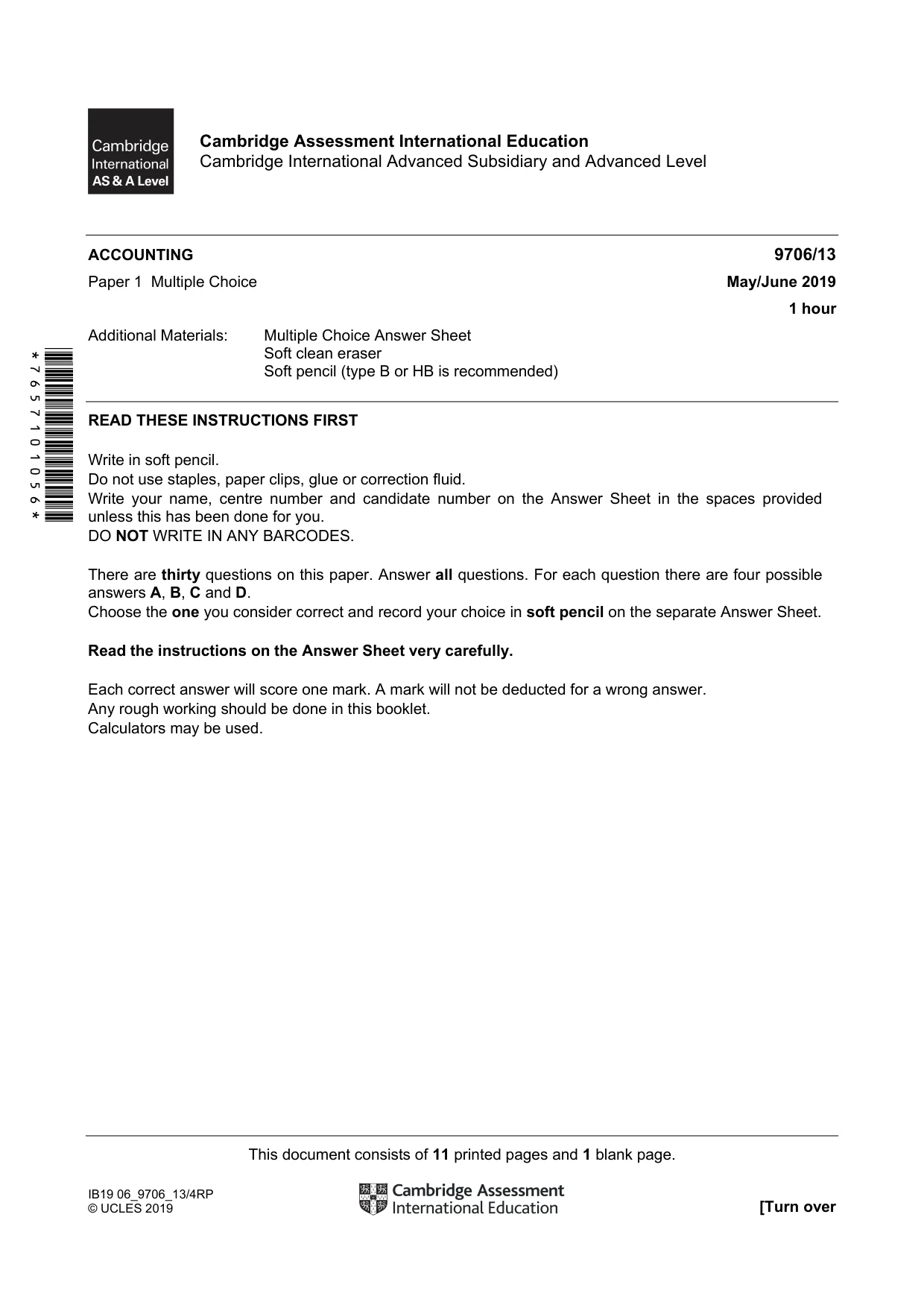
Cambridge A Level Accounting 9706 — 2019 May/June Paper 1 · Variant 3
9706/13/M/J/19 · 30 questions · 30 marks · ≈34 min
The question paper and its mark scheme, free to read here and free to download. This is Cambridge’s own paper, exactly as it was sat.
Question paper12 pages
Mark scheme3 pages
Answers below. Sit the paper first if you are practising.
Questions as text
Q1 · When valuing inventory for inclusion in the financial statements, its selling price is…
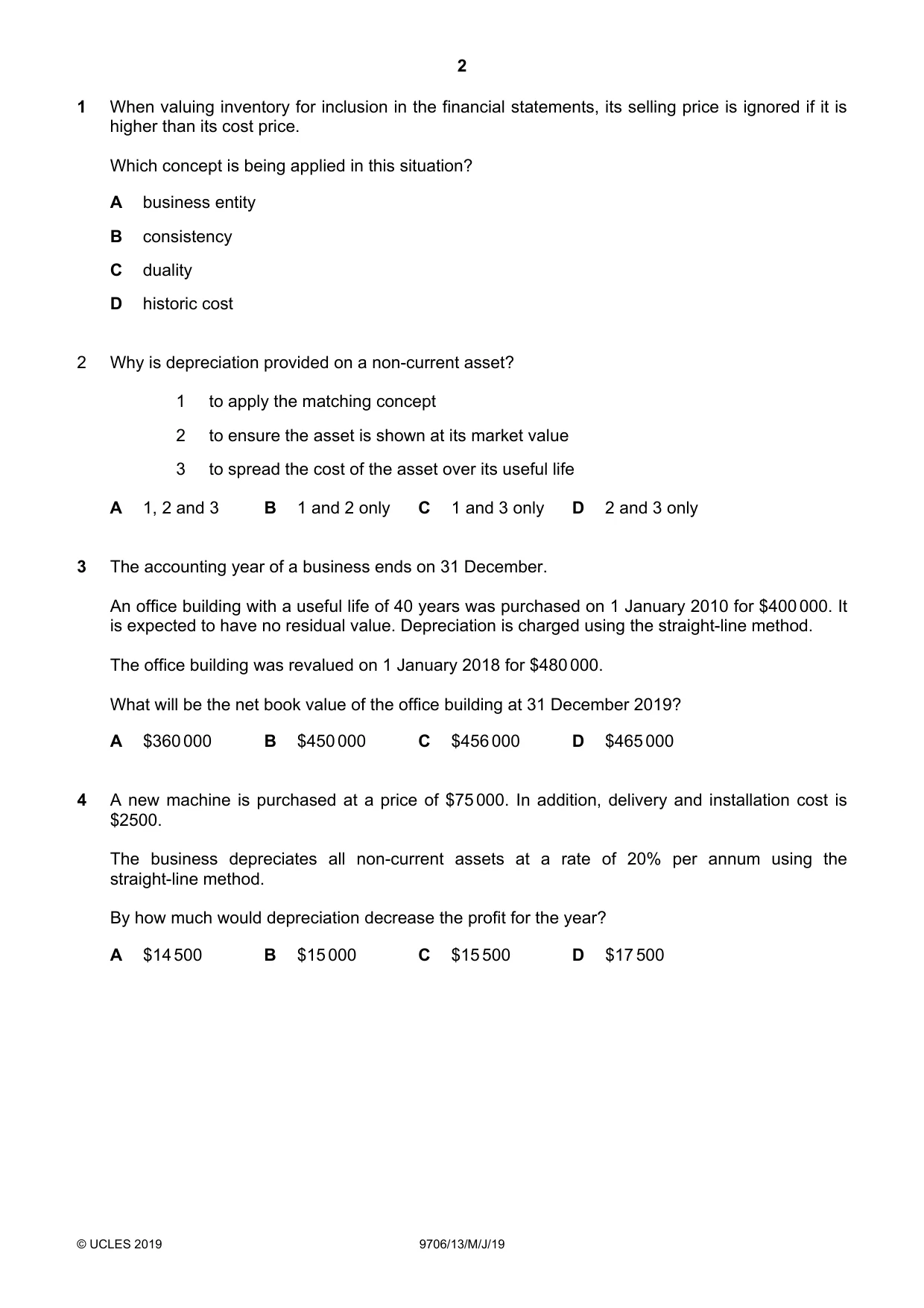
1 When valuing inventory for inclusion in the financial statements, its selling price is ignored if it is higher than its cost price. Which concept is being applied in this situation? A business entity B consistency C duality D historic cost
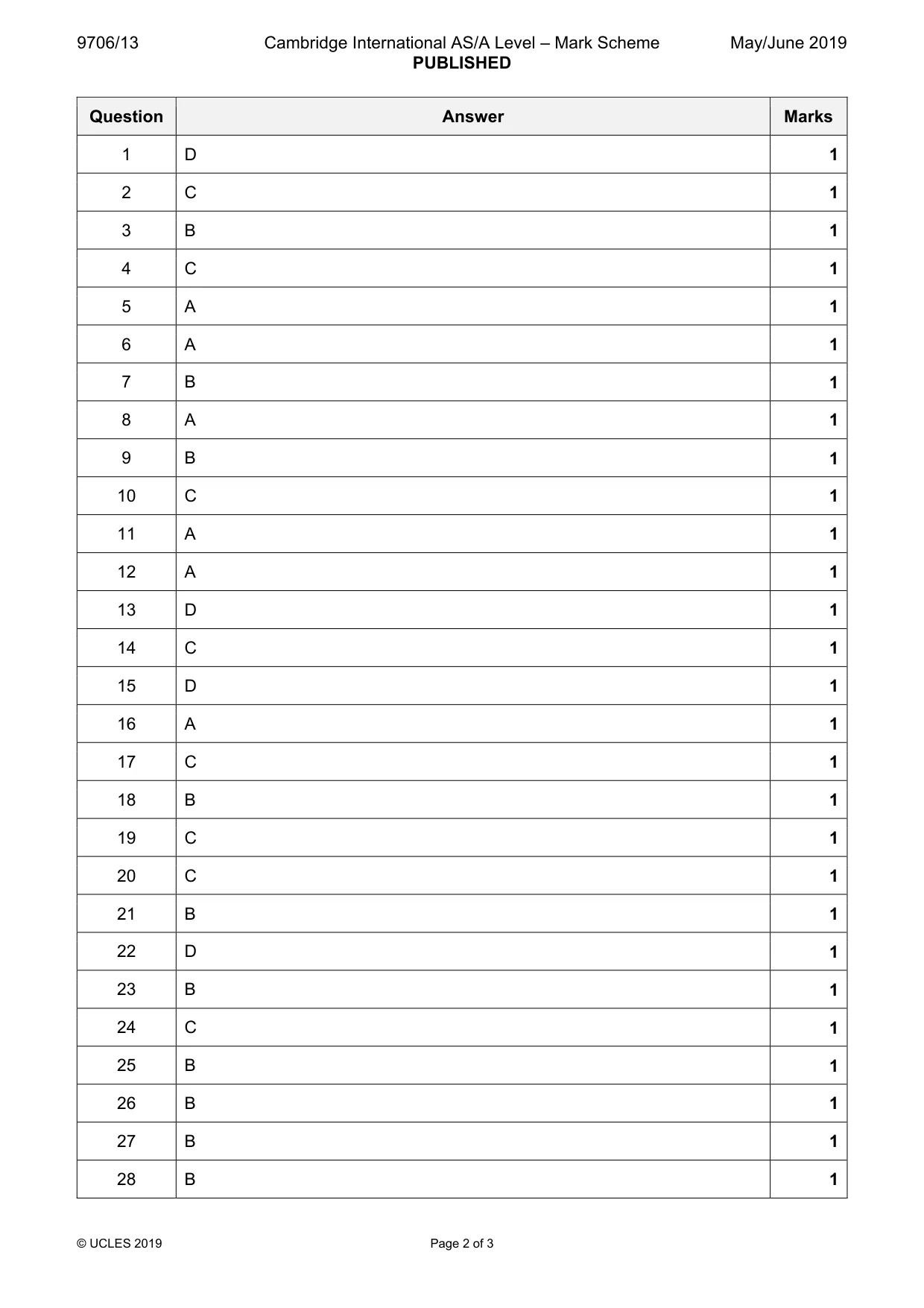
Mark scheme: D
Q2 · Why is depreciation provided on a non-current asset?
2 Why is depreciation provided on a non-current asset? 1 to apply the matching concept 2 to ensure the asset is shown at its market value 3 to spread the cost of the asset over its useful life A 1, 2 and 3 B 1 and 2 only C 1 and 3 only D 2 and 3 only
Mark scheme: C
Q3 · The accounting year of a business ends on 31 December
3 The accounting year of a business ends on 31 December. An office building with a useful life of 40 years was purchased on 1 January 2010 for $400 000. It is expected to have no residual value. Depreciation is charged using the straight-line method. The office building was revalued on 1 January 2018 for $480 000. What will be the net book value of the office building at 31 December 2019? A $360 000 B $450 000 C $456 000 D $465 000
Mark scheme: B
Q4 · A new machine is purchased at a price of $75 000
4 A new machine is purchased at a price of $75 000. In addition, delivery and installation cost is $2500. The business depreciates all non-current assets at a rate of 20% per annum using the straight-line method. By how much would depreciation decrease the profit for the year? A $14 500 B $15 000 C $15 500 D $17 500
Mark scheme: C
Q5 · The sales ledger control account of a business had a closing balance of $21 650
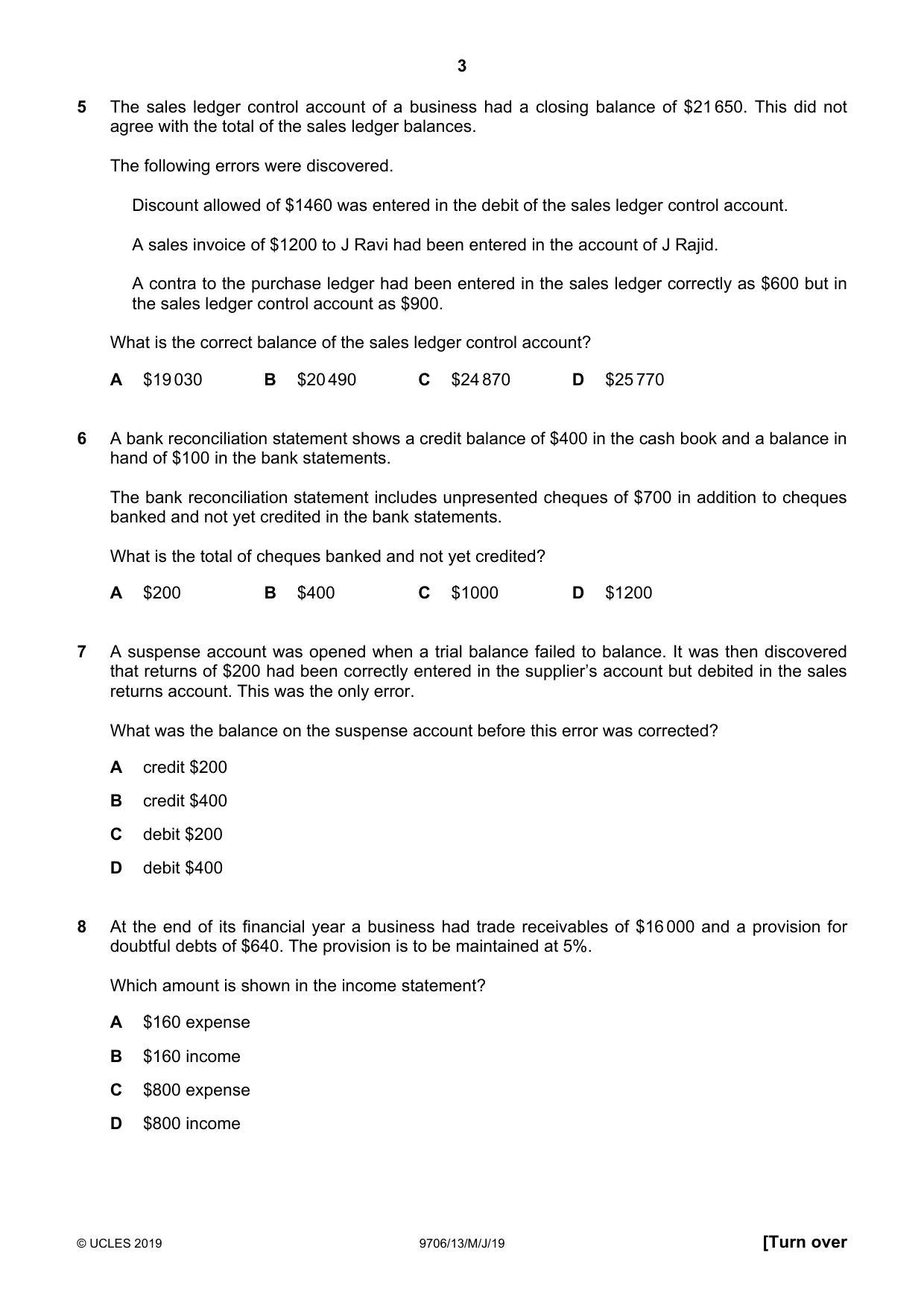
5 The sales ledger control account of a business had a closing balance of $21 650. This did not agree with the total of the sales ledger balances. The following errors were discovered. Discount allowed of $1460 was entered in the debit of the sales ledger control account. A sales invoice of $1200 to J Ravi had been entered in the account of J Rajid. A contra to the purchase ledger had been entered in the sales ledger correctly as $600 but in the sales ledger control account as $900. What is the correct balance of the sales ledger control account? A $19 030 B $20 490 C $24 870 D $25 770
Mark scheme: A
Q6 · A bank reconciliation statement shows a credit balance of $400 in the cash book and a…
6 A bank reconciliation statement shows a credit balance of $400 in the cash book and a balance in hand of $100 in the bank statements. The bank reconciliation statement includes unpresented cheques of $700 in addition to cheques banked and not yet credited in the bank statements. What is the total of cheques banked and not yet credited? A $200 B $400 C $1000 D $1200
Mark scheme: A
Q7 · A suspense account was opened when a trial balance failed to balance
7 A suspense account was opened when a trial balance failed to balance. It was then discovered that returns of $200 had been correctly entered in the supplier’s account but debited in the sales returns account. This was the only error. What was the balance on the suspense account before this error was corrected? A credit $200 B credit $400 C debit $200 D debit $400
Mark scheme: B
Q8 · At the end of its financial year a business had trade receivables of $16 000 and a…
8 At the end of its financial year a business had trade receivables of $16 000 and a provision for doubtful debts of $640. The provision is to be maintained at 5%. Which amount is shown in the income statement? A $160 expense B $160 income C $800 expense D $800 income
Mark scheme: A
Q9 · A business provided the following information about general expenses for the year ended…
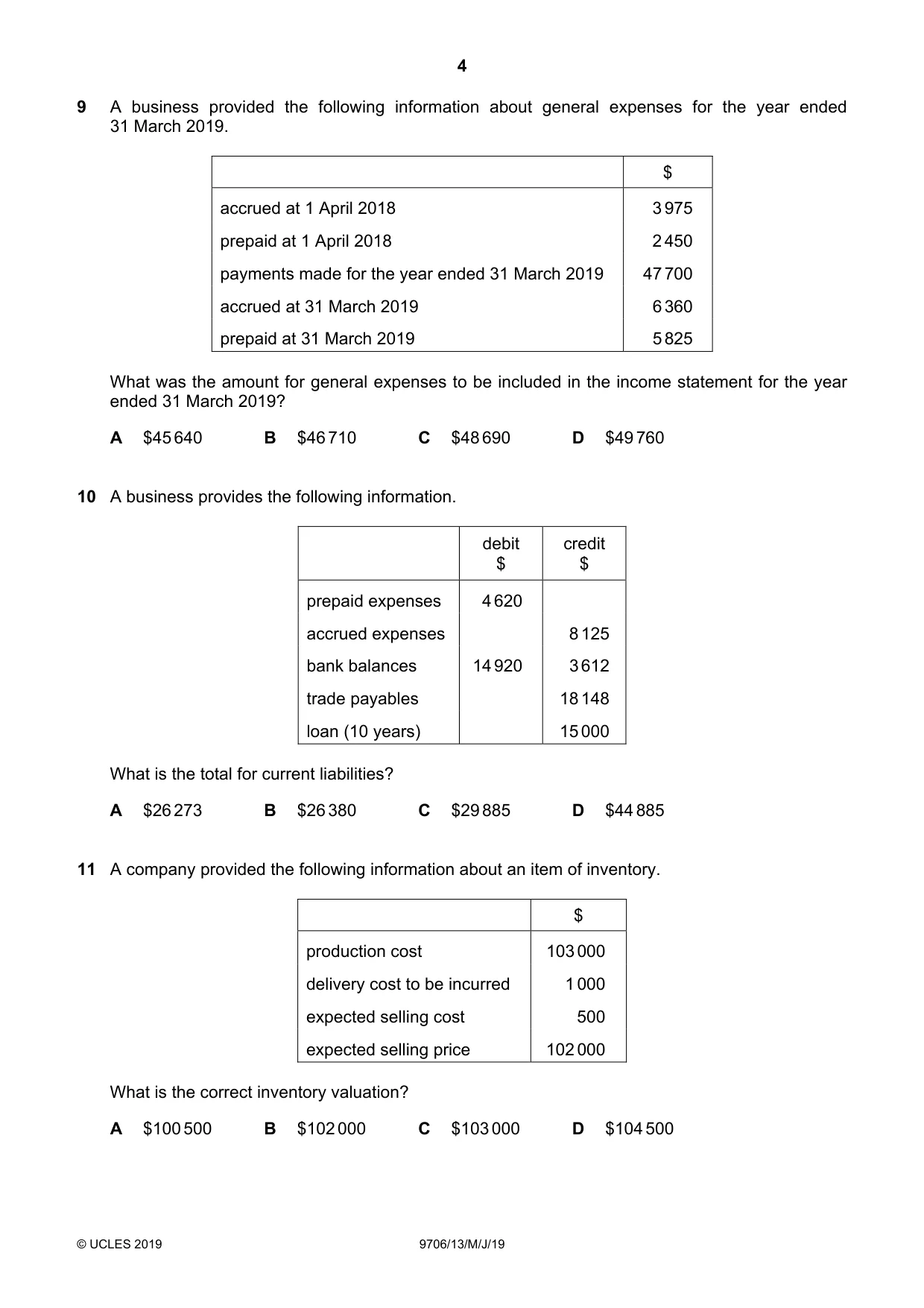
9 A business provided the following information about general expenses for the year ended 31 March 2019. $ accrued at 1 April 2018 3 975 prepaid at 1 April 2018 2 450 payments made for the year ended 31 March 2019 47 700 accrued at 31 March 2019 6 360 prepaid at 31 March 2019 5 825 What was the amount for general expenses to be included in the income statement for the year ended 31 March 2019? A $45 640 B $46 710 C $48 690 D $49 760
Mark scheme: B
Q10 · A business provides the following information
10 A business provides the following information. debit credit $ $ prepaid expenses 4 620 accrued expenses 8 125 bank balances 14 920 3 612 trade payables 18 148 loan (10 years) 15 000 What is the total for current liabilities? A $26 273 B $26 380 C $29 885 D $44 885
Mark scheme: C
Q11 · A company provided the following information about an item of inventory
11 A company provided the following information about an item of inventory. $ production cost 103 000 delivery cost to be incurred 1 000 expected selling cost 500 expected selling price 102 000 What is the correct inventory valuation? A $100 500 B $102 000 C $103 000 D $104 500
Mark scheme: A
Q12 · Goodwill is adjusted in partners’ accounts when there is a change in the profit sharing…
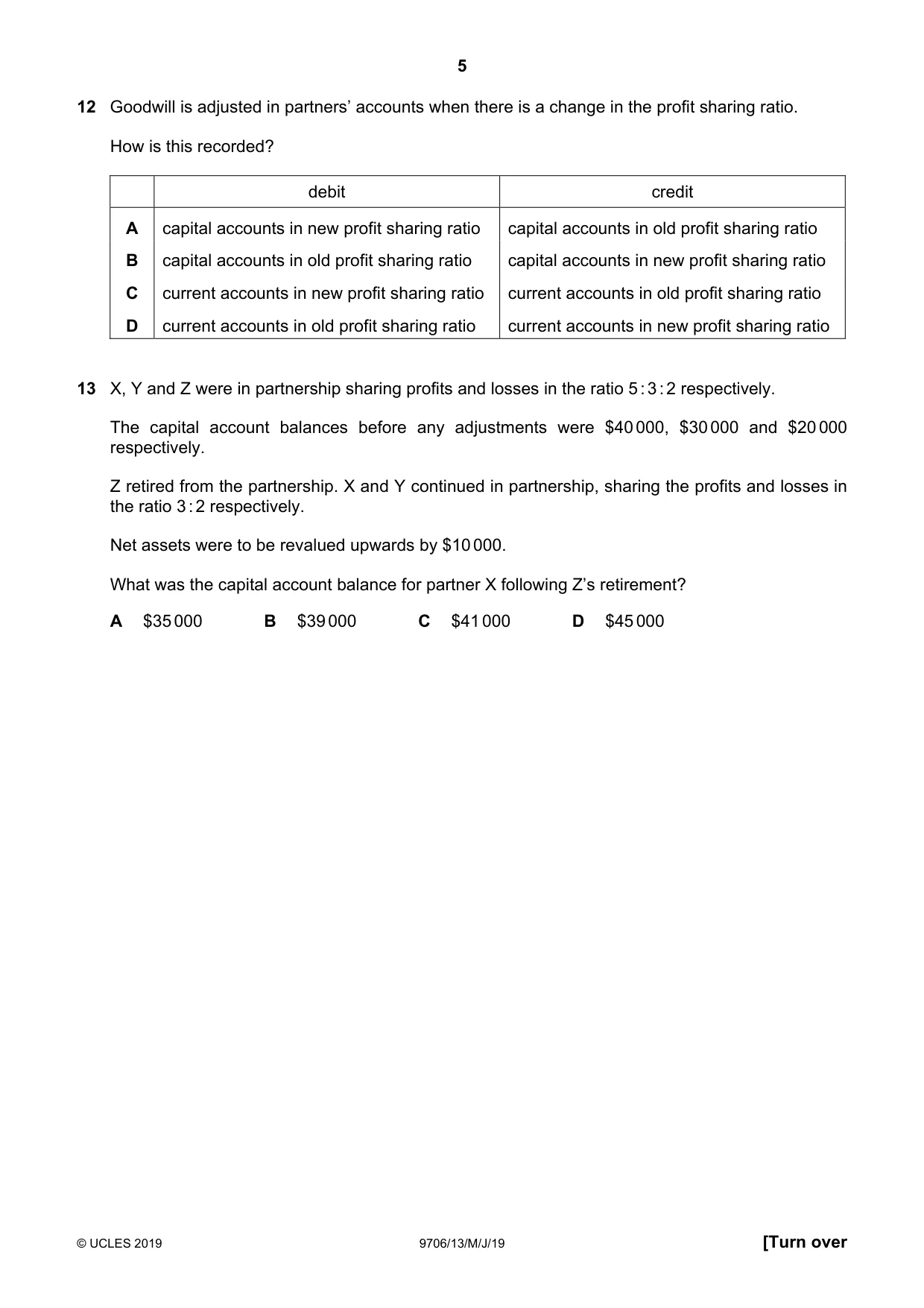
12 Goodwill is adjusted in partners’ accounts when there is a change in the profit sharing ratio. How is this recorded? debit credit A capital accounts in new profit sharing ratio capital accounts in old profit sharing ratio B capital accounts in old profit sharing ratio capital accounts in new profit sharing ratio C current accounts in new profit sharing ratio current accounts in old profit sharing ratio D current accounts in old profit sharing ratio current accounts in new profit sharing ratio
Mark scheme: A
Q13 · X, Y and Z were in partnership sharing profits and losses in the ratio 5 : 3 : 2…
13 X, Y and Z were in partnership sharing profits and losses in the ratio 5 : 3 : 2 respectively. The capital account balances before any adjustments were $40 000, $30 000 and $20 000 respectively. Z retired from the partnership. X and Y continued in partnership, sharing the profits and losses in the ratio 3 : 2 respectively. Net assets were to be revalued upwards by $10 000. What was the capital account balance for partner X following Z’s retirement? A $35 000 B $39 000 C $41 000 D $45 000
Mark scheme: D
Q14 · L and M are business partners sharing profits and losses in the ratio 2 : 1
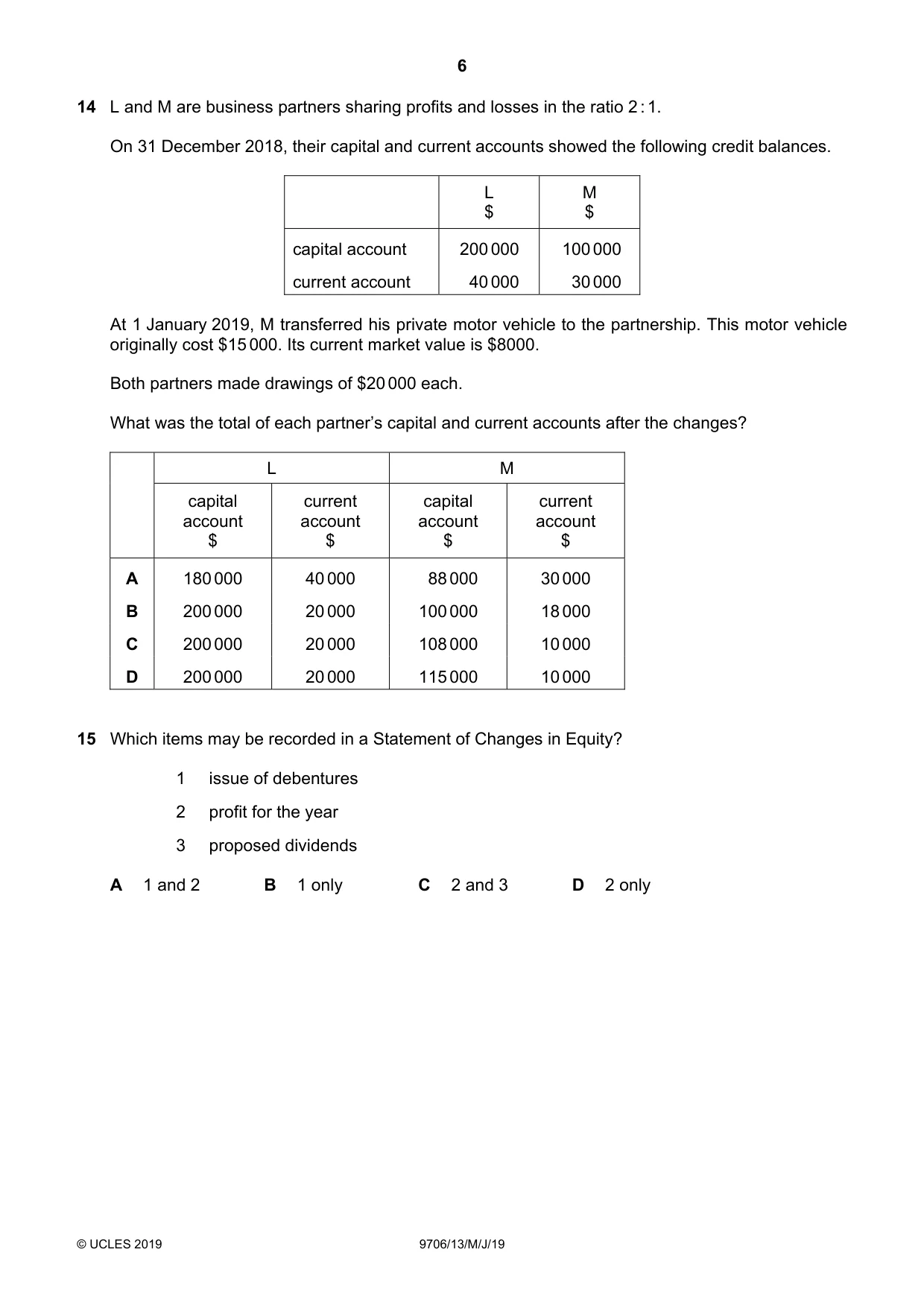
14 L and M are business partners sharing profits and losses in the ratio 2 : 1. On 31 December 2018, their capital and current accounts showed the following credit balances. L M $ $ capital account 200 000 100 000 current account 40 000 30 000 At 1 January 2019, M transferred his private motor vehicle to the partnership. This motor vehicle originally cost $15 000. Its current market value is $8000. Both partners made drawings of $20 000 each. What was the total of each partner’s capital and current accounts after the changes? L M capital current capital current account account account account $ $ $ $ A 180 000 40 000 88 000 30 000 B 200 000 20 000 100 000 18 000 C 200 000 20 000 108 000 10 000 D 200 000 20 000 115 000 10 000
Mark scheme: C
Q15 · Which items may be recorded in a Statement of Changes in Equity?
15 Which items may be recorded in a Statement of Changes in Equity? 1 issue of debentures 2 profit for the year 3 proposed dividends A 1 and 2 B 1 only C 2 and 3 D 2 only
Mark scheme: D
Q16 · The equity of a company included the following: $ ordinary shares of $1 each 1 500 000…
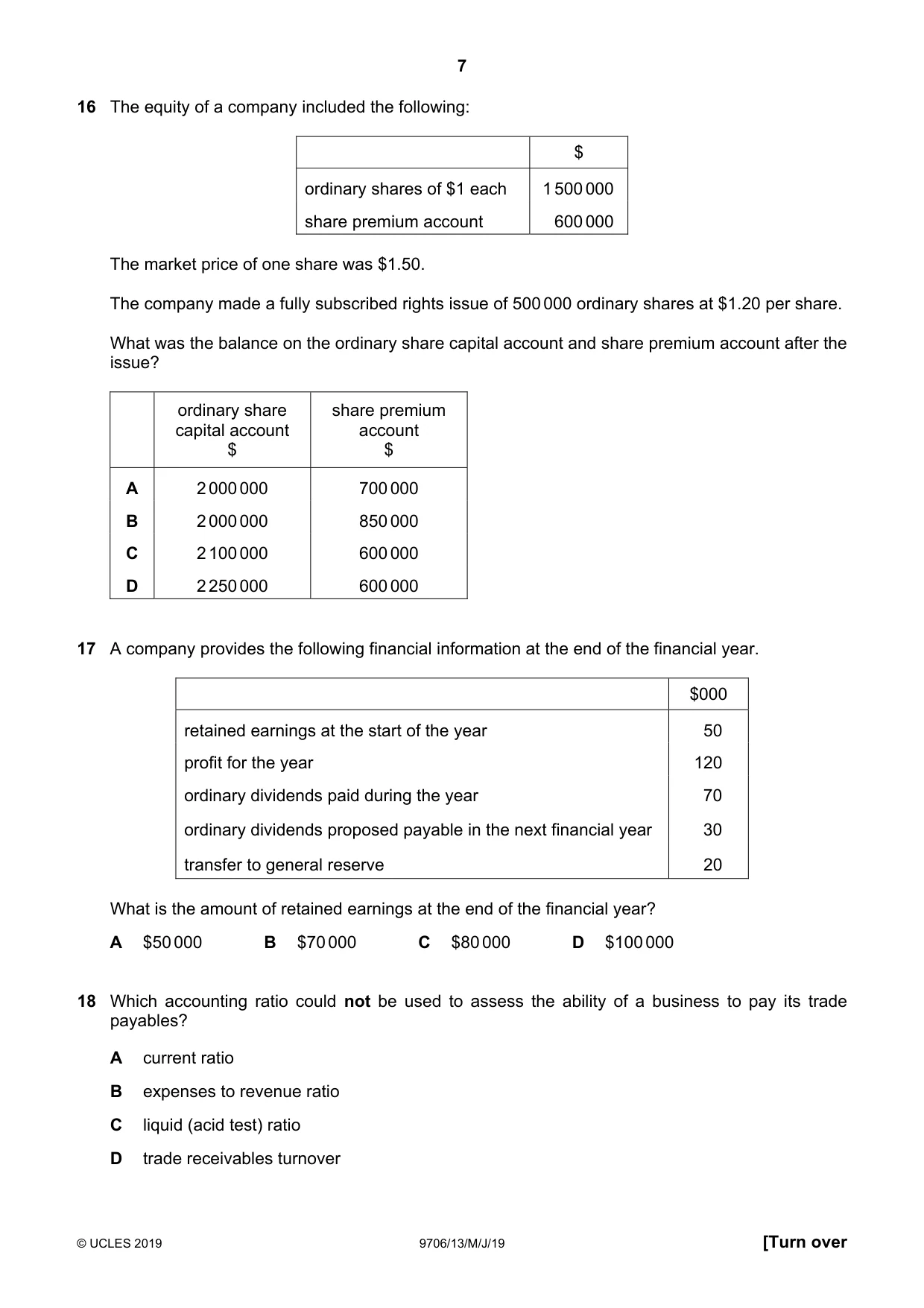
16 The equity of a company included the following: $ ordinary shares of $1 each 1 500 000 share premium account 600 000 The market price of one share was $1.50. The company made a fully subscribed rights issue of 500 000 ordinary shares at $1.20 per share. What was the balance on the ordinary share capital account and share premium account after the issue? ordinary share share premium capital account account $ $ A 2 000 000 700 000 B 2 000 000 850 000 C 2 100 000 600 000 D 2 250 000 600 000
Mark scheme: A
Q17 · A company provides the following financial information at the end of the financial year
17 A company provides the following financial information at the end of the financial year. $000 retained earnings at the start of the year 50 profit for the year 120 ordinary dividends paid during the year 70 ordinary dividends proposed payable in the next financial year 30 transfer to general reserve 20 What is the amount of retained earnings at the end of the financial year? A $50 000 B $70 000 C $80 000 D $100 000
Mark scheme: C
Q18 · Which accounting ratio could not be used to assess the ability of a business to pay its…
18 Which accounting ratio could not be used to assess the ability of a business to pay its trade payables? A current ratio B expenses to revenue ratio C liquid (acid test) ratio D trade receivables turnover
Mark scheme: B
More questions on Analysis and communication of accounting information
Q19 · A sole trader has provided the following information
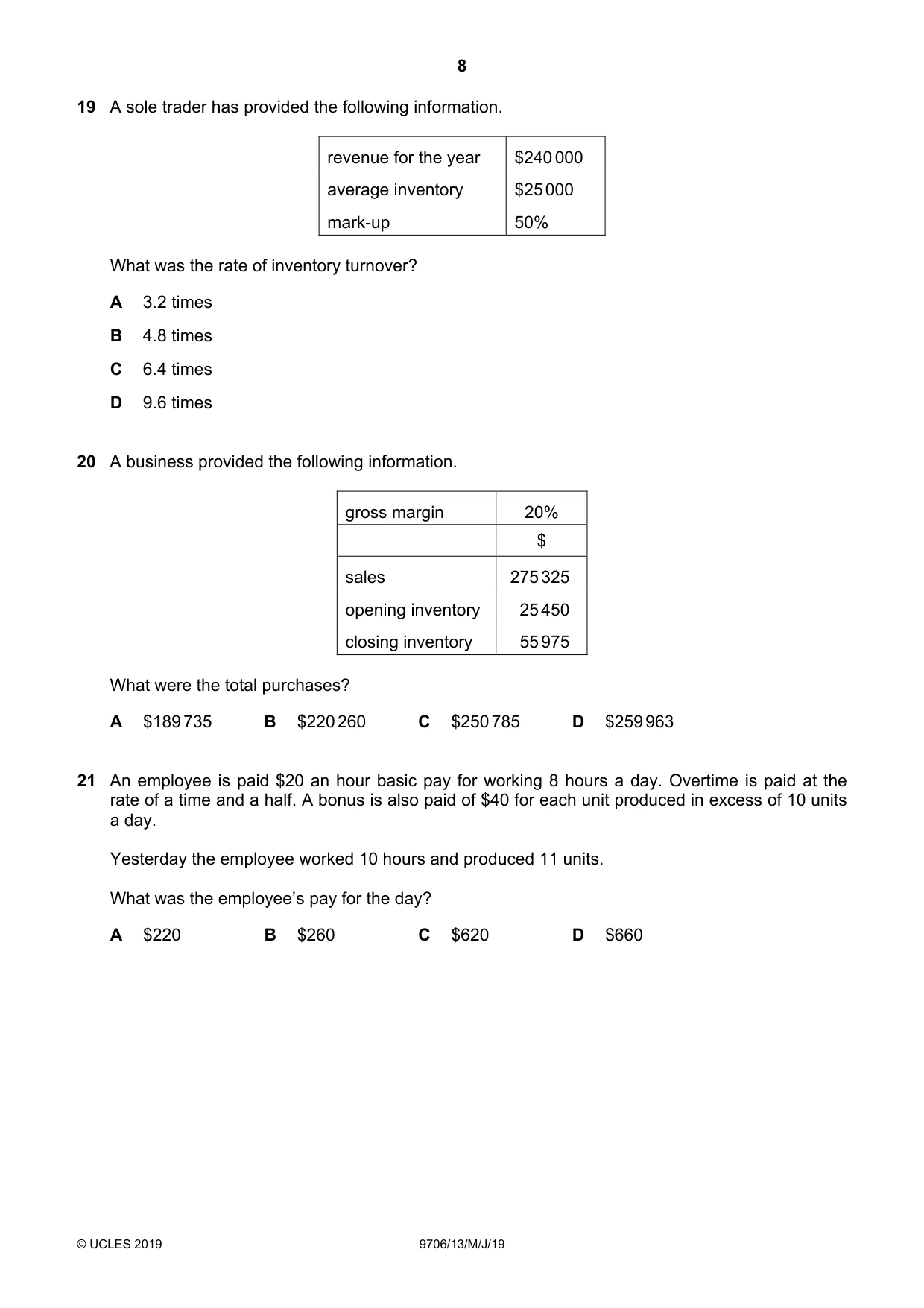
19 A sole trader has provided the following information. revenue for the year $240 000 average inventory $25 000 mark-up 50% What was the rate of inventory turnover? A 3.2 times B 4.8 times C 6.4 times D 9.6 times
Mark scheme: C
More questions on Analysis and communication of accounting information
Q20 · A business provided the following information
20 A business provided the following information. gross margin 20% $ sales 275 325 opening inventory 25 450 closing inventory 55 975 What were the total purchases? A $189 735 B $220 260 C $250 785 D $259 963
Mark scheme: C
More questions on Analysis and communication of accounting information
Q21 · An employee is paid $20 an hour basic pay for working 8 hours a day
21 An employee is paid $20 an hour basic pay for working 8 hours a day. Overtime is paid at the rate of a time and a half. A bonus is also paid of $40 for each unit produced in excess of 10 units a day. Yesterday the employee worked 10 hours and produced 11 units. What was the employee’s pay for the day? A $220 B $260 C $620 D $660
Mark scheme: B
Q22 · The following information relates to one accounting period
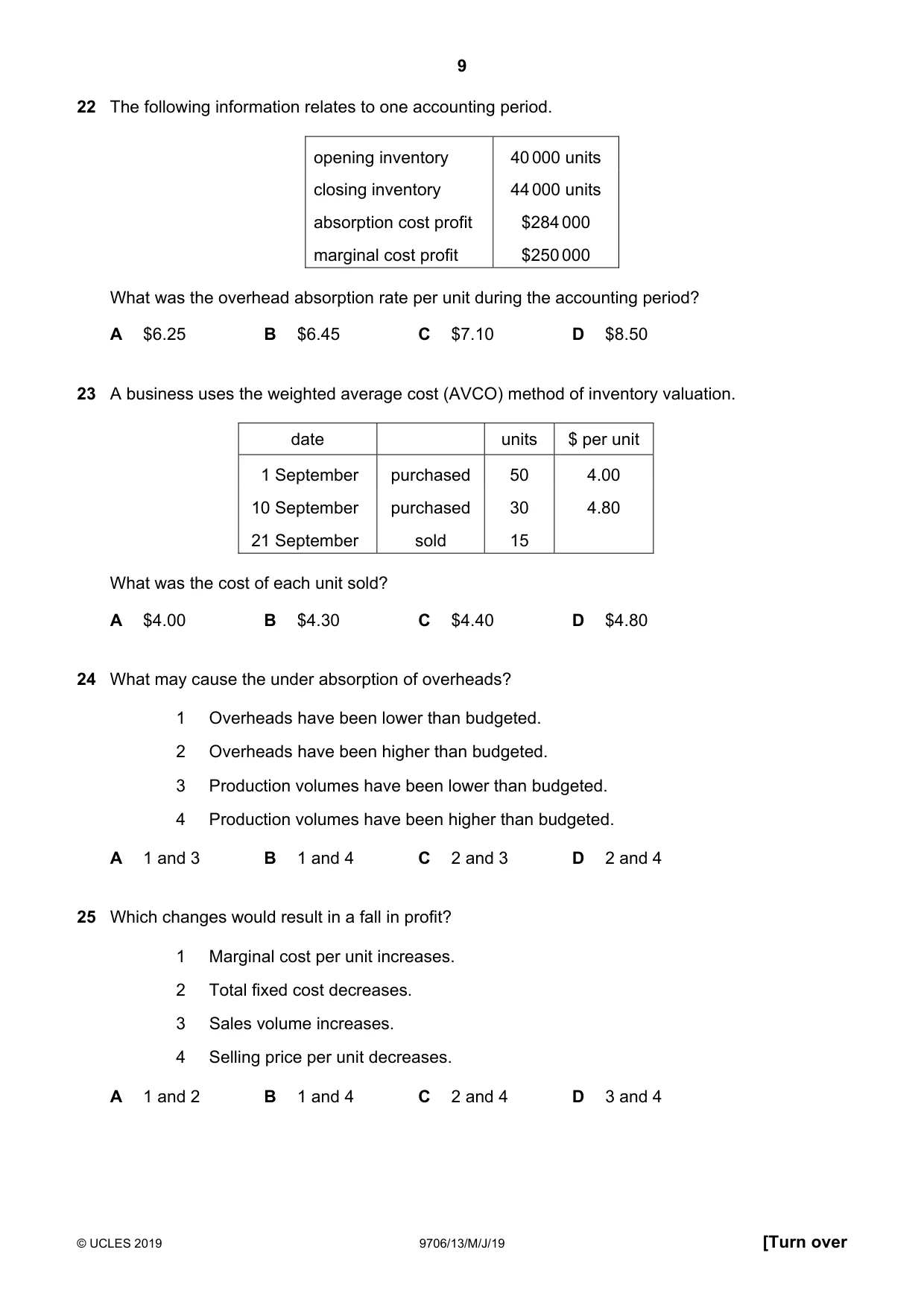
22 The following information relates to one accounting period. opening inventory 40 000 units closing inventory 44 000 units absorption cost profit $284 000 marginal cost profit $250 000 What was the overhead absorption rate per unit during the accounting period? A $6.25 B $6.45 C $7.10 D $8.50
Mark scheme: D
Q23 · A business uses the weighted average cost (AVCO) method of inventory valuation
23 A business uses the weighted average cost (AVCO) method of inventory valuation. date units $ per unit 1 September purchased 50 4.00 10 September purchased 30 4.80 21 September sold 15 What was the cost of each unit sold? A $4.00 B $4.30 C $4.40 D $4.80
Mark scheme: B
Q24 · What may cause the under absorption of overheads?
24 What may cause the under absorption of overheads? 1 Overheads have been lower than budgeted. 2 Overheads have been higher than budgeted. 3 Production volumes have been lower than budgeted. 4 Production volumes have been higher than budgeted. A 1 and 3 B 1 and 4 C 2 and 3 D 2 and 4
Mark scheme: C
Q25 · Which changes would result in a fall in profit?
25 Which changes would result in a fall in profit? 1 Marginal cost per unit increases. 2 Total fixed cost decreases. 3 Sales volume increases. 4 Selling price per unit decreases. A 1 and 2 B 1 and 4 C 2 and 4 D 3 and 4
Mark scheme: B
Q26 · Last month a business sold 10 000 units and made a total contribution of $60 000
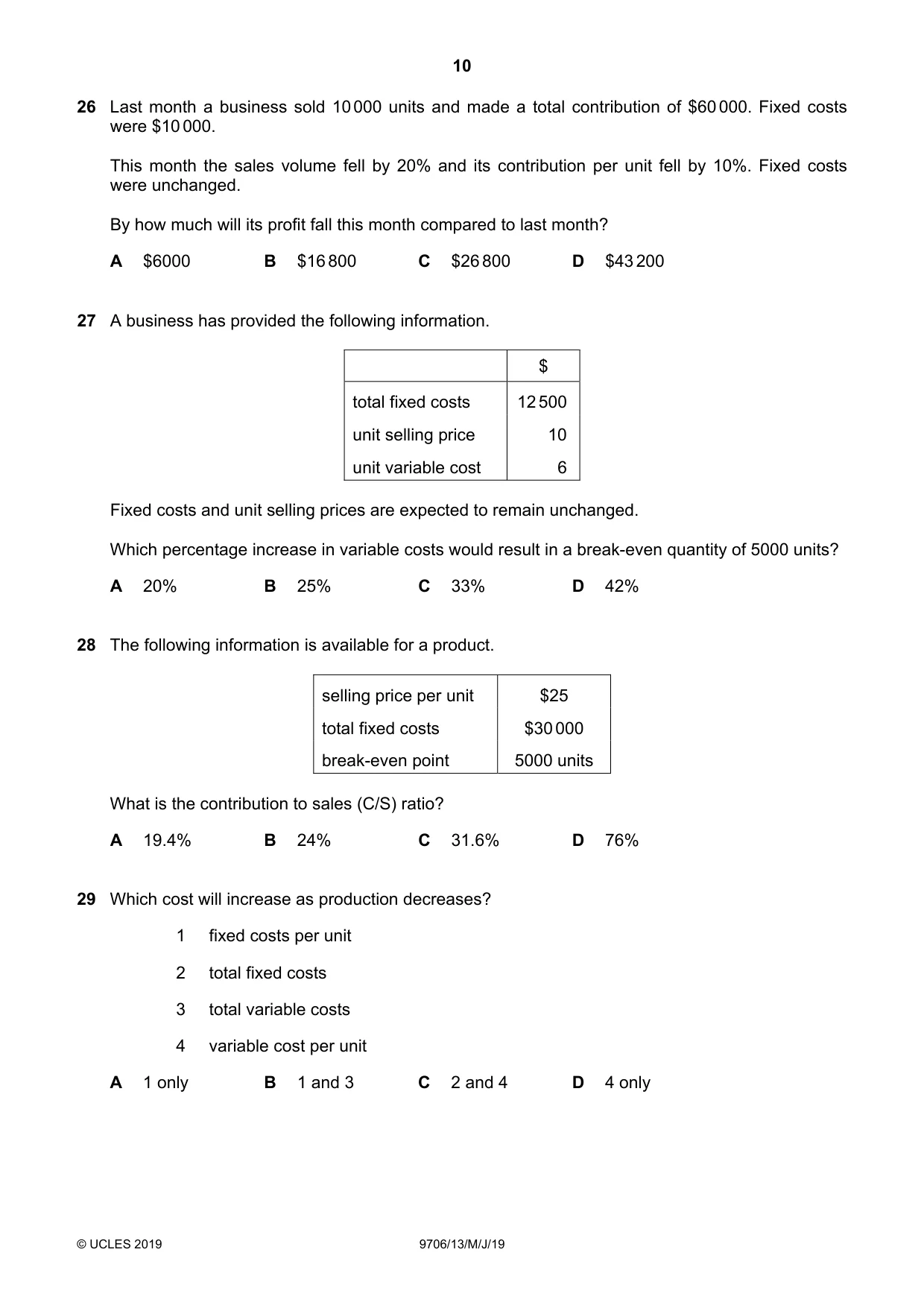
26 Last month a business sold 10 000 units and made a total contribution of $60 000. Fixed costs were $10 000. This month the sales volume fell by 20% and its contribution per unit fell by 10%. Fixed costs were unchanged. By how much will its profit fall this month compared to last month? A $6000 B $16 800 C $26 800 D $43 200
Mark scheme: B
Q27 · A business has provided the following information
27 A business has provided the following information. $ total fixed costs 12 500 unit selling price 10 unit variable cost 6 Fixed costs and unit selling prices are expected to remain unchanged. Which percentage increase in variable costs would result in a break-even quantity of 5000 units? A 20% B 25% C 33% D 42%
Mark scheme: B
Q28 · The following information is available for a product
28 The following information is available for a product. selling price per unit $25 total fixed costs $30 000 break-even point 5000 units What is the contribution to sales (C/S) ratio? A 19.4% B 24% C 31.6% D 76%
Mark scheme: B
Q29 · Which cost will increase as production decreases?
29 Which cost will increase as production decreases? 1 fixed costs per unit 2 total fixed costs 3 total variable costs 4 variable cost per unit A 1 only B 1 and 3 C 2 and 4 D 4 only
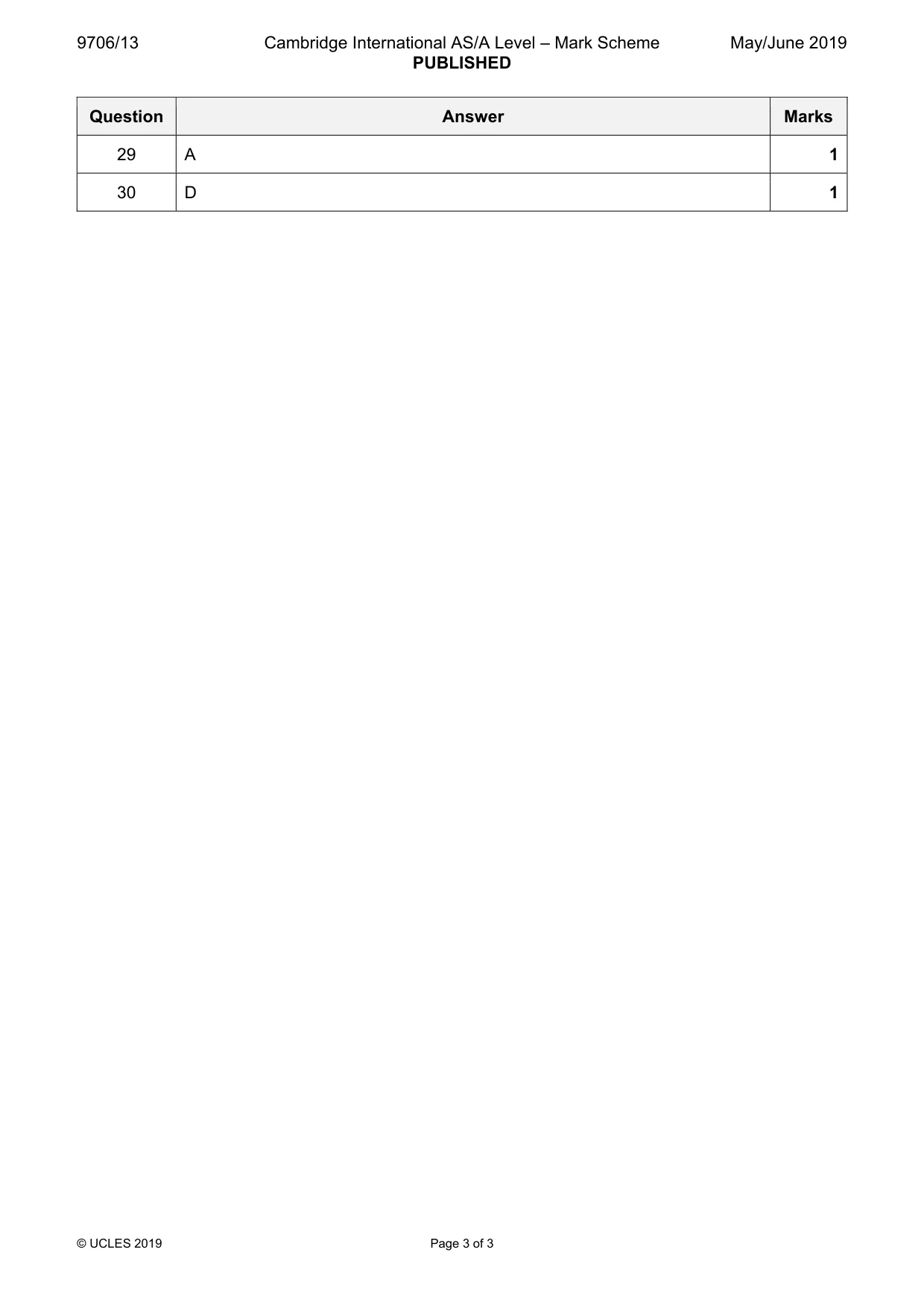
Mark scheme: A
Q30 · Which statements concerning a budget are correct?
30 Which statements concerning a budget are correct? 1 It is always based upon historic data. 2 It is always prepared for a year ahead. 3 It needs the full commitment of all managers in order to work well. 4 It is used for planning and control of a business. A 1 and 2 B 1 and 3 C 2 and 4 D 3 and 4
Mark scheme: D
What was in this paper
The subtopics covered by these 30 questions, and how many questions each got. Open one in a new tab to see every Cambridge question on it.
What you needed in this session
Cambridge’s own grade thresholds for 2019 May/June, Paper 1 · Variant 3. A higher threshold means an easier paper — the bar moves with how the cohort did.