Cambridge A Level Accounting 9706 — 2011 Oct/Nov Paper 1 · Variant 2
9706/12/O/N/11 · 30 questions · 30 marks · ≈34 min
The question paper and its mark scheme, free to read here and free to download. This is Cambridge’s own paper, exactly as it was sat.
Question paper12 pages
Mark scheme2 pages
Answers below. Sit the paper first if you are practising.
Questions as text
Q1 · The table gives data about rental income for the year ended 31 March 2011
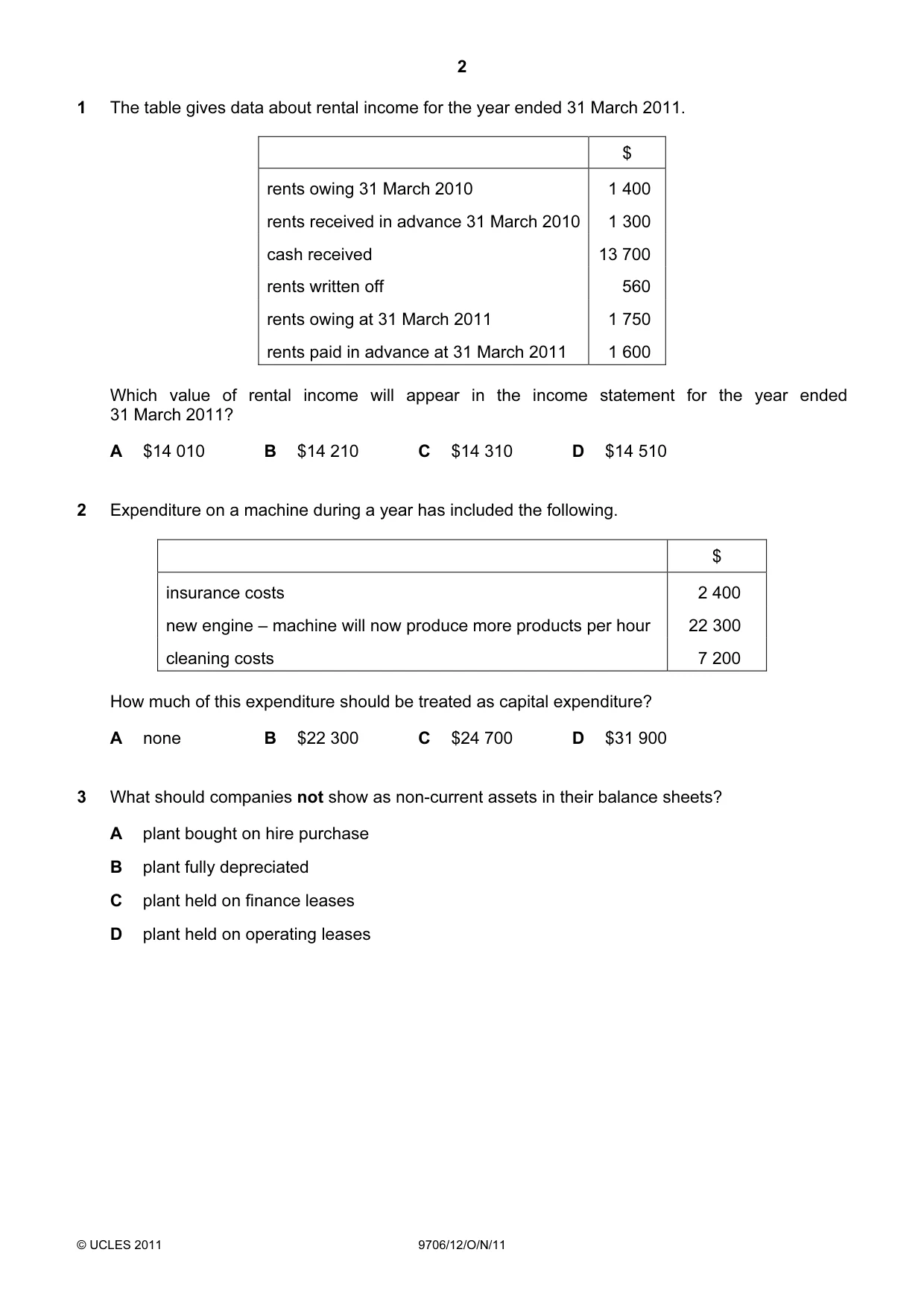
1 The table gives data about rental income for the year ended 31 March 2011. $ rents owing 31 March 2010 1 400 rents received in advance 31 March 2010 1 300 cash received 13 700 rents written off 560 rents owing at 31 March 2011 1 750 rents paid in advance at 31 March 2011 1 600 Which value of rental income will appear in the income statement for the year ended 31 March 2011? A $14 010 B $14 210 C $14 310 D $14 510
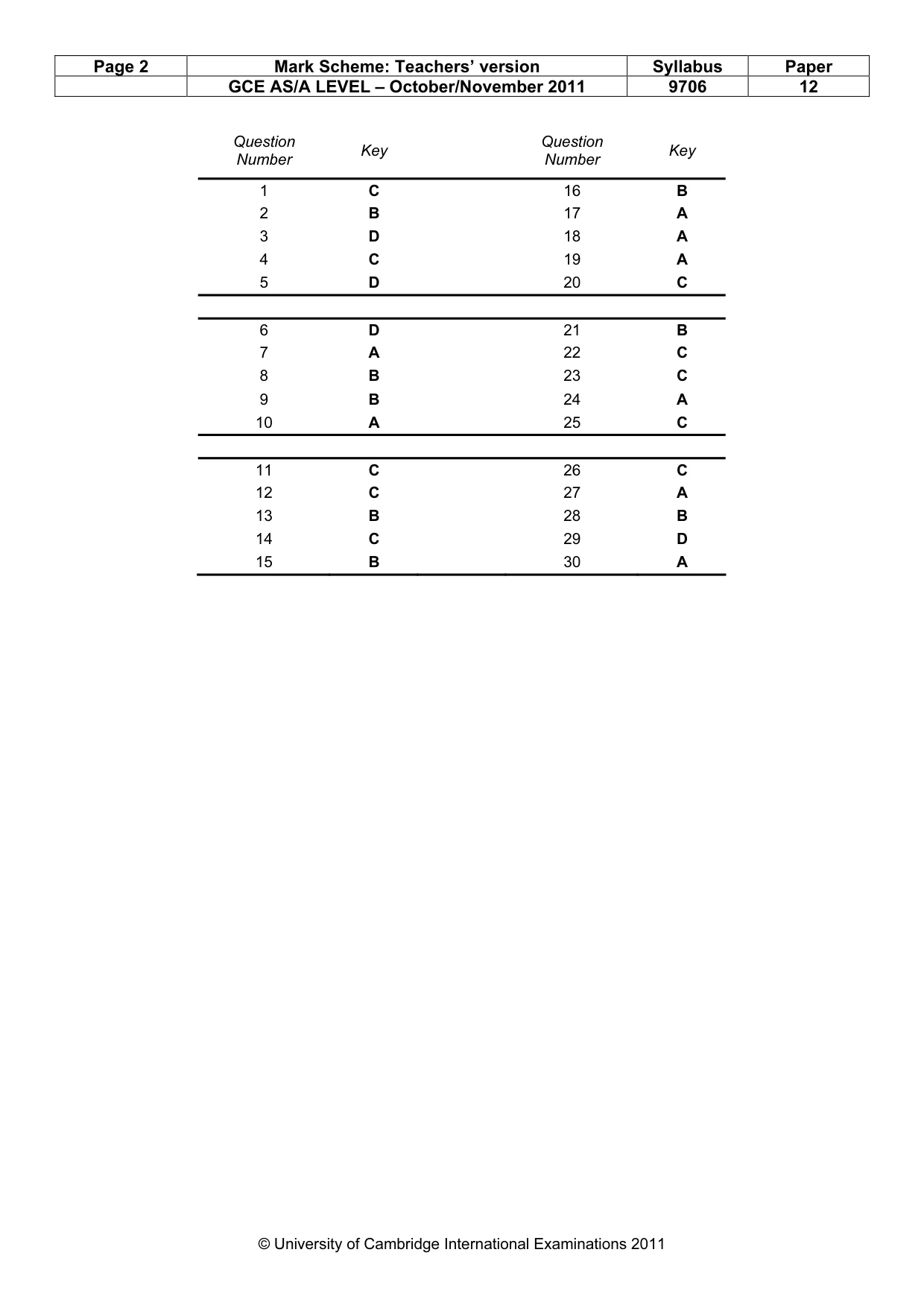
Mark scheme: C
Q2 · Expenditure on a machine during a year has included the following
2 Expenditure on a machine during a year has included the following. $ insurance costs 2 400 new engine – machine will now produce more products per hour 22 300 cleaning costs 7 200 How much of this expenditure should be treated as capital expenditure? A none B $22 300 C $24 700 D $31 900
Mark scheme: B
Q3 · What should companies not show as non-current assets in their balance sheets?
3 What should companies not show as non-current assets in their balance sheets? A plant bought on hire purchase B plant fully depreciated C plant held on finance leases D plant held on operating leases
Mark scheme: D
Q4 · Which accounting policies illustrate the matching principle?
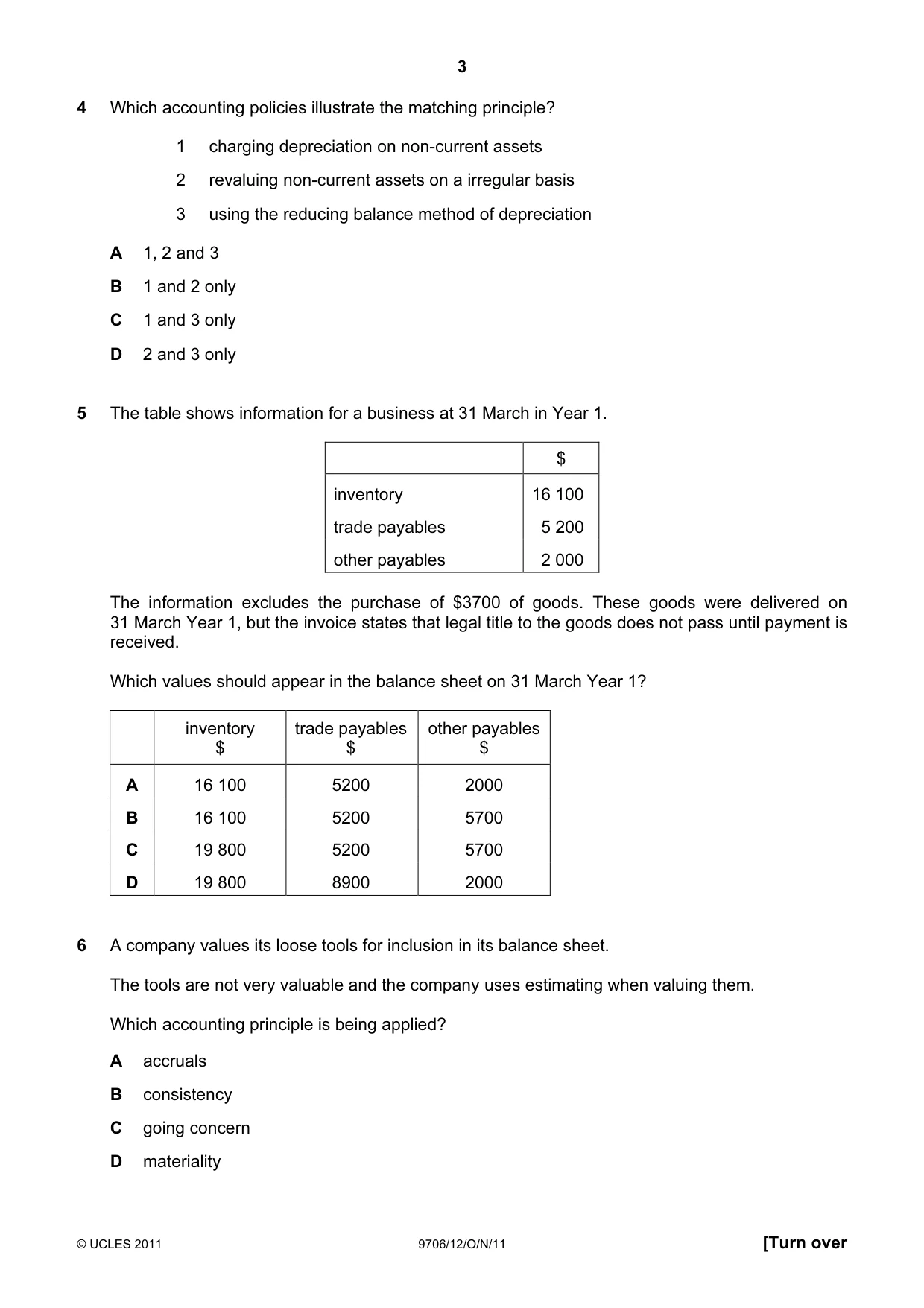
4 Which accounting policies illustrate the matching principle? 1 charging depreciation on non-current assets 2 revaluing non-current assets on a irregular basis 3 using the reducing balance method of depreciation A 1, 2 and 3 B 1 and 2 only C 1 and 3 only D 2 and 3 only
Mark scheme: C
Q5 · The table shows information for a business at 31 March in Year 1
5 The table shows information for a business at 31 March in Year 1. $ inventory 16 100 trade payables 5 200 other payables 2 000 The information excludes the purchase of $3700 of goods. These goods were delivered on 31 March Year 1, but the invoice states that legal title to the goods does not pass until payment is received. Which values should appear in the balance sheet on 31 March Year 1? inventory trade payables other payables $ $ $ A 16 100 5200 2000 B 16 100 5200 5700 C 19 800 5200 5700 D 19 800 8900 2000
Mark scheme: D
Q6 · A company values its loose tools for inclusion in its balance sheet
6 A company values its loose tools for inclusion in its balance sheet. The tools are not very valuable and the company uses estimating when valuing them. Which accounting principle is being applied? A accruals B consistency C going concern D materiality
Mark scheme: D
Q7 · The following items are recorded in the cash book of a business but not yet recorded in…
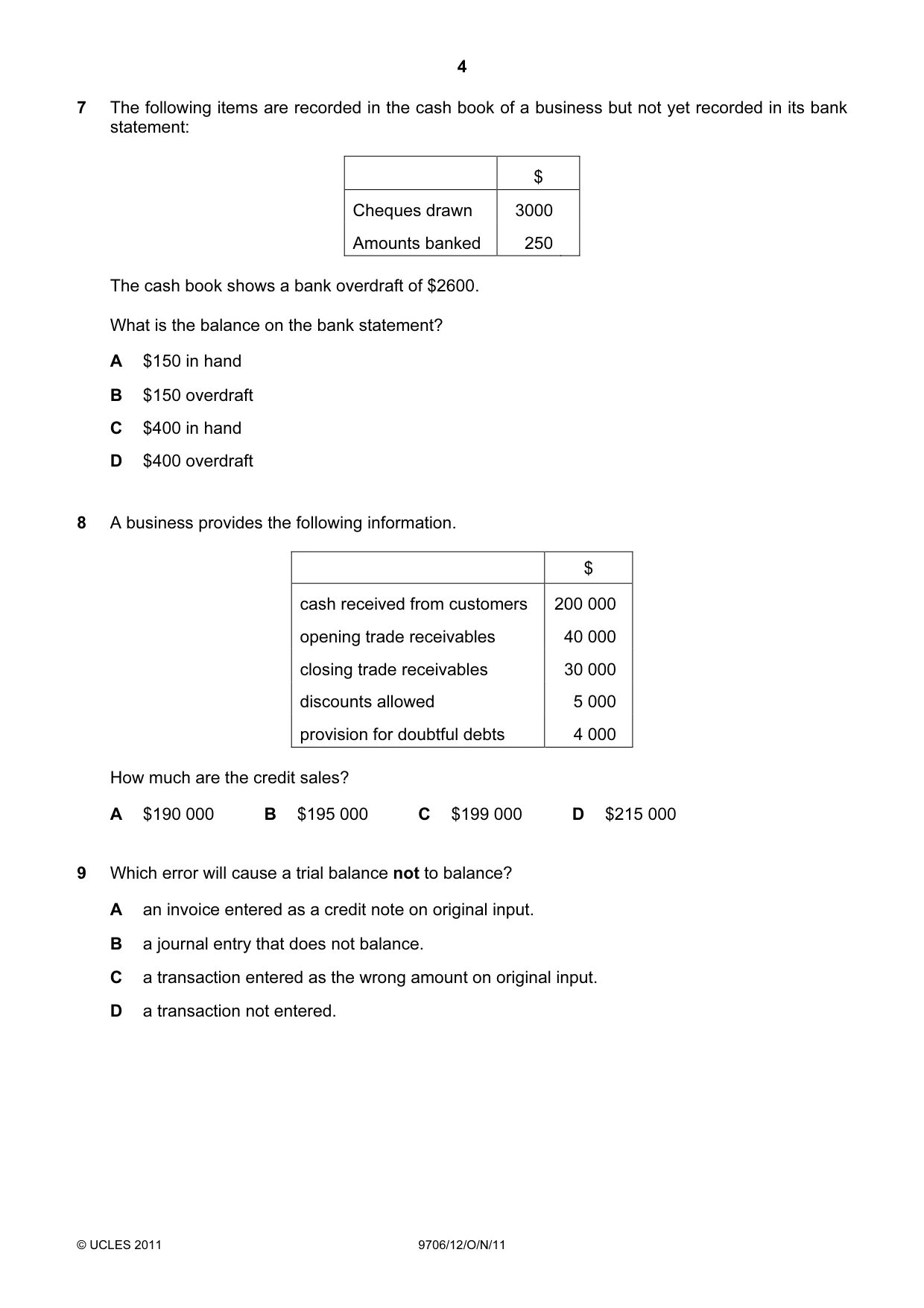
7 The following items are recorded in the cash book of a business but not yet recorded in its bank statement: $ Cheques drawn 3000 Amounts banked 250 The cash book shows a bank overdraft of $2600. What is the balance on the bank statement? A $150 in hand B $150 overdraft C $400 in hand D $400 overdraft
Mark scheme: A
Q8 · A business provides the following information
8 A business provides the following information. $ cash received from customers 200 000 opening trade receivables 40 000 closing trade receivables 30 000 discounts allowed 5 000 provision for doubtful debts 4 000 How much are the credit sales? A $190 000 B $195 000 C $199 000 D $215 000
Mark scheme: B
Q9 · Which error will cause a trial balance not to balance?
9 Which error will cause a trial balance not to balance? A an invoice entered as a credit note on original input. B a journal entry that does not balance. C a transaction entered as the wrong amount on original input. D a transaction not entered.
Mark scheme: B
Q10 · A manufacturing company incurred the following costs
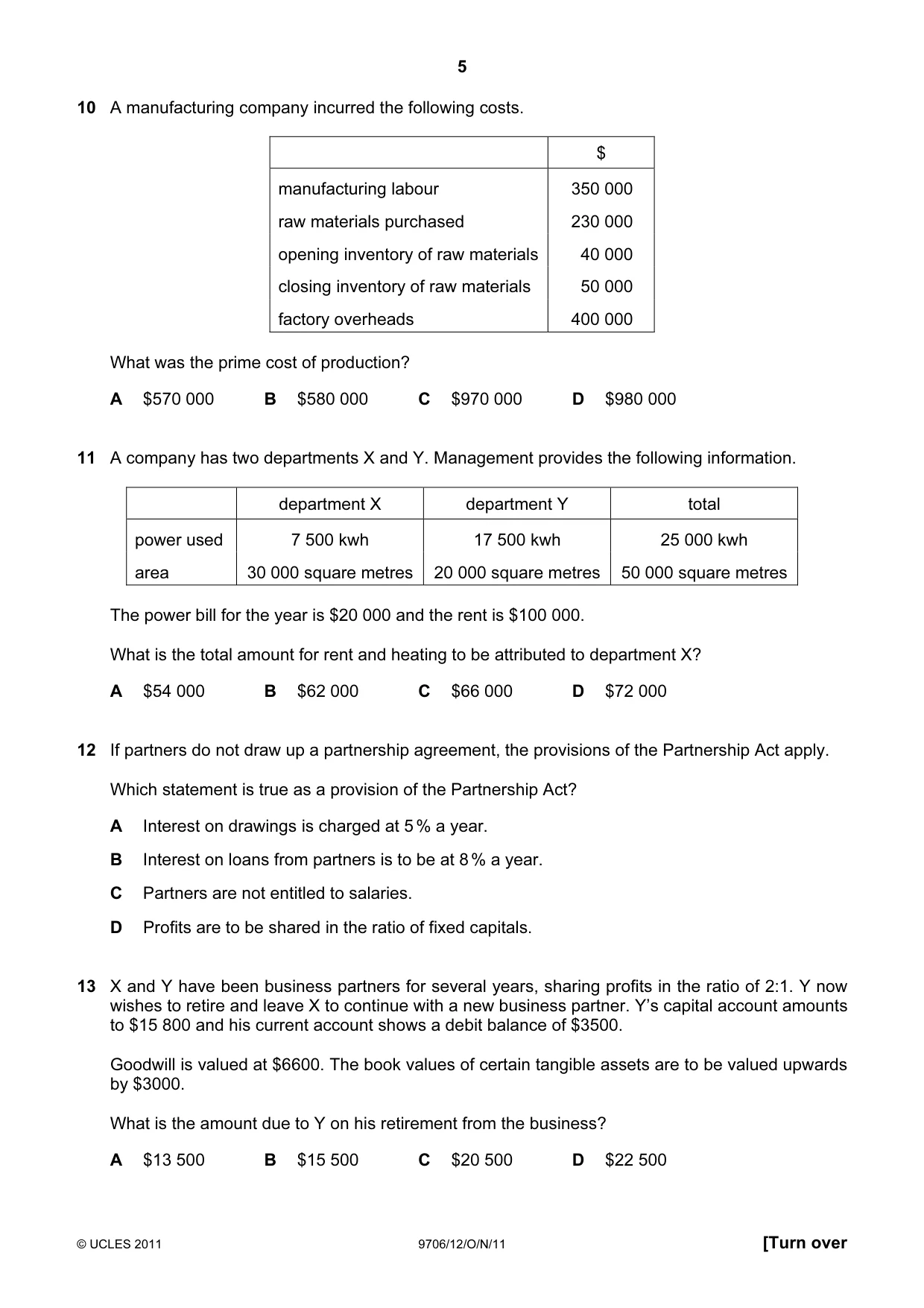
10 A manufacturing company incurred the following costs. $ manufacturing labour 350 000 raw materials purchased 230 000 opening inventory of raw materials 40 000 closing inventory of raw materials 50 000 factory overheads 400 000 What was the prime cost of production? A $570 000 B $580 000 C $970 000 D $980 000
Mark scheme: A
Q11 · A company has two departments X and Y
11 A company has two departments X and Y. Management provides the following information. department X department Y total power used 7 500 kwh 17 500 kwh 25 000 kwh area 30 000 square metres 20 000 square metres 50 000 square metres The power bill for the year is $20 000 and the rent is $100 000. What is the total amount for rent and heating to be attributed to department X? A $54 000 B $62 000 C $66 000 D $72 000
Mark scheme: C
Q12 · If partners do not draw up a partnership agreement, the provisions of the Partnership Act…
12 If partners do not draw up a partnership agreement, the provisions of the Partnership Act apply. Which statement is true as a provision of the Partnership Act? A Interest on drawings is charged at 5 % a year. B Interest on loans from partners is to be at 8 % a year. C Partners are not entitled to salaries. D Profits are to be shared in the ratio of fixed capitals.
Mark scheme: C
Q13 · X and Y have been business partners for several years, sharing profits in the ratio of 2:1
13 X and Y have been business partners for several years, sharing profits in the ratio of 2:1. Y now wishes to retire and leave X to continue with a new business partner. Y’s capital account amounts to $15 800 and his current account shows a debit balance of $3500. Goodwill is valued at $6600. The book values of certain tangible assets are to be valued upwards by $3000. What is the amount due to Y on his retirement from the business? A $13 500 B $15 500 C $20 500 D $22 500
Mark scheme: B
Q14 · Subscriptions received by a sports club were as follows
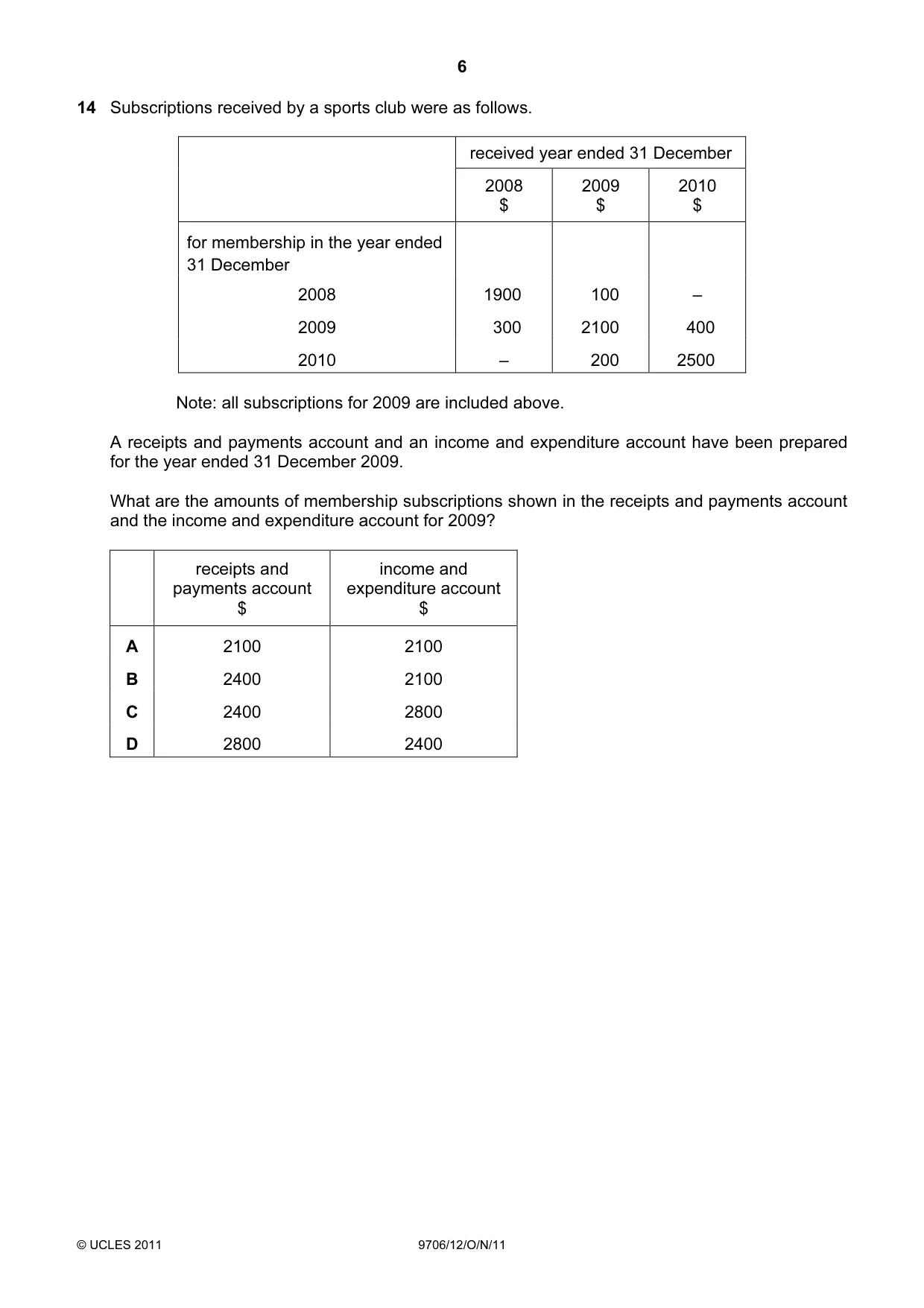
14 Subscriptions received by a sports club were as follows. received year ended 31 December 2008 2009 2010 $ $ $ for membership in the year ended 31 December 2008 1900 100 – 2009 300 2100 400 2010 – 200 2500 Note: all subscriptions for 2009 are included above. A receipts and payments account and an income and expenditure account have been prepared for the year ended 31 December 2009. What are the amounts of membership subscriptions shown in the receipts and payments account and the income and expenditure account for 2009? receipts and income and payments account expenditure account $ $ A 2100 2100 B 2400 2100 C 2400 2800 D 2800 2400
Mark scheme: C
Q15 · The treasurer has provided the following information relating to a golf club’s financial…
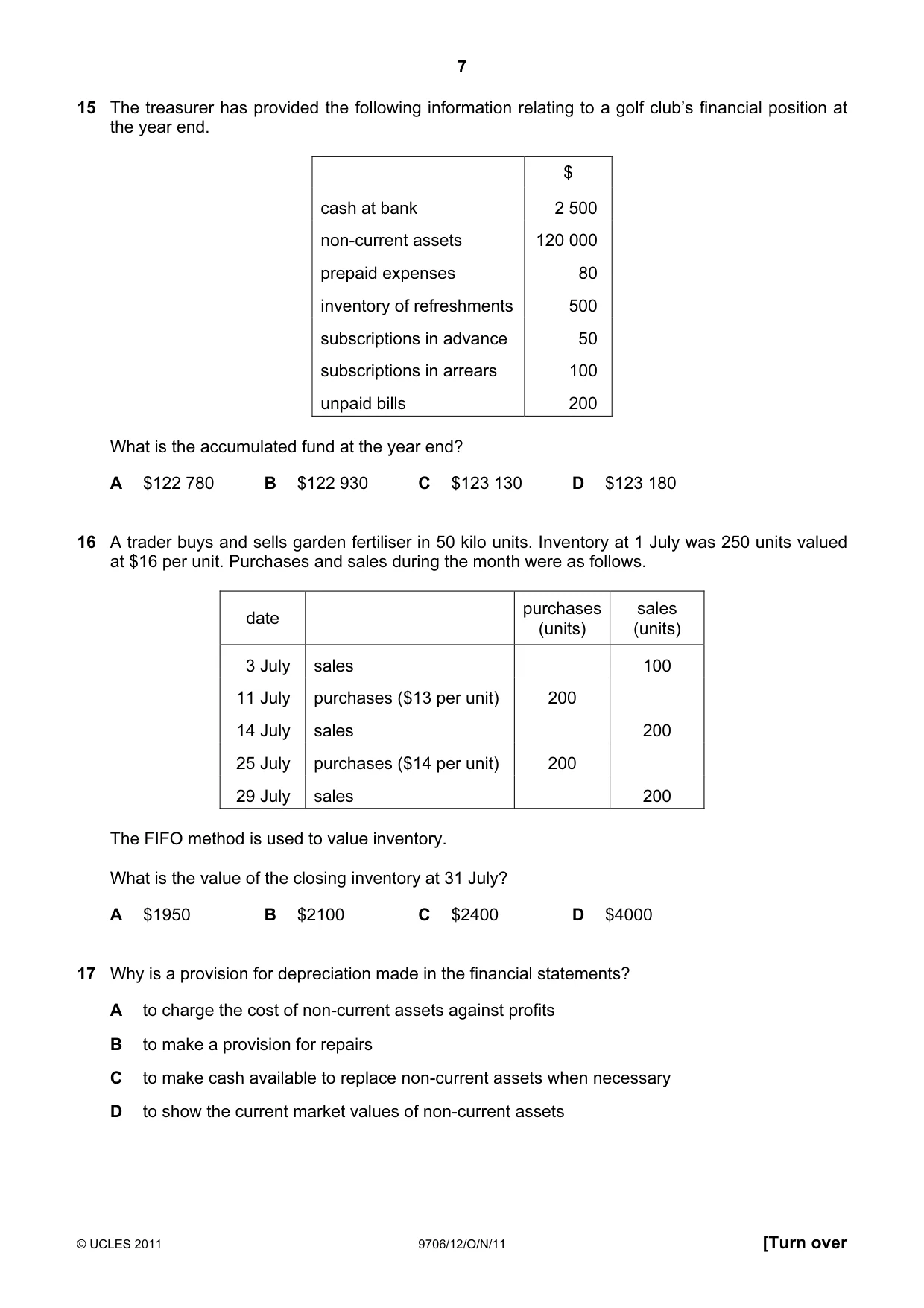
15 The treasurer has provided the following information relating to a golf club’s financial position at the year end. $ cash at bank 2 500 non-current assets 120 000 prepaid expenses 80 inventory of refreshments 500 subscriptions in advance 50 subscriptions in arrears 100 unpaid bills 200 What is the accumulated fund at the year end? A $122 780 B $122 930 C $123 130 D $123 180
Mark scheme: B
Q16 · A trader buys and sells garden fertiliser in 50 kilo units
16 A trader buys and sells garden fertiliser in 50 kilo units. Inventory at 1 July was 250 units valued at $16 per unit. Purchases and sales during the month were as follows. purchases sales date (units) (units) 3 July sales 100 11 July purchases ($13 per unit) 200 14 July sales 200 25 July purchases ($14 per unit) 200 29 July sales 200 The FIFO method is used to value inventory. What is the value of the closing inventory at 31 July? A $1950 B $2100 C $2400 D $4000
Mark scheme: B
Q17 · Why is a provision for depreciation made in the financial statements?
17 Why is a provision for depreciation made in the financial statements? A to charge the cost of non-current assets against profits B to make a provision for repairs C to make cash available to replace non-current assets when necessary D to show the current market values of non-current assets
Mark scheme: A
Q18 · When is working capital most likely to increase?
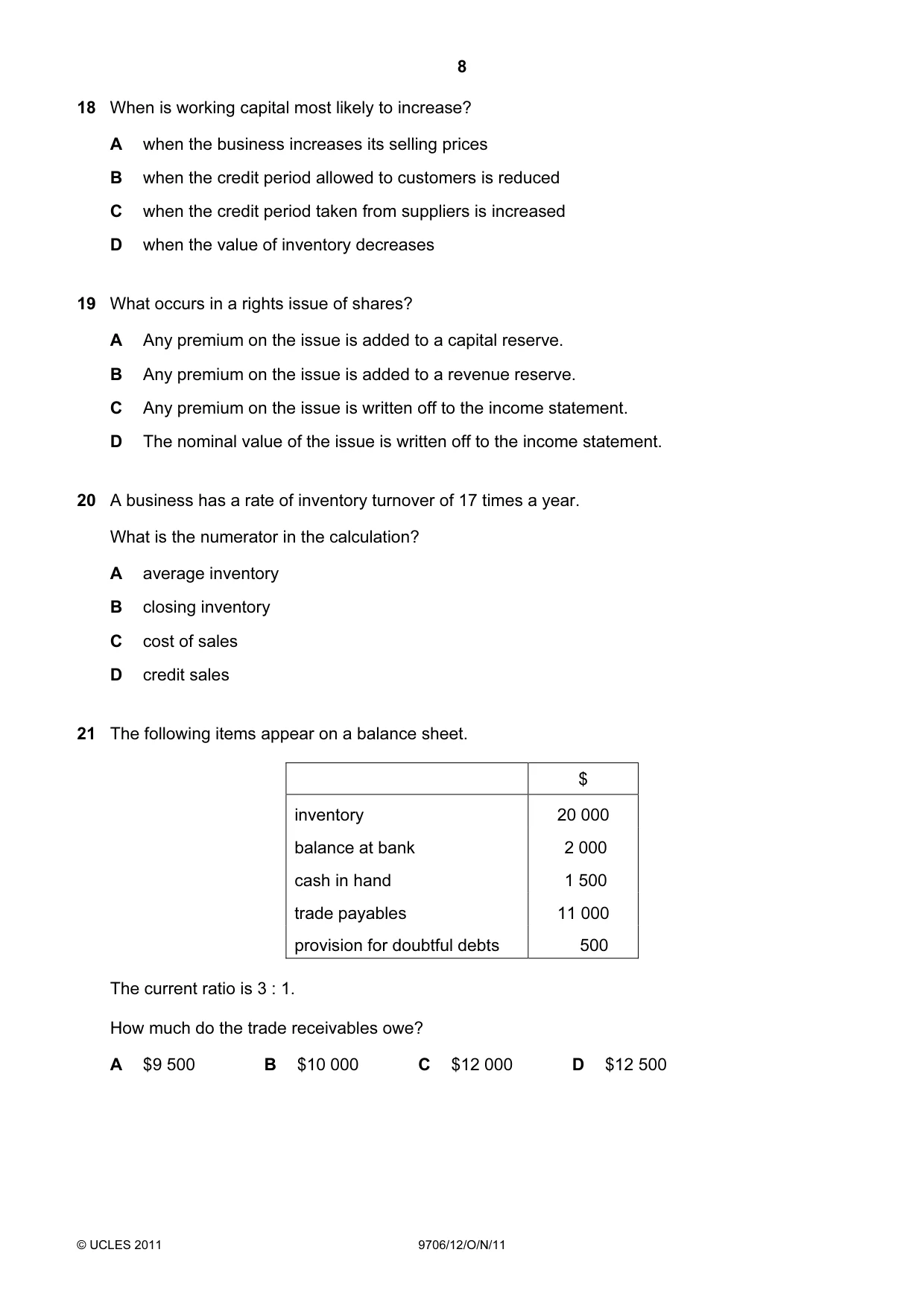
18 When is working capital most likely to increase? A when the business increases its selling prices B when the credit period allowed to customers is reduced C when the credit period taken from suppliers is increased D when the value of inventory decreases
Mark scheme: A
More questions on Analysis and communication of accounting information
Q19 · What occurs in a rights issue of shares?
19 What occurs in a rights issue of shares? A Any premium on the issue is added to a capital reserve. B Any premium on the issue is added to a revenue reserve. C Any premium on the issue is written off to the income statement. D The nominal value of the issue is written off to the income statement.
Mark scheme: A
Q20 · A business has a rate of inventory turnover of 17 times a year
20 A business has a rate of inventory turnover of 17 times a year. What is the numerator in the calculation? A average inventory B closing inventory C cost of sales D credit sales
Mark scheme: C
More questions on Analysis and communication of accounting information
Q21 · The following items appear on a balance sheet
21 The following items appear on a balance sheet. $ inventory 20 000 balance at bank 2 000 cash in hand 1 500 trade payables 11 000 provision for doubtful debts 500 The current ratio is 3 : 1. How much do the trade receivables owe? A $9 500 B $10 000 C $12 000 D $12 500
Mark scheme: B
More questions on Analysis and communication of accounting information
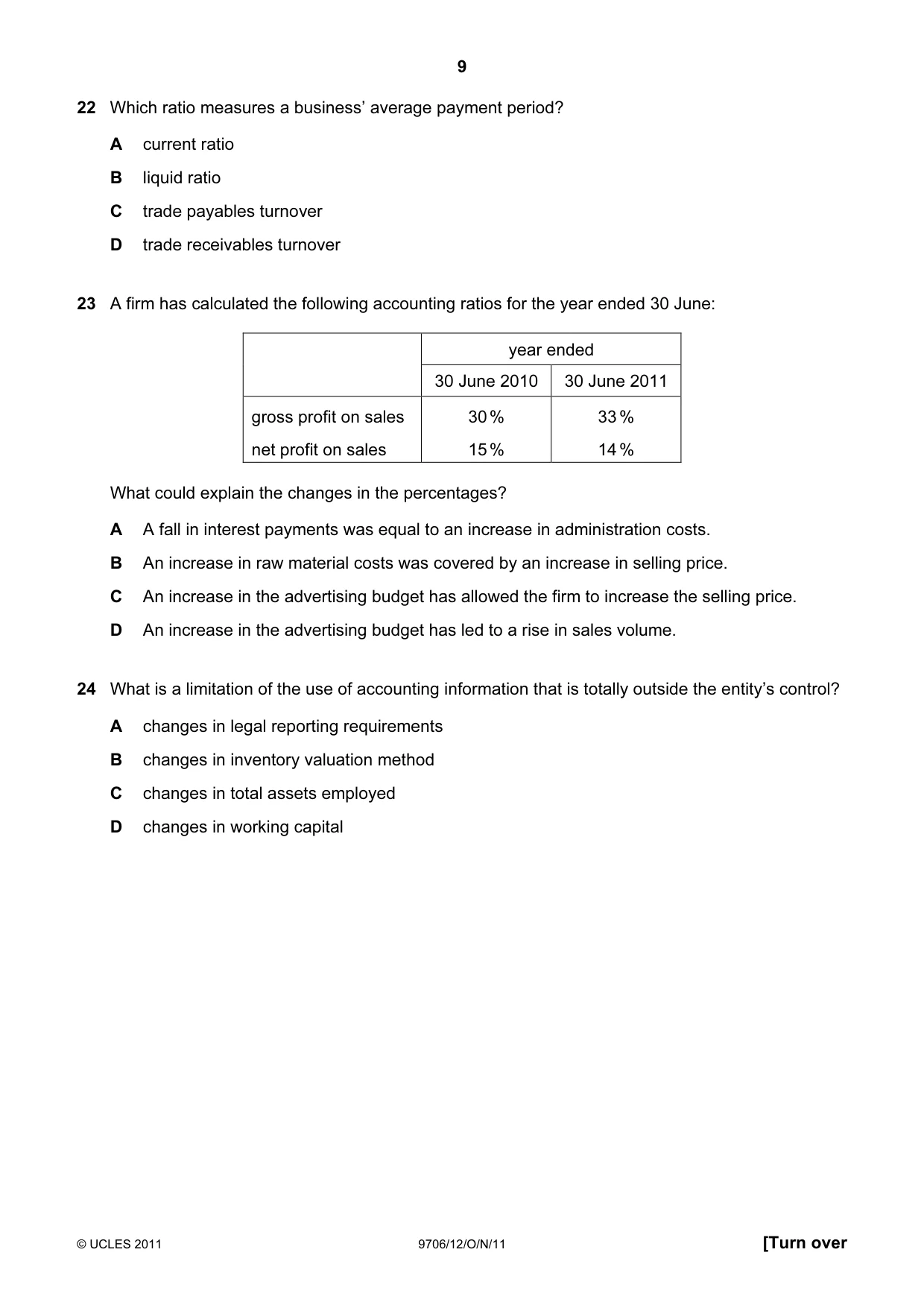
Q22 · Which ratio measures a business’ average payment period?
22 Which ratio measures a business’ average payment period? A current ratio B liquid ratio C trade payables turnover D trade receivables turnover
Mark scheme: C
More questions on Analysis and communication of accounting information
Q23 · A firm has calculated the following accounting ratios for the year ended 30 June: year…
23 A firm has calculated the following accounting ratios for the year ended 30 June: year ended 30 June 2010 30 June 2011 gross profit on sales 30 % 33 % net profit on sales 15 % 14 % What could explain the changes in the percentages? A A fall in interest payments was equal to an increase in administration costs. B An increase in raw material costs was covered by an increase in selling price. C An increase in the advertising budget has allowed the firm to increase the selling price. D An increase in the advertising budget has led to a rise in sales volume.
Mark scheme: C
More questions on Analysis and communication of accounting information
Q24 · What is a limitation of the use of accounting information that is totally outside the…
24 What is a limitation of the use of accounting information that is totally outside the entity’s control? A changes in legal reporting requirements B changes in inventory valuation method C changes in total assets employed D changes in working capital
Mark scheme: A
More questions on Analysis and communication of accounting information
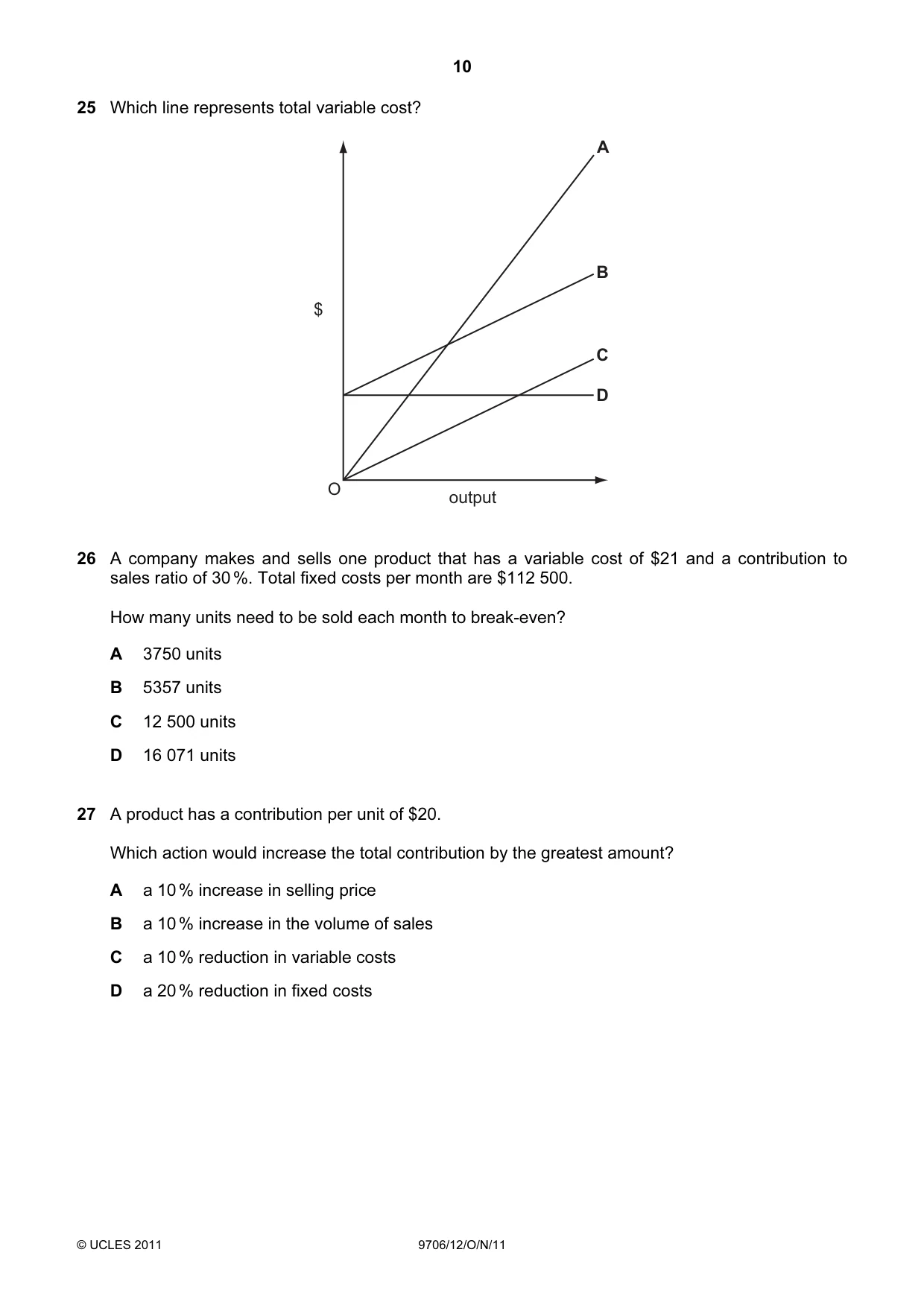
Q25 · Which line represents total variable cost?
25 Which line represents total variable cost? A B $ C D O output
Mark scheme: C
Q26 · A company makes and sells one product that has a variable cost of $21 and a contribution…
26 A company makes and sells one product that has a variable cost of $21 and a contribution to sales ratio of 30 %. Total fixed costs per month are $112 500. How many units need to be sold each month to break-even? A 3750 units B 5357 units C 12 500 units D 16 071 units
Mark scheme: C
Q27 · A product has a contribution per unit of $20
27 A product has a contribution per unit of $20. Which action would increase the total contribution by the greatest amount? A a 10 % increase in selling price B a 10 % increase in the volume of sales C a 10 % reduction in variable costs D a 20 % reduction in fixed costs
Mark scheme: A
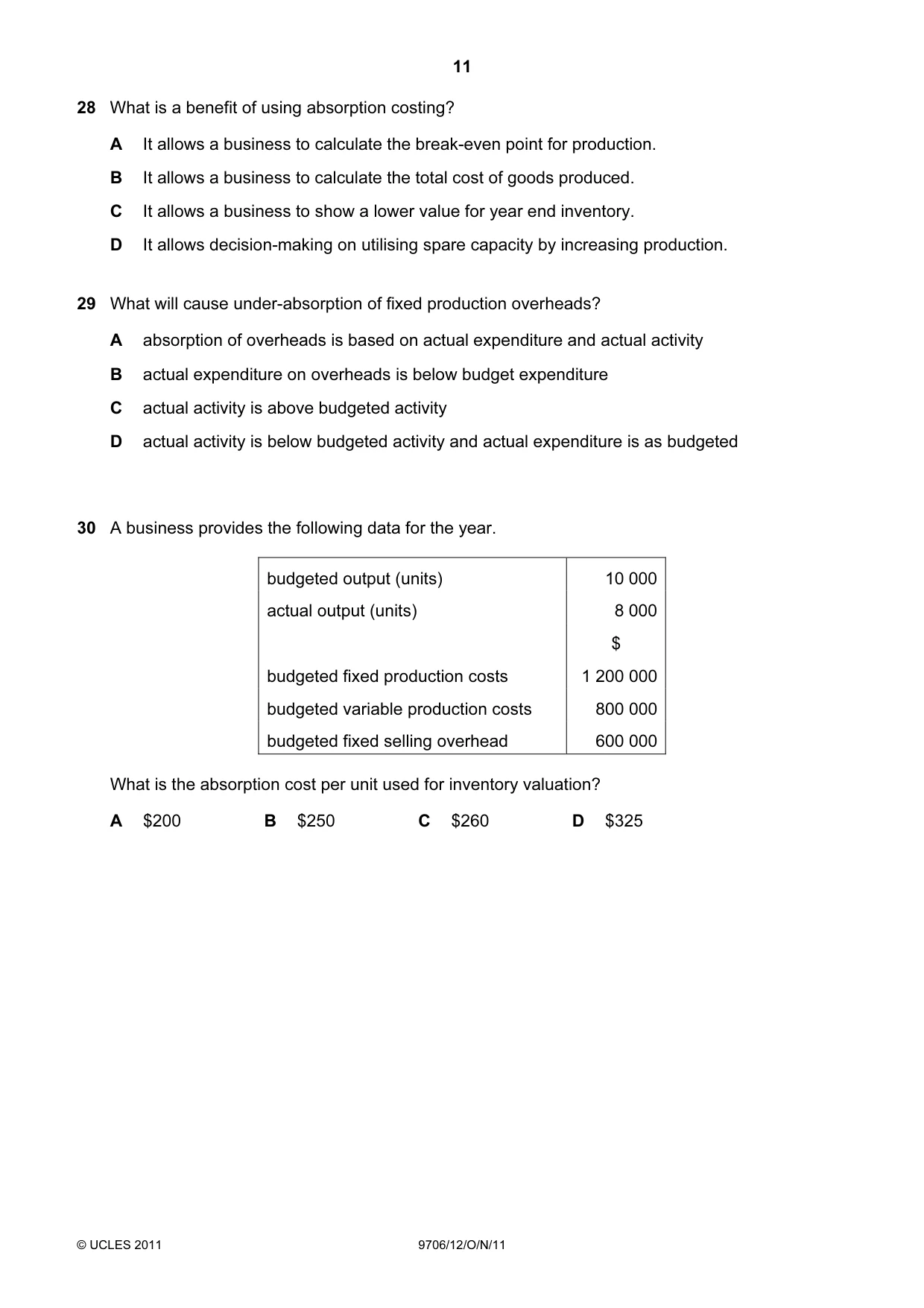
Q28 · What is a benefit of using absorption costing?
28 What is a benefit of using absorption costing? A It allows a business to calculate the break-even point for production. B It allows a business to calculate the total cost of goods produced. C It allows a business to show a lower value for year end inventory. D It allows decision-making on utilising spare capacity by increasing production.
Mark scheme: B
Q29 · What will cause under-absorption of fixed production overheads?
29 What will cause under-absorption of fixed production overheads? A absorption of overheads is based on actual expenditure and actual activity B actual expenditure on overheads is below budget expenditure C actual activity is above budgeted activity D actual activity is below budgeted activity and actual expenditure is as budgeted
Mark scheme: D
Q30 · A business provides the following data for the year
30 A business provides the following data for the year. budgeted output (units) 10 000 actual output (units) 8 000 $ budgeted fixed production costs 1 200 000 budgeted variable production costs 800 000 budgeted fixed selling overhead 600 000 What is the absorption cost per unit used for inventory valuation? A $200 B $250 C $260 D $325
Mark scheme: A
What was in this paper
The subtopics covered by these 30 questions, and how many questions each got. Open one in a new tab to see every Cambridge question on it.
What you needed in this session
Cambridge’s own grade thresholds for 2011 Oct/Nov, Paper 1 · Variant 2. A higher threshold means an easier paper — the bar moves with how the cohort did.