Cambridge A Level Accounting 9706 — 2017 Oct/Nov Paper 1 · Variant 1
9706/11/O/N/17 · 30 questions · 30 marks · ≈34 min
The question paper and its mark scheme, free to read here and free to download. This is Cambridge’s own paper, exactly as it was sat.
Question paper12 pages

Mark scheme3 pages
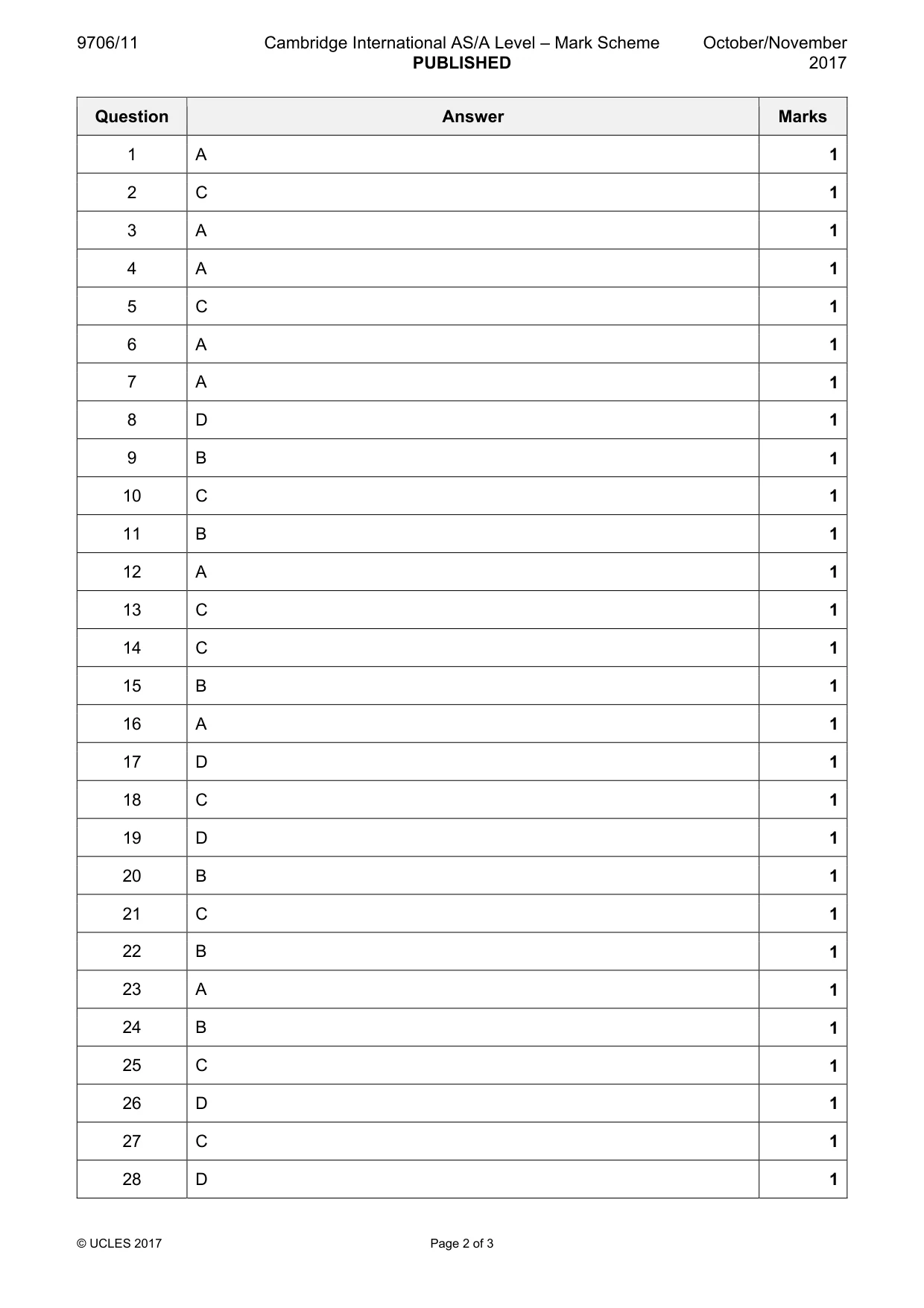
Answers below. Sit the paper first if you are practising.
Questions as text
Q1 · The personal spending of the owner of a business is not recognised as a business expense
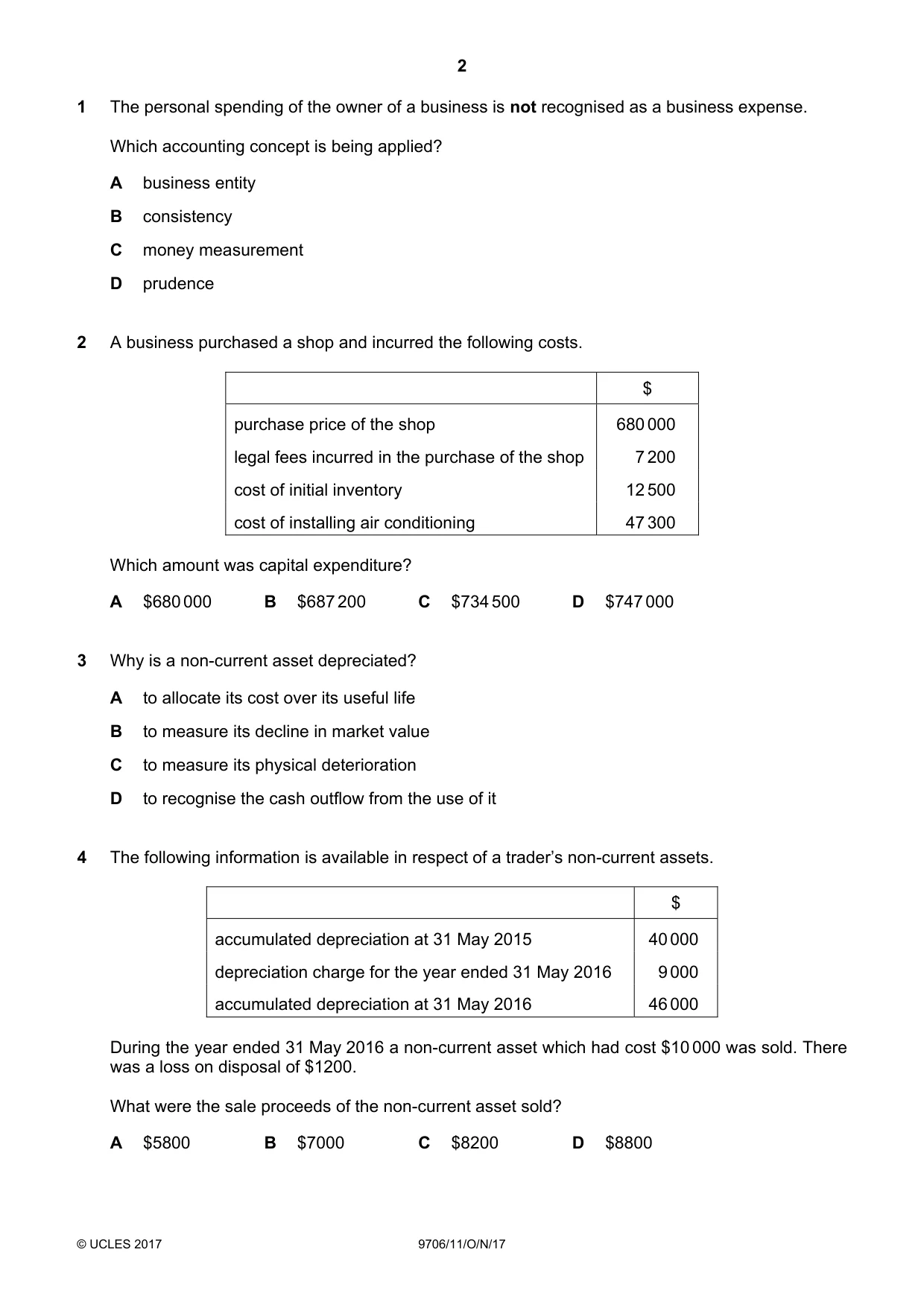
1 The personal spending of the owner of a business is not recognised as a business expense. Which accounting concept is being applied? A business entity B consistency C money measurement D prudence
Mark scheme: A
Q2 · A business purchased a shop and incurred the following costs
2 A business purchased a shop and incurred the following costs. $ purchase price of the shop 680 000 legal fees incurred in the purchase of the shop 7 200 cost of initial inventory 12 500 cost of installing air conditioning 47 300 Which amount was capital expenditure? A $680 000 B $687 200 C $734 500 D $747 000
Mark scheme: C
Q3 · Why is a non-current asset depreciated?
3 Why is a non-current asset depreciated? A to allocate its cost over its useful life B to measure its decline in market value C to measure its physical deterioration D to recognise the cash outflow from the use of it
Mark scheme: A
Q4 · The following information is available in respect of a trader’s non-current assets
4 The following information is available in respect of a trader’s non-current assets. $ accumulated depreciation at 31 May 2015 40 000 depreciation charge for the year ended 31 May 2016 9 000 accumulated depreciation at 31 May 2016 46 000 During the year ended 31 May 2016 a non-current asset which had cost $10 000 was sold. There was a loss on disposal of $1200. What were the sale proceeds of the non-current asset sold? A $5800 B $7000 C $8200 D $8800
Mark scheme: A
Q5 · The owner of a transport business purchased a motor vehicle
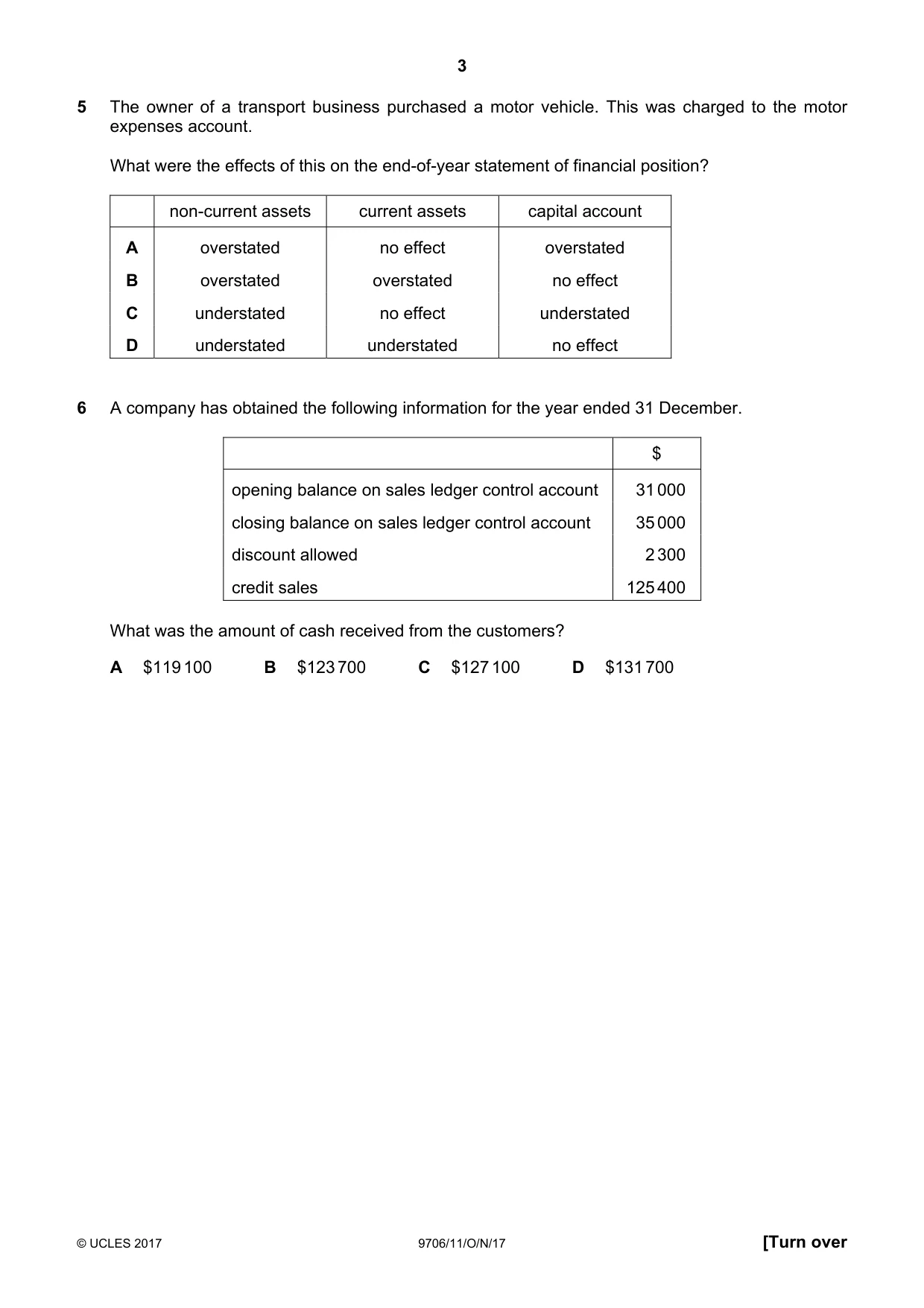
5 The owner of a transport business purchased a motor vehicle. This was charged to the motor expenses account. What were the effects of this on the end-of-year statement of financial position? non-current assets current assets capital account A overstated no effect overstated B overstated overstated no effect C understated no effect understated D understated understated no effect
Mark scheme: C
Q6 · A company has obtained the following information for the year ended 31 December
6 A company has obtained the following information for the year ended 31 December. $ opening balance on sales ledger control account 31 000 closing balance on sales ledger control account 35 000 discount allowed 2 300 credit sales 125 400 What was the amount of cash received from the customers? A $119 100 B $123 700 C $127 100 D $131 700
Mark scheme: A
Q7 · X sent goods to Y on a sale or return basis but treated them as a sale of $1200
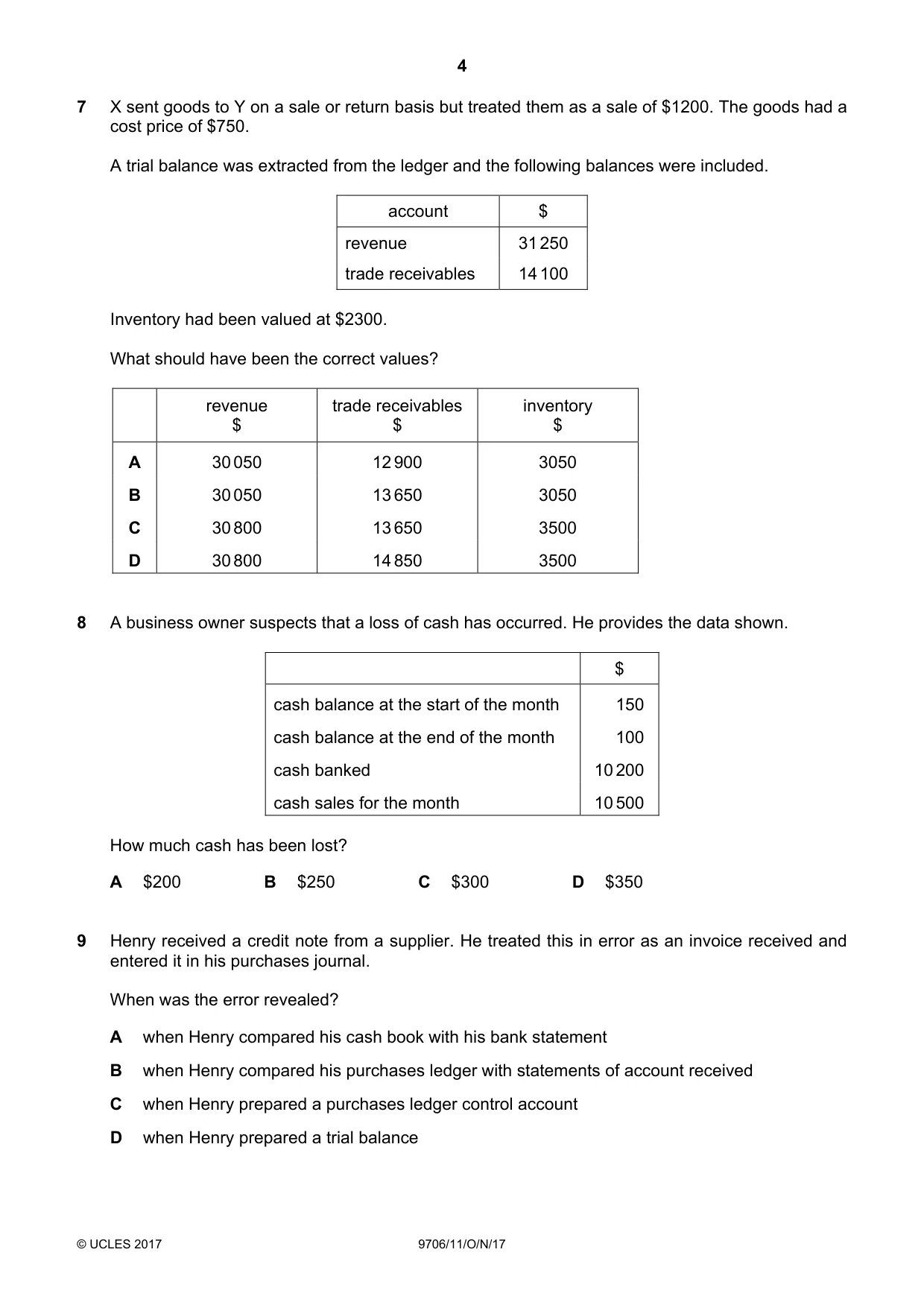
7 X sent goods to Y on a sale or return basis but treated them as a sale of $1200. The goods had a cost price of $750. A trial balance was extracted from the ledger and the following balances were included. account $ revenue 31 250 trade receivables 14 100 Inventory had been valued at $2300. What should have been the correct values? revenue trade receivables inventory $ $ $ A 30 050 12 900 3050 B 30 050 13 650 3050 C 30 800 13 650 3500 D 30 800 14 850 3500
Mark scheme: A
Q8 · A business owner suspects that a loss of cash has occurred
8 A business owner suspects that a loss of cash has occurred. He provides the data shown. $ cash balance at the start of the month 150 cash balance at the end of the month 100 cash banked 10 200 cash sales for the month 10 500 How much cash has been lost? A $200 B $250 C $300 D $350
Mark scheme: D
Q9 · Henry received a credit note from a supplier
9 Henry received a credit note from a supplier. He treated this in error as an invoice received and entered it in his purchases journal. When was the error revealed? A when Henry compared his cash book with his bank statement B when Henry compared his purchases ledger with statements of account received C when Henry prepared a purchases ledger control account D when Henry prepared a trial balance
Mark scheme: B
Q10 · A business prepares its financial statements on 31 December
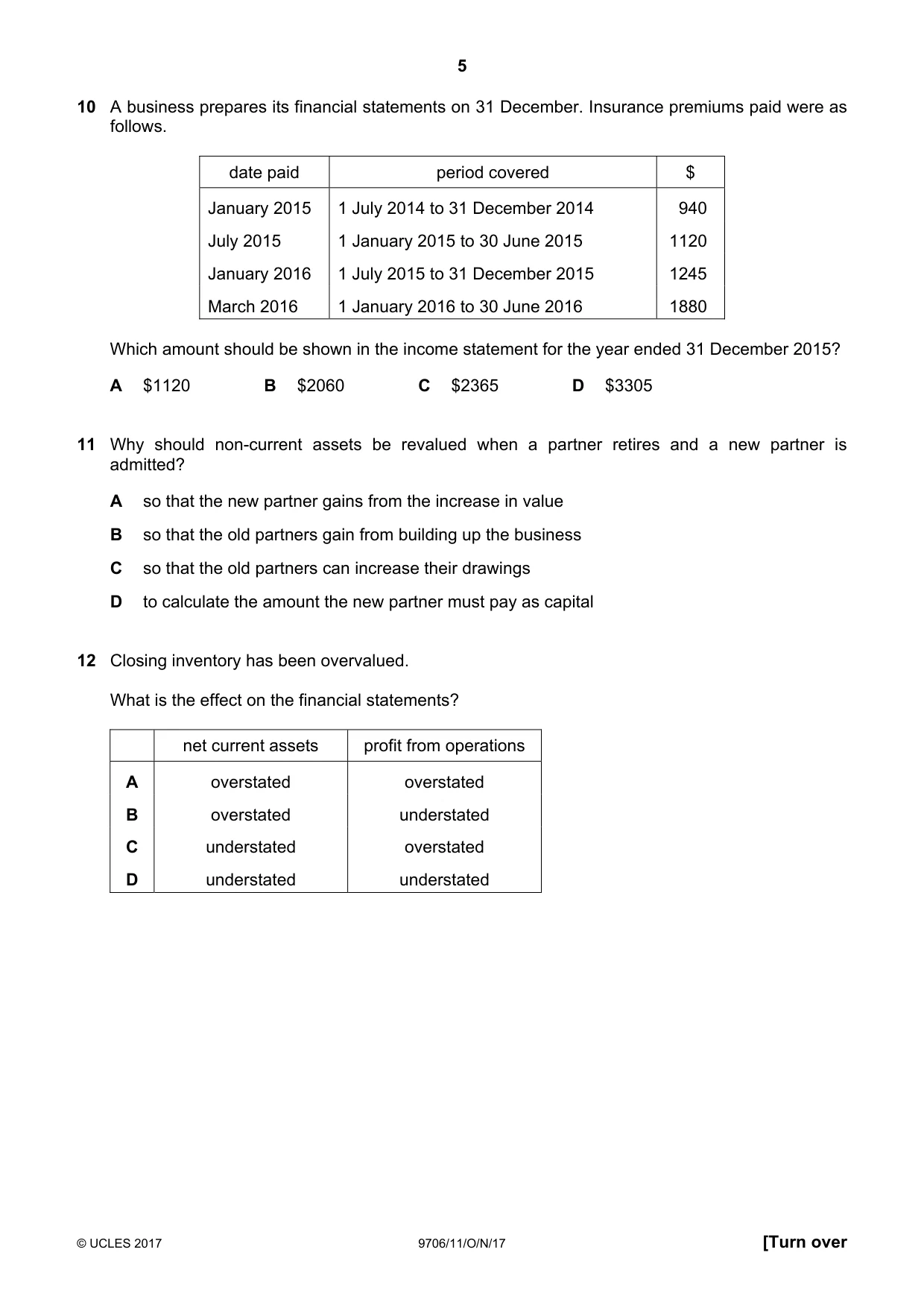
10 A business prepares its financial statements on 31 December. Insurance premiums paid were as follows. date paid period covered $ January 2015 1 July 2014 to 31 December 2014 940 July 2015 1 January 2015 to 30 June 2015 1120 January 2016 1 July 2015 to 31 December 2015 1245 March 2016 1 January 2016 to 30 June 2016 1880 Which amount should be shown in the income statement for the year ended 31 December 2015? A $1120 B $2060 C $2365 D $3305
Mark scheme: C
Q11 · Why should non-current assets be revalued when a partner retires and a new partner is…
11 Why should non-current assets be revalued when a partner retires and a new partner is admitted? A so that the new partner gains from the increase in value B so that the old partners gain from building up the business C so that the old partners can increase their drawings D to calculate the amount the new partner must pay as capital
Mark scheme: B
Q12 · Closing inventory has been overvalued
12 Closing inventory has been overvalued. What is the effect on the financial statements? net current assets profit from operations A overstated overstated B overstated understated C understated overstated D understated understated
Mark scheme: A
Q13 · The following information is available for a partnership at 31 December 2016
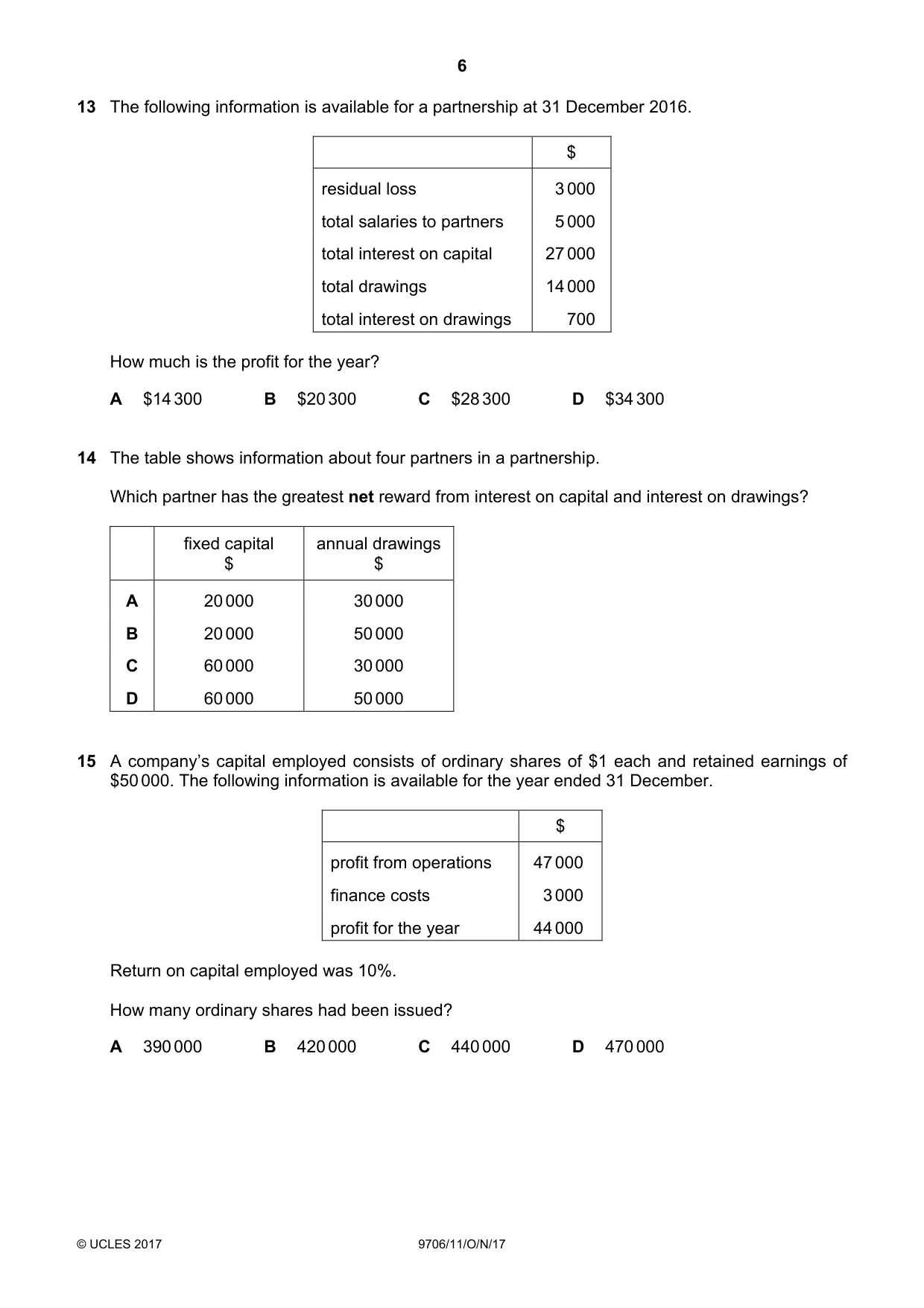
13 The following information is available for a partnership at 31 December 2016. $ residual loss 3 000 total salaries to partners 5 000 total interest on capital 27 000 total drawings 14 000 total interest on drawings 700 How much is the profit for the year? A $14 300 B $20 300 C $28 300 D $34 300
Mark scheme: C
Q14 · The table shows information about four partners in a partnership
14 The table shows information about four partners in a partnership. Which partner has the greatest net reward from interest on capital and interest on drawings? fixed capital annual drawings $ $ A 20 000 30 000 B 20 000 50 000 C 60 000 30 000 D 60 000 50 000
Mark scheme: C
Q15 · A company’s capital employed consists of ordinary shares of $1 each and retained earnings…
15 A company’s capital employed consists of ordinary shares of $1 each and retained earnings of $50 000. The following information is available for the year ended 31 December. $ profit from operations 47 000 finance costs 3 000 profit for the year 44 000 Return on capital employed was 10%. How many ordinary shares had been issued? A 390 000 B 420 000 C 440 000 D 470 000
Mark scheme: B
More questions on Analysis and communication of accounting information
Q16 · When is a share premium account opened?
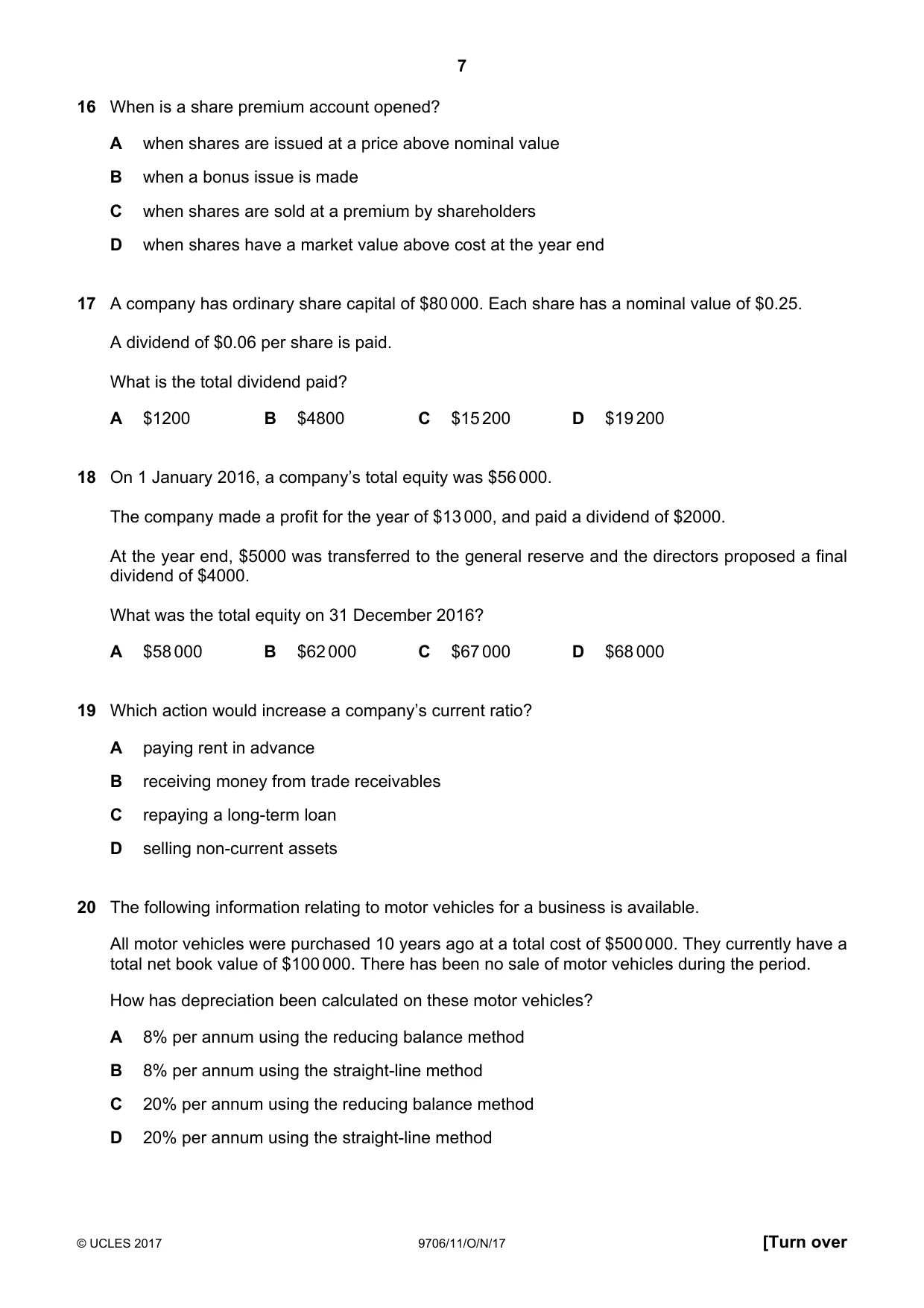
16 When is a share premium account opened? A when shares are issued at a price above nominal value B when a bonus issue is made C when shares are sold at a premium by shareholders D when shares have a market value above cost at the year end
Mark scheme: A
Q17 · A company has ordinary share capital of $80 000
17 A company has ordinary share capital of $80 000. Each share has a nominal value of $0.25. A dividend of $0.06 per share is paid. What is the total dividend paid? A $1200 B $4800 C $15 200 D $19 200
Mark scheme: D
Q18 · On 1 January 2016, a company’s total equity was $56 000
18 On 1 January 2016, a company’s total equity was $56 000. The company made a profit for the year of $13 000, and paid a dividend of $2000. At the year end, $5000 was transferred to the general reserve and the directors proposed a final dividend of $4000. What was the total equity on 31 December 2016? A $58 000 B $62 000 C $67 000 D $68 000
Mark scheme: C
Q19 · Which action would increase a company’s current ratio?
19 Which action would increase a company’s current ratio? A paying rent in advance B receiving money from trade receivables C repaying a long-term loan D selling non-current assets
Mark scheme: D
More questions on Analysis and communication of accounting information
Q20 · The following information relating to motor vehicles for a business is available
20 The following information relating to motor vehicles for a business is available. All motor vehicles were purchased 10 years ago at a total cost of $500 000. They currently have a total net book value of $100 000. There has been no sale of motor vehicles during the period. How has depreciation been calculated on these motor vehicles? A 8% per annum using the reducing balance method B 8% per annum using the straight-line method C 20% per annum using the reducing balance method D 20% per annum using the straight-line method
Mark scheme: B
Q21 · The following information is available for the inventory of a business
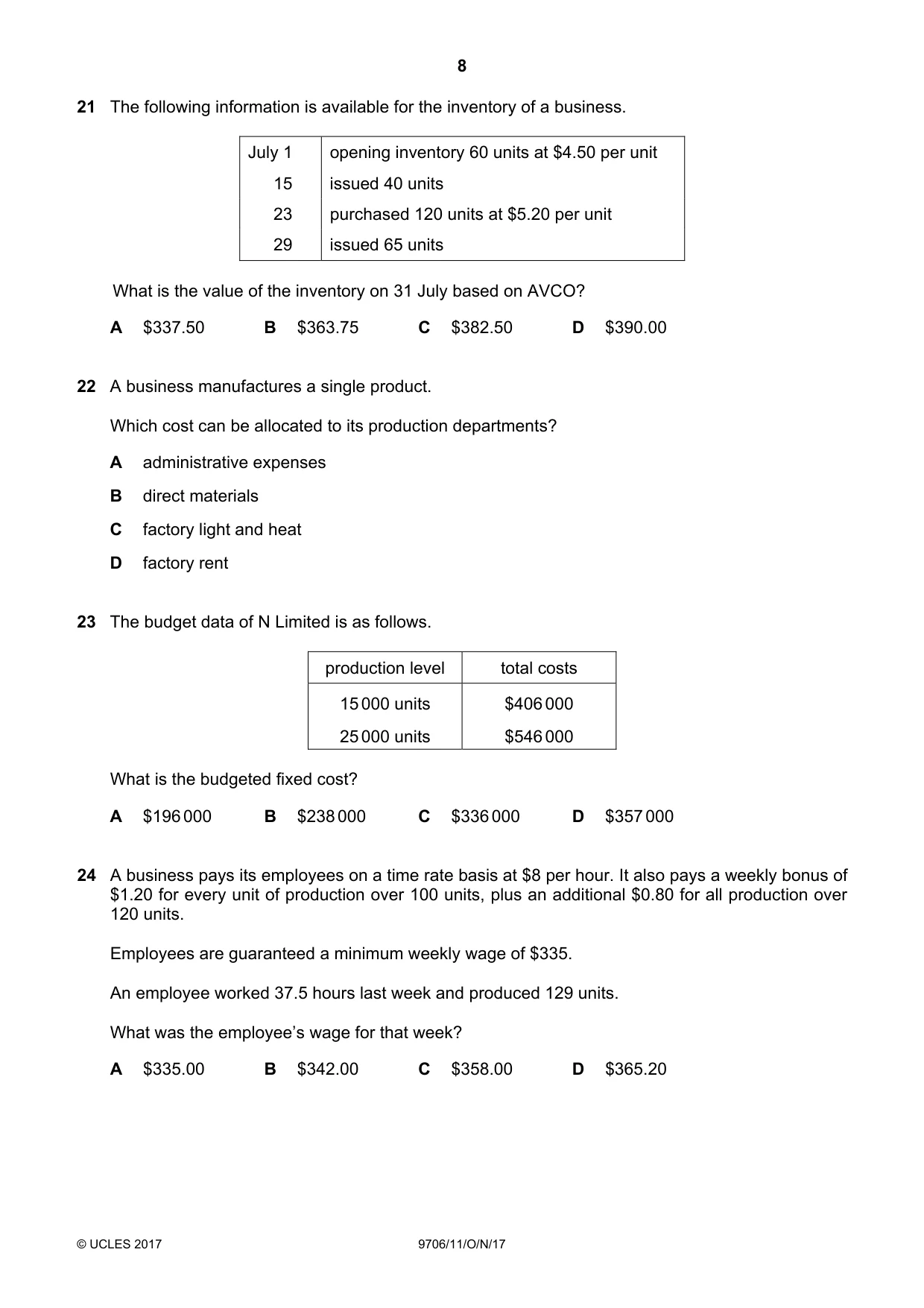
21 The following information is available for the inventory of a business. July 1 opening inventory 60 units at $4.50 per unit 15 issued 40 units 23 purchased 120 units at $5.20 per unit 29 issued 65 units What is the value of the inventory on 31 July based on AVCO? A $337.50 B $363.75 C $382.50 D $390.00
Mark scheme: C
Q22 · A business manufactures a single product
22 A business manufactures a single product. Which cost can be allocated to its production departments? A administrative expenses B direct materials C factory light and heat D factory rent
Mark scheme: B
Q23 · The budget data of N Limited is as follows
23 The budget data of N Limited is as follows. production level total costs 15 000 units $406 000 25 000 units $546 000 What is the budgeted fixed cost? A $196 000 B $238 000 C $336 000 D $357 000
Mark scheme: A
Q24 · A business pays its employees on a time rate basis at $8 per hour
24 A business pays its employees on a time rate basis at $8 per hour. It also pays a weekly bonus of $1.20 for every unit of production over 100 units, plus an additional $0.80 for all production over 120 units. Employees are guaranteed a minimum weekly wage of $335. An employee worked 37.5 hours last week and produced 129 units. What was the employee’s wage for that week? A $335.00 B $342.00 C $358.00 D $365.20
Mark scheme: B
Q25 · A business absorbs overheads based on machine hours
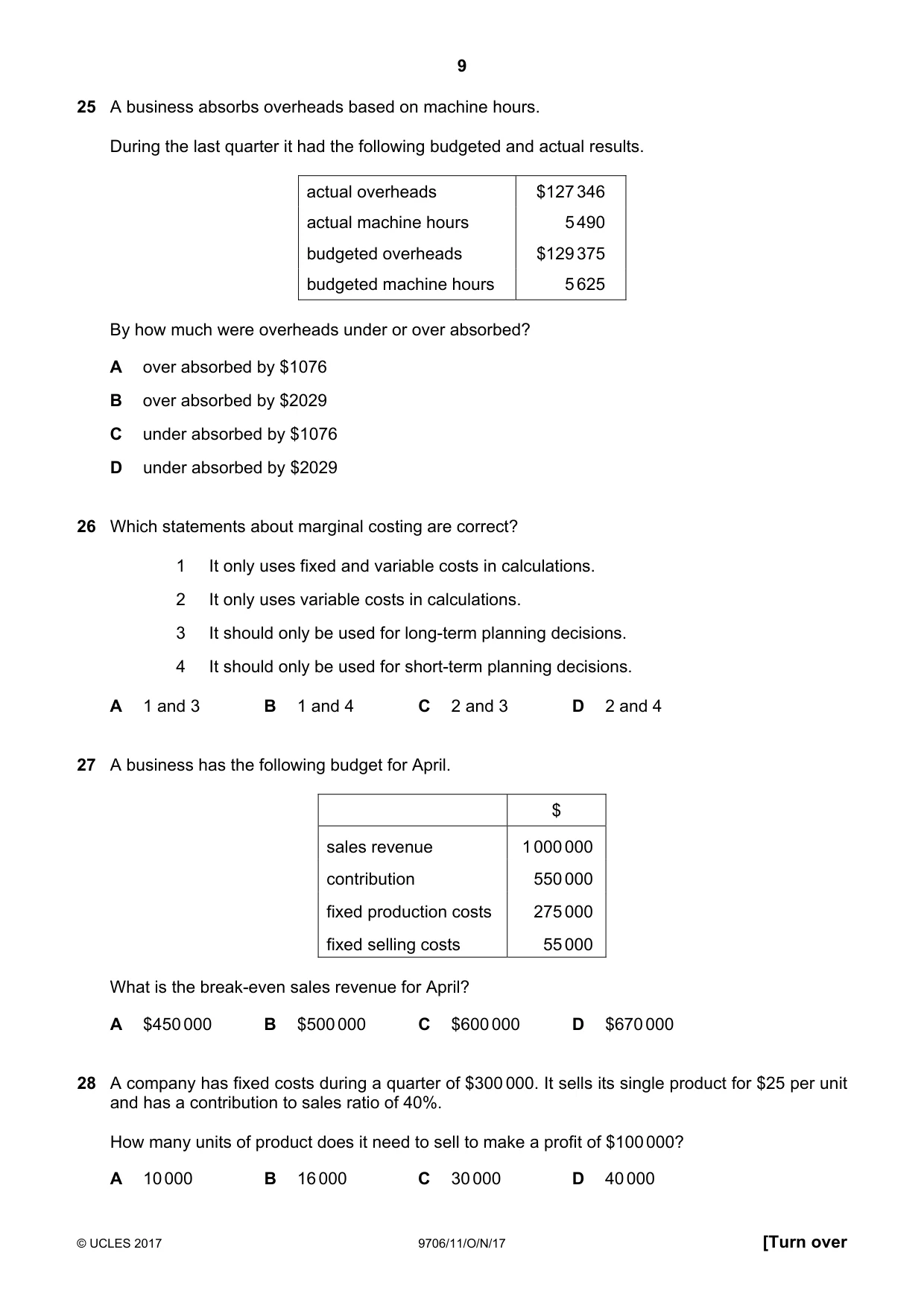
25 A business absorbs overheads based on machine hours. During the last quarter it had the following budgeted and actual results. actual overheads $127 346 actual machine hours 5 490 budgeted overheads $129 375 budgeted machine hours 5 625 By how much were overheads under or over absorbed? A over absorbed by $1076 B over absorbed by $2029 C under absorbed by $1076 D under absorbed by $2029
Mark scheme: C
Q26 · Which statements about marginal costing are correct?
26 Which statements about marginal costing are correct? 1 It only uses fixed and variable costs in calculations. 2 It only uses variable costs in calculations. 3 It should only be used for long-term planning decisions. 4 It should only be used for short-term planning decisions. A 1 and 3 B 1 and 4 C 2 and 3 D 2 and 4
Mark scheme: D
Q27 · A business has the following budget for April
27 A business has the following budget for April. $ sales revenue 1 000 000 contribution 550 000 fixed production costs 275 000 fixed selling costs 55 000 What is the break-even sales revenue for April? A $450 000 B $500 000 C $600 000 D $670 000
Mark scheme: C
Q28 · A company has fixed costs during a quarter of $300 000
28 A company has fixed costs during a quarter of $300 000. It sells its single product for $25 per unit and has a contribution to sales ratio of 40%. How many units of product does it need to sell to make a profit of $100 000? A 10 000 B 16 000 C 30 000 D 40 000
Mark scheme: D
Q29 · The following information is available about two products
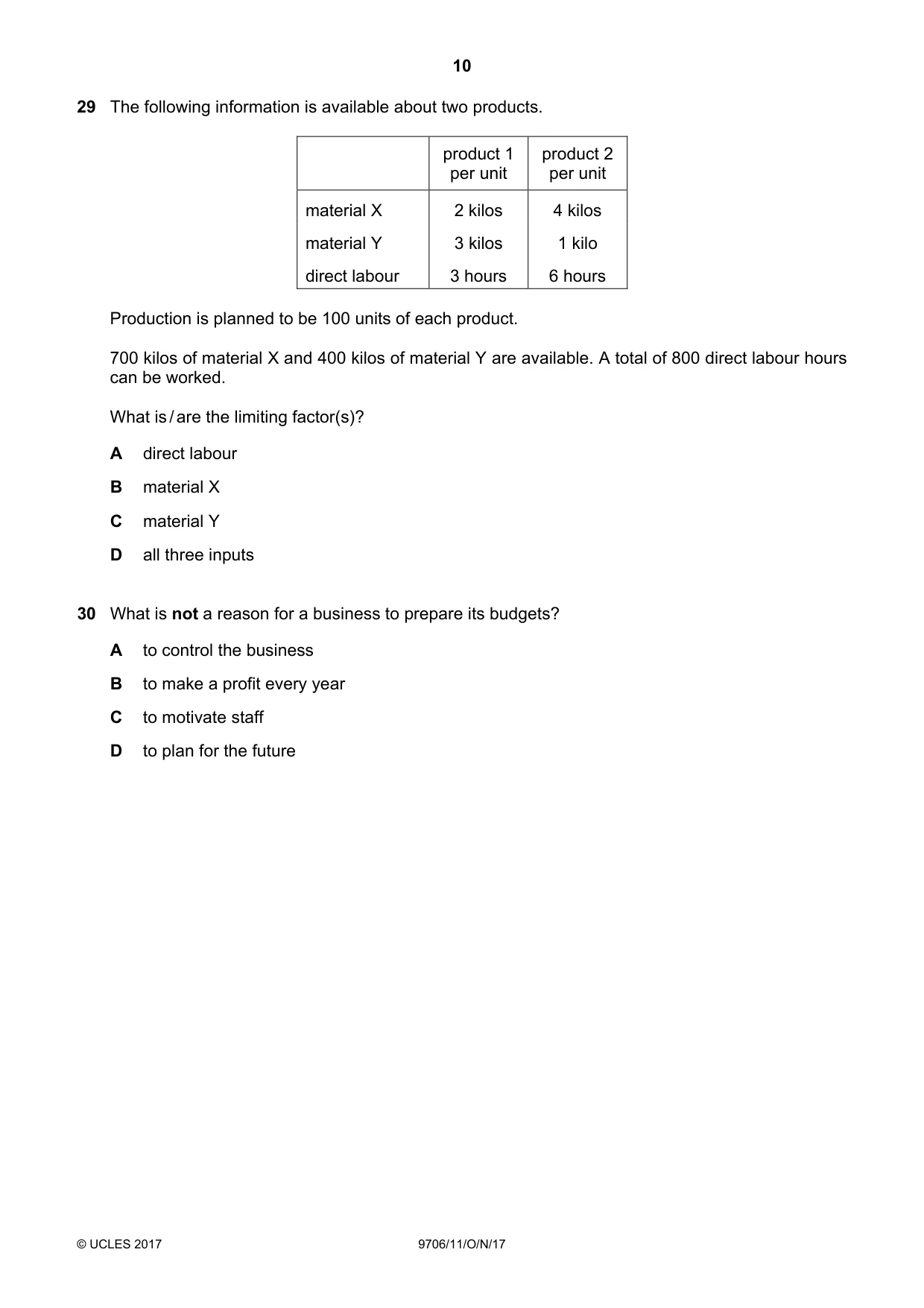
29 The following information is available about two products. product 1 product 2 per unit per unit material X 2 kilos 4 kilos material Y 3 kilos 1 kilo direct labour 3 hours 6 hours Production is planned to be 100 units of each product. 700 kilos of material X and 400 kilos of material Y are available. A total of 800 direct labour hours can be worked. What is / are the limiting factor(s)? A direct labour B material X C material Y D all three inputs
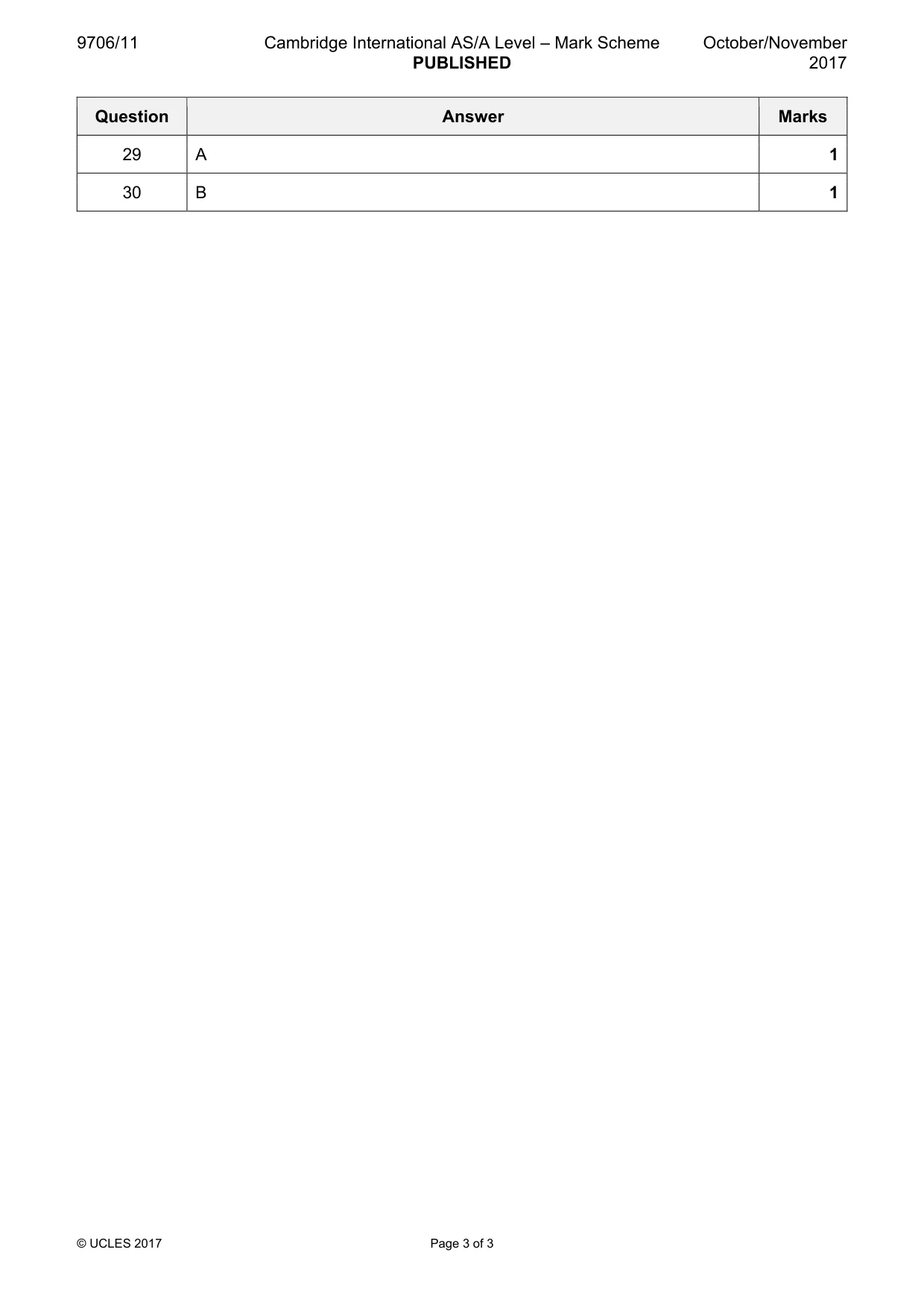
Mark scheme: A
Q30 · What is not a reason for a business to prepare its budgets?
30 What is not a reason for a business to prepare its budgets? A to control the business B to make a profit every year C to motivate staff D to plan for the future
Mark scheme: B
What was in this paper
The subtopics covered by these 30 questions, and how many questions each got. Open one in a new tab to see every Cambridge question on it.
What you needed in this session
Cambridge’s own grade thresholds for 2017 Oct/Nov, Paper 1 · Variant 1. A higher threshold means an easier paper — the bar moves with how the cohort did.