Cambridge A Level Accounting 9706 — 2021 Oct/Nov Paper 1 · Variant 2
9706/12/O/N/21 · 30 questions · 30 marks · ≈34 min
The question paper and its mark scheme, free to read here and free to download. This is Cambridge’s own paper, exactly as it was sat.
Question paper12 pages
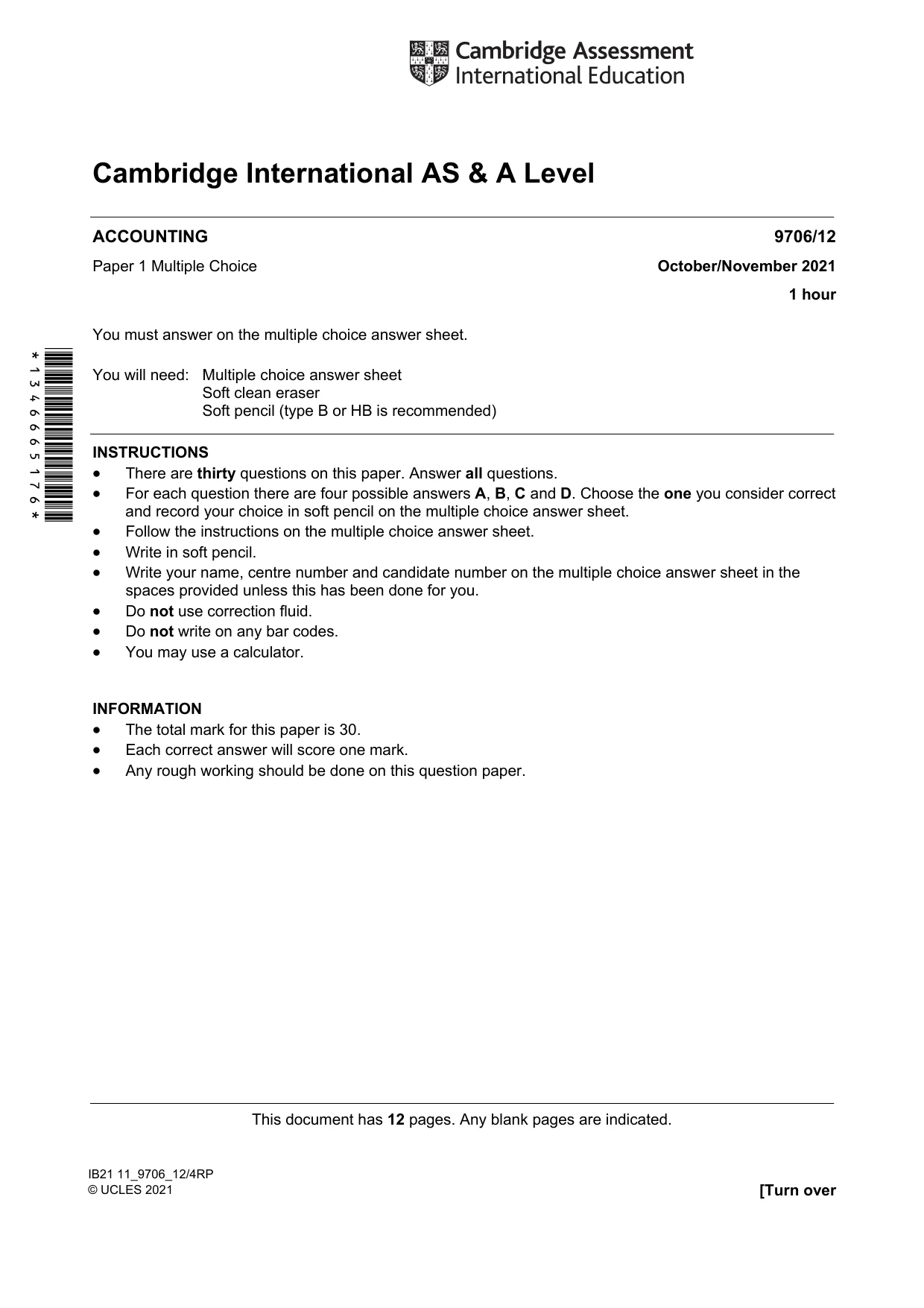

Mark scheme3 pages
Answers below. Sit the paper first if you are practising.
Questions as text
Q1 · A trader has prepared financial statements which include unpaid wages to her employees
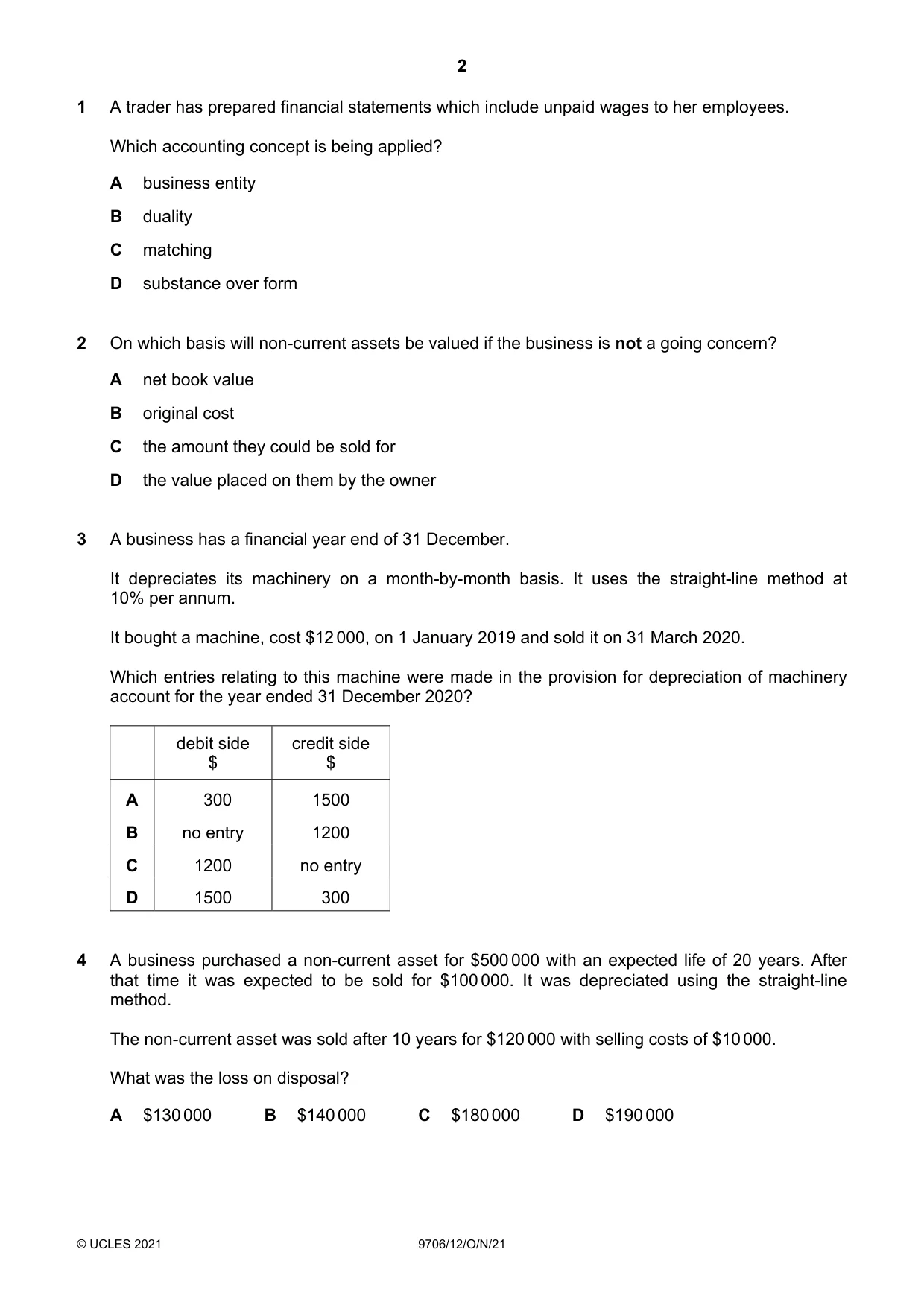
1 A trader has prepared financial statements which include unpaid wages to her employees. Which accounting concept is being applied? A business entity B duality C matching D substance over form
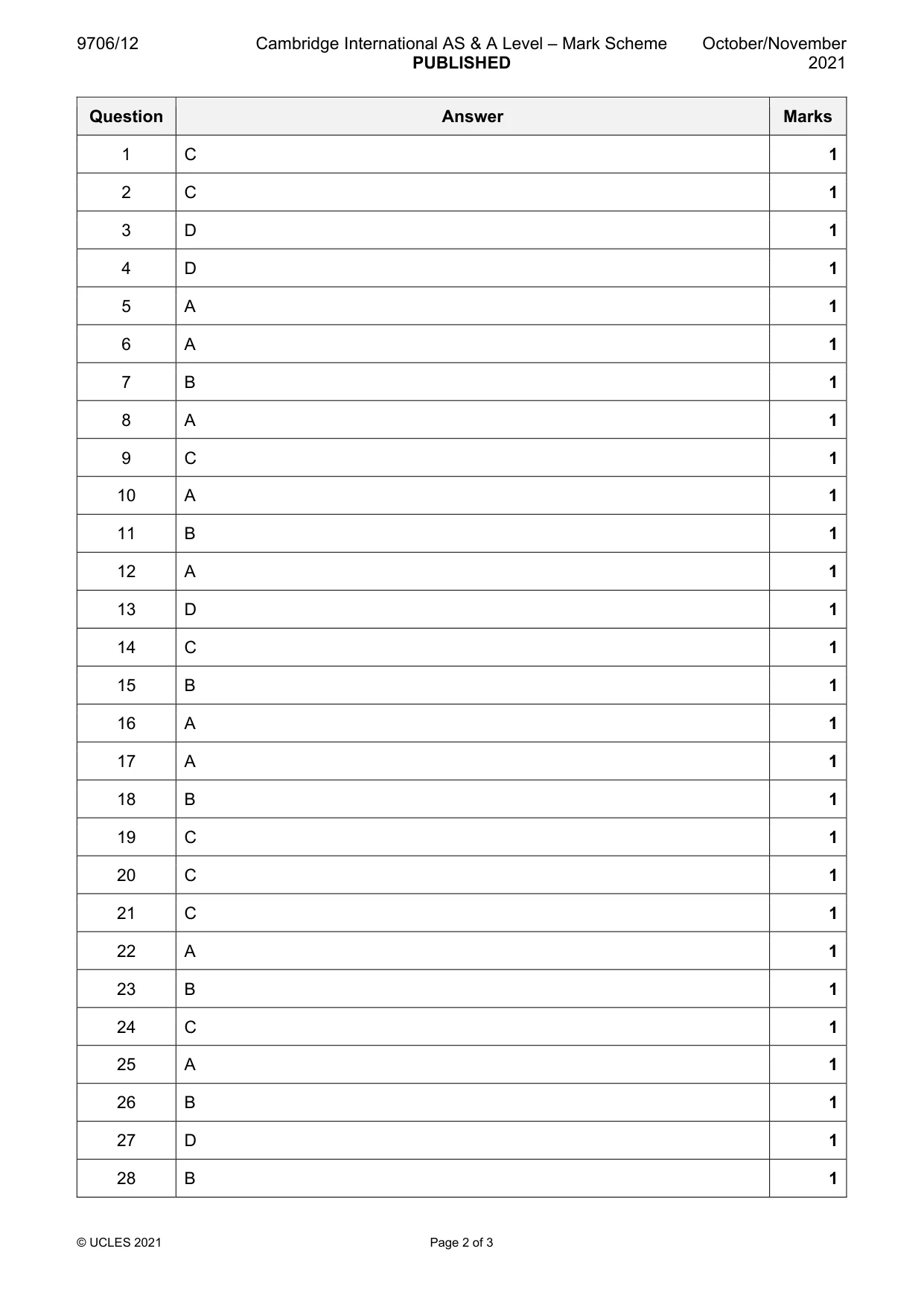
Mark scheme: C
Q2 · On which basis will non-current assets be valued if the business is not a going concern?
2 On which basis will non-current assets be valued if the business is not a going concern? A net book value B original cost C the amount they could be sold for D the value placed on them by the owner
Mark scheme: C
Q3 · A business has a financial year end of 31 December
3 A business has a financial year end of 31 December. It depreciates its machinery on a month-by-month basis. It uses the straight-line method at 10% per annum. It bought a machine, cost $12 000, on 1 January 2019 and sold it on 31 March 2020. Which entries relating to this machine were made in the provision for depreciation of machinery account for the year ended 31 December 2020? debit side credit side $ $ A 300 1500 B no entry 1200 C 1200 no entry D 1500 300
Mark scheme: D
Q4 · A business purchased a non-current asset for $500 000 with an expected life of 20 years
4 A business purchased a non-current asset for $500 000 with an expected life of 20 years. After that time it was expected to be sold for $100 000. It was depreciated using the straight-line method. The non-current asset was sold after 10 years for $120 000 with selling costs of $10 000. What was the loss on disposal? A $130 000 B $140 000 C $180 000 D $190 000
Mark scheme: D
Q5 · Which items are capital expenditure?
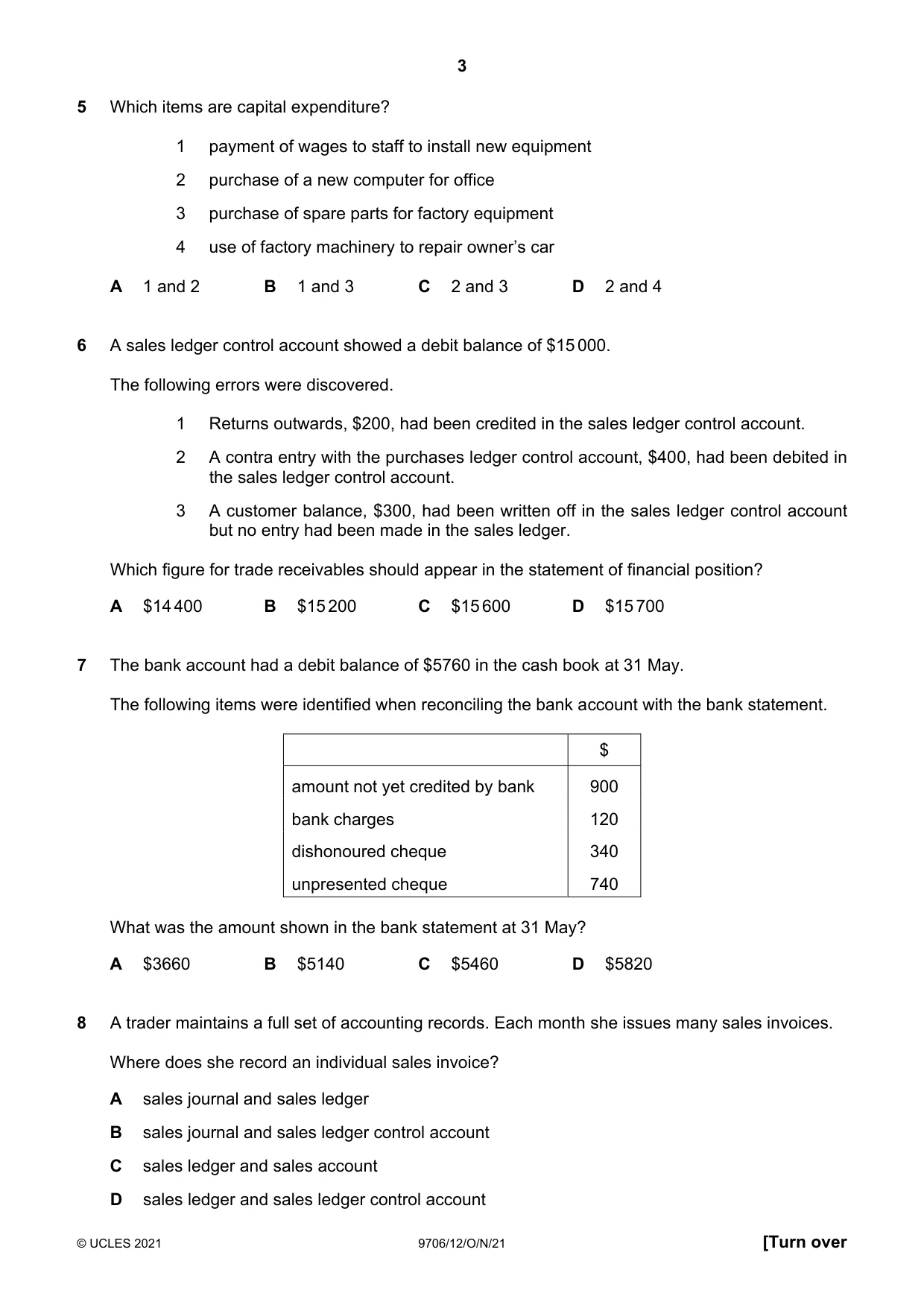
5 Which items are capital expenditure? 1 payment of wages to staff to install new equipment 2 purchase of a new computer for office 3 purchase of spare parts for factory equipment 4 use of factory machinery to repair owner’s car A 1 and 2 B 1 and 3 C 2 and 3 D 2 and 4
Mark scheme: A
Q6 · A sales ledger control account showed a debit balance of $15 000
6 A sales ledger control account showed a debit balance of $15 000. The following errors were discovered. 1 Returns outwards, $200, had been credited in the sales ledger control account. 2 A contra entry with the purchases ledger control account, $400, had been debited in the sales ledger control account. 3 A customer balance, $300, had been written off in the sales ledger control account but no entry had been made in the sales ledger. Which figure for trade receivables should appear in the statement of financial position? A $14 400 B $15 200 C $15 600 D $15 700
Mark scheme: A
Q7 · The bank account had a debit balance of $5760 in the cash book at 31 May
7 The bank account had a debit balance of $5760 in the cash book at 31 May. The following items were identified when reconciling the bank account with the bank statement. $ amount not yet credited by bank 900 bank charges 120 dishonoured cheque 340 unpresented cheque 740 What was the amount shown in the bank statement at 31 May? A $3660 B $5140 C $5460 D $5820
Mark scheme: B
Q8 · A trader maintains a full set of accounting records
8 A trader maintains a full set of accounting records. Each month she issues many sales invoices. Where does she record an individual sales invoice? A sales journal and sales ledger B sales journal and sales ledger control account C sales ledger and sales account D sales ledger and sales ledger control account
Mark scheme: A
Q9 · Brian had a service business which held no inventory
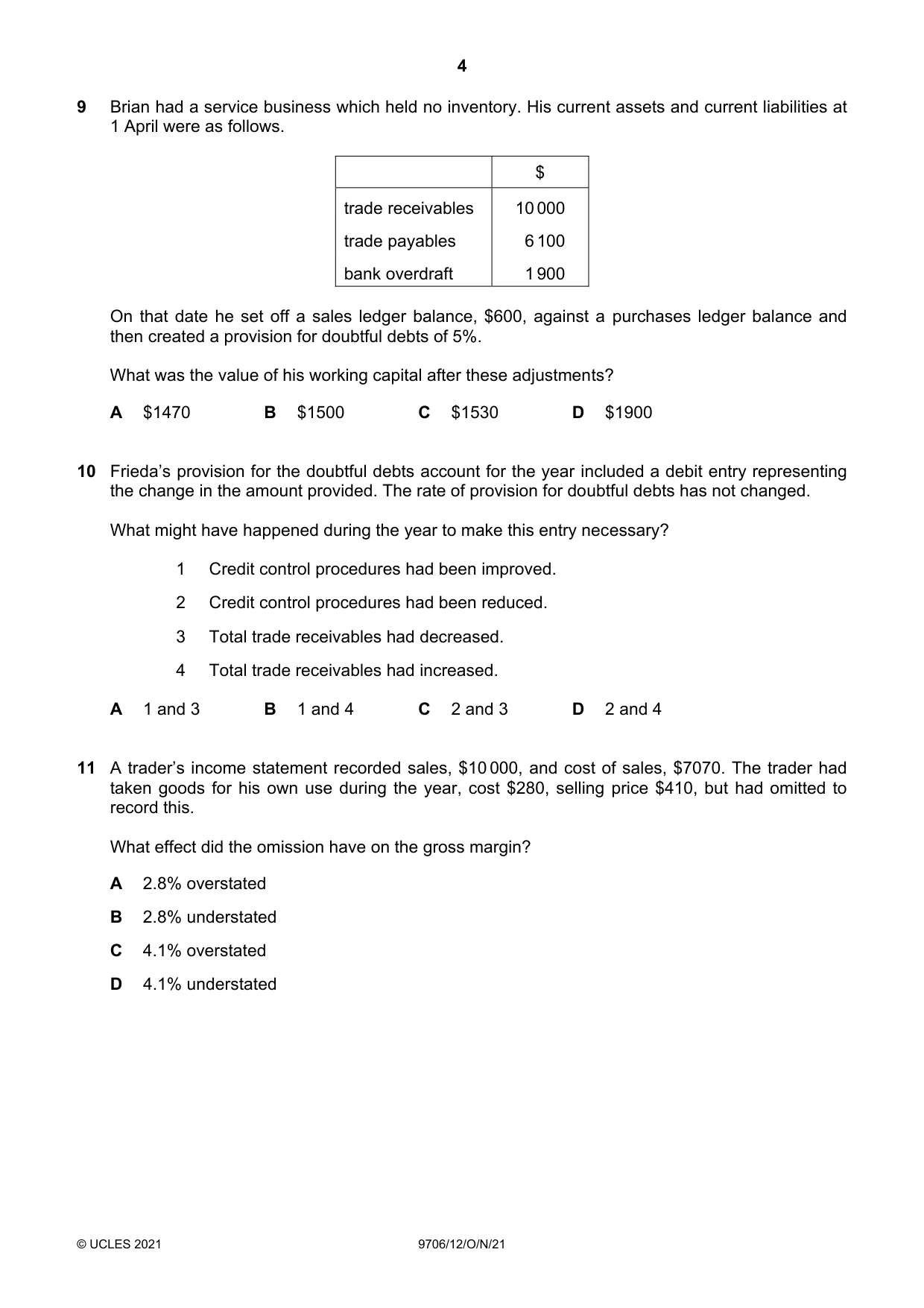
9 Brian had a service business which held no inventory. His current assets and current liabilities at 1 April were as follows. $ trade receivables 10 000 trade payables 6 100 bank overdraft 1 900 On that date he set off a sales ledger balance, $600, against a purchases ledger balance and then created a provision for doubtful debts of 5%. What was the value of his working capital after these adjustments? A $1470 B $1500 C $1530 D $1900
Mark scheme: C
Q10 · Frieda’s provision for the doubtful debts account for the year included a debit entry…
10 Frieda’s provision for the doubtful debts account for the year included a debit entry representing the change in the amount provided. The rate of provision for doubtful debts has not changed. What might have happened during the year to make this entry necessary? 1 Credit control procedures had been improved. 2 Credit control procedures had been reduced. 3 Total trade receivables had decreased. 4 Total trade receivables had increased. A 1 and 3 B 1 and 4 C 2 and 3 D 2 and 4
Mark scheme: A
Q11 · A trader’s income statement recorded sales, $10 000, and cost of sales, $7070
11 A trader’s income statement recorded sales, $10 000, and cost of sales, $7070. The trader had taken goods for his own use during the year, cost $280, selling price $410, but had omitted to record this. What effect did the omission have on the gross margin? A 2.8% overstated B 2.8% understated C 4.1% overstated D 4.1% understated
Mark scheme: B
More questions on Analysis and communication of accounting information
Q12 · William buys radios for $10 each and sells them for $15 each
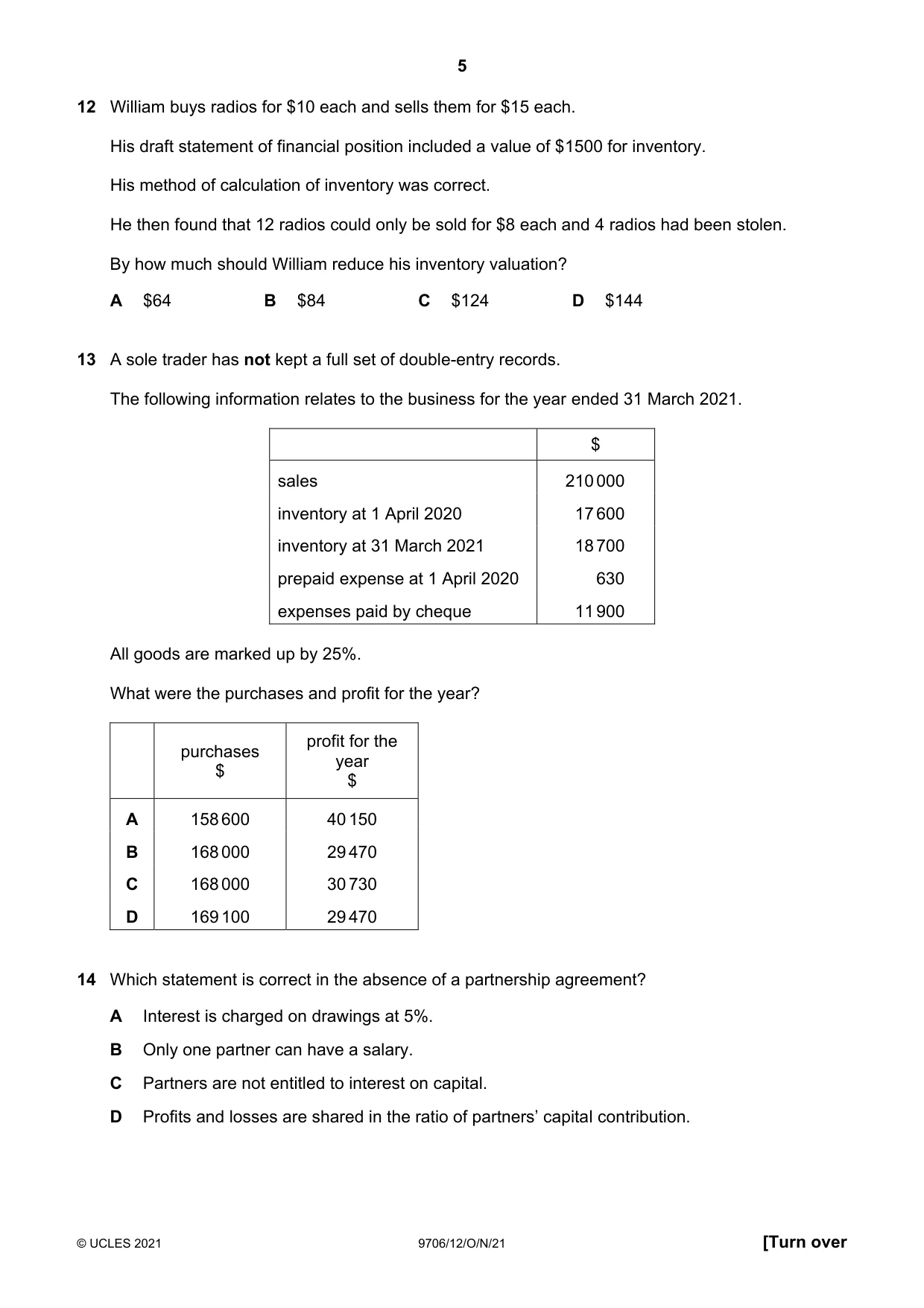
12 William buys radios for $10 each and sells them for $15 each. His draft statement of financial position included a value of $1500 for inventory. His method of calculation of inventory was correct. He then found that 12 radios could only be sold for $8 each and 4 radios had been stolen. By how much should William reduce his inventory valuation? A $64 B $84 C $124 D $144
Mark scheme: A
Q13 · A sole trader has not kept a full set of double-entry records
13 A sole trader has not kept a full set of double-entry records. The following information relates to the business for the year ended 31 March 2021. $ sales 210 000 inventory at 1 April 2020 17 600 inventory at 31 March 2021 18 700 prepaid expense at 1 April 2020 630 expenses paid by cheque 11 900 All goods are marked up by 25%. What were the purchases and profit for the year? profit for the purchases year $ $ A 158 600 40 150 B 168 000 29 470 C 168 000 30 730 D 169 100 29 470
Mark scheme: D
Q14 · Which statement is correct in the absence of a partnership agreement?
14 Which statement is correct in the absence of a partnership agreement? A Interest is charged on drawings at 5%. B Only one partner can have a salary. C Partners are not entitled to interest on capital. D Profits and losses are shared in the ratio of partners’ capital contribution.
Mark scheme: C
Q15 · X and Y are in partnership sharing profits and losses equally
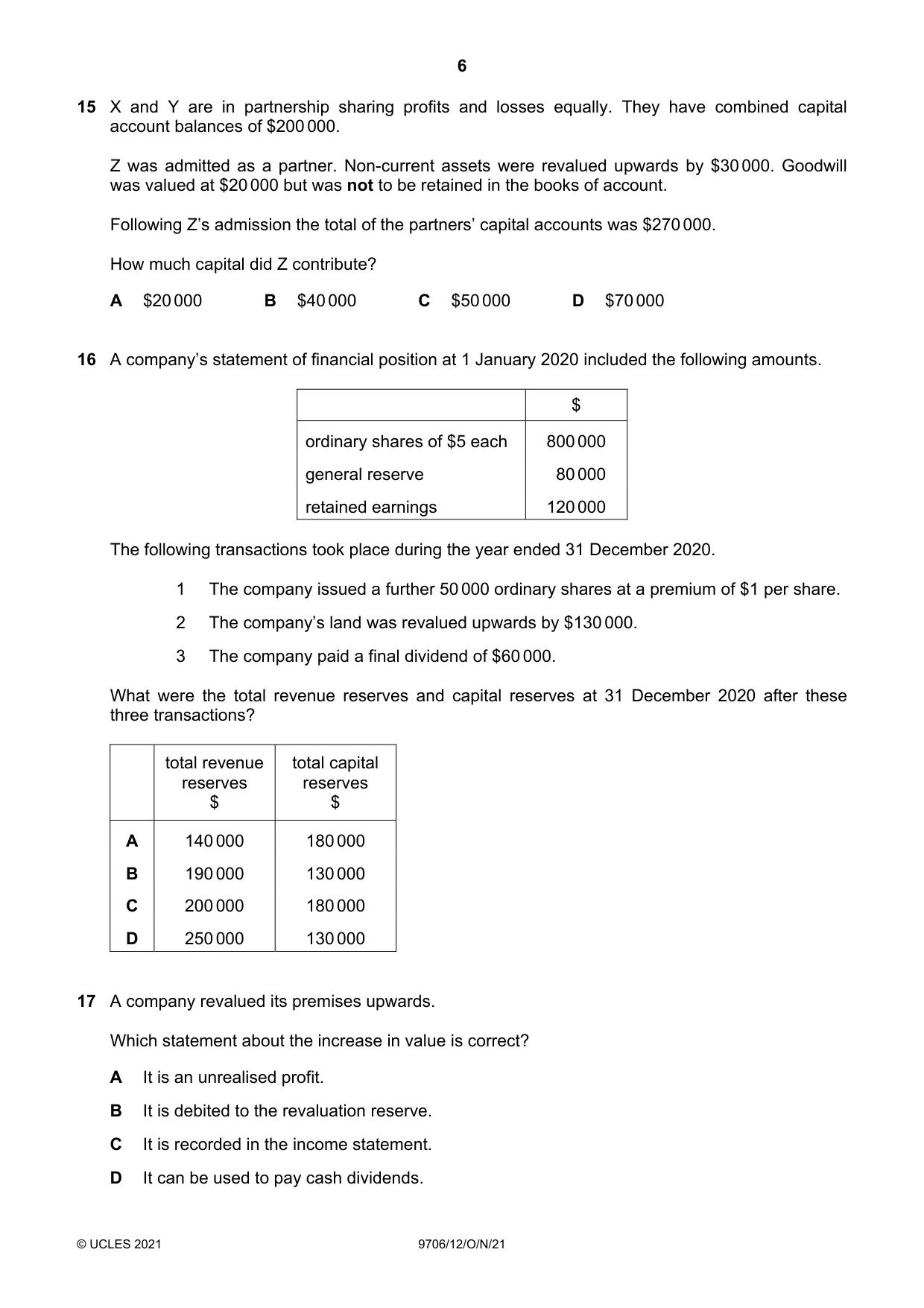
15 X and Y are in partnership sharing profits and losses equally. They have combined capital account balances of $200 000. Z was admitted as a partner. Non-current assets were revalued upwards by $30 000. Goodwill was valued at $20 000 but was not to be retained in the books of account. Following Z’s admission the total of the partners’ capital accounts was $270 000. How much capital did Z contribute? A $20 000 B $40 000 C $50 000 D $70 000
Mark scheme: B
Q16 · A company’s statement of financial position at 1 January 2020 included the following…
16 A company’s statement of financial position at 1 January 2020 included the following amounts. $ ordinary shares of $5 each 800 000 general reserve 80 000 retained earnings 120 000 The following transactions took place during the year ended 31 December 2020. 1 The company issued a further 50 000 ordinary shares at a premium of $1 per share. 2 The company’s land was revalued upwards by $130 000. 3 The company paid a final dividend of $60 000. What were the total revenue reserves and capital reserves at 31 December 2020 after these three transactions? total revenue total capital reserves reserves $ $ A 140 000 180 000 B 190 000 130 000 C 200 000 180 000 D 250 000 130 000
Mark scheme: A
Q17 · A company revalued its premises upwards
17 A company revalued its premises upwards. Which statement about the increase in value is correct? A It is an unrealised profit. B It is debited to the revaluation reserve. C It is recorded in the income statement. D It can be used to pay cash dividends.
Mark scheme: A
Q18 · The table shows equity and liabilities of a company at 31 December 2020
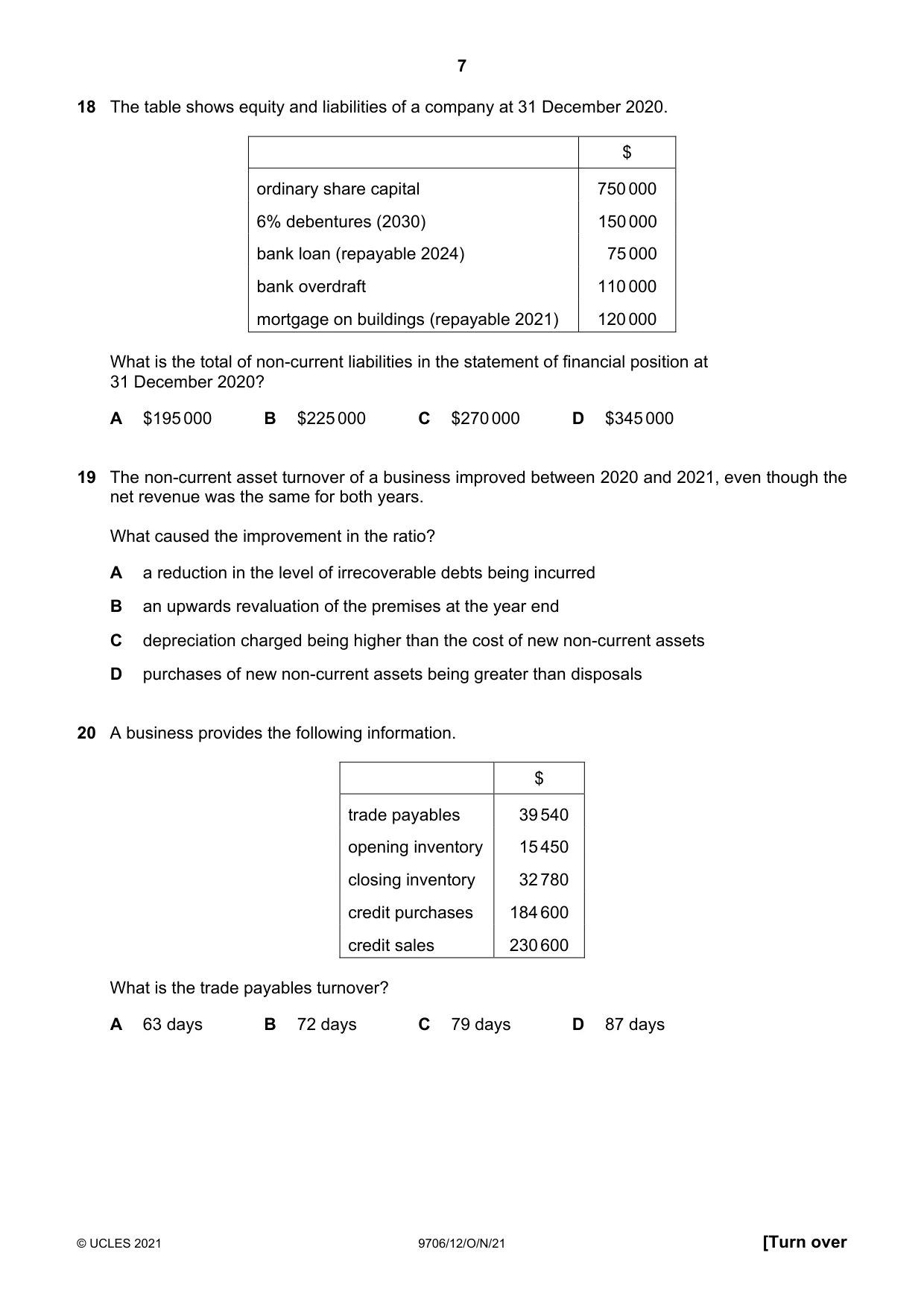
18 The table shows equity and liabilities of a company at 31 December 2020. $ ordinary share capital 750 000 6% debentures (2030) 150 000 bank loan (repayable 2024) 75 000 bank overdraft 110 000 mortgage on buildings (repayable 2021) 120 000 What is the total of non-current liabilities in the statement of financial position at 31 December 2020? A $195 000 B $225 000 C $270 000 D $345 000
Mark scheme: B
Q19 · The non-current asset turnover of a business improved between 2020 and 2021, even though…
19 The non-current asset turnover of a business improved between 2020 and 2021, even though the net revenue was the same for both years. What caused the improvement in the ratio? A a reduction in the level of irrecoverable debts being incurred B an upwards revaluation of the premises at the year end C depreciation charged being higher than the cost of new non-current assets D purchases of new non-current assets being greater than disposals
Mark scheme: C
More questions on Analysis and communication of accounting information
Q20 · A business provides the following information
20 A business provides the following information. $ trade payables 39 540 opening inventory 15 450 closing inventory 32 780 credit purchases 184 600 credit sales 230 600 What is the trade payables turnover? A 63 days B 72 days C 79 days D 87 days
Mark scheme: C
More questions on Analysis and communication of accounting information
Q21 · When a company produces 5000 units of a product it requires one supervisor
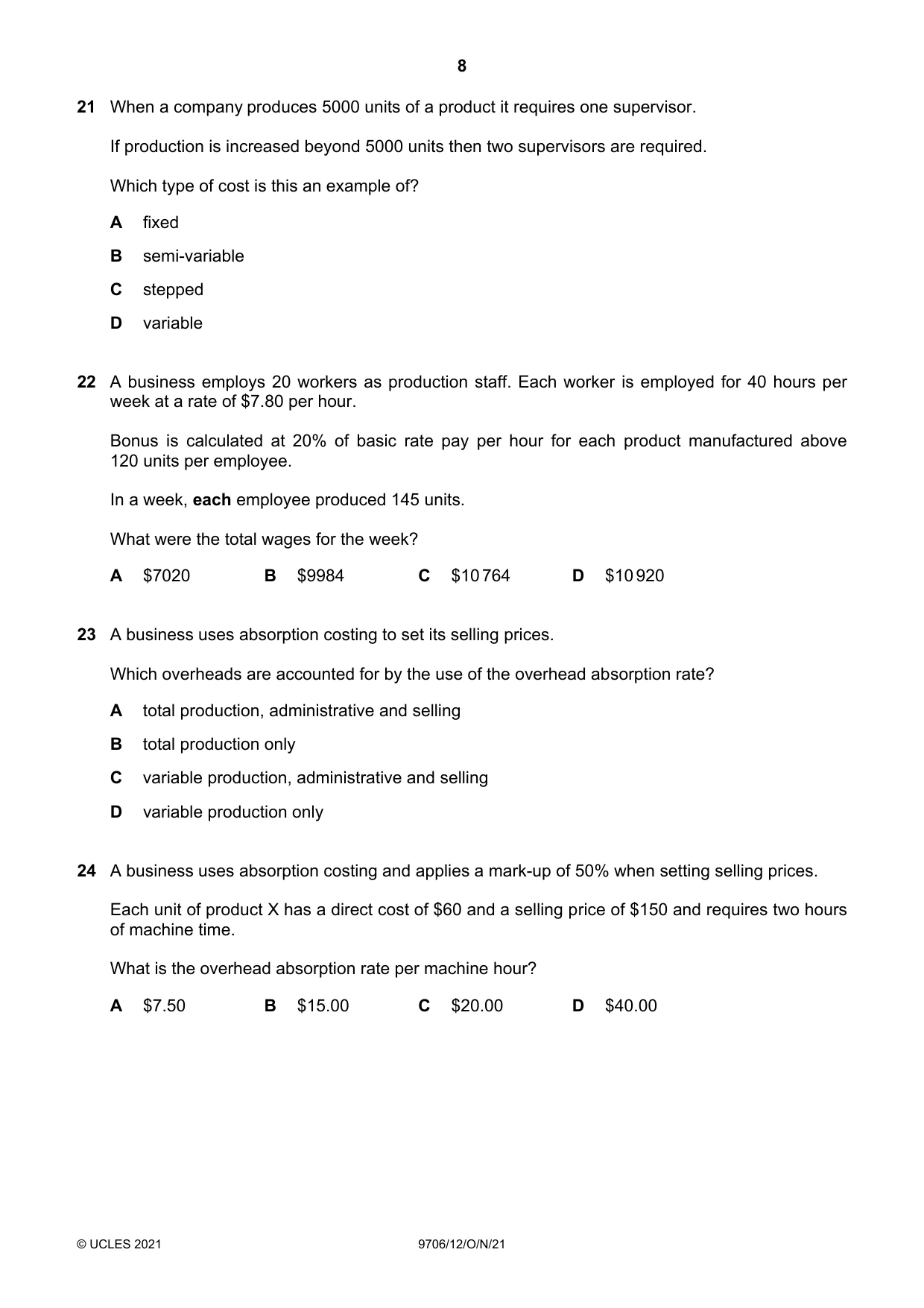
21 When a company produces 5000 units of a product it requires one supervisor. If production is increased beyond 5000 units then two supervisors are required. Which type of cost is this an example of? A fixed B semi-variable C stepped D variable
Mark scheme: C
Q22 · A business employs 20 workers as production staff
22 A business employs 20 workers as production staff. Each worker is employed for 40 hours per week at a rate of $7.80 per hour. Bonus is calculated at 20% of basic rate pay per hour for each product manufactured above 120 units per employee. In a week, each employee produced 145 units. What were the total wages for the week? A $7020 B $9984 C $10 764 D $10 920
Mark scheme: A
Q23 · A business uses absorption costing to set its selling prices
23 A business uses absorption costing to set its selling prices. Which overheads are accounted for by the use of the overhead absorption rate? A total production, administrative and selling B total production only C variable production, administrative and selling D variable production only
Mark scheme: B
Q24 · A business uses absorption costing and applies a mark-up of 50% when setting selling…
24 A business uses absorption costing and applies a mark-up of 50% when setting selling prices. Each unit of product X has a direct cost of $60 and a selling price of $150 and requires two hours of machine time. What is the overhead absorption rate per machine hour? A $7.50 B $15.00 C $20.00 D $40.00
Mark scheme: C
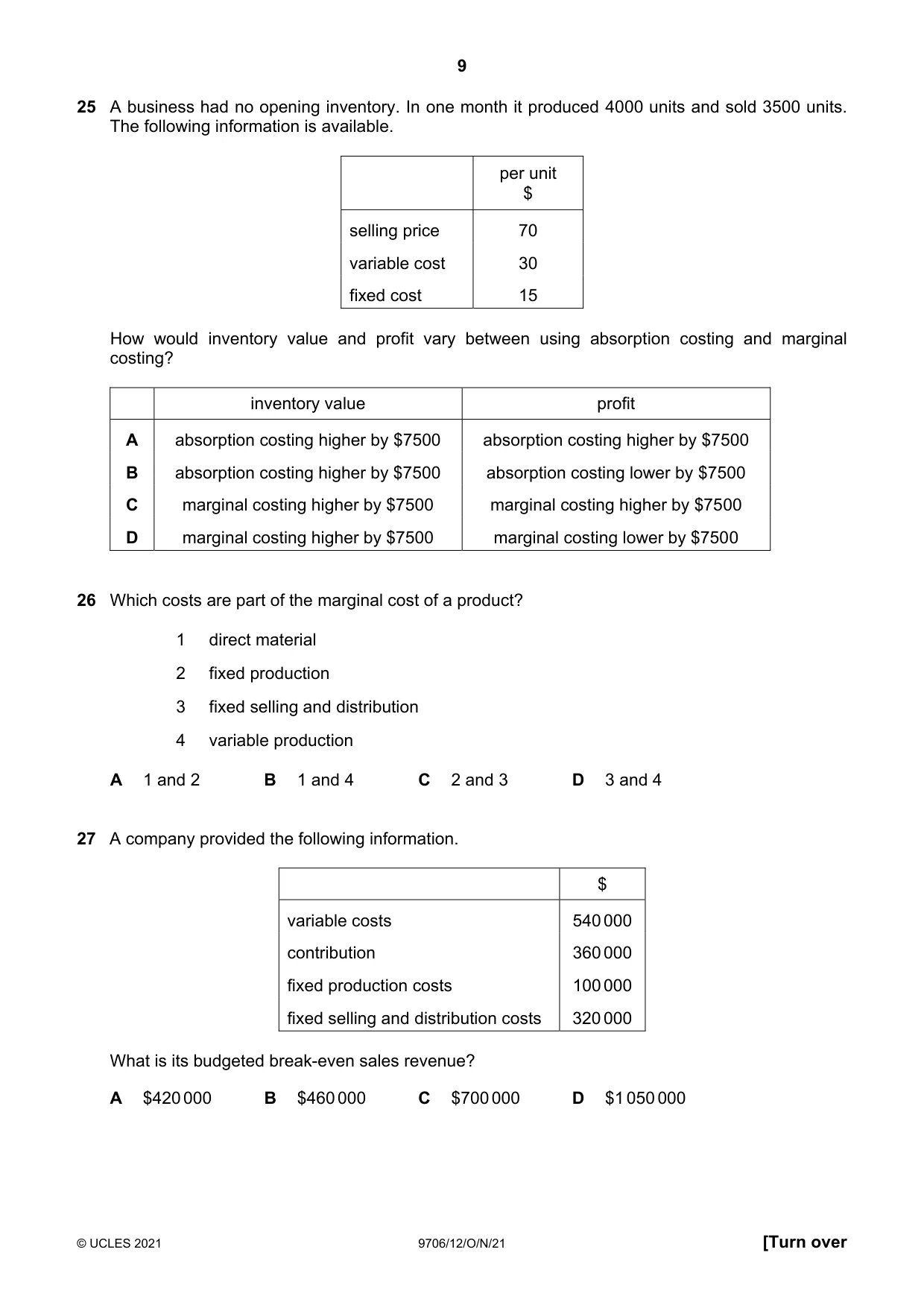
Q25 · A business had no opening inventory
25 A business had no opening inventory. In one month it produced 4000 units and sold 3500 units. The following information is available. per unit $ selling price 70 variable cost 30 fixed cost 15 How would inventory value and profit vary between using absorption costing and marginal costing? inventory value profit A absorption costing higher by $7500 absorption costing higher by $7500 B absorption costing higher by $7500 absorption costing lower by $7500 C marginal costing higher by $7500 marginal costing higher by $7500 D marginal costing higher by $7500 marginal costing lower by $7500
Mark scheme: A
Q26 · Which costs are part of the marginal cost of a product?
26 Which costs are part of the marginal cost of a product? 1 direct material 2 fixed production 3 fixed selling and distribution 4 variable production A 1 and 2 B 1 and 4 C 2 and 3 D 3 and 4
Mark scheme: B
Q27 · A company provided the following information
27 A company provided the following information. $ variable costs 540 000 contribution 360 000 fixed production costs 100 000 fixed selling and distribution costs 320 000 What is its budgeted break-even sales revenue? A $420 000 B $460 000 C $700 000 D $1 050 000
Mark scheme: D
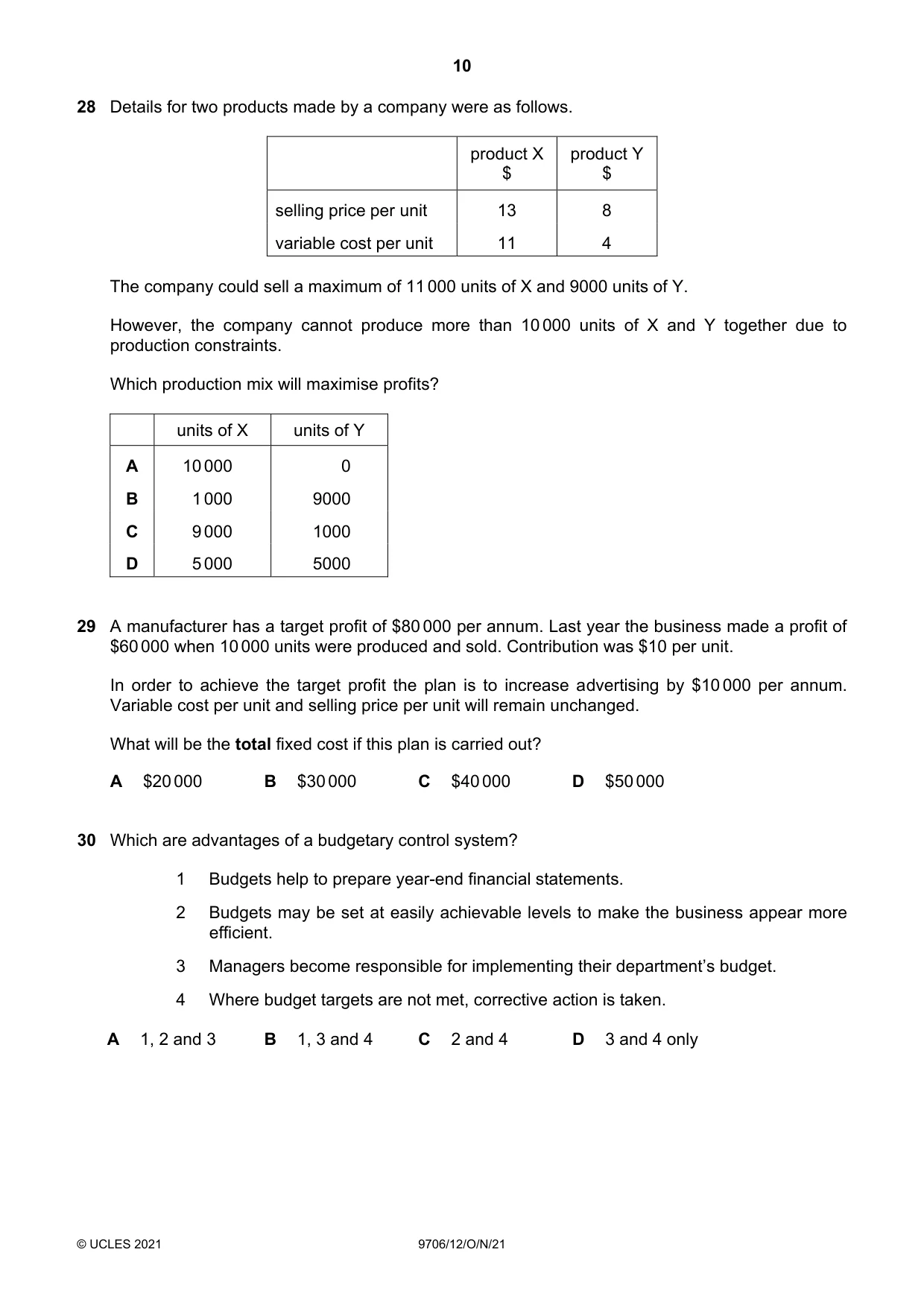
Q28 · Details for two products made by a company were as follows
28 Details for two products made by a company were as follows. product X product Y $ $ selling price per unit 13 8 variable cost per unit 11 4 The company could sell a maximum of 11 000 units of X and 9000 units of Y. However, the company cannot produce more than 10 000 units of X and Y together due to production constraints. Which production mix will maximise profits? units of X units of Y A 10 000 0 B 1 000 9000 C 9 000 1000 D 5 000 5000
Mark scheme: B
Q29 · A manufacturer has a target profit of $80 000 per annum
29 A manufacturer has a target profit of $80 000 per annum. Last year the business made a profit of $60 000 when 10 000 units were produced and sold. Contribution was $10 per unit. In order to achieve the target profit the plan is to increase advertising by $10 000 per annum. Variable cost per unit and selling price per unit will remain unchanged. What will be the total fixed cost if this plan is carried out? A $20 000 B $30 000 C $40 000 D $50 000
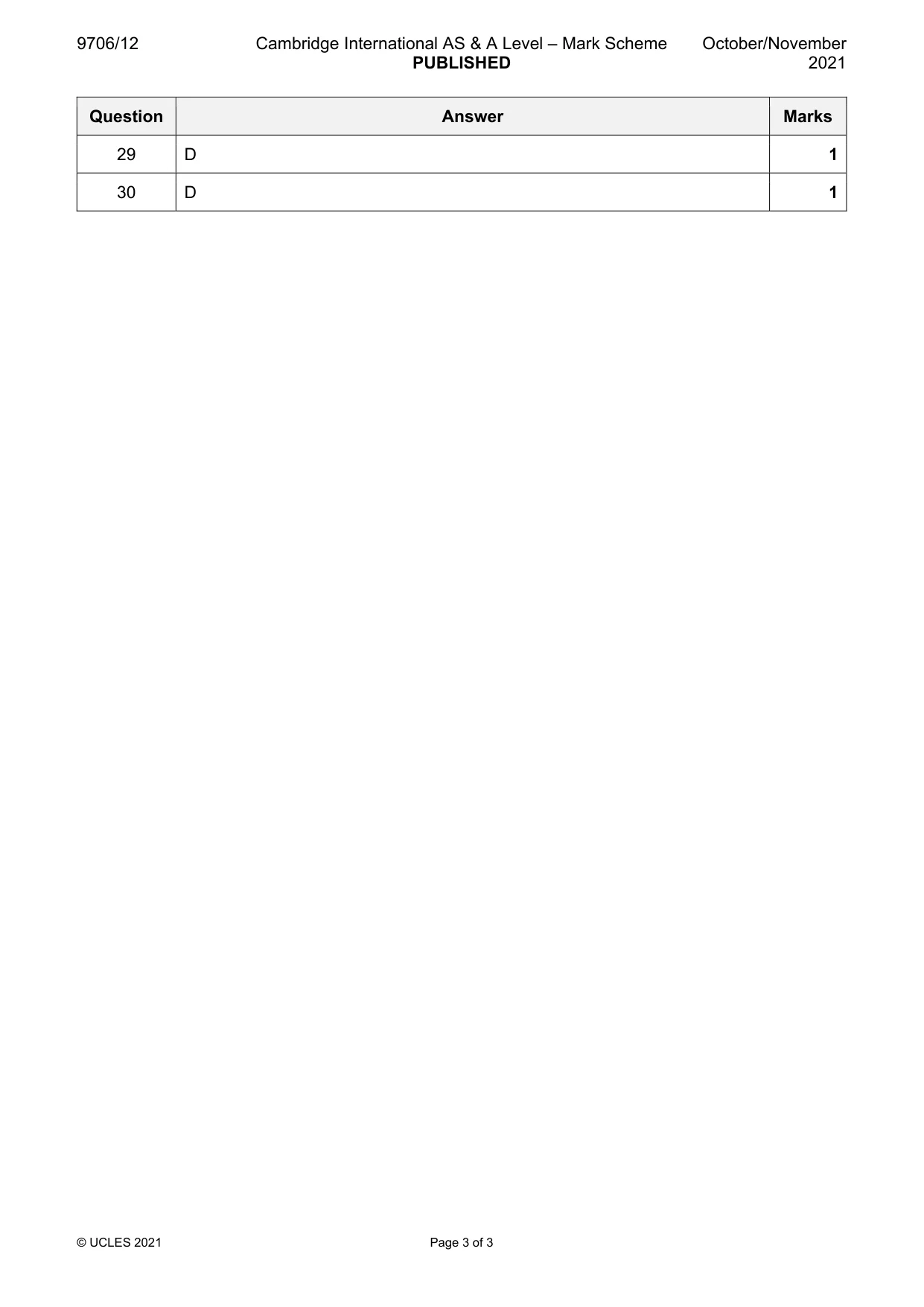
Mark scheme: D
Q30 · Which are advantages of a budgetary control system?
30 Which are advantages of a budgetary control system? 1 Budgets help to prepare year-end financial statements. 2 Budgets may be set at easily achievable levels to make the business appear more efficient. 3 Managers become responsible for implementing their department’s budget. 4 Where budget targets are not met, corrective action is taken. A 1, 2 and 3 B 1, 3 and 4 C 2 and 4 D 3 and 4 only
Mark scheme: D
What was in this paper
The subtopics covered by these 30 questions, and how many questions each got. Open one in a new tab to see every Cambridge question on it.
5Traditional costing methods5Preparation of financial statements4Accounting for non-current assets3Costs and cost behaviour3Analysis and communication of accounting information2Budgeting and budgetary control2Reconciliation and verification2The accounting system2Analysis and communication of accounting information1Types of business entity1What you needed in this session
Cambridge’s own grade thresholds for 2021 Oct/Nov, Paper 1 · Variant 2. A higher threshold means an easier paper — the bar moves with how the cohort did.