Cambridge A Level Accounting 9706 — 2017 Oct/Nov Paper 1 · Variant 3
9706/13/O/N/17 · 30 questions · 30 marks · ≈34 min
The question paper and its mark scheme, free to read here and free to download. This is Cambridge’s own paper, exactly as it was sat.
Question paper12 pages
Mark scheme3 pages
Answers below. Sit the paper first if you are practising.
Questions as text
Q1 · Which statements about the prudence concept are correct?
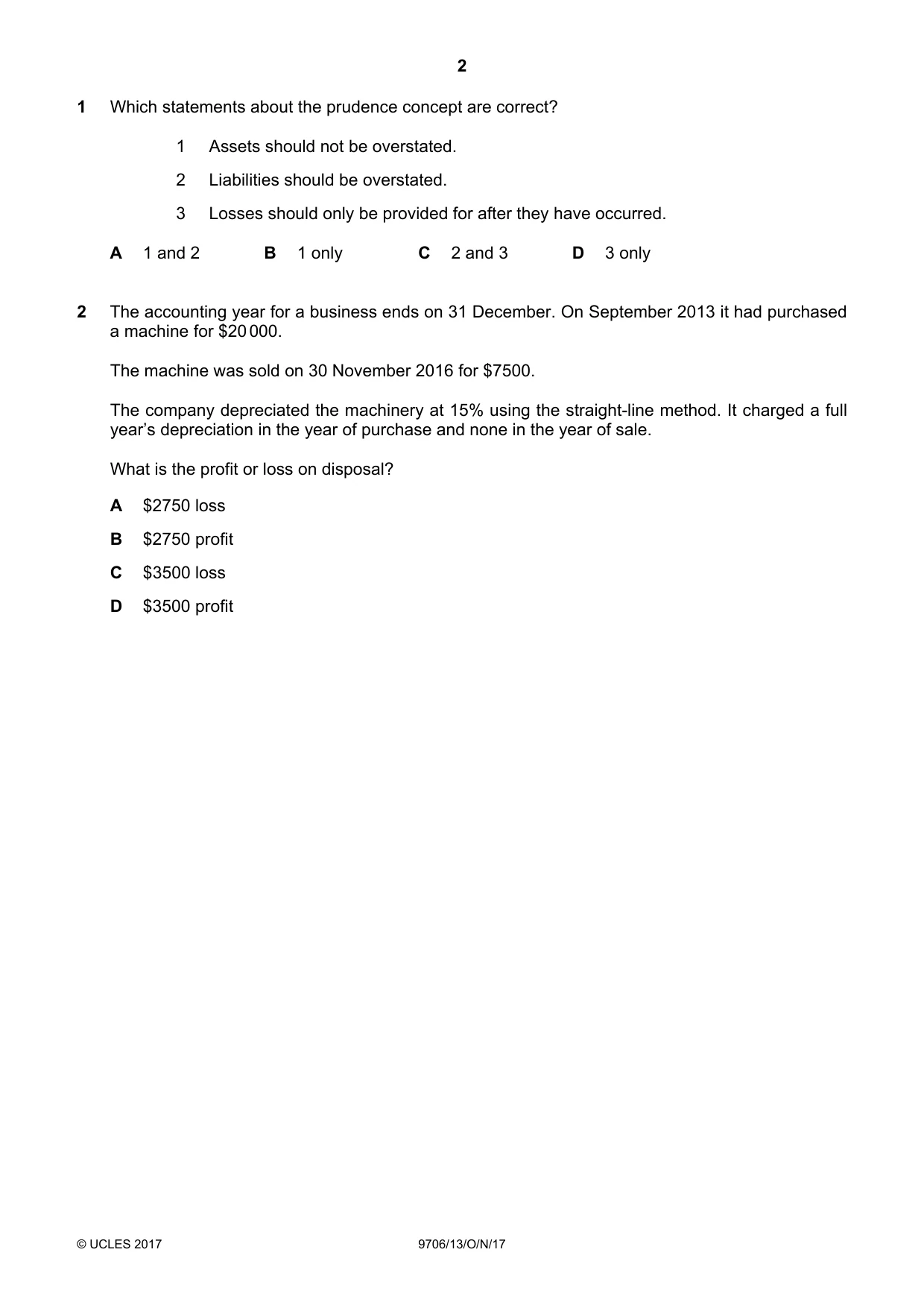
1 Which statements about the prudence concept are correct? 1 Assets should not be overstated. 2 Liabilities should be overstated. 3 Losses should only be provided for after they have occurred. A 1 and 2 B 1 only C 2 and 3 D 3 only
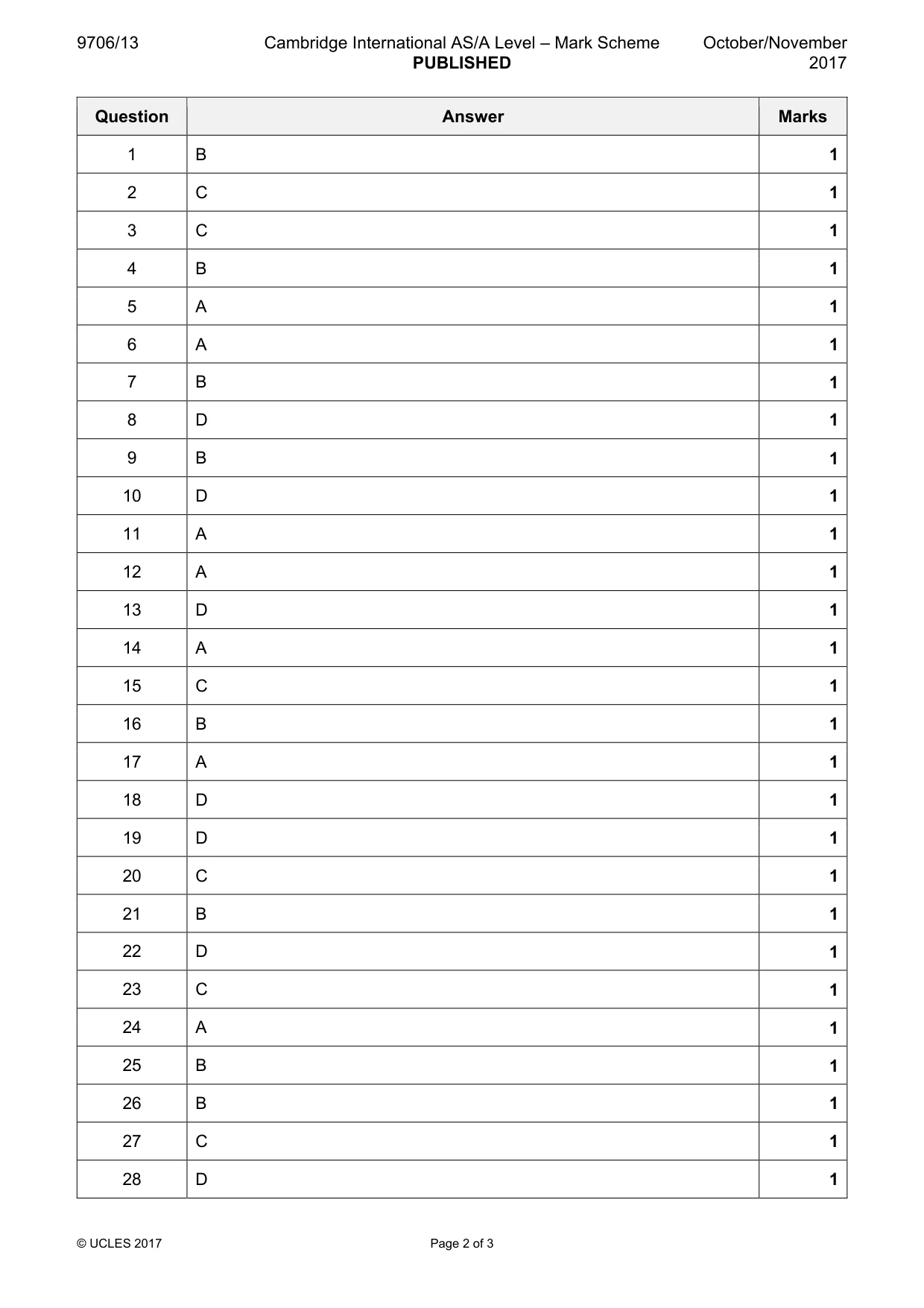
Mark scheme: B
Q2 · The accounting year for a business ends on 31 December
2 The accounting year for a business ends on 31 December. On September 2013 it had purchased a machine for $20 000. The machine was sold on 30 November 2016 for $7500. The company depreciated the machinery at 15% using the straight-line method. It charged a full year’s depreciation in the year of purchase and none in the year of sale. What is the profit or loss on disposal? A $2750 loss B $2750 profit C $3500 loss D $3500 profit
Mark scheme: C
Q3 · The table shows how a property was recorded in the statement of financial position
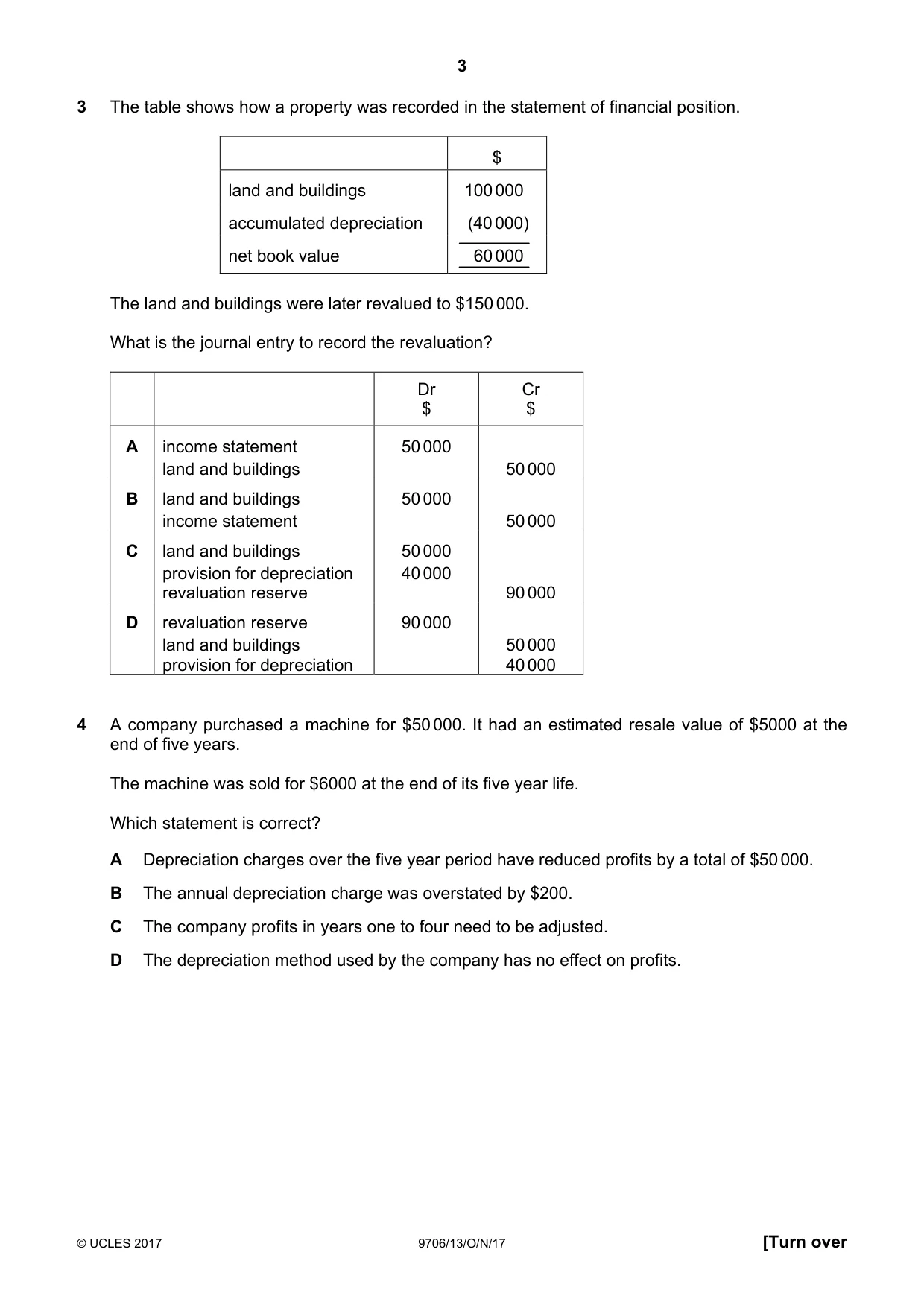
3 The table shows how a property was recorded in the statement of financial position. $ land and buildings 100 000 accumulated depreciation (40 000) net book value 60 000 The land and buildings were later revalued to $150 000. What is the journal entry to record the revaluation? Dr Cr $ $ A income statement 50 000 land and buildings 50 000 B land and buildings 50 000 income statement 50 000 C land and buildings 50 000 provision for depreciation 40 000 revaluation reserve 90 000 D revaluation reserve 90 000 land and buildings 50 000 provision for depreciation 40 000
Mark scheme: C
Q4 · A company purchased a machine for $50 000
4 A company purchased a machine for $50 000. It had an estimated resale value of $5000 at the end of five years. The machine was sold for $6000 at the end of its five year life. Which statement is correct? A Depreciation charges over the five year period have reduced profits by a total of $50 000. B The annual depreciation charge was overstated by $200. C The company profits in years one to four need to be adjusted. D The depreciation method used by the company has no effect on profits.
Mark scheme: B
Q5 · The following errors in the accounting records have been found and corrected: 1 A…
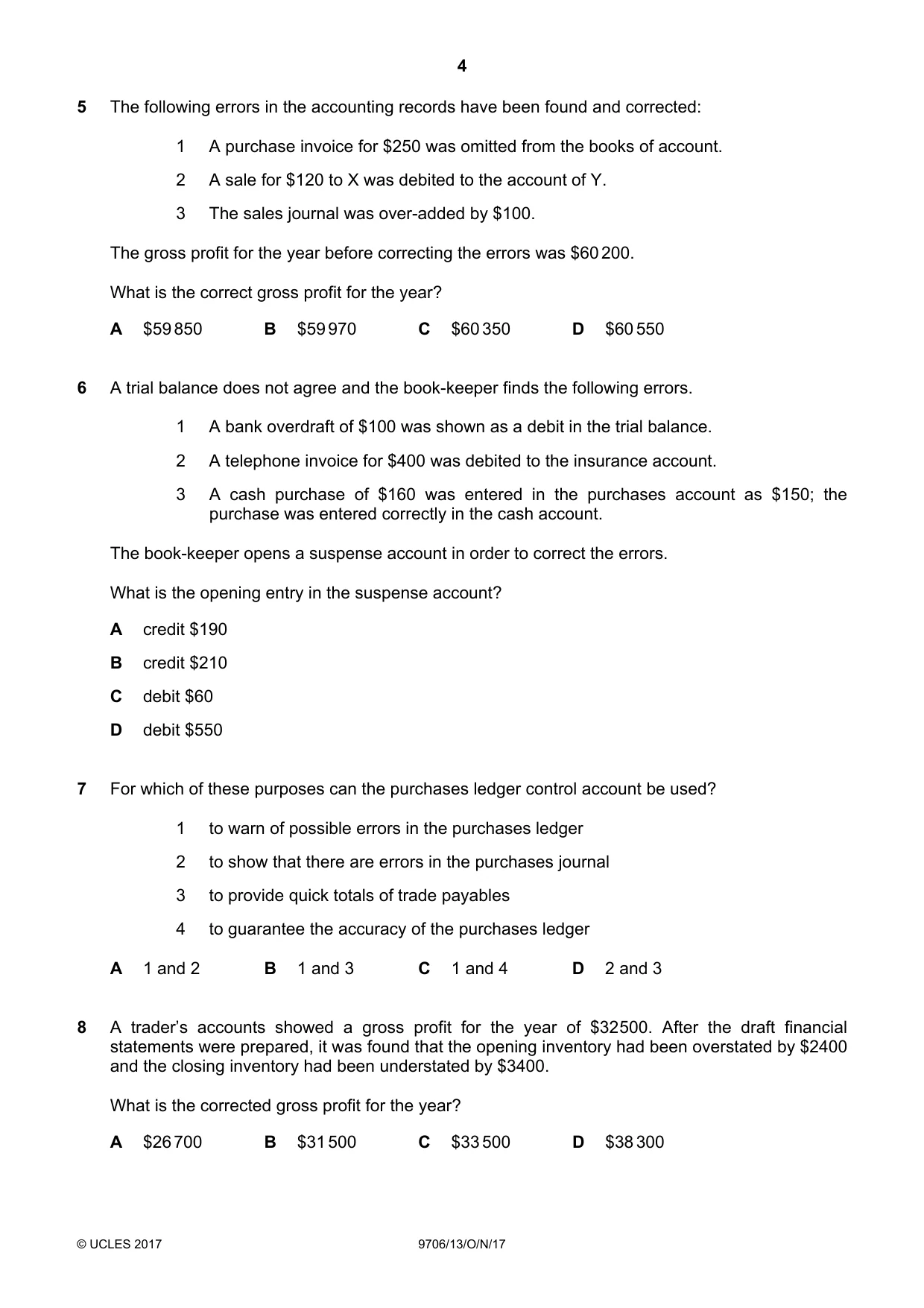
5 The following errors in the accounting records have been found and corrected: 1 A purchase invoice for $250 was omitted from the books of account. 2 A sale for $120 to X was debited to the account of Y. 3 The sales journal was over-added by $100. The gross profit for the year before correcting the errors was $60 200. What is the correct gross profit for the year? A $59 850 B $59 970 C $60 350 D $60 550
Mark scheme: A
Q6 · A trial balance does not agree and the book-keeper finds the following errors
6 A trial balance does not agree and the book-keeper finds the following errors. 1 A bank overdraft of $100 was shown as a debit in the trial balance. 2 A telephone invoice for $400 was debited to the insurance account. 3 A cash purchase of $160 was entered in the purchases account as $150; the purchase was entered correctly in the cash account. The book-keeper opens a suspense account in order to correct the errors. What is the opening entry in the suspense account? A credit $190 B credit $210 C debit $60 D debit $550
Mark scheme: A
Q7 · For which of these purposes can the purchases ledger control account be used?
7 For which of these purposes can the purchases ledger control account be used? 1 to warn of possible errors in the purchases ledger 2 to show that there are errors in the purchases journal 3 to provide quick totals of trade payables 4 to guarantee the accuracy of the purchases ledger A 1 and 2 B 1 and 3 C 1 and 4 D 2 and 3
Mark scheme: B
Q8 · A trader’s accounts showed a gross profit for the year of $32 500
8 A trader’s accounts showed a gross profit for the year of $32 500. After the draft financial statements were prepared, it was found that the opening inventory had been overstated by $2400 and the closing inventory had been understated by $3400. What is the corrected gross profit for the year? A $26 700 B $31 500 C $33 500 D $38 300
Mark scheme: D
Q9 · At 1 January 2016 a company had the trade receivables totalling $45 000
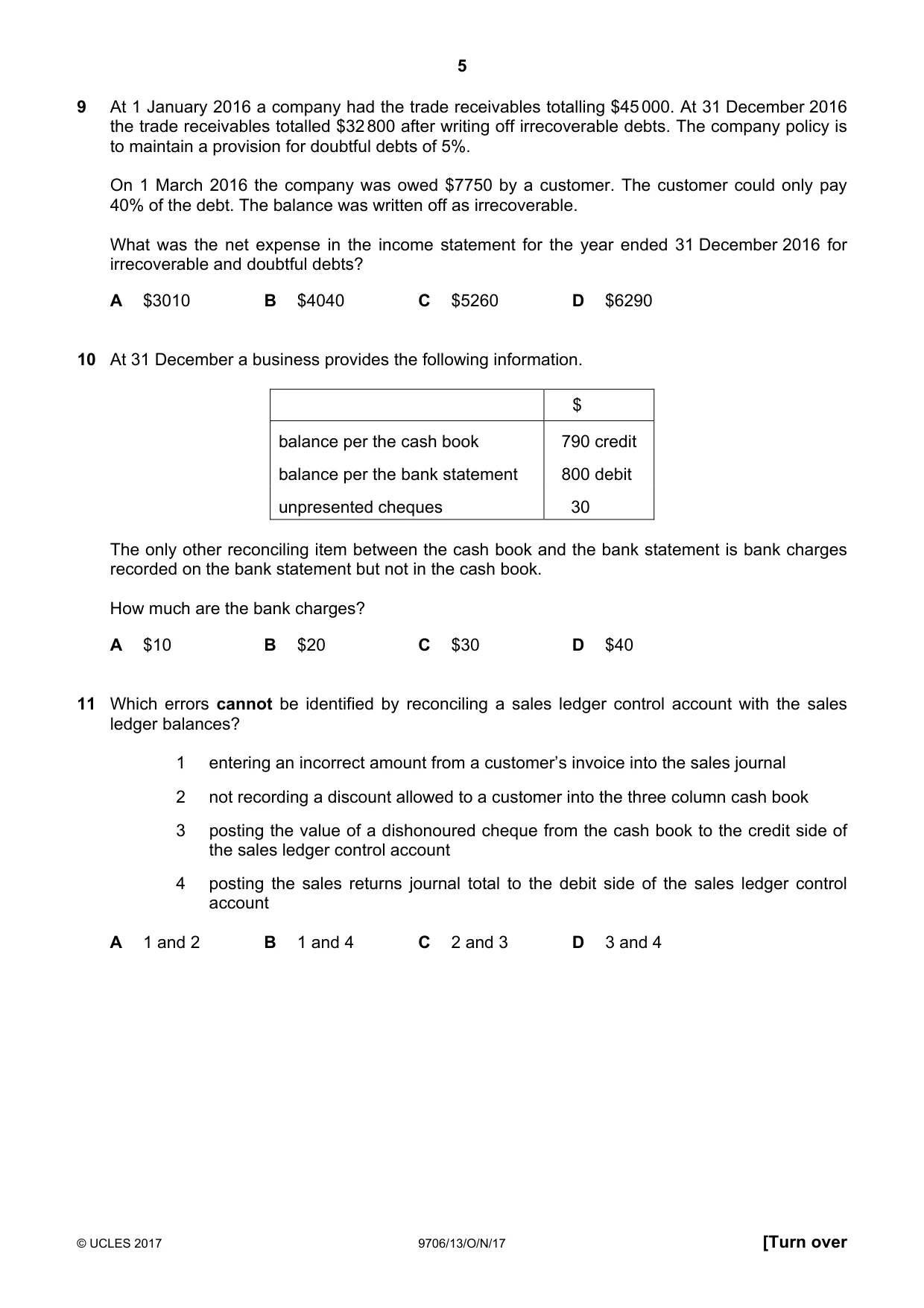
9 At 1 January 2016 a company had the trade receivables totalling $45 000. At 31 December 2016 the trade receivables totalled $32 800 after writing off irrecoverable debts. The company policy is to maintain a provision for doubtful debts of 5%. On 1 March 2016 the company was owed $7750 by a customer. The customer could only pay 40% of the debt. The balance was written off as irrecoverable. What was the net expense in the income statement for the year ended 31 December 2016 for irrecoverable and doubtful debts? A $3010 B $4040 C $5260 D $6290
Mark scheme: B
Q10 · At 31 December a business provides the following information
10 At 31 December a business provides the following information. $ balance per the cash book 790 credit balance per the bank statement 800 debit unpresented cheques 30 The only other reconciling item between the cash book and the bank statement is bank charges recorded on the bank statement but not in the cash book. How much are the bank charges? A $10 B $20 C $30 D $40
Mark scheme: D
Q11 · Which errors cannot be identified by reconciling a sales ledger control account with the…
11 Which errors cannot be identified by reconciling a sales ledger control account with the sales ledger balances? 1 entering an incorrect amount from a customer’s invoice into the sales journal 2 not recording a discount allowed to a customer into the three column cash book 3 posting the value of a dishonoured cheque from the cash book to the credit side of the sales ledger control account 4 posting the sales returns journal total to the debit side of the sales ledger control account A 1 and 2 B 1 and 4 C 2 and 3 D 3 and 4
Mark scheme: A
Q12 · X and Y are in partnership, sharing profits and losses equally
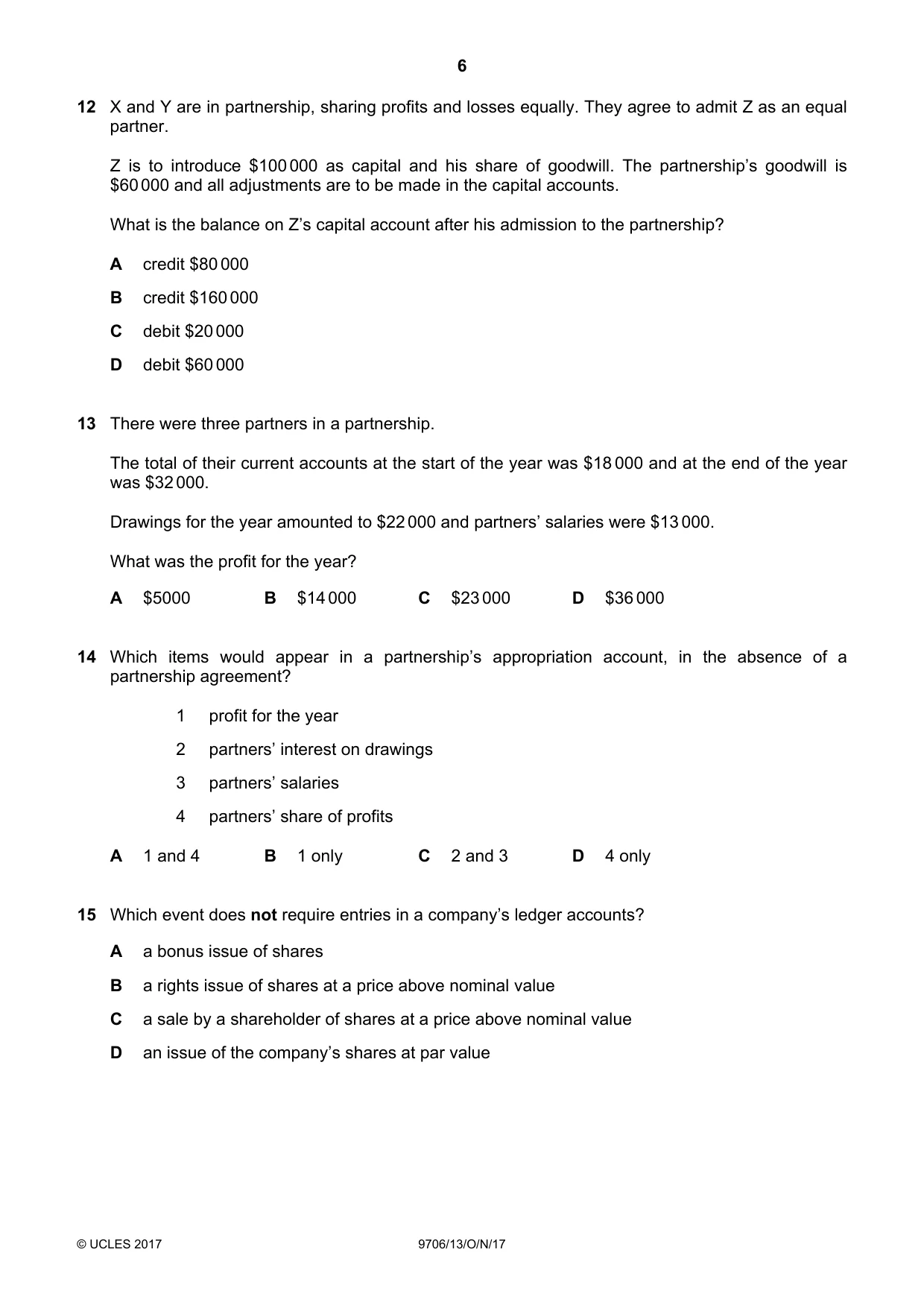
12 X and Y are in partnership, sharing profits and losses equally. They agree to admit Z as an equal partner. Z is to introduce $100 000 as capital and his share of goodwill. The partnership’s goodwill is $60 000 and all adjustments are to be made in the capital accounts. What is the balance on Z’s capital account after his admission to the partnership? A credit $80 000 B credit $160 000 C debit $20 000 D debit $60 000
Mark scheme: A
Q13 · There were three partners in a partnership
13 There were three partners in a partnership. The total of their current accounts at the start of the year was $18 000 and at the end of the year was $32 000. Drawings for the year amounted to $22 000 and partners’ salaries were $13 000. What was the profit for the year? A $5000 B $14 000 C $23 000 D $36 000
Mark scheme: D
Q14 · Which items would appear in a partnership’s appropriation account, in the absence of a…
14 Which items would appear in a partnership’s appropriation account, in the absence of a partnership agreement? 1 profit for the year 2 partners’ interest on drawings 3 partners’ salaries 4 partners’ share of profits A 1 and 4 B 1 only C 2 and 3 D 4 only
Mark scheme: A
Q15 · Which event does not require entries in a company’s ledger accounts?
15 Which event does not require entries in a company’s ledger accounts? A a bonus issue of shares B a rights issue of shares at a price above nominal value C a sale by a shareholder of shares at a price above nominal value D an issue of the company’s shares at par value
Mark scheme: C
Q16 · An extract from a statement of changes in equity for the year ended 31 December 2016 is…
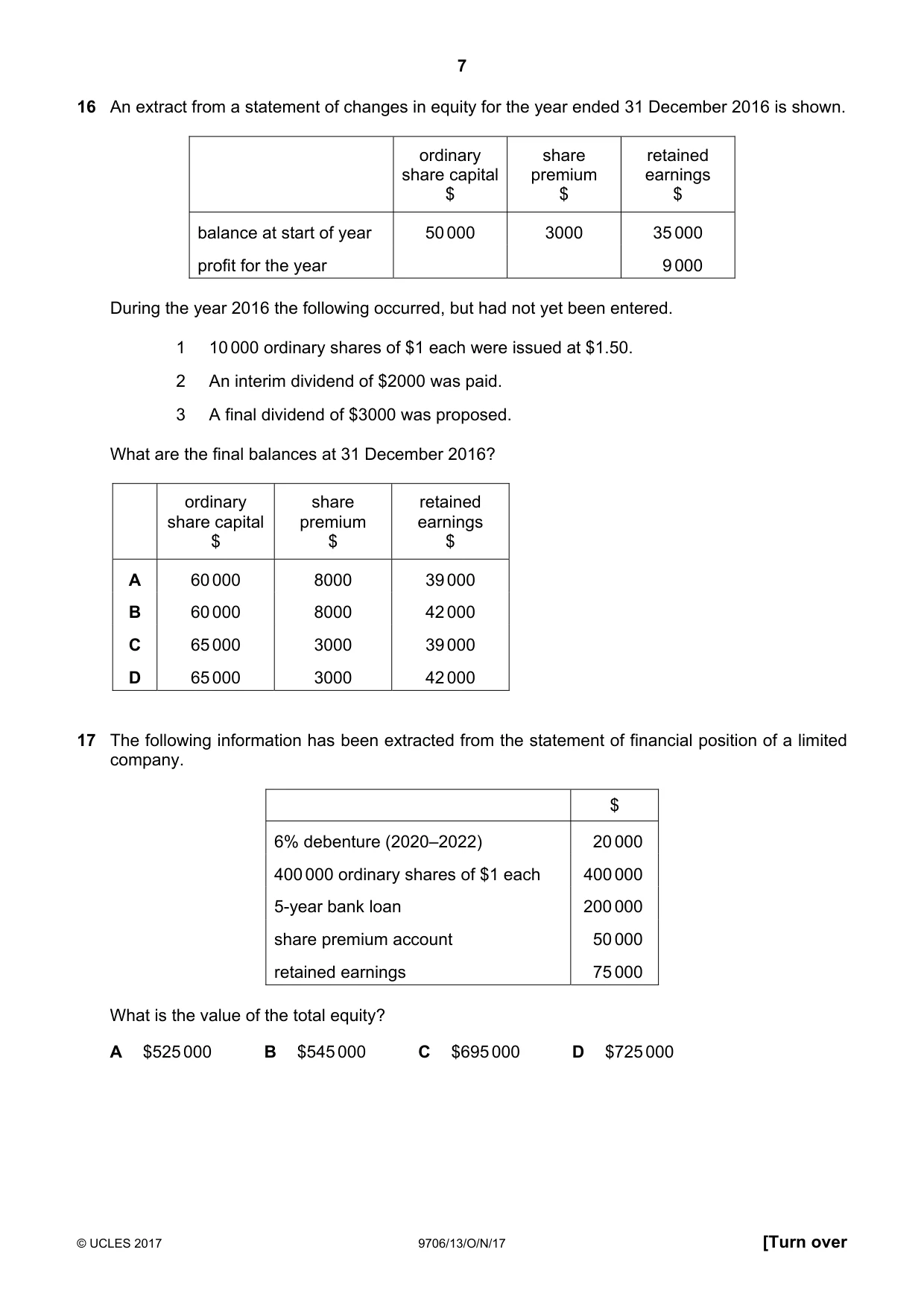
16 An extract from a statement of changes in equity for the year ended 31 December 2016 is shown. ordinary share retained share capital premium earnings $ $ $ balance at start of year 50 000 3000 35 000 profit for the year 9 000 During the year 2016 the following occurred, but had not yet been entered. 1 10 000 ordinary shares of $1 each were issued at $1.50. 2 An interim dividend of $2000 was paid. 3 A final dividend of $3000 was proposed. What are the final balances at 31 December 2016? ordinary share retained share capital premium earnings $ $ $ A 60 000 8000 39 000 B 60 000 8000 42 000 C 65 000 3000 39 000 D 65 000 3000 42 000
Mark scheme: B
Q17 · The following information has been extracted from the statement of financial position of…
17 The following information has been extracted from the statement of financial position of a limited company. $ 6% debenture (2020–2022) 20 000 400 000 ordinary shares of $1 each 400 000 5-year bank loan 200 000 share premium account 50 000 retained earnings 75 000 What is the value of the total equity? A $525 000 B $545 000 C $695 000 D $725 000
Mark scheme: A
Q18 · The opening inventory for a business was $60 000
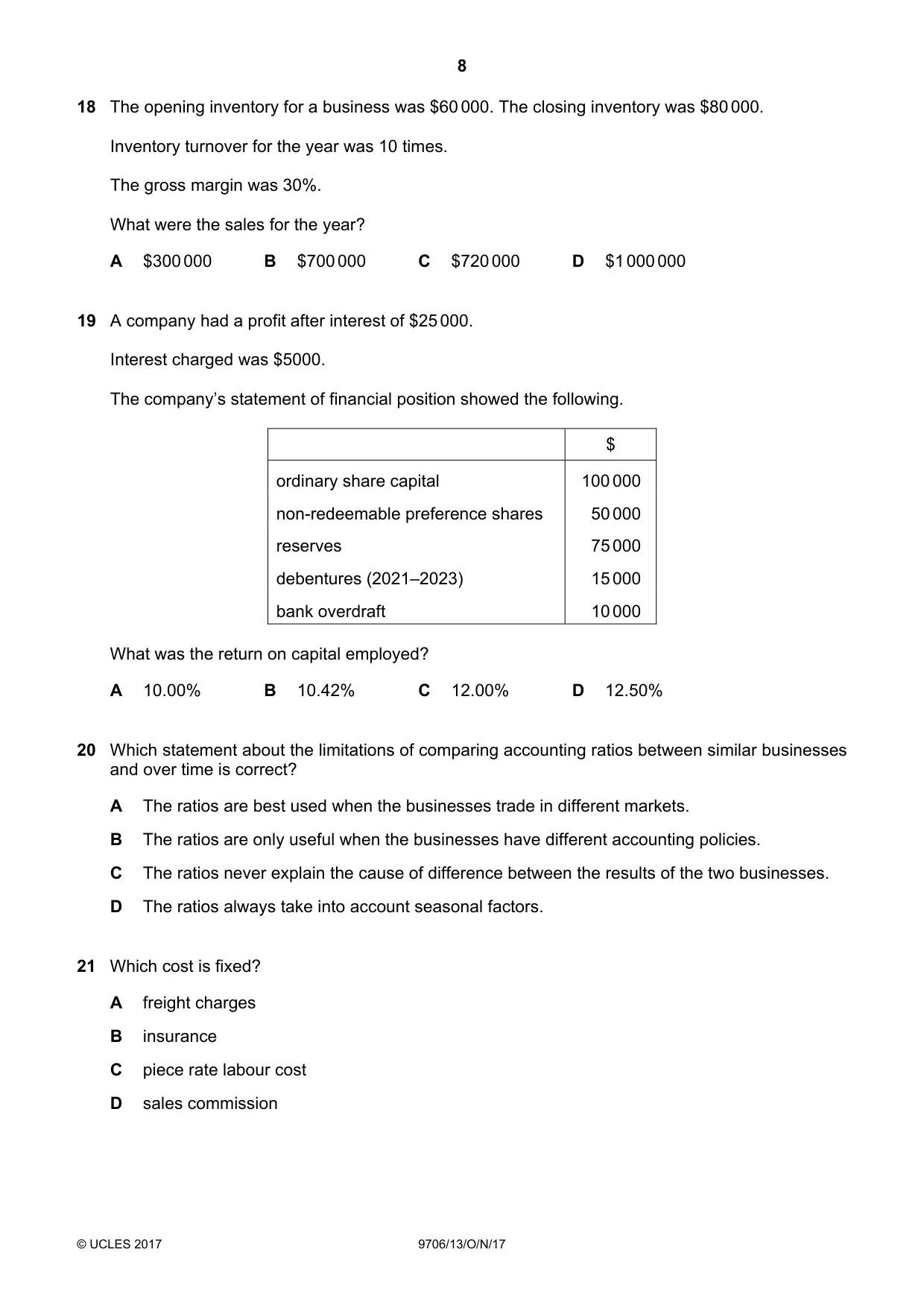
18 The opening inventory for a business was $60 000. The closing inventory was $80 000. Inventory turnover for the year was 10 times. The gross margin was 30%. What were the sales for the year? A $300 000 B $700 000 C $720 000 D $1 000 000
Mark scheme: D
More questions on Analysis and communication of accounting information
Q19 · A company had a profit after interest of $25 000
19 A company had a profit after interest of $25 000. Interest charged was $5000. The company’s statement of financial position showed the following. $ ordinary share capital 100 000 non-redeemable preference shares 50 000 reserves 75 000 debentures (2021–2023) 15 000 bank overdraft 10 000 What was the return on capital employed? A 10.00% B 10.42% C 12.00% D 12.50%
Mark scheme: D
More questions on Analysis and communication of accounting information
Q20 · Which statement about the limitations of comparing accounting ratios between similar…
20 Which statement about the limitations of comparing accounting ratios between similar businesses and over time is correct? A The ratios are best used when the businesses trade in different markets. B The ratios are only useful when the businesses have different accounting policies. C The ratios never explain the cause of difference between the results of the two businesses. D The ratios always take into account seasonal factors.
Mark scheme: C
More questions on Analysis and communication of accounting information
Q21 · Which cost is fixed?
21 Which cost is fixed? A freight charges B insurance C piece rate labour cost D sales commission
Mark scheme: B
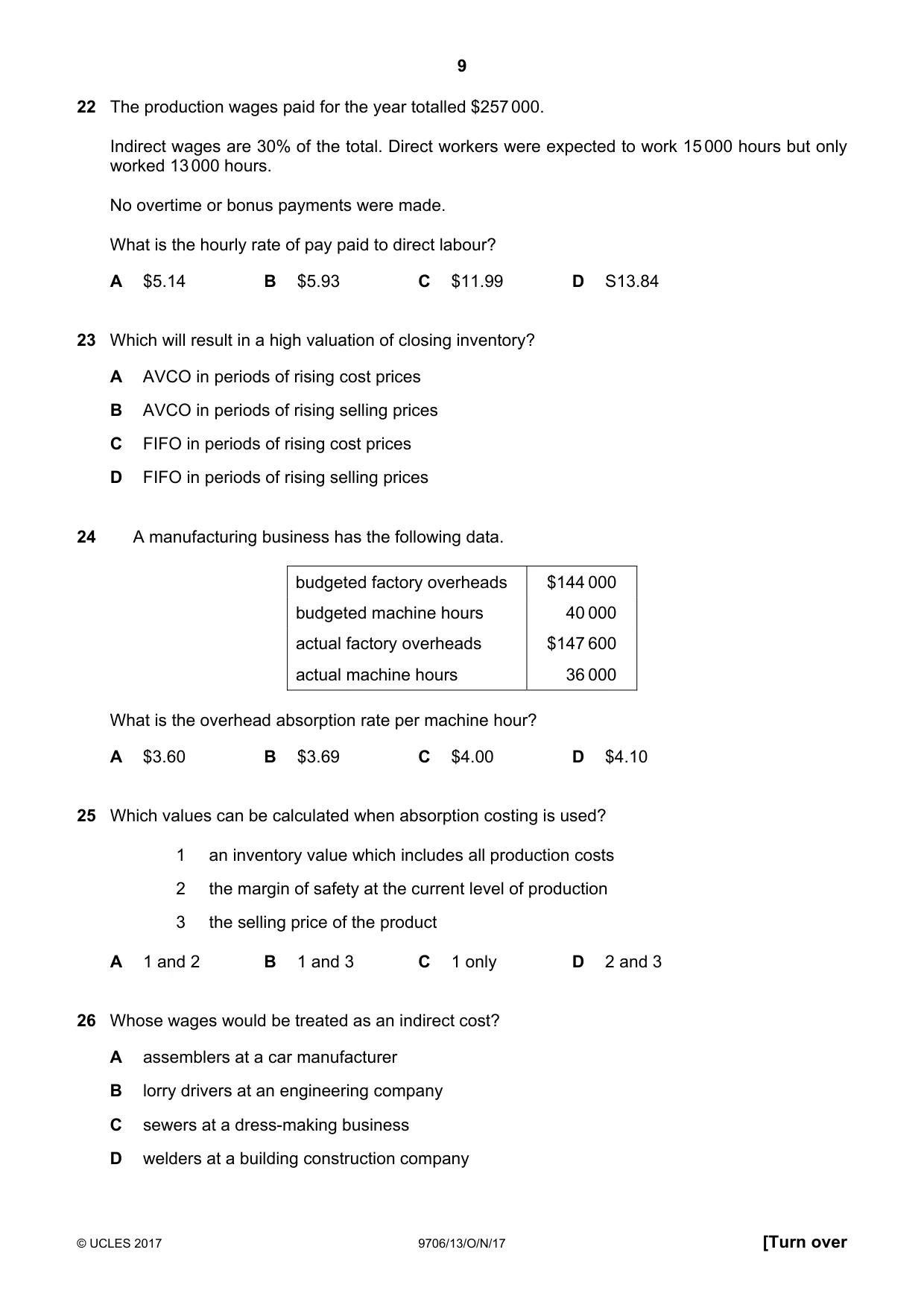
Q22 · The production wages paid for the year totalled $257 000
22 The production wages paid for the year totalled $257 000. Indirect wages are 30% of the total. Direct workers were expected to work 15 000 hours but only worked 13 000 hours. No overtime or bonus payments were made. What is the hourly rate of pay paid to direct labour? A $5.14 B $5.93 C $11.99 D S13.84
Mark scheme: D
Q23 · Which will result in a high valuation of closing inventory?
23 Which will result in a high valuation of closing inventory? A AVCO in periods of rising cost prices B AVCO in periods of rising selling prices C FIFO in periods of rising cost prices D FIFO in periods of rising selling prices
Mark scheme: C
Q24 · A manufacturing business has the following data
24 A manufacturing business has the following data. budgeted factory overheads $144 000 budgeted machine hours 40 000 actual factory overheads $147 600 actual machine hours 36 000 What is the overhead absorption rate per machine hour? A $3.60 B $3.69 C $4.00 D $4.10
Mark scheme: A
Q25 · Which values can be calculated when absorption costing is used?
25 Which values can be calculated when absorption costing is used? 1 an inventory value which includes all production costs 2 the margin of safety at the current level of production 3 the selling price of the product A 1 and 2 B 1 and 3 C 1 only D 2 and 3
Mark scheme: B
Q26 · Whose wages would be treated as an indirect cost?
26 Whose wages would be treated as an indirect cost? A assemblers at a car manufacturer B lorry drivers at an engineering company C sewers at a dress-making business D welders at a building construction company
Mark scheme: B
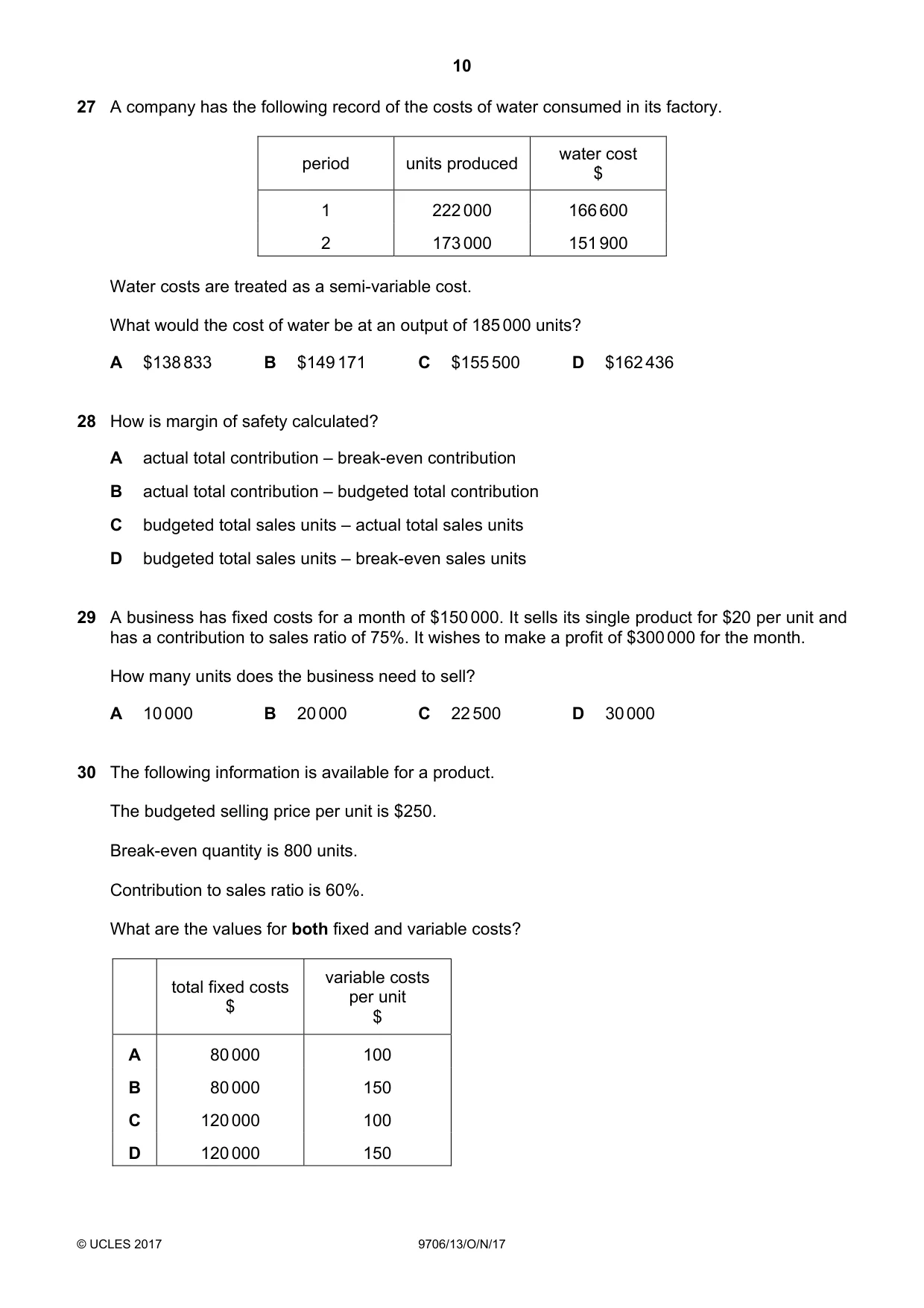
Q27 · A company has the following record of the costs of water consumed in its factory
27 A company has the following record of the costs of water consumed in its factory. water cost period units produced $ 1 222 000 166 600 2 173 000 151 900 Water costs are treated as a semi-variable cost. What would the cost of water be at an output of 185 000 units? A $138 833 B $149 171 C $155 500 D $162 436
Mark scheme: C
Q28 · How is margin of safety calculated?
28 How is margin of safety calculated? A actual total contribution – break-even contribution B actual total contribution – budgeted total contribution C budgeted total sales units – actual total sales units D budgeted total sales units – break-even sales units
Mark scheme: D
Q29 · A business has fixed costs for a month of $150 000
29 A business has fixed costs for a month of $150 000. It sells its single product for $20 per unit and has a contribution to sales ratio of 75%. It wishes to make a profit of $300 000 for the month. How many units does the business need to sell? A 10 000 B 20 000 C 22 500 D 30 000
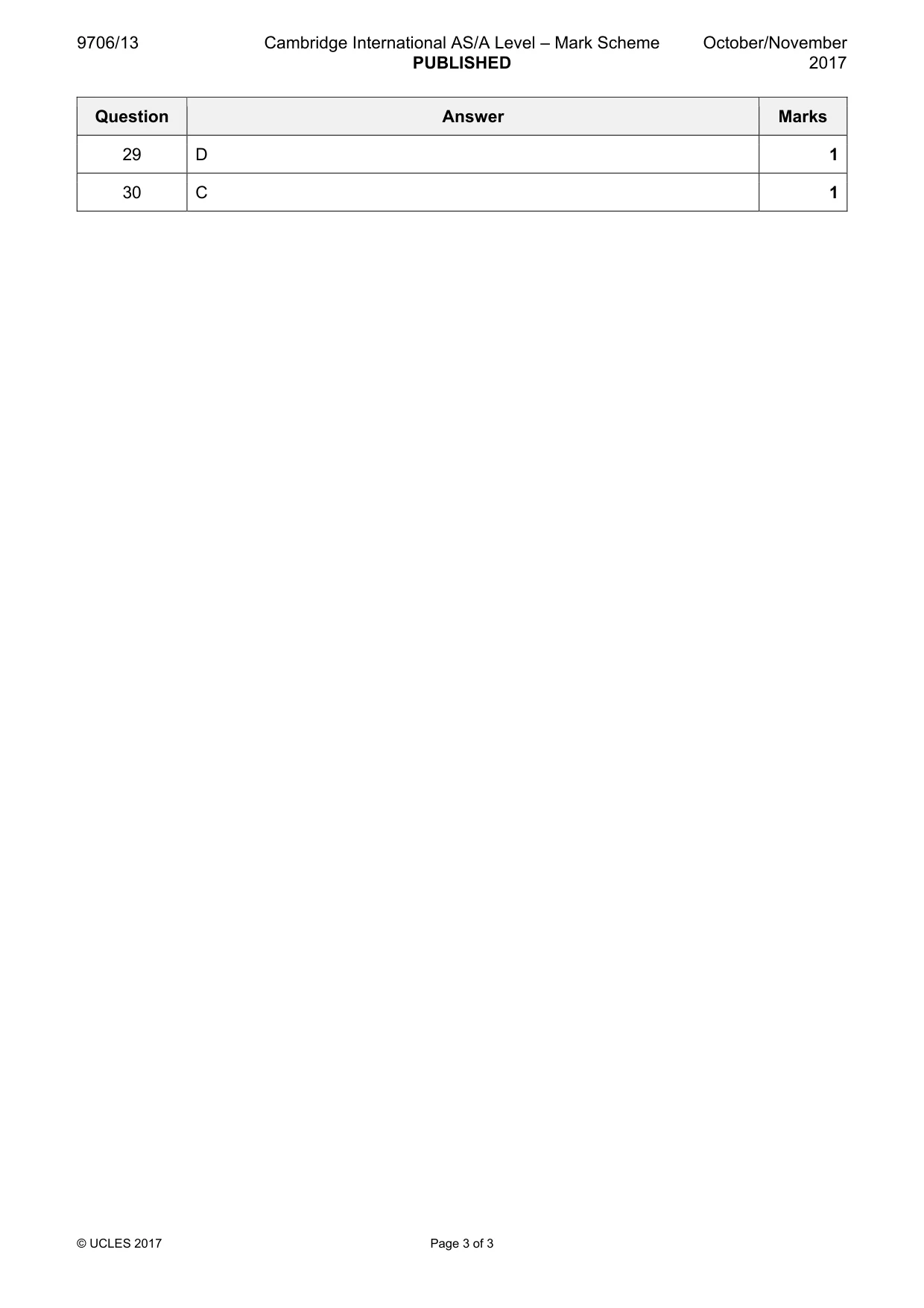
Mark scheme: D
Q30 · The following information is available for a product
30 The following information is available for a product. The budgeted selling price per unit is $250. Break-even quantity is 800 units. Contribution to sales ratio is 60%. What are the values for both fixed and variable costs? variable costs total fixed costs per unit $ $ A 80 000 100 B 80 000 150 C 120 000 100 D 120 000 150
Mark scheme: C
What was in this paper
The subtopics covered by these 30 questions, and how many questions each got. Open one in a new tab to see every Cambridge question on it.
6Traditional costing methods6Reconciliation and verification5Costs and cost behaviour4Accounting for non-current assets3Analysis and communication of accounting information2Preparation of financial statements2Analysis and communication of accounting information1The accounting system1What you needed in this session
Cambridge’s own grade thresholds for 2017 Oct/Nov, Paper 1 · Variant 3. A higher threshold means an easier paper — the bar moves with how the cohort did.