Cambridge A Level Accounting 9706 — 2012 Oct/Nov Paper 1 · Variant 3
9706/13/O/N/12 · 30 questions · 30 marks · ≈34 min
The question paper and its mark scheme, free to read here and free to download. This is Cambridge’s own paper, exactly as it was sat.
Question paper12 pages
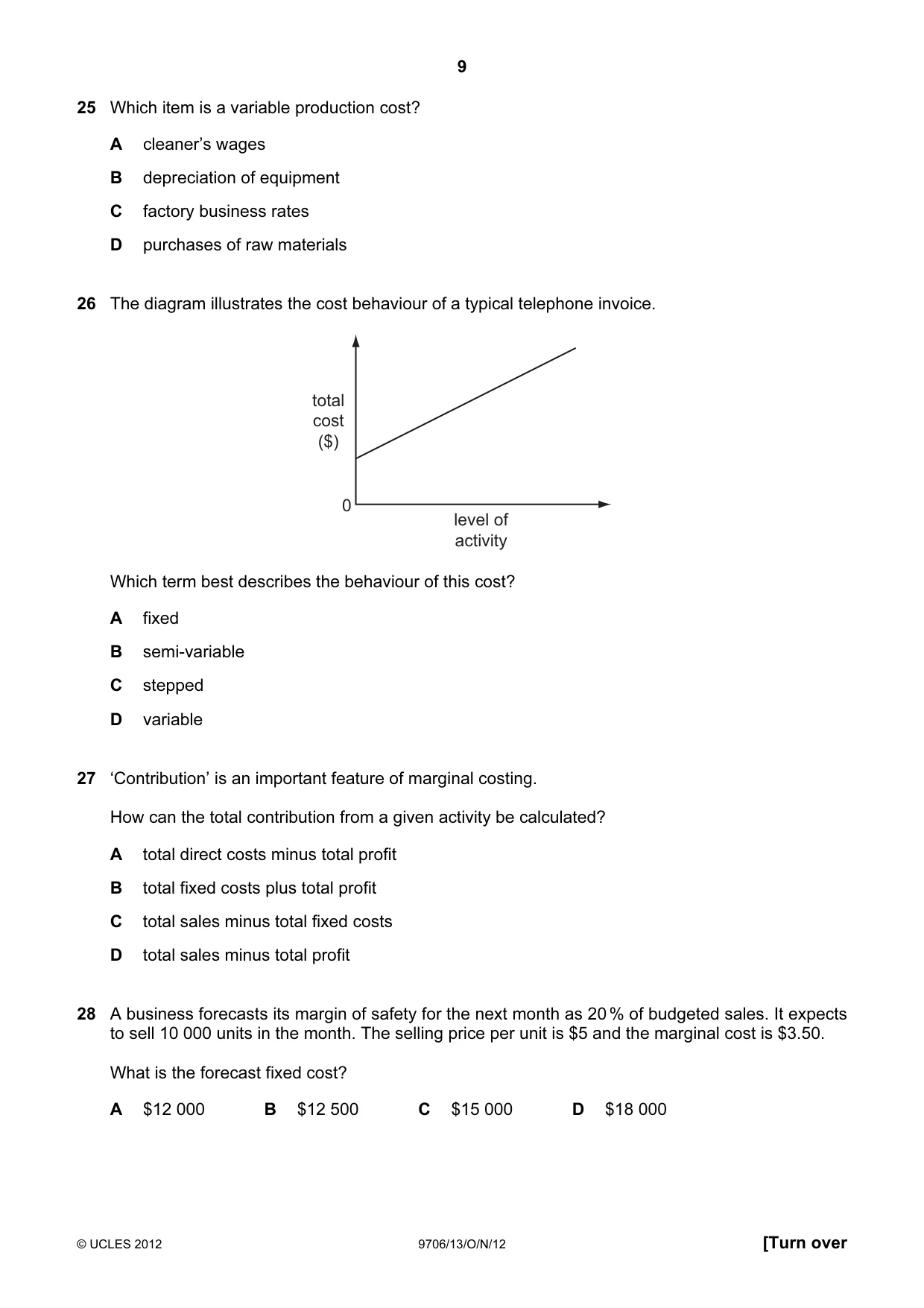
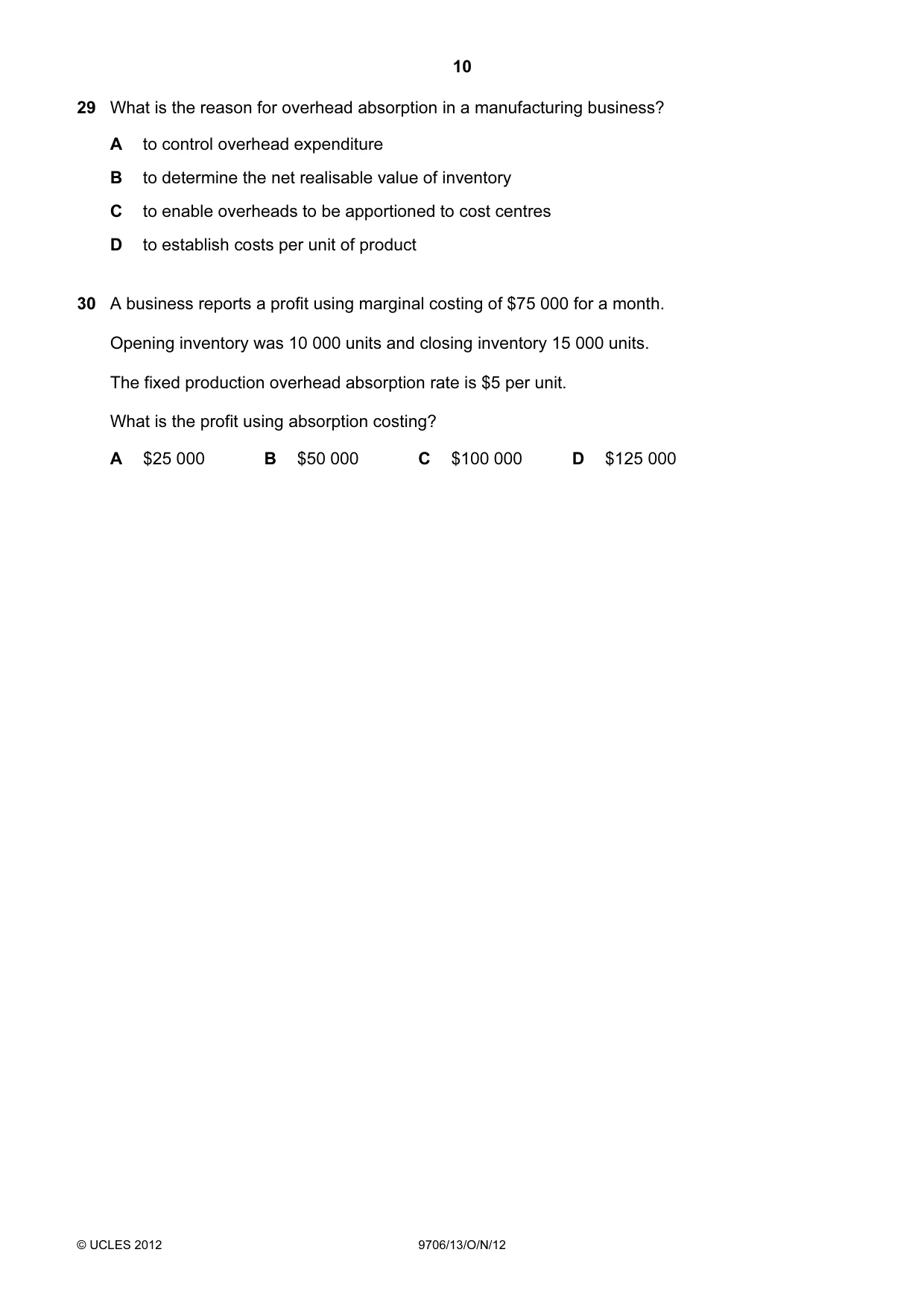

Mark scheme2 pages
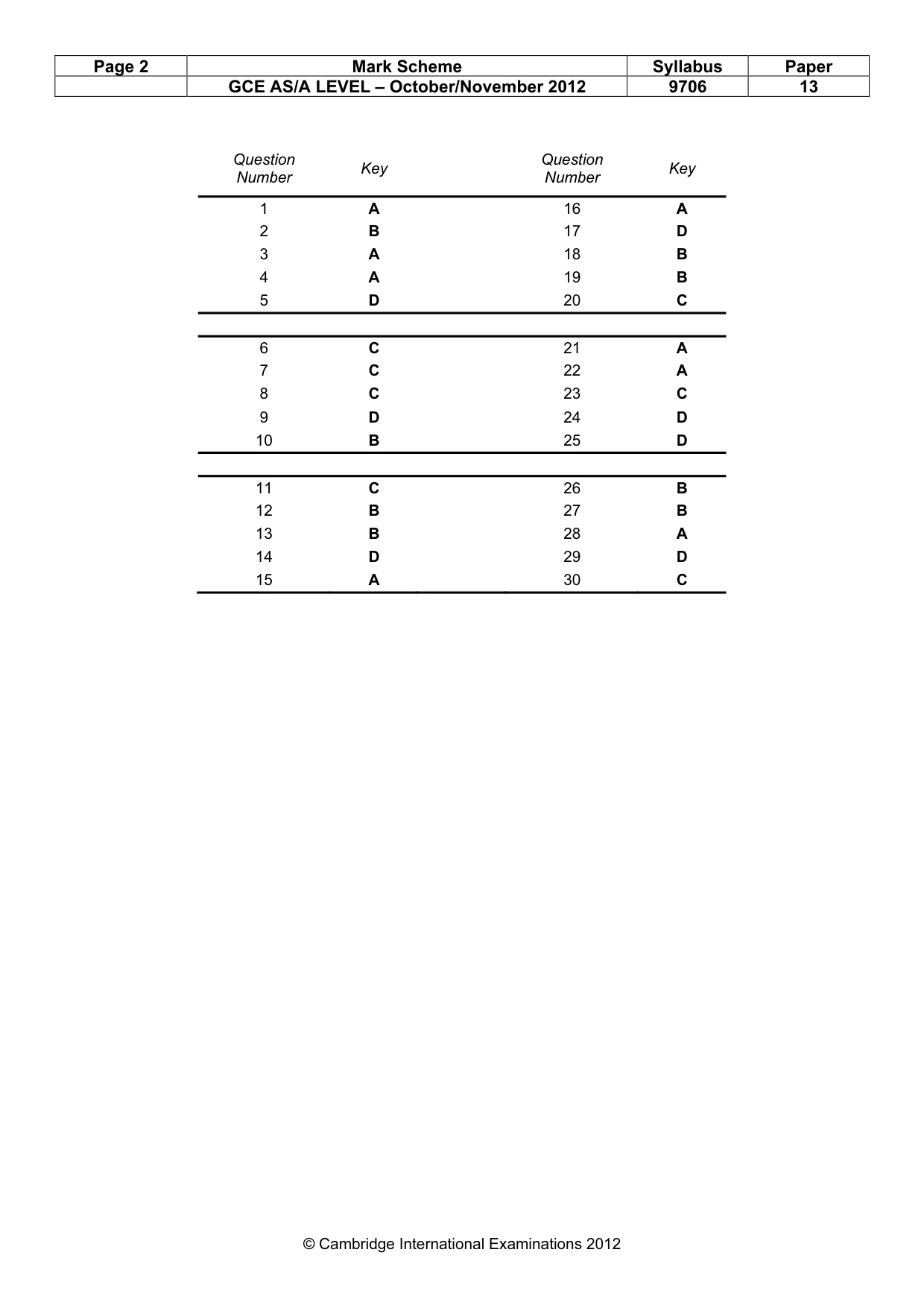
Answers below. Sit the paper first if you are practising.
Questions as text
Q1 · A business maintains a sales journal, a purchases journal, a cash book and a general…
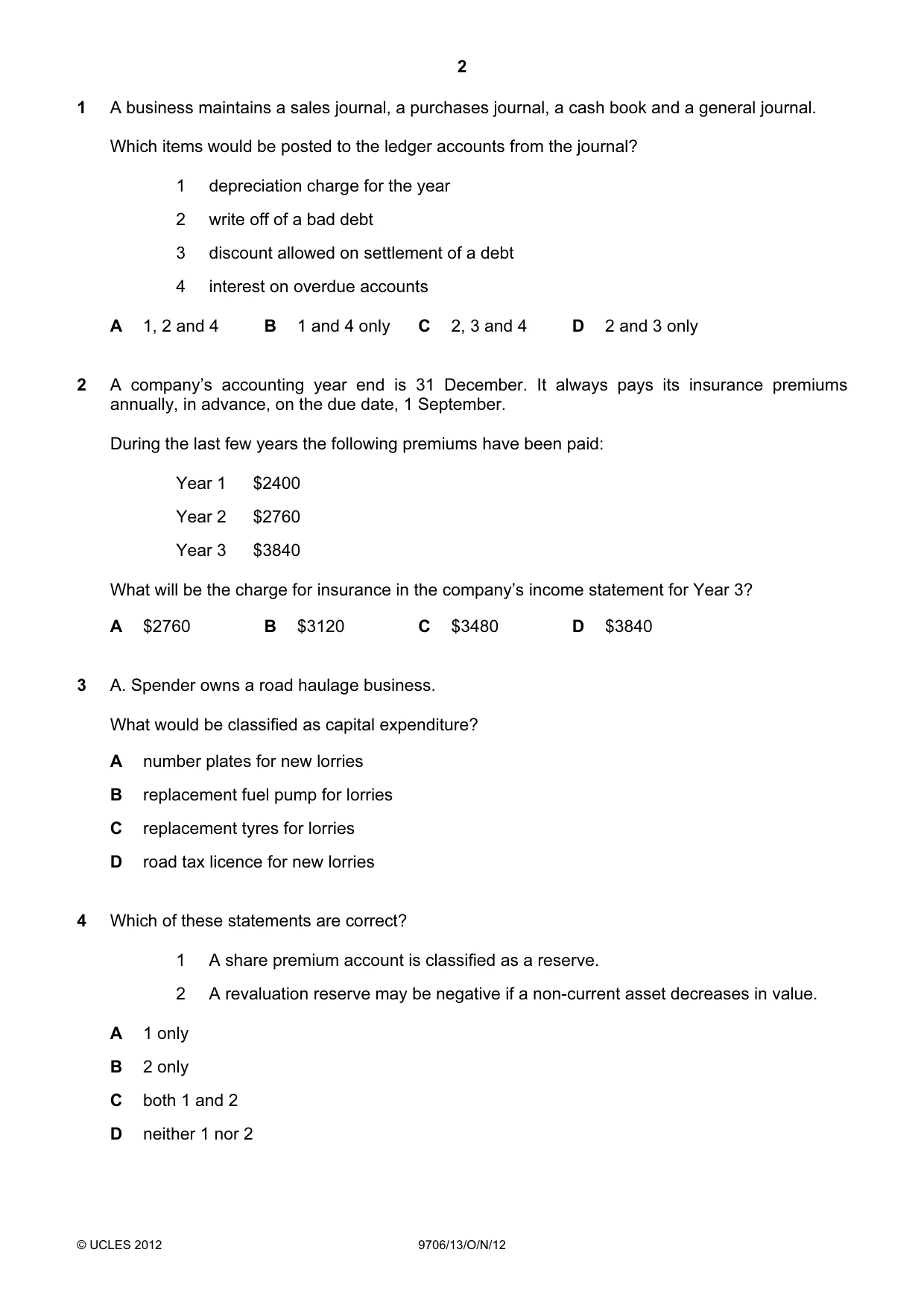
1 A business maintains a sales journal, a purchases journal, a cash book and a general journal. Which items would be posted to the ledger accounts from the journal? 1 depreciation charge for the year 2 write off of a bad debt 3 discount allowed on settlement of a debt 4 interest on overdue accounts A 1, 2 and 4 B 1 and 4 only C 2, 3 and 4 D 2 and 3 only
Mark scheme: A
Q2 · A company’s accounting year end is 31 December
2 A company’s accounting year end is 31 December. It always pays its insurance premiums annually, in advance, on the due date, 1 September. During the last few years the following premiums have been paid: Year 1 $2400 Year 2 $2760 Year 3 $3840 What will be the charge for insurance in the company’s income statement for Year 3? A $2760 B $3120 C $3480 D $3840
Mark scheme: B
Question 3
3 A. Spender owns a road haulage business. What would be classified as capital expenditure? A number plates for new lorries B replacement fuel pump for lorries C replacement tyres for lorries D road tax licence for new lorries
Mark scheme: A
Q4 · Which of these statements are correct?
4 Which of these statements are correct? 1 A share premium account is classified as a reserve. 2 A revaluation reserve may be negative if a non-current asset decreases in value. A 1 only B 2 only C both 1 and 2 D neither 1 nor 2
Mark scheme: A
Q5 · Which statement is correct?
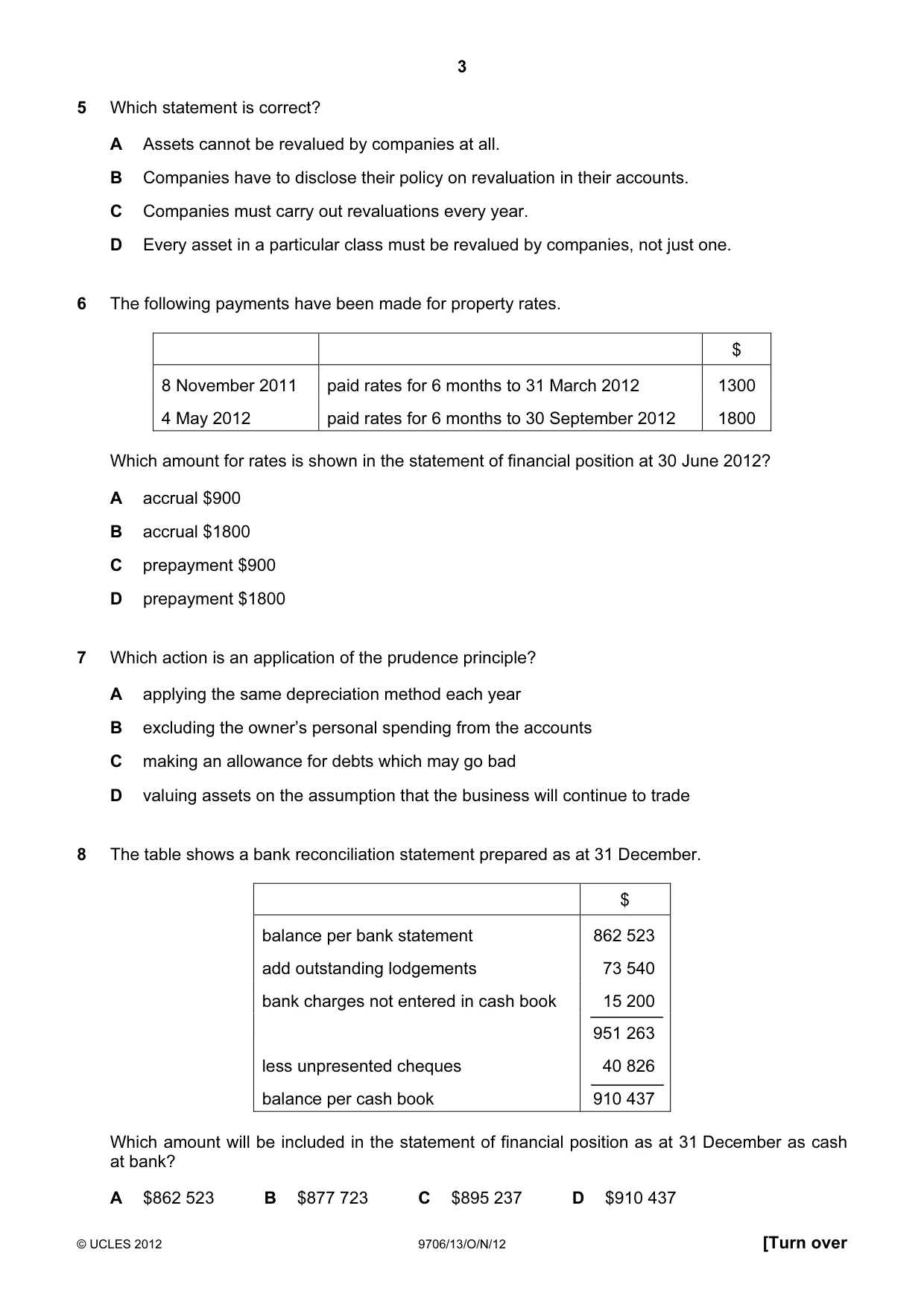
5 Which statement is correct? A Assets cannot be revalued by companies at all. B Companies have to disclose their policy on revaluation in their accounts. C Companies must carry out revaluations every year. D Every asset in a particular class must be revalued by companies, not just one.
Mark scheme: D
Q6 · The following payments have been made for property rates
6 The following payments have been made for property rates. $ 8 November 2011 paid rates for 6 months to 31 March 2012 1300 4 May 2012 paid rates for 6 months to 30 September 2012 1800 Which amount for rates is shown in the statement of financial position at 30 June 2012? A accrual $900 B accrual $1800 C prepayment $900 D prepayment $1800
Mark scheme: C
Q7 · Which action is an application of the prudence principle?
7 Which action is an application of the prudence principle? A applying the same depreciation method each year B excluding the owner’s personal spending from the accounts C making an allowance for debts which may go bad D valuing assets on the assumption that the business will continue to trade
Mark scheme: C
Q8 · The table shows a bank reconciliation statement prepared as at 31 December
8 The table shows a bank reconciliation statement prepared as at 31 December. $ balance per bank statement 862 523 add outstanding lodgements 73 540 bank charges not entered in cash book 15 200 951 263 less unpresented cheques 40 826 balance per cash book 910 437 Which amount will be included in the statement of financial position as at 31 December as cash at bank? A $862 523 B $877 723 C $895 237 D $910 437
Mark scheme: C
Q9 · A trial balance failed to balance and a suspense account was opened
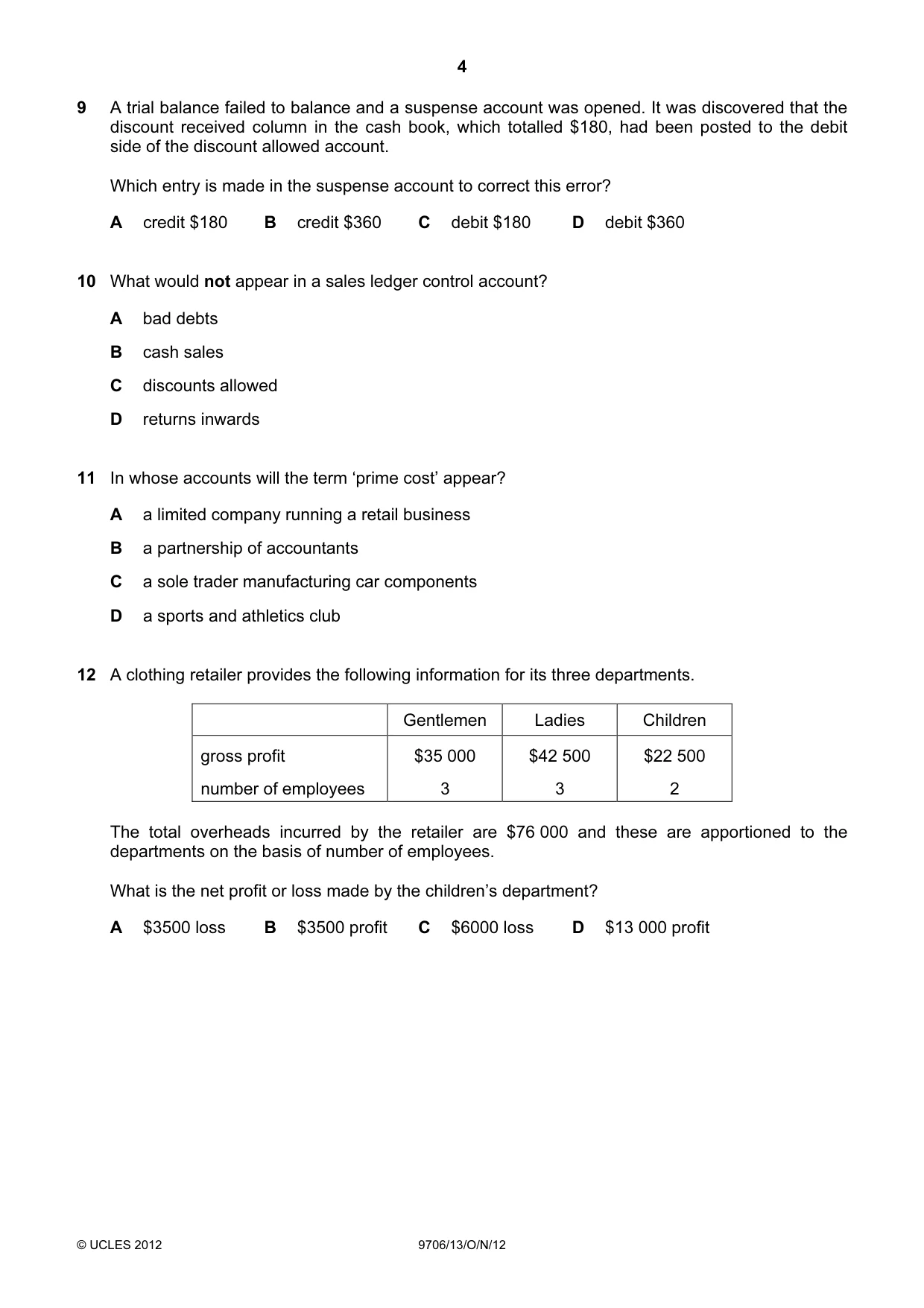
9 A trial balance failed to balance and a suspense account was opened. It was discovered that the discount received column in the cash book, which totalled $180, had been posted to the debit side of the discount allowed account. Which entry is made in the suspense account to correct this error? A credit $180 B credit $360 C debit $180 D debit $360
Mark scheme: D
Q10 · What would not appear in a sales ledger control account?
10 What would not appear in a sales ledger control account? A bad debts B cash sales C discounts allowed D returns inwards
Mark scheme: B
Q11 · In whose accounts will the term ‘prime cost’ appear?
11 In whose accounts will the term ‘prime cost’ appear? A a limited company running a retail business B a partnership of accountants C a sole trader manufacturing car components D a sports and athletics club
Mark scheme: C
Q12 · A clothing retailer provides the following information for its three departments
12 A clothing retailer provides the following information for its three departments. Gentlemen Ladies Children gross profit $35 000 $42 500 $22 500 number of employees 3 3 2 The total overheads incurred by the retailer are $76 000 and these are apportioned to the departments on the basis of number of employees. What is the net profit or loss made by the children’s department? A $3500 loss B $3500 profit C $6000 loss D $13 000 profit
Mark scheme: B
Q13 · A company’s income statement includes the following
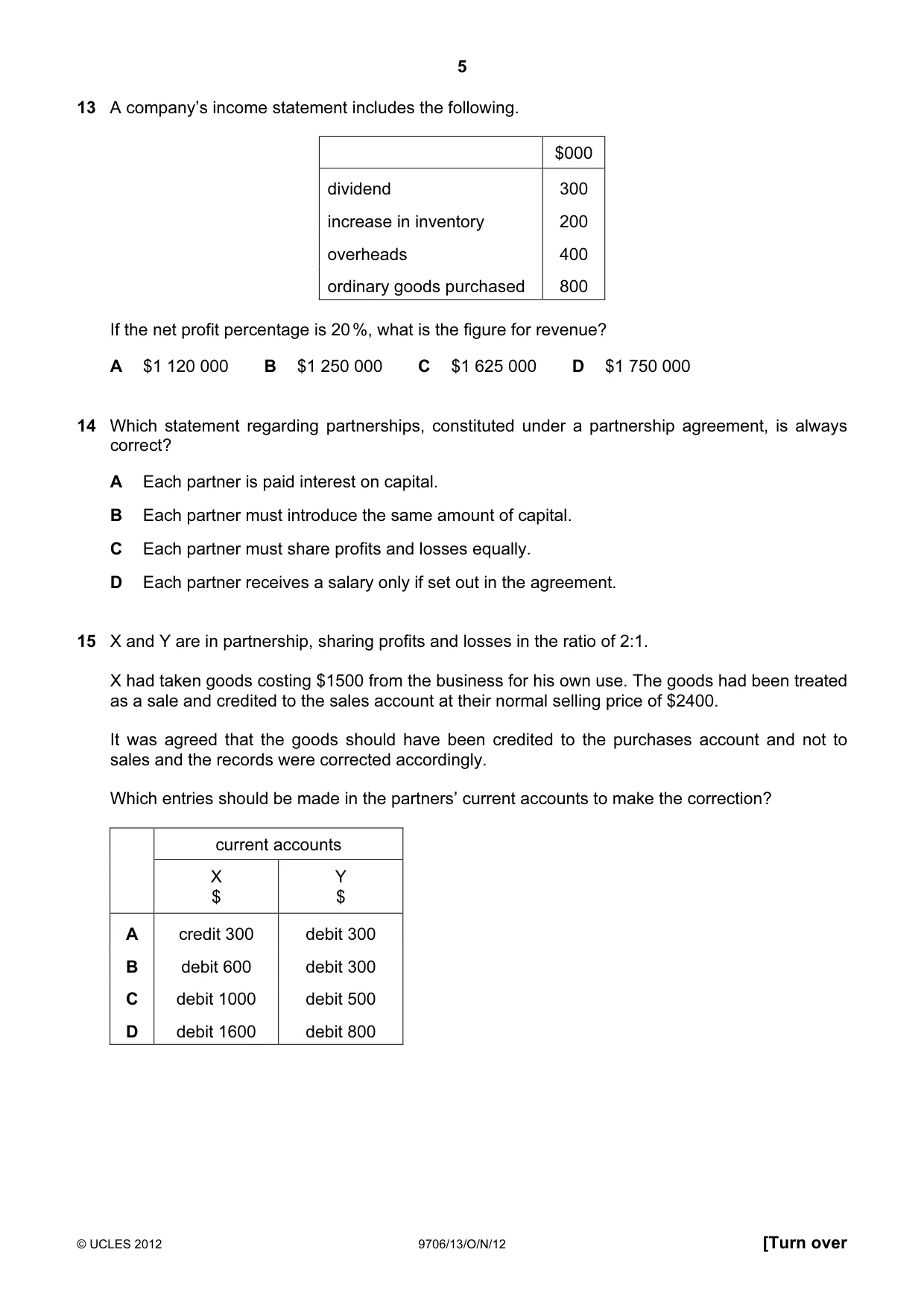
13 A company’s income statement includes the following. $000 dividend 300 increase in inventory 200 overheads 400 ordinary goods purchased 800 If the net profit percentage is 20 %, what is the figure for revenue? A $1 120 000 B $1 250 000 C $1 625 000 D $1 750 000
Mark scheme: B
Q14 · Which statement regarding partnerships, constituted under a partnership agreement, is…
14 Which statement regarding partnerships, constituted under a partnership agreement, is always correct? A Each partner is paid interest on capital. B Each partner must introduce the same amount of capital. C Each partner must share profits and losses equally. D Each partner receives a salary only if set out in the agreement.
Mark scheme: D
Q15 · X and Y are in partnership, sharing profits and losses in the ratio of 2:1
15 X and Y are in partnership, sharing profits and losses in the ratio of 2:1. X had taken goods costing $1500 from the business for his own use. The goods had been treated as a sale and credited to the sales account at their normal selling price of $2400. It was agreed that the goods should have been credited to the purchases account and not to sales and the records were corrected accordingly. Which entries should be made in the partners’ current accounts to make the correction? current accounts X Y $ $ A credit 300 debit 300 B debit 600 debit 300 C debit 1000 debit 500 D debit 1600 debit 800
Mark scheme: A
Q16 · Details of a company’s inventory are shown in the table
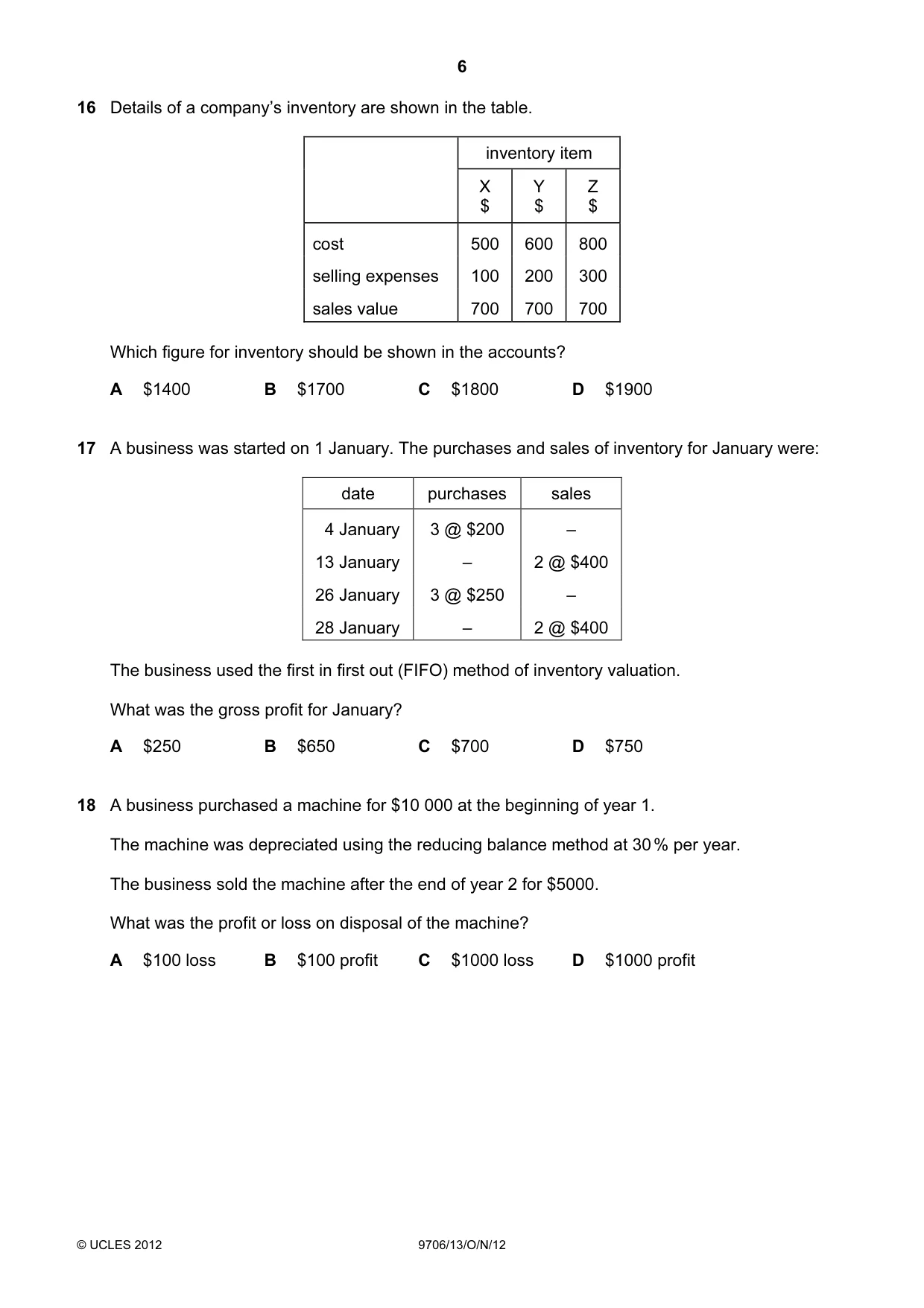
16 Details of a company’s inventory are shown in the table. inventory item X Y Z $ $ $ cost 500 600 800 selling expenses 100 200 300 sales value 700 700 700 Which figure for inventory should be shown in the accounts? A $1400 B $1700 C $1800 D $1900
Mark scheme: A
Q17 · A business was started on 1 January
17 A business was started on 1 January. The purchases and sales of inventory for January were: date purchases sales 4 January 3 @ $200 – 13 January – 2 @ $400 26 January 3 @ $250 – 28 January – 2 @ $400 The business used the first in first out (FIFO) method of inventory valuation. What was the gross profit for January? A $250 B $650 C $700 D $750
Mark scheme: D
Q18 · A business purchased a machine for $10 000 at the beginning of year 1
18 A business purchased a machine for $10 000 at the beginning of year 1. The machine was depreciated using the reducing balance method at 30 % per year. The business sold the machine after the end of year 2 for $5000. What was the profit or loss on disposal of the machine? A $100 loss B $100 profit C $1000 loss D $1000 profit
Mark scheme: B
Q19 · The profits of Bronte Ltd are: Year ended 31 December 2010 nil Year ended 31 December…
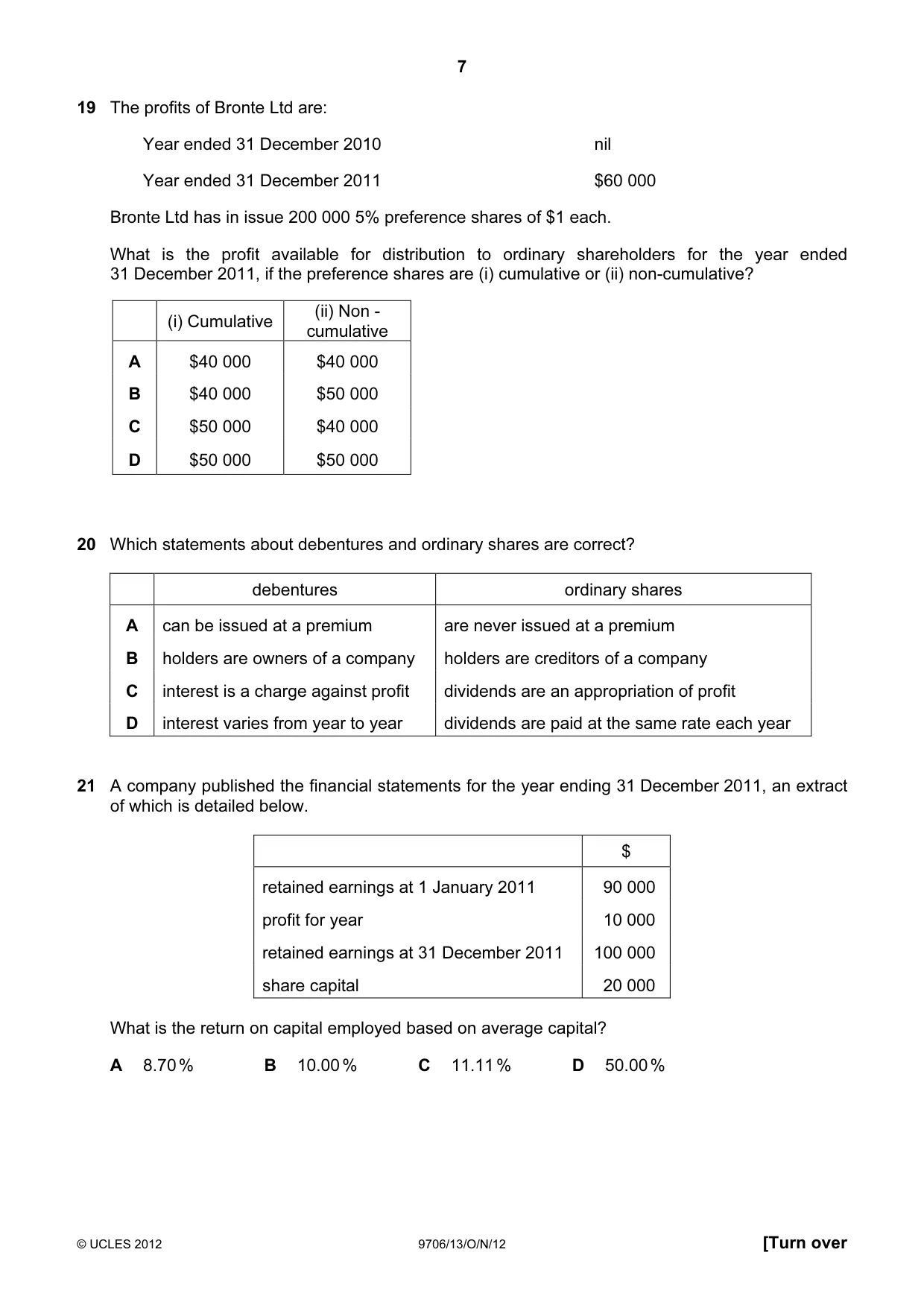
19 The profits of Bronte Ltd are: Year ended 31 December 2010 nil Year ended 31 December 2011 $60 000 Bronte Ltd has in issue 200 000 5% preference shares of $1 each. What is the profit available for distribution to ordinary shareholders for the year ended 31 December 2011, if the preference shares are (i) cumulative or (ii) non-cumulative? (ii) Non - (i) Cumulative cumulative A $40 000 $40 000 B $40 000 $50 000 C $50 000 $40 000 D $50 000 $50 000
Mark scheme: B
Q20 · Which statements about debentures and ordinary shares are correct?
20 Which statements about debentures and ordinary shares are correct? debentures ordinary shares A can be issued at a premium are never issued at a premium B holders are owners of a company holders are creditors of a company C interest is a charge against profit dividends are an appropriation of profit D interest varies from year to year dividends are paid at the same rate each year
Mark scheme: C
Q21 · A company published the financial statements for the year ending 31 December 2011, an…
21 A company published the financial statements for the year ending 31 December 2011, an extract of which is detailed below. $ retained earnings at 1 January 2011 90 000 profit for year 10 000 retained earnings at 31 December 2011 100 000 share capital 20 000 What is the return on capital employed based on average capital? A 8.70 % B 10.00 % C 11.11 % D 50.00 %
Mark scheme: A
More questions on Analysis and communication of accounting information
Q22 · Which transactions would decrease short term liquidity, as measured by the liquid (acid…
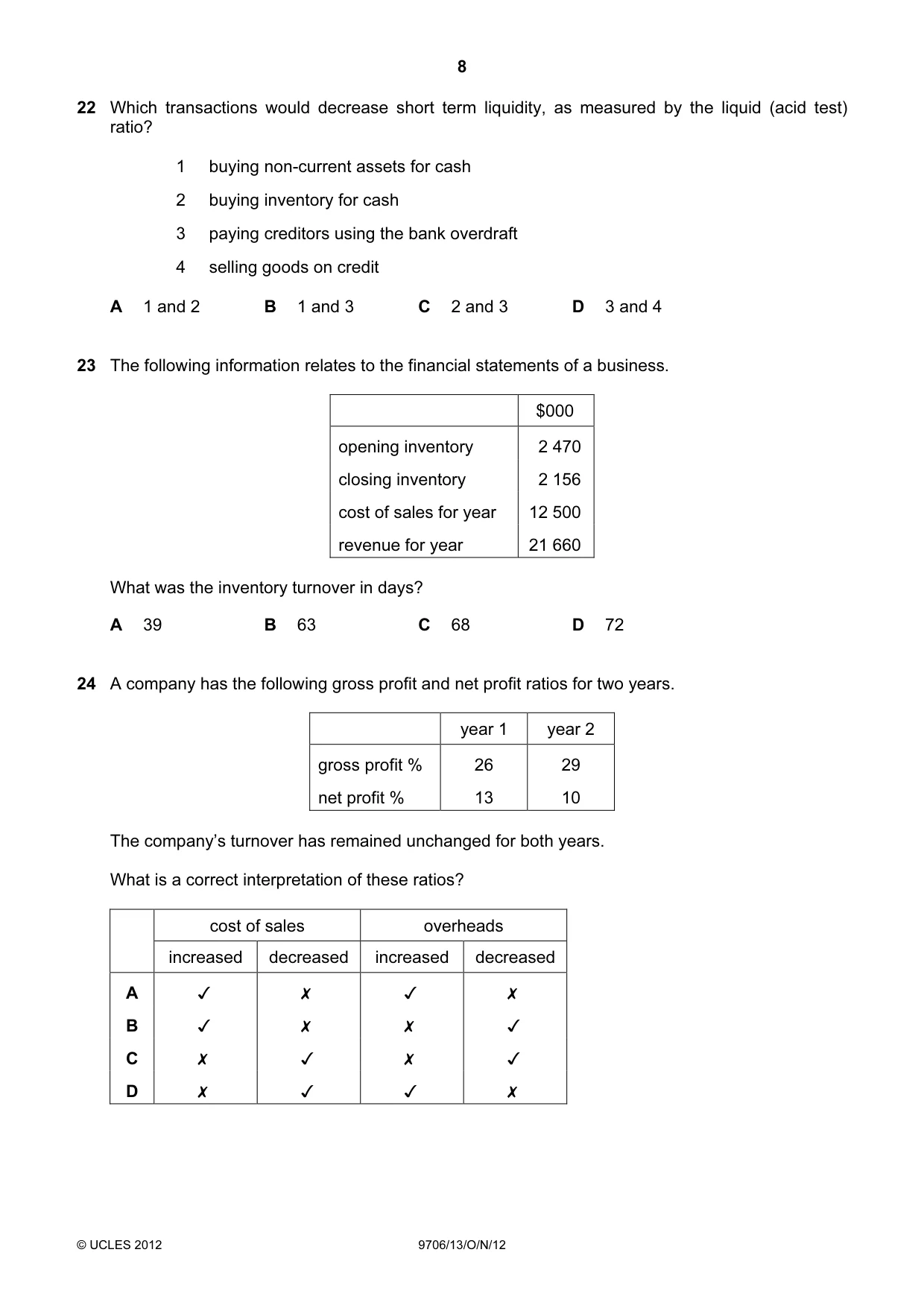
22 Which transactions would decrease short term liquidity, as measured by the liquid (acid test) ratio? 1 buying non-current assets for cash 2 buying inventory for cash 3 paying creditors using the bank overdraft 4 selling goods on credit A 1 and 2 B 1 and 3 C 2 and 3 D 3 and 4
Mark scheme: A
More questions on Analysis and communication of accounting information
Q23 · The following information relates to the financial statements of a business
23 The following information relates to the financial statements of a business. $000 opening inventory 2 470 closing inventory 2 156 cost of sales for year 12 500 revenue for year 21 660 What was the inventory turnover in days? A 39 B 63 C 68 D 72
Mark scheme: C
More questions on Analysis and communication of accounting information
Q24 · Acompany has the following gross profit and net profit ratios for two years
24 Acompany has the following gross profit and net profit ratios for two years. year 1 year 2 gross profit % 26 29 net profit % 13 10 The company’s turnover has remained unchanged for both years. What is a correct interpretation of these ratios? cost of sales overheads increased | decreased increased | decreased v x v x 00 DW > ~~ O® \ x x ~*~ KOM x v v
Mark scheme: D
More questions on Analysis and communication of accounting information
Q25 · Which item is a variable production cost?
25 Which item is a variable production cost? A cleaner’s wages B depreciation of equipment C factory business rates D purchases of raw materials
Mark scheme: D
Q26 · The diagram illustrates the cost behaviour of a typical telephone invoice
26 The diagram illustrates the cost behaviour of a typical telephone invoice. total cost ($) 0 level of activity Which term best describes the behaviour of this cost? A fixed B semi-variable C stepped D variable
Mark scheme: B
Q27 · ‘Contribution’ is an important feature of marginal costing
27 ‘Contribution’ is an important feature of marginal costing. How can the total contribution from a given activity be calculated? A total direct costs minus total profit B total fixed costs plus total profit C total sales minus total fixed costs D total sales minus total profit
Mark scheme: B
Q28 · A business forecasts its margin of safety for the next month as 20 % of budgeted sales
28 A business forecasts its margin of safety for the next month as 20 % of budgeted sales. It expects to sell 10 000 units in the month. The selling price per unit is $5 and the marginal cost is $3.50. What is the forecast fixed cost? A $12 000 B $12 500 C $15 000 D $18 000
Mark scheme: A
Q29 · What is the reason for overhead absorption in a manufacturing business?
29 What is the reason for overhead absorption in a manufacturing business? A to control overhead expenditure B to determine the net realisable value of inventory C to enable overheads to be apportioned to cost centres D to establish costs per unit of product
Mark scheme: D
Q30 · A business reports a profit using marginal costing of $75 000 for a month
30 A business reports a profit using marginal costing of $75 000 for a month. Opening inventory was 10 000 units and closing inventory 15 000 units. The fixed production overhead absorption rate is $5 per unit. What is the profit using absorption costing? A $25 000 B $50 000 C $100 000 D $125 000
Mark scheme: C
What was in this paper
The subtopics covered by these 30 questions, and how many questions each got. Open one in a new tab to see every Cambridge question on it.
What you needed in this session
Cambridge’s own grade thresholds for 2012 Oct/Nov, Paper 1 · Variant 3. A higher threshold means an easier paper — the bar moves with how the cohort did.