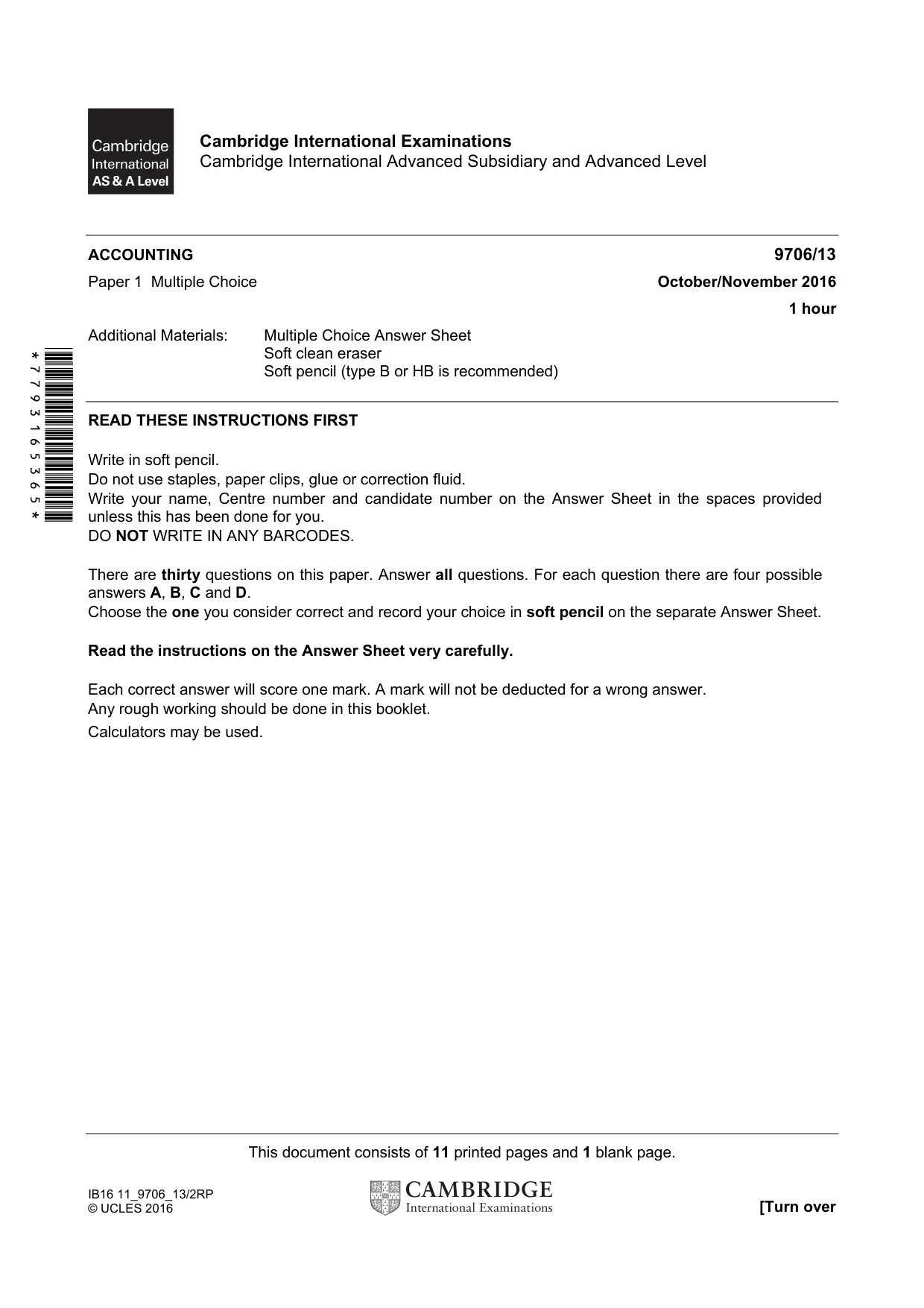
Cambridge A Level Accounting 9706 — 2016 Oct/Nov Paper 1 · Variant 3
9706/13/O/N/16 · 30 questions · 30 marks · ≈34 min
The question paper and its mark scheme, free to read here and free to download. This is Cambridge’s own paper, exactly as it was sat.
Question paper12 pages
Mark scheme2 pages
Answers below. Sit the paper first if you are practising.
Questions as text
Q1 · Which item is entered in the general journal?
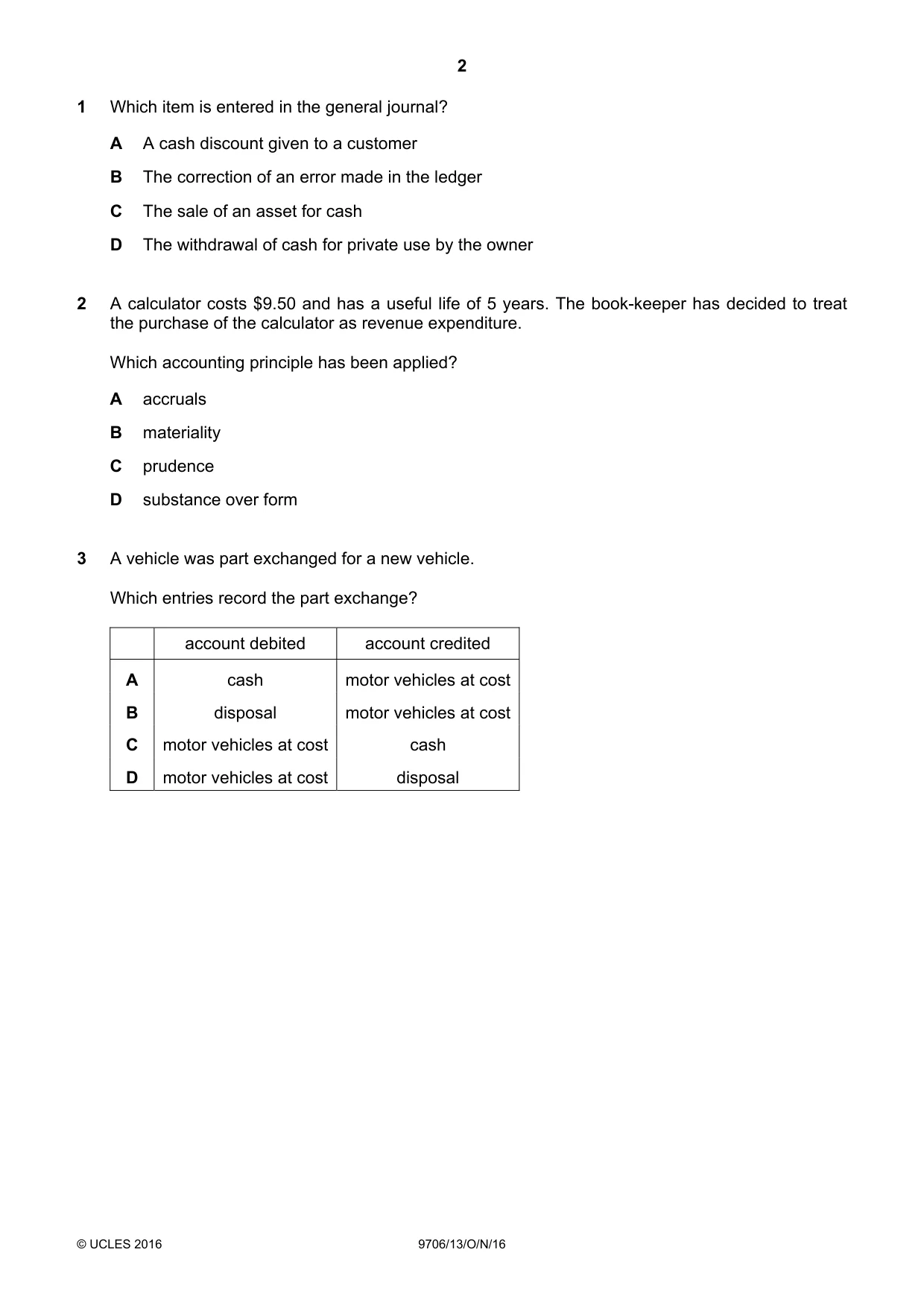
1 Which item is entered in the general journal? A A cash discount given to a customer B The correction of an error made in the ledger C The sale of an asset for cash D The withdrawal of cash for private use by the owner
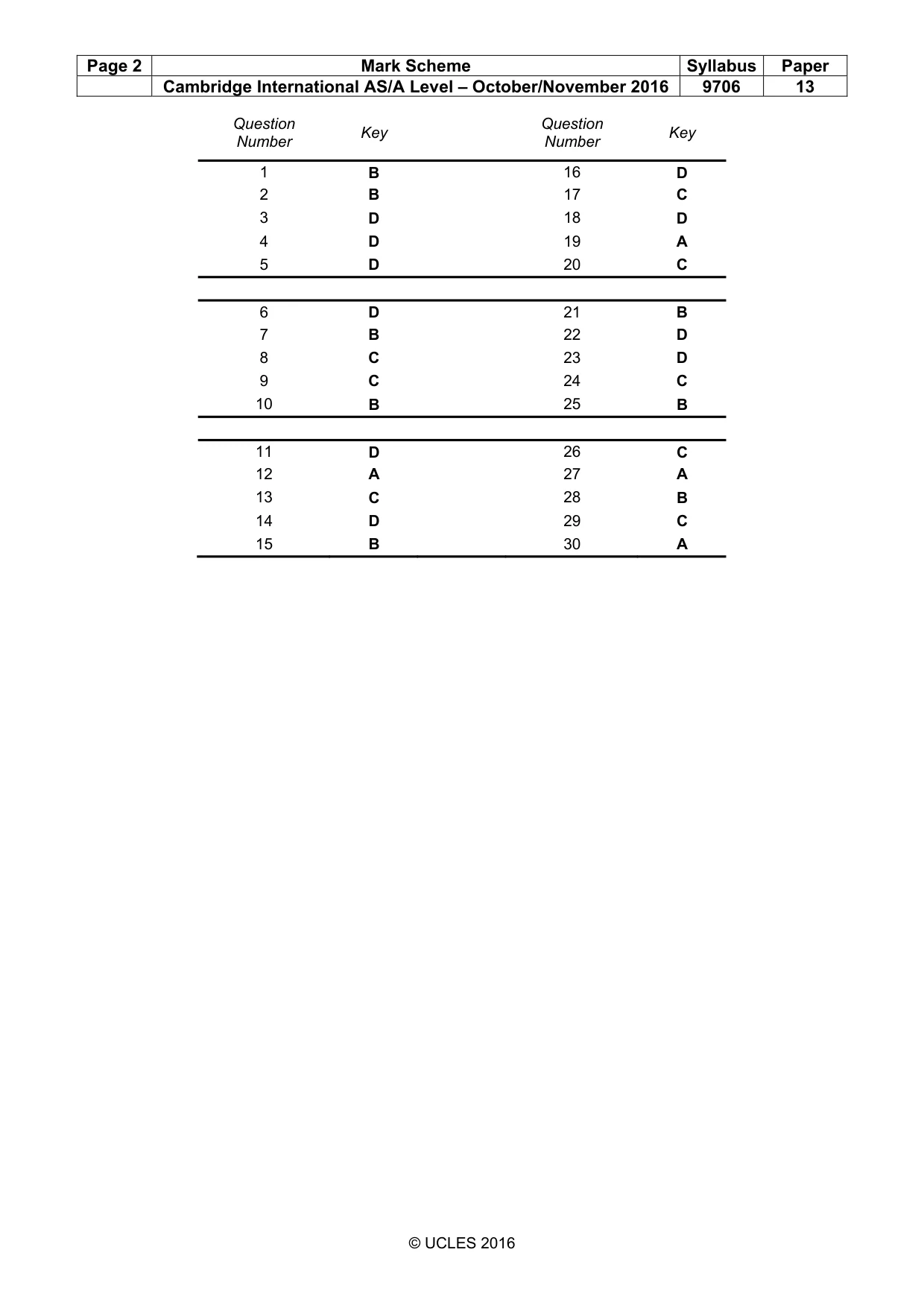
Mark scheme: B
Q2 · A calculator costs $9.50 and has a useful life of 5 years
2 A calculator costs $9.50 and has a useful life of 5 years. The book-keeper has decided to treat the purchase of the calculator as revenue expenditure. Which accounting principle has been applied? A accruals B materiality C prudence D substance over form
Mark scheme: B
Q3 · A vehicle was part exchanged for a new vehicle
3 A vehicle was part exchanged for a new vehicle. Which entries record the part exchange? account debited account credited A cash motor vehicles at cost B disposal motor vehicles at cost C motor vehicles at cost cash D motor vehicles at cost disposal
Mark scheme: D
Q4 · On 1 January Ann owed Sam $400
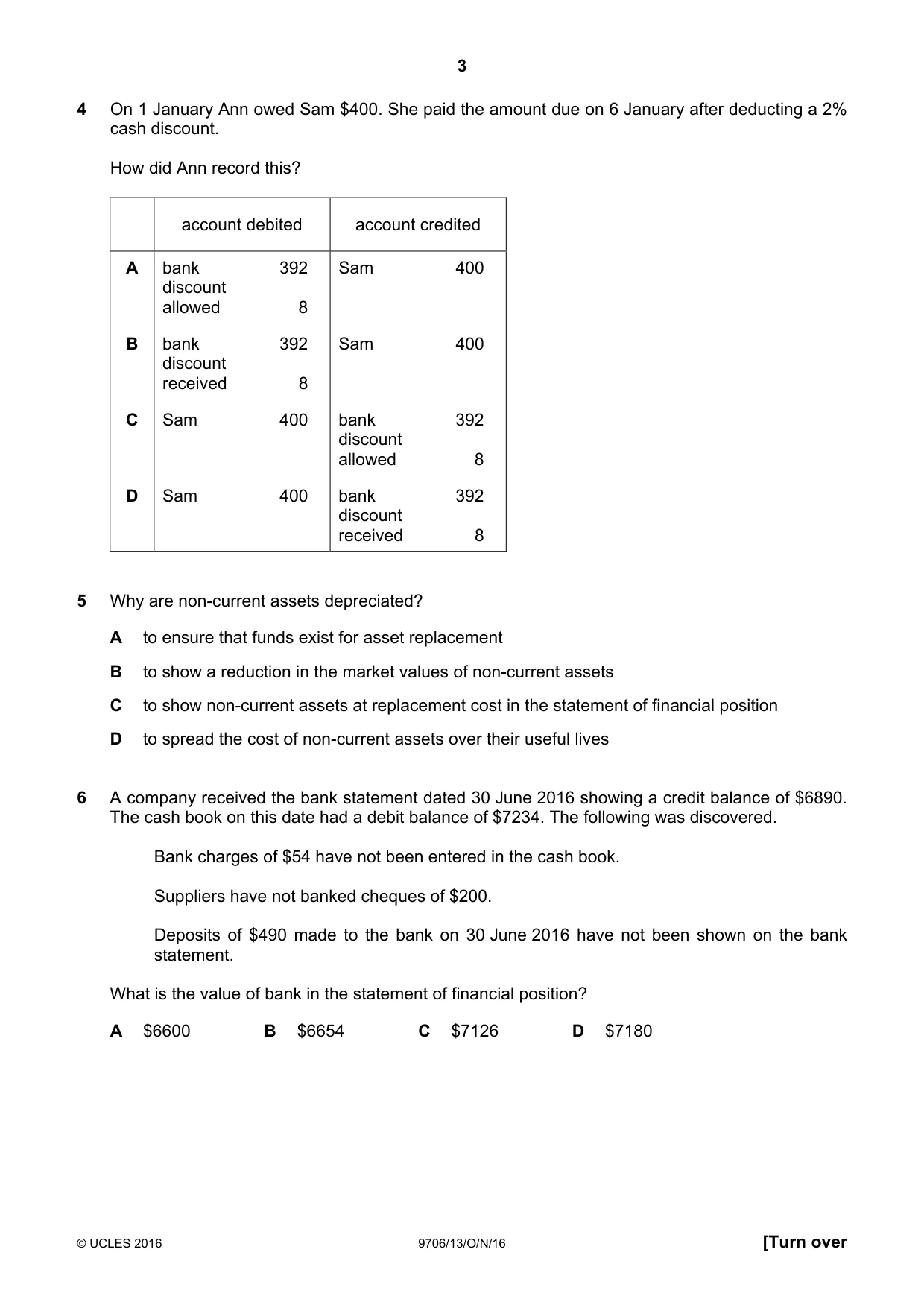
4 On 1 January Ann owed Sam $400. She paid the amount due on 6 January after deducting a 2% cash discount. How did Ann record this? account debited account credited A bank 392 Sam 400 discount allowed 8 B bank 392 Sam 400 discount received 8 C Sam 400 bank 392 discount allowed 8 D Sam 400 bank 392 discount received 8
Mark scheme: D
Q5 · Why are non-current assets depreciated?
5 Why are non-current assets depreciated? A to ensure that funds exist for asset replacement B to show a reduction in the market values of non-current assets C to show non-current assets at replacement cost in the statement of financial position D to spread the cost of non-current assets over their useful lives
Mark scheme: D
Q6 · A company received the bank statement dated 30 June 2016 showing a credit balance of $6890
6 A company received the bank statement dated 30 June 2016 showing a credit balance of $6890. The cash book on this date had a debit balance of $7234. The following was discovered. Bank charges of $54 have not been entered in the cash book. Suppliers have not banked cheques of $200. Deposits of $490 made to the bank on 30 June 2016 have not been shown on the bank statement. What is the value of bank in the statement of financial position? A $6600 B $6654 C $7126 D $7180
Mark scheme: D
Q7 · A trial balance includes a suspense account
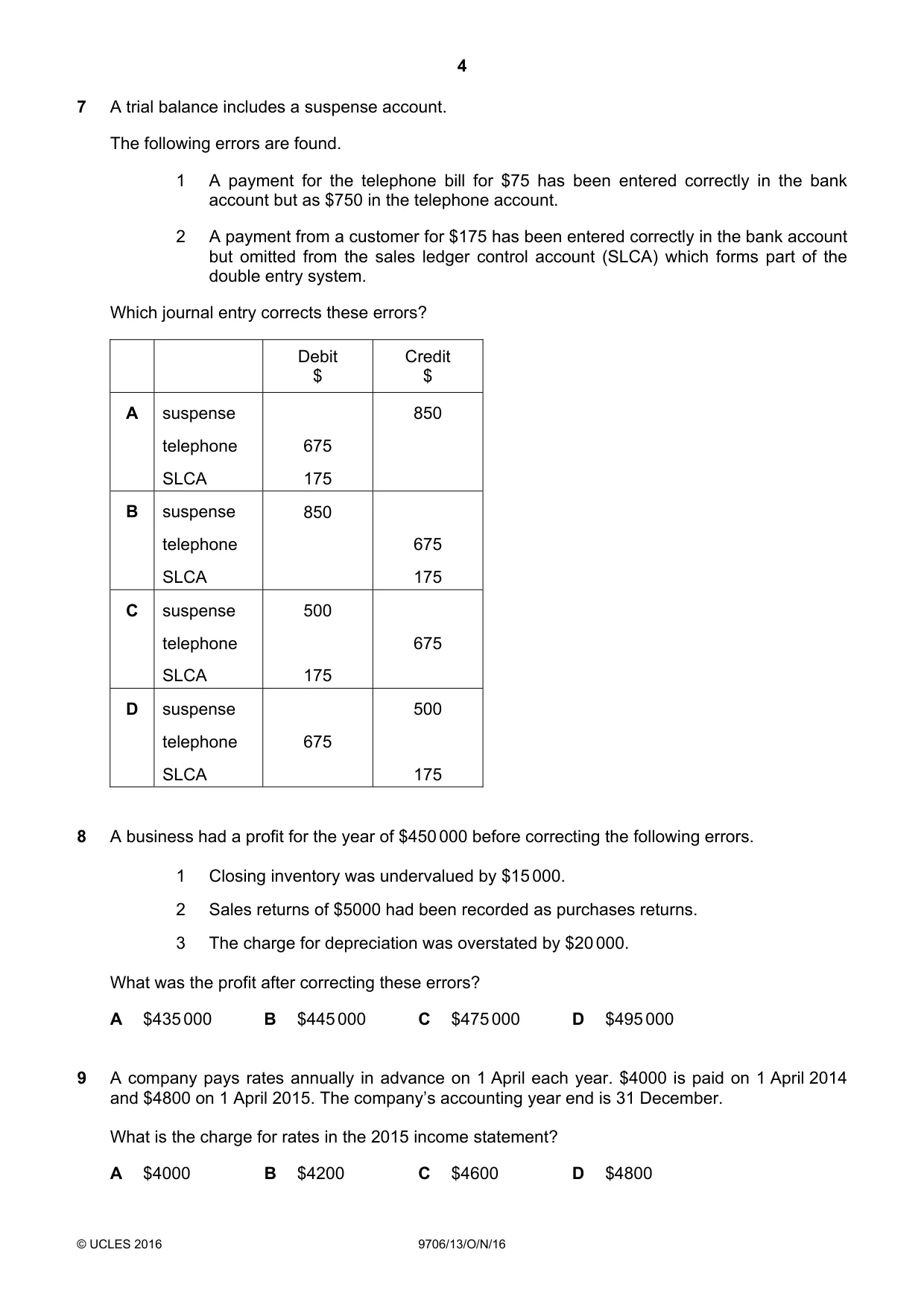
7 A trial balance includes a suspense account. The following errors are found. 1 A payment for the telephone bill for $75 has been entered correctly in the bank account but as $750 in the telephone account. 2 A payment from a customer for $175 has been entered correctly in the bank account but omitted from the sales ledger control account (SLCA) which forms part of the double entry system. Which journal entry corrects these errors? Debit Credit $ $ A suspense 850 telephone 675 SLCA 175 B suspense 850 telephone 675 SLCA 175 C suspense 500 telephone 675 SLCA 175 D suspense 500 telephone 675 SLCA 175
Mark scheme: B
Q8 · A business had a profit for the year of $450 000 before correcting the following errors
8 A business had a profit for the year of $450 000 before correcting the following errors. 1 Closing inventory was undervalued by $15 000. 2 Sales returns of $5000 had been recorded as purchases returns. 3 The charge for depreciation was overstated by $20 000. What was the profit after correcting these errors? A $435 000 B $445 000 C $475 000 D $495 000
Mark scheme: C
Q9 · A company pays rates annually in advance on 1 April each year
9 A company pays rates annually in advance on 1 April each year. $4000 is paid on 1 April 2014 and $4800 on 1 April 2015. The company’s accounting year end is 31 December. What is the charge for rates in the 2015 income statement? A $4000 B $4200 C $4600 D $4800
Mark scheme: C
Q10 · A business has calculated inventory turnover ratio as 8 times
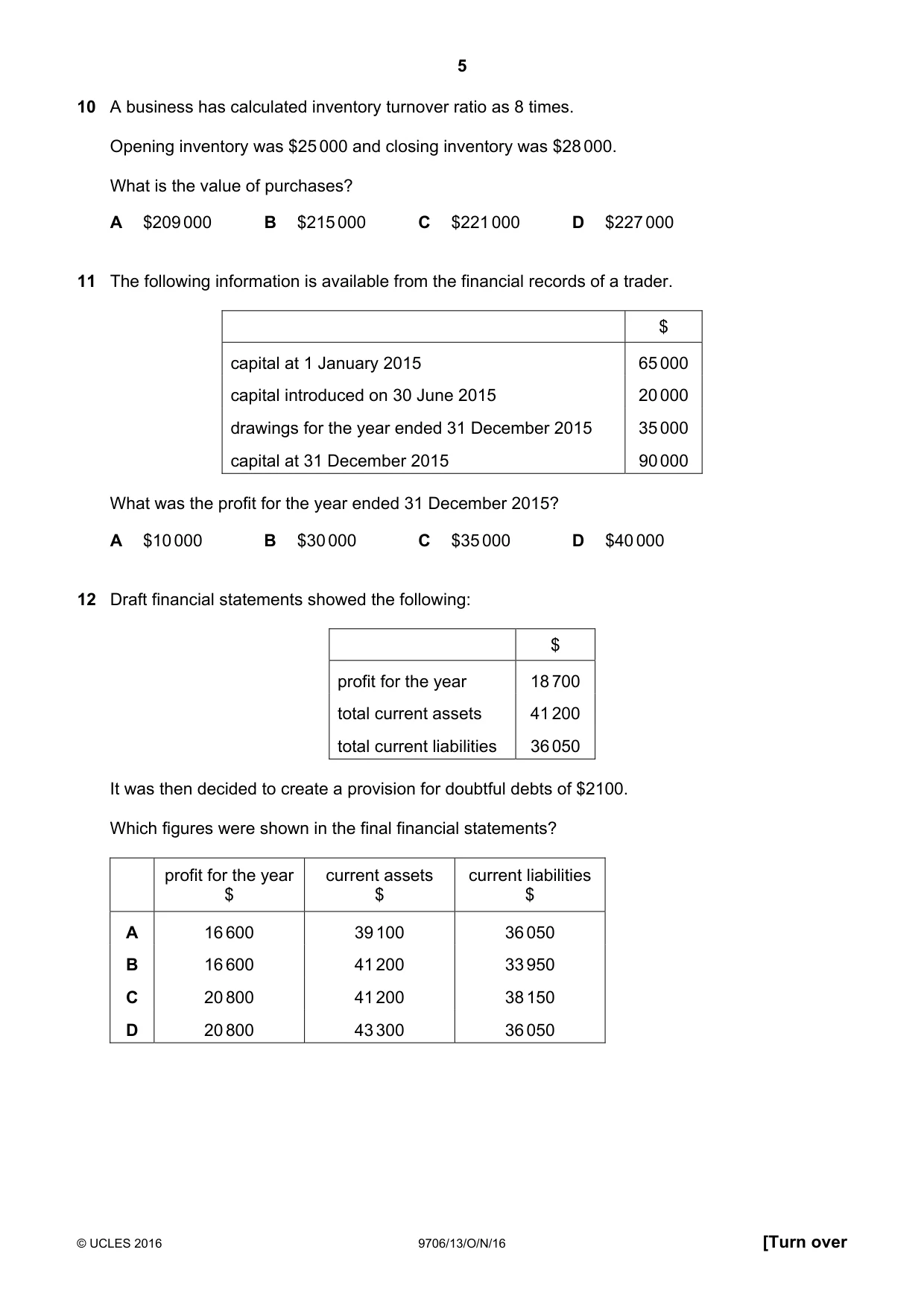
10 A business has calculated inventory turnover ratio as 8 times. Opening inventory was $25 000 and closing inventory was $28 000. What is the value of purchases? A $209 000 B $215 000 C $221 000 D $227 000
Mark scheme: B
Q11 · The following information is available from the financial records of a trader
11 The following information is available from the financial records of a trader. $ capital at 1 January 2015 65 000 capital introduced on 30 June 2015 20 000 drawings for the year ended 31 December 2015 35 000 capital at 31 December 2015 90 000 What was the profit for the year ended 31 December 2015? A $10 000 B $30 000 C $35 000 D $40 000
Mark scheme: D
Q12 · Draft financial statements showed the following: $ profit for the year 18 700 total…
12 Draft financial statements showed the following: $ profit for the year 18 700 total current assets 41 200 total current liabilities 36 050 It was then decided to create a provision for doubtful debts of $2100. Which figures were shown in the final financial statements? profit for the year current assets current liabilities $ $ $ A 16 600 39 100 36 050 B 16 600 41 200 33 950 C 20 800 41 200 38 150 D 20 800 43 300 36 050
Mark scheme: A
Q13 · A book-keeper reconciles the control accounts with the sales and purchase ledgers
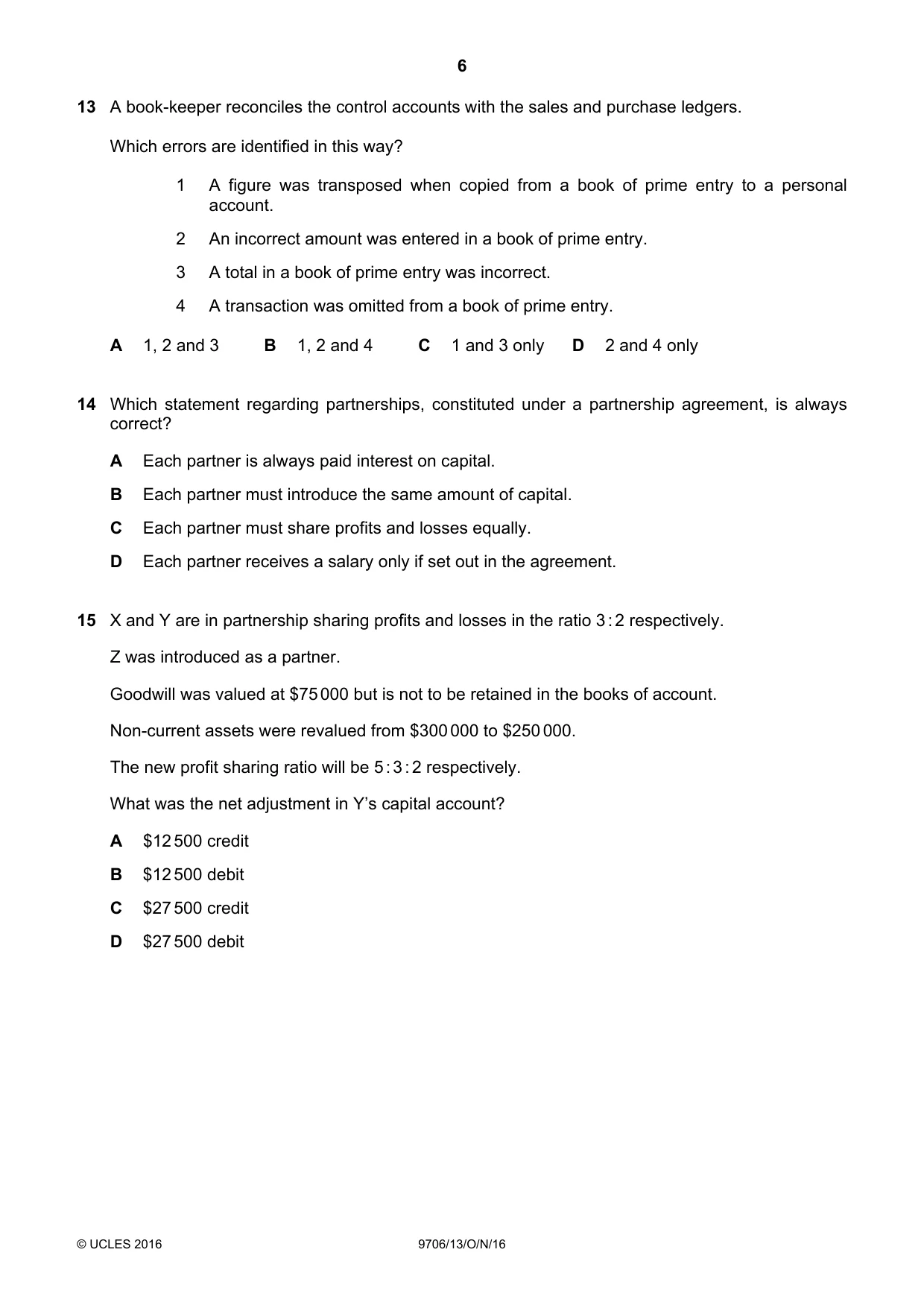
13 A book-keeper reconciles the control accounts with the sales and purchase ledgers. Which errors are identified in this way? 1 A figure was transposed when copied from a book of prime entry to a personal account. 2 An incorrect amount was entered in a book of prime entry. 3 A total in a book of prime entry was incorrect. 4 A transaction was omitted from a book of prime entry. A 1, 2 and 3 B 1, 2 and 4 C 1 and 3 only D 2 and 4 only
Mark scheme: C
Q14 · Which statement regarding partnerships, constituted under a partnership agreement, is…
14 Which statement regarding partnerships, constituted under a partnership agreement, is always correct? A Each partner is always paid interest on capital. B Each partner must introduce the same amount of capital. C Each partner must share profits and losses equally. D Each partner receives a salary only if set out in the agreement.
Mark scheme: D
Q15 · X and Y are in partnership sharing profits and losses in the ratio 3 : 2 respectively
15 X and Y are in partnership sharing profits and losses in the ratio 3 : 2 respectively. Z was introduced as a partner. Goodwill was valued at $75 000 but is not to be retained in the books of account. Non-current assets were revalued from $300 000 to $250 000. The new profit sharing ratio will be 5 : 3 : 2 respectively. What was the net adjustment in Y’s capital account? A $12 500 credit B $12 500 debit C $27 500 credit D $27 500 debit
Mark scheme: B
Q16 · A and B are in partnership
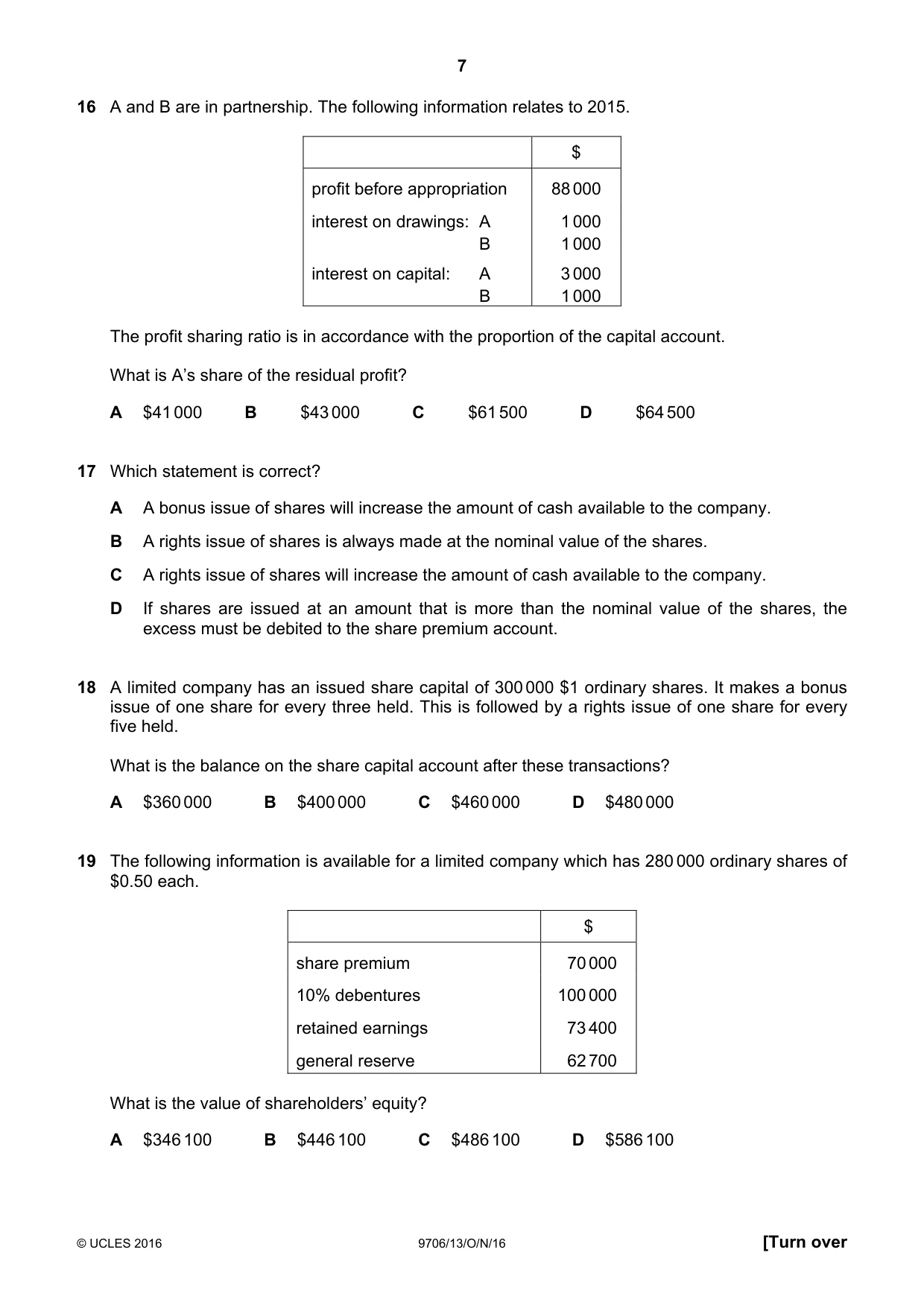
16 A and B are in partnership. The following information relates to 2015. $ profit before appropriation 88 000 interest on drawings: A 1 000 B 1 000 interest on capital: A 3 000 B 1 000 The profit sharing ratio is in accordance with the proportion of the capital account. What is A’s share of the residual profit? A $41 000 B $43 000 C $61 500 D $64 500
Mark scheme: D
Q17 · Which statement is correct?
17 Which statement is correct? A A bonus issue of shares will increase the amount of cash available to the company. B A rights issue of shares is always made at the nominal value of the shares. C A rights issue of shares will increase the amount of cash available to the company. D If shares are issued at an amount that is more than the nominal value of the shares, the excess must be debited to the share premium account.
Mark scheme: C
Q18 · A limited company has an issued share capital of 300 000 $1 ordinary shares
18 A limited company has an issued share capital of 300 000 $1 ordinary shares. It makes a bonus issue of one share for every three held. This is followed by a rights issue of one share for every five held. What is the balance on the share capital account after these transactions? A $360 000 B $400 000 C $460 000 D $480 000
Mark scheme: D
Q19 · The following information is available for a limited company which has 280 000 ordinary…
19 The following information is available for a limited company which has 280 000 ordinary shares of $0.50 each. $ share premium 70 000 10% debentures 100 000 retained earnings 73 400 general reserve 62 700 What is the value of shareholders’ equity? A $346 100 B $446 100 C $486 100 D $586 100
Mark scheme: A
Q20 · Which ratio indicates how efficiently a company controls its overheads?
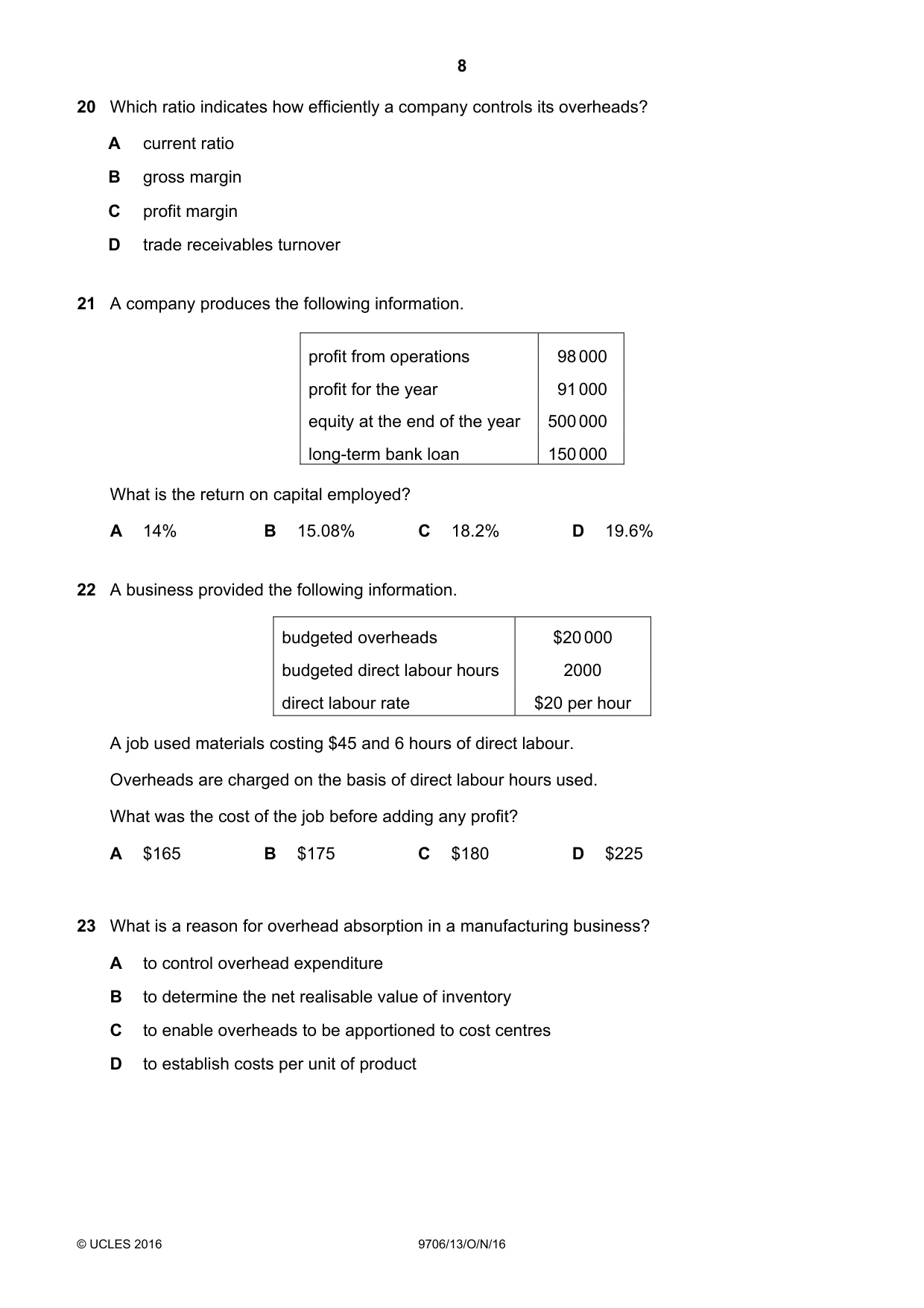
20 Which ratio indicates how efficiently a company controls its overheads? A current ratio B gross margin C profit margin D trade receivables turnover
Mark scheme: C
More questions on Analysis and communication of accounting information
Q21 · A company produces the following information
21 A company produces the following information. profit from operations 98 000 profit for the year 91 000 equity at the end of the year 500 000 long-term bank loan 150 000 What is the return on capital employed? A 14% B 15.08% C 18.2% D 19.6%
Mark scheme: B
More questions on Analysis and communication of accounting information
Q22 · A business provided the following information
22 A business provided the following information. budgeted overheads $20 000 budgeted direct labour hours 2000 direct labour rate $20 per hour A job used materials costing $45 and 6 hours of direct labour. Overheads are charged on the basis of direct labour hours used. What was the cost of the job before adding any profit? A $165 B $175 C $180 D $225
Mark scheme: D
Q23 · What is a reason for overhead absorption in a manufacturing business?
23 What is a reason for overhead absorption in a manufacturing business? A to control overhead expenditure B to determine the net realisable value of inventory C to enable overheads to be apportioned to cost centres D to establish costs per unit of product
Mark scheme: D
Q24 · The following inventory transactions are available for a business
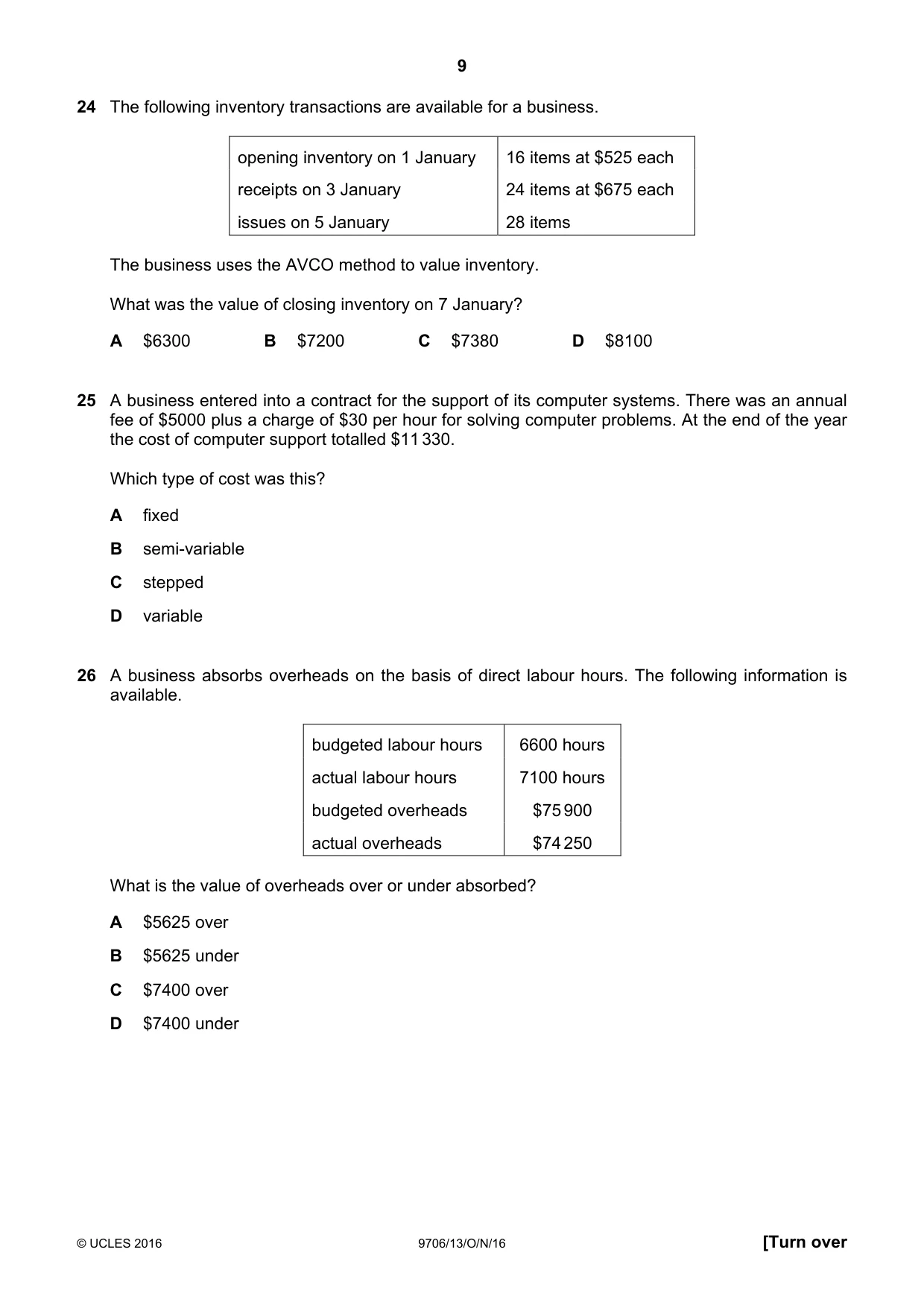
24 The following inventory transactions are available for a business. opening inventory on 1 January 16 items at $525 each receipts on 3 January 24 items at $675 each issues on 5 January 28 items The business uses the AVCO method to value inventory. What was the value of closing inventory on 7 January? A $6300 B $7200 C $7380 D $8100
Mark scheme: C
Q25 · A business entered into a contract for the support of its computer systems
25 A business entered into a contract for the support of its computer systems. There was an annual fee of $5000 plus a charge of $30 per hour for solving computer problems. At the end of the year the cost of computer support totalled $11 330. Which type of cost was this? A fixed B semi-variable C stepped D variable
Mark scheme: B
Q26 · A business absorbs overheads on the basis of direct labour hours
26 A business absorbs overheads on the basis of direct labour hours. The following information is available. budgeted labour hours 6600 hours actual labour hours 7100 hours budgeted overheads $75 900 actual overheads $74 250 What is the value of overheads over or under absorbed? A $5625 over B $5625 under C $7400 over D $7400 under
Mark scheme: C
Q27 · A manufacturing business has two production departments: assembly and painting
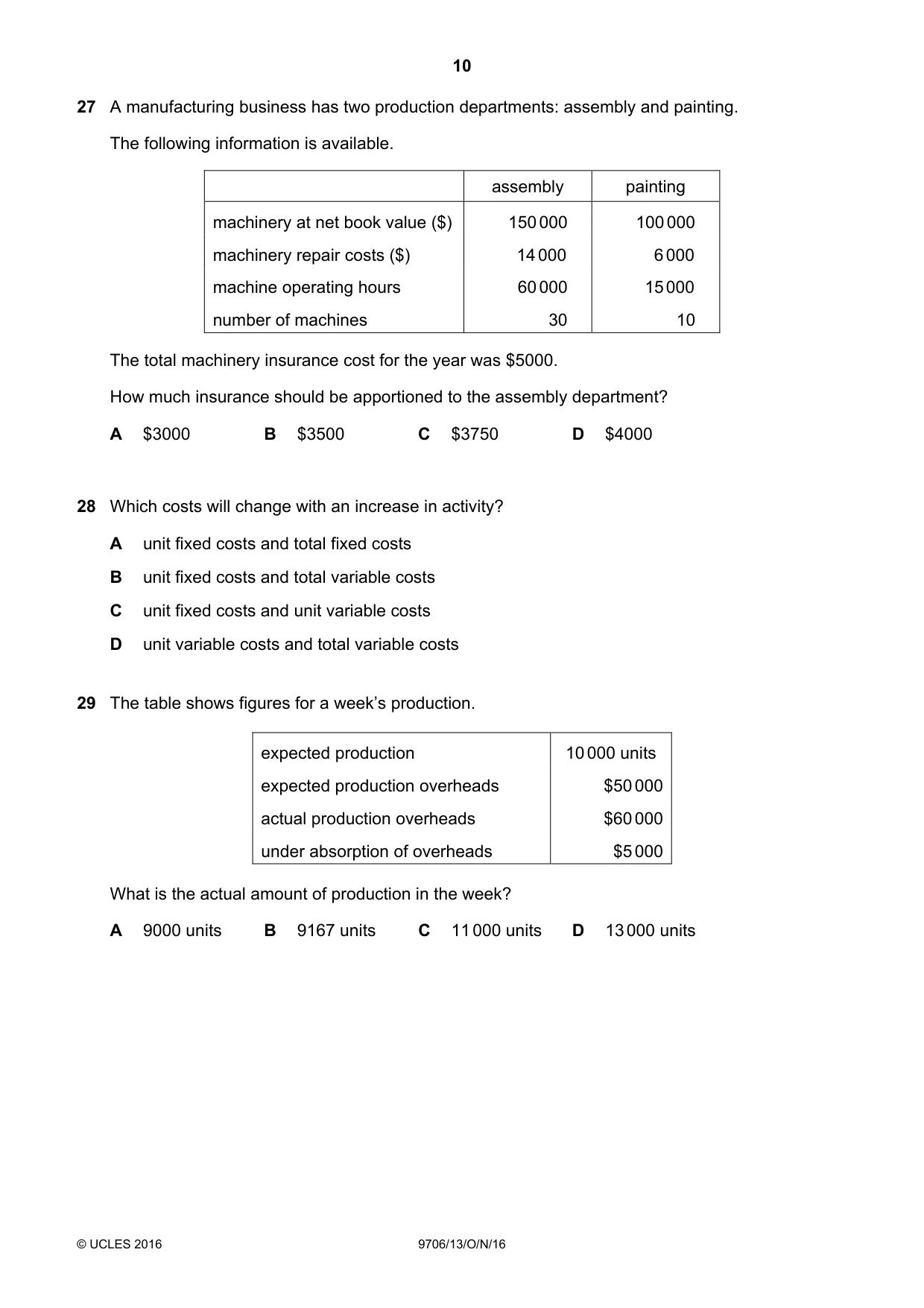
27 A manufacturing business has two production departments: assembly and painting. The following information is available. assembly painting machinery at net book value ($) 150 000 100 000 machinery repair costs ($) 14 000 6 000 machine operating hours 60 000 15 000 number of machines 30 10 The total machinery insurance cost for the year was $5000. How much insurance should be apportioned to the assembly department? A $3000 B $3500 C $3750 D $4000
Mark scheme: A
Q28 · Which costs will change with an increase in activity?
28 Which costs will change with an increase in activity? A unit fixed costs and total fixed costs B unit fixed costs and total variable costs C unit fixed costs and unit variable costs D unit variable costs and total variable costs
Mark scheme: B
Q29 · The table shows figures for a week’s production
29 The table shows figures for a week’s production. expected production 10 000 units expected production overheads $50 000 actual production overheads $60 000 under absorption of overheads $5 000 What is the actual amount of production in the week? A 9000 units B 9167 units C 11 000 units D 13 000 units
Mark scheme: C
Q30 · A business makes a single product
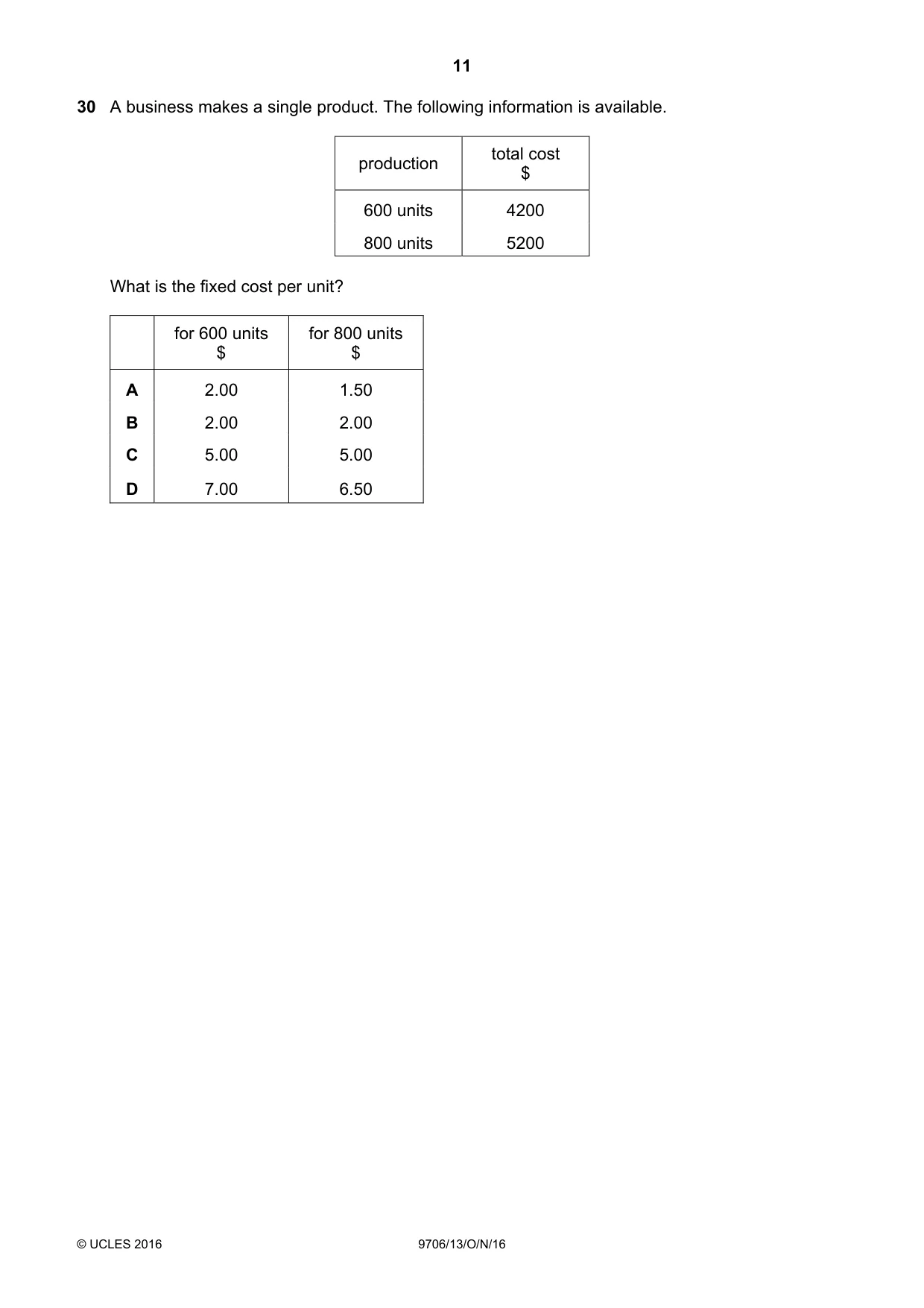
30 A business makes a single product. The following information is available. total cost production $ 600 units 4200 800 units 5200 What is the fixed cost per unit? for 600 units for 800 units $ $ A 2.00 1.50 B 2.00 2.00 C 5.00 5.00 D 7.00 6.50
Mark scheme: A
What was in this paper
The subtopics covered by these 30 questions, and how many questions each got. Open one in a new tab to see every Cambridge question on it.
What you needed in this session
Cambridge’s own grade thresholds for 2016 Oct/Nov, Paper 1 · Variant 3. A higher threshold means an easier paper — the bar moves with how the cohort did.