Cambridge A Level Accounting 9706 — 2015 May/June Paper 1 · Variant 1
9706/11/M/J/15 · 30 questions · 30 marks · ≈34 min
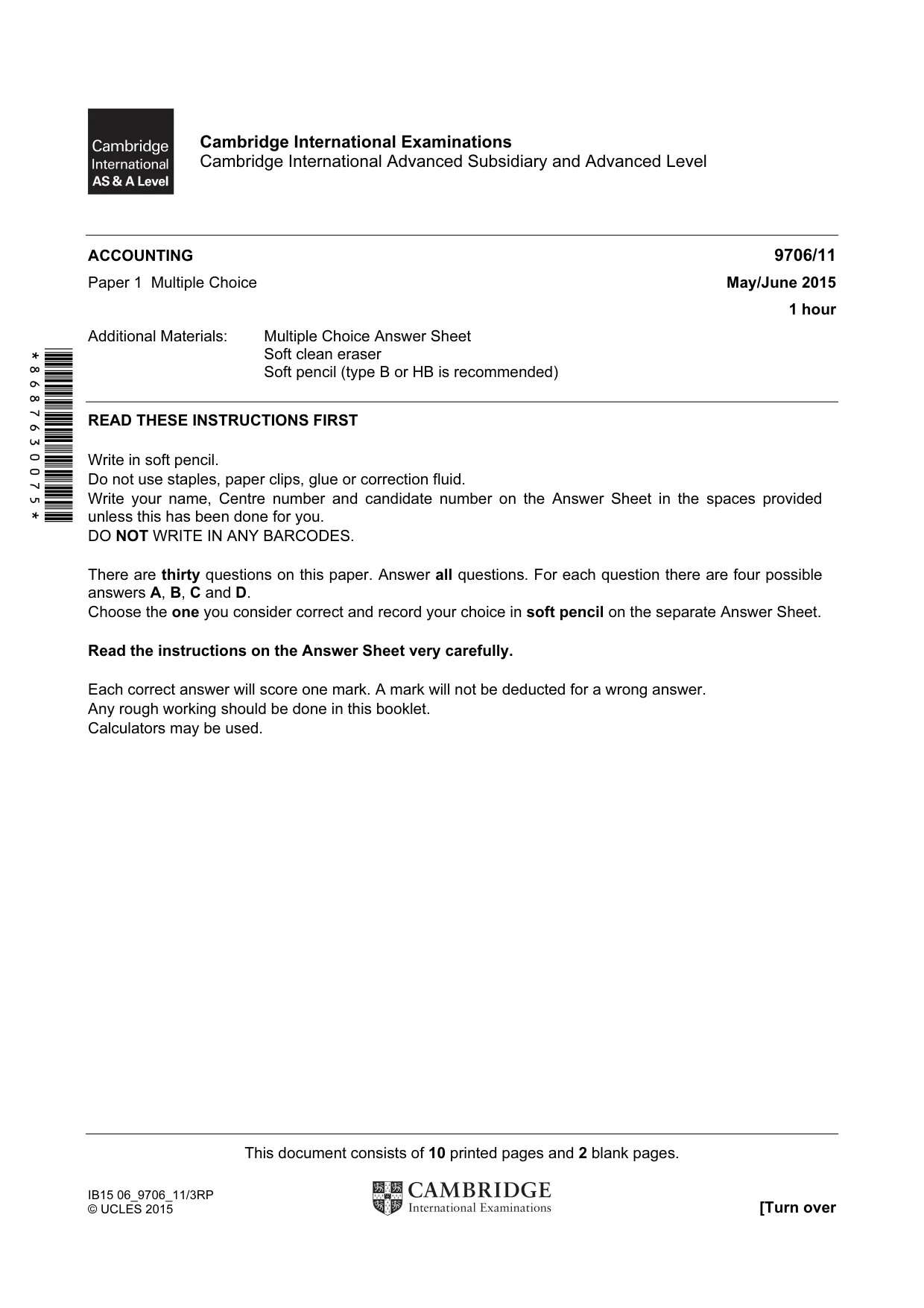
The question paper and its mark scheme, free to read here and free to download. This is Cambridge’s own paper, exactly as it was sat.
Question paper12 pages

Mark scheme2 pages
Answers below. Sit the paper first if you are practising.
Questions as text
Q1 · Which entries are required to show a decrease in the existing provision for doubtful…
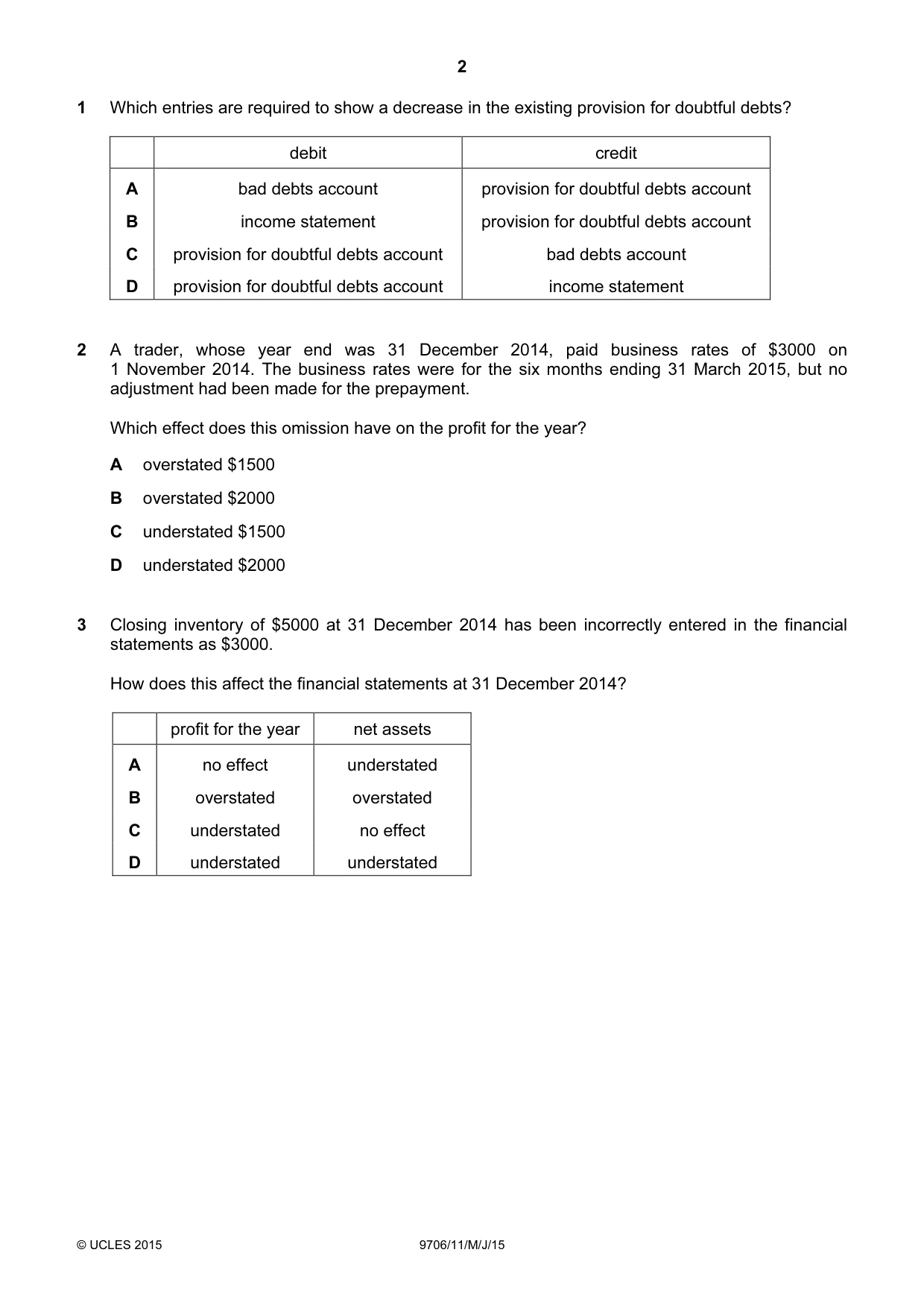
1 Which entries are required to show a decrease in the existing provision for doubtful debts? debit credit A bad debts account provision for doubtful debts account B income statement provision for doubtful debts account C provision for doubtful debts account bad debts account D provision for doubtful debts account income statement
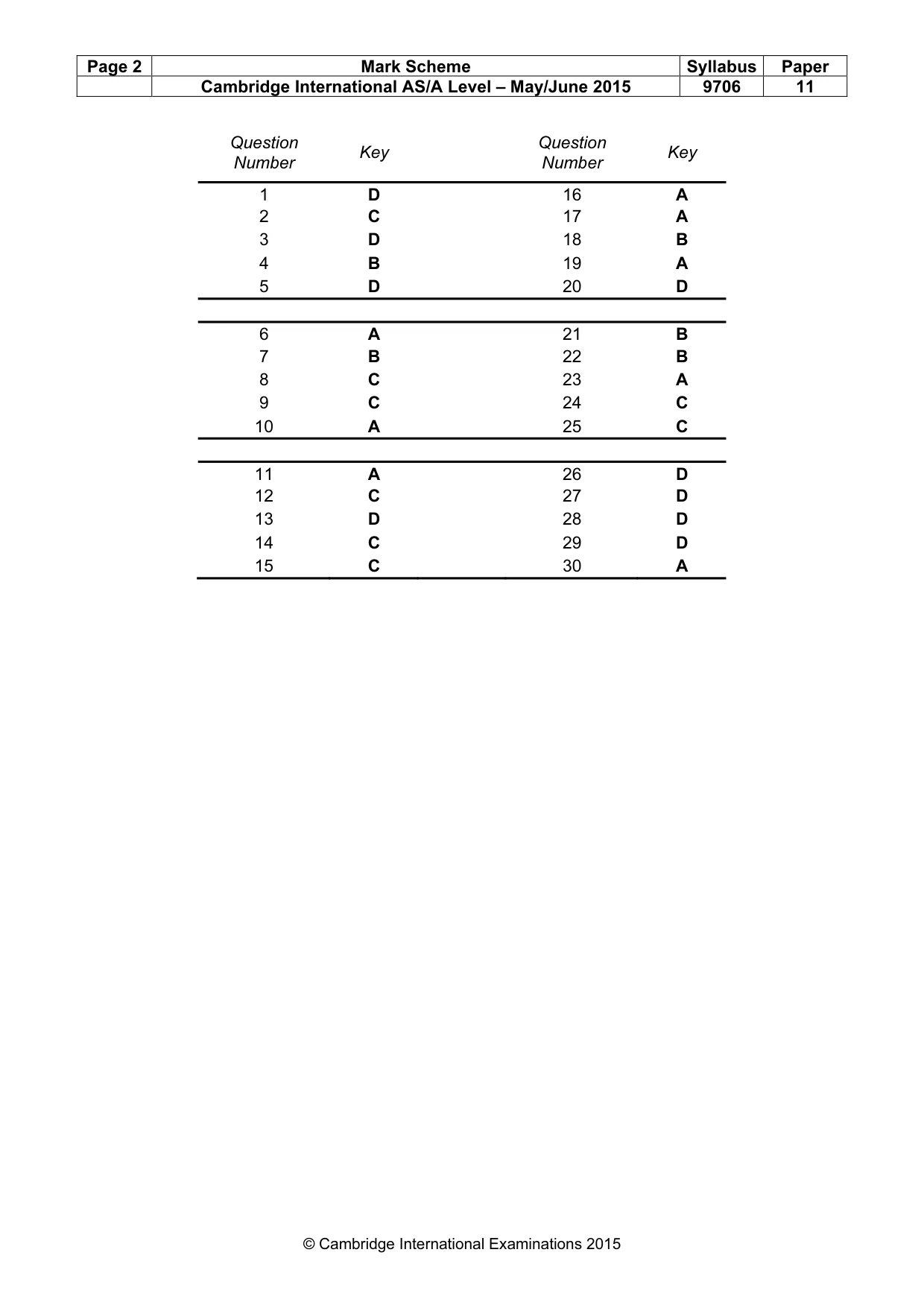
Mark scheme: D
Q2 · A trader, whose year end was 31 December 2014, paid business rates of $3000 on 1 November…
2 A trader, whose year end was 31 December 2014, paid business rates of $3000 on 1 November 2014. The business rates were for the six months ending 31 March 2015, but no adjustment had been made for the prepayment. Which effect does this omission have on the profit for the year? A overstated $1500 B overstated $2000 C understated $1500 D understated $2000
Mark scheme: C
Q3 · Closing inventory of $5000 at 31 December 2014 has been incorrectly entered in the…
3 Closing inventory of $5000 at 31 December 2014 has been incorrectly entered in the financial statements as $3000. How does this affect the financial statements at 31 December 2014? profit for the year net assets A no effect understated B overstated overstated C understated no effect D understated understated
Mark scheme: D
Q4 · Jasmine makes purchases from X Limited and also sells goods to X Limited
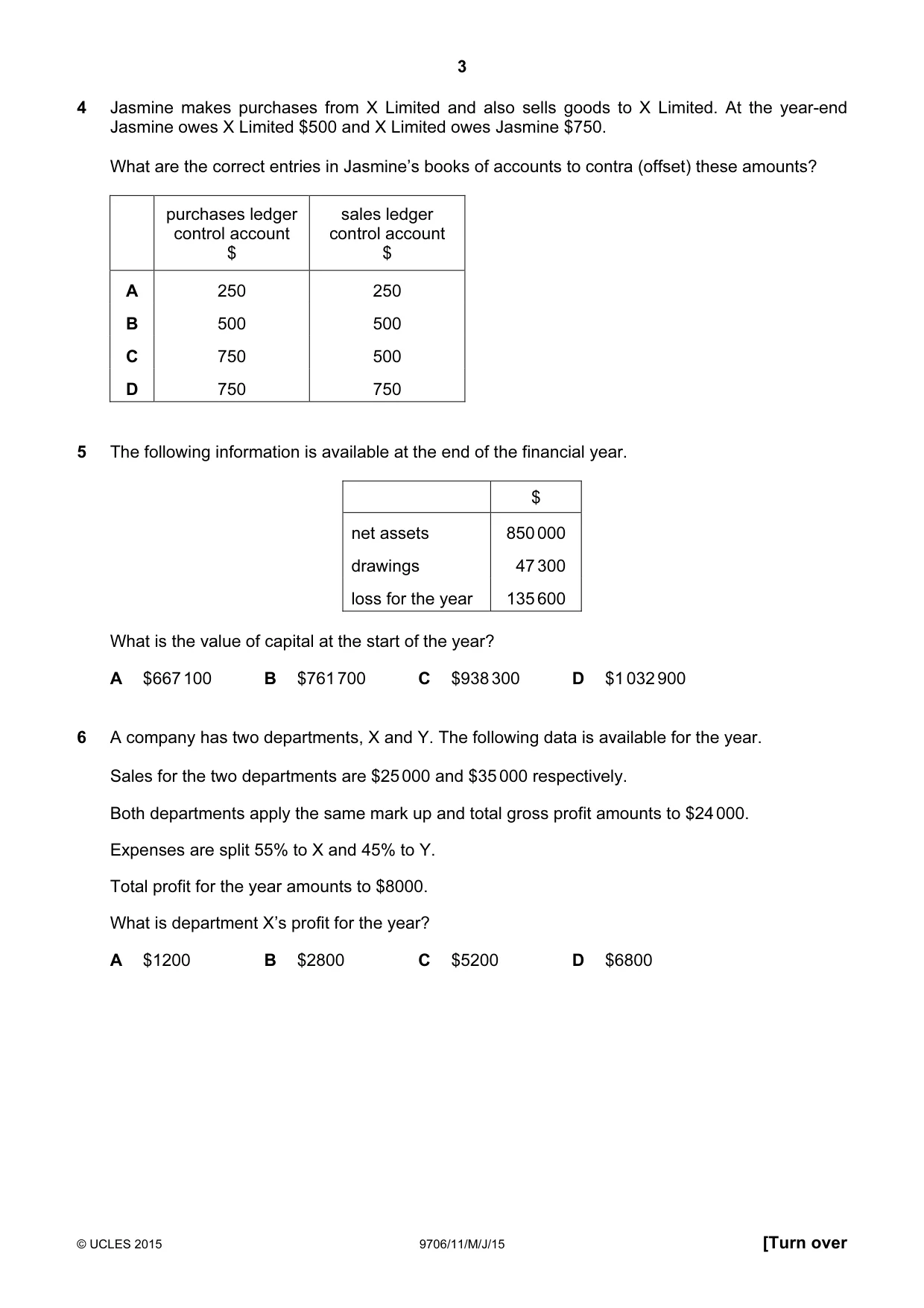
4 Jasmine makes purchases from X Limited and also sells goods to X Limited. At the year-end Jasmine owes X Limited $500 and X Limited owes Jasmine $750. What are the correct entries in Jasmine’s books of accounts to contra (offset) these amounts? purchases ledger sales ledger control account control account $ $ A 250 250 B 500 500 C 750 500 D 750 750
Mark scheme: B
Q5 · The following information is available at the end of the financial year
5 The following information is available at the end of the financial year. $ net assets 850 000 drawings 47 300 loss for the year 135 600 What is the value of capital at the start of the year? A $667 100 B $761 700 C $938 300 D $1 032 900
Mark scheme: D
Q6 · A company has two departments, X and Y
6 A company has two departments, X and Y. The following data is available for the year. Sales for the two departments are $25 000 and $35 000 respectively. Both departments apply the same mark up and total gross profit amounts to $24 000. Expenses are split 55% to X and 45% to Y. Total profit for the year amounts to $8000. What is department X’s profit for the year? A $1200 B $2800 C $5200 D $6800
Mark scheme: A
Q7 · An analysis of the cash account for a sole trader showed the following for the year
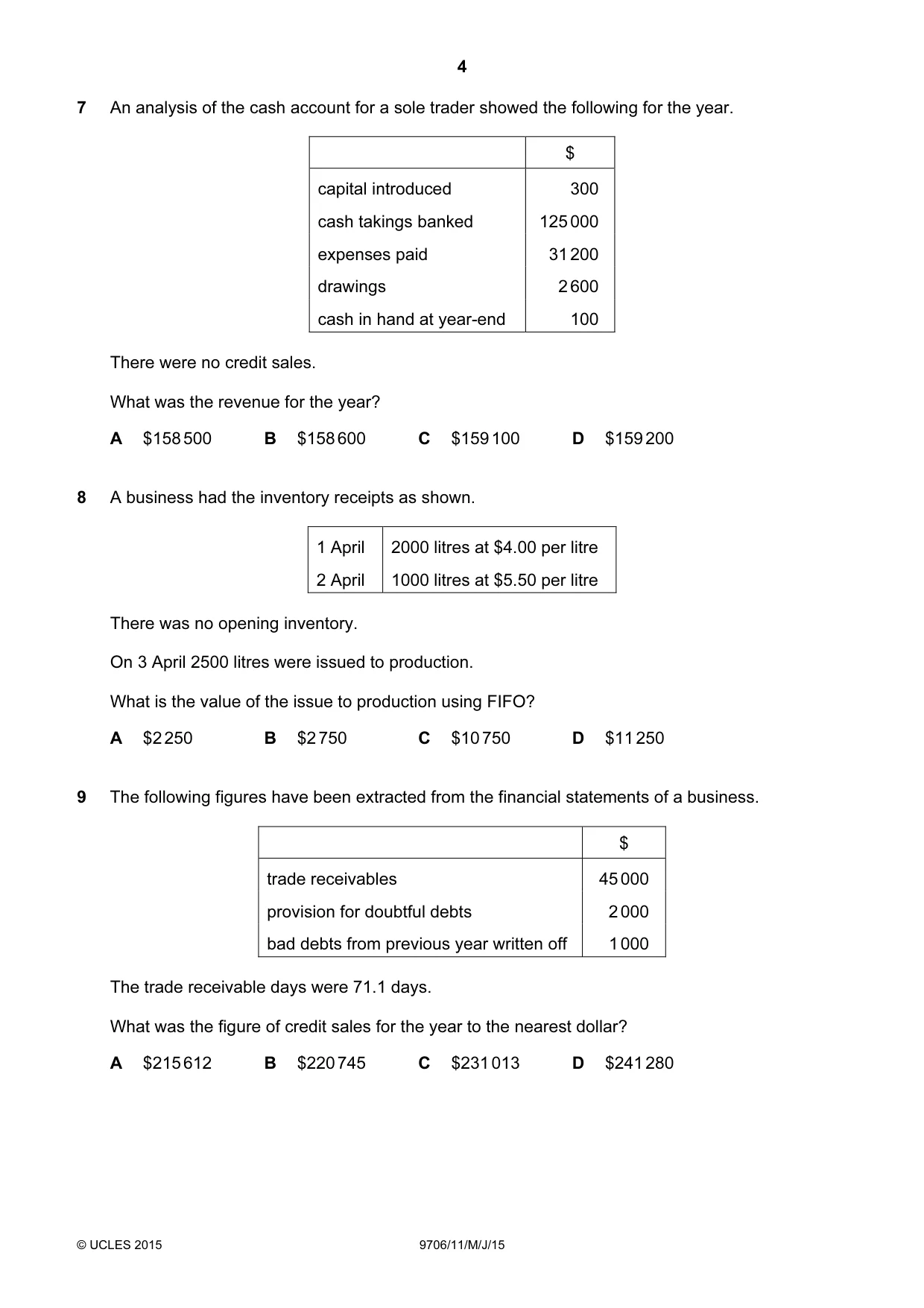
7 An analysis of the cash account for a sole trader showed the following for the year. $ capital introduced 300 cash takings banked 125 000 expenses paid 31 200 drawings 2 600 cash in hand at year-end 100 There were no credit sales. What was the revenue for the year? A $158 500 B $158 600 C $159 100 D $159 200
Mark scheme: B
Q8 · A business had the inventory receipts as shown
8 A business had the inventory receipts as shown. 1 April 2000 litres at $4.00 per litre 2 April 1000 litres at $5.50 per litre There was no opening inventory. On 3 April 2500 litres were issued to production. What is the value of the issue to production using FIFO? A $2 250 B $2 750 C $10 750 D $11 250
Mark scheme: C
Q9 · The following figures have been extracted from the financial statements of a business
9 The following figures have been extracted from the financial statements of a business. $ trade receivables 45 000 provision for doubtful debts 2 000 bad debts from previous year written off 1 000 The trade receivable days were 71.1 days. What was the figure of credit sales for the year to the nearest dollar? A $215 612 B $220 745 C $231 013 D $241 280
Mark scheme: C
More questions on Analysis and communication of accounting information
Q10 · Which item incorrectly applies the matching principle?
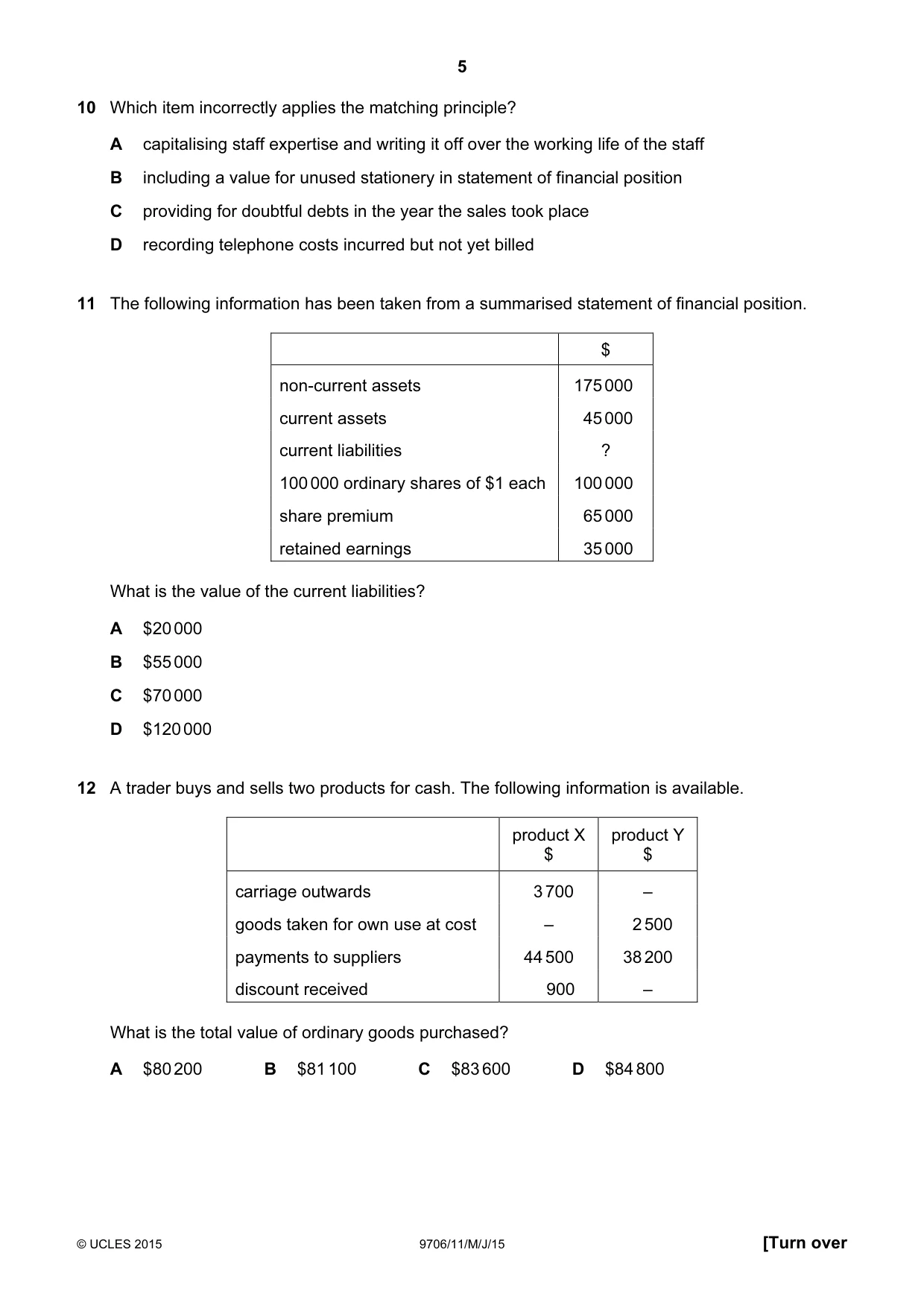
10 Which item incorrectly applies the matching principle? A capitalising staff expertise and writing it off over the working life of the staff B including a value for unused stationery in statement of financial position C providing for doubtful debts in the year the sales took place D recording telephone costs incurred but not yet billed
Mark scheme: A
Q11 · The following information has been taken from a summarised statement of financial position
11 The following information has been taken from a summarised statement of financial position. $ non-current assets 175 000 current assets 45 000 current liabilities ? 100 000 ordinary shares of $1 each 100 000 share premium 65 000 retained earnings 35 000 What is the value of the current liabilities? A $20 000 B $55 000 C $70 000 D $120 000
Mark scheme: A
Q12 · A trader buys and sells two products for cash
12 A trader buys and sells two products for cash. The following information is available. product X product Y $ $ carriage outwards 3 700 – goods taken for own use at cost – 2 500 payments to suppliers 44 500 38 200 discount received 900 – What is the total value of ordinary goods purchased? A $80 200 B $81 100 C $83 600 D $84 800
Mark scheme: C
Q13 · Which item appears as a credit entry in the appropriation account of a partnership?
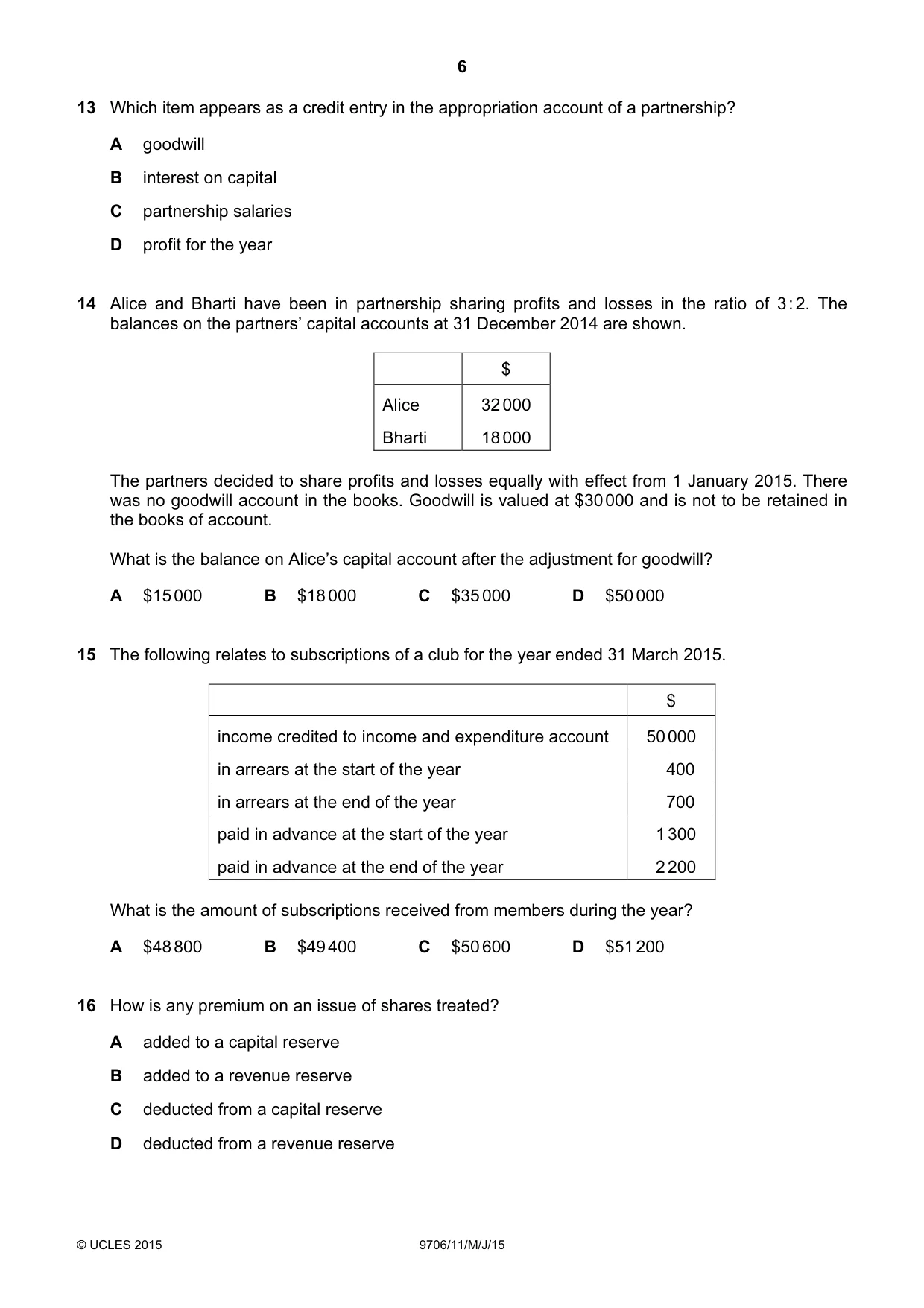
13 Which item appears as a credit entry in the appropriation account of a partnership? A goodwill B interest on capital C partnership salaries D profit for the year
Mark scheme: D
Q14 · Alice and Bharti have been in partnership sharing profits and losses in the ratio of 3 : 2
14 Alice and Bharti have been in partnership sharing profits and losses in the ratio of 3 : 2. The balances on the partners’ capital accounts at 31 December 2014 are shown. $ Alice 32 000 Bharti 18 000 The partners decided to share profits and losses equally with effect from 1 January 2015. There was no goodwill account in the books. Goodwill is valued at $30 000 and is not to be retained in the books of account. What is the balance on Alice’s capital account after the adjustment for goodwill? A $15 000 B $18 000 C $35 000 D $50 000
Mark scheme: C
Q15 · The following relates to subscriptions of a club for the year ended 31 March 2015
15 The following relates to subscriptions of a club for the year ended 31 March 2015. $ income credited to income and expenditure account 50 000 in arrears at the start of the year 400 in arrears at the end of the year 700 paid in advance at the start of the year 1 300 paid in advance at the end of the year 2 200 What is the amount of subscriptions received from members during the year? A $48 800 B $49 400 C $50 600 D $51 200
Mark scheme: C
Q16 · How is any premium on an issue of shares treated?
16 How is any premium on an issue of shares treated? A added to a capital reserve B added to a revenue reserve C deducted from a capital reserve D deducted from a revenue reserve
Mark scheme: A
Q17 · The following statement describes a type of preference share
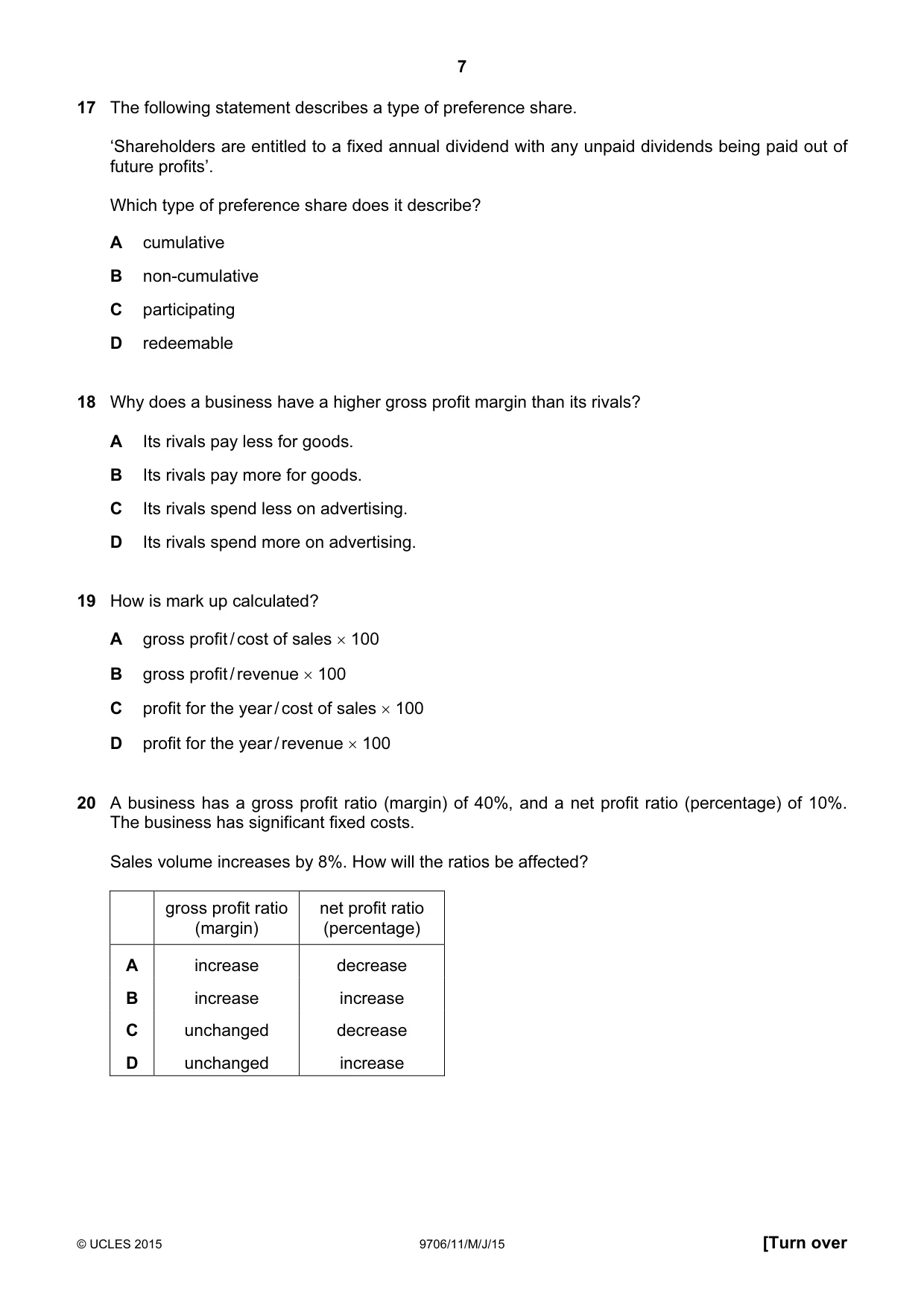
17 The following statement describes a type of preference share. ‘Shareholders are entitled to a fixed annual dividend with any unpaid dividends being paid out of future profits’. Which type of preference share does it describe? A cumulative B non-cumulative C participating D redeemable
Mark scheme: A
Q18 · Why does a business have a higher gross profit margin than its rivals?
18 Why does a business have a higher gross profit margin than its rivals? A Its rivals pay less for goods. B Its rivals pay more for goods. C Its rivals spend less on advertising. D Its rivals spend more on advertising.
Mark scheme: B
More questions on Analysis and communication of accounting information
Q19 · How is mark up calculated?
19 How is mark up calculated? A gross profit / cost of sales × 100 B gross profit / revenue × 100 C profit for the year / cost of sales × 100 D profit for the year / revenue × 100
Mark scheme: A
More questions on Analysis and communication of accounting information
Q20 · A business has a gross profit ratio (margin) of 40%, and a net profit ratio (percentage)…
20 A business has a gross profit ratio (margin) of 40%, and a net profit ratio (percentage) of 10%. The business has significant fixed costs. Sales volume increases by 8%. How will the ratios be affected? gross profit ratio net profit ratio (margin) (percentage) A increase decrease B increase increase C unchanged decrease D unchanged increase
Mark scheme: D
More questions on Analysis and communication of accounting information
Q21 · Petra supplies goods on credit to Ashy Limited
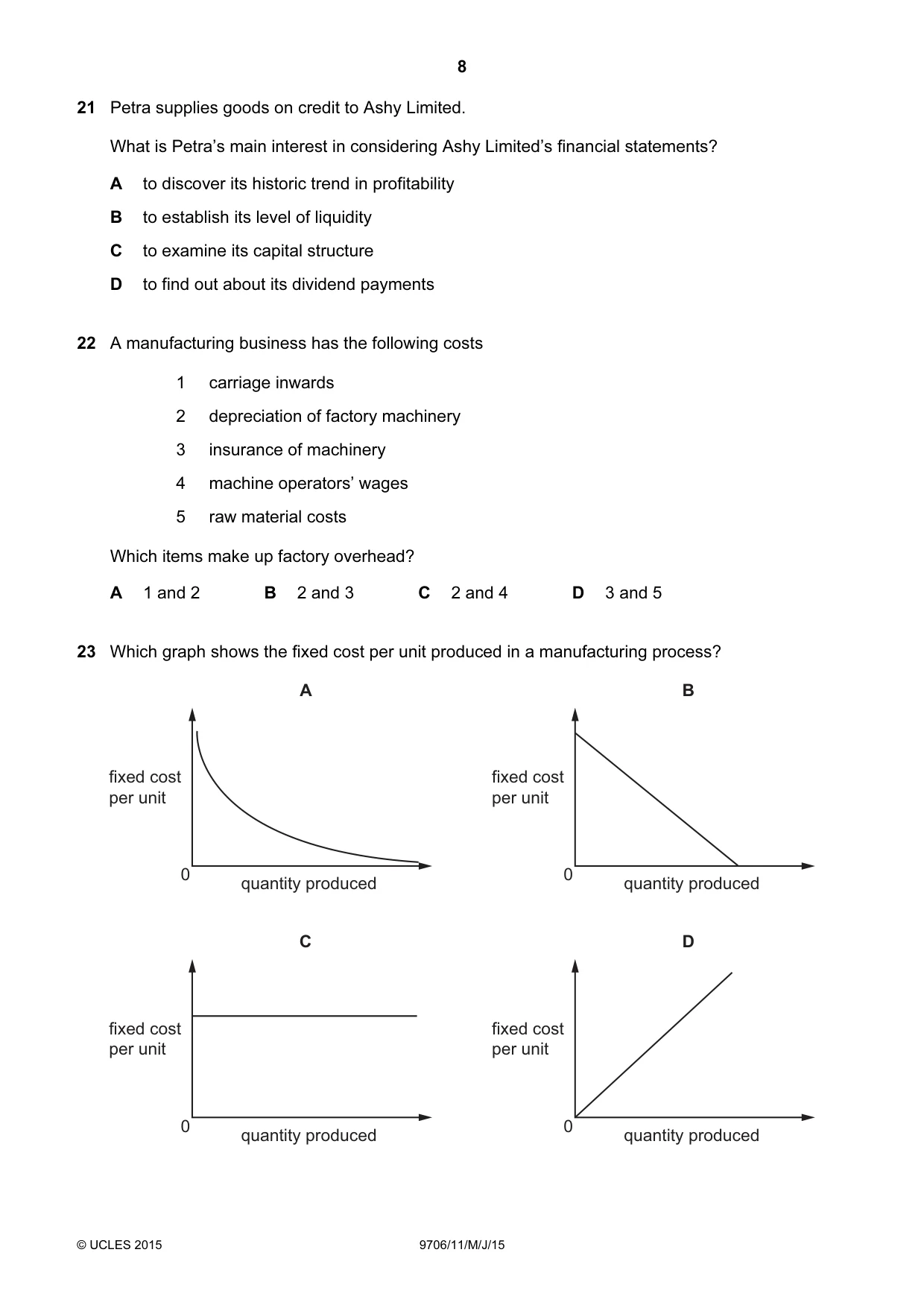
21 Petra supplies goods on credit to Ashy Limited. What is Petra’s main interest in considering Ashy Limited’s financial statements? A to discover its historic trend in profitability B to establish its level of liquidity C to examine its capital structure D to find out about its dividend payments
Mark scheme: B
More questions on Analysis and communication of accounting information
Q22 · A manufacturing business has the following costs 1 carriage inwards 2 depreciation of…
22 A manufacturing business has the following costs 1 carriage inwards 2 depreciation of factory machinery 3 insurance of machinery 4 machine operators’ wages 5 raw material costs Which items make up factory overhead? A 1 and 2 B 2 and 3 C 2 and 4 D 3 and 5
Mark scheme: B
Q23 · Which graph shows the fixed cost per unit produced in a manufacturing process?
23 Which graph shows the fixed cost per unit produced in a manufacturing process? A B fixed cost fixed cost per unit per unit 0 0 quantity produced quantity produced C D fixed cost fixed cost per unit per unit 0 0 quantity produced quantity produced
Mark scheme: A
Q24 · Actual output for a business is higher than budgeted output
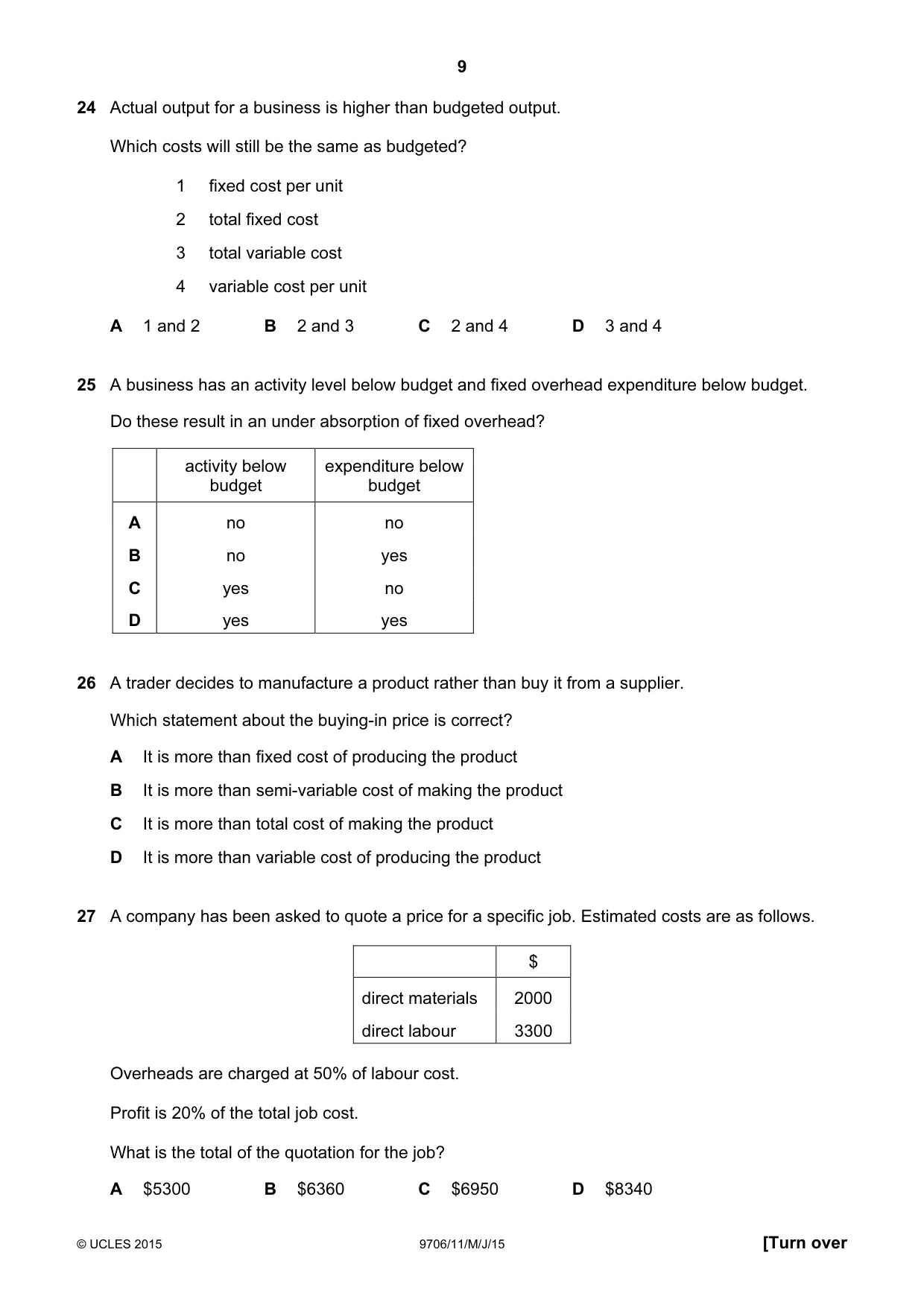
24 Actual output for a business is higher than budgeted output. Which costs will still be the same as budgeted? 1 fixed cost per unit 2 total fixed cost 3 total variable cost 4 variable cost per unit A 1 and 2 B 2 and 3 C 2 and 4 D 3 and 4
Mark scheme: C
Q25 · A business has an activity level below budget and fixed overhead expenditure below budget
25 A business has an activity level below budget and fixed overhead expenditure below budget. Do these result in an under absorption of fixed overhead? activity below expenditure below budget budget A no no B no yes C yes no D yes yes
Mark scheme: C
Q26 · A trader decides to manufacture a product rather than buy it from a supplier
26 A trader decides to manufacture a product rather than buy it from a supplier. Which statement about the buying-in price is correct? A It is more than fixed cost of producing the product B It is more than semi-variable cost of making the product C It is more than total cost of making the product D It is more than variable cost of producing the product
Mark scheme: D
Q27 · A company has been asked to quote a price for a specific job
27 A company has been asked to quote a price for a specific job. Estimated costs are as follows. $ direct materials 2000 direct labour 3300 Overheads are charged at 50% of labour cost. Profit is 20% of the total job cost. What is the total of the quotation for the job? A $5300 B $6360 C $6950 D $8340
Mark scheme: D
Q28 · A business had the following results in April and May
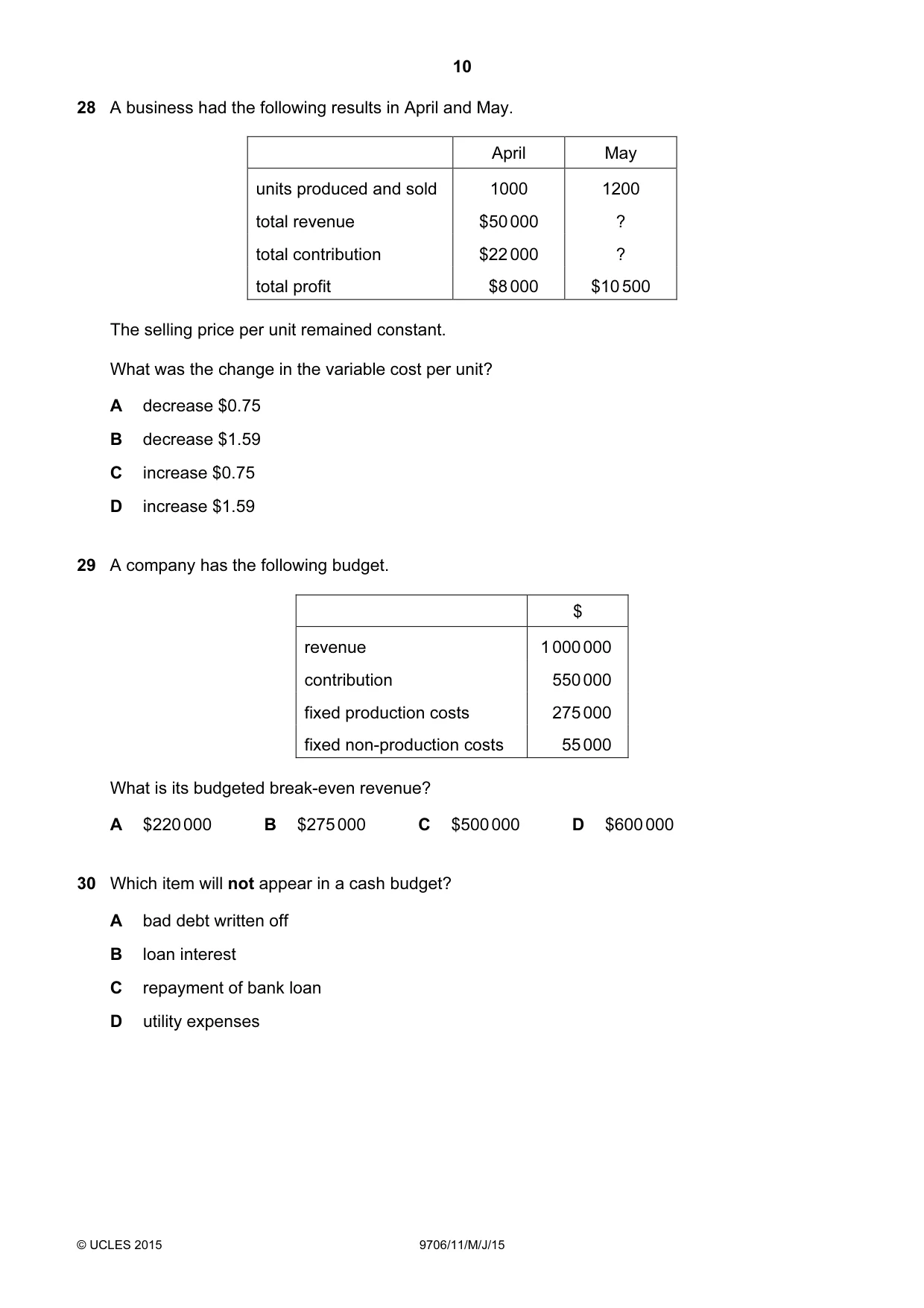
28 A business had the following results in April and May. April May units produced and sold 1000 1200 total revenue $50 000 ? total contribution $22 000 ? total profit $8 000 $10 500 The selling price per unit remained constant. What was the change in the variable cost per unit? A decrease $0.75 B decrease $1.59 C increase $0.75 D increase $1.59
Mark scheme: D
Q29 · A company has the following budget
29 A company has the following budget. $ revenue 1 000 000 contribution 550 000 fixed production costs 275 000 fixed non-production costs 55 000 What is its budgeted break-even revenue? A $220 000 B $275 000 C $500 000 D $600 000
Mark scheme: D
Q30 · Which item will not appear in a cash budget?
30 Which item will not appear in a cash budget? A bad debt written off B loan interest C repayment of bank loan D utility expenses
Mark scheme: A
What was in this paper
The subtopics covered by these 30 questions, and how many questions each got. Open one in a new tab to see every Cambridge question on it.
What you needed in this session
Cambridge’s own grade thresholds for 2015 May/June, Paper 1 · Variant 1. A higher threshold means an easier paper — the bar moves with how the cohort did.