Cambridge A Level Accounting 9706 — 2015 Oct/Nov Paper 1 · Variant 2
9706/12/O/N/15 · 30 questions · 30 marks · ≈34 min
The question paper and its mark scheme, free to read here and free to download. This is Cambridge’s own paper, exactly as it was sat.
Question paper12 pages
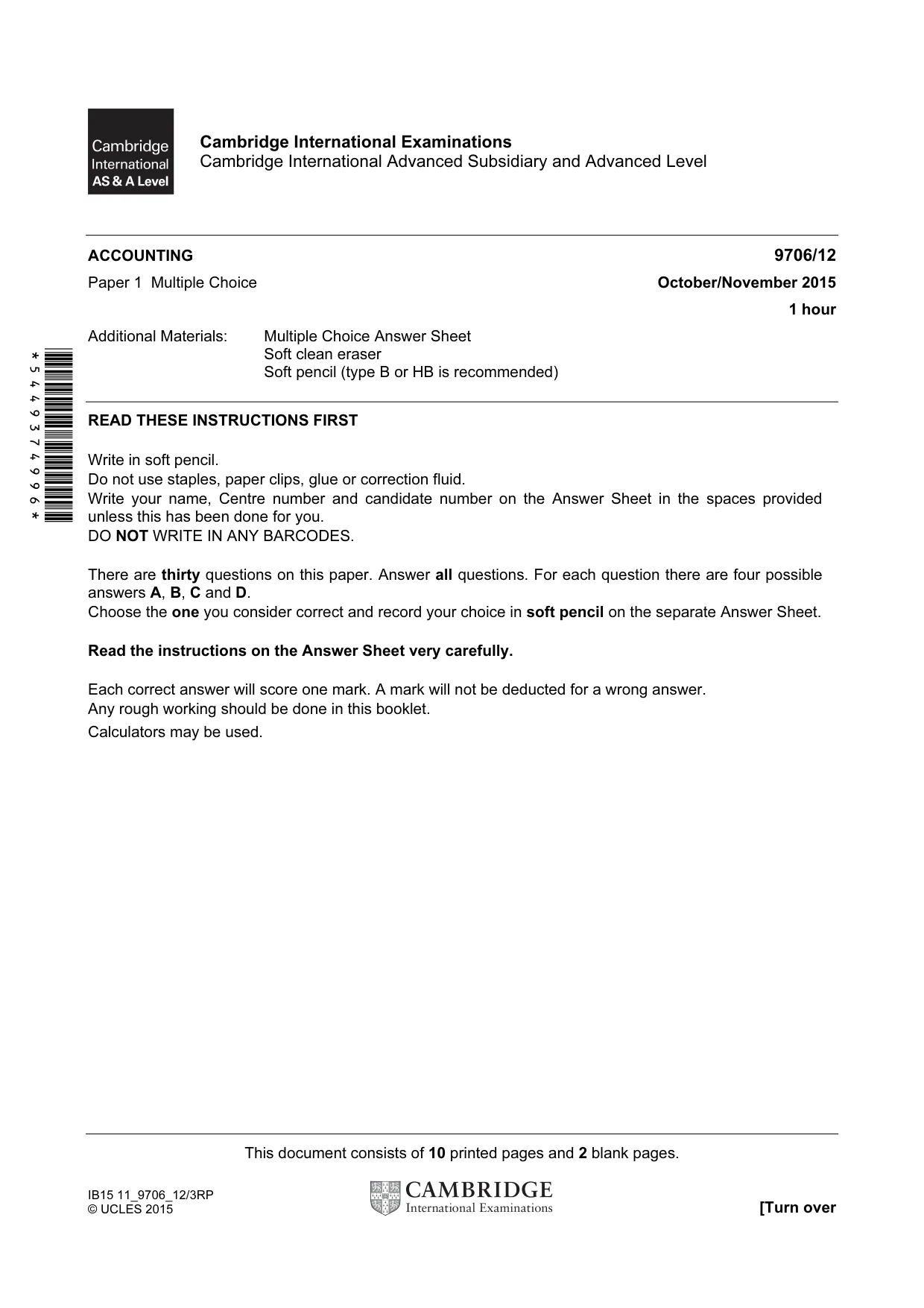
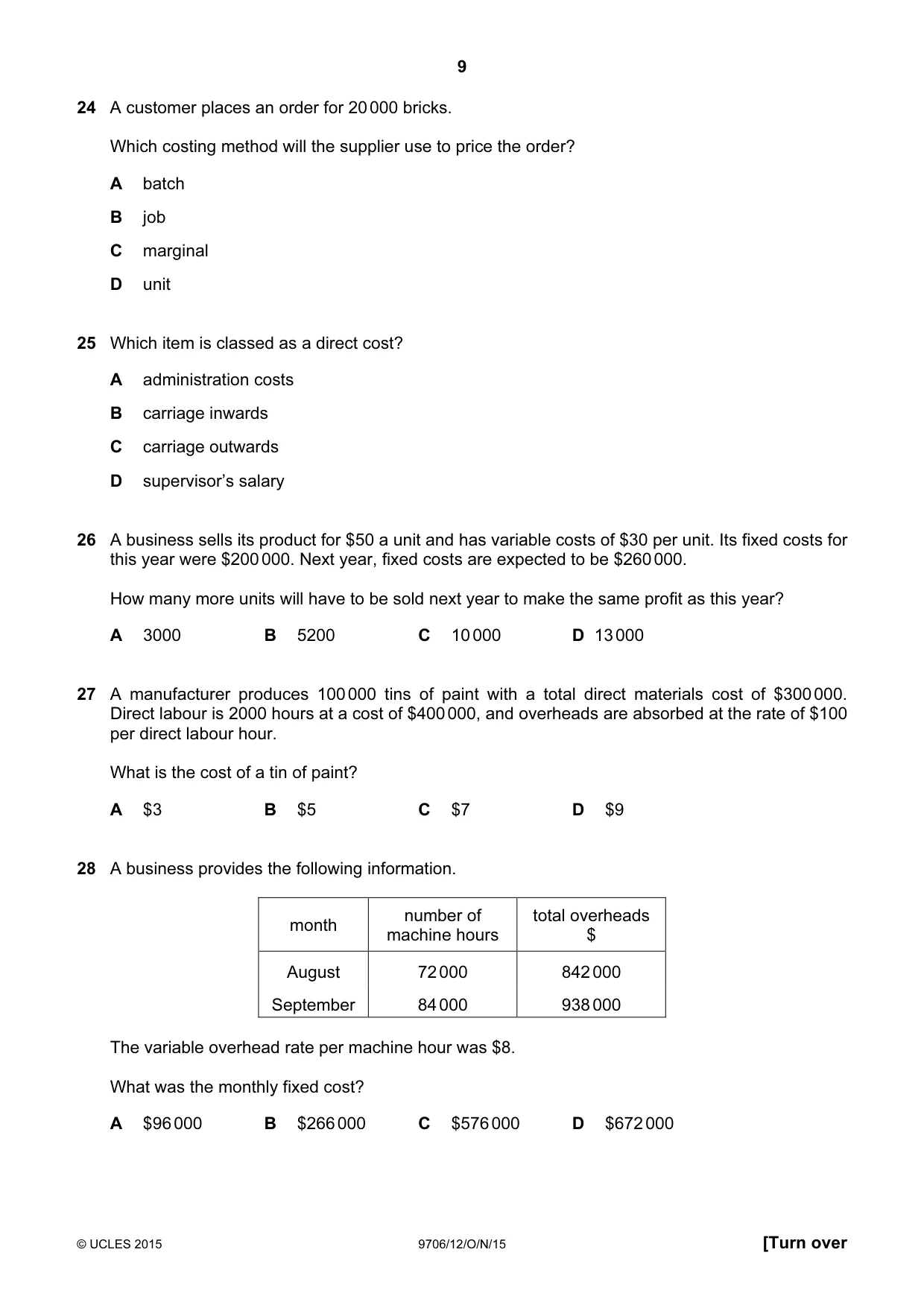
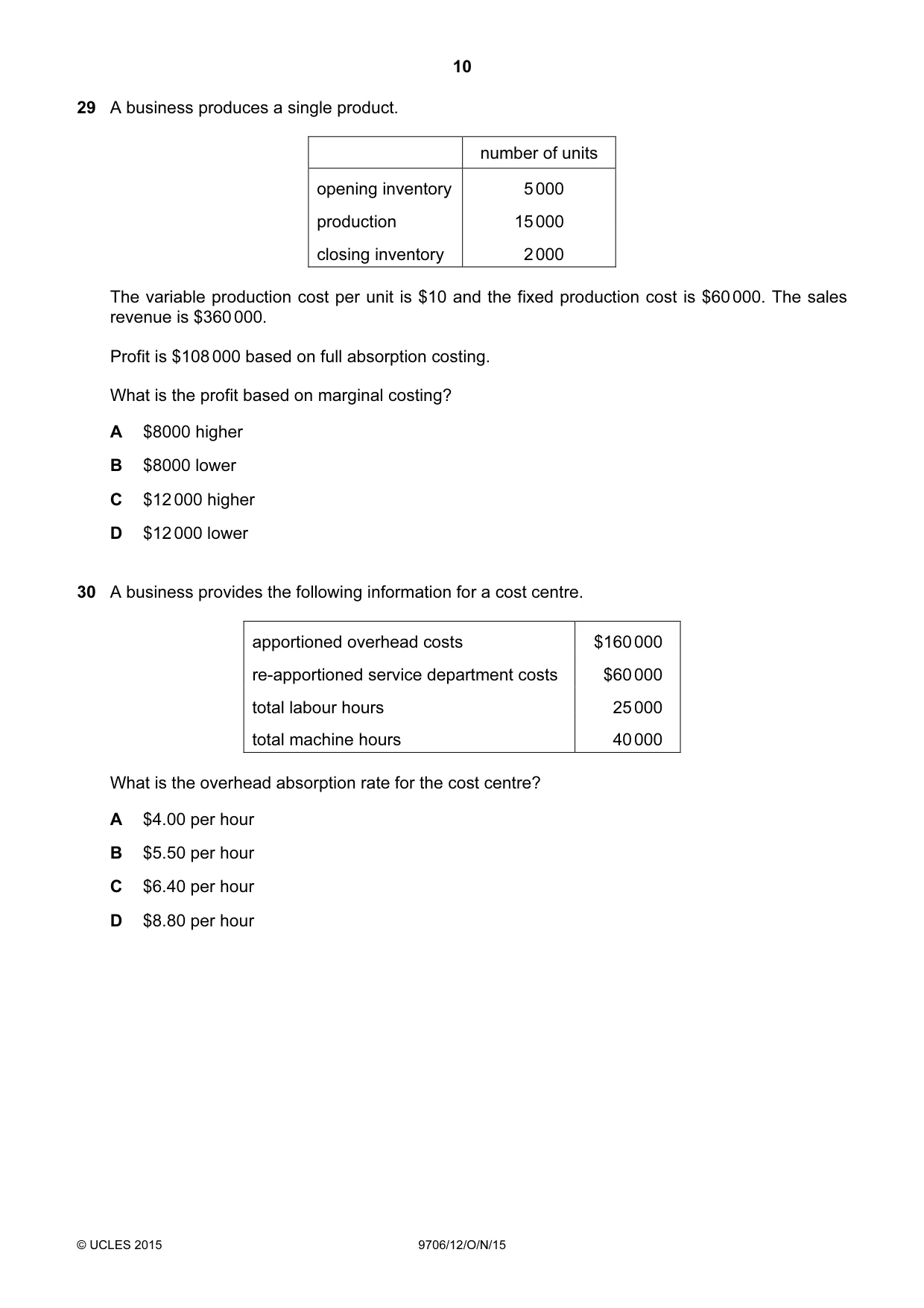

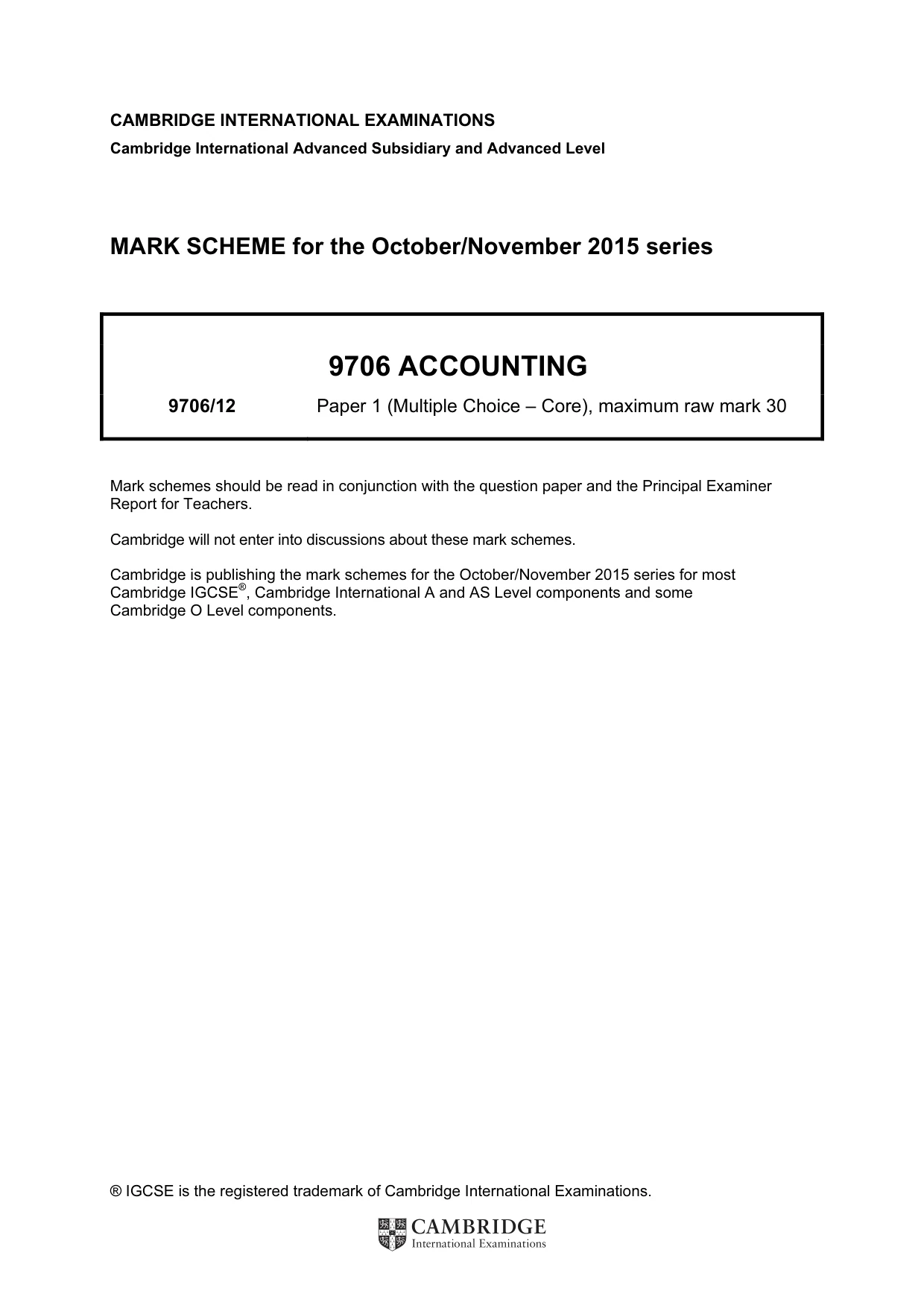
Mark scheme2 pages
Answers below. Sit the paper first if you are practising.
Questions as text
Q1 · Why does a trader account for accrued income?
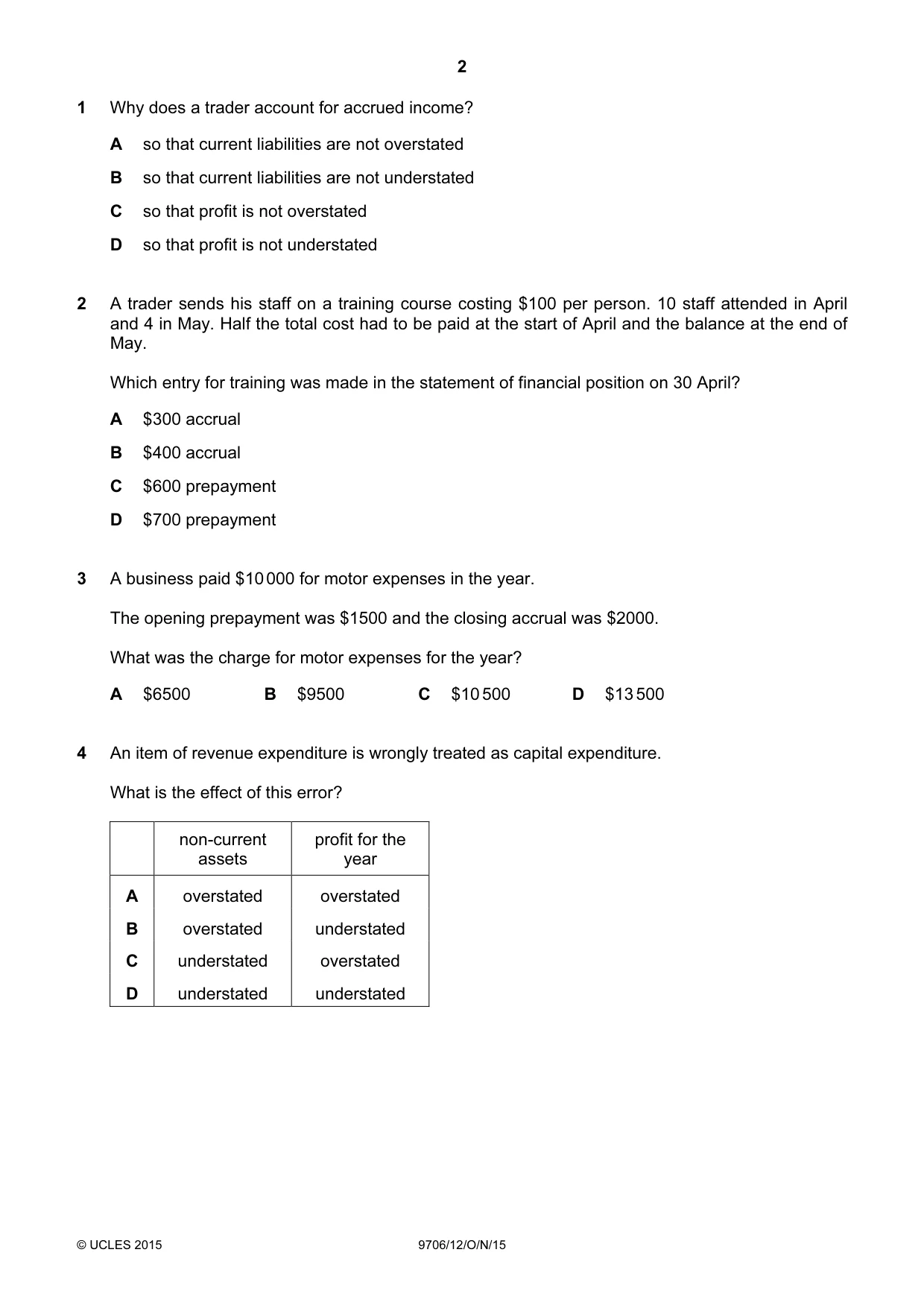
1 Why does a trader account for accrued income? A so that current liabilities are not overstated B so that current liabilities are not understated C so that profit is not overstated D so that profit is not understated
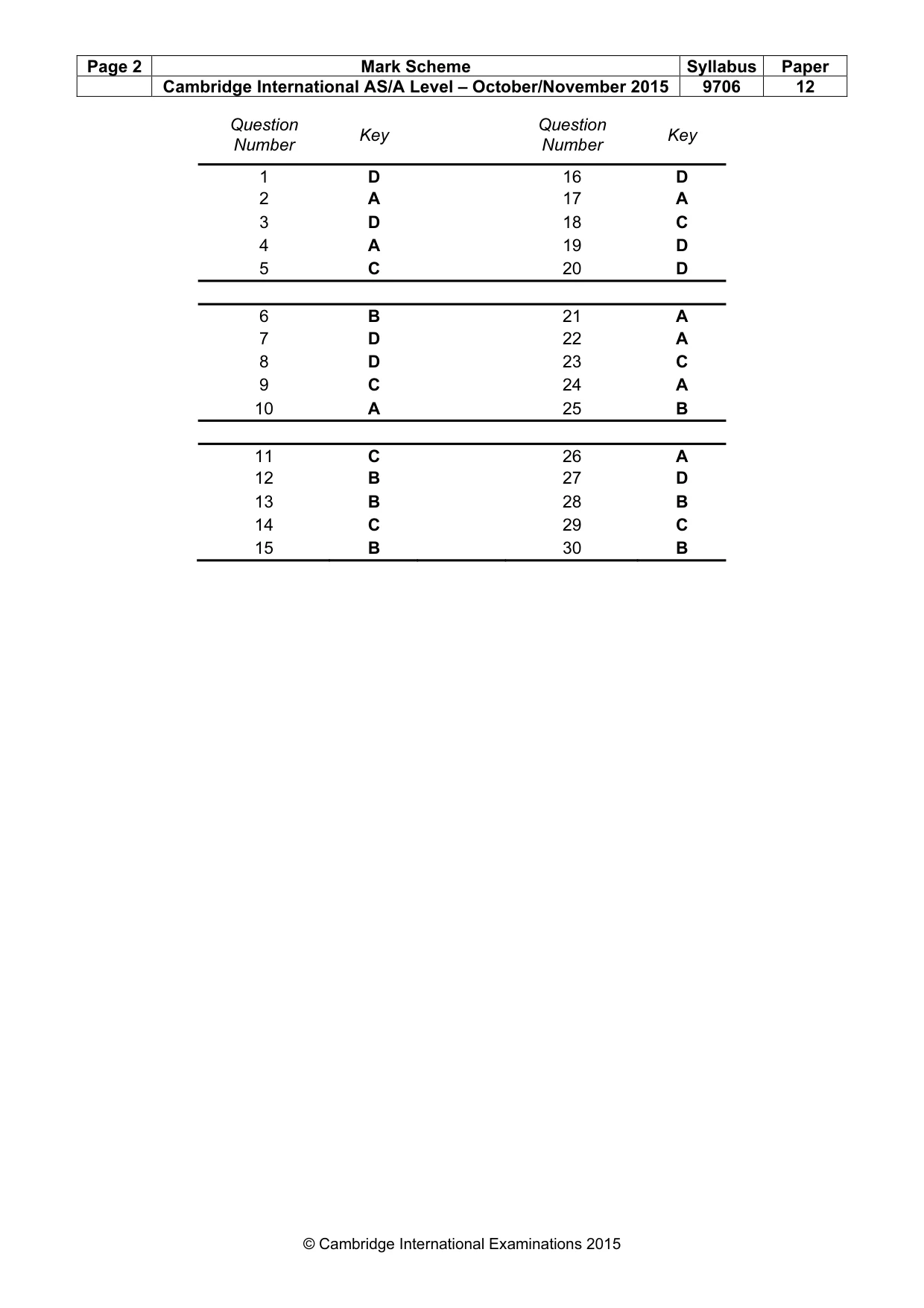
Mark scheme: D
Q2 · A trader sends his staff on a training course costing $100 per person
2 A trader sends his staff on a training course costing $100 per person. 10 staff attended in April and 4 in May. Half the total cost had to be paid at the start of April and the balance at the end of May. Which entry for training was made in the statement of financial position on 30 April? A $300 accrual B $400 accrual C $600 prepayment D $700 prepayment
Mark scheme: A
Q3 · A business paid $10 000 for motor expenses in the year
3 A business paid $10 000 for motor expenses in the year. The opening prepayment was $1500 and the closing accrual was $2000. What was the charge for motor expenses for the year? A $6500 B $9500 C $10 500 D $13 500
Mark scheme: D
Q4 · An item of revenue expenditure is wrongly treated as capital expenditure
4 An item of revenue expenditure is wrongly treated as capital expenditure. What is the effect of this error? non-current profit for the assets year A overstated overstated B overstated understated C understated overstated D understated understated
Mark scheme: A
Q5 · A trader prepares a disposal account
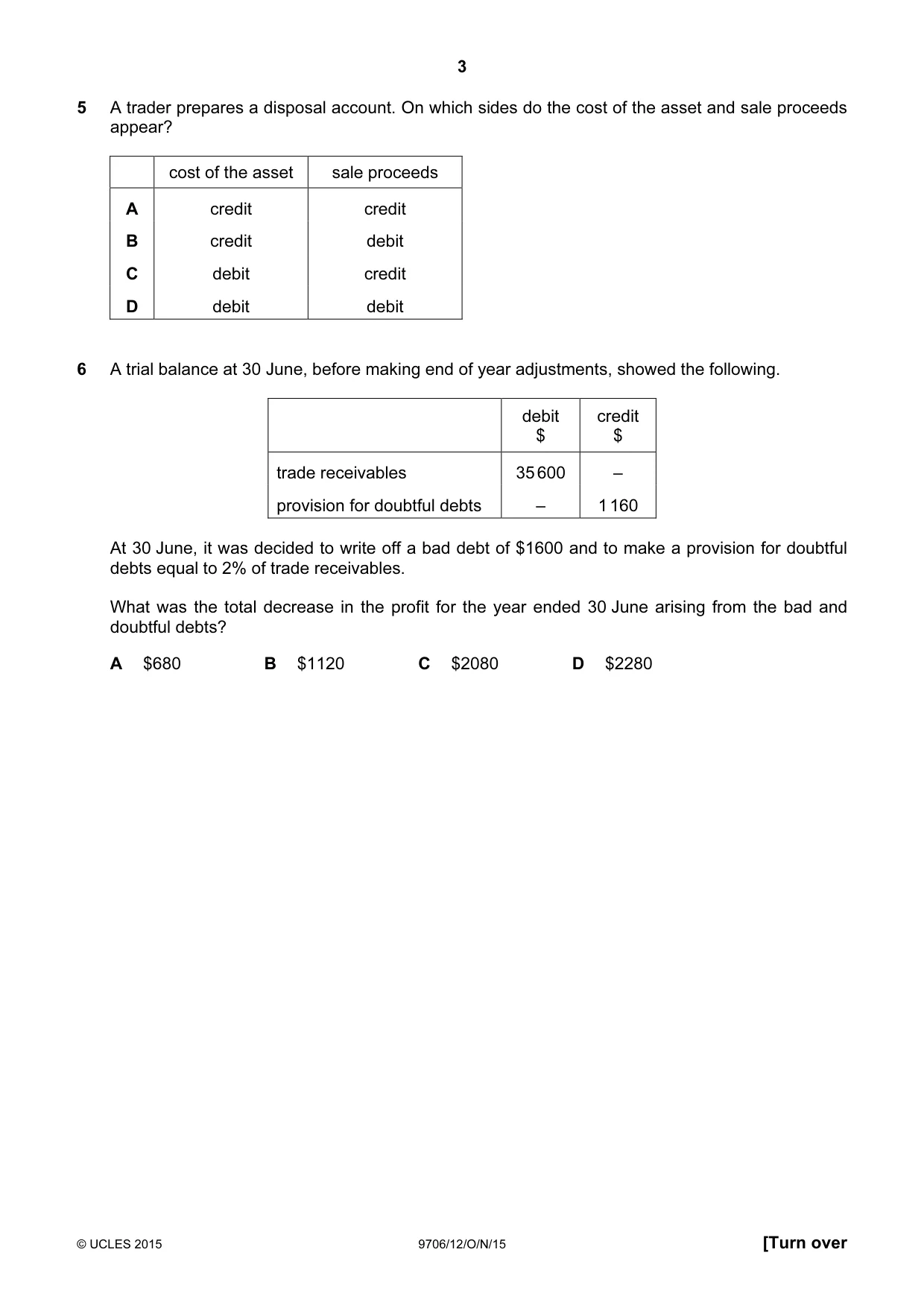
5 A trader prepares a disposal account. On which sides do the cost of the asset and sale proceeds appear? cost of the asset sale proceeds A credit credit B credit debit C debit credit D debit debit
Mark scheme: C
Q6 · A trial balance at 30 June, before making end of year adjustments, showed the following
6 A trial balance at 30 June, before making end of year adjustments, showed the following. debit credit $ $ trade receivables 35 600 – provision for doubtful debts – 1 160 At 30 June, it was decided to write off a bad debt of $1600 and to make a provision for doubtful debts equal to 2% of trade receivables. What was the total decrease in the profit for the year ended 30 June arising from the bad and doubtful debts? A $680 B $1120 C $2080 D $2280
Mark scheme: B
Q7 · Land and buildings are shown in the books of account at a cost price of $200 000 with…
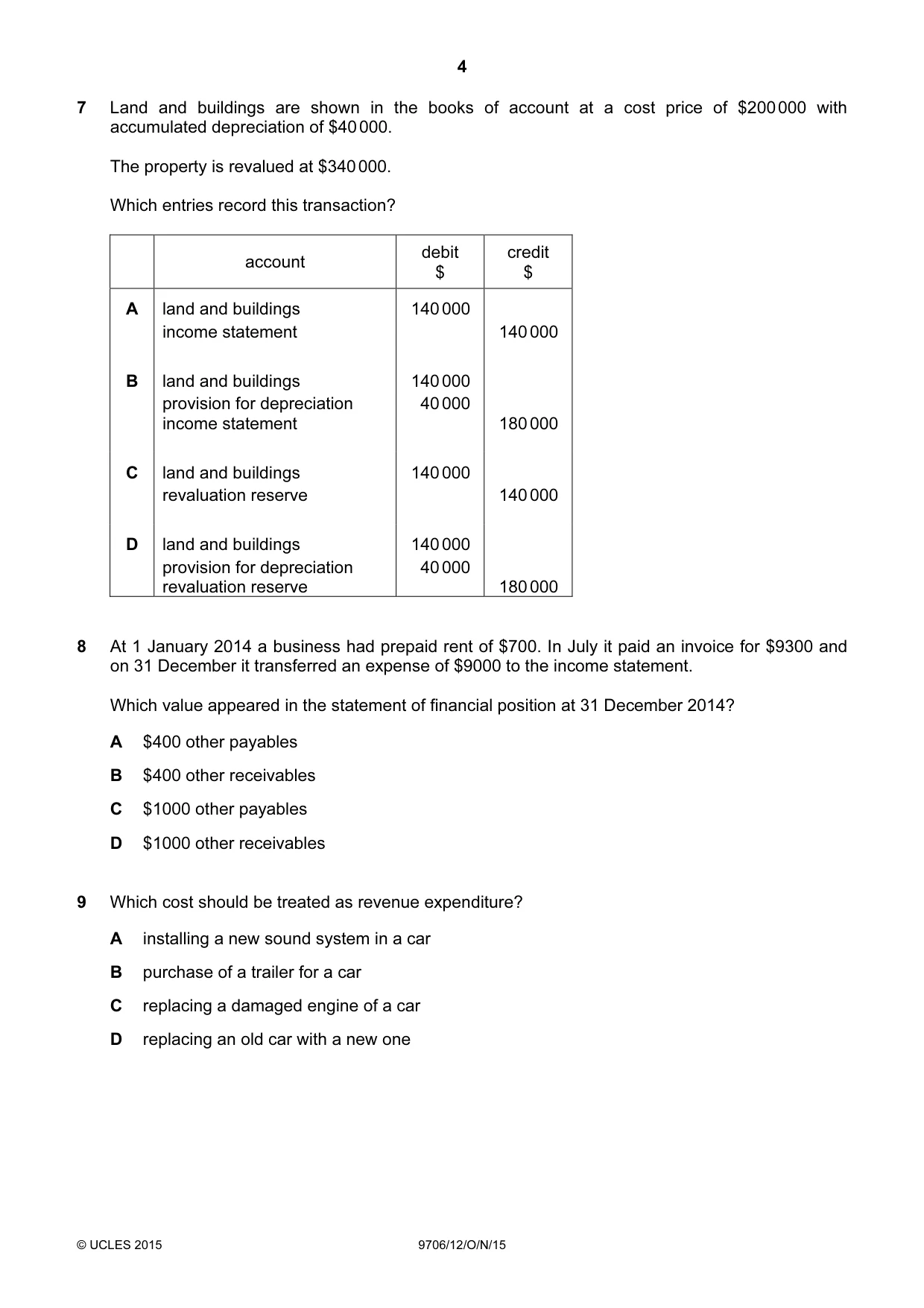
7 Land and buildings are shown in the books of account at a cost price of $200 000 with accumulated depreciation of $40 000. The property is revalued at $340 000. Which entries record this transaction? debit credit account $ $ A land and buildings 140 000 income statement 140 000 B land and buildings 140 000 provision for depreciation 40 000 income statement 180 000 C land and buildings 140 000 revaluation reserve 140 000 D land and buildings 140 000 provision for depreciation 40 000 revaluation reserve 180 000
Mark scheme: D
Q8 · At 1 January 2014 a business had prepaid rent of $700
8 At 1 January 2014 a business had prepaid rent of $700. In July it paid an invoice for $9300 and on 31 December it transferred an expense of $9000 to the income statement. Which value appeared in the statement of financial position at 31 December 2014? A $400 other payables B $400 other receivables C $1000 other payables D $1000 other receivables
Mark scheme: D
Q9 · Which cost should be treated as revenue expenditure?
9 Which cost should be treated as revenue expenditure? A installing a new sound system in a car B purchase of a trailer for a car C replacing a damaged engine of a car D replacing an old car with a new one
Mark scheme: C
Q10 · A sales return of $400 has been credited to the customer’s account as $40
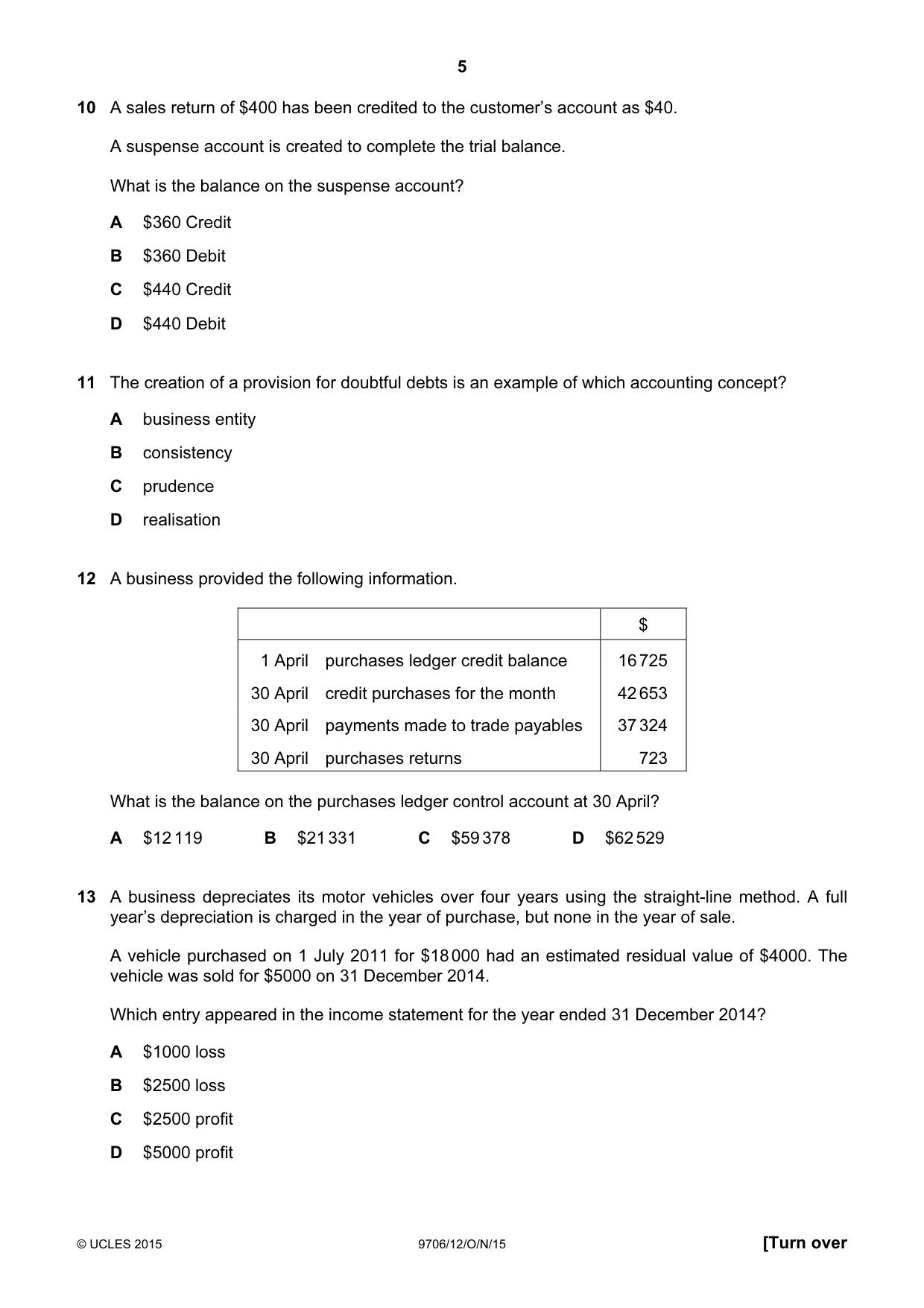
10 A sales return of $400 has been credited to the customer’s account as $40. A suspense account is created to complete the trial balance. What is the balance on the suspense account? A $360 Credit B $360 Debit C $440 Credit D $440 Debit
Mark scheme: A
Q11 · The creation of a provision for doubtful debts is an example of which accounting concept?
11 The creation of a provision for doubtful debts is an example of which accounting concept? A business entity B consistency C prudence D realisation
Mark scheme: C
Q12 · A business provided the following information
12 A business provided the following information. $ 1 April purchases ledger credit balance 16 725 30 April credit purchases for the month 42 653 30 April payments made to trade payables 37 324 30 April purchases returns 723 What is the balance on the purchases ledger control account at 30 April? A $12 119 B $21 331 C $59 378 D $62 529
Mark scheme: B
Q13 · A business depreciates its motor vehicles over four years using the straight-line method
13 A business depreciates its motor vehicles over four years using the straight-line method. A full year’s depreciation is charged in the year of purchase, but none in the year of sale. A vehicle purchased on 1 July 2011 for $18 000 had an estimated residual value of $4000. The vehicle was sold for $5000 on 31 December 2014. Which entry appeared in the income statement for the year ended 31 December 2014? A $1000 loss B $2500 loss C $2500 profit D $5000 profit
Mark scheme: B
Q14 · Rachel’s trial balance did not agree and she placed the difference in a suspense account
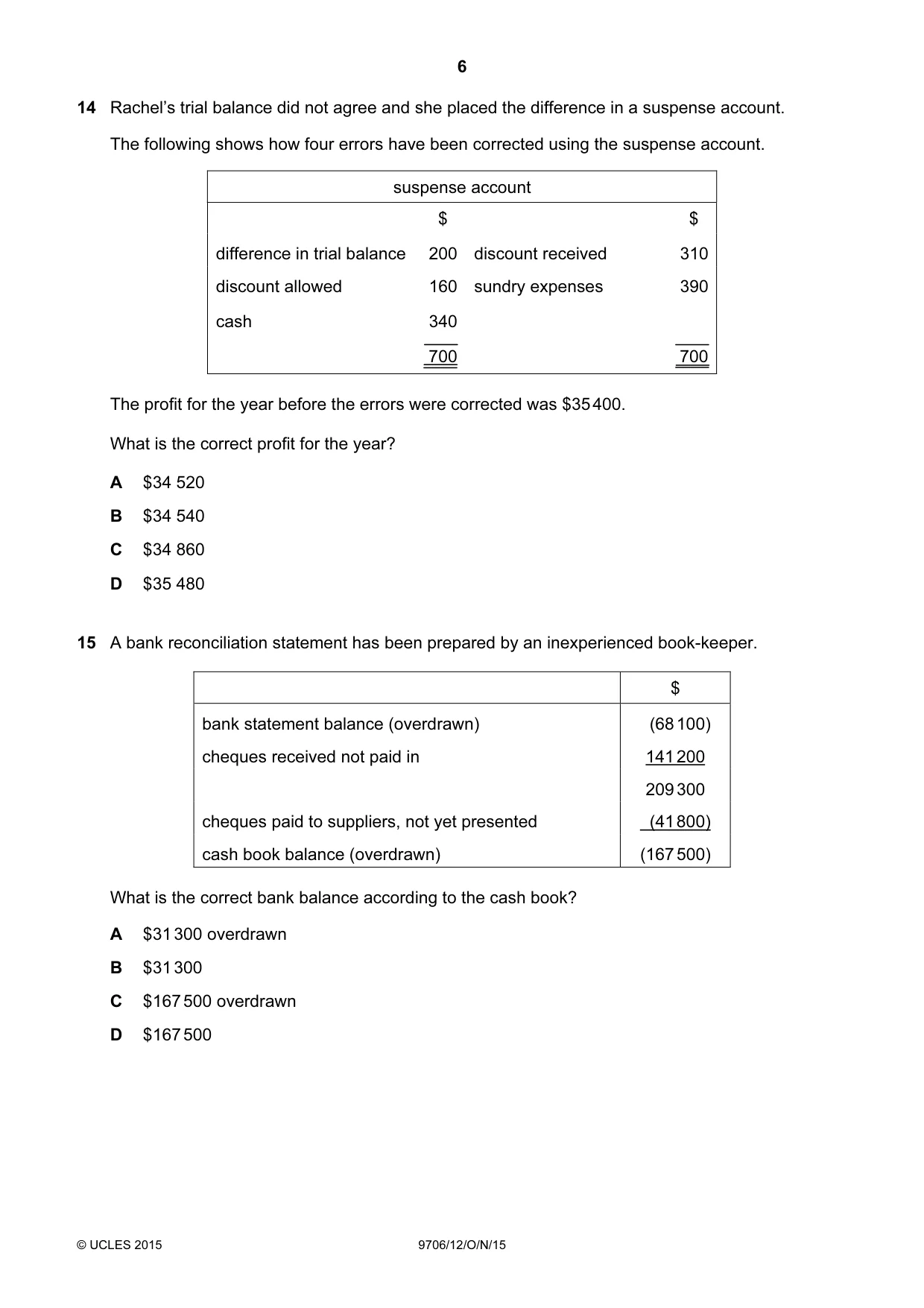
14 Rachel’s trial balance did not agree and she placed the difference in a suspense account. The following shows how four errors have been corrected using the suspense account. suspense account $ $ difference in trial balance 200 discount received 310 discount allowed 160 sundry expenses 390 cash 340 700 700 The profit for the year before the errors were corrected was $35 400. What is the correct profit for the year? A $34 520 B $34 540 C $34 860 D $35 480
Mark scheme: C
Q15 · A bank reconciliation statement has been prepared by an inexperienced book-keeper
15 A bank reconciliation statement has been prepared by an inexperienced book-keeper. $ bank statement balance (overdrawn) (68 100) cheques received not paid in 141 200 209 300 cheques paid to suppliers, not yet presented (41 800) cash book balance (overdrawn) (167 500) What is the correct bank balance according to the cash book? A $31 300 overdrawn B $31 300 C $167 500 overdrawn D $167 500
Mark scheme: B
Q16 · An invoice for purchases was credited to the purchases account
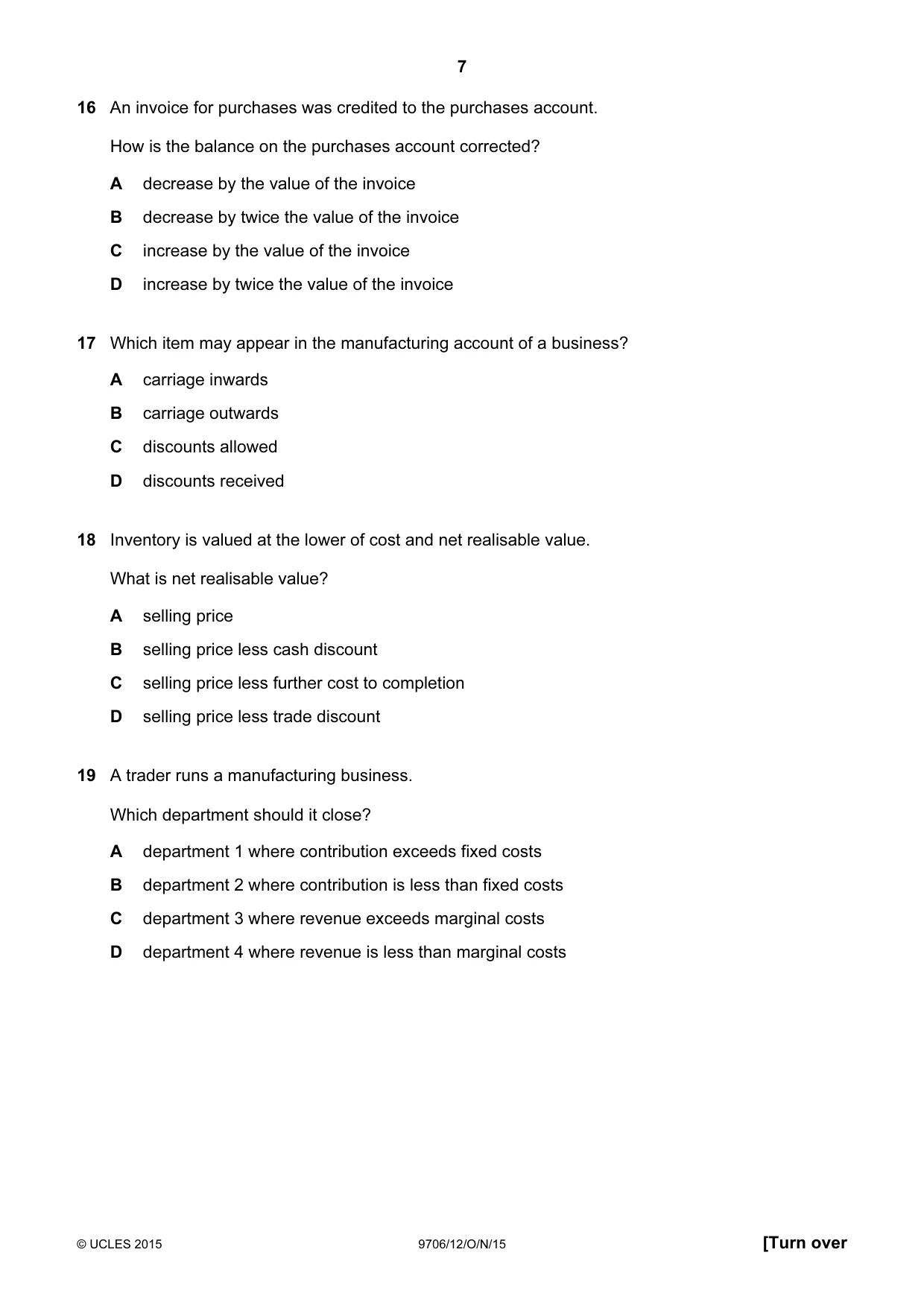
16 An invoice for purchases was credited to the purchases account. How is the balance on the purchases account corrected? A decrease by the value of the invoice B decrease by twice the value of the invoice C increase by the value of the invoice D increase by twice the value of the invoice
Mark scheme: D
Q17 · Which item may appear in the manufacturing account of a business?
17 Which item may appear in the manufacturing account of a business? A carriage inwards B carriage outwards C discounts allowed D discounts received
Mark scheme: A
Q18 · Inventory is valued at the lower of cost and net realisable value
18 Inventory is valued at the lower of cost and net realisable value. What is net realisable value? A selling price B selling price less cash discount C selling price less further cost to completion D selling price less trade discount
Mark scheme: C
Q19 · A trader runs a manufacturing business
19 A trader runs a manufacturing business. Which department should it close? A department 1 where contribution exceeds fixed costs B department 2 where contribution is less than fixed costs C department 3 where revenue exceeds marginal costs D department 4 where revenue is less than marginal costs
Mark scheme: D
Q20 · A club provides the following information
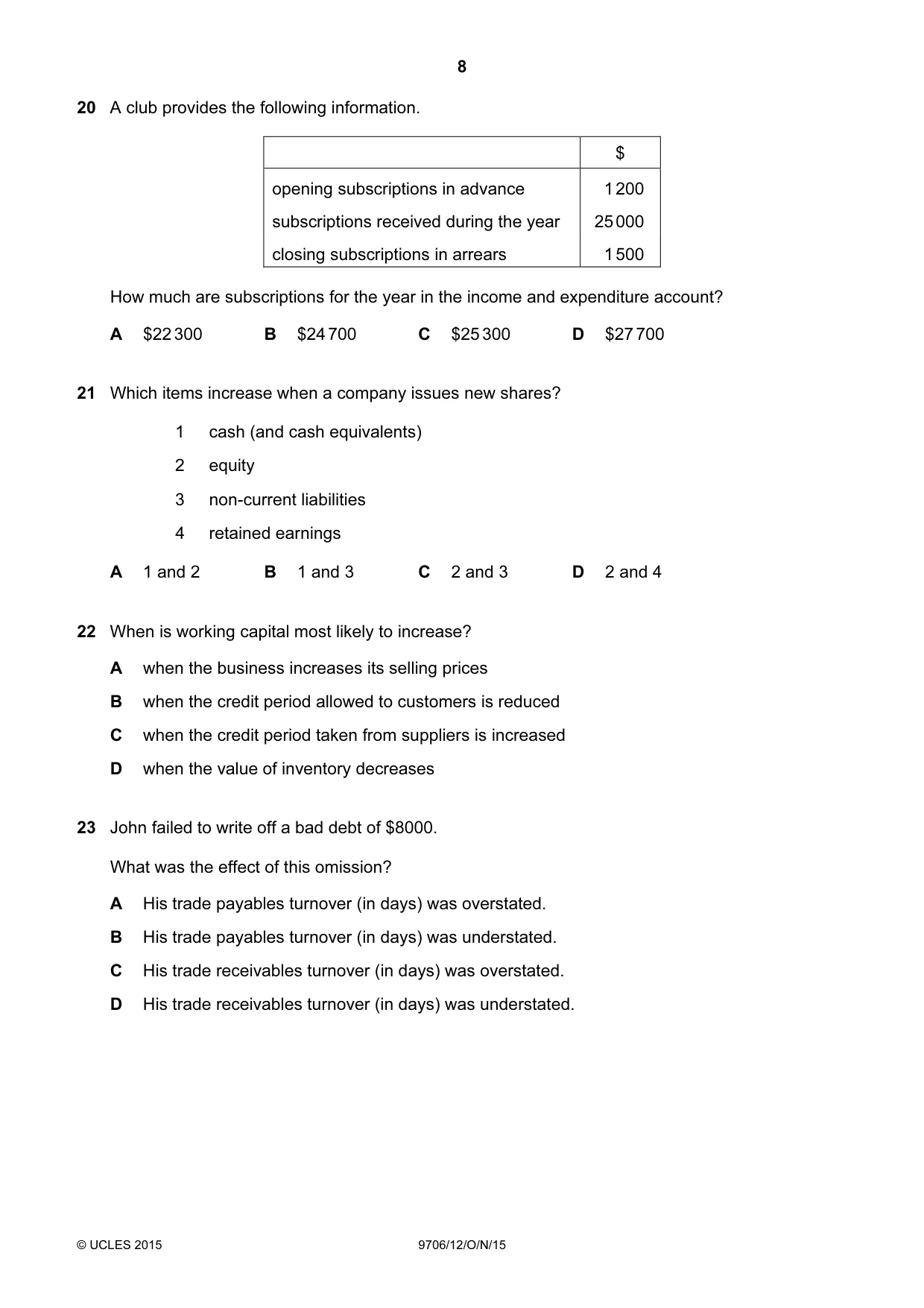
20 A club provides the following information. $ opening subscriptions in advance 1 200 subscriptions received during the year 25 000 closing subscriptions in arrears 1 500 How much are subscriptions for the year in the income and expenditure account? A $22 300 B $24 700 C $25 300 D $27 700
Mark scheme: D
Q21 · Which items increase when a company issues new shares?
21 Which items increase when a company issues new shares? 1 cash (and cash equivalents) 2 equity 3 non-current liabilities 4 retained earnings A 1 and 2 B 1 and 3 C 2 and 3 D 2 and 4
Mark scheme: A
Q22 · When is working capital most likely to increase?
22 When is working capital most likely to increase? A when the business increases its selling prices B when the credit period allowed to customers is reduced C when the credit period taken from suppliers is increased D when the value of inventory decreases
Mark scheme: A
More questions on Analysis and communication of accounting information
Q23 · John failed to write off a bad debt of $8000
23 John failed to write off a bad debt of $8000. What was the effect of this omission? A His trade payables turnover (in days) was overstated. B His trade payables turnover (in days) was understated. C His trade receivables turnover (in days) was overstated. D His trade receivables turnover (in days) was understated.
Mark scheme: C
More questions on Analysis and communication of accounting information
Q24 · A customer places an order for 20 000 bricks
24 A customer places an order for 20 000 bricks. Which costing method will the supplier use to price the order? A batch B job C marginal D unit
Mark scheme: A
Q25 · Which item is classed as a direct cost?
25 Which item is classed as a direct cost? A administration costs B carriage inwards C carriage outwards D supervisor’s salary
Mark scheme: B
Q26 · A business sells its product for $50 a unit and has variable costs of $30 per unit
26 A business sells its product for $50 a unit and has variable costs of $30 per unit. Its fixed costs for this year were $200 000. Next year, fixed costs are expected to be $260 000. How many more units will have to be sold next year to make the same profit as this year? A 3000 B 5200 C 10 000 D 13 000
Mark scheme: A
Q27 · A manufacturer produces 100 000 tins of paint with a total direct materials cost of $300…
27 A manufacturer produces 100 000 tins of paint with a total direct materials cost of $300 000. Direct labour is 2000 hours at a cost of $400 000, and overheads are absorbed at the rate of $100 per direct labour hour. What is the cost of a tin of paint? A $3 B $5 C $7 D $9
Mark scheme: D
Q28 · A business provides the following information
28 A business provides the following information. number of total overheads month machine hours $ August 72 000 842 000 September 84 000 938 000 The variable overhead rate per machine hour was $8. What was the monthly fixed cost? A $96 000 B $266 000 C $576 000 D $672 000
Mark scheme: B
Q29 · A business produces a single product
29 A business produces a single product. number of units opening inventory 5 000 production 15 000 closing inventory 2 000 The variable production cost per unit is $10 and the fixed production cost is $60 000. The sales revenue is $360 000. Profit is $108 000 based on full absorption costing. What is the profit based on marginal costing? A $8000 higher B $8000 lower C $12 000 higher D $12 000 lower
Mark scheme: C
Q30 · A business provides the following information for a cost centre
30 A business provides the following information for a cost centre. apportioned overhead costs $160 000 re-apportioned service department costs $60 000 total labour hours 25 000 total machine hours 40 000 What is the overhead absorption rate for the cost centre? A $4.00 per hour B $5.50 per hour C $6.40 per hour D $8.80 per hour
Mark scheme: B
What was in this paper
The subtopics covered by these 30 questions, and how many questions each got. Open one in a new tab to see every Cambridge question on it.
What you needed in this session
Cambridge’s own grade thresholds for 2015 Oct/Nov, Paper 1 · Variant 2. A higher threshold means an easier paper — the bar moves with how the cohort did.