Cambridge A Level Accounting 9706 — 2013 May/June Paper 1 · Variant 1
9706/11/M/J/13 · 30 questions · 30 marks · ≈34 min
The question paper and its mark scheme, free to read here and free to download. This is Cambridge’s own paper, exactly as it was sat.
Question paper12 pages
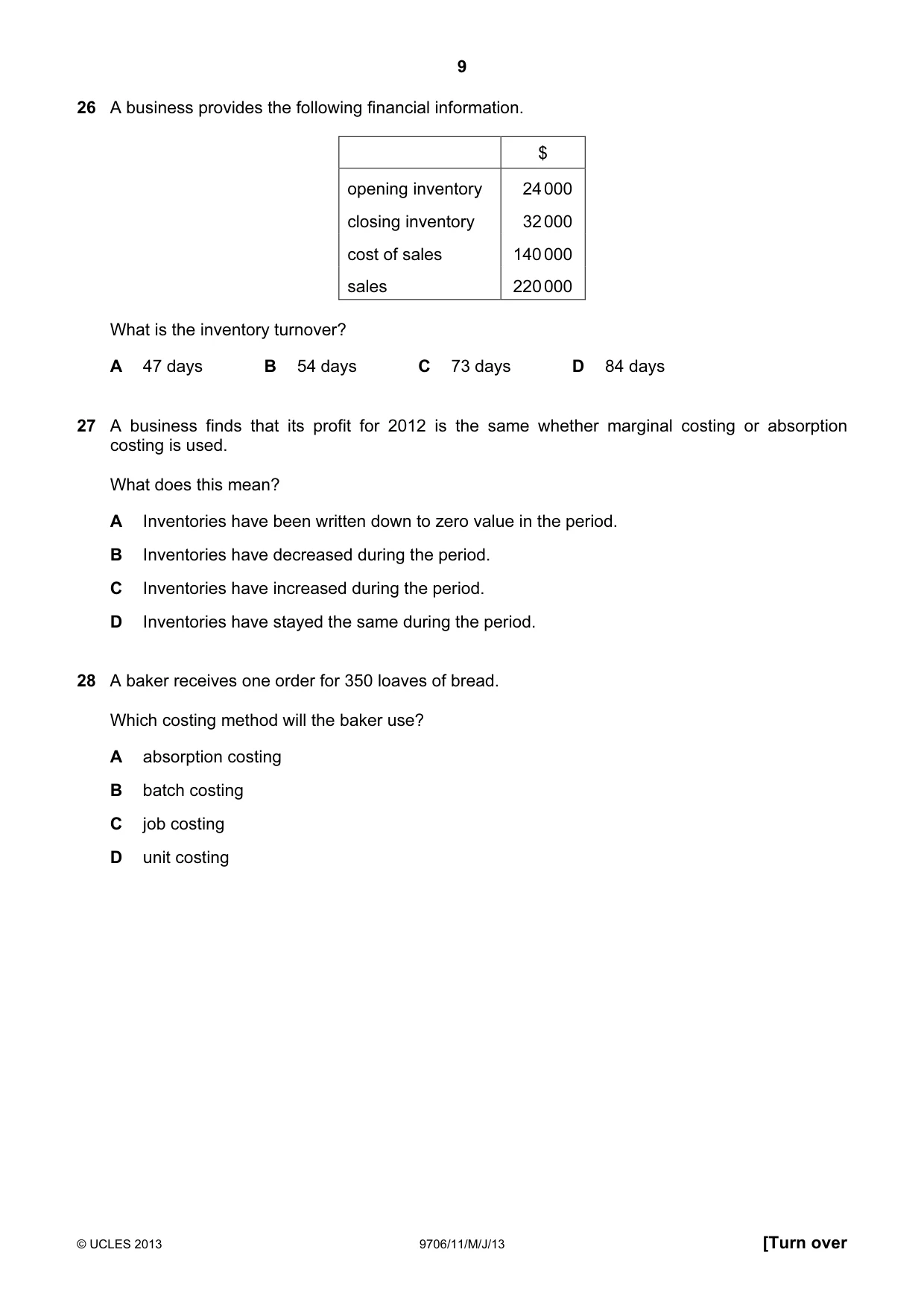
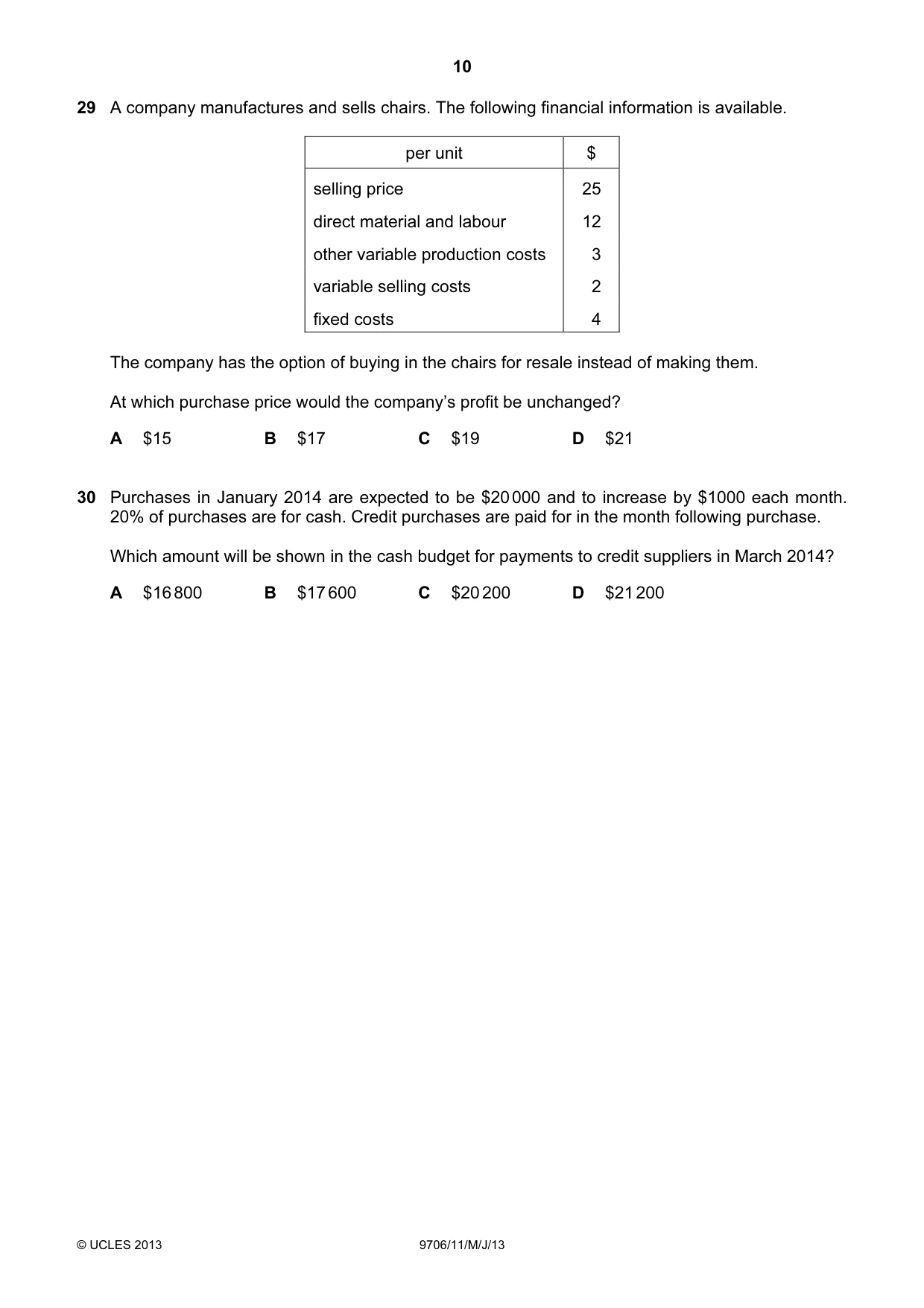
Mark scheme2 pages
Answers below. Sit the paper first if you are practising.
Questions as text
Q1 · A trader made four transactions
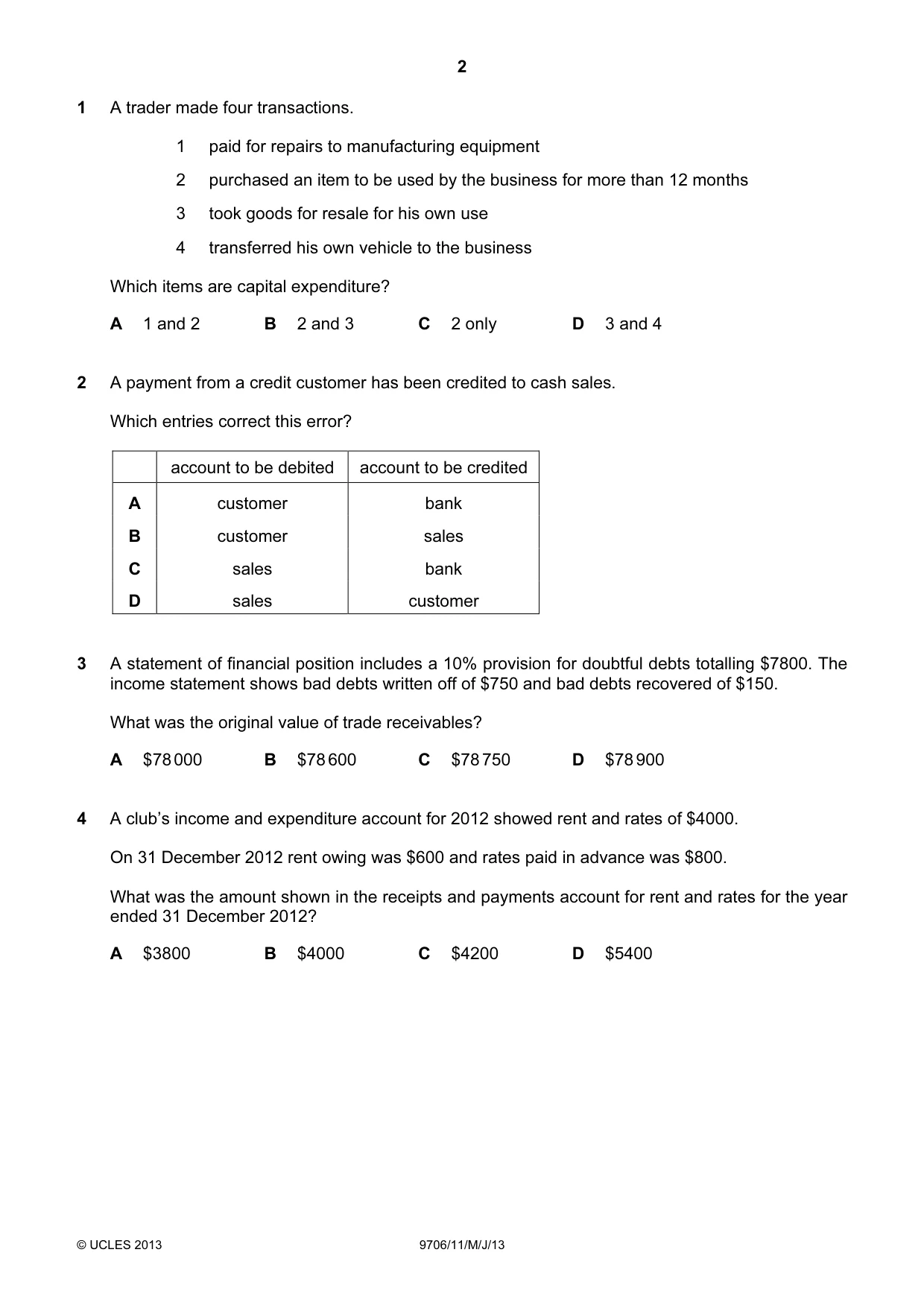
1 A trader made four transactions. 1 paid for repairs to manufacturing equipment 2 purchased an item to be used by the business for more than 12 months 3 took goods for resale for his own use 4 transferred his own vehicle to the business Which items are capital expenditure? A 1 and 2 B 2 and 3 C 2 only D 3 and 4
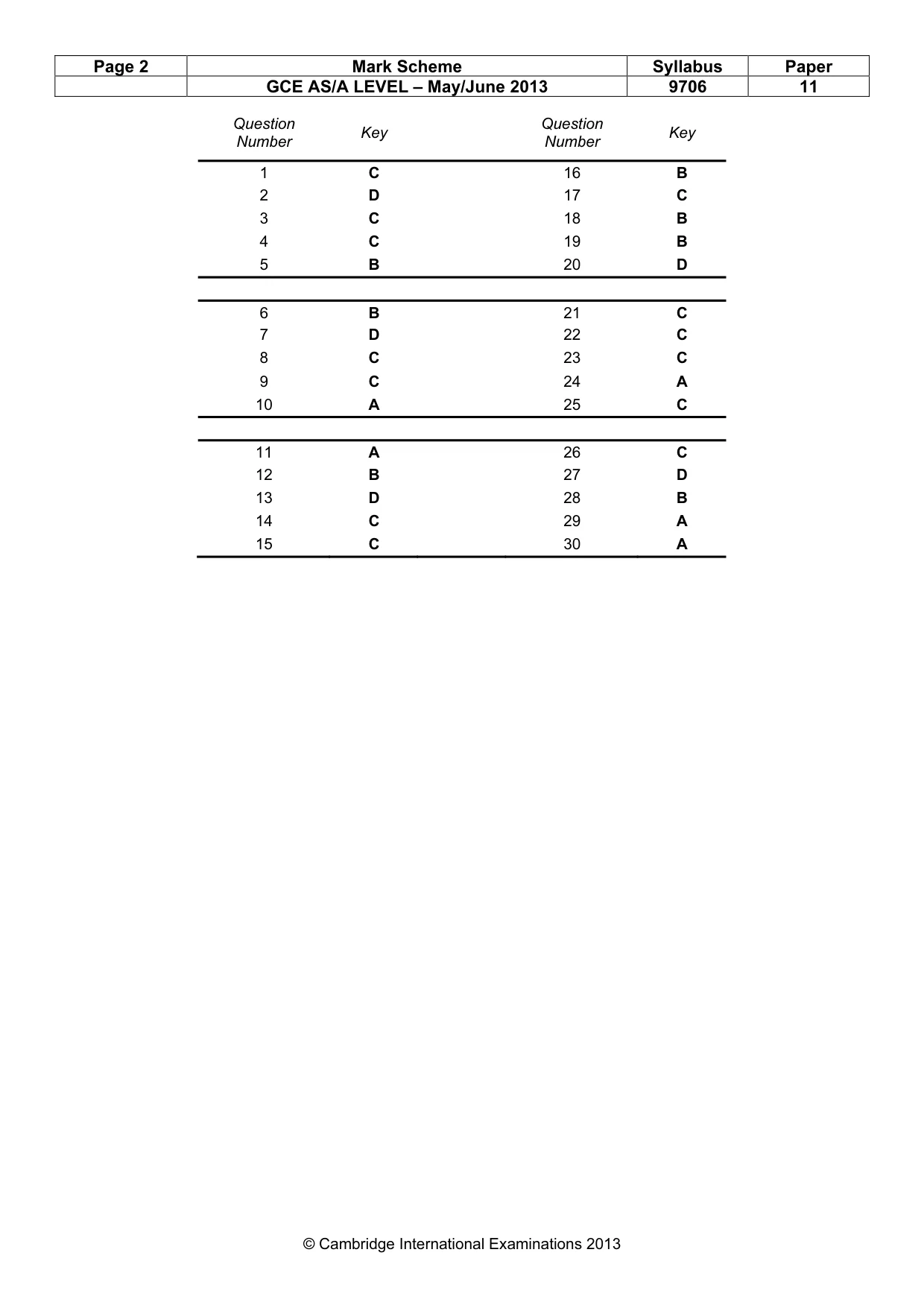
Mark scheme: C
Q2 · A payment from a credit customer has been credited to cash sales
2 A payment from a credit customer has been credited to cash sales. Which entries correct this error? account to be debited account to be credited A customer bank B customer sales C sales bank D sales customer
Mark scheme: D
Q3 · A statement of financial position includes a 10% provision for doubtful debts totalling…
3 A statement of financial position includes a 10% provision for doubtful debts totalling $7800. The income statement shows bad debts written off of $750 and bad debts recovered of $150. What was the original value of trade receivables? A $78 000 B $78 600 C $78 750 D $78 900
Mark scheme: C
Q4 · A club’s income and expenditure account for 2012 showed rent and rates of $4000
4 A club’s income and expenditure account for 2012 showed rent and rates of $4000. On 31 December 2012 rent owing was $600 and rates paid in advance was $800. What was the amount shown in the receipts and payments account for rent and rates for the year ended 31 December 2012? A $3800 B $4000 C $4200 D $5400
Mark scheme: C
Q5 · At the beginning of the year a business has a provision for doubtful debts of $2600
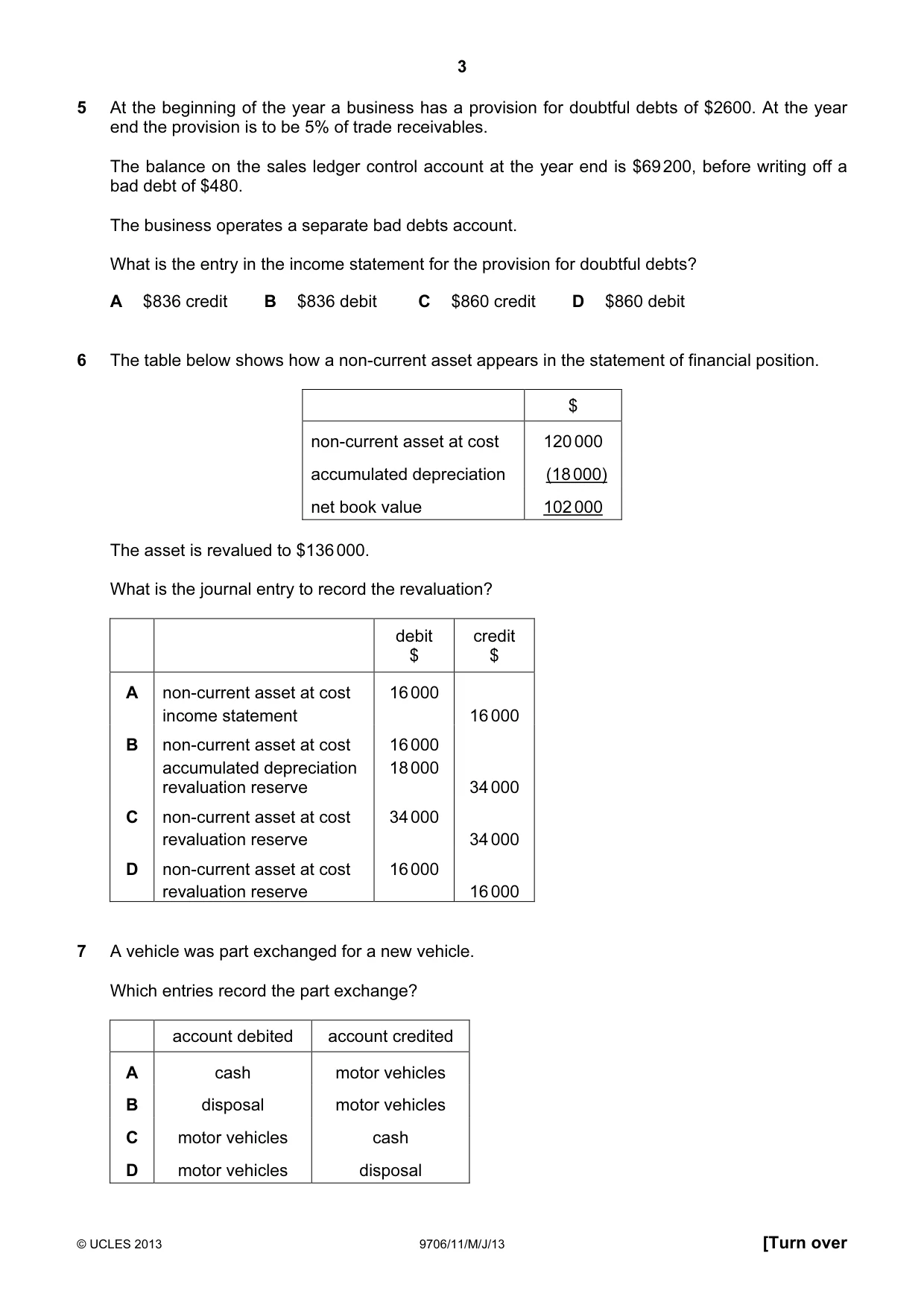
5 At the beginning of the year a business has a provision for doubtful debts of $2600. At the year end the provision is to be 5% of trade receivables. The balance on the sales ledger control account at the year end is $69 200, before writing off a bad debt of $480. The business operates a separate bad debts account. What is the entry in the income statement for the provision for doubtful debts? A $836 credit B $836 debit C $860 credit D $860 debit
Mark scheme: B
Q6 · The table below shows how a non-current asset appears in the statement of financial…
6 The table below shows how a non-current asset appears in the statement of financial position. $ non-current asset at cost 120 000 accumulated depreciation (18 000) net book value 102 000 The asset is revalued to $136 000. What is the journal entry to record the revaluation? debit credit $ $ A non-current asset at cost 16 000 income statement 16 000 B non-current asset at cost 16 000 accumulated depreciation 18 000 revaluation reserve 34 000 C non-current asset at cost 34 000 revaluation reserve 34 000 D non-current asset at cost 16 000 revaluation reserve 16 000
Mark scheme: B
Q7 · A vehicle was part exchanged for a new vehicle
7 A vehicle was part exchanged for a new vehicle. Which entries record the part exchange? account debited account credited A cash motor vehicles B disposal motor vehicles C motor vehicles cash D motor vehicles disposal
Mark scheme: D
Q8 · Which transaction would increase the current assets of a business?
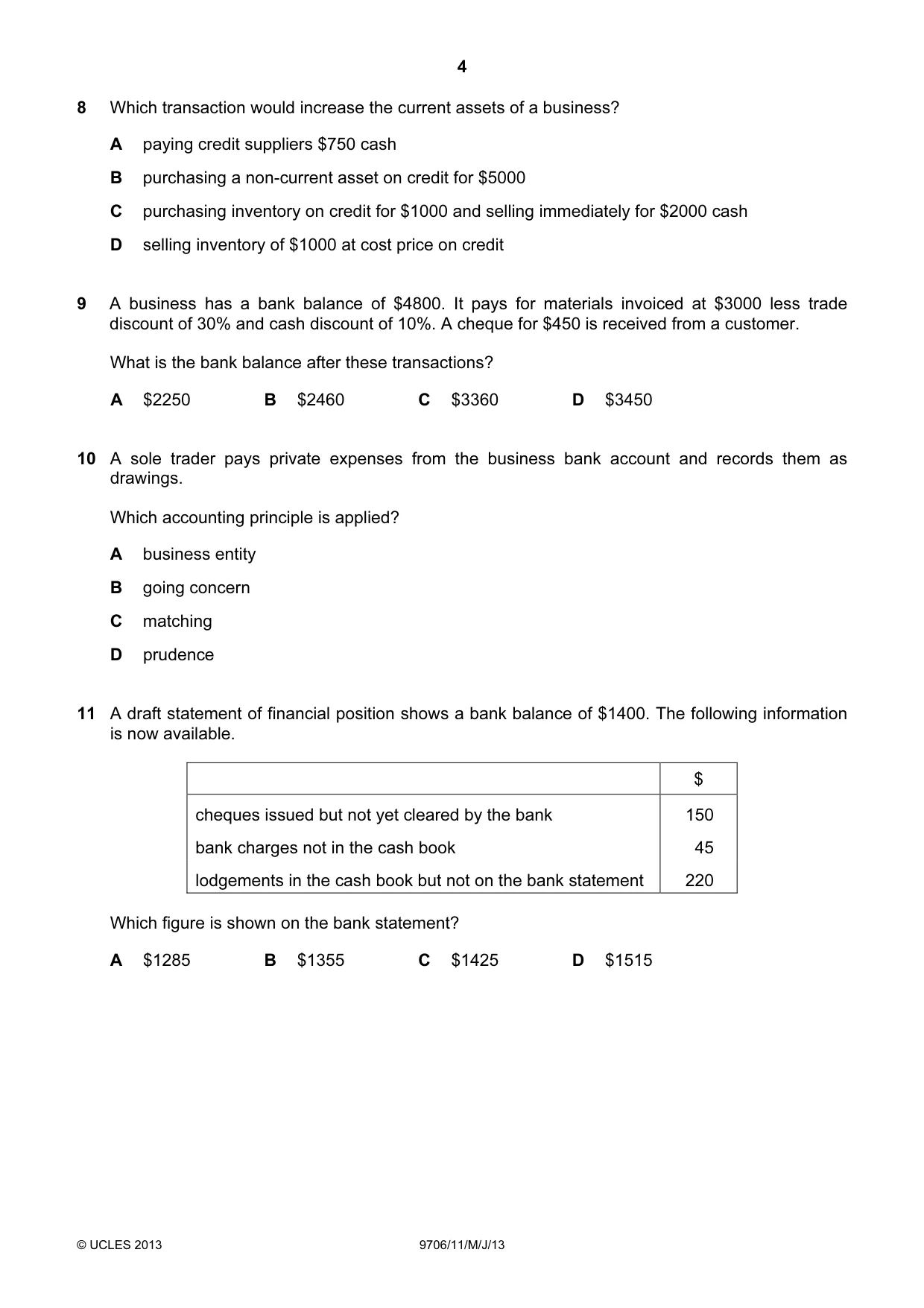
8 Which transaction would increase the current assets of a business? A paying credit suppliers $750 cash B purchasing a non-current asset on credit for $5000 C purchasing inventory on credit for $1000 and selling immediately for $2000 cash D selling inventory of $1000 at cost price on credit
Mark scheme: C
Q9 · A business has a bank balance of $4800
9 A business has a bank balance of $4800. It pays for materials invoiced at $3000 less trade discount of 30% and cash discount of 10%. A cheque for $450 is received from a customer. What is the bank balance after these transactions? A $2250 B $2460 C $3360 D $3450
Mark scheme: C
Q10 · A sole trader pays private expenses from the business bank account and records them as…
10 A sole trader pays private expenses from the business bank account and records them as drawings. Which accounting principle is applied? A business entity B going concern C matching D prudence
Mark scheme: A
Q11 · A draft statement of financial position shows a bank balance of $1400
11 A draft statement of financial position shows a bank balance of $1400. The following information is now available. $ cheques issued but not yet cleared by the bank 150 bank charges not in the cash book 45 lodgements in the cash book but not on the bank statement 220 Which figure is shown on the bank statement? A $1285 B $1355 C $1425 D $1515
Mark scheme: A
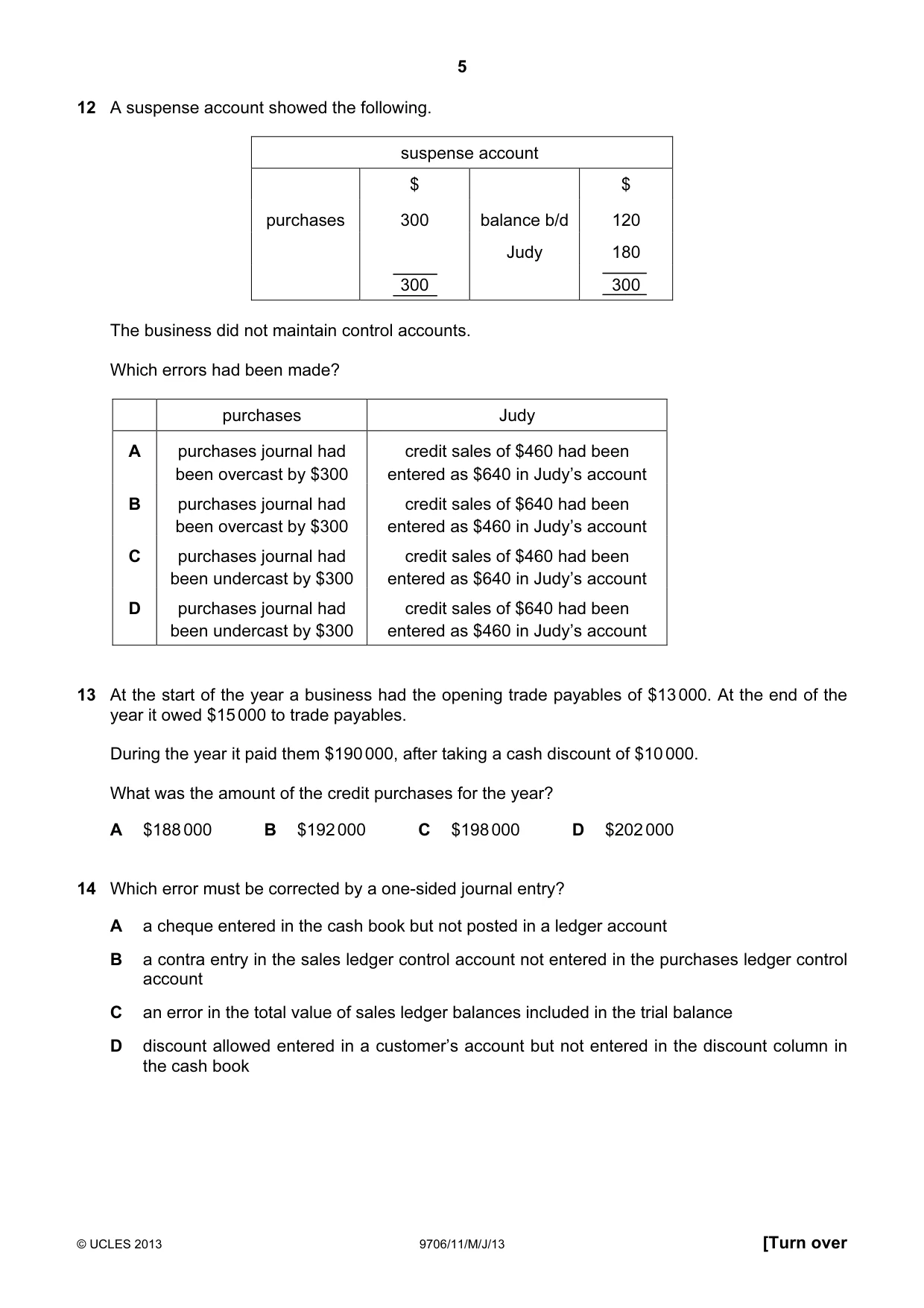
Q12 · A suspense account showed the following
12 A suspense account showed the following. suspense account $ $ purchases 300 balance b/d 120 Judy 180 300 300 The business did not maintain control accounts. Which errors had been made? purchases Judy A purchases journal had credit sales of $460 had been been overcast by $300 entered as $640 in Judy’s account B purchases journal had credit sales of $640 had been been overcast by $300 entered as $460 in Judy’s account C purchases journal had credit sales of $460 had been been undercast by $300 entered as $640 in Judy’s account D purchases journal had credit sales of $640 had been been undercast by $300 entered as $460 in Judy’s account
Mark scheme: B
Q13 · At the start of the year a business had the opening trade payables of $13 000
13 At the start of the year a business had the opening trade payables of $13 000. At the end of the year it owed $15 000 to trade payables. During the year it paid them $190 000, after taking a cash discount of $10 000. What was the amount of the credit purchases for the year? A $188 000 B $192 000 C $198 000 D $202 000
Mark scheme: D
Q14 · Which error must be corrected by a one-sided journal entry?
14 Which error must be corrected by a one-sided journal entry? A a cheque entered in the cash book but not posted in a ledger account B a contra entry in the sales ledger control account not entered in the purchases ledger control account C an error in the total value of sales ledger balances included in the trial balance D discount allowed entered in a customer’s account but not entered in the discount column in the cash book
Mark scheme: C
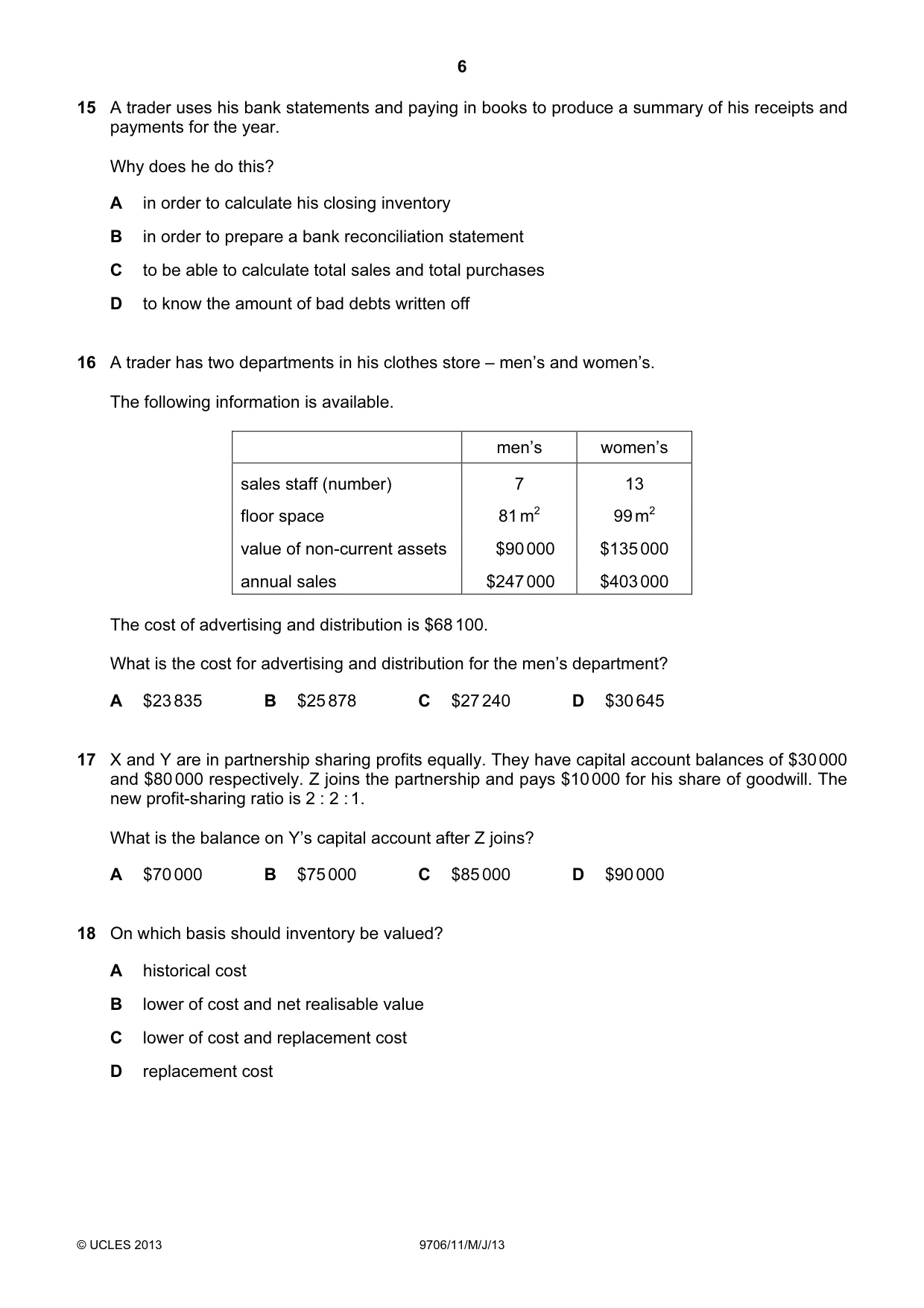
Q15 · A trader uses his bank statements and paying in books to produce a summary of his…
15 A trader uses his bank statements and paying in books to produce a summary of his receipts and payments for the year. Why does he do this? A in order to calculate his closing inventory B in order to prepare a bank reconciliation statement C to be able to calculate total sales and total purchases D to know the amount of bad debts written off
Mark scheme: C
Q16 · A trader has two departments in his clothes store – men’s and women’s
16 A trader has two departments in his clothes store – men’s and women’s. The following information is available. men’s women’s sales staff (number) 7 13 floor space 81 m2 99 m2 value of non-current assets $90 000 $135 000 annual sales $247 000 $403 000 The cost of advertising and distribution is $68 100. What is the cost for advertising and distribution for the men’s department? A $23 835 B $25 878 C $27 240 D $30 645
Mark scheme: B
Q17 · X and Y are in partnership sharing profits equally
17 X and Y are in partnership sharing profits equally. They have capital account balances of $30 000 and $80 000 respectively. Z joins the partnership and pays $10 000 for his share of goodwill. The new profit-sharing ratio is 2 : 2 : 1. What is the balance on Y’s capital account after Z joins? A $70 000 B $75 000 C $85 000 D $90 000
Mark scheme: C
Q18 · On which basis should inventory be valued?
18 On which basis should inventory be valued? A historical cost B lower of cost and net realisable value C lower of cost and replacement cost D replacement cost
Mark scheme: B
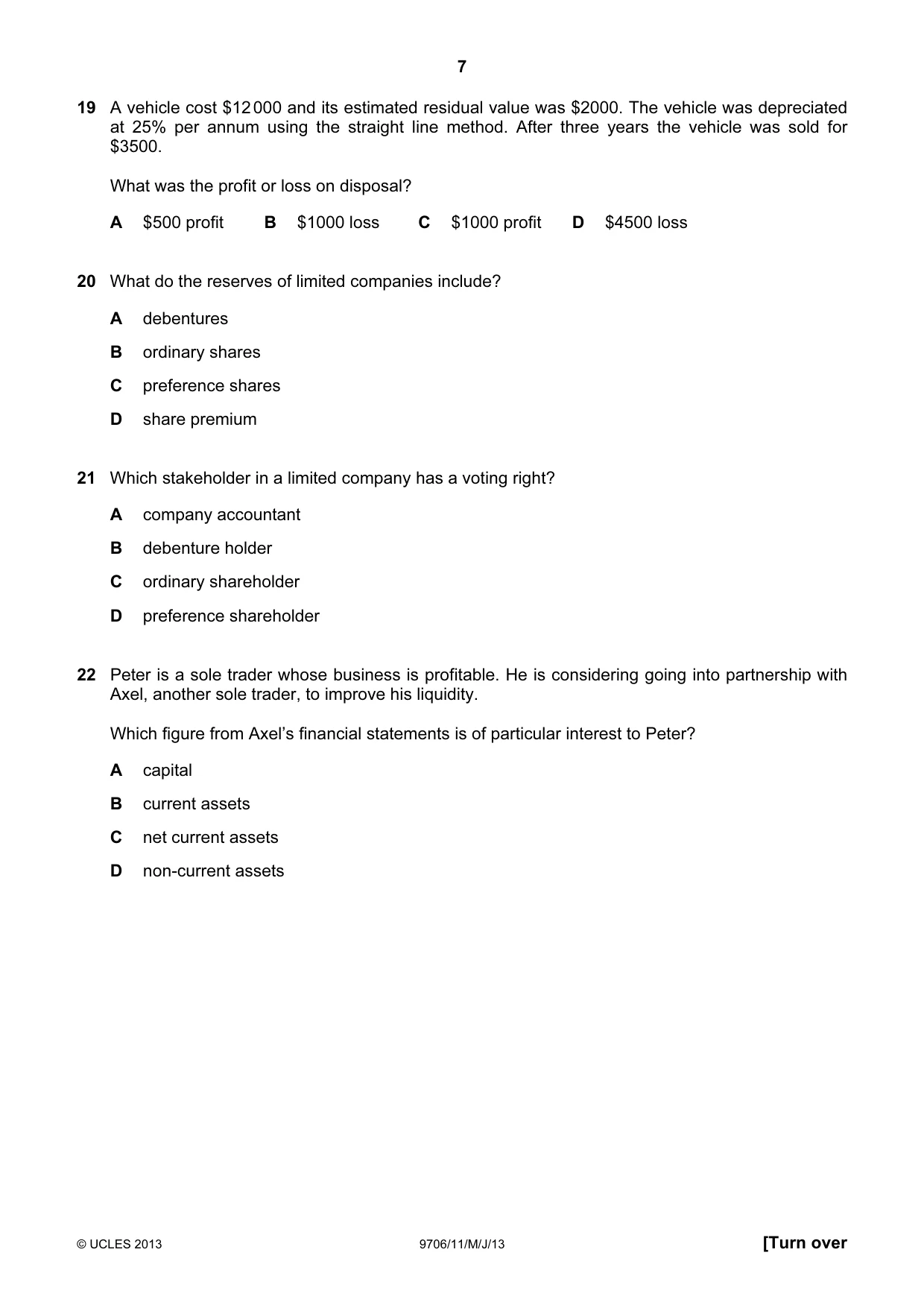
Q19 · A vehicle cost $12 000 and its estimated residual value was $2000
19 A vehicle cost $12 000 and its estimated residual value was $2000. The vehicle was depreciated at 25% per annum using the straight line method. After three years the vehicle was sold for $3500. What was the profit or loss on disposal? A $500 profit B $1000 loss C $1000 profit D $4500 loss
Mark scheme: B
Q20 · What do the reserves of limited companies include?
20 What do the reserves of limited companies include? A debentures B ordinary shares C preference shares D share premium
Mark scheme: D
Q21 · Which stakeholder in a limited company has a voting right?
21 Which stakeholder in a limited company has a voting right? A company accountant B debenture holder C ordinary shareholder D preference shareholder
Mark scheme: C
Q22 · Peter is a sole trader whose business is profitable
22 Peter is a sole trader whose business is profitable. He is considering going into partnership with Axel, another sole trader, to improve his liquidity. Which figure from Axel’s financial statements is of particular interest to Peter? A capital B current assets C net current assets D non-current assets
Mark scheme: C
More questions on Analysis and communication of accounting information
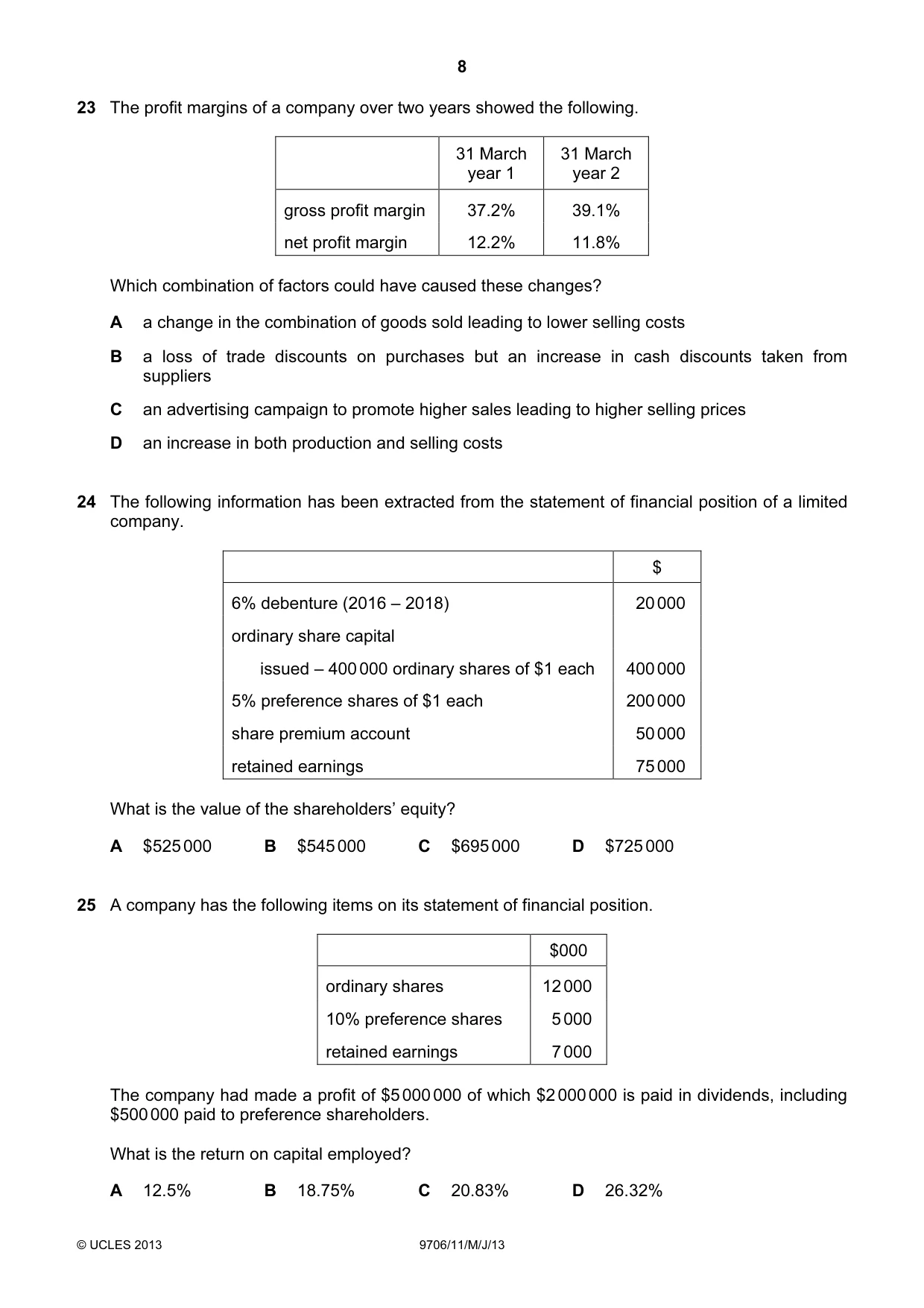
Q23 · The profit margins of a company over two years showed the following
23 The profit margins of a company over two years showed the following. 31 March 31 March year 1 year 2 gross profit margin 37.2% 39.1% net profit margin 12.2% 11.8% Which combination of factors could have caused these changes? A a change in the combination of goods sold leading to lower selling costs B a loss of trade discounts on purchases but an increase in cash discounts taken from suppliers C an advertising campaign to promote higher sales leading to higher selling prices D an increase in both production and selling costs
Mark scheme: C
More questions on Analysis and communication of accounting information
Q24 · The following information has been extracted from the statement of financial position of…
24 The following information has been extracted from the statement of financial position of a limited company. $ 6% debenture (2016 – 2018) 20 000 ordinary share capital issued – 400 000 ordinary shares of $1 each 400 000 5% preference shares of $1 each 200 000 share premium account 50 000 retained earnings 75 000 What is the value of the shareholders’ equity? A $525 000 B $545 000 C $695 000 D $725 000
Mark scheme: A
Q25 · A company has the following items on its statement of financial position
25 A company has the following items on its statement of financial position. $000 ordinary shares 12 000 10% preference shares 5 000 retained earnings 7 000 The company had made a profit of $5 000 000 of which $2 000 000 is paid in dividends, including $500 000 paid to preference shareholders. What is the return on capital employed? A 12.5% B 18.75% C 20.83% D 26.32%
Mark scheme: C
More questions on Analysis and communication of accounting information
Q26 · A business provides the following financial information
26 A business provides the following financial information. $ opening inventory 24 000 closing inventory 32 000 cost of sales 140 000 sales 220 000 What is the inventory turnover? A 47 days B 54 days C 73 days D 84 days
Mark scheme: C
More questions on Analysis and communication of accounting information
Q27 · A business finds that its profit for 2012 is the same whether marginal costing or…
27 A business finds that its profit for 2012 is the same whether marginal costing or absorption costing is used. What does this mean? A Inventories have been written down to zero value in the period. B Inventories have decreased during the period. C Inventories have increased during the period. D Inventories have stayed the same during the period.
Mark scheme: D
Q28 · A baker receives one order for 350 loaves of bread
28 A baker receives one order for 350 loaves of bread. Which costing method will the baker use? A absorption costing B batch costing C job costing D unit costing
Mark scheme: B
Q29 · A company manufactures and sells chairs
29 A company manufactures and sells chairs. The following financial information is available. per unit $ selling price 25 direct material and labour 12 other variable production costs 3 variable selling costs 2 fixed costs 4 The company has the option of buying in the chairs for resale instead of making them. At which purchase price would the company’s profit be unchanged? A $15 B $17 C $19 D $21
Mark scheme: A
Q30 · Purchases in January 2014 are expected to be $20 000 and to increase by $1000 each month
30 Purchases in January 2014 are expected to be $20 000 and to increase by $1000 each month. 20% of purchases are for cash. Credit purchases are paid for in the month following purchase. Which amount will be shown in the cash budget for payments to credit suppliers in March 2014? A $16 800 B $17 600 C $20 200 D $21 200
Mark scheme: A
What was in this paper
The subtopics covered by these 30 questions, and how many questions each got. Open one in a new tab to see every Cambridge question on it.
What you needed in this session
Cambridge’s own grade thresholds for 2013 May/June, Paper 1 · Variant 1. A higher threshold means an easier paper — the bar moves with how the cohort did.