Cambridge A Level Accounting 9706 — 2017 Oct/Nov Paper 1 · Variant 2
9706/12/O/N/17 · 30 questions · 30 marks · ≈34 min
The question paper and its mark scheme, free to read here and free to download. This is Cambridge’s own paper, exactly as it was sat.
Question paper12 pages

Mark scheme3 pages
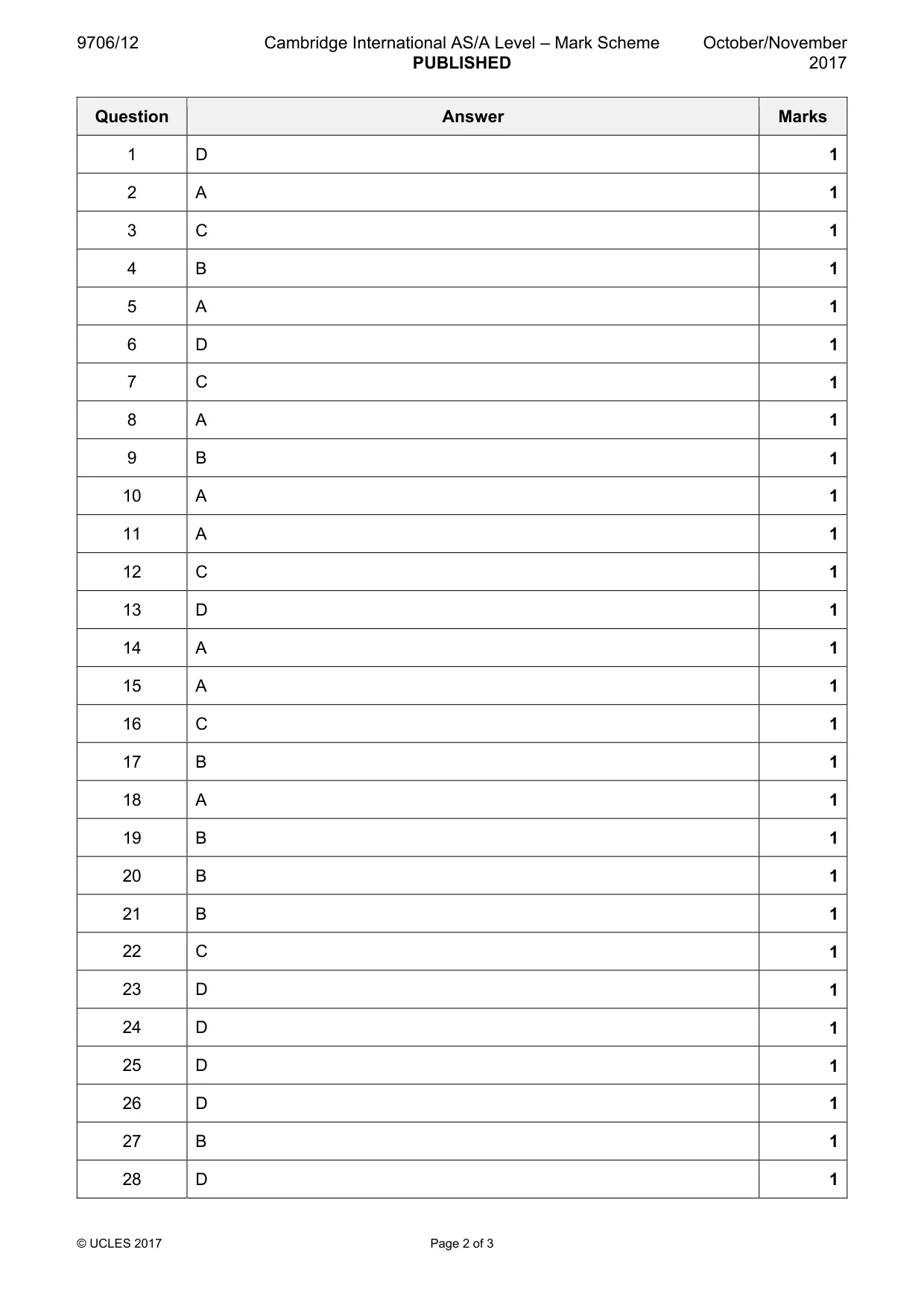
Answers below. Sit the paper first if you are practising.
Questions as text
Q1 · Which item is classed as revenue expenditure?
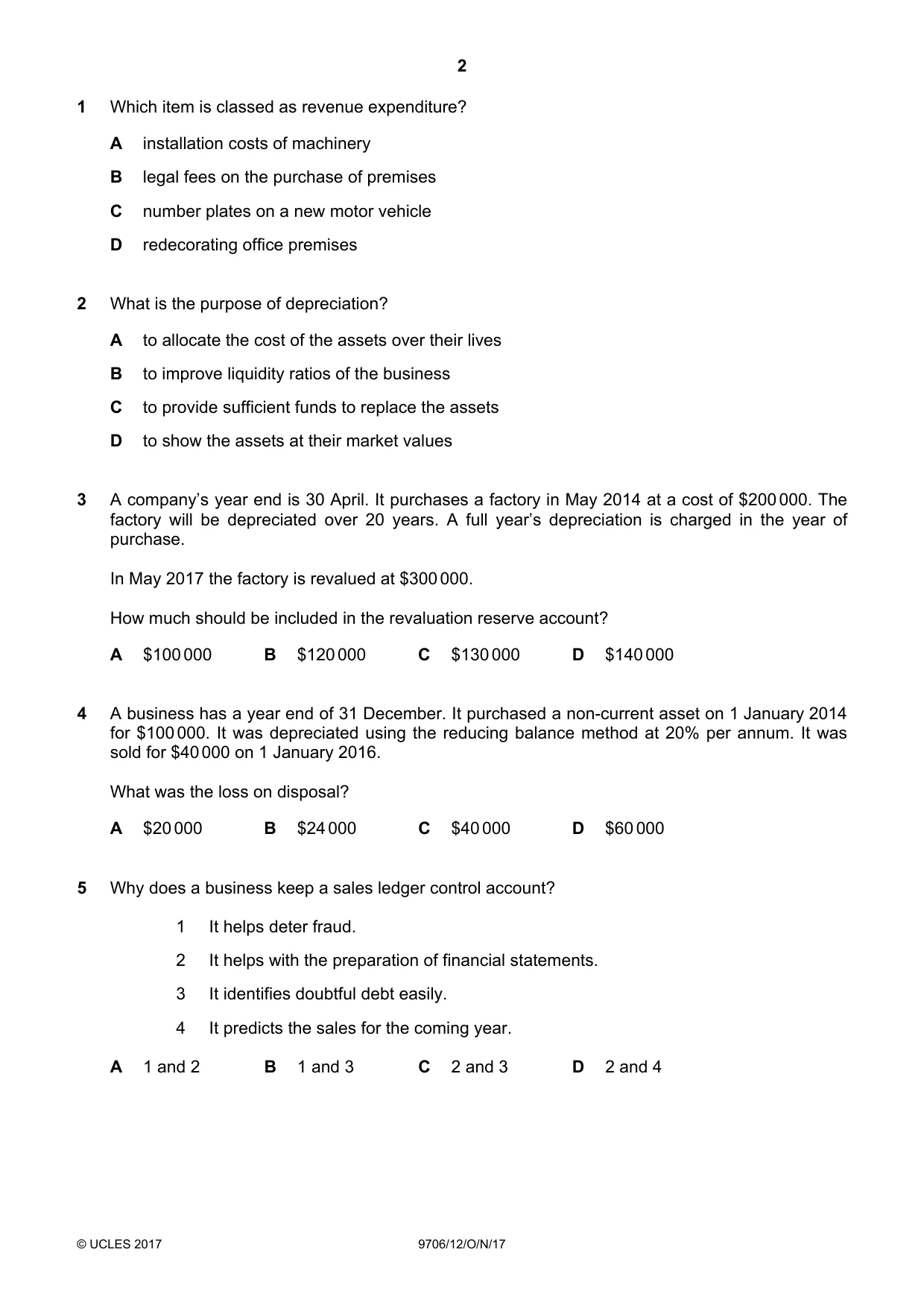
1 Which item is classed as revenue expenditure? A installation costs of machinery B legal fees on the purchase of premises C number plates on a new motor vehicle D redecorating office premises
Mark scheme: D
Q2 · What is the purpose of depreciation?
2 What is the purpose of depreciation? A to allocate the cost of the assets over their lives B to improve liquidity ratios of the business C to provide sufficient funds to replace the assets D to show the assets at their market values
Mark scheme: A
Q3 · A company’s year end is 30 April
3 A company’s year end is 30 April. It purchases a factory in May 2014 at a cost of $200 000. The factory will be depreciated over 20 years. A full year’s depreciation is charged in the year of purchase. In May 2017 the factory is revalued at $300 000. How much should be included in the revaluation reserve account? A $100 000 B $120 000 C $130 000 D $140 000
Mark scheme: C
Q4 · A business has a year end of 31 December
4 A business has a year end of 31 December. It purchased a non-current asset on 1 January 2014 for $100 000. It was depreciated using the reducing balance method at 20% per annum. It was sold for $40 000 on 1 January 2016. What was the loss on disposal? A $20 000 B $24 000 C $40 000 D $60 000
Mark scheme: B
Q5 · Why does a business keep a sales ledger control account?
5 Why does a business keep a sales ledger control account? 1 It helps deter fraud. 2 It helps with the preparation of financial statements. 3 It identifies doubtful debt easily. 4 It predicts the sales for the coming year. A 1 and 2 B 1 and 3 C 2 and 3 D 2 and 4
Mark scheme: A
Q6 · A sales ledger control account had a debit balance of $38 600
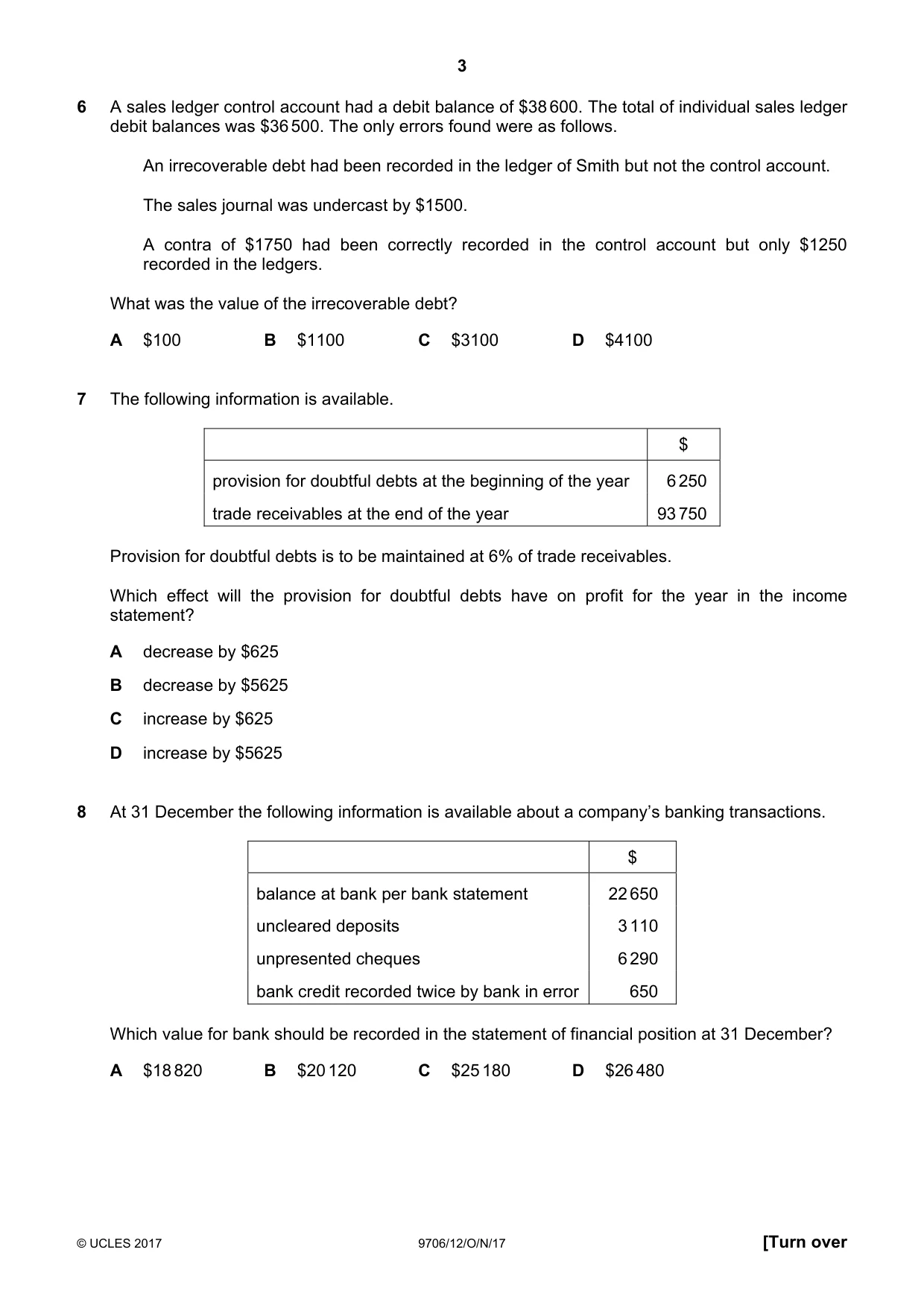
6 A sales ledger control account had a debit balance of $38 600. The total of individual sales ledger debit balances was $36 500. The only errors found were as follows. An irrecoverable debt had been recorded in the ledger of Smith but not the control account. The sales journal was undercast by $1500. A contra of $1750 had been correctly recorded in the control account but only $1250 recorded in the ledgers. What was the value of the irrecoverable debt? A $100 B $1100 C $3100 D $4100
Mark scheme: D
Q7 · The following information is available
7 The following information is available. $ provision for doubtful debts at the beginning of the year 6 250 trade receivables at the end of the year 93 750 Provision for doubtful debts is to be maintained at 6% of trade receivables. Which effect will the provision for doubtful debts have on profit for the year in the income statement? A decrease by $625 B decrease by $5625 C increase by $625 D increase by $5625
Mark scheme: C
Q8 · At 31 December the following information is available about a company’s banking…
8 At 31 December the following information is available about a company’s banking transactions. $ balance at bank per bank statement 22 650 uncleared deposits 3 110 unpresented cheques 6 290 bank credit recorded twice by bank in error 650 Which value for bank should be recorded in the statement of financial position at 31 December? A $18 820 B $20 120 C $25 180 D $26 480
Mark scheme: A
Q9 · Hedley has 100 items of inventory in his warehouse and five more with a customer on a…
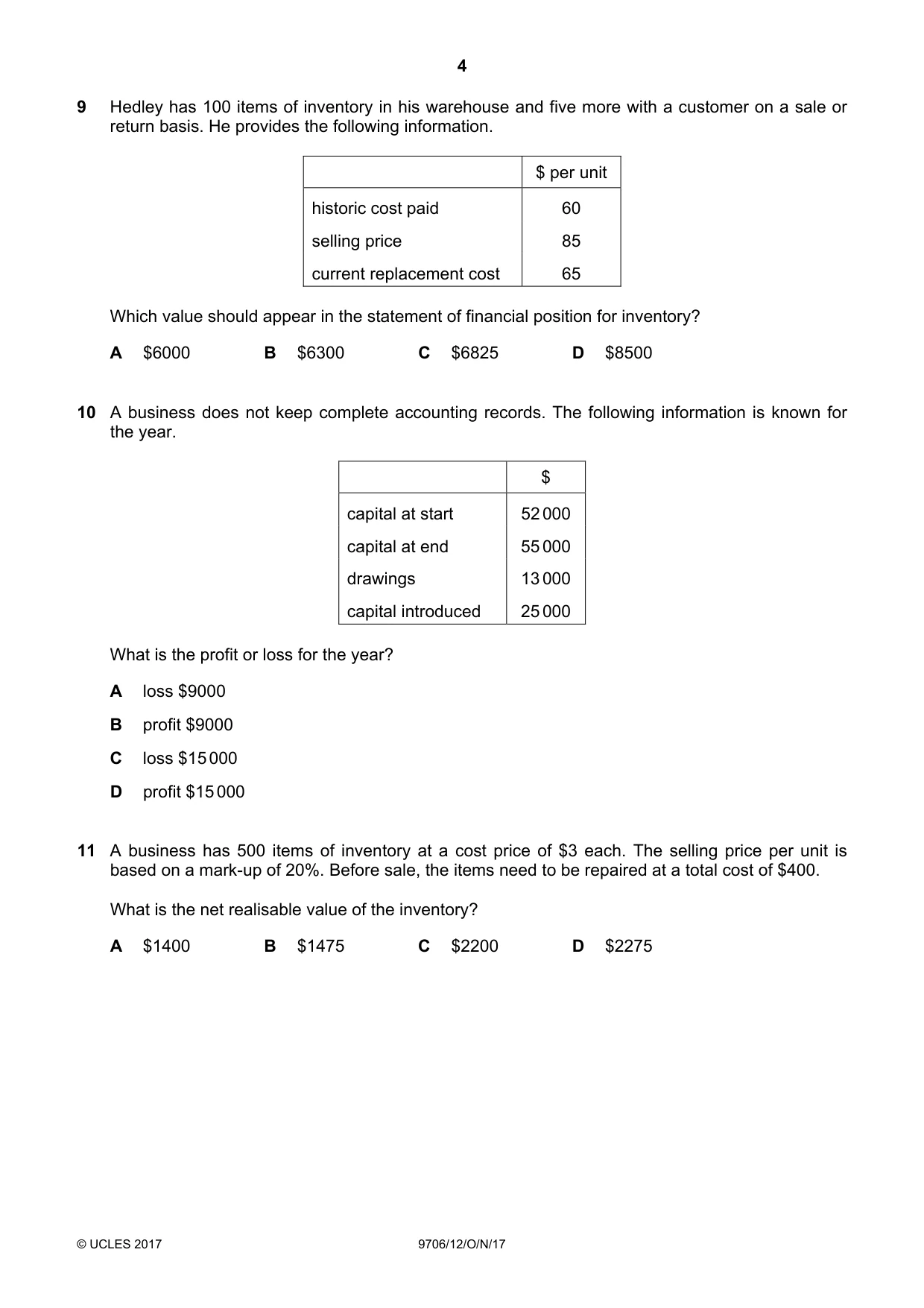
9 Hedley has 100 items of inventory in his warehouse and five more with a customer on a sale or return basis. He provides the following information. $ per unit historic cost paid 60 selling price 85 current replacement cost 65 Which value should appear in the statement of financial position for inventory? A $6000 B $6300 C $6825 D $8500
Mark scheme: B
Q10 · A business does not keep complete accounting records
10 A business does not keep complete accounting records. The following information is known for the year. $ capital at start 52 000 capital at end 55 000 drawings 13 000 capital introduced 25 000 What is the profit or loss for the year? A loss $9000 B profit $9000 C loss $15 000 D profit $15 000
Mark scheme: A
Q11 · A business has 500 items of inventory at a cost price of $3 each
11 A business has 500 items of inventory at a cost price of $3 each. The selling price per unit is based on a mark-up of 20%. Before sale, the items need to be repaired at a total cost of $400. What is the net realisable value of the inventory? A $1400 B $1475 C $2200 D $2275
Mark scheme: A
Q12 · The following information is available for the year ended 31 December 2016
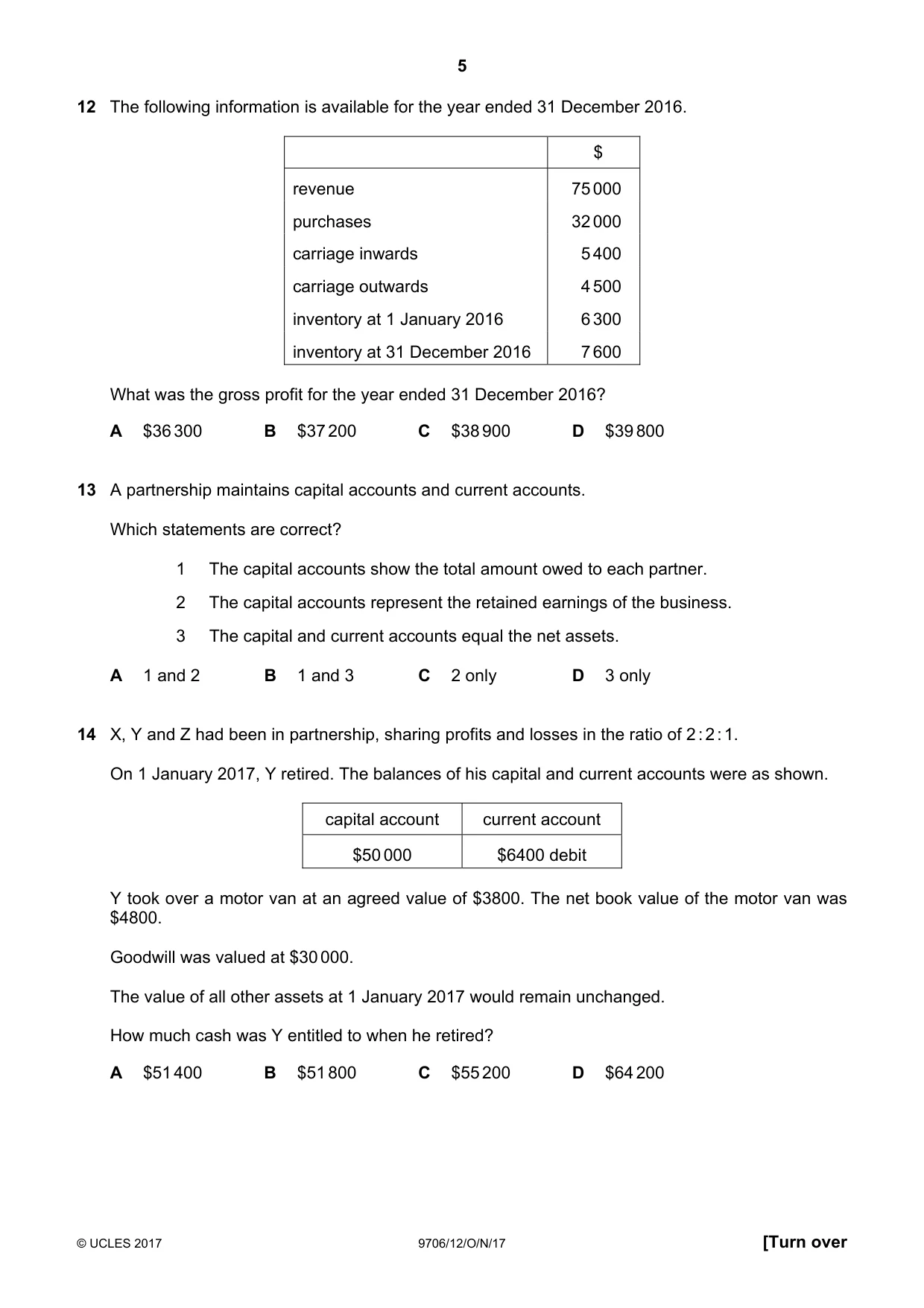
12 The following information is available for the year ended 31 December 2016. $ revenue 75 000 purchases 32 000 carriage inwards 5 400 carriage outwards 4 500 inventory at 1 January 2016 6 300 inventory at 31 December 2016 7 600 What was the gross profit for the year ended 31 December 2016? A $36 300 B $37 200 C $38 900 D $39 800
Mark scheme: C
Q13 · A partnership maintains capital accounts and current accounts
13 A partnership maintains capital accounts and current accounts. Which statements are correct? 1 The capital accounts show the total amount owed to each partner. 2 The capital accounts represent the retained earnings of the business. 3 The capital and current accounts equal the net assets. A 1 and 2 B 1 and 3 C 2 only D 3 only
Mark scheme: D
Q14 · X, Y and Z had been in partnership, sharing profits and losses in the ratio of 2 : 2 : 1
14 X, Y and Z had been in partnership, sharing profits and losses in the ratio of 2 : 2 : 1. On 1 January 2017, Y retired. The balances of his capital and current accounts were as shown. capital account current account $50 000 $6400 debit Y took over a motor van at an agreed value of $3800. The net book value of the motor van was $4800. Goodwill was valued at $30 000. The value of all other assets at 1 January 2017 would remain unchanged. How much cash was Y entitled to when he retired? A $51 400 B $51 800 C $55 200 D $64 200
Mark scheme: A
Q15 · S and T are in partnership, sharing profits and losses in the ratio 2 : 1
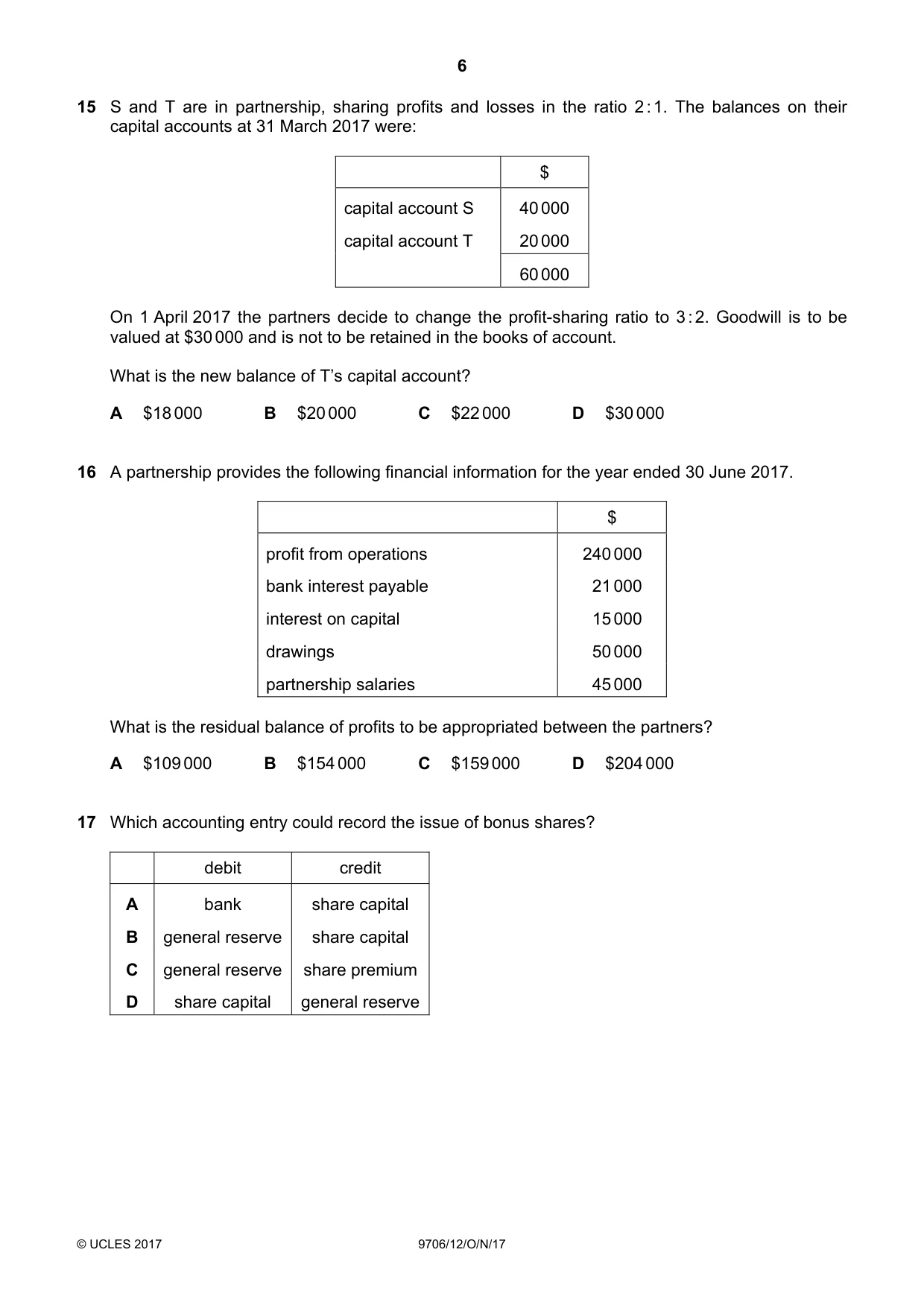
15 S and T are in partnership, sharing profits and losses in the ratio 2 : 1. The balances on their capital accounts at 31 March 2017 were: $ capital account S 40 000 capital account T 20 000 60 000 On 1 April 2017 the partners decide to change the profit-sharing ratio to 3 : 2. Goodwill is to be valued at $30 000 and is not to be retained in the books of account. What is the new balance of T’s capital account? A $18 000 B $20 000 C $22 000 D $30 000
Mark scheme: A
Q16 · A partnership provides the following financial information for the year ended 30 June 2017
16 A partnership provides the following financial information for the year ended 30 June 2017. $ profit from operations 240 000 bank interest payable 21 000 interest on capital 15 000 drawings 50 000 partnership salaries 45 000 What is the residual balance of profits to be appropriated between the partners? A $109 000 B $154 000 C $159 000 D $204 000
Mark scheme: C
Q17 · Which accounting entry could record the issue of bonus shares?
17 Which accounting entry could record the issue of bonus shares? debit credit A bank share capital B general reserve share capital C general reserve share premium D share capital general reserve
Mark scheme: B
Q18 · From which accounts can a company pay dividends?
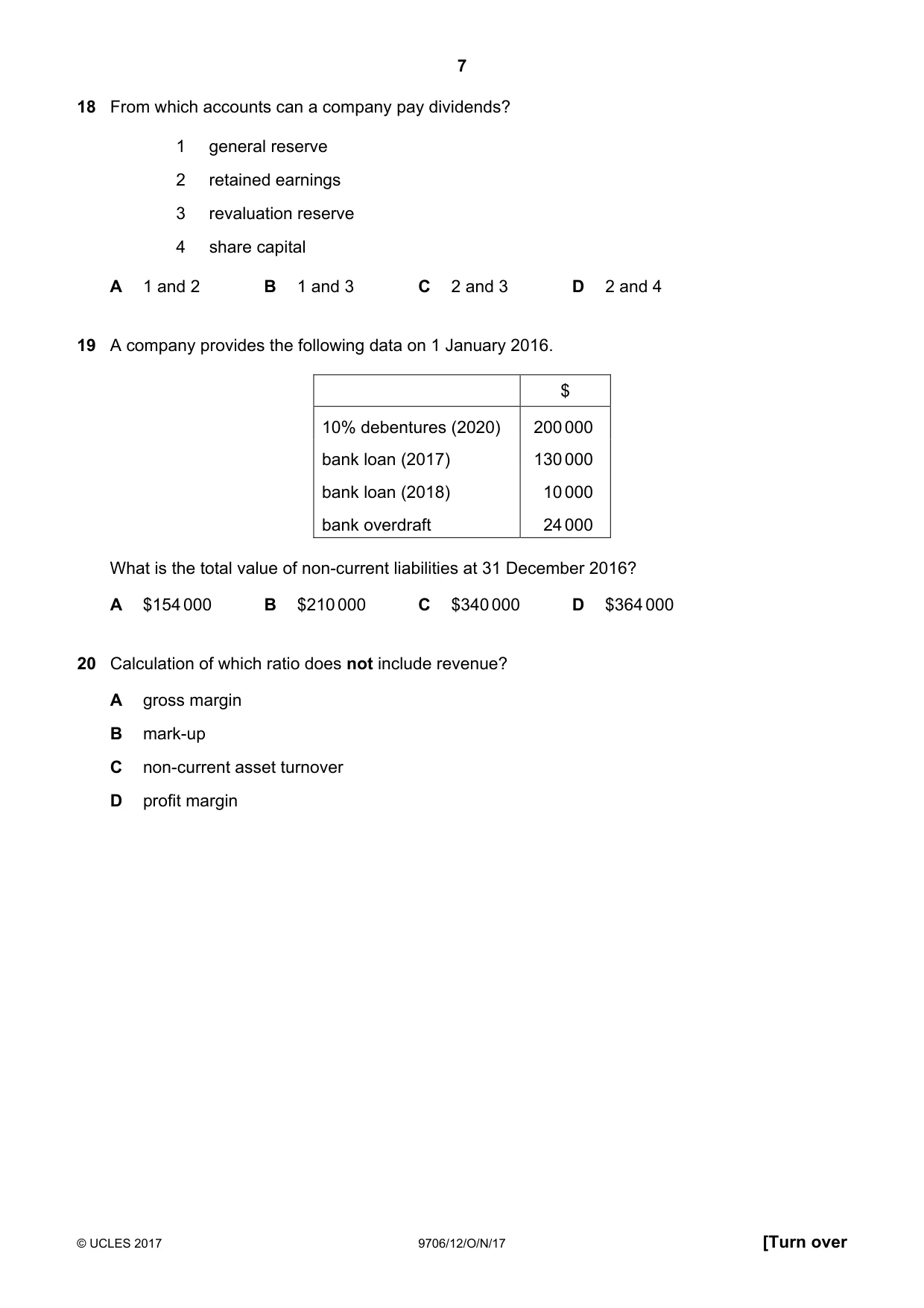
18 From which accounts can a company pay dividends? 1 general reserve 2 retained earnings 3 revaluation reserve 4 share capital A 1 and 2 B 1 and 3 C 2 and 3 D 2 and 4
Mark scheme: A
Q19 · A company provides the following data on 1 January 2016
19 A company provides the following data on 1 January 2016. $ 10% debentures (2020) 200 000 bank loan (2017) 130 000 bank loan (2018) 10 000 bank overdraft 24 000 What is the total value of non-current liabilities at 31 December 2016? A $154 000 B $210 000 C $340 000 D $364 000
Mark scheme: B
Q20 · Calculation of which ratio does not include revenue?
20 Calculation of which ratio does not include revenue? A gross margin B mark-up C non-current asset turnover D profit margin
Mark scheme: B
More questions on Analysis and communication of accounting information
Q21 · Bradshaw does not keep proper books of account
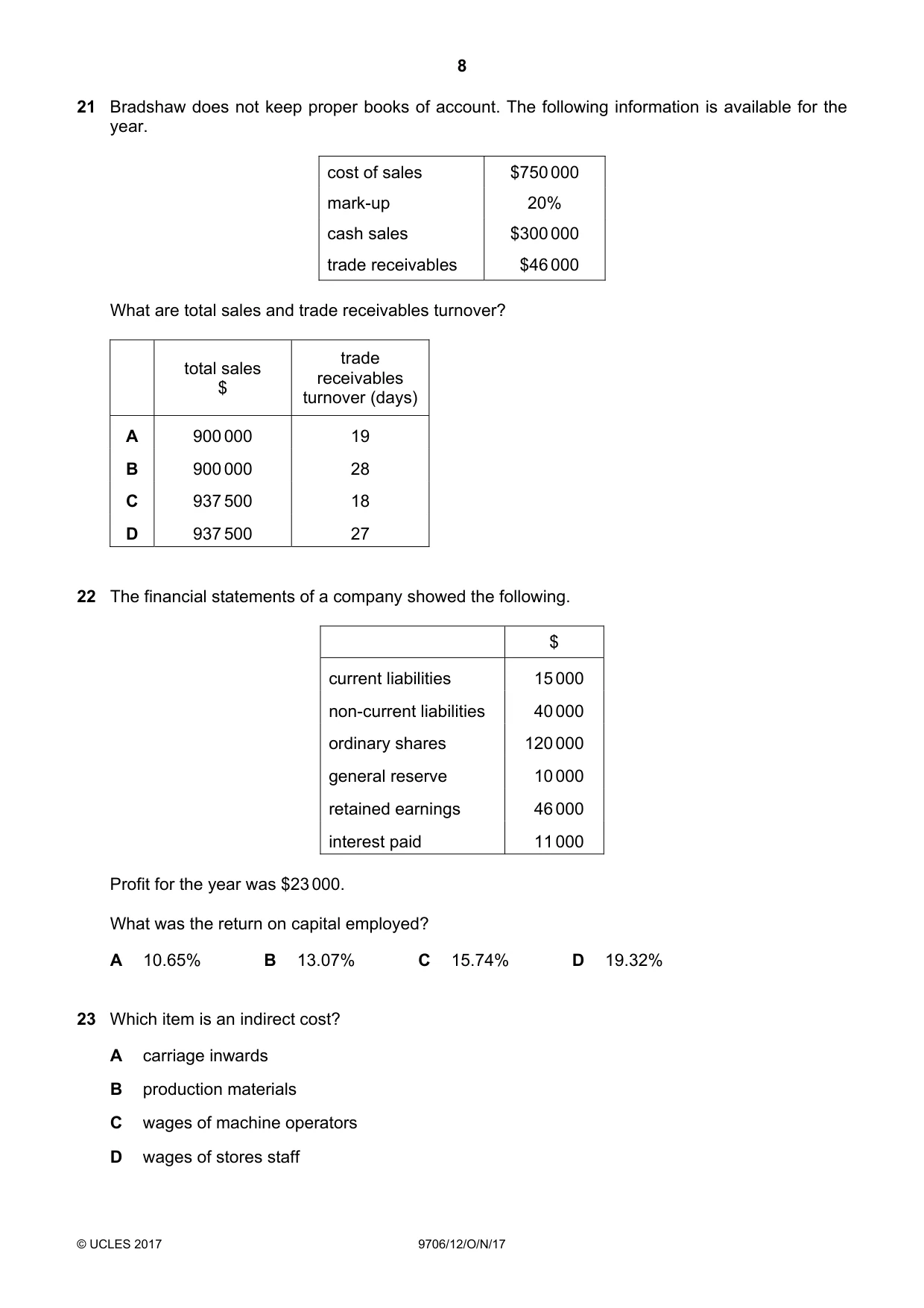
21 Bradshaw does not keep proper books of account. The following information is available for the year. cost of sales $750 000 mark-up 20% cash sales $300 000 trade receivables $46 000 What are total sales and trade receivables turnover? trade total sales receivables $ turnover (days) A 900 000 19 B 900 000 28 C 937 500 18 D 937 500 27
Mark scheme: B
More questions on Analysis and communication of accounting information
Q22 · The financial statements of a company showed the following
22 The financial statements of a company showed the following. $ current liabilities 15 000 non-current liabilities 40 000 ordinary shares 120 000 general reserve 10 000 retained earnings 46 000 interest paid 11 000 Profit for the year was $23 000. What was the return on capital employed? A 10.65% B 13.07% C 15.74% D 19.32%
Mark scheme: C
More questions on Analysis and communication of accounting information
Q23 · Which item is an indirect cost?
23 Which item is an indirect cost? A carriage inwards B production materials C wages of machine operators D wages of stores staff
Mark scheme: D
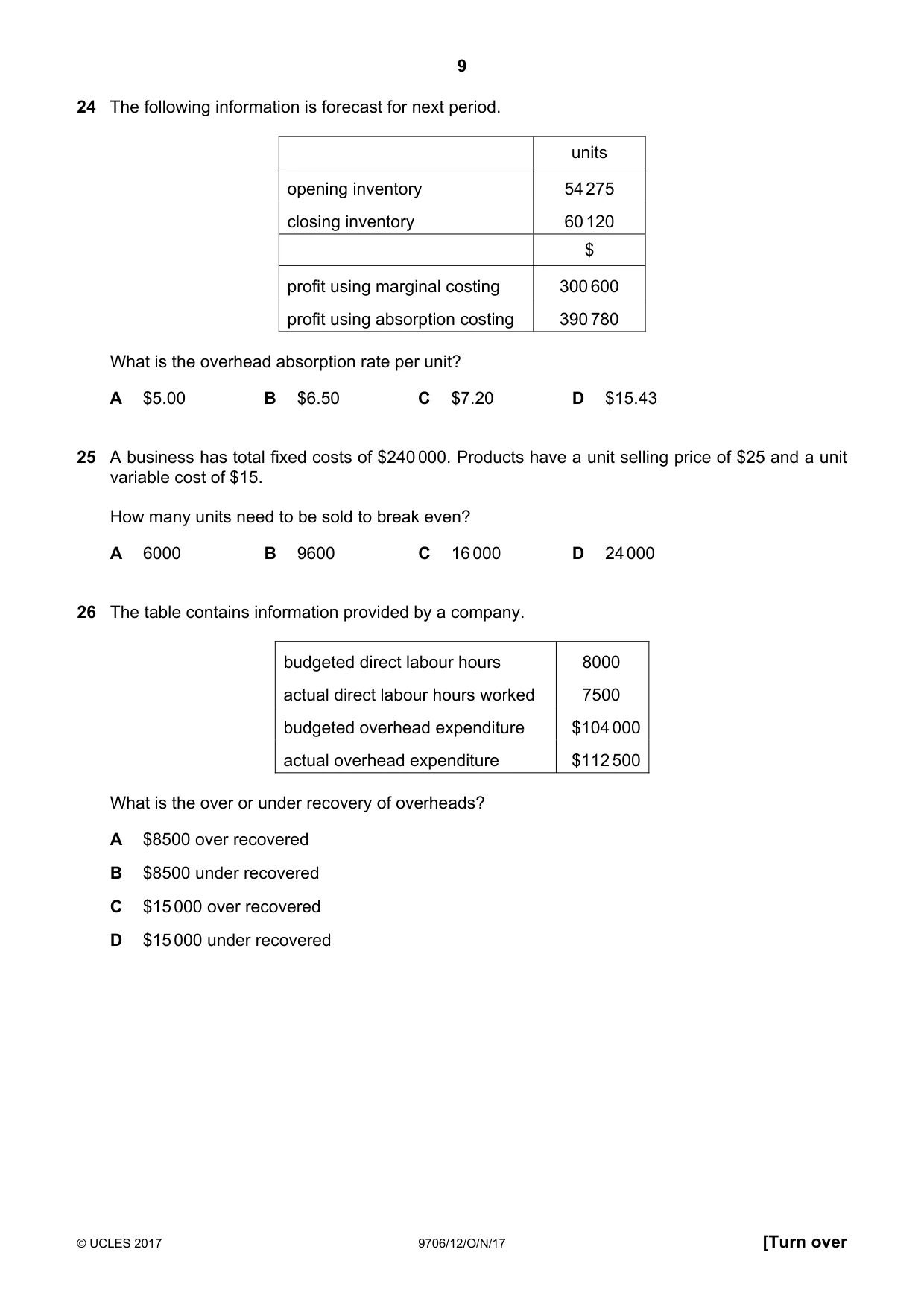
Q24 · The following information is forecast for next period
24 The following information is forecast for next period. units opening inventory 54 275 closing inventory 60 120 $ profit using marginal costing 300 600 profit using absorption costing 390 780 What is the overhead absorption rate per unit? A $5.00 B $6.50 C $7.20 D $15.43
Mark scheme: D
Q25 · A business has total fixed costs of $240 000
25 A business has total fixed costs of $240 000. Products have a unit selling price of $25 and a unit variable cost of $15. How many units need to be sold to break even? A 6000 B 9600 C 16 000 D 24 000
Mark scheme: D
Q26 · The table contains information provided by a company
26 The table contains information provided by a company. budgeted direct labour hours 8000 actual direct labour hours worked 7500 budgeted overhead expenditure $104 000 actual overhead expenditure $112 500 What is the over or under recovery of overheads? A $8500 over recovered B $8500 under recovered C $15 000 over recovered D $15 000 under recovered
Mark scheme: D
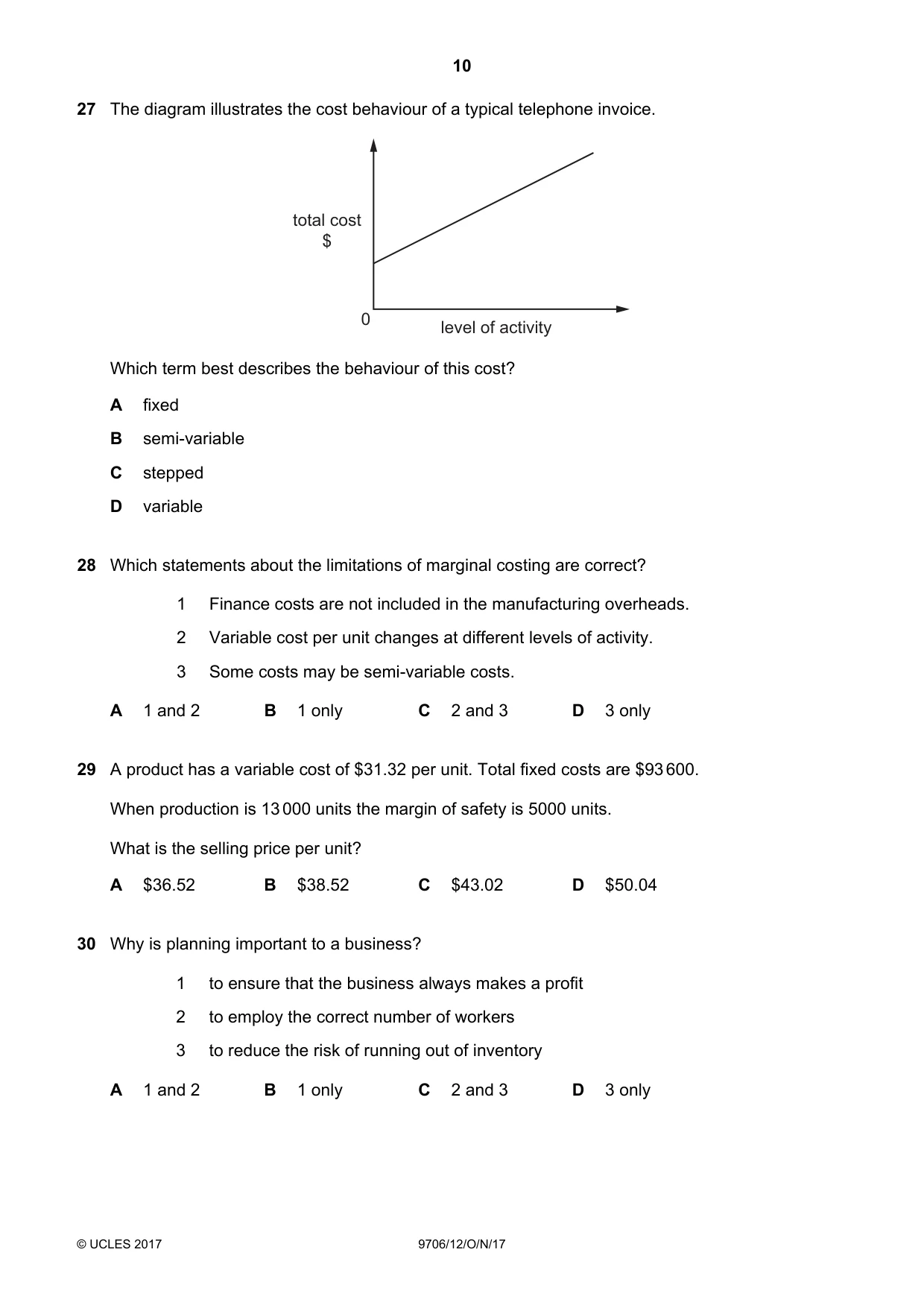
Q27 · The diagram illustrates the cost behaviour of a typical telephone invoice
27 The diagram illustrates the cost behaviour of a typical telephone invoice. total cost $ 0 level of activity Which term best describes the behaviour of this cost? A fixed B semi-variable C stepped D variable
Mark scheme: B
Q28 · Which statements about the limitations of marginal costing are correct?
28 Which statements about the limitations of marginal costing are correct? 1 Finance costs are not included in the manufacturing overheads. 2 Variable cost per unit changes at different levels of activity. 3 Some costs may be semi-variable costs. A 1 and 2 B 1 only C 2 and 3 D 3 only
Mark scheme: D
Q29 · A product has a variable cost of $31.32 per unit
29 A product has a variable cost of $31.32 per unit. Total fixed costs are $93 600. When production is 13 000 units the margin of safety is 5000 units. What is the selling price per unit? A $36.52 B $38.52 C $43.02 D $50.04
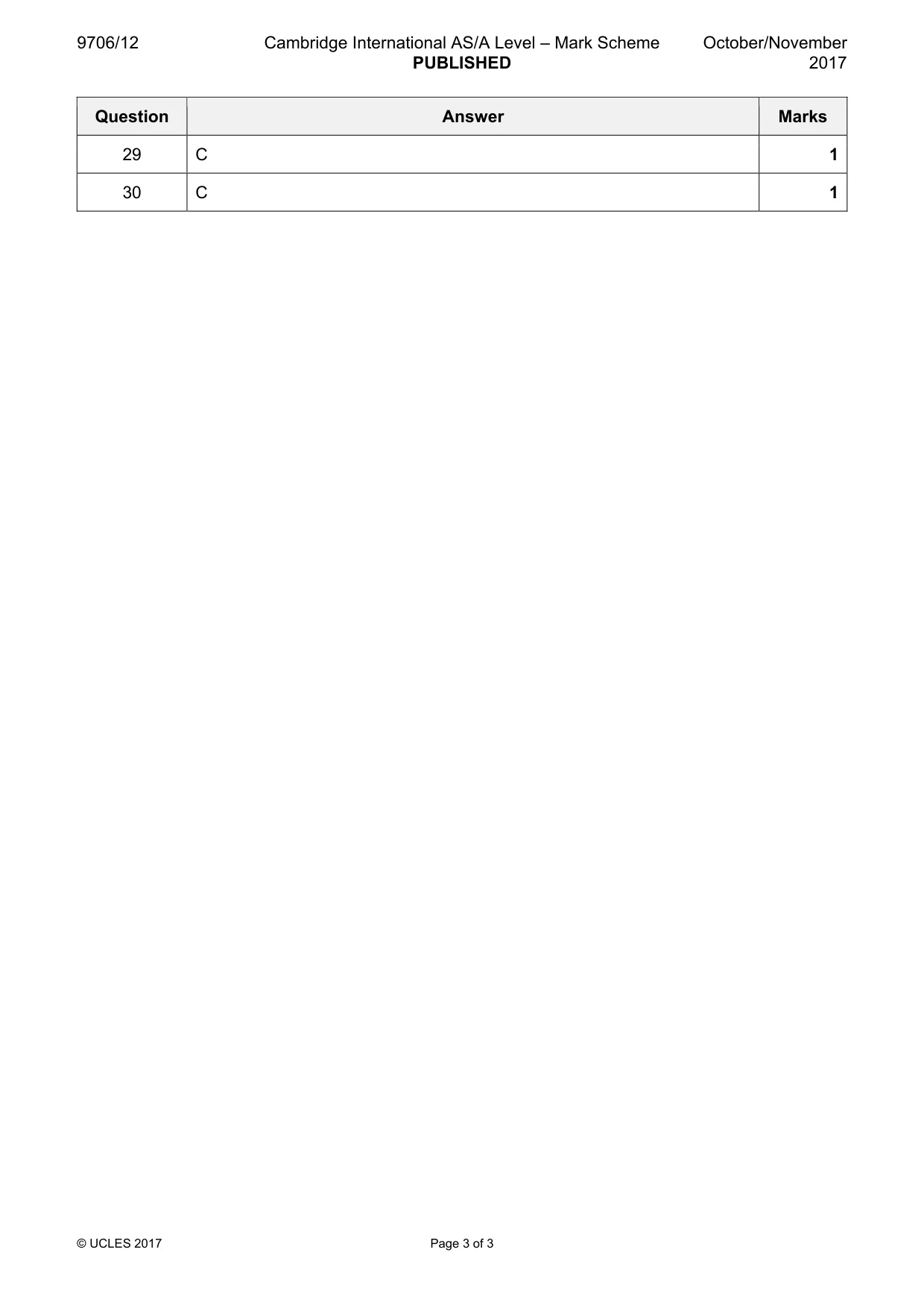
Mark scheme: C
Q30 · Why is planning important to a business?
30 Why is planning important to a business? 1 to ensure that the business always makes a profit 2 to employ the correct number of workers 3 to reduce the risk of running out of inventory A 1 and 2 B 1 only C 2 and 3 D 3 only
Mark scheme: C
What was in this paper
The subtopics covered by these 30 questions, and how many questions each got. Open one in a new tab to see every Cambridge question on it.
What you needed in this session
Cambridge’s own grade thresholds for 2017 Oct/Nov, Paper 1 · Variant 2. A higher threshold means an easier paper — the bar moves with how the cohort did.