Cambridge A Level Accounting 9706 — 2008 Oct/Nov Paper 1 · Variant 1
9706/11/O/N/08 · 30 questions · 30 marks · ≈34 min
The question paper and its mark scheme, free to read here and free to download. This is Cambridge’s own paper, exactly as it was sat.
Question paper12 pages
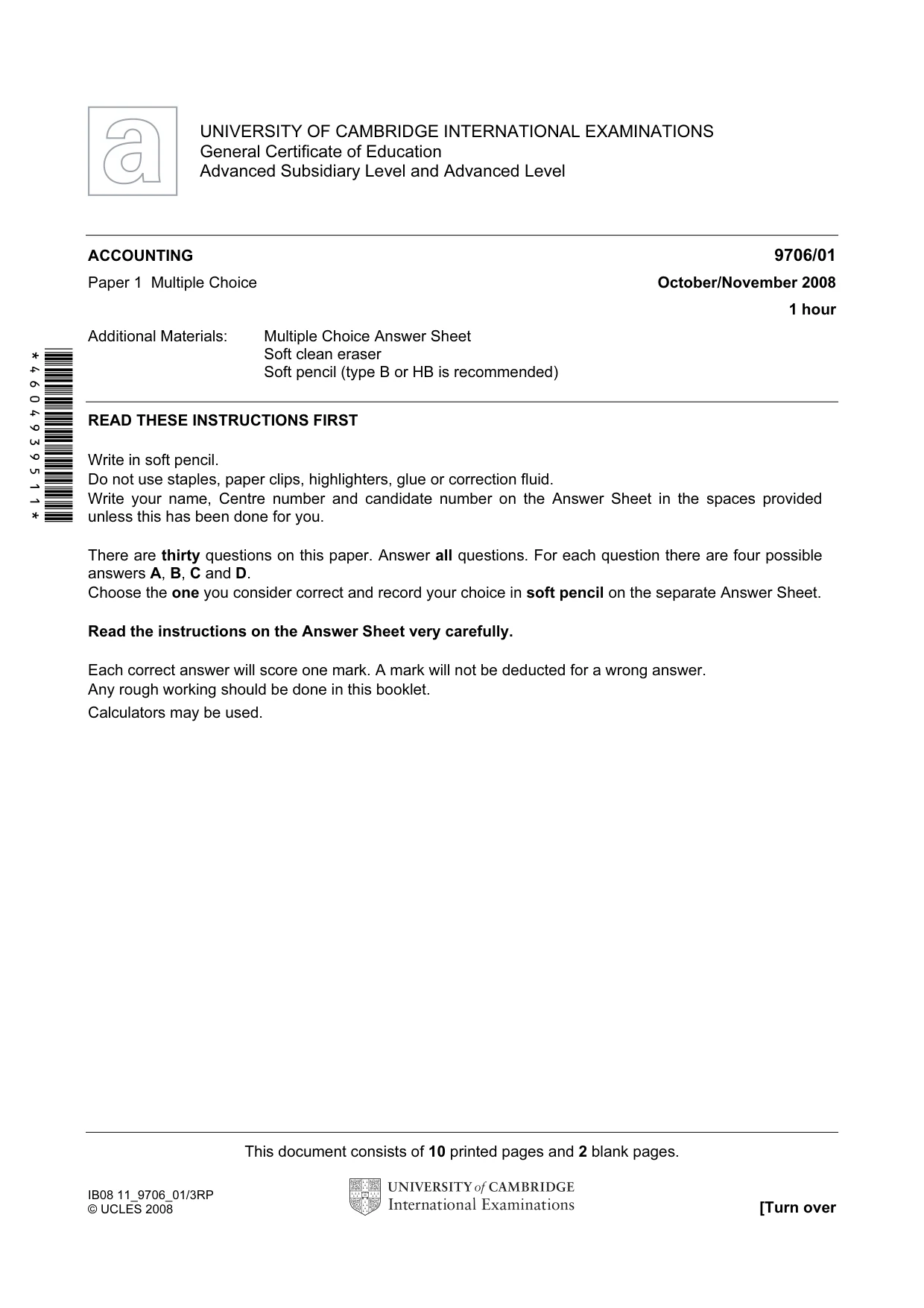

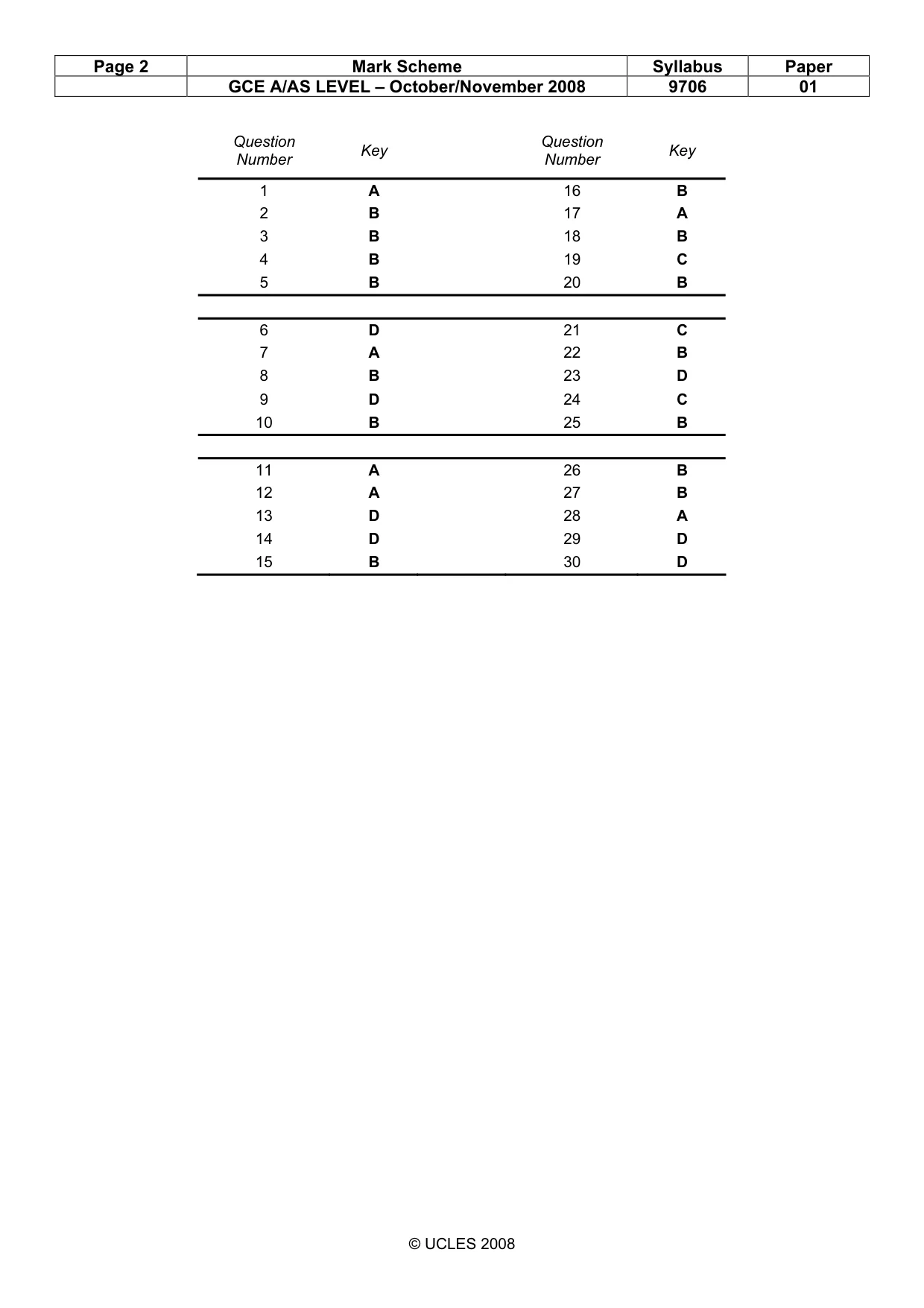
Mark scheme2 pages
Answers below. Sit the paper first if you are practising.
Questions as text
Q1 · Which item should be treated as capital expenditure?
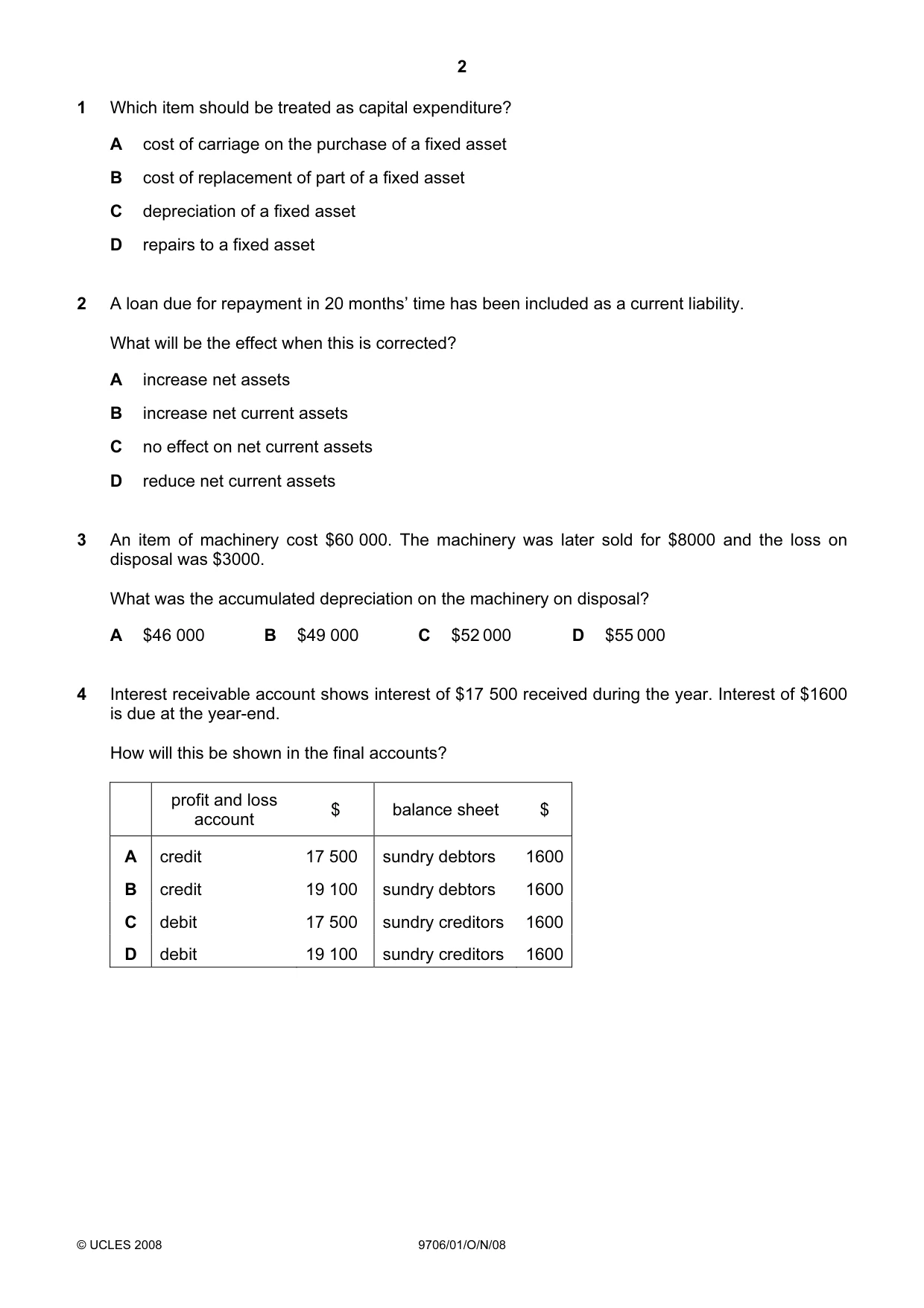
1 Which item should be treated as capital expenditure? A cost of carriage on the purchase of a fixed asset B cost of replacement of part of a fixed asset C depreciation of a fixed asset D repairs to a fixed asset
Mark scheme: A
Q2 · A loan due for repayment in 20 months’ time has been included as a current liability
2 A loan due for repayment in 20 months’ time has been included as a current liability. What will be the effect when this is corrected? A increase net assets B increase net current assets C no effect on net current assets D reduce net current assets
Mark scheme: B
Q3 · An item of machinery cost $60 000
3 An item of machinery cost $60 000. The machinery was later sold for $8000 and the loss on disposal was $3000. What was the accumulated depreciation on the machinery on disposal? A $46 000 B $49 000 C $52 000 D $55 000
Mark scheme: B
Q4 · Interest receivable account shows interest of $17 500 received during the year
4 Interest receivable account shows interest of $17 500 received during the year. Interest of $1600 is due at the year-end. How will this be shown in the final accounts? profit and loss $ balance sheet $ account A credit 17 500 sundry debtors 1600 B credit 19 100 sundry debtors 1600 C debit 17 500 sundry creditors 1600 D debit 19 100 sundry creditors 1600
Mark scheme: B
Q5 · The table shows how a property appears in the balance sheet
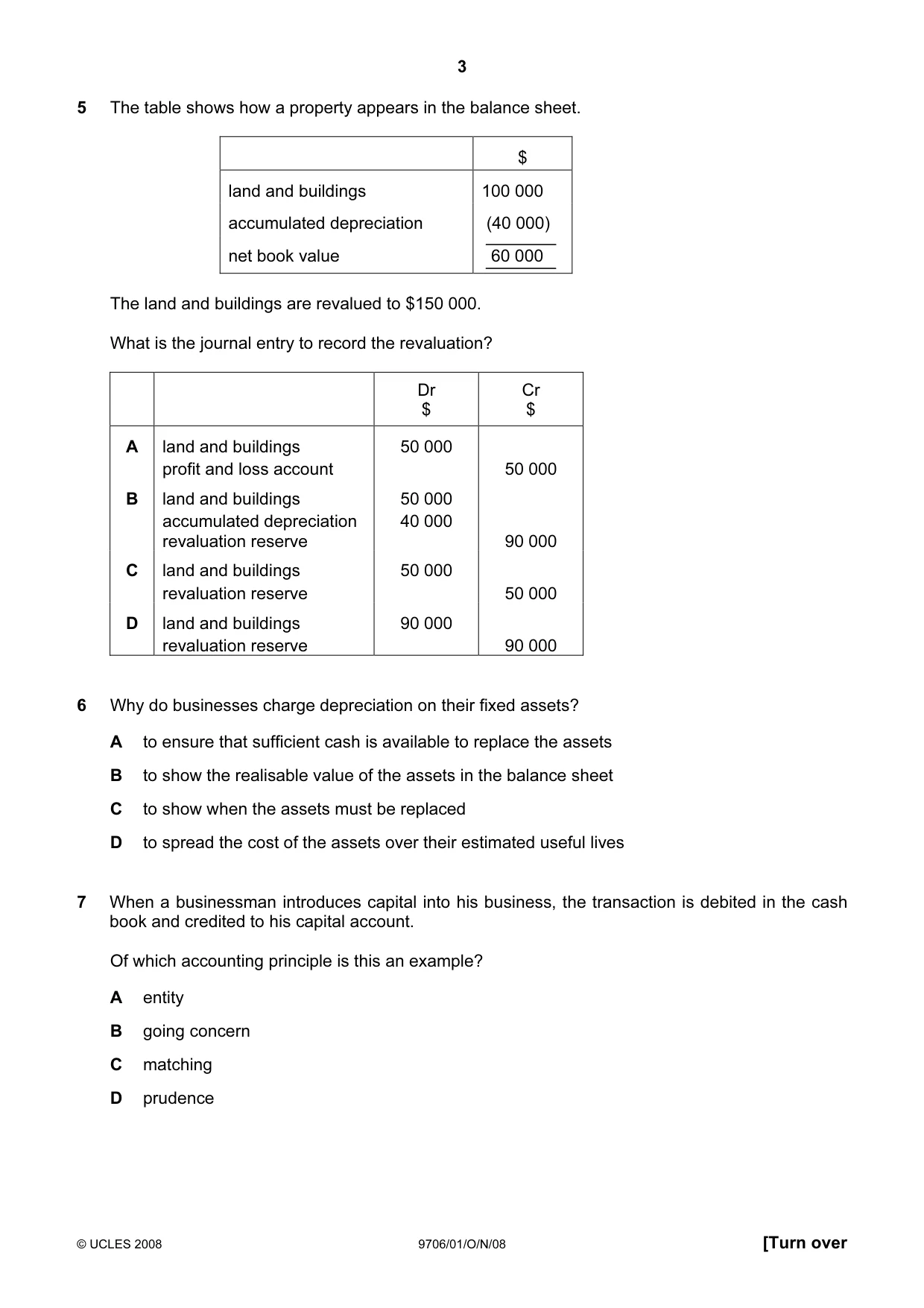
5 The table shows how a property appears in the balance sheet. $ land and buildings 100 000 accumulated depreciation (40 000) net book value 60 000 The land and buildings are revalued to $150 000. What is the journal entry to record the revaluation? Dr Cr $ $ A land and buildings 50 000 profit and loss account 50 000 B land and buildings 50 000 accumulated depreciation 40 000 revaluation reserve 90 000 C land and buildings 50 000 revaluation reserve 50 000 D land and buildings 90 000 revaluation reserve 90 000
Mark scheme: B
Q6 · Why do businesses charge depreciation on their fixed assets?
6 Why do businesses charge depreciation on their fixed assets? A to ensure that sufficient cash is available to replace the assets B to show the realisable value of the assets in the balance sheet C to show when the assets must be replaced D to spread the cost of the assets over their estimated useful lives
Mark scheme: D
Q7 · When a businessman introduces capital into his business, the transaction is debited in…
7 When a businessman introduces capital into his business, the transaction is debited in the cash book and credited to his capital account. Of which accounting principle is this an example? A entity B going concern C matching D prudence
Mark scheme: A
Q8 · A creditor for $720 transferred from the purchases ledger has been entered on the wrong…
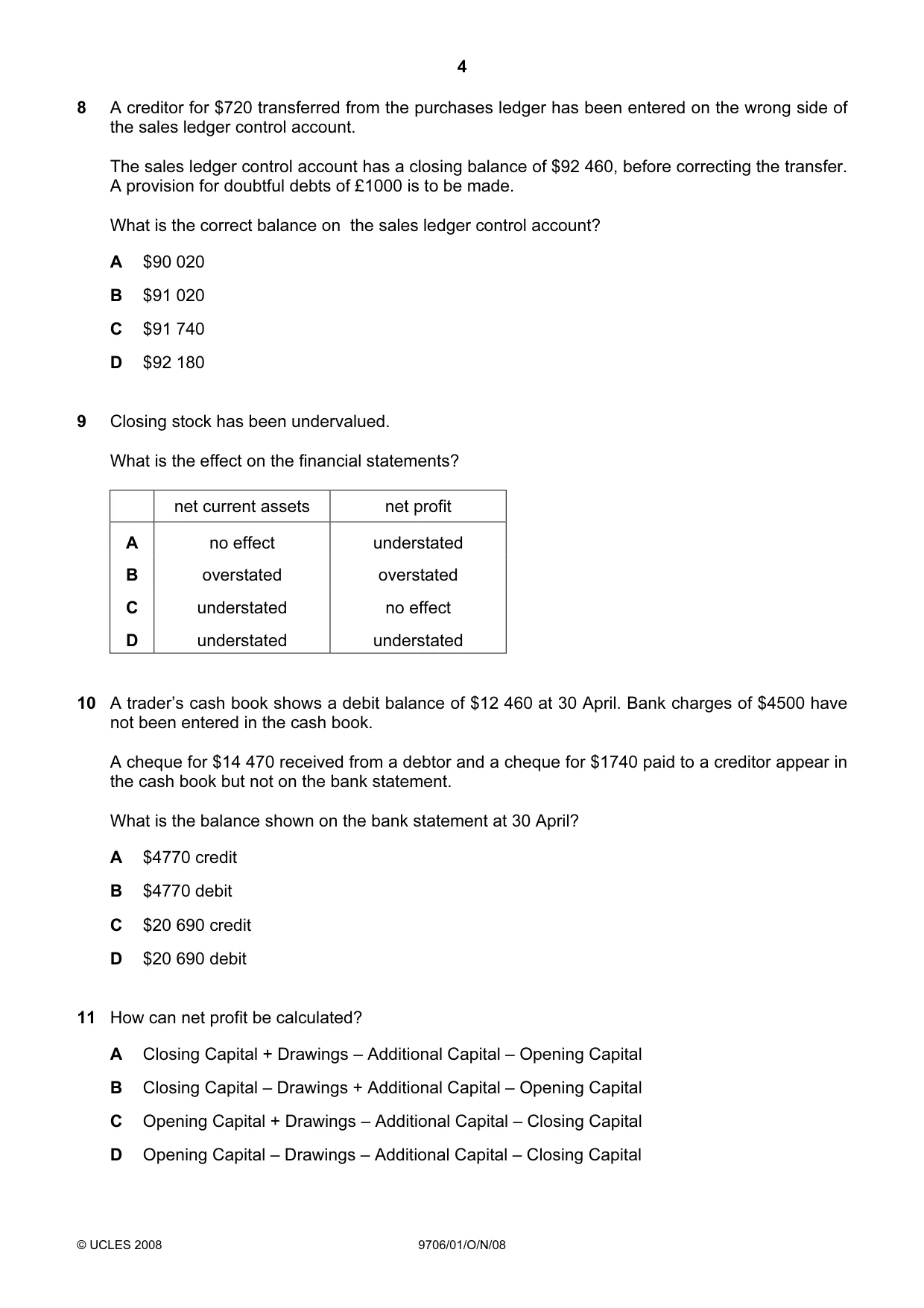
8 A creditor for $720 transferred from the purchases ledger has been entered on the wrong side of the sales ledger control account. The sales ledger control account has a closing balance of $92 460, before correcting the transfer. A provision for doubtful debts of £1000 is to be made. What is the correct balance on the sales ledger control account? A $90 020 B $91 020 C $91 740 D $92 180
Mark scheme: B
Q9 · Closing stock has been undervalued
9 Closing stock has been undervalued. What is the effect on the financial statements? net current assets net profit A no effect understated B overstated overstated C understated no effect D understated understated
Mark scheme: D
Q10 · A trader’s cash book shows a debit balance of $12 460 at 30 April
10 A trader’s cash book shows a debit balance of $12 460 at 30 April. Bank charges of $4500 have not been entered in the cash book. A cheque for $14 470 received from a debtor and a cheque for $1740 paid to a creditor appear in the cash book but not on the bank statement. What is the balance shown on the bank statement at 30 April? A $4770 credit B $4770 debit C $20 690 credit D $20 690 debit
Mark scheme: B
Q11 · How can net profit be calculated?
11 How can net profit be calculated? A Closing Capital + Drawings – Additional Capital – Opening Capital B Closing Capital – Drawings + Additional Capital – Opening Capital C Opening Capital + Drawings – Additional Capital – Closing Capital D Opening Capital – Drawings – Additional Capital – Closing Capital
Mark scheme: A
Q12 · A company’s capital expenditure of $200 000 has been debited in error to the purchases…
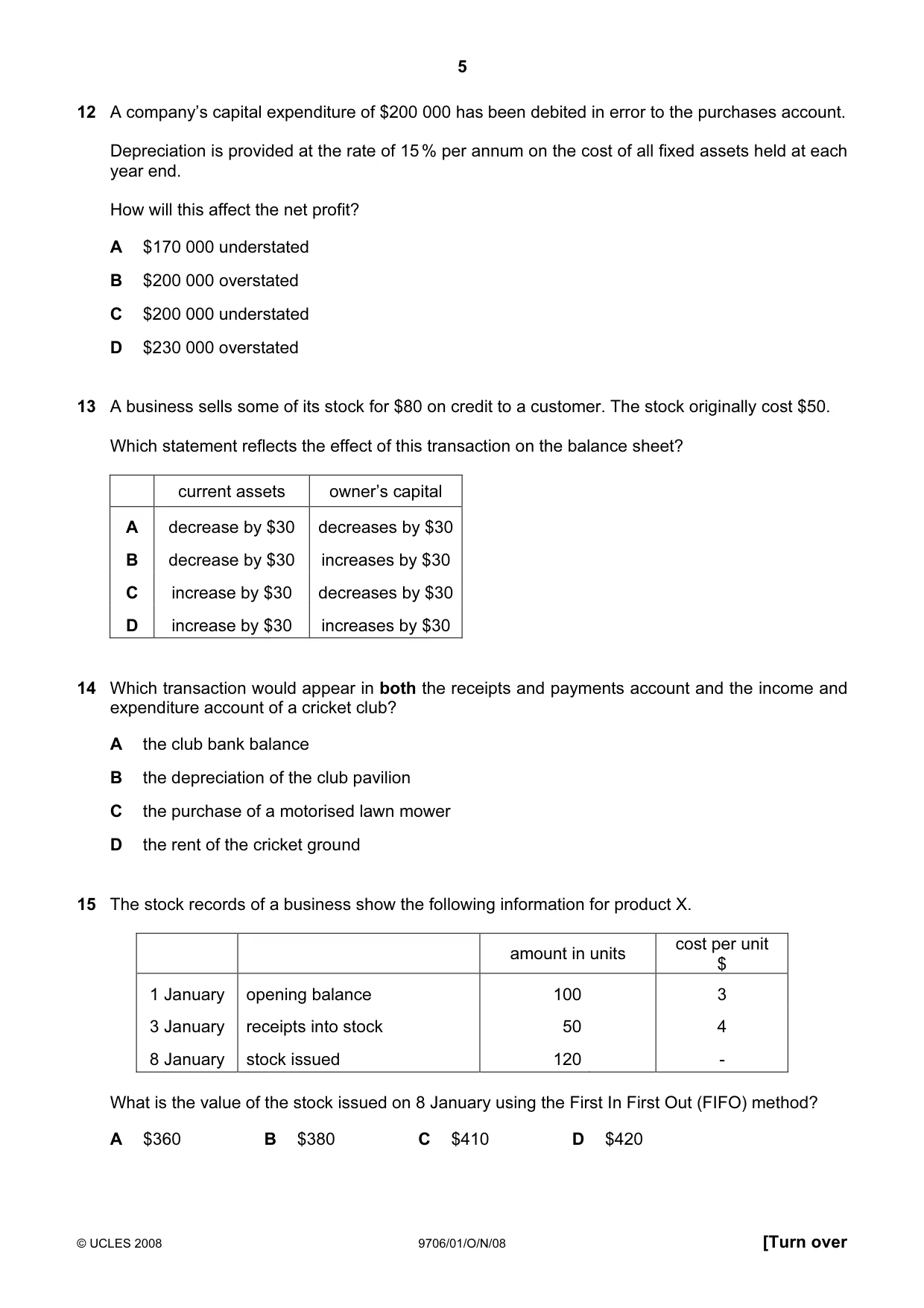
12 A company’s capital expenditure of $200 000 has been debited in error to the purchases account. Depreciation is provided at the rate of 15 % per annum on the cost of all fixed assets held at each year end. How will this affect the net profit? A $170 000 understated B $200 000 overstated C $200 000 understated D $230 000 overstated
Mark scheme: A
Q13 · A business sells some of its stock for $80 on credit to a customer
13 A business sells some of its stock for $80 on credit to a customer. The stock originally cost $50. Which statement reflects the effect of this transaction on the balance sheet? current assets owner’s capital A decrease by $30 decreases by $30 B decrease by $30 increases by $30 C increase by $30 decreases by $30 D increase by $30 increases by $30
Mark scheme: D
Q14 · Which transaction would appear in both the receipts and payments account and the income…
14 Which transaction would appear in both the receipts and payments account and the income and expenditure account of a cricket club? A the club bank balance B the depreciation of the club pavilion C the purchase of a motorised lawn mower D the rent of the cricket ground
Mark scheme: D
Q15 · The stock records of a business show the following information for product X
15 The stock records of a business show the following information for product X. cost per unit amount in units $ 1 January opening balance 100 3 3 January receipts into stock 50 4 8 January stock issued 120 - What is the value of the stock issued on 8 January using the First In First Out (FIFO) method? A $360 B $380 C $410 D $420
Mark scheme: B
Q16 · A business uses the weighted average cost (AVCO) method of stock valuation
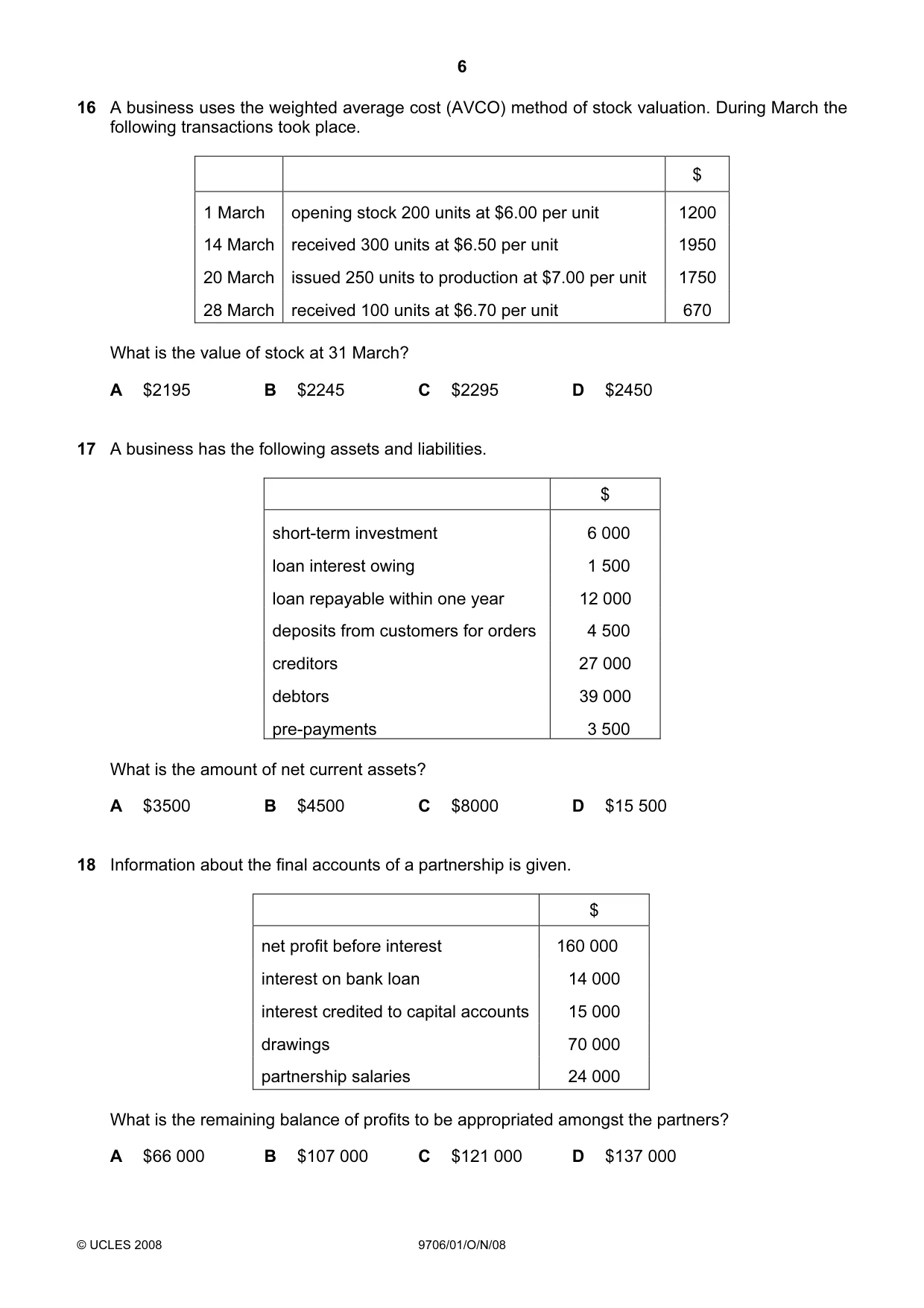
16 A business uses the weighted average cost (AVCO) method of stock valuation. During March the following transactions took place. $ 1 March opening stock 200 units at $6.00 per unit 1200 14 March received 300 units at $6.50 per unit 1950 20 March issued 250 units to production at $7.00 per unit 1750 28 March received 100 units at $6.70 per unit 670 What is the value of stock at 31 March? A $2195 B $2245 C $2295 D $2450
Mark scheme: B
Q17 · A business has the following assets and liabilities
17 A business has the following assets and liabilities. $ short-term investment 6 000 loan interest owing 1 500 loan repayable within one year 12 000 deposits from customers for orders 4 500 creditors 27 000 debtors 39 000 pre-payments 3 500 What is the amount of net current assets? A $3500 B $4500 C $8000 D $15 500
Mark scheme: A
Q18 · Information about the final accounts of a partnership is given
18 Information about the final accounts of a partnership is given. $ net profit before interest 160 000 interest on bank loan 14 000 interest credited to capital accounts 15 000 drawings 70 000 partnership salaries 24 000 What is the remaining balance of profits to be appropriated amongst the partners? A $66 000 B $107 000 C $121 000 D $137 000
Mark scheme: B
Q19 · What is the effect on a company’s balance sheet of issuing bonus shares?
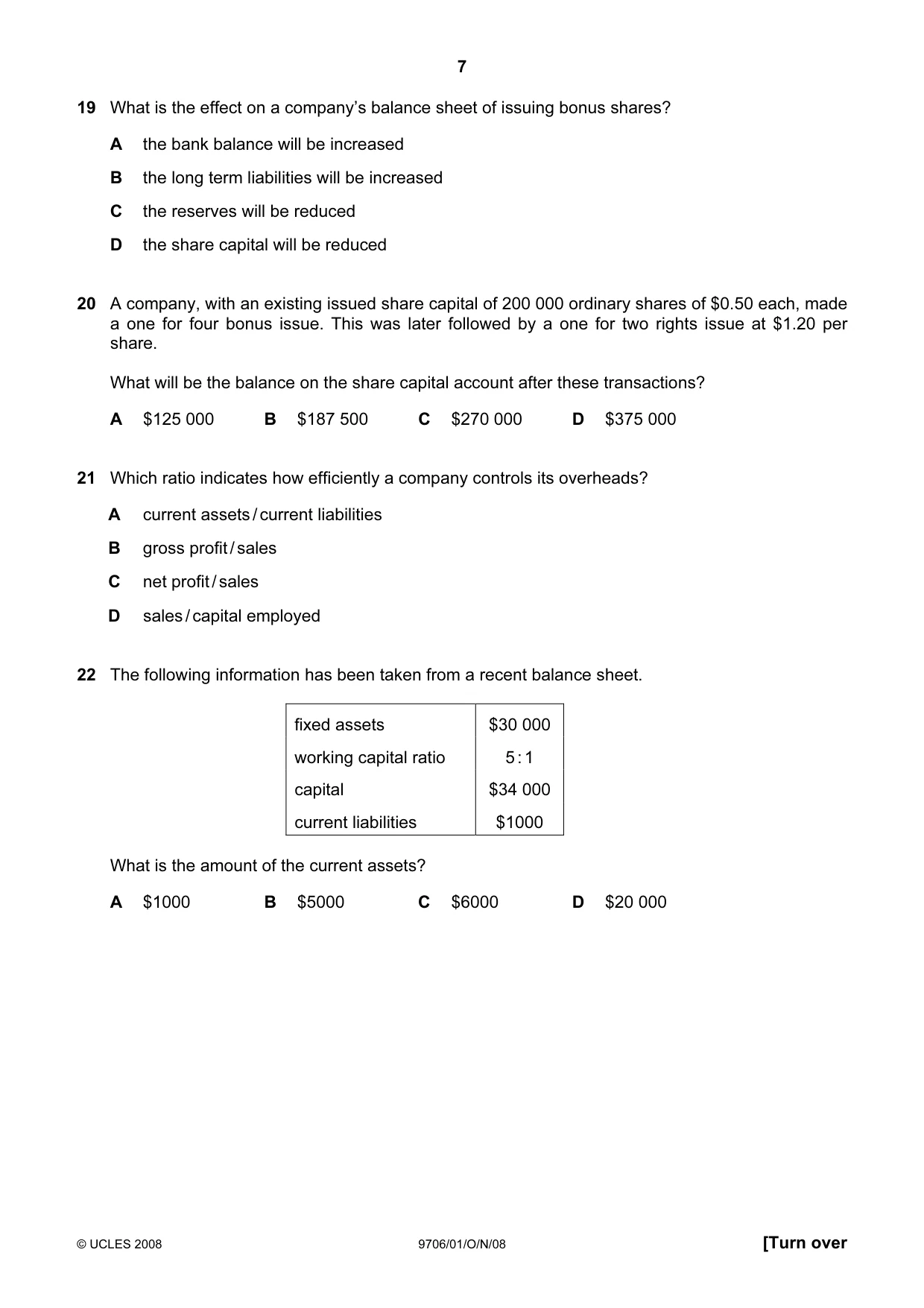
19 What is the effect on a company’s balance sheet of issuing bonus shares? A the bank balance will be increased B the long term liabilities will be increased C the reserves will be reduced D the share capital will be reduced
Mark scheme: C
Q20 · A company, with an existing issued share capital of 200 000 ordinary shares of $0.50…
20 A company, with an existing issued share capital of 200 000 ordinary shares of $0.50 each, made a one for four bonus issue. This was later followed by a one for two rights issue at $1.20 per share. What will be the balance on the share capital account after these transactions? A $125 000 B $187 500 C $270 000 D $375 000
Mark scheme: B
Q21 · Which ratio indicates how efficiently a company controls its overheads?
21 Which ratio indicates how efficiently a company controls its overheads? A current assets / current liabilities B gross profit / sales C net profit / sales D sales / capital employed
Mark scheme: C
More questions on Analysis and communication of accounting information
Q22 · The following information has been taken from a recent balance sheet
22 The following information has been taken from a recent balance sheet. fixed assets $30 000 working capital ratio 5 : 1 capital $34 000 current liabilities $1000 What is the amount of the current assets? A $1000 B $5000 C $6000 D $20 000
Mark scheme: B
More questions on Analysis and communication of accounting information
Q23 · The following data is available at the end of a financial year
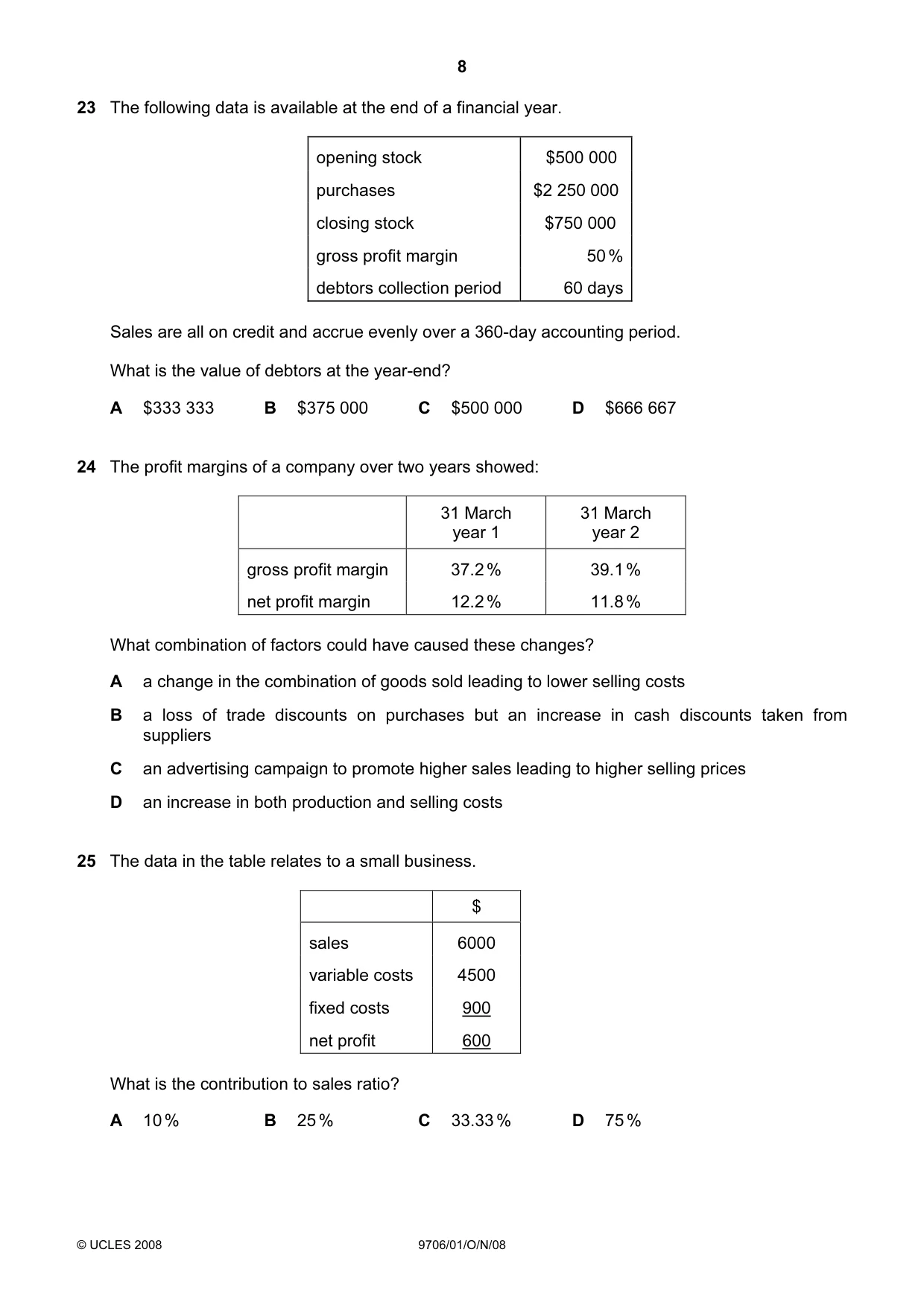
23 The following data is available at the end of a financial year. opening stock $500 000 purchases $2 250 000 closing stock $750 000 gross profit margin 50 % debtors collection period 60 days Sales are all on credit and accrue evenly over a 360-day accounting period. What is the value of debtors at the year-end? A $333 333 B $375 000 C $500 000 D $666 667
Mark scheme: D
More questions on Analysis and communication of accounting information
Q24 · The profit margins of a company over two years showed: 31 March 31 March year 1 year 2…
24 The profit margins of a company over two years showed: 31 March 31 March year 1 year 2 gross profit margin 37.2 % 39.1 % net profit margin 12.2 % 11.8 % What combination of factors could have caused these changes? A a change in the combination of goods sold leading to lower selling costs B a loss of trade discounts on purchases but an increase in cash discounts taken from suppliers C an advertising campaign to promote higher sales leading to higher selling prices D an increase in both production and selling costs
Mark scheme: C
More questions on Analysis and communication of accounting information
Q25 · The data in the table relates to a small business
25 The data in the table relates to a small business. $ sales 6000 variable costs 4500 fixed costs 900 net profit 600 What is the contribution to sales ratio? A 10 % B 25 % C 33.33 % D 75 %
Mark scheme: B
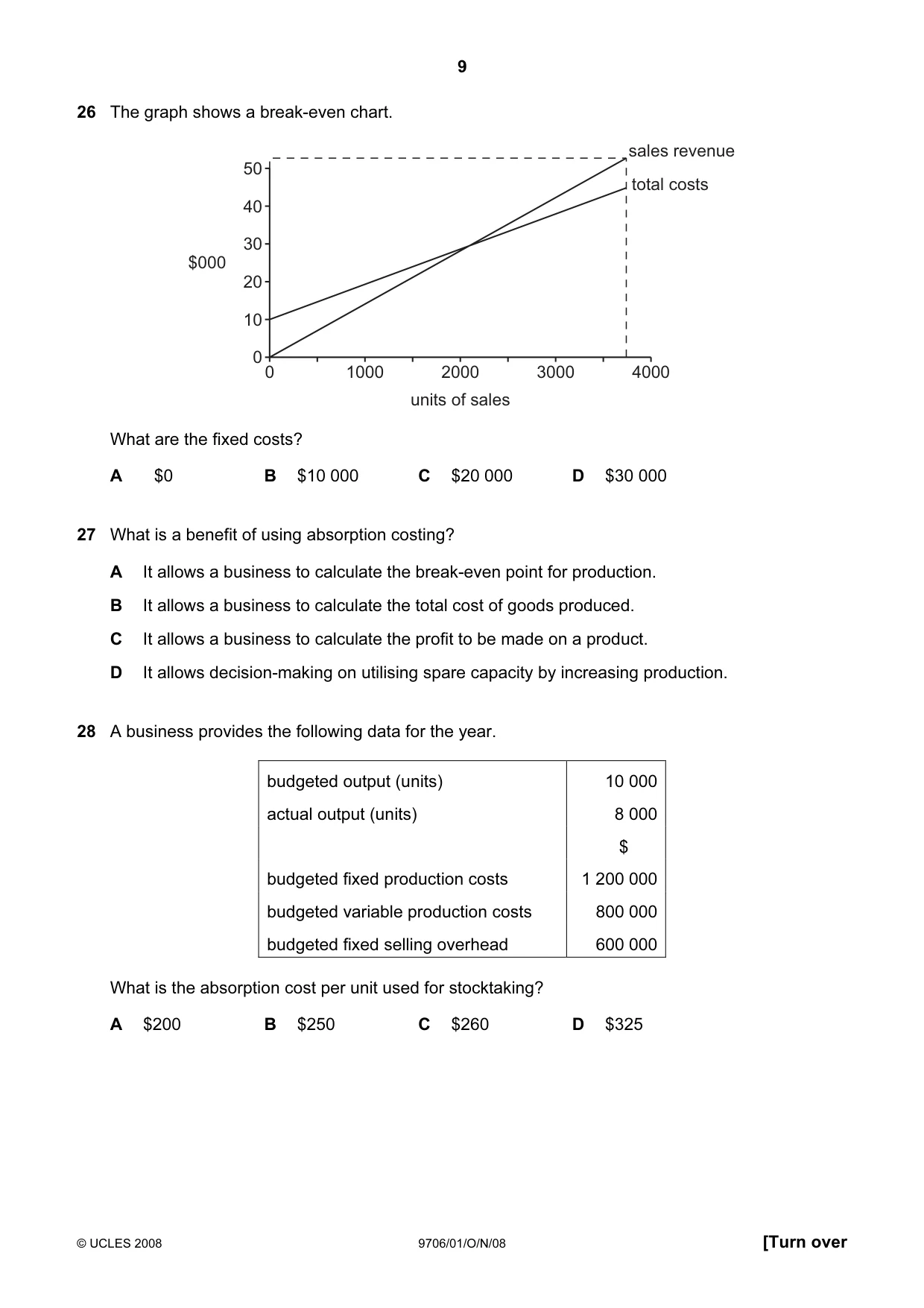
Q26 · The graph shows a break-even chart
26 The graph shows a break-even chart. sales revenue 50 total costs 40 30 $000 20 10 0 0 1000 2000 3000 4000 units of sales What are the fixed costs? A $0 B $10 000 C $20 000 D $30 000
Mark scheme: B
Q27 · What is a benefit of using absorption costing?
27 What is a benefit of using absorption costing? A It allows a business to calculate the break-even point for production. B It allows a business to calculate the total cost of goods produced. C It allows a business to calculate the profit to be made on a product. D It allows decision-making on utilising spare capacity by increasing production.
Mark scheme: B
Q28 · A business provides the following data for the year
28 A business provides the following data for the year. budgeted output (units) 10 000 actual output (units) 8 000 $ budgeted fixed production costs 1 200 000 budgeted variable production costs 800 000 budgeted fixed selling overhead 600 000 What is the absorption cost per unit used for stocktaking? A $200 B $250 C $260 D $325
Mark scheme: A
Q29 · The following data applies to a business
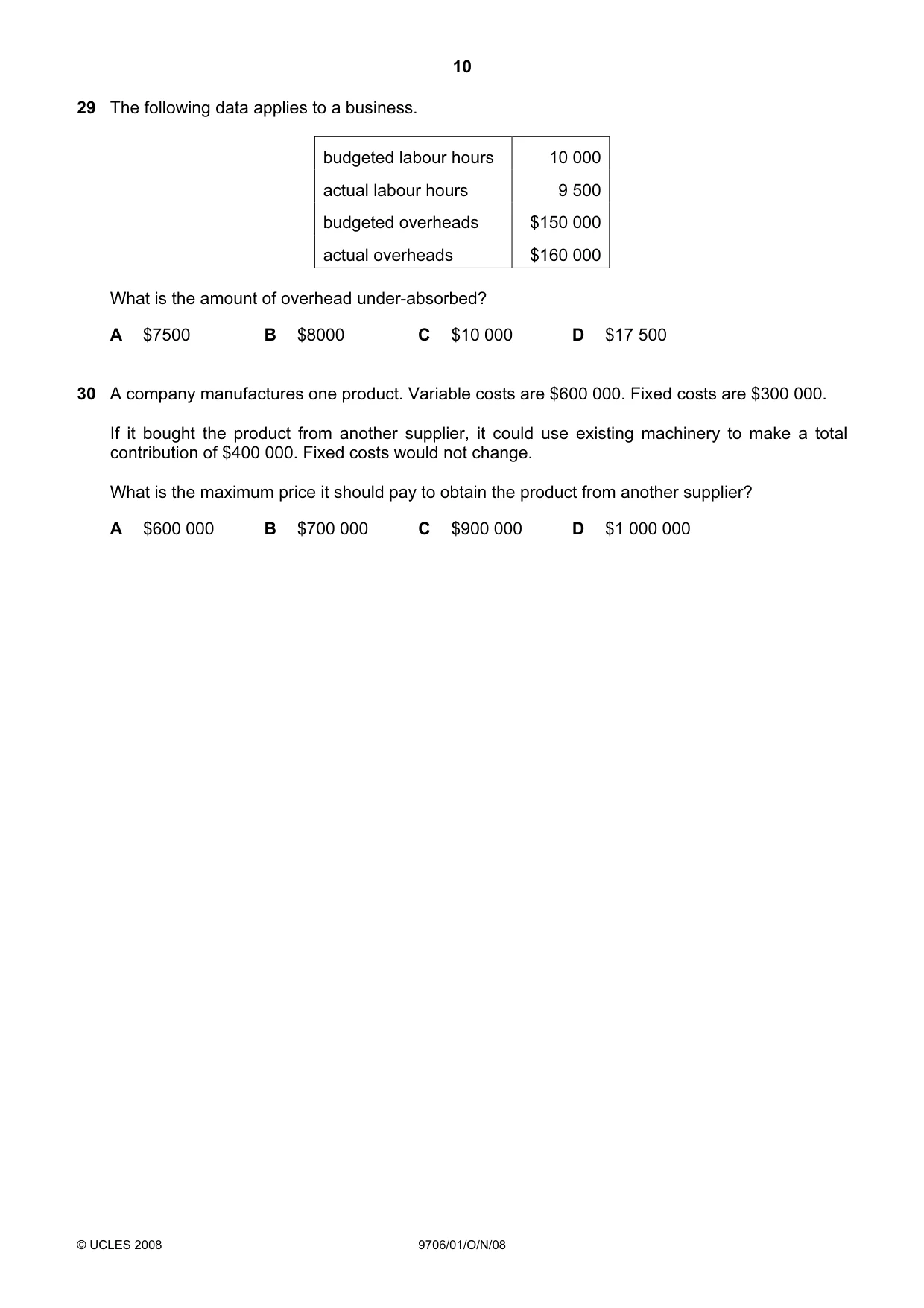
29 The following data applies to a business. budgeted labour hours 10 000 actual labour hours 9 500 budgeted overheads $150 000 actual overheads $160 000 What is the amount of overhead under-absorbed? A $7500 B $8000 C $10 000 D $17 500
Mark scheme: D
Q30 · A company manufactures one product
30 A company manufactures one product. Variable costs are $600 000. Fixed costs are $300 000. If it bought the product from another supplier, it could use existing machinery to make a total contribution of $400 000. Fixed costs would not change. What is the maximum price it should pay to obtain the product from another supplier? A $600 000 B $700 000 C $900 000 D $1 000 000
Mark scheme: D
What was in this paper
The subtopics covered by these 30 questions, and how many questions each got. Open one in a new tab to see every Cambridge question on it.
What you needed in this session
Cambridge’s own grade thresholds for 2008 Oct/Nov, Paper 1 · Variant 1. A higher threshold means an easier paper — the bar moves with how the cohort did.