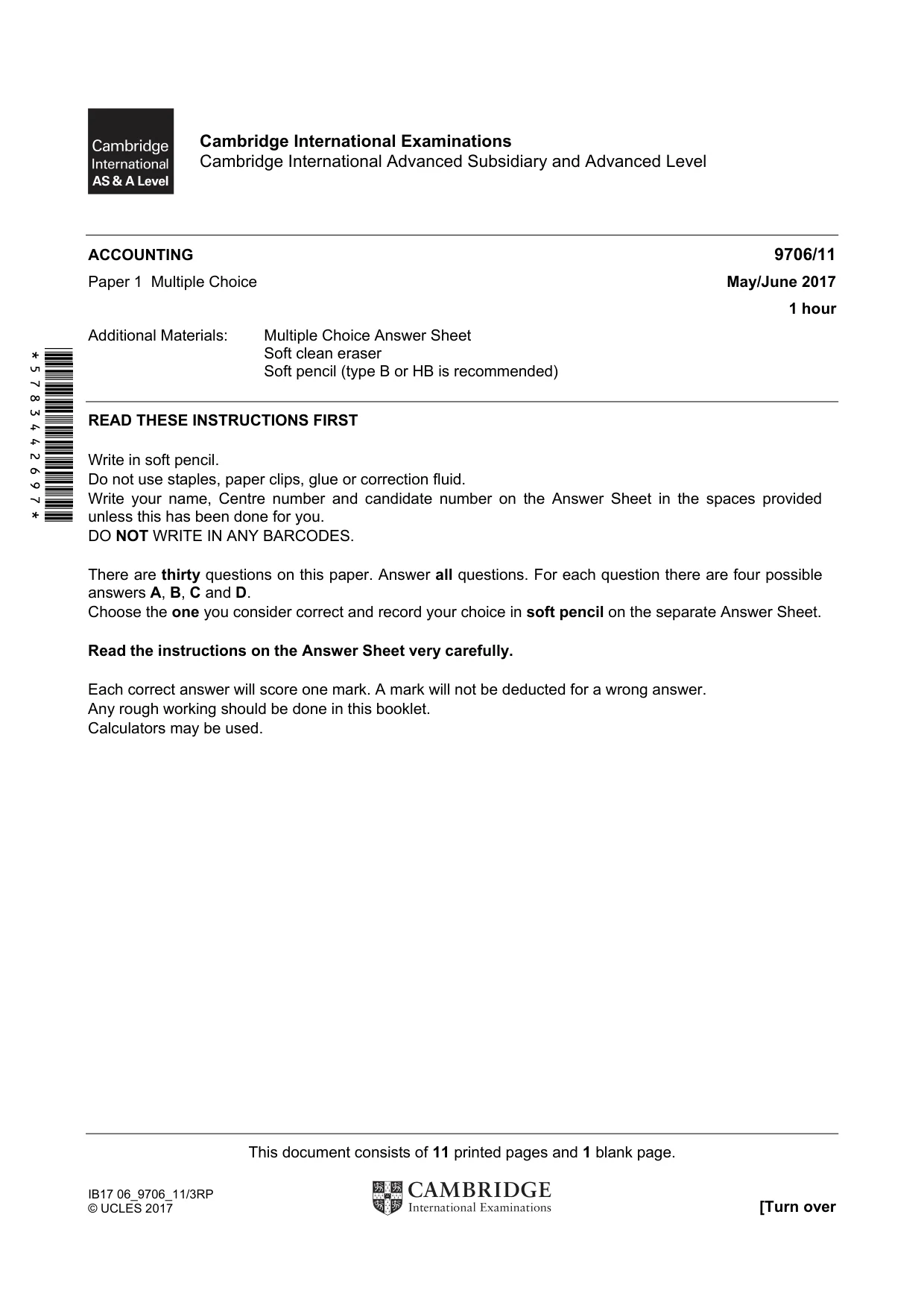
Cambridge A Level Accounting 9706 — 2017 May/June Paper 1 · Variant 1
9706/11/M/J/17 · 30 questions · 30 marks · ≈34 min
The question paper and its mark scheme, free to read here and free to download. This is Cambridge’s own paper, exactly as it was sat.
Question paper12 pages
Mark scheme3 pages
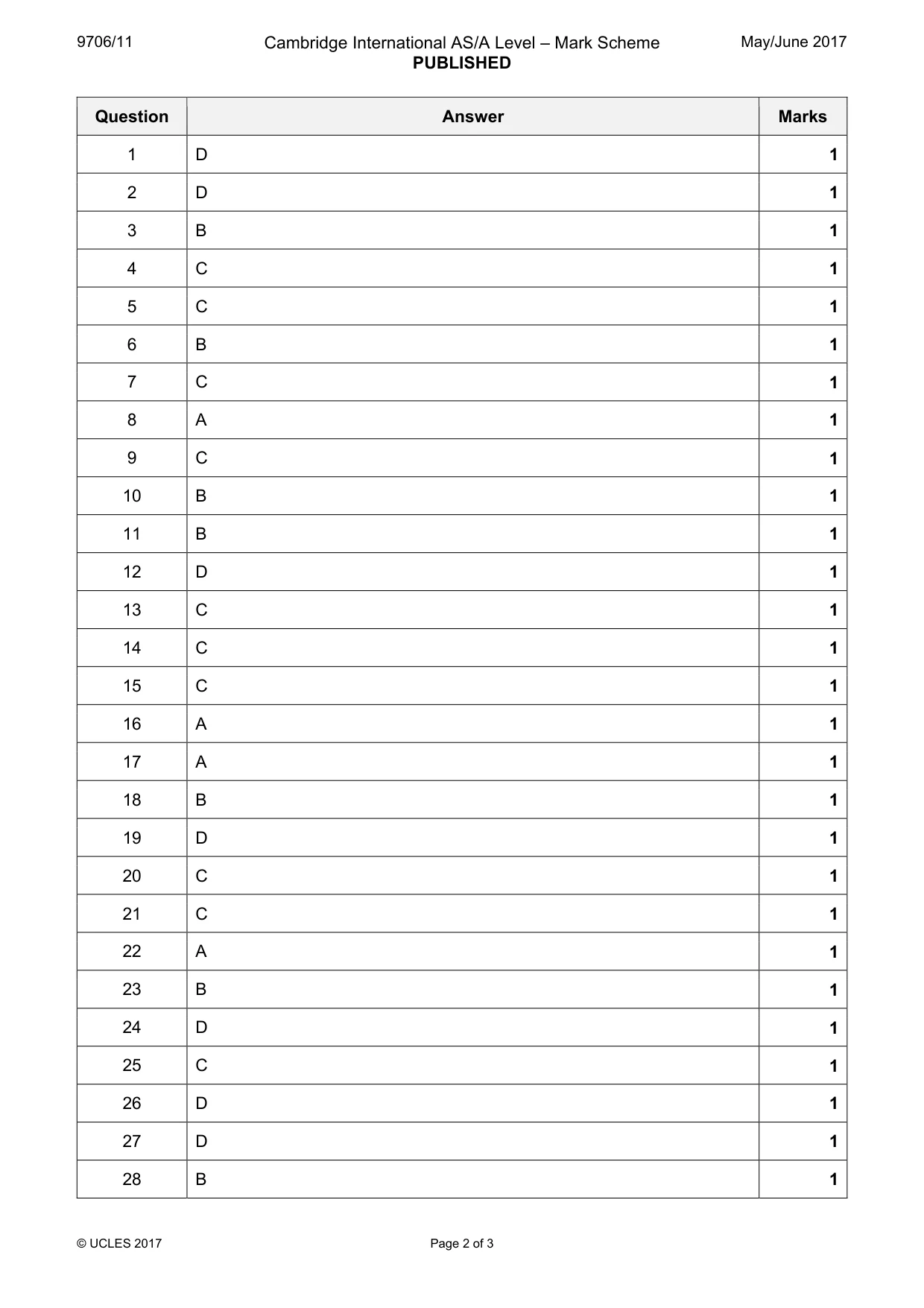
Answers below. Sit the paper first if you are practising.
Questions as text
Q1 · A business’s year end is 31 March
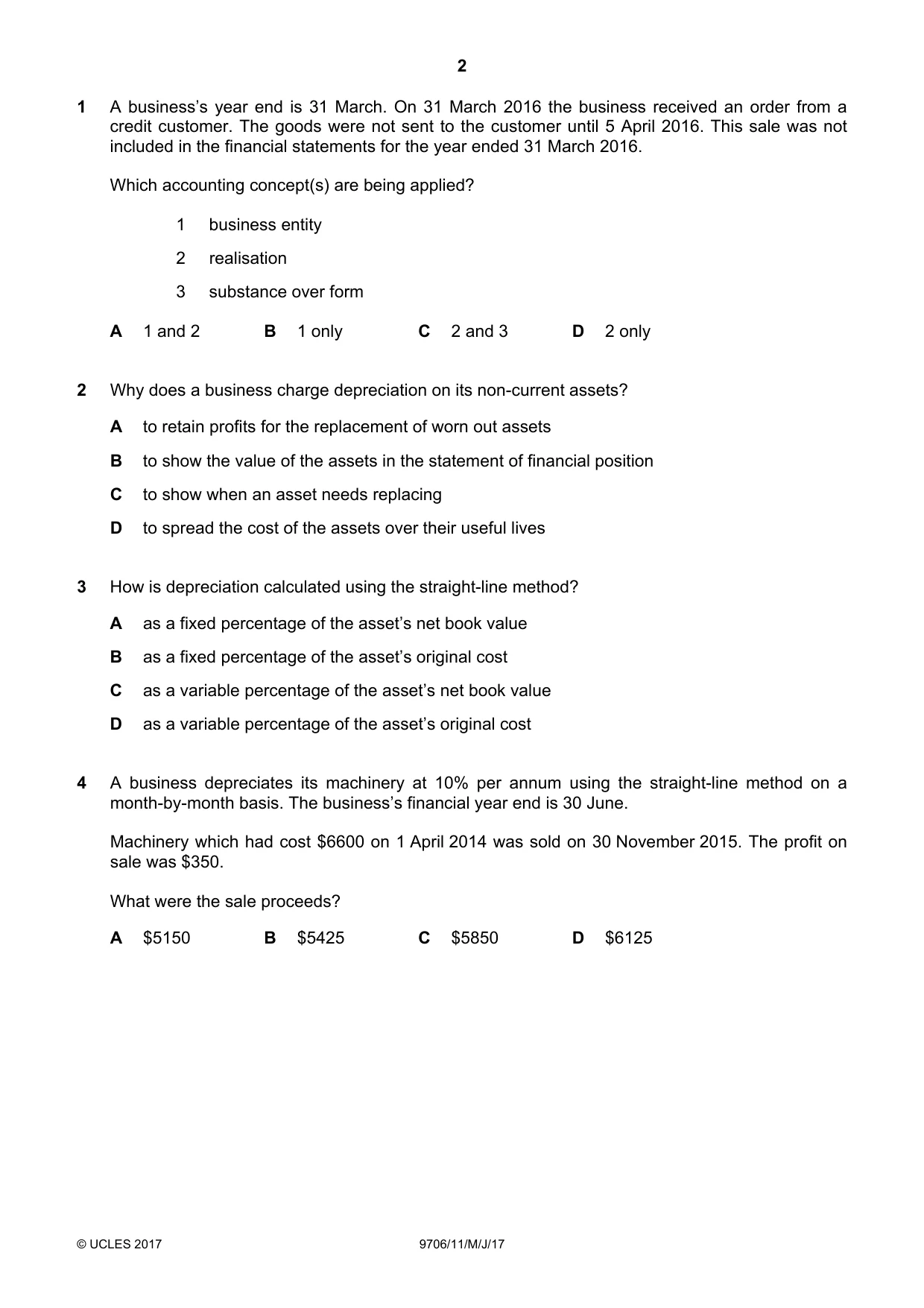
1 A business’s year end is 31 March. On 31 March 2016 the business received an order from a credit customer. The goods were not sent to the customer until 5 April 2016. This sale was not included in the financial statements for the year ended 31 March 2016. Which accounting concept(s) are being applied? 1 business entity 2 realisation 3 substance over form A 1 and 2 B 1 only C 2 and 3 D 2 only
Mark scheme: D
Q2 · Why does a business charge depreciation on its non-current assets?
2 Why does a business charge depreciation on its non-current assets? A to retain profits for the replacement of worn out assets B to show the value of the assets in the statement of financial position C to show when an asset needs replacing D to spread the cost of the assets over their useful lives
Mark scheme: D
Q3 · How is depreciation calculated using the straight-line method?
3 How is depreciation calculated using the straight-line method? A as a fixed percentage of the asset’s net book value B as a fixed percentage of the asset’s original cost C as a variable percentage of the asset’s net book value D as a variable percentage of the asset’s original cost
Mark scheme: B
Q4 · A business depreciates its machinery at 10% per annum using the straight-line method on a…
4 A business depreciates its machinery at 10% per annum using the straight-line method on a month-by-month basis. The business’s financial year end is 30 June. Machinery which had cost $6600 on 1 April 2014 was sold on 30 November 2015. The profit on sale was $350. What were the sale proceeds? A $5150 B $5425 C $5850 D $6125
Mark scheme: C
Q5 · The table shows information relating to the non-current assets of a business
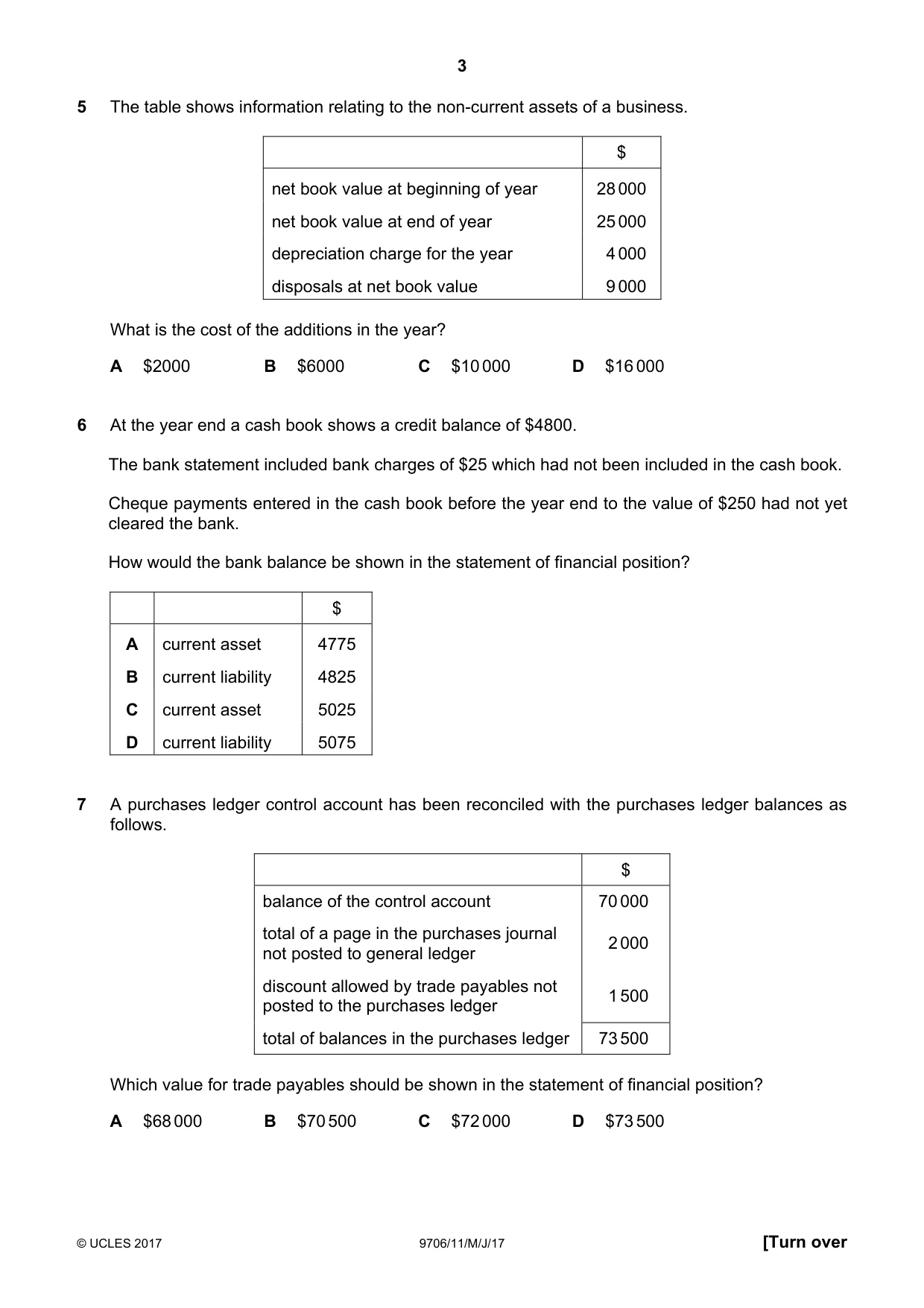
5 The table shows information relating to the non-current assets of a business. $ net book value at beginning of year 28 000 net book value at end of year 25 000 depreciation charge for the year 4 000 disposals at net book value 9 000 What is the cost of the additions in the year? A $2000 B $6000 C $10 000 D $16 000
Mark scheme: C
Q6 · At the year end a cash book shows a credit balance of $4800
6 At the year end a cash book shows a credit balance of $4800. The bank statement included bank charges of $25 which had not been included in the cash book. Cheque payments entered in the cash book before the year end to the value of $250 had not yet cleared the bank. How would the bank balance be shown in the statement of financial position? $ A current asset 4775 B current liability 4825 C current asset 5025 D current liability 5075
Mark scheme: B
Q7 · A purchases ledger control account has been reconciled with the purchases ledger balances…
7 A purchases ledger control account has been reconciled with the purchases ledger balances as follows. $ balance of the control account 70 000 total of a page in the purchases journal 2 000 not posted to general ledger discount allowed by trade payables not 1 500 posted to the purchases ledger total of balances in the purchases ledger 73 500 Which value for trade payables should be shown in the statement of financial position? A $68 000 B $70 500 C $72 000 D $73 500
Mark scheme: C
Q8 · Trade receivable balances at the start of a period were $30 000 and were $38 000 at the…
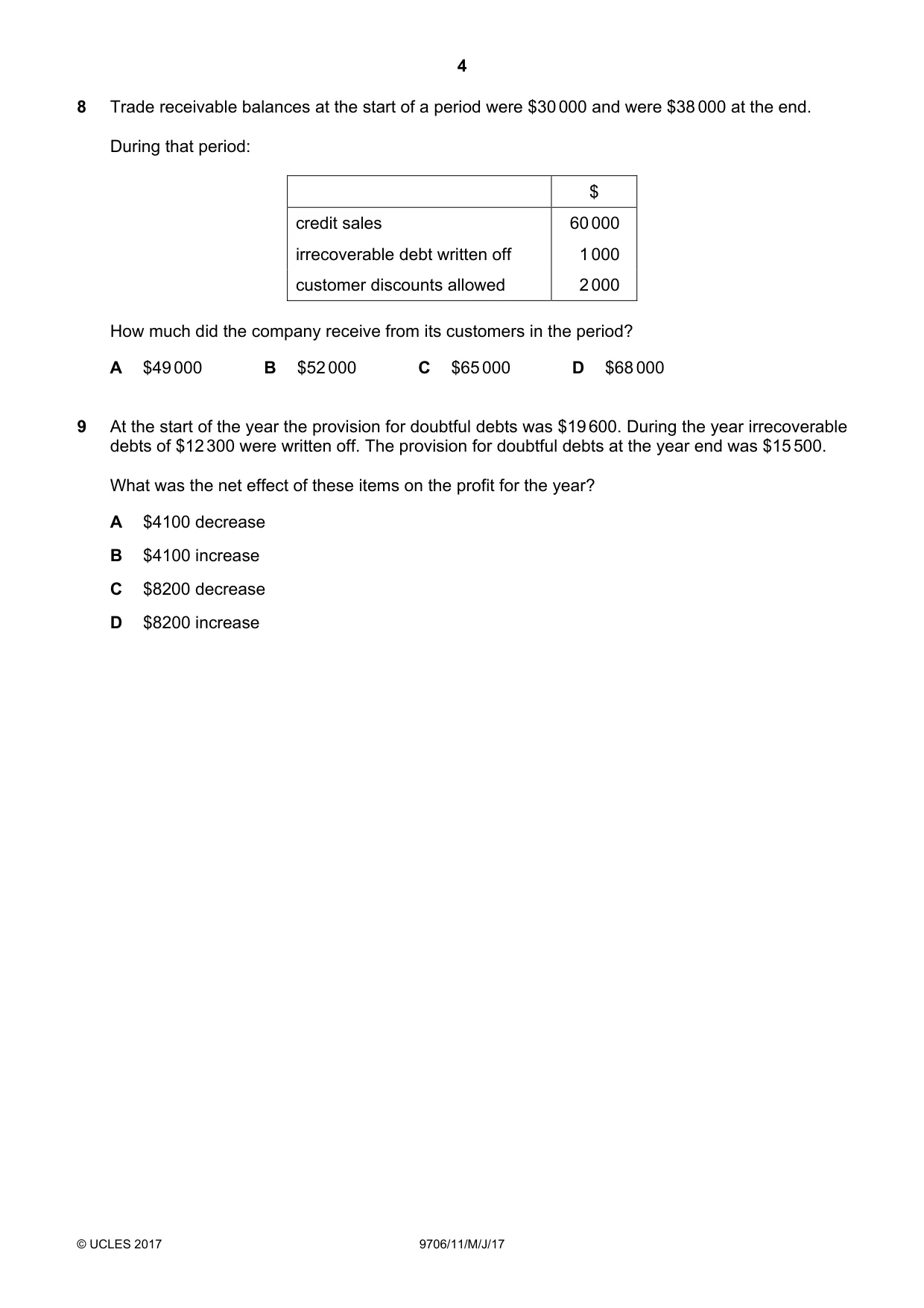
8 Trade receivable balances at the start of a period were $30 000 and were $38 000 at the end. During that period: $ credit sales 60 000 irrecoverable debt written off 1 000 customer discounts allowed 2 000 How much did the company receive from its customers in the period? A $49 000 B $52 000 C $65 000 D $68 000
Mark scheme: A
Q9 · At the start of the year the provision for doubtful debts was $19 600
9 At the start of the year the provision for doubtful debts was $19 600. During the year irrecoverable debts of $12 300 were written off. The provision for doubtful debts at the year end was $15 500. What was the net effect of these items on the profit for the year? A $4100 decrease B $4100 increase C $8200 decrease D $8200 increase
Mark scheme: C
Q10 · The following financial information is available
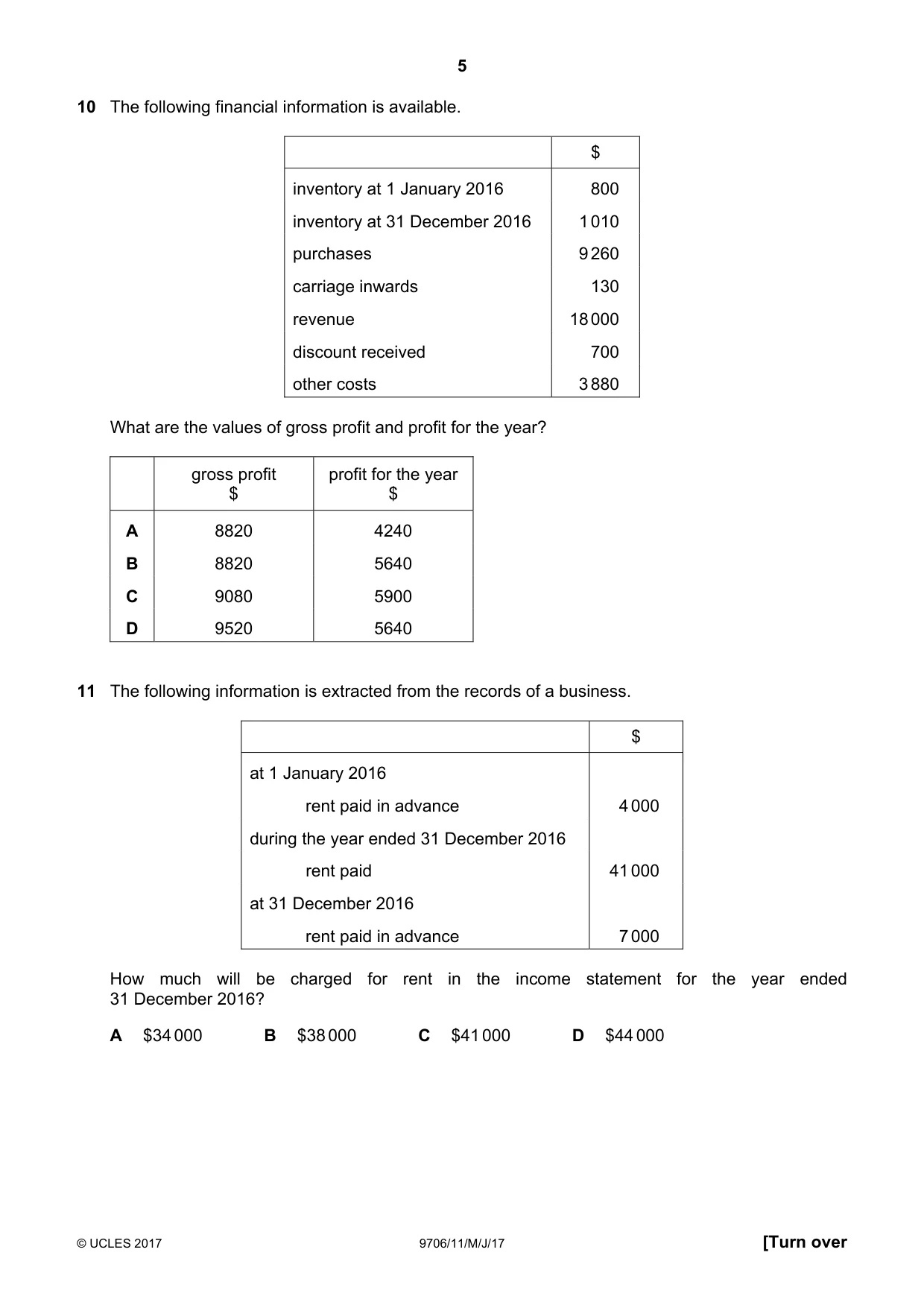
10 The following financial information is available. $ inventory at 1 January 2016 800 inventory at 31 December 2016 1 010 purchases 9 260 carriage inwards 130 revenue 18 000 discount received 700 other costs 3 880 What are the values of gross profit and profit for the year? gross profit profit for the year $ $ A 8820 4240 B 8820 5640 C 9080 5900 D 9520 5640
Mark scheme: B
Q11 · The following information is extracted from the records of a business
11 The following information is extracted from the records of a business. $ at 1 January 2016 rent paid in advance 4 000 during the year ended 31 December 2016 rent paid 41 000 at 31 December 2016 rent paid in advance 7 000 How much will be charged for rent in the income statement for the year ended 31 December 2016? A $34 000 B $38 000 C $41 000 D $44 000
Mark scheme: B
Q12 · The assets of a partnership were revalued when a partner retired
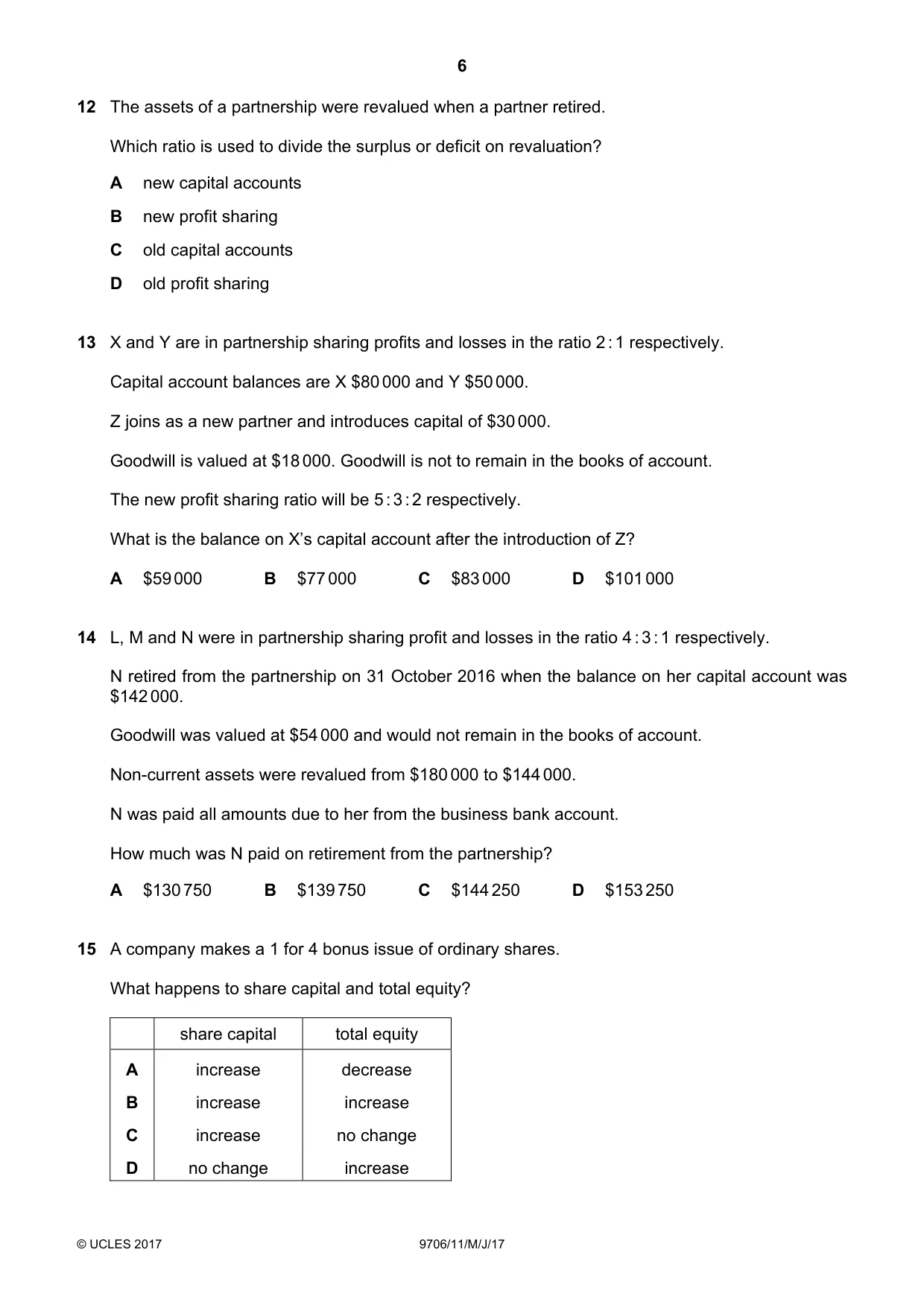
12 The assets of a partnership were revalued when a partner retired. Which ratio is used to divide the surplus or deficit on revaluation? A new capital accounts B new profit sharing C old capital accounts D old profit sharing
Mark scheme: D
Q13 · X and Y are in partnership sharing profits and losses in the ratio 2 : 1 respectively
13 X and Y are in partnership sharing profits and losses in the ratio 2 : 1 respectively. Capital account balances are X $80 000 and Y $50 000. Z joins as a new partner and introduces capital of $30 000. Goodwill is valued at $18 000. Goodwill is not to remain in the books of account. The new profit sharing ratio will be 5 : 3 : 2 respectively. What is the balance on X’s capital account after the introduction of Z? A $59 000 B $77 000 C $83 000 D $101 000
Mark scheme: C
Q14 · L, M and N were in partnership sharing profit and losses in the ratio 4 : 3 : 1…
14 L, M and N were in partnership sharing profit and losses in the ratio 4 : 3 : 1 respectively. N retired from the partnership on 31 October 2016 when the balance on her capital account was $142 000. Goodwill was valued at $54 000 and would not remain in the books of account. Non-current assets were revalued from $180 000 to $144 000. N was paid all amounts due to her from the business bank account. How much was N paid on retirement from the partnership? A $130 750 B $139 750 C $144 250 D $153 250
Mark scheme: C
Q15 · A company makes a 1 for 4 bonus issue of ordinary shares
15 A company makes a 1 for 4 bonus issue of ordinary shares. What happens to share capital and total equity? share capital total equity A increase decrease B increase increase C increase no change D no change increase
Mark scheme: C
Q16 · A company has the following: 12 000 ordinary shares of $1 each 10% debenture $10 000 It…
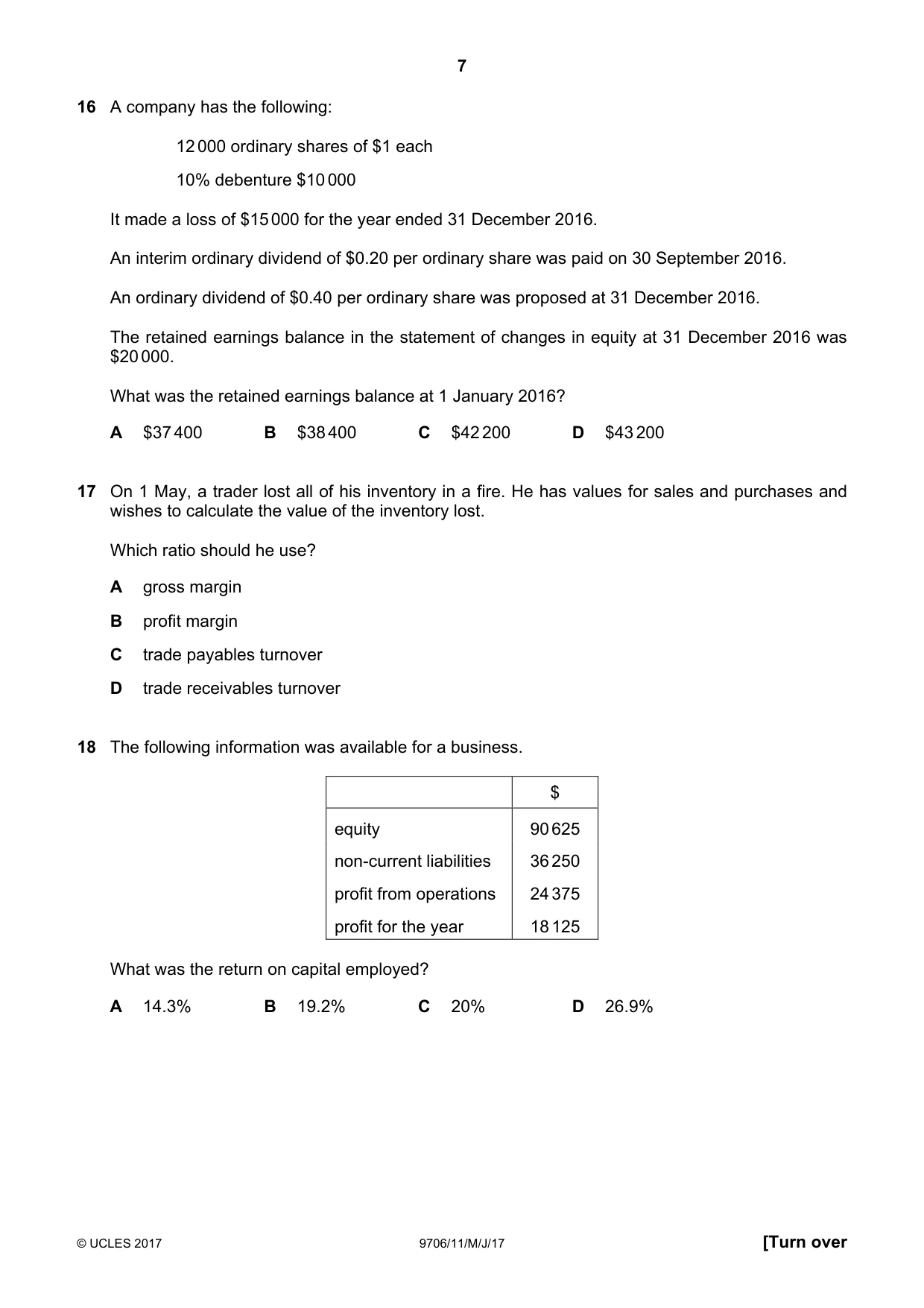
16 A company has the following: 12 000 ordinary shares of $1 each 10% debenture $10 000 It made a loss of $15 000 for the year ended 31 December 2016. An interim ordinary dividend of $0.20 per ordinary share was paid on 30 September 2016. An ordinary dividend of $0.40 per ordinary share was proposed at 31 December 2016. The retained earnings balance in the statement of changes in equity at 31 December 2016 was $20 000. What was the retained earnings balance at 1 January 2016? A $37 400 B $38 400 C $42 200 D $43 200
Mark scheme: A
Q17 · On 1 May, a trader lost all of his inventory in a fire
17 On 1 May, a trader lost all of his inventory in a fire. He has values for sales and purchases and wishes to calculate the value of the inventory lost. Which ratio should he use? A gross margin B profit margin C trade payables turnover D trade receivables turnover
Mark scheme: A
More questions on Analysis and communication of accounting information
Q18 · The following information was available for a business
18 The following information was available for a business. $ equity 90 625 non-current liabilities 36 250 profit from operations 24 375 profit for the year 18 125 What was the return on capital employed? A 14.3% B 19.2% C 20% D 26.9%
Mark scheme: B
More questions on Analysis and communication of accounting information
Q19 · A business provided the following information
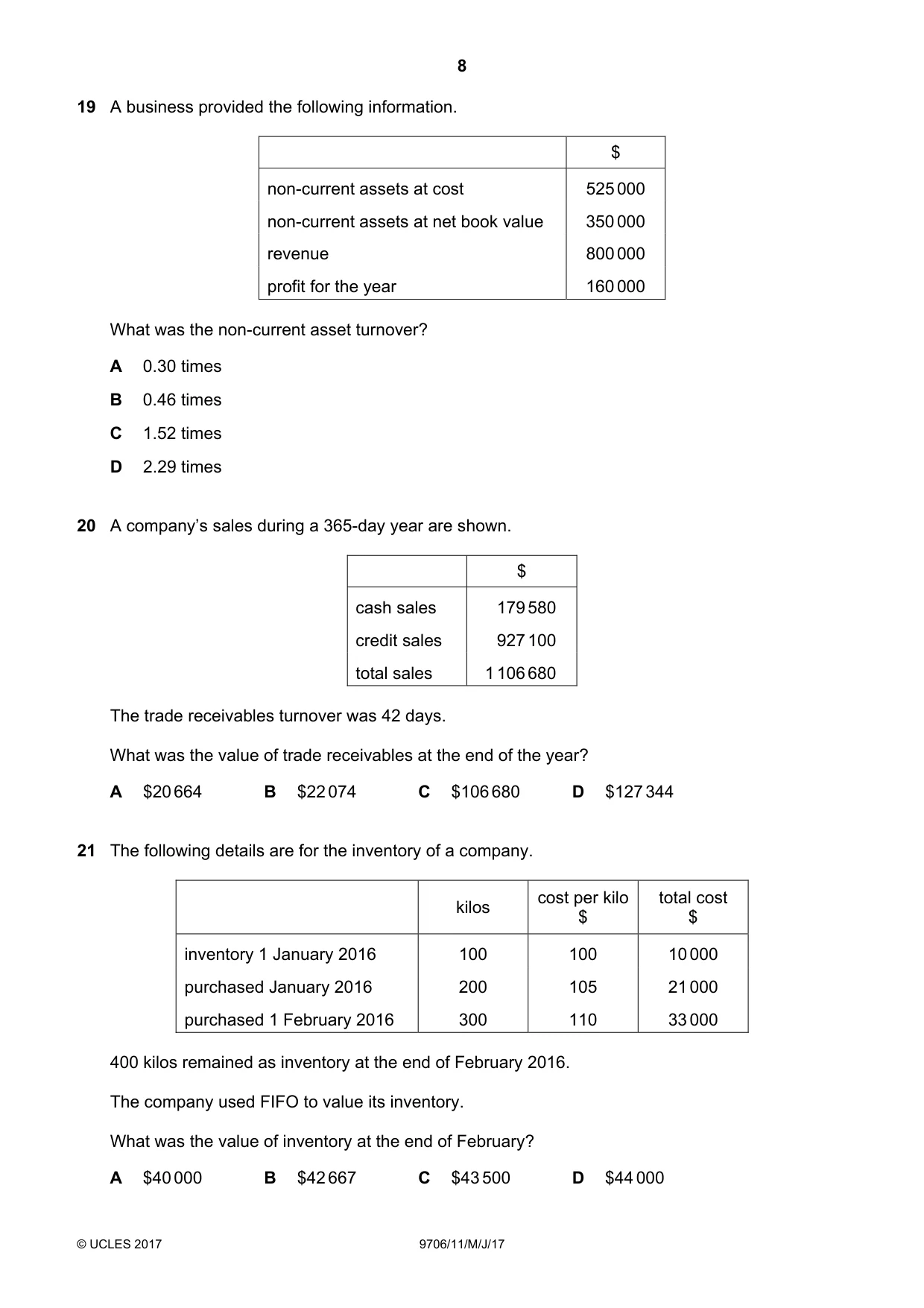
19 A business provided the following information. $ non-current assets at cost 525 000 non-current assets at net book value 350 000 revenue 800 000 profit for the year 160 000 What was the non-current asset turnover? A 0.30 times B 0.46 times C 1.52 times D 2.29 times
Mark scheme: D
More questions on Analysis and communication of accounting information
Q20 · A company’s sales during a 365-day year are shown
20 A company’s sales during a 365-day year are shown. $ cash sales 179 580 credit sales 927 100 total sales 1 106 680 The trade receivables turnover was 42 days. What was the value of trade receivables at the end of the year? A $20 664 B $22 074 C $106 680 D $127 344
Mark scheme: C
More questions on Analysis and communication of accounting information
Q21 · The following details are for the inventory of a company
21 The following details are for the inventory of a company. cost per kilo total cost kilos $ $ inventory 1 January 2016 100 100 10 000 purchased January 2016 200 105 21 000 purchased 1 February 2016 300 110 33 000 400 kilos remained as inventory at the end of February 2016. The company used FIFO to value its inventory. What was the value of inventory at the end of February? A $40 000 B $42 667 C $43 500 D $44 000
Mark scheme: C
Q22 · Which item is a direct cost?
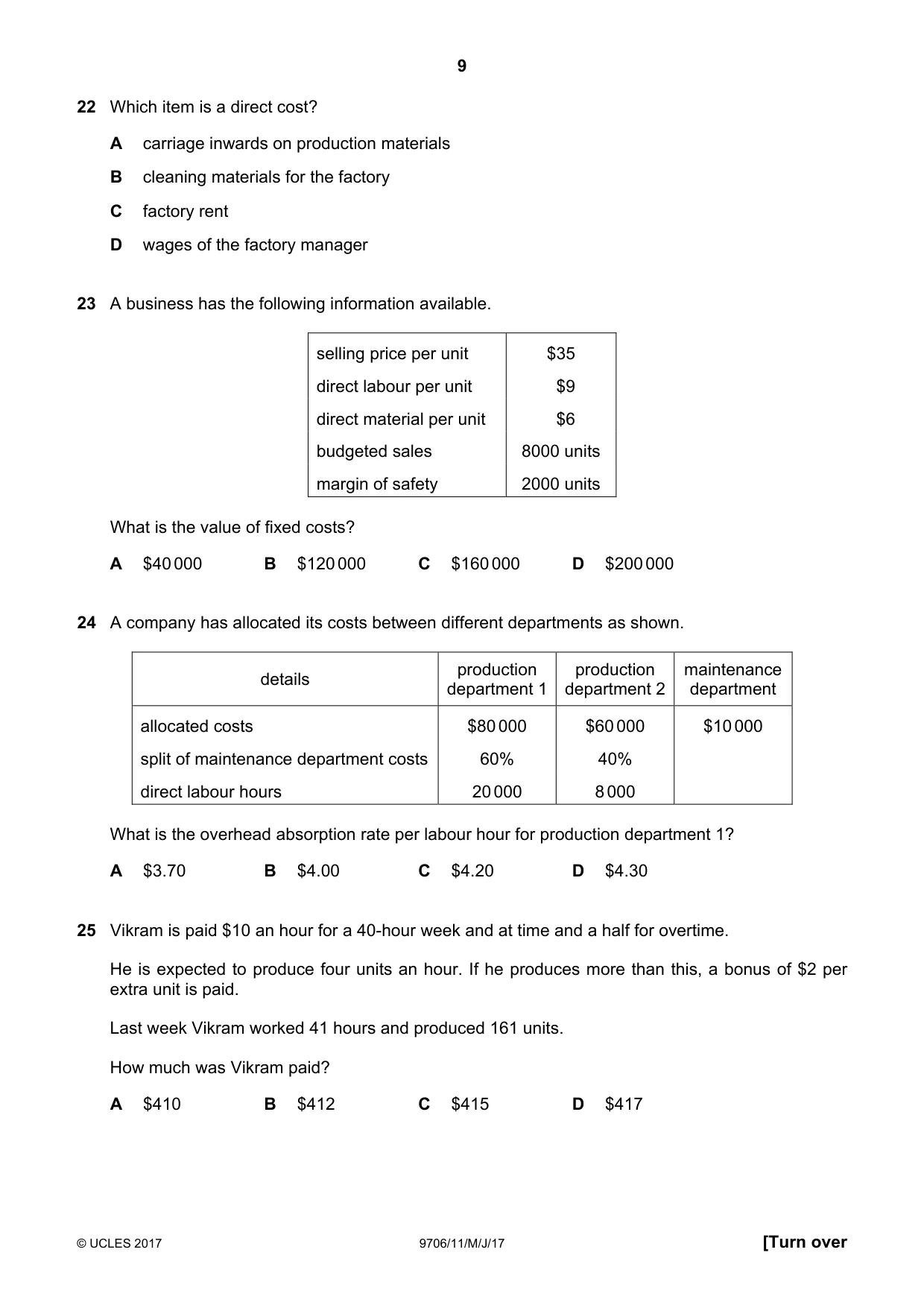
22 Which item is a direct cost? A carriage inwards on production materials B cleaning materials for the factory C factory rent D wages of the factory manager
Mark scheme: A
Q23 · A business has the following information available
23 A business has the following information available. selling price per unit $35 direct labour per unit $9 direct material per unit $6 budgeted sales 8000 units margin of safety 2000 units What is the value of fixed costs? A $40 000 B $120 000 C $160 000 D $200 000
Mark scheme: B
Q24 · A company has allocated its costs between different departments as shown
24 A company has allocated its costs between different departments as shown. production production maintenance details department 1 department 2 department allocated costs $80 000 $60 000 $10 000 split of maintenance department costs 60% 40% direct labour hours 20 000 8 000 What is the overhead absorption rate per labour hour for production department 1? A $3.70 B $4.00 C $4.20 D $4.30
Mark scheme: D
Q25 · Vikram is paid $10 an hour for a 40-hour week and at time and a half for overtime
25 Vikram is paid $10 an hour for a 40-hour week and at time and a half for overtime. He is expected to produce four units an hour. If he produces more than this, a bonus of $2 per extra unit is paid. Last week Vikram worked 41 hours and produced 161 units. How much was Vikram paid? A $410 B $412 C $415 D $417
Mark scheme: C
Q26 · A business operated a staff canteen at a cost of $12 000
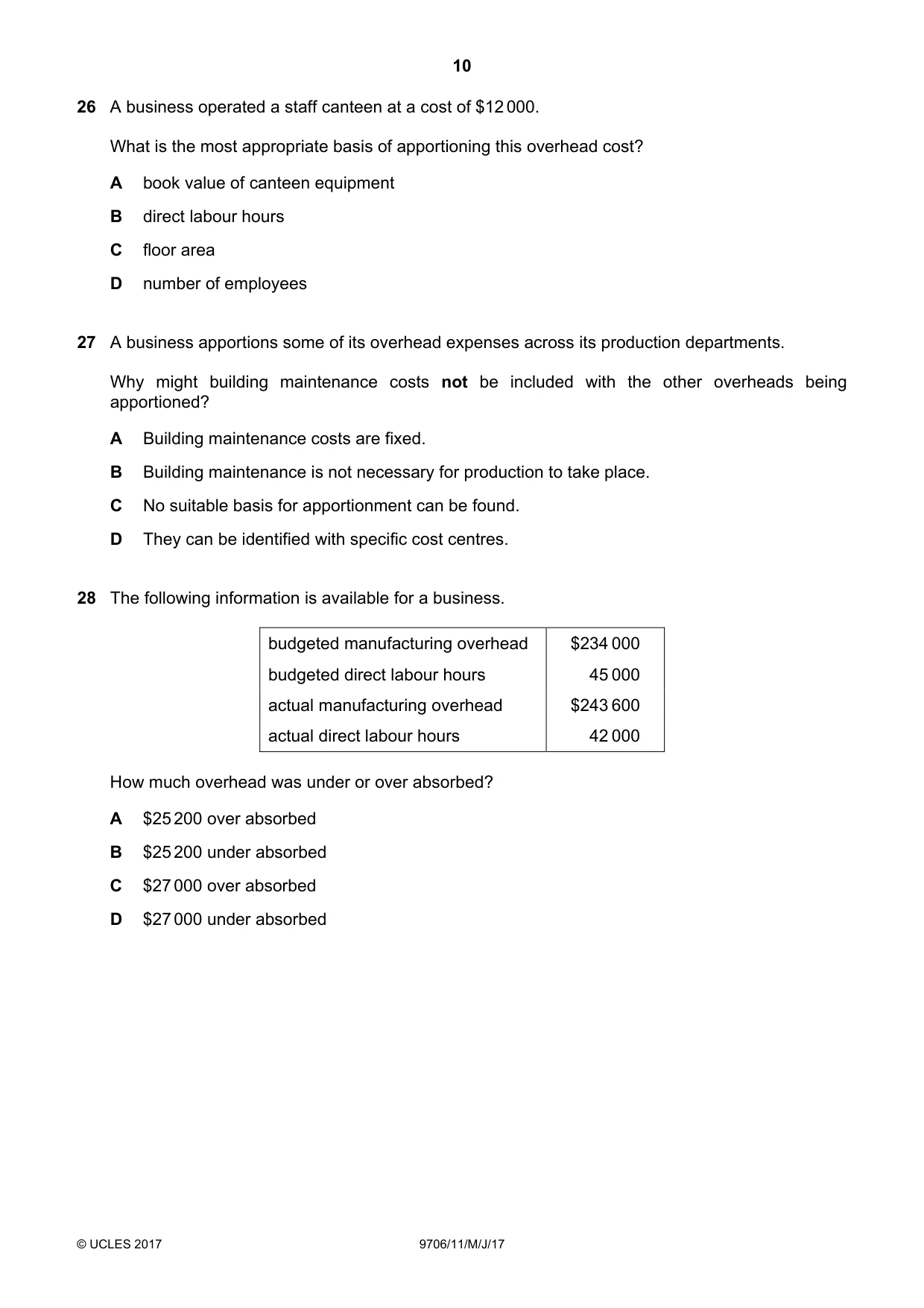
26 A business operated a staff canteen at a cost of $12 000. What is the most appropriate basis of apportioning this overhead cost? A book value of canteen equipment B direct labour hours C floor area D number of employees
Mark scheme: D
Q27 · A business apportions some of its overhead expenses across its production departments
27 A business apportions some of its overhead expenses across its production departments. Why might building maintenance costs not be included with the other overheads being apportioned? A Building maintenance costs are fixed. B Building maintenance is not necessary for production to take place. C No suitable basis for apportionment can be found. D They can be identified with specific cost centres.
Mark scheme: D
Q28 · The following information is available for a business
28 The following information is available for a business. budgeted manufacturing overhead $234 000 budgeted direct labour hours 45 000 actual manufacturing overhead $243 600 actual direct labour hours 42 000 How much overhead was under or over absorbed? A $25 200 over absorbed B $25 200 under absorbed C $27 000 over absorbed D $27 000 under absorbed
Mark scheme: B
Q29 · A company manufactures and sells 10 000 units
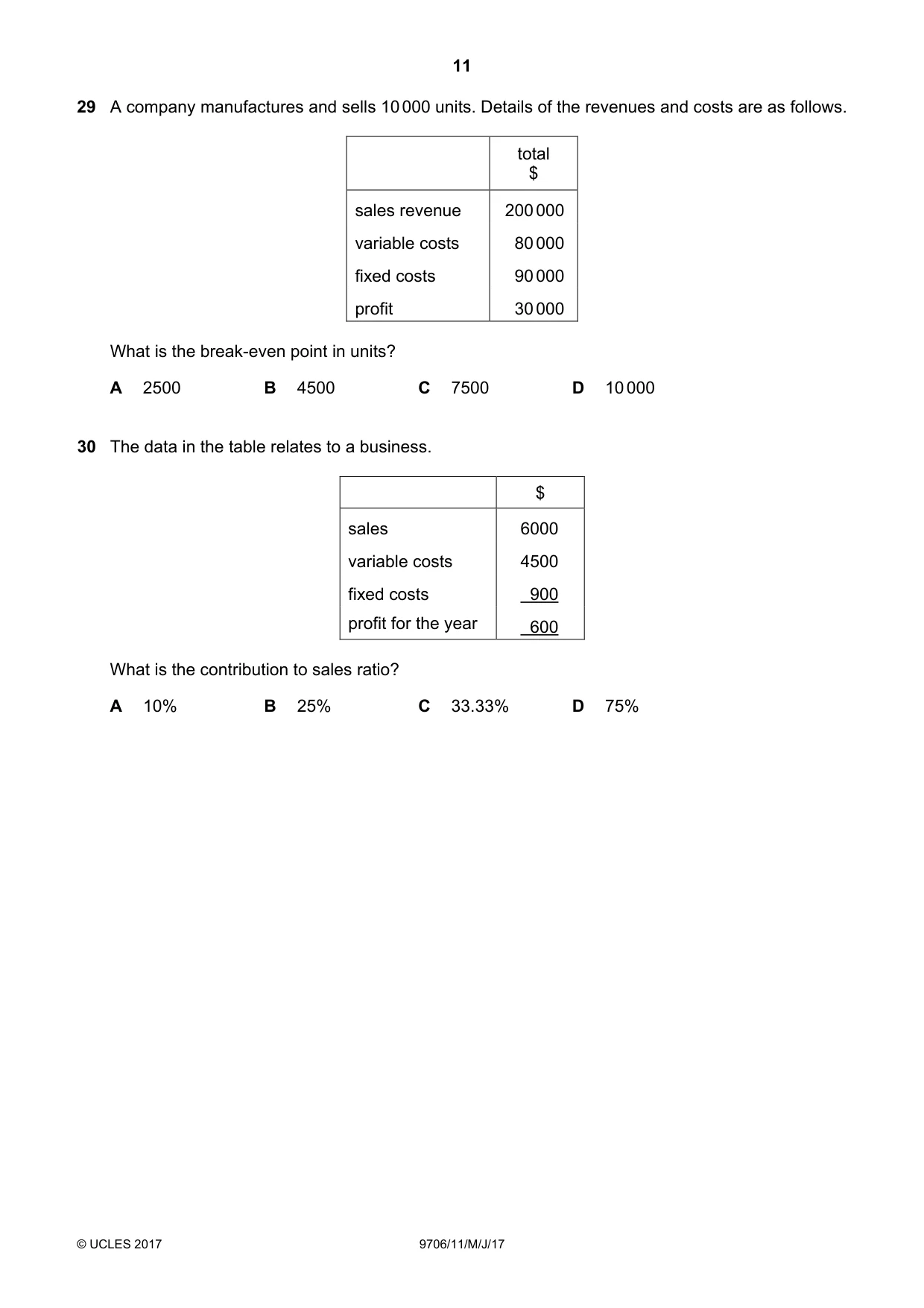
29 A company manufactures and sells 10 000 units. Details of the revenues and costs are as follows. total $ sales revenue 200 000 variable costs 80 000 fixed costs 90 000 profit 30 000 What is the break-even point in units? A 2500 B 4500 C 7500 D 10 000
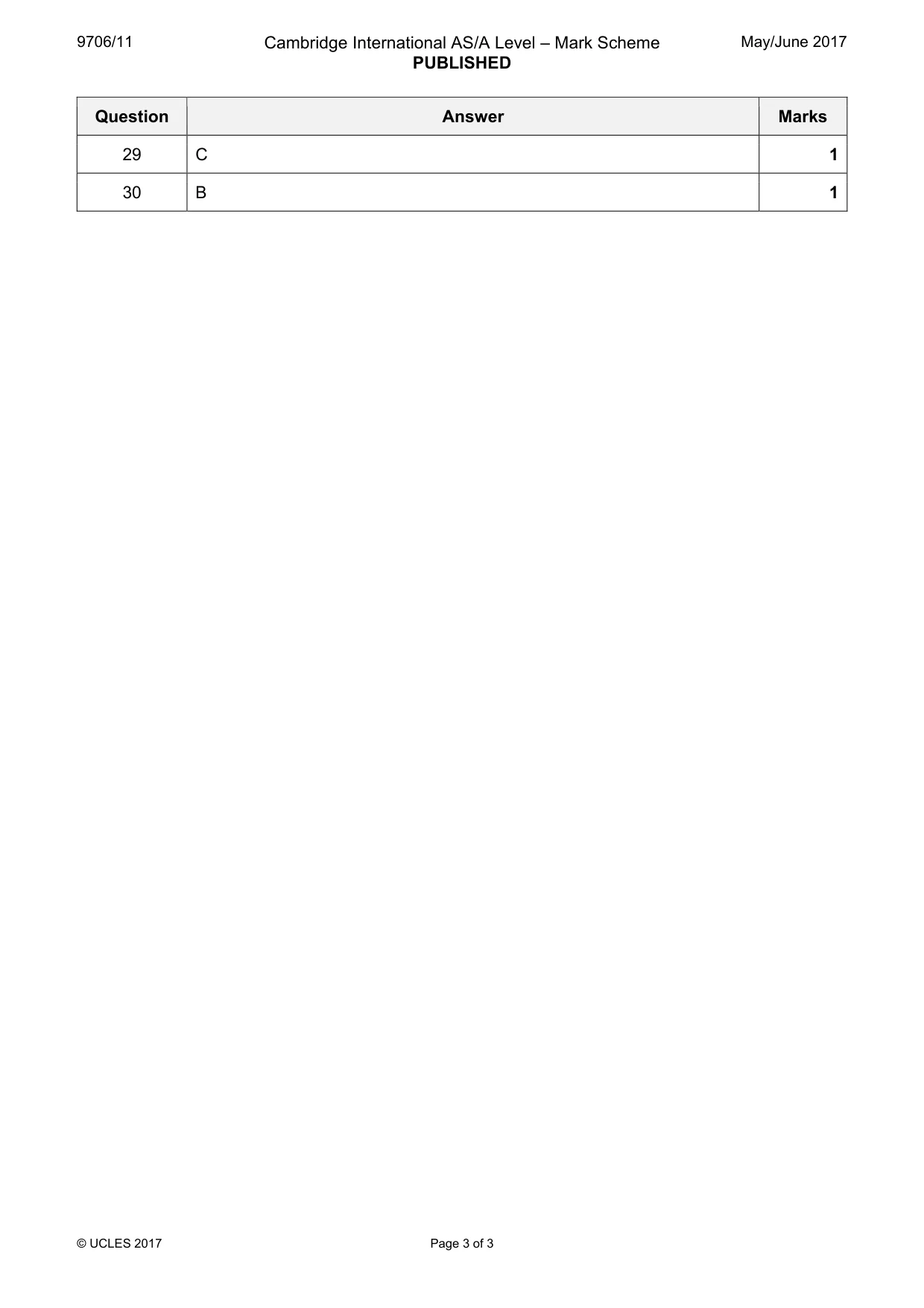
Mark scheme: C
Q30 · The data in the table relates to a business
30 The data in the table relates to a business. $ sales 6000 variable costs 4500 fixed costs 900 profit for the year 600 What is the contribution to sales ratio? A 10% B 25% C 33.33% D 75%
Mark scheme: B
What was in this paper
The subtopics covered by these 30 questions, and how many questions each got. Open one in a new tab to see every Cambridge question on it.
What you needed in this session
Cambridge’s own grade thresholds for 2017 May/June, Paper 1 · Variant 1. A higher threshold means an easier paper — the bar moves with how the cohort did.