Cambridge A Level Accounting 9706 — 2022 May/June Paper 1 · Variant 2
9706/12/M/J/22 · 30 questions · 30 marks · ≈34 min
The question paper and its mark scheme, free to read here and free to download. This is Cambridge’s own paper, exactly as it was sat.
Question paper12 pages
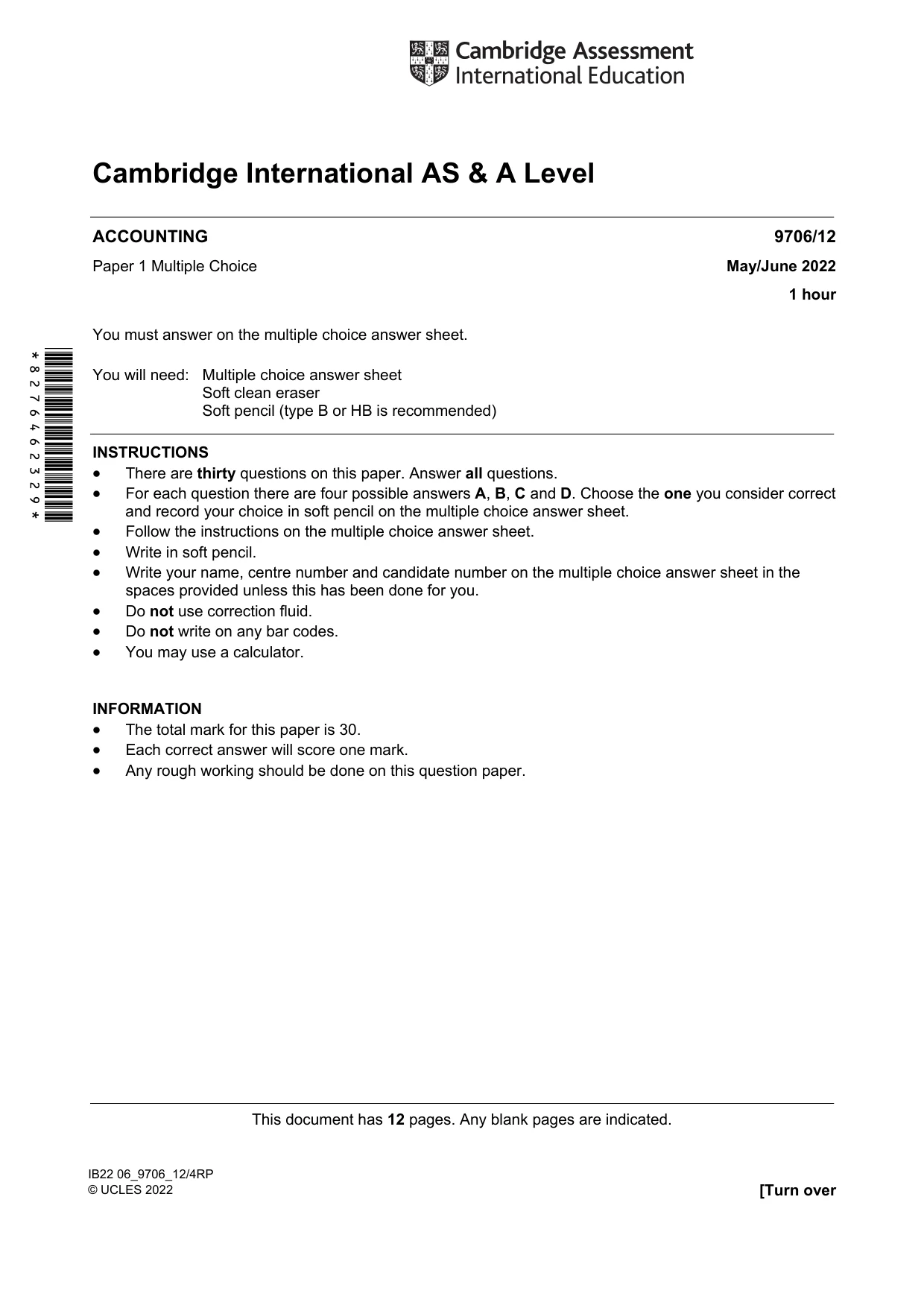

Mark scheme3 pages
Answers below. Sit the paper first if you are practising.
Questions as text
Q1 · Which accounting concept states that revenue can only be recognised after it has been…
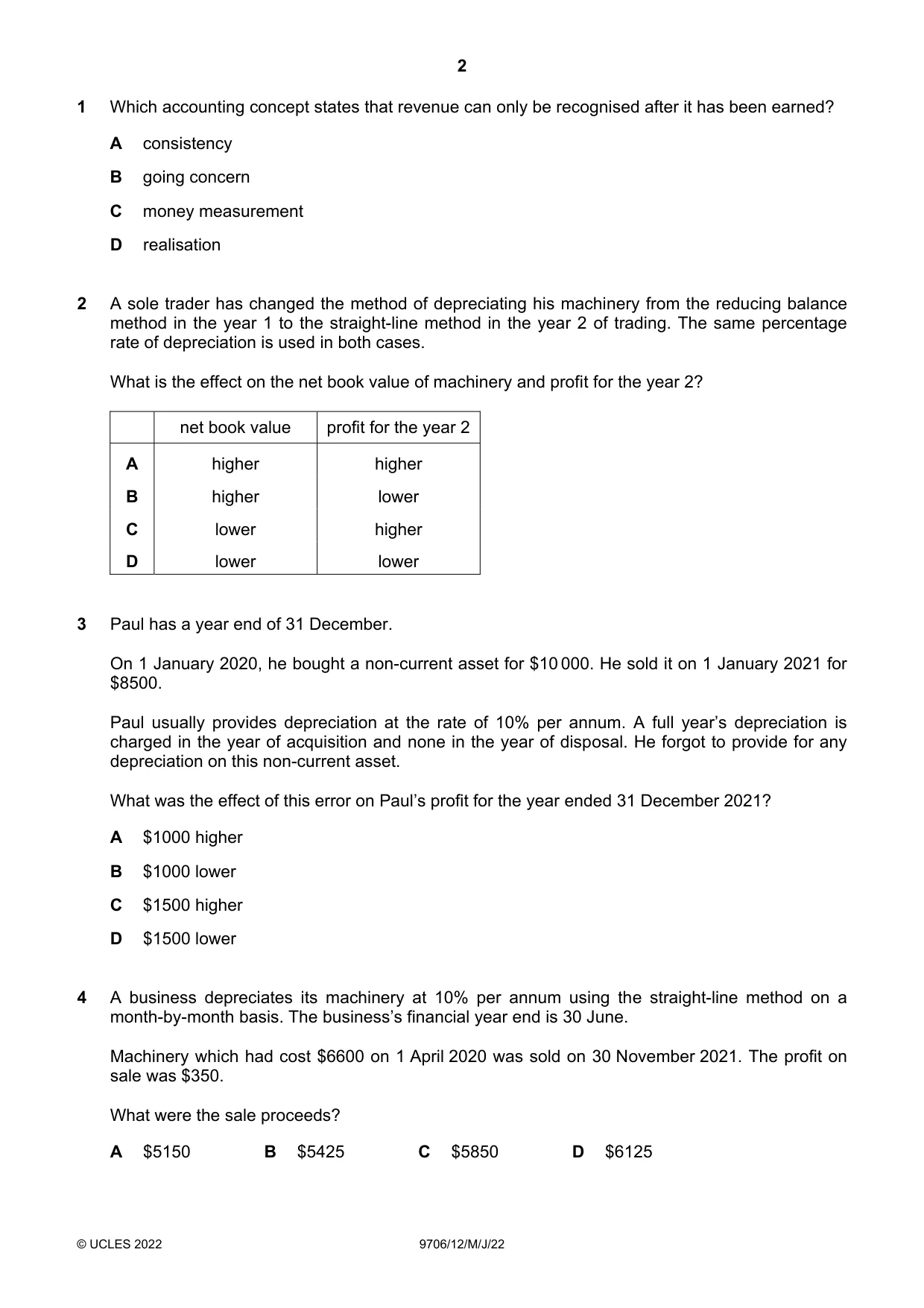
1 Which accounting concept states that revenue can only be recognised after it has been earned? A consistency B going concern C money measurement D realisation
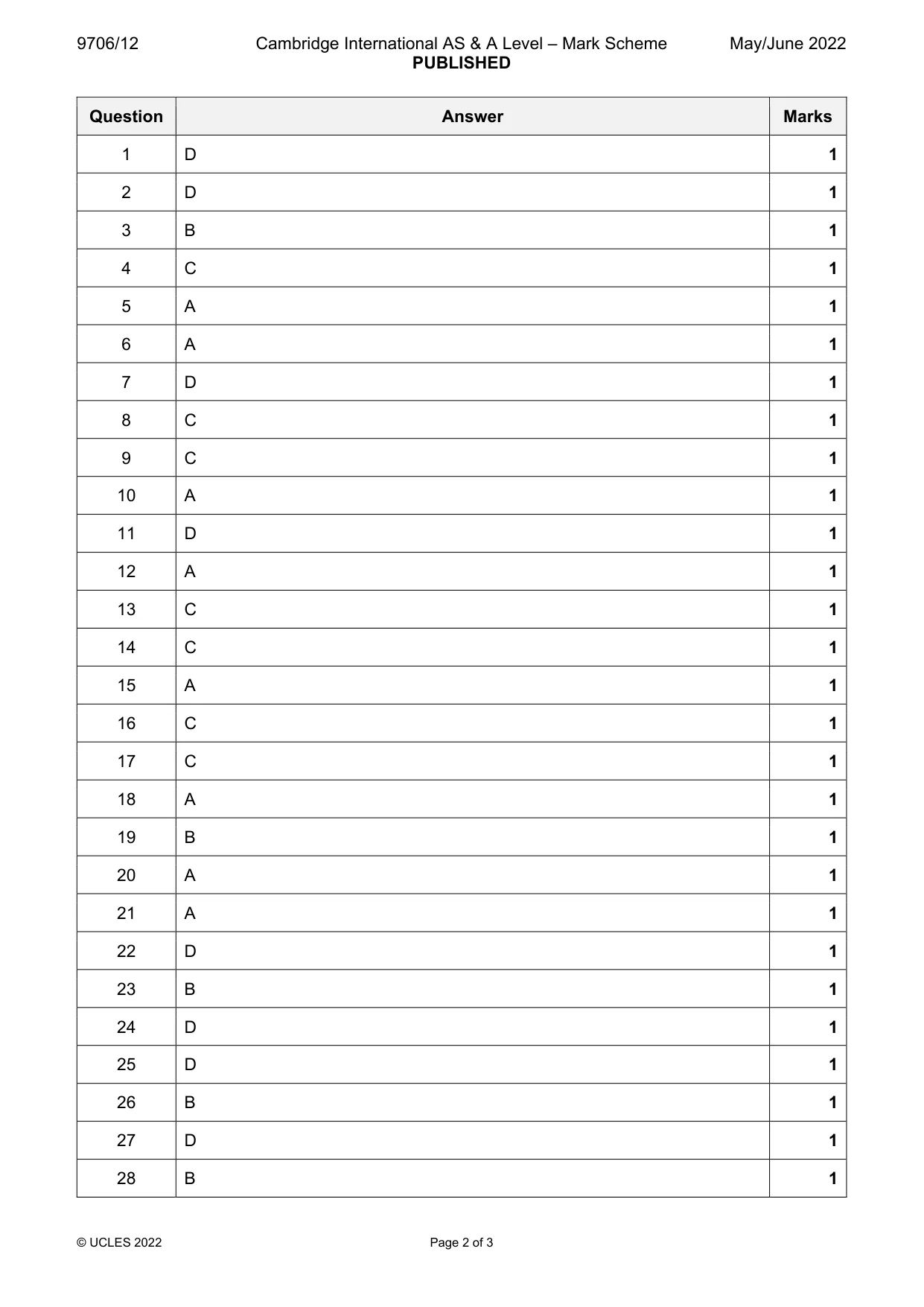
Mark scheme: D
Q2 · A sole trader has changed the method of depreciating his machinery from the reducing…
2 A sole trader has changed the method of depreciating his machinery from the reducing balance method in the year 1 to the straight-line method in the year 2 of trading. The same percentage rate of depreciation is used in both cases. What is the effect on the net book value of machinery and profit for the year 2? net book value profit for the year 2 A higher higher B higher lower C lower higher D lower lower
Mark scheme: D
Q3 · Paul has a year end of 31 December
3 Paul has a year end of 31 December. On 1 January 2020, he bought a non-current asset for $10 000. He sold it on 1 January 2021 for $8500. Paul usually provides depreciation at the rate of 10% per annum. A full year’s depreciation is charged in the year of acquisition and none in the year of disposal. He forgot to provide for any depreciation on this non-current asset. What was the effect of this error on Paul’s profit for the year ended 31 December 2021? A $1000 higher B $1000 lower C $1500 higher D $1500 lower
Mark scheme: B
Q4 · A business depreciates its machinery at 10% per annum using the straight-line method on a…
4 A business depreciates its machinery at 10% per annum using the straight-line method on a month-by-month basis. The business’s financial year end is 30 June. Machinery which had cost $6600 on 1 April 2020 was sold on 30 November 2021. The profit on sale was $350. What were the sale proceeds? A $5150 B $5425 C $5850 D $6125
Mark scheme: C
Q5 · Why does a business maintain sales and purchases ledger control accounts as part of the…
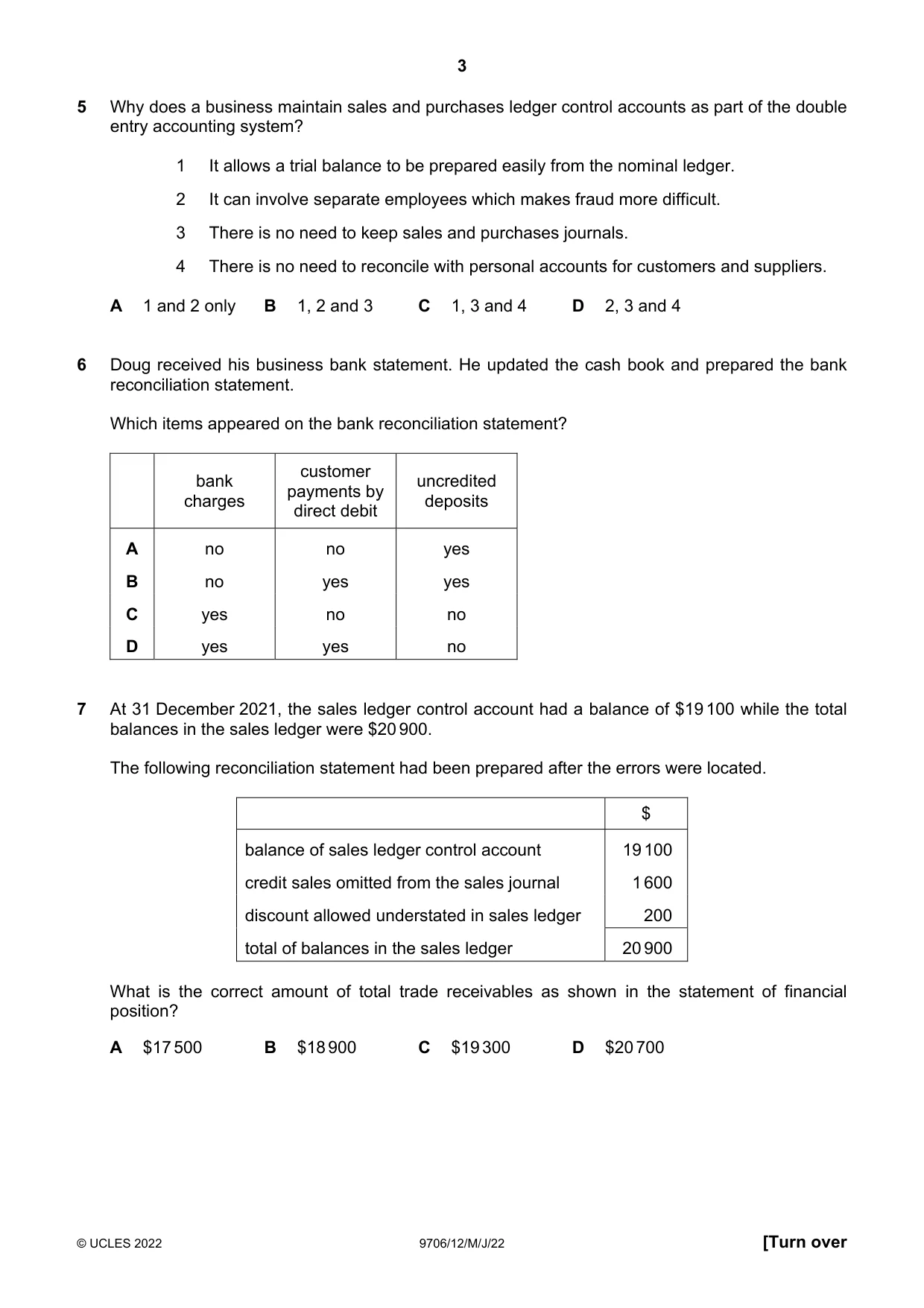
5 Why does a business maintain sales and purchases ledger control accounts as part of the double entry accounting system? 1 It allows a trial balance to be prepared easily from the nominal ledger. 2 It can involve separate employees which makes fraud more difficult. 3 There is no need to keep sales and purchases journals. 4 There is no need to reconcile with personal accounts for customers and suppliers. A 1 and 2 only B 1, 2 and 3 C 1, 3 and 4 D 2, 3 and 4
Mark scheme: A
Q6 · Doug received his business bank statement
6 Doug received his business bank statement. He updated the cash book and prepared the bank reconciliation statement. Which items appeared on the bank reconciliation statement? customer bank uncredited payments by charges deposits direct debit A no no yes B no yes yes C yes no no D yes yes no
Mark scheme: A
Q7 · At 31 December 2021, the sales ledger control account had a balance of $19 100 while the…
7 At 31 December 2021, the sales ledger control account had a balance of $19 100 while the total balances in the sales ledger were $20 900. The following reconciliation statement had been prepared after the errors were located. $ balance of sales ledger control account 19 100 credit sales omitted from the sales journal 1 600 discount allowed understated in sales ledger 200 total of balances in the sales ledger 20 900 What is the correct amount of total trade receivables as shown in the statement of financial position? A $17 500 B $18 900 C $19 300 D $20 700
Mark scheme: D
Q8 · At the year-end, Victor had 100 units of inventory which had cost $12 per unit
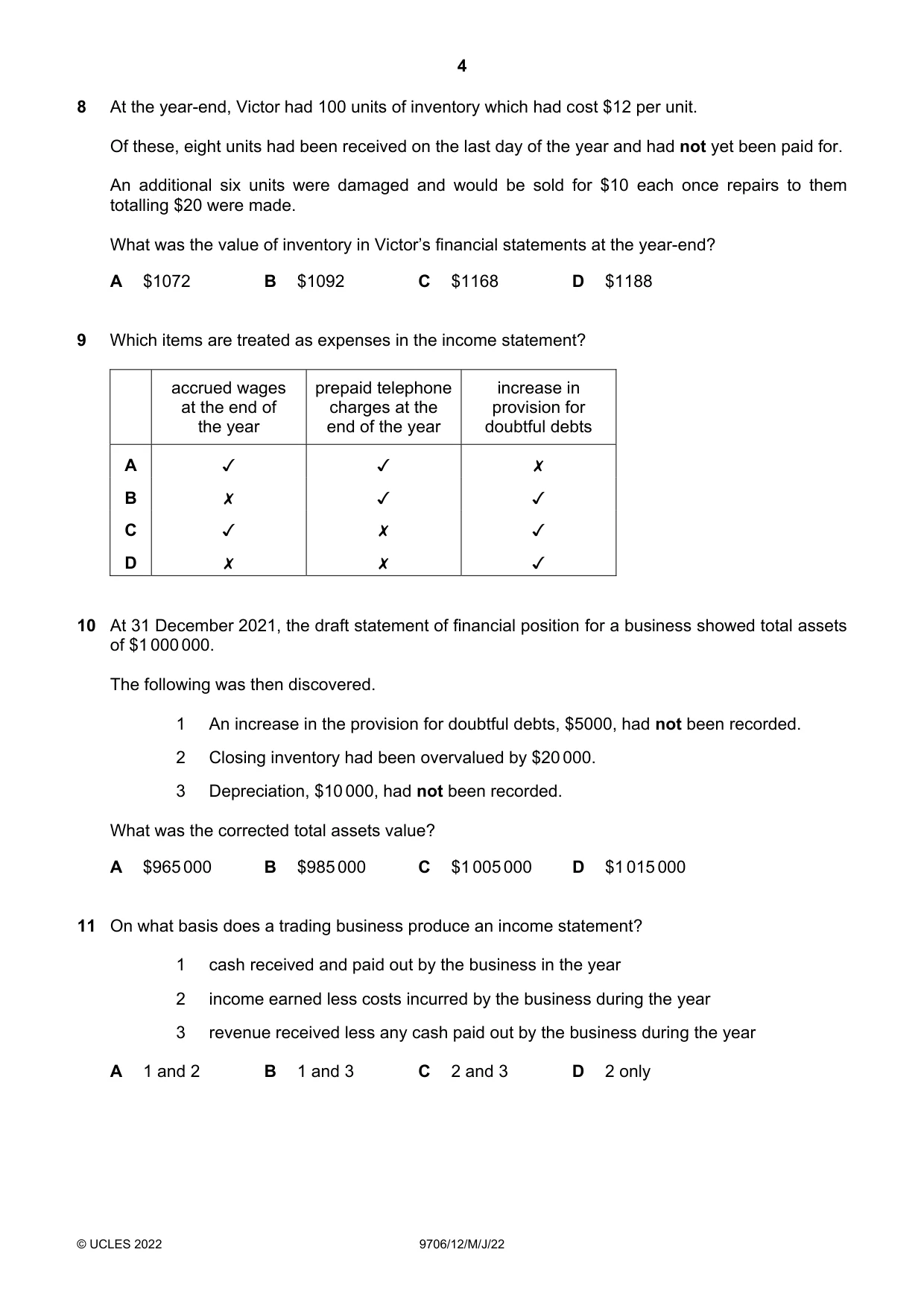
8 At the year-end, Victor had 100 units of inventory which had cost $12 per unit. Of these, eight units had been received on the last day of the year and had not yet been paid for. An additional six units were damaged and would be sold for $10 each once repairs to them totalling $20 were made. What was the value of inventory in Victor’s financial statements at the year-end? A $1072 B $1092 C $1168 D $1188
Mark scheme: C
Q9 · Which items are treated as expenses in the income statement?
9 Which items are treated as expenses in the income statement? accrued wages _| prepaid telephone increase in at the end of charges at the provision for the year end of the year doubtful debts 00 WwW D> <x \ x «x «KX \ \ NX
Mark scheme: C
Q10 · At 31 December 2021, the draft statement of financial position for a business showed…
10 At 31 December 2021, the draft statement of financial position for a business showed total assets of $1 000 000. The following was then discovered. 1 An increase in the provision for doubtful debts, $5000, had not been recorded. 2 Closing inventory had been overvalued by $20 000. 3 Depreciation, $10 000, had not been recorded. What was the corrected total assets value? A $965 000 B $985 000 C $1 005 000 D $1 015 000
Mark scheme: A
Q11 · On what basis does a trading business produce an income statement?
11 On what basis does a trading business produce an income statement? 1 cash received and paid out by the business in the year 2 income earned less costs incurred by the business during the year 3 revenue received less any cash paid out by the business during the year A 1 and 2 B 1 and 3 C 2 and 3 D 2 only
Mark scheme: D
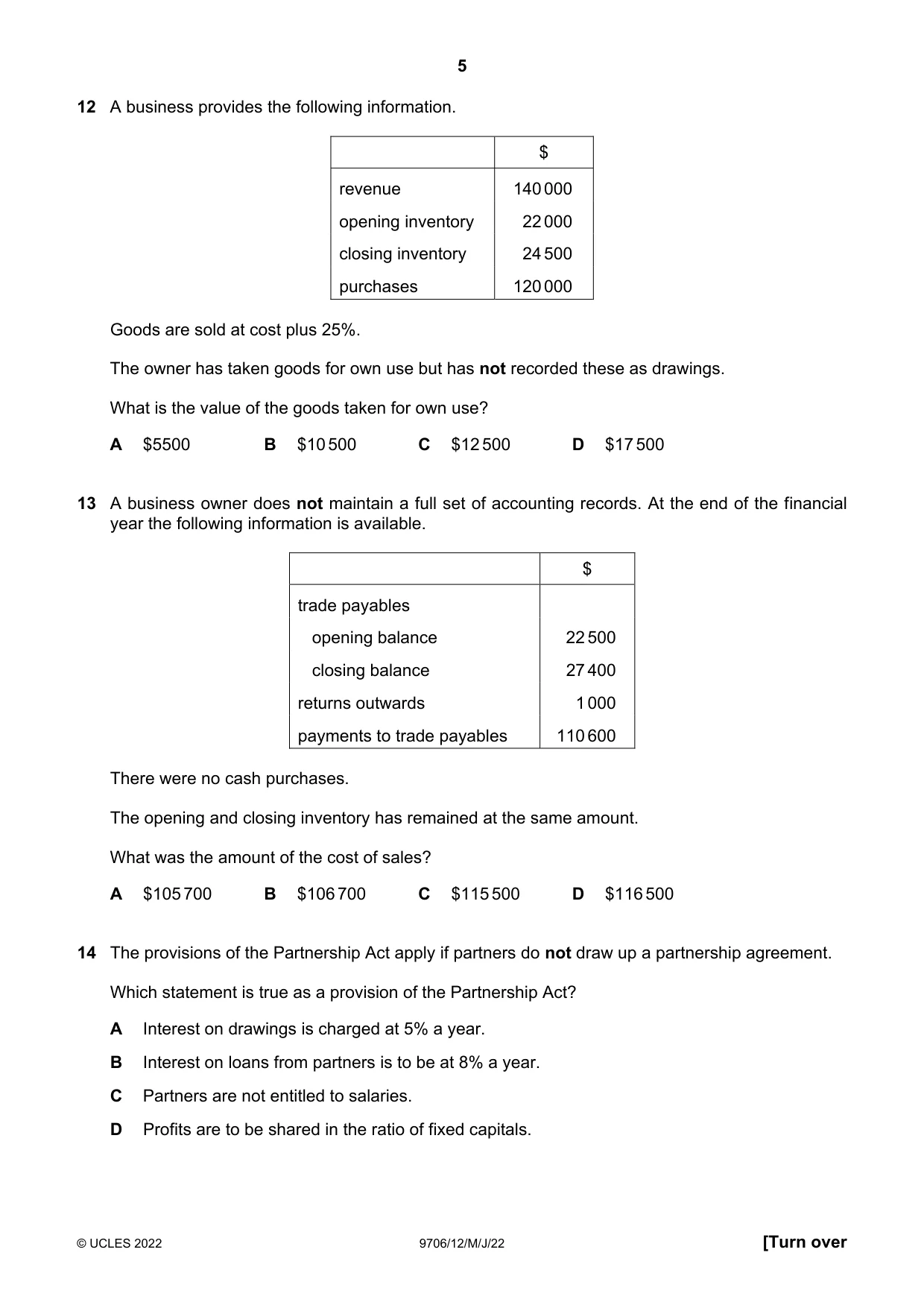
Q12 · A business provides the following information
12 A business provides the following information. $ revenue 140 000 opening inventory 22 000 closing inventory 24 500 purchases 120 000 Goods are sold at cost plus 25%. The owner has taken goods for own use but has not recorded these as drawings. What is the value of the goods taken for own use? A $5500 B $10 500 C $12 500 D $17 500
Mark scheme: A
Q13 · A business owner does not maintain a full set of accounting records
13 A business owner does not maintain a full set of accounting records. At the end of the financial year the following information is available. $ trade payables opening balance 22 500 closing balance 27 400 returns outwards 1 000 payments to trade payables 110 600 There were no cash purchases. The opening and closing inventory has remained at the same amount. What was the amount of the cost of sales? A $105 700 B $106 700 C $115 500 D $116 500
Mark scheme: C
Q14 · The provisions of the Partnership Act apply if partners do not draw up a partnership…
14 The provisions of the Partnership Act apply if partners do not draw up a partnership agreement. Which statement is true as a provision of the Partnership Act? A Interest on drawings is charged at 5% a year. B Interest on loans from partners is to be at 8% a year. C Partners are not entitled to salaries. D Profits are to be shared in the ratio of fixed capitals.
Mark scheme: C
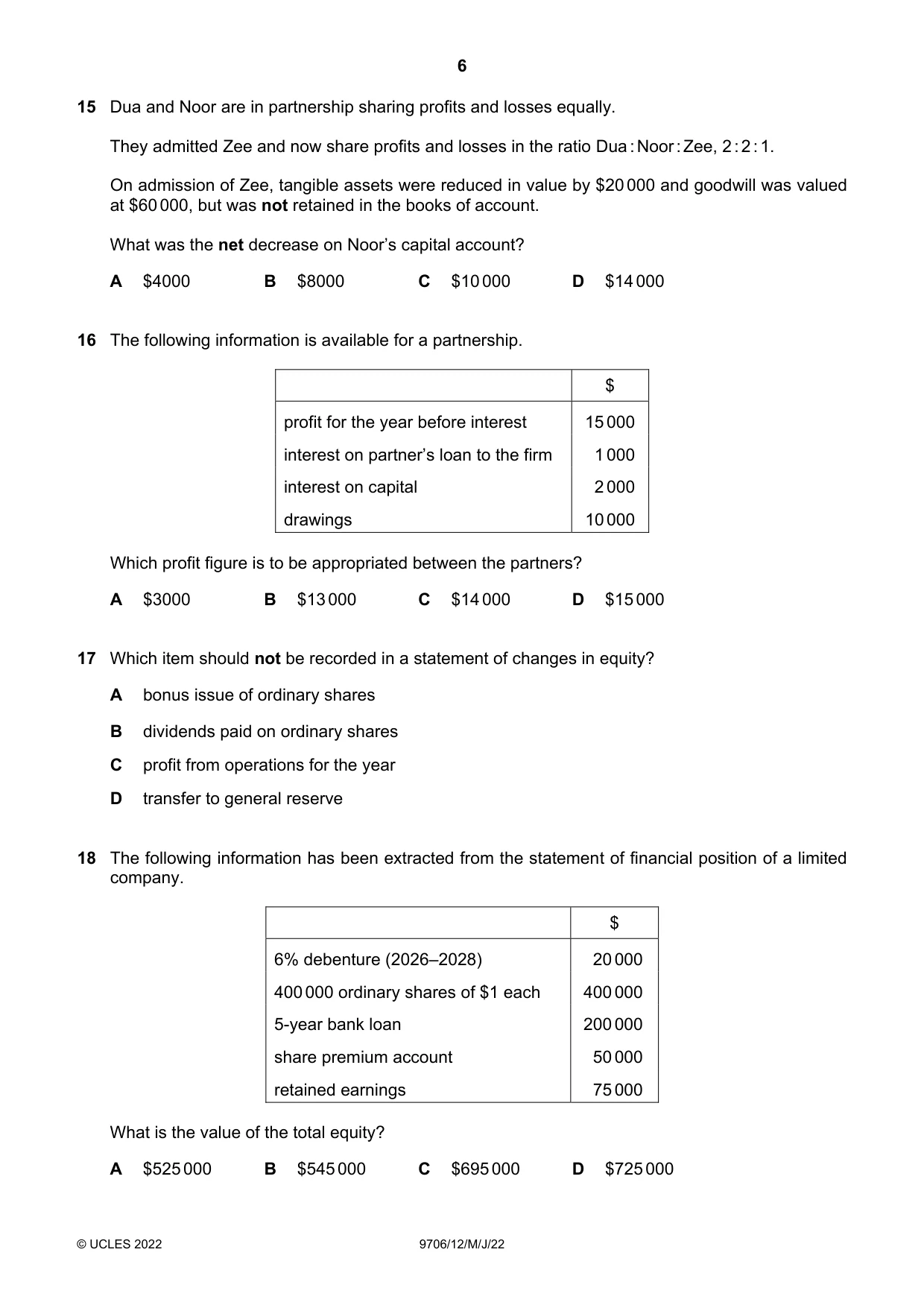
Q15 · Dua and Noor are in partnership sharing profits and losses equally
15 Dua and Noor are in partnership sharing profits and losses equally. They admitted Zee and now share profits and losses in the ratio Dua : Noor : Zee, 2 : 2 : 1. On admission of Zee, tangible assets were reduced in value by $20 000 and goodwill was valued at $60 000, but was not retained in the books of account. What was the net decrease on Noor’s capital account? A $4000 B $8000 C $10 000 D $14 000
Mark scheme: A
Q16 · The following information is available for a partnership
16 The following information is available for a partnership. $ profit for the year before interest 15 000 interest on partner’s loan to the firm 1 000 interest on capital 2 000 drawings 10 000 Which profit figure is to be appropriated between the partners? A $3000 B $13 000 C $14 000 D $15 000
Mark scheme: C
Q17 · Which item should not be recorded in a statement of changes in equity?
17 Which item should not be recorded in a statement of changes in equity? A bonus issue of ordinary shares B dividends paid on ordinary shares C profit from operations for the year D transfer to general reserve
Mark scheme: C
Q18 · The following information has been extracted from the statement of financial position of…
18 The following information has been extracted from the statement of financial position of a limited company. $ 6% debenture (2026–2028) 20 000 400 000 ordinary shares of $1 each 400 000 5-year bank loan 200 000 share premium account 50 000 retained earnings 75 000 What is the value of the total equity? A $525 000 B $545 000 C $695 000 D $725 000
Mark scheme: A
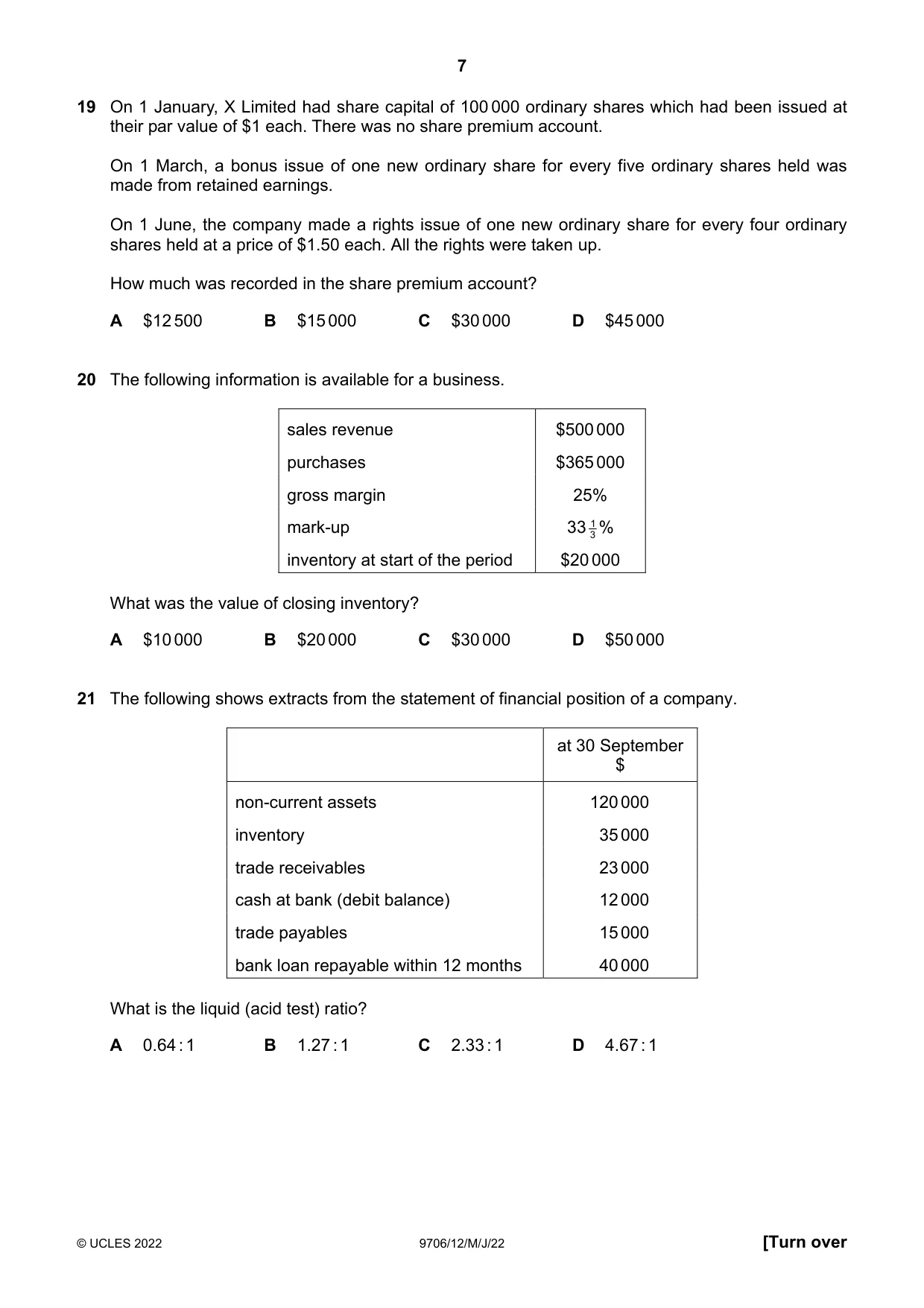
Q19 · On 1 January, X Limited had share capital of 100 000 ordinary shares which had been…
19 On 1 January, X Limited had share capital of 100 000 ordinary shares which had been issued at their par value of $1 each. There was no share premium account. On 1 March, a bonus issue of one new ordinary share for every five ordinary shares held was made from retained earnings. On 1 June, the company made a rights issue of one new ordinary share for every four ordinary shares held at a price of $1.50 each. All the rights were taken up. How much was recorded in the share premium account? A $12 500 B $15 000 C $30 000 D $45 000
Mark scheme: B
Q20 · The following information is available for a business
20 The following information is available for a business. sales revenue $500 000 purchases $365 000 gross margin 25% mark-up 33 % 1 3 inventory at start of the period $20 000 What was the value of closing inventory? A $10 000 B $20 000 C $30 000 D $50 000
Mark scheme: A
More questions on Analysis and communication of accounting information
Q21 · The following shows extracts from the statement of financial position of a company
21 The following shows extracts from the statement of financial position of a company. at 30 September $ non-current assets 120 000 inventory 35 000 trade receivables 23 000 cash at bank (debit balance) 12 000 trade payables 15 000 bank loan repayable within 12 months 40 000 What is the liquid (acid test) ratio? A 0.64 : 1 B 1.27 : 1 C 2.33 : 1 D 4.67 : 1
Mark scheme: A
More questions on Analysis and communication of accounting information
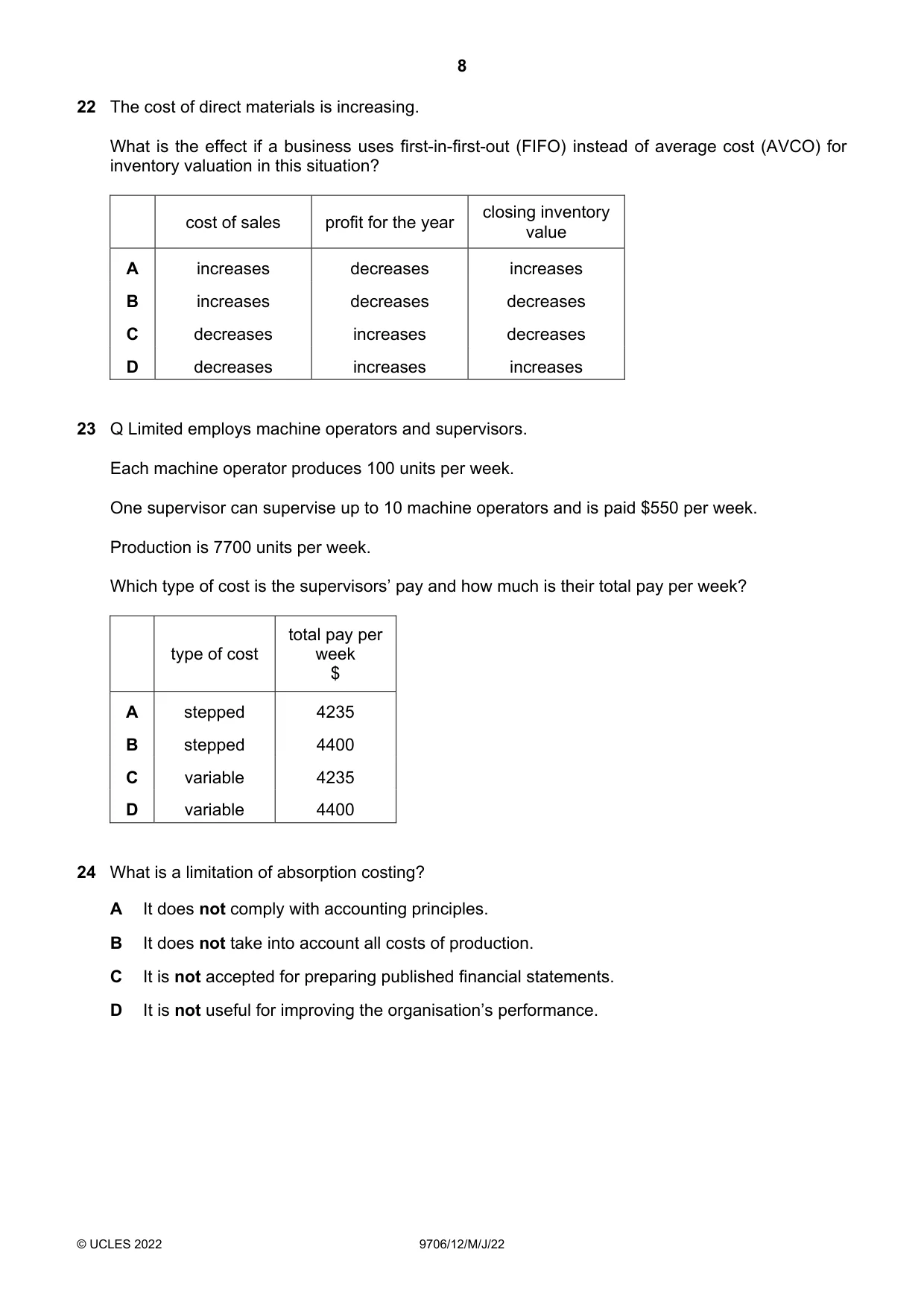
Q22 · The cost of direct materials is increasing
22 The cost of direct materials is increasing. What is the effect if a business uses first-in-first-out (FIFO) instead of average cost (AVCO) for inventory valuation in this situation? closing inventory cost of sales profit for the year value A increases decreases increases B increases decreases decreases C decreases increases decreases D decreases increases increases
Mark scheme: D
Q23 · Q Limited employs machine operators and supervisors
23 Q Limited employs machine operators and supervisors. Each machine operator produces 100 units per week. One supervisor can supervise up to 10 machine operators and is paid $550 per week. Production is 7700 units per week. Which type of cost is the supervisors’ pay and how much is their total pay per week? total pay per type of cost week $ A stepped 4235 B stepped 4400 C variable 4235 D variable 4400
Mark scheme: B
Q24 · What is a limitation of absorption costing?
24 What is a limitation of absorption costing? A It does not comply with accounting principles. B It does not take into account all costs of production. C It is not accepted for preparing published financial statements. D It is not useful for improving the organisation’s performance.
Mark scheme: D
Q25 · The following information relates to one accounting period
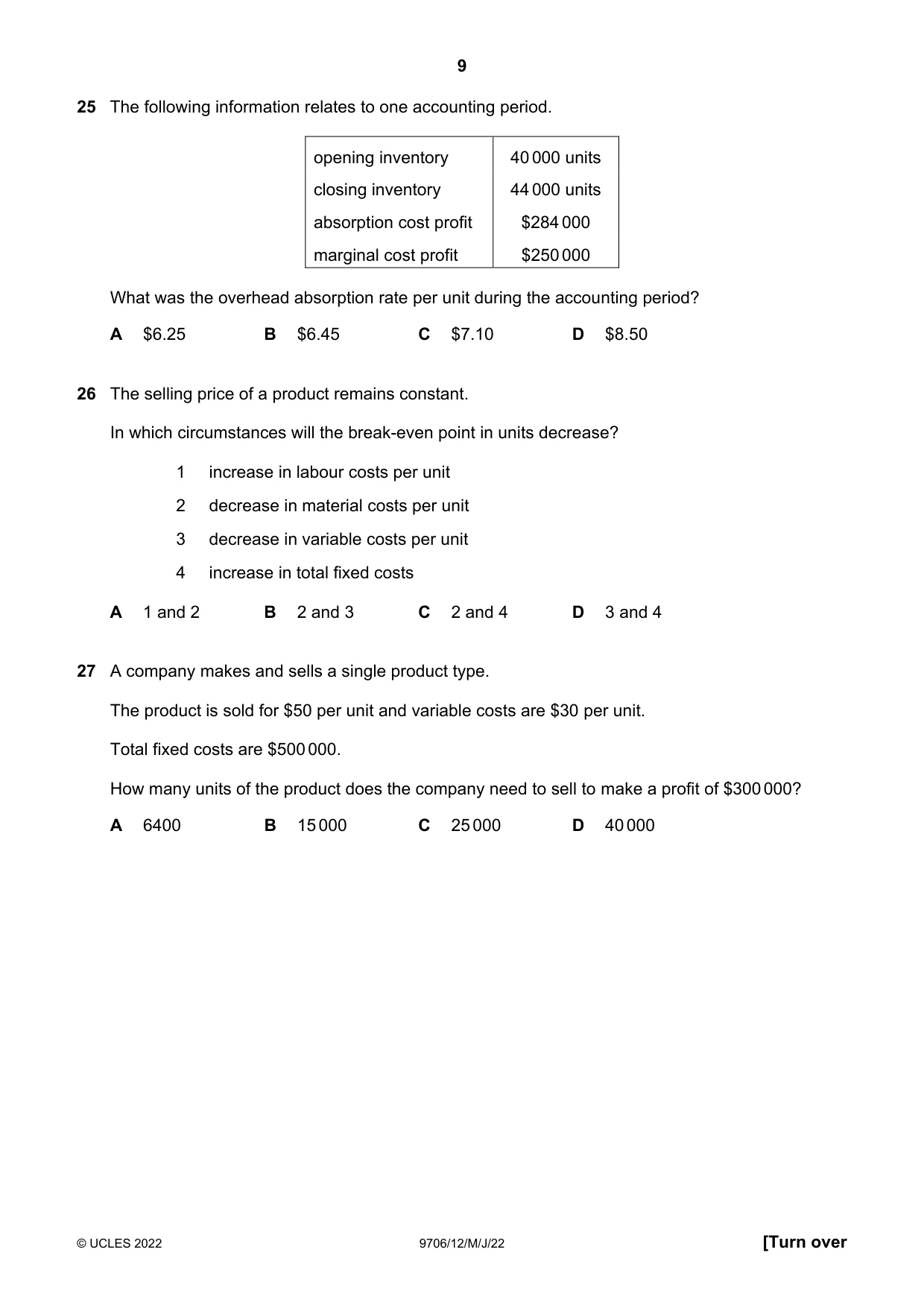
25 The following information relates to one accounting period. opening inventory 40 000 units closing inventory 44 000 units absorption cost profit $284 000 marginal cost profit $250 000 What was the overhead absorption rate per unit during the accounting period? A $6.25 B $6.45 C $7.10 D $8.50
Mark scheme: D
Q26 · The selling price of a product remains constant
26 The selling price of a product remains constant. In which circumstances will the break-even point in units decrease? 1 increase in labour costs per unit 2 decrease in material costs per unit 3 decrease in variable costs per unit 4 increase in total fixed costs A 1 and 2 B 2 and 3 C 2 and 4 D 3 and 4
Mark scheme: B
Q27 · A company makes and sells a single product type
27 A company makes and sells a single product type. The product is sold for $50 per unit and variable costs are $30 per unit. Total fixed costs are $500 000. How many units of the product does the company need to sell to make a profit of $300 000? A 6400 B 15 000 C 25 000 D 40 000
Mark scheme: D
Q28 · A business makes and sells three different product types, M, N and O
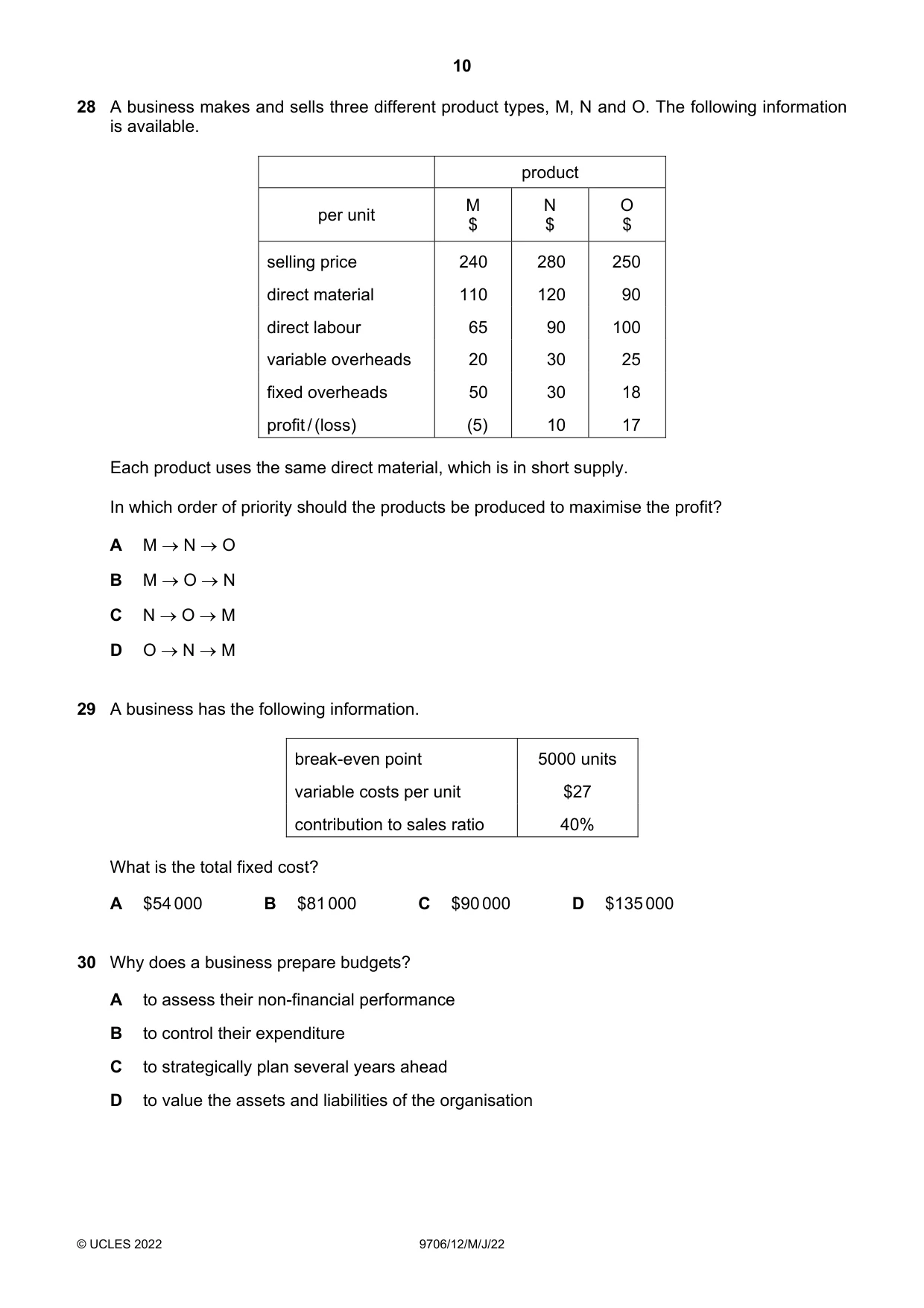
28 A business makes and sells three different product types, M, N and O. The following information is available. product M N O per unit $ $ $ selling price 240 280 250 direct material 110 120 90 direct labour 65 90 100 variable overheads 20 30 25 fixed overheads 50 30 18 profit / (loss) (5) 10 17 Each product uses the same direct material, which is in short supply. In which order of priority should the products be produced to maximise the profit? A M N O B M O N C N O M D O N M
Mark scheme: B
Q29 · A business has the following information
29 A business has the following information. break-even point 5000 units variable costs per unit $27 contribution to sales ratio 40% What is the total fixed cost? A $54 000 B $81 000 C $90 000 D $135 000
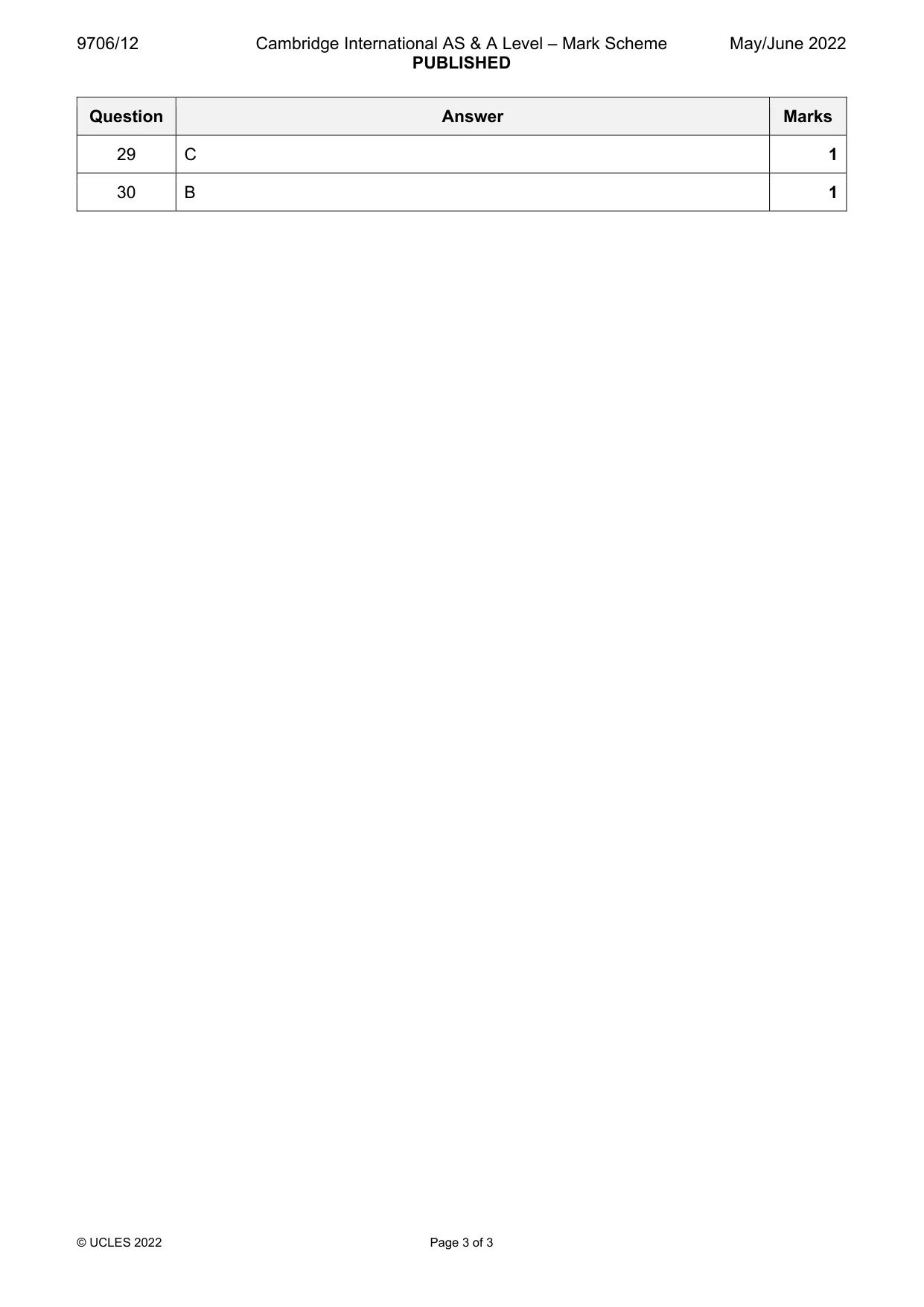
Mark scheme: C
Q30 · Why does a business prepare budgets?
30 Why does a business prepare budgets? A to assess their non-financial performance B to control their expenditure C to strategically plan several years ahead D to value the assets and liabilities of the organisation
Mark scheme: B
What was in this paper
The subtopics covered by these 30 questions, and how many questions each got. Open one in a new tab to see every Cambridge question on it.
6Preparation of financial statements5Traditional costing methods5Accounting for non-current assets3Reconciliation and verification3Analysis and communication of accounting information2Costs and cost behaviour2The accounting system2Budgeting and budgetary control1Types of business entity1What you needed in this session
Cambridge’s own grade thresholds for 2022 May/June, Paper 1 · Variant 2. A higher threshold means an easier paper — the bar moves with how the cohort did.