Cambridge A Level Accounting 9706 — 2018 Oct/Nov Paper 1 · Variant 3
9706/13/O/N/18 · 30 questions · 30 marks · ≈34 min
The question paper and its mark scheme, free to read here and free to download. This is Cambridge’s own paper, exactly as it was sat.
Question paper12 pages

Mark scheme3 pages
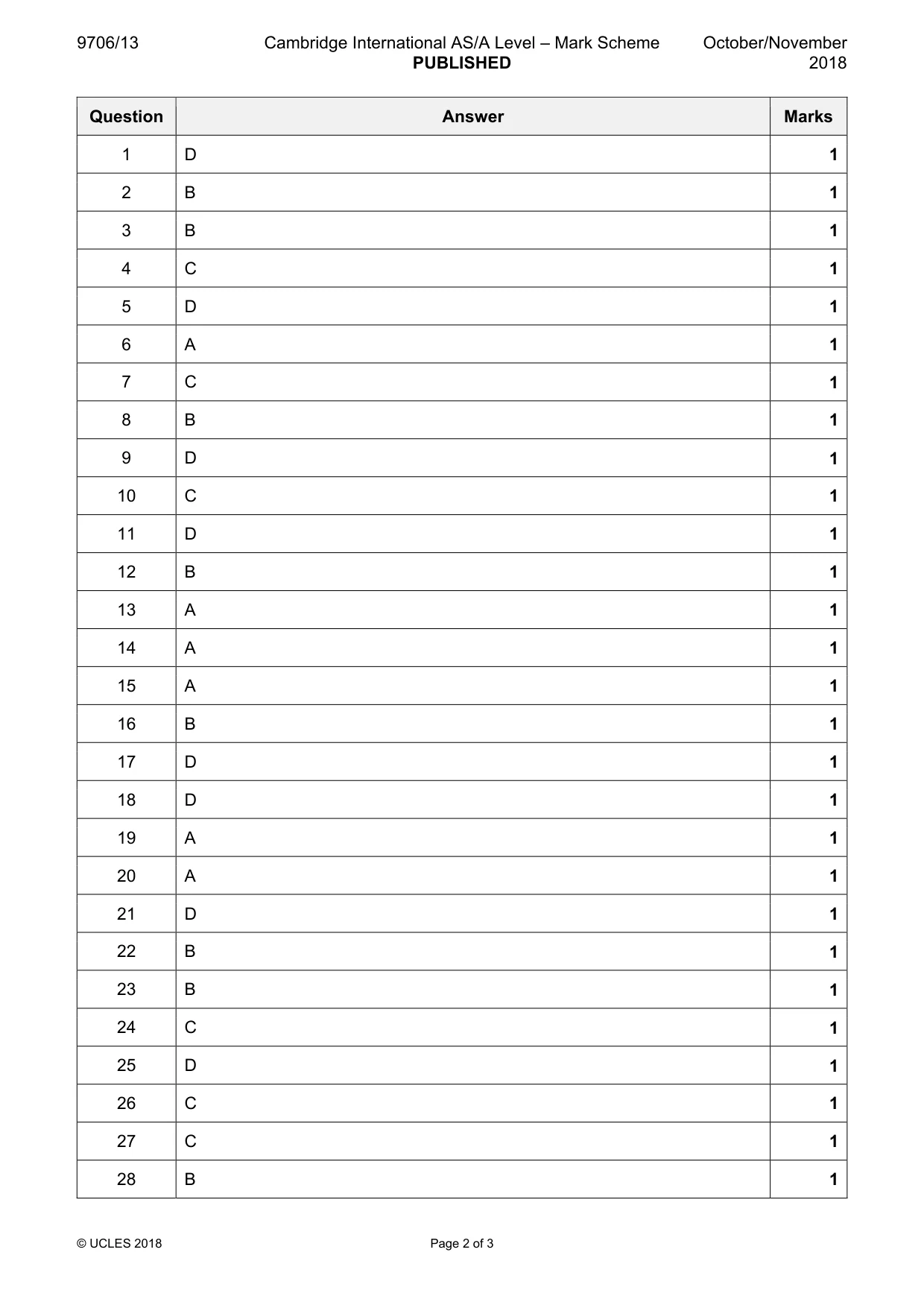
Answers below. Sit the paper first if you are practising.
Questions as text
Q1 · An item is found to be the subject of a material error in a company’s financial statements
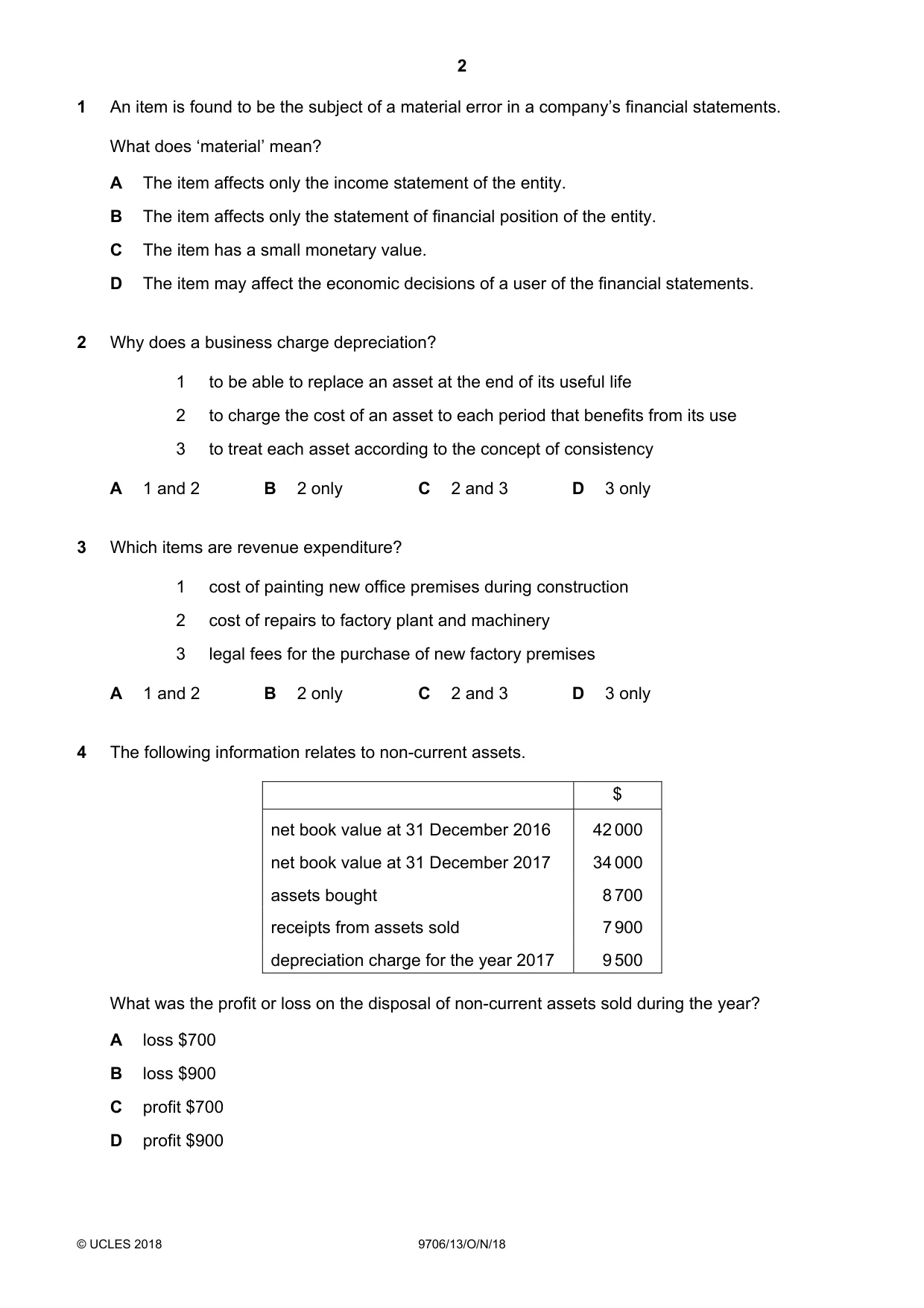
1 An item is found to be the subject of a material error in a company’s financial statements. What does ‘material’ mean? A The item affects only the income statement of the entity. B The item affects only the statement of financial position of the entity. C The item has a small monetary value. D The item may affect the economic decisions of a user of the financial statements.
Mark scheme: D
Q2 · Why does a business charge depreciation?
2 Why does a business charge depreciation? 1 to be able to replace an asset at the end of its useful life 2 to charge the cost of an asset to each period that benefits from its use 3 to treat each asset according to the concept of consistency A 1 and 2 B 2 only C 2 and 3 D 3 only
Mark scheme: B
Q3 · Which items are revenue expenditure?
3 Which items are revenue expenditure? 1 cost of painting new office premises during construction 2 cost of repairs to factory plant and machinery 3 legal fees for the purchase of new factory premises A 1 and 2 B 2 only C 2 and 3 D 3 only
Mark scheme: B
Q4 · The following information relates to non-current assets
4 The following information relates to non-current assets. $ net book value at 31 December 2016 42 000 net book value at 31 December 2017 34 000 assets bought 8 700 receipts from assets sold 7 900 depreciation charge for the year 2017 9 500 What was the profit or loss on the disposal of non-current assets sold during the year? A loss $700 B loss $900 C profit $700 D profit $900
Mark scheme: C
Q5 · During the year a business sells a non-current asset
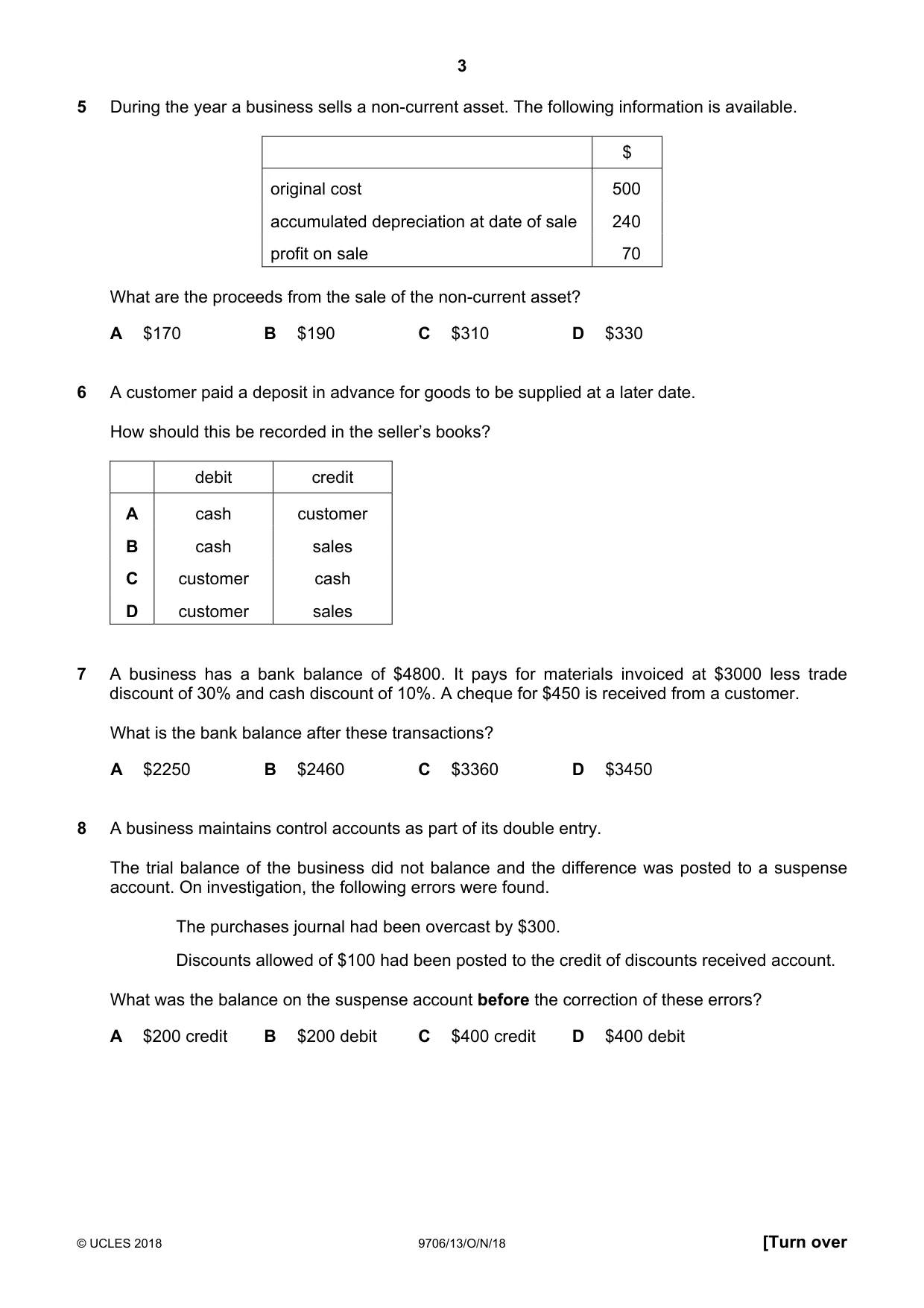
5 During the year a business sells a non-current asset. The following information is available. $ original cost 500 accumulated depreciation at date of sale 240 profit on sale 70 What are the proceeds from the sale of the non-current asset? A $170 B $190 C $310 D $330
Mark scheme: D
Q6 · A customer paid a deposit in advance for goods to be supplied at a later date
6 A customer paid a deposit in advance for goods to be supplied at a later date. How should this be recorded in the seller’s books? debit credit A cash customer B cash sales C customer cash D customer sales
Mark scheme: A
Q7 · A business has a bank balance of $4800
7 A business has a bank balance of $4800. It pays for materials invoiced at $3000 less trade discount of 30% and cash discount of 10%. A cheque for $450 is received from a customer. What is the bank balance after these transactions? A $2250 B $2460 C $3360 D $3450
Mark scheme: C
Q8 · A business maintains control accounts as part of its double entry
8 A business maintains control accounts as part of its double entry. The trial balance of the business did not balance and the difference was posted to a suspense account. On investigation, the following errors were found. The purchases journal had been overcast by $300. Discounts allowed of $100 had been posted to the credit of discounts received account. What was the balance on the suspense account before the correction of these errors? A $200 credit B $200 debit C $400 credit D $400 debit
Mark scheme: B
Q9 · A business has trade receivables of $52 000 at the year-end
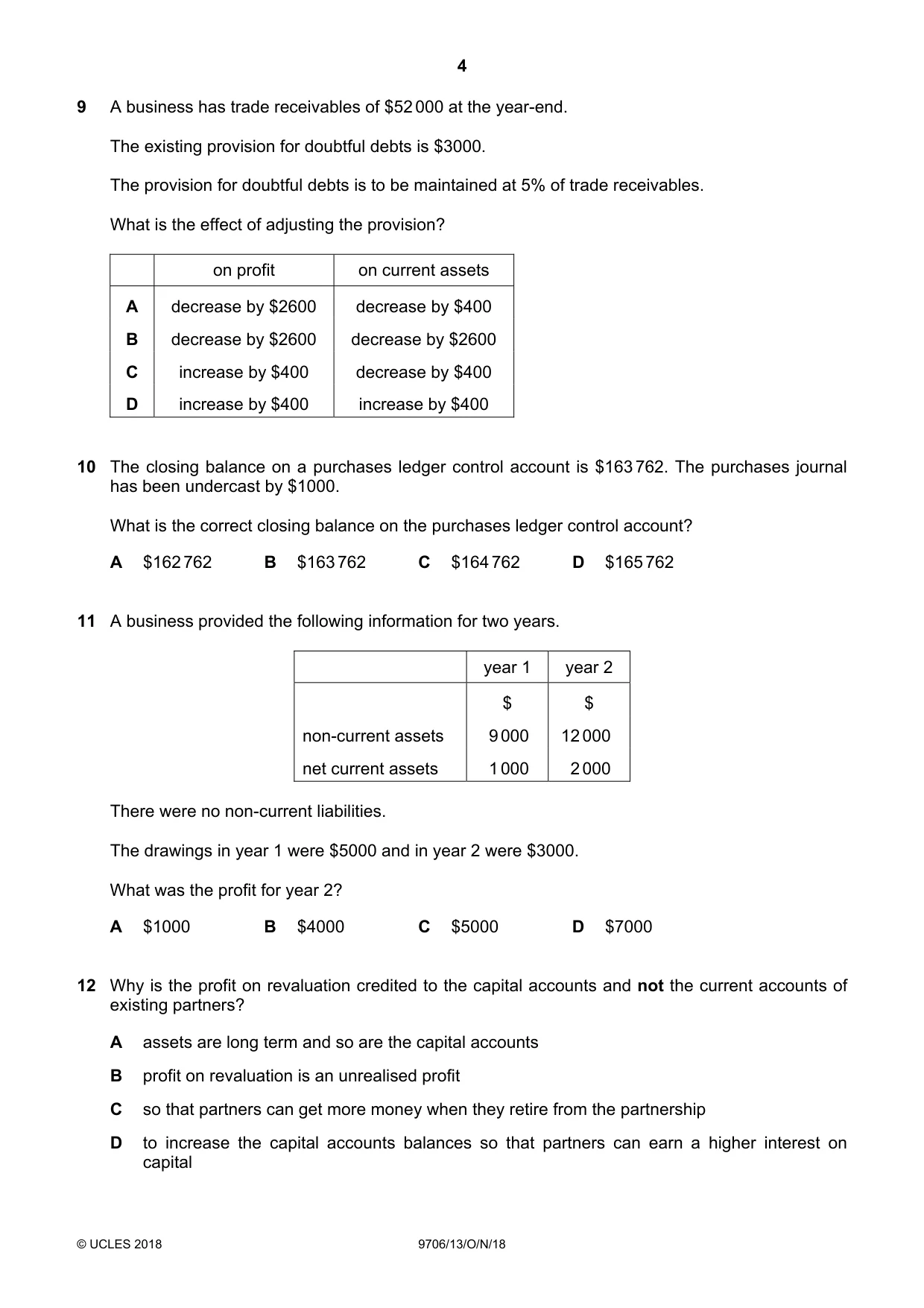
9 A business has trade receivables of $52 000 at the year-end. The existing provision for doubtful debts is $3000. The provision for doubtful debts is to be maintained at 5% of trade receivables. What is the effect of adjusting the provision? on profit on current assets A decrease by $2600 decrease by $400 B decrease by $2600 decrease by $2600 C increase by $400 decrease by $400 D increase by $400 increase by $400
Mark scheme: D
Q10 · The closing balance on a purchases ledger control account is $163 762
10 The closing balance on a purchases ledger control account is $163 762. The purchases journal has been undercast by $1000. What is the correct closing balance on the purchases ledger control account? A $162 762 B $163 762 C $164 762 D $165 762
Mark scheme: C
Q11 · A business provided the following information for two years
11 A business provided the following information for two years. year 1 year 2 $ $ non-current assets 9 000 12 000 net current assets 1 000 2 000 There were no non-current liabilities. The drawings in year 1 were $5000 and in year 2 were $3000. What was the profit for year 2? A $1000 B $4000 C $5000 D $7000
Mark scheme: D
Q12 · Why is the profit on revaluation credited to the capital accounts and not the current…
12 Why is the profit on revaluation credited to the capital accounts and not the current accounts of existing partners? A assets are long term and so are the capital accounts B profit on revaluation is an unrealised profit C so that partners can get more money when they retire from the partnership D to increase the capital accounts balances so that partners can earn a higher interest on capital
Mark scheme: B
Q13 · X and Y were in partnership sharing profits and losses equally
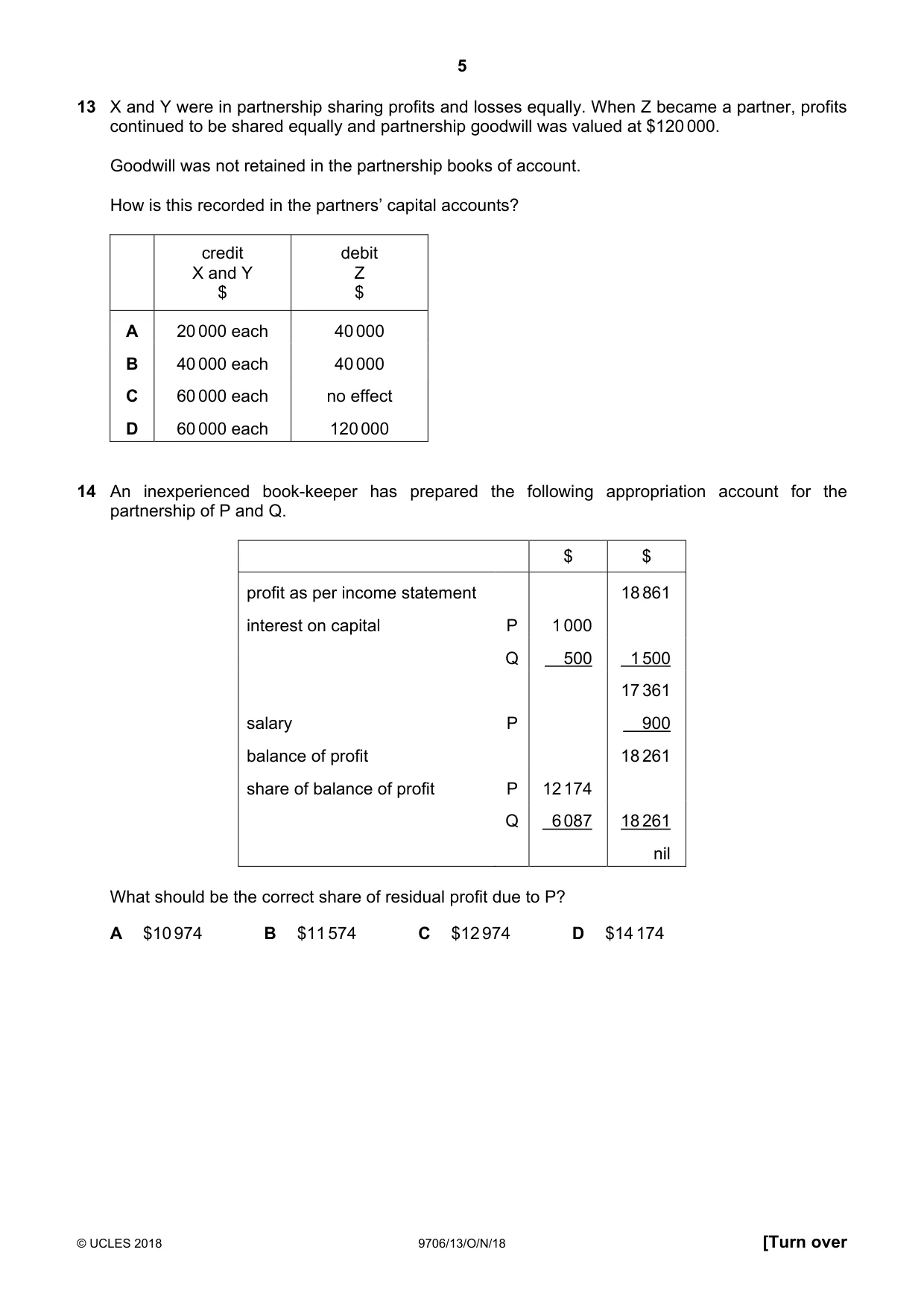
13 X and Y were in partnership sharing profits and losses equally. When Z became a partner, profits continued to be shared equally and partnership goodwill was valued at $120 000. Goodwill was not retained in the partnership books of account. How is this recorded in the partners’ capital accounts? credit debit X and Y Z $ $ A 20 000 each 40 000 B 40 000 each 40 000 C 60 000 each no effect D 60 000 each 120 000
Mark scheme: A
Q14 · An inexperienced book-keeper has prepared the following appropriation account for the…
14 An inexperienced book-keeper has prepared the following appropriation account for the partnership of P and Q. $ $ profit as per income statement 18 861 interest on capital P 1 000 Q 500 1 500 17 361 salary P 900 balance of profit 18 261 share of balance of profit P 12 174 Q 6 087 18 261 nil What should be the correct share of residual profit due to P? A $10 974 B $11 574 C $12 974 D $14 174
Mark scheme: A
Q15 · L and M are in partnership
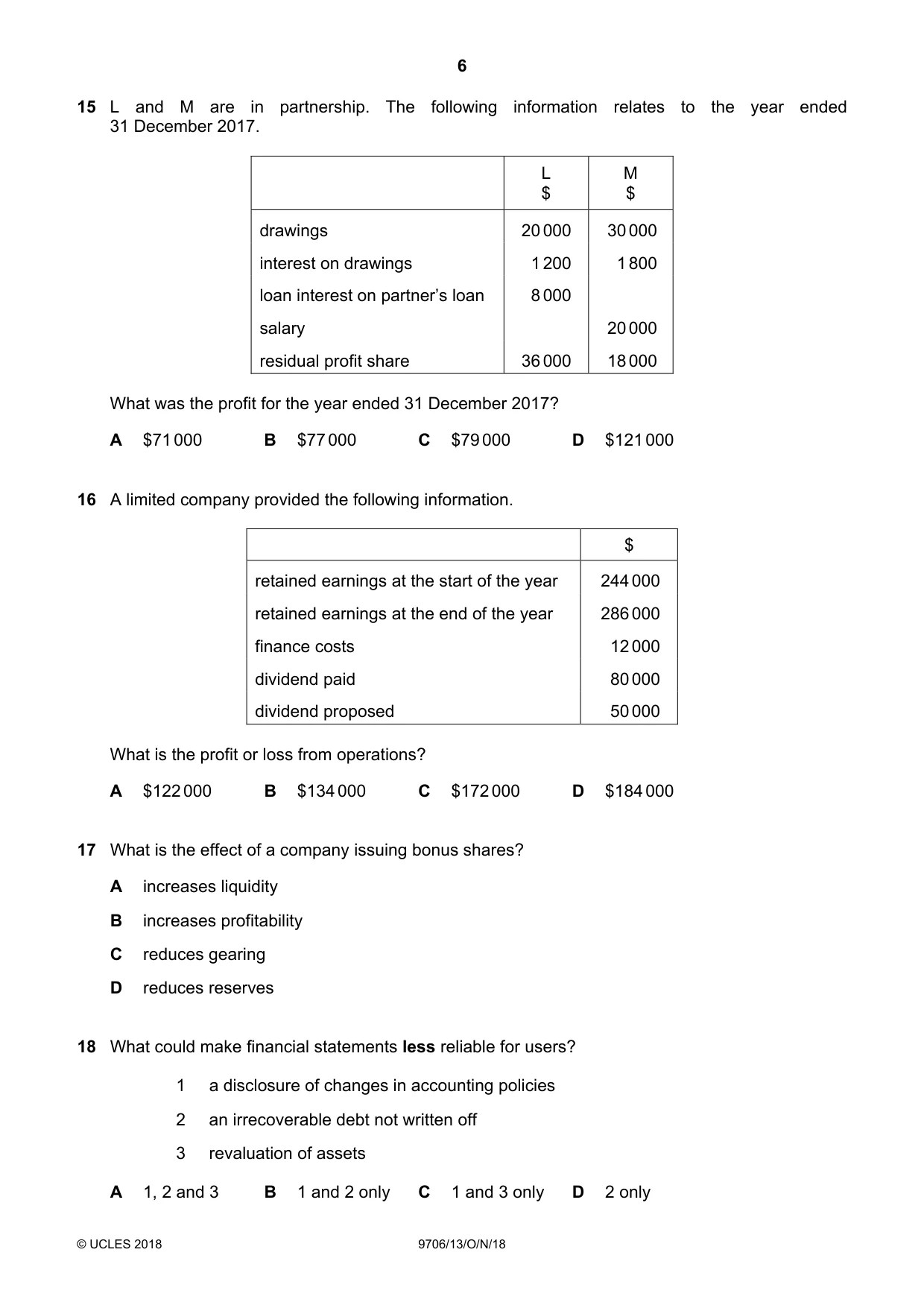
15 L and M are in partnership. The following information relates to the year ended 31 December 2017. L M $ $ drawings 20 000 30 000 interest on drawings 1 200 1 800 loan interest on partner’s loan 8 000 salary 20 000 residual profit share 36 000 18 000 What was the profit for the year ended 31 December 2017? A $71 000 B $77 000 C $79 000 D $121 000
Mark scheme: A
Q16 · A limited company provided the following information
16 A limited company provided the following information. $ retained earnings at the start of the year 244 000 retained earnings at the end of the year 286 000 finance costs 12 000 dividend paid 80 000 dividend proposed 50 000 What is the profit or loss from operations? A $122 000 B $134 000 C $172 000 D $184 000
Mark scheme: B
Q17 · What is the effect of a company issuing bonus shares?
17 What is the effect of a company issuing bonus shares? A increases liquidity B increases profitability C reduces gearing D reduces reserves
Mark scheme: D
Q18 · What could make financial statements less reliable for users?
18 What could make financial statements less reliable for users? 1 a disclosure of changes in accounting policies 2 an irrecoverable debt not written off 3 revaluation of assets A 1, 2 and 3 B 1 and 2 only C 1 and 3 only D 2 only
Mark scheme: D
Q19 · The following information is available for a business for the year
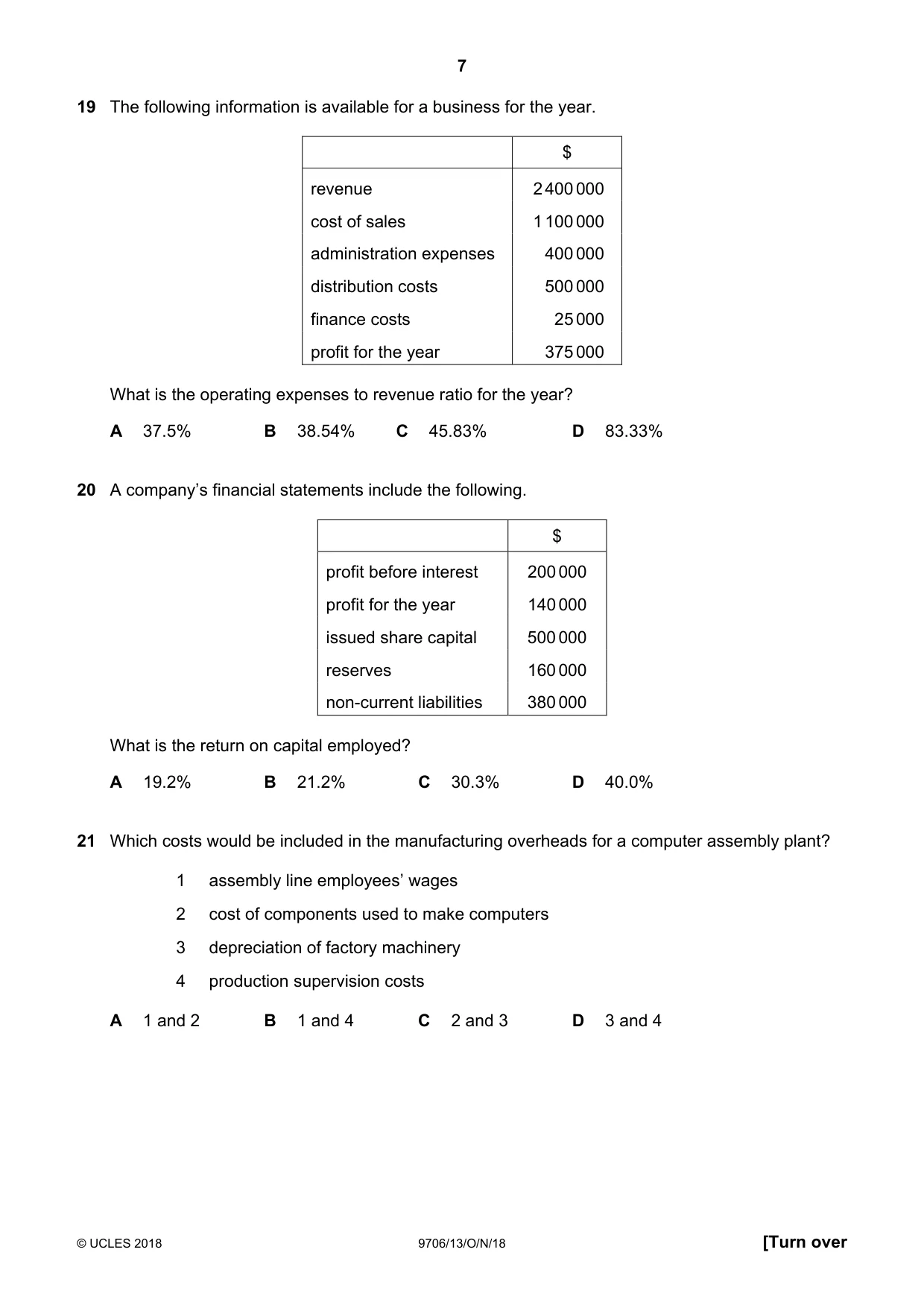
19 The following information is available for a business for the year. $ revenue 2 400 000 cost of sales 1 100 000 administration expenses 400 000 distribution costs 500 000 finance costs 25 000 profit for the year 375 000 What is the operating expenses to revenue ratio for the year? A 37.5% B 38.54% C 45.83% D 83.33%
Mark scheme: A
More questions on Analysis and communication of accounting information
Q20 · A company’s financial statements include the following
20 A company’s financial statements include the following. $ profit before interest 200 000 profit for the year 140 000 issued share capital 500 000 reserves 160 000 non-current liabilities 380 000 What is the return on capital employed? A 19.2% B 21.2% C 30.3% D 40.0%
Mark scheme: A
More questions on Analysis and communication of accounting information
Q21 · Which costs would be included in the manufacturing overheads for a computer assembly…
21 Which costs would be included in the manufacturing overheads for a computer assembly plant? 1 assembly line employees’ wages 2 cost of components used to make computers 3 depreciation of factory machinery 4 production supervision costs A 1 and 2 B 1 and 4 C 2 and 3 D 3 and 4
Mark scheme: D
Q22 · The inventory records of a business show the following information for product X
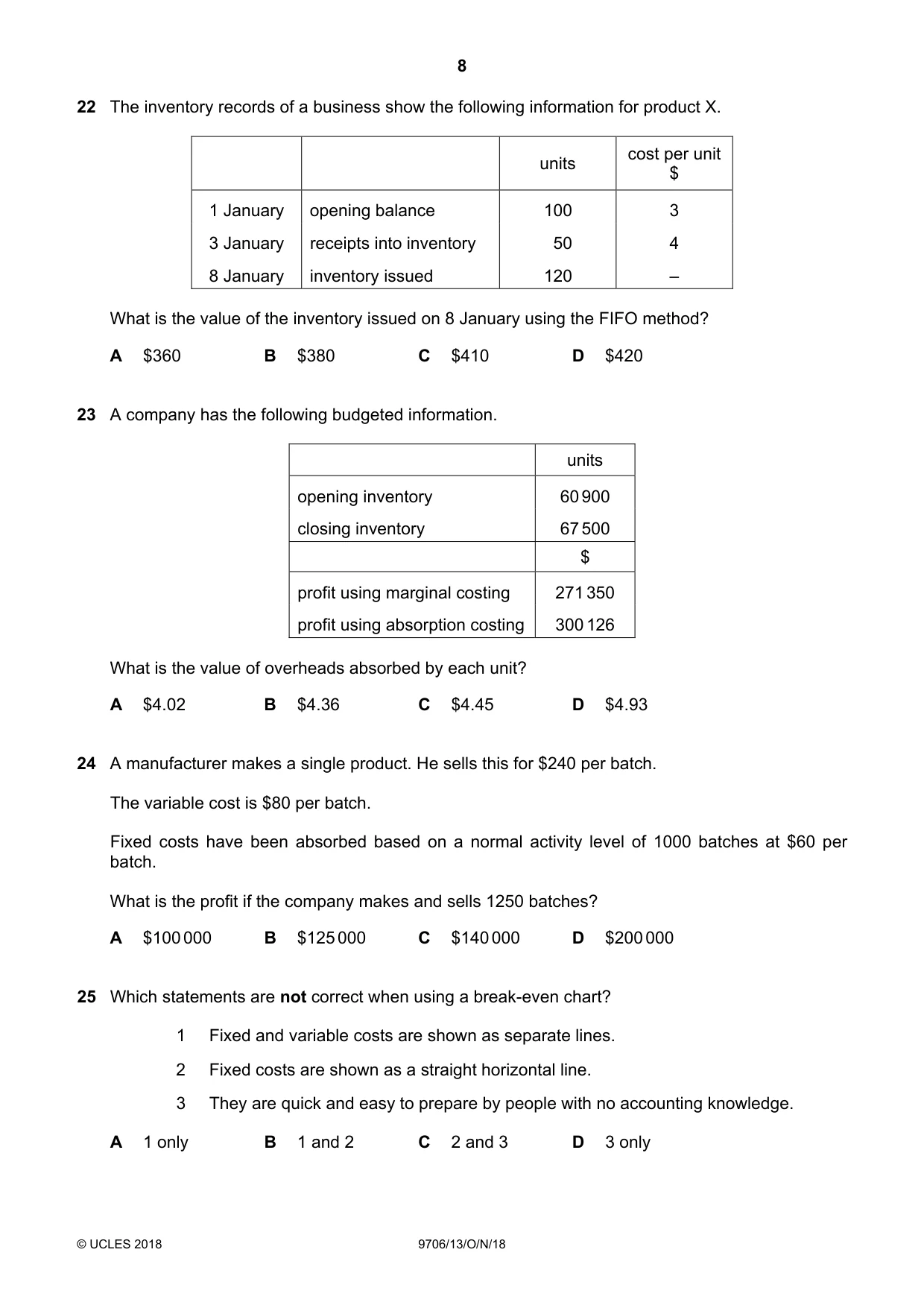
22 The inventory records of a business show the following information for product X. cost per unit units $ 1 January opening balance 100 3 3 January receipts into inventory 50 4 8 January inventory issued 120 – What is the value of the inventory issued on 8 January using the FIFO method? A $360 B $380 C $410 D $420
Mark scheme: B
Q23 · A company has the following budgeted information
23 A company has the following budgeted information. units opening inventory 60 900 closing inventory 67 500 $ profit using marginal costing 271 350 profit using absorption costing 300 126 What is the value of overheads absorbed by each unit? A $4.02 B $4.36 C $4.45 D $4.93
Mark scheme: B
Q24 · A manufacturer makes a single product
24 A manufacturer makes a single product. He sells this for $240 per batch. The variable cost is $80 per batch. Fixed costs have been absorbed based on a normal activity level of 1000 batches at $60 per batch. What is the profit if the company makes and sells 1250 batches? A $100 000 B $125 000 C $140 000 D $200 000
Mark scheme: C
Q25 · Which statements are not correct when using a break-even chart?
25 Which statements are not correct when using a break-even chart? 1 Fixed and variable costs are shown as separate lines. 2 Fixed costs are shown as a straight horizontal line. 3 They are quick and easy to prepare by people with no accounting knowledge. A 1 only B 1 and 2 C 2 and 3 D 3 only
Mark scheme: D
Q26 · A manufacturer has the following overheads for two different levels of production
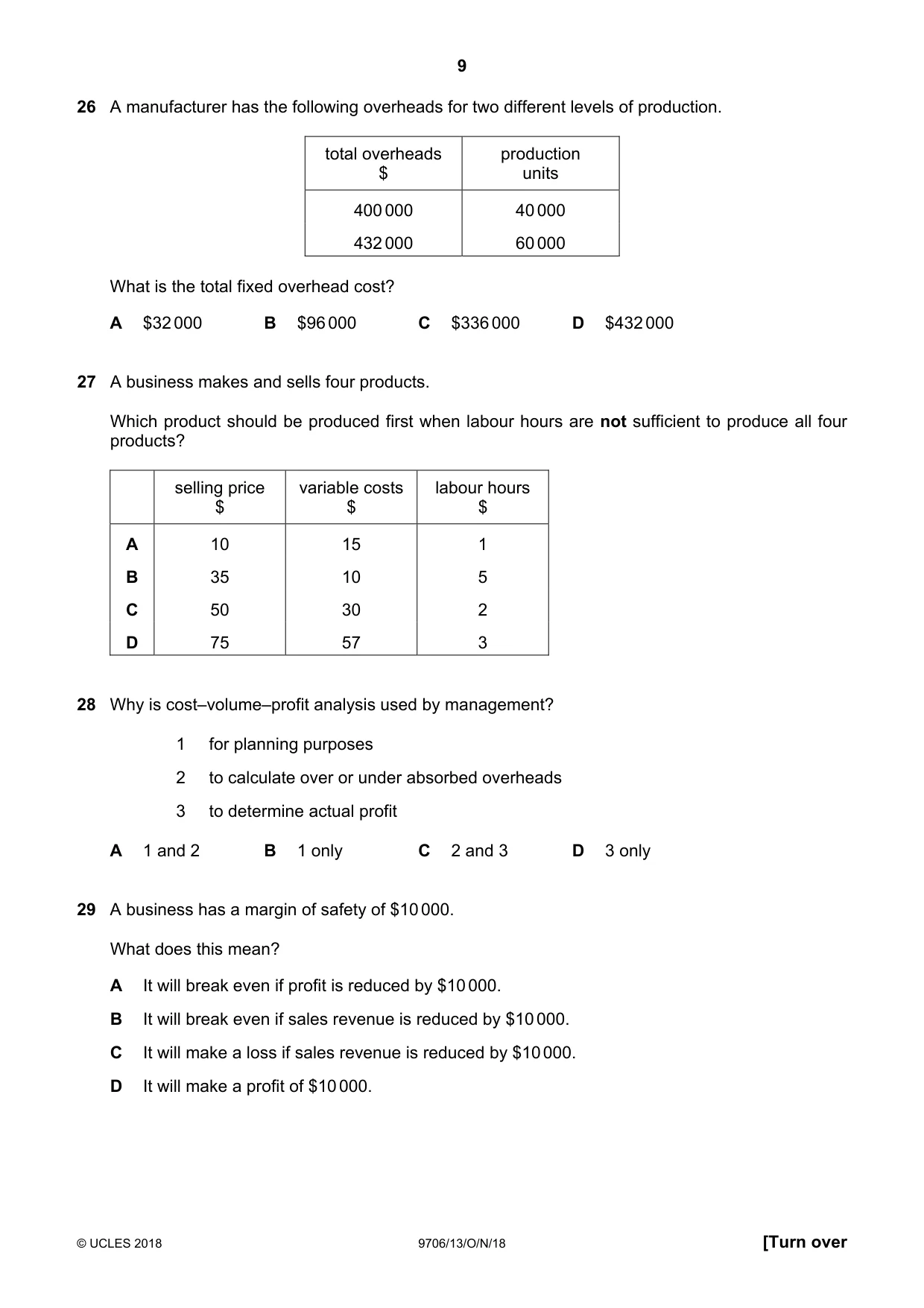
26 A manufacturer has the following overheads for two different levels of production. total overheads production $ units 400 000 40 000 432 000 60 000 What is the total fixed overhead cost? A $32 000 B $96 000 C $336 000 D $432 000
Mark scheme: C
Q27 · A business makes and sells four products
27 A business makes and sells four products. Which product should be produced first when labour hours are not sufficient to produce all four products? selling price variable costs labour hours $ $ $ A 10 15 1 B 35 10 5 C 50 30 2 D 75 57 3
Mark scheme: C
Q28 · Why is cost–volume–profit analysis used by management?
28 Why is cost–volume–profit analysis used by management? 1 for planning purposes 2 to calculate over or under absorbed overheads 3 to determine actual profit A 1 and 2 B 1 only C 2 and 3 D 3 only
Mark scheme: B
Q29 · A business has a margin of safety of $10 000
29 A business has a margin of safety of $10 000. What does this mean? A It will break even if profit is reduced by $10 000. B It will break even if sales revenue is reduced by $10 000. C It will make a loss if sales revenue is reduced by $10 000. D It will make a profit of $10 000.
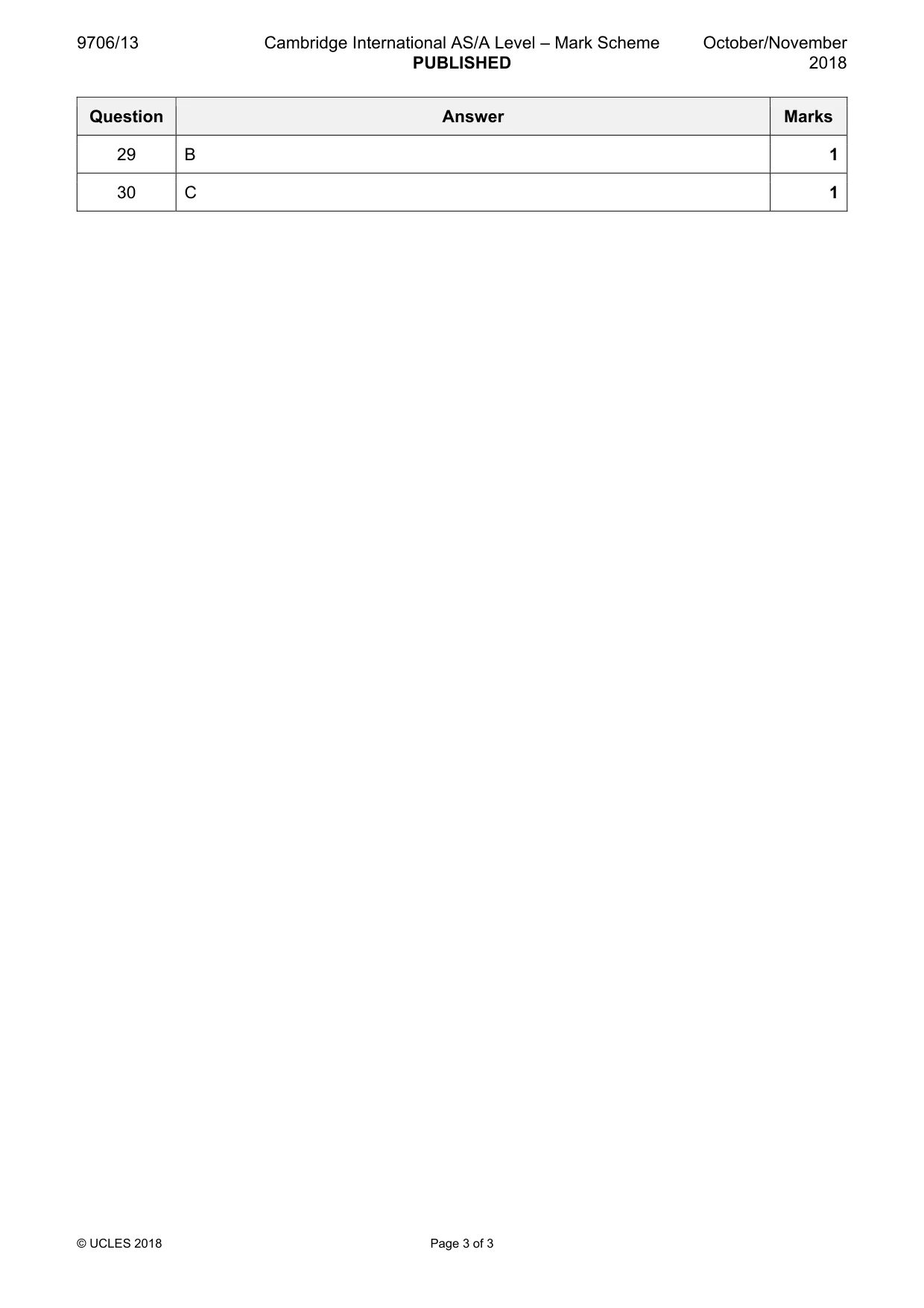
Mark scheme: B
Q30 · Which statement about budgeting is not correct?
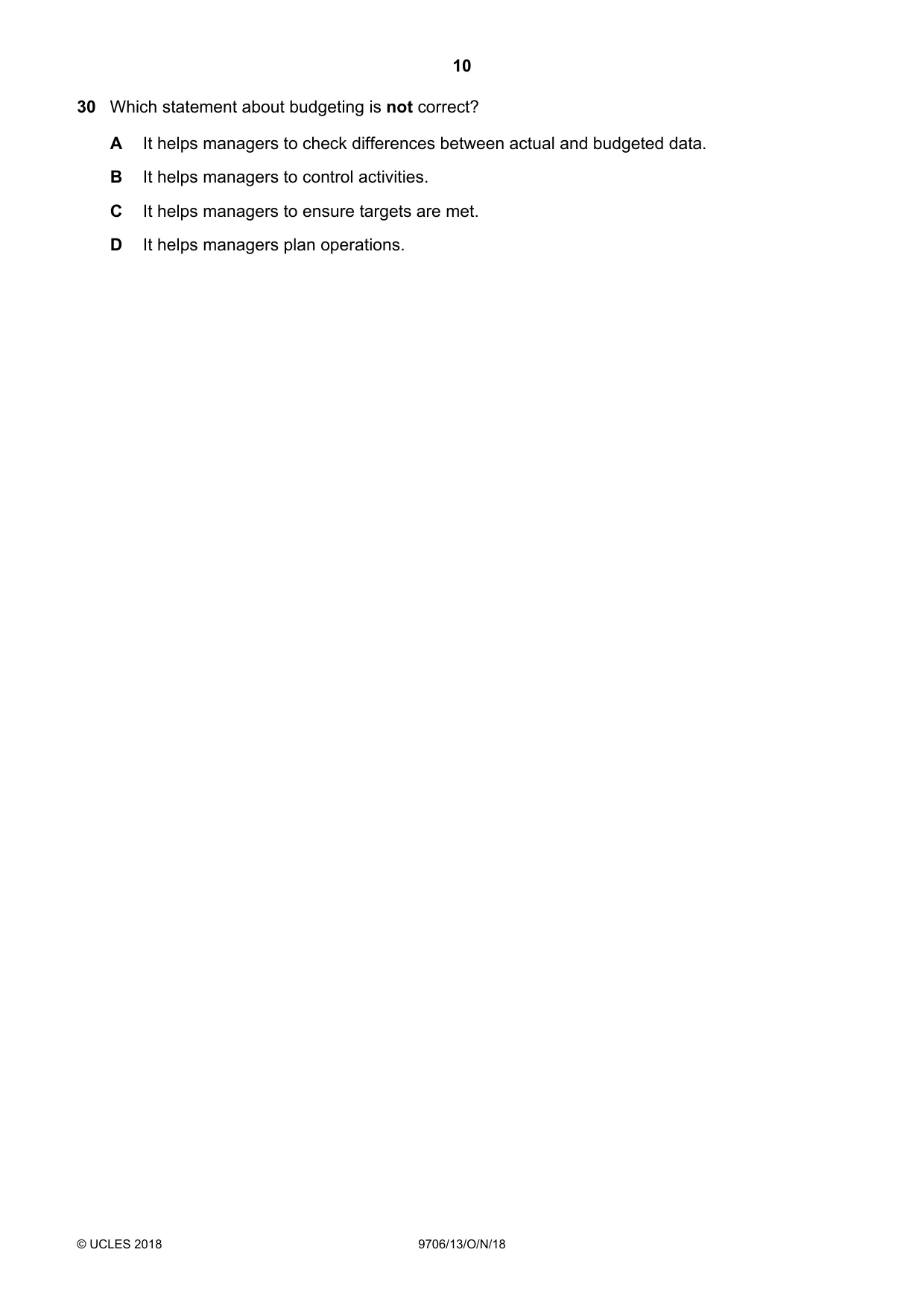
30 Which statement about budgeting is not correct? A It helps managers to check differences between actual and budgeted data. B It helps managers to control activities. C It helps managers to ensure targets are met. D It helps managers plan operations.
Mark scheme: C
What was in this paper
The subtopics covered by these 30 questions, and how many questions each got. Open one in a new tab to see every Cambridge question on it.
7Types of business entity4Accounting for non-current assets3Preparation of financial statements3The accounting system3Analysis and communication of accounting information2Reconciliation and verification2Regulatory and ethical considerations2Traditional costing methods2Budgeting and budgetary control1Preparation of financial statements1What you needed in this session
Cambridge’s own grade thresholds for 2018 Oct/Nov, Paper 1 · Variant 3. A higher threshold means an easier paper — the bar moves with how the cohort did.