Cambridge A Level Accounting 9706 — 2018 May/June Paper 1 · Variant 2
9706/12/M/J/18 · 30 questions · 30 marks · ≈34 min
The question paper and its mark scheme, free to read here and free to download. This is Cambridge’s own paper, exactly as it was sat.
Question paper12 pages
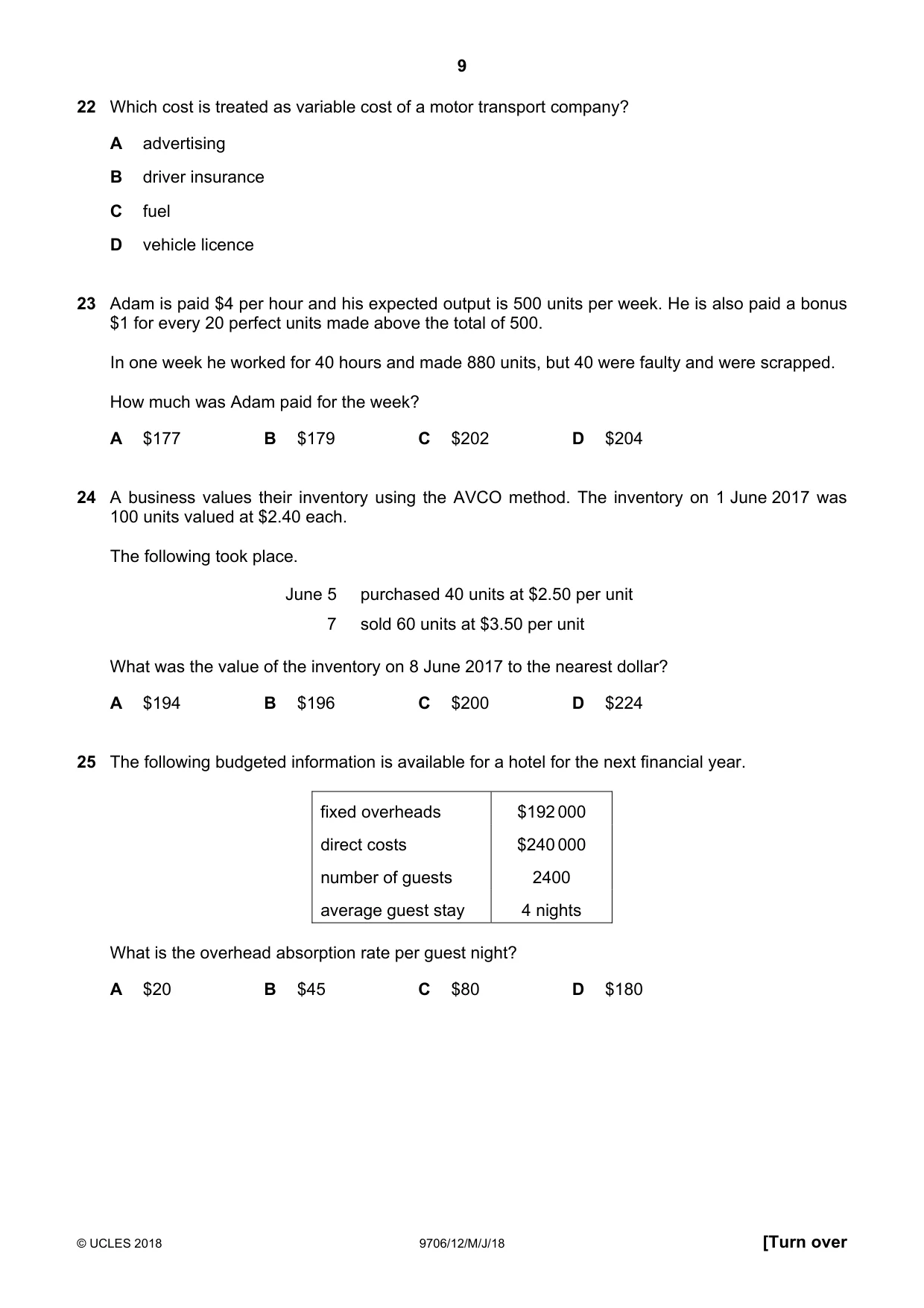
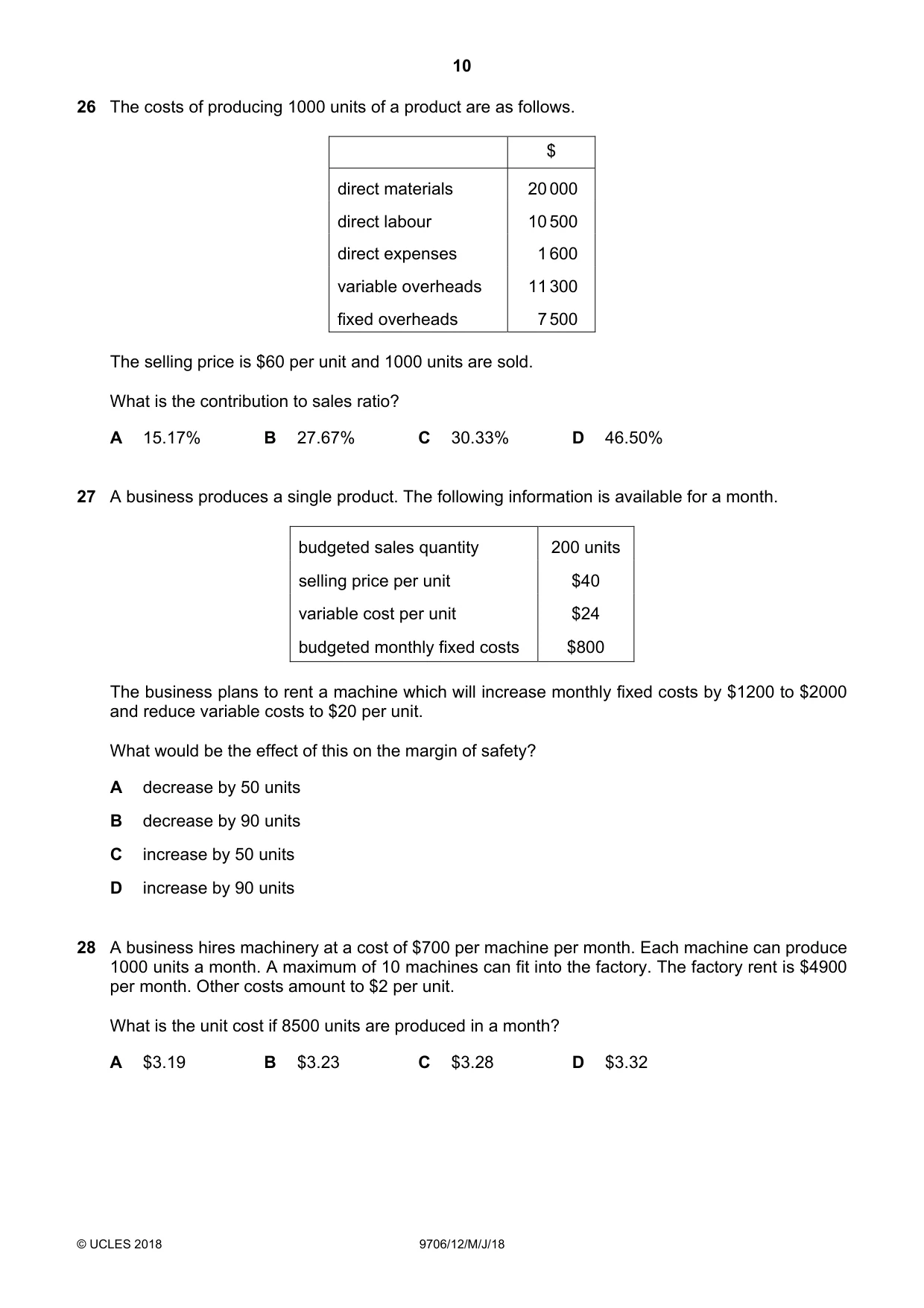
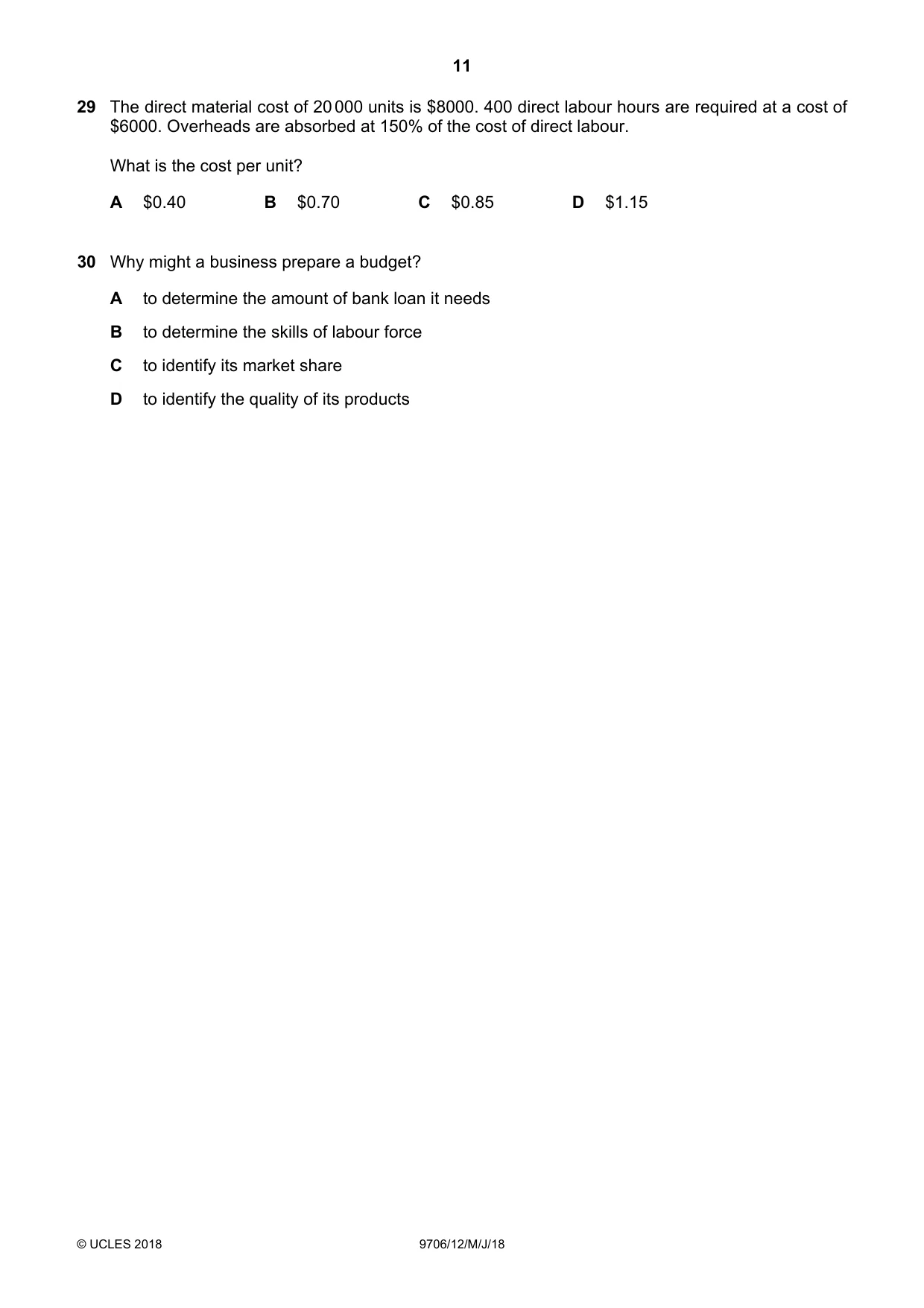
Mark scheme3 pages
Answers below. Sit the paper first if you are practising.
Questions as text
Q1 · The owner of a business has been told that work completed for a customer should be…
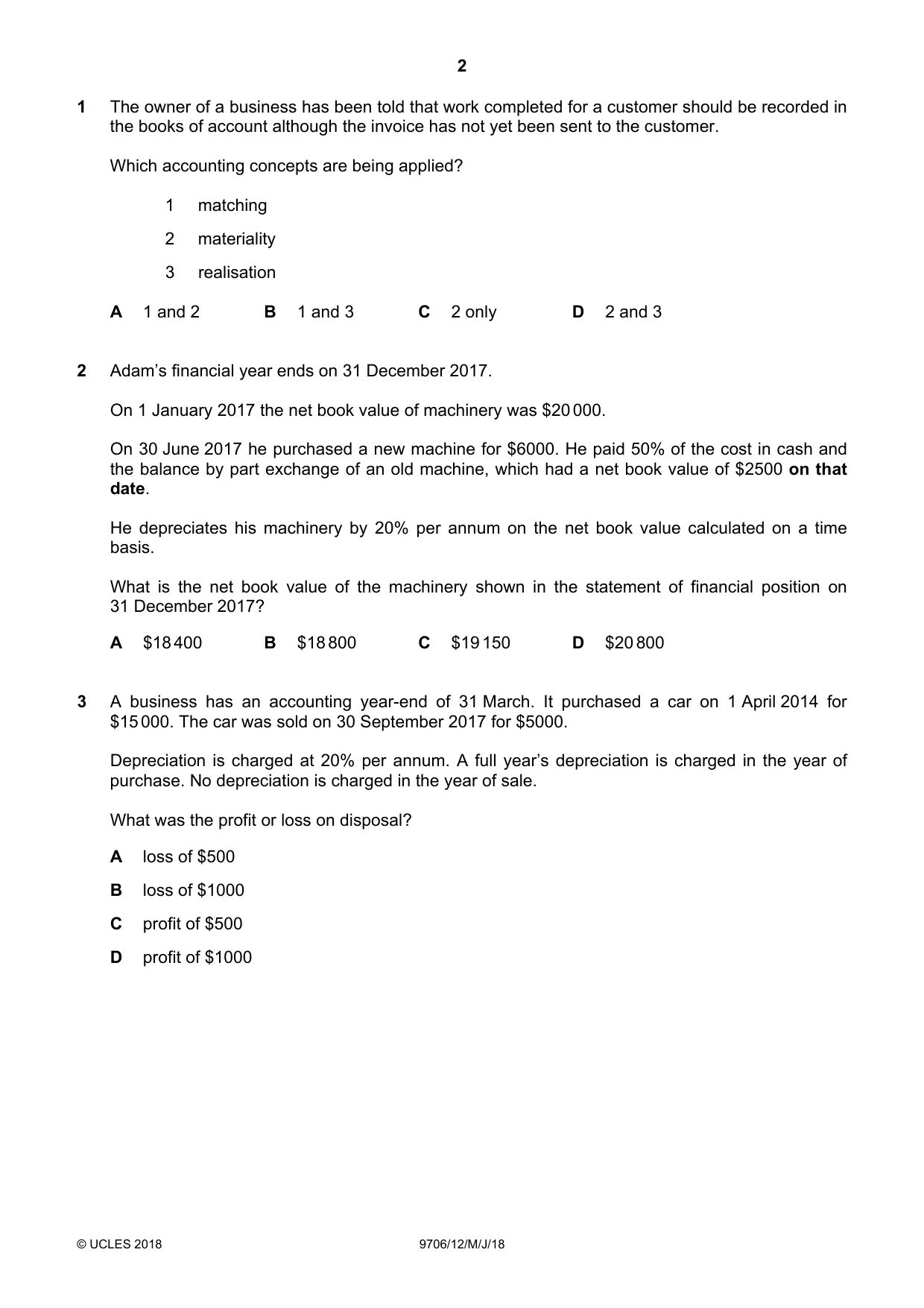
1 The owner of a business has been told that work completed for a customer should be recorded in the books of account although the invoice has not yet been sent to the customer. Which accounting concepts are being applied? 1 matching 2 materiality 3 realisation A 1 and 2 B 1 and 3 C 2 only D 2 and 3
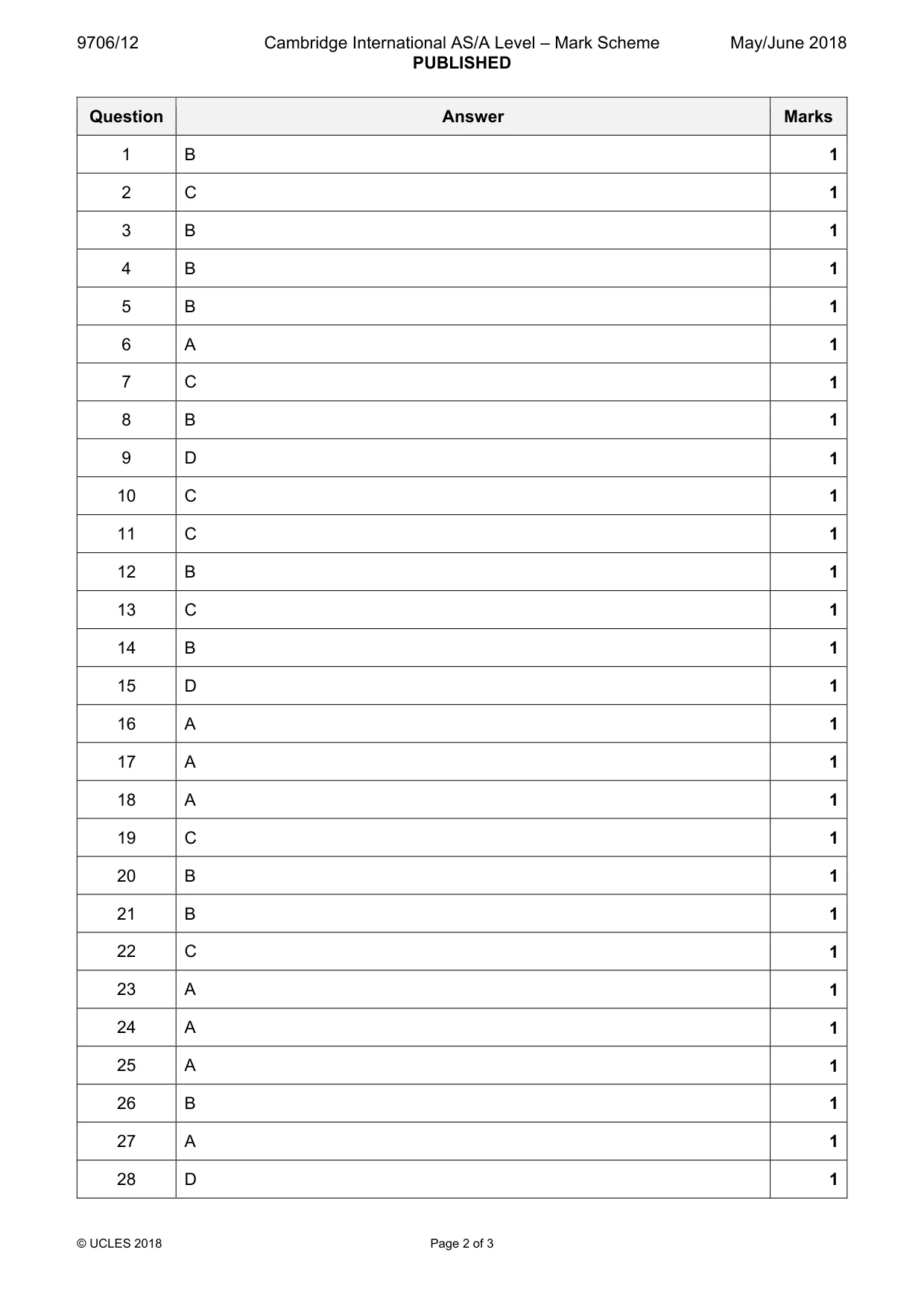
Mark scheme: B
Q2 · Adam’s financial year ends on 31 December 2017
2 Adam’s financial year ends on 31 December 2017. On 1 January 2017 the net book value of machinery was $20 000. On 30 June 2017 he purchased a new machine for $6000. He paid 50% of the cost in cash and the balance by part exchange of an old machine, which had a net book value of $2500 on that date. He depreciates his machinery by 20% per annum on the net book value calculated on a time basis. What is the net book value of the machinery shown in the statement of financial position on 31 December 2017? A $18 400 B $18 800 C $19 150 D $20 800
Mark scheme: C
Q3 · A business has an accounting year-end of 31 March
3 A business has an accounting year-end of 31 March. It purchased a car on 1 April 2014 for $15 000. The car was sold on 30 September 2017 for $5000. Depreciation is charged at 20% per annum. A full year’s depreciation is charged in the year of purchase. No depreciation is charged in the year of sale. What was the profit or loss on disposal? A loss of $500 B loss of $1000 C profit of $500 D profit of $1000
Mark scheme: B
Q4 · The accounting year-end for a company is 31 October
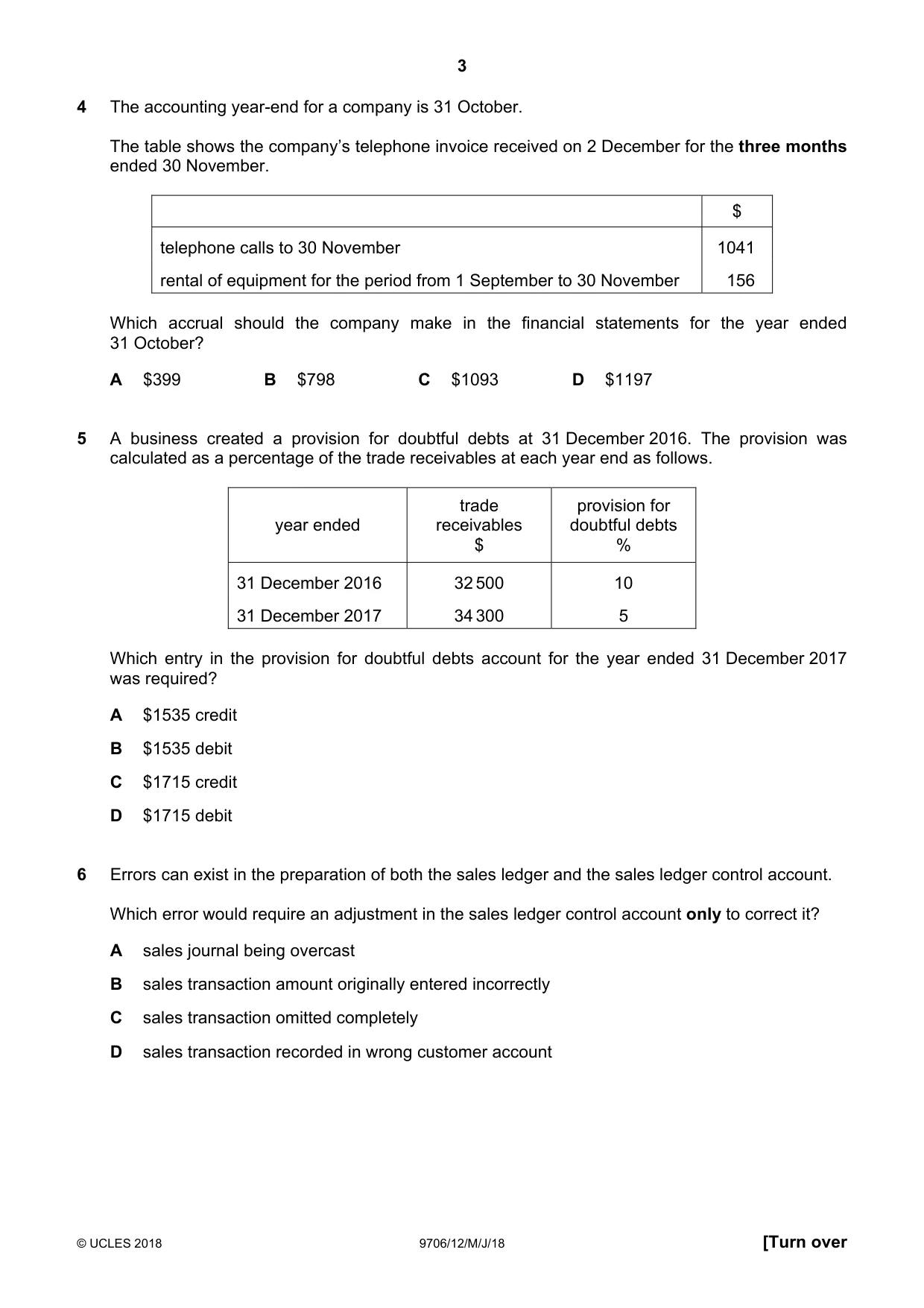
4 The accounting year-end for a company is 31 October. The table shows the company’s telephone invoice received on 2 December for the three months ended 30 November. $ telephone calls to 30 November 1041 rental of equipment for the period from 1 September to 30 November 156 Which accrual should the company make in the financial statements for the year ended 31 October? A $399 B $798 C $1093 D $1197
Mark scheme: B
Q5 · A business created a provision for doubtful debts at 31 December 2016
5 A business created a provision for doubtful debts at 31 December 2016. The provision was calculated as a percentage of the trade receivables at each year end as follows. trade provision for year ended receivables doubtful debts $ % 31 December 2016 32 500 10 31 December 2017 34 300 5 Which entry in the provision for doubtful debts account for the year ended 31 December 2017 was required? A $1535 credit B $1535 debit C $1715 credit D $1715 debit
Mark scheme: B
Q6 · Errors can exist in the preparation of both the sales ledger and the sales ledger control…
6 Errors can exist in the preparation of both the sales ledger and the sales ledger control account. Which error would require an adjustment in the sales ledger control account only to correct it? A sales journal being overcast B sales transaction amount originally entered incorrectly C sales transaction omitted completely D sales transaction recorded in wrong customer account
Mark scheme: A
Q7 · The trial balance of a business did not balance
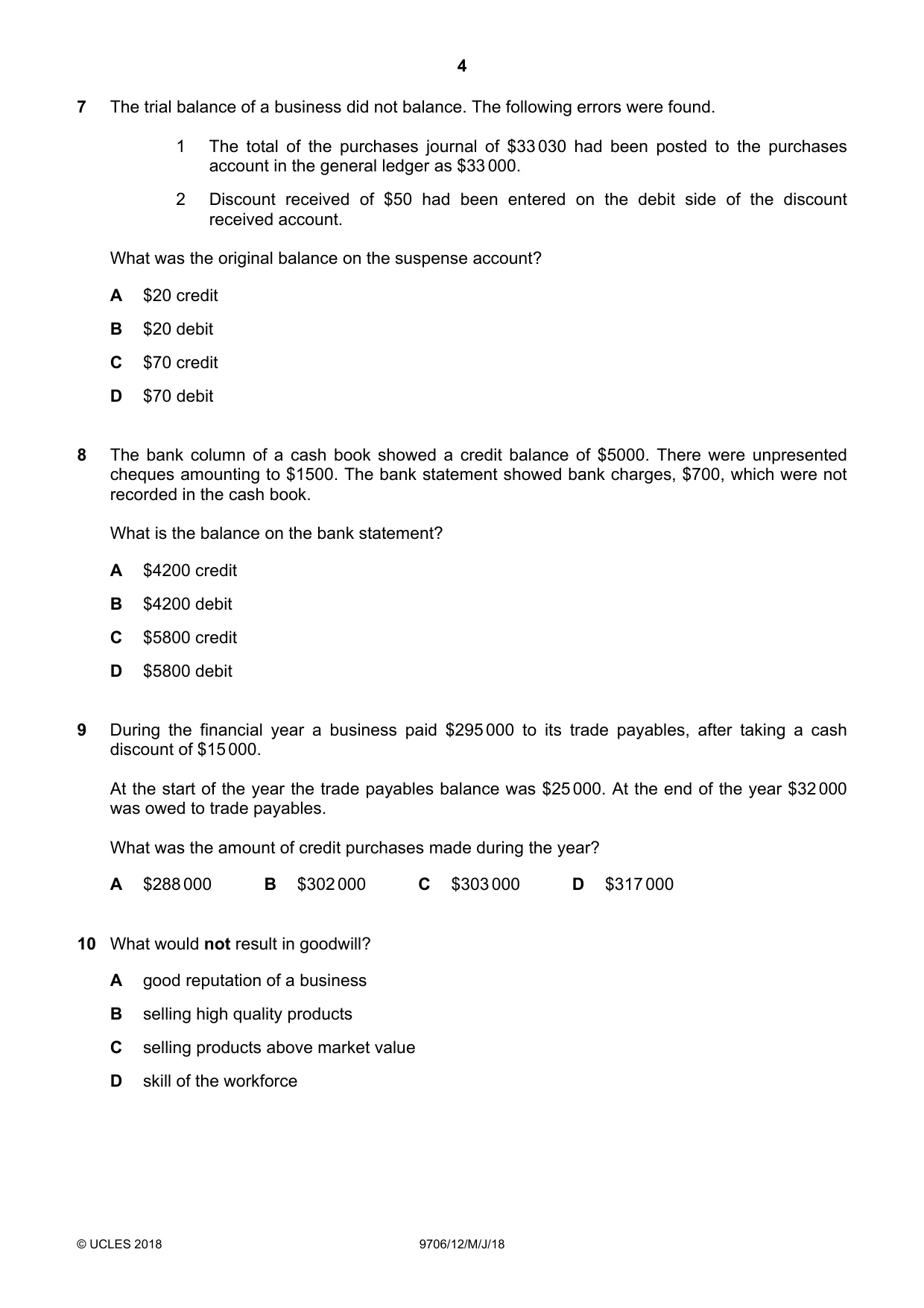
7 The trial balance of a business did not balance. The following errors were found. 1 The total of the purchases journal of $33 030 had been posted to the purchases account in the general ledger as $33 000. 2 Discount received of $50 had been entered on the debit side of the discount received account. What was the original balance on the suspense account? A $20 credit B $20 debit C $70 credit D $70 debit
Mark scheme: C
Q8 · The bank column of a cash book showed a credit balance of $5000
8 The bank column of a cash book showed a credit balance of $5000. There were unpresented cheques amounting to $1500. The bank statement showed bank charges, $700, which were not recorded in the cash book. What is the balance on the bank statement? A $4200 credit B $4200 debit C $5800 credit D $5800 debit
Mark scheme: B
Q9 · During the financial year a business paid $295 000 to its trade payables, after taking a…
9 During the financial year a business paid $295 000 to its trade payables, after taking a cash discount of $15 000. At the start of the year the trade payables balance was $25 000. At the end of the year $32 000 was owed to trade payables. What was the amount of credit purchases made during the year? A $288 000 B $302 000 C $303 000 D $317 000
Mark scheme: D
Q10 · What would not result in goodwill?
10 What would not result in goodwill? A good reputation of a business B selling high quality products C selling products above market value D skill of the workforce
Mark scheme: C
Q11 · At the beginning of the financial year inventory was valued at $15 000
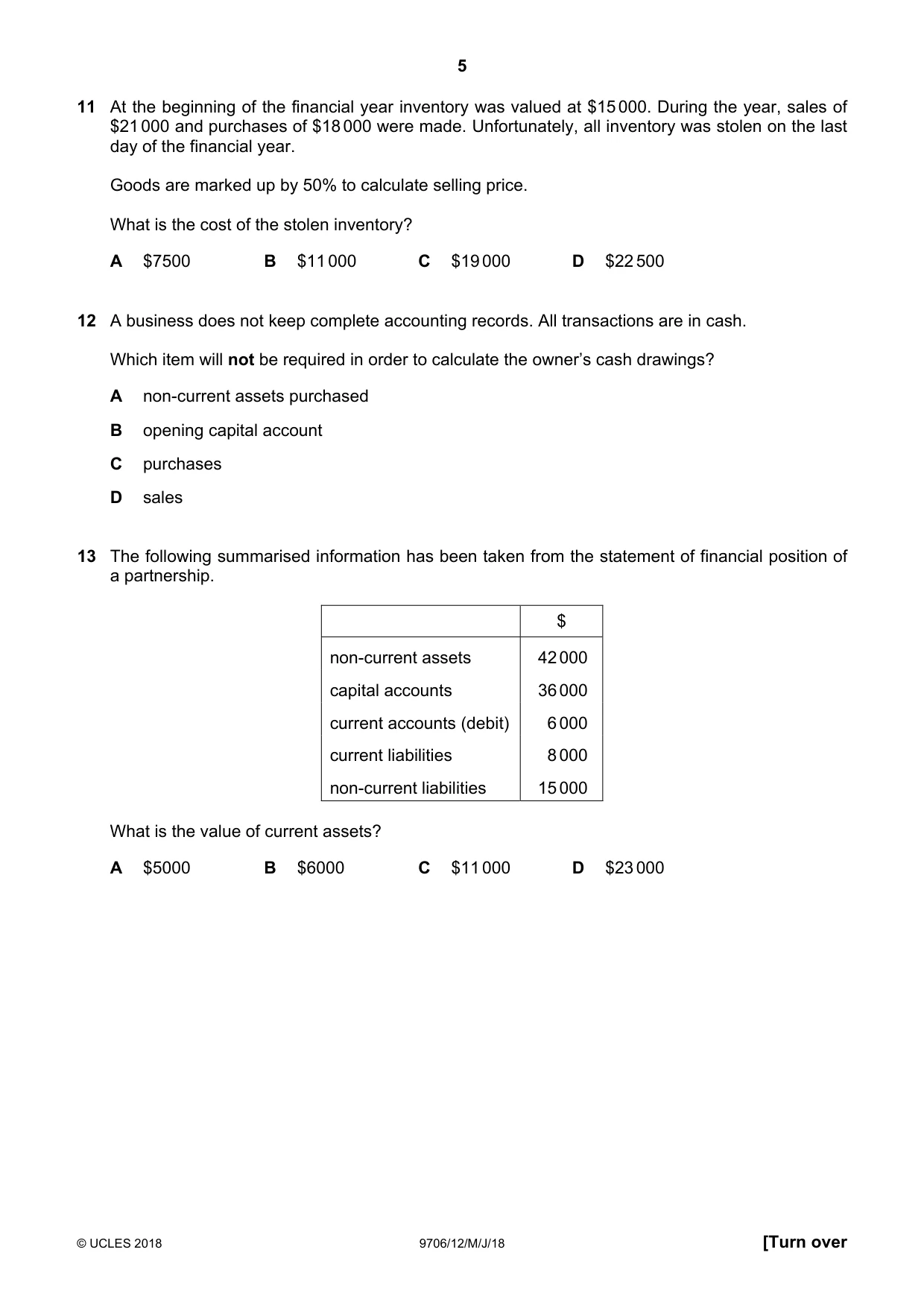
11 At the beginning of the financial year inventory was valued at $15 000. During the year, sales of $21 000 and purchases of $18 000 were made. Unfortunately, all inventory was stolen on the last day of the financial year. Goods are marked up by 50% to calculate selling price. What is the cost of the stolen inventory? A $7500 B $11 000 C $19 000 D $22 500
Mark scheme: C
Q12 · A business does not keep complete accounting records
12 A business does not keep complete accounting records. All transactions are in cash. Which item will not be required in order to calculate the owner’s cash drawings? A non-current assets purchased B opening capital account C purchases D sales
Mark scheme: B
Q13 · The following summarised information has been taken from the statement of financial…
13 The following summarised information has been taken from the statement of financial position of a partnership. $ non-current assets 42 000 capital accounts 36 000 current accounts (debit) 6 000 current liabilities 8 000 non-current liabilities 15 000 What is the value of current assets? A $5000 B $6000 C $11 000 D $23 000
Mark scheme: C
Q14 · X and Y had been in partnership for some years when Z was admitted as a partner
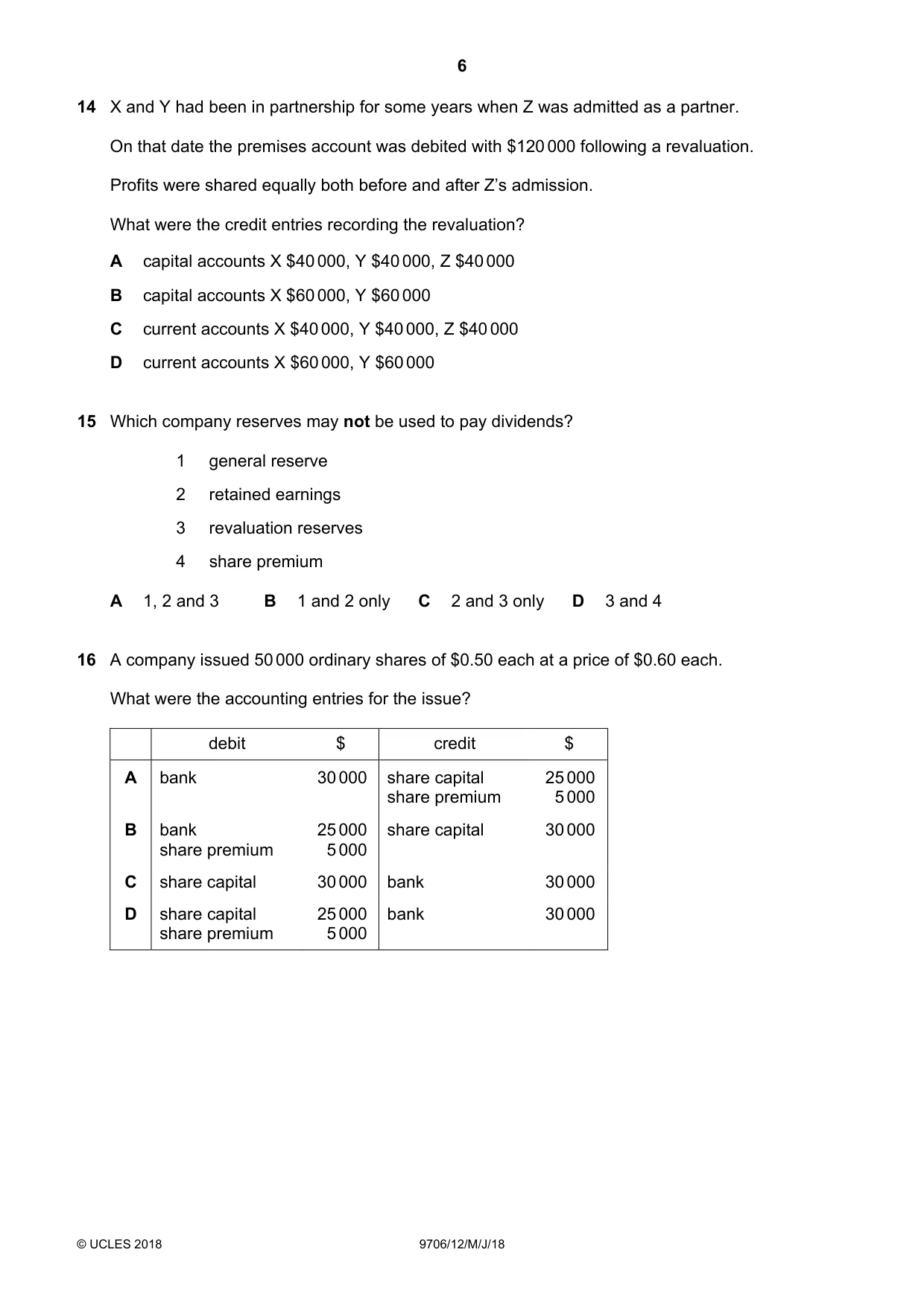
14 X and Y had been in partnership for some years when Z was admitted as a partner. On that date the premises account was debited with $120 000 following a revaluation. Profits were shared equally both before and after Z’s admission. What were the credit entries recording the revaluation? A capital accounts X $40 000, Y $40 000, Z $40 000 B capital accounts X $60 000, Y $60 000 C current accounts X $40 000, Y $40 000, Z $40 000 D current accounts X $60 000, Y $60 000
Mark scheme: B
Q15 · Which company reserves may not be used to pay dividends?
15 Which company reserves may not be used to pay dividends? 1 general reserve 2 retained earnings 3 revaluation reserves 4 share premium A 1, 2 and 3 B 1 and 2 only C 2 and 3 only D 3 and 4
Mark scheme: D
Q16 · A company issued 50 000 ordinary shares of $0.50 each at a price of $0.60 each
16 A company issued 50 000 ordinary shares of $0.50 each at a price of $0.60 each. What were the accounting entries for the issue? debit $ credit $ A bank 30 000 share capital 25 000 share premium 5 000 B bank 25 000 share capital 30 000 share premium 5 000 C share capital 30 000 bank 30 000 D share capital 25 000 bank 30 000 share premium 5 000
Mark scheme: A
Q17 · What could be used to fund a bonus issue of shares?
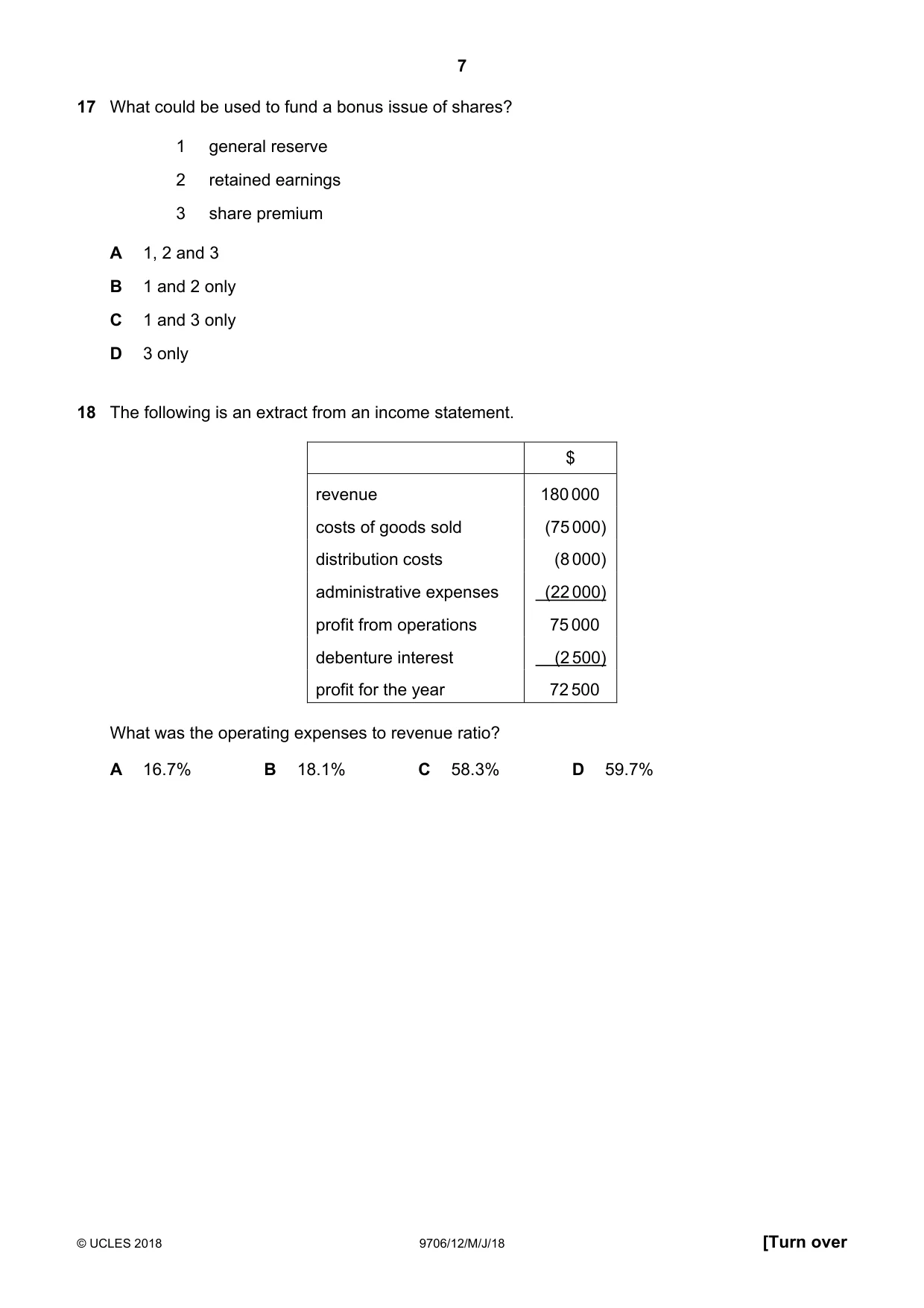
17 What could be used to fund a bonus issue of shares? 1 general reserve 2 retained earnings 3 share premium A 1, 2 and 3 B 1 and 2 only C 1 and 3 only D 3 only
Mark scheme: A
Q18 · The following is an extract from an income statement
18 The following is an extract from an income statement. $ revenue 180 000 costs of goods sold (75 000) distribution costs (8 000) administrative expenses (22 000) profit from operations 75 000 debenture interest (2 500) profit for the year 72 500 What was the operating expenses to revenue ratio? A 16.7% B 18.1% C 58.3% D 59.7%
Mark scheme: A
More questions on Analysis and communication of accounting information
Q19 · The following information is available for the year ended 31 December 2017
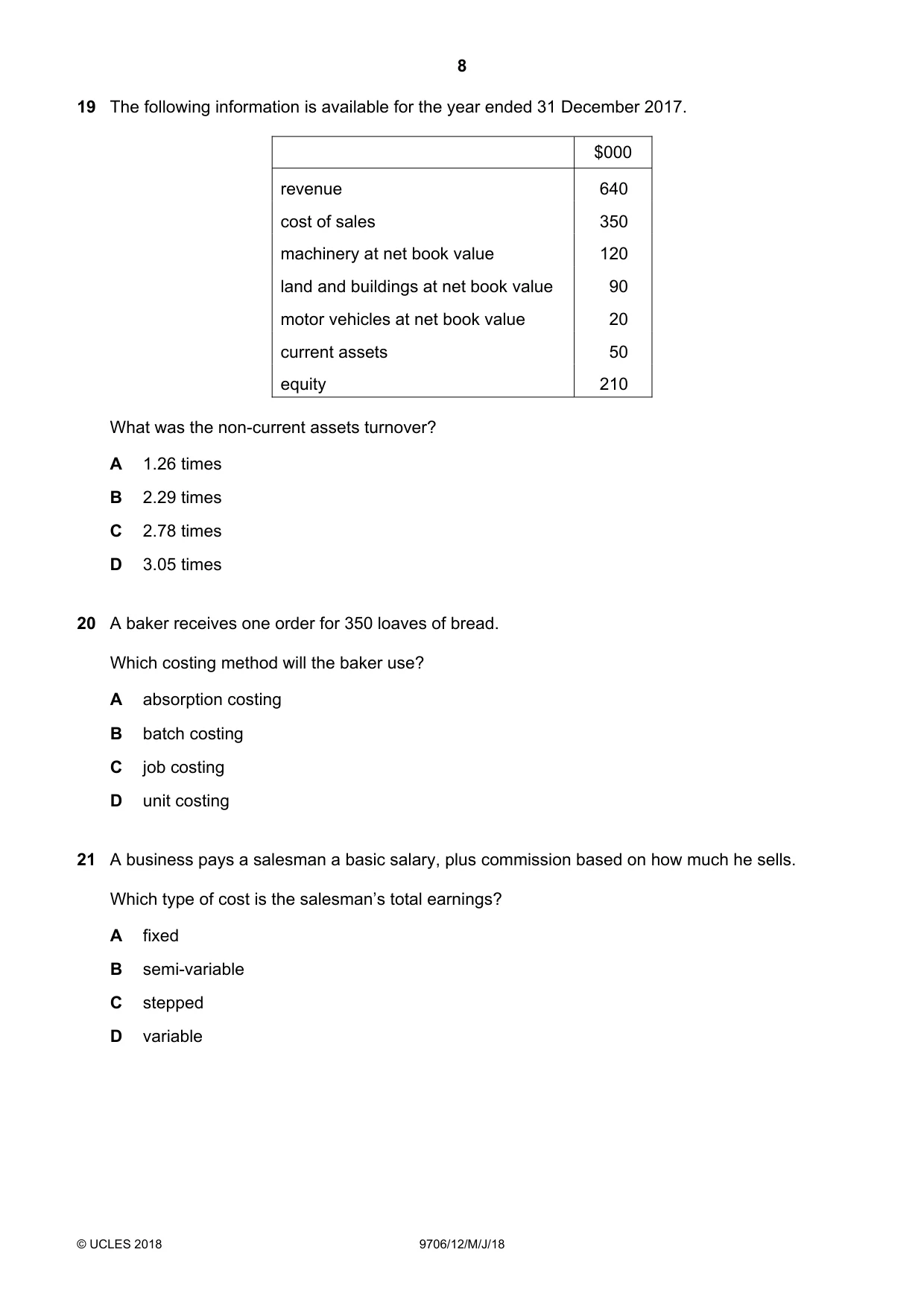
19 The following information is available for the year ended 31 December 2017. $000 revenue 640 cost of sales 350 machinery at net book value 120 land and buildings at net book value 90 motor vehicles at net book value 20 current assets 50 equity 210 What was the non-current assets turnover? A 1.26 times B 2.29 times C 2.78 times D 3.05 times
Mark scheme: C
More questions on Analysis and communication of accounting information
Q20 · A baker receives one order for 350 loaves of bread
20 A baker receives one order for 350 loaves of bread. Which costing method will the baker use? A absorption costing B batch costing C job costing D unit costing
Mark scheme: B
Q21 · A business pays a salesman a basic salary, plus commission based on how much he sells
21 A business pays a salesman a basic salary, plus commission based on how much he sells. Which type of cost is the salesman’s total earnings? A fixed B semi-variable C stepped D variable
Mark scheme: B
Q22 · Which cost is treated as variable cost of a motor transport company?
22 Which cost is treated as variable cost of a motor transport company? A advertising B driver insurance C fuel D vehicle licence
Mark scheme: C
Q23 · Adam is paid $4 per hour and his expected output is 500 units per week
23 Adam is paid $4 per hour and his expected output is 500 units per week. He is also paid a bonus $1 for every 20 perfect units made above the total of 500. In one week he worked for 40 hours and made 880 units, but 40 were faulty and were scrapped. How much was Adam paid for the week? A $177 B $179 C $202 D $204
Mark scheme: A
Q24 · A business values their inventory using the AVCO method
24 A business values their inventory using the AVCO method. The inventory on 1 June 2017 was 100 units valued at $2.40 each. The following took place. June 5 purchased 40 units at $2.50 per unit 7 sold 60 units at $3.50 per unit What was the value of the inventory on 8 June 2017 to the nearest dollar? A $194 B $196 C $200 D $224
Mark scheme: A
Q25 · The following budgeted information is available for a hotel for the next financial year
25 The following budgeted information is available for a hotel for the next financial year. fixed overheads $192 000 direct costs $240 000 number of guests 2400 average guest stay 4 nights What is the overhead absorption rate per guest night? A $20 B $45 C $80 D $180
Mark scheme: A
Q26 · The costs of producing 1000 units of a product are as follows
26 The costs of producing 1000 units of a product are as follows. $ direct materials 20 000 direct labour 10 500 direct expenses 1 600 variable overheads 11 300 fixed overheads 7 500 The selling price is $60 per unit and 1000 units are sold. What is the contribution to sales ratio? A 15.17% B 27.67% C 30.33% D 46.50%
Mark scheme: B
Q27 · A business produces a single product
27 A business produces a single product. The following information is available for a month. budgeted sales quantity 200 units selling price per unit $40 variable cost per unit $24 budgeted monthly fixed costs $800 The business plans to rent a machine which will increase monthly fixed costs by $1200 to $2000 and reduce variable costs to $20 per unit. What would be the effect of this on the margin of safety? A decrease by 50 units B decrease by 90 units C increase by 50 units D increase by 90 units
Mark scheme: A
Q28 · A business hires machinery at a cost of $700 per machine per month
28 A business hires machinery at a cost of $700 per machine per month. Each machine can produce 1000 units a month. A maximum of 10 machines can fit into the factory. The factory rent is $4900 per month. Other costs amount to $2 per unit. What is the unit cost if 8500 units are produced in a month? A $3.19 B $3.23 C $3.28 D $3.32
Mark scheme: D
Q29 · The direct material cost of 20 000 units is $8000
29 The direct material cost of 20 000 units is $8000. 400 direct labour hours are required at a cost of $6000. Overheads are absorbed at 150% of the cost of direct labour. What is the cost per unit? A $0.40 B $0.70 C $0.85 D $1.15
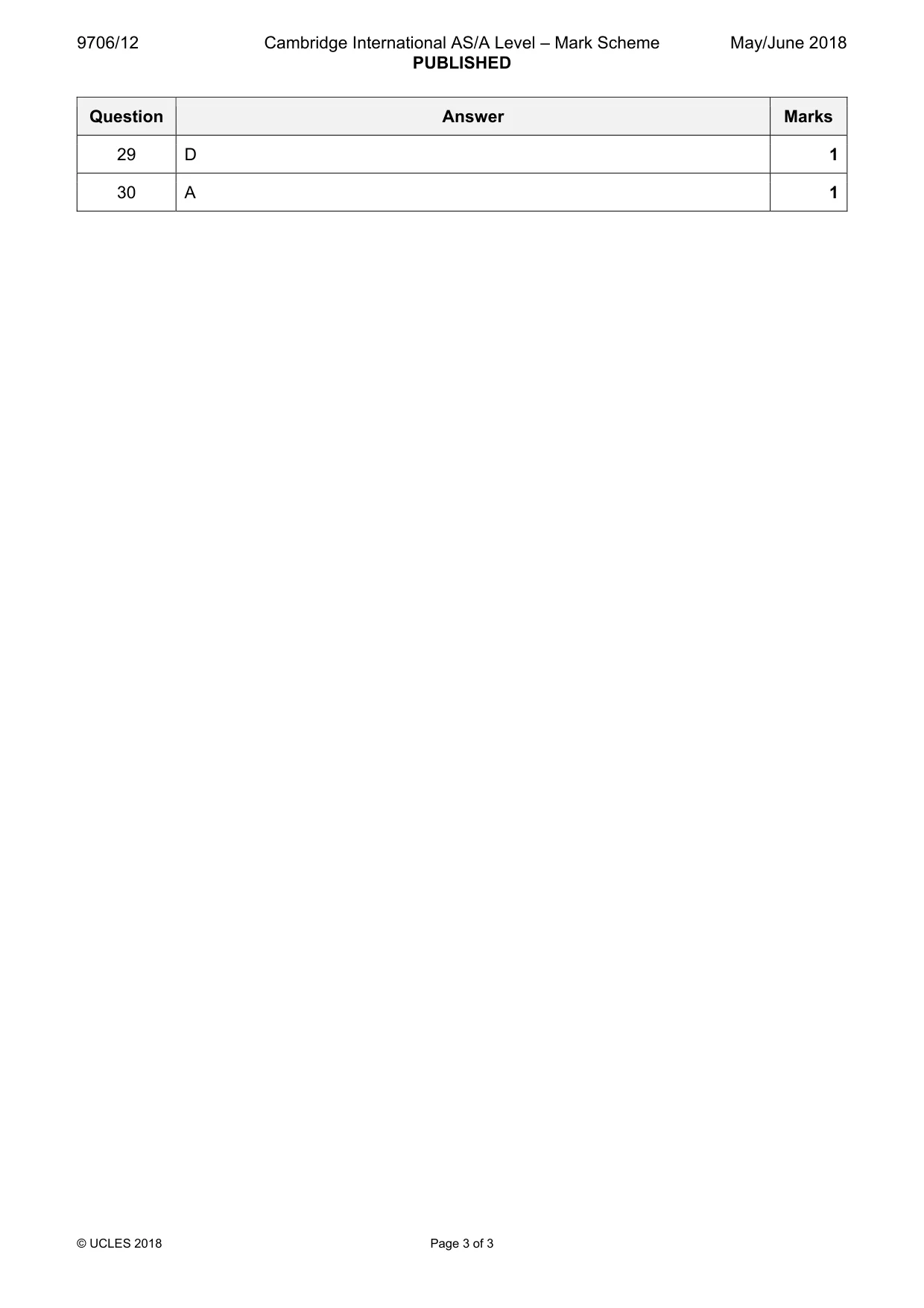
Mark scheme: D
Q30 · Why might a business prepare a budget?
30 Why might a business prepare a budget? A to determine the amount of bank loan it needs B to determine the skills of labour force C to identify its market share D to identify the quality of its products
Mark scheme: A
What was in this paper
The subtopics covered by these 30 questions, and how many questions each got. Open one in a new tab to see every Cambridge question on it.
6The accounting system5Traditional costing methods4Preparation of financial statements3Preparation of financial statements3Reconciliation and verification3Accounting for non-current assets2Analysis and communication of accounting information2Budgeting and budgetary control1Business acquisition and merger1What you needed in this session
Cambridge’s own grade thresholds for 2018 May/June, Paper 1 · Variant 2. A higher threshold means an easier paper — the bar moves with how the cohort did.