Cambridge A Level Accounting 9706 — 2016 Feb/March Paper 1 · Variant 2
9706/12/F/M/16 · 30 questions · 30 marks · ≈34 min
The question paper and its mark scheme, free to read here and free to download. This is Cambridge’s own paper, exactly as it was sat.
Question paper12 pages

Mark scheme2 pages
Answers below. Sit the paper first if you are practising.
Questions as text
Q1 · A business has a good reputation
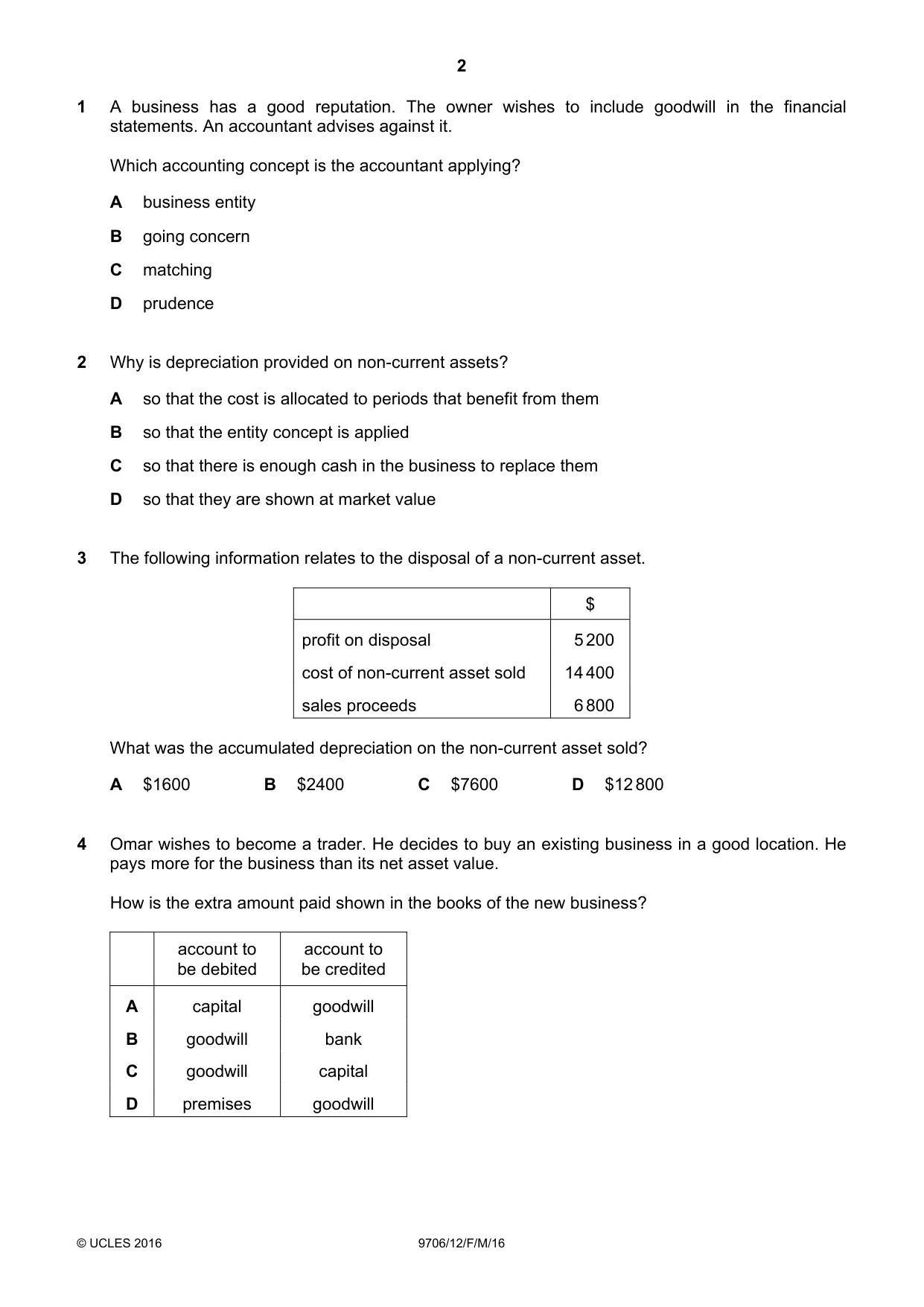
1 A business has a good reputation. The owner wishes to include goodwill in the financial statements. An accountant advises against it. Which accounting concept is the accountant applying? A business entity B going concern C matching D prudence
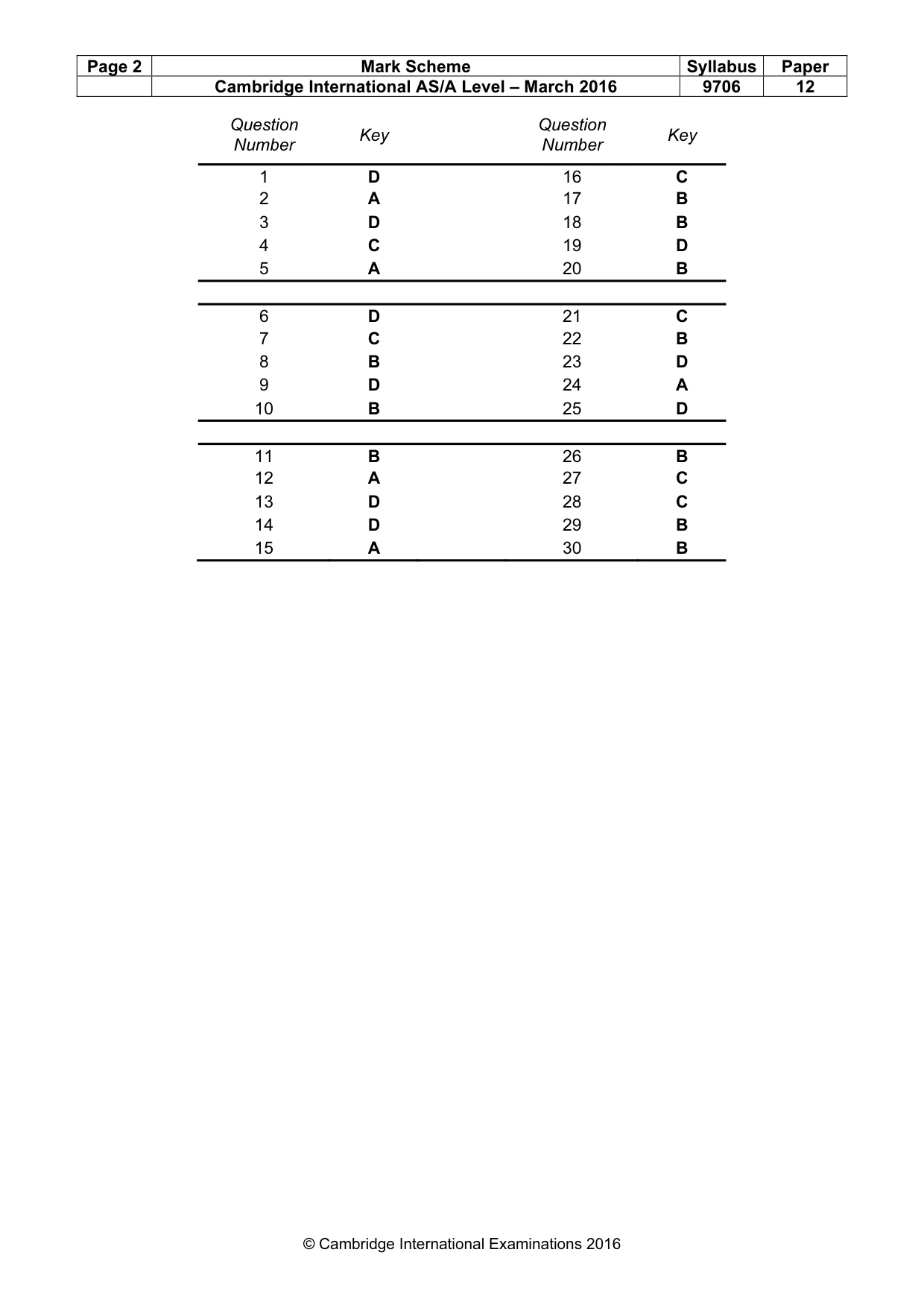
Mark scheme: D
Q2 · Why is depreciation provided on non-current assets?
2 Why is depreciation provided on non-current assets? A so that the cost is allocated to periods that benefit from them B so that the entity concept is applied C so that there is enough cash in the business to replace them D so that they are shown at market value
Mark scheme: A
Q3 · The following information relates to the disposal of a non-current asset
3 The following information relates to the disposal of a non-current asset. $ profit on disposal 5 200 cost of non-current asset sold 14 400 sales proceeds 6 800 What was the accumulated depreciation on the non-current asset sold? A $1600 B $2400 C $7600 D $12 800
Mark scheme: D
Q4 · Omar wishes to become a trader
4 Omar wishes to become a trader. He decides to buy an existing business in a good location. He pays more for the business than its net asset value. How is the extra amount paid shown in the books of the new business? account to account to be debited be credited A capital goodwill B goodwill bank C goodwill capital D premises goodwill
Mark scheme: C
Q5 · A sales ledger control account was prepared
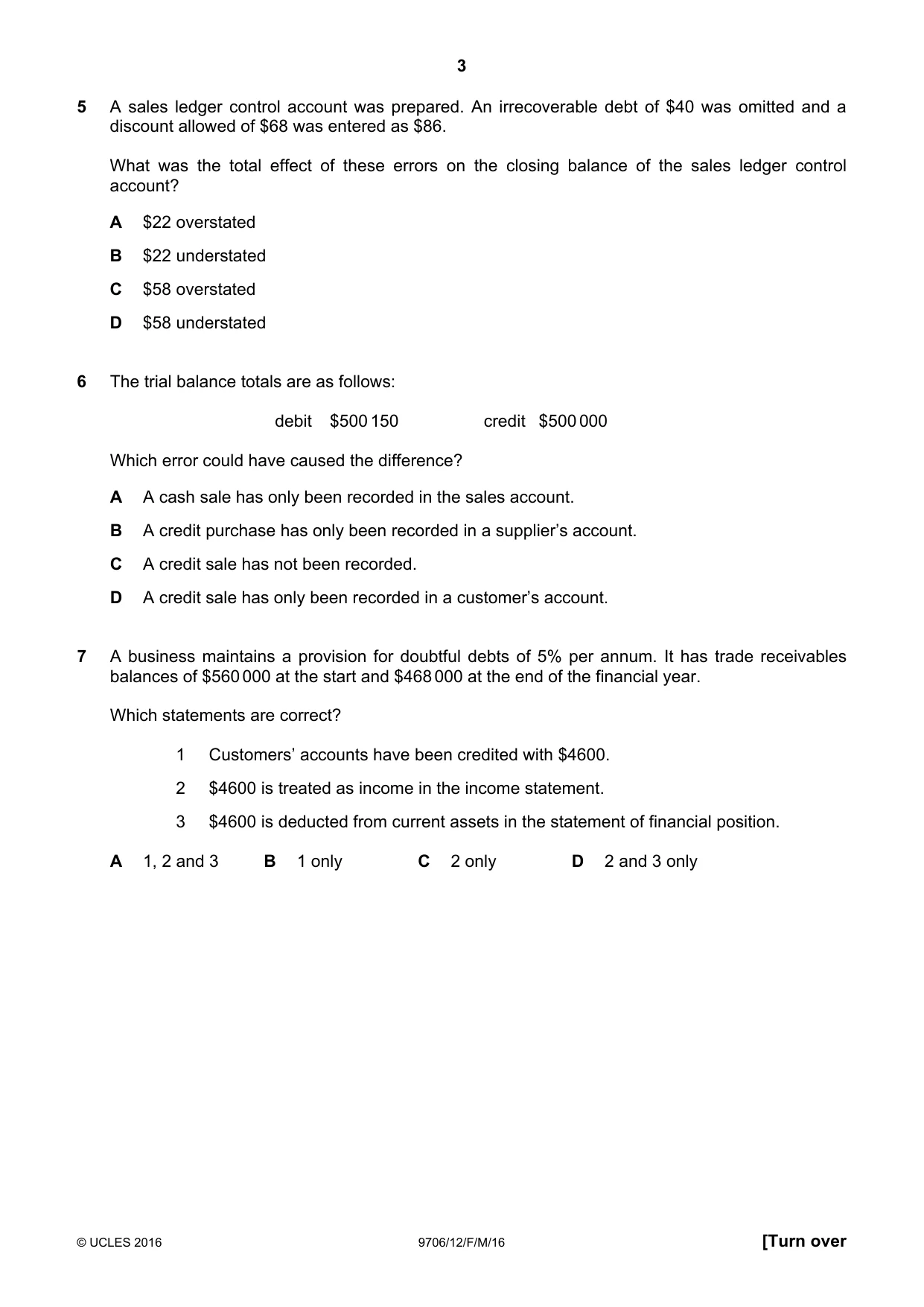
5 A sales ledger control account was prepared. An irrecoverable debt of $40 was omitted and a discount allowed of $68 was entered as $86. What was the total effect of these errors on the closing balance of the sales ledger control account? A $22 overstated B $22 understated C $58 overstated D $58 understated
Mark scheme: A
Q6 · The trial balance totals are as follows: debit $500 150 credit $500 000 Which error could…
6 The trial balance totals are as follows: debit $500 150 credit $500 000 Which error could have caused the difference? A A cash sale has only been recorded in the sales account. B A credit purchase has only been recorded in a supplier’s account. C A credit sale has not been recorded. D A credit sale has only been recorded in a customer’s account.
Mark scheme: D
Q7 · A business maintains a provision for doubtful debts of 5% per annum
7 A business maintains a provision for doubtful debts of 5% per annum. It has trade receivables balances of $560 000 at the start and $468 000 at the end of the financial year. Which statements are correct? 1 Customers’ accounts have been credited with $4600. 2 $4600 is treated as income in the income statement. 3 $4600 is deducted from current assets in the statement of financial position. A 1, 2 and 3 B 1 only C 2 only D 2 and 3 only
Mark scheme: C
Q8 · The statement of the financial position of a company shows the following: $ tangible…
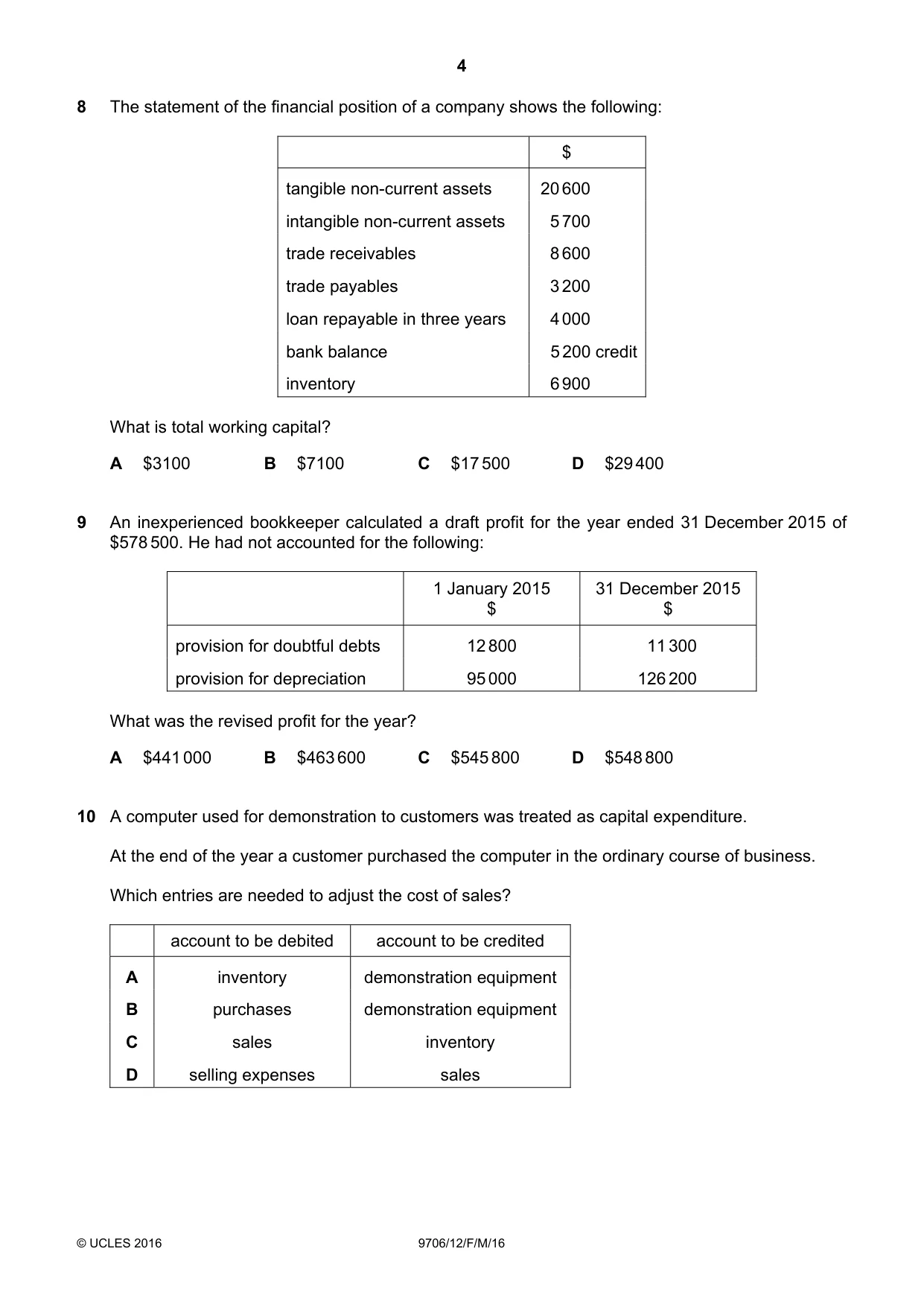
8 The statement of the financial position of a company shows the following: $ tangible non-current assets 20 600 intangible non-current assets 5 700 trade receivables 8 600 trade payables 3 200 loan repayable in three years 4 000 bank balance 5 200 credit inventory 6 900 What is total working capital? A $3100 B $7100 C $17 500 D $29 400
Mark scheme: B
Q9 · An inexperienced bookkeeper calculated a draft profit for the year ended 31 December 2015…
9 An inexperienced bookkeeper calculated a draft profit for the year ended 31 December 2015 of $578 500. He had not accounted for the following: 1 January 2015 31 December 2015 $ $ provision for doubtful debts 12 800 11 300 provision for depreciation 95 000 126 200 What was the revised profit for the year? A $441 000 B $463 600 C $545 800 D $548 800
Mark scheme: D
Q10 · A computer used for demonstration to customers was treated as capital expenditure
10 A computer used for demonstration to customers was treated as capital expenditure. At the end of the year a customer purchased the computer in the ordinary course of business. Which entries are needed to adjust the cost of sales? account to be debited account to be credited A inventory demonstration equipment B purchases demonstration equipment C sales inventory D selling expenses sales
Mark scheme: B
Q11 · A business makes up its financial statements to 30 April each year
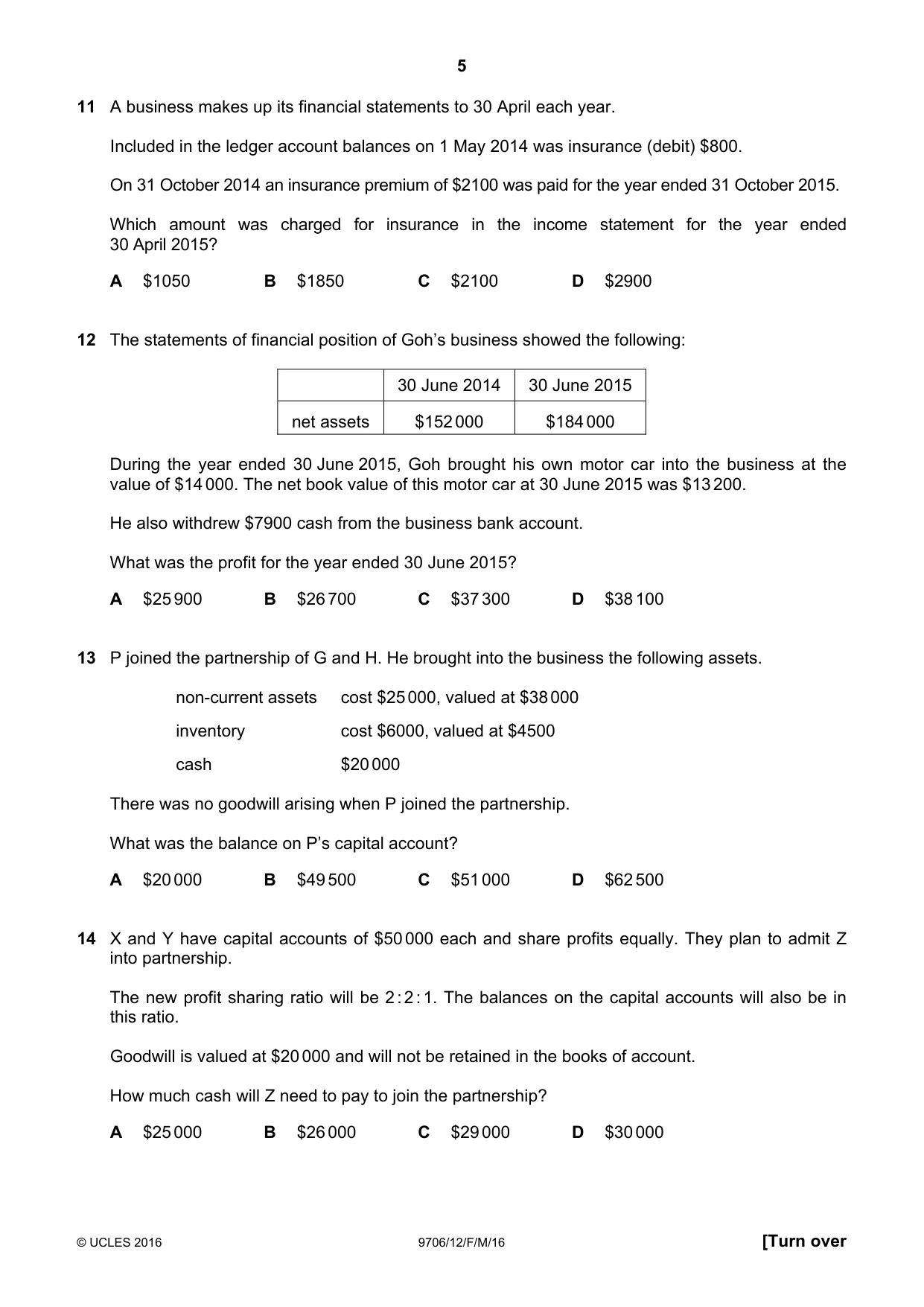
11 A business makes up its financial statements to 30 April each year. Included in the ledger account balances on 1 May 2014 was insurance (debit) $800. On 31 October 2014 an insurance premium of $2100 was paid for the year ended 31 October 2015. Which amount was charged for insurance in the income statement for the year ended 30 April 2015? A $1050 B $1850 C $2100 D $2900
Mark scheme: B
Q12 · The statements of financial position of Goh’s business showed the following: 30 June 2014…
12 The statements of financial position of Goh’s business showed the following: 30 June 2014 30 June 2015 net assets $152 000 $184 000 During the year ended 30 June 2015, Goh brought his own motor car into the business at the value of $14 000. The net book value of this motor car at 30 June 2015 was $13 200. He also withdrew $7900 cash from the business bank account. What was the profit for the year ended 30 June 2015? A $25 900 B $26 700 C $37 300 D $38 100
Mark scheme: A
Q13 · P joined the partnership of G and H
13 P joined the partnership of G and H. He brought into the business the following assets. non-current assets cost $25 000, valued at $38 000 inventory cost $6000, valued at $4500 cash $20 000 There was no goodwill arising when P joined the partnership. What was the balance on P’s capital account? A $20 000 B $49 500 C $51 000 D $62 500
Mark scheme: D
Q14 · X and Y have capital accounts of $50 000 each and share profits equally
14 X and Y have capital accounts of $50 000 each and share profits equally. They plan to admit Z into partnership. The new profit sharing ratio will be 2 : 2 : 1. The balances on the capital accounts will also be in this ratio. Goodwill is valued at $20 000 and will not be retained in the books of account. How much cash will Z need to pay to join the partnership? A $25 000 B $26 000 C $29 000 D $30 000
Mark scheme: D
Q15 · David and Jane have been business partners for several years, sharing profits in the…
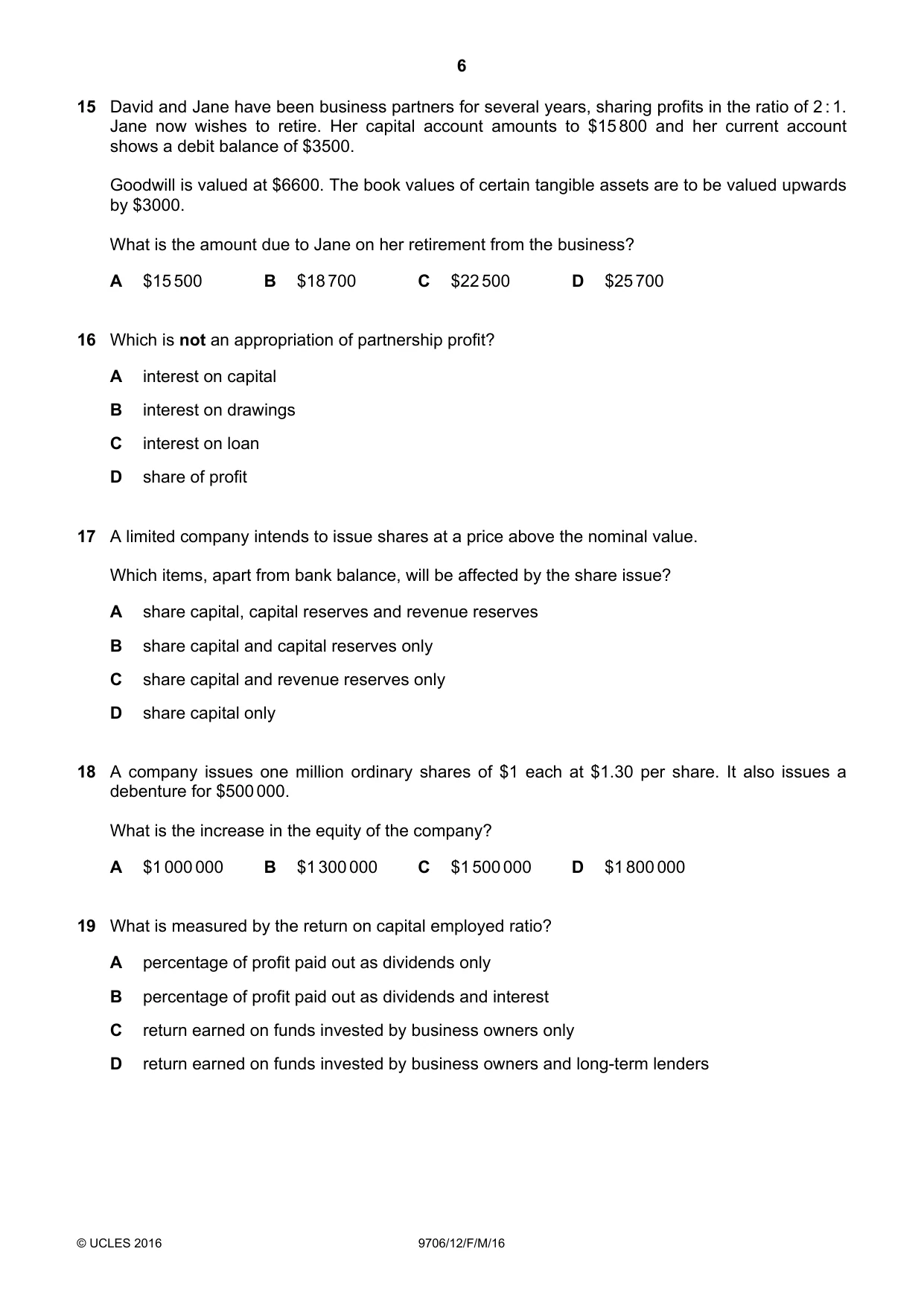
15 David and Jane have been business partners for several years, sharing profits in the ratio of 2 : 1. Jane now wishes to retire. Her capital account amounts to $15 800 and her current account shows a debit balance of $3500. Goodwill is valued at $6600. The book values of certain tangible assets are to be valued upwards by $3000. What is the amount due to Jane on her retirement from the business? A $15 500 B $18 700 C $22 500 D $25 700
Mark scheme: A
Q16 · Which is not an appropriation of partnership profit?
16 Which is not an appropriation of partnership profit? A interest on capital B interest on drawings C interest on loan D share of profit
Mark scheme: C
Q17 · A limited company intends to issue shares at a price above the nominal value
17 A limited company intends to issue shares at a price above the nominal value. Which items, apart from bank balance, will be affected by the share issue? A share capital, capital reserves and revenue reserves B share capital and capital reserves only C share capital and revenue reserves only D share capital only
Mark scheme: B
Q18 · A company issues one million ordinary shares of $1 each at $1.30 per share
18 A company issues one million ordinary shares of $1 each at $1.30 per share. It also issues a debenture for $500 000. What is the increase in the equity of the company? A $1 000 000 B $1 300 000 C $1 500 000 D $1 800 000
Mark scheme: B
Q19 · What is measured by the return on capital employed ratio?
19 What is measured by the return on capital employed ratio? A percentage of profit paid out as dividends only B percentage of profit paid out as dividends and interest C return earned on funds invested by business owners only D return earned on funds invested by business owners and long-term lenders
Mark scheme: D
More questions on Analysis and communication of accounting information
Q20 · The following ratios have been calculated for two businesses, both with the same revenue…
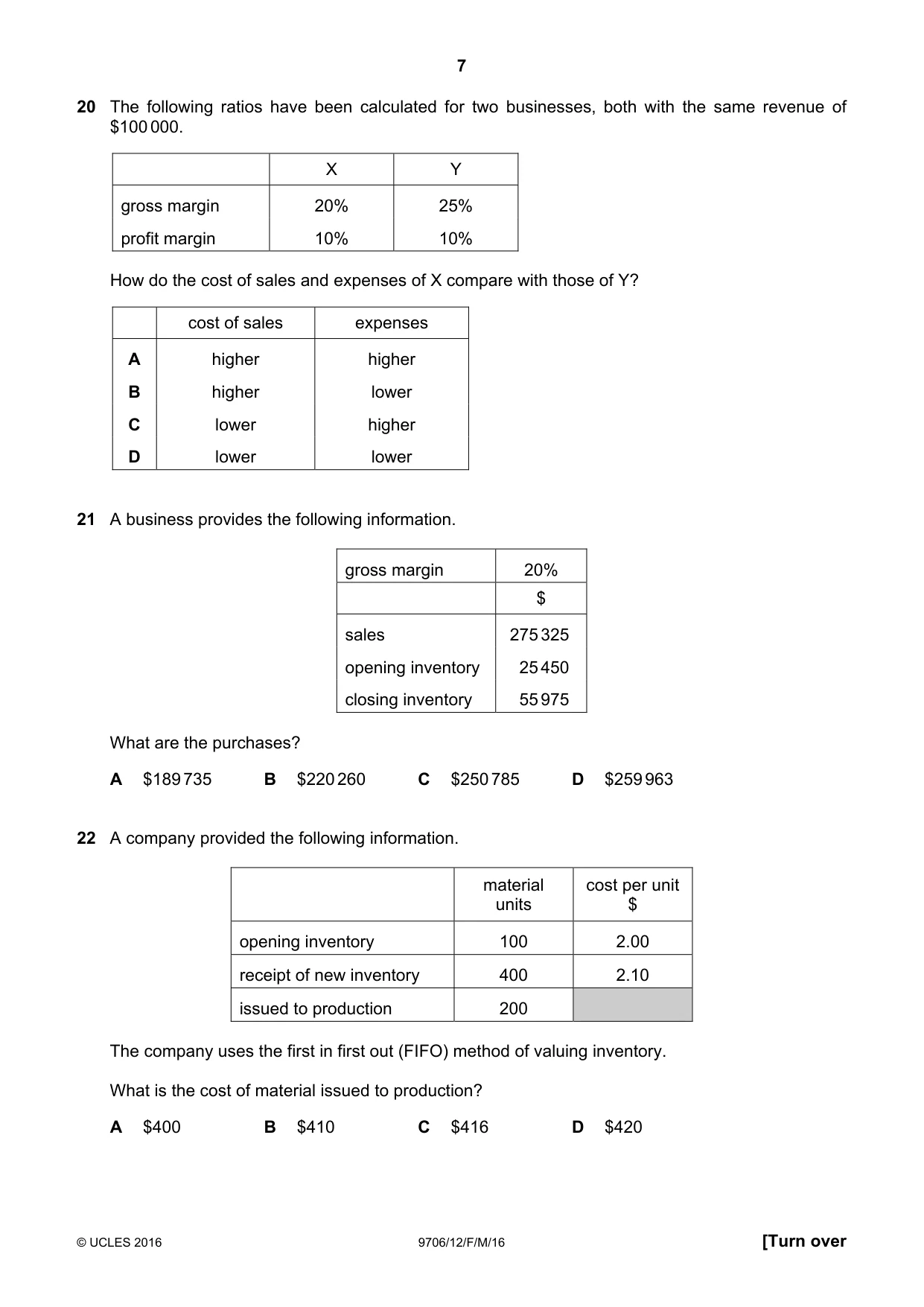
20 The following ratios have been calculated for two businesses, both with the same revenue of $100 000. X Y gross margin 20% 25% profit margin 10% 10% How do the cost of sales and expenses of X compare with those of Y? cost of sales expenses A higher higher B higher lower C lower higher D lower lower
Mark scheme: B
More questions on Analysis and communication of accounting information
Q21 · A business provides the following information
21 A business provides the following information. gross margin 20% $ sales 275 325 opening inventory 25 450 closing inventory 55 975 What are the purchases? A $189 735 B $220 260 C $250 785 D $259 963
Mark scheme: C
Q22 · A company provided the following information
22 A company provided the following information. material cost per unit units $ opening inventory 100 2.00 receipt of new inventory 400 2.10 issued to production 200 The company uses the first in first out (FIFO) method of valuing inventory. What is the cost of material issued to production? A $400 B $410 C $416 D $420
Mark scheme: B
Q23 · A production centre uses 20 000 machine hours and 17 000 labour hours each month
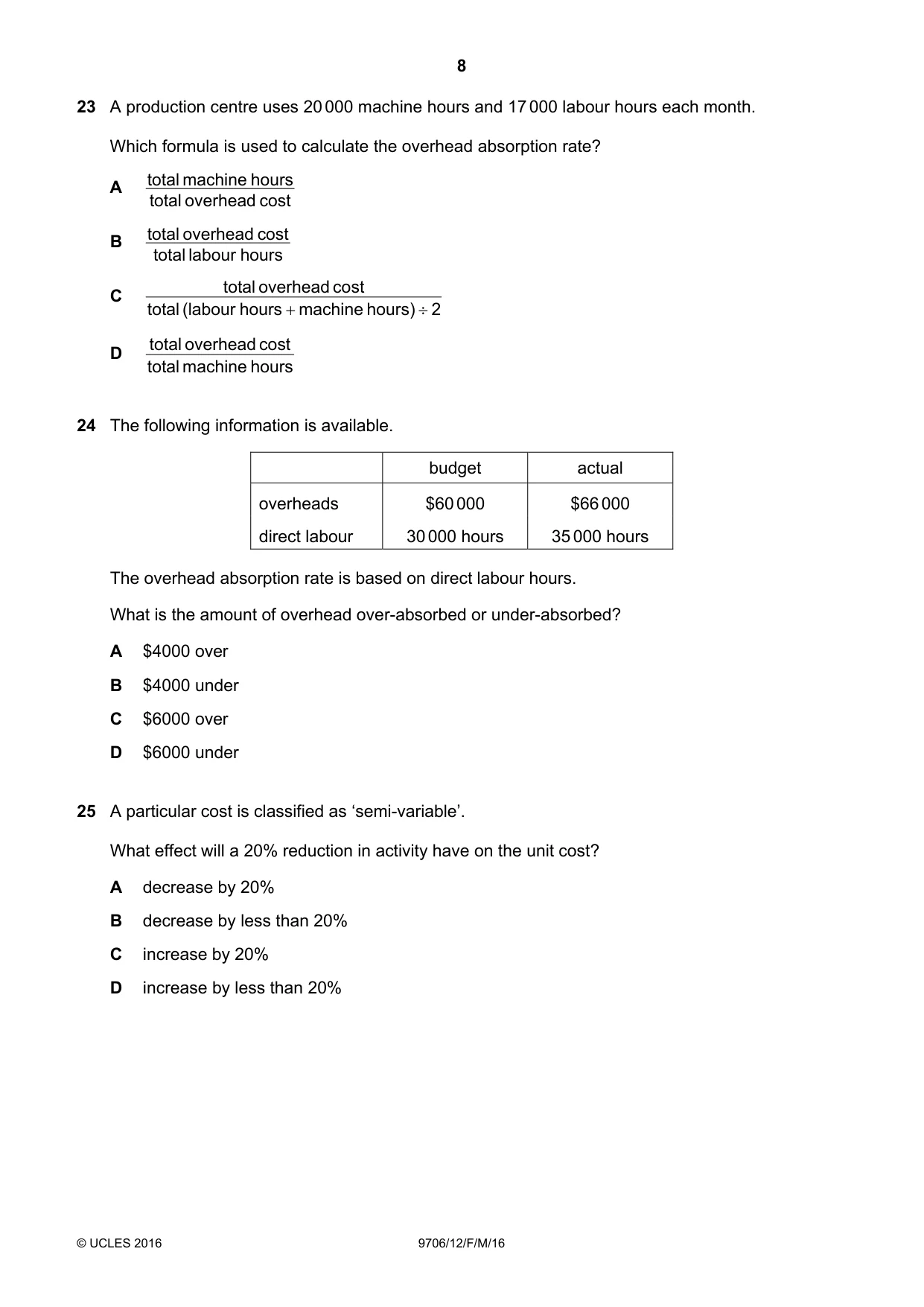
23 A production centre uses 20 000 machine hours and 17 000 labour hours each month. Which formula is used to calculate the overhead absorption rate? A total machine hours total overhead cost B total overhead cost total labour hours total overhead cost C total (labour hours + machine hours) ÷ 2 total overhead cost D total machine hours
Mark scheme: D
Q24 · The following information is available
24 The following information is available. budget actual overheads $60 000 $66 000 direct labour 30 000 hours 35 000 hours The overhead absorption rate is based on direct labour hours. What is the amount of overhead over-absorbed or under-absorbed? A $4000 over B $4000 under C $6000 over D $6000 under
Mark scheme: A
Q25 · A particular cost is classified as ‘semi-variable’
25 A particular cost is classified as ‘semi-variable’. What effect will a 20% reduction in activity have on the unit cost? A decrease by 20% B decrease by less than 20% C increase by 20% D increase by less than 20%
Mark scheme: D
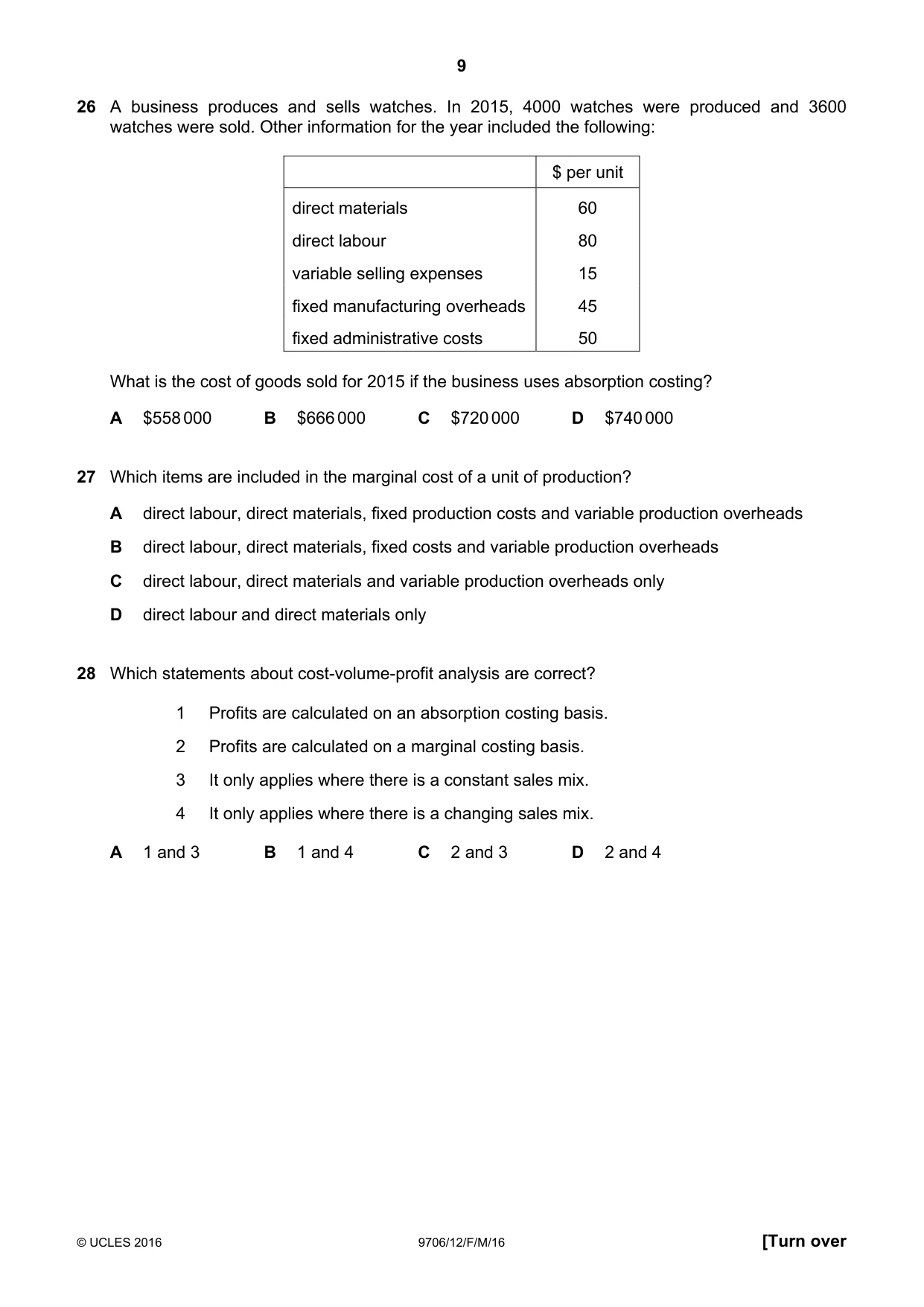
Q26 · A business produces and sells watches
26 A business produces and sells watches. In 2015, 4000 watches were produced and 3600 watches were sold. Other information for the year included the following: $ per unit direct materials 60 direct labour 80 variable selling expenses 15 fixed manufacturing overheads 45 fixed administrative costs 50 What is the cost of goods sold for 2015 if the business uses absorption costing? A $558 000 B $666 000 C $720 000 D $740 000
Mark scheme: B
Q27 · Which items are included in the marginal cost of a unit of production?
27 Which items are included in the marginal cost of a unit of production? A direct labour, direct materials, fixed production costs and variable production overheads B direct labour, direct materials, fixed costs and variable production overheads C direct labour, direct materials and variable production overheads only D direct labour and direct materials only
Mark scheme: C
Q28 · Which statements about cost-volume-profit analysis are correct?
28 Which statements about cost-volume-profit analysis are correct? 1 Profits are calculated on an absorption costing basis. 2 Profits are calculated on a marginal costing basis. 3 It only applies where there is a constant sales mix. 4 It only applies where there is a changing sales mix. A 1 and 3 B 1 and 4 C 2 and 3 D 2 and 4
Mark scheme: C
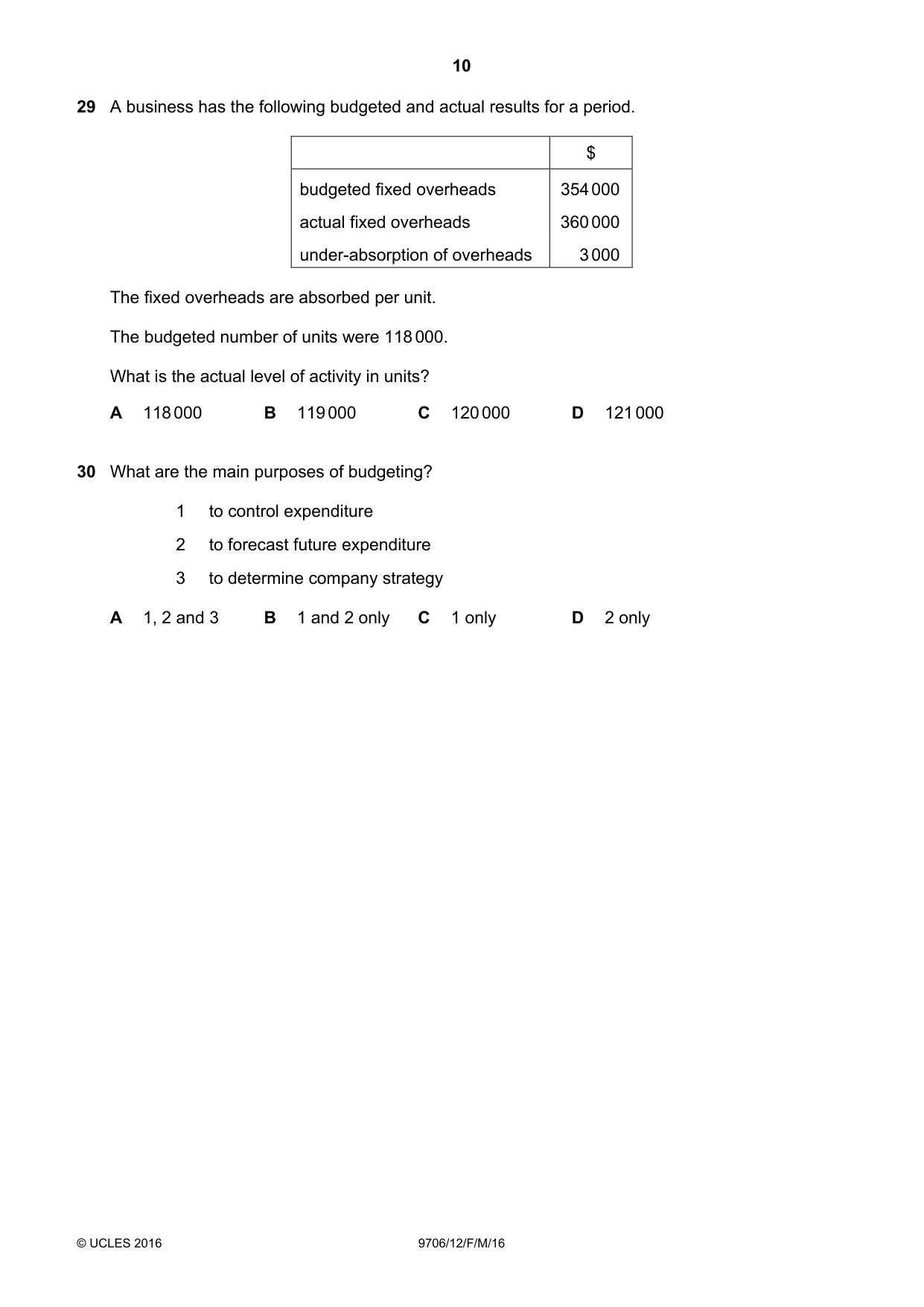
Q29 · A business has the following budgeted and actual results for a period
29 A business has the following budgeted and actual results for a period. $ budgeted fixed overheads 354 000 actual fixed overheads 360 000 under-absorption of overheads 3 000 The fixed overheads are absorbed per unit. The budgeted number of units were 118 000. What is the actual level of activity in units? A 118 000 B 119 000 C 120 000 D 121 000
Mark scheme: B
Q30 · What are the main purposes of budgeting?
30 What are the main purposes of budgeting? 1 to control expenditure 2 to forecast future expenditure 3 to determine company strategy A 1, 2 and 3 B 1 and 2 only C 1 only D 2 only
Mark scheme: B
What was in this paper
The subtopics covered by these 30 questions, and how many questions each got. Open one in a new tab to see every Cambridge question on it.
7Preparation of financial statements6Traditional costing methods4Accounting for non-current assets2Analysis and communication of accounting information2Costs and cost behaviour2Reconciliation and verification2The accounting system2Budgeting and budgetary control1Regulatory and ethical considerations1Standard costing1What you needed in this session
Cambridge’s own grade thresholds for 2016 Feb/March, Paper 1 · Variant 2. A higher threshold means an easier paper — the bar moves with how the cohort did.