Cambridge A Level Accounting 9706 — 2019 Feb/March Paper 1 · Variant 2
9706/12/F/M/19 · 30 questions · 30 marks · ≈34 min
The question paper and its mark scheme, free to read here and free to download. This is Cambridge’s own paper, exactly as it was sat.
Question paper12 pages

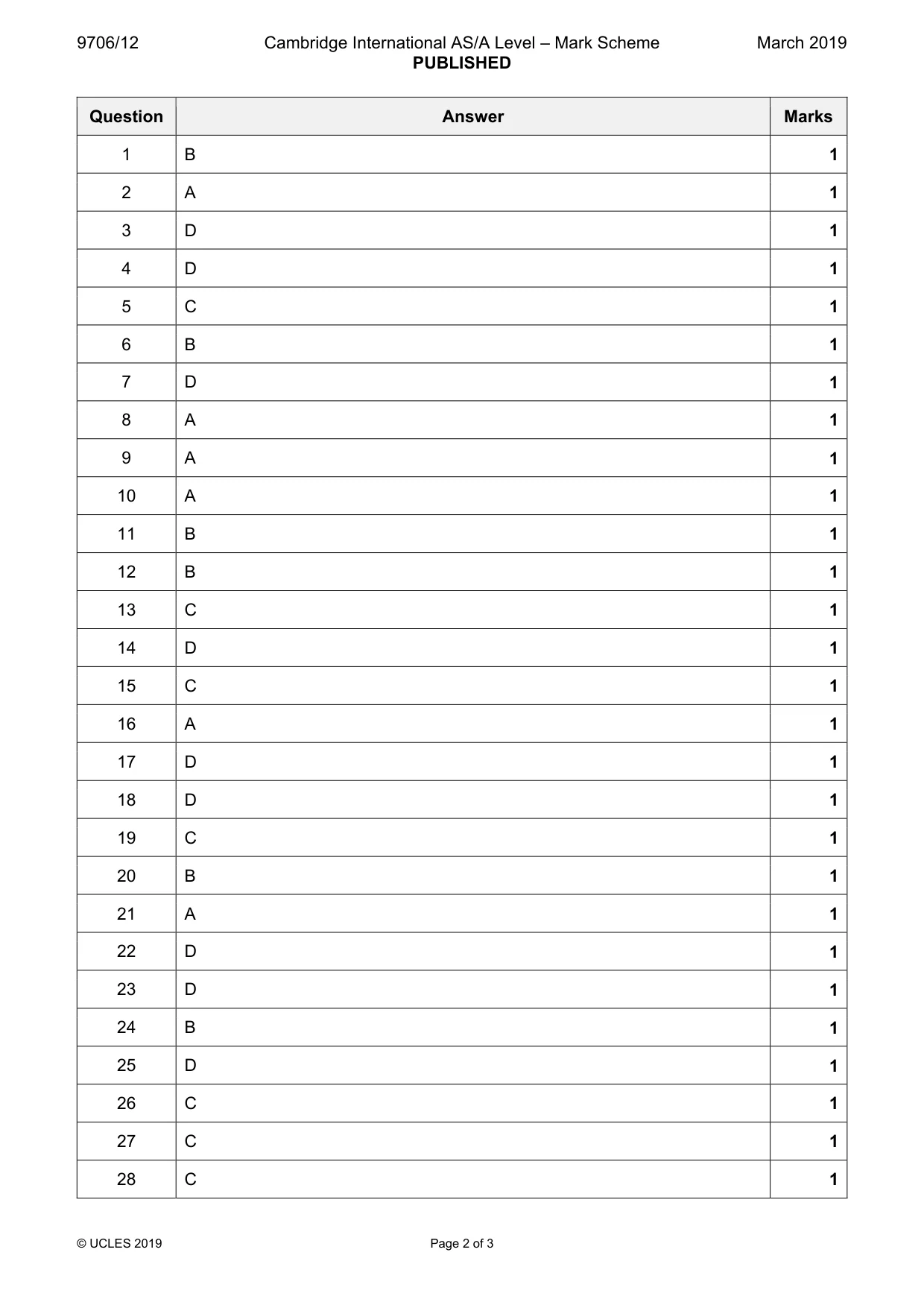
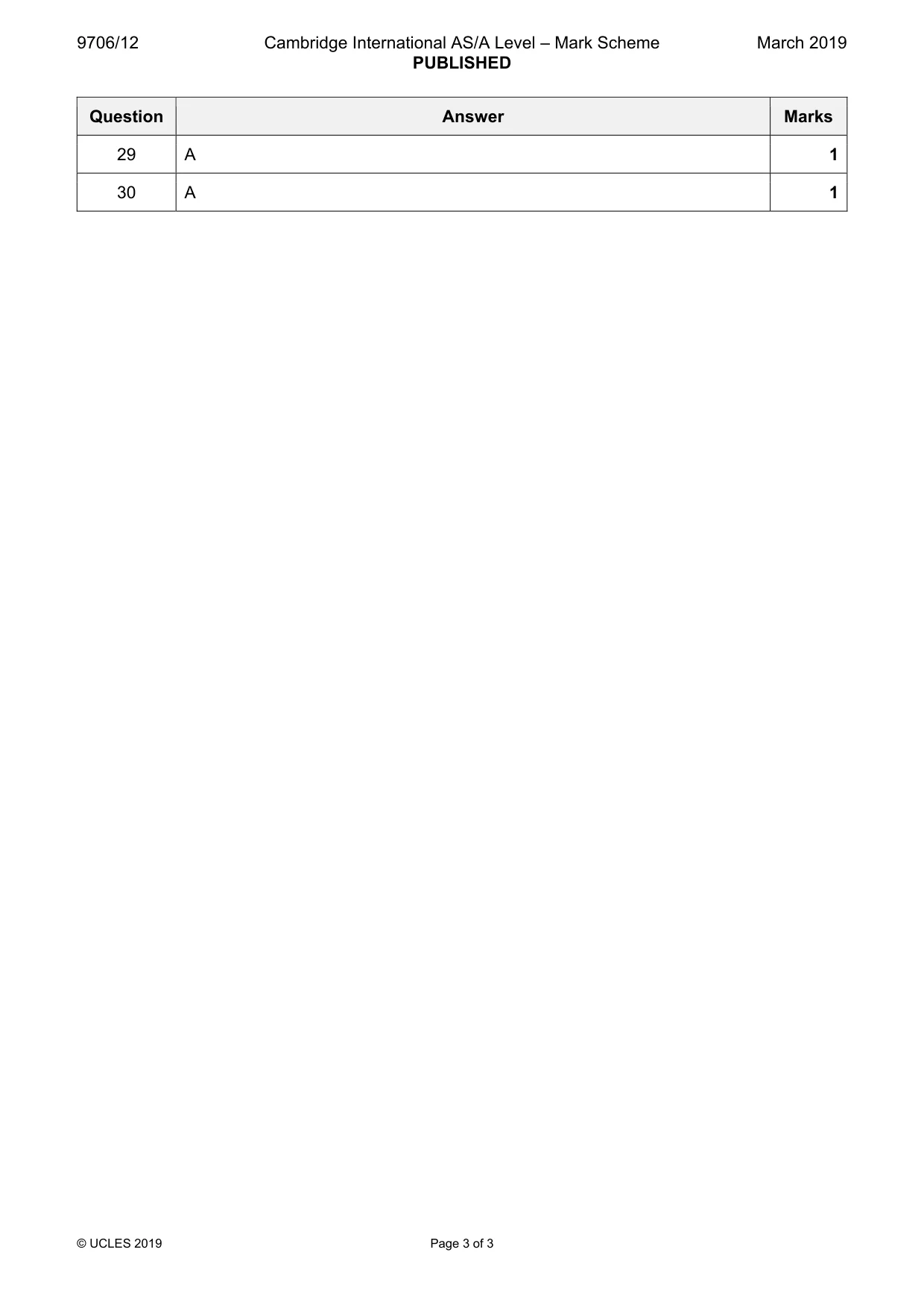
Mark scheme3 pages
Answers below. Sit the paper first if you are practising.
Questions as text
Q1 · An item is included in the financial statements because it affects their interpretation
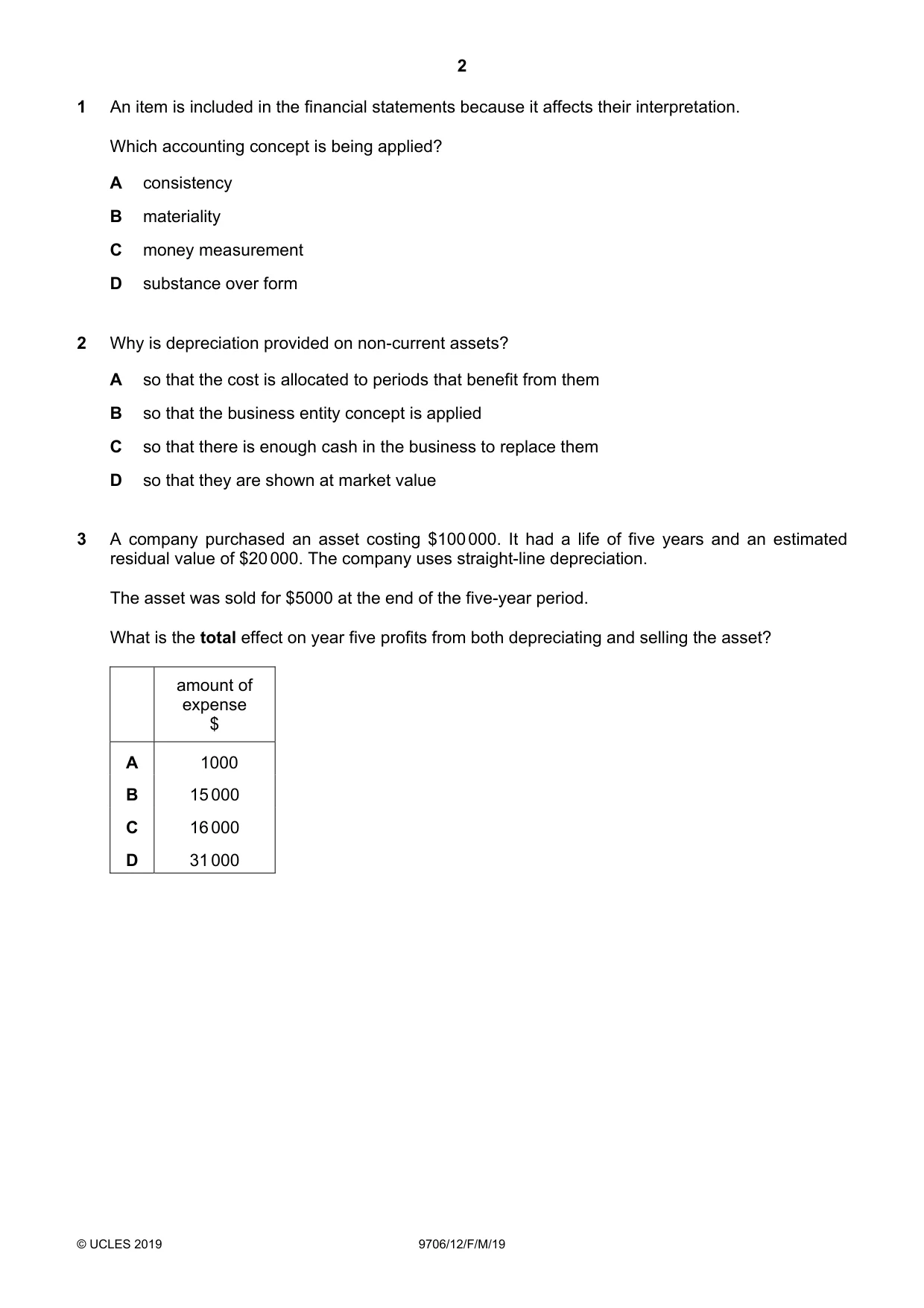
1 An item is included in the financial statements because it affects their interpretation. Which accounting concept is being applied? A consistency B materiality C money measurement D substance over form
Mark scheme: B
Q2 · Why is depreciation provided on non-current assets?
2 Why is depreciation provided on non-current assets? A so that the cost is allocated to periods that benefit from them B so that the business entity concept is applied C so that there is enough cash in the business to replace them D so that they are shown at market value
Mark scheme: A
Q3 · A company purchased an asset costing $100 000
3 A company purchased an asset costing $100 000. It had a life of five years and an estimated residual value of $20 000. The company uses straight-line depreciation. The asset was sold for $5000 at the end of the five-year period. What is the total effect on year five profits from both depreciating and selling the asset? amount of expense $ A 1000 B 15 000 C 16 000 D 31 000
Mark scheme: D
Q4 · A business provides the following information
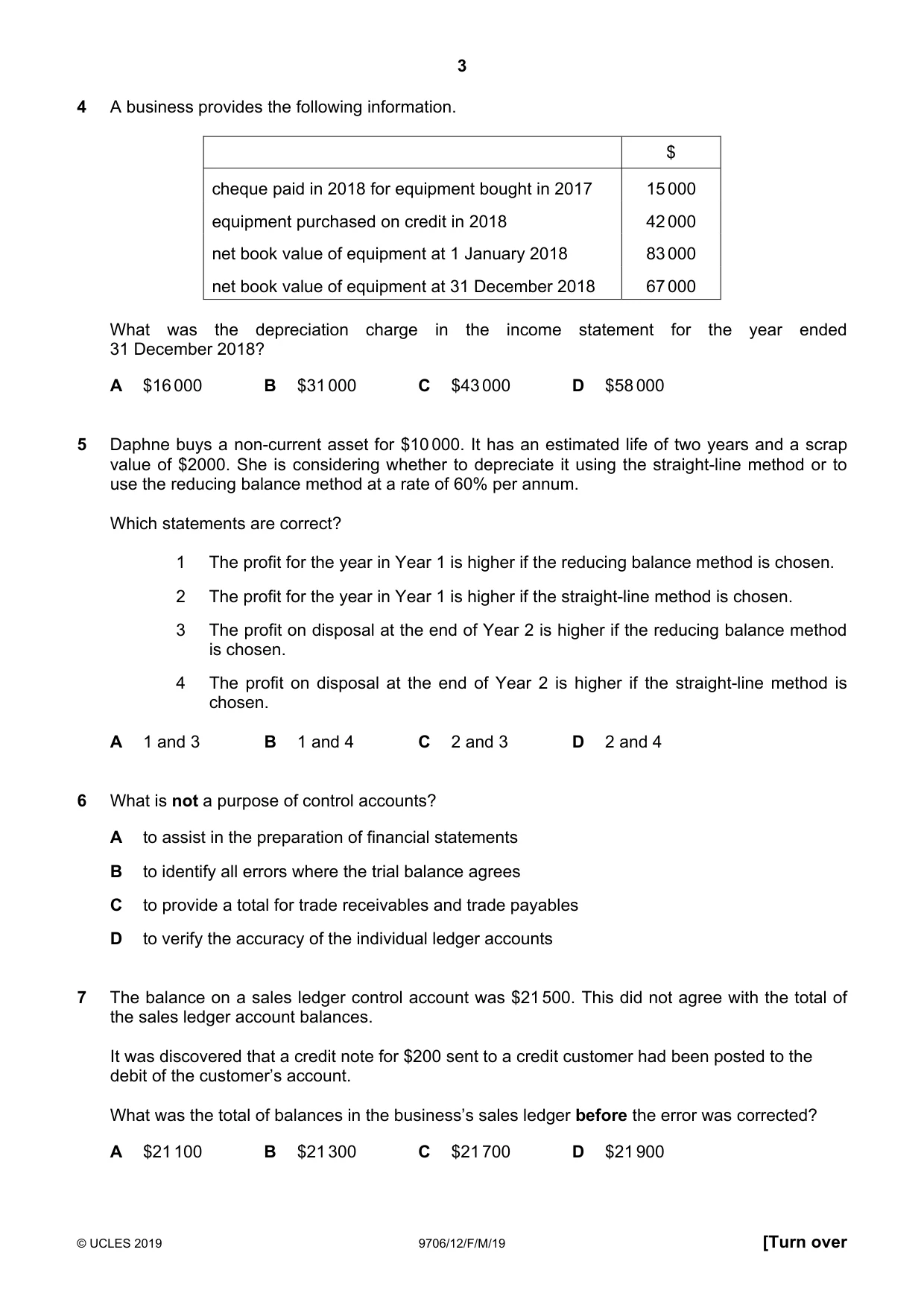
4 A business provides the following information. $ cheque paid in 2018 for equipment bought in 2017 15 000 equipment purchased on credit in 2018 42 000 net book value of equipment at 1 January 2018 83 000 net book value of equipment at 31 December 2018 67 000 What was the depreciation charge in the income statement for the year ended 31 December 2018? A $16 000 B $31 000 C $43 000 D $58 000
Mark scheme: D
Q5 · Daphne buys a non-current asset for $10 000
5 Daphne buys a non-current asset for $10 000. It has an estimated life of two years and a scrap value of $2000. She is considering whether to depreciate it using the straight-line method or to use the reducing balance method at a rate of 60% per annum. Which statements are correct? 1 The profit for the year in Year 1 is higher if the reducing balance method is chosen. 2 The profit for the year in Year 1 is higher if the straight-line method is chosen. 3 The profit on disposal at the end of Year 2 is higher if the reducing balance method is chosen. 4 The profit on disposal at the end of Year 2 is higher if the straight-line method is chosen. A 1 and 3 B 1 and 4 C 2 and 3 D 2 and 4
Mark scheme: C
Q6 · What is not a purpose of control accounts?
6 What is not a purpose of control accounts? A to assist in the preparation of financial statements B to identify all errors where the trial balance agrees C to provide a total for trade receivables and trade payables D to verify the accuracy of the individual ledger accounts
Mark scheme: B
Q7 · The balance on a sales ledger control account was $21 500
7 The balance on a sales ledger control account was $21 500. This did not agree with the total of the sales ledger account balances. It was discovered that a credit note for $200 sent to a credit customer had been posted to the debit of the customer’s account. What was the total of balances in the business’s sales ledger before the error was corrected? A $21 100 B $21 300 C $21 700 D $21 900
Mark scheme: D
Q8 · During the month of June, a business recorded the following information
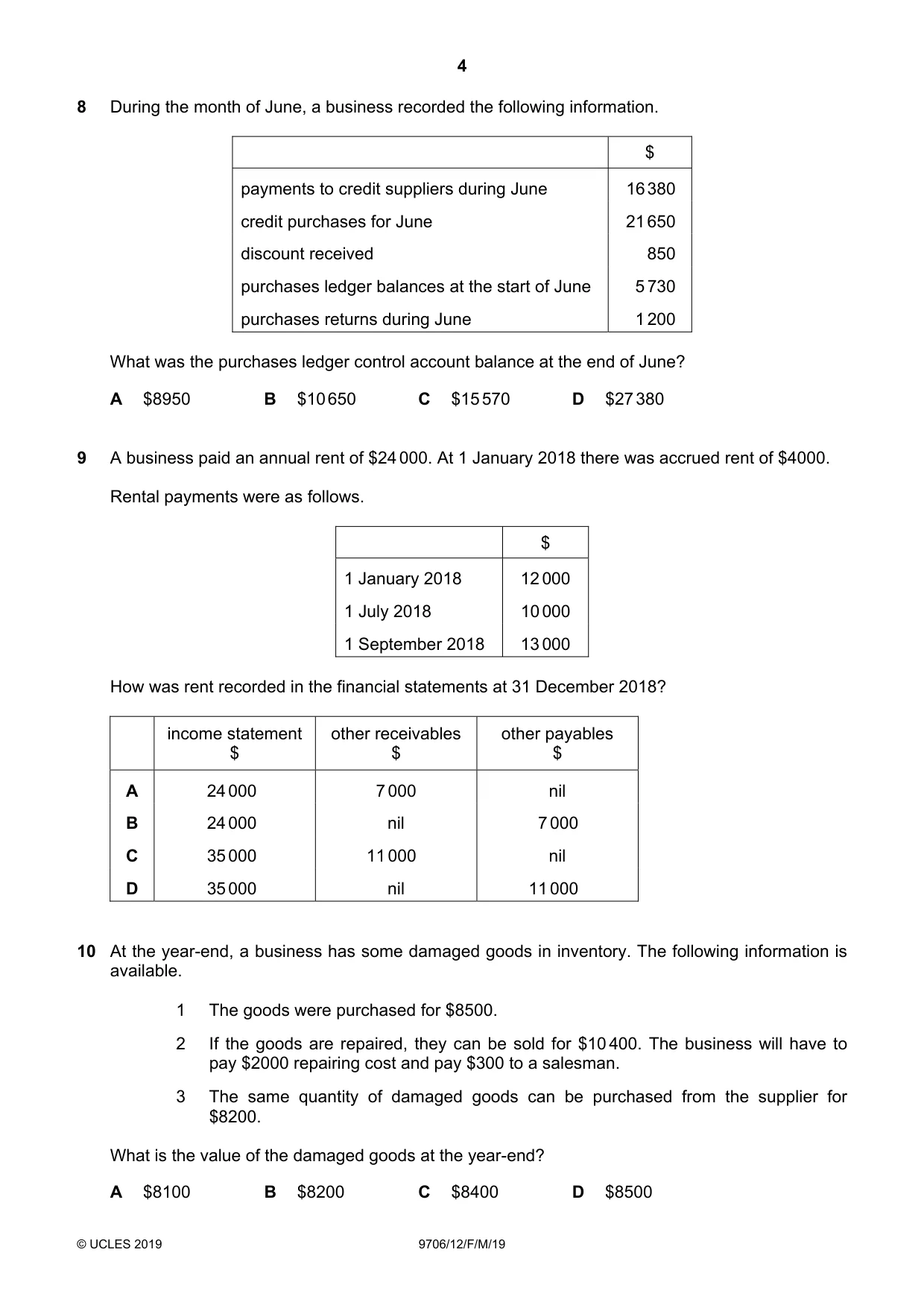
8 During the month of June, a business recorded the following information. $ payments to credit suppliers during June 16 380 credit purchases for June 21 650 discount received 850 purchases ledger balances at the start of June 5 730 purchases returns during June 1 200 What was the purchases ledger control account balance at the end of June? A $8950 B $10 650 C $15 570 D $27 380
Mark scheme: A
Q9 · A business paid an annual rent of $24 000
9 A business paid an annual rent of $24 000. At 1 January 2018 there was accrued rent of $4000. Rental payments were as follows. $ 1 January 2018 12 000 1 July 2018 10 000 1 September 2018 13 000 How was rent recorded in the financial statements at 31 December 2018? income statement other receivables other payables $ $ $ A 24 000 7 000 nil B 24 000 nil 7 000 C 35 000 11 000 nil D 35 000 nil 11 000
Mark scheme: A
Q10 · At the year-end, a business has some damaged goods in inventory
10 At the year-end, a business has some damaged goods in inventory. The following information is available. 1 The goods were purchased for $8500. 2 If the goods are repaired, they can be sold for $10 400. The business will have to pay $2000 repairing cost and pay $300 to a salesman. 3 The same quantity of damaged goods can be purchased from the supplier for $8200. What is the value of the damaged goods at the year-end? A $8100 B $8200 C $8400 D $8500
Mark scheme: A
Q11 · A company undervalued the closing inventory for its current accounting period
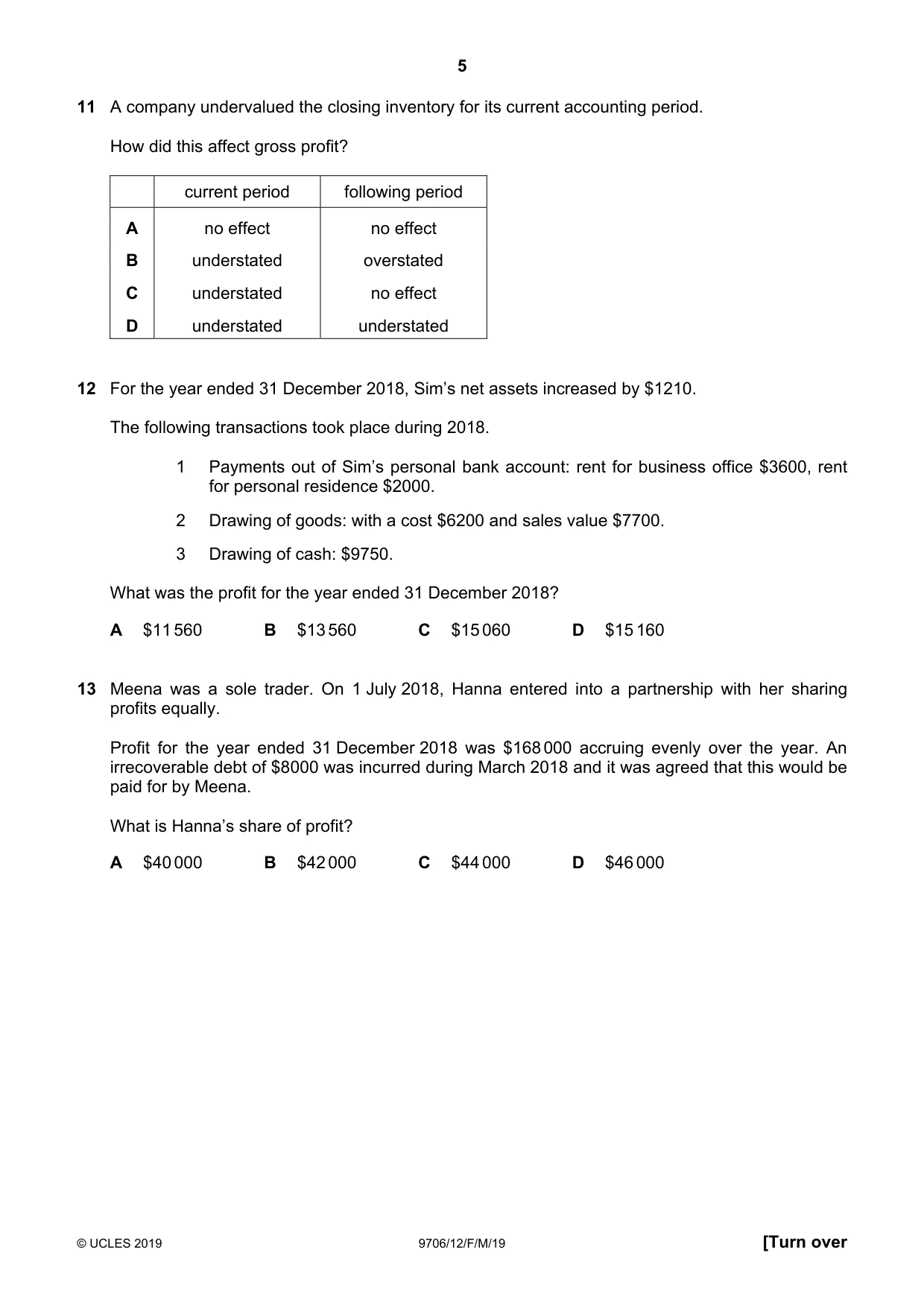
11 A company undervalued the closing inventory for its current accounting period. How did this affect gross profit? current period following period A no effect no effect B understated overstated C understated no effect D understated understated
Mark scheme: B
Q12 · For the year ended 31 December 2018, Sim’s net assets increased by $1210
12 For the year ended 31 December 2018, Sim’s net assets increased by $1210. The following transactions took place during 2018. 1 Payments out of Sim’s personal bank account: rent for business office $3600, rent for personal residence $2000. 2 Drawing of goods: with a cost $6200 and sales value $7700. 3 Drawing of cash: $9750. What was the profit for the year ended 31 December 2018? A $11 560 B $13 560 C $15 060 D $15 160
Mark scheme: B
Q13 · Meena was a sole trader
13 Meena was a sole trader. On 1 July 2018, Hanna entered into a partnership with her sharing profits equally. Profit for the year ended 31 December 2018 was $168 000 accruing evenly over the year. An irrecoverable debt of $8000 was incurred during March 2018 and it was agreed that this would be paid for by Meena. What is Hanna’s share of profit? A $40 000 B $42 000 C $44 000 D $46 000
Mark scheme: C
Q14 · Z is admitted as a new partner in the partnership of X and Y
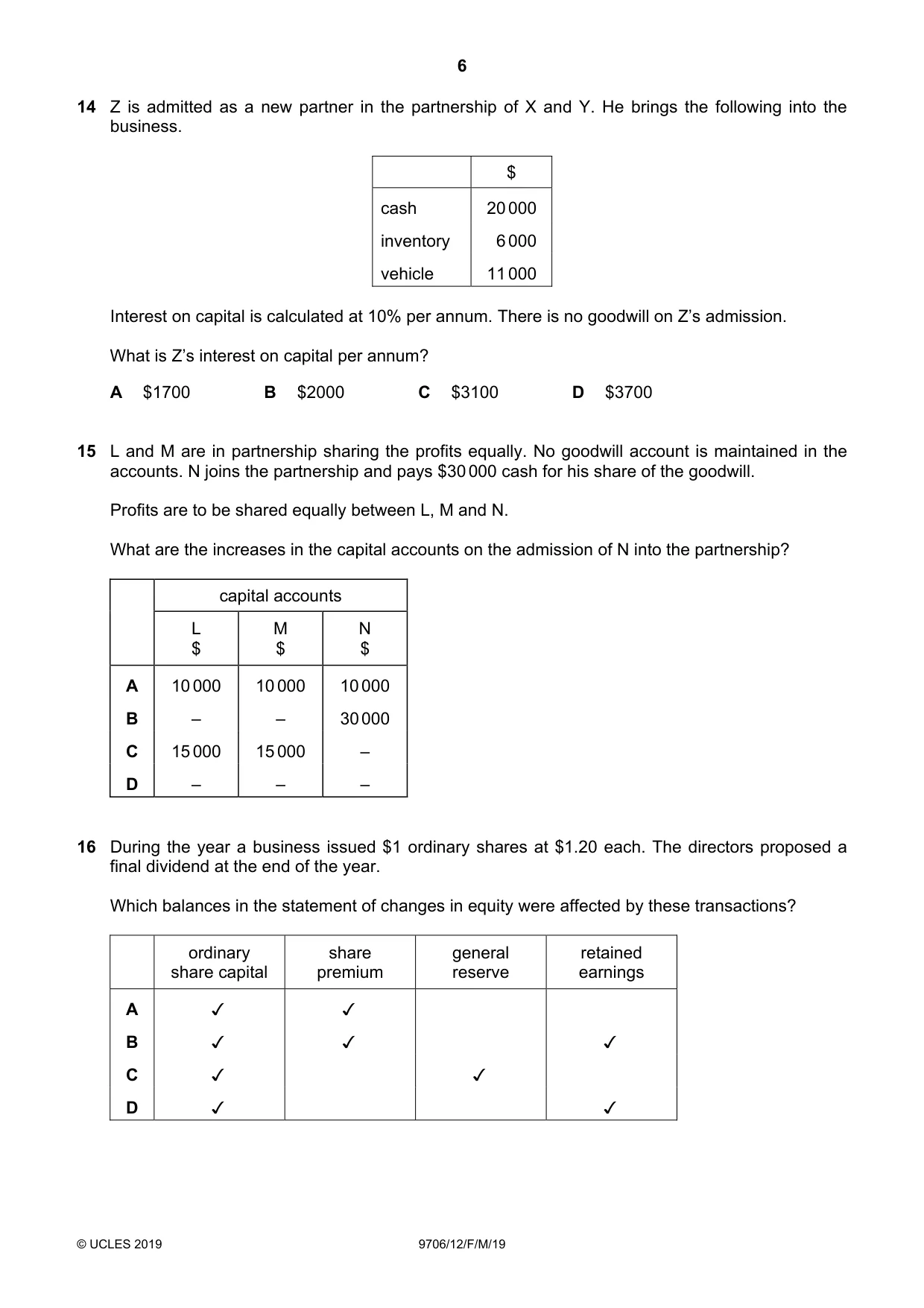
14 Z is admitted as a new partner in the partnership of X and Y. He brings the following into the business. $ cash 20 000 inventory 6 000 vehicle 11 000 Interest on capital is calculated at 10% per annum. There is no goodwill on Z’s admission. What is Z’s interest on capital per annum? A $1700 B $2000 C $3100 D $3700
Mark scheme: D
Q15 · L and M are in partnership sharing the profits equally
15 L and M are in partnership sharing the profits equally. No goodwill account is maintained in the accounts. N joins the partnership and pays $30 000 cash for his share of the goodwill. Profits are to be shared equally between L, M and N. What are the increases in the capital accounts on the admission of N into the partnership? capital accounts L M N $ $ $ A 10 000 10 000 10 000 B – – 30 000 C 15 000 15 000 – D – – –
Mark scheme: C
Q16 · During the year a business issued $1 ordinary shares at $1.20 each
16 During the year a business issued $1 ordinary shares at $1.20 each. The directors proposed a final dividend at the end of the year. Which balances in the statement of changes in equity were affected by these transactions? ordinary share general retained share capital premium reserve earnings A Jv Jv B Jv Jv J Cc Jv J D Jv J
Mark scheme: A
Q17 · A company has ordinary share capital of $250 000
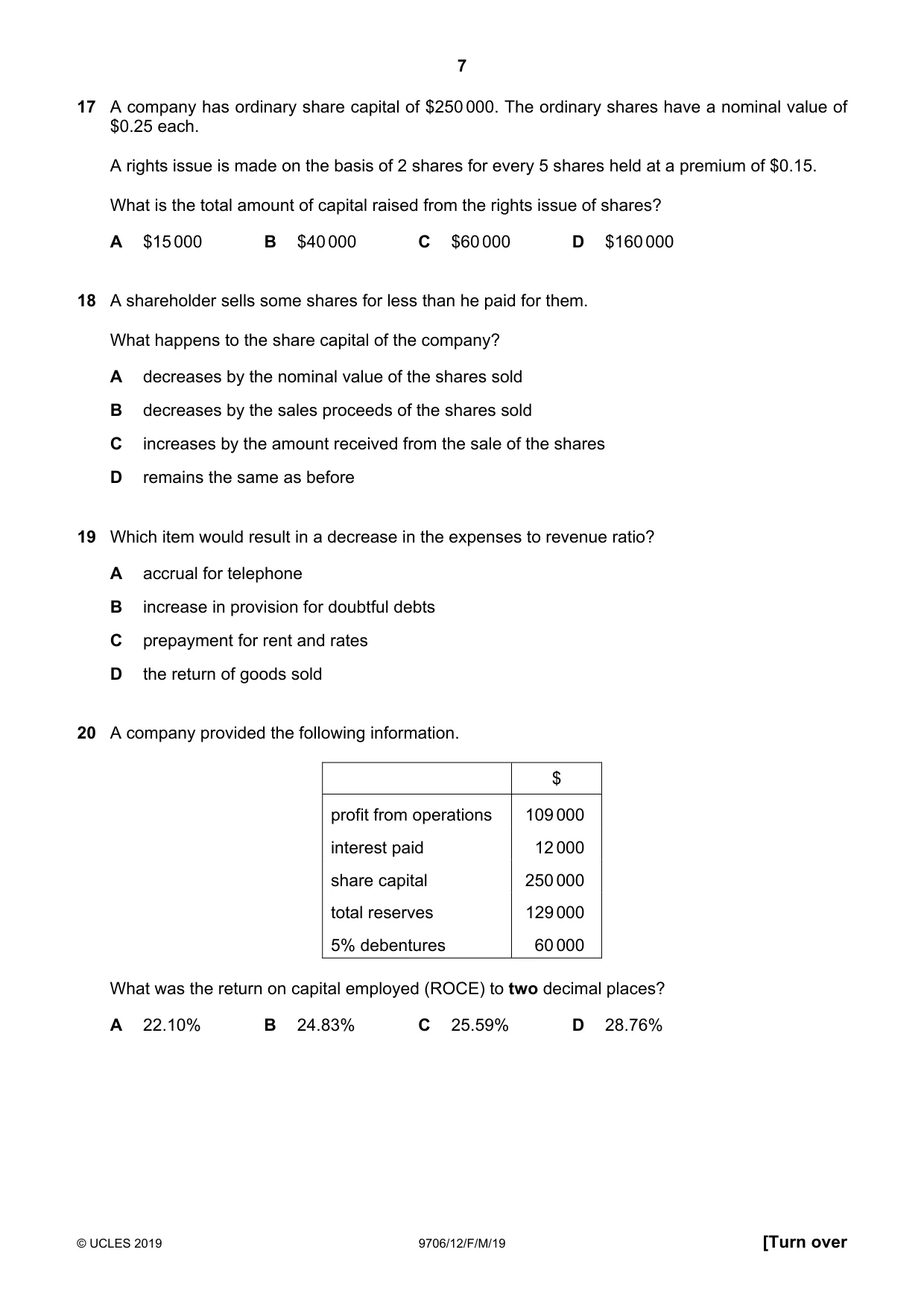
17 A company has ordinary share capital of $250 000. The ordinary shares have a nominal value of $0.25 each. A rights issue is made on the basis of 2 shares for every 5 shares held at a premium of $0.15. What is the total amount of capital raised from the rights issue of shares? A $15 000 B $40 000 C $60 000 D $160 000
Mark scheme: D
Q18 · A shareholder sells some shares for less than he paid for them
18 A shareholder sells some shares for less than he paid for them. What happens to the share capital of the company? A decreases by the nominal value of the shares sold B decreases by the sales proceeds of the shares sold C increases by the amount received from the sale of the shares D remains the same as before
Mark scheme: D
Q19 · Which item would result in a decrease in the expenses to revenue ratio?
19 Which item would result in a decrease in the expenses to revenue ratio? A accrual for telephone B increase in provision for doubtful debts C prepayment for rent and rates D the return of goods sold
Mark scheme: C
More questions on Analysis and communication of accounting information
Q20 · A company provided the following information
20 A company provided the following information. $ profit from operations 109 000 interest paid 12 000 share capital 250 000 total reserves 129 000 5% debentures 60 000 What was the return on capital employed (ROCE) to two decimal places? A 22.10% B 24.83% C 25.59% D 28.76%
Mark scheme: B
More questions on Analysis and communication of accounting information
Q21 · A business provided the following information
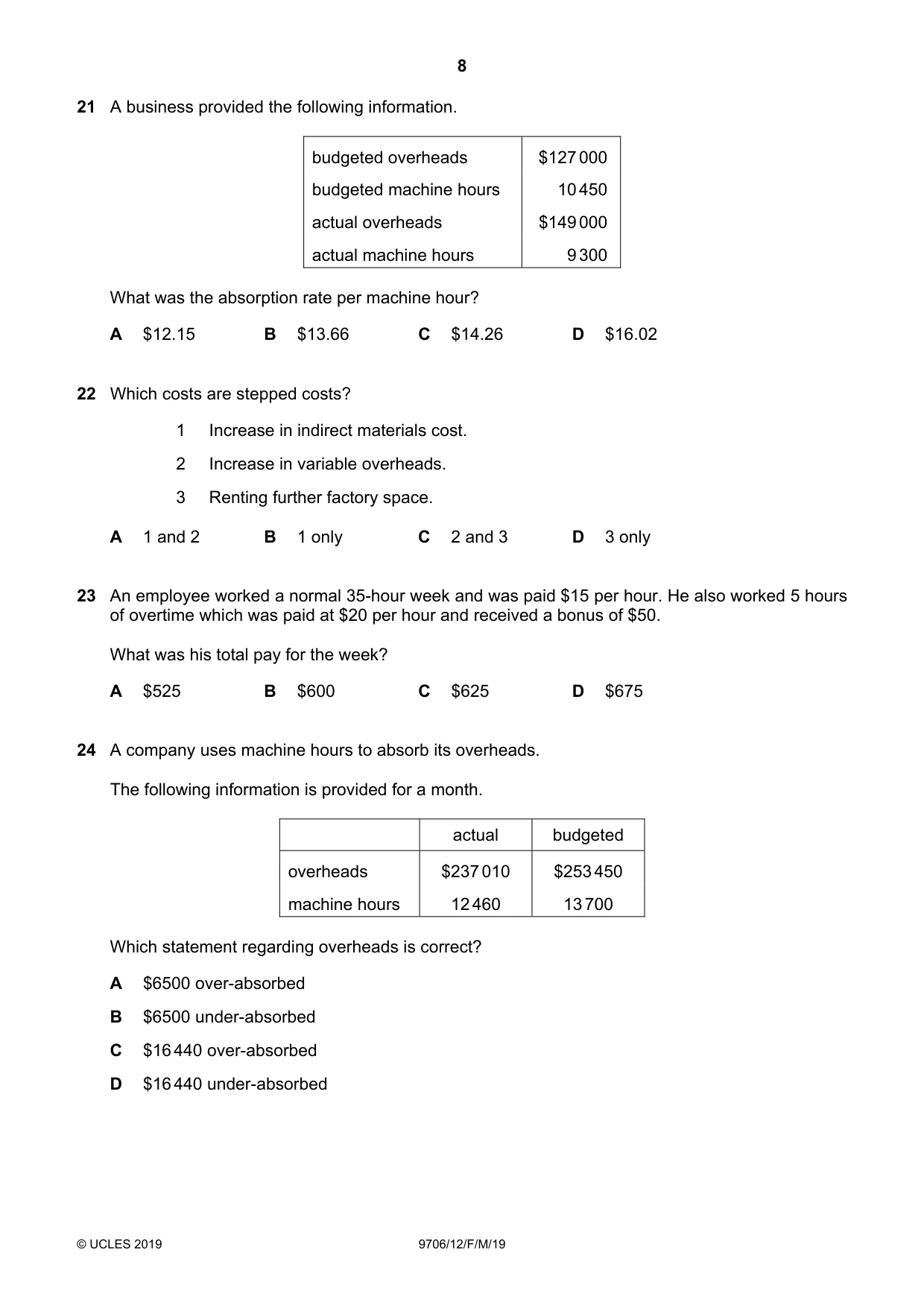
21 A business provided the following information. budgeted overheads $127 000 budgeted machine hours 10 450 actual overheads $149 000 actual machine hours 9 300 What was the absorption rate per machine hour? A $12.15 B $13.66 C $14.26 D $16.02
Mark scheme: A
Q22 · Which costs are stepped costs?
22 Which costs are stepped costs? 1 Increase in indirect materials cost. 2 Increase in variable overheads. 3 Renting further factory space. A 1 and 2 B 1 only C 2 and 3 D 3 only
Mark scheme: D
Q23 · An employee worked a normal 35-hour week and was paid $15 per hour
23 An employee worked a normal 35-hour week and was paid $15 per hour. He also worked 5 hours of overtime which was paid at $20 per hour and received a bonus of $50. What was his total pay for the week? A $525 B $600 C $625 D $675
Mark scheme: D
Q24 · A company uses machine hours to absorb its overheads
24 A company uses machine hours to absorb its overheads. The following information is provided for a month. actual budgeted overheads $237 010 $253 450 machine hours 12 460 13 700 Which statement regarding overheads is correct? A $6500 over-absorbed B $6500 under-absorbed C $16 440 over-absorbed D $16 440 under-absorbed
Mark scheme: B
Q25 · Which line represents total variable cost?
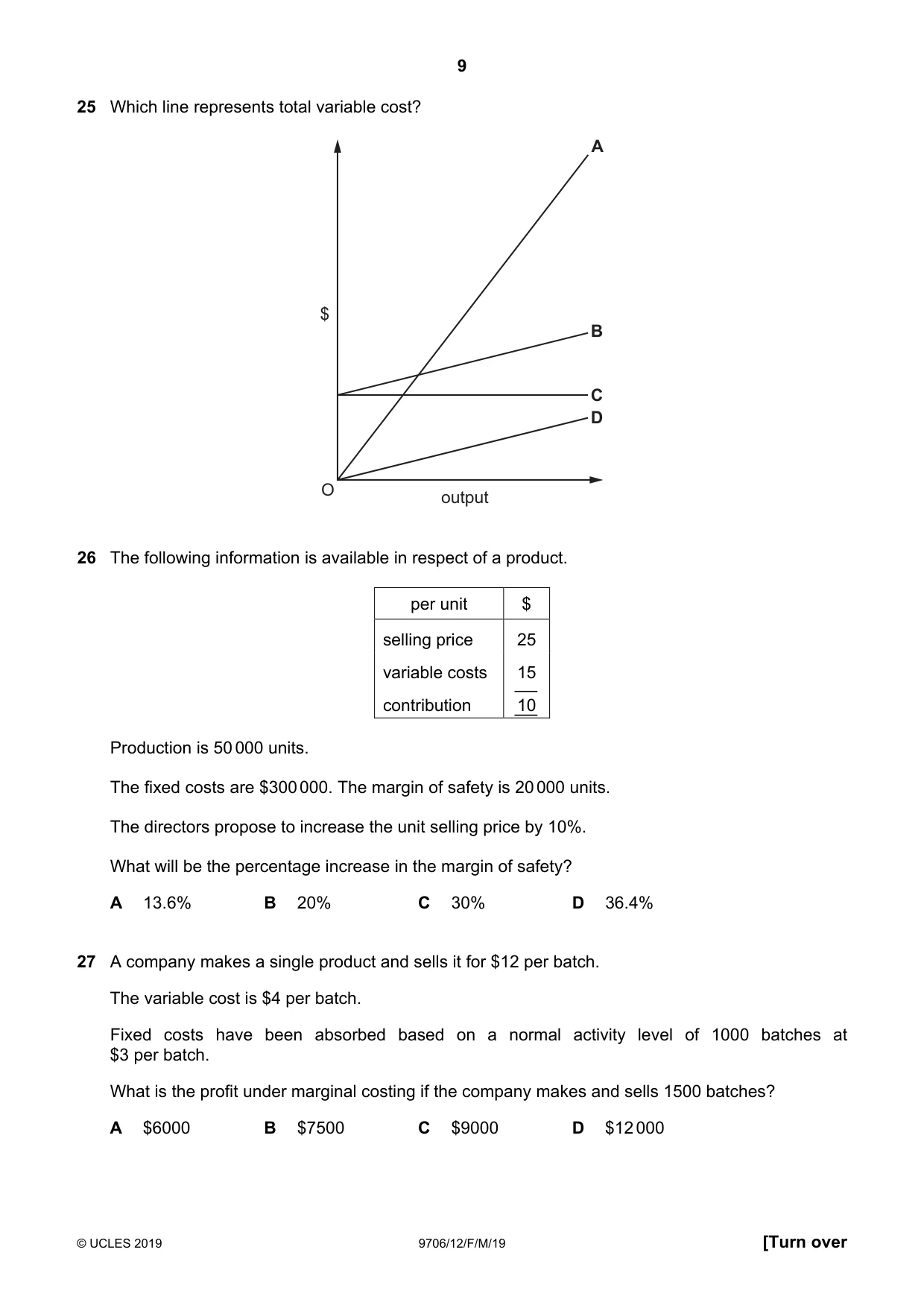
25 Which line represents total variable cost? A $ B C D O output
Mark scheme: D
Q26 · The following information is available in respect of a product
26 The following information is available in respect of a product. per unit $ selling price 25 variable costs 15 contribution 10 Production is 50 000 units. The fixed costs are $300 000. The margin of safety is 20 000 units. The directors propose to increase the unit selling price by 10%. What will be the percentage increase in the margin of safety? A 13.6% B 20% C 30% D 36.4%
Mark scheme: C
Q27 · A company makes a single product and sells it for $12 per batch
27 A company makes a single product and sells it for $12 per batch. The variable cost is $4 per batch. Fixed costs have been absorbed based on a normal activity level of 1000 batches at $3 per batch. What is the profit under marginal costing if the company makes and sells 1500 batches? A $6000 B $7500 C $9000 D $12 000
Mark scheme: C
Q28 · The following information relates to one unit of a product
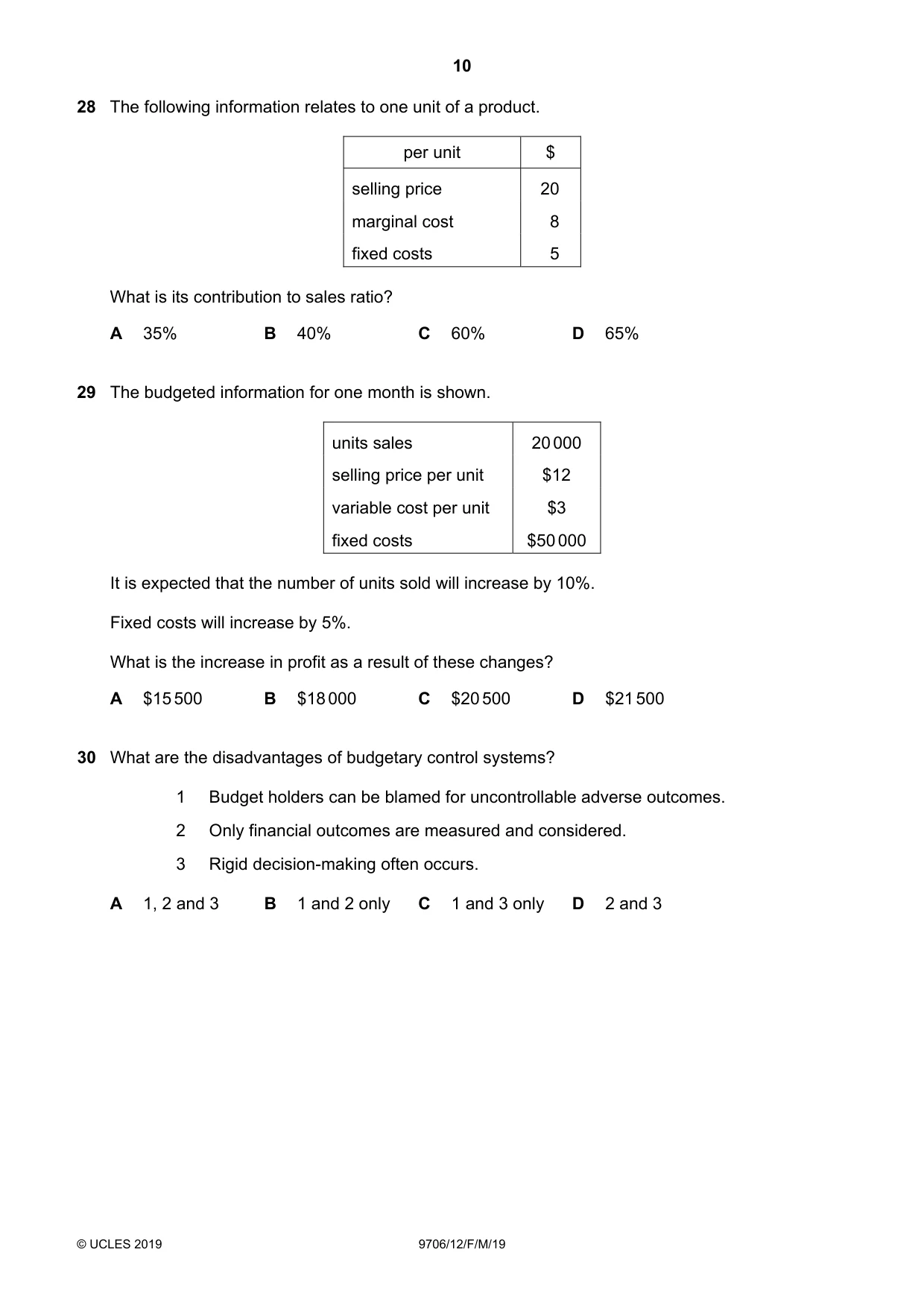
28 The following information relates to one unit of a product. per unit $ selling price 20 marginal cost 8 fixed costs 5 What is its contribution to sales ratio? A 35% B 40% C 60% D 65%
Mark scheme: C
Q29 · The budgeted information for one month is shown
29 The budgeted information for one month is shown. units sales 20 000 selling price per unit $12 variable cost per unit $3 fixed costs $50 000 It is expected that the number of units sold will increase by 10%. Fixed costs will increase by 5%. What is the increase in profit as a result of these changes? A $15 500 B $18 000 C $20 500 D $21 500
Mark scheme: A
Q30 · What are the disadvantages of budgetary control systems?
30 What are the disadvantages of budgetary control systems? 1 Budget holders can be blamed for uncontrollable adverse outcomes. 2 Only financial outcomes are measured and considered. 3 Rigid decision-making often occurs. A 1, 2 and 3 B 1 and 2 only C 1 and 3 only D 2 and 3
Mark scheme: A
What was in this paper
The subtopics covered by these 30 questions, and how many questions each got. Open one in a new tab to see every Cambridge question on it.
7Traditional costing methods5Accounting for non-current assets4Costs and cost behaviour3Preparation of financial statements3Reconciliation and verification3Budgeting and budgetary control2Analysis and communication of accounting information1Analysis and communication of accounting information1The accounting system1What you needed in this session
Cambridge’s own grade thresholds for 2019 Feb/March, Paper 1 · Variant 2. A higher threshold means an easier paper — the bar moves with how the cohort did.