Cambridge A Level Accounting 9706 — 2015 Oct/Nov Paper 1 · Variant 3
9706/13/O/N/15 · 30 questions · 30 marks · ≈34 min
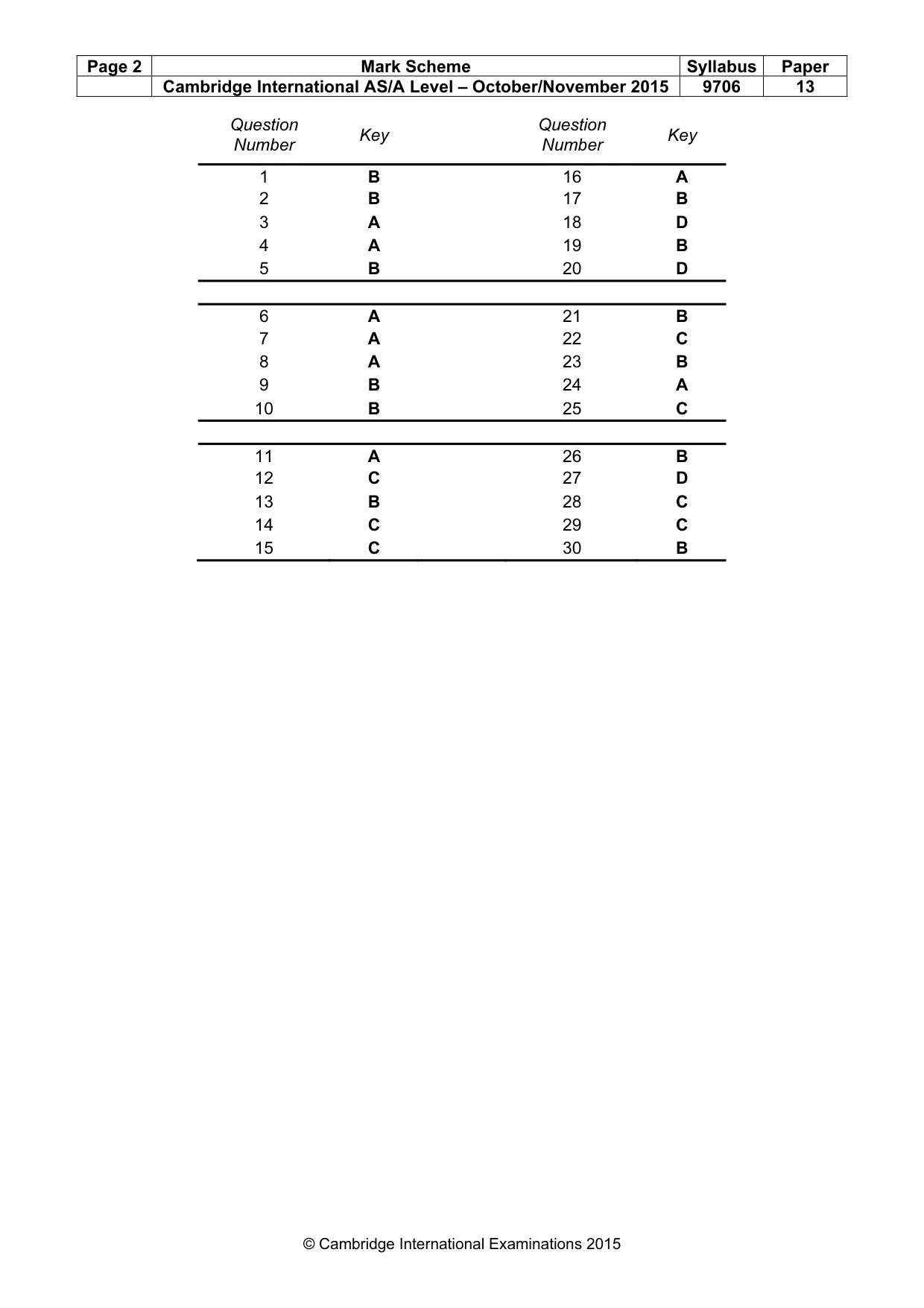
The question paper and its mark scheme, free to read here and free to download. This is Cambridge’s own paper, exactly as it was sat.
Question paper12 pages
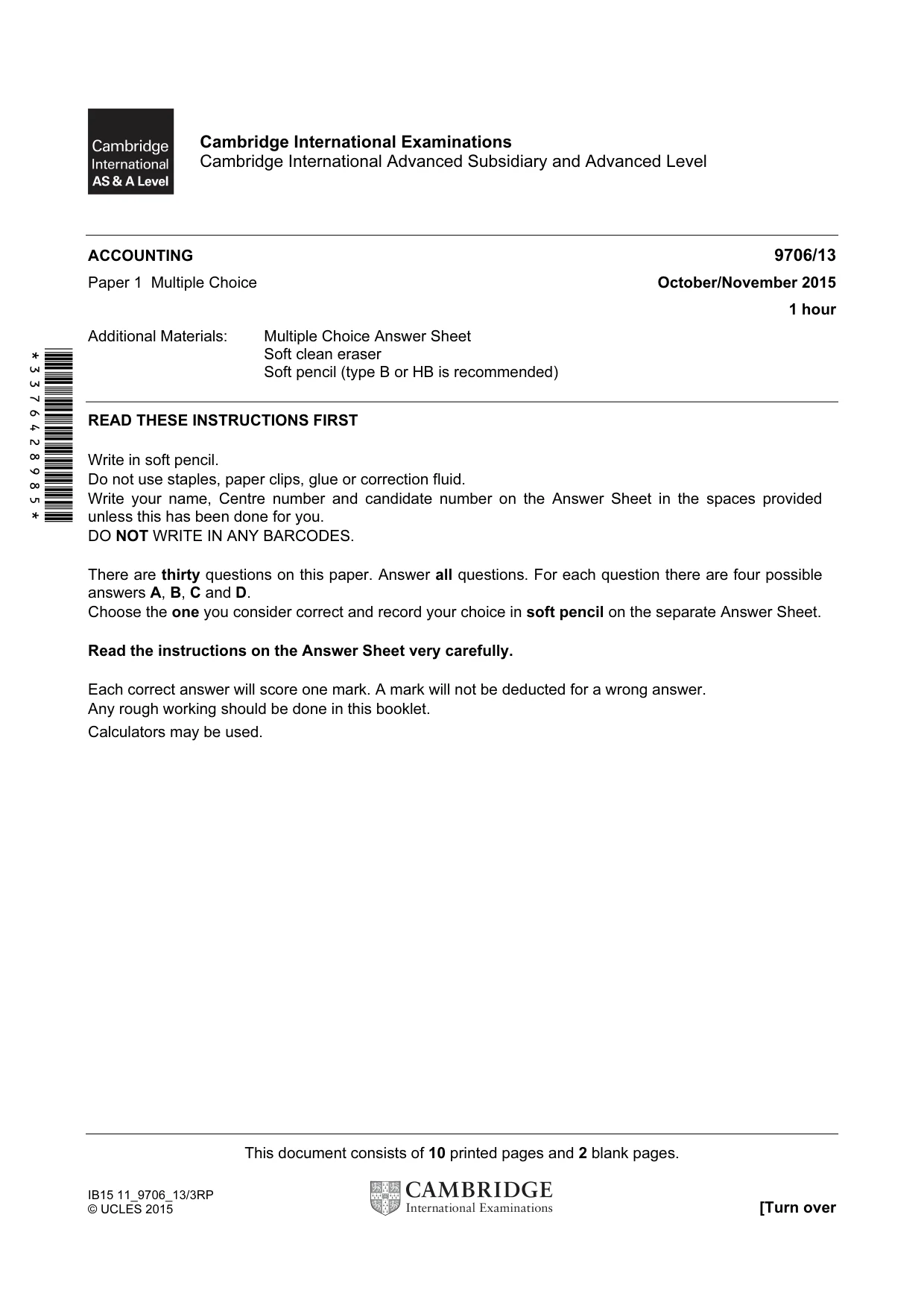
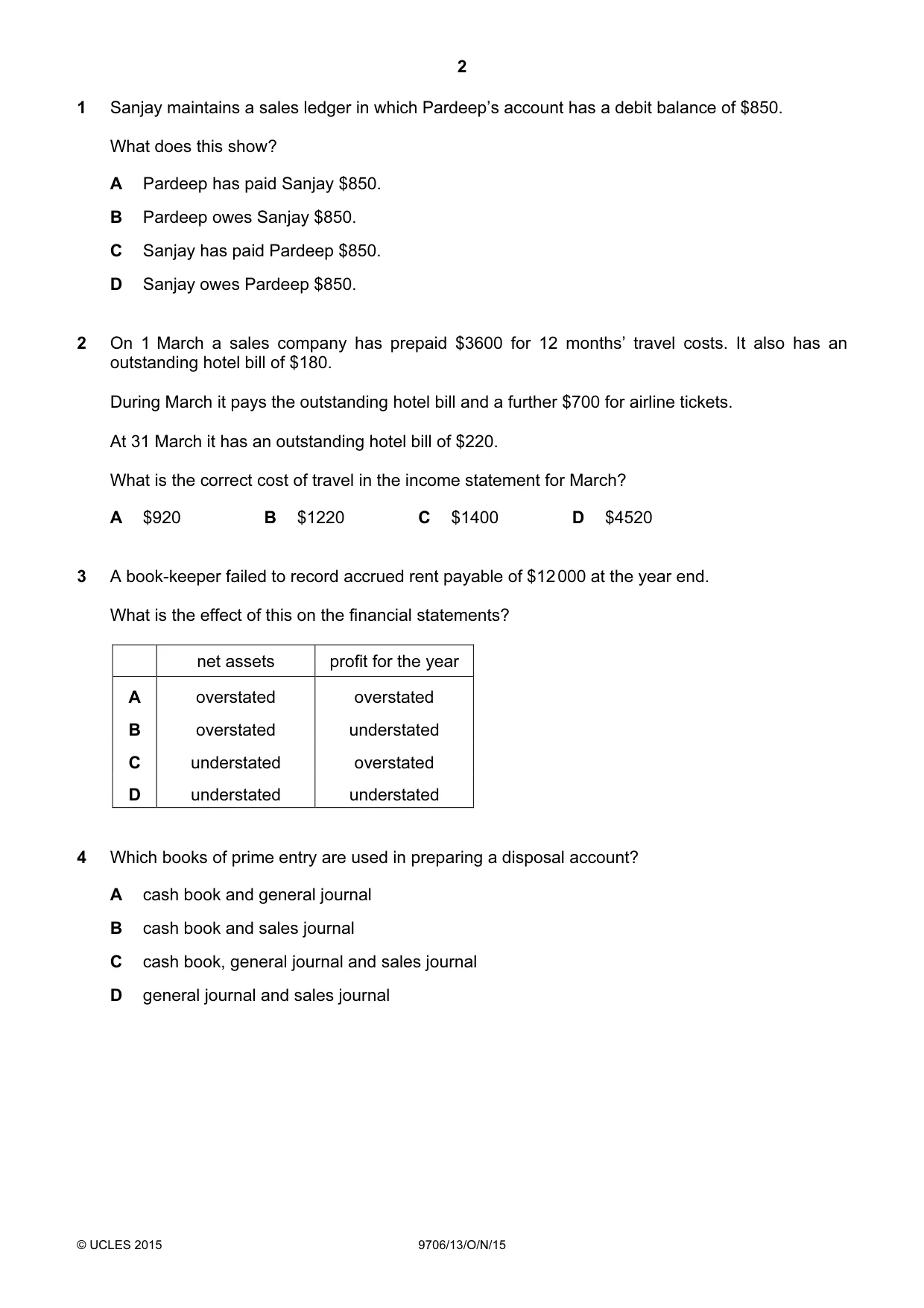
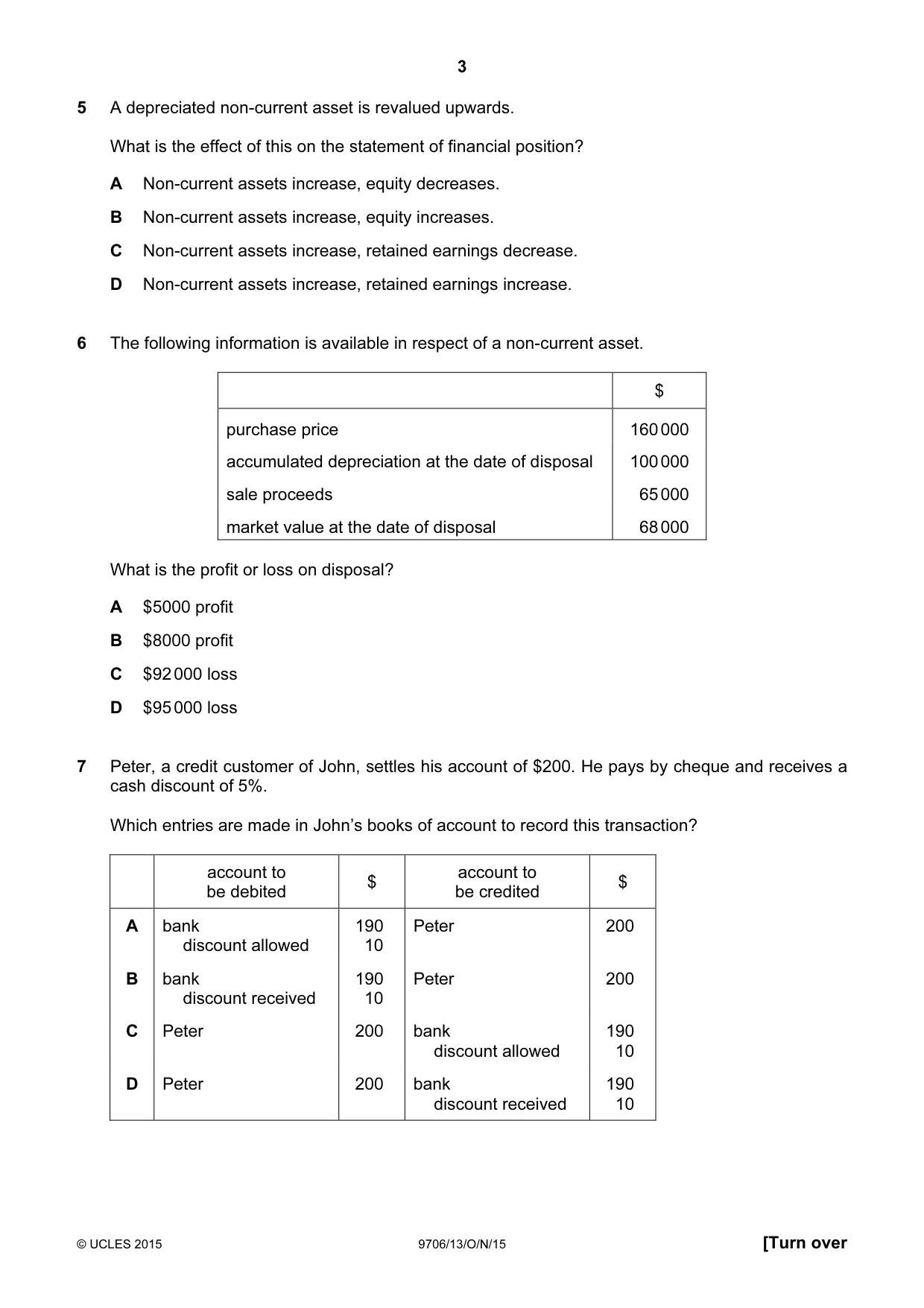
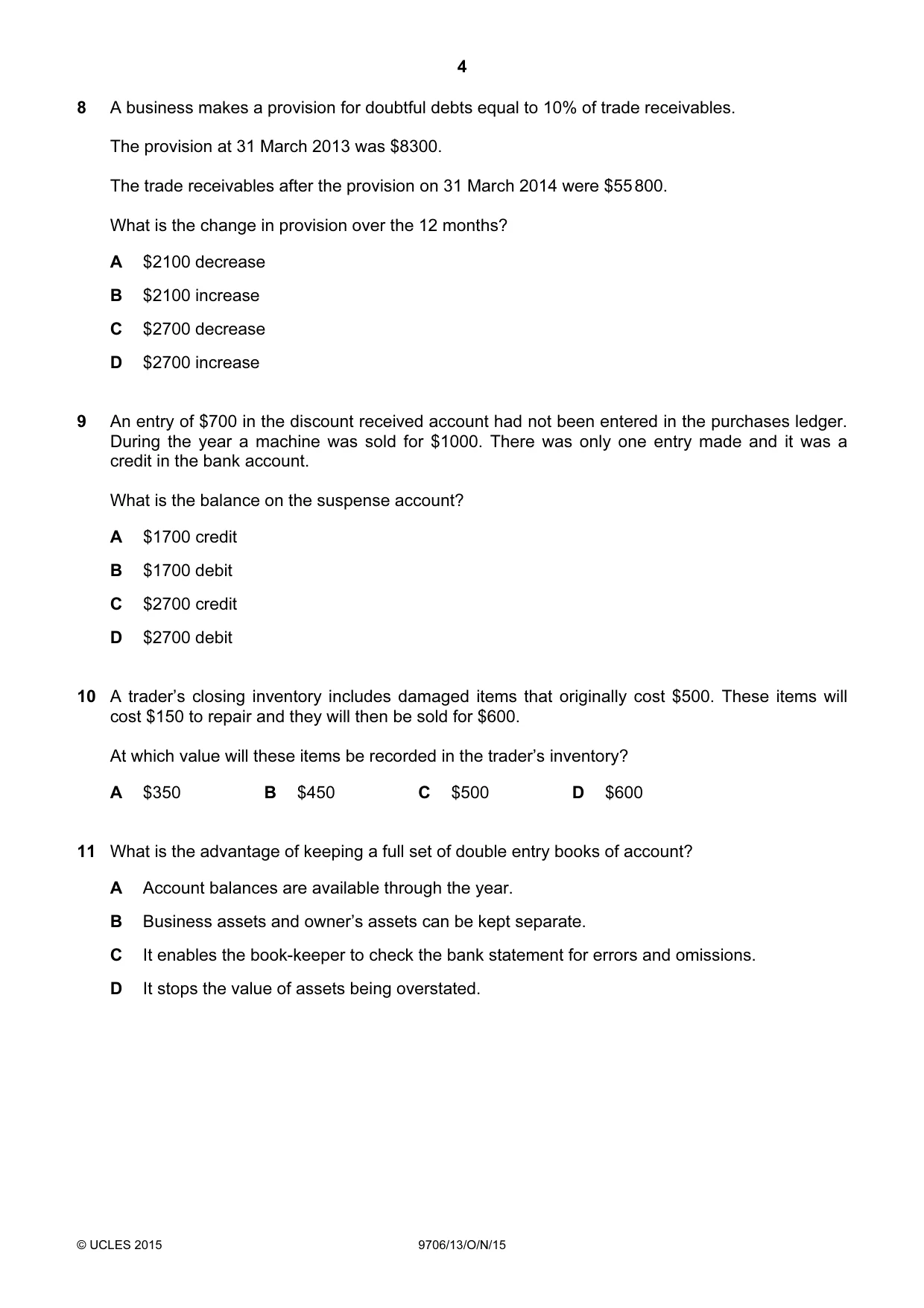

Mark scheme2 pages
Answers below. Sit the paper first if you are practising.
Questions as text
Q1 · Sanjay maintains a sales ledger in which Pardeep’s account has a debit balance of $850
1 Sanjay maintains a sales ledger in which Pardeep’s account has a debit balance of $850. What does this show? A Pardeep has paid Sanjay $850. B Pardeep owes Sanjay $850. C Sanjay has paid Pardeep $850. D Sanjay owes Pardeep $850.
Mark scheme: B
Q2 · On 1 March a sales company has prepaid $3600 for 12 months’ travel costs
2 On 1 March a sales company has prepaid $3600 for 12 months’ travel costs. It also has an outstanding hotel bill of $180. During March it pays the outstanding hotel bill and a further $700 for airline tickets. At 31 March it has an outstanding hotel bill of $220. What is the correct cost of travel in the income statement for March? A $920 B $1220 C $1400 D $4520
Mark scheme: B
Q3 · A book-keeper failed to record accrued rent payable of $12 000 at the year end
3 A book-keeper failed to record accrued rent payable of $12 000 at the year end. What is the effect of this on the financial statements? net assets profit for the year A overstated overstated B overstated understated C understated overstated D understated understated
Mark scheme: A
Q4 · Which books of prime entry are used in preparing a disposal account?
4 Which books of prime entry are used in preparing a disposal account? A cash book and general journal B cash book and sales journal C cash book, general journal and sales journal D general journal and sales journal
Mark scheme: A
Q5 · A depreciated non-current asset is revalued upwards
5 A depreciated non-current asset is revalued upwards. What is the effect of this on the statement of financial position? A Non-current assets increase, equity decreases. B Non-current assets increase, equity increases. C Non-current assets increase, retained earnings decrease. D Non-current assets increase, retained earnings increase.
Mark scheme: B
Q6 · The following information is available in respect of a non-current asset
6 The following information is available in respect of a non-current asset. $ purchase price 160 000 accumulated depreciation at the date of disposal 100 000 sale proceeds 65 000 market value at the date of disposal 68 000 What is the profit or loss on disposal? A $5000 profit B $8000 profit C $92 000 loss D $95 000 loss
Mark scheme: A
Q7 · Peter, a credit customer of John, settles his account of $200
7 Peter, a credit customer of John, settles his account of $200. He pays by cheque and receives a cash discount of 5%. Which entries are made in John’s books of account to record this transaction? account to account to $ $ be debited be credited A bank 190 Peter 200 discount allowed 10 B bank 190 Peter 200 discount received 10 C Peter 200 bank 190 discount allowed 10 D Peter 200 bank 190 discount received 10
Mark scheme: A
Q8 · A business makes a provision for doubtful debts equal to 10% of trade receivables
8 A business makes a provision for doubtful debts equal to 10% of trade receivables. The provision at 31 March 2013 was $8300. The trade receivables after the provision on 31 March 2014 were $55 800. What is the change in provision over the 12 months? A $2100 decrease B $2100 increase C $2700 decrease D $2700 increase
Mark scheme: A
Q9 · An entry of $700 in the discount received account had not been entered in the purchases…
9 An entry of $700 in the discount received account had not been entered in the purchases ledger. During the year a machine was sold for $1000. There was only one entry made and it was a credit in the bank account. What is the balance on the suspense account? A $1700 credit B $1700 debit C $2700 credit D $2700 debit
Mark scheme: B
Q10 · A trader’s closing inventory includes damaged items that originally cost $500
10 A trader’s closing inventory includes damaged items that originally cost $500. These items will cost $150 to repair and they will then be sold for $600. At which value will these items be recorded in the trader’s inventory? A $350 B $450 C $500 D $600
Mark scheme: B
Q11 · What is the advantage of keeping a full set of double entry books of account?
11 What is the advantage of keeping a full set of double entry books of account? A Account balances are available through the year. B Business assets and owner’s assets can be kept separate. C It enables the book-keeper to check the bank statement for errors and omissions. D It stops the value of assets being overstated.
Mark scheme: A
Q12 · The following financial information is available for a business
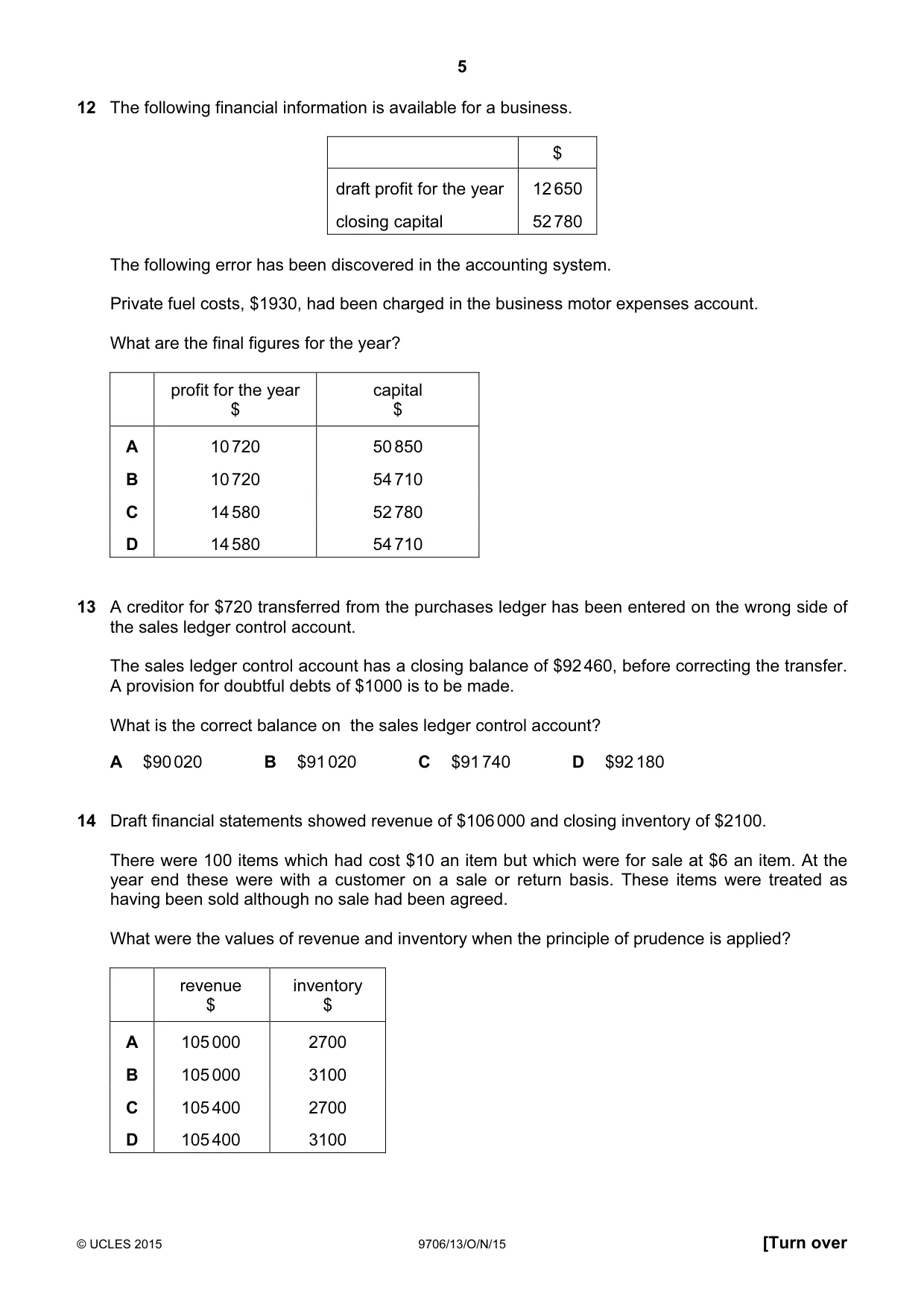
12 The following financial information is available for a business. $ draft profit for the year 12 650 closing capital 52 780 The following error has been discovered in the accounting system. Private fuel costs, $1930, had been charged in the business motor expenses account. What are the final figures for the year? profit for the year capital $ $ A 10 720 50 850 B 10 720 54 710 C 14 580 52 780 D 14 580 54 710
Mark scheme: C
Q13 · A creditor for $720 transferred from the purchases ledger has been entered on the wrong…
13 A creditor for $720 transferred from the purchases ledger has been entered on the wrong side of the sales ledger control account. The sales ledger control account has a closing balance of $92 460, before correcting the transfer. A provision for doubtful debts of $1000 is to be made. What is the correct balance on the sales ledger control account? A $90 020 B $91 020 C $91 740 D $92 180
Mark scheme: B
Q14 · Draft financial statements showed revenue of $106 000 and closing inventory of $2100
14 Draft financial statements showed revenue of $106 000 and closing inventory of $2100. There were 100 items which had cost $10 an item but which were for sale at $6 an item. At the year end these were with a customer on a sale or return basis. These items were treated as having been sold although no sale had been agreed. What were the values of revenue and inventory when the principle of prudence is applied? revenue inventory $ $ A 105 000 2700 B 105 000 3100 C 105 400 2700 D 105 400 3100
Mark scheme: C
Q15 · A club charges each of its 100 members an annual subscription of $12
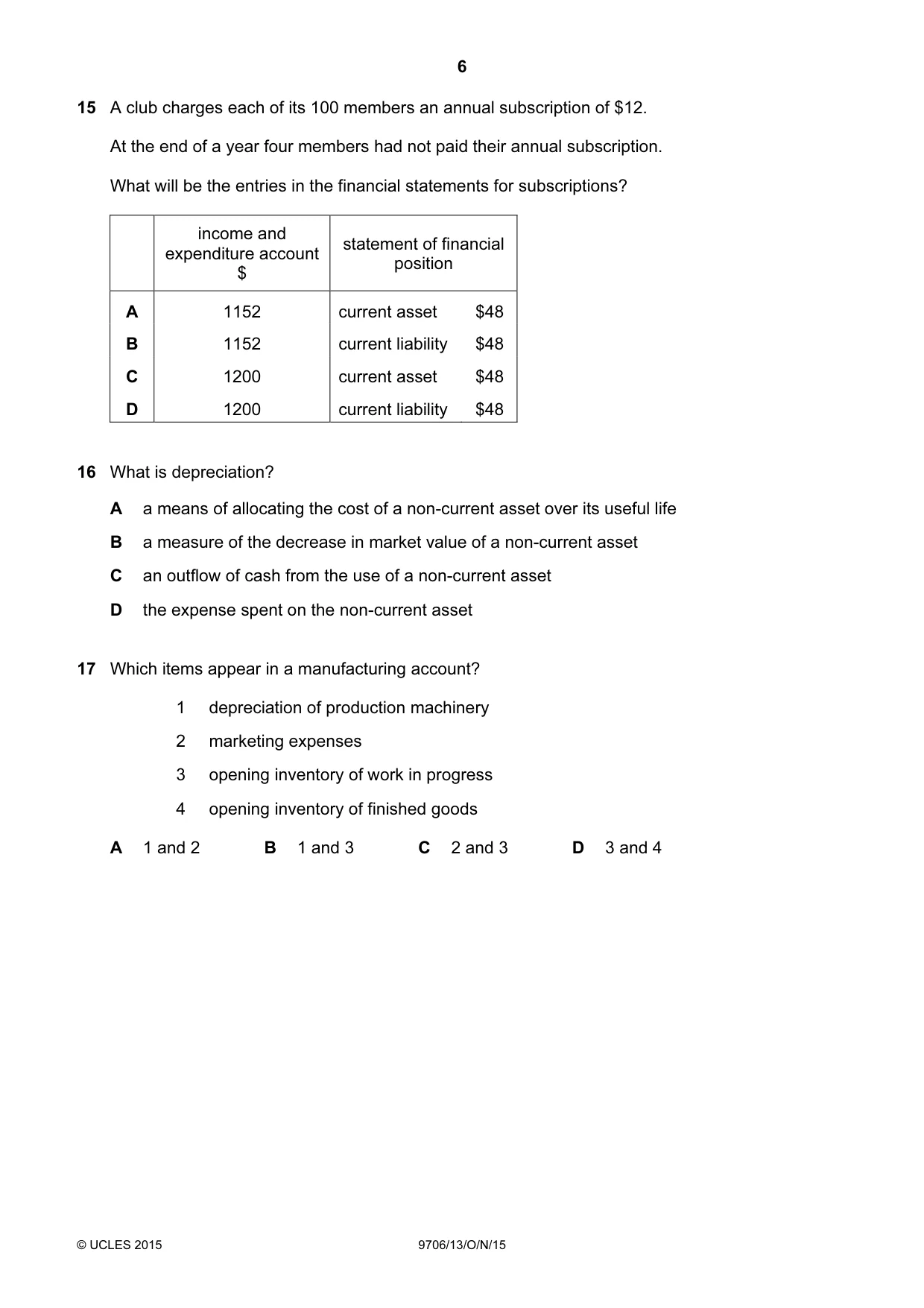
15 A club charges each of its 100 members an annual subscription of $12. At the end of a year four members had not paid their annual subscription. What will be the entries in the financial statements for subscriptions? income and statement of financial expenditure account position $ A 1152 current asset $48 B 1152 current liability $48 C 1200 current asset $48 D 1200 current liability $48
Mark scheme: C
Question 16
16 What is depreciation? A a means of allocating the cost of a non-current asset over its useful life B a measure of the decrease in market value of a non-current asset C an outflow of cash from the use of a non-current asset D the expense spent on the non-current asset
Mark scheme: A
Q17 · Which items appear in a manufacturing account?
17 Which items appear in a manufacturing account? 1 depreciation of production machinery 2 marketing expenses 3 opening inventory of work in progress 4 opening inventory of finished goods A 1 and 2 B 1 and 3 C 2 and 3 D 3 and 4
Mark scheme: B
Q18 · A business has two departments
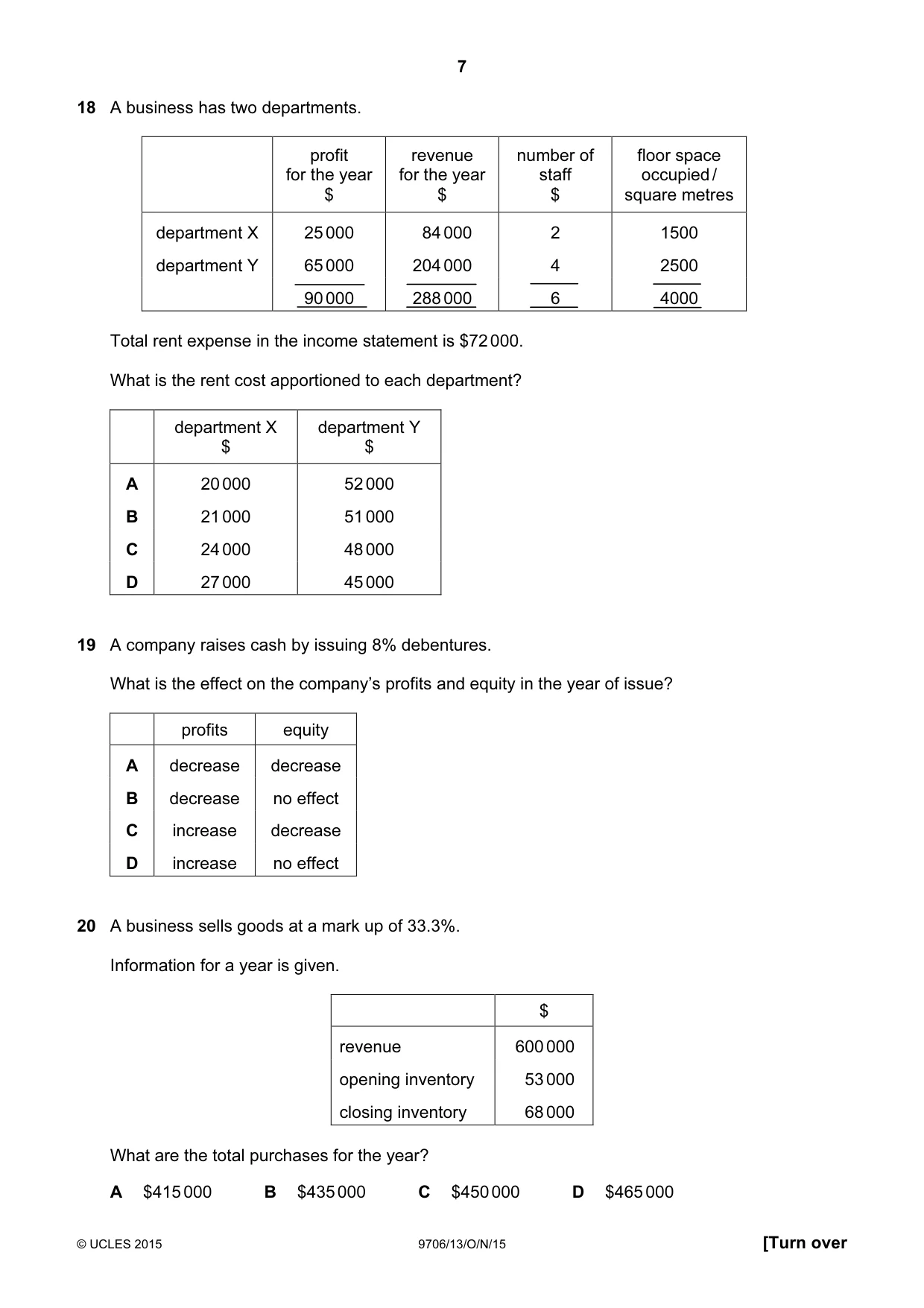
18 A business has two departments. profit revenue number of floor space for the year for the year staff occupied / $ $ $ square metres department X 25 000 84 000 2 1500 department Y 65 000 204 000 4 2500 90 000 288 000 6 4000 Total rent expense in the income statement is $72 000. What is the rent cost apportioned to each department? department X department Y $ $ A 20 000 52 000 B 21 000 51 000 C 24 000 48 000 D 27 000 45 000
Mark scheme: D
Q19 · A company raises cash by issuing 8% debentures
19 A company raises cash by issuing 8% debentures. What is the effect on the company’s profits and equity in the year of issue? profits equity A decrease decrease B decrease no effect C increase decrease D increase no effect
Mark scheme: B
Q20 · A business sells goods at a mark up of 33.3%
20 A business sells goods at a mark up of 33.3%. Information for a year is given. $ revenue 600 000 opening inventory 53 000 closing inventory 68 000 What are the total purchases for the year? A $415 000 B $435 000 C $450 000 D $465 000
Mark scheme: D
Q21 · A company has a current ratio of 2 : 1
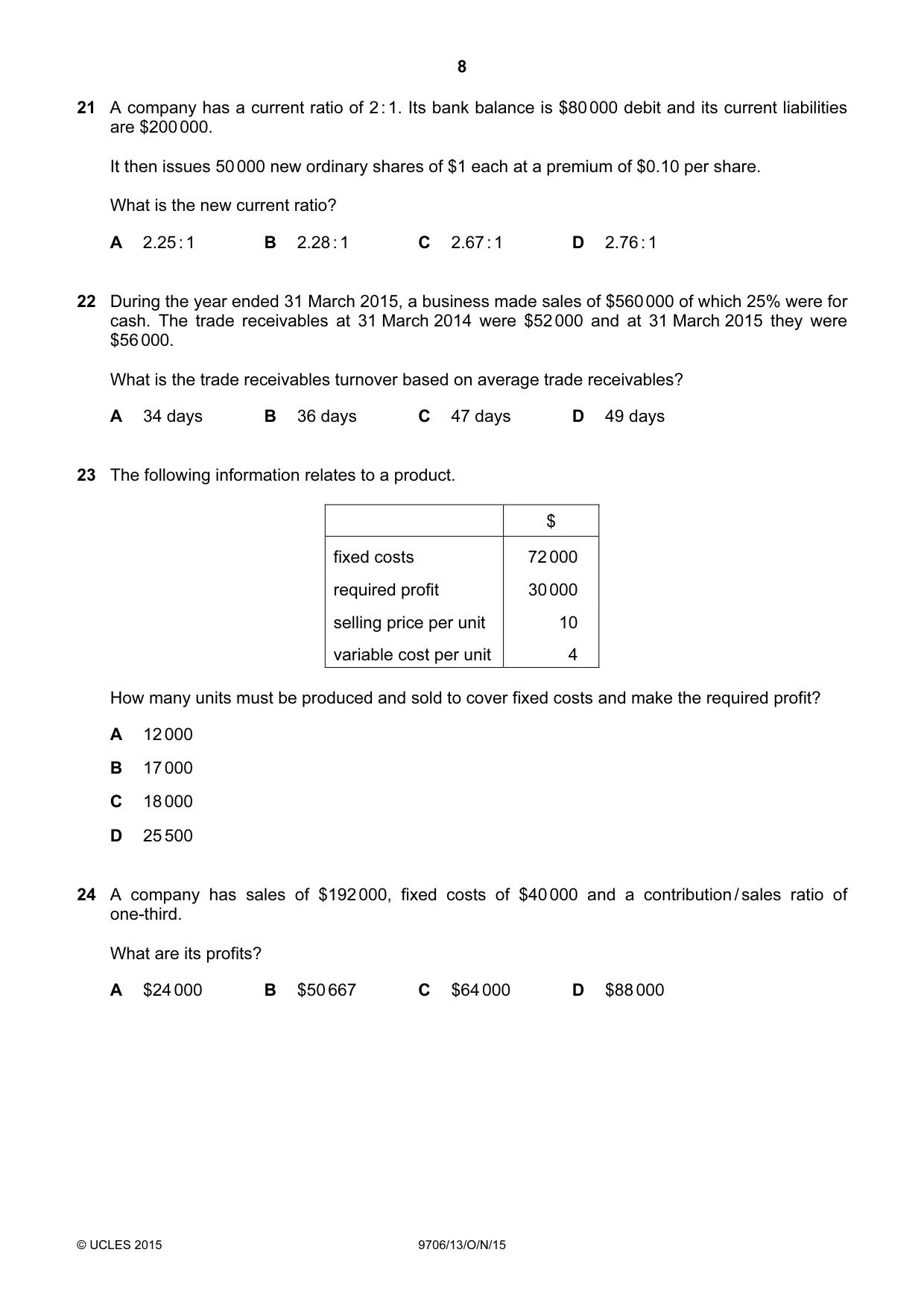
21 A company has a current ratio of 2 : 1. Its bank balance is $80 000 debit and its current liabilities are $200 000. It then issues 50 000 new ordinary shares of $1 each at a premium of $0.10 per share. What is the new current ratio? A 2.25 : 1 B 2.28 : 1 C 2.67 : 1 D 2.76 : 1
Mark scheme: B
More questions on Analysis and communication of accounting information
Q22 · During the year ended 31 March 2015, a business made sales of $560 000 of which 25% were…
22 During the year ended 31 March 2015, a business made sales of $560 000 of which 25% were for cash. The trade receivables at 31 March 2014 were $52 000 and at 31 March 2015 they were $56 000. What is the trade receivables turnover based on average trade receivables? A 34 days B 36 days C 47 days D 49 days
Mark scheme: C
More questions on Analysis and communication of accounting information
Q23 · The following information relates to a product
23 The following information relates to a product. $ fixed costs 72 000 required profit 30 000 selling price per unit 10 variable cost per unit 4 How many units must be produced and sold to cover fixed costs and make the required profit? A 12 000 B 17 000 C 18 000 D 25 500
Mark scheme: B
Q24 · A company has sales of $192 000, fixed costs of $40 000 and a contribution / sales ratio…
24 A company has sales of $192 000, fixed costs of $40 000 and a contribution / sales ratio of one-third. What are its profits? A $24 000 B $50 667 C $64 000 D $88 000
Mark scheme: A
Q25 · A company sells a single product for $24 per batch
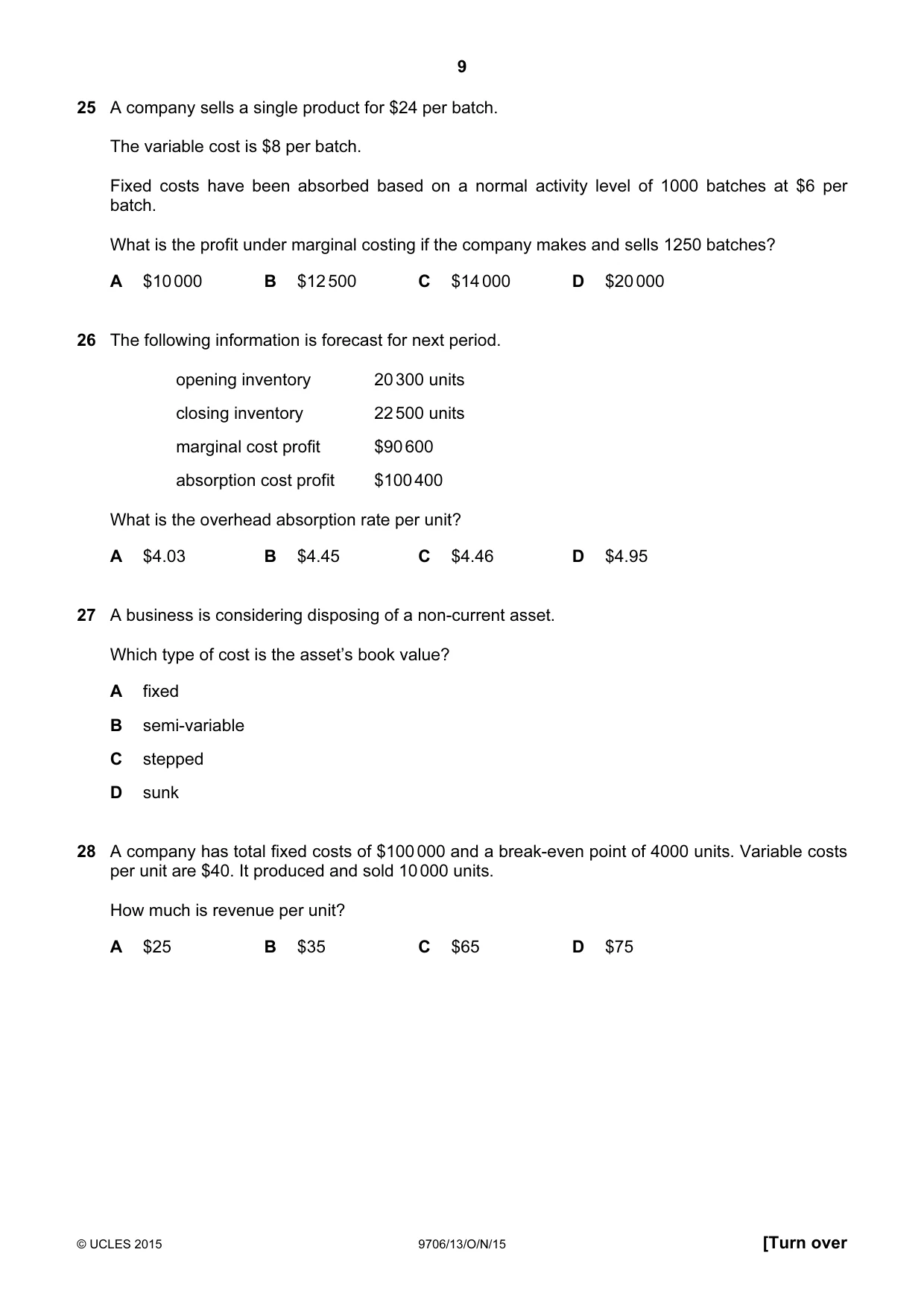
25 A company sells a single product for $24 per batch. The variable cost is $8 per batch. Fixed costs have been absorbed based on a normal activity level of 1000 batches at $6 per batch. What is the profit under marginal costing if the company makes and sells 1250 batches? A $10 000 B $12 500 C $14 000 D $20 000
Mark scheme: C
Q26 · The following information is forecast for next period
26 The following information is forecast for next period. opening inventory 20 300 units closing inventory 22 500 units marginal cost profit $90 600 absorption cost profit $100 400 What is the overhead absorption rate per unit? A $4.03 B $4.45 C $4.46 D $4.95
Mark scheme: B
Q27 · A business is considering disposing of a non-current asset
27 A business is considering disposing of a non-current asset. Which type of cost is the asset’s book value? A fixed B semi-variable C stepped D sunk
Mark scheme: D
Q28 · A company has total fixed costs of $100 000 and a break-even point of 4000 units
28 A company has total fixed costs of $100 000 and a break-even point of 4000 units. Variable costs per unit are $40. It produced and sold 10 000 units. How much is revenue per unit? A $25 B $35 C $65 D $75
Mark scheme: C
Q29 · A trader received an order for 1000 shirts, 500 units printed in red and 500 units in blue
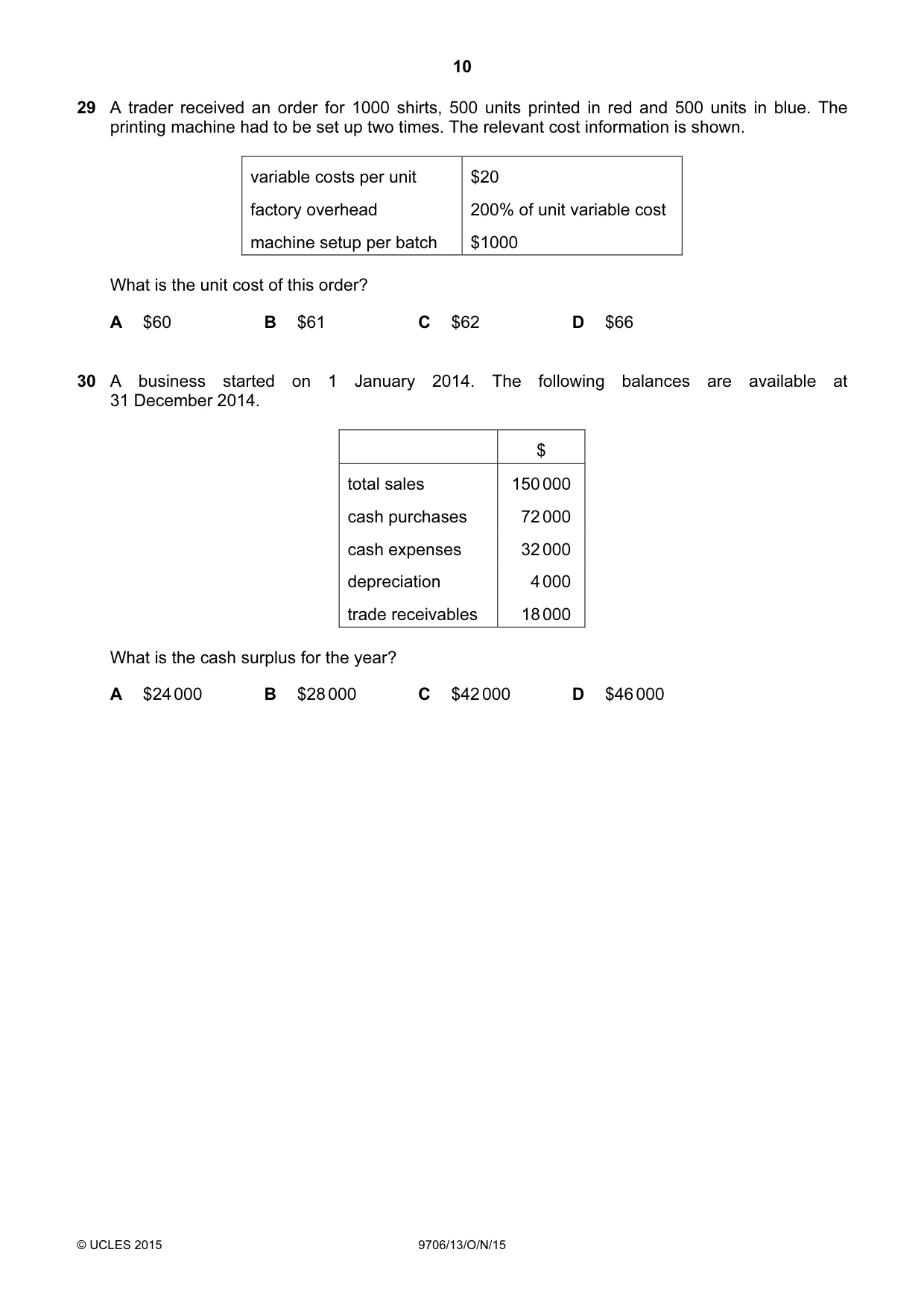
29 A trader received an order for 1000 shirts, 500 units printed in red and 500 units in blue. The printing machine had to be set up two times. The relevant cost information is shown. variable costs per unit $20 factory overhead 200% of unit variable cost machine setup per batch $1000 What is the unit cost of this order? A $60 B $61 C $62 D $66
Mark scheme: C
Q30 · A business started on 1 January 2014
30 A business started on 1 January 2014. The following balances are available at 31 December 2014. $ total sales 150 000 cash purchases 72 000 cash expenses 32 000 depreciation 4 000 trade receivables 18 000 What is the cash surplus for the year? A $24 000 B $28 000 C $42 000 D $46 000
Mark scheme: B
What was in this paper
The subtopics covered by these 30 questions, and how many questions each got. Open one in a new tab to see every Cambridge question on it.
What you needed in this session
Cambridge’s own grade thresholds for 2015 Oct/Nov, Paper 1 · Variant 3. A higher threshold means an easier paper — the bar moves with how the cohort did.