Cambridge A Level Accounting 9706 — 2014 May/June Paper 1 · Variant 3
9706/13/M/J/14 · 30 questions · 30 marks · ≈34 min
The question paper and its mark scheme, free to read here and free to download. This is Cambridge’s own paper, exactly as it was sat.
Question paper12 pages

Mark scheme2 pages
Answers below. Sit the paper first if you are practising.
Questions as text
Q1 · An item of machinery cost $60 000
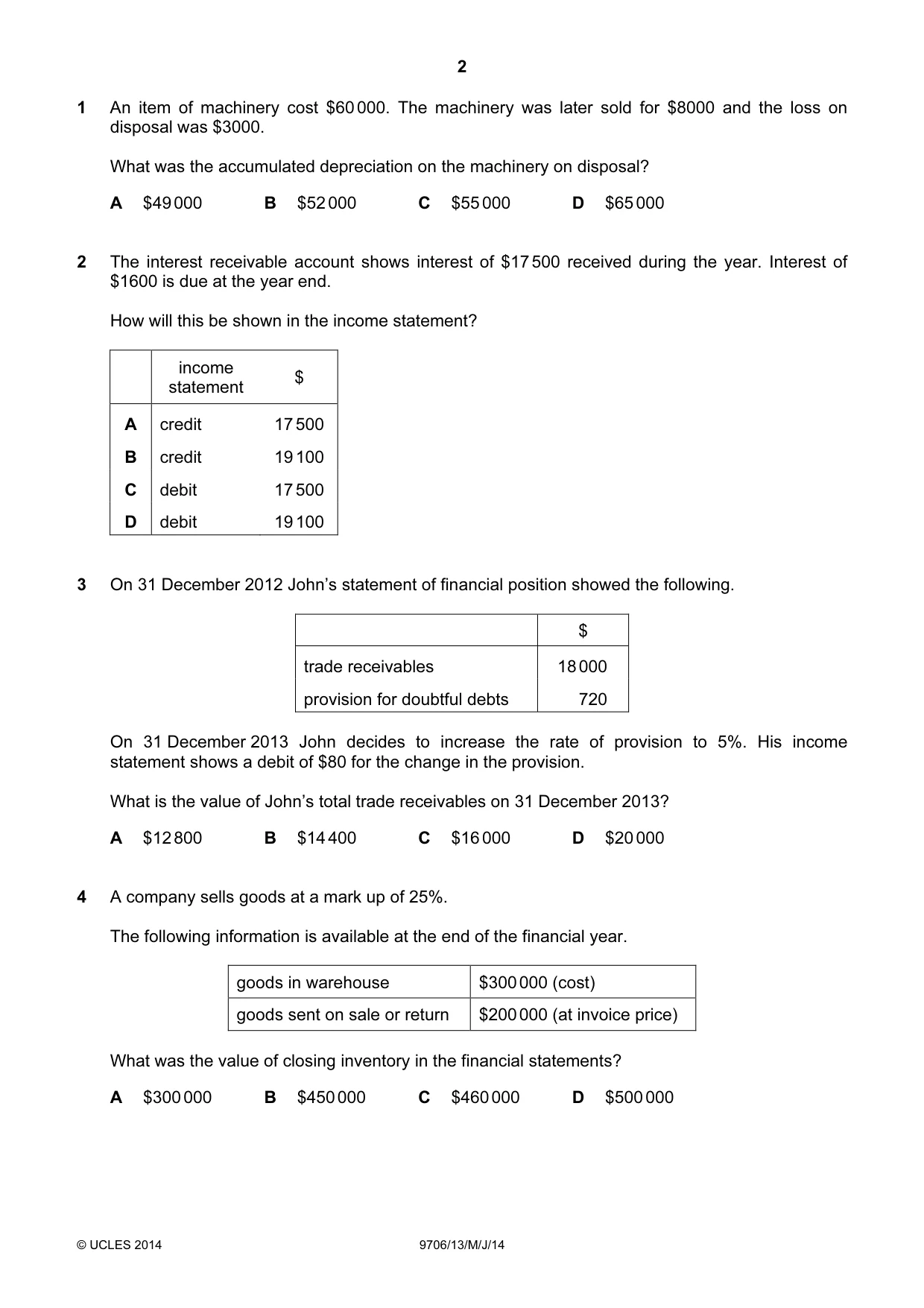
1 An item of machinery cost $60 000. The machinery was later sold for $8000 and the loss on disposal was $3000. What was the accumulated depreciation on the machinery on disposal? A $49 000 B $52 000 C $55 000 D $65 000
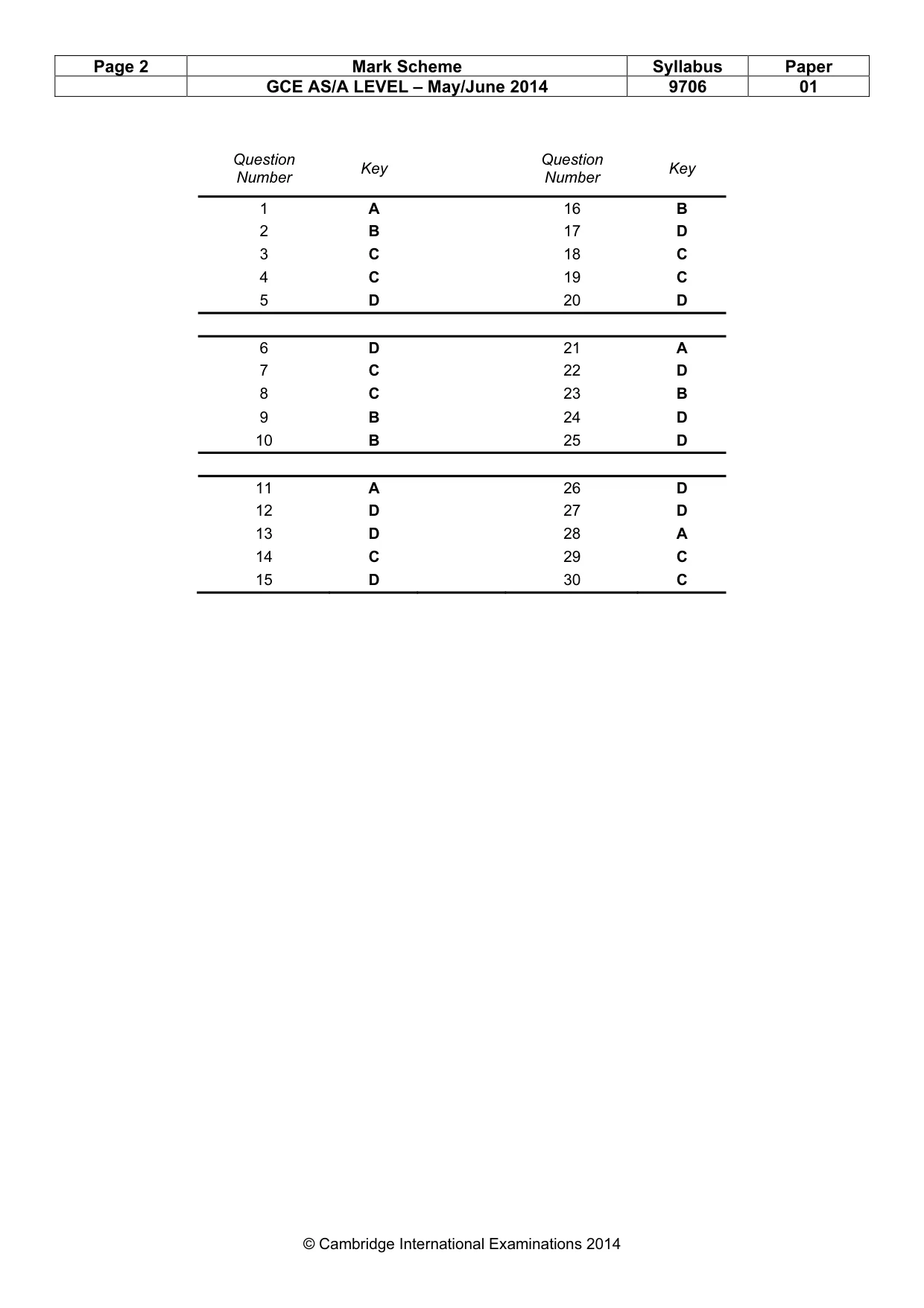
Mark scheme: A
Q2 · The interest receivable account shows interest of $17 500 received during the year
2 The interest receivable account shows interest of $17 500 received during the year. Interest of $1600 is due at the year end. How will this be shown in the income statement? income $ statement A credit 17 500 B credit 19 100 C debit 17 500 D debit 19 100
Mark scheme: B
Q3 · On 31 December 2012 John’s statement of financial position showed the following
3 On 31 December 2012 John’s statement of financial position showed the following. $ trade receivables 18 000 provision for doubtful debts 720 On 31 December 2013 John decides to increase the rate of provision to 5%. His income statement shows a debit of $80 for the change in the provision. What is the value of John’s total trade receivables on 31 December 2013? A $12 800 B $14 400 C $16 000 D $20 000
Mark scheme: C
Q4 · A company sells goods at a mark up of 25%
4 A company sells goods at a mark up of 25%. The following information is available at the end of the financial year. goods in warehouse $300 000 (cost) goods sent on sale or return $200 000 (at invoice price) What was the value of closing inventory in the financial statements? A $300 000 B $450 000 C $460 000 D $500 000
Mark scheme: C
Q5 · After draft financial statements had been prepared, the following errors were discovered
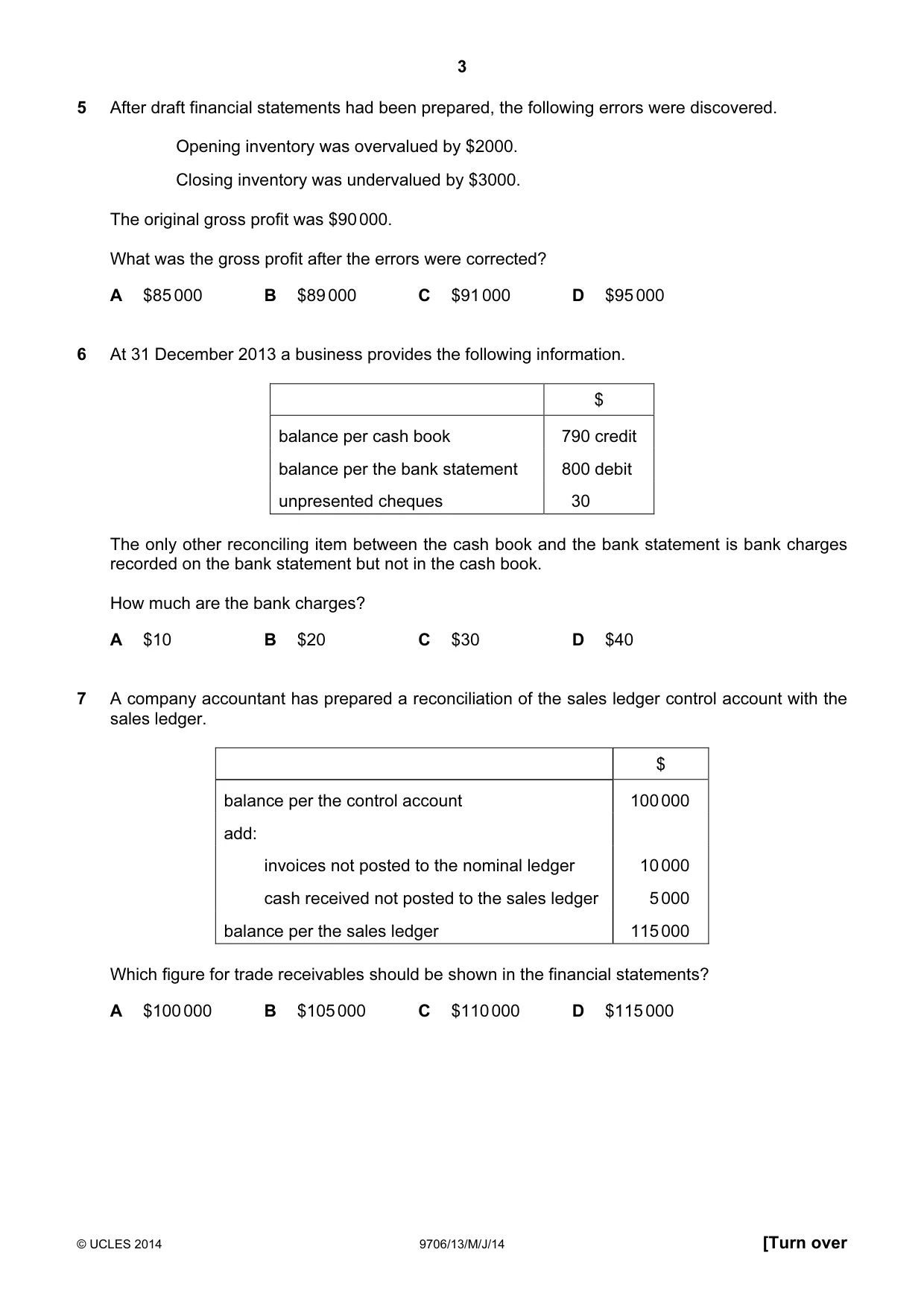
5 After draft financial statements had been prepared, the following errors were discovered. Opening inventory was overvalued by $2000. Closing inventory was undervalued by $3000. The original gross profit was $90 000. What was the gross profit after the errors were corrected? A $85 000 B $89 000 C $91 000 D $95 000
Mark scheme: D
Q6 · At 31 December 2013 a business provides the following information
6 At 31 December 2013 a business provides the following information. $ balance per cash book 790 credit balance per the bank statement 800 debit unpresented cheques 30 The only other reconciling item between the cash book and the bank statement is bank charges recorded on the bank statement but not in the cash book. How much are the bank charges? A $10 B $20 C $30 D $40
Mark scheme: D
Q7 · A company accountant has prepared a reconciliation of the sales ledger control account…
7 A company accountant has prepared a reconciliation of the sales ledger control account with the sales ledger. $ balance per the control account 100 000 add: invoices not posted to the nominal ledger 10 000 cash received not posted to the sales ledger 5 000 balance per the sales ledger 115 000 Which figure for trade receivables should be shown in the financial statements? A $100 000 B $105 000 C $110 000 D $115 000
Mark scheme: C
Q8 · A trial balance at 31 December shows the following
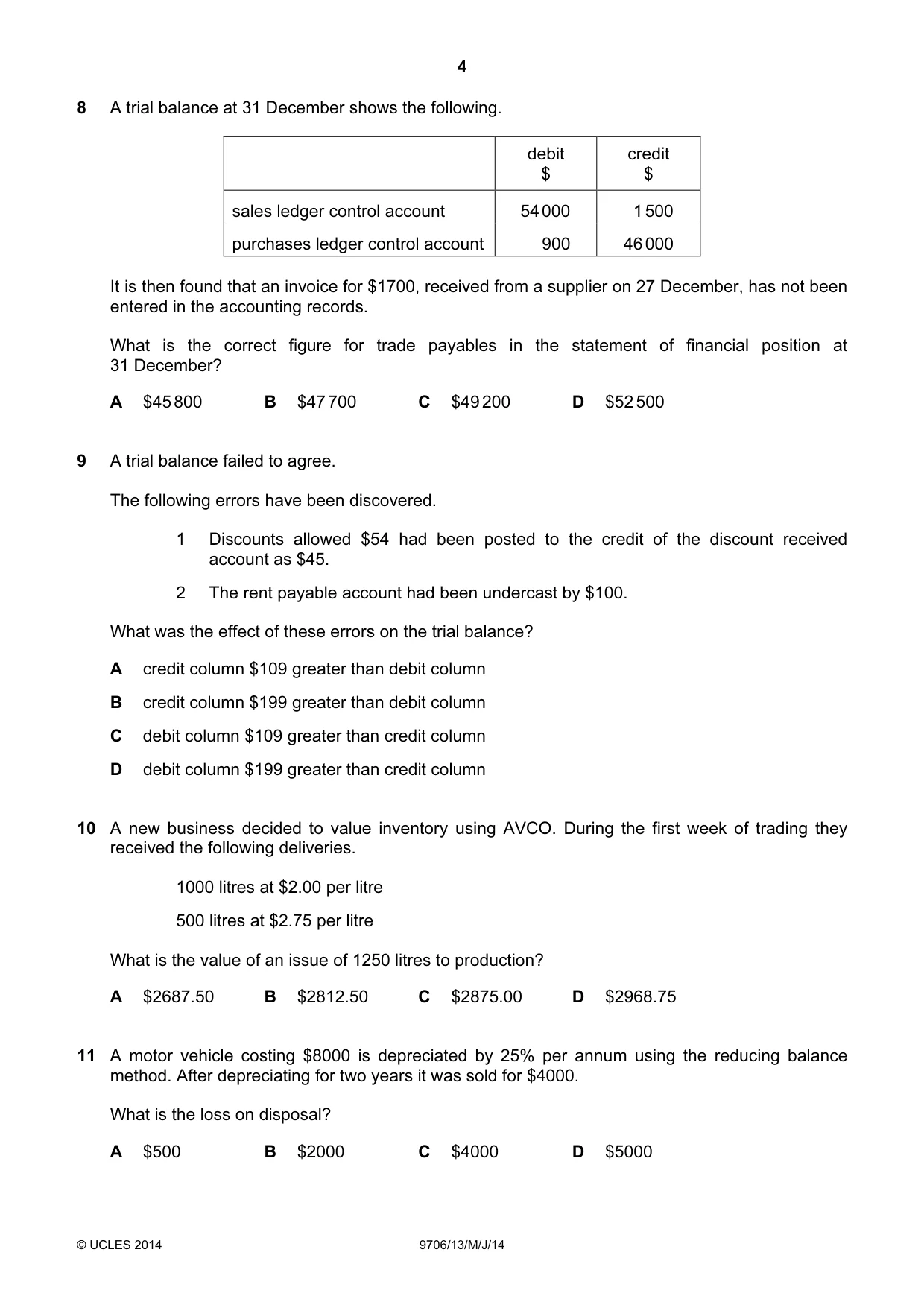
8 A trial balance at 31 December shows the following. debit credit $ $ sales ledger control account 54 000 1 500 purchases ledger control account 900 46 000 It is then found that an invoice for $1700, received from a supplier on 27 December, has not been entered in the accounting records. What is the correct figure for trade payables in the statement of financial position at 31 December? A $45 800 B $47 700 C $49 200 D $52 500
Mark scheme: C
Q9 · A trial balance failed to agree
9 A trial balance failed to agree. The following errors have been discovered. 1 Discounts allowed $54 had been posted to the credit of the discount received account as $45. 2 The rent payable account had been undercast by $100. What was the effect of these errors on the trial balance? A credit column $109 greater than debit column B credit column $199 greater than debit column C debit column $109 greater than credit column D debit column $199 greater than credit column
Mark scheme: B
Q10 · A new business decided to value inventory using AVCO
10 A new business decided to value inventory using AVCO. During the first week of trading they received the following deliveries. 1000 litres at $2.00 per litre 500 litres at $2.75 per litre What is the value of an issue of 1250 litres to production? A $2687.50 B $2812.50 C $2875.00 D $2968.75
Mark scheme: B
Q11 · A motor vehicle costing $8000 is depreciated by 25% per annum using the reducing balance…
11 A motor vehicle costing $8000 is depreciated by 25% per annum using the reducing balance method. After depreciating for two years it was sold for $4000. What is the loss on disposal? A $500 B $2000 C $4000 D $5000
Mark scheme: A
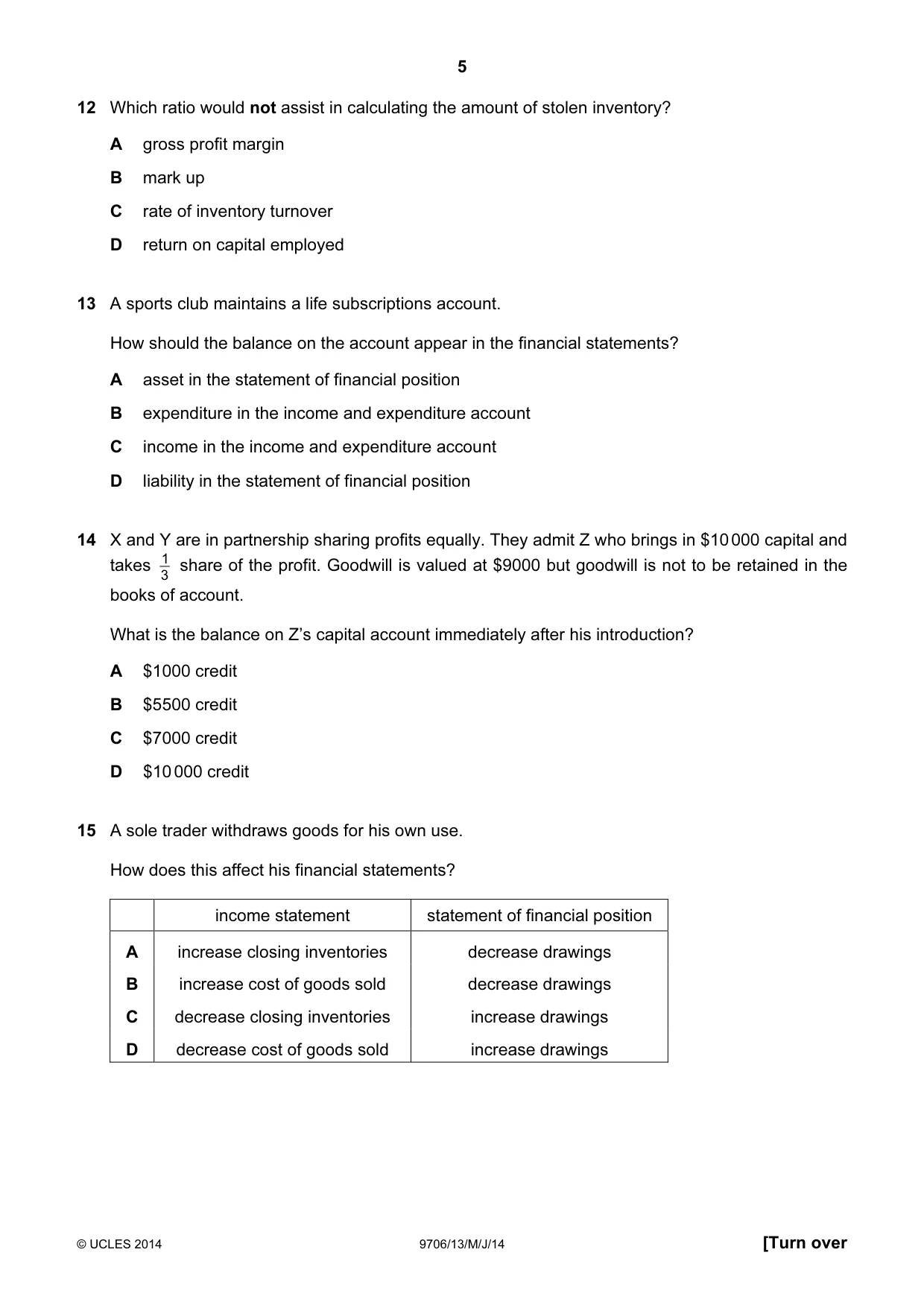
Q12 · Which ratio would not assist in calculating the amount of stolen inventory?
12 Which ratio would not assist in calculating the amount of stolen inventory? A gross profit margin B mark up C rate of inventory turnover D return on capital employed
Mark scheme: D
More questions on Analysis and communication of accounting information
Q13 · A sports club maintains a life subscriptions account
13 A sports club maintains a life subscriptions account. How should the balance on the account appear in the financial statements? A asset in the statement of financial position B expenditure in the income and expenditure account C income in the income and expenditure account D liability in the statement of financial position
Mark scheme: D
Q14 · X and Y are in partnership sharing profits equally
14 X and Y are in partnership sharing profits equally. They admit Z who brings in $10 000 capital and takes 3 1 share of the profit. Goodwill is valued at $9000 but goodwill is not to be retained in the books of account. What is the balance on Z’s capital account immediately after his introduction? A $1000 credit B $5500 credit C $7000 credit D $10 000 credit
Mark scheme: C
Q15 · A sole trader withdraws goods for his own use
15 A sole trader withdraws goods for his own use. How does this affect his financial statements? income statement statement of financial position A increase closing inventories decrease drawings B increase cost of goods sold decrease drawings C decrease closing inventories increase drawings D decrease cost of goods sold increase drawings
Mark scheme: D
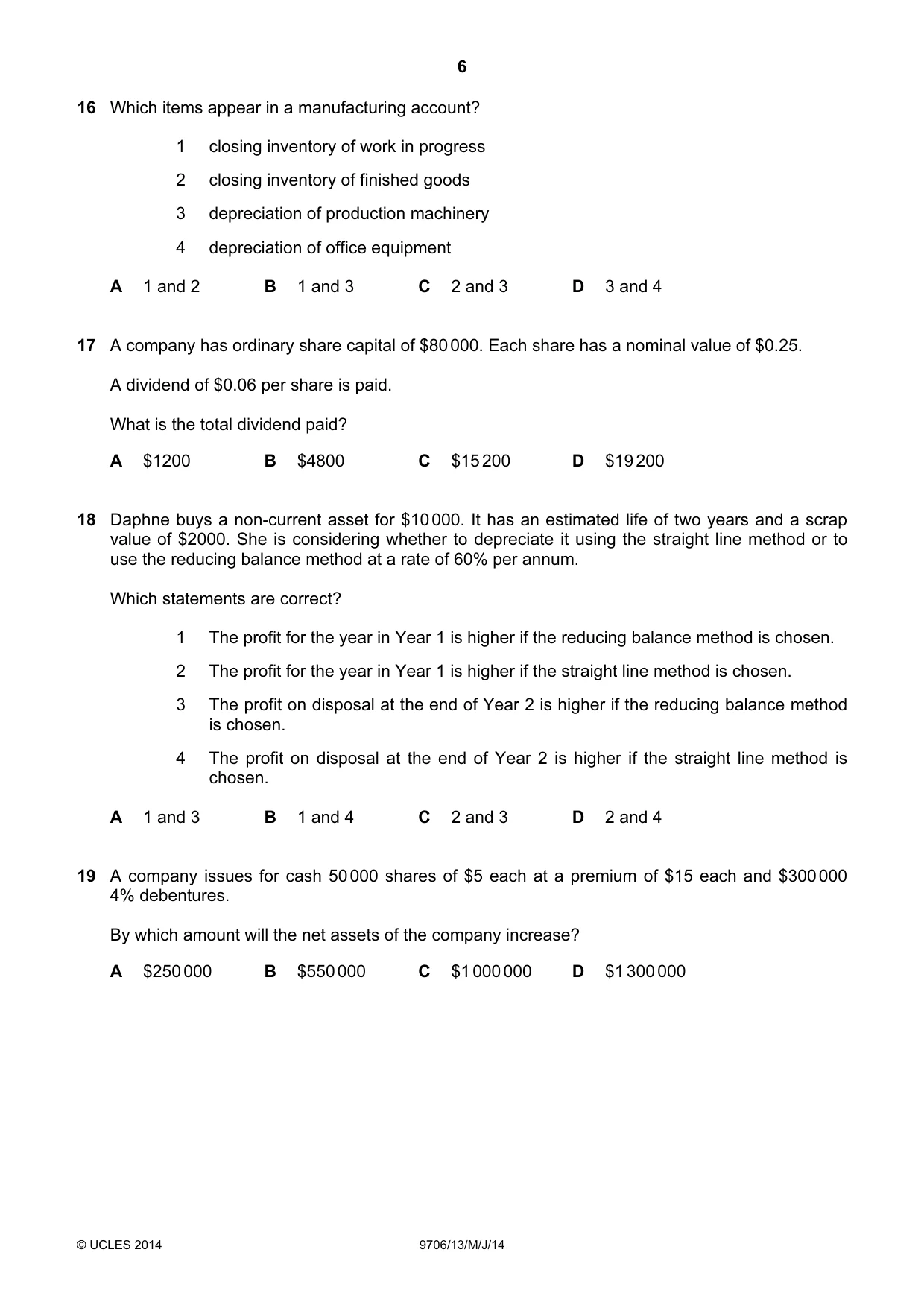
Q16 · Which items appear in a manufacturing account?
16 Which items appear in a manufacturing account? 1 closing inventory of work in progress 2 closing inventory of finished goods 3 depreciation of production machinery 4 depreciation of office equipment A 1 and 2 B 1 and 3 C 2 and 3 D 3 and 4
Mark scheme: B
Q17 · A company has ordinary share capital of $80 000
17 A company has ordinary share capital of $80 000. Each share has a nominal value of $0.25. A dividend of $0.06 per share is paid. What is the total dividend paid? A $1200 B $4800 C $15 200 D $19 200
Mark scheme: D
Q18 · Daphne buys a non-current asset for $10 000
18 Daphne buys a non-current asset for $10 000. It has an estimated life of two years and a scrap value of $2000. She is considering whether to depreciate it using the straight line method or to use the reducing balance method at a rate of 60% per annum. Which statements are correct? 1 The profit for the year in Year 1 is higher if the reducing balance method is chosen. 2 The profit for the year in Year 1 is higher if the straight line method is chosen. 3 The profit on disposal at the end of Year 2 is higher if the reducing balance method is chosen. 4 The profit on disposal at the end of Year 2 is higher if the straight line method is chosen. A 1 and 3 B 1 and 4 C 2 and 3 D 2 and 4
Mark scheme: C
Q19 · A company issues for cash 50 000 shares of $5 each at a premium of $15 each and $300 000…
19 A company issues for cash 50 000 shares of $5 each at a premium of $15 each and $300 000 4% debentures. By which amount will the net assets of the company increase? A $250 000 B $550 000 C $1 000 000 D $1 300 000
Mark scheme: C
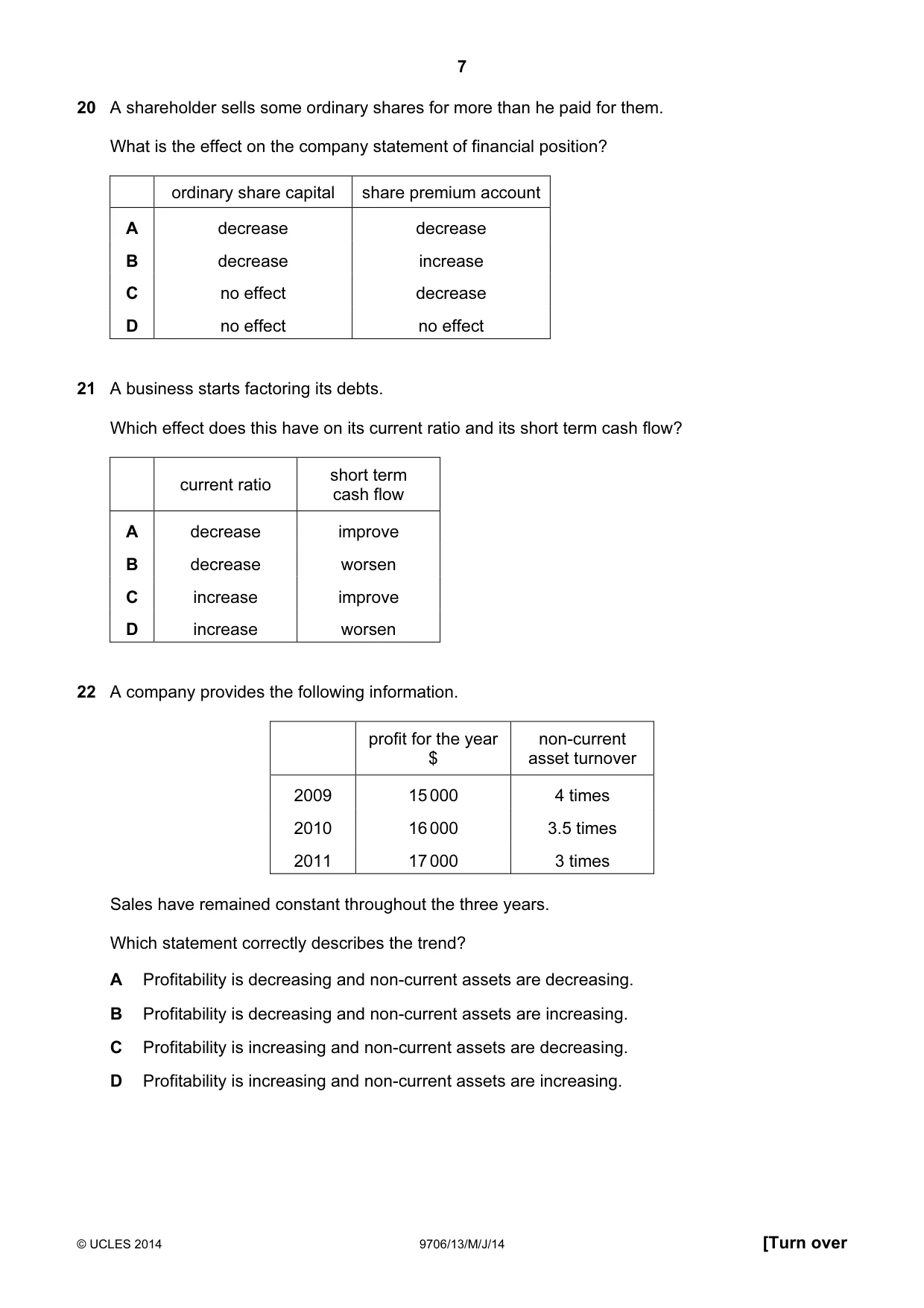
Q20 · A shareholder sells some ordinary shares for more than he paid for them
20 A shareholder sells some ordinary shares for more than he paid for them. What is the effect on the company statement of financial position? ordinary share capital share premium account A decrease decrease B decrease increase C no effect decrease D no effect no effect
Mark scheme: D
Q21 · A business starts factoring its debts
21 A business starts factoring its debts. Which effect does this have on its current ratio and its short term cash flow? short term current ratio cash flow A decrease improve B decrease worsen C increase improve D increase worsen
Mark scheme: A
More questions on Analysis and communication of accounting information
Q22 · A company provides the following information
22 A company provides the following information. profit for the year non-current $ asset turnover 2009 15 000 4 times 2010 16 000 3.5 times 2011 17 000 3 times Sales have remained constant throughout the three years. Which statement correctly describes the trend? A Profitability is decreasing and non-current assets are decreasing. B Profitability is decreasing and non-current assets are increasing. C Profitability is increasing and non-current assets are decreasing. D Profitability is increasing and non-current assets are increasing.
Mark scheme: D
More questions on Analysis and communication of accounting information
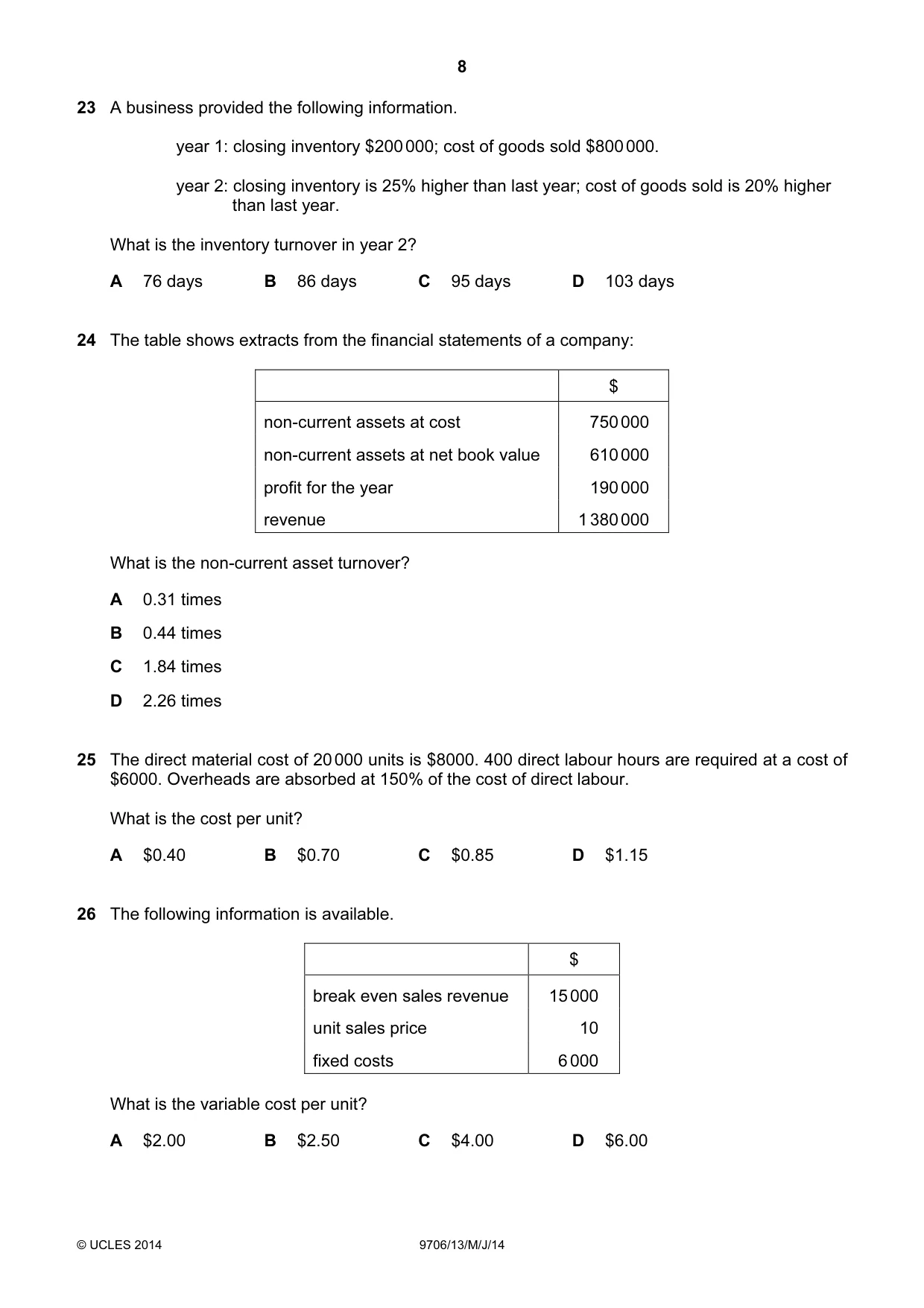
Q23 · A business provided the following information
23 A business provided the following information. year 1: closing inventory $200 000; cost of goods sold $800 000. year 2: closing inventory is 25% higher than last year; cost of goods sold is 20% higher than last year. What is the inventory turnover in year 2? A 76 days B 86 days C 95 days D 103 days
Mark scheme: B
More questions on Analysis and communication of accounting information
Q24 · The table shows extracts from the financial statements of a company: $ non-current assets…
24 The table shows extracts from the financial statements of a company: $ non-current assets at cost 750 000 non-current assets at net book value 610 000 profit for the year 190 000 revenue 1 380 000 What is the non-current asset turnover? A 0.31 times B 0.44 times C 1.84 times D 2.26 times
Mark scheme: D
More questions on Analysis and communication of accounting information
Q25 · The direct material cost of 20 000 units is $8000
25 The direct material cost of 20 000 units is $8000. 400 direct labour hours are required at a cost of $6000. Overheads are absorbed at 150% of the cost of direct labour. What is the cost per unit? A $0.40 B $0.70 C $0.85 D $1.15
Mark scheme: D
Q26 · The following information is available
26 The following information is available. $ break even sales revenue 15 000 unit sales price 10 fixed costs 6 000 What is the variable cost per unit? A $2.00 B $2.50 C $4.00 D $6.00
Mark scheme: D
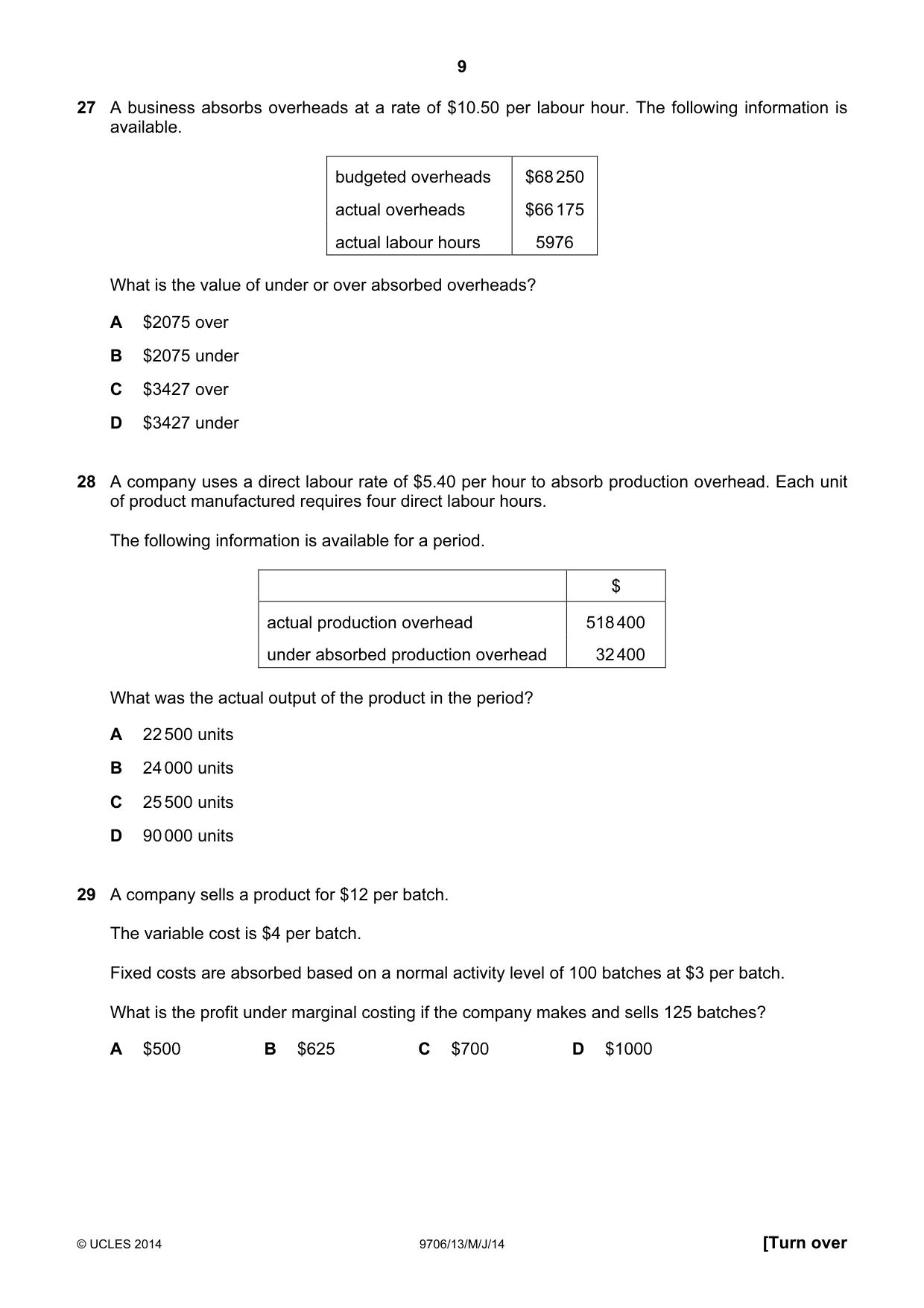
Q27 · A business absorbs overheads at a rate of $10.50 per labour hour
27 A business absorbs overheads at a rate of $10.50 per labour hour. The following information is available. budgeted overheads $68 250 actual overheads $66 175 actual labour hours 5976 What is the value of under or over absorbed overheads? A $2075 over B $2075 under C $3427 over D $3427 under
Mark scheme: D
Q28 · A company uses a direct labour rate of $5.40 per hour to absorb production overhead
28 A company uses a direct labour rate of $5.40 per hour to absorb production overhead. Each unit of product manufactured requires four direct labour hours. The following information is available for a period. $ actual production overhead 518 400 under absorbed production overhead 32 400 What was the actual output of the product in the period? A 22 500 units B 24 000 units C 25 500 units D 90 000 units
Mark scheme: A
Q29 · A company sells a product for $12 per batch
29 A company sells a product for $12 per batch. The variable cost is $4 per batch. Fixed costs are absorbed based on a normal activity level of 100 batches at $3 per batch. What is the profit under marginal costing if the company makes and sells 125 batches? A $500 B $625 C $700 D $1000
Mark scheme: C
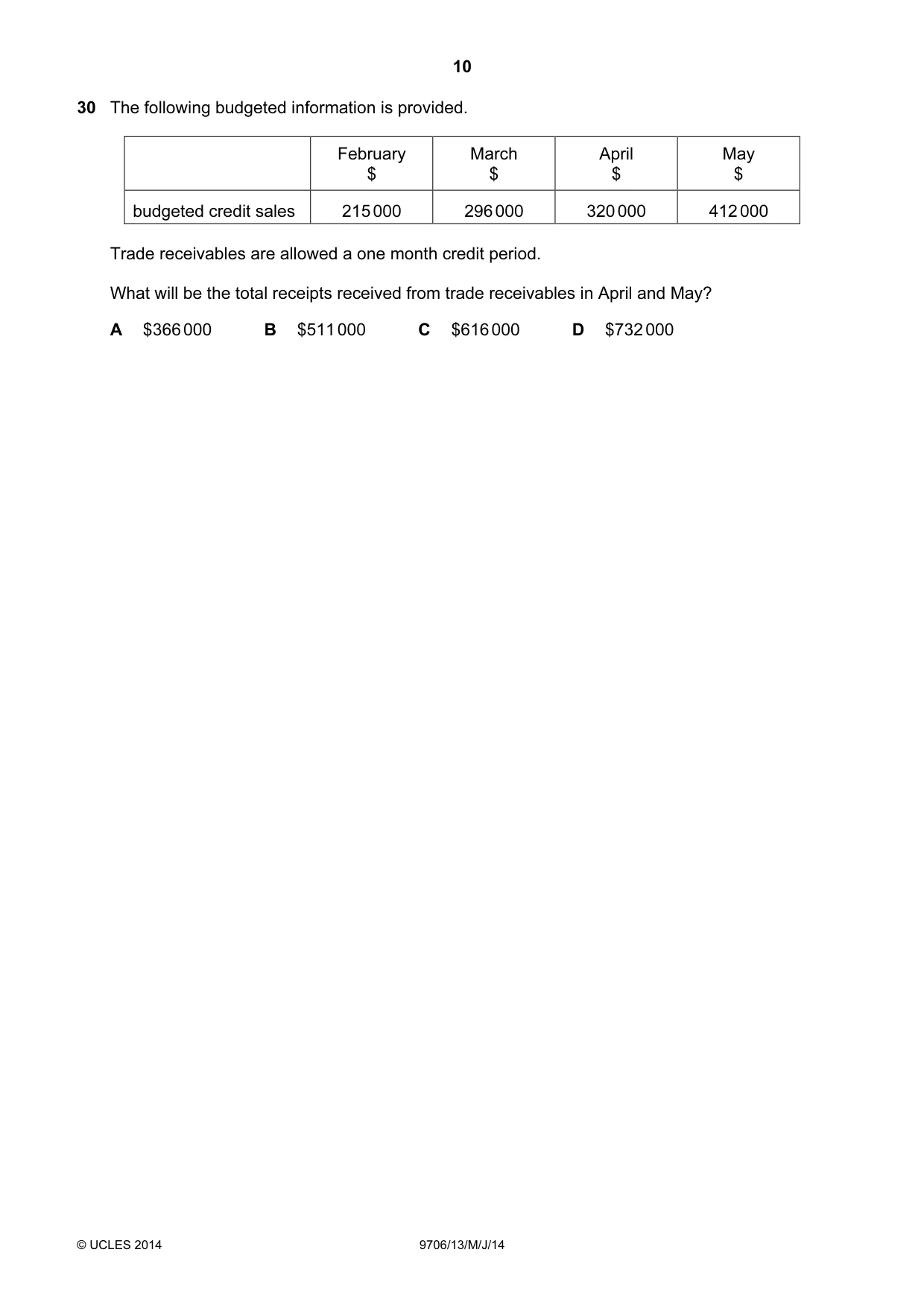
Q30 · The following budgeted information is provided
30 The following budgeted information is provided. February March April May $ $ $ $ budgeted credit sales 215 000 296 000 320 000 412 000 Trade receivables are allowed a one month credit period. What will be the total receipts received from trade receivables in April and May? A $366 000 B $511 000 C $616 000 D $732 000
Mark scheme: C
What was in this paper
The subtopics covered by these 30 questions, and how many questions each got. Open one in a new tab to see every Cambridge question on it.
What you needed in this session
Cambridge’s own grade thresholds for 2014 May/June, Paper 1 · Variant 3. A higher threshold means an easier paper — the bar moves with how the cohort did.