Cambridge A Level Accounting 9706 — 2016 Oct/Nov Paper 1 · Variant 1
9706/11/O/N/16 · 30 questions · 30 marks · ≈34 min
The question paper and its mark scheme, free to read here and free to download. This is Cambridge’s own paper, exactly as it was sat.
Question paper12 pages
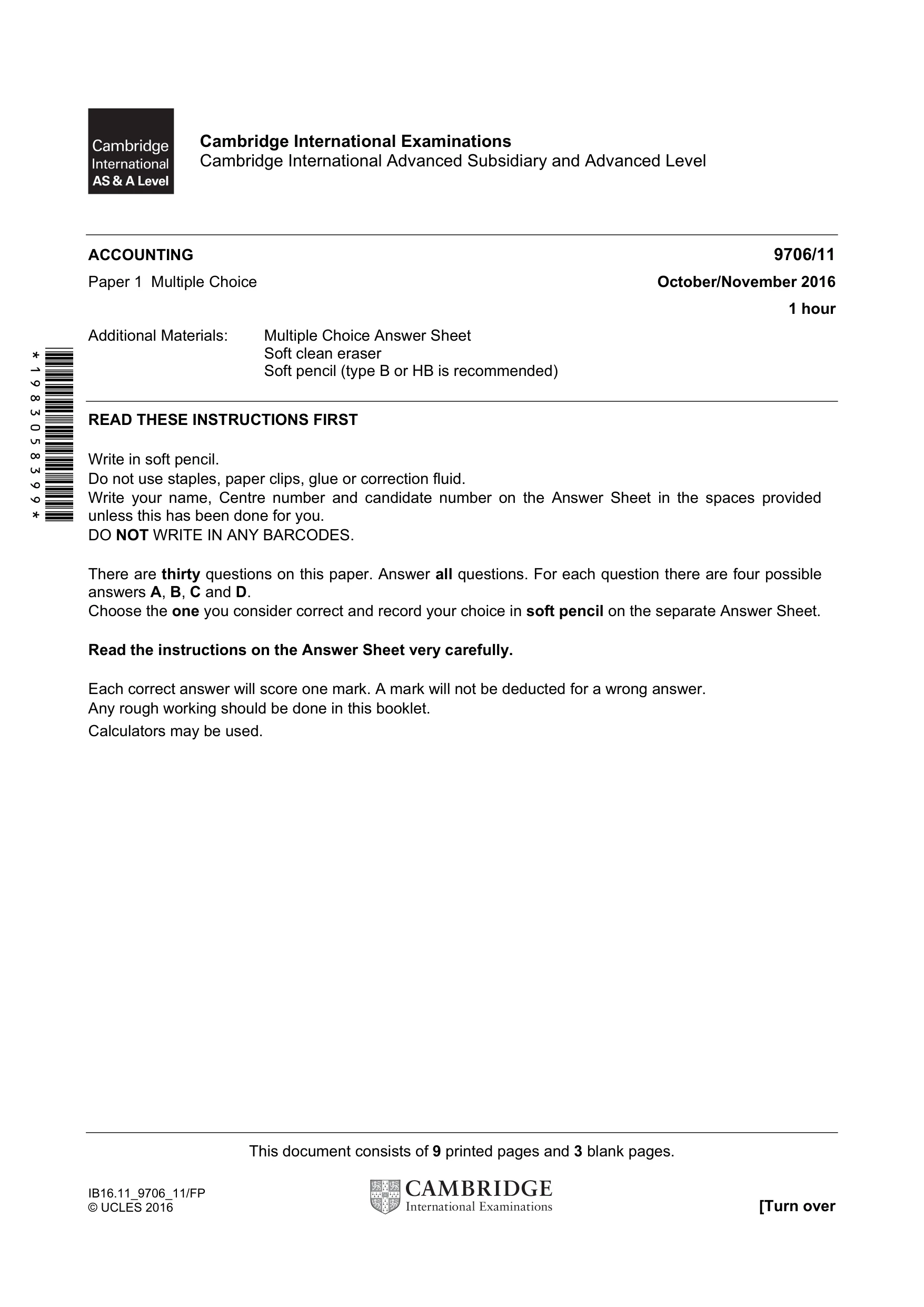


Mark scheme2 pages
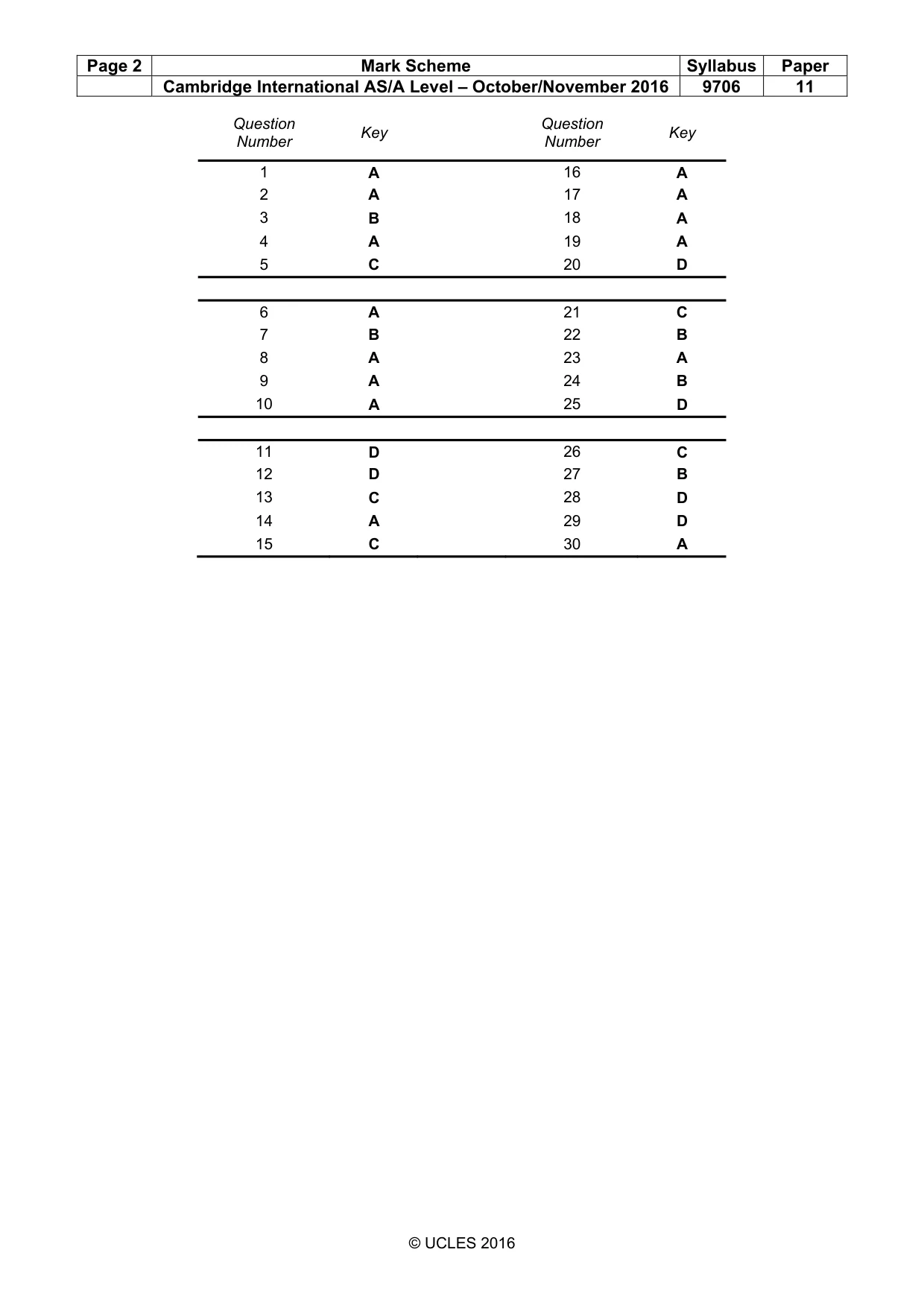
Answers below. Sit the paper first if you are practising.
Questions as text
Q1 · A company changes from the straight-line method of depreciation to the reducing balance…
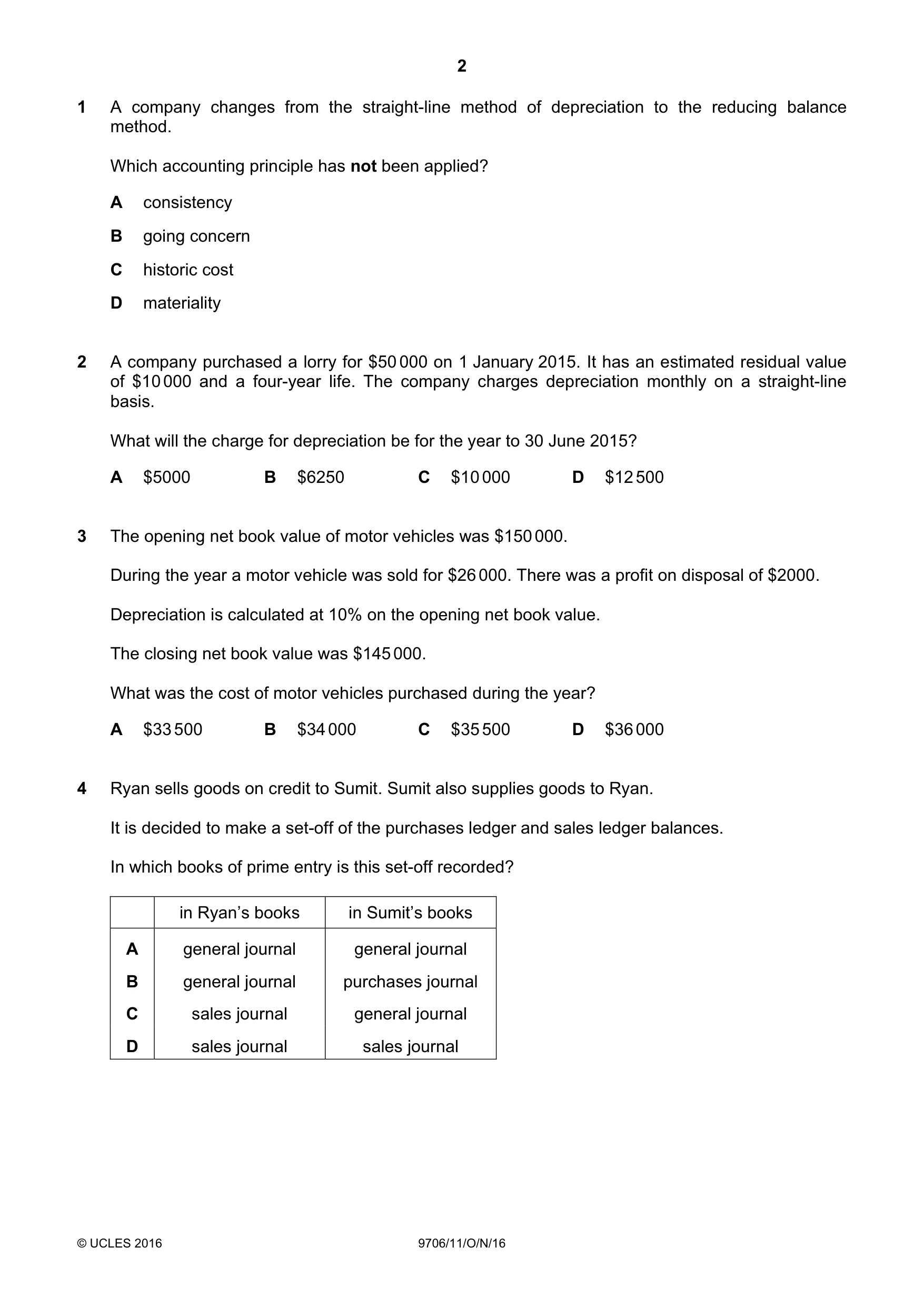
1 A company changes from the straight-line method of depreciation to the reducing balance method. Which accounting principle has not been applied? A consistency B going concern C historic cost D materiality
Mark scheme: A
Q2 · A company purchased a lorry for $50 000 on 1 January 2015
2 A company purchased a lorry for $50 000 on 1 January 2015. It has an estimated residual value of $10 000 and a four-year life. The company charges depreciation monthly on a straight-line basis. What will the charge for depreciation be for the year to 30 June 2015? A $5000 B $6250 C $10 000 D $12 500
Mark scheme: A
Q3 · The opening net book value of motor vehicles was $150 000
3 The opening net book value of motor vehicles was $150 000. During the year a motor vehicle was sold for $26 000. There was a profit on disposal of $2000. Depreciation is calculated at 10% on the opening net book value. The closing net book value was $145 000. What was the cost of motor vehicles purchased during the year? A $33 500 B $34 000 C $35 500 D $36 000
Mark scheme: B
Q4 · Ryan sells goods on credit to Sumit
4 Ryan sells goods on credit to Sumit. Sumit also supplies goods to Ryan. It is decided to make a set-off of the purchases ledger and sales ledger balances. In which books of prime entry is this set-off recorded? in Ryan’s books in Sumit’s books A general journal general journal B general journal purchases journal C sales journal general journal D sales journal sales journal
Mark scheme: A
Q5 · A book-keeper compared the business bank statement with the cash book
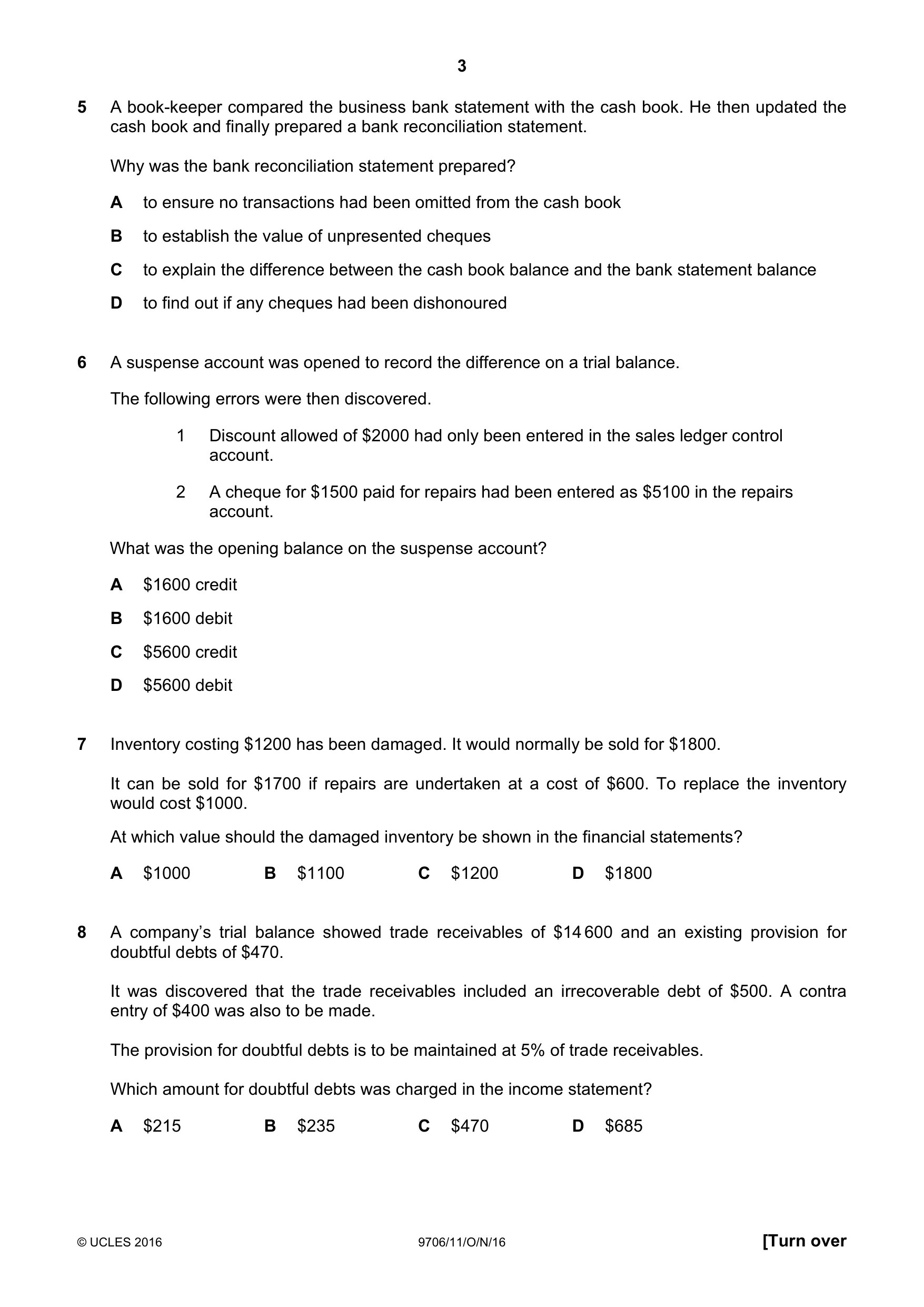
5 A book-keeper compared the business bank statement with the cash book. He then updated the cash book and finally prepared a bank reconciliation statement. Why was the bank reconciliation statement prepared? A to ensure no transactions had been omitted from the cash book B to establish the value of unpresented cheques C to explain the difference between the cash book balance and the bank statement balance D to find out if any cheques had been dishonoured
Mark scheme: C
Q6 · A suspense account was opened to record the difference on a trial balance
6 A suspense account was opened to record the difference on a trial balance. The following errors were then discovered. 1 Discount allowed of $2000 had only been entered in the sales ledger control account. 2 A cheque for $1500 paid for repairs had been entered as $5100 in the repairs account. What was the opening balance on the suspense account? A $1600 credit B $1600 debit C $5600 credit D $5600 debit
Mark scheme: A
Q7 · Inventory costing $1200 has been damaged
7 Inventory costing $1200 has been damaged. It would normally be sold for $1800. It can be sold for $1700 if repairs are undertaken at a cost of $600. To replace the inventory would cost $1000. At which value should the damaged inventory be shown in the financial statements? A $1000 B $1100 C $1200 D $1800
Mark scheme: B
Q8 · A company’s trial balance showed trade receivables of $14 600 and an existing provision…
8 A company’s trial balance showed trade receivables of $14 600 and an existing provision for doubtful debts of $470. It was discovered that the trade receivables included an irrecoverable debt of $500. A contra entry of $400 was also to be made. The provision for doubtful debts is to be maintained at 5% of trade receivables. Which amount for doubtful debts was charged in the income statement? A $215 B $235 C $470 D $685
Mark scheme: A
Q9 · A business did not maintain control accounts as part of its double entry books of account
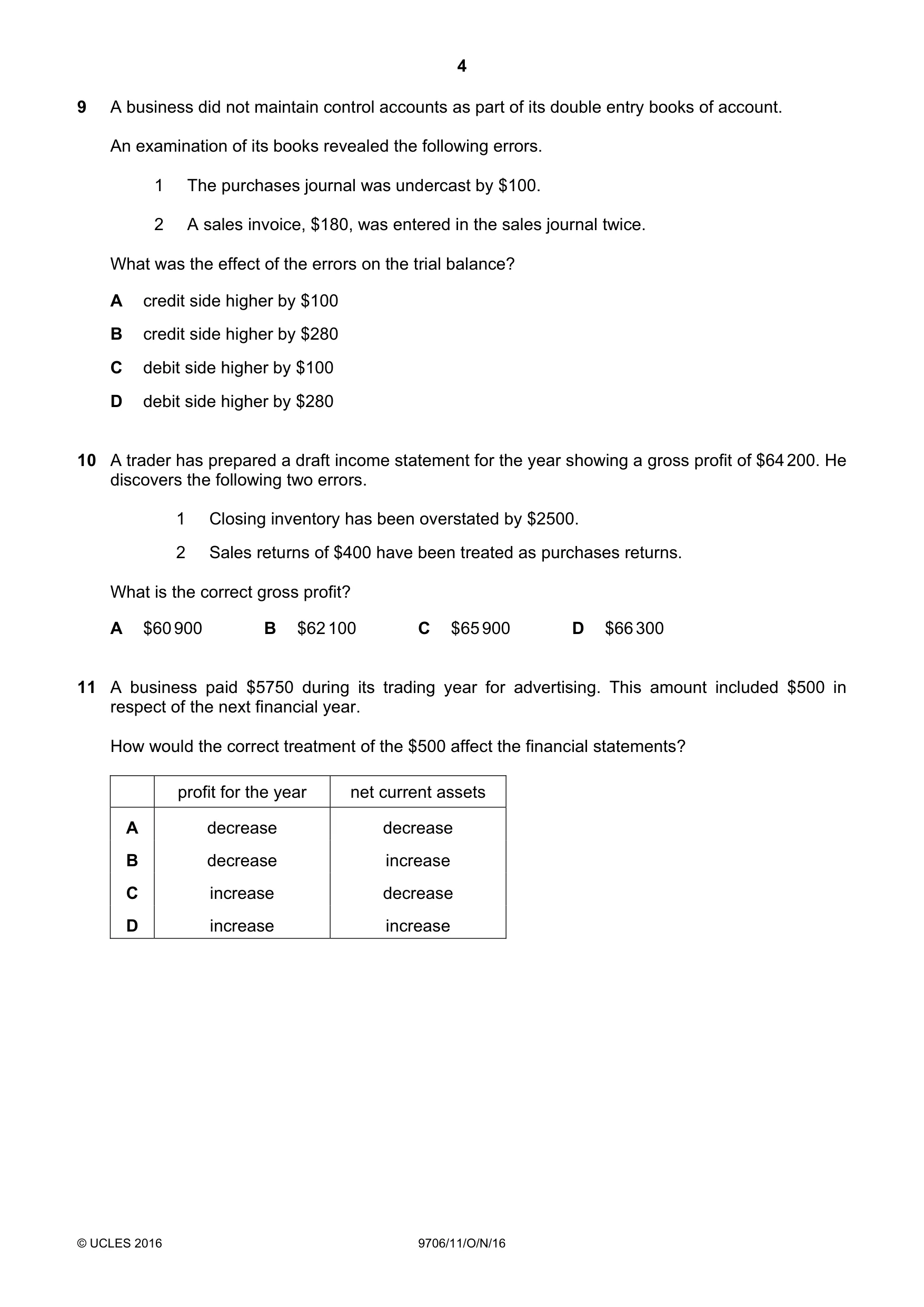
9 A business did not maintain control accounts as part of its double entry books of account. An examination of its books revealed the following errors. 1 The purchases journal was undercast by $100. 2 A sales invoice, $180, was entered in the sales journal twice. What was the effect of the errors on the trial balance? A credit side higher by $100 B credit side higher by $280 C debit side higher by $100 D debit side higher by $280
Mark scheme: A
Q10 · A trader has prepared a draft income statement for the year showing a gross profit of $64…
10 A trader has prepared a draft income statement for the year showing a gross profit of $64 200. He discovers the following two errors. 1 Closing inventory has been overstated by $2500. 2 Sales returns of $400 have been treated as purchases returns. What is the correct gross profit? A $60 900 B $62 100 C $65 900 D $66 300
Mark scheme: A
Q11 · A business paid $5750 during its trading year for advertising
11 A business paid $5750 during its trading year for advertising. This amount included $500 in respect of the next financial year. How would the correct treatment of the $500 affect the financial statements? profit for the year net current assets A decrease decrease B decrease increase C increase decrease D increase increase
Mark scheme: D
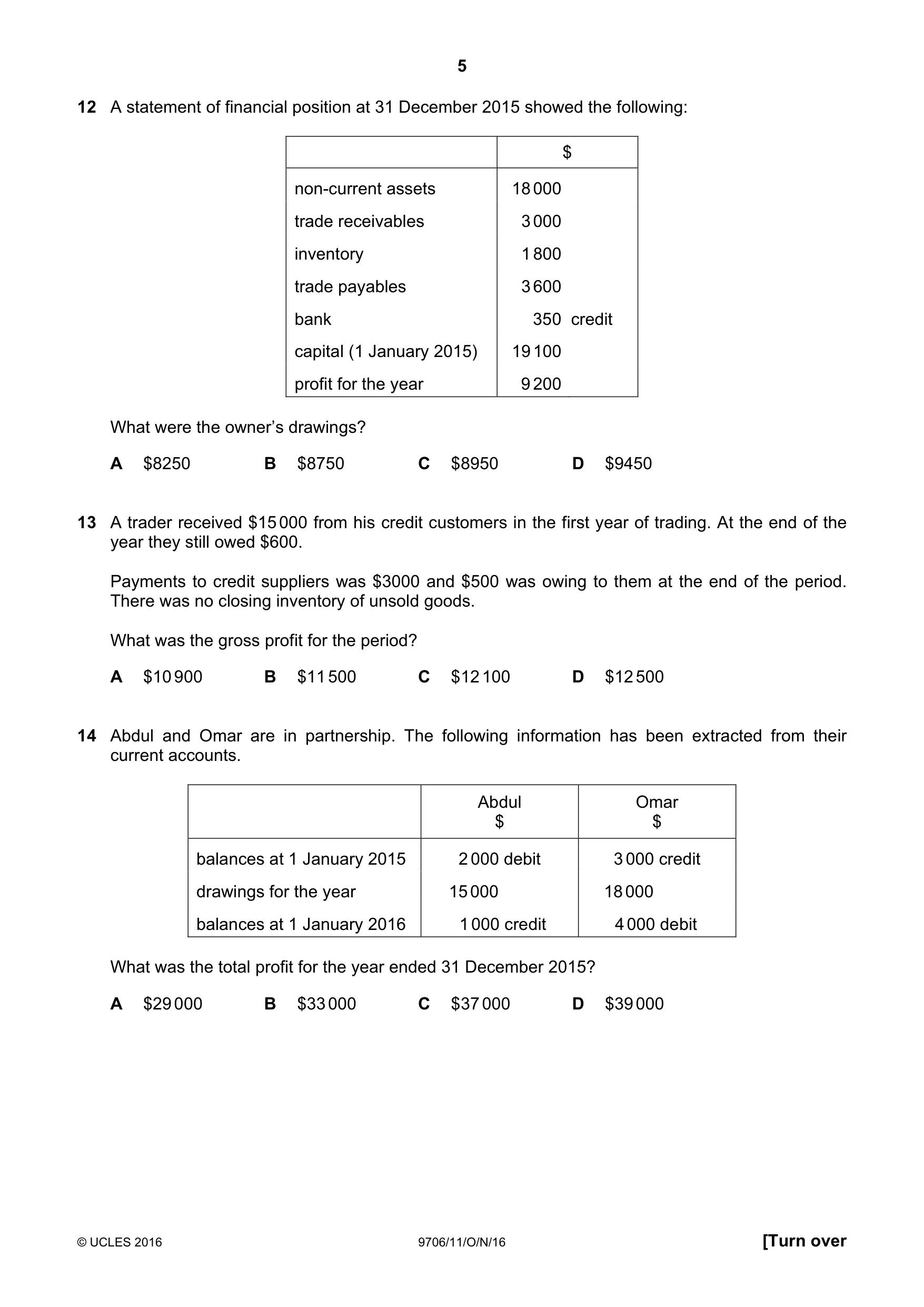
Q12 · A statement of financial position at 31 December 2015 showed the following: $ non-current…
12 A statement of financial position at 31 December 2015 showed the following: $ non-current assets 18 000 trade receivables 3 000 inventory 1 800 trade payables 3 600 bank 350 credit capital (1 January 2015) 19 100 profit for the year 9 200 What were the owner’s drawings? A $8250 B $8750 C $8950 D $9450
Mark scheme: D
Q13 · A trader received $15 000 from his credit customers in the first year of trading
13 A trader received $15 000 from his credit customers in the first year of trading. At the end of the year they still owed $600. Payments to credit suppliers was $3000 and $500 was owing to them at the end of the period. There was no closing inventory of unsold goods. What was the gross profit for the period? A $10 900 B $11 500 C $12 100 D $12 500
Mark scheme: C
Q14 · Abdul and Omar are in partnership
14 Abdul and Omar are in partnership. The following information has been extracted from their current accounts. Abdul Omar $ $ balances at 1 January 2015 2 000 debit 3 000 credit drawings for the year 15 000 18 000 balances at 1 January 2016 1 000 credit 4 000 debit What was the total profit for the year ended 31 December 2015? A $29 000 B $33 000 C $37 000 D $39 000
Mark scheme: A
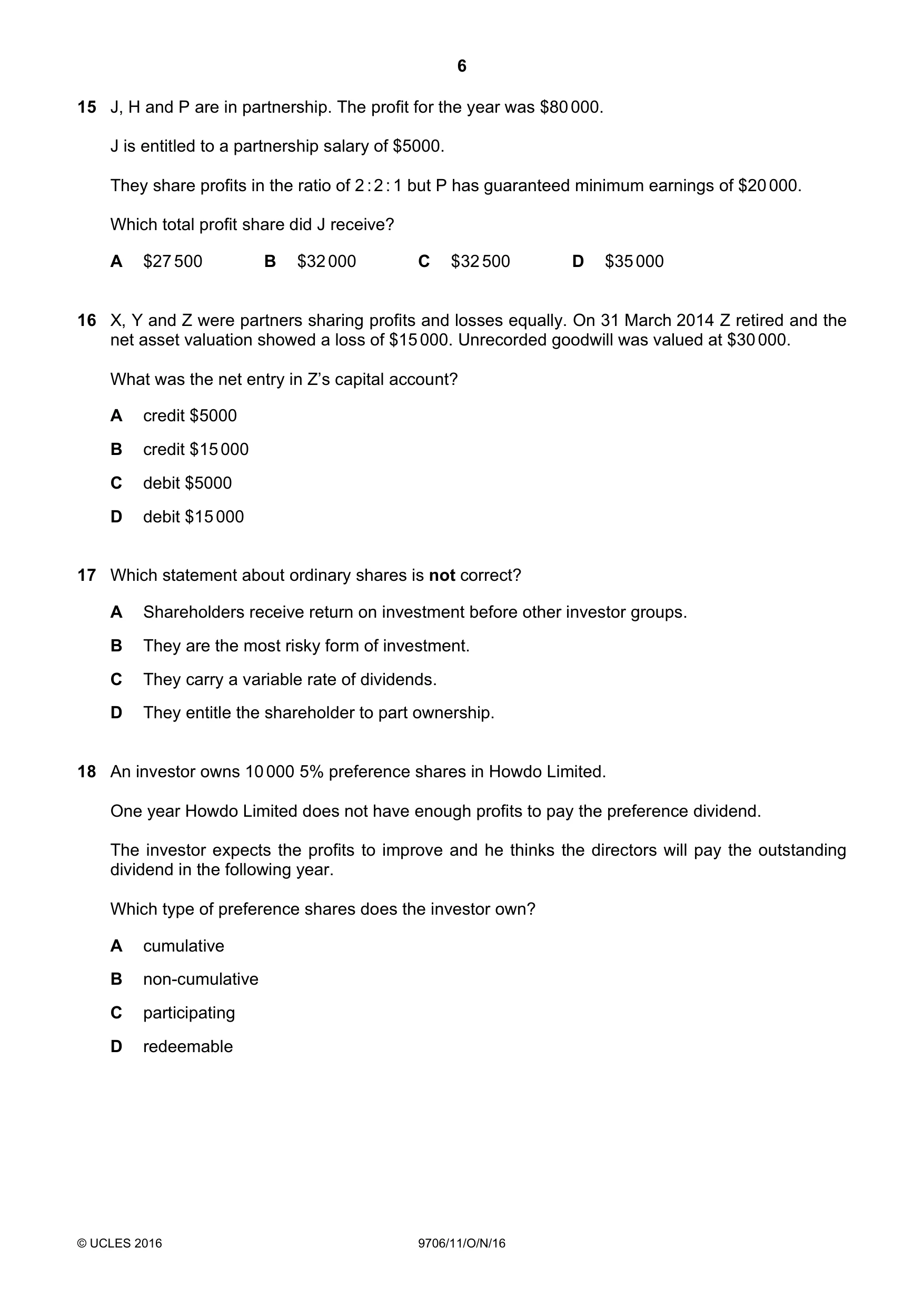
Q15 · J, H and P are in partnership
15 J, H and P are in partnership. The profit for the year was $80 000. J is entitled to a partnership salary of $5000. They share profits in the ratio of 2 : 2 : 1 but P has guaranteed minimum earnings of $20 000. Which total profit share did J receive? A $27 500 B $32 000 C $32 500 D $35 000
Mark scheme: C
Q16 · X, Y and Z were partners sharing profits and losses equally
16 X, Y and Z were partners sharing profits and losses equally. On 31 March 2014 Z retired and the net asset valuation showed a loss of $15 000. Unrecorded goodwill was valued at $30 000. What was the net entry in Z’s capital account? A credit $5000 B credit $15 000 C debit $5000 D debit $15 000
Mark scheme: A
Q17 · Which statement about ordinary shares is not correct?
17 Which statement about ordinary shares is not correct? A Shareholders receive return on investment before other investor groups. B They are the most risky form of investment. C They carry a variable rate of dividends. D They entitle the shareholder to part ownership.
Mark scheme: A
Q18 · An investor owns 10 000 5% preference shares in Howdo Limited
18 An investor owns 10 000 5% preference shares in Howdo Limited. One year Howdo Limited does not have enough profits to pay the preference dividend. The investor expects the profits to improve and he thinks the directors will pay the outstanding dividend in the following year. Which type of preference shares does the investor own? A cumulative B non-cumulative C participating D redeemable
Mark scheme: A
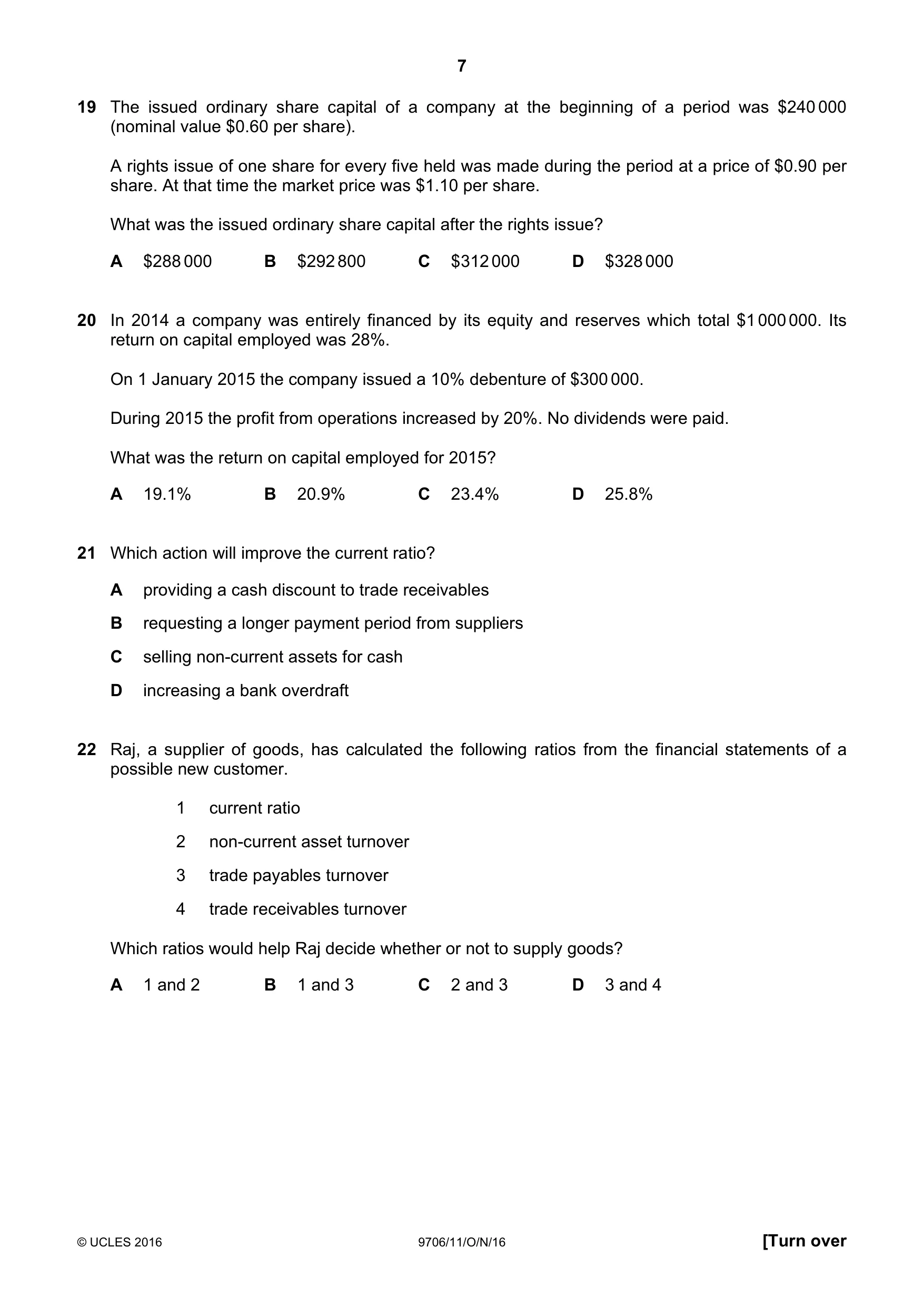
Q19 · The issued ordinary share capital of a company at the beginning of a period was $240 000…
19 The issued ordinary share capital of a company at the beginning of a period was $240 000 (nominal value $0.60 per share). A rights issue of one share for every five held was made during the period at a price of $0.90 per share. At that time the market price was $1.10 per share. What was the issued ordinary share capital after the rights issue? A $288 000 B $292 800 C $312 000 D $328 000
Mark scheme: A
Q20 · In 2014 a company was entirely financed by its equity and reserves which total $1 000 000
20 In 2014 a company was entirely financed by its equity and reserves which total $1 000 000. Its return on capital employed was 28%. On 1 January 2015 the company issued a 10% debenture of $300 000. During 2015 the profit from operations increased by 20%. No dividends were paid. What was the return on capital employed for 2015? A 19.1% B 20.9% C 23.4% D 25.8%
Mark scheme: D
More questions on Analysis and communication of accounting information
Q21 · Which action will improve the current ratio?
21 Which action will improve the current ratio? A providing a cash discount to trade receivables B requesting a longer payment period from suppliers C selling non-current assets for cash D increasing a bank overdraft
Mark scheme: C
More questions on Analysis and communication of accounting information
Q22 · Raj, a supplier of goods, has calculated the following ratios from the financial…
22 Raj, a supplier of goods, has calculated the following ratios from the financial statements of a possible new customer. 1 current ratio 2 non-current asset turnover 3 trade payables turnover 4 trade receivables turnover Which ratios would help Raj decide whether or not to supply goods? A 1 and 2 B 1 and 3 C 2 and 3 D 3 and 4
Mark scheme: B
More questions on Analysis and communication of accounting information
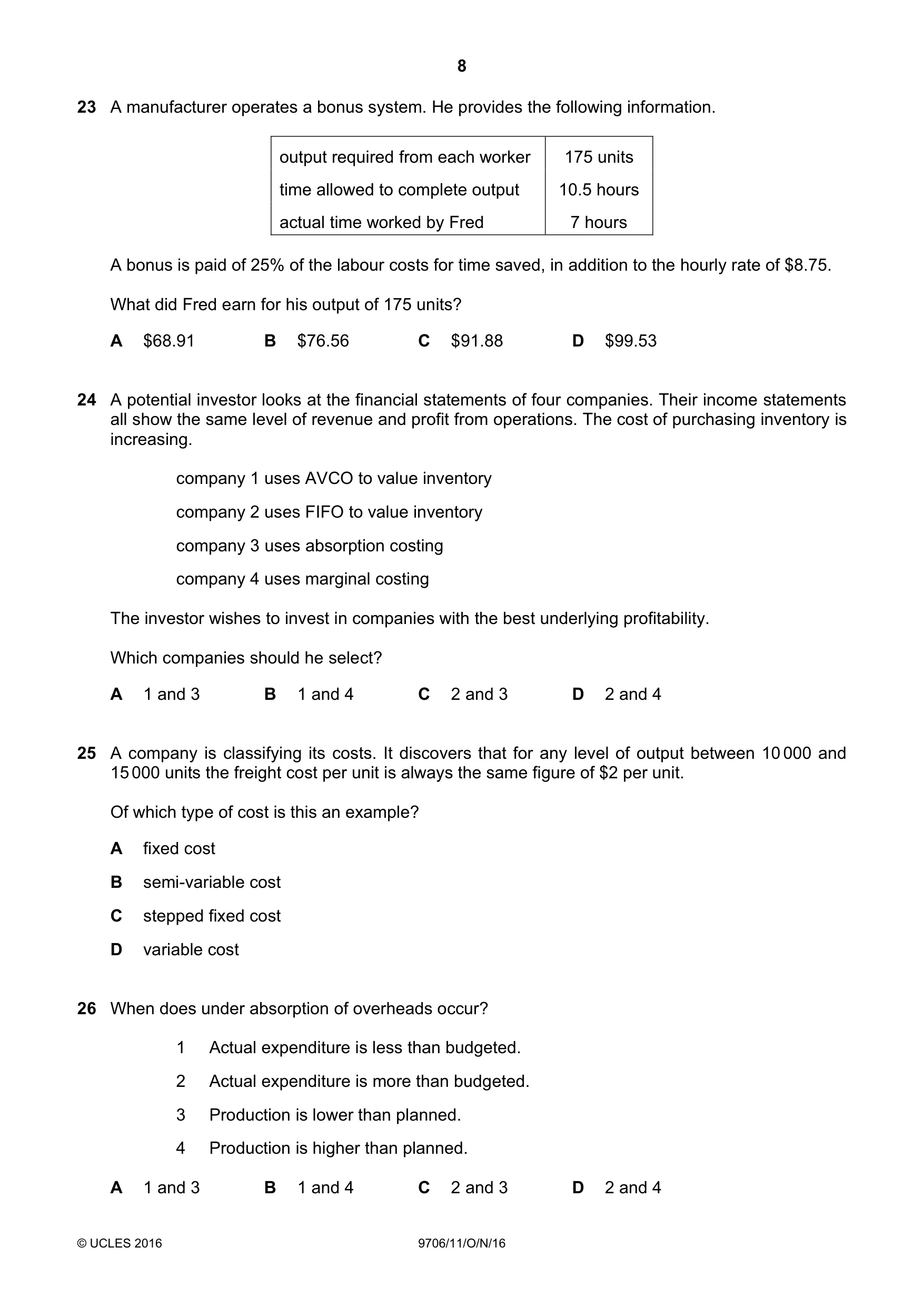
Q23 · A manufacturer operates a bonus system
23 A manufacturer operates a bonus system. He provides the following information. output required from each worker 175 units time allowed to complete output 10.5 hours actual time worked by Fred 7 hours A bonus is paid of 25% of the labour costs for time saved, in addition to the hourly rate of $8.75. What did Fred earn for his output of 175 units? A $68.91 B $76.56 C $91.88 D $99.53
Mark scheme: A
Q24 · A potential investor looks at the financial statements of four companies
24 A potential investor looks at the financial statements of four companies. Their income statements all show the same level of revenue and profit from operations. The cost of purchasing inventory is increasing. company 1 uses AVCO to value inventory company 2 uses FIFO to value inventory company 3 uses absorption costing company 4 uses marginal costing The investor wishes to invest in companies with the best underlying profitability. Which companies should he select? A 1 and 3 B 1 and 4 C 2 and 3 D 2 and 4
Mark scheme: B
Q25 · A company is classifying its costs
25 A company is classifying its costs. It discovers that for any level of output between 10 000 and 15 000 units the freight cost per unit is always the same figure of $2 per unit. Of which type of cost is this an example? A fixed cost B semi-variable cost C stepped fixed cost D variable cost
Mark scheme: D
Q26 · When does under absorption of overheads occur?
26 When does under absorption of overheads occur? 1 Actual expenditure is less than budgeted. 2 Actual expenditure is more than budgeted. 3 Production is lower than planned. 4 Production is higher than planned. A 1 and 3 B 1 and 4 C 2 and 3 D 2 and 4
Mark scheme: C
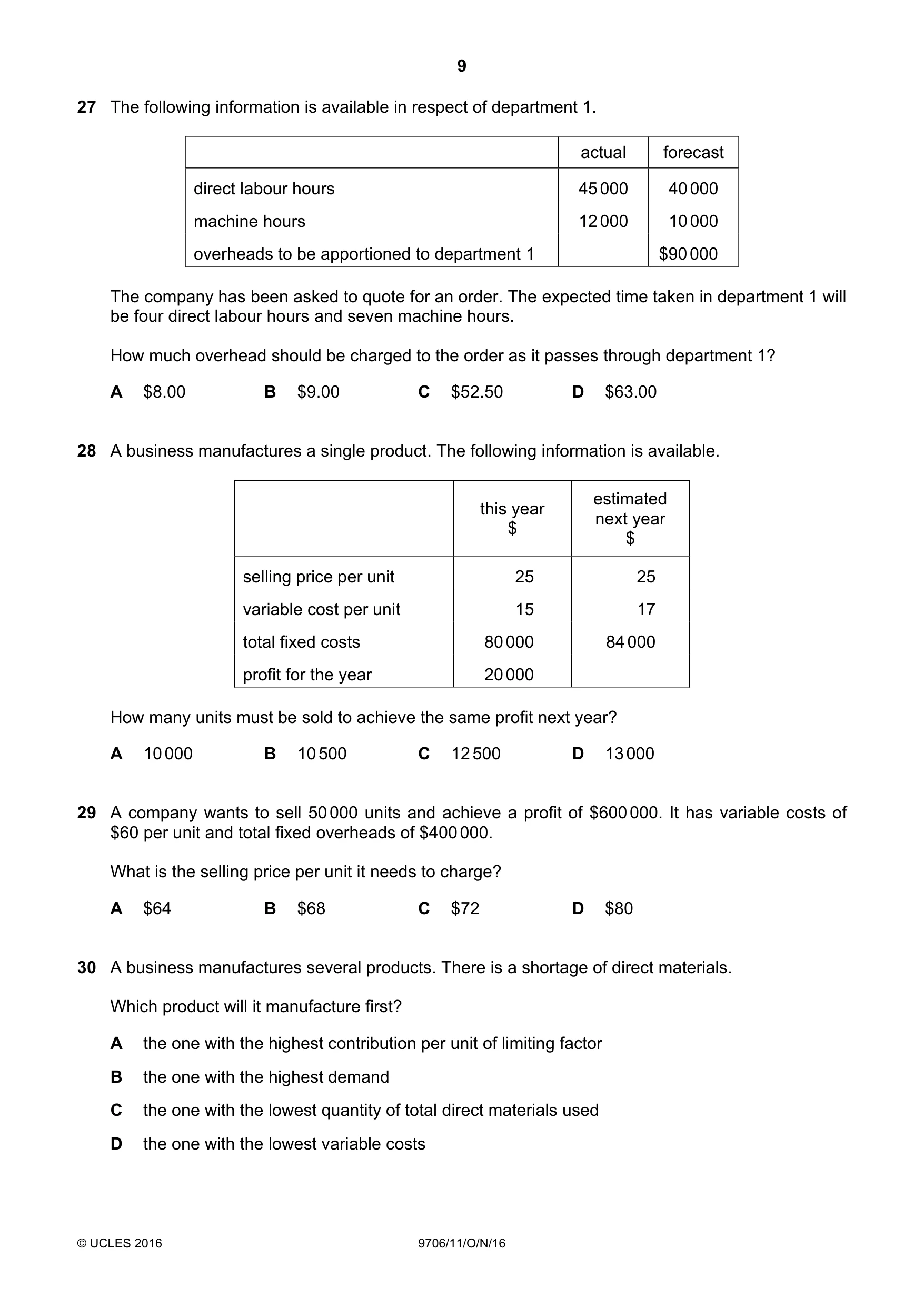
Q27 · The following information is available in respect of department 1
27 The following information is available in respect of department 1. actual forecast direct labour hours 45 000 40 000 machine hours 12 000 10 000 overheads to be apportioned to department 1 $90 000 The company has been asked to quote for an order. The expected time taken in department 1 will be four direct labour hours and seven machine hours. How much overhead should be charged to the order as it passes through department 1? A $8.00 B $9.00 C $52.50 D $63.00
Mark scheme: B
Q28 · A business manufactures a single product
28 A business manufactures a single product. The following information is available. estimated this year next year $ $ selling price per unit 25 25 variable cost per unit 15 17 total fixed costs 80 000 84 000 profit for the year 20 000 How many units must be sold to achieve the same profit next year? A 10 000 B 10 500 C 12 500 D 13 000
Mark scheme: D
Q29 · A company wants to sell 50 000 units and achieve a profit of $600 000
29 A company wants to sell 50 000 units and achieve a profit of $600 000. It has variable costs of $60 per unit and total fixed overheads of $400 000. What is the selling price per unit it needs to charge? A $64 B $68 C $72 D $80
Mark scheme: D
Q30 · A business manufactures several products
30 A business manufactures several products. There is a shortage of direct materials. Which product will it manufacture first? A the one with the highest contribution per unit of limiting factor B the one with the highest demand C the one with the lowest quantity of total direct materials used D the one with the lowest variable costs
Mark scheme: A
What was in this paper
The subtopics covered by these 30 questions, and how many questions each got. Open one in a new tab to see every Cambridge question on it.
What you needed in this session
Cambridge’s own grade thresholds for 2016 Oct/Nov, Paper 1 · Variant 1. A higher threshold means an easier paper — the bar moves with how the cohort did.