Cambridge A Level Accounting 9706 — 2011 Oct/Nov Paper 1 · Variant 3
9706/13/O/N/11 · 30 questions · 30 marks · ≈34 min
The question paper and its mark scheme, free to read here and free to download. This is Cambridge’s own paper, exactly as it was sat.
Question paper12 pages
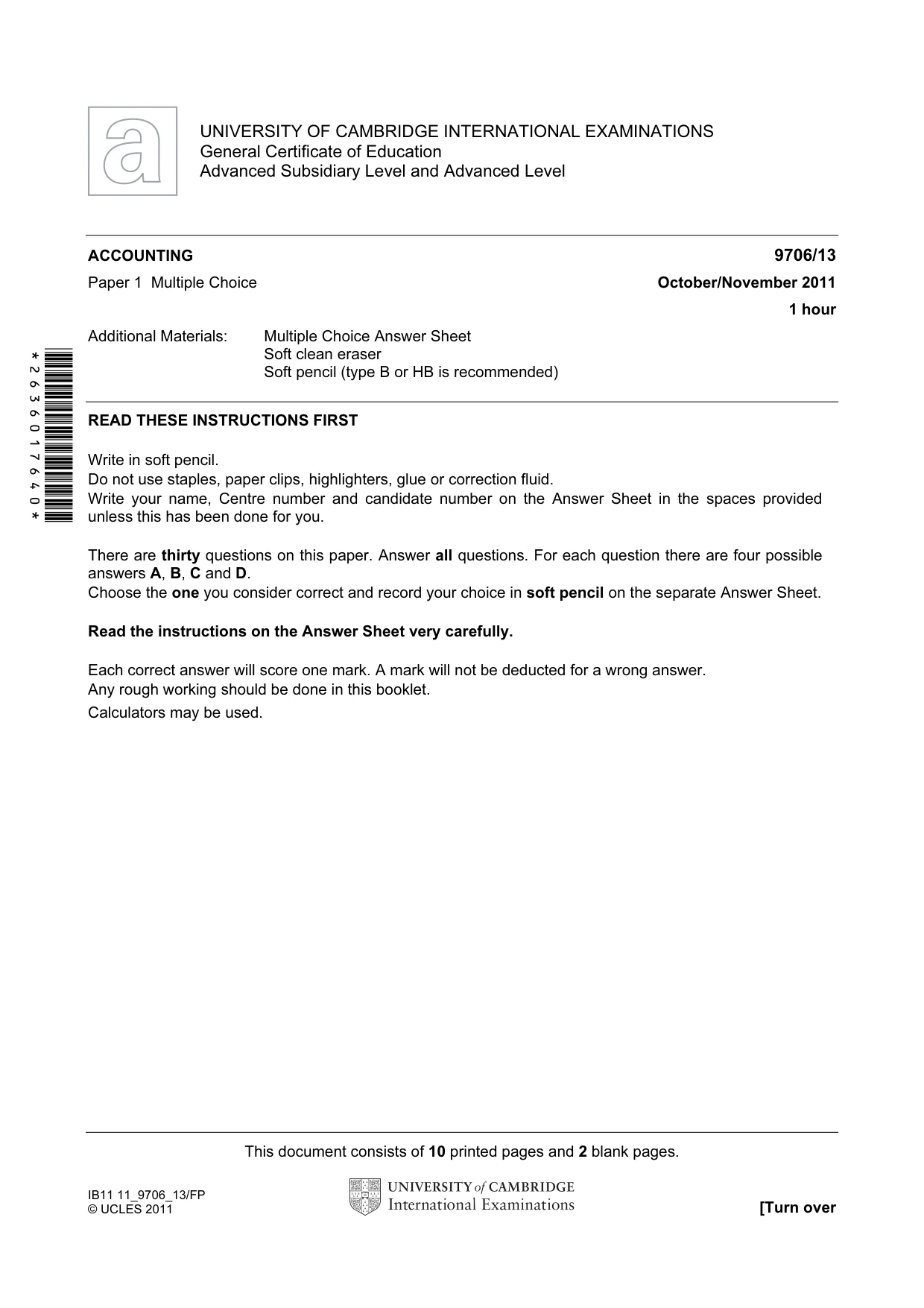

Mark scheme2 pages
Answers below. Sit the paper first if you are practising.
Questions as text
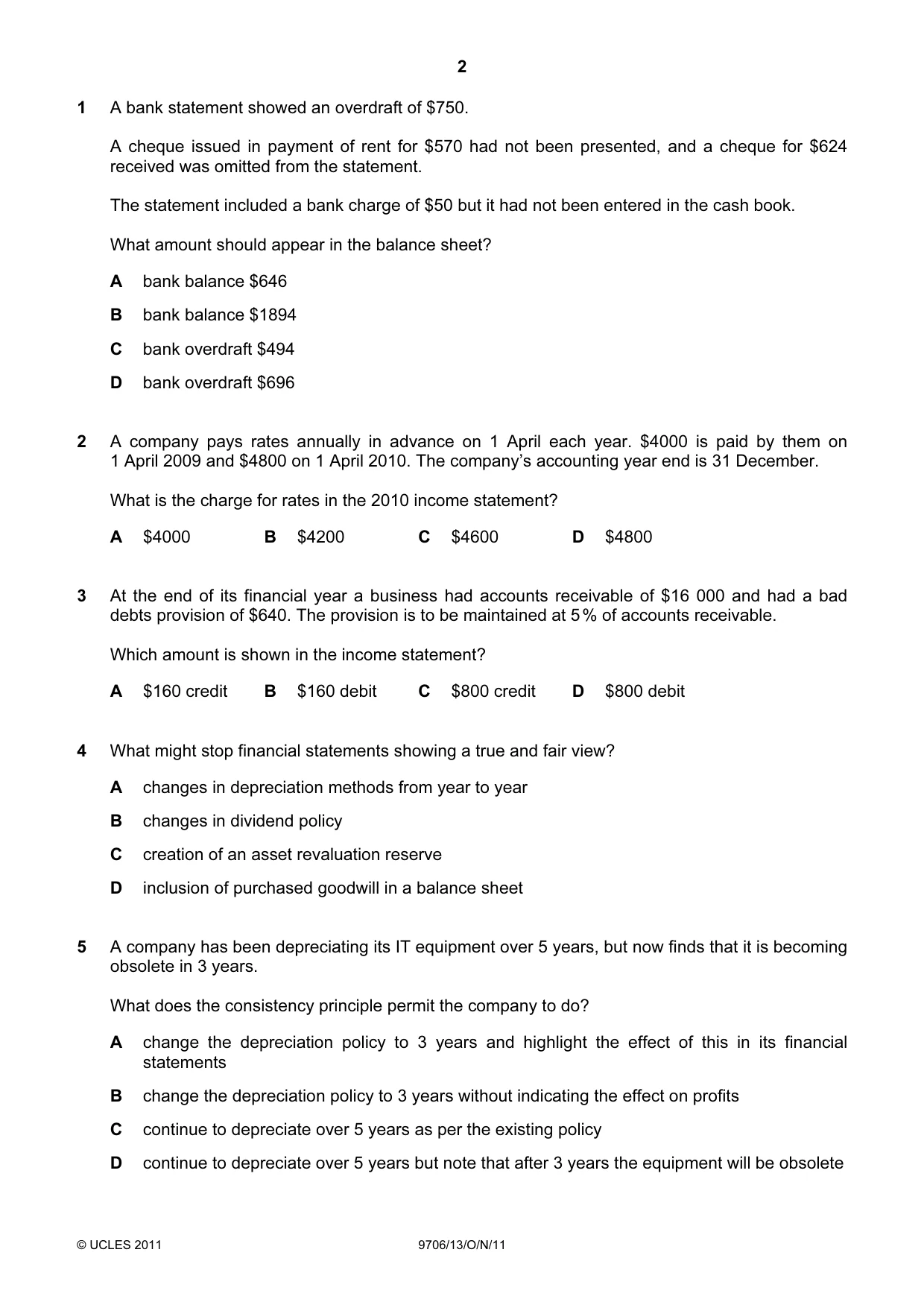
Q1 · A bank statement showed an overdraft of $750
1 A bank statement showed an overdraft of $750. A cheque issued in payment of rent for $570 had not been presented, and a cheque for $624 received was omitted from the statement. The statement included a bank charge of $50 but it had not been entered in the cash book. What amount should appear in the balance sheet? A bank balance $646 B bank balance $1894 C bank overdraft $494 D bank overdraft $696
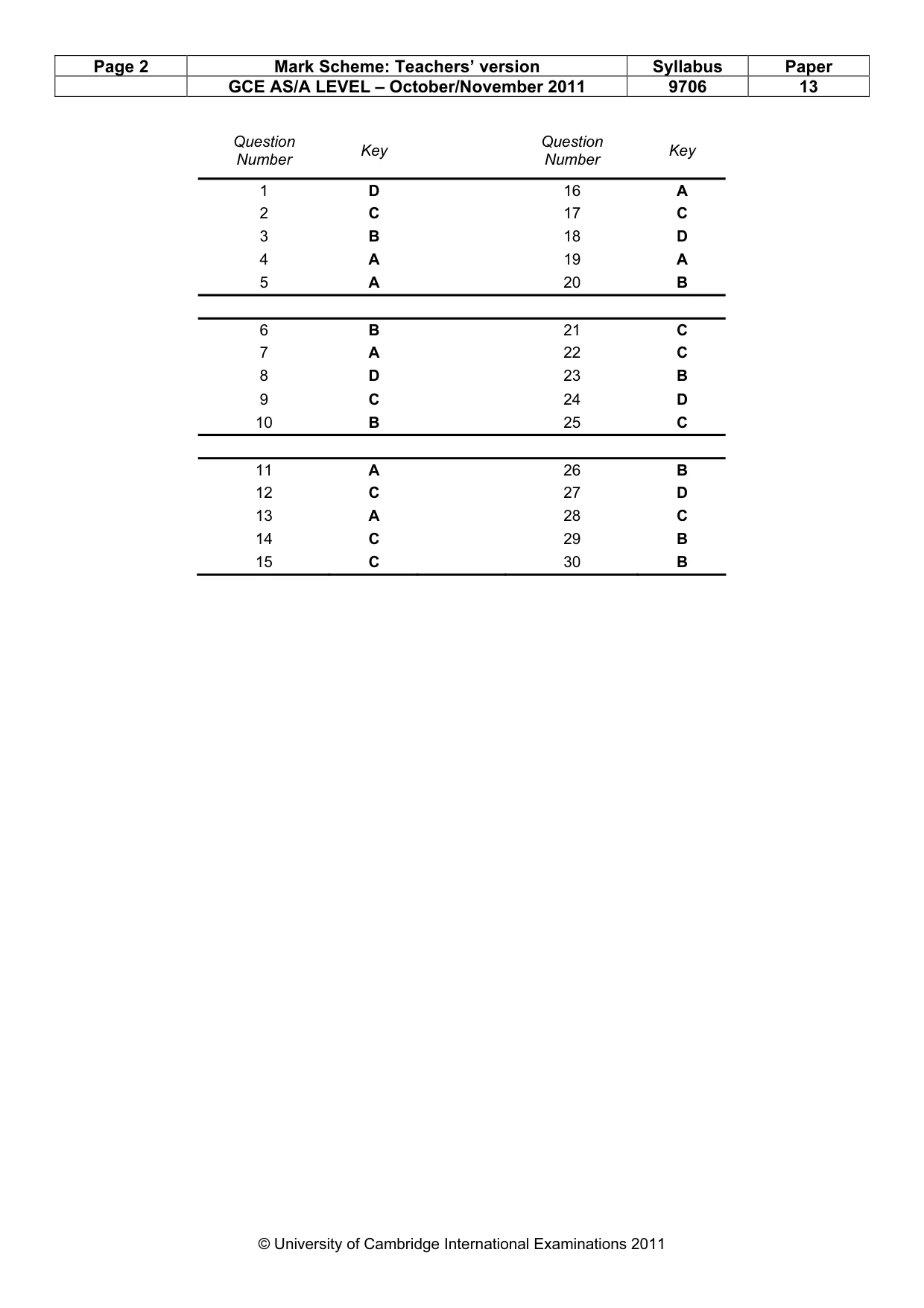
Mark scheme: D
Q2 · A company pays rates annually in advance on 1 April each year
2 A company pays rates annually in advance on 1 April each year. $4000 is paid by them on 1 April 2009 and $4800 on 1 April 2010. The company’s accounting year end is 31 December. What is the charge for rates in the 2010 income statement? A $4000 B $4200 C $4600 D $4800
Mark scheme: C
Q3 · At the end of its financial year a business had accounts receivable of $16 000 and had a…
3 At the end of its financial year a business had accounts receivable of $16 000 and had a bad debts provision of $640. The provision is to be maintained at 5 % of accounts receivable. Which amount is shown in the income statement? A $160 credit B $160 debit C $800 credit D $800 debit
Mark scheme: B
Q4 · What might stop financial statements showing a true and fair view?
4 What might stop financial statements showing a true and fair view? A changes in depreciation methods from year to year B changes in dividend policy C creation of an asset revaluation reserve D inclusion of purchased goodwill in a balance sheet
Mark scheme: A
Q5 · A company has been depreciating its IT equipment over 5 years, but now finds that it is…
5 A company has been depreciating its IT equipment over 5 years, but now finds that it is becoming obsolete in 3 years. What does the consistency principle permit the company to do? A change the depreciation policy to 3 years and highlight the effect of this in its financial statements B change the depreciation policy to 3 years without indicating the effect on profits C continue to depreciate over 5 years as per the existing policy D continue to depreciate over 5 years but note that after 3 years the equipment will be obsolete
Mark scheme: A
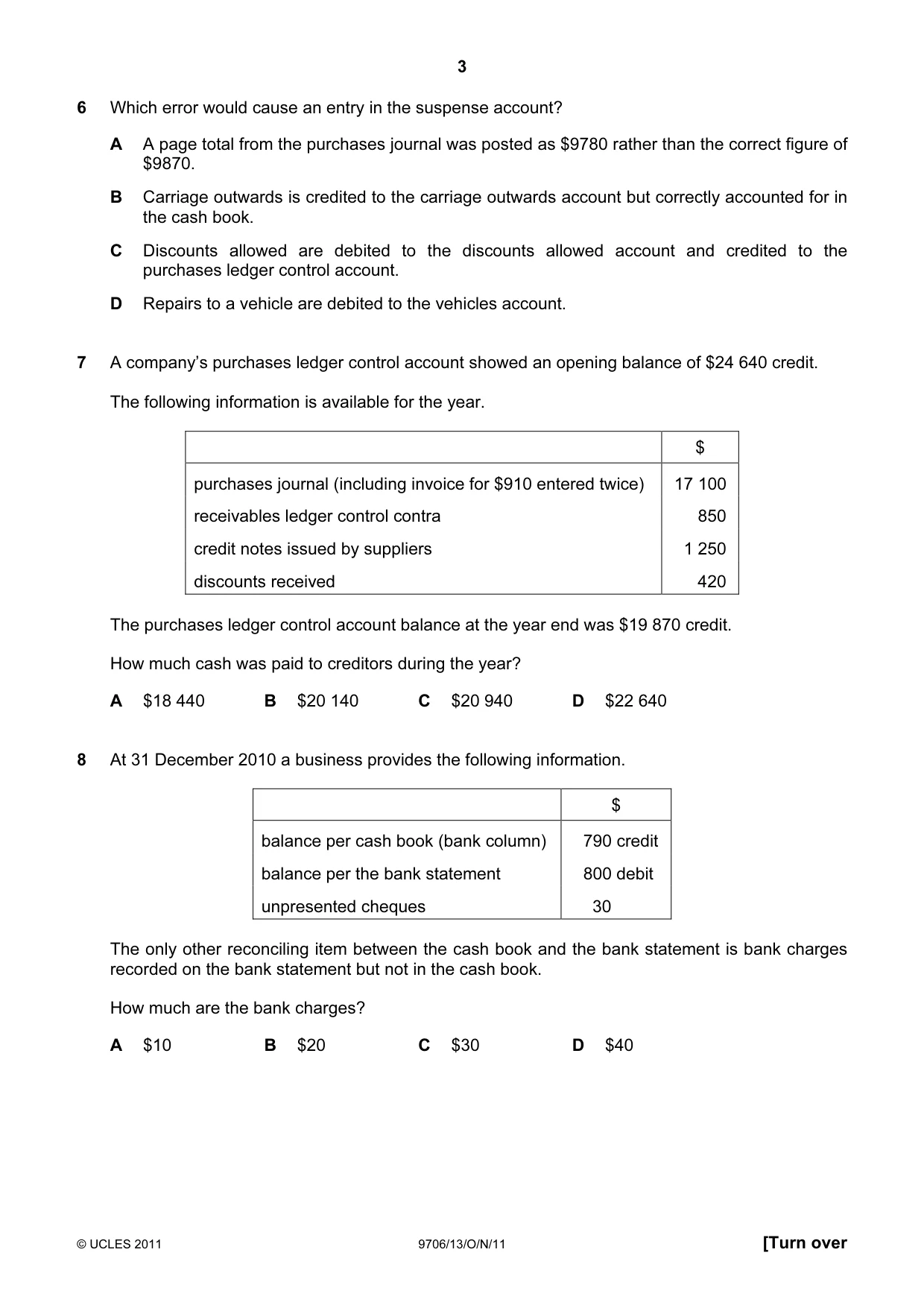
Q6 · Which error would cause an entry in the suspense account?
6 Which error would cause an entry in the suspense account? A A page total from the purchases journal was posted as $9780 rather than the correct figure of $9870. B Carriage outwards is credited to the carriage outwards account but correctly accounted for in the cash book. C Discounts allowed are debited to the discounts allowed account and credited to the purchases ledger control account. D Repairs to a vehicle are debited to the vehicles account.
Mark scheme: B
Q7 · A company’s purchases ledger control account showed an opening balance of $24 640 credit
7 A company’s purchases ledger control account showed an opening balance of $24 640 credit. The following information is available for the year. $ purchases journal (including invoice for $910 entered twice) 17 100 receivables ledger control contra 850 credit notes issued by suppliers 1 250 discounts received 420 The purchases ledger control account balance at the year end was $19 870 credit. How much cash was paid to creditors during the year? A $18 440 B $20 140 C $20 940 D $22 640
Mark scheme: A
Q8 · At 31 December 2010 a business provides the following information
8 At 31 December 2010 a business provides the following information. $ balance per cash book (bank column) 790 credit balance per the bank statement 800 debit unpresented cheques 30 The only other reconciling item between the cash book and the bank statement is bank charges recorded on the bank statement but not in the cash book. How much are the bank charges? A $10 B $20 C $30 D $40
Mark scheme: D
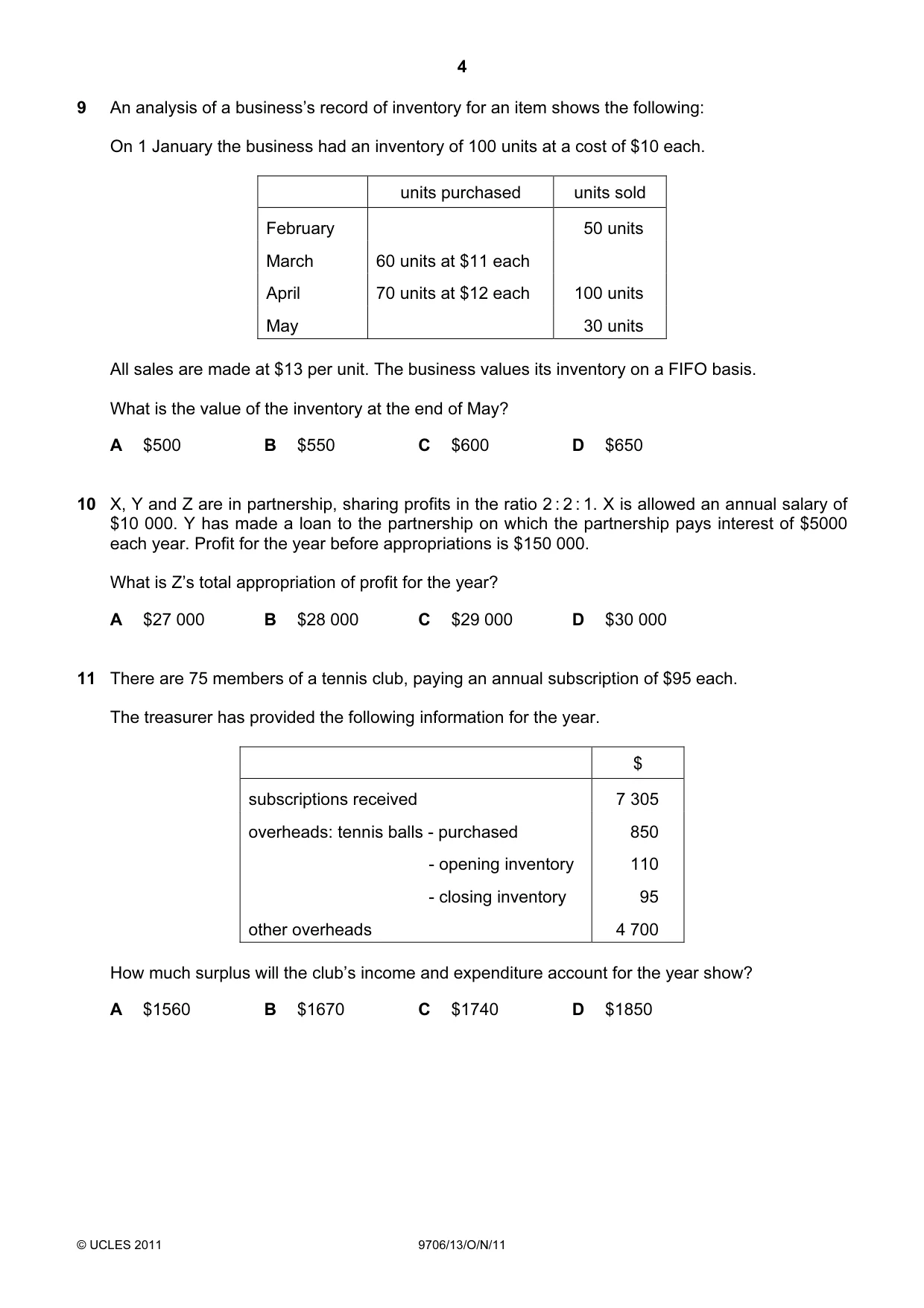
Q9 · An analysis of a business’s record of inventory for an item shows the following: On 1…
9 An analysis of a business’s record of inventory for an item shows the following: On 1 January the business had an inventory of 100 units at a cost of $10 each. units purchased units sold February 50 units March 60 units at $11 each April 70 units at $12 each 100 units May 30 units All sales are made at $13 per unit. The business values its inventory on a FIFO basis. What is the value of the inventory at the end of May? A $500 B $550 C $600 D $650
Mark scheme: C
Q10 · X, Y and Z are in partnership, sharing profits in the ratio 2 : 2 : 1
10 X, Y and Z are in partnership, sharing profits in the ratio 2 : 2 : 1. X is allowed an annual salary of $10 000. Y has made a loan to the partnership on which the partnership pays interest of $5000 each year. Profit for the year before appropriations is $150 000. What is Z’s total appropriation of profit for the year? A $27 000 B $28 000 C $29 000 D $30 000
Mark scheme: B
Q11 · There are 75 members of a tennis club, paying an annual subscription of $95 each
11 There are 75 members of a tennis club, paying an annual subscription of $95 each. The treasurer has provided the following information for the year. $ subscriptions received 7 305 overheads: tennis balls - purchased 850 - opening inventory 110 - closing inventory 95 other overheads 4 700 How much surplus will the club’s income and expenditure account for the year show? A $1560 B $1670 C $1740 D $1850
Mark scheme: A
Q12 · A businessman marks up his cost of sales by 50 %
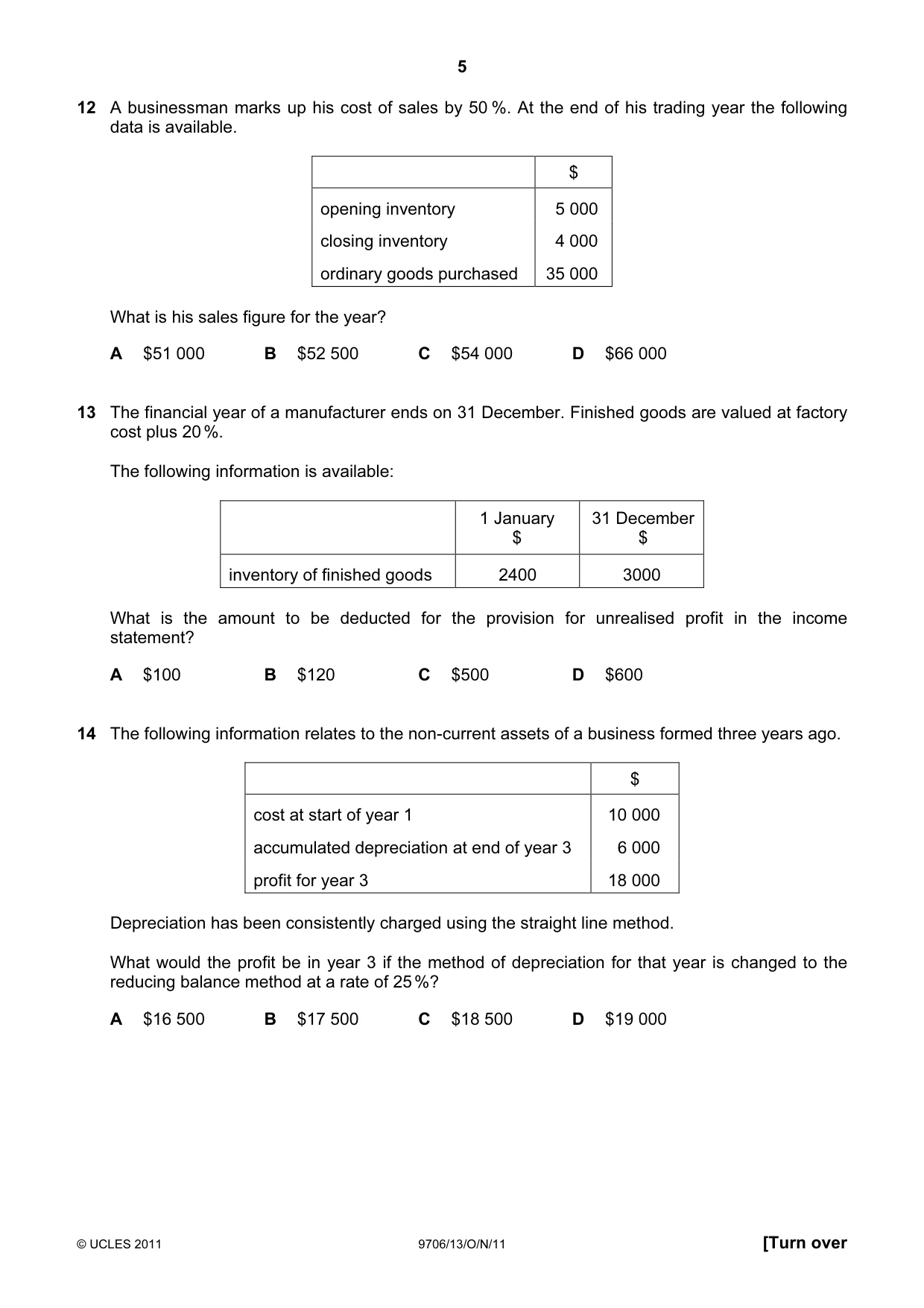
12 A businessman marks up his cost of sales by 50 %. At the end of his trading year the following data is available. $ opening inventory 5 000 closing inventory 4 000 ordinary goods purchased 35 000 What is his sales figure for the year? A $51 000 B $52 500 C $54 000 D $66 000
Mark scheme: C
Q13 · The financial year of a manufacturer ends on 31 December
13 The financial year of a manufacturer ends on 31 December. Finished goods are valued at factory cost plus 20 %. The following information is available: 1 January 31 December $ $ inventory of finished goods 2400 3000 What is the amount to be deducted for the provision for unrealised profit in the income statement? A $100 B $120 C $500 D $600
Mark scheme: A
Q14 · The following information relates to the non-current assets of a business formed three…
14 The following information relates to the non-current assets of a business formed three years ago. $ cost at start of year 1 10 000 accumulated depreciation at end of year 3 6 000 profit for year 3 18 000 Depreciation has been consistently charged using the straight line method. What would the profit be in year 3 if the method of depreciation for that year is changed to the reducing balance method at a rate of 25 %? A $16 500 B $17 500 C $18 500 D $19 000
Mark scheme: C
Q15 · What could be used to fund a bonus issue of shares?
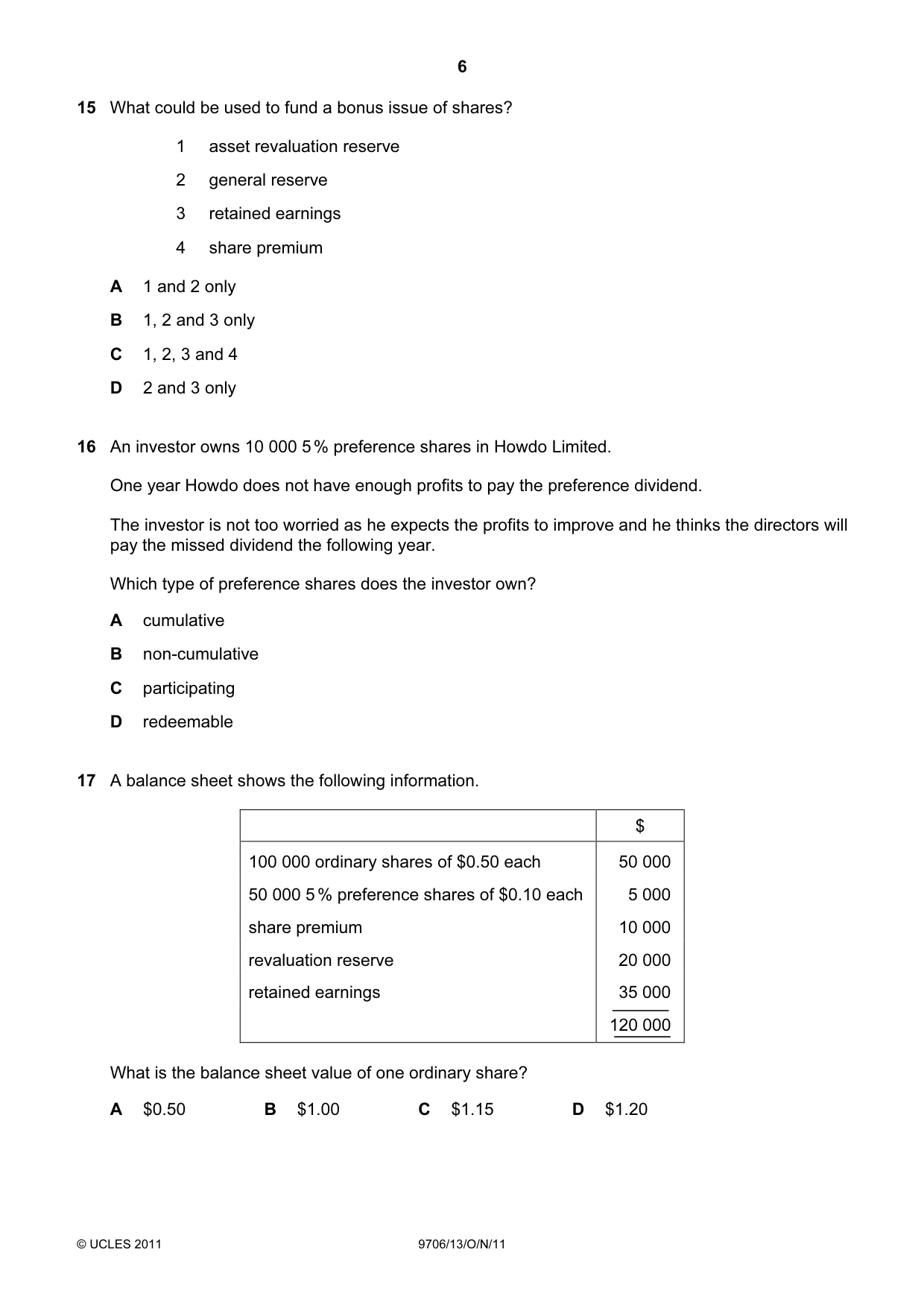
15 What could be used to fund a bonus issue of shares? 1 asset revaluation reserve 2 general reserve 3 retained earnings 4 share premium A 1 and 2 only B 1, 2 and 3 only C 1, 2, 3 and 4 D 2 and 3 only
Mark scheme: C
Q16 · An investor owns 10 000 5 % preference shares in Howdo Limited
16 An investor owns 10 000 5 % preference shares in Howdo Limited. One year Howdo does not have enough profits to pay the preference dividend. The investor is not too worried as he expects the profits to improve and he thinks the directors will pay the missed dividend the following year. Which type of preference shares does the investor own? A cumulative B non-cumulative C participating D redeemable
Mark scheme: A
Q17 · A balance sheet shows the following information
17 A balance sheet shows the following information. $ 100 000 ordinary shares of $0.50 each 50 000 50 000 5 % preference shares of $0.10 each 5 000 share premium 10 000 revaluation reserve 20 000 retained earnings 35 000 120 000 What is the balance sheet value of one ordinary share? A $0.50 B $1.00 C $1.15 D $1.20
Mark scheme: C
Q18 · A business has a gross profit ratio of 40 %, and a net profit ratio of 10 %
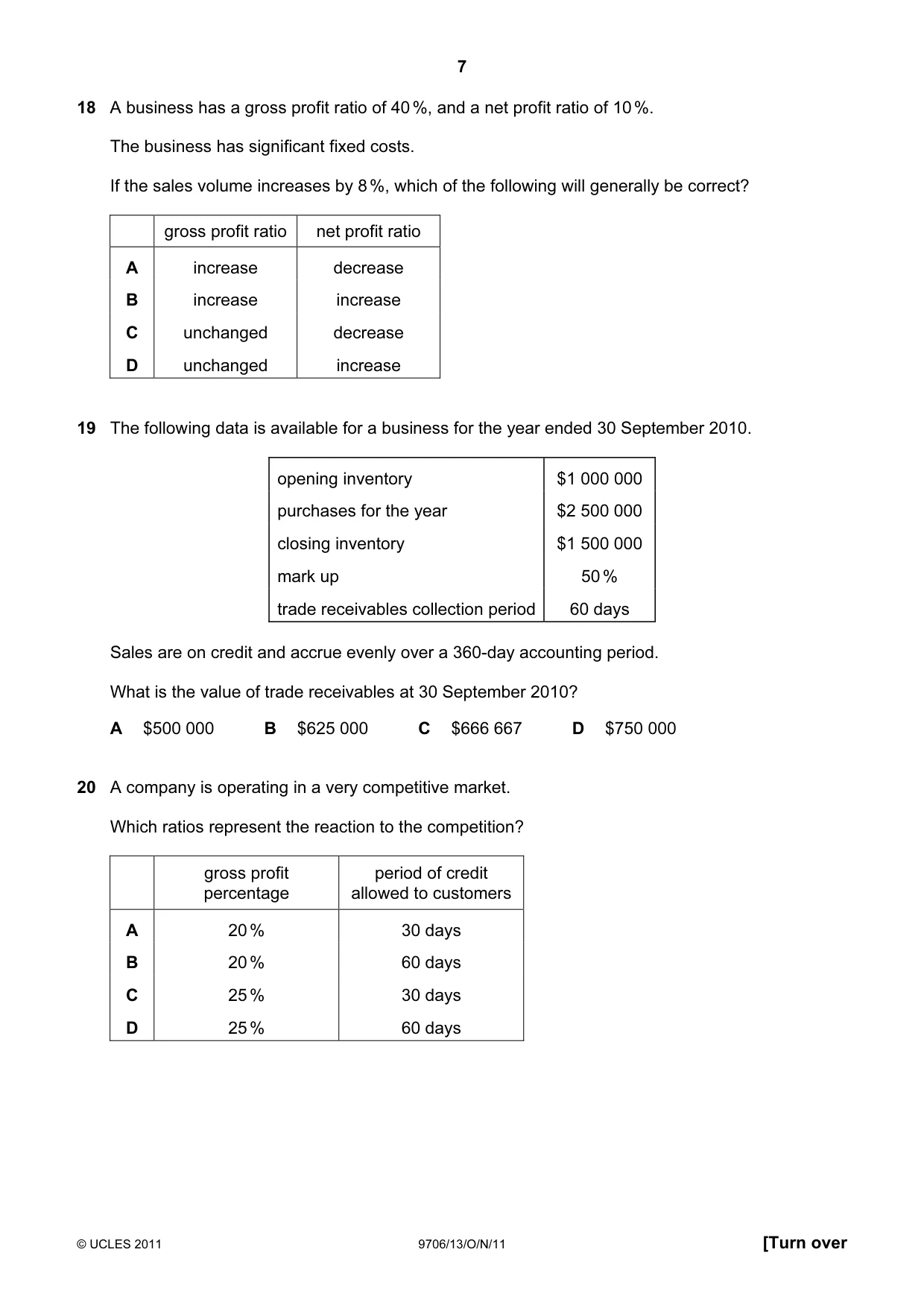
18 A business has a gross profit ratio of 40 %, and a net profit ratio of 10 %. The business has significant fixed costs. If the sales volume increases by 8 %, which of the following will generally be correct? gross profit ratio net profit ratio A increase decrease B increase increase C unchanged decrease D unchanged increase
Mark scheme: D
More questions on Analysis and communication of accounting information
Q19 · The following data is available for a business for the year ended 30 September 2010
19 The following data is available for a business for the year ended 30 September 2010. opening inventory $1 000 000 purchases for the year $2 500 000 closing inventory $1 500 000 mark up 50 % trade receivables collection period 60 days Sales are on credit and accrue evenly over a 360-day accounting period. What is the value of trade receivables at 30 September 2010? A $500 000 B $625 000 C $666 667 D $750 000
Mark scheme: A
More questions on Analysis and communication of accounting information
Q20 · A company is operating in a very competitive market
20 A company is operating in a very competitive market. Which ratios represent the reaction to the competition? gross profit period of credit percentage allowed to customers A 20 % 30 days B 20 % 60 days C 25 % 30 days D 25 % 60 days
Mark scheme: B
More questions on Analysis and communication of accounting information
Q21 · The balance sheet of a business at 30 June includes the following items: Year 1 Year 2…
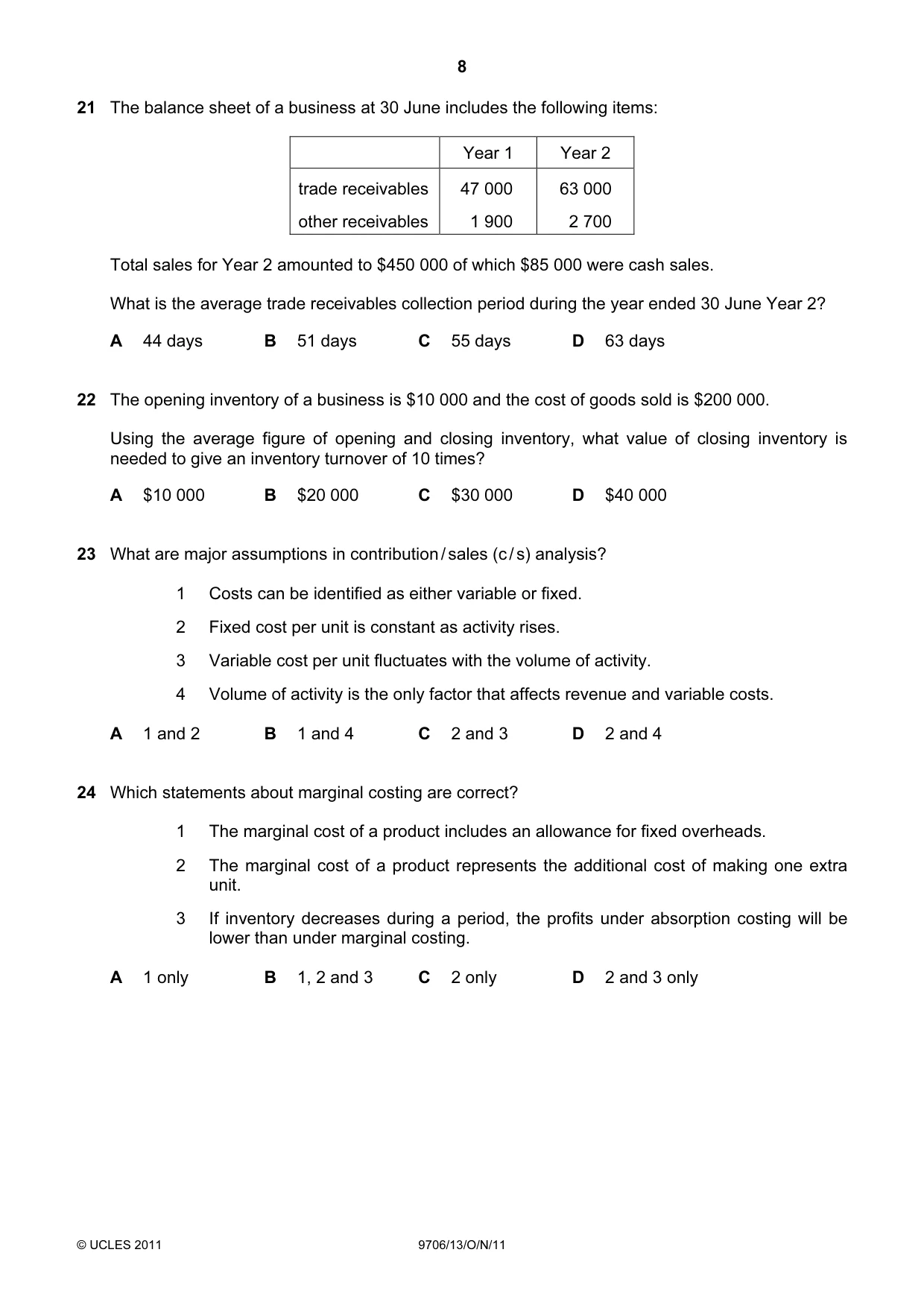
21 The balance sheet of a business at 30 June includes the following items: Year 1 Year 2 trade receivables 47 000 63 000 other receivables 1 900 2 700 Total sales for Year 2 amounted to $450 000 of which $85 000 were cash sales. What is the average trade receivables collection period during the year ended 30 June Year 2? A 44 days B 51 days C 55 days D 63 days
Mark scheme: C
More questions on Analysis and communication of accounting information
Q22 · The opening inventory of a business is $10 000 and the cost of goods sold is $200 000
22 The opening inventory of a business is $10 000 and the cost of goods sold is $200 000. Using the average figure of opening and closing inventory, what value of closing inventory is needed to give an inventory turnover of 10 times? A $10 000 B $20 000 C $30 000 D $40 000
Mark scheme: C
More questions on Analysis and communication of accounting information
Q23 · What are major assumptions in contribution / sales (c / s) analysis?
23 What are major assumptions in contribution / sales (c / s) analysis? 1 Costs can be identified as either variable or fixed. 2 Fixed cost per unit is constant as activity rises. 3 Variable cost per unit fluctuates with the volume of activity. 4 Volume of activity is the only factor that affects revenue and variable costs. A 1 and 2 B 1 and 4 C 2 and 3 D 2 and 4
Mark scheme: B
Q24 · Which statements about marginal costing are correct?
24 Which statements about marginal costing are correct? 1 The marginal cost of a product includes an allowance for fixed overheads. 2 The marginal cost of a product represents the additional cost of making one extra unit. 3 If inventory decreases during a period, the profits under absorption costing will be lower than under marginal costing. A 1 only B 1, 2 and 3 C 2 only D 2 and 3 only
Mark scheme: D
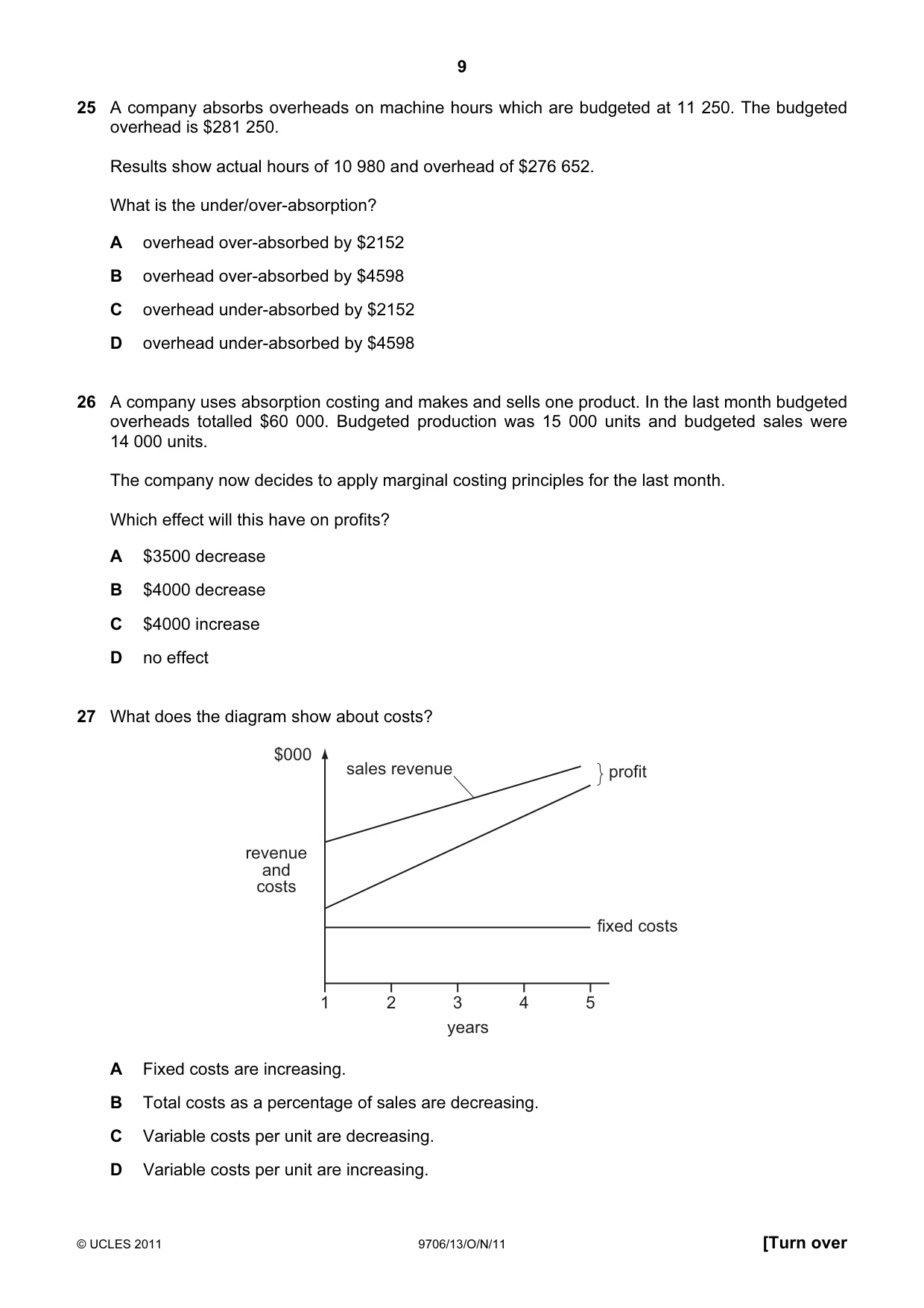
Q25 · A company absorbs overheads on machine hours which are budgeted at 11 250
25 A company absorbs overheads on machine hours which are budgeted at 11 250. The budgeted overhead is $281 250. Results show actual hours of 10 980 and overhead of $276 652. What is the under/over-absorption? A overhead over-absorbed by $2152 B overhead over-absorbed by $4598 C overhead under-absorbed by $2152 D overhead under-absorbed by $4598
Mark scheme: C
Q26 · A company uses absorption costing and makes and sells one product
26 A company uses absorption costing and makes and sells one product. In the last month budgeted overheads totalled $60 000. Budgeted production was 15 000 units and budgeted sales were 14 000 units. The company now decides to apply marginal costing principles for the last month. Which effect will this have on profits? A $3500 decrease B $4000 decrease C $4000 increase D no effect
Mark scheme: B
Q27 · What does the diagram show about costs?
27 What does the diagram show about costs? $000 sales revenue profit revenue and costs fixed costs 1 2 3 4 5 years A Fixed costs are increasing. B Total costs as a percentage of sales are decreasing. C Variable costs per unit are decreasing. D Variable costs per unit are increasing.
Mark scheme: D
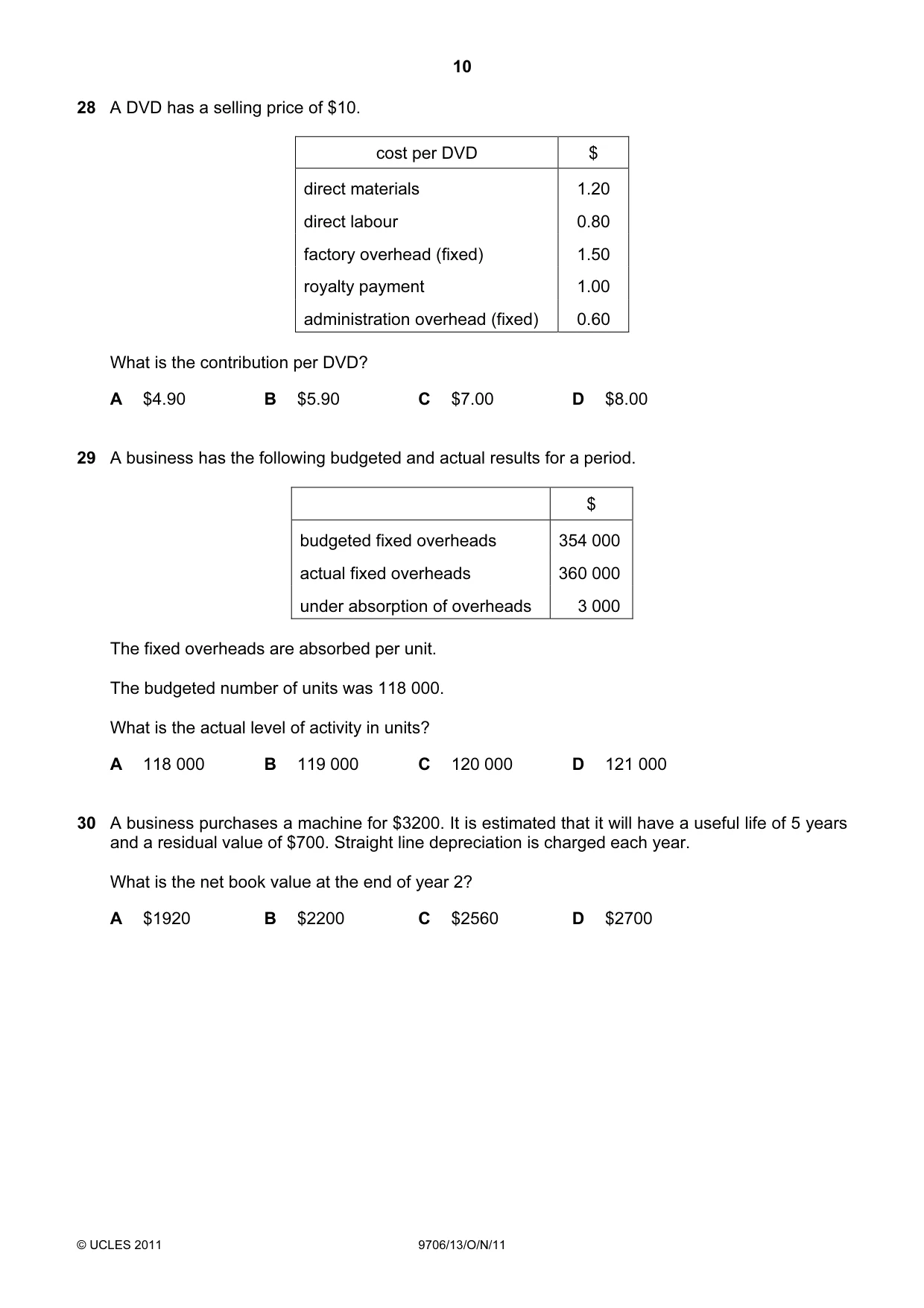
Q28 · A DVD has a selling price of $10
28 A DVD has a selling price of $10. cost per DVD $ direct materials 1.20 direct labour 0.80 factory overhead (fixed) 1.50 royalty payment 1.00 administration overhead (fixed) 0.60 What is the contribution per DVD? A $4.90 B $5.90 C $7.00 D $8.00
Mark scheme: C
Q29 · A business has the following budgeted and actual results for a period
29 A business has the following budgeted and actual results for a period. $ budgeted fixed overheads 354 000 actual fixed overheads 360 000 under absorption of overheads 3 000 The fixed overheads are absorbed per unit. The budgeted number of units was 118 000. What is the actual level of activity in units? A 118 000 B 119 000 C 120 000 D 121 000
Mark scheme: B
Q30 · A business purchases a machine for $3200
30 A business purchases a machine for $3200. It is estimated that it will have a useful life of 5 years and a residual value of $700. Straight line depreciation is charged each year. What is the net book value at the end of year 2? A $1920 B $2200 C $2560 D $2700
Mark scheme: B
What was in this paper
The subtopics covered by these 30 questions, and how many questions each got. Open one in a new tab to see every Cambridge question on it.
6Analysis and communication of accounting information5Reconciliation and verification4Traditional costing methods4Costs and cost behaviour3Accounting for non-current assets2Preparation of financial statements2Regulatory and ethical considerations2Types of business entity2What you needed in this session
Cambridge’s own grade thresholds for 2011 Oct/Nov, Paper 1 · Variant 3. A higher threshold means an easier paper — the bar moves with how the cohort did.