Cambridge A Level Accounting 9706 — 2023 May/June Paper 1 · Variant 2
9706/12/M/J/23 · 30 questions · 30 marks · ≈34 min
The question paper and its mark scheme, free to read here and free to download. This is Cambridge’s own paper, exactly as it was sat.
Question paper12 pages
Mark scheme3 pages
Answers below. Sit the paper first if you are practising.
Questions as text
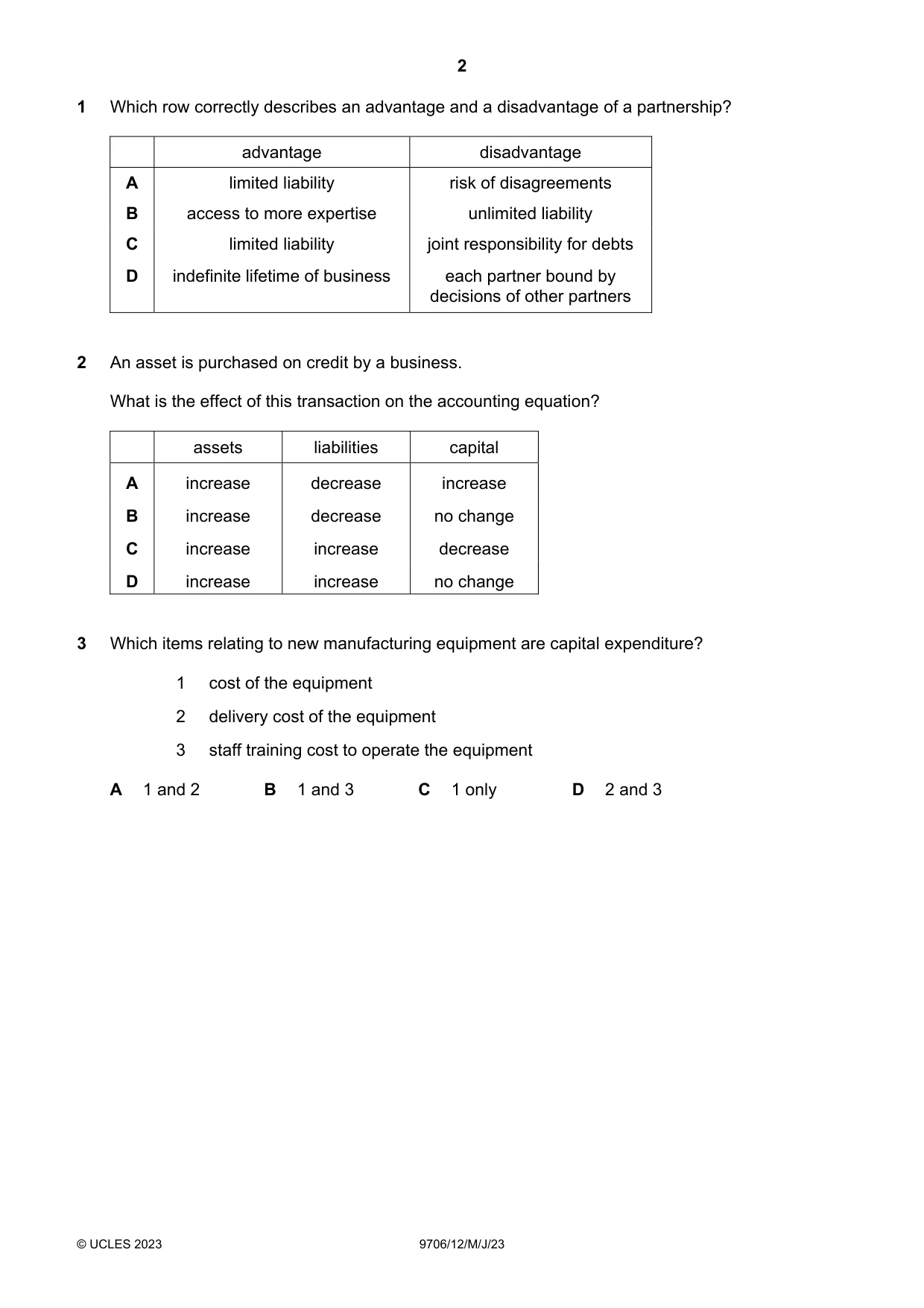
Q1 · Which row correctly describes an advantage and a disadvantage of a partnership?
1 Which row correctly describes an advantage and a disadvantage of a partnership? advantage disadvantage A limited liability risk of disagreements B access to more expertise unlimited liability C limited liability joint responsibility for debts D indefinite lifetime of business each partner bound by decisions of other partners
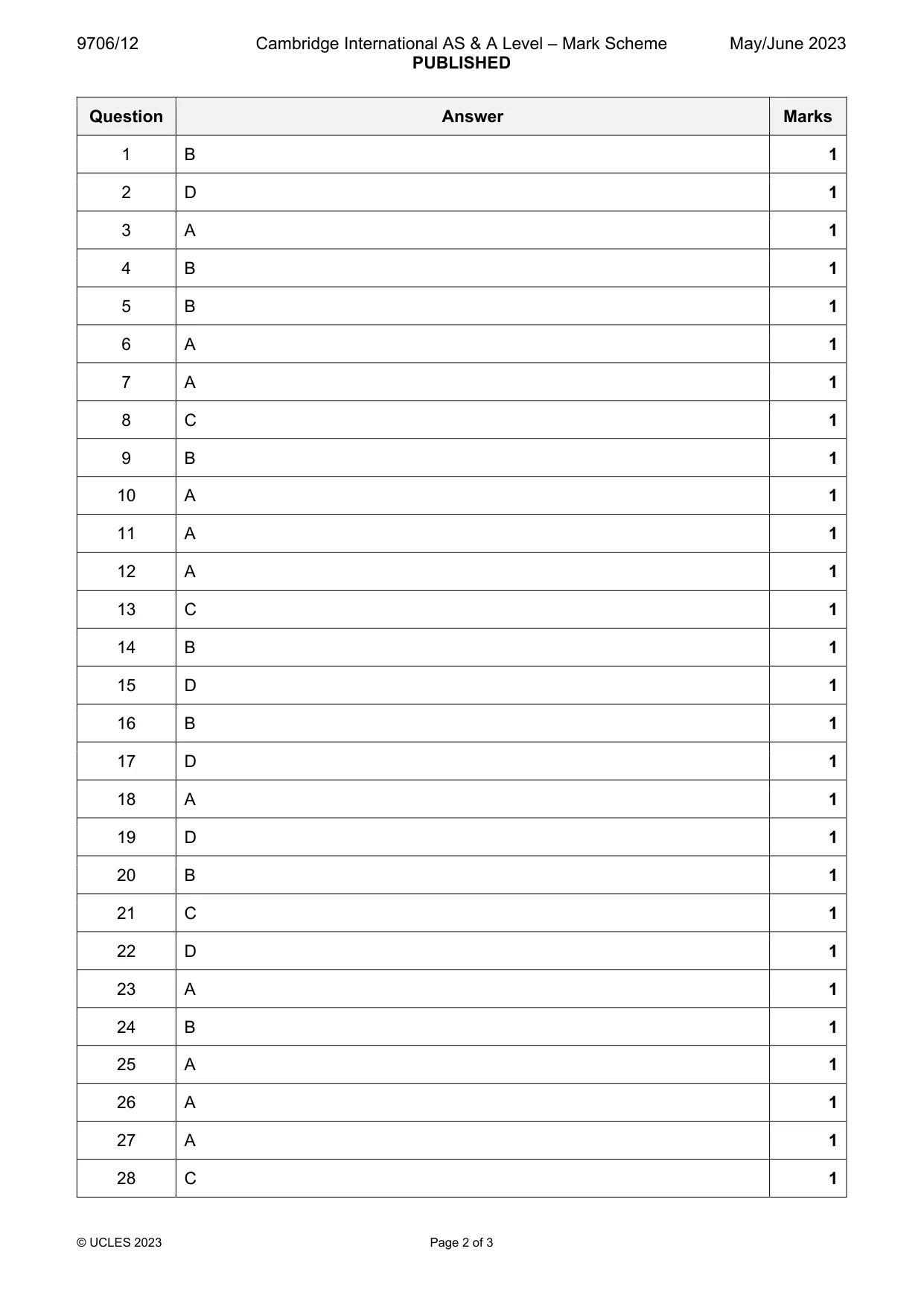
Mark scheme: B
Q2 · An asset is purchased on credit by a business
2 An asset is purchased on credit by a business. What is the effect of this transaction on the accounting equation? assets liabilities capital A increase decrease increase B increase decrease no change C increase increase decrease D increase increase no change
Mark scheme: D
Q3 · Which items relating to new manufacturing equipment are capital expenditure?
3 Which items relating to new manufacturing equipment are capital expenditure? 1 cost of the equipment 2 delivery cost of the equipment 3 staff training cost to operate the equipment A 1 and 2 B 1 and 3 C 1 only D 2 and 3
Mark scheme: A
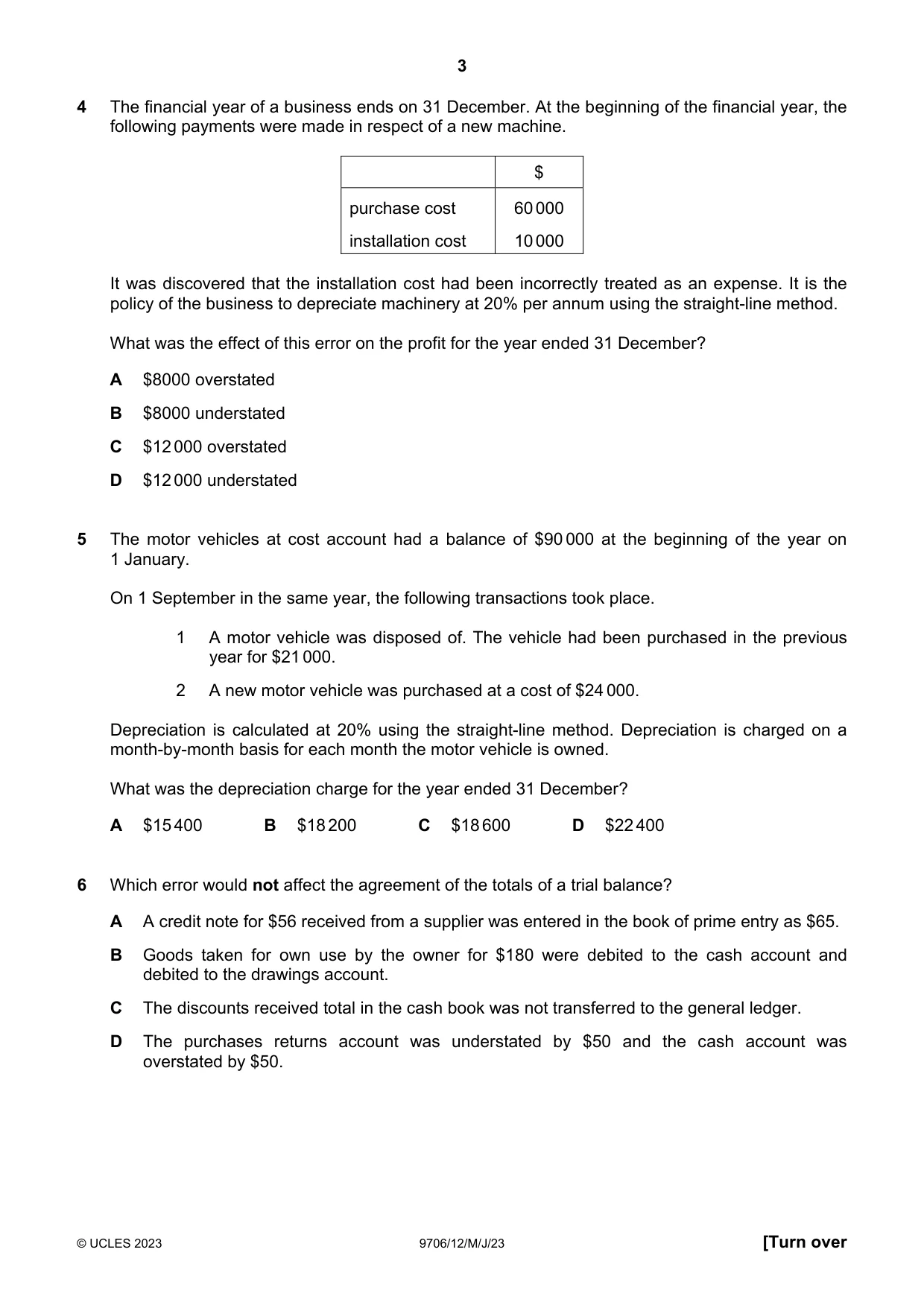
Q4 · The financial year of a business ends on 31 December
4 The financial year of a business ends on 31 December. At the beginning of the financial year, the following payments were made in respect of a new machine. $ purchase cost 60 000 installation cost 10 000 It was discovered that the installation cost had been incorrectly treated as an expense. It is the policy of the business to depreciate machinery at 20% per annum using the straight-line method. What was the effect of this error on the profit for the year ended 31 December? A $8000 overstated B $8000 understated C $12 000 overstated D $12 000 understated
Mark scheme: B
Q5 · The motor vehicles at cost account had a balance of $90 000 at the beginning of the year…
5 The motor vehicles at cost account had a balance of $90 000 at the beginning of the year on 1 January. On 1 September in the same year, the following transactions took place. 1 A motor vehicle was disposed of. The vehicle had been purchased in the previous year for $21 000. 2 A new motor vehicle was purchased at a cost of $24 000. Depreciation is calculated at 20% using the straight-line method. Depreciation is charged on a month-by-month basis for each month the motor vehicle is owned. What was the depreciation charge for the year ended 31 December? A $15 400 B $18 200 C $18 600 D $22 400
Mark scheme: B
Q6 · Which error would not affect the agreement of the totals of a trial balance?
6 Which error would not affect the agreement of the totals of a trial balance? A A credit note for $56 received from a supplier was entered in the book of prime entry as $65. B Goods taken for own use by the owner for $180 were debited to the cash account and debited to the drawings account. C The discounts received total in the cash book was not transferred to the general ledger. D The purchases returns account was understated by $50 and the cash account was overstated by $50.
Mark scheme: A
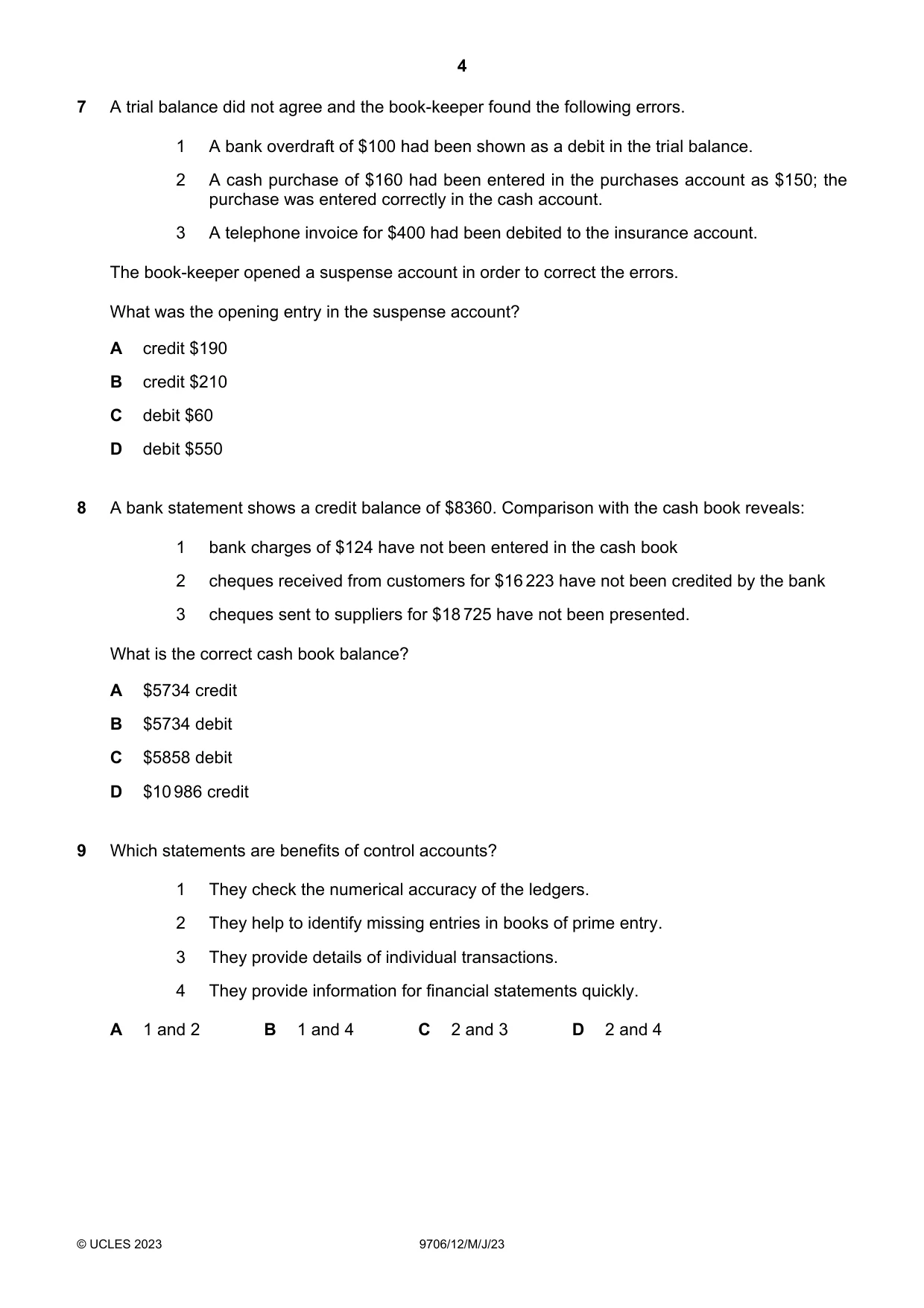
Q7 · A trial balance did not agree and the book-keeper found the following errors
7 A trial balance did not agree and the book-keeper found the following errors. 1 A bank overdraft of $100 had been shown as a debit in the trial balance. 2 A cash purchase of $160 had been entered in the purchases account as $150; the purchase was entered correctly in the cash account. 3 A telephone invoice for $400 had been debited to the insurance account. The book-keeper opened a suspense account in order to correct the errors. What was the opening entry in the suspense account? A credit $190 B credit $210 C debit $60 D debit $550
Mark scheme: A
Q8 · A bank statement shows a credit balance of $8360
8 A bank statement shows a credit balance of $8360. Comparison with the cash book reveals: 1 bank charges of $124 have not been entered in the cash book 2 cheques received from customers for $16 223 have not been credited by the bank 3 cheques sent to suppliers for $18 725 have not been presented. What is the correct cash book balance? A $5734 credit B $5734 debit C $5858 debit D $10 986 credit
Mark scheme: C
Q9 · Which statements are benefits of control accounts?
9 Which statements are benefits of control accounts? 1 They check the numerical accuracy of the ledgers. 2 They help to identify missing entries in books of prime entry. 3 They provide details of individual transactions. 4 They provide information for financial statements quickly. A 1 and 2 B 1 and 4 C 2 and 3 D 2 and 4
Mark scheme: B
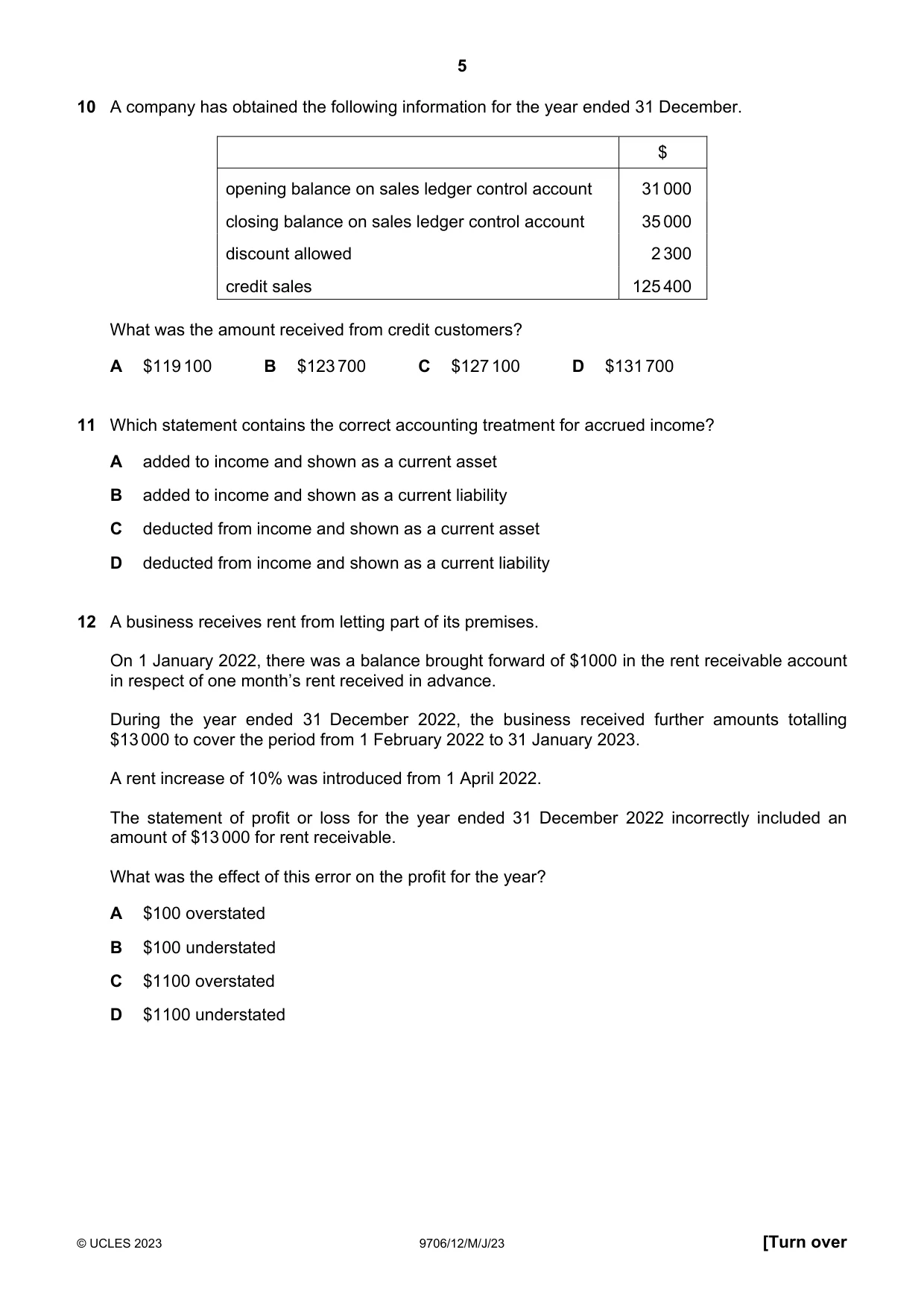
Q10 · A company has obtained the following information for the year ended 31 December
10 A company has obtained the following information for the year ended 31 December. $ opening balance on sales ledger control account 31 000 closing balance on sales ledger control account 35 000 discount allowed 2 300 credit sales 125 400 What was the amount received from credit customers? A $119 100 B $123 700 C $127 100 D $131 700
Mark scheme: A
Q11 · Which statement contains the correct accounting treatment for accrued income?
11 Which statement contains the correct accounting treatment for accrued income? A added to income and shown as a current asset B added to income and shown as a current liability C deducted from income and shown as a current asset D deducted from income and shown as a current liability
Mark scheme: A
Q12 · A business receives rent from letting part of its premises
12 A business receives rent from letting part of its premises. On 1 January 2022, there was a balance brought forward of $1000 in the rent receivable account in respect of one month’s rent received in advance. During the year ended 31 December 2022, the business received further amounts totalling $13 000 to cover the period from 1 February 2022 to 31 January 2023. A rent increase of 10% was introduced from 1 April 2022. The statement of profit or loss for the year ended 31 December 2022 incorrectly included an amount of $13 000 for rent receivable. What was the effect of this error on the profit for the year? A $100 overstated B $100 understated C $1100 overstated D $1100 understated
Mark scheme: A
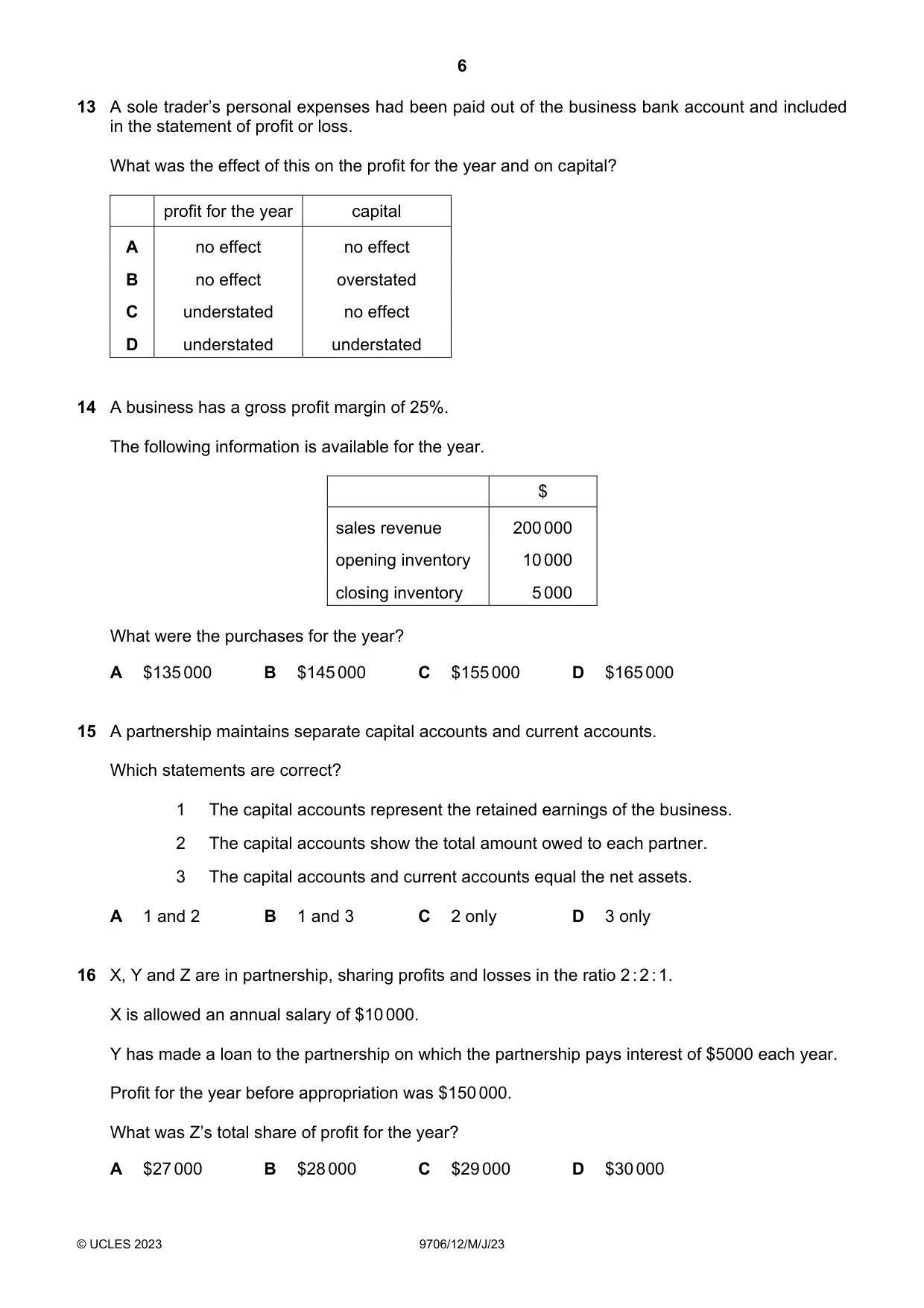
Q13 · A sole trader’s personal expenses had been paid out of the business bank account and…
13 A sole trader’s personal expenses had been paid out of the business bank account and included in the statement of profit or loss. What was the effect of this on the profit for the year and on capital? profit for the year capital A no effect no effect B no effect overstated C understated no effect D understated understated
Mark scheme: C
Q14 · A business has a gross profit margin of 25%
14 A business has a gross profit margin of 25%. The following information is available for the year. $ sales revenue 200 000 opening inventory 10 000 closing inventory 5 000 What were the purchases for the year? A $135 000 B $145 000 C $155 000 D $165 000
Mark scheme: B
Q15 · A partnership maintains separate capital accounts and current accounts
15 A partnership maintains separate capital accounts and current accounts. Which statements are correct? 1 The capital accounts represent the retained earnings of the business. 2 The capital accounts show the total amount owed to each partner. 3 The capital accounts and current accounts equal the net assets. A 1 and 2 B 1 and 3 C 2 only D 3 only
Mark scheme: D
Q16 · X, Y and Z are in partnership, sharing profits and losses in the ratio 2 : 2 : 1
16 X, Y and Z are in partnership, sharing profits and losses in the ratio 2 : 2 : 1. X is allowed an annual salary of $10 000. Y has made a loan to the partnership on which the partnership pays interest of $5000 each year. Profit for the year before appropriation was $150 000. What was Z’s total share of profit for the year? A $27 000 B $28 000 C $29 000 D $30 000
Mark scheme: B
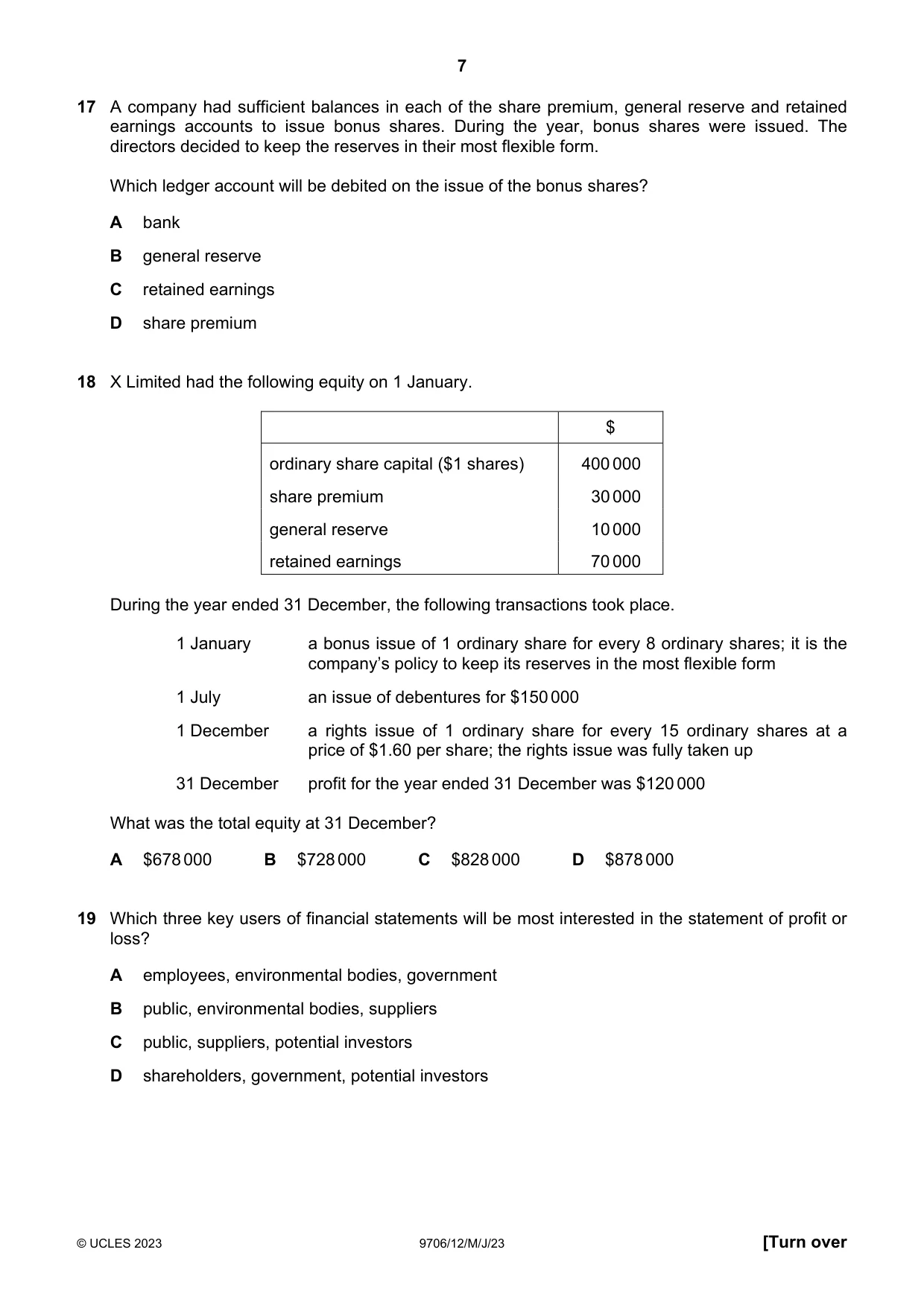
Q17 · A company had sufficient balances in each of the share premium, general reserve and…
17 A company had sufficient balances in each of the share premium, general reserve and retained earnings accounts to issue bonus shares. During the year, bonus shares were issued. The directors decided to keep the reserves in their most flexible form. Which ledger account will be debited on the issue of the bonus shares? A bank B general reserve C retained earnings D share premium
Mark scheme: D
Q18 · X Limited had the following equity on 1 January
18 X Limited had the following equity on 1 January. $ ordinary share capital ($1 shares) 400 000 share premium 30 000 general reserve 10 000 retained earnings 70 000 During the year ended 31 December, the following transactions took place. 1 January a bonus issue of 1 ordinary share for every 8 ordinary shares; it is the company’s policy to keep its reserves in the most flexible form 1 July an issue of debentures for $150 000 1 December a rights issue of 1 ordinary share for every 15 ordinary shares at a price of $1.60 per share; the rights issue was fully taken up 31 December profit for the year ended 31 December was $120 000 What was the total equity at 31 December? A $678 000 B $728 000 C $828 000 D $878 000
Mark scheme: A
Q19 · Which three key users of financial statements will be most interested in the statement of…
19 Which three key users of financial statements will be most interested in the statement of profit or loss? A employees, environmental bodies, government B public, environmental bodies, suppliers C public, suppliers, potential investors D shareholders, government, potential investors
Mark scheme: D
More questions on Analysis and communication of accounting information
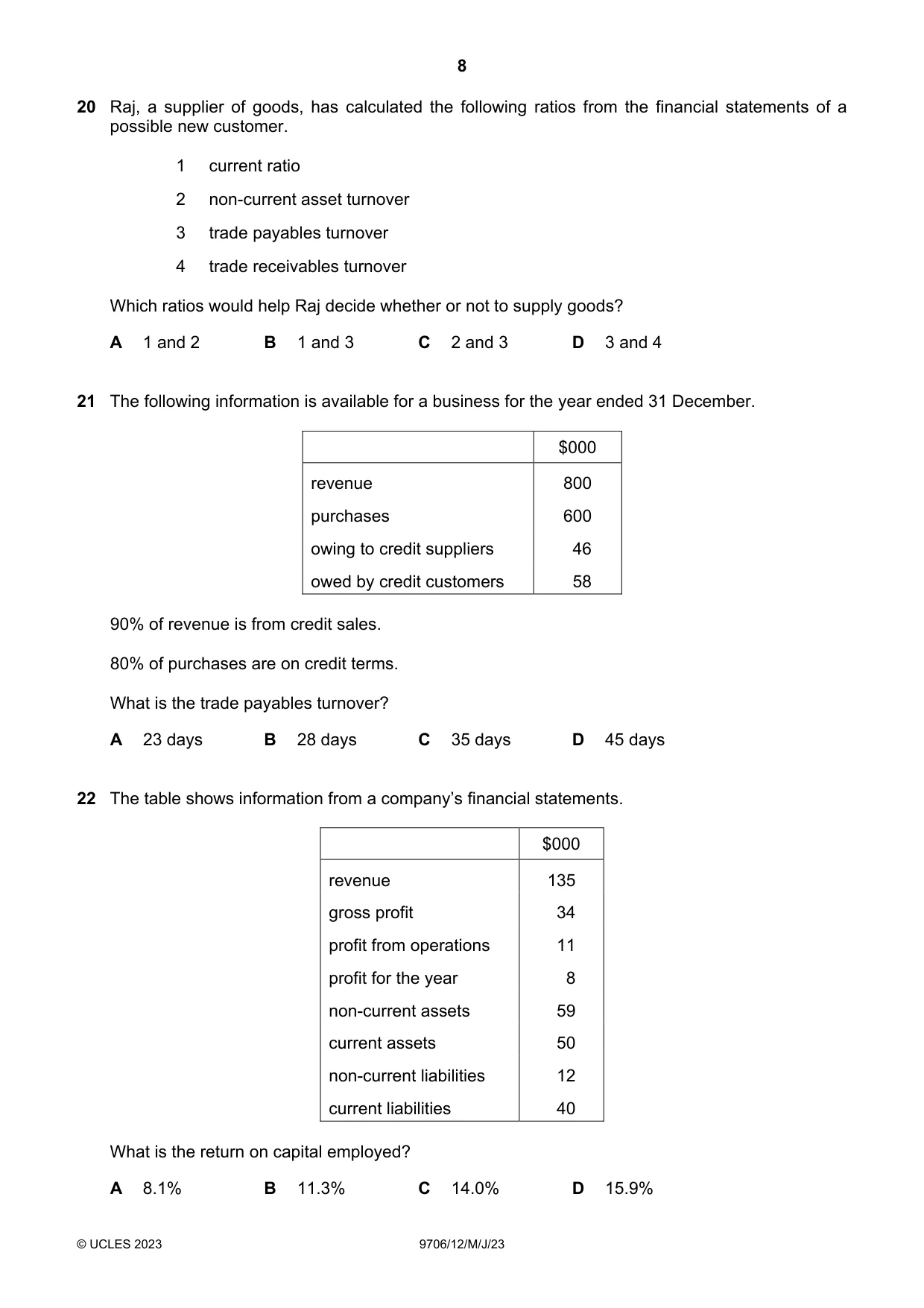
Q20 · Raj, a supplier of goods, has calculated the following ratios from the financial…
20 Raj, a supplier of goods, has calculated the following ratios from the financial statements of a possible new customer. 1 current ratio 2 non-current asset turnover 3 trade payables turnover 4 trade receivables turnover Which ratios would help Raj decide whether or not to supply goods? A 1 and 2 B 1 and 3 C 2 and 3 D 3 and 4
Mark scheme: B
More questions on Analysis and communication of accounting information
Q21 · The following information is available for a business for the year ended 31 December
21 The following information is available for a business for the year ended 31 December. $000 revenue 800 purchases 600 owing to credit suppliers 46 owed by credit customers 58 90% of revenue is from credit sales. 80% of purchases are on credit terms. What is the trade payables turnover? A 23 days B 28 days C 35 days D 45 days
Mark scheme: C
More questions on Analysis and communication of accounting information
Q22 · The table shows information from a company’s financial statements
22 The table shows information from a company’s financial statements. $000 revenue 135 gross profit 34 profit from operations 11 profit for the year 8 non-current assets 59 current assets 50 non-current liabilities 12 current liabilities 40 What is the return on capital employed? A 8.1% B 11.3% C 14.0% D 15.9%
Mark scheme: D
More questions on Analysis and communication of accounting information
Q23 · A company incurs a semi-variable cost per employee hour worked
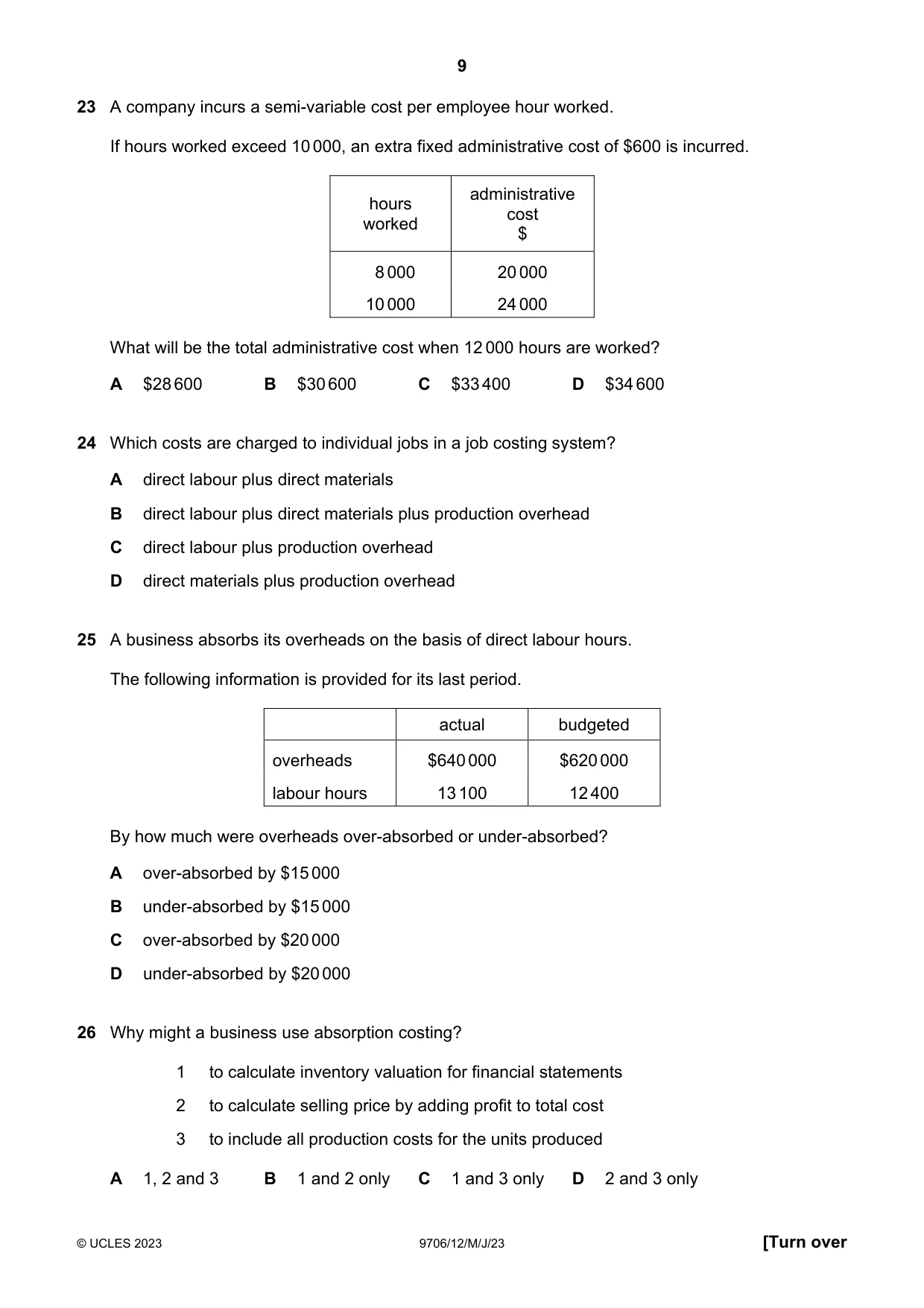
23 A company incurs a semi-variable cost per employee hour worked. If hours worked exceed 10 000, an extra fixed administrative cost of $600 is incurred. administrative hours cost worked $ 8 000 20 000 10 000 24 000 What will be the total administrative cost when 12 000 hours are worked? A $28 600 B $30 600 C $33 400 D $34 600
Mark scheme: A
Q24 · Which costs are charged to individual jobs in a job costing system?
24 Which costs are charged to individual jobs in a job costing system? A direct labour plus direct materials B direct labour plus direct materials plus production overhead C direct labour plus production overhead D direct materials plus production overhead
Mark scheme: B
Q25 · A business absorbs its overheads on the basis of direct labour hours
25 A business absorbs its overheads on the basis of direct labour hours. The following information is provided for its last period. actual budgeted overheads $640 000 $620 000 labour hours 13 100 12 400 By how much were overheads over-absorbed or under-absorbed? A over-absorbed by $15 000 B under-absorbed by $15 000 C over-absorbed by $20 000 D under-absorbed by $20 000
Mark scheme: A
Q26 · Why might a business use absorption costing?
26 Why might a business use absorption costing? 1 to calculate inventory valuation for financial statements 2 to calculate selling price by adding profit to total cost 3 to include all production costs for the units produced A 1, 2 and 3 B 1 and 2 only C 1 and 3 only D 2 and 3 only
Mark scheme: A
Q27 · Gareth makes and sells bread
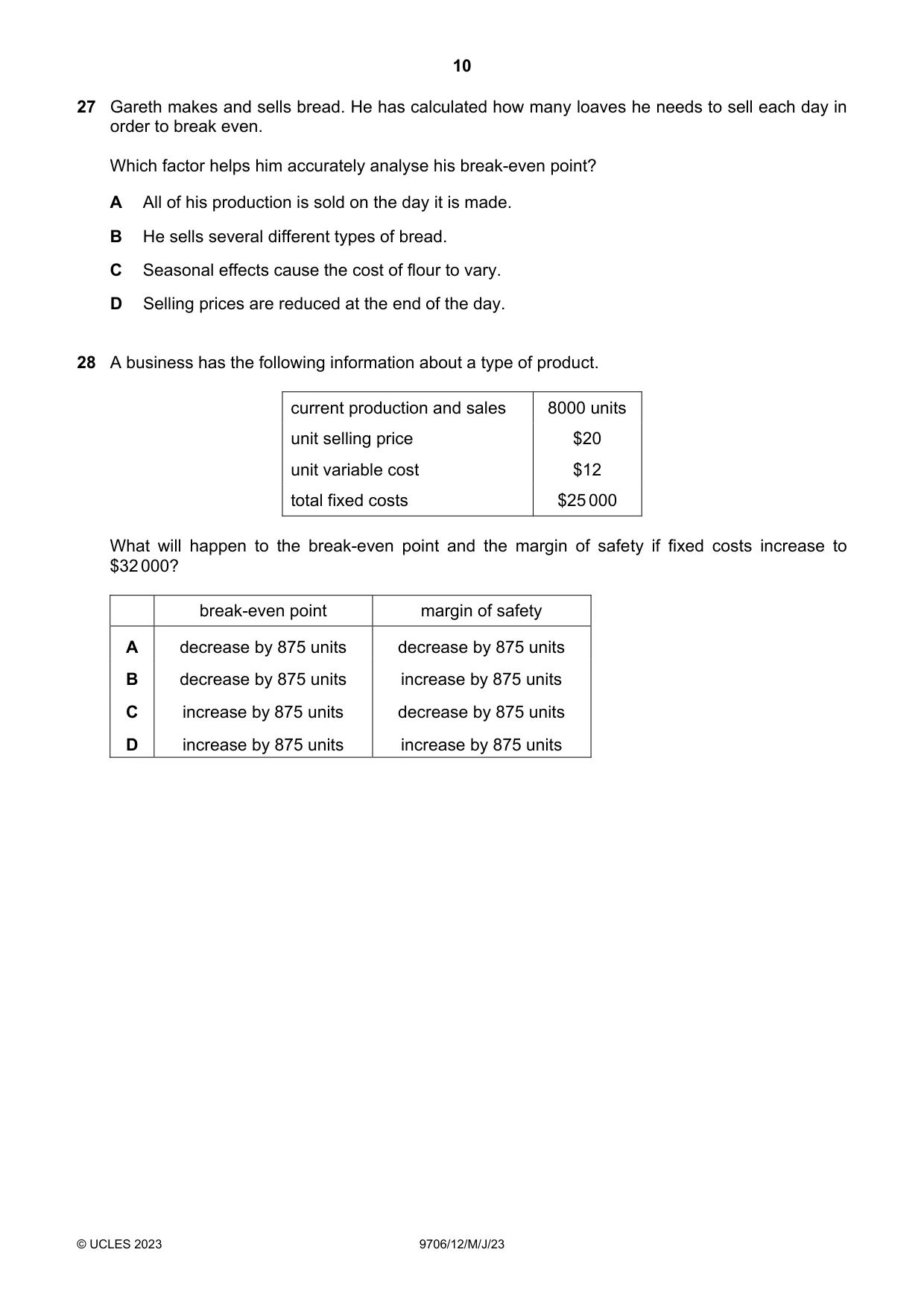
27 Gareth makes and sells bread. He has calculated how many loaves he needs to sell each day in order to break even. Which factor helps him accurately analyse his break-even point? A All of his production is sold on the day it is made. B He sells several different types of bread. C Seasonal effects cause the cost of flour to vary. D Selling prices are reduced at the end of the day.
Mark scheme: A
Q28 · A business has the following information about a type of product
28 A business has the following information about a type of product. current production and sales 8000 units unit selling price $20 unit variable cost $12 total fixed costs $25 000 What will happen to the break-even point and the margin of safety if fixed costs increase to $32 000? break-even point margin of safety A decrease by 875 units decrease by 875 units B decrease by 875 units increase by 875 units C increase by 875 units decrease by 875 units D increase by 875 units increase by 875 units
Mark scheme: C
Q29 · A company manufactures three products: X, Y and Z
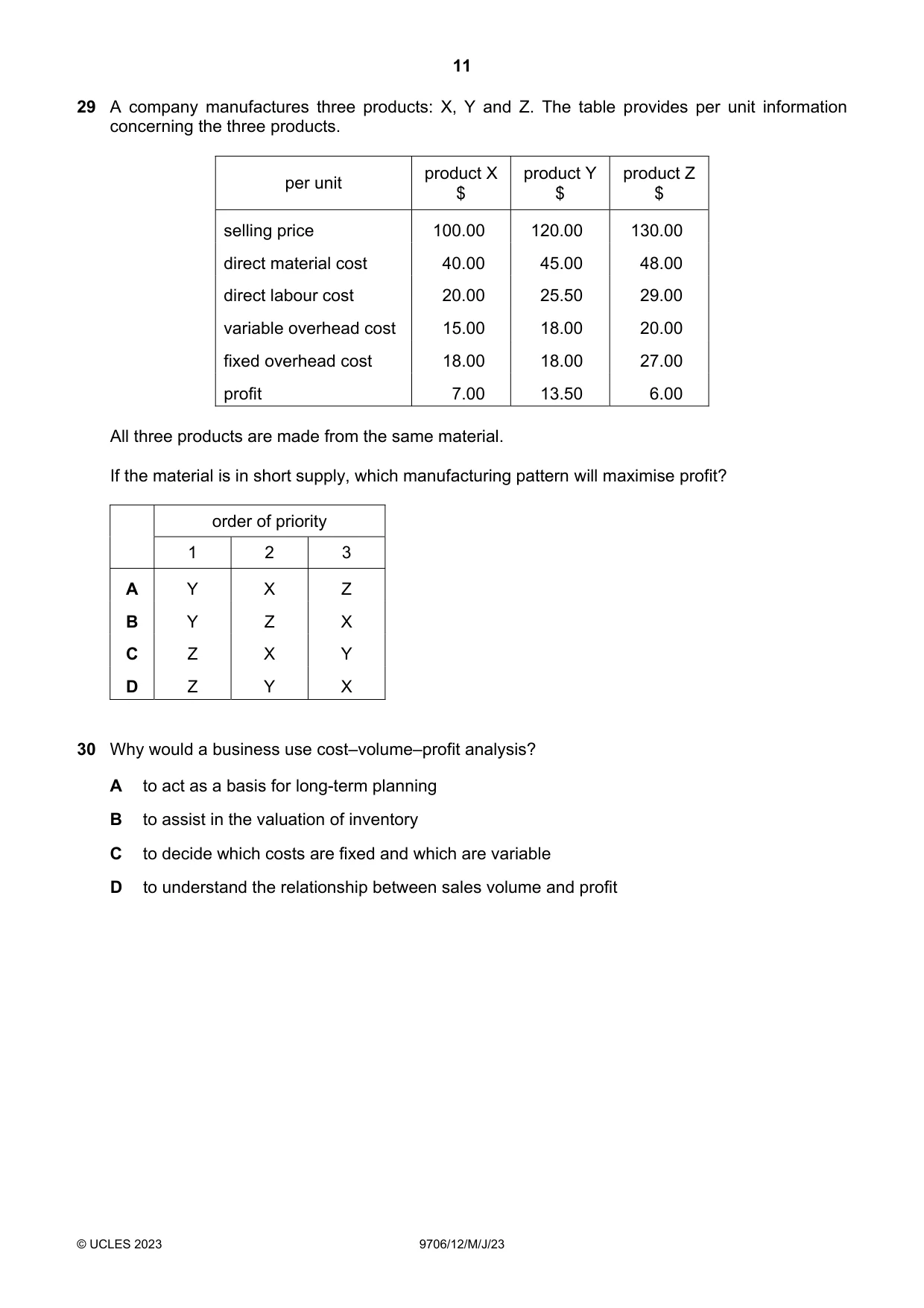
29 A company manufactures three products: X, Y and Z. The table provides per unit information concerning the three products. product X product Y product Z per unit $ $ $ selling price 100.00 120.00 130.00 direct material cost 40.00 45.00 48.00 direct labour cost 20.00 25.50 29.00 variable overhead cost 15.00 18.00 20.00 fixed overhead cost 18.00 18.00 27.00 profit 7.00 13.50 6.00 All three products are made from the same material. If the material is in short supply, which manufacturing pattern will maximise profit? order of priority 1 2 3 A Y X Z B Y Z X C Z X Y D Z Y X
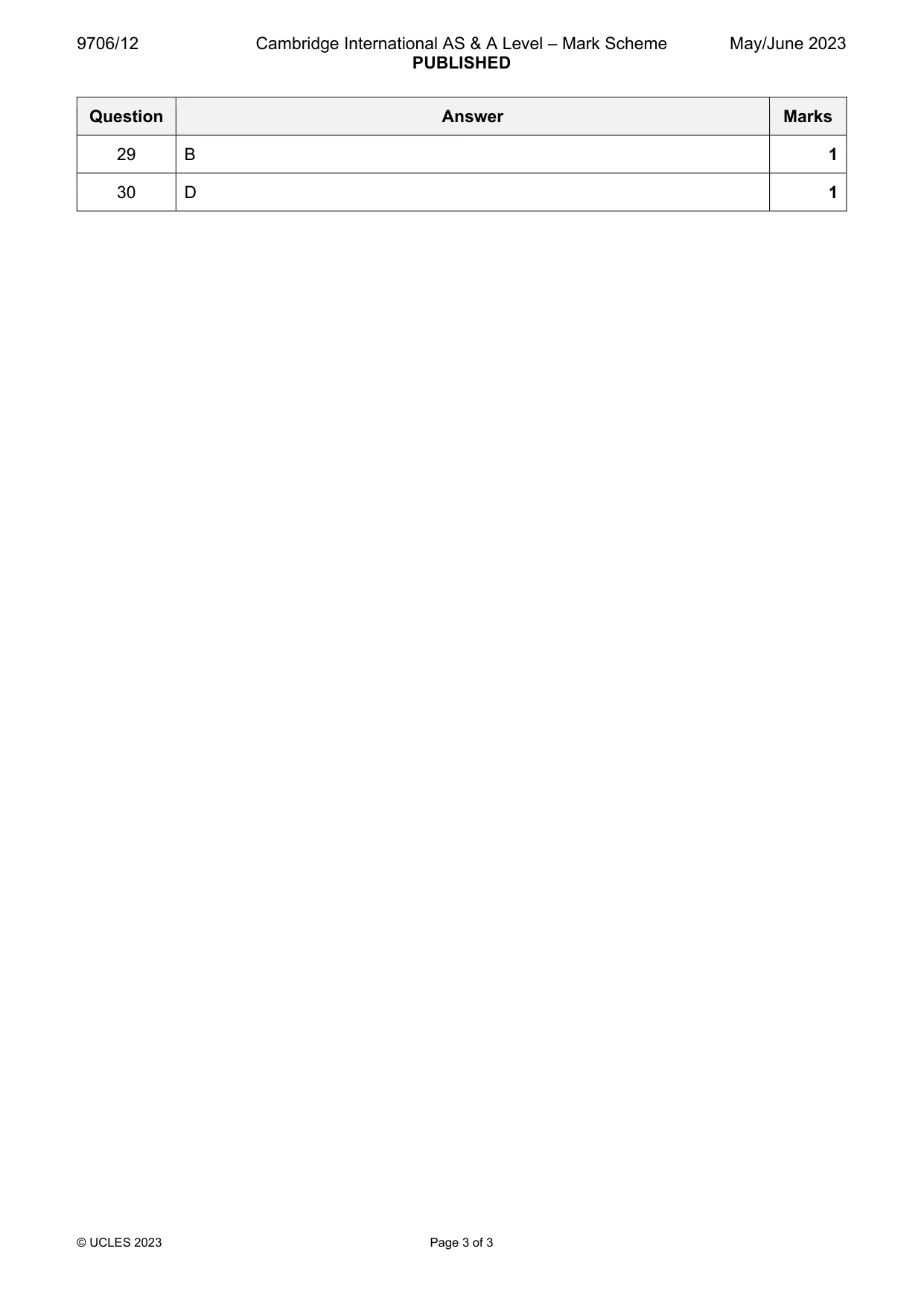
Mark scheme: B
Q30 · Why would a business use cost–volume–profit analysis?
30 Why would a business use cost–volume–profit analysis? A to act as a basis for long-term planning B to assist in the valuation of inventory C to decide which costs are fixed and which are variable D to understand the relationship between sales volume and profit
Mark scheme: D
What was in this paper
The subtopics covered by these 30 questions, and how many questions each got. Open one in a new tab to see every Cambridge question on it.
What you needed in this session
Cambridge’s own grade thresholds for 2023 May/June, Paper 1 · Variant 2. A higher threshold means an easier paper — the bar moves with how the cohort did.