Cambridge A Level Accounting 9706 — 2016 May/June Paper 1 · Variant 2
9706/12/M/J/16 · 30 questions · 30 marks · ≈34 min
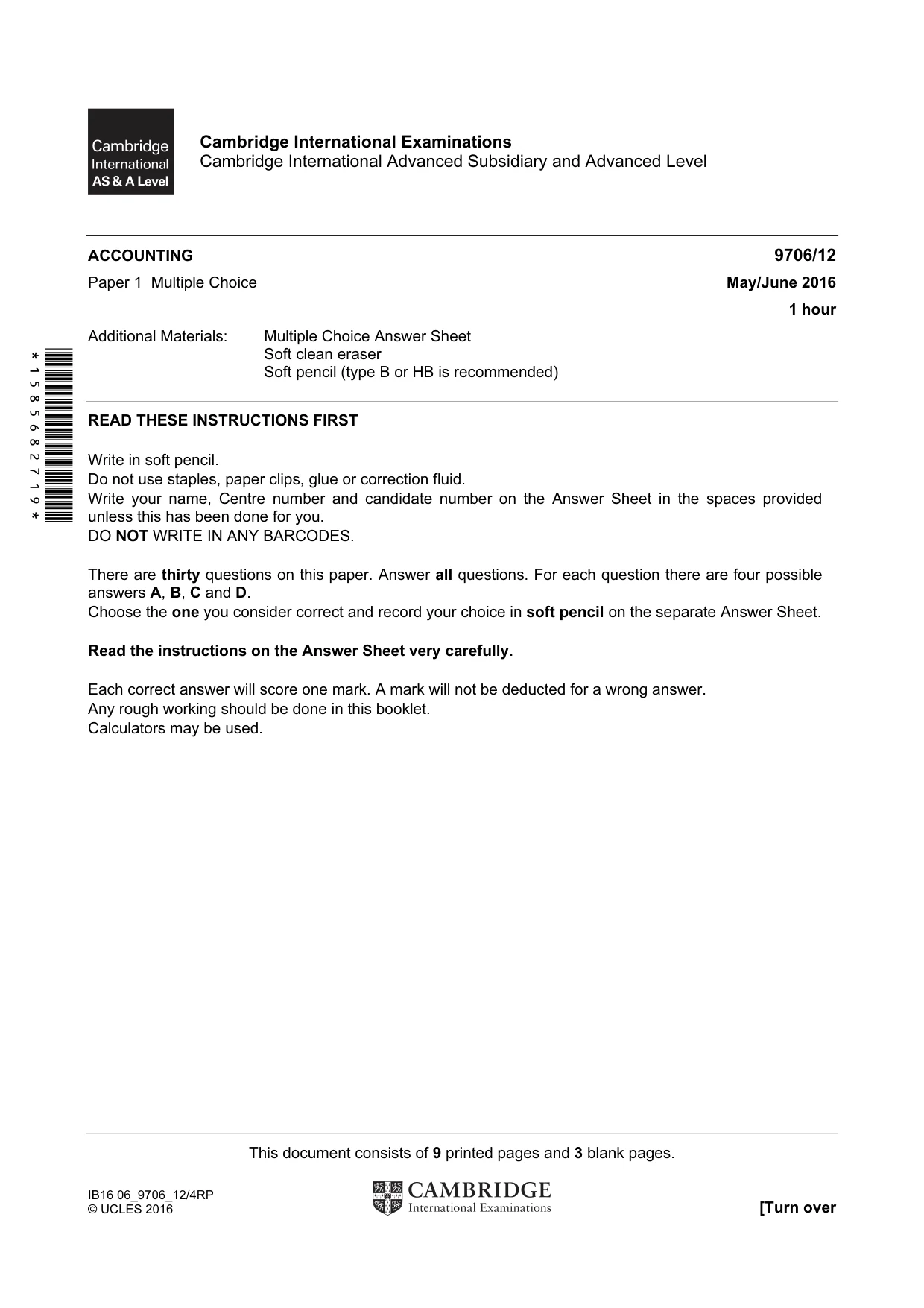
The question paper and its mark scheme, free to read here and free to download. This is Cambridge’s own paper, exactly as it was sat.
Question paper12 pages


Mark scheme2 pages
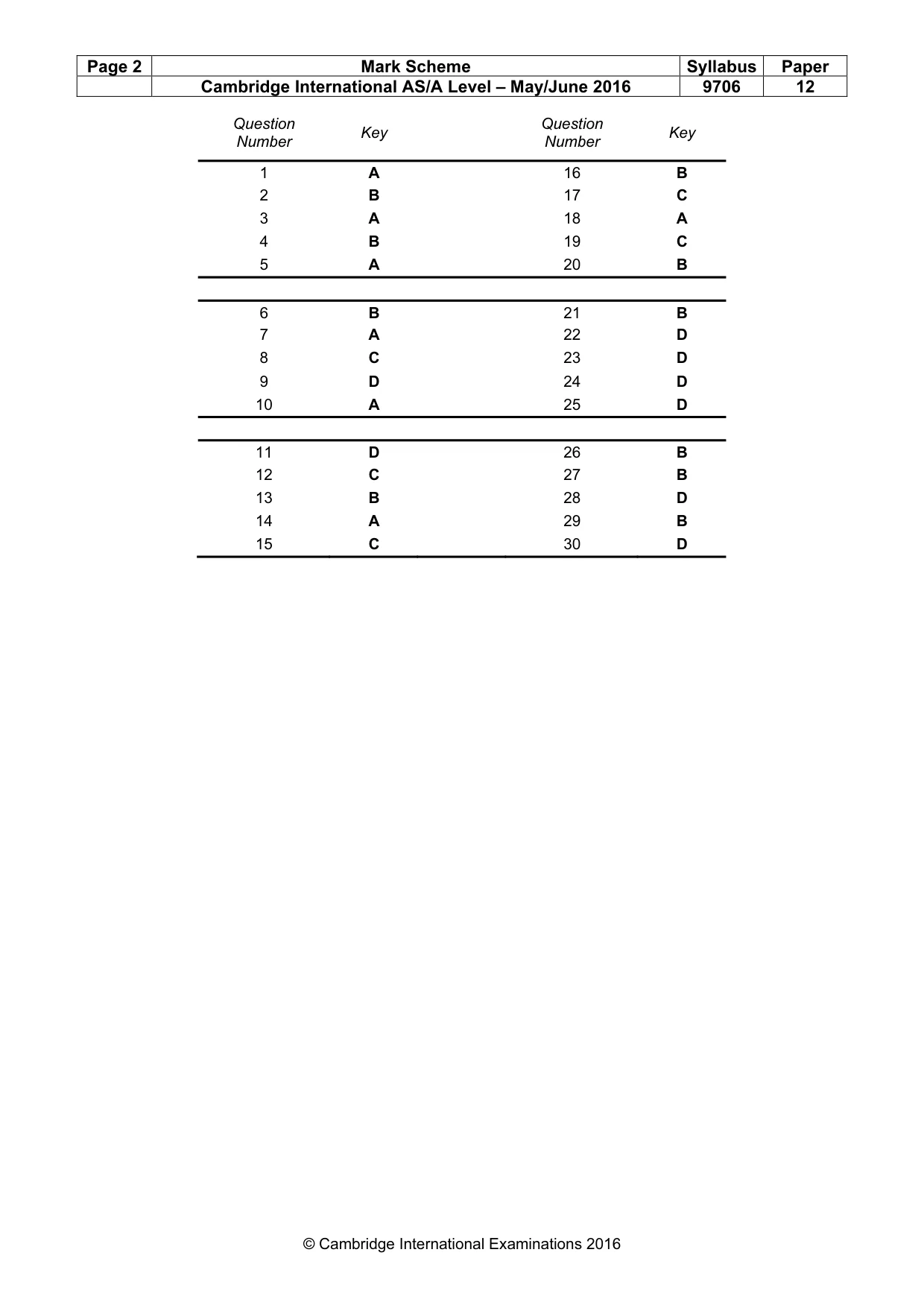
Answers below. Sit the paper first if you are practising.
Questions as text
Q1 · What might stop financial statements showing a true and fair view?
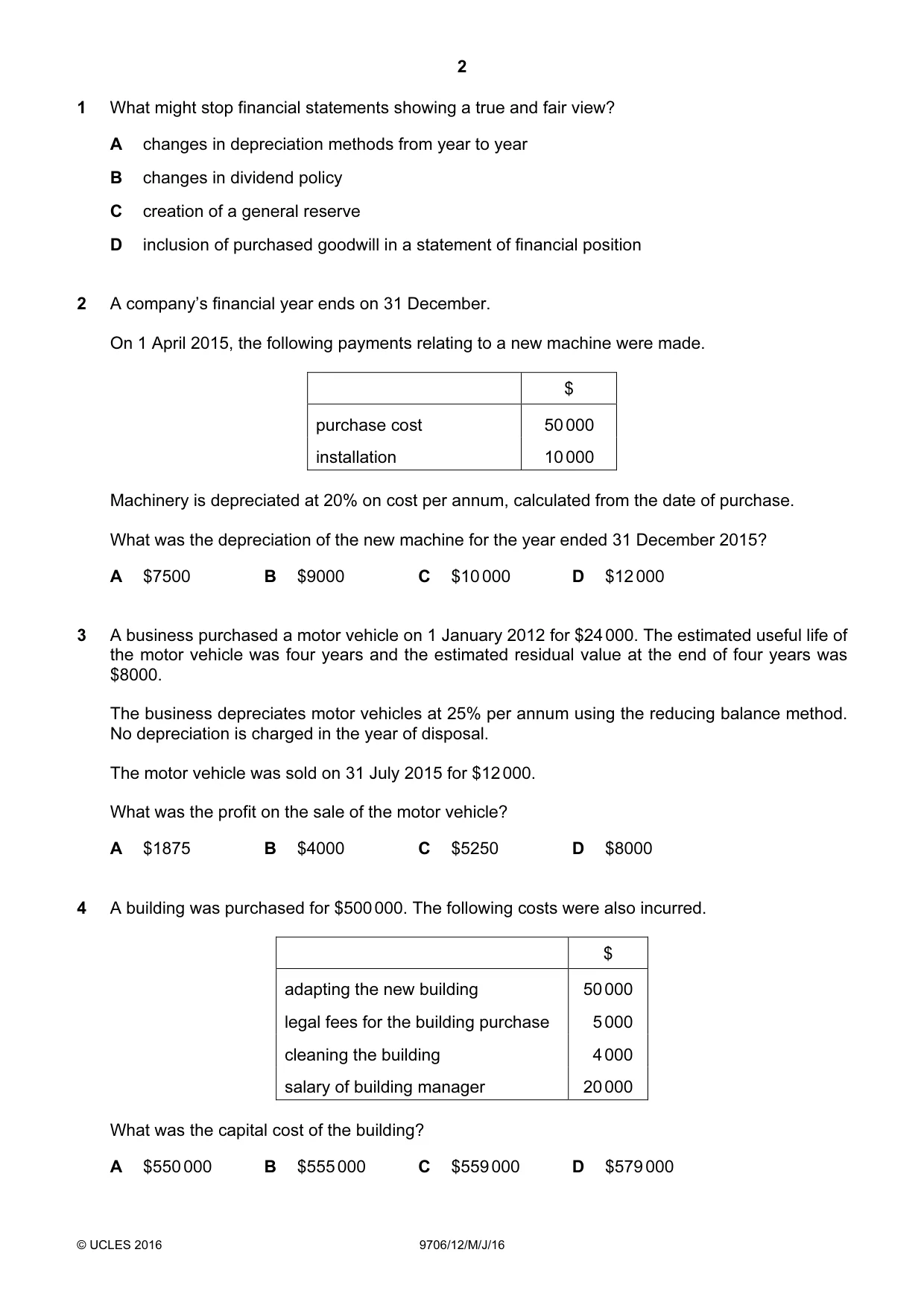
1 What might stop financial statements showing a true and fair view? A changes in depreciation methods from year to year B changes in dividend policy C creation of a general reserve D inclusion of purchased goodwill in a statement of financial position
Mark scheme: A
Q2 · A company’s financial year ends on 31 December
2 A company’s financial year ends on 31 December. On 1 April 2015, the following payments relating to a new machine were made. $ purchase cost 50 000 installation 10 000 Machinery is depreciated at 20% on cost per annum, calculated from the date of purchase. What was the depreciation of the new machine for the year ended 31 December 2015? A $7500 B $9000 C $10 000 D $12 000
Mark scheme: B
Q3 · A business purchased a motor vehicle on 1 January 2012 for $24 000
3 A business purchased a motor vehicle on 1 January 2012 for $24 000. The estimated useful life of the motor vehicle was four years and the estimated residual value at the end of four years was $8000. The business depreciates motor vehicles at 25% per annum using the reducing balance method. No depreciation is charged in the year of disposal. The motor vehicle was sold on 31 July 2015 for $12 000. What was the profit on the sale of the motor vehicle? A $1875 B $4000 C $5250 D $8000
Mark scheme: A
Q4 · A building was purchased for $500 000
4 A building was purchased for $500 000. The following costs were also incurred. $ adapting the new building 50 000 legal fees for the building purchase 5 000 cleaning the building 4 000 salary of building manager 20 000 What was the capital cost of the building? A $550 000 B $555 000 C $559 000 D $579 000
Mark scheme: B
Q5 · Which statement about the sales ledger control account is correct?
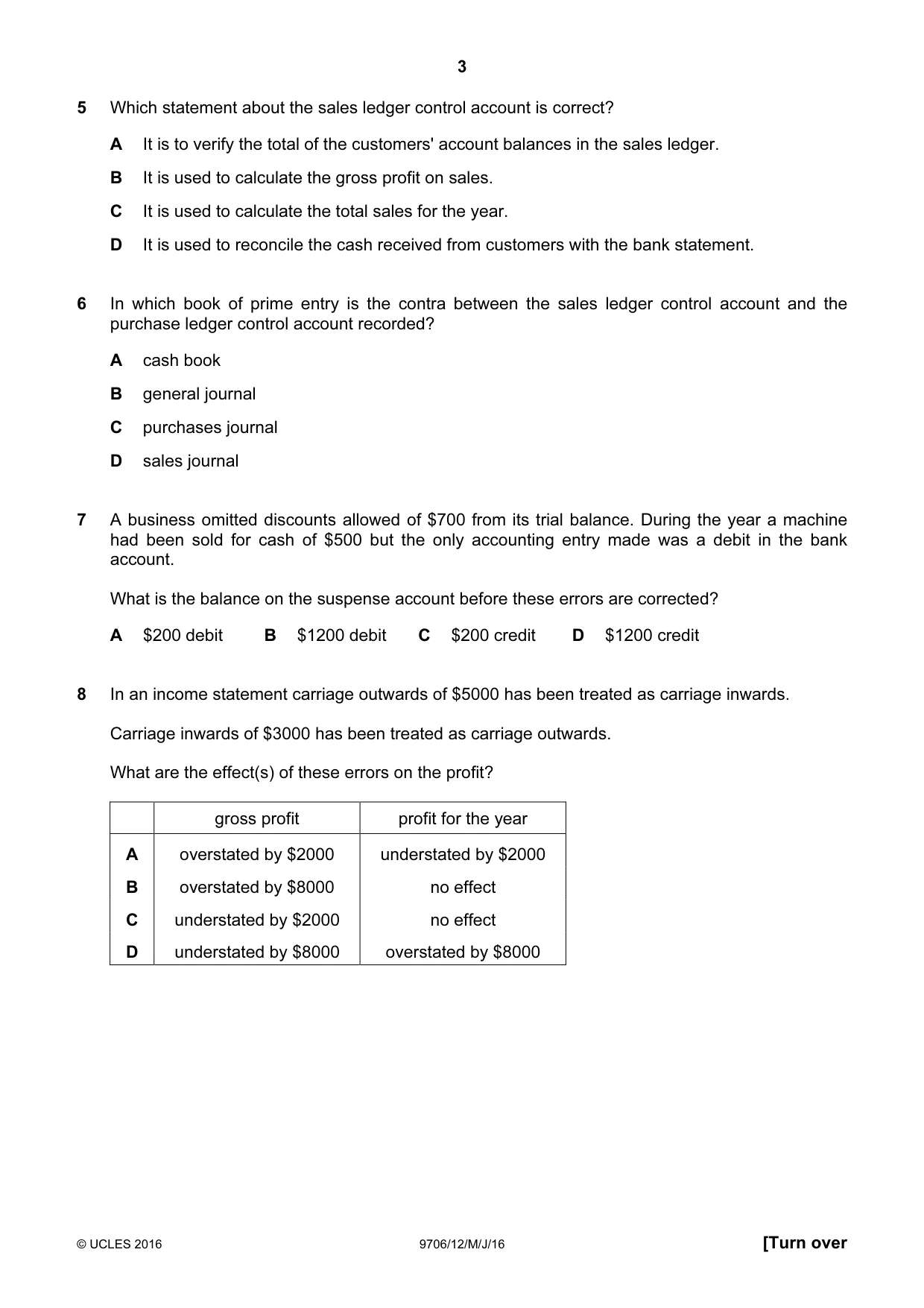
5 Which statement about the sales ledger control account is correct? A It is to verify the total of the customers' account balances in the sales ledger. B It is used to calculate the gross profit on sales. C It is used to calculate the total sales for the year. D It is used to reconcile the cash received from customers with the bank statement.
Mark scheme: A
Q6 · In which book of prime entry is the contra between the sales ledger control account and…
6 In which book of prime entry is the contra between the sales ledger control account and the purchase ledger control account recorded? A cash book B general journal C purchases journal D sales journal
Mark scheme: B
Q7 · A business omitted discounts allowed of $700 from its trial balance
7 A business omitted discounts allowed of $700 from its trial balance. During the year a machine had been sold for cash of $500 but the only accounting entry made was a debit in the bank account. What is the balance on the suspense account before these errors are corrected? A $200 debit B $1200 debit C $200 credit D $1200 credit
Mark scheme: A
Q8 · In an income statement carriage outwards of $5000 has been treated as carriage inwards
8 In an income statement carriage outwards of $5000 has been treated as carriage inwards. Carriage inwards of $3000 has been treated as carriage outwards. What are the effect(s) of these errors on the profit? gross profit profit for the year A overstated by $2000 understated by $2000 B overstated by $8000 no effect C understated by $2000 no effect D understated by $8000 overstated by $8000
Mark scheme: C
Q9 · A company received interest of $8800 during the financial year
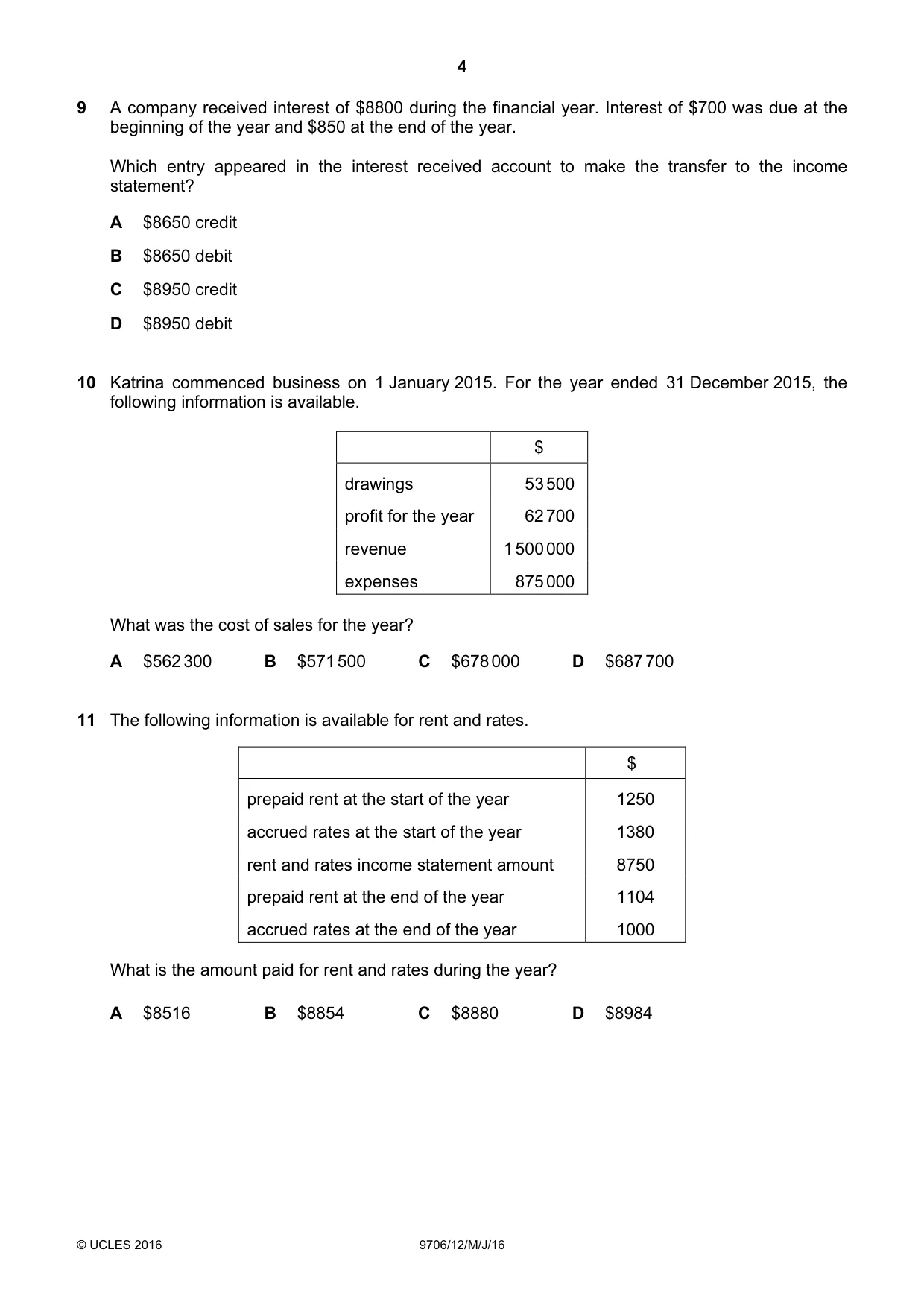
9 A company received interest of $8800 during the financial year. Interest of $700 was due at the beginning of the year and $850 at the end of the year. Which entry appeared in the interest received account to make the transfer to the income statement? A $8650 credit B $8650 debit C $8950 credit D $8950 debit
Mark scheme: D
Q10 · Katrina commenced business on 1 January 2015
10 Katrina commenced business on 1 January 2015. For the year ended 31 December 2015, the following information is available. $ drawings 53 500 profit for the year 62 700 revenue 1 500 000 expenses 875 000 What was the cost of sales for the year? A $562 300 B $571 500 C $678 000 D $687 700
Mark scheme: A
Q11 · The following information is available for rent and rates
11 The following information is available for rent and rates. $ prepaid rent at the start of the year 1250 accrued rates at the start of the year 1380 rent and rates income statement amount 8750 prepaid rent at the end of the year 1104 accrued rates at the end of the year 1000 What is the amount paid for rent and rates during the year? A $8516 B $8854 C $8880 D $8984
Mark scheme: D
Q12 · The directors of a company are completing the financial statements for the year ended 30…
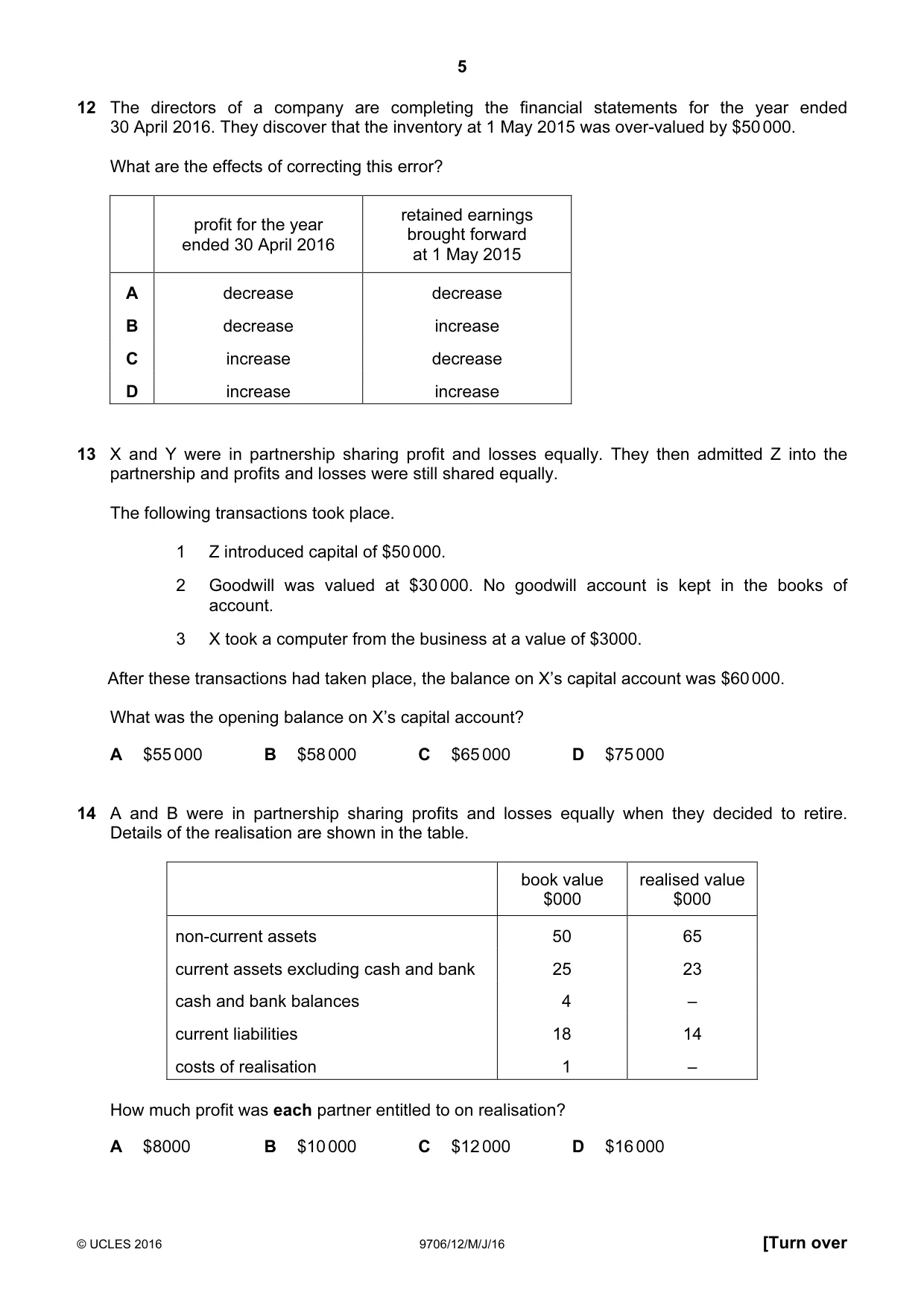
12 The directors of a company are completing the financial statements for the year ended 30 April 2016. They discover that the inventory at 1 May 2015 was over-valued by $50 000. What are the effects of correcting this error? retained earnings profit for the year brought forward ended 30 April 2016 at 1 May 2015 A decrease decrease B decrease increase C increase decrease D increase increase
Mark scheme: C
Q13 · X and Y were in partnership sharing profit and losses equally
13 X and Y were in partnership sharing profit and losses equally. They then admitted Z into the partnership and profits and losses were still shared equally. The following transactions took place. 1 Z introduced capital of $50 000. 2 Goodwill was valued at $30 000. No goodwill account is kept in the books of account. 3 X took a computer from the business at a value of $3000. After these transactions had taken place, the balance on X’s capital account was $60 000. What was the opening balance on X’s capital account? A $55 000 B $58 000 C $65 000 D $75 000
Mark scheme: B
Q14 · A and B were in partnership sharing profits and losses equally when they decided to retire
14 A and B were in partnership sharing profits and losses equally when they decided to retire. Details of the realisation are shown in the table. book value realised value $000 $000 non-current assets 50 65 current assets excluding cash and bank 25 23 cash and bank balances 4 – current liabilities 18 14 costs of realisation 1 – How much profit was each partner entitled to on realisation? A $8000 B $10 000 C $12 000 D $16 000
Mark scheme: A
Q15 · A company’s profit from operations has increased by 10% in a year, whilst its gross…
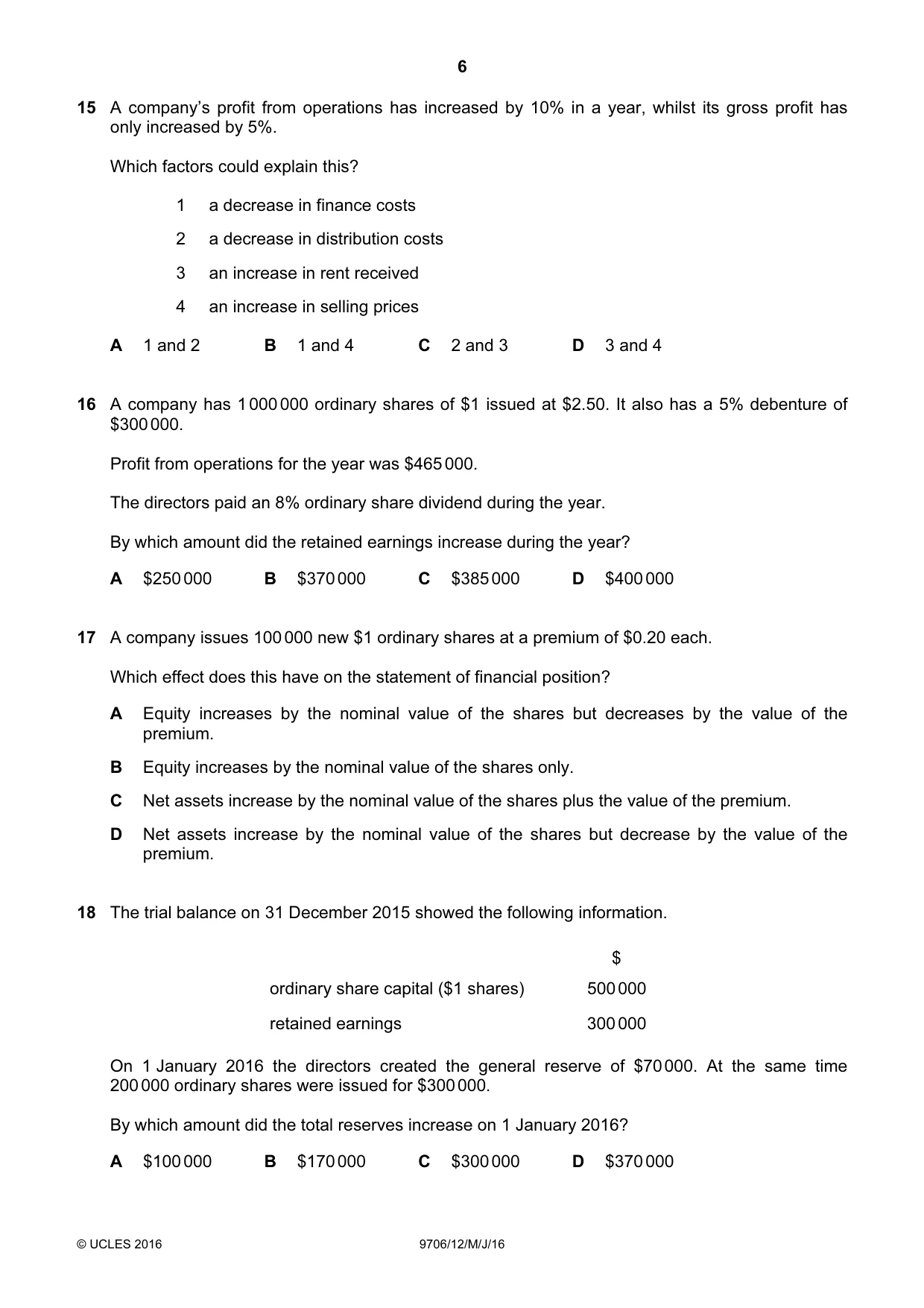
15 A company’s profit from operations has increased by 10% in a year, whilst its gross profit has only increased by 5%. Which factors could explain this? 1 a decrease in finance costs 2 a decrease in distribution costs 3 an increase in rent received 4 an increase in selling prices A 1 and 2 B 1 and 4 C 2 and 3 D 3 and 4
Mark scheme: C
More questions on Analysis and communication of accounting information
Q16 · A company has 1 000 000 ordinary shares of $1 issued at $2.50
16 A company has 1 000 000 ordinary shares of $1 issued at $2.50. It also has a 5% debenture of $300 000. Profit from operations for the year was $465 000. The directors paid an 8% ordinary share dividend during the year. By which amount did the retained earnings increase during the year? A $250 000 B $370 000 C $385 000 D $400 000
Mark scheme: B
Q17 · A company issues 100 000 new $1 ordinary shares at a premium of $0.20 each
17 A company issues 100 000 new $1 ordinary shares at a premium of $0.20 each. Which effect does this have on the statement of financial position? A Equity increases by the nominal value of the shares but decreases by the value of the premium. B Equity increases by the nominal value of the shares only. C Net assets increase by the nominal value of the shares plus the value of the premium. D Net assets increase by the nominal value of the shares but decrease by the value of the premium.
Mark scheme: C
Q18 · The trial balance on 31 December 2015 showed the following information
18 The trial balance on 31 December 2015 showed the following information. $ ordinary share capital ($1 shares) 500 000 retained earnings 300 000 On 1 January 2016 the directors created the general reserve of $70 000. At the same time 200 000 ordinary shares were issued for $300 000. By which amount did the total reserves increase on 1 January 2016? A $100 000 B $170 000 C $300 000 D $370 000
Mark scheme: A
Q19 · A company wants to increase its return on capital employed in the short term
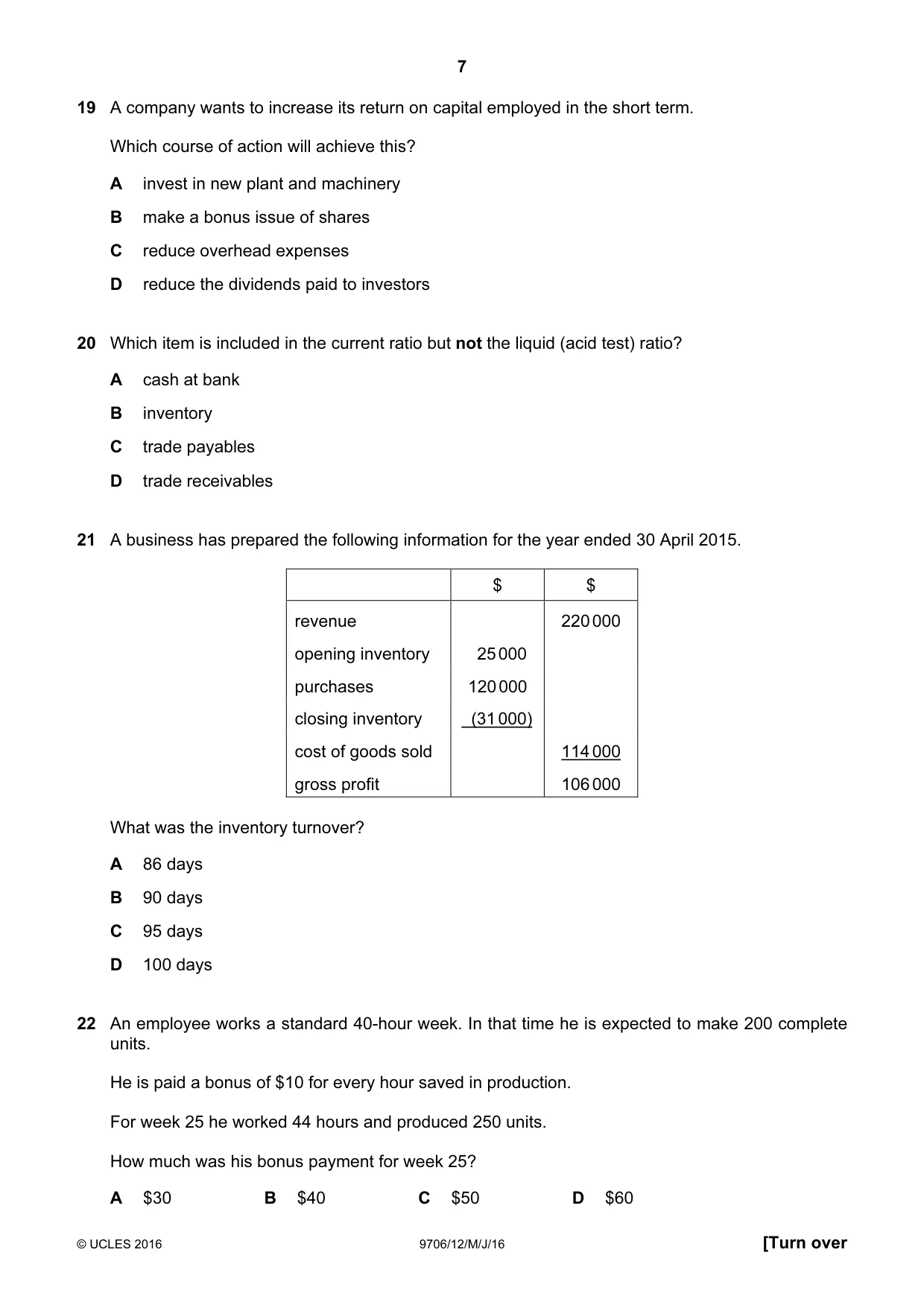
19 A company wants to increase its return on capital employed in the short term. Which course of action will achieve this? A invest in new plant and machinery B make a bonus issue of shares C reduce overhead expenses D reduce the dividends paid to investors
Mark scheme: C
More questions on Analysis and communication of accounting information
Q20 · Which item is included in the current ratio but not the liquid (acid test) ratio?
20 Which item is included in the current ratio but not the liquid (acid test) ratio? A cash at bank B inventory C trade payables D trade receivables
Mark scheme: B
More questions on Analysis and communication of accounting information
Q21 · A business has prepared the following information for the year ended 30 April 2015
21 A business has prepared the following information for the year ended 30 April 2015. $ $ revenue 220 000 opening inventory 25 000 purchases 120 000 closing inventory (31 000) cost of goods sold 114 000 gross profit 106 000 What was the inventory turnover? A 86 days B 90 days C 95 days D 100 days
Mark scheme: B
More questions on Analysis and communication of accounting information
Q22 · An employee works a standard 40-hour week
22 An employee works a standard 40-hour week. In that time he is expected to make 200 complete units. He is paid a bonus of $10 for every hour saved in production. For week 25 he worked 44 hours and produced 250 units. How much was his bonus payment for week 25? A $30 B $40 C $50 D $60
Mark scheme: D
Q23 · A business was started on 1 January
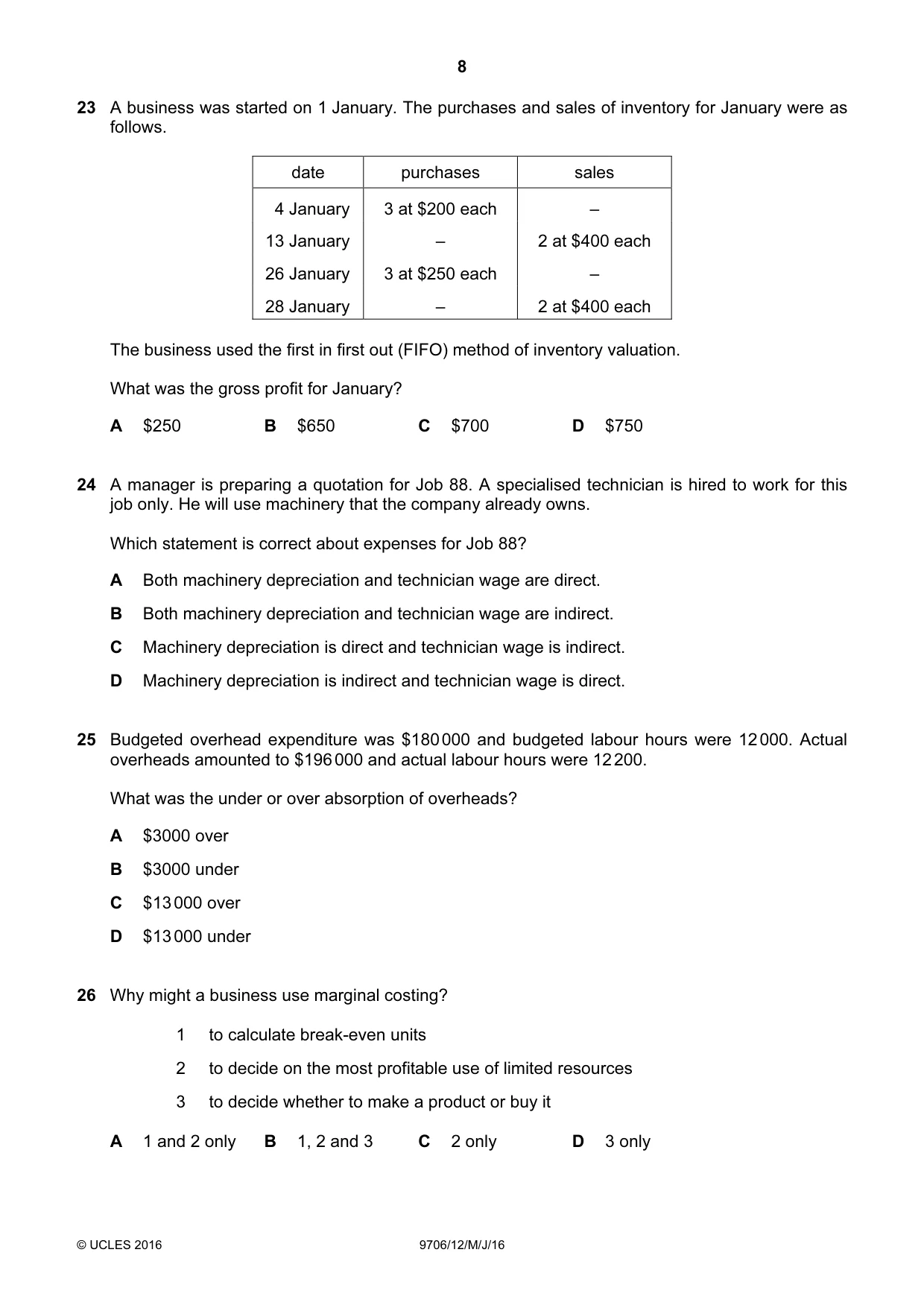
23 A business was started on 1 January. The purchases and sales of inventory for January were as follows. date purchases sales 4 January 3 at $200 each – 13 January – 2 at $400 each 26 January 3 at $250 each – 28 January – 2 at $400 each The business used the first in first out (FIFO) method of inventory valuation. What was the gross profit for January? A $250 B $650 C $700 D $750
Mark scheme: D
Q24 · A manager is preparing a quotation for Job 88
24 A manager is preparing a quotation for Job 88. A specialised technician is hired to work for this job only. He will use machinery that the company already owns. Which statement is correct about expenses for Job 88? A Both machinery depreciation and technician wage are direct. B Both machinery depreciation and technician wage are indirect. C Machinery depreciation is direct and technician wage is indirect. D Machinery depreciation is indirect and technician wage is direct.
Mark scheme: D
Q25 · Budgeted overhead expenditure was $180 000 and budgeted labour hours were 12 000
25 Budgeted overhead expenditure was $180 000 and budgeted labour hours were 12 000. Actual overheads amounted to $196 000 and actual labour hours were 12 200. What was the under or over absorption of overheads? A $3000 over B $3000 under C $13 000 over D $13 000 under
Mark scheme: D
Q26 · Why might a business use marginal costing?
26 Why might a business use marginal costing? 1 to calculate break-even units 2 to decide on the most profitable use of limited resources 3 to decide whether to make a product or buy it A 1 and 2 only B 1, 2 and 3 C 2 only D 3 only
Mark scheme: B
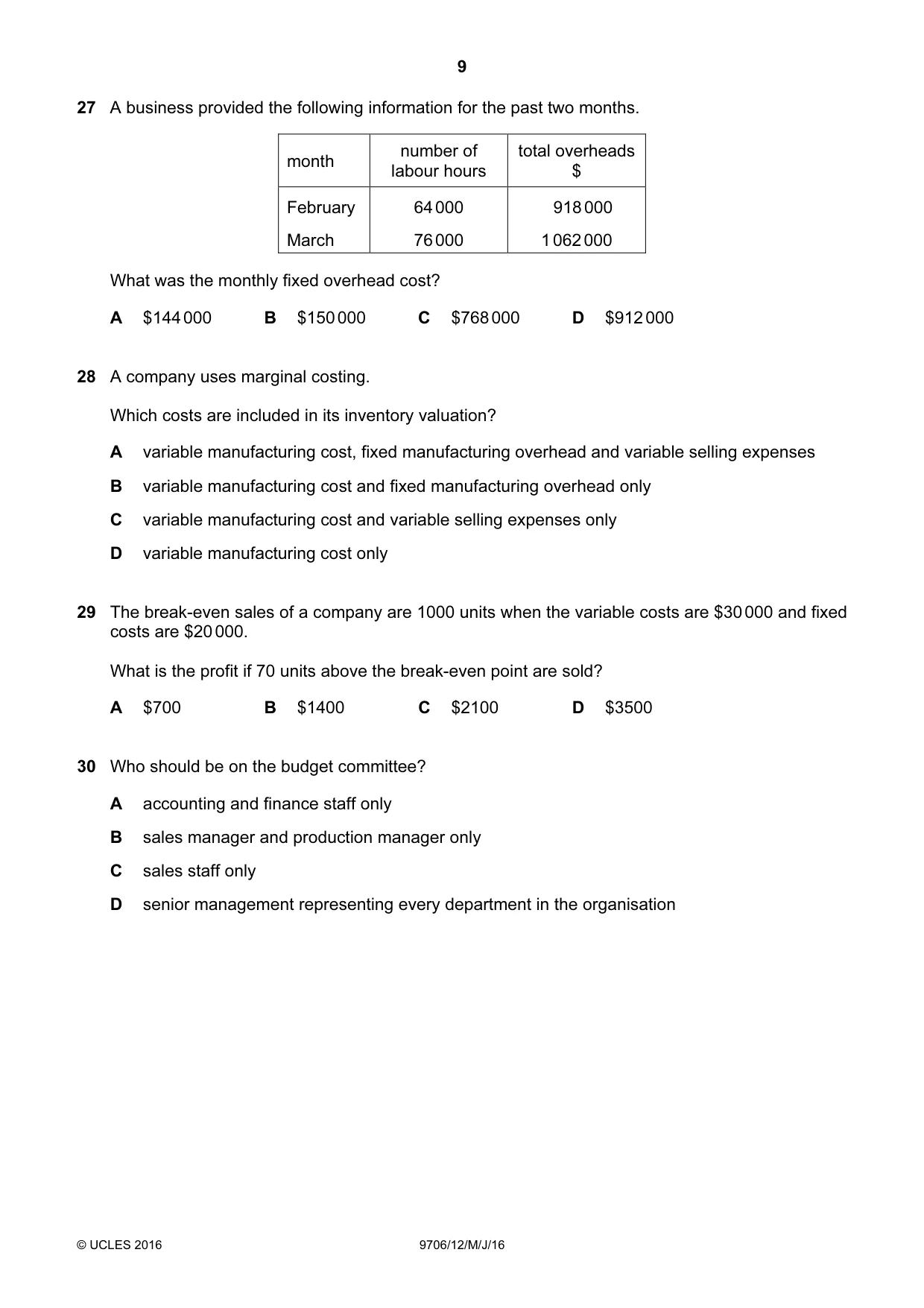
Q27 · A business provided the following information for the past two months
27 A business provided the following information for the past two months. number of total overheads month labour hours $ February 64 000 918 000 March 76 000 1 062 000 What was the monthly fixed overhead cost? A $144 000 B $150 000 C $768 000 D $912 000
Mark scheme: B
Q28 · A company uses marginal costing
28 A company uses marginal costing. Which costs are included in its inventory valuation? A variable manufacturing cost, fixed manufacturing overhead and variable selling expenses B variable manufacturing cost and fixed manufacturing overhead only C variable manufacturing cost and variable selling expenses only D variable manufacturing cost only
Mark scheme: D
Q29 · The break-even sales of a company are 1000 units when the variable costs are $30 000 and…
29 The break-even sales of a company are 1000 units when the variable costs are $30 000 and fixed costs are $20 000. What is the profit if 70 units above the break-even point are sold? A $700 B $1400 C $2100 D $3500
Mark scheme: B
Q30 · Who should be on the budget committee?
30 Who should be on the budget committee? A accounting and finance staff only B sales manager and production manager only C sales staff only D senior management representing every department in the organisation
Mark scheme: D
What was in this paper
The subtopics covered by these 30 questions, and how many questions each got. Open one in a new tab to see every Cambridge question on it.
What you needed in this session
Cambridge’s own grade thresholds for 2016 May/June, Paper 1 · Variant 2. A higher threshold means an easier paper — the bar moves with how the cohort did.