Cambridge A Level Accounting 9706 — 2011 May/June Paper 1 · Variant 2
9706/12/M/J/11 · 30 questions · 30 marks · ≈34 min
The question paper and its mark scheme, free to read here and free to download. This is Cambridge’s own paper, exactly as it was sat.
Question paper12 pages

Mark scheme2 pages
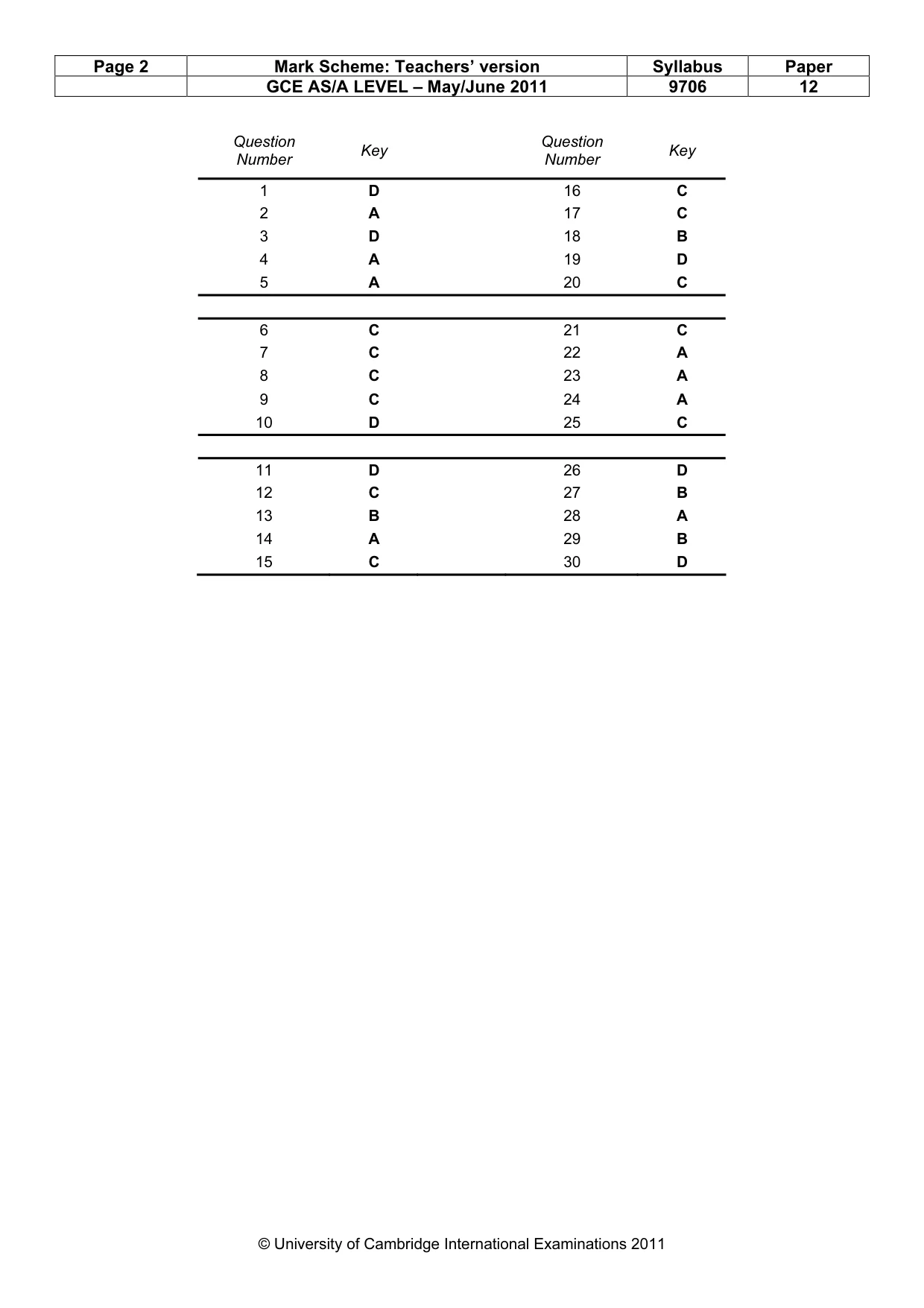
Answers below. Sit the paper first if you are practising.
Questions as text
Q1 · Accountants prefer the commercial reality of a transaction to a strictly legal approach
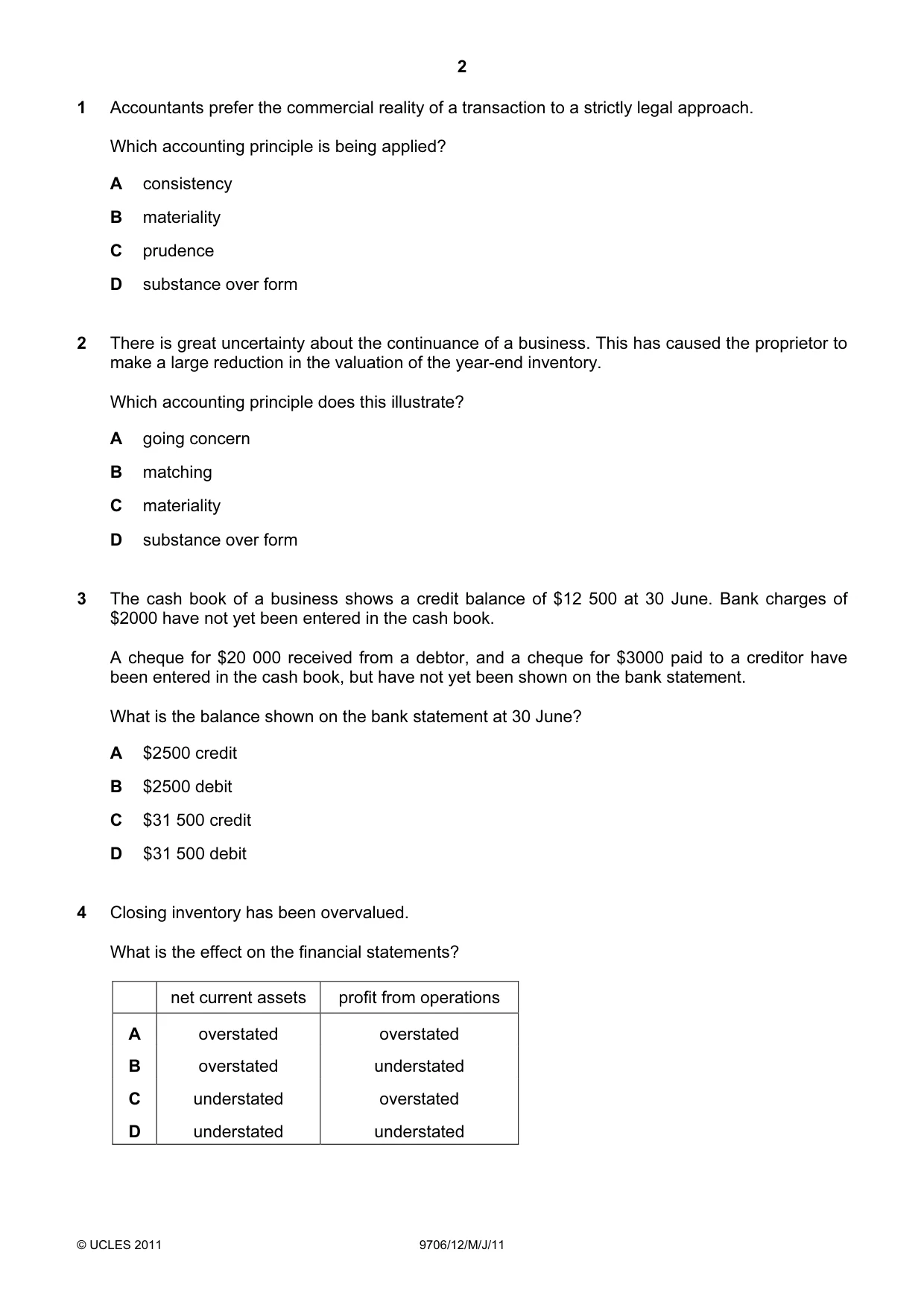
1 Accountants prefer the commercial reality of a transaction to a strictly legal approach. Which accounting principle is being applied? A consistency B materiality C prudence D substance over form
Mark scheme: D
Q2 · There is great uncertainty about the continuance of a business
2 There is great uncertainty about the continuance of a business. This has caused the proprietor to make a large reduction in the valuation of the year-end inventory. Which accounting principle does this illustrate? A going concern B matching C materiality D substance over form
Mark scheme: A
Q3 · The cash book of a business shows a credit balance of $12 500 at 30 June
3 The cash book of a business shows a credit balance of $12 500 at 30 June. Bank charges of $2000 have not yet been entered in the cash book. A cheque for $20 000 received from a debtor, and a cheque for $3000 paid to a creditor have been entered in the cash book, but have not yet been shown on the bank statement. What is the balance shown on the bank statement at 30 June? A $2500 credit B $2500 debit C $31 500 credit D $31 500 debit
Mark scheme: D
Q4 · Closing inventory has been overvalued
4 Closing inventory has been overvalued. What is the effect on the financial statements? net current assets profit from operations A overstated overstated B overstated understated C understated overstated D understated understated
Mark scheme: A
Q5 · At the year end a company discovers that some inventory is damaged
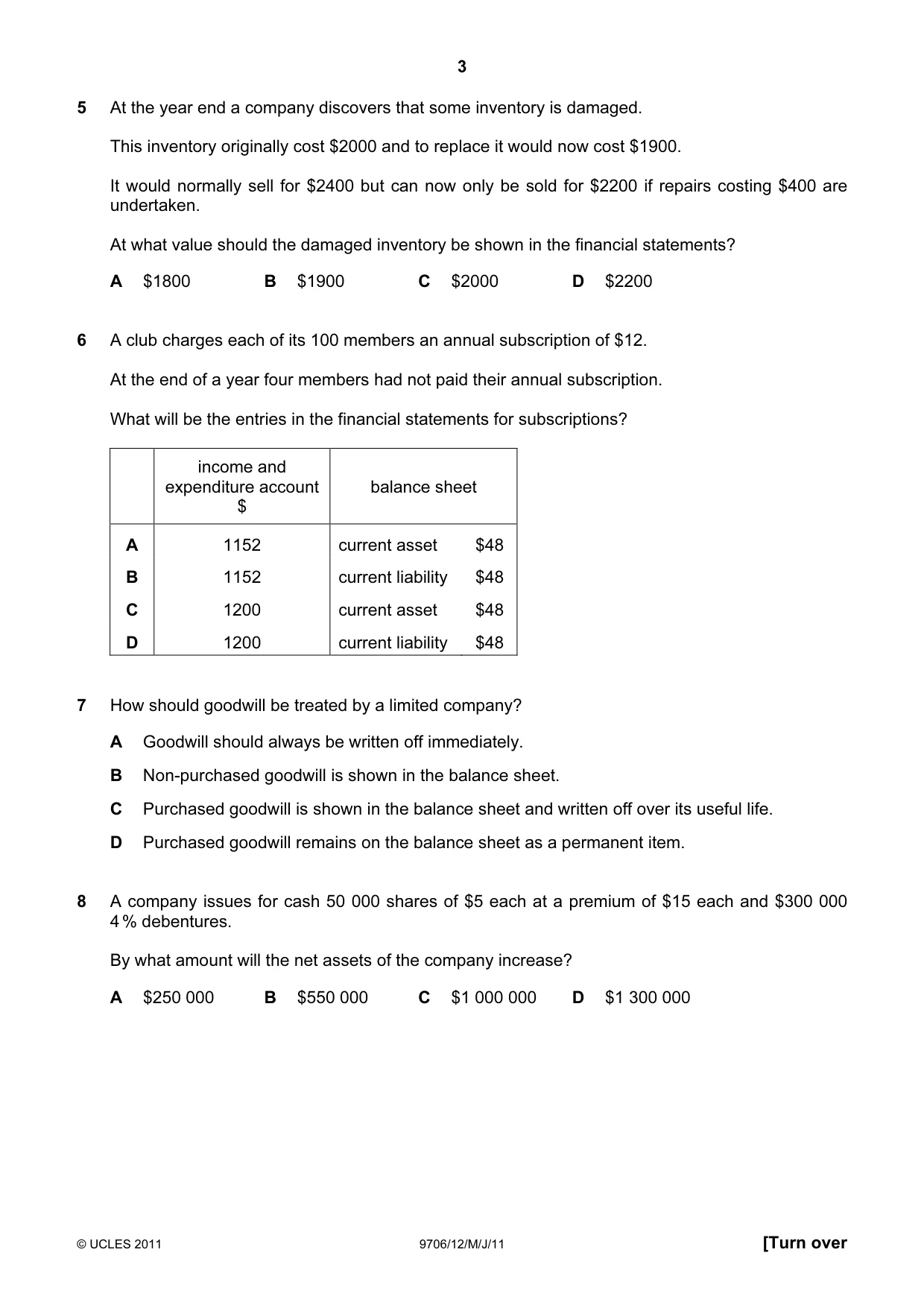
5 At the year end a company discovers that some inventory is damaged. This inventory originally cost $2000 and to replace it would now cost $1900. It would normally sell for $2400 but can now only be sold for $2200 if repairs costing $400 are undertaken. At what value should the damaged inventory be shown in the financial statements? A $1800 B $1900 C $2000 D $2200
Mark scheme: A
Q6 · A club charges each of its 100 members an annual subscription of $12
6 A club charges each of its 100 members an annual subscription of $12. At the end of a year four members had not paid their annual subscription. What will be the entries in the financial statements for subscriptions? income and expenditure account balance sheet $ A 1152 current asset $48 B 1152 current liability $48 C 1200 current asset $48 D 1200 current liability $48
Mark scheme: C
Q7 · How should goodwill be treated by a limited company?
7 How should goodwill be treated by a limited company? A Goodwill should always be written off immediately. B Non-purchased goodwill is shown in the balance sheet. C Purchased goodwill is shown in the balance sheet and written off over its useful life. D Purchased goodwill remains on the balance sheet as a permanent item.
Mark scheme: C
Q8 · A company issues for cash 50 000 shares of $5 each at a premium of $15 each and $300 000…
8 A company issues for cash 50 000 shares of $5 each at a premium of $15 each and $300 000 4 % debentures. By what amount will the net assets of the company increase? A $250 000 B $550 000 C $1 000 000 D $1 300 000
Mark scheme: C
Q9 · An extract from Bumble Ltd's balance sheet shows the following
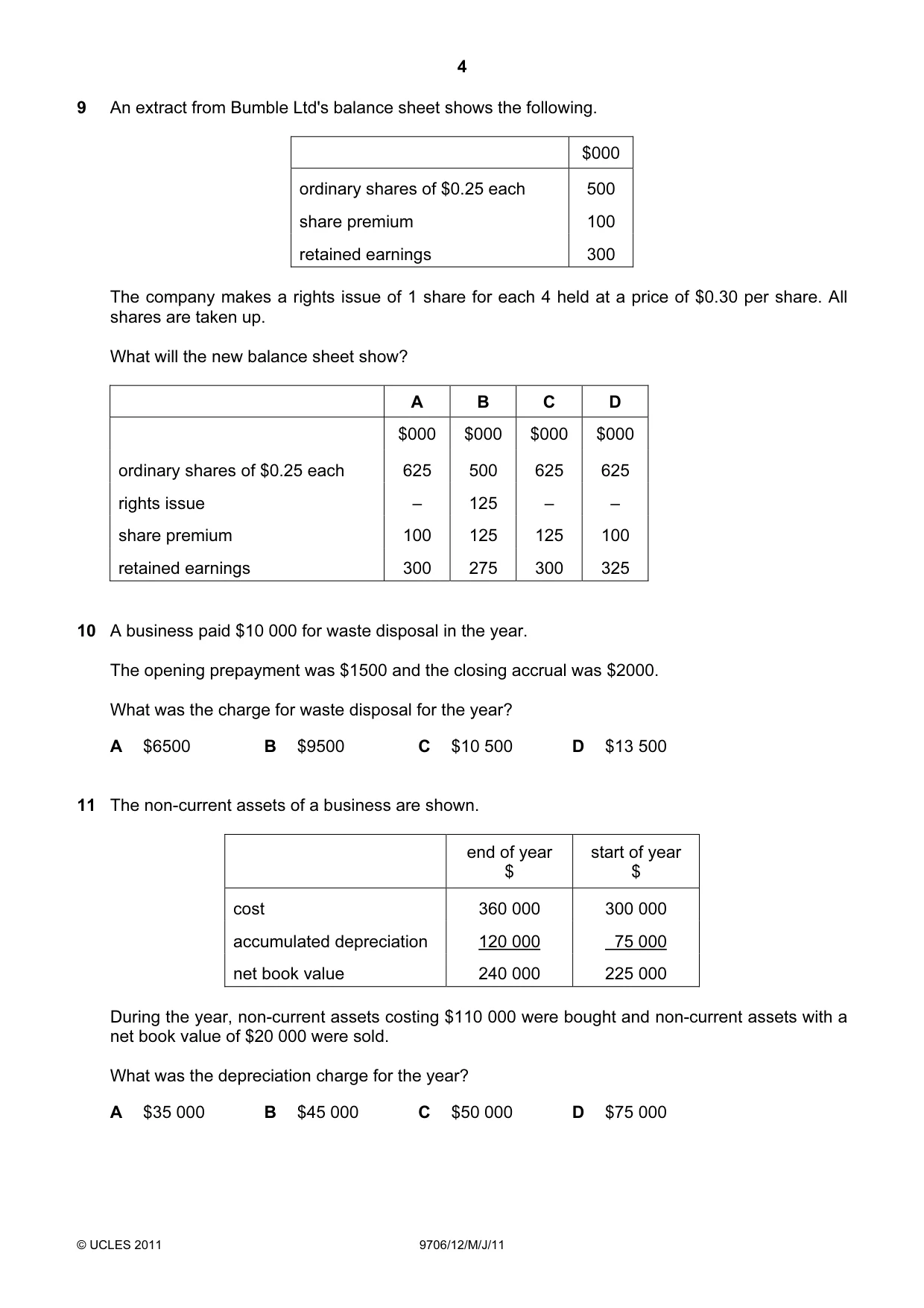
9 An extract from Bumble Ltd's balance sheet shows the following. $000 ordinary shares of $0.25 each 500 share premium 100 retained earnings 300 The company makes a rights issue of 1 share for each 4 held at a price of $0.30 per share. All shares are taken up. What will the new balance sheet show? A B C D $000 $000 $000 $000 ordinary shares of $0.25 each 625 500 625 625 rights issue – 125 – – share premium 100 125 125 100 retained earnings 300 275 300 325
Mark scheme: C
Q10 · A business paid $10 000 for waste disposal in the year
10 A business paid $10 000 for waste disposal in the year. The opening prepayment was $1500 and the closing accrual was $2000. What was the charge for waste disposal for the year? A $6500 B $9500 C $10 500 D $13 500
Mark scheme: D
Q11 · The non-current assets of a business are shown
11 The non-current assets of a business are shown. end of year start of year $ $ cost 360 000 300 000 accumulated depreciation 120 000 75 000 net book value 240 000 225 000 During the year, non-current assets costing $110 000 were bought and non-current assets with a net book value of $20 000 were sold. What was the depreciation charge for the year? A $35 000 B $45 000 C $50 000 D $75 000
Mark scheme: D
Q12 · Which transaction would increase the current assets of a business?
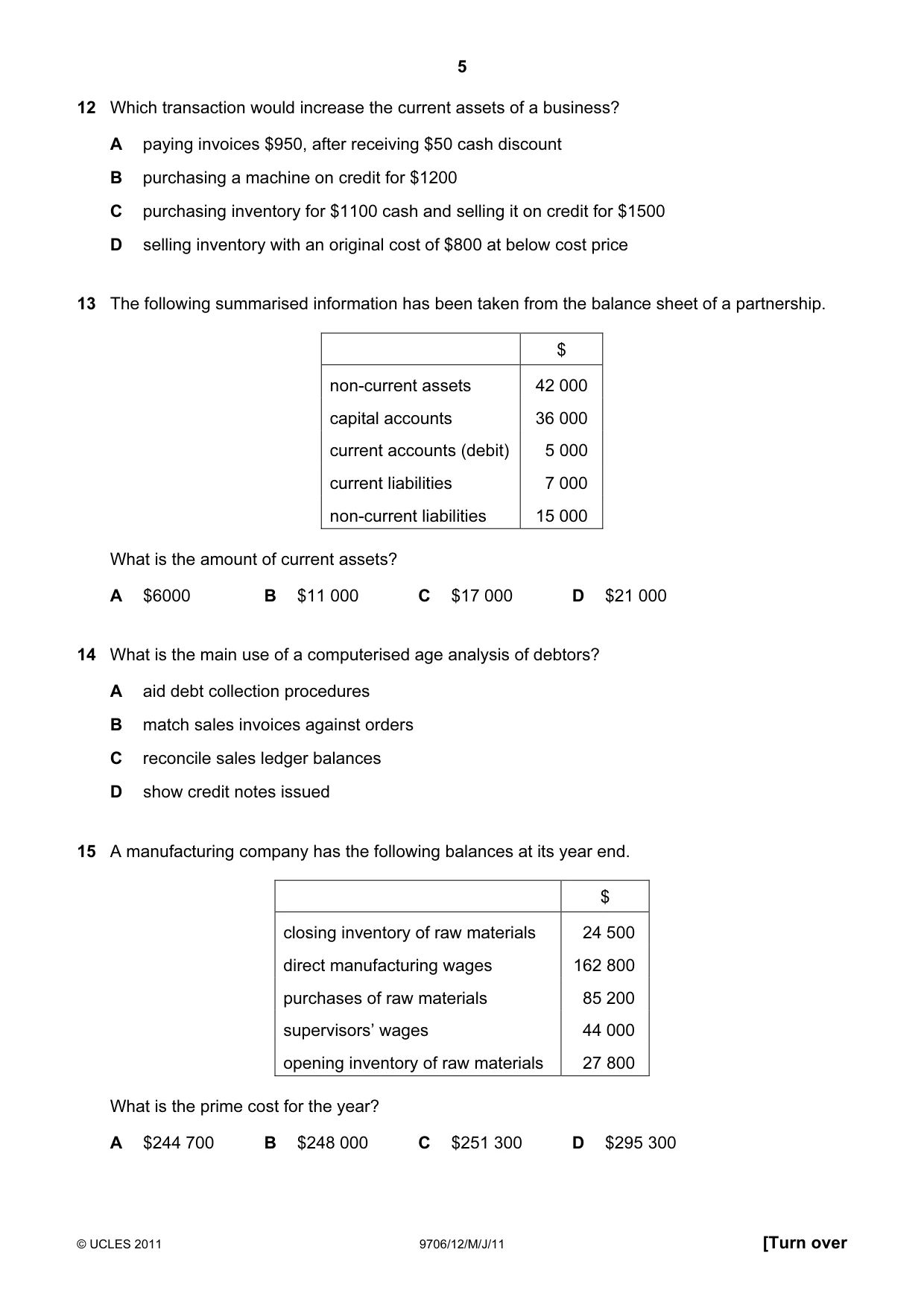
12 Which transaction would increase the current assets of a business? A paying invoices $950, after receiving $50 cash discount B purchasing a machine on credit for $1200 C purchasing inventory for $1100 cash and selling it on credit for $1500 D selling inventory with an original cost of $800 at below cost price
Mark scheme: C
Q13 · The following summarised information has been taken from the balance sheet of a…
13 The following summarised information has been taken from the balance sheet of a partnership. $ non-current assets 42 000 capital accounts 36 000 current accounts (debit) 5 000 current liabilities 7 000 non-current liabilities 15 000 What is the amount of current assets? A $6000 B $11 000 C $17 000 D $21 000
Mark scheme: B
Q14 · What is the main use of a computerised age analysis of debtors?
14 What is the main use of a computerised age analysis of debtors? A aid debt collection procedures B match sales invoices against orders C reconcile sales ledger balances D show credit notes issued
Mark scheme: A
Q15 · A manufacturing company has the following balances at its year end
15 A manufacturing company has the following balances at its year end. $ closing inventory of raw materials 24 500 direct manufacturing wages 162 800 purchases of raw materials 85 200 supervisors’ wages 44 000 opening inventory of raw materials 27 800 What is the prime cost for the year? A $244 700 B $248 000 C $251 300 D $295 300
Mark scheme: C
Q16 · A partnership provides the following financial information for the year ended 30 June 2011
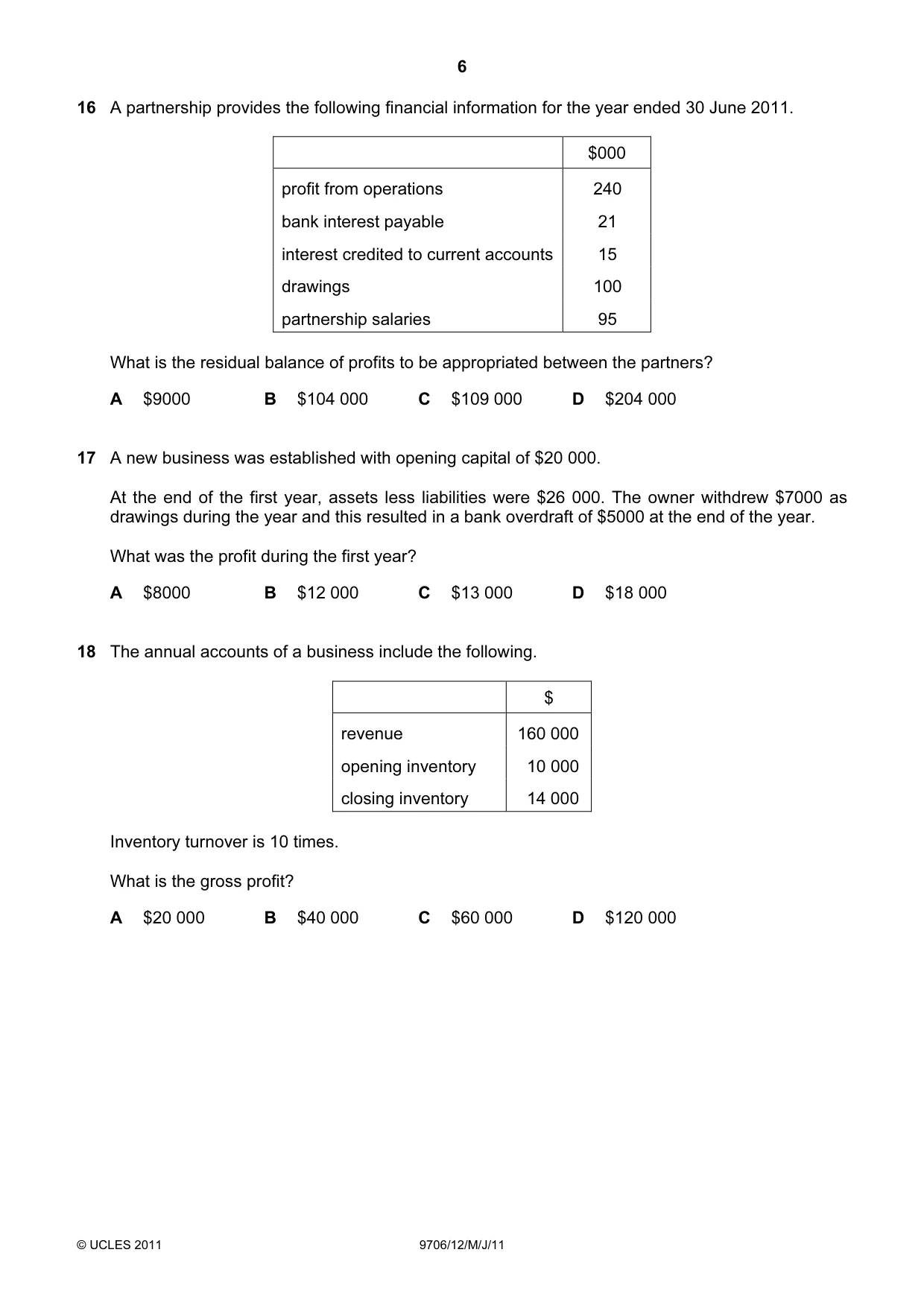
16 A partnership provides the following financial information for the year ended 30 June 2011. $000 profit from operations 240 bank interest payable 21 interest credited to current accounts 15 drawings 100 partnership salaries 95 What is the residual balance of profits to be appropriated between the partners? A $9000 B $104 000 C $109 000 D $204 000
Mark scheme: C
Q17 · A new business was established with opening capital of $20 000
17 A new business was established with opening capital of $20 000. At the end of the first year, assets less liabilities were $26 000. The owner withdrew $7000 as drawings during the year and this resulted in a bank overdraft of $5000 at the end of the year. What was the profit during the first year? A $8000 B $12 000 C $13 000 D $18 000
Mark scheme: C
Q18 · The annual accounts of a business include the following
18 The annual accounts of a business include the following. $ revenue 160 000 opening inventory 10 000 closing inventory 14 000 Inventory turnover is 10 times. What is the gross profit? A $20 000 B $40 000 C $60 000 D $120 000
Mark scheme: B
More questions on Analysis and communication of accounting information
Q19 · A company’s profit from operations was $128 000
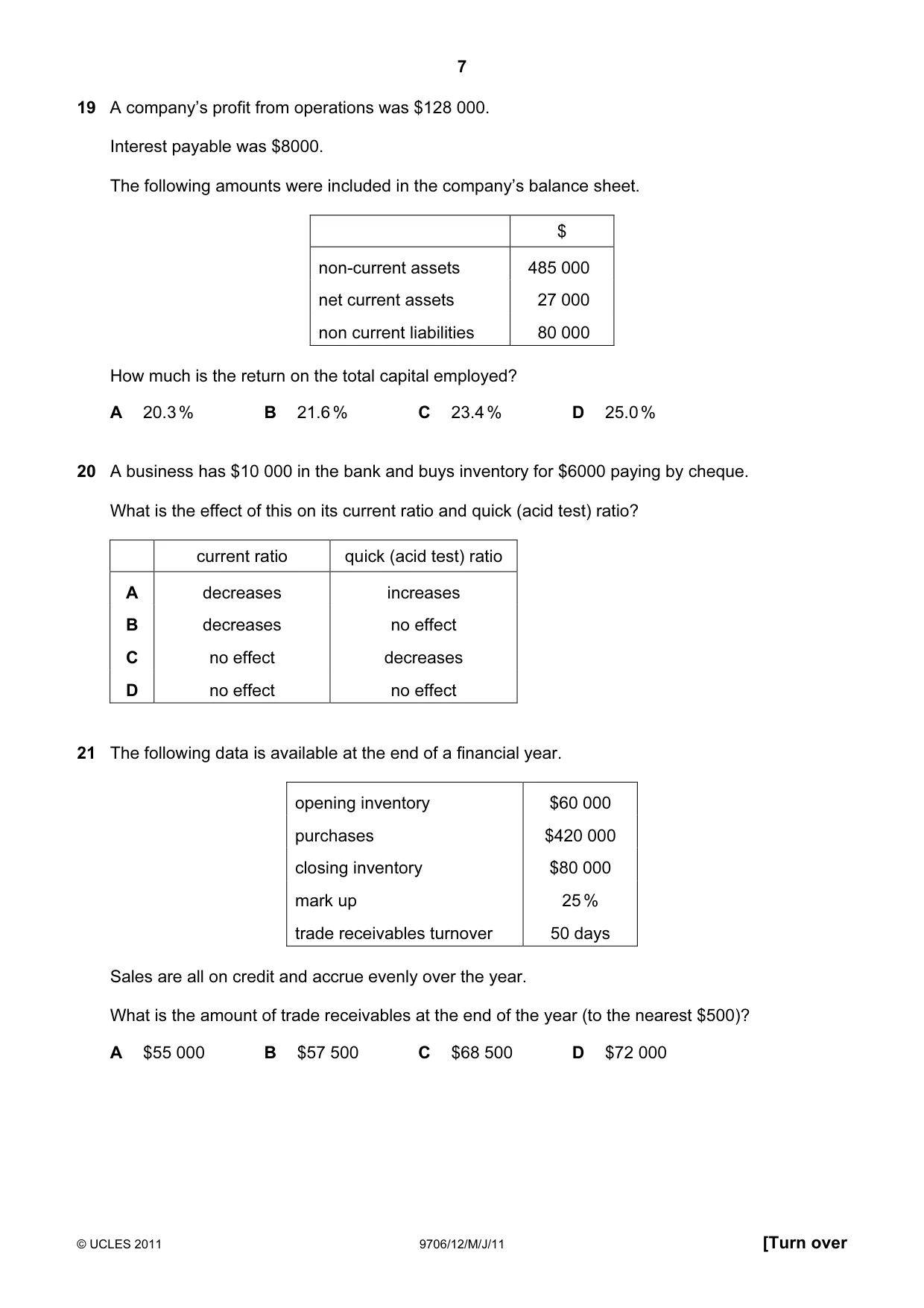
19 A company’s profit from operations was $128 000. Interest payable was $8000. The following amounts were included in the company’s balance sheet. $ non-current assets 485 000 net current assets 27 000 non current liabilities 80 000 How much is the return on the total capital employed? A 20.3 % B 21.6 % C 23.4 % D 25.0 %
Mark scheme: D
More questions on Analysis and communication of accounting information
Q20 · A business has $10 000 in the bank and buys inventory for $6000 paying by cheque
20 A business has $10 000 in the bank and buys inventory for $6000 paying by cheque. What is the effect of this on its current ratio and quick (acid test) ratio? current ratio quick (acid test) ratio A decreases increases B decreases no effect C no effect decreases D no effect no effect
Mark scheme: C
More questions on Analysis and communication of accounting information
Q21 · The following data is available at the end of a financial year
21 The following data is available at the end of a financial year. opening inventory $60 000 purchases $420 000 closing inventory $80 000 mark up 25 % trade receivables turnover 50 days Sales are all on credit and accrue evenly over the year. What is the amount of trade receivables at the end of the year (to the nearest $500)? A $55 000 B $57 500 C $68 500 D $72 000
Mark scheme: C
More questions on Analysis and communication of accounting information
Q22 · Which cost will decrease as production is increased?
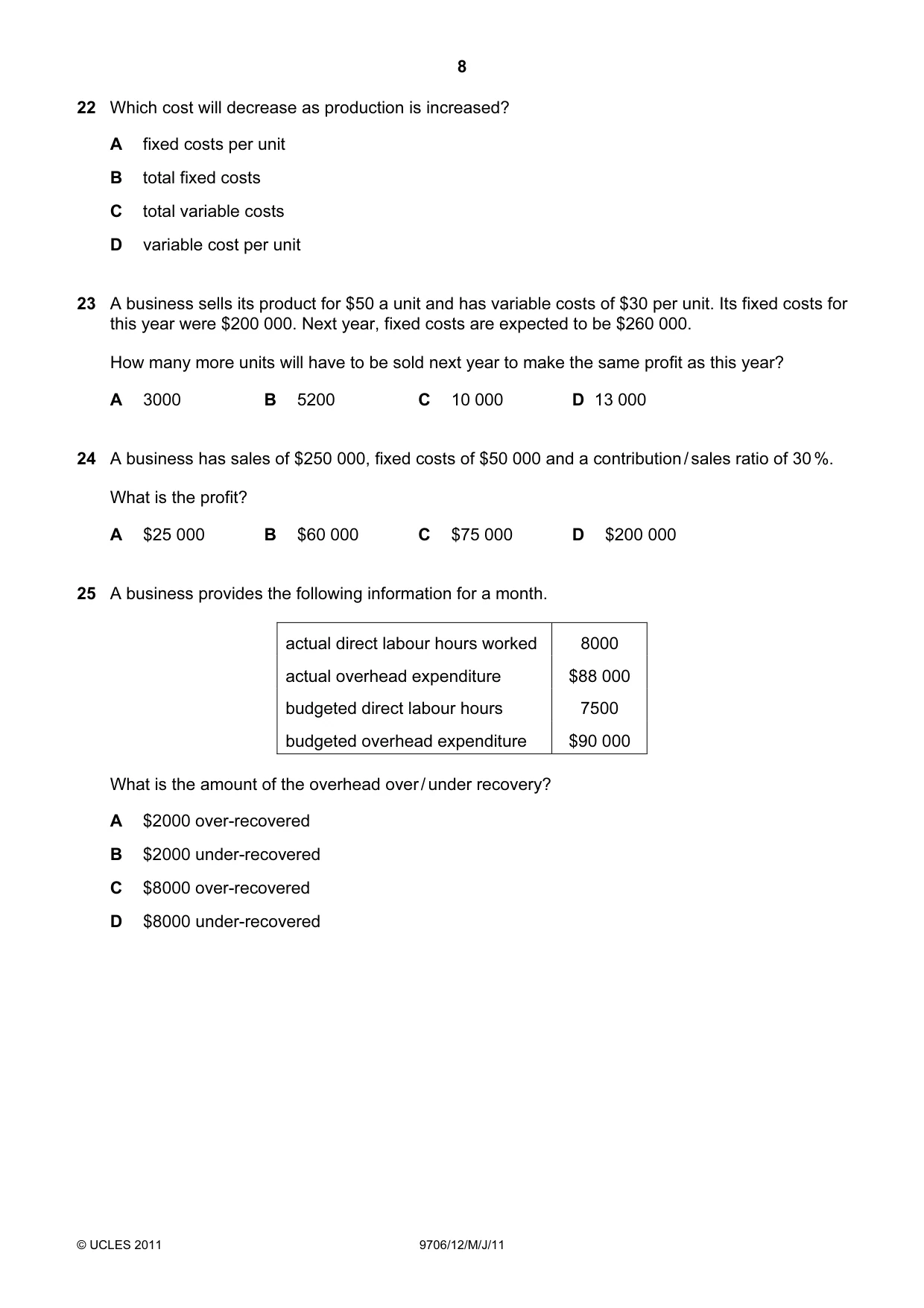
22 Which cost will decrease as production is increased? A fixed costs per unit B total fixed costs C total variable costs D variable cost per unit
Mark scheme: A
Q23 · A business sells its product for $50 a unit and has variable costs of $30 per unit
23 A business sells its product for $50 a unit and has variable costs of $30 per unit. Its fixed costs for this year were $200 000. Next year, fixed costs are expected to be $260 000. How many more units will have to be sold next year to make the same profit as this year? A 3000 B 5200 C 10 000 D 13 000
Mark scheme: A
Q24 · A business has sales of $250 000, fixed costs of $50 000 and a contribution / sales ratio…
24 A business has sales of $250 000, fixed costs of $50 000 and a contribution / sales ratio of 30 %. What is the profit? A $25 000 B $60 000 C $75 000 D $200 000
Mark scheme: A
Q25 · A business provides the following information for a month
25 A business provides the following information for a month. actual direct labour hours worked 8000 actual overhead expenditure $88 000 budgeted direct labour hours 7500 budgeted overhead expenditure $90 000 What is the amount of the overhead over / under recovery? A $2000 over-recovered B $2000 under-recovered C $8000 over-recovered D $8000 under-recovered
Mark scheme: C
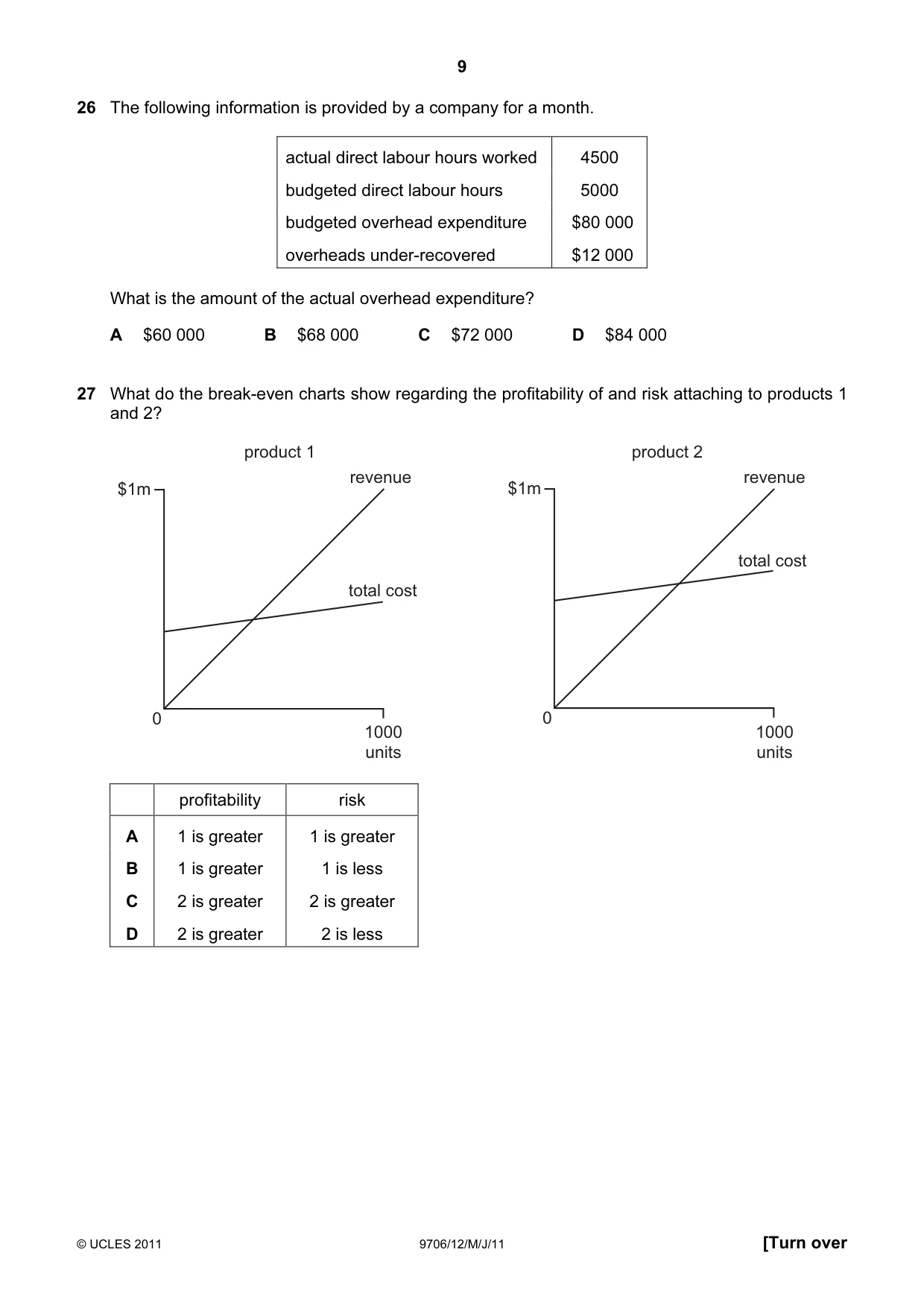
Q26 · The following information is provided by a company for a month
26 The following information is provided by a company for a month. actual direct labour hours worked 4500 budgeted direct labour hours 5000 budgeted overhead expenditure $80 000 overheads under-recovered $12 000 What is the amount of the actual overhead expenditure? A $60 000 B $68 000 C $72 000 D $84 000
Mark scheme: D
Q27 · What do the break-even charts show regarding the profitability of and risk attaching to…
27 What do the break-even charts show regarding the profitability of and risk attaching to products 1 and 2? product 1 product 2 revenue revenue $1m $1m total cost total cost 0 0 1000 1000 units units profitability risk A 1 is greater 1 is greater B 1 is greater 1 is less C 2 is greater 2 is greater D 2 is greater 2 is less
Mark scheme: B
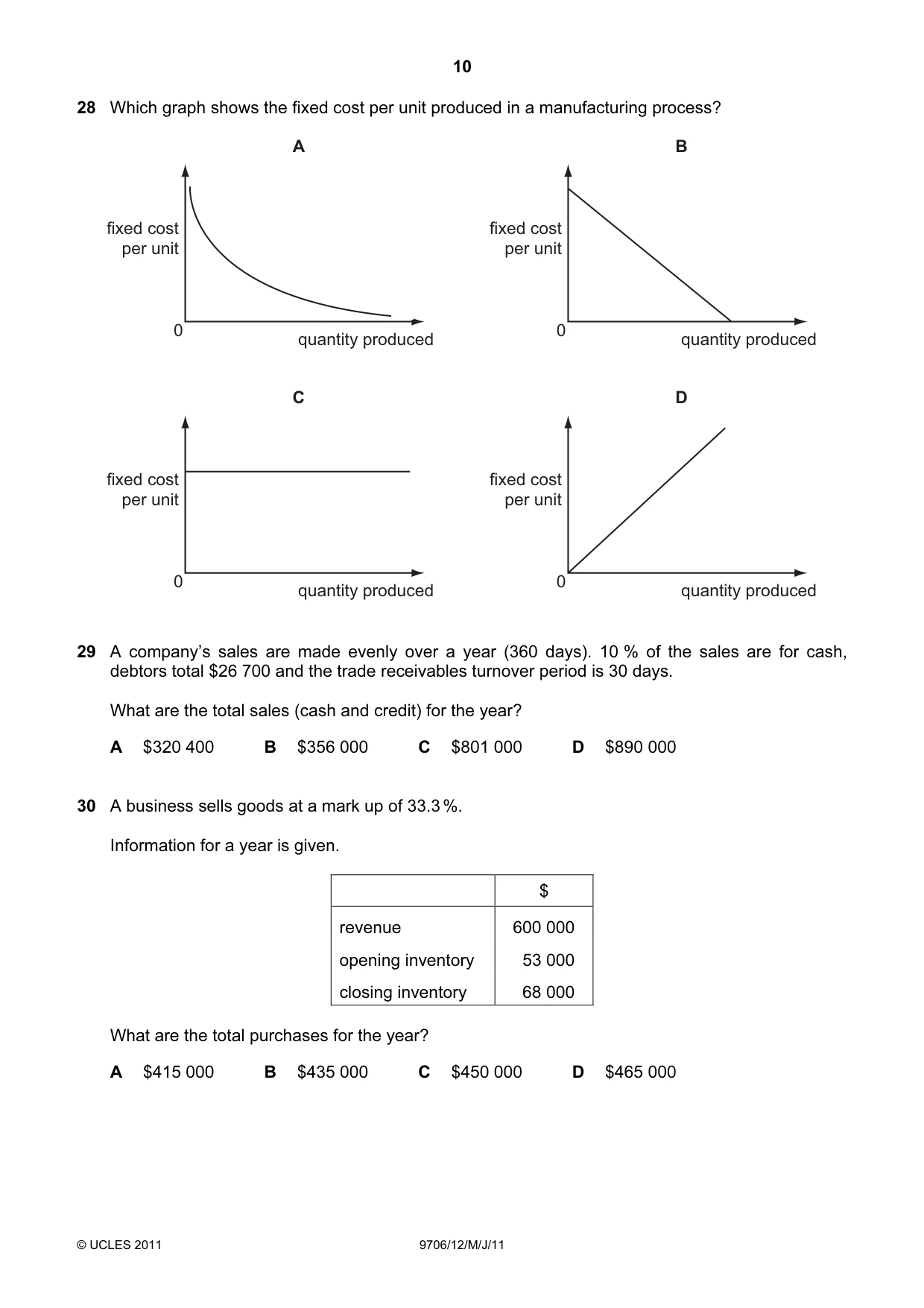
Q28 · Which graph shows the fixed cost per unit produced in a manufacturing process?
28 Which graph shows the fixed cost per unit produced in a manufacturing process? A B fixed cost fixed cost per unit per unit 0 0 quantity produced quantity produced C D fixed cost fixed cost per unit per unit 0 0 quantity produced quantity produced
Mark scheme: A
Q29 · A company’s sales are made evenly over a year (360 days)
29 A company’s sales are made evenly over a year (360 days). 10 % of the sales are for cash, debtors total $26 700 and the trade receivables turnover period is 30 days. What are the total sales (cash and credit) for the year? A $320 400 B $356 000 C $801 000 D $890 000
Mark scheme: B
More questions on Analysis and communication of accounting information
Q30 · A business sells goods at a mark up of 33.3 %
30 A business sells goods at a mark up of 33.3 %. Information for a year is given. $ revenue 600 000 opening inventory 53 000 closing inventory 68 000 What are the total purchases for the year? A $415 000 B $435 000 C $450 000 D $465 000
Mark scheme: D
What was in this paper
The subtopics covered by these 30 questions, and how many questions each got. Open one in a new tab to see every Cambridge question on it.
6Traditional costing methods6Analysis and communication of accounting information5Accounting for non-current assets2Costs and cost behaviour2Preparation of financial statements2Regulatory and ethical considerations2The accounting system2Computerised accounting systems1Reconciliation and verification1Types of business entity1What you needed in this session
Cambridge’s own grade thresholds for 2011 May/June, Paper 1 · Variant 2. A higher threshold means an easier paper — the bar moves with how the cohort did.