Questions as text
Q1 · Which item should be treated as capital expenditure? 9706/11 May/June 2006
1 Which item should be treated as capital expenditure? A the cost of a printer for an existing computer system B repair costs to a car which are not covered by insurance C rent paid on a factory, whilst the company negotiated the purchase of the factory D the replacement of a wooden fence with a new fence
1 marks
Answer: A
This question in 9706/11 May/June 2006
Q2 · A business uses the straight line method to provide for depreciation of equipment 9706/11 May/June 2006
5 A business uses the straight line method to provide for depreciation of equipment. Why should it continue to use this method in subsequent years? A accounting principles never allow accounting methods to be changed B other methods of depreciation are unsuitable for depreciating equipment C to ensure that profits are stated on a consistent basis over time D to ensure that the Balance Sheet always shows the market value for equipment
1 marks
Answer: C
This question in 9706/11 May/June 2006
Q3 · Which accounting policies illustrate the matching principle? 9706/11 May/June 2006
7 Which accounting policies illustrate the matching principle? 1 charging depreciation on fixed assets 2 revaluing fixed assets on a regular basis 3 using the reducing balance method of depreciation A 1, 2 and 3 B 1 and 2 only C 1 and 3 only D 2 and 3 only
1 marks
Answer: C
This question in 9706/11 May/June 2006
Q4 · What would be treated as part of the capital cost of the purchase of a building? 9706/11 Oct/Nov 2006
1 What would be treated as part of the capital cost of the purchase of a building? 1 legal costs of the purchase 2 redecoration of the building 3 installation of air conditioning needed for the machinery in the building A 1 only B 1 and 3 only C 2 and 3 only D 1, 2 and 3
1 marks
Answer: B
This question in 9706/11 Oct/Nov 2006
Q5 · The following information relates to a company’s fixed assets at 31 December: cost price… 9706/11 Oct/Nov 2006
6 The following information relates to a company’s fixed assets at 31 December: cost price disposal value $ $ motor vehicles 25 000 18 000 equipment 48 000 36 000 fixtures and fittings 12 000 5 000 The company has a serious cash shortage and will cease to trade within the next two months. What is the total value for fixed assets in the company’s Balance Sheet at 31 December? A $26 000 B $59 000 C $85 000 D $144 000
1 marks
Answer: B
This question in 9706/11 Oct/Nov 2006
Q6 · Which item is revenue expenditure? 9706/11 May/June 2007
1 Which item is revenue expenditure? A cost of painting new office premises during construction B cost of repairs to factory plant and machinery C legal fees for the purchase of new factory premises D wages of a company’s own workmen for building an office extension
1 marks
Answer: B
This question in 9706/11 May/June 2007
Q7 · On 1 October 2004 a company purchased machinery for $26 000 9706/11 May/June 2007
3 On 1 October 2004 a company purchased machinery for $26 000. It was decided to depreciate the asset using the reducing balance method at a rate of 20 % per annum. On 30 September 2006 the asset was sold for $12 000. What is the profit or loss on disposal? A $3600 loss B $3600 profit C $4640 loss D $4640 profit
1 marks
Answer: C
This question in 9706/11 May/June 2007
Q8 · When is it necessary to distinguish between revenue and capital expenditure? 9706/11 May/June 2008
1 When is it necessary to distinguish between revenue and capital expenditure? A when preparing cash budgets B when preparing investment appraisal calculations C when preparing profit and loss accounts D when preparing purchase ledger control accounts
1 marks
Answer: C
This question in 9706/11 May/June 2008
Q9 · The table gives information relating to the fixed assets of a business 9706/11 May/June 2008
3 The table gives information relating to the fixed assets of a business. $ net book value at the end of the year 25 000 net book value at the beginning of the year 16 000 depreciation charge for the year 5 000 additions at cost during the year 22 000 What is the net book value of disposals during the year? A $8000 B $11 000 C $18 000 D $22 000
1 marks
Answer: A
This question in 9706/11 May/June 2008
Q10 · A company has two fixed assets 9706/11 May/June 2008
5 A company has two fixed assets. Details are given in the table. cost residual asset date bought depreciation method $ value X 1 Jan, Year 1 10 000 straight line life 5 years $2000 Y 1 Jan, Year 1 20 000 reducing balance rate 20 % nil What is the depreciation charge for the year ended 31 December, Year 2? A $4800 B $5200 C $5600 D $6000
1 marks
Answer: A
This question in 9706/11 May/June 2008
Q11 · Which transaction applies the matching concept? 9706/11 May/June 2008
6 Which transaction applies the matching concept? A a machine acquired on long-term rental is included in fixed assets B computer equipment is depreciated over two years C a building is revalued following a fall in property prices D a waste-paper basket is treated as revenue expenditure
1 marks
Answer: B
This question in 9706/11 May/June 2008
Q12 · Which item should be treated as capital expenditure? 9706/11 Oct/Nov 2008
1 Which item should be treated as capital expenditure? A cost of carriage on the purchase of a fixed asset B cost of replacement of part of a fixed asset C depreciation of a fixed asset D repairs to a fixed asset
1 marks
Answer: A
This question in 9706/11 Oct/Nov 2008
Q13 · An item of machinery cost $60 000 9706/11 Oct/Nov 2008
3 An item of machinery cost $60 000. The machinery was later sold for $8000 and the loss on disposal was $3000. What was the accumulated depreciation on the machinery on disposal? A $46 000 B $49 000 C $52 000 D $55 000
1 marks
Answer: B
This question in 9706/11 Oct/Nov 2008
Q14 · The table shows how a property appears in the balance sheet 9706/11 Oct/Nov 2008
5 The table shows how a property appears in the balance sheet. $ land and buildings 100 000 accumulated depreciation (40 000) net book value 60 000 The land and buildings are revalued to $150 000. What is the journal entry to record the revaluation? Dr Cr $ $ A land and buildings 50 000 profit and loss account 50 000 B land and buildings 50 000 accumulated depreciation 40 000 revaluation reserve 90 000 C land and buildings 50 000 revaluation reserve 50 000 D land and buildings 90 000 revaluation reserve 90 000
1 marks
Answer: B
This question in 9706/11 Oct/Nov 2008
Q15 · Why do businesses charge depreciation on their fixed assets? 9706/11 Oct/Nov 2008
6 Why do businesses charge depreciation on their fixed assets? A to ensure that sufficient cash is available to replace the assets B to show the realisable value of the assets in the balance sheet C to show when the assets must be replaced D to spread the cost of the assets over their estimated useful lives
1 marks
Answer: D
This question in 9706/11 Oct/Nov 2008
Q16 · A company’s capital expenditure of $200 000 has been debited in error to the purchases… 9706/11 Oct/Nov 2008
12 A company’s capital expenditure of $200 000 has been debited in error to the purchases account. Depreciation is provided at the rate of 15 % per annum on the cost of all fixed assets held at each year end. How will this affect the net profit? A $170 000 understated B $200 000 overstated C $200 000 understated D $230 000 overstated
1 marks
Answer: A
This question in 9706/11 Oct/Nov 2008
Q17 · A vehicle cost $30 000 9706/11 May/June 2009
1 A vehicle cost $30 000. The vehicle was later sold for $9000 and the profit on disposal was $1500. What was the accumulated depreciation of the vehicle on disposal? A $7500 B $9000 C $21 000 D $22 500
1 marks
Answer: D
This question in 9706/11 May/June 2009
Q18 · A transport business owned by a sole proprietor purchases a motor vehicle 9706/11 May/June 2009
2 A transport business owned by a sole proprietor purchases a motor vehicle. This is charged to the Motor expenses account. What are the effects of this on the end-of-year balance sheet? A fixed assets understated current assets understated B fixed assets overstated current assets overstated C fixed assets overstated capital account overstated D fixed assets understated capital account understated
1 marks
Answer: D
This question in 9706/11 May/June 2009
Q19 · A business buys a computer for $2200 on 1 January 2007 9706/11 May/June 2009
3 A business buys a computer for $2200 on 1 January 2007. The computer will be used for four years, after which time it will be sold for $280. The business uses the straight-line method of depreciation. What is the depreciation charge for the year ended 31 December 2008? A $480 B $550 C $960 D $1100
1 marks
Answer: A
This question in 9706/11 May/June 2009
Q20 · A company’s policy is to depreciate its equipment by 30 % annually using the reducing… 9706/11 May/June 2009
12 A company’s policy is to depreciate its equipment by 30 % annually using the reducing balance method. A piece of equipment which was two years old was sold for $6000 and the profit on sale was $1590. What was the cost price of the equipment? A $7590 B $9000 C $9600 D $11 025
1 marks
Answer: B
This question in 9706/11 May/June 2009
Q21 · A business purchases a vehicle for $10 000 9706/11 May/June 2010
1 A business purchases a vehicle for $10 000. The business depreciates its non current (fixed) assets at 20 % using the diminishing value method. What is the depreciation charge for year 2? A $1600 B $2000 C $6400 D $8000
1 marks
Answer: A
This question in 9706/11 May/June 2010
Q22 · An item of capital expenditure has been incorrectly treated as revenue expenditure in the… 9706/12 May/June 2010
1 An item of capital expenditure has been incorrectly treated as revenue expenditure in the accounts of a business. What is the effect of this error on the accounts of the business? assets profit A overstated overstated B overstated understated C understated overstated D understated understated
1 marks
Answer: D
This question in 9706/12 May/June 2010
Q23 · A business purchases a vehicle for $10 000 9706/12 May/June 2010
30 A business purchases a vehicle for $10 000. The business depreciates its non current (fixed) assets at 20 % using the diminishing value method. What is the depreciation charge for year 2? A $1600 B $2000 C $6400 D $8000
1 marks
Answer: A
This question in 9706/12 May/June 2010
Q24 · A business purchases a vehicle for $10 000 9706/13 May/June 2010
29 A business purchases a vehicle for $10 000. The business depreciates its non current (fixed) assets at 20 % using the diminishing value method. What is the depreciation charge for year 2? A $1600 B $2000 C $6400 D $8000
1 marks
Answer: A
This question in 9706/13 May/June 2010
Q25 · An item of capital expenditure has been incorrectly treated as revenue expenditure in the… 9706/13 May/June 2010
30 An item of capital expenditure has been incorrectly treated as revenue expenditure in the accounts of a business. What is the effect of this error on the accounts of the business? assets profit A overstated overstated B overstated understated C understated overstated D understated understated
1 marks
Answer: D
This question in 9706/13 May/June 2010
Q26 · Non current (fixed) assets of a company were: start of year end of year $ $ at cost 460… 9706/11 Oct/Nov 2010
3 Non current (fixed) assets of a company were: start of year end of year $ $ at cost 460 000 505 000 cumulative depreciation 215 000 237 000 net book value 245 000 268 000 During the year non current (fixed) assets costing $92 000 were purchased and non current (fixed) assets with a net book value of $16 000 were sold. What was the depreciation charge for the year? A $22 000 B $23 000 C $53 000 D $69 000
1 marks
Answer: C
This question in 9706/11 Oct/Nov 2010
Q27 · Non current (fixed) assets of a company were: start of year end of year $ $ at cost 460… 9706/12 Oct/Nov 2010
3 Non current (fixed) assets of a company were: start of year end of year $ $ at cost 460 000 505 000 cumulative depreciation 215 000 237 000 net book value 245 000 268 000 During the year non current (fixed) assets costing $92 000 were purchased and non current (fixed) assets with a net book value of $16 000 were sold. What was the depreciation charge for the year? A $22 000 B $23 000 C $53 000 D $69 000
1 marks
Answer: C
This question in 9706/12 Oct/Nov 2010
Q28 · Non current (fixed) assets of a company were: start of year end of year $ $ at cost 460… 9706/13 Oct/Nov 2010
2 Non current (fixed) assets of a company were: start of year end of year $ $ at cost 460 000 505 000 cumulative depreciation 215 000 237 000 net book value 245 000 268 000 During the year non current (fixed) assets costing $92 000 were purchased and non current (fixed) assets with a net book value of $16 000 were sold. What was the depreciation charge for the year? A $22 000 B $23 000 C $53 000 D $69 000
1 marks
Answer: C
This question in 9706/13 Oct/Nov 2010
Q29 · The non-current assets of a business are shown 9706/11 May/June 2011
2 The non-current assets of a business are shown. end of year start of year $ $ cost 360 000 300 000 accumulated depreciation 120 000 75 000 net book value 240 000 225 000 During the year, non-current assets costing $110 000 were bought and non-current assets with a net book value of $20 000 were sold. What was the depreciation charge for the year? A $35 000 B $45 000 C $50 000 D $75 000
1 marks
Answer: D
This question in 9706/11 May/June 2011
Q30 · How should goodwill be treated by a limited company? 9706/11 May/June 2011
15 How should goodwill be treated by a limited company? A Goodwill should always be written off immediately. B Non-purchased goodwill is shown in the balance sheet. C Purchased goodwill is shown in the balance sheet and written off over its useful life. D Purchased goodwill remains on the balance sheet as a permanent item.
1 marks
Answer: C
This question in 9706/11 May/June 2011
Q31 · How should goodwill be treated by a limited company? 9706/12 May/June 2011
7 How should goodwill be treated by a limited company? A Goodwill should always be written off immediately. B Non-purchased goodwill is shown in the balance sheet. C Purchased goodwill is shown in the balance sheet and written off over its useful life. D Purchased goodwill remains on the balance sheet as a permanent item.
1 marks
Answer: C
This question in 9706/12 May/June 2011
Q32 · The non-current assets of a business are shown 9706/12 May/June 2011
11 The non-current assets of a business are shown. end of year start of year $ $ cost 360 000 300 000 accumulated depreciation 120 000 75 000 net book value 240 000 225 000 During the year, non-current assets costing $110 000 were bought and non-current assets with a net book value of $20 000 were sold. What was the depreciation charge for the year? A $35 000 B $45 000 C $50 000 D $75 000
1 marks
Answer: D
This question in 9706/12 May/June 2011
Q33 · The non-current assets of a business are shown 9706/13 May/June 2011
3 The non-current assets of a business are shown. end of year start of year $ $ cost 360 000 300 000 accumulated depreciation 120 000 75 000 net book value 240 000 225 000 During the year, non-current assets costing $110 000 were bought and non-current assets with a net book value of $20 000 were sold. What was the depreciation charge for the year? A $35 000 B $45 000 C $50 000 D $75 000
1 marks
Answer: D
This question in 9706/13 May/June 2011
Q34 · A business purchases a machine for $3200 9706/11 Oct/Nov 2011
1 A business purchases a machine for $3200. It is estimated that it will have a useful life of 5 years and a residual value of $700. Straight line depreciation is charged each year. What is the net book value at the end of year 2? A $1920 B $2200 C $2560 D $2700
1 marks
Answer: B
This question in 9706/11 Oct/Nov 2011
Q35 · The following information relates to the non-current assets of a business formed three… 9706/11 Oct/Nov 2011
15 The following information relates to the non-current assets of a business formed three years ago. $ cost at start of year 1 10 000 accumulated depreciation at end of year 3 6 000 profit for year 3 18 000 Depreciation has been consistently charged using the straight line method. What would the profit be in year 3 if the method of depreciation for that year is changed to the reducing balance method at a rate of 25 %? A $16 500 B $17 500 C $18 500 D $19 000
1 marks
Answer: C
This question in 9706/11 Oct/Nov 2011
Q36 · Expenditure on a machine during a year has included the following 9706/12 Oct/Nov 2011
2 Expenditure on a machine during a year has included the following. $ insurance costs 2 400 new engine – machine will now produce more products per hour 22 300 cleaning costs 7 200 How much of this expenditure should be treated as capital expenditure? A none B $22 300 C $24 700 D $31 900
1 marks
Answer: B
This question in 9706/12 Oct/Nov 2011
Q37 · What should companies not show as non-current assets in their balance sheets? 9706/12 Oct/Nov 2011
3 What should companies not show as non-current assets in their balance sheets? A plant bought on hire purchase B plant fully depreciated C plant held on finance leases D plant held on operating leases
1 marks
Answer: D
This question in 9706/12 Oct/Nov 2011
Q38 · Which accounting policies illustrate the matching principle? 9706/12 Oct/Nov 2011
4 Which accounting policies illustrate the matching principle? 1 charging depreciation on non-current assets 2 revaluing non-current assets on a irregular basis 3 using the reducing balance method of depreciation A 1, 2 and 3 B 1 and 2 only C 1 and 3 only D 2 and 3 only
1 marks
Answer: C
This question in 9706/12 Oct/Nov 2011
Q39 · Why is a provision for depreciation made in the financial statements? 9706/12 Oct/Nov 2011
17 Why is a provision for depreciation made in the financial statements? A to charge the cost of non-current assets against profits B to make a provision for repairs C to make cash available to replace non-current assets when necessary D to show the current market values of non-current assets
1 marks
Answer: A
This question in 9706/12 Oct/Nov 2011
Q40 · A company has been depreciating its IT equipment over 5 years, but now finds that it is… 9706/13 Oct/Nov 2011
5 A company has been depreciating its IT equipment over 5 years, but now finds that it is becoming obsolete in 3 years. What does the consistency principle permit the company to do? A change the depreciation policy to 3 years and highlight the effect of this in its financial statements B change the depreciation policy to 3 years without indicating the effect on profits C continue to depreciate over 5 years as per the existing policy D continue to depreciate over 5 years but note that after 3 years the equipment will be obsolete
1 marks
Answer: A
This question in 9706/13 Oct/Nov 2011
Q41 · The following information relates to the non-current assets of a business formed three… 9706/13 Oct/Nov 2011
14 The following information relates to the non-current assets of a business formed three years ago. $ cost at start of year 1 10 000 accumulated depreciation at end of year 3 6 000 profit for year 3 18 000 Depreciation has been consistently charged using the straight line method. What would the profit be in year 3 if the method of depreciation for that year is changed to the reducing balance method at a rate of 25 %? A $16 500 B $17 500 C $18 500 D $19 000
1 marks
Answer: C
This question in 9706/13 Oct/Nov 2011
Q42 · A business purchases a machine for $3200 9706/13 Oct/Nov 2011
30 A business purchases a machine for $3200. It is estimated that it will have a useful life of 5 years and a residual value of $700. Straight line depreciation is charged each year. What is the net book value at the end of year 2? A $1920 B $2200 C $2560 D $2700
1 marks
Answer: B
This question in 9706/13 Oct/Nov 2011
Q43 · Which asset is often revalued in a business’s accounts? 9706/11 May/June 2012
1 Which asset is often revalued in a business’s accounts? A buildings B inventory C IT equipment D trade receivables
1 marks
Answer: A
This question in 9706/11 May/June 2012
Q44 · A non-current asset costing $206 000, with a net book value of $131 000, is revalued to… 9706/12 May/June 2012
3 A non-current asset costing $206 000, with a net book value of $131 000, is revalued to $275 000. How should the revaluation be recorded? A Dr Asset at cost $69 000 Cr Revaluation reserve $69 000 B Dr Provision for depreciation $75 000 Dr Asset at cost $69 000 Cr Revaluation reserve $144 000 C Dr Provision for depreciation $144 000 Cr Revaluation reserve $144 000 D Dr Revaluation reserve $144 000 Cr Asset at cost $69 000 Cr Provision for depreciation $75 000
1 marks
Answer: B
This question in 9706/12 May/June 2012
Q45 · Which asset is often revalued in a business’s accounts? 9706/13 May/June 2012
3 Which asset is often revalued in a business’s accounts? A buildings B inventory C IT equipment D trade receivables
1 marks
Answer: A
This question in 9706/13 May/June 2012
Q46 · A business sells a non-current asset for cash 9706/11 Oct/Nov 2012
17 A business sells a non-current asset for cash. The disposal account includes entries for the cost of the asset and the sales proceeds. Which books of prime entry are used? cost sales proceeds A cash book general journal B cash book sales journal C general journal cash book D purchases journal cash book
1 marks
Answer: C
This question in 9706/11 Oct/Nov 2012
Q47 · A business buys a vehicle for $10 000 on 1 January Year 1 and sells it for $6500 on 1… 9706/11 Oct/Nov 2012
18 A business buys a vehicle for $10 000 on 1 January Year 1 and sells it for $6500 on 1 January Year 3, having depreciated it at 10 % a year using the straight line method. The company provides a full year’s depreciation in the year of purchase and none in the year of disposal. Which amount for profit or loss will appear in the disposal account and on what side of the disposal account will it be shown? A $1500 on the credit side B $1500 on the debit side C $2500 on the credit side D $2500 on the debit side
1 marks
Answer: A
This question in 9706/11 Oct/Nov 2012
Q48 · Which item is revenue expenditure? 9706/12 Oct/Nov 2012
2 Which item is revenue expenditure? A cost of painting new office premises during construction B cost of repairs to factory plant and machinery C legal fees for the purchase of new factory premises D wages of a company’s own workmen for building an office extension
1 marks
Answer: B
This question in 9706/12 Oct/Nov 2012
Q49 · A company uses the straight-line method of depreciation for all its non-current assets 9706/12 Oct/Nov 2012
18 A company uses the straight-line method of depreciation for all its non-current assets. On 1 January the company bought machinery on hire purchase. The cash price was $115 000 and the interest for the year is $19 550. The estimated useful life of the machinery is five years with no residual value. What is the charge for depreciation for the year ended 31 December? A $19 090 B $23 000 C $26 910 D $42 550
1 marks
Answer: B
This question in 9706/12 Oct/Nov 2012
Question 50 9706/13 Oct/Nov 2012
3 A. Spender owns a road haulage business. What would be classified as capital expenditure? A number plates for new lorries B replacement fuel pump for lorries C replacement tyres for lorries D road tax licence for new lorries
1 marks
Answer: A
This question in 9706/13 Oct/Nov 2012
Q51 · Which statement is correct? 9706/13 Oct/Nov 2012
5 Which statement is correct? A Assets cannot be revalued by companies at all. B Companies have to disclose their policy on revaluation in their accounts. C Companies must carry out revaluations every year. D Every asset in a particular class must be revalued by companies, not just one.
1 marks
Answer: D
This question in 9706/13 Oct/Nov 2012
Q52 · A business purchased a machine for $10 000 at the beginning of year 1 9706/13 Oct/Nov 2012
18 A business purchased a machine for $10 000 at the beginning of year 1. The machine was depreciated using the reducing balance method at 30 % per year. The business sold the machine after the end of year 2 for $5000. What was the profit or loss on disposal of the machine? A $100 loss B $100 profit C $1000 loss D $1000 profit
1 marks
Answer: B
This question in 9706/13 Oct/Nov 2012
Q53 · The table below shows how a non-current asset appears in the statement of financial… 9706/11 May/June 2013
6 The table below shows how a non-current asset appears in the statement of financial position. $ non-current asset at cost 120 000 accumulated depreciation (18 000) net book value 102 000 The asset is revalued to $136 000. What is the journal entry to record the revaluation? debit credit $ $ A non-current asset at cost 16 000 income statement 16 000 B non-current asset at cost 16 000 accumulated depreciation 18 000 revaluation reserve 34 000 C non-current asset at cost 34 000 revaluation reserve 34 000 D non-current asset at cost 16 000 revaluation reserve 16 000
1 marks
Answer: B
This question in 9706/11 May/June 2013
Q54 · A vehicle was part exchanged for a new vehicle 9706/11 May/June 2013
7 A vehicle was part exchanged for a new vehicle. Which entries record the part exchange? account debited account credited A cash motor vehicles B disposal motor vehicles C motor vehicles cash D motor vehicles disposal
1 marks
Answer: D
This question in 9706/11 May/June 2013
Q55 · A vehicle cost $12 000 and its estimated residual value was $2000 9706/11 May/June 2013
19 A vehicle cost $12 000 and its estimated residual value was $2000. The vehicle was depreciated at 25% per annum using the straight line method. After three years the vehicle was sold for $3500. What was the profit or loss on disposal? A $500 profit B $1000 loss C $1000 profit D $4500 loss
1 marks
Answer: B
This question in 9706/11 May/June 2013
Q56 · A vehicle is sold for $1000 9706/12 May/June 2013
18 A vehicle is sold for $1000. It had cost $6000 and $2800 depreciation had been provided on it. What is the profit or loss on disposal? A loss $2200 B loss $4200 C profit $2200 D profit $4200
1 marks
Answer: A
This question in 9706/12 May/June 2013
Q57 · The table shows information relating to the non-current assets of a business 9706/13 May/June 2013
4 The table shows information relating to the non-current assets of a business. $ net book value at the beginning of year 28 000 net book value at end of year 25 000 depreciation charge for the year 4 000 disposals at net book value 9 000 What is the cost of non-current asset additions? A $2000 B $6000 C $10 000 D $16 000
1 marks
Answer: C
This question in 9706/13 May/June 2013
Q58 · ABC Ltd purchased a non-current asset for $35 000 on 1 April 2009 and sold it on 1… 9706/13 May/June 2013
19 ABC Ltd purchased a non-current asset for $35 000 on 1 April 2009 and sold it on 1 October 2012 for $14 500. The company’s year end is 31 December and their policy is to make no charge for depreciation in the year of disposal but a full year’s charge in the year of purchase. The company uses the reducing balance method at the rate of 25% per annum. What is the profit or loss made, to the nearest $, on the disposal of the asset? A $265 loss B $265 profit C $5188 loss D $5188 profit
1 marks
Answer: A
This question in 9706/13 May/June 2013
Q59 · A non-current asset costs $250 000 and has a useful economic life of 25 years 9706/11 Oct/Nov 2013
1 A non-current asset costs $250 000 and has a useful economic life of 25 years. The estimated residual value is $10 000. Depreciation is provided on a straight line basis. After 10 years the asset is sold for $120 000. Disposal costs of $20 000 are incurred. What is the loss on disposal? A $30 000 B $34 000 C $50 000 D $54 000
1 marks
Answer: D
This question in 9706/11 Oct/Nov 2013
Q60 · Anna owns a plumbing business 9706/12 Oct/Nov 2013
3 Anna owns a plumbing business. Costs for the year were $49 500 for wages and $95 000 for materials. These included $2200 labour and $540 materials used by Anna in the extension of the business premises. Additional planning and legal costs of the extension were $450. What was Anna’s total revenue expenditure for the year? A $141 310 B $141 760 C $142 300 D $144 500
1 marks
Answer: B
This question in 9706/12 Oct/Nov 2013
Q61 · A building cost $340 000 9706/12 Oct/Nov 2013
4 A building cost $340 000. The accumulated depreciation on the building was $47 600. It was decided to revalue the building to its market value of $560 000. What is the balance on the revaluation reserve? A $172 400 B $220 000 C $267 600 D $512 400
1 marks
Answer: C
This question in 9706/12 Oct/Nov 2013
Q62 · The table shows extracts from the statements of financial position of a business 9706/12 Oct/Nov 2013
5 The table shows extracts from the statements of financial position of a business. 2011 2012 $ $ non-current assets (at cost) 190 000 245 000 less accumulated depreciation 75 000 90 000 115 000 155 000 Other information for the financial year 2012 is as follows. $ depreciation charged 40 000 new non-current assets purchased (at cost) 105 000 loss on sale of non-current assets 10 000 Which amount was received from the sales of the non-current assets? A $15 000 B $25 000 C $30 000 D $35 000
1 marks
Answer: A
This question in 9706/12 Oct/Nov 2013
Q63 · A vehicle is sold for $1500 9706/12 Oct/Nov 2013
20 A vehicle is sold for $1500. It cost $5000 and $3000 depreciation had been provided on it. Which entry is needed to close the disposal account? debit $ credit $ A disposal account 500 income statement 500 B disposal account 3500 income statement 3500 C income statement 500 disposal account 500 D income statement 3500 disposal account 3500
1 marks
Answer: C
This question in 9706/12 Oct/Nov 2013
Q64 · What would be treated as part of the capital cost of the purchase of a building? 9706/13 Oct/Nov 2013
6 What would be treated as part of the capital cost of the purchase of a building? 1 legal costs of the purchase 2 redecoration of the building 3 installation of air conditioning needed for the machinery in the building A 1 only B 1, 2 and 3 C 1 and 3 only D 2 and 3 only
1 marks
Answer: C
This question in 9706/13 Oct/Nov 2013
Q65 · Ryan purchased a van for $16 000 on 31 December 2010 9706/13 Oct/Nov 2013
7 Ryan purchased a van for $16 000 on 31 December 2010. It is his policy to apply 25% per annum reducing balance depreciation for each part of the year the asset is held. Ryan traded the vehicle in on 1 July 2013 for a $6150 reduction on the cost of a new vehicle. What was the profit or loss made on the disposal of the van? A $600 loss B $1725 loss C $150 profit D $2150 profit
1 marks
Answer: B
This question in 9706/13 Oct/Nov 2013
Q66 · Which statement about goodwill is correct? 9706/13 Oct/Nov 2013
17 Which statement about goodwill is correct? A Internally generated goodwill should be omitted from the statement of financial position. B Purchased goodwill should be classed as a tangible non-current asset. C Purchased goodwill should be omitted from the statement of financial position. D The value of goodwill should never be included in the statement of financial position.
1 marks
Answer: A
This question in 9706/13 Oct/Nov 2013
Q67 · A trader uses the revaluation method of depreciation for loose tools 9706/13 Oct/Nov 2013
19 A trader uses the revaluation method of depreciation for loose tools. On 1 January loose tools were valued at $4620 and on 31 December at $5740. During the year $2010 was spent on purchasing new loose tools. Which amount was charged to the income statement? A $890 B $1120 C $2010 D $3130
1 marks
Answer: A
This question in 9706/13 Oct/Nov 2013
Q68 · What is the reason for providing depreciation on non-current assets? 9706/13 Oct/Nov 2013
20 What is the reason for providing depreciation on non-current assets? A to provide sufficient funds to replace the non-current assets B to show the assets at replacement cost on the statement of financial position C to show the fall in value of the assets in the income statement D to spread the cost of the assets over their estimated useful lives
1 marks
Answer: D
This question in 9706/13 Oct/Nov 2013
Q69 · A business has a non-current asset turnover of two times, based on non-current assets… 9706/13 Oct/Nov 2013
24 A business has a non-current asset turnover of two times, based on non-current assets valued at $250 000 at the end of 2011. The company uses the reducing balance method to depreciate its non-current assets at 25% per annum. In 2012 sales revenue increased by 20%. There were no purchases or disposals of non-current assets during the year. What is the non-current asset turnover for 2012? A 2.13 times B 2.40 times C 2.67 times D 3.20 times
1 marks
Answer: D
This question in 9706/13 Oct/Nov 2013
Q70 · A new machine is purchased at a price of $75 000 9706/11 May/June 2014
4 A new machine is purchased at a price of $75 000. In addition, delivery and installation cost is $2500. The business depreciates all non-current assets at a rate of 20% per annum using the straight line method. By how much would this transaction decrease the profit for the year? A $14 500 B $15 000 C $15 500 D $17 500
1 marks
Answer: C
This question in 9706/11 May/June 2014
Q71 · Which costs may be capitalised as land and buildings? 9706/11 May/June 2014
5 Which costs may be capitalised as land and buildings? 1 construction cost of an extension 2 insurance premium 3 legal fees on purchase 4 redecoration costs A 1 and 2 B 1 and 3 C 2 and 4 D 3 and 4
1 marks
Answer: B
This question in 9706/11 May/June 2014
Q72 · June purchased a new machine 9706/11 May/June 2014
12 June purchased a new machine. She depreciated it at a rate of 40% a year on the reducing balance basis. After two years its net book value was $3600. What was the purchase price? A $8400 B $10 000 C $14 400 D $22 500
1 marks
Answer: B
This question in 9706/11 May/June 2014
Q73 · The following information relates to the motor vehicles of a business 9706/11 May/June 2014
14 The following information relates to the motor vehicles of a business. 1 January 2013 31 December 2013 $ $ net book value 398 000 480 000 During 2013 the following occurred. 1 Additional motor vehicles costing $195 000 were purchased. 2 A motor vehicle (original cost $80 000) was sold for $24 000 at a profit of $2000. What was the depreciation charge for 2013? A $87 000 B $89 000 C $91 000 D $113 000
1 marks
Answer: C
This question in 9706/11 May/June 2014
Q74 · A non-current asset is depreciated due to passage of time 9706/12 May/June 2014
5 A non-current asset is depreciated due to passage of time. Which type of non-current asset is it? A a computer which has become out of date B a lease with a fixed life in terms of years C a machine which is subject to rust and breakdown D a mine which loses value as coal is extracted
1 marks
Answer: B
This question in 9706/12 May/June 2014
Q75 · On 1 June 2011, a company purchases machinery for $18 000 9706/12 May/June 2014
6 On 1 June 2011, a company purchases machinery for $18 000. The company depreciates machinery at 20% per annum using the reducing balance method. The machinery was sold on 1 June 2013 for $9400. What is the profit / loss on the disposal of the machinery? A loss $1400 B loss $2120 C profit $1400 D profit $2120
1 marks
Answer: B
This question in 9706/12 May/June 2014
Q76 · A company’s non-current asset turnover figure rises from 3.4 times in Year 1 to 4 times… 9706/12 May/June 2014
25 A company’s non-current asset turnover figure rises from 3.4 times in Year 1 to 4 times in Year 2. Sales revenue has been constant. What explains the change? A The cost of repairs to non-current assets had decreased. B The cost of repairs to non-current assets had increased. C The depreciation charge for the year was higher than the cost of non-current assets purchased. D The depreciation charge for the year was lower than the cost of non-current assets purchased.
1 marks
Answer: C
This question in 9706/12 May/June 2014
Q77 · Sybil owns a vehicle which on 1 August 2014 will be shown at a cost of $10 000 with… 9706/12 May/June 2014
30 Sybil owns a vehicle which on 1 August 2014 will be shown at a cost of $10 000 with accumulated depreciation of $6000. On that date she expects to trade it in against a new vehicle with a cost of $15 000, receiving a trade-in allowance of $3500. Which figure will appear in Sybil’s cash budget for August 2014? A $5000 B $11 000 C $11 500 D $15 000
1 marks
Answer: C
This question in 9706/12 May/June 2014
Q78 · An item of machinery cost $60 000 9706/13 May/June 2014
1 An item of machinery cost $60 000. The machinery was later sold for $8000 and the loss on disposal was $3000. What was the accumulated depreciation on the machinery on disposal? A $49 000 B $52 000 C $55 000 D $65 000
1 marks
Answer: A
This question in 9706/13 May/June 2014
Q79 · A motor vehicle costing $8000 is depreciated by 25% per annum using the reducing balance… 9706/13 May/June 2014
11 A motor vehicle costing $8000 is depreciated by 25% per annum using the reducing balance method. After depreciating for two years it was sold for $4000. What is the loss on disposal? A $500 B $2000 C $4000 D $5000
1 marks
Answer: A
This question in 9706/13 May/June 2014
Q80 · Daphne buys a non-current asset for $10 000 9706/13 May/June 2014
18 Daphne buys a non-current asset for $10 000. It has an estimated life of two years and a scrap value of $2000. She is considering whether to depreciate it using the straight line method or to use the reducing balance method at a rate of 60% per annum. Which statements are correct? 1 The profit for the year in Year 1 is higher if the reducing balance method is chosen. 2 The profit for the year in Year 1 is higher if the straight line method is chosen. 3 The profit on disposal at the end of Year 2 is higher if the reducing balance method is chosen. 4 The profit on disposal at the end of Year 2 is higher if the straight line method is chosen. A 1 and 3 B 1 and 4 C 2 and 3 D 2 and 4
1 marks
Answer: C
This question in 9706/13 May/June 2014
Q81 · A business purchases a new van 9706/11 Oct/Nov 2014
2 A business purchases a new van. The table shows the purchase invoice details. $ purchase price 13 000 delivery charge 500 sign writing 200 road tax 200 tank of fuel 50 How much should be debited to the motor van account? A $13 500 B $13 700 C $13 900 D $13 950
1 marks
Answer: B
This question in 9706/11 Oct/Nov 2014
Q82 · The following information relates to non-current assets 9706/11 Oct/Nov 2014
5 The following information relates to non-current assets. $ net book value at 1 January 2013 20 000 net book value at 31 December 2013 18 000 receipts from disposals 3 500 assets bought 9 700 loss on sale 650 What is the depreciation charge for the year? A $3550 B $4200 C $7550 D $8200
1 marks
Answer: C
This question in 9706/11 Oct/Nov 2014
Q83 · The following is an extract from the statement of financial position for a company at 31… 9706/11 Oct/Nov 2014
16 The following is an extract from the statement of financial position for a company at 31 December 2012. cost depreciation net book value $ $ $ non-current assets 250 000 95 000 155 000 The assets have a residual scrap value of $12 500. Depreciation policy is provided using the reducing balance method at a rate of 25% per annum. What is the depreciation charge for the year ended 31 December 2013? A $35 625 B $38 750 C $59 375 D $62 500
1 marks
Answer: B
This question in 9706/11 Oct/Nov 2014
Q84 · The non-current assets of a business are shown in the table 9706/12 Oct/Nov 2014
2 The non-current assets of a business are shown in the table. end of year start of year $ $ cost 360 000 300 000 accumulated depreciation 120 000 75 000 net book value 240 000 225 000 During the year, non-current assets costing $110 000 were bought and non-current assets with a net book value of $20 000 were sold. What was the depreciation charge for the year? A $35 000 B $45 000 C $50 000 D $75 000
1 marks
Answer: D
This question in 9706/12 Oct/Nov 2014
Q85 · What is the purpose of providing for depreciation? 9706/12 Oct/Nov 2014
10 What is the purpose of providing for depreciation? A to apply the matching principle B to calculate the true value of non-current assets C to ensure that money is available for repair of non-current assets D to provide cash in the business for replacement of non-current assets
1 marks
Answer: A
This question in 9706/12 Oct/Nov 2014
Q86 · On 1 October 2011 a company purchased machinery for $26 000 9706/13 Oct/Nov 2014
3 On 1 October 2011 a company purchased machinery for $26 000. It was depreciated at a rate of 20% per annum using the reducing balance method. On 30 September 2013 the machinery was sold for $12 000. What is the profit or loss on disposal? A $3600 loss B $3600 profit C $4640 loss D $4640 profit
1 marks
Answer: C
This question in 9706/13 Oct/Nov 2014
Q87 · A business provides the following information 9706/13 Oct/Nov 2014
6 A business provides the following information. $ cheque paid in 2013 for equipment bought in 2012 15 000 equipment purchased on credit in 2013 42 000 net book value of equipment at 1 January 2013 83 000 net book value of equipment at 31 December 2013 67 000 What was the depreciation charge in the income statement for the year ended 31 December 2013? A $16 000 B $31 000 C $43 000 D $58 000
1 marks
Answer: D
This question in 9706/13 Oct/Nov 2014
Q88 · A business depreciates its non-current assets at 20% using the straight-line method 9706/12 May/June 2015
6 A business depreciates its non-current assets at 20% using the straight-line method. Depreciation is calculated on a time basis in the year of acquisition and disposal. $ non-current assets, at cost, 31 December 2013 200 000 purchase of machinery 1 January 2014 50 000 disposal of machinery 30 September 2014 40 000 non-current assets, at cost, 31 December 2014 210 000 What is the depreciation charge for non-current assets for the year ended 31 December 2014? A $42 000 B $48 000 C $50 000 D $52 000
1 marks
Answer: B
This question in 9706/12 May/June 2015
Q89 · Which item should be treated as capital expenditure? 9706/13 May/June 2015
1 Which item should be treated as capital expenditure? A the cost of a printer for an existing computer system B repair costs to a car which are not covered by insurance C rent paid on a factory, whilst the company negotiated the purchase of the factory D the replacement of a wooden fence with a new fence
1 marks
Answer: A
This question in 9706/13 May/June 2015
Q90 · A trader depreciates fixtures and fittings at the rate of 10% a year on cost 9706/13 May/June 2015
2 A trader depreciates fixtures and fittings at the rate of 10% a year on cost. On 1 January 2014 a purchase of new fixtures and fittings, $5000, was posted to the advertising account in error. What was the effect of this error on the trader’s capital account on 31 December 2014? A overstated $4500 B overstated $5000 C understated $4500 D understated $5000
1 marks
Answer: C
This question in 9706/13 May/June 2015
Q91 · Non-current assets of a company were as follows 9706/13 May/June 2015
3 Non-current assets of a company were as follows. start of year end of year $ $ at cost 460 000 505 000 accumulated depreciation 215 000 237 000 net book value 245 000 268 000 During the year non-current assets costing $92 000 were purchased and non-current assets with a net book value of $16 000 were sold. What was the depreciation charge for the year? A $22 000 B $23 000 C $53 000 D $69 000
1 marks
Answer: C
This question in 9706/13 May/June 2015
Q92 · A business buys a non-current asset and decides to apply the straight-line method of… 9706/13 May/June 2015
12 A business buys a non-current asset and decides to apply the straight-line method of depreciation. The accountant forgets to include an estimate of scrap value in the calculation. Which statements are correct? 1 The annual depreciation charge is too high. 2 The annual depreciation charge is too low. 3 There is likely to be a loss on disposal in the future. 4 There is likely to be a profit on disposal in the future. A 1 and 3 B 1 and 4 C 2 and 3 D 2 and 4
1 marks
Answer: B
This question in 9706/13 May/June 2015
Q93 · A manufacturing company uses the reducing balance method to calculate depreciation 9706/13 May/June 2015
26 A manufacturing company uses the reducing balance method to calculate depreciation. What describes the depreciation expense? A fixed cost B semi-variable cost C stepped cost D variable cost
1 marks
Answer: A
This question in 9706/13 May/June 2015
Q94 · Motor vehicles purchased for $530 000 at the start of the year have been incorrectly… 9706/11 Oct/Nov 2015
14 Motor vehicles purchased for $530 000 at the start of the year have been incorrectly depreciated for the whole year at 10% instead of 25%. Ledger balances after the entries have been posted: $ motor vehicles at cost 530 000 provision for depreciation 53 000 Which entries will correct the error? account to be debited $ account to be credited $ A income statement 79 500 provision for depreciation 79 500 of motor vehicles B income statement 132 500 provision for depreciation 132 500 of motor vehicles C provision for depreciation 79 500 income statement 79 500 of motor vehicles D provision for depreciation 132 500 income statement 132 500 of motor vehicles
1 marks
Answer: A
This question in 9706/11 Oct/Nov 2015
Q95 · An asset with accumulated depreciation of $72 400 is sold for $46 500 9706/11 Oct/Nov 2015
23 An asset with accumulated depreciation of $72 400 is sold for $46 500. There is a loss on disposal of $23 000. What was the cost of the asset? A $48 900 B $95 900 C $118 900 D $141 900
1 marks
Answer: D
This question in 9706/11 Oct/Nov 2015
Q96 · An item of revenue expenditure is wrongly treated as capital expenditure 9706/12 Oct/Nov 2015
4 An item of revenue expenditure is wrongly treated as capital expenditure. What is the effect of this error? non-current profit for the assets year A overstated overstated B overstated understated C understated overstated D understated understated
1 marks
Answer: A
This question in 9706/12 Oct/Nov 2015
Q97 · A trader prepares a disposal account 9706/12 Oct/Nov 2015
5 A trader prepares a disposal account. On which sides do the cost of the asset and sale proceeds appear? cost of the asset sale proceeds A credit credit B credit debit C debit credit D debit debit
1 marks
Answer: C
This question in 9706/12 Oct/Nov 2015
Q98 · Land and buildings are shown in the books of account at a cost price of $200 000 with… 9706/12 Oct/Nov 2015
7 Land and buildings are shown in the books of account at a cost price of $200 000 with accumulated depreciation of $40 000. The property is revalued at $340 000. Which entries record this transaction? debit credit account $ $ A land and buildings 140 000 income statement 140 000 B land and buildings 140 000 provision for depreciation 40 000 income statement 180 000 C land and buildings 140 000 revaluation reserve 140 000 D land and buildings 140 000 provision for depreciation 40 000 revaluation reserve 180 000
1 marks
Answer: D
This question in 9706/12 Oct/Nov 2015
Q99 · Which cost should be treated as revenue expenditure? 9706/12 Oct/Nov 2015
9 Which cost should be treated as revenue expenditure? A installing a new sound system in a car B purchase of a trailer for a car C replacing a damaged engine of a car D replacing an old car with a new one
1 marks
Answer: C
This question in 9706/12 Oct/Nov 2015
Q100 · A business depreciates its motor vehicles over four years using the straight-line method 9706/12 Oct/Nov 2015
13 A business depreciates its motor vehicles over four years using the straight-line method. A full year’s depreciation is charged in the year of purchase, but none in the year of sale. A vehicle purchased on 1 July 2011 for $18 000 had an estimated residual value of $4000. The vehicle was sold for $5000 on 31 December 2014. Which entry appeared in the income statement for the year ended 31 December 2014? A $1000 loss B $2500 loss C $2500 profit D $5000 profit
1 marks
Answer: B
This question in 9706/12 Oct/Nov 2015
Q101 · A depreciated non-current asset is revalued upwards 9706/13 Oct/Nov 2015
5 A depreciated non-current asset is revalued upwards. What is the effect of this on the statement of financial position? A Non-current assets increase, equity decreases. B Non-current assets increase, equity increases. C Non-current assets increase, retained earnings decrease. D Non-current assets increase, retained earnings increase.
1 marks
Answer: B
This question in 9706/13 Oct/Nov 2015
Q102 · The following information is available in respect of a non-current asset 9706/13 Oct/Nov 2015
6 The following information is available in respect of a non-current asset. $ purchase price 160 000 accumulated depreciation at the date of disposal 100 000 sale proceeds 65 000 market value at the date of disposal 68 000 What is the profit or loss on disposal? A $5000 profit B $8000 profit C $92 000 loss D $95 000 loss
1 marks
Answer: A
This question in 9706/13 Oct/Nov 2015
Question 103 9706/13 Oct/Nov 2015
16 What is depreciation? A a means of allocating the cost of a non-current asset over its useful life B a measure of the decrease in market value of a non-current asset C an outflow of cash from the use of a non-current asset D the expense spent on the non-current asset
1 marks
Answer: A
This question in 9706/13 Oct/Nov 2015
Q104 · Why is depreciation provided on non-current assets? 9706/12 Feb/March 2016
2 Why is depreciation provided on non-current assets? A so that the cost is allocated to periods that benefit from them B so that the entity concept is applied C so that there is enough cash in the business to replace them D so that they are shown at market value
1 marks
Answer: A
This question in 9706/12 Feb/March 2016
Q105 · The following information relates to the disposal of a non-current asset 9706/12 Feb/March 2016
3 The following information relates to the disposal of a non-current asset. $ profit on disposal 5 200 cost of non-current asset sold 14 400 sales proceeds 6 800 What was the accumulated depreciation on the non-current asset sold? A $1600 B $2400 C $7600 D $12 800
1 marks
Answer: D
This question in 9706/12 Feb/March 2016
Q106 · The table shows extracts from the statements of financial position of a business 9706/11 May/June 2016
2 The table shows extracts from the statements of financial position of a business. 2014 2015 $ $ non-current assets (at cost) 190 000 245 000 less accumulated depreciation 75 000 90 000 net book value 115 000 155 000 Other information for the financial year 2015 is as follows. $ depreciation charged 40 000 new non-current assets purchased (at cost) 105 000 loss on sale of non-current assets 10 000 Which amount was received from the sale of the non-current assets? A $15 000 B $25 000 C $35 000 D $50 000
1 marks
Answer: A
This question in 9706/11 May/June 2016
Q107 · What would be treated as part of the capital cost of the purchase of a building? 9706/11 May/June 2016
3 What would be treated as part of the capital cost of the purchase of a building? 1 cost of purchase 2 insurance of the building 3 installation of air conditioning needed for the machinery in the building A 1 only B 1, 2 and 3 C 1 and 3 only D 2 and 3 only
1 marks
Answer: C
This question in 9706/11 May/June 2016
Q108 · A company’s financial year ends on 31 December 9706/12 May/June 2016
2 A company’s financial year ends on 31 December. On 1 April 2015, the following payments relating to a new machine were made. $ purchase cost 50 000 installation 10 000 Machinery is depreciated at 20% on cost per annum, calculated from the date of purchase. What was the depreciation of the new machine for the year ended 31 December 2015? A $7500 B $9000 C $10 000 D $12 000
1 marks
Answer: B
This question in 9706/12 May/June 2016
Q109 · A business purchased a motor vehicle on 1 January 2012 for $24 000 9706/12 May/June 2016
3 A business purchased a motor vehicle on 1 January 2012 for $24 000. The estimated useful life of the motor vehicle was four years and the estimated residual value at the end of four years was $8000. The business depreciates motor vehicles at 25% per annum using the reducing balance method. No depreciation is charged in the year of disposal. The motor vehicle was sold on 31 July 2015 for $12 000. What was the profit on the sale of the motor vehicle? A $1875 B $4000 C $5250 D $8000
1 marks
Answer: A
This question in 9706/12 May/June 2016
Q110 · A building was purchased for $500 000 9706/12 May/June 2016
4 A building was purchased for $500 000. The following costs were also incurred. $ adapting the new building 50 000 legal fees for the building purchase 5 000 cleaning the building 4 000 salary of building manager 20 000 What was the capital cost of the building? A $550 000 B $555 000 C $559 000 D $579 000
1 marks
Answer: B
This question in 9706/12 May/June 2016
Q111 · The table shows extracts from the statements of financial position of a business 9706/13 May/June 2016
2 The table shows extracts from the statements of financial position of a business. 2014 2015 $ $ non-current assets (at cost) 190 000 245 000 less accumulated depreciation 75 000 90 000 net book value 115 000 155 000 Other information for the financial year 2015 is as follows. $ depreciation charged 40 000 new non-current assets purchased (at cost) 105 000 loss on sale of non-current assets 10 000 Which amount was received from the sale of the non-current assets? A $15 000 B $25 000 C $35 000 D $50 000
1 marks
Answer: A
This question in 9706/13 May/June 2016
Q112 · What would be treated as part of the capital cost of the purchase of a building? 9706/13 May/June 2016
3 What would be treated as part of the capital cost of the purchase of a building? 1 cost of purchase 2 insurance of the building 3 installation of air conditioning needed for the machinery in the building A 1 only B 1, 2 and 3 C 1 and 3 only D 2 and 3 only
1 marks
Answer: C
This question in 9706/13 May/June 2016
Q113 · A company purchased a lorry for $50 000 on 1 January 2015 9706/11 Oct/Nov 2016
2 A company purchased a lorry for $50 000 on 1 January 2015. It has an estimated residual value of $10 000 and a four-year life. The company charges depreciation monthly on a straight-line basis. What will the charge for depreciation be for the year to 30 June 2015? A $5000 B $6250 C $10 000 D $12 500
1 marks
Answer: A
This question in 9706/11 Oct/Nov 2016
Q114 · The opening net book value of motor vehicles was $150 000 9706/11 Oct/Nov 2016
3 The opening net book value of motor vehicles was $150 000. During the year a motor vehicle was sold for $26 000. There was a profit on disposal of $2000. Depreciation is calculated at 10% on the opening net book value. The closing net book value was $145 000. What was the cost of motor vehicles purchased during the year? A $33 500 B $34 000 C $35 500 D $36 000
1 marks
Answer: B
This question in 9706/11 Oct/Nov 2016
Q115 · A disposal account is used to record the sale of a non-current asset 9706/12 Oct/Nov 2016
2 A disposal account is used to record the sale of a non-current asset. Which transactions are recorded on the credit side of the disposal account? A cost, loss on disposal and sale proceeds B cost, profit on disposal and sale proceeds C depreciation, loss on disposal and sale proceeds D depreciation, profit on disposal and sale proceeds
1 marks
Answer: C
This question in 9706/12 Oct/Nov 2016
Q116 · The following information was available for the disposal of a machine 9706/12 Oct/Nov 2016
3 The following information was available for the disposal of a machine. $ accumulated depreciation 45 000 profit on disposal 8 100 sale proceeds 75 600 What was the original cost of the machine? A $22 500 B $38 700 C $112 500 D $128 700
1 marks
Answer: C
This question in 9706/12 Oct/Nov 2016
Q117 · A printing company installed a large printing press 9706/12 Oct/Nov 2016
4 A printing company installed a large printing press. Which costs are capital expenditure in the first year of its operation? 1 installation of the press 2 depreciation of the press 3 repairs to the press 4 upgrades to the press A 1 and 2 B 1 and 4 C 2 and 3 D 3 and 4
1 marks
Answer: B
This question in 9706/12 Oct/Nov 2016
Q118 · A vehicle was part exchanged for a new vehicle 9706/13 Oct/Nov 2016
3 A vehicle was part exchanged for a new vehicle. Which entries record the part exchange? account debited account credited A cash motor vehicles at cost B disposal motor vehicles at cost C motor vehicles at cost cash D motor vehicles at cost disposal
1 marks
Answer: D
This question in 9706/13 Oct/Nov 2016
Q119 · Why are non-current assets depreciated? 9706/13 Oct/Nov 2016
5 Why are non-current assets depreciated? A to ensure that funds exist for asset replacement B to show a reduction in the market values of non-current assets C to show non-current assets at replacement cost in the statement of financial position D to spread the cost of non-current assets over their useful lives
1 marks
Answer: D
This question in 9706/13 Oct/Nov 2016
Q120 · Which item should be treated as capital expenditure? 9706/12 Feb/March 2017
2 Which item should be treated as capital expenditure? A cost of carriage on the purchase of a non-current asset B cost of replacement of part of a non-current asset C depreciation of a non-current asset D repairs to a non-current asset
1 marks
Answer: A
This question in 9706/12 Feb/March 2017
Q121 · During the year ended 31 December 2012 a business purchased a vehicle for $23 500 9706/12 Feb/March 2017
3 During the year ended 31 December 2012 a business purchased a vehicle for $23 500. On 30 September 2015 it was sold for $3500. Depreciation was charged at 20% per annum using the straight line method. A full year’s depreciation was charged in the year of purchase and the year of disposal. What was the profit or loss on disposal of the vehicle? A $1200 loss B $1200 profit C $5900 loss D $5900 profit
1 marks
Answer: A
This question in 9706/12 Feb/March 2017
Q122 · A partnership revalues its non-current assets upwards 9706/12 Feb/March 2017
14 A partnership revalues its non-current assets upwards. What are the ledger entries to record this? account to debit account to credit A non-current assets bank B non-current assets partners’ capital accounts C non-current assets partners’ current accounts D non-current assets revaluation reserve
1 marks
Answer: B
This question in 9706/12 Feb/March 2017
Q123 · Why does a business charge depreciation on its non-current assets? 9706/11 May/June 2017
2 Why does a business charge depreciation on its non-current assets? A to retain profits for the replacement of worn out assets B to show the value of the assets in the statement of financial position C to show when an asset needs replacing D to spread the cost of the assets over their useful lives
1 marks
Answer: D
This question in 9706/11 May/June 2017
Q124 · How is depreciation calculated using the straight-line method? 9706/11 May/June 2017
3 How is depreciation calculated using the straight-line method? A as a fixed percentage of the asset’s net book value B as a fixed percentage of the asset’s original cost C as a variable percentage of the asset’s net book value D as a variable percentage of the asset’s original cost
1 marks
Answer: B
This question in 9706/11 May/June 2017
Q125 · A business depreciates its machinery at 10% per annum using the straight-line method on a… 9706/11 May/June 2017
4 A business depreciates its machinery at 10% per annum using the straight-line method on a month-by-month basis. The business’s financial year end is 30 June. Machinery which had cost $6600 on 1 April 2014 was sold on 30 November 2015. The profit on sale was $350. What were the sale proceeds? A $5150 B $5425 C $5850 D $6125
1 marks
Answer: C
This question in 9706/11 May/June 2017
Q126 · The table shows information relating to the non-current assets of a business 9706/11 May/June 2017
5 The table shows information relating to the non-current assets of a business. $ net book value at beginning of year 28 000 net book value at end of year 25 000 depreciation charge for the year 4 000 disposals at net book value 9 000 What is the cost of the additions in the year? A $2000 B $6000 C $10 000 D $16 000
1 marks
Answer: C
This question in 9706/11 May/June 2017
Q127 · Amitav purchased a van costing $20 000 9706/12 May/June 2017
3 Amitav purchased a van costing $20 000. He provided an old van with a net book value of $8000 in part exchange. There was a profit on disposal of $1500. What was the cash outflow arising from the purchase? A $9500 B $10 500 C $12 000 D $13 500
1 marks
Answer: B
This question in 9706/12 May/June 2017
Q128 · The net book value of a company’s non-current assets was as follows 9706/12 May/June 2017
4 The net book value of a company’s non-current assets was as follows. $ at 1 January 2016 100 000 at 31 December 2016 80 000 During 2016 assets were sold for $20 000, realising a profit on disposal of $5000. Depreciation charged for 2016 was $8000. What was the expenditure on new assets in 2016? A $3000 B $5000 C $8000 D $15 000
1 marks
Answer: A
This question in 9706/12 May/June 2017
Q129 · Which statement describes the treatment of purchased goodwill for a limited company? 9706/12 May/June 2017
15 Which statement describes the treatment of purchased goodwill for a limited company? A a tangible non-current asset that can be amortised B a tangible non-current asset that can be depreciated C an intangible non-current asset that can be amortised D an intangible non-current asset that can be depreciated
1 marks
Answer: C
This question in 9706/12 May/June 2017
Q130 · Which statements explain why depreciation might be charged on a non-current asset? 9706/13 May/June 2017
3 Which statements explain why depreciation might be charged on a non-current asset? 1 An asset could be subject to obsolescence. 2 The actual future disposal proceeds could differ from the estimated residual scrap value. 3 The estimated future replacement cost could differ from the original purchase price. A 1 and 2 B 1 only C 1 and 3 D 2 and 3
1 marks
Answer: A
This question in 9706/13 May/June 2017
Q131 · A trader bought a machine on 1 January 2015 9706/13 May/June 2017
4 A trader bought a machine on 1 January 2015. He depreciated it at the rate of 10% per annum using the straight-line method, and he sold it on 1 January 2017 for $4000. The profit on disposal was $200. How much had the machine cost on 1 January 2015? A $4560 B $4750 C $5040 D $5250
1 marks
Answer: B
This question in 9706/13 May/June 2017
Q132 · The following information relates to non-current assets 9706/13 May/June 2017
5 The following information relates to non-current assets. $ net book value at 1 January 2016 20 000 net book value at 31 December 2016 18 000 receipts from disposals 3 500 assets bought 9 700 loss on disposal 650 What is the depreciation charge for the year? A $3550 B $4200 C $7550 D $8200
1 marks
Answer: C
This question in 9706/13 May/June 2017
Q133 · A business purchased a shop and incurred the following costs 9706/11 Oct/Nov 2017
2 A business purchased a shop and incurred the following costs. $ purchase price of the shop 680 000 legal fees incurred in the purchase of the shop 7 200 cost of initial inventory 12 500 cost of installing air conditioning 47 300 Which amount was capital expenditure? A $680 000 B $687 200 C $734 500 D $747 000
1 marks
Answer: C
This question in 9706/11 Oct/Nov 2017
Q134 · Why is a non-current asset depreciated? 9706/11 Oct/Nov 2017
3 Why is a non-current asset depreciated? A to allocate its cost over its useful life B to measure its decline in market value C to measure its physical deterioration D to recognise the cash outflow from the use of it
1 marks
Answer: A
This question in 9706/11 Oct/Nov 2017
Q135 · The following information is available in respect of a trader’s non-current assets 9706/11 Oct/Nov 2017
4 The following information is available in respect of a trader’s non-current assets. $ accumulated depreciation at 31 May 2015 40 000 depreciation charge for the year ended 31 May 2016 9 000 accumulated depreciation at 31 May 2016 46 000 During the year ended 31 May 2016 a non-current asset which had cost $10 000 was sold. There was a loss on disposal of $1200. What were the sale proceeds of the non-current asset sold? A $5800 B $7000 C $8200 D $8800
1 marks
Answer: A
This question in 9706/11 Oct/Nov 2017
Q136 · The following information relating to motor vehicles for a business is available 9706/11 Oct/Nov 2017
20 The following information relating to motor vehicles for a business is available. All motor vehicles were purchased 10 years ago at a total cost of $500 000. They currently have a total net book value of $100 000. There has been no sale of motor vehicles during the period. How has depreciation been calculated on these motor vehicles? A 8% per annum using the reducing balance method B 8% per annum using the straight-line method C 20% per annum using the reducing balance method D 20% per annum using the straight-line method
1 marks
Answer: B
This question in 9706/11 Oct/Nov 2017
Q137 · Which item is classed as revenue expenditure? 9706/12 Oct/Nov 2017
1 Which item is classed as revenue expenditure? A installation costs of machinery B legal fees on the purchase of premises C number plates on a new motor vehicle D redecorating office premises
1 marks
Answer: D
This question in 9706/12 Oct/Nov 2017
Q138 · What is the purpose of depreciation? 9706/12 Oct/Nov 2017
2 What is the purpose of depreciation? A to allocate the cost of the assets over their lives B to improve liquidity ratios of the business C to provide sufficient funds to replace the assets D to show the assets at their market values
1 marks
Answer: A
This question in 9706/12 Oct/Nov 2017
Q139 · A company’s year end is 30 April 9706/12 Oct/Nov 2017
3 A company’s year end is 30 April. It purchases a factory in May 2014 at a cost of $200 000. The factory will be depreciated over 20 years. A full year’s depreciation is charged in the year of purchase. In May 2017 the factory is revalued at $300 000. How much should be included in the revaluation reserve account? A $100 000 B $120 000 C $130 000 D $140 000
1 marks
Answer: C
This question in 9706/12 Oct/Nov 2017
Q140 · A business has a year end of 31 December 9706/12 Oct/Nov 2017
4 A business has a year end of 31 December. It purchased a non-current asset on 1 January 2014 for $100 000. It was depreciated using the reducing balance method at 20% per annum. It was sold for $40 000 on 1 January 2016. What was the loss on disposal? A $20 000 B $24 000 C $40 000 D $60 000
1 marks
Answer: B
This question in 9706/12 Oct/Nov 2017
Q141 · The accounting year for a business ends on 31 December 9706/13 Oct/Nov 2017
2 The accounting year for a business ends on 31 December. On September 2013 it had purchased a machine for $20 000. The machine was sold on 30 November 2016 for $7500. The company depreciated the machinery at 15% using the straight-line method. It charged a full year’s depreciation in the year of purchase and none in the year of sale. What is the profit or loss on disposal? A $2750 loss B $2750 profit C $3500 loss D $3500 profit
1 marks
Answer: C
This question in 9706/13 Oct/Nov 2017
Q142 · The table shows how a property was recorded in the statement of financial position 9706/13 Oct/Nov 2017
3 The table shows how a property was recorded in the statement of financial position. $ land and buildings 100 000 accumulated depreciation (40 000) net book value 60 000 The land and buildings were later revalued to $150 000. What is the journal entry to record the revaluation? Dr Cr $ $ A income statement 50 000 land and buildings 50 000 B land and buildings 50 000 income statement 50 000 C land and buildings 50 000 provision for depreciation 40 000 revaluation reserve 90 000 D revaluation reserve 90 000 land and buildings 50 000 provision for depreciation 40 000
1 marks
Answer: C
This question in 9706/13 Oct/Nov 2017
Q143 · A company purchased a machine for $50 000 9706/13 Oct/Nov 2017
4 A company purchased a machine for $50 000. It had an estimated resale value of $5000 at the end of five years. The machine was sold for $6000 at the end of its five year life. Which statement is correct? A Depreciation charges over the five year period have reduced profits by a total of $50 000. B The annual depreciation charge was overstated by $200. C The company profits in years one to four need to be adjusted. D The depreciation method used by the company has no effect on profits.
1 marks
Answer: B
This question in 9706/13 Oct/Nov 2017
Q144 · Which accounting concepts apply to depreciation? 9706/12 Feb/March 2018
2 Which accounting concepts apply to depreciation? 1 consistency 2 matching 3 money measurement 4 prudence A 1, 2 and 4 B 1 and 2 only C 2 and 4 only D 3 and 4
1 marks
Answer: A
This question in 9706/12 Feb/March 2018
Q145 · A motor vehicle was purchased for $12 000 on 1 January 2015 9706/12 Feb/March 2018
3 A motor vehicle was purchased for $12 000 on 1 January 2015. Its estimated residual value was $7000 and expected life 5 years. Depreciation was calculated on a month-by-month basis using the straight-line method. It was sold on 30 June 2017 and there was a loss on disposal of $2560. What were the sale proceeds? A $3440 B $4352 C $6440 D $6940
1 marks
Answer: D
This question in 9706/12 Feb/March 2018
Q146 · The following information relates to a motor vehicle part-exchanged for a new vehicle in… 9706/12 Feb/March 2018
4 The following information relates to a motor vehicle part-exchanged for a new vehicle in the year. $ cost of old vehicle 20 000 accumulated depreciation at the date of sale 8 000 profit on disposal 3 000 cost of new vehicle 25 000 The balance payable for the new vehicle was paid from the business bank account. How much was the payment from the bank account? A $9000 B $10 000 C $15 000 D $20 000
1 marks
Answer: B
This question in 9706/12 Feb/March 2018
Q147 · A company purchased a new machine costing $110 000 with an estimated life of 10 years 9706/11 May/June 2018
2 A company purchased a new machine costing $110 000 with an estimated life of 10 years. The machine was considered to have a residual value of $10 000. The company uses the straight-line method of depreciation and provides depreciation in full in the year of purchase and sale. The machine was sold for $20 000 at the end of its life. Which statement is correct? A The annual depreciation charges have been overstated by $1000. B The choice of the depreciation method has no effect on the annual profits of the company. C The company can replace the machine from accumulated depreciation charges over its life. D The effect of depreciation had been to reduce profits by a total of $110 000 over the life of the asset.
1 marks
Answer: A
This question in 9706/11 May/June 2018
Q148 · Adam’s financial year ends on 31 December 2017 9706/12 May/June 2018
2 Adam’s financial year ends on 31 December 2017. On 1 January 2017 the net book value of machinery was $20 000. On 30 June 2017 he purchased a new machine for $6000. He paid 50% of the cost in cash and the balance by part exchange of an old machine, which had a net book value of $2500 on that date. He depreciates his machinery by 20% per annum on the net book value calculated on a time basis. What is the net book value of the machinery shown in the statement of financial position on 31 December 2017? A $18 400 B $18 800 C $19 150 D $20 800
1 marks
Answer: C
This question in 9706/12 May/June 2018
Q149 · A business has an accounting year-end of 31 March 9706/12 May/June 2018
3 A business has an accounting year-end of 31 March. It purchased a car on 1 April 2014 for $15 000. The car was sold on 30 September 2017 for $5000. Depreciation is charged at 20% per annum. A full year’s depreciation is charged in the year of purchase. No depreciation is charged in the year of sale. What was the profit or loss on disposal? A loss of $500 B loss of $1000 C profit of $500 D profit of $1000
1 marks
Answer: B
This question in 9706/12 May/June 2018
Q150 · Why is depreciation charged on non-current assets? 9706/13 May/June 2018
2 Why is depreciation charged on non-current assets? A to be able to calculate a profit or loss on disposal B to calculate a residual scrap value C to reflect future replacement cost D to spread its cost over its useful life
1 marks
Answer: D
This question in 9706/13 May/June 2018
Q151 · The net book values of a company’s non-current assets are as follows 9706/13 May/June 2018
3 The net book values of a company’s non-current assets are as follows. $ at 1 January 2017 20 000 at 31 December 2017 15 000 During 2017 non-current assets, $7000, were purchased. Non-current assets were sold realising a profit of $1000. The depreciation charge for 2017 was $8000. What were the disposal proceeds of the assets sold? A $3000 B $4000 C $5000 D $8000
1 marks
Answer: C
This question in 9706/13 May/June 2018
Q152 · Which costs may be capitalised as land and buildings? 9706/13 May/June 2018
4 Which costs may be capitalised as land and buildings? 1 construction cost of an extension 2 insurance premium 3 legal fees on purchase 4 redecoration costs A 1 and 2 B 1 and 3 C 2 and 4 D 3 and 4
1 marks
Answer: B
This question in 9706/13 May/June 2018
Q153 · Why is an expense for depreciation included in the financial statements? 9706/11 Oct/Nov 2018
2 Why is an expense for depreciation included in the financial statements? A to charge the wear and tear on non-current assets against profits B to make cash available to replace non-current assets C to set cash aside for future repairs of non-current assets D to show the current market values of non-current assets
1 marks
Answer: A
This question in 9706/11 Oct/Nov 2018
Q154 · A company incurred the following expenditures on a motor van 9706/11 Oct/Nov 2018
3 A company incurred the following expenditures on a motor van. $ year 1 purchase of motor van 80 000 year 2 purchase of new tyres 2 000 year 2 purchase of trailer attached to the motor van 10 000 Depreciation to all vehicles is 20% on cost. A full year’s depreciation is charged in the year of purchase. What was the depreciation charge on vehicles for year 2? A $16 000 B $16 400 C $18 000 D $18 400
1 marks
Answer: C
This question in 9706/11 Oct/Nov 2018
Q155 · Which non-current asset is most likely to be depreciated using the revaluation method? 9706/12 Oct/Nov 2018
2 Which non-current asset is most likely to be depreciated using the revaluation method? A loose tools B motor vehicles C office equipment D plant and machinery
1 marks
Answer: A
This question in 9706/12 Oct/Nov 2018
Q156 · A trader purchased a motor vehicle costing $36 000 on 1 July 2016 9706/12 Oct/Nov 2018
3 A trader purchased a motor vehicle costing $36 000 on 1 July 2016. The estimated useful life of the motor vehicle was five years and the estimated residual value was $6000. Depreciation is provided on a month-by-month basis using the straight-line method. The motor vehicle was sold on 31 March 2018 for $22 500. What was the profit or loss on disposal of the motor vehicle? A $900 loss B $900 profit C $3000 loss D $3000 profit
1 marks
Answer: C
This question in 9706/12 Oct/Nov 2018
Q157 · The following is an extract from the statement of financial position for a company at 31… 9706/12 Oct/Nov 2018
4 The following is an extract from the statement of financial position for a company at 31 December 2016. accumulated cost net book value depreciation $ $ $ non-current assets 250 000 95 000 155 000 The assets have a residual scrap value of $12 500. The company’s policy is to provide depreciation using the reducing balance method at a rate of 25% per annum. What was the depreciation charge for the year ended 31 December 2017? A $35 625 B $38 750 C $59 375 D $62 500
1 marks
Answer: B
This question in 9706/12 Oct/Nov 2018
Q158 · Why does a business charge depreciation? 9706/13 Oct/Nov 2018
2 Why does a business charge depreciation? 1 to be able to replace an asset at the end of its useful life 2 to charge the cost of an asset to each period that benefits from its use 3 to treat each asset according to the concept of consistency A 1 and 2 B 2 only C 2 and 3 D 3 only
1 marks
Answer: B
This question in 9706/13 Oct/Nov 2018
Q159 · The following information relates to non-current assets 9706/13 Oct/Nov 2018
4 The following information relates to non-current assets. $ net book value at 31 December 2016 42 000 net book value at 31 December 2017 34 000 assets bought 8 700 receipts from assets sold 7 900 depreciation charge for the year 2017 9 500 What was the profit or loss on the disposal of non-current assets sold during the year? A loss $700 B loss $900 C profit $700 D profit $900
1 marks
Answer: C
This question in 9706/13 Oct/Nov 2018
Q160 · During the year a business sells a non-current asset 9706/13 Oct/Nov 2018
5 During the year a business sells a non-current asset. The following information is available. $ original cost 500 accumulated depreciation at date of sale 240 profit on sale 70 What are the proceeds from the sale of the non-current asset? A $170 B $190 C $310 D $330
1 marks
Answer: D
This question in 9706/13 Oct/Nov 2018
Q161 · Why is depreciation provided on non-current assets? 9706/12 Feb/March 2019
2 Why is depreciation provided on non-current assets? A so that the cost is allocated to periods that benefit from them B so that the business entity concept is applied C so that there is enough cash in the business to replace them D so that they are shown at market value
1 marks
Answer: A
This question in 9706/12 Feb/March 2019
Q162 · A company purchased an asset costing $100 000 9706/12 Feb/March 2019
3 A company purchased an asset costing $100 000. It had a life of five years and an estimated residual value of $20 000. The company uses straight-line depreciation. The asset was sold for $5000 at the end of the five-year period. What is the total effect on year five profits from both depreciating and selling the asset? amount of expense $ A 1000 B 15 000 C 16 000 D 31 000
1 marks
Answer: D
This question in 9706/12 Feb/March 2019
Q163 · A business provides the following information 9706/12 Feb/March 2019
4 A business provides the following information. $ cheque paid in 2018 for equipment bought in 2017 15 000 equipment purchased on credit in 2018 42 000 net book value of equipment at 1 January 2018 83 000 net book value of equipment at 31 December 2018 67 000 What was the depreciation charge in the income statement for the year ended 31 December 2018? A $16 000 B $31 000 C $43 000 D $58 000
1 marks
Answer: D
This question in 9706/12 Feb/March 2019
Q164 · Daphne buys a non-current asset for $10 000 9706/12 Feb/March 2019
5 Daphne buys a non-current asset for $10 000. It has an estimated life of two years and a scrap value of $2000. She is considering whether to depreciate it using the straight-line method or to use the reducing balance method at a rate of 60% per annum. Which statements are correct? 1 The profit for the year in Year 1 is higher if the reducing balance method is chosen. 2 The profit for the year in Year 1 is higher if the straight-line method is chosen. 3 The profit on disposal at the end of Year 2 is higher if the reducing balance method is chosen. 4 The profit on disposal at the end of Year 2 is higher if the straight-line method is chosen. A 1 and 3 B 1 and 4 C 2 and 3 D 2 and 4
1 marks
Answer: C
This question in 9706/12 Feb/March 2019
Q165 · Why is depreciation provided on non-current assets? 9706/11 May/June 2019
2 Why is depreciation provided on non-current assets? 1 to ensure funds are available to replace the item 2 to ensure the profits of the business are not overstated 3 to match the cost of the asset with the revenue it earns A 1, 2 and 3 B 1 and 2 only C 1 and 3 only D 2 and 3 only
1 marks
Answer: D
This question in 9706/11 May/June 2019
Q166 · The net book value of motor vehicles of a business was as follows: 31 December 31… 9706/11 May/June 2019
3 The net book value of motor vehicles of a business was as follows: 31 December 31 December 2017 2018 motor vehicles $238 000 $243 000 During the year ended 31 December 2018, a new motor vehicle was purchased for $47 000. A motor vehicle costing $53 000 with accumulated depreciation $31 000 was sold for $7000. What was the depreciation charge for motor vehicles for the year ended 31 December 2018? A $11 000 B $20 000 C $35 000 D $42 000
1 marks
Answer: B
This question in 9706/11 May/June 2019
Q167 · A business with a year-end of 31 December purchased a motor vehicle on 1 January 2015 for… 9706/11 May/June 2019
4 A business with a year-end of 31 December purchased a motor vehicle on 1 January 2015 for $24 000. The estimated useful life of the motor vehicle was four years and the estimated residual value at the end of four years was $8000. The business depreciates motor vehicles at 25% per annum using the reducing balance method. No depreciation is charged in the year of disposal. The motor vehicle was sold on 31 July 2018 for $12 000. What was the profit on the sale of the motor vehicle? A $1875 B $4000 C $5250 D $6000
1 marks
Answer: A
This question in 9706/11 May/June 2019
Q168 · What are causes of depreciation on non-current assets? 9706/12 May/June 2019
2 What are causes of depreciation on non-current assets? 1 change in its cost of repair 2 change in its market value 3 changes in technology A 1 and 2 B 1 only C 2 and 3 D 3 only
1 marks
Answer: D
This question in 9706/12 May/June 2019
Q169 · June purchased a new machine 9706/12 May/June 2019
3 June purchased a new machine. She depreciated it at a rate of 40% per annum using the reducing balance method. After two years its net book value was $3600. What was the purchase price of the machine? A $7056 B $9216 C $10 000 D $22 500
1 marks
Answer: C
This question in 9706/12 May/June 2019
Q170 · The following information relates to the motor vehicles of a business 9706/12 May/June 2019
4 The following information relates to the motor vehicles of a business. 1 January 2018 31 December 2018 $ $ net book value 398 000 480 000 During 2018 the following occurred. 1 Additional motor vehicles costing $195 000 were purchased. 2 A motor vehicle (original cost $80 000) was sold for $24 000 at a profit of $2000. What was the depreciation charge for 2018? A $87 000 B $89 000 C $91 000 D $113 000
1 marks
Answer: C
This question in 9706/12 May/June 2019
Q171 · Why is depreciation provided on a non-current asset? 9706/13 May/June 2019
2 Why is depreciation provided on a non-current asset? 1 to apply the matching concept 2 to ensure the asset is shown at its market value 3 to spread the cost of the asset over its useful life A 1, 2 and 3 B 1 and 2 only C 1 and 3 only D 2 and 3 only
1 marks
Answer: C
This question in 9706/13 May/June 2019
Q172 · The accounting year of a business ends on 31 December 9706/13 May/June 2019
3 The accounting year of a business ends on 31 December. An office building with a useful life of 40 years was purchased on 1 January 2010 for $400 000. It is expected to have no residual value. Depreciation is charged using the straight-line method. The office building was revalued on 1 January 2018 for $480 000. What will be the net book value of the office building at 31 December 2019? A $360 000 B $450 000 C $456 000 D $465 000
1 marks
Answer: B
This question in 9706/13 May/June 2019
Q173 · A new machine is purchased at a price of $75 000 9706/13 May/June 2019
4 A new machine is purchased at a price of $75 000. In addition, delivery and installation cost is $2500. The business depreciates all non-current assets at a rate of 20% per annum using the straight-line method. By how much would depreciation decrease the profit for the year? A $14 500 B $15 000 C $15 500 D $17 500
1 marks
Answer: C
This question in 9706/13 May/June 2019
Q174 · The net book value of motor vehicles at the start of the year was $150 000 9706/11 Oct/Nov 2019
3 The net book value of motor vehicles at the start of the year was $150 000. During the year a motor vehicle was sold for $26 000. There was a profit on disposal of $2000. Depreciation is calculated at 10% on the opening net book value. The net book value at the end of the year was $145 000. What was the cost of motor vehicles purchased during the year? A $33 500 B $34 000 C $35 500 D $36 000
1 marks
Answer: B
This question in 9706/11 Oct/Nov 2019
Q175 · A company’s accounting year end is 30 June 9706/11 Oct/Nov 2019
4 A company’s accounting year end is 30 June. On 1 October 2016 it purchased a machine for $16 000. This was sold for $7000 on 31 March 2019. The company depreciates its machinery at 15% per annum on cost. Depreciation is charged on a month-by-month basis. What was the profit or loss on disposal? A $1800 loss B $1800 profit C $3000 loss D $3000 profit
1 marks
Answer: C
This question in 9706/11 Oct/Nov 2019
Q176 · A business buys a non-current asset and decides to apply the straight-line method of… 9706/12 Oct/Nov 2019
2 A business buys a non-current asset and decides to apply the straight-line method of depreciation. The accountant forgets to include an estimate of scrap value in the calculation. Which statements are correct? 1 The annual depreciation charge is too high. 2 The annual depreciation charge is too low. 3 There is likely to be a loss on disposal in the future. 4 There is likely to be a profit on disposal in the future. A 1 and 3 B 1 and 4 C 2 and 3 D 2 and 4
1 marks
Answer: B
This question in 9706/12 Oct/Nov 2019
Q177 · The table gives information relating to the non-current assets of a business 9706/12 Oct/Nov 2019
3 The table gives information relating to the non-current assets of a business. $ net book value at the end of the year 25 000 net book value at the beginning of the year 16 000 depreciation charge for the year 5 000 additions at cost during the year 22 000 What is the net book value of disposals during the year? A $8000 B $14 000 C $18 000 D $24 000
1 marks
Answer: A
This question in 9706/12 Oct/Nov 2019
Q178 · The accounting year of a company ends on 31 December 9706/12 Oct/Nov 2019
4 The accounting year of a company ends on 31 December. It purchased a warehouse for $100 000 on 1 January 2013. The warehouse had an estimated useful economic life of 25 years. The company’s accounting policy is to depreciate the warehouse using the straight-line method. On 1 January 2018, the warehouse was revalued at $120 000. What was the depreciation charge for the year ended 31 December 2018? A $4000 B $4800 C $5000 D $6000
1 marks
Answer: D
This question in 9706/12 Oct/Nov 2019
Q179 · Which costs are not a part of capital expenditure when purchasing a new machine? 9706/13 Oct/Nov 2019
2 Which costs are not a part of capital expenditure when purchasing a new machine? 1 delivery costs 2 installation costs 3 machine operator training costs A 1 and 2 B 2 and 3 C 2 only D 3 only
1 marks
Answer: D
This question in 9706/13 Oct/Nov 2019
Q180 · A business had a non-current asset with a net book value of $18 000 at 31 December 2018 9706/13 Oct/Nov 2019
3 A business had a non-current asset with a net book value of $18 000 at 31 December 2018. It had been purchased during the year ended 31 December 2017. Depreciation is charged at a rate of 25% per annum using the reducing balance method. A full year’s depreciation is charged in the year of purchase. What was the original cost of the non-current asset? A $22 500 B $24 000 C $27 000 D $32 000
1 marks
Answer: D
This question in 9706/13 Oct/Nov 2019
Q181 · The following information relates to the disposal of a non-current asset 9706/13 Oct/Nov 2019
4 The following information relates to the disposal of a non-current asset. $ profit on disposal 5 200 cost of non-current asset sold 14 400 sales proceeds 6 800 What was the accumulated depreciation on the non-current asset sold? A $1600 B $2400 C $7600 D $12 800
1 marks
Answer: D
This question in 9706/13 Oct/Nov 2019
Q182 · The following costs for a business relate to a newly purchased machine 9706/12 Feb/March 2020
2 The following costs for a business relate to a newly purchased machine. 1 alterations to the factory building to install the machine 2 payment of insurance for the new machine 3 the final purchase price of the machine agreed with the supplier 4 the price of the machine before the discount from the supplier Which costs would be treated as capital expenditure? A 1, 2 and 3 B 1 and 3 only C 2 and 3 only D 2 and 4
1 marks
Answer: B
This question in 9706/12 Feb/March 2020
Q183 · The following information is available 9706/12 Feb/March 2020
3 The following information is available. $ freehold premises at cost 125 000 provision for depreciation of freehold premises 50 000 The premises were revalued at $180 000. Which entries are required to record the revaluation? income freehold premises provision for revaluation statement at cost account depreciation reserve A credit $105 000 debit $55 000 none debit $50 000 B debit $55 000 debit $75 000 debit $50 000 credit $180 000 C debit $75 000 debit $55 000 debit $50 000 credit $180 000 D none debit $55 000 debit $50 000 credit $105 000
1 marks
Answer: D
This question in 9706/12 Feb/March 2020
Q184 · A business has a year end of 31 December 9706/12 Feb/March 2020
4 A business has a year end of 31 December. It purchased a motor vehicle on 1 January 2017 for $15 000. The motor vehicle was sold on 31 March 2019 for $8000. Depreciation is calculated at 20% per annum using the reducing balance method on a month by month basis. What is the accumulated depreciation and profit/loss on disposal of the motor vehicle? accumulated depreciation profit/loss on disposal $ $ A 5400 1600 loss B 5400 1600 profit C 5880 1120 loss D 5880 1120 profit
1 marks
Answer: C
This question in 9706/12 Feb/March 2020
Q185 · What are the characteristics of non-current assets? 9706/11 May/June 2020
2 What are the characteristics of non-current assets? 1 They are not intended for resale. 2 They provide future economic benefits. 3 They prevent the company from going out of business. A 1 and 2 only B 1 and 3 only C 2 and 3 only D 1, 2 and 3
1 marks
Answer: A
This question in 9706/11 May/June 2020
Q186 · A business has a year end of 31 December 9706/11 May/June 2020
3 A business has a year end of 31 December. It depreciates its motor vehicles over four years using the straight-line method. A full year’s depreciation is charged in the year of purchase, but none in the year of sale. A motor vehicle purchased on 1 July 2016 for $18 000 had an estimated residual value of $4000. The motor vehicle was sold for $5000 on 31 December 2019. What was the profit or loss on disposal? A $1000 loss B $1000 profit C $2500 loss D $2500 profit
1 marks
Answer: C
This question in 9706/11 May/June 2020
Q187 · The following information is available in respect of the purchase of a new machine 9706/11 May/June 2020
4 The following information is available in respect of the purchase of a new machine. $ machine cost 80 000 less 10% trade discount 8 000 72 000 delivery cost 1 200 installation cost 1 800 annual maintenance cost 4 000 The business plans to keep the machine for 5 years. It is expected to be sold for $5000. What will be the annual depreciation charge using the straight-line method? A $13 400 B $14 000 C $14 800 D $15 600
1 marks
Answer: B
This question in 9706/11 May/June 2020
Q188 · A company purchased a machine on 1 April 2017 for $25 000 9706/12 May/June 2020
3 A company purchased a machine on 1 April 2017 for $25 000. It was depreciated at 20% per annum using the straight-line method. A full year’s depreciation is charged in the year of purchase but none in the year of sale. On 30 June 2019 the machine was sold for $12 500. The company year-end is 31 December. What was the profit or loss on the disposal of the machine? A $1250 loss B $1250 profit C $2500 loss D $2500 profit
1 marks
Answer: C
This question in 9706/12 May/June 2020
Q189 · Why do businesses charge depreciation on their non-current assets? 9706/12 May/June 2020
4 Why do businesses charge depreciation on their non-current assets? A to ensure that sufficient cash is available to replace the assets B to show the realisable value of the assets in the statement of financial position C to spread the cost of the assets over their estimated useful life D to show when the assets must be replaced
1 marks
Answer: C
This question in 9706/12 May/June 2020
Q190 · What are the characteristics of non-current assets? 9706/13 May/June 2020
2 What are the characteristics of non-current assets? 1 They are not intended for resale. 2 They provide future economic benefits. 3 They prevent the company from going out of business. A 1 and 2 only B 1 and 3 only C 2 and 3 only D 1, 2 and 3
1 marks
Answer: A
This question in 9706/13 May/June 2020
Q191 · A business has a year end of 31 December 9706/13 May/June 2020
3 A business has a year end of 31 December. It depreciates its motor vehicles over four years using the straight-line method. A full year’s depreciation is charged in the year of purchase, but none in the year of sale. A motor vehicle purchased on 1 July 2016 for $18 000 had an estimated residual value of $4000. The motor vehicle was sold for $5000 on 31 December 2019. What was the profit or loss on disposal? A $1000 loss B $1000 profit C $2500 loss D $2500 profit
1 marks
Answer: C
This question in 9706/13 May/June 2020
Q192 · The following information is available in respect of the purchase of a new machine 9706/13 May/June 2020
4 The following information is available in respect of the purchase of a new machine. $ machine cost 80 000 less 10% trade discount 8 000 72 000 delivery cost 1 200 installation cost 1 800 annual maintenance cost 4 000 The business plans to keep the machine for 5 years. It is expected to be sold for $5000. What will be the annual depreciation charge using the straight-line method? A $13 400 B $14 000 C $14 800 D $15 600
1 marks
Answer: B
This question in 9706/13 May/June 2020
Q193 · A company has two non-current assets 9706/11 Oct/Nov 2020
3 A company has two non-current assets. Details are as follows: cost residual asset date bought depreciation method $ value X 1 Jan 2018 10 000 straight-line life 5 years $2000 Y 1 Jan 2018 20 000 reducing balance rate 20% nil What was the total depreciation charge in the income statement for the year ended 31 December 2019? A $4800 B $5200 C $5600 D $6000
1 marks
Answer: A
This question in 9706/11 Oct/Nov 2020
Q194 · A business purchased a new machine on 1 January 2020 for $15 000 paying $10 000 by cheque 9706/11 Oct/Nov 2020
4 A business purchased a new machine on 1 January 2020 for $15 000 paying $10 000 by cheque. The balance was settled by part exchange of an old machine. This old machine had cost $12 000 on 1 January 2018 and had been expected to last for 6 years with a residual value of $2400. The business uses the straight-line method of depreciation. What was the loss on the disposal of the old machine? A $1400 B $3000 C $3800 D $4600
1 marks
Answer: C
This question in 9706/11 Oct/Nov 2020
Question 195 9706/12 Oct/Nov 2020
2 What is depreciation? A a means of allocating the cost of a non-current asset over its useful life B a measure of the decrease in market value of a non-current asset C an outflow of cash from the use of a non-current asset D the expense spent on the non-current asset
1 marks
Answer: A
This question in 9706/12 Oct/Nov 2020
Q196 · A trader depreciates fixtures and fittings at the rate of 10% per annum on cost 9706/12 Oct/Nov 2020
3 A trader depreciates fixtures and fittings at the rate of 10% per annum on cost. On 1 January 2019 a purchase of new fixtures and fittings, $5000, was posted to the advertising account in error. What was the effect of this error on the trader’s capital account on 31 December 2019? A overstated $4500 B overstated $5000 C understated $4500 D understated $5000
1 marks
Answer: C
This question in 9706/12 Oct/Nov 2020
Q197 · A company had a non-current asset which cost $370 000 9706/12 Oct/Nov 2020
4 A company had a non-current asset which cost $370 000. The asset had a 10-year useful life and an estimated residual value of $20 000. A full year’s charge for depreciation is made in every year of use. After four years the asset was sold. The loss on disposal was $30 000 and disposal costs were $10 000. What were the sale proceeds? A $192 000 B $200 000 C $202 000 D $210 000
1 marks
Answer: D
This question in 9706/12 Oct/Nov 2020
Q198 · A motor vehicle costing $8000 is depreciated by 25% per annum using the reducing balance… 9706/13 Oct/Nov 2020
3 A motor vehicle costing $8000 is depreciated by 25% per annum using the reducing balance method. After depreciating it for two years it was sold for $4000. What is the profit or loss on disposal? A $500 loss B $500 profit C $2000 loss D $2000 profit
1 marks
Answer: A
This question in 9706/13 Oct/Nov 2020
Q199 · A business purchased a new delivery van 9706/13 Oct/Nov 2020
4 A business purchased a new delivery van. The total amount paid is made up of the basic cost of the delivery and the following: 1 changing the inside to carry tools and materials 2 one year’s insurance and servicing 3 painting the exterior with the business name Which items are included in the total to be entered in non-current assets? A 1 and 2 only B 1 and 3 only C 2 and 3 only D 1, 2 and 3
1 marks
Answer: B
This question in 9706/13 Oct/Nov 2020
Q200 · Which item is not included as part of the capital cost of a new machine? 9706/12 Feb/March 2021
3 Which item is not included as part of the capital cost of a new machine? A cost of delivering the machine to the factory B cost of installing the new machine C interest on a loan used to buy the machine D invoice price of the machine
1 marks
Answer: C
This question in 9706/12 Feb/March 2021
Q201 · Why does a business charge depreciation on its non-current assets? 9706/12 Feb/March 2021
4 Why does a business charge depreciation on its non-current assets? A to retain profits for the replacement of worn out assets B to show the correct value of the asset in the statement of financial position C to show when an asset needs replacing D to spread the cost of the assets over their useful lives
1 marks
Answer: D
This question in 9706/12 Feb/March 2021
Q202 · The net book value of motor vehicles of a company is shown 9706/12 Feb/March 2021
5 The net book value of motor vehicles of a company is shown. beginning of end of the year the year $312 000 $305 000 During the year, an old vehicle was traded in as part exchange for a new vehicle. The part exchange value of the old vehicle was $8000. The remaining purchase price of the new vehicle, $30 000, was paid by cheque. What was the depreciation charge for the year? A $29 000 B $37 000 C $45 000 D $53 000
1 marks
Answer: C
This question in 9706/12 Feb/March 2021
Q203 · On 1 January 2020, Marek bought some machinery 9706/11 May/June 2021
2 On 1 January 2020, Marek bought some machinery. He paid a total of $50 000. Of this, $6000 was for maintenance of the machinery until 31 December 2022. Marek depreciates his machinery at the rate of 10% per annum. How was the expenditure recorded in Marek’s financial statements for the year ended 31 December 2020? non-current current income assets assets statement $ $ $ A 39 600 nil 10 400 B 39 600 4 000 6 400 C 41 600 4 000 4 400 D 45 000 nil 5 000
1 marks
Answer: B
This question in 9706/11 May/June 2021
Q204 · Which statements about depreciation are correct? 9706/11 May/June 2021
3 Which statements about depreciation are correct? 1 It is an application of the matching concept. 2 It provides funds for the replacement of a non-current asset. 3 It spreads the cost of a non-current asset over its useful life. A 1, 2 and 3 B 1 and 2 only C 1 and 3 only D 2 and 3 only
1 marks
Answer: C
This question in 9706/11 May/June 2021
Q205 · Which statement relating to depreciation is not correct? 9706/12 May/June 2021
2 Which statement relating to depreciation is not correct? A A business can never change its accounting policy on depreciation. B Depreciation is the allocation of the cost of a non-current asset over its useful life. C Freehold land is usually not depreciated. D Non-current assets of similar class are depreciated using the same method of depreciation.
1 marks
Answer: A
This question in 9706/12 May/June 2021
Q206 · Arnaud owned a vehicle which originally cost $20 000 9706/12 May/June 2021
3 Arnaud owned a vehicle which originally cost $20 000. During the year ended 31 May 2021, he paid for repairs of $3700 and provided depreciation of $4000. On 31 May 2021, the vehicle had a net book value of $12 000. Arnaud sold the vehicle on that date and the loss on disposal amounted to $2500. What were the cash inflows and outflows relating to the vehicle during the year? cash inflows cash outflows $ $ A 9 500 3 700 B 9 500 7 700 C 13 500 6 200 D 13 500 8 000
1 marks
Answer: A
This question in 9706/12 May/June 2021
Q207 · Two years ago a business purchased two machines costing $25 000 each 9706/12 May/June 2021
4 Two years ago a business purchased two machines costing $25 000 each. During the third year one of them with a net book value of $16 000 was sold. A new machine costing $30 000 was purchased. Depreciation is charged at 20% per annum using the reducing balance method on all the assets owned at the end of the accounting period. What was the depreciation charge for the third year? A $6000 B $9200 C $11 000 D $12 800
1 marks
Answer: B
This question in 9706/12 May/June 2021
Q208 · A business purchased a machine, making the following payments 9706/13 May/June 2021
3 A business purchased a machine, making the following payments. $ machine cost 7500 alterations to improve efficiency 1200 insurance for 12 months 400 installation costs 800 9900 What was the cost of the machine to be included in non-current assets? A $7500 B $8700 C $9500 D $9900
1 marks
Answer: C
This question in 9706/13 May/June 2021
Q209 · A business had a financial year end of 31 December 2020 9706/13 May/June 2021
4 A business had a financial year end of 31 December 2020.
On 1 September 2020 it had sold an old motor vehicle and purchased a replacement.
How were these transactions recorded in the provision for depreciation account on
1 September 2020?
the transfer to the depreciation on the new
disposal account was vehicle was recorded on
recorded on the debit side the credit side
A x x key
B x Jv / = correct
Cc Jv v X = not correct
D v x
1 marks
Answer: D
This question in 9706/13 May/June 2021
Q210 · During the year ended 31 December 2017 a business purchased a vehicle for $23 500 9706/13 May/June 2021
5 During the year ended 31 December 2017 a business purchased a vehicle for $23 500. On 30 September 2020 it was sold for $3500. Depreciation was charged at 20% per annum using the straight-line method. A full year’s depreciation was charged in the year of purchase and the year of disposal. What was the profit or loss on disposal of the vehicle? A $1200 loss B $1200 profit C $5900 loss D $5900 profit
1 marks
Answer: A
This question in 9706/13 May/June 2021
Q211 · A company sold one of its delivery vehicles for $2800 after two years of use 9706/11 Oct/Nov 2021
3 A company sold one of its delivery vehicles for $2800 after two years of use. The original cost of the vehicle was $6500. The company depreciates its vehicles at 30% per annum using the reducing balance method. What was the profit or loss on disposal? A loss $200 B loss $385 C profit $200 D profit $385
1 marks
Answer: B
This question in 9706/11 Oct/Nov 2021
Q212 · A trader depreciates loose tools using the revaluation method 9706/11 Oct/Nov 2021
4 A trader depreciates loose tools using the revaluation method. Which account is credited at the end of the year to record depreciation on loose tools? A depreciation of loose tools B disposal C loose tools D provision for depreciation of loose tools
1 marks
Answer: C
This question in 9706/11 Oct/Nov 2021
Q213 · A business sold one of its non-current assets 9706/11 Oct/Nov 2021
5 A business sold one of its non-current assets. The following information relates to this asset. $ purchase price 50 000 depreciation to date of sale 20 000 sale price 60 000 What was the effect of this transaction on the net assets in the year of sale? A decrease of $30 000 B decrease of $60 000 C increase of $30 000 D increase of $60 000
1 marks
Answer: C
This question in 9706/11 Oct/Nov 2021
Q214 · A business has a financial year end of 31 December 9706/12 Oct/Nov 2021
3 A business has a financial year end of 31 December. It depreciates its machinery on a month-by-month basis. It uses the straight-line method at 10% per annum. It bought a machine, cost $12 000, on 1 January 2019 and sold it on 31 March 2020. Which entries relating to this machine were made in the provision for depreciation of machinery account for the year ended 31 December 2020? debit side credit side $ $ A 300 1500 B no entry 1200 C 1200 no entry D 1500 300
1 marks
Answer: D
This question in 9706/12 Oct/Nov 2021
Q215 · A business purchased a non-current asset for $500 000 with an expected life of 20 years 9706/12 Oct/Nov 2021
4 A business purchased a non-current asset for $500 000 with an expected life of 20 years. After that time it was expected to be sold for $100 000. It was depreciated using the straight-line method. The non-current asset was sold after 10 years for $120 000 with selling costs of $10 000. What was the loss on disposal? A $130 000 B $140 000 C $180 000 D $190 000
1 marks
Answer: D
This question in 9706/12 Oct/Nov 2021
Q216 · Which items are capital expenditure? 9706/12 Oct/Nov 2021
5 Which items are capital expenditure? 1 payment of wages to staff to install new equipment 2 purchase of a new computer for office 3 purchase of spare parts for factory equipment 4 use of factory machinery to repair owner’s car A 1 and 2 B 1 and 3 C 2 and 3 D 2 and 4
1 marks
Answer: A
This question in 9706/12 Oct/Nov 2021
Q217 · The accounting year end of a company is 31 December 9706/13 Oct/Nov 2021
3 The accounting year end of a company is 31 December. The company purchased a motor vehicle on 1 January 2020 and incurred the following costs. 1 cost, $30 000, of which half was paid by cheque. The balance was paid by a bank loan. Loan interest for the year ended 31 December 2020 was $2500. 2 delivery cost, $2000 3 engine improvement cost, $4000 4 repair and maintenance costs for three years, $5000 The motor vehicle was to be depreciated by 20% per annum using the straight-line method. What is the depreciation charge for the year ended 31 December 2020? A $4200 B $7200 C $7700 D $8200
1 marks
Answer: B
This question in 9706/13 Oct/Nov 2021
Q218 · A business sold a non-current asset 9706/13 Oct/Nov 2021
4 A business sold a non-current asset. It had been purchased for $15 000 and had an estimated life of 10 years, with no residual value. It was depreciated using the straight-line method. It was sold after six years. Disposal costs were $1000 and there was a profit on disposal of $3000. What was the sale price? A $8000 B $9000 C $10 000 D $13 000
1 marks
Answer: C
This question in 9706/13 Oct/Nov 2021
Q219 · Which statements about a depreciation charge for the year are correct? 9706/13 Oct/Nov 2021
5 Which statements about a depreciation charge for the year are correct? 1 It is a non-monetary expense. 2 It is debited to the provision for depreciation account. 3 It is only provided on non-current assets with an estimated useful life. A 1 and 2 B 1 and 3 C 2 and 3 D 3 only
1 marks
Answer: B
This question in 9706/13 Oct/Nov 2021
Q220 · Which item is an example of capital expenditure? 9706/12 Feb/March 2022
2 Which item is an example of capital expenditure? A cost of repairs to an office building B cost of repainting business name on delivery van C legal cost paid to purchase an office building D legal cost to collect outstanding receivables
1 marks
Answer: C
This question in 9706/12 Feb/March 2022
Q221 · On 1 July 2021, Tim bought a delivery van for $10 000 9706/12 Feb/March 2022
3 On 1 July 2021, Tim bought a delivery van for $10 000. He paid an additional $900 to have racks fitted inside, and $800 for a year’s insurance. Tim provides for depreciation at the rate of 10% per annum. A full year’s depreciation is charged in the year of acquisition. What was the total for expenses recorded in Tim’s income statement in respect of the van for the year ended 30 September 2021? A $1290 B $1690 C $2100 D $2500
1 marks
Answer: A
This question in 9706/12 Feb/March 2022
Q222 · A business has a year end of 31 December 9706/12 Feb/March 2022
4 A business has a year end of 31 December. It purchased a non-current asset on 1 January 2020 for $100 000. The asset was depreciated using the reducing balance method at 20% per annum. It was sold for $40 000 on 1 January 2022. What was the loss on disposal? A $20 000 B $24 000 C $40 000 D $60 000
1 marks
Answer: B
This question in 9706/12 Feb/March 2022
Q223 · Which accounting concepts are not reasons for including depreciation in the income… 9706/11 May/June 2022
2 Which accounting concepts are not reasons for including depreciation in the income statement? 1 matching 2 materiality 3 prudence 4 realisation A 1 and 4 B 2 and 3 C 3 only D 4 only
1 marks
Answer: D
This question in 9706/11 May/June 2022
Q224 · On 1 January 2019, a non-current asset was purchased at a cost of $290 000 9706/11 May/June 2022
3 On 1 January 2019, a non-current asset was purchased at a cost of $290 000. Delivery and installation costs of $10 000 were also paid. The reducing balance method is used to depreciate the asset at a rate of 20% per annum. A full year’s depreciation is charged in the year of acquisition and none in the year of disposal. On 31 December 2021, the non-current asset was sold for $205 000. Disposal costs of $5000 were also paid. What was the profit on disposal? A $8000 B $13 000 C $14 400 D $46 400
1 marks
Answer: A
This question in 9706/11 May/June 2022
Q225 · A sole trader purchased a machine costing $30 000 with an estimated residual value of… 9706/11 May/June 2022
4 A sole trader purchased a machine costing $30 000 with an estimated residual value of $5000. It was expected to have a useful life of five years. At the end of the fourth year, the machine was sold at a profit of $200. Depreciation is charged using the straight-line method. A full year’s depreciation is charged for each year the asset is owned. What was the amount of sale proceeds? A $5200 B $6200 C $10 200 D $15 200
1 marks
Answer: C
This question in 9706/11 May/June 2022
Q226 · A sole trader has changed the method of depreciating his machinery from the reducing… 9706/12 May/June 2022
2 A sole trader has changed the method of depreciating his machinery from the reducing balance method in the year 1 to the straight-line method in the year 2 of trading. The same percentage rate of depreciation is used in both cases. What is the effect on the net book value of machinery and profit for the year 2? net book value profit for the year 2 A higher higher B higher lower C lower higher D lower lower
1 marks
Answer: D
This question in 9706/12 May/June 2022
Q227 · Paul has a year end of 31 December 9706/12 May/June 2022
3 Paul has a year end of 31 December. On 1 January 2020, he bought a non-current asset for $10 000. He sold it on 1 January 2021 for $8500. Paul usually provides depreciation at the rate of 10% per annum. A full year’s depreciation is charged in the year of acquisition and none in the year of disposal. He forgot to provide for any depreciation on this non-current asset. What was the effect of this error on Paul’s profit for the year ended 31 December 2021? A $1000 higher B $1000 lower C $1500 higher D $1500 lower
1 marks
Answer: B
This question in 9706/12 May/June 2022
Q228 · A business depreciates its machinery at 10% per annum using the straight-line method on a… 9706/12 May/June 2022
4 A business depreciates its machinery at 10% per annum using the straight-line method on a month-by-month basis. The business’s financial year end is 30 June. Machinery which had cost $6600 on 1 April 2020 was sold on 30 November 2021. The profit on sale was $350. What were the sale proceeds? A $5150 B $5425 C $5850 D $6125
1 marks
Answer: C
This question in 9706/12 May/June 2022
Q229 · Which item should be treated as capital expenditure? 9706/13 May/June 2022
2 Which item should be treated as capital expenditure? A cost of a printer for an existing computer system B rent paid on a factory, whilst the company negotiated the purchase of the factory C repainting the wooden office door D repair costs to a car which are not covered by insurance
1 marks
Answer: A
This question in 9706/13 May/June 2022
Q230 · A business has a financial year end of 31 December 9706/13 May/June 2022
3 A business has a financial year end of 31 December. It purchased a vehicle on 1 January 2019 for $30 000. The business depreciates vehicles at the rate of 20% per annum using the reducing balance method. Depreciation is charged on a month-by-month basis. The vehicle was sold on 30 September 2021. A profit on disposal of $3000 had been calculated. However, no entries had been made to record the depreciation for 2021. What was the effect of not recording the depreciation for 2021 on the profit on disposal? A $2880 overstated B $3840 overstated C $2880 understated D $3840 understated
1 marks
Answer: C
This question in 9706/13 May/June 2022
Q231 · A trader bought a machine on 1 January 2019 9706/13 May/June 2022
4 A trader bought a machine on 1 January 2019. He depreciated it at the rate of 10% per annum using the straight-line method. He sold this machine on 1 January 2021 for $4000. The profit on disposal was $200. How much had the machine cost on 1 January 2019? A $4560 B $4750 C $5040 D $5250
1 marks
Answer: B
This question in 9706/13 May/June 2022
Q232 · Which statements about the reducing balance method of depreciation are correct? 9706/11 Oct/Nov 2022
2 Which statements about the reducing balance method of depreciation are correct? 1 The annual percentage depreciation rate changes each year. 2 The annual depreciation charge remains the same each year. 3 The annual percentage depreciation rate remains the same each year. 4 The annual depreciation charge falls each year. A 1 and 2 B 1 and 4 C 2 and 3 D 3 and 4
1 marks
Answer: D
This question in 9706/11 Oct/Nov 2022
Q233 · On 1 April 2021 a business purchased a machine for $120 000 with an estimated residual… 9706/11 Oct/Nov 2022
3 On 1 April 2021 a business purchased a machine for $120 000 with an estimated residual value of $12 000. On 1 July 2022 the machine was sold for $100 000. Machinery is depreciated at the rate of 20% per annum using the straight-line method. Depreciation is calculated for each month of ownership. Which entry should be made in the provision for depreciation of machinery account for the disposal of the machine? A $21 600 credit B $21 600 debit C $27 000 credit D $27 000 debit
1 marks
Answer: D
This question in 9706/11 Oct/Nov 2022
Q234 · Sue purchased a new machine 9706/11 Oct/Nov 2022
4 Sue purchased a new machine. She depreciated it at a rate of 40% per annum using the reducing balance method. After two years its net book value was $3600. What was the purchase price of the machine? A $7056 B $9216 C $10 000 D $22 500
1 marks
Answer: C
This question in 9706/11 Oct/Nov 2022
Q235 · The following information is available for a business for the year ended 31 March 2022 9706/11 Oct/Nov 2022
13 The following information is available for a business for the year ended 31 March 2022. $ non-current assets at cost at 1 April 2021 62 000 provision for depreciation on non-current assets at 1 April 2021 12 000 expenses paid by cash and cheques during the year 42 200 expenses prepaid at 31 March 2022 4 600 trade receivables at 31 March 2022 25 000 A provision for doubtful debts is to be created at 2% of trade receivables. Depreciation on non-current assets is to be provided at 20% using the reducing balance method. What was the total of expenses for the year? A $47 600 B $48 100 C $50 500 D $57 300
1 marks
Answer: B
This question in 9706/11 Oct/Nov 2022
Q236 · Why is it important for a trader to distinguish between capital expenditure and revenue… 9706/12 Oct/Nov 2022
2 Why is it important for a trader to distinguish between capital expenditure and revenue expenditure? 1 to apply the realisation concept 2 to know which method of depreciation to use 3 to obtain a more accurate profit figure A 1 and 2 B 1 only C 2 and 3 D 3 only
1 marks
Answer: D
This question in 9706/12 Oct/Nov 2022
Q237 · A company purchased a new vehicle for $30 000 9706/12 Oct/Nov 2022
3 A company purchased a new vehicle for $30 000. It part-exchanged an existing vehicle at a value of $6500, with the balance being paid by cheque. The part-exchanged vehicle originally cost $12 000 and had a net book value of $4800 on disposal. Which entries will be made in the accounts? income statement bank account A $1700 income motor vehicle at cost $23 500 credit B $1700 expense motor vehicle at cost $30 000 debit C $5500 expense motor vehicle at cost $23 500 debit D $5500 income motor vehicle at cost $30 000 credit
1 marks
Answer: A
This question in 9706/12 Oct/Nov 2022
Q238 · At 31 December 2021 a business had a non-current asset with a net book value of $18 000 9706/12 Oct/Nov 2022
4 At 31 December 2021 a business had a non-current asset with a net book value of $18 000. It had been purchased during the year ended 31 December 2020. Depreciation is charged at a rate of 25% per annum using the reducing balance method. A full year’s depreciation is charged in the year of purchase. What was the original cost of the non-current asset? A $22 500 B $24 000 C $27 000 D $32 000
1 marks
Answer: D
This question in 9706/12 Oct/Nov 2022
Q239 · A business sold a non-current asset at a profit 9706/13 Oct/Nov 2022
2 A business sold a non-current asset at a profit. What are the entries to be made in a disposal account? debit credit A non-current asset at cost provision for depreciation bank income statement B non-current asset at cost provision for depreciation income statement bank C provision for depreciation non-current asset at cost bank income statement D provision for depreciation non-current asset at cost income statement bank
1 marks
Answer: B
This question in 9706/13 Oct/Nov 2022
Q240 · On 1 January 2020 a business purchased new delivery vehicles 9706/13 Oct/Nov 2022
3 On 1 January 2020 a business purchased new delivery vehicles. The following information is available. $ total purchase cost 300 000 cost of painting delivery vehicles in the company’s colours 4 000 total annual maintenance cost 16 000 The company depreciates delivery vehicles using the reducing balance method at a rate of 40% per annum. What is the depreciation charge for the delivery vehicles for the year ended 31 December 2021? A $72 000 B $72 960 C $75 840 D $76 800
1 marks
Answer: B
This question in 9706/13 Oct/Nov 2022
Q241 · The following information is available in respect of a trader’s non-current assets 9706/13 Oct/Nov 2022
4 The following information is available in respect of a trader’s non-current assets. $ accumulated depreciation at 31 May 2020 40 000 depreciation charge for the year ended 31 May 2021 9 000 accumulated depreciation at 31 May 2021 46 000 During the year ended 31 May 2021, a non-current asset which had cost $10 000 was sold. There was a loss on disposal of $1200. What were the sale proceeds? A $5800 B $7000 C $8200 D $8800
1 marks
Answer: A
This question in 9706/13 Oct/Nov 2022
Q242 · Non-current assets at the end of Year 1 were recorded as cost, $500 000, and carrying… 9706/12 Feb/March 2023
6 Non-current assets at the end of Year 1 were recorded as cost, $500 000, and carrying value, $360 000. During Year 2, certain assets were sold. They had originally cost $100 000 and had been depreciated by $40 000. The depreciation charge for the remaining non-current assets in Year 2 was $30 000. What was the carrying value of non-current assets at the end of Year 2? A $270 000 B $300 000 C $330 000 D $370 000
1 marks
Answer: A
This question in 9706/12 Feb/March 2023
Q243 · Phil purchased new premises and made the following payments 9706/11 May/June 2023
2 Phil purchased new premises and made the following payments. $ premises 60 000 legal fees relating to purchase 2 000 insurance for the financial year 700 When recording the purchase of the premises, the legal fees and insurance were both treated incorrectly. Phil’s accounting policy is not to charge depreciation on non-current assets in the year of purchase. What was the effect of the errors on the profit for the year? A $1300 overstated B $1300 understated C $2700 overstated D $2700 understated
1 marks
Answer: B
This question in 9706/11 May/June 2023
Q244 · The delivery cost of a machine purchased for business use has been included in carriage… 9706/11 May/June 2023
3 The delivery cost of a machine purchased for business use has been included in carriage inwards. What is the effect on the profit for the year and on total assets? profit for total assets the year A overstated overstated B overstated understated C understated overstated D understated understated
1 marks
Answer: D
This question in 9706/11 May/June 2023
Q245 · Which factors are considered when choosing the most appropriate method of calculating… 9706/11 May/June 2023
4 Which factors are considered when choosing the most appropriate method of calculating depreciation? 1 the benefit received over the years by using the non-current asset 2 the non-current asset has a clearly defined life 3 the replacement cost of the non-current asset A 1 and 2 B 1 and 3 C 1 only D 2 and 3
1 marks
Answer: A
This question in 9706/11 May/June 2023
Q246 · The carrying value of a company’s non-current assets at the beginning and end of a… 9706/11 May/June 2023
5 The carrying value of a company’s non-current assets at the beginning and end of a financial year is shown. $ at 1 January 100 000 at 31 December 80 000 During the year non-current assets were sold for $20 000 cash, realising a profit on disposal of $5000. Depreciation charged for the year was $8000. What was the expenditure on non-current assets during the year? A $3000 B $5000 C $8000 D $15 000
1 marks
Answer: A
This question in 9706/11 May/June 2023
Q247 · Which items relating to new manufacturing equipment are capital expenditure? 9706/12 May/June 2023
3 Which items relating to new manufacturing equipment are capital expenditure? 1 cost of the equipment 2 delivery cost of the equipment 3 staff training cost to operate the equipment A 1 and 2 B 1 and 3 C 1 only D 2 and 3
1 marks
Answer: A
This question in 9706/12 May/June 2023
Q248 · The financial year of a business ends on 31 December 9706/12 May/June 2023
4 The financial year of a business ends on 31 December. At the beginning of the financial year, the following payments were made in respect of a new machine. $ purchase cost 60 000 installation cost 10 000 It was discovered that the installation cost had been incorrectly treated as an expense. It is the policy of the business to depreciate machinery at 20% per annum using the straight-line method. What was the effect of this error on the profit for the year ended 31 December? A $8000 overstated B $8000 understated C $12 000 overstated D $12 000 understated
1 marks
Answer: B
This question in 9706/12 May/June 2023
Q249 · The motor vehicles at cost account had a balance of $90 000 at the beginning of the year… 9706/12 May/June 2023
5 The motor vehicles at cost account had a balance of $90 000 at the beginning of the year on 1 January. On 1 September in the same year, the following transactions took place. 1 A motor vehicle was disposed of. The vehicle had been purchased in the previous year for $21 000. 2 A new motor vehicle was purchased at a cost of $24 000. Depreciation is calculated at 20% using the straight-line method. Depreciation is charged on a month-by-month basis for each month the motor vehicle is owned. What was the depreciation charge for the year ended 31 December? A $15 400 B $18 200 C $18 600 D $22 400
1 marks
Answer: B
This question in 9706/12 May/June 2023
Q250 · Which item is revenue expenditure? 9706/13 May/June 2023
4 Which item is revenue expenditure? A installation costs of machinery B legal fees on the purchase of premises C number plates on a new motor vehicle D redecorating office premises
1 marks
Answer: D
This question in 9706/13 May/June 2023
Q251 · On 1 January, the owner of a business purchased a new machine 9706/13 May/June 2023
5 On 1 January, the owner of a business purchased a new machine. All non-current assets are depreciated by 25% per annum. During the year, the following payments were made in respect of the machine. $ cost of machine 16 000 delivery 400 installation 600 one year’s insurance 100 A charge of $5100 for these items was included in the draft statement of profit or loss for the year ended 31 December. By how much was the draft profit for the year understated? A $300 B $450 C $750 D $850
1 marks
Answer: C
This question in 9706/13 May/June 2023
Q252 · What is the purpose of providing for depreciation? 9706/13 May/June 2023
6 What is the purpose of providing for depreciation? A to apply the matching principle B to calculate the true value of non-current assets C to ensure that money is available for repair of non-current assets D to provide cash in the business for replacement of non-current assets
1 marks
Answer: A
This question in 9706/13 May/June 2023
Q253 · A business purchased a vehicle which had cost $27 000 and had an estimated residual value… 9706/13 May/June 2023
7 A business purchased a vehicle which had cost $27 000 and had an estimated residual value of $1000. Depreciation of $18 200 has been charged on this vehicle. The vehicle was sold in part exchange for a new vehicle which cost $29 500. A cheque for $19 000 was paid in settlement of the transaction. Which profit or loss was made on the sale of the vehicle? A loss $1700 B loss $2700 C profit $1700 D profit $2700
1 marks
Answer: C
This question in 9706/13 May/June 2023
Q254 · Which statement identifies why depreciation is provided on non-current assets? 9706/11 Oct/Nov 2023
5 Which statement identifies why depreciation is provided on non-current assets? A so that the cost is allocated to periods that benefit from them B so that the realisation concept is applied C so that there is enough cash in the business to replace them D so that they are shown at market value
1 marks
Answer: A
This question in 9706/11 Oct/Nov 2023
Q255 · New equipment costing $40 000, with an estimated residual value of $6000, was acquired at… 9706/11 Oct/Nov 2023
6 New equipment costing $40 000, with an estimated residual value of $6000, was acquired at the beginning of the year on 1 January. On the same date the business made the following payments in respect of the equipment. $ delivery 5000 installation 7000 8-year maintenance contract 8000 The equipment has an estimated life of 8 years. The business uses the straight-line method of depreciation. What would be the carrying amount for this item at the end of the year on 31 December? A $35 750 B $46 250 C $52 500 D $53 250
1 marks
Answer: B
This question in 9706/11 Oct/Nov 2023
Q256 · A business purchased a shop and incurred the following costs 9706/12 Oct/Nov 2023
4 A business purchased a shop and incurred the following costs. $ purchase price of the shop 680 000 legal fees incurred in the purchase of the shop 7 200 cost of initial inventory 12 500 cost of installing air conditioning 47 300 What was the total capital expenditure? A $680 000 B $687 200 C $734 500 D $747 000
1 marks
Answer: C
This question in 9706/12 Oct/Nov 2023
Q257 · A used motor vehicle was part exchanged for a new motor vehicle 9706/12 Oct/Nov 2023
5 A used motor vehicle was part exchanged for a new motor vehicle. The balance of the purchase cost of the new motor vehicle was settled by cheque. What were the entries to record the part-exchange value? account debited account credited A bank disposal B bank motor vehicles C motor vehicles bank D motor vehicles disposal
1 marks
Answer: D
This question in 9706/12 Oct/Nov 2023
Q258 · A non-current asset of a business cost $300 000 in 2021 9706/12 Oct/Nov 2023
6 A non-current asset of a business cost $300 000 in 2021. It is depreciated using the reducing balance method at the rate of 40% per annum. A full year’s depreciation is provided in the year of acquisition but none in the year of sale. The financial year of the business ends on 31 December. In 2023, the item was sold for $150 000. Disposal costs of $15 000 were incurred. What was the profit on disposal? A $27 000 B $42 000 C $57 000 D $70 200
1 marks
Answer: A
This question in 9706/12 Oct/Nov 2023
Q259 · A business prepared its statement of profit or loss for the year ended 31 December 9706/12 Oct/Nov 2023
14 A business prepared its statement of profit or loss for the year ended 31 December. During that year, on 30 April, a non-current asset had been sold. The following information is available in respect of this item. cost $130 000 sale proceeds $53 500 residual value $10 000 carrying value at 1 January $52 500 expected life 8 years Non-current assets are depreciated using the straight-line method, with depreciation being charged for each month of ownership. No accounting entries had been made in respect of this non-current asset for the year ended 31 December. What was the effect of this omission on the profit for the year? A $1000 understated B $5000 overstated C $6000 understated D $9000 overstated
1 marks
Answer: A
This question in 9706/12 Oct/Nov 2023
Q260 · A business incurs the following business expenditure during the year 9706/13 Oct/Nov 2023
5 A business incurs the following business expenditure during the year. $ purchase of a machine 9 700 3-year maintenance for the machine 10 000 replacing the wheels of a motor car 8 500 upgrading the hardware of a computer 5 600 What are the total costs to be included in the non-current assets account during the year? A $15 300 B $15 600 C $23 800 D $25 300
1 marks
Answer: A
This question in 9706/13 Oct/Nov 2023
Q261 · What is a reason for providing for depreciation of non-current assets? 9706/13 Oct/Nov 2023
6 What is a reason for providing for depreciation of non-current assets? A to ensure non-current assets are replaced when they are worn out B to match the cost to the revenue earned each year by the non-current assets C to provide funds for purchasing replacement non-current assets D to show the amount they would realise if non-current assets were sold
1 marks
Answer: B
This question in 9706/13 Oct/Nov 2023
Q262 · A business uses the straight-line method of depreciation 9706/13 Oct/Nov 2023
7 A business uses the straight-line method of depreciation. A machine which it has owned for three years has a carrying value of $13 000 at the end of the third year. When purchased, it was estimated that it had a life of five years and a residual value of $5000. What was the original cost of the machine? A $18 000 B $20 000 C $25 000 D $32 500
1 marks
Answer: C
This question in 9706/13 Oct/Nov 2023
Q263 · What are the characteristics of non-current assets? 9706/12 Feb/March 2024
5 What are the characteristics of non-current assets? 1 They are not intended for resale. 2 They provide future economic benefits. 3 They prevent the company from going out of business. A 1 and 2 only B 1 and 3 only C 2 and 3 only D 1, 2 and 3
1 marks
Answer: A
This question in 9706/12 Feb/March 2024
Q264 · At the beginning of the financial year on 1 January, a business acquired a new motor… 9706/12 Feb/March 2024
6 At the beginning of the financial year on 1 January, a business acquired a new motor vehicle for $34 000. In error, this was recorded in the account for motor expenses. Motor vehicles are depreciated using the reducing balance method at the rate of 30% per annum. It is estimated that the motor vehicle will have a residual value of $4000 at the end of its life. If the error is not corrected, what will be the effect on the profit for the year ended 31 December? A $10 200 overstated B $23 800 understated C $25 000 understated D $34 000 understated
1 marks
Answer: B
This question in 9706/12 Feb/March 2024
Q265 · A company purchased a machine on 1 April 2021 for $25 000 9706/12 Feb/March 2024
7 A company purchased a machine on 1 April 2021 for $25 000. It was depreciated at 20% per annum using the straight-line method. A full year’s depreciation is charged in the year of purchase but none in the year of sale. On 30 June 2023 the machine was sold for $12 500. The company’s year end is 31 December. What was the profit or loss on the disposal of the machine? A $1250 loss B $1250 profit C $2500 loss D $2500 profit
1 marks
Answer: C
This question in 9706/12 Feb/March 2024
Q266 · Why does a business charge depreciation? 9706/11 May/June 2024
3 Why does a business charge depreciation? 1 to be able to replace an asset at the end of its useful life 2 to charge the cost of an asset to each period that benefits from its use 3 to treat each asset according to the concept of consistency A 1 and 2 B 2 only C 2 and 3 D 3 only
1 marks
Answer: B
This question in 9706/11 May/June 2024
Q267 · The following information relates to the non-current assets of a business that was formed… 9706/11 May/June 2024
4 The following information relates to the non-current assets of a business that was formed three years ago. $ cost at start of year 1 10 000 accumulated depreciation at end of year 3 6 000 draft profit for year 3 18 000 In calculating the draft profit for year 3, depreciation has been consistently charged using the straight-line method. Prior to finalising the accounts, the business decided to change the method of depreciation for year 3 to the reducing balance method at a rate of 25% per annum. What was the revised profit for year 3? A $16 000 B $17 500 C $18 500 D $19 000
1 marks
Answer: C
This question in 9706/11 May/June 2024
Q268 · Non-current assets, and depreciation at 10% of cost was charged to the draft statement of… 9706/13 May/June 2024
4 non-current assets, and depreciation at 10% of cost was charged to the draft statement of profit or loss for the period. In addition the business paid $14 000 for installation of the machinery and $6000 for insuring the machine. These amounts were treated as revenue expenditure for the period. The draft statement of profit or loss for the period showed a profit of $50 000. What is the revised profit for the period? A $48 600 B $50 000 C $62 600 D $68 000
1 marks
Answer: C
This question in 9706/13 May/June 2024
Q269 · Sara bought a non-current asset 9706/13 May/June 2024
6 Sara bought a non-current asset. Depreciation was provided at the rate of 10% per annum in years 1 and 2. It was sold at a profit in year 3. The policy of the business is not to charge depreciation in the year of disposal. How would profits be affected if the rate had been 15% per annum? profit in profit in years 1 and 2 year 3 A higher higher B higher lower C lower higher D lower lower
1 marks
Answer: C
This question in 9706/13 May/June 2024
Q270 · A business buys a vehicle for $10 000 on 1 January Year 1 and sells it for $6500 on 1… 9706/13 May/June 2024
7 A business buys a vehicle for $10 000 on 1 January Year 1 and sells it for $6500 on 1 January Year 3. The business has depreciated the vehicle at 10% a year, using the straight-line method. The business provides a full year’s depreciation in the year of purchase and none in the year of disposal. Which amount for profit or loss will appear in the disposal account, and on what side of the disposal account will it be shown? A $1500 on the credit side B $1500 on the debit side C $2500 on the credit side D $2500 on the debit side
1 marks
Answer: A
This question in 9706/13 May/June 2024
Q271 · In a draft statement of profit or loss, two errors were discovered 9706/13 May/June 2024
13 In a draft statement of profit or loss, two errors were discovered. 1 A profit of $6000 on the disposal of equipment had been treated as a loss. 2 A charge of $18 000 for the depreciation of a motor vehicle had been omitted. What was the effect of these errors on the draft profit for the year? A overstated $6000 B overstated $12 000 C understated $6000 D understated $12 000
1 marks
Answer: A
This question in 9706/13 May/June 2024
Q272 · Details regarding the purchase of a non-current asset are as follows: $ cost of new… 9706/11 Oct/Nov 2024
5 Details regarding the purchase of a non-current asset are as follows: $ cost of new machine 20000 expected residual value 5000 installation cost of new machine 3000 cost of inventory for use in new machine 6000 Which amount was recorded as capital expenditure for the new machine? A $15000 B $20000 C $23000 D $29000
1 marks
Answer: C
This question in 9706/11 Oct/Nov 2024
Q273 · A business depreciates its non-current assets at 20% using the straight-line method 9706/11 Oct/Nov 2024
7 A business depreciates its non-current assets at 20% using the straight-line method. Depreciation is calculated on a time basis in the year of acquisition and disposal. $ non-current assets, at cost, 31 December (previous year) 200000 purchase of machinery 1 January (current year) 50000 disposal of machinery 30 September (current year) 40000 non-current assets, at cost, 31 December (current year) 210000 What is the depreciation charge for non-current assets for the current year ended 31 December? A $42000 B $48000 C $50000 D $52000
1 marks
Answer: B
This question in 9706/11 Oct/Nov 2024
Q274 · Non-current assets can be depreciated using a number of methods 9706/12 Oct/Nov 2024
6 Non-current assets can be depreciated using a number of methods. How is the most appropriate method decided? A The method chosen improves the profit for the year of the business. B The method chosen is easily understood by the users of financial information. C The method chosen is easy to calculate. D The method chosen reflects the pattern of use of the non-current assets.
1 marks
Answer: D
This question in 9706/12 Oct/Nov 2024
Q275 · Ryan purchased a van for $16000 on 31 December 2021 9706/12 Oct/Nov 2024
7 Ryan purchased a van for $16000 on 31 December 2021. It is his policy to apply 25% per annum reducing balance depreciation for each part of the year the asset is held. Ryan traded the van in on 1 July 2024 for a $6150 reduction on the cost of a new van. What was the profit or loss made on the disposal of the van? A $600 loss B $1725 loss C $150 profit D $2150 profit
1 marks
Answer: B
This question in 9706/12 Oct/Nov 2024
Q276 · A business recorded expenditure on improving a non-current asset as revenue expenditure 9706/13 Oct/Nov 2024
4 A business recorded expenditure on improving a non-current asset as revenue expenditure. What is the effect of this error on the carrying value of non-current assets and profit for the year? carrying value of profit for non-current the year assets A overstated overstated B overstated understated C understated overstated D understated understated
1 marks
Answer: D
This question in 9706/13 Oct/Nov 2024
Q277 · A car dealer and garage owner has the following vehicles at her premises 9706/13 Oct/Nov 2024
5 A car dealer and garage owner has the following vehicles at her premises. 1 breakdown truck for recovering customers’ vehicles 2 new cars in the showroom 3 service department car for loan to customers 4 used cars in the showroom Which should be classified as non-current assets? A 1 , 2 and 3 B 1 and 3 only C 1 and 4 D 2 and 4
1 marks
Answer: B
This question in 9706/13 Oct/Nov 2024
Q278 · The table shows details of a freehold property 9706/13 Oct/Nov 2024
6 The table shows details of a freehold property. $ historical cost 80000 depreciation 25000 The property is to be shown in the statement of financial position at its current valuation of $100000. Which entries are to be made in the ledger accounts? account to be debited $ account to be credited $ A non-current asset 20000 statement of profit or loss 20000 B non-current asset 20000 revaluation reserve 45000 provision for depreciation 25000 C non-current asset 45000 statement of profit or loss 20000 provision for depreciation 25000 D non-current asset 20000 revaluation reserve 20000
1 marks
Answer: B
This question in 9706/13 Oct/Nov 2024
Q279 · The following information relates to the motor vehicles of a business 9706/13 Oct/Nov 2024
7 The following information relates to the motor vehicles of a business. 1 January 2021 31 December 2021 $ $ carrying value 398000 480000 During the year 2021 the following occurred. 1 Additional motor vehicles costing $195000 were purchased. 2 A motor vehicle (original cost $80000) was sold for $24000 at a profit of $2000. What was the depreciation charge for 2021? A $87000 B $89000 C $91000 D $113000
1 marks
Answer: C
This question in 9706/13 Oct/Nov 2024
Q280 · A business owns a property which is rented out to tenants 9706/11 May/June 2025
4 A business owns a property which is rented out to tenants. Which of the following costs should be treated as capital expenditure? A extending the kitchen area B legal fee for a 5-year tenancy agreement C repainting the property D replacing a water pipe
1 marks
Answer: A
This question in 9706/11 May/June 2025
Q281 · Which statements describe factors that may cause a non-current asset to depreciate? 9706/11 May/June 2025
5 Which statements describe factors that may cause a non-current asset to depreciate? 1 a reduction in the estimated residual value of the non-current asset 2 the introduction of new technology making the non-current asset obsolete 3 a change in the estimated useful life of the non-current asset 4 physical deterioration due to increased use of the non-current asset A 1, 3 and 4 B 1 and 2 only C 2, 3 and 4 D 2 and 4 only
1 marks
Answer: D
This question in 9706/11 May/June 2025
Q282 · A business purchased a non-current asset which had an estimated life of 10 years 9706/11 May/June 2025
6 A business purchased a non-current asset which had an estimated life of 10 years. It is depreciated using the straight-line method. At the date of sale, 5 years’ depreciation had been charged. The following information is available. $ original purchase price 100000 estimated residual value when purchased 20000 selling costs 8000 loss on sale 10000 What were the sale proceeds? A $48000 B $50000 C $58000 D $62000
1 marks
Answer: C
This question in 9706/11 May/June 2025
Q283 · Which accounting concepts are applied when depreciating non-current assets? 9706/12 May/June 2025
3 Which accounting concepts are applied when depreciating non-current assets? 1 consistency 2 matching/accruals 3 objectivity 4 prudence A 1 and 2 only B 1 and 3 C 1, 2 and 4 D 2, 3 and 4
1 marks
Answer: C
This question in 9706/12 May/June 2025
Q284 · The financial statements were prepared using the following details 9706/12 May/June 2025
5 The financial statements were prepared using the following details. $ purchase cost of machinery (included $450 for 16950 repairs to the machinery) lighting and heating (included $250 for wiring in 1780 the factory extension) carriage inwards (included $45 for delivery of new 230 machinery) What will be the amount of the decrease in non-current assets when capital and revenue items are treated correctly (ignore depreciation)? A $155 B $200 C $405 D $450
1 marks
Answer: A
This question in 9706/12 May/June 2025
Q285 · What is the purpose of depreciating a non-current asset? 9706/12 May/June 2025
6 What is the purpose of depreciating a non-current asset? A to allocate its cost over its useful life B to reflect its market value C to reflect its replacement cost D to reserve funds for its future replacement
1 marks
Answer: A
This question in 9706/12 May/June 2025
Q286 · The non-current assets of a business are shown in the table 9706/12 May/June 2025
7 The non-current assets of a business are shown in the table. end of the year start of the year $ $ cost 360000 300000 accumulated depreciation 120 000 75 000 carrying value 240000 225000 During the year, non-current assets costing $110000 were bought, and non-current assets, with a carrying value of $20000, were sold. What was the depreciation charge for the year? A $35000 B $45000 C $50000 D $75000
1 marks
Answer: D
This question in 9706/12 May/June 2025
Q287 · A business owns a property which is rented out to tenants 9706/13 May/June 2025
4 A business owns a property which is rented out to tenants. Which of the following costs should be treated as capital expenditure? A extending the kitchen area B legal fee for a 5-year tenancy agreement C repainting the property D replacing a water pipe
1 marks
Answer: A
This question in 9706/13 May/June 2025
Q288 · Which statements describe factors that may cause a non-current asset to depreciate? 9706/13 May/June 2025
5 Which statements describe factors that may cause a non-current asset to depreciate? 1 a reduction in the estimated residual value of the non-current asset 2 the introduction of new technology making the non-current asset obsolete 3 a change in the estimated useful life of the non-current asset 4 physical deterioration due to increased use of the non-current asset A 1, 3 and 4 B 1 and 2 only C 2, 3 and 4 D 2 and 4 only
1 marks
Answer: D
This question in 9706/13 May/June 2025
Q289 · A business purchased a non-current asset which had an estimated life of 10 years 9706/13 May/June 2025
6 A business purchased a non-current asset which had an estimated life of 10 years. It is depreciated using the straight-line method. At the date of sale, 5 years’ depreciation had been charged. The following information is available. $ original purchase price 100000 estimated residual value when purchased 20000 selling costs 8000 loss on sale 10000 What were the sale proceeds? A $48000 B $50000 C $58000 D $62000
1 marks
Answer: C
This question in 9706/13 May/June 2025
Q290 · The owner of a business recently purchased a new delivery vehicle and made the payments… 9706/11 Oct/Nov 2025
5 The owner of a business recently purchased a new delivery vehicle and made the payments shown. $ delivery vehicle 28000 fitting shelves in the vehicle 3000 painting business logo on the side of the vehicle 2000 What was the total capital expenditure? A $28000 B $30000 C $31000 D $33000 Which statements are correct?
1 marks
Answer: D
This question in 9706/11 Oct/Nov 2025
Q291 · Motor vehicles purchased for $530000, at the start of the year, have been incorrectly… 9706/11 Oct/Nov 2025
7 Motor vehicles purchased for $530000, at the start of the year, have been incorrectly depreciated for the whole year, using the straight-line method at 10% instead of 25%. Ledger balances after the entries have been posted are as follows: $ motor vehicles at cost 530000 provision for depreciation of motor vehicles 53000 Which entries will correct the error? account to be debited $ account to be credited $ A statement of profit 79500 provision for depreciation 79500 or loss of motor vehicles B statement of profit 132500 provision for depreciation 132500 or loss of motor vehicles C provision for depreciation 79500 statement of profit 79500 of motor vehicles or loss D provision for depreciation 132500 statement of profit 132500 of motor vehicles or loss
1 marks
Answer: A
This question in 9706/11 Oct/Nov 2025
Q292 · Vehicle X was purchased for $80000 9706/11 Oct/Nov 2025
8 Vehicle X was purchased for $80000. It had a useful life of five years and was expected to be sold for $5000 at the end of its useful life. Vehicles are depreciated using the straight-line method. Vehicle X is replaced by vehicle Y after three years of use. The cost of vehicle Y is partly settled by the part exchange value of $20000 of vehicle X. What is the loss on disposal of vehicle X? A $12000 B $15000 C $24000 D $30000
1 marks
Answer: B
This question in 9706/11 Oct/Nov 2025
Q293 · An item of capital expenditure has been treated as revenue expenditure 9706/12 Oct/Nov 2025
4 An item of capital expenditure has been treated as revenue expenditure. What is the effect on the non-current assets and on the loss for the year? non-current assets loss for the year A overstated overstated B overstated understated C understated overstated D understated understated
1 marks
Answer: C
This question in 9706/12 Oct/Nov 2025
Q294 · Y Limited purchased a motor van and incurred the following expenditure at the beginning… 9706/12 Oct/Nov 2025
5 Y Limited purchased a motor van and incurred the following expenditure at the beginning of the year. $ motor van 50000 delivery of motor van 4500 upgrading the engine 6000 2-year maintenance 4000 contract annual licence fee 1200 The motor van is to be depreciated at 20% using the straight-line method. What is the total amount of expenses to be included in the statement of profit or loss for the year? A $14340 B $15300 C $17300 D $20100
1 marks
Answer: B
This question in 9706/12 Oct/Nov 2025
Q295 · A business charges depreciation on its property using the straight-line method 9706/12 Oct/Nov 2025
6 A business charges depreciation on its property using the straight-line method. At the start of the year, the business revalued its property upwards with the useful life remaining unchanged. What is the change to the expenses and carrying value of the property at the end of the current year compared to the previous year? carrying value expenses of property A decrease decrease B decrease increase C increase decrease D increase increase
1 marks
Answer: D
This question in 9706/12 Oct/Nov 2025
Q296 · X Limited purchased a property for $100 000 on 1 January 2010 9706/12 Oct/Nov 2025
7 X Limited purchased a property for $100 000 on 1 January 2010. The property had an expected useful life of 50 years. On 1 January 2024, the property was revalued at $119000. The total estimated useful life still remained 50 years from 1 January 2010. What is the charge for depreciation for the year ended 31 December 2024? A $2000 B $2380 C $2778 D $3306
1 marks
Answer: D
This question in 9706/12 Oct/Nov 2025
Q297 · What are correct descriptions of revenue and capital expenditure? 9706/13 Oct/Nov 2025
5 What are correct descriptions of revenue and capital expenditure? 1 Capital expenditure includes the cost of improving non-current assets. 2 Capital expenditure includes the cost of purchasing non-current assets. 3 Revenue expenditure includes the everyday running costs of a business. A 1, 2 and 3 B 1 and 2 only C 1 and 3 only D 2 and 3 only
1 marks
Answer: A
This question in 9706/13 Oct/Nov 2025
Q298 · A business has a financial year end of 31 December 9706/13 Oct/Nov 2025
6 A business has a financial year end of 31 December. New production machinery was purchased on 1 July in the current financial year. The business depreciates production machinery using the straight-line method at a rate of 20% per annum. Depreciation is charged for each month of ownership. The residual value of the new production machinery has been estimated at $20 000. Depreciation charged on the new production machinery was $8000 for the current financial year. What was the cost of the new production machinery? A $40 000 B $60 000 C $80 000 D $100 000
1 marks
Answer: D
This question in 9706/13 Oct/Nov 2025
Q299 · A new business is deciding upon the methods to use for calculating depreciation on… 9706/13 Oct/Nov 2025
7 A new business is deciding upon the methods to use for calculating depreciation on non-current assets. Which statements are correct? 1 Reducing balance method is used when a non-current asset is expected to lose more of its value early in its life. 2 Straight-line method is used for depreciating both land and buildings. 3 Straight-line method is used when the most benefit is gained from a non-current asset in the early years of its life. A 1 and 2 B 1 only C 2 only D 2 and 3
1 marks
Answer: B
This question in 9706/13 Oct/Nov 2025
Q300 · A company has two non-current assets 9706/13 Oct/Nov 2025
8 A company has two non-current assets. Details are as follows: cost residual asset date purchased depreciation method $ value X 1 Jan 2023 10000 straight-line life 5 years $2000 Y 1 Jan 2023 20000 reducing balance rate 20% nil What was the total depreciation charge in the statement of profit or loss for the year ended 31 December 2024? A $4800 B $5200 C $5600 D $6000
1 marks
Answer: A
This question in 9706/13 Oct/Nov 2025

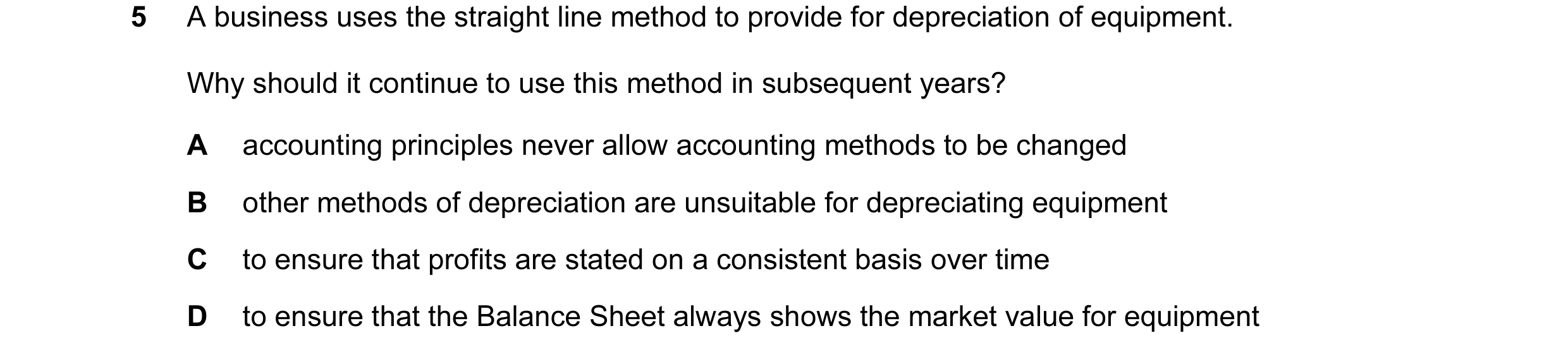
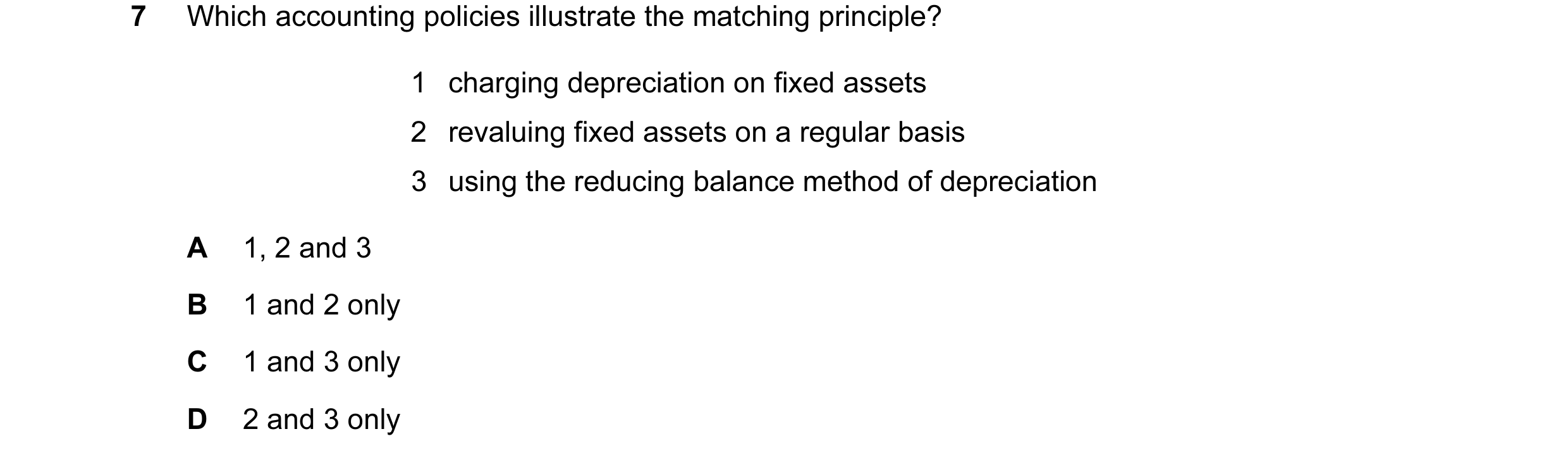
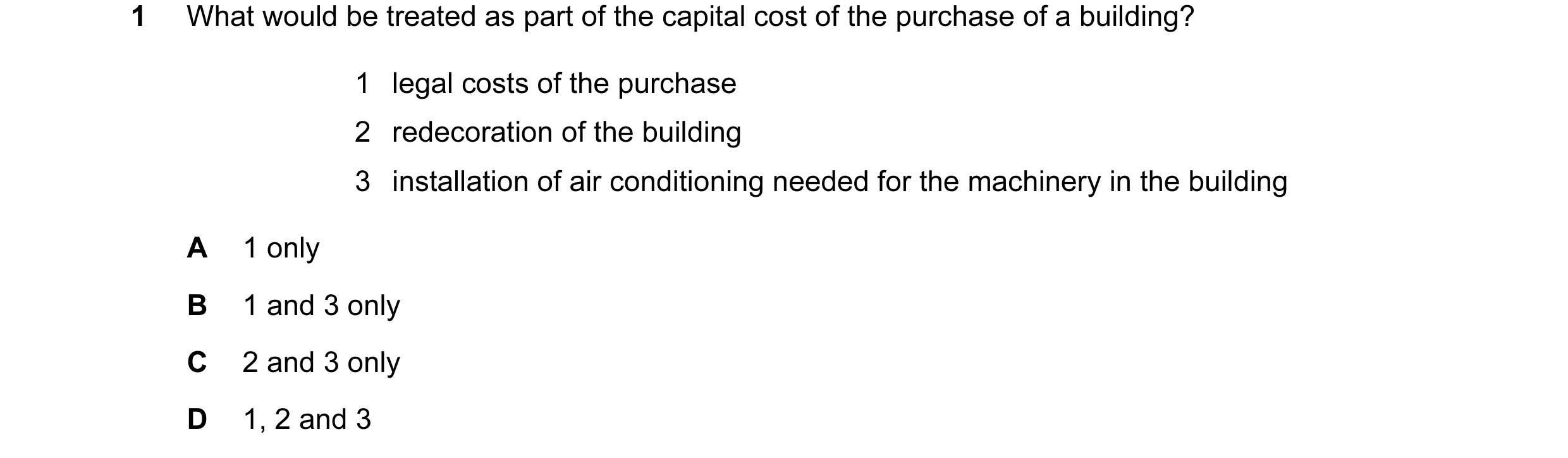 1 / 72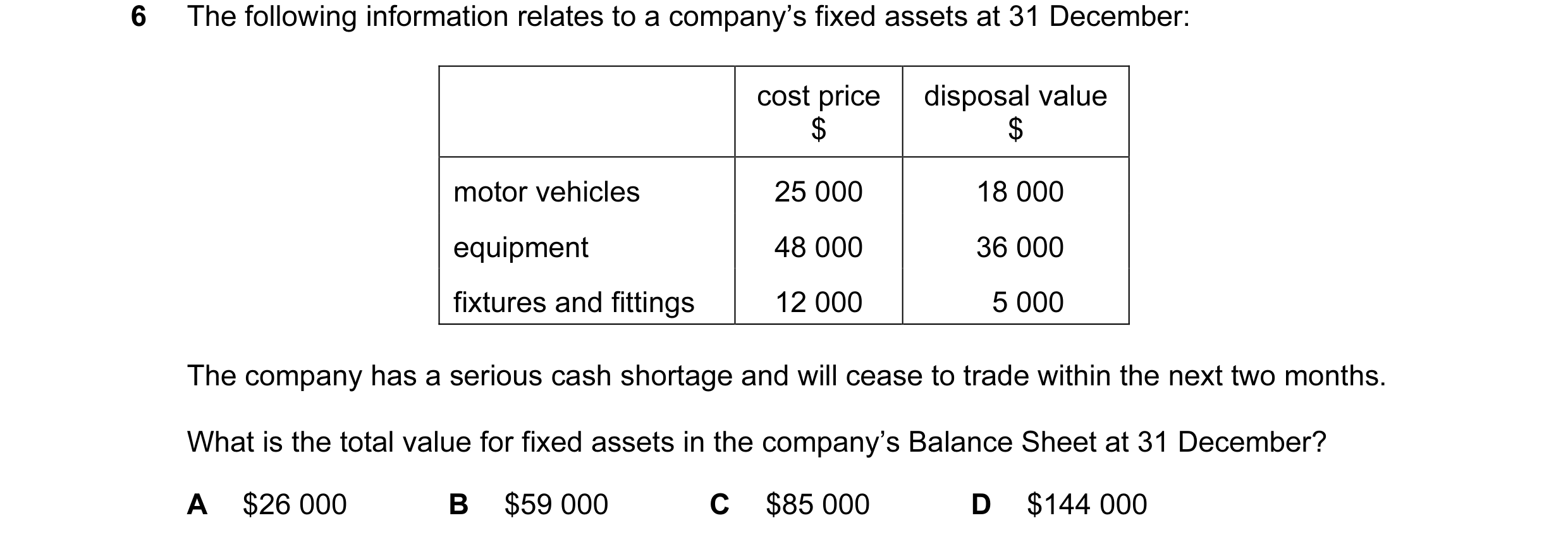



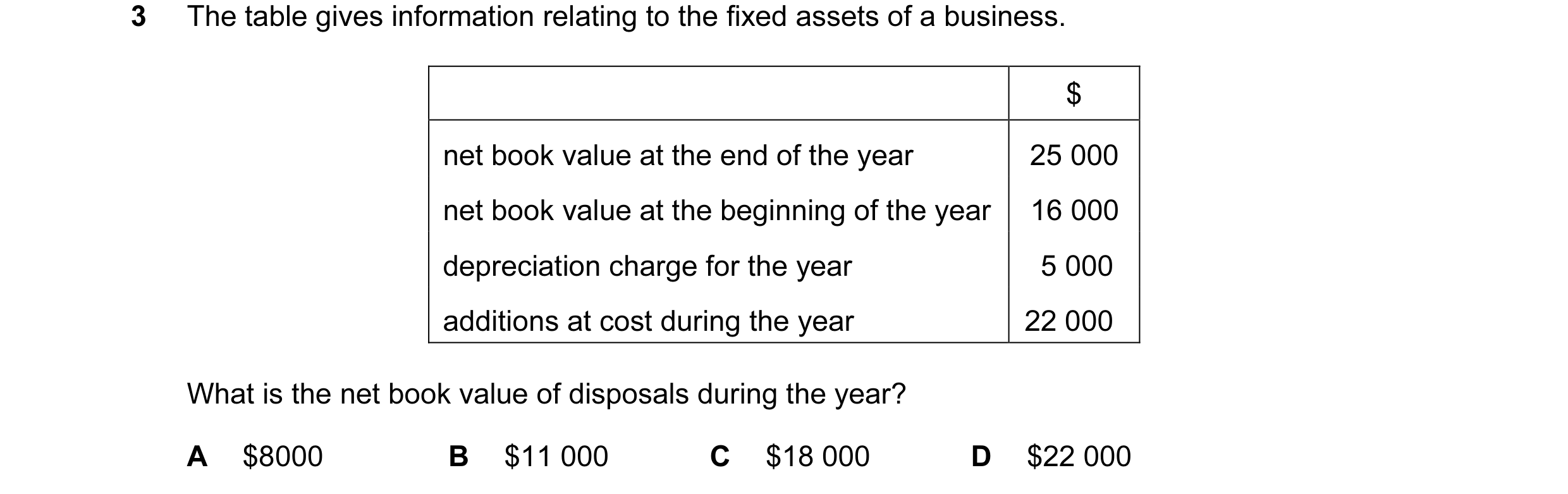 2 / 72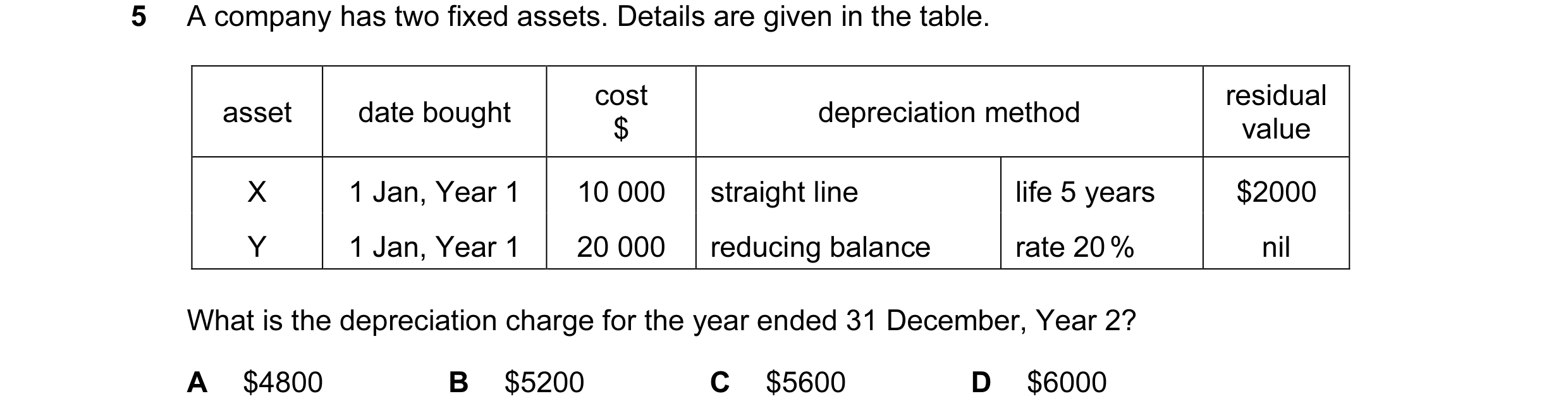


 3 / 72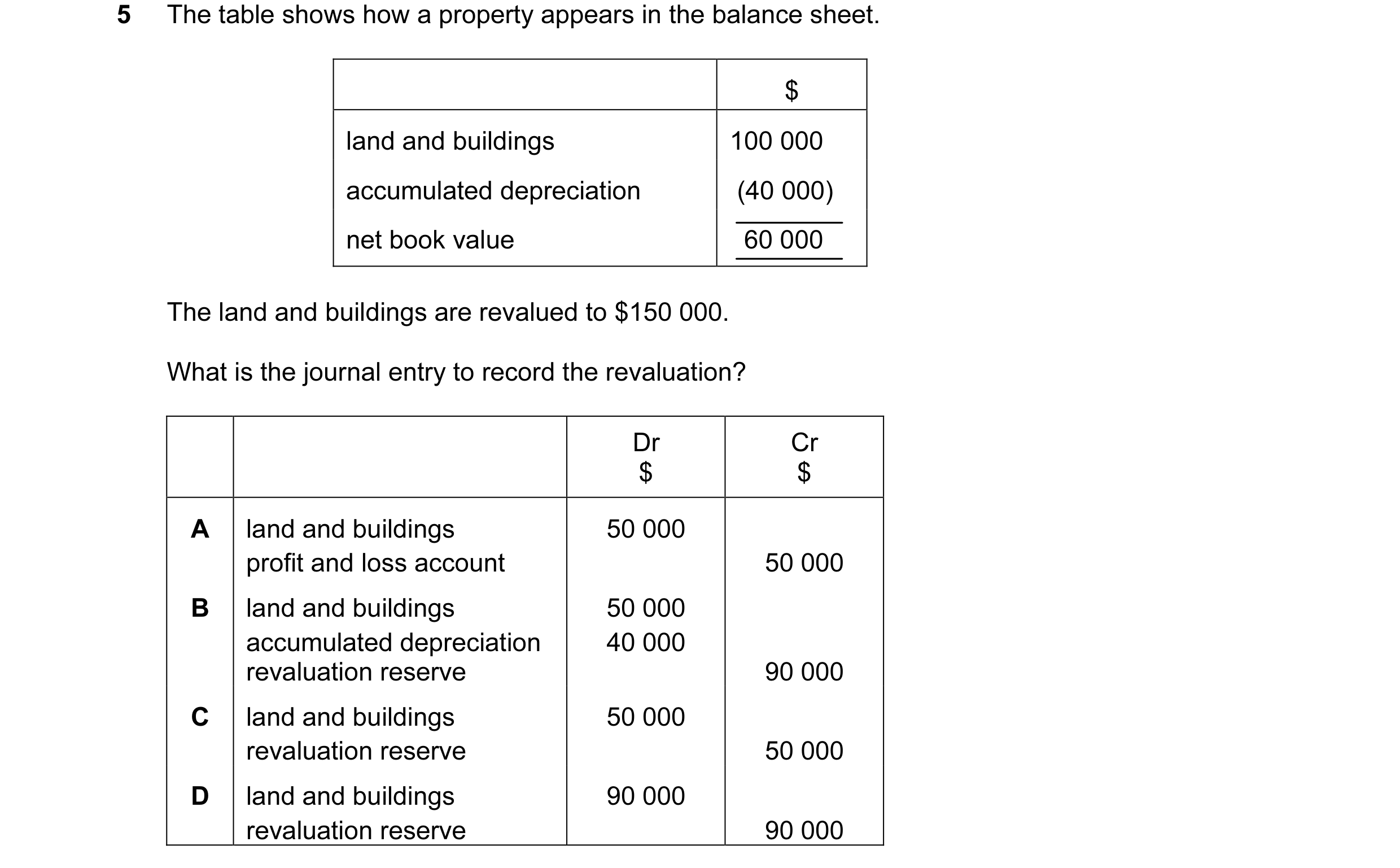

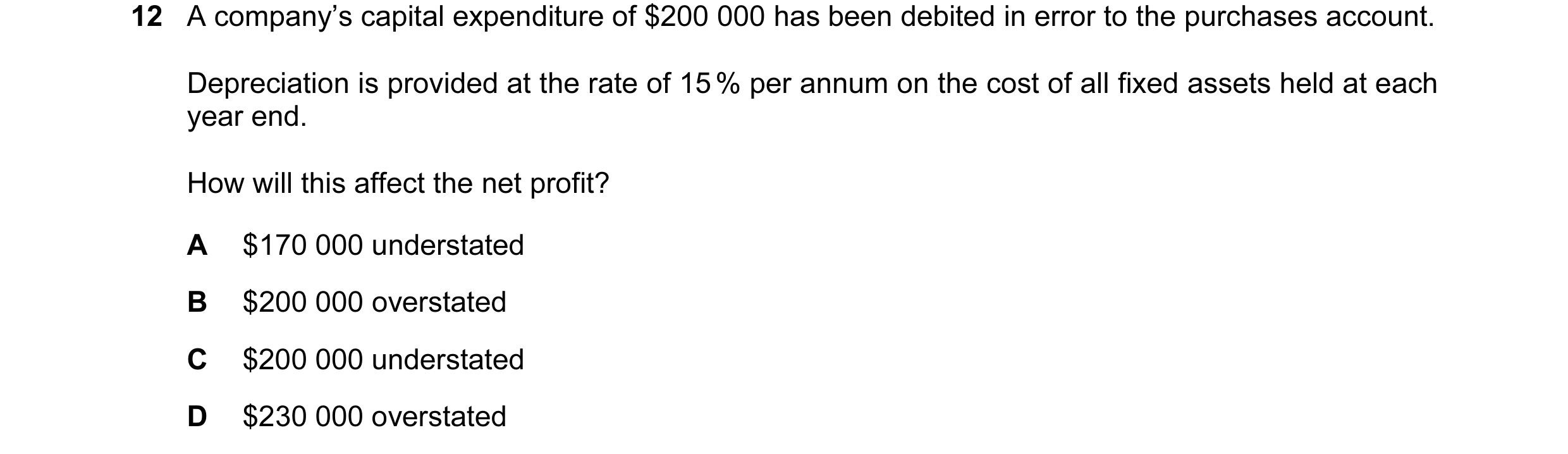
 4 / 72


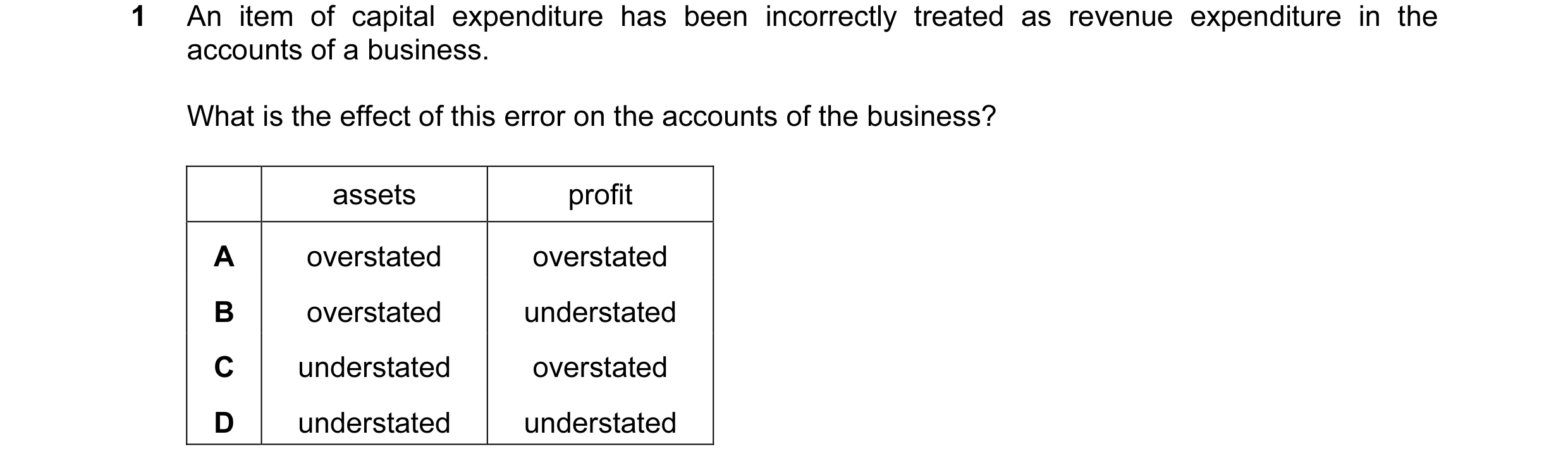
 5 / 72
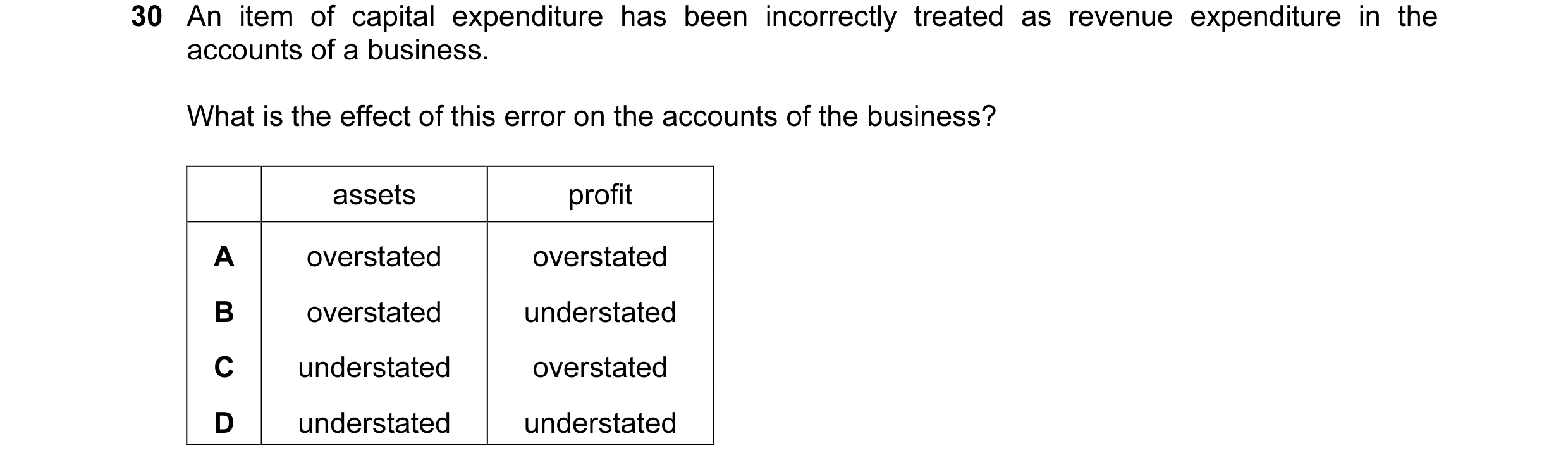
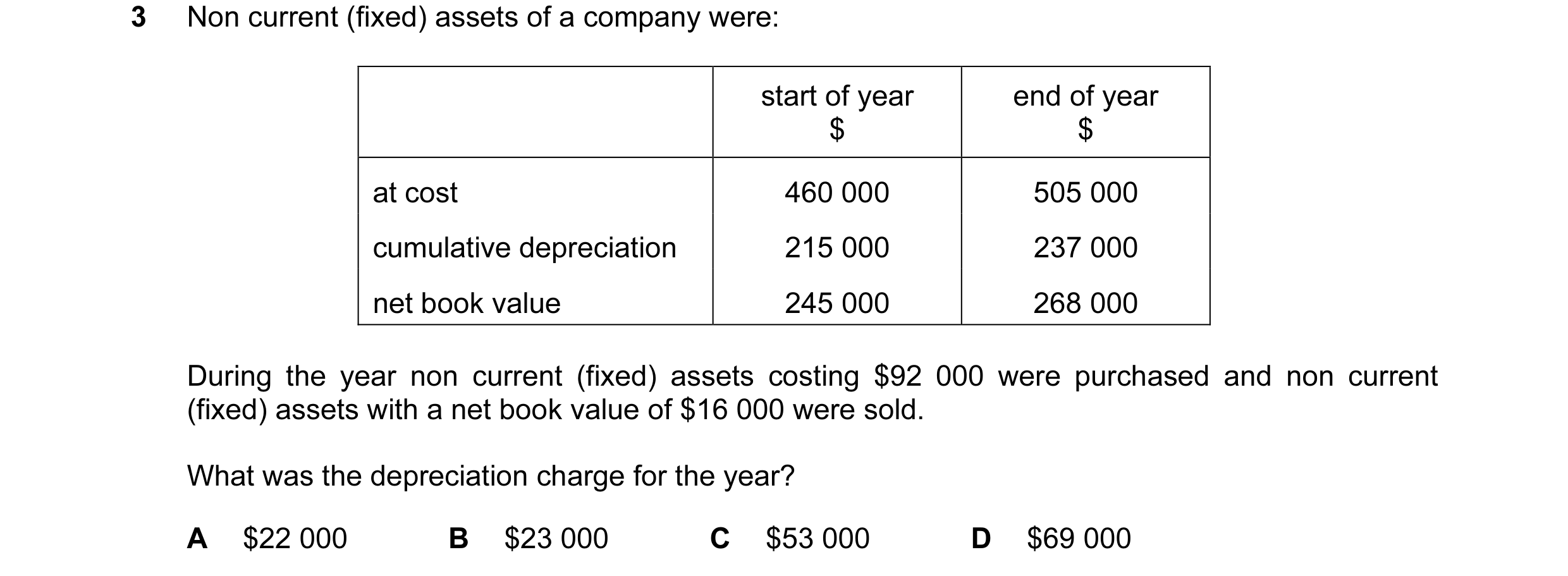
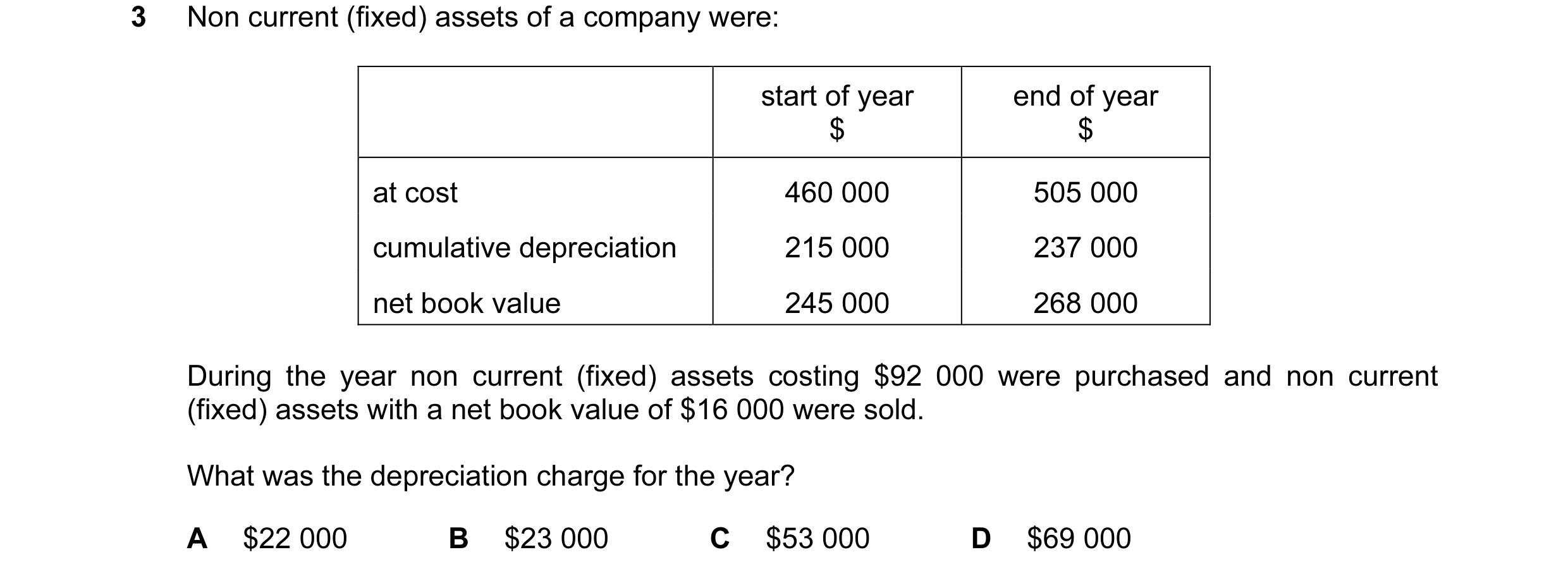 6 / 72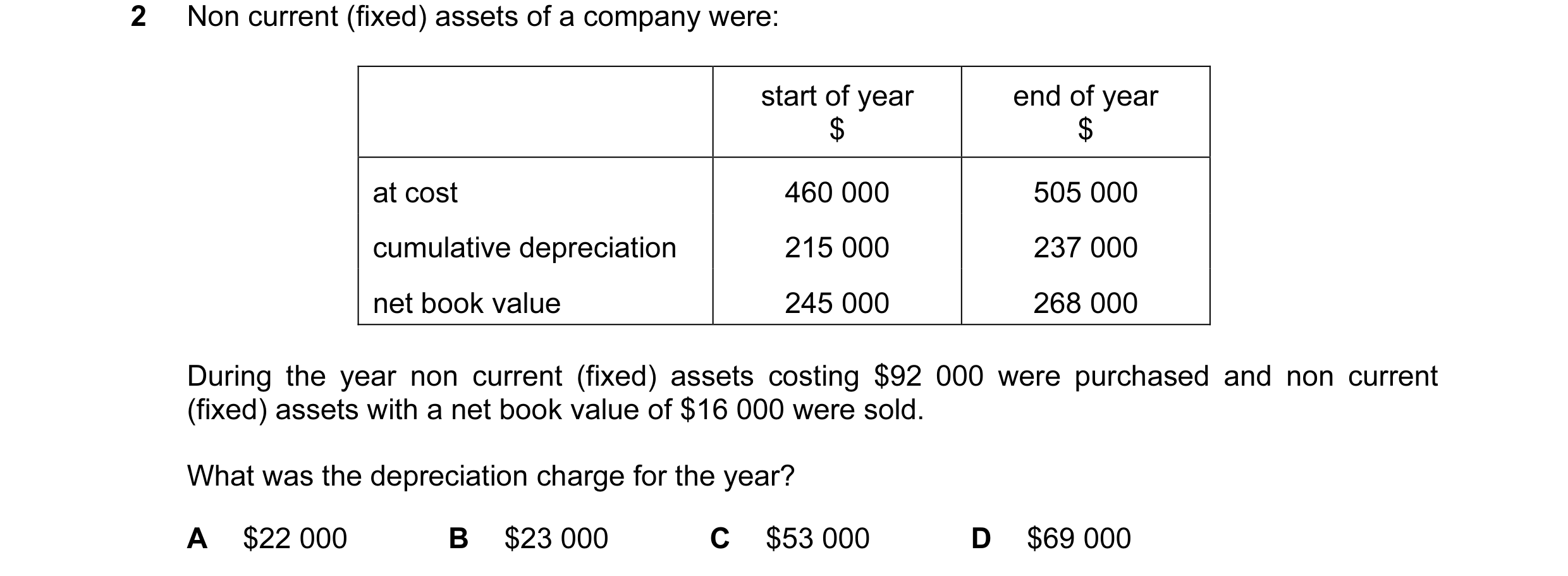
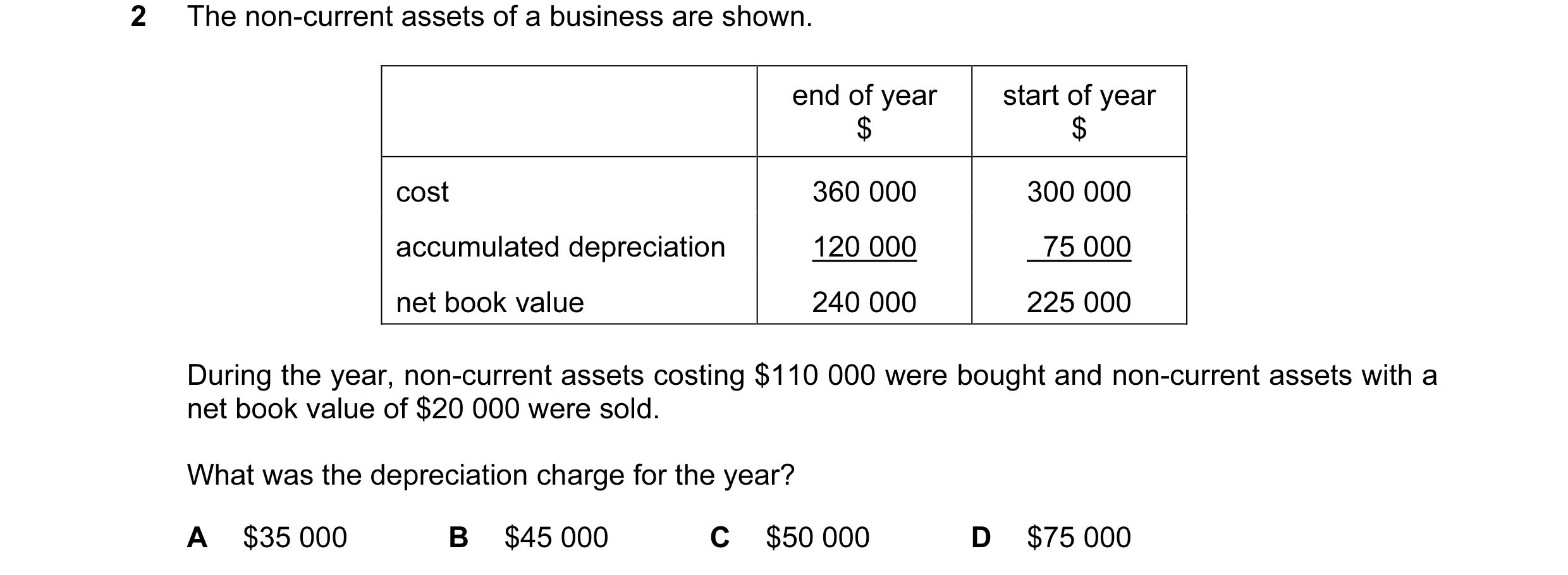

 7 / 72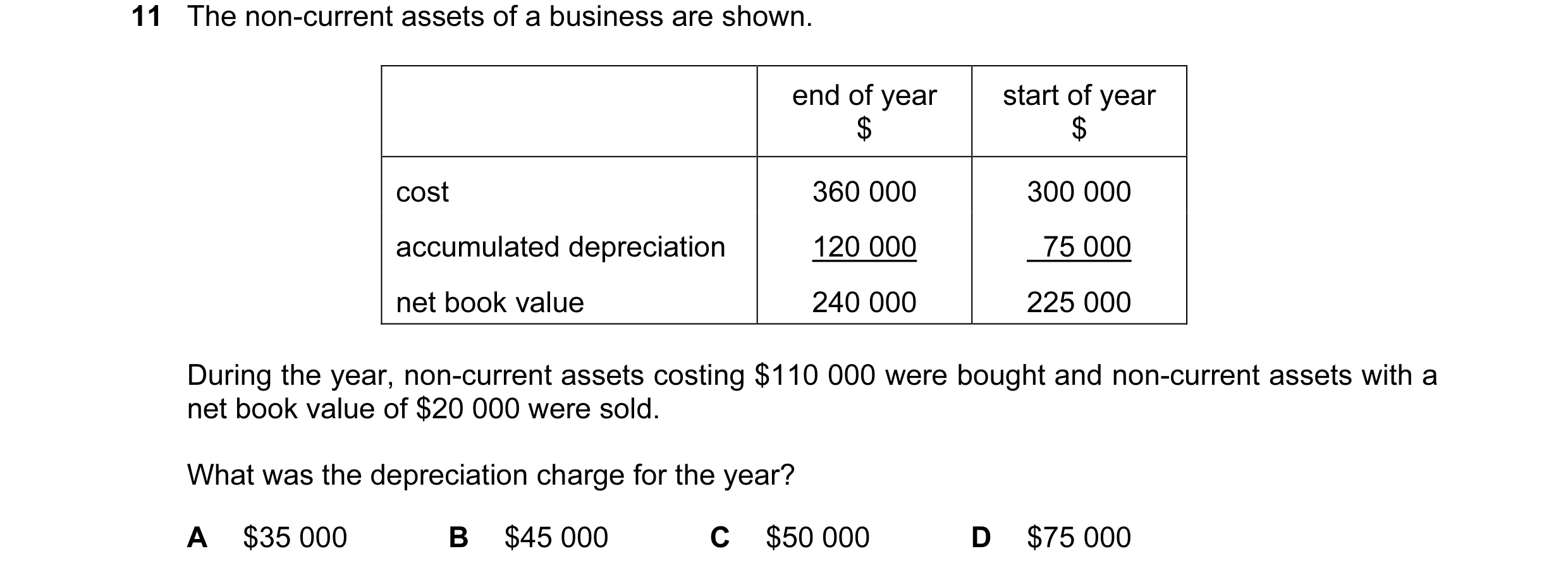
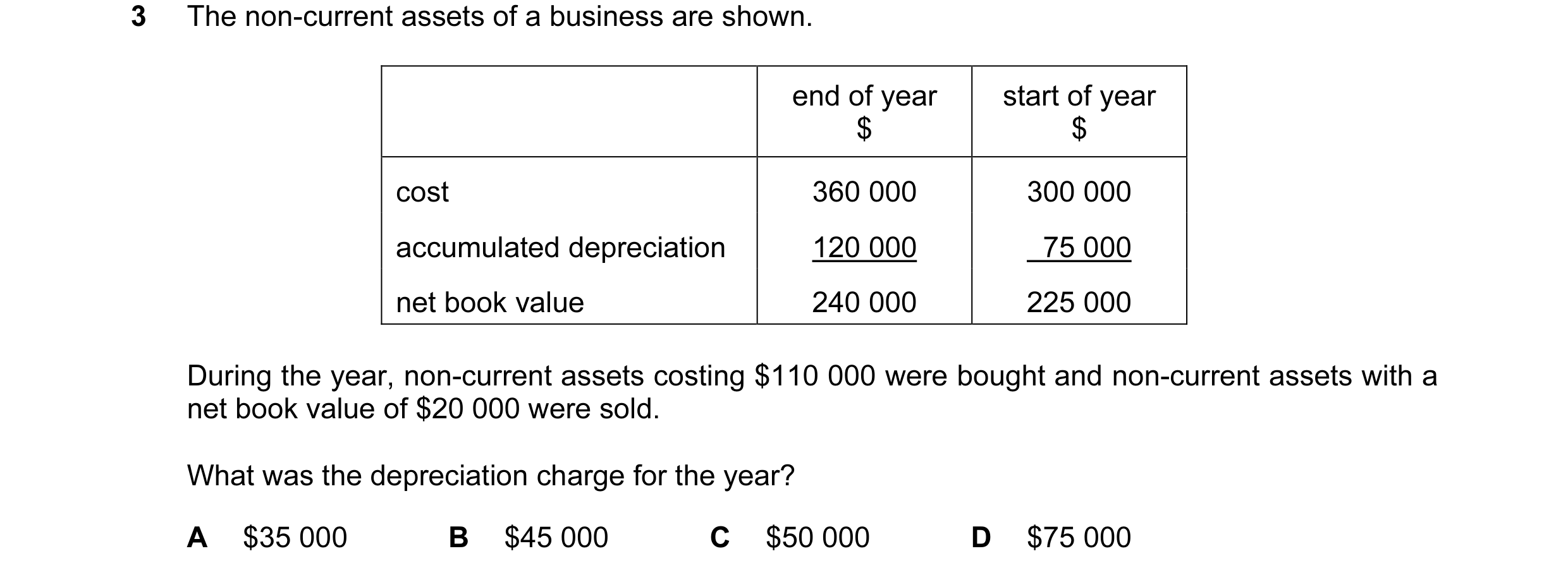

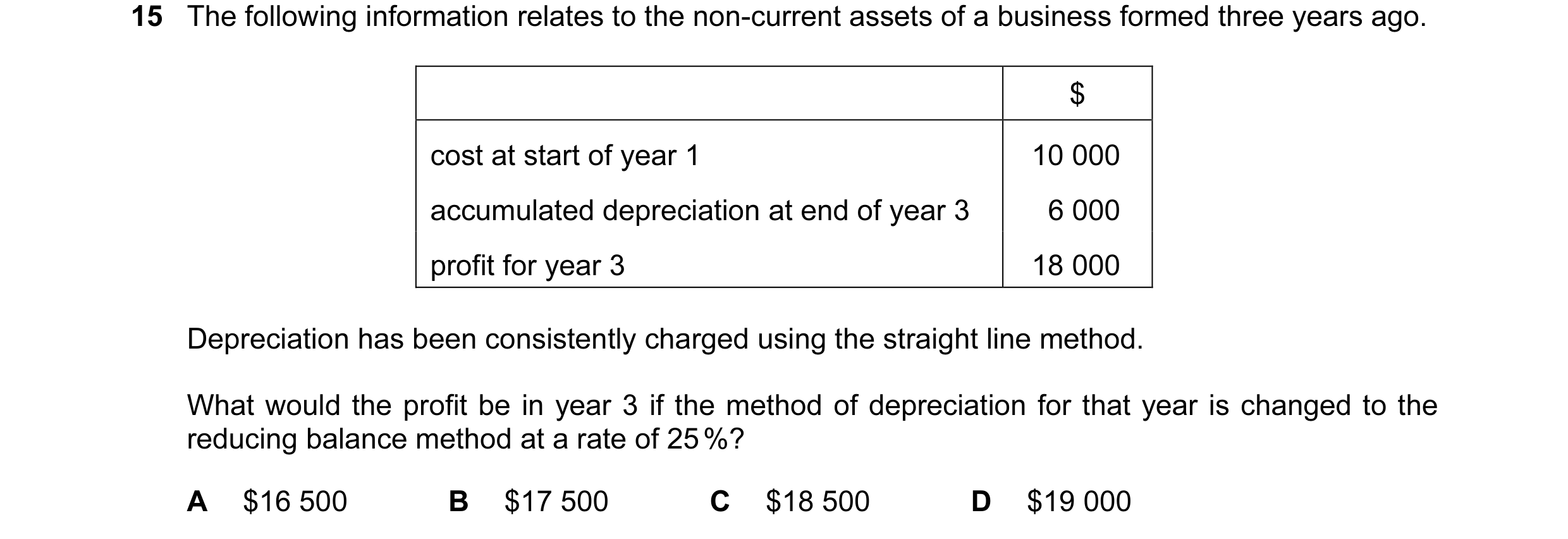 8 / 72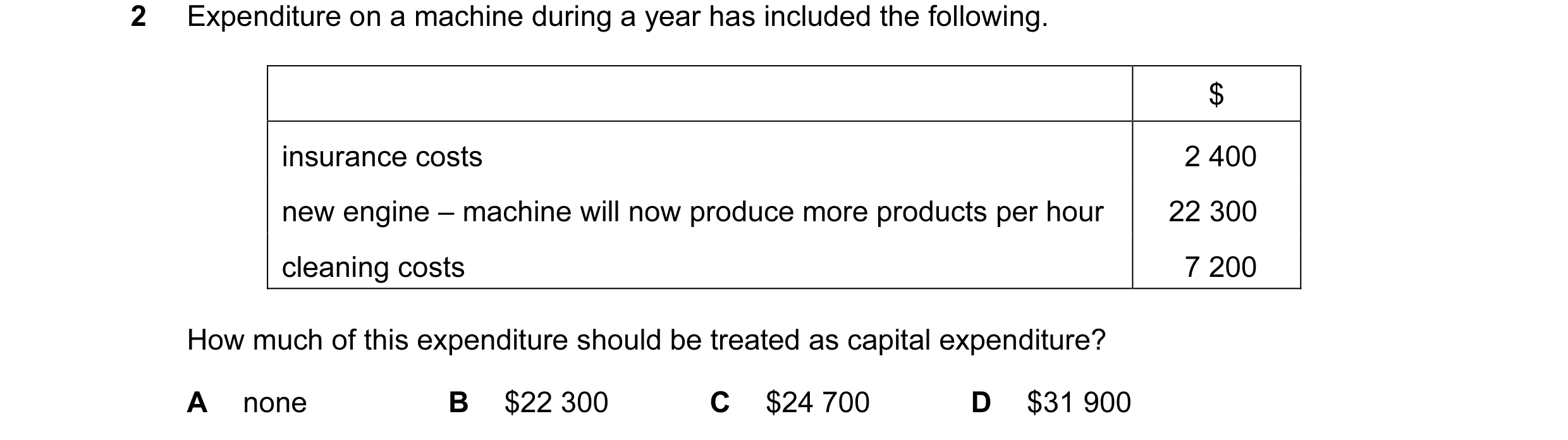

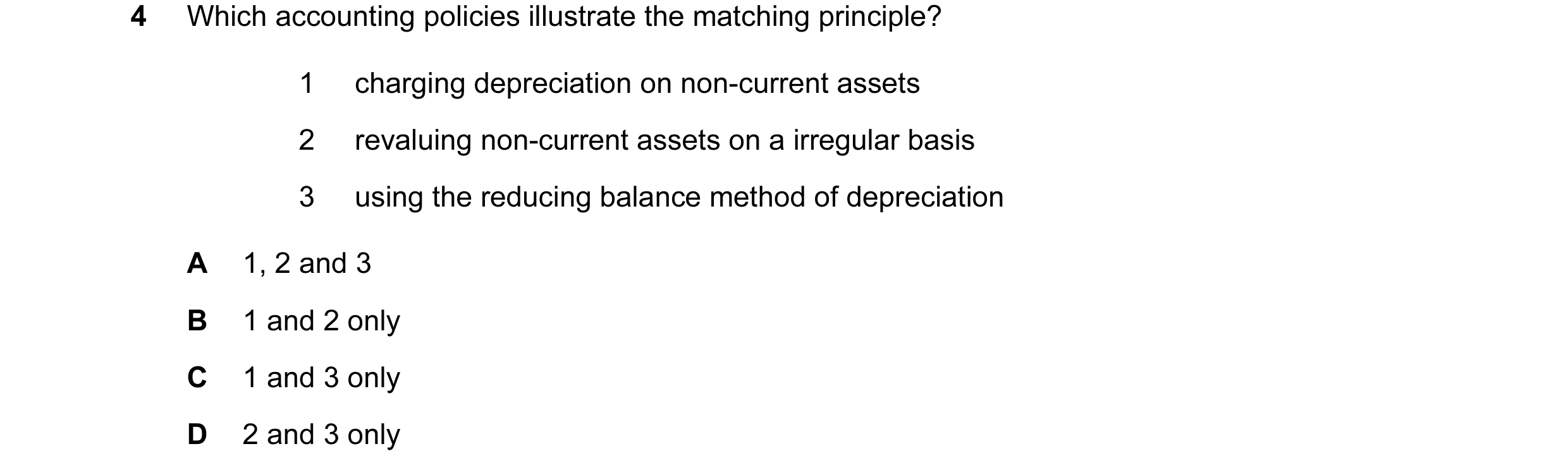

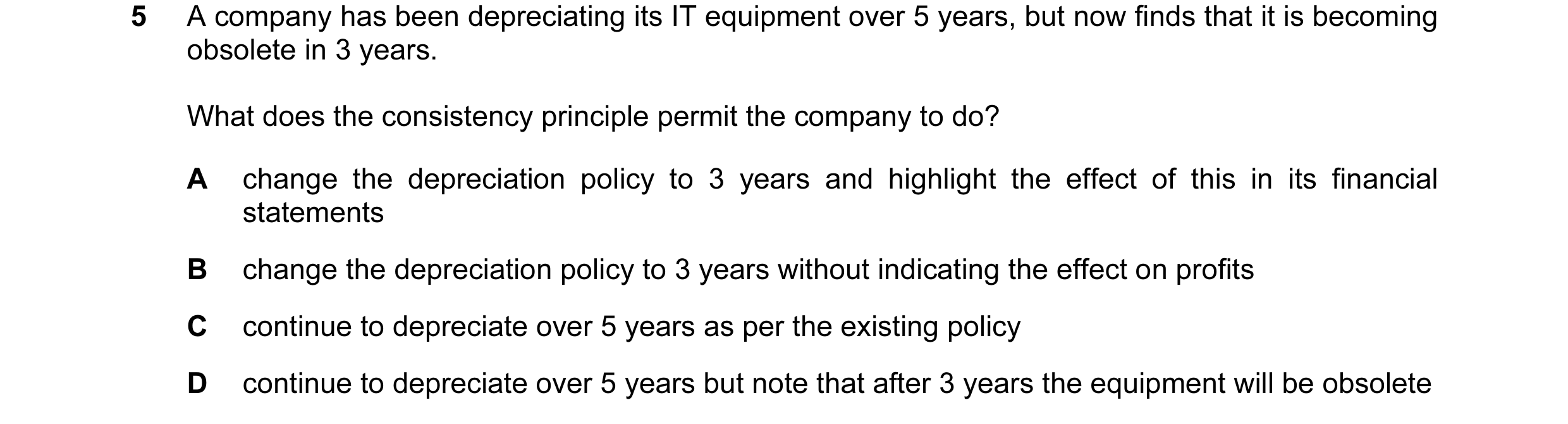 9 / 72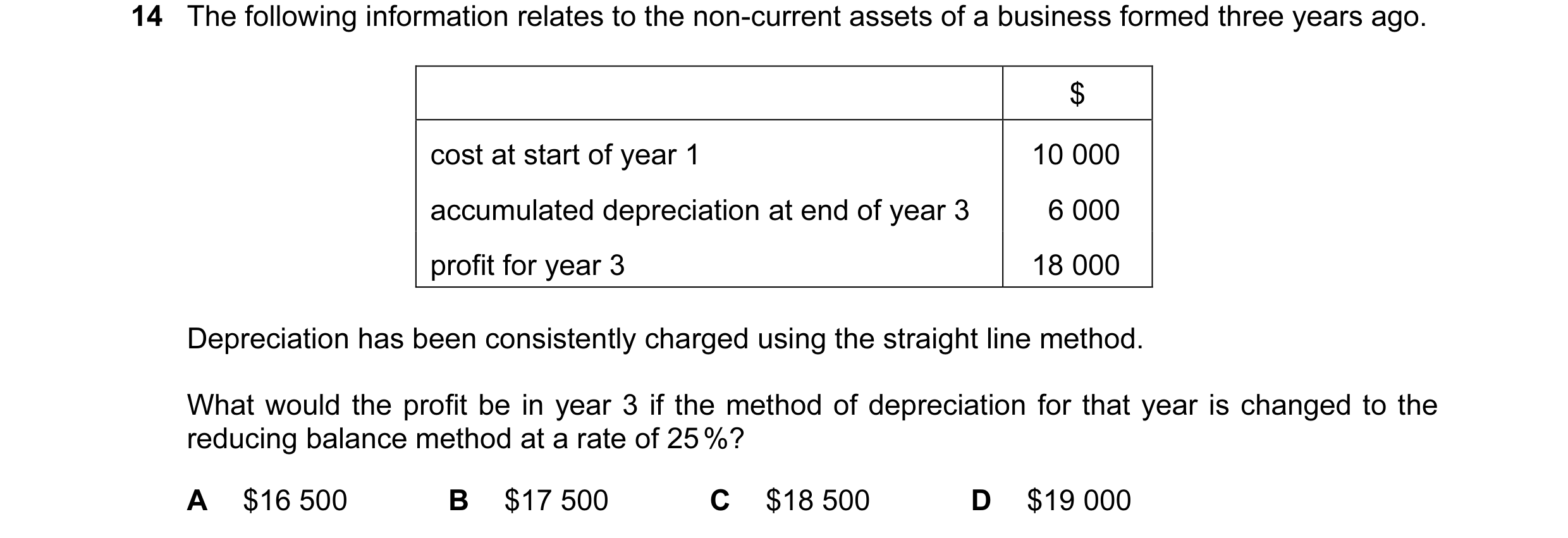


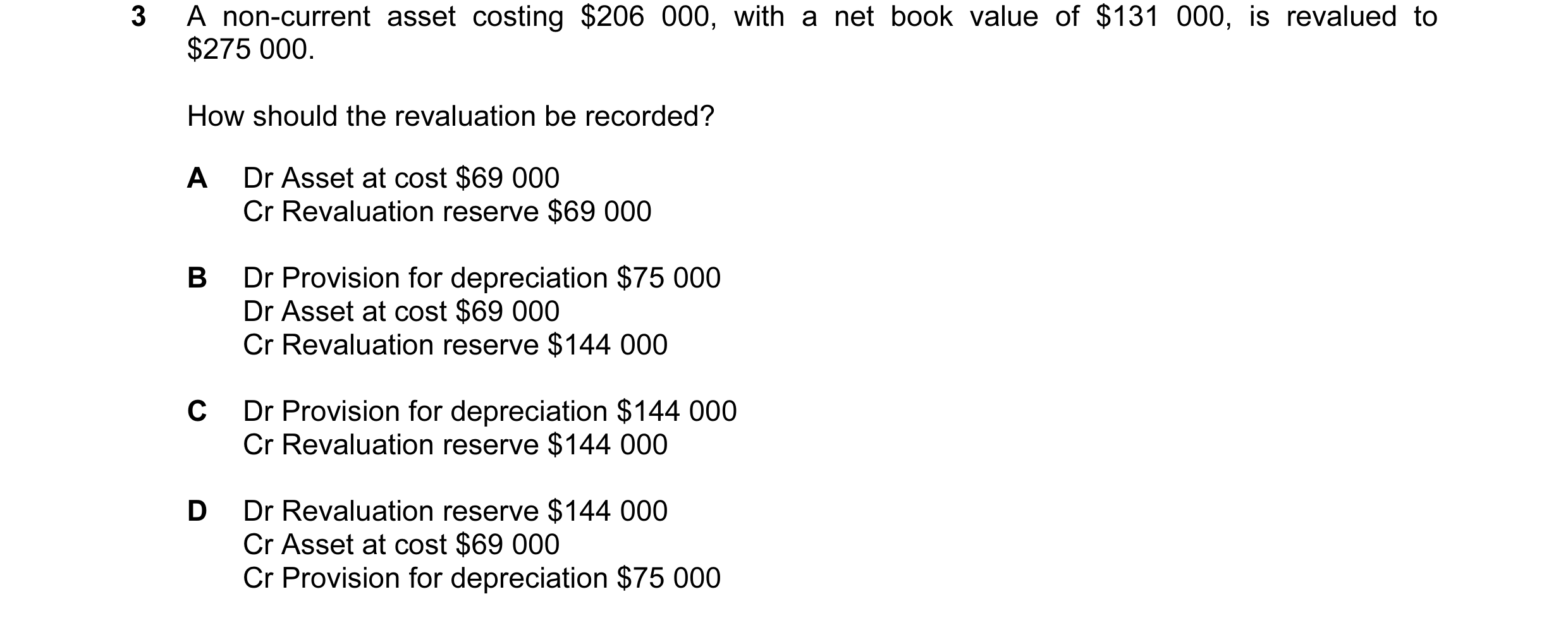
 10 / 72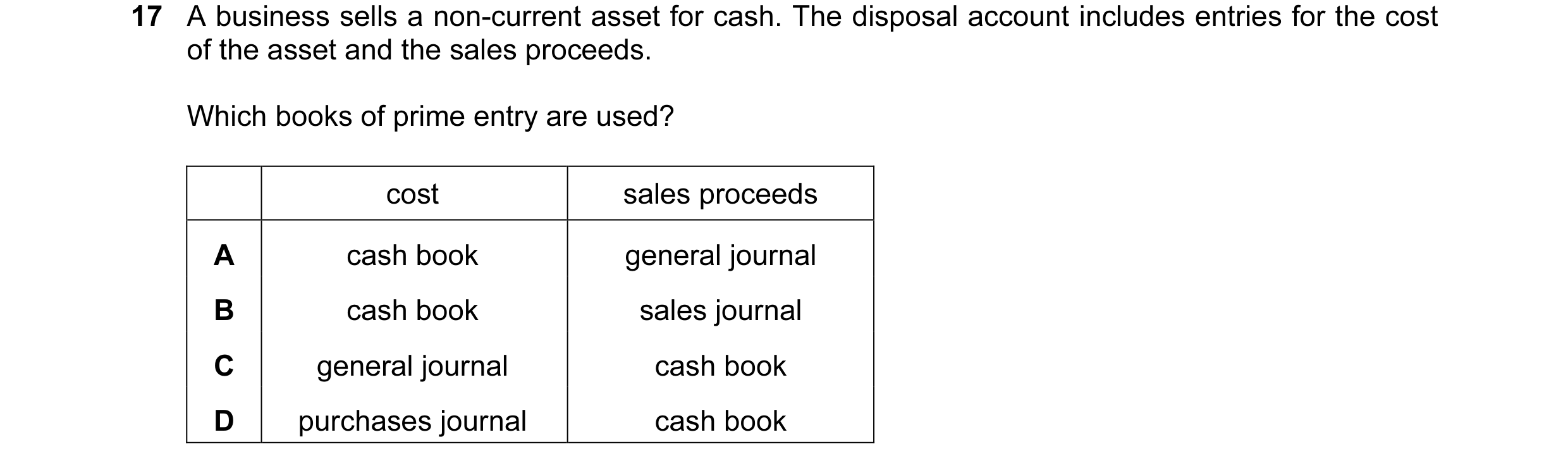
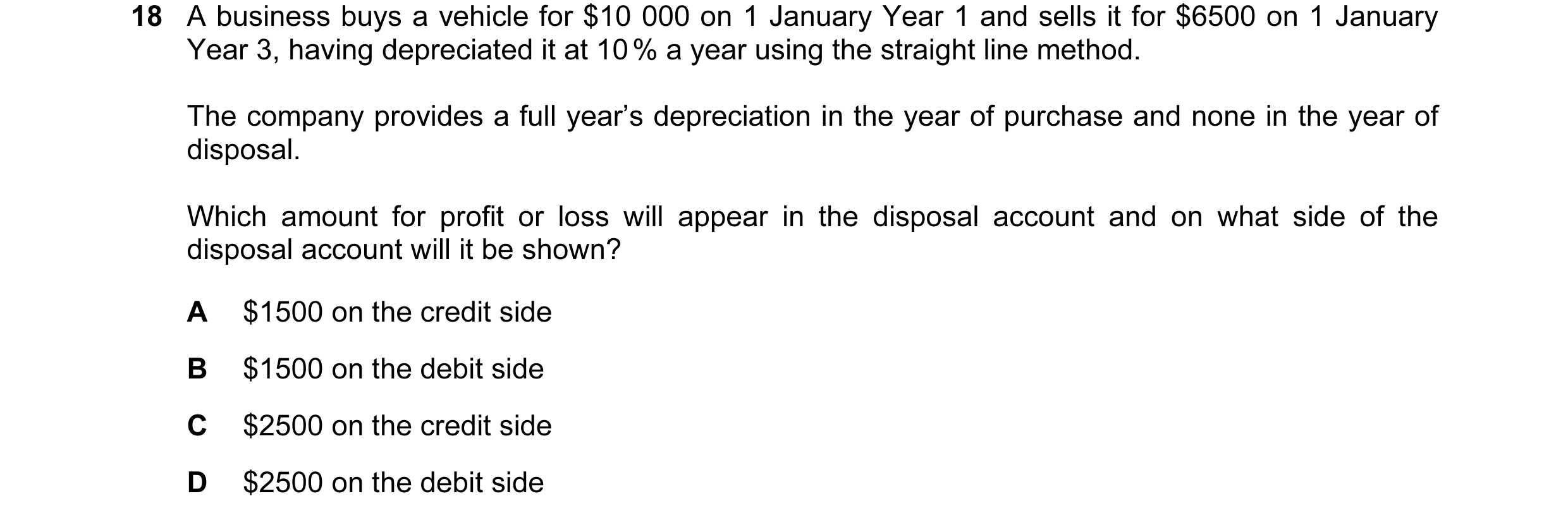

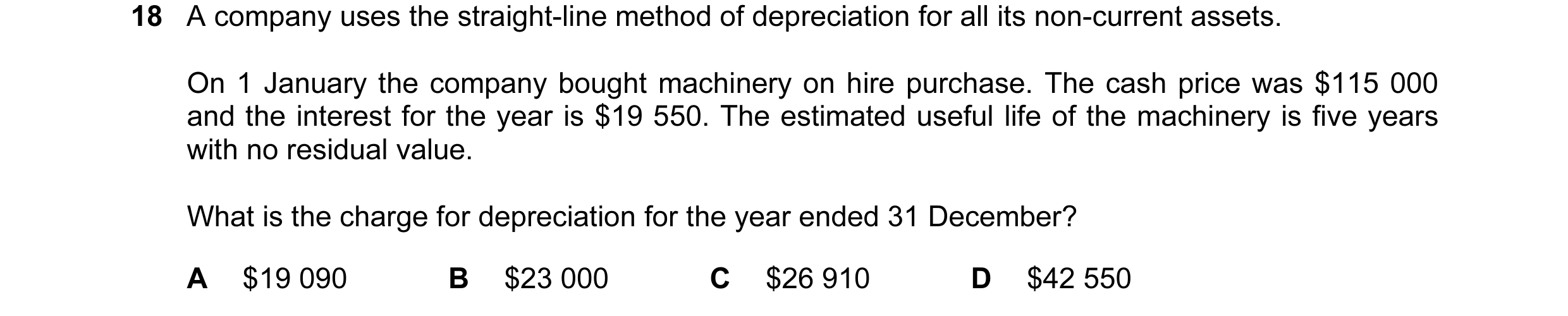
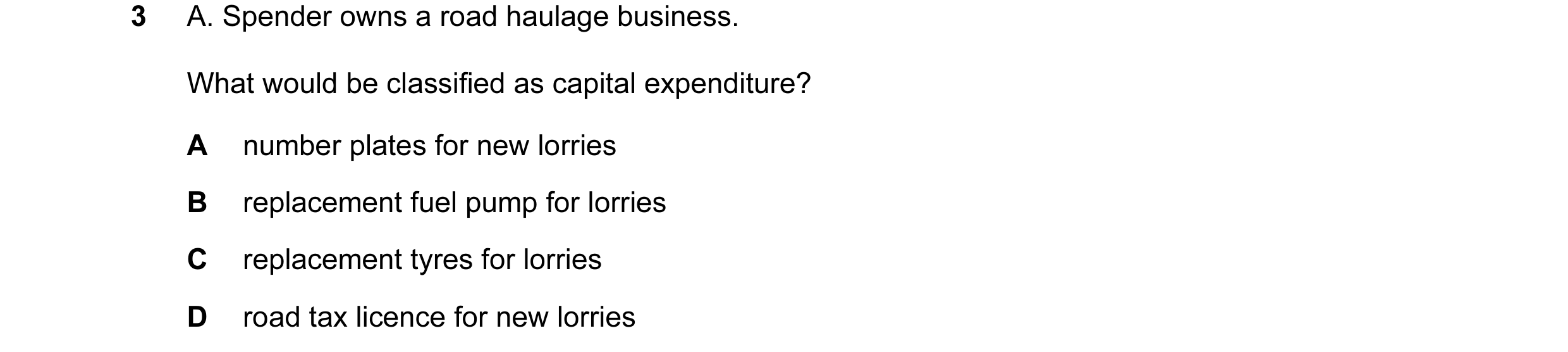 11 / 72
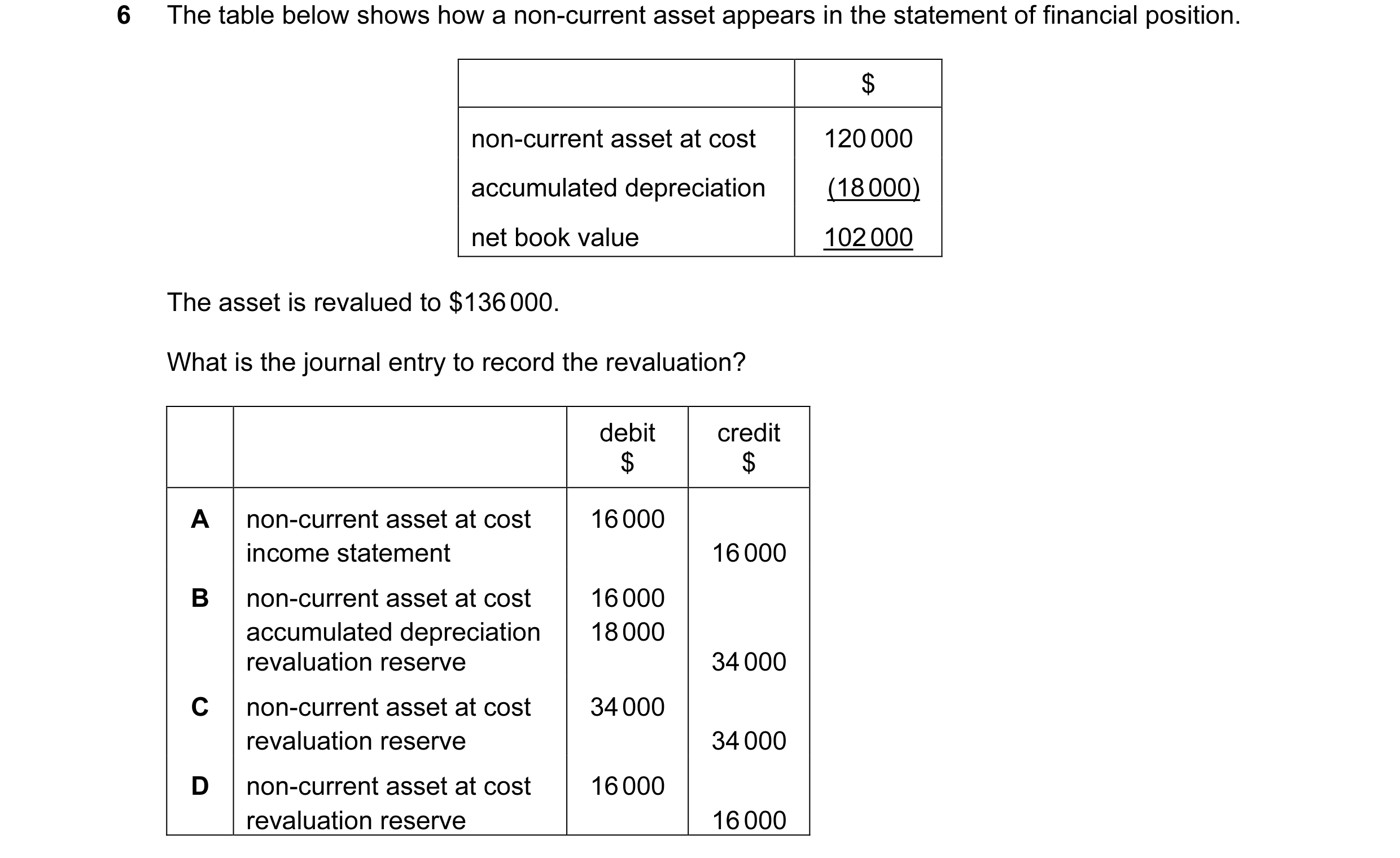
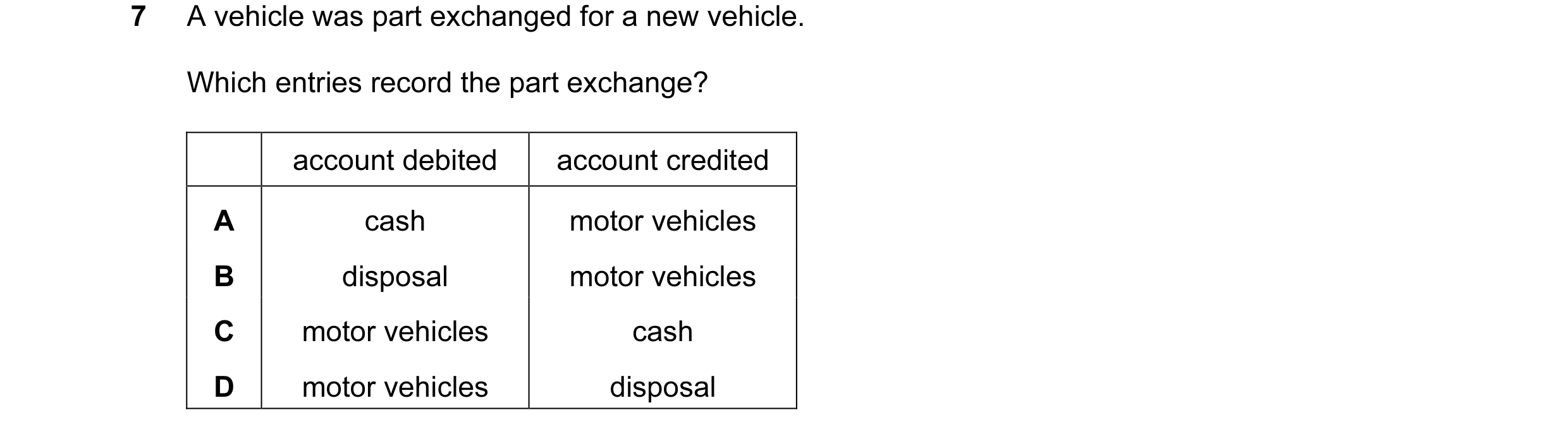 12 / 72
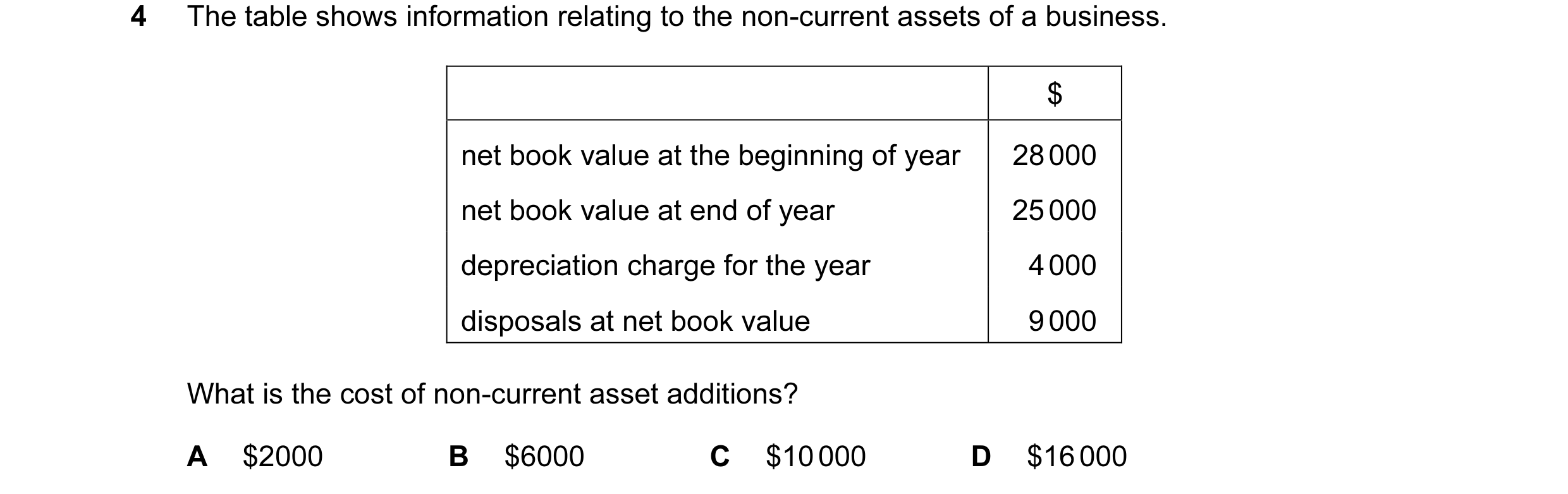
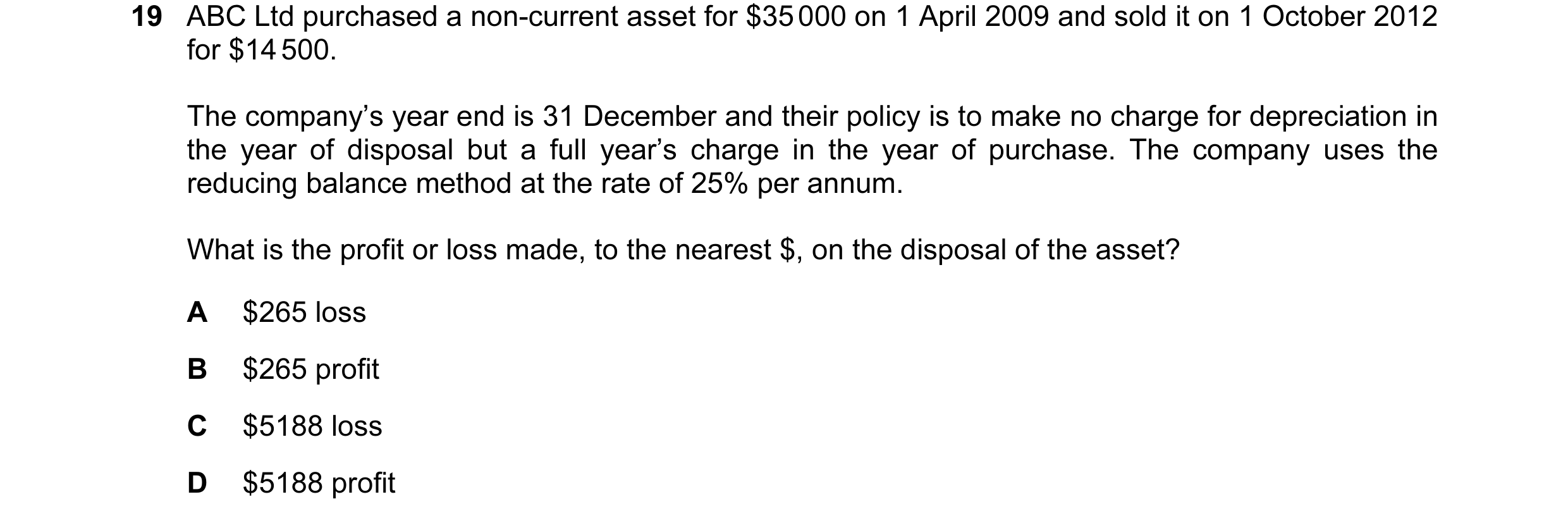
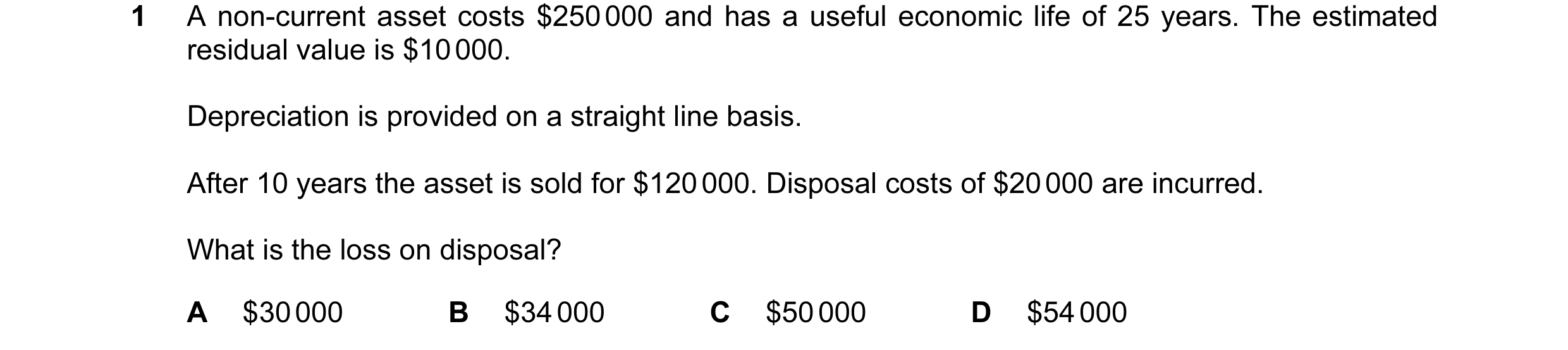 13 / 72

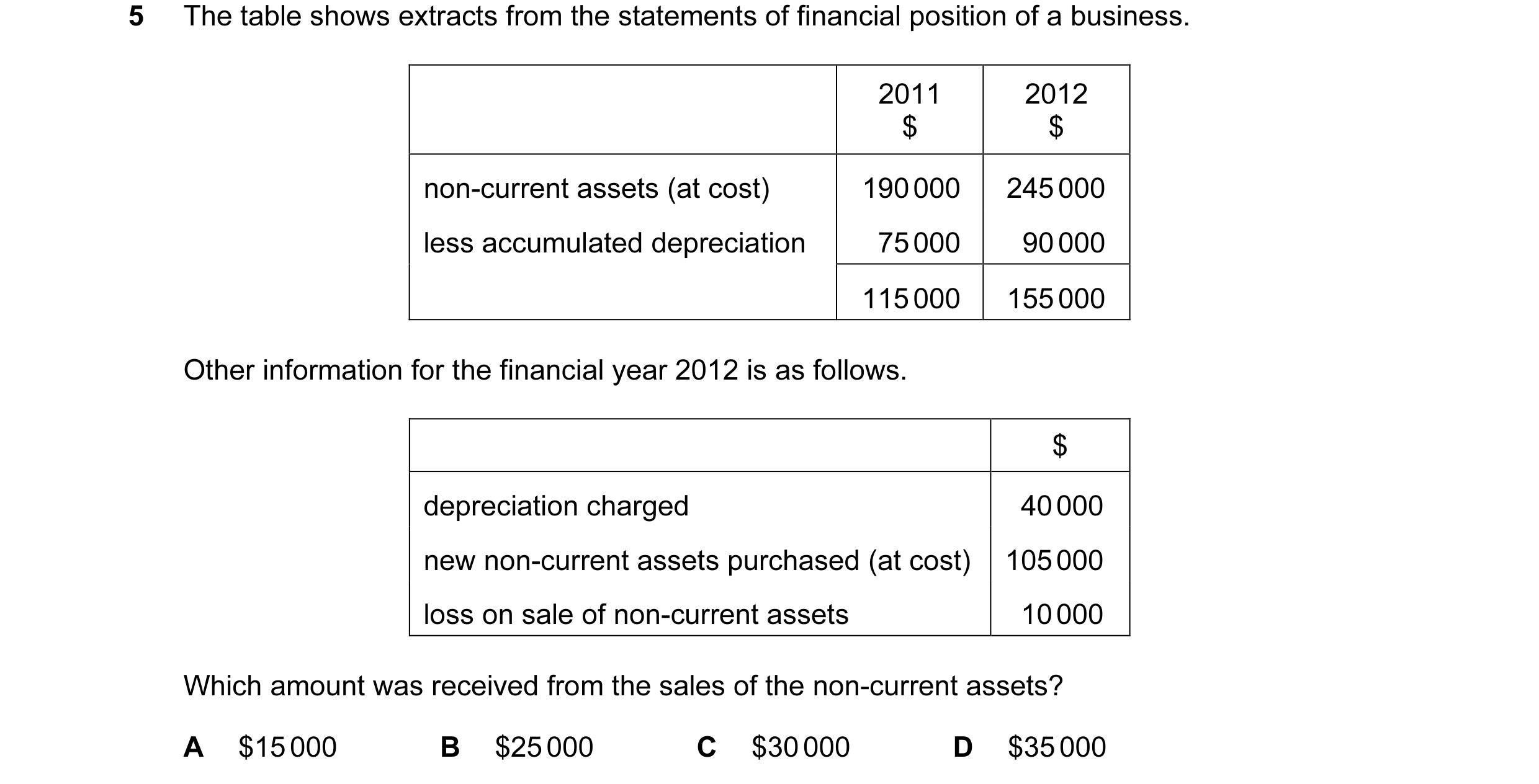
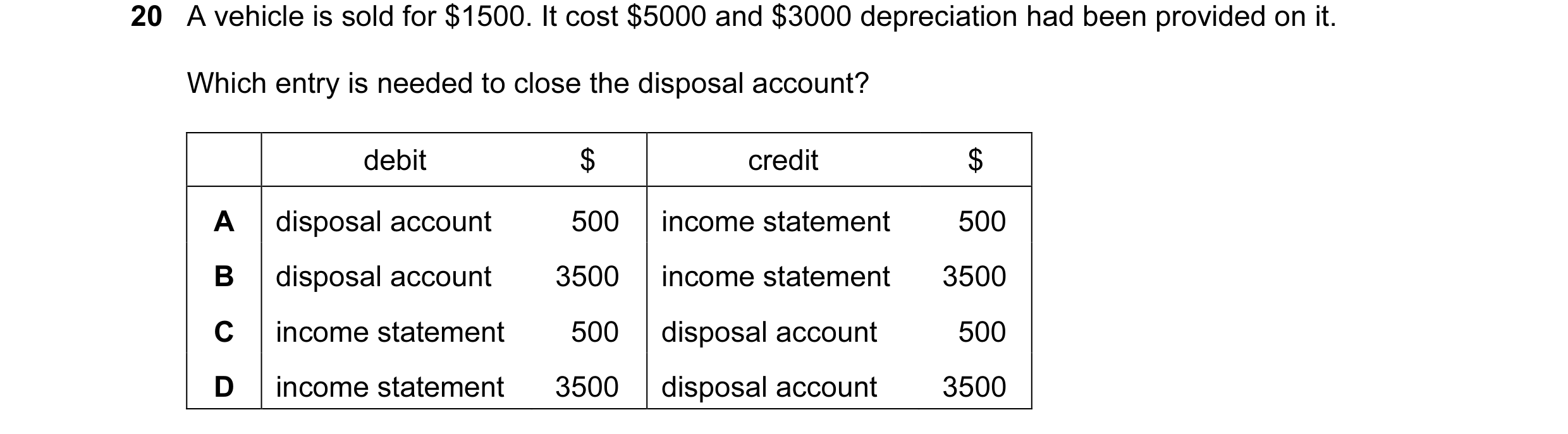
 14 / 72



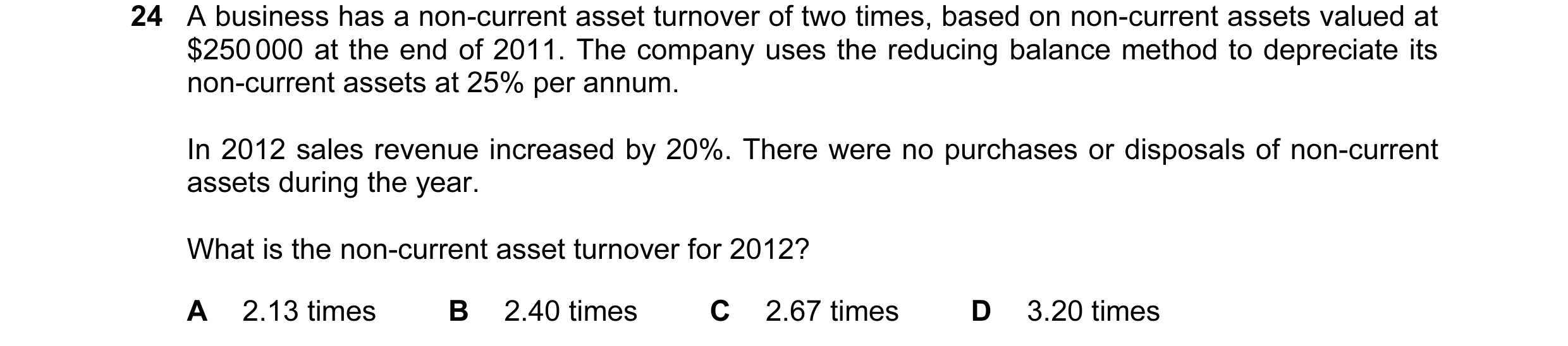
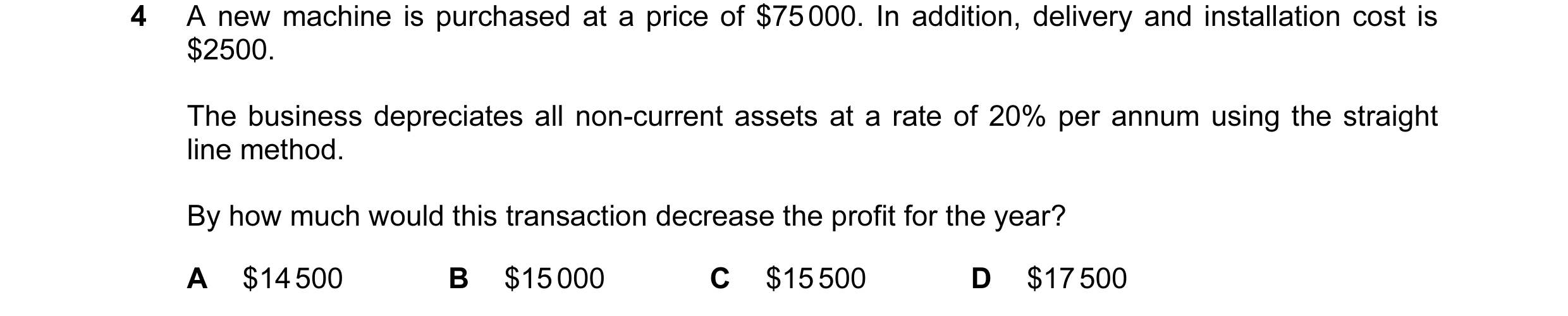 15 / 72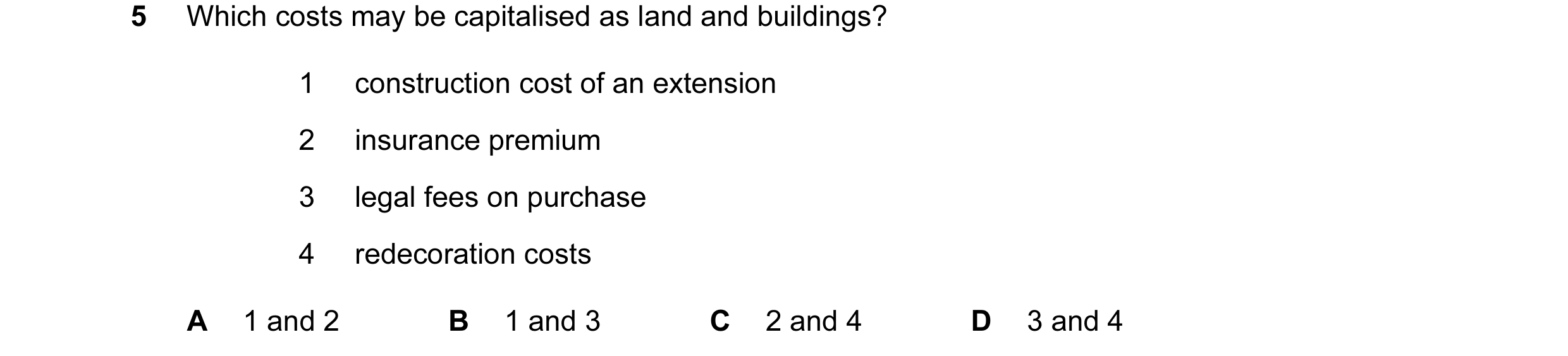

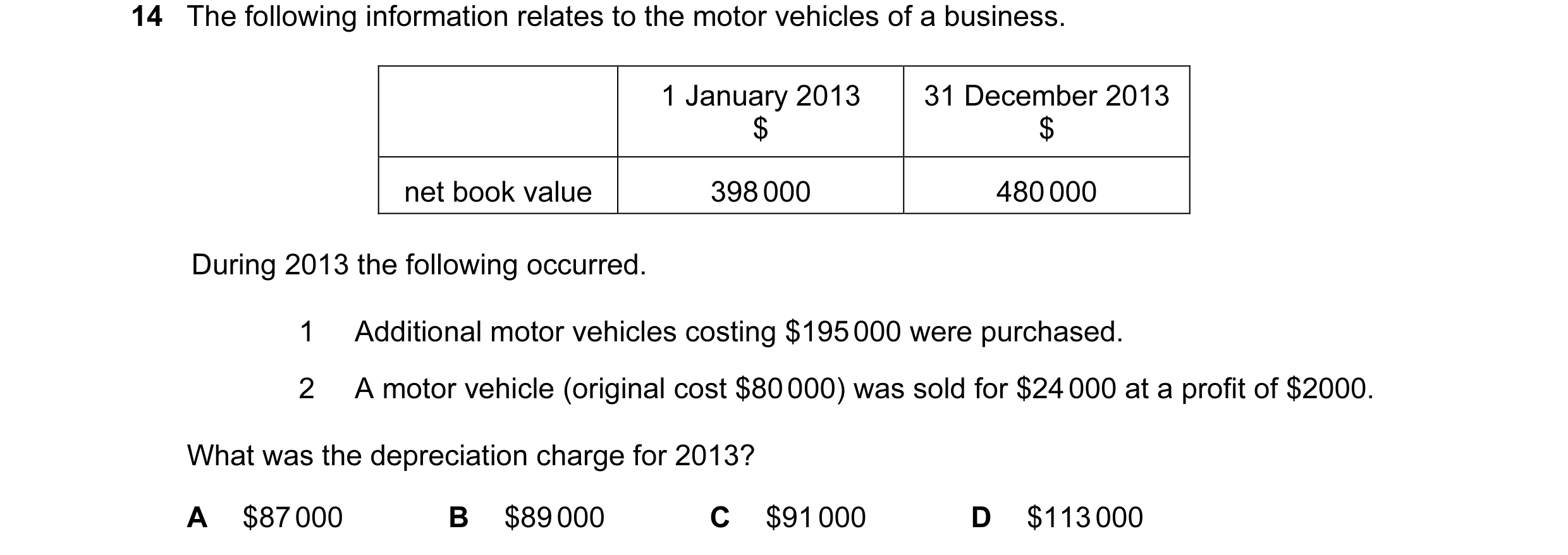
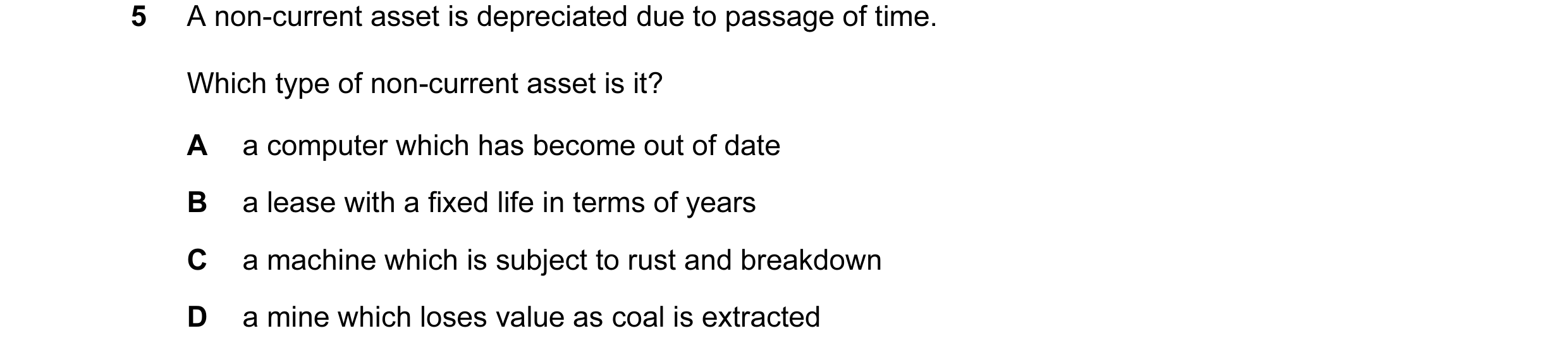
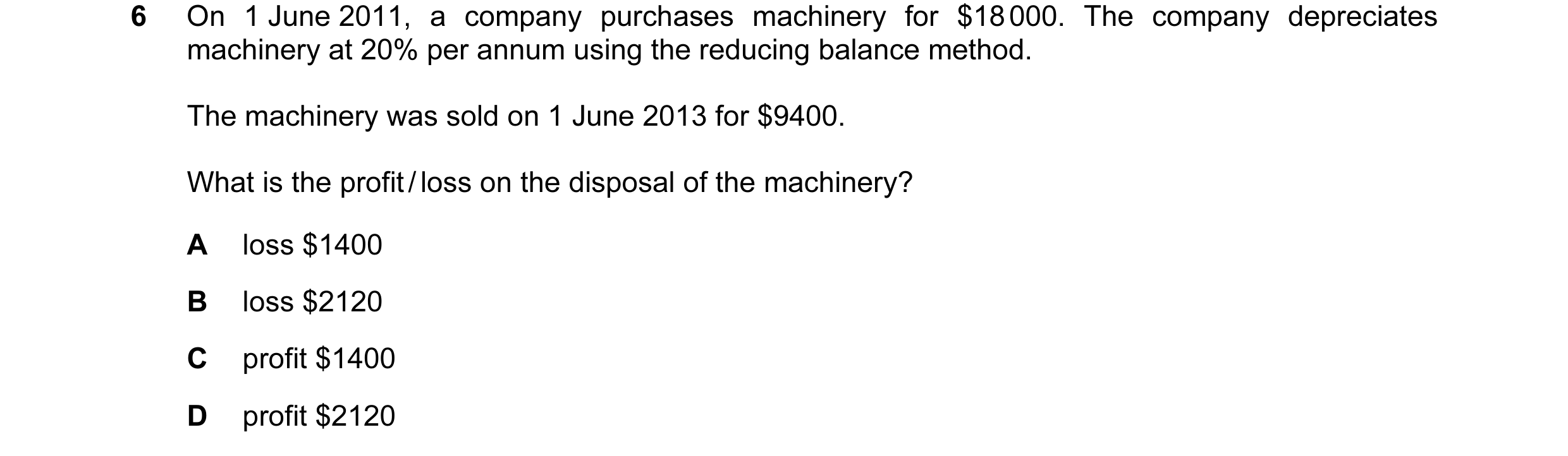 16 / 72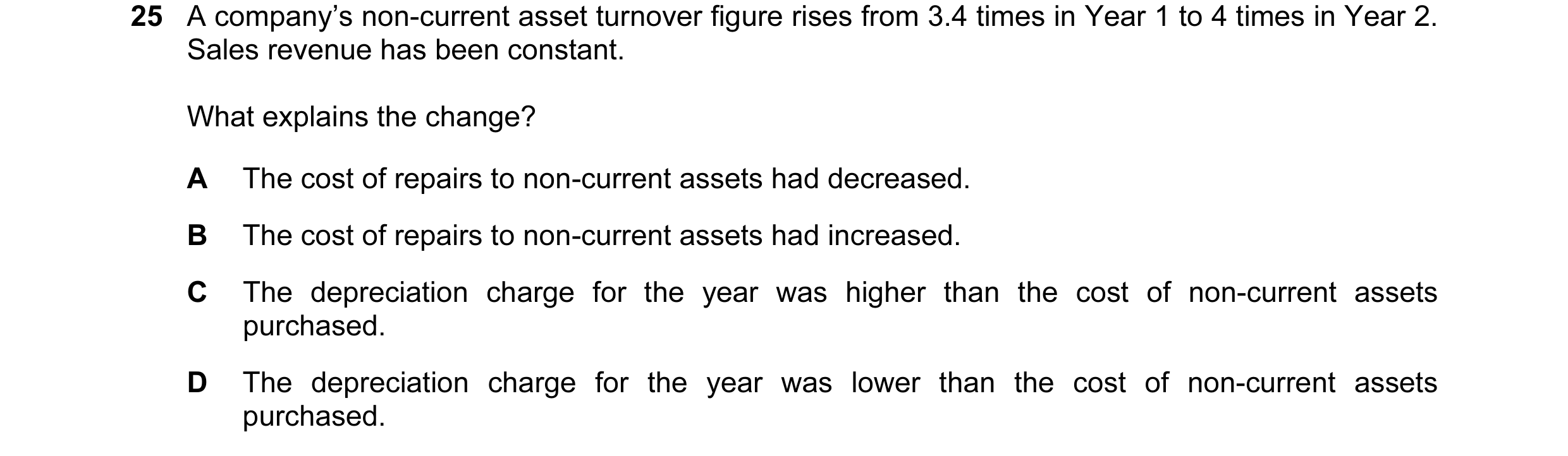


 17 / 72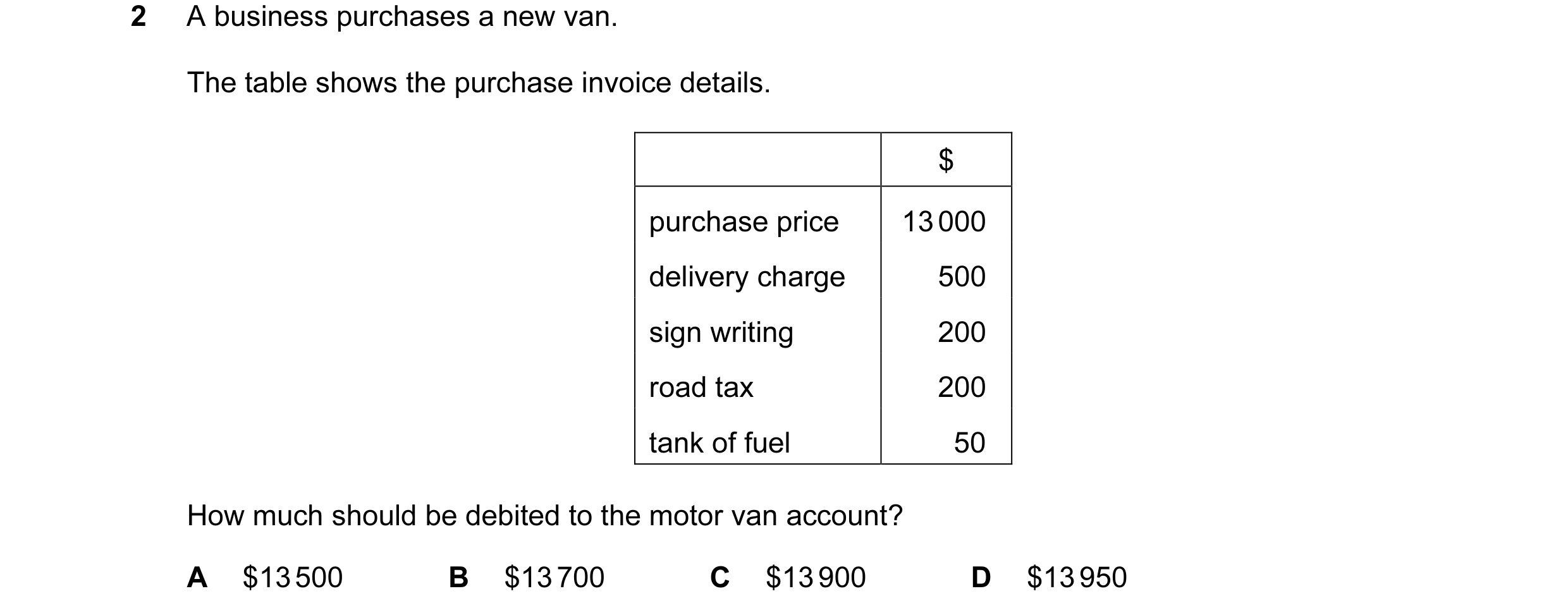
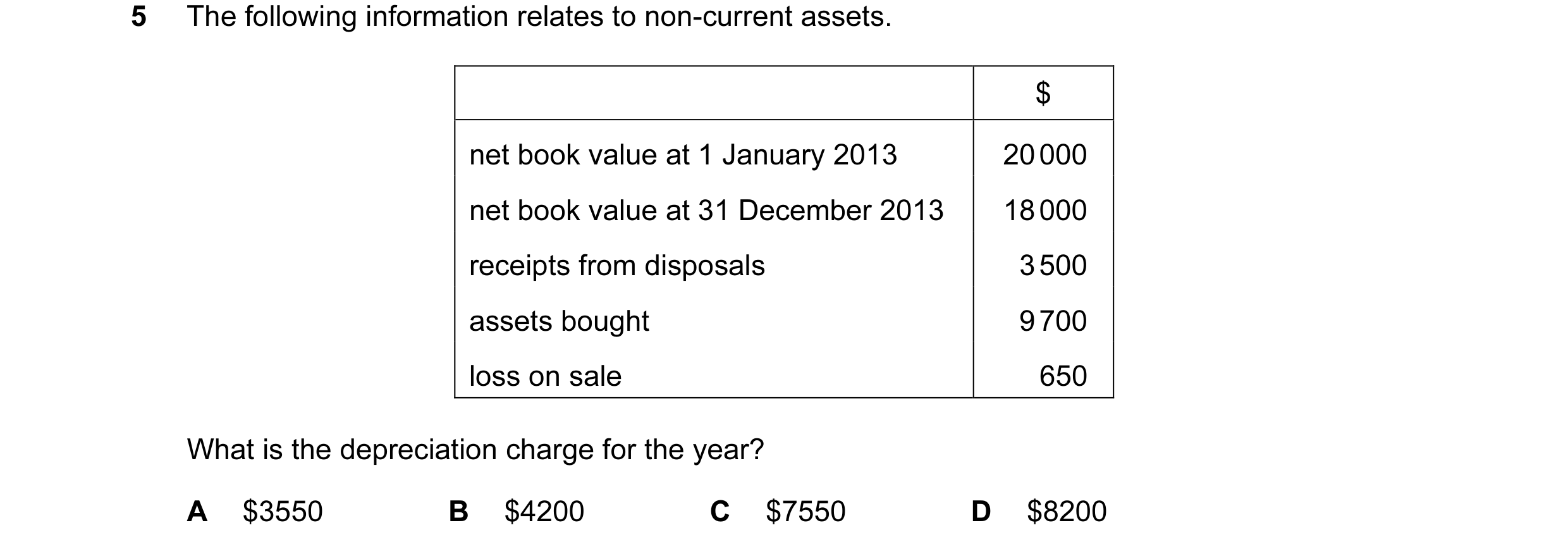
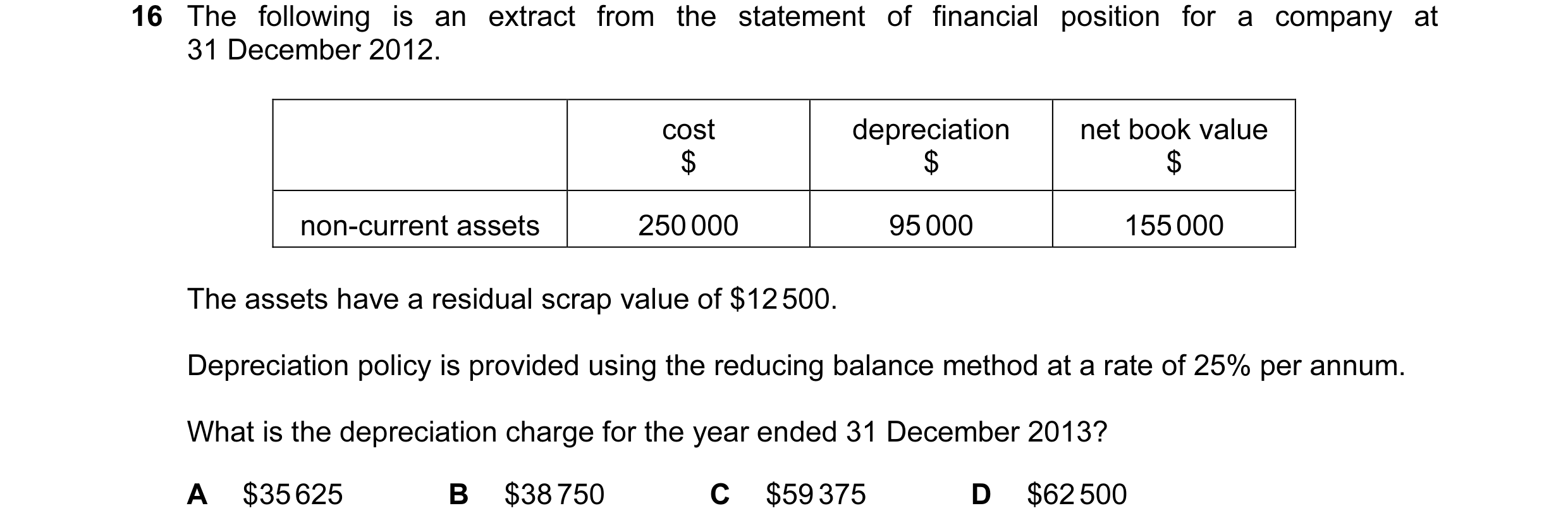 18 / 72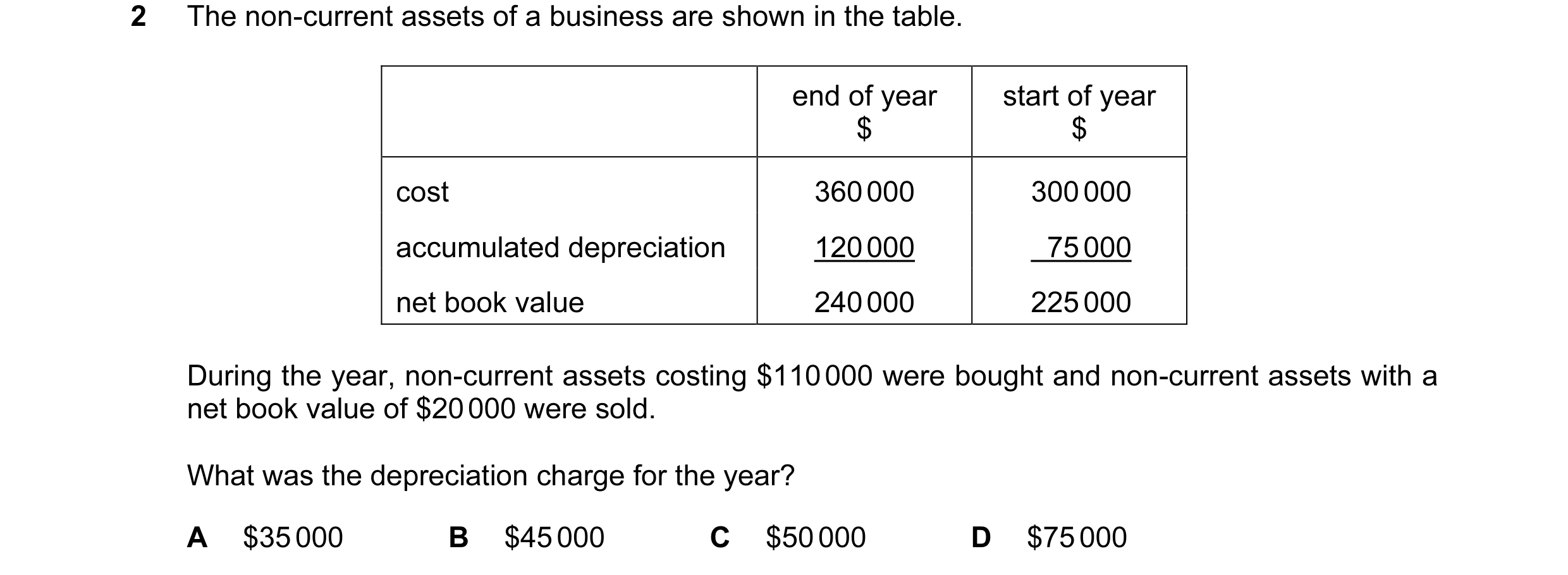


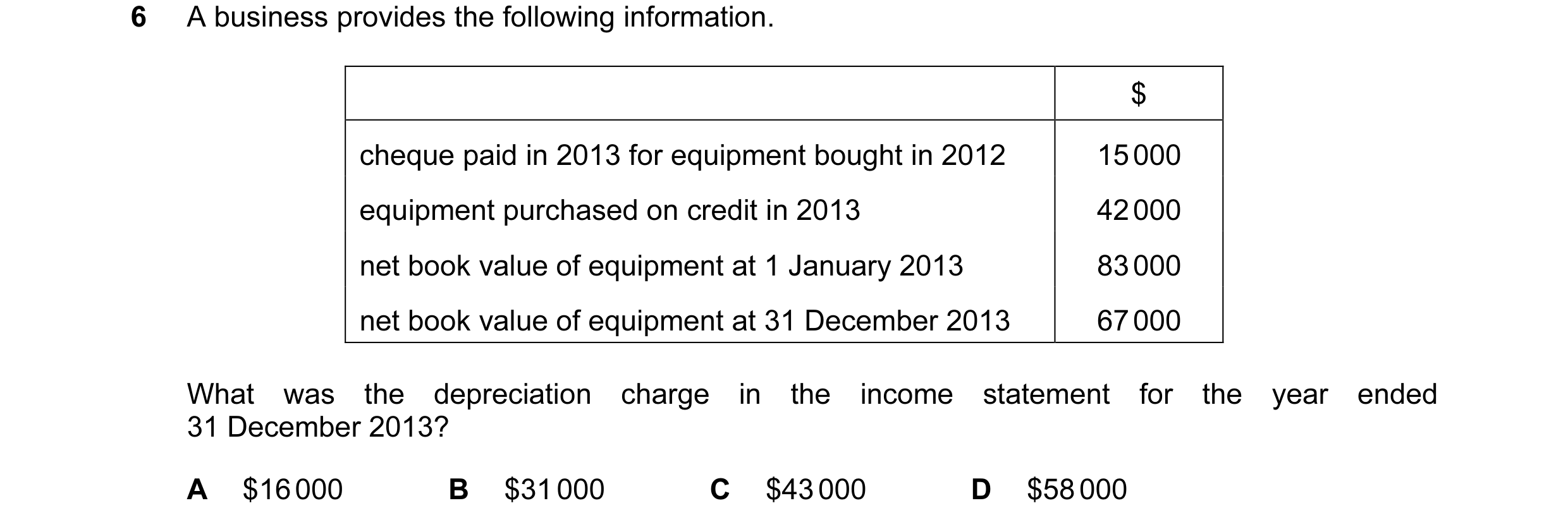 19 / 72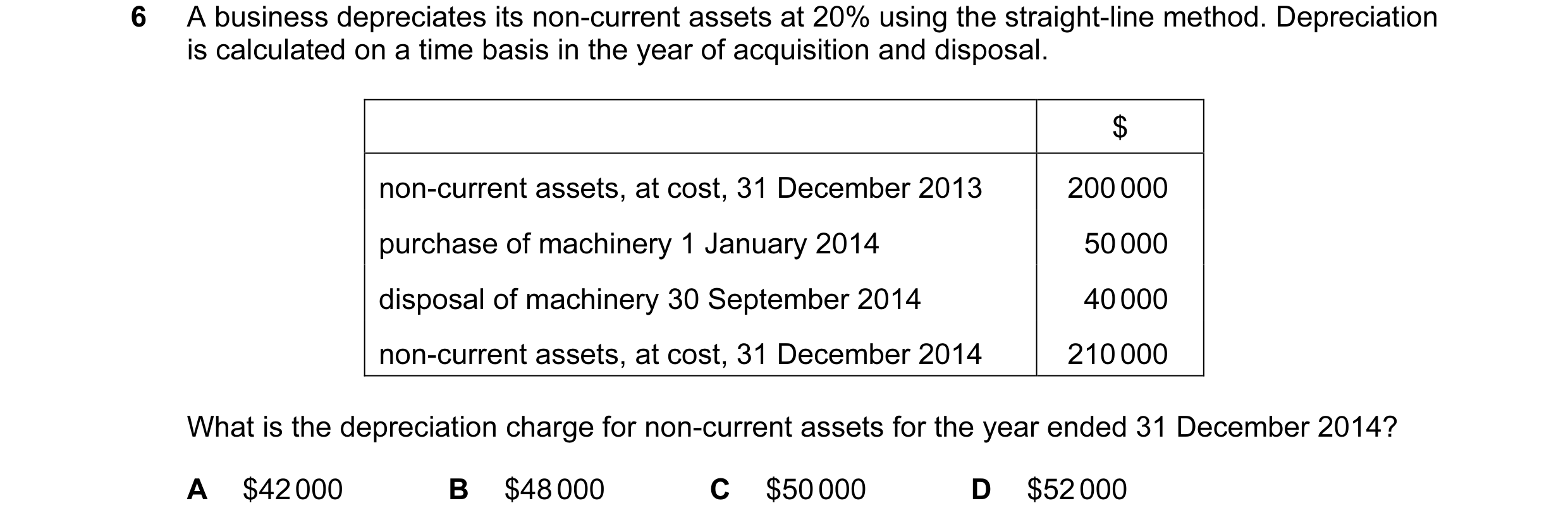

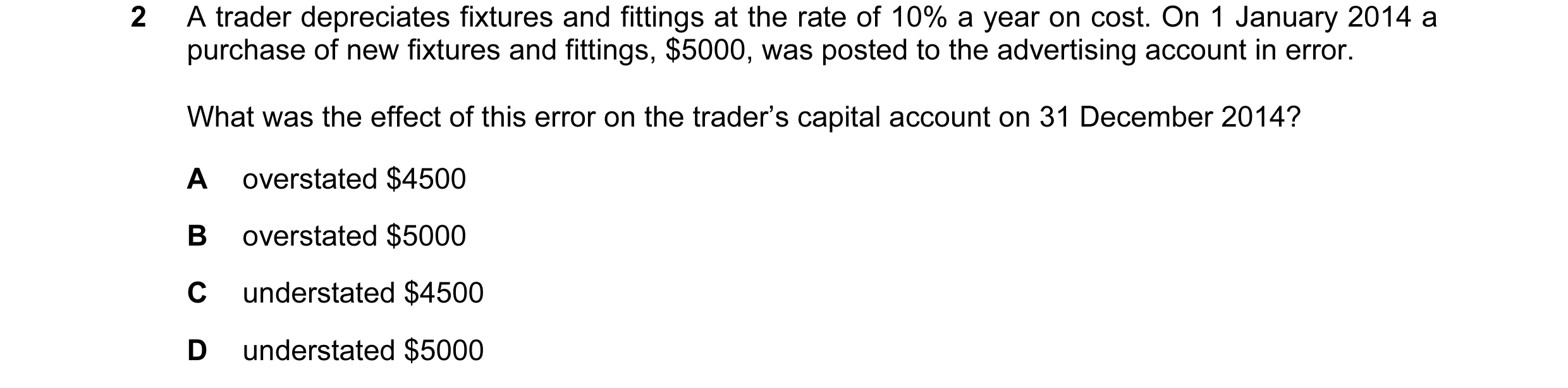
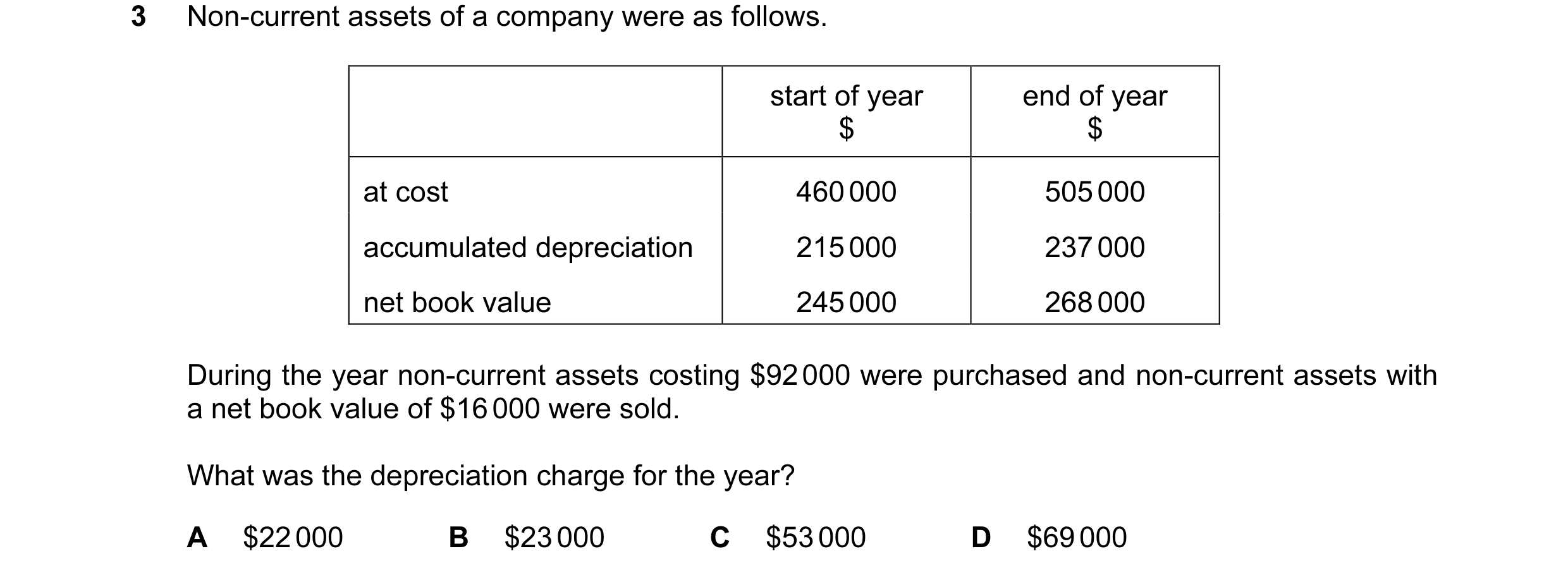 20 / 72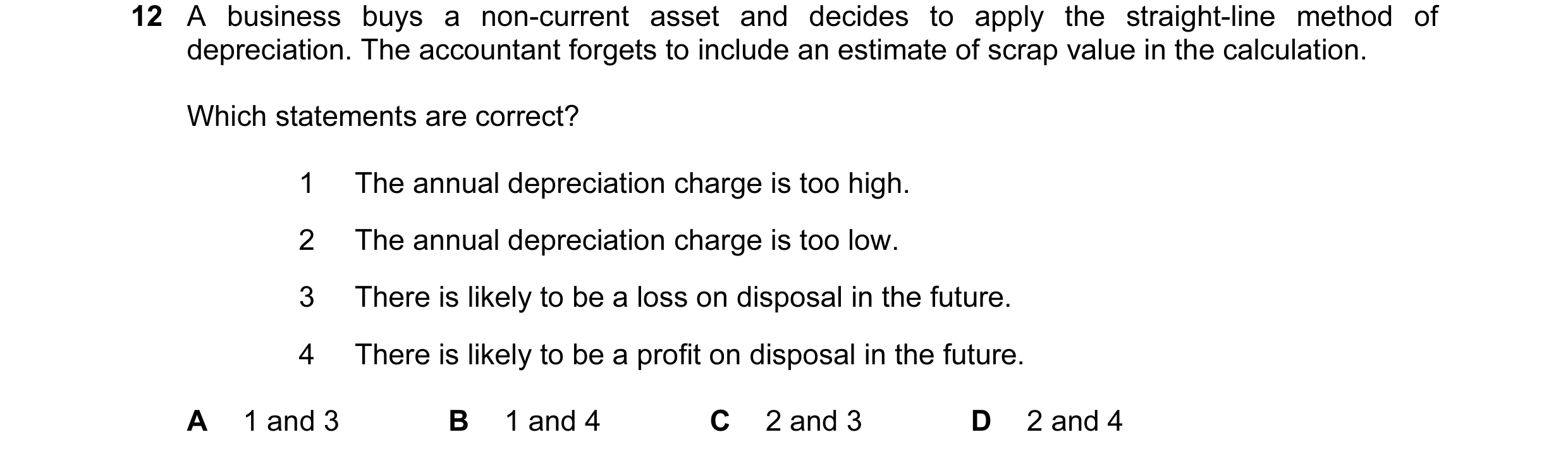
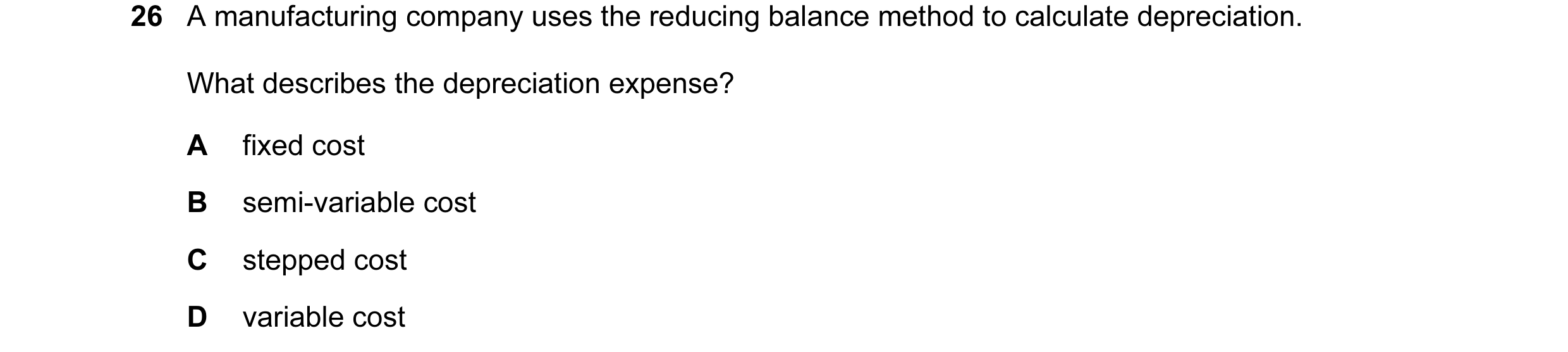
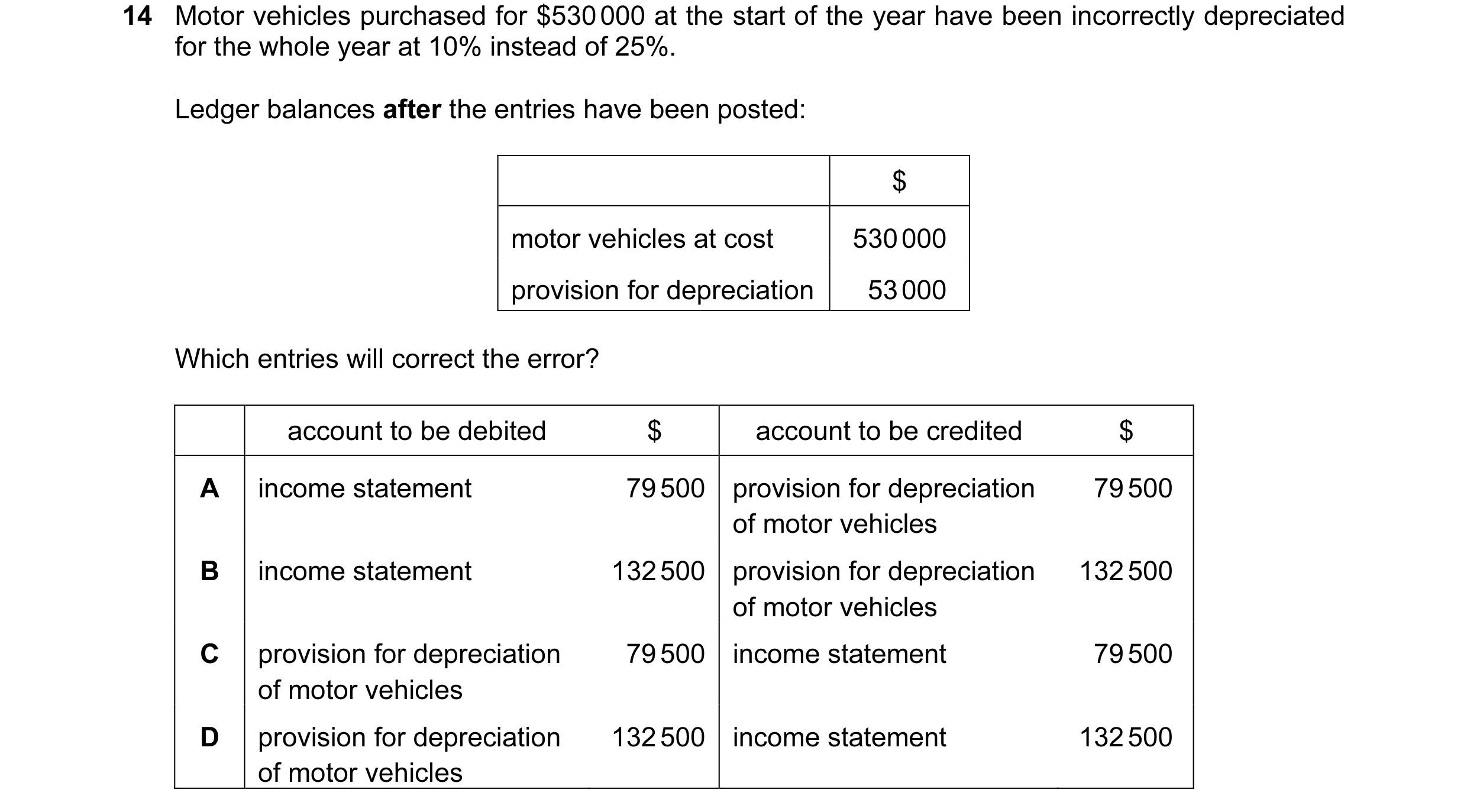
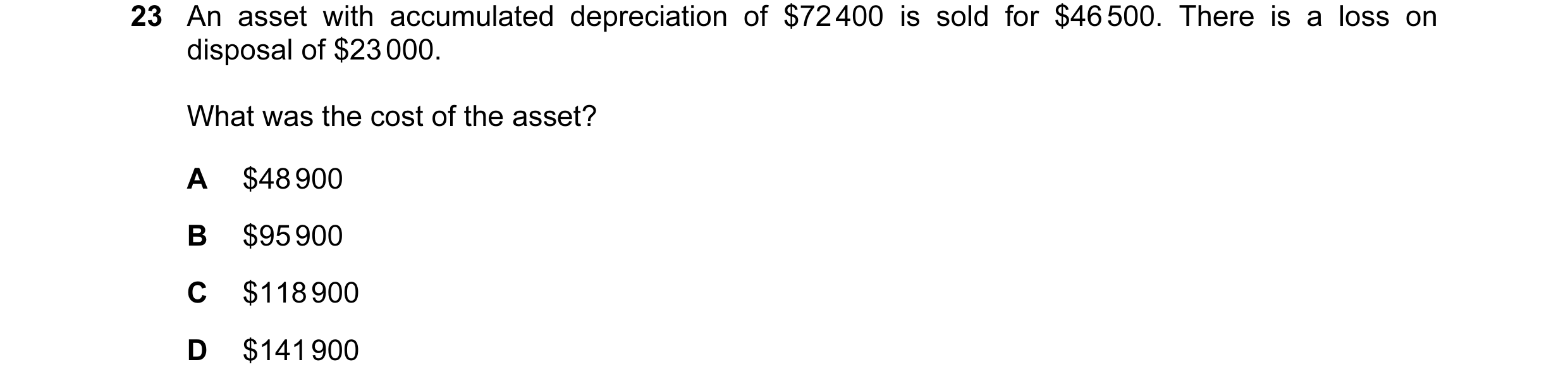 21 / 72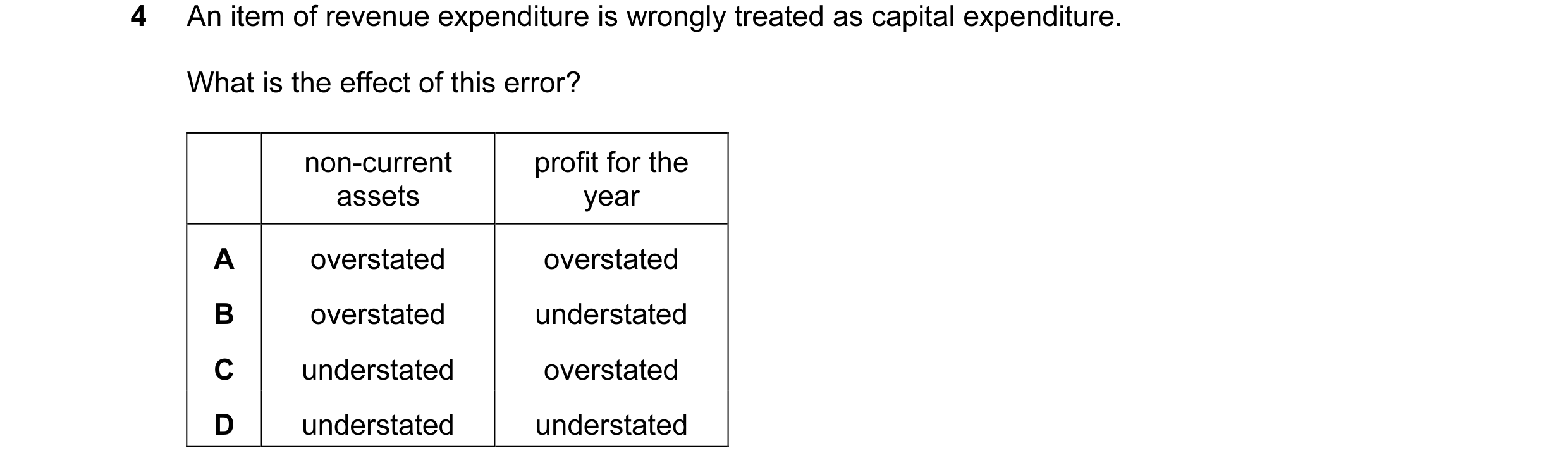
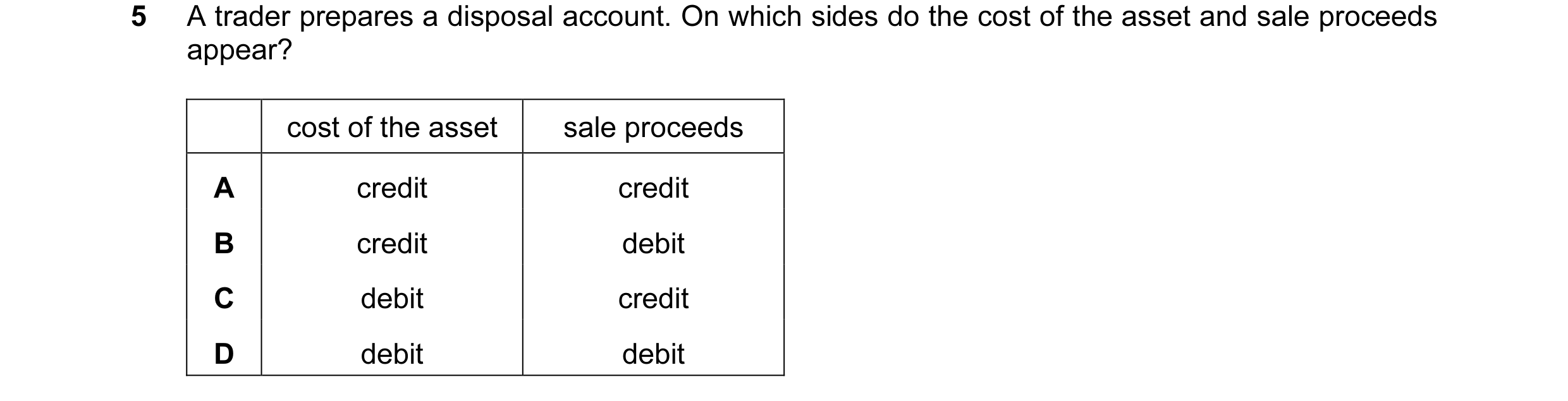
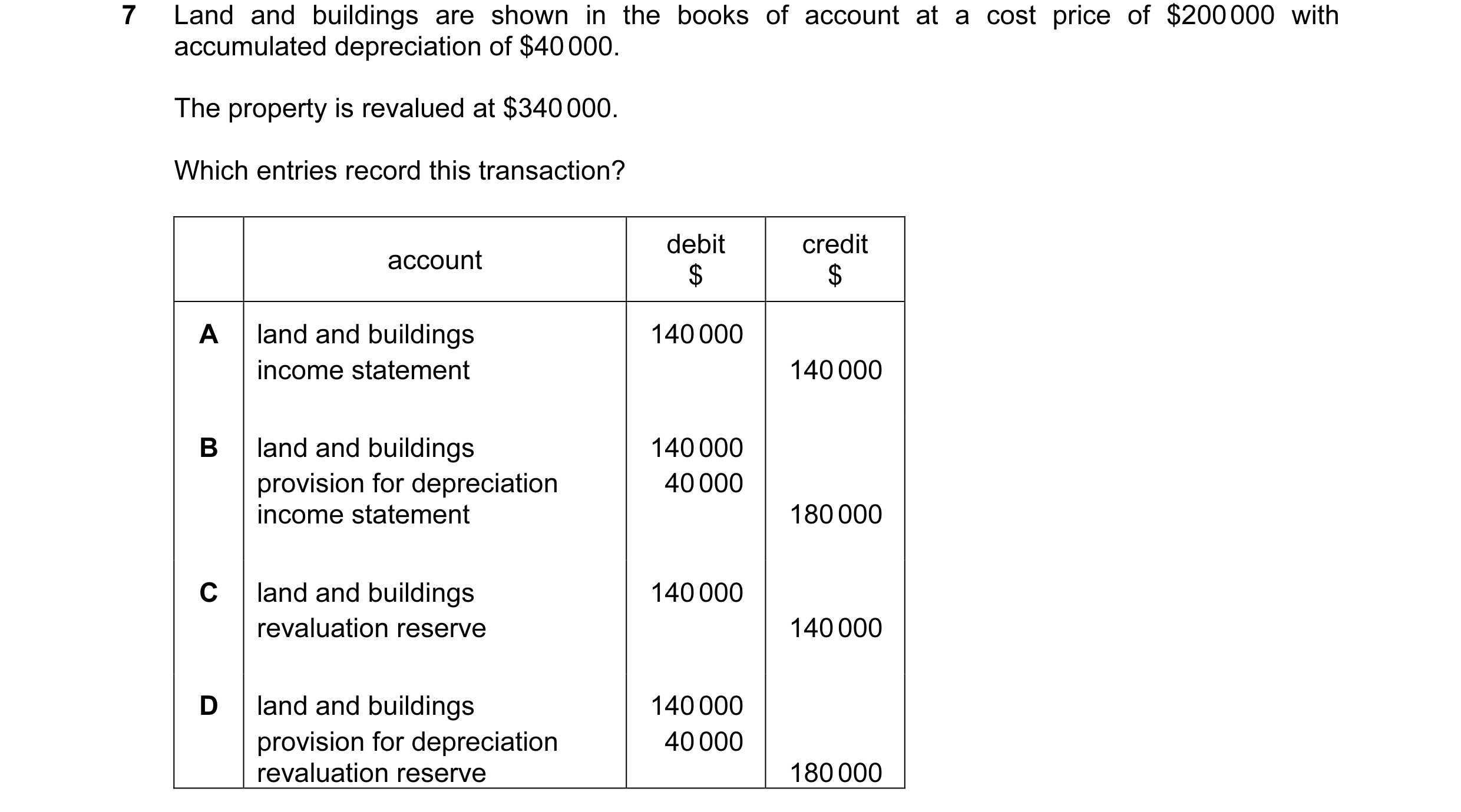
 22 / 72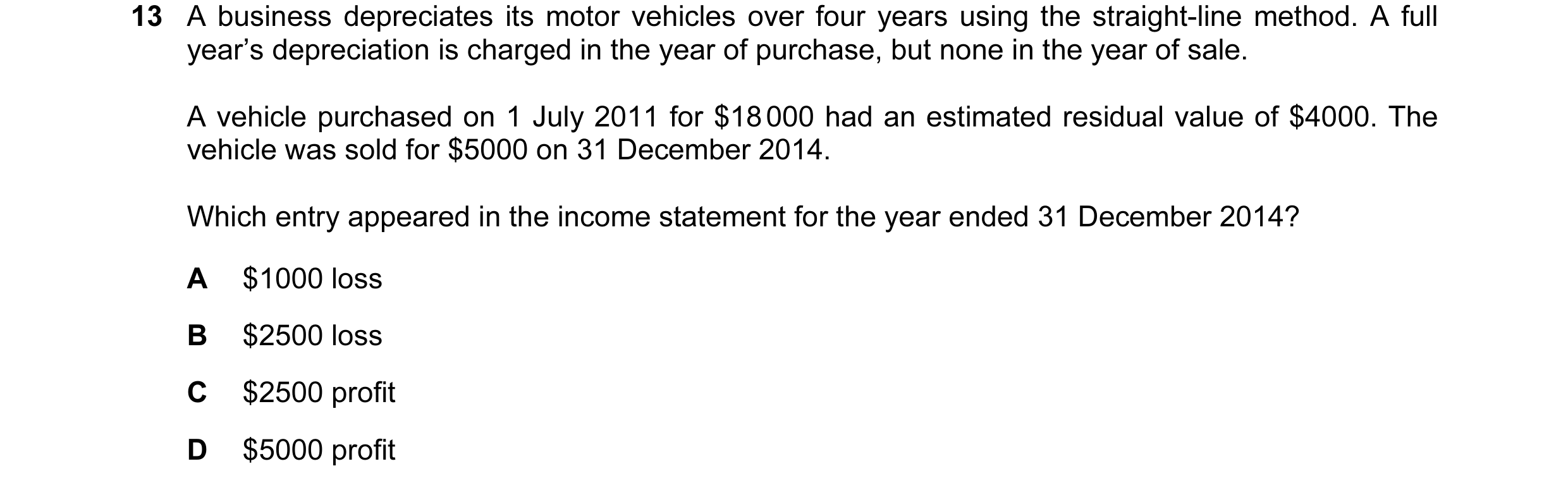
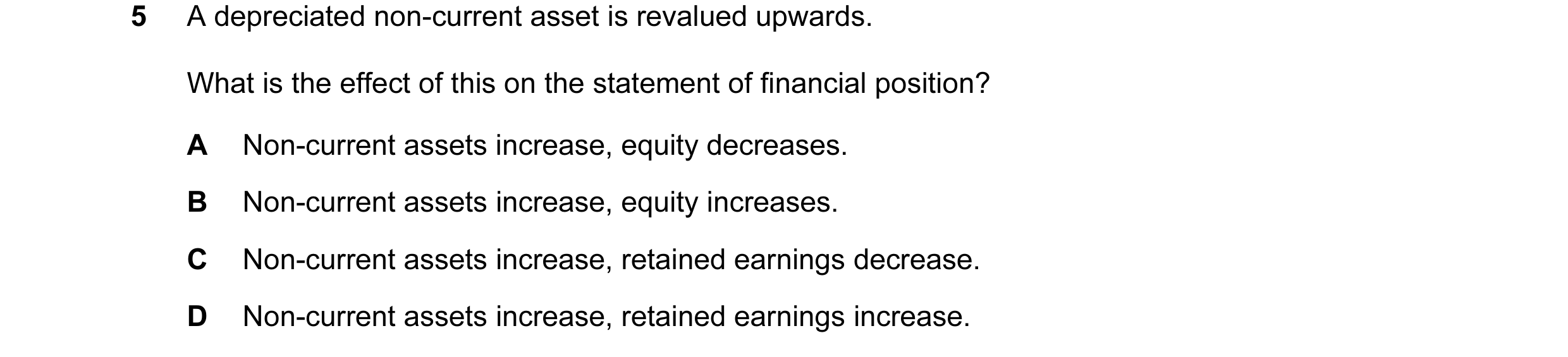
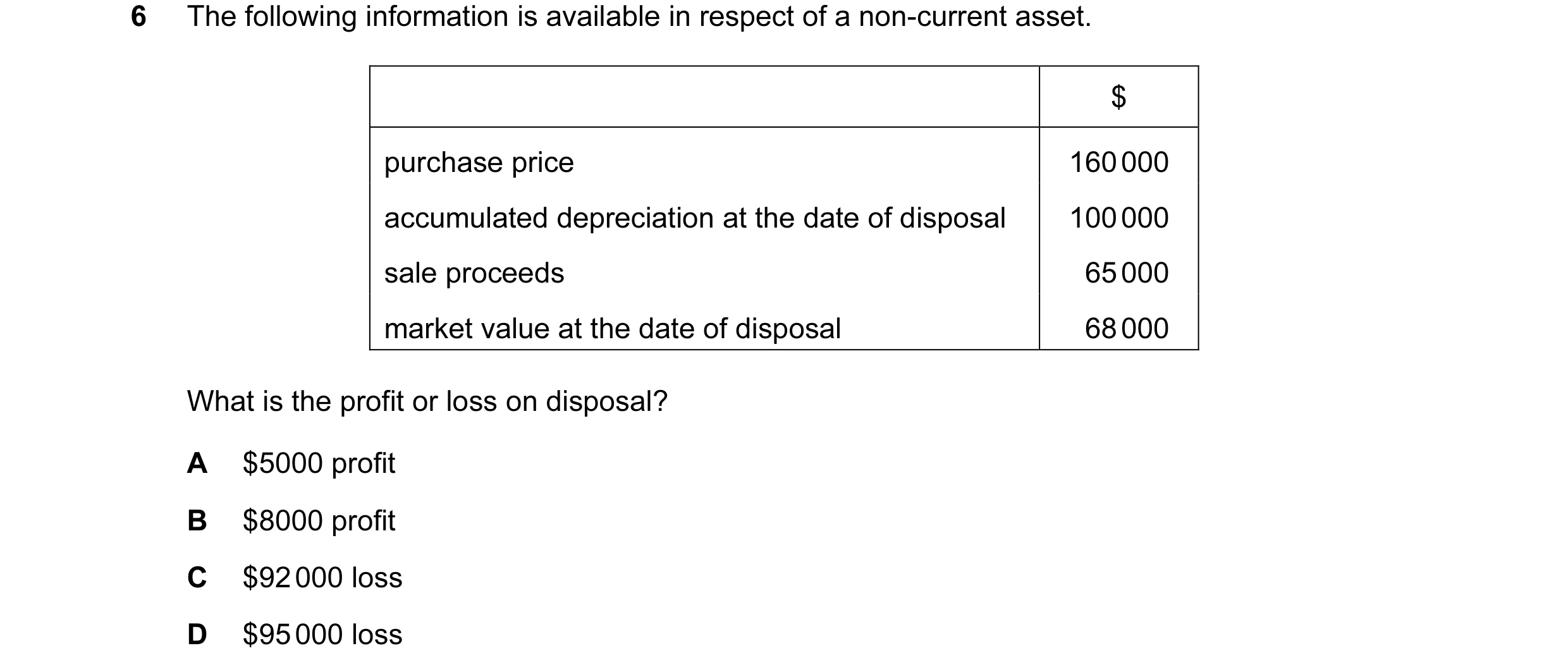
 23 / 72
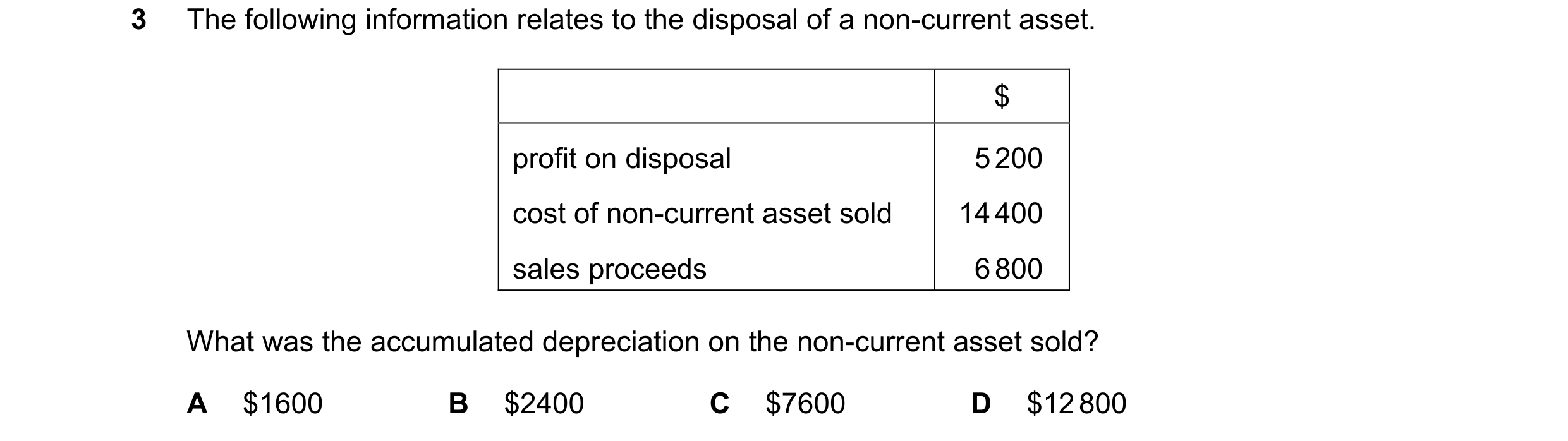
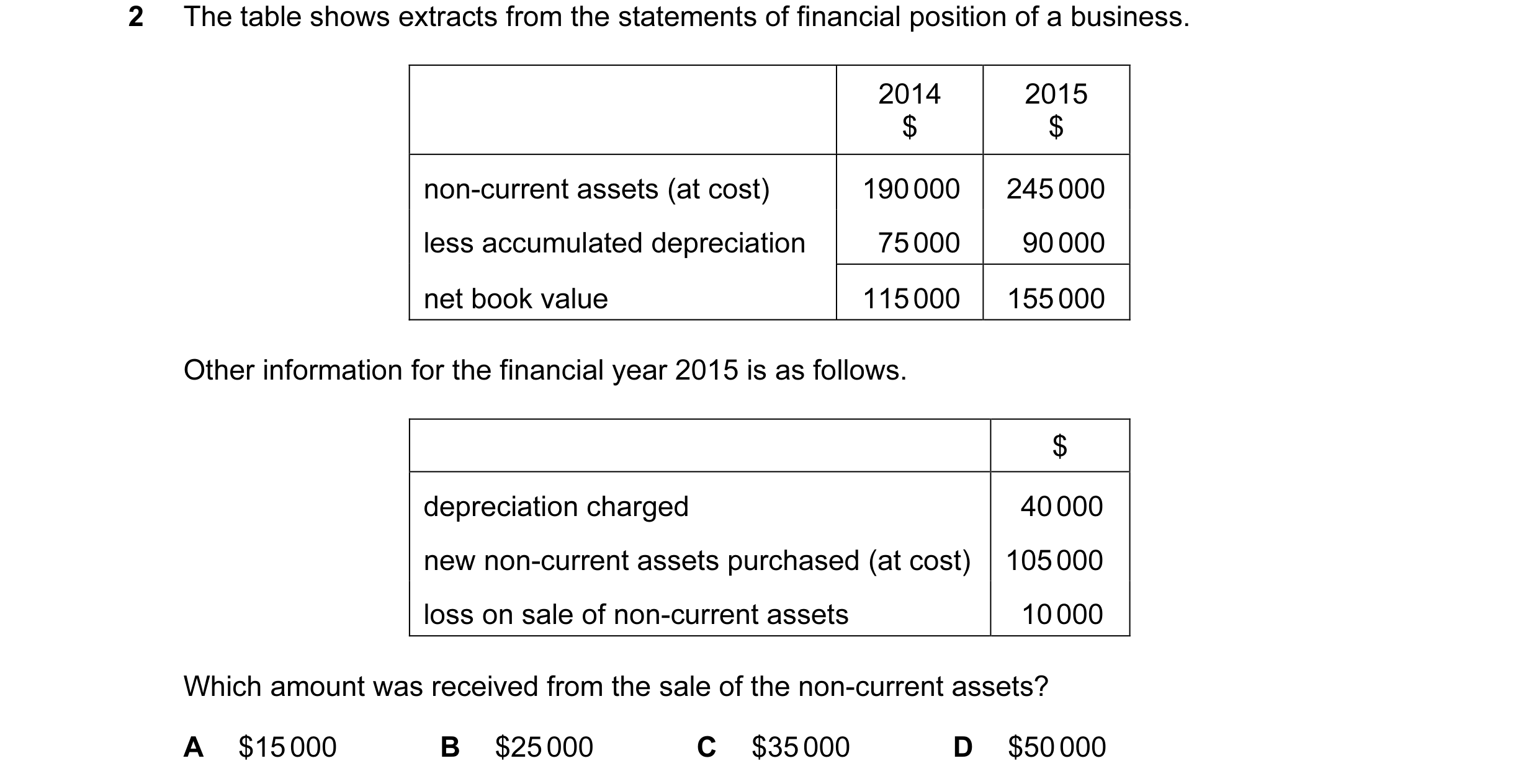
 24 / 72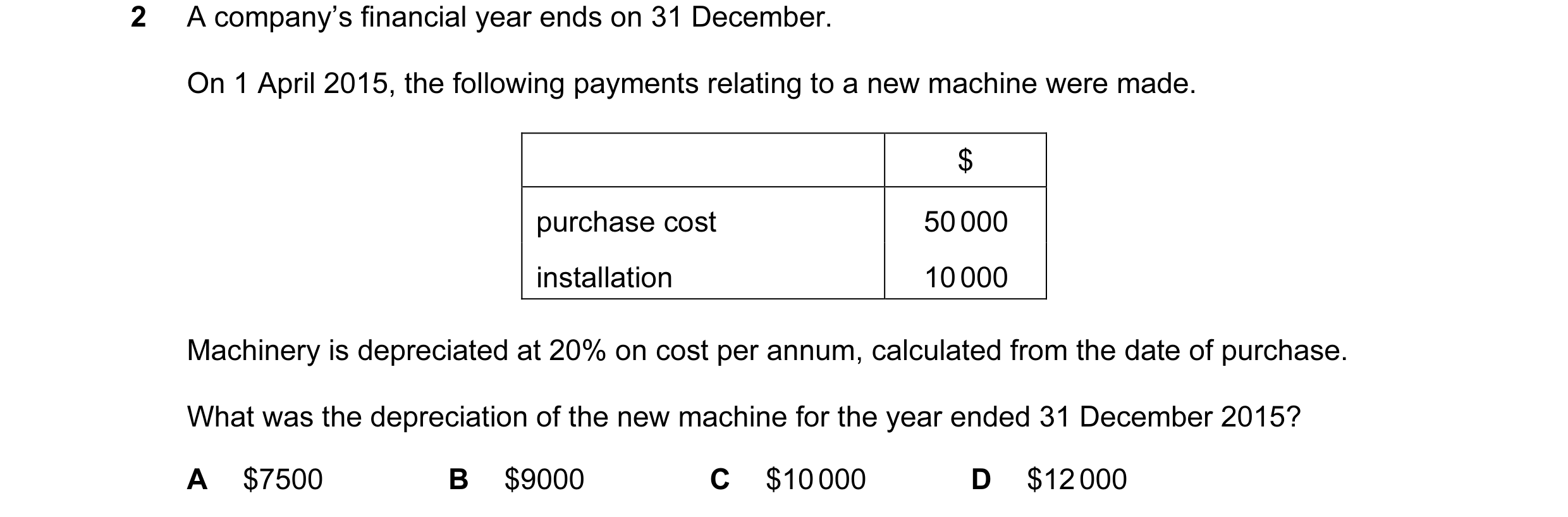
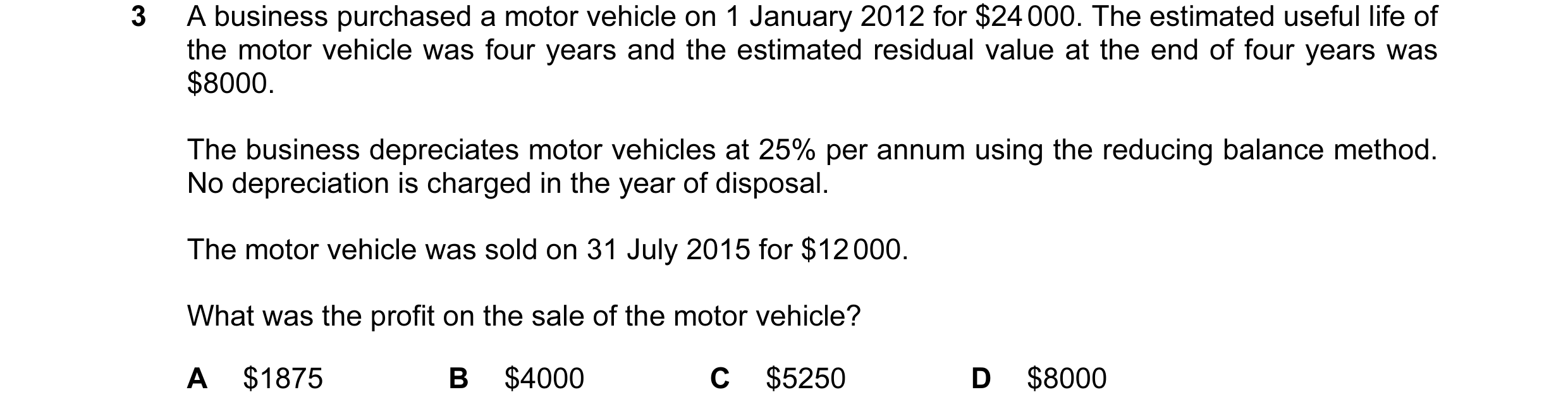
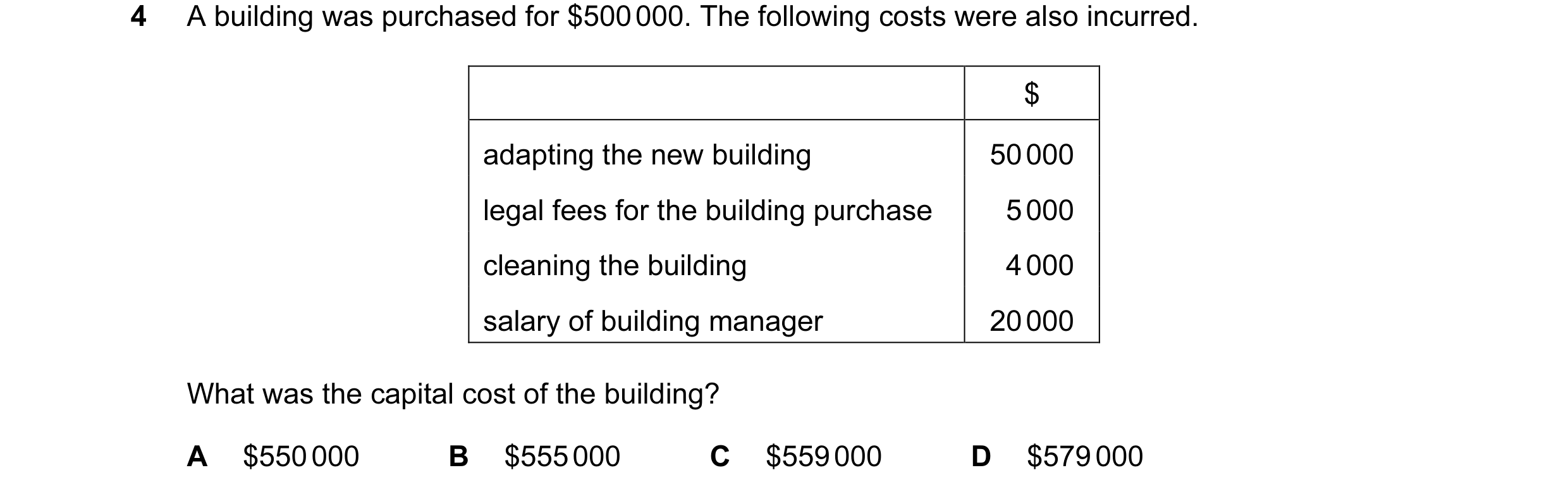 25 / 72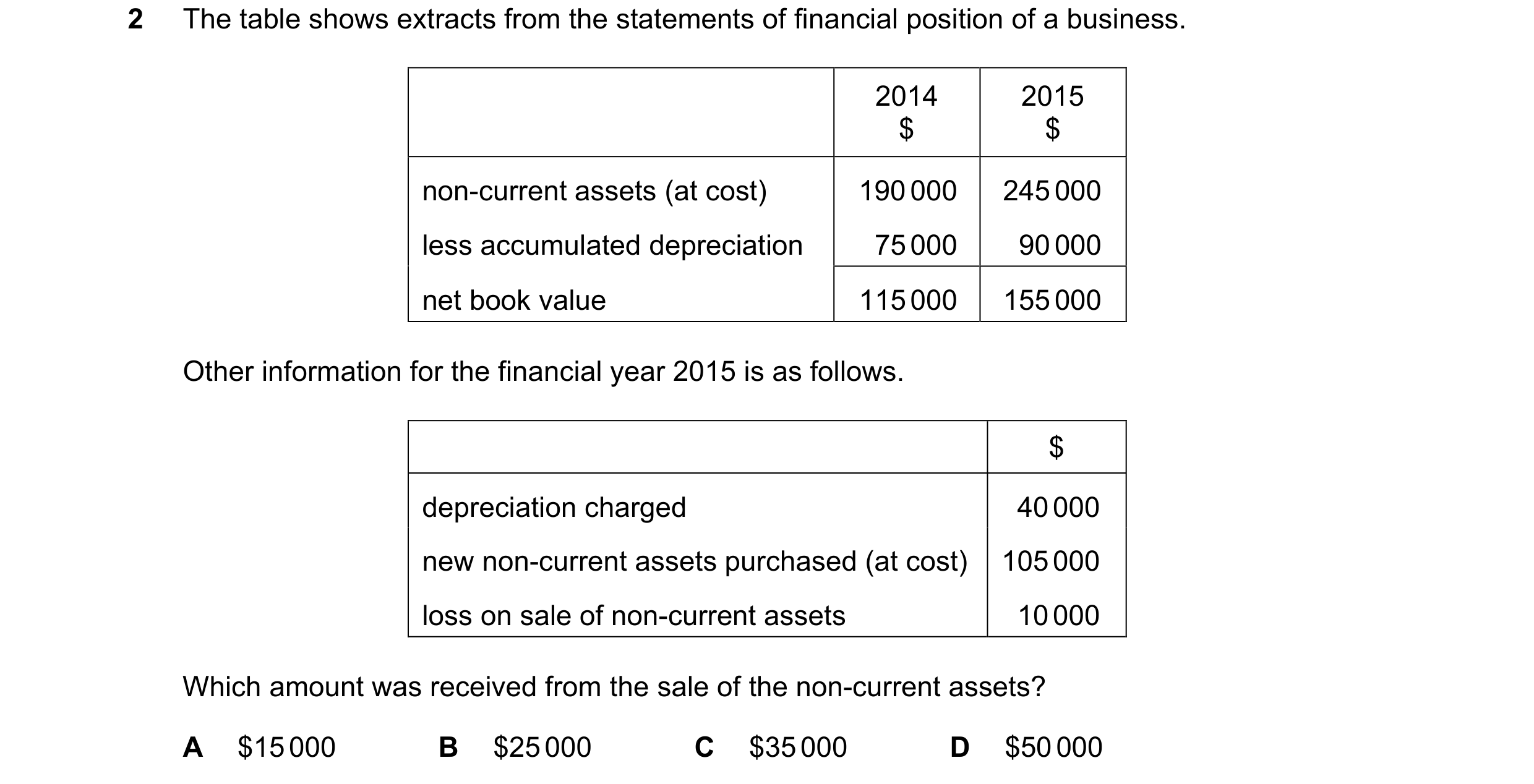


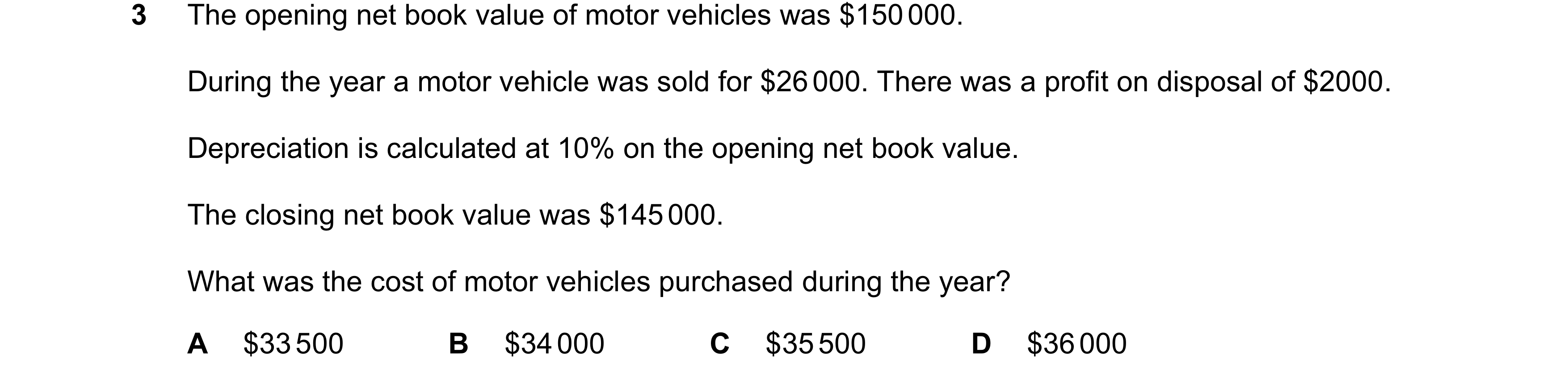
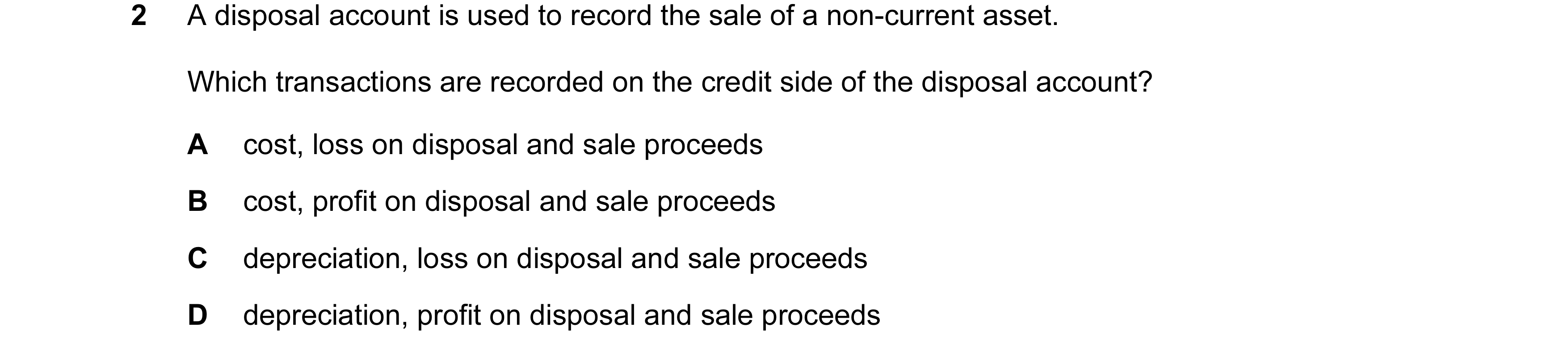 26 / 72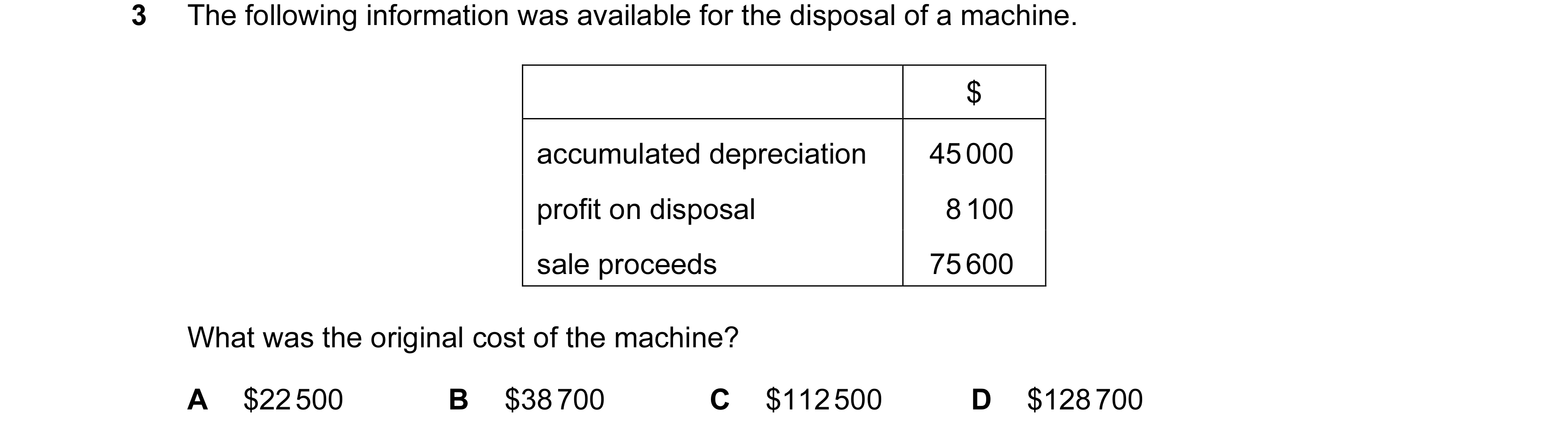
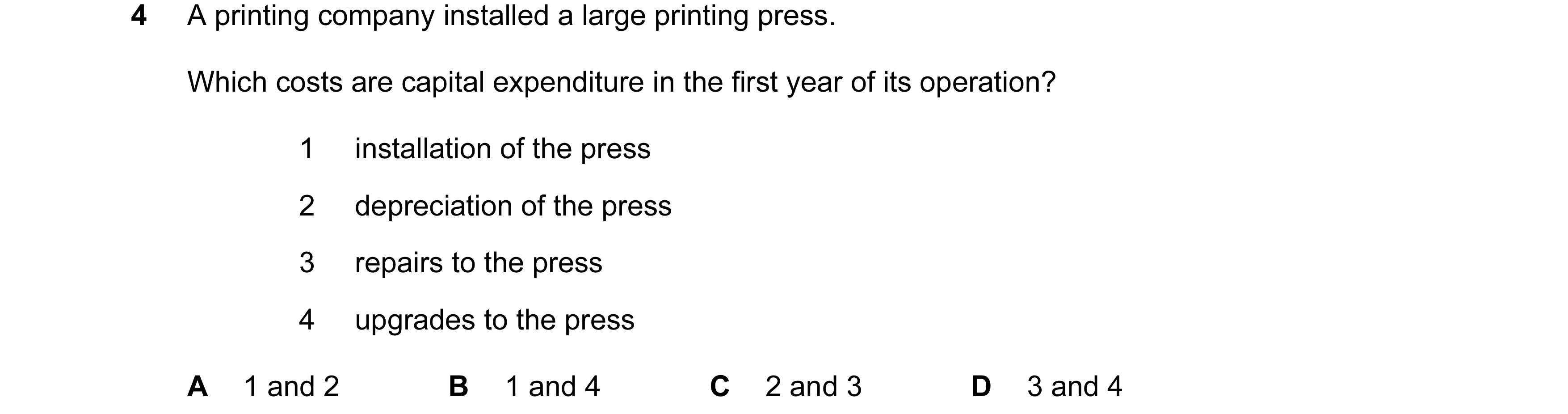
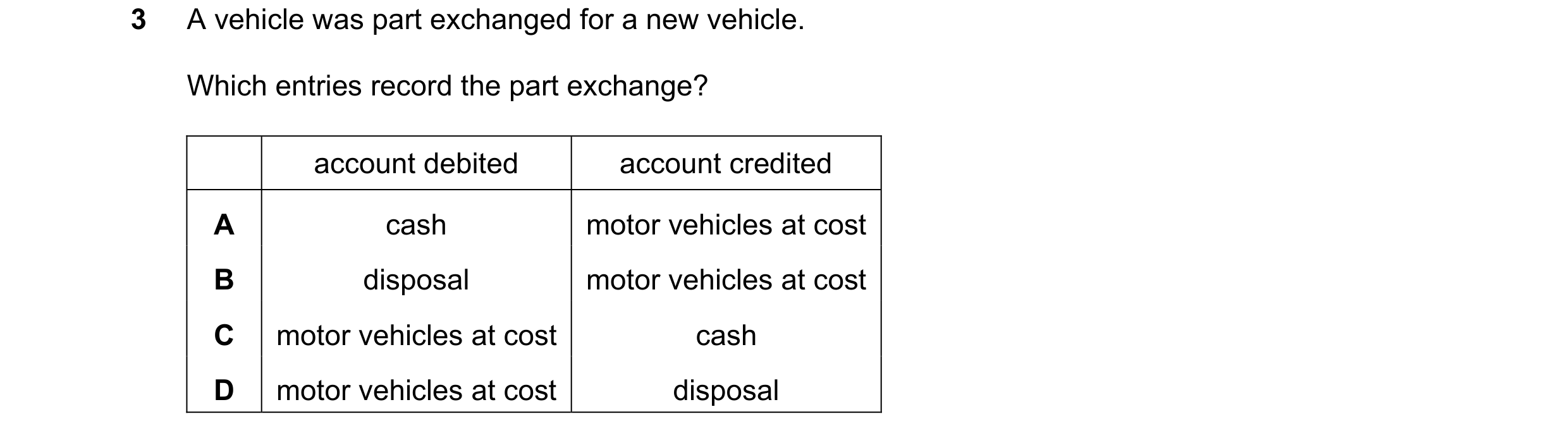

 27 / 72
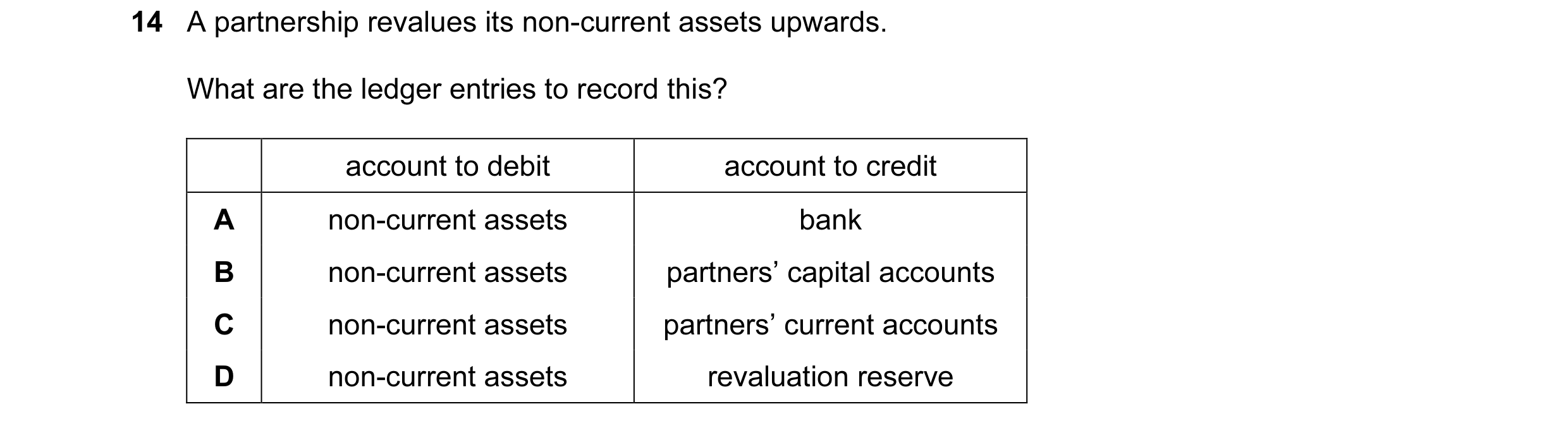


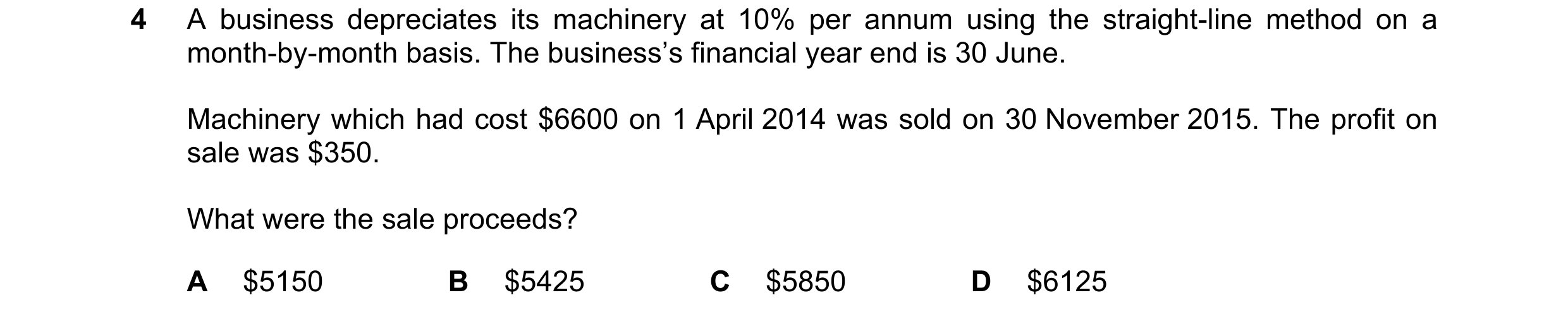 28 / 72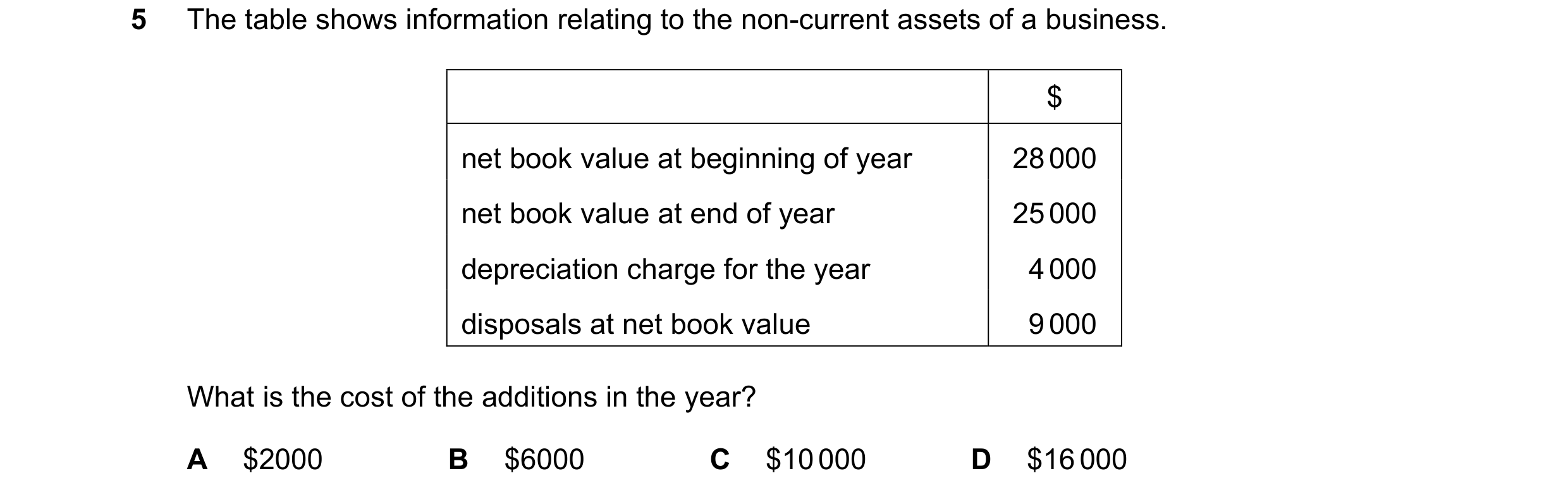

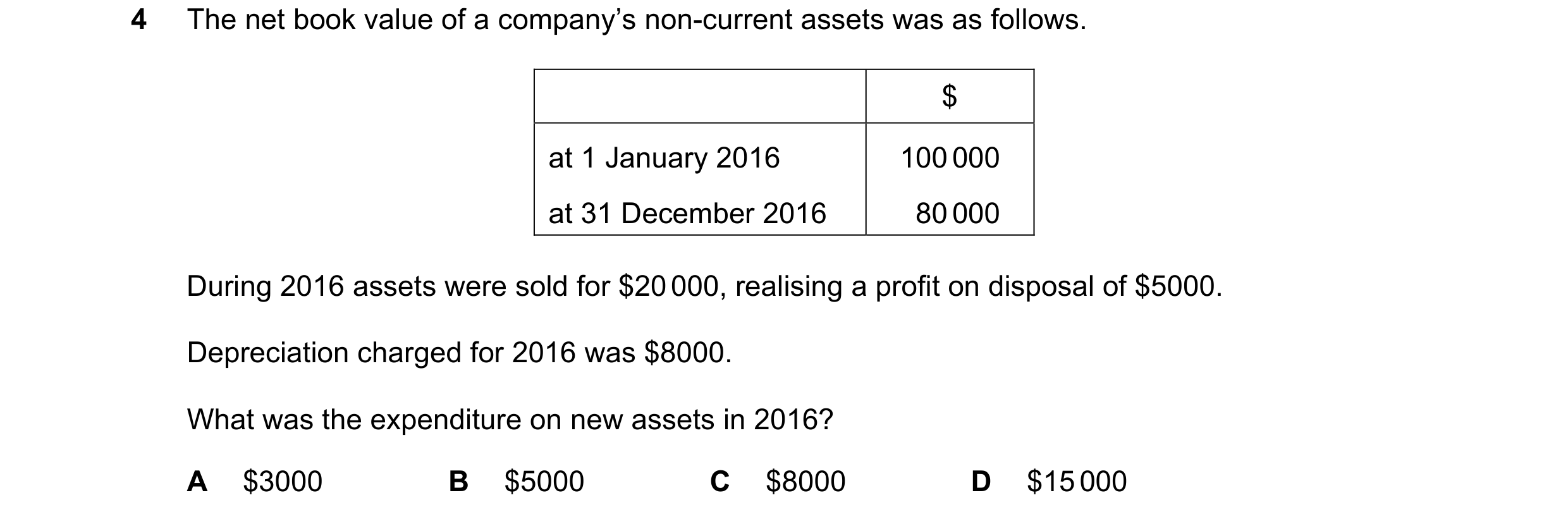

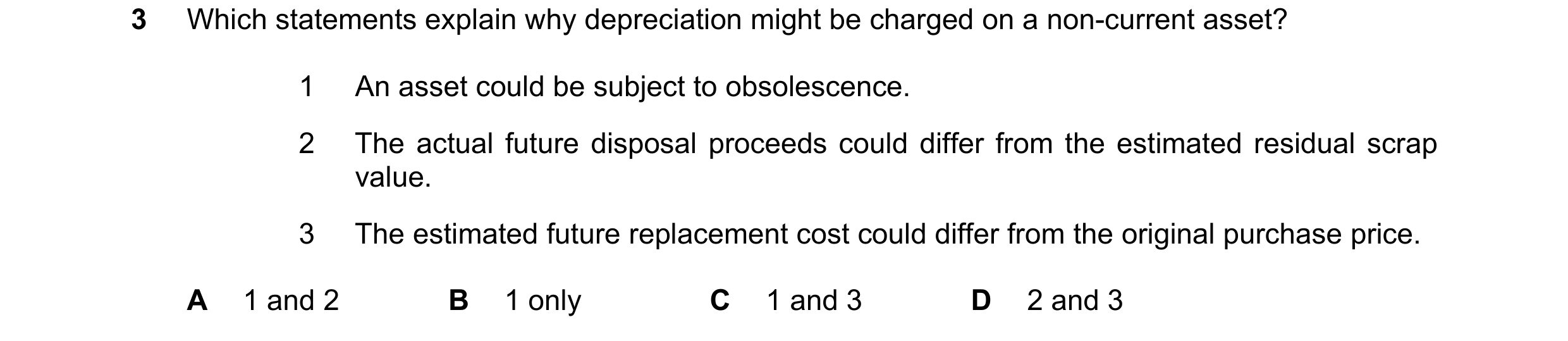 29 / 72
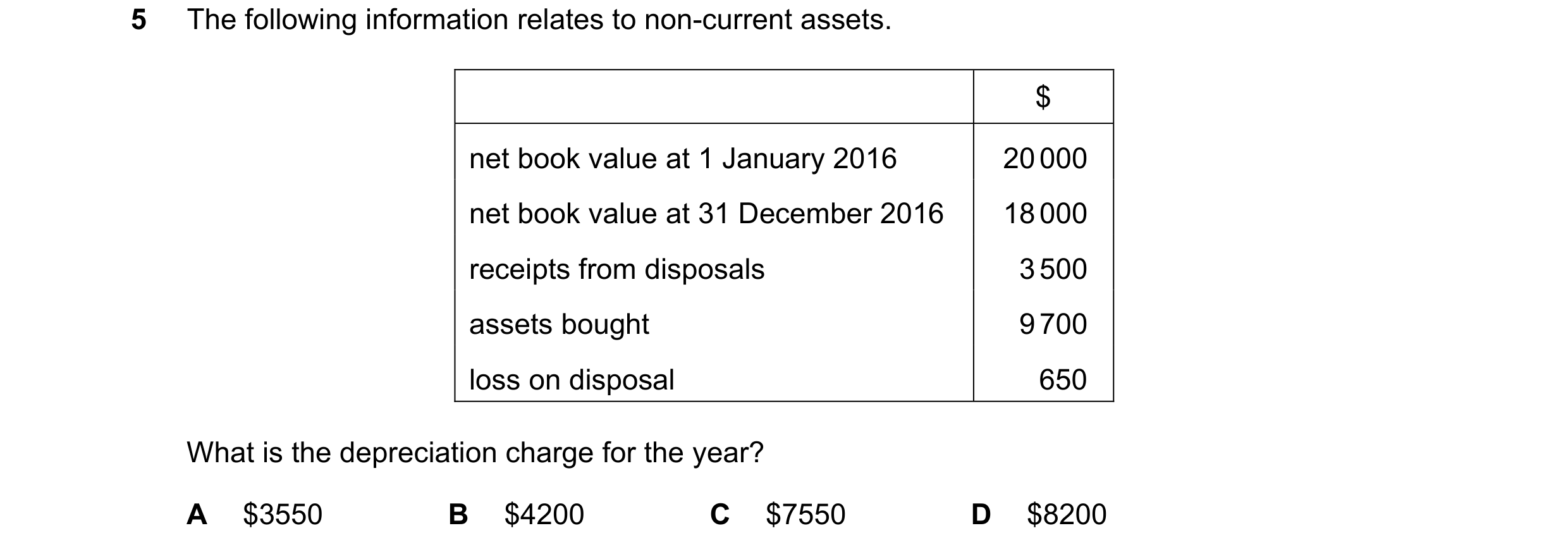
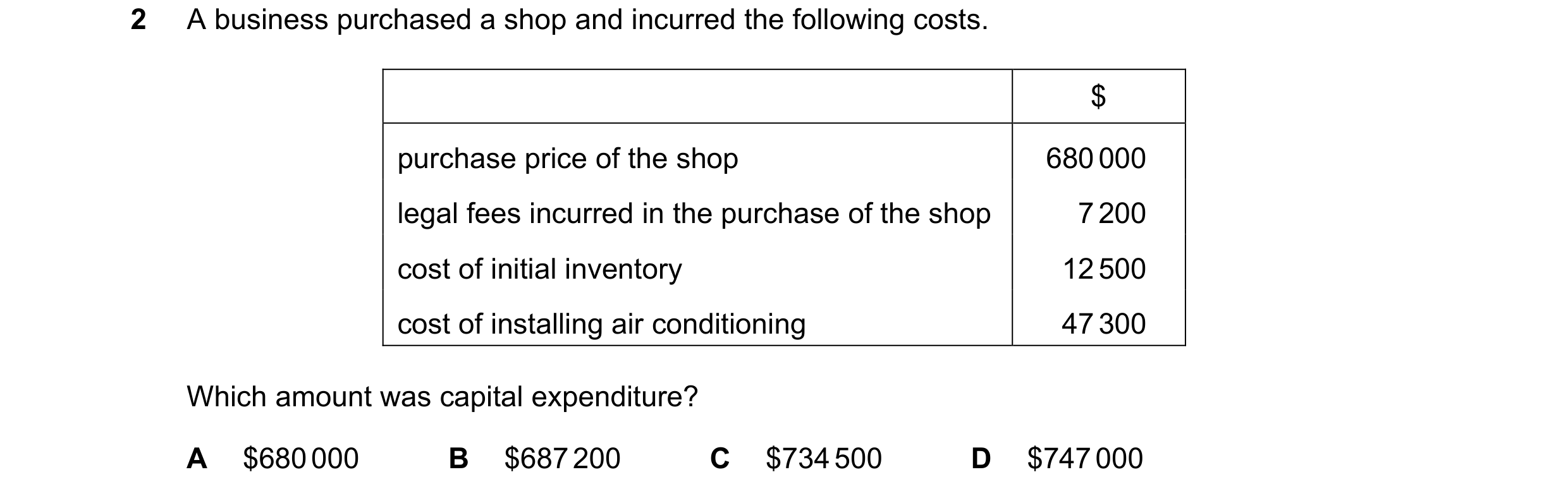
 30 / 72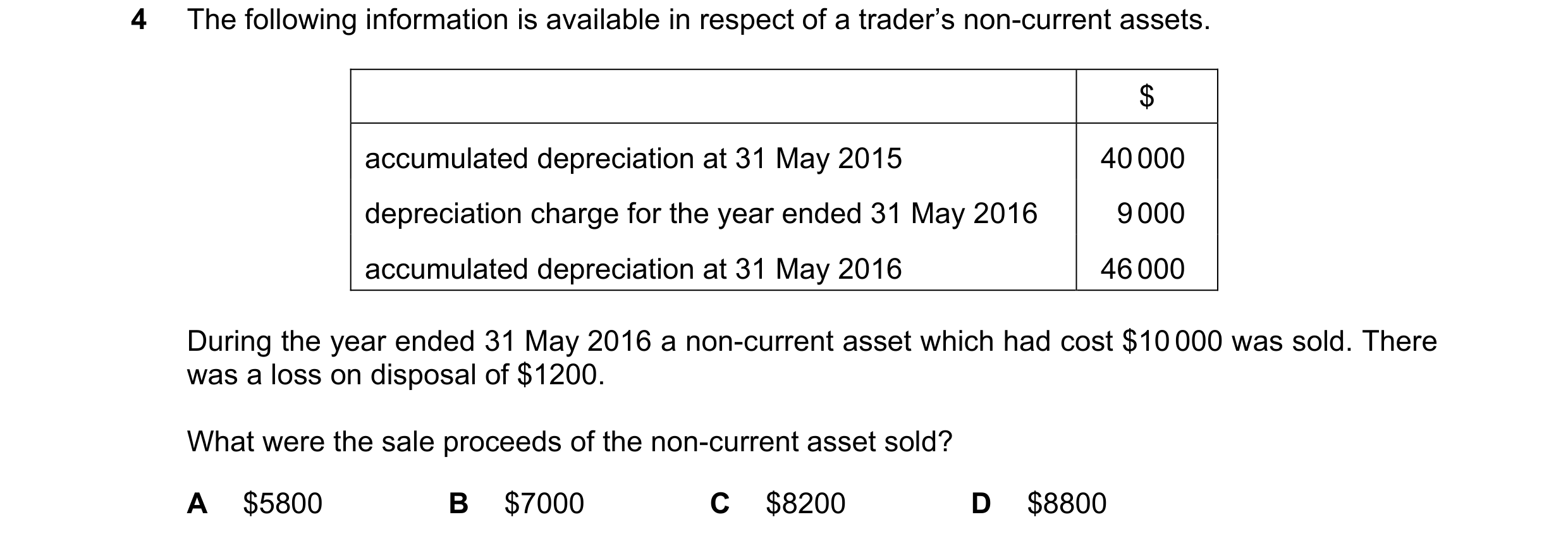


 31 / 72
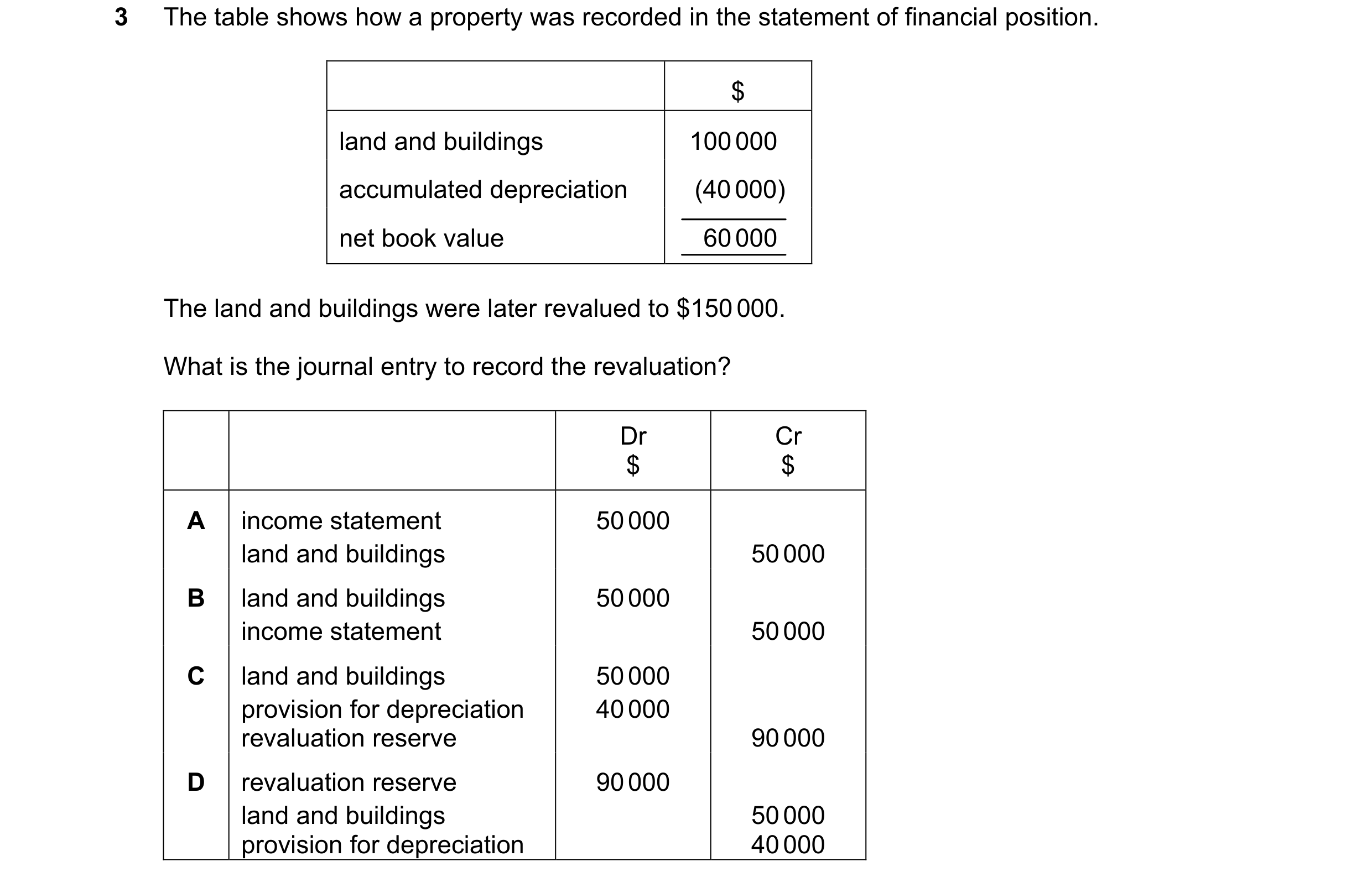 32 / 72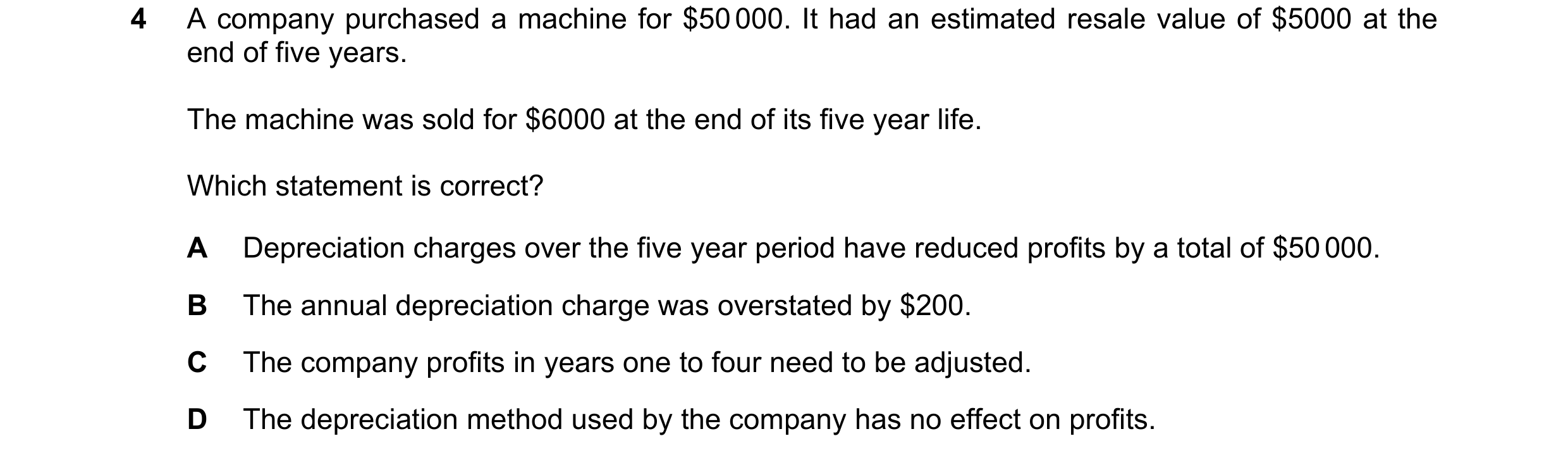
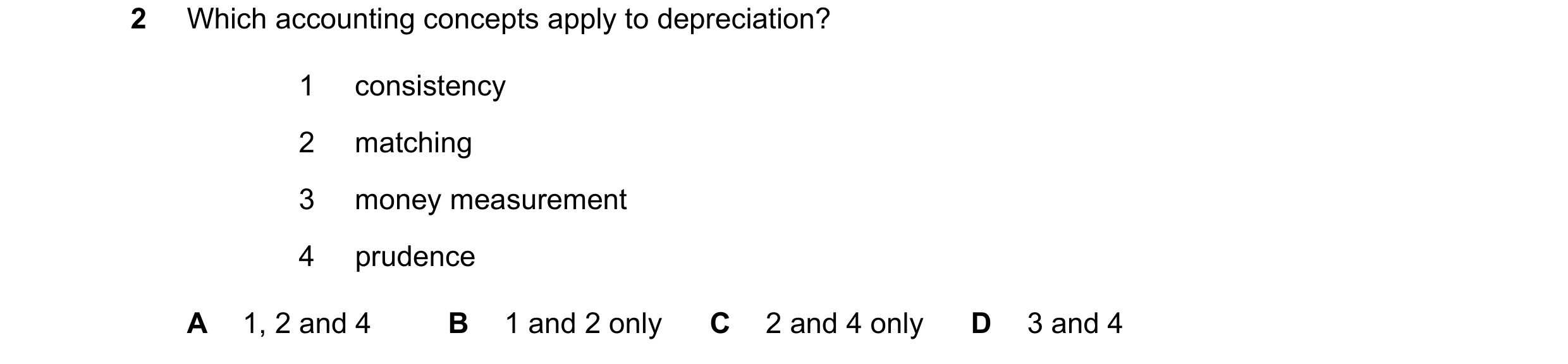
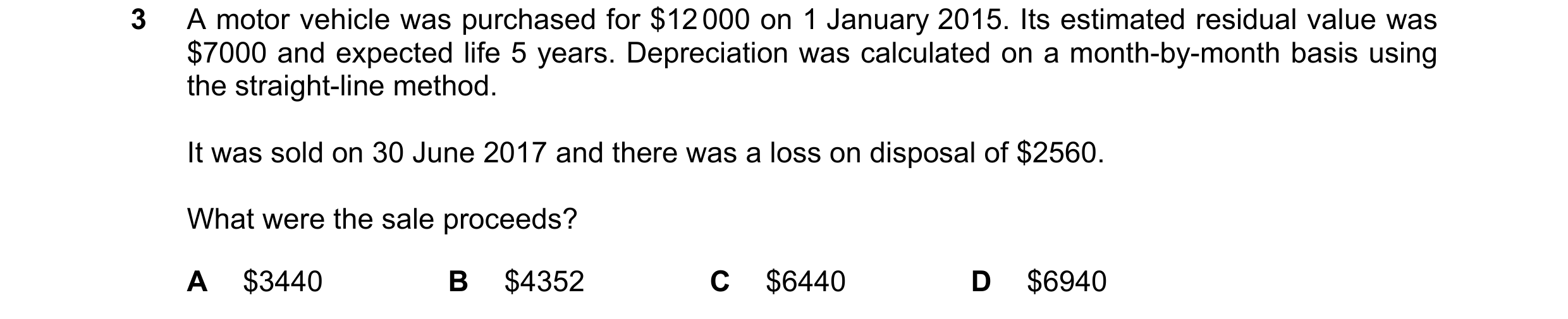
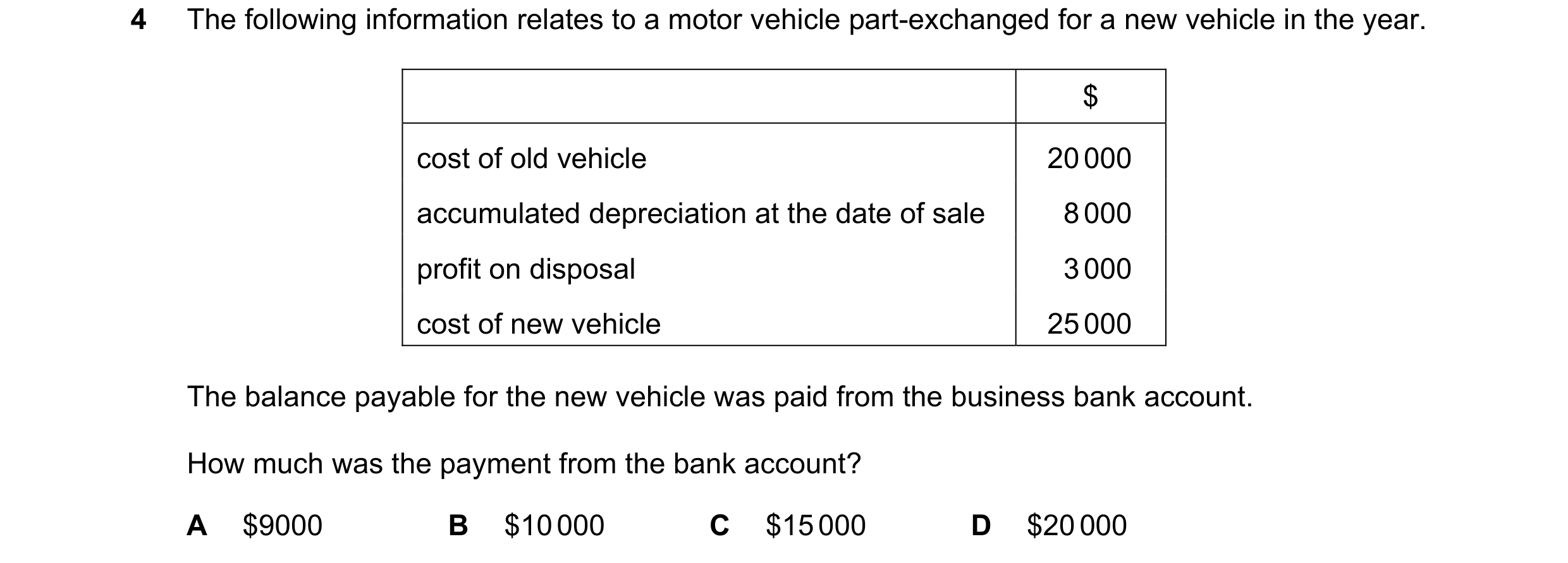 33 / 72
 34 / 72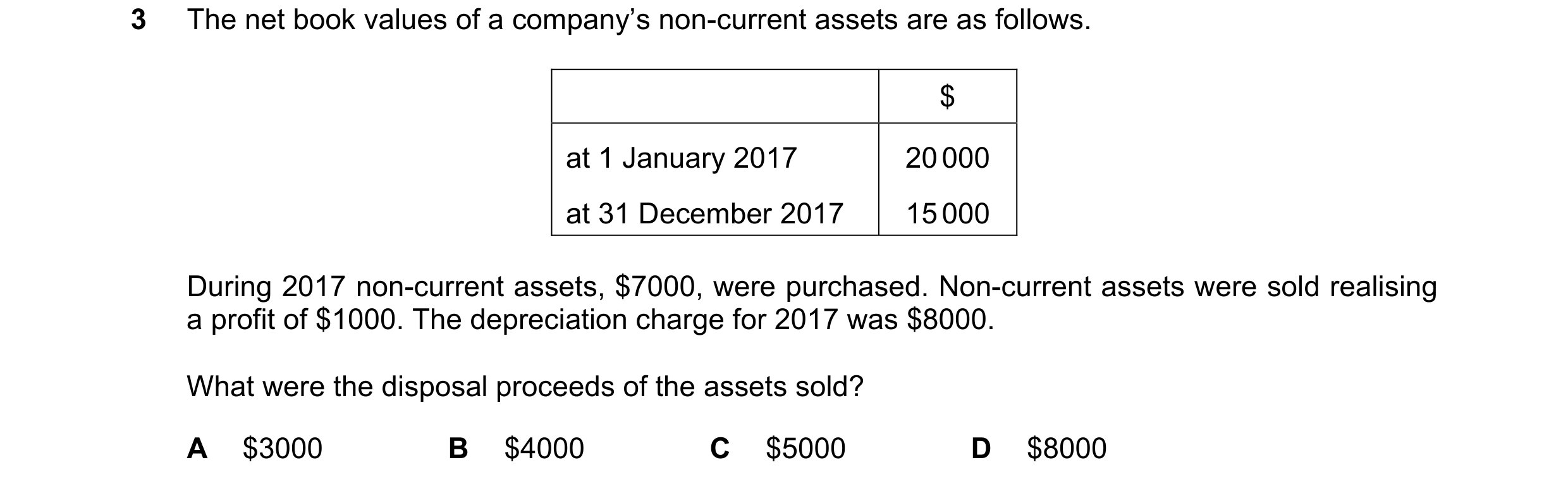
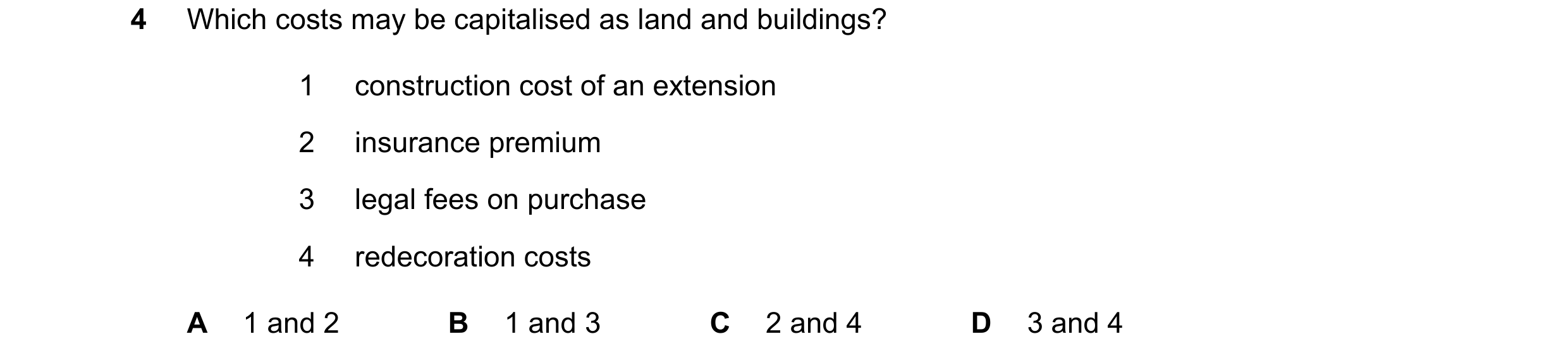

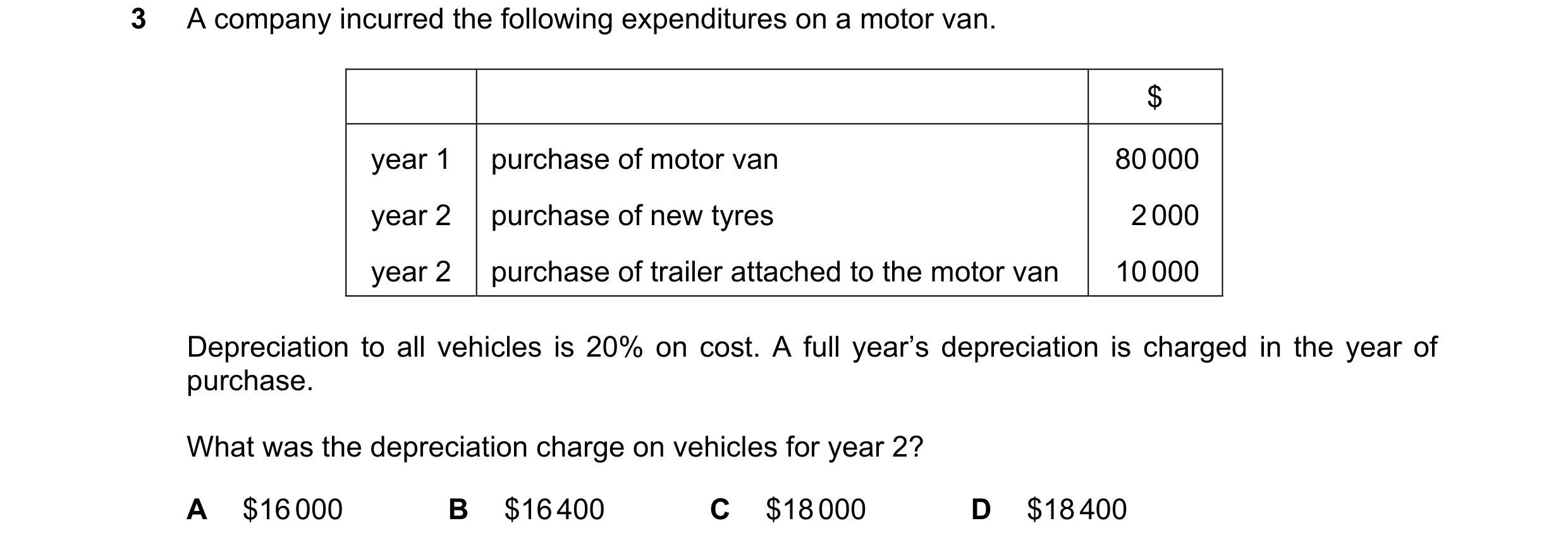
 35 / 72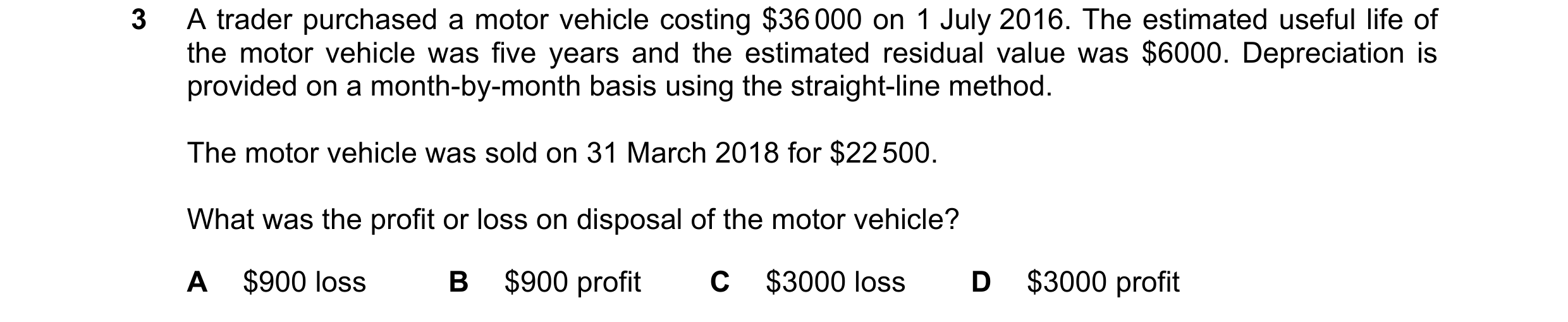
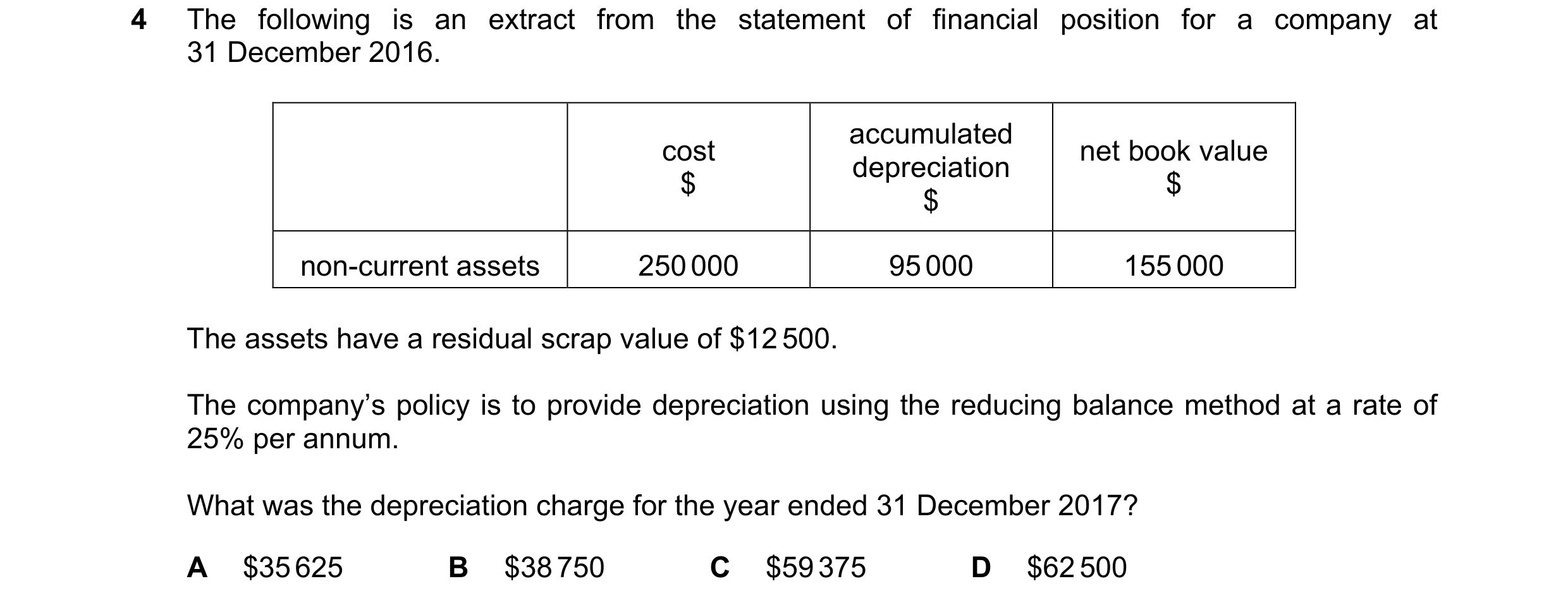

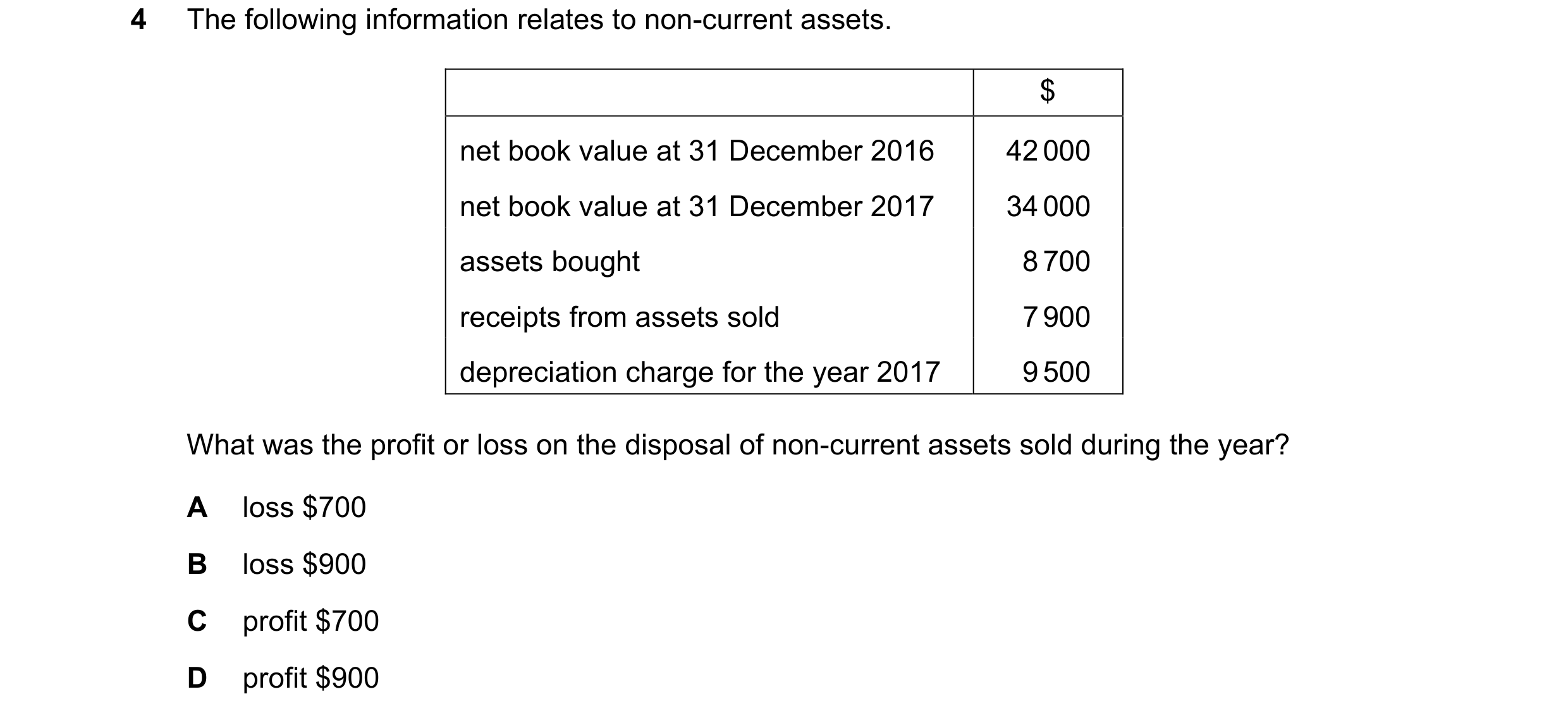 36 / 72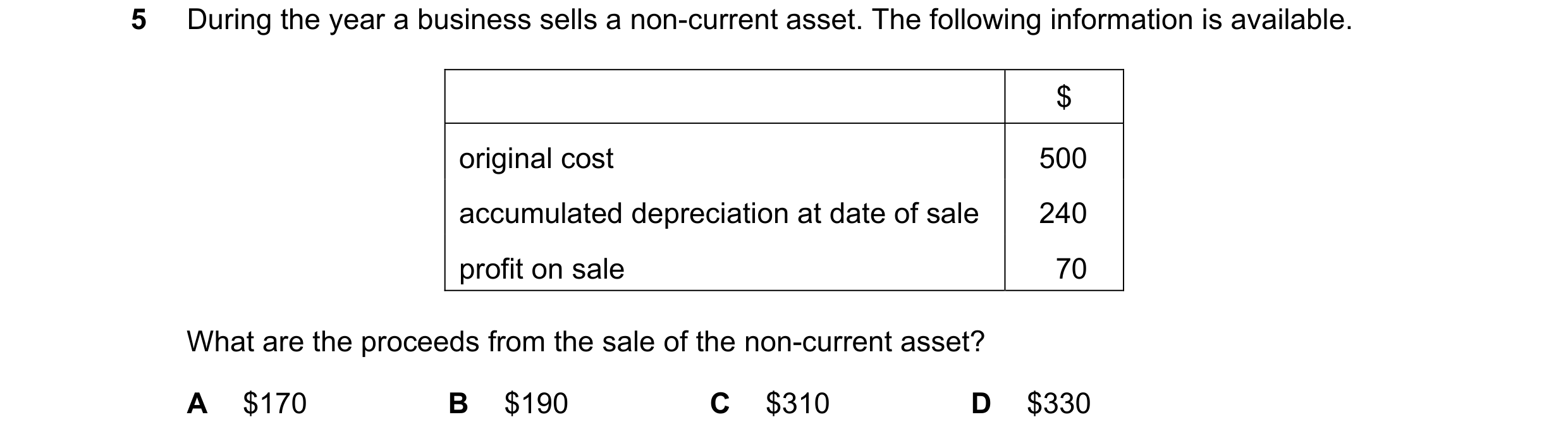

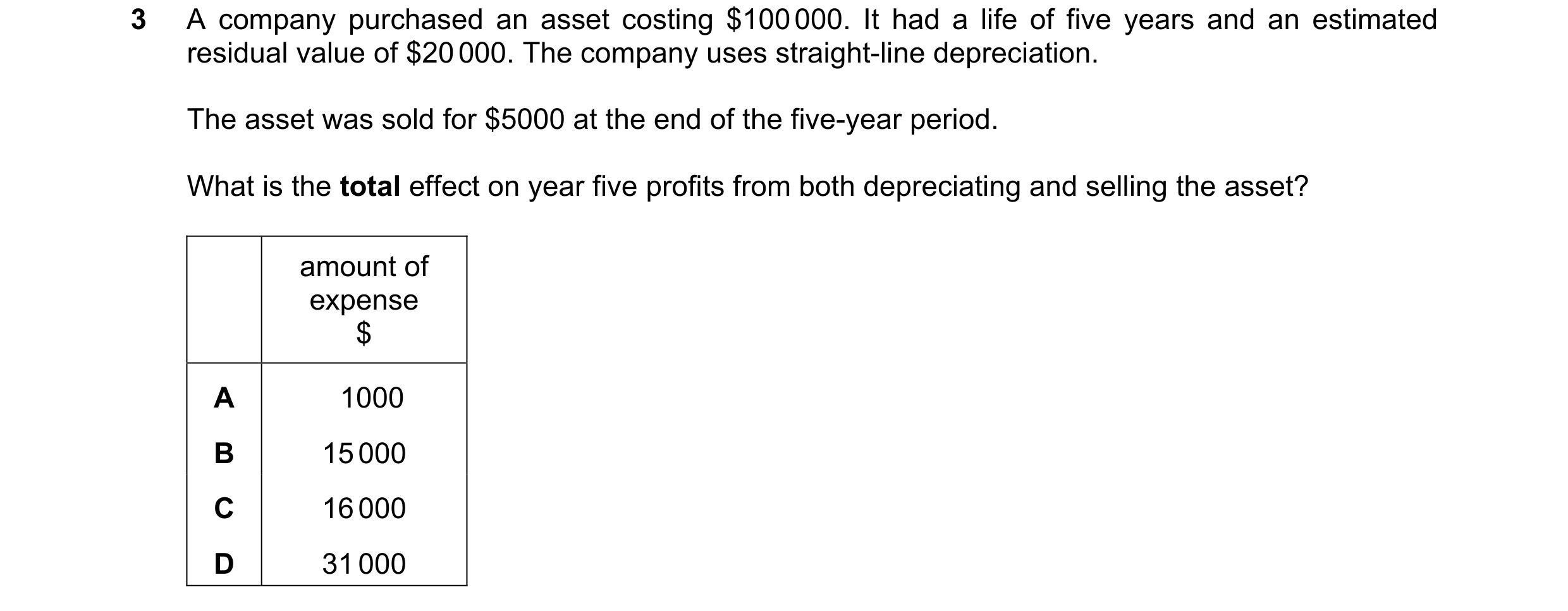
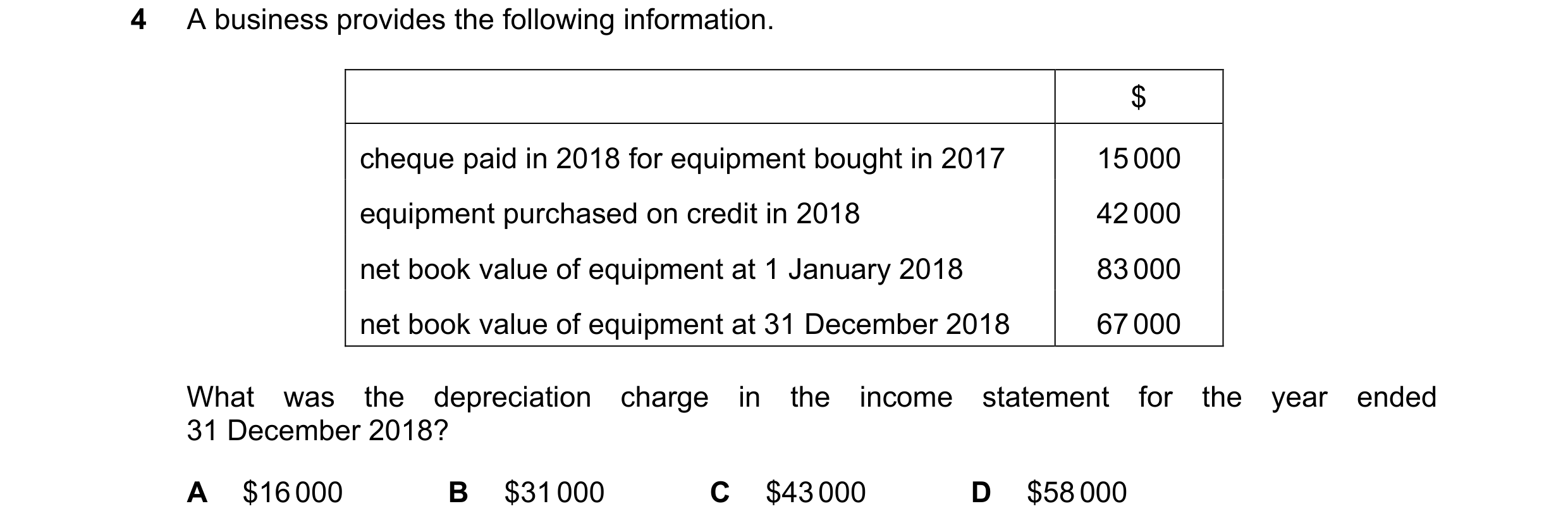 37 / 72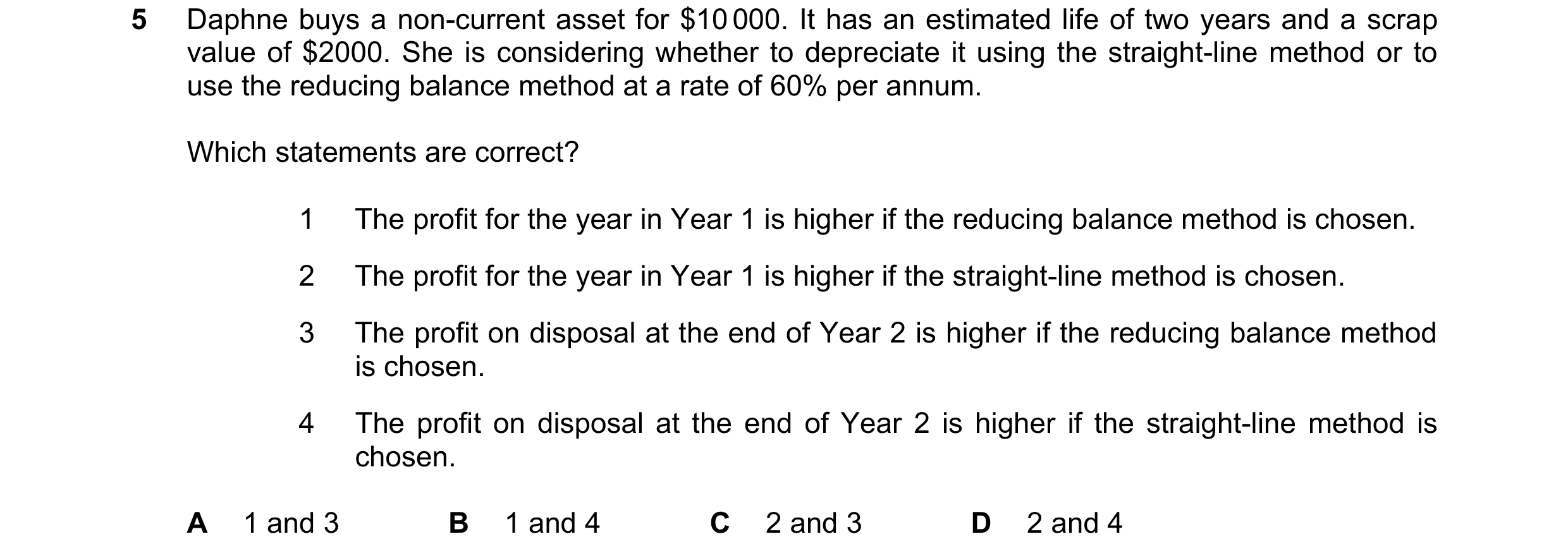
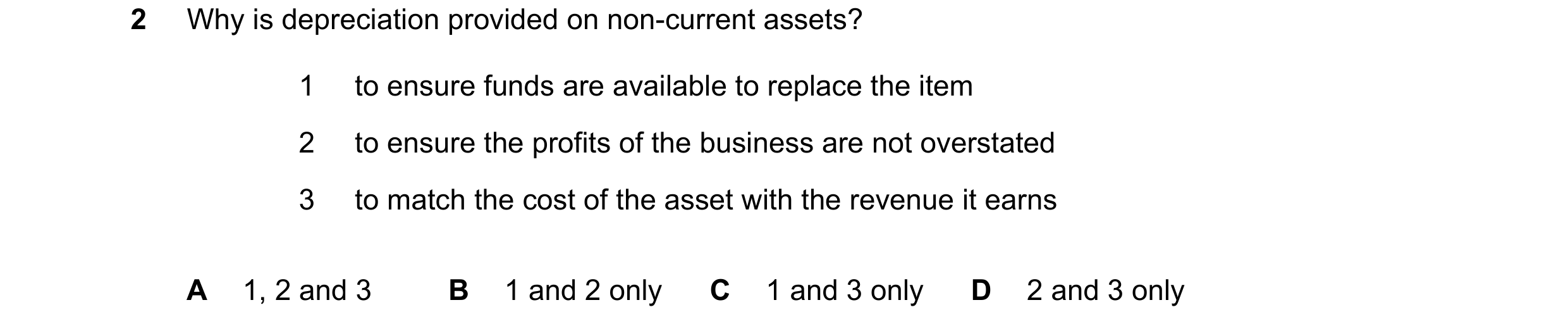
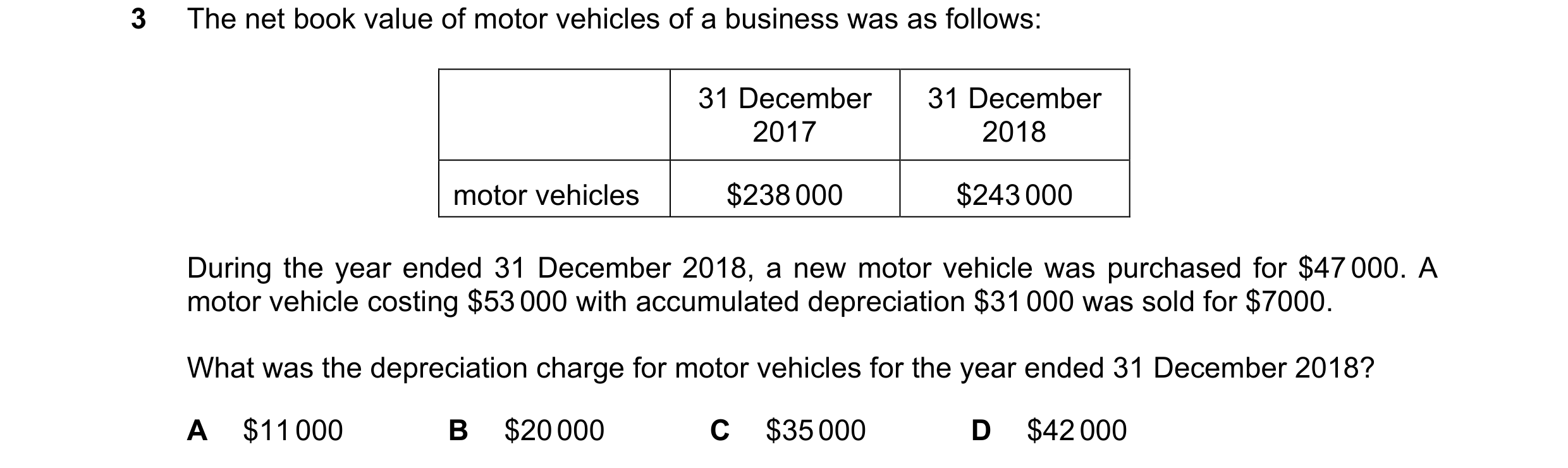
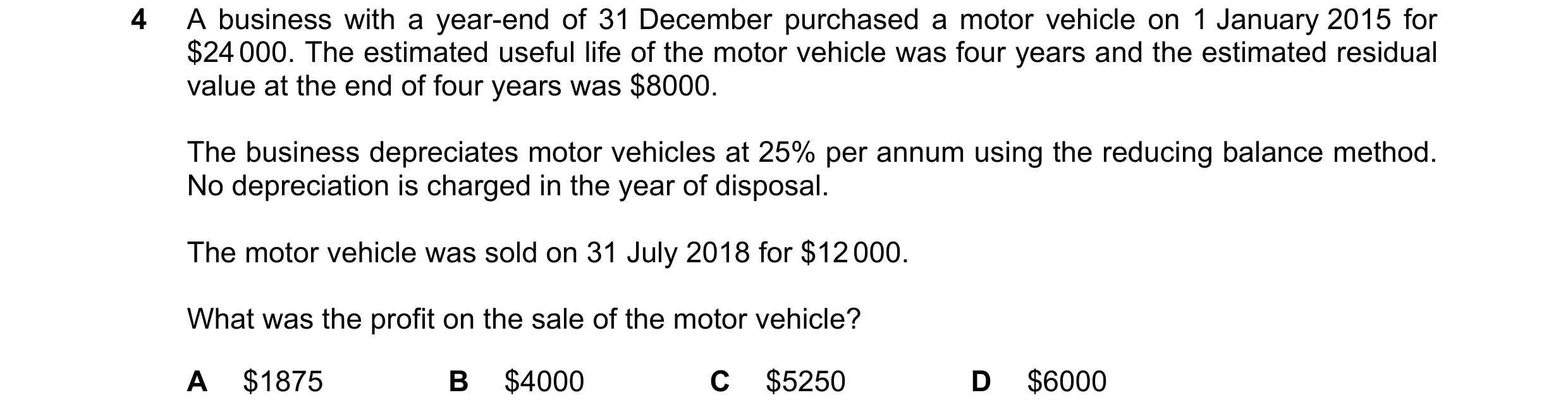 38 / 72

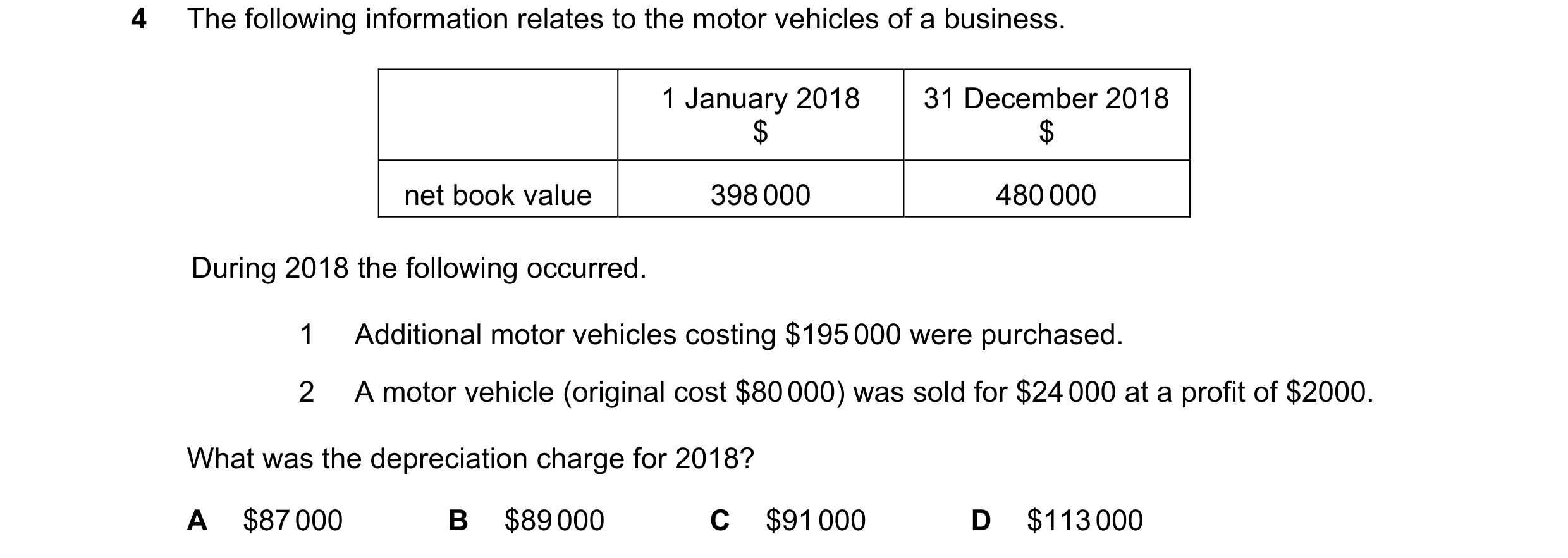

 39 / 72
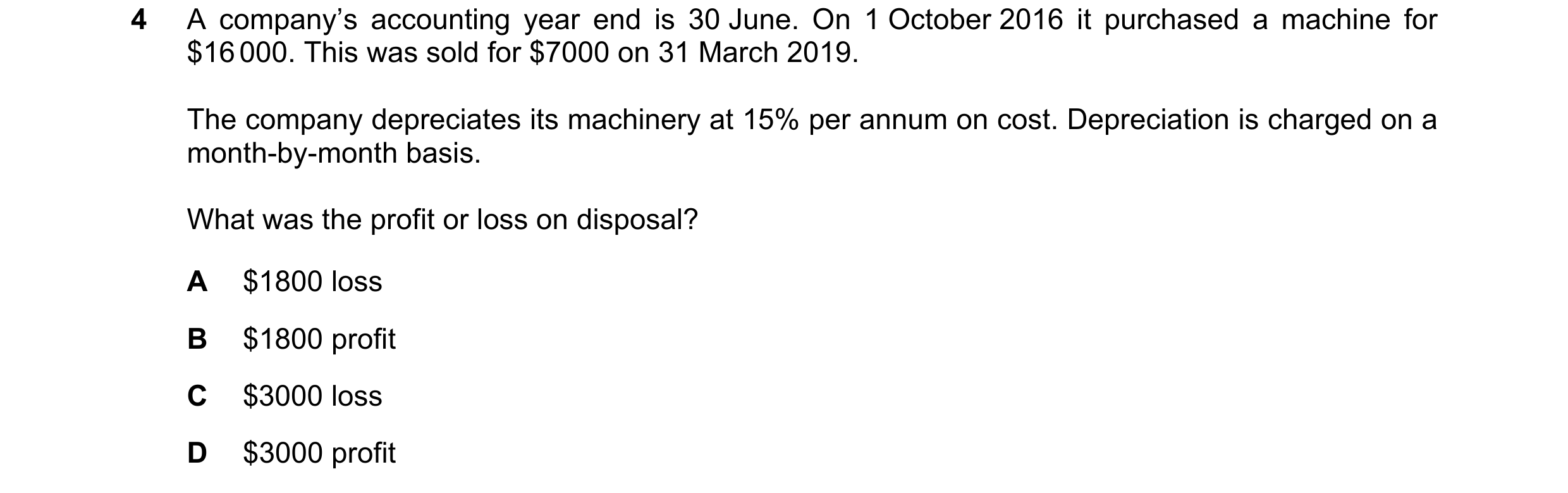
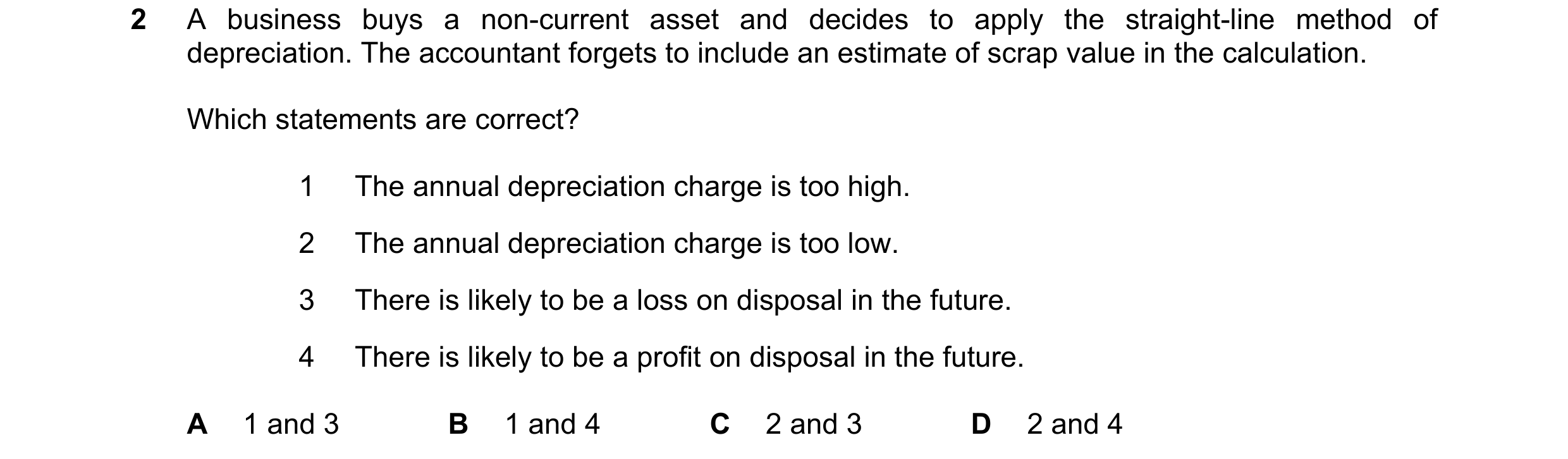 40 / 72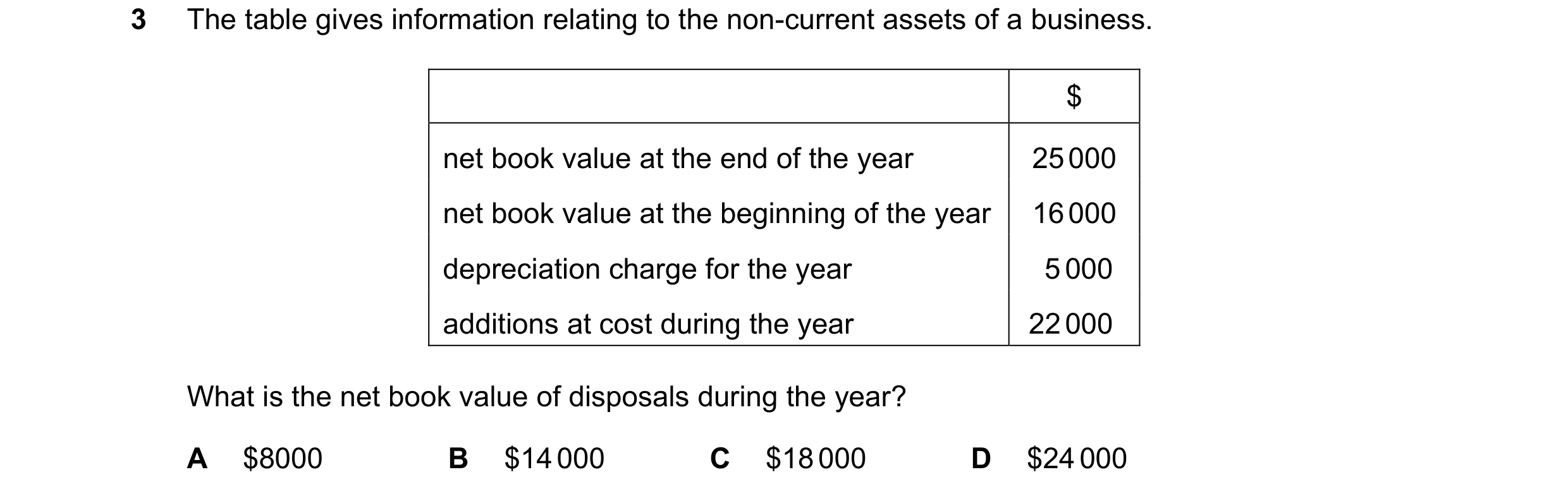


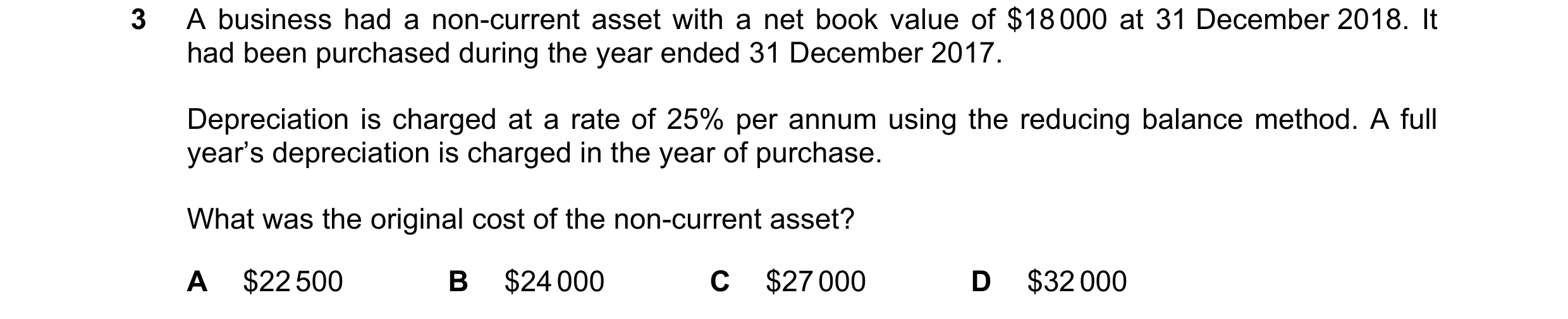
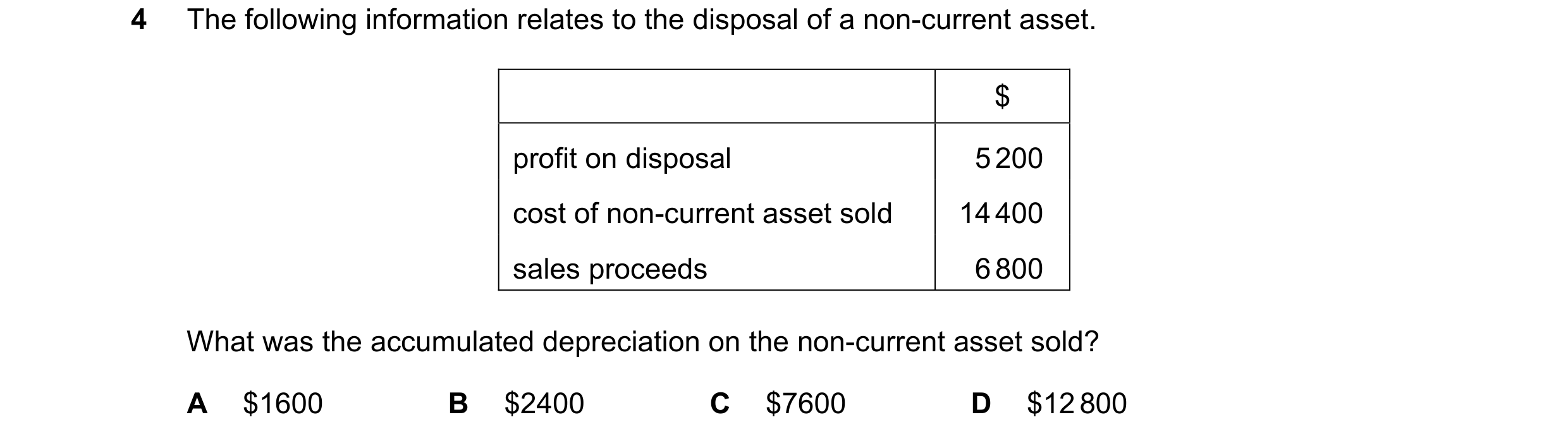 41 / 72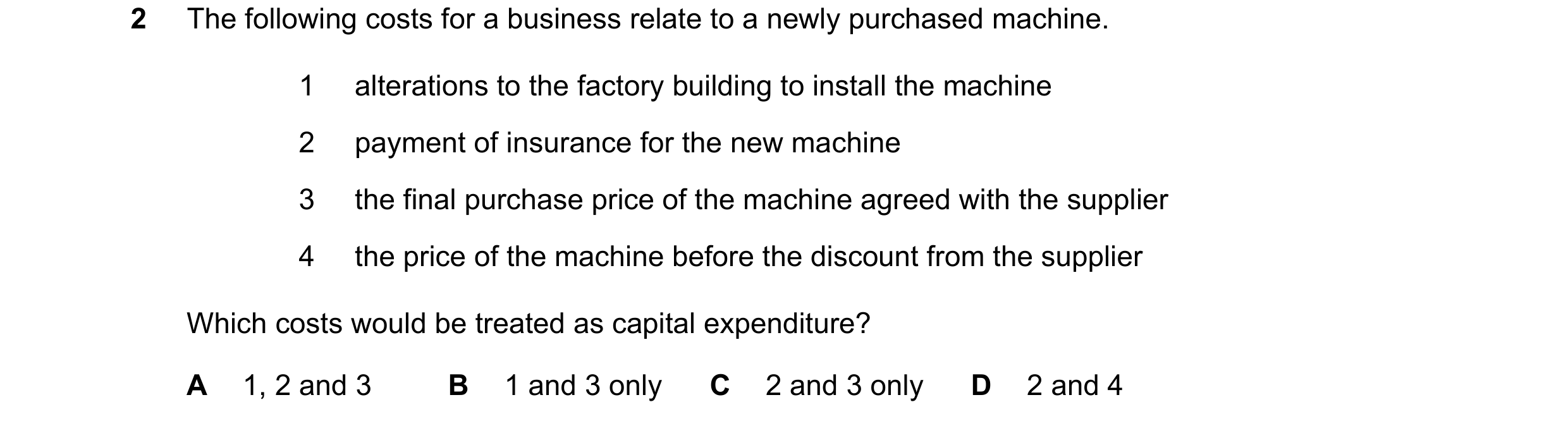
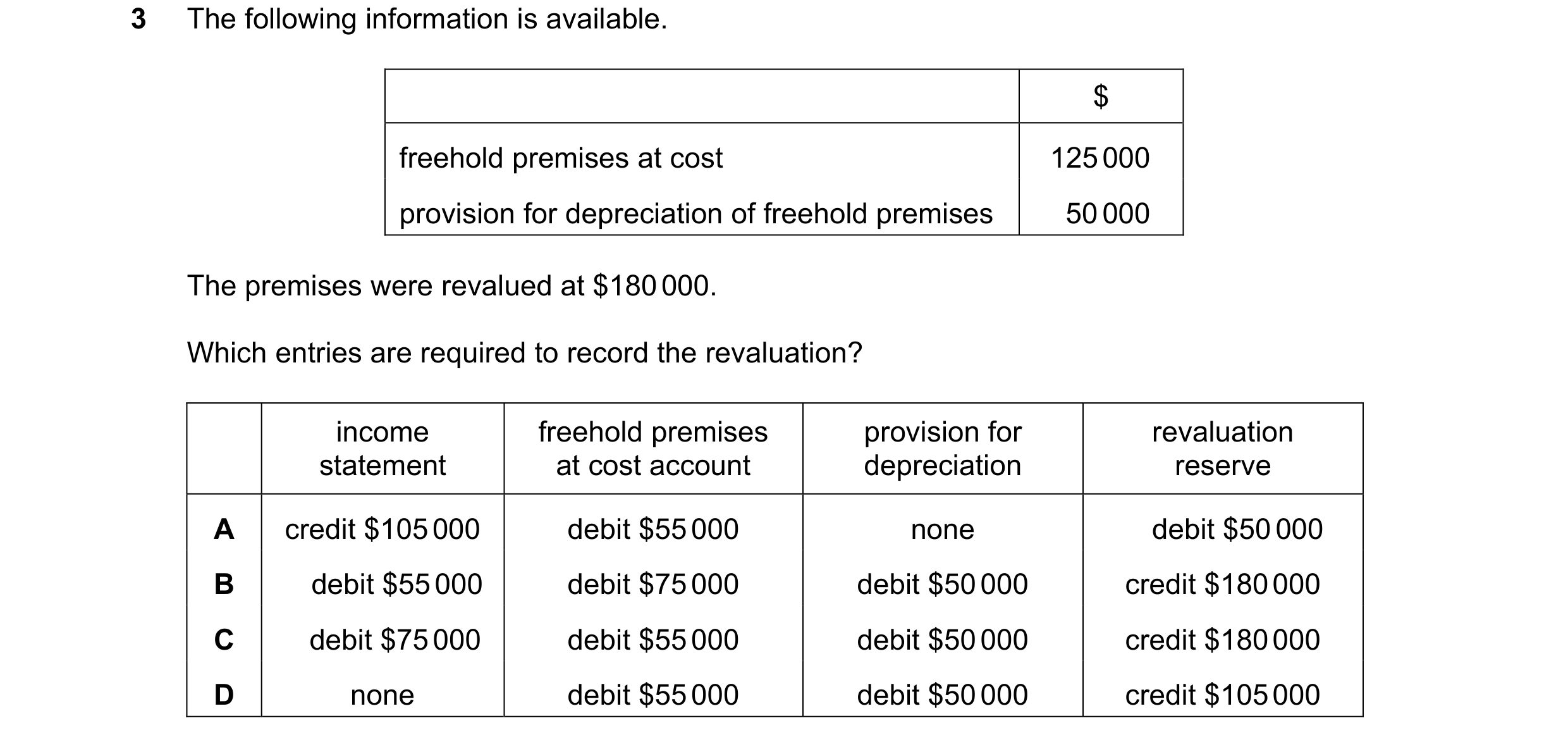
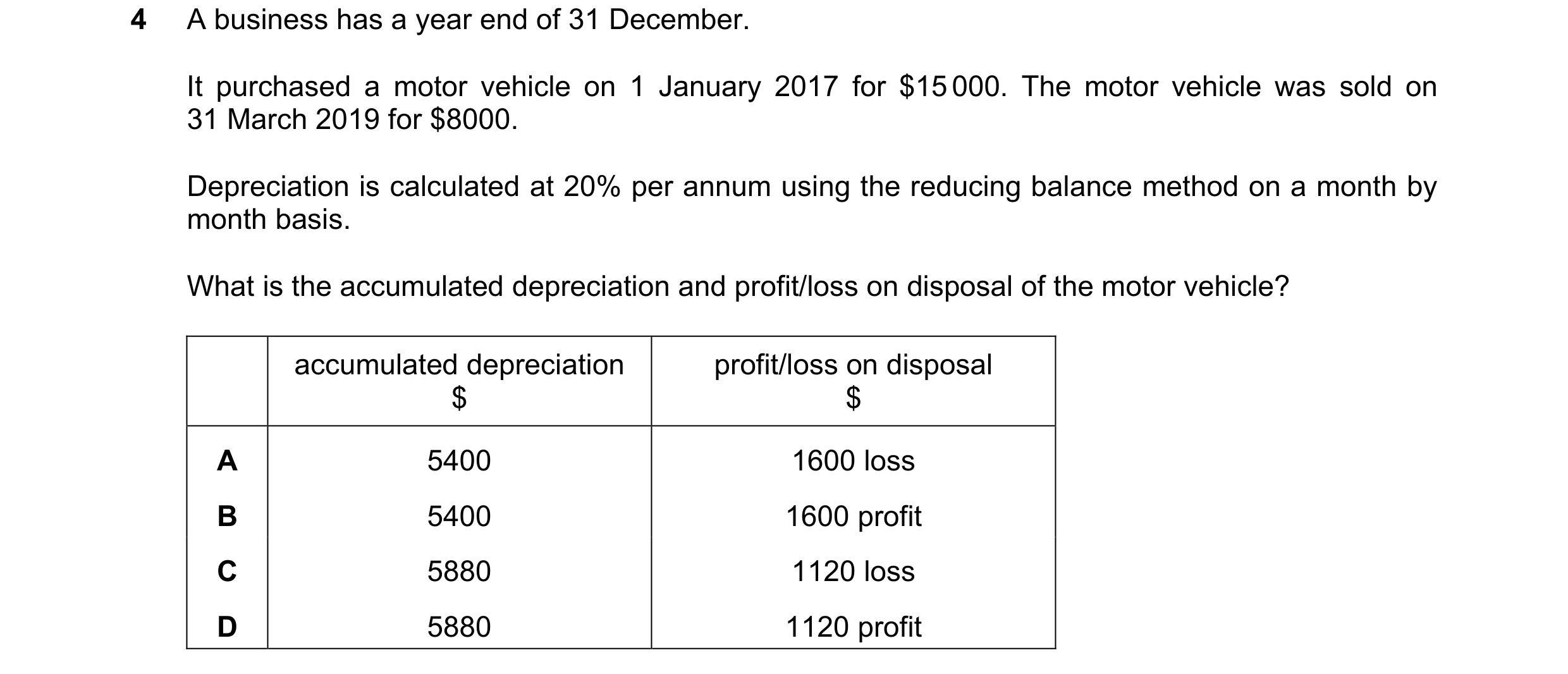 42 / 72
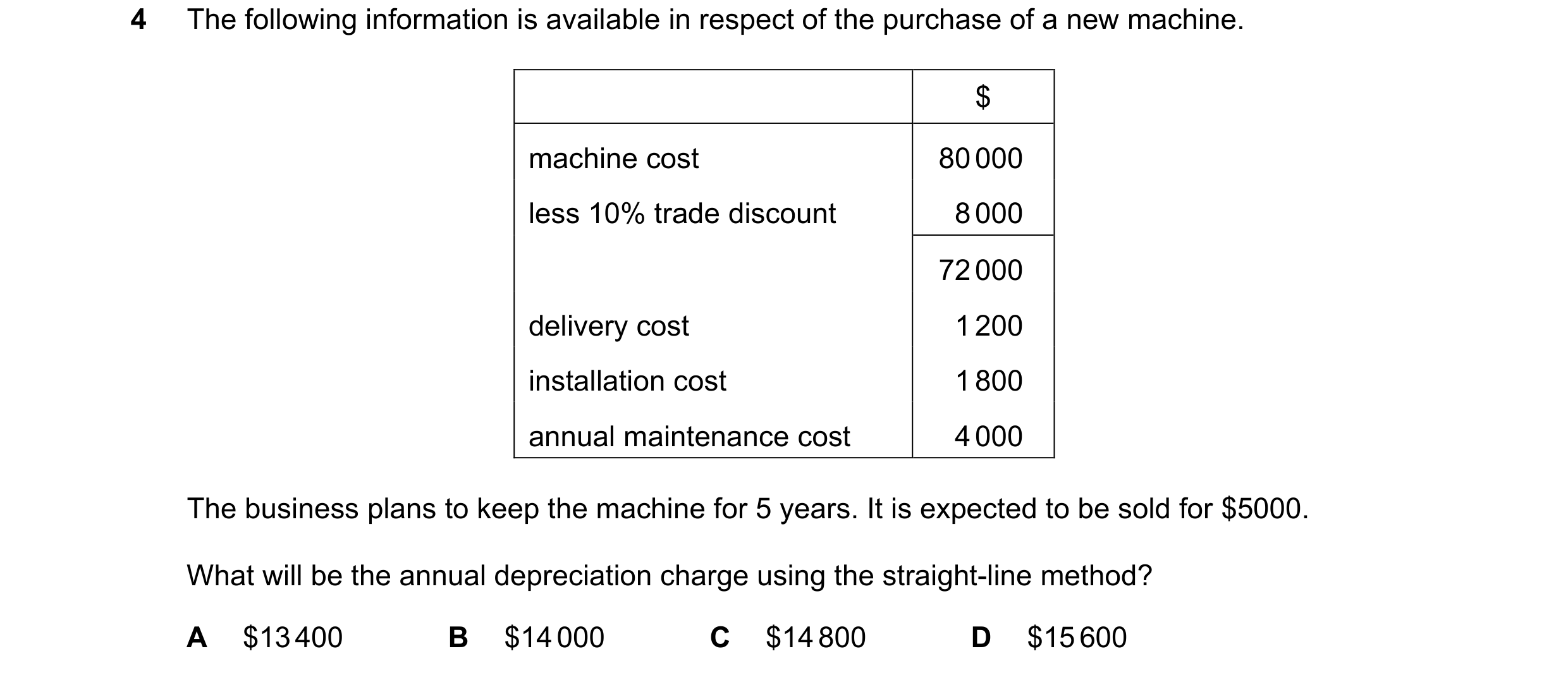
 43 / 72

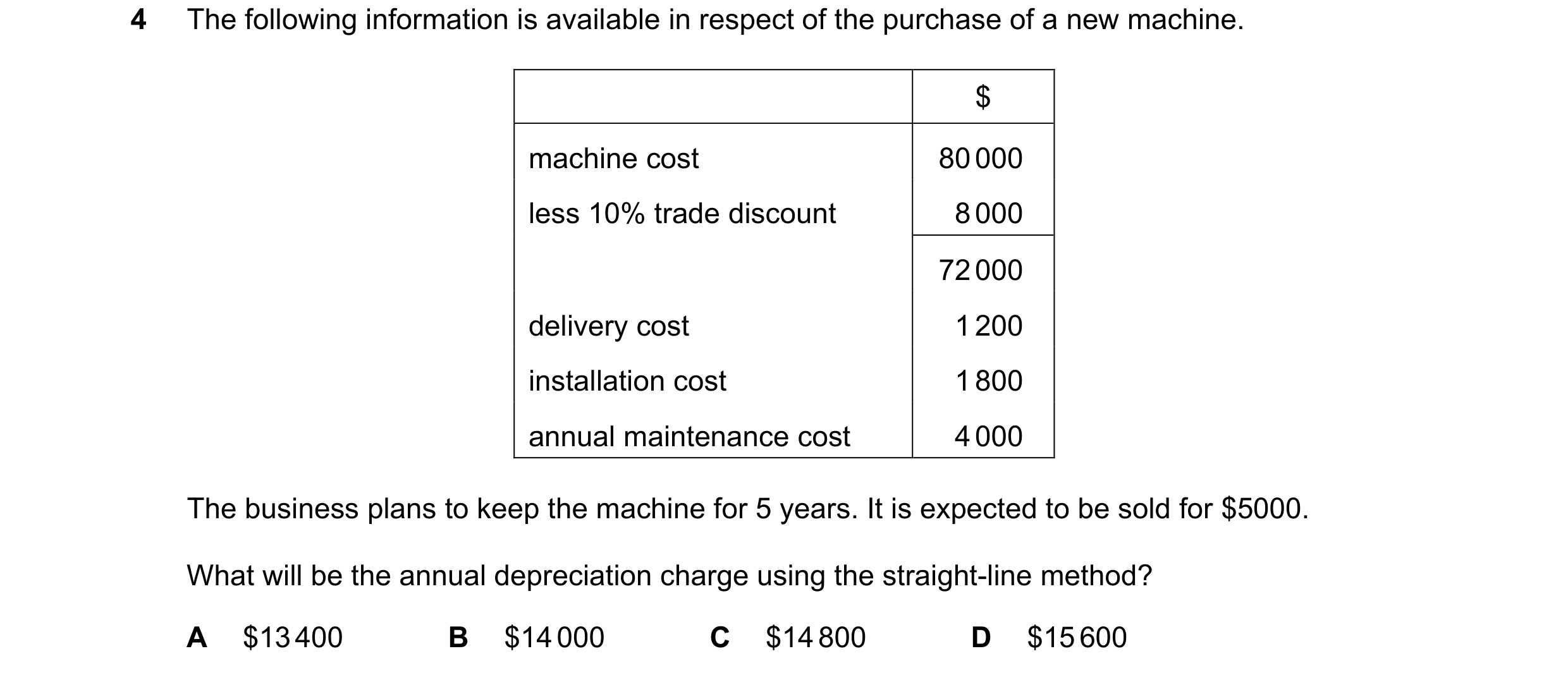 44 / 72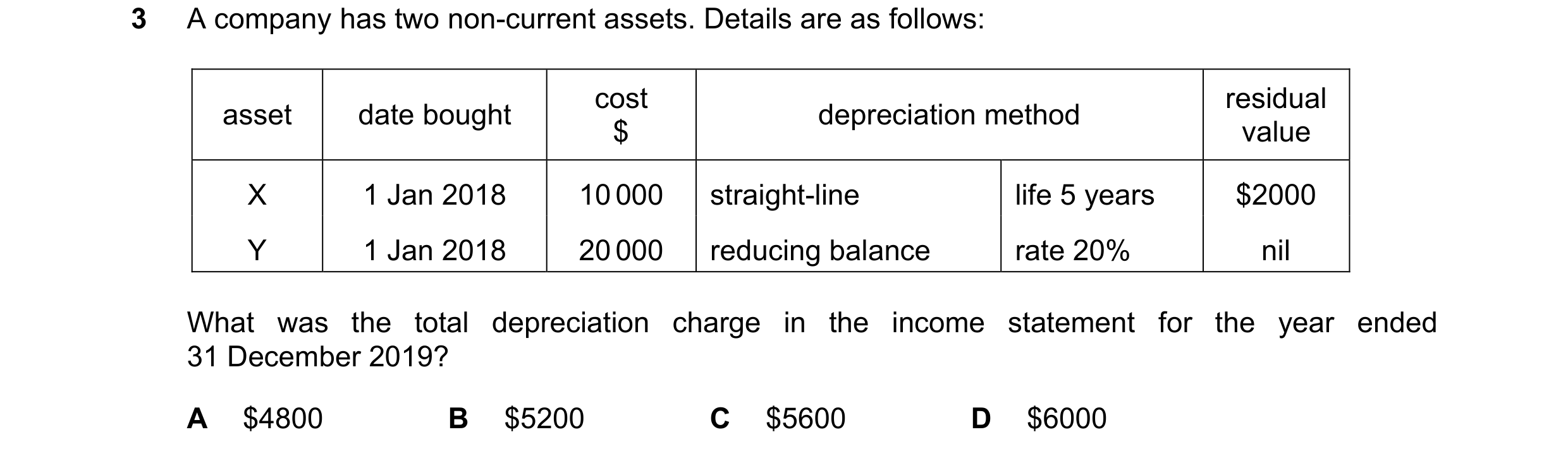

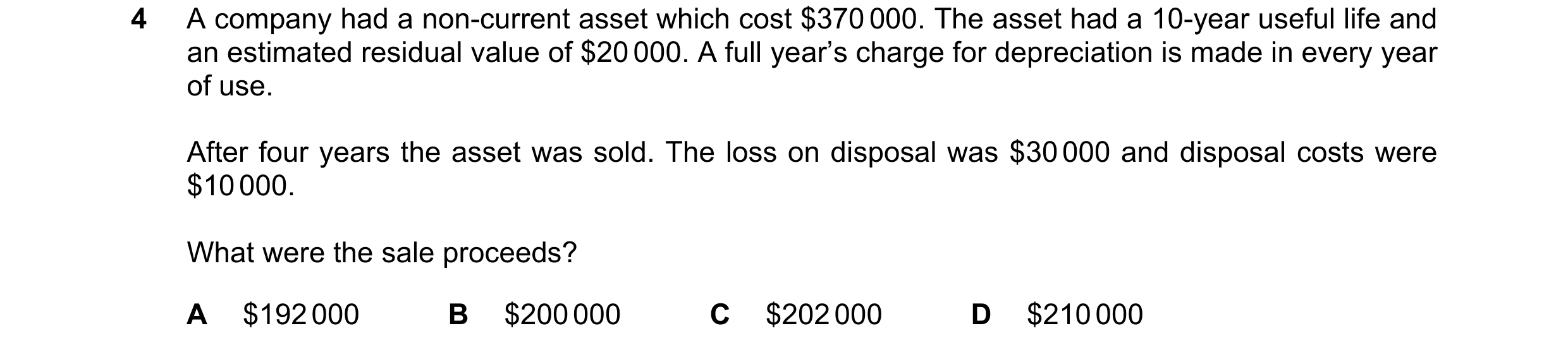 45 / 72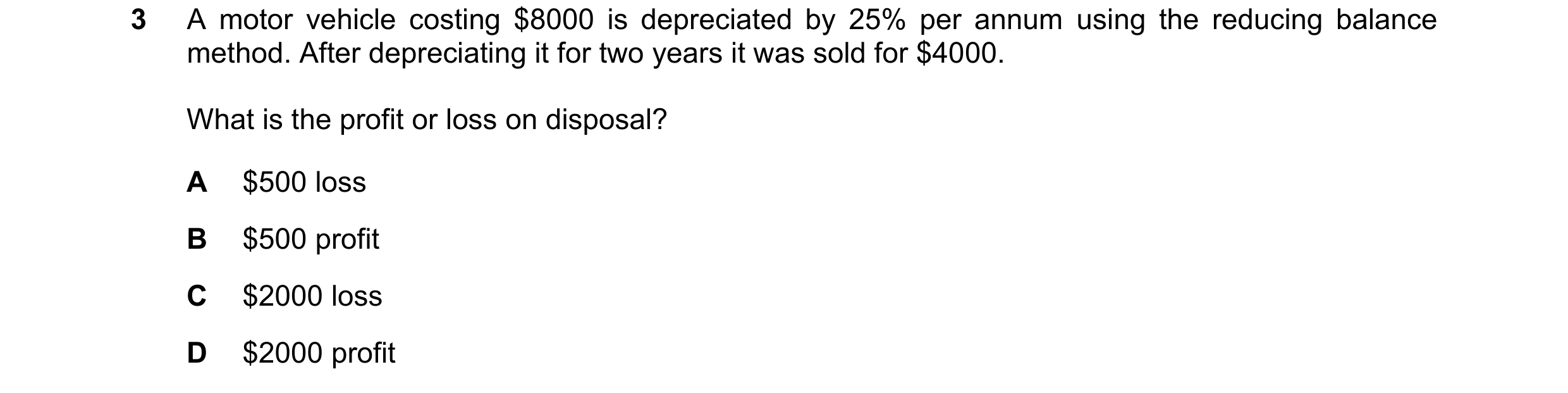
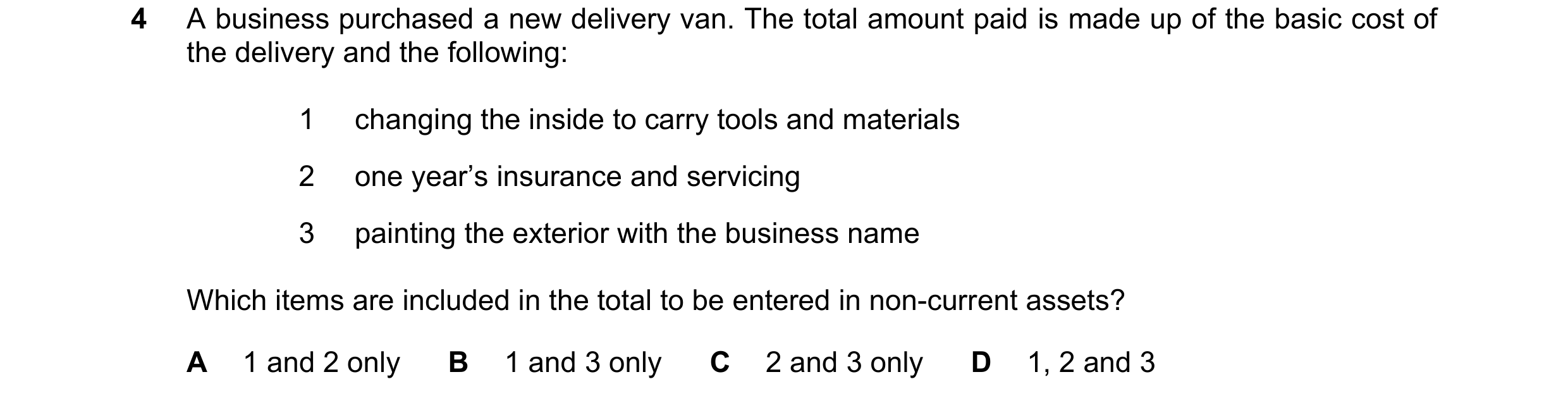


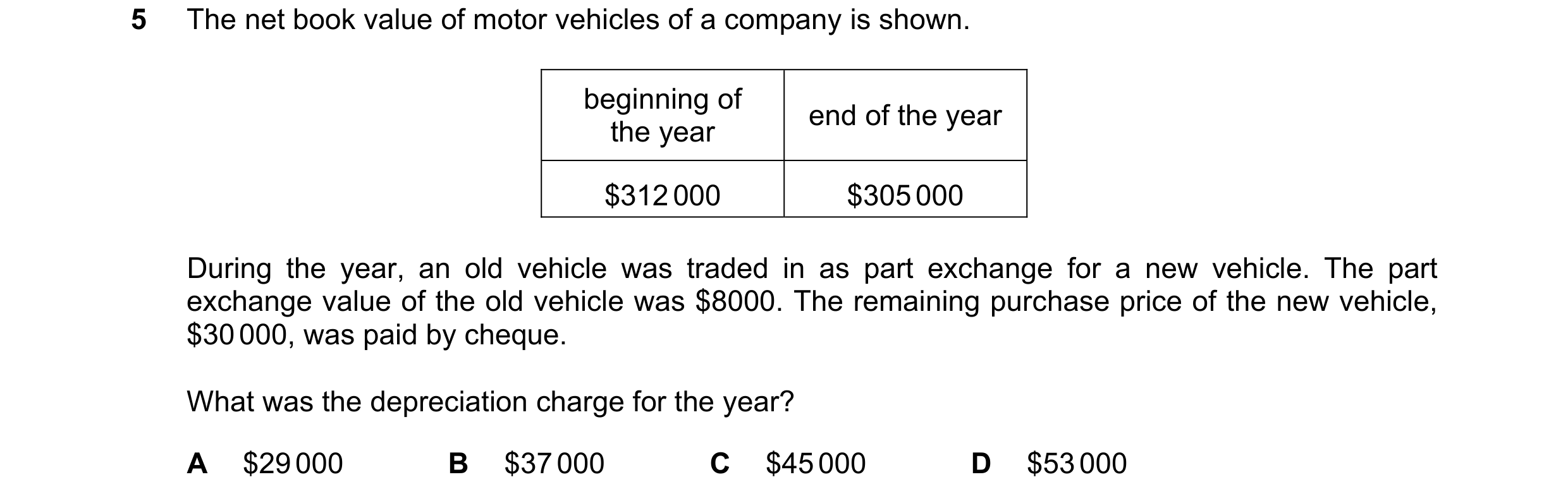 46 / 72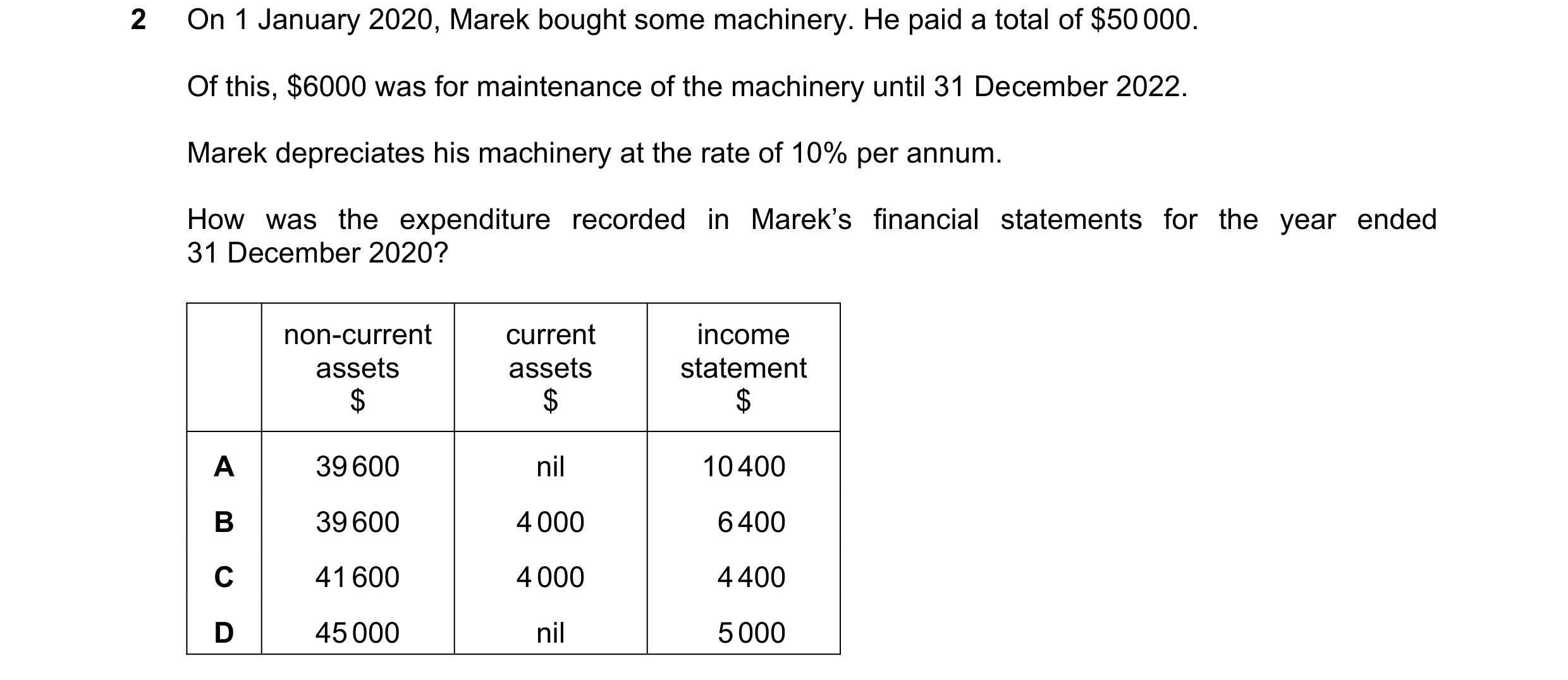


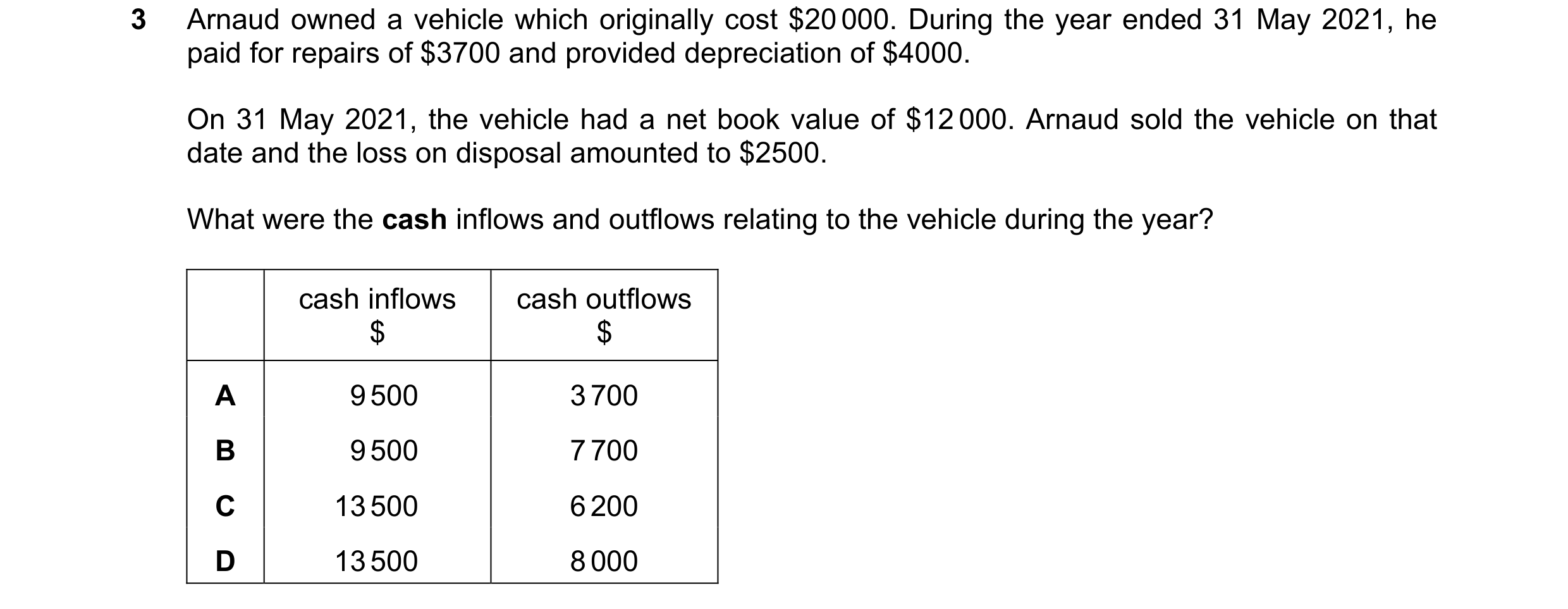 47 / 72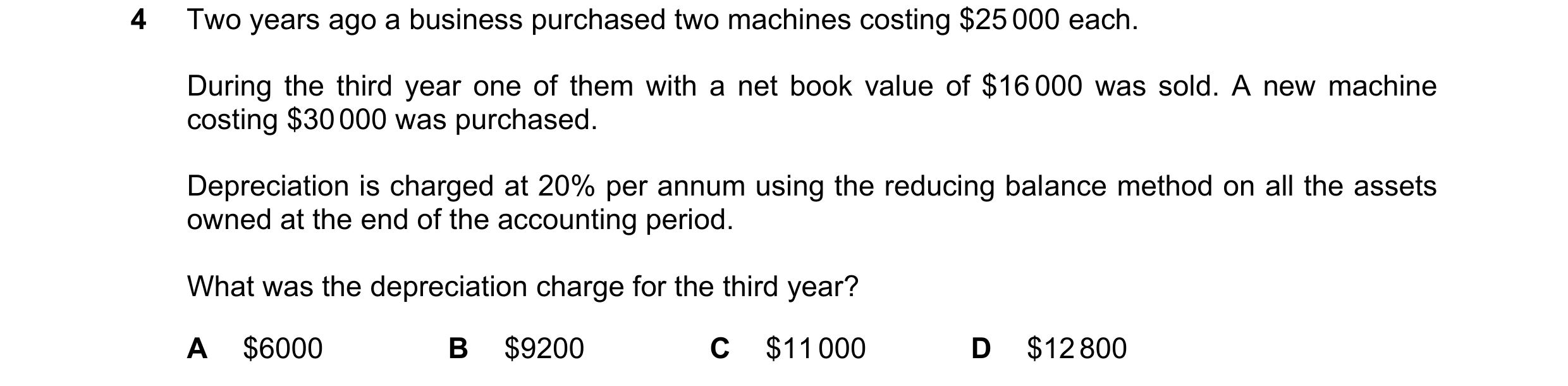
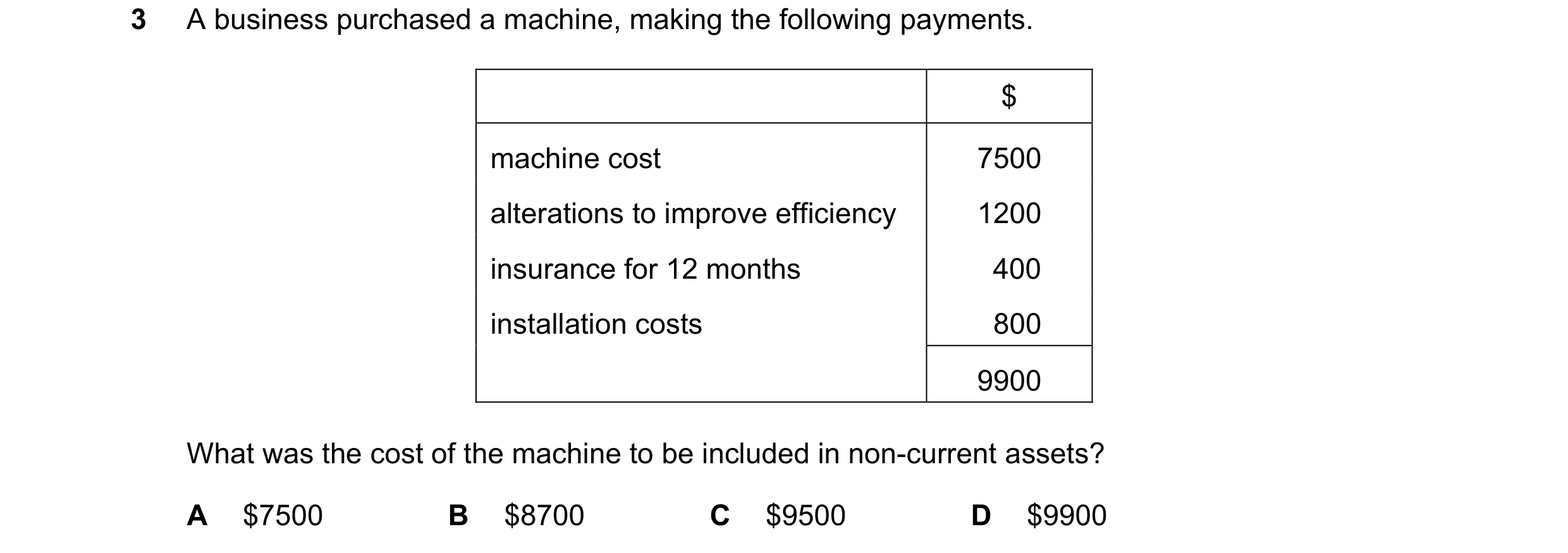
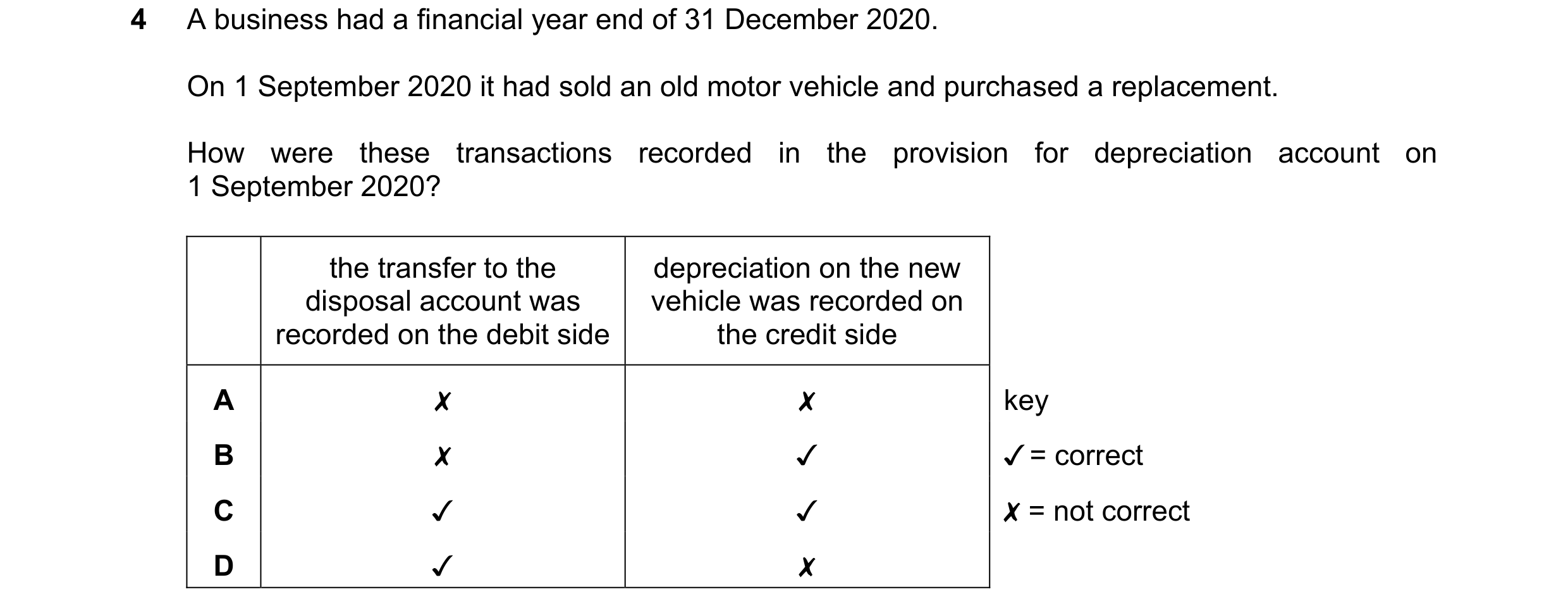
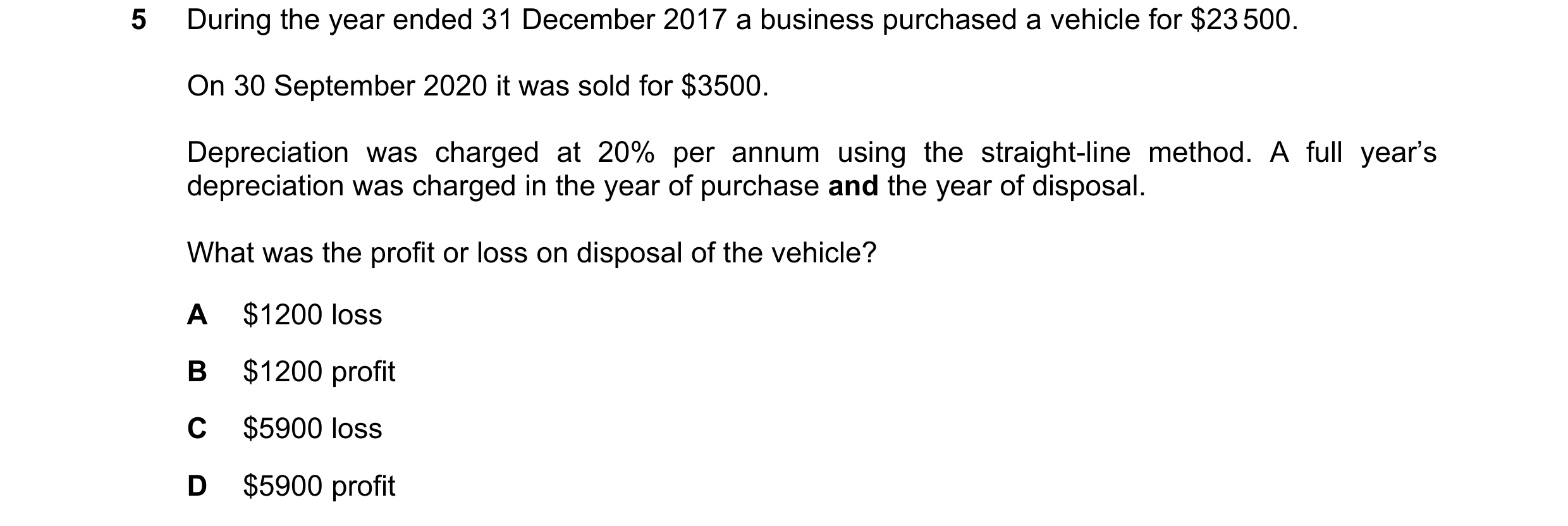 48 / 72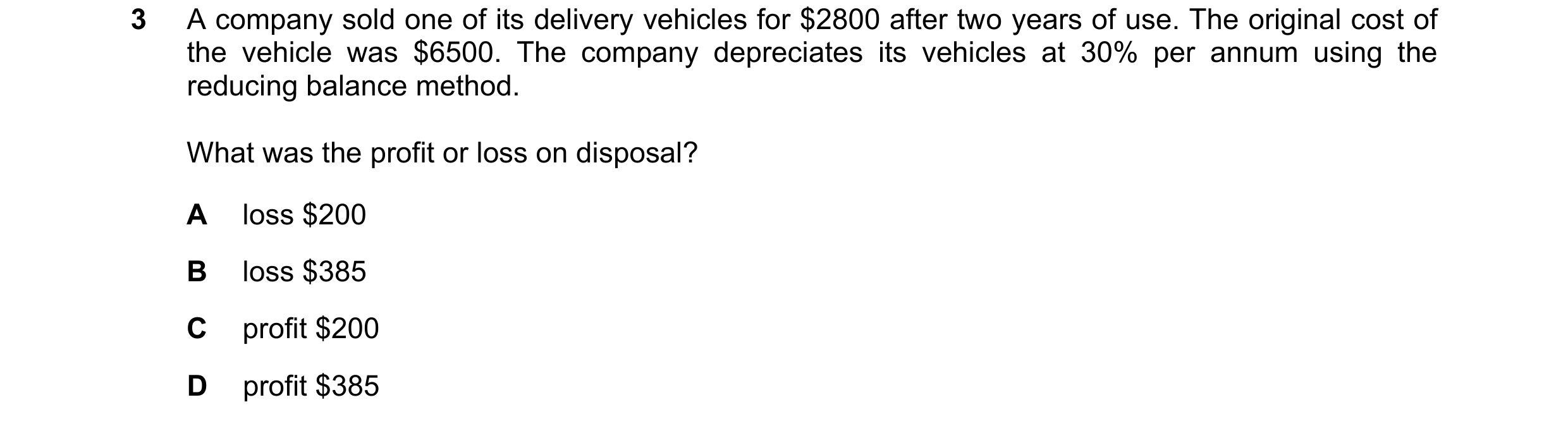
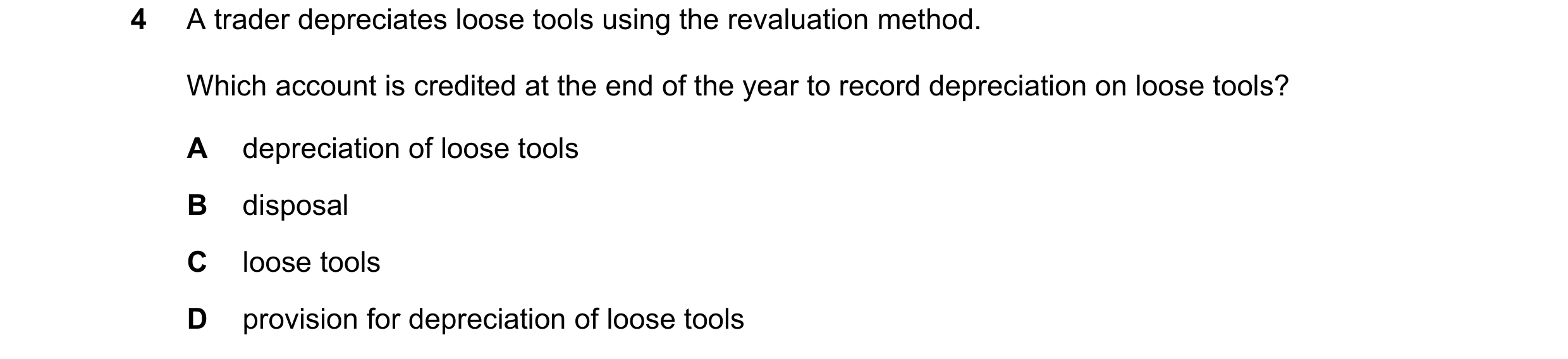
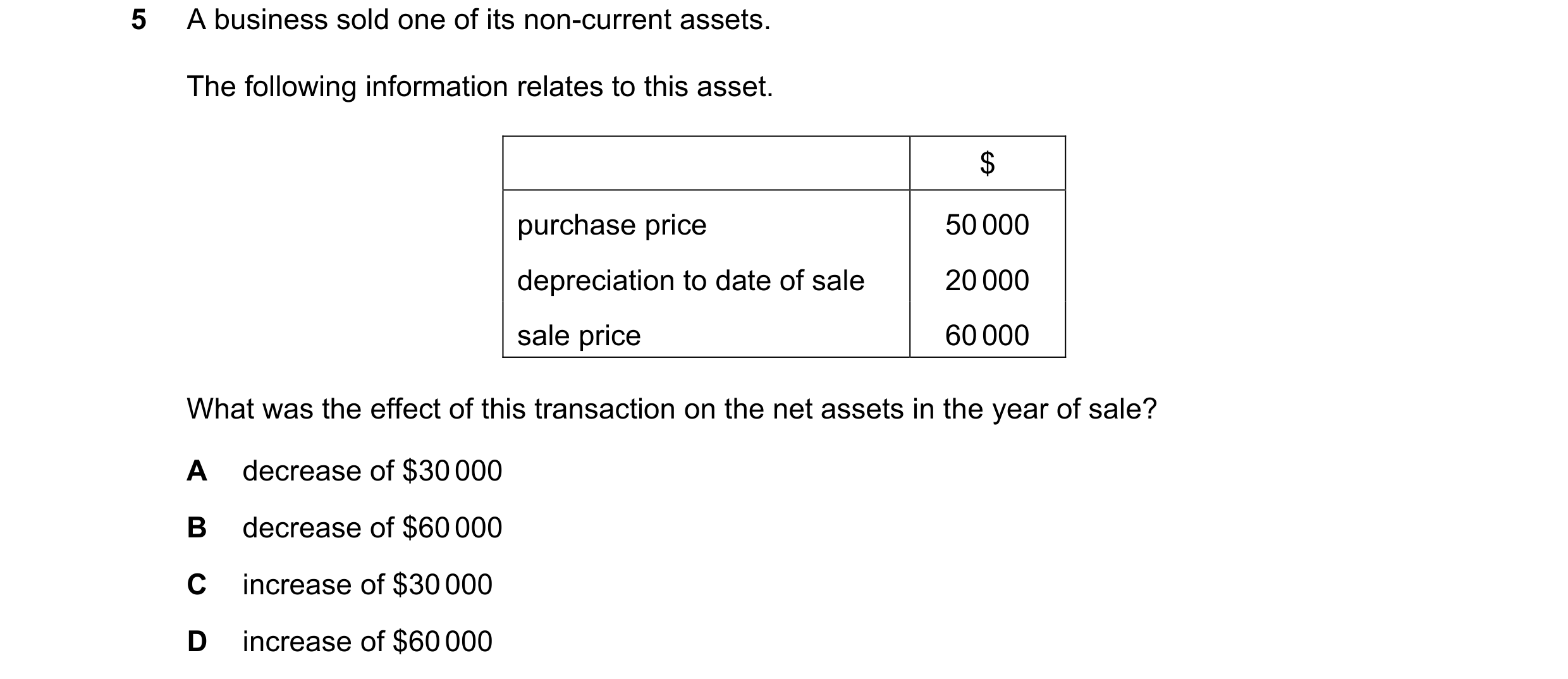 49 / 72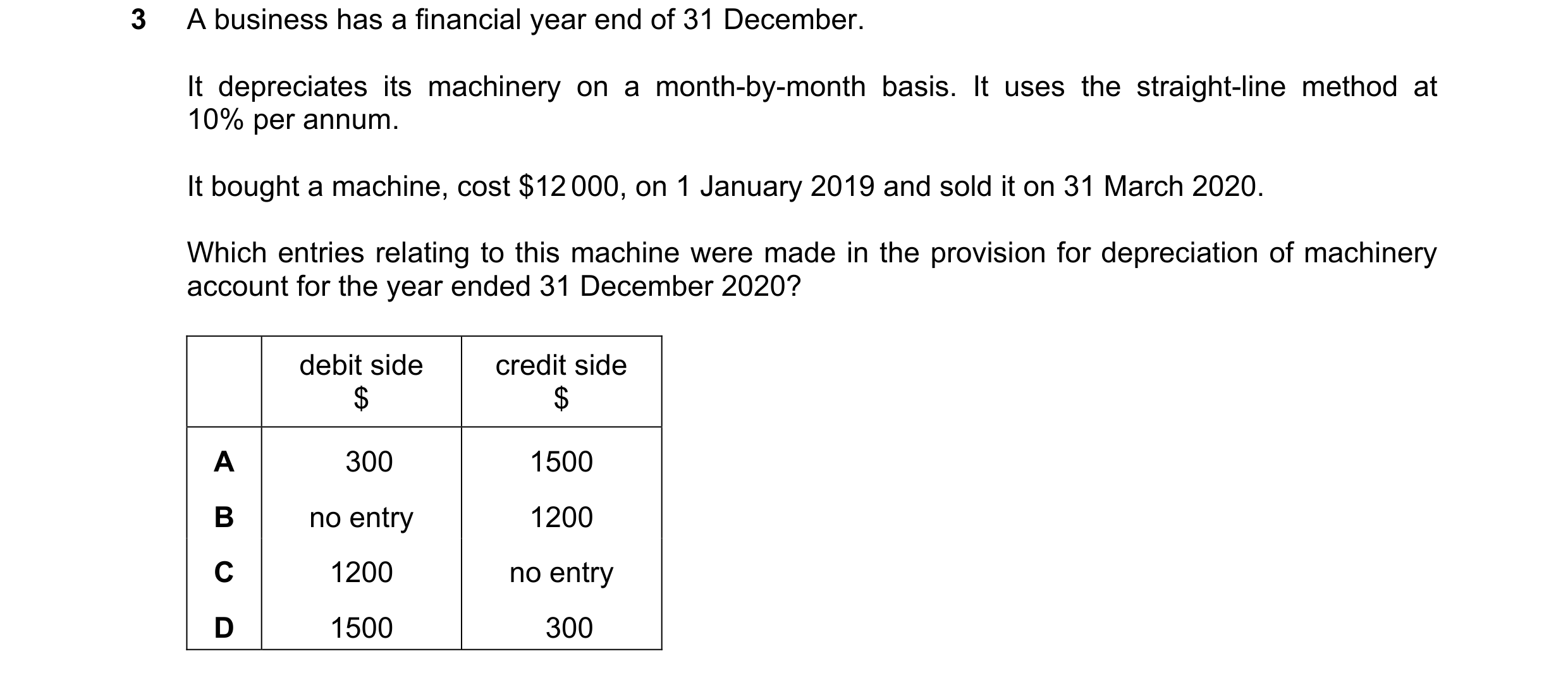
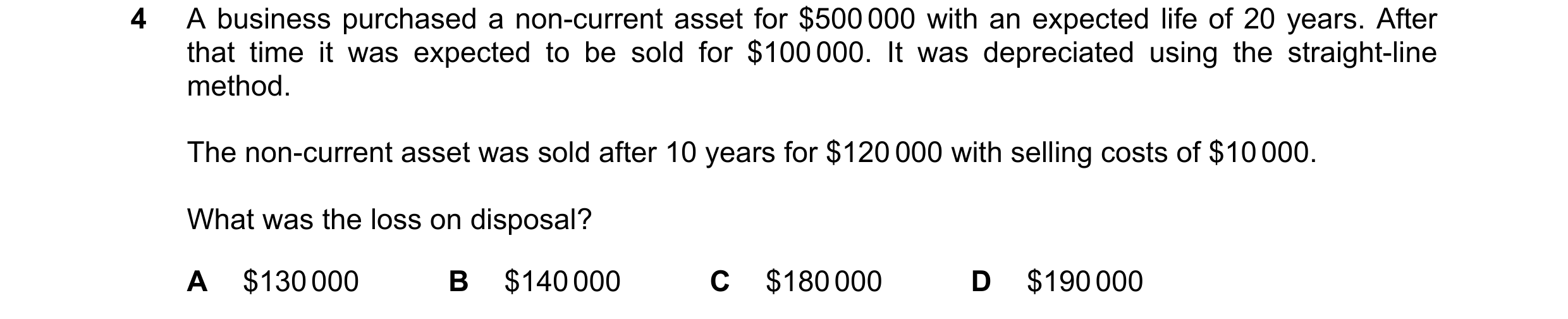
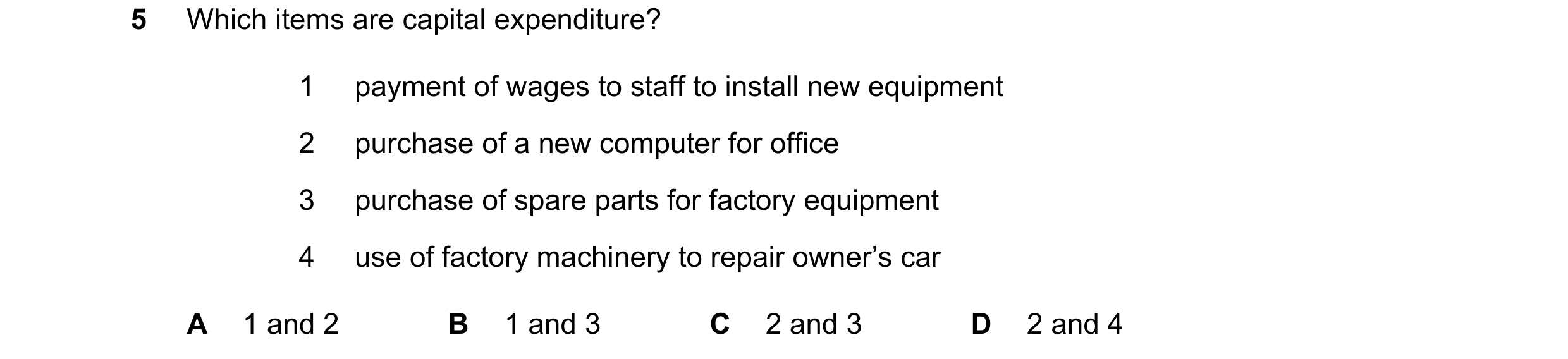
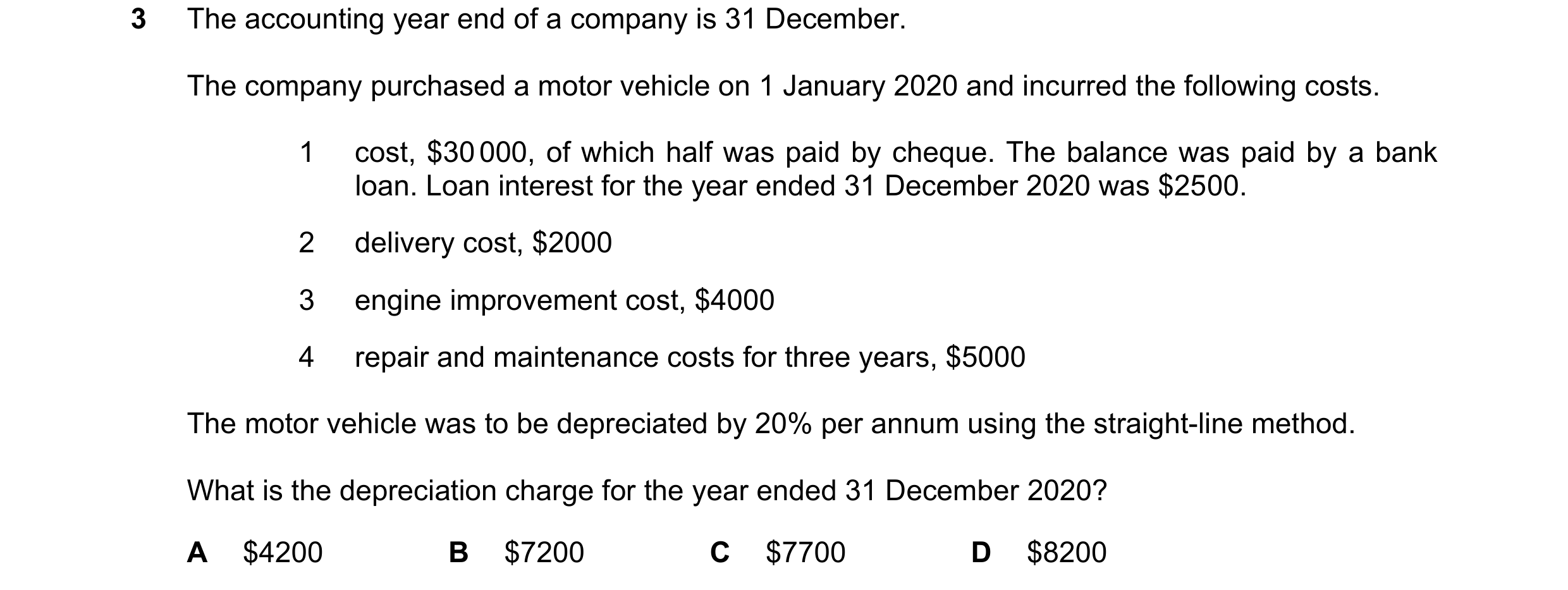 50 / 72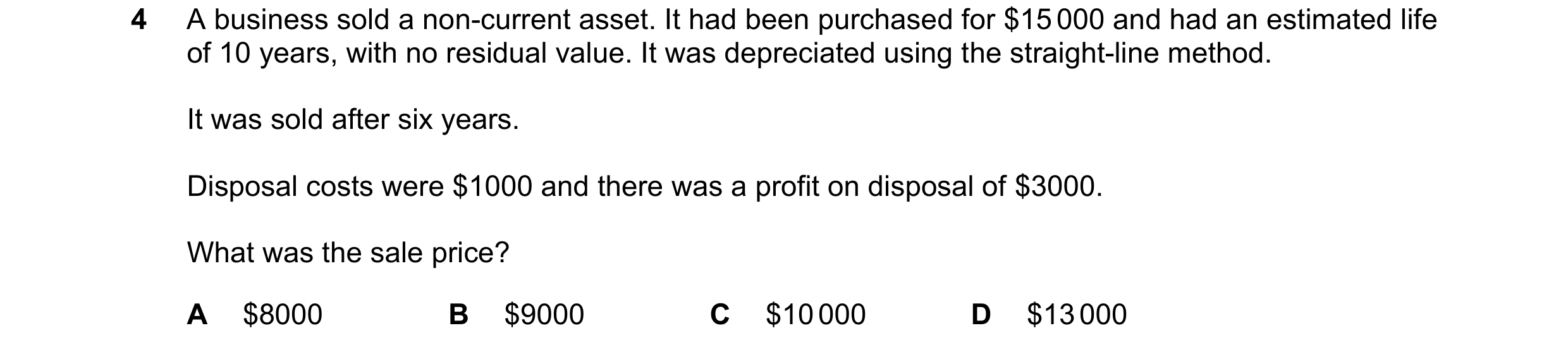


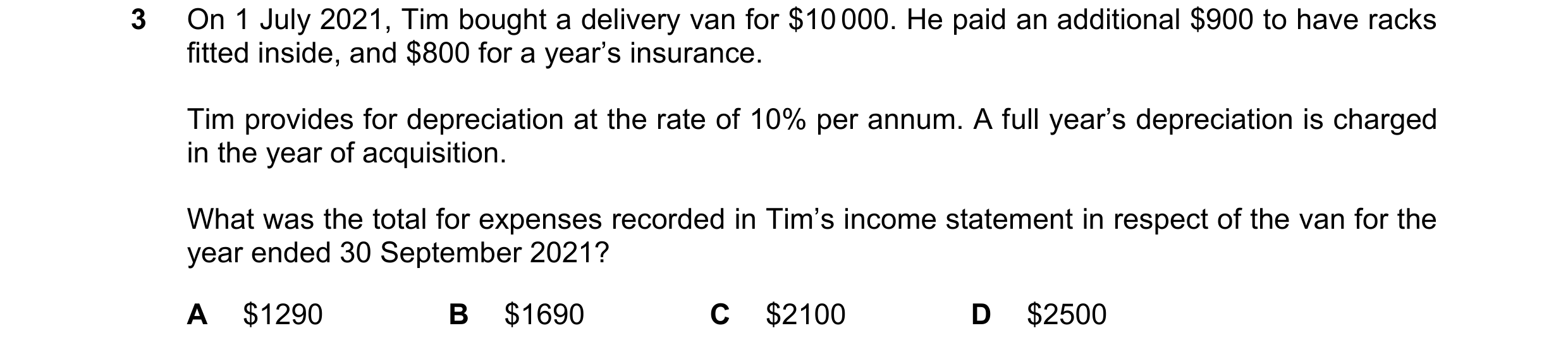

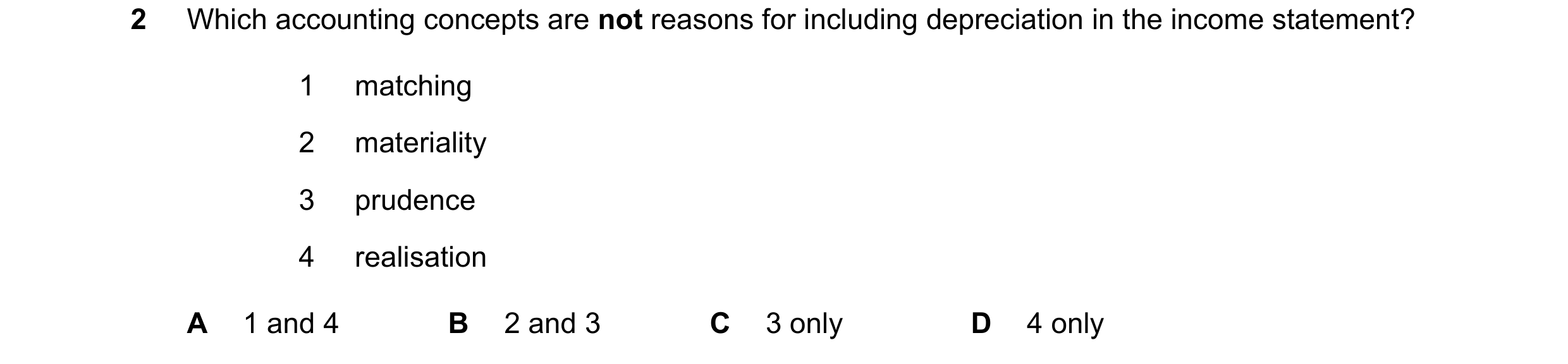 51 / 72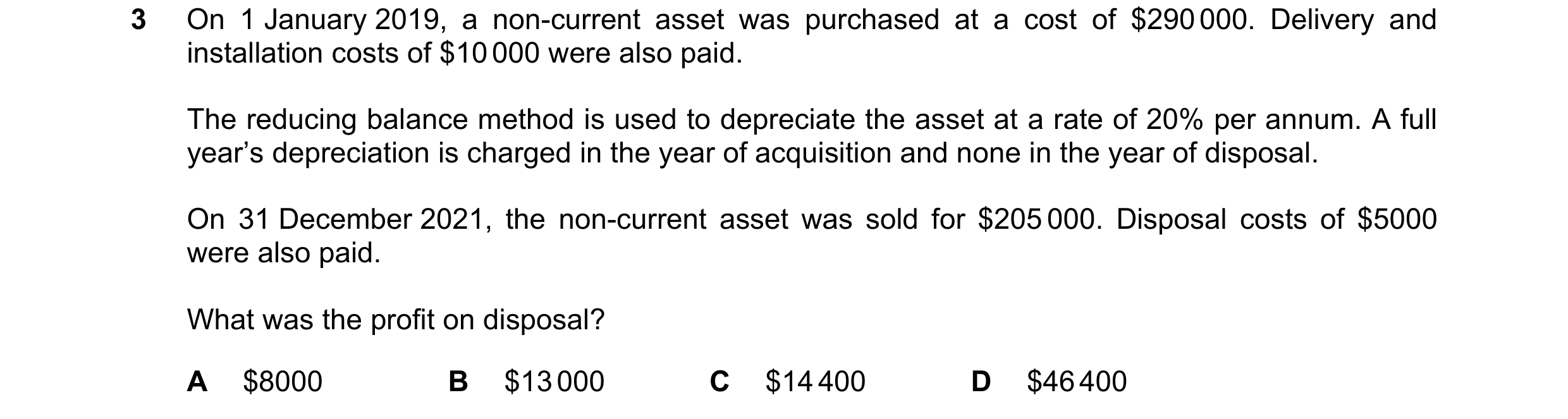
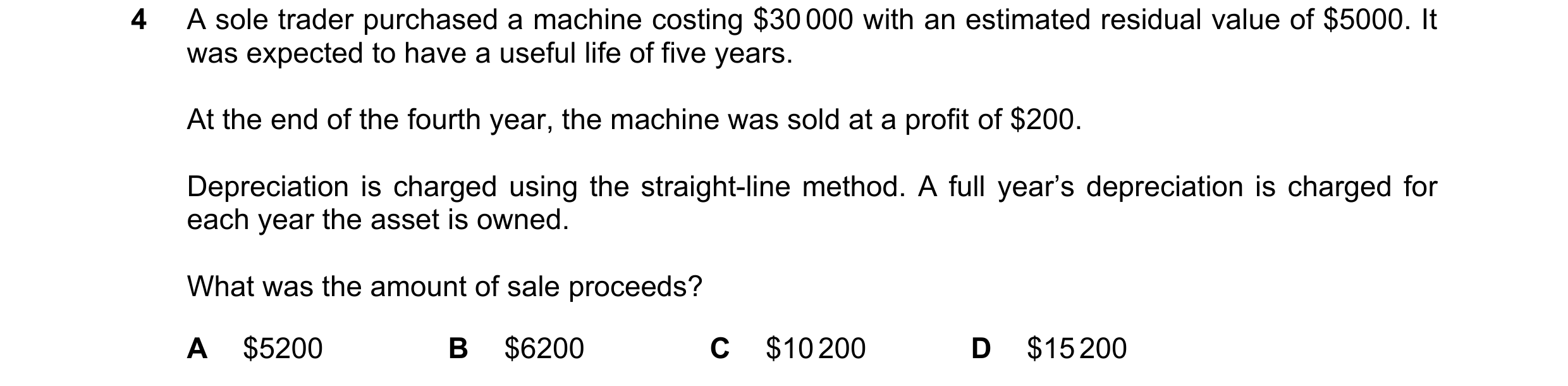
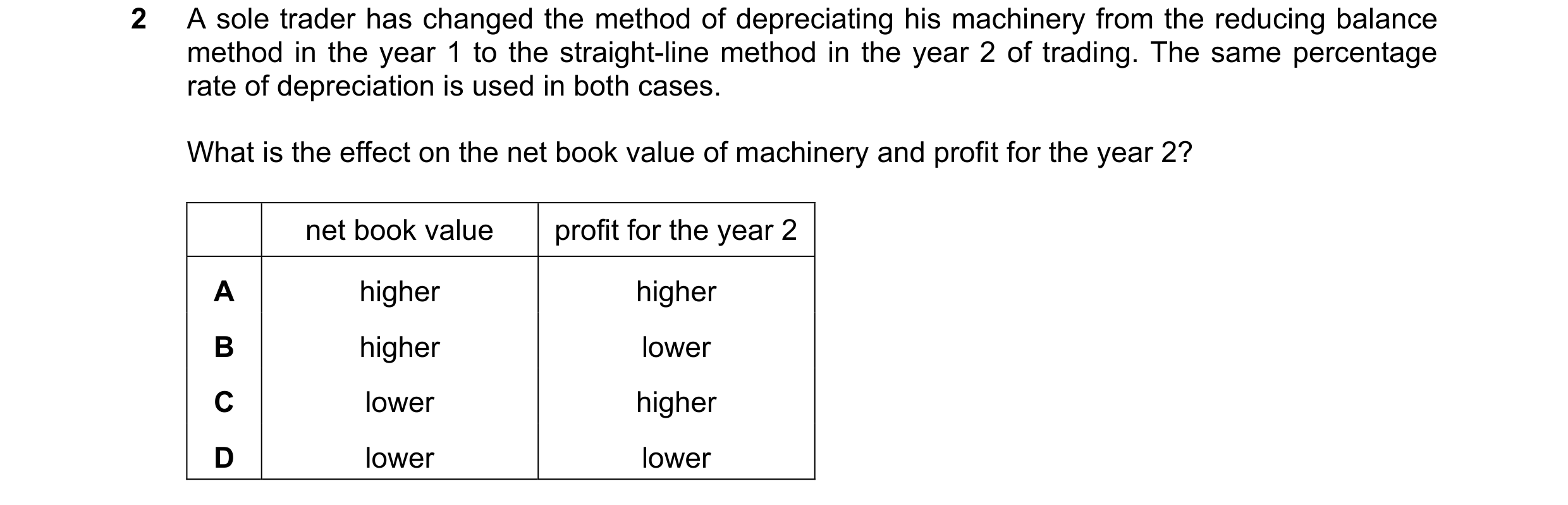
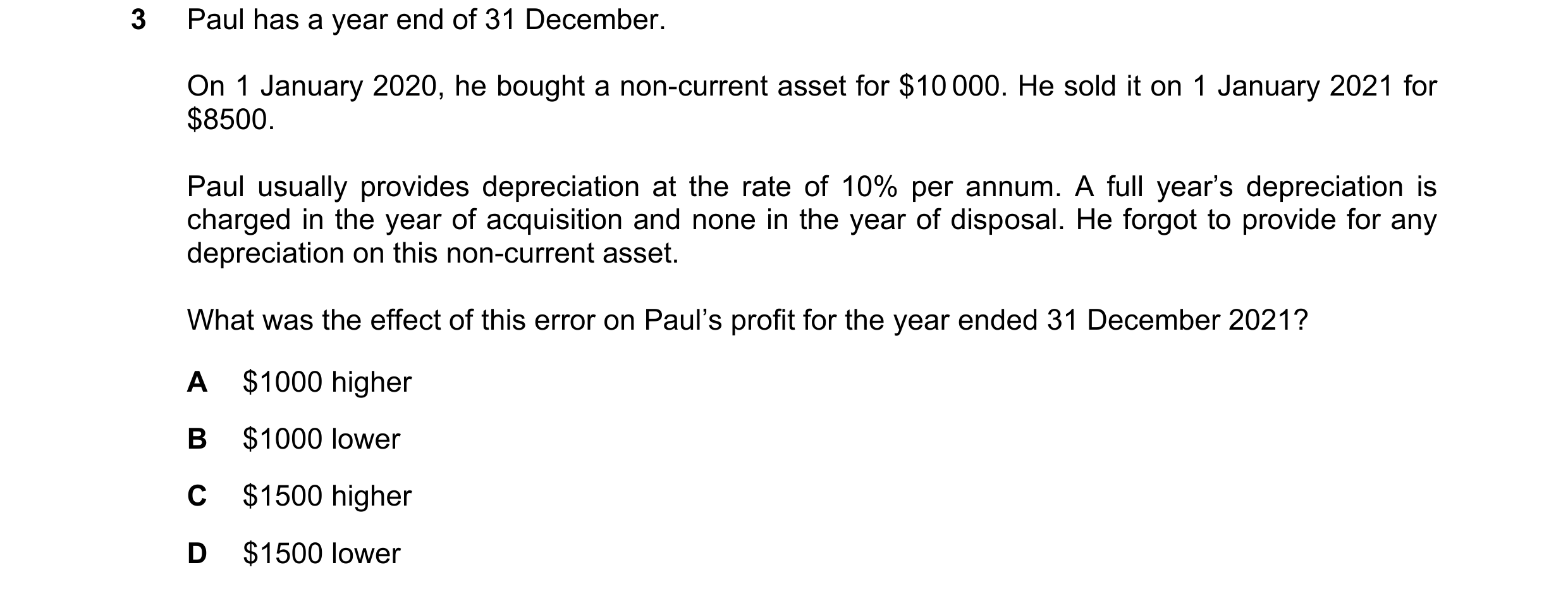 52 / 72


 53 / 72

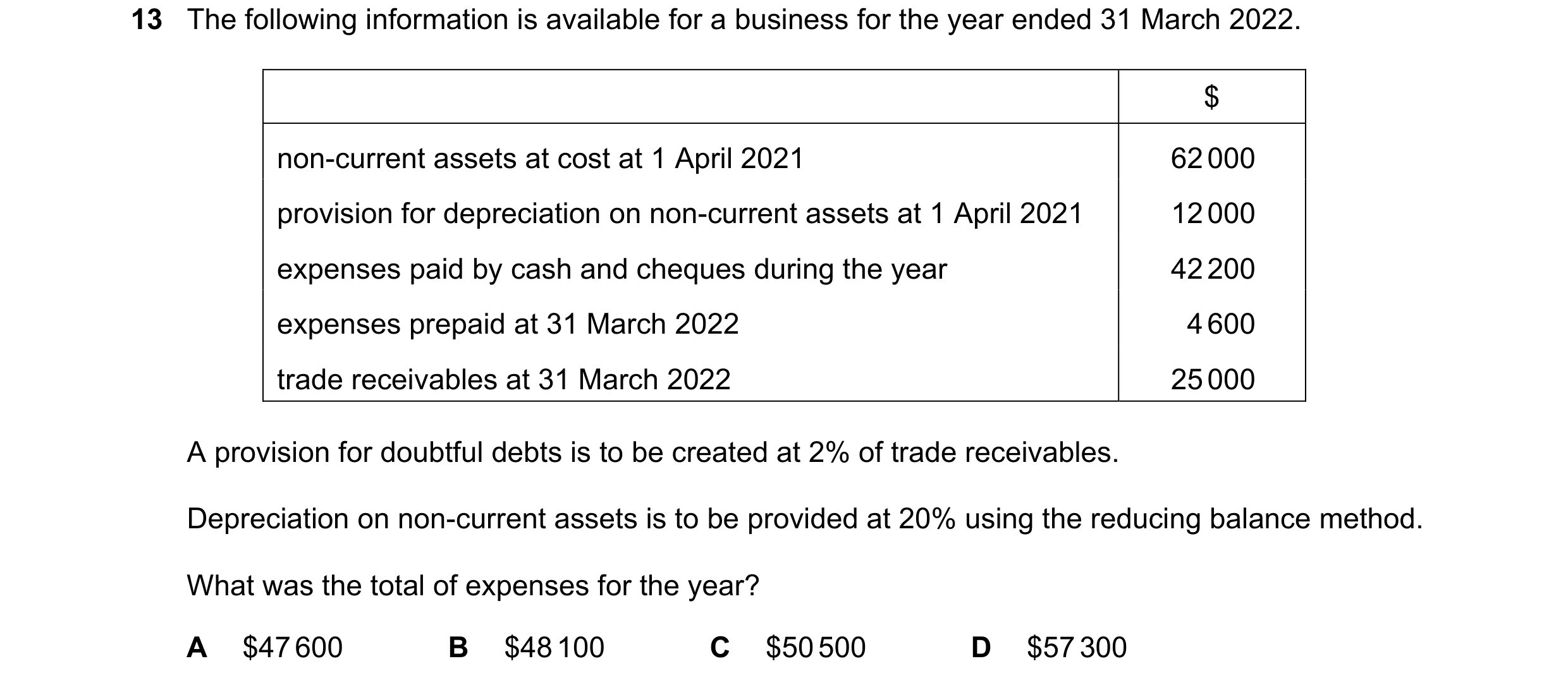
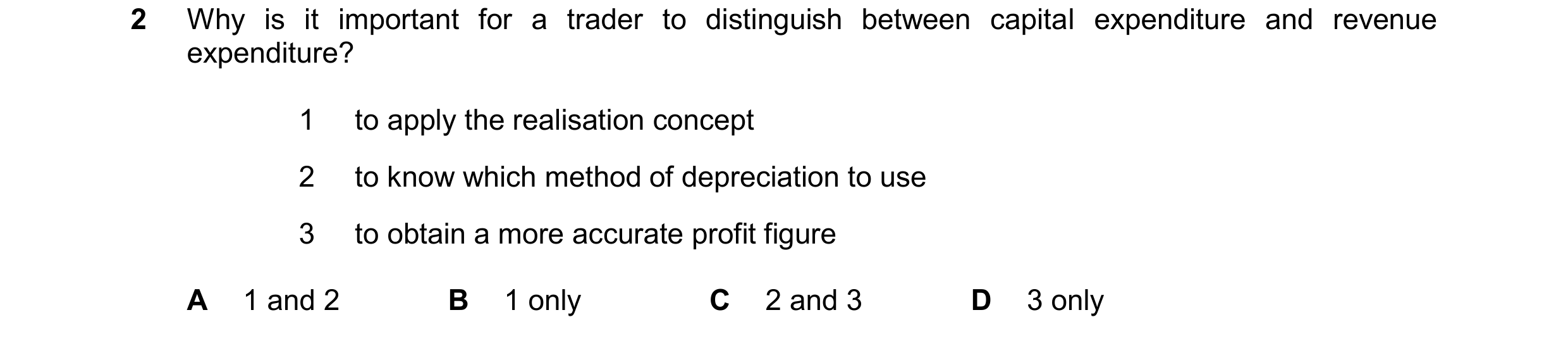 54 / 72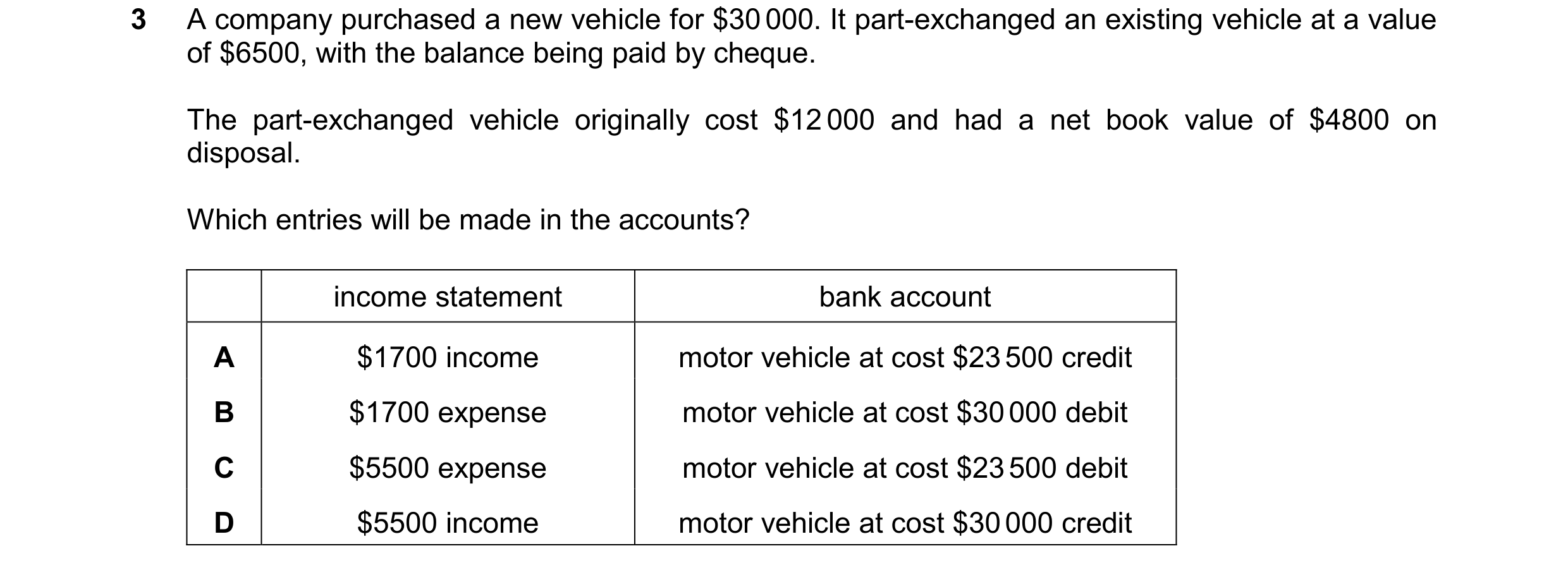
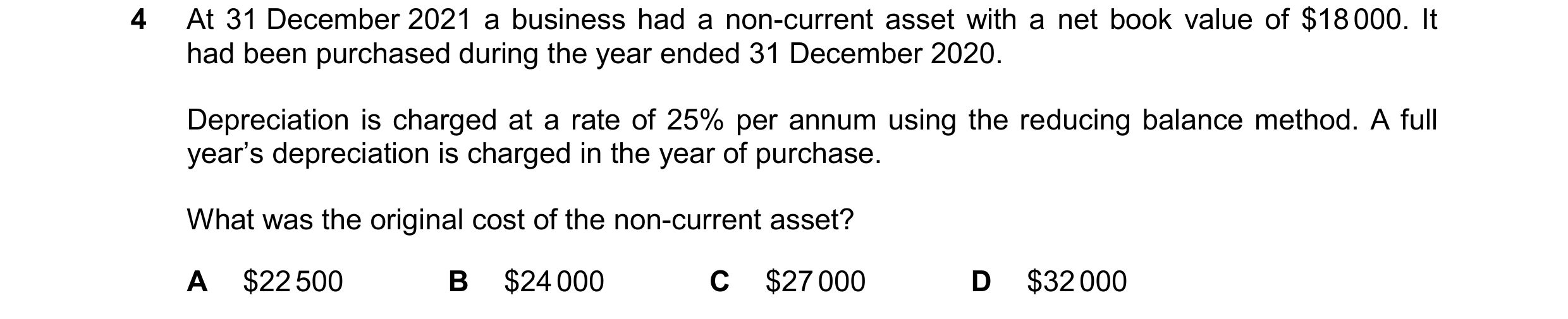
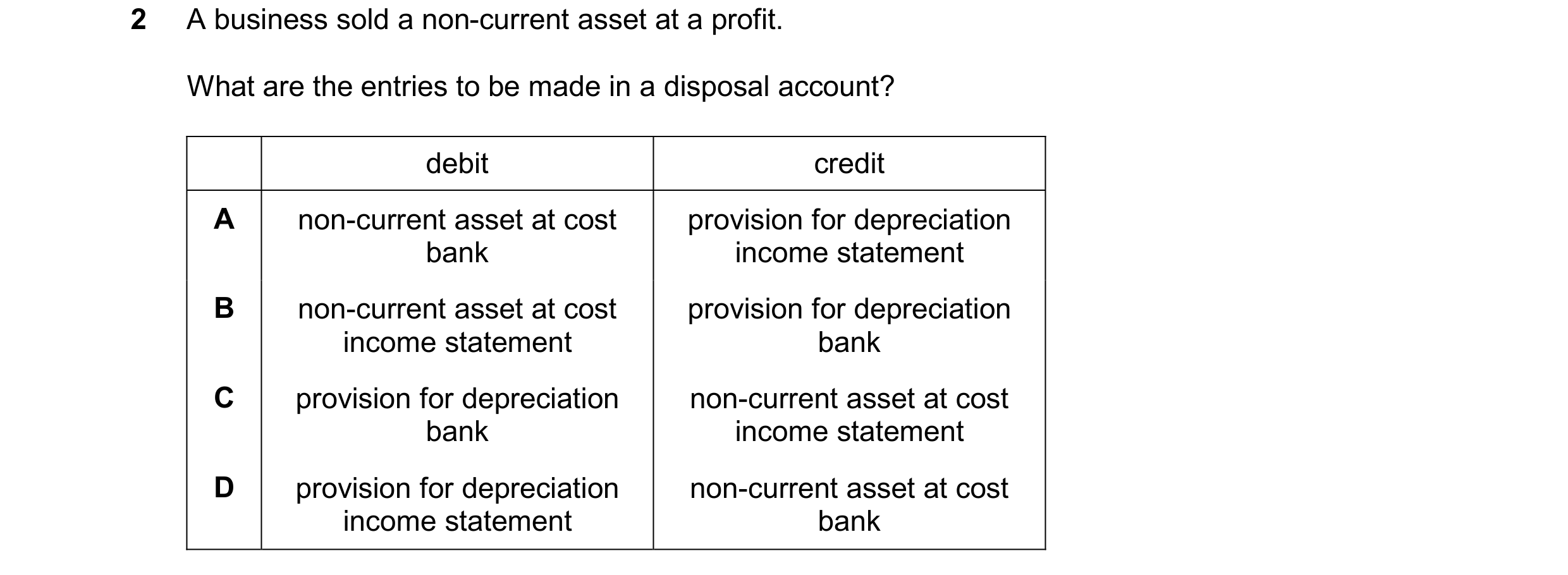
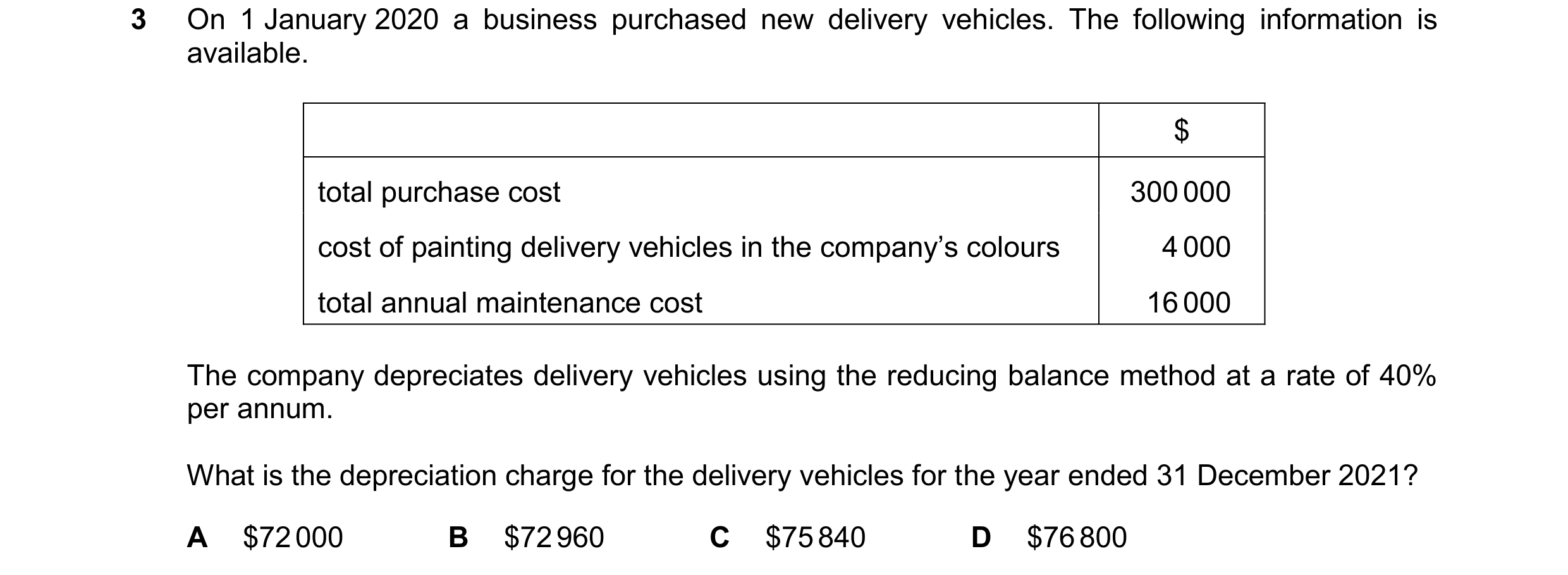 55 / 72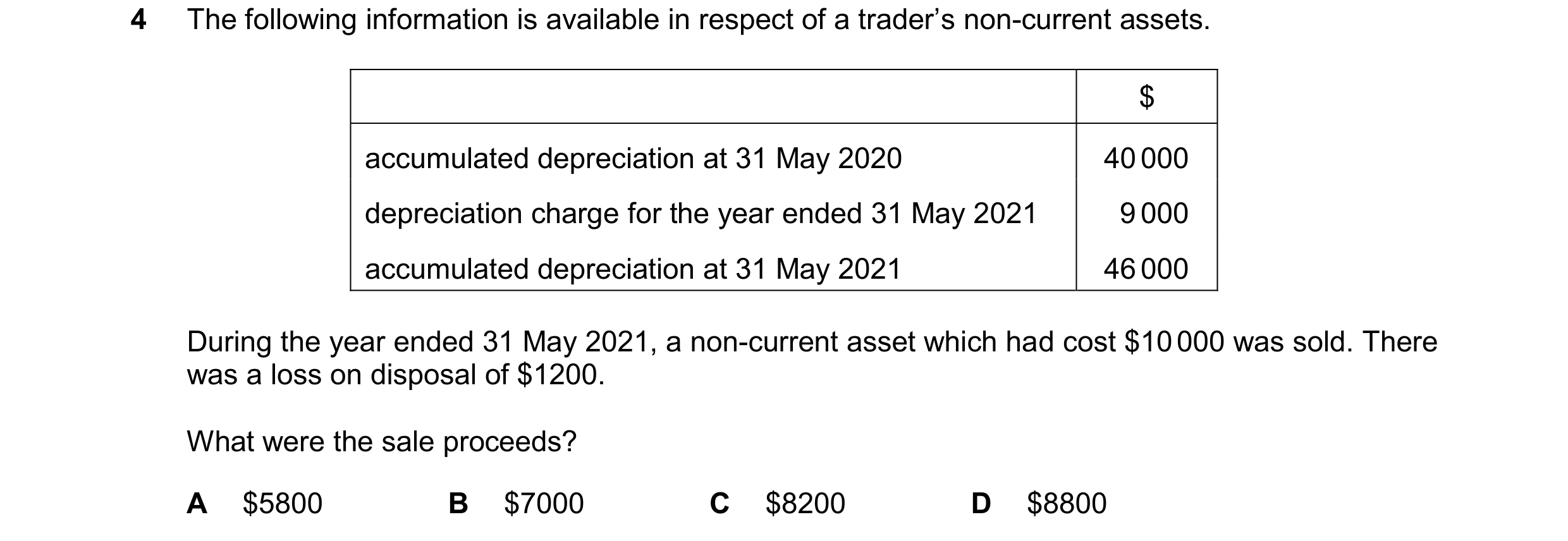
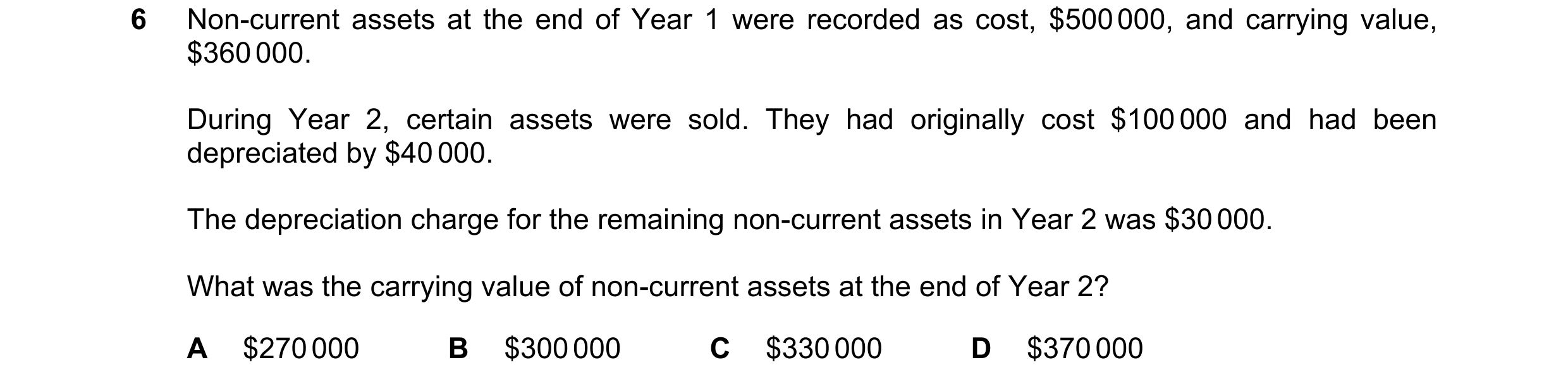
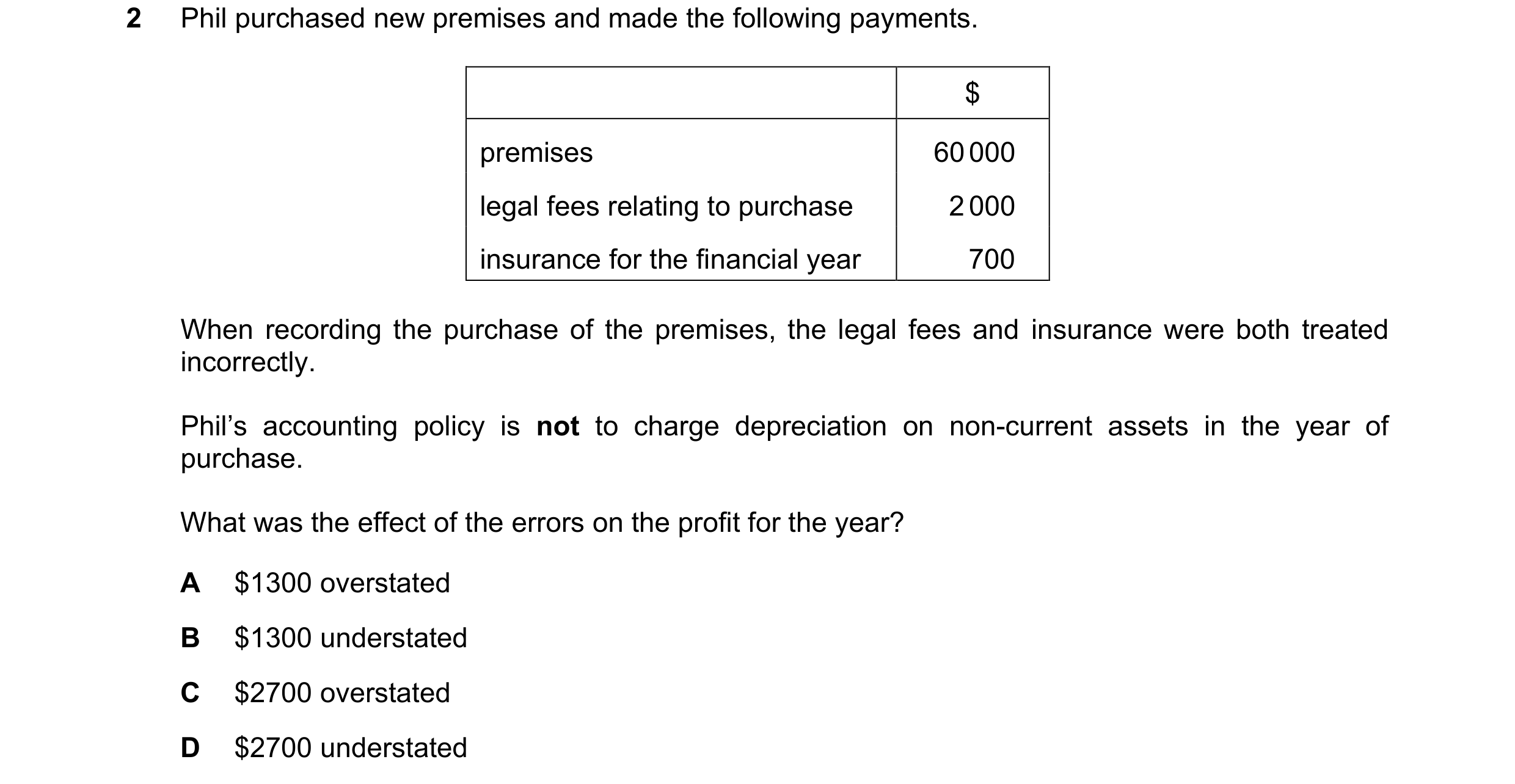 56 / 72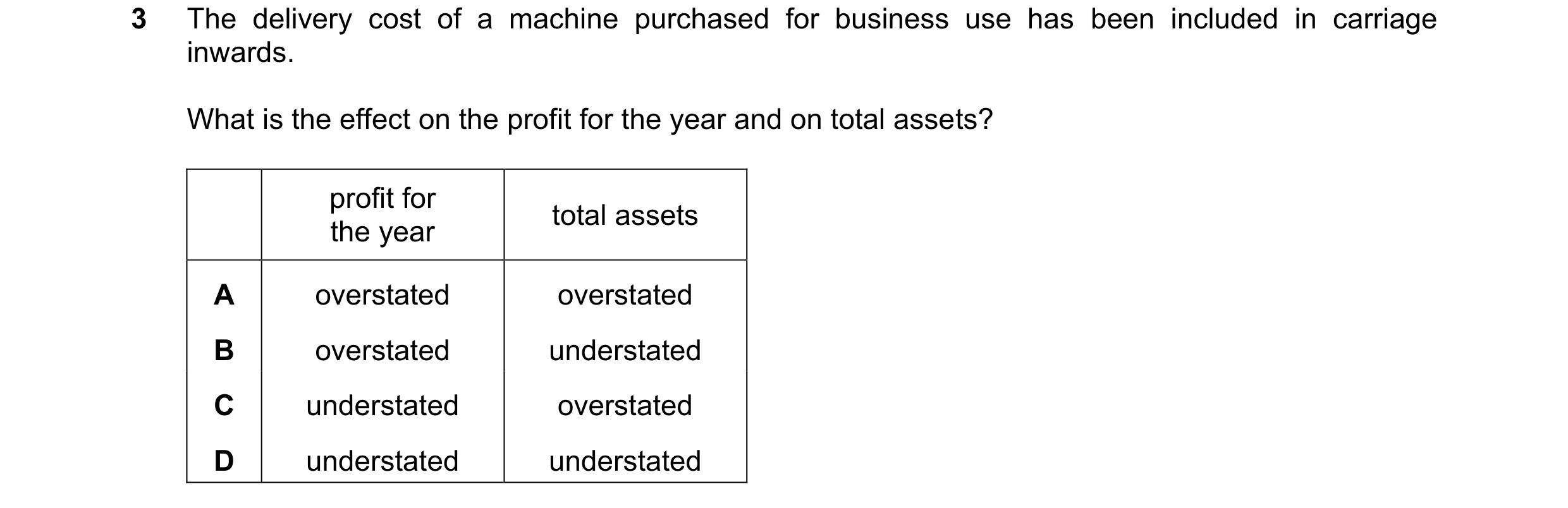
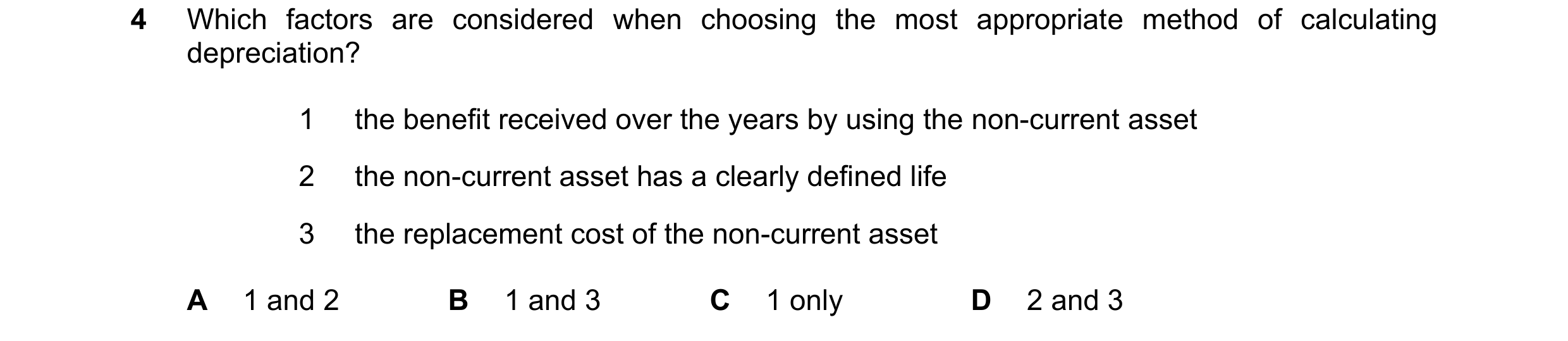
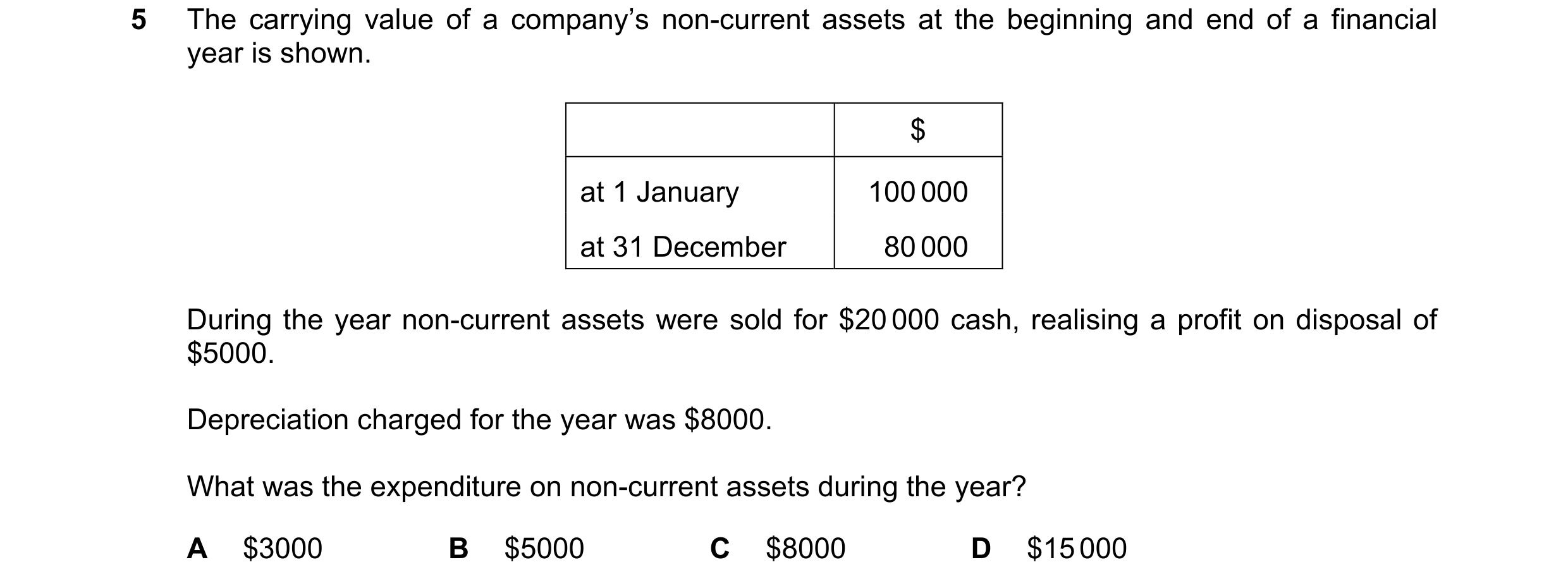
 57 / 72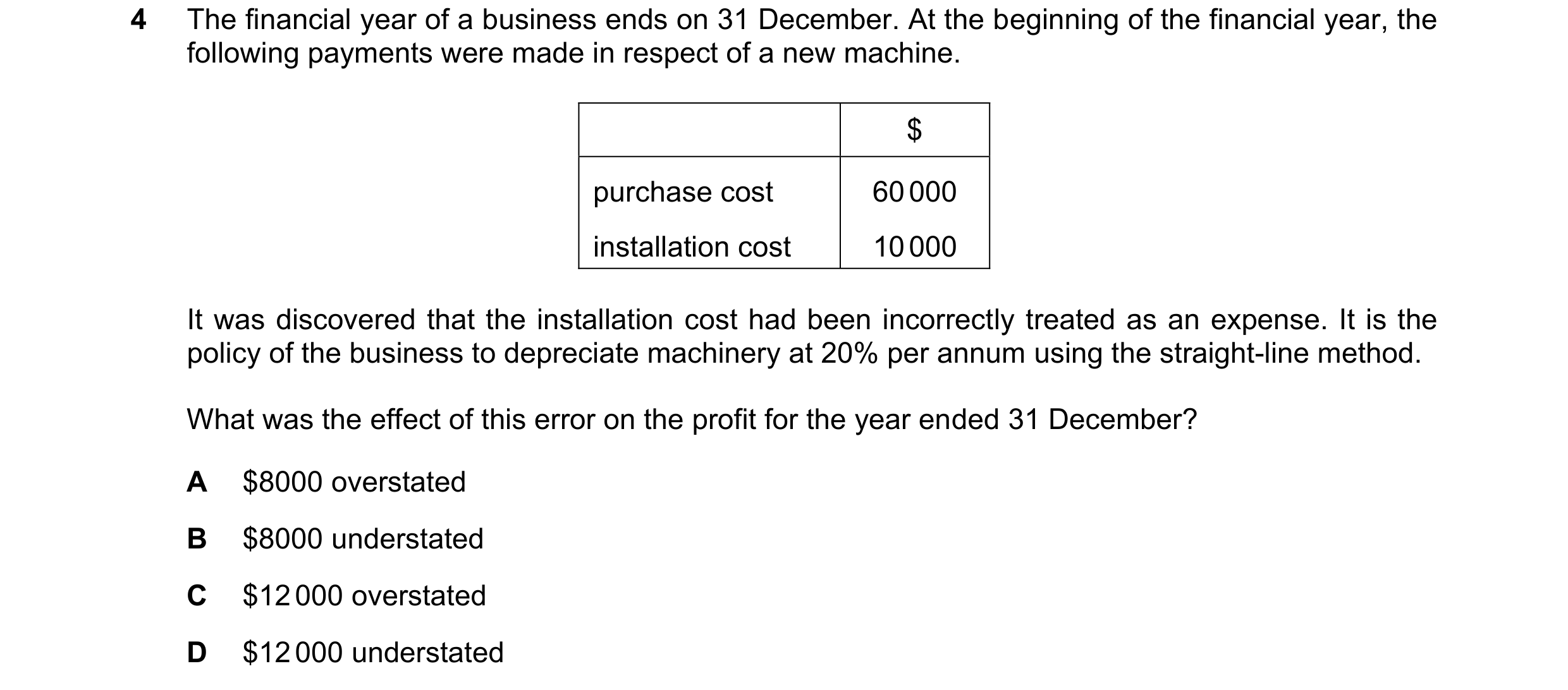
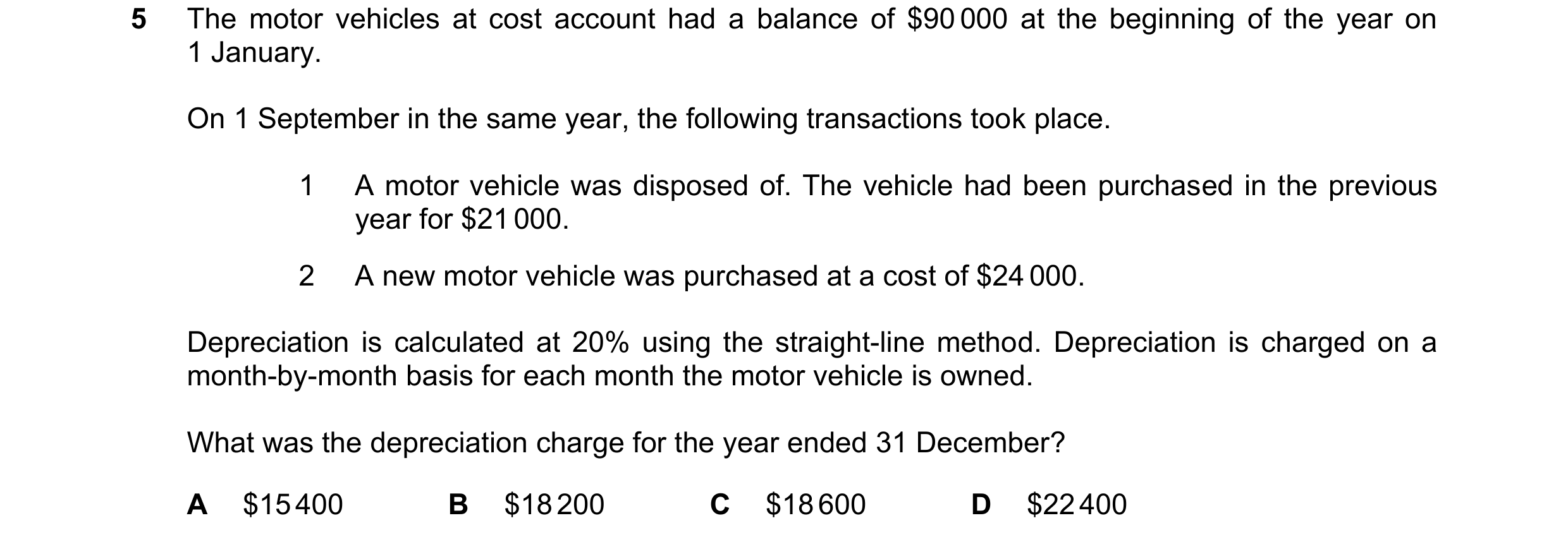
 58 / 72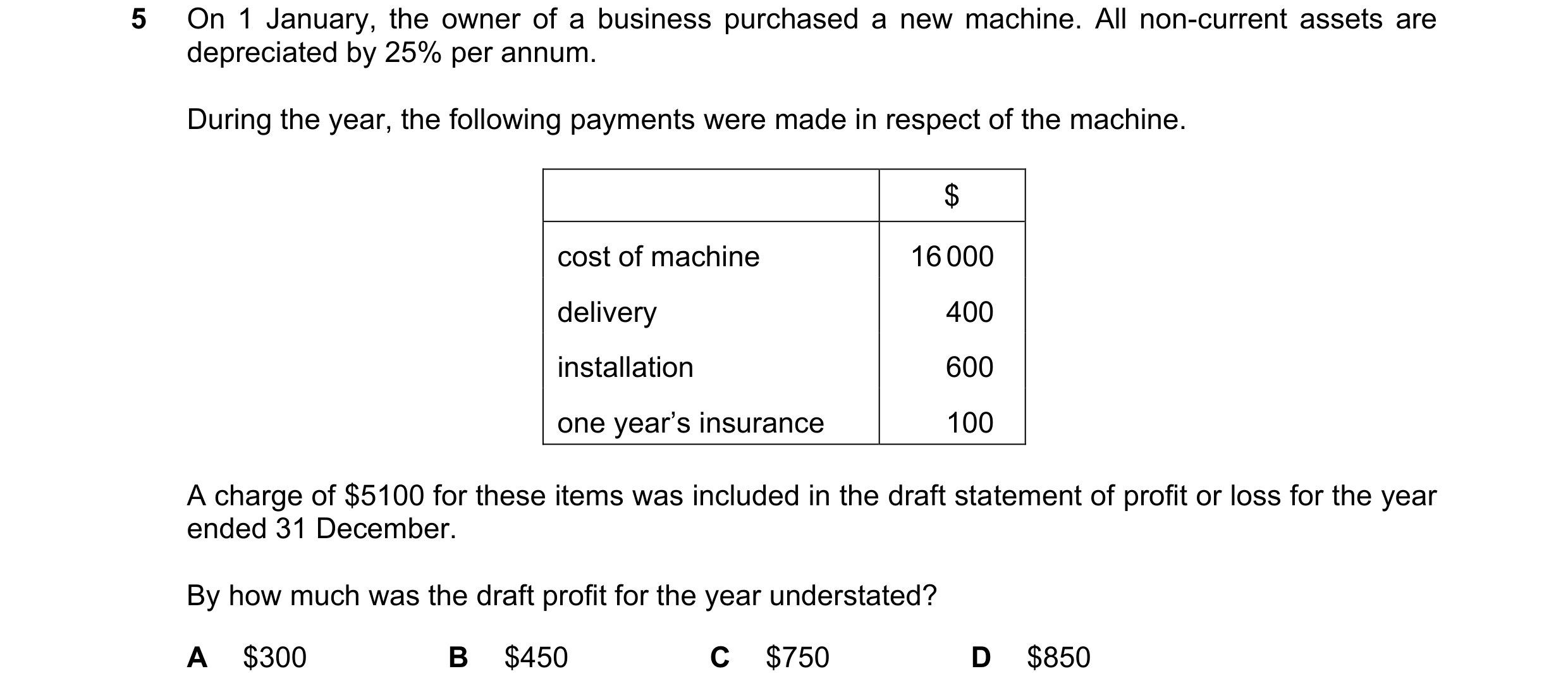

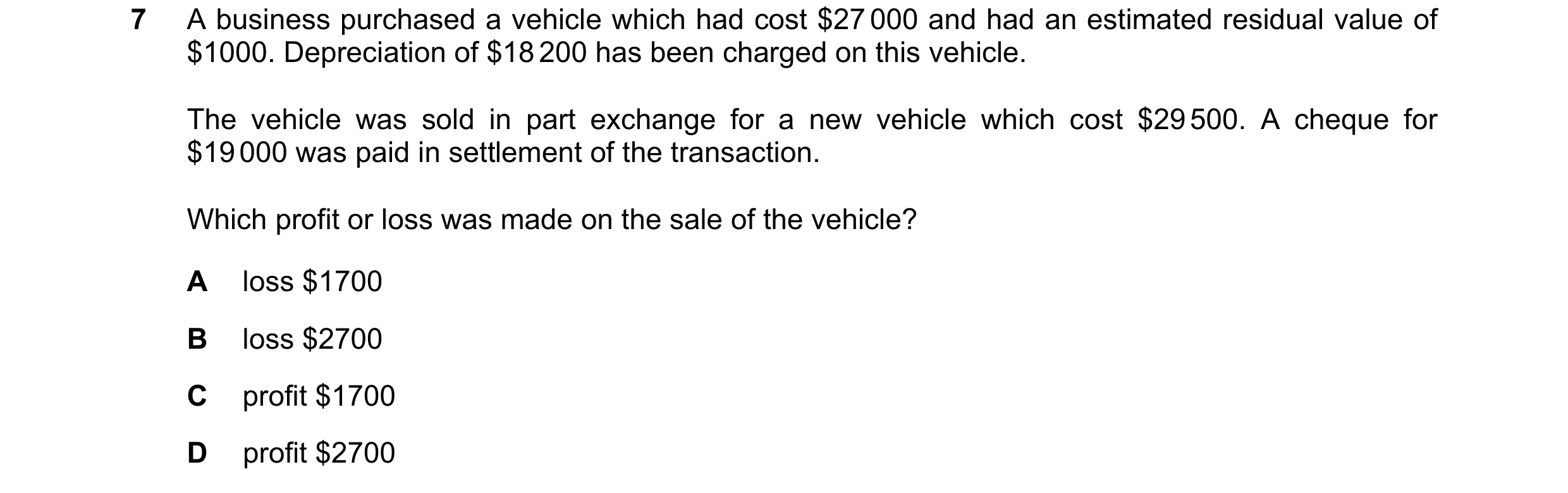
 59 / 72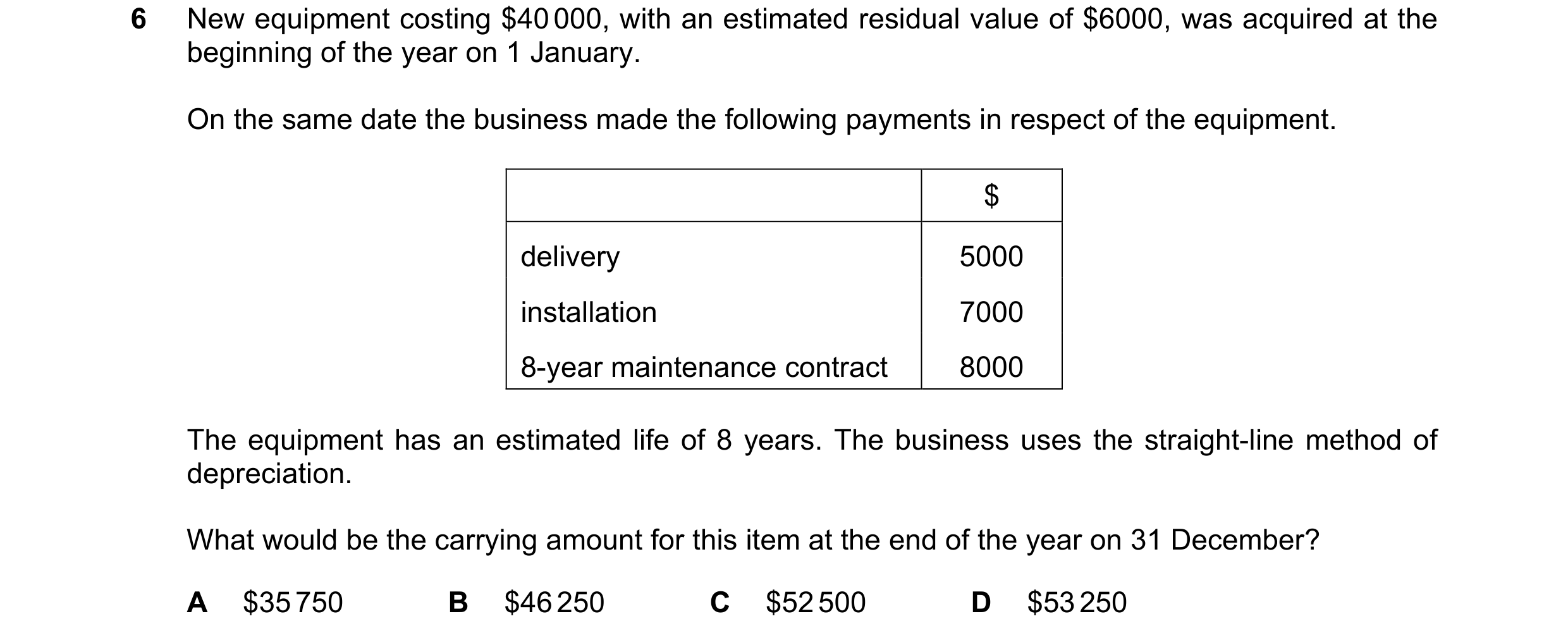
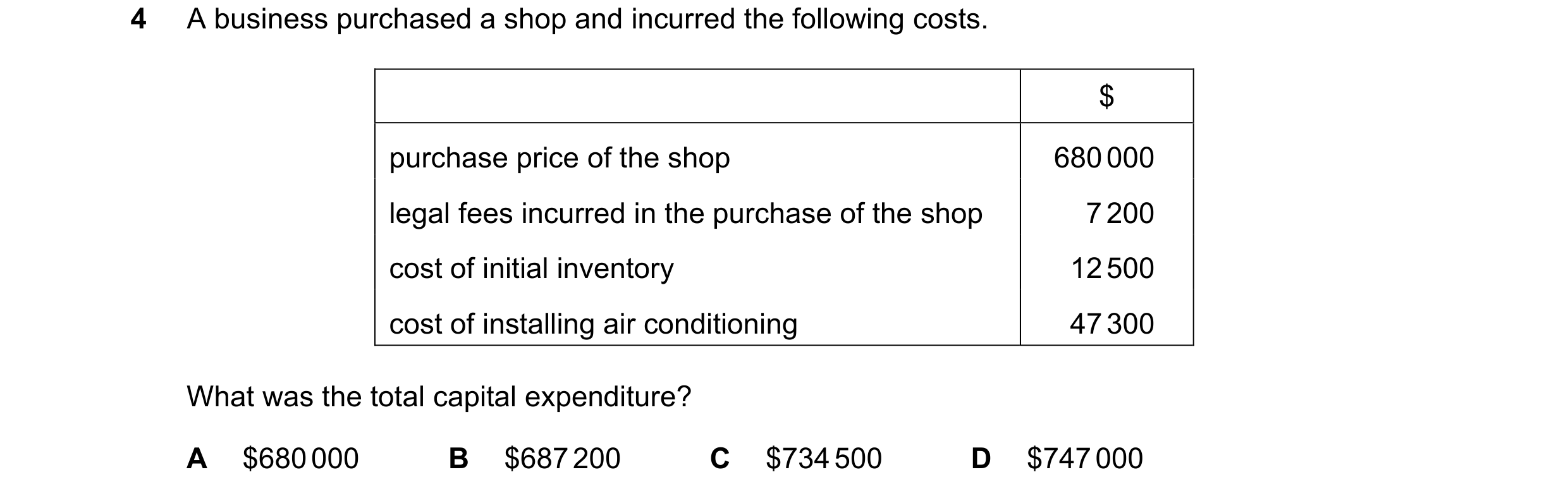
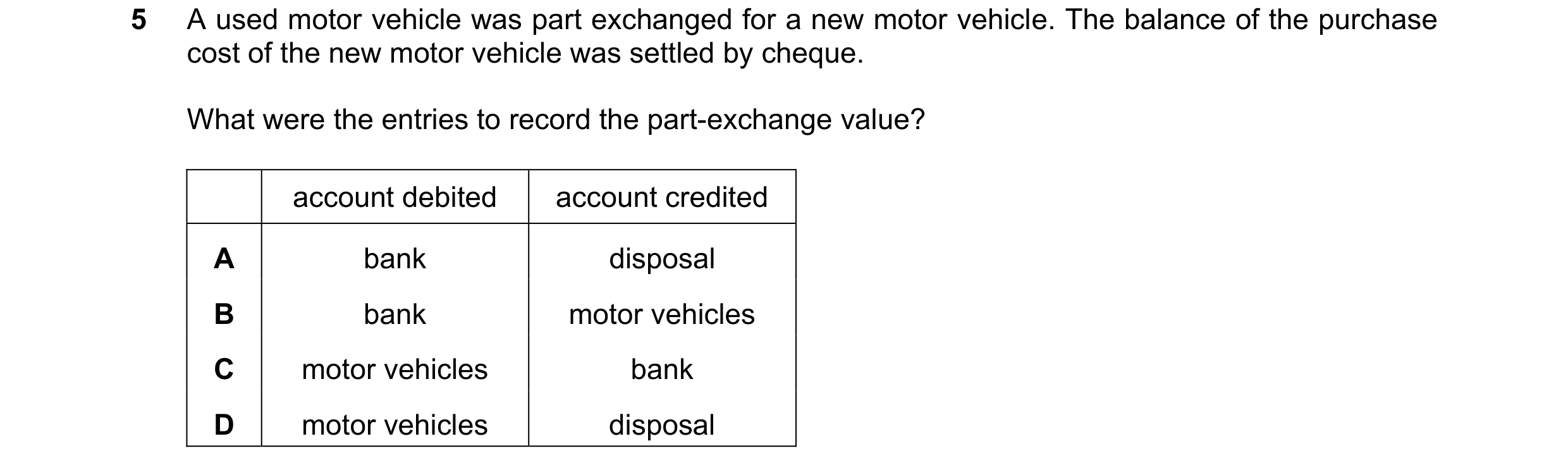
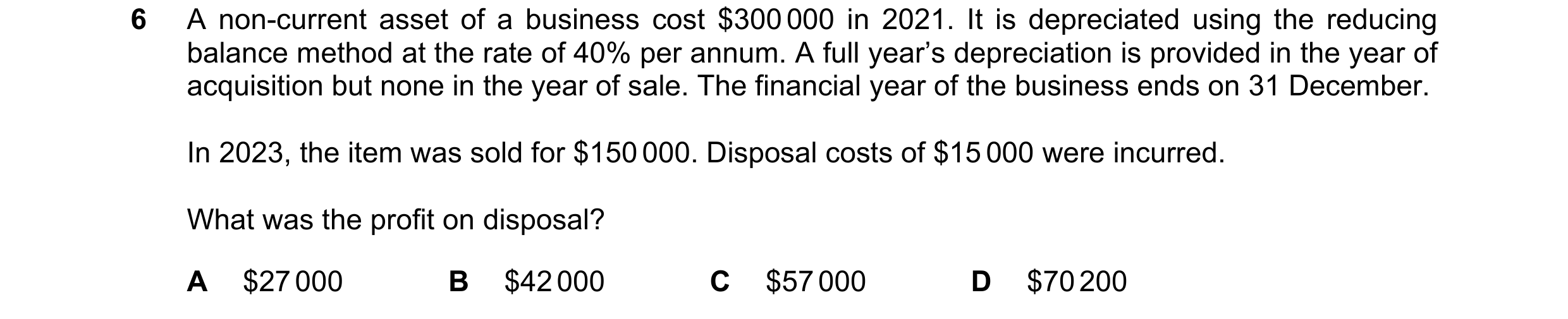 60 / 72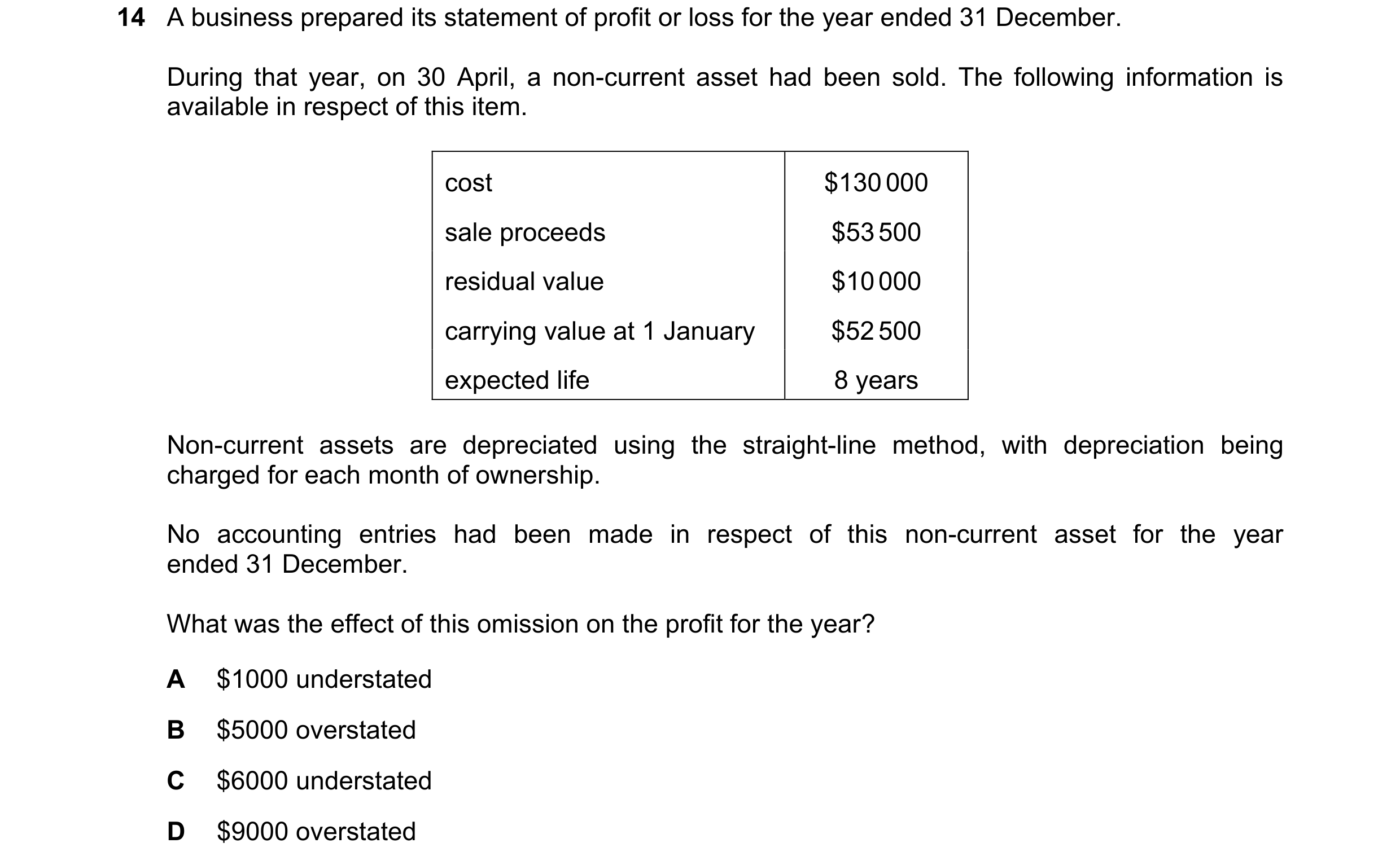
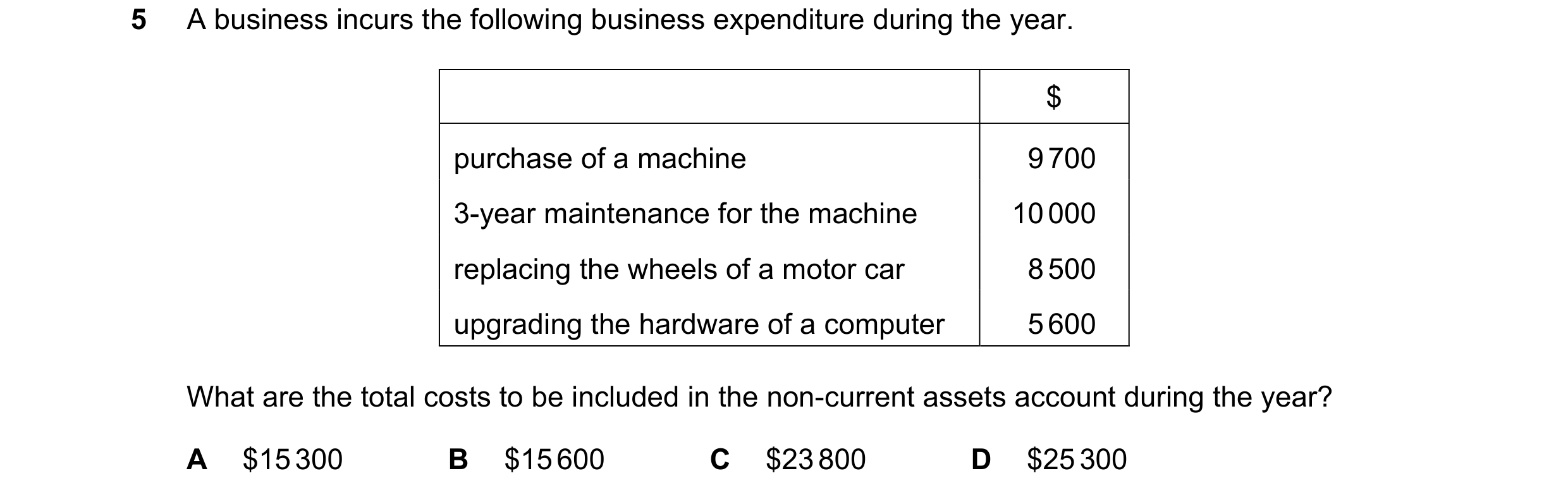

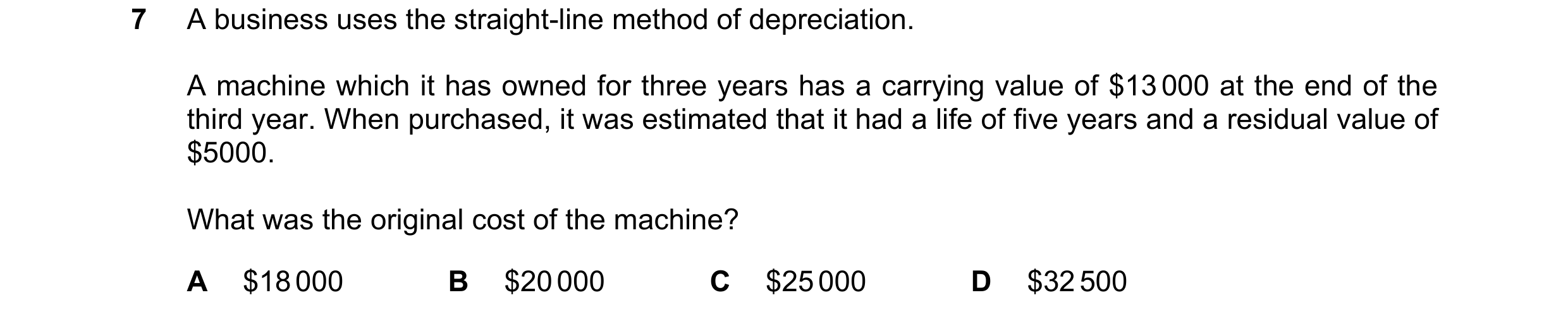 61 / 72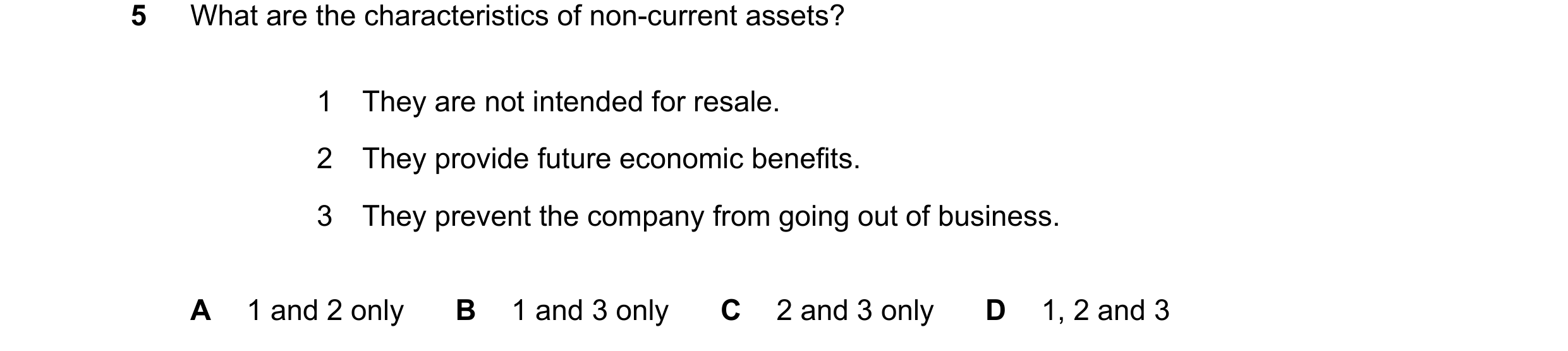
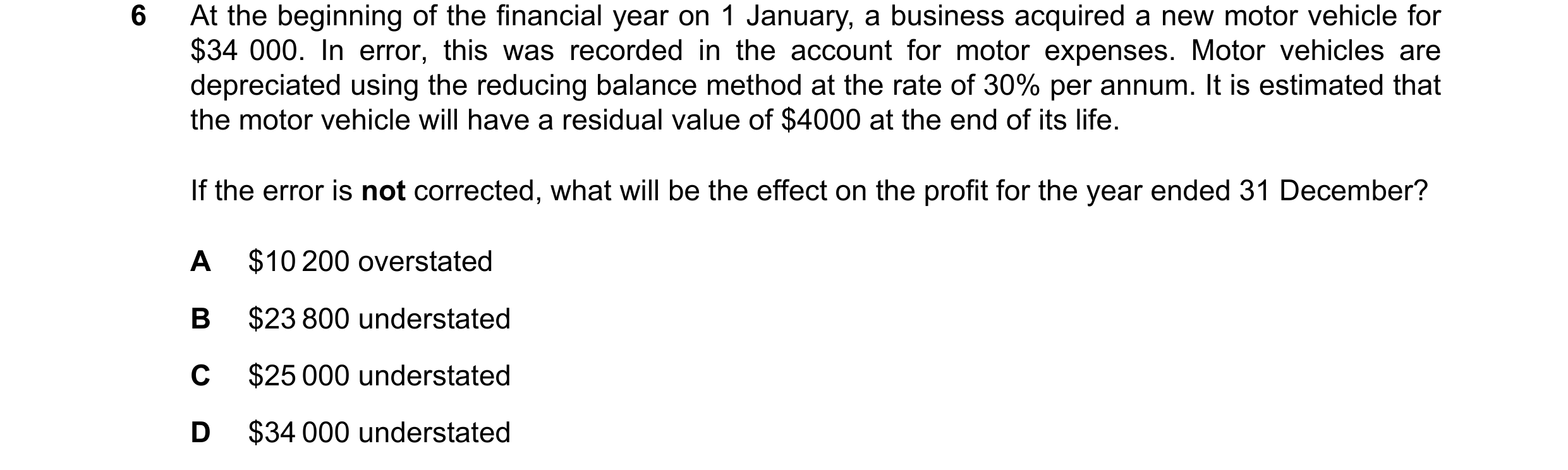
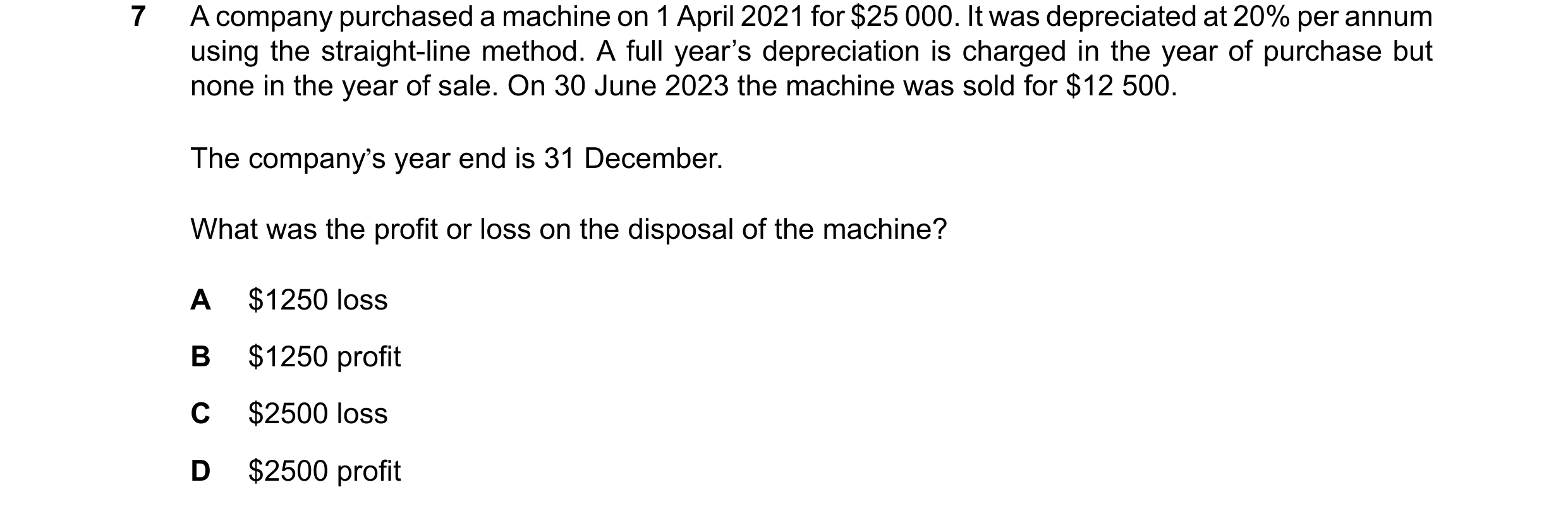
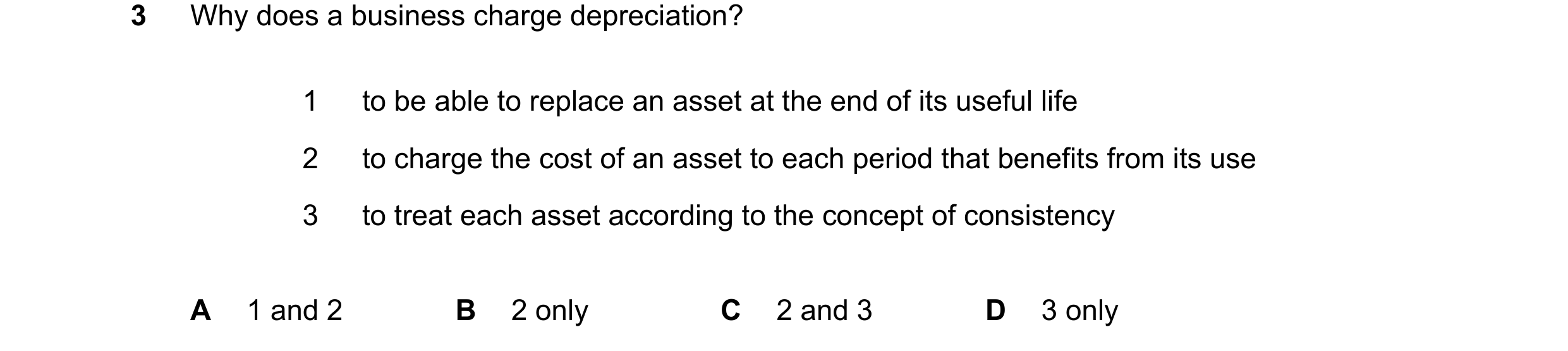 62 / 72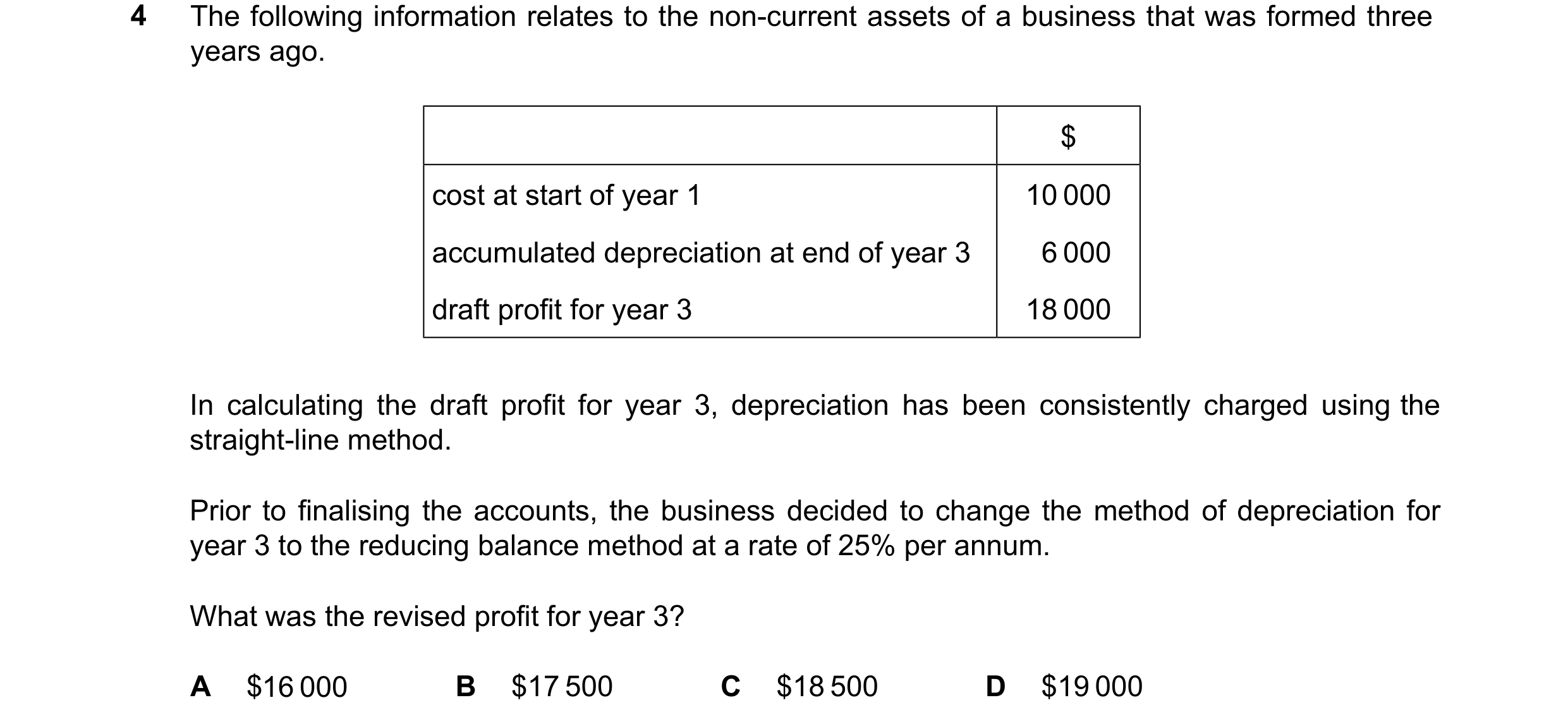
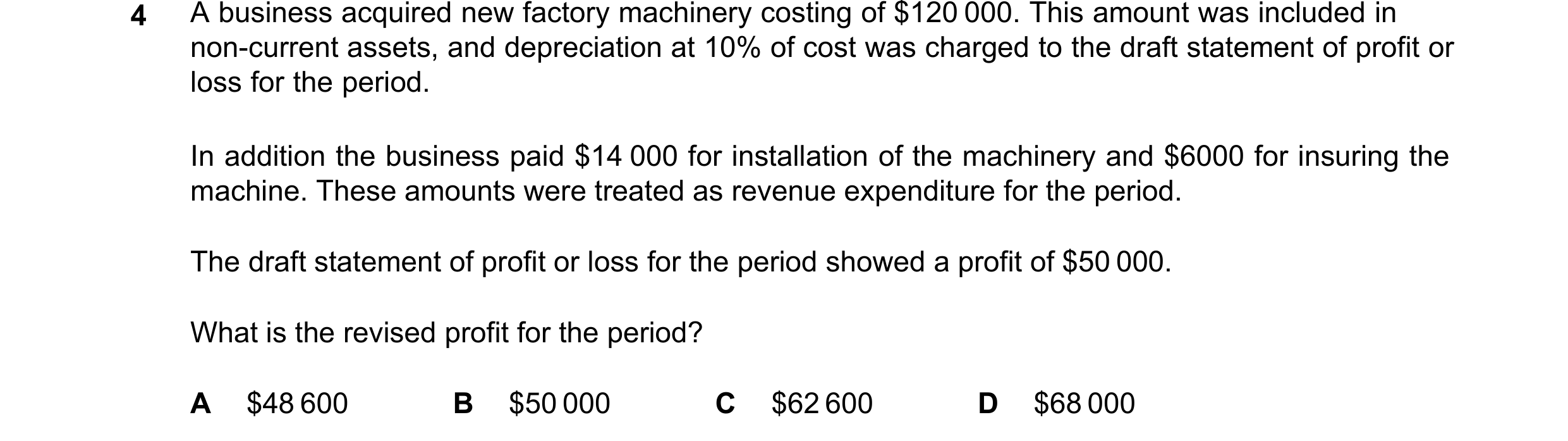
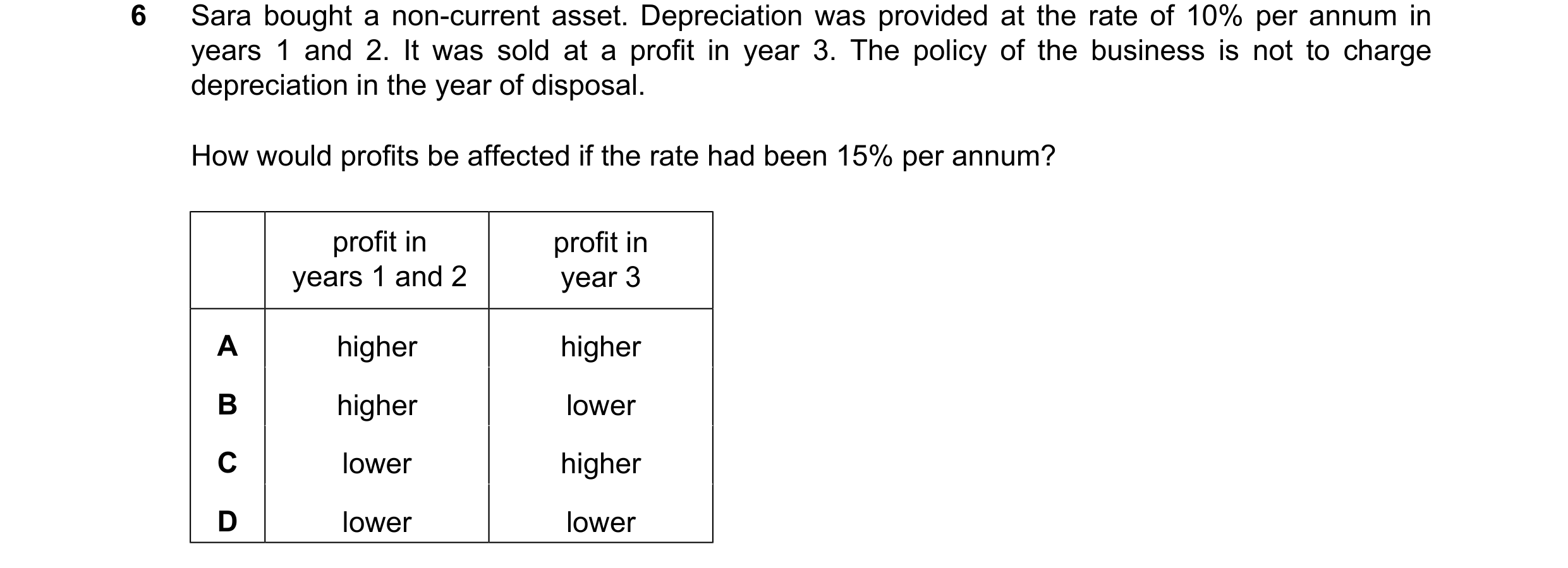 63 / 72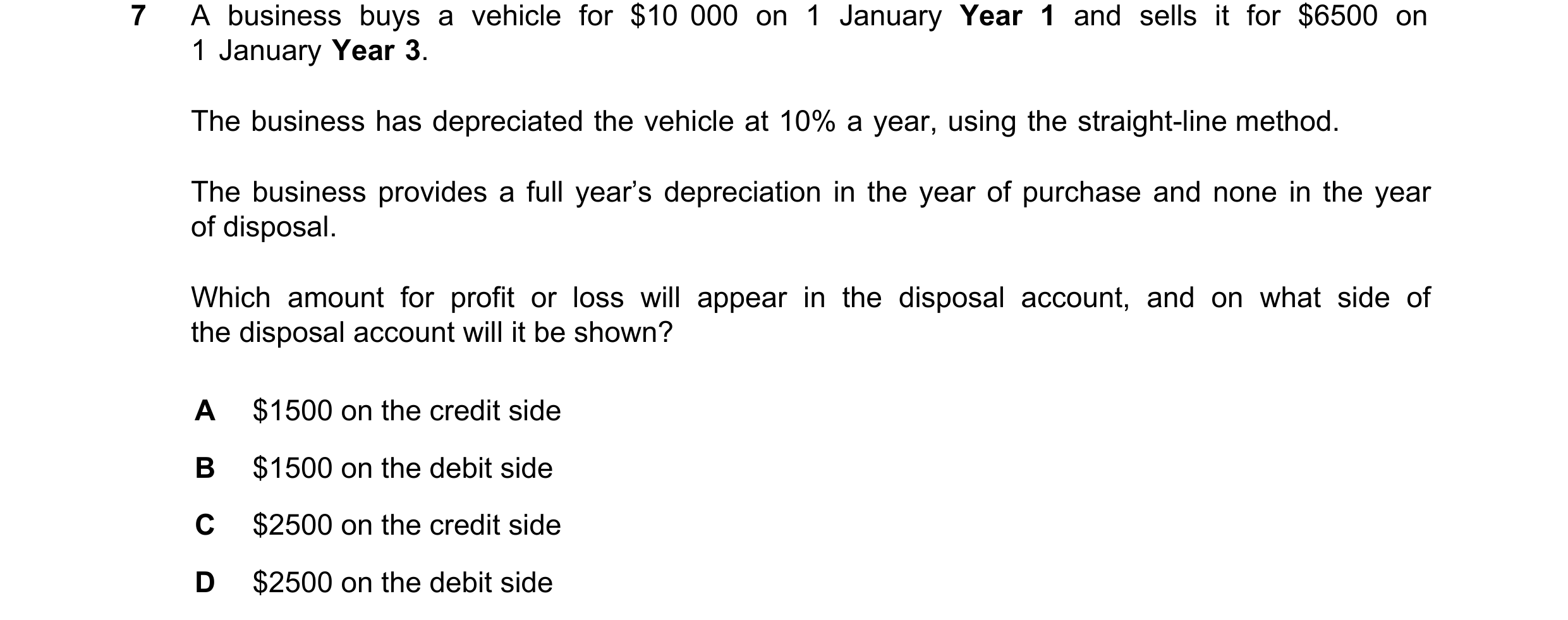
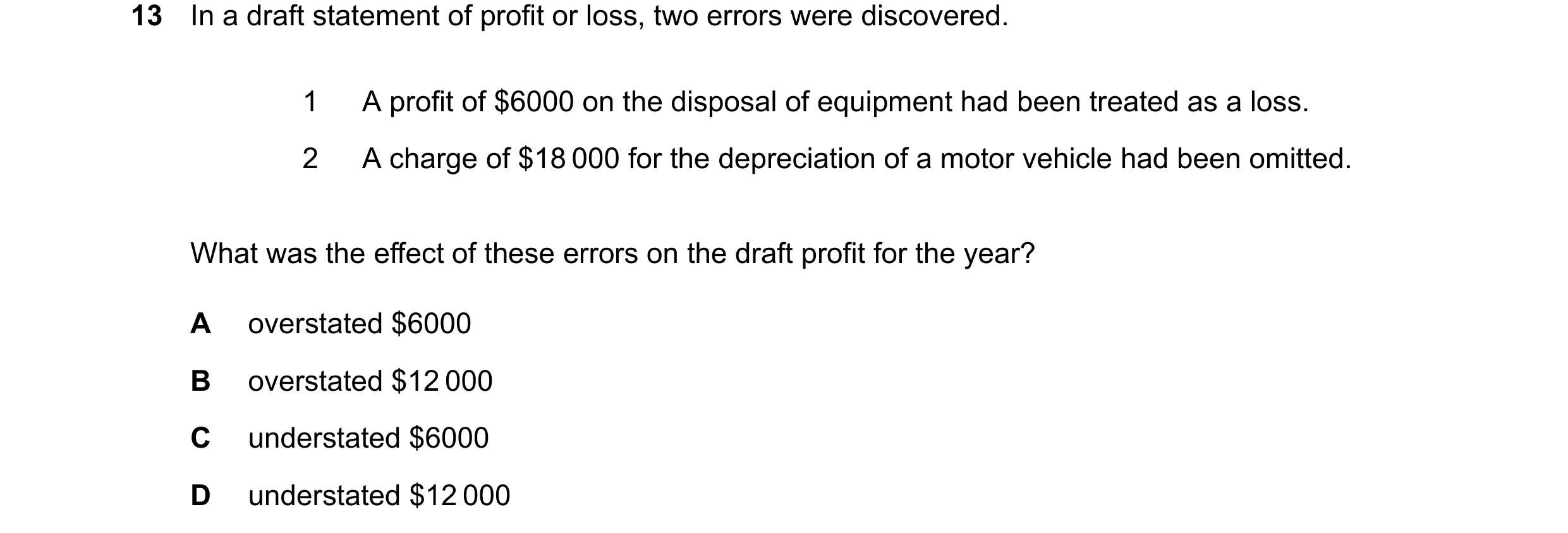
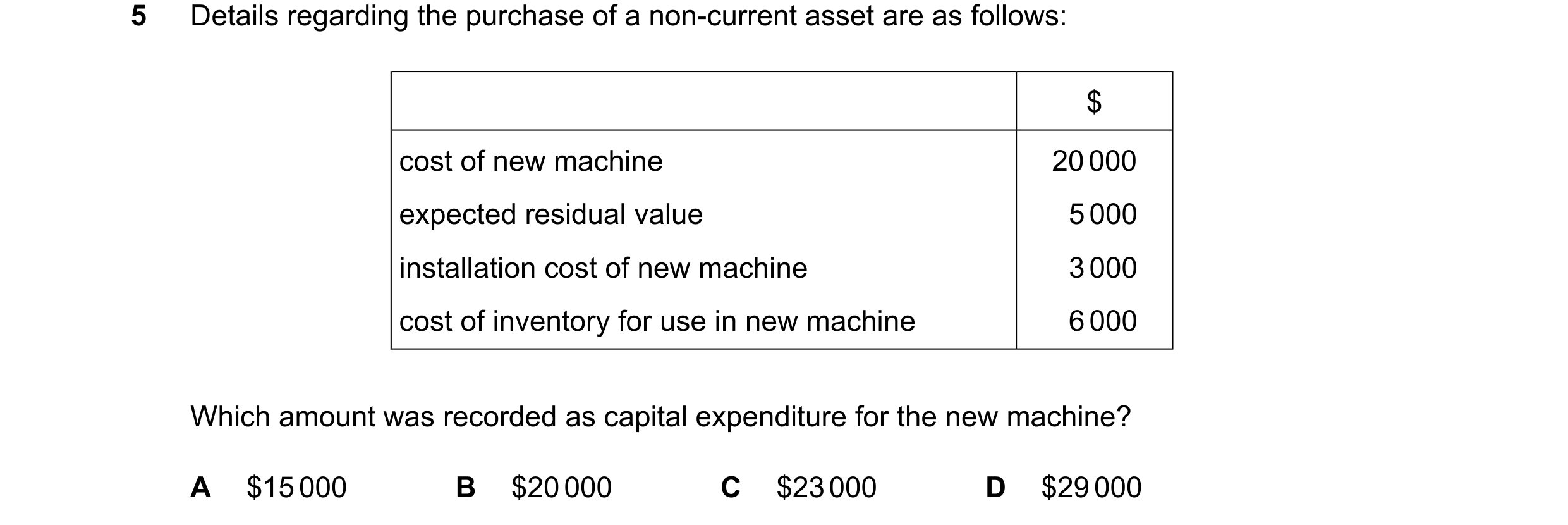 64 / 72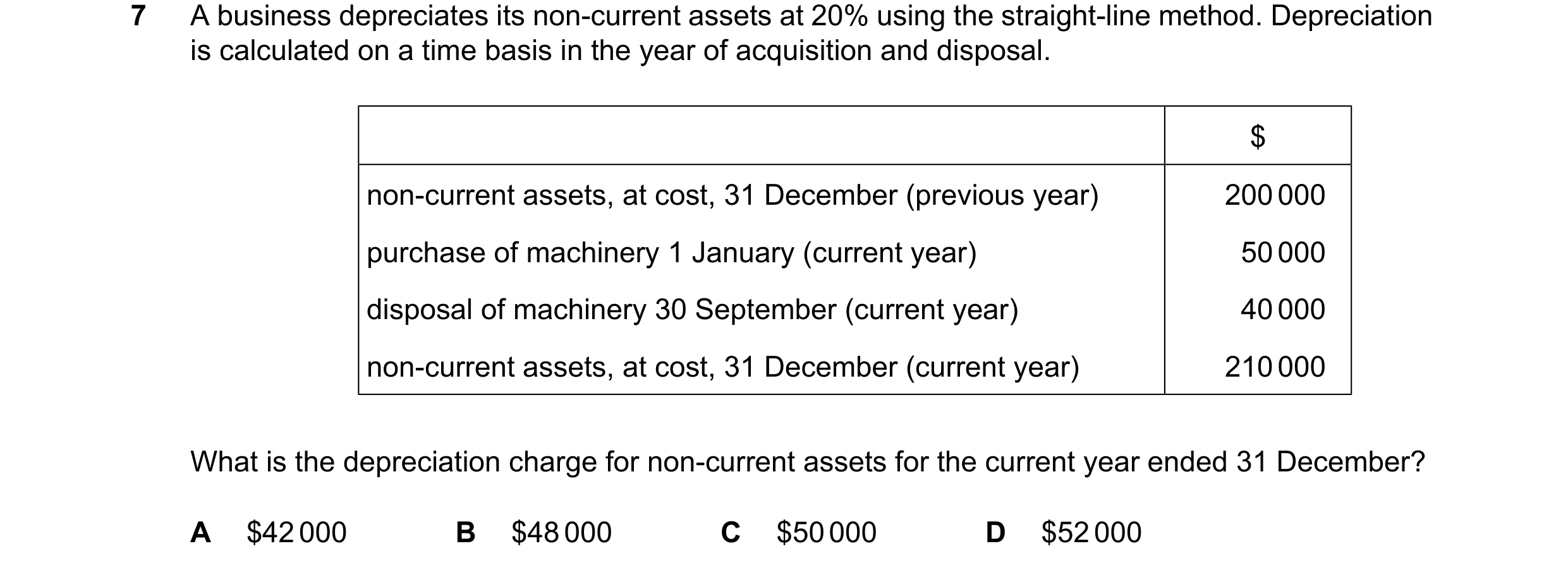
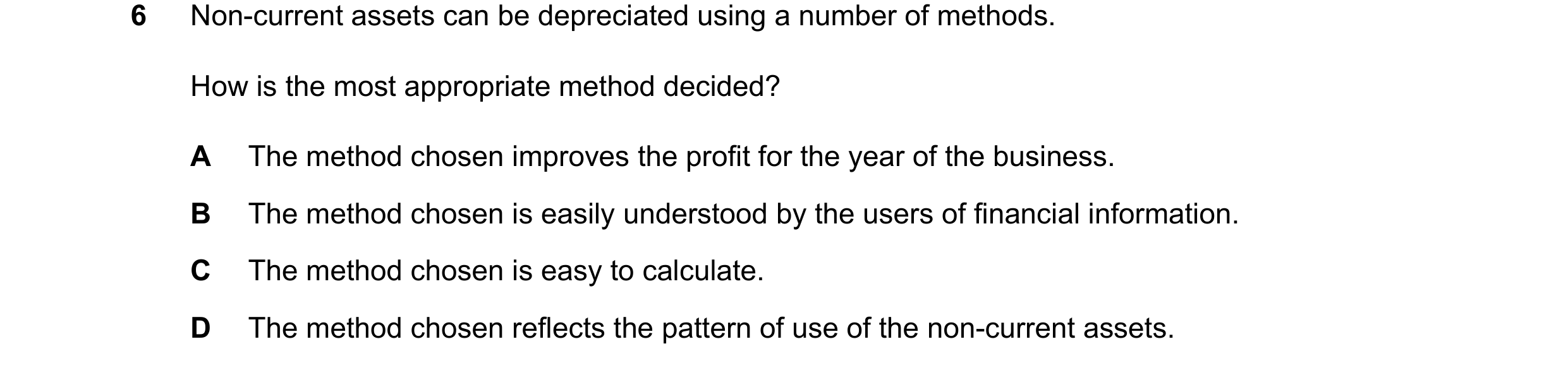

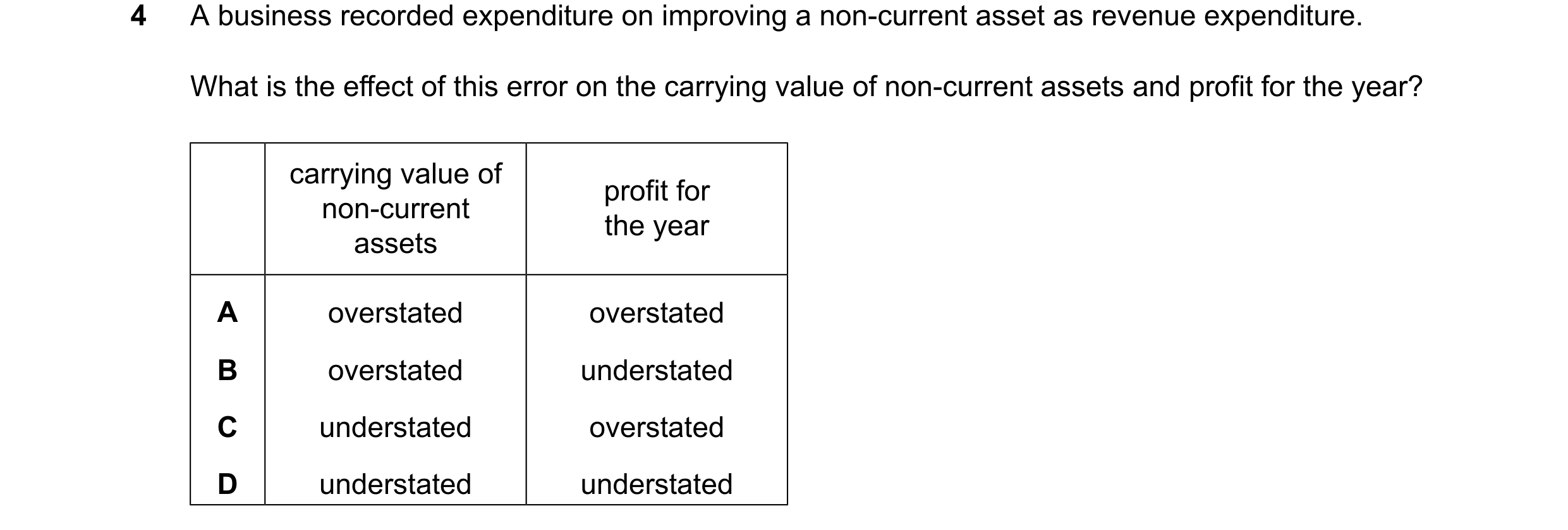 65 / 72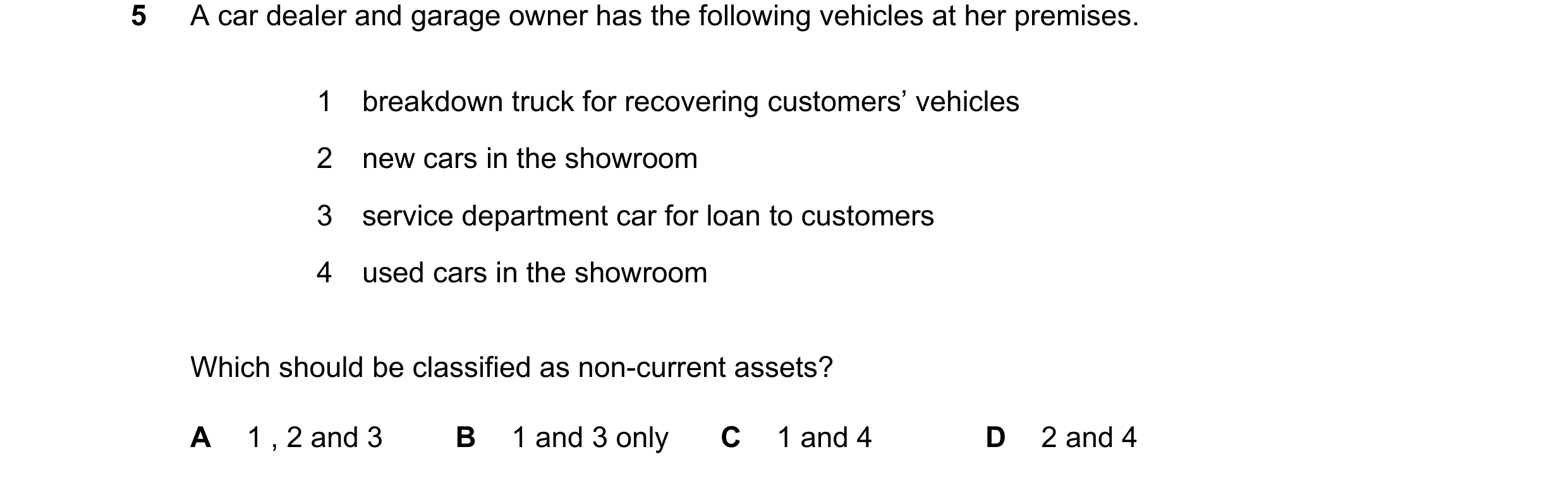
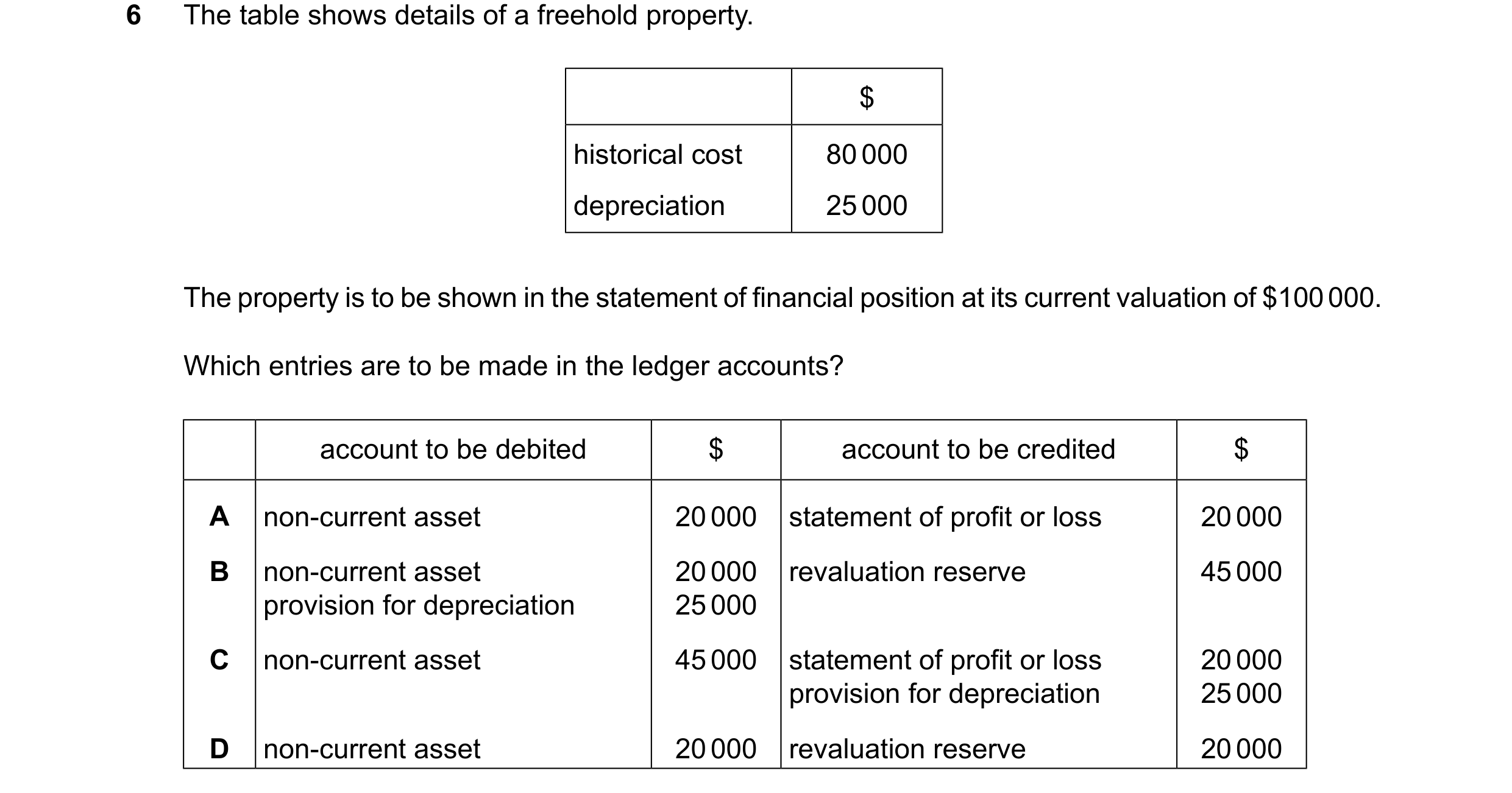
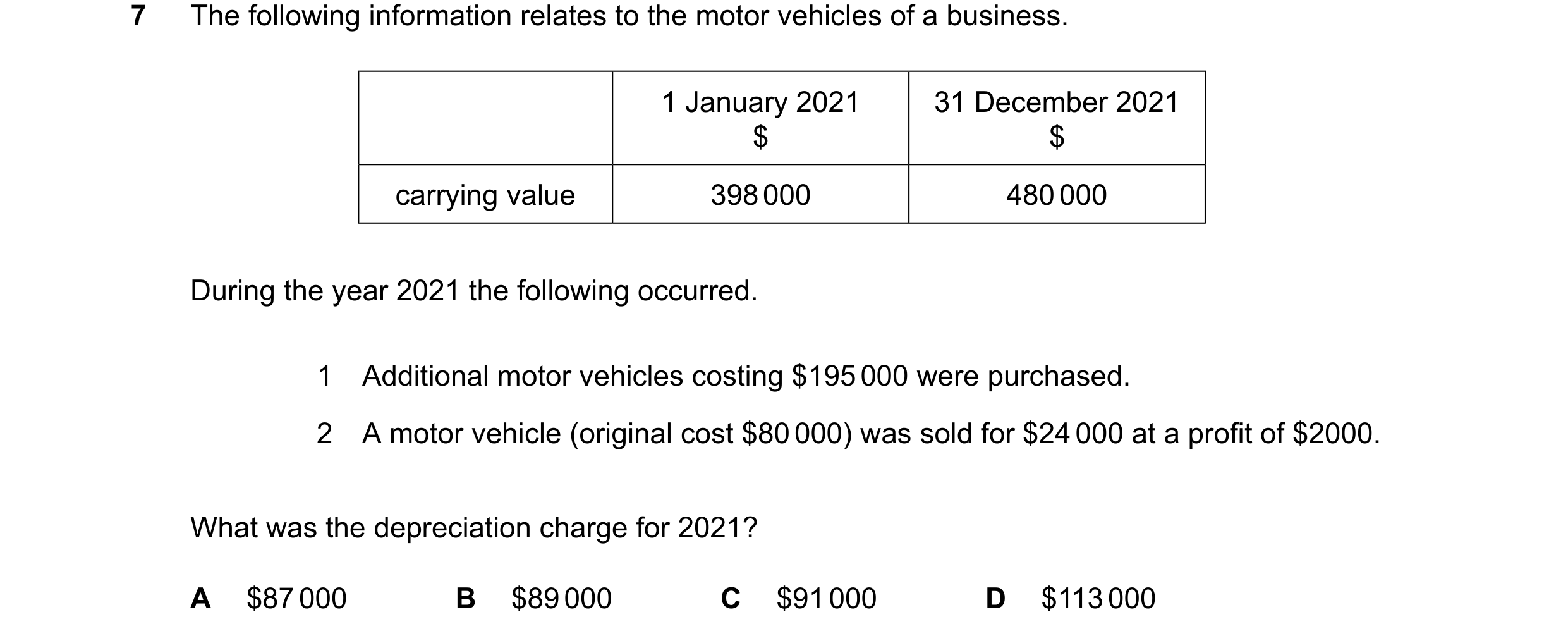 66 / 72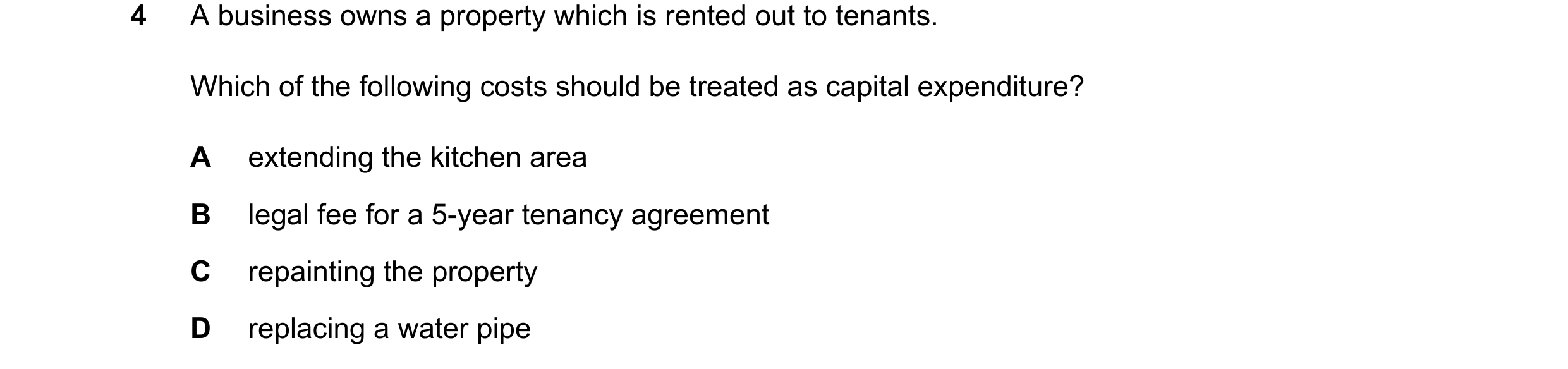
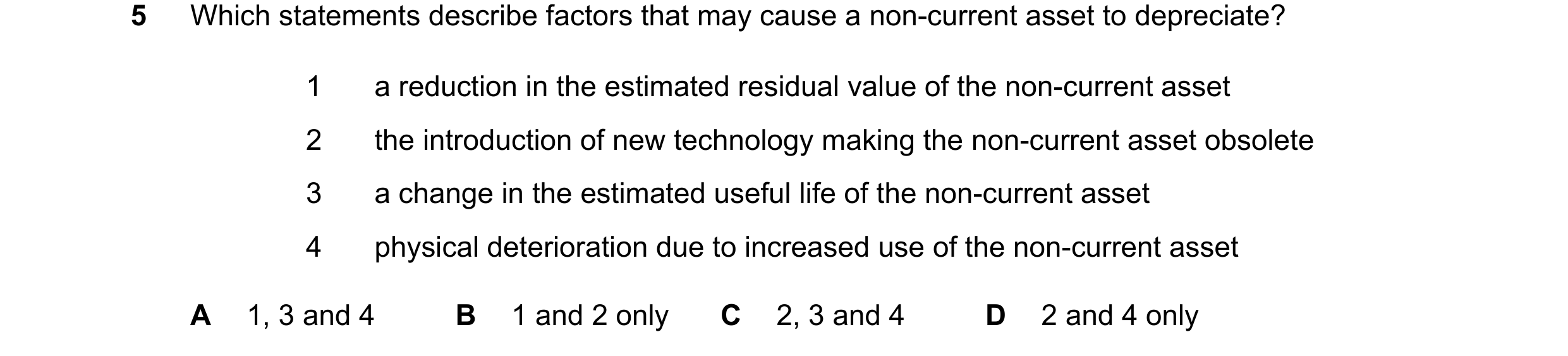
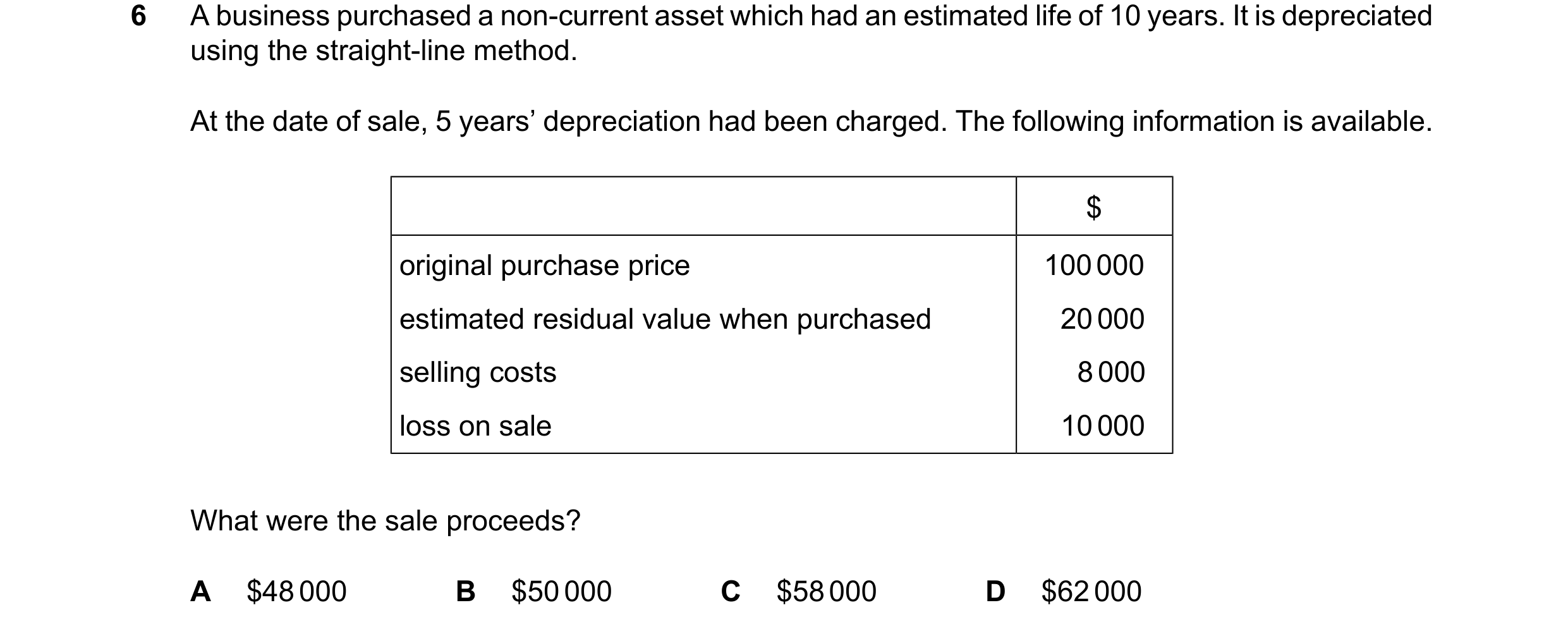
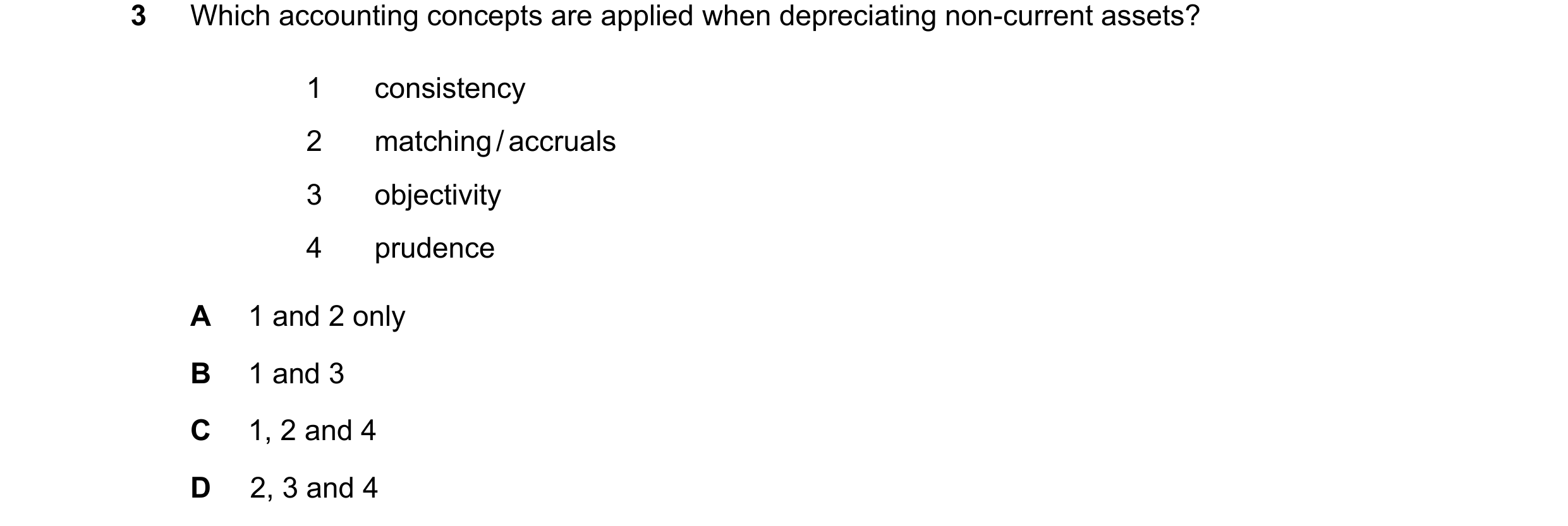 67 / 72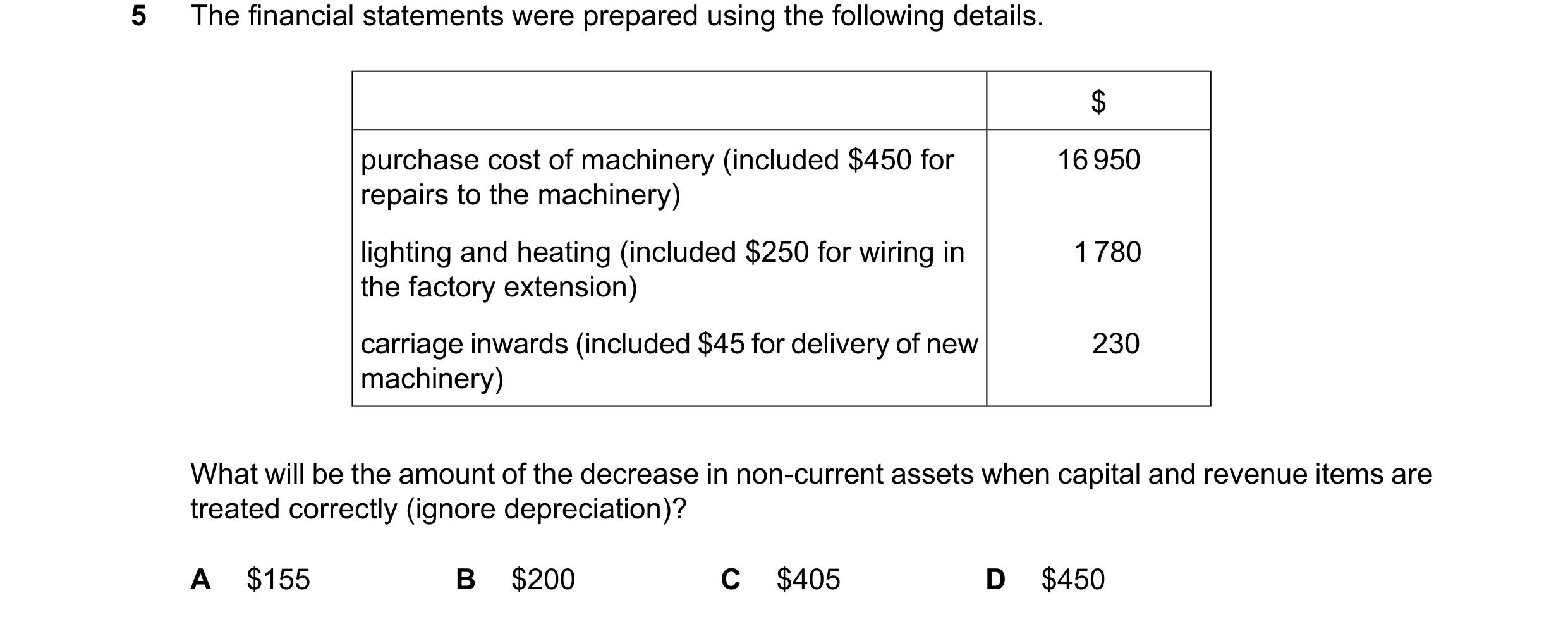

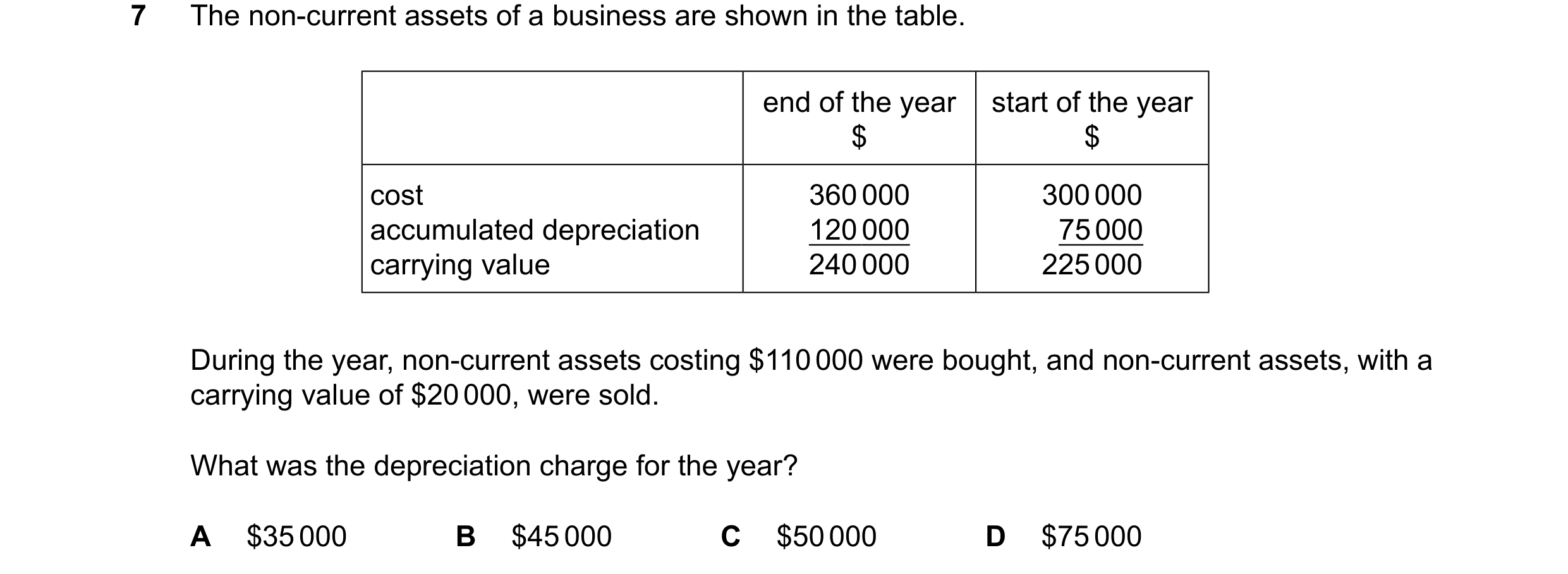
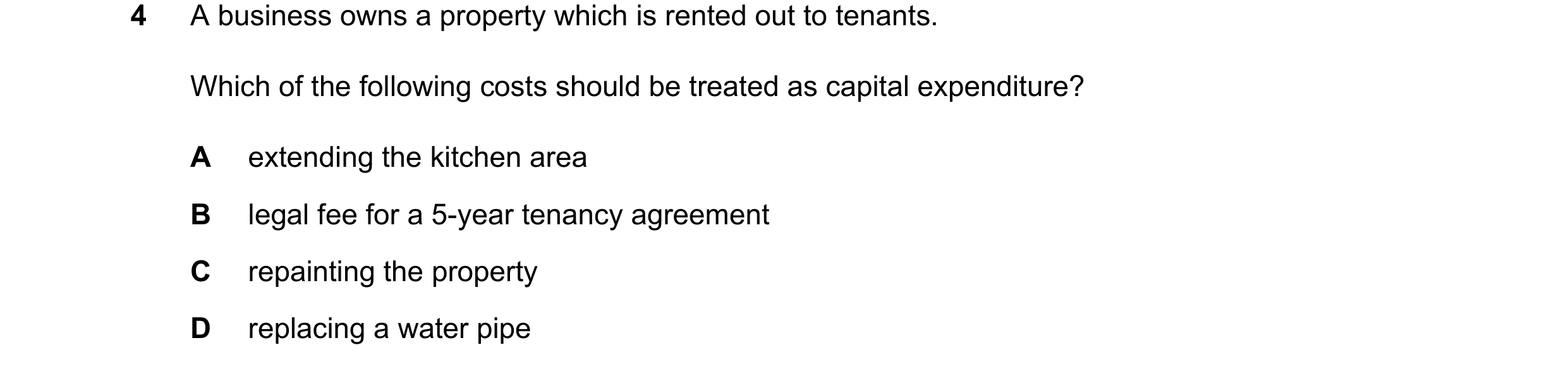 68 / 72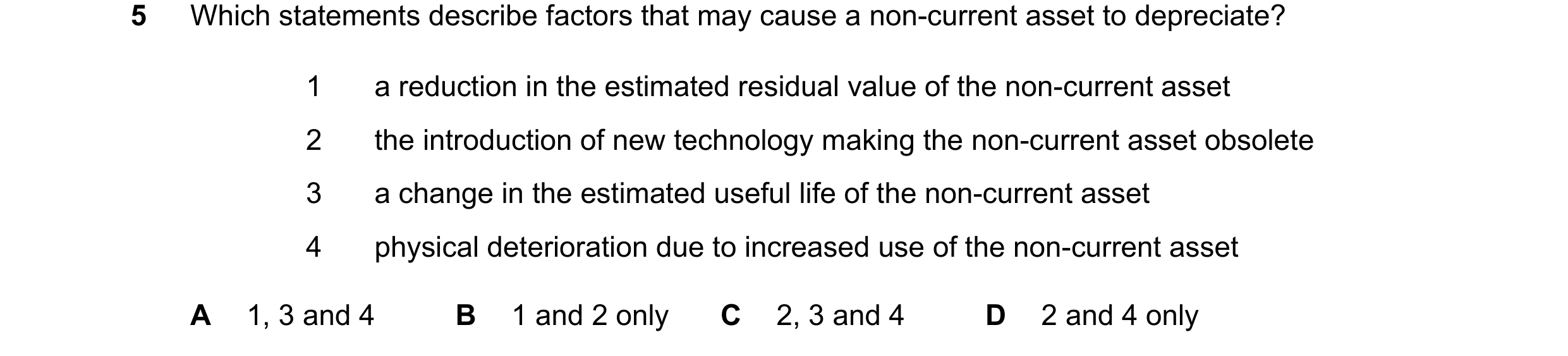
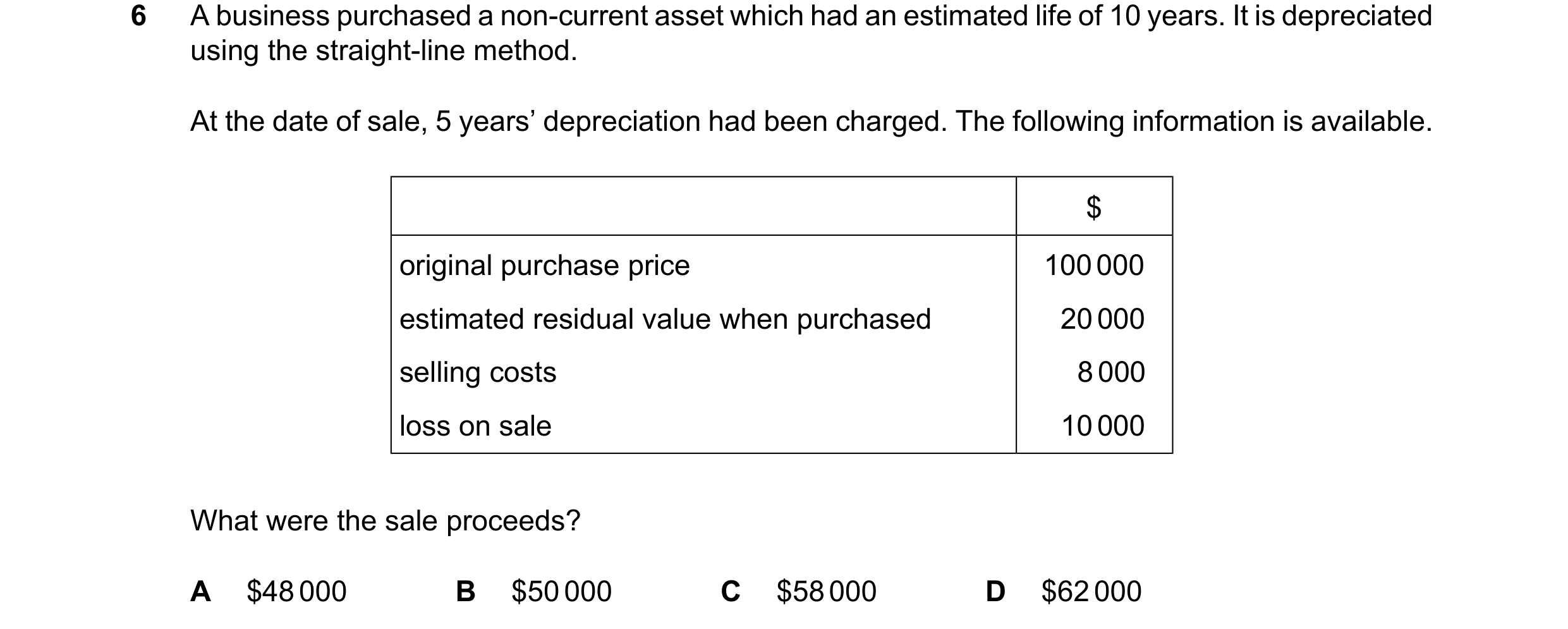
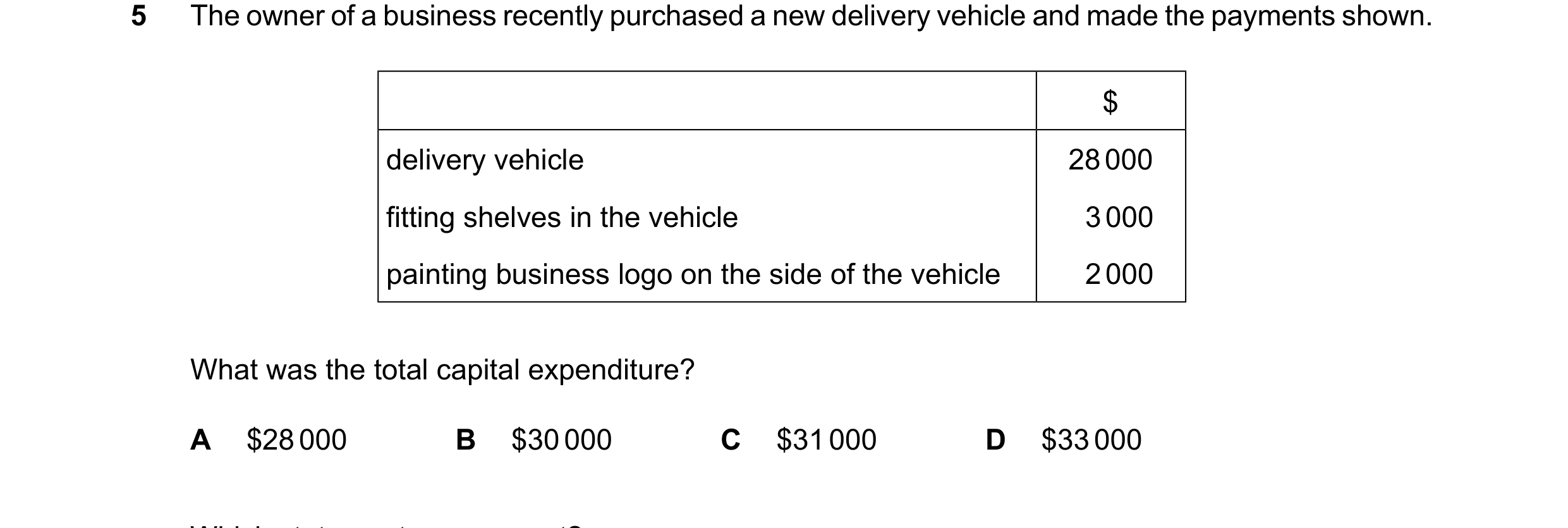 69 / 72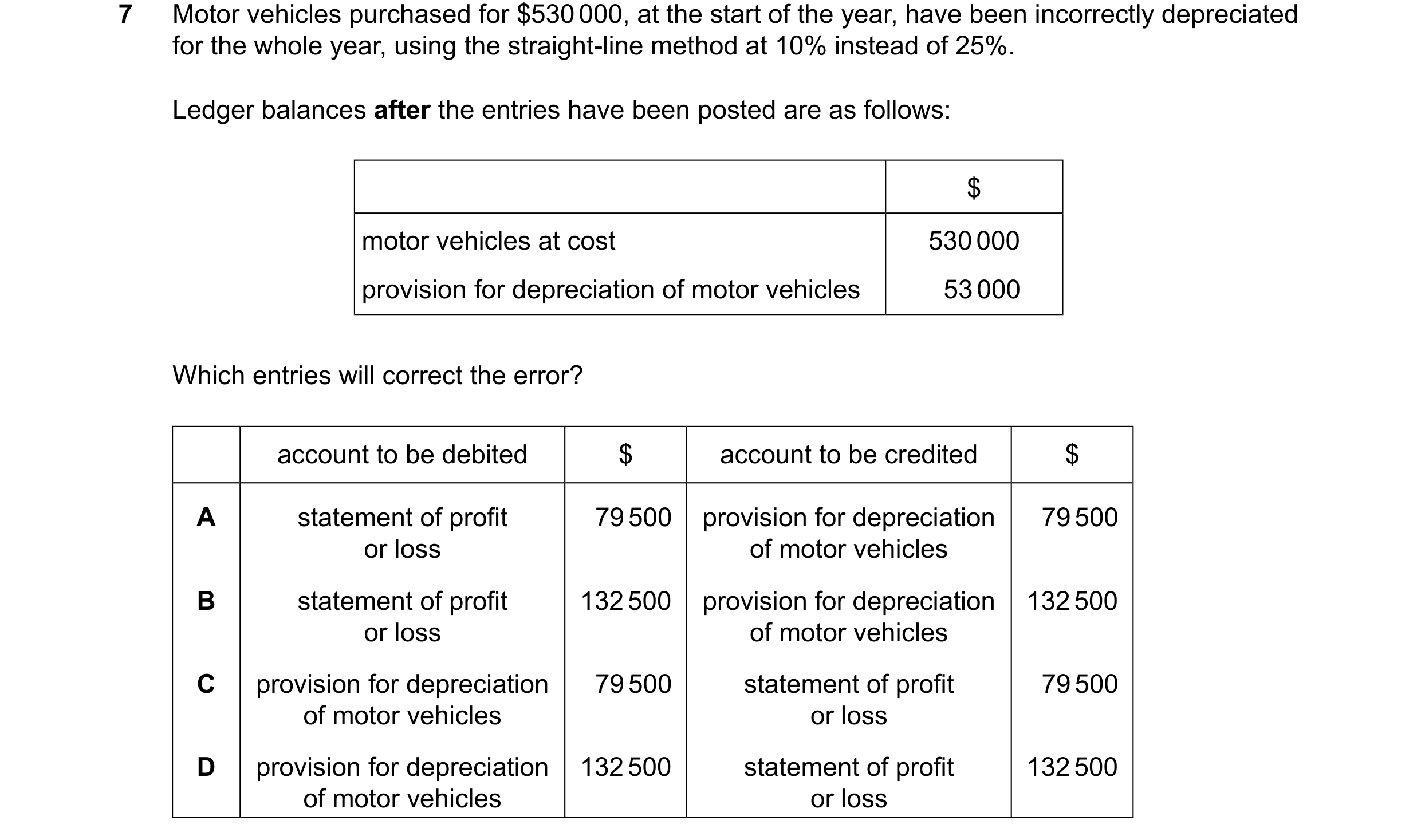
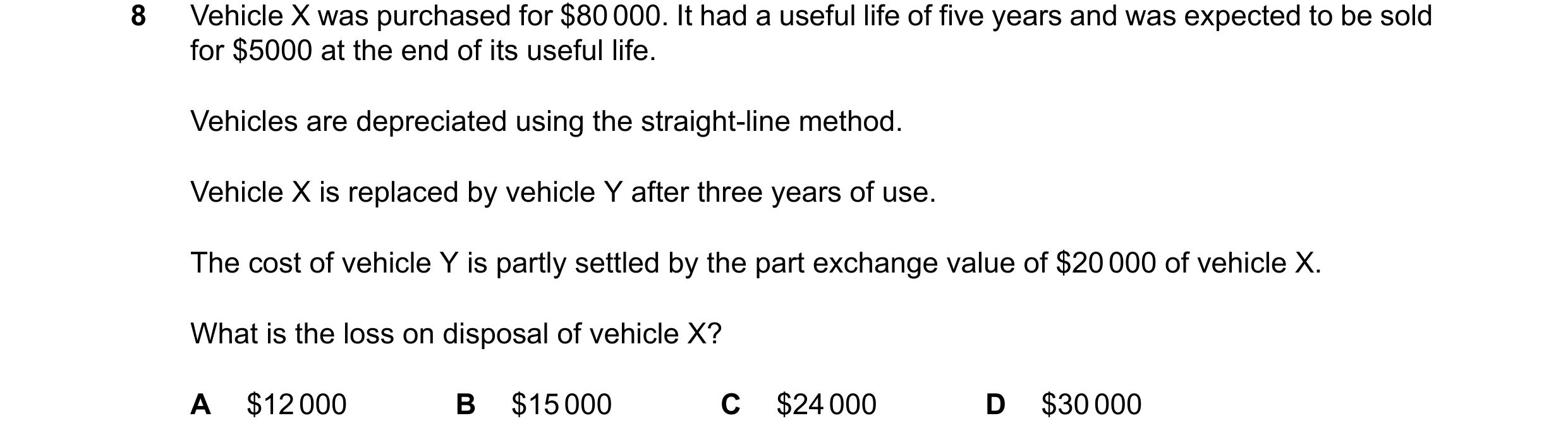
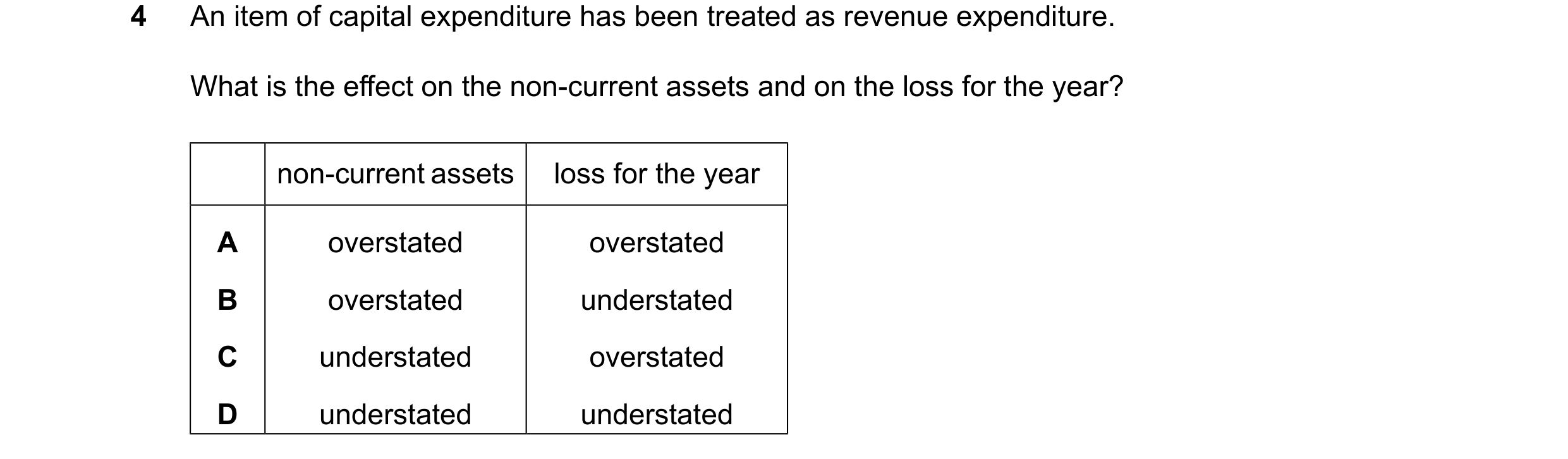 70 / 72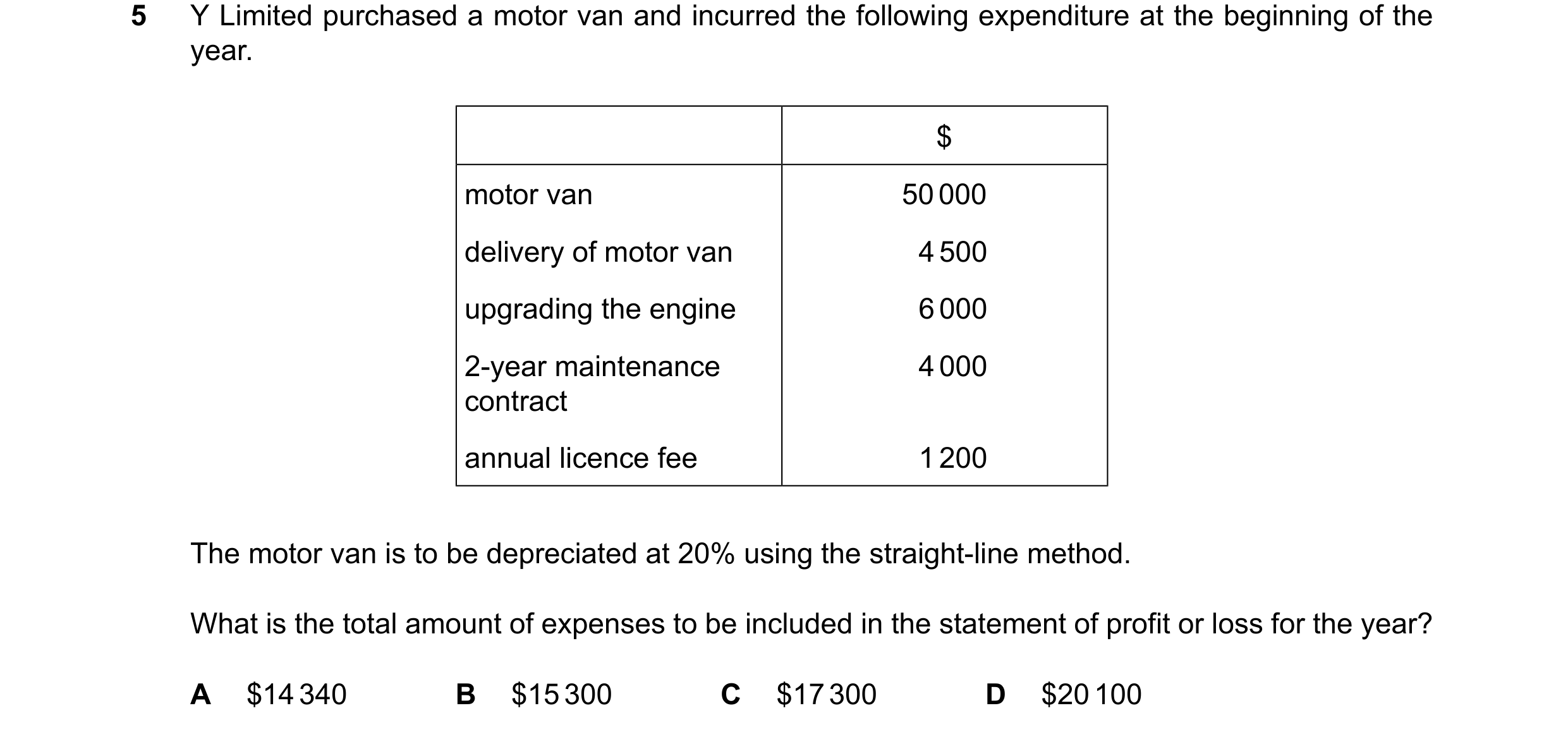
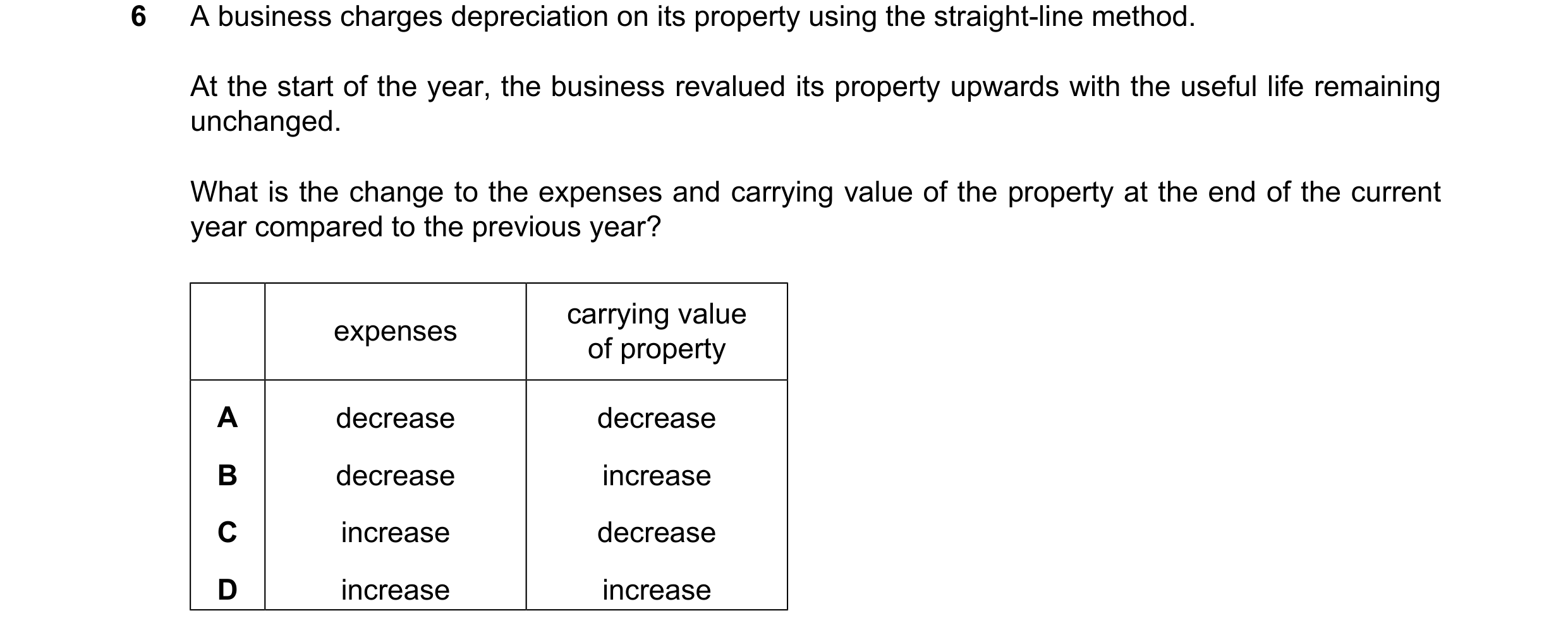

 71 / 72
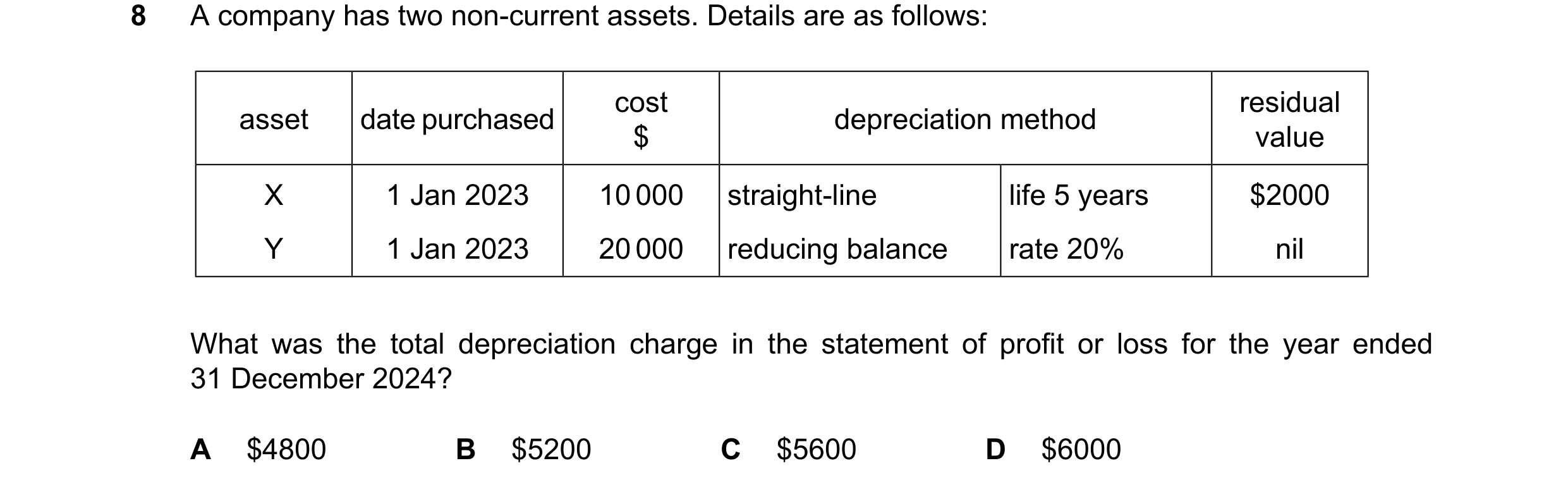 72 / 72