Cambridge A Level Accounting 9706 — 2022 May/June Paper 1 · Variant 1
9706/11/M/J/22 · 30 questions · 30 marks · ≈34 min
The question paper and its mark scheme, free to read here and free to download. This is Cambridge’s own paper, exactly as it was sat.
Question paper12 pages


Mark scheme3 pages
Answers below. Sit the paper first if you are practising.
Questions as text
Q1 · Which statements are correct?
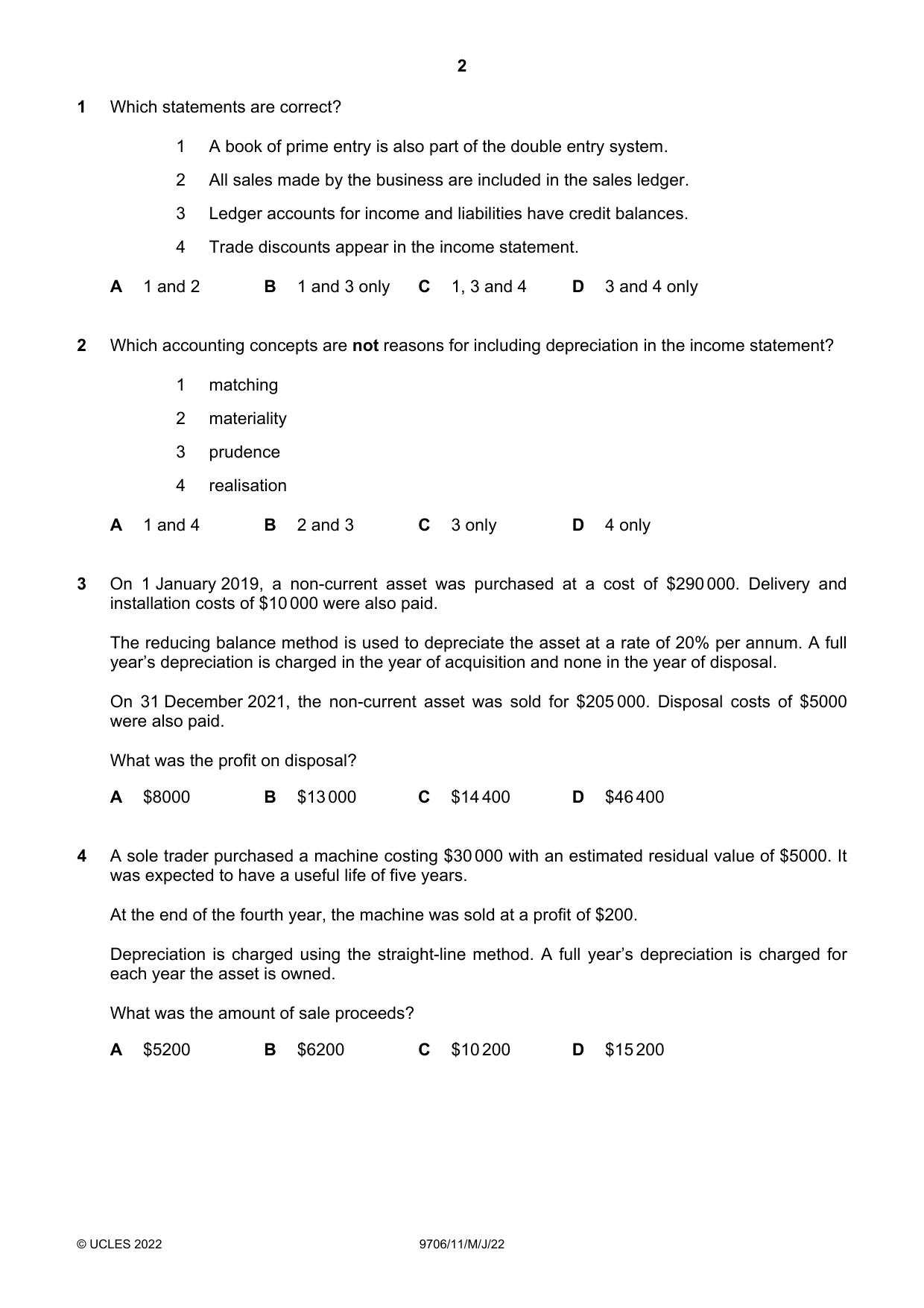
1 Which statements are correct? 1 A book of prime entry is also part of the double entry system. 2 All sales made by the business are included in the sales ledger. 3 Ledger accounts for income and liabilities have credit balances. 4 Trade discounts appear in the income statement. A 1 and 2 B 1 and 3 only C 1, 3 and 4 D 3 and 4 only
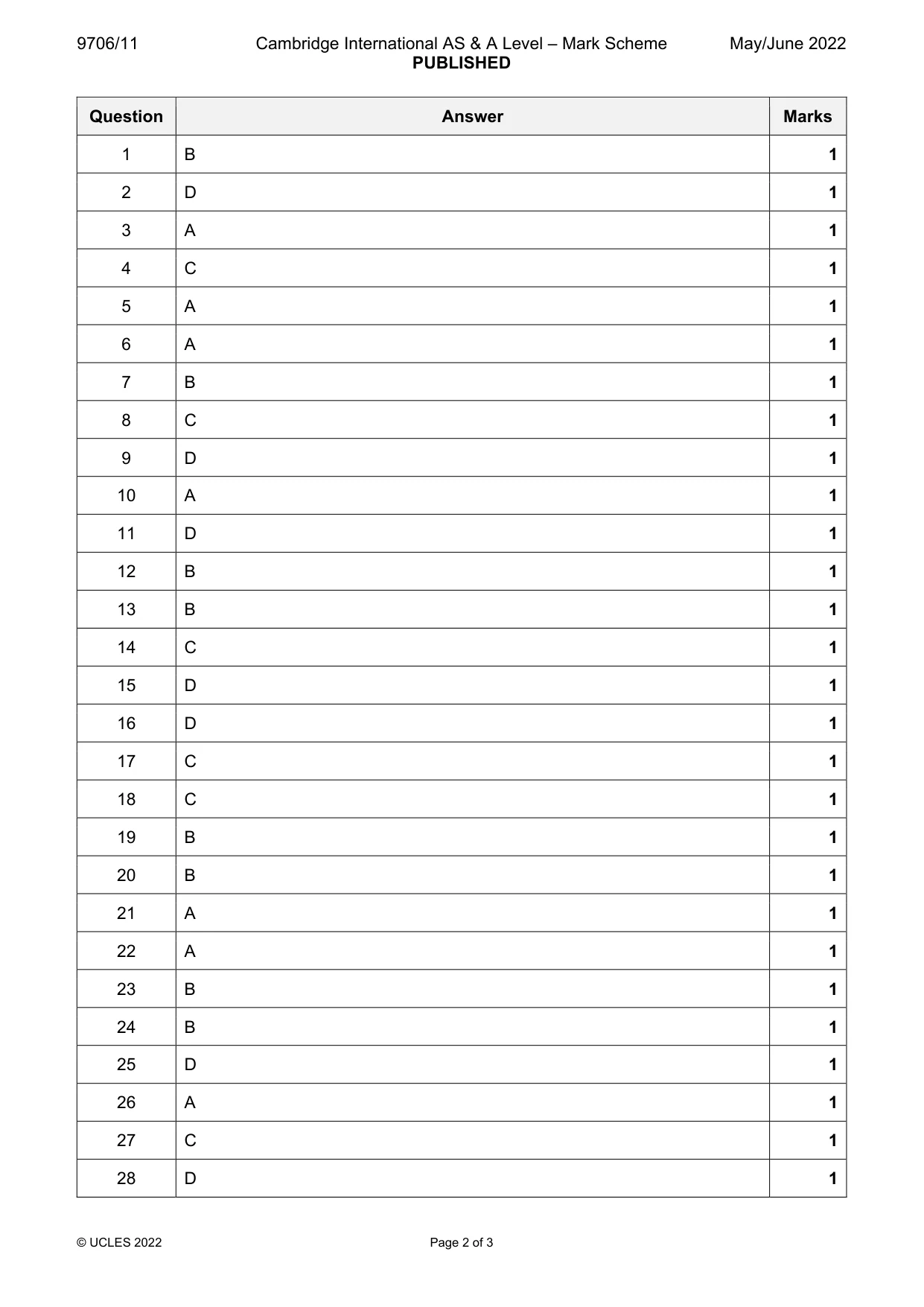
Mark scheme: B
Q2 · Which accounting concepts are not reasons for including depreciation in the income…
2 Which accounting concepts are not reasons for including depreciation in the income statement? 1 matching 2 materiality 3 prudence 4 realisation A 1 and 4 B 2 and 3 C 3 only D 4 only
Mark scheme: D
Q3 · On 1 January 2019, a non-current asset was purchased at a cost of $290 000
3 On 1 January 2019, a non-current asset was purchased at a cost of $290 000. Delivery and installation costs of $10 000 were also paid. The reducing balance method is used to depreciate the asset at a rate of 20% per annum. A full year’s depreciation is charged in the year of acquisition and none in the year of disposal. On 31 December 2021, the non-current asset was sold for $205 000. Disposal costs of $5000 were also paid. What was the profit on disposal? A $8000 B $13 000 C $14 400 D $46 400
Mark scheme: A
Q4 · A sole trader purchased a machine costing $30 000 with an estimated residual value of…
4 A sole trader purchased a machine costing $30 000 with an estimated residual value of $5000. It was expected to have a useful life of five years. At the end of the fourth year, the machine was sold at a profit of $200. Depreciation is charged using the straight-line method. A full year’s depreciation is charged for each year the asset is owned. What was the amount of sale proceeds? A $5200 B $6200 C $10 200 D $15 200
Mark scheme: C
Q5 · Which statement about control accounts is not correct?
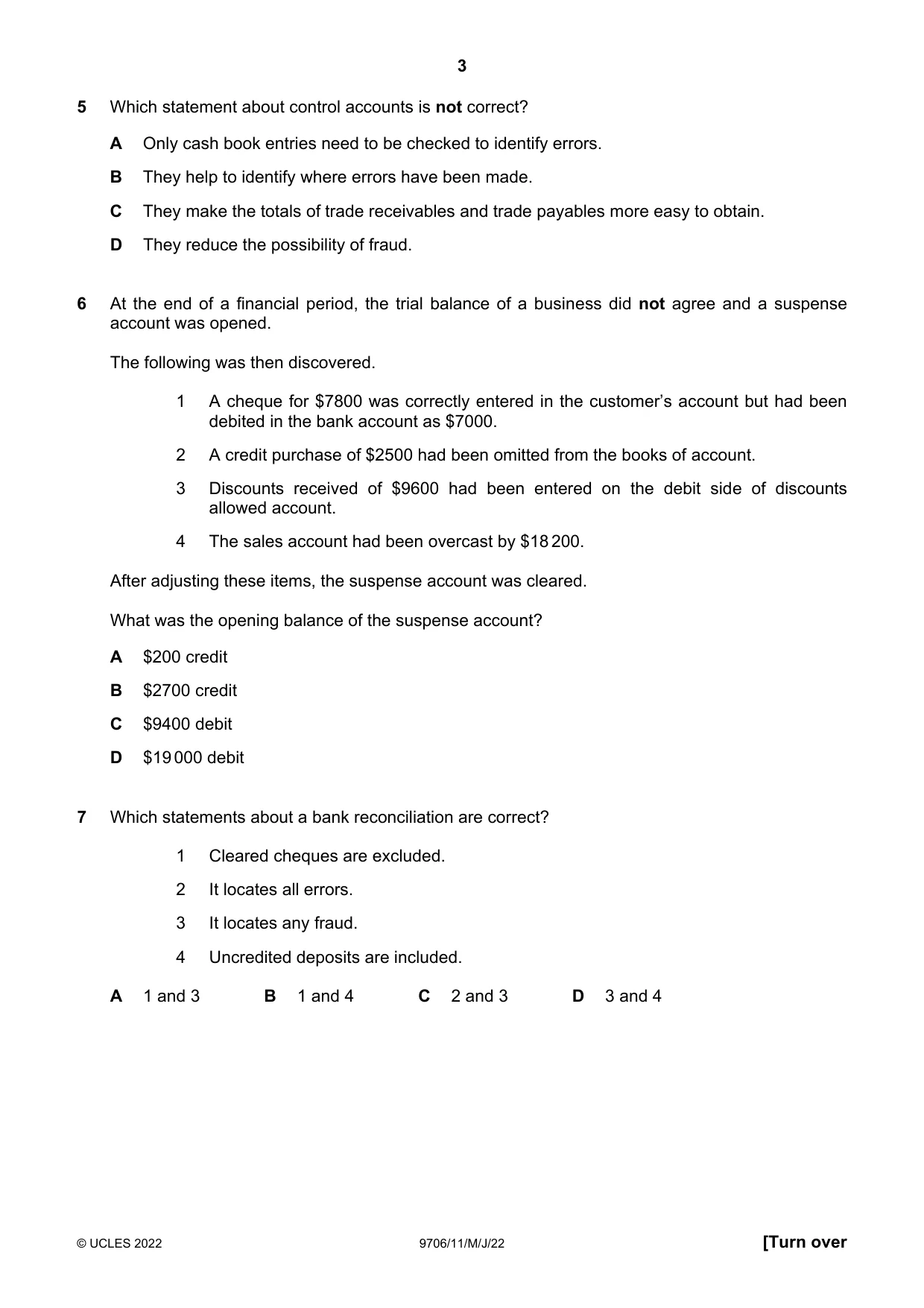
5 Which statement about control accounts is not correct? A Only cash book entries need to be checked to identify errors. B They help to identify where errors have been made. C They make the totals of trade receivables and trade payables more easy to obtain. D They reduce the possibility of fraud.
Mark scheme: A
Q6 · At the end of a financial period, the trial balance of a business did not agree and a…
6 At the end of a financial period, the trial balance of a business did not agree and a suspense account was opened. The following was then discovered. 1 A cheque for $7800 was correctly entered in the customer’s account but had been debited in the bank account as $7000. 2 A credit purchase of $2500 had been omitted from the books of account. 3 Discounts received of $9600 had been entered on the debit side of discounts allowed account. 4 The sales account had been overcast by $18 200. After adjusting these items, the suspense account was cleared. What was the opening balance of the suspense account? A $200 credit B $2700 credit C $9400 debit D $19 000 debit
Mark scheme: A
Q7 · Which statements about a bank reconciliation are correct?
7 Which statements about a bank reconciliation are correct? 1 Cleared cheques are excluded. 2 It locates all errors. 3 It locates any fraud. 4 Uncredited deposits are included. A 1 and 3 B 1 and 4 C 2 and 3 D 3 and 4
Mark scheme: B
Q8 · At the beginning of the financial year, inventory was valued at $15 000
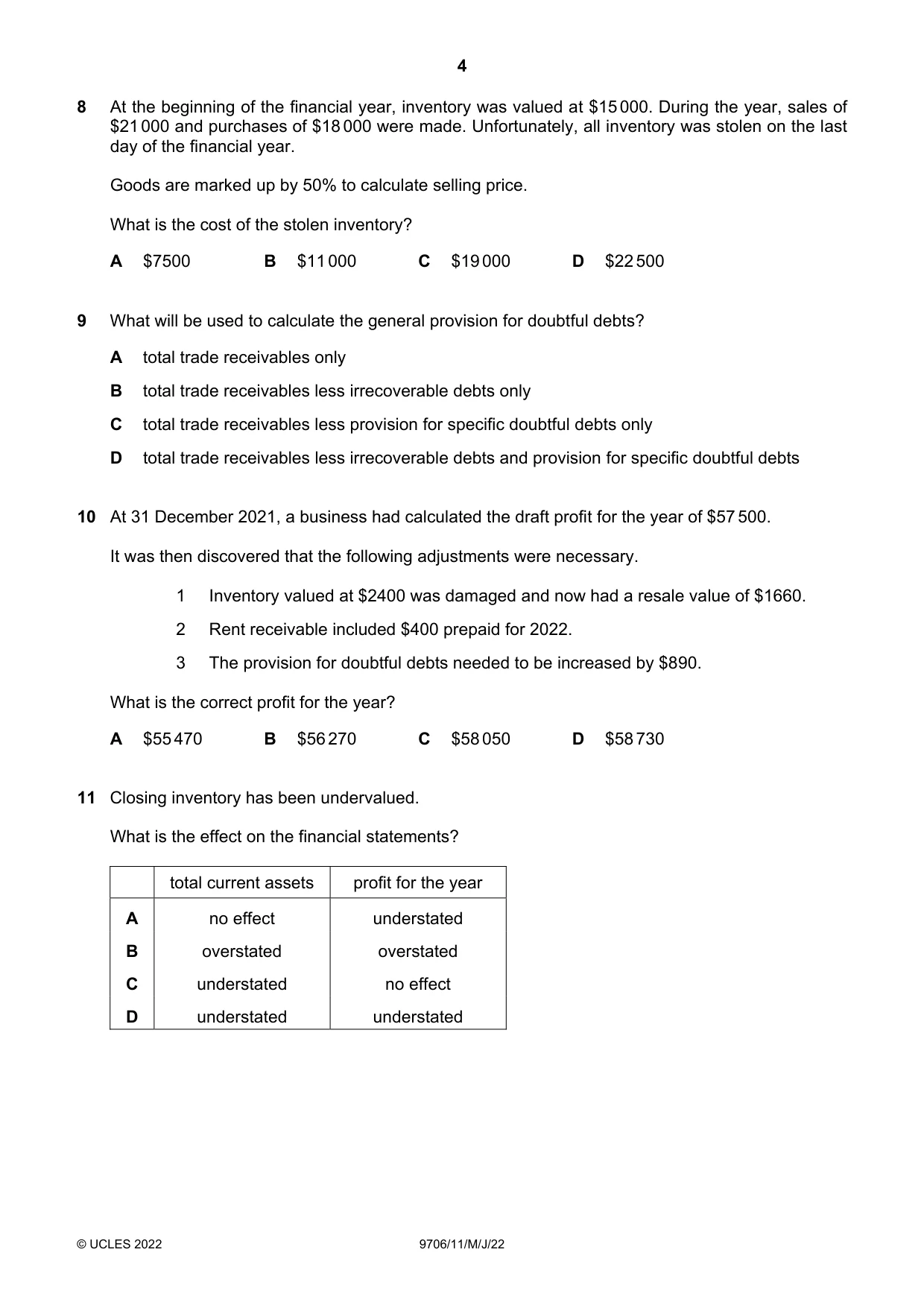
8 At the beginning of the financial year, inventory was valued at $15 000. During the year, sales of $21 000 and purchases of $18 000 were made. Unfortunately, all inventory was stolen on the last day of the financial year. Goods are marked up by 50% to calculate selling price. What is the cost of the stolen inventory? A $7500 B $11 000 C $19 000 D $22 500
Mark scheme: C
Q9 · What will be used to calculate the general provision for doubtful debts?
9 What will be used to calculate the general provision for doubtful debts? A total trade receivables only B total trade receivables less irrecoverable debts only C total trade receivables less provision for specific doubtful debts only D total trade receivables less irrecoverable debts and provision for specific doubtful debts
Mark scheme: D
Q10 · At 31 December 2021, a business had calculated the draft profit for the year of $57 500
10 At 31 December 2021, a business had calculated the draft profit for the year of $57 500. It was then discovered that the following adjustments were necessary. 1 Inventory valued at $2400 was damaged and now had a resale value of $1660. 2 Rent receivable included $400 prepaid for 2022. 3 The provision for doubtful debts needed to be increased by $890. What is the correct profit for the year? A $55 470 B $56 270 C $58 050 D $58 730
Mark scheme: A
Q11 · Closing inventory has been undervalued
11 Closing inventory has been undervalued. What is the effect on the financial statements? total current assets profit for the year A no effect understated B overstated overstated C understated no effect D understated understated
Mark scheme: D
Q12 · A sole trader has provided the following information
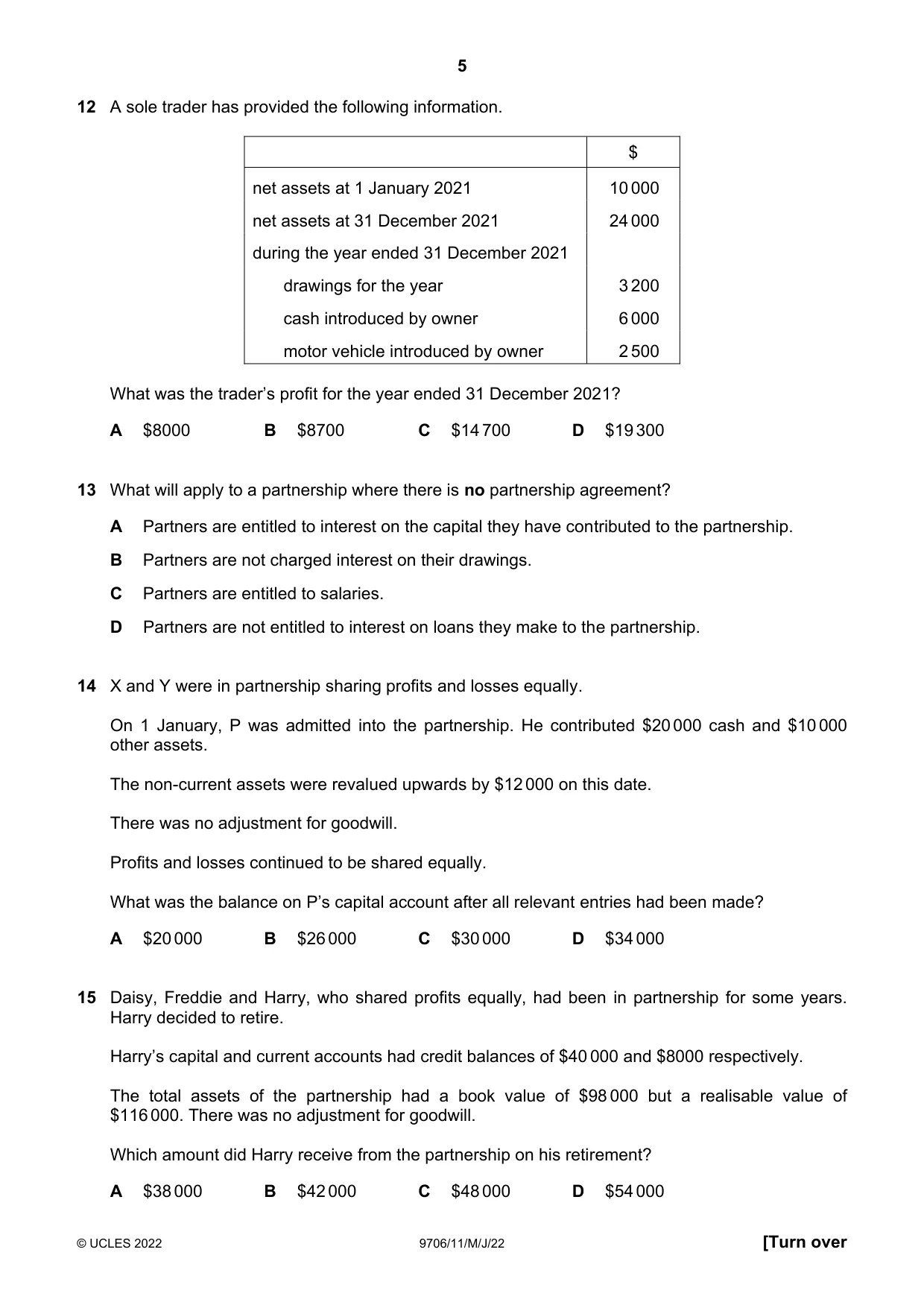
12 A sole trader has provided the following information. $ net assets at 1 January 2021 10 000 net assets at 31 December 2021 24 000 during the year ended 31 December 2021 drawings for the year 3 200 cash introduced by owner 6 000 motor vehicle introduced by owner 2 500 What was the trader’s profit for the year ended 31 December 2021? A $8000 B $8700 C $14 700 D $19 300
Mark scheme: B
Q13 · What will apply to a partnership where there is no partnership agreement?
13 What will apply to a partnership where there is no partnership agreement? A Partners are entitled to interest on the capital they have contributed to the partnership. B Partners are not charged interest on their drawings. C Partners are entitled to salaries. D Partners are not entitled to interest on loans they make to the partnership.
Mark scheme: B
Q14 · X and Y were in partnership sharing profits and losses equally
14 X and Y were in partnership sharing profits and losses equally. On 1 January, P was admitted into the partnership. He contributed $20 000 cash and $10 000 other assets. The non-current assets were revalued upwards by $12 000 on this date. There was no adjustment for goodwill. Profits and losses continued to be shared equally. What was the balance on P’s capital account after all relevant entries had been made? A $20 000 B $26 000 C $30 000 D $34 000
Mark scheme: C
Q15 · Daisy, Freddie and Harry, who shared profits equally, had been in partnership for some…
15 Daisy, Freddie and Harry, who shared profits equally, had been in partnership for some years. Harry decided to retire. Harry’s capital and current accounts had credit balances of $40 000 and $8000 respectively. The total assets of the partnership had a book value of $98 000 but a realisable value of $116 000. There was no adjustment for goodwill. Which amount did Harry receive from the partnership on his retirement? A $38 000 B $42 000 C $48 000 D $54 000
Mark scheme: D
Q16 · A company made a bonus issue of one ordinary share for every five ordinary shares held
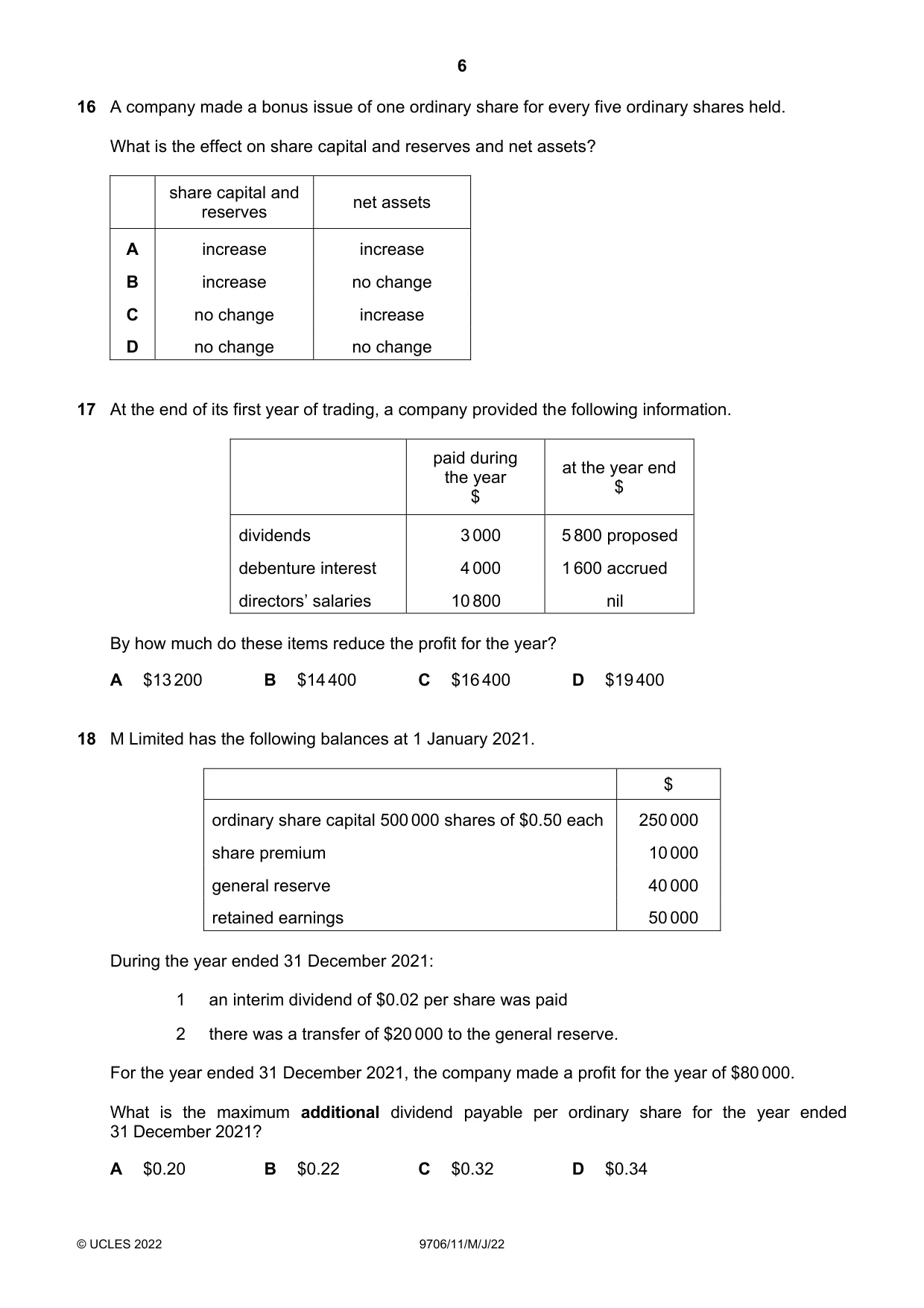
16 A company made a bonus issue of one ordinary share for every five ordinary shares held. What is the effect on share capital and reserves and net assets? share capital and net assets reserves A increase increase B increase no change C no change increase D no change no change
Mark scheme: D
Q17 · At the end of its first year of trading, a company provided the following information
17 At the end of its first year of trading, a company provided the following information. paid during at the year end the year $ $ dividends 3 000 5 800 proposed debenture interest 4 000 1 600 accrued directors’ salaries 10 800 nil By how much do these items reduce the profit for the year? A $13 200 B $14 400 C $16 400 D $19 400
Mark scheme: C
Q18 · M Limited has the following balances at 1 January 2021
18 M Limited has the following balances at 1 January 2021. $ ordinary share capital 500 000 shares of $0.50 each 250 000 share premium 10 000 general reserve 40 000 retained earnings 50 000 During the year ended 31 December 2021: 1 an interim dividend of $0.02 per share was paid 2 there was a transfer of $20 000 to the general reserve. For the year ended 31 December 2021, the company made a profit for the year of $80 000. What is the maximum additional dividend payable per ordinary share for the year ended 31 December 2021? A $0.20 B $0.22 C $0.32 D $0.34
Mark scheme: C
Q19 · Which ratios are efficiency ratios?
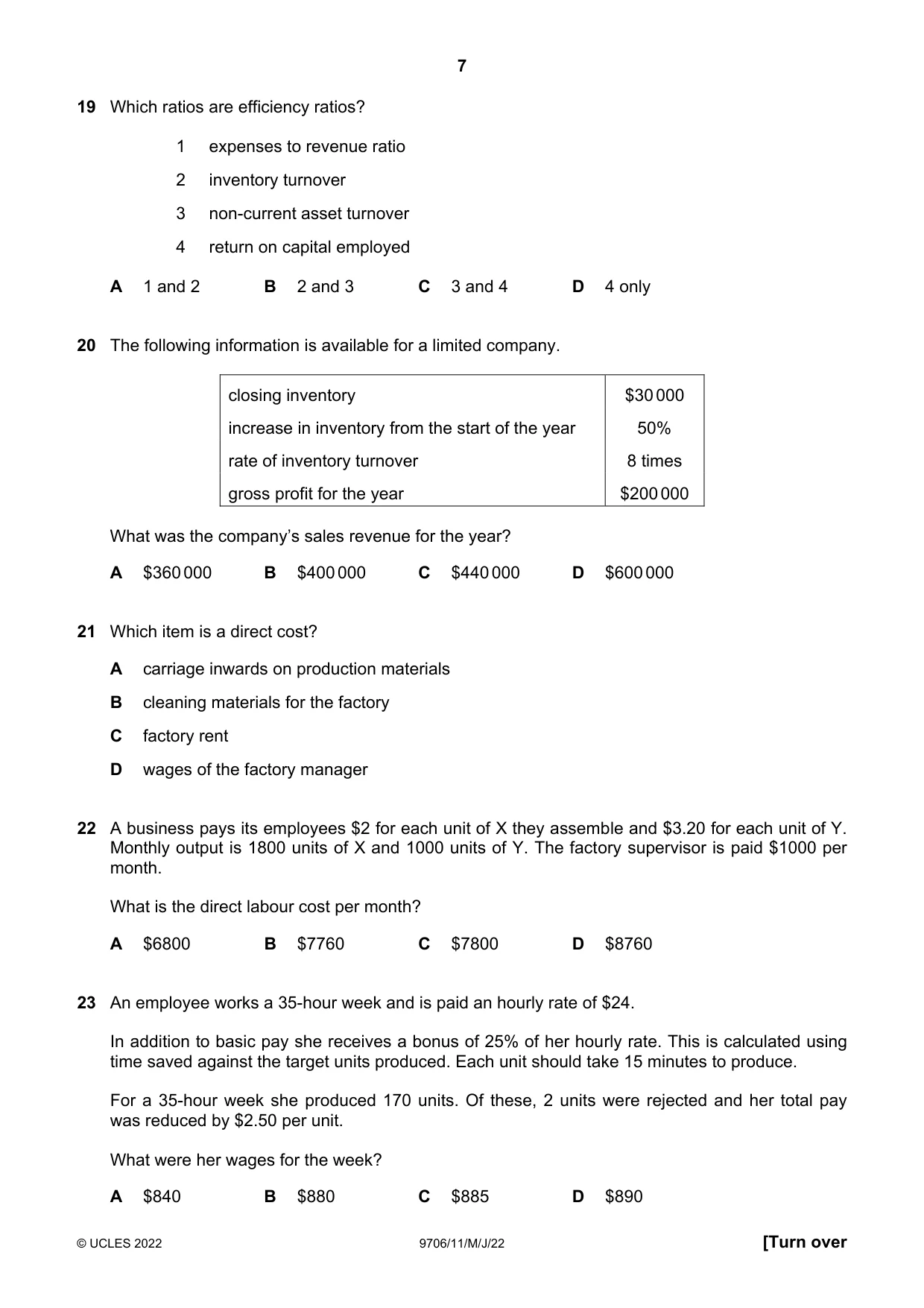
19 Which ratios are efficiency ratios? 1 expenses to revenue ratio 2 inventory turnover 3 non-current asset turnover 4 return on capital employed A 1 and 2 B 2 and 3 C 3 and 4 D 4 only
Mark scheme: B
More questions on Analysis and communication of accounting information
Q20 · The following information is available for a limited company
20 The following information is available for a limited company. closing inventory $30 000 increase in inventory from the start of the year 50% rate of inventory turnover 8 times gross profit for the year $200 000 What was the company’s sales revenue for the year? A $360 000 B $400 000 C $440 000 D $600 000
Mark scheme: B
More questions on Analysis and communication of accounting information
Q21 · Which item is a direct cost?
21 Which item is a direct cost? A carriage inwards on production materials B cleaning materials for the factory C factory rent D wages of the factory manager
Mark scheme: A
Q22 · A business pays its employees $2 for each unit of X they assemble and $3.20 for each unit…
22 A business pays its employees $2 for each unit of X they assemble and $3.20 for each unit of Y. Monthly output is 1800 units of X and 1000 units of Y. The factory supervisor is paid $1000 per month. What is the direct labour cost per month? A $6800 B $7760 C $7800 D $8760
Mark scheme: A
Q23 · An employee works a 35-hour week and is paid an hourly rate of $24
23 An employee works a 35-hour week and is paid an hourly rate of $24. In addition to basic pay she receives a bonus of 25% of her hourly rate. This is calculated using time saved against the target units produced. Each unit should take 15 minutes to produce. For a 35-hour week she produced 170 units. Of these, 2 units were rejected and her total pay was reduced by $2.50 per unit. What were her wages for the week? A $840 B $880 C $885 D $890
Mark scheme: B
Q24 · A manufacturing business uses direct labour hours to calculate its overhead absorption…
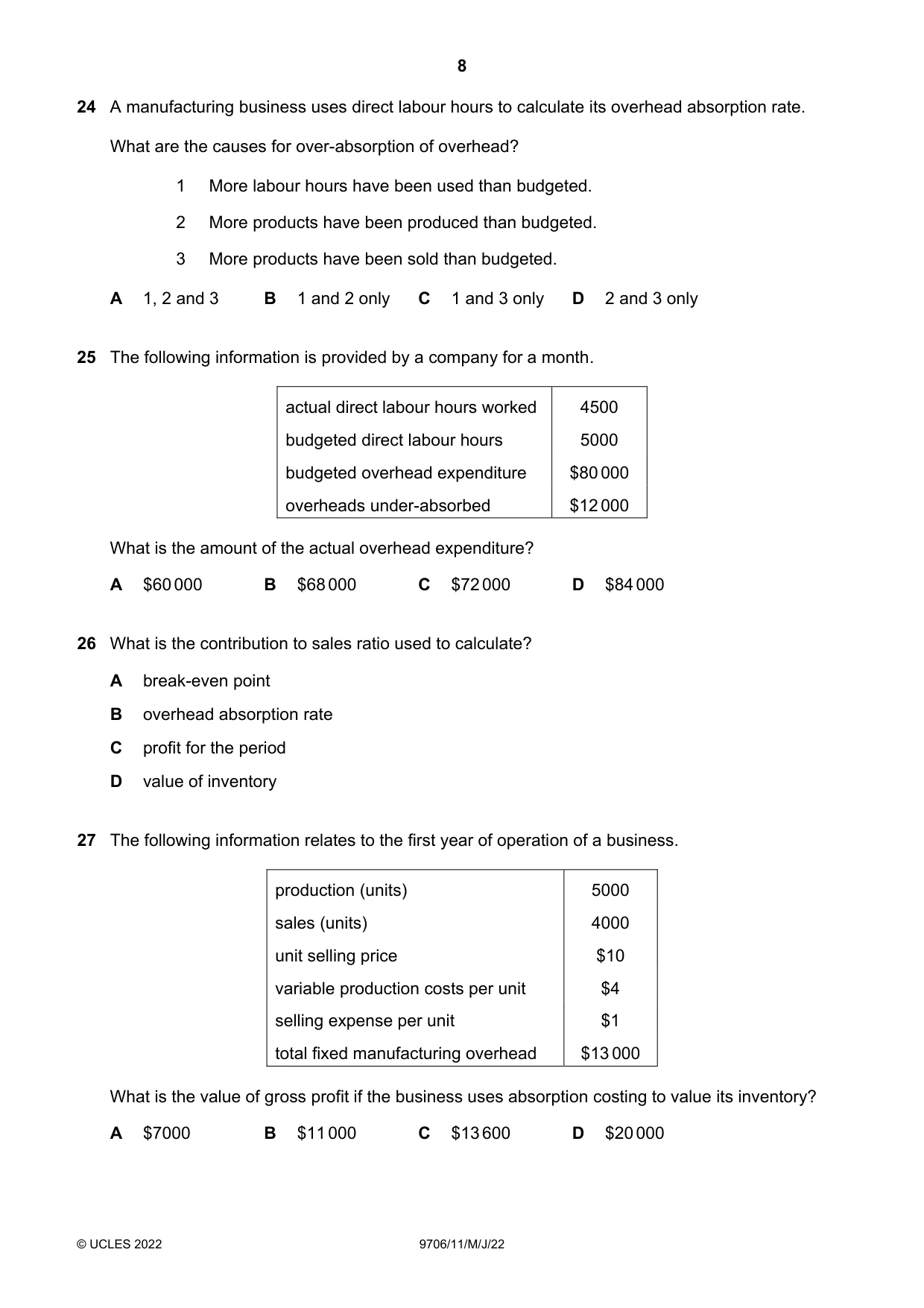
24 A manufacturing business uses direct labour hours to calculate its overhead absorption rate. What are the causes for over-absorption of overhead? 1 More labour hours have been used than budgeted. 2 More products have been produced than budgeted. 3 More products have been sold than budgeted. A 1, 2 and 3 B 1 and 2 only C 1 and 3 only D 2 and 3 only
Mark scheme: B
Q25 · The following information is provided by a company for a month
25 The following information is provided by a company for a month. actual direct labour hours worked 4500 budgeted direct labour hours 5000 budgeted overhead expenditure $80 000 overheads under-absorbed $12 000 What is the amount of the actual overhead expenditure? A $60 000 B $68 000 C $72 000 D $84 000
Mark scheme: D
Q26 · What is the contribution to sales ratio used to calculate?
26 What is the contribution to sales ratio used to calculate? A break-even point B overhead absorption rate C profit for the period D value of inventory
Mark scheme: A
Q27 · The following information relates to the first year of operation of a business
27 The following information relates to the first year of operation of a business. production (units) 5000 sales (units) 4000 unit selling price $10 variable production costs per unit $4 selling expense per unit $1 total fixed manufacturing overhead $13 000 What is the value of gross profit if the business uses absorption costing to value its inventory? A $7000 B $11 000 C $13 600 D $20 000
Mark scheme: C
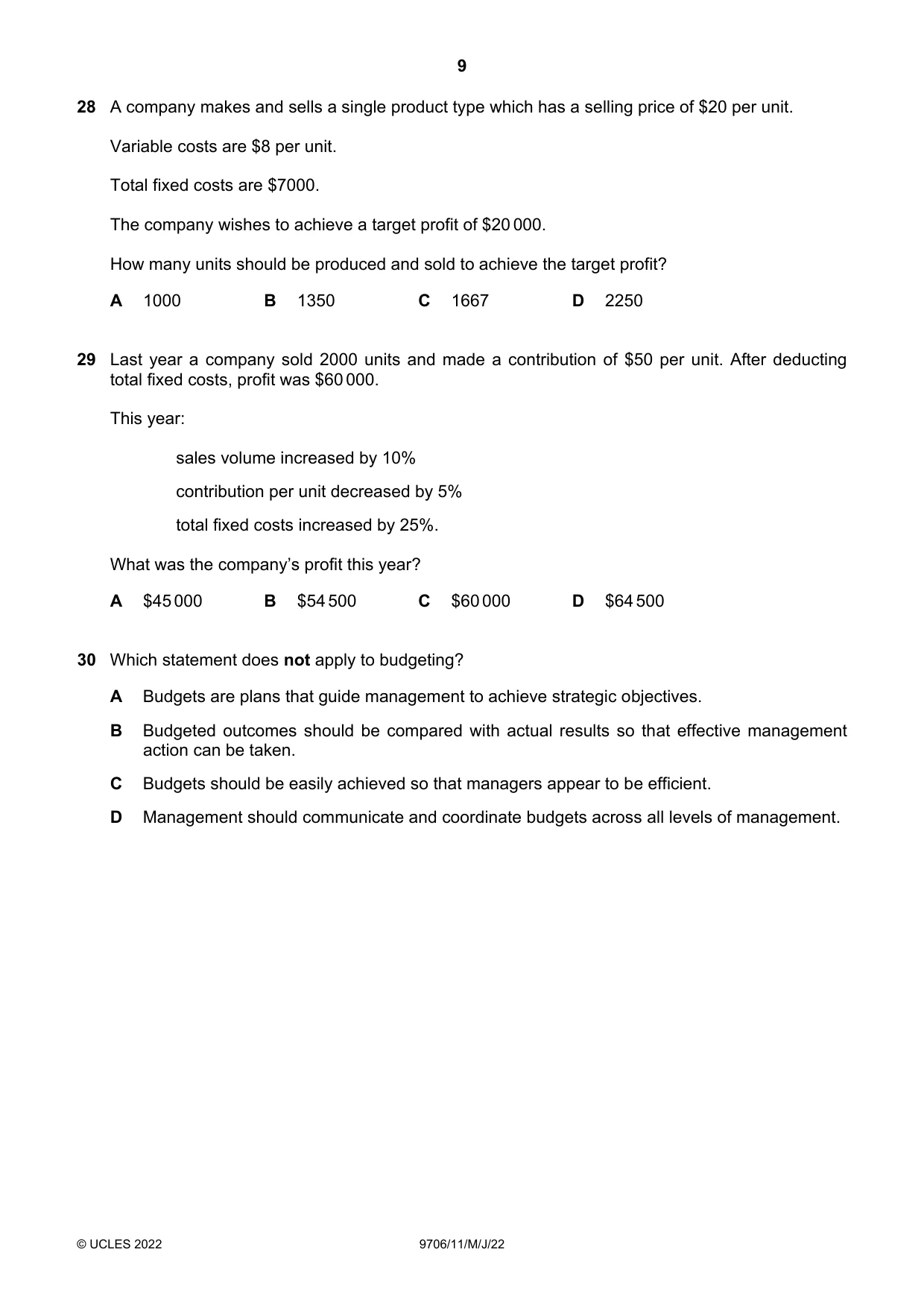
Q28 · A company makes and sells a single product type which has a selling price of $20 per unit
28 A company makes and sells a single product type which has a selling price of $20 per unit. Variable costs are $8 per unit. Total fixed costs are $7000. The company wishes to achieve a target profit of $20 000. How many units should be produced and sold to achieve the target profit? A 1000 B 1350 C 1667 D 2250
Mark scheme: D
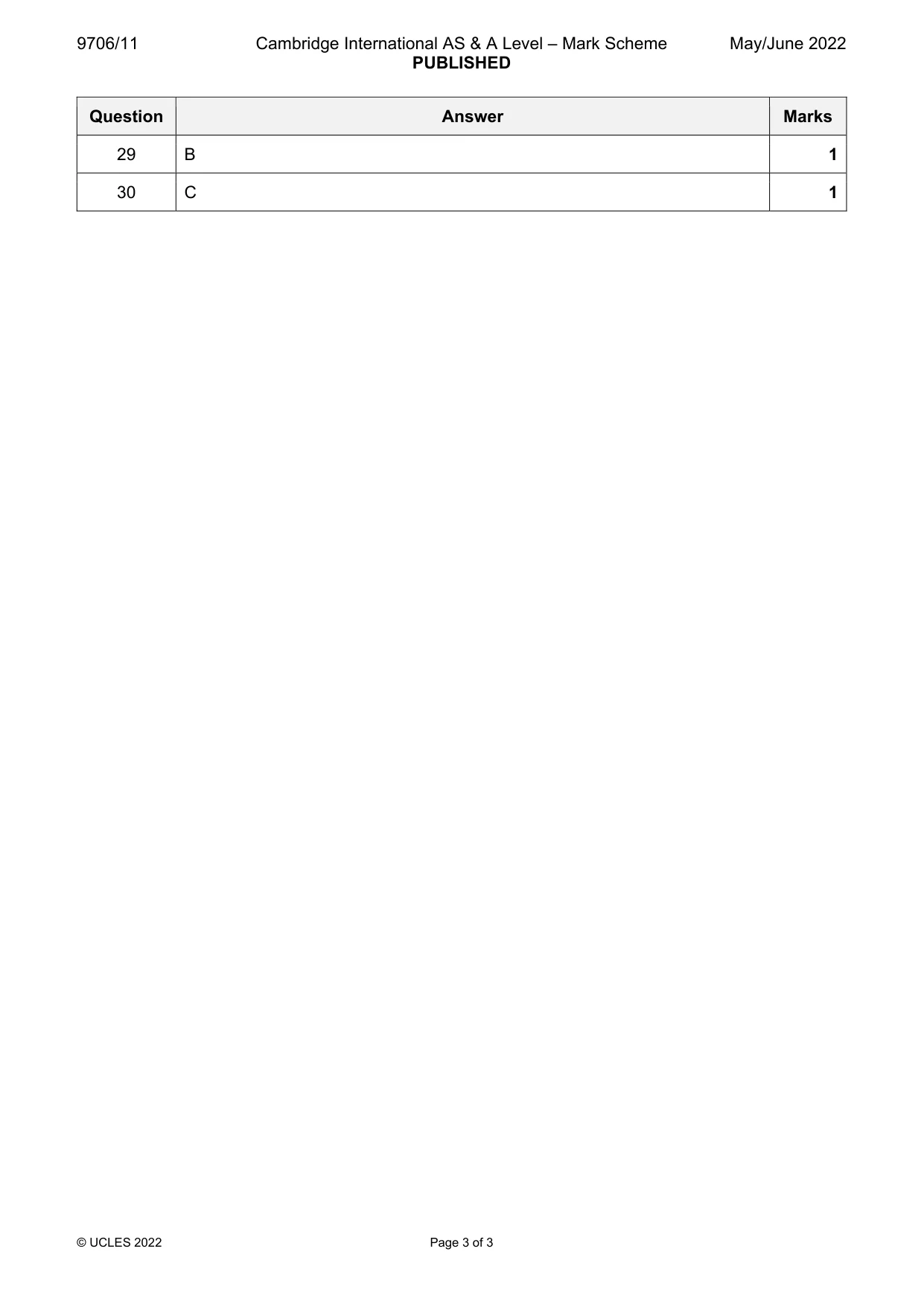
Q29 · Last year a company sold 2000 units and made a contribution of $50 per unit
29 Last year a company sold 2000 units and made a contribution of $50 per unit. After deducting total fixed costs, profit was $60 000. This year: sales volume increased by 10% contribution per unit decreased by 5% total fixed costs increased by 25%. What was the company’s profit this year? A $45 000 B $54 500 C $60 000 D $64 500
Mark scheme: B
Q30 · Which statement does not apply to budgeting?
30 Which statement does not apply to budgeting? A Budgets are plans that guide management to achieve strategic objectives. B Budgeted outcomes should be compared with actual results so that effective management action can be taken. C Budgets should be easily achieved so that managers appear to be efficient. D Management should communicate and coordinate budgets across all levels of management.
Mark scheme: C
What was in this paper
The subtopics covered by these 30 questions, and how many questions each got. Open one in a new tab to see every Cambridge question on it.
6Preparation of financial statements5Preparation of financial statements5Accounting for non-current assets3Costs and cost behaviour3Reconciliation and verification3Analysis and communication of accounting information2Budgeting and budgetary control1The accounting system1Types of business entity1What you needed in this session
Cambridge’s own grade thresholds for 2022 May/June, Paper 1 · Variant 1. A higher threshold means an easier paper — the bar moves with how the cohort did.