Questions as text
Q1 · An amine is produced in the following reaction 9701/11 Oct/Nov 2005
23 An amine is produced in the following reaction. C2H5I + 2NH3 → C2H5NH2 + NH4I What is the mechanism? A electrophilic addition B electrophilic substitution C nucleophilic addition D nucleophilic substitution
1 marks
Answer: D
This question in 9701/11 Oct/Nov 2005
Q2 · Use of the Data Booklet is relevant to this question 9701/11 May/June 2006
23 Use of the Data Booklet is relevant to this question. In which reaction is the relative molecular mass of the organic product the largest? A bromoethane + aqueous sodium hydroxide B bromoethane + alcoholic sodium hydroxide C ethane + bromine D ethanol + phosphorus pentachloride
1 marks
Answer: C
This question in 9701/11 May/June 2006
Q3 · High-energy irradiation in the stratosphere produces radicals from chlorofluoroalkanes… 9701/11 May/June 2006
25 High-energy irradiation in the stratosphere produces radicals from chlorofluoroalkanes, commonly known as CFCs. Which radical could result from this irradiation of CHFClCF2Cl? A CHFClCFCl B CHClCF2Cl C CHFCF2Cl D CFClCF2Cl
1 marks
Answer: C
This question in 9701/11 May/June 2006
Q4 · What is the total number of different chloroethanes, formula C2H6-nCln, where n can be… 9701/11 Oct/Nov 2006
21 What is the total number of different chloroethanes, formula C2H6-nCln, where n can be any integer from 1 to 4? A 4 B 6 C 7 D 8
1 marks
Answer: C
This question in 9701/11 Oct/Nov 2006
Q5 · Which reaction is an example of nucleophilic substitution? 9701/11 Oct/Nov 2006
22 Which reaction is an example of nucleophilic substitution? A CH3CH2Br → CH2=CH2 + HBr B CH2=CH2 + HBr → CH3CH2Br C C3H7Br + H2O → C3H7OH + HBr D C2H6 + Br2 → C2H5Br + HBr
1 marks
Answer: C
This question in 9701/11 Oct/Nov 2006
Q6 · Compound X on refluxing with aqueous sodium hydroxide gave mixture Y which on… 9701/11 Oct/Nov 2007
16 Compound X on refluxing with aqueous sodium hydroxide gave mixture Y which on distillation with acidified potassium dichromate(VI) produced propanone. Mixing Y with dilute nitric acid and aqueous silver nitrate gave a cream precipitate. What could compound X be? A CH3CHBrCH3 B CH3CHICH3 C CH3CH2CH2Br D CH3CH2CH2I
1 marks
Answer: A
This question in 9701/11 Oct/Nov 2007
Q7 · The anaesthetic halothane, CF3CHBrCl, is made industrially as shown below 9701/11 Oct/Nov 2007
24 The anaesthetic halothane, CF3CHBrCl, is made industrially as shown below. HF Br2 CCl2=CHCl CF3CH2Cl CF3CHBrCl stage 1 stage 2 Which type of reaction is occurring in stage 2? A electrophilic addition B electrophilic substitution C free radical substitution D nucleophilic addition
1 marks
Answer: C
This question in 9701/11 Oct/Nov 2007
Q8 · Chlorofluoroalkanes, CFCs, can be used as refrigerants, aerosol propellants and fire… 9701/11 Oct/Nov 2007
25 Chlorofluoroalkanes, CFCs, can be used as refrigerants, aerosol propellants and fire extinguishers. CFCs such as CCl3F and CCl2F2 are more stable than chloroalkanes such as CCl4. What is the reason for their greater stability? A Fluorine has a higher first ionisation energy than chlorine. B Fluorine radicals are more stable than chlorine radicals. C The C–F bond energy is larger than the C–Cl bond energy. D The C–F bond is more polar than the C–Cl bond.
1 marks
Answer: C
This question in 9701/11 Oct/Nov 2007
Q9 · Which pair of reaction types is illustrated by the reaction sequence below? 9701/11 May/June 2008
20 Which pair of reaction types is illustrated by the reaction sequence below? HI in CH3CO2H NaOH(aq) CH3CH=CHCH3 CH3CH2CHICH3 CH3CH2CH(OH)CH3 A electrophilic addition and electrophilic substitution B electrophilic addition and nucleophilic substitution C nucleophilic addition and electrophilic substitution D nucleophilic addition and nucleophilic substitution
1 marks
Answer: B
This question in 9701/11 May/June 2008
Q10 · Halogenoalkanes are important molecules in organic synthetic reactions 9701/11 May/June 2008
25 Halogenoalkanes are important molecules in organic synthetic reactions. In particular they undergo a range of nucleophilic reactions. Which reaction proceeds only by an SN1 mechanism? A CH3CH2Br + NH3 B CH3CH2CH2I + OH– C CH3CHBrCH3 + NH3 D (CH3)3CI + OH–
1 marks
Answer: D
This question in 9701/11 May/June 2008
Q11 · The structure of monosodium glutamate, a flavour enhancer, is shown 9701/11 May/June 2008
38 The structure of monosodium glutamate, a flavour enhancer, is shown. Na+ O– C CH2 CH2 CH CO2H O NH2 It may be prepared starting from the following compound. Cl CH2 CH2 CH CO2H NH2 Which set of reagents and reaction conditions could be used to prepare monosodium glutamate? 1 Heat under reflux with ethanolic KCN followed by hydrolysis with NaOH(aq). 2 Heat with sodium methanoate, HCO Na − + . 2 3 Heat under reflux with NaOH(aq).
1 marks
Answer: D
This question in 9701/11 May/June 2008
Q12 · Aluminium chloride catalyses certain reactions by forming carbocations (carbonium ions)… 9701/11 Oct/Nov 2008
15 Aluminium chloride catalyses certain reactions by forming carbocations (carbonium ions) with chloroalkanes as shown. RCl + Al Cl3 → R+ + A l C l − 4 Which property makes this reaction possible? A AlCl3 exists as the dimer Al2Cl6 in the vapour. B AlCl3 is a covalent molecule. C The aluminium atom in Al Cl3 has an incomplete octet of electrons. D The chlorine atom in RCl has a vacant p orbital.
1 marks
Answer: C
This question in 9701/11 Oct/Nov 2008
Q13 · Four drops of 1-chlorobutane, 1-bromobutane and 1-iodobutane were put separately into… 9701/11 Oct/Nov 2008
23 Four drops of 1-chlorobutane, 1-bromobutane and 1-iodobutane were put separately into three test-tubes containing 1.0 cm3 of aqueous silver nitrate at 60 °C. A hydrolysis reaction occurred. (R represents the butane chain C4H9– and X the halogen atom.) H2O(l) + R–X(l) + Ag+(aq) → R–OH(aq) + AgX(s) + H+(aq) The rate of formation of cloudiness in the tubes was in the order RCl < RBr < RI. Why is this? A The R–X bond polarity decreases from RCl to RI. B The solubility of AgX(s) decreases from AgCl to AgI. C The ionisation energy of the halogen decreases from Cl to I. D The bond energy of R–X decreases from RCl to RI.
1 marks
Answer: D
This question in 9701/11 Oct/Nov 2008
Q14 · A possible mechanism of the exothermic hydrolysis of 2-chloro-2-methylpropane is shown 9701/11 Oct/Nov 2008
24 A possible mechanism of the exothermic hydrolysis of 2-chloro-2-methylpropane is shown. CH3 CH3 slow + _ CH3 C Cl CH3 C + Cl CH3 CH3 CH3 CH3 + _ fast CH3 C + OH CH3 C OH CH3 CH3 Which diagram represents the reaction profile for this mechanism? A B C D energy energy energy energy reaction pathway reaction pathway reaction pathway reaction pathway
1 marks
Answer: C
This question in 9701/11 Oct/Nov 2008
Q15 · In the hydrolysis of bromoethane by aqueous sodium hydroxide, what is the nature of the… 9701/11 May/June 2009
24 In the hydrolysis of bromoethane by aqueous sodium hydroxide, what is the nature of the attacking group and of the leaving group? attacking group leaving group A electrophile electrophile B electrophile nucleophile C nucleophile electrophile D nucleophile nucleophile
1 marks
Answer: D
This question in 9701/11 May/June 2009
Q16 · Which reaction would not give propene as one product? 9701/11 May/June 2009
25 Which reaction would not give propene as one product? A adding an excess of concentrated sulfuric acid to propan-1-ol B adding warm aqueous sodium hydroxide to 2-bromopropane C adding warm ethanolic sodium hydroxide to 1-bromopropane D passing propan-2-ol vapour over heated aluminium oxide
1 marks
Answer: B
This question in 9701/11 May/June 2009
Q17 · Which statements are true for an SN2 reaction? 9701/11 Oct/Nov 2009
37 Which statements are true for an SN2 reaction? 1 One bond is broken as another bond is formed. 2 The formation of a transition state involves the collision of two molecules or ions. 3 A carbon atom in the transition state is bonded, either fully or partially, to five other atoms.
1 marks
Answer: A
This question in 9701/11 Oct/Nov 2009
Q18 · In many countries plastic waste is collected separately and sorted 9701/11 May/June 2010
26 In many countries plastic waste is collected separately and sorted. Some of this is incinerated to provide heat for power stations. Why is pvc, polyvinylchloride, removed from any waste that is to be incinerated? A It destroys the ozone layer. B It does not burn easily. C It is easily biodegradable. D Its combustion products are harmful.
1 marks
Answer: D
This question in 9701/11 May/June 2010
Q19 · When an isomer Y of molecular formula C4H9Br undergoes hydrolysis in aqueous alkali to… 9701/11 May/June 2010
28 When an isomer Y of molecular formula C4H9Br undergoes hydrolysis in aqueous alkali to form an alcohol C4H9OH, the rate of reaction is found to be unaffected by changes in the concentration of OH– ions present. Which is the most likely molecular structure of Y? A CH3CH2CH2CH2Br B CH3CH2CHBrCH3 C (CH3)2CHCH2Br D (CH3)3CBr
1 marks
Answer: D
This question in 9701/11 May/June 2010
Q20 · Which reactions are examples of nucleophilic substitution? 9701/11 May/June 2010
39 Which reactions are examples of nucleophilic substitution? 1 CH3CH2Br + OH– → CH3CH2OH + Br– H + 2 CH3I + H2O → CH3OH + HI 3 CH3CH2CH2Cl + NH3 → CH3CH2CH2NH2 + HCl
1 marks
Answer: A
This question in 9701/11 May/June 2010
Q21 · When an isomer Y of molecular formula C4H9Br undergoes hydrolysis in aqueous alkali to… 9701/12 May/June 2010
26 When an isomer Y of molecular formula C4H9Br undergoes hydrolysis in aqueous alkali to form an alcohol C4H9OH, the rate of reaction is found to be unaffected by changes in the concentration of OH– ions present. Which is the most likely molecular structure of Y? A CH3CH2CH2CH2Br B CH3CH2CHBrCH3 C (CH3)2CHCH2Br D (CH3)3CBr
1 marks
Answer: D
This question in 9701/12 May/June 2010
Q22 · In many countries plastic waste is collected separately and sorted 9701/12 May/June 2010
29 In many countries plastic waste is collected separately and sorted. Some of this is incinerated to provide heat for power stations. Why is pvc, polyvinylchloride, removed from any waste that is to be incinerated? A It destroys the ozone layer. B It does not burn easily. C It is easily biodegradable. D Its combustion products are harmful.
1 marks
Answer: D
This question in 9701/12 May/June 2010
Q23 · Which reactions are examples of nucleophilic substitution? 9701/12 May/June 2010
37 Which reactions are examples of nucleophilic substitution? 1 CH3CH2Br + OH– → CH3CH2OH + Br– H + 2 CH3I + H2O → CH3OH + HI 3 CH3CH2CH2Cl + NH3 → CH3CH2CH2NH2 + HCl
1 marks
Answer: A
This question in 9701/12 May/June 2010
Q24 · In many countries plastic waste is collected separately and sorted 9701/13 May/June 2010
27 In many countries plastic waste is collected separately and sorted. Some of this is incinerated to provide heat for power stations. Why is pvc, polyvinylchloride, removed from any waste that is to be incinerated? A It destroys the ozone layer. B It does not burn easily. C It is easily biodegradable. D Its combustion products are harmful.
1 marks
Answer: D
This question in 9701/13 May/June 2010
Q25 · When an isomer Y of molecular formula C4H9Br undergoes hydrolysis in aqueous alkali to… 9701/13 May/June 2010
29 When an isomer Y of molecular formula C4H9Br undergoes hydrolysis in aqueous alkali to form an alcohol C4H9OH, the rate of reaction is found to be unaffected by changes in the concentration of OH– ions present. Which is the most likely molecular structure of Y? A CH3CH2CH2CH2Br B CH3CH2CHBrCH3 C (CH3)2CHCH2Br D (CH3)3CBr
1 marks
Answer: D
This question in 9701/13 May/June 2010
Q26 · Which reactions are examples of nucleophilic substitution? 9701/13 May/June 2010
38 Which reactions are examples of nucleophilic substitution? 1 CH3CH2Br + OH– → CH3CH2OH + Br– H + 2 CH3I + H2O → CH3OH + HI 3 CH3CH2CH2Cl + NH3 → CH3CH2CH2NH2 + HCl
1 marks
Answer: A
This question in 9701/13 May/June 2010
Q27 · The diagram shows some laboratory apparatus 9701/13 May/June 2010
40 The diagram shows some laboratory apparatus. water heat Which preparations could this apparatus be used for? 1 bromoethane, from ethanol, sodium bromide and concentrated sulfuric acid 2 ethanal, from ethanol, sodium dichromate(VI) and sulfuric acid 3 1,2-dibromoethane, from bromine and ethene
1 marks
Answer: B
This question in 9701/13 May/June 2010
Q28 · Limonene is an oil formed in the peel of citrus fruits 9701/11 Oct/Nov 2010
25 Limonene is an oil formed in the peel of citrus fruits. CH3 CH2 C CH3 limonene Which product is formed when an excess of bromine, Br2(l), reacts with limonene at room temperature in the dark? A B C D Br Br CH3 CH2 CH3 CH2 C C CH3 C CH2Br CH3 C CH2Br Br Br Br CH3 CH3 Br CH3 CH3 Br
1 marks
Answer: D
This question in 9701/11 Oct/Nov 2010
Q29 · Which compound undergoes an SN1 substitution reaction? 9701/11 Oct/Nov 2010
28 Which compound undergoes an SN1 substitution reaction? A CH3CH2CH2Br B (CH3)3CCH2I CH3 Cl C D CH2=CHCl
1 marks
Answer: C
This question in 9701/11 Oct/Nov 2010
Q30 · Textiles for use in aircraft are treated with a finish containing a halogenoalkane 9701/11 Oct/Nov 2010
40 Textiles for use in aircraft are treated with a finish containing a halogenoalkane. What is the reason for this? 1 The textile burns less easily, improving safety. 2 The fabric forms hydrogen bonds to water more readily, making the fabric easier to wash. 3 The halogenoalkane undergoes addition polymerisation, stiffening the fabric.
1 marks
Answer: D
This question in 9701/11 Oct/Nov 2010
Q31 · How many structural isomers are there of trichloropropane, C3H5Cl 3? 9701/12 Oct/Nov 2010
20 How many structural isomers are there of trichloropropane, C3H5Cl 3? A 3 B 4 C 5 D 6
1 marks
Answer: C
This question in 9701/12 Oct/Nov 2010
Q32 · Nine compounds have molecular formula C4H8Br2 9701/12 Oct/Nov 2010
21 Nine compounds have molecular formula C4H8Br2. Which compound may be synthesised from an alkene by an addition reaction? A 1,1-dibromobutane B 1,2-dibromobutane C 1,3-dibromobutane D 1,3-dibromomethylpropane
1 marks
Answer: B
This question in 9701/12 Oct/Nov 2010
Q33 · Which sequence of reagents may be used in the laboratory to convert propan-1-ol into… 9701/12 Oct/Nov 2010
23 Which sequence of reagents may be used in the laboratory to convert propan-1-ol into 2-bromopropane? A concentrated sulfuric acid, followed by bromine B concentrated sulfuric acid, followed by hydrogen bromide C ethanolic sodium hydroxide, followed by bromine D ethanolic sodium hydroxide, followed by hydrogen bromide
1 marks
Answer: B
This question in 9701/12 Oct/Nov 2010
Q34 · Many, but not all, organic reactions need to be heated before reaction occurs 9701/12 Oct/Nov 2010
25 Many, but not all, organic reactions need to be heated before reaction occurs. Which reaction occurs at a good rate at room temperature (20 °C)? A C10H22 → C8H18 + C2H4 B CH3CH2CH2Br + NH3 → CH3CH2CH2NH2 + HBr C CH3CH2OH + KBr → CH3CH2Br + KOH D (CH3)2CO + H2NNHC6H3(NO2)2 → (CH3)2C=NNHC6H3(NO2)2 + H2O
1 marks
Answer: D
This question in 9701/12 Oct/Nov 2010
Q35 · A reaction pathway diagram is shown 9701/12 Oct/Nov 2010
40 A reaction pathway diagram is shown. energy reaction pathway Which reactions would have such a profile? 1 (CH3)3CBr + NaOH → (CH3)3COH + NaBr 2 CH3CH2Br + NaOH → CH3CH2OH + NaBr 3 (CH3)3CCH2CH2Cl + 2NH3 → (CH3)3CCH2CH2NH2 + NH4Cl
1 marks
Answer: D
This question in 9701/12 Oct/Nov 2010
Q36 · Limonene is an oil formed in the peel of citrus fruits 9701/13 Oct/Nov 2010
23 Limonene is an oil formed in the peel of citrus fruits. CH3 CH2 C CH3 limonene Which product is formed when an excess of bromine, Br2(l), reacts with limonene at room temperature in the dark? A B C D Br Br CH3 CH2 CH3 CH2 C C CH3 C CH2Br CH3 C CH2Br Br Br Br CH3 CH3 Br CH3 CH3 Br
1 marks
Answer: D
This question in 9701/13 Oct/Nov 2010
Q37 · Which compound undergoes an SN1 substitution reaction? 9701/13 Oct/Nov 2010
28 Which compound undergoes an SN1 substitution reaction? A CH3CH2CH2Br B (CH3)3CCH2I CH3 Cl C D CH2=CHCl
1 marks
Answer: C
This question in 9701/13 Oct/Nov 2010
Q38 · Textiles for use in aircraft are treated with a finish containing a halogenoalkane 9701/13 Oct/Nov 2010
39 Textiles for use in aircraft are treated with a finish containing a halogenoalkane. What is the reason for this? 1 The textile burns less easily, improving safety. 2 The fabric forms hydrogen bonds to water more readily, making the fabric easier to wash. 3 The halogenoalkane undergoes addition polymerisation, stiffening the fabric.
1 marks
Answer: D
This question in 9701/13 Oct/Nov 2010
Q39 · Butanedioic acid occurs in amber, algae, lichens, sugar cane and beets 9701/11 May/June 2011
21 Butanedioic acid occurs in amber, algae, lichens, sugar cane and beets. It may be synthesised in two steps from 1,2-dibromoethane. step 1 step 2 BrCH2CH2Br X HO2CCH2CH2CO2H Which reagents could be used for this synthesis? step 1 step 2 A HCN(g) HCl (aq) B HCO2Na(aq) HCl (aq) C KCN(aq / alcoholic) H2SO4(aq) D NaOH(aq) K2Cr2O7 / H2SO4(aq)
1 marks
Answer: C
This question in 9701/11 May/June 2011
Q40 · Bromoethane undergoes all of the conversions shown 9701/11 May/June 2011
39 Bromoethane undergoes all of the conversions shown. Which conversions are examples of nucleophilic substitution? 1 C2H5Br → C2H5CN 2 C2H5Br → C2H5OH 3 C2H5Br → C2H5NH2
1 marks
Answer: A
This question in 9701/11 May/June 2011
Q41 · Which halogenoalkane will undergo an SN1 reaction and produce a yellow precipitate when… 9701/12 May/June 2011
21 Which halogenoalkane will undergo an SN1 reaction and produce a yellow precipitate when AgNO3(aq) is added to it? A 1-chlorobutane B 1-iodobutane C 2-chloro-2-methylpropane D 2-iodo-2-methylpropane
1 marks
Answer: D
This question in 9701/12 May/June 2011
Q42 · Which reaction will give 2-chloropropane in the best yield? 9701/12 May/June 2011
22 Which reaction will give 2-chloropropane in the best yield? A propane gas with chlorine gas in the presence of ultraviolet light B propan-2-ol with dilute NaCl (aq) C propan-2-ol with SOCl 2 D propene with dilute HCl (aq)
1 marks
Answer: C
This question in 9701/12 May/June 2011
Q43 · 1,1-dichloropropane reacts with aqueous sodium hydroxide in a series of steps to give… 9701/12 May/June 2011
27 1,1-dichloropropane reacts with aqueous sodium hydroxide in a series of steps to give propanal. NaOH(aq) CH3CH2CHCl 2 CH3CH2CHO Which term describes the first step of this reaction? A electrophilic addition B elimination C nucleophilic substitution D oxidation
1 marks
Answer: C
This question in 9701/12 May/June 2011
Q44 · Bromoethane undergoes all of the conversions shown 9701/13 May/June 2011
40 Bromoethane undergoes all of the conversions shown. Which conversions are examples of nucleophilic substitution? 1 C2H5Br → C2H5CN 2 C2H5Br → C2H5OH 3 C2H5Br → C2H5NH2
1 marks
Answer: A
This question in 9701/13 May/June 2011
Q45 · What is involved in the mechanism of the reaction between aqueous sodium hydroxide and… 9701/11 Oct/Nov 2011
24 What is involved in the mechanism of the reaction between aqueous sodium hydroxide and 1-bromobutane? A attack by a nucleophile on a carbon atom with a partial positive charge B heterolytic bond fission and attack by a nucleophile on a carbocation C homolytic bond fission and attack by an electrophile on a carbanion D homolytic bond fission and attack by a nucleophile on a carbocation
1 marks
Answer: A
This question in 9701/11 Oct/Nov 2011
Q46 · Bromine and propene undergo an addition reaction 9701/12 Oct/Nov 2011
20 Bromine and propene undergo an addition reaction. Which is a property of the product? A It exists in cis-trans isomers. B It is more volatile than propene. C It possesses a chiral centre. D It possesses hydrogen bonding.
1 marks
This question in 9701/12 Oct/Nov 2011
Q47 · What is involved in the mechanism of the reaction between aqueous sodium hydroxide and… 9701/12 Oct/Nov 2011
25 What is involved in the mechanism of the reaction between aqueous sodium hydroxide and 2-bromo-2-methylbutane? A heterolytic bond fission, attack by an electrophile on a carbanion B heterolytic bond fission, attack by a nucleophile on a carbocation C homolytic bond fission, attack by an electrophile on a carbanion D homolytic bond fission, attack by a nucleophile on a carbocation
1 marks
This question in 9701/12 Oct/Nov 2011
Q48 · Y is an organic compound 9701/12 Oct/Nov 2011
38 Y is an organic compound. Y gives a precipitate with aqueous silver nitrate. All of this precipitate dissolves when concentrated aqueous ammonia is added. What is a possible identity for Y? 1 1-bromopropane 2 chloroethane 3 2-iodo-2-methylpropane
1 marks
This question in 9701/12 Oct/Nov 2011
Q49 · Y and Z are two widely-used selective weed killers 9701/13 Oct/Nov 2011
21 Y and Z are two widely-used selective weed killers. OCH2CO2H OCH2CH2OH CH3 Cl Cl Cl Y Z Which reagent will distinguish Y from Z? A acidified AgNO3(aq) B Fehling’s solution C Na D Na2CO3(aq)
1 marks
Answer: D
This question in 9701/13 Oct/Nov 2011
Q50 · What is involved in the mechanism of the reaction between aqueous sodium hydroxide and… 9701/13 Oct/Nov 2011
22 What is involved in the mechanism of the reaction between aqueous sodium hydroxide and 1-bromobutane? A attack by a nucleophile on a carbon atom with a partial positive charge B heterolytic bond fission and attack by a nucleophile on a carbocation C homolytic bond fission and attack by an electrophile on a carbanion D homolytic bond fission and attack by a nucleophile on a carbocation
1 marks
Answer: A
This question in 9701/13 Oct/Nov 2011
Q51 · Many different compounds have been used in aerosol sprays, refrigerators and in making… 9701/13 Oct/Nov 2011
24 Many different compounds have been used in aerosol sprays, refrigerators and in making foamed plastics. Which compound will cause the most ozone depletion? A CCl 3F B CH2FCHCl F C CH3CH2CH2CH3 D N2O
1 marks
Answer: A
This question in 9701/13 Oct/Nov 2011
Q52 · Aluminium chloride catalyses certain reactions by forming carbocations with chloroalkanes… 9701/11 May/June 2012
12 Aluminium chloride catalyses certain reactions by forming carbocations with chloroalkanes as shown. RCl + Al Cl 3 → R+ + Al Cl 4 – Which property makes this reaction possible? A Al Cl 3 exists as the dimer Al 2Cl 6 in the vapour. B Al Cl 3 is a covalent molecule. C The aluminium atom in Al Cl 3 has an incomplete octet of electrons. D The chlorine atom in RCl has a vacant p orbital.
1 marks
Answer: C
This question in 9701/11 May/June 2012
Q53 · The presence of halogen in an organic compound may be detected by warming the organic… 9701/11 May/June 2012
27 The presence of halogen in an organic compound may be detected by warming the organic compound with aqueous silver nitrate. Which compound would produce a precipitate quickest? A B C D Cl F Cl F Cl Cl Br F Cl F F I
1 marks
Answer: D
This question in 9701/11 May/June 2012
Q54 · A reaction pathway diagram is shown 9701/11 May/June 2012
28 A reaction pathway diagram is shown. energy reaction pathway Which reaction does not have such a profile? NaCN A CH3CHO + HCN CH3CH(OH)CN B C2H5Br + NaOH → C2H5OH + NaBr C (CH3)3CBr + NaOH → (CH3)3 COH + NaBr Br D + Br2 Br
1 marks
Answer: B
This question in 9701/11 May/June 2012
Q55 · The depletion of the ozone layer in the upper atmosphere reduces the Earth’s natural… 9701/11 May/June 2012
29 The depletion of the ozone layer in the upper atmosphere reduces the Earth’s natural protection from harmful ultraviolet radiation. Which compound would cause the most depletion of the ozone layer? A CCl 3F B CF4 C CHCl F2 D CH2F2
1 marks
Answer: A
This question in 9701/11 May/June 2012
Q56 · How can a good yield of ethylamine be made using bromoethane as starting material? 9701/11 May/June 2012
40 How can a good yield of ethylamine be made using bromoethane as starting material? 1 by heating bromoethane with an excess of ammonia gas in a sealed tube 2 by adding dilute aqueous ammonia to bromoethane at room temperature 3 by heating bromoethane under reflux with aqueous ammonium chloride
1 marks
Answer: D
This question in 9701/11 May/June 2012
Q57 · Isomers X and Y both react with HBr 9701/12 May/June 2012
23 Isomers X and Y both react with HBr. H3C Br Br Br C C C C H3C Br H3C CH3 X Y A mixture of X and Y is reacted with HBr. Which three structures represent three different possible products of this reaction? A (CH3)2CHCBr3 (CH3)2CBrCHBr2 CH3CHBrCHBrCH3 B (CH3)2CHCBr3 (CH3)2CBrCHBr2 CH3CBr2CHBrCH3 C (CH3)2CBrCBr3 (CH3)2CHCBr3 CH3CBr2CHBrCH3 D (CH3)2CBrCHBr2 CHBr2CBr(CH3)CH3 CH3CHBrCBr2CH3
1 marks
Answer: B
This question in 9701/12 May/June 2012
Q58 · When phenacyl chloride, C6H5COCH2Cl, is reacted with aqueous NaOH, the substitution… 9701/12 May/June 2012
25 When phenacyl chloride, C6H5COCH2Cl, is reacted with aqueous NaOH, the substitution reaction follows an SN2 mechanism. Which structure represents a species formed during the reaction? A B H OH H δ+ δ– C6H5 C C + C6H5 C C Cl O H O– H C D – – H H H H δ– δ– δ– HO C Cl HO C Cl δ– C O C O C6H5 C6H5
1 marks
Answer: C
This question in 9701/12 May/June 2012
Q59 · The depletion of the ozone layer in the upper atmosphere reduces the Earth’s natural… 9701/13 May/June 2012
27 The depletion of the ozone layer in the upper atmosphere reduces the Earth’s natural protection from harmful ultraviolet radiation. Which compound would cause the most depletion of the ozone layer? A CCl 3F B CF4 C CHCl F2 D CH2F2
1 marks
Answer: A
This question in 9701/13 May/June 2012
Q60 · The presence of halogen in an organic compound may be detected by warming the organic… 9701/13 May/June 2012
28 The presence of halogen in an organic compound may be detected by warming the organic compound with aqueous silver nitrate. Which compound would produce a precipitate quickest? A B C D Cl F Cl F Cl Cl Br F Cl F F I
1 marks
Answer: D
This question in 9701/13 May/June 2012
Q61 · A reaction pathway diagram is shown 9701/13 May/June 2012
29 A reaction pathway diagram is shown. energy reaction pathway Which reaction does not have such a profile? NaCN A CH3CHO + HCN CH3CH(OH)CN B C2H5Br + NaOH → C2H5OH + NaBr C (CH3)3CBr + NaOH → (CH3)3 COH + NaBr Br D + Br2 Br
1 marks
Answer: B
This question in 9701/13 May/June 2012
Q62 · How can a good yield of ethylamine be made using bromoethane as starting material? 9701/13 May/June 2012
39 How can a good yield of ethylamine be made using bromoethane as starting material? 1 by heating bromoethane with an excess of ammonia gas in a sealed tube 2 by adding dilute aqueous ammonia to bromoethane at room temperature 3 by heating bromoethane under reflux with aqueous ammonium chloride
1 marks
Answer: D
This question in 9701/13 May/June 2012
Q63 · High-energy radiation in the stratosphere produces free-radicals from… 9701/11 Oct/Nov 2012
26 High-energy radiation in the stratosphere produces free-radicals from chlorofluoroalkanes, commonly known as CFCs. Which free-radical is most likely to result from the irradiation of CHFCl CF2Cl ? A CHFCl CFCl B CHCl CF2Cl C CHFCF2Cl D CFCl CF2Cl
1 marks
Answer: C
This question in 9701/11 Oct/Nov 2012
Q64 · Many, but not all, organic reactions need to be heated before reaction occurs 9701/11 Oct/Nov 2012
29 Many, but not all, organic reactions need to be heated before reaction occurs. Which reaction occurs at a good rate at room temperature (20 °C)? A CH3OH + PCl 5 → CH3Cl + POCl 3 + HCl B CH3CH2Br + KCN → CH3CH2CN + KBr C CH3CH2OH → C2H4 + H2O D CH3CH2CN + 2H2O → CH3CH2CO2H + NH3
1 marks
Answer: A
This question in 9701/11 Oct/Nov 2012
Q65 · Chloroethane can be formed from bromoethane in two steps 9701/11 Oct/Nov 2012
38 Chloroethane can be formed from bromoethane in two steps. step X step Y C2H5Br C2H5OH C2H5Cl Which statements about these steps are correct? 1 Step X involves nucleophilic substitution. 2 Hot aqueous sodium hydroxide is the reagent in step X. 3 Hot aqueous sodium chloride is the reagent in step Y.
1 marks
Answer: B
This question in 9701/11 Oct/Nov 2012
Q66 · High-energy radiation in the stratosphere produces free-radicals from… 9701/12 Oct/Nov 2012
26 High-energy radiation in the stratosphere produces free-radicals from chlorofluoroalkanes, commonly known as CFCs. Which free-radical is most likely to result from the irradiation of CHFCl CF2Cl ? A CHFCl CFCl B CHCl CF2Cl C CHFCF2Cl D CFCl CF2Cl
1 marks
Answer: C
This question in 9701/12 Oct/Nov 2012
Q67 · Many, but not all, organic reactions need to be heated before reaction occurs 9701/12 Oct/Nov 2012
29 Many, but not all, organic reactions need to be heated before reaction occurs. Which reaction occurs at a good rate at room temperature (20 °C)? A CH3OH + PCl 5 → CH3Cl + POCl 3 + HCl B CH3CH2Br + KCN → CH3CH2CN + KBr C CH3CH2OH → C2H4 + H2O D CH3CH2CN + 2H2O → CH3CH2CO2H + NH3
1 marks
Answer: A
This question in 9701/12 Oct/Nov 2012
Q68 · Which reagents and conditions will convert propane into 1-chloropropane? 9701/12 Oct/Nov 2012
37 Which reagents and conditions will convert propane into 1-chloropropane? 1 Cl 2 and sunlight 2 conc. HCl, reflux 3 PCl 5
1 marks
Answer: D
This question in 9701/12 Oct/Nov 2012
Q69 · Chloroethane can be formed from bromoethane in two steps 9701/12 Oct/Nov 2012
38 Chloroethane can be formed from bromoethane in two steps. step X step Y C2H5Br C2H5OH C2H5Cl Which statements about these steps are correct? 1 Step X involves nucleophilic substitution. 2 Hot aqueous sodium hydroxide is the reagent in step X. 3 Hot aqueous sodium chloride is the reagent in step Y.
1 marks
Answer: B
This question in 9701/12 Oct/Nov 2012
Q70 · A possible mechanism for the exothermic hydrolysis of 2-chloro-2-methylpropane is shown 9701/13 Oct/Nov 2012
30 A possible mechanism for the exothermic hydrolysis of 2-chloro-2-methylpropane is shown. CH3 CH3 slow + CH3 C Cl CH3 C + Cl – CH3 CH3 CH3 CH3 + OH– fast CH3 C + CH3 C OH CH3 CH3 Which diagram represents the reaction pathway diagram for this mechanism? A B energy energy reaction pathway reaction pathway C D energy energy reaction pathway reaction pathway
1 marks
Answer: C
This question in 9701/13 Oct/Nov 2012
Q71 · Chloroethane can be used to make sodium propanoate 9701/11 May/June 2013
23 Chloroethane can be used to make sodium propanoate. chloroethane → Q → sodium propanoate The intermediate, Q, is hydrolysed with boiling aqueous sodium hydroxide, to give sodium propanoate. Which reagent would produce the intermediate, Q, from chloroethane? A concentrated ammonia solution B dilute sulfuric acid C hydrogen cyanide D potassium cyanide
1 marks
Answer: D
This question in 9701/11 May/June 2013
Q72 · Aqueous sodium hydroxide reacts with 1-bromopropane to give propan-1-ol 9701/11 May/June 2013
24 Aqueous sodium hydroxide reacts with 1-bromopropane to give propan-1-ol. How should the first step in the mechanism be described? A by a curly arrow from a lone pair on the OH– ion to the Cδ+ atom of 1-bromopropane B by a curly arrow from the Cδ+ atom of 1-bromopropane to the OH– ion C by a curly arrow from the C–Br bond to the C atom D by the homolytic fission of the C–Br bond
1 marks
Answer: A
This question in 9701/11 May/June 2013
Q73 · Aqueous sodium hydroxide reacts with 2-bromo-2-methylpropane to give 2-methylpropan-2-ol 9701/12 May/June 2013
23 Aqueous sodium hydroxide reacts with 2-bromo-2-methylpropane to give 2-methylpropan-2-ol. The reaction proceeds by an SN1 mechanism. How should the first step in the mechanism be described? A by a curly arrow from a lone pair on the OH– ion to the Cδ+ atom of 2-bromopropane B by a curly arrow from the C–Br bond to the Br atom C by a curly arrow from the C–Br bond to the C atom D by the homolytic fission of the C–Br bond
1 marks
Answer: B
This question in 9701/12 May/June 2013
Q74 · Compound Y can be hydrolysed by warm aqueous silver nitrate to form a precipitate that is… 9701/12 May/June 2013
24 Compound Y can be hydrolysed by warm aqueous silver nitrate to form a precipitate that is soluble in dilute aqueous ammonia. Compound Y can undergo an elimination reaction to form an alkene. What could be the skeletal formula of compound Y? A B C D Br I Cl Cl
1 marks
Answer: C
This question in 9701/12 May/June 2013
Q75 · Which are properties of fluoroalkanes? 9701/12 May/June 2013
37 Which are properties of fluoroalkanes? 1 They are less reactive than the corresponding chloroalkanes. 2 They are non-flammable. 3 The C–F bond is stronger than the C–Cl bond.
1 marks
Answer: A
This question in 9701/12 May/June 2013
Q76 · Which sequence of reagents may be used in the laboratory to convert propan-1-ol into… 9701/13 May/June 2013
24 Which sequence of reagents may be used in the laboratory to convert propan-1-ol into 2-bromopropane? A concentrated sulfuric acid, followed by bromine B concentrated sulfuric acid, followed by hydrogen bromide C ethanolic sodium hydroxide, followed by bromine D ethanolic sodium hydroxide, followed by hydrogen bromide
1 marks
Answer: B
This question in 9701/13 May/June 2013
Q77 · A carbanion is an organic ion in which a carbon atom has a negative charge 9701/13 May/June 2013
25 A carbanion is an organic ion in which a carbon atom has a negative charge. A carbocation is an organic ion in which a carbon atom has a positive charge. What is involved in the mechanism of the reaction between aqueous sodium hydroxide and 2-bromo-2-methylbutane? A heterolytic bond fission followed by an attack by an electrophile on a carbanion B heterolytic bond fission followed by an attack by a nucleophile on a carbocation C homolytic bond fission followed by an attack by an electrophile on a carbanion D homolytic bond fission followed by an attack by a nucleophile on a carbocation
1 marks
Answer: B
This question in 9701/13 May/June 2013
Q78 · Fabrics for use in aircraft seating are treated with a coating containing a halogenoalkane 9701/13 May/June 2013
38 Fabrics for use in aircraft seating are treated with a coating containing a halogenoalkane. Why is this coating used? 1 The treated fabric burns less easily, improving safety. 2 The treated fabric forms hydrogen bonds to water more readily, so it is easier to wash. 3 The halogenoalkane undergoes addition polymerisation, stiffening the fabric.
1 marks
Answer: D
This question in 9701/13 May/June 2013
Q79 · Which reaction will give the best yield of 1-chloropropane? 9701/11 Oct/Nov 2013
21 Which reaction will give the best yield of 1-chloropropane? A chlorine gas with propene gas in the dark B propan-1-ol with dilute NaCl (aq) C propan-1-ol with PCl 5 D propene with dilute HCl (aq)
1 marks
Answer: C
This question in 9701/11 Oct/Nov 2013
Q80 · A carbanion is an organic ion in which a carbon atom has a negative charge 9701/11 Oct/Nov 2013
24 A carbanion is an organic ion in which a carbon atom has a negative charge. A carbocation is an organic ion in which a carbon atom has a positive charge. The reaction between aqueous sodium hydroxide and 1-bromobutane proceeds by an SN2 mechanism. How should the first step in the mechanism be described? A attack by a nucleophile on a carbon atom with a partial positive charge B heterolytic bond fission followed by an attack by an electrophile on a carbanion C heterolytic bond fission followed by an attack by a nucleophile on a carbocation D homolytic bond fission followed by an attack by a nucleophile on a carbocation
1 marks
Answer: A
This question in 9701/11 Oct/Nov 2013
Q81 · The organic compound X gives a precipitate when warmed with aqueous silver nitrate 9701/11 Oct/Nov 2013
37 The organic compound X gives a precipitate when warmed with aqueous silver nitrate. This precipitate dissolves when concentrated aqueous ammonia is added. What is a possible identity for X? 1 1-bromopropane 2 2-chlorobutane 3 2-iodo,2-methylpropane
1 marks
Answer: B
This question in 9701/11 Oct/Nov 2013
Q82 · Which reactions can be used to make an alcohol in the laboratory? 9701/11 Oct/Nov 2013
39 Which reactions can be used to make an alcohol in the laboratory? 1 hydrolysis of a bromoalkane with NaOH(aq) 2 reduction of a ketone with NaBH4 3 reduction of an aldehyde with NaBH4
1 marks
Answer: A
This question in 9701/11 Oct/Nov 2013
Q83 · Which reaction will give the best yield of 1-chloropropane? 9701/12 Oct/Nov 2013
21 Which reaction will give the best yield of 1-chloropropane? A chlorine gas with propene gas in the dark B propan-1-ol with dilute NaCl (aq) C propan-1-ol with PCl 5 D propene with dilute HCl (aq)
1 marks
Answer: C
This question in 9701/12 Oct/Nov 2013
Q84 · A carbanion is an organic ion in which a carbon atom has a negative charge 9701/12 Oct/Nov 2013
24 A carbanion is an organic ion in which a carbon atom has a negative charge. A carbocation is an organic ion in which a carbon atom has a positive charge. The reaction between aqueous sodium hydroxide and 1-bromobutane proceeds by an SN2 mechanism. How should the first step in the mechanism be described? A attack by a nucleophile on a carbon atom with a partial positive charge B heterolytic bond fission followed by an attack by an electrophile on a carbanion C heterolytic bond fission followed by an attack by a nucleophile on a carbocation D homolytic bond fission followed by an attack by a nucleophile on a carbocation
1 marks
Answer: A
This question in 9701/12 Oct/Nov 2013
Q85 · The organic compound X gives a precipitate when warmed with aqueous silver nitrate 9701/12 Oct/Nov 2013
37 The organic compound X gives a precipitate when warmed with aqueous silver nitrate. This precipitate dissolves when concentrated aqueous ammonia is added. What is a possible identity for X? 1 1-bromopropane 2 2-chlorobutane 3 2-iodo,2-methylpropane
1 marks
Answer: B
This question in 9701/12 Oct/Nov 2013
Q86 · Which reactions can be used to make an alcohol in the laboratory? 9701/12 Oct/Nov 2013
39 Which reactions can be used to make an alcohol in the laboratory? 1 hydrolysis of a bromoalkane with NaOH(aq) 2 reduction of a ketone with NaBH4 3 reduction of an aldehyde with NaBH4
1 marks
Answer: A
This question in 9701/12 Oct/Nov 2013
Q87 · Including structural and stereoisomers, how many isomers are there of C2H2Br2? 9701/13 Oct/Nov 2013
21 Including structural and stereoisomers, how many isomers are there of C2H2Br2? A 2 B 3 C 4 D 5
1 marks
Answer: B
This question in 9701/13 Oct/Nov 2013
Q88 · Which reaction will give the best yield of 2-chloropropane? 9701/13 Oct/Nov 2013
22 Which reaction will give the best yield of 2-chloropropane? A chlorine gas with propane gas in the presence of uv light B chlorine gas with propene gas in the dark C propan-2-ol with dilute NaCl (aq) D propan-2-ol with PCl 5
1 marks
Answer: D
This question in 9701/13 Oct/Nov 2013
Q89 · Including structural and stereoisomers, how many isomeric products are produced when… 9701/13 Oct/Nov 2013
24 Including structural and stereoisomers, how many isomeric products are produced when alcoholic KOH reacts with 2-chlorobutane? A 1 B 2 C 3 D 4
1 marks
Answer: C
This question in 9701/13 Oct/Nov 2013
Q90 · Chlorofluorocarbons, CFCs, can be used as refrigerants, aerosol propellants and fire… 9701/13 Oct/Nov 2013
25 Chlorofluorocarbons, CFCs, can be used as refrigerants, aerosol propellants and fire extinguishers. CFCs such as CCl 3F and CCl 2F2 are more stable than chloroalkanes such as CCl 4. What is the reason for their greater stability? A Fluorine has a higher first ionisation energy than chlorine. B Fluorine radicals are more stable than chlorine radicals. C The C–F bond energy is larger than the C–Cl bond energy. D The C–F bond is more polar than the C–Cl bond.
1 marks
Answer: C
This question in 9701/13 Oct/Nov 2013
Q91 · Halogenoalkanes react with aqueous NaOH to give alcohols 9701/13 Oct/Nov 2013
26 Halogenoalkanes react with aqueous NaOH to give alcohols. The mechanism involved is either SN1 or SN2. Which halogenoalkane produces the highest percentage of product by an SN1 mechanism, when treated with aqueous NaOH? A 2-bromopropane B 2-chloropropane C 1-iodo-2-methylpropane D 2-iodo-2-methylpropane
1 marks
Answer: D
This question in 9701/13 Oct/Nov 2013
Q92 · Which fragment could appear in the chain produced by polymerising 1,1-dichloroethene? 9701/13 Oct/Nov 2013
30 Which fragment could appear in the chain produced by polymerising 1,1-dichloroethene? A – CH2 – CH2 – CCl 2 – CCl 2 – CH2 – CH2 – B – CHCl – CHCl – CHCl – CHCl – CHCl – CHCl – C – CH2 – CCl 2 – CH2 – CH2 – CH2 – CCl 2 – D – CCl 2 – CCl 2 – CH2 – CH2 – CH2 – CCl 2 –
1 marks
Answer: A
This question in 9701/13 Oct/Nov 2013
Q93 · The hydrolysis of 1-chloropropane to produce propan-1-ol is much slower than the… 9701/11 May/June 2014
23 The hydrolysis of 1-chloropropane to produce propan-1-ol is much slower than the corresponding hydrolysis of 1-iodopropane. Which statement explains this observation? A Chlorine is more electronegative than iodine. B The bond strength of the C – I bond is less than that of the C – Cl bond. C The carbon atom in the C – Cl bond is more δ+ than that in the C – I bond. D The hydrolysis involves a nucleophilic addition reaction.
1 marks
Answer: B
This question in 9701/11 May/June 2014
Q94 · Butanoic acid can be produced from 1-bromopropane using reagents X and Y as shown below 9701/11 May/June 2014
30 Butanoic acid can be produced from 1-bromopropane using reagents X and Y as shown below. reagent X reagent Y 1-bromopropane compound Q butanoic acid What could be reagents X and Y? X Y A KCN in ethanol HCl (aq) B KCN in ethanol NaOH(aq) C NH3 in ethanol HCl (aq) D NaOH(aq) H+ / Cr2O7 2–(aq)
1 marks
Answer: A
This question in 9701/11 May/June 2014
Q95 · Halogenoalkanes undergo a range of nucleophilic substitution reactions 9701/12 May/June 2014
21 Halogenoalkanes undergo a range of nucleophilic substitution reactions. Which reaction proceeds only by an SN1 mechanism? A CH3CH2Br + NH3 B CH3CH2CH2I + OH– C CH3CHBrCH3 + NH3 D (CH3)3CI + OH–
1 marks
Answer: D
This question in 9701/12 May/June 2014
Q96 · Which statement does not correctly describe a problem related to the disposal of PVC? 9701/12 May/June 2014
25 Which statement does not correctly describe a problem related to the disposal of PVC? A PVC is slowly degraded in the environment by bacteria and fungi. B PVC is slowly degraded in the environment by sunlight. C When PVC is burnt, a significant amount of ethene gas is present in the products. D When PVC is burnt, a significant amount of HCl gas is present in the products.
1 marks
Answer: C
This question in 9701/12 May/June 2014
Q97 · When heated with KOH dissolved in ethanol, halogenoalkanes can undergo an elimination… 9701/12 May/June 2014
29 When heated with KOH dissolved in ethanol, halogenoalkanes can undergo an elimination reaction to form alkenes. What are the possible elimination products when 2-bromobutane is heated with KOH dissolved in ethanol? A CH3CH=CHCH3 only B CH3CH2CH=CH2 only C CH3CH=CHCH3 and CH3CH2CH=CH2 D CH3CH=CHCH3 and CH2=CHCH=CH2
1 marks
Answer: C
This question in 9701/12 May/June 2014
Q98 · 1,1-dichloropropane reacts with aqueous sodium hydroxide in a series of steps to give… 9701/11 Oct/Nov 2014
22 1,1-dichloropropane reacts with aqueous sodium hydroxide in a series of steps to give propanal. NaOH(aq) CH3CH2CHCl 2 CH3CH2CHO Which term describes the first step of this reaction? A addition B elimination C oxidation D substitution
1 marks
Answer: D
This question in 9701/11 Oct/Nov 2014
Q99 · In the hydrolysis of bromoethane by aqueous sodium hydroxide, what is the nature of the… 9701/11 Oct/Nov 2014
25 In the hydrolysis of bromoethane by aqueous sodium hydroxide, what is the nature of the attacking group and of the leaving group? attacking group leaving group A electrophile electrophile B electrophile nucleophile C nucleophile electrophile D nucleophile nucleophile
1 marks
Answer: D
This question in 9701/11 Oct/Nov 2014
Q100 · X is an organic compound that gives a precipitate with aqueous silver nitrate 9701/11 Oct/Nov 2014
38 X is an organic compound that gives a precipitate with aqueous silver nitrate. This precipitate remains undissolved when concentrated aqueous ammonia is added. What is a possible identity for X? 1 iodomethane 2 2-bromobutane 3 2-chlorobutane
1 marks
Answer: D
This question in 9701/11 Oct/Nov 2014
Q101 · A reaction pathway diagram is shown 9701/11 Oct/Nov 2014
40 A reaction pathway diagram is shown. energy extent of reaction Which reactions would have this profile? 1 (CH3)3CBr + NaOH → (CH3)3COH + NaBr 2 CH3CH2Br + NaOH → CH3CH2OH + NaBr 3 (CH3)3CCH2CH2Cl + 2NH3 → (CH3)3CCH2CH2NH2 + NH4Cl
1 marks
Answer: D
This question in 9701/11 Oct/Nov 2014
Q102 · 1,1-dichloropropane reacts with aqueous sodium hydroxide in a series of steps to give… 9701/12 Oct/Nov 2014
22 1,1-dichloropropane reacts with aqueous sodium hydroxide in a series of steps to give propanal. NaOH(aq) CH3CH2CHCl 2 CH3CH2CHO Which term describes the first step of this reaction? A addition B elimination C oxidation D substitution
1 marks
Answer: D
This question in 9701/12 Oct/Nov 2014
Q103 · In the hydrolysis of bromoethane by aqueous sodium hydroxide, what is the nature of the… 9701/12 Oct/Nov 2014
25 In the hydrolysis of bromoethane by aqueous sodium hydroxide, what is the nature of the attacking group and of the leaving group? attacking group leaving group A electrophile electrophile B electrophile nucleophile C nucleophile electrophile D nucleophile nucleophile
1 marks
Answer: D
This question in 9701/12 Oct/Nov 2014
Q104 · A reaction pathway diagram is shown 9701/12 Oct/Nov 2014
40 A reaction pathway diagram is shown. energy extent of reaction Which reactions would have this profile? 1 (CH3)3CBr + NaOH → (CH3)3COH + NaBr 2 CH3CH2Br + NaOH → CH3CH2OH + NaBr 3 (CH3)3CCH2CH2Cl + 2NH3 → (CH3)3CCH2CH2NH2 + NH4Cl
1 marks
Answer: D
This question in 9701/12 Oct/Nov 2014
Q105 · A compound Y, C4H9Br, undergoes hydrolysis in aqueous alkali to form an alcohol, C4H9OH 9701/13 Oct/Nov 2014
23 A compound Y, C4H9Br, undergoes hydrolysis in aqueous alkali to form an alcohol, C4H9OH. The rate of this reaction is found to be unaffected by changes in the concentration of OH– ions present. Which is the most likely molecular structure of Y? A CH3CH2CH2CH2Br B CH3CH2CHBrCH3 C (CH3)2CHCH2Br D (CH3)3CBr
1 marks
Answer: D
This question in 9701/13 Oct/Nov 2014
Q106 · Which compounds produce pent-2-ene as either one of the products, or as the only product… 9701/13 Oct/Nov 2014
38 Which compounds produce pent-2-ene as either one of the products, or as the only product, on heating with potassium hydroxide in ethanol? 1 CH3CH2CH2CH2CH2Br 2 CH3CHBrCH2CH2CH3 3 CH3CH2CHBrCH2CH3
1 marks
Answer: C
This question in 9701/13 Oct/Nov 2014
Q107 · 2-bromopropane reacts with a hot concentrated solution of sodium hydroxide in ethanol 9701/11 May/June 2015
25 2-bromopropane reacts with a hot concentrated solution of sodium hydroxide in ethanol. Which substance is the major product of this reaction? A propan-1-ol B propan-2-ol C 2-hydroxypropene D propene
1 marks
Answer: D
This question in 9701/11 May/June 2015
Q108 · What is the major product formed when compound Q is warmed with excess HBr? 9701/12 May/June 2015
21 What is the major product formed when compound Q is warmed with excess HBr? OH OH Q A B Br Br OH OH Br Br C D Br Br Br Br Br Br
1 marks
Answer: C
This question in 9701/12 May/June 2015
Q109 · Butanedioic acid may be synthesised in two steps from 1,2-dibromoethane 9701/12 May/June 2015
23 Butanedioic acid may be synthesised in two steps from 1,2-dibromoethane. step 1 step 2 BrCH2CH2Br X HO2CCH2CH2CO2H Which reagents could be used for this synthesis? step 1 step 2 A HCN(g) HCl (aq) B HCO2Na(aq) HCl (aq) C KCN(alcoholic) H2SO4(aq) D NaOH(aq) K2Cr2O7 / H2SO4(aq)
1 marks
Answer: C
This question in 9701/12 May/June 2015
Q110 · Which reaction would not give propene? 9701/12 May/June 2015
24 Which reaction would not give propene? A adding excess hot concentrated sulfuric acid to propan-1-ol B adding warm aqueous sodium hydroxide to 2-bromopropane C adding warm ethanolic sodium hydroxide to 1-bromopropane D passing propan-2-ol vapour over heated aluminium oxide
1 marks
Answer: B
This question in 9701/12 May/June 2015
Q111 · Halogenated hydrocarbons have many uses 9701/12 May/June 2015
36 Halogenated hydrocarbons have many uses. What have halogenated hydrocarbons been used for? 1 solvents 2 refrigerants 3 monomers in polymer manufacture
1 marks
Answer: A
This question in 9701/12 May/June 2015
Q112 · The depletion of the ozone layer in the upper atmosphere reduces the Earth’s natural… 9701/12 Oct/Nov 2015
24 The depletion of the ozone layer in the upper atmosphere reduces the Earth’s natural protection from harmful ultraviolet radiation. Which compound would cause the most depletion of the ozone layer? A CCl 3F B CF4 C CO2 D SO2
1 marks
This question in 9701/12 Oct/Nov 2015
Q113 · X is an organic compound 9701/12 Oct/Nov 2015
38 X is an organic compound. X gives a precipitate with aqueous silver nitrate. Some or all of this precipitate remains undissolved when excess dilute aqueous ammonia is added. What could be the identity of X? 1 2-chlorobutane 2 2-bromobutane 3 iodomethane
1 marks
This question in 9701/12 Oct/Nov 2015
Q114 · Hydrogen bromide can be added to T to give compound U 9701/12 Feb/March 2016
24 Hydrogen bromide can be added to T to give compound U. Compound U can be hydrolysed to compound V. step 1 step 2 Br OH T U V Four students, W, X, Y and Z, made the following statements. W All the atoms in a molecule of compound T lie in the same plane. X Compound V contains only one chiral centre. Y Step 1 is an electrophilic addition reaction. Z Step 2 is a nucleophilic substitution reaction. Which two students are correct? A W and Y B W and Z C X and Y D Y and Z
1 marks
Answer: D
This question in 9701/12 Feb/March 2016
Q115 · Structural isomerism and stereoisomerism should be considered in answering this question 9701/12 Feb/March 2016
25 Structural isomerism and stereoisomerism should be considered in answering this question. Compound J is reacted with KOH dissolved in ethanol. Three isomeric alkenes with molecular formula C4H8 are formed. What is J? A CH3 CH2 CH2 CH2 Br B CH3 CH CH2 CH3 Br C CH3 CH CH2 Br CH3 CH3 D CH3 C Br CH3
1 marks
Answer: B
This question in 9701/12 Feb/March 2016
Q116 · A student prepares pentan-1-ol by the alkaline hydrolysis of 1-iodopentane 9701/11 May/June 2016
25 A student prepares pentan-1-ol by the alkaline hydrolysis of 1-iodopentane. She gently warms the reaction mixture for 20 minutes. CH3CH2CH2CH2CH2I + OH– → CH3CH2CH2CH2CH2OH + I– When the student uses 1-chloropentane to prepare the same alcohol she has to change the condition of the reaction. Which change in condition should she use and what is the correct reason for its use? change in condition reason A heat under reflux C–Cl bond is more polar than the C–I bond B heat under reflux C–Cl bond is stronger than the C–I bond C room temperature C–Cl bond is more polar than the C–I bond D room temperature C–Cl bond is shorter than the C–I bond
1 marks
Answer: B
This question in 9701/11 May/June 2016
Q117 · Which types of reaction can occur with 1-bromobutane? 9701/11 May/June 2016
36 Which types of reaction can occur with 1-bromobutane? 1 elimination 2 hydrolysis 3 free radical substitution
1 marks
Answer: A
This question in 9701/11 May/June 2016
Q118 · 1-chloro-1-methylcyclohexane is hydrolysed by heating with NaOH(aq) 9701/12 May/June 2016
24 1-chloro-1-methylcyclohexane is hydrolysed by heating with NaOH(aq). CH3 CH3 + OH– → + Cl – Cl OH The reaction pathway is shown. energy Z reaction pathway One carbon atom in 1-chloro-1-methylcyclohexane is bonded to three other carbon atoms. What is the charge on this carbon atom at point Z? A δ+ B + C δ – D –
1 marks
Answer: B
This question in 9701/12 May/June 2016
Q119 · A reaction pathway diagram is shown 9701/13 May/June 2016
25 A reaction pathway diagram is shown. energy extent of reaction The four reactions that follow are all exothermic. Which reaction would not have such a pathway? A CH3I + NaCN → CH3CN + NaI CH3 CH3 B + 2NH3 → + NH4Br Br NH2 C + HBr → Br conc. H2SO4 OH D CH3 + H2O heat CH3
1 marks
Answer: A
This question in 9701/13 May/June 2016
Q120 · Which reaction will give 2-chloropropane in the best yield? 9701/13 May/June 2016
28 Which reaction will give 2-chloropropane in the best yield? A propane gas with chlorine gas in the presence of ultraviolet light B propan-2-ol with dilute NaCl (aq) C propan-2-ol with SOCl 2(l) D propene with dilute HCl (aq)
1 marks
Answer: C
This question in 9701/13 May/June 2016
Q121 · Halogenoalkanes show trends in their physical and chemical properties 9701/13 May/June 2016
37 Halogenoalkanes show trends in their physical and chemical properties. Which properties steadily increase from C2H5Cl to C2H5Br to C2H5I ? 1 the polarity of the carbon-halogen bond 2 the boiling point of the halogenoalkane 3 the rate of reaction of the halogenoalkane with nucleophiles
1 marks
Answer: C
This question in 9701/13 May/June 2016
Q122 · Chloroethane can be used to make sodium propanoate 9701/11 Oct/Nov 2016
24 Chloroethane can be used to make sodium propanoate. chloroethane → Q → sodium propanoate The intermediate, Q, is hydrolysed with boiling aqueous sodium hydroxide to give sodium propanoate. Which reagent would produce the intermediate, Q, from chloroethane? A concentrated ammonia solution B dilute sulfuric acid C hydrogen cyanide in water D potassium cyanide in ethanol
1 marks
Answer: D
This question in 9701/11 Oct/Nov 2016
Q123 · Bromoethane reacts with NaOH in different ways depending on the solvent used 9701/11 Oct/Nov 2016
38 Bromoethane reacts with NaOH in different ways depending on the solvent used. Which statements about these reactions are correct? solvent used main organic product 1 water ethane-1,2-diol 2 ethanol ethene 3 water ethanol
1 marks
Answer: C
This question in 9701/11 Oct/Nov 2016
Q124 · PVC is difficult to dispose of 9701/13 Oct/Nov 2016
22 PVC is difficult to dispose of. Two possible methods are burying it in landfill sites and disposal by combustion. Which row of the table is correct? rate of biodegradation gases produced when of PVC in landfill sites PVC combusts A fast CO2, H2O, HCl B fast CO2, H2O, Cl 2 C slow CO2, H2O, Cl 2 D slow CO2, H2O, HCl
1 marks
Answer: D
This question in 9701/13 Oct/Nov 2016
Q125 · Chloroethane can be used to make sodium propanoate 9701/13 Oct/Nov 2016
24 Chloroethane can be used to make sodium propanoate. chloroethane → Q → sodium propanoate The intermediate, Q, is hydrolysed with boiling aqueous sodium hydroxide to give sodium propanoate. Which reagent would produce the intermediate, Q, from chloroethane? A concentrated ammonia solution B dilute sulfuric acid C hydrogen cyanide in water D potassium cyanide in ethanol
1 marks
Answer: D
This question in 9701/13 Oct/Nov 2016
Q126 · Bromoethane reacts with NaOH in different ways depending on the solvent used 9701/13 Oct/Nov 2016
38 Bromoethane reacts with NaOH in different ways depending on the solvent used. Which statements about these reactions are correct? solvent used main organic product 1 water ethane-1,2-diol 2 ethanol ethene 3 water ethanol
1 marks
Answer: C
This question in 9701/13 Oct/Nov 2016
Q127 · Aqueous sodium hydroxide reacts with 1-bromopropane to give propan-1-ol 9701/12 May/June 2017
23 Aqueous sodium hydroxide reacts with 1-bromopropane to give propan-1-ol. What should be included in a diagram of the first step in the mechanism? A a curly arrow from a lone pair on the OH– ion to the Cδ+ atom of 1-bromopropane B a curly arrow from the Cδ+ atom of 1-bromopropane to the OH– ion C a curly arrow from the C–Br bond to the C atom D the homolytic fission of the C–Br bond
1 marks
Answer: A
This question in 9701/12 May/June 2017
Q128 · 2-bromo-2-methylpropane undergoes nucleophilic substitution when heated under reflux with… 9701/12 May/June 2017
26 2-bromo-2-methylpropane undergoes nucleophilic substitution when heated under reflux with an aqueous solution of sodium hydroxide. Which row is correct? mechanism for reason this reaction A SN1 the hydroxide ion is helped in its approach to the central carbon atom by the methyl groups B SN1 the intermediate carbocation is stabilised by the inductive effect of the methyl groups C SN2 the hydroxide ion is hindered in its approach to the central carbon atom by the methyl groups D SN2 the intermediate carbocation is destabilised by the inductive effect of the methyl groups
1 marks
Answer: B
This question in 9701/12 May/June 2017
Q129 · An organic compound, X, has the following skeletal formula 9701/12 May/June 2017
39 An organic compound, X, has the following skeletal formula. OH X Which statements about X are correct? 1 X is a primary alcohol. 2 X will dehydrate to give a single alkene. 3 X will undergo a substitution reaction with chloride ions.
1 marks
Answer: A
This question in 9701/12 May/June 2017
Q130 · Butanoic acid can be produced from 1-bromopropane using reagents X and Y as shown 9701/13 May/June 2017
29 Butanoic acid can be produced from 1-bromopropane using reagents X and Y as shown. reagent X reagent Y 1-bromopropane compound Q butanoic acid What could be reagents X and Y? X Y A KCN in ethanol HCl (aq) B KCN in ethanol NaOH(aq) C NH3 in ethanol HCl (aq) D NaOH(aq) H+ / Cr2O7 2–(aq)
1 marks
Answer: A
This question in 9701/13 May/June 2017
Q131 · Which organic reaction is an example of nucleophilic substitution? 9701/11 Oct/Nov 2017
24 Which organic reaction is an example of nucleophilic substitution? A CH3CH2Br + NaOH → CH2CH2 + H2O + NaBr B CH3CH2Br + NaOH → CH3CH2OH + NaBr C CH2CH2 + HCl → C2H5Cl D C2H6 + Cl 2 → C2H5Cl + HCl
1 marks
Answer: B
This question in 9701/11 Oct/Nov 2017
Q132 · A reaction pathway diagram is shown 9701/11 Oct/Nov 2017
38 A reaction pathway diagram is shown. energy progress of reaction Which reactions would have this reaction pathway diagram? 1 (CH3)3CBr + NaOH → (CH3)3COH + NaBr 2 CH3CH2CH2Br + NaOH → CH3CH2CH2OH + NaBr 3 (CH3)3CCH2CH2Cl + 2NH3 → (CH3)3CCH2CH2NH2 + NH4Cl
1 marks
Answer: D
This question in 9701/11 Oct/Nov 2017
Q133 · Equal volumes of aqueous silver nitrate were added to separate small volumes of… 9701/12 Oct/Nov 2017
25 Equal volumes of aqueous silver nitrate were added to separate small volumes of bromoethane and iodoethane in two test-tubes. The test-tubes were shaken. Which row about the observations made for bromoethane is correct? colour of precipitate rate of reaction A cream faster than for iodoethane B cream slower than for iodoethane C yellow faster than for iodoethane D yellow slower than for iodoethane
1 marks
Answer: B
This question in 9701/12 Oct/Nov 2017
Q134 · Many, but not all, organic reactions need to be heated before a reaction occurs 9701/12 Oct/Nov 2017
26 Many, but not all, organic reactions need to be heated before a reaction occurs. Which reaction occurs quickly at room temperature (20 °C)? A CH3OH + PCl 5 → CH3Cl + POCl 3 + HCl B CH3CH2Br + KCN → CH3CH2CN + KBr C CH3CH2OH → C2H4 + H2O D CH3CH2CN + 2H2O → CH3CH2CO2H + NH3
1 marks
Answer: A
This question in 9701/12 Oct/Nov 2017
Q135 · Which statements are correct for an SN2 mechanism? 9701/12 Oct/Nov 2017
37 Which statements are correct for an SN2 mechanism? 1 One bond is being broken at the same time as another bond is being formed. 2 The formation of the intermediate involves the collision of two molecules or ions. 3 A carbon atom in the transition state is bonded, either fully or partially, to five atoms.
1 marks
Answer: A
This question in 9701/12 Oct/Nov 2017
Q136 · Bromoethane is heated under reflux with concentrated aqueous NaOH 9701/12 Oct/Nov 2017
38 Bromoethane is heated under reflux with concentrated aqueous NaOH. Which statements are correct? 1 The major product is a primary alcohol. 2 The major reaction is hydrolysis by an SN2 mechanism. 3 The major product would be the same if the NaOH is dissolved in ethanol.
1 marks
Answer: B
This question in 9701/12 Oct/Nov 2017
Q137 · Which organic reaction is an example of nucleophilic substitution? 9701/13 Oct/Nov 2017
24 Which organic reaction is an example of nucleophilic substitution? A CH3CH2Br + NaOH → CH2CH2 + H2O + NaBr B CH3CH2Br + NaOH → CH3CH2OH + NaBr C CH2CH2 + HCl → C2H5Cl D C2H6 + Cl 2 → C2H5Cl + HCl
1 marks
Answer: B
This question in 9701/13 Oct/Nov 2017
Q138 · A reaction pathway diagram is shown 9701/13 Oct/Nov 2017
38 A reaction pathway diagram is shown. energy progress of reaction Which reactions would have this reaction pathway diagram? 1 (CH3)3CBr + NaOH → (CH3)3COH + NaBr 2 CH3CH2CH2Br + NaOH → CH3CH2CH2OH + NaBr 3 (CH3)3CCH2CH2Cl + 2NH3 → (CH3)3CCH2CH2NH2 + NH4Cl
1 marks
Answer: D
This question in 9701/13 Oct/Nov 2017
Q139 · An organic ion containing a carbon atom with a negative charge is called a carbanion 9701/12 Feb/March 2018
21 An organic ion containing a carbon atom with a negative charge is called a carbanion. An organic ion containing a carbon atom with a positive charge is called a carbocation. The reaction between aqueous sodium hydroxide and 1-bromobutane proceeds by an SN2 mechanism. What is the first step in the mechanism? A attack by a nucleophile on a carbon atom with a partial positive charge B heterolytic bond fission followed by attack by an electrophile on a carbanion C heterolytic bond fission followed by attack by a nucleophile on a carbocation D homolytic bond fission followed by attack by a nucleophile on a carbocation
1 marks
Answer: A
This question in 9701/12 Feb/March 2018
Q140 · A reaction occurs when a sample of 1-chloropropane is heated under reflux with sodium… 9701/12 Feb/March 2018
27 A reaction occurs when a sample of 1-chloropropane is heated under reflux with sodium hydroxide dissolved in ethanol. Which row is correct? type of reaction name of product A elimination propan-1-ol B elimination propene C substitution propan-1-ol D substitution propene
1 marks
Answer: B
This question in 9701/12 Feb/March 2018
Q141 · Sodium methoxide, Na+CH3O–, reacts with 2-chloro-2-methylpropane in a nucleophilic… 9701/11 May/June 2018
22 Sodium methoxide, Na+CH3O–, reacts with 2-chloro-2-methylpropane in a nucleophilic substitution reaction. The nucleophile is the CH3O– ion. Which row is correct? intermediate or product transition state A (CH3)3C+ (CH3)3COCH3 B (CH3)3C+ (CH3)3CCH2OH C [HOCH2- - -C(CH3)3- - -Cl ]– HOCH2C(CH3)3 D [H3CO- - -C(CH3)3- - -Cl ]– H3COC(CH3)3
1 marks
Answer: A
This question in 9701/11 May/June 2018
Q142 · Primary halogenoalkanes undergo hydrolysis reactions 9701/12 May/June 2018
23 Primary halogenoalkanes undergo hydrolysis reactions. Which reaction would occur most rapidly if they are all warmed to the same temperature? A C2H5Br with H2O B C2H5Br with NaOH(aq) C C2H5Cl with H2O D C2H5Cl with NaOH(aq)
1 marks
Answer: B
This question in 9701/12 May/June 2018
Q143 · Structural isomerism and stereoisomerism should be considered when answering this question 9701/12 May/June 2018
24 Structural isomerism and stereoisomerism should be considered when answering this question. A colourless liquid, C5H11Cl , exists as a mixture of two optical isomers. When heated with sodium hydroxide in ethanol, a mixture of only two alkenes is formed. What could the colourless liquid be? A (CH3CH2)2CHCl B CH3CH2CH2CHCl CH3 C (CH3)2CHCHCl CH3 D CH3CH2CCl (CH3)2
1 marks
Answer: C
This question in 9701/12 May/June 2018
Q144 · When warm water is added to halogenoalkane X, an SN1 reaction occurs 9701/12 May/June 2018
25 When warm water is added to halogenoalkane X, an SN1 reaction occurs. AgNO3(aq) is then added; a yellow precipitate is formed. What could be X? A 1-chlorobutane B 1-iodobutane C 2-chloro-2-methylpropane D 2-iodo-2-methylpropane
1 marks
Answer: D
This question in 9701/12 May/June 2018
Q145 · Sibirene, C15H24, is reacted with an excess of HBr(g) 9701/13 May/June 2018
21 Sibirene, C15H24, is reacted with an excess of HBr(g). The major product is X. excess HBr(g) X sibirene What is the skeletal formula of X? A B Br Br Br Br C D Br Br Br Br
1 marks
Answer: D
This question in 9701/13 May/June 2018
Q146 · The presence of a halogen in an organic compound may be detected by warming the organic… 9701/13 May/June 2018
23 The presence of a halogen in an organic compound may be detected by warming the organic compound with aqueous silver nitrate. Which compound would be the quickest to produce a precipitate? A B C D Cl F F Cl Cl Cl F Br Cl F I F
1 marks
Answer: C
This question in 9701/13 May/June 2018
Q147 · Halogenoalkanes react with NaOH(aq) either by an SN1 mechanism or by an SN2 mechanism 9701/13 May/June 2018
24 Halogenoalkanes react with NaOH(aq) either by an SN1 mechanism or by an SN2 mechanism. The mechanism followed by the reaction depends on the structure of the halogenoalkane. This question is about the reaction of 3-bromo-3-ethylpentane, (C2H5)3CBr. Which statement is correct? A The mechanism is SN1, due to the stabilisation of an intermediate anion by three alkyl groups. B The mechanism is SN1, due to the stabilisation of an intermediate cation by three alkyl groups. C The mechanism is SN2, due to the stabilisation of an intermediate anion by three alkyl groups. D The mechanism is SN2, due to the stabilisation of an intermediate cation by three alkyl groups.
1 marks
Answer: B
This question in 9701/13 May/June 2018
Q148 · Compound Y is a straight chain molecule with formula CnH2n+1X 9701/13 May/June 2018
38 Compound Y is a straight chain molecule with formula CnH2n+1X. X is a halogen. The Mr of Y is 137. The halogen atom is on the second carbon atom in the chain. Which statements are correct? 1 Y contains a chiral centre. 2 Y can eliminate HX to form two structurally isomeric alkenes. 3 Y can eliminate HX to form two geometrically isomeric alkenes.
1 marks
Answer: A
This question in 9701/13 May/June 2018
Q149 · Compound J, C15H23Br2Cl, is reacted with an excess of a hot concentrated solution of… 9701/11 Oct/Nov 2018
25 Compound J, C15H23Br2Cl, is reacted with an excess of a hot concentrated solution of sodium hydroxide in ethanol. One of the products is X. excess NaOH Cl Br in ethanol X Br compound J What could be the skeletal formula of X? A B C D
1 marks
Answer: B
This question in 9701/11 Oct/Nov 2018
Q150 · The halogenoalkanes listed below all react with NaOH(aq) 9701/11 Oct/Nov 2018
38 The halogenoalkanes listed below all react with NaOH(aq). Which reactions proceed mainly by an SN1 mechanism? 1 1-iodopropane 2 2-iodo-2-methylpropane 3 2-bromo-2-methylbutane
1 marks
Answer: C
This question in 9701/11 Oct/Nov 2018
Q151 · Compound P reacts separately with KOH(aq) and HBr 9701/12 Oct/Nov 2018
23 Compound P reacts separately with KOH(aq) and HBr. CH2CHCH2CH2Cl compound P What are the mechanisms of these two reactions? KOH (aq) HBr A nucleophilic addition electrophilic addition B nucleophilic addition free radical substitution C nucleophilic substitution electrophilic addition D nucleophilic substitution free radical substitution
1 marks
Answer: C
This question in 9701/12 Oct/Nov 2018
Q152 · A halogenoalkane has the molecular formula C5H11Br 9701/12 Oct/Nov 2018
25 A halogenoalkane has the molecular formula C5H11Br. The halogenoalkane does not form an alkene when treated with ethanolic sodium hydroxide. What could be the halogenoalkane? A 1-bromo-2-methylbutane B 2-bromo-2-methylbutane C 3-bromopentane D bromodimethylpropane
1 marks
Answer: D
This question in 9701/12 Oct/Nov 2018
Q153 · The conversion of propene to propan-2-ol can be carried out in two stages represented by… 9701/13 Oct/Nov 2018
23 The conversion of propene to propan-2-ol can be carried out in two stages represented by the equations shown. reaction 1 CH3CH=CH2(g) + HI(g) → CH3CHICH3(l) reaction 2 CH3CHICH3(l) + KOH(aq) → CH3CH(OH)CH3(aq) + K+(aq) + I–(aq) How can these two reactions be described? reaction 1 reaction 2 A addition elimination B addition substitution C elimination substitution D substitution elimination
1 marks
Answer: B
This question in 9701/13 Oct/Nov 2018
Q154 · Compound J, C15H23Br2Cl, is reacted with an excess of a hot concentrated solution of… 9701/13 Oct/Nov 2018
25 Compound J, C15H23Br2Cl, is reacted with an excess of a hot concentrated solution of sodium hydroxide in ethanol. One of the products is X. excess NaOH Cl Br in ethanol X Br compound J What could be the skeletal formula of X? A B C D
1 marks
Answer: B
This question in 9701/13 Oct/Nov 2018
Q155 · The halogenoalkanes listed below all react with NaOH(aq) 9701/13 Oct/Nov 2018
38 The halogenoalkanes listed below all react with NaOH(aq). Which reactions proceed mainly by an SN1 mechanism? 1 1-iodopropane 2 2-iodo-2-methylpropane 3 2-bromo-2-methylbutane
1 marks
Answer: C
This question in 9701/13 Oct/Nov 2018
Q156 · Structural isomerism and stereoisomerism should be considered when answering this question 9701/12 Feb/March 2019
23 Structural isomerism and stereoisomerism should be considered when answering this question. 2-bromopentane is heated with an excess of ethanolic sodium hydroxide. How many different hydrocarbons are produced? A 1 B 2 C 3 D 4
1 marks
Answer: C
This question in 9701/12 Feb/March 2019
Q157 · Bromopropane reacts with water as shown 9701/12 Feb/March 2019
24 Bromopropane reacts with water as shown. CH3CH2CH2Br + H2O → CH3CH2CH2OH + HBr Which statement is correct? A This is an elimination reaction. B This is a hydrolysis reaction. C This is a redox reaction. D This reaction tends to proceed via the SN1 mechanism.
1 marks
Answer: B
This question in 9701/12 Feb/March 2019
Q158 · Which reaction is most likely to involve the formation of a positively charged… 9701/11 May/June 2019
23 Which reaction is most likely to involve the formation of a positively charged intermediate? A 1-bromopentane and warm dilute NaOH(aq) B 1-bromo-2,2-dimethylpropane and warm dilute NaOH(aq) C 1-bromo-3-methylbutane and warm dilute NaOH(aq) D 2-bromo-2-methylbutane and warm dilute NaOH(aq)
1 marks
Answer: D
This question in 9701/11 May/June 2019
Q159 · The structure of coniine is shown 9701/11 May/June 2019
25 The structure of coniine is shown. coniine N CH2CH2CH3 H Coniine can be synthesised by reacting ammonia with a dibromo compound, X. NH3 + C8H16Br2 → coniine + 2HBr X What is the name of compound X? A 1,1-dibromo-2-propylcyclopentane B 1,2-dibromo-2-propylcyclopentane C 1,4-dibromooctane D 1,5-dibromooctane
1 marks
Answer: D
This question in 9701/11 May/June 2019
Q160 · Which compound is chiral? 9701/11 May/June 2019
30 Which compound is chiral? A 1-chloro-3-methylbutane B 2-chloro-2-methylbutane C 2-chloro-3-methylbutane D 3-chloropentane Section B
1 marks
Answer: C
This question in 9701/11 May/June 2019
Q161 · Which product can be made from bromoethane by an elimination reaction? 9701/12 May/June 2019
25 Which product can be made from bromoethane by an elimination reaction? A ethanol B ethene C ethylamine D propanenitrile
1 marks
Answer: B
This question in 9701/12 May/June 2019
Q162 · Propene, bromine and hydrogen bromide are mixed in the dark 9701/12 May/June 2019
26 Propene, bromine and hydrogen bromide are mixed in the dark. A number of products are formed, some in very small quantities. Which substance will not be present in the mixture of products? A 1-bromopropane B 2-bromopropane C 1,1-dibromopropane D 1,2-dibromopropane
1 marks
Answer: C
This question in 9701/12 May/June 2019
Q163 · Halogenoalkanes can be hydrolysed using aqueous sodium hydroxide 9701/12 May/June 2019
38 Halogenoalkanes can be hydrolysed using aqueous sodium hydroxide. Which compounds tend to be hydrolysed by an SN1 mechanism? 1 CH3CH2CCl (CH3)CH2CH3 2 CH3CH2CBr(CH3)CH2CH3 3 CH3CH2CH(CH3)CH2CH2Br
1 marks
Answer: B
This question in 9701/12 May/June 2019
Q164 · The Finkelstein reaction occurs when NaI in propanone reacts with a chloroalkane or… 9701/13 May/June 2019
20 The Finkelstein reaction occurs when NaI in propanone reacts with a chloroalkane or bromoalkane. The halogen is directly replaced by I. The reaction only works for primary halogenoalkanes. Which halogenoalkane produces compound X? X I A (CH3)2CHCH(CH3)CH2CH2Br B (CH3)2CHCH(CH3)CH2Br C (CH3)2CHCH2CH2CH(CH3)Cl D (CH3)2CHCH2CH(CH3)CH2Cl
1 marks
Answer: D
This question in 9701/13 May/June 2019
Q165 · Water is added to a sample of 2,3-dibromohexane 9701/13 May/June 2019
24 Water is added to a sample of 2,3-dibromohexane. Some of the 2,3-dibromohexane undergoes complete hydrolysis and some of it undergoes partial hydrolysis. What is not present in the mixture of products? A CH3CH(OH)CHBrCH2CH2CH3 B CH3CH(OH)CH(OH)CH2CH2CH3 C CH3CH2CH(OH)CH(OH)CH2CH3 D CH3CH2CH2CH(OH)CHBrCH3
1 marks
Answer: C
This question in 9701/13 May/June 2019
Q166 · Which statement about the mechanism of an SN1 reaction of a halogenoalkane is correct? 9701/13 May/June 2019
25 Which statement about the mechanism of an SN1 reaction of a halogenoalkane is correct? A A nucleophile is substituted by an electrophile. B One intermediate is formed from two reacting molecules. C The intermediate is stabilised by adjacent alkyl groups. D The intermediate is uncharged.
1 marks
Answer: C
This question in 9701/13 May/June 2019
Q167 · A tertiary bromoalkane, indicated here by C–Br, reacts with aqueous NaOH 9701/11 Oct/Nov 2019
23 A tertiary bromoalkane, indicated here by C–Br, reacts with aqueous NaOH. The mechanism has the reaction pathway shown. X C–Br + OH– Y energy C–OH + Br – progress of reaction Which point in the diagram is correctly identified? A X is C+ – B X is HO C Br C Y is C+ – D Y is HO C Br
1 marks
Answer: C
This question in 9701/11 Oct/Nov 2019
Q168 · Bromoethane and chloroethane are added separately to water 9701/11 Oct/Nov 2019
24 Bromoethane and chloroethane are added separately to water. Hydrolysis reactions occur. Which compound hydrolyses more rapidly and what is the mechanism? compound that mechanism hydrolyses more rapidly A bromoethane electrophilic substitution B bromoethane nucleophilic substitution C chloroethane electrophilic substitution D chloroethane nucleophilic substitution
1 marks
Answer: B
This question in 9701/11 Oct/Nov 2019
Q169 · 1-chloro-2-methylbutane reacts with sodium cyanide in ethanol in a nucleophilic… 9701/12 Oct/Nov 2019
23 1-chloro-2-methylbutane reacts with sodium cyanide in ethanol in a nucleophilic substitution reaction. What is the most likely intermediate or transition state in this reaction? A B – – H H H3C CH2CH3 NC C Cl NC C Cl CH(CH3)CH2CH3 CH3 C D H3C CH2CH3 H H +C +C CH3 CH(CH3)CH2CH3
1 marks
Answer: A
This question in 9701/12 Oct/Nov 2019
Q170 · Bromoethane undergoes nucleophilic substitution reactions 9701/12 Oct/Nov 2019
38 Bromoethane undergoes nucleophilic substitution reactions. Which statements are correct? 1 Bromoethane reacts with aqueous NaOH to make ethanol. 2 Bromoethane reacts with ethanolic NH3 to make ethylamine. 3 Bromoethane reacts with ethanolic KCN to make ethanenitrile.
1 marks
Answer: B
This question in 9701/12 Oct/Nov 2019
Q171 · A tertiary bromoalkane, indicated here by C–Br, reacts with aqueous NaOH 9701/13 Oct/Nov 2019
23 A tertiary bromoalkane, indicated here by C–Br, reacts with aqueous NaOH. The mechanism has the reaction pathway shown. X C–Br + OH– Y energy C–OH + Br – progress of reaction Which point in the diagram is correctly identified? A X is C+ – B X is HO C Br C Y is C+ – D Y is HO C Br
1 marks
Answer: C
This question in 9701/13 Oct/Nov 2019
Q172 · Bromoethane and chloroethane are added separately to water 9701/13 Oct/Nov 2019
24 Bromoethane and chloroethane are added separately to water. Hydrolysis reactions occur. Which compound hydrolyses more rapidly and what is the mechanism? compound that mechanism hydrolyses more rapidly A bromoethane electrophilic substitution B bromoethane nucleophilic substitution C chloroethane electrophilic substitution D chloroethane nucleophilic substitution
1 marks
Answer: B
This question in 9701/13 Oct/Nov 2019
Q173 · Which row identifies a suitable starting material and reagent that can be used to produce… 9701/12 Feb/March 2020
21 Which row identifies a suitable starting material and reagent that can be used to produce butanenitrile? starting material reagent A CH3CH2CH2Br HCN B CH3CH2CH2Br NaCN C CH3CH2CH2CH2Br HCN D CH3CH2CH2CH2Br NaCN
1 marks
Answer: B
This question in 9701/12 Feb/March 2020
Q174 · An excess of dry HBr is warmed with compound Y 9701/12 Feb/March 2020
26 An excess of dry HBr is warmed with compound Y. Y OH What is the major product of the reaction? A B C D Br HO HO Br Br Br Br Br Br Br Br
1 marks
Answer: C
This question in 9701/12 Feb/March 2020
Q175 · 2-bromo-2-methylpentane is a tertiary halogenoalkane 9701/11 May/June 2020
23 2-bromo-2-methylpentane is a tertiary halogenoalkane. Which organic products are formed when 2-bromo-2-methylpentane reacts with a hot concentrated ethanolic solution of sodium hydroxide? A 2-methylpent-1-ene only B 2-methylpent-1-ene and 2-methylpent-2-ene C 2-methylpent-2-ene only D 2-methylpent-2-ene and 4-methylpent-2-ene
1 marks
Answer: B
This question in 9701/11 May/June 2020
Q176 · Which row correctly shows the type of mechanism of each of the two reactions? 9701/12 May/June 2020
22 Which row correctly shows the type of mechanism of each of the two reactions? C2H5Br + KCN CH3COCH3 + HCN A electrophilic substitution electrophilic addition B electrophilic substitution nucleophilic addition C nucleophilic substitution electrophilic addition D nucleophilic substitution nucleophilic addition
1 marks
Answer: D
This question in 9701/12 May/June 2020
Q177 · A reaction mechanism is shown 9701/12 May/June 2020
40 A reaction mechanism is shown. H2C CH2 H2C CH2 H2C CH2 H2C CH2 + Br – H2C C Br H2C C H HO– H OH Which statements about this reaction are correct? 1 Heterolytic bond fission occurs. 2 It is a substitution reaction. 3 OH– behaves as an electrophile.
1 marks
Answer: B
This question in 9701/12 May/June 2020
Q178 · 1,2-dibromopropane can be made from 1-bromopropane in two steps 9701/13 May/June 2020
27 1,2-dibromopropane can be made from 1-bromopropane in two steps. Which row is correct? step 1 step 2 A addition substitution B elimination addition C hydrolysis elimination D substitution hydrolysis
1 marks
Answer: B
This question in 9701/13 May/June 2020
Q179 · 2-methylbut-2-ene reacts with HBr(g) to form two isomeric products 9701/13 May/June 2020
28 2-methylbut-2-ene reacts with HBr(g) to form two isomeric products. During the reaction two positively charged intermediates can be made. Which diagram shows the more stable of the two positively charged intermediates? A B C D Br + Br + + +
1 marks
Answer: A
This question in 9701/13 May/June 2020
Q180 · A reaction mechanism is shown 9701/13 May/June 2020
38 A reaction mechanism is shown. CH2 CH2 H2C CH2 H2C CH2 + Cl – H2C C Cl H2C C H H OH HO– Which statements about this reaction are correct? 1 It is a substitution reaction. 2 OH– behaves as a nucleophile. 3 Heterolytic bond fission is involved.
1 marks
Answer: A
This question in 9701/13 May/June 2020
Q181 · Which statement is correct when referring to the complete combustion of PVC? 9701/11 Oct/Nov 2020
22 Which statement is correct when referring to the complete combustion of PVC? A A gas is made which contributes to global warming. B Carbon dioxide and water are the only products. C If water is used to clean the exhaust gases, the water becomes alkaline. D There is no need to treat the exhaust gases as the products are non-hazardous.
1 marks
Answer: A
This question in 9701/11 Oct/Nov 2020
Q182 · Iodoethane, CH3CH2I, reacts with aqueous silver nitrate at 50 C 9701/11 Oct/Nov 2020
23 Iodoethane, CH3CH2I, reacts with aqueous silver nitrate at 50 C. A precipitate forms during this reaction. Which row of the table is correct about this reaction? type of organic reaction colour of precipitate A electrophilic substitution cream B electrophilic substitution yellow C nucleophilic substitution cream D nucleophilic substitution yellow
1 marks
Answer: D
This question in 9701/11 Oct/Nov 2020
Q183 · A student converts 1-iodopropane, C3H7I, into butanoic acid, C3H7CO2H, by a two-stage… 9701/11 Oct/Nov 2020
24 A student converts 1-iodopropane, C3H7I, into butanoic acid, C3H7CO2H, by a two-stage chemical synthesis. In the first of the two stages, which reagent is reacted with 1-iodopropane? A aqueous sodium hydroxide B ethanolic ammonia C ethanolic potassium cyanide D ethanolic sodium hydroxide
1 marks
Answer: C
This question in 9701/11 Oct/Nov 2020
Q184 · 1-chloro-1-methylcyclohexane is hydrolysed by heating with NaOH(aq) 9701/11 Oct/Nov 2020
25 1-chloro-1-methylcyclohexane is hydrolysed by heating with NaOH(aq). CH3 CH3 + OH– → + Cl – Cl OH The reaction pathway is shown. energy Z reaction pathway One carbon atom in 1-chloro-1-methylcyclohexane is bonded to three other carbon atoms. What is the charge on this carbon atom at point Z? A 1– B – C + D 1+
1 marks
Answer: D
This question in 9701/11 Oct/Nov 2020
Q185 · Diols in which both hydroxy groups are bonded to the same carbon atom can spontaneously… 9701/12 Oct/Nov 2020
25 Diols in which both hydroxy groups are bonded to the same carbon atom can spontaneously eliminate a molecule of water to produce a carbonyl compound. Which compound, after complete hydrolysis, gives a silver mirror with Tollens’ reagent? A 1,1-dibromobutane B 1,2-dibromobutane C 1,3-dibromobutane D 2,2-dibromobutane
1 marks
Answer: A
This question in 9701/12 Oct/Nov 2020
Q186 · Which statement is correct when referring to the complete combustion of PVC? 9701/13 Oct/Nov 2020
22 Which statement is correct when referring to the complete combustion of PVC? A A gas is made which contributes to global warming. B Carbon dioxide and water are the only products. C If water is used to clean the exhaust gases, the water becomes alkaline. D There is no need to treat the exhaust gases as the products are non-hazardous.
1 marks
Answer: A
This question in 9701/13 Oct/Nov 2020
Q187 · Iodoethane, CH3CH2I, reacts with aqueous silver nitrate at 50 C 9701/13 Oct/Nov 2020
23 Iodoethane, CH3CH2I, reacts with aqueous silver nitrate at 50 C. A precipitate forms during this reaction. Which row of the table is correct about this reaction? type of organic reaction colour of precipitate A electrophilic substitution cream B electrophilic substitution yellow C nucleophilic substitution cream D nucleophilic substitution yellow
1 marks
Answer: D
This question in 9701/13 Oct/Nov 2020
Q188 · 1-chloro-1-methylcyclohexane is hydrolysed by heating with NaOH(aq) 9701/13 Oct/Nov 2020
25 1-chloro-1-methylcyclohexane is hydrolysed by heating with NaOH(aq). CH3 CH3 + OH– → + Cl – Cl OH The reaction pathway is shown. energy Z reaction pathway One carbon atom in 1-chloro-1-methylcyclohexane is bonded to three other carbon atoms. What is the charge on this carbon atom at point Z? A 1– B – C + D 1+
1 marks
Answer: D
This question in 9701/13 Oct/Nov 2020
Q189 · Dibromopentanes can undergo ‘double elimination’ reactions to produce hydrocarbons 9701/12 Feb/March 2021
25 Dibromopentanes can undergo ‘double elimination’ reactions to produce hydrocarbons. 2NaOH + C5H10Br2 C5H8 + 2NaBr + 2H2O Which isomer produces only one hydrocarbon product? A 1,5-dibromopentane B 1,4-dibromopentane C 2,3-dibromopentane D 2,4-dibromopentane
1 marks
Answer: A
This question in 9701/12 Feb/March 2021
Q190 · In which reactions is the major product formed by a nucleophilic substitution reaction? 9701/12 Feb/March 2021
37 In which reactions is the major product formed by a nucleophilic substitution reaction? 1 bromoethane + potassium cyanide in ethanol 2 bromoethane + ammonia in ethanol under pressure 3 bromoethane + hot concentrated sodium hydroxide in ethanol
1 marks
Answer: B
This question in 9701/12 Feb/March 2021
Q191 · Bromoethane reacts with cyanide ions, producing propanenitrile 9701/11 May/June 2021
20 Bromoethane reacts with cyanide ions, producing propanenitrile. Which statement about the SN2 mechanism of this reaction is correct? A The lone pair of electrons on C of CN– attacks the carbon atom of the C–Br bond. B The lone pair of electrons on C of CN– attacks the carbocation formed when the C–Br bond breaks. C The lone pair of electrons on N of CN– attacks the carbon atom of the C–Br bond. D The lone pair of electrons on N of CN– attacks the carbocation formed when the C–Br bond breaks.
1 marks
Answer: A
This question in 9701/11 May/June 2021
Q192 · A few drops of 2-bromopropane were placed in a test-tube 9701/12 May/June 2021
24 A few drops of 2-bromopropane were placed in a test-tube. An equal volume of aqueous silver nitrate was added. A precipitate was formed. The experiment was repeated with 2-iodopropane. Which row is correct? colour of precipitate from faster rate of reaction 2-bromopropane + AgNO3(aq) A cream 2-bromopropane + AgNO3(aq) B yellow 2-bromopropane + AgNO3(aq) C cream 2-iodopropane + AgNO3(aq) D yellow 2-iodopropane + AgNO3(aq)
1 marks
Answer: C
This question in 9701/12 May/June 2021
Q193 · Sodium methoxide, Na+CH3O–, reacts with 2-chloro-2-methylpropane in a nucleophilic… 9701/12 May/June 2021
25 Sodium methoxide, Na+CH3O–, reacts with 2-chloro-2-methylpropane in a nucleophilic substitution reaction. The nucleophile is the CH3O– ion. Which row is correct? intermediate or product transition state A (CH3)3C+ (CH3)3COCH3 B (CH3)3C+ (CH3)3CCH2OH – H3C CH3 C H3CO C Cl HOCH2C(CH3)3 CH3 – H3C CH3 D H3CO C Cl H3COC(CH3)3 CH3
1 marks
Answer: A
This question in 9701/12 May/June 2021
Q194 · Halogenoalkanes react with nucleophiles such as OH– 9701/13 May/June 2021
23 Halogenoalkanes react with nucleophiles such as OH–. Which pair of halogenoalkanes both react via an SN1 mechanism? A B Br Cl and and Cl Br C D Br and and Br Cl Br
1 marks
Answer: A
This question in 9701/13 May/June 2021
Q195 · Bromoethane reacts with NaOH in different ways depending on the solvent used 9701/13 May/June 2021
38 Bromoethane reacts with NaOH in different ways depending on the solvent used. Which rows about these reactions are correct? solvent used organic product 1 water ethan-1,2-diol 2 ethanol ethene 3 water ethanol
1 marks
Answer: C
This question in 9701/13 May/June 2021
Q196 · Hex-2-ene can be made by the reaction shown 9701/11 Oct/Nov 2021
20 Hex-2-ene can be made by the reaction shown. O– HO H + I– I Which statement about this reaction is correct? A (CH3)3CO– is behaving as a Brønsted-Lowry base. B (CH3)3CO– is behaving as an oxidising agent. C The C–I bond breaks via homolytic fission. D This is a hydrolysis reaction.
1 marks
Answer: A
This question in 9701/11 Oct/Nov 2021
Q197 · Structural isomerism and stereoisomerism should be considered when answering this question 9701/11 Oct/Nov 2021
22 Structural isomerism and stereoisomerism should be considered when answering this question. A colourless liquid, C5H11Cl , exists as a mixture of two optical isomers. When heated with sodium hydroxide in ethanol, a mixture of only two alkenes is formed. What could the colourless liquid be? A (CH3CH2)2CHCl B CH3CH2CH2CHCl CH3 C CH3CH2CCl (CH3)2 D (CH3)2CHCHCl CH3
1 marks
Answer: D
This question in 9701/11 Oct/Nov 2021
Q198 · When 2-bromo-2-methylpropane reacts with aqueous sodium hydroxide, an alcohol is formed 9701/11 Oct/Nov 2021
23 When 2-bromo-2-methylpropane reacts with aqueous sodium hydroxide, an alcohol is formed.
Which diagram describes the first step in the reaction mechanism?
H;c—
A
CH,
\~
CH,
Br
Ss
B
HO:
CH,
1 marks
Answer: B
This question in 9701/11 Oct/Nov 2021
Q199 · Which statements about chlorofluoroalkanes are correct? 9701/11 Oct/Nov 2021
39 Which statements about chlorofluoroalkanes are correct? 1 Both the C–Cl and C–F bonds are readily dissociated by ultra-violet light. 2 They have caused ozone depletion. 3 They are relatively chemically inert.
1 marks
Answer: C
This question in 9701/11 Oct/Nov 2021
Q200 · Butanoic acid can be made from 1-bromopropane in two stages 9701/12 Oct/Nov 2021
24 Butanoic acid can be made from 1-bromopropane in two stages. stage 1 CH3CH2CH2Br CH3CH2CH2CN stage 2 CH3CH2CH2CN CH3CH2CH2CO2H Which types of reaction are stage 1 and stage 2? stage 1 stage 2 A electrophilic addition hydrolysis B electrophilic addition oxidation C nucleophilic substitution hydrolysis D nucleophilic substitution oxidation
1 marks
Answer: C
This question in 9701/12 Oct/Nov 2021
Q201 · A halogenoalkane has the molecular formula C5H11Br 9701/12 Oct/Nov 2021
25 A halogenoalkane has the molecular formula C5H11Br. The halogenoalkane does not form an alkene when treated with ethanolic sodium hydroxide. What could be the halogenoalkane? A 1-bromo-2-methylbutane B 2-bromo-2-methylbutane C 3-bromopentane D 1-bromo-2,2-dimethylpropane
1 marks
Answer: D
This question in 9701/12 Oct/Nov 2021
Q202 · Structural isomerism and stereoisomerism should be considered when answering this question 9701/13 Oct/Nov 2021
22 Structural isomerism and stereoisomerism should be considered when answering this question. A colourless liquid, C5H11Cl , exists as a mixture of two optical isomers. When heated with sodium hydroxide in ethanol, a mixture of only two alkenes is formed. What could the colourless liquid be? A (CH3CH2)2CHCl B CH3CH2CH2CHCl CH3 C CH3CH2CCl (CH3)2 D (CH3)2CHCHCl CH3
1 marks
Answer: D
This question in 9701/13 Oct/Nov 2021
Q203 · When 2-bromo-2-methylpropane reacts with aqueous sodium hydroxide, an alcohol is formed 9701/13 Oct/Nov 2021
23 When 2-bromo-2-methylpropane reacts with aqueous sodium hydroxide, an alcohol is formed.
Which diagram describes the first step in the reaction mechanism?
H;c—
A
CH,
\~
CH,
Br
Ss
B
HO:
CH,
1 marks
Answer: B
This question in 9701/13 Oct/Nov 2021
Q204 · Ethanol can be used to make propanenitrile in two steps 9701/11 May/June 2022
26 Ethanol can be used to make propanenitrile in two steps. X Y CH3CH2OH CH3CH2Br CH3CH2CN What types of reaction are X and Y? X Y A free-radical substitution electrophilic substitution B free-radical substitution nucleophilic substitution C nucleophilic substitution nucleophilic substitution D nucleophilic substitution electrophilic substitution
1 marks
Answer: C
This question in 9701/11 May/June 2022
Q205 · Structural isomerism and stereoisomerism should be taken into account when answering this… 9701/11 May/June 2022
31 Structural isomerism and stereoisomerism should be taken into account when answering this question. How many isomeric alkenes with formula C5H8 are present in the mixture produced when 1,4-dibromopentane is reacted with NaOH in ethanol? A 1 B 2 C 3 D 4
1 marks
Answer: C
This question in 9701/11 May/June 2022
Q206 · Compound Z, C7H13Br, has two chiral centres 9701/12 May/June 2022
28 Compound Z, C7H13Br, has two chiral centres. A sample of Z contains all four possible optical isomers. This sample of Z reacts with hot ethanolic NaOH to produce a mixture of only three isomers. Two of these isomers are optical isomers of each other. What could be the formula of Z? A B C D Br Br Br Br
1 marks
Answer: A
This question in 9701/12 May/June 2022
Q207 · The alkene shown reacts with an excess of HBr via an electrophilic addition reaction 9701/12 May/June 2022
30 The alkene shown reacts with an excess of HBr via an electrophilic addition reaction. What is the major product formed? A 3,5-dibromo-2-methylhexane B 2,5-dibromo-2-methylhexane C 2,6-dibromo-2-methylhexane D 3,6-dibromo-2-methylhexane
1 marks
Answer: B
This question in 9701/12 May/June 2022
Q208 · The diagram shows the structures of two halogenoalkanes, P and Q 9701/12 May/June 2022
31 The diagram shows the structures of two halogenoalkanes, P and Q. P Q C2H5 C2H5 CH3 C C3H7 CH3 C C3H7 Br F Both compounds can be hydrolysed. Which row is correct? compound more reaction mechanism readily hydrolysed A P SN1 B P SN2 C Q SN1 D Q SN2
1 marks
Answer: A
This question in 9701/12 May/June 2022
Q209 · The structure of coniine is shown 9701/12 May/June 2022
32 The structure of coniine is shown. coniine N CH2CH2CH3 H Coniine can be synthesised by reacting ammonia with a dibromo compound, X. X NH3 + C8H16Br2 coniine + 2HBr What is compound X? A 1,1-dibromo-2-propylcyclopentane B 1,2-dibromo-2-propylcyclopentane C Br(CH2)3CHBr(CH2)3CH3 D Br(CH2)4CHBr(CH2)2CH3
1 marks
Answer: D
This question in 9701/12 May/June 2022
Q210 · Which statement concerning the hydrolysis of 1-bromopropane with water is correct? 9701/13 May/June 2022
31 Which statement concerning the hydrolysis of 1-bromopropane with water is correct? A The hydrolysis reaction between water and 1-iodopropane is faster because the C–Br bond is less polar than the C–I bond. B The hydrolysis reaction with water is very slow because water is a weak electrophile. C The mechanism of the reaction involves the formation of a stable carbocation. D The reaction is slower with 1-chloropropane because the C–Cl bond is stronger than the C–Br bond.
1 marks
Answer: D
This question in 9701/13 May/June 2022
Q211 · Compound R can be formed from 1-bromopropane using a nucleophilic substitution reaction… 9701/11 Oct/Nov 2022
30 Compound R can be formed from 1-bromopropane using a nucleophilic substitution reaction followed by an oxidation reaction. What is the identity of R? A propanoic acid B propanone C propylamine D propyl ethanoate
1 marks
Answer: A
This question in 9701/11 Oct/Nov 2022
Q212 · 2-bromopropane reacts with hot ethanolic sodium hydroxide 9701/11 Oct/Nov 2022
37 2-bromopropane reacts with hot ethanolic sodium hydroxide. Which substance is the major product of this reaction? A propan-1-ol B propan-2-ol C 2-hydroxypropene D propene
1 marks
Answer: D
This question in 9701/11 Oct/Nov 2022
Q213 · What is the major product formed when compound R is warmed with an excess of HBr? 9701/12 Oct/Nov 2022
29 What is the major product formed when compound R is warmed with an excess of HBr? R OH OH A B C D Br Br OH Br OH Br Br Br OH Br Br Br
1 marks
Answer: A
This question in 9701/12 Oct/Nov 2022
Q214 · For which reaction will the major organic product have the lowest relative molecular mass? 9701/12 Oct/Nov 2022
31 For which reaction will the major organic product have the lowest relative molecular mass? A Bromoethane is heated under reflux with an aqueous solution of sodium hydroxide. B Bromoethane is heated under reflux with a solution of sodium cyanide in ethanol. C 2-bromopropane is heated under reflux with an aqueous solution of sodium hydroxide. D 2-bromopropane is heated under reflux with concentrated ethanolic sodium hydroxide.
1 marks
Answer: D
This question in 9701/12 Oct/Nov 2022
Q215 · C4H9Cl reacts with warm dilute aqueous sodium hydroxide solution 9701/12 Oct/Nov 2022
32 C4H9Cl reacts with warm dilute aqueous sodium hydroxide solution. Which isomer of C4H9Cl will form the most stable cation intermediate? A 1-chlorobutane B 2-chlorobutane C 1-chloro-2-methylpropane D 2-chloro-2-methylpropane
1 marks
Answer: D
This question in 9701/12 Oct/Nov 2022
Q216 · Compound R can be formed from 1-bromopropane using a nucleophilic substitution reaction… 9701/13 Oct/Nov 2022
30 Compound R can be formed from 1-bromopropane using a nucleophilic substitution reaction followed by an oxidation reaction. What is the identity of R? A propanoic acid B propanone C propylamine D propyl ethanoate
1 marks
Answer: A
This question in 9701/13 Oct/Nov 2022
Q217 · 2-bromopropane reacts with hot ethanolic sodium hydroxide 9701/13 Oct/Nov 2022
37 2-bromopropane reacts with hot ethanolic sodium hydroxide. Which substance is the major product of this reaction? A propan-1-ol B propan-2-ol C 2-hydroxypropene D propene
1 marks
Answer: D
This question in 9701/13 Oct/Nov 2022
Q218 · Compound X, C7H13Br, reacts with hot alcoholic NaOH to produce two compounds, Y and Z 9701/12 Feb/March 2023
27 Compound X, C7H13Br, reacts with hot alcoholic NaOH to produce two compounds, Y and Z. On reaction with Br2, Y gives a product, C7H12Br2, which exists as a mixture of four optical isomers. On reaction with Br2, Z gives a product, C7H12Br2, which is non-chiral. What could X be? A B C D CH3 Br CH2Br CH3 CH3 Br Br
1 marks
Answer: A
This question in 9701/12 Feb/March 2023
Q219 · Which type of reaction happens during the hydrolysis of 2-bromopropane? 9701/13 May/June 2023
30 Which type of reaction happens during the hydrolysis of 2-bromopropane? A electrophilic addition B free radical substitution C nucleophilic addition D nucleophilic substitution
1 marks
Answer: D
This question in 9701/13 May/June 2023
Q220 · Which compound has an Mr of 84 and will react with HBr to give a product with an Mr of… 9701/11 Oct/Nov 2023
29 Which compound has an Mr of 84 and will react with HBr to give a product with an Mr of 164.9? A B C D O
1 marks
Answer: D
This question in 9701/11 Oct/Nov 2023
Q221 · 1,1-dichloropropane reacts with aqueous sodium hydroxide in a series of steps to give… 9701/11 Oct/Nov 2023
31 1,1-dichloropropane reacts with aqueous sodium hydroxide in a series of steps to give propanal. NaOH(aq) CH3CH2CHCl 2 CH3CH2CHO Which term describes the first step of this reaction? A addition B elimination C oxidation D substitution
1 marks
Answer: D
This question in 9701/11 Oct/Nov 2023
Q222 · Which row shows the correct name and classification of the halogenoalkane shown? 9701/12 Oct/Nov 2023
28 Which row shows the correct name and classification of the halogenoalkane shown? CH3(CH2)2CBr(CH3)CH2CH3 classification of name halogenoalkane A 3-bromo-3-methylhexane secondary B 3-bromo-3-methylhexane tertiary C 3-bromo-4-methylhexane tertiary D 4-bromo-5-methylhexane secondary
1 marks
Answer: B
This question in 9701/12 Oct/Nov 2023
Q223 · The structure of compound X is shown 9701/12 Oct/Nov 2023
30 The structure of compound X is shown. compound X One mole of compound X reacts completely with two moles of hydrogen bromide. What is the structure of the major product of this reaction? A B Br Br Br Br C D Br Br Br Br
1 marks
Answer: A
This question in 9701/12 Oct/Nov 2023
Q224 · 1,1-dichloropropane reacts with aqueous sodium hydroxide in a series of steps to give… 9701/13 Oct/Nov 2023
31 1,1-dichloropropane reacts with aqueous sodium hydroxide in a series of steps to give propanal. NaOH(aq) CH3CH2CHCl 2 CH3CH2CHO Which term describes the first step of this reaction? A addition B elimination C oxidation D substitution
1 marks
Answer: D
This question in 9701/13 Oct/Nov 2023
Q225 · Which statement is correct? 9701/12 Feb/March 2024
29 Which statement is correct? A Bromoethane reacts with NaOH(aq) to form ethene as a major product. B 1-chlorobutane reacts more rapidly than 1-bromobutane with NaOH(aq) at the same temperature. C Hydrolysis of (C2H5)3CBr occurs mostly by the SN2 mechanism. D The CH3CH2CH2CH2 + ion is less stable than the (CH3)3C+ ion.
1 marks
Answer: D
This question in 9701/12 Feb/March 2024
Q226 · In the hydrolysis of bromoethane by aqueous NaOH, what is the nature of the attacking… 9701/12 Feb/March 2024
30 In the hydrolysis of bromoethane by aqueous NaOH, what is the nature of the attacking group and of the leaving group? attacking group leaving group A electrophile electrophile B electrophile nucleophile C nucleophile electrophile D nucleophile nucleophile
1 marks
Answer: D
This question in 9701/12 Feb/March 2024
Q227 · Structural isomerism only should be considered when answering this question 9701/12 Feb/March 2024
36 Structural isomerism only should be considered when answering this question. How many compounds with molecular formula C5H11Br are primary halogenoalkanes? A 4 B 5 C 7 D 8
1 marks
Answer: A
This question in 9701/12 Feb/March 2024
Q228 · Q is either a primary or a tertiary halogenoalkane 9701/11 May/June 2024
30 Q is either a primary or a tertiary halogenoalkane. Q undergoes hydrolysis with aqueous sodium hydroxide. The first step in the mechanism of this reaction involves two species reacting together. Which row is correct? Q behaviour of hydroxide ion A primary halogenoalkane electrophile B primary halogenoalkane nucleophile C tertiary halogenoalkane electrophile D tertiary halogenoalkane nucleophile
1 marks
Answer: B
This question in 9701/11 May/June 2024
Q229 · 2-bromopropane is converted to 1,2-dibromopropane in a pathway involving two reactions 9701/11 May/June 2024
31 2-bromopropane is converted to 1,2-dibromopropane in a pathway involving two reactions. reaction 1 reaction 2 2-bromopropane compound X 1,2-dibromopropane What are the reagents and conditions for the two reactions? reaction 1 reaction 2 A heat under reflux with aqueous NaOH HBr(g) at room temperature B heat under reflux with aqueous NaOH Br2(l) at room temperature C heat under reflux with ethanolic NaOH HBr(g) at room temperature D heat under reflux with ethanolic NaOH Br2(l) at room temperature
1 marks
Answer: D
This question in 9701/11 May/June 2024
Q230 · Which reagents could be used to form 2-bromobutane from butan-1-ol? 9701/11 May/June 2024
33 Which reagents could be used to form 2-bromobutane from butan-1-ol? A bromine and ultraviolet light B concentrated sulfuric acid with potassium bromide, under reflux C concentrated sulfuric acid followed by bromine D concentrated sulfuric acid followed by hydrogen bromide
1 marks
Answer: D
This question in 9701/11 May/June 2024
Q231 · Aqueous NaOH reacts with 1-bromopropane to give propan-1-ol 9701/12 May/June 2024
28 Aqueous NaOH reacts with 1-bromopropane to give propan-1-ol. What should be included in a diagram of the first step in the mechanism? A a curly arrow from a lone pair on the OH– ion to the C+ atom of 1-bromopropane B a curly arrow from the C+ atom of 1-bromopropane to the OH– ion C a curly arrow from the C–Br bond to the C atom D the homolytic fission of the C–Br bond
1 marks
Answer: A
This question in 9701/12 May/June 2024
Q232 · 1-bromopropane reacts with hot ethanolic NaOH 9701/12 May/June 2024
35 1-bromopropane reacts with hot ethanolic NaOH. What is the molecular formula of the product in this reaction? A C3H6 B C3H8 C C3H7O D C3H8O
1 marks
Answer: A
This question in 9701/12 May/June 2024
Q233 · What is involved in the mechanism of the reaction between aqueous NaOH and 1-bromobutane? 9701/13 May/June 2024
28 What is involved in the mechanism of the reaction between aqueous NaOH and 1-bromobutane? A attack by a nucleophile on a carbon atom with a partial positive charge B heterolytic bond fission and attack by a nucleophile on a carbocation C homolytic bond fission and attack by an electrophile on a carbanion D homolytic bond fission and attack by a nucleophile on a carbocation
1 marks
Answer: A
This question in 9701/13 May/June 2024
Q234 · When heated with KOH dissolved in ethanol, halogenoalkanes can undergo an elimination… 9701/13 May/June 2024
30 When heated with KOH dissolved in ethanol, halogenoalkanes can undergo an elimination reaction to form alkenes. What are the possible elimination products when 2-bromobutane is heated with KOH dissolved in ethanol? A CH3CH=CHCH3 only B CH3CH2CH=CH2 only C CH3CH=CHCH3 and CH3CH2CH=CH2 D CH3CH=CHCH3 and CH2=CHCH=CH2
1 marks
Answer: C
This question in 9701/13 May/June 2024
Q235 · Chloroethane can be used to make sodium propanoate 9701/13 May/June 2024
31 Chloroethane can be used to make sodium propanoate. chloroethane intermediate Q sodium propanoate Intermediate Q is hydrolysed with boiling aqueous NaOH to give sodium propanoate. Which reagent would produce intermediate Q from chloroethane? A concentrated ammonia solution B dilute sulfuric acid C hydrogen cyanide in water D potassium cyanide in ethanol
1 marks
Answer: D
This question in 9701/13 May/June 2024
Q236 · When X is added to NaOH(aq) and heated under reflux, pentan-2-ol is made 9701/11 Oct/Nov 2024
32 When X is added to NaOH(aq) and heated under reflux, pentan-2-ol is made. Which organic product is made when X is heated with a solution of KCN dissolved in ethanol? A B C D CN CN CN CN
1 marks
Answer: D
This question in 9701/11 Oct/Nov 2024
Q237 · 1-chlorobutane and 1-iodobutane both react with aqueous sodium hydroxide by a… 9701/11 Oct/Nov 2024
33 1-chlorobutane and 1-iodobutane both react with aqueous sodium hydroxide by a nucleophilic substitution mechanism. Which reaction has the greatest rate under the same conditions and which mechanism is followed by this reaction? greatest rate mechanism A 1-chlorobutane SN1 B 1-chlorobutane SN2 C 1-iodobutane SN1 D 1-iodobutane SN2
1 marks
Answer: D
This question in 9701/11 Oct/Nov 2024
Q238 · The table shows three sets of reagents and reaction conditions 9701/12 Oct/Nov 2024
31 The table shows three sets of reagents and reaction conditions. reagents reaction conditions 1 CH2C(CH3)CH3 and HCl (g) room temperature 2 CH3C(CH3)(OH)CH3 and SOCl 2 room temperature 3 CH3CH(CH3)CH3 and Cl 2 the presence of ultraviolet light Which sets of reagents and conditions can be used to produce 2-chloro-2-methylpropane as one of the organic products? A 1, 2 and 3 B 1 and 2 only C 1 and 3 only D 2 and 3 only
1 marks
Answer: A
This question in 9701/12 Oct/Nov 2024
Q239 · When X is added to NaOH(aq) and heated under reflux, pentan-2-ol is made 9701/13 Oct/Nov 2024
32 When X is added to NaOH(aq) and heated under reflux, pentan-2-ol is made. Which organic product is made when X is heated with a solution of KCN dissolved in ethanol? A B C D CN CN CN CN
1 marks
Answer: D
This question in 9701/13 Oct/Nov 2024
Q240 · 1-chlorobutane and 1-iodobutane both react with aqueous sodium hydroxide by a… 9701/13 Oct/Nov 2024
33 1-chlorobutane and 1-iodobutane both react with aqueous sodium hydroxide by a nucleophilic substitution mechanism. Which reaction has the greatest rate under the same conditions and which mechanism is followed by this reaction? greatest rate mechanism A 1-chlorobutane SN1 B 1-chlorobutane SN2 C 1-iodobutane SN1 D 1-iodobutane SN2
1 marks
Answer: D
This question in 9701/13 Oct/Nov 2024
Q241 · Which compound may be synthesised from an alkene, with formula C4H8, by an addition… 9701/12 Feb/March 2025
28 Which compound may be synthesised from an alkene, with formula C4H8, by an addition reaction? A 1,1-dibromobutane B 1,2-dibromobutane C 1,3-dibromobutane D 1,3-dibromomethylpropane
1 marks
Answer: B
This question in 9701/12 Feb/March 2025
Q242 · Compound Y is hydrolysed by warm aqueous silver nitrate to form a precipitate that is… 9701/12 Feb/March 2025
32 Compound Y is hydrolysed by warm aqueous silver nitrate to form a precipitate that is soluble in dilute aqueous ammonia. Compound Y undergoes an elimination reaction to form an alkene. What is the skeletal formula of compound Y? A B C D Br I Cl Cl
1 marks
Answer: C
This question in 9701/12 Feb/March 2025
Q243 · Propan-2-ol can be converted into 2-chloropropane using reagent M followed by reagent N 9701/12 Feb/March 2025
33 Propan-2-ol can be converted into 2-chloropropane using reagent M followed by reagent N. Which row is correct? reagent M reagent N A concentrated NaOH Cl 2 B concentrated H2SO4 Cl 2 C concentrated H3PO4 HCl D concentrated NaOH HCl
1 marks
Answer: C
This question in 9701/12 Feb/March 2025
Q244 · A possible mechanism for the exothermic hydrolysis of 2-chloro-2-methylpropane is shown 9701/11 May/June 2025
33 A possible mechanism for the exothermic hydrolysis of 2-chloro-2-methylpropane is shown. CH3 C Cl CH3 CH3 CH3 C Cl– CH3 CH3 + CH3 C CH3 CH3 CH3 C CH3 CH3 slow fast OH– + OH + + Which diagram represents the reaction pathway diagram for this mechanism? reaction pathway energy reaction pathway energy reaction pathway energy reaction pathway energy A B C D
1 marks
Answer: B
This question in 9701/11 May/June 2025
Q245 · Two reactions are described 9701/11 May/June 2025
35 Two reactions are described. 1 2-bromo-2-methylbutane heated with NaOH(aq) 2 2-chloro-2-methylbutane heated with NaOH(aq) In both reactions, the conditions are the same and NaOH(aq) is in excess. 30.18g of 2-bromo-2-methylbutane forms 12.32g of product X. [Mr: 2-bromo-2-methylbutane, 150.9; 2-chloro-2-methylbutane, 106.5] Which row is correct? percentage yield of product X/% relative rate of reaction A 41 1 is faster than 2 B 41 2 is faster than 1 C 70 1 is faster than 2 D 70 2 is faster than 1
1 marks
Answer: C
This question in 9701/11 May/June 2025
Q246 · Which statement about the mechanism of an SN1 reaction of a halogenoalkane is correct? 9701/12 May/June 2025
25 Which statement about the mechanism of an SN1 reaction of a halogenoalkane is correct? A A nucleophile is substituted by an electrophile. B One intermediate is formed from two reacting molecules. C The intermediate is stabilised by adjacent alkyl groups. D The intermediate is uncharged.
1 marks
Answer: C
This question in 9701/12 May/June 2025
Q247 · Which row gives pentanenitrile as one product? 9701/12 May/June 2025
28 Which row gives pentanenitrile as one product? reagents and halogenoalkane conditions A heat with HCN Br B heat with KCN using Br ethanol as solvent C heat with HCN Br D heat with KCN using Br ethanol as solvent
1 marks
Answer: B
This question in 9701/12 May/June 2025
Q248 · An amine is produced in the following reaction 9701/13 May/June 2025
33 An amine is produced in the following reaction. C2H5I + 2NH3 → C2H5NH2 + NH4I What is the mechanism? A electrophilic addition B free-radical substitution C nucleophilic addition D nucleophilic substitution
1 marks
Answer: D
This question in 9701/13 May/June 2025
Q249 · 1-chloro-2-methylbutane reacts with sodium cyanide in a nucleophilic substitution reaction 9701/14 May/June 2025
28 1-chloro-2-methylbutane reacts with sodium cyanide in a nucleophilic substitution reaction. What is the most likely intermediate or transition state in this reaction? A B – – H H H3C CH2CH3 NC C Cl NC C Cl CH(CH3)CH2CH3 CH3 C D H3C CH2CH3 H H +C +C CH3 CH(CH3)CH2CH3
1 marks
Answer: A
This question in 9701/14 May/June 2025
Q250 · Which reagent would react with 1-bromopropane to give the highest yield of propene? 9701/14 May/June 2025
33 Which reagent would react with 1-bromopropane to give the highest yield of propene? A ammonia B aqueous potassium hydroxide C potassium cyanide D ethanolic sodium hydroxide
1 marks
Answer: D
This question in 9701/14 May/June 2025
Q251 · Separate samples of 1-bromopropane are used in two different reactions 9701/14 May/June 2025
38 Separate samples of 1-bromopropane are used in two different reactions. reaction 1 1-bromopropane is converted into compound X by heating it under pressure with ammonia in ethanol. reaction 2 1-bromopropane is converted into compound Y. Compound Y undergoes hydrolysis to form butanoic acid. Which row identifies compound X and describes the reagents used in reaction 2 to make compound Y? identity of compound X reagents for reaction 2 A CH3CH2CH2NH2 HCN(aq) B CH3CH2CH2NH2 KCN dissolved in ethanol C CH3CH2CH2OH HCN(aq) D CH3CH2CH2OH KCN dissolved in ethanol
1 marks
Answer: B
This question in 9701/14 May/June 2025
Q252 · Compound X, C7H11ICl2, is dissolved in ethanol and the solution mixed with warm aqueous… 9701/11 Oct/Nov 2025
30 Compound X, C7H11ICl2, is dissolved in ethanol and the solution mixed with warm aqueous silver nitrate. A precipitate is seen immediately. CH2Cl Cl I compound X What is the colour of this precipitate and what is the structural formula of the first organic product? colour of the precipitate structural formula of the first organic product A cream CH2Cl HO OH B cream CH2OH HO OH C white CH2OH HO I D yellow CH2Cl Cl OH
1 marks
Answer: D
This question in 9701/11 Oct/Nov 2025
Q253 · 1,4-dibromobutane reacts with an excess of ethanolic sodium hydroxide until no further… 9701/11 Oct/Nov 2025
31 1,4-dibromobutane reacts with an excess of ethanolic sodium hydroxide until no further reaction takes place. What is the relative formula mass of the major organic product? A 54 B 56 C 74 D 90
1 marks
Answer: A
This question in 9701/11 Oct/Nov 2025
Q254 · What is the major product when 2-methylpent-2-ene reacts with hydrogen bromide? 9701/12 Oct/Nov 2025
27 What is the major product when 2-methylpent-2-ene reacts with hydrogen bromide? A 1-bromo-2-methylpentane B 2-bromo-2-methylpentane C 3-bromo-2-methylpentane D 4-bromo-2-methylpentane
1 marks
Answer: B
This question in 9701/12 Oct/Nov 2025
Q255 · Limonene is an oil formed in the peel of citrus fruits 9701/12 Oct/Nov 2025
29 Limonene is an oil formed in the peel of citrus fruits. limonene CH3 CH2 C CH3 Which product is formed when an excess of bromine, Br2(l), reacts with limonene at room temperature in the dark? A B C D Br Br CH3 CH2 CH3 CH2 C C CH3 C CH2Br CH3 C CH2Br Br Br Br CH3 CH3 Br CH3 CH3 Br
1 marks
Answer: D
This question in 9701/12 Oct/Nov 2025
Q256 · Which reaction mixture produces a nitrile? 9701/12 Oct/Nov 2025
30 Which reaction mixture produces a nitrile? A halogenoalkane with KCN in ethanol B halogenoalkane with NH3 in ethanol C ketone with 2,4-DNPH D carboxylic acid with NH3 in water
1 marks
Answer: A
This question in 9701/12 Oct/Nov 2025
Q257 · Which reaction is classified as SN1? 9701/12 Oct/Nov 2025
31 Which reaction is classified as SN1? A the reaction of 1-chloropropane with ammonia in ethanol B the reaction of 1-chloropropane with potassium hydroxide in ethanol C the reaction of 2-chloro-2-methylpropane with potassium cyanide in ethanol D the reaction of 2-chloro-2-methylpropane with potassium hydroxide in ethanol
1 marks
Answer: C
This question in 9701/12 Oct/Nov 2025
Q258 · Compound X, C7H11ICl2, is dissolved in ethanol and the solution mixed with warm aqueous… 9701/13 Oct/Nov 2025
30 Compound X, C7H11ICl2, is dissolved in ethanol and the solution mixed with warm aqueous silver nitrate. A precipitate is seen immediately. CH2Cl Cl I compound X What is the colour of this precipitate and what is the structural formula of the first organic product? colour of the precipitate structural formula of the first organic product A cream CH2Cl HO OH B cream CH2OH HO OH C white CH2OH HO I D yellow CH2Cl Cl OH
1 marks
Answer: D
This question in 9701/13 Oct/Nov 2025
Q259 · 1,4-dibromobutane reacts with an excess of ethanolic sodium hydroxide until no further… 9701/13 Oct/Nov 2025
31 1,4-dibromobutane reacts with an excess of ethanolic sodium hydroxide until no further reaction takes place. What is the relative formula mass of the major organic product? A 54 B 56 C 74 D 90
1 marks
Answer: A
This question in 9701/13 Oct/Nov 2025
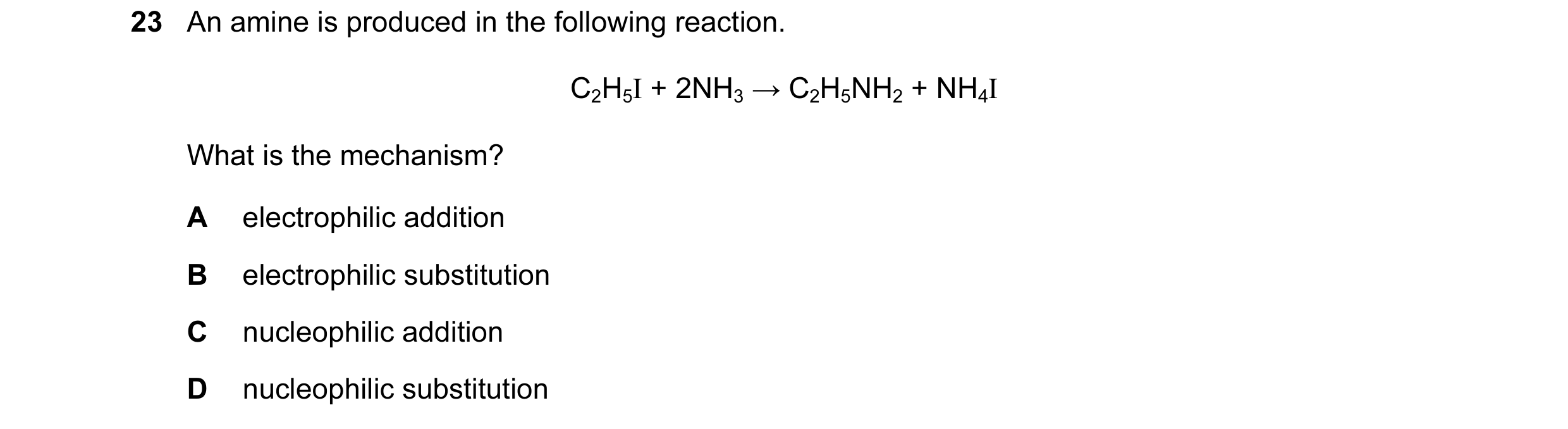
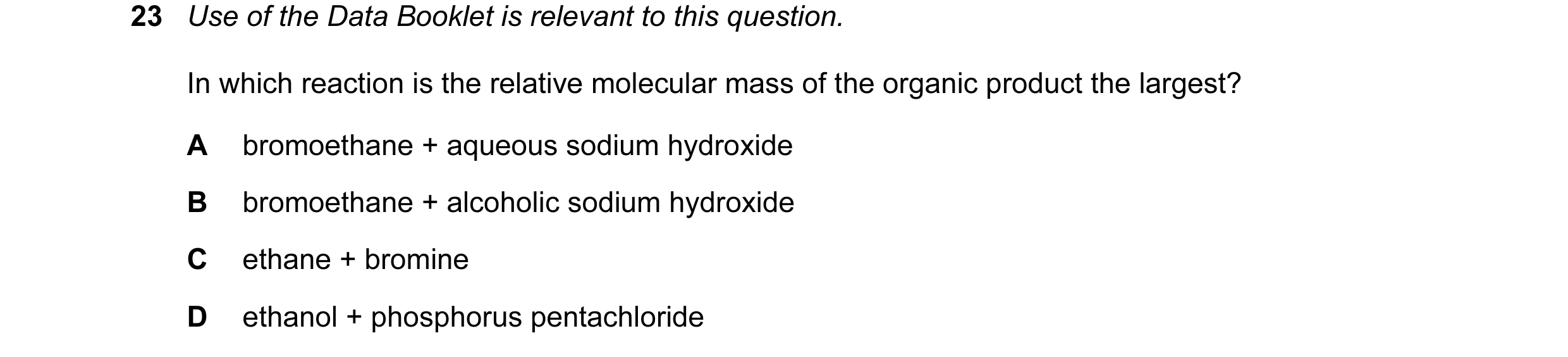
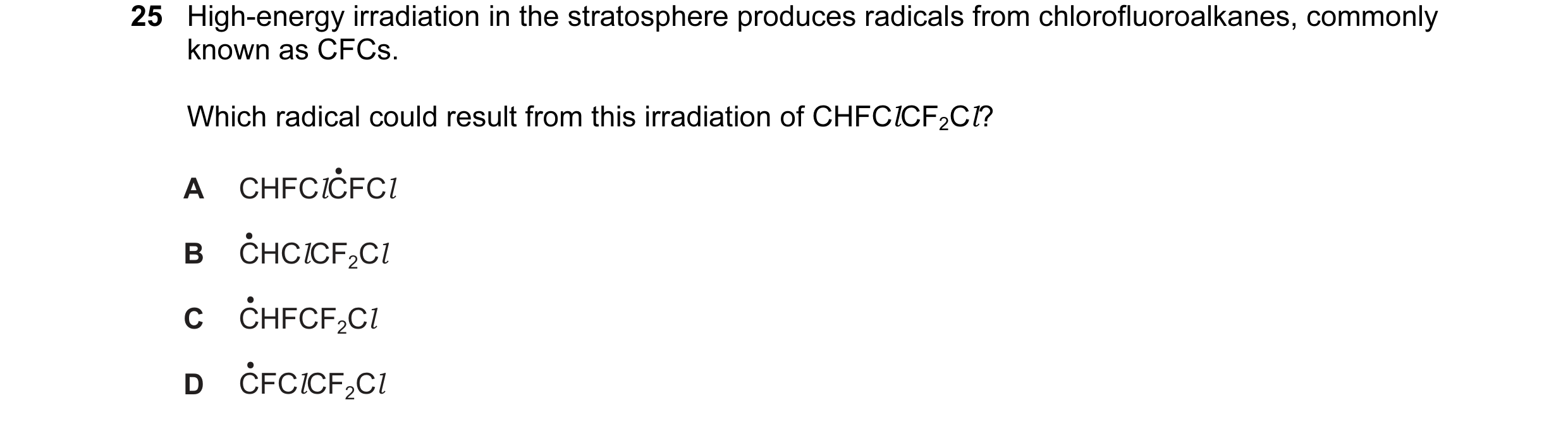

 1 / 66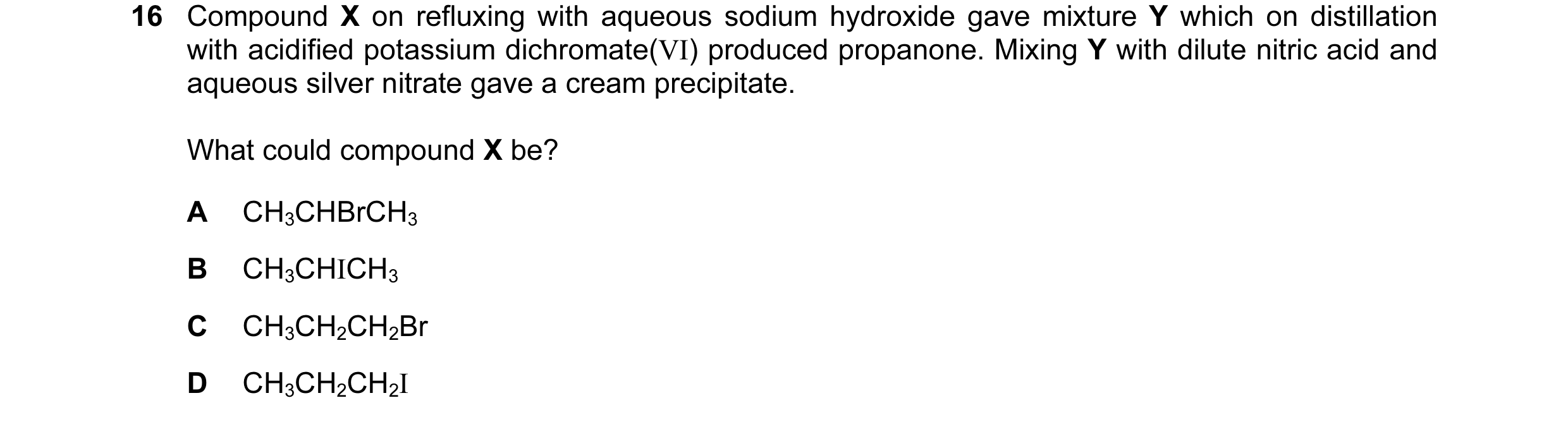
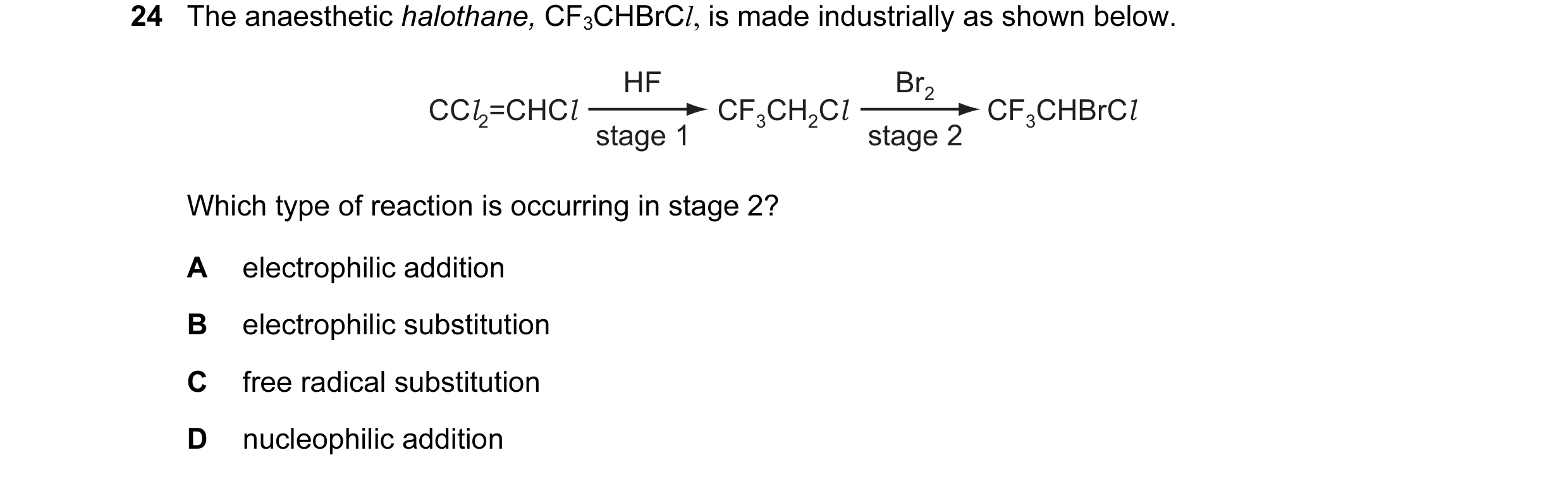
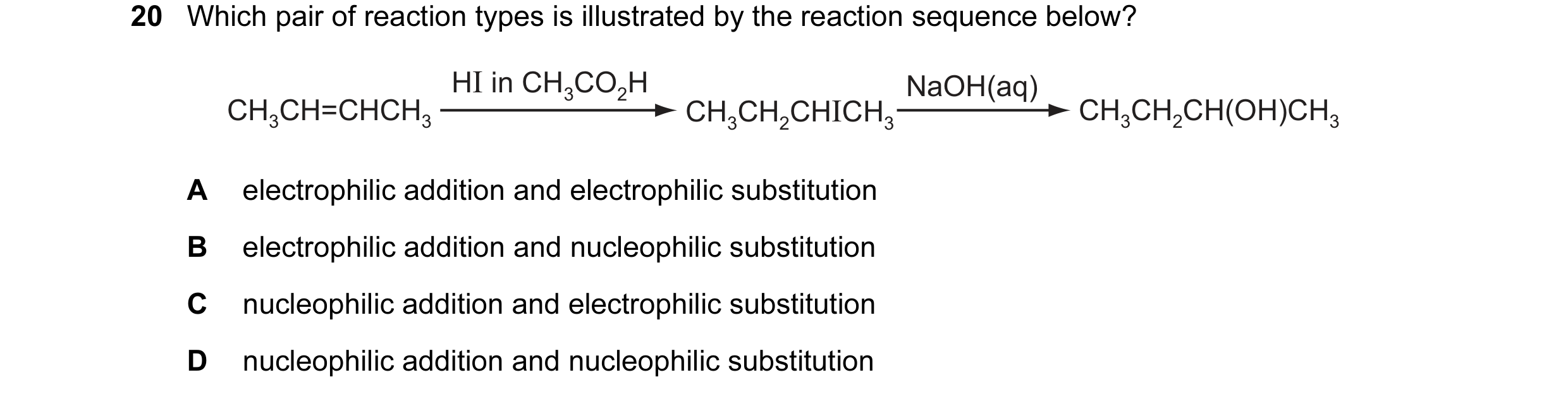 2 / 66
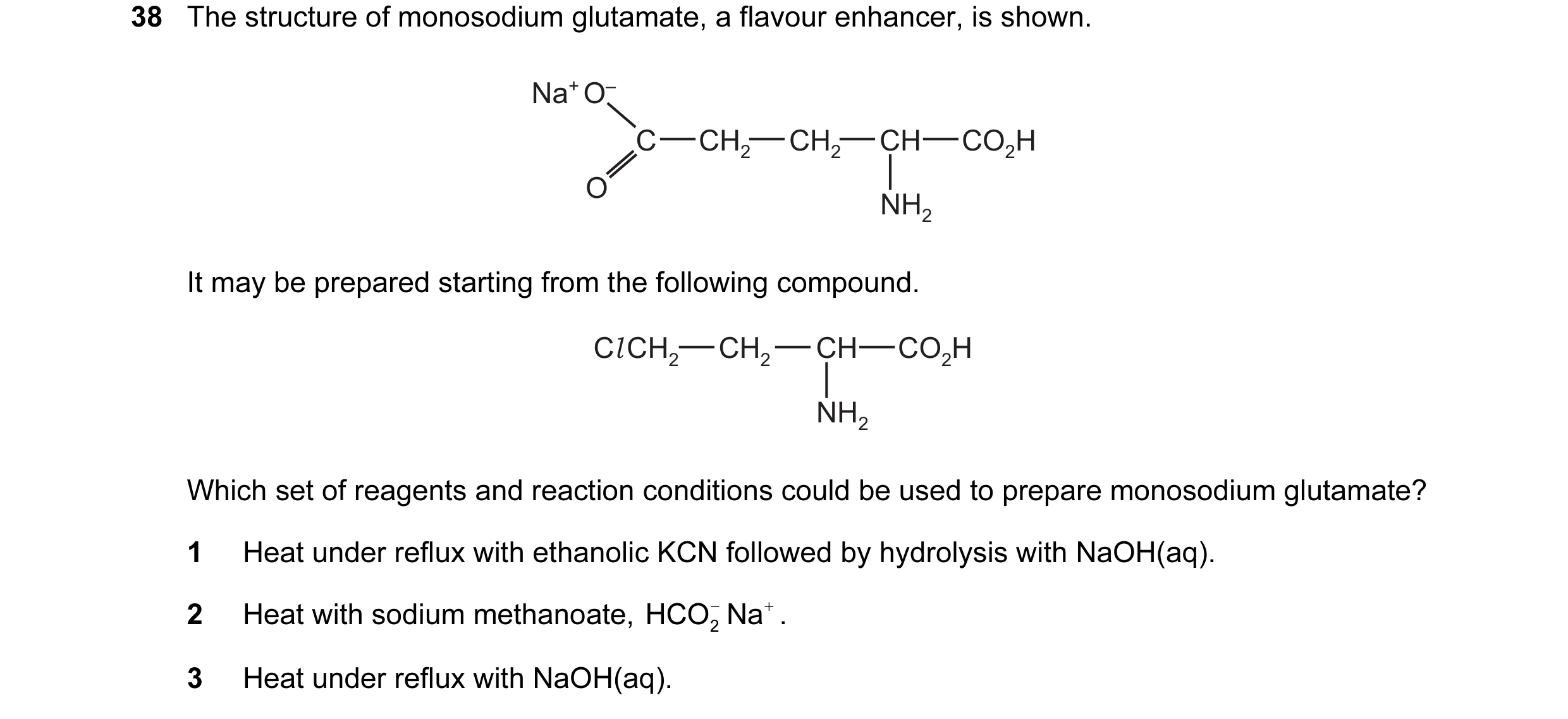
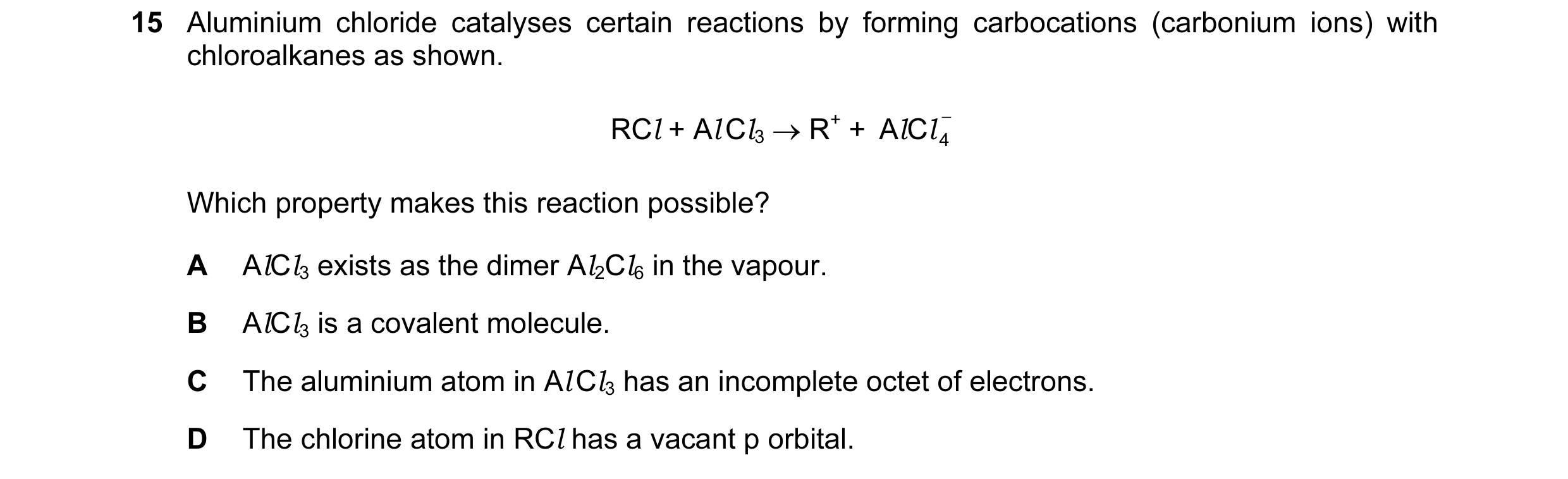 3 / 66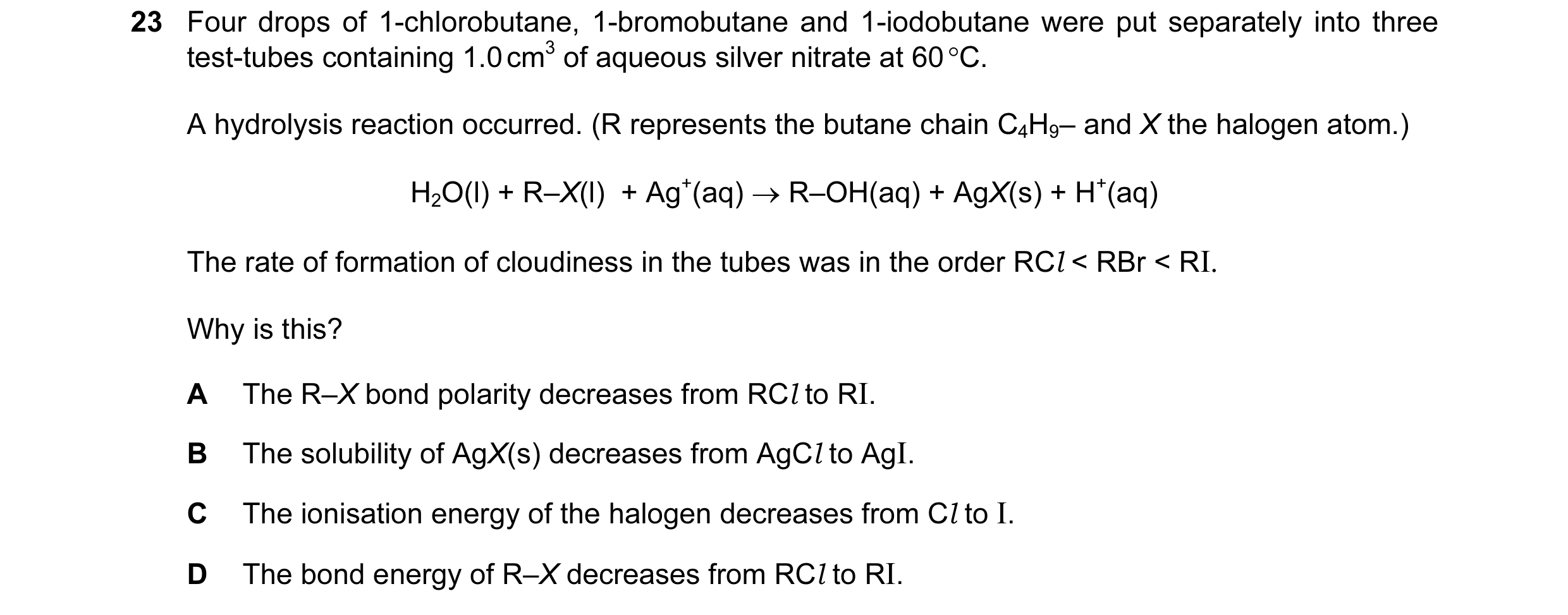
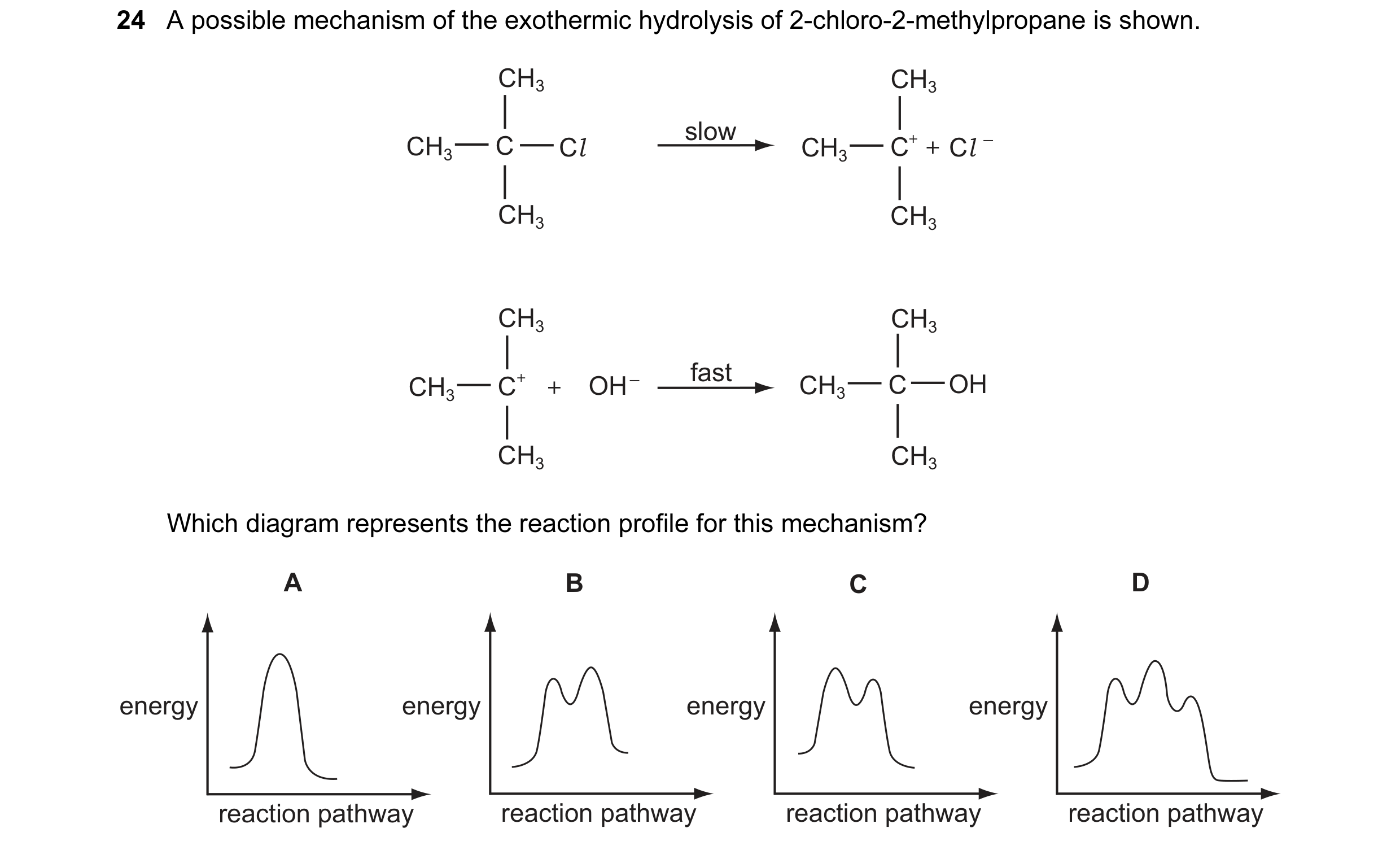
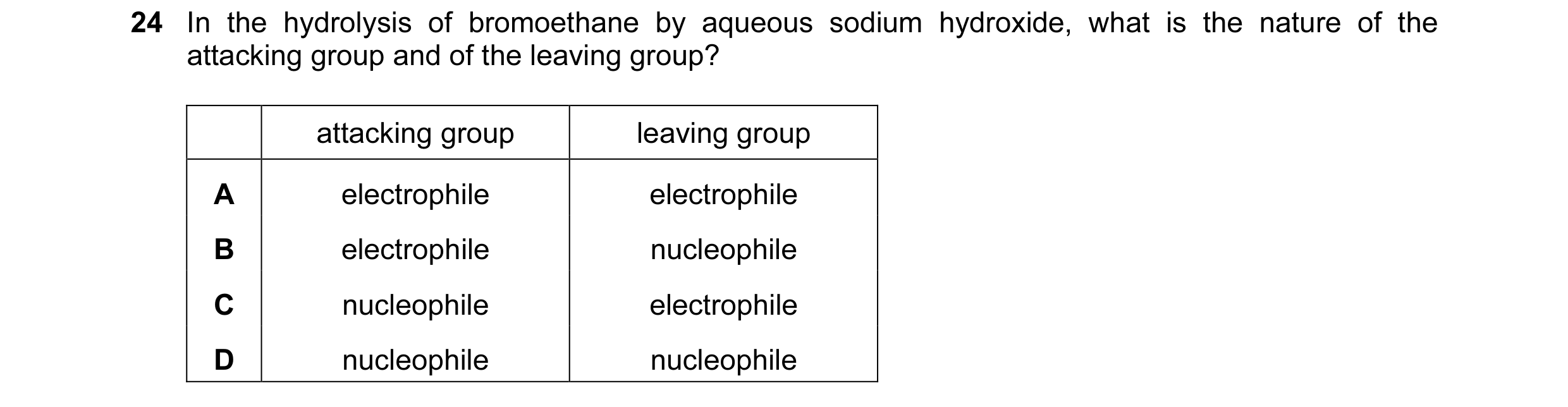 4 / 66

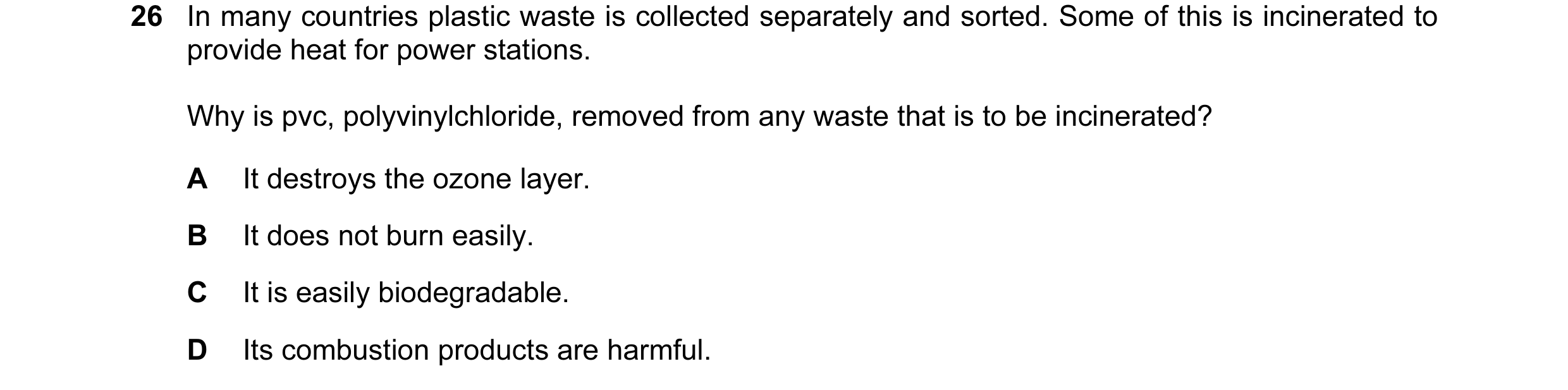
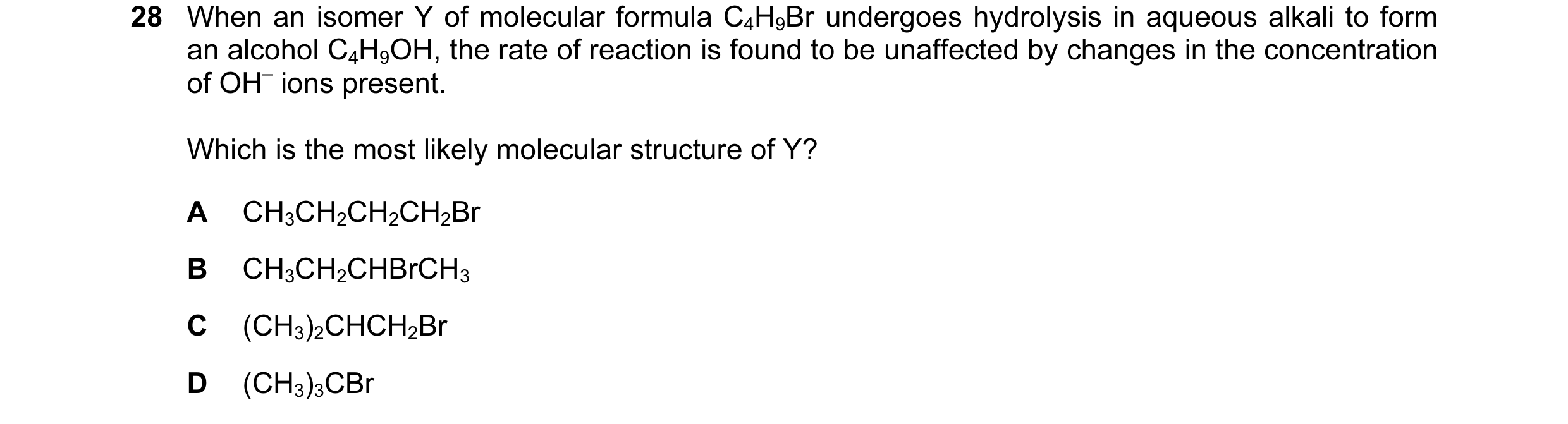

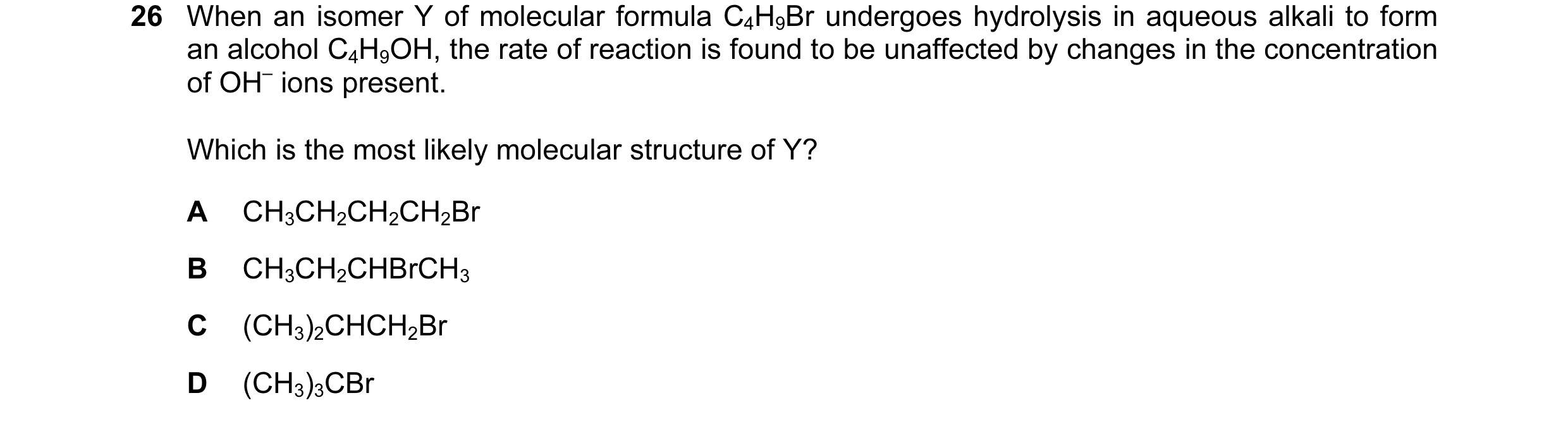 5 / 66

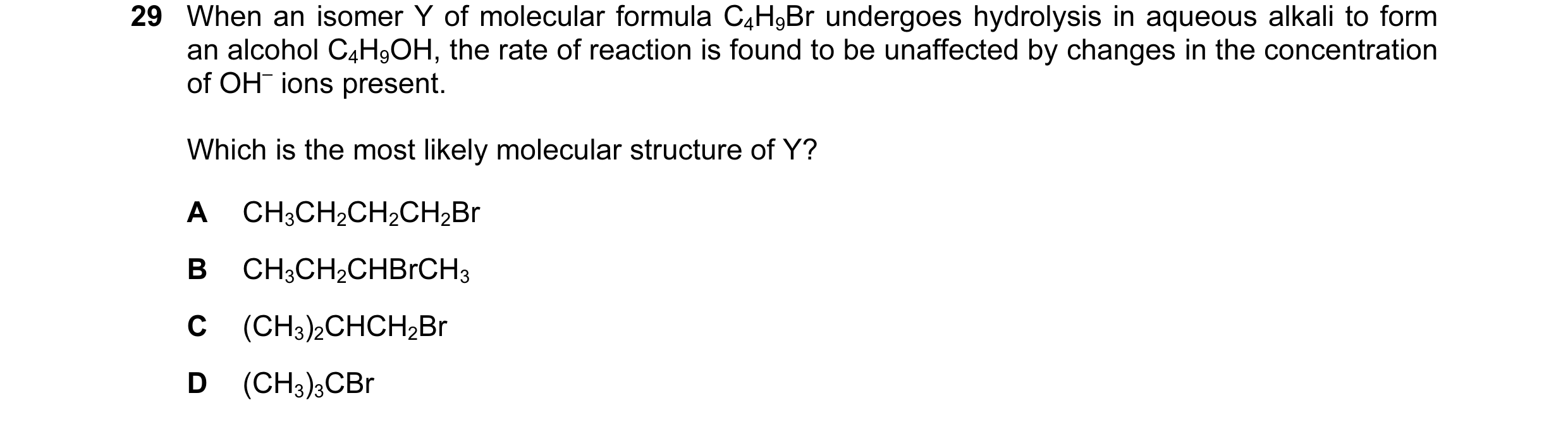
 6 / 66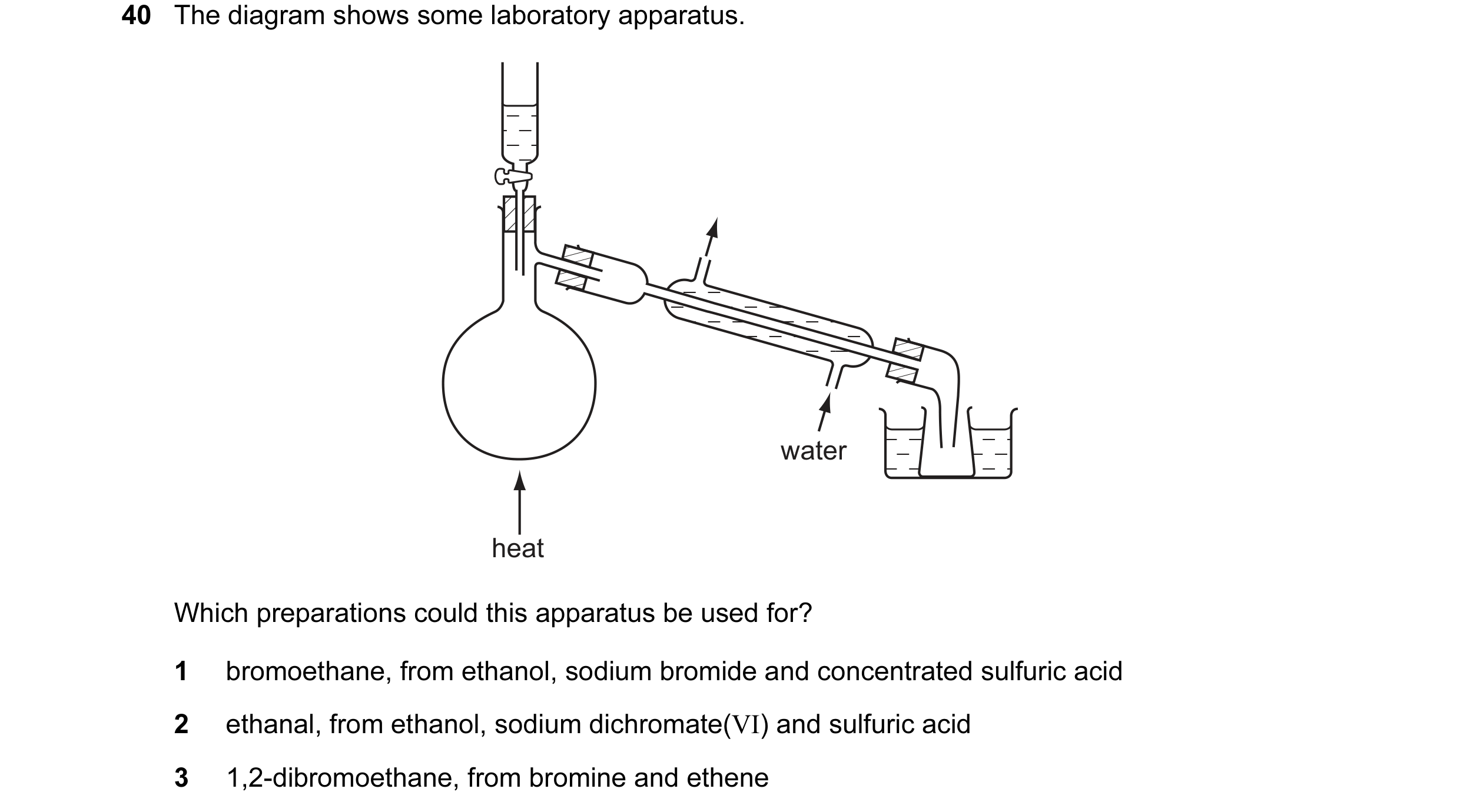
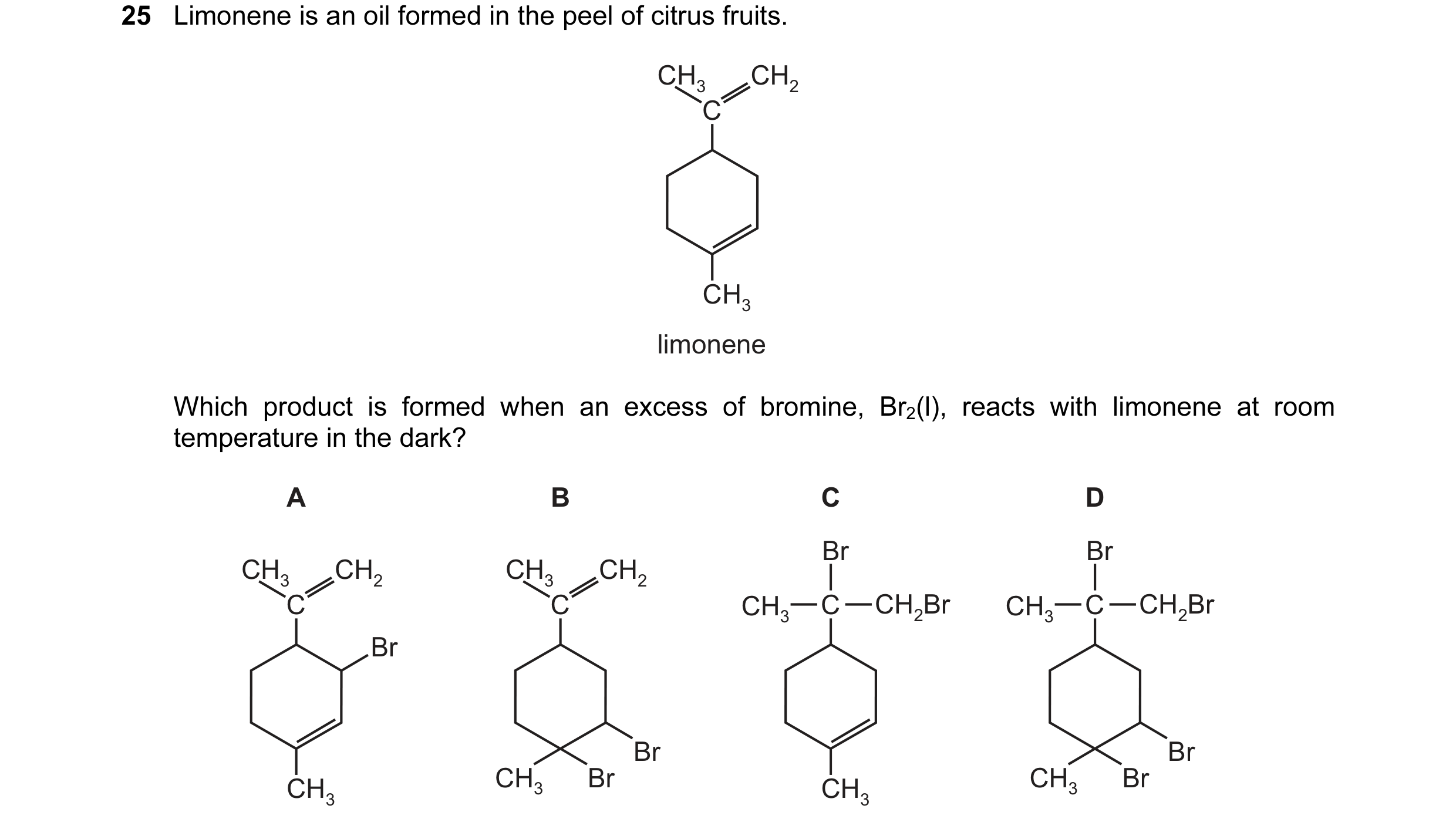
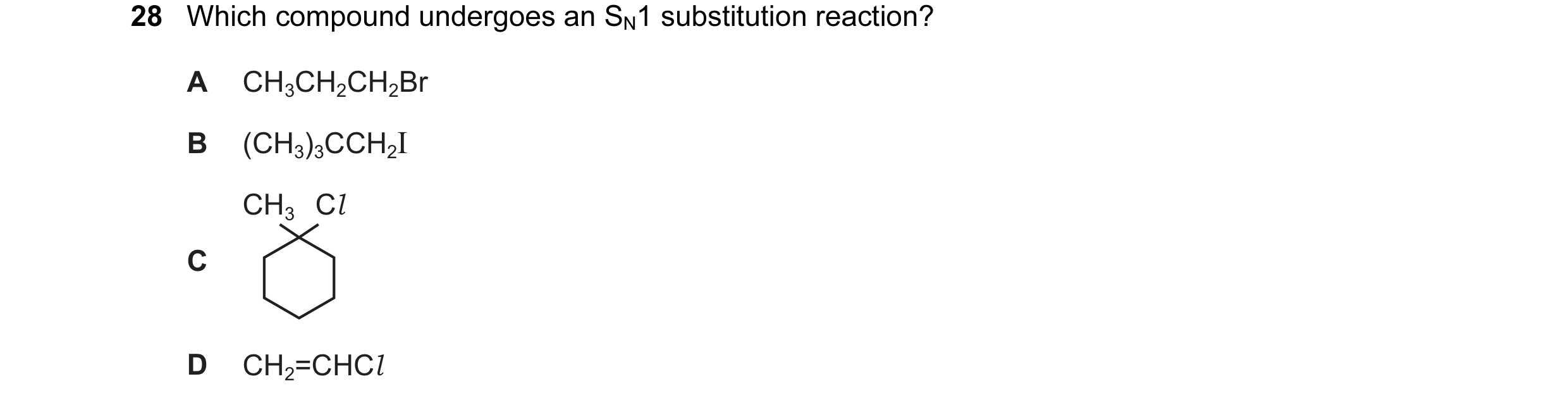 7 / 66

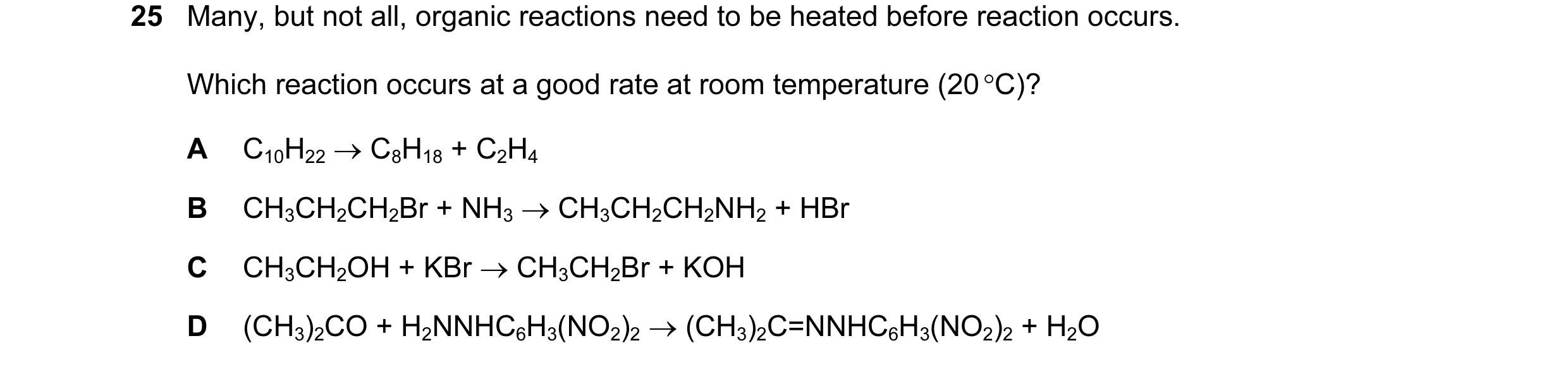 8 / 66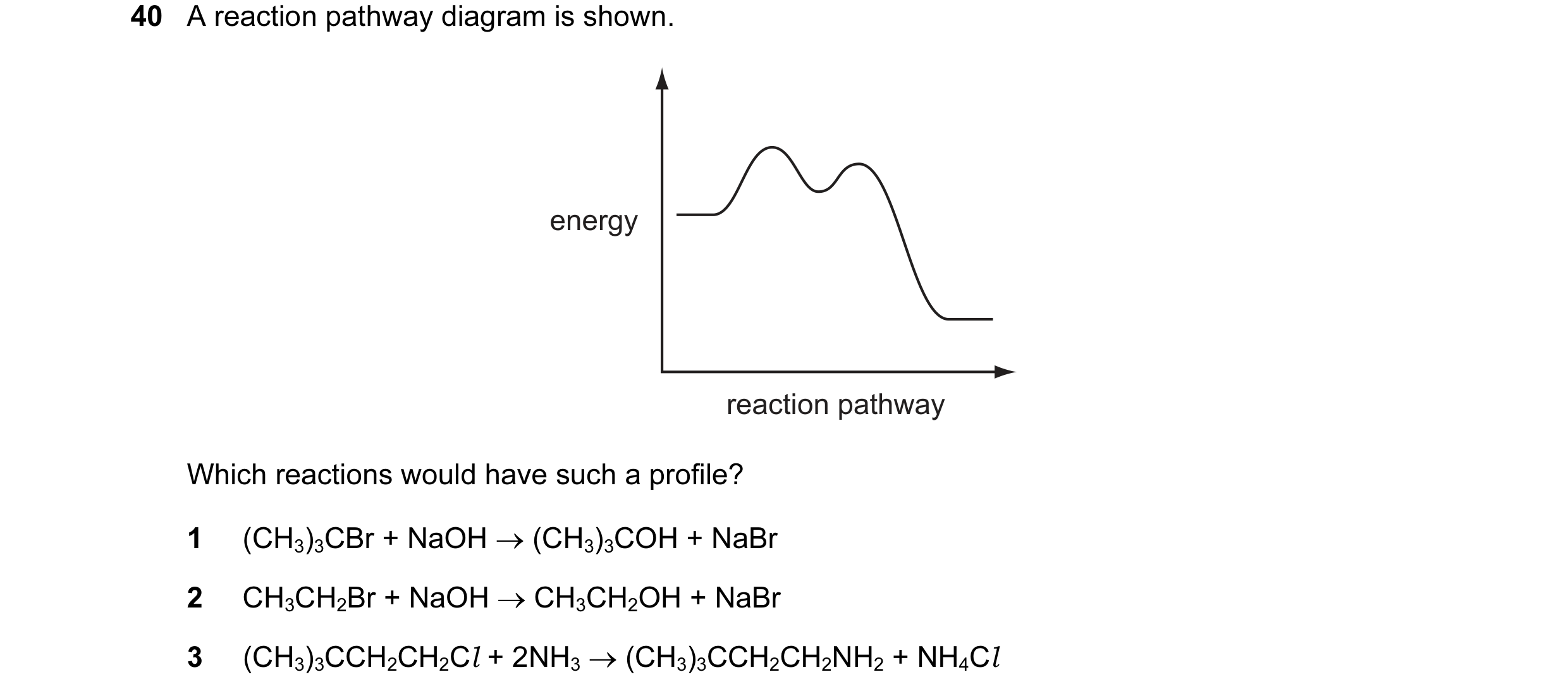
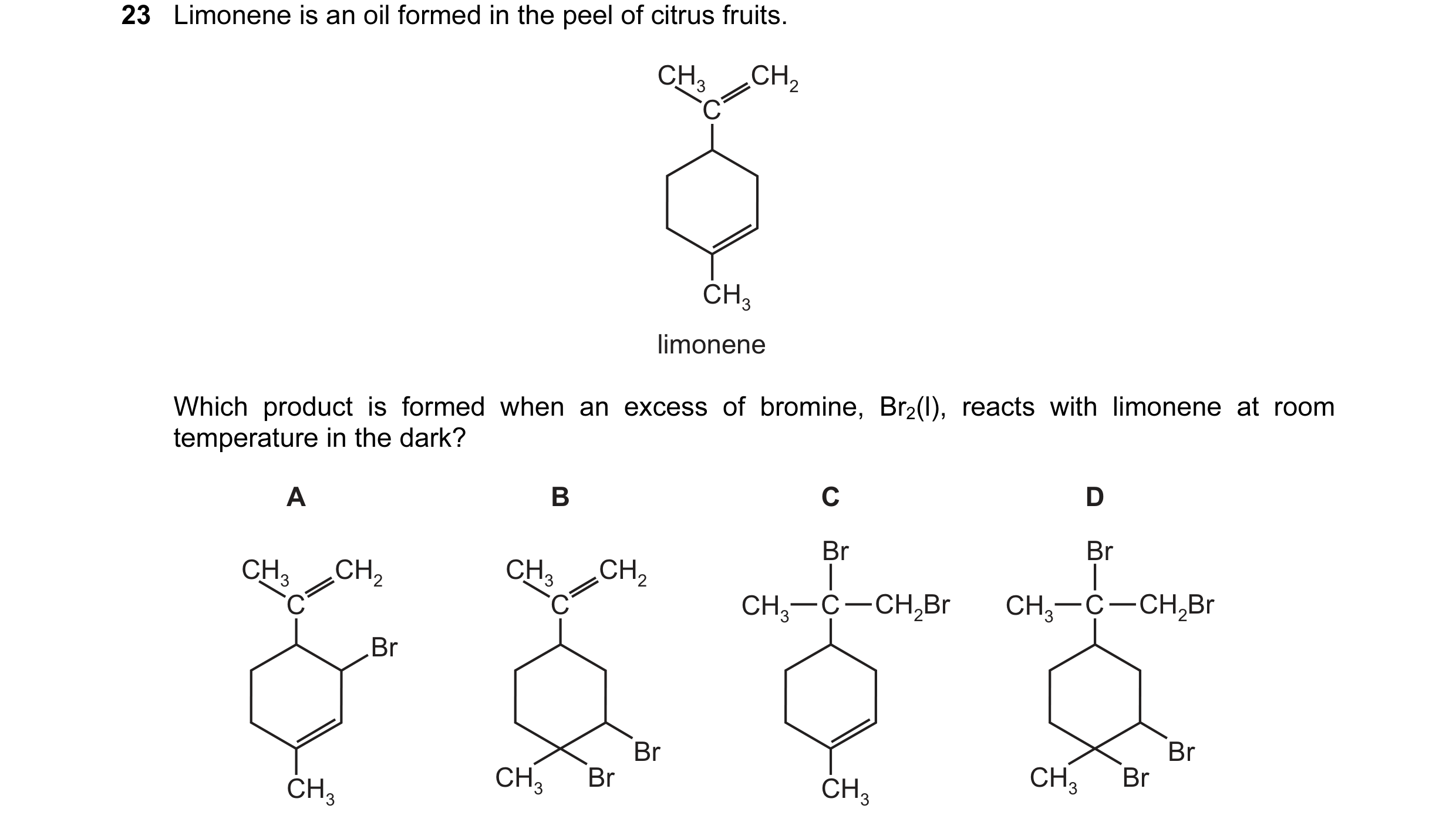
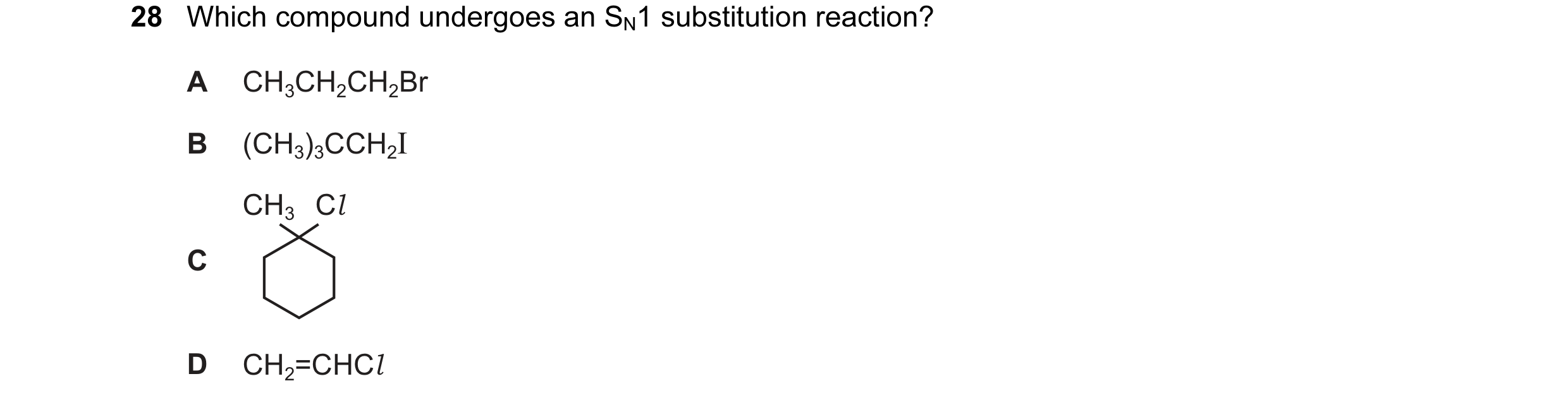 9 / 66
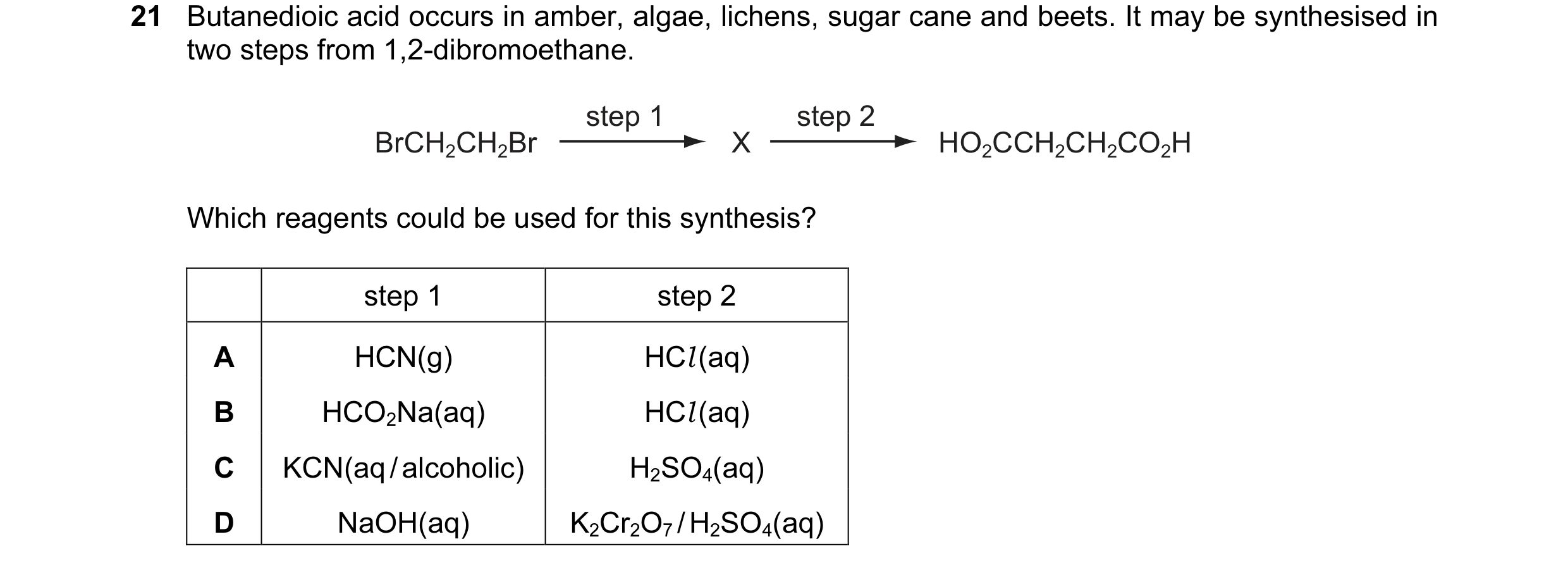

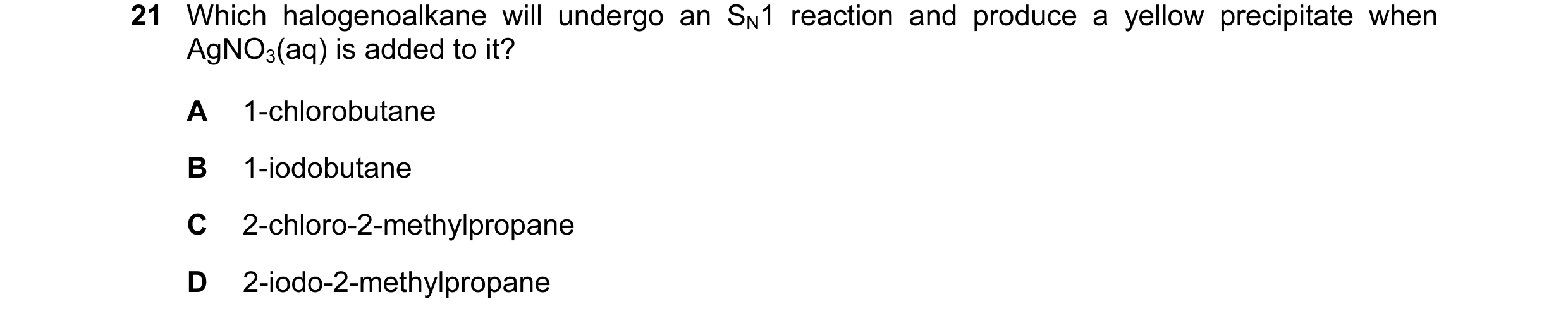
 10 / 66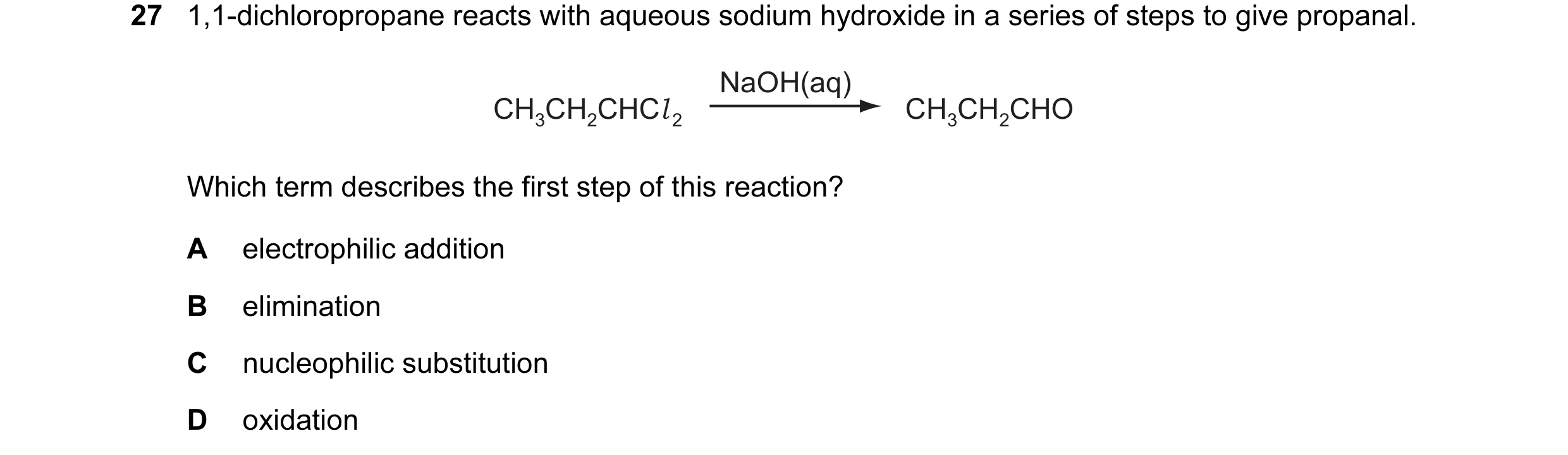

 11 / 66
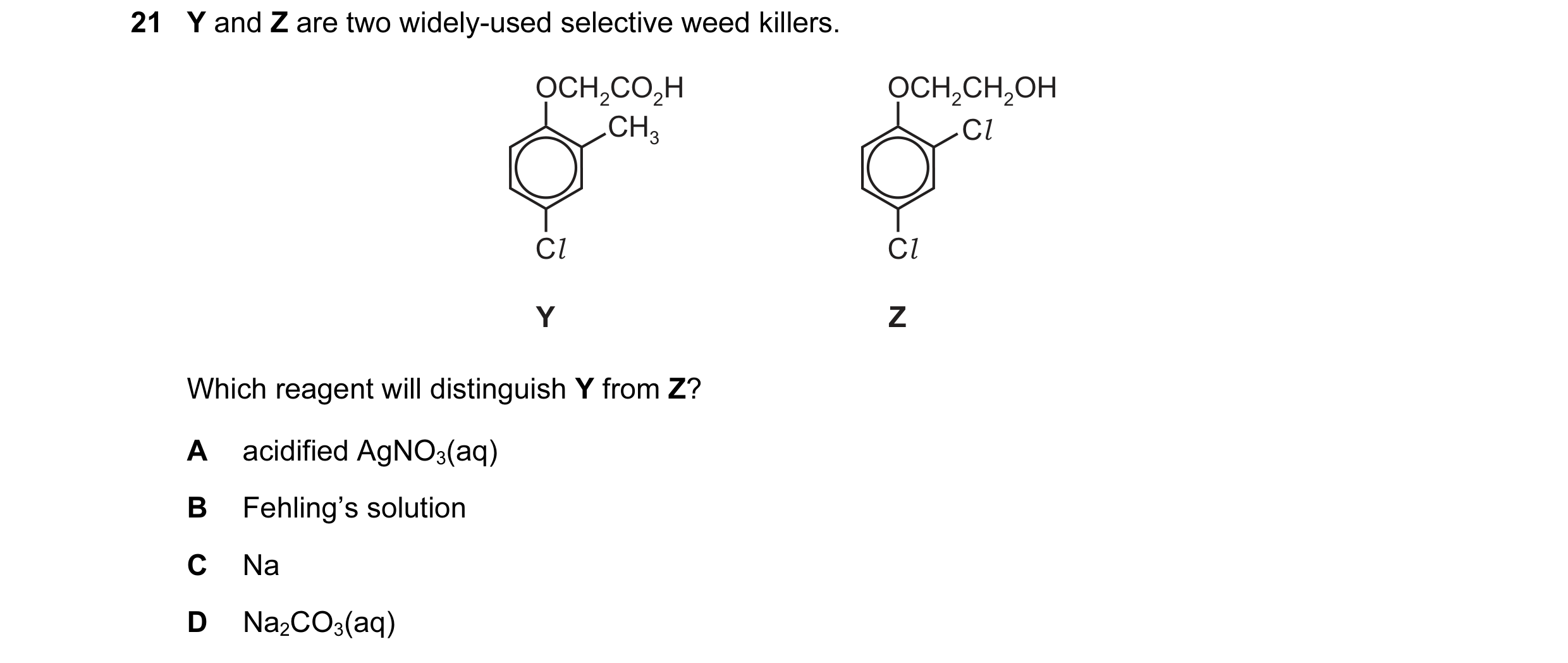
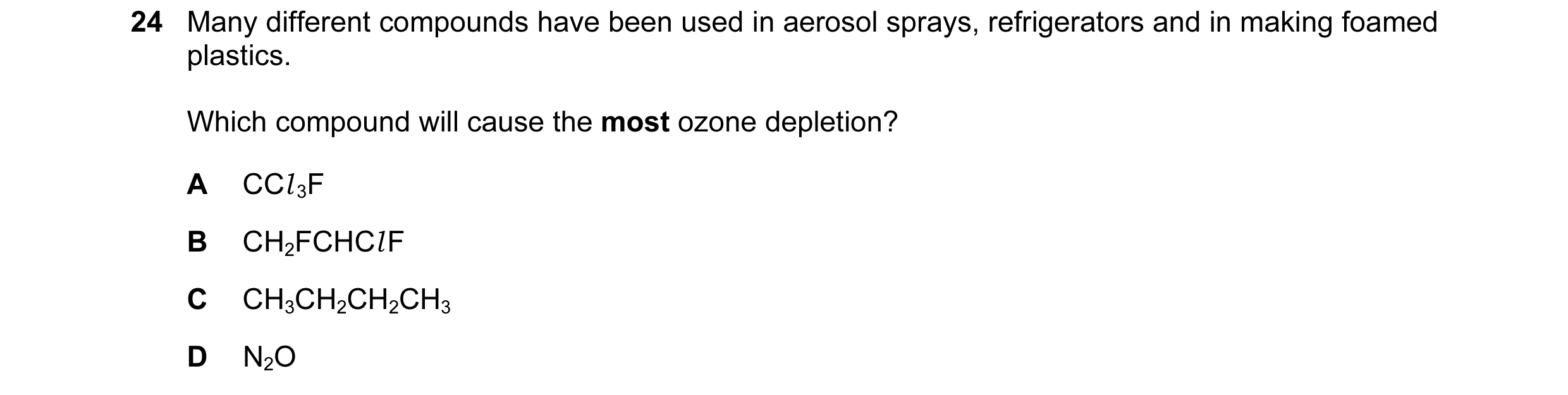 12 / 66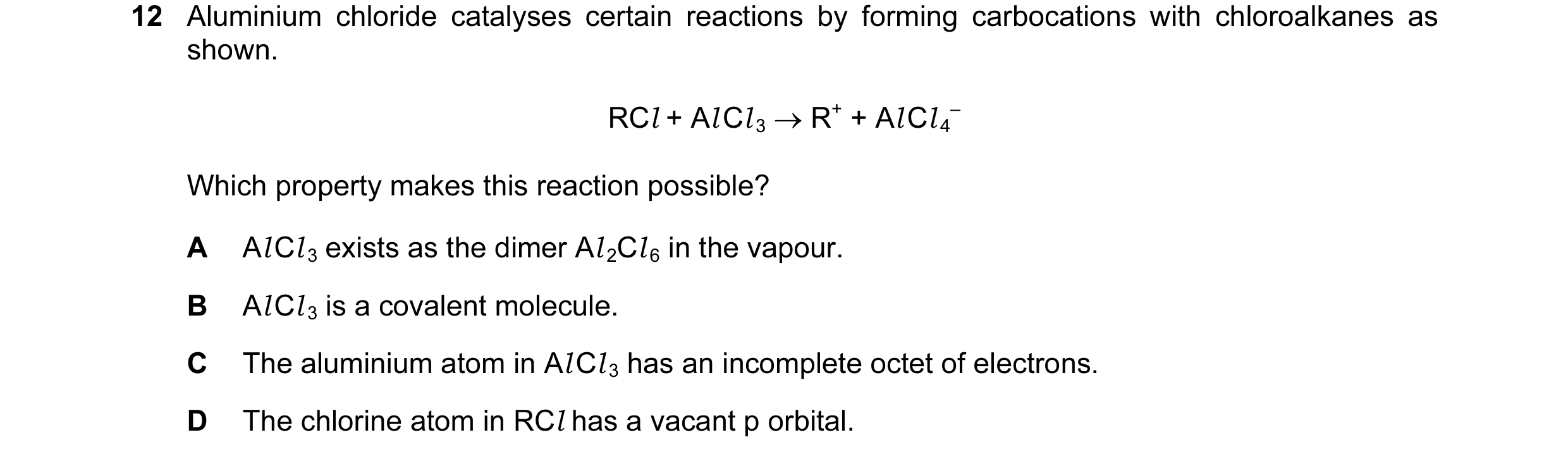
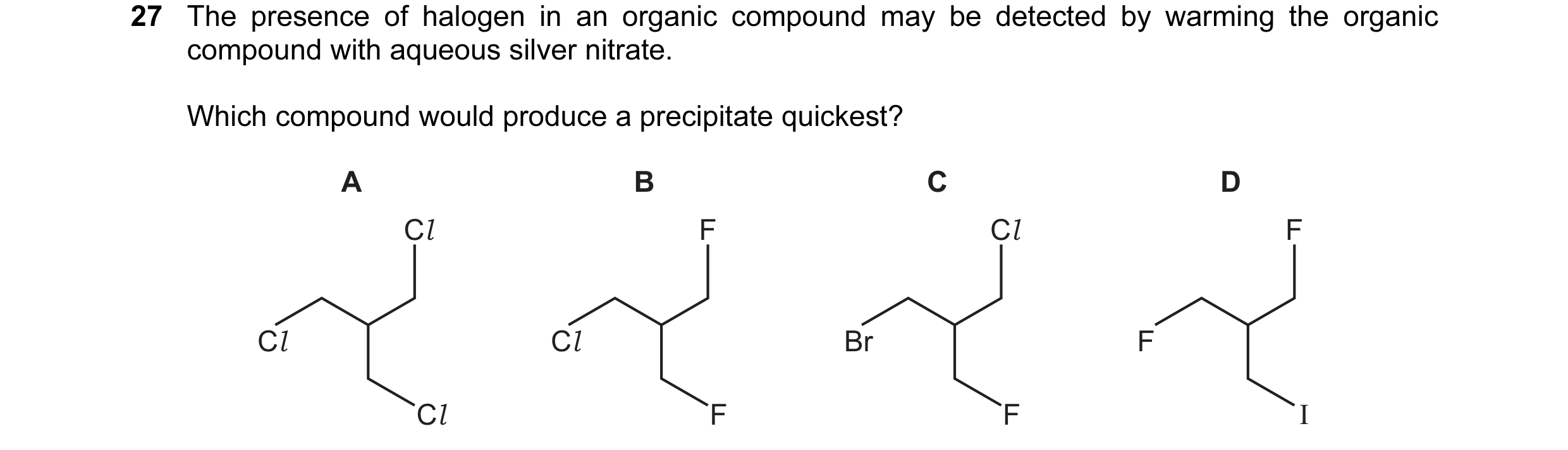
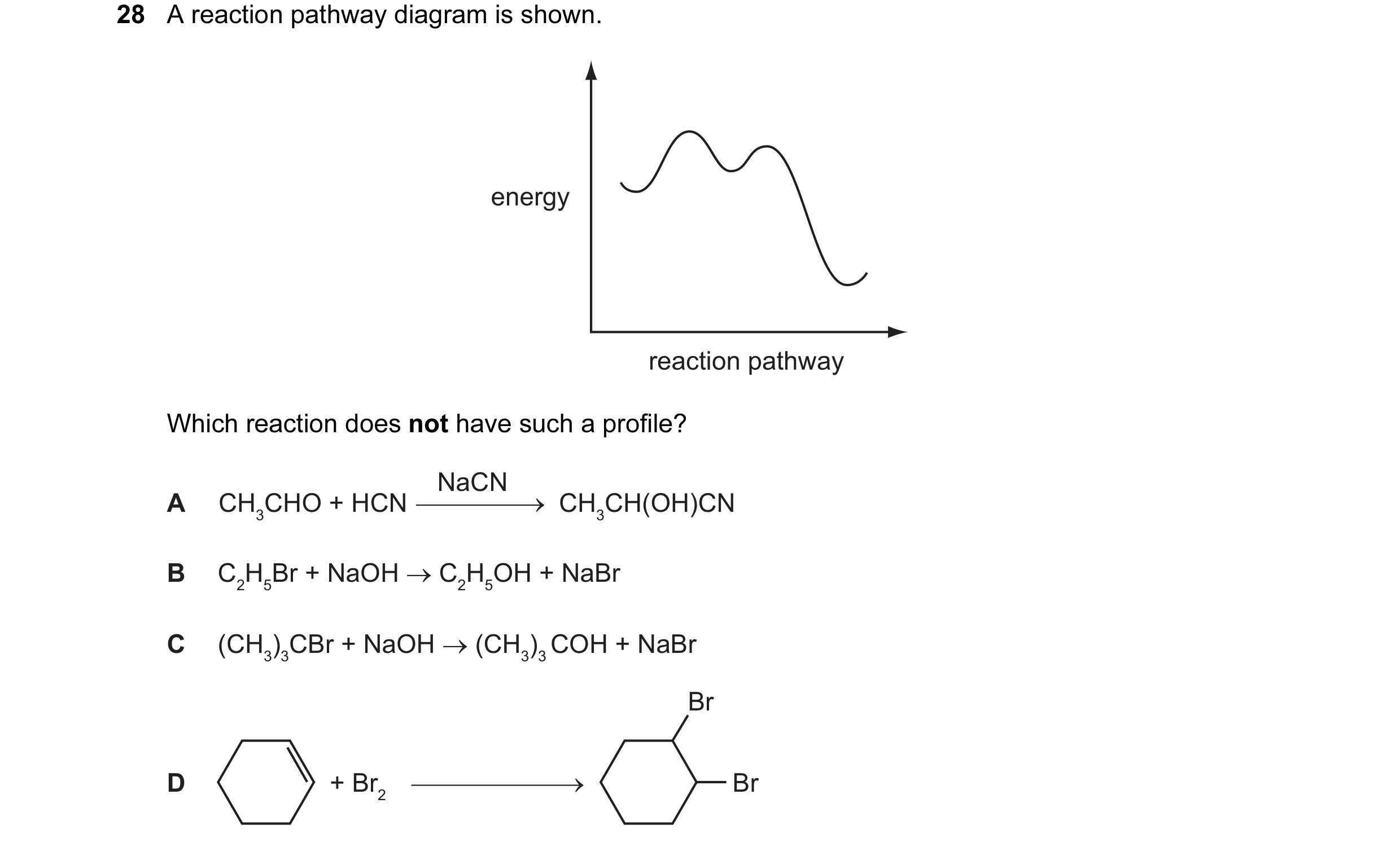
 13 / 66
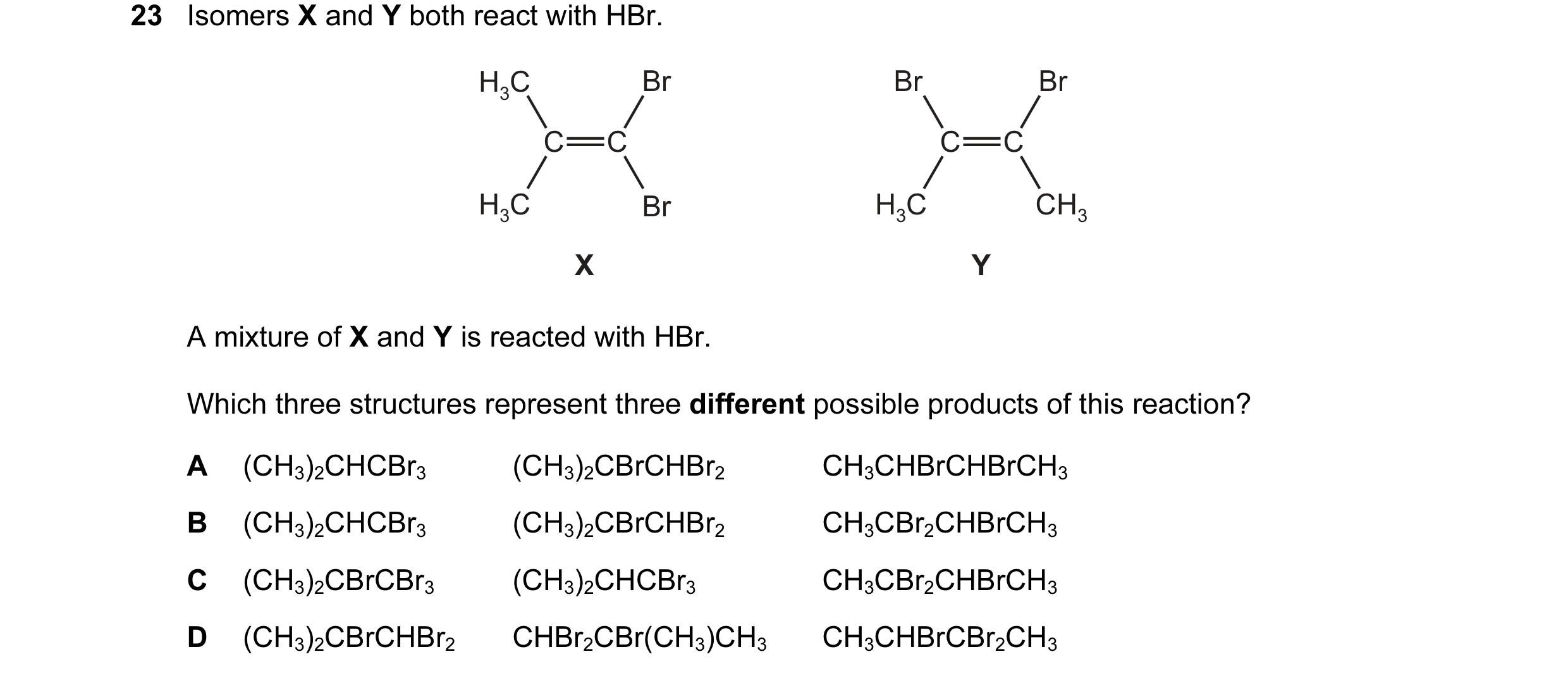
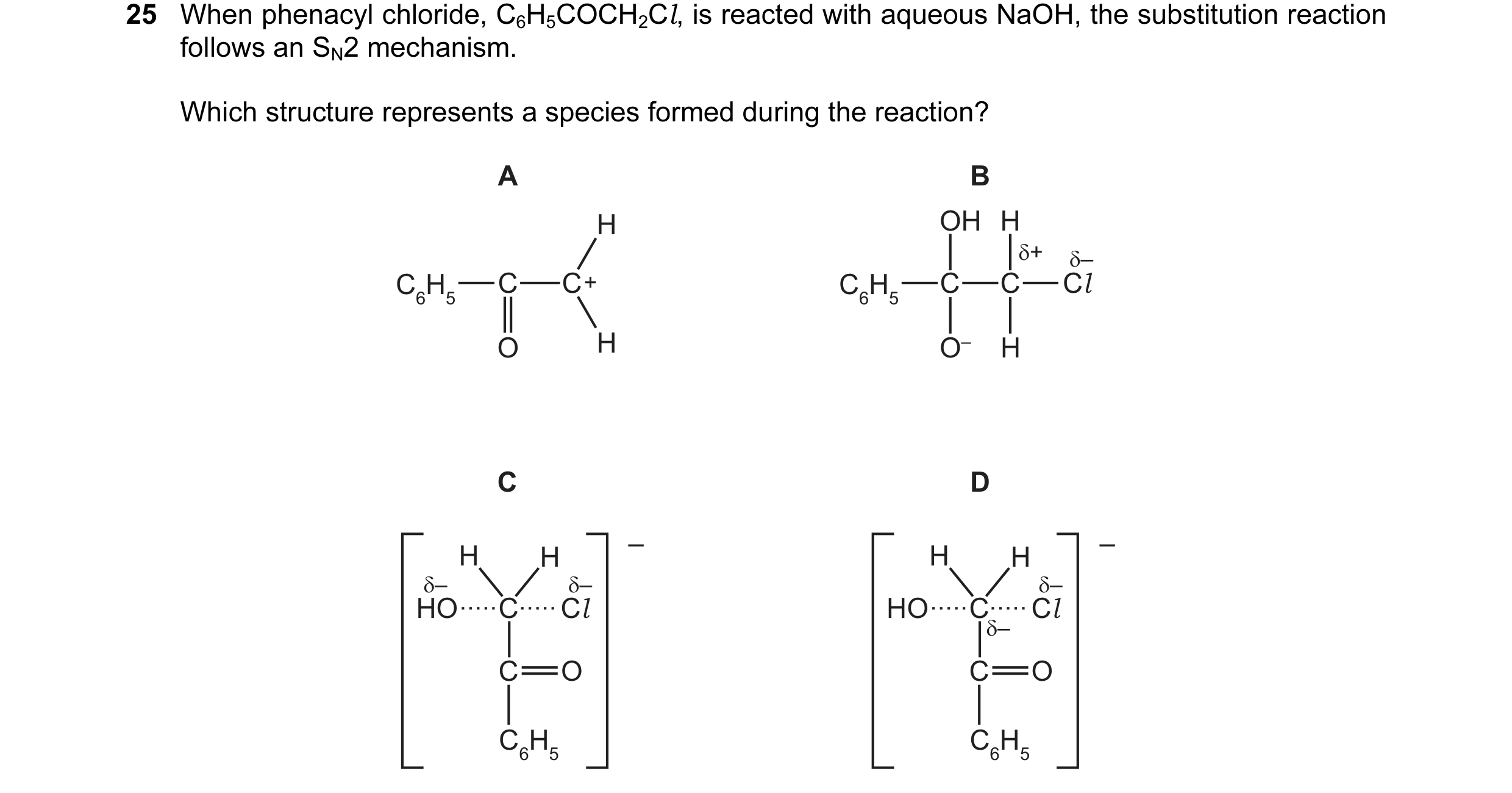
 14 / 66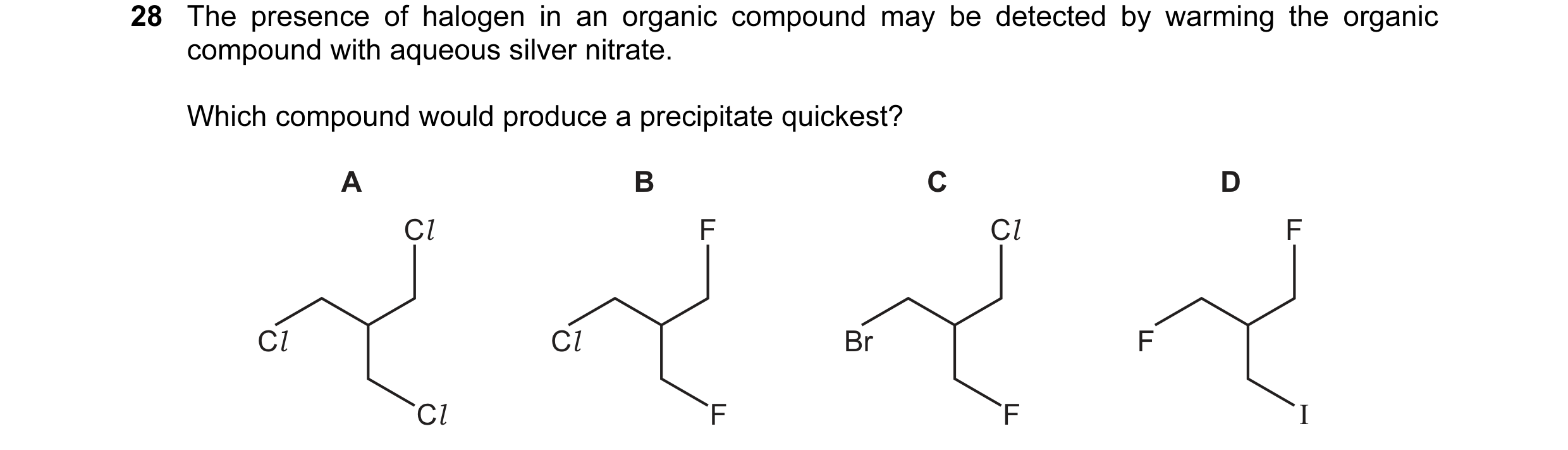
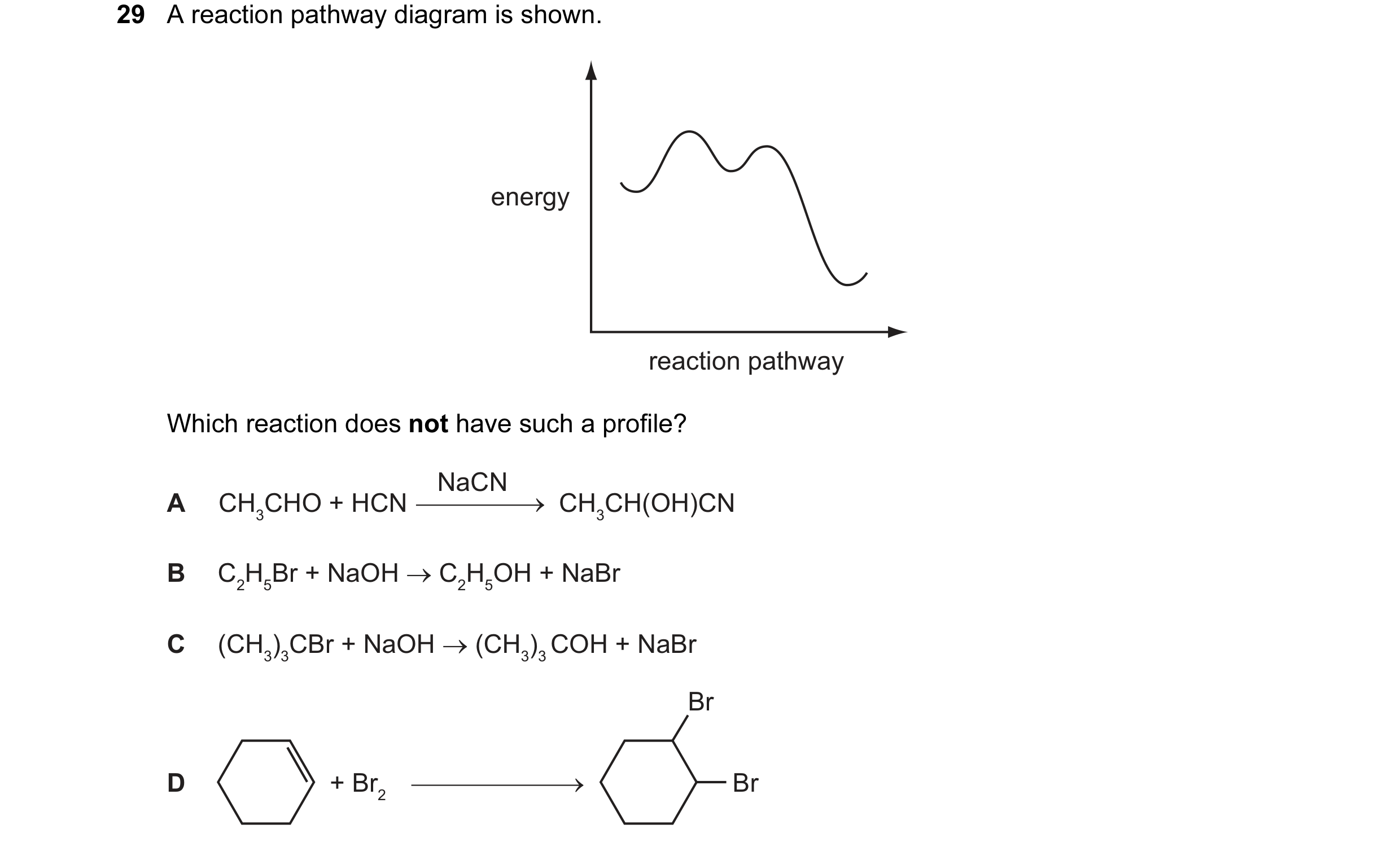

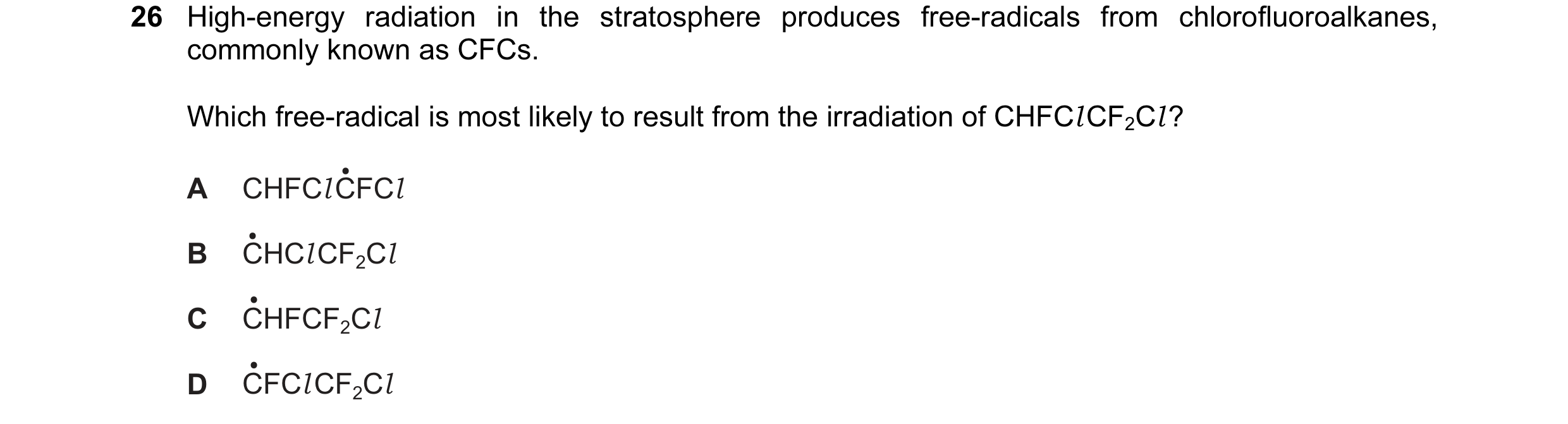 15 / 66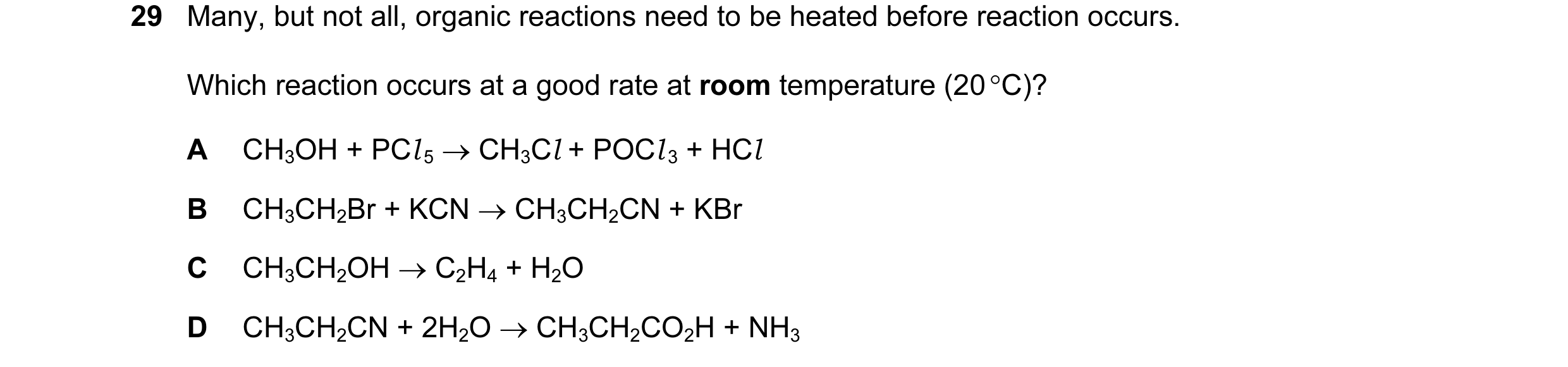
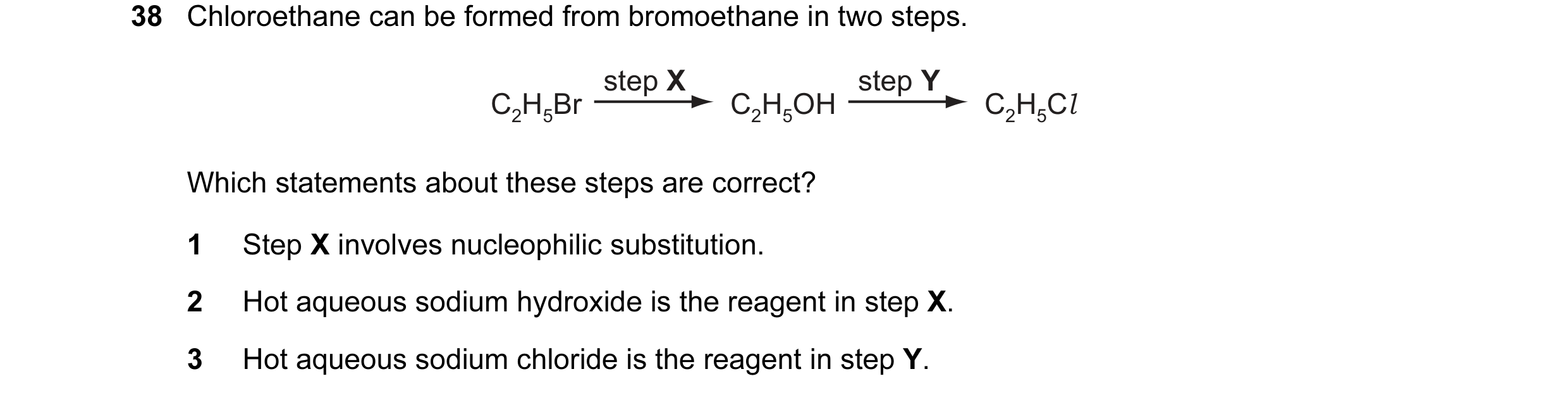
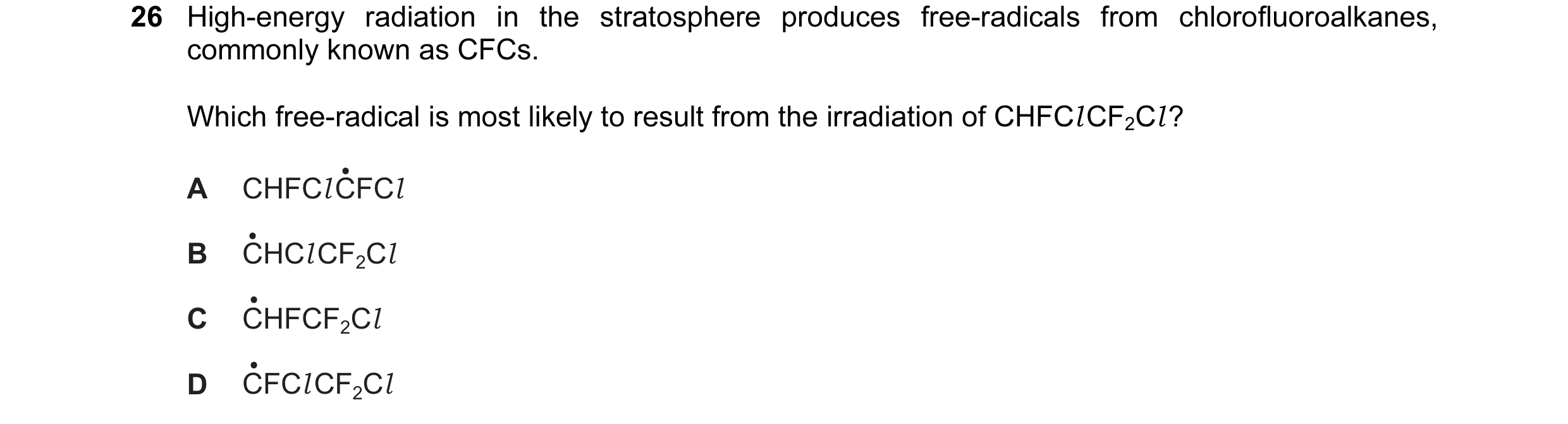
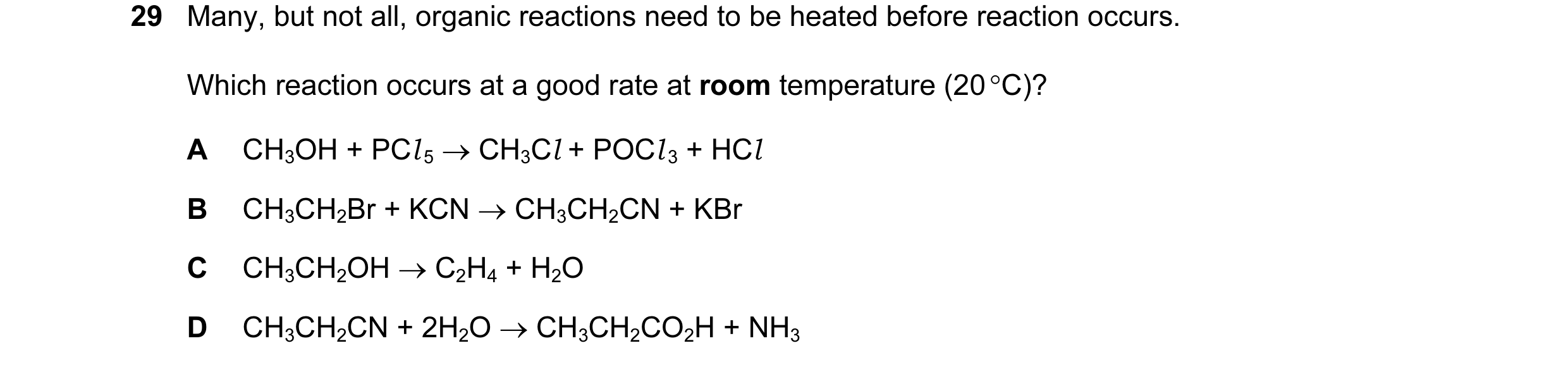
 16 / 66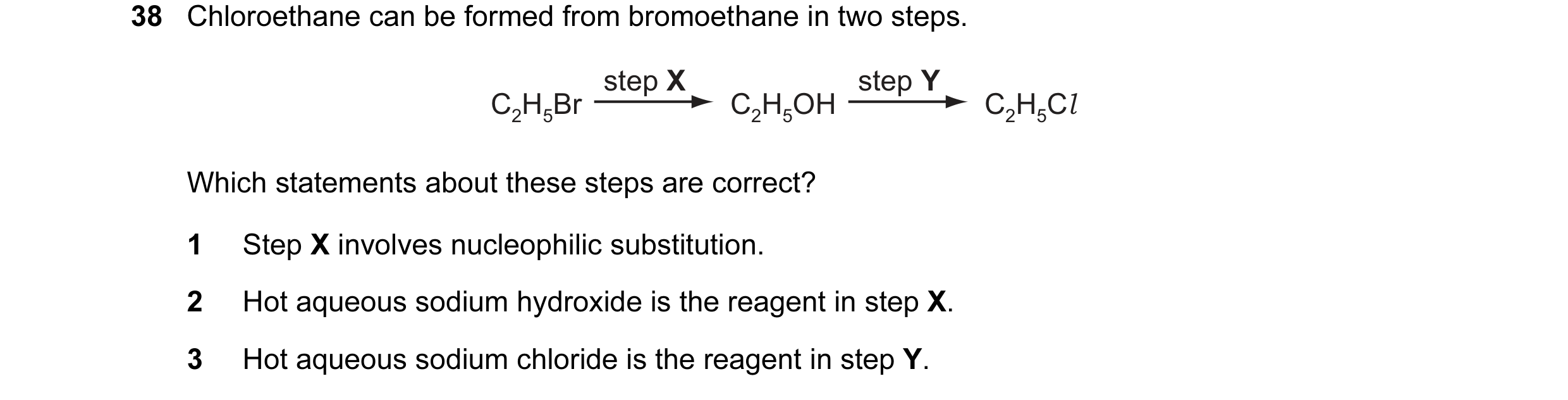
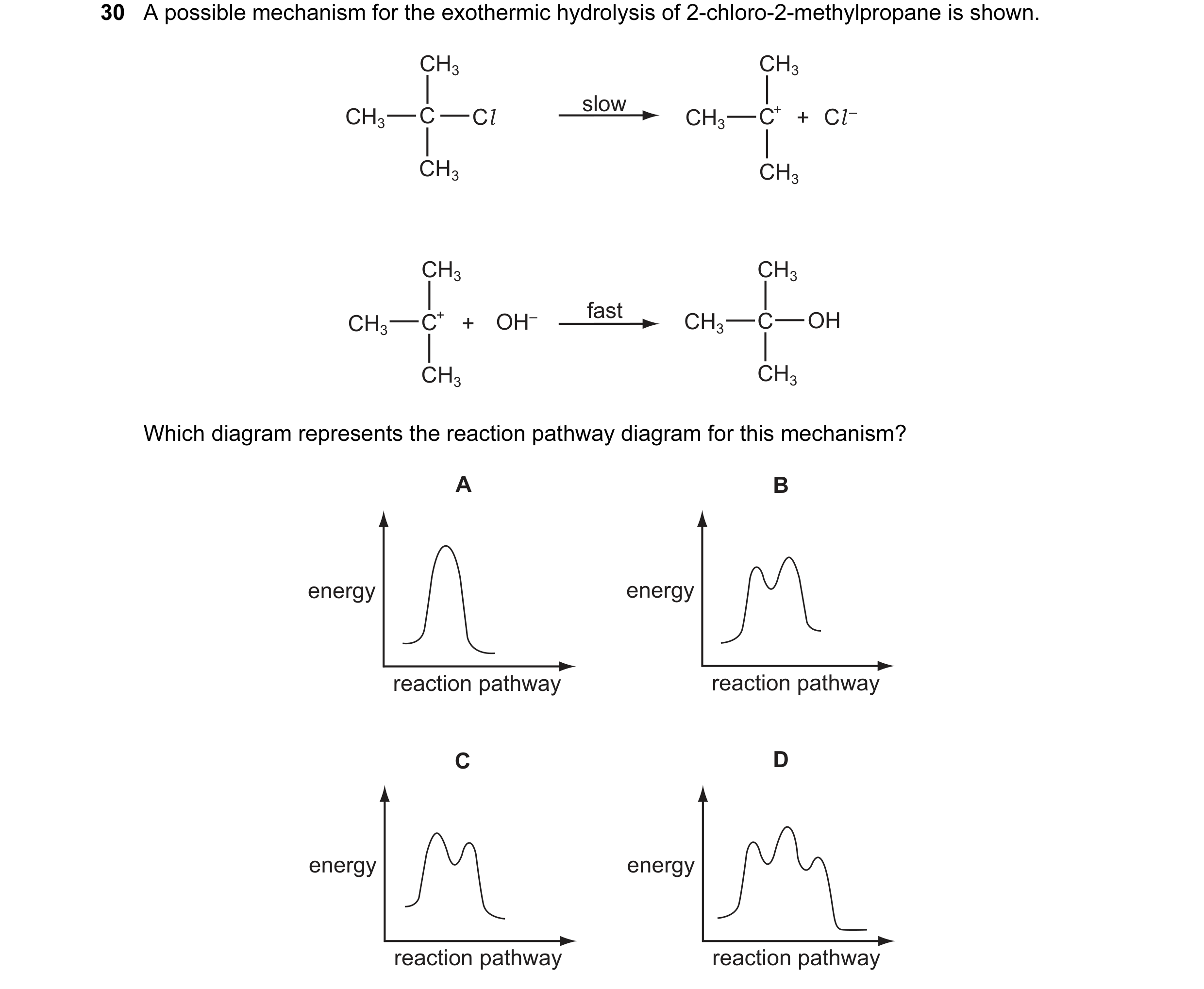 17 / 66
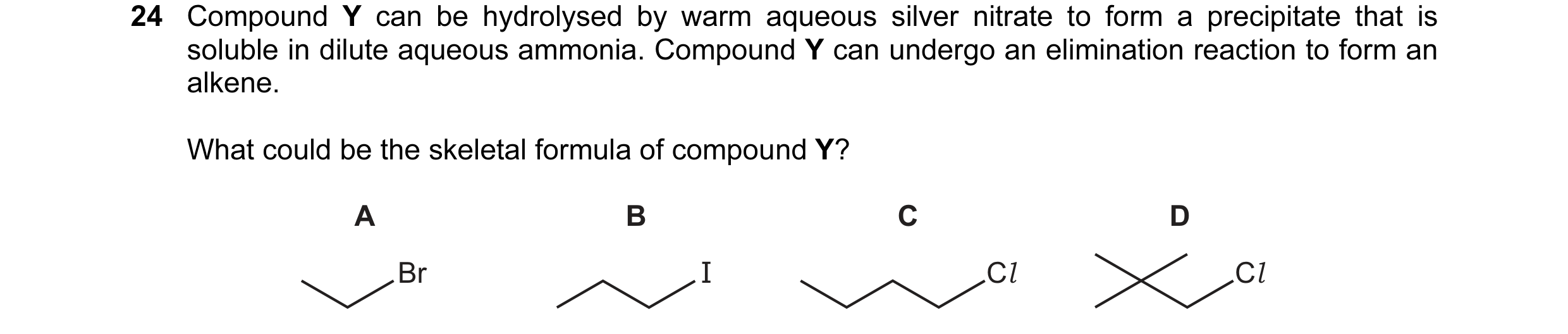
 18 / 66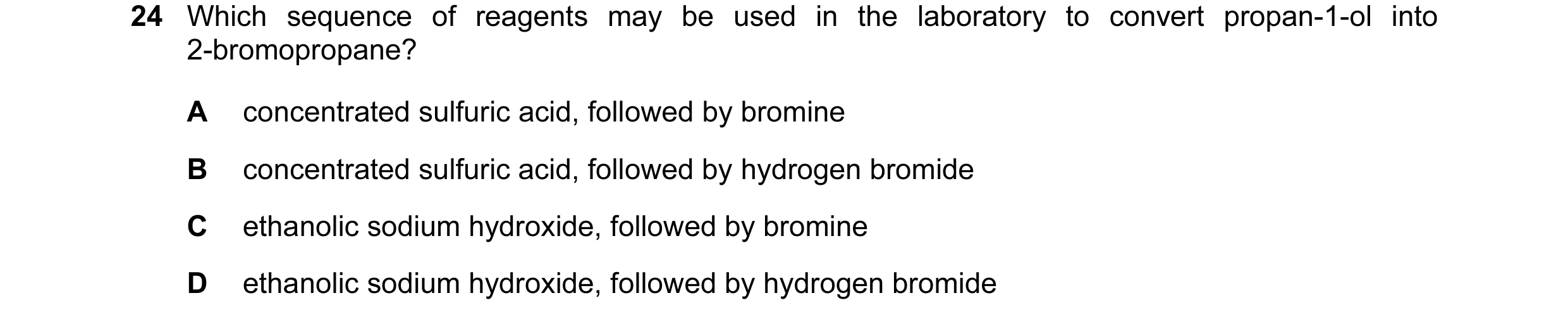
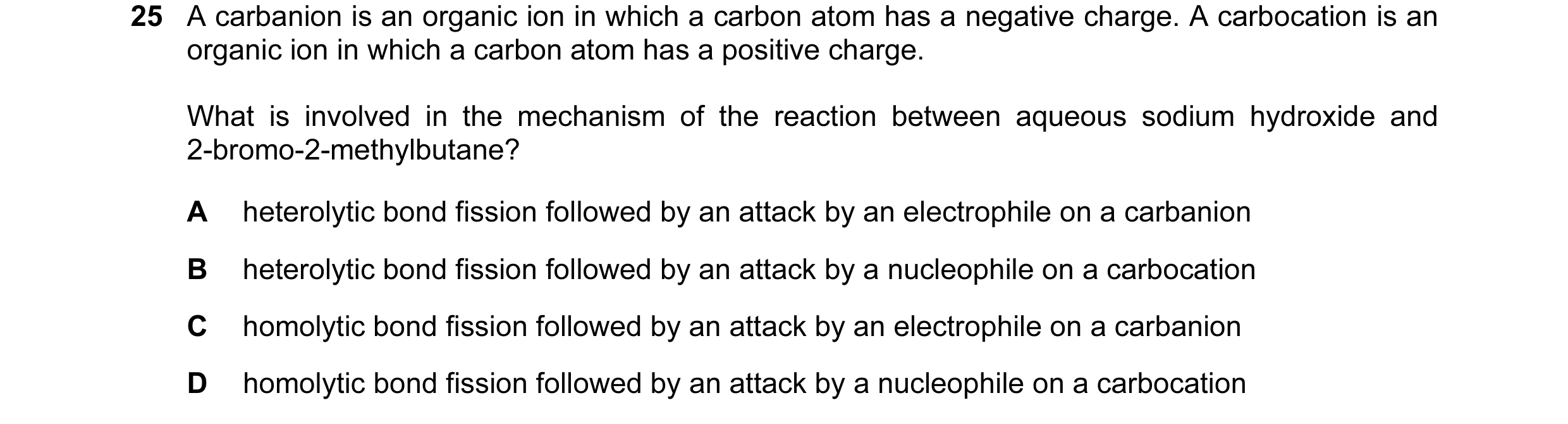


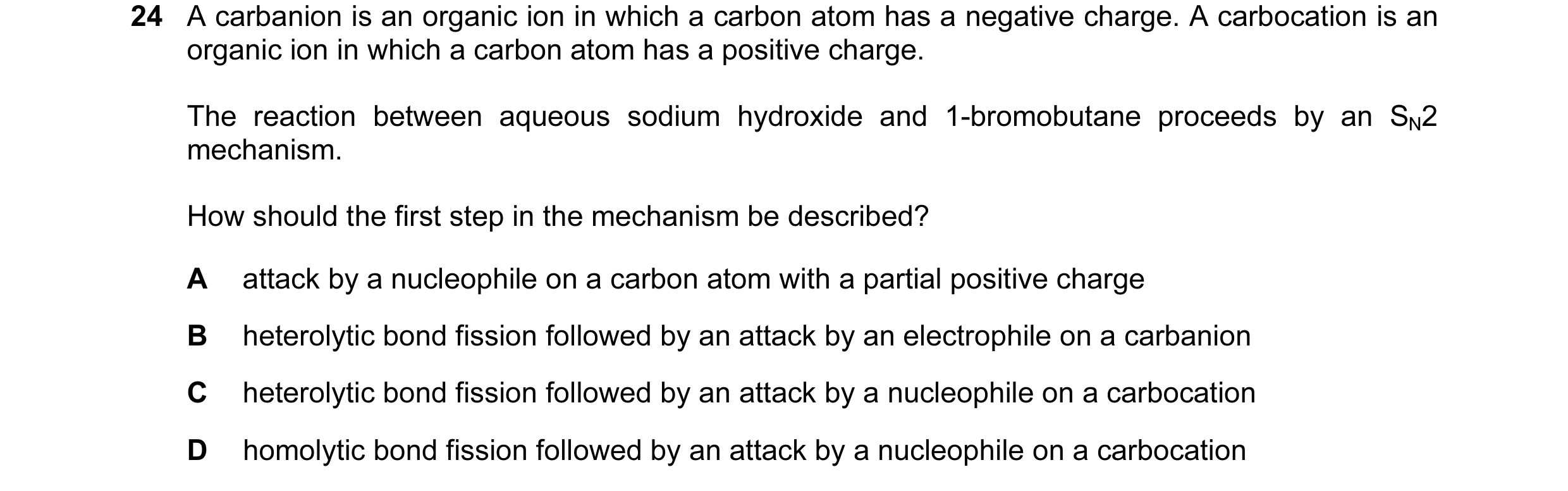 19 / 66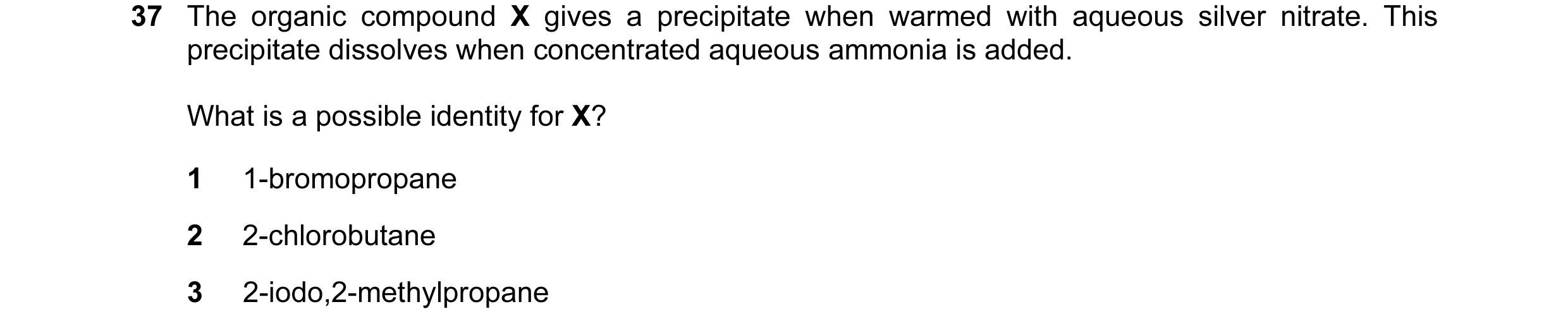


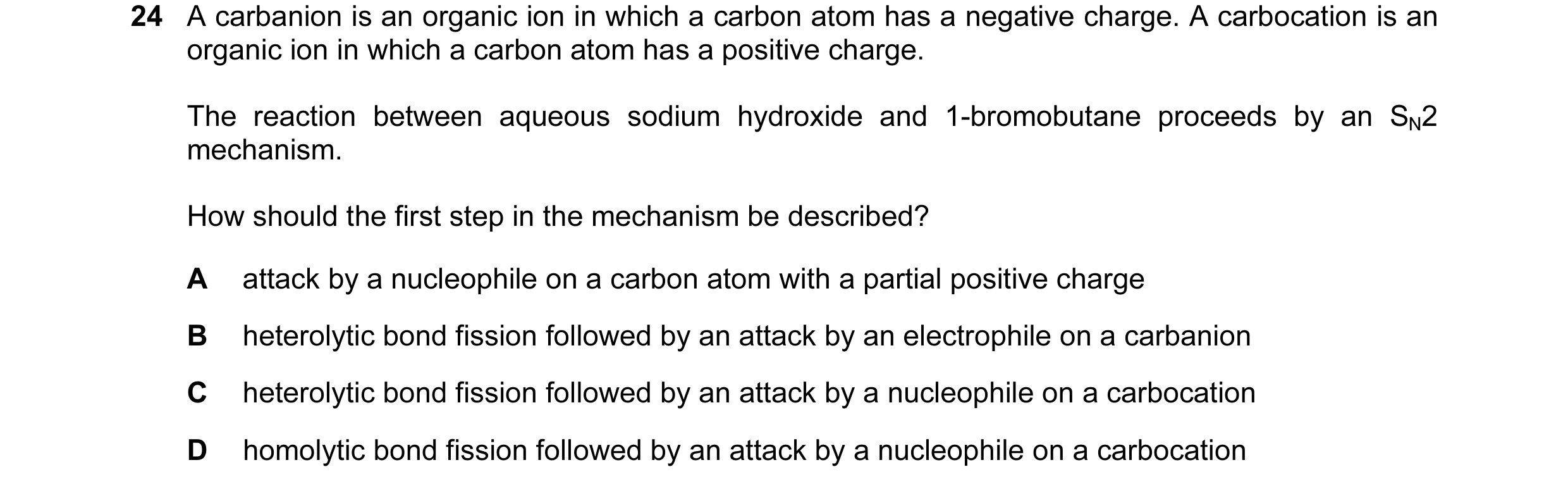
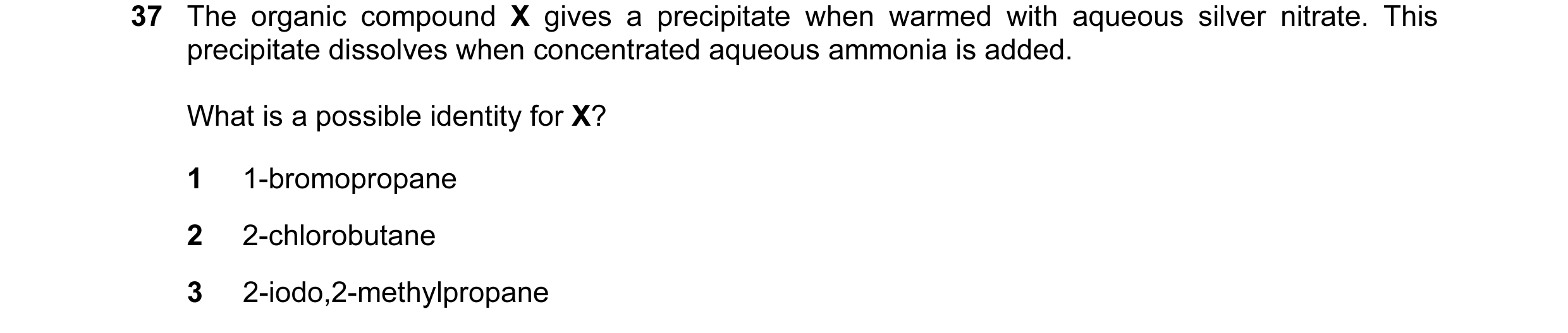
 20 / 66


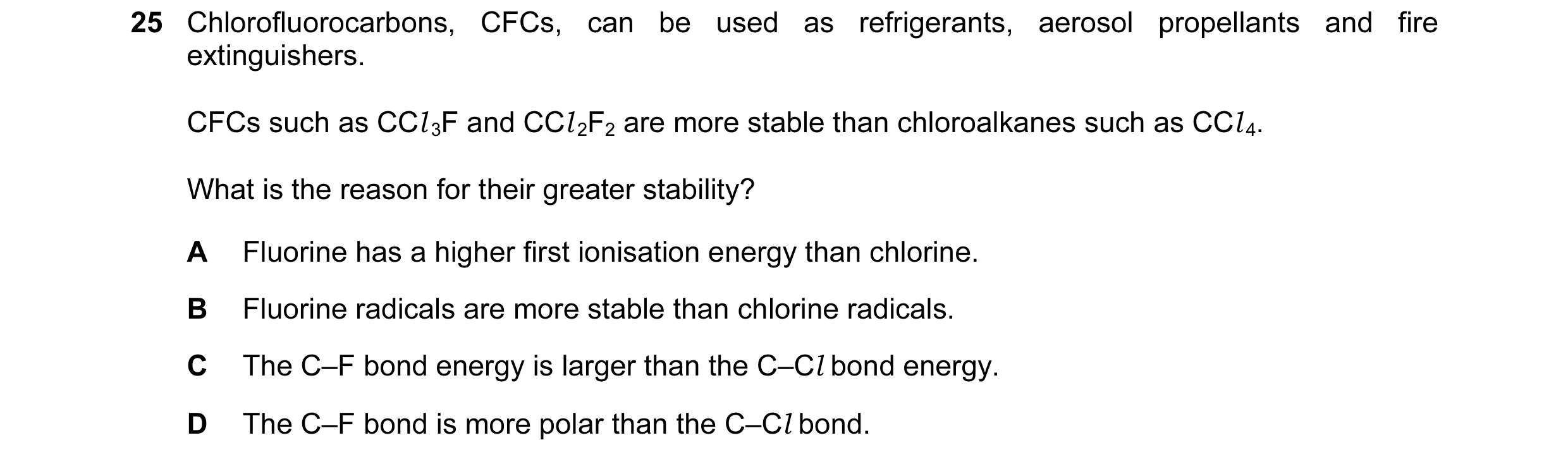
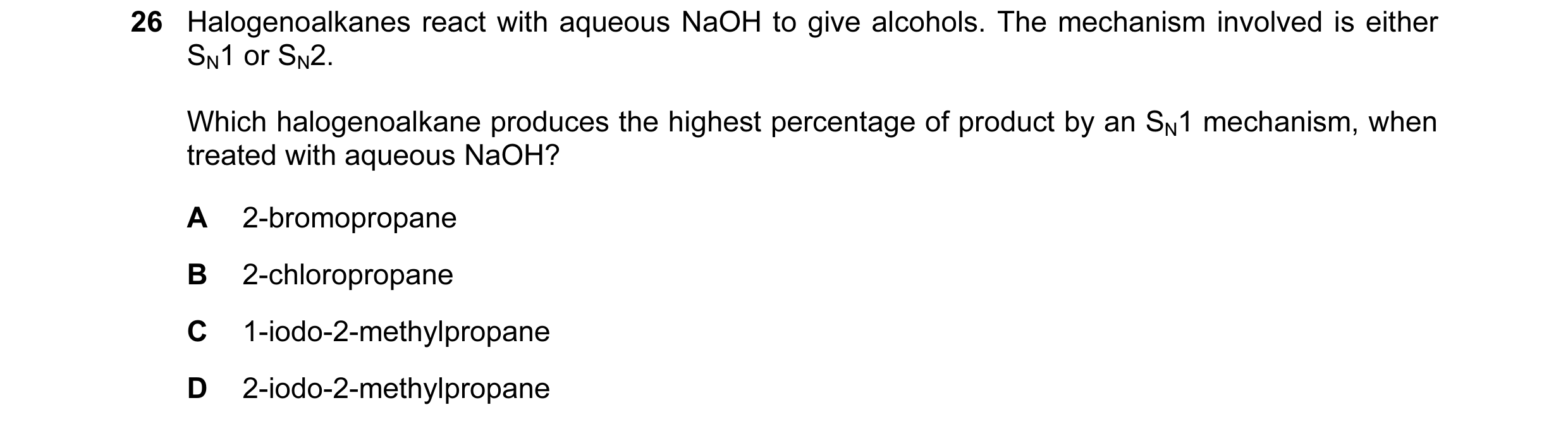
 21 / 66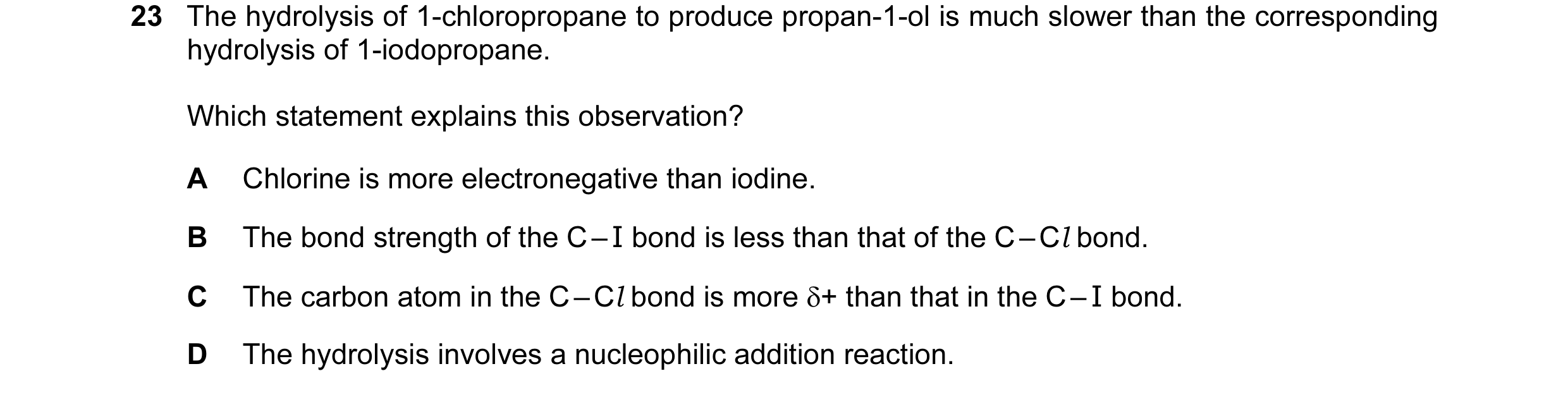
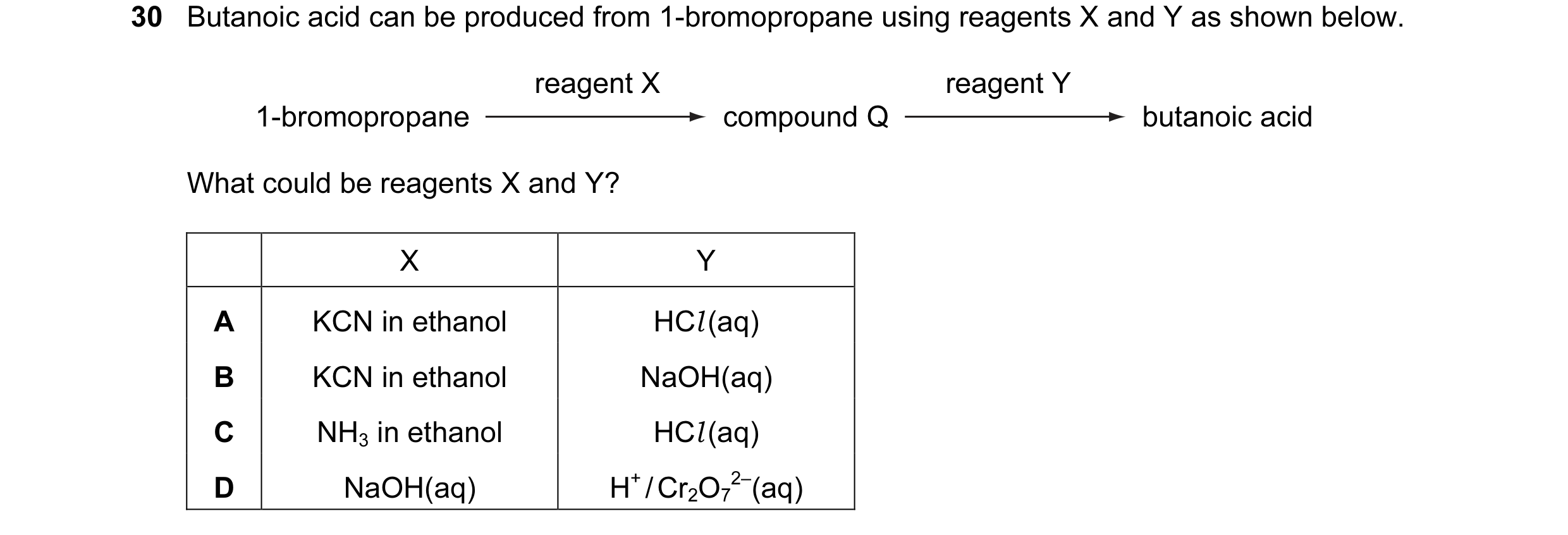
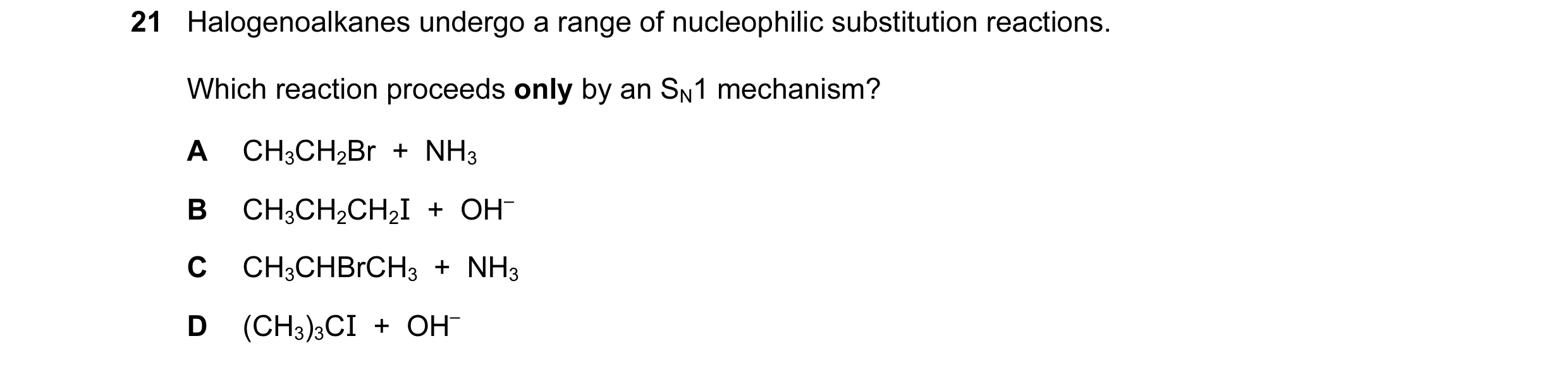

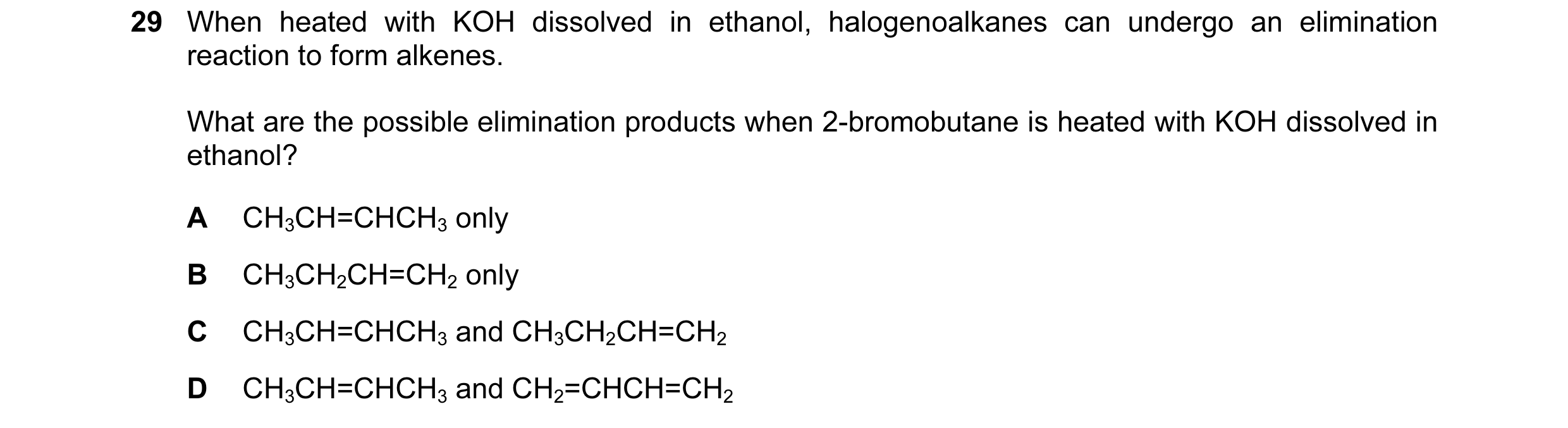 22 / 66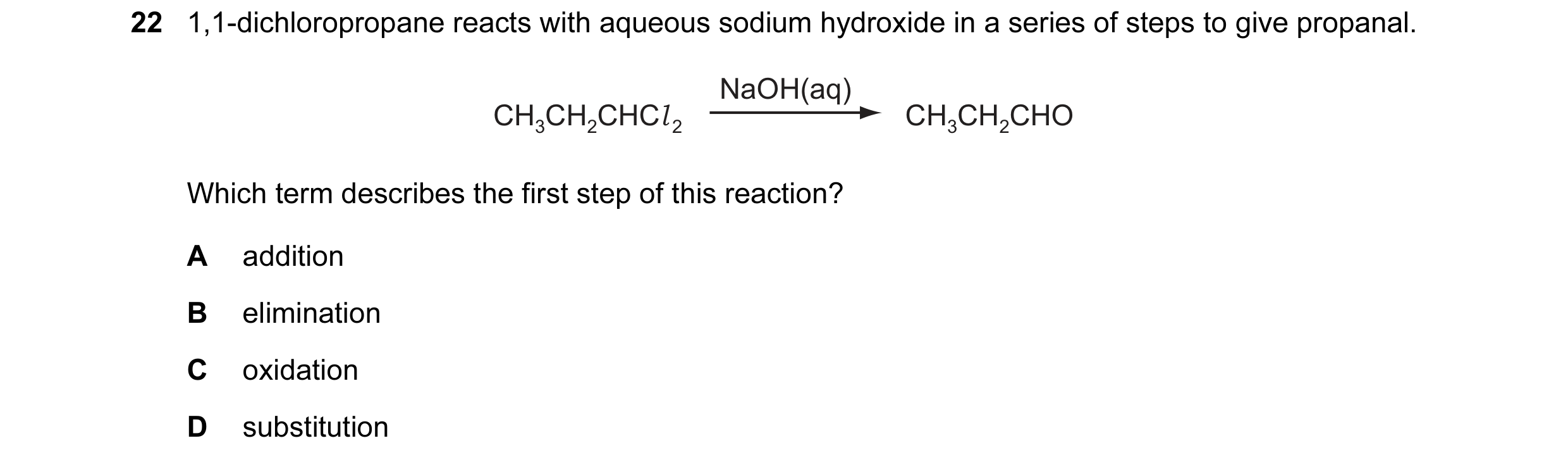
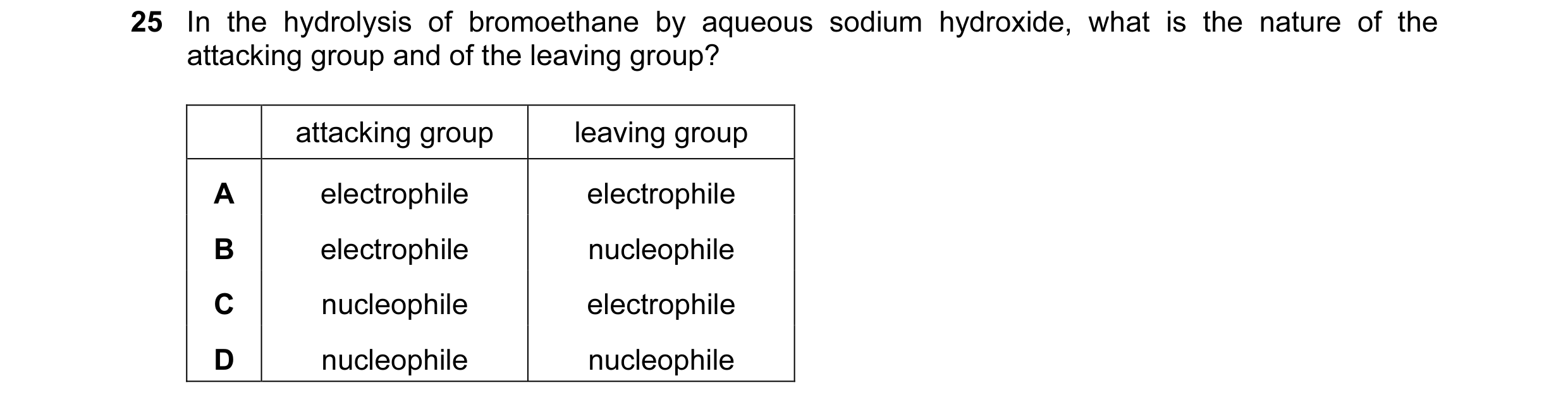
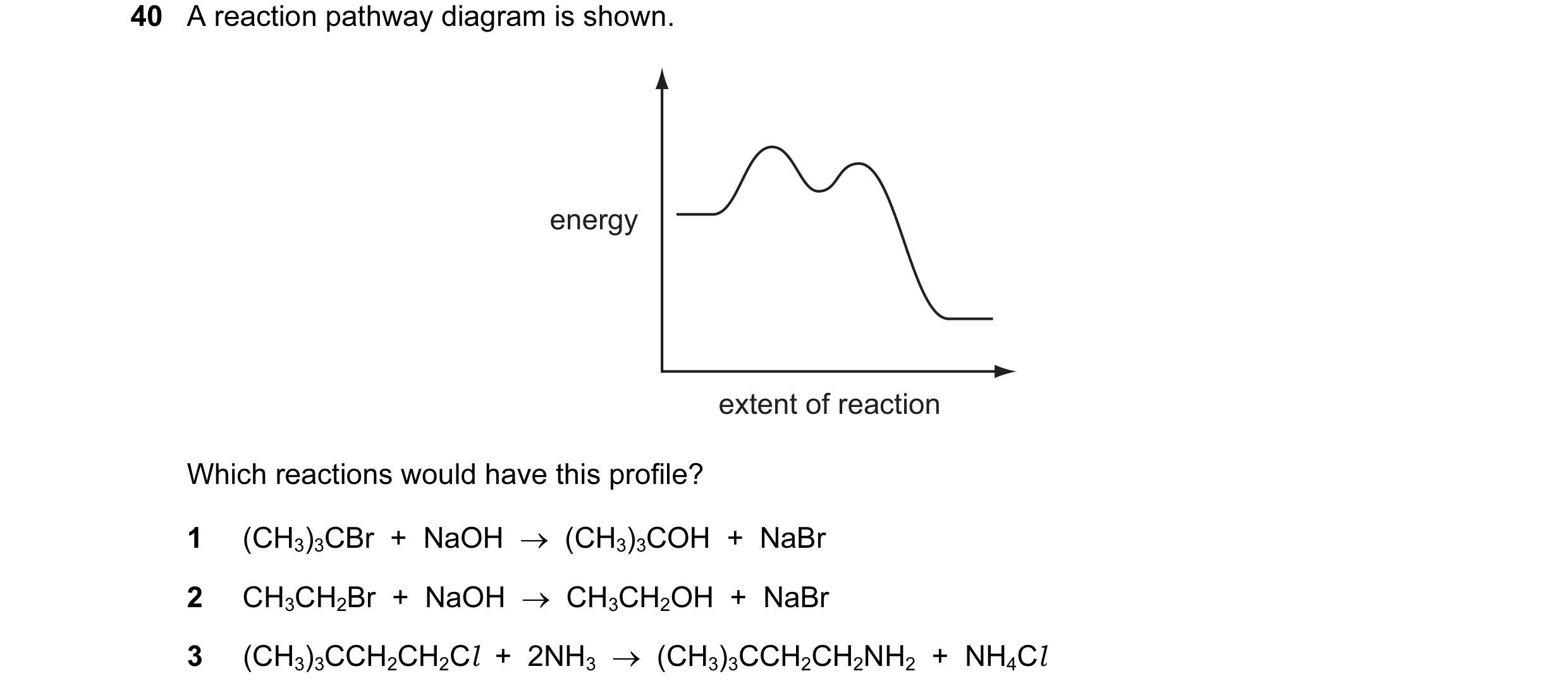 23 / 66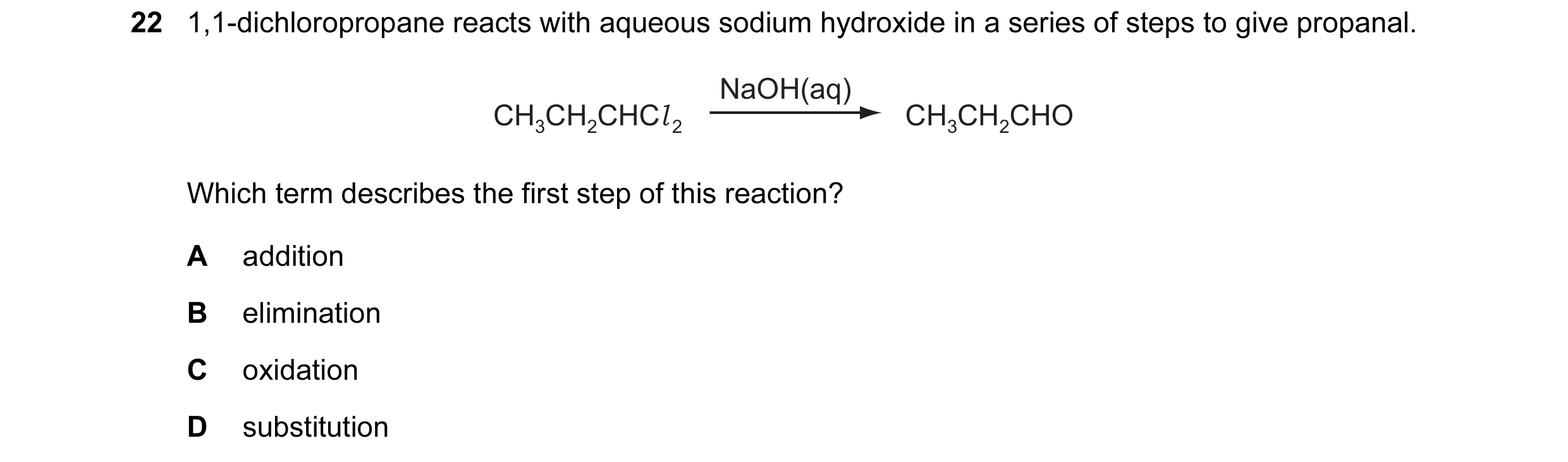
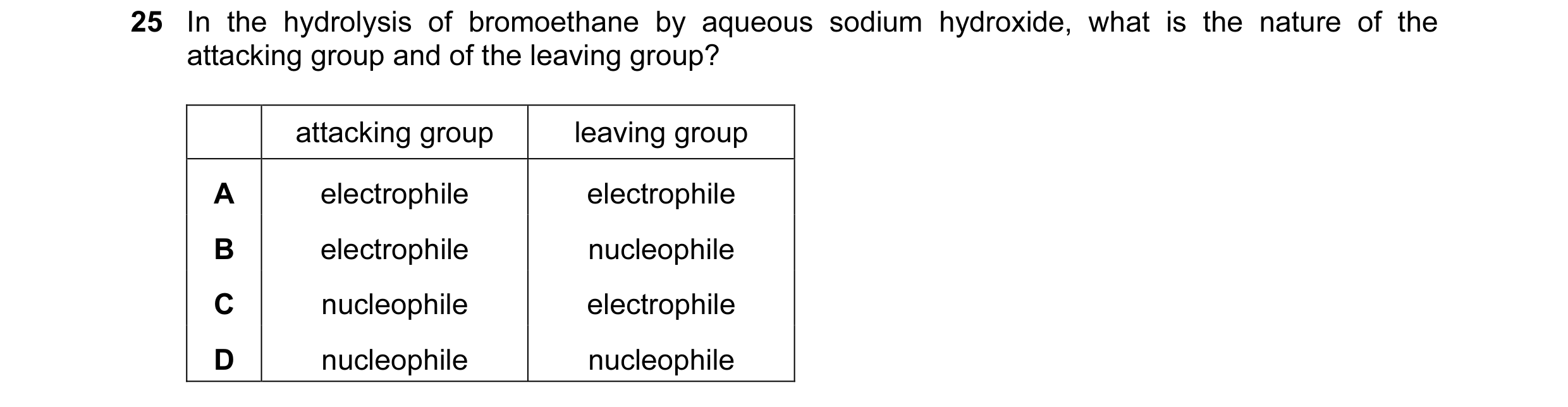
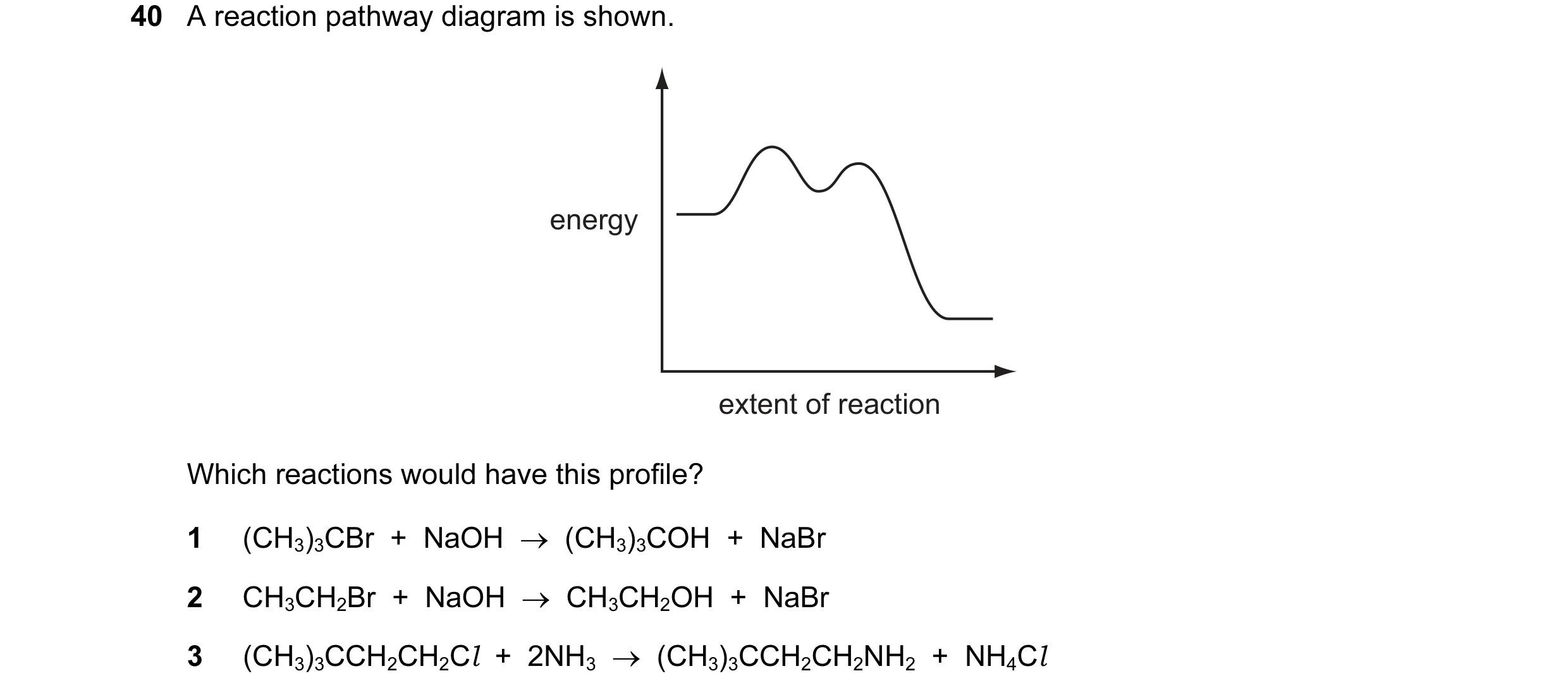
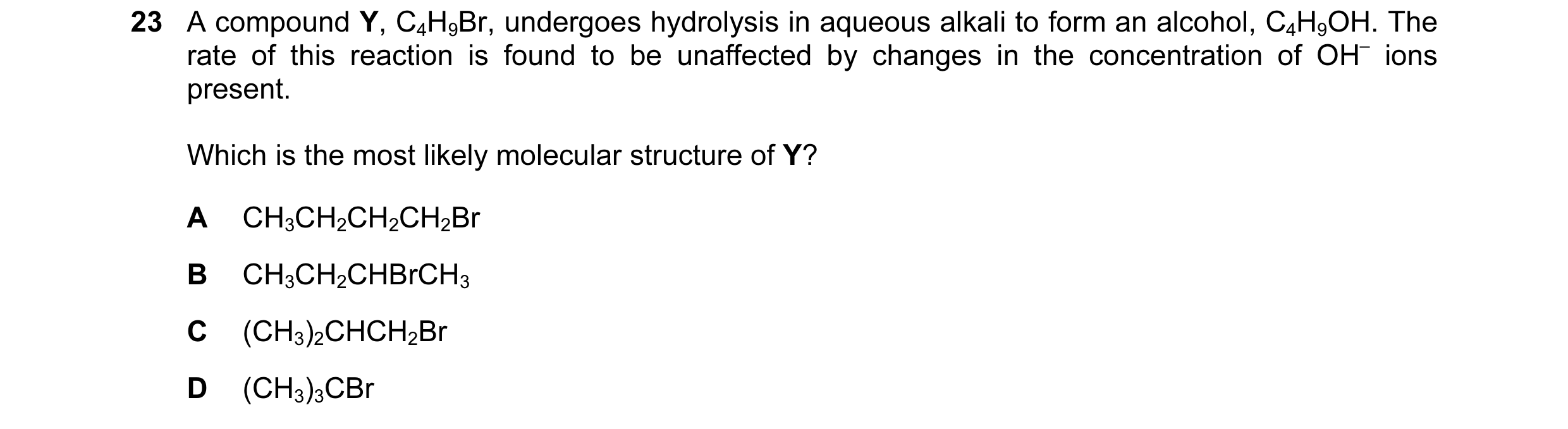 24 / 66
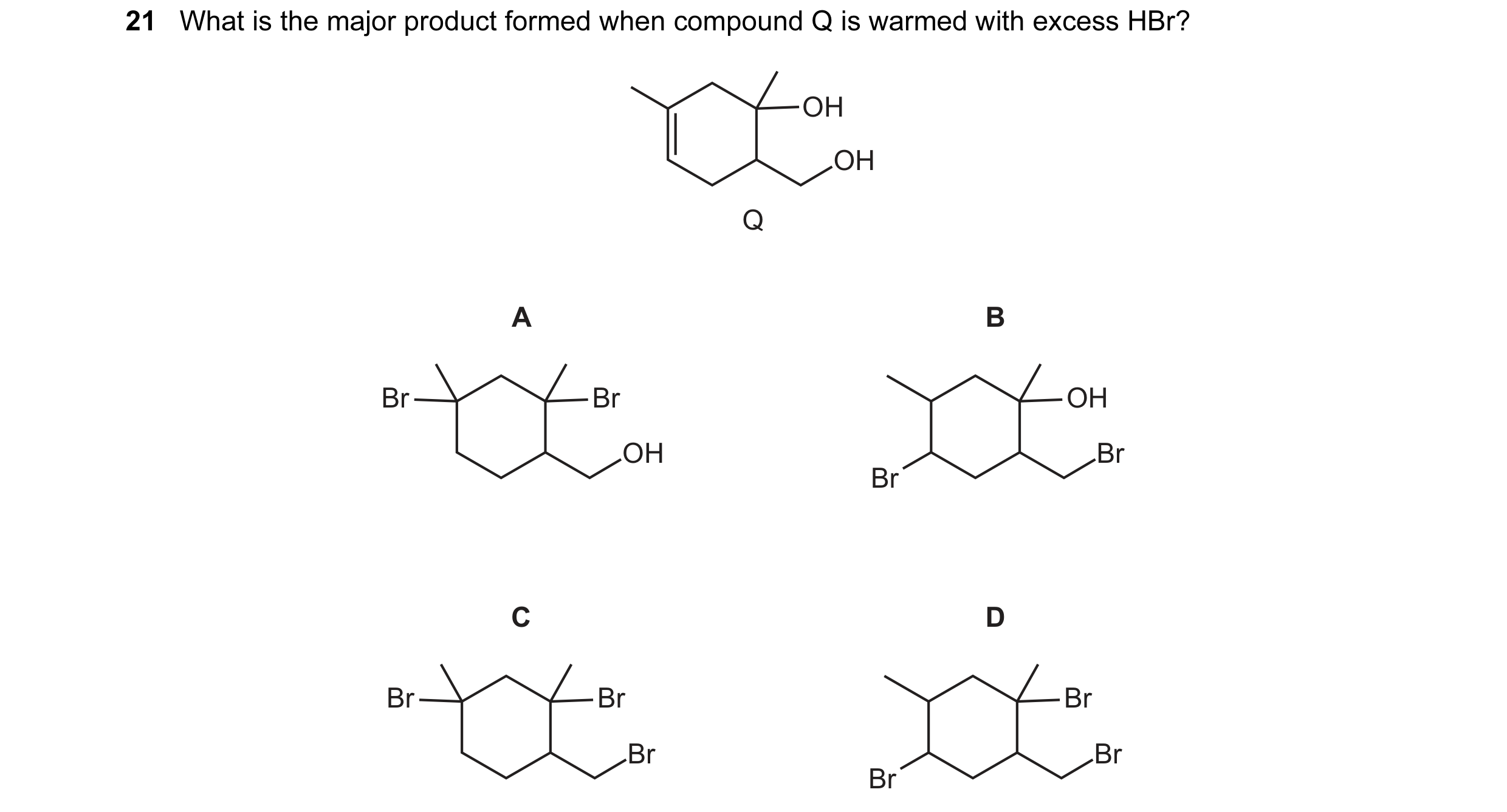
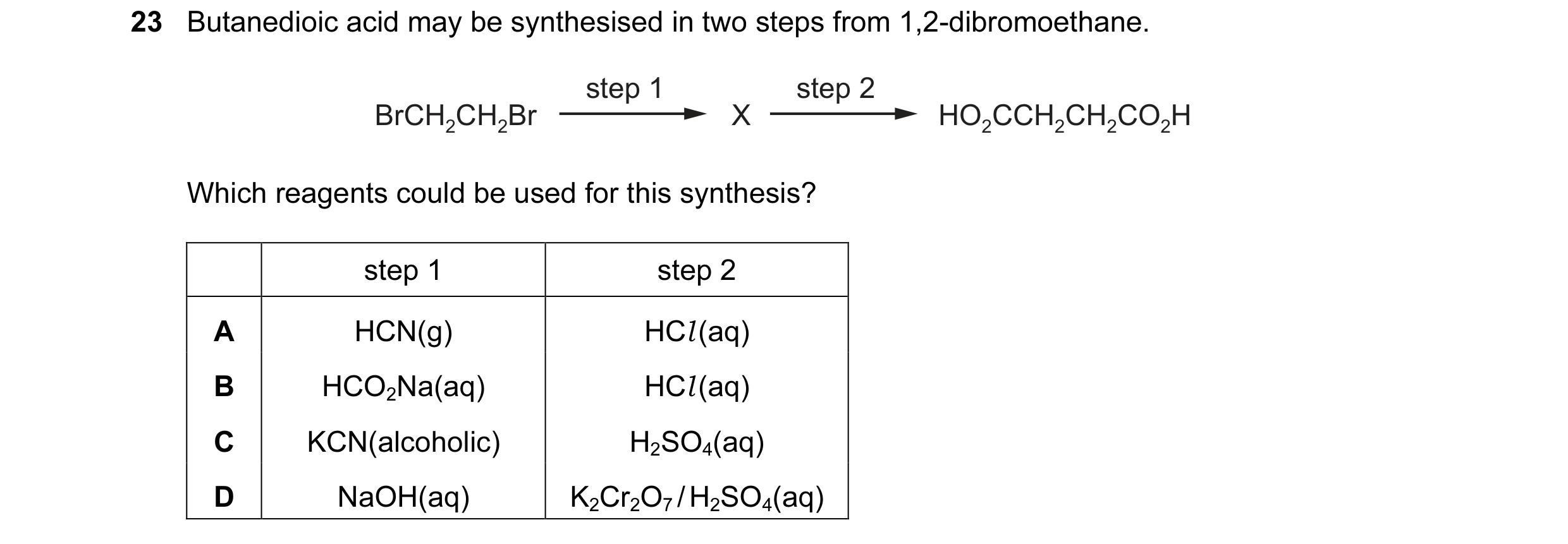 25 / 66


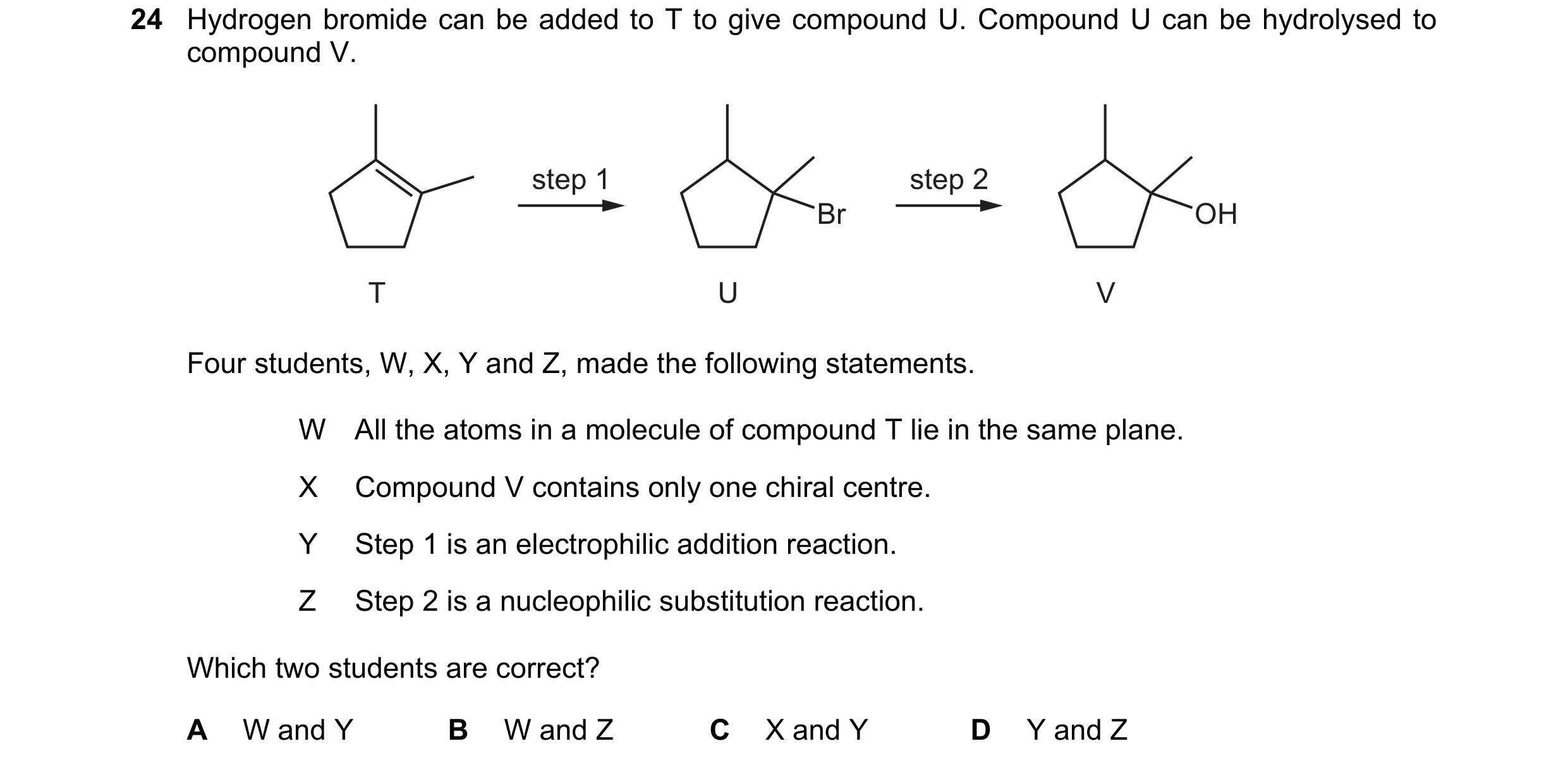 26 / 66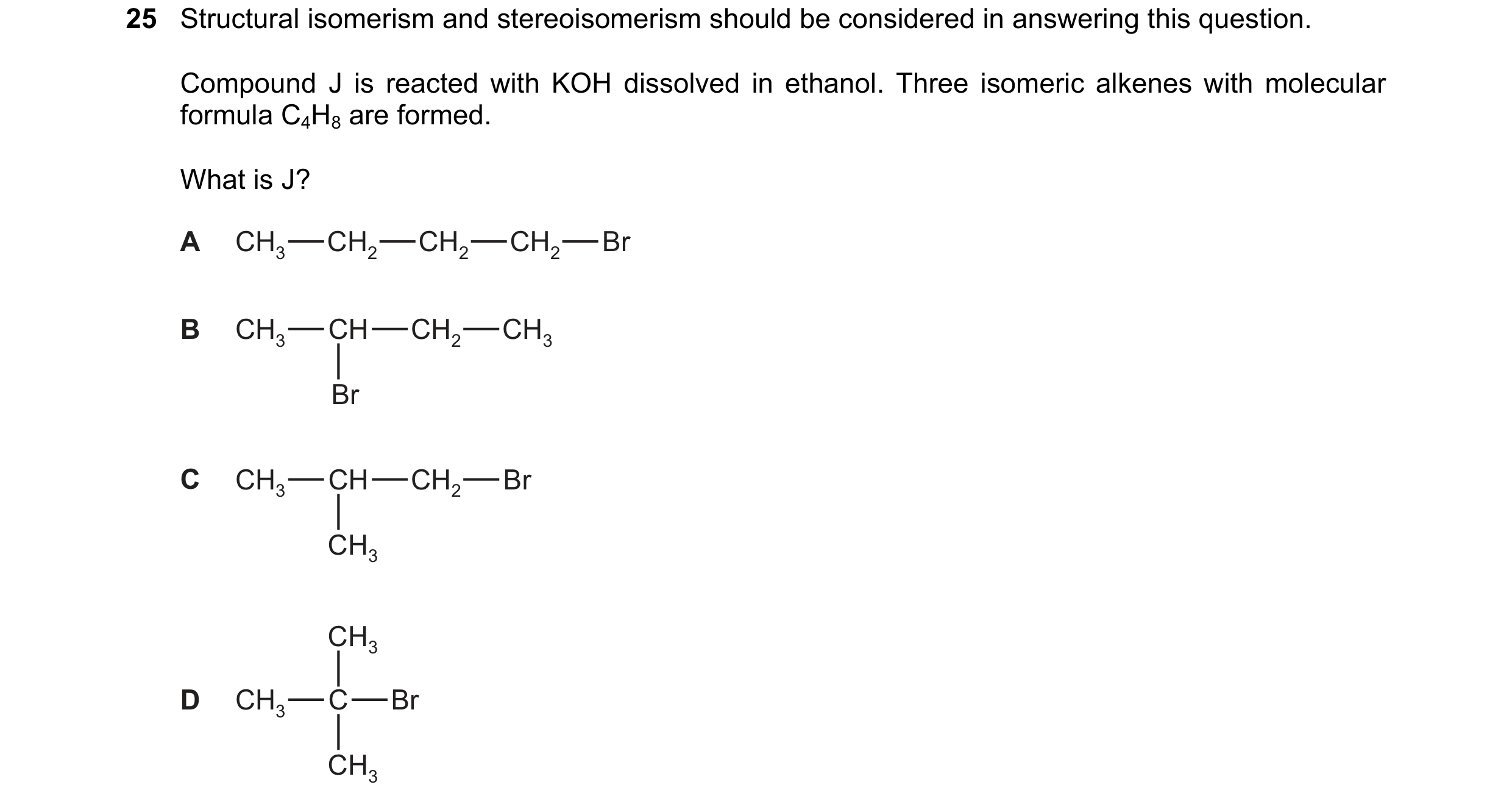
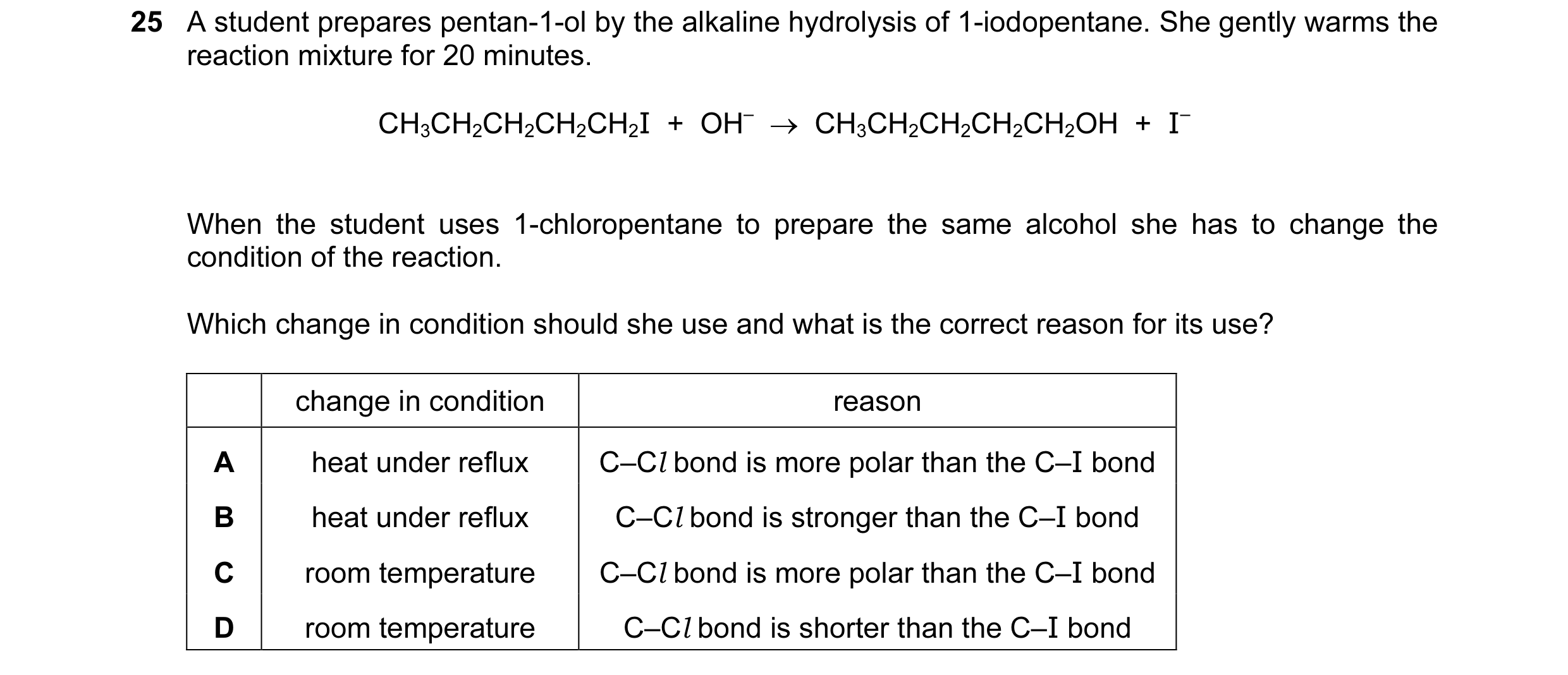
 27 / 66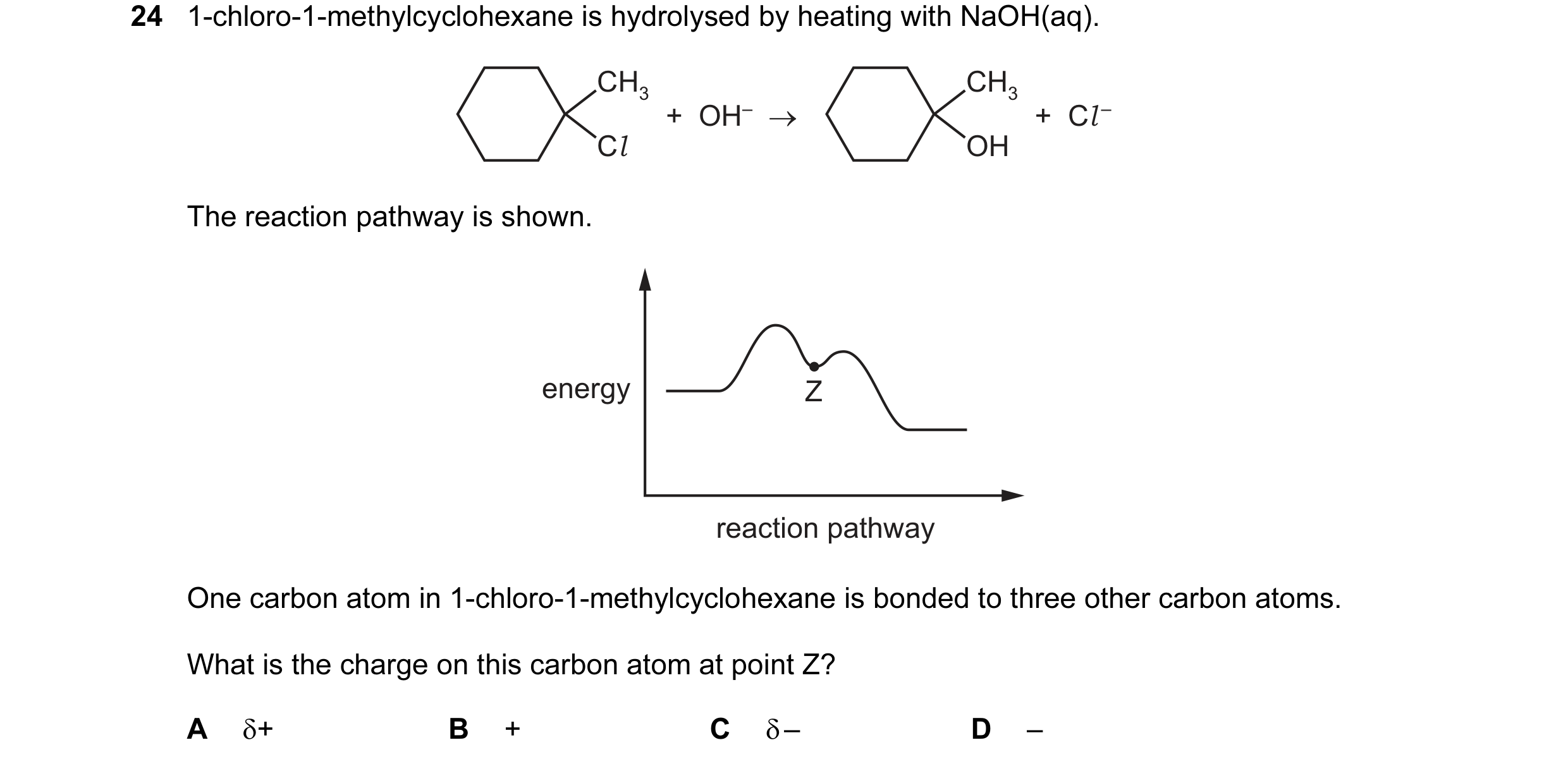
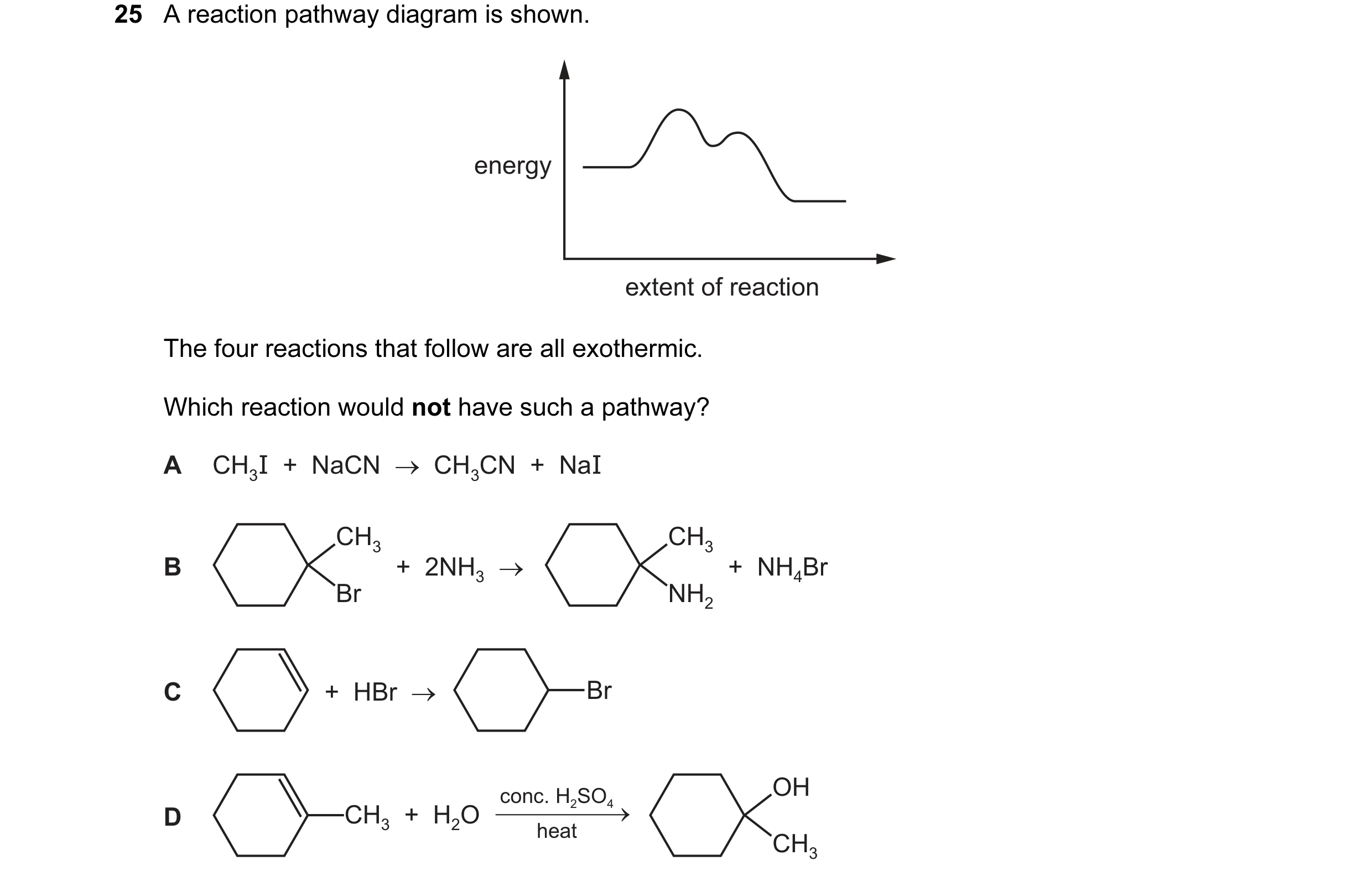
 28 / 66
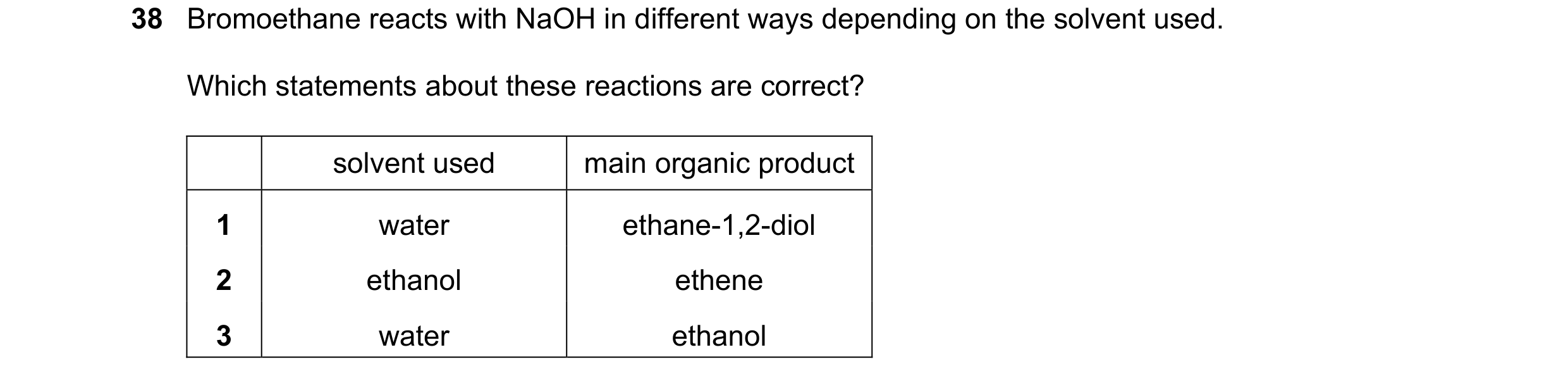
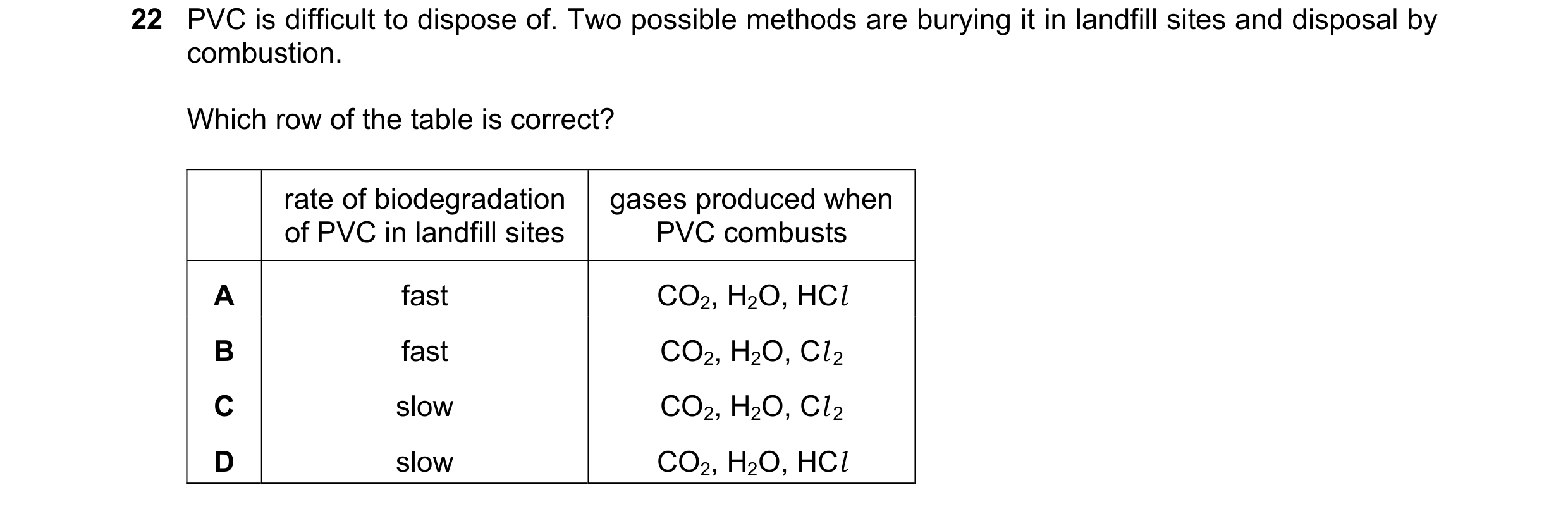 29 / 66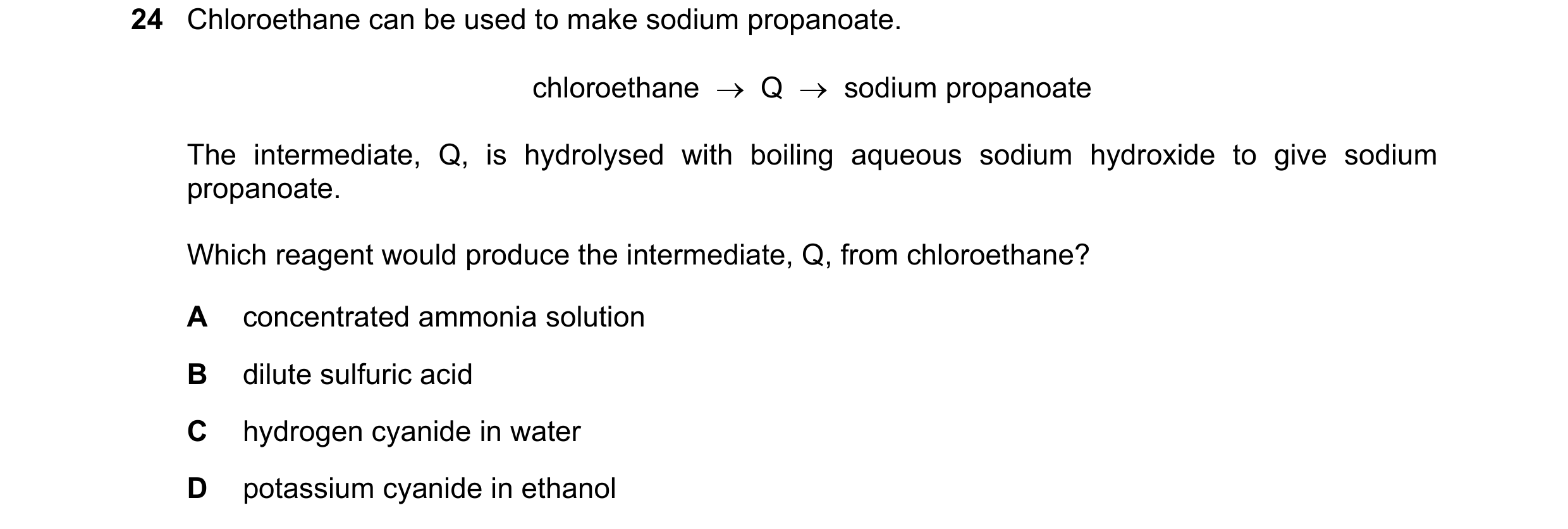
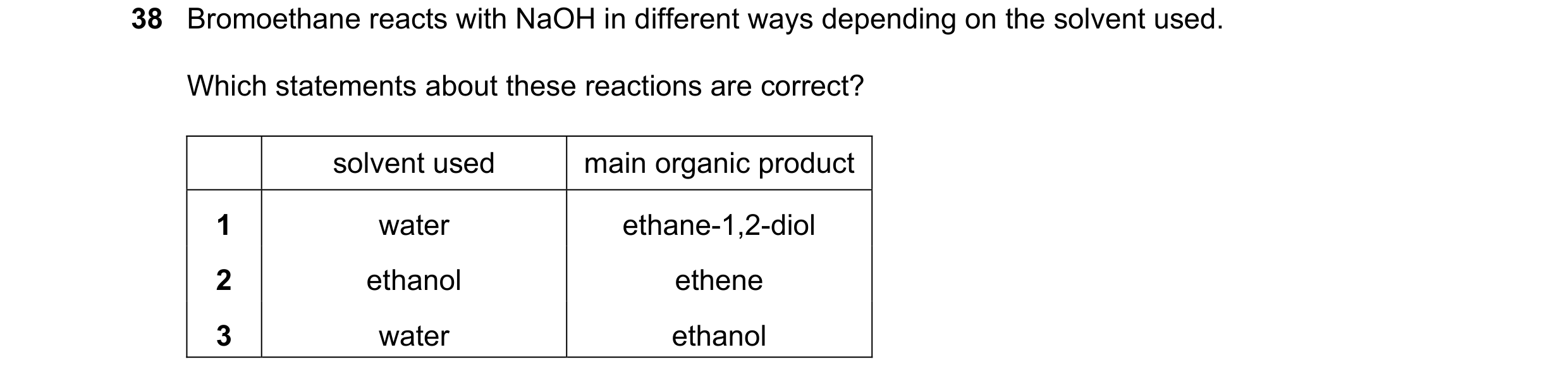
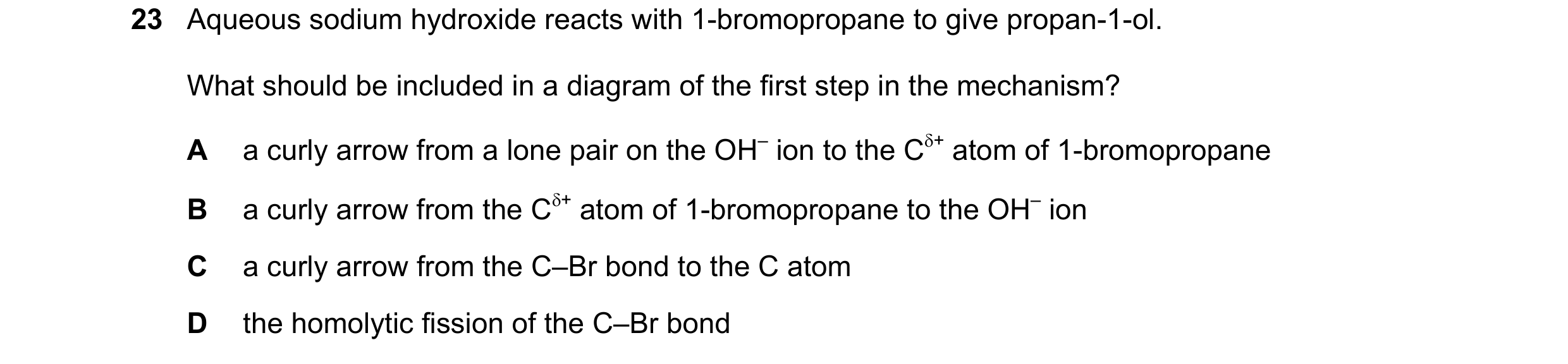
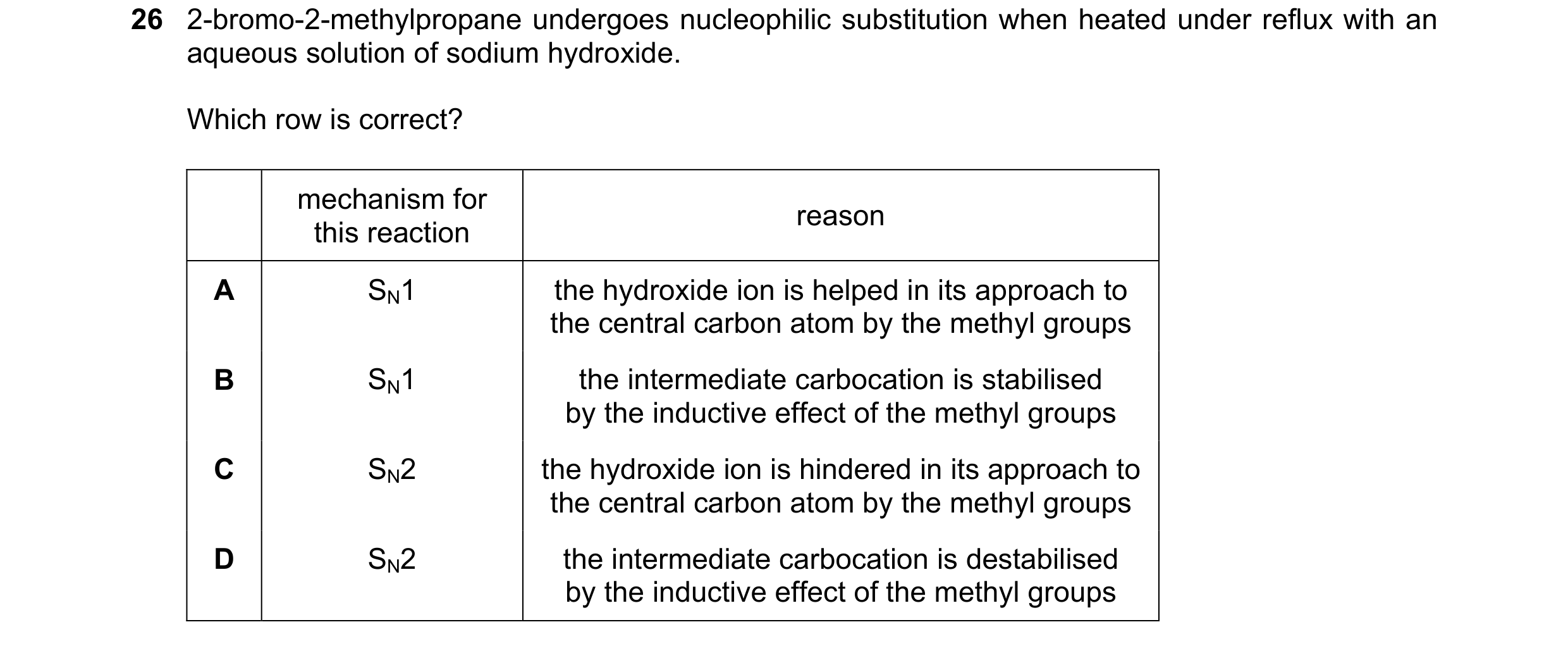 30 / 66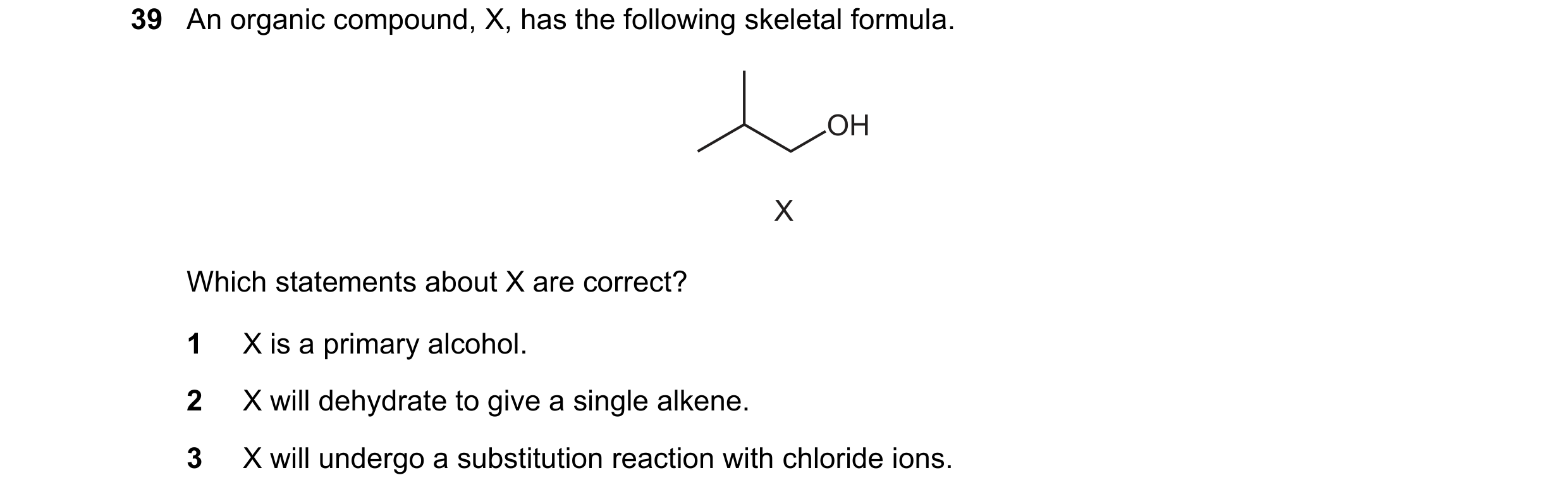
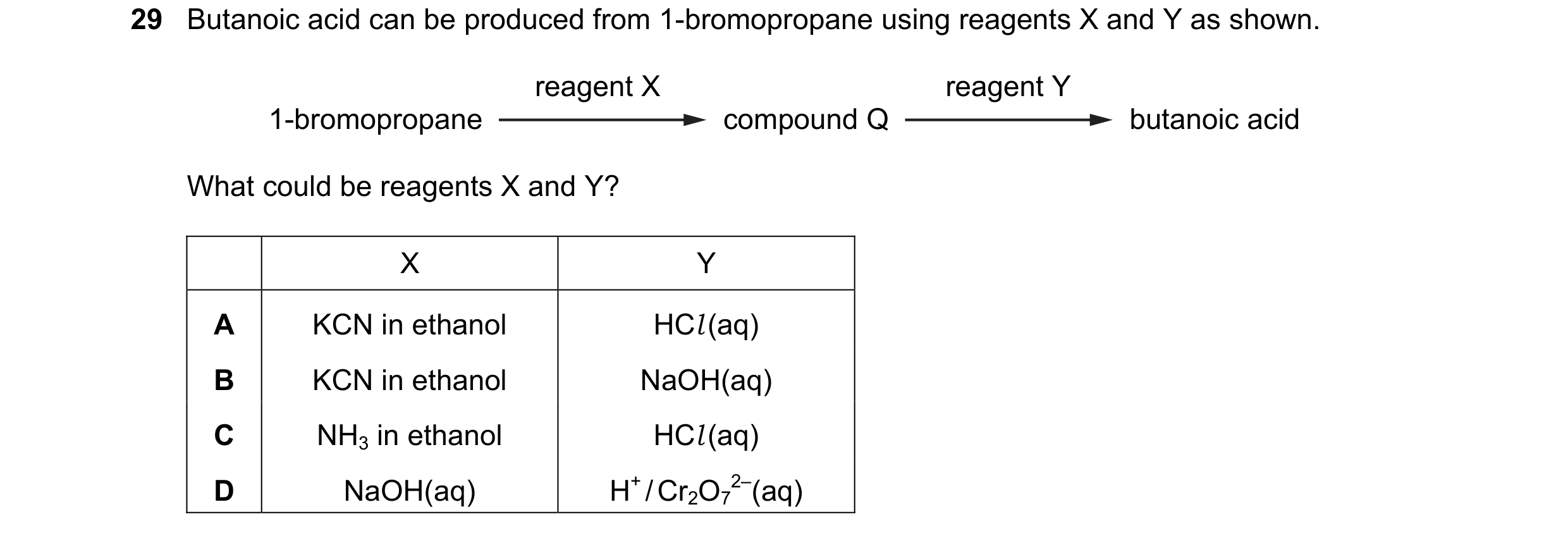

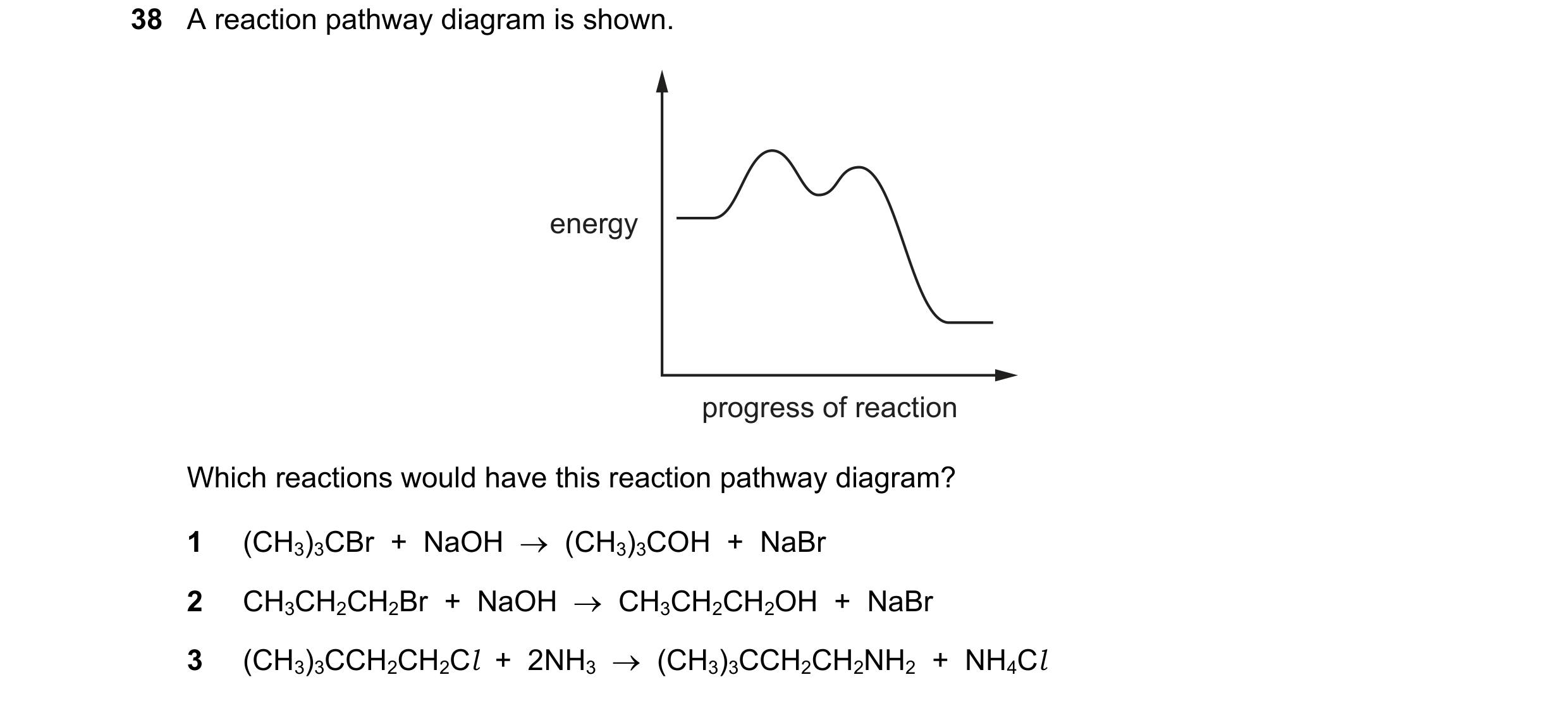 31 / 66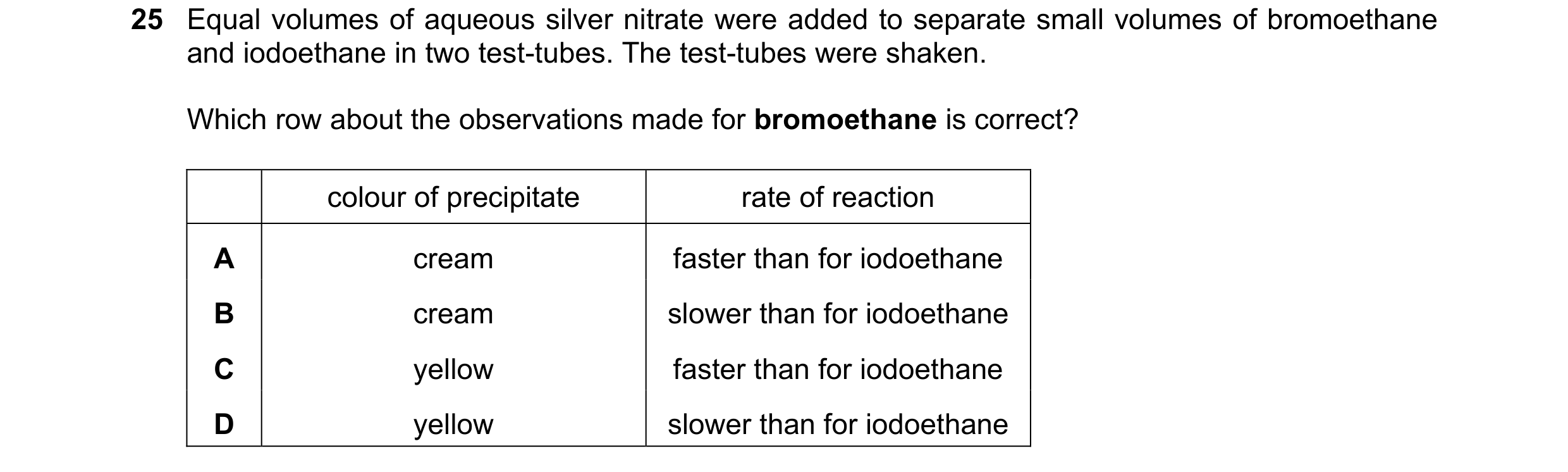
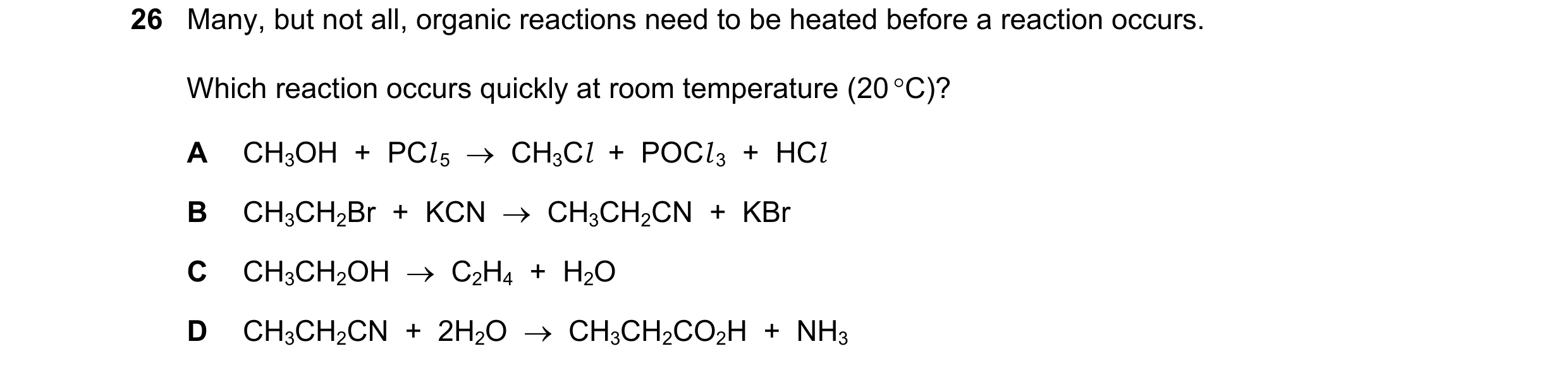


 32 / 66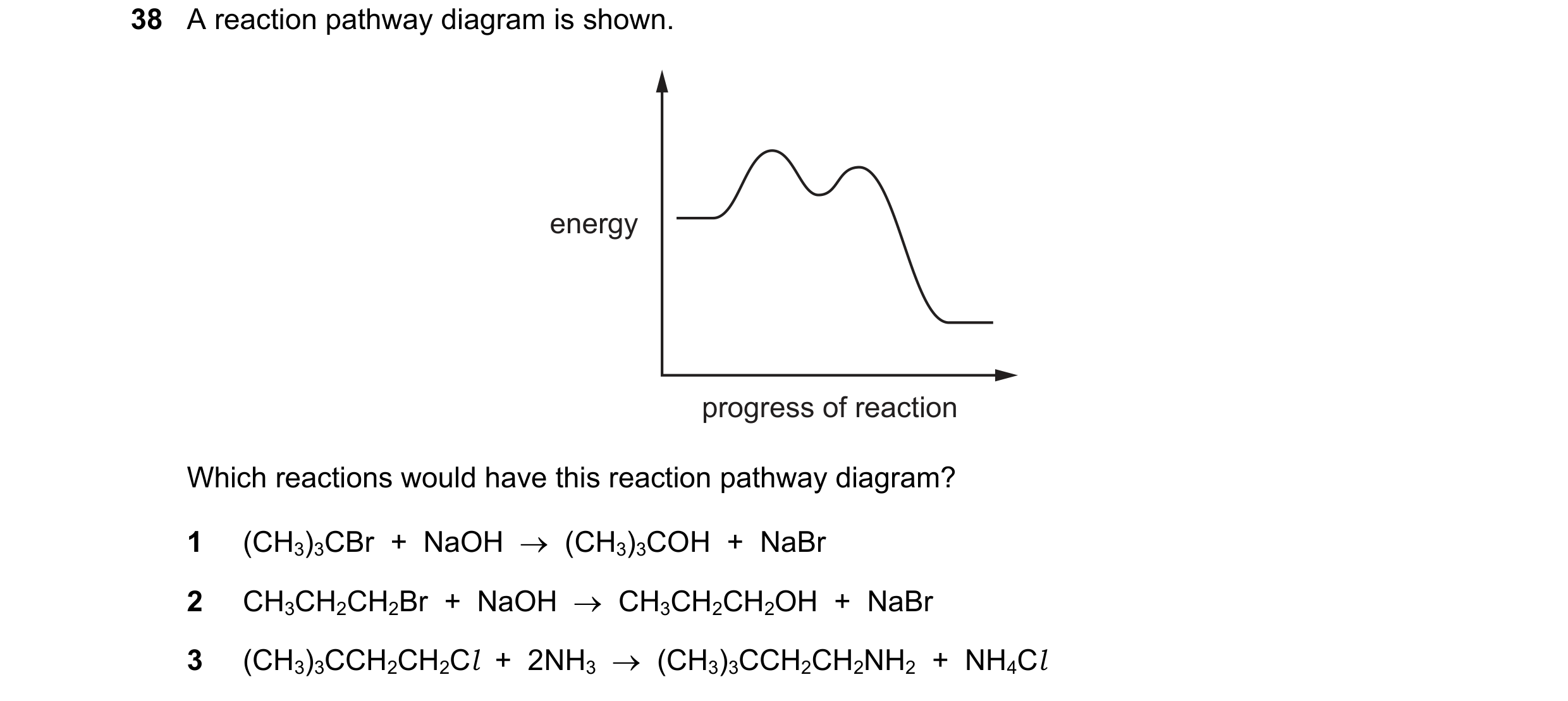
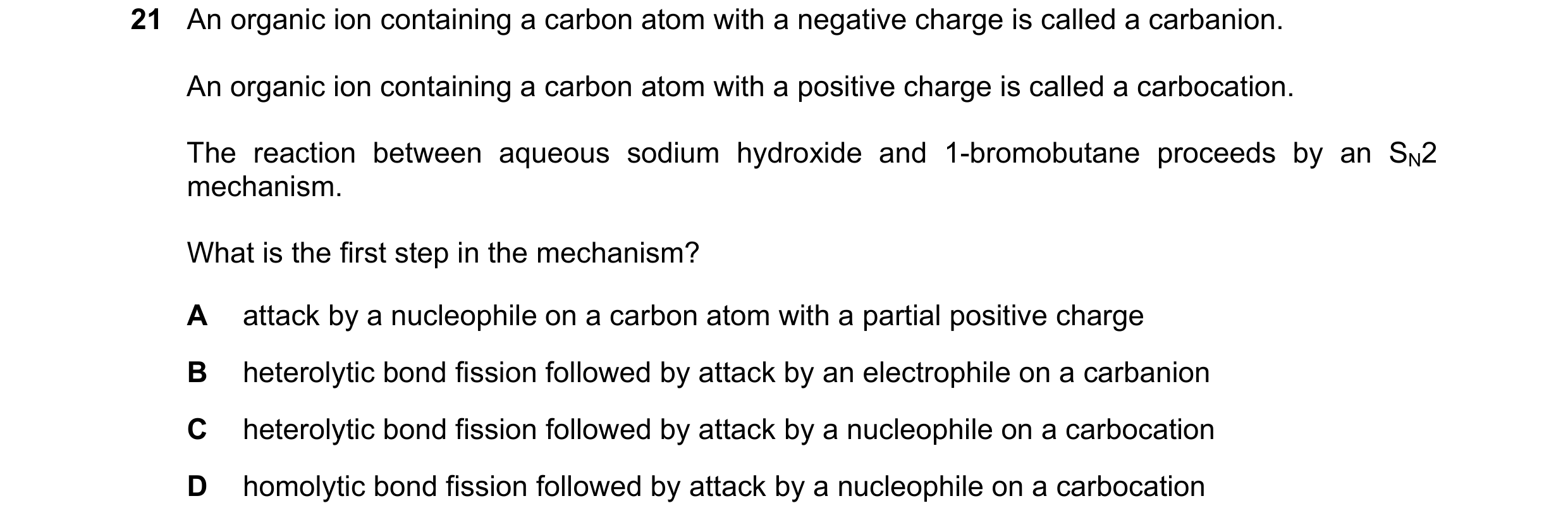
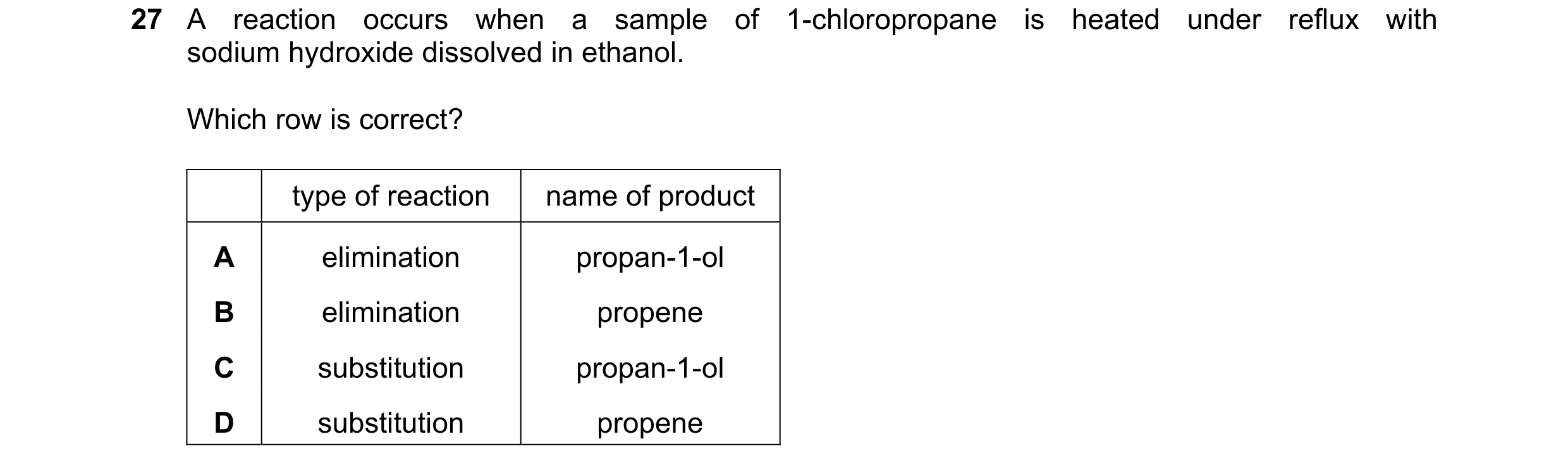 33 / 66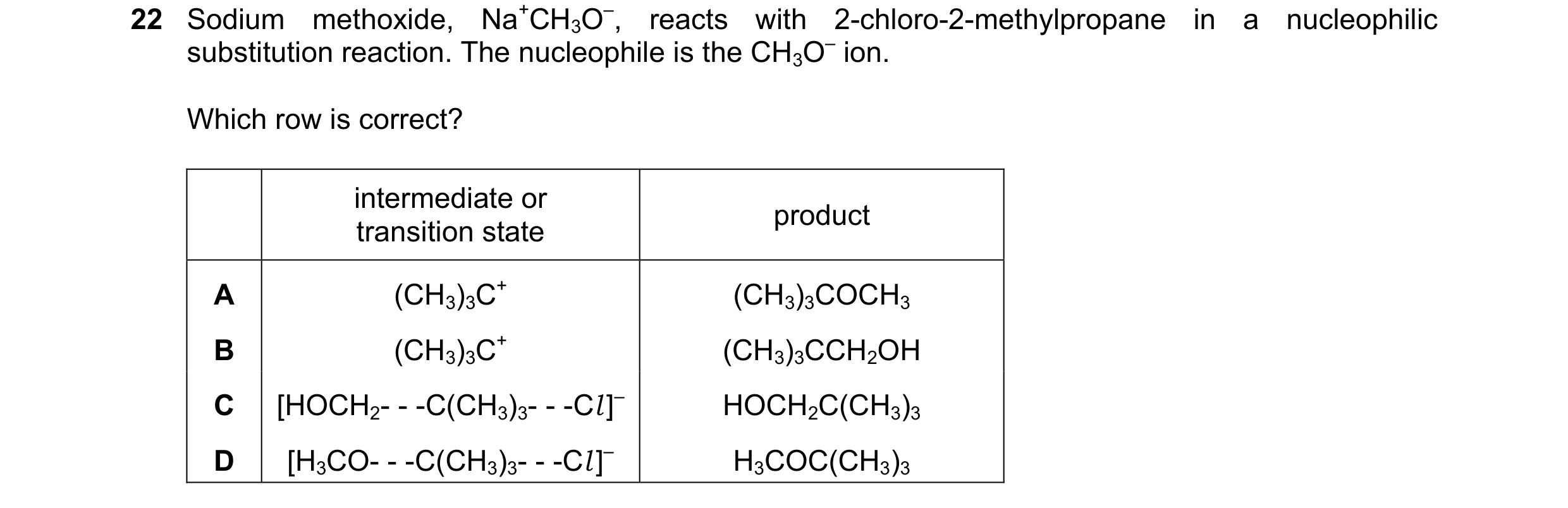
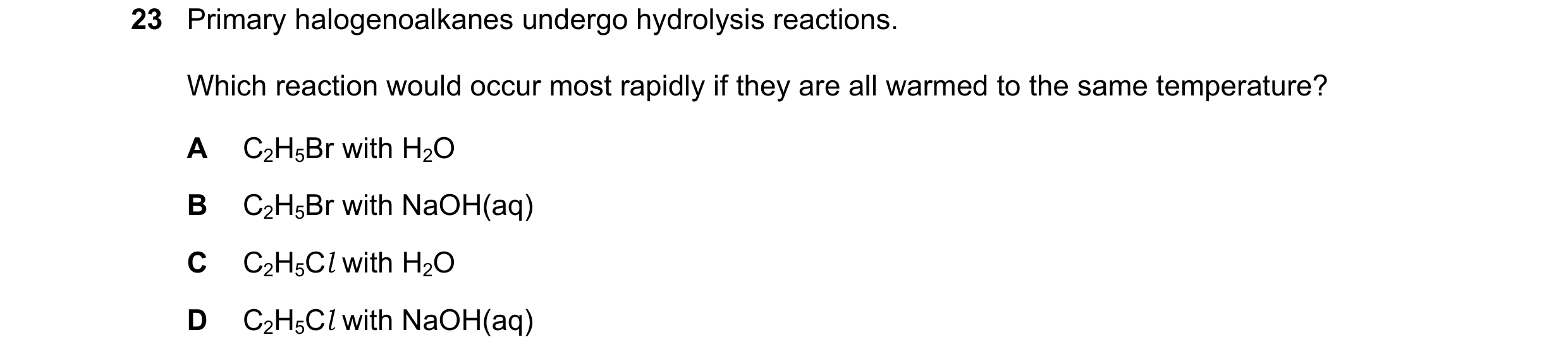
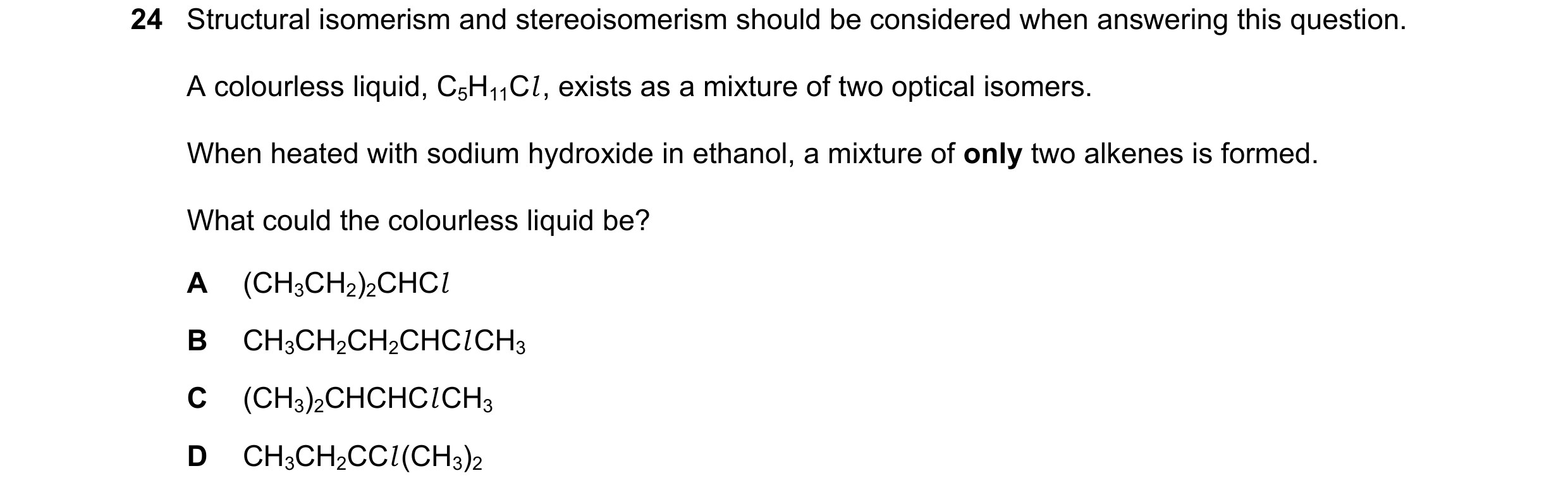
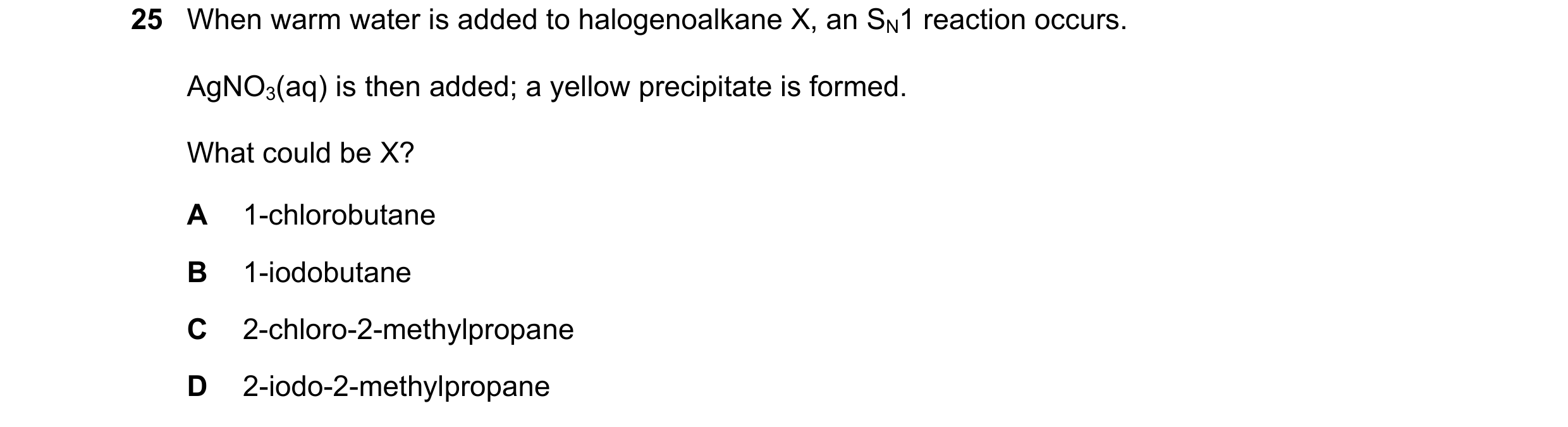 34 / 66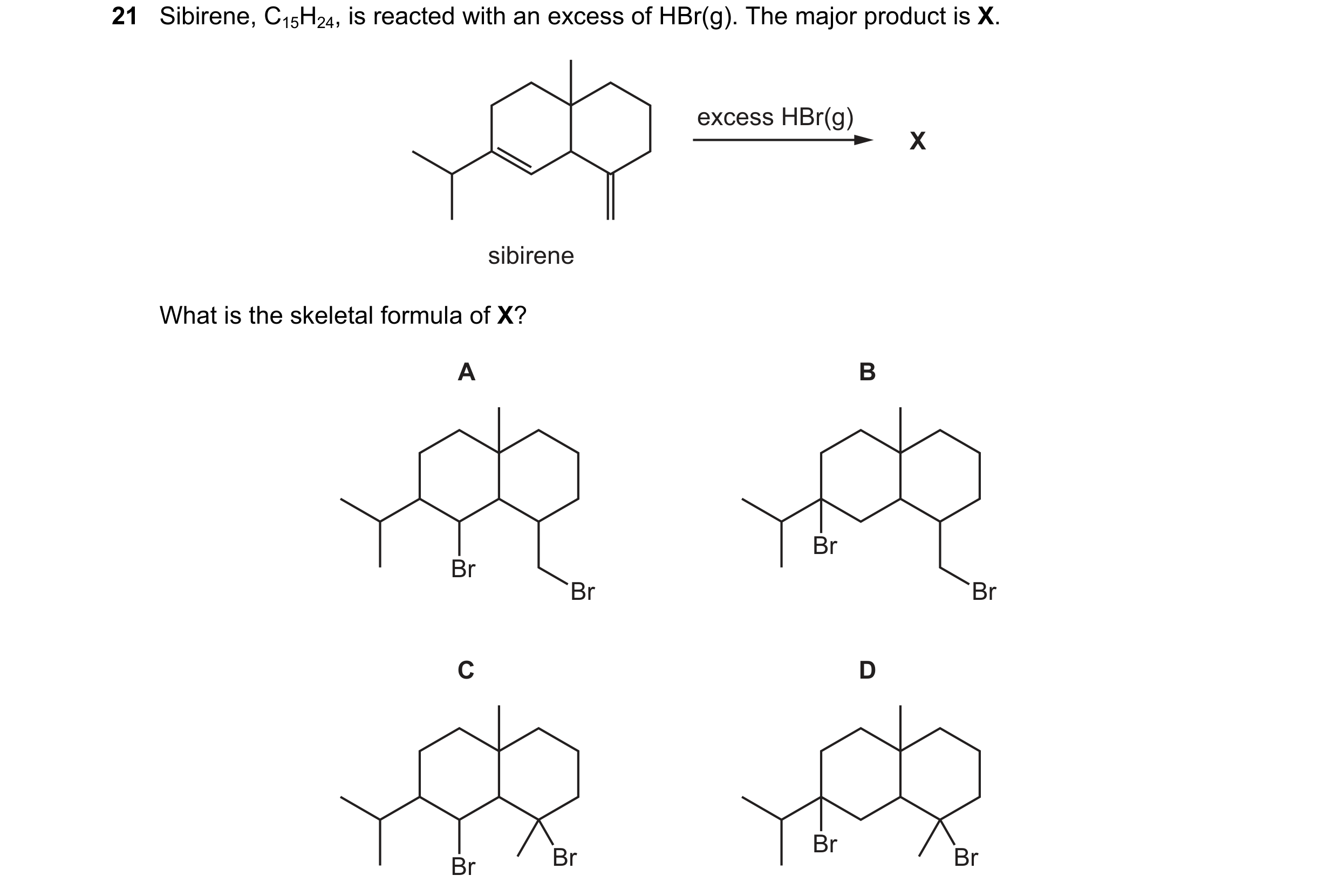
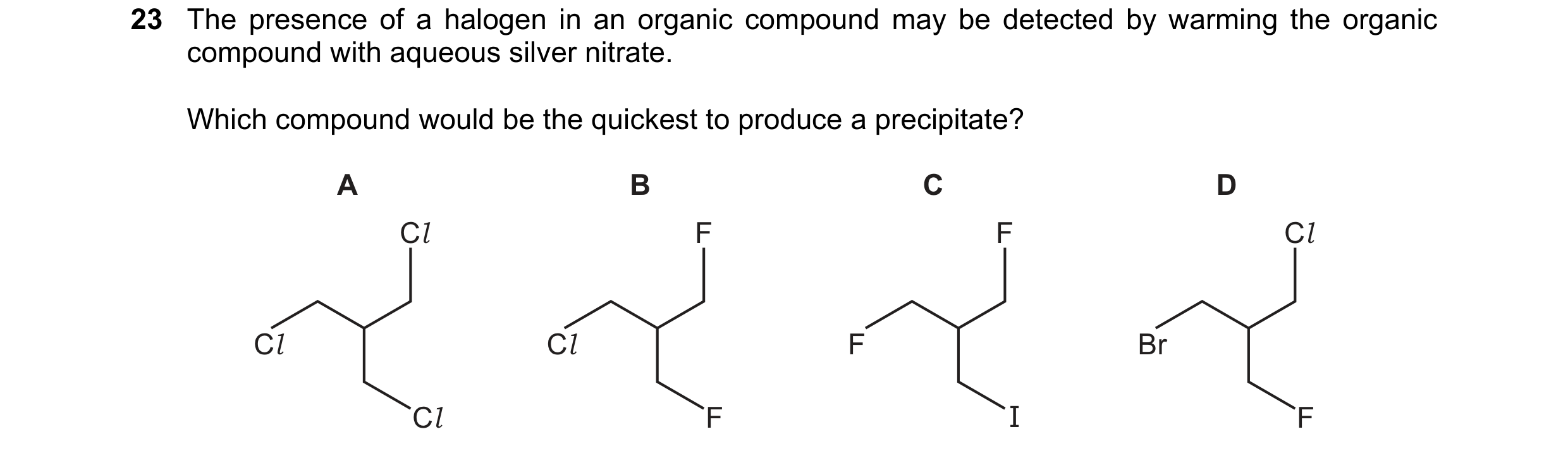
 35 / 66
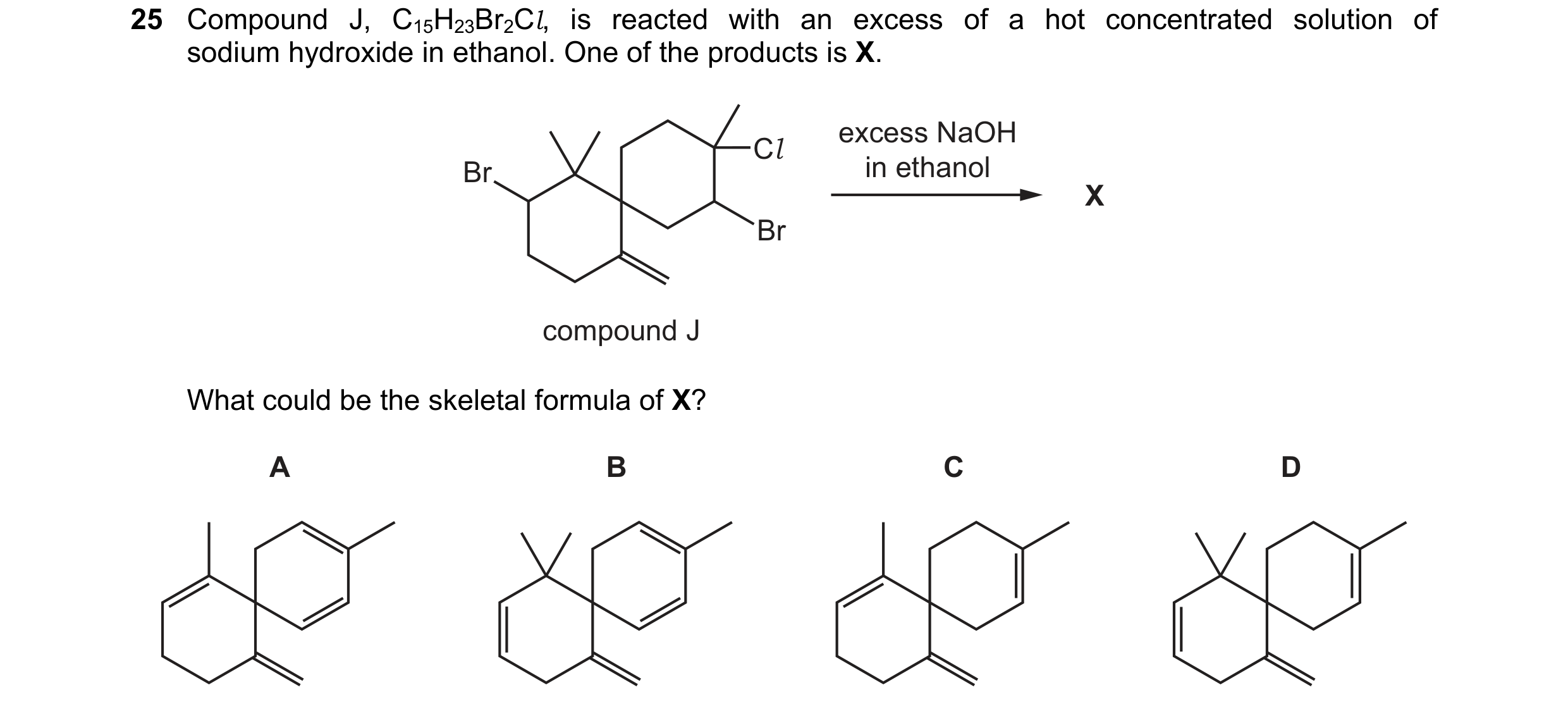

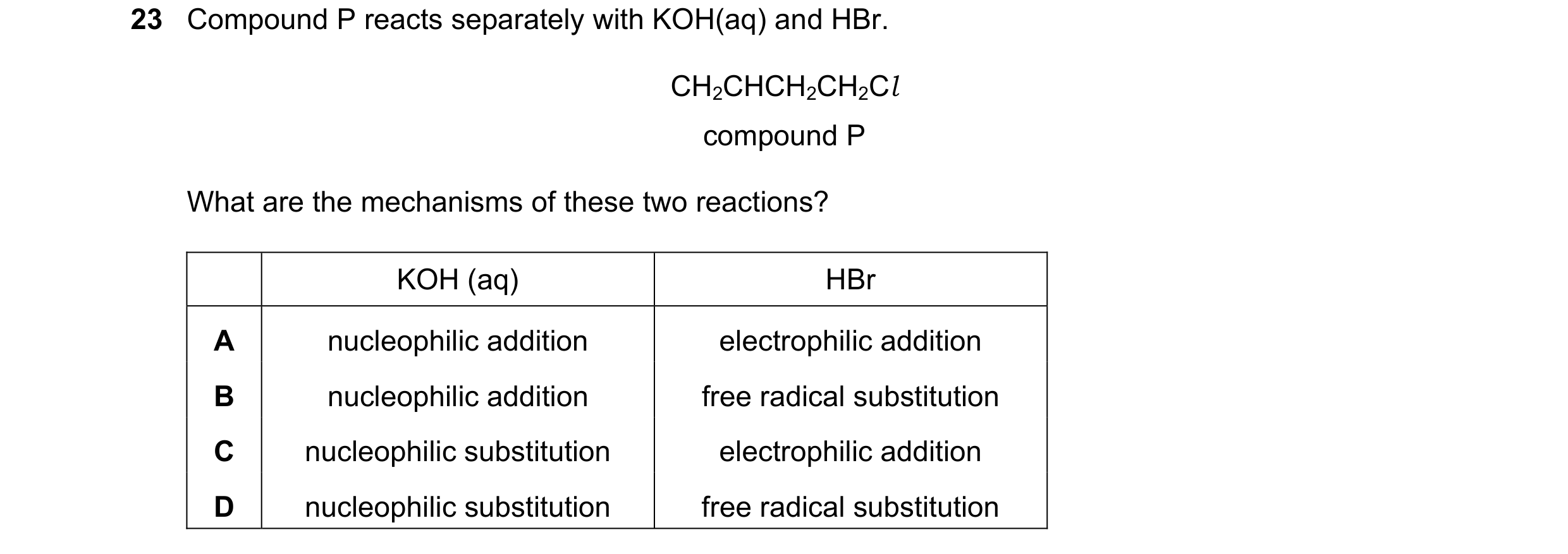 36 / 66
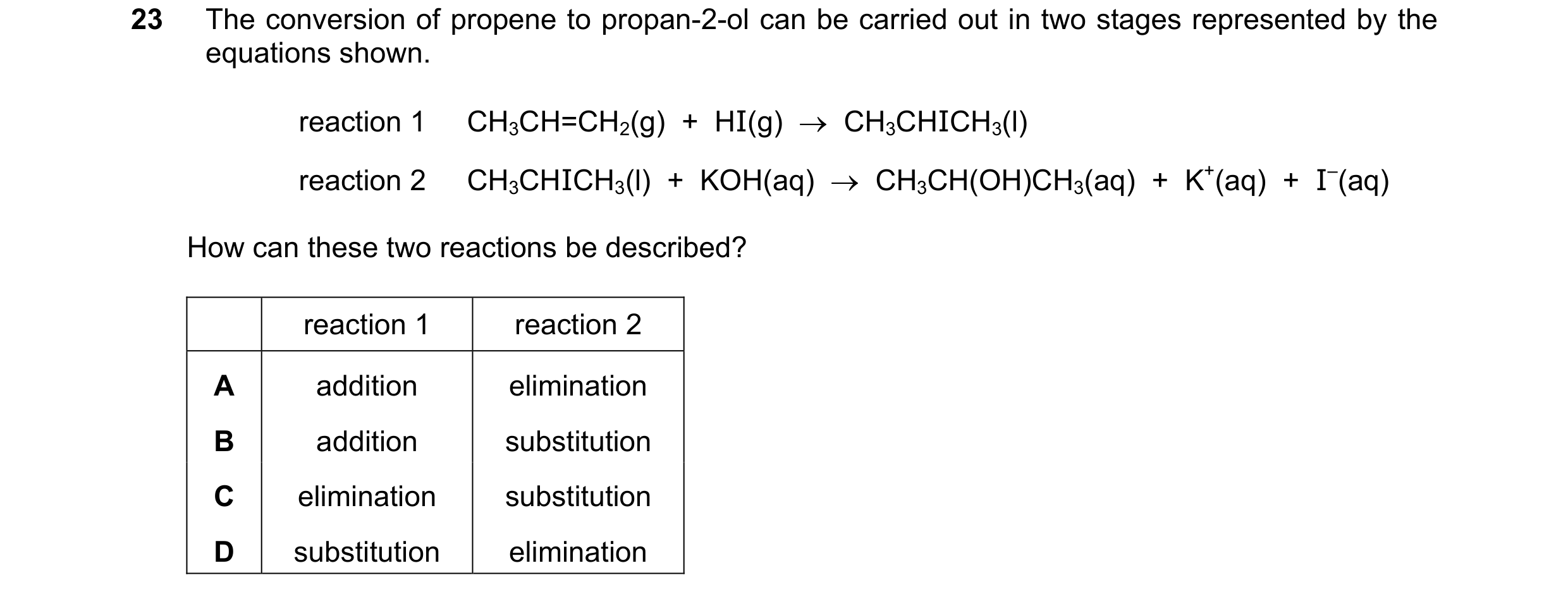
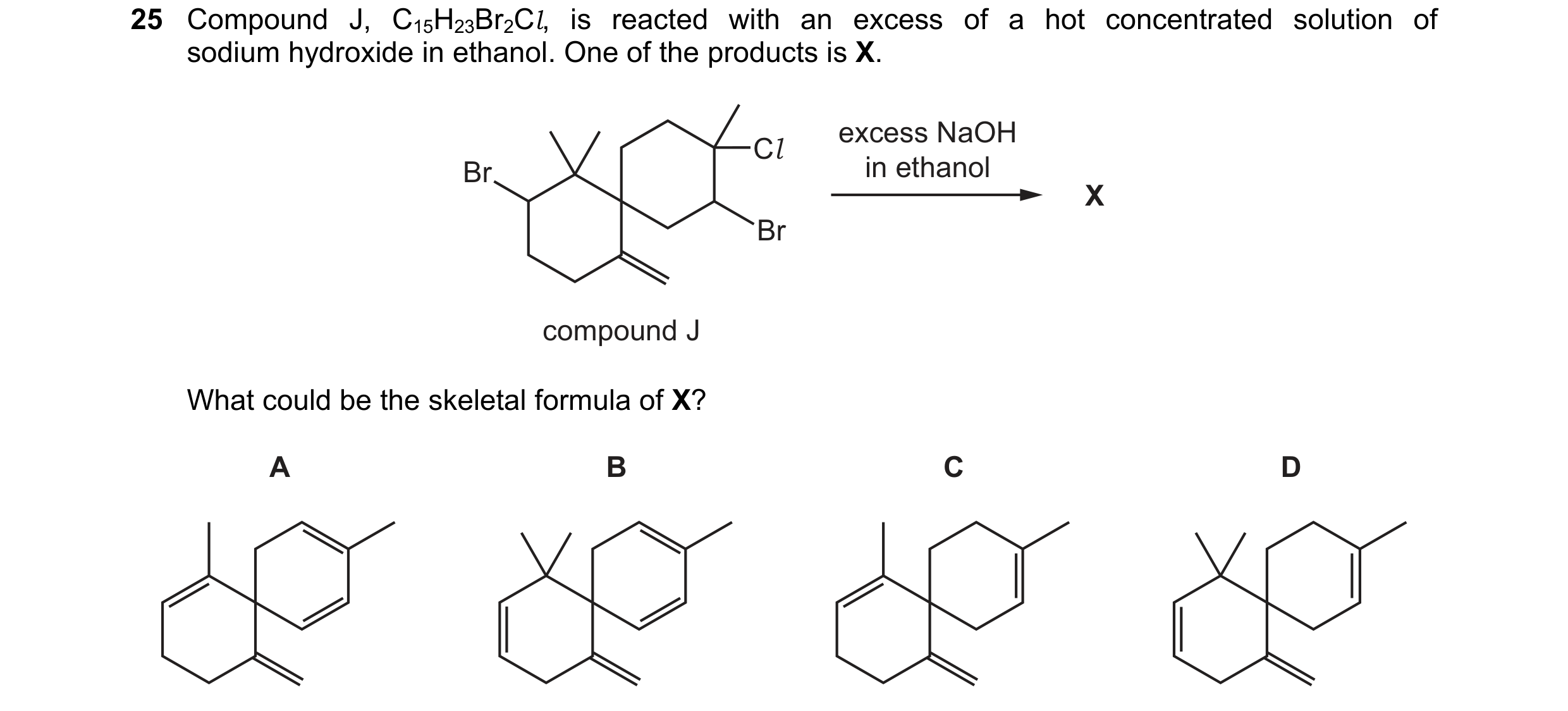
 37 / 66

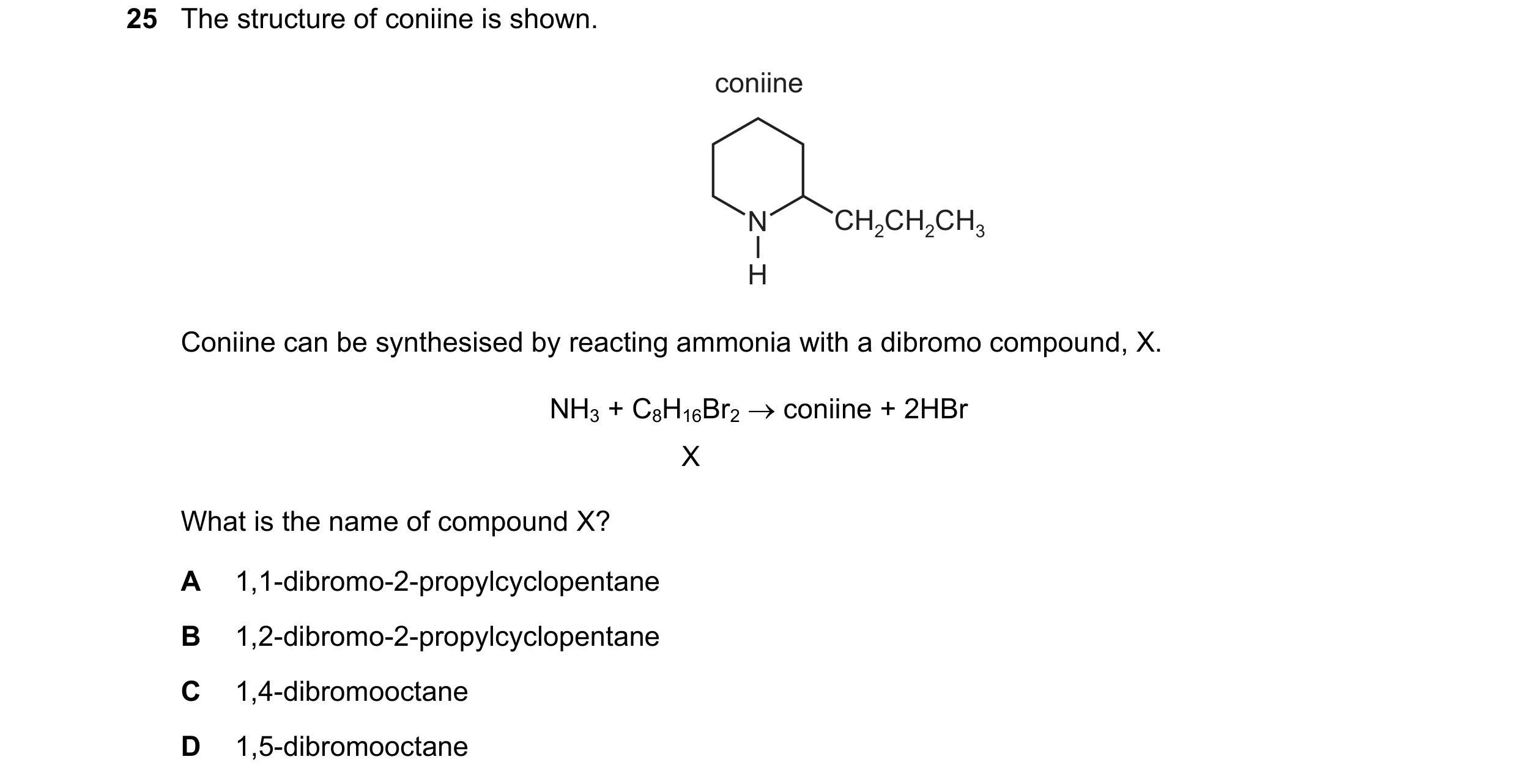 38 / 66

 39 / 66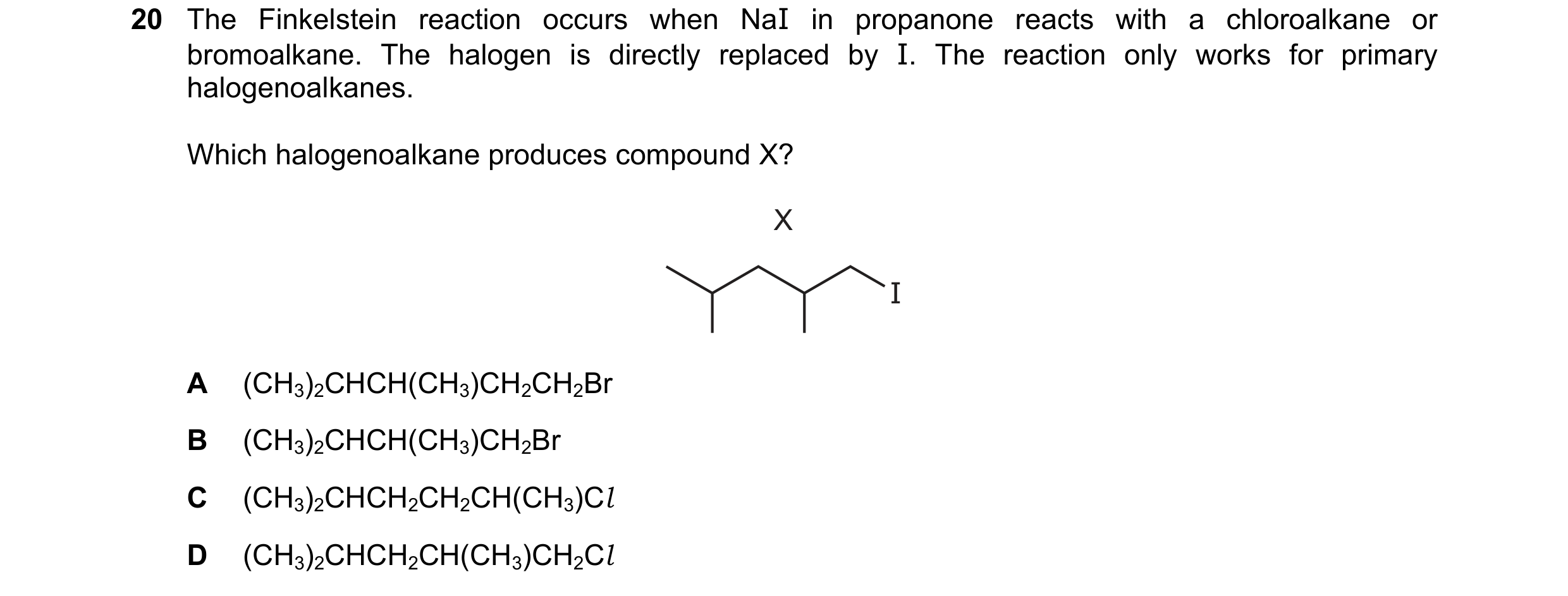
 40 / 66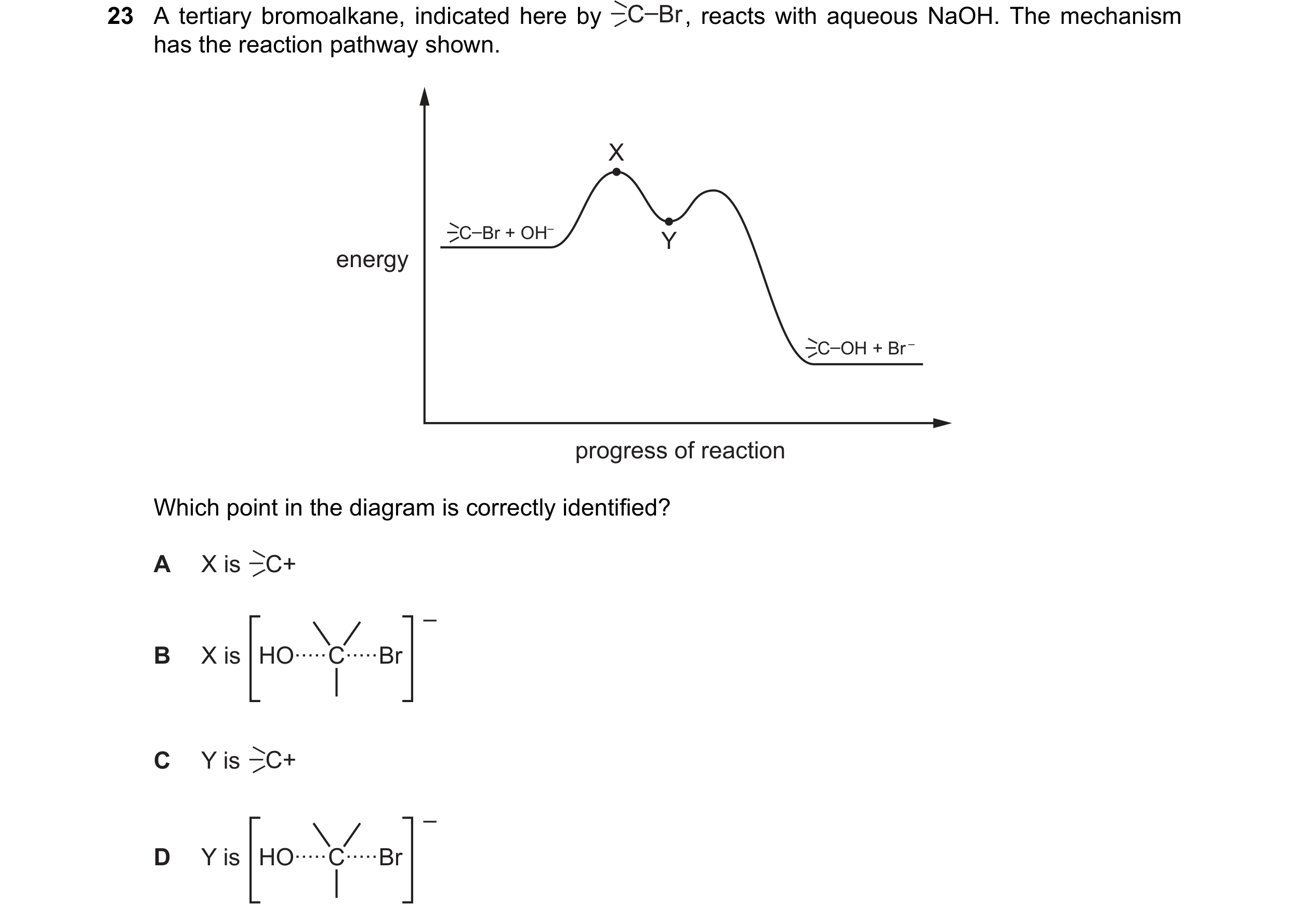
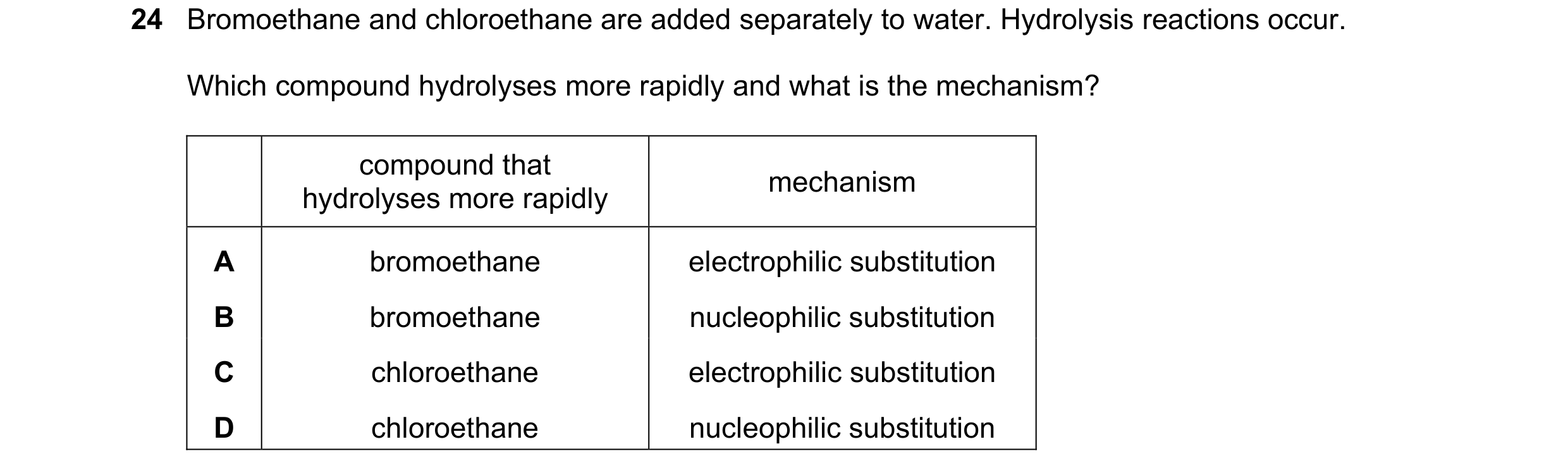 41 / 66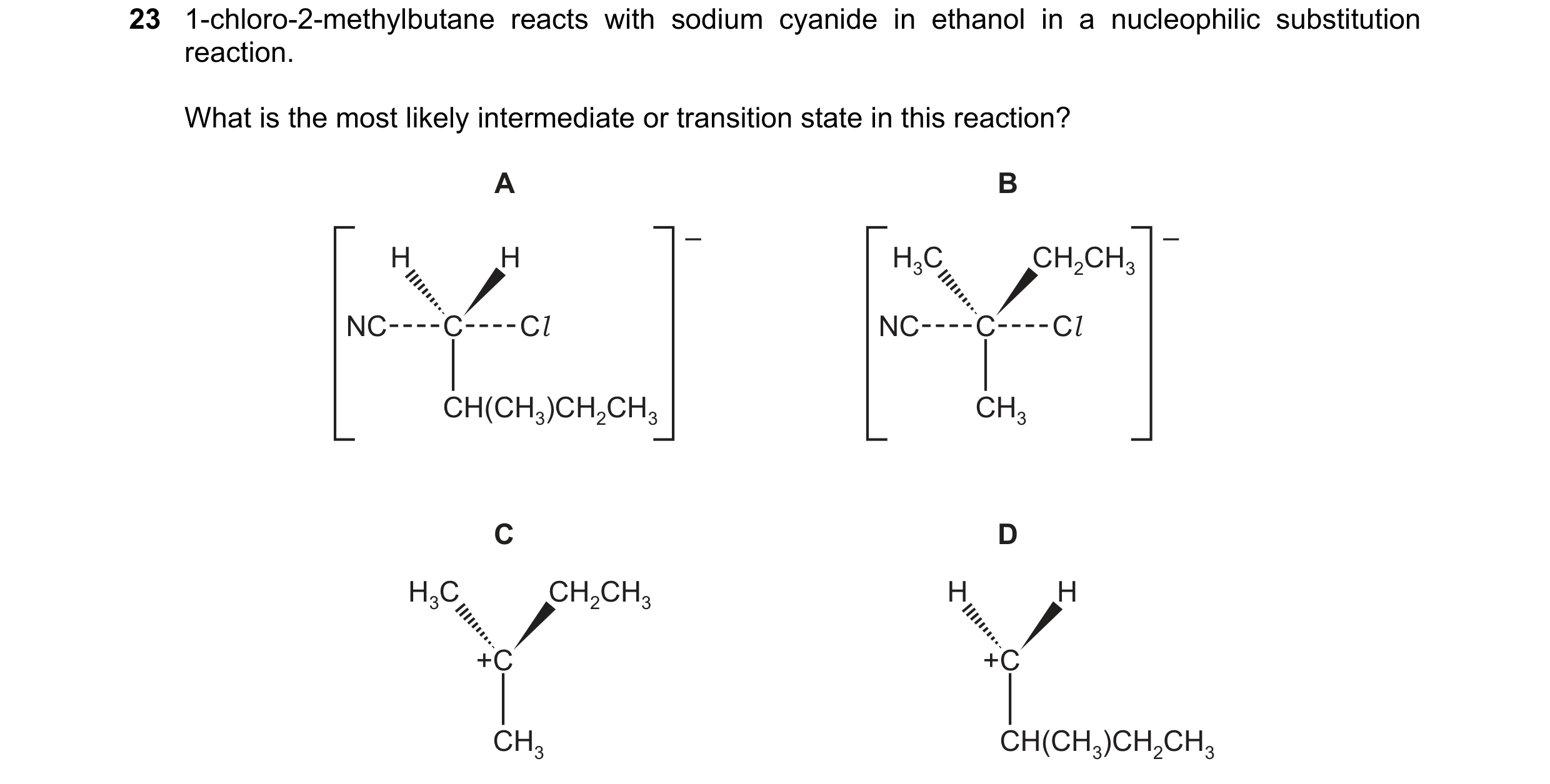
 42 / 66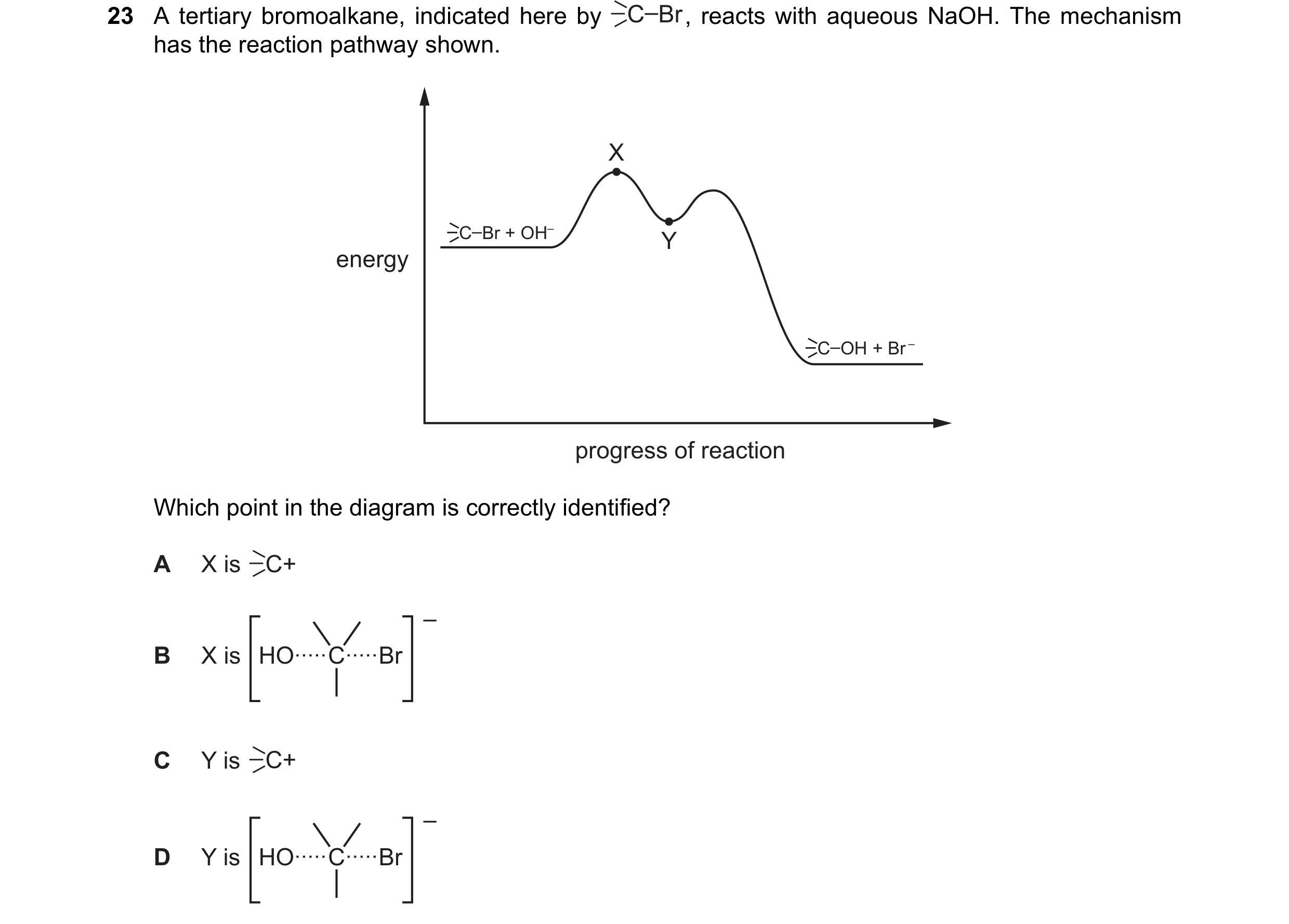
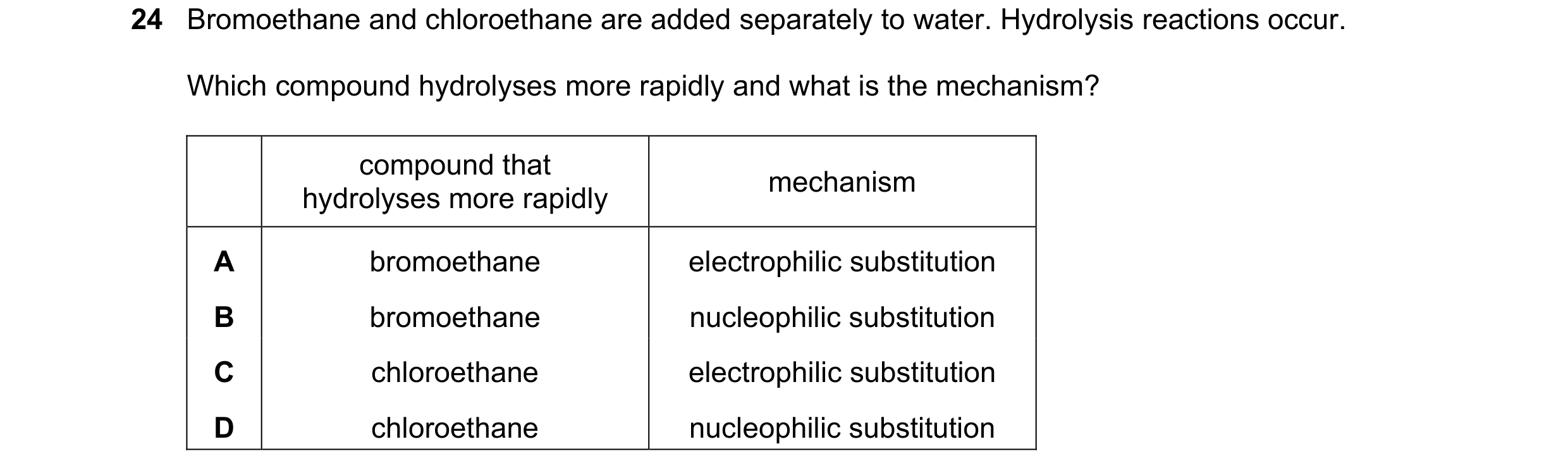
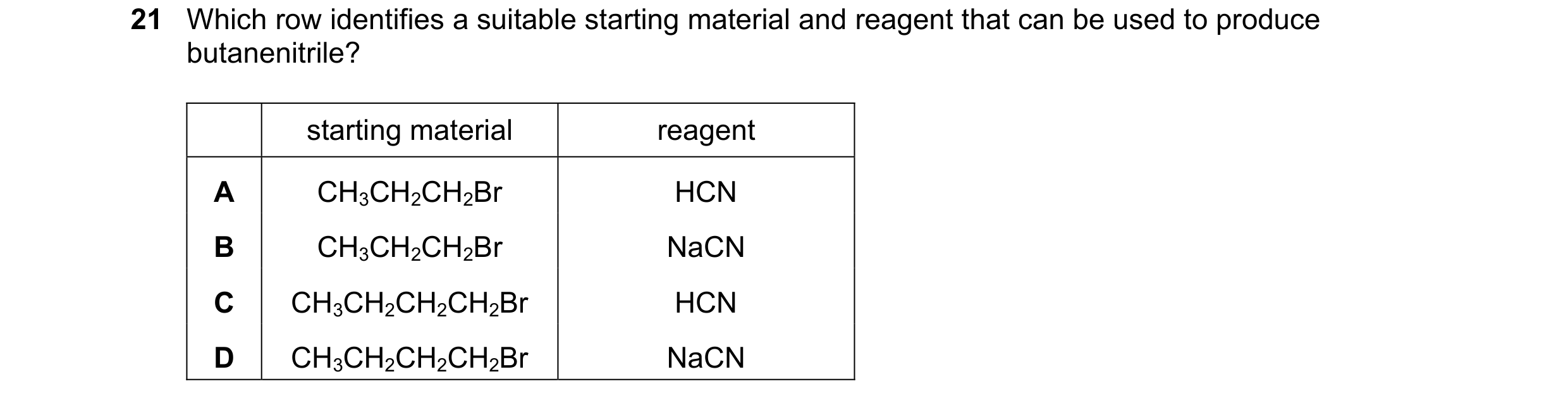 43 / 66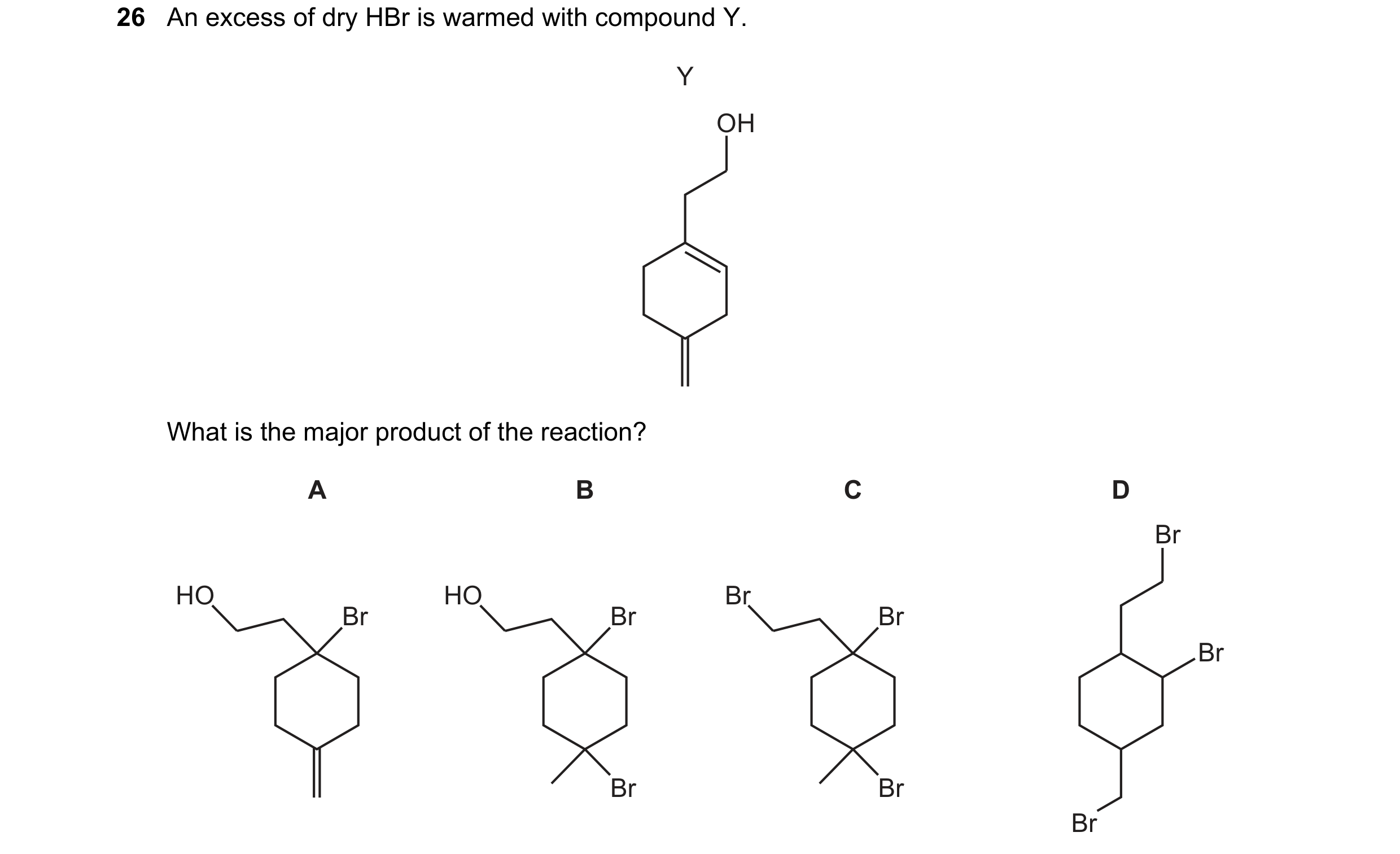
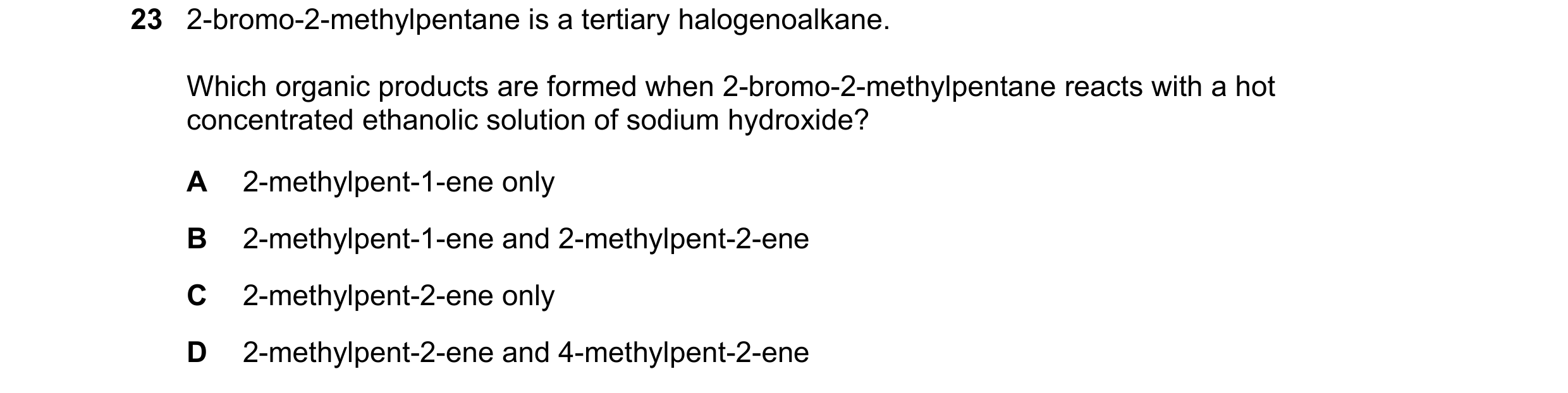
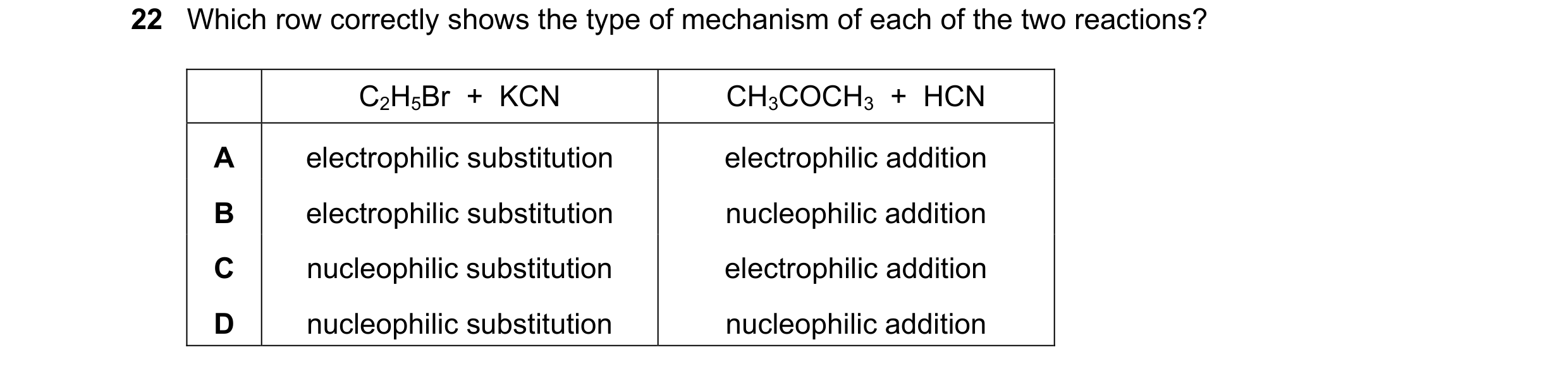 44 / 66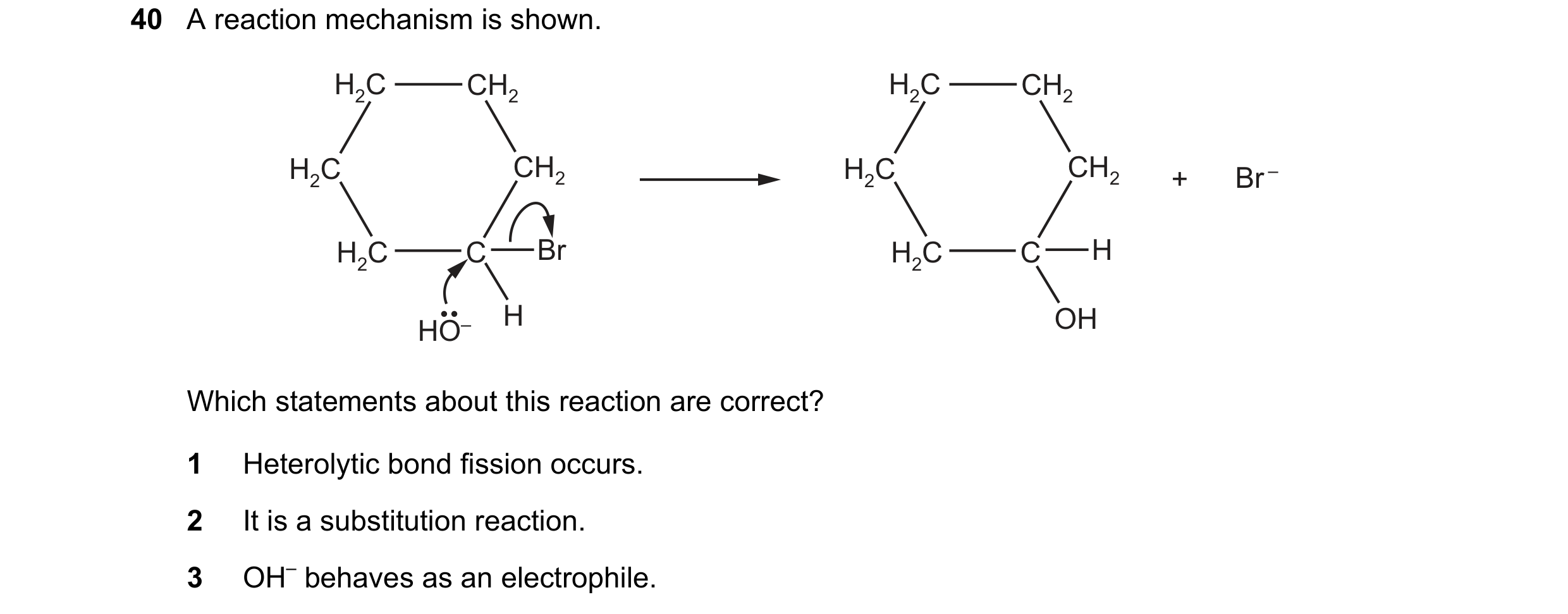
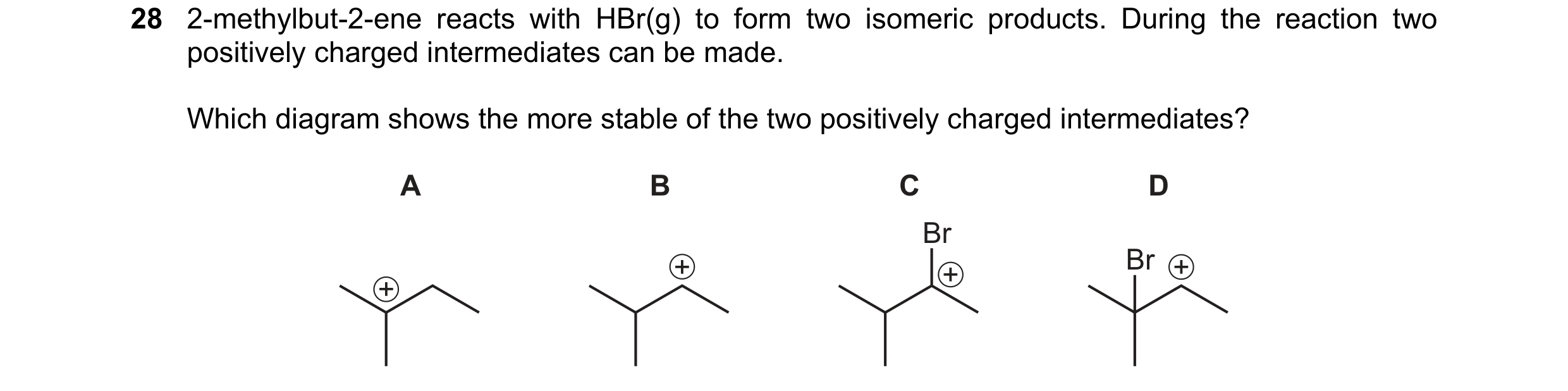
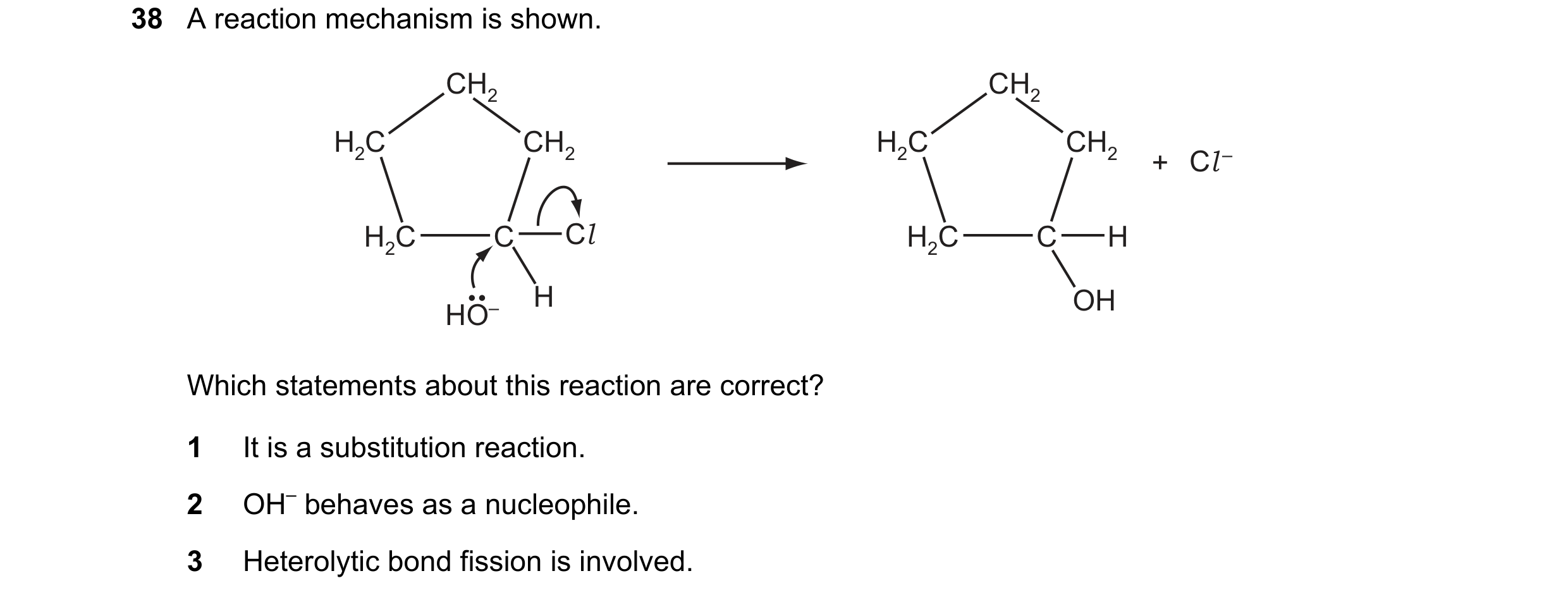 45 / 66
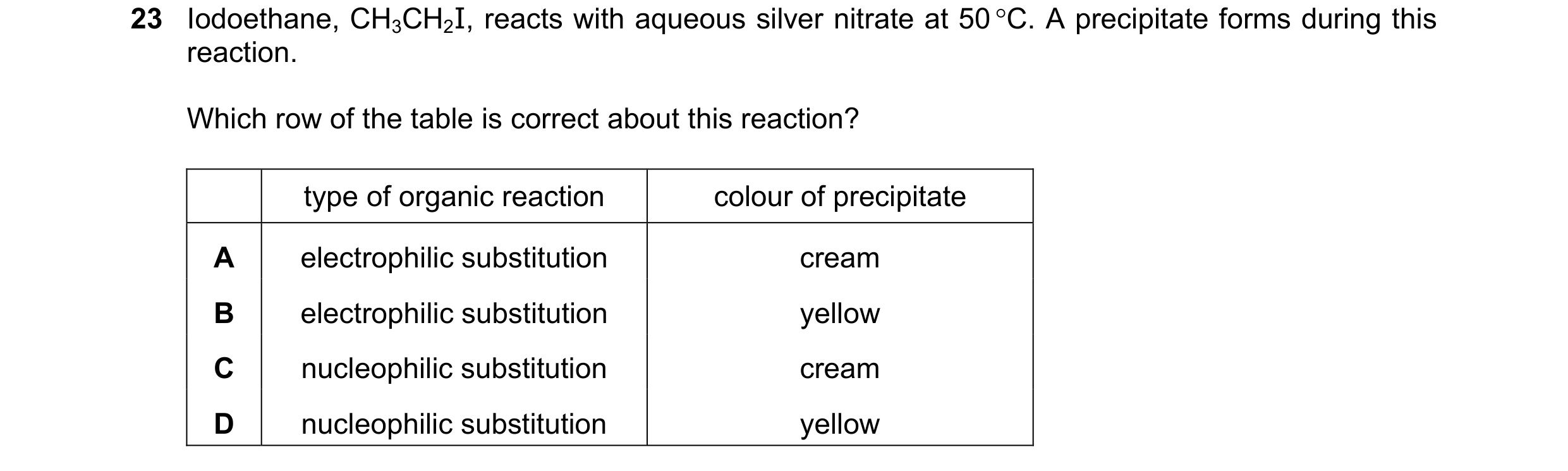
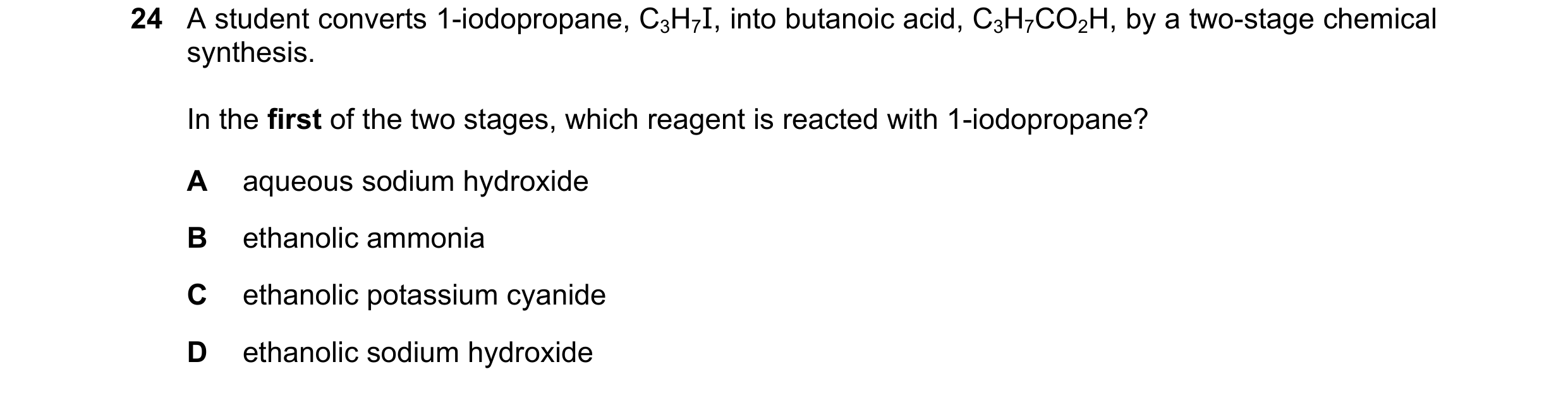
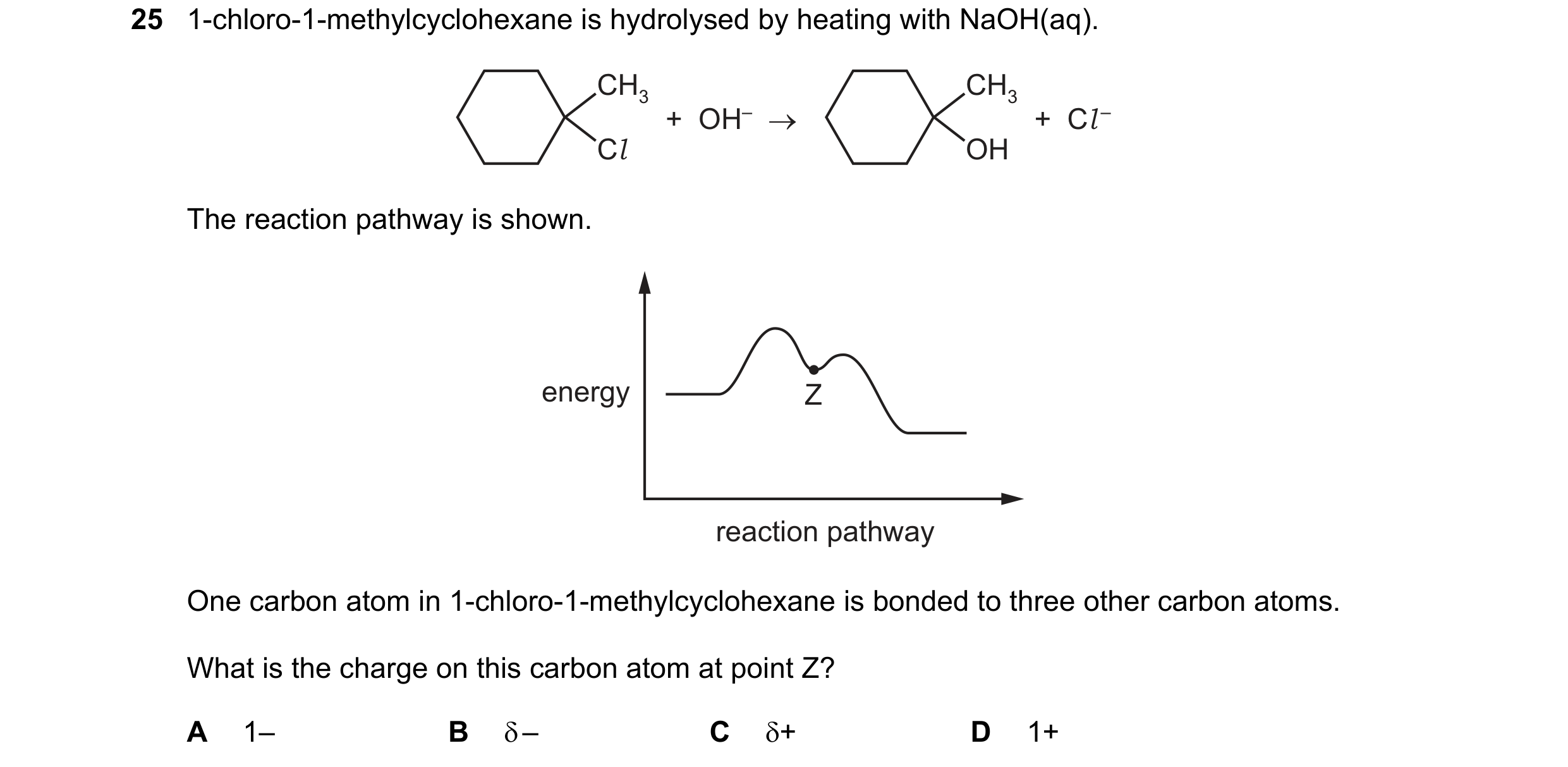 46 / 66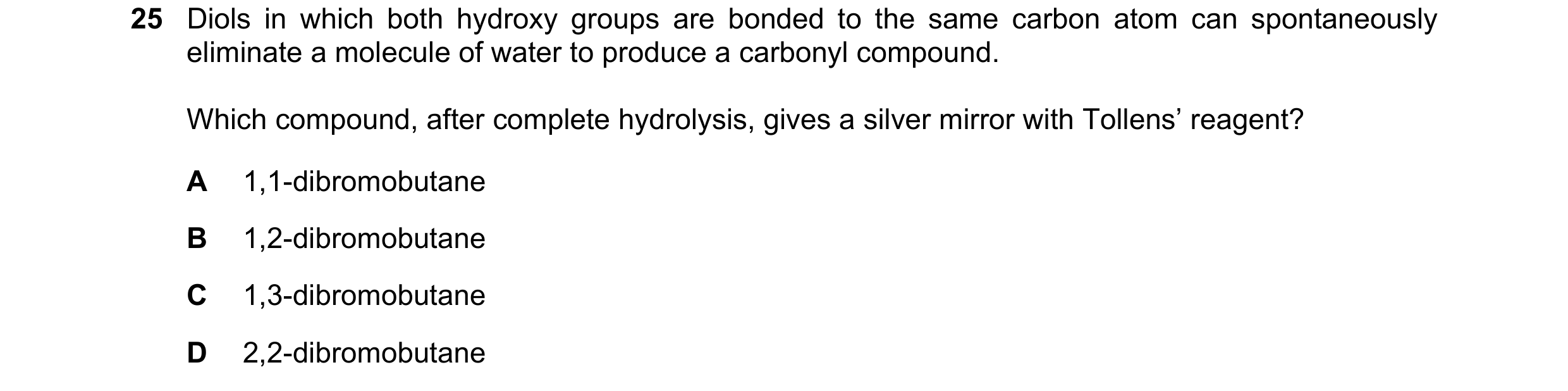

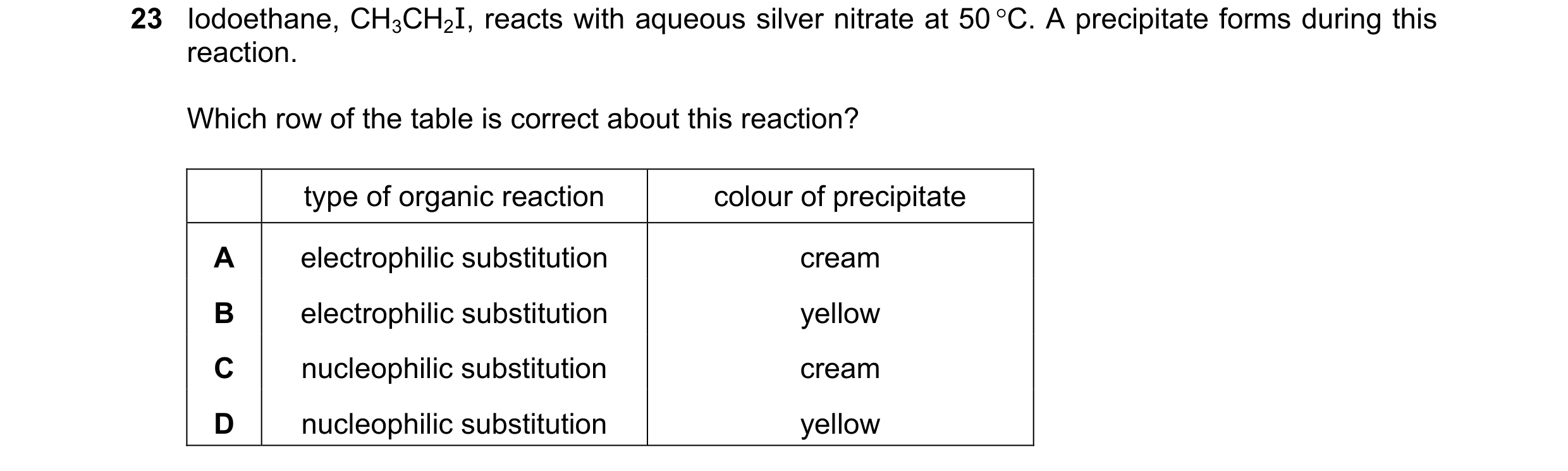
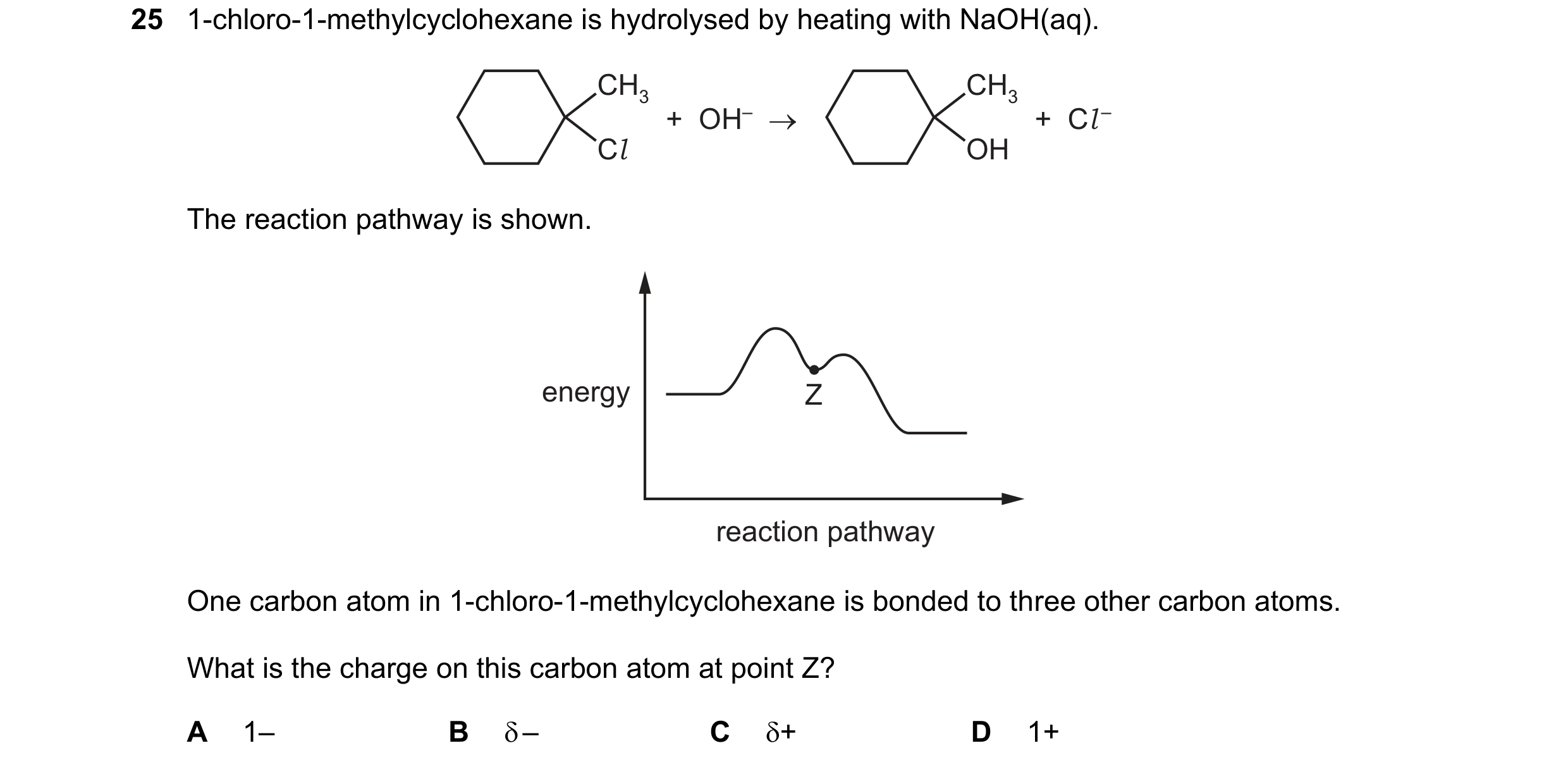 47 / 66

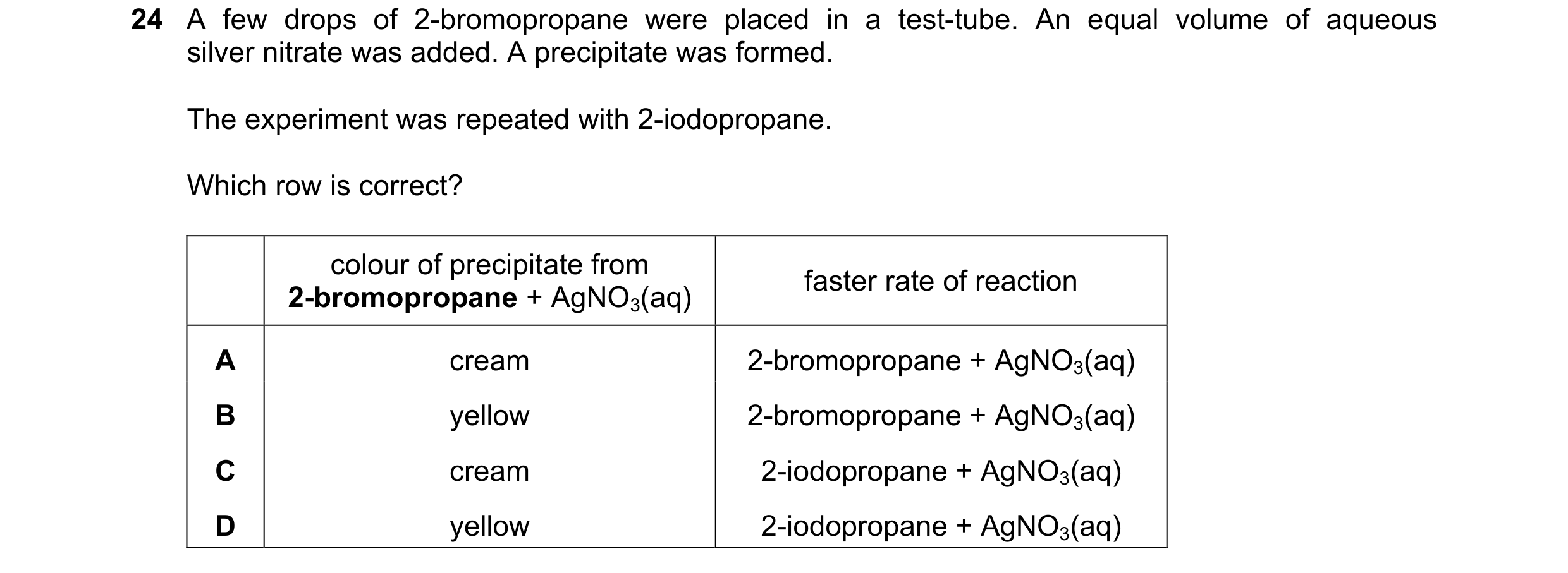 48 / 66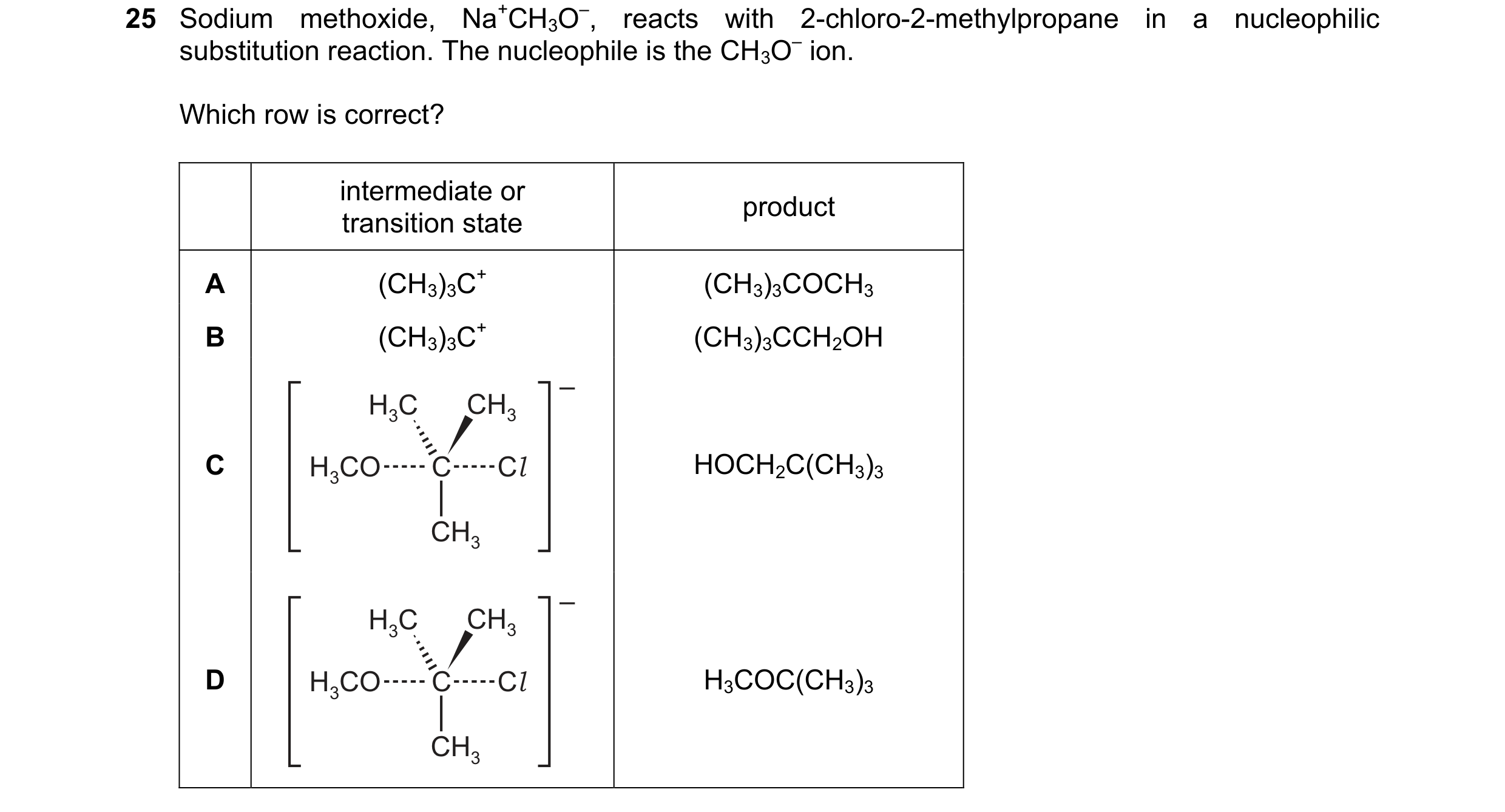
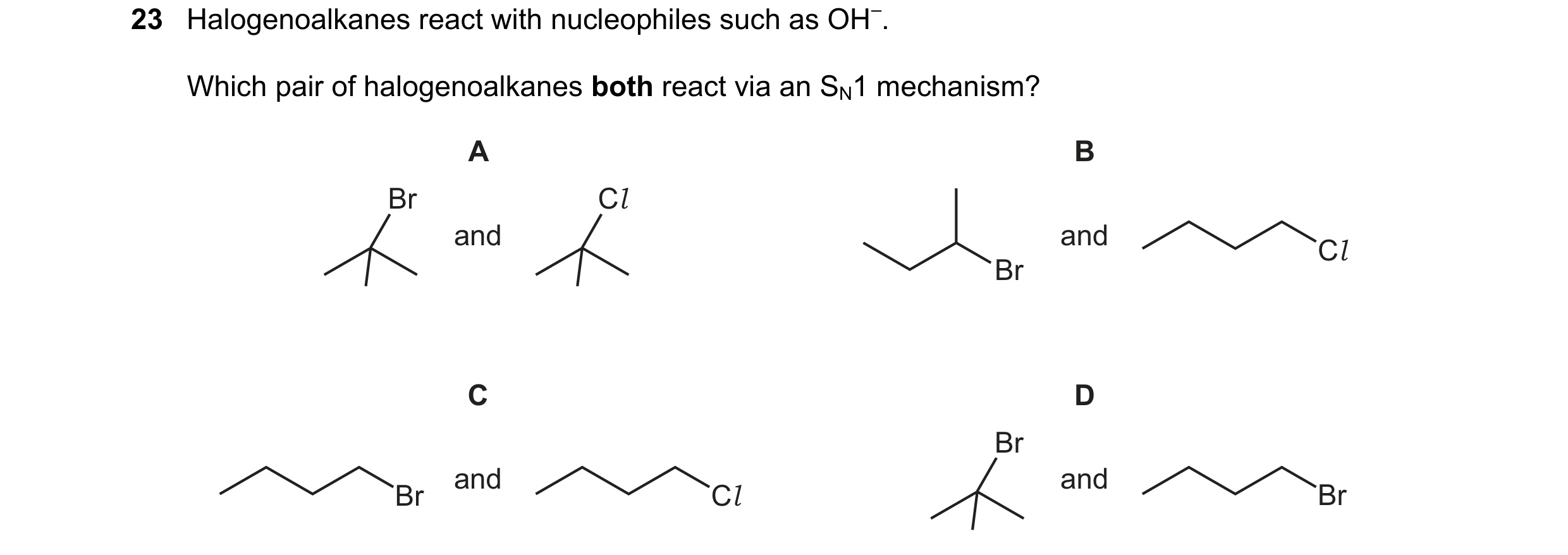
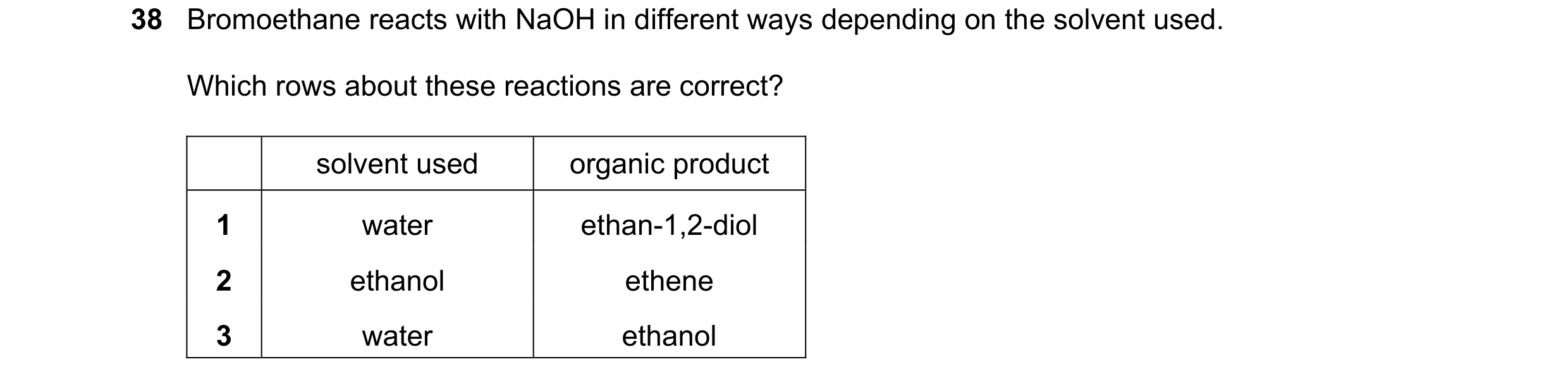 49 / 66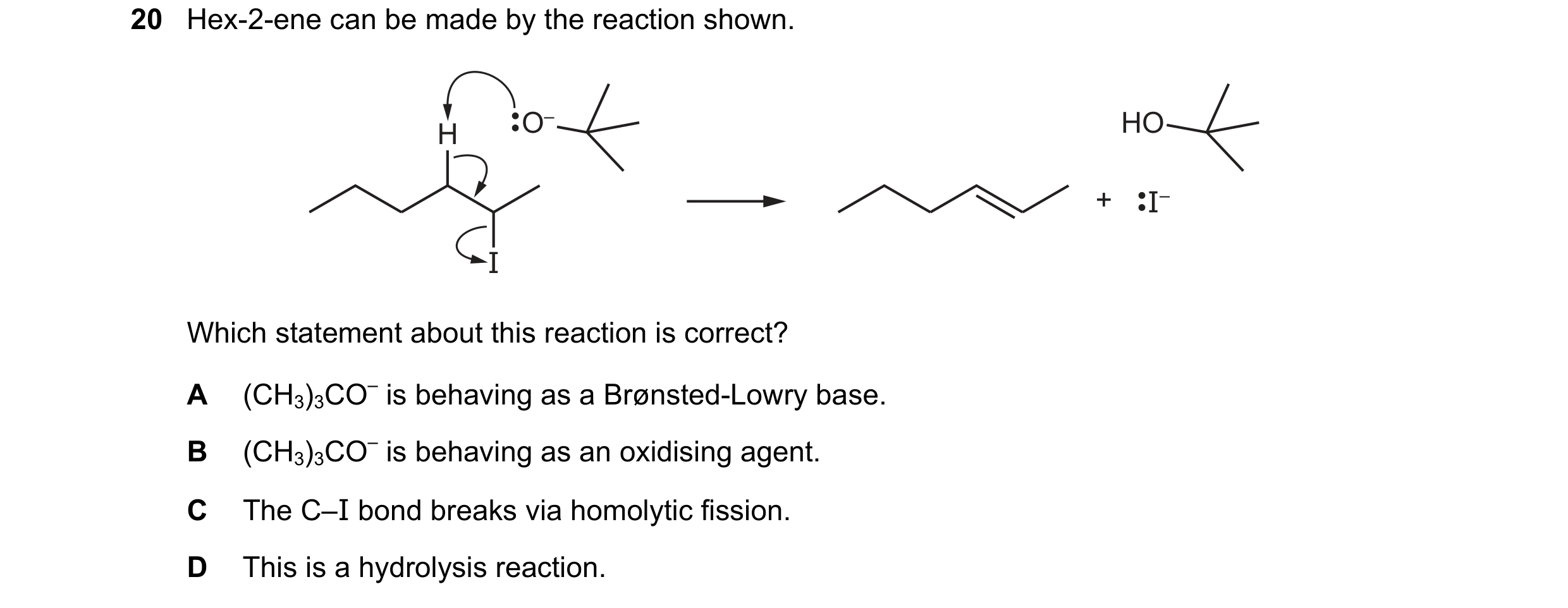
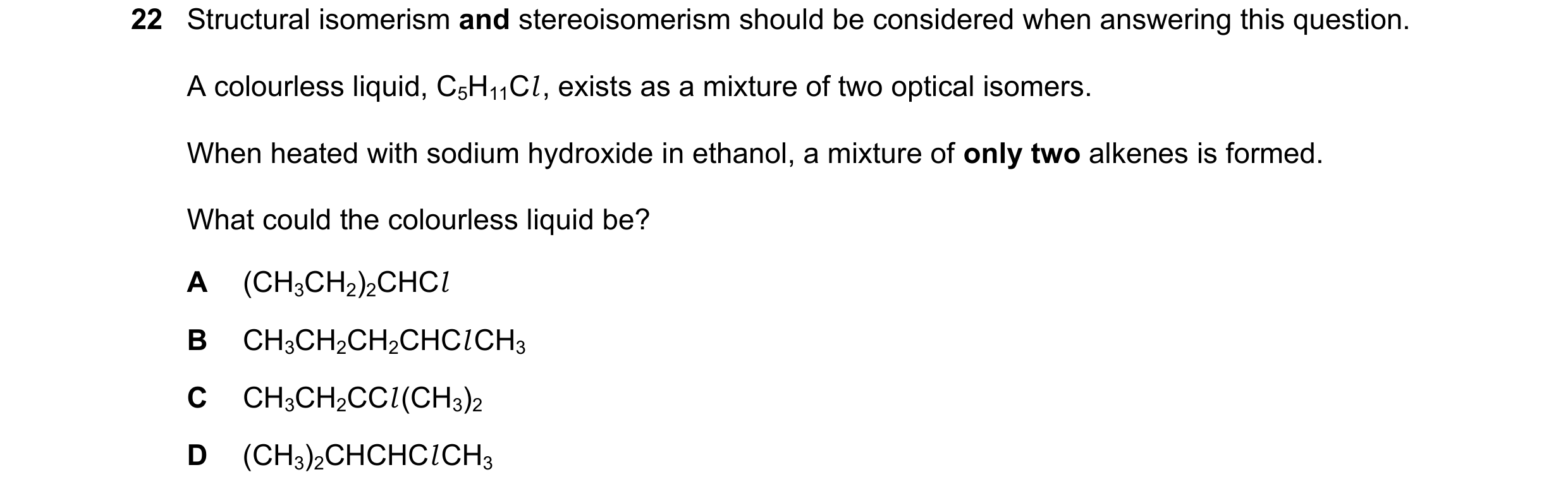
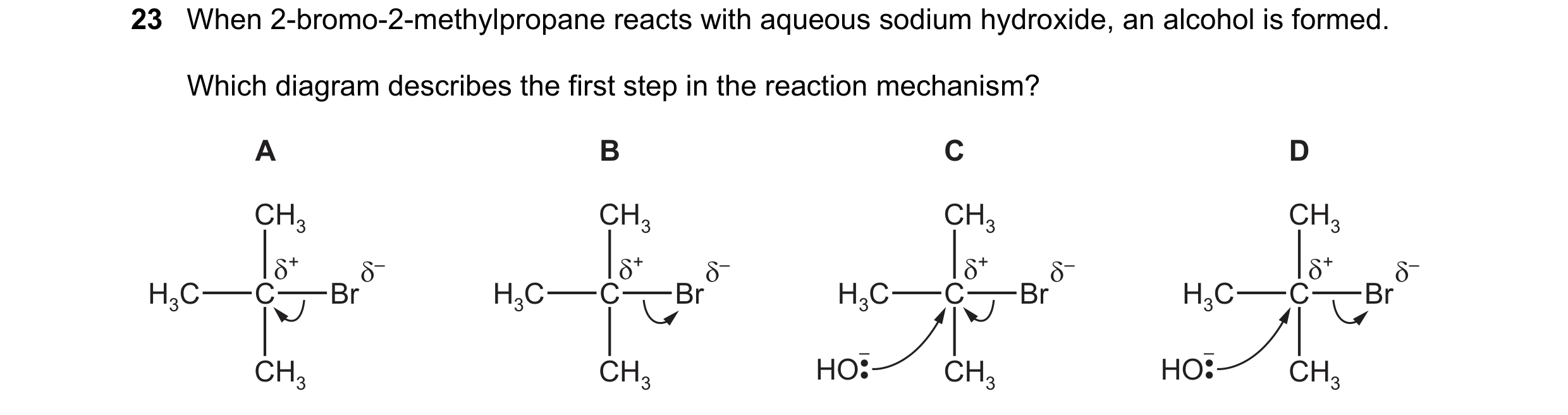
 50 / 66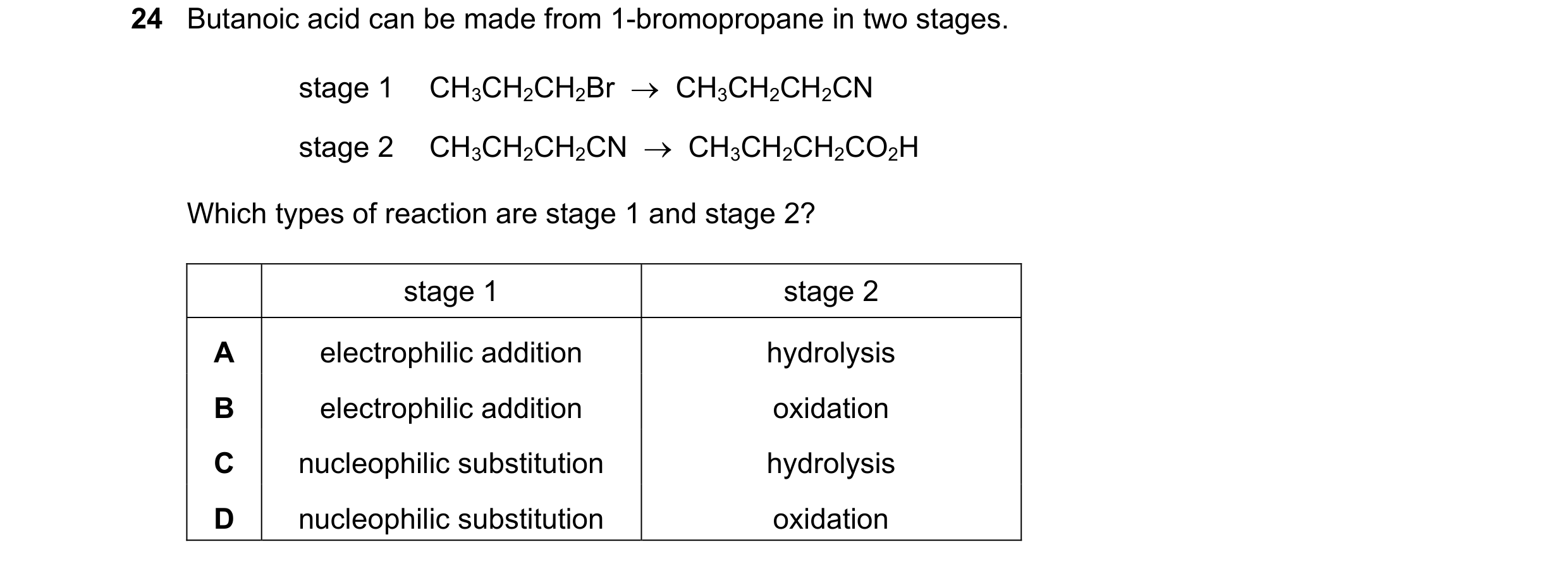
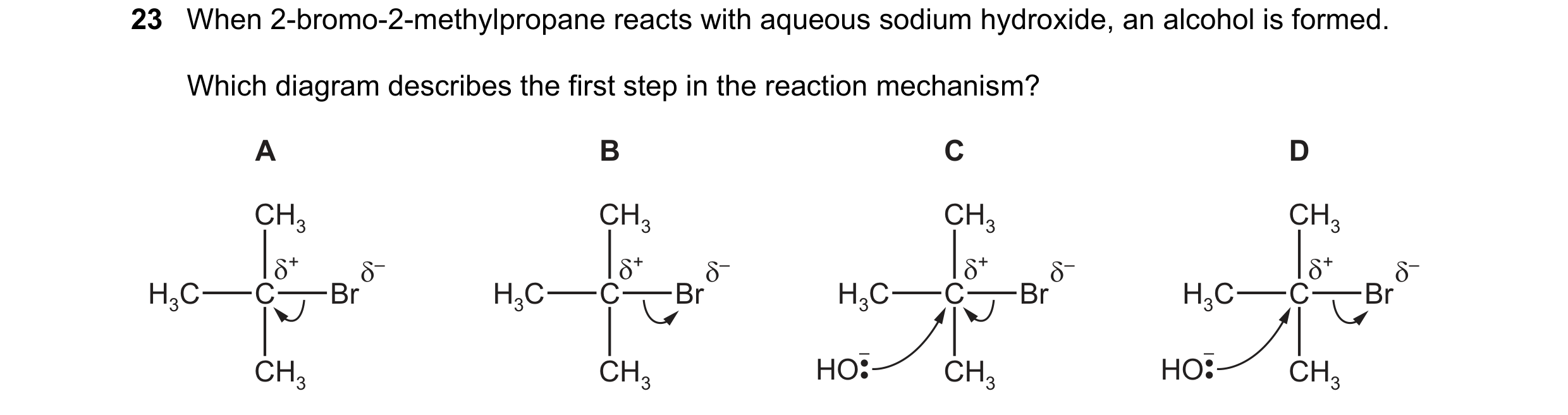 51 / 66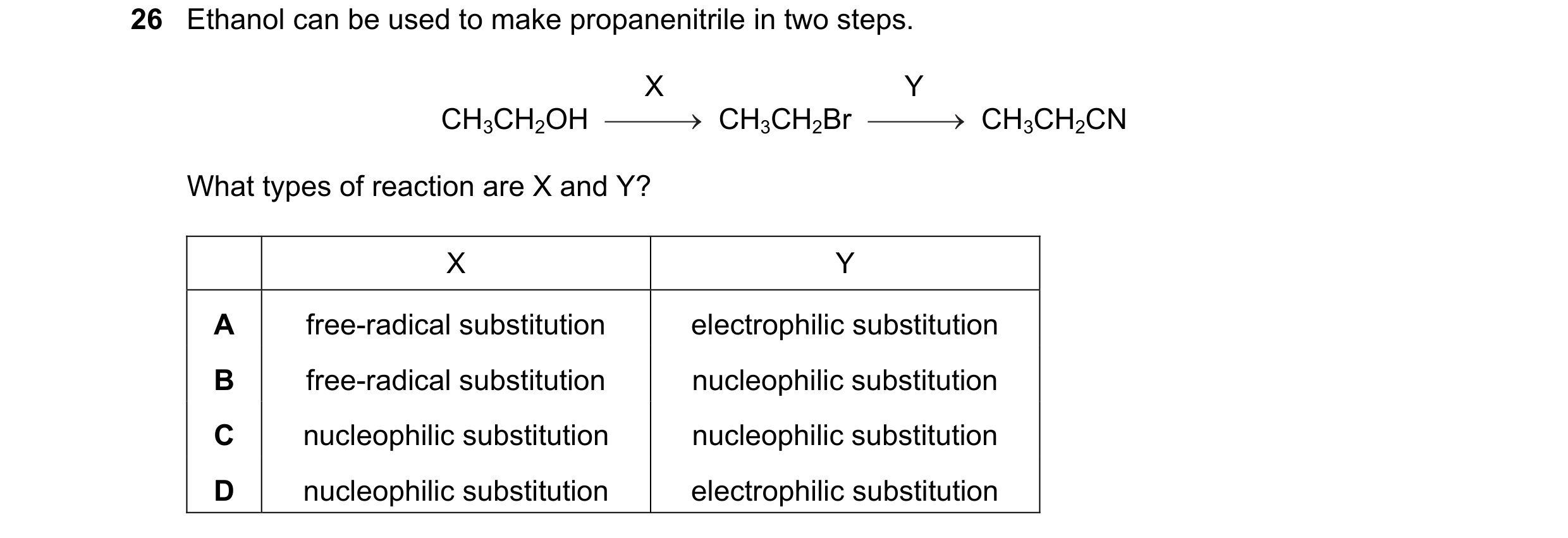

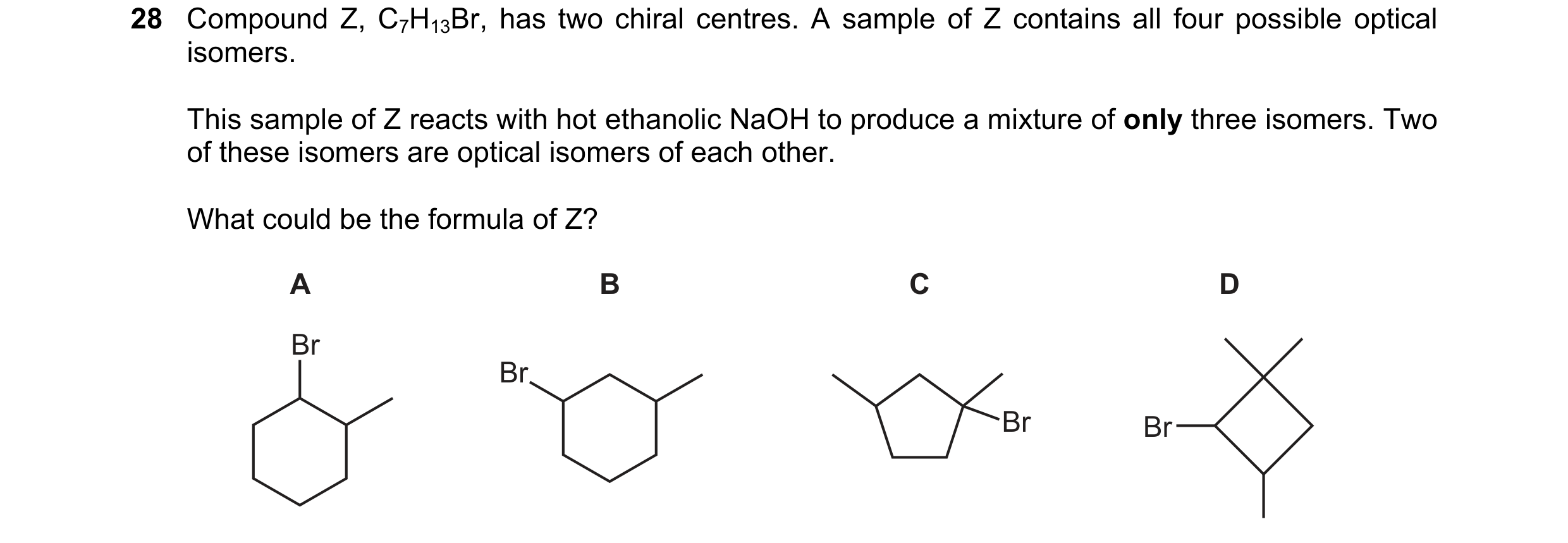
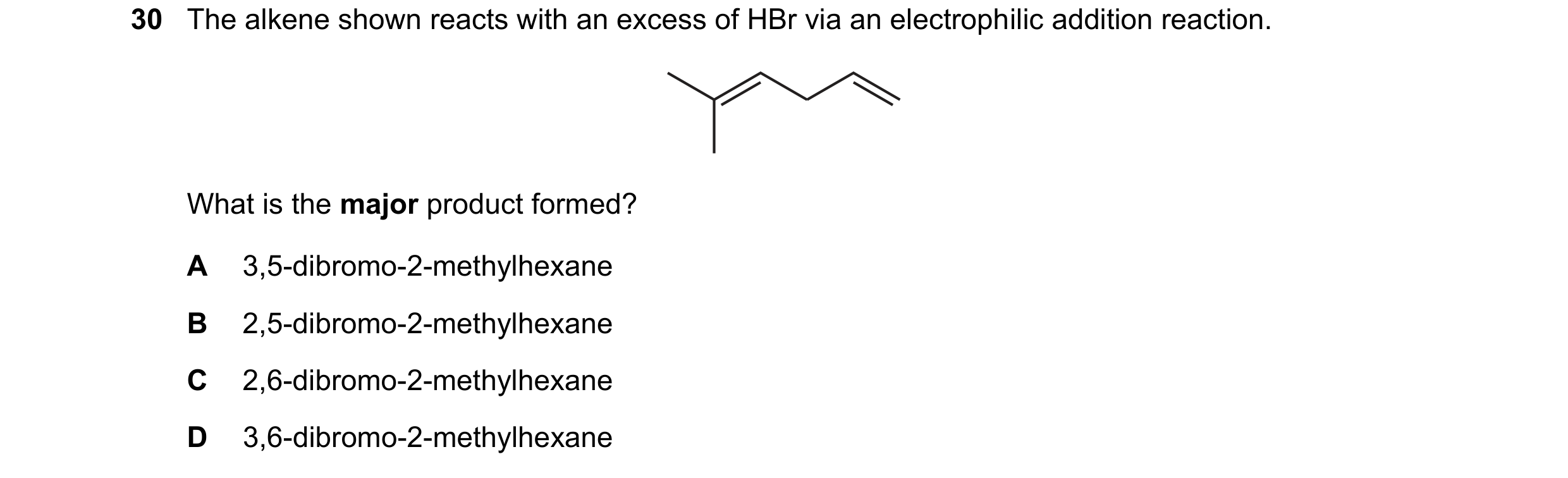 52 / 66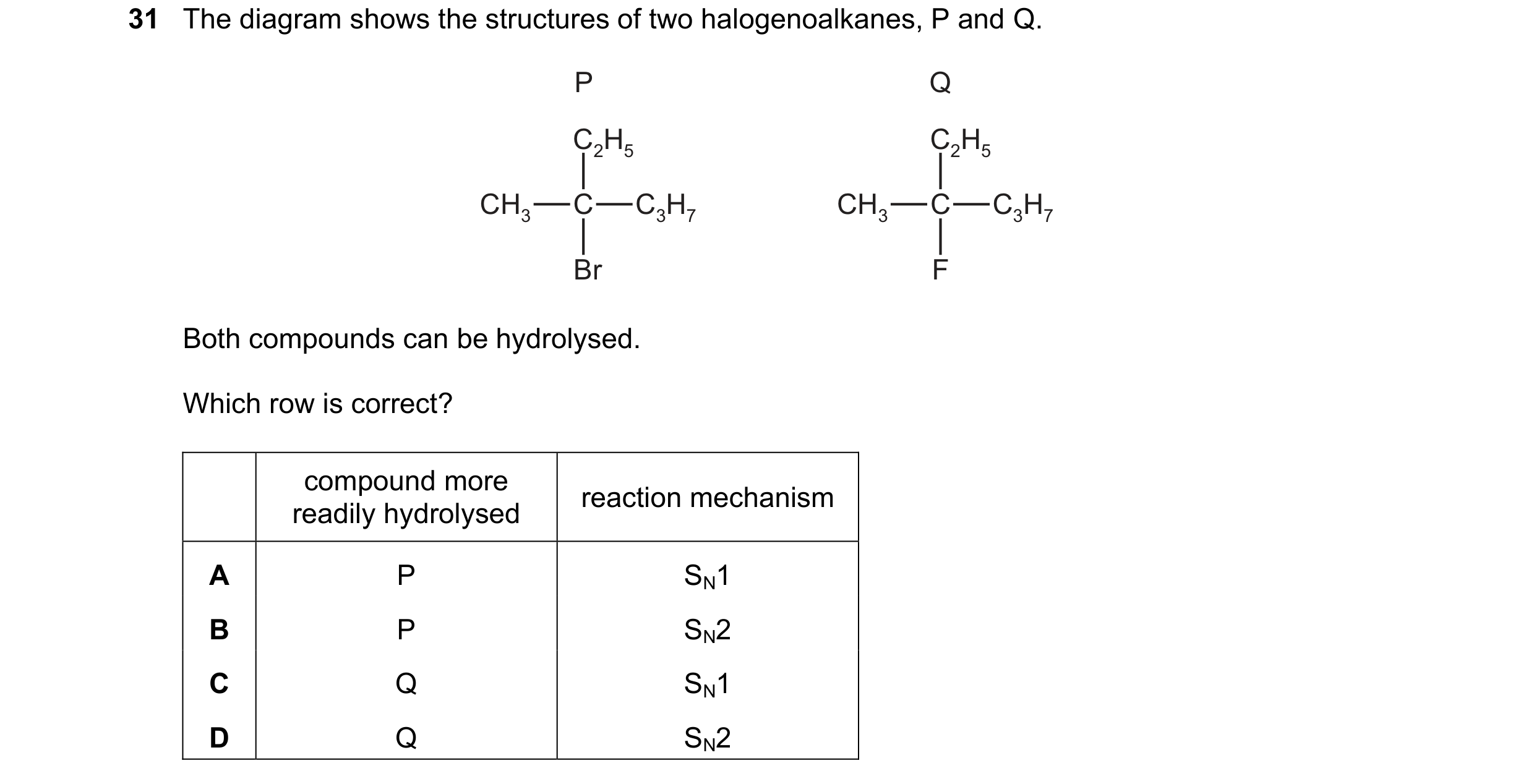
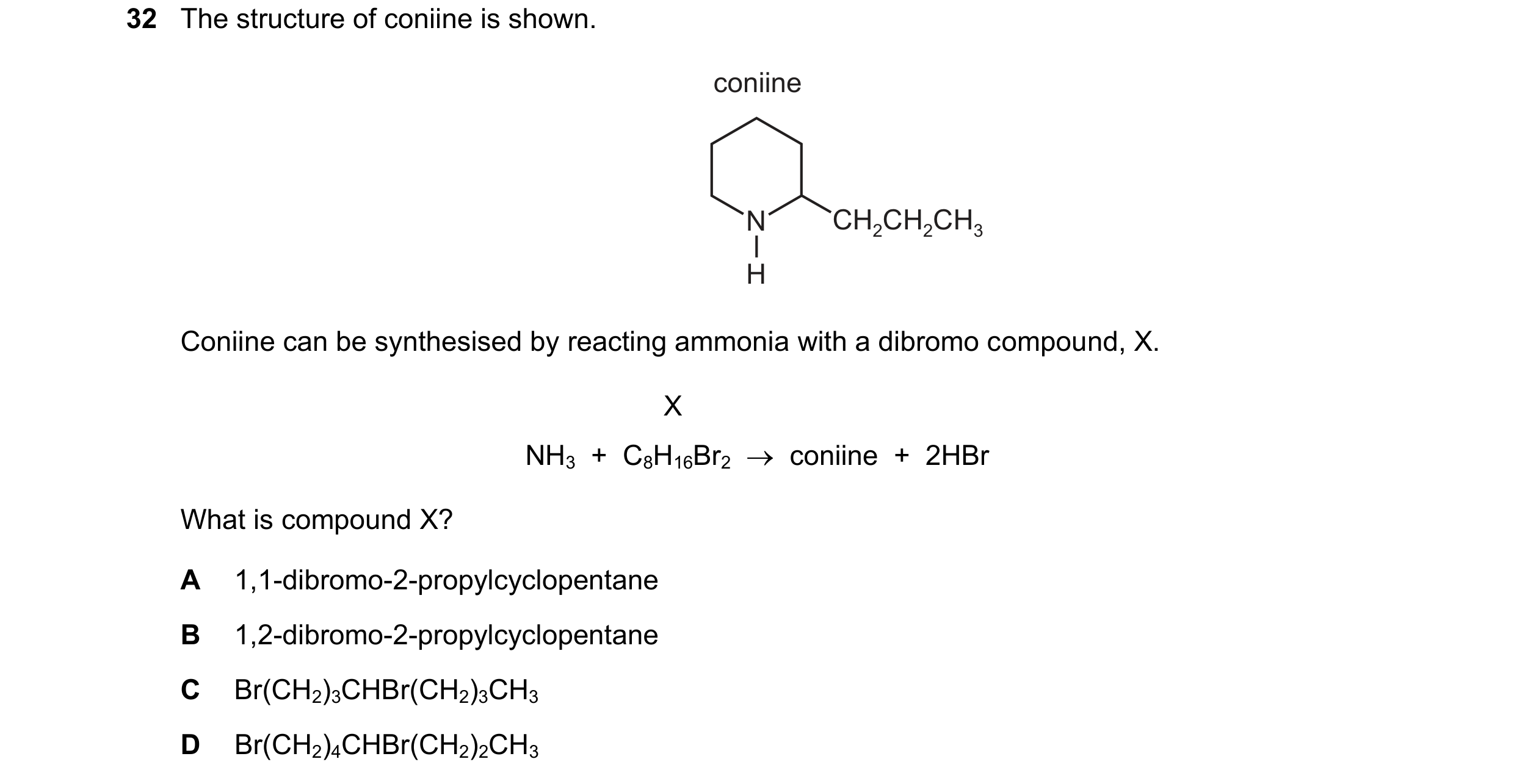
 53 / 66
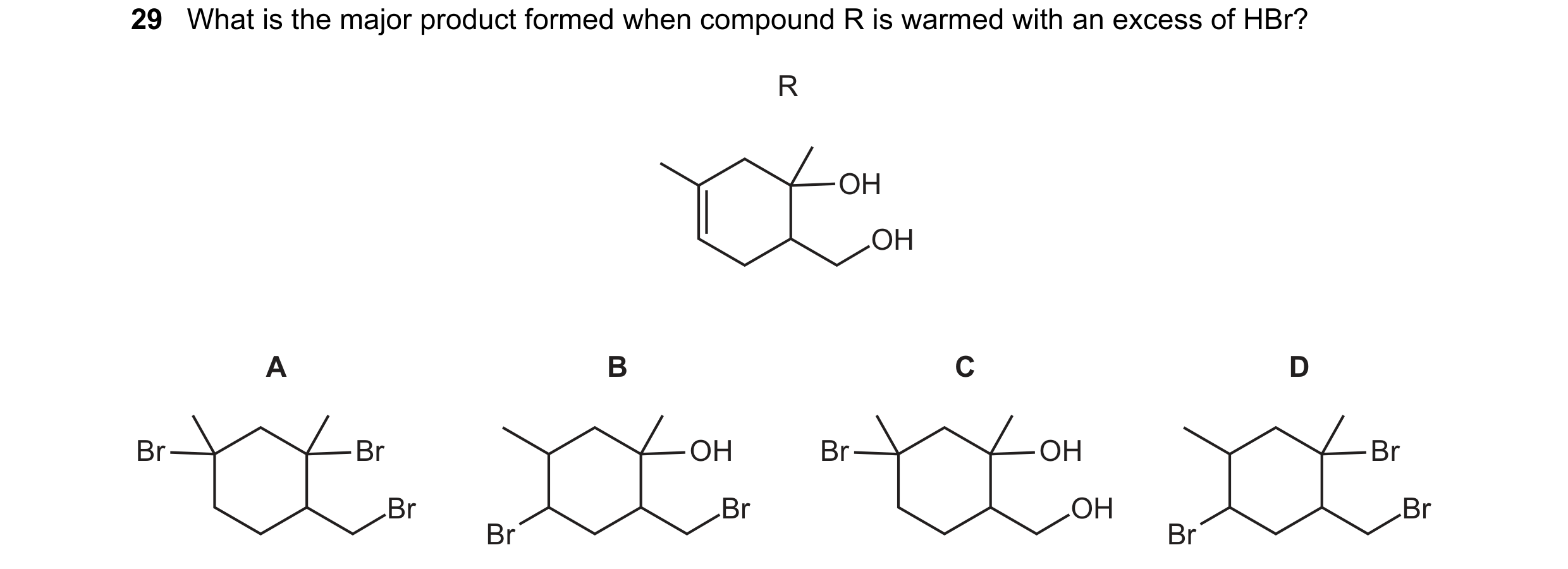

 54 / 66
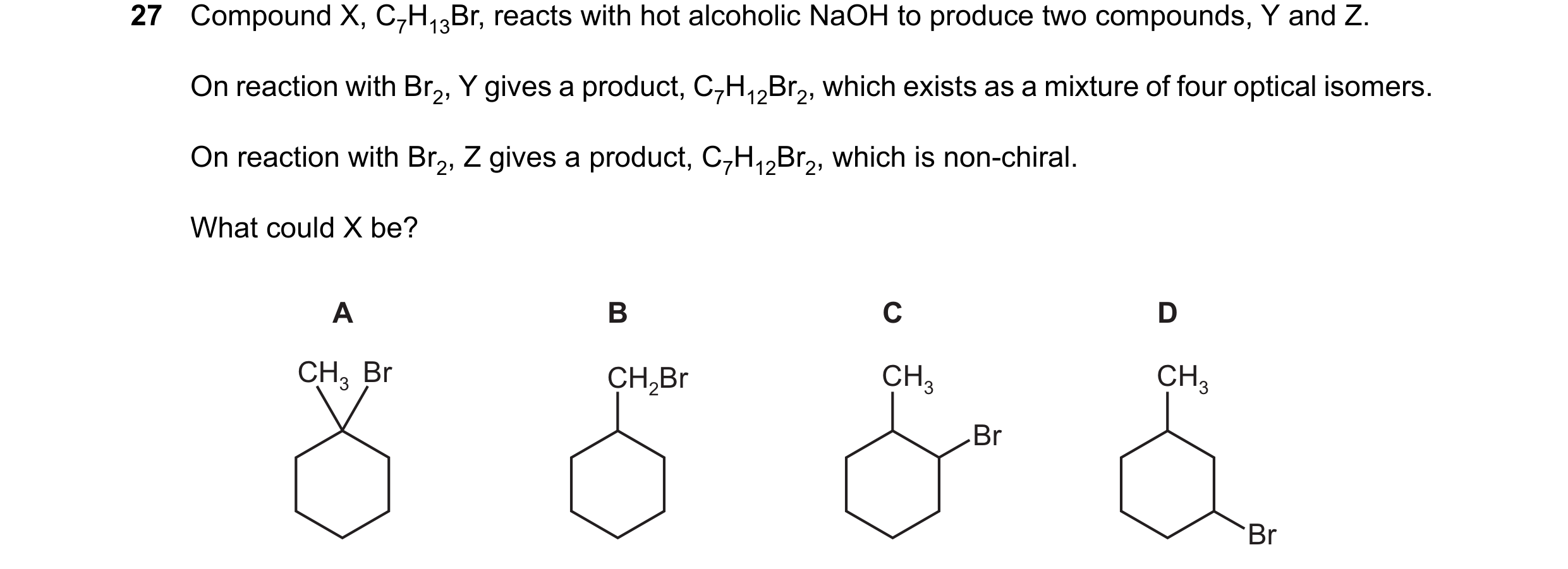

 55 / 66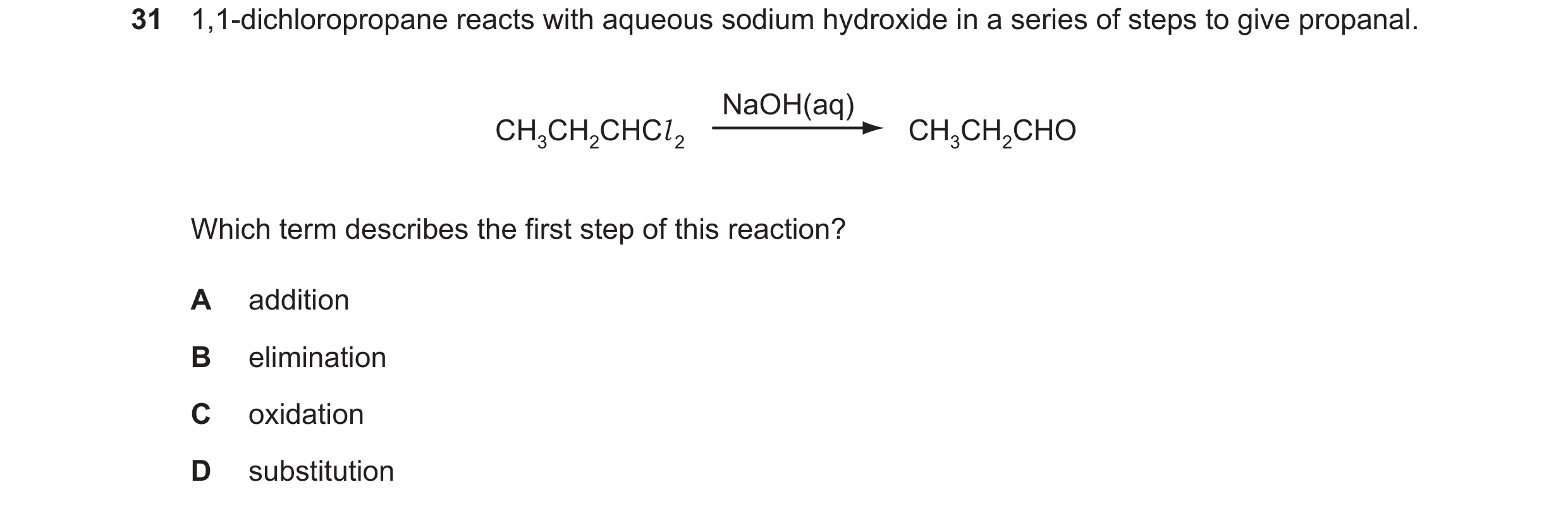
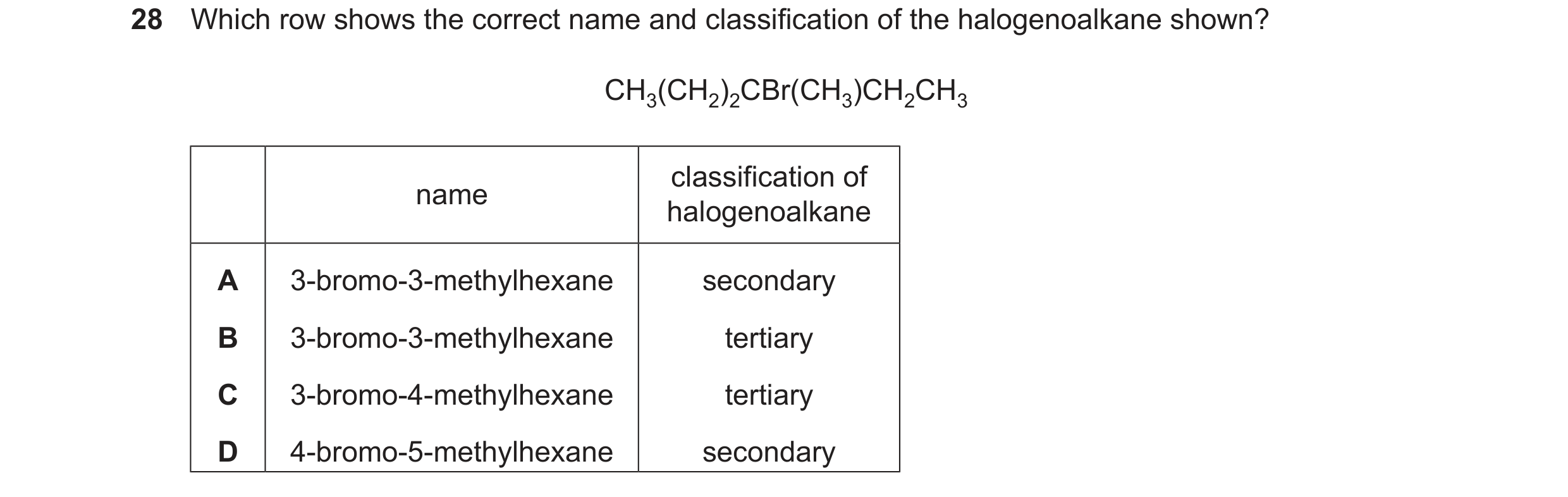
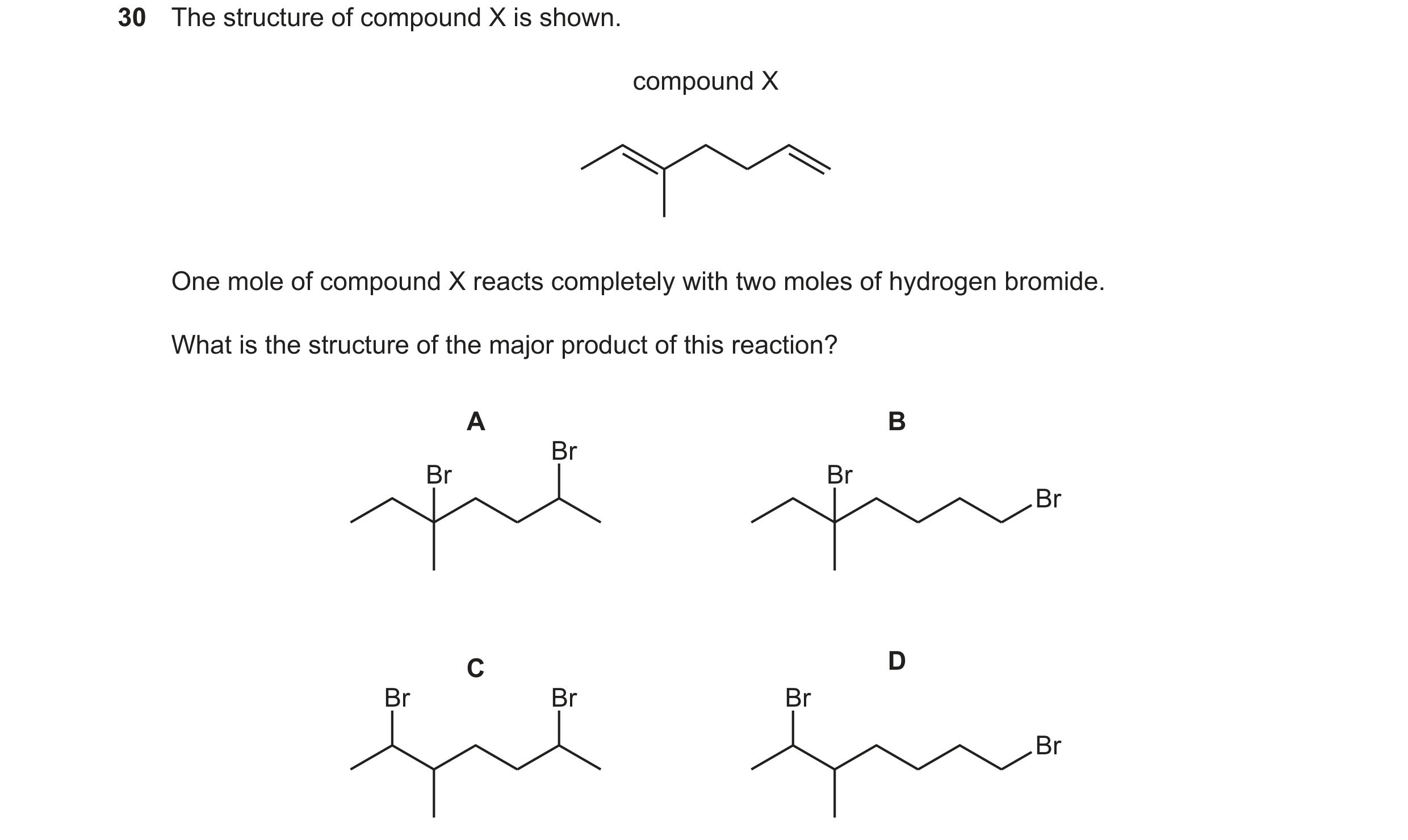 56 / 66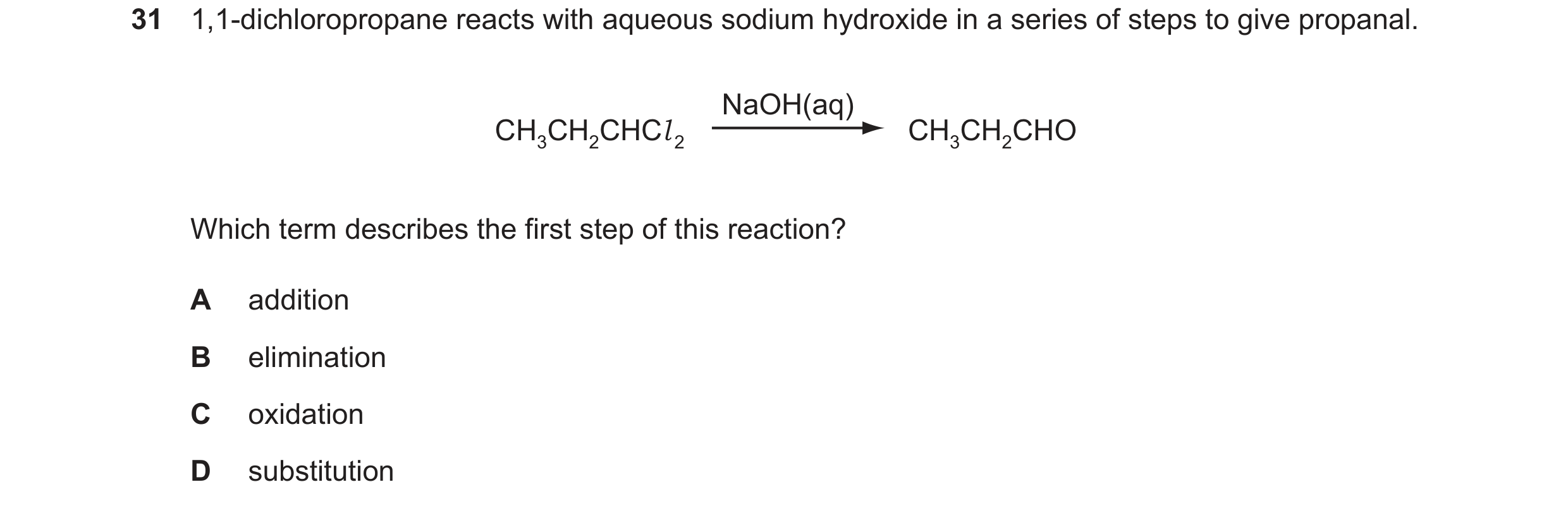
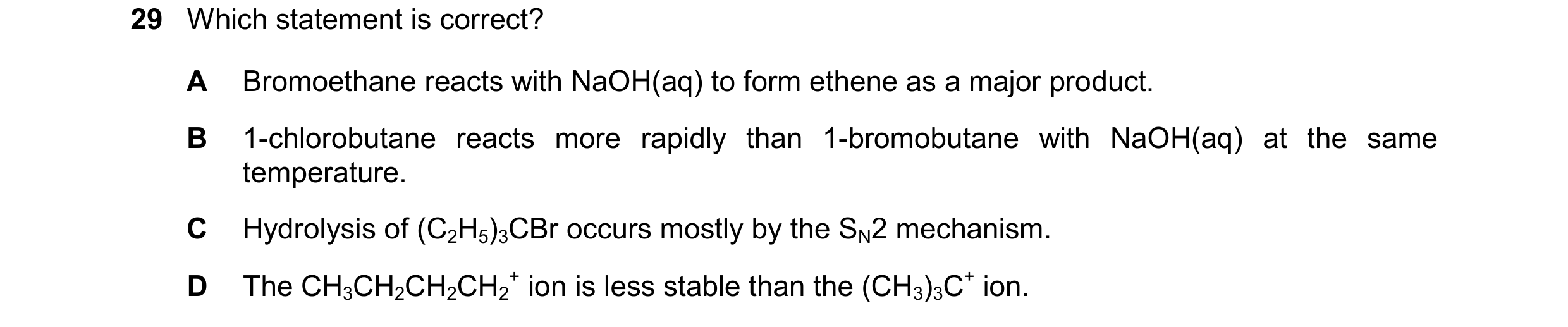
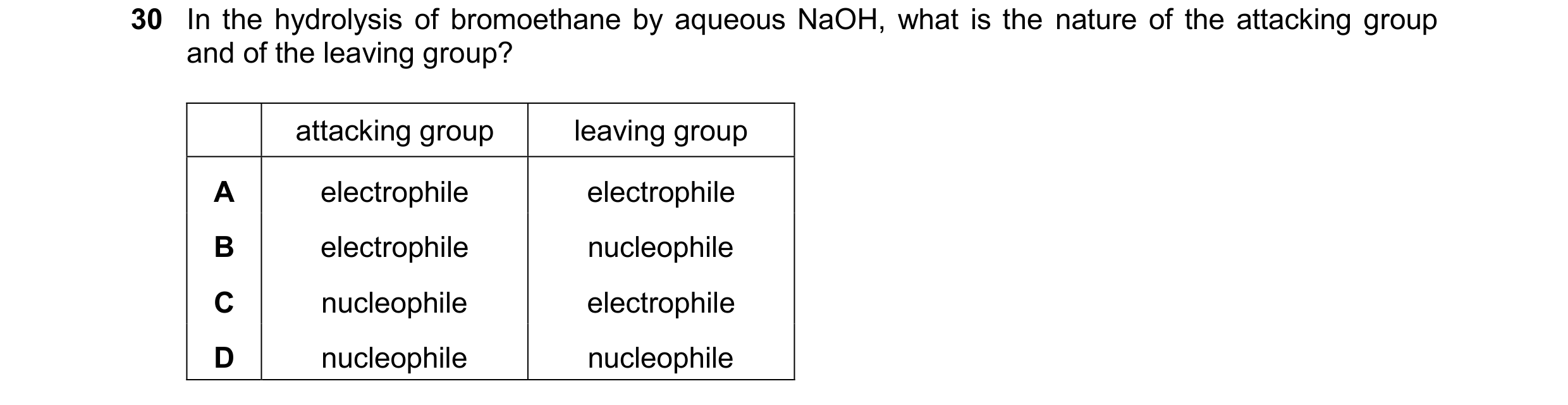

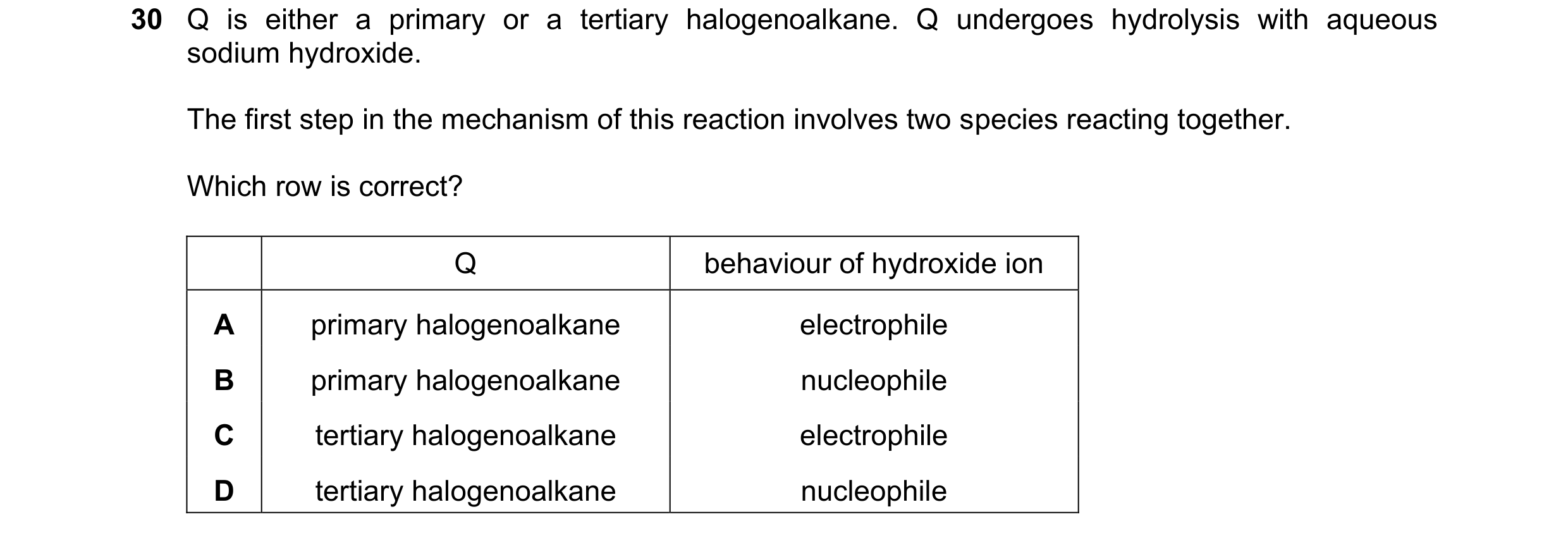 57 / 66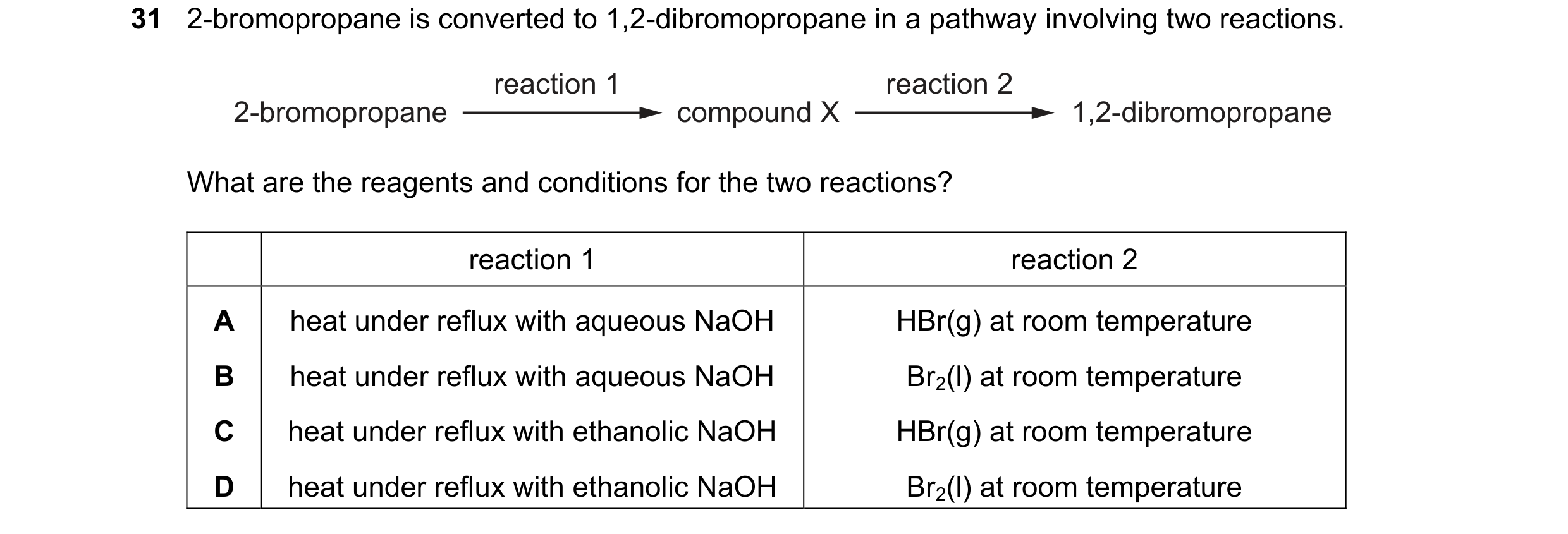

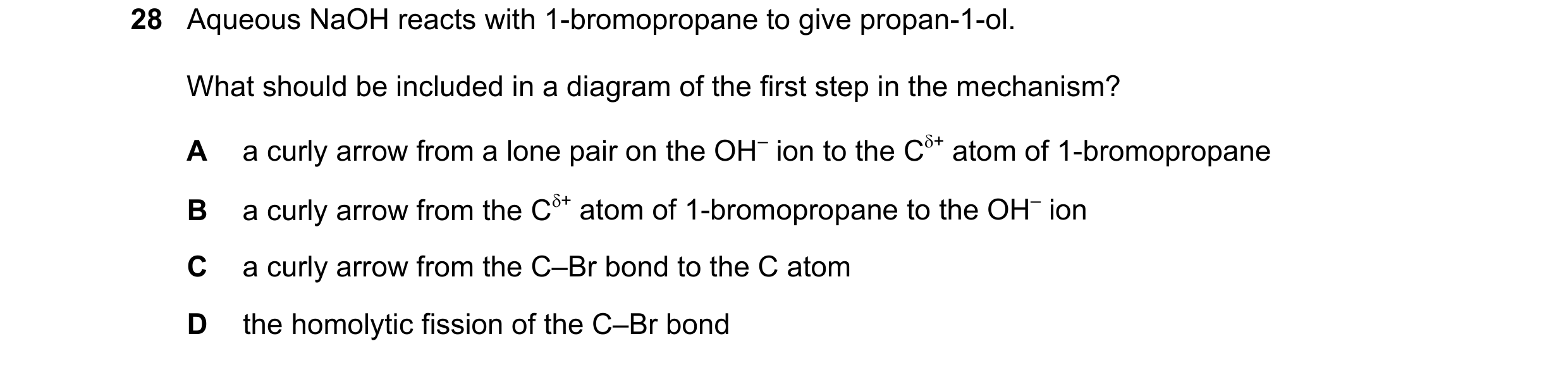

 58 / 66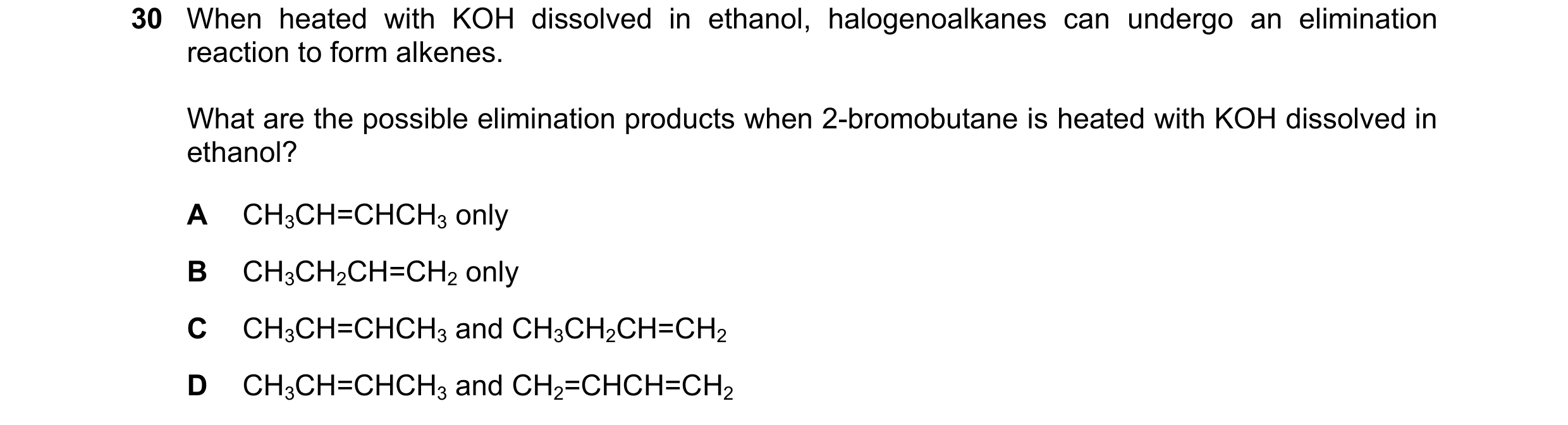
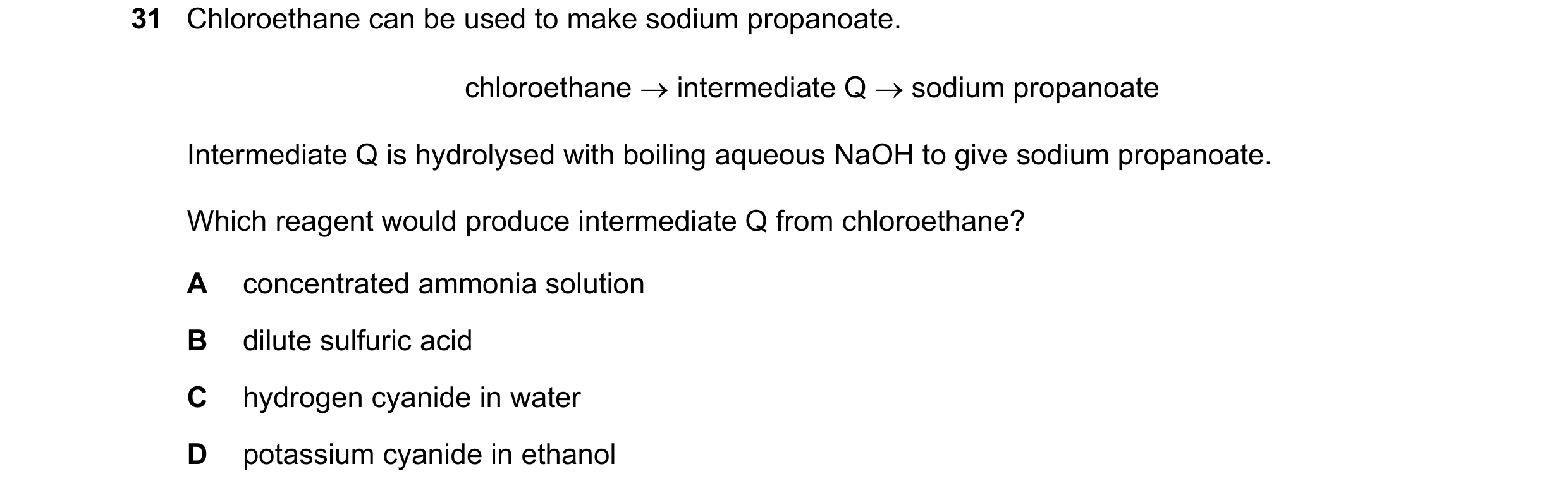
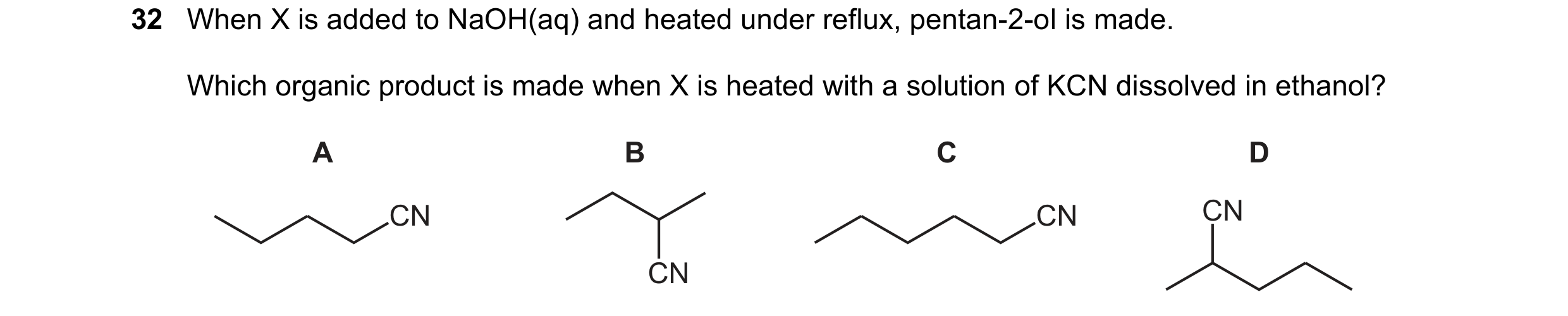
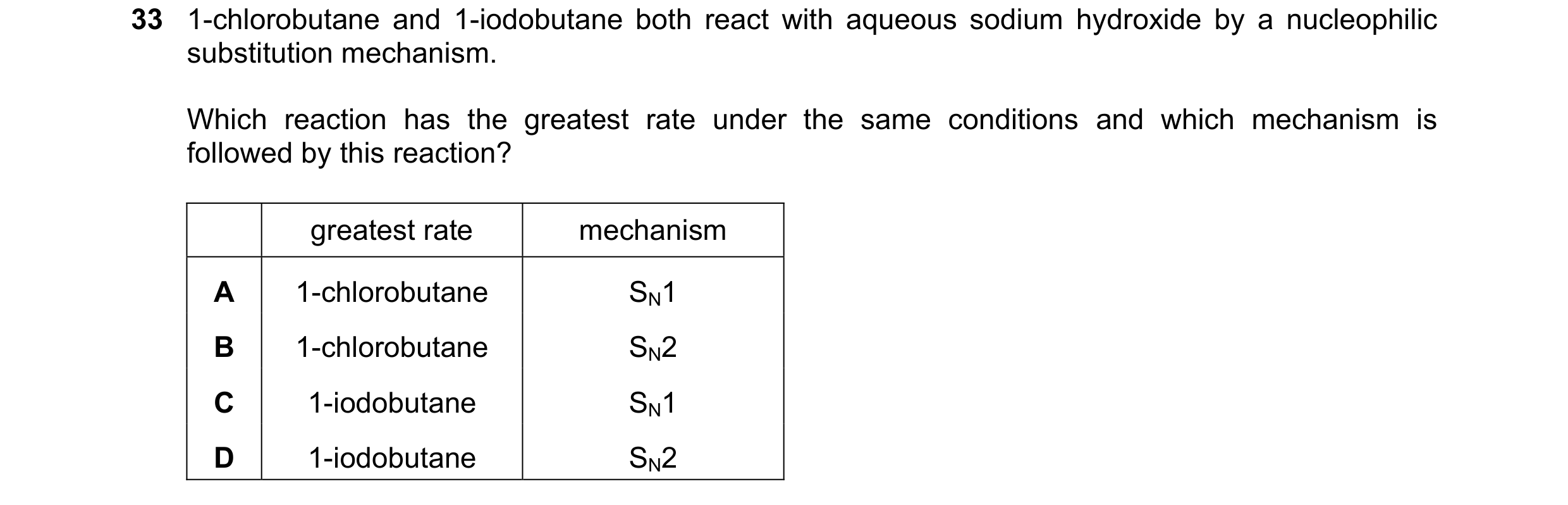 59 / 66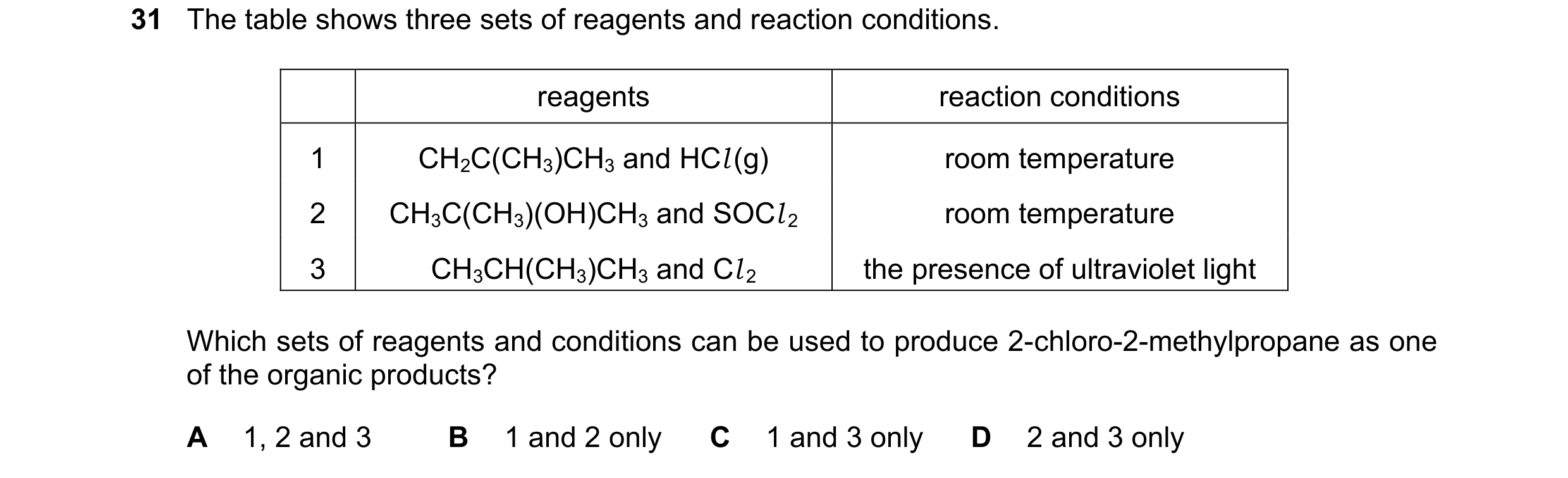
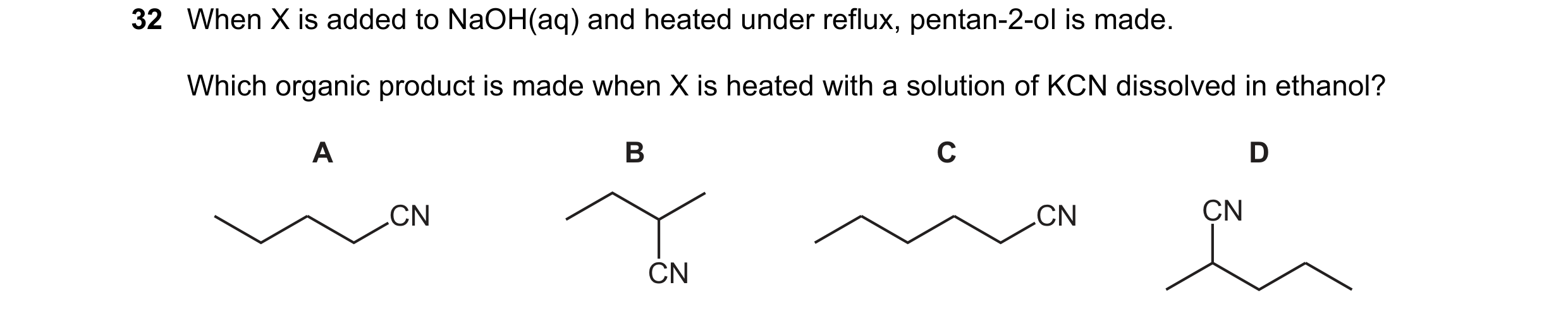
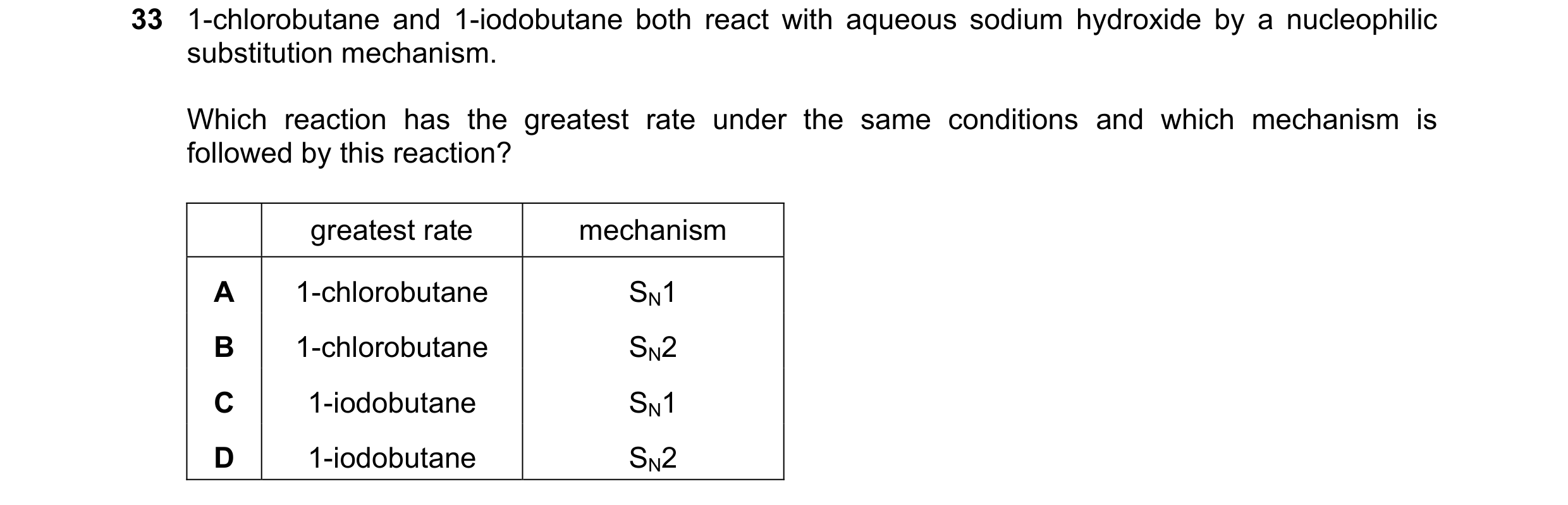
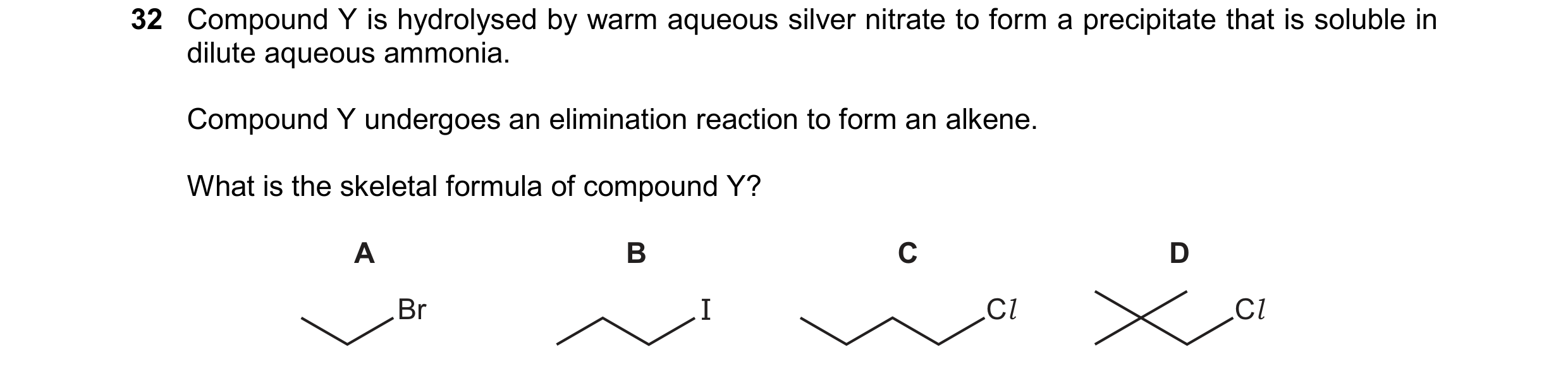 60 / 66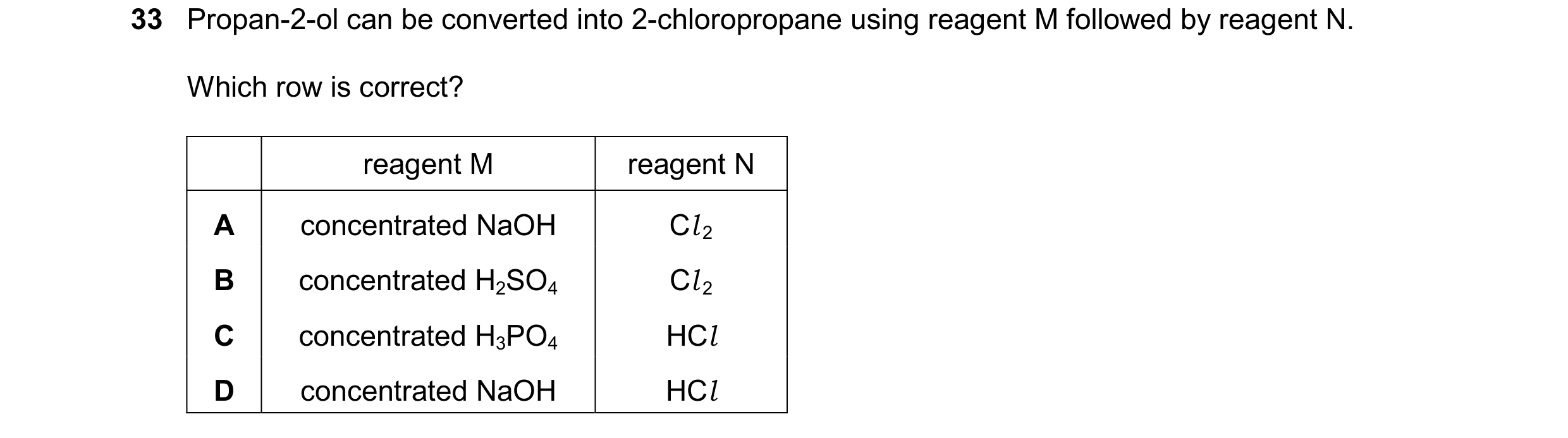
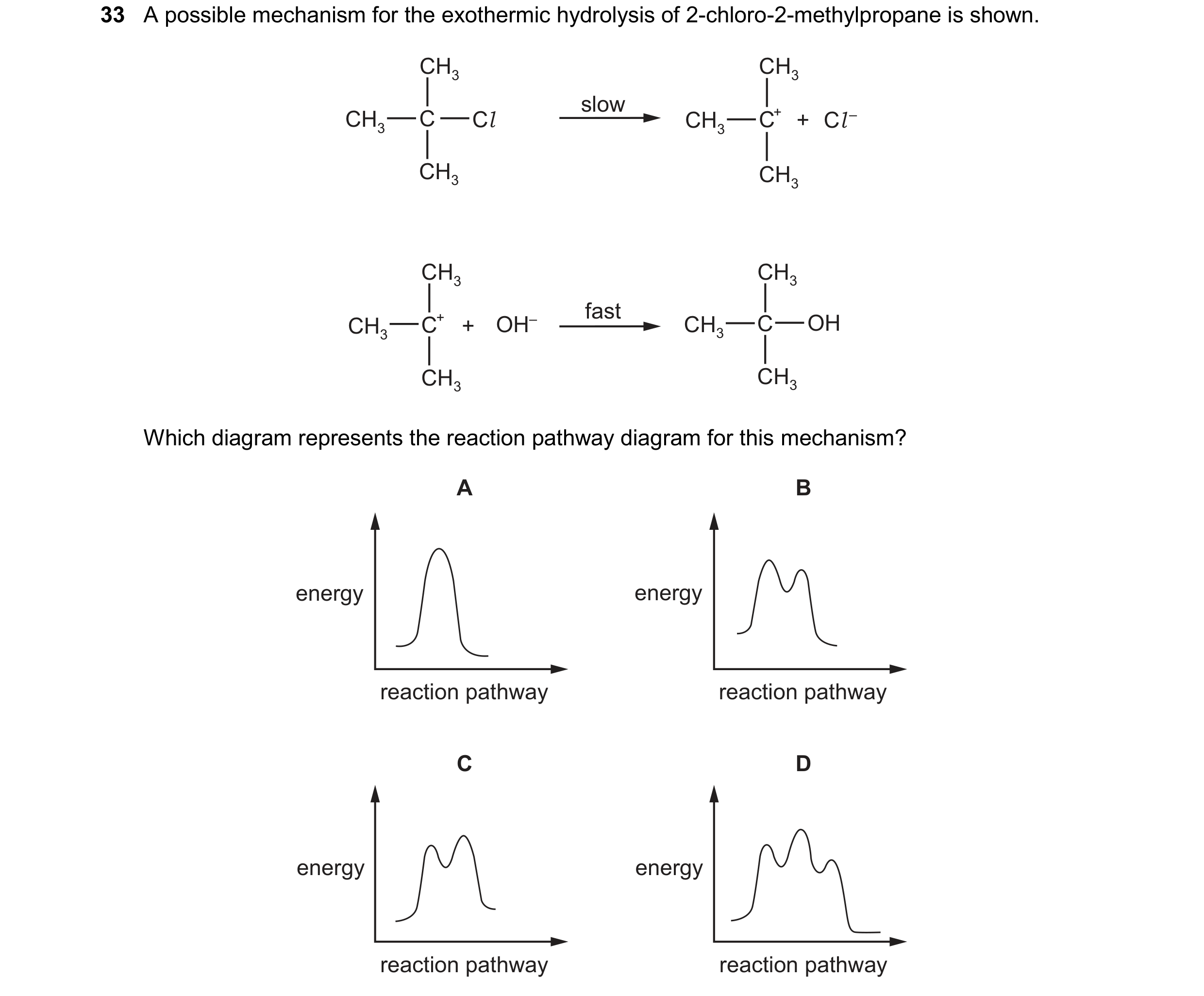 61 / 66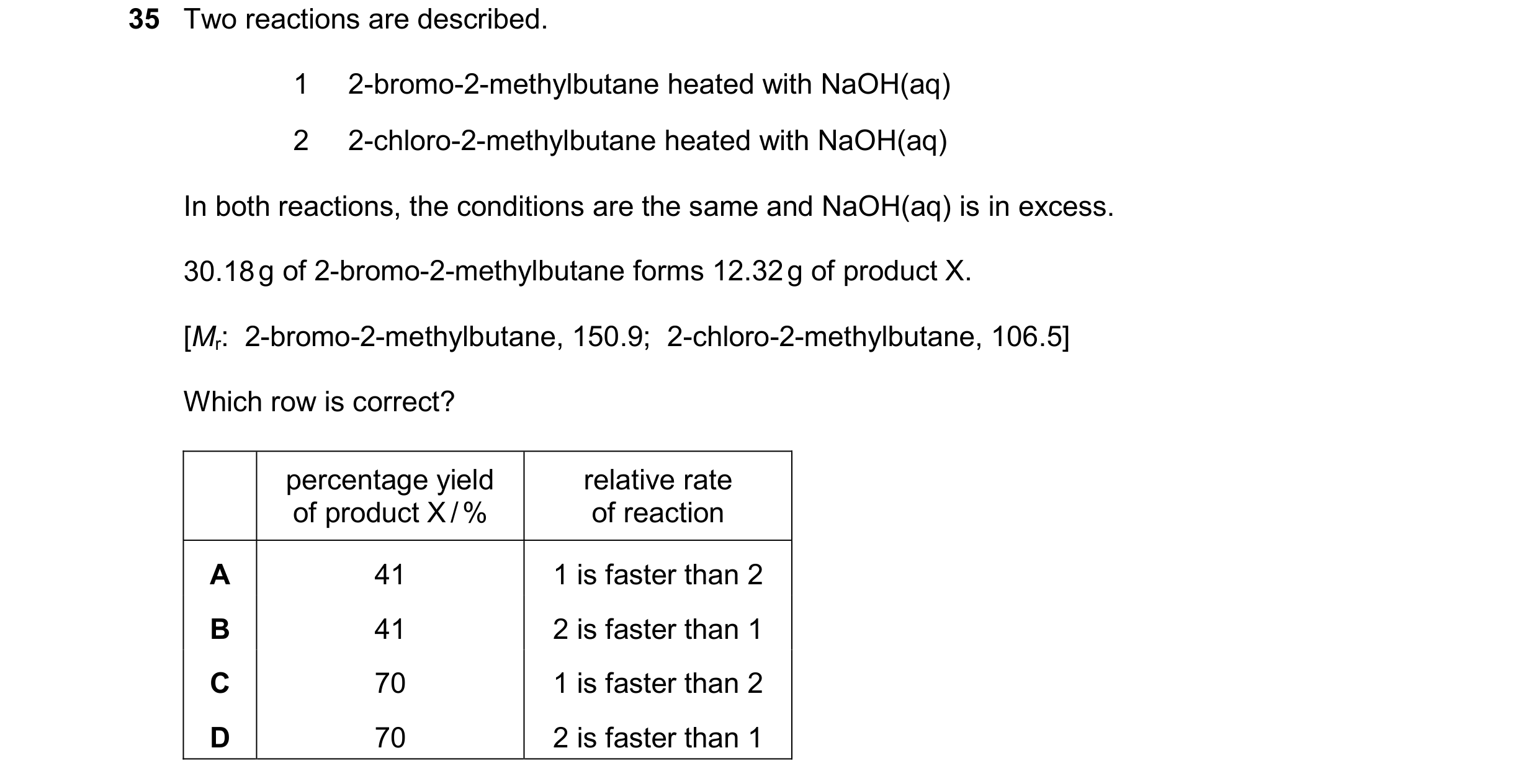

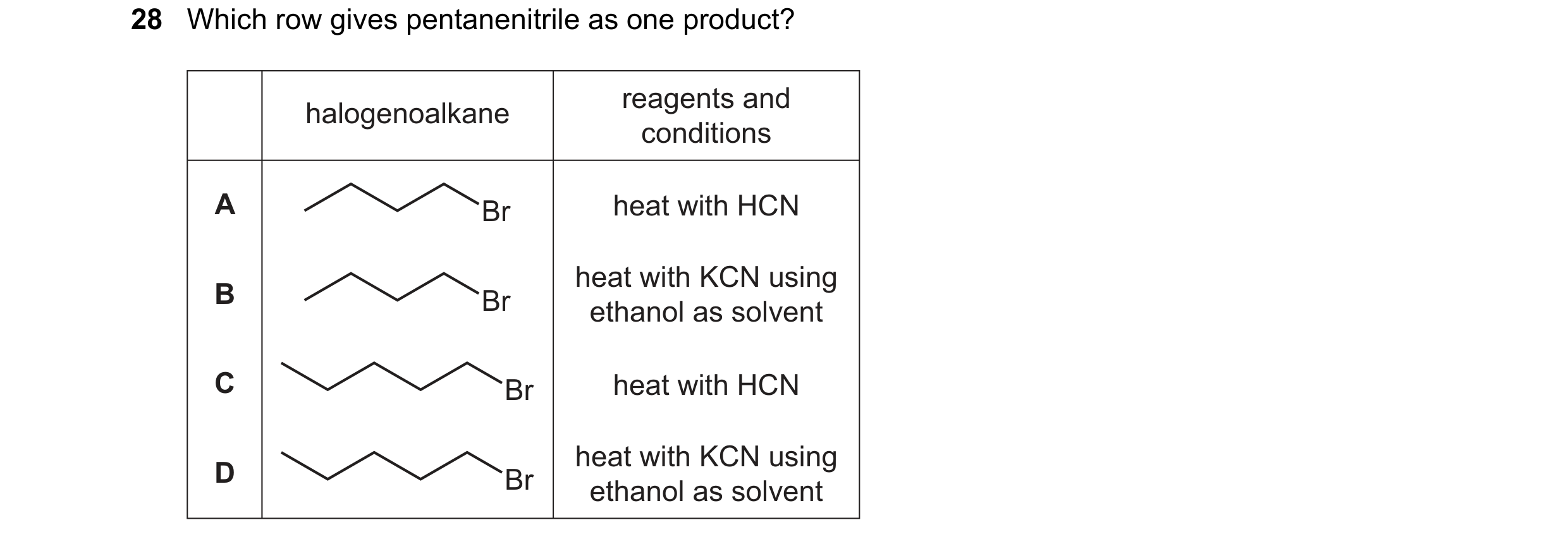
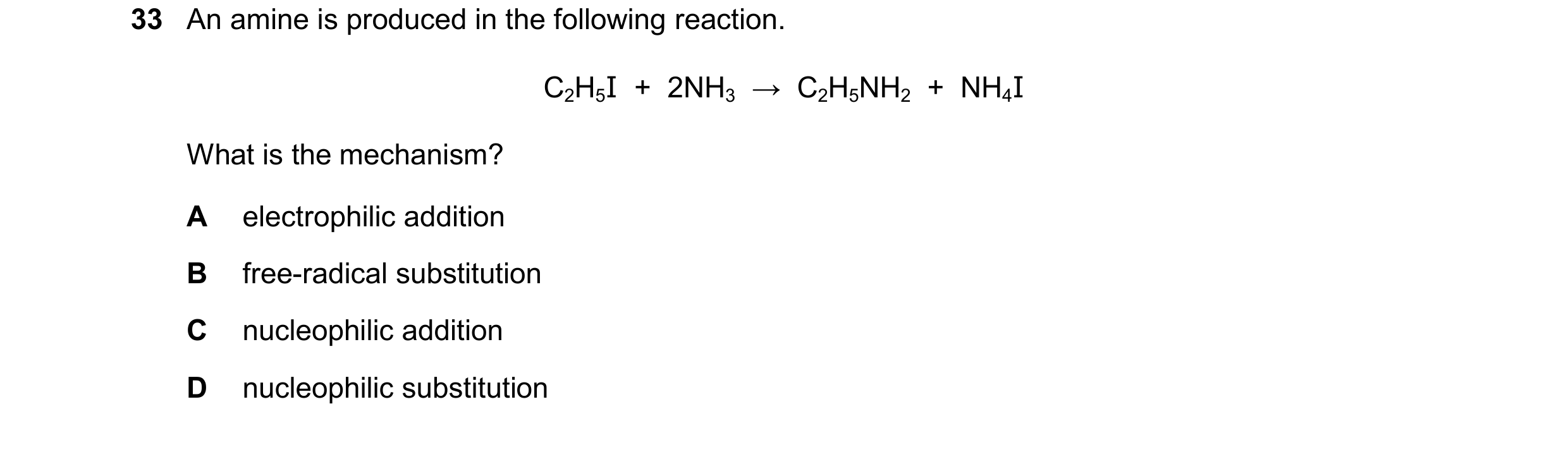 62 / 66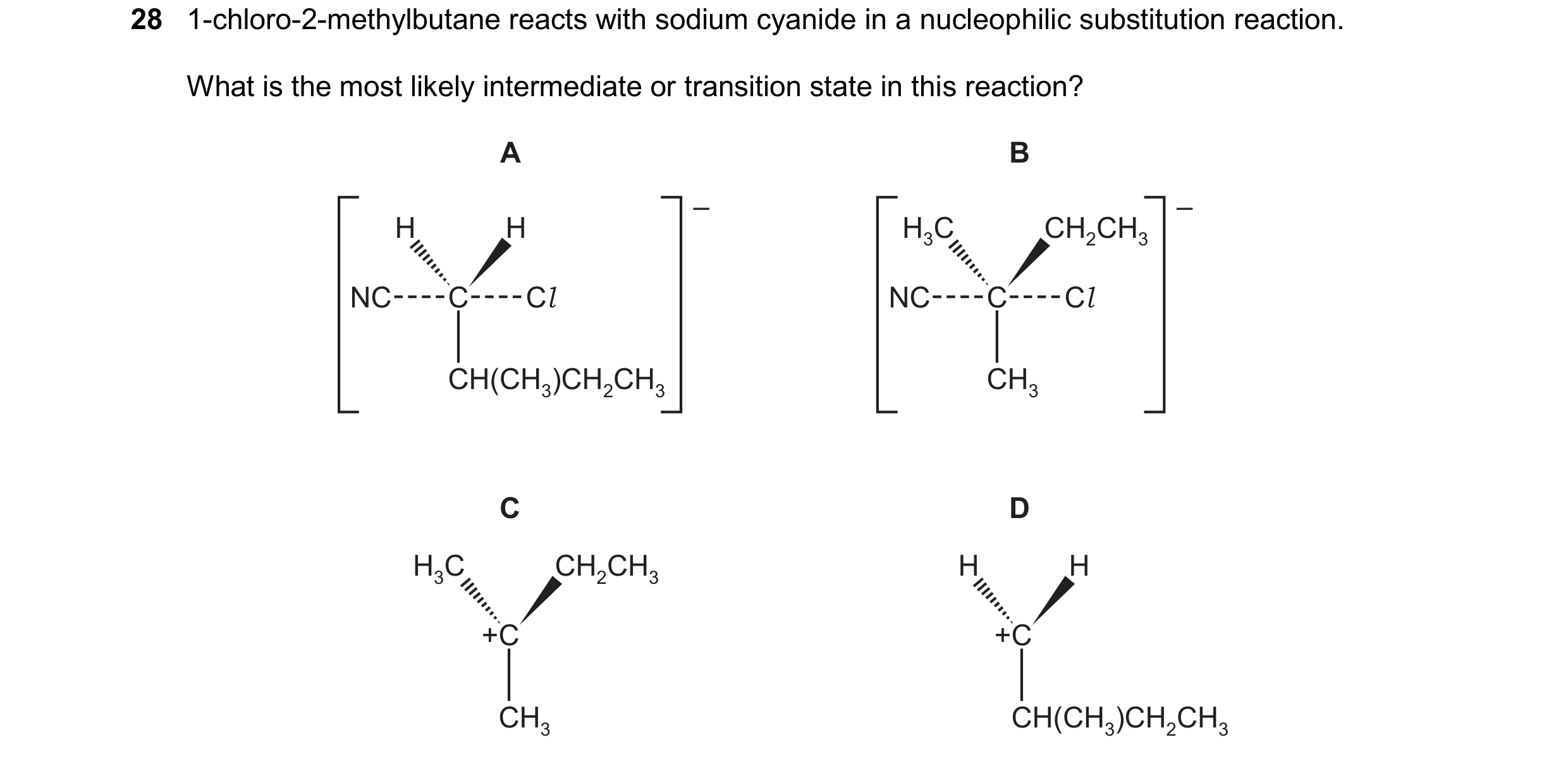

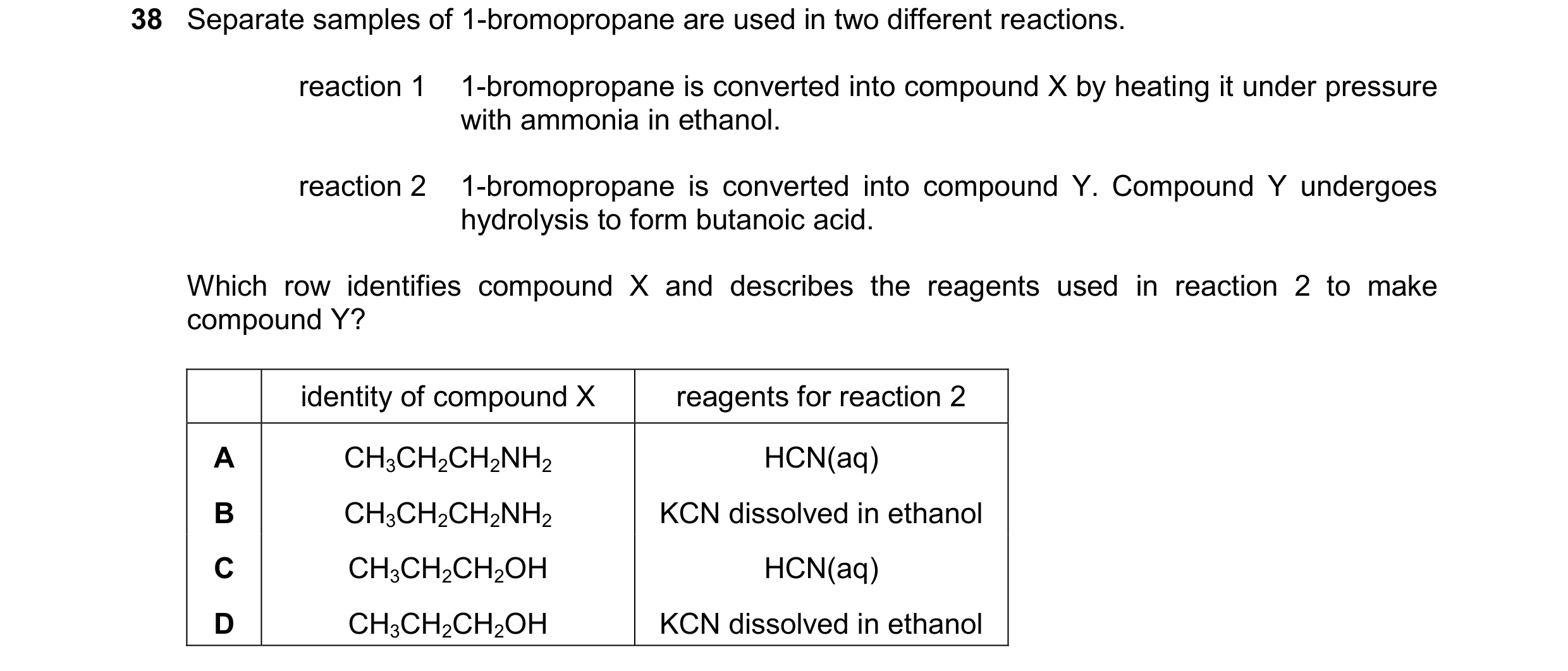 63 / 66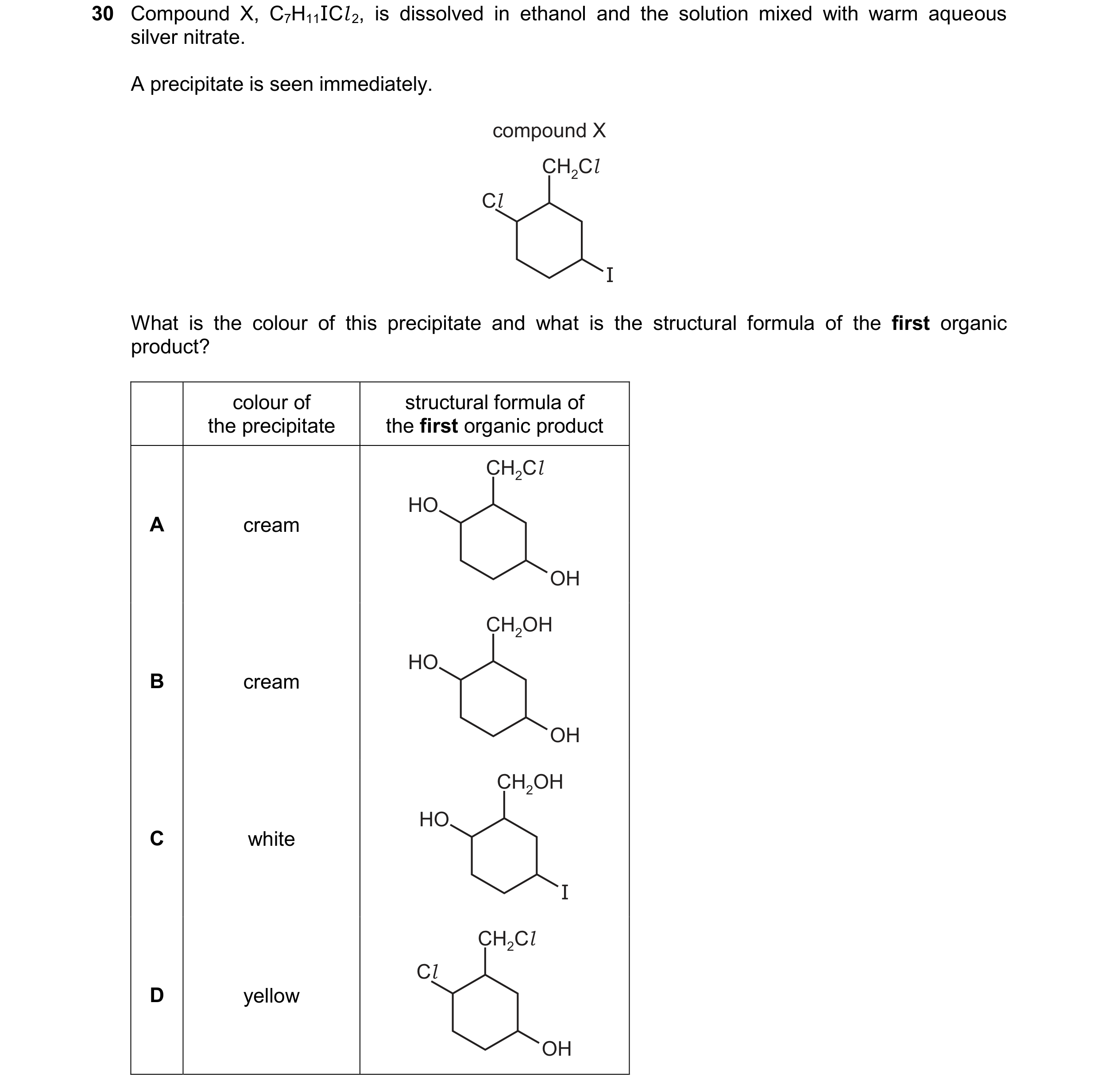
 64 / 66
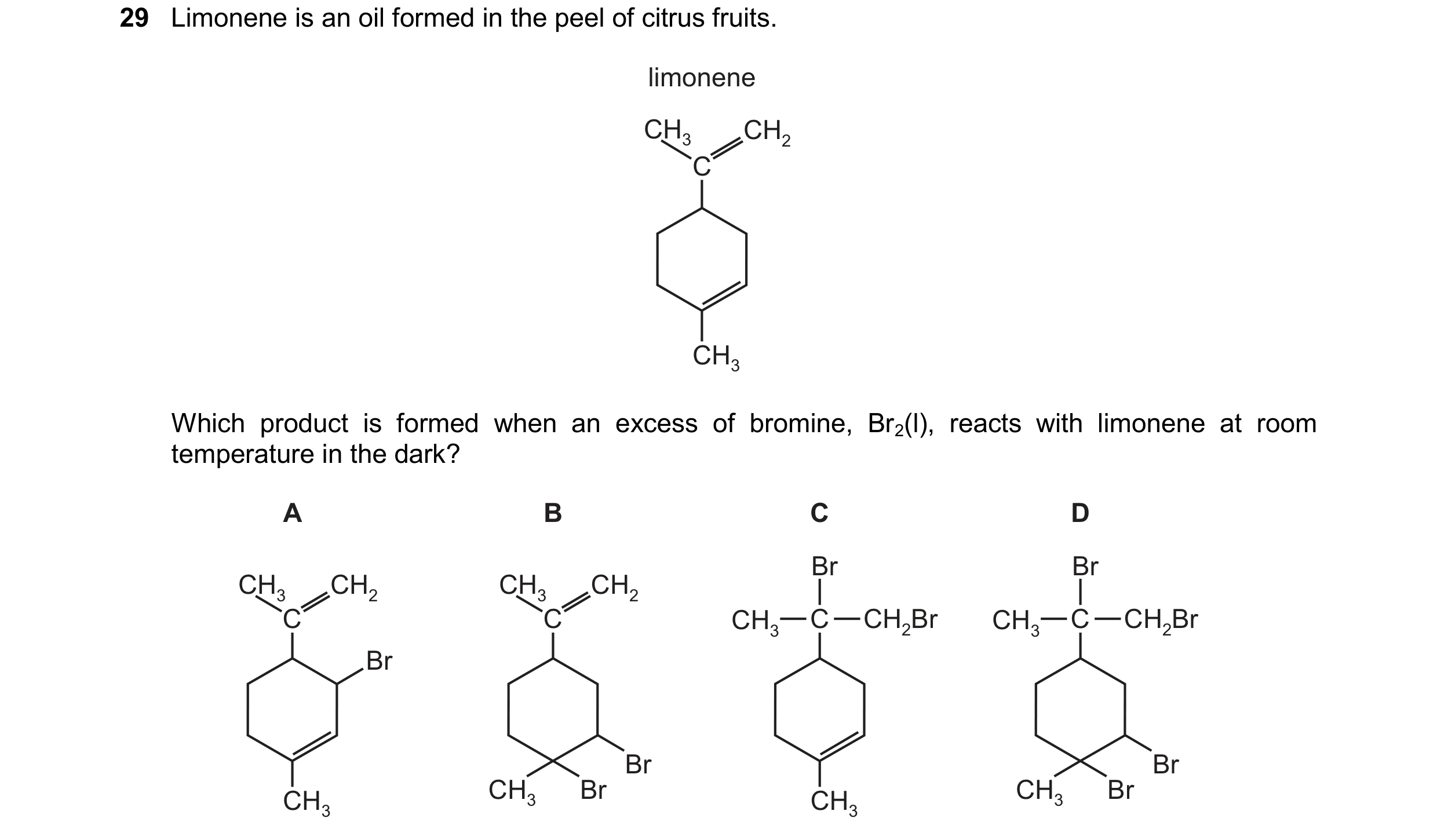

 65 / 66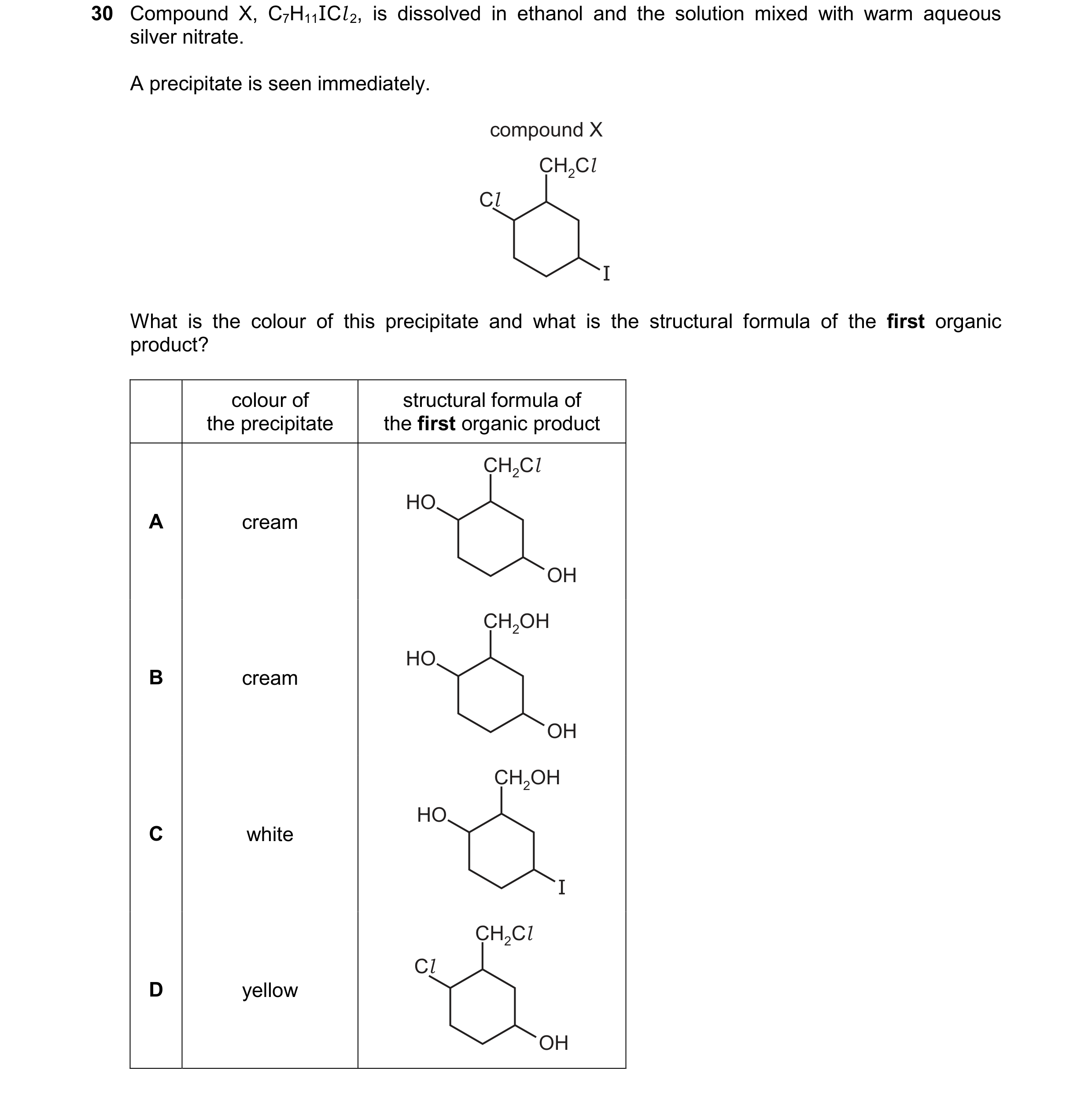
 66 / 66