Cambridge A Level Chemistry 9701 — 2006 May/June Paper 1 · Variant 1
9701/11/M/J/06 · 40 questions · 40 marks · ≈45 min
The question paper and its mark scheme, free to read here and free to download. This is Cambridge’s own paper, exactly as it was sat.
Question paper16 pages
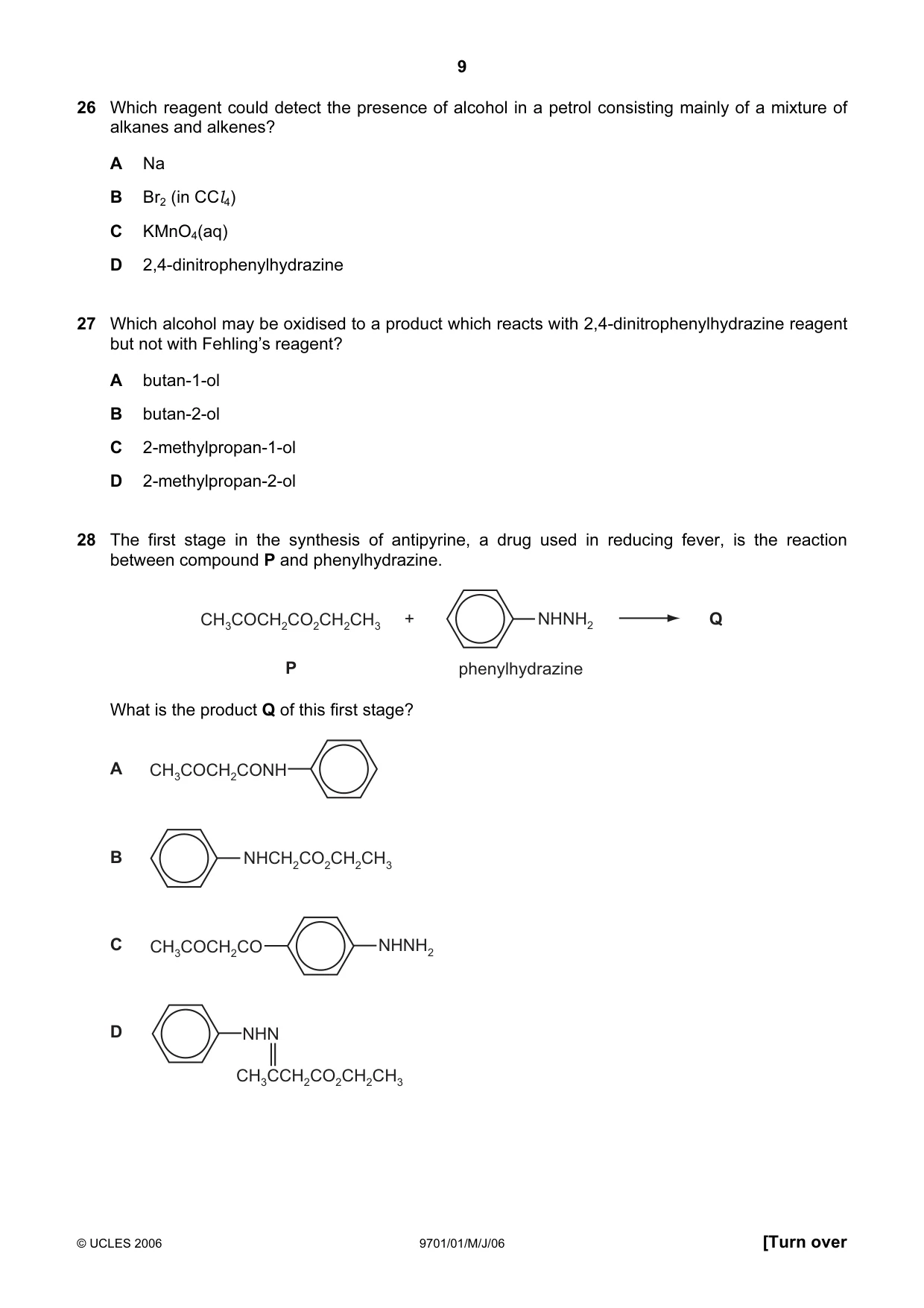
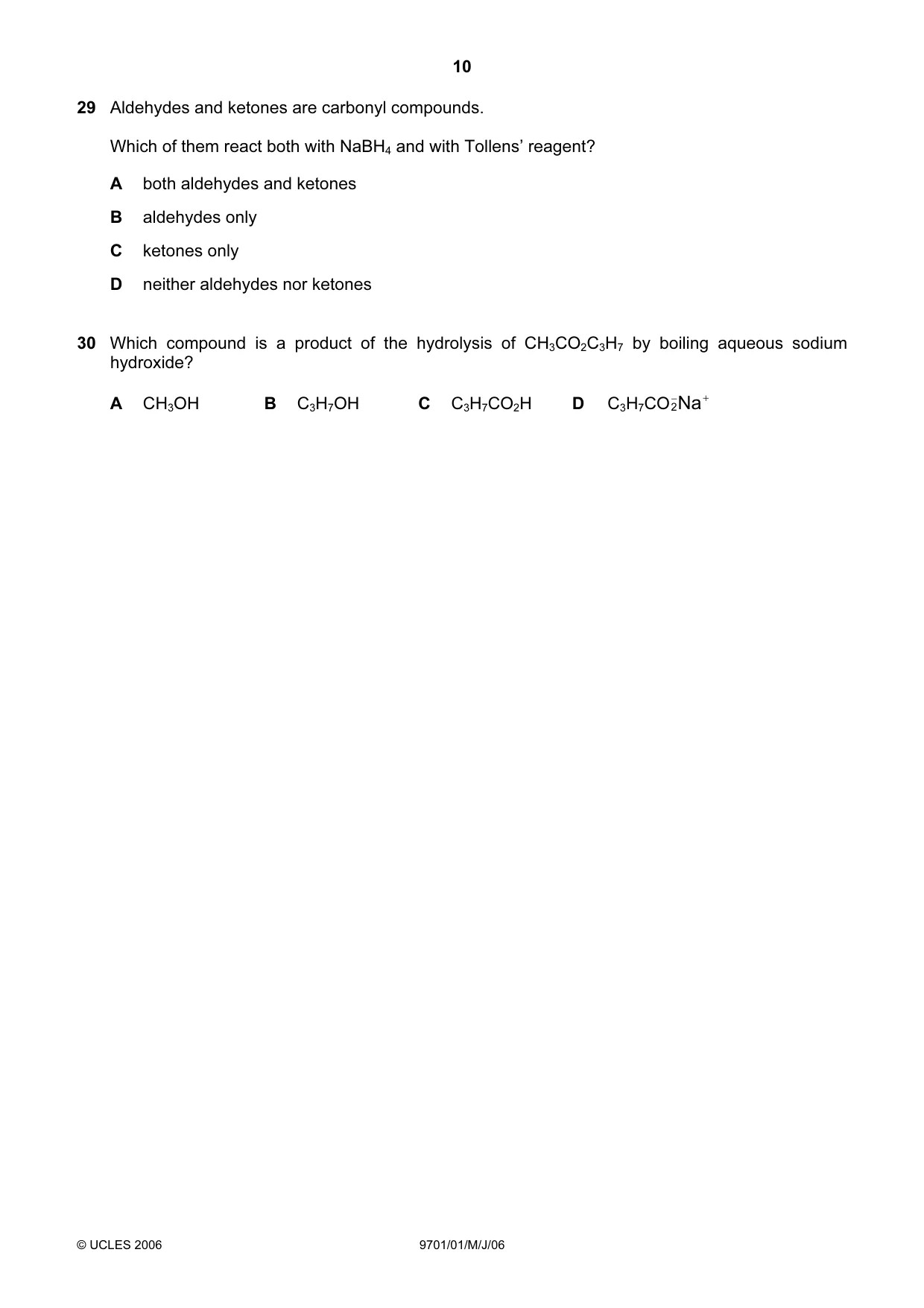
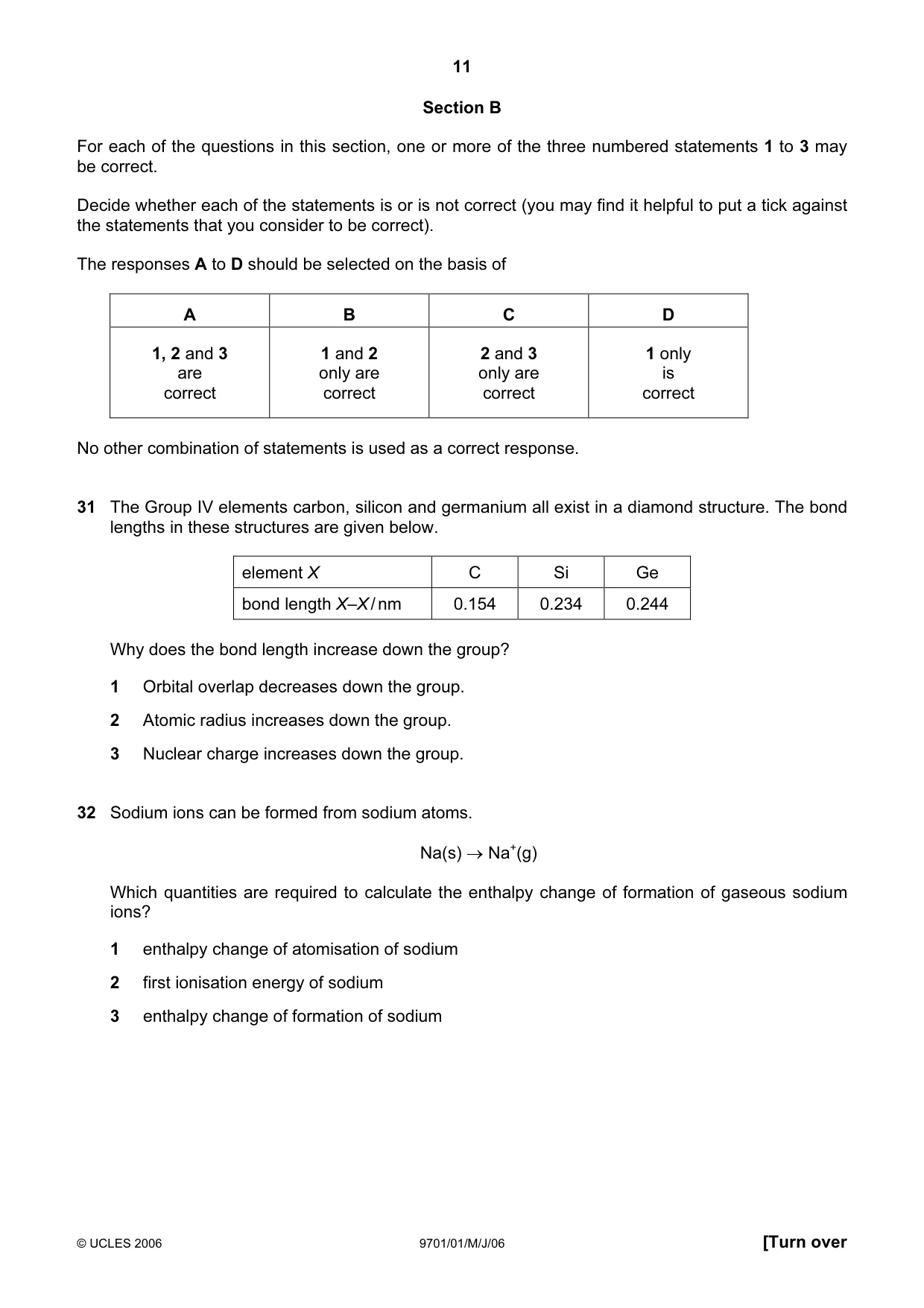
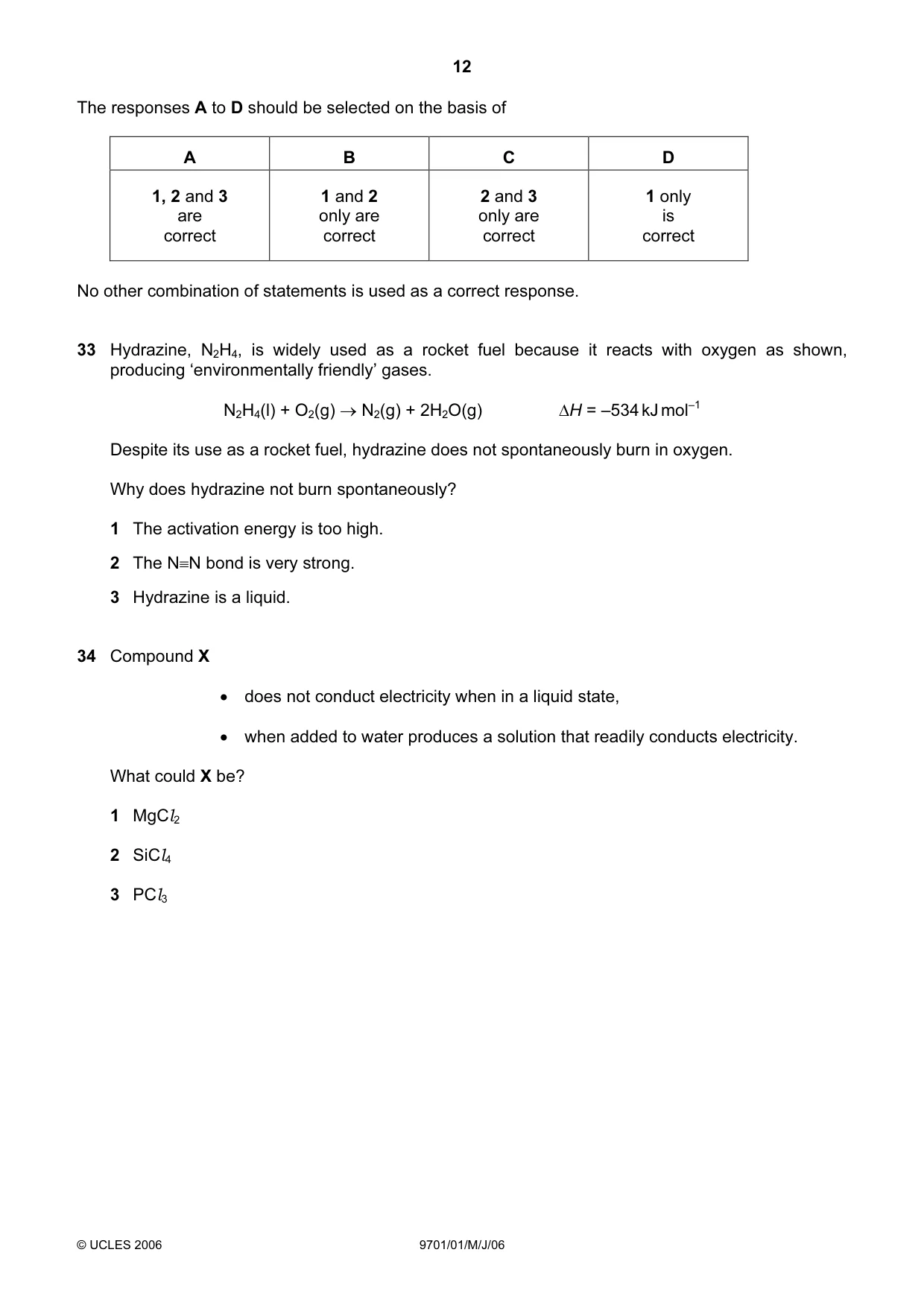
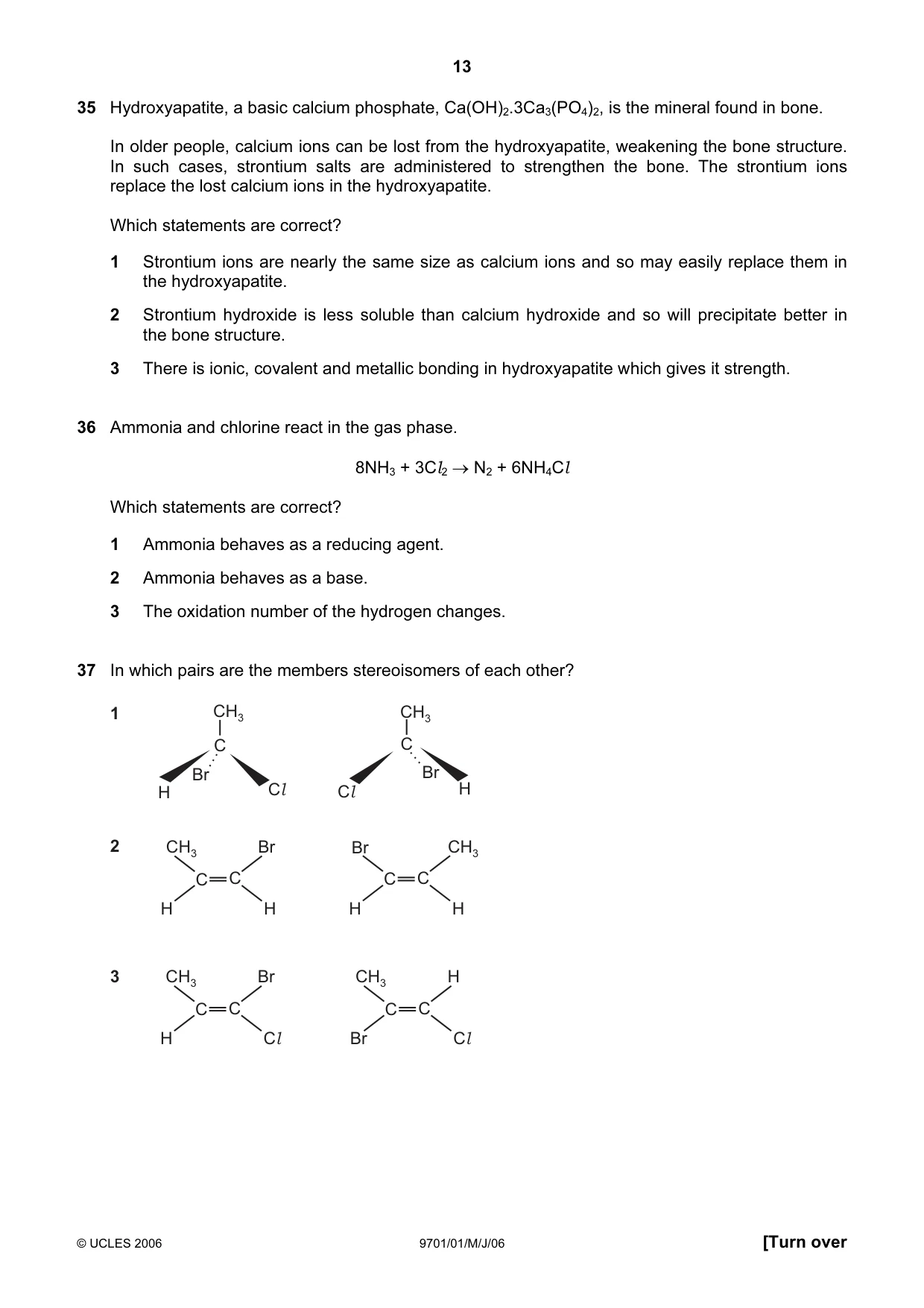
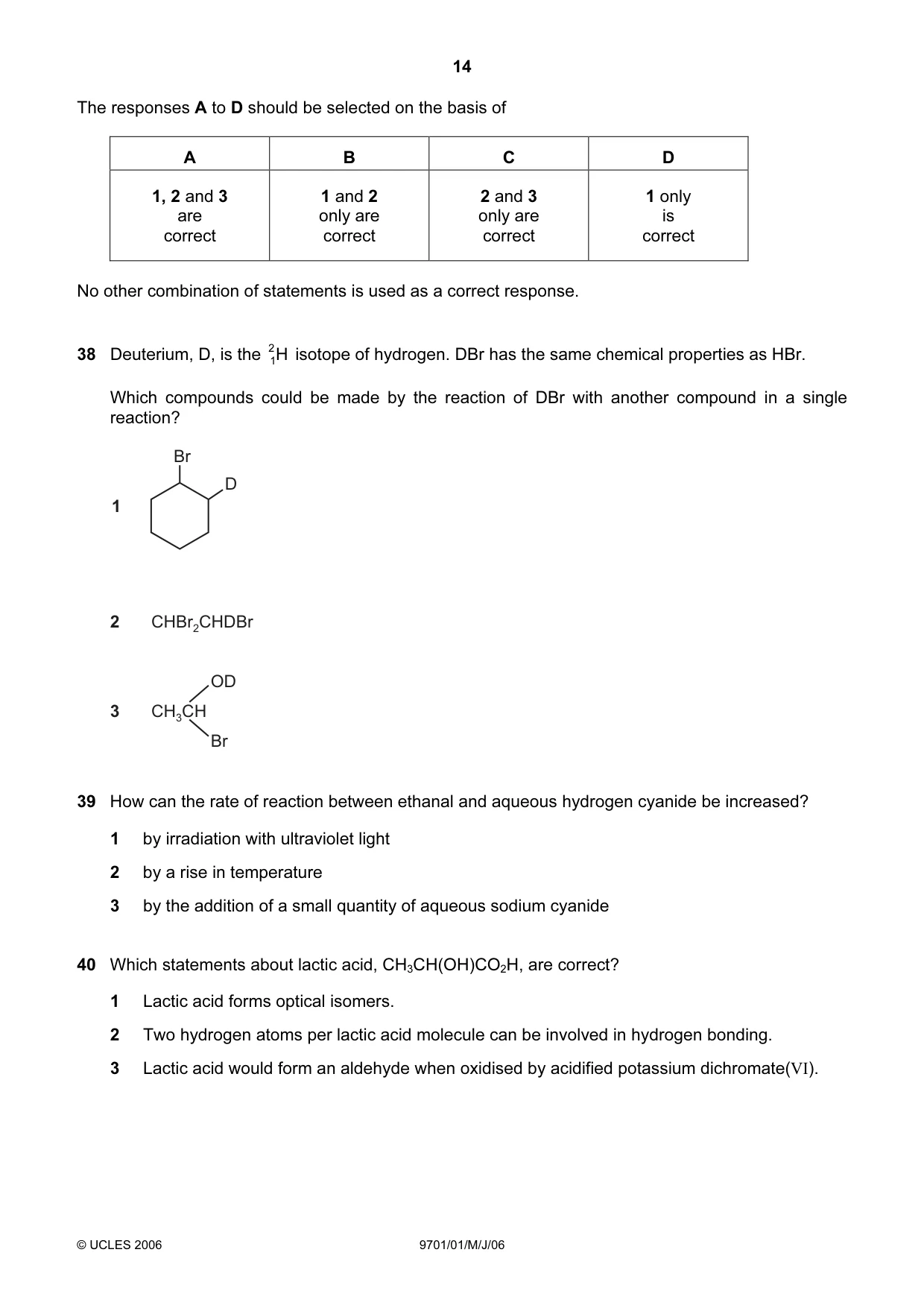


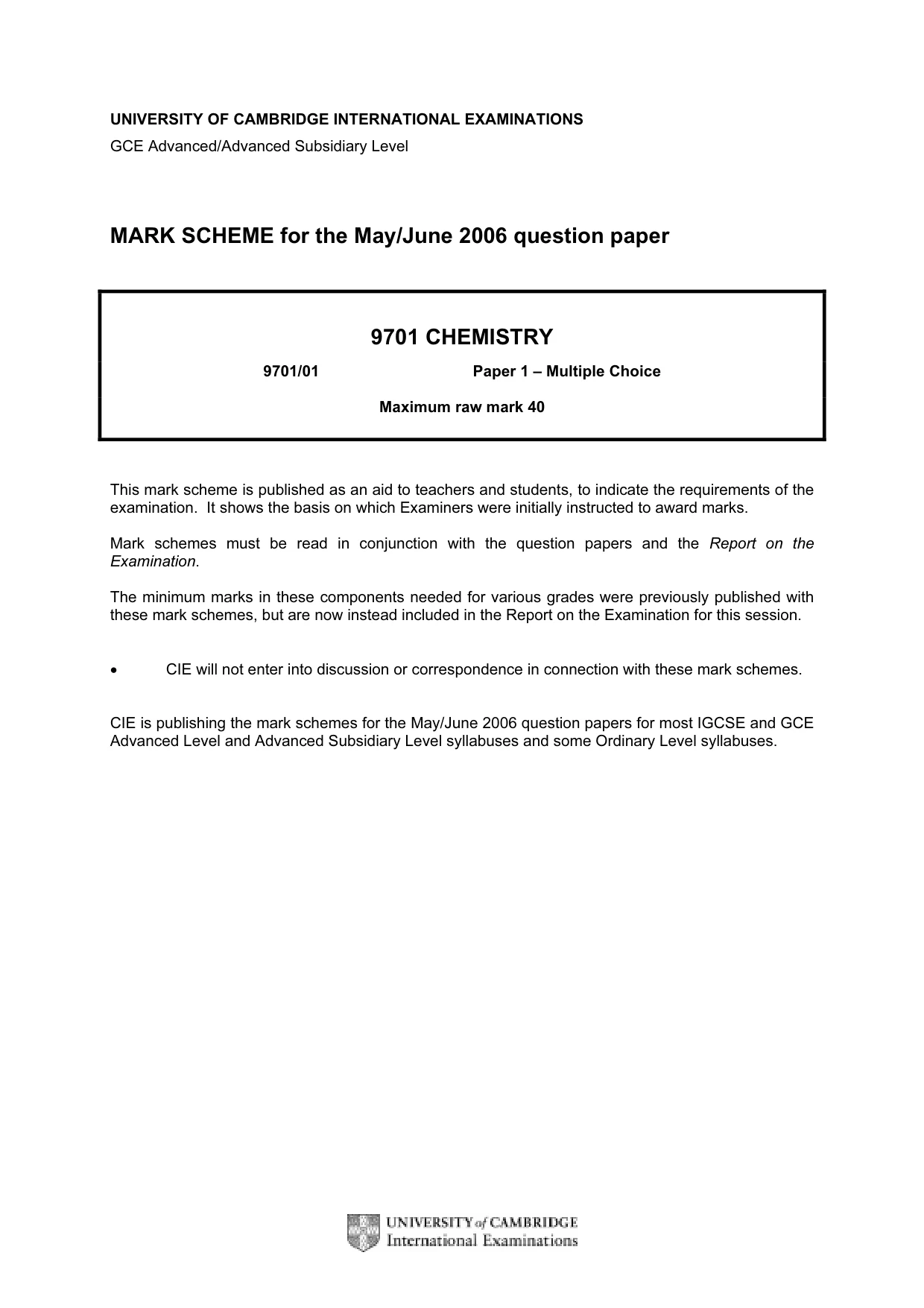
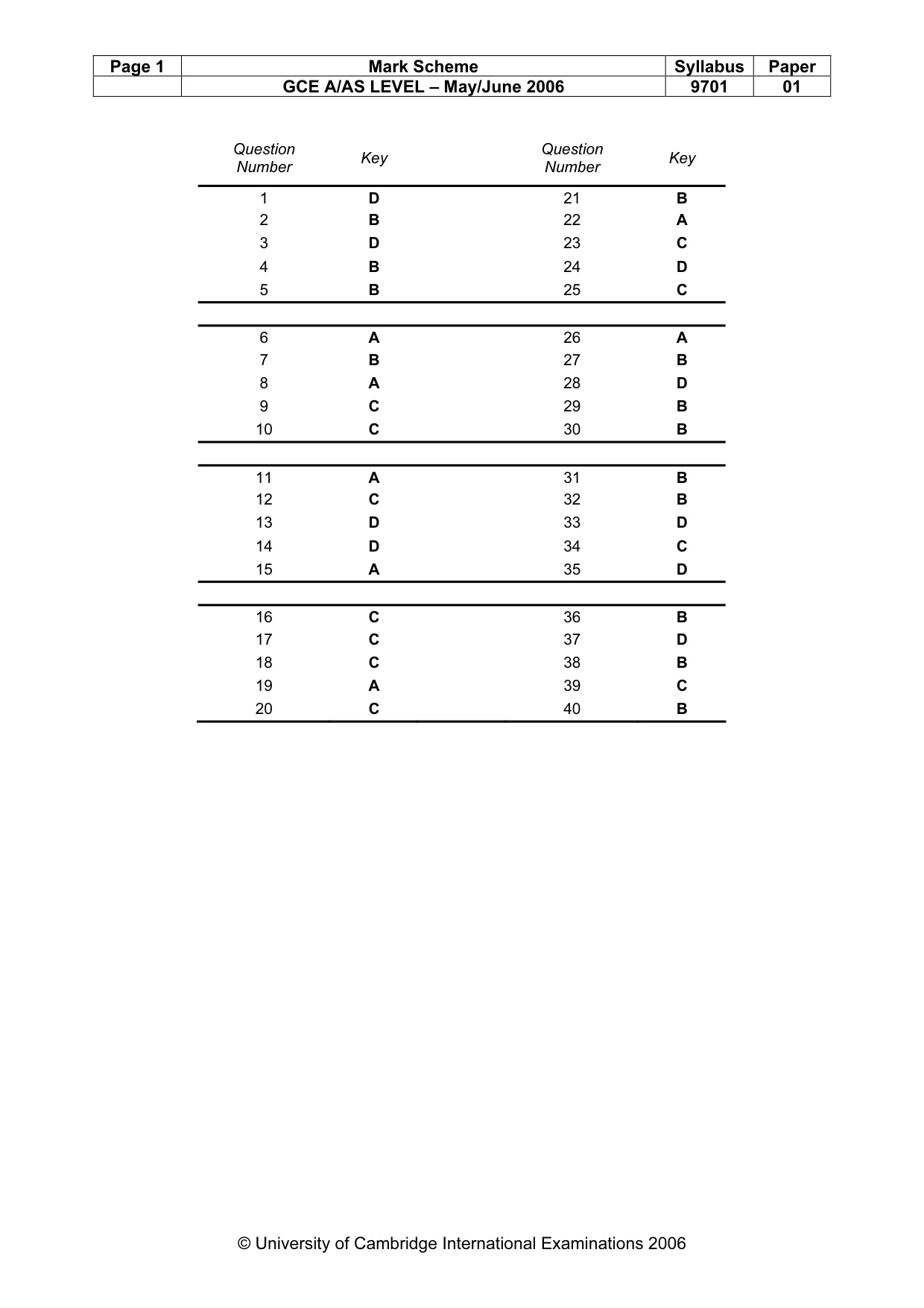
Mark scheme2 pages
Answers below. Sit the paper first if you are practising.
Questions as text
Q1 · N2O4 is a poisonous gas
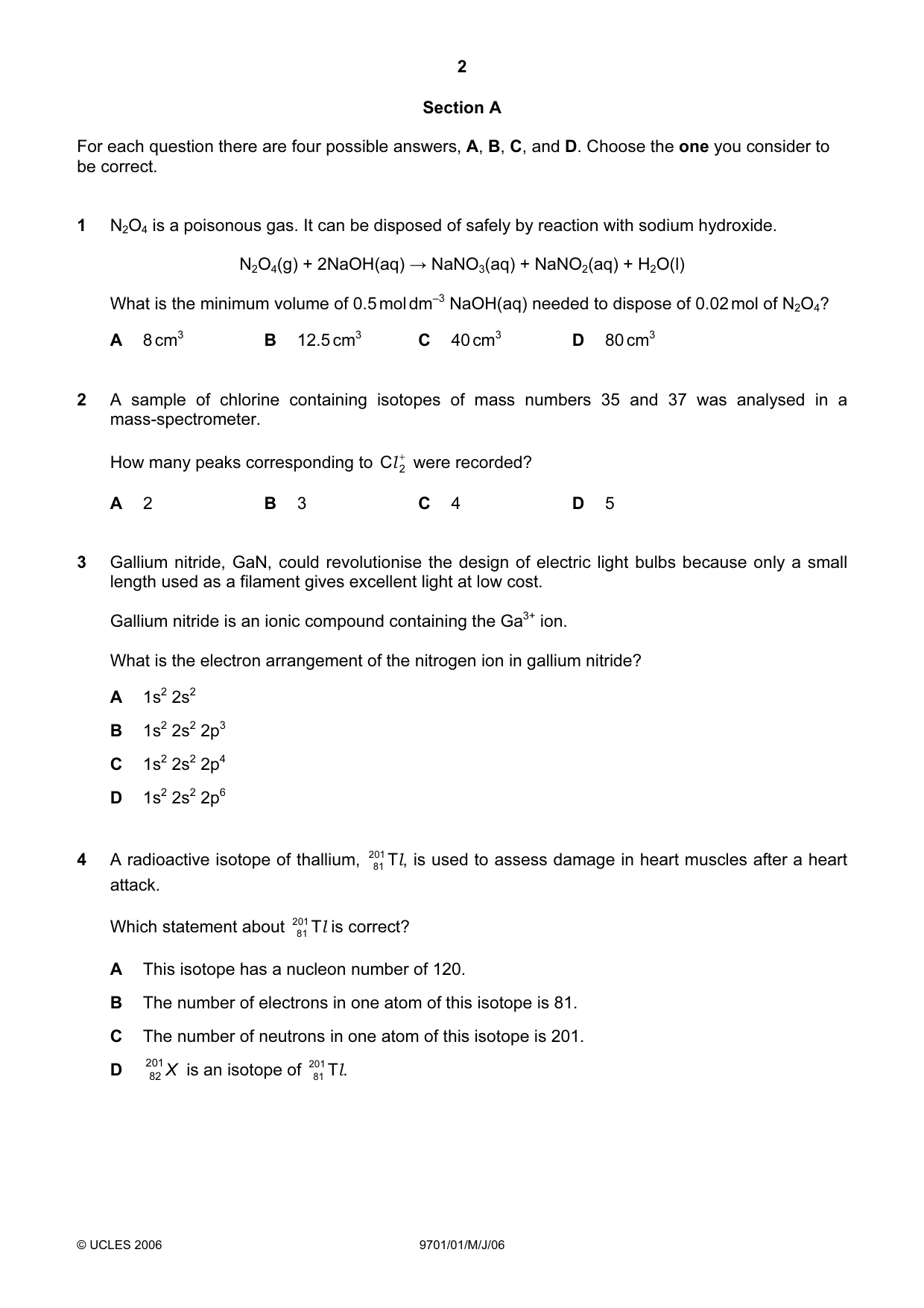
1 N2O4 is a poisonous gas. It can be disposed of safely by reaction with sodium hydroxide. N2O4(g) + 2NaOH(aq) → NaNO3(aq) + NaNO2(aq) + H2O(l) What is the minimum volume of 0.5 mol dm–3 NaOH(aq) needed to dispose of 0.02 mol of N2O4? A 8 cm3 B 12.5 cm3 C 40 cm3 D 80 cm3
Mark scheme: D
More questions on Reacting masses and volumes (of solutions and gases)
Q2 · A sample of chlorine containing isotopes of mass numbers 35 and 37 was analysed in a…
2 A sample of chlorine containing isotopes of mass numbers 35 and 37 was analysed in a mass-spectrometer. How many peaks corresponding to Cl were recorded? + 2 A 2 B 3 C 4 D 5
Mark scheme: B
Q3 · Gallium nitride, GaN, could revolutionise the design of electric light bulbs because only…
3 Gallium nitride, GaN, could revolutionise the design of electric light bulbs because only a small length used as a filament gives excellent light at low cost. Gallium nitride is an ionic compound containing the Ga3+ ion. What is the electron arrangement of the nitrogen ion in gallium nitride? A 1s2 2s2 B 1s2 2s2 2p3 C 1s2 2s2 2p4 D 1s2 2s2 2p6
Mark scheme: D
More questions on Electrons, energy levels and atomic orbitals
Q4 · A radioactive isotope of thallium, 201 81 Tl, is used to assess damage in heart muscles…
4 A radioactive isotope of thallium, 201 81 Tl, is used to assess damage in heart muscles after a heart attack. Which statement about 201 81 Tl is correct? A This isotope has a nucleon number of 120. B The number of electrons in one atom of this isotope is 81. C The number of neutrons in one atom of this isotope is 201. D 201 X is an isotope of 201 81 Tl. 82
Mark scheme: B
Q5 · In which process are hydrogen bonds broken?
5 In which process are hydrogen bonds broken? A H2(l) → H2(g) B NH3(l) → NH3(g) C 2HI(g) → H2(g) + I2(g) D CH4(g) → C(g) + 4H(g)
Mark scheme: B
More questions on Intermolecular forces, electronegativity and bond properties
Q6 · Which of the following least resembles an ideal gas?
6 Which of the following least resembles an ideal gas? A ammonia B helium C hydrogen D trichloromethane
Mark scheme: A
More questions on The gaseous state: ideal and real gases and pV = nRT
Q7 · The diagram shows part of the lattice structures of solids X and Y
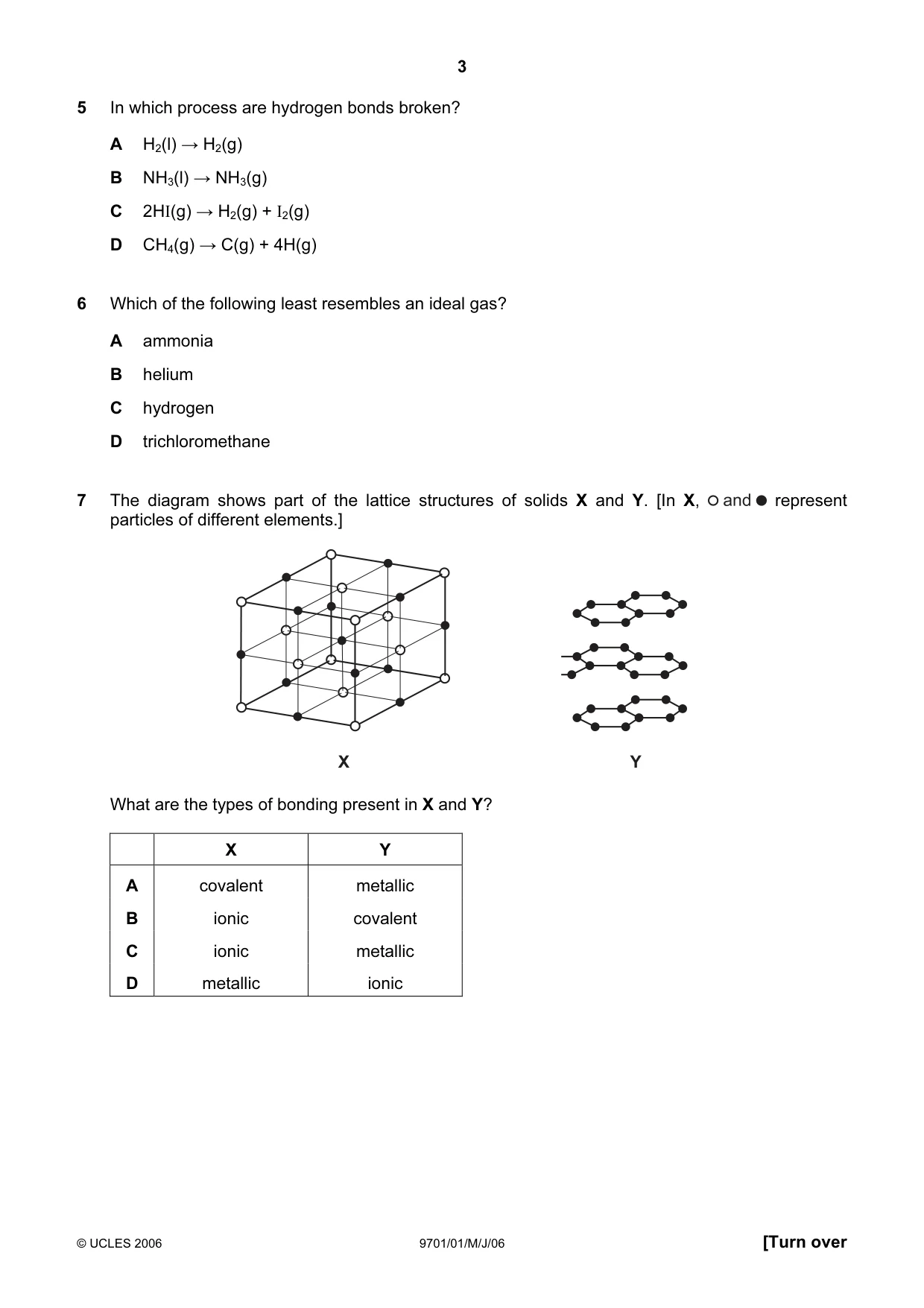
7 The diagram shows part of the lattice structures of solids X and Y. [In X, represent particles of different elements.] X Y What are the types of bonding present in X and Y? X Y A covalent metallic B ionic covalent C ionic metallic D metallic ionic
Mark scheme: B
Q8 · In the conversion of compound X into compound Z, it was found that the reaction proceeded…
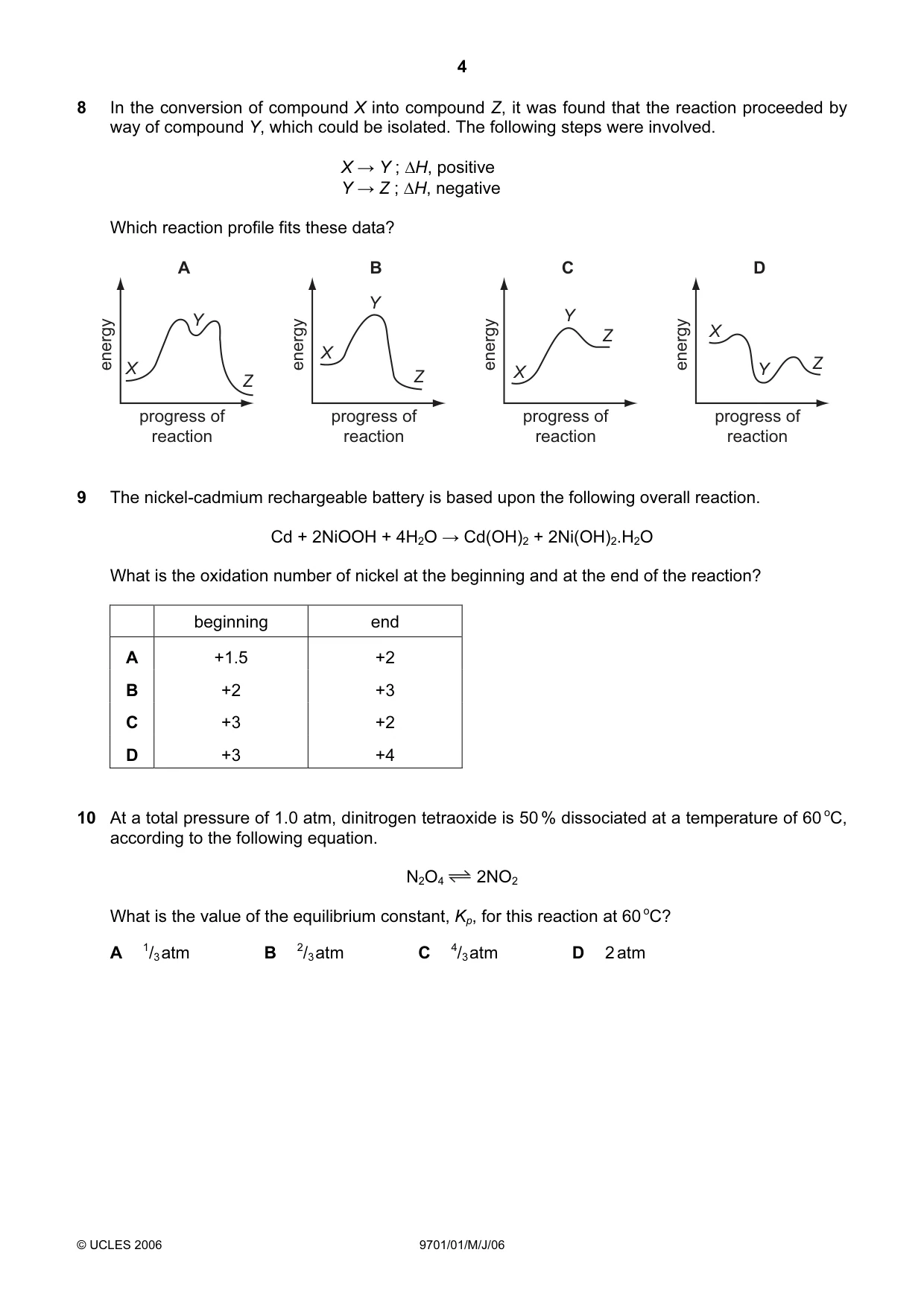
8 In the conversion of compound X into compound Z, it was found that the reaction proceeded by way of compound Y, which could be isolated. The following steps were involved. X → Y ; ∆H, positive Y → Z ; ∆H, negative Which reaction profile fits these data? A B C D Y Y Y energy energy energy energy X Z X X Y Z Z X Z progress of progress of progress of progress of reaction reaction reaction reaction
Mark scheme: A
Q9 · The nickel-cadmium rechargeable battery is based upon the following overall reaction
9 The nickel-cadmium rechargeable battery is based upon the following overall reaction. Cd + 2NiOOH + 4H2O → Cd(OH)2 + 2Ni(OH)2.H2O What is the oxidation number of nickel at the beginning and at the end of the reaction? beginning end A +1.5 +2 B +2 +3 C +3 +2 D +3 +4
Mark scheme: C
Q10 · At a total pressure of 1.0 atm, dinitrogen tetraoxide is 50 % dissociated at a…
10 At a total pressure of 1.0 atm, dinitrogen tetraoxide is 50 % dissociated at a temperature of 60 oC, according to the following equation. N2O4 2NO2 What is the value of the equilibrium constant, Kp, for this reaction at 60 oC? A 1/3 atm B 2/3 atm C 4/3 atm D 2 atm
Mark scheme: C
More questions on Chemical equilibria: reversible reactions, dynamic equilibrium
Q11 · Swimming pool water can be kept free of harmful bacteria by adding aqueous sodium…
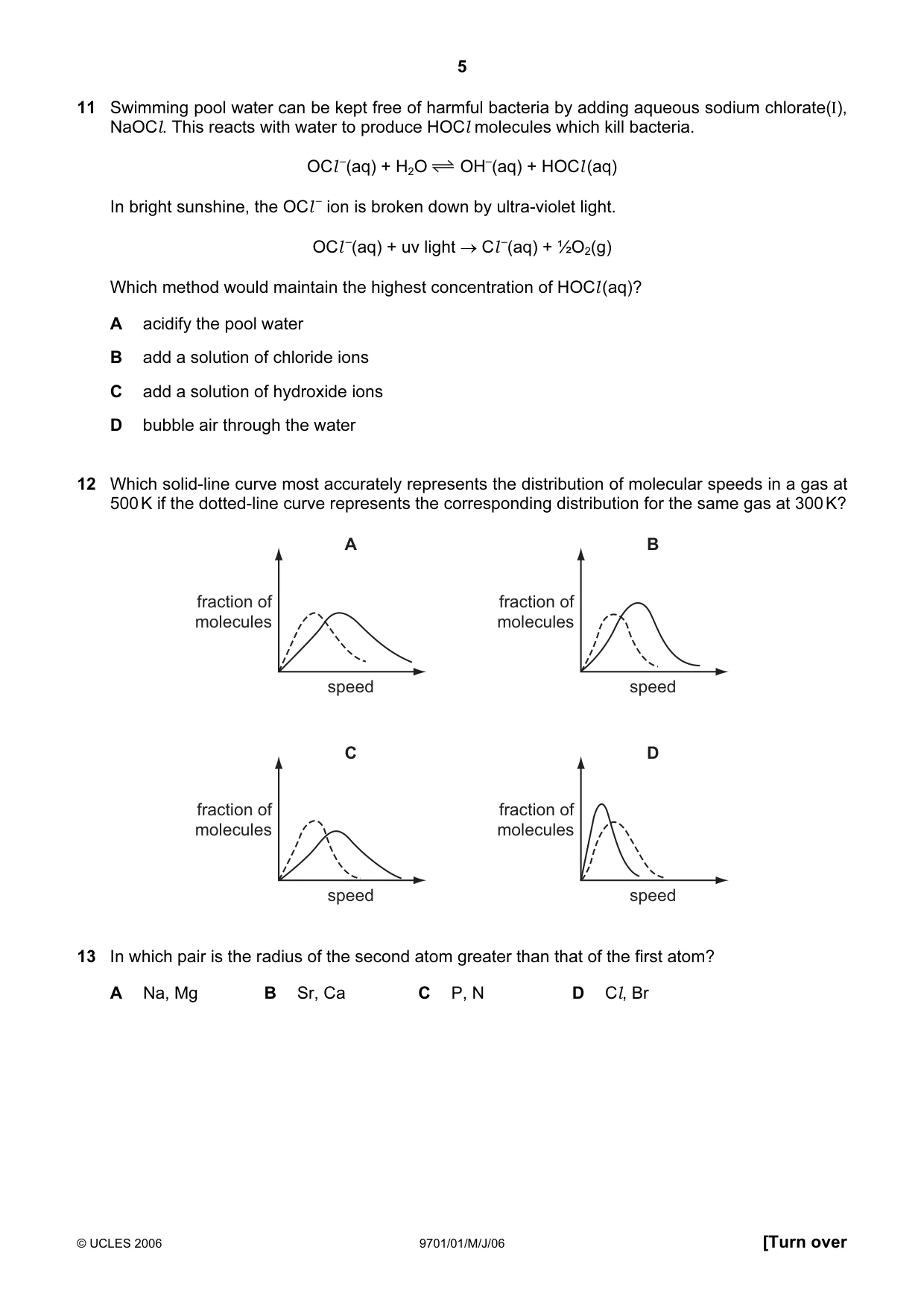
11 Swimming pool water can be kept free of harmful bacteria by adding aqueous sodium chlorate(I), NaOCl. This reacts with water to produce HOCl molecules which kill bacteria. OCl –(aq) + H2O OH–(aq) + HOCl (aq) In bright sunshine, the OCl – ion is broken down by ultra-violet light. OCl –(aq) + uv light → Cl –(aq) + ½O2(g) Which method would maintain the highest concentration of HOCl (aq)? A acidify the pool water B add a solution of chloride ions C add a solution of hydroxide ions D bubble air through the water
Mark scheme: A
More questions on Chemical equilibria: reversible reactions, dynamic equilibrium
Q12 · Which solid-line curve most accurately represents the distribution of molecular speeds in…
12 Which solid-line curve most accurately represents the distribution of molecular speeds in a gas at 500 K if the dotted-line curve represents the corresponding distribution for the same gas at 300 K? A B fraction of fraction of molecules molecules speed speed C D fraction of fraction of molecules molecules speed speed
Mark scheme: C
More questions on Effect of temperature on reaction rates and the concept of activation energy
Q13 · In which pair is the radius of the second atom greater than that of the first atom?
13 In which pair is the radius of the second atom greater than that of the first atom? A Na, Mg B Sr, Ca C P, N D Cl, Br
Mark scheme: D
Q14 · The oxide and chloride of an element X are separately mixed with water
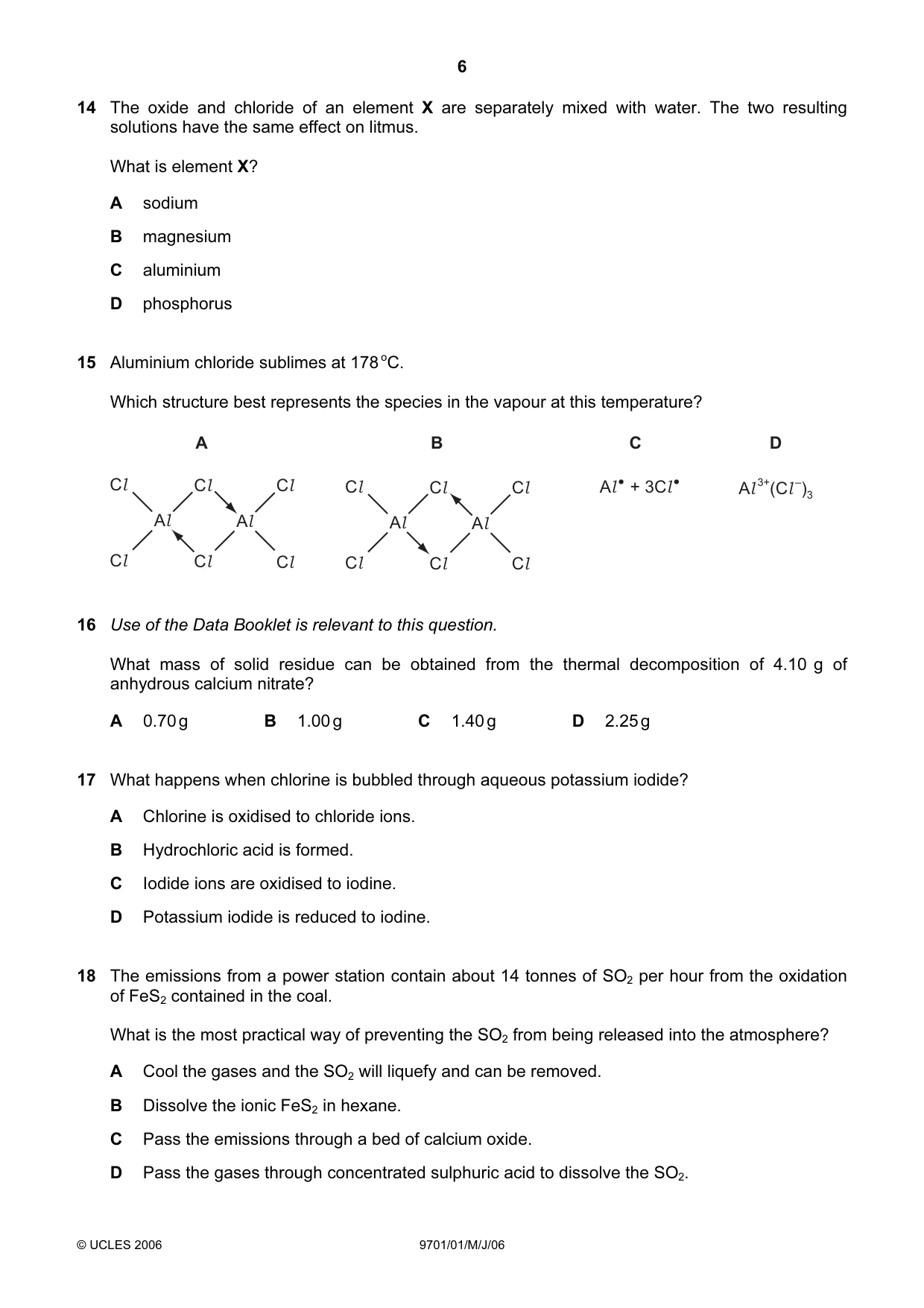
14 The oxide and chloride of an element X are separately mixed with water. The two resulting solutions have the same effect on litmus. What is element X? A sodium B magnesium C aluminium D phosphorus
Mark scheme: D
More questions on Periodicity of chemical properties of the elements in Period 3
Q15 · Aluminium chloride sublimes at 178 oC
15 Aluminium chloride sublimes at 178 oC. Which structure best represents the species in the vapour at this temperature? A B C D Cl Cl Cl Cl Cl Cl Al + 3Cl Al 3+(Cl –)3 Al Al Al Al Cl Cl Cl Cl Cl Cl
Mark scheme: A
More questions on Covalent bonding and coordinate (dative covalent) bonding
Q16 · Use of the Data Booklet is relevant to this question
16 Use of the Data Booklet is relevant to this question. What mass of solid residue can be obtained from the thermal decomposition of 4.10 g of anhydrous calcium nitrate? A 0.70 g B 1.00 g C 1.40 g D 2.25 g
Mark scheme: C
More questions on Reacting masses and volumes (of solutions and gases)
Q17 · What happens when chlorine is bubbled through aqueous potassium iodide?
17 What happens when chlorine is bubbled through aqueous potassium iodide? A Chlorine is oxidised to chloride ions. B Hydrochloric acid is formed. C Iodide ions are oxidised to iodine. D Potassium iodide is reduced to iodine.
Mark scheme: C
More questions on The chemical properties of the halogen elements and the hydrogen halides
Q18 · The emissions from a power station contain about 14 tonnes of SO2 per hour from the…
18 The emissions from a power station contain about 14 tonnes of SO2 per hour from the oxidation of FeS2 contained in the coal. What is the most practical way of preventing the SO2 from being released into the atmosphere? A Cool the gases and the SO2 will liquefy and can be removed. B Dissolve the ionic FeS2 in hexane. C Pass the emissions through a bed of calcium oxide. D Pass the gases through concentrated sulphuric acid to dissolve the SO2.
Mark scheme: C
Q19 · The gaseous oxides of nitrogen have positive enthalpy changes of formation
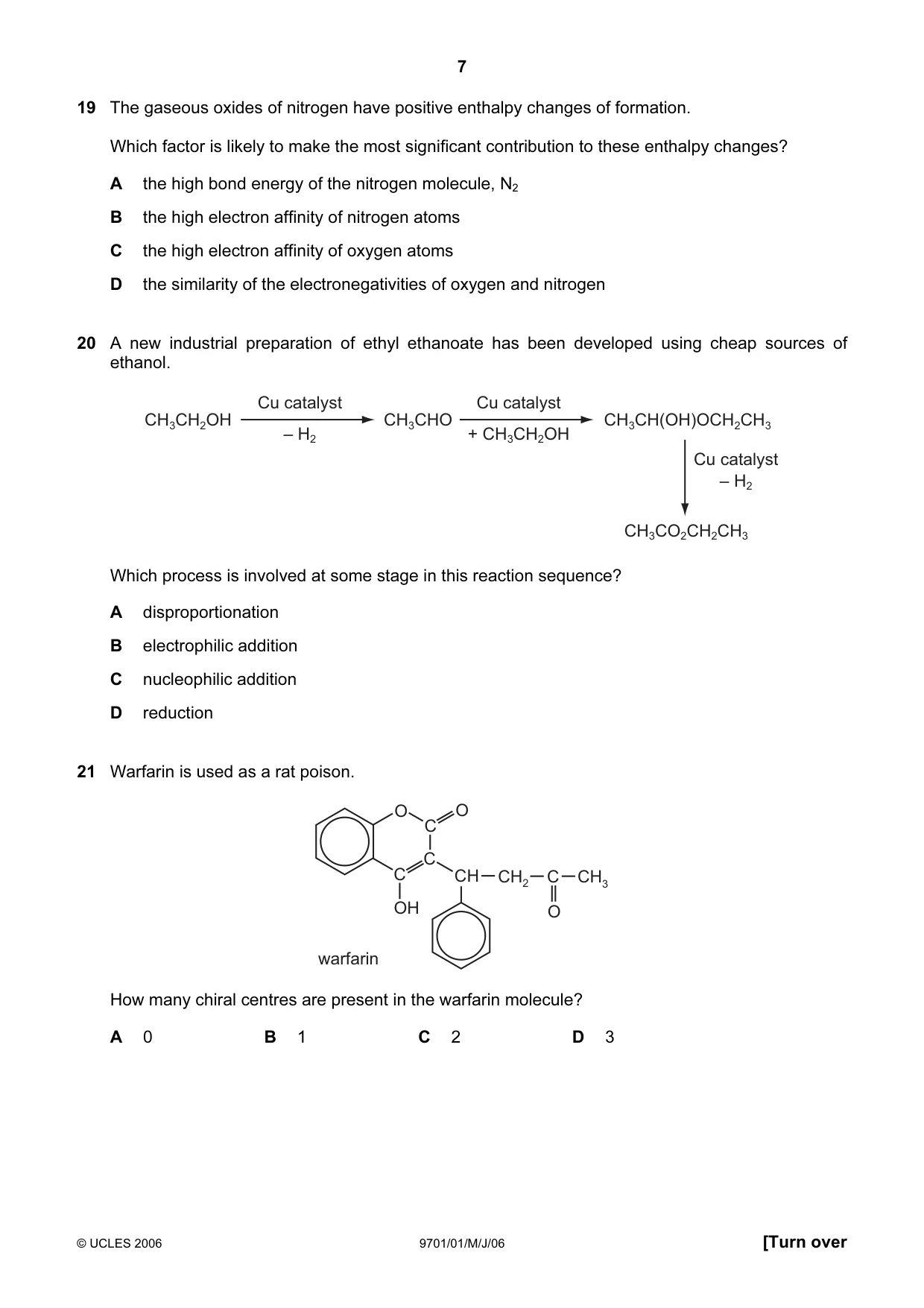
19 The gaseous oxides of nitrogen have positive enthalpy changes of formation. Which factor is likely to make the most significant contribution to these enthalpy changes? A the high bond energy of the nitrogen molecule, N2 B the high electron affinity of nitrogen atoms C the high electron affinity of oxygen atoms D the similarity of the electronegativities of oxygen and nitrogen
Mark scheme: A
Q20 · A new industrial preparation of ethyl ethanoate has been developed using cheap sources of…
20 A new industrial preparation of ethyl ethanoate has been developed using cheap sources of ethanol. Cu catalyst Cu catalyst CH3CH2OH CH3CHO CH3CH(OH)OCH2CH3 – H2 + CH3CH2OH Cu catalyst – H2 CH3CO2CH2CH3 Which process is involved at some stage in this reaction sequence? A disproportionation B electrophilic addition C nucleophilic addition D reduction
Mark scheme: C
Q21 · Warfarin is used as a rat poison
21 Warfarin is used as a rat poison. O O C C C CH CH2 C CH3 OH O warfarin How many chiral centres are present in the warfarin molecule? A 0 B 1 C 2 D 3
Mark scheme: B
More questions on Isomerism: structural isomerism and stereoisomerism
Q22 · The structures below show isomers of C6H12
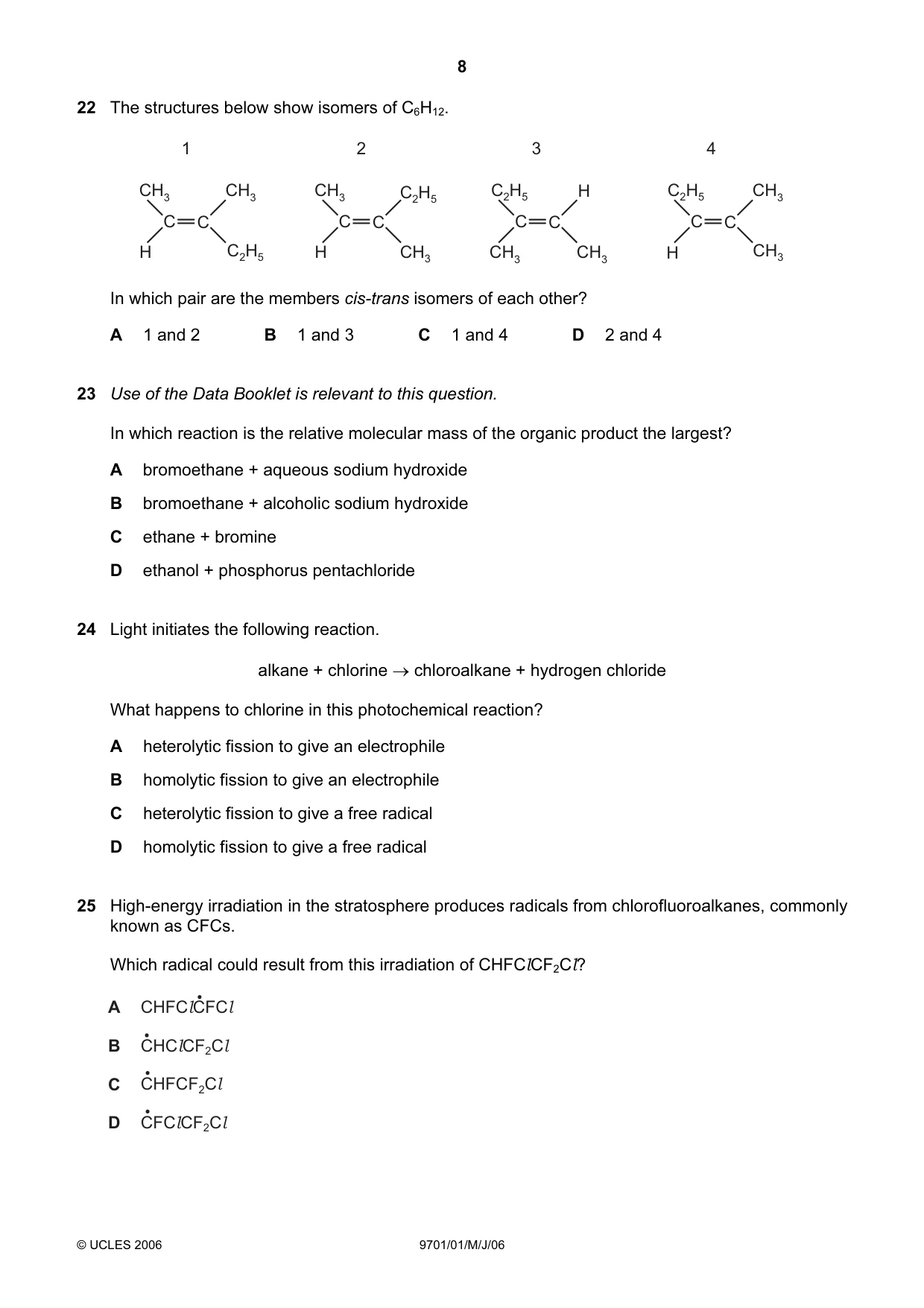
22 The structures below show isomers of C6H12. 1 2 3 4 CH3 CH3 CH3 C2H5 C2H5 H C2H5 CH3 C C C C C C C C H C2H5 H CH3 CH3 CH3 H CH3 In which pair are the members cis-trans isomers of each other? A 1 and 2 B 1 and 3 C 1 and 4 D 2 and 4
Mark scheme: A
More questions on Isomerism: structural isomerism and stereoisomerism
Q23 · Use of the Data Booklet is relevant to this question
23 Use of the Data Booklet is relevant to this question. In which reaction is the relative molecular mass of the organic product the largest? A bromoethane + aqueous sodium hydroxide B bromoethane + alcoholic sodium hydroxide C ethane + bromine D ethanol + phosphorus pentachloride
Mark scheme: C
Q24 · Light initiates the following reaction
24 Light initiates the following reaction. alkane + chlorine → chloroalkane + hydrogen chloride What happens to chlorine in this photochemical reaction? A heterolytic fission to give an electrophile B homolytic fission to give an electrophile C heterolytic fission to give a free radical D homolytic fission to give a free radical
Mark scheme: D
Q25 · High-energy irradiation in the stratosphere produces radicals from chlorofluoroalkanes…
25 High-energy irradiation in the stratosphere produces radicals from chlorofluoroalkanes, commonly known as CFCs. Which radical could result from this irradiation of CHFClCF2Cl? A CHFClCFCl B CHClCF2Cl C CHFCF2Cl D CFClCF2Cl
Mark scheme: C
Q26 · Which reagent could detect the presence of alcohol in a petrol consisting mainly of a…
26 Which reagent could detect the presence of alcohol in a petrol consisting mainly of a mixture of alkanes and alkenes? A Na B Br2 (in CCl4) C KMnO4(aq) D 2,4-dinitrophenylhydrazine
Mark scheme: A
Q27 · Which alcohol may be oxidised to a product which reacts with 2,4-dinitrophenylhydrazine…
27 Which alcohol may be oxidised to a product which reacts with 2,4-dinitrophenylhydrazine reagent but not with Fehling’s reagent? A butan-1-ol B butan-2-ol C 2-methylpropan-1-ol D 2-methylpropan-2-ol
Mark scheme: B
Q28 · The first stage in the synthesis of antipyrine, a drug used in reducing fever, is the…
28 The first stage in the synthesis of antipyrine, a drug used in reducing fever, is the reaction between compound P and phenylhydrazine. CH3COCH2CO2CH2CH3 + NHNH2 Q P phenylhydrazine What is the product Q of this first stage? A CH3COCH2CONH B NHCH2CO2CH2CH3 C CH3COCH2CO NHNH2 D NHN CH3CCH2CO2CH2CH3
Mark scheme: D
Q29 · Aldehydes and ketones are carbonyl compounds
29 Aldehydes and ketones are carbonyl compounds. Which of them react both with NaBH4 and with Tollens’ reagent? A both aldehydes and ketones B aldehydes only C ketones only D neither aldehydes nor ketones
Mark scheme: B
Q30 · Which compound is a product of the hydrolysis of CH3CO2C3H7 by boiling aqueous sodium…
30 Which compound is a product of the hydrolysis of CH3CO2C3H7 by boiling aqueous sodium hydroxide? A CH3OH B C3H7OH C C3H7CO2H D C H CO −Na + 3 7 2
Mark scheme: B
Q31 · The Group IV elements carbon, silicon and germanium all exist in a diamond structure
31 The Group IV elements carbon, silicon and germanium all exist in a diamond structure. The bond lengths in these structures are given below. element X C Si Ge bond length X–X / nm 0.154 0.234 0.244 Why does the bond length increase down the group? 1 Orbital overlap decreases down the group. 2 Atomic radius increases down the group. 3 Nuclear charge increases down the group.
Mark scheme: B
Q32 · Sodium ions can be formed from sodium atoms
32 Sodium ions can be formed from sodium atoms. Na(s) → Na+(g) Which quantities are required to calculate the enthalpy change of formation of gaseous sodium ions? 1 enthalpy change of atomisation of sodium 2 first ionisation energy of sodium 3 enthalpy change of formation of sodium
Mark scheme: B
Q33 · Hydrazine, N2H4, is widely used as a rocket fuel because it reacts with oxygen as shown…
33 Hydrazine, N2H4, is widely used as a rocket fuel because it reacts with oxygen as shown, producing ‘environmentally friendly’ gases. N2H4(l) + O2(g) → N2(g) + 2H2O(g) ∆H = –534 kJ mol–1 Despite its use as a rocket fuel, hydrazine does not spontaneously burn in oxygen. Why does hydrazine not burn spontaneously? 1 The activation energy is too high. 2 The N≡N bond is very strong. 3 Hydrazine is a liquid.
Mark scheme: D
More questions on Effect of temperature on reaction rates and the concept of activation energy
Q34 · Compound X • does not conduct electricity when in a liquid state, • when added to water…
34 Compound X • does not conduct electricity when in a liquid state, • when added to water produces a solution that readily conducts electricity. What could X be? 1 MgCl2 2 SiCl4 3 PCl3
Mark scheme: C
Q35 · Hydroxyapatite, a basic calcium phosphate, Ca(OH)2.3Ca3(PO4)2, is the mineral found in…
35 Hydroxyapatite, a basic calcium phosphate, Ca(OH)2.3Ca3(PO4)2, is the mineral found in bone. In older people, calcium ions can be lost from the hydroxyapatite, weakening the bone structure. In such cases, strontium salts are administered to strengthen the bone. The strontium ions replace the lost calcium ions in the hydroxyapatite. Which statements are correct? 1 Strontium ions are nearly the same size as calcium ions and so may easily replace them in the hydroxyapatite. 2 Strontium hydroxide is less soluble than calcium hydroxide and so will precipitate better in the bone structure. 3 There is ionic, covalent and metallic bonding in hydroxyapatite which gives it strength.
Mark scheme: D
Q36 · Ammonia and chlorine react in the gas phase
36 Ammonia and chlorine react in the gas phase. 8NH3 + 3Cl2 → N2 + 6NH4Cl Which statements are correct? 1 Ammonia behaves as a reducing agent. 2 Ammonia behaves as a base. 3 The oxidation number of the hydrogen changes.
Mark scheme: B
Q37 · In which pairs are the members stereoisomers of each other?
37 In which pairs are the members stereoisomers of each other? 1 CH3 CH3 C C Br Br H Cl Cl H 2 CH3 Br Br CH3 C C C C H H H H 3 CH3 Br CH3 H C C C C H Cl Br Cl
Mark scheme: D
More questions on Isomerism: structural isomerism and stereoisomerism
Q38 · Deuterium, D, is the H 2 isotope of hydrogen
38 Deuterium, D, is the H 2 isotope of hydrogen. DBr has the same chemical properties as HBr. 1 Which compounds could be made by the reaction of DBr with another compound in a single reaction? Br D 1 2 CHBr2CHDBr OD 3 CH3CH Br
Mark scheme: B
Q39 · How can the rate of reaction between ethanal and aqueous hydrogen cyanide be increased?
39 How can the rate of reaction between ethanal and aqueous hydrogen cyanide be increased? 1 by irradiation with ultraviolet light 2 by a rise in temperature 3 by the addition of a small quantity of aqueous sodium cyanide
Mark scheme: C
More questions on Effect of temperature on reaction rates and the concept of activation energy
Q40 · Which statements about lactic acid, CH3CH(OH)CO2H, are correct?
40 Which statements about lactic acid, CH3CH(OH)CO2H, are correct? 1 Lactic acid forms optical isomers. 2 Two hydrogen atoms per lactic acid molecule can be involved in hydrogen bonding. 3 Lactic acid would form an aldehyde when oxidised by acidified potassium dichromate(VI).
Mark scheme: B
What was in this paper
The subtopics covered by these 40 questions, and how many questions each got. Open one in a new tab to see every Cambridge question on it.
3Isomerism: structural isomerism and stereoisomerism3Particles in the atom and atomic radius3Aldehydes and ketones2Alkanes2Chemical equilibria: reversible reactions, dynamic equilibrium2Enthalpy change, ΔH2Reacting masses and volumes (of solutions and gases)2Redox processes: electron transfer and changes in oxidation number (oxidation state)2Alcohols1Alkenes1Bonding and structure1Characteristic organic reactions1Covalent bonding and coordinate (dative covalent) bonding1Electrons, energy levels and atomic orbitals1Esters1Halogenoalkanes1Intermolecular forces, electronegativity and bond properties1Ionic bonding1Ionisation energy1Isomerism: optical1Mass spectrometry1Nitrogen and sulfur1Organic synthesis1Periodicity of chemical properties of the elements in Period 31Similarities and trends in the properties of the Group 2 metals, magnesium to barium, and their compounds1The chemical properties of the halogen elements and the hydrogen halides1The gaseous state: ideal and real gases and pV = nRT1What you needed in this session
Cambridge’s own grade thresholds for 2006 May/June, Paper 1 · Variant 1. A higher threshold means an easier paper — the bar moves with how the cohort did.