Cambridge A Level Chemistry 9701 — 2024 Oct/Nov Paper 1 · Variant 1
9701/11/O/N/24 · 40 questions · 40 marks · ≈45 min
The question paper and its mark scheme, free to read here and free to download. This is Cambridge’s own paper, exactly as it was sat.
Question paper20 pages


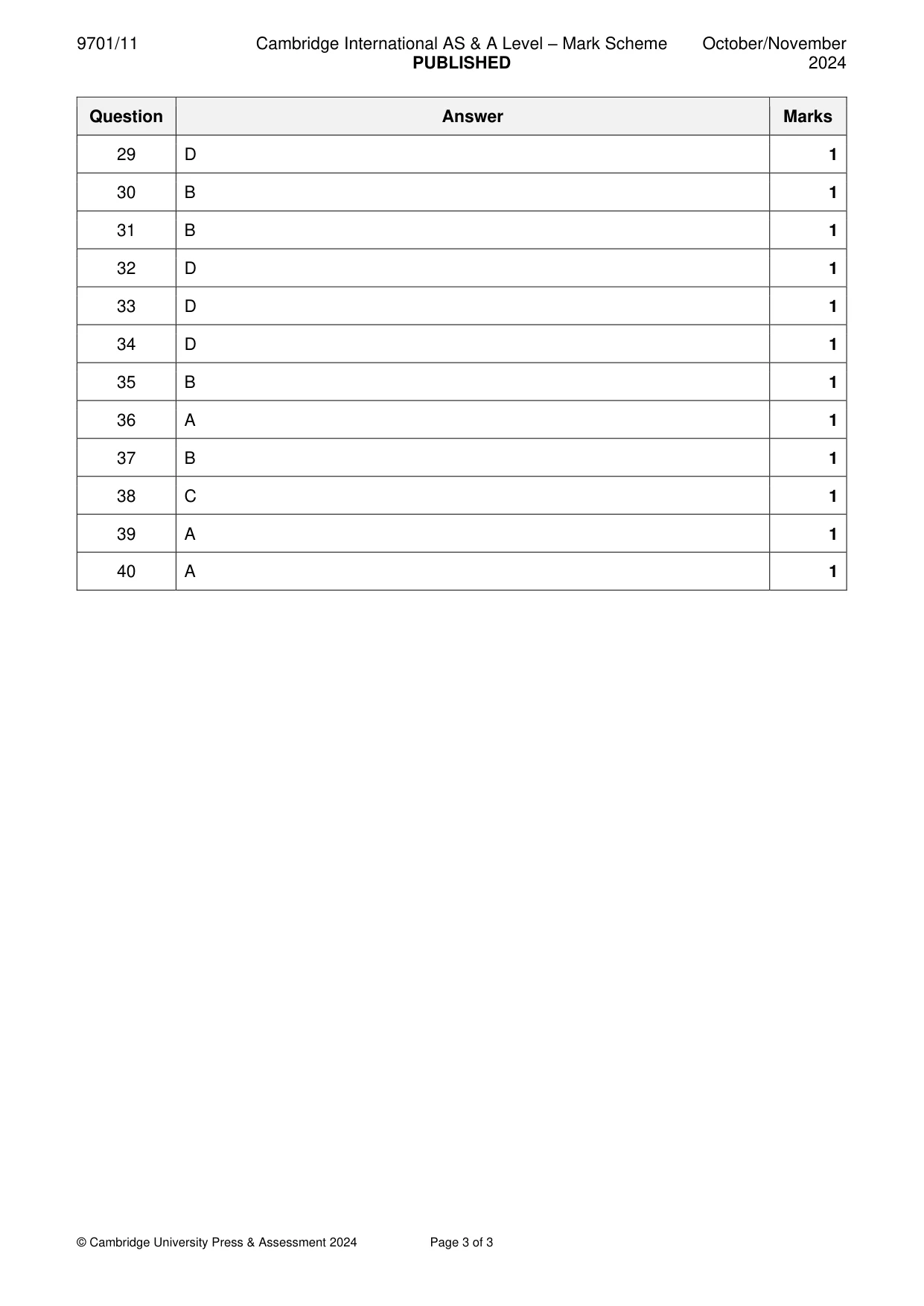
Mark scheme3 pages
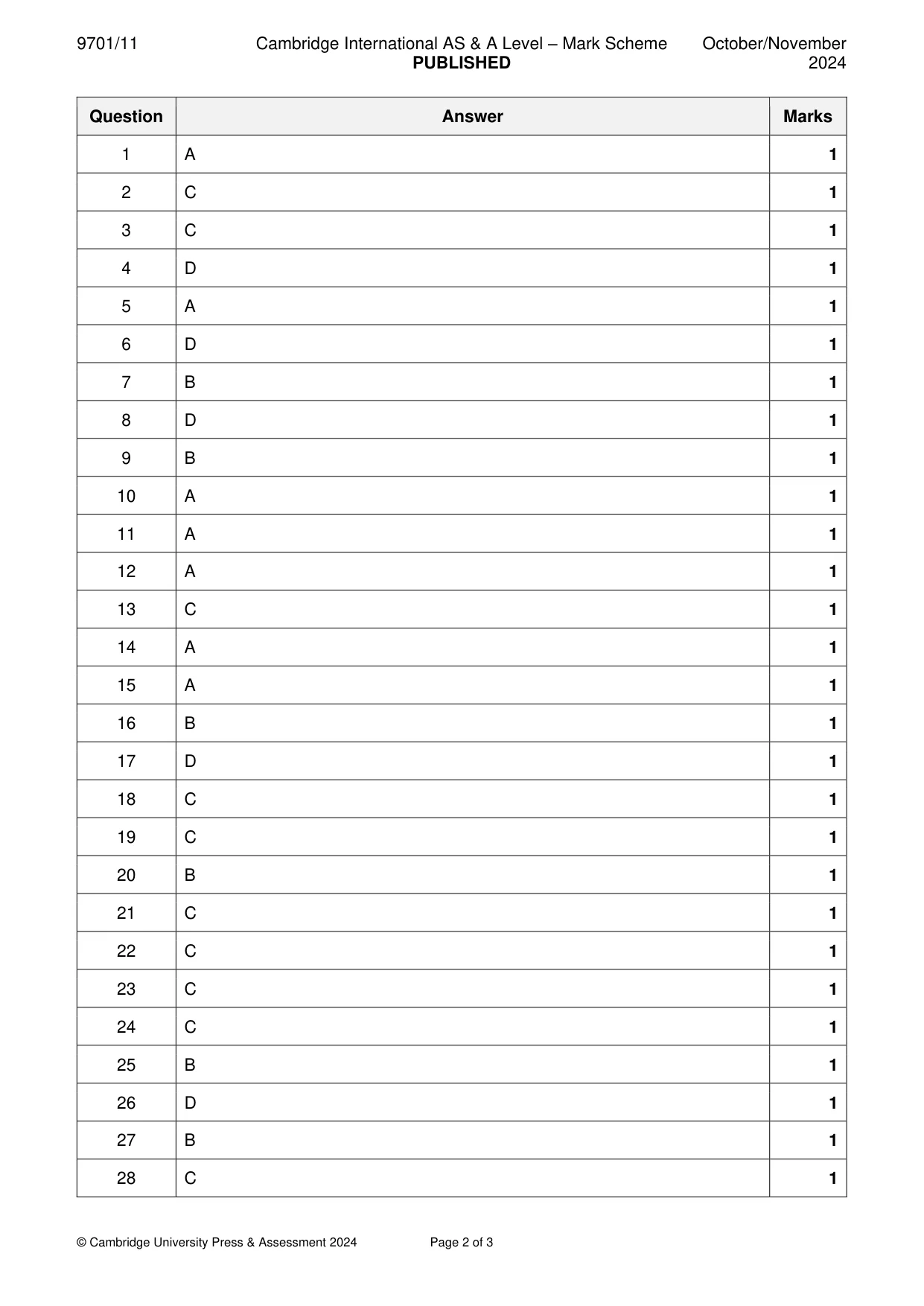
Answers below. Sit the paper first if you are practising.
Questions as text
Q1 · In this question Q is used to represent a halogen atom
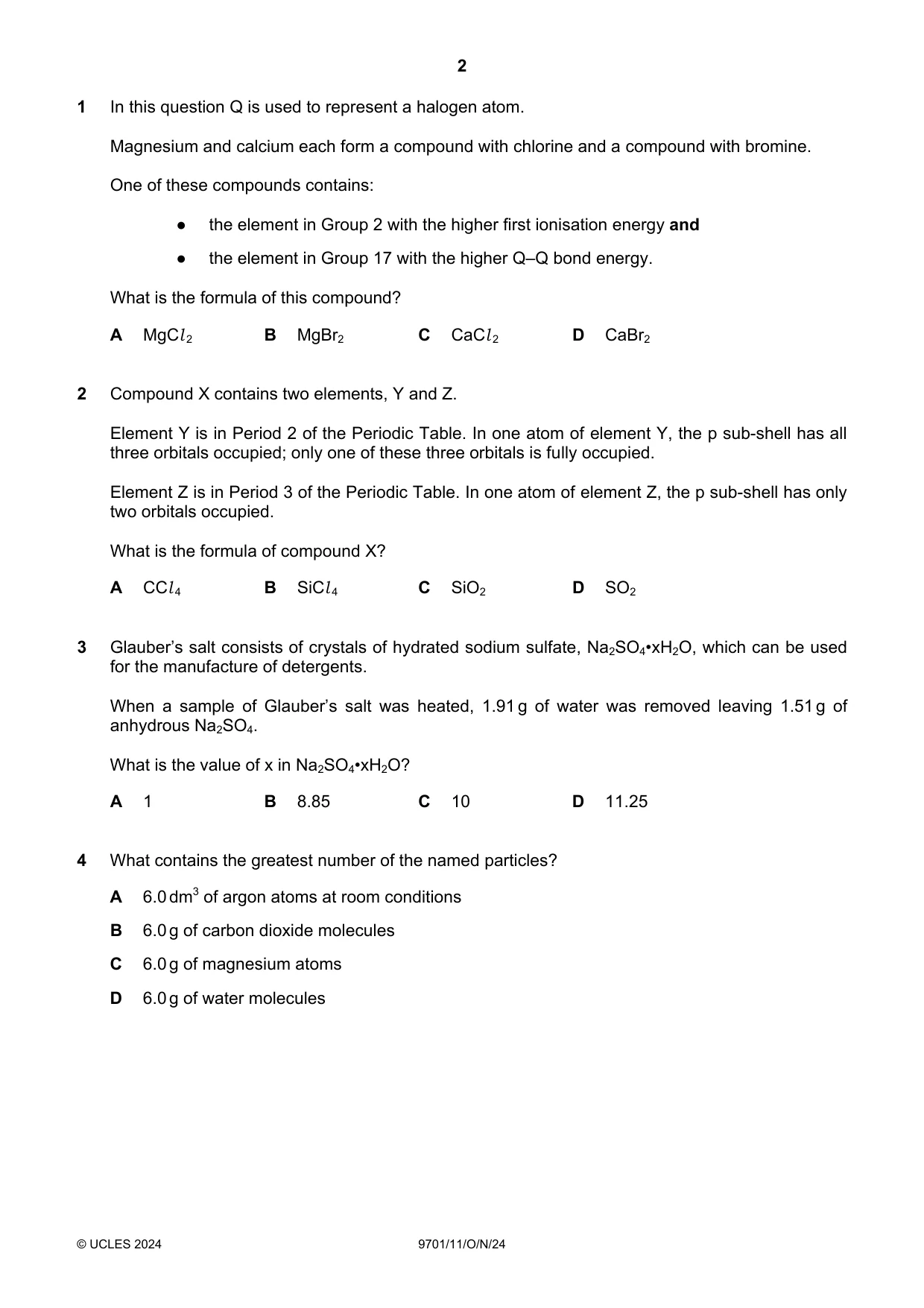
1 In this question Q is used to represent a halogen atom. Magnesium and calcium each form a compound with chlorine and a compound with bromine. One of these compounds contains: ● the element in Group 2 with the higher first ionisation energy and ● the element in Group 17 with the higher Q–Q bond energy. What is the formula of this compound? A MgCl 2 B MgBr2 C CaCl 2 D CaBr2
Mark scheme: A
Q2 · Compound X contains two elements, Y and Z
2 Compound X contains two elements, Y and Z. Element Y is in Period 2 of the Periodic Table. In one atom of element Y, the p sub-shell has all three orbitals occupied; only one of these three orbitals is fully occupied. Element Z is in Period 3 of the Periodic Table. In one atom of element Z, the p sub-shell has only two orbitals occupied. What is the formula of compound X? A CCl 4 B SiCl 4 C SiO2 D SO2
Mark scheme: C
More questions on Electrons, energy levels and atomic orbitals
Q3 · Glauber’s salt consists of crystals of hydrated sodium sulfate, Na2SO4•xH2O, which can be…
3 Glauber’s salt consists of crystals of hydrated sodium sulfate, Na2SO4•xH2O, which can be used for the manufacture of detergents. When a sample of Glauber’s salt was heated, 1.91 g of water was removed leaving 1.51 g of anhydrous Na2SO4. What is the value of x in Na2SO4•xH2O? A 1 B 8.85 C 10 D 11.25
Mark scheme: C
Q4 · What contains the greatest number of the named particles?
4 What contains the greatest number of the named particles? A 6.0 dm3 of argon atoms at room conditions B 6.0 g of carbon dioxide molecules C 6.0 g of magnesium atoms D 6.0 g of water molecules
Mark scheme: D
Q5 · Phosphorus forms a compound with hydrogen called phosphine, PH3
5 Phosphorus forms a compound with hydrogen called phosphine, PH3. This compound can react with a hydrogen ion, H+. Which type of interaction occurs between PH3 and H+? A dative covalent bond B dipole–dipole forces C hydrogen bond D ionic bond
Mark scheme: A
More questions on Covalent bonding and coordinate (dative covalent) bonding
Q6 · The graphs show trends in four physical properties of elements in Period 3, excluding…
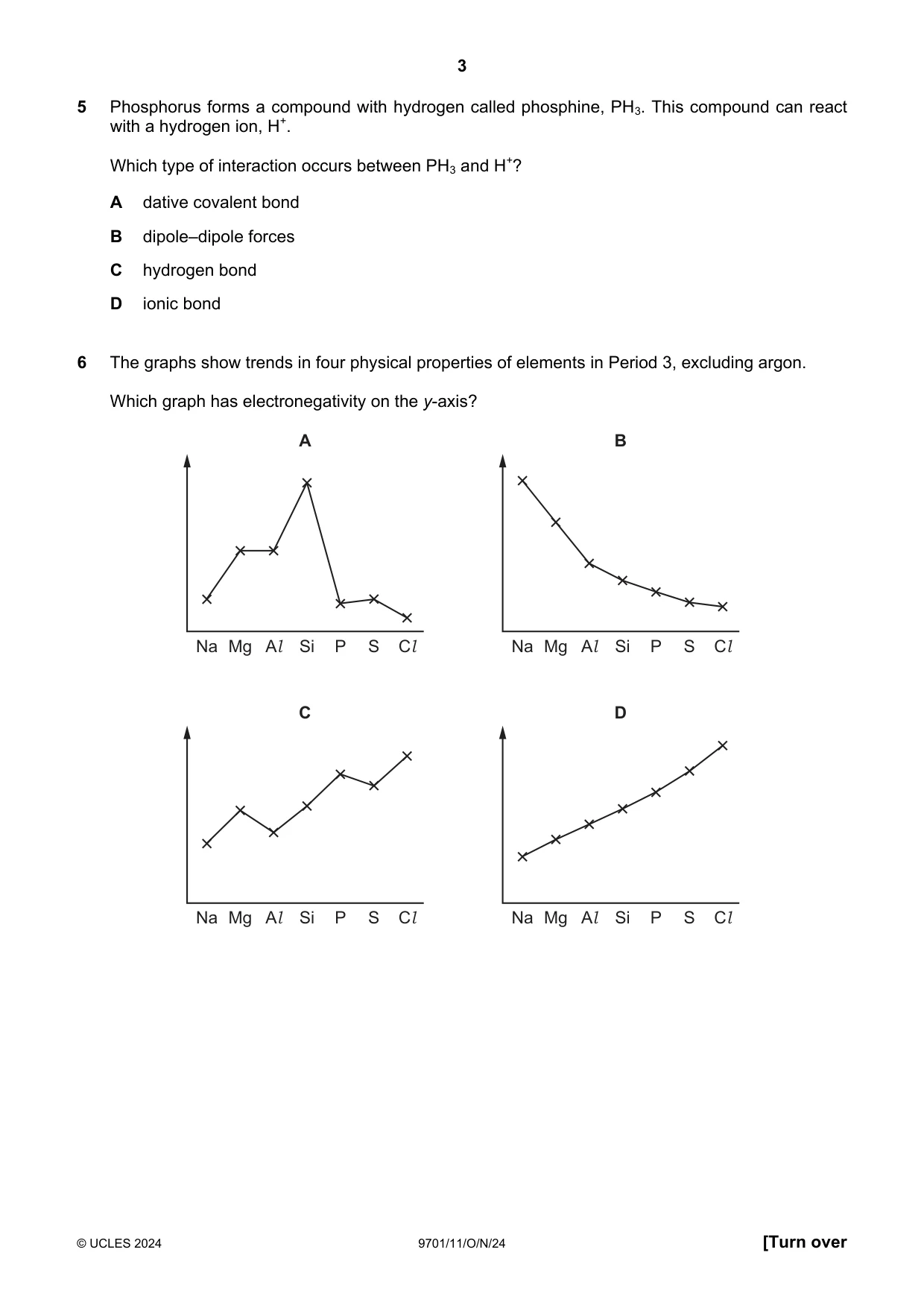
6 The graphs show trends in four physical properties of elements in Period 3, excluding argon. Which graph has electronegativity on the y-axis? A B Na Mg Al Si P S Cl Na Mg Al Si P S Cl C D Na Mg Al Si P S Cl Na Mg Al Si P S Cl
Mark scheme: D
More questions on Periodicity of physical properties of the elements in Period 3
Q7 · The element tin exists in two forms, grey tin and white tin
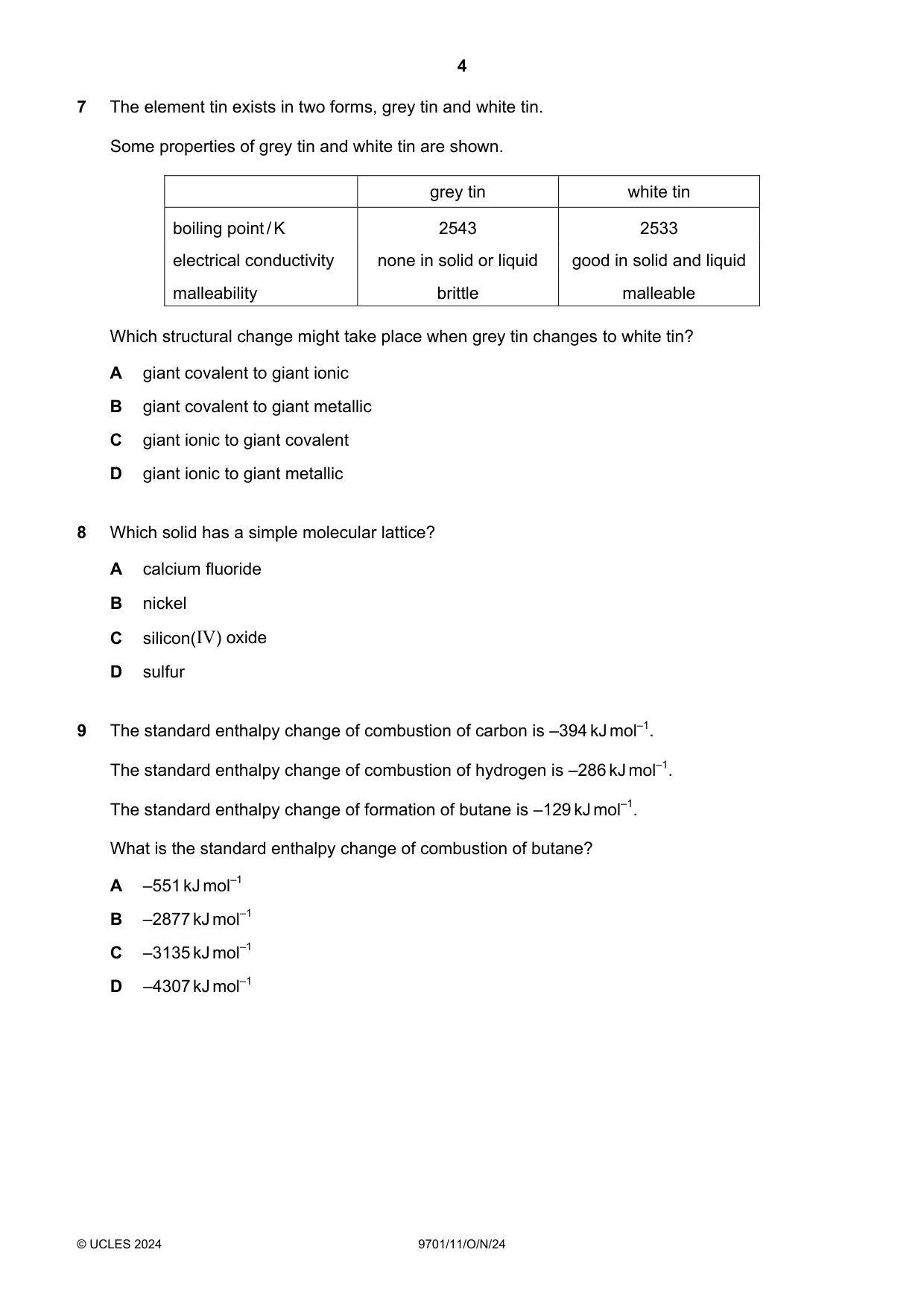
7 The element tin exists in two forms, grey tin and white tin. Some properties of grey tin and white tin are shown. grey tin white tin boiling point / K 2543 2533 electrical conductivity none in solid or liquid good in solid and liquid malleability brittle malleable Which structural change might take place when grey tin changes to white tin? A giant covalent to giant ionic B giant covalent to giant metallic C giant ionic to giant covalent D giant ionic to giant metallic
Mark scheme: B
Q8 · Which solid has a simple molecular lattice?
8 Which solid has a simple molecular lattice? A calcium fluoride B nickel C silicon(IV) oxide D sulfur
Mark scheme: D
Q9 · The standard enthalpy change of combustion of carbon is –394 kJ mol–1
9 The standard enthalpy change of combustion of carbon is –394 kJ mol–1. The standard enthalpy change of combustion of hydrogen is –286 kJ mol–1. The standard enthalpy change of formation of butane is –129 kJ mol–1. What is the standard enthalpy change of combustion of butane? A –551 kJ mol–1 B –2877 kJ mol–1 C –3135 kJ mol–1 D –4307 kJ mol–1
Mark scheme: B
Q10 · Three processes are described
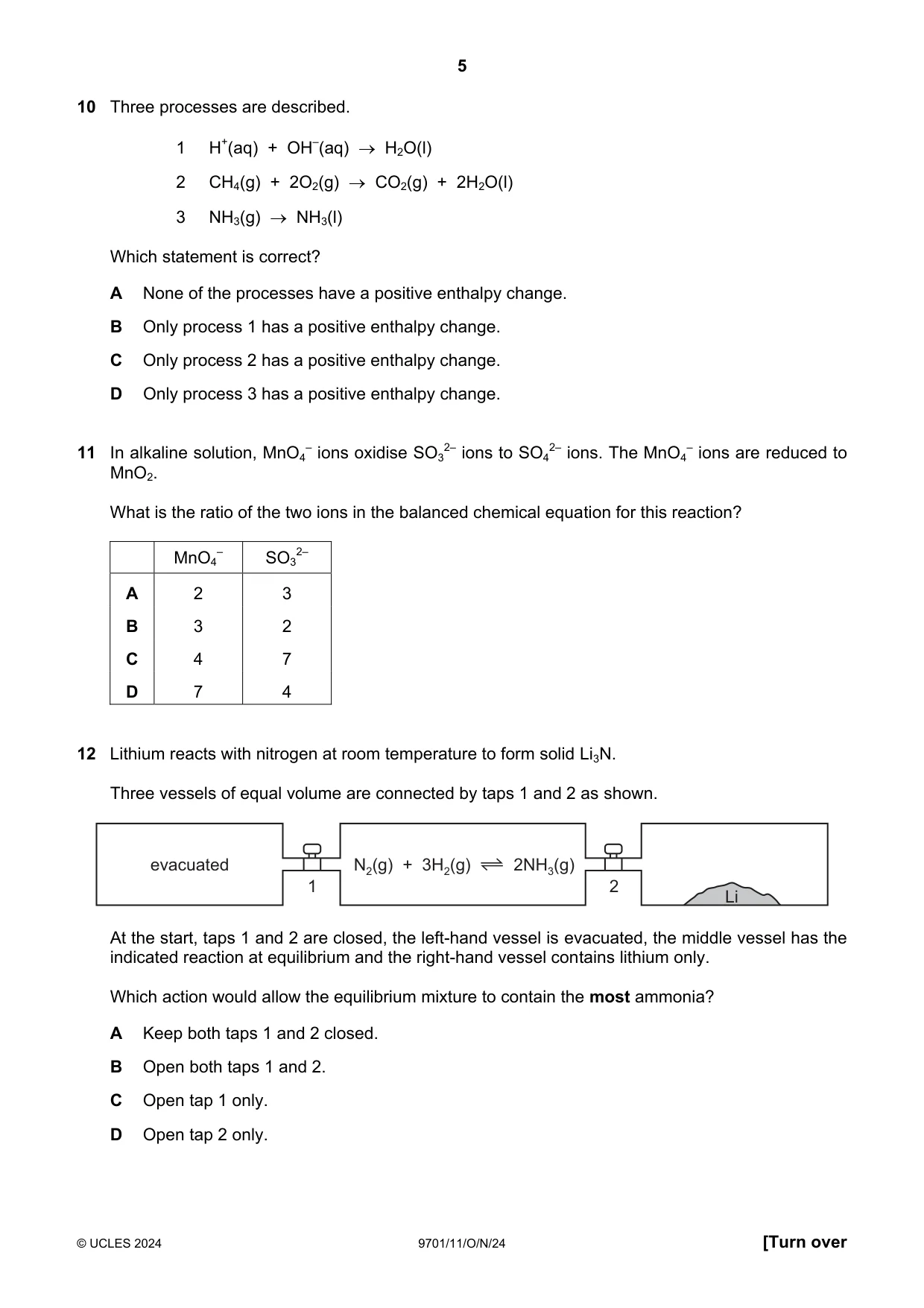
10 Three processes are described. 1 H+(aq) + OH–(aq) H2O(l) 2 CH4(g) + 2O2(g) CO2(g) + 2H2O(l) 3 NH3(g) NH3(l) Which statement is correct? A None of the processes have a positive enthalpy change. B Only process 1 has a positive enthalpy change. C Only process 2 has a positive enthalpy change. D Only process 3 has a positive enthalpy change.
Mark scheme: A
Q11 · In alkaline solution, MnO4 – ions oxidise SO3 2– ions to SO4 2– ions
11 In alkaline solution, MnO4 – ions oxidise SO3 2– ions to SO4 2– ions. The MnO4 – ions are reduced to MnO2. What is the ratio of the two ions in the balanced chemical equation for this reaction? MnO4 – SO3 2– A 2 3 B 3 2 C 4 7 D 7 4
Mark scheme: A
Q12 · Lithium reacts with nitrogen at room temperature to form solid Li3N
12 Lithium reacts with nitrogen at room temperature to form solid Li3N. Three vessels of equal volume are connected by taps 1 and 2 as shown. evacuated N2(g) + 3H2(g) 2NH3(g) 1 2 Li At the start, taps 1 and 2 are closed, the left-hand vessel is evacuated, the middle vessel has the indicated reaction at equilibrium and the right-hand vessel contains lithium only. Which action would allow the equilibrium mixture to contain the most ammonia? A Keep both taps 1 and 2 closed. B Open both taps 1 and 2. C Open tap 1 only. D Open tap 2 only.
Mark scheme: A
More questions on Chemical equilibria: reversible reactions, dynamic equilibrium
Q13 · When 0.20 mol of hydrogen gas and 0.15 mol of iodine gas are heated at 723 K until…
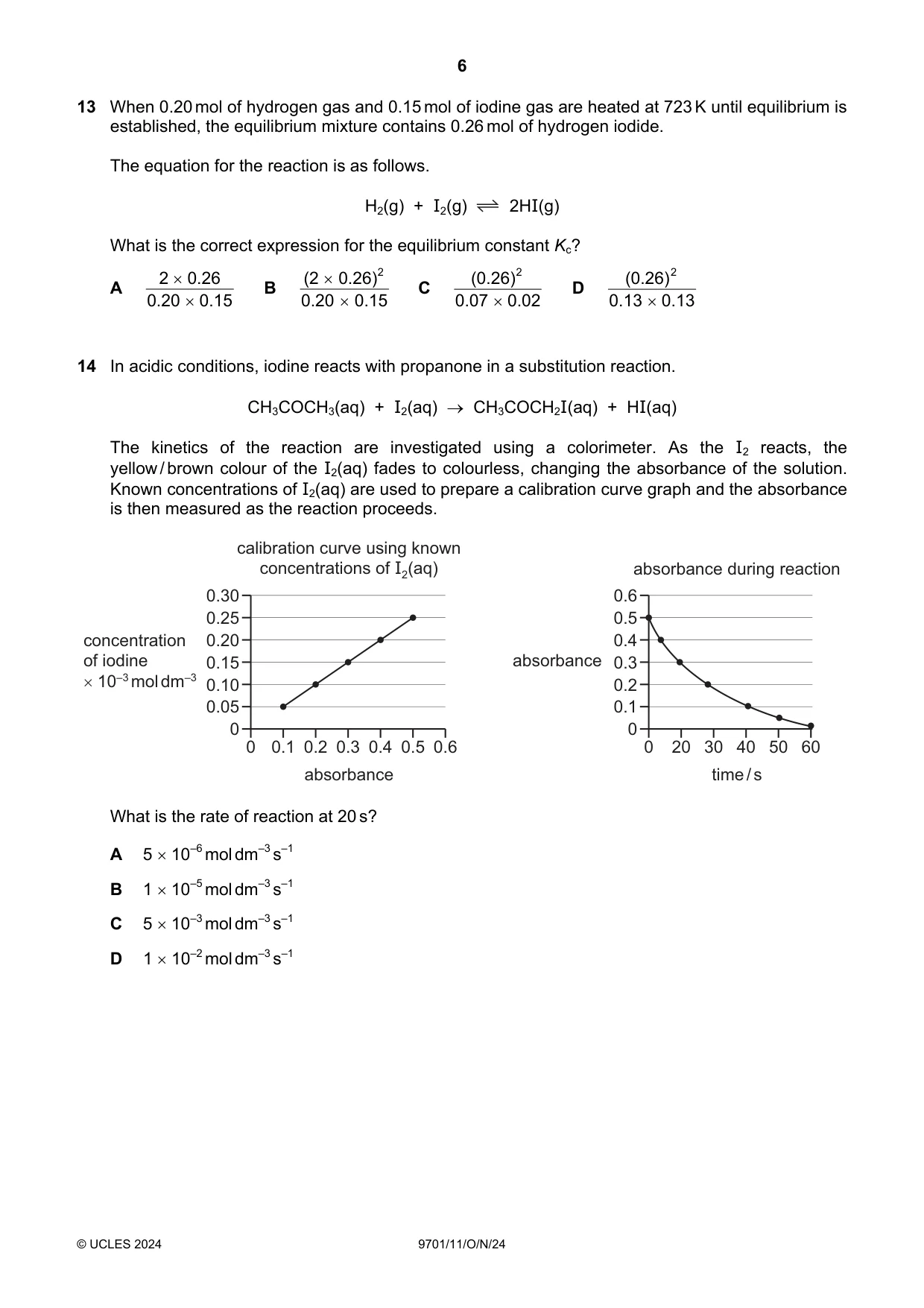
13 When 0.20 mol of hydrogen gas and 0.15 mol of iodine gas are heated at 723 K until equilibrium is established, the equilibrium mixture contains 0.26 mol of hydrogen iodide. The equation for the reaction is as follows. H2(g) + I2(g) 2HI(g) What is the correct expression for the equilibrium constant Kc? 2 0.26 (2 0.26) 2 (0.26)2 (0.26)2 A B C D 0.20 0.15 0.20 0.15 0.07 0.02 0.13 0.13
Mark scheme: C
More questions on Chemical equilibria: reversible reactions, dynamic equilibrium
Q14 · In acidic conditions, iodine reacts with propanone in a substitution reaction
14 In acidic conditions, iodine reacts with propanone in a substitution reaction. CHsCOCH3(aq) + I,(aq) — CH3COCH2I(aq) + HI(aq) The kinetics of the reaction are investigated using a colorimeter. As the I, reacts, the yellow/brown colour of the I,(aq) fades to colourless, changing the absorbance of the solution. Known concentrations of I2(aq) are used to prepare a calibration curve graph and the absorbance is then measured as the reaction proceeds. calibration curve using known concentrations of I,(aq) absorbance during reaction 0.30 0.6 0.25 0.5 concentration 0.20 0.4 of iodine 0.15 absorbance 0.3 x 10°moldm™ 9.10 0.2 0.05 0.1 0 0 0 0.1 0.2 0.3 0.4 0.5 0.6 0 20 30 40 50 60 absorbance time/s What is the rate of reaction at 20s? A 5x10°%moldm?s™ 1x 10° moldm?s" 5 x 10°°moldm?s™ 0 Oo DW 1 x 10° moldm“s
Mark scheme: A
Q15 · The diagram shows a Boltzmann distribution curve
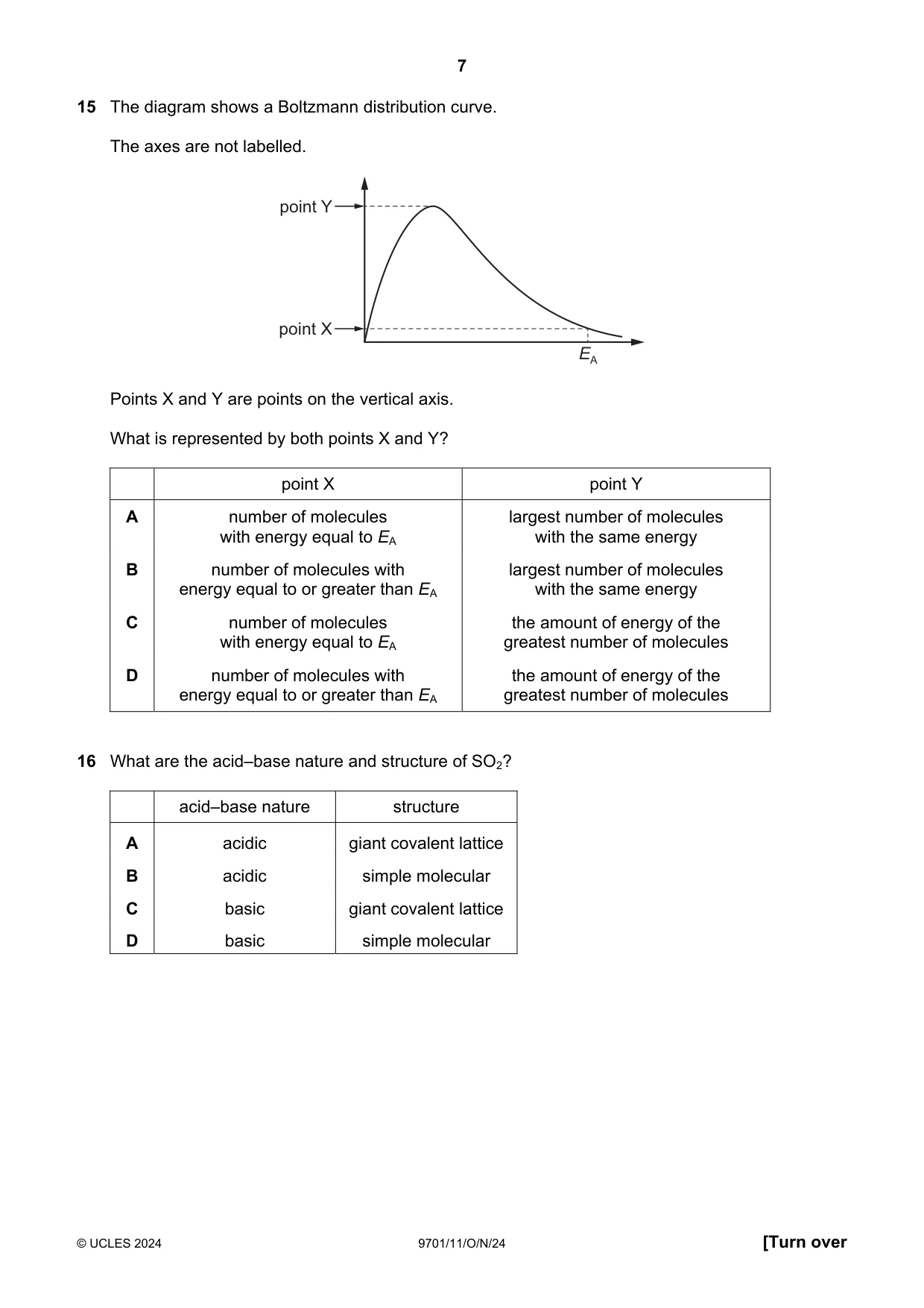
15 The diagram shows a Boltzmann distribution curve. The axes are not labelled. point Y point X EA Points X and Y are points on the vertical axis. What is represented by both points X and Y? point X point Y A number of molecules largest number of molecules with energy equal to EA with the same energy B number of molecules with largest number of molecules energy equal to or greater than EA with the same energy C number of molecules the amount of energy of the with energy equal to EA greatest number of molecules D number of molecules with the amount of energy of the energy equal to or greater than EA greatest number of molecules
Mark scheme: A
More questions on Effect of temperature on reaction rates and the concept of activation energy
Q16 · What are the acid–base nature and structure of SO2?
16 What are the acid–base nature and structure of SO2? acid–base nature structure A acidic giant covalent lattice B acidic simple molecular C basic giant covalent lattice D basic simple molecular
Mark scheme: B
More questions on Periodicity of chemical properties of the elements in Period 3
Q17 · Elements X and Y are in Period 3 of the Periodic Table
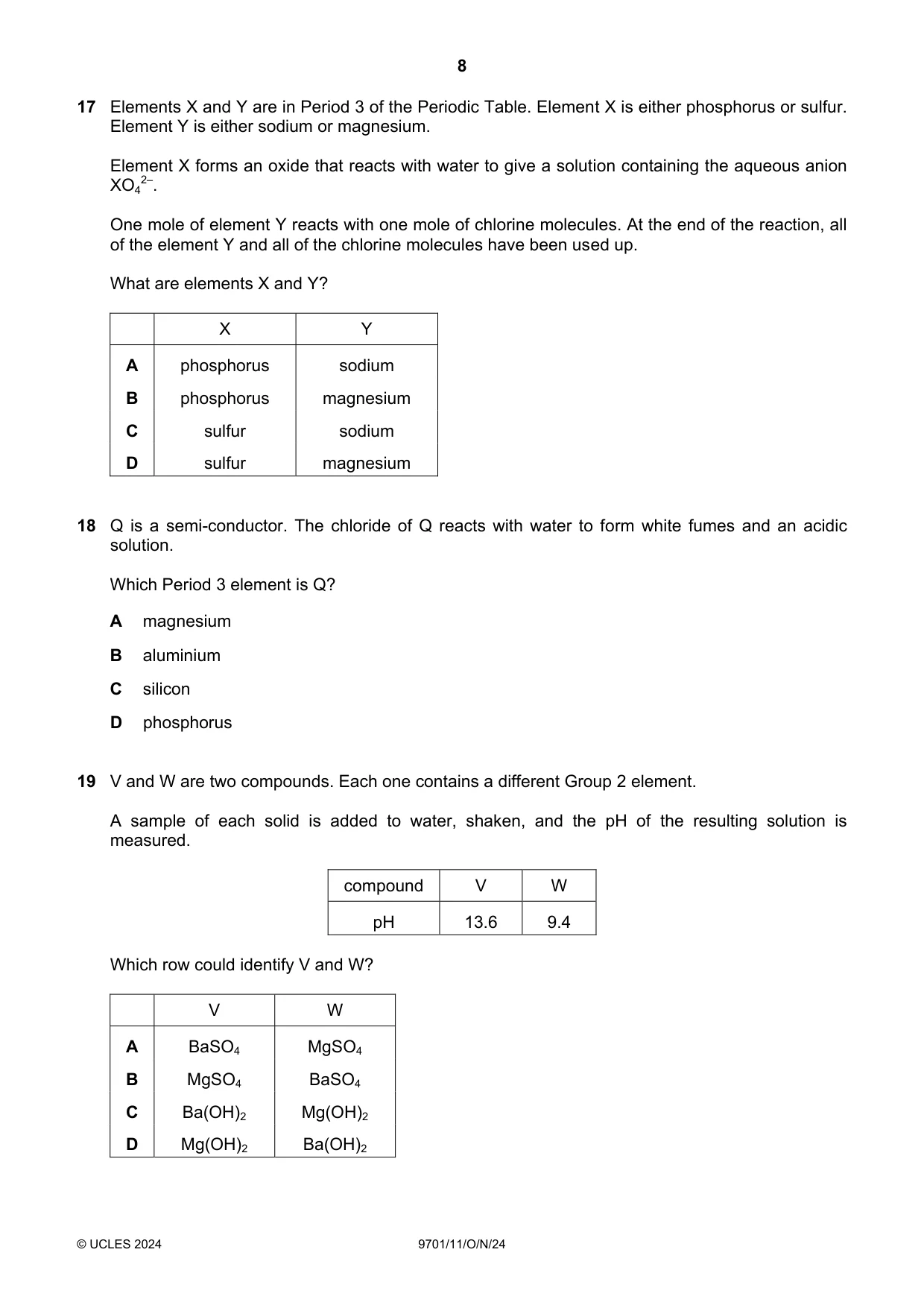
17 Elements X and Y are in Period 3 of the Periodic Table. Element X is either phosphorus or sulfur. Element Y is either sodium or magnesium. Element X forms an oxide that reacts with water to give a solution containing the aqueous anion XO4 2–. One mole of element Y reacts with one mole of chlorine molecules. At the end of the reaction, all of the element Y and all of the chlorine molecules have been used up. What are elements X and Y? X Y A phosphorus sodium B phosphorus magnesium C sulfur sodium D sulfur magnesium
Mark scheme: D
More questions on Periodicity of chemical properties of the elements in Period 3
Q18 · Q is a semi-conductor
18 Q is a semi-conductor. The chloride of Q reacts with water to form white fumes and an acidic solution. Which Period 3 element is Q? A magnesium B aluminium C silicon D phosphorus
Mark scheme: C
More questions on Periodicity of chemical properties of the elements in Period 3
Q19 · V and W are two compounds
19 V and W are two compounds. Each one contains a different Group 2 element. A sample of each solid is added to water, shaken, and the pH of the resulting solution is measured. compound V W pH 13.6 9.4 Which row could identify V and W? V W A BaSO4 MgSO4 B MgSO4 BaSO4 C Ba(OH)2 Mg(OH)2 D Mg(OH)2 Ba(OH)2
Mark scheme: C
Q20 · Compound L decomposes on heating
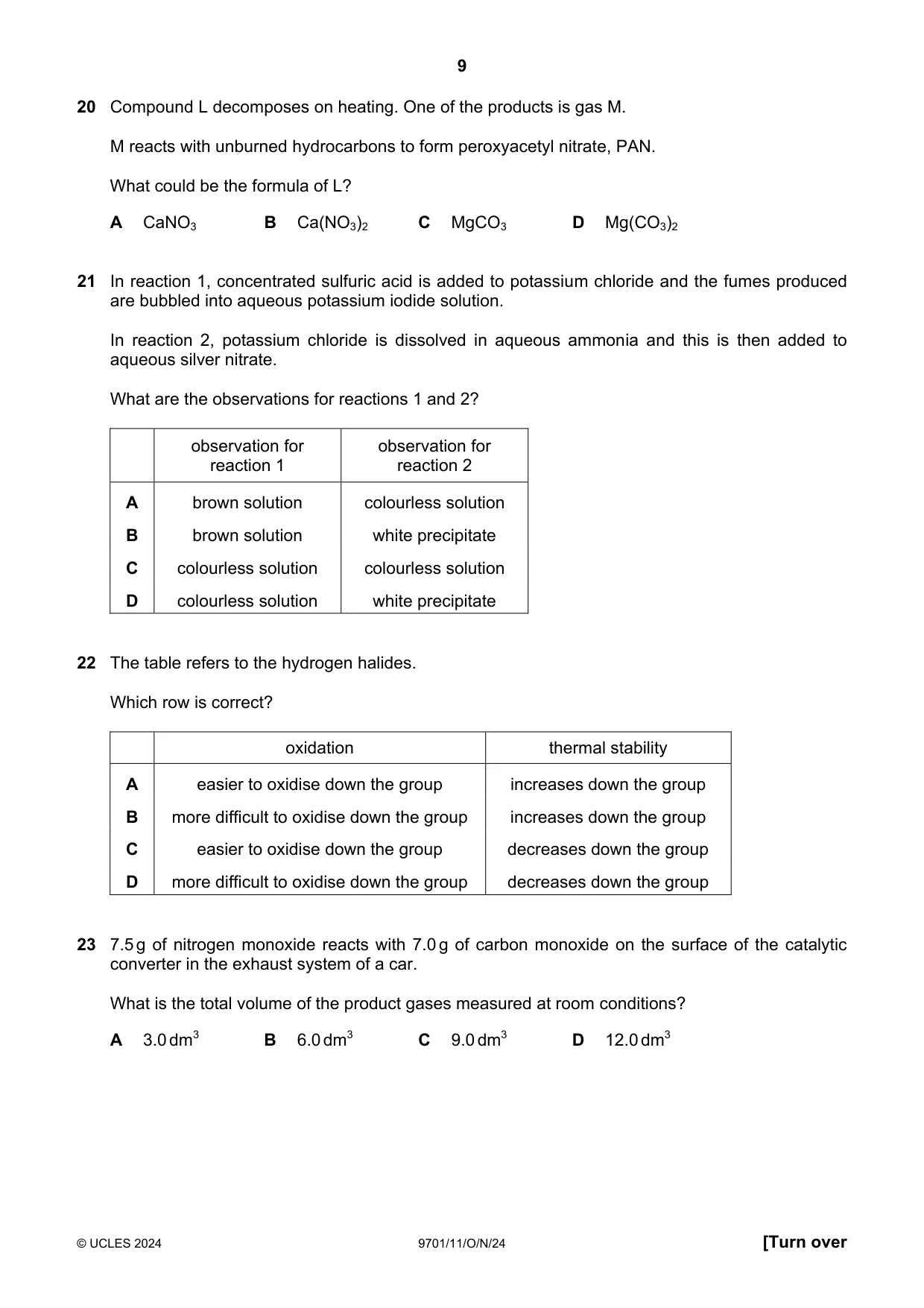
20 Compound L decomposes on heating. One of the products is gas M. M reacts with unburned hydrocarbons to form peroxyacetyl nitrate, PAN. What could be the formula of L? A CaNO3 B Ca(NO3)2 C MgCO3 D Mg(CO3)2
Mark scheme: B
Q21 · In reaction 1, concentrated sulfuric acid is added to potassium chloride and the fumes…
21 In reaction 1, concentrated sulfuric acid is added to potassium chloride and the fumes produced are bubbled into aqueous potassium iodide solution. In reaction 2, potassium chloride is dissolved in aqueous ammonia and this is then added to aqueous silver nitrate. What are the observations for reactions 1 and 2? observation for observation for reaction 1 reaction 2 A brown solution colourless solution B brown solution white precipitate C colourless solution colourless solution D colourless solution white precipitate
Mark scheme: C
Q22 · The table refers to the hydrogen halides
22 The table refers to the hydrogen halides. Which row is correct? oxidation thermal stability A easier to oxidise down the group increases down the group B more difficult to oxidise down the group increases down the group C easier to oxidise down the group decreases down the group D more difficult to oxidise down the group decreases down the group
Mark scheme: C
More questions on The chemical properties of the halogen elements and the hydrogen halides
Q23 · 7.5 g of nitrogen monoxide reacts with 7.0 g of carbon monoxide on the surface of the…
23 7.5 g of nitrogen monoxide reacts with 7.0 g of carbon monoxide on the surface of the catalytic converter in the exhaust system of a car. What is the total volume of the product gases measured at room conditions? A 3.0 dm3 B 6.0 dm3 C 9.0 dm3 D 12.0 dm3
Mark scheme: C
More questions on Reacting masses and volumes (of solutions and gases)
Q24 · Three statements about ammonia molecules and ammonium ions are given
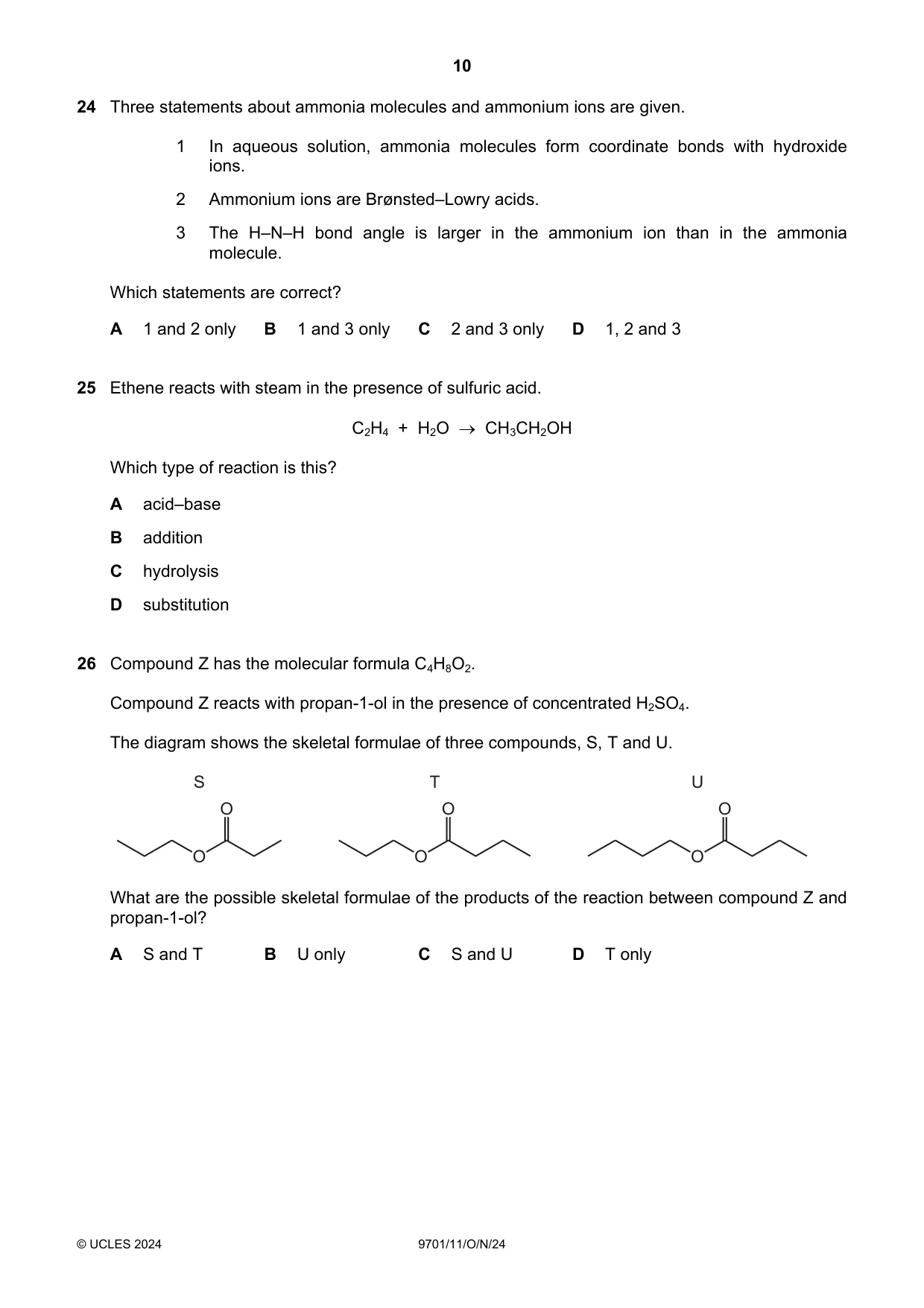
24 Three statements about ammonia molecules and ammonium ions are given. 1 In aqueous solution, ammonia molecules form coordinate bonds with hydroxide ions. 2 Ammonium ions are Brønsted–Lowry acids. 3 The H–N–H bond angle is larger in the ammonium ion than in the ammonia molecule. Which statements are correct? A 1 and 2 only B 1 and 3 only C 2 and 3 only D 1, 2 and 3
Mark scheme: C
More questions on Covalent bonding and coordinate (dative covalent) bonding
Q25 · Ethene reacts with steam in the presence of sulfuric acid
25 Ethene reacts with steam in the presence of sulfuric acid. C2H4 + H2O CH3CH2OH Which type of reaction is this? A acid–base B addition C hydrolysis D substitution
Mark scheme: B
Q26 · Compound Z has the molecular formula C4H8O2
26 Compound Z has the molecular formula C4H8O2. Compound Z reacts with propan-1-ol in the presence of concentrated H2SO4. The diagram shows the skeletal formulae of three compounds, S, T and U. S T U O O O O O O What are the possible skeletal formulae of the products of the reaction between compound Z and propan-1-ol? A S and T B U only C S and U D T only
Mark scheme: D
Q27 · Geraniol and nerol are isomers of each other
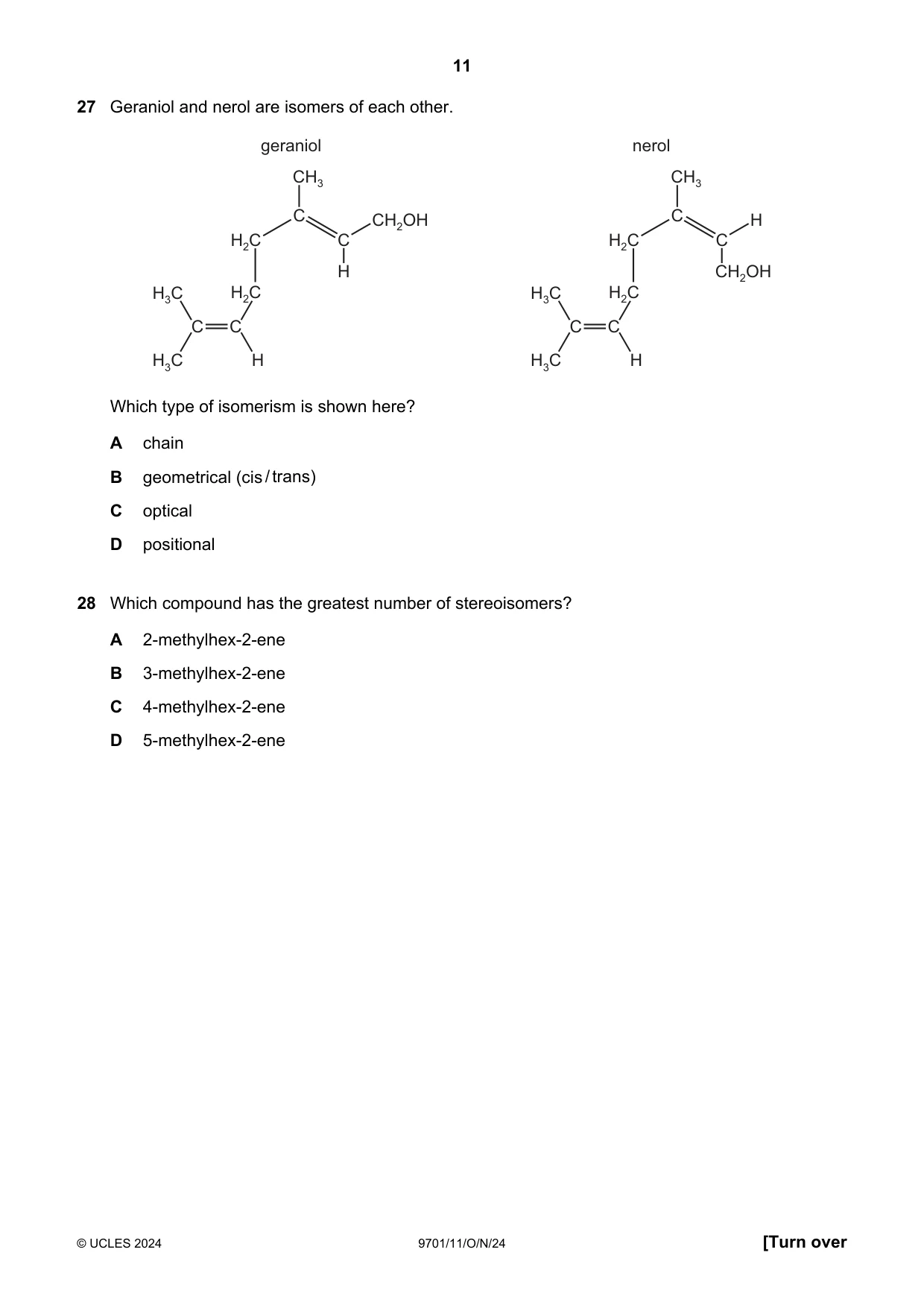
27 Geraniol and nerol are isomers of each other. geraniol nerol CH3 CH3 C CH2OH C H H2C C H2C C H CH2OH H3C H2C H3C H2C C C C C H3C H H3C H Which type of isomerism is shown here? A chain B geometrical (cis / trans) C optical D positional
Mark scheme: B
More questions on Isomerism: structural isomerism and stereoisomerism
Q28 · Which compound has the greatest number of stereoisomers?
28 Which compound has the greatest number of stereoisomers? A 2-methylhex-2-ene B 3-methylhex-2-ene C 4-methylhex-2-ene D 5-methylhex-2-ene
Mark scheme: C
More questions on Isomerism: structural isomerism and stereoisomerism
Q29 · Vitamin A contains retinol
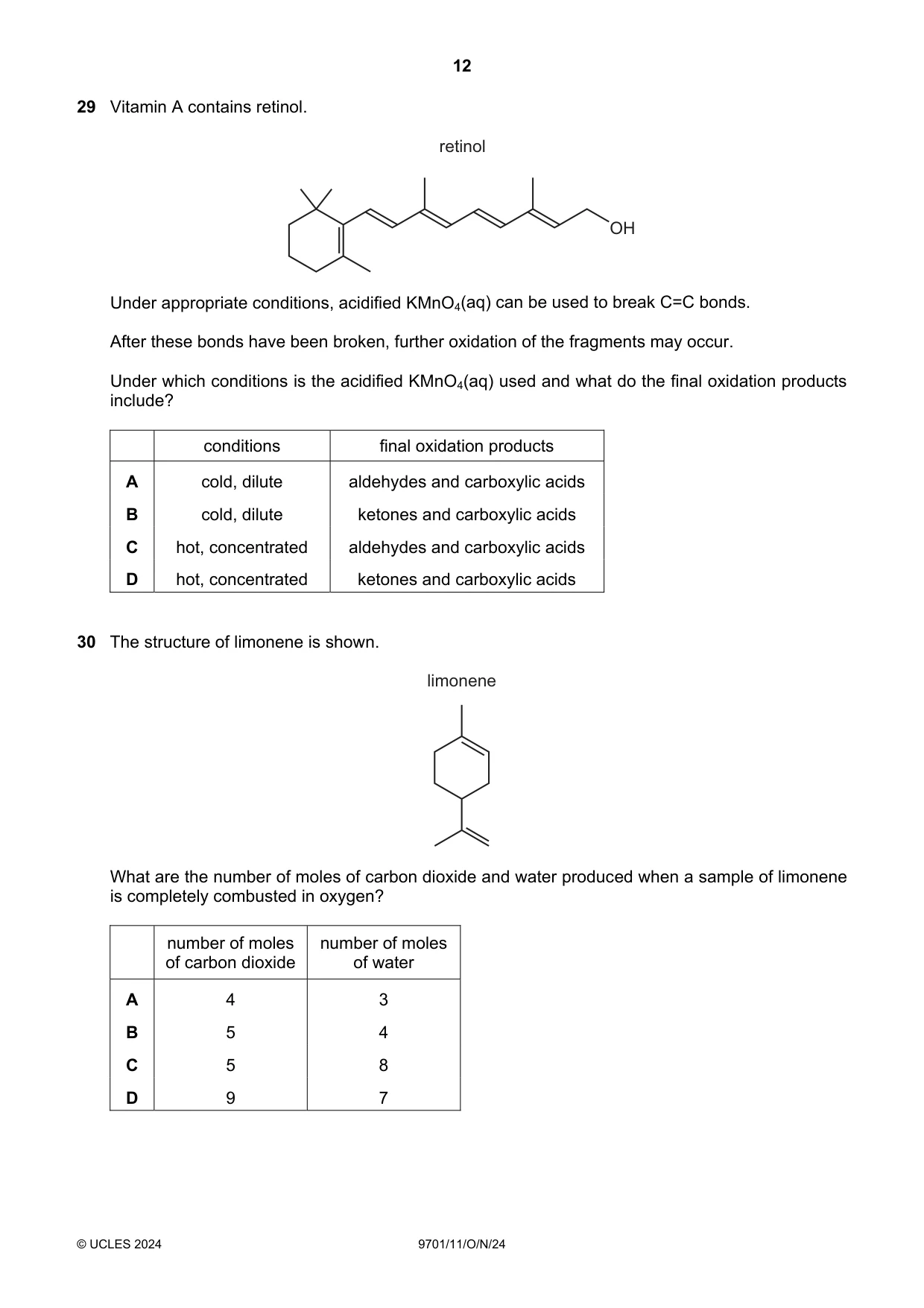
29 Vitamin A contains retinol. retinol OH Under appropriate conditions, acidified KMnO4(aq) can be used to break C=C bonds. After these bonds have been broken, further oxidation of the fragments may occur. Under which conditions is the acidified KMnO4(aq) used and what do the final oxidation products include? conditions final oxidation products A cold, dilute aldehydes and carboxylic acids B cold, dilute ketones and carboxylic acids C hot, concentrated aldehydes and carboxylic acids D hot, concentrated ketones and carboxylic acids
Mark scheme: D
Q30 · The structure of limonene is shown
30 The structure of limonene is shown. limonene What are the number of moles of carbon dioxide and water produced when a sample of limonene is completely combusted in oxygen? number of moles number of moles of carbon dioxide of water A 4 3 B 5 4 C 5 8 D 9 7
Mark scheme: B
Q31 · The reaction of chlorine with methane is carried out in the presence of light
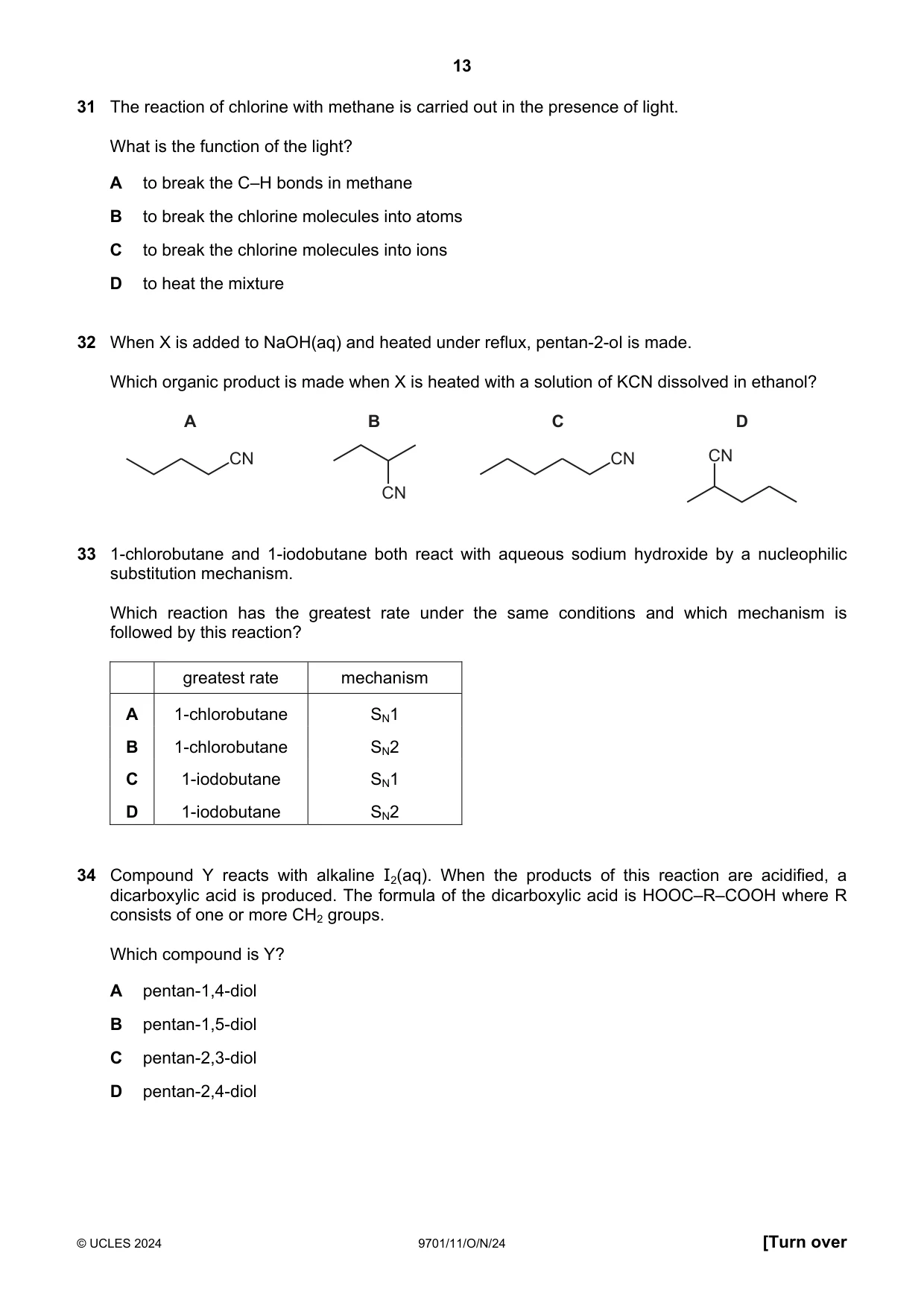
31 The reaction of chlorine with methane is carried out in the presence of light. What is the function of the light? A to break the C–H bonds in methane B to break the chlorine molecules into atoms C to break the chlorine molecules into ions D to heat the mixture
Mark scheme: B
Q32 · When X is added to NaOH(aq) and heated under reflux, pentan-2-ol is made
32 When X is added to NaOH(aq) and heated under reflux, pentan-2-ol is made. Which organic product is made when X is heated with a solution of KCN dissolved in ethanol? A B C D CN CN CN CN
Mark scheme: D
Q33 · 1-chlorobutane and 1-iodobutane both react with aqueous sodium hydroxide by a…
33 1-chlorobutane and 1-iodobutane both react with aqueous sodium hydroxide by a nucleophilic substitution mechanism. Which reaction has the greatest rate under the same conditions and which mechanism is followed by this reaction? greatest rate mechanism A 1-chlorobutane SN1 B 1-chlorobutane SN2 C 1-iodobutane SN1 D 1-iodobutane SN2
Mark scheme: D
Q34 · Compound Y reacts with alkaline I2(aq)
34 Compound Y reacts with alkaline I2(aq). When the products of this reaction are acidified, a dicarboxylic acid is produced. The formula of the dicarboxylic acid is HOOC–R–COOH where R consists of one or more CH2 groups. Which compound is Y? A pentan-1,4-diol B pentan-1,5-diol C pentan-2,3-diol D pentan-2,4-diol
Mark scheme: D
Q35 · Which alcohol gives only one possible oxidation product when warmed with dilute acidified…
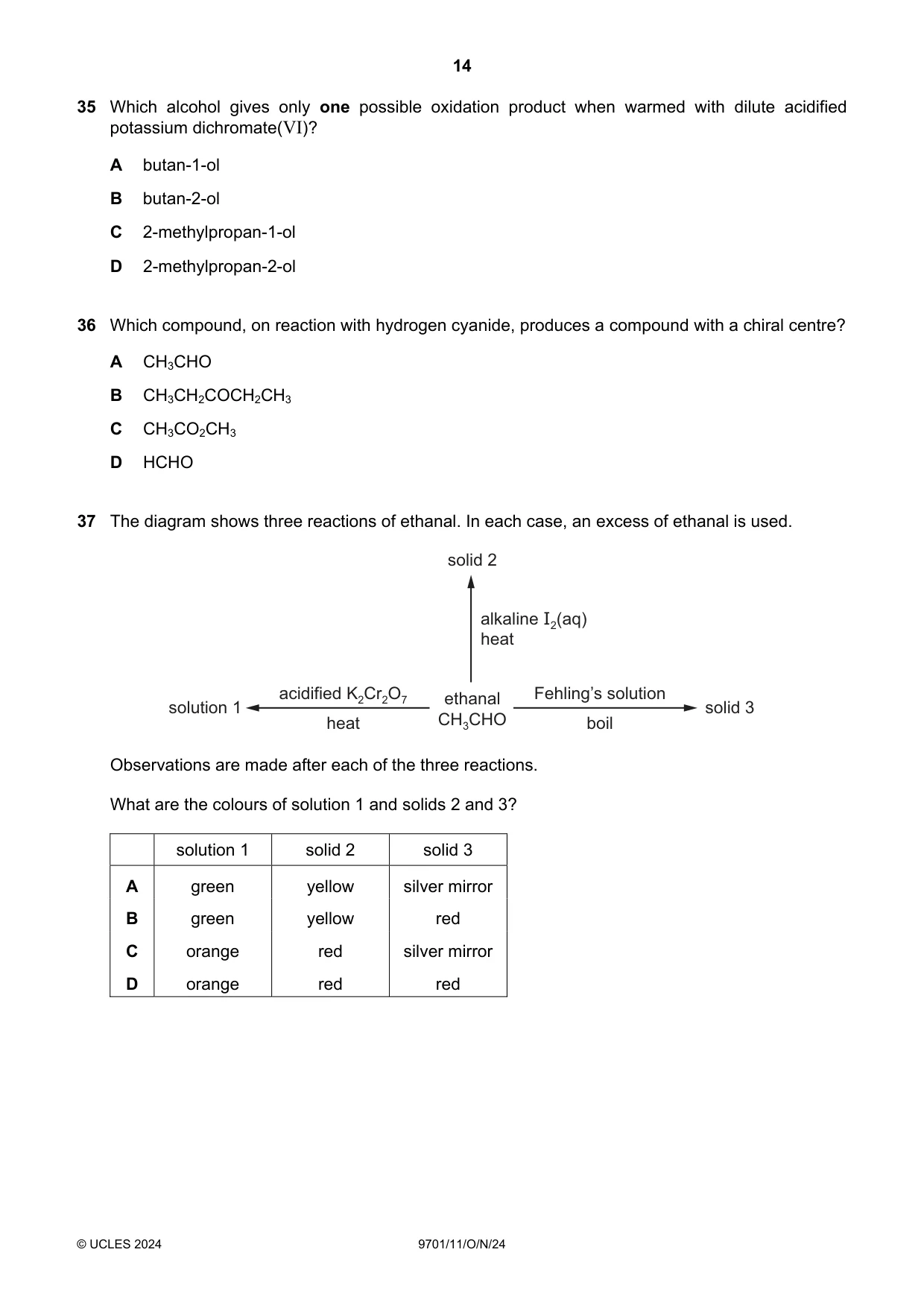
35 Which alcohol gives only one possible oxidation product when warmed with dilute acidified potassium dichromate(VI)? A butan-1-ol B butan-2-ol C 2-methylpropan-1-ol D 2-methylpropan-2-ol
Mark scheme: B
Q36 · Which compound, on reaction with hydrogen cyanide, produces a compound with a chiral…
36 Which compound, on reaction with hydrogen cyanide, produces a compound with a chiral centre? A CH3CHO B CH3CH2COCH2CH3 C CH3CO2CH3 D HCHO
Mark scheme: A
Q37 · The diagram shows three reactions of ethanal
37 The diagram shows three reactions of ethanal. In each case, an excess of ethanal is used. solid 2 alkaline I2(aq) heat acidified K2Cr2O7 ethanal Fehling’s solution solution 1 solid 3 heat CH3CHO boil Observations are made after each of the three reactions. What are the colours of solution 1 and solids 2 and 3? solution 1 solid 2 solid 3 A green yellow silver mirror B green yellow red C orange red silver mirror D orange red red
Mark scheme: B
Q38 · (CH3)3CCN reacts to form alcohol Y via the reaction sequence shown
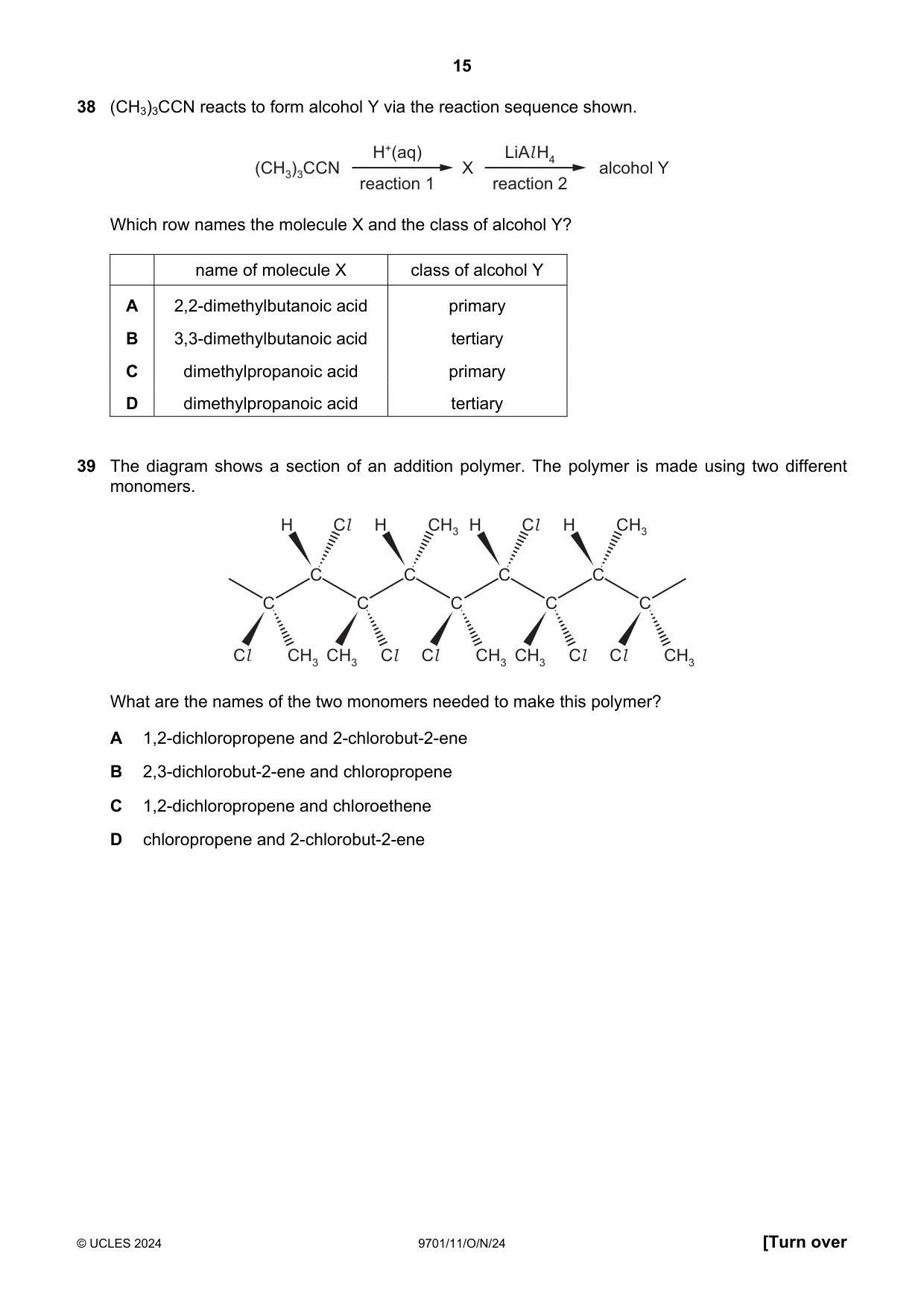
38 (CH3)3CCN reacts to form alcohol Y via the reaction sequence shown. H+(aq) LiAl H4 (CH3)3CCN X alcohol Y reaction 1 reaction 2 Which row names the molecule X and the class of alcohol Y? name of molecule X class of alcohol Y A 2,2-dimethylbutanoic acid primary B 3,3-dimethylbutanoic acid tertiary C dimethylpropanoic acid primary D dimethylpropanoic acid tertiary
Mark scheme: C
Q39 · The diagram shows a section of an addition polymer
39 The diagram shows a section of an addition polymer. The polymer is made using two different monomers. H Cl H CH3 H Cl H CH3 C C C C C C C C C Cl CH3 CH3 Cl Cl CH3 CH3 Cl Cl CH3 What are the names of the two monomers needed to make this polymer? A 1,2-dichloropropene and 2-chlorobut-2-ene B 2,3-dichlorobut-2-ene and chloropropene C 1,2-dichloropropene and chloroethene D chloropropene and 2-chlorobut-2-ene
Mark scheme: A
Q40 · The diagram shows the mass spectrum of a sample of chlorine
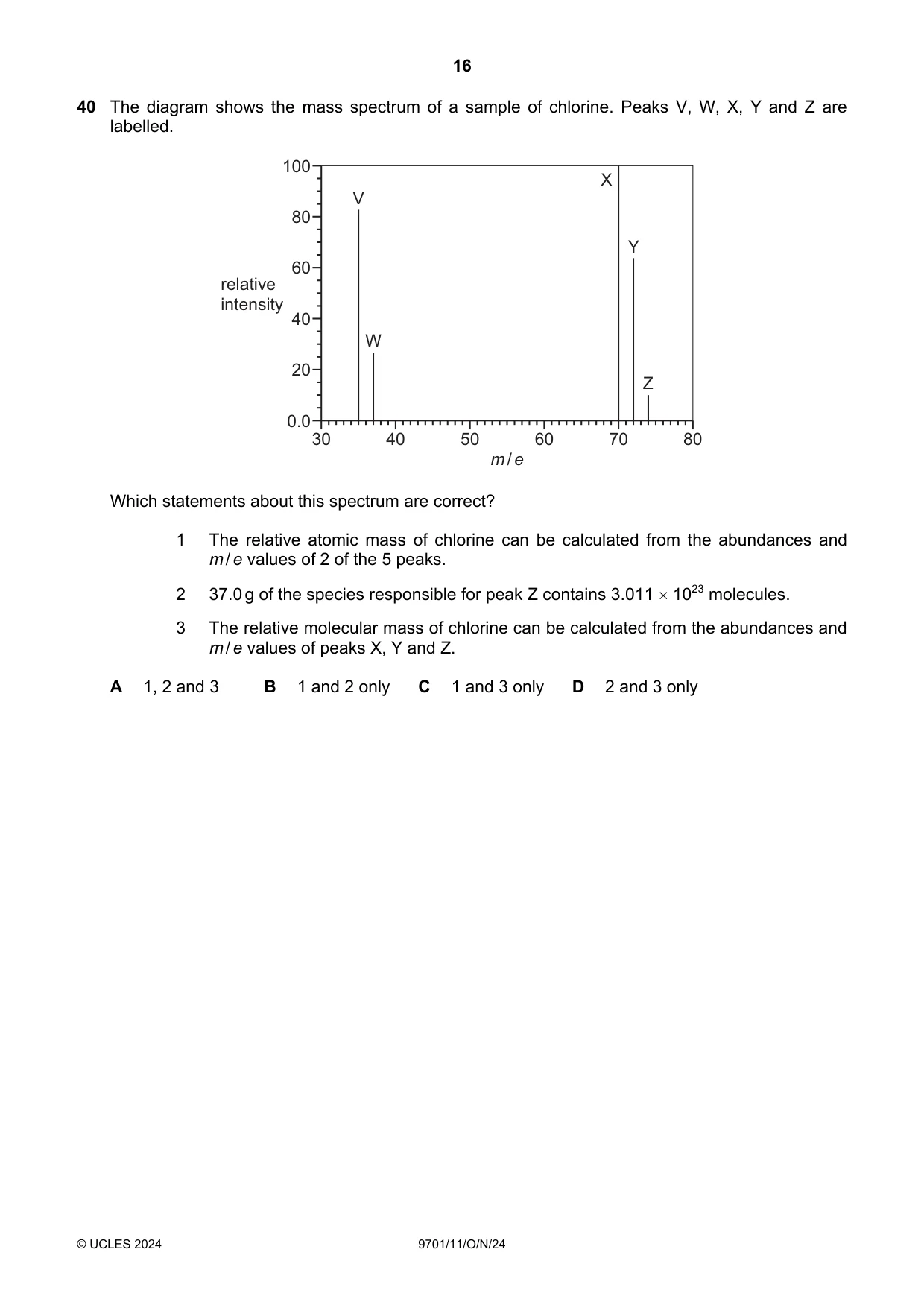
40 The diagram shows the mass spectrum of a sample of chlorine. Peaks V, W, X, Y and Z are labelled. 100 X V 80 Y 60 relative intensity 40 W 20 Z 0.0 30 40 50 60 70 80 m / e Which statements about this spectrum are correct? 1 The relative atomic mass of chlorine can be calculated from the abundances and m / e values of 2 of the 5 peaks. 2 37.0 g of the species responsible for peak Z contains 3.011 1023 molecules. 3 The relative molecular mass of chlorine can be calculated from the abundances and m / e values of peaks X, Y and Z. A 1, 2 and 3 B 1 and 2 only C 1 and 3 only D 2 and 3 only
Mark scheme: A
What was in this paper
The subtopics covered by these 40 questions, and how many questions each got. Open one in a new tab to see every Cambridge question on it.
3Periodicity of chemical properties of the elements in Period 33Alkenes2Bonding and structure2Chemical equilibria: reversible reactions, dynamic equilibrium2Covalent bonding and coordinate (dative covalent) bonding2Halogenoalkanes2Isomerism: structural isomerism and stereoisomerism2Nitriles and hydroxynitriles2Similarities and trends in the properties of the Group 2 metals, magnesium to barium, and their compounds2Addition polymerisation1Alcohols1Alkanes1Effect of temperature on reaction rates and the concept of activation energy1Electrons, energy levels and atomic orbitals1Enthalpy change, ΔH1Esters1Formulas1Hess’s law1Ionisation energy1Mass spectrometry1Periodicity of physical properties of the elements in Period 31Rate of reaction1Reacting masses and volumes (of solutions and gases)1Redox processes: electron transfer and changes in oxidation number (oxidation state)1Some reactions of the halide ions1The chemical properties of the halogen elements and the hydrogen halides1The mole and the Avogadro constant1What you needed in this session
Cambridge’s own grade thresholds for 2024 Oct/Nov, Paper 1 · Variant 1. A higher threshold means an easier paper — the bar moves with how the cohort did.