Cambridge A Level Chemistry 9701 — 2018 May/June Paper 1 · Variant 1
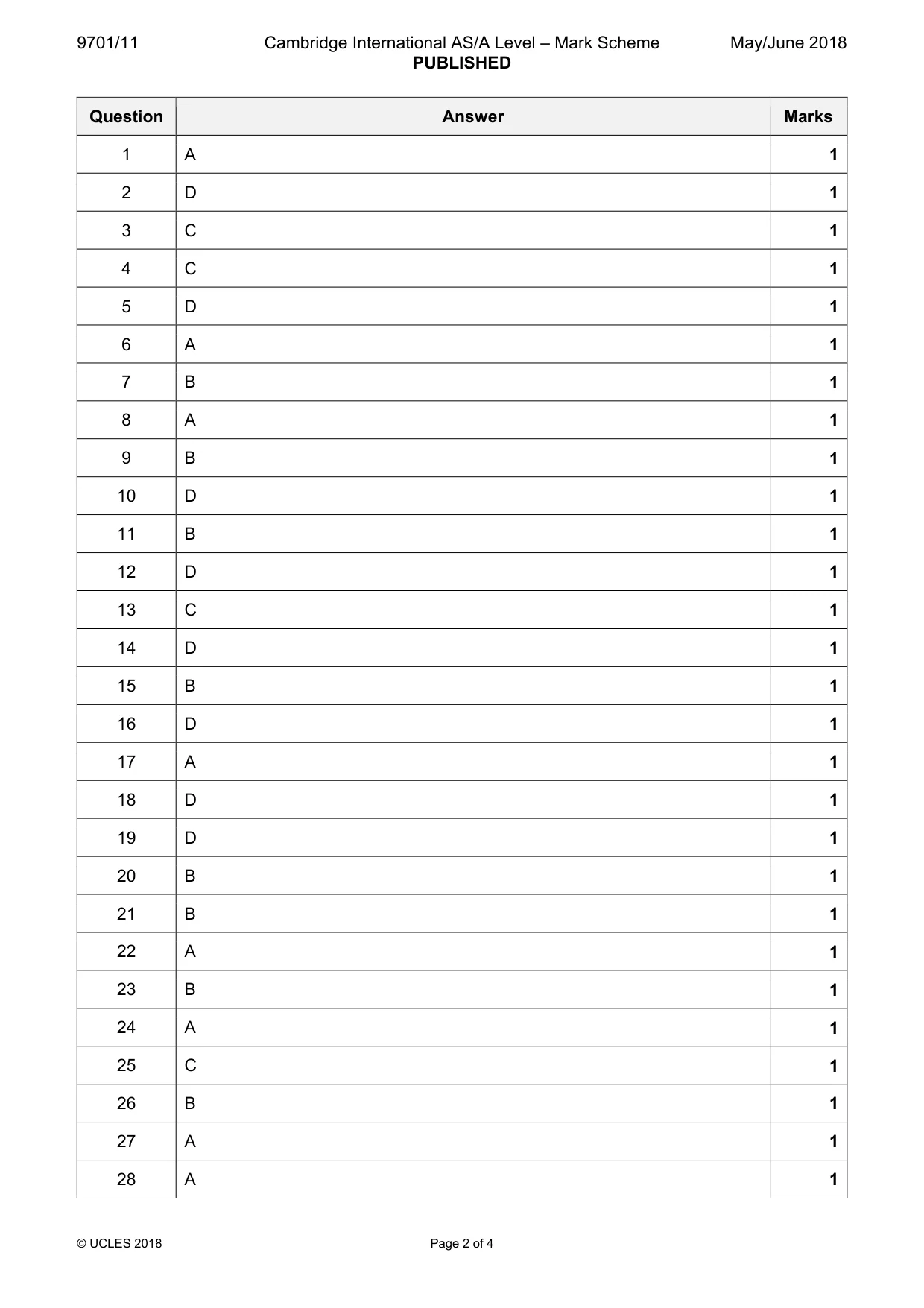
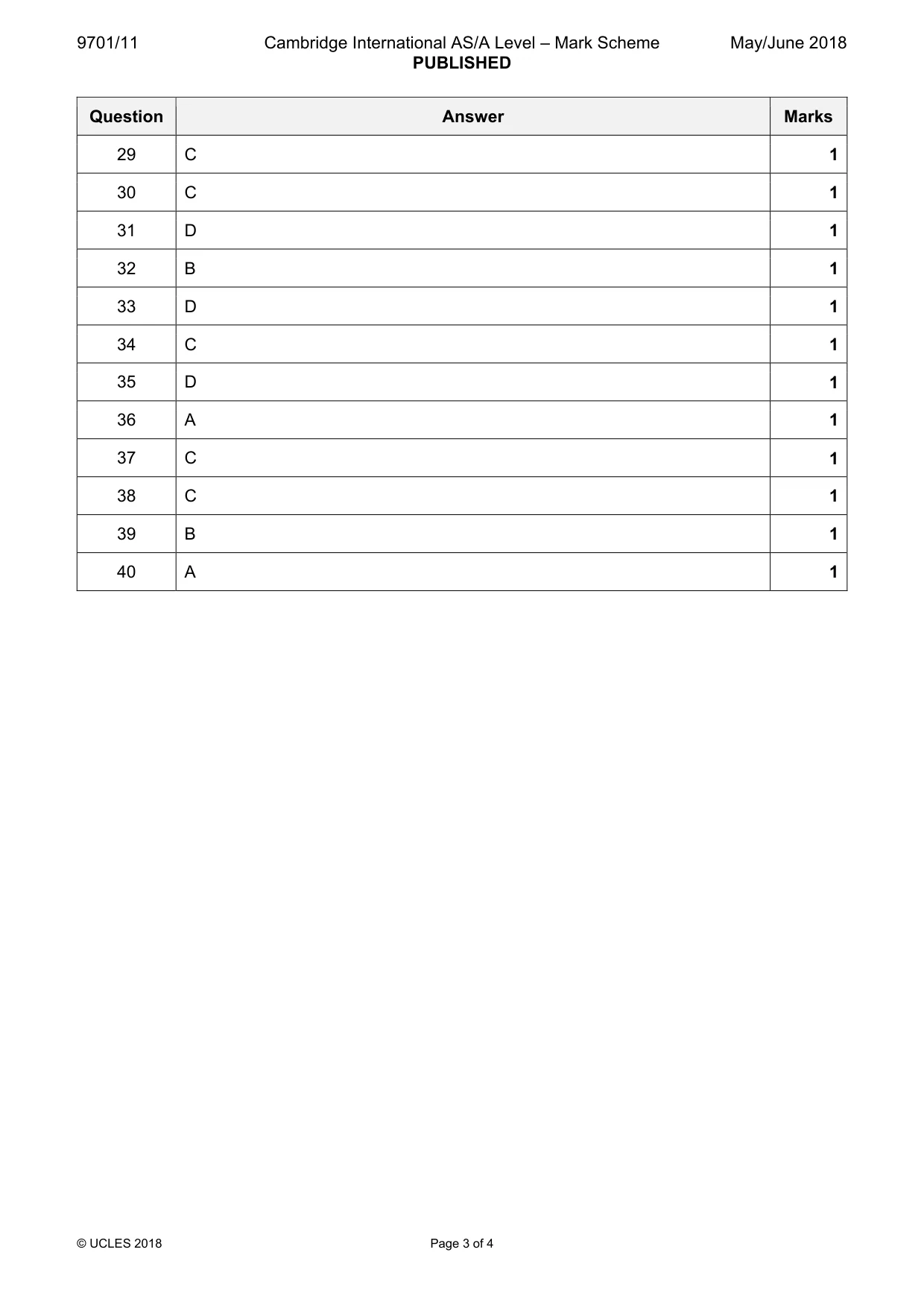
9701/11/M/J/18 · 40 questions · 40 marks · ≈45 min
The question paper and its mark scheme, free to read here and free to download. This is Cambridge’s own paper, exactly as it was sat.
Question paper16 pages
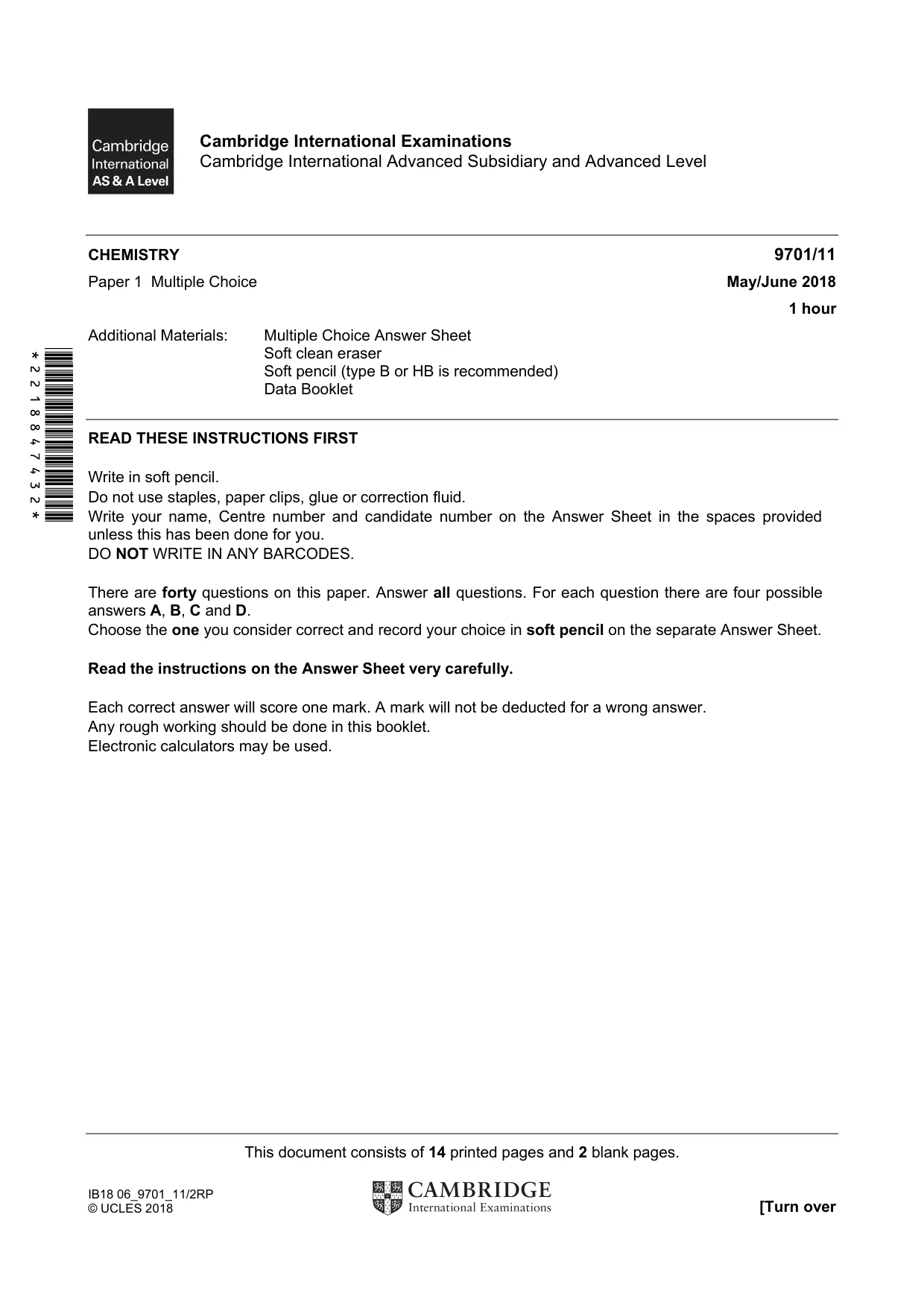
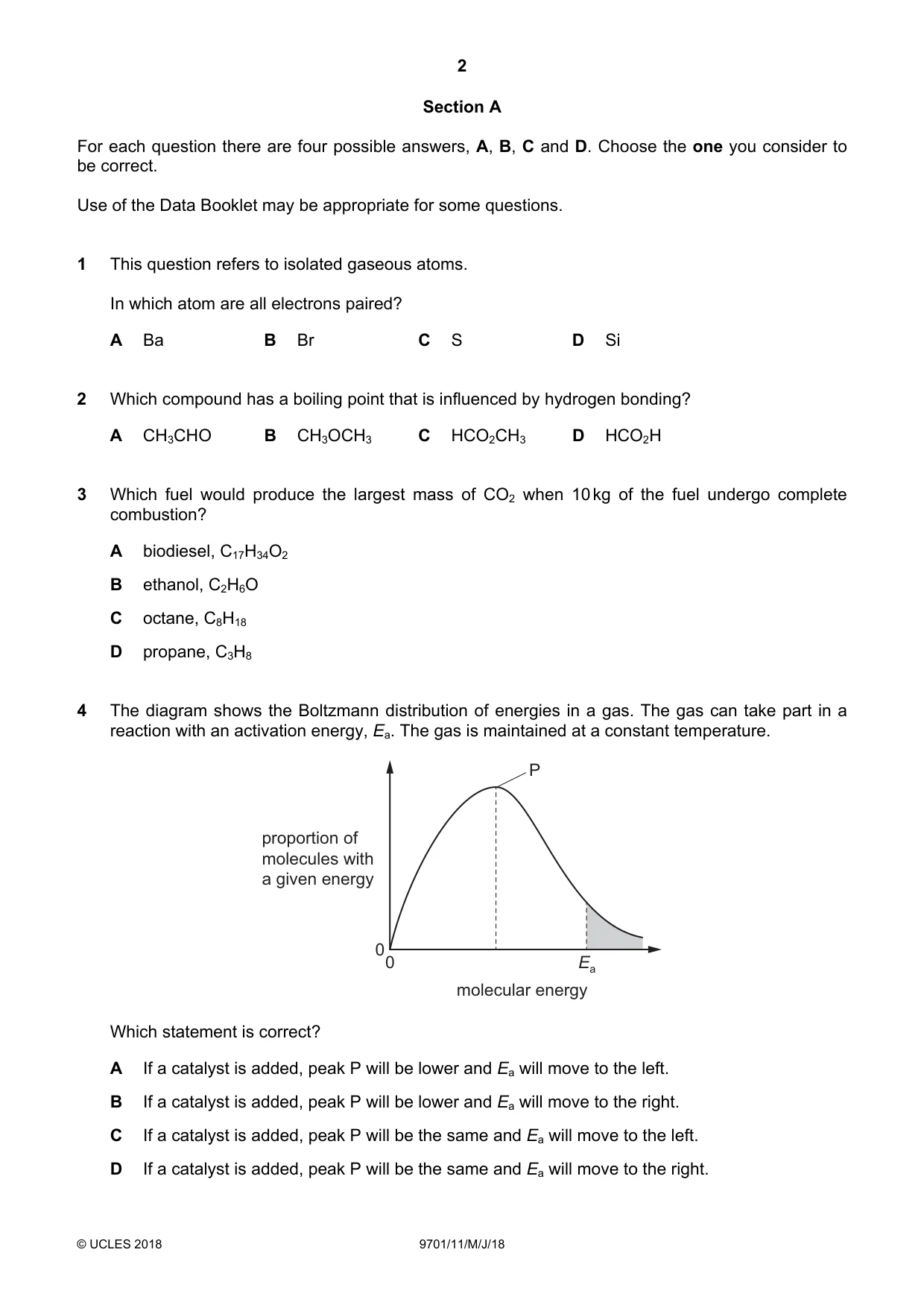
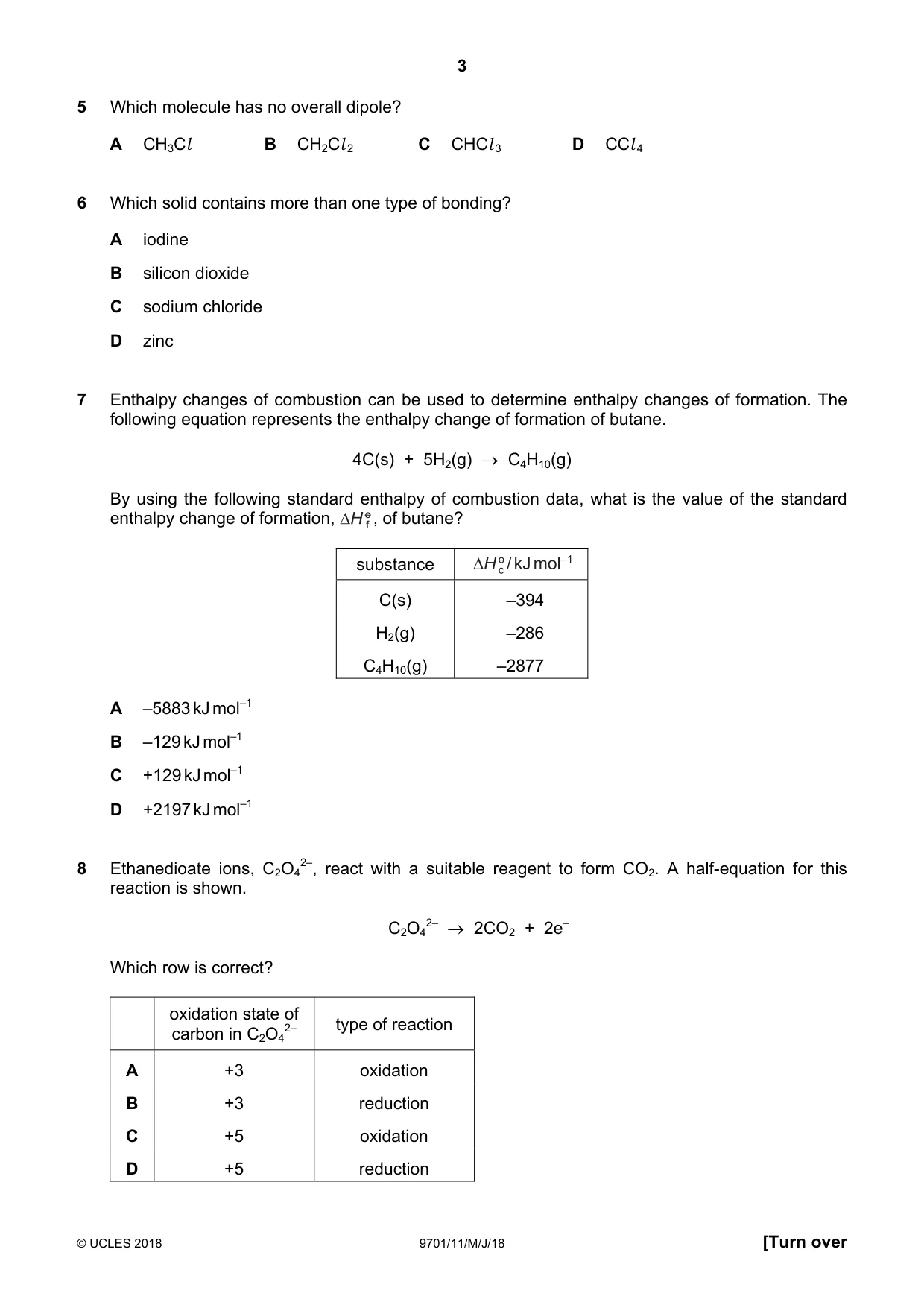
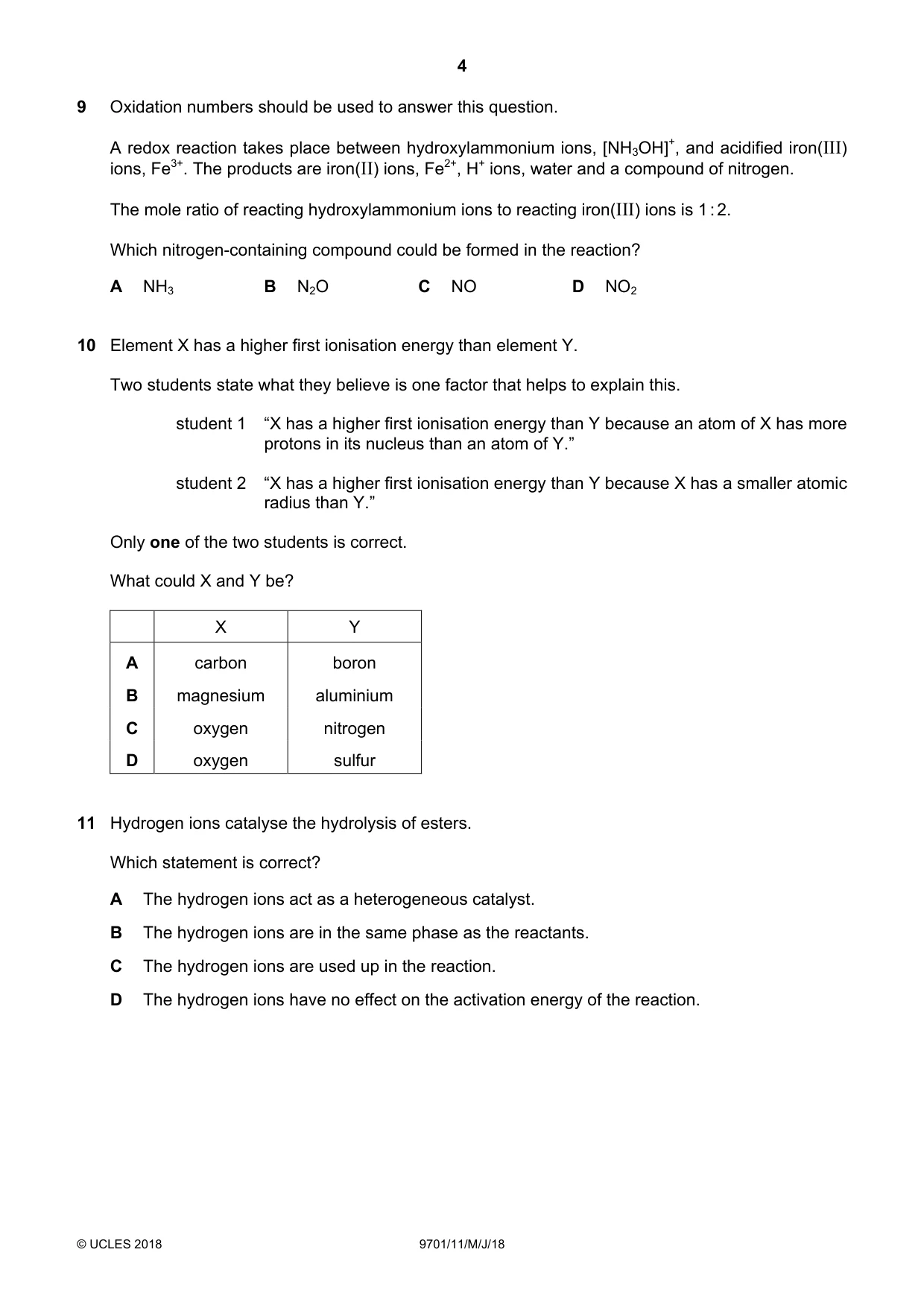

Mark scheme4 pages
Answers below. Sit the paper first if you are practising.

Questions as text
Q1 · This question refers to isolated gaseous atoms
1 This question refers to isolated gaseous atoms. In which atom are all electrons paired? A Ba B Br C S D Si
Mark scheme: A
More questions on Electrons, energy levels and atomic orbitals
Q2 · Which compound has a boiling point that is influenced by hydrogen bonding?
2 Which compound has a boiling point that is influenced by hydrogen bonding? A CH3CHO B CH3OCH3 C HCO2CH3 D HCO2H
Mark scheme: D
More questions on Intermolecular forces, electronegativity and bond properties
Q3 · Which fuel would produce the largest mass of CO2 when 10 kg of the fuel undergo complete…
3 Which fuel would produce the largest mass of CO2 when 10 kg of the fuel undergo complete combustion? A biodiesel, C17H34O2 B ethanol, C2H6O C octane, C8H18 D propane, C3H8
Mark scheme: C
More questions on Reacting masses and volumes (of solutions and gases)
Q4 · The diagram shows the Boltzmann distribution of energies in a gas
4 The diagram shows the Boltzmann distribution of energies in a gas. The gas can take part in a reaction with an activation energy, Ea. The gas is maintained at a constant temperature. P proportion of molecules with a given energy 0 0 Ea molecular energy Which statement is correct? A If a catalyst is added, peak P will be lower and Ea will move to the left. B If a catalyst is added, peak P will be lower and Ea will move to the right. C If a catalyst is added, peak P will be the same and Ea will move to the left. D If a catalyst is added, peak P will be the same and Ea will move to the right.
Mark scheme: C
More questions on Effect of temperature on reaction rates and the concept of activation energy
Q5 · Which molecule has no overall dipole?
5 Which molecule has no overall dipole? A CH3Cl B CH2Cl 2 C CHCl 3 D CCl 4
Mark scheme: D
Q6 · Which solid contains more than one type of bonding?
6 Which solid contains more than one type of bonding? A iodine B silicon dioxide C sodium chloride D zinc
Mark scheme: A
Q7 · Enthalpy changes of combustion can be used to determine enthalpy changes of formation
7 Enthalpy changes of combustion can be used to determine enthalpy changes of formation. The following equation represents the enthalpy change of formation of butane. 4C(s) + 5H2(g) → C4H10(g) By using the following standard enthalpy of combustion data, what is the value of the standard enthalpy change of formation, , of butane? substance C(s) –394 H2(g) –286 C4H10(g) –2877 A –5883 kJ mol–1 B –129 kJ mol–1 C +129 kJ mol–1 D +2197 kJ mol–1
Mark scheme: B
Q8 · Ethanedioate ions, C2O4 2–, react with a suitable reagent to form CO2
8 Ethanedioate ions, C2O4 2–, react with a suitable reagent to form CO2. A half-equation for this reaction is shown. C2O4 2– → 2CO2 + 2e– Which row is correct? oxidation state of 2– type of reaction carbon in C2O4 A +3 oxidation B +3 reduction C +5 oxidation D +5 reduction
Mark scheme: A
Q9 · Oxidation numbers should be used to answer this question
9 Oxidation numbers should be used to answer this question. A redox reaction takes place between hydroxylammonium ions, [NH3OH]+, and acidified iron(III) ions, Fe3+. The products are iron(II) ions, Fe2+, H+ ions, water and a compound of nitrogen. The mole ratio of reacting hydroxylammonium ions to reacting iron(III) ions is 1 : 2. Which nitrogen-containing compound could be formed in the reaction? A NH3 B N2O C NO D NO2
Mark scheme: B
Q10 · Element X has a higher first ionisation energy than element Y
10 Element X has a higher first ionisation energy than element Y. Two students state what they believe is one factor that helps to explain this. student 1 “X has a higher first ionisation energy than Y because an atom of X has more protons in its nucleus than an atom of Y.” student 2 “X has a higher first ionisation energy than Y because X has a smaller atomic radius than Y.” Only one of the two students is correct. What could X and Y be? X Y A carbon boron B magnesium aluminium C oxygen nitrogen D oxygen sulfur
Mark scheme: D
Q11 · Hydrogen ions catalyse the hydrolysis of esters
11 Hydrogen ions catalyse the hydrolysis of esters. Which statement is correct? A The hydrogen ions act as a heterogeneous catalyst. B The hydrogen ions are in the same phase as the reactants. C The hydrogen ions are used up in the reaction. D The hydrogen ions have no effect on the activation energy of the reaction.
Mark scheme: B
Q12 · Silicon is heated in an excess of chlorine, producing compound J
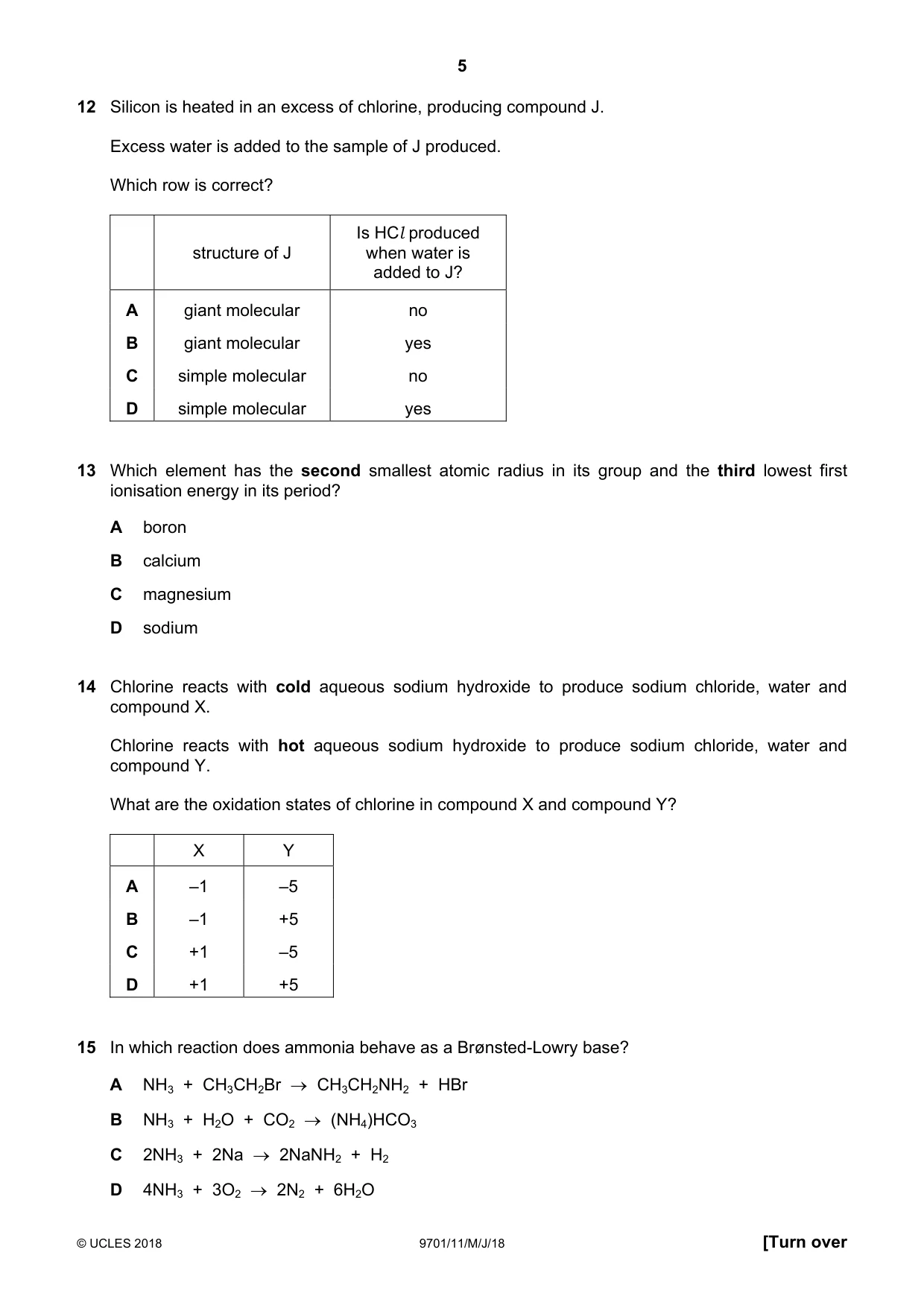
12 Silicon is heated in an excess of chlorine, producing compound J. Excess water is added to the sample of J produced. Which row is correct? Is HCl produced structure of J when water is added to J? A giant molecular no B giant molecular yes C simple molecular no D simple molecular yes
Mark scheme: D
More questions on Periodicity of chemical properties of the elements in Period 3
Q13 · Which element has the second smallest atomic radius in its group and the third lowest…
13 Which element has the second smallest atomic radius in its group and the third lowest first ionisation energy in its period? A boron B calcium C magnesium D sodium
Mark scheme: C
More questions on Periodicity of physical properties of the elements in Period 3
Q14 · Chlorine reacts with cold aqueous sodium hydroxide to produce sodium chloride, water and…
14 Chlorine reacts with cold aqueous sodium hydroxide to produce sodium chloride, water and compound X. Chlorine reacts with hot aqueous sodium hydroxide to produce sodium chloride, water and compound Y. What are the oxidation states of chlorine in compound X and compound Y? X Y A –1 –5 B –1 +5 C +1 –5 D +1 +5
Mark scheme: D
Q15 · In which reaction does ammonia behave as a Brønsted-Lowry base?
15 In which reaction does ammonia behave as a Brønsted-Lowry base? A NH3 + CH3CH2Br → CH3CH2NH2 + HBr B NH3 + H2O + CO2 → (NH4)HCO3 C 2NH3 + 2Na → 2NaNH2 + H2 D 4NH3 + 3O2 → 2N2 + 6H2O
Mark scheme: B
Q16 · Aqueous silver nitrate is added to a solution of potassium iodide
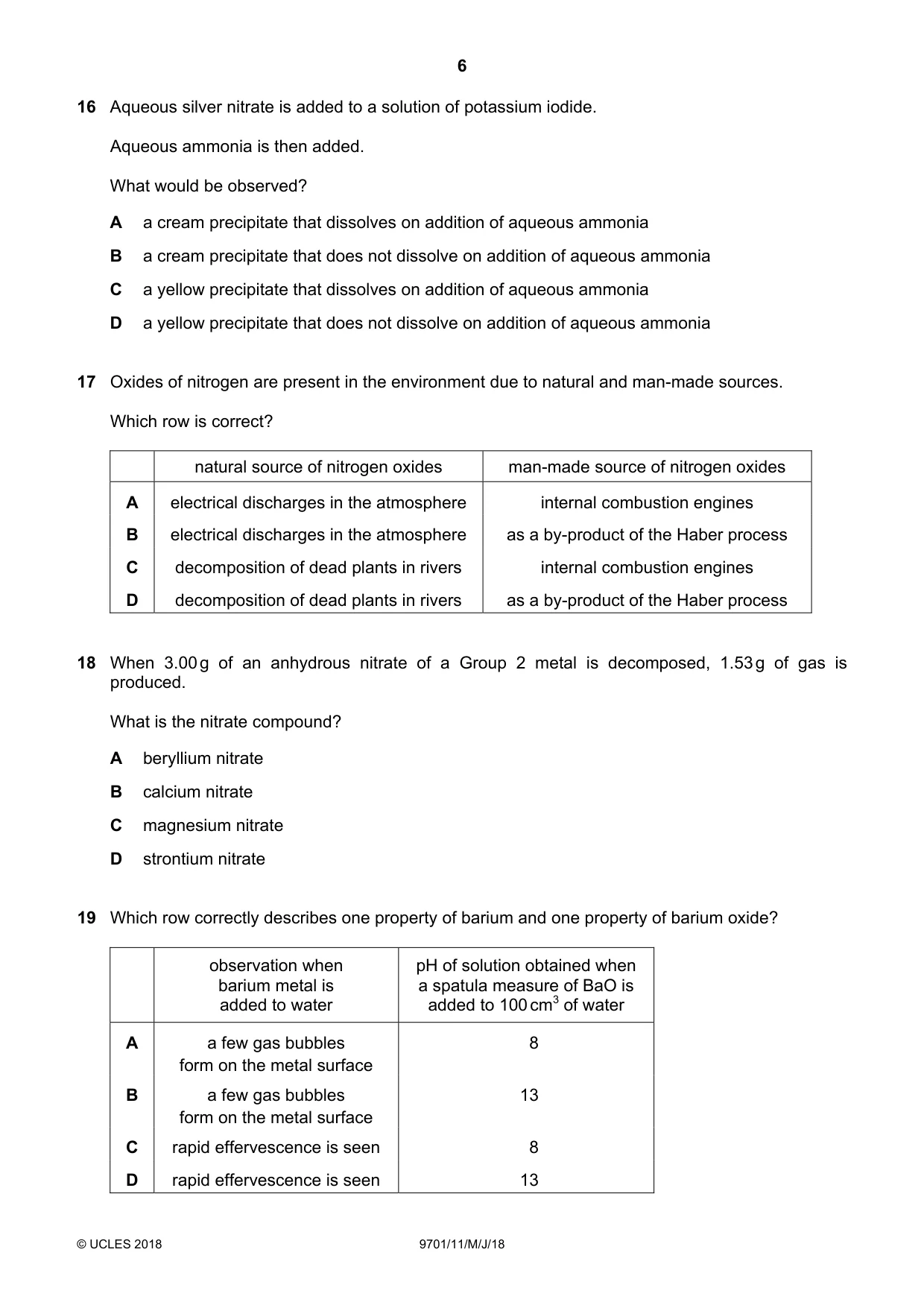
16 Aqueous silver nitrate is added to a solution of potassium iodide. Aqueous ammonia is then added. What would be observed? A a cream precipitate that dissolves on addition of aqueous ammonia B a cream precipitate that does not dissolve on addition of aqueous ammonia C a yellow precipitate that dissolves on addition of aqueous ammonia D a yellow precipitate that does not dissolve on addition of aqueous ammonia
Mark scheme: D
Q17 · Oxides of nitrogen are present in the environment due to natural and man-made sources
17 Oxides of nitrogen are present in the environment due to natural and man-made sources. Which row is correct? natural source of nitrogen oxides man-made source of nitrogen oxides A electrical discharges in the atmosphere internal combustion engines B electrical discharges in the atmosphere as a by-product of the Haber process C decomposition of dead plants in rivers internal combustion engines D decomposition of dead plants in rivers as a by-product of the Haber process
Mark scheme: A
Q18 · When 3.00 g of an anhydrous nitrate of a Group 2 metal is decomposed, 1.53 g of gas is…
18 When 3.00 g of an anhydrous nitrate of a Group 2 metal is decomposed, 1.53 g of gas is produced. What is the nitrate compound? A beryllium nitrate B calcium nitrate C magnesium nitrate D strontium nitrate
Mark scheme: D
Q19 · Which row correctly describes one property of barium and one property of barium oxide?
19 Which row correctly describes one property of barium and one property of barium oxide? observation when pH of solution obtained when barium metal is a spatula measure of BaO is added to water added to 100 cm3 of water A a few gas bubbles 8 form on the metal surface B a few gas bubbles 13 form on the metal surface C rapid effervescence is seen 8 D rapid effervescence is seen 13
Mark scheme: D
Q20 · Fructose is a sugar with more than one chiral centre
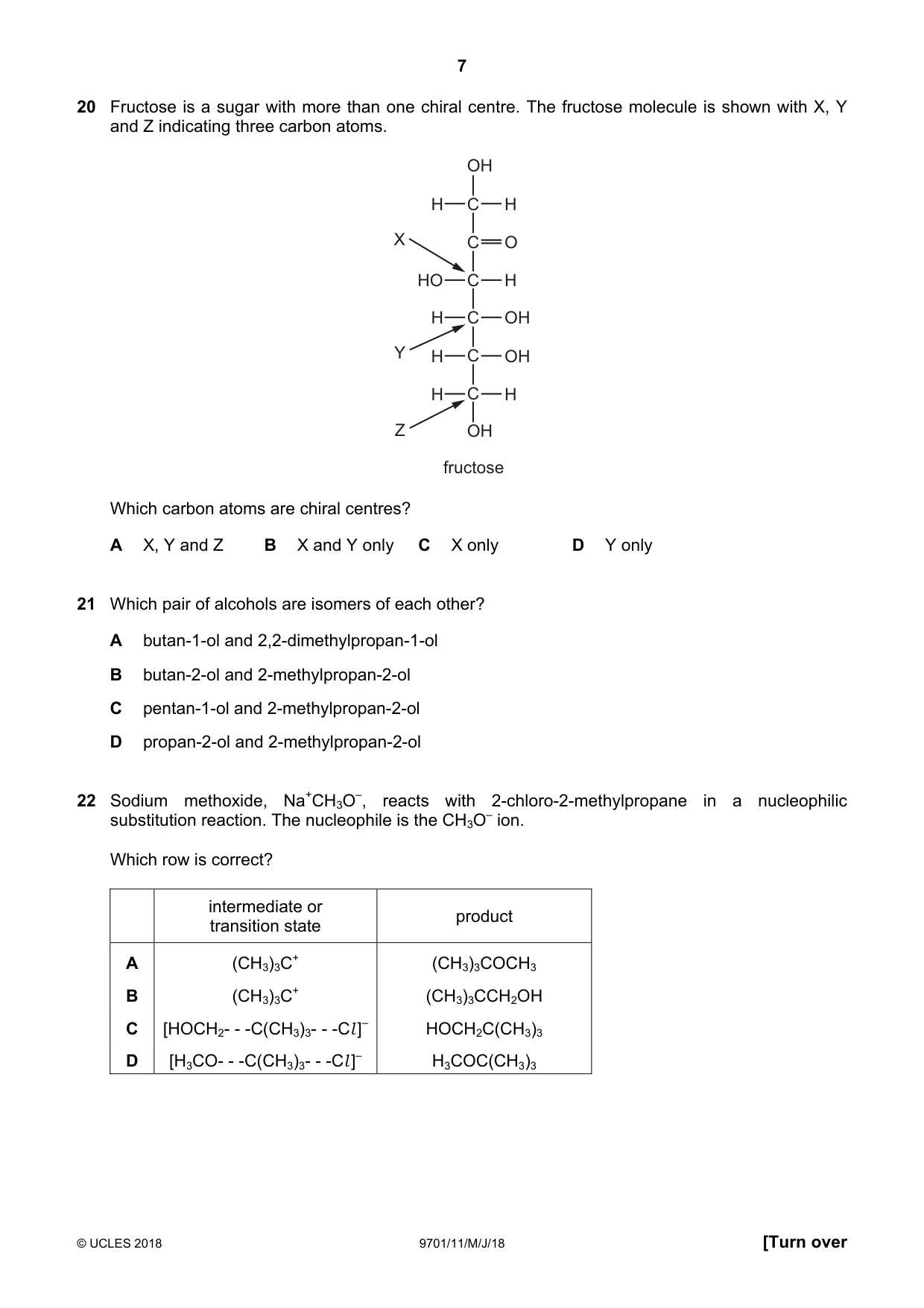
20 Fructose is a sugar with more than one chiral centre. The fructose molecule is shown with X, Y and Z indicating three carbon atoms. OH H C H X C O HO C H H C OH Y H C OH H C H Z OH fructose Which carbon atoms are chiral centres? A X, Y and Z B X and Y only C X only D Y only
Mark scheme: B
Q21 · Which pair of alcohols are isomers of each other?
21 Which pair of alcohols are isomers of each other? A butan-1-ol and 2,2-dimethylpropan-1-ol B butan-2-ol and 2-methylpropan-2-ol C pentan-1-ol and 2-methylpropan-2-ol D propan-2-ol and 2-methylpropan-2-ol
Mark scheme: B
More questions on Isomerism: structural isomerism and stereoisomerism
Q22 · Sodium methoxide, Na+CH3O–, reacts with 2-chloro-2-methylpropane in a nucleophilic…
22 Sodium methoxide, Na+CH3O–, reacts with 2-chloro-2-methylpropane in a nucleophilic substitution reaction. The nucleophile is the CH3O– ion. Which row is correct? intermediate or product transition state A (CH3)3C+ (CH3)3COCH3 B (CH3)3C+ (CH3)3CCH2OH C [HOCH2- - -C(CH3)3- - -Cl ]– HOCH2C(CH3)3 D [H3CO- - -C(CH3)3- - -Cl ]– H3COC(CH3)3
Mark scheme: A
Q23 · Which alcohol can be dehydrated to give two products which are structural isomers of each…
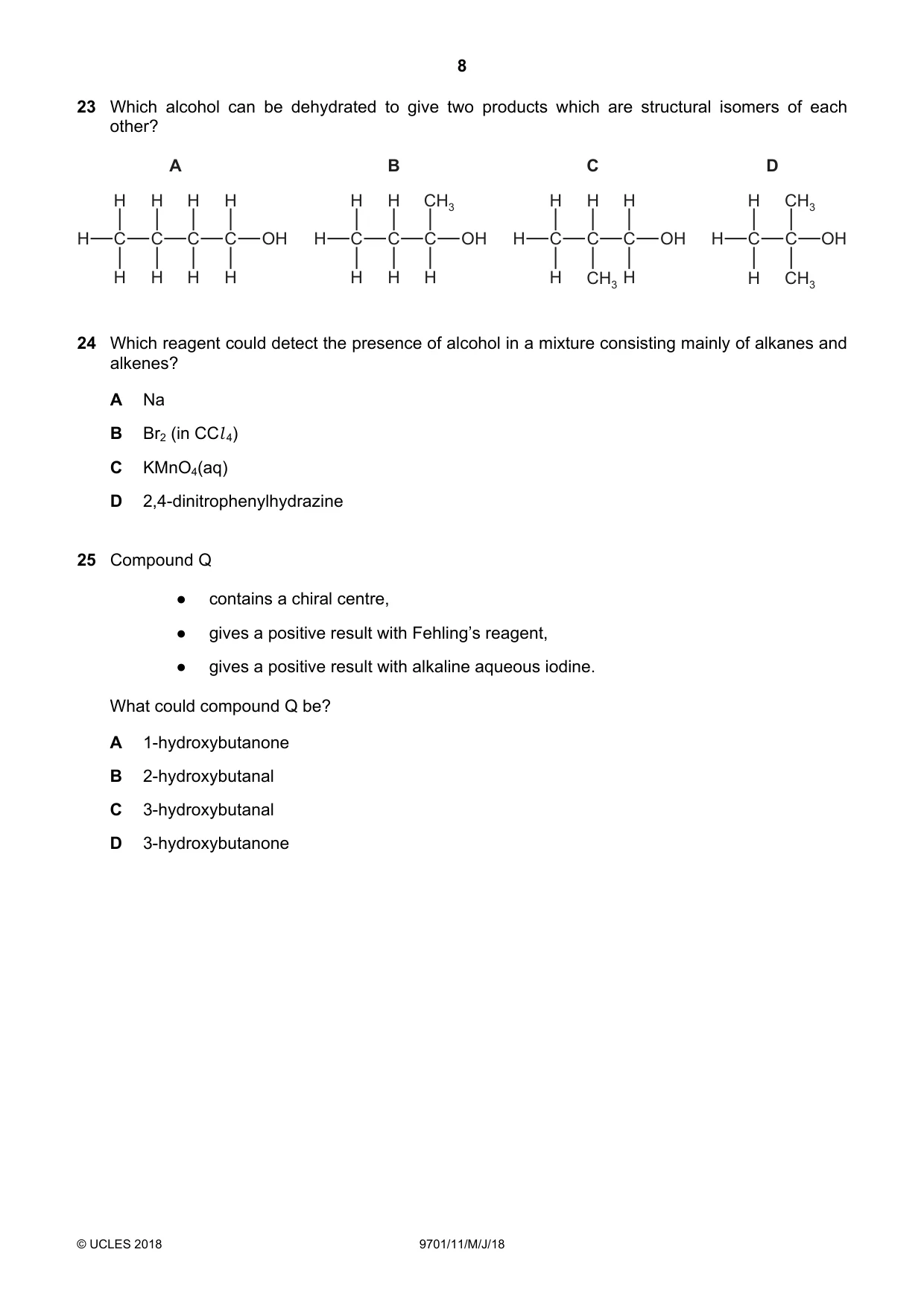
23 Which alcohol can be dehydrated to give two products which are structural isomers of each other? A B C D H H H H H H CH3 H H H H CH3 H C C C C OH H C C C OH H C C C OH H C C OH H H H H H H H H CH3 H H CH3
Mark scheme: B
Q24 · Which reagent could detect the presence of alcohol in a mixture consisting mainly of…
24 Which reagent could detect the presence of alcohol in a mixture consisting mainly of alkanes and alkenes? A Na B Br2 (in CCl 4) C KMnO4(aq) D 2,4-dinitrophenylhydrazine
Mark scheme: A
Q25 · Compound Q ● contains a chiral centre, ● gives a positive result with Fehling’s reagent…
25 Compound Q ● contains a chiral centre, ● gives a positive result with Fehling’s reagent, ● gives a positive result with alkaline aqueous iodine. What could compound Q be? A 1-hydroxybutanone B 2-hydroxybutanal C 3-hydroxybutanal D 3-hydroxybutanone
Mark scheme: C
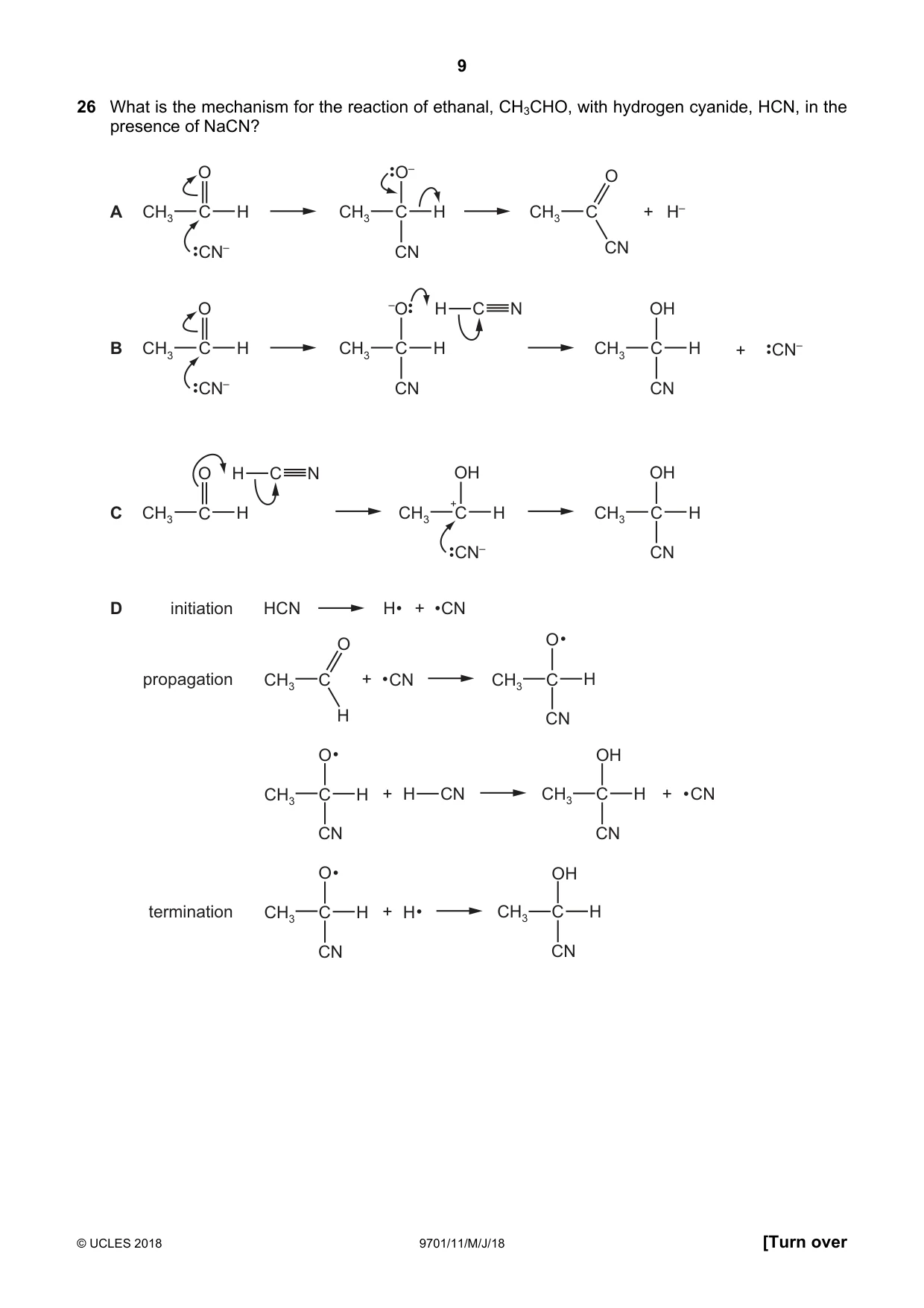
Q26 · What is the mechanism for the reaction of ethanal, CH3CHO, with hydrogen cyanide, HCN, in…
26 What is the mechanism for the reaction of ethanal, CH3CHO, with hydrogen cyanide, HCN, in the presence of NaCN? O O– O A CH3 C H CH3 C H CH3 C + H– CN– CN CN O –O H C N OH B CH3 C H CH3 C H CH3 C H + CN– CN– CN CN O H C N OH OH C CH3 C H CH3 + C H CH3 C H CN– CN D initiation HCN H • + • CN O O • propagation CH3 C + • CN CH3 C H H CN O • OH CH3 C H + H CN CH3 C H + • CN CN CN O • OH termination CH3 C H + H • CH3 C H CN CN
Mark scheme: B
Q27 · Ethyl propanoate is refluxed with aqueous sodium hydroxide
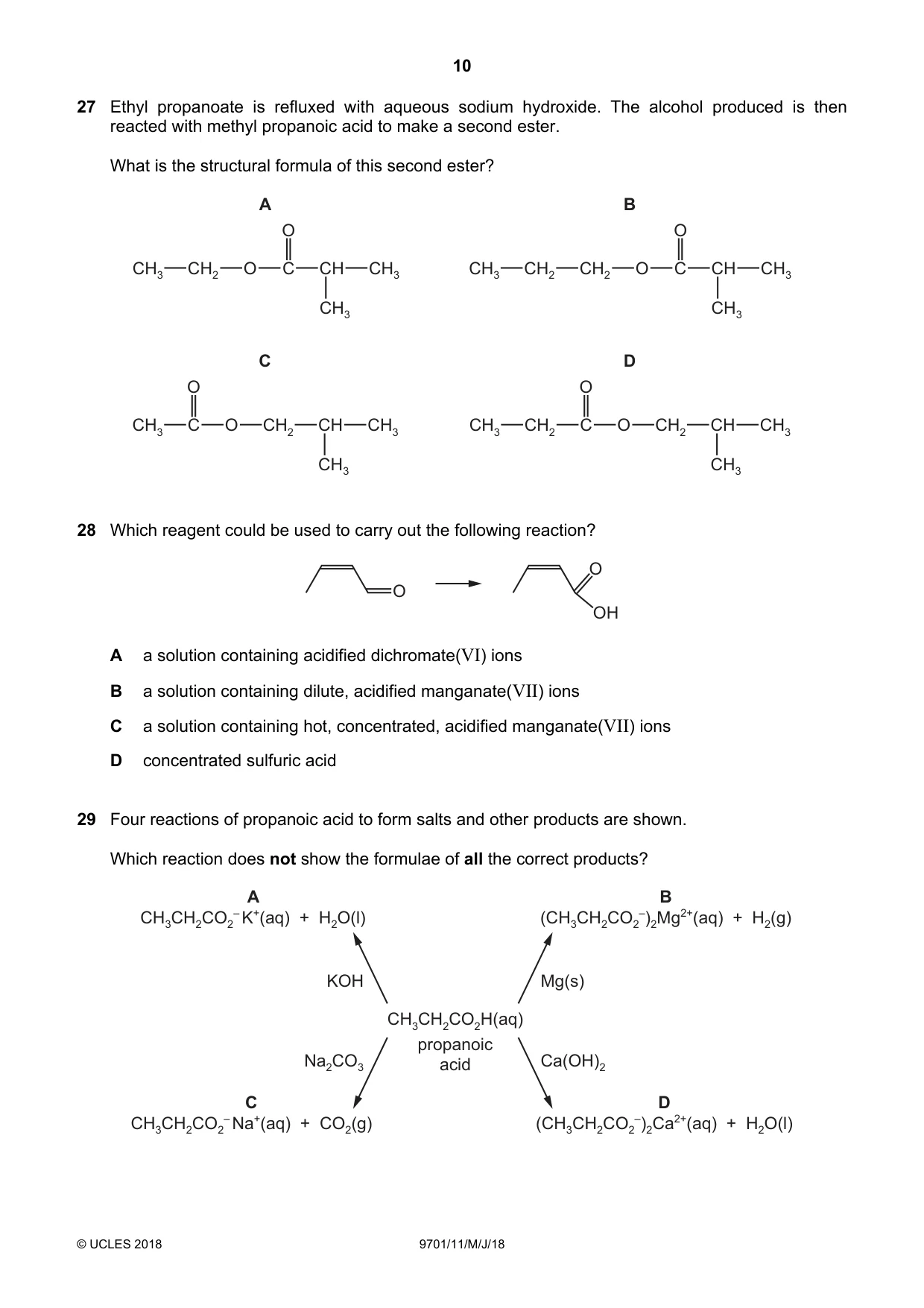
27 Ethyl propanoate is refluxed with aqueous sodium hydroxide. The alcohol produced is then reacted with methyl propanoic acid to make a second ester. What is the structural formula of this second ester? A B O O CH3 CH2 O C CH CH3 CH3 CH2 CH2 O C CH CH3 CH3 CH3 C D O O CH3 C O CH2 CH CH3 CH3 CH2 C O CH2 CH CH3 CH3 CH3
Mark scheme: A
Q28 · Which reagent could be used to carry out the following reaction?
28 Which reagent could be used to carry out the following reaction? O O OH A a solution containing acidified dichromate(VI) ions B a solution containing dilute, acidified manganate(VII) ions C a solution containing hot, concentrated, acidified manganate(VII) ions D concentrated sulfuric acid
Mark scheme: A
Q29 · Four reactions of propanoic acid to form salts and other products are shown
29 Four reactions of propanoic acid to form salts and other products are shown. Which reaction does not show the formulae of all the correct products? A B CH3CH2CO2 – K+(aq) + H2O(l) (CH3CH2CO2 –)2Mg2+(aq) + H2(g) KOH Mg(s) CH3CH2CO2H(aq) propanoic Na2CO3 acid Ca(OH)2 C D CH3CH2CO2 – Na+(aq) + CO2(g) (CH3CH2CO2 –)2Ca2+(aq) + H2O(l)
Mark scheme: C
Q30 · Compound X contains three carbon atoms
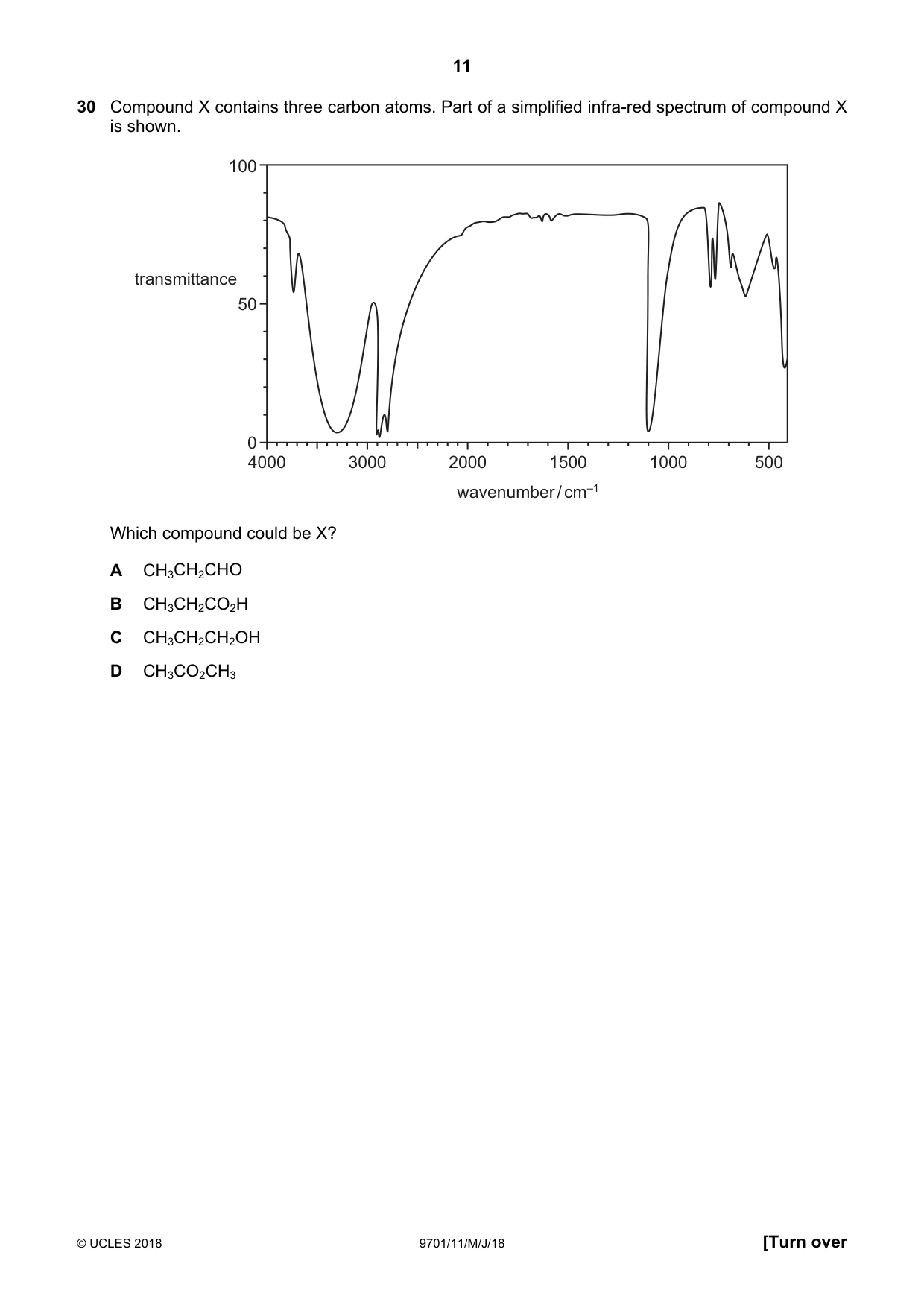
30 Compound X contains three carbon atoms. Part of a simplified infra-red spectrum of compound X is shown. 100 transmittance 50 0 4000 3000 2000 1500 1000 500 wavenumber / cm–1 Which compound could be X? A CH3CH2CHO B CH3CH2CO2H C CH3CH2CH2OH D CH3CO2CH3
Mark scheme: C
Q31 · One mole of sulfuric acid is used to make an aqueous solution
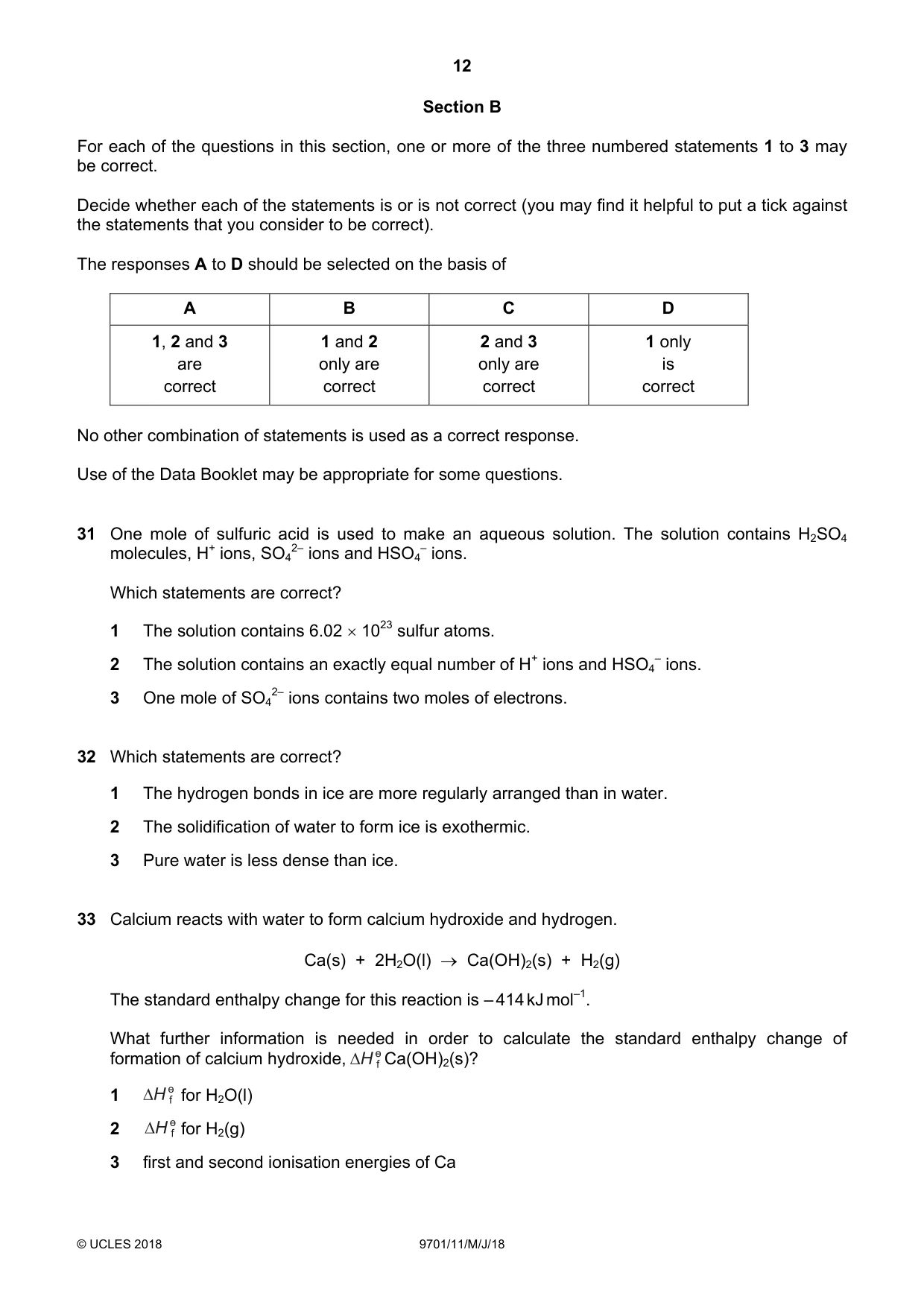
31 One mole of sulfuric acid is used to make an aqueous solution. The solution contains H2SO4 molecules, H+ ions, SO4 2– ions and HSO4 – ions. Which statements are correct? 1 The solution contains 6.02 × 10²³ sulfur atoms. 2 The solution contains an exactly equal number of H+ ions and HSO4 – ions. 3 One mole of SO4 2– ions contains two moles of electrons.
Mark scheme: D
Q32 · Which statements are correct?
32 Which statements are correct? 1 The hydrogen bonds in ice are more regularly arranged than in water. 2 The solidification of water to form ice is exothermic. 3 Pure water is less dense than ice.
Mark scheme: B
More questions on Intermolecular forces, electronegativity and bond properties
Q33 · Calcium reacts with water to form calcium hydroxide and hydrogen
33 Calcium reacts with water to form calcium hydroxide and hydrogen. Ca(s) + 2H2O(l) → Ca(OH)2(s) + H2(g) The standard enthalpy change for this reaction is – 414 kJ mol–1. What further information is needed in order to calculate the standard enthalpy change of formation of calcium hydroxide, Ca(OH)2(s)? 1 for H2O(l) 2 for H2(g) 3 first and second ionisation energies of Ca
Mark scheme: D
Q34 · Which statements are correct when a reversible reaction is at equilibrium?
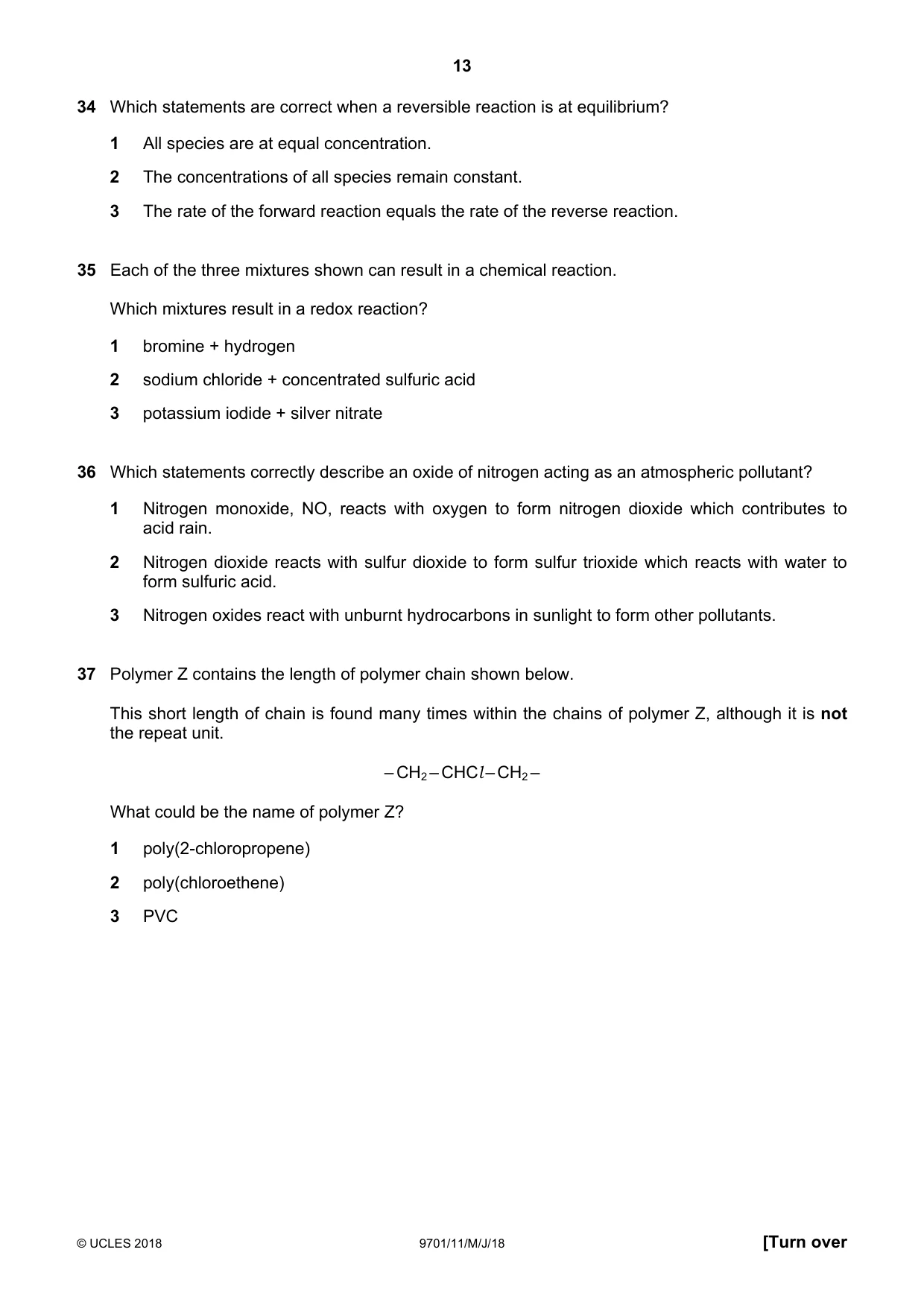
34 Which statements are correct when a reversible reaction is at equilibrium? 1 All species are at equal concentration. 2 The concentrations of all species remain constant. 3 The rate of the forward reaction equals the rate of the reverse reaction.
Mark scheme: C
More questions on Chemical equilibria: reversible reactions, dynamic equilibrium
Q35 · Each of the three mixtures shown can result in a chemical reaction
35 Each of the three mixtures shown can result in a chemical reaction. Which mixtures result in a redox reaction? 1 bromine + hydrogen 2 sodium chloride + concentrated sulfuric acid 3 potassium iodide + silver nitrate
Mark scheme: D
Q36 · Which statements correctly describe an oxide of nitrogen acting as an atmospheric…
36 Which statements correctly describe an oxide of nitrogen acting as an atmospheric pollutant? 1 Nitrogen monoxide, NO, reacts with oxygen to form nitrogen dioxide which contributes to acid rain. 2 Nitrogen dioxide reacts with sulfur dioxide to form sulfur trioxide which reacts with water to form sulfuric acid. 3 Nitrogen oxides react with unburnt hydrocarbons in sunlight to form other pollutants.
Mark scheme: A
Q37 · Polymer Z contains the length of polymer chain shown below
37 Polymer Z contains the length of polymer chain shown below. This short length of chain is found many times within the chains of polymer Z, although it is not the repeat unit. – CH2 – CHCl – CH2 – What could be the name of polymer Z? 1 poly(2-chloropropene) 2 poly(chloroethene) 3 PVC
Mark scheme: C
Q38 · Limonene is found in lemons
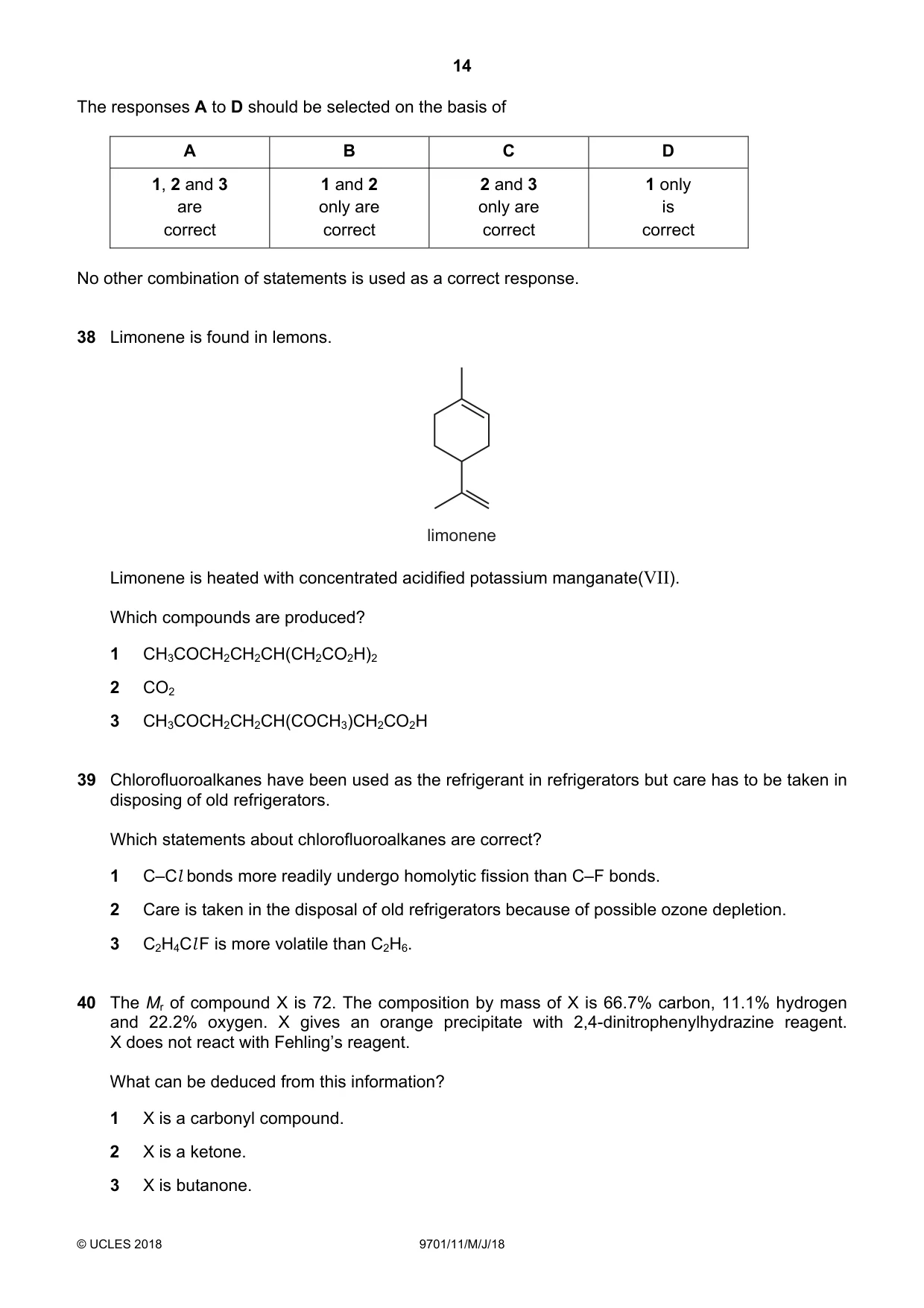
38 Limonene is found in lemons. limonene Limonene is heated with concentrated acidified potassium manganate(VII). Which compounds are produced? 1 CH3COCH2CH2CH(CH2CO2H)2 2 CO2 3 CH3COCH2CH2CH(COCH3)CH2CO2H
Mark scheme: C
Q39 · Chlorofluoroalkanes have been used as the refrigerant in refrigerators but care has to be…
39 Chlorofluoroalkanes have been used as the refrigerant in refrigerators but care has to be taken in disposing of old refrigerators. Which statements about chlorofluoroalkanes are correct? 1 C–Cl bonds more readily undergo homolytic fission than C–F bonds. 2 Care is taken in the disposal of old refrigerators because of possible ozone depletion. 3 C2H4Cl F is more volatile than C2H6.
Mark scheme: B
More questions on Intermolecular forces, electronegativity and bond properties
Q40 · The Mr of compound X is 72
40 The Mr of compound X is 72. The composition by mass of X is 66.7% carbon, 11.1% hydrogen and 22.2% oxygen. X gives an orange precipitate with 2,4-dinitrophenylhydrazine reagent. X does not react with Fehling’s reagent. What can be deduced from this information? 1 X is a carbonyl compound. 2 X is a ketone. 3 X is butanone.
Mark scheme: A
What was in this paper
The subtopics covered by these 40 questions, and how many questions each got. Open one in a new tab to see every Cambridge question on it.
3Redox processes: electron transfer and changes in oxidation number (oxidation state)3Alcohols2Aldehydes and ketones2Isomerism: optical2Nitrogen and sulfur2Similarities and trends in the properties of the Group 2 metals, magnesium to barium, and their compounds2Addition polymerisation1Alkenes1Bonding and structure1Brønsted–Lowry theory of acids and bases1Carboxylic acids1Chemical equilibria: reversible reactions, dynamic equilibrium1Effect of temperature on reaction rates and the concept of activation energy1Electrons, energy levels and atomic orbitals1Enthalpy change, ΔH1Esters1Halogenoalkanes1Hess’s law1Homogeneous and heterogeneous catalysts1Infrared spectroscopy1Ionisation energy1Isomerism: structural isomerism and stereoisomerism1Nitriles and hydroxynitriles1Periodicity of chemical properties of the elements in Period 31Periodicity of physical properties of the elements in Period 31Reacting masses and volumes (of solutions and gases)1Shapes of molecules1Some reactions of the halide ions1The mole and the Avogadro constant1The reactions of chlorine1What you needed in this session
Cambridge’s own grade thresholds for 2018 May/June, Paper 1 · Variant 1. A higher threshold means an easier paper — the bar moves with how the cohort did.