Cambridge A Level Chemistry 9701 — 2009 Oct/Nov Paper 1 · Variant 1
9701/11/O/N/09 · 40 questions · 40 marks · ≈45 min
The question paper and its mark scheme, free to read here and free to download. This is Cambridge’s own paper, exactly as it was sat.
Question paper16 pages
Mark scheme2 pages
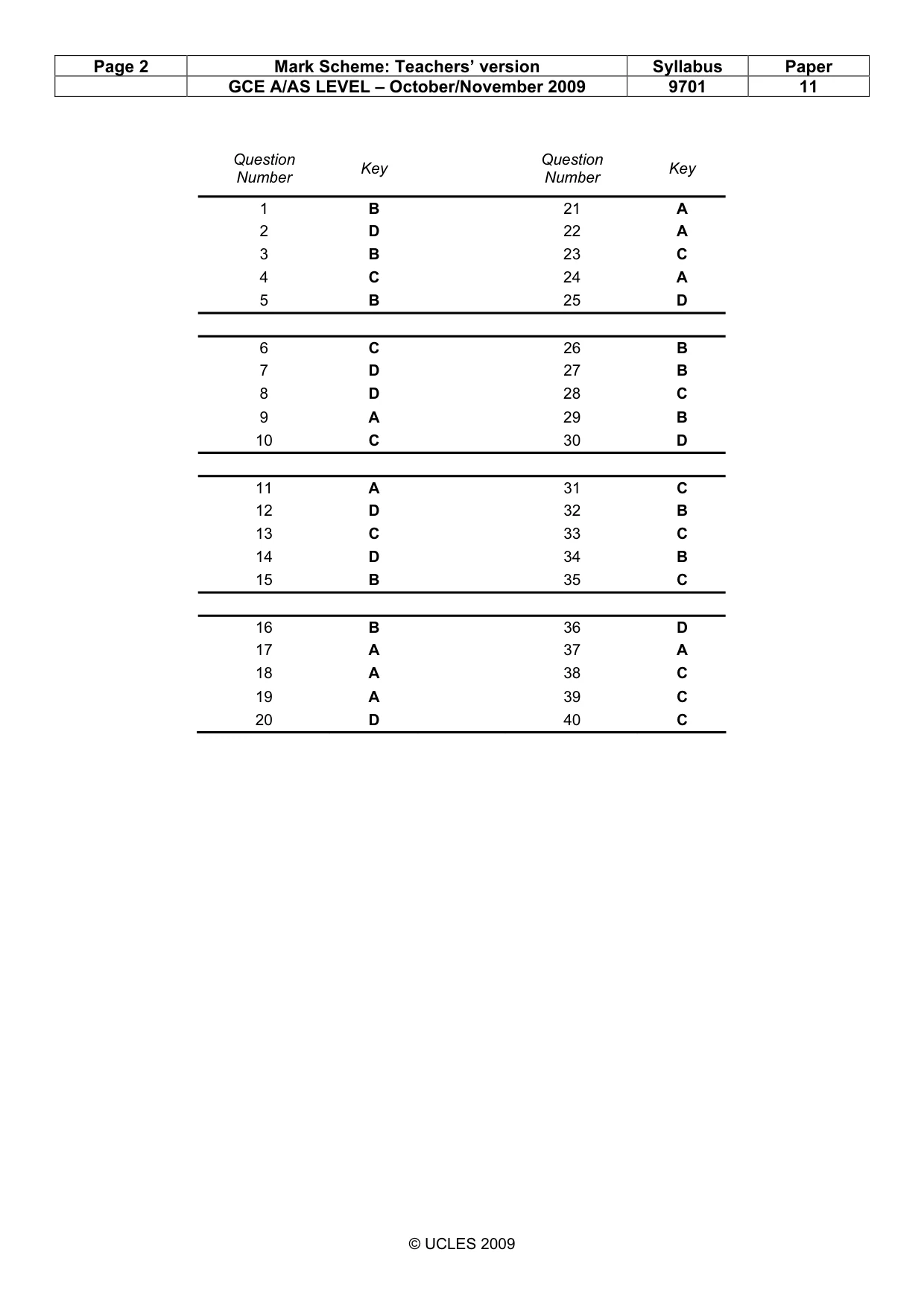
Answers below. Sit the paper first if you are practising.
Questions as text
Q1 · An element X consists of four isotopes
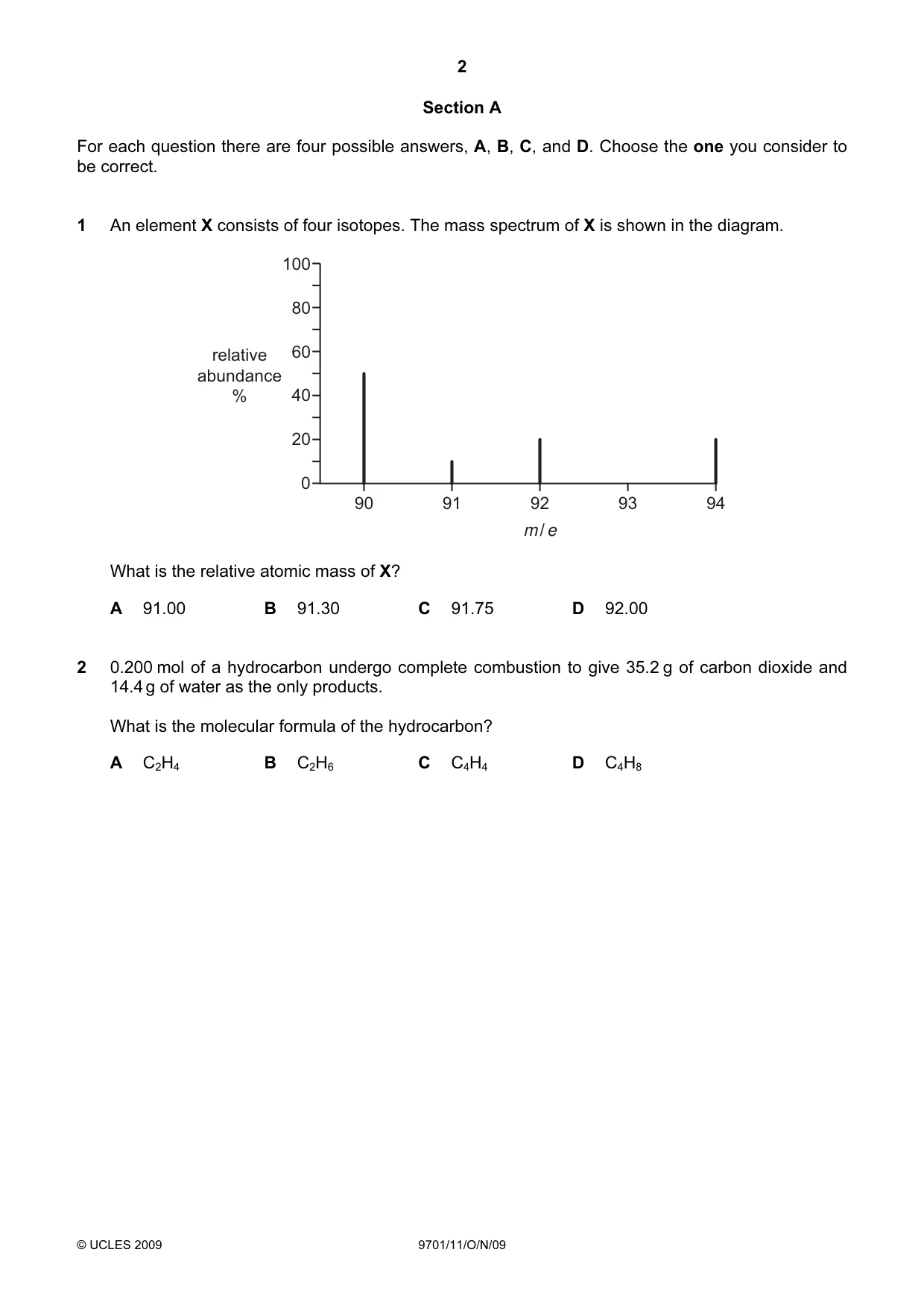
1 An element X consists of four isotopes. The mass spectrum of X is shown in the diagram. 100 80 relative 60 abundance % 40 20 0 90 91 92 93 94 m / e What is the relative atomic mass of X? A 91.00 B 91.30 C 91.75 D 92.00
Mark scheme: B
Q2 · 0.200 mol of a hydrocarbon undergo complete combustion to give 35.2 g of carbon dioxide…
2 0.200 mol of a hydrocarbon undergo complete combustion to give 35.2 g of carbon dioxide and 14.4 g of water as the only products. What is the molecular formula of the hydrocarbon? A C2H4 B C2H6 C C4H4 D C4H8
Mark scheme: D
Q3 · Use of the Data Booklet is relevant to this question
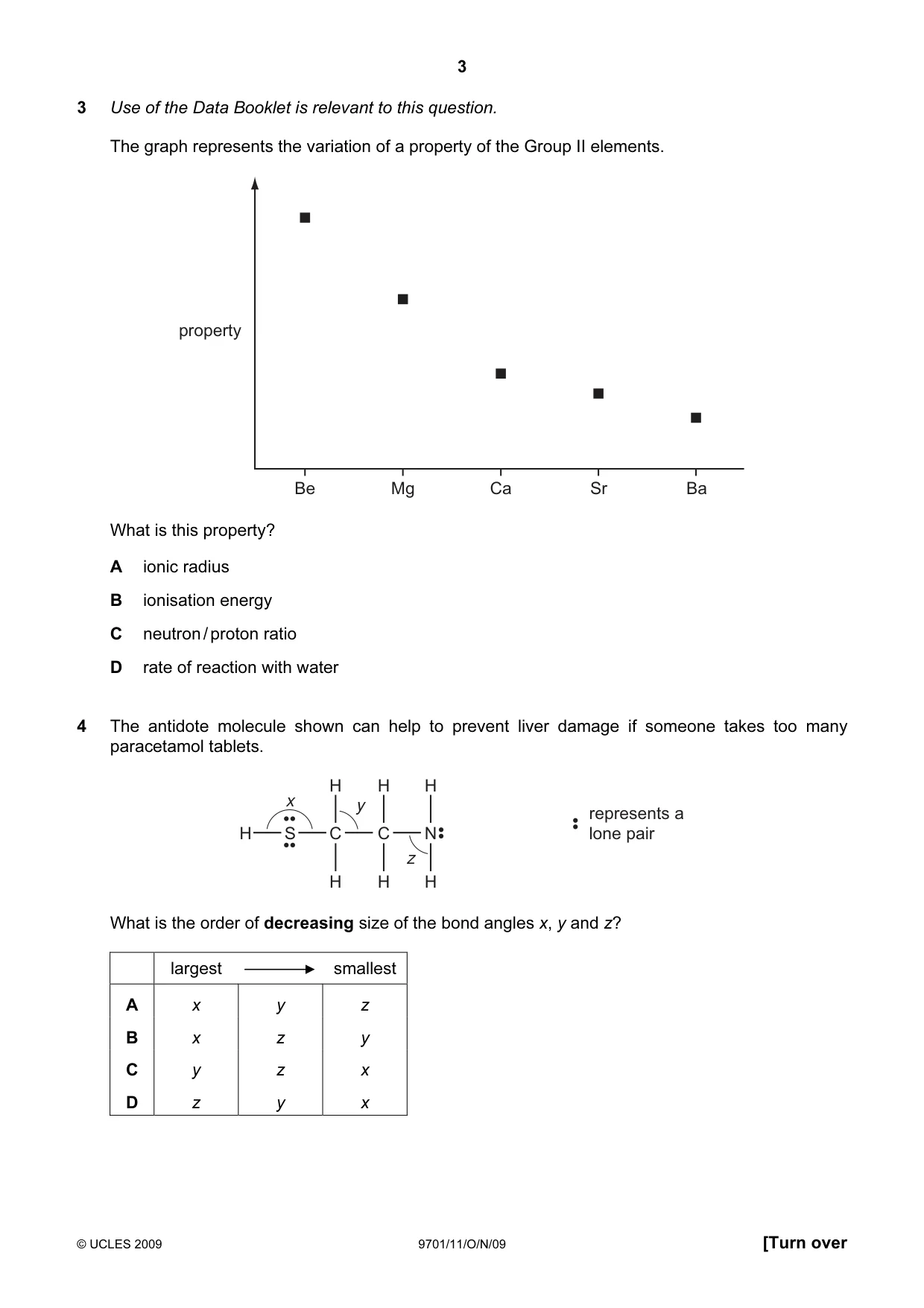
3 Use of the Data Booklet is relevant to this question. The graph represents the variation of a property of the Group II elements. property Be Mg Ca Sr Ba What is this property? A ionic radius B ionisation energy C neutron / proton ratio D rate of reaction with water
Mark scheme: B
Q4 · The antidote molecule shown can help to prevent liver damage if someone takes too many…
4 The antidote molecule shown can help to prevent liver damage if someone takes too many paracetamol tablets. H H H x y represents a H S C C N lone pair z H H H What is the order of decreasing size of the bond angles x, y and z? largest smallest A x y z B x z y C y z x D z y x
Mark scheme: C
Q5 · Which molecule has the largest overall dipole?
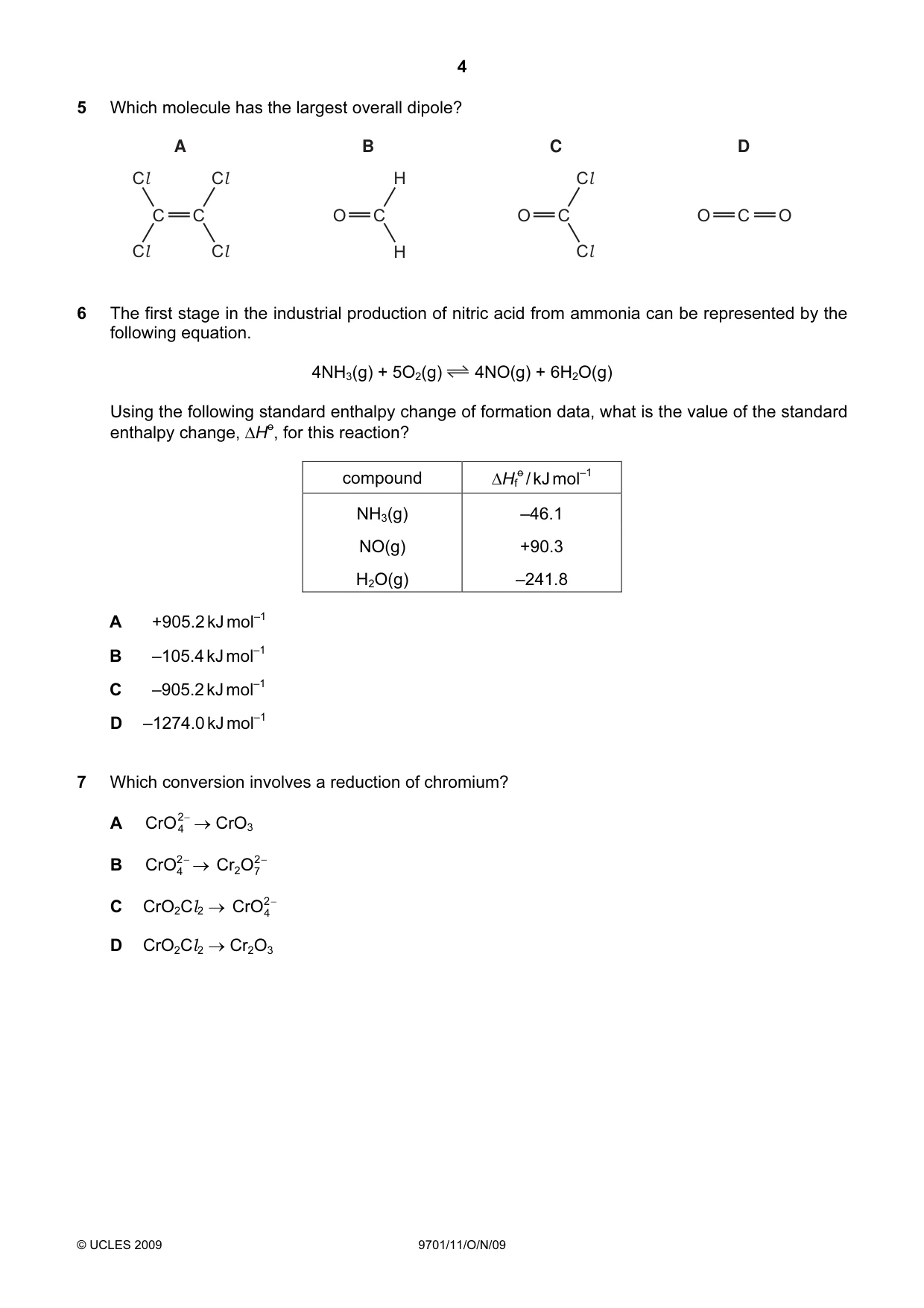
5 Which molecule has the largest overall dipole? A B C D Cl Cl H Cl C C O C O C O C O Cl Cl H Cl
Mark scheme: B
More questions on Intermolecular forces, electronegativity and bond properties
Q6 · The first stage in the industrial production of nitric acid from ammonia can be…
6 The first stage in the industrial production of nitric acid from ammonia can be represented by the following equation. 4NH3(g) + 5O2(g) 4NO(g) + 6H2O(g) Using the following standard enthalpy change of formation data, what is the value of the standard enthalpy change, ∆Ho, for this reaction? compound ∆Hf o / kJ mol–1 NH3(g) –46.1 NO(g) +90.3 H2O(g) –241.8 A +905.2 kJ mol–1 B –105.4 kJ mol–1 C –905.2 kJ mol–1 D –1274.0 kJ mol–1
Mark scheme: C
Q7 · Which conversion involves a reduction of chromium?
7 Which conversion involves a reduction of chromium? A CrO 2 − → CrO3 4 B CrO 2 − → Cr 2O 2 − 4 7 C CrO2Cl2 → CrO 2 − 4 D CrO2Cl2 → Cr2O3
Mark scheme: D
Q8 · The equilibrium N2(g) + O2(g) == 2NO(g) AH= +180kJ mol" contributes to a series of…
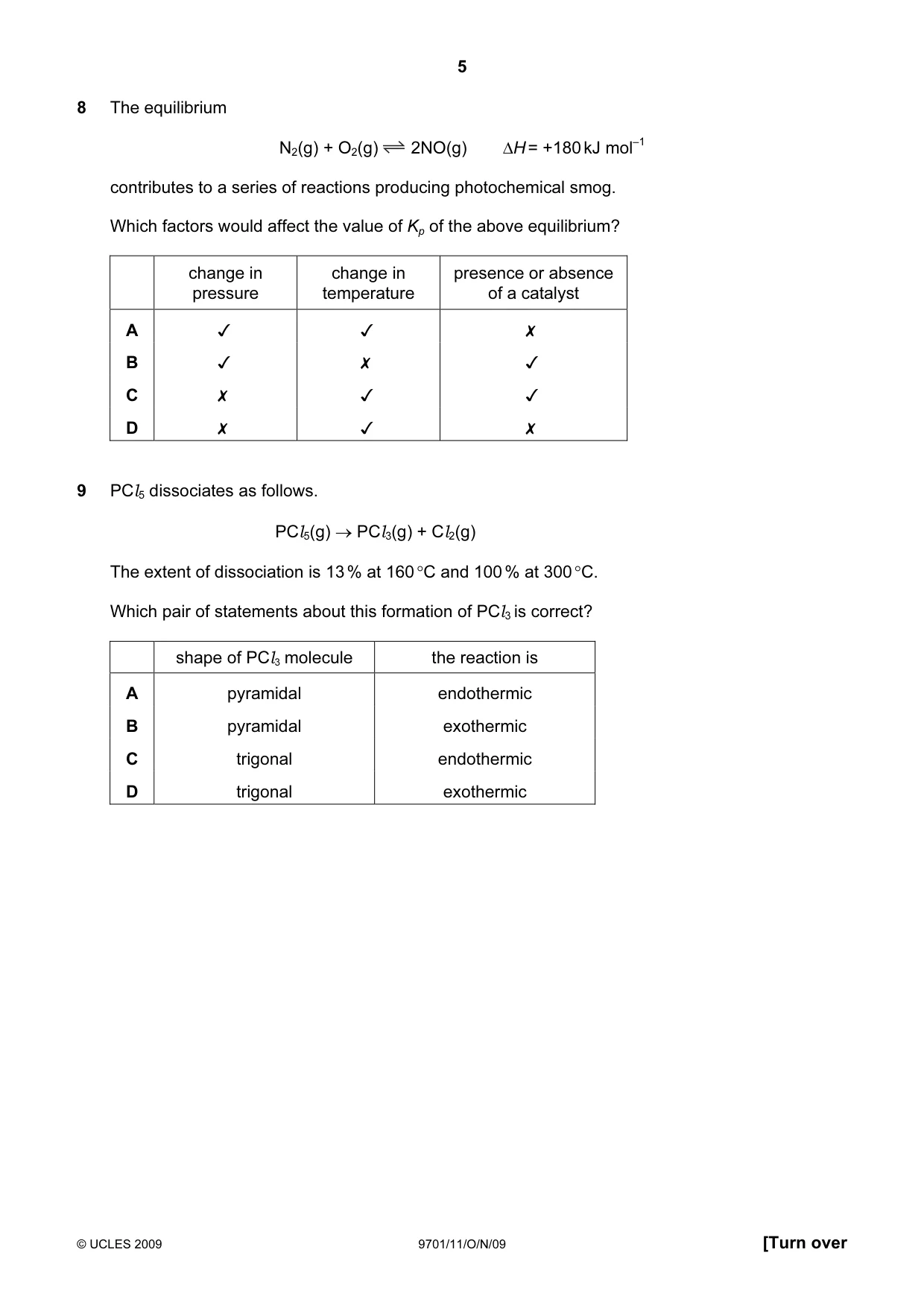
8 The equilibrium N2(g) + O2(g) == 2NO(g) AH= +180kJ mol" contributes to a series of reactions producing photochemical smog. Which factors would affect the value of K, of the above equilibrium? change in change in presence or absence pressure temperature of a catalyst A v v x B v x v Cc x v v D x v x
Mark scheme: D
More questions on Chemical equilibria: reversible reactions, dynamic equilibrium
Q9 · PCl5 dissociates as follows
9 PCl5 dissociates as follows. PCl5(g) → PCl3(g) + Cl2(g) The extent of dissociation is 13 % at 160 °C and 100 % at 300 °C. Which pair of statements about this formation of PCl3 is correct? shape of PCl3 molecule the reaction is A pyramidal endothermic B pyramidal exothermic C trigonal endothermic D trigonal exothermic
Mark scheme: A
Q10 · Four reactions of the type shown are studied at the same temperature
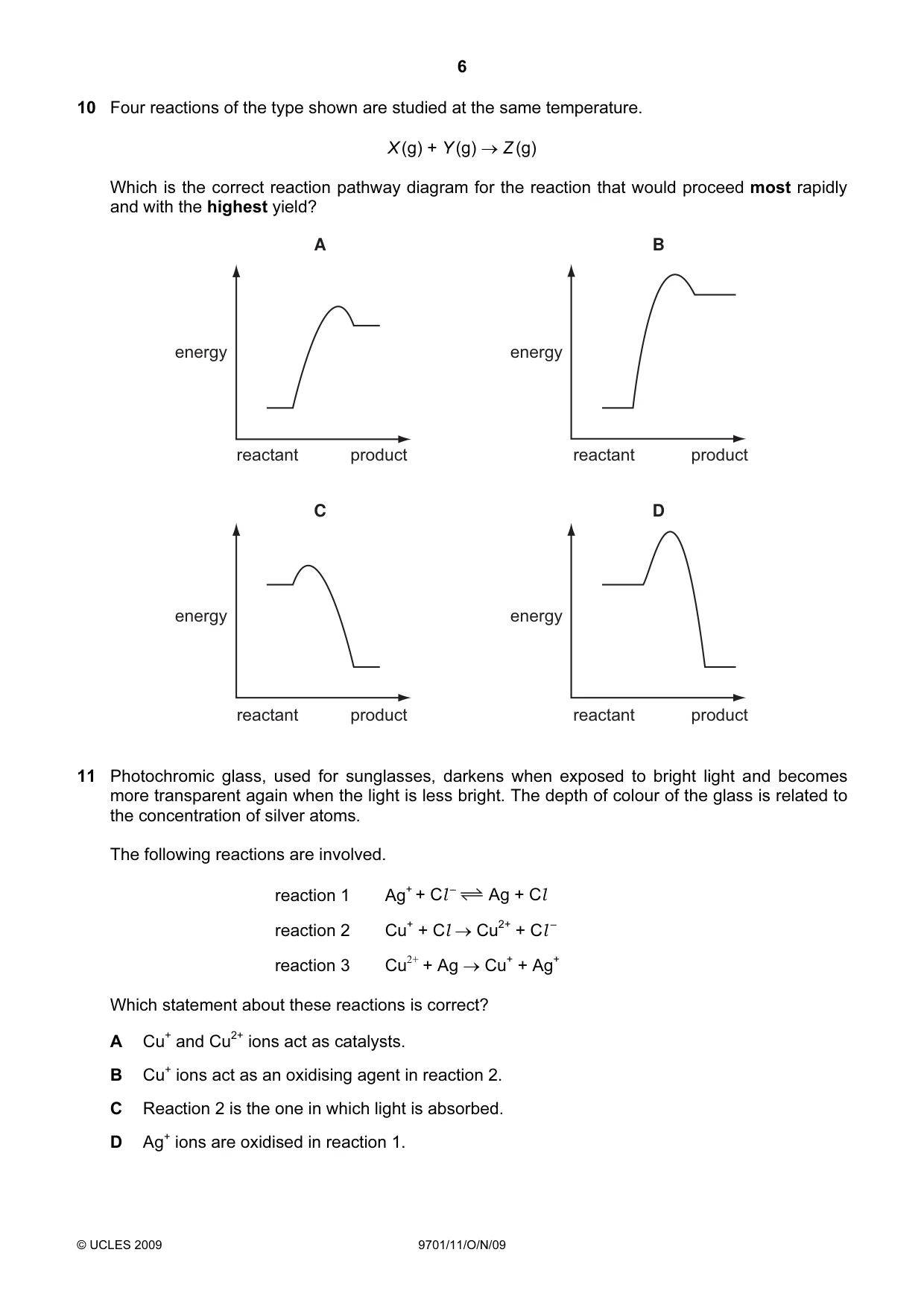
10 Four reactions of the type shown are studied at the same temperature. X (g) + Y (g) → Z (g) Which is the correct reaction pathway diagram for the reaction that would proceed most rapidly and with the highest yield? A B energy energy reactant product reactant product C D energy energy reactant product reactant product
Mark scheme: C
More questions on Effect of temperature on reaction rates and the concept of activation energy
Q11 · Photochromic glass, used for sunglasses, darkens when exposed to bright light and becomes…
11 Photochromic glass, used for sunglasses, darkens when exposed to bright light and becomes more transparent again when the light is less bright. The depth of colour of the glass is related to the concentration of silver atoms. The following reactions are involved. reaction 1 Ag+ + Cl – Ag + Cl reaction 2 Cu+ + Cl → Cu2+ + Cl – reaction 3 Cu2+ + Ag → Cu+ + Ag+ Which statement about these reactions is correct? A Cu+ and Cu2+ ions act as catalysts. B Cu+ ions act as an oxidising agent in reaction 2. C Reaction 2 is the one in which light is absorbed. D Ag+ ions are oxidised in reaction 1.
Mark scheme: A
Q12 · The following graph shows the variation of a property of the first 20 elements in the…
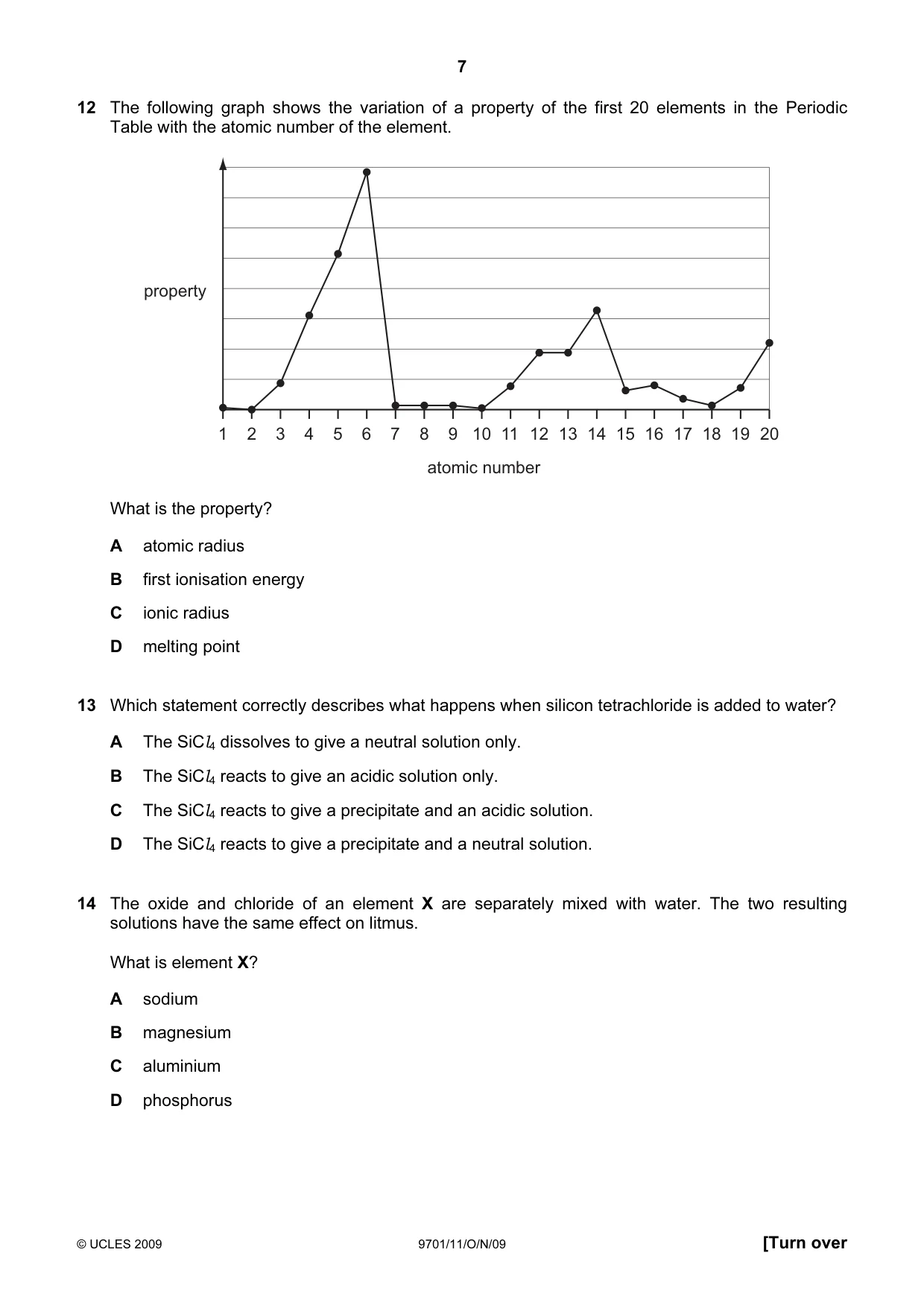
12 The following graph shows the variation of a property of the first 20 elements in the Periodic Table with the atomic number of the element. property 1 2 3 4 5 6 7 8 9 10 11 12 13 14 15 16 17 18 19 20 atomic number What is the property? A atomic radius B first ionisation energy C ionic radius D melting point
Mark scheme: D
More questions on Periodicity of physical properties of the elements in Period 3
Q13 · Which statement correctly describes what happens when silicon tetrachloride is added to…
13 Which statement correctly describes what happens when silicon tetrachloride is added to water? A The SiCl4 dissolves to give a neutral solution only. B The SiCl4 reacts to give an acidic solution only. C The SiCl4 reacts to give a precipitate and an acidic solution. D The SiCl4 reacts to give a precipitate and a neutral solution.
Mark scheme: C
More questions on Periodicity of chemical properties of the elements in Period 3
Q14 · The oxide and chloride of an element X are separately mixed with water
14 The oxide and chloride of an element X are separately mixed with water. The two resulting solutions have the same effect on litmus. What is element X? A sodium B magnesium C aluminium D phosphorus
Mark scheme: D
More questions on Periodicity of chemical properties of the elements in Period 3
Q15 · Which graph correctly describes a trend found in the halogen group?
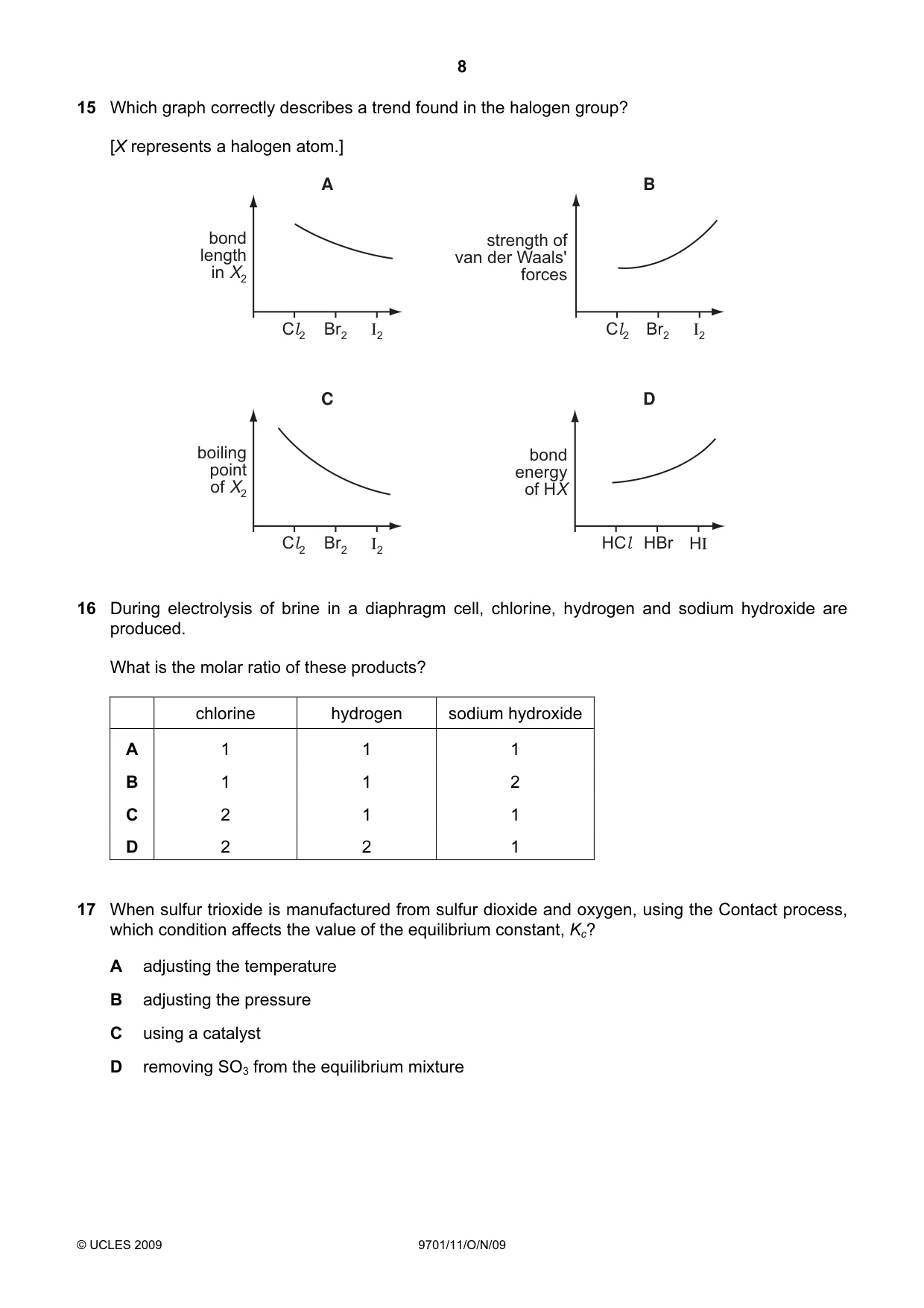
15 Which graph correctly describes a trend found in the halogen group? [X represents a halogen atom.] A B bond strength of length van der Waals' in X2 forces Cl2 Br2 I2 Cl2 Br2 I2 C D boiling bond point energy of X2 of HX Cl2 Br2 I2 HCl HBr HI
Mark scheme: B
More questions on Physical properties of the Group 17 elements
Q16 · During electrolysis of brine in a diaphragm cell, chlorine, hydrogen and sodium hydroxide…
16 During electrolysis of brine in a diaphragm cell, chlorine, hydrogen and sodium hydroxide are produced. What is the molar ratio of these products? chlorine hydrogen sodium hydroxide A 1 1 1 B 1 1 2 C 2 1 1 D 2 2 1
Mark scheme: B
Q17 · When sulfur trioxide is manufactured from sulfur dioxide and oxygen, using the Contact…
17 When sulfur trioxide is manufactured from sulfur dioxide and oxygen, using the Contact process, which condition affects the value of the equilibrium constant, Kc? A adjusting the temperature B adjusting the pressure C using a catalyst D removing SO3 from the equilibrium mixture
Mark scheme: A
More questions on Chemical equilibria: reversible reactions, dynamic equilibrium
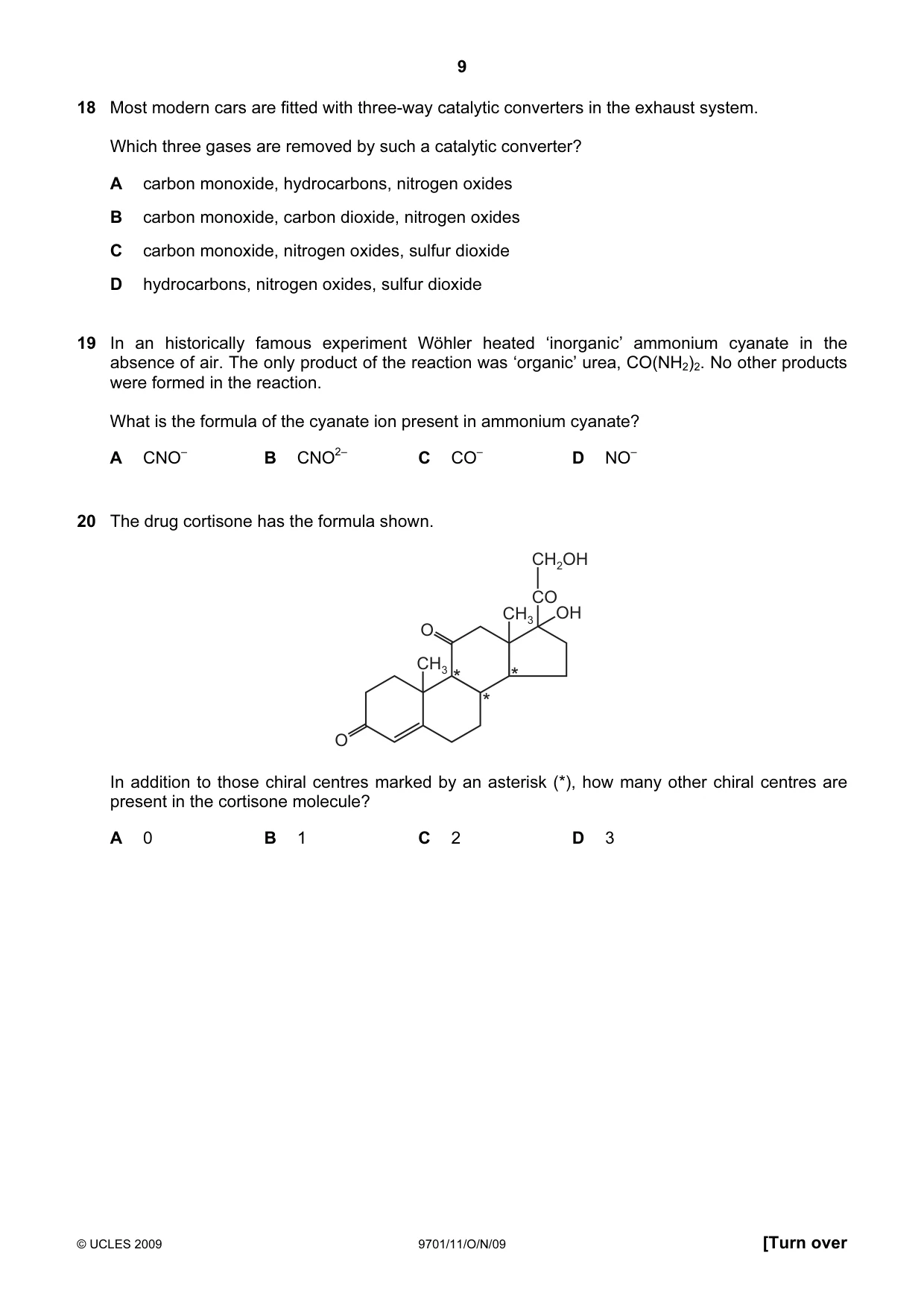
Q18 · Most modern cars are fitted with three-way catalytic converters in the exhaust system
18 Most modern cars are fitted with three-way catalytic converters in the exhaust system. Which three gases are removed by such a catalytic converter? A carbon monoxide, hydrocarbons, nitrogen oxides B carbon monoxide, carbon dioxide, nitrogen oxides C carbon monoxide, nitrogen oxides, sulfur dioxide D hydrocarbons, nitrogen oxides, sulfur dioxide
Mark scheme: A
Q19 · In an historically famous experiment Wöhler heated ‘inorganic’ ammonium cyanate in the…
19 In an historically famous experiment Wöhler heated ‘inorganic’ ammonium cyanate in the absence of air. The only product of the reaction was ‘organic’ urea, CO(NH2)2. No other products were formed in the reaction. What is the formula of the cyanate ion present in ammonium cyanate? A CNO– B CNO2– C CO– D NO–
Mark scheme: A
More questions on Formulas, functional groups and the naming of organic compounds
Q20 · The drug cortisone has the formula shown
20 The drug cortisone has the formula shown. CH2OH CO CH3 OH O CH3 O In addition to those chiral centres marked by an asterisk (*), how many other chiral centres are present in the cortisone molecule? A 0 B 1 C 2 D 3
Mark scheme: D
More questions on Isomerism: structural isomerism and stereoisomerism
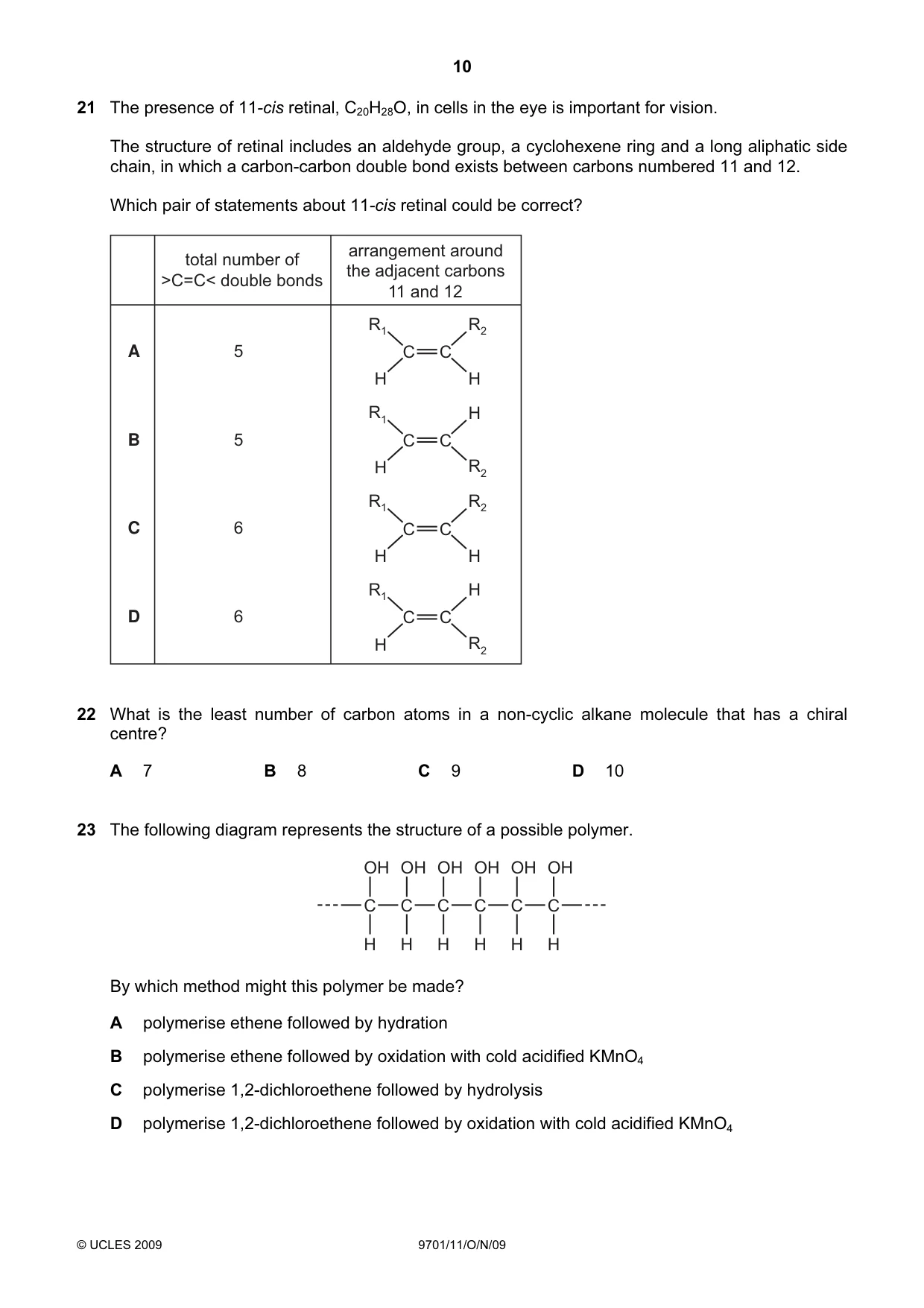
Q21 · The presence of 11-cis retinal, C20H28O, in cells in the eye is important for vision
21 The presence of 11-cis retinal, C20H28O, in cells in the eye is important for vision. The structure of retinal includes an aldehyde group, a cyclohexene ring and a long aliphatic side chain, in which a carbon-carbon double bond exists between carbons numbered 11 and 12. Which pair of statements about 11-cis retinal could be correct? arrangement around total number of the adjacent carbons >C=C< double bonds 11 and 12 R1 R2 A 5 C C H H R1 H B 5 C C H R2 R1 R2 C 6 C C H H R1 H D 6 C C H R2
Mark scheme: A
More questions on Isomerism: structural isomerism and stereoisomerism
Q22 · What is the least number of carbon atoms in a non-cyclic alkane molecule that has a…
22 What is the least number of carbon atoms in a non-cyclic alkane molecule that has a chiral centre? A 7 B 8 C 9 D 10
Mark scheme: A
More questions on Isomerism: structural isomerism and stereoisomerism
Q23 · The following diagram represents the structure of a possible polymer
23 The following diagram represents the structure of a possible polymer. OH OH OH OH OH OH C C C C C C H H H H H H By which method might this polymer be made? A polymerise ethene followed by hydration B polymerise ethene followed by oxidation with cold acidified KMnO4 C polymerise 1,2-dichloroethene followed by hydrolysis D polymerise 1,2-dichloroethene followed by oxidation with cold acidified KMnO4
Mark scheme: C
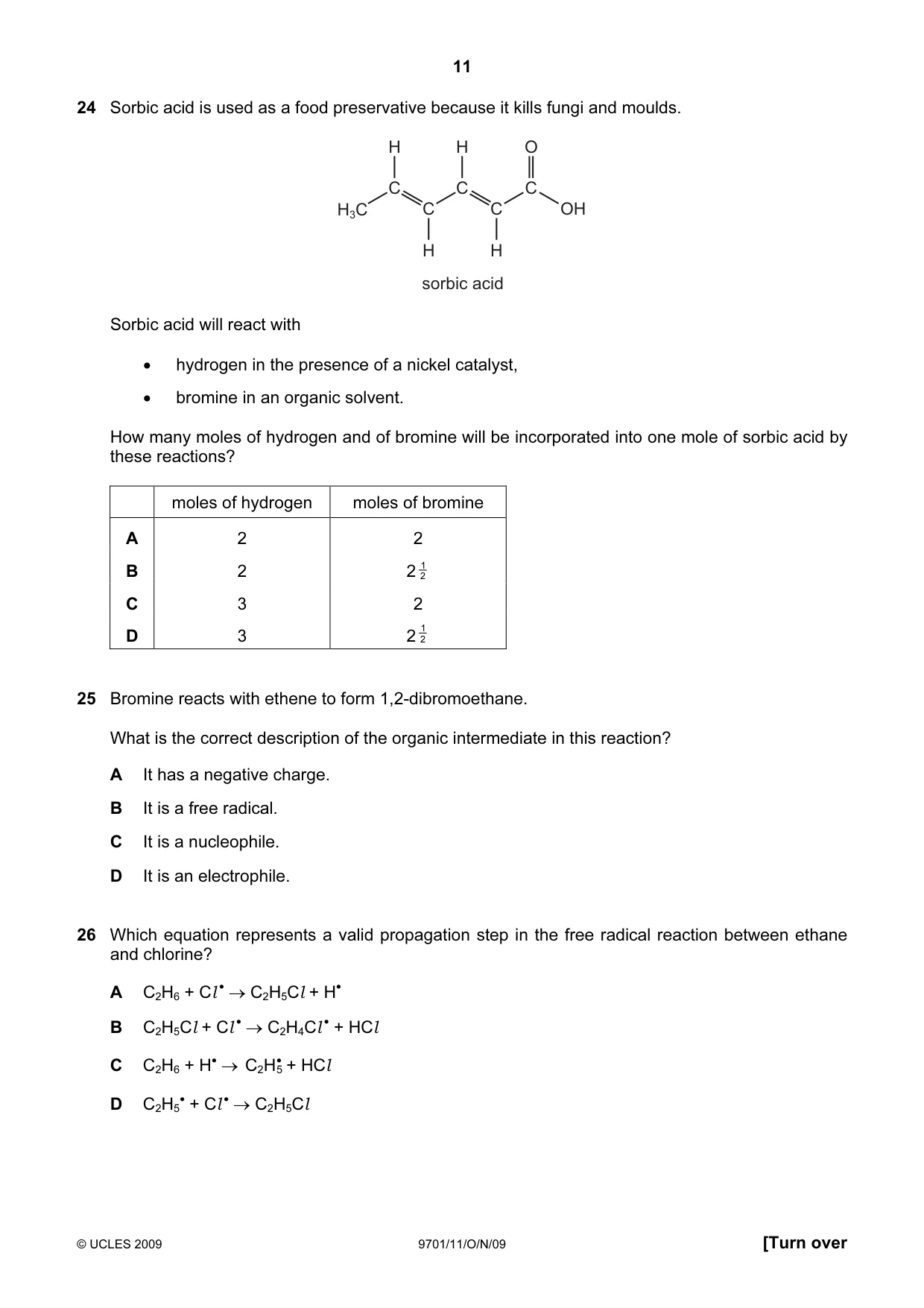
Q24 · Sorbic acid is used as a food preservative because it kills fungi and moulds
24 Sorbic acid is used as a food preservative because it kills fungi and moulds. H H O C C C H3C C C OH H H sorbic acid Sorbic acid will react with • hydrogen in the presence of a nickel catalyst, • bromine in an organic solvent. How many moles of hydrogen and of bromine will be incorporated into one mole of sorbic acid by these reactions? moles of hydrogen moles of bromine A 2 2 1 B 2 2 2 C 3 2 1 D 3 2 2
Mark scheme: A
Q25 · Bromine reacts with ethene to form 1,2-dibromoethane
25 Bromine reacts with ethene to form 1,2-dibromoethane. What is the correct description of the organic intermediate in this reaction? A It has a negative charge. B It is a free radical. C It is a nucleophile. D It is an electrophile.
Mark scheme: D
Q26 · Which equation represents a valid propagation step in the free radical reaction between…
26 Which equation represents a valid propagation step in the free radical reaction between ethane and chlorine? A C2H6 + Cl • → C2H5Cl + H• B C2H5Cl + Cl • → C2H4Cl • + HCl C C2H6 + H• → C 2H • + HCl 5 D C2H5 • + Cl • → C2H5Cl
Mark scheme: B
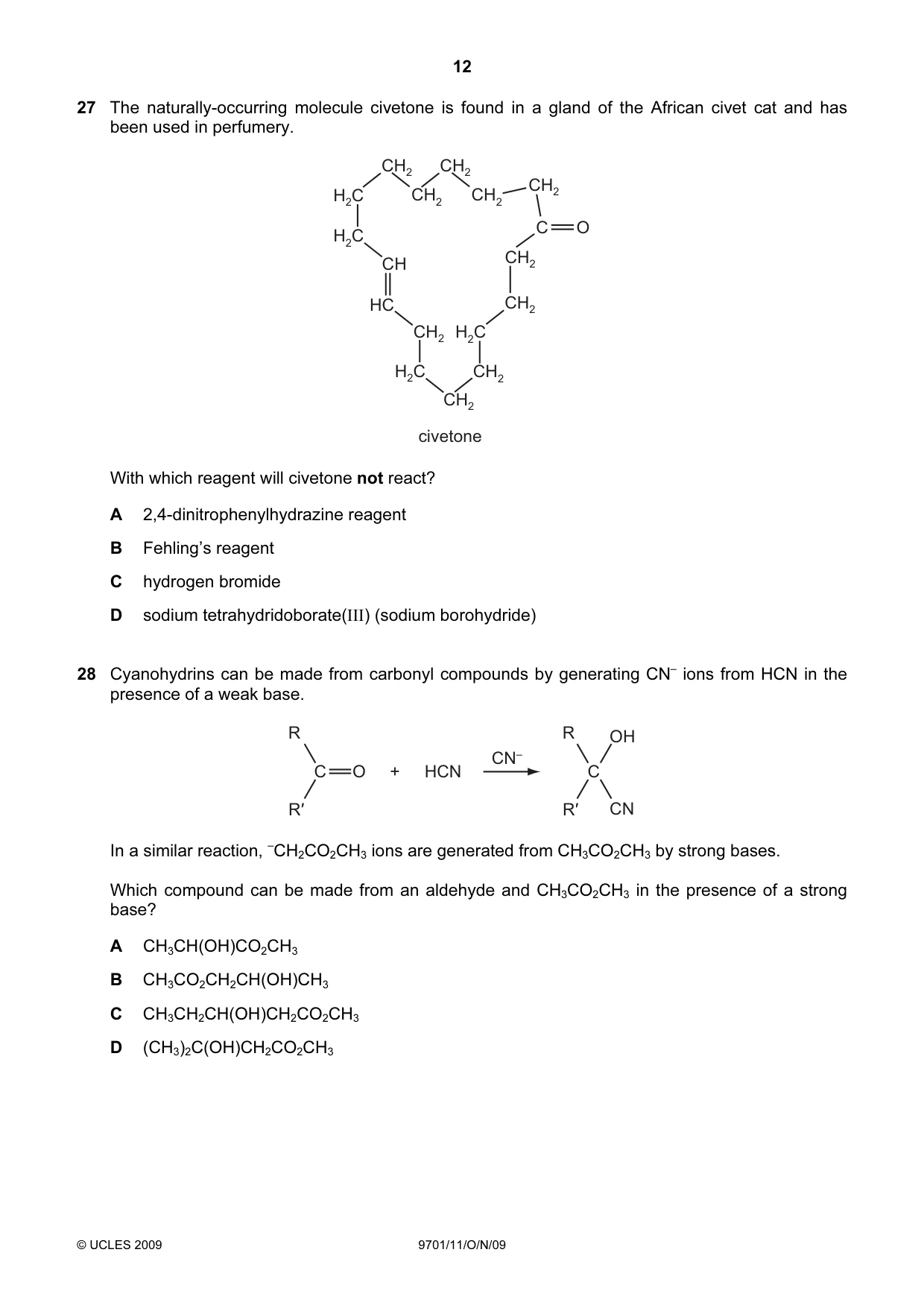
Q27 · The naturally-occurring molecule civetone is found in a gland of the African civet cat…
27 The naturally-occurring molecule civetone is found in a gland of the African civet cat and has been used in perfumery. CH2 CH2 CH2 H2C CH2 CH2 C O H2C CH CH2 HC CH2 CH2 H2C H2C CH2 CH2 civetone With which reagent will civetone not react? A 2,4-dinitrophenylhydrazine reagent B Fehling’s reagent C hydrogen bromide D sodium tetrahydridoborate(III) (sodium borohydride)
Mark scheme: B
Q28 · Cyanohydrins can be made from carbonyl compounds by generating CN– ions from HCN in the…
28 Cyanohydrins can be made from carbonyl compounds by generating CN– ions from HCN in the presence of a weak base. R R OH CN– C O + HCN C R′ R′ CN In a similar reaction, –CH2CO2CH3 ions are generated from CH3CO2CH3 by strong bases. Which compound can be made from an aldehyde and CH3CO2CH3 in the presence of a strong base? A CH3CH(OH)CO2CH3 B CH3CO2CH2CH(OH)CH3 C CH3CH2CH(OH)CH2CO2CH3 D (CH3)2C(OH)CH2CO2CH3
Mark scheme: C
Q29 · The characteristic odour of rum is attributed to the compound 2-ethyl-3-methylbutanoic…
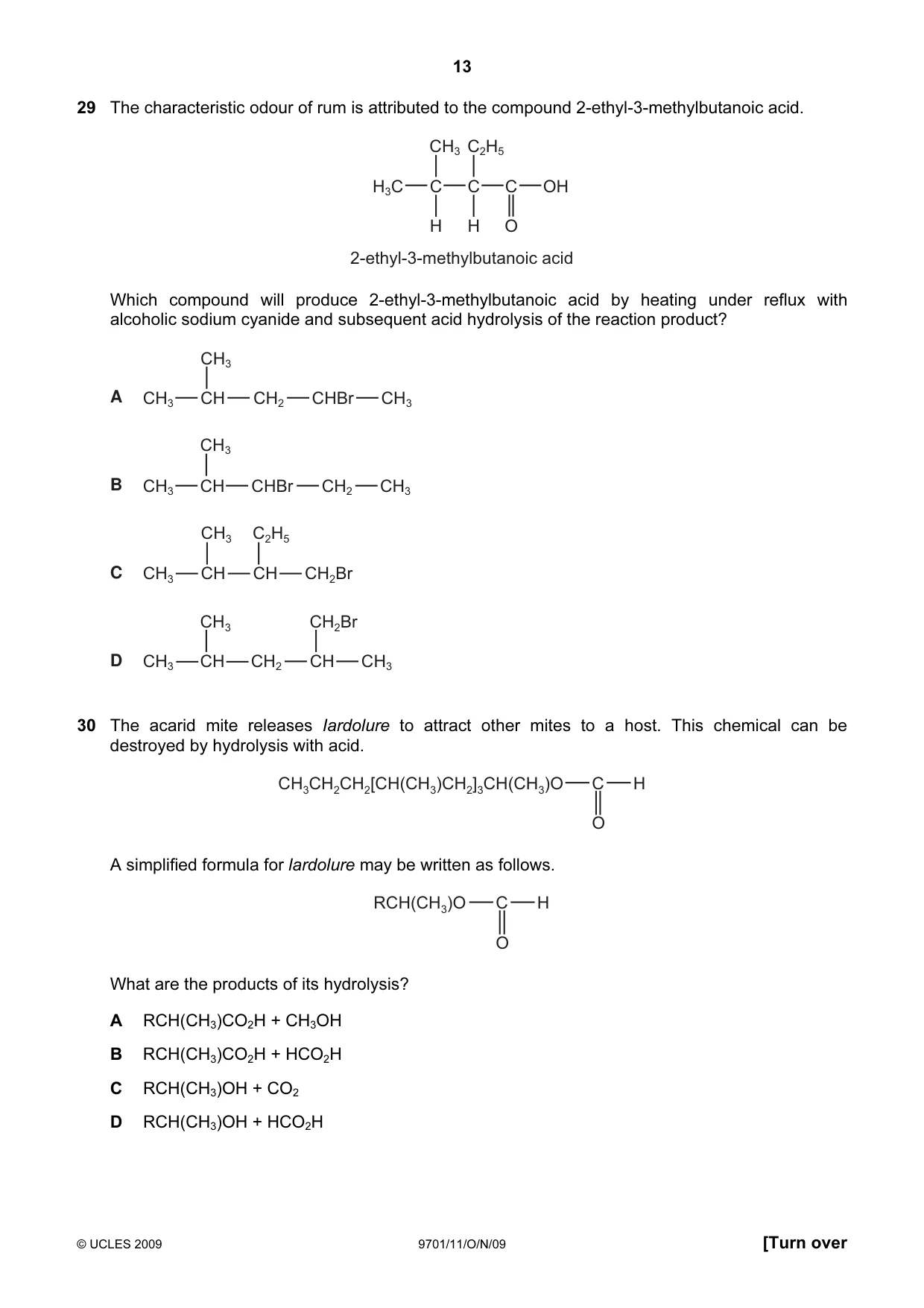
29 The characteristic odour of rum is attributed to the compound 2-ethyl-3-methylbutanoic acid. CH3 C2H5 H3C C C C OH H H O 2-ethyl-3-methylbutanoic acid Which compound will produce 2-ethyl-3-methylbutanoic acid by heating under reflux with alcoholic sodium cyanide and subsequent acid hydrolysis of the reaction product? CH3 A CH3 CH CH2 CHBr CH3 CH3 B CH3 CH CHBr CH2 CH3 CH3 C2H5 C CH3 CH CH CH2Br CH3 CH2Br D CH3 CH CH2 CH CH3
Mark scheme: B
Q30 · The acarid mite releases Iardolure to attract other mites to a host
30 The acarid mite releases Iardolure to attract other mites to a host. This chemical can be destroyed by hydrolysis with acid. CH3CH2CH2[CH(CH3)CH2]3CH(CH3)O C H O A simplified formula for lardolure may be written as follows. RCH(CH3)O C H O What are the products of its hydrolysis? A RCH(CH3)CO2H + CH3OH B RCH(CH3)CO2H + HCO2H C RCH(CH3)OH + CO2 D RCH(CH3)OH + HCO2H
Mark scheme: D
Q31 · A monomer undergoes addition polymerisation
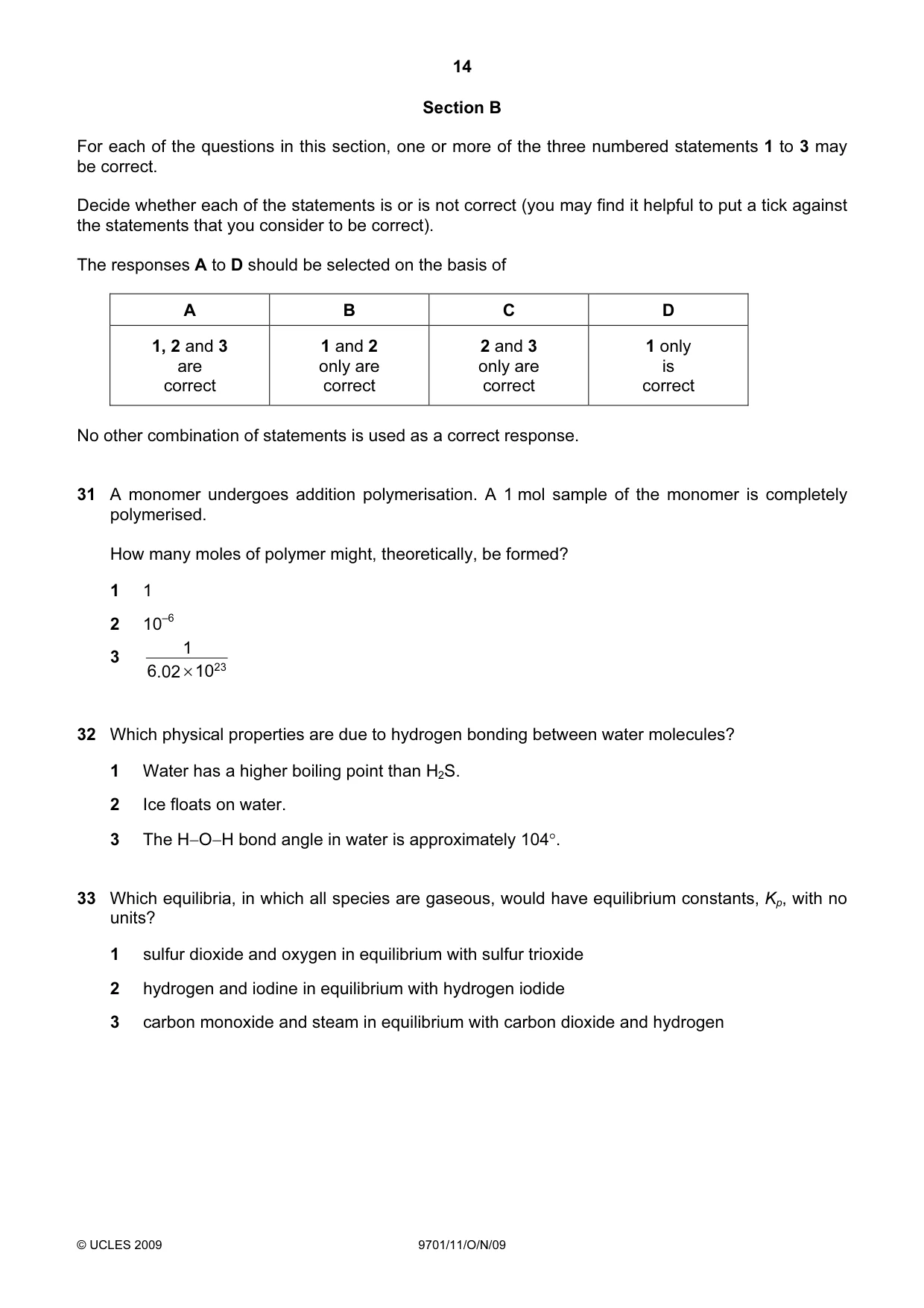
31 A monomer undergoes addition polymerisation. A 1 mol sample of the monomer is completely polymerised. How many moles of polymer might, theoretically, be formed? 1 1 2 10–6 1 3 6 .02 × 10 23
Mark scheme: C
Q32 · Which physical properties are due to hydrogen bonding between water molecules?
32 Which physical properties are due to hydrogen bonding between water molecules? 1 Water has a higher boiling point than H2S. 2 Ice floats on water. 3 The H−O−H bond angle in water is approximately 104°.
Mark scheme: B
More questions on Intermolecular forces, electronegativity and bond properties
Q33 · Which equilibria, in which all species are gaseous, would have equilibrium constants, Kp…
33 Which equilibria, in which all species are gaseous, would have equilibrium constants, Kp, with no units? 1 sulfur dioxide and oxygen in equilibrium with sulfur trioxide 2 hydrogen and iodine in equilibrium with hydrogen iodide 3 carbon monoxide and steam in equilibrium with carbon dioxide and hydrogen
Mark scheme: C
More questions on Chemical equilibria: reversible reactions, dynamic equilibrium
Q34 · Why does a mixture of hydrogen gas and bromine gas react together faster at a temperature…
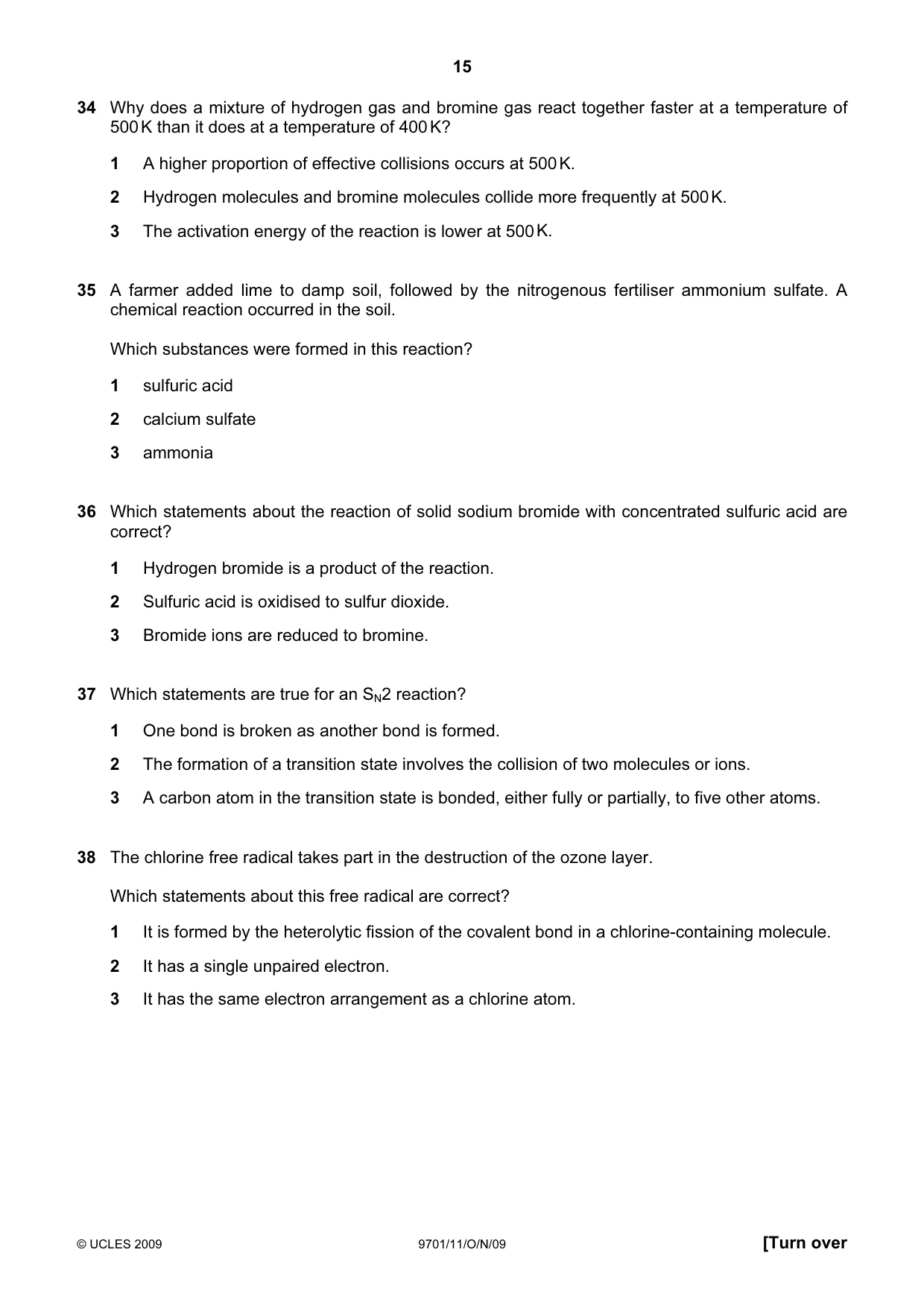
34 Why does a mixture of hydrogen gas and bromine gas react together faster at a temperature of 500 K than it does at a temperature of 400 K? 1 A higher proportion of effective collisions occurs at 500 K. 2 Hydrogen molecules and bromine molecules collide more frequently at 500 K. 3 The activation energy of the reaction is lower at 500 K.
Mark scheme: B
More questions on Effect of temperature on reaction rates and the concept of activation energy
Q35 · A farmer added lime to damp soil, followed by the nitrogenous fertiliser ammonium sulfate
35 A farmer added lime to damp soil, followed by the nitrogenous fertiliser ammonium sulfate. A chemical reaction occurred in the soil. Which substances were formed in this reaction? 1 sulfuric acid 2 calcium sulfate 3 ammonia
Mark scheme: C
Q36 · Which statements about the reaction of solid sodium bromide with concentrated sulfuric…
36 Which statements about the reaction of solid sodium bromide with concentrated sulfuric acid are correct? 1 Hydrogen bromide is a product of the reaction. 2 Sulfuric acid is oxidised to sulfur dioxide. 3 Bromide ions are reduced to bromine.
Mark scheme: D
Q37 · Which statements are true for an SN2 reaction?
37 Which statements are true for an SN2 reaction? 1 One bond is broken as another bond is formed. 2 The formation of a transition state involves the collision of two molecules or ions. 3 A carbon atom in the transition state is bonded, either fully or partially, to five other atoms.
Mark scheme: A
Q38 · The chlorine free radical takes part in the destruction of the ozone layer
38 The chlorine free radical takes part in the destruction of the ozone layer. Which statements about this free radical are correct? 1 It is formed by the heterolytic fission of the covalent bond in a chlorine-containing molecule. 2 It has a single unpaired electron. 3 It has the same electron arrangement as a chlorine atom.
Mark scheme: C
Q39 · The diagram shows an experiment
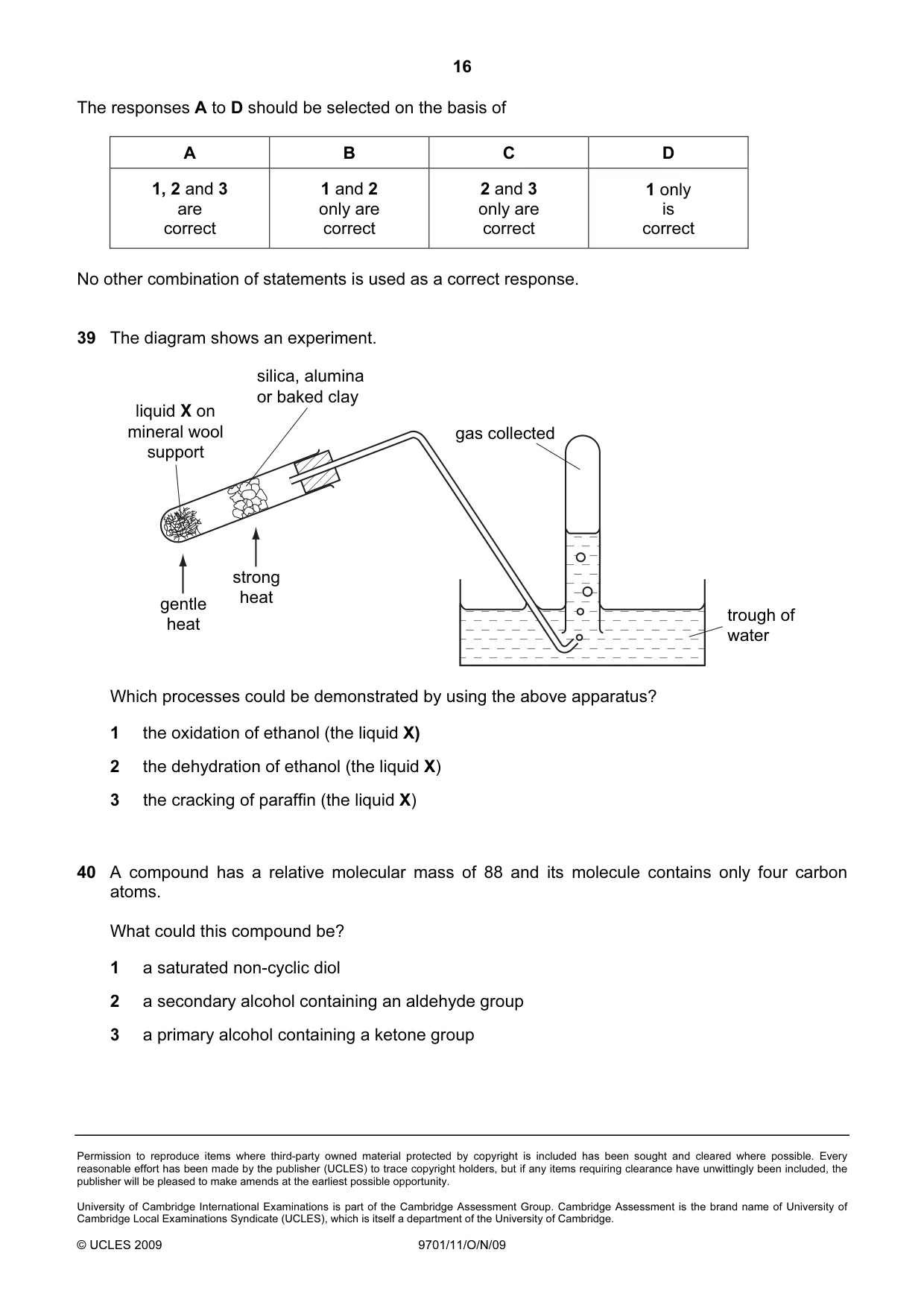
39 The diagram shows an experiment. silica, alumina or baked clay liquid X on mineral wool gas collected support strong gentle heat trough of heat water Which processes could be demonstrated by using the above apparatus? 1 the oxidation of ethanol (the liquid X) 2 the dehydration of ethanol (the liquid X) 3 the cracking of paraffin (the liquid X)
Mark scheme: C
Q40 · A compound has a relative molecular mass of 88 and its molecule contains only four carbon…
40 A compound has a relative molecular mass of 88 and its molecule contains only four carbon atoms. What could this compound be? 1 a saturated non-cyclic diol 2 a secondary alcohol containing an aldehyde group 3 a primary alcohol containing a ketone group
Mark scheme: C
What was in this paper
The subtopics covered by these 40 questions, and how many questions each got. Open one in a new tab to see every Cambridge question on it.
3Chemical equilibria: reversible reactions, dynamic equilibrium3Isomerism: structural isomerism and stereoisomerism3Aldehydes and ketones2Alkenes2Effect of temperature on reaction rates and the concept of activation energy2Intermolecular forces, electronegativity and bond properties2Periodicity of chemical properties of the elements in Period 32Shapes of molecules2Similarities and trends in the properties of the Group 2 metals, magnesium to barium, and their compounds2Addition polymerisation1Alkanes1Carboxylic acids1Electrolysis1Enthalpy change, ΔH1Esters1Formulas1Formulas, functional groups and the naming of organic compounds1Halogenoalkanes1Homogeneous and heterogeneous catalysts1Isotopes1Nitrogen and sulfur1Particles in the atom and atomic radius1Periodicity of physical properties of the elements in Period 31Physical properties of the Group 17 elements1Redox processes: electron transfer and changes in oxidation number (oxidation state)1Some reactions of the halide ions1