Cambridge A Level Chemistry 9701 — 2021 May/June Paper 1 · Variant 2
9701/12/M/J/21 · 40 questions · 40 marks · ≈45 min
The question paper and its mark scheme, free to read here and free to download. This is Cambridge’s own paper, exactly as it was sat.
Question paper16 pages
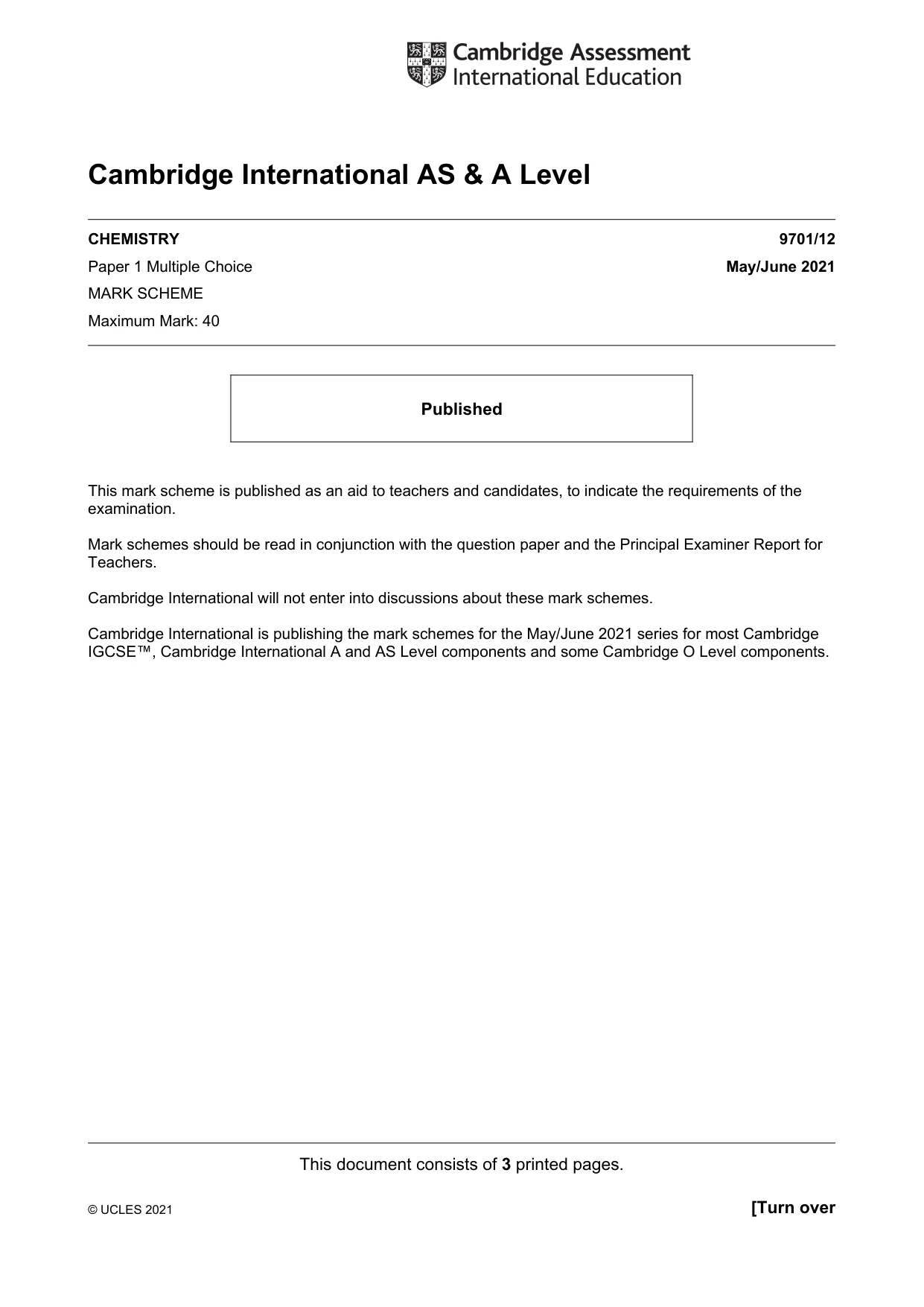
Mark scheme3 pages
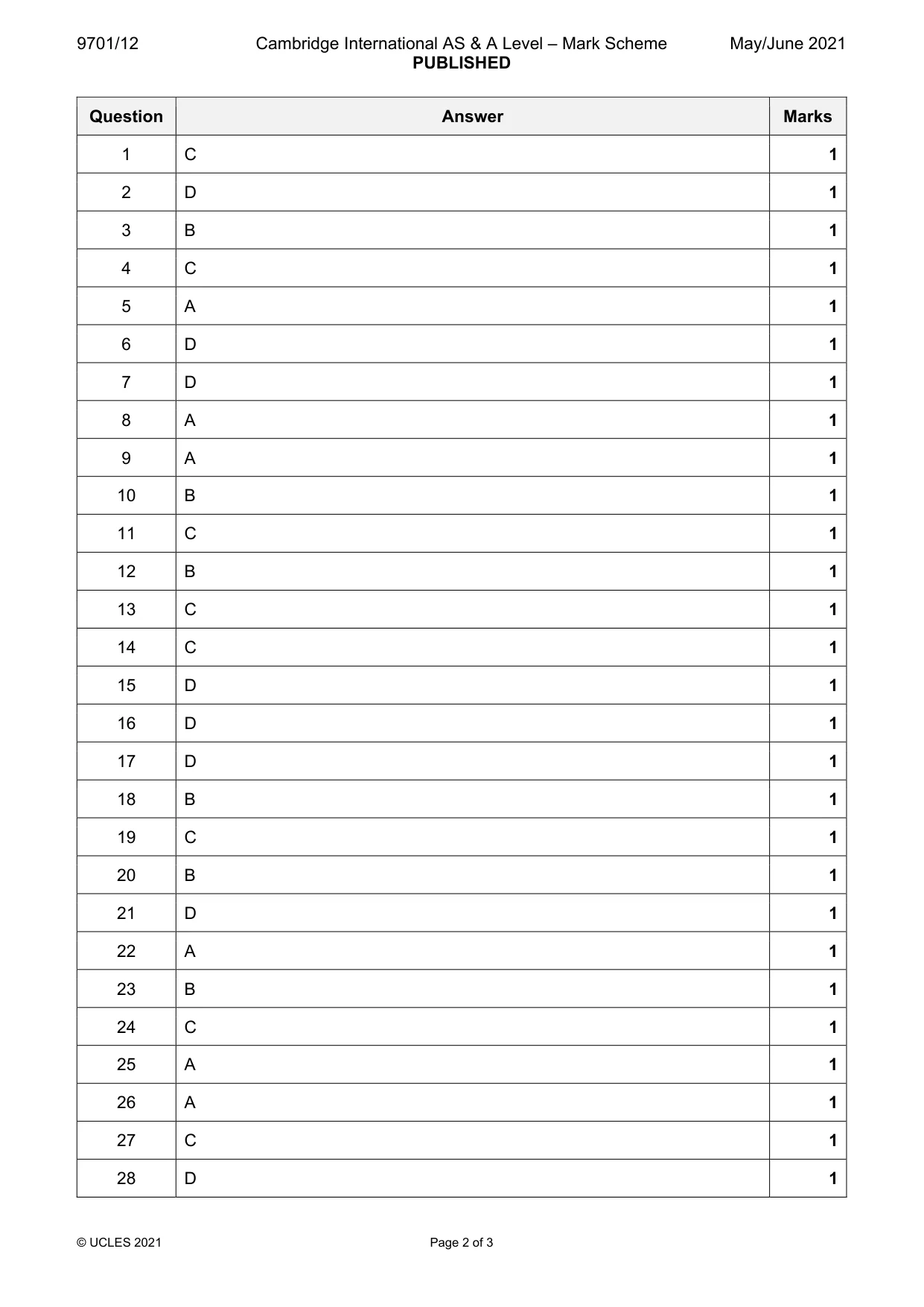
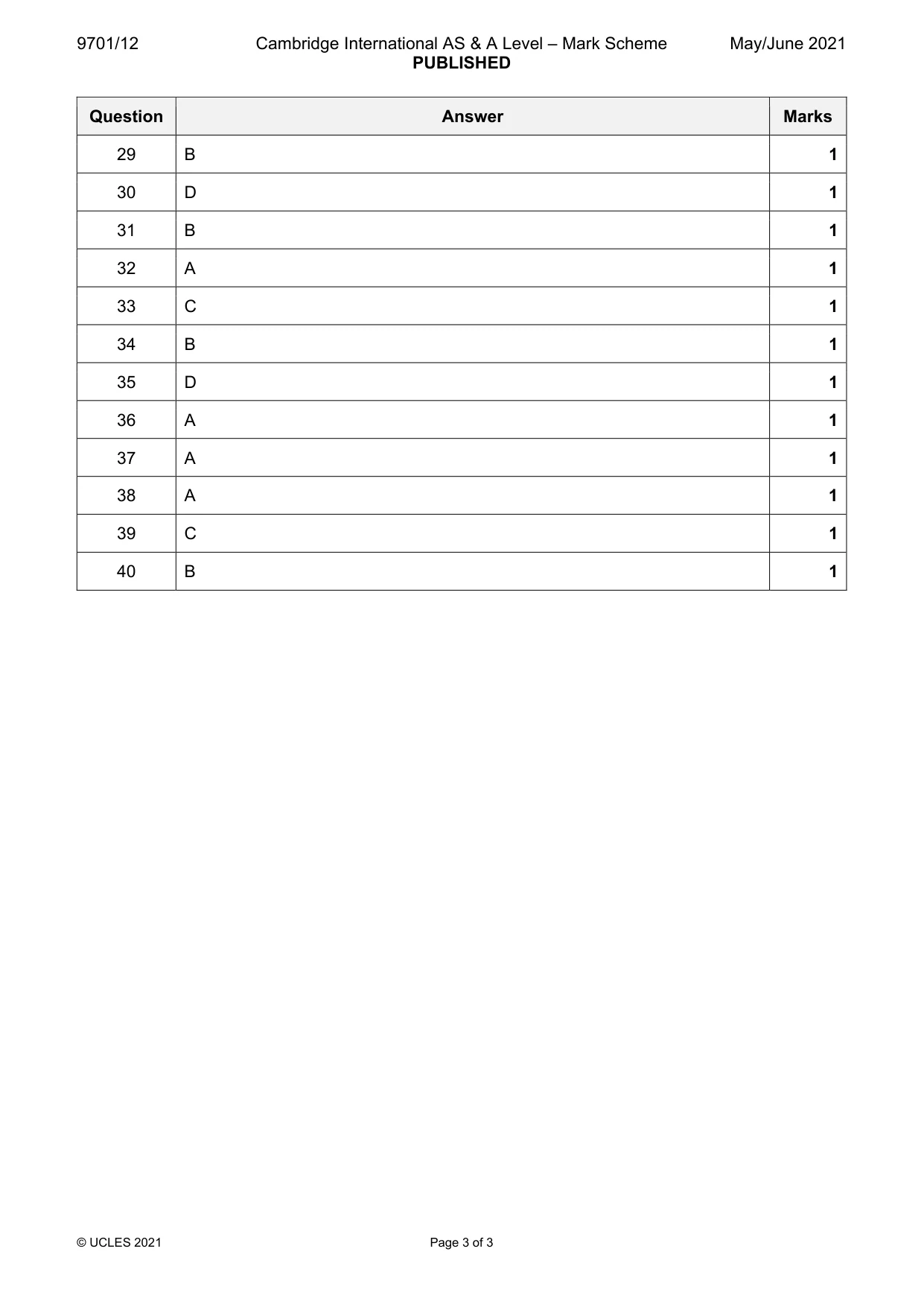
Answers below. Sit the paper first if you are practising.
Questions as text
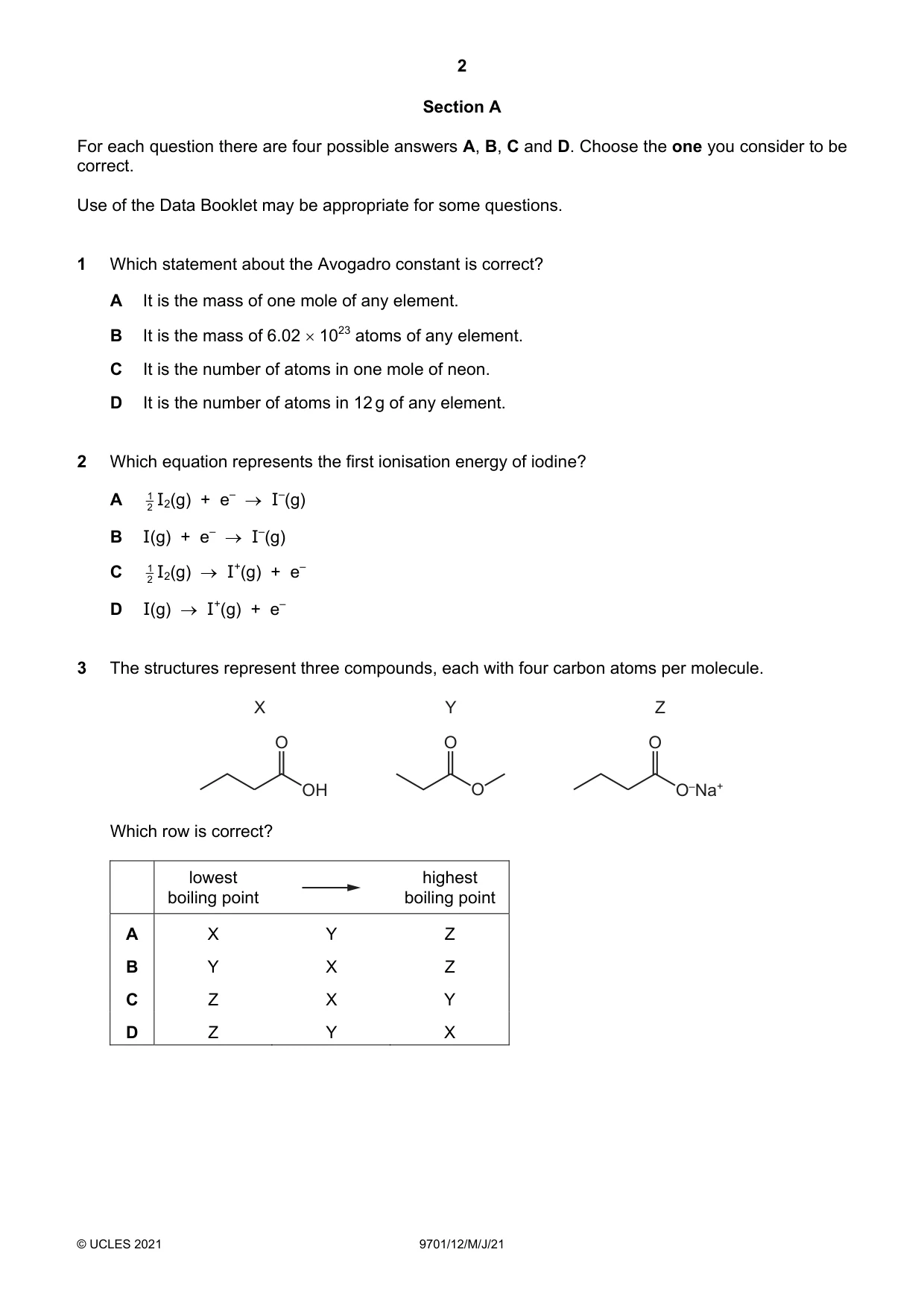
Q1 · Which statement about the Avogadro constant is correct?
1 Which statement about the Avogadro constant is correct? A It is the mass of one mole of any element. B It is the mass of 6.02 1023 atoms of any element. C It is the number of atoms in one mole of neon. D It is the number of atoms in 12 g of any element.
Mark scheme: C
Q2 · Which equation represents the first ionisation energy of iodine?
2 Which equation represents the first ionisation energy of iodine? A 2 I2(g) + e– I–(g) 1 B I(g) + e– I–(g) C 2 I2(g) I+(g) + e– 1 D I(g) I+(g) + e–
Mark scheme: D
Q3 · The structures represent three compounds, each with four carbon atoms per molecule
3 The structures represent three compounds, each with four carbon atoms per molecule. X Y Z O O O OH O O–Na+ Which row is correct? lowest highest boiling point boiling point A X Y Z B Y X Z C Z X Y D Z Y X
Mark scheme: B
More questions on Intermolecular forces, electronegativity and bond properties
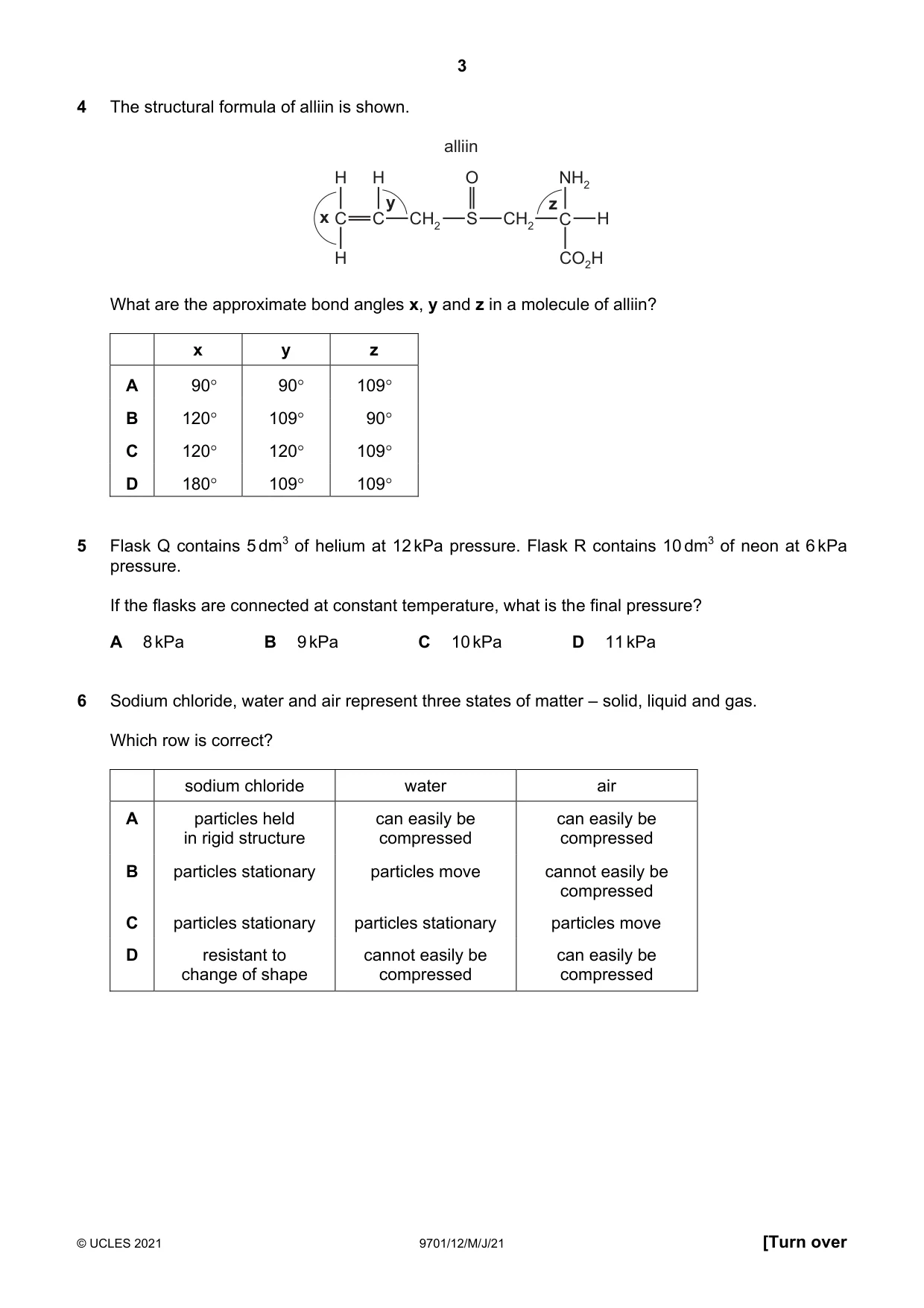
Q4 · The structural formula of alliin is shown
4 The structural formula of alliin is shown. alliin H H O NH2 y z x C C CH2 S CH2 C H H CO2H What are the approximate bond angles x, y and z in a molecule of alliin? x y z A 90 90 109 B 120 109 90 C 120 120 109 D 180 109 109
Mark scheme: C
Q5 · Flask Q contains 5 dm3 of helium at 12 kPa pressure
5 Flask Q contains 5 dm3 of helium at 12 kPa pressure. Flask R contains 10 dm3 of neon at 6 kPa pressure. If the flasks are connected at constant temperature, what is the final pressure? A 8 kPa B 9 kPa C 10 kPa D 11 kPa
Mark scheme: A
More questions on The gaseous state: ideal and real gases and pV = nRT
Q6 · Sodium chloride, water and air represent three states of matter – solid, liquid and gas
6 Sodium chloride, water and air represent three states of matter – solid, liquid and gas. Which row is correct? sodium chloride water air A particles held can easily be can easily be in rigid structure compressed compressed B particles stationary particles move cannot easily be compressed C particles stationary particles stationary particles move D resistant to cannot easily be can easily be change of shape compressed compressed
Mark scheme: D
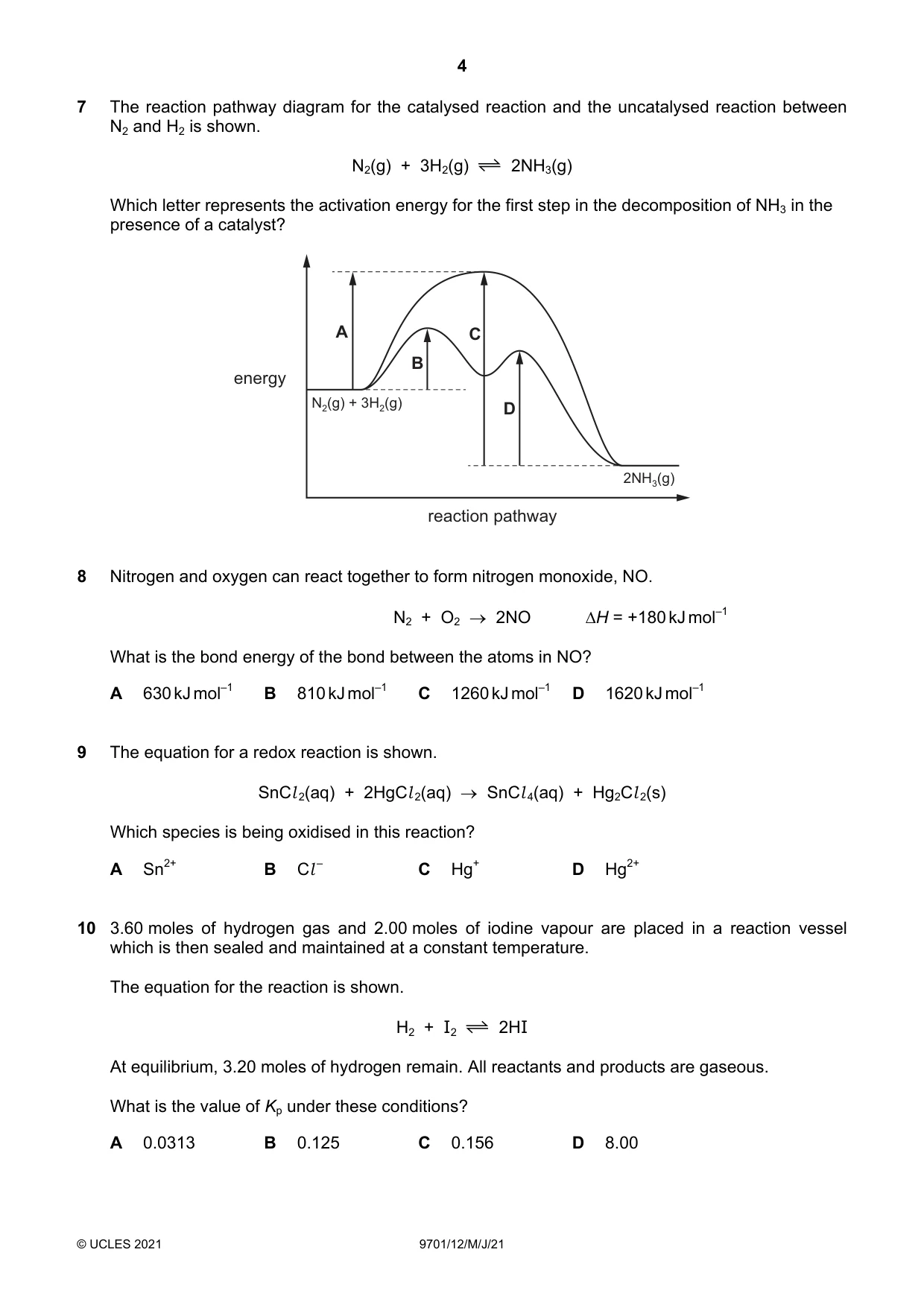
Q7 · The reaction pathway diagram for the catalysed reaction and the uncatalysed reaction…
7 The reaction pathway diagram for the catalysed reaction and the uncatalysed reaction between N2 and H2 is shown. N2(g) + 3H2(g) 2NH3(g) Which letter represents the activation energy for the first step in the decomposition of NH3 in the presence of a catalyst? A C B energy N2(g) + 3H2(g) D 2NH3(g) reaction pathway
Mark scheme: D
More questions on Effect of temperature on reaction rates and the concept of activation energy
Q8 · Nitrogen and oxygen can react together to form nitrogen monoxide, NO
8 Nitrogen and oxygen can react together to form nitrogen monoxide, NO. N2 + O2 2NO H = +180 kJ mol–1 What is the bond energy of the bond between the atoms in NO? A 630 kJ mol–1 B 810 kJ mol–1 C 1260 kJ mol–1 D 1620 kJ mol–1
Mark scheme: A
Q9 · The equation for a redox reaction is shown
9 The equation for a redox reaction is shown. SnCl 2(aq) + 2HgCl 2(aq) SnCl 4(aq) + Hg2Cl 2(s) Which species is being oxidised in this reaction? A Sn2+ B Cl – C Hg+ D Hg2+
Mark scheme: A
Q10 · 3.60 moles of hydrogen gas and 2.00 moles of iodine vapour are placed in a reaction…
10 3.60 moles of hydrogen gas and 2.00 moles of iodine vapour are placed in a reaction vessel which is then sealed and maintained at a constant temperature. The equation for the reaction is shown. H2 + I2 2HI At equilibrium, 3.20 moles of hydrogen remain. All reactants and products are gaseous. What is the value of Kp under these conditions? A 0.0313 B 0.125 C 0.156 D 8.00
Mark scheme: B
More questions on Chemical equilibria: reversible reactions, dynamic equilibrium
Q11 · Two chemicals, X and Y, react together in solution to give product Z
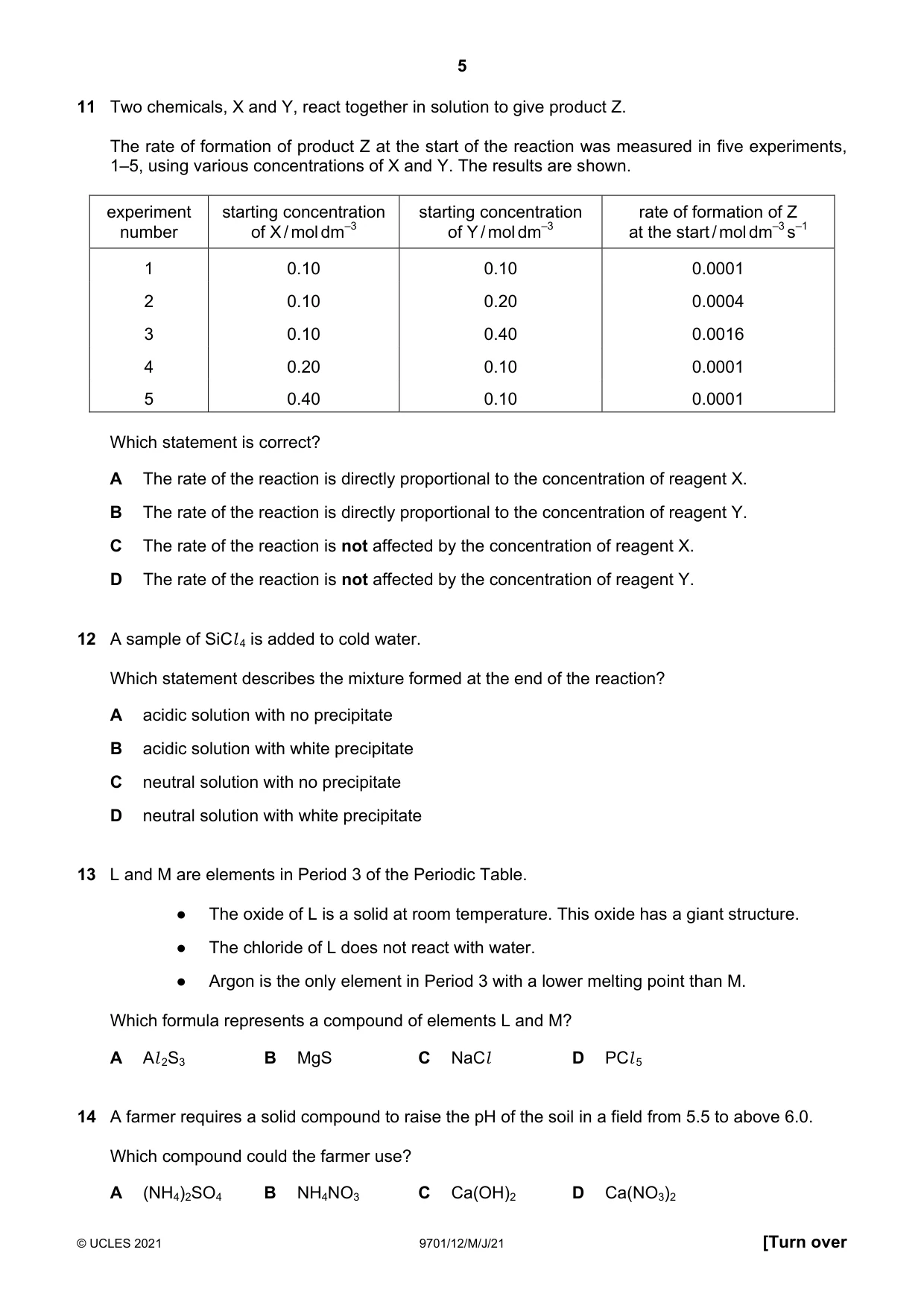
11 Two chemicals, X and Y, react together in solution to give product Z. The rate of formation of product Z at the start of the reaction was measured in five experiments, 1–5, using various concentrations of X and Y. The results are shown. experiment starting concentration starting concentration rate of formation of Z number of X / mol dm–3 of Y / mol dm–3 at the start / mol dm–3 s–1 1 0.10 0.10 0.0001 2 0.10 0.20 0.0004 3 0.10 0.40 0.0016 4 0.20 0.10 0.0001 5 0.40 0.10 0.0001 Which statement is correct? A The rate of the reaction is directly proportional to the concentration of reagent X. B The rate of the reaction is directly proportional to the concentration of reagent Y. C The rate of the reaction is not affected by the concentration of reagent X. D The rate of the reaction is not affected by the concentration of reagent Y.
Mark scheme: C
More questions on Simple rate equations, orders of reaction and rate constants
Q12 · A sample of SiCl 4 is added to cold water
12 A sample of SiCl 4 is added to cold water. Which statement describes the mixture formed at the end of the reaction? A acidic solution with no precipitate B acidic solution with white precipitate C neutral solution with no precipitate D neutral solution with white precipitate
Mark scheme: B
More questions on Periodicity of chemical properties of the elements in Period 3
Q13 · L and M are elements in Period 3 of the Periodic Table
13 L and M are elements in Period 3 of the Periodic Table. ● The oxide of L is a solid at room temperature. This oxide has a giant structure. ● The chloride of L does not react with water. ● Argon is the only element in Period 3 with a lower melting point than M. Which formula represents a compound of elements L and M? A Al 2S3 B MgS C NaCl D PCl 5
Mark scheme: C
More questions on Periodicity of physical properties of the elements in Period 3
Q14 · A farmer requires a solid compound to raise the pH of the soil in a field from 5.5 to…
14 A farmer requires a solid compound to raise the pH of the soil in a field from 5.5 to above 6.0. Which compound could the farmer use? A (NH4)2SO4 B NH4NO3 C Ca(OH)2 D Ca(NO3)2
Mark scheme: C
Q15 · Z is an anhydrous compound of a Group 2 element
15 Z is an anhydrous compound of a Group 2 element. When it is heated, Z undergoes thermal decomposition to produce two different gases. Z has relatively low thermal stability compared to other Group 2 compounds containing the same anion as Z. What is compound Z? A barium carbonate B barium nitrate C magnesium carbonate D magnesium nitrate
Mark scheme: D
Q16 · Which row gives mixtures that both result in the oxidation of a halide ion?
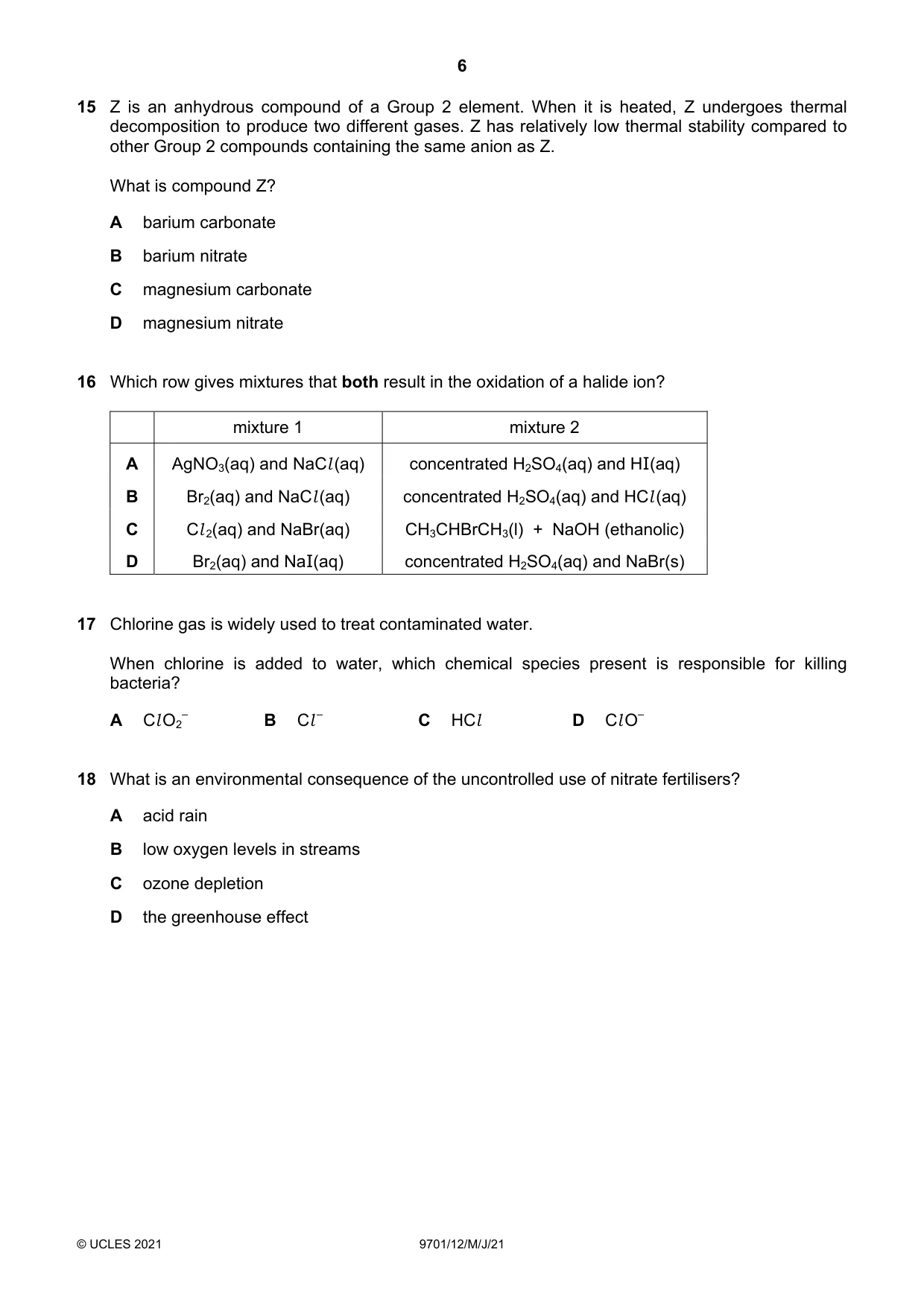
16 Which row gives mixtures that both result in the oxidation of a halide ion? mixture 1 mixture 2 A AgNO3(aq) and NaCl (aq) concentrated H2SO4(aq) and HI(aq) B Br2(aq) and NaCl (aq) concentrated H2SO4(aq) and HCl (aq) C Cl 2(aq) and NaBr(aq) CH3CHBrCH3(l) + NaOH (ethanolic) D Br2(aq) and NaI(aq) concentrated H2SO4(aq) and NaBr(s)
Mark scheme: D
Q17 · Chlorine gas is widely used to treat contaminated water
17 Chlorine gas is widely used to treat contaminated water. When chlorine is added to water, which chemical species present is responsible for killing bacteria? A Cl O2 – B Cl – C HCl D Cl O–
Mark scheme: D
Q18 · What is an environmental consequence of the uncontrolled use of nitrate fertilisers?
18 What is an environmental consequence of the uncontrolled use of nitrate fertilisers? A acid rain B low oxygen levels in streams C ozone depletion D the greenhouse effect
Mark scheme: B
Q19 · Ammonia gas, NH3, and hydrogen sulfide gas, H2S, react together to form the salt ammonium…
19 Ammonia gas, NH3, and hydrogen sulfide gas, H2S, react together to form the salt ammonium sulfide, (NH4)2S. Ammonium sulfide dissolves in water to produce an orange alkaline solution. (NH4)2S(aq) NH3(aq) + NH4SH(aq) The addition of NaOH(aq) to this solution produces a gas, X. The addition of HCl (aq) to a separate portion of this solution produces a gas, Y. X and Y could represent different gases or identical gases. What are the identities of X and Y? X Y A H2S H2S B H2S NH3 C NH3 H2S D NH3 NH3
Mark scheme: C
Q20 · Compound P is treated with an excess of hydrogen gas in the presence of a nickel catalyst
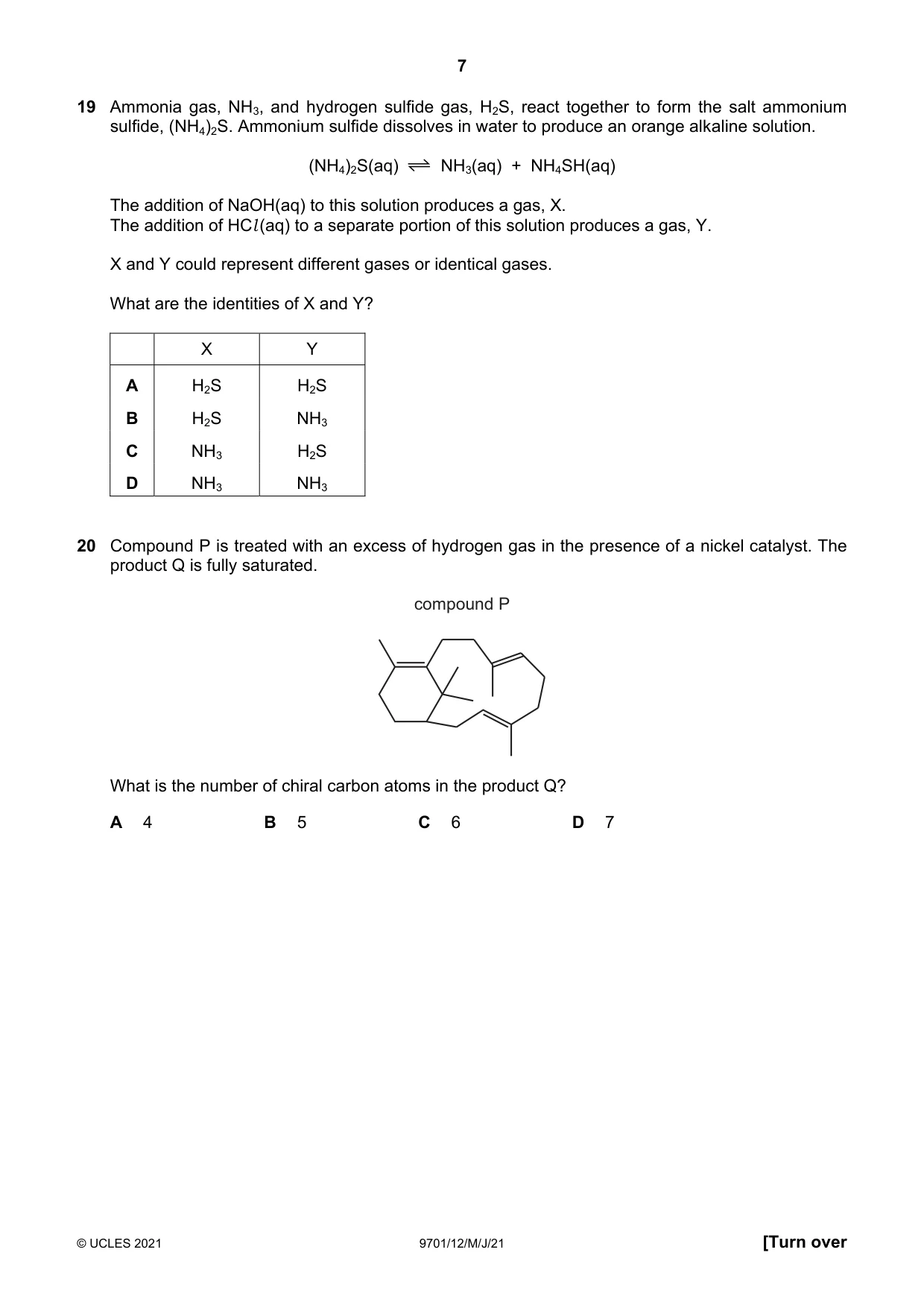
20 Compound P is treated with an excess of hydrogen gas in the presence of a nickel catalyst. The product Q is fully saturated. compound P What is the number of chiral carbon atoms in the product Q? A 4 B 5 C 6 D 7
Mark scheme: B
Q21 · Hexadeca-10,12-dien-1-ol is produced by silk moths from hexadecanoic acid in a three-step…
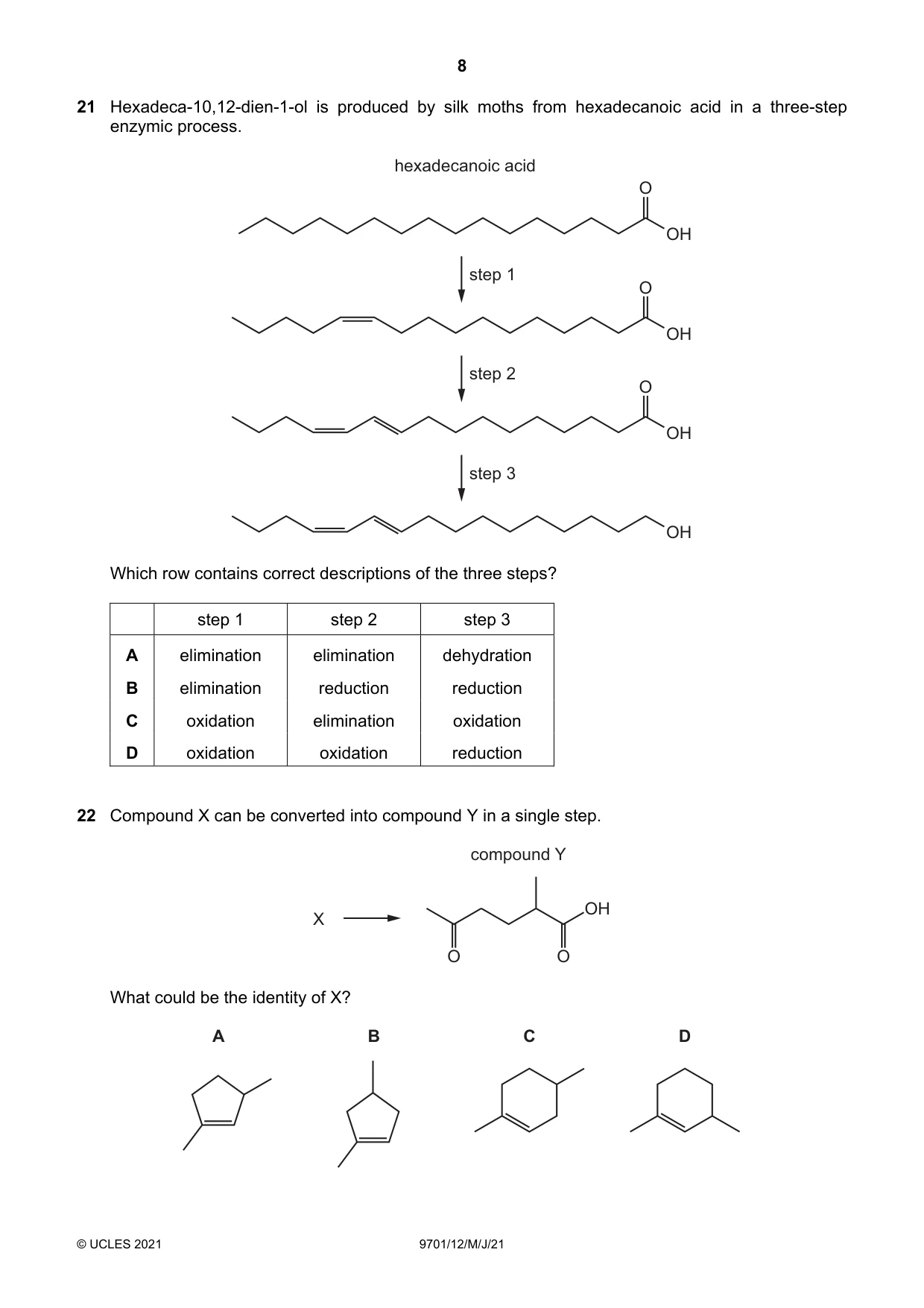
21 Hexadeca-10,12-dien-1-ol is produced by silk moths from hexadecanoic acid in a three-step enzymic process. hexadecanoic acid O OH step 1 O OH step 2 O OH step 3 OH Which row contains correct descriptions of the three steps? step 1 step 2 step 3 A elimination elimination dehydration B elimination reduction reduction C oxidation elimination oxidation D oxidation oxidation reduction
Mark scheme: D
Q22 · Compound X can be converted into compound Y in a single step
22 Compound X can be converted into compound Y in a single step. compound Y OH X O O What could be the identity of X? A B C D
Mark scheme: A
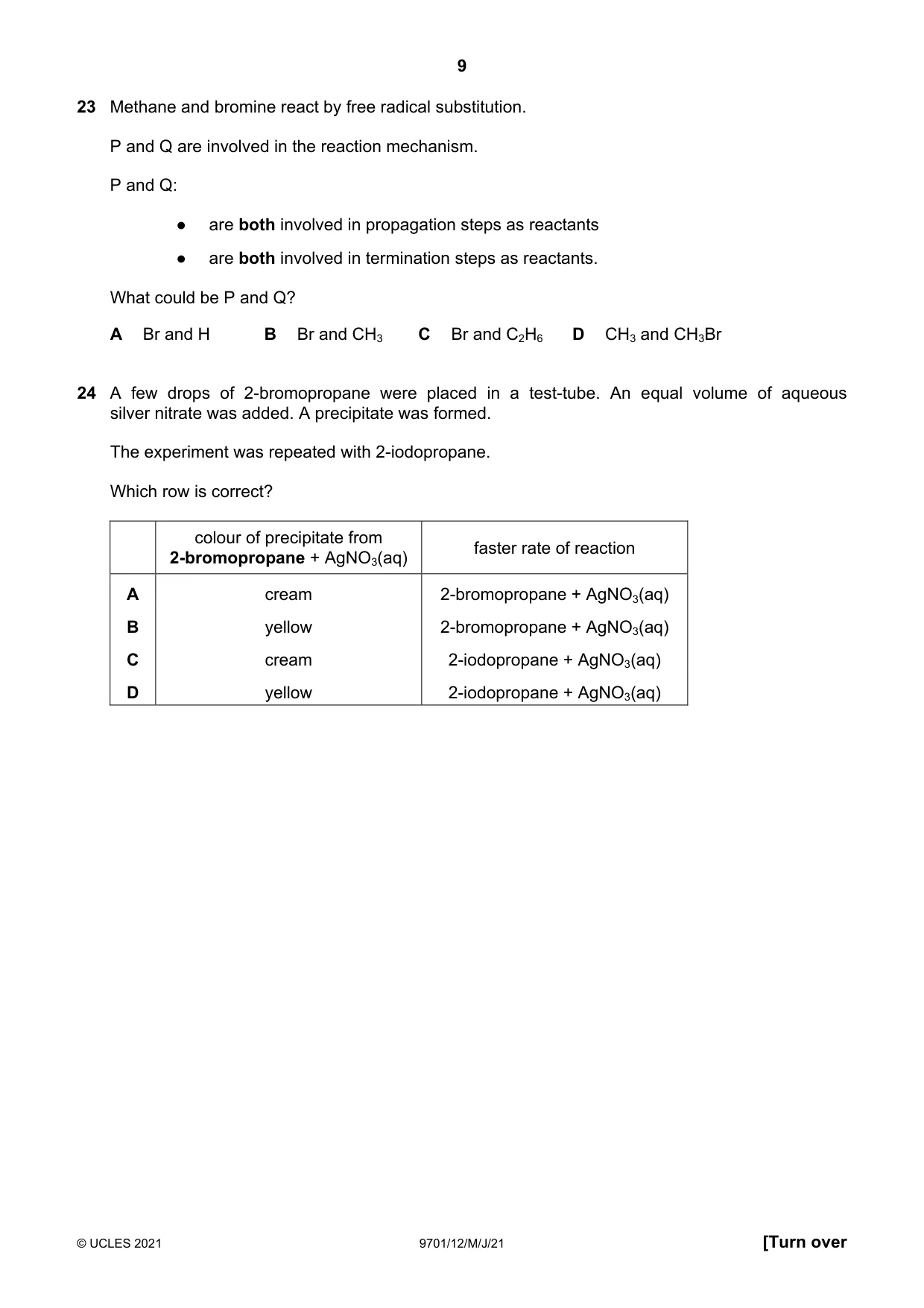
Q23 · Methane and bromine react by free radical substitution
23 Methane and bromine react by free radical substitution. P and Q are involved in the reaction mechanism. P and Q: ● are both involved in propagation steps as reactants ● are both involved in termination steps as reactants. What could be P and Q? A Br and H B Br and CH3 C Br and C2H6 D CH3 and CH3Br
Mark scheme: B
Q24 · A few drops of 2-bromopropane were placed in a test-tube
24 A few drops of 2-bromopropane were placed in a test-tube. An equal volume of aqueous silver nitrate was added. A precipitate was formed. The experiment was repeated with 2-iodopropane. Which row is correct? colour of precipitate from faster rate of reaction 2-bromopropane + AgNO3(aq) A cream 2-bromopropane + AgNO3(aq) B yellow 2-bromopropane + AgNO3(aq) C cream 2-iodopropane + AgNO3(aq) D yellow 2-iodopropane + AgNO3(aq)
Mark scheme: C
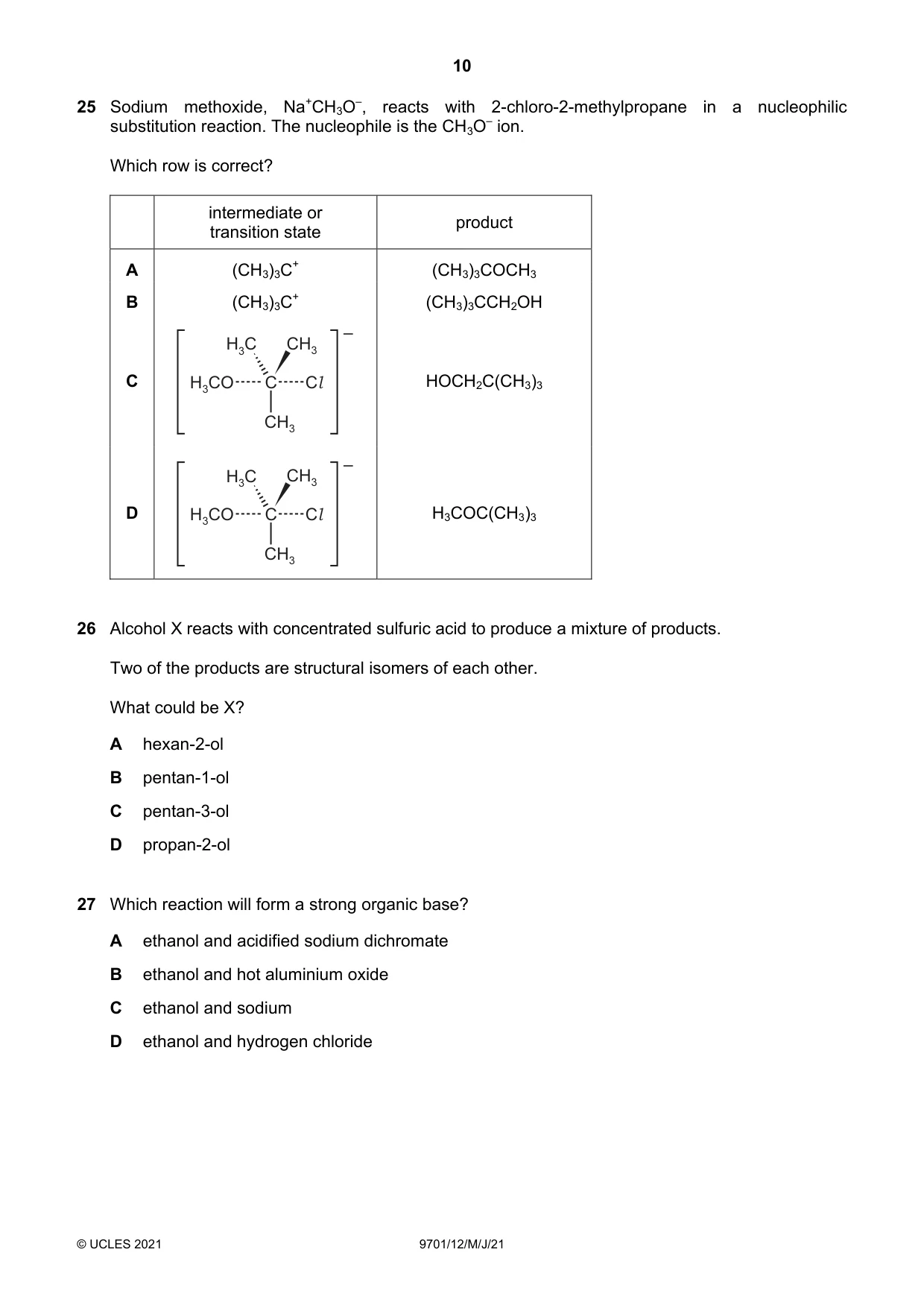
Q25 · Sodium methoxide, Na+CH3O–, reacts with 2-chloro-2-methylpropane in a nucleophilic…
25 Sodium methoxide, Na+CH3O–, reacts with 2-chloro-2-methylpropane in a nucleophilic substitution reaction. The nucleophile is the CH3O– ion. Which row is correct? intermediate or product transition state A (CH3)3C+ (CH3)3COCH3 B (CH3)3C+ (CH3)3CCH2OH – H3C CH3 C H3CO C Cl HOCH2C(CH3)3 CH3 – H3C CH3 D H3CO C Cl H3COC(CH3)3 CH3
Mark scheme: A
Q26 · Alcohol X reacts with concentrated sulfuric acid to produce a mixture of products
26 Alcohol X reacts with concentrated sulfuric acid to produce a mixture of products. Two of the products are structural isomers of each other. What could be X? A hexan-2-ol B pentan-1-ol C pentan-3-ol D propan-2-ol
Mark scheme: A
Q27 · Which reaction will form a strong organic base?
27 Which reaction will form a strong organic base? A ethanol and acidified sodium dichromate B ethanol and hot aluminium oxide C ethanol and sodium D ethanol and hydrogen chloride
Mark scheme: C
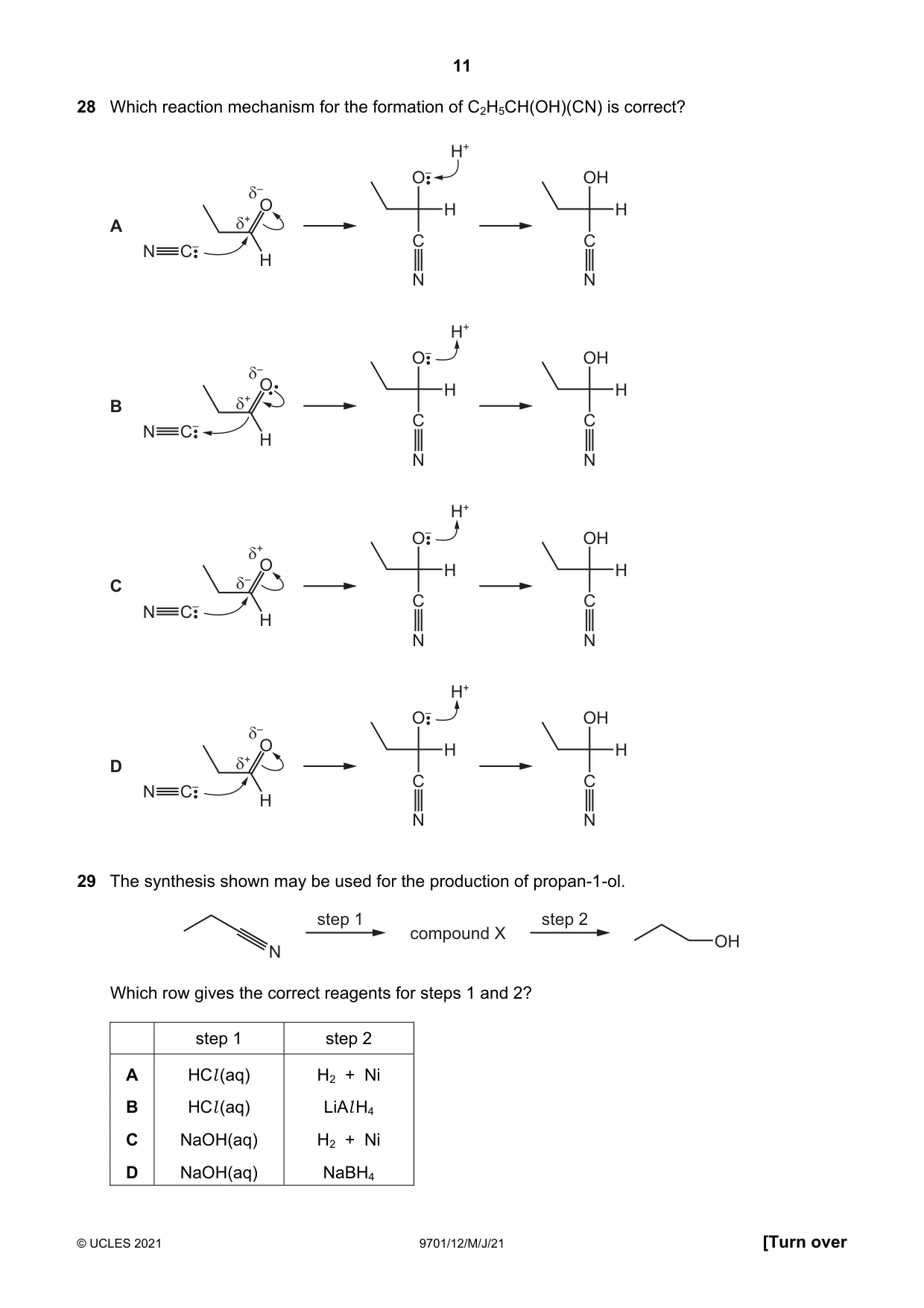
Q28 · Which reaction mechanism for the formation of CzH;CH(OH)(CN) is correct?
28 Which reaction mechanism for the formation of CzH;CH(OH)(CN) is correct? H* > or OH A oy Ss) ———$> 4 ———“—— H — Cs C NSC H | | H* 7 o:J OH \ ; a + B wy > —> 4 —_—_> —c; / C N=C H | | N H* 54 o: OH O + + Cc Sf —+» —_> =c:__” C NSC H | | N H*
Mark scheme: D
Q29 · The synthesis shown may be used for the production of propan-1-ol
29 The synthesis shown may be used for the production of propan-1-ol. step 1 step 2 compound X OH N Which row gives the correct reagents for steps 1 and 2? step 1 step 2 A HCl (aq) H2 + Ni B HCl (aq) LiAl H4 C NaOH(aq) H2 + Ni D NaOH(aq) NaBH4
Mark scheme: B
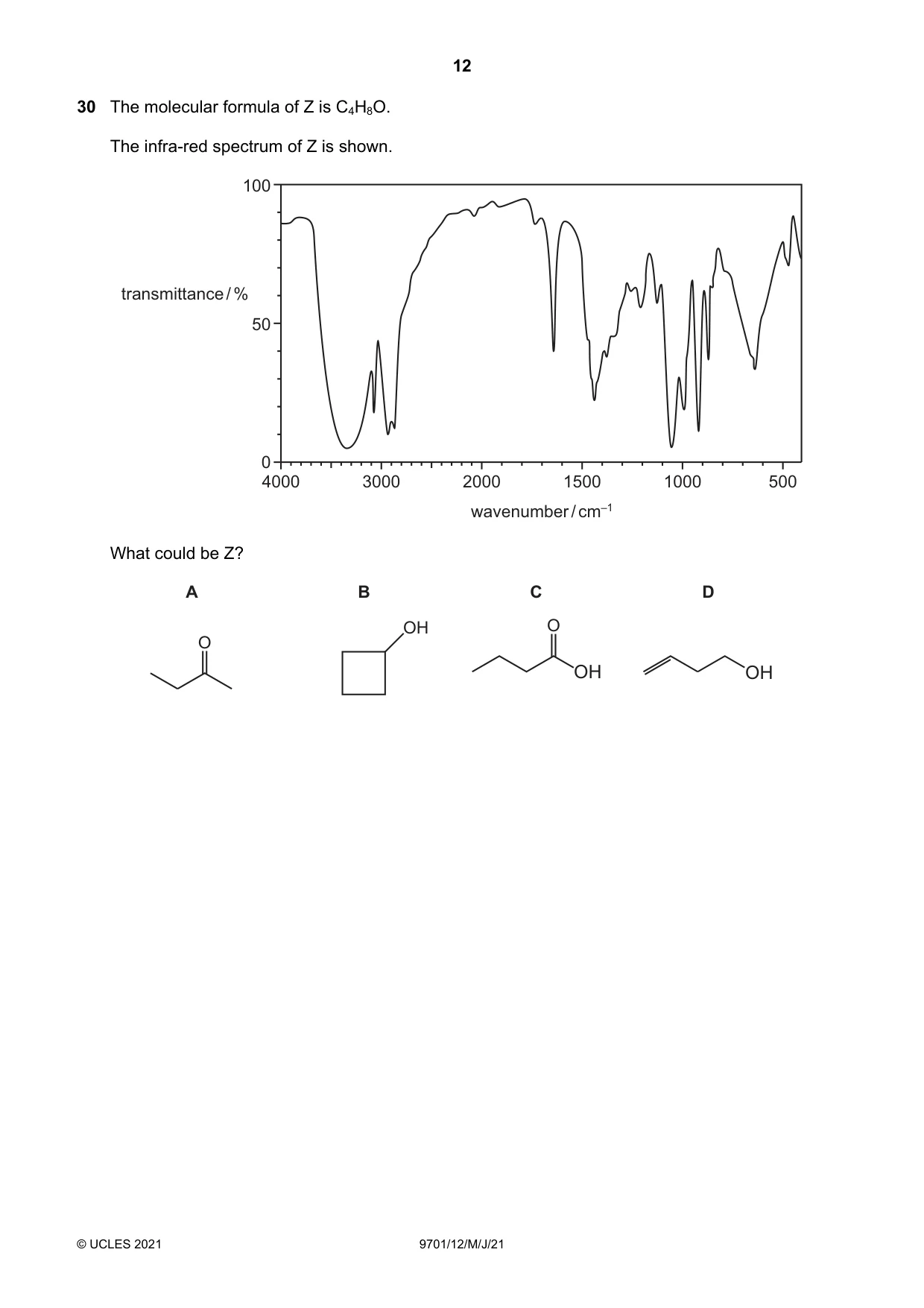
Q30 · The molecular formula of Z is C4H8O
30 The molecular formula of Z is C4H8O. The infra-red spectrum of Z is shown. 100 transmittance / % 50 0 4000 3000 2000 1500 1000 500 wavenumber / cm–1 What could be Z? A B C D OH O O OH OH
Mark scheme: D
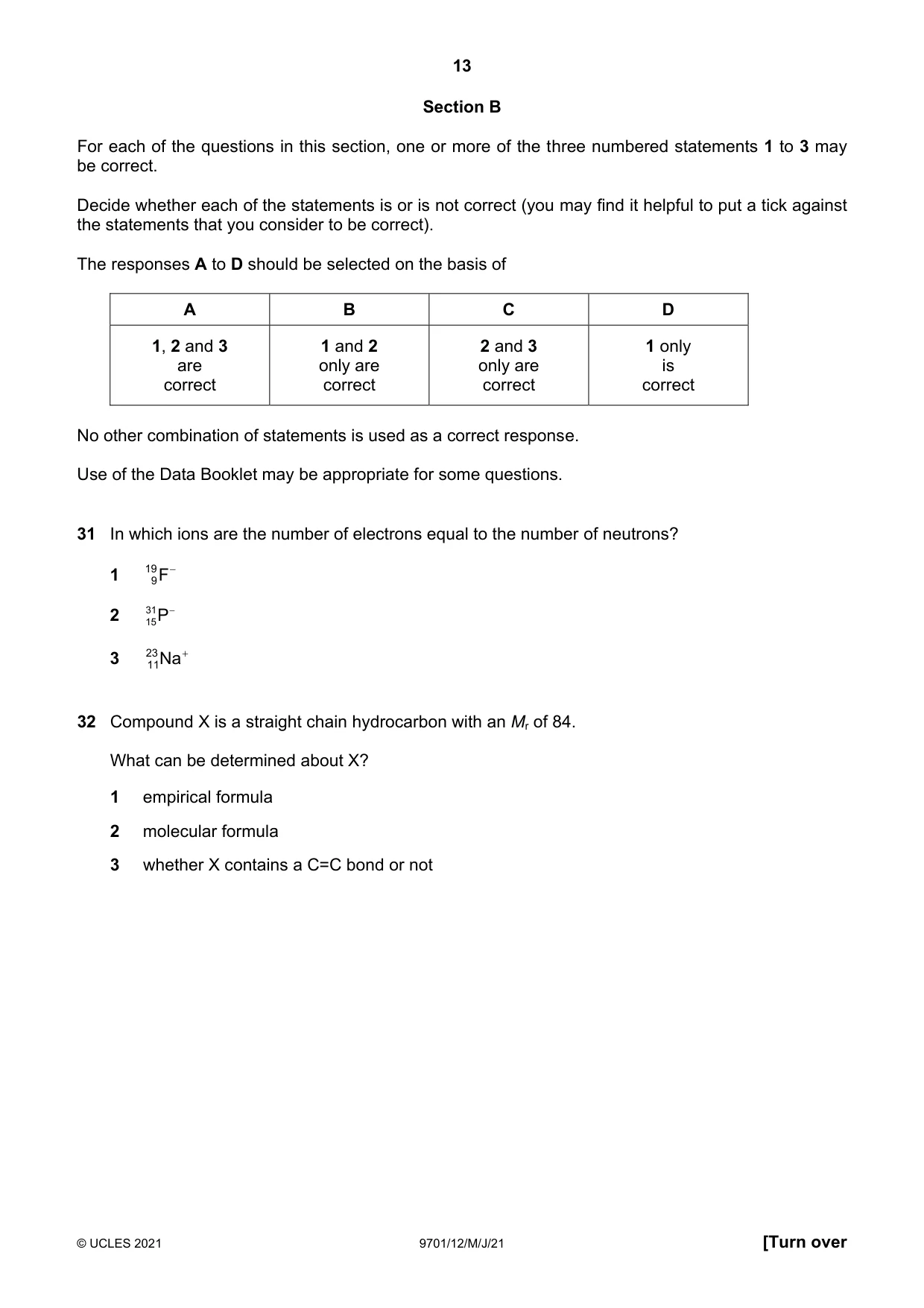
Q31 · In which ions are the number of electrons equal to the number of neutrons?
31 In which ions are the number of electrons equal to the number of neutrons? 1 19 F 9 2 15P 31 3 23 Na 11
Mark scheme: B
Q32 · Compound X is a straight chain hydrocarbon with an Mr of 84
32 Compound X is a straight chain hydrocarbon with an Mr of 84. What can be determined about X? 1 empirical formula 2 molecular formula 3 whether X contains a C=C bond or not
Mark scheme: A
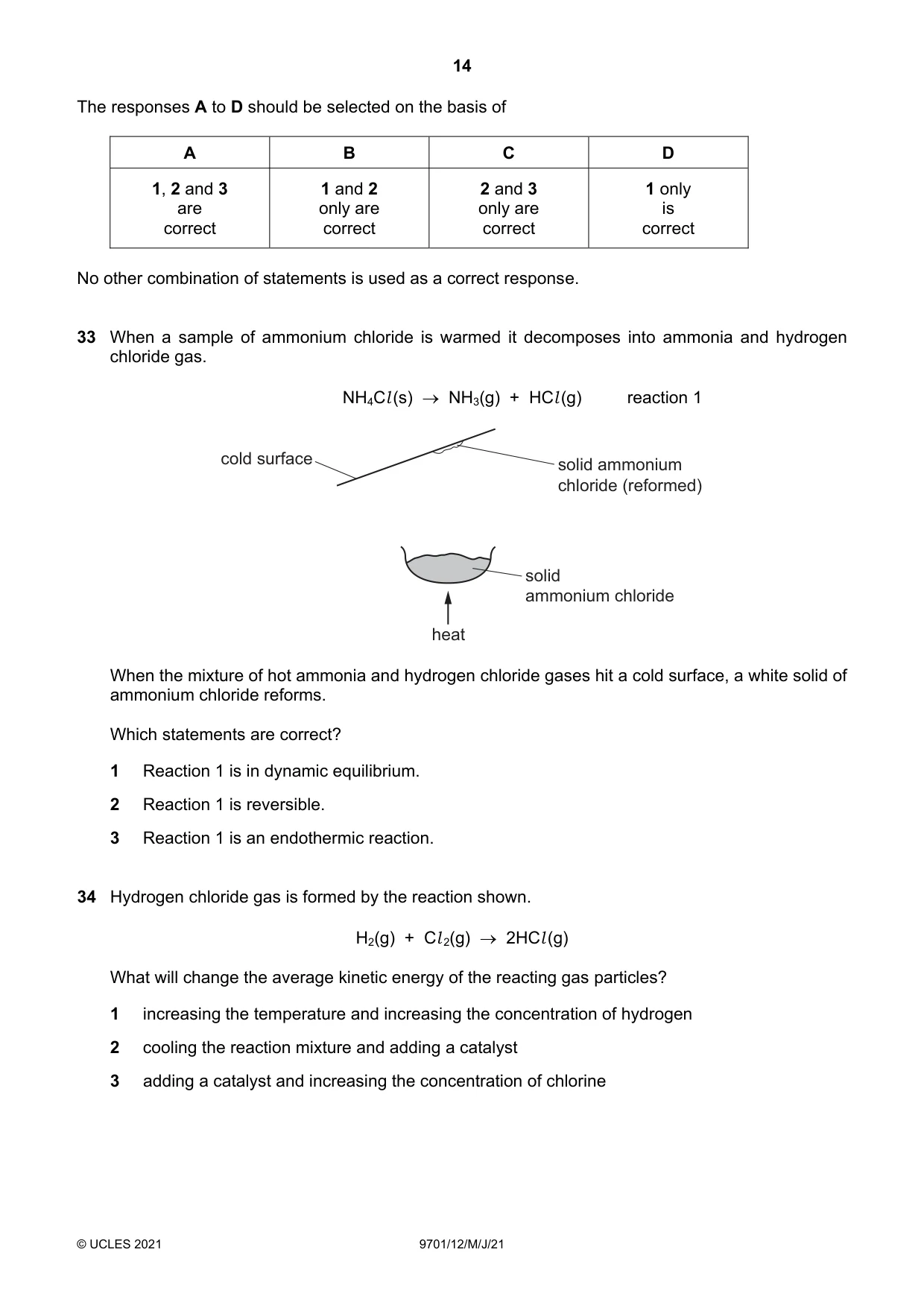
Q33 · When a sample of ammonium chloride is warmed it decomposes into ammonia and hydrogen…
33 When a sample of ammonium chloride is warmed it decomposes into ammonia and hydrogen chloride gas. NH4Cl (s) NH3(g) + HCl (g) reaction 1 cold surface solid ammonium chloride (reformed) solid ammonium chloride heat When the mixture of hot ammonia and hydrogen chloride gases hit a cold surface, a white solid of ammonium chloride reforms. Which statements are correct? 1 Reaction 1 is in dynamic equilibrium. 2 Reaction 1 is reversible. 3 Reaction 1 is an endothermic reaction.
Mark scheme: C
More questions on Chemical equilibria: reversible reactions, dynamic equilibrium
Q34 · Hydrogen chloride gas is formed by the reaction shown
34 Hydrogen chloride gas is formed by the reaction shown. H2(g) + Cl 2(g) 2HCl (g) What will change the average kinetic energy of the reacting gas particles? 1 increasing the temperature and increasing the concentration of hydrogen 2 cooling the reaction mixture and adding a catalyst 3 adding a catalyst and increasing the concentration of chlorine
Mark scheme: B
More questions on Effect of temperature on reaction rates and the concept of activation energy
Q35 · Which oxides will cause a change in pH when added to water?
35 Which oxides will cause a change in pH when added to water? 1 CaO 2 Al 2O3 3 SiO2
Mark scheme: D
More questions on Periodicity of chemical properties of the elements in Period 3
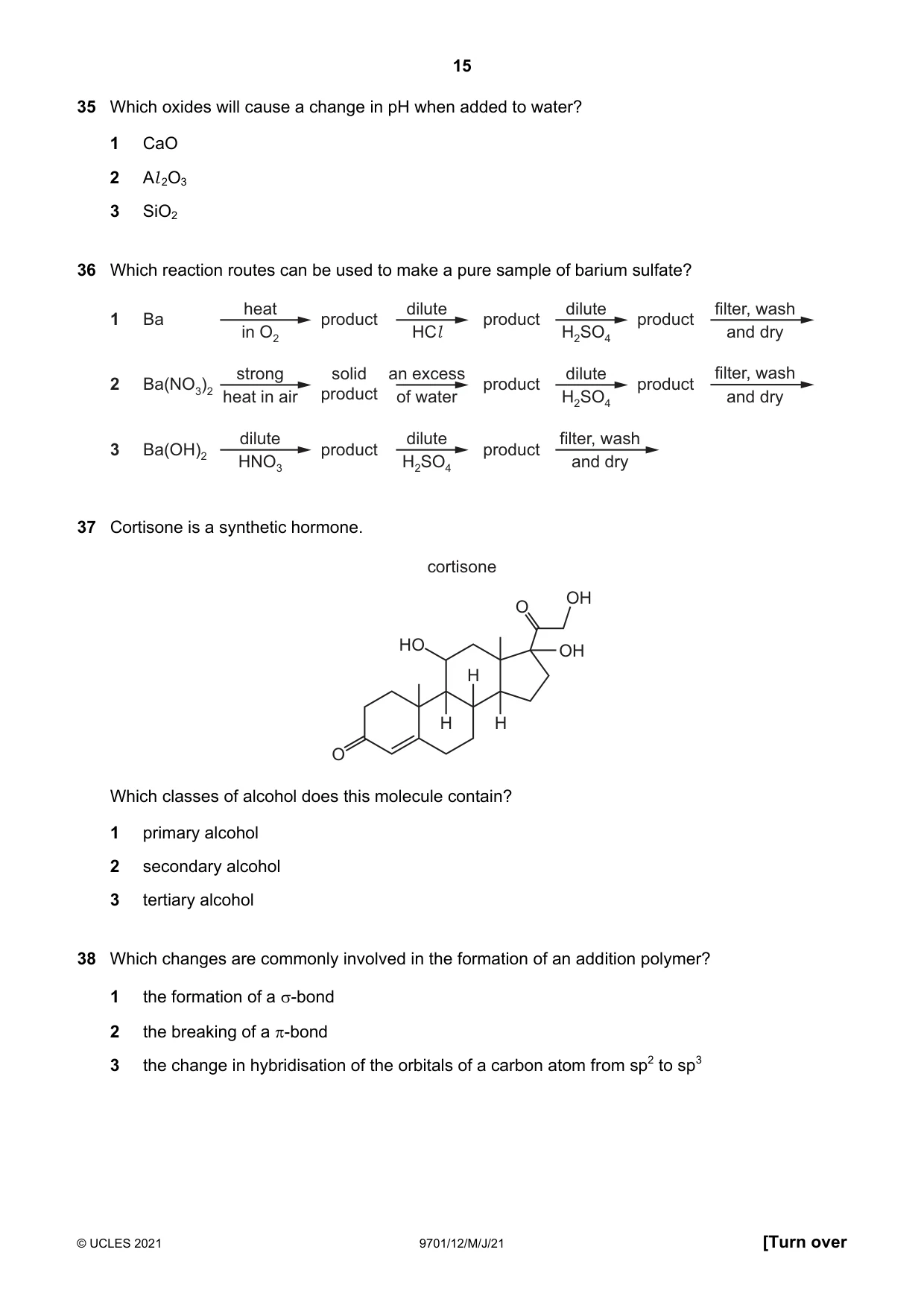
Q36 · Which reaction routes can be used to make a pure sample of barium sulfate?
36 Which reaction routes can be used to make a pure sample of barium sulfate? heat dilute dilute filter, wash 1 Ba product product product in O2 HCl H2SO4 and dry strong solid an excess dilute filter, wash 2 Ba(NO3)2 product product heat in air product of water H2SO4 and dry dilute dilute filter, wash 3 Ba(OH)2 product product HNO3 H2SO4 and dry
Mark scheme: A
Q37 · Cortisone is a synthetic hormone
37 Cortisone is a synthetic hormone. cortisone OH O HO OH H H H O Which classes of alcohol does this molecule contain? 1 primary alcohol 2 secondary alcohol 3 tertiary alcohol
Mark scheme: A
Q38 · Which changes are commonly involved in the formation of an addition polymer?
38 Which changes are commonly involved in the formation of an addition polymer? 1 the formation of a -bond 2 the breaking of a -bond 3 the change in hybridisation of the orbitals of a carbon atom from sp2 to sp3
Mark scheme: A
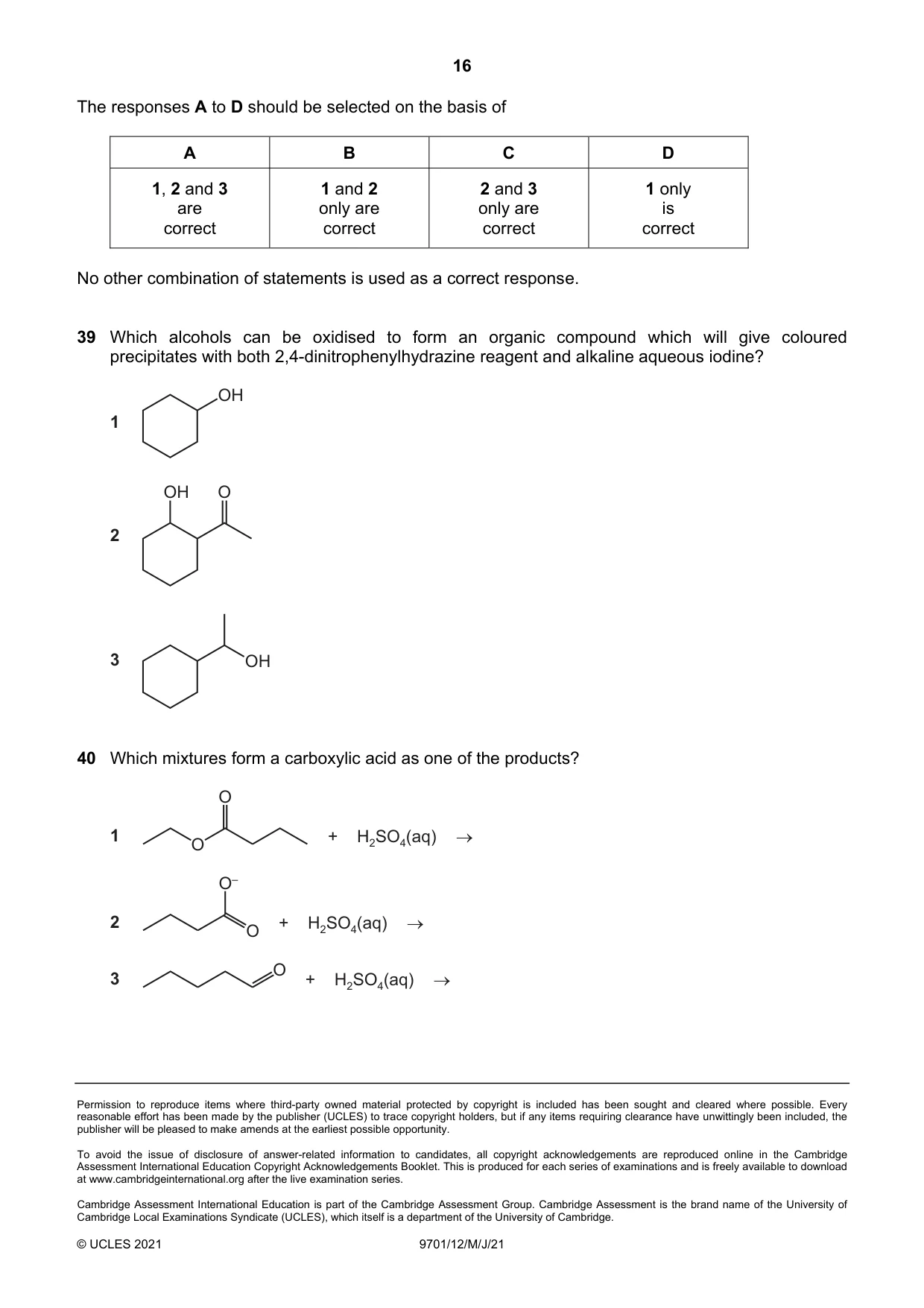
Q39 · Which alcohols can be oxidised to form an organic compound which will give coloured…
39 Which alcohols can be oxidised to form an organic compound which will give coloured precipitates with both 2,4-dinitrophenylhydrazine reagent and alkaline aqueous iodine? OH 1 OH O 2 3 OH
Mark scheme: C
Q40 · Which mixtures form a carboxylic acid as one of the products?
40 Which mixtures form a carboxylic acid as one of the products? O 1 AK + H,SO,(aq) > O- 2 AK, + H,SO,(aq) > 3 NRA + H80,(aq) >
Mark scheme: B
What was in this paper
The subtopics covered by these 40 questions, and how many questions each got. Open one in a new tab to see every Cambridge question on it.
3Chemical equilibria: reversible reactions, dynamic equilibrium2Effect of temperature on reaction rates and the concept of activation energy2Halogenoalkanes2Nitrogen and sulfur2Periodicity of chemical properties of the elements in Period 32Similarities and trends in the properties of the Group 2 metals, magnesium to barium, and their compounds2Acids and bases1Addition polymerisation1Aldehydes and ketones1Alkanes1Bonding and structure1Carboxylic acids1Characteristic organic reactions1Enthalpy change, ΔH1Esters1Formulas1Infrared spectroscopy1Intermolecular forces, electronegativity and bond properties1Ionisation energy1Isomerism: optical1Nitriles and hydroxynitriles1Organic synthesis1Particles in the atom and atomic radius1Periodicity of physical properties of the elements in Period 31Redox processes: electron transfer and changes in oxidation number (oxidation state)1Shapes of molecules1Simple rate equations, orders of reaction and rate constants1Some reactions of the halide ions1The gaseous state: ideal and real gases and pV = nRT1The mole and the Avogadro constant1The reactions of chlorine1What you needed in this session
Cambridge’s own grade thresholds for 2021 May/June, Paper 1 · Variant 2. A higher threshold means an easier paper — the bar moves with how the cohort did.