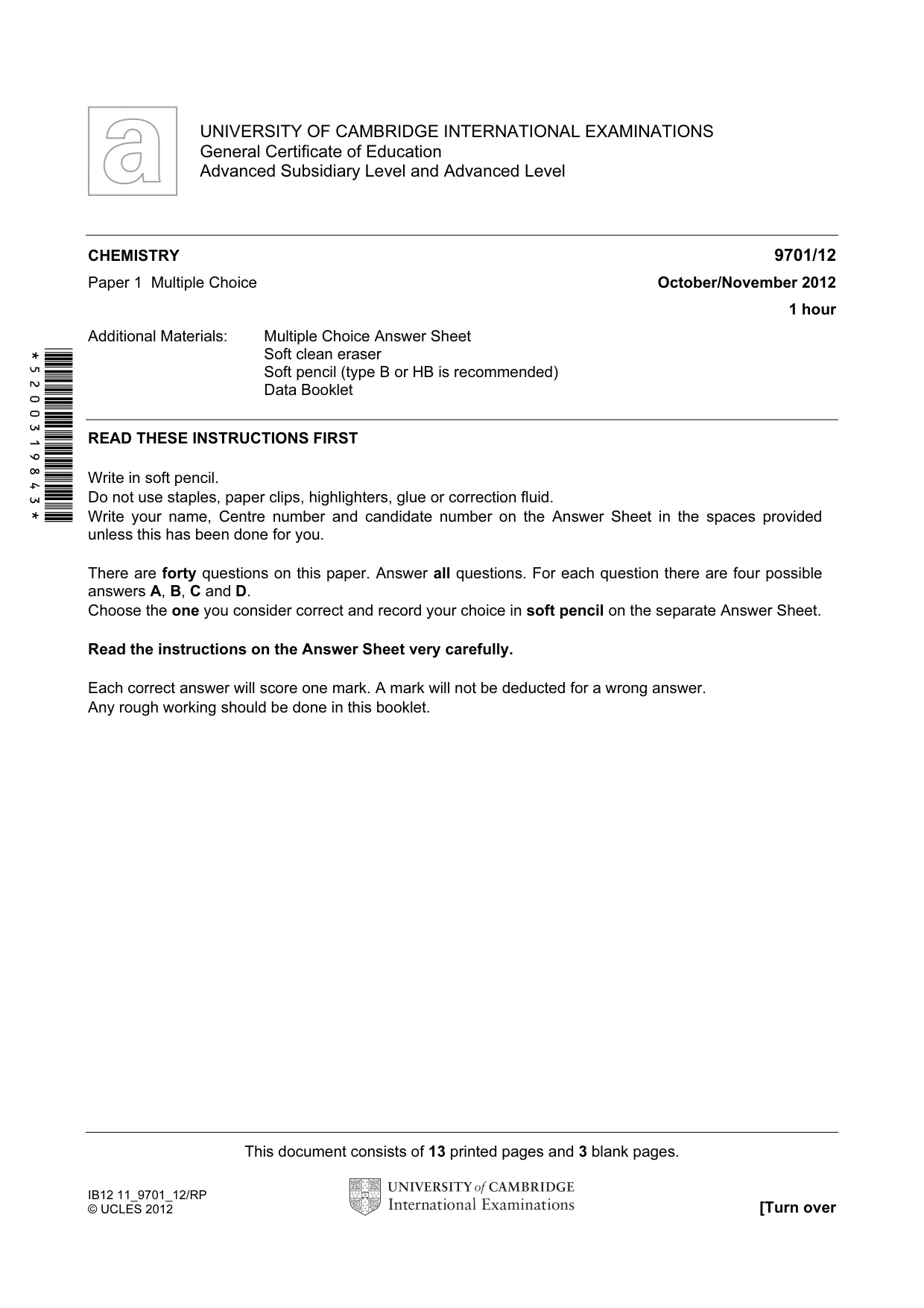
Cambridge A Level Chemistry 9701 — 2012 Oct/Nov Paper 1 · Variant 2
9701/12/O/N/12 · 40 questions · 40 marks · ≈45 min
The question paper and its mark scheme, free to read here and free to download. This is Cambridge’s own paper, exactly as it was sat.
Question paper16 pages



Mark scheme2 pages
Answers below. Sit the paper first if you are practising.
Questions as text
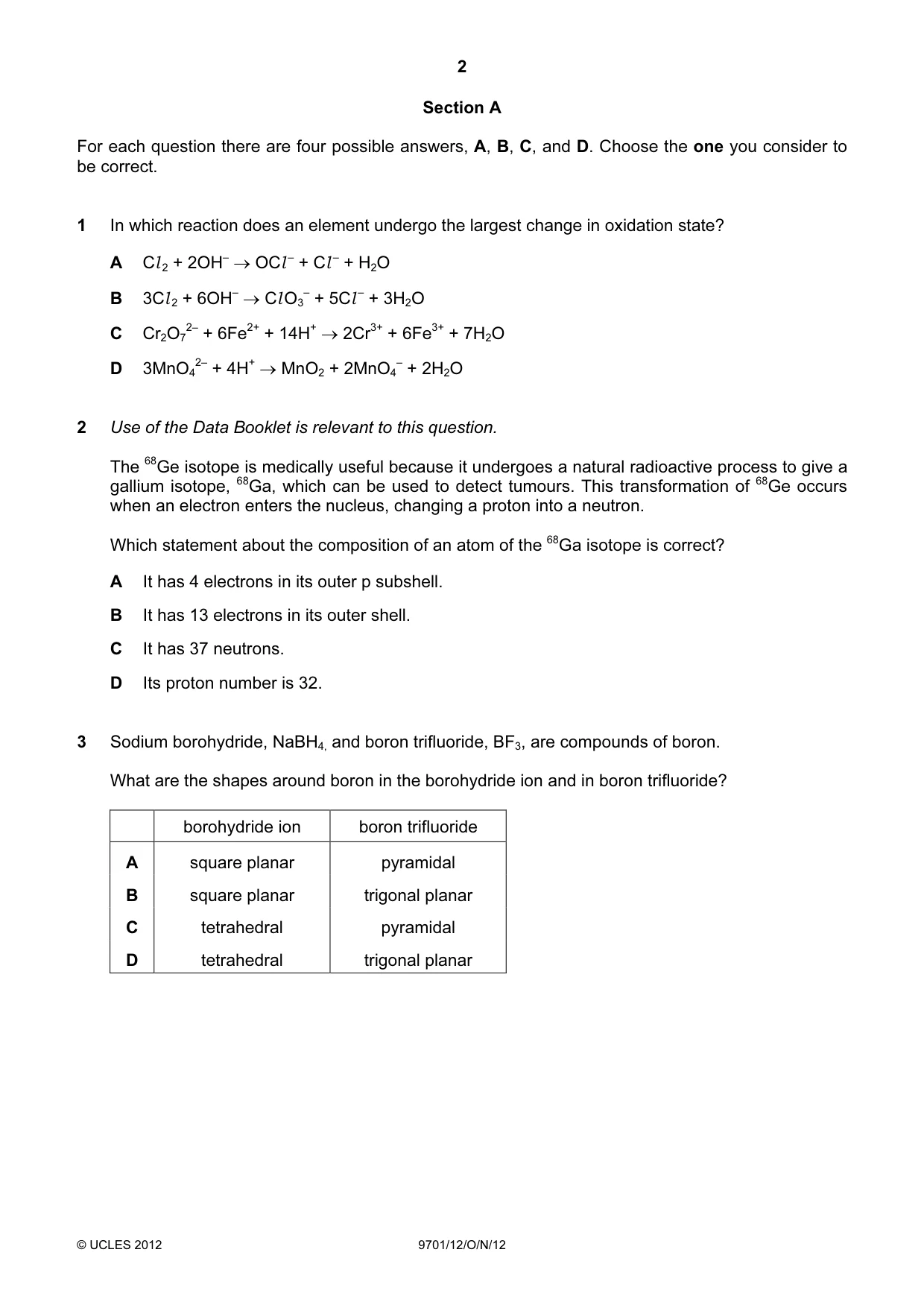
Q1 · In which reaction does an element undergo the largest change in oxidation state?
1 In which reaction does an element undergo the largest change in oxidation state? A Cl 2 + 2OH– → OCl – + Cl – + H2O B 3Cl 2 + 6OH– → Cl O3 – + 5Cl – + 3H2O C Cr2O7 2– + 6Fe2+ + 14H+ → 2Cr3+ + 6Fe3+ + 7H2O D 3MnO4 2– + 4H+ → MnO2 + 2MnO4 – + 2H2O
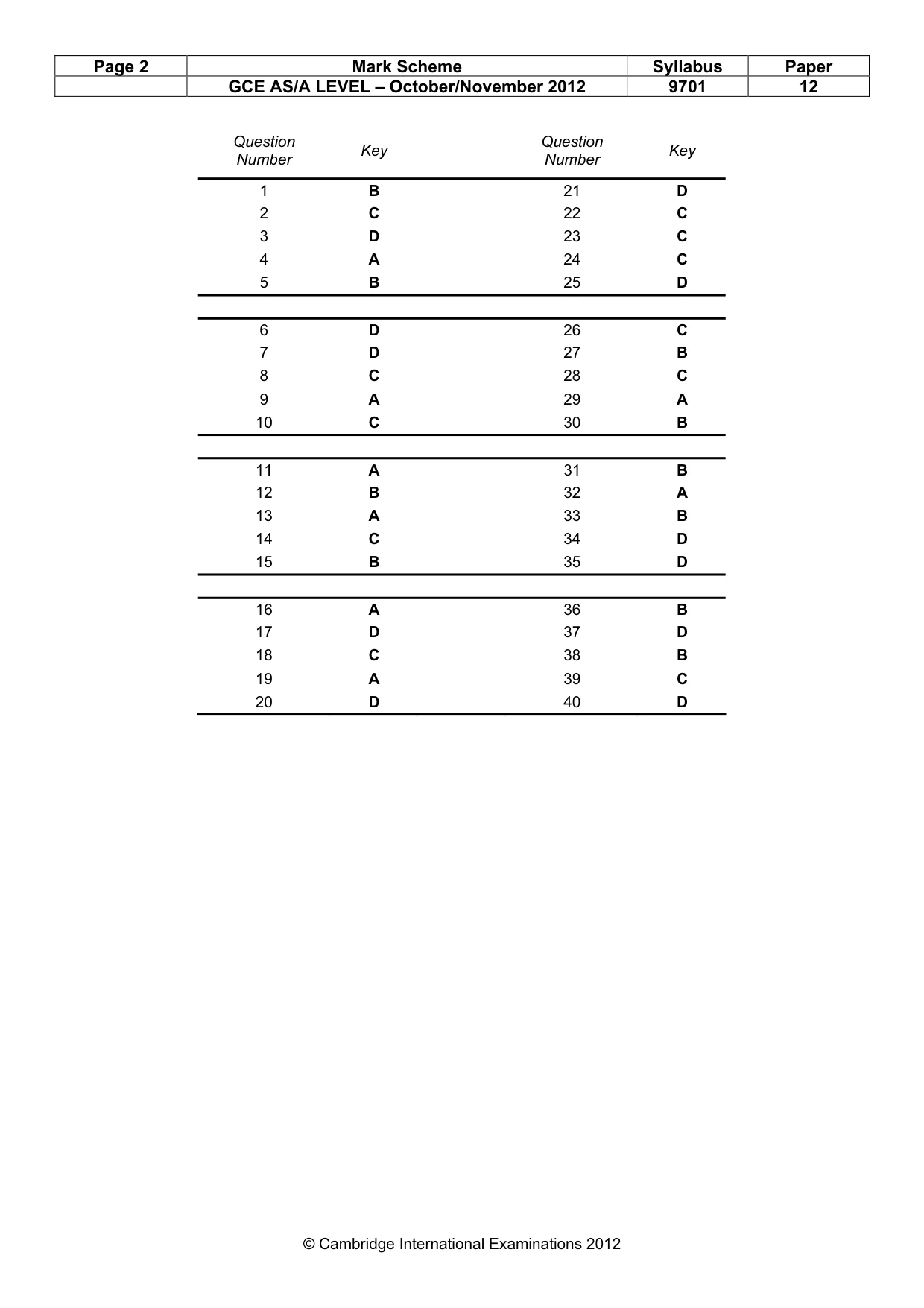
Mark scheme: B
Q2 · Use of the Data Booklet is relevant to this question
2 Use of the Data Booklet is relevant to this question. The 68Ge isotope is medically useful because it undergoes a natural radioactive process to give a gallium isotope, 68Ga, which can be used to detect tumours. This transformation of 68Ge occurs when an electron enters the nucleus, changing a proton into a neutron. Which statement about the composition of an atom of the 68Ga isotope is correct? A It has 4 electrons in its outer p subshell. B It has 13 electrons in its outer shell. C It has 37 neutrons. D Its proton number is 32.
Mark scheme: C
Q3 · Sodium borohydride, NaBH4, and boron trifluoride, BF3, are compounds of boron
3 Sodium borohydride, NaBH4, and boron trifluoride, BF3, are compounds of boron. What are the shapes around boron in the borohydride ion and in boron trifluoride? borohydride ion boron trifluoride A square planar pyramidal B square planar trigonal planar C tetrahedral pyramidal D tetrahedral trigonal planar
Mark scheme: D
Q4 · Use of the Data Booklet is relevant to this question
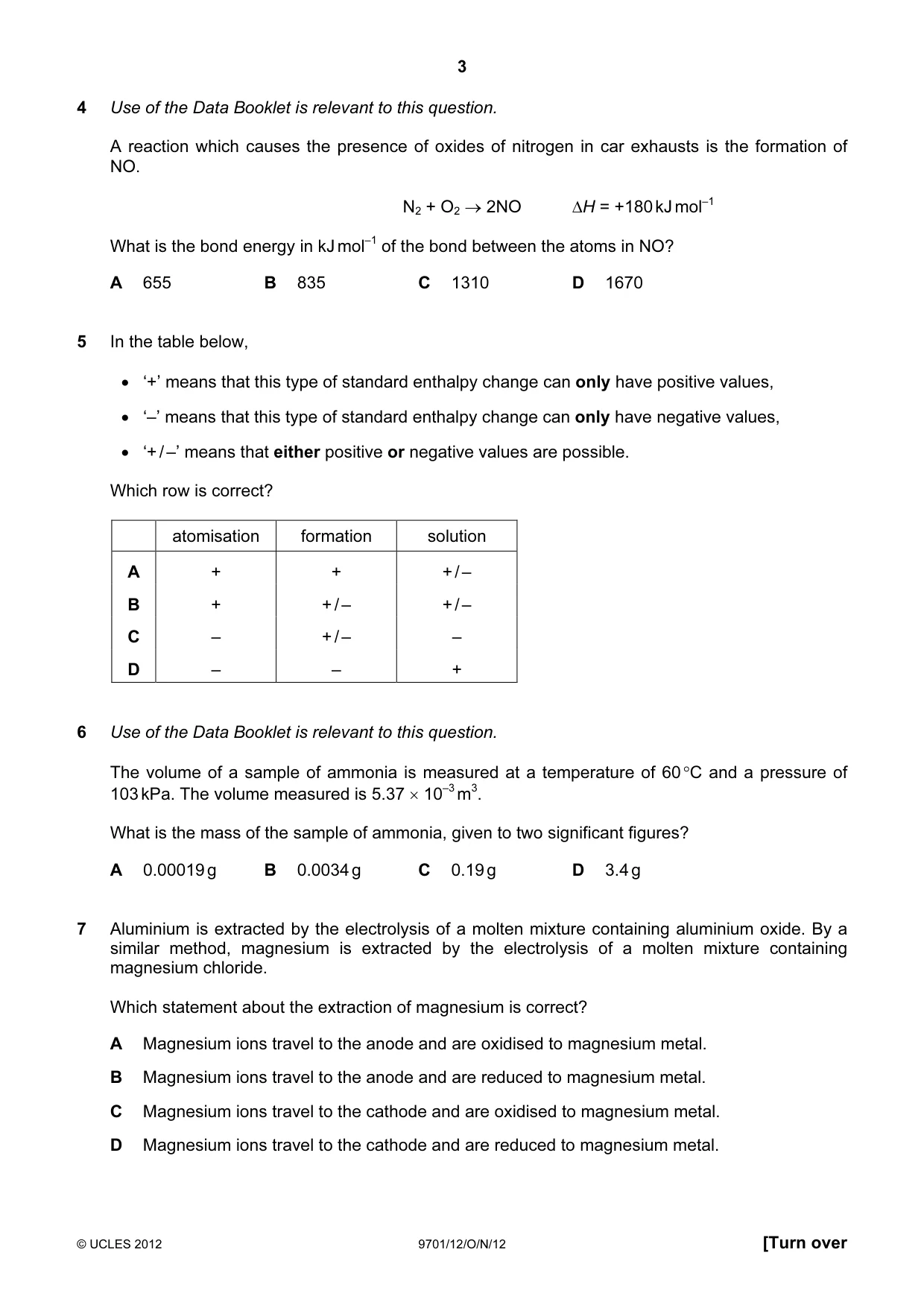
4 Use of the Data Booklet is relevant to this question. A reaction which causes the presence of oxides of nitrogen in car exhausts is the formation of NO. N2 + O2 → 2NO ∆H = +180 kJ mol–1 What is the bond energy in kJ mol–1 of the bond between the atoms in NO? A 655 B 835 C 1310 D 1670
Mark scheme: A
Q5 · In the table below, • ‘+’ means that this type of standard enthalpy change can only have…
5 In the table below, • ‘+’ means that this type of standard enthalpy change can only have positive values, • ‘–’ means that this type of standard enthalpy change can only have negative values, • ‘+ / –’ means that either positive or negative values are possible. Which row is correct? atomisation formation solution A + + + / – B + + / – + / – C – + / – – D – – +
Mark scheme: B
Q6 · Use of the Data Booklet is relevant to this question
6 Use of the Data Booklet is relevant to this question. The volume of a sample of ammonia is measured at a temperature of 60 °C and a pressure of 103 kPa. The volume measured is 5.37 × 10⁻³ m3. What is the mass of the sample of ammonia, given to two significant figures? A 0.00019 g B 0.0034 g C 0.19 g D 3.4 g
Mark scheme: D
More questions on The gaseous state: ideal and real gases and pV = nRT
Q7 · Aluminium is extracted by the electrolysis of a molten mixture containing aluminium oxide
7 Aluminium is extracted by the electrolysis of a molten mixture containing aluminium oxide. By a similar method, magnesium is extracted by the electrolysis of a molten mixture containing magnesium chloride. Which statement about the extraction of magnesium is correct? A Magnesium ions travel to the anode and are oxidised to magnesium metal. B Magnesium ions travel to the anode and are reduced to magnesium metal. C Magnesium ions travel to the cathode and are oxidised to magnesium metal. D Magnesium ions travel to the cathode and are reduced to magnesium metal.
Mark scheme: D
Q8 · Some car paints contain small flakes of silica, SiO2
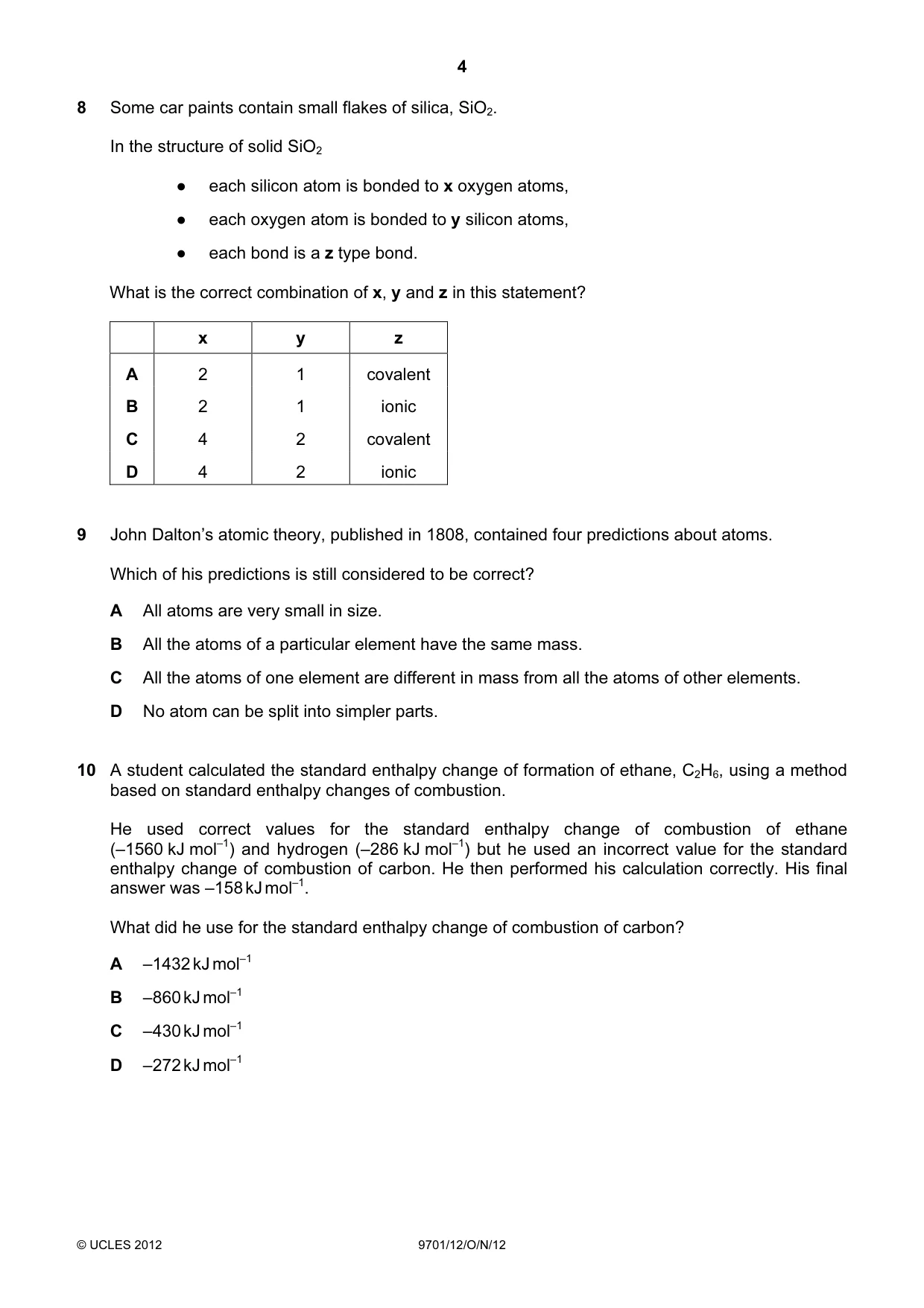
8 Some car paints contain small flakes of silica, SiO2. In the structure of solid SiO2 ● each silicon atom is bonded to x oxygen atoms, ● each oxygen atom is bonded to y silicon atoms, ● each bond is a z type bond. What is the correct combination of x, y and z in this statement? x y z A 2 1 covalent B 2 1 ionic C 4 2 covalent D 4 2 ionic
Mark scheme: C
Q9 · John Dalton’s atomic theory, published in 1808, contained four predictions about atoms
9 John Dalton’s atomic theory, published in 1808, contained four predictions about atoms. Which of his predictions is still considered to be correct? A All atoms are very small in size. B All the atoms of a particular element have the same mass. C All the atoms of one element are different in mass from all the atoms of other elements. D No atom can be split into simpler parts.
Mark scheme: A
Q10 · A student calculated the standard enthalpy change of formation of ethane, C2H6, using a…
10 A student calculated the standard enthalpy change of formation of ethane, C2H6, using a method based on standard enthalpy changes of combustion. He used correct values for the standard enthalpy change of combustion of ethane (–1560 kJ mol–1) and hydrogen (–286 kJ mol–1) but he used an incorrect value for the standard enthalpy change of combustion of carbon. He then performed his calculation correctly. His final answer was –158 kJ mol–1. What did he use for the standard enthalpy change of combustion of carbon? A –1432 kJ mol–1 B –860 kJ mol–1 C –430 kJ mol–1 D –272 kJ mol–1
Mark scheme: C
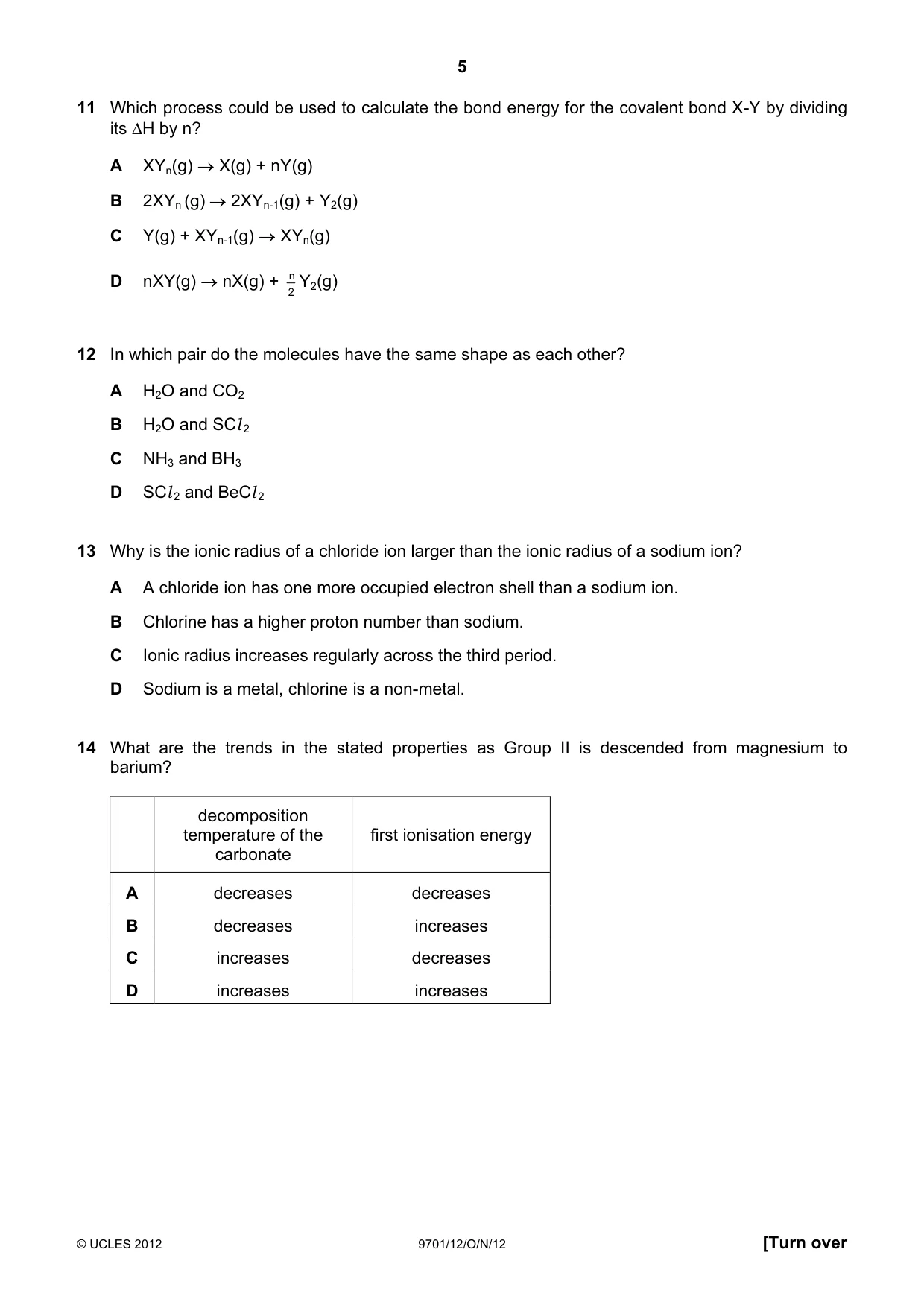
Q11 · Which process could be used to calculate the bond energy for the covalent bond X-Y by…
11 Which process could be used to calculate the bond energy for the covalent bond X-Y by dividing its ∆H by n? A XYn(g) → X(g) + nY(g) B 2XYn (g) → 2XYn-1(g) + Y2(g) C Y(g) + XYn-1(g) → XYn(g) D nXY(g) → nX(g) + n Y2(g) 2
Mark scheme: A
Q12 · In which pair do the molecules have the same shape as each other?
12 In which pair do the molecules have the same shape as each other? A H2O and CO2 B H2O and SCl 2 C NH3 and BH3 D SCl 2 and BeCl 2
Mark scheme: B
Q13 · Why is the ionic radius of a chloride ion larger than the ionic radius of a sodium ion?
13 Why is the ionic radius of a chloride ion larger than the ionic radius of a sodium ion? A A chloride ion has one more occupied electron shell than a sodium ion. B Chlorine has a higher proton number than sodium. C Ionic radius increases regularly across the third period. D Sodium is a metal, chlorine is a non-metal.
Mark scheme: A
Q14 · What are the trends in the stated properties as Group II is descended from magnesium to…
14 What are the trends in the stated properties as Group II is descended from magnesium to barium? decomposition temperature of the first ionisation energy carbonate A decreases decreases B decreases increases C increases decreases D increases increases
Mark scheme: C
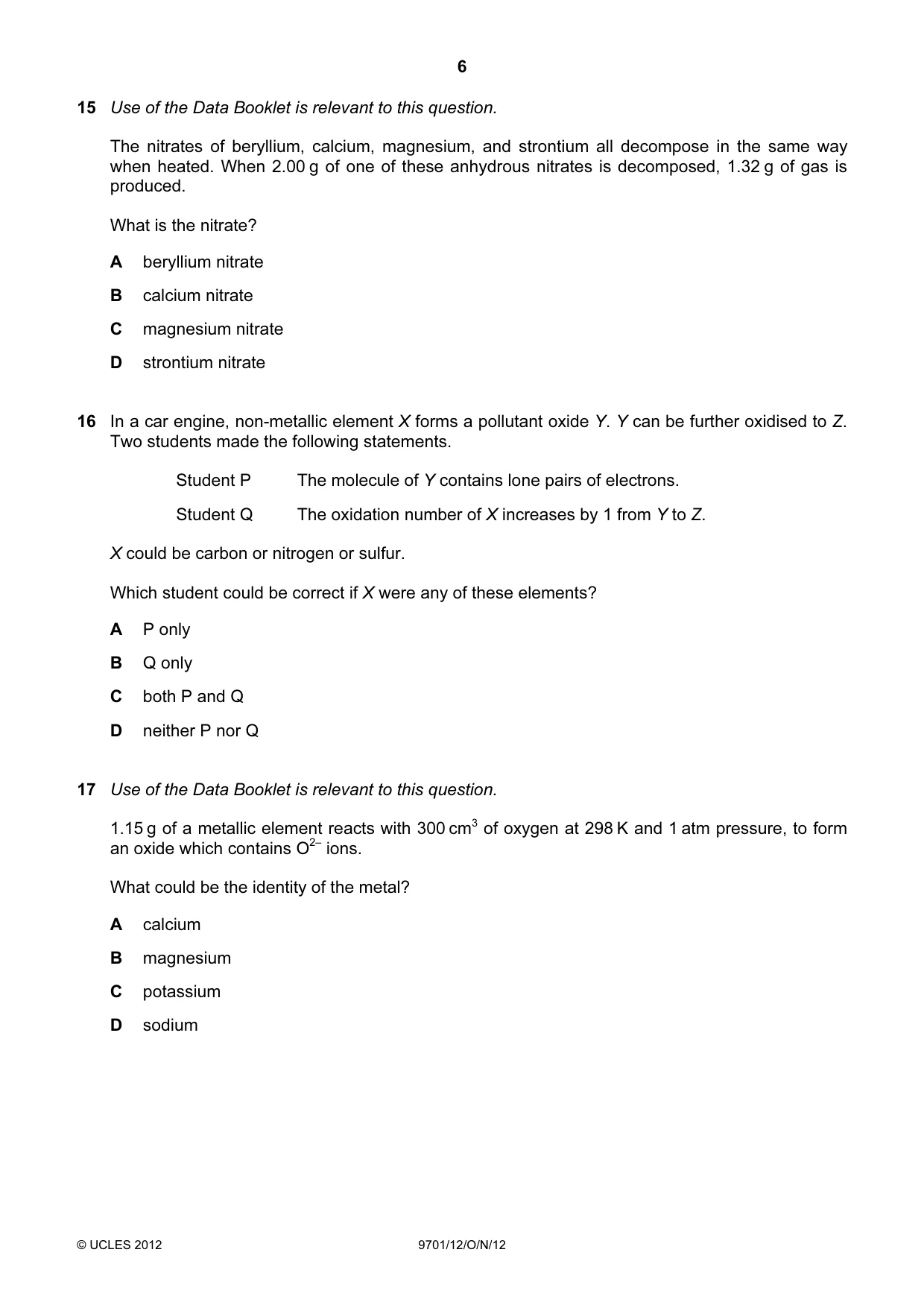
Q15 · Use of the Data Booklet is relevant to this question
15 Use of the Data Booklet is relevant to this question. The nitrates of beryllium, calcium, magnesium, and strontium all decompose in the same way when heated. When 2.00 g of one of these anhydrous nitrates is decomposed, 1.32 g of gas is produced. What is the nitrate? A beryllium nitrate B calcium nitrate C magnesium nitrate D strontium nitrate
Mark scheme: B
Q16 · In a car engine, non-metallic element X forms a pollutant oxide Y
16 In a car engine, non-metallic element X forms a pollutant oxide Y. Y can be further oxidised to Z. Two students made the following statements. Student P The molecule of Y contains lone pairs of electrons. Student Q The oxidation number of X increases by 1 from Y to Z. X could be carbon or nitrogen or sulfur. Which student could be correct if X were any of these elements? A P only B Q only C both P and Q D neither P nor Q
Mark scheme: A
Q17 · Use of the Data Booklet is relevant to this question
17 Use of the Data Booklet is relevant to this question. 1.15 g of a metallic element reacts with 300 cm3 of oxygen at 298 K and 1 atm pressure, to form an oxide which contains O2– ions. What could be the identity of the metal? A calcium B magnesium C potassium D sodium
Mark scheme: D
More questions on Reacting masses and volumes (of solutions and gases)
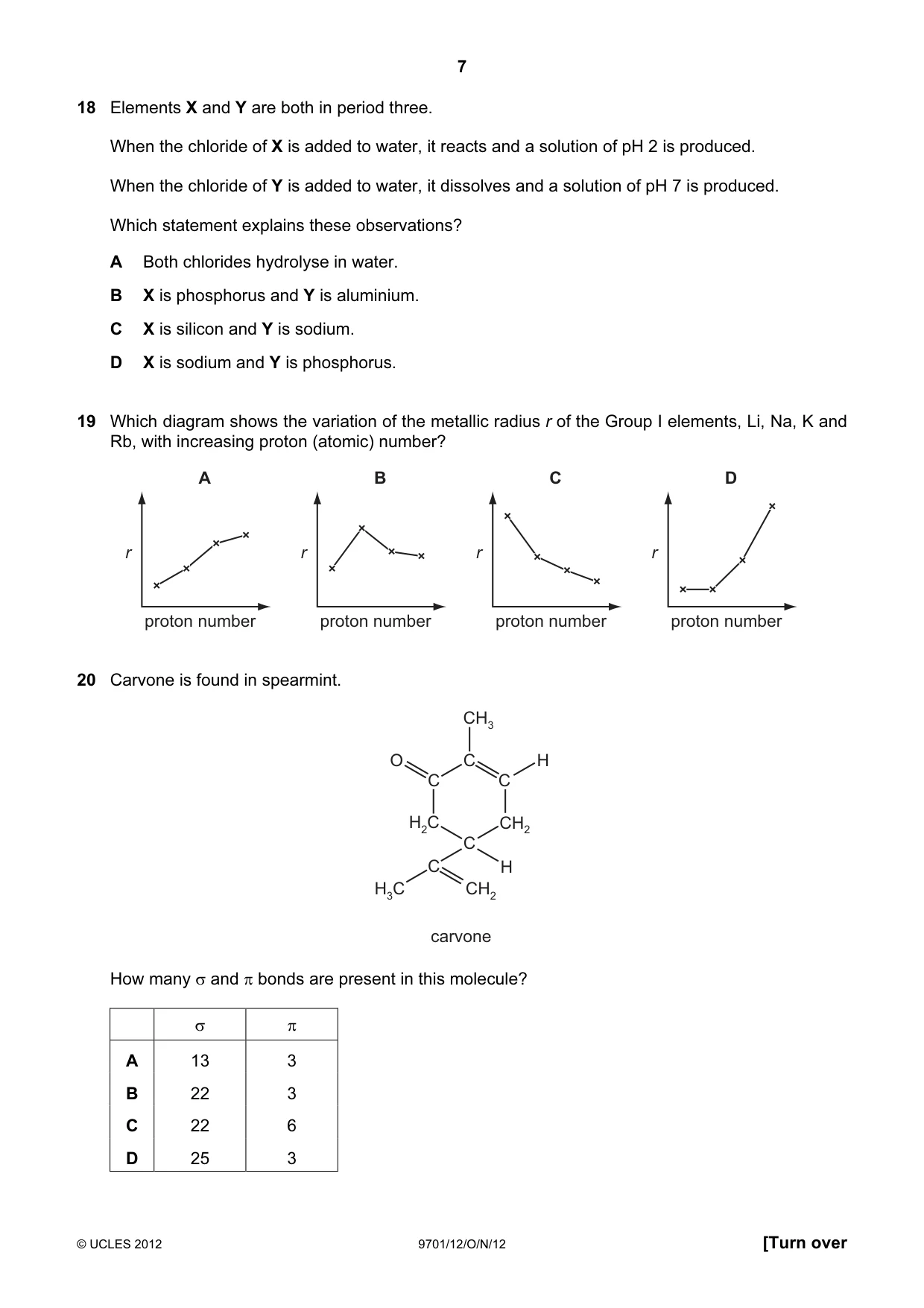
Q18 · Elements X and Y are both in period three
18 Elements X and Y are both in period three. When the chloride of X is added to water, it reacts and a solution of pH 2 is produced. When the chloride of Y is added to water, it dissolves and a solution of pH 7 is produced. Which statement explains these observations? A Both chlorides hydrolyse in water. B X is phosphorus and Y is aluminium. C X is silicon and Y is sodium. D X is sodium and Y is phosphorus.
Mark scheme: C
More questions on Periodicity of chemical properties of the elements in Period 3
Q19 · Which diagram shows the variation of the metallic radius r of the Group I elements, Li…
19 Which diagram shows the variation of the metallic radius r of the Group I elements, Li, Na, K and Rb, with increasing proton (atomic) number? A B C D r r r r proton number proton number proton number proton number
Mark scheme: A
Q20 · Carvone is found in spearmint
20 Carvone is found in spearmint. CH3 O C H C C H2C CH2 C C H H3C CH2 carvone How many σ and π bonds are present in this molecule? σ π A 13 3 B 22 3 C 22 6 D 25 3
Mark scheme: D
More questions on Shapes of organic molecules; σ and π bonds
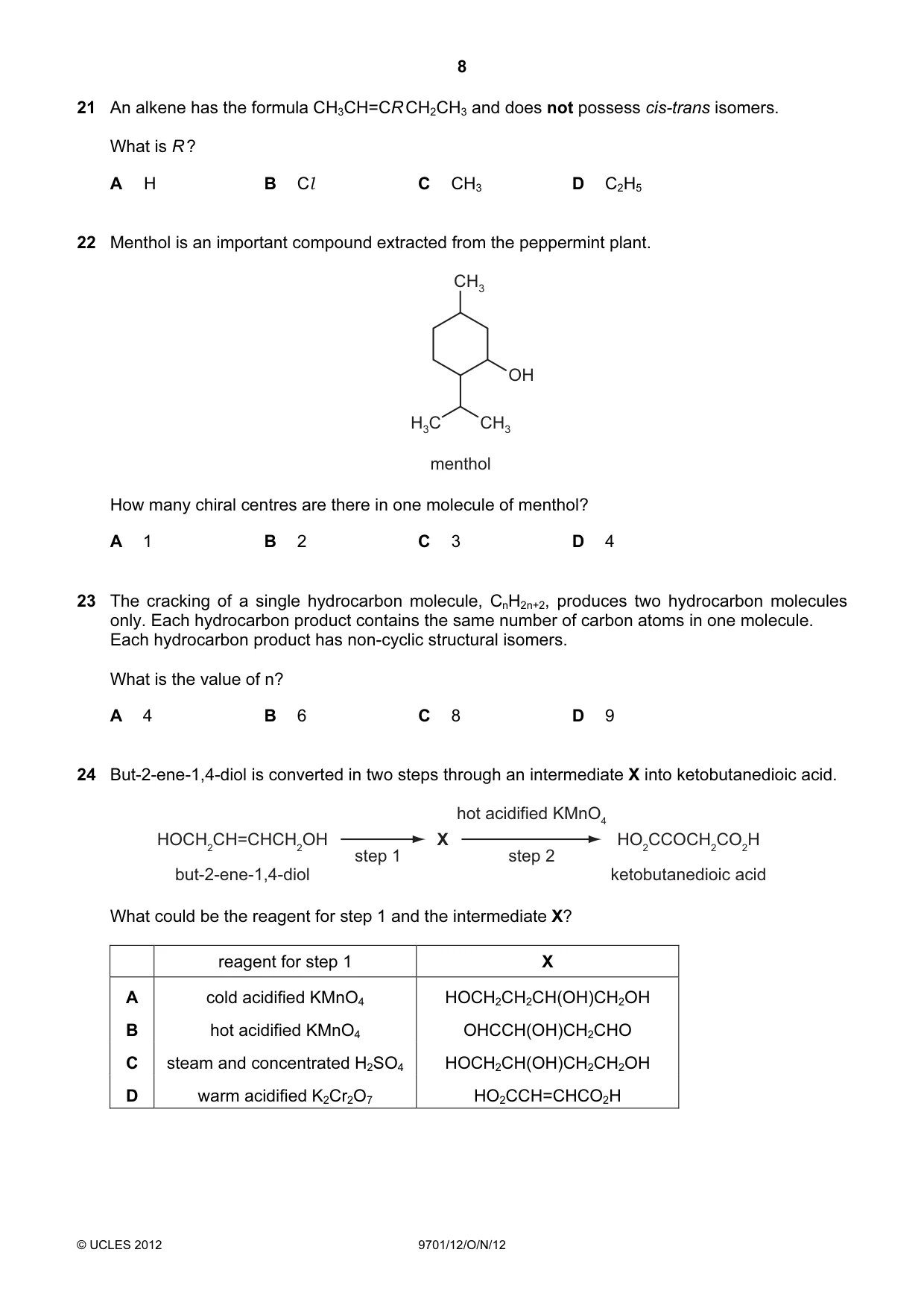
Q21 · An alkene has the formula CH3CH=CR CH2CH3 and does not possess cis-trans isomers
21 An alkene has the formula CH3CH=CR CH2CH3 and does not possess cis-trans isomers. What is R ? A H B Cl C CH3 D C2H5
Mark scheme: D
More questions on Isomerism: structural isomerism and stereoisomerism
Q22 · Menthol is an important compound extracted from the peppermint plant
22 Menthol is an important compound extracted from the peppermint plant. CH3 OH H3C CH3 menthol How many chiral centres are there in one molecule of menthol? A 1 B 2 C 3 D 4
Mark scheme: C
Q23 · The cracking of a single hydrocarbon molecule, CnH2n+2, produces two hydrocarbon…
23 The cracking of a single hydrocarbon molecule, CnH2n+2, produces two hydrocarbon molecules only. Each hydrocarbon product contains the same number of carbon atoms in one molecule. Each hydrocarbon product has non-cyclic structural isomers. What is the value of n? A 4 B 6 C 8 D 9
Mark scheme: C
Q24 · But-2-ene-1,4-diol is converted in two steps through an intermediate X into…
24 But-2-ene-1,4-diol is converted in two steps through an intermediate X into ketobutanedioic acid. hot acidified KMnO4 HOCH2CH=CHCH2OH X HO2CCOCH2CO2H step 1 step 2 but-2-ene-1,4-diol ketobutanedioic acid What could be the reagent for step 1 and the intermediate X? reagent for step 1 X A cold acidified KMnO4 HOCH2CH2CH(OH)CH2OH B hot acidified KMnO4 OHCCH(OH)CH2CHO C steam and concentrated H2SO4 HOCH2CH(OH)CH2CH2OH D warm acidified K2Cr2O7 HO2CCH=CHCO2H
Mark scheme: C
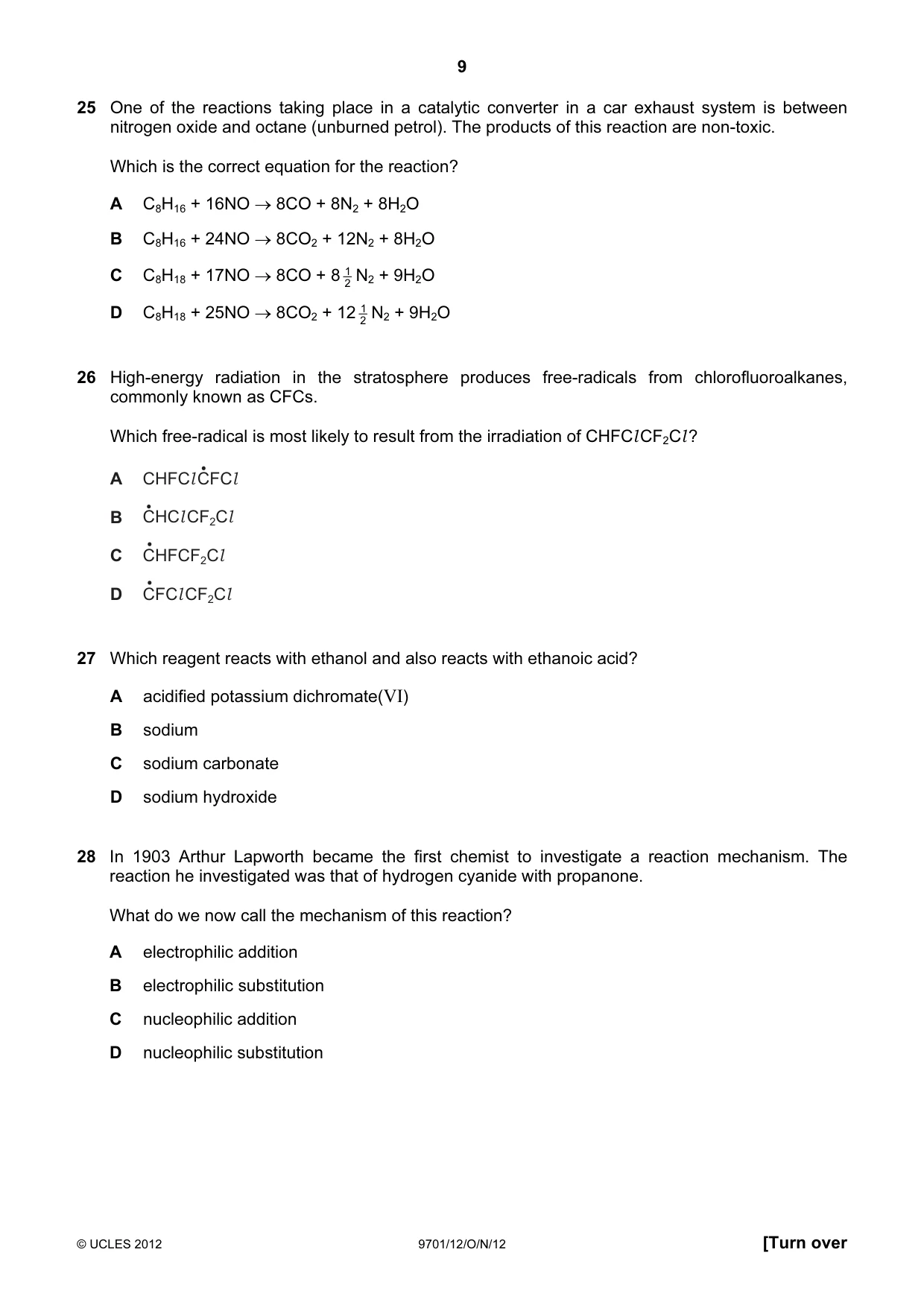
Q25 · One of the reactions taking place in a catalytic converter in a car exhaust system is…
25 One of the reactions taking place in a catalytic converter in a car exhaust system is between nitrogen oxide and octane (unburned petrol). The products of this reaction are non-toxic. Which is the correct equation for the reaction? A C8H16 + 16NO → 8CO + 8N2 + 8H2O B C8H16 + 24NO → 8CO2 + 12N2 + 8H2O C C8H18 + 17NO → 8CO + 8 2 1 N2 + 9H2O D C8H18 + 25NO → 8CO2 + 12 2 1 N2 + 9H2O
Mark scheme: D
Q26 · High-energy radiation in the stratosphere produces free-radicals from…
26 High-energy radiation in the stratosphere produces free-radicals from chlorofluoroalkanes, commonly known as CFCs. Which free-radical is most likely to result from the irradiation of CHFCl CF2Cl ? A CHFCl CFCl B CHCl CF2Cl C CHFCF2Cl D CFCl CF2Cl
Mark scheme: C
Q27 · Which reagent reacts with ethanol and also reacts with ethanoic acid?
27 Which reagent reacts with ethanol and also reacts with ethanoic acid? A acidified potassium dichromate(VI) B sodium C sodium carbonate D sodium hydroxide
Mark scheme: B
Q28 · In 1903 Arthur Lapworth became the first chemist to investigate a reaction mechanism
28 In 1903 Arthur Lapworth became the first chemist to investigate a reaction mechanism. The reaction he investigated was that of hydrogen cyanide with propanone. What do we now call the mechanism of this reaction? A electrophilic addition B electrophilic substitution C nucleophilic addition D nucleophilic substitution
Mark scheme: C
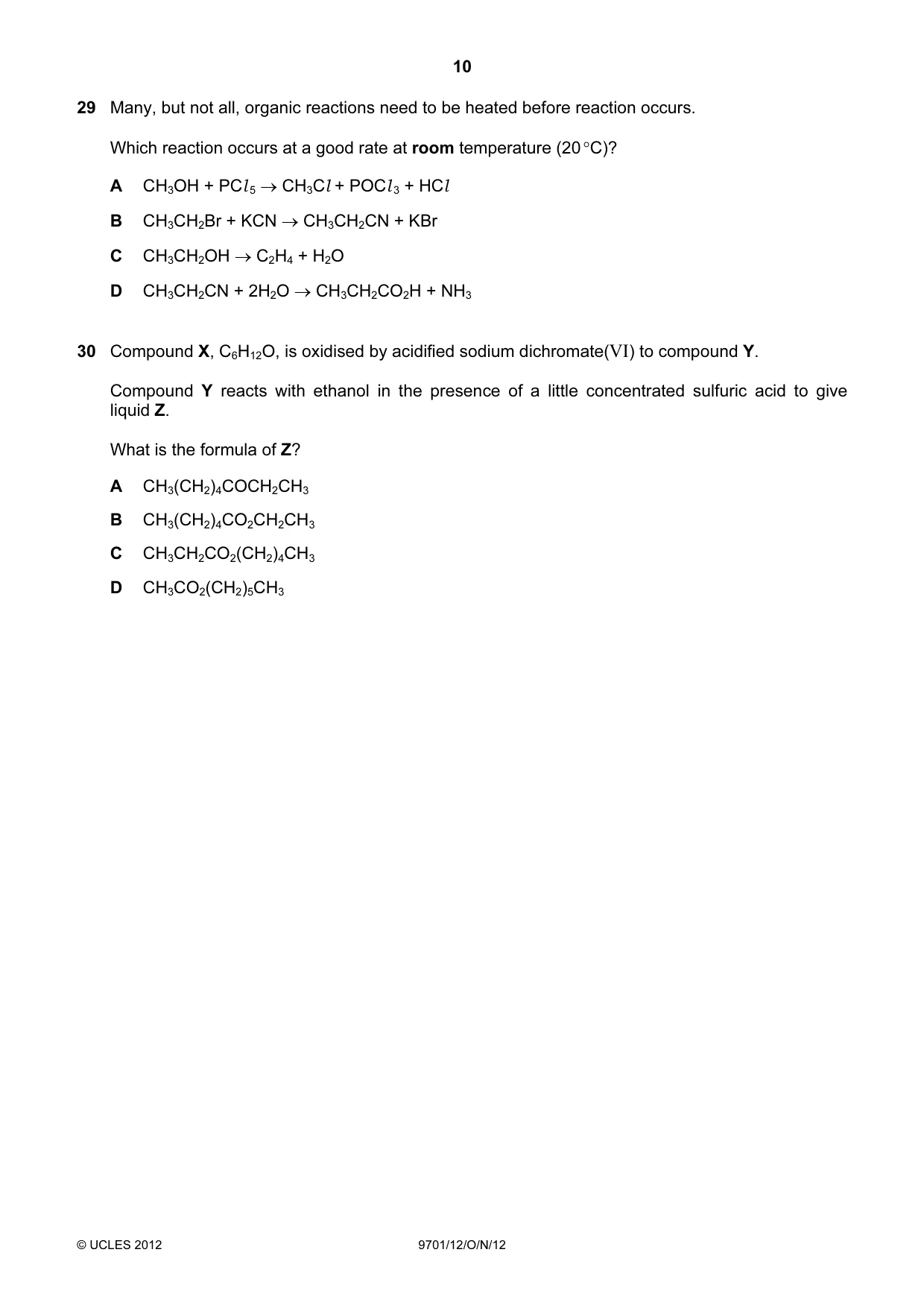
Q29 · Many, but not all, organic reactions need to be heated before reaction occurs
29 Many, but not all, organic reactions need to be heated before reaction occurs. Which reaction occurs at a good rate at room temperature (20 °C)? A CH3OH + PCl 5 → CH3Cl + POCl 3 + HCl B CH3CH2Br + KCN → CH3CH2CN + KBr C CH3CH2OH → C2H4 + H2O D CH3CH2CN + 2H2O → CH3CH2CO2H + NH3
Mark scheme: A
Q30 · Compound X, C6H12O, is oxidised by acidified sodium dichromate(VI) to compound Y
30 Compound X, C6H12O, is oxidised by acidified sodium dichromate(VI) to compound Y. Compound Y reacts with ethanol in the presence of a little concentrated sulfuric acid to give liquid Z. What is the formula of Z? A CH3(CH2)4COCH2CH3 B CH3(CH2)4CO2CH2CH3 C CH3CH2CO2(CH2)4CH3 D CH3CO2(CH2)5CH3
Mark scheme: B
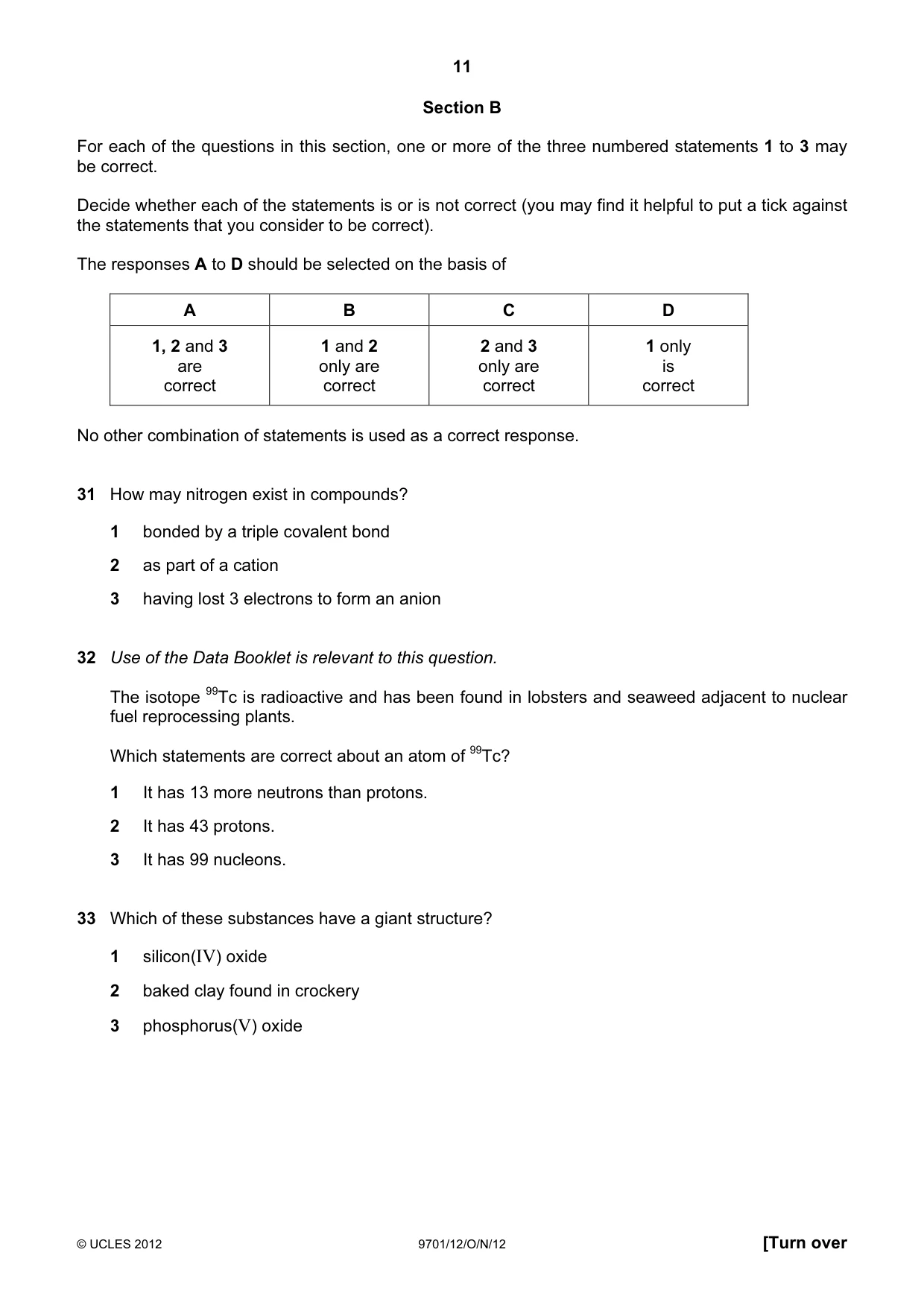
Q31 · How may nitrogen exist in compounds?
31 How may nitrogen exist in compounds? 1 bonded by a triple covalent bond 2 as part of a cation 3 having lost 3 electrons to form an anion
Mark scheme: B
More questions on Covalent bonding and coordinate (dative covalent) bonding
Q32 · Use of the Data Booklet is relevant to this question
32 Use of the Data Booklet is relevant to this question. The isotope 99Tc is radioactive and has been found in lobsters and seaweed adjacent to nuclear fuel reprocessing plants. Which statements are correct about an atom of 99Tc? 1 It has 13 more neutrons than protons. 2 It has 43 protons. 3 It has 99 nucleons.
Mark scheme: A
Q33 · Which of these substances have a giant structure?
33 Which of these substances have a giant structure? 1 silicon(IV) oxide 2 baked clay found in crockery 3 phosphorus(V) oxide
Mark scheme: B
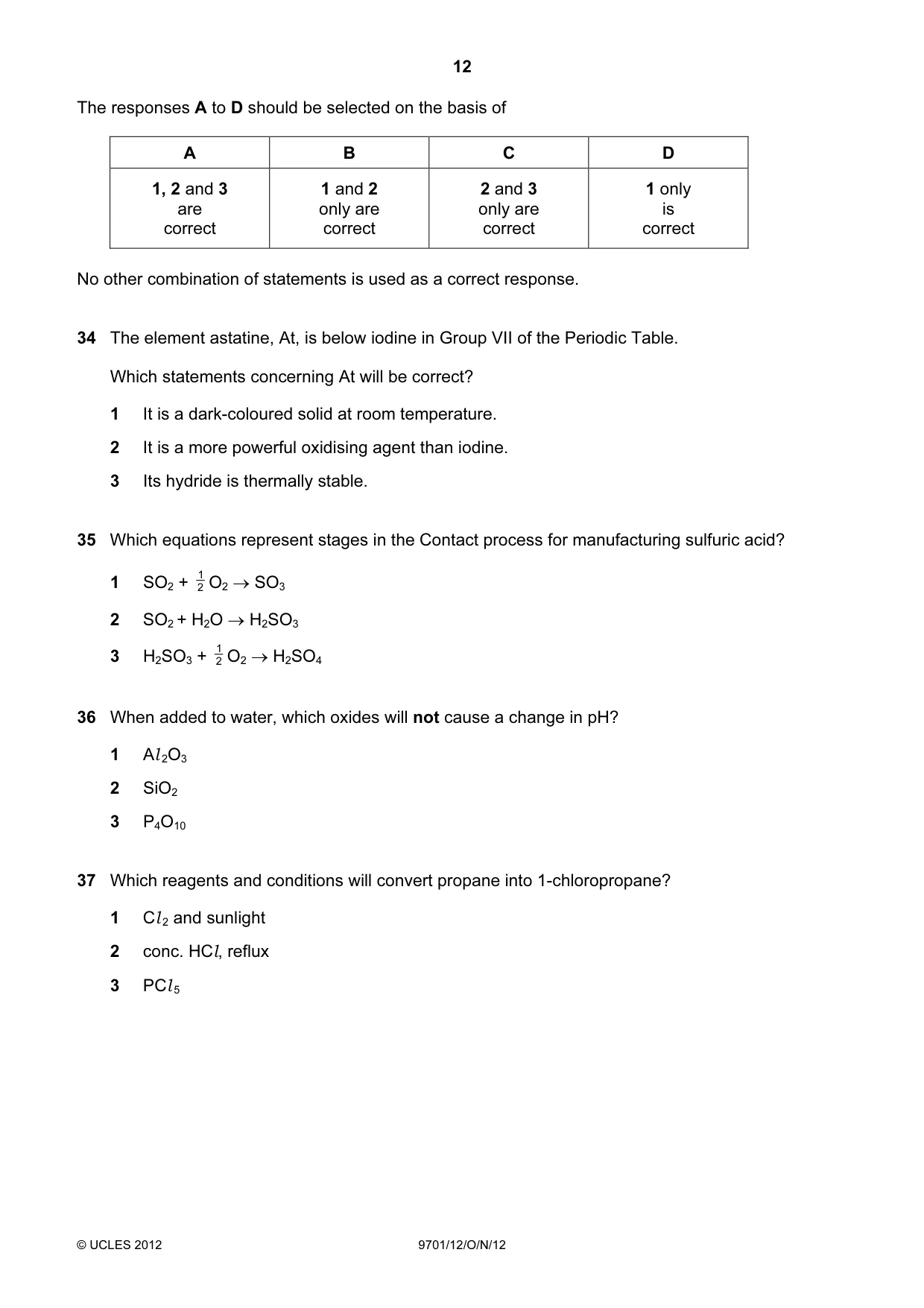
Q34 · The element astatine, At, is below iodine in Group VII of the Periodic Table
34 The element astatine, At, is below iodine in Group VII of the Periodic Table. Which statements concerning At will be correct? 1 It is a dark-coloured solid at room temperature. 2 It is a more powerful oxidising agent than iodine. 3 Its hydride is thermally stable.
Mark scheme: D
More questions on Physical properties of the Group 17 elements
Q35 · Which equations represent stages in the Contact process for manufacturing sulfuric acid?
35 Which equations represent stages in the Contact process for manufacturing sulfuric acid? 1 O2 → SO3 1 SO2 + 2 2 SO2 + H2O → H2SO3 1 O2 → H2SO4 3 H2SO3 + 2
Mark scheme: D
Q36 · When added to water, which oxides will not cause a change in pH?
36 When added to water, which oxides will not cause a change in pH? 1 Al 2O3 2 SiO2 3 P4O10
Mark scheme: B
More questions on Periodicity of chemical properties of the elements in Period 3
Q37 · Which reagents and conditions will convert propane into 1-chloropropane?
37 Which reagents and conditions will convert propane into 1-chloropropane? 1 Cl 2 and sunlight 2 conc. HCl, reflux 3 PCl 5
Mark scheme: D
Q38 · Chloroethane can be formed from bromoethane in two steps
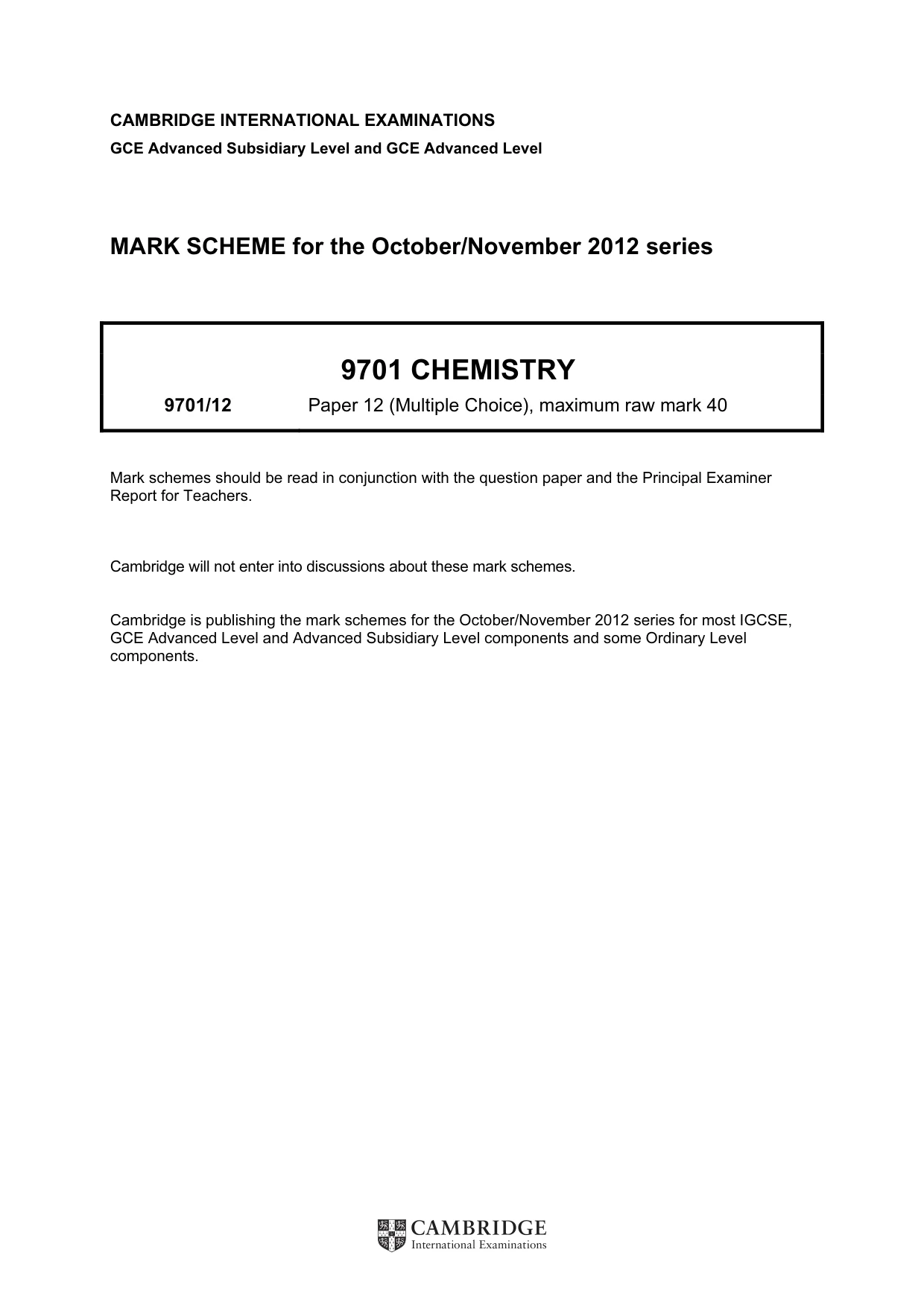
38 Chloroethane can be formed from bromoethane in two steps. step X step Y C2H5Br C2H5OH C2H5Cl Which statements about these steps are correct? 1 Step X involves nucleophilic substitution. 2 Hot aqueous sodium hydroxide is the reagent in step X. 3 Hot aqueous sodium chloride is the reagent in step Y.
Mark scheme: B
Q39 · Which reagents react with butanone, C2H5COCH3?
39 Which reagents react with butanone, C2H5COCH3? 1 Tollens’ reagent 2 sodium borohydride 3 2,4-dinitrophenylhydrazine reagent
Mark scheme: C
Q40 · Oleic acid is found in olive oil
40 Oleic acid is found in olive oil. It has the following formula. H H C C O CH3(CH2)7 (CH2)7 C OH Which reagents will give a positive result with oleic acid? 1 aqueous bromine 2 acidified potassium dichromate(VI) 3 Fehling’s reagent
Mark scheme: D
What was in this paper
The subtopics covered by these 40 questions, and how many questions each got. Open one in a new tab to see every Cambridge question on it.
4Particles in the atom and atomic radius4Alkanes2Alkenes2Bonding and structure2Enthalpy change, ΔH2Periodicity of chemical properties of the elements in Period 32Redox processes: electron transfer and changes in oxidation number (oxidation state)2Shapes of molecules2Similarities and trends in the properties of the Group 2 metals, magnesium to barium, and their compounds2Alcohols1Aldehydes and ketones1Covalent bonding and coordinate (dative covalent) bonding1Electrolysis1Enthalpies of solution and hydration1Esters1Hess’s law1Ionic bonding1Isomerism: optical1Isomerism: structural isomerism and stereoisomerism1Nitriles and hydroxynitriles1Nitrogen and sulfur1Physical properties of the Group 17 elements1Reacting masses and volumes (of solutions and gases)1Shapes of organic molecules; σ and π bonds1The gaseous state: ideal and real gases and pV = nRT1What you needed in this session
Cambridge’s own grade thresholds for 2012 Oct/Nov, Paper 1 · Variant 2. A higher threshold means an easier paper — the bar moves with how the cohort did.