Cambridge A Level Chemistry 9701 — 2019 May/June Paper 1 · Variant 3
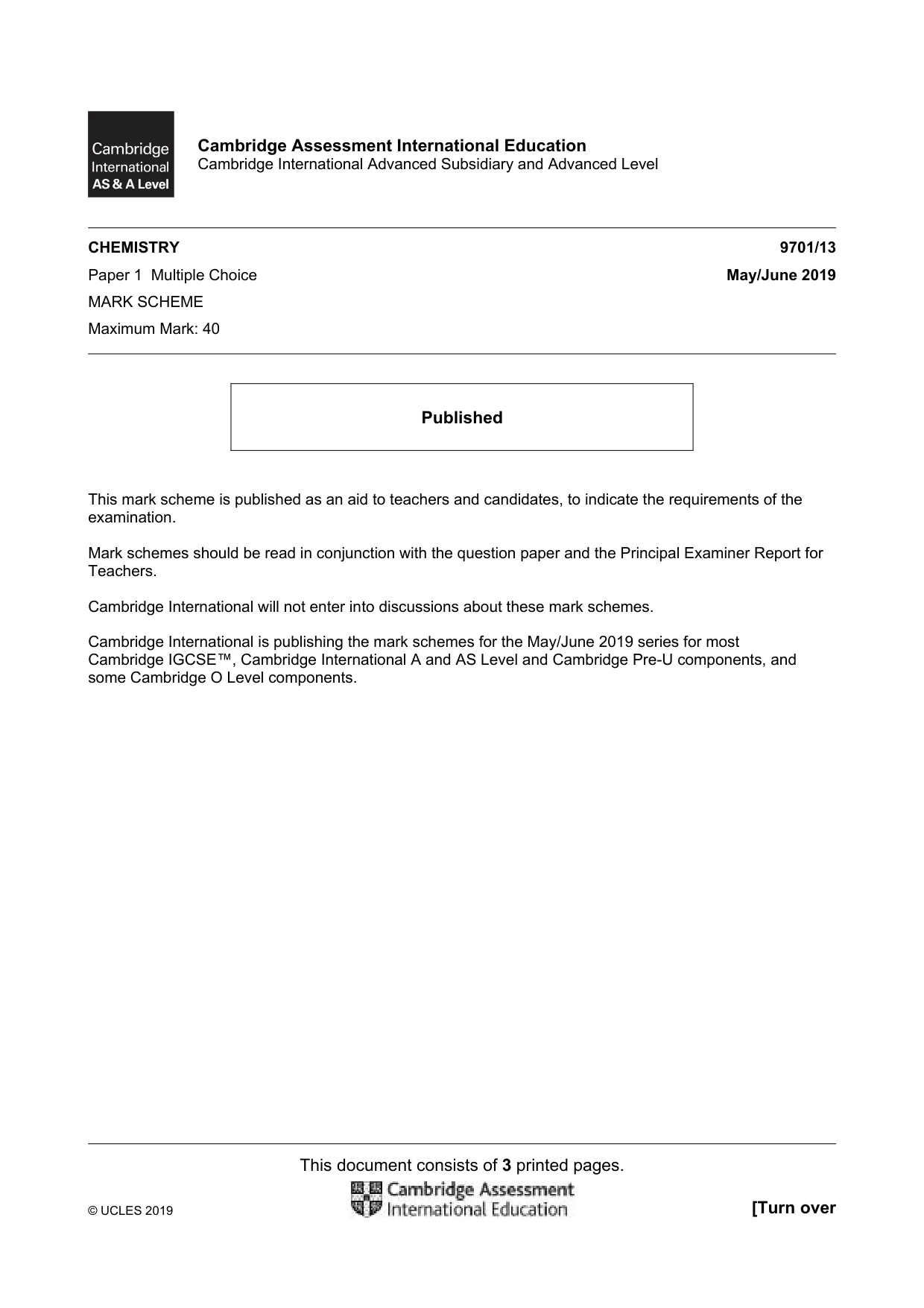
9701/13/M/J/19 · 40 questions · 40 marks · ≈45 min
The question paper and its mark scheme, free to read here and free to download. This is Cambridge’s own paper, exactly as it was sat.
Question paper16 pages
Mark scheme3 pages
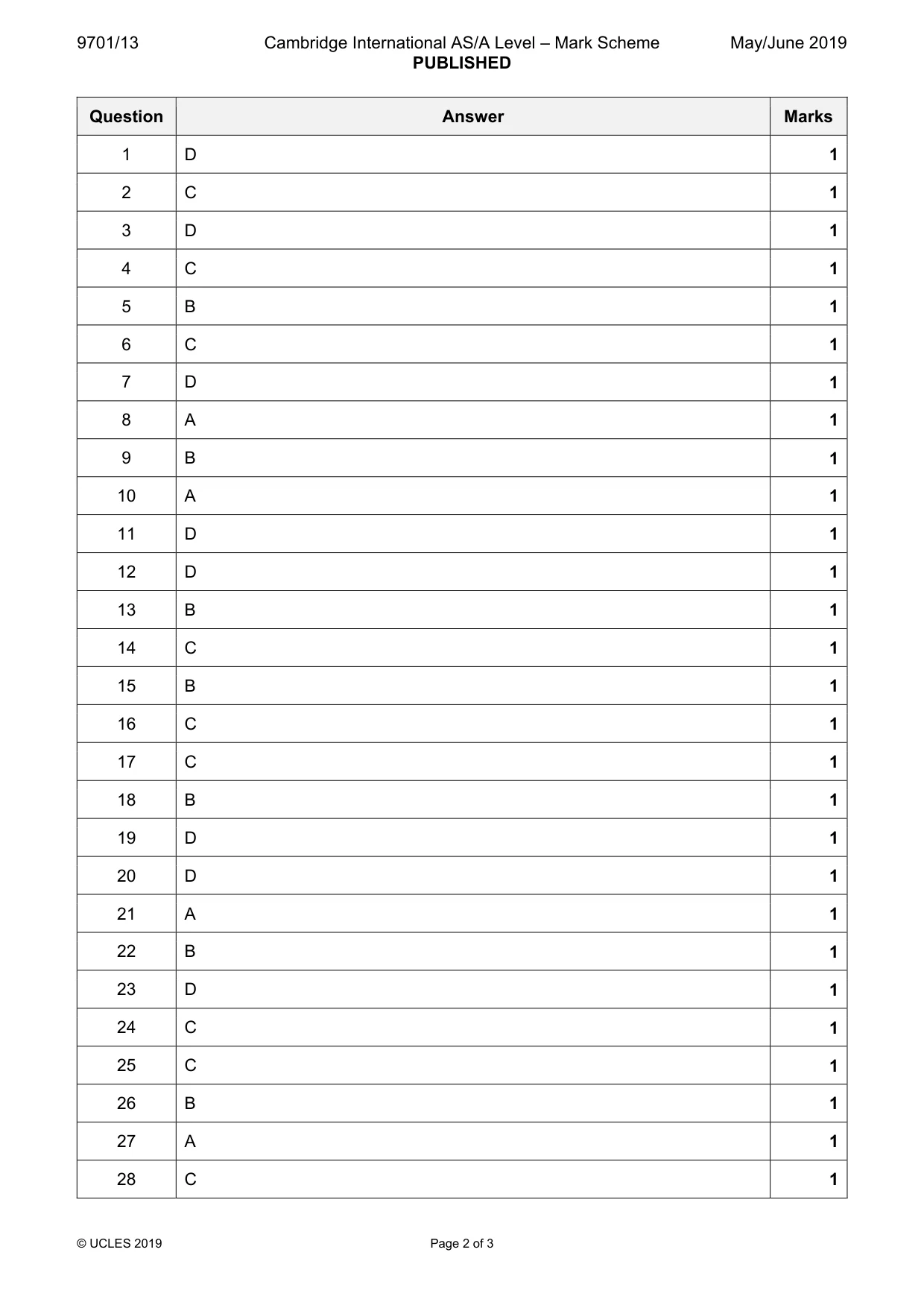
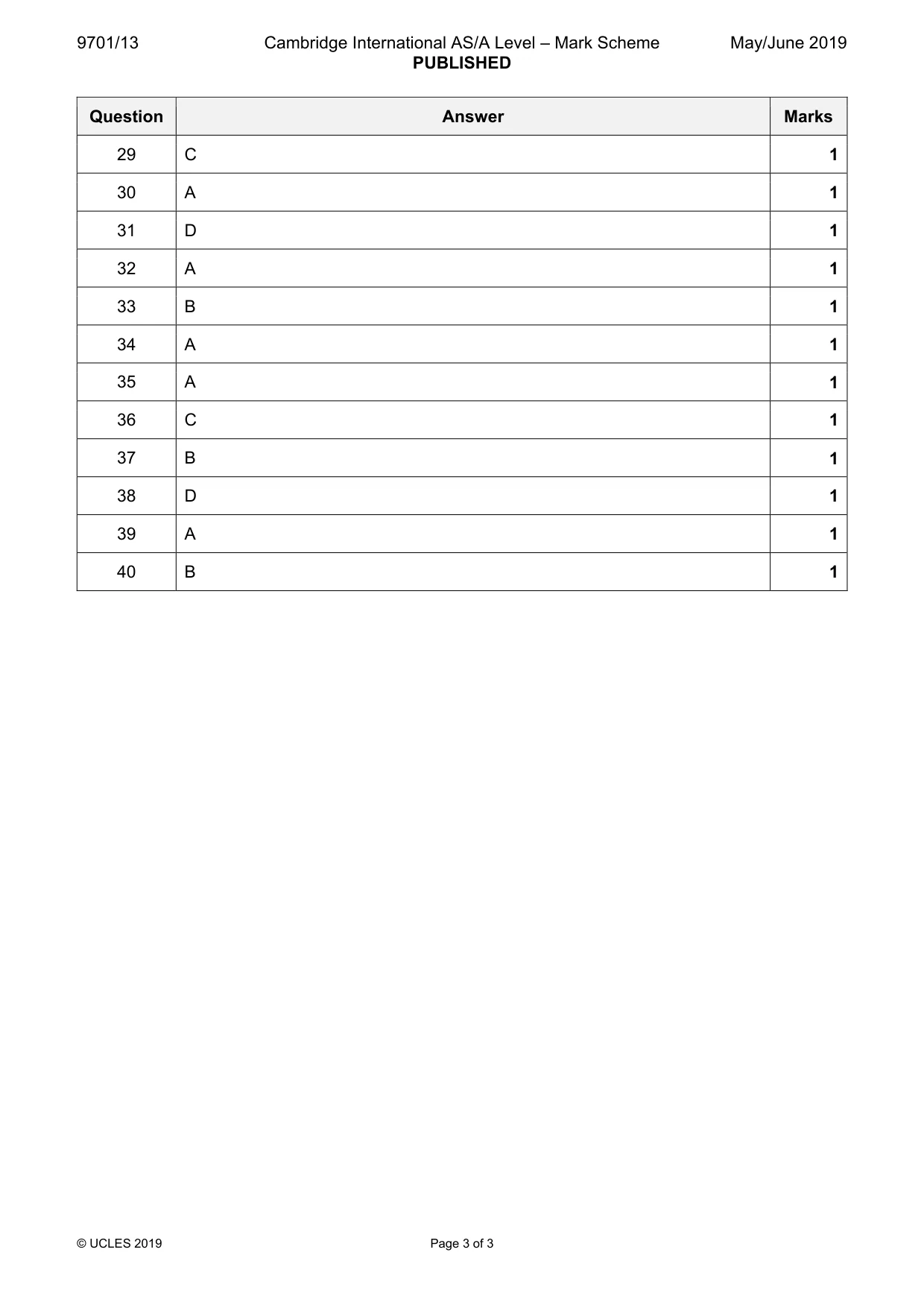
Answers below. Sit the paper first if you are practising.
Questions as text
Q1 · Manganese and nitrogen can show a range of different oxidation states
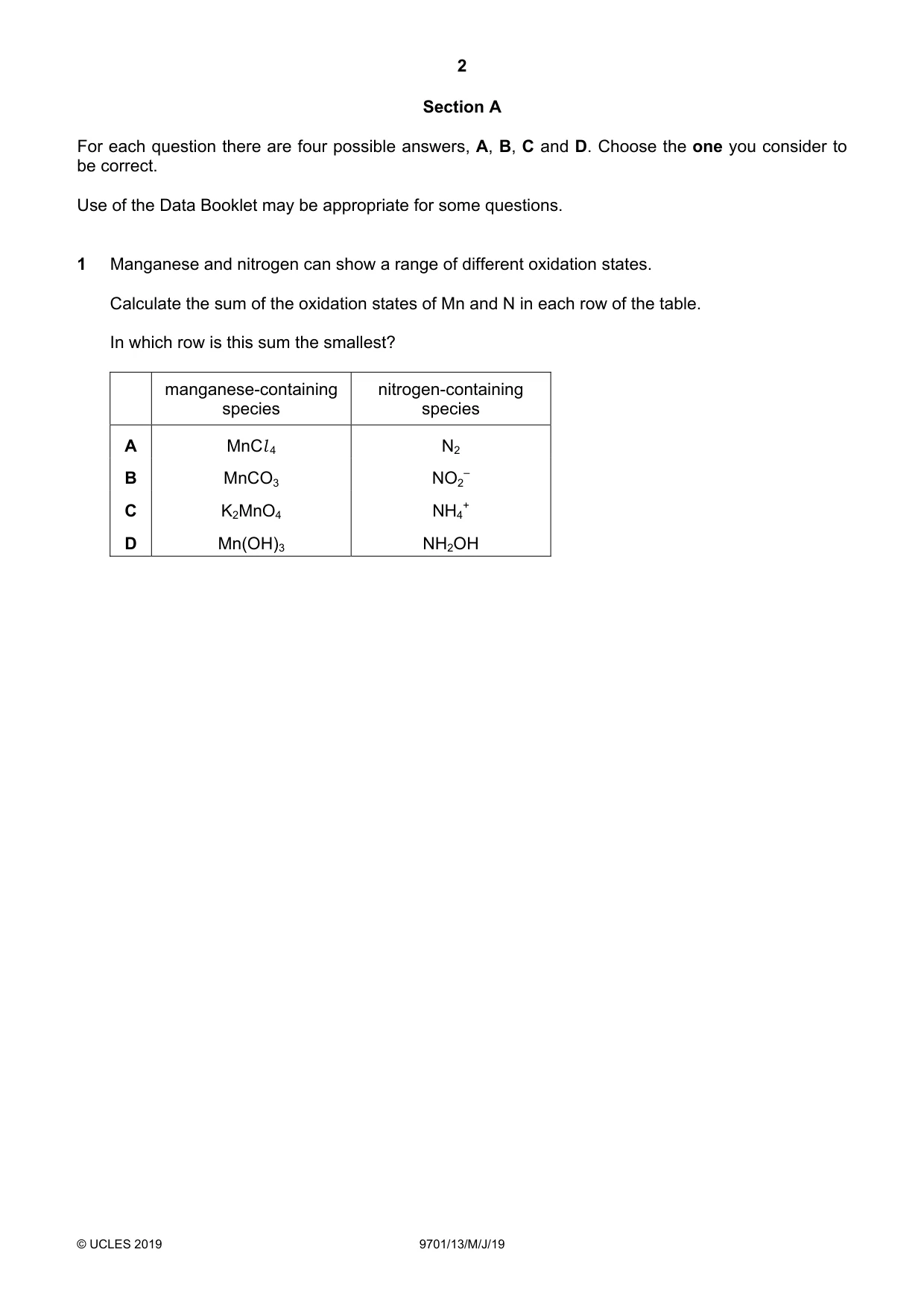
1 Manganese and nitrogen can show a range of different oxidation states. Calculate the sum of the oxidation states of Mn and N in each row of the table. In which row is this sum the smallest? manganese-containing nitrogen-containing species species A MnCl 4 N2 B MnCO3 NO2 – C K2MnO4 NH4 + D Mn(OH)3 NH2OH
Mark scheme: D
Q2 · The mass spectrum of an alloy of copper and gold is shown
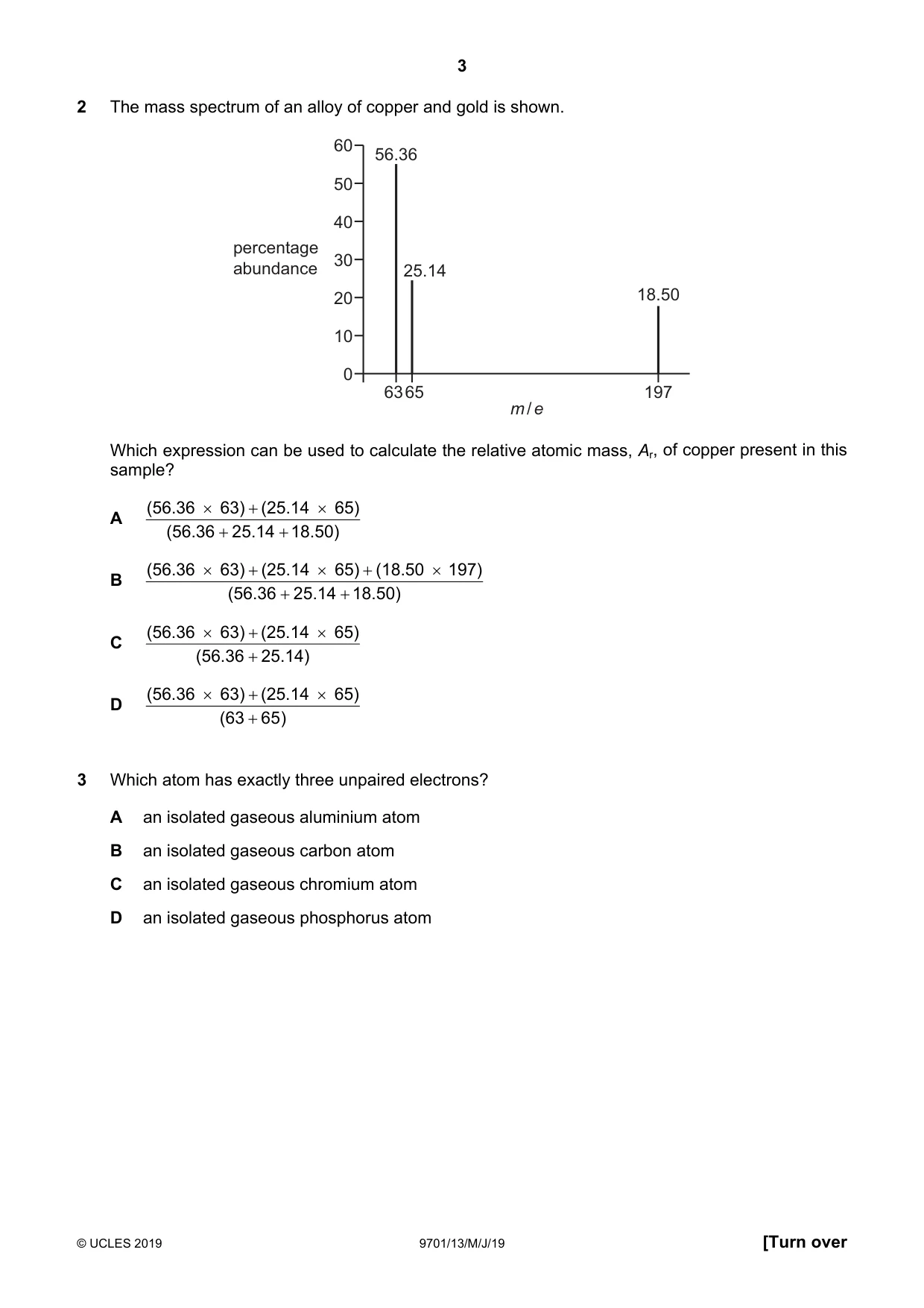
2 The mass spectrum of an alloy of copper and gold is shown. 60 56.36 50 40 percentage 30 abundance 25.14 20 18.50 10 0 6365 197 m / e Which expression can be used to calculate the relative atomic mass, Ar, of copper present in this sample? (56.36 × 63) + (25.14 × 65) A (56.36 + 25.14 + 18.50) (56.36 × 63) + (25.14 × 65) + (18.50 × 197) B (56.36 + 25.14 + 18.50) (56.36 × 63) + (25.14 × 65) C (56.36 + 25.14) (56.36 × 63) + (25.14 × 65) D (63 + 6 5 )
Mark scheme: C
Q3 · Which atom has exactly three unpaired electrons?
3 Which atom has exactly three unpaired electrons? A an isolated gaseous aluminium atom B an isolated gaseous carbon atom C an isolated gaseous chromium atom D an isolated gaseous phosphorus atom
Mark scheme: D
More questions on Electrons, energy levels and atomic orbitals
Q4 · Element W is in period three of the Periodic Table and has a solid, white oxide, X
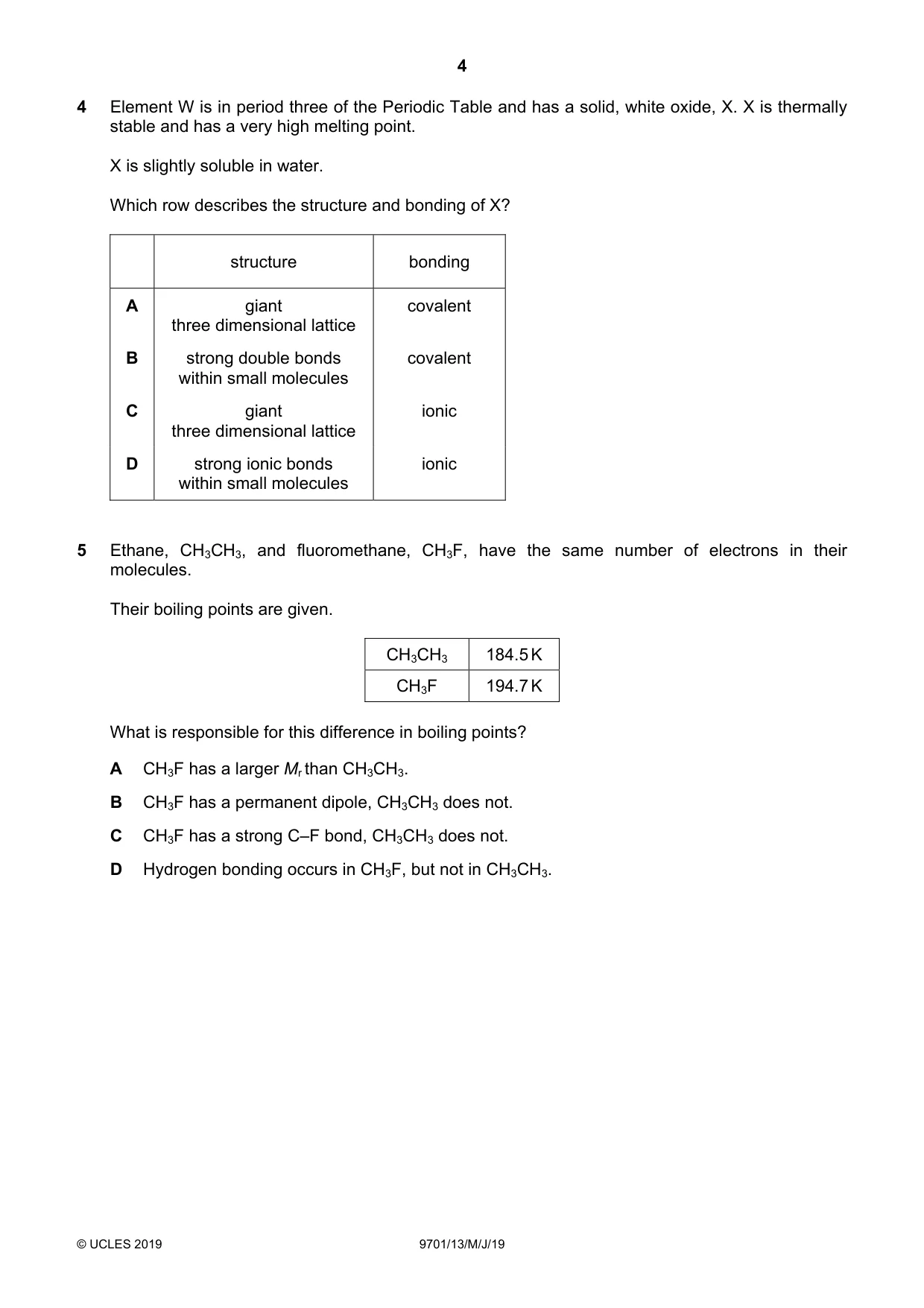
4 Element W is in period three of the Periodic Table and has a solid, white oxide, X. X is thermally stable and has a very high melting point. X is slightly soluble in water. Which row describes the structure and bonding of X? structure bonding A giant covalent three dimensional lattice B strong double bonds covalent within small molecules C giant ionic three dimensional lattice D strong ionic bonds ionic within small molecules
Mark scheme: C
Q5 · Ethane, CH3CH3, and fluoromethane, CH3F, have the same number of electrons in their…
5 Ethane, CH3CH3, and fluoromethane, CH3F, have the same number of electrons in their molecules. Their boiling points are given. CH3CH3 184.5 K CH3F 194.7 K What is responsible for this difference in boiling points? A CH3F has a larger Mr than CH3CH3. B CH3F has a permanent dipole, CH3CH3 does not. C CH3F has a strong C–F bond, CH3CH3 does not. D Hydrogen bonding occurs in CH3F, but not in CH3CH3.
Mark scheme: B
More questions on Intermolecular forces, electronegativity and bond properties
Q6 · The reaction pathway diagram for a chemical reaction is shown
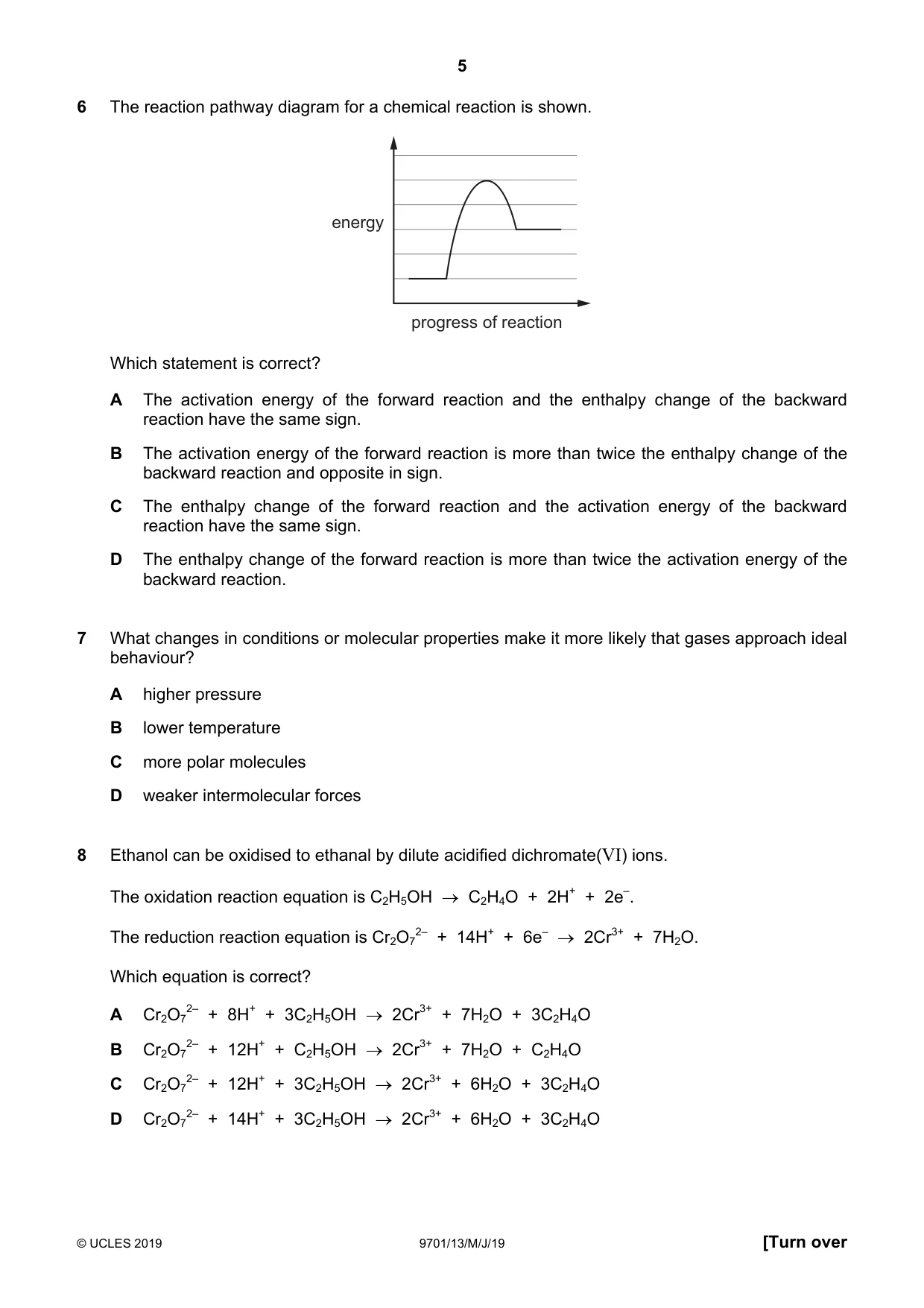
6 The reaction pathway diagram for a chemical reaction is shown. energy progress of reaction Which statement is correct? A The activation energy of the forward reaction and the enthalpy change of the backward reaction have the same sign. B The activation energy of the forward reaction is more than twice the enthalpy change of the backward reaction and opposite in sign. C The enthalpy change of the forward reaction and the activation energy of the backward reaction have the same sign. D The enthalpy change of the forward reaction is more than twice the activation energy of the backward reaction.
Mark scheme: C
Q7 · What changes in conditions or molecular properties make it more likely that gases…
7 What changes in conditions or molecular properties make it more likely that gases approach ideal behaviour? A higher pressure B lower temperature C more polar molecules D weaker intermolecular forces
Mark scheme: D
More questions on The gaseous state: ideal and real gases and pV = nRT
Q8 · Ethanol can be oxidised to ethanal by dilute acidified dichromate(VI) ions
8 Ethanol can be oxidised to ethanal by dilute acidified dichromate(VI) ions. The oxidation reaction equation is C2H5OH → C2H4O + 2H+ + 2e–. The reduction reaction equation is Cr2O7 2– + 14H+ + 6e– → 2Cr3+ + 7H2O. Which equation is correct? A Cr2O7 2– + 8H+ + 3C2H5OH → 2Cr3+ + 7H2O + 3C2H4O B Cr2O7 2– + 12H+ + C2H5OH → 2Cr3+ + 7H2O + C2H4O C Cr2O7 2– + 12H+ + 3C2H5OH → 2Cr3+ + 6H2O + 3C2H4O D Cr2O7 2– + 14H+ + 3C2H5OH → 2Cr3+ + 6H2O + 3C2H4O
Mark scheme: A
Q9 · What is the correct expression for Kc for the reaction shown?
9 What is the correct expression for Kc for the reaction shown? I2(aq) + 2Fe2+(aq) 2I–(aq) + 2Fe3+(aq) [ 2 I − ][ 2 Fe 3 + ] [ I − ] 2 [ Fe 3 + ] 2 [ I ][ 2 Fe 2 + ] [ I ][ Fe 2 + ] 2 A B C 2 D 2 [ I ][ 2 Fe 2 + ] [ I ][ Fe 2 + ] 2 [ 2 I − ][ 2 Fe 3 + ] [ I − ] 2 [ Fe 3 + ] 2 2 2
Mark scheme: B
More questions on Chemical equilibria: reversible reactions, dynamic equilibrium
Q10 · X and Y react together to form Z in a reversible reaction
10 X and Y react together to form Z in a reversible reaction. The equilibrium yield of Z is lower at higher temperature. The equilibrium yield of Z is lower at lower pressure. Which equation could represent this reaction? A X(g) + Y(g) Z(g) ∆H = –100 kJ mol–1 B X(g) + Y(g) Z(g) ∆H = +100 kJ mol–1 C X(s) + Y(g) 2Z(g) ∆H = –100 kJ mol–1 D X(s) + Y(g) 2Z(g) ∆H = +100 kJ mol–1
Mark scheme: A
More questions on Chemical equilibria: reversible reactions, dynamic equilibrium
Q11 · The volume of carbon dioxide collected by reacting 0.100 mol of magnesium carbonate with…
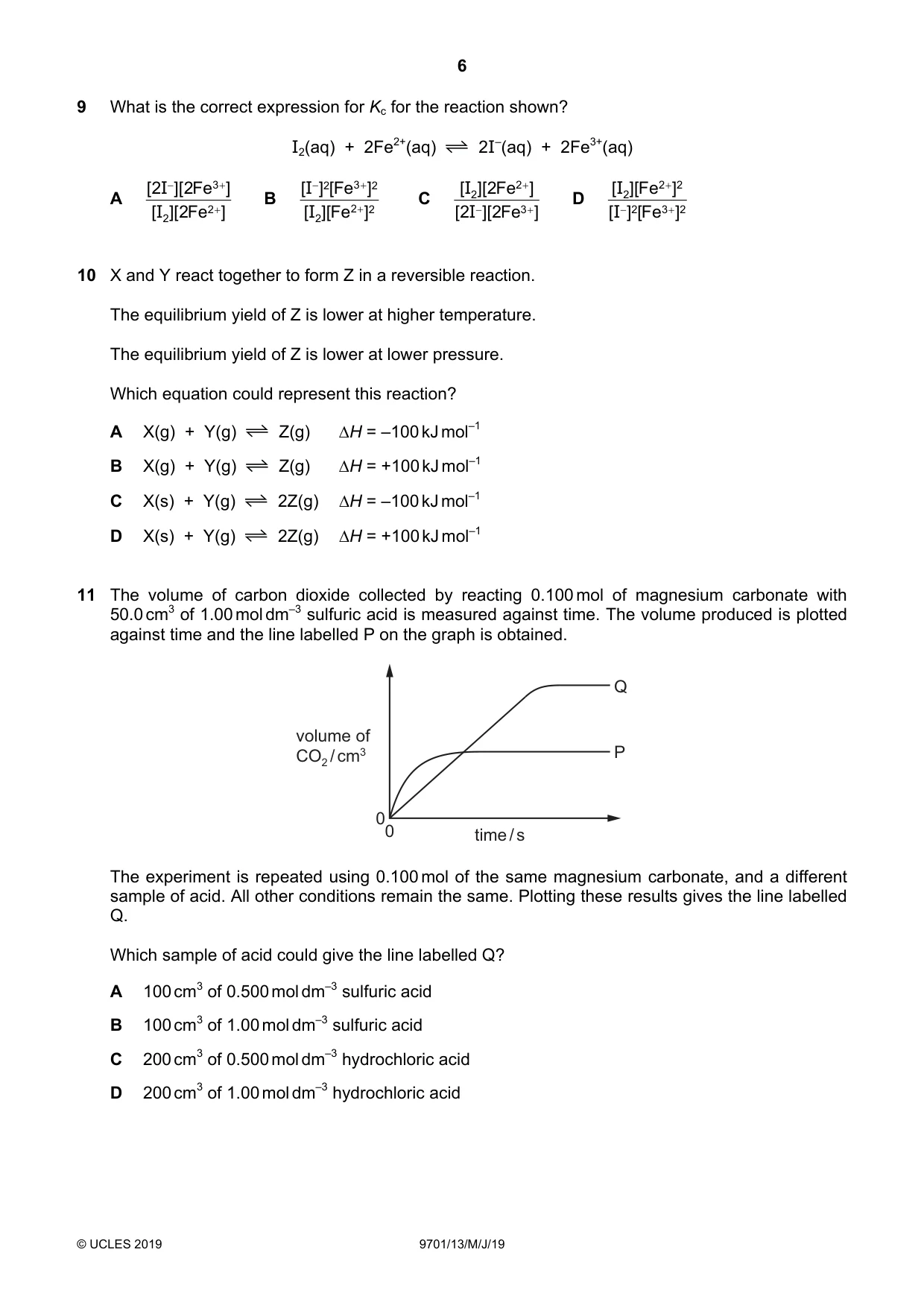
11 The volume of carbon dioxide collected by reacting 0.100 mol of magnesium carbonate with 50.0 cm3 of 1.00 mol dm–3 sulfuric acid is measured against time. The volume produced is plotted against time and the line labelled P on the graph is obtained. Q volume of CO2 / cm3 P 0 0 time / s The experiment is repeated using 0.100 mol of the same magnesium carbonate, and a different sample of acid. All other conditions remain the same. Plotting these results gives the line labelled Q. Which sample of acid could give the line labelled Q? A 100 cm3 of 0.500 mol dm–3 sulfuric acid B 100 cm3 of 1.00 mol dm–3 sulfuric acid C 200 cm3 of 0.500 mol dm–3 hydrochloric acid D 200 cm3 of 1.00 mol dm–3 hydrochloric acid
Mark scheme: D
Q12 · Sodium and sulfur react together to form sodium sulfide, Na2S
12 Sodium and sulfur react together to form sodium sulfide, Na2S. How do the atomic radius and ionic radius of sodium compare with those of sulfur? atomic radius ionic radius A sodium < sulfur sodium > sulfur B sodium < sulfur sodium < sulfur C sodium > sulfur sodium > sulfur D sodium > sulfur sodium < sulfur
Mark scheme: D
More questions on Periodicity of physical properties of the elements in Period 3
Q13 · Which graph represents the variation in electronegativity for Period 3 elements?
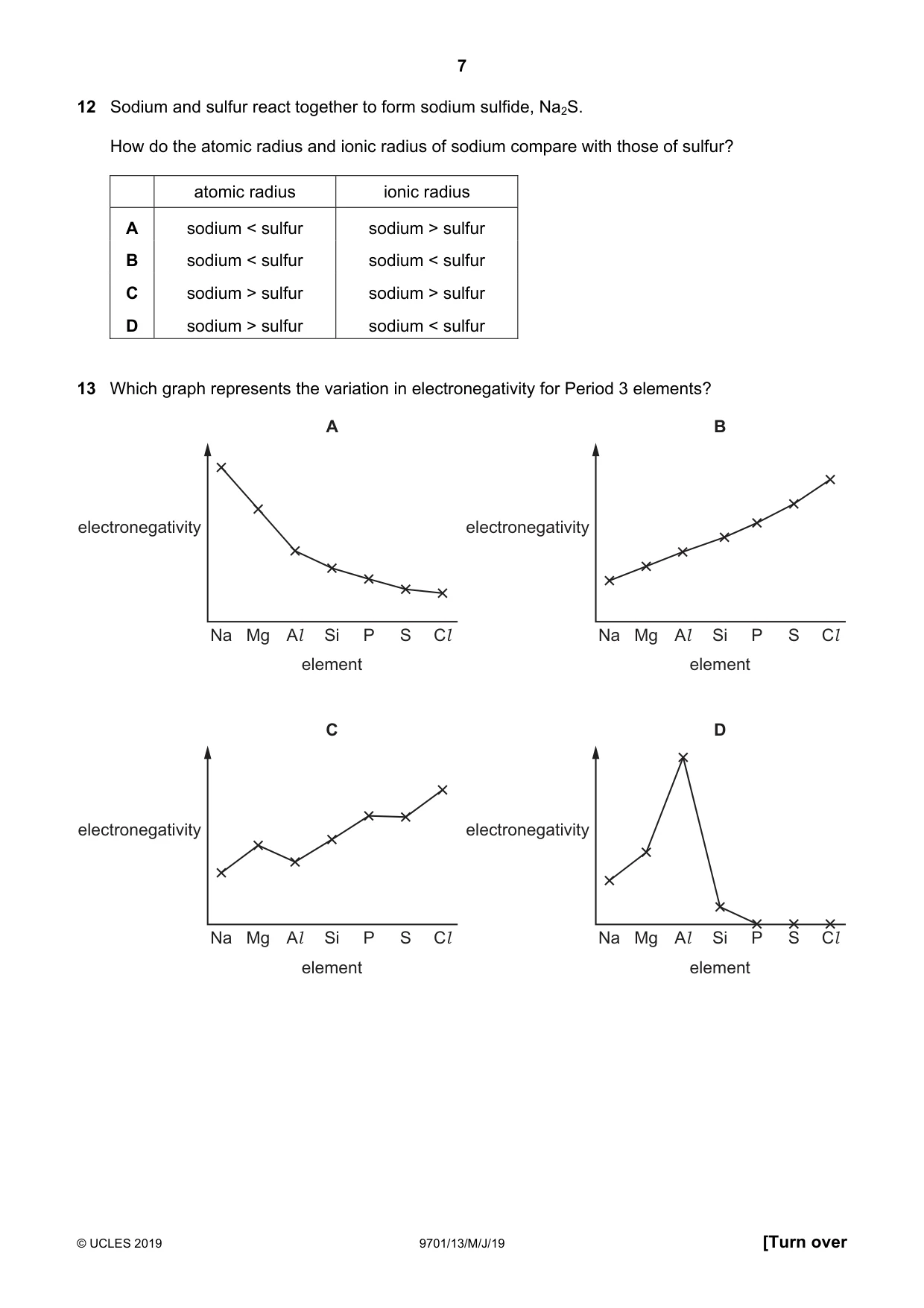
13 Which graph represents the variation in electronegativity for Period 3 elements? A B electronegativity electronegativity Na Mg Al Si P S Cl Na Mg Al Si P S Cl element element C D electronegativity electronegativity Na Mg Al Si P S Cl Na Mg Al Si P S Cl element element
Mark scheme: B
Q14 · Dilute hydrochloric acid is added to solid barium carbonate and solid magnesium carbonate…
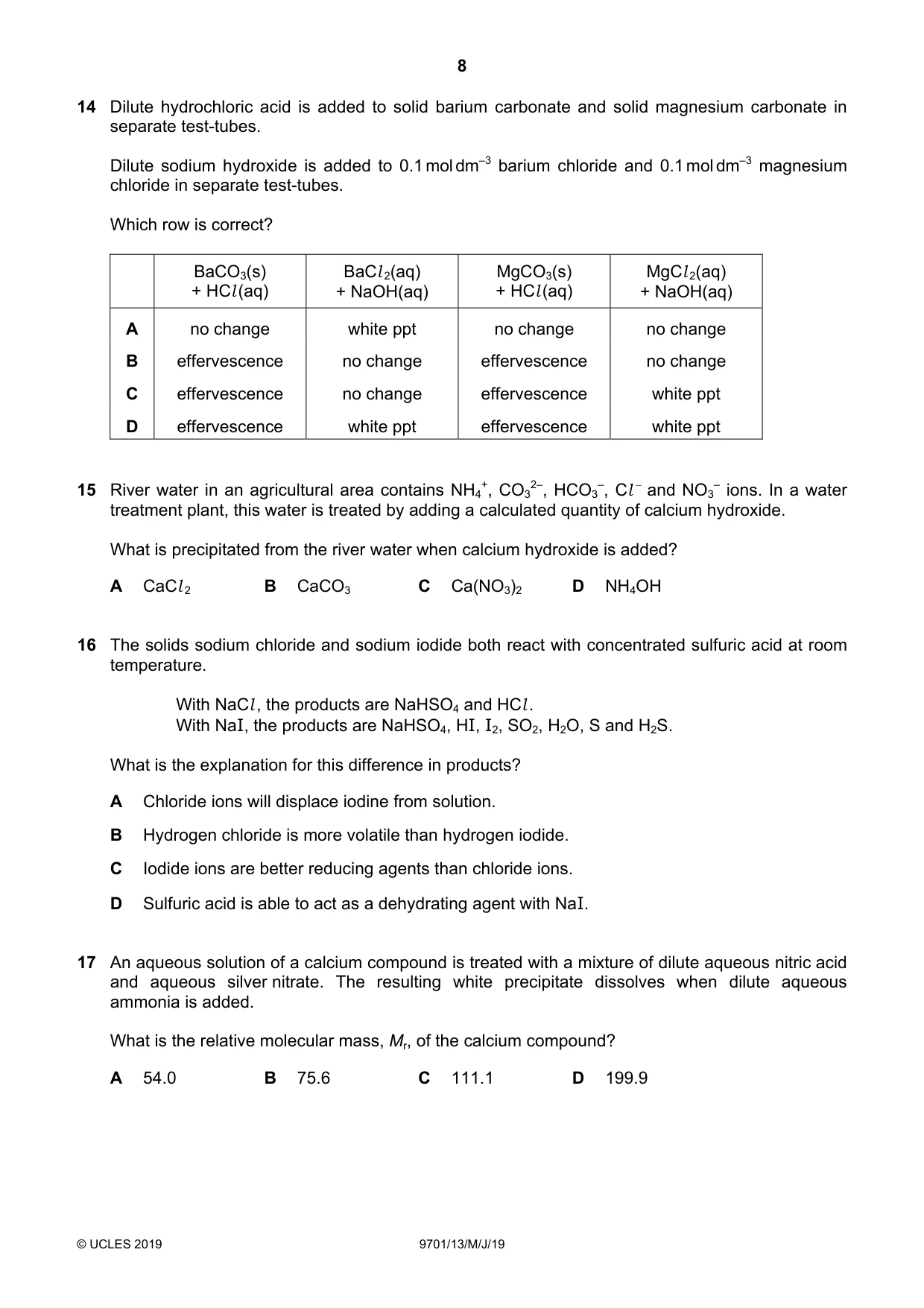
14 Dilute hydrochloric acid is added to solid barium carbonate and solid magnesium carbonate in separate test-tubes. Dilute sodium hydroxide is added to 0.1 mol dm–3 barium chloride and 0.1 mol dm–3 magnesium chloride in separate test-tubes. Which row is correct? BaCO3(s) BaCl 2(aq) MgCO3(s) MgCl 2(aq) + HCl (aq) + NaOH(aq) + HCl (aq) + NaOH(aq) A no change white ppt no change no change B effervescence no change effervescence no change C effervescence no change effervescence white ppt D effervescence white ppt effervescence white ppt
Mark scheme: C
Q15 · River water in an agricultural area contains NH4 +, CO3 2–, HCO3 –, Cl − and NO3 – ions
15 River water in an agricultural area contains NH4 +, CO3 2–, HCO3 –, Cl − and NO3 – ions. In a water treatment plant, this water is treated by adding a calculated quantity of calcium hydroxide. What is precipitated from the river water when calcium hydroxide is added? A CaCl 2 B CaCO3 C Ca(NO3)2 D NH4OH
Mark scheme: B
Q16 · The solids sodium chloride and sodium iodide both react with concentrated sulfuric acid…
16 The solids sodium chloride and sodium iodide both react with concentrated sulfuric acid at room temperature. With NaCl , the products are NaHSO4 and HCl . With NaI, the products are NaHSO4, HI, I2, SO2, H2O, S and H2S. What is the explanation for this difference in products? A Chloride ions will displace iodine from solution. B Hydrogen chloride is more volatile than hydrogen iodide. C Iodide ions are better reducing agents than chloride ions. D Sulfuric acid is able to act as a dehydrating agent with NaI.
Mark scheme: C
More questions on The chemical properties of the halogen elements and the hydrogen halides
Q17 · An aqueous solution of a calcium compound is treated with a mixture of dilute aqueous…
17 An aqueous solution of a calcium compound is treated with a mixture of dilute aqueous nitric acid and aqueous silver nitrate. The resulting white precipitate dissolves when dilute aqueous ammonia is added. What is the relative molecular mass, Mr, of the calcium compound? A 54.0 B 75.6 C 111.1 D 199.9
Mark scheme: C
More questions on Reacting masses and volumes (of solutions and gases)
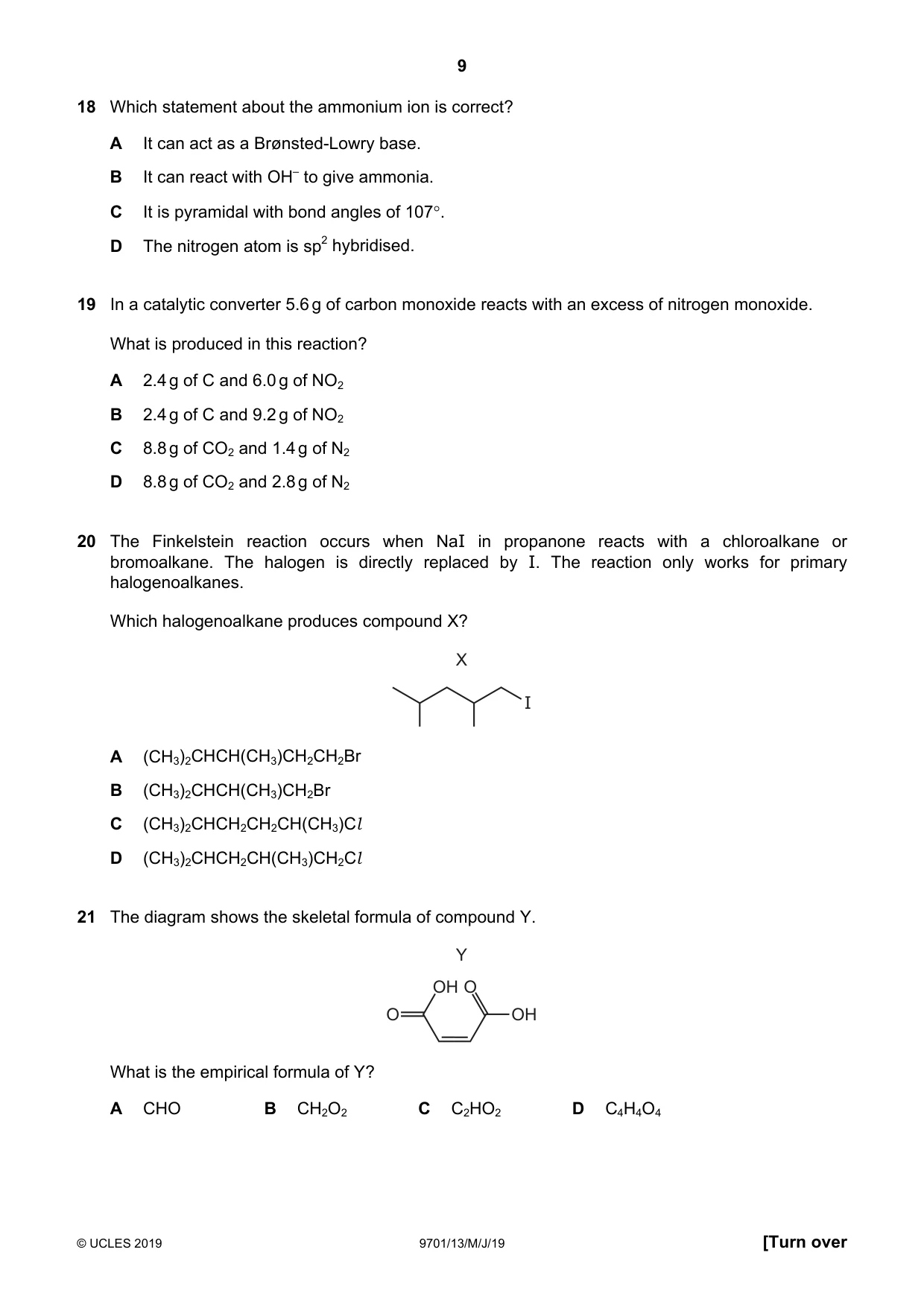
Q18 · Which statement about the ammonium ion is correct?
18 Which statement about the ammonium ion is correct? A It can act as a Brønsted-Lowry base. B It can react with OH– to give ammonia. C It is pyramidal with bond angles of 107°. D The nitrogen atom is sp2 hybridised.
Mark scheme: B
Q19 · In a catalytic converter 5.6 g of carbon monoxide reacts with an excess of nitrogen…
19 In a catalytic converter 5.6 g of carbon monoxide reacts with an excess of nitrogen monoxide. What is produced in this reaction? A 2.4 g of C and 6.0 g of NO2 B 2.4 g of C and 9.2 g of NO2 C 8.8 g of CO2 and 1.4 g of N2 D 8.8 g of CO2 and 2.8 g of N2
Mark scheme: D
More questions on Reacting masses and volumes (of solutions and gases)
Q20 · The Finkelstein reaction occurs when NaI in propanone reacts with a chloroalkane or…
20 The Finkelstein reaction occurs when NaI in propanone reacts with a chloroalkane or bromoalkane. The halogen is directly replaced by I. The reaction only works for primary halogenoalkanes. Which halogenoalkane produces compound X? X I A (CH3)2CHCH(CH3)CH2CH2Br B (CH3)2CHCH(CH3)CH2Br C (CH3)2CHCH2CH2CH(CH3)Cl D (CH3)2CHCH2CH(CH3)CH2Cl
Mark scheme: D
Q21 · The diagram shows the skeletal formula of compound Y
21 The diagram shows the skeletal formula of compound Y. Y OH O O OH What is the empirical formula of Y? A CHO B CH2O2 C C2HO2 D C4H4O4
Mark scheme: A
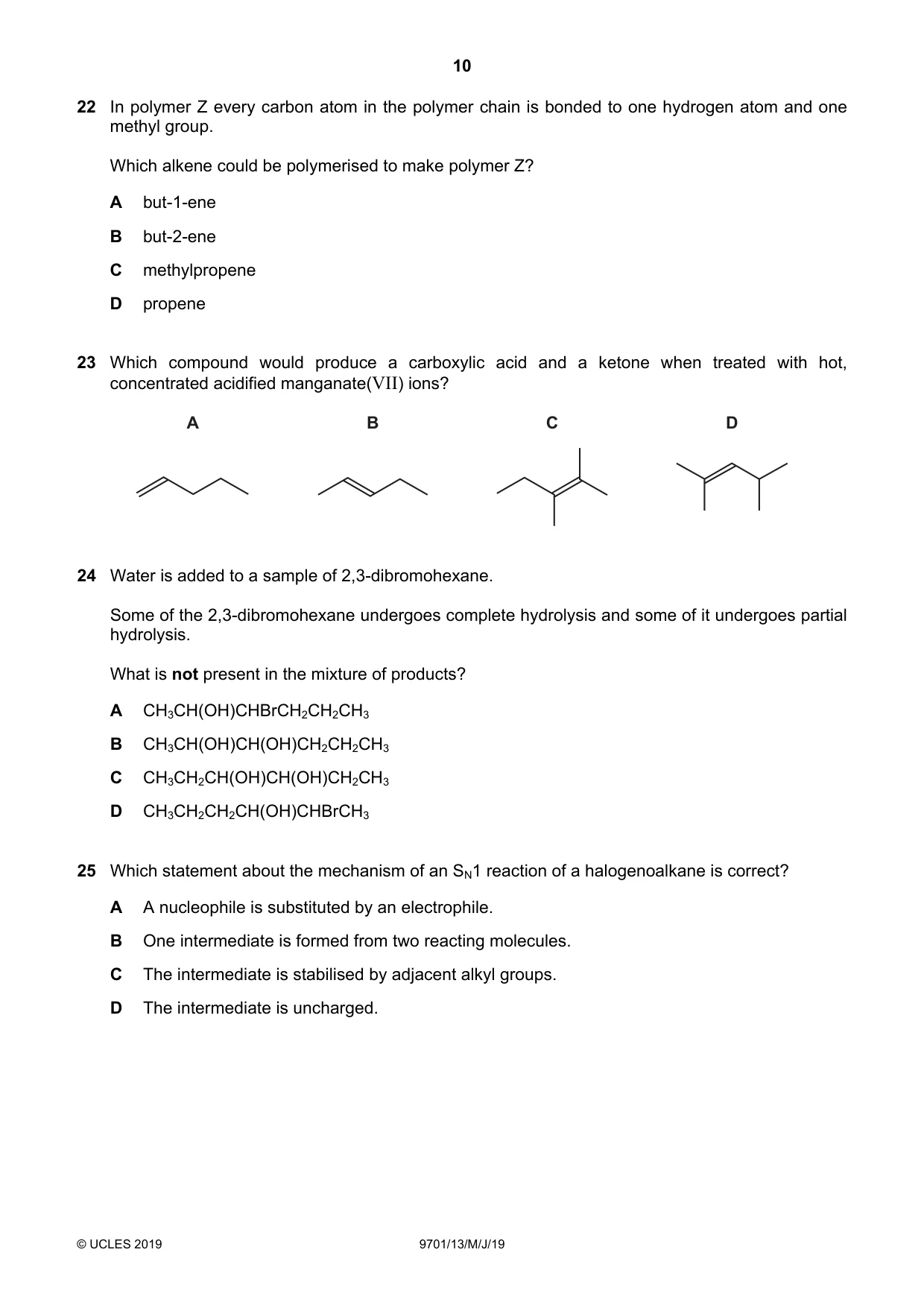
Q22 · In polymer Z every carbon atom in the polymer chain is bonded to one hydrogen atom and…
22 In polymer Z every carbon atom in the polymer chain is bonded to one hydrogen atom and one methyl group. Which alkene could be polymerised to make polymer Z? A but-1-ene B but-2-ene C methylpropene D propene
Mark scheme: B
Q23 · Which compound would produce a carboxylic acid and a ketone when treated with hot…
23 Which compound would produce a carboxylic acid and a ketone when treated with hot, concentrated acidified manganate(VII) ions? A B C D
Mark scheme: D
Q24 · Water is added to a sample of 2,3-dibromohexane
24 Water is added to a sample of 2,3-dibromohexane. Some of the 2,3-dibromohexane undergoes complete hydrolysis and some of it undergoes partial hydrolysis. What is not present in the mixture of products? A CH3CH(OH)CHBrCH2CH2CH3 B CH3CH(OH)CH(OH)CH2CH2CH3 C CH3CH2CH(OH)CH(OH)CH2CH3 D CH3CH2CH2CH(OH)CHBrCH3
Mark scheme: C
Q25 · Which statement about the mechanism of an SN1 reaction of a halogenoalkane is correct?
25 Which statement about the mechanism of an SN1 reaction of a halogenoalkane is correct? A A nucleophile is substituted by an electrophile. B One intermediate is formed from two reacting molecules. C The intermediate is stabilised by adjacent alkyl groups. D The intermediate is uncharged.
Mark scheme: C
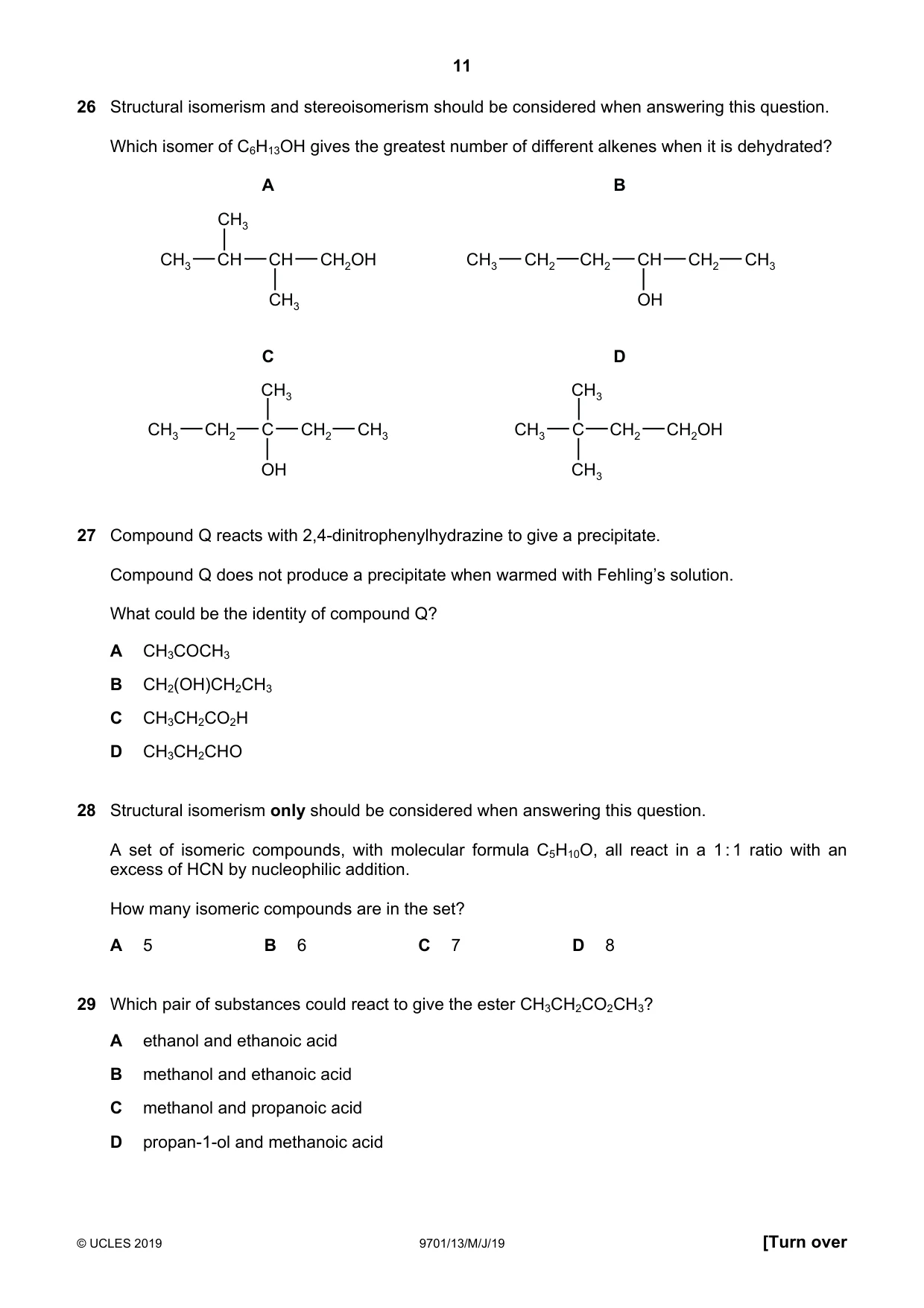
Q26 · Structural isomerism and stereoisomerism should be considered when answering this question
26 Structural isomerism and stereoisomerism should be considered when answering this question. Which isomer of C6H13OH gives the greatest number of different alkenes when it is dehydrated? A B CH3 CH3 CH CH CH2OH CH3 CH2 CH2 CH CH2 CH3 CH3 OH C D CH3 CH3 CH3 CH2 C CH2 CH3 CH3 C CH2 CH2OH OH CH3
Mark scheme: B
Q27 · Compound Q reacts with 2,4-dinitrophenylhydrazine to give a precipitate
27 Compound Q reacts with 2,4-dinitrophenylhydrazine to give a precipitate. Compound Q does not produce a precipitate when warmed with Fehling’s solution. What could be the identity of compound Q? A CH3COCH3 B CH2(OH)CH2CH3 C CH3CH2CO2H D CH3CH2CHO
Mark scheme: A
Q28 · Structural isomerism only should be considered when answering this question
28 Structural isomerism only should be considered when answering this question. A set of isomeric compounds, with molecular formula C5H10O, all react in a 1 : 1 ratio with an excess of HCN by nucleophilic addition. How many isomeric compounds are in the set? A 5 B 6 C 7 D 8
Mark scheme: C
Q29 · Which pair of substances could react to give the ester CH3CH2CO2CH3?
29 Which pair of substances could react to give the ester CH3CH2CO2CH3? A ethanol and ethanoic acid B methanol and ethanoic acid C methanol and propanoic acid D propan-1-ol and methanoic acid
Mark scheme: C
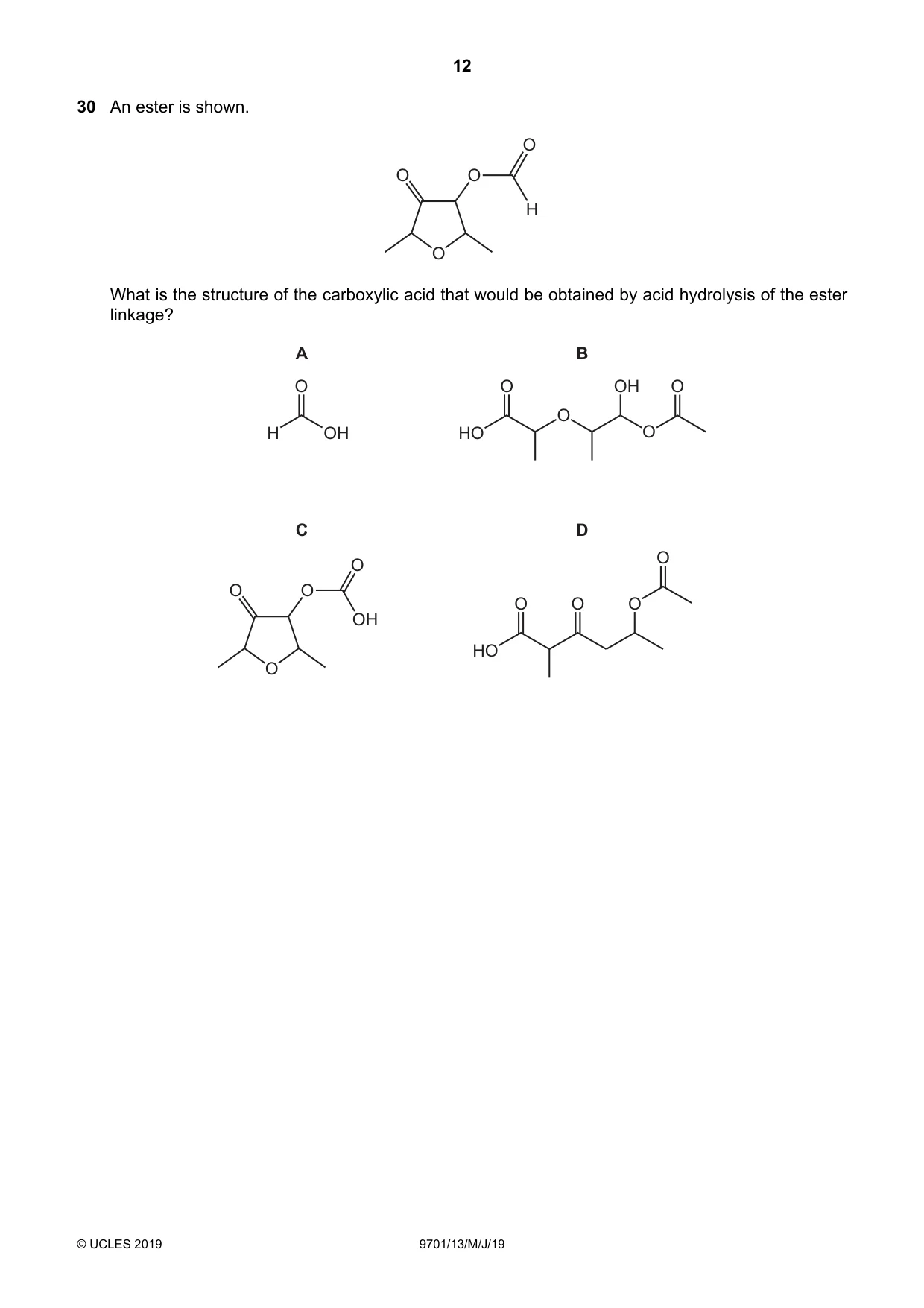
Q30 · An ester is shown
30 An ester is shown. O O O H O What is the structure of the carboxylic acid that would be obtained by acid hydrolysis of the ester linkage? A B O O OH O O H OH HO O C D O O O O O O O OH HO O
Mark scheme: A
Q31 · Which deductions about the 209 Bi atom are correct?
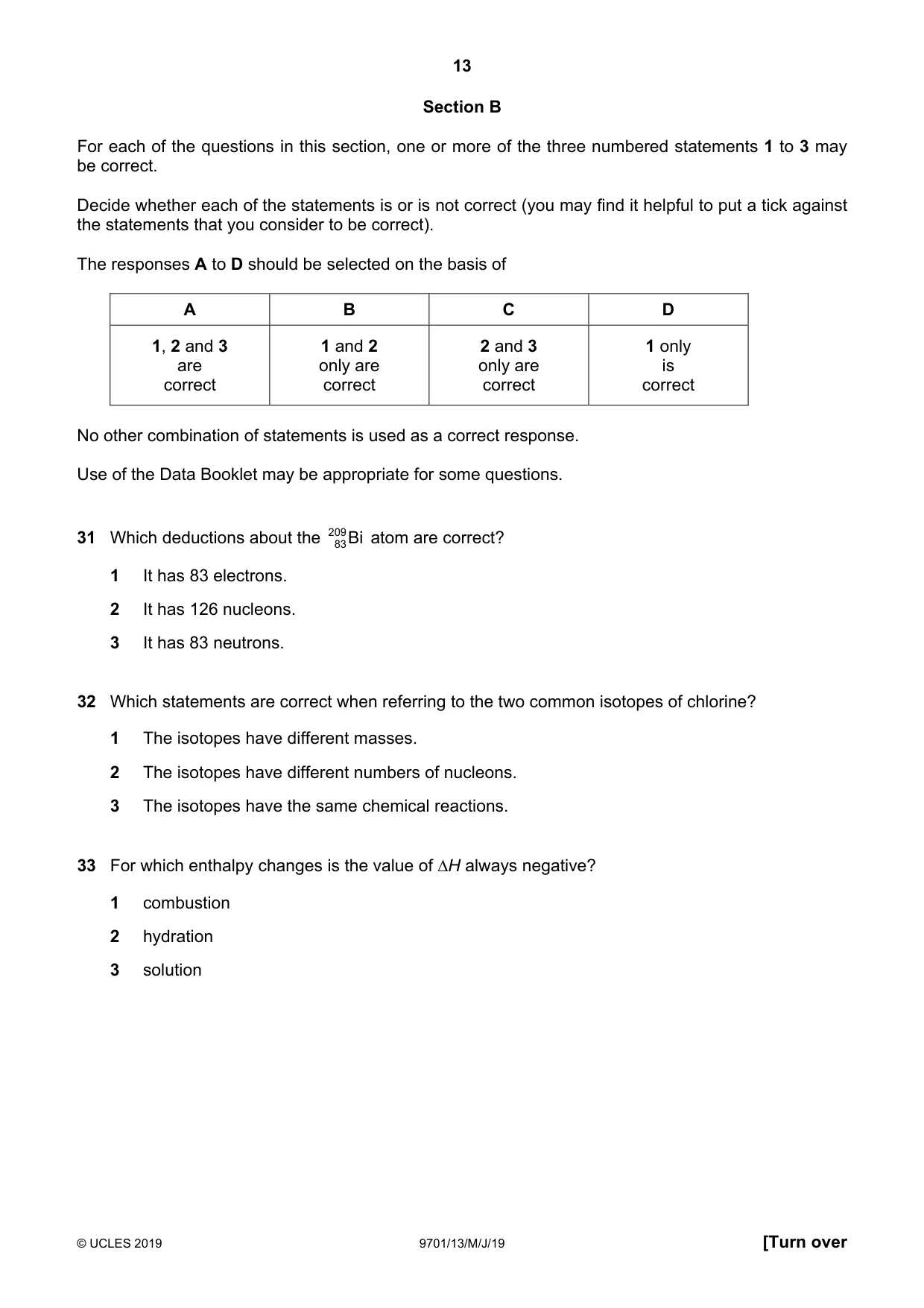
31 Which deductions about the 209 Bi atom are correct? 83 1 It has 83 electrons. 2 It has 126 nucleons. 3 It has 83 neutrons.
Mark scheme: D
Q32 · Which statements are correct when referring to the two common isotopes of chlorine?
32 Which statements are correct when referring to the two common isotopes of chlorine? 1 The isotopes have different masses. 2 The isotopes have different numbers of nucleons. 3 The isotopes have the same chemical reactions.
Mark scheme: A
Q33 · For which enthalpy changes is the value of ∆H always negative?
33 For which enthalpy changes is the value of ∆H always negative? 1 combustion 2 hydration 3 solution
Mark scheme: B
Q34 · The diagram shows the Boltzmann distribution of molecular energies in one mole of a gas…
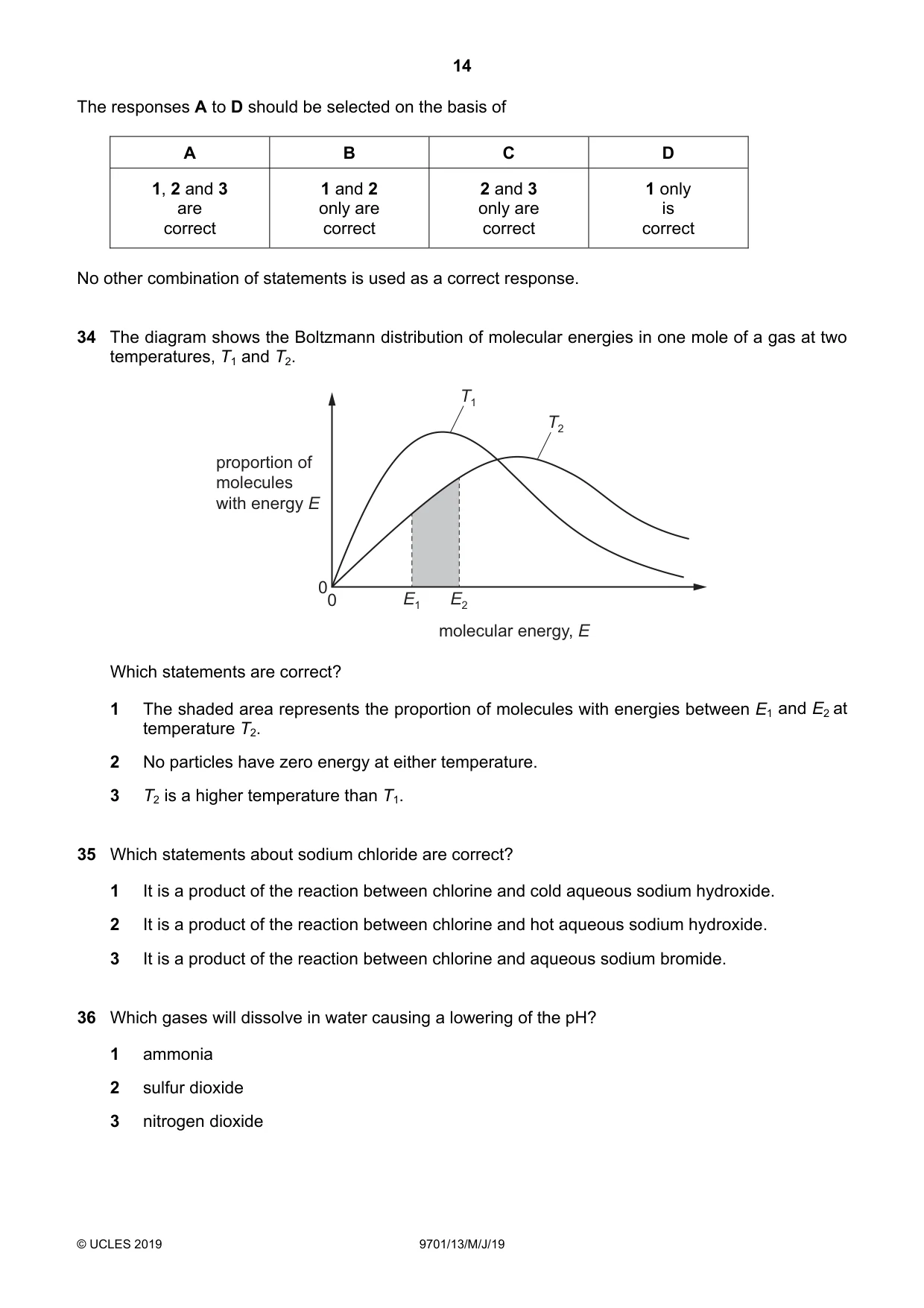
34 The diagram shows the Boltzmann distribution of molecular energies in one mole of a gas at two temperatures, T1 and T2. T1 T2 proportion of molecules with energy E 00 E1 E2 molecular energy, E Which statements are correct? 1 The shaded area represents the proportion of molecules with energies between E1 and E2 at temperature T2. 2 No particles have zero energy at either temperature. 3 T2 is a higher temperature than T1.
Mark scheme: A
More questions on Effect of temperature on reaction rates and the concept of activation energy
Q35 · Which statements about sodium chloride are correct?
35 Which statements about sodium chloride are correct? 1 It is a product of the reaction between chlorine and cold aqueous sodium hydroxide. 2 It is a product of the reaction between chlorine and hot aqueous sodium hydroxide. 3 It is a product of the reaction between chlorine and aqueous sodium bromide.
Mark scheme: A
Q36 · Which gases will dissolve in water causing a lowering of the pH?
36 Which gases will dissolve in water causing a lowering of the pH? 1 ammonia 2 sulfur dioxide 3 nitrogen dioxide
Mark scheme: C
Q37 · Which compounds have optical isomers?
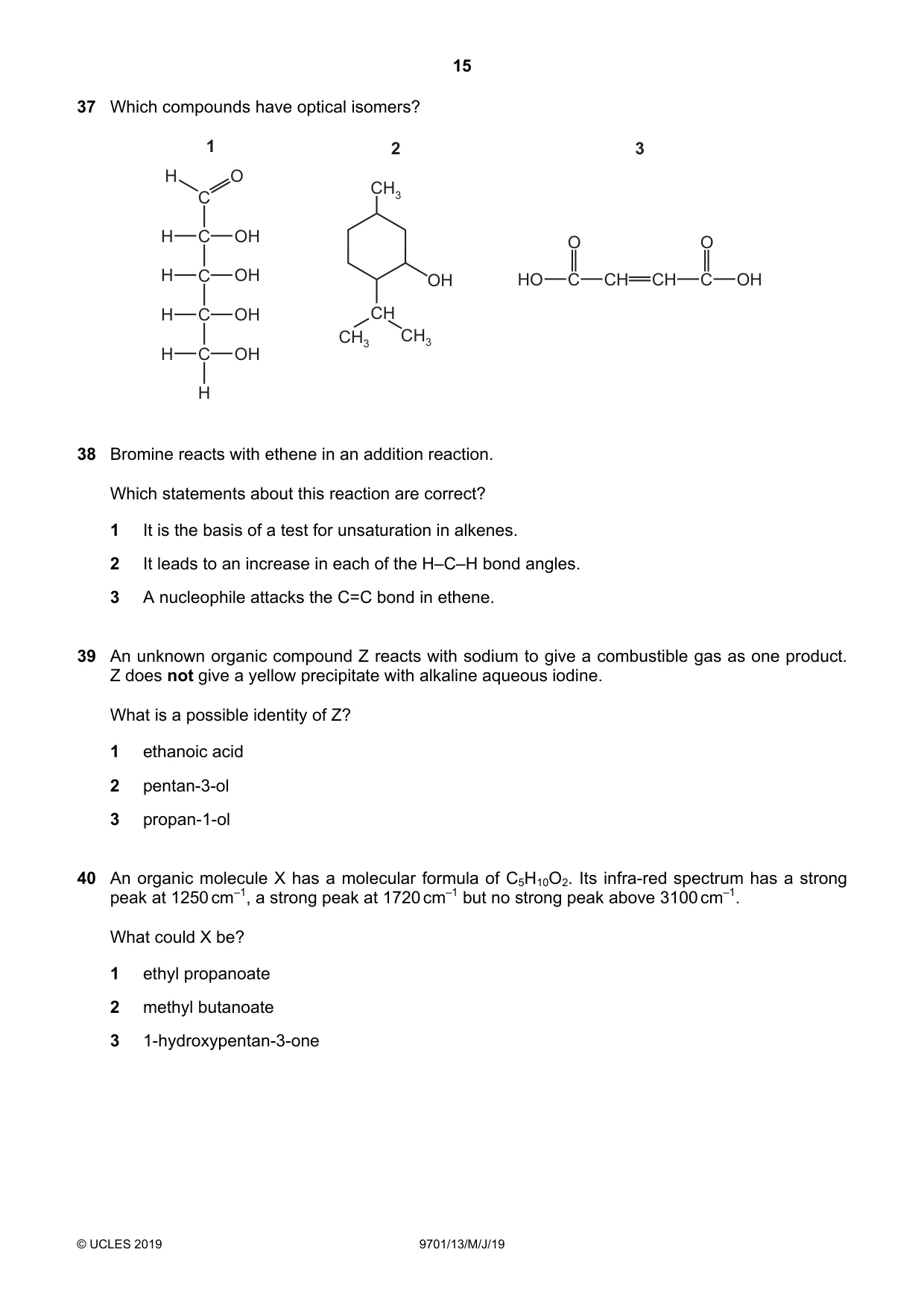
37 Which compounds have optical isomers? 1 2 3 H O CH3 C H C OH O O H C OH OH HO C CH CH C OH H C OH CH CH3 CH3 H C OH H
Mark scheme: B
Q38 · Bromine reacts with ethene in an addition reaction
38 Bromine reacts with ethene in an addition reaction. Which statements about this reaction are correct? 1 It is the basis of a test for unsaturation in alkenes. 2 It leads to an increase in each of the H–C–H bond angles. 3 A nucleophile attacks the C=C bond in ethene.
Mark scheme: D
Q39 · An unknown organic compound Z reacts with sodium to give a combustible gas as one product
39 An unknown organic compound Z reacts with sodium to give a combustible gas as one product. Z does not give a yellow precipitate with alkaline aqueous iodine. What is a possible identity of Z? 1 ethanoic acid 2 pentan-3-ol 3 propan-1-ol
Mark scheme: A
Q40 · An organic molecule X has a molecular formula of C5H10O2
40 An organic molecule X has a molecular formula of C5H10O2. Its infra-red spectrum has a strong peak at 1250 cm–1, a strong peak at 1720 cm–1 but no strong peak above 3100 cm–1. What could X be? 1 ethyl propanoate 2 methyl butanoate 3 1-hydroxypentan-3-one
Mark scheme: B
What was in this paper
The subtopics covered by these 40 questions, and how many questions each got. Open one in a new tab to see every Cambridge question on it.
3Halogenoalkanes3Chemical equilibria: reversible reactions, dynamic equilibrium2Enthalpy change, ΔH2Esters2Reacting masses and volumes (of solutions and gases)2Redox processes: electron transfer and changes in oxidation number (oxidation state)2Similarities and trends in the properties of the Group 2 metals, magnesium to barium, and their compounds2Alcohols1Alcohols1Aldehydes and ketones1Bonding and structure1Effect of temperature on reaction rates and the concept of activation energy1Electronegativity and bonding1Electrons, energy levels and atomic orbitals1Formulas1Infrared spectroscopy1Intermolecular forces, electronegativity and bond properties1Isomerism: optical1Isotopes1Mass spectrometry1Nitriles and hydroxynitriles1Nitrogen and sulfur1Particles in the atom and atomic radius1Periodicity of physical properties of the elements in Period 31Rate of reaction1Shapes of molecules1The chemical properties of the halogen elements and the hydrogen halides1The gaseous state: ideal and real gases and pV = nRT1The reactions of chlorine1What you needed in this session
Cambridge’s own grade thresholds for 2019 May/June, Paper 1 · Variant 3. A higher threshold means an easier paper — the bar moves with how the cohort did.