Cambridge A Level Chemistry 9701 — 2025 May/June Paper 1 · Variant 4
9701/14/M/J/25 · 40 questions · 40 marks · 75 min
The question paper and its mark scheme, free to read here and free to download. This is Cambridge’s own paper, exactly as it was sat.
Question paper20 pages



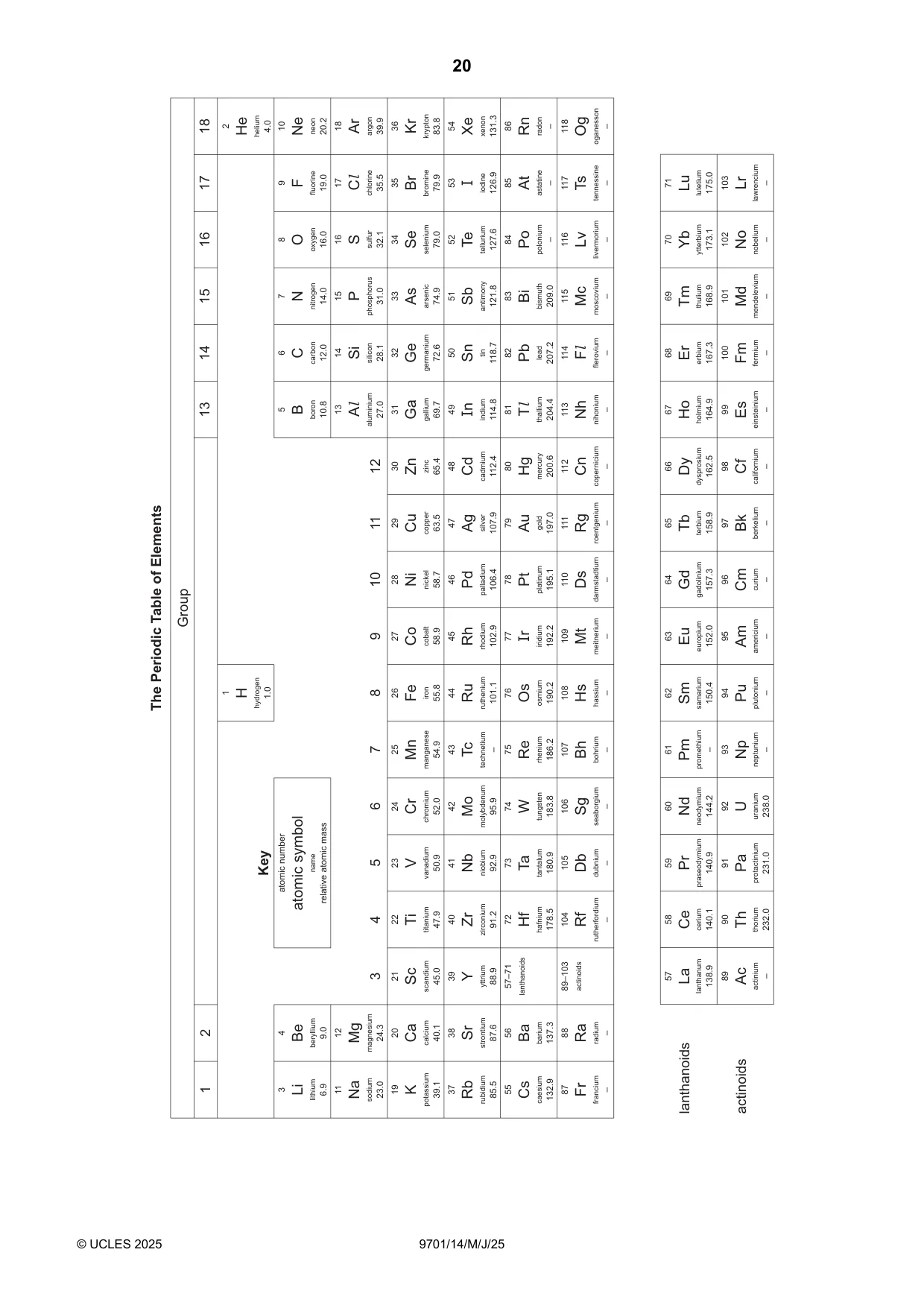
Mark scheme3 pages
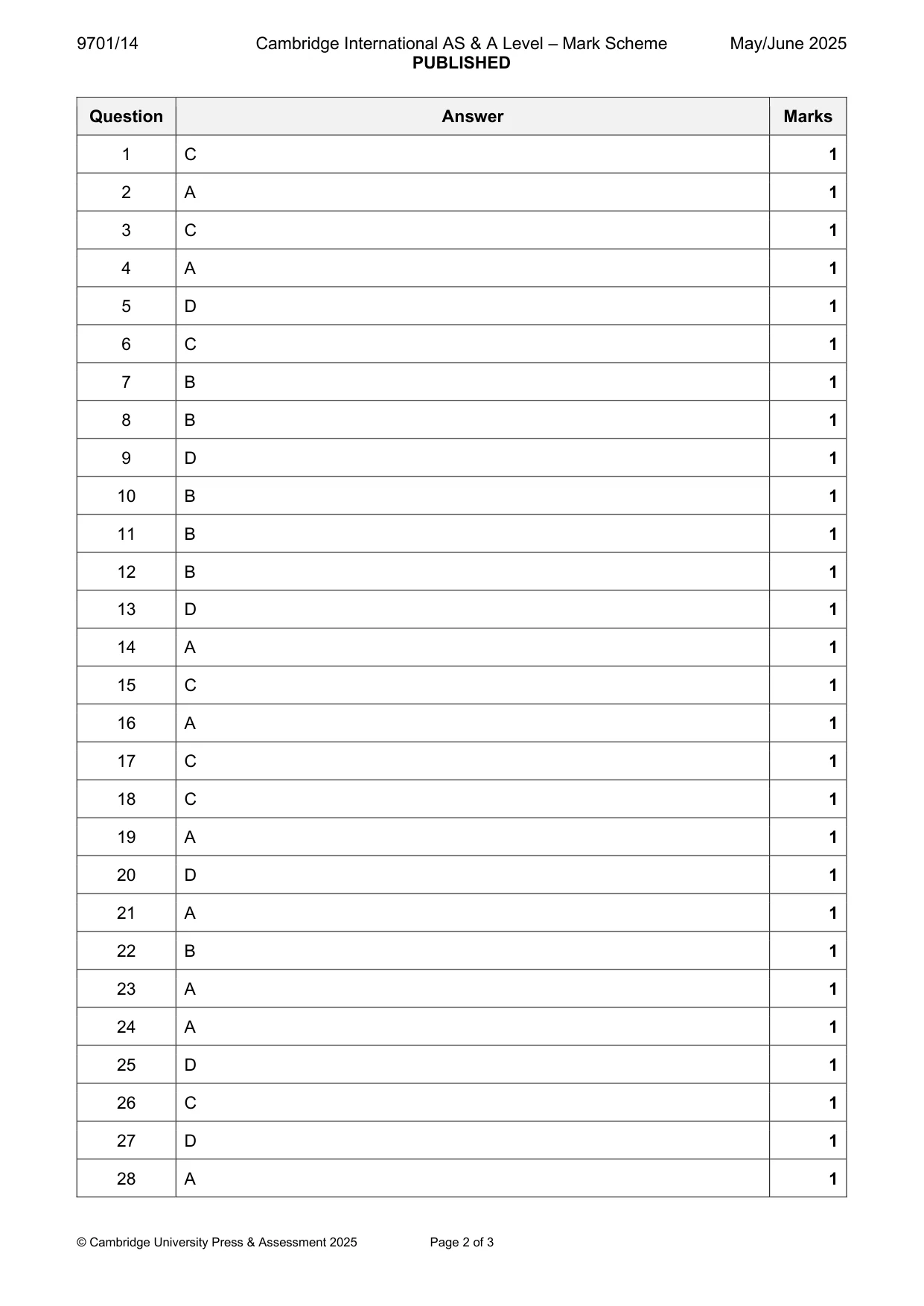
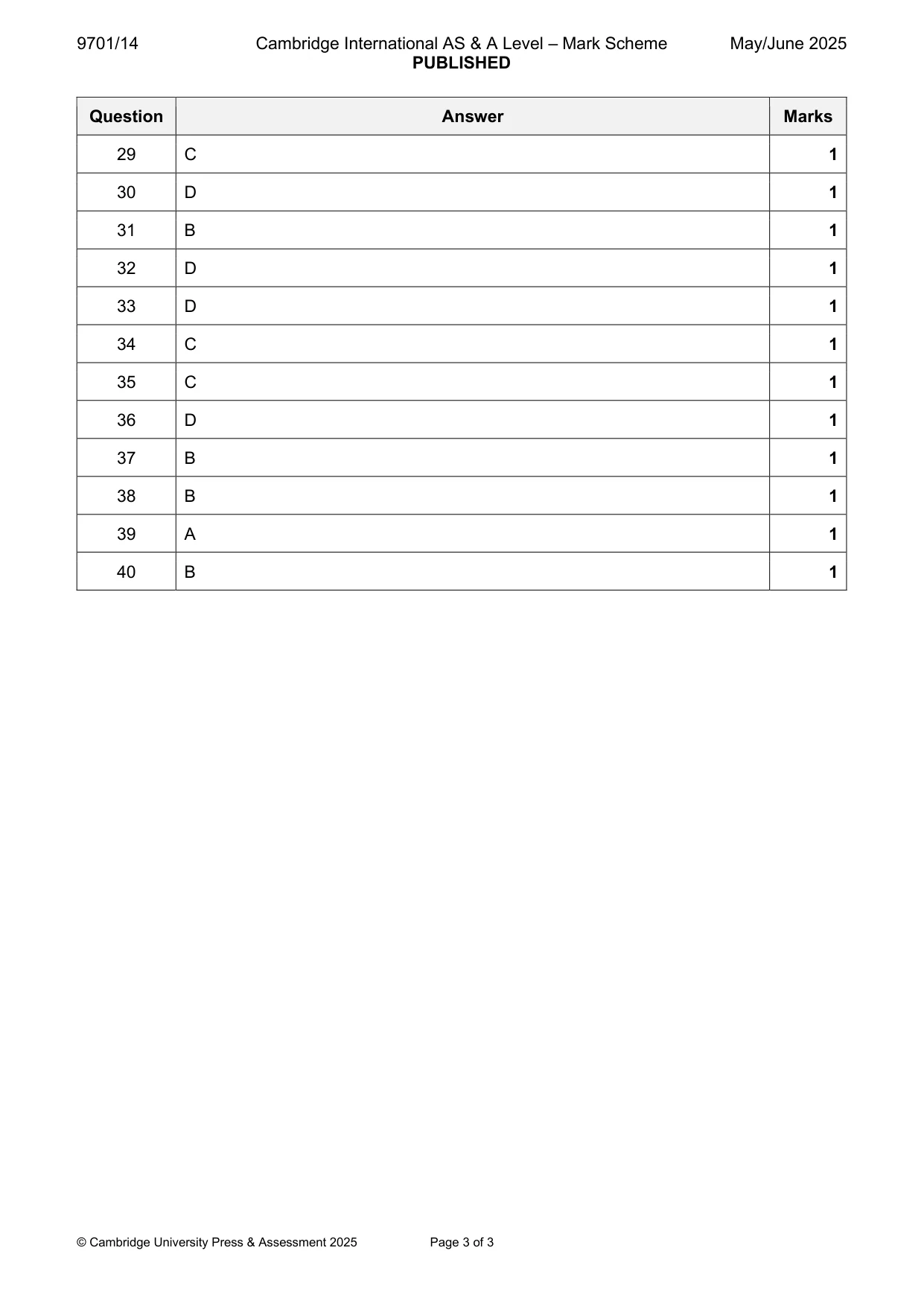
Answers below. Sit the paper first if you are practising.
Questions as text
Q1 · The diagram shows the logarithm of the first 13 ionisation energies of an element
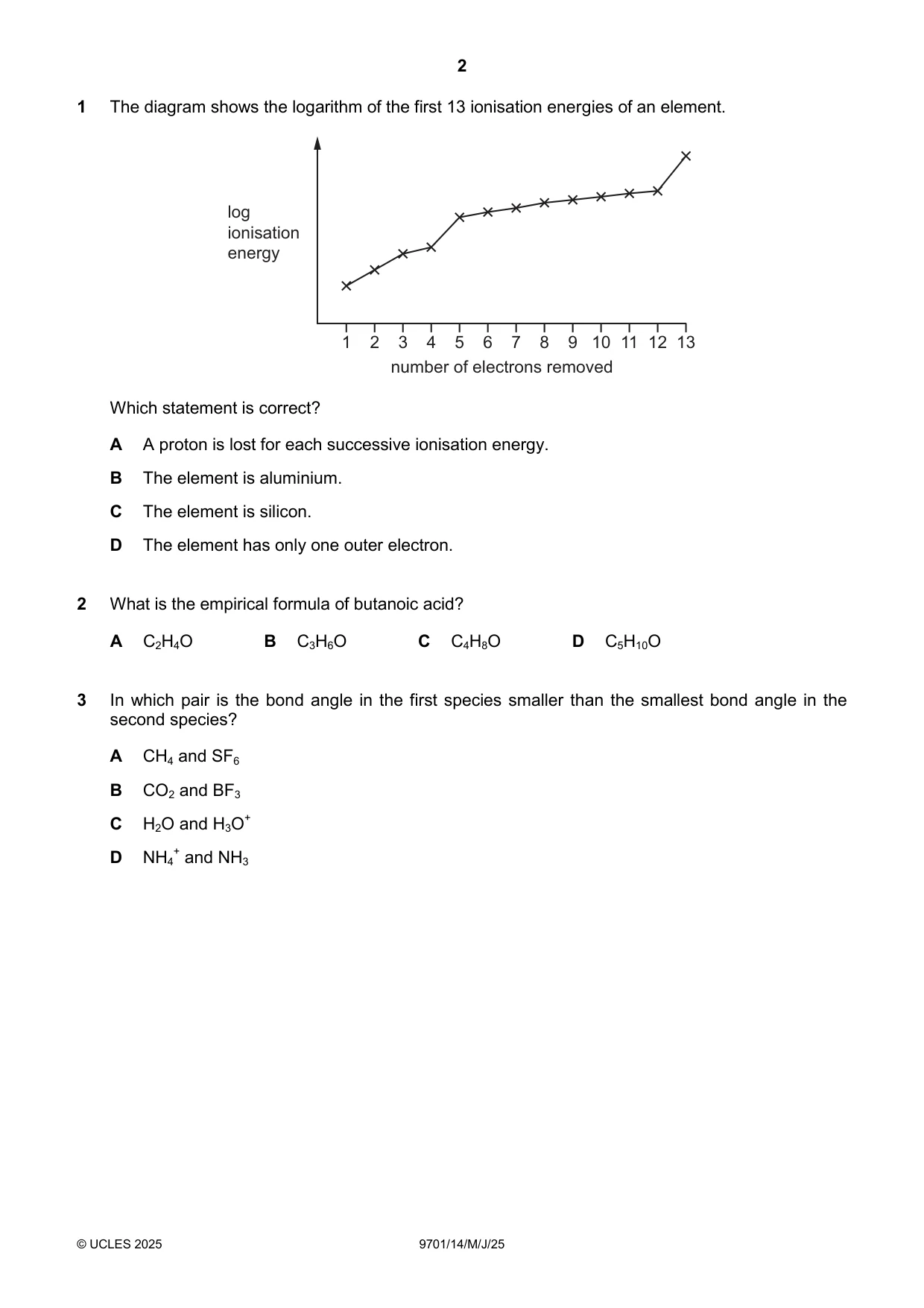
1 The diagram shows the logarithm of the first 13 ionisation energies of an element. log ionisation energy 1 2 3 4 5 6 7 8 9 10 11 12 13 number of electrons removed Which statement is correct? A A proton is lost for each successive ionisation energy. B The element is aluminium. C The element is silicon. D The element has only one outer electron.
Mark scheme: C
Q2 · What is the empirical formula of butanoic acid?
2 What is the empirical formula of butanoic acid? A C2H4O B C3H6O C C4H8O D C5H10O
Mark scheme: A
Q3 · In which pair is the bond angle in the first species smaller than the smallest bond angle…
3 In which pair is the bond angle in the first species smaller than the smallest bond angle in the second species? A CH4 and SF6 B CO2 and BF3 C H2O and H3O+ D NH4 + and NH3
Mark scheme: C
Q4 · Two glass vessels, M and N, are connected by a closed valve
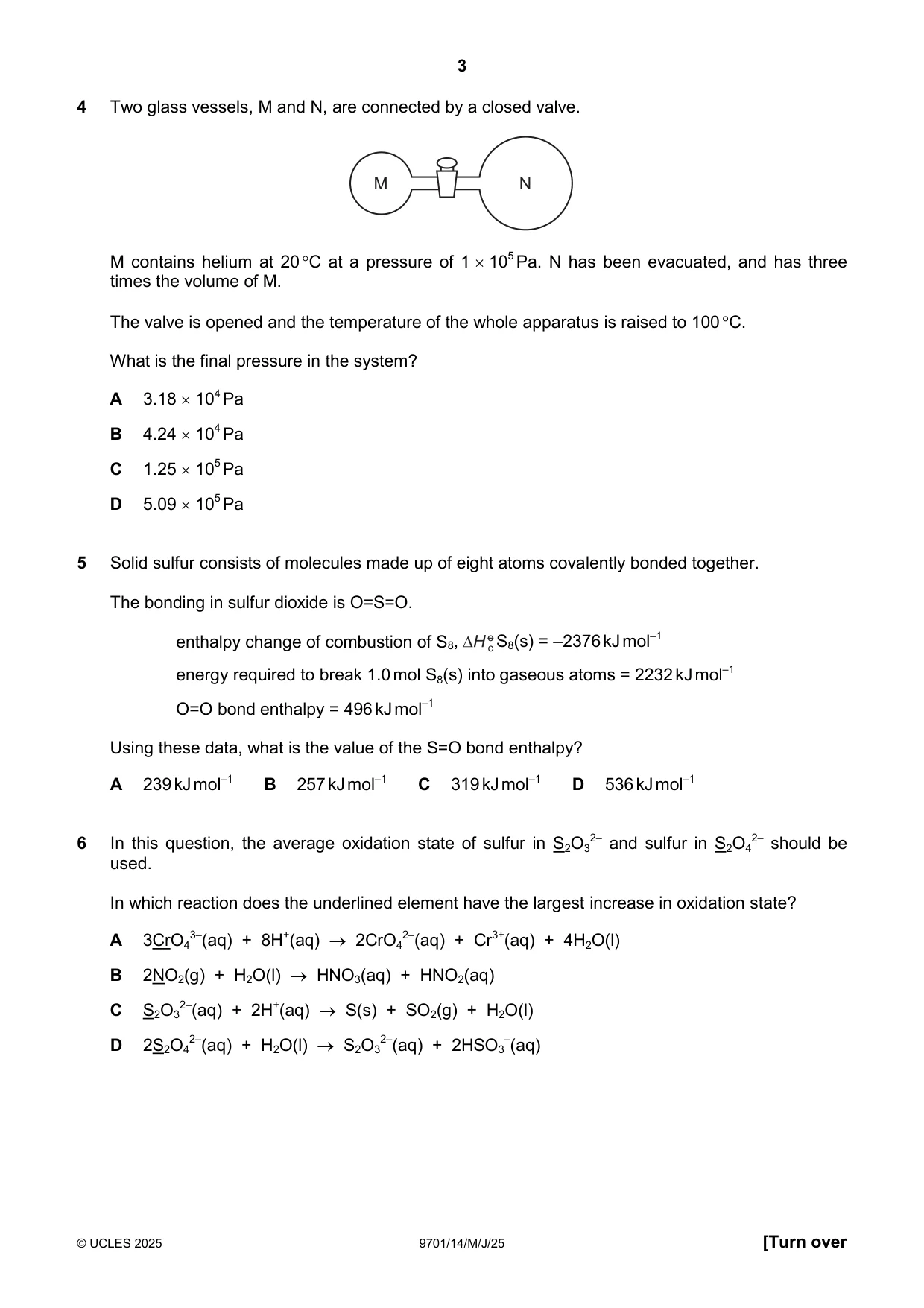
4 Two glass vessels, M and N, are connected by a closed valve. M N M contains helium at 20 C at a pressure of 1 105 Pa. N has been evacuated, and has three times the volume of M. The valve is opened and the temperature of the whole apparatus is raised to 100 C. What is the final pressure in the system? A 3.18 104 Pa B 4.24 104 Pa C 1.25 105 Pa D 5.09 105 Pa
Mark scheme: A
More questions on The gaseous state: ideal and real gases and pV = nRT
Q5 · Solid sulfur consists of molecules made up of eight atoms covalently bonded together
5 Solid sulfur consists of molecules made up of eight atoms covalently bonded together. The bonding in sulfur dioxide is O=S=O. enthalpy change of combustion of S8, S8(s) = –2376 kJ mol–1 energy required to break 1.0 mol S8(s) into gaseous atoms = 2232 kJ mol–1 O=O bond enthalpy = 496 kJ mol–1 Using these data, what is the value of the S=O bond enthalpy? A 239 kJ mol–1 B 257 kJ mol–1 C 319 kJ mol–1 D 536 kJ mol–1
Mark scheme: D
Q6 · In this question, the average oxidation state of sulfur in S2O3 2– and sulfur in S2O4 2…
6 In this question, the average oxidation state of sulfur in S2O3 2– and sulfur in S2O4 2– should be used. In which reaction does the underlined element have the largest increase in oxidation state? A 3CrO4 3–(aq) + 8H+(aq) 2CrO4 2–(aq) + Cr3+(aq) + 4H2O(l) B 2NO2(g) + H2O(l) HNO3(aq) + HNO2(aq) C S2O3 2–(aq) + 2H+(aq) S(s) + SO2(g) + H2O(l) D 2S2O4 2–(aq) + H2O(l) S2O3 2–(aq) + 2HSO3 –(aq)
Mark scheme: C
Q7 · Methanol, CH3OH, is made industrially from carbon monoxide and hydrogen in the…
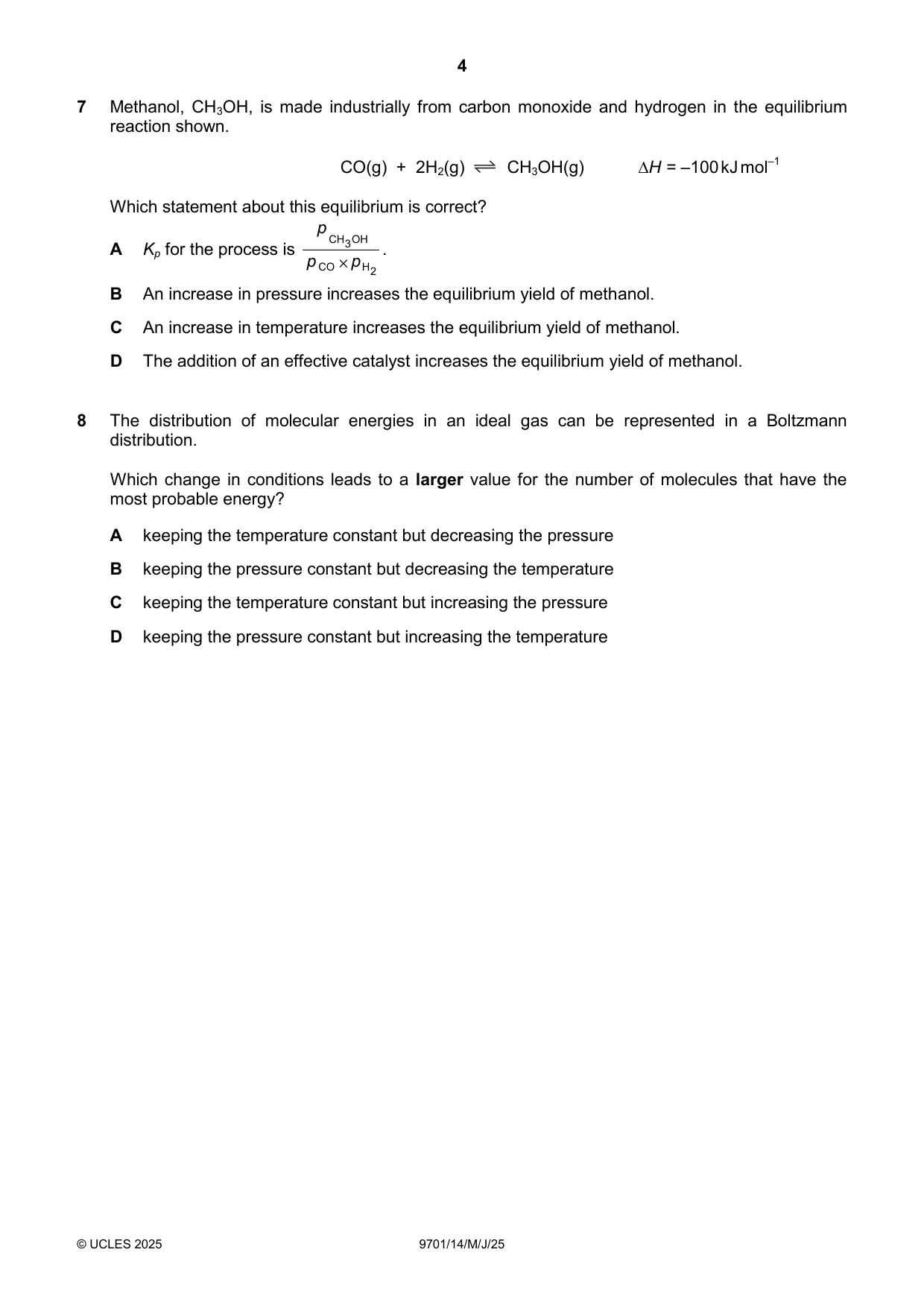
7 Methanol, CH3OH, is made industrially from carbon monoxide and hydrogen in the equilibrium reaction shown. CO(g) + 2H2(g) CH3OH(g) H = –100 kJ mol–1 Which statement about this equilibrium is correct? p A Kp for the process is CH 3 OH . p p CO H 2 B An increase in pressure increases the equilibrium yield of methanol. C An increase in temperature increases the equilibrium yield of methanol. D The addition of an effective catalyst increases the equilibrium yield of methanol.
Mark scheme: B
More questions on Chemical equilibria: reversible reactions, dynamic equilibrium
Q8 · The distribution of molecular energies in an ideal gas can be represented in a Boltzmann…
8 The distribution of molecular energies in an ideal gas can be represented in a Boltzmann distribution. Which change in conditions leads to a larger value for the number of molecules that have the most probable energy? A keeping the temperature constant but decreasing the pressure B keeping the pressure constant but decreasing the temperature C keeping the temperature constant but increasing the pressure D keeping the pressure constant but increasing the temperature
Mark scheme: B
More questions on Effect of temperature on reaction rates and the concept of activation energy
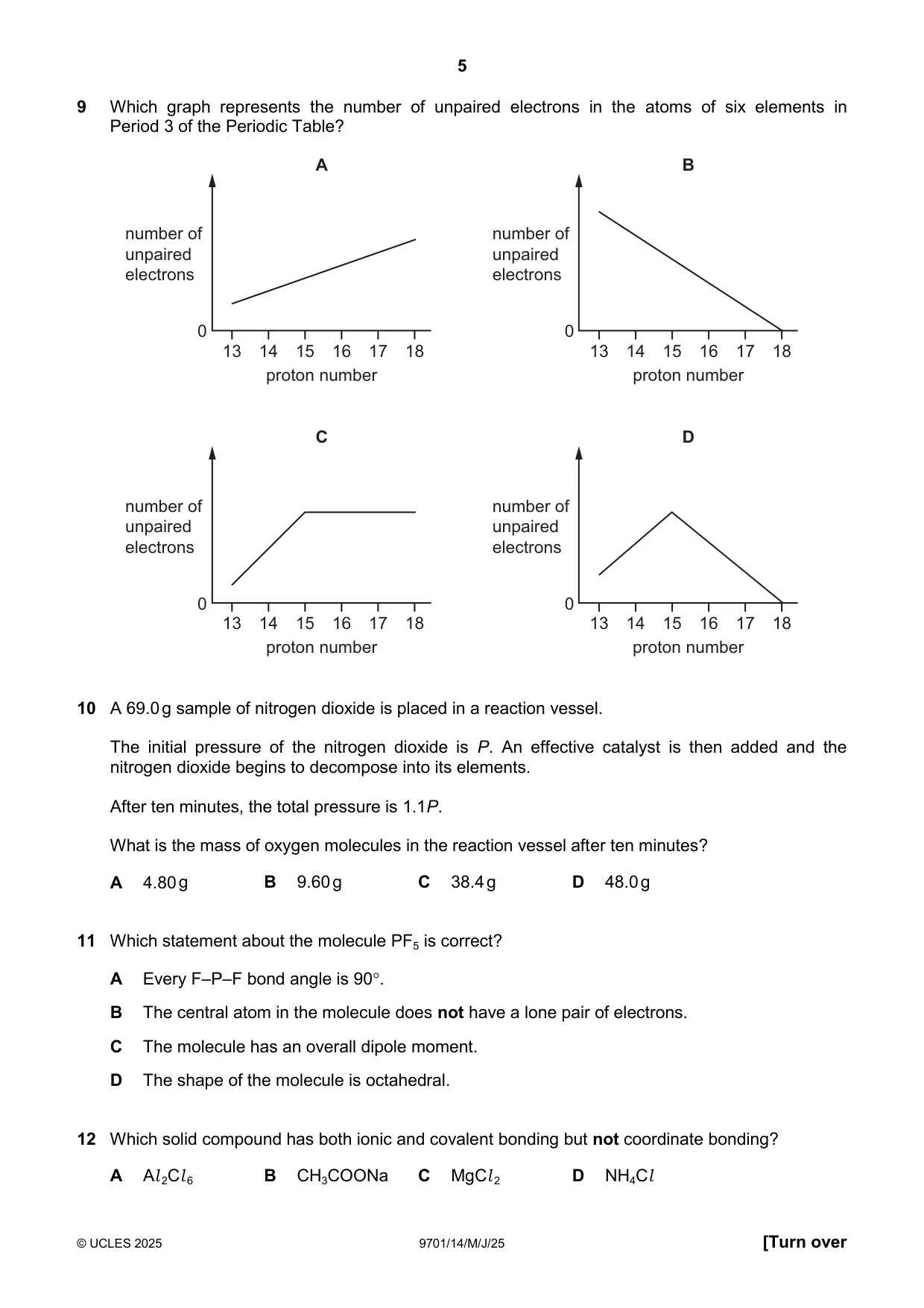
Q9 · Which graph represents the number of unpaired electrons in the atoms of six elements in…
9 Which graph represents the number of unpaired electrons in the atoms of six elements in Period 3 of the Periodic Table? A B number of number of unpaired unpaired electrons electrons 0 0 13 14 15 16 17 18 13 14 15 16 17 18 proton number proton number C D number of number of unpaired unpaired electrons electrons 0 0 13 14 15 16 17 18 13 14 15 16 17 18 proton number proton number
Mark scheme: D
More questions on Electrons, energy levels and atomic orbitals
Q10 · A 69.0 g sample of nitrogen dioxide is placed in a reaction vessel
10 A 69.0 g sample of nitrogen dioxide is placed in a reaction vessel. The initial pressure of the nitrogen dioxide is P. An effective catalyst is then added and the nitrogen dioxide begins to decompose into its elements. After ten minutes, the total pressure is 1.1P. What is the mass of oxygen molecules in the reaction vessel after ten minutes? A 4.80 g B 9.60 g C 38.4 g D 48.0 g
Mark scheme: B
More questions on Reacting masses and volumes (of solutions and gases)
Q11 · Which statement about the molecule PF5 is correct?
11 Which statement about the molecule PF5 is correct? A Every F–P–F bond angle is 90. B The central atom in the molecule does not have a lone pair of electrons. C The molecule has an overall dipole moment. D The shape of the molecule is octahedral.
Mark scheme: B
Q12 · Which solid compound has both ionic and covalent bonding but not coordinate bonding?
12 Which solid compound has both ionic and covalent bonding but not coordinate bonding? A Al 2Cl 6 B CH3COONa C MgCl 2 D NH4Cl
Mark scheme: B
More questions on Covalent bonding and coordinate (dative covalent) bonding
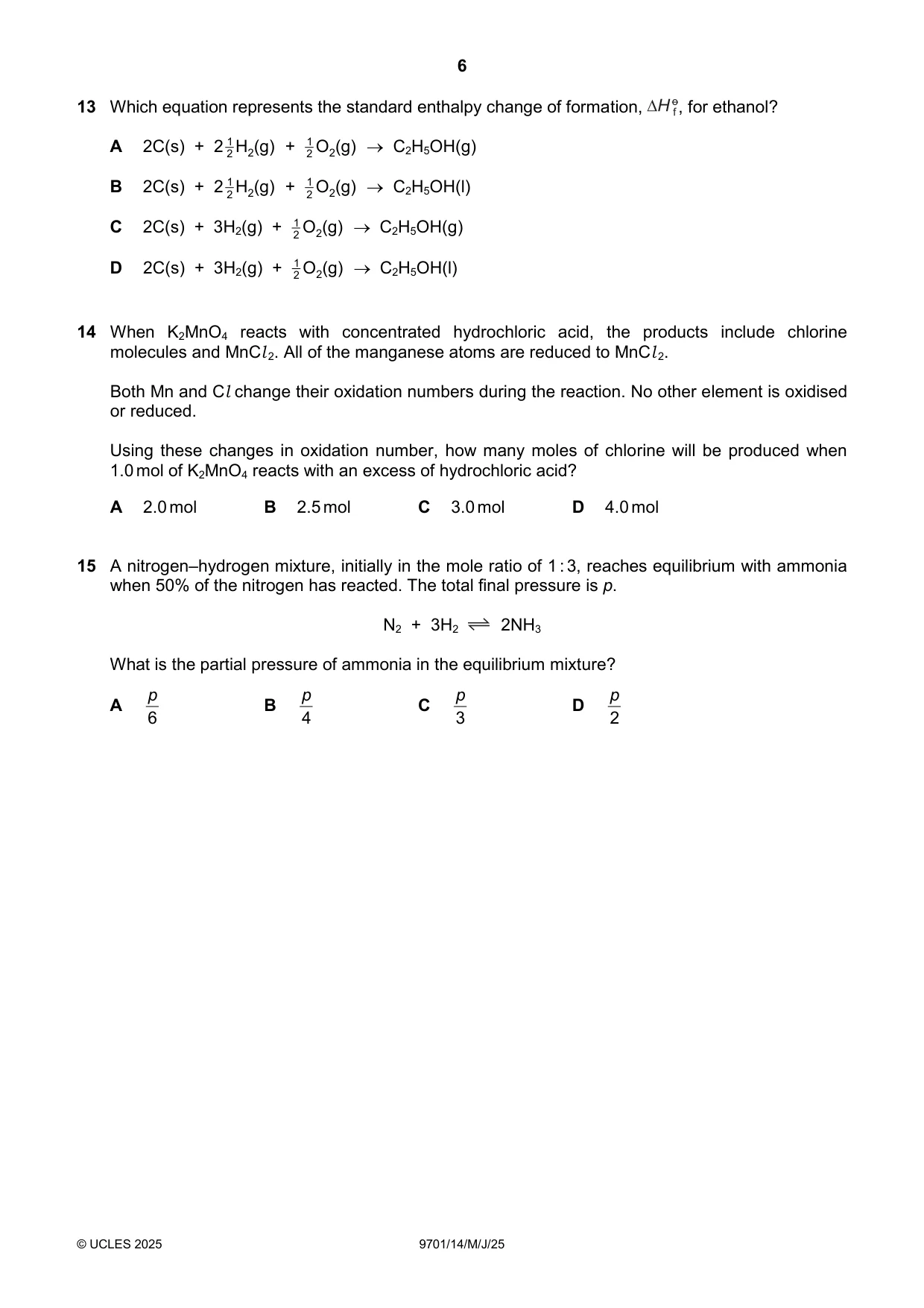
Q13 · Which equation represents the standard enthalpy change of formation, , for ethanol?
13 Which equation represents the standard enthalpy change of formation, , for ethanol? A 2C(s) + 2 1 H (g) + 1 O2 (g) C2H5OH(g) 2 2 2 B 2C(s) + 2 1 H (g) + 1 O2 (g) C2H5OH(l) 2 2 2 C 2C(s) + 3H2(g) + 1 O2 (g) C2H5OH(g) 2 D 2C(s) + 3H2(g) + 1 O2 (g) C2H5OH(l) 2
Mark scheme: D
Q14 · When K2MnO4 reacts with concentrated hydrochloric acid, the products include chlorine…
14 When K2MnO4 reacts with concentrated hydrochloric acid, the products include chlorine molecules and MnCl 2. All of the manganese atoms are reduced to MnCl 2. Both Mn and Cl change their oxidation numbers during the reaction. No other element is oxidised or reduced. Using these changes in oxidation number, how many moles of chlorine will be produced when 1.0 mol of K2MnO4 reacts with an excess of hydrochloric acid? A 2.0 mol B 2.5 mol C 3.0 mol D 4.0 mol
Mark scheme: A
Q15 · A nitrogen–hydrogen mixture, initially in the mole ratio of 1 : 3, reaches equilibrium…
15 A nitrogen–hydrogen mixture, initially in the mole ratio of 1 : 3, reaches equilibrium with ammonia when 50% of the nitrogen has reacted. The total final pressure is p. N2 + 3H2 2NH3 What is the partial pressure of ammonia in the equilibrium mixture? p p p p A B C D 6 4 3 2
Mark scheme: C
More questions on Chemical equilibria: reversible reactions, dynamic equilibrium
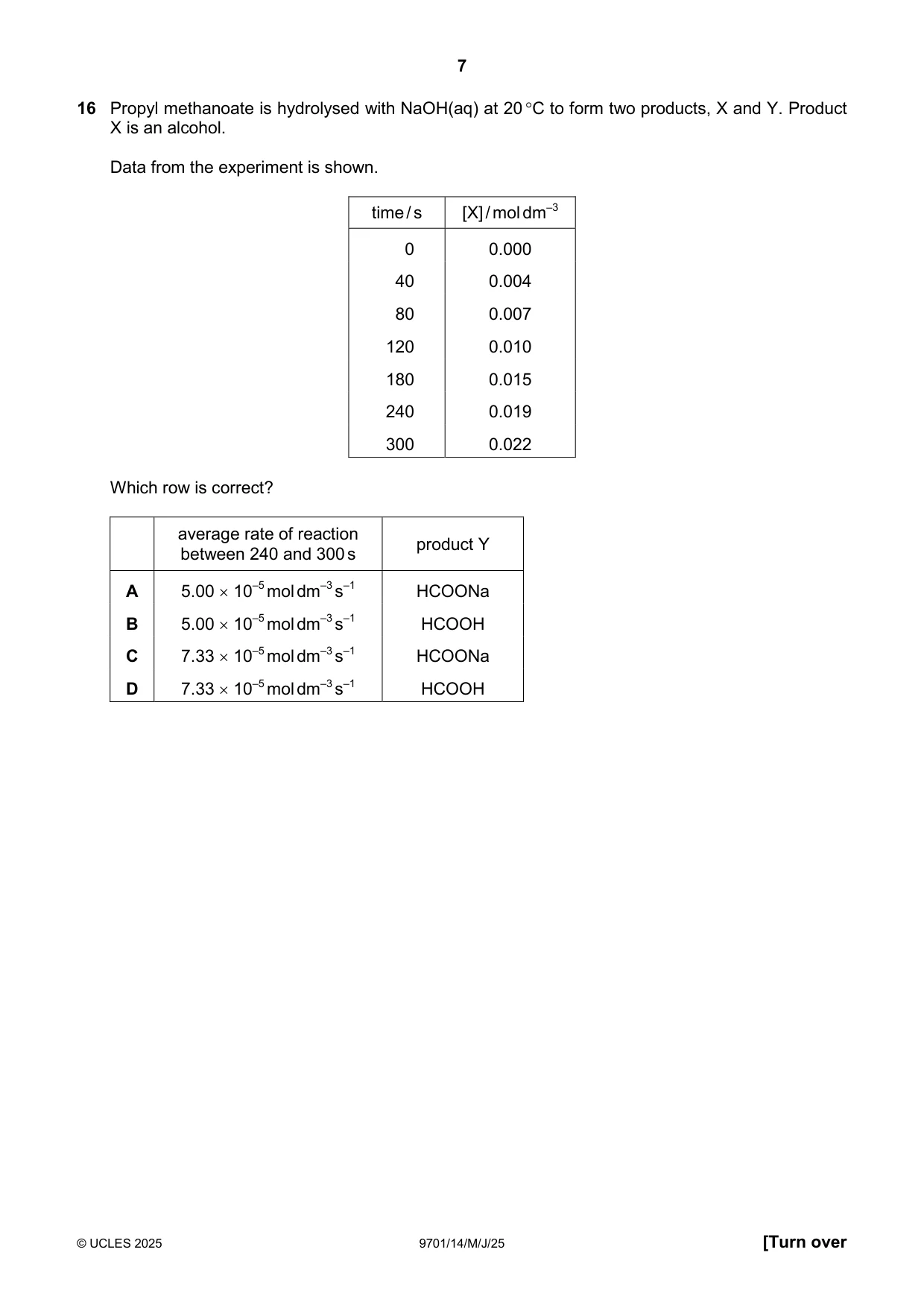
Q16 · Propyl methanoate is hydrolysed with NaOH(aq) at 20 C to form two products, X and Y
16 Propyl methanoate is hydrolysed with NaOH(aq) at 20 C to form two products, X and Y. Product X is an alcohol. Data from the experiment is shown. time / s [X] / mol dm–3 0 0.000 40 0.004 80 0.007 120 0.010 180 0.015 240 0.019 300 0.022 Which row is correct? average rate of reaction product Y between 240 and 300 s A 5.00 10–5 mol dm–3 s–1 HCOONa B 5.00 10–5 mol dm–3 s–1 HCOOH C 7.33 10–5 mol dm–3 s–1 HCOONa D 7.33 10–5 mol dm–3 s–1 HCOOH
Mark scheme: A
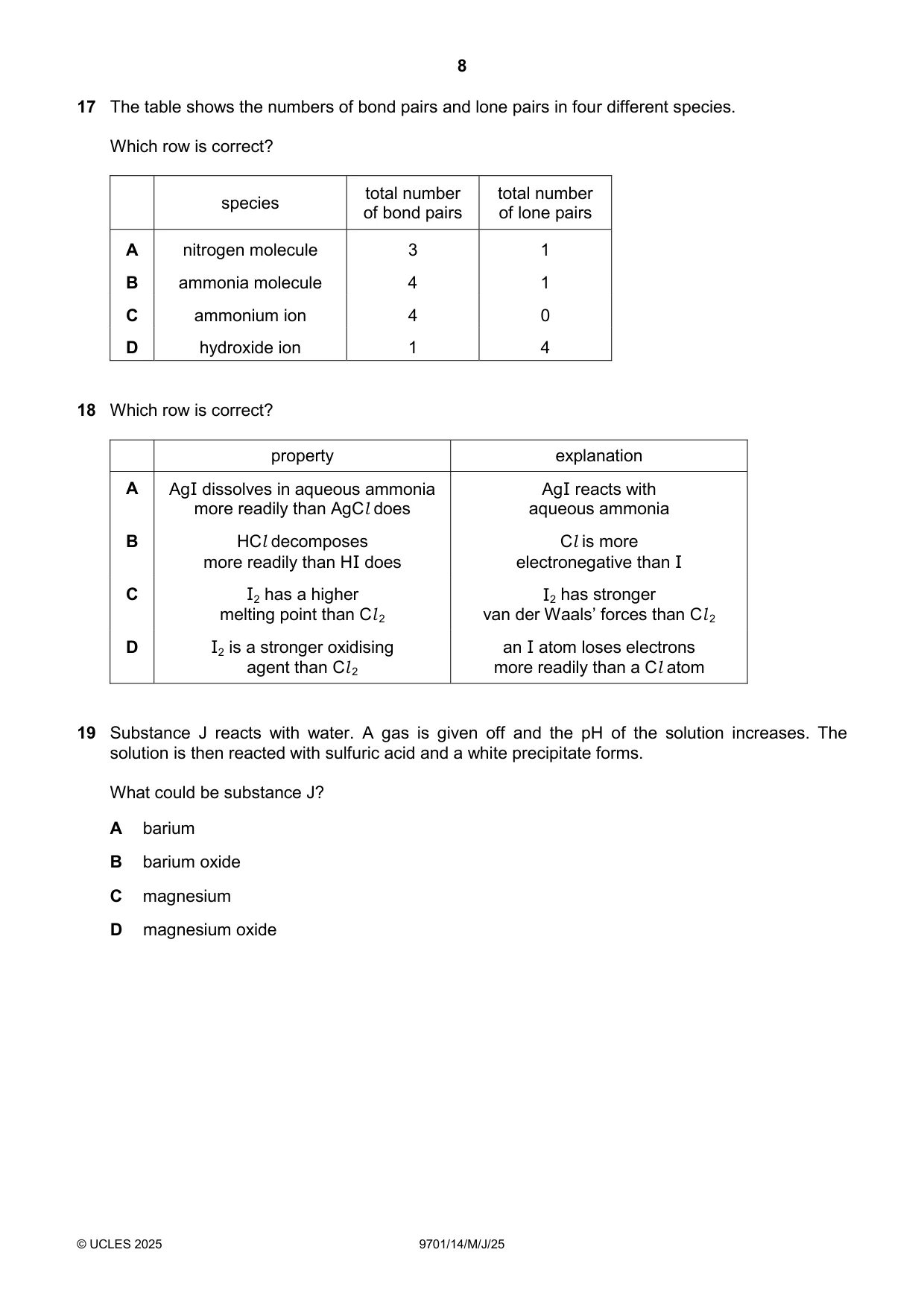
Q17 · The table shows the numbers of bond pairs and lone pairs in four different species
17 The table shows the numbers of bond pairs and lone pairs in four different species. Which row is correct? total number total number species of bond pairs of lone pairs A nitrogen molecule 3 1 B ammonia molecule 4 1 C ammonium ion 4 0 D hydroxide ion 1 4
Mark scheme: C
Q18 · Which row is correct?
18 Which row is correct? property explanation A AgI dissolves in aqueous ammonia AgI reacts with more readily than AgCl does aqueous ammonia B HCl decomposes Cl is more more readily than HI does electronegative than I C I2 has a higher I2 has stronger melting point than Cl 2 van der Waals’ forces than Cl 2 D I2 is a stronger oxidising an I atom loses electrons agent than Cl 2 more readily than a Cl atom
Mark scheme: C
More questions on Intermolecular forces, electronegativity and bond properties
Q19 · Substance J reacts with water
19 Substance J reacts with water. A gas is given off and the pH of the solution increases. The solution is then reacted with sulfuric acid and a white precipitate forms. What could be substance J? A barium B barium oxide C magnesium D magnesium oxide
Mark scheme: A
Q20 · Compound L has empirical formula NH
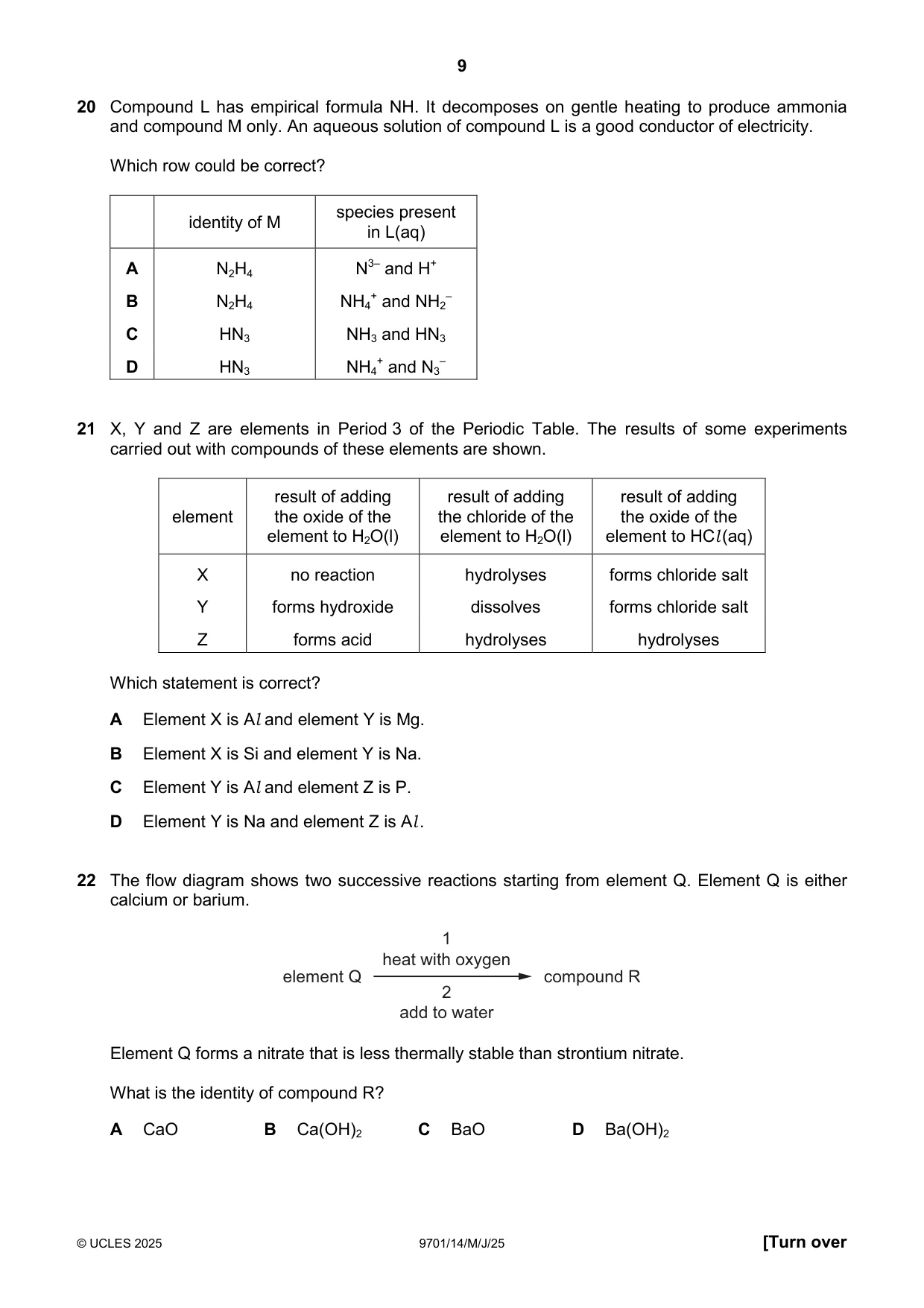
20 Compound L has empirical formula NH. It decomposes on gentle heating to produce ammonia and compound M only. An aqueous solution of compound L is a good conductor of electricity. Which row could be correct? species present identity of M in L(aq) A N2H4 N3– and H+ B N2H4 NH4 + and NH2 – C HN3 NH3 and HN3 D HN3 NH4 + and N3 –
Mark scheme: D
Q21 · X, Y and Z are elements in Period 3 of the Periodic Table
21 X, Y and Z are elements in Period 3 of the Periodic Table. The results of some experiments carried out with compounds of these elements are shown. result of adding result of adding result of adding element the oxide of the the chloride of the the oxide of the element to H2O(l) element to H2O(l) element to HCl (aq) X no reaction hydrolyses forms chloride salt Y forms hydroxide dissolves forms chloride salt Z forms acid hydrolyses hydrolyses Which statement is correct? A Element X is Al and element Y is Mg. B Element X is Si and element Y is Na. C Element Y is Al and element Z is P. D Element Y is Na and element Z is Al .
Mark scheme: A
More questions on Periodicity of chemical properties of the elements in Period 3
Q22 · The flow diagram shows two successive reactions starting from element Q
22 The flow diagram shows two successive reactions starting from element Q. Element Q is either calcium or barium. 1 heat with oxygen element Q compound R 2 add to water Element Q forms a nitrate that is less thermally stable than strontium nitrate. What is the identity of compound R? A CaO B Ca(OH)2 C BaO D Ba(OH)2
Mark scheme: B
Q23 · Which anions are formed when chlorine is passed into cold aqueous potassium hydroxide?
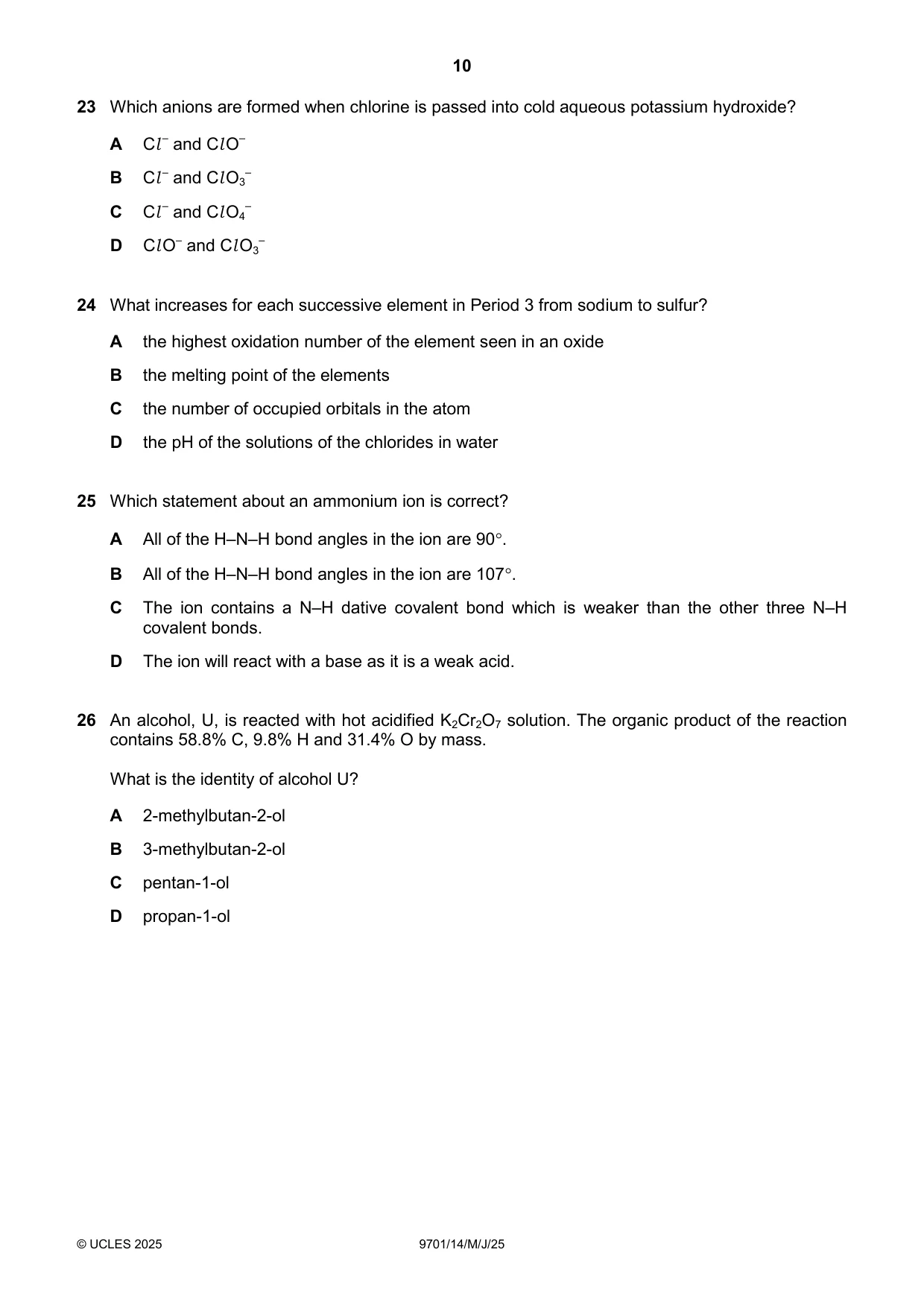
23 Which anions are formed when chlorine is passed into cold aqueous potassium hydroxide? A Cl – and Cl O– B Cl – and Cl O3 – C Cl – and Cl O4 – D Cl O– and Cl O3 –
Mark scheme: A
Q24 · What increases for each successive element in Period 3 from sodium to sulfur?
24 What increases for each successive element in Period 3 from sodium to sulfur? A the highest oxidation number of the element seen in an oxide B the melting point of the elements C the number of occupied orbitals in the atom D the pH of the solutions of the chlorides in water
Mark scheme: A
More questions on Periodicity of physical properties of the elements in Period 3
Q25 · Which statement about an ammonium ion is correct?
25 Which statement about an ammonium ion is correct? A All of the H–N–H bond angles in the ion are 90. B All of the H–N–H bond angles in the ion are 107. C The ion contains a N–H dative covalent bond which is weaker than the other three N–H covalent bonds. D The ion will react with a base as it is a weak acid.
Mark scheme: D
More questions on Covalent bonding and coordinate (dative covalent) bonding
Q26 · An alcohol, U, is reacted with hot acidified K2Cr2O7 solution
26 An alcohol, U, is reacted with hot acidified K2Cr2O7 solution. The organic product of the reaction contains 58.8% C, 9.8% H and 31.4% O by mass. What is the identity of alcohol U? A 2-methylbutan-2-ol B 3-methylbutan-2-ol C pentan-1-ol D propan-1-ol
Mark scheme: C
Q27 · Which row shows a primary, a secondary and a tertiary alcohol?
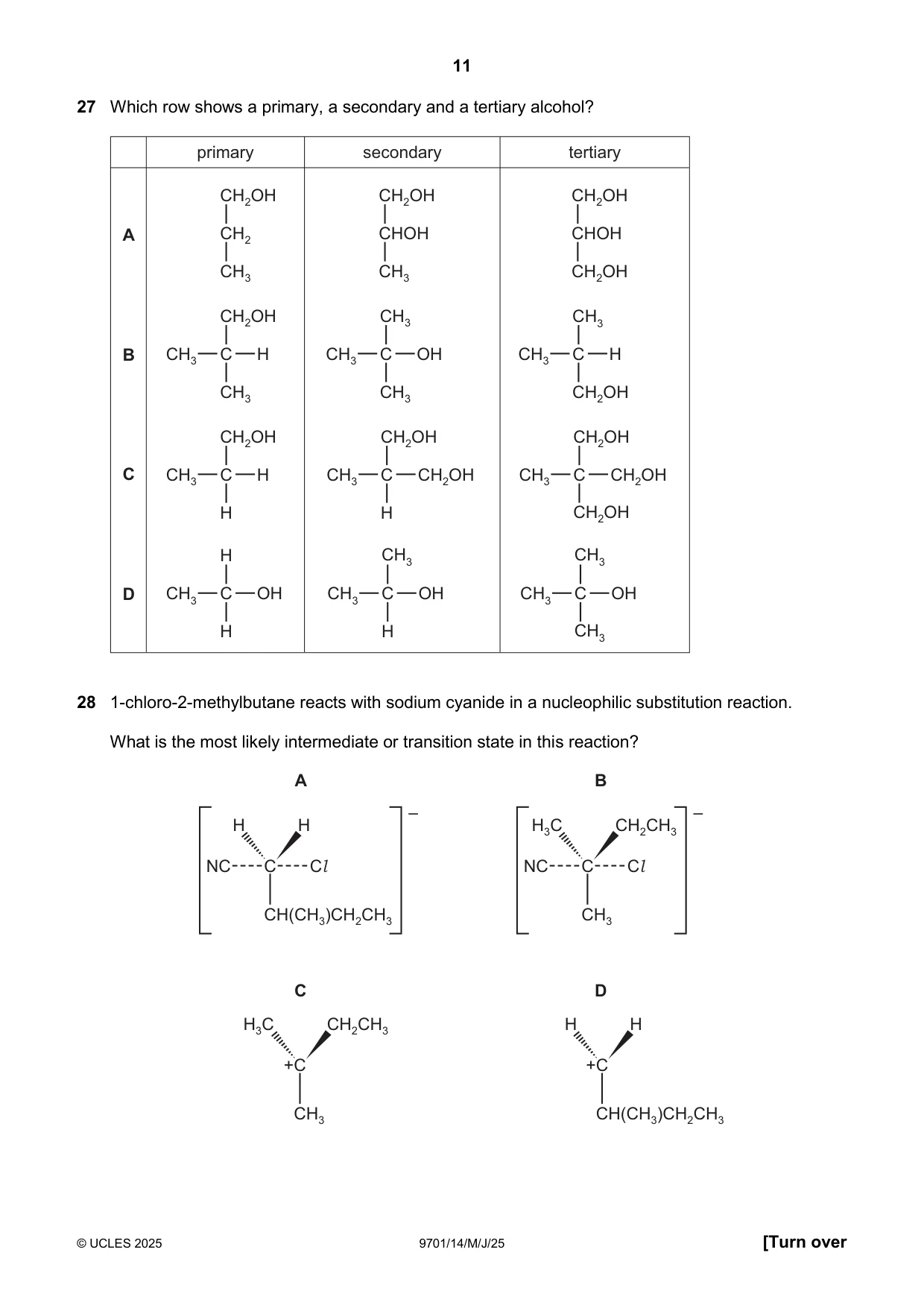
27 Which row shows a primary, a secondary and a tertiary alcohol? primary secondary tertiary CH2OH CH2OH CH2OH A CH2 CHOH CHOH CH3 CH3 CH2OH CH2OH CH3 CH3 B CH3 C H CH3 C OH CH3 C H CH3 CH3 CH2OH CH2OH CH2OH CH2OH C CH3 C H CH3 C CH2OH CH3 C CH2OH H H CH2OH H CH3 CH3 D CH3 C OH CH3 C OH CH3 C OH H H CH3
Mark scheme: D
Q28 · 1-chloro-2-methylbutane reacts with sodium cyanide in a nucleophilic substitution reaction
28 1-chloro-2-methylbutane reacts with sodium cyanide in a nucleophilic substitution reaction. What is the most likely intermediate or transition state in this reaction? A B – – H H H3C CH2CH3 NC C Cl NC C Cl CH(CH3)CH2CH3 CH3 C D H3C CH2CH3 H H +C +C CH3 CH(CH3)CH2CH3
Mark scheme: A
Q29 · When 0.010 mol of a hydrocarbon X reacts with 720 cm3 of hydrogen at room conditions, an…
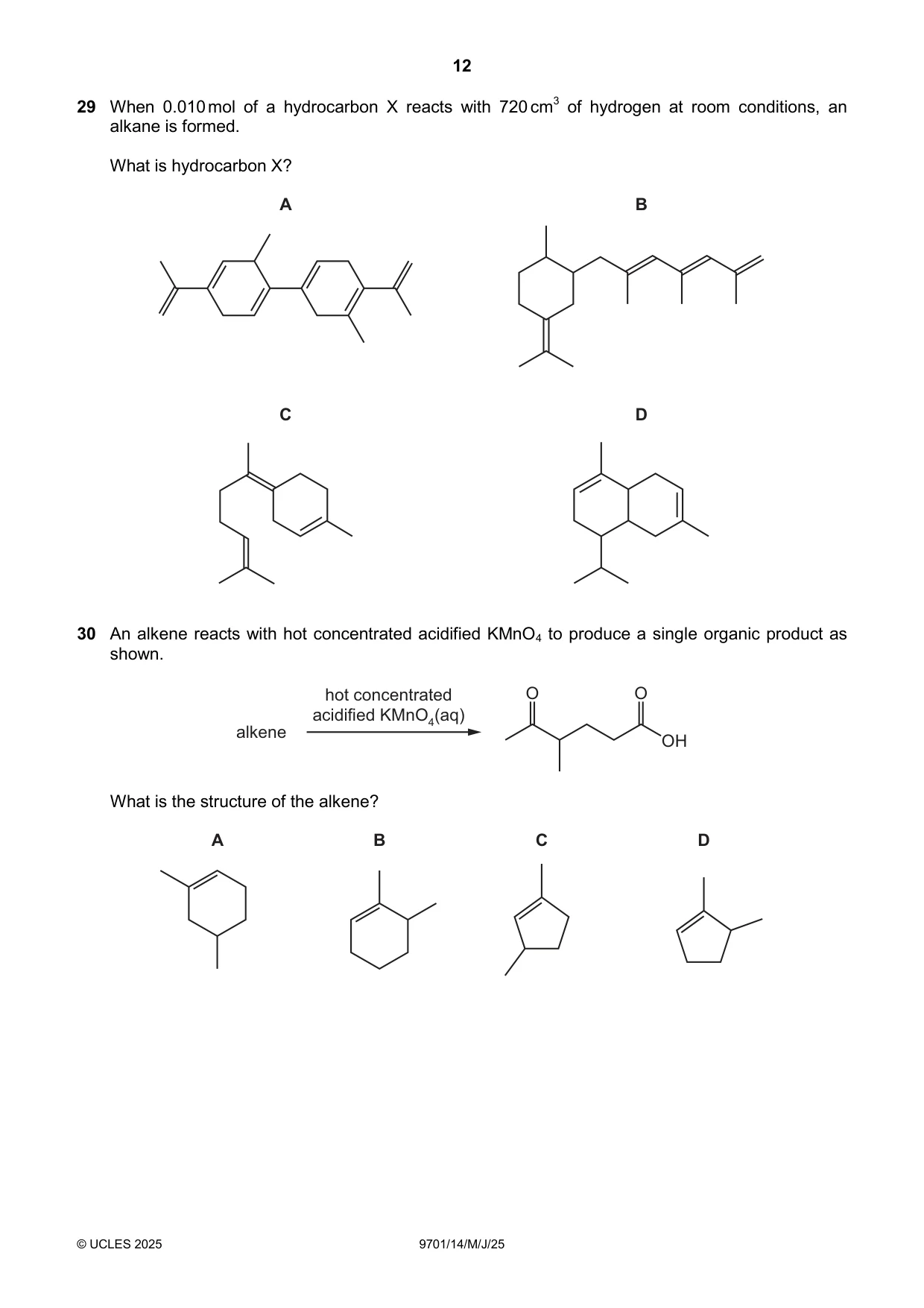
29 When 0.010 mol of a hydrocarbon X reacts with 720 cm3 of hydrogen at room conditions, an alkane is formed. What is hydrocarbon X? A B C D
Mark scheme: C
Q30 · An alkene reacts with hot concentrated acidified KMnO4 to produce a single organic…
30 An alkene reacts with hot concentrated acidified KMnO4 to produce a single organic product as shown. hot concentrated O O acidified KMnO4(aq) alkene OH What is the structure of the alkene? A B C D
Mark scheme: D
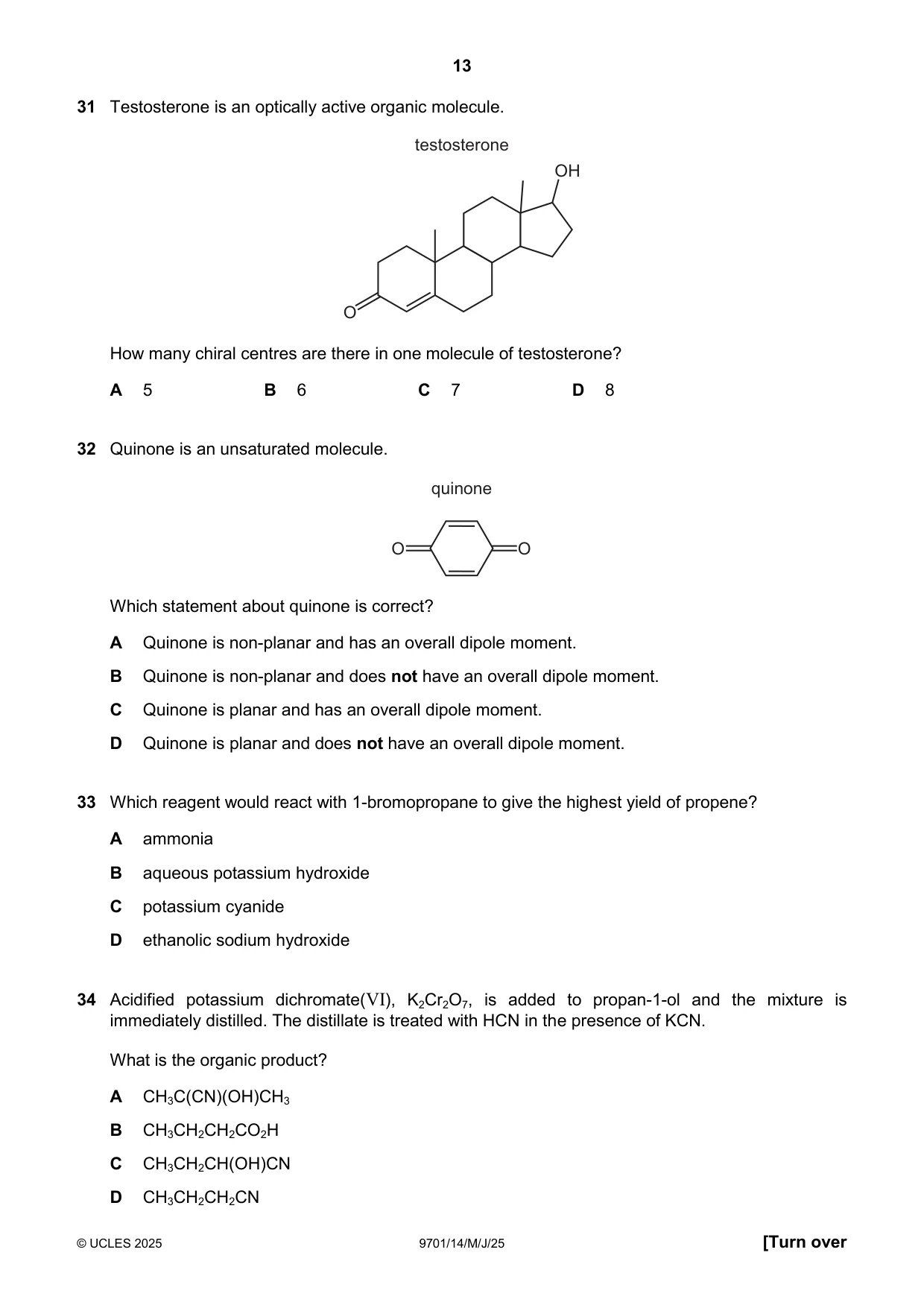
Q31 · Testosterone is an optically active organic molecule
31 Testosterone is an optically active organic molecule. testosterone OH O How many chiral centres are there in one molecule of testosterone? A 5 B 6 C 7 D 8
Mark scheme: B
Q32 · Quinone is an unsaturated molecule
32 Quinone is an unsaturated molecule. quinone O O Which statement about quinone is correct? A Quinone is non-planar and has an overall dipole moment. B Quinone is non-planar and does not have an overall dipole moment. C Quinone is planar and has an overall dipole moment. D Quinone is planar and does not have an overall dipole moment.
Mark scheme: D
More questions on Shapes of aromatic organic molecules; σ and π bonds
Q33 · Which reagent would react with 1-bromopropane to give the highest yield of propene?
33 Which reagent would react with 1-bromopropane to give the highest yield of propene? A ammonia B aqueous potassium hydroxide C potassium cyanide D ethanolic sodium hydroxide
Mark scheme: D
Q34 · Acidified potassium dichromate(VI), K2Cr2O7, is added to propan-1-ol and the mixture is…
34 Acidified potassium dichromate(VI), K2Cr2O7, is added to propan-1-ol and the mixture is immediately distilled. The distillate is treated with HCN in the presence of KCN. What is the organic product? A CH3C(CN)(OH)CH3 B CH3CH2CH2CO2H C CH3CH2CH(OH)CN D CH3CH2CH2CN
Mark scheme: C
Q35 · Compound Q gives positive results when tested separately with alkaline I2(aq) and with…
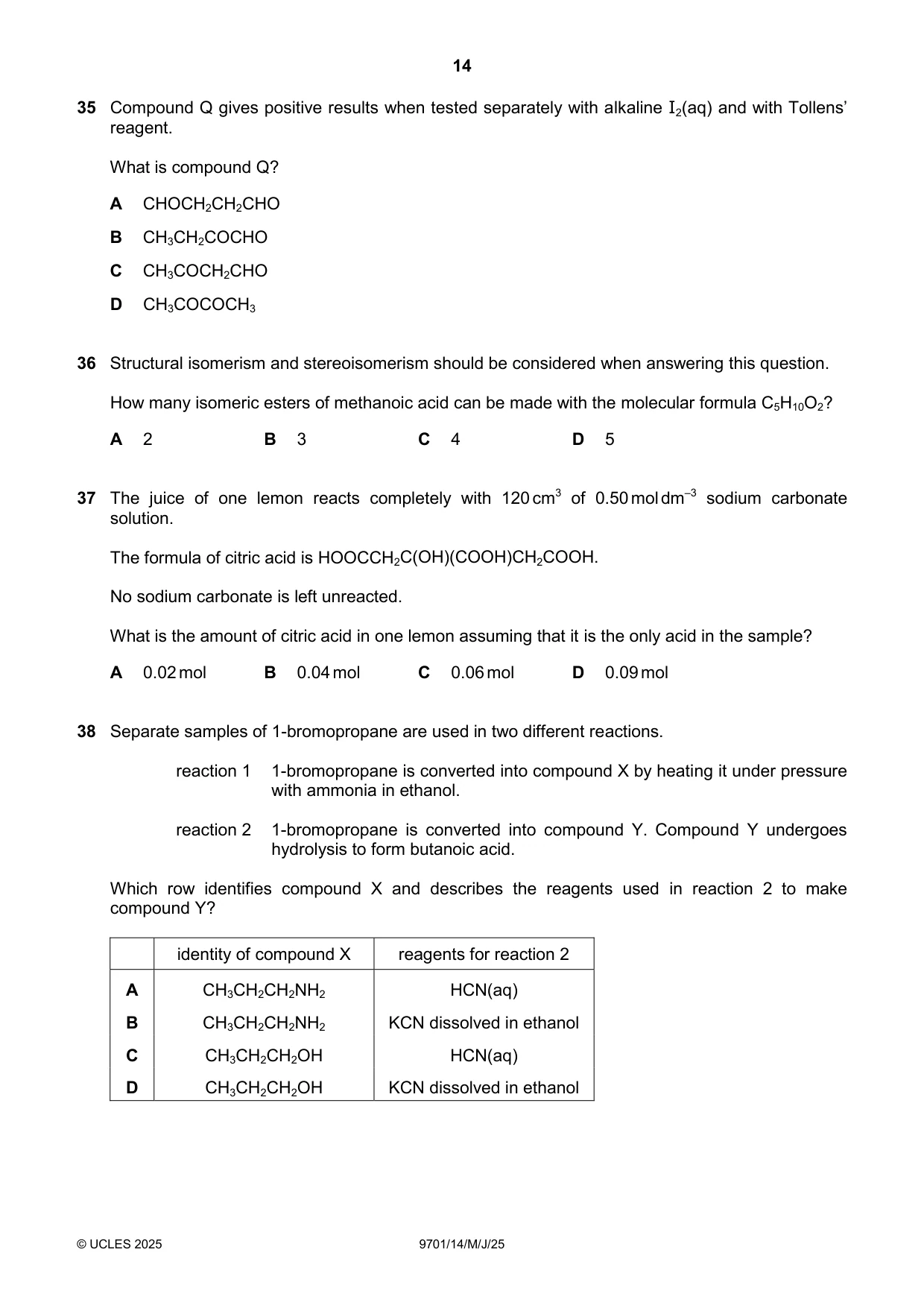
35 Compound Q gives positive results when tested separately with alkaline I2(aq) and with Tollens’ reagent. What is compound Q? A CHOCH2CH2CHO B CH3CH2COCHO C CH3COCH2CHO D CH3COCOCH3
Mark scheme: C
Q36 · Structural isomerism and stereoisomerism should be considered when answering this question
36 Structural isomerism and stereoisomerism should be considered when answering this question. How many isomeric esters of methanoic acid can be made with the molecular formula C5H10O2? A 2 B 3 C 4 D 5
Mark scheme: D
More questions on Isomerism: structural isomerism and stereoisomerism
Q37 · The juice of one lemon reacts completely with 120 cm3 of 0.50 mol dm–3 sodium carbonate…
37 The juice of one lemon reacts completely with 120 cm3 of 0.50 mol dm–3 sodium carbonate solution. The formula of citric acid is HOOCCH2C(OH)(COOH)CH2COOH. No sodium carbonate is left unreacted. What is the amount of citric acid in one lemon assuming that it is the only acid in the sample? A 0.02 mol B 0.04 mol C 0.06 mol D 0.09 mol
Mark scheme: B
More questions on Reacting masses and volumes (of solutions and gases)
Q38 · Separate samples of 1-bromopropane are used in two different reactions
38 Separate samples of 1-bromopropane are used in two different reactions. reaction 1 1-bromopropane is converted into compound X by heating it under pressure with ammonia in ethanol. reaction 2 1-bromopropane is converted into compound Y. Compound Y undergoes hydrolysis to form butanoic acid. Which row identifies compound X and describes the reagents used in reaction 2 to make compound Y? identity of compound X reagents for reaction 2 A CH3CH2CH2NH2 HCN(aq) B CH3CH2CH2NH2 KCN dissolved in ethanol C CH3CH2CH2OH HCN(aq) D CH3CH2CH2OH KCN dissolved in ethanol
Mark scheme: B
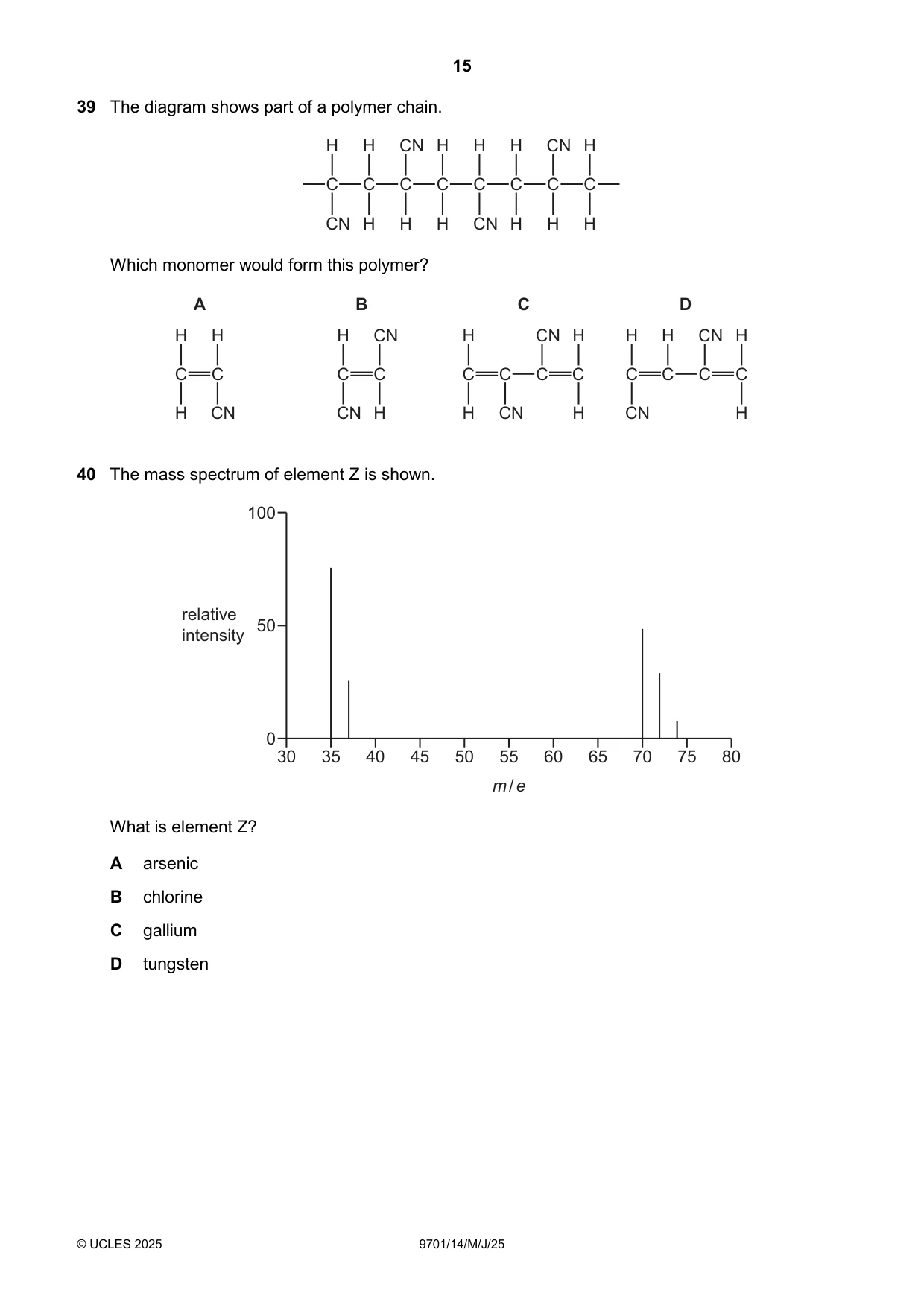
Q39 · The diagram shows part of a polymer chain
39 The diagram shows part of a polymer chain. H H CN H H H CN H C C C C C C C C CN H H H CN H H H Which monomer would form this polymer? A B C D H H H CN H CN H H H CN H C C C C C C C C C C C C H CN CN H H CN H CN H
Mark scheme: A
Q40 · The mass spectrum of element Z is shown
40 The mass spectrum of element Z is shown. 100 relative 50 intensity 0 30 35 40 45 50 55 60 65 70 75 80 m / e What is element Z? A arsenic B chlorine C gallium D tungsten
Mark scheme: B
What was in this paper
The subtopics covered by these 40 questions, and how many questions each got. Open one in a new tab to see every Cambridge question on it.
2Alkenes2Chemical equilibria: reversible reactions, dynamic equilibrium2Covalent bonding and coordinate (dative covalent) bonding2Enthalpy change, ΔH2Formulas2Halogenoalkanes2Nitriles and hydroxynitriles2Reacting masses and volumes (of solutions and gases)2Redox processes: electron transfer and changes in oxidation number (oxidation state)2Shapes of molecules2Similarities and trends in the properties of the Group 2 metals, magnesium to barium, and their compounds2Addition polymerisation1Alcohols1Dot-and-cross diagrams1Effect of temperature on reaction rates and the concept of activation energy1Electrons, energy levels and atomic orbitals1Intermolecular forces, electronegativity and bond properties1Ionisation energy1Isomerism: optical1Isomerism: structural isomerism and stereoisomerism1Mass spectrometry1Periodicity of chemical properties of the elements in Period 31Periodicity of physical properties of the elements in Period 31Rate of reaction1Shapes of aromatic organic molecules; σ and π bonds1The gaseous state: ideal and real gases and pV = nRT1The reactions of chlorine1What you needed in this session
Cambridge’s own grade thresholds for 2025 May/June, Paper 1 · Variant 4. A higher threshold means an easier paper — the bar moves with how the cohort did.