Cambridge A Level Chemistry 9701 — 2013 May/June Paper 1 · Variant 1
9701/11/M/J/13 · 40 questions · 40 marks · ≈45 min
The question paper and its mark scheme, free to read here and free to download. This is Cambridge’s own paper, exactly as it was sat.
Question paper16 pages


Mark scheme2 pages
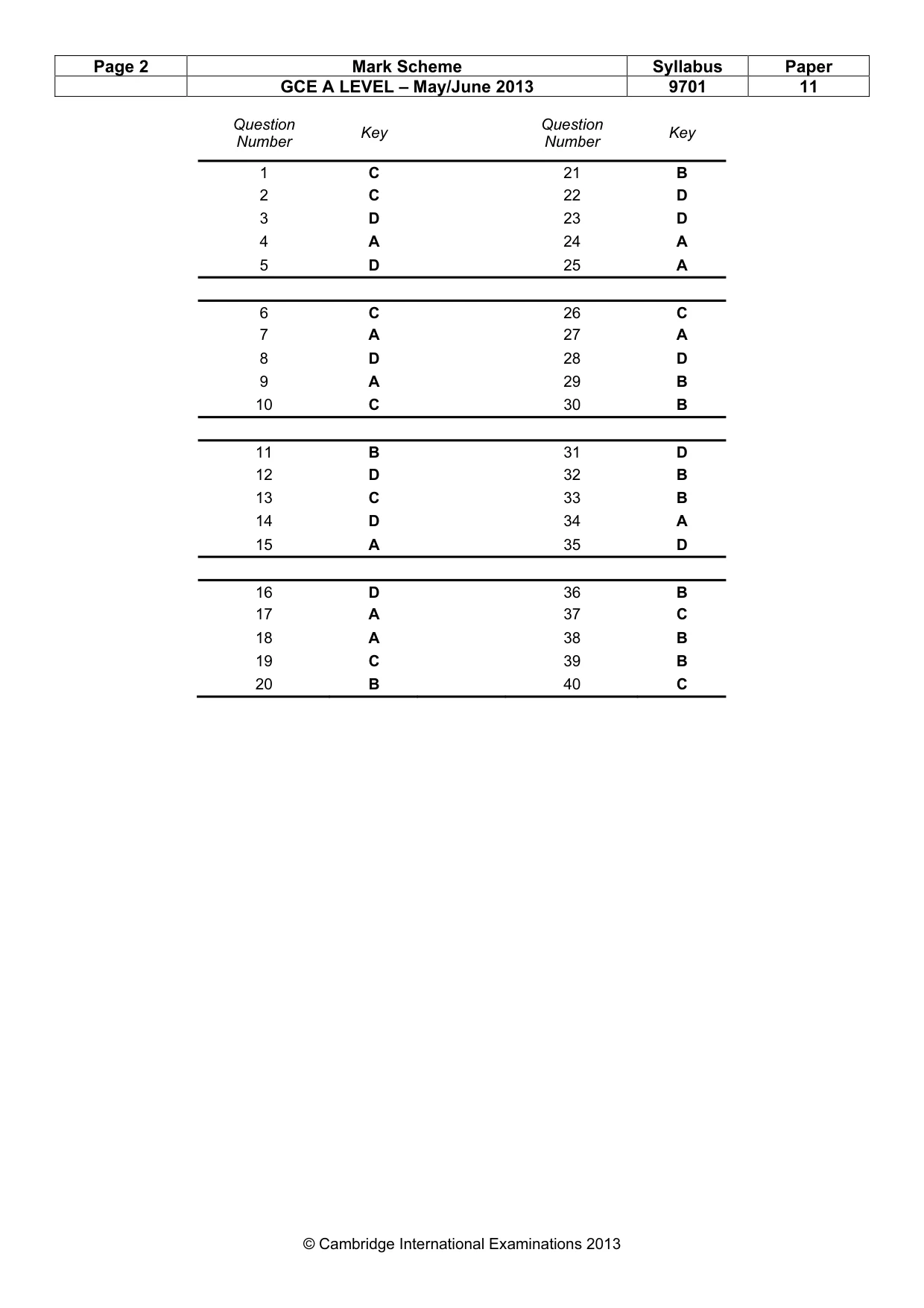
Answers below. Sit the paper first if you are practising.
Questions as text
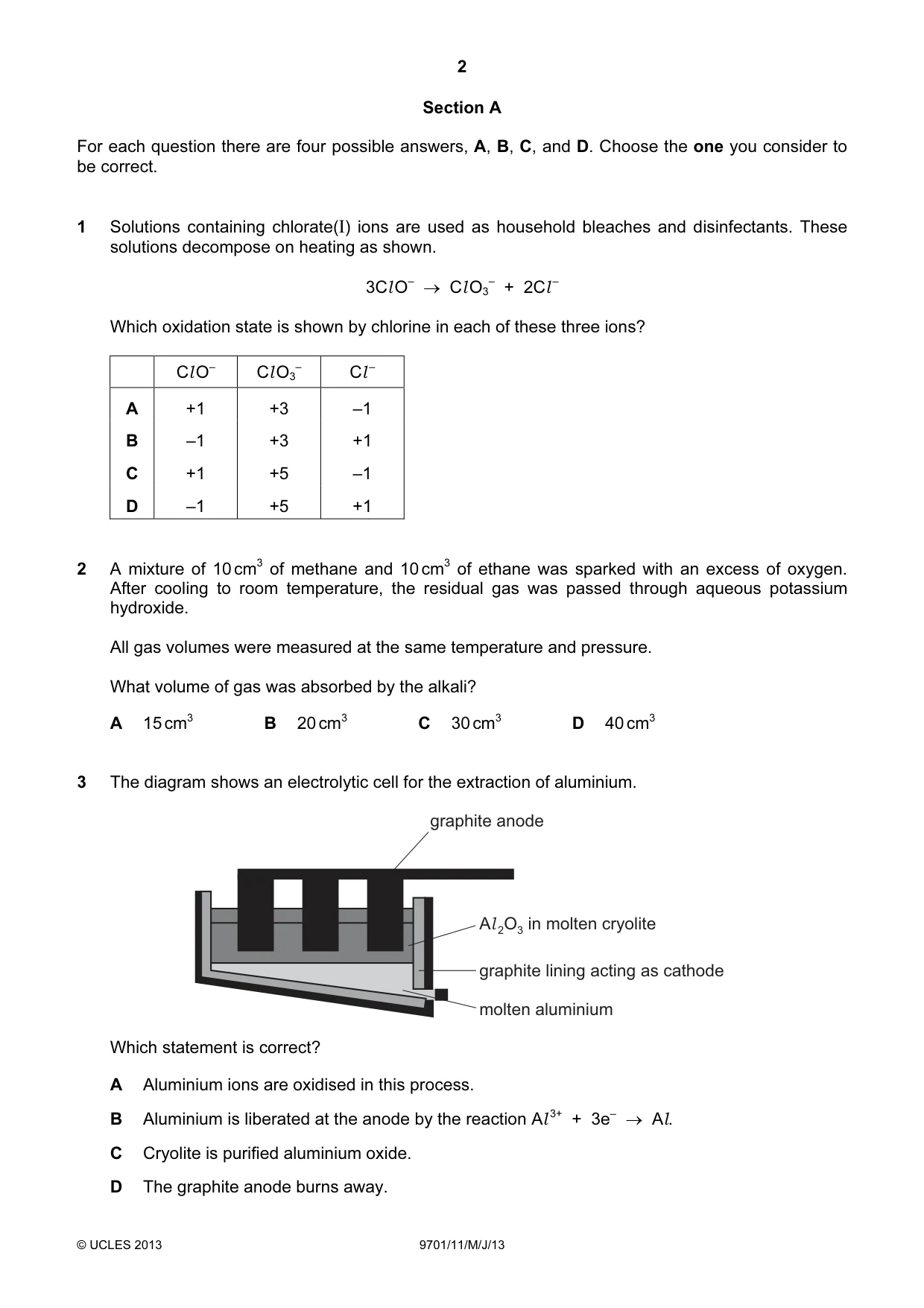
Q1 · Solutions containing chlorate(I) ions are used as household bleaches and disinfectants
1 Solutions containing chlorate(I) ions are used as household bleaches and disinfectants. These solutions decompose on heating as shown. 3Cl O– → Cl O3 – + 2Cl – Which oxidation state is shown by chlorine in each of these three ions? Cl O– Cl O3 – Cl – A +1 +3 –1 B –1 +3 +1 C +1 +5 –1 D –1 +5 +1
Mark scheme: C
Q2 · A mixture of 10 cm3 of methane and 10 cm3 of ethane was sparked with an excess of oxygen
2 A mixture of 10 cm3 of methane and 10 cm3 of ethane was sparked with an excess of oxygen. After cooling to room temperature, the residual gas was passed through aqueous potassium hydroxide. All gas volumes were measured at the same temperature and pressure. What volume of gas was absorbed by the alkali? A 15 cm3 B 20 cm3 C 30 cm3 D 40 cm3
Mark scheme: C
More questions on Reacting masses and volumes (of solutions and gases)
Q3 · The diagram shows an electrolytic cell for the extraction of aluminium
3 The diagram shows an electrolytic cell for the extraction of aluminium. graphite anode Al 2O3 in molten cryolite graphite lining acting as cathode molten aluminium Which statement is correct? A Aluminium ions are oxidised in this process. B Aluminium is liberated at the anode by the reaction Al 3+ + 3e– → Al. C Cryolite is purified aluminium oxide. D The graphite anode burns away.
Mark scheme: D
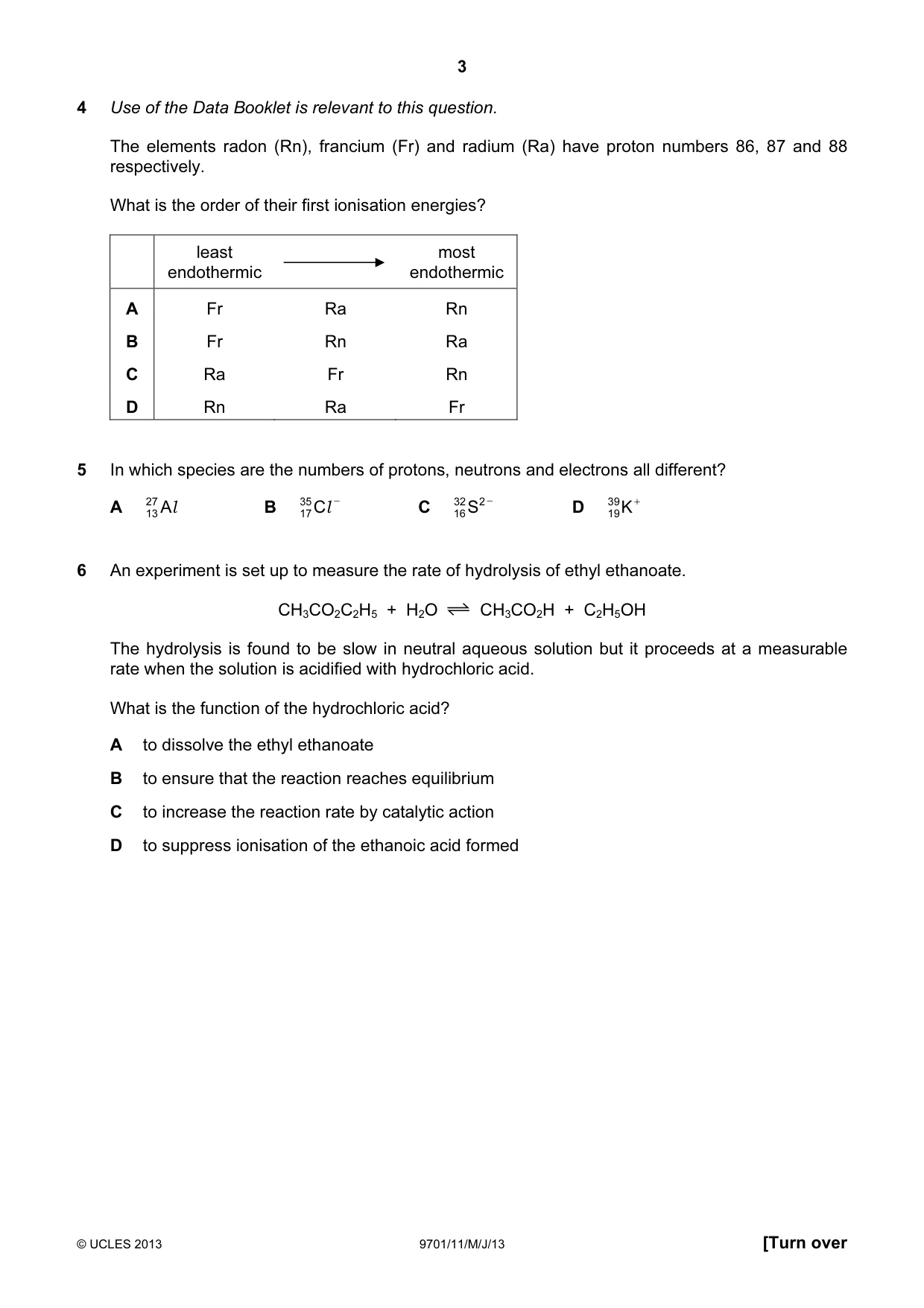
Q4 · Use of the Data Booklet is relevant to this question
4 Use of the Data Booklet is relevant to this question. The elements radon (Rn), francium (Fr) and radium (Ra) have proton numbers 86, 87 and 88 respectively. What is the order of their first ionisation energies? least most endothermic endothermic A Fr Ra Rn B Fr Rn Ra C Ra Fr Rn D Rn Ra Fr
Mark scheme: A
Q5 · In which species are the numbers of protons, neutrons and electrons all different?
5 In which species are the numbers of protons, neutrons and electrons all different? A 27 A l B 35 C l − C 16S 32 2 − D 39 K + 13 17 19
Mark scheme: D
Q6 · An experiment is set up to measure the rate of hydrolysis of ethyl ethanoate
6 An experiment is set up to measure the rate of hydrolysis of ethyl ethanoate. CH3CO2C2H5 + H2O CH3CO2H + C2H5OH The hydrolysis is found to be slow in neutral aqueous solution but it proceeds at a measurable rate when the solution is acidified with hydrochloric acid. What is the function of the hydrochloric acid? A to dissolve the ethyl ethanoate B to ensure that the reaction reaches equilibrium C to increase the reaction rate by catalytic action D to suppress ionisation of the ethanoic acid formed
Mark scheme: C
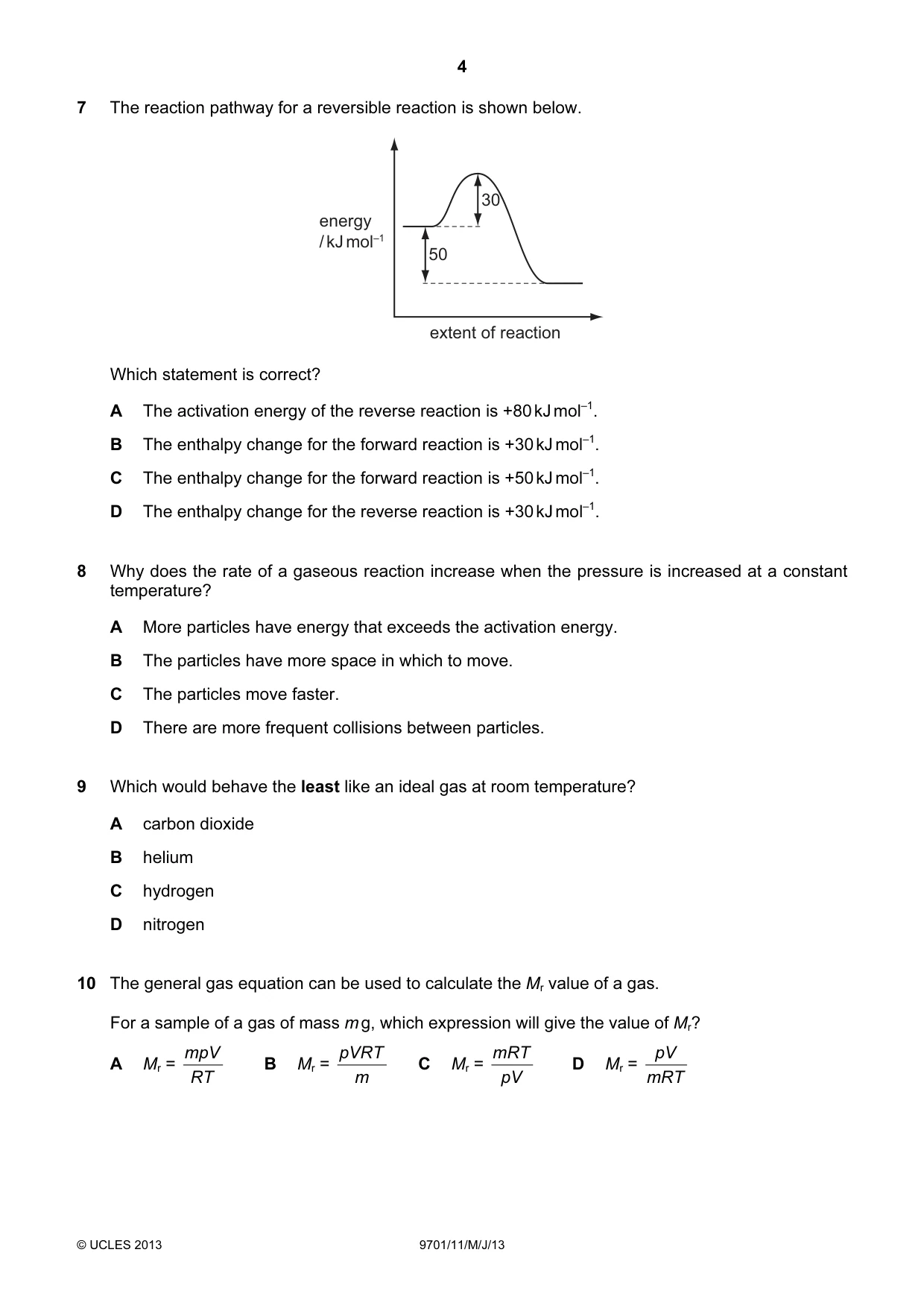
Q7 · The reaction pathway for a reversible reaction is shown below
7 The reaction pathway for a reversible reaction is shown below. 30 energy / kJ mol–1 50 extent of reaction Which statement is correct? A The activation energy of the reverse reaction is +80 kJ mol–1. B The enthalpy change for the forward reaction is +30 kJ mol–1. C The enthalpy change for the forward reaction is +50 kJ mol–1. D The enthalpy change for the reverse reaction is +30 kJ mol–1.
Mark scheme: A
Q8 · Why does the rate of a gaseous reaction increase when the pressure is increased at a…
8 Why does the rate of a gaseous reaction increase when the pressure is increased at a constant temperature? A More particles have energy that exceeds the activation energy. B The particles have more space in which to move. C The particles move faster. D There are more frequent collisions between particles.
Mark scheme: D
Q9 · Which would behave the least like an ideal gas at room temperature?
9 Which would behave the least like an ideal gas at room temperature? A carbon dioxide B helium C hydrogen D nitrogen
Mark scheme: A
More questions on The gaseous state: ideal and real gases and pV = nRT
Q10 · The general gas equation can be used to calculate the Mr value of a gas
10 The general gas equation can be used to calculate the Mr value of a gas. For a sample of a gas of mass m g, which expression will give the value of Mr? mpV pVRT mRT pV A Mr = RT B Mr = C Mr = pV D Mr = mRT m
Mark scheme: C
More questions on The gaseous state: ideal and real gases and pV = nRT
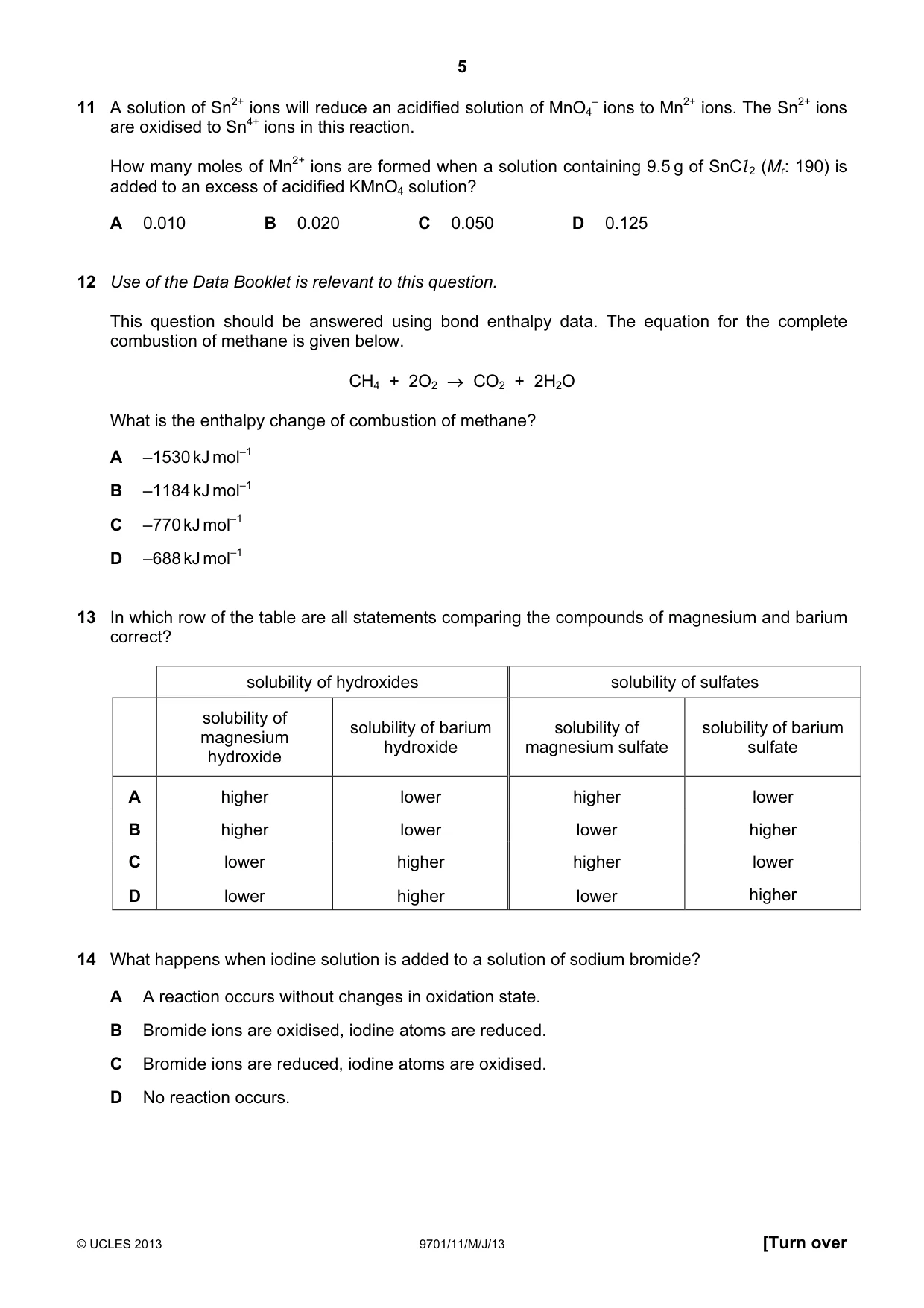
Q11 · A solution of Sn2+ ions will reduce an acidified solution of MnO4 – ions to Mn2+ ions
11 A solution of Sn2+ ions will reduce an acidified solution of MnO4 – ions to Mn2+ ions. The Sn2+ ions are oxidised to Sn4+ ions in this reaction. How many moles of Mn2+ ions are formed when a solution containing 9.5 g of SnCl 2 (Mr: 190) is added to an excess of acidified KMnO4 solution? A 0.010 B 0.020 C 0.050 D 0.125
Mark scheme: B
More questions on Reacting masses and volumes (of solutions and gases)
Q12 · Use of the Data Booklet is relevant to this question
12 Use of the Data Booklet is relevant to this question. This question should be answered using bond enthalpy data. The equation for the complete combustion of methane is given below. CH4 + 2O2 → CO2 + 2H2O What is the enthalpy change of combustion of methane? A –1530 kJ mol–1 B –1184 kJ mol–1 C –770 kJ mol–1 D –688 kJ mol–1
Mark scheme: D
Q13 · In which row of the table are all statements comparing the compounds of magnesium and…
13 In which row of the table are all statements comparing the compounds of magnesium and barium correct? solubility of hydroxides solubility of sulfates solubility of solubility of barium solubility of solubility of barium magnesium hydroxide magnesium sulfate sulfate hydroxide A higher lower higher lower B higher lower lower higher C lower higher higher lower D lower higher lower higher
Mark scheme: C
Q14 · What happens when iodine solution is added to a solution of sodium bromide?
14 What happens when iodine solution is added to a solution of sodium bromide? A A reaction occurs without changes in oxidation state. B Bromide ions are oxidised, iodine atoms are reduced. C Bromide ions are reduced, iodine atoms are oxidised. D No reaction occurs.
Mark scheme: D
More questions on The chemical properties of the halogen elements and the hydrogen halides
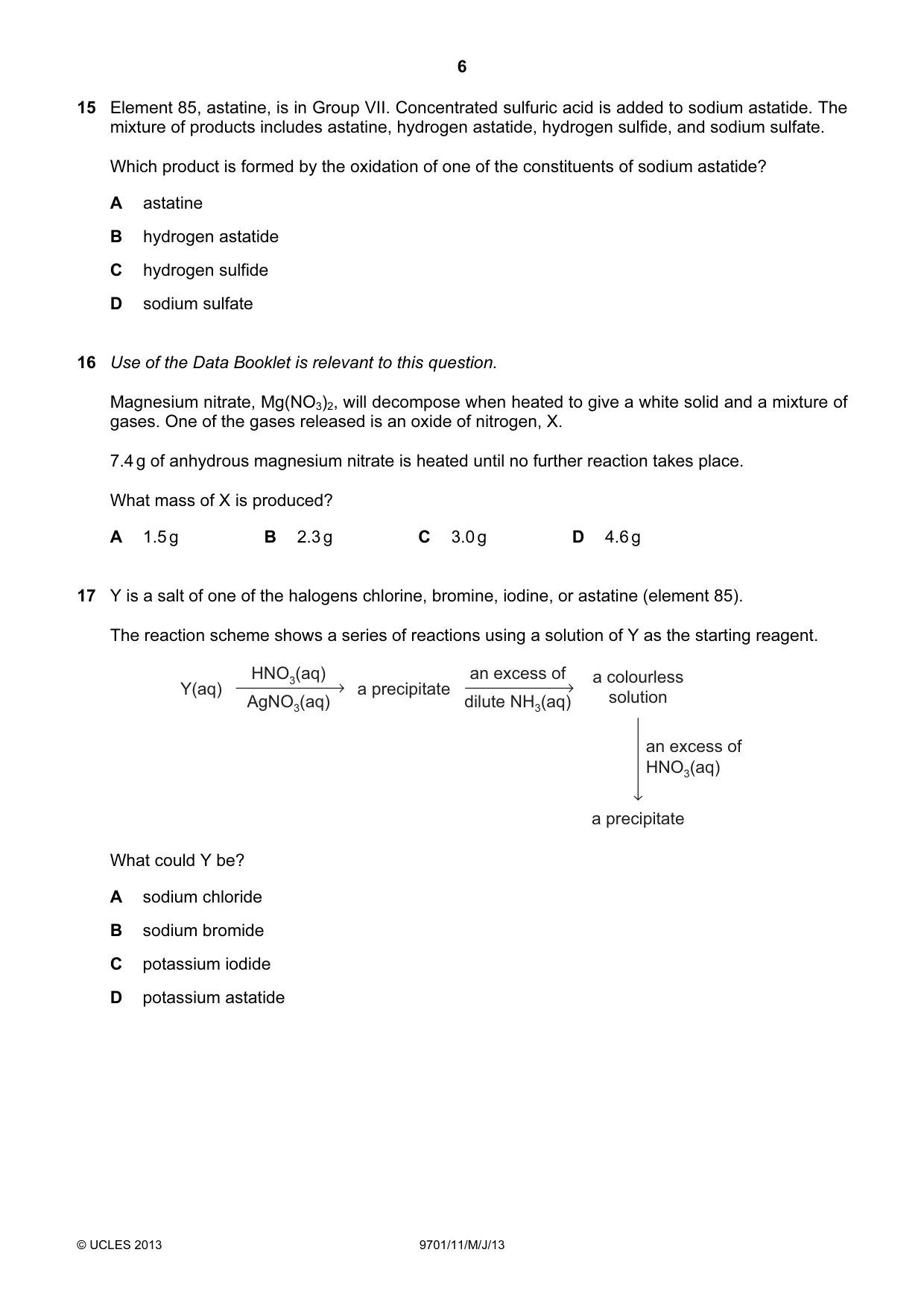
Q15 · Element 85, astatine, is in Group VII
15 Element 85, astatine, is in Group VII. Concentrated sulfuric acid is added to sodium astatide. The mixture of products includes astatine, hydrogen astatide, hydrogen sulfide, and sodium sulfate. Which product is formed by the oxidation of one of the constituents of sodium astatide? A astatine B hydrogen astatide C hydrogen sulfide D sodium sulfate
Mark scheme: A
More questions on The chemical properties of the halogen elements and the hydrogen halides
Q16 · Use of the Data Booklet is relevant to this question
16 Use of the Data Booklet is relevant to this question. Magnesium nitrate, Mg(NO3)2, will decompose when heated to give a white solid and a mixture of gases. One of the gases released is an oxide of nitrogen, X. 7.4 g of anhydrous magnesium nitrate is heated until no further reaction takes place. What mass of X is produced? A 1.5 g B 2.3 g C 3.0 g D 4.6 g
Mark scheme: D
More questions on Reacting masses and volumes (of solutions and gases)
Q17 · Y is a salt of one of the halogens chlorine, bromine, iodine, or astatine (element 85)
17 Y is a salt of one of the halogens chlorine, bromine, iodine, or astatine (element 85). The reaction scheme shows a series of reactions using a solution of Y as the starting reagent. HNO3(aq) an excess of a colourless Y(aq) a precipitate AgNO3(aq) dilute NH3(aq) solution an excess of HNO3(aq) a precipitate What could Y be? A sodium chloride B sodium bromide C potassium iodide D potassium astatide
Mark scheme: A
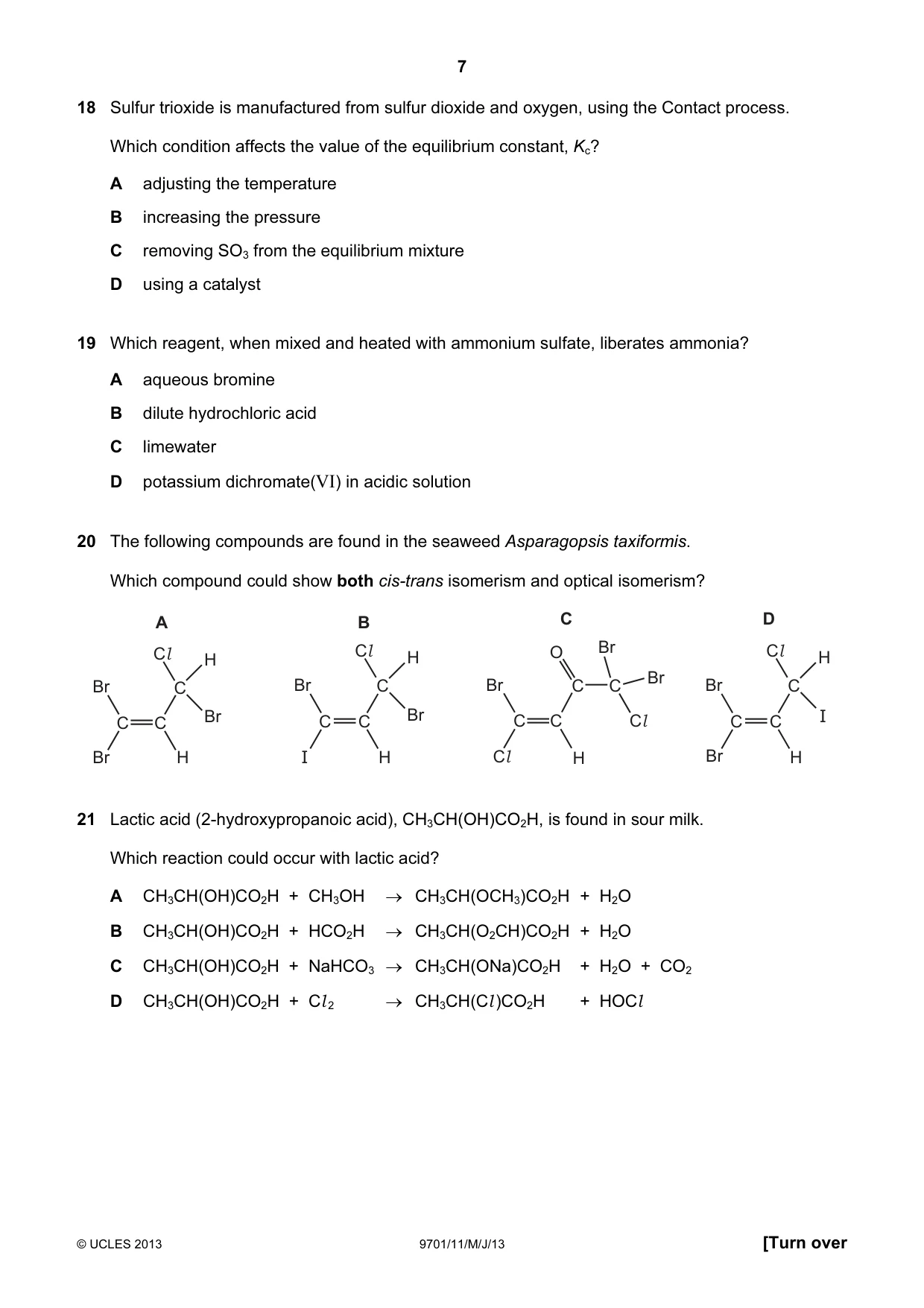
Q18 · Sulfur trioxide is manufactured from sulfur dioxide and oxygen, using the Contact process
18 Sulfur trioxide is manufactured from sulfur dioxide and oxygen, using the Contact process. Which condition affects the value of the equilibrium constant, Kc? A adjusting the temperature B increasing the pressure C removing SO3 from the equilibrium mixture D using a catalyst
Mark scheme: A
More questions on Chemical equilibria: reversible reactions, dynamic equilibrium
Q19 · Which reagent, when mixed and heated with ammonium sulfate, liberates ammonia?
19 Which reagent, when mixed and heated with ammonium sulfate, liberates ammonia? A aqueous bromine B dilute hydrochloric acid C limewater D potassium dichromate(VI) in acidic solution
Mark scheme: C
Q20 · The following compounds are found in the seaweed Asparagopsis taxiformis
20 The following compounds are found in the seaweed Asparagopsis taxiformis. Which compound could show both cis-trans isomerism and optical isomerism? A B C D Cl Cl O Br Cl H H H Br Br Br C Br C C C Br C Br C C Br C C Cl C C I C C Br H I H Cl H Br H
Mark scheme: B
More questions on Isomerism: structural isomerism and stereoisomerism
Q21 · Lactic acid (2-hydroxypropanoic acid), CH3CH(OH)CO2H, is found in sour milk
21 Lactic acid (2-hydroxypropanoic acid), CH3CH(OH)CO2H, is found in sour milk. Which reaction could occur with lactic acid? A CH3CH(OH)CO2H + CH3OH → CH3CH(OCH3)CO2H + H2O B CH3CH(OH)CO2H + HCO2H → CH3CH(O2CH)CO2H + H2O C CH3CH(OH)CO2H + NaHCO3 → CH3CH(ONa)CO2H + H2O + CO2 D CH3CH(OH)CO2H + Cl 2 → CH3CH(Cl )CO2H + HOCl
Mark scheme: B
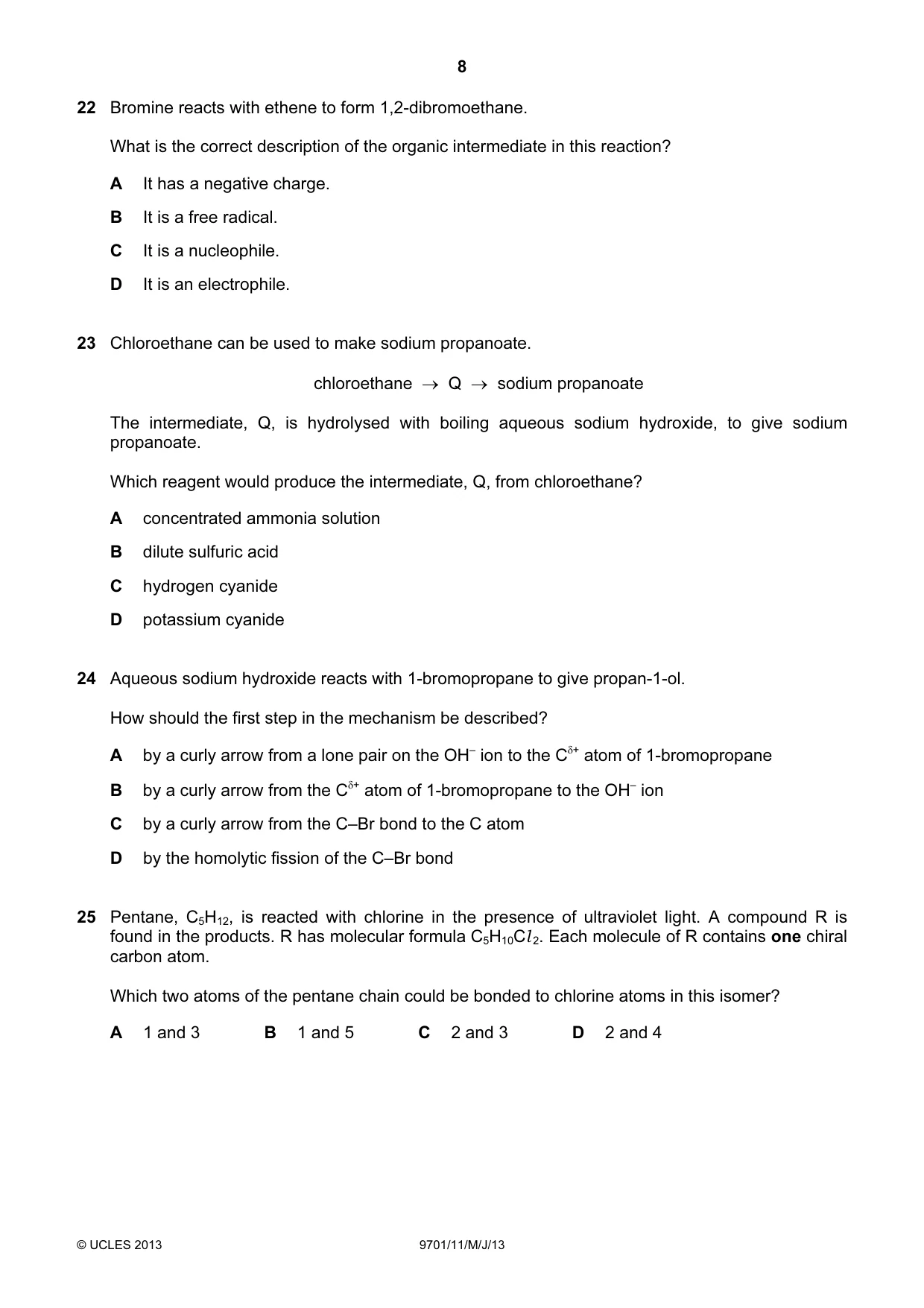
Q22 · Bromine reacts with ethene to form 1,2-dibromoethane
22 Bromine reacts with ethene to form 1,2-dibromoethane. What is the correct description of the organic intermediate in this reaction? A It has a negative charge. B It is a free radical. C It is a nucleophile. D It is an electrophile.
Mark scheme: D
Q23 · Chloroethane can be used to make sodium propanoate
23 Chloroethane can be used to make sodium propanoate. chloroethane → Q → sodium propanoate The intermediate, Q, is hydrolysed with boiling aqueous sodium hydroxide, to give sodium propanoate. Which reagent would produce the intermediate, Q, from chloroethane? A concentrated ammonia solution B dilute sulfuric acid C hydrogen cyanide D potassium cyanide
Mark scheme: D
Q24 · Aqueous sodium hydroxide reacts with 1-bromopropane to give propan-1-ol
24 Aqueous sodium hydroxide reacts with 1-bromopropane to give propan-1-ol. How should the first step in the mechanism be described? A by a curly arrow from a lone pair on the OH– ion to the Cδ+ atom of 1-bromopropane B by a curly arrow from the Cδ+ atom of 1-bromopropane to the OH– ion C by a curly arrow from the C–Br bond to the C atom D by the homolytic fission of the C–Br bond
Mark scheme: A
Q25 · Pentane, C5H12, is reacted with chlorine in the presence of ultraviolet light
25 Pentane, C5H12, is reacted with chlorine in the presence of ultraviolet light. A compound R is found in the products. R has molecular formula C5H10Cl 2. Each molecule of R contains one chiral carbon atom. Which two atoms of the pentane chain could be bonded to chlorine atoms in this isomer? A 1 and 3 B 1 and 5 C 2 and 3 D 2 and 4
Mark scheme: A
Q26 · Use of the Data Booklet is relevant to this question
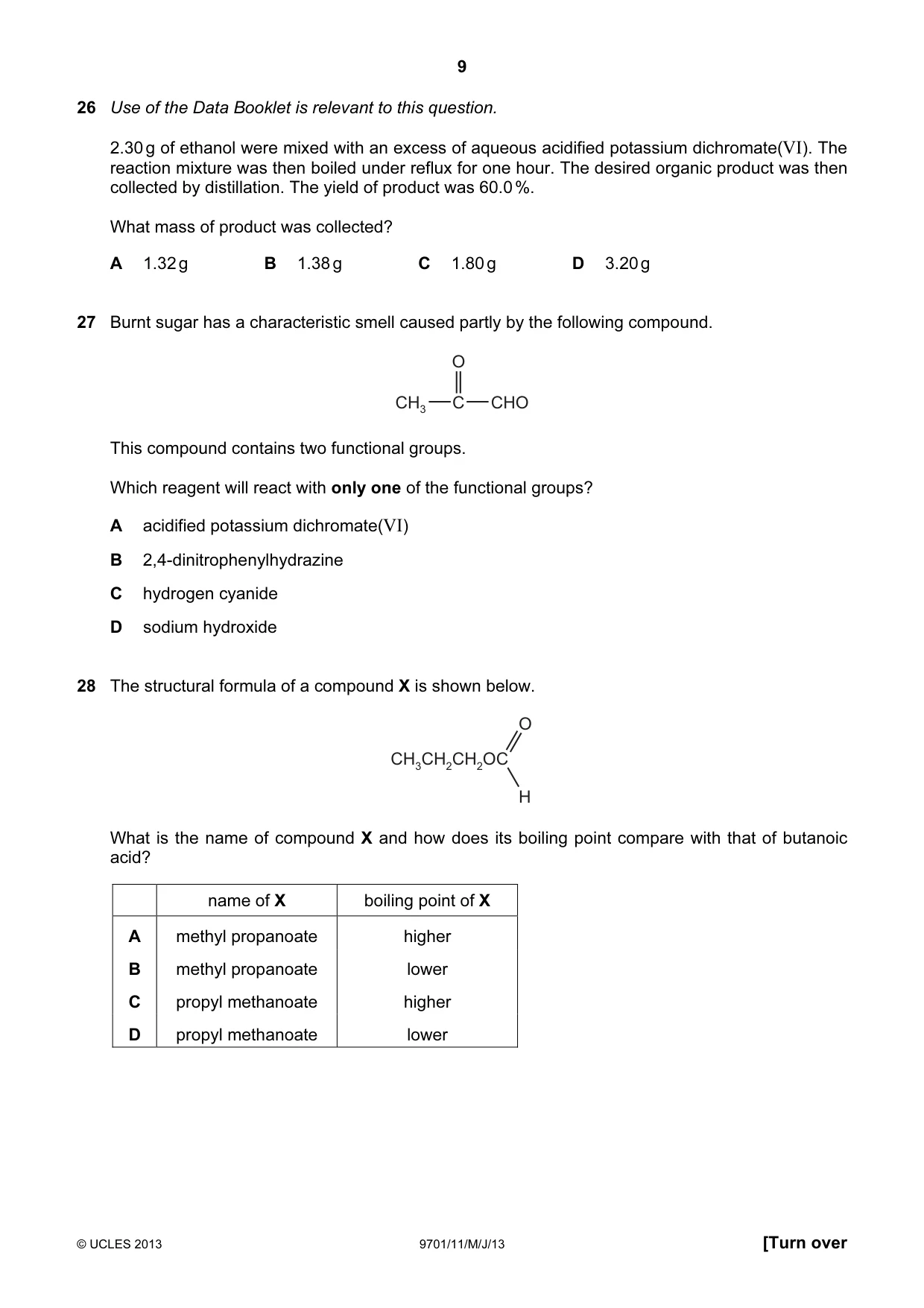
26 Use of the Data Booklet is relevant to this question. 2.30 g of ethanol were mixed with an excess of aqueous acidified potassium dichromate(VI). The reaction mixture was then boiled under reflux for one hour. The desired organic product was then collected by distillation. The yield of product was 60.0 %. What mass of product was collected? A 1.32 g B 1.38 g C 1.80 g D 3.20 g
Mark scheme: C
More questions on Reacting masses and volumes (of solutions and gases)
Q27 · Burnt sugar has a characteristic smell caused partly by the following compound
27 Burnt sugar has a characteristic smell caused partly by the following compound. O CH3 C CHO This compound contains two functional groups. Which reagent will react with only one of the functional groups? A acidified potassium dichromate(VI) B 2,4-dinitrophenylhydrazine C hydrogen cyanide D sodium hydroxide
Mark scheme: A
Q28 · The structural formula of a compound X is shown below
28 The structural formula of a compound X is shown below. O CH3CH2CH2OC H What is the name of compound X and how does its boiling point compare with that of butanoic acid? name of X boiling point of X A methyl propanoate higher B methyl propanoate lower C propyl methanoate higher D propyl methanoate lower
Mark scheme: D
Q29 · Synthetic resins, plasticisers and many other chemicals can be made by polymerisation of…
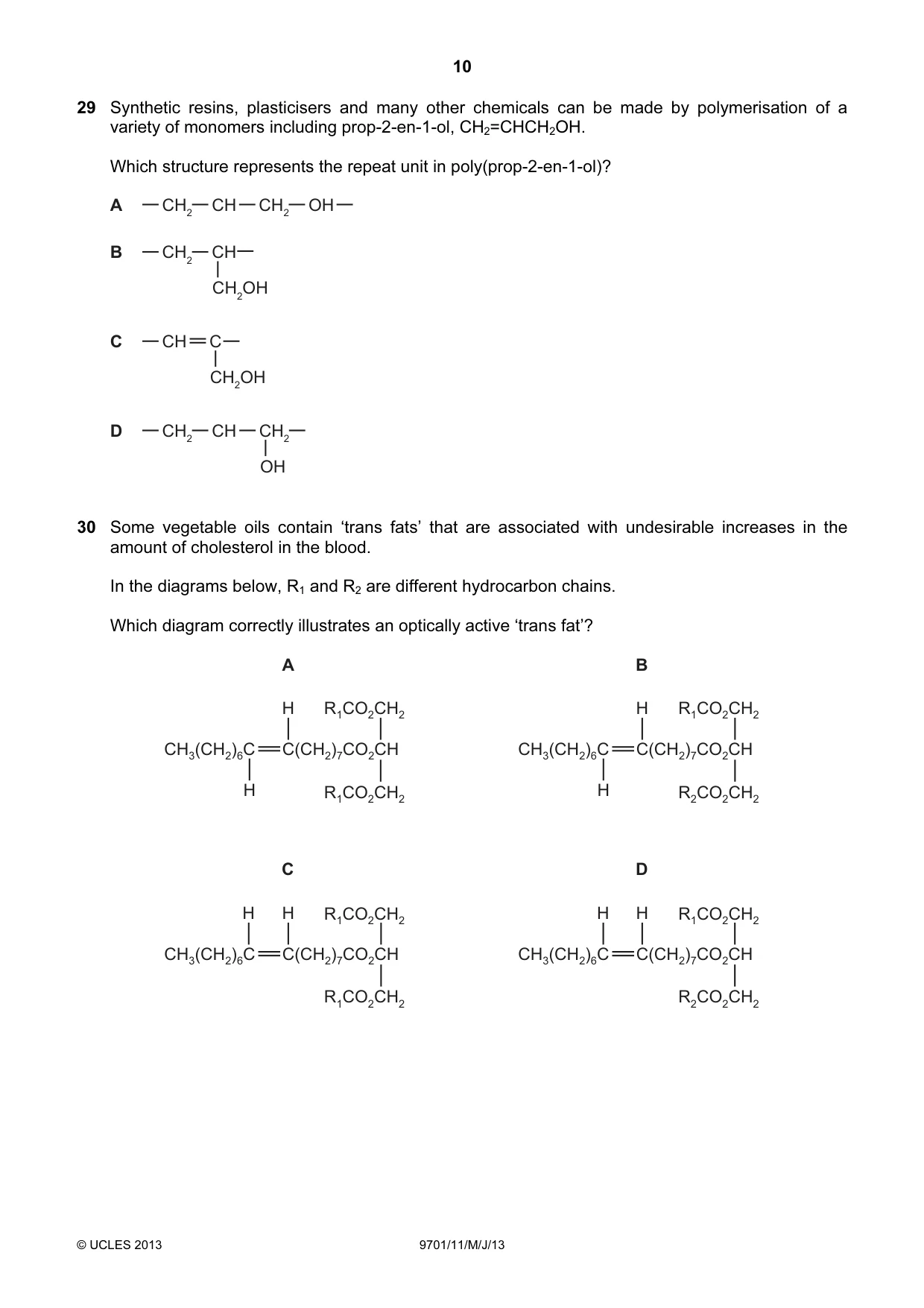
29 Synthetic resins, plasticisers and many other chemicals can be made by polymerisation of a variety of monomers including prop-2-en-1-ol, CH2=CHCH2OH. Which structure represents the repeat unit in poly(prop-2-en-1-ol)? A CH2 CH CH2 OH B CH2 CH CH2OH C CH C CH2OH D CH2 CH CH2 OH
Mark scheme: B
Q30 · Some vegetable oils contain ‘trans fats’ that are associated with undesirable increases…
30 Some vegetable oils contain ‘trans fats’ that are associated with undesirable increases in the amount of cholesterol in the blood. In the diagrams below, R1 and R2 are different hydrocarbon chains. Which diagram correctly illustrates an optically active ‘trans fat’? A B H R1CO2CH2 H R1CO2CH2 CH3(CH2)6C C(CH2)7CO2CH CH3(CH2)6C C(CH2)7CO2CH H R1CO2CH2 H R2CO2CH2 C D H H R1CO2CH2 H H R1CO2CH2 CH3(CH2)6C C(CH2)7CO2CH CH3(CH2)6C C(CH2)7CO2CH R1CO2CH2 R2CO2CH2
Mark scheme: B
More questions on Isomerism: structural isomerism and stereoisomerism
Q31 · Use of the Data Booklet is relevant to this question
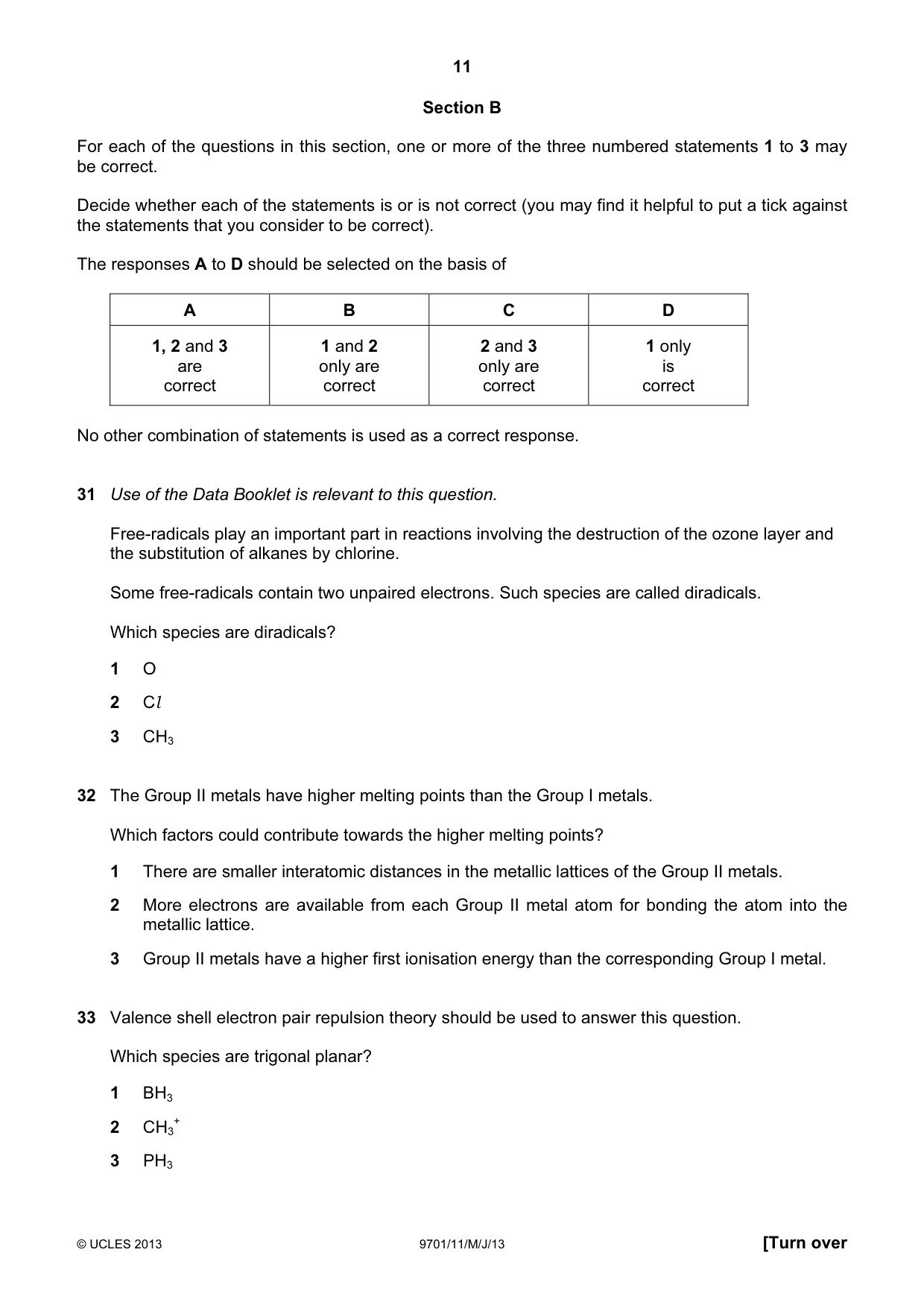
31 Use of the Data Booklet is relevant to this question. Free-radicals play an important part in reactions involving the destruction of the ozone layer and the substitution of alkanes by chlorine. Some free-radicals contain two unpaired electrons. Such species are called diradicals. Which species are diradicals? 1 O 2 Cl 3 CH3
Mark scheme: D
More questions on Electrons, energy levels and atomic orbitals
Q32 · The Group II metals have higher melting points than the Group I metals
32 The Group II metals have higher melting points than the Group I metals. Which factors could contribute towards the higher melting points? 1 There are smaller interatomic distances in the metallic lattices of the Group II metals. 2 More electrons are available from each Group II metal atom for bonding the atom into the metallic lattice. 3 Group II metals have a higher first ionisation energy than the corresponding Group I metal.
Mark scheme: B
Q33 · Valence shell electron pair repulsion theory should be used to answer this question
33 Valence shell electron pair repulsion theory should be used to answer this question. Which species are trigonal planar? 1 BH3 2 CH3 + 3 PH3
Mark scheme: B
Q34 · The first ionisation energies of twenty successive elements in the Periodic Table are…
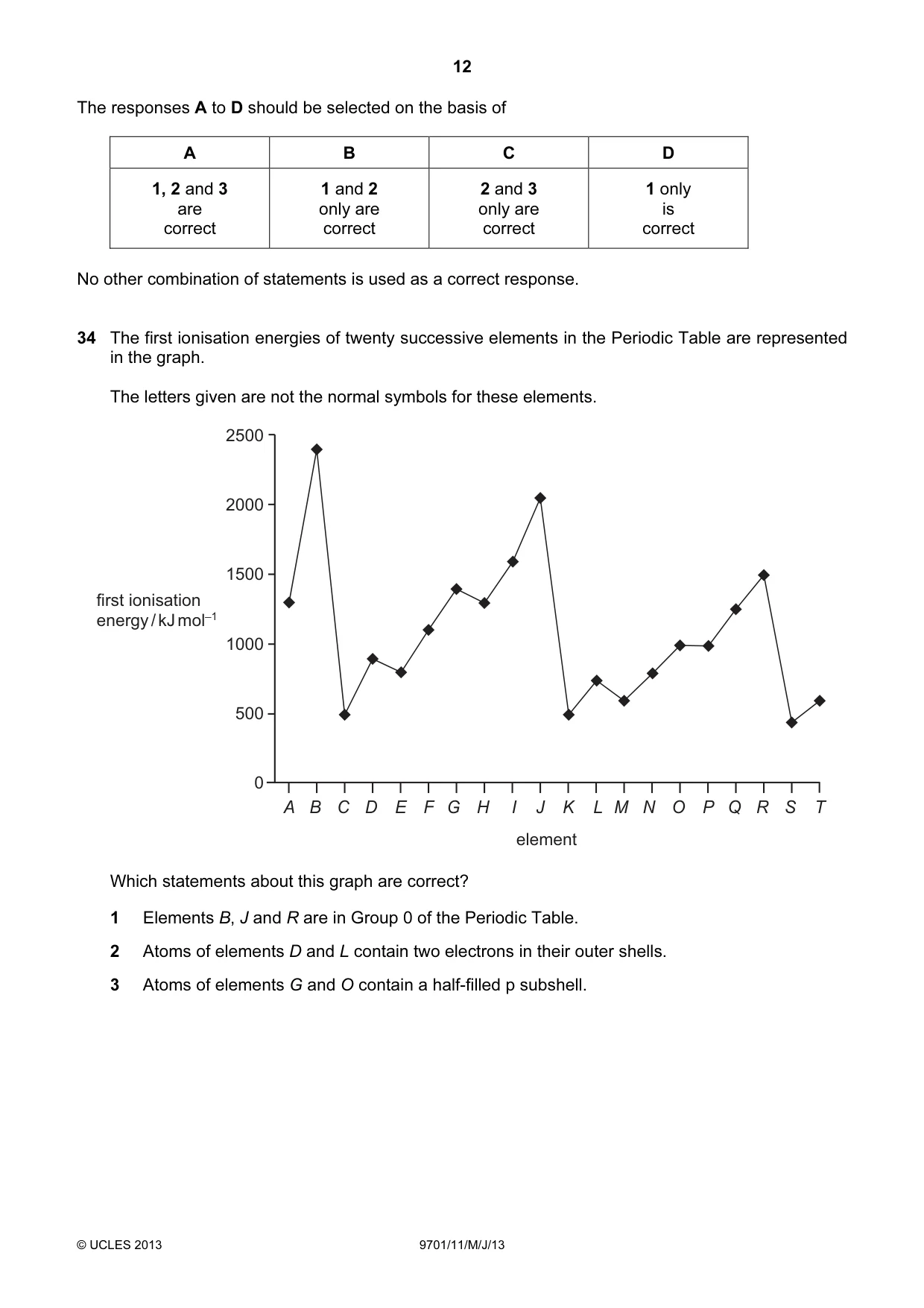
34 The first ionisation energies of twenty successive elements in the Periodic Table are represented in the graph. The letters given are not the normal symbols for these elements. 2500 2000 1500 first ionisation energy / kJ mol _1 1000 500 0 A B C D E F G H I J K L M N O P Q R S T element Which statements about this graph are correct? 1 Elements B, J and R are in Group 0 of the Periodic Table. 2 Atoms of elements D and L contain two electrons in their outer shells. 3 Atoms of elements G and O contain a half-filled p subshell.
Mark scheme: A
More questions on Periodicity of physical properties of the elements in Period 3
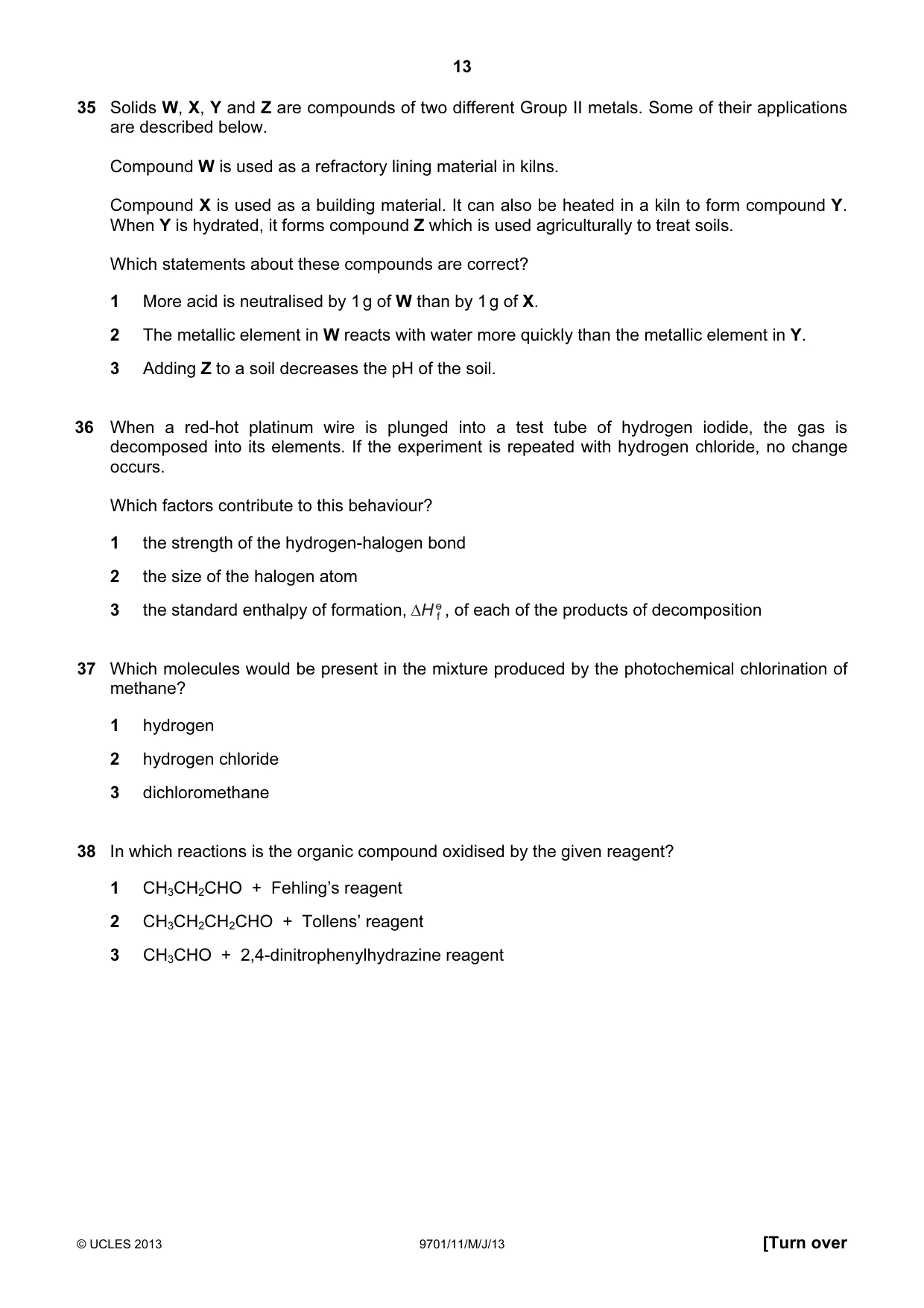
Q35 · Solids W, X, Y and Z are compounds of two different Group II metals
35 Solids W, X, Y and Z are compounds of two different Group II metals. Some of their applications are described below. Compound W is used as a refractory lining material in kilns. Compound X is used as a building material. It can also be heated in a kiln to form compound Y. When Y is hydrated, it forms compound Z which is used agriculturally to treat soils. Which statements about these compounds are correct? 1 More acid is neutralised by 1 g of W than by 1 g of X. 2 The metallic element in W reacts with water more quickly than the metallic element in Y. 3 Adding Z to a soil decreases the pH of the soil.
Mark scheme: D
Q36 · When a red-hot platinum wire is plunged into a test tube of hydrogen iodide, the gas is…
36 When a red-hot platinum wire is plunged into a test tube of hydrogen iodide, the gas is decomposed into its elements. If the experiment is repeated with hydrogen chloride, no change occurs. Which factors contribute to this behaviour? 1 the strength of the hydrogen-halogen bond 2 the size of the halogen atom 3 the standard enthalpy of formation, , of each of the products of decomposition
Mark scheme: B
More questions on The chemical properties of the halogen elements and the hydrogen halides
Q37 · Which molecules would be present in the mixture produced by the photochemical…
37 Which molecules would be present in the mixture produced by the photochemical chlorination of methane? 1 hydrogen 2 hydrogen chloride 3 dichloromethane
Mark scheme: C
Q38 · In which reactions is the organic compound oxidised by the given reagent?
38 In which reactions is the organic compound oxidised by the given reagent? 1 CH3CH2CHO + Fehling’s reagent 2 CH3CH2CH2CHO + Tollens’ reagent 3 CH3CHO + 2,4-dinitrophenylhydrazine reagent
Mark scheme: B
Q39 · A sun protection cream contains the following ester as its active ingredient
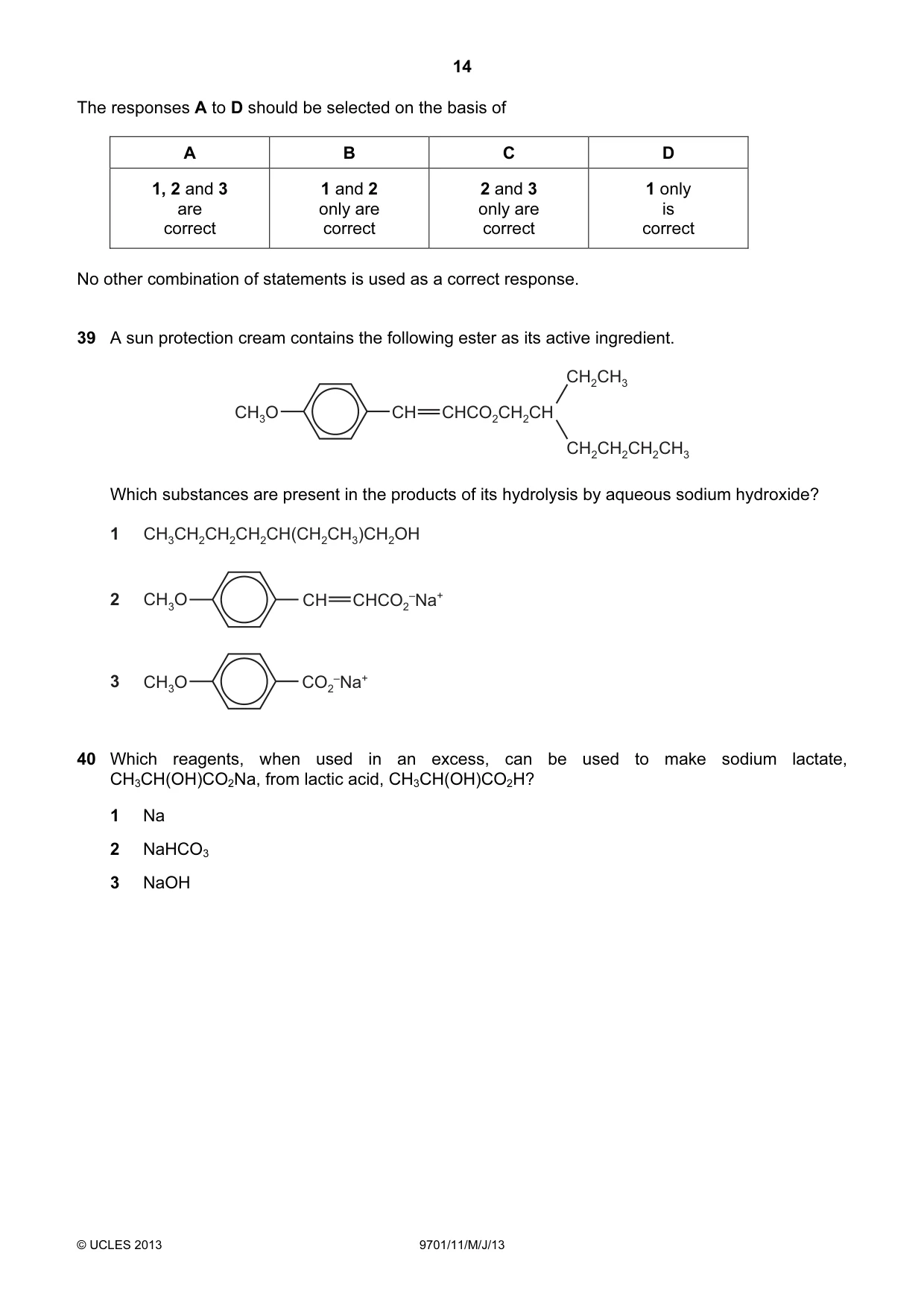
39 A sun protection cream contains the following ester as its active ingredient. CH2CH3 CH3O CH CHCO2CH2CH CH2CH2CH2CH3 Which substances are present in the products of its hydrolysis by aqueous sodium hydroxide? 1 CH3CH2CH2CH2CH(CH2CH3)CH2OH 2 CH3O CH CHCO2 –Na+ 3 CH3O CO2 –Na+
Mark scheme: B
Q40 · Which reagents, when used in an excess, can be used to make sodium lactate…
40 Which reagents, when used in an excess, can be used to make sodium lactate, CH3CH(OH)CO2Na, from lactic acid, CH3CH(OH)CO2H? 1 Na 2 NaHCO3 3 NaOH
Mark scheme: C
What was in this paper
The subtopics covered by these 40 questions, and how many questions each got. Open one in a new tab to see every Cambridge question on it.
4The chemical properties of the halogen elements and the hydrogen halides3Aldehydes and ketones2Alkanes2Carboxylic acids2Enthalpy change, ΔH2Esters2Isomerism: structural isomerism and stereoisomerism2Similarities and trends in the properties of the Group 2 metals, magnesium to barium, and their compounds2The gaseous state: ideal and real gases and pV = nRT2Acids and bases1Addition polymerisation1Alkenes1Chemical equilibria: reversible reactions, dynamic equilibrium1Electrolysis1Electrons, energy levels and atomic orbitals1Halogenoalkanes1Homogeneous and heterogeneous catalysts1Ionisation energy1Metallic bonding1Nitriles and hydroxynitriles1Particles in the atom and atomic radius1Periodicity of physical properties of the elements in Period 31Rate of reaction1Redox processes: electron transfer and changes in oxidation number (oxidation state)1Shapes of molecules1Some reactions of the halide ions1What you needed in this session
Cambridge’s own grade thresholds for 2013 May/June, Paper 1 · Variant 1. A higher threshold means an easier paper — the bar moves with how the cohort did.