Cambridge A Level Chemistry 9701 — 2023 May/June Paper 1 · Variant 3
9701/13/M/J/23 · 40 questions · 40 marks · ≈45 min
The question paper and its mark scheme, free to read here and free to download. This is Cambridge’s own paper, exactly as it was sat.
Question paper16 pages
Mark scheme3 pages
Answers below. Sit the paper first if you are practising.
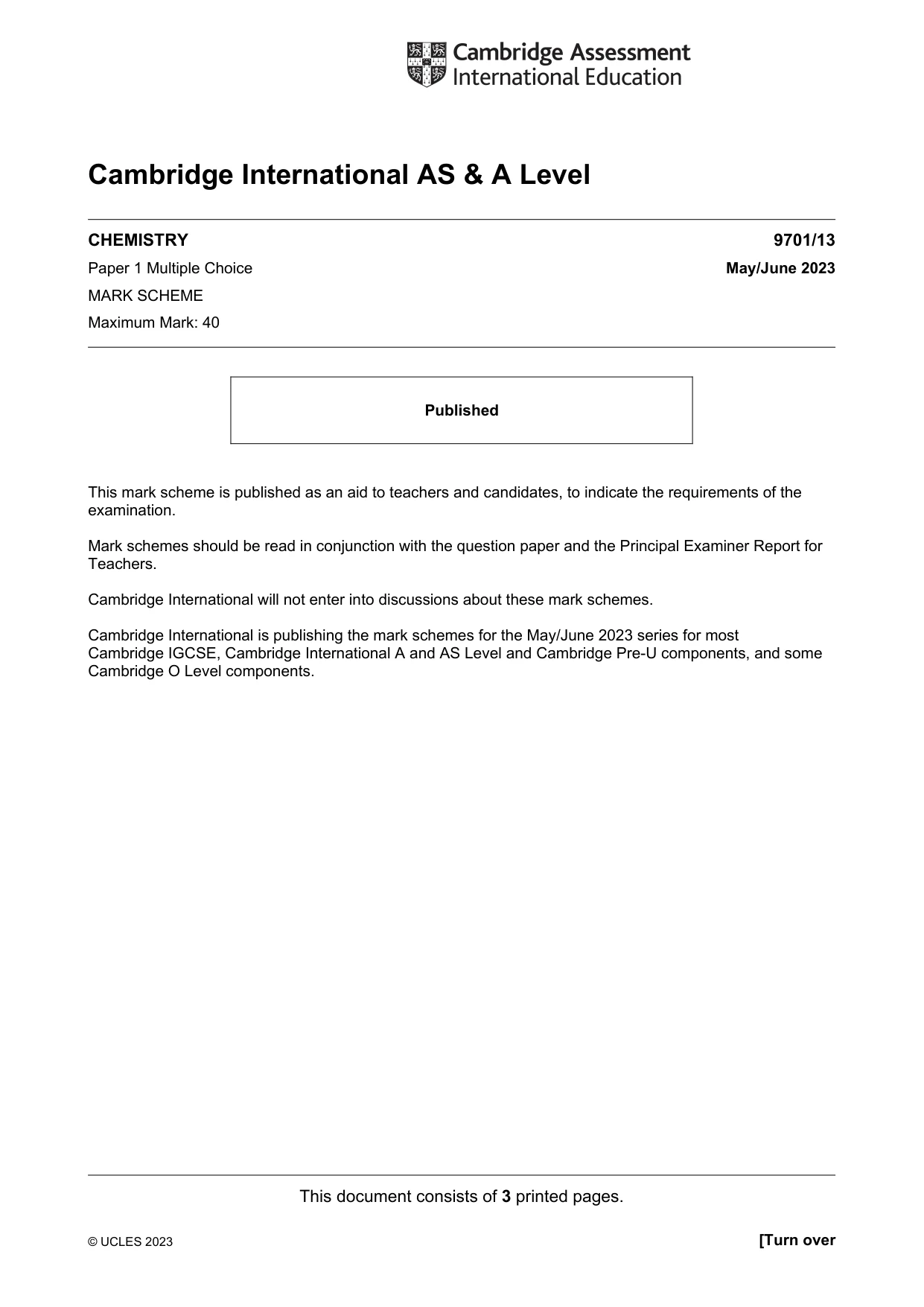
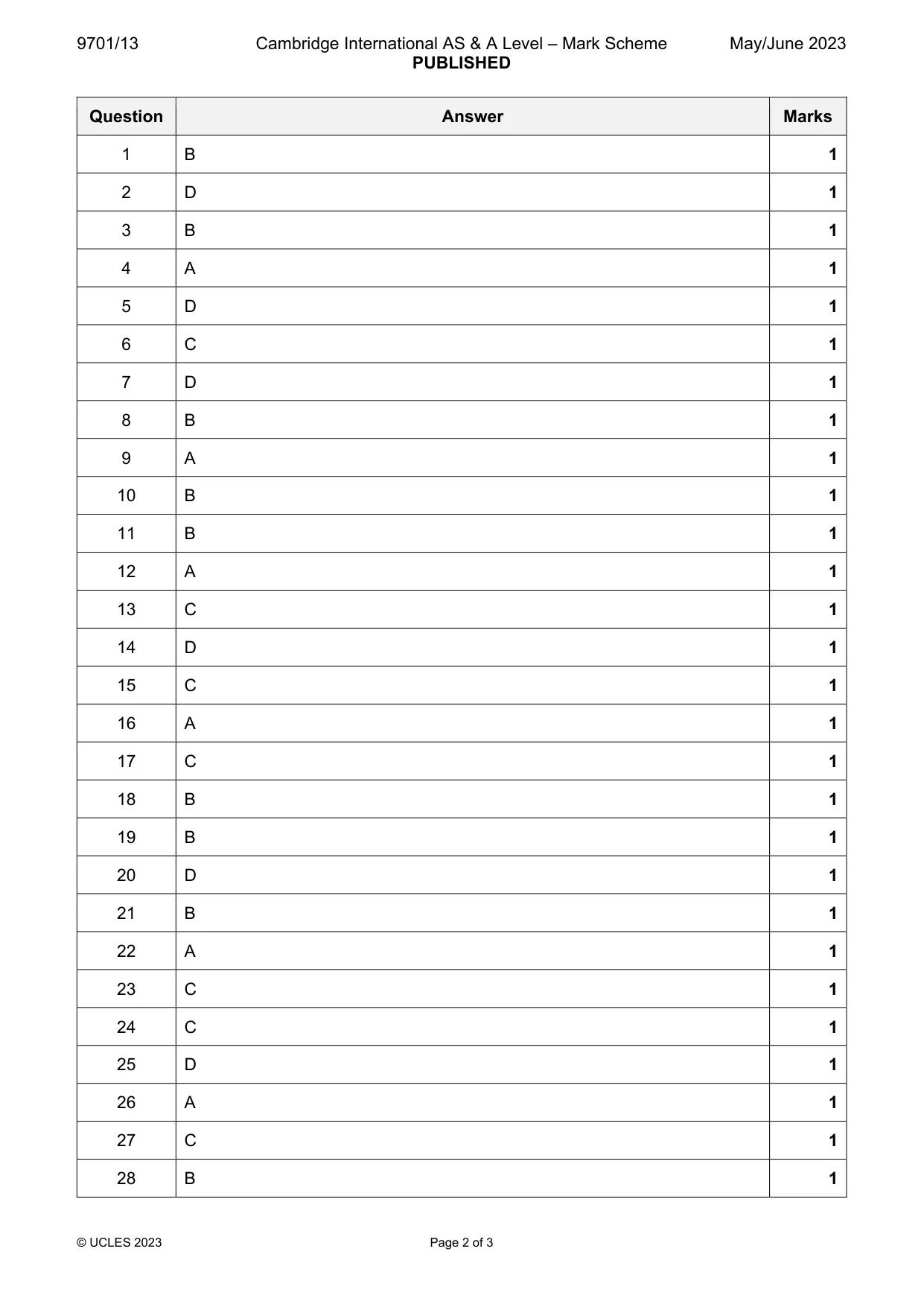
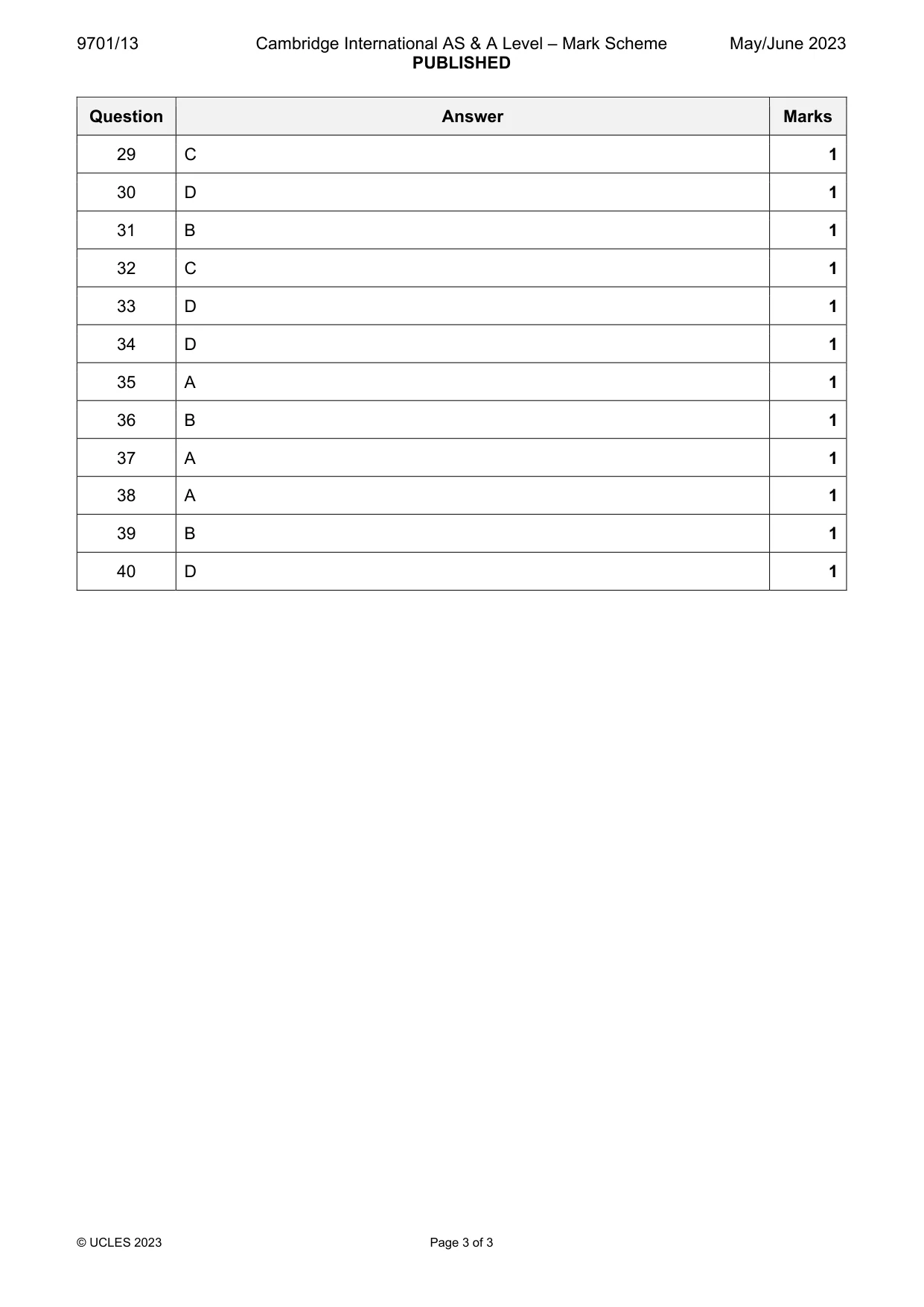
Questions as text
Q1 · Propanoic acid is treated with reagent X at room temperature
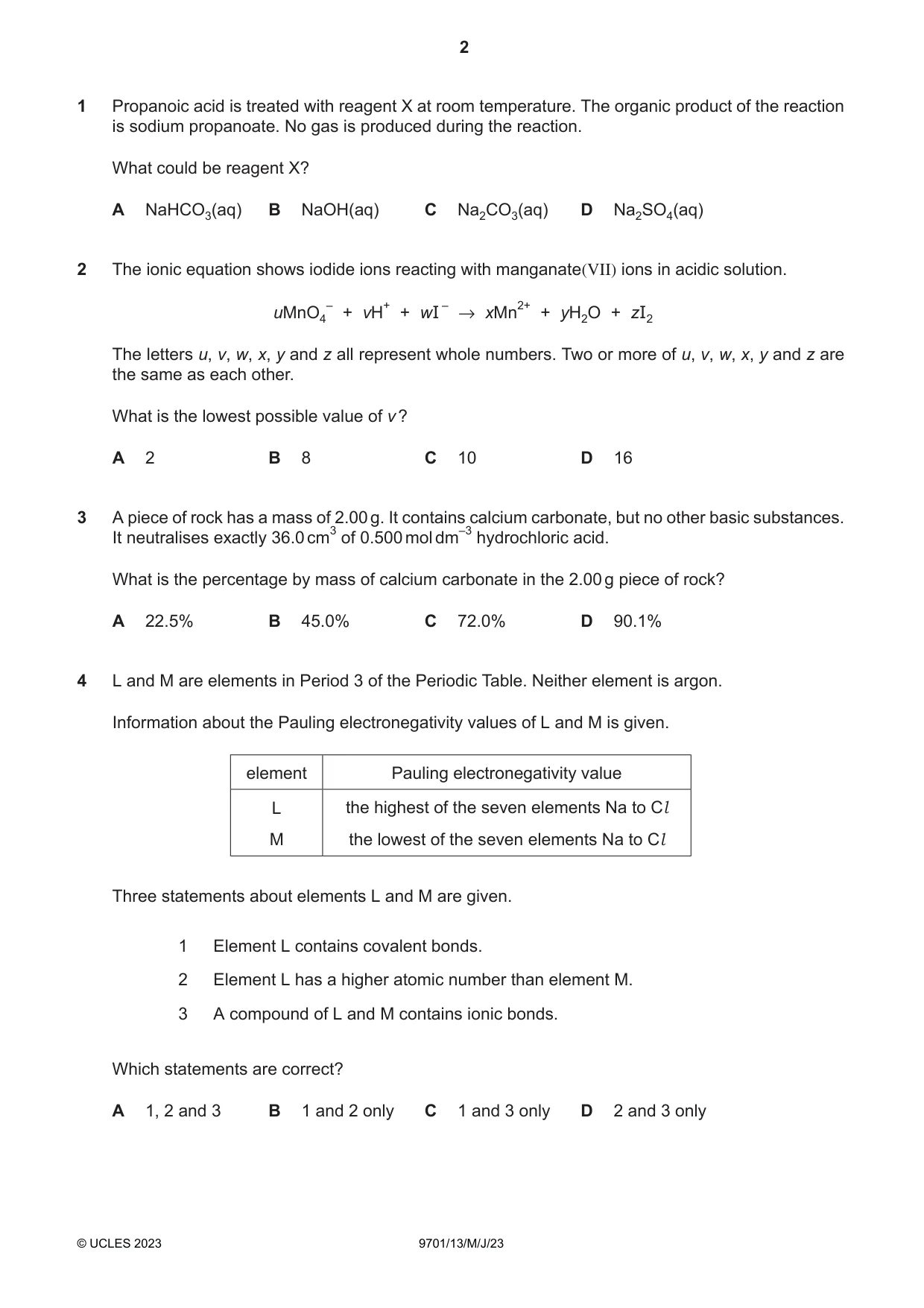
1 Propanoic acid is treated with reagent X at room temperature. The organic product of the reaction is sodium propanoate. No gas is produced during the reaction. What could be reagent X? A NaHCO3(aq) B NaOH(aq) C Na2CO3(aq) D Na2SO4(aq)
Mark scheme: B
Q2 · The ionic equation shows iodide ions reacting with manganate(VII) ions in acidic solution
2 The ionic equation shows iodide ions reacting with manganate(VII) ions in acidic solution. – + vH+ + wI – →xMn2+ + yH2O + zI2 uMnO4 The letters u, v, w, x, y and z all represent whole numbers. Two or more of u, v, w, x, y and z are the same as each other. What is the lowest possible value of v? A 2 B 8 C 10 D 16
Mark scheme: D
Q3 · A piece of rock has a mass of 2.00g
3 A piece of rock has a mass of 2.00g. It contains calcium carbonate, but no other basic substances. It neutralises exactly 36.0cm3 of 0.500moldm–3 hydrochloric acid. What is the percentage by mass of calcium carbonate in the 2.00g piece of rock? A 22.5% B 45.0% C 72.0% D 90.1%
Mark scheme: B
More questions on Reacting masses and volumes (of solutions and gases)
Q4 · L and M are elements in Period 3 of the Periodic Table
4 L and M are elements in Period 3 of the Periodic Table. Neither element is argon. Information about the Pauling electronegativity values of L and M is given. element Pauling electronegativity value L the highest of the seven elements Na to Cl M the lowest of the seven elements Na to Cl Three statements about elements L and M are given. 1 Element L contains covalent bonds. 2 Element L has a higher atomic number than element M. 3 A compound of L and M contains ionic bonds. Which statements are correct? A 1, 2 and 3 B 1 and 2 only C 1 and 3 only D 2 and 3 only
Mark scheme: A
More questions on Periodicity of physical properties of the elements in Period 3
Q5 · Ammonia reacts with acids to form the ammonium ion
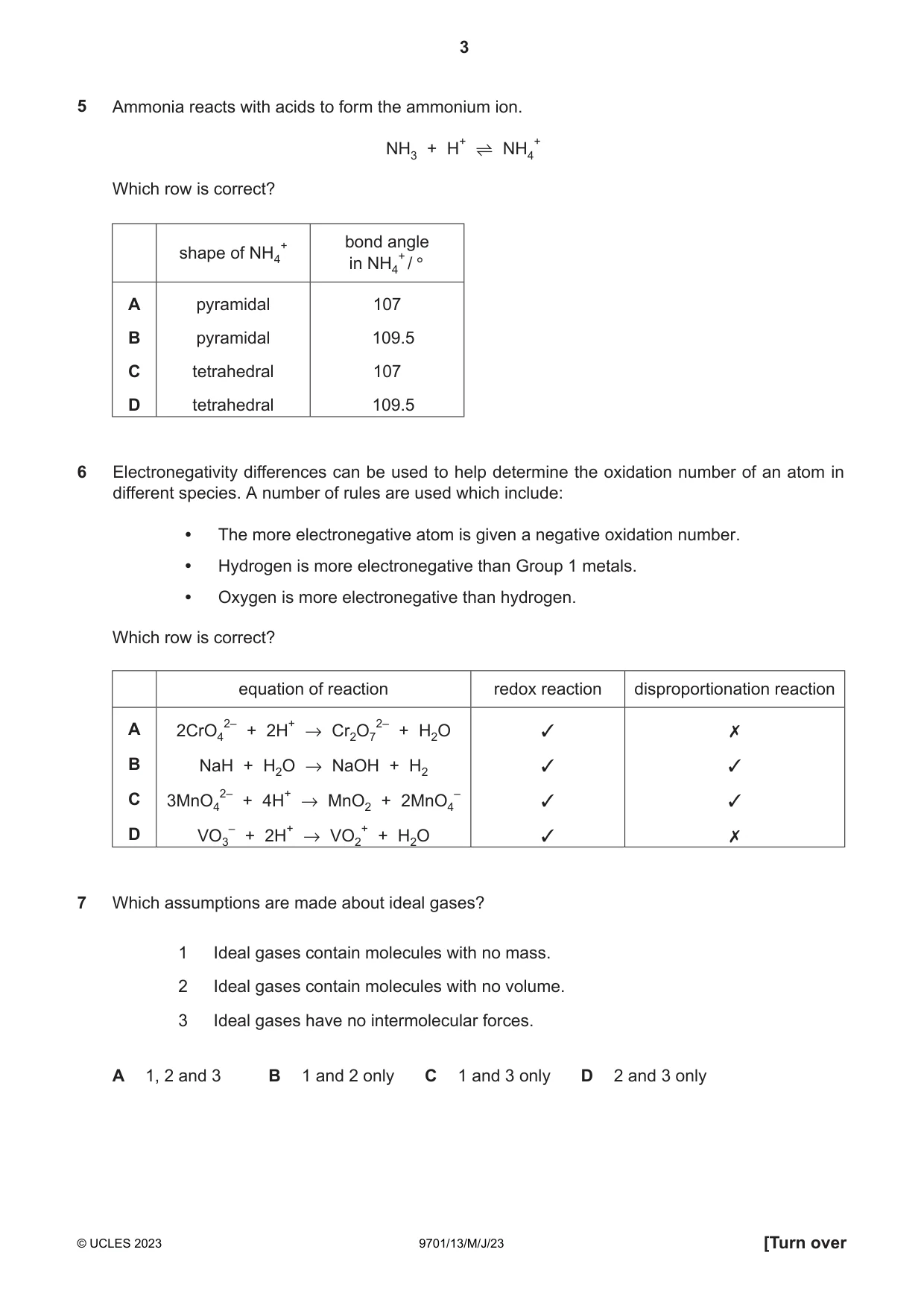
5 Ammonia reacts with acids to form the ammonium ion. NH, + H’ = NH, Which row is correct? + bond angle shape of NH, in NH,*/° A pyramidal 107 B pyramidal 109.5 Cc tetrahedral 107 D tetrahedral 109.5
Mark scheme: D
Q6 · Electronegativity differences can be used to help determine the oxidation number of an…
6 Electronegativity differences can be used to help determine the oxidation number of an atom in different species. A number of rules are used which include: e The more electronegative atom is given a negative oxidation number. e — Hydrogen is more electronegative than Group 1 metals. e Oxygen is more electronegative than hydrogen. Which row is correct? equation of reaction redox reaction disproportionation reaction A | 2CrO0,* + 2H* > Cr,0,7 + H,O V x B NaH + H,O — NaOH + H, Jv Jv Cc 3Mn0,~ + 4H" — MnO, + 2MnO, Jv Jv D VO, + 2H’ > VO, + H,O J x
Mark scheme: C
Q7 · Which assumptions are made about ideal gases?
7 Which assumptions are made about ideal gases? 1. Ideal gases contain molecules with no mass. 2 Ideal gases contain molecules with no volume. 3 Ideal gases have no intermolecular forces. A 1,2and3 B 1tand2only C 1and3only D = 2and3only
Mark scheme: D
More questions on The gaseous state: ideal and real gases and pV = nRT
Q8 · This amount of oxygen gas has a volume of 6.00cm3 when measured at 1.00 × 10⁵Pa and 35°C
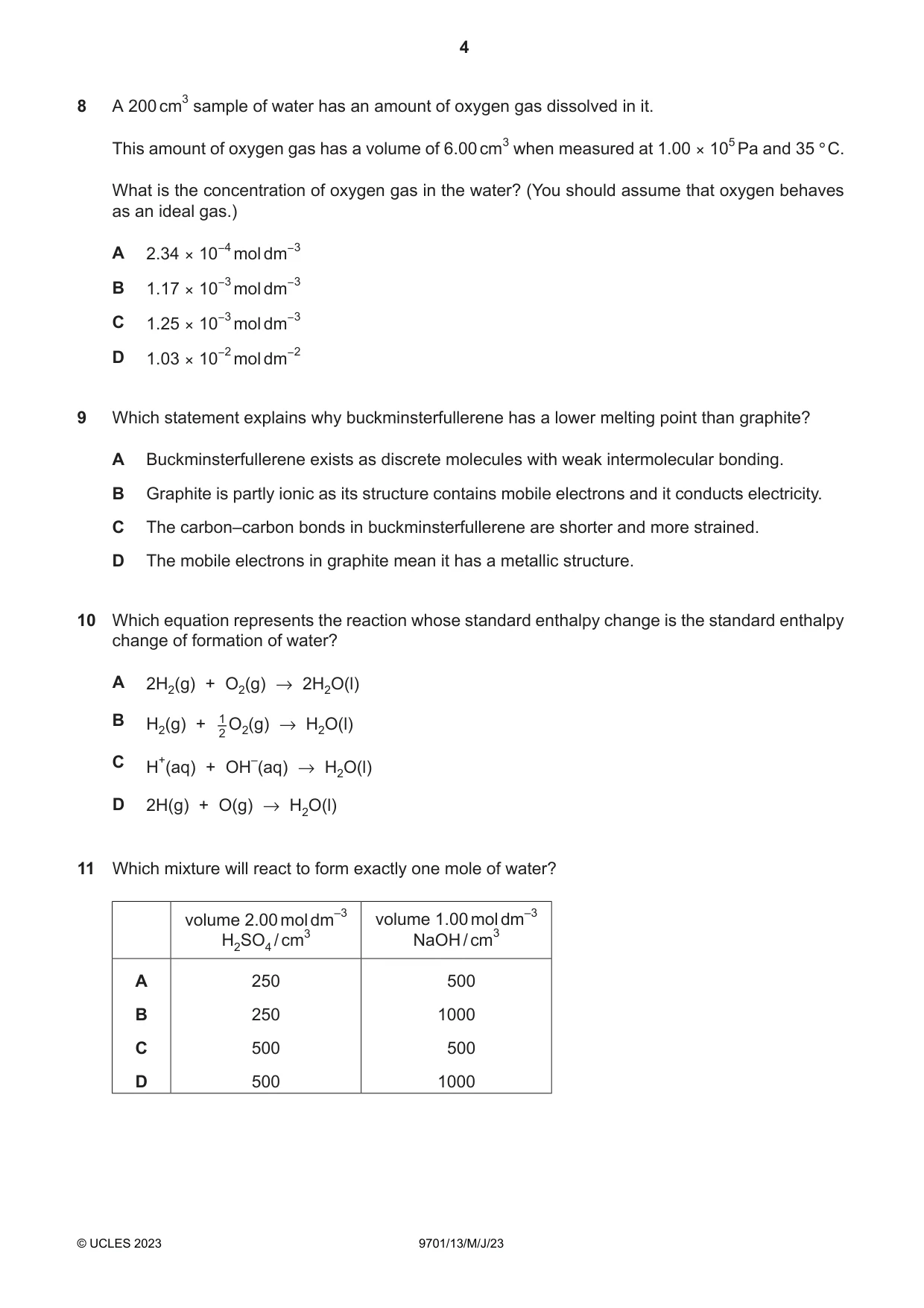
8 This amount of oxygen gas has a volume of 6.00cm3 when measured at 1.00 × 10⁵Pa and 35°C. What is the concentration of oxygen gas in the water? (You should assume that oxygen behaves as an ideal gas.) A 2.34 × 10⁻⁴moldm−3 B 1.17 × 10⁻³moldm−3 C 1.25 × 10⁻³moldm−3 D 1.03 × 10⁻²moldm−2
Mark scheme: B
More questions on The gaseous state: ideal and real gases and pV = nRT
Q9 · Which statement explains why buckminsterfullerene has a lower melting point than graphite?
9 Which statement explains why buckminsterfullerene has a lower melting point than graphite? A Buckminsterfullerene exists as discrete molecules with weak intermolecular bonding. B Graphite is partly ionic as its structure contains mobile electrons and it conducts electricity. C The carbon–carbon bonds in buckminsterfullerene are shorter and more strained. D The mobile electrons in graphite mean it has a metallic structure.
Mark scheme: A
More questions on Intermolecular forces, electronegativity and bond properties
Q10 · Which equation represents the reaction whose standard enthalpy change is the standard…
10 Which equation represents the reaction whose standard enthalpy change is the standard enthalpy change of formation of water? A 2H2(g) + O2(g) →2H2O(l) B H2(g) + O2(g) →H2O(l) C H+(aq) + OH–(aq) →H2O(l) D 2H(g) + O(g) →H2O(l)
Mark scheme: B
Q11 · Which mixture will react to form exactly one mole of water?
11 Which mixture will react to form exactly one mole of water? volume 2.00moldm–3 volume 1.00moldm–3 H2SO4/cm3 NaOH/cm3 A 250 500 B 250 1000 C 500 500 D 500 1000
Mark scheme: B
More questions on Reacting masses and volumes (of solutions and gases)
Q12 · The enthalpy change for neutralisation of HNO3(aq) with NaOH(aq) is –57.0kJmol–1
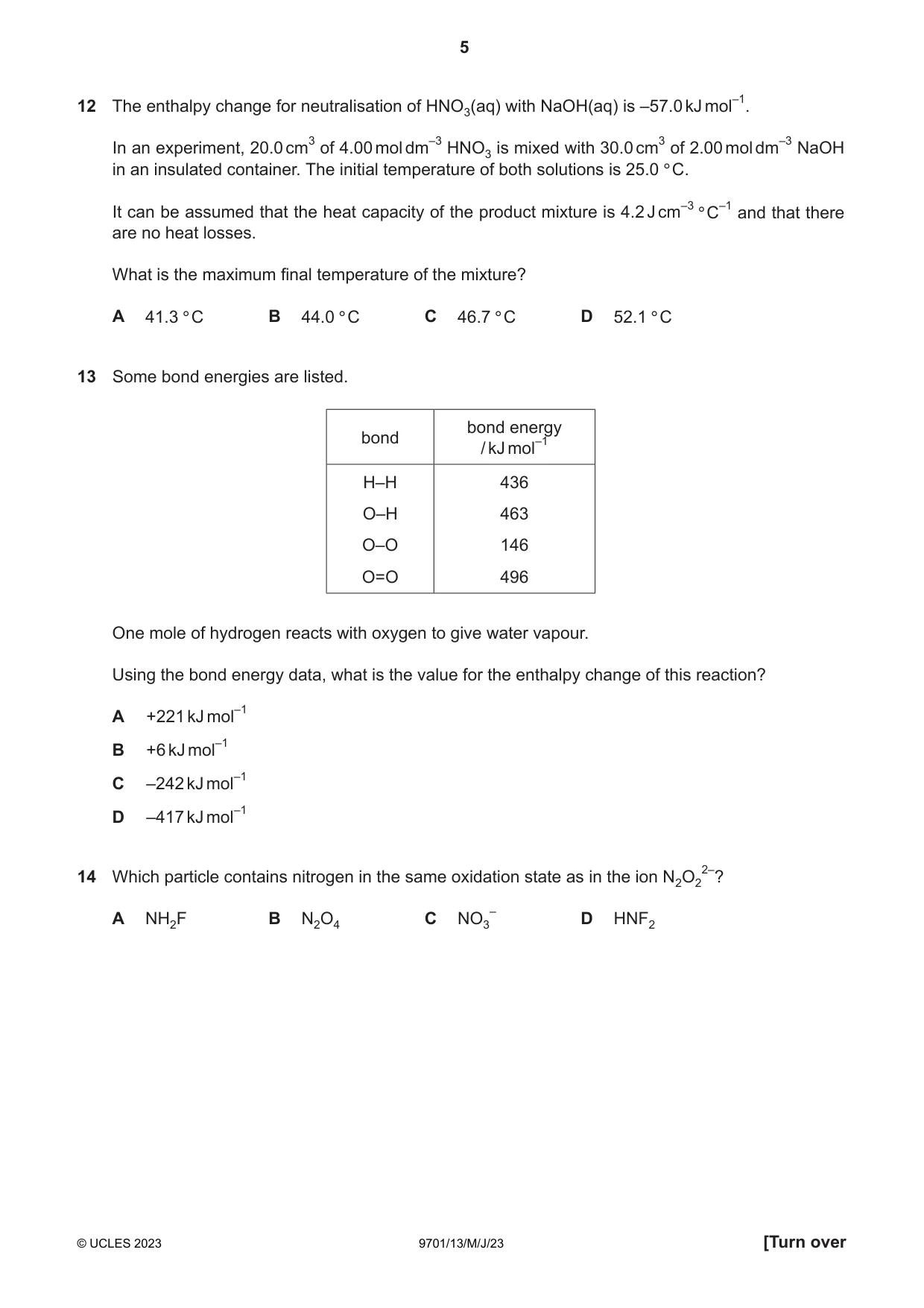
12 The enthalpy change for neutralisation of HNO3(aq) with NaOH(aq) is –57.0kJmol–1. In an experiment, 20.0cm3 of 4.00moldm–3 HNO3 is mixed with 30.0cm3 of 2.00moldm–3 NaOH in an insulated container. The initial temperature of both solutions is 25.0 °C. It can be assumed that the heat capacity of the product mixture is 4.2Jcm–3°C–1 and that there are no heat losses. What is the maximum final temperature of the mixture? A 41.3°C B 44.0°C C 46.7°C D 52.1°C
Mark scheme: A
Q13 · Some bond energies are listed
13 Some bond energies are listed. bond energy bond /kJmol–1 H–H 436 O–H 463 O–O 146 O=O 496 One mole of hydrogen reacts with oxygen to give water vapour. Using the bond energy data, what is the value for the enthalpy change of this reaction? A +221kJmol–1 B +6kJmol–1 C –242kJmol–1 D –417kJmol–1
Mark scheme: C
Q14 · Which particle contains nitrogen in the same oxidation state as in the ion N2O2 2–?
14 Which particle contains nitrogen in the same oxidation state as in the ion N2O2 2–? A NH2F B N2O4 C NO3 – D HNF2
Mark scheme: D
Q15 · Sulfur dioxide reacts with oxygen as shown
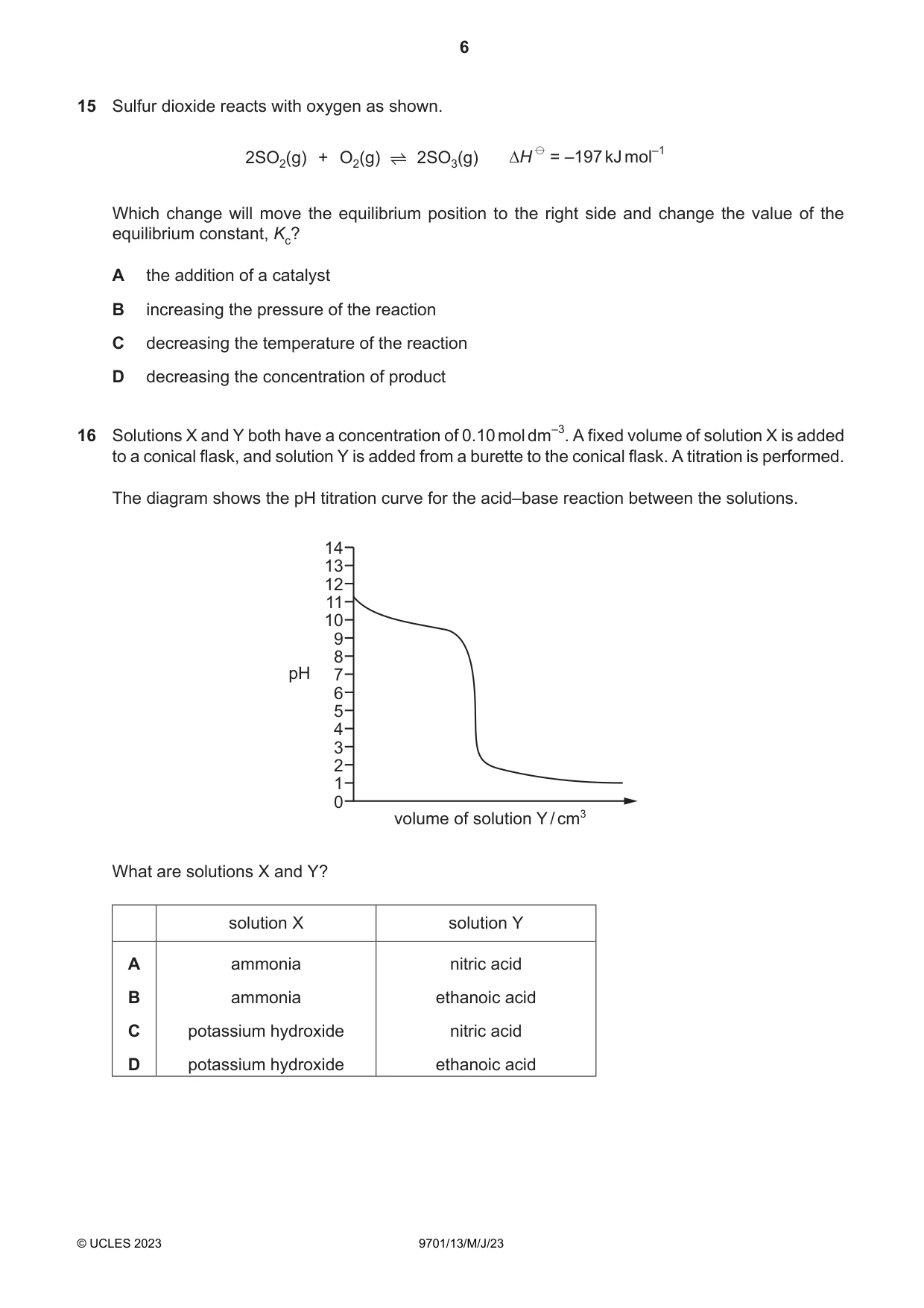
15 Sulfur dioxide reacts with oxygen as shown. 2SO2(g) + O2(g) ⇋2SO3(g) ¨H ⦵= –197kJmol–1 Which change will move the equilibrium position to the right side and change the value of the equilibrium constant, Kc? A the addition of a catalyst B increasing the pressure of the reaction C decreasing the temperature of the reaction D decreasing the concentration of product
Mark scheme: C
More questions on Chemical equilibria: reversible reactions, dynamic equilibrium
Q16 · Solutions X and Y both have a concentration of 0.10moldm–3
16 Solutions X and Y both have a concentration of 0.10moldm–3. A fixed volume of solution X is added to a conical flask, and solution Y is added from a burette to the conical flask. A titration is performed. The diagram shows the pH titration curve for the acid–base reaction between the solutions. 14 13 12 11 10 9 8 pH 7 6 5 4 3 2 1 0 volume of solution Y / cm3 What are solutions X and Y? solution X solution Y A ammonia nitric acid B ammonia ethanoic acid C potassium hydroxide nitric acid D potassium hydroxide ethanoic acid
Mark scheme: A
Q17 · Which row shows the expected properties of the element astatine when compared to the…
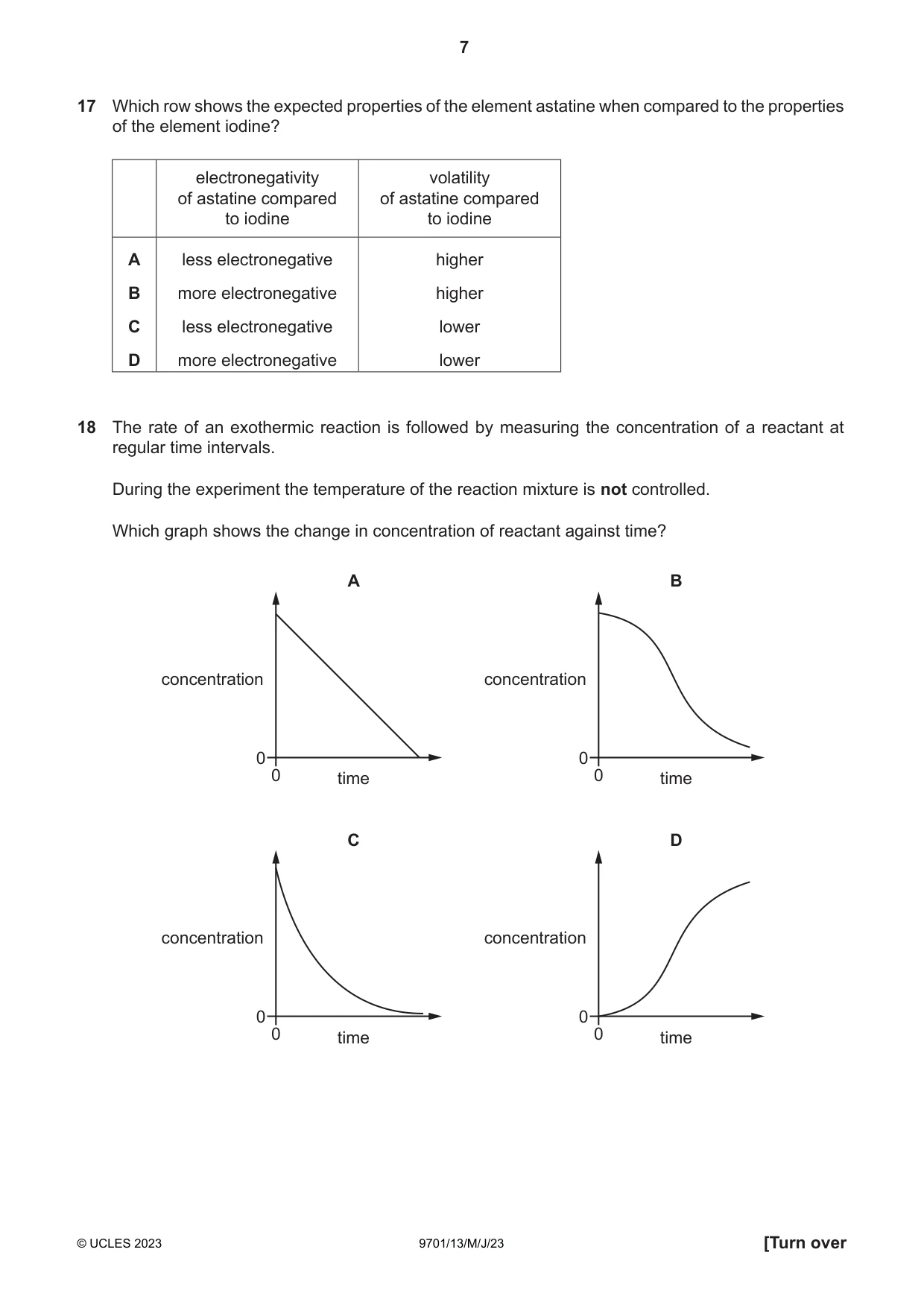
17 Which row shows the expected properties of the element astatine when compared to the properties of the element iodine? electronegativity volatility of astatine compared of astatine compared to iodine to iodine A less electronegative higher B more electronegative higher C less electronegative lower D more electronegative lower
Mark scheme: C
More questions on Physical properties of the Group 17 elements
Q18 · The rate of an exothermic reaction is followed by measuring the concentration of a…
18 The rate of an exothermic reaction is followed by measuring the concentration of a reactant at regular time intervals. During the experiment the temperature of the reaction mixture is not controlled. Which graph shows the change in concentration of reactant against time? concentration concentration iN 0 time 0 time concentration concentration KO 0 time 0 time
Mark scheme: B
Q19 · For a particular reversible reaction the backward reaction is endothermic
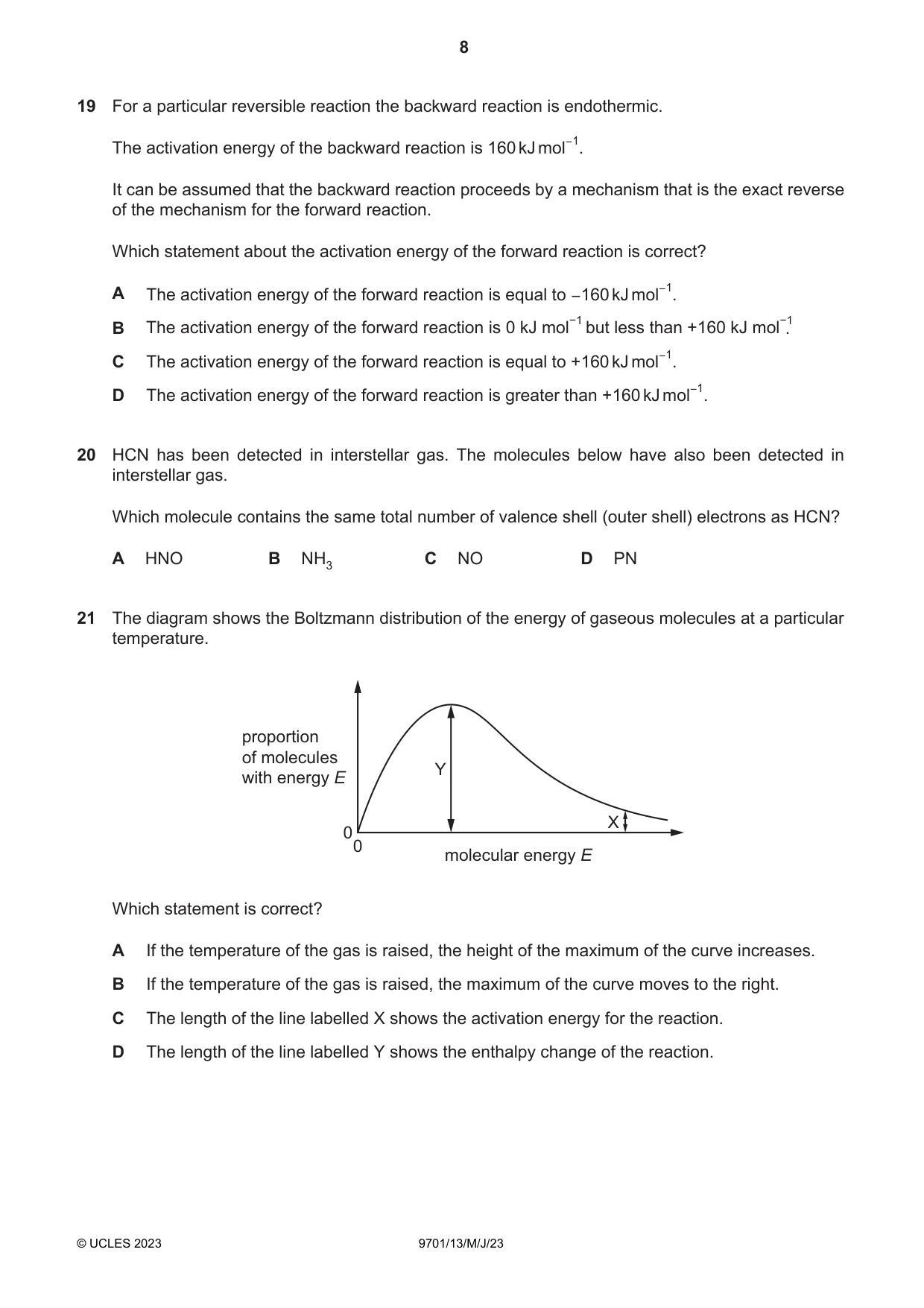
19 For a particular reversible reaction the backward reaction is endothermic. The activation energy of the backward reaction is 160kJmol−1. It can be assumed that the backward reaction proceeds by a mechanism that is the exact reverse of the mechanism for the forward reaction. Which statement about the activation energy of the forward reaction is correct? A The activation energy of the forward reaction is equal to −160kJmol−1. B The activation energy of the forward reaction is 0 kJ mol−1 but less than +160 kJ mol−1. C The activation energy of the forward reaction is equal to +160kJmol−1. D The activation energy of the forward reaction is greater than +160kJmol−1.
Mark scheme: B
More questions on Effect of temperature on reaction rates and the concept of activation energy
Q20 · HCN has been detected in interstellar gas
20 HCN has been detected in interstellar gas. The molecules below have also been detected in interstellar gas. Which molecule contains the same total number of valence shell (outer shell) electrons as HCN? A HNO B NH3 C NO D PN
Mark scheme: D
More questions on Electrons, energy levels and atomic orbitals
Q21 · The diagram shows the Boltzmann distribution of the energy of gaseous molecules at a…
21 The diagram shows the Boltzmann distribution of the energy of gaseous molecules at a particular temperature. proportion of molecules Y with energy E X 00 molecular energy E Which statement is correct? A If the temperature of the gas is raised, the height of the maximum of the curve increases. B If the temperature of the gas is raised, the maximum of the curve moves to the right. C The length of the line labelled X shows the activation energy for the reaction. D The length of the line labelled Y shows the enthalpy change of the reaction.
Mark scheme: B
More questions on Effect of temperature on reaction rates and the concept of activation energy
Q22 · The elements magnesium and phosphorus are reacted separately with an excess of oxygen to…
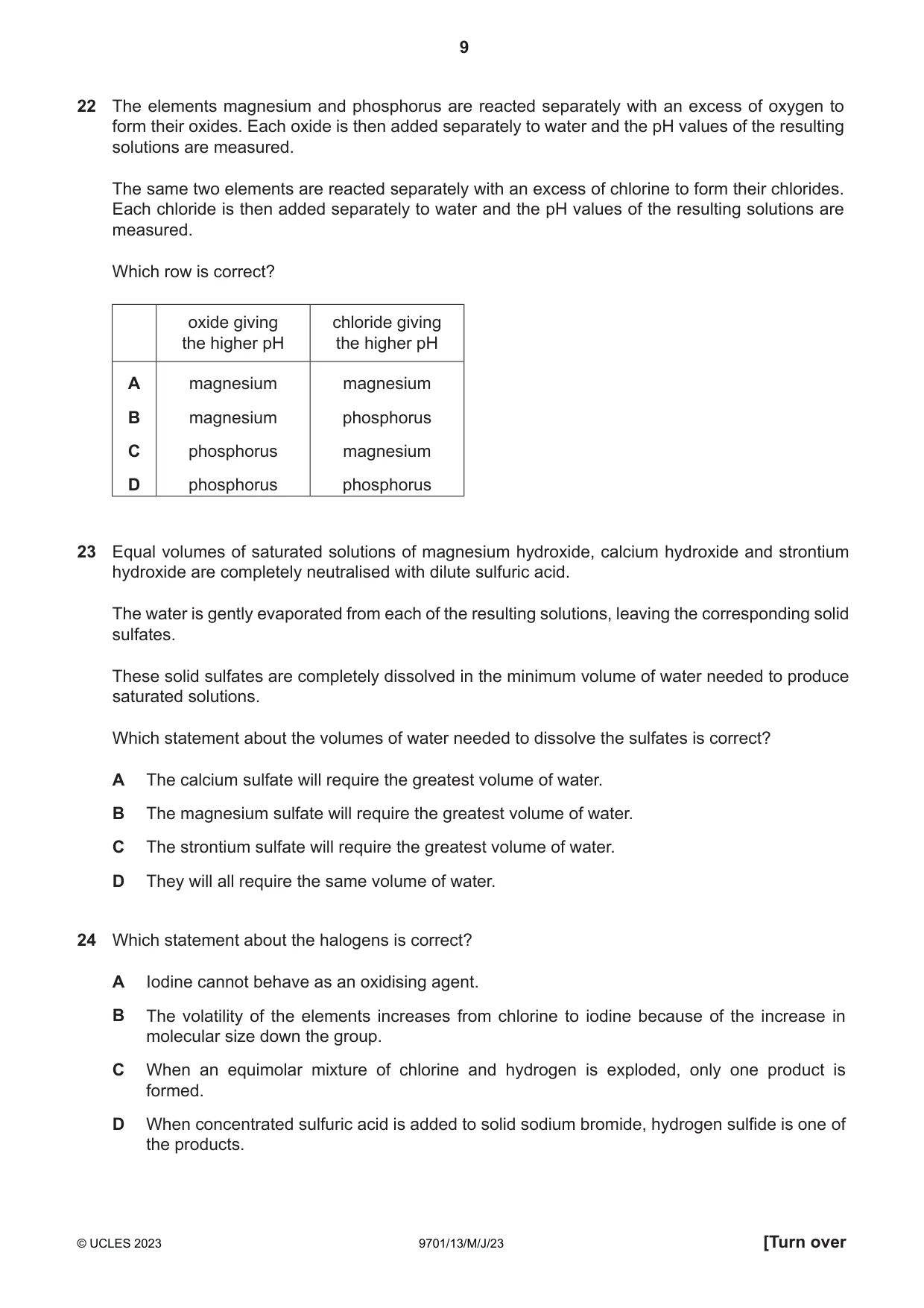
22 The elements magnesium and phosphorus are reacted separately with an excess of oxygen to form their oxides. Each oxide is then added separately to water and the pH values of the resulting solutions are measured. The same two elements are reacted separately with an excess of chlorine to form their chlorides. Each chloride is then added separately to water and the pH values of the resulting solutions are measured. Which row is correct? oxide giving chloride giving the higher pH the higher pH A magnesium magnesium B magnesium phosphorus C phosphorus magnesium D phosphorus phosphorus
Mark scheme: A
More questions on Periodicity of chemical properties of the elements in Period 3
Q23 · Equal volumes of saturated solutions of magnesium hydroxide, calcium hydroxide and…
23 Equal volumes of saturated solutions of magnesium hydroxide, calcium hydroxide and strontium hydroxide are completely neutralised with dilute sulfuric acid. The water is gently evaporated from each of the resulting solutions, leaving the corresponding solid sulfates. These solid sulfates are completely dissolved in the minimum volume of water needed to produce saturated solutions. Which statement about the volumes of water needed to dissolve the sulfates is correct? A The calcium sulfate will require the greatest volume of water. B The magnesium sulfate will require the greatest volume of water. C The strontium sulfate will require the greatest volume of water. D They will all require the same volume of water.
Mark scheme: C
Q24 · Which statement about the halogens is correct?
24 Which statement about the halogens is correct? A Iodine cannot behave as an oxidising agent. B The volatility of the elements increases from chlorine to iodine because of the increase in molecular size down the group. C When an equimolar mixture of chlorine and hydrogen is exploded, only one product is formed. D When concentrated sulfuric acid is added to solid sodium bromide, hydrogen sulfide is one of the products.
Mark scheme: C
More questions on The chemical properties of the halogen elements and the hydrogen halides
Q25 · When concentrated sulfuric acid is added to solid sodium bromide, bromine gas is…
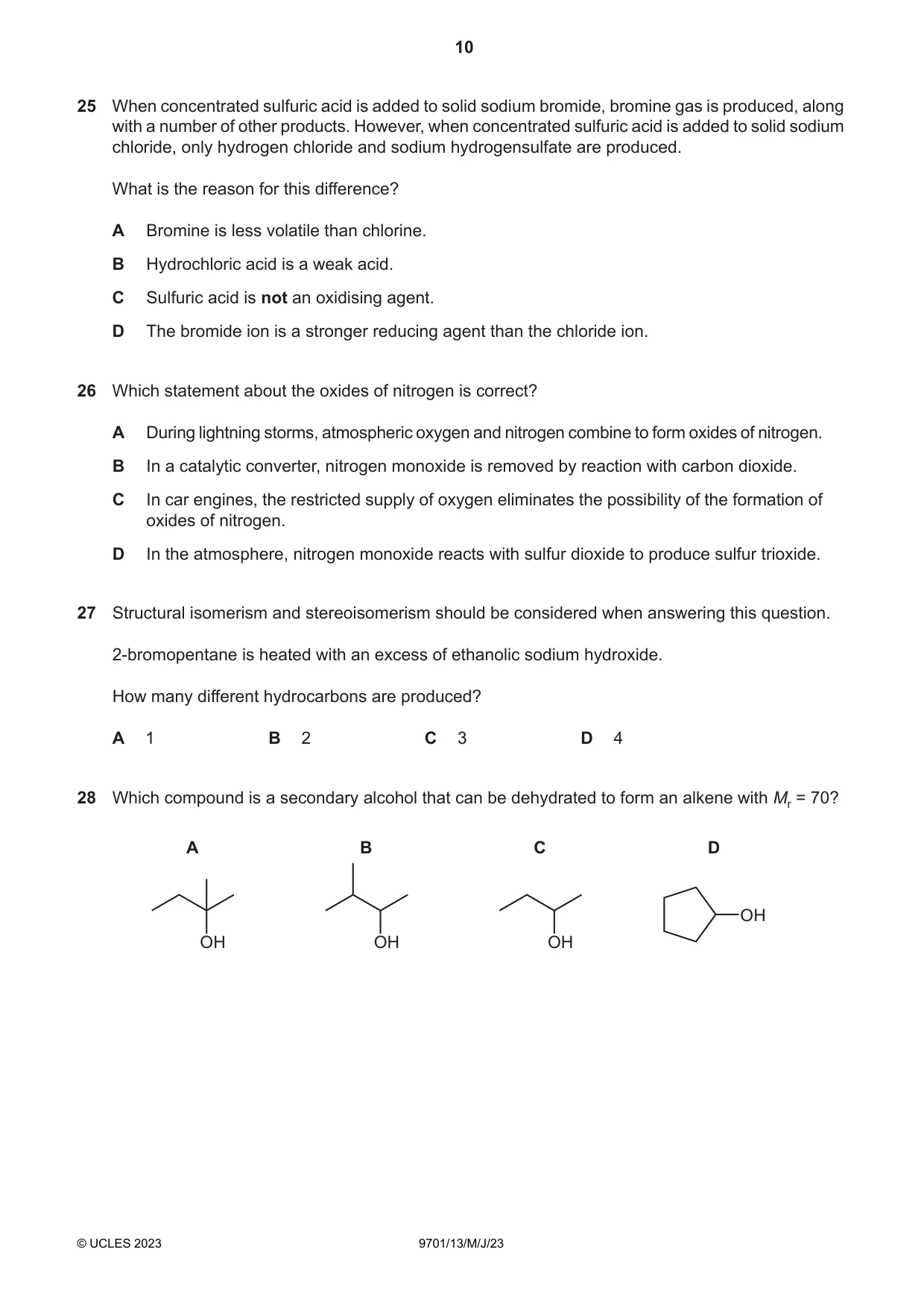
25 When concentrated sulfuric acid is added to solid sodium bromide, bromine gas is produced, along with a number of other products. However, when concentrated sulfuric acid is added to solid sodium chloride, only hydrogen chloride and sodium hydrogensulfate are produced. What is the reason for this difference? A Bromine is less volatile than chlorine. B Hydrochloric acid is a weak acid. C Sulfuric acid is not an oxidising agent. D The bromide ion is a stronger reducing agent than the chloride ion.
Mark scheme: D
Q26 · Which statement about the oxides of nitrogen is correct?
26 Which statement about the oxides of nitrogen is correct? A During lightning storms, atmospheric oxygen and nitrogen combine to form oxides of nitrogen. B In a catalytic converter, nitrogen monoxide is removed by reaction with carbon dioxide. C In car engines, the restricted supply of oxygen eliminates the possibility of the formation of oxides of nitrogen. D In the atmosphere, nitrogen monoxide reacts with sulfur dioxide to produce sulfur trioxide.
Mark scheme: A
Q27 · Structural isomerism and stereoisomerism should be considered when answering this question
27 Structural isomerism and stereoisomerism should be considered when answering this question. 2-bromopentane is heated with an excess of ethanolic sodium hydroxide. How many different hydrocarbons are produced? A 1 B 2 C 3 D 4
Mark scheme: C
Q28 · Which compound is a secondary alcohol that can be dehydrated to form an alkene with Mr =…
28 Which compound is a secondary alcohol that can be dehydrated to form an alkene with Mr = 70? A B C D A B C D OH OH OH OH
Mark scheme: B
Q29 · The conversion of propan-1-ol into propan-2-ol can be completed in a two-stage synthesis
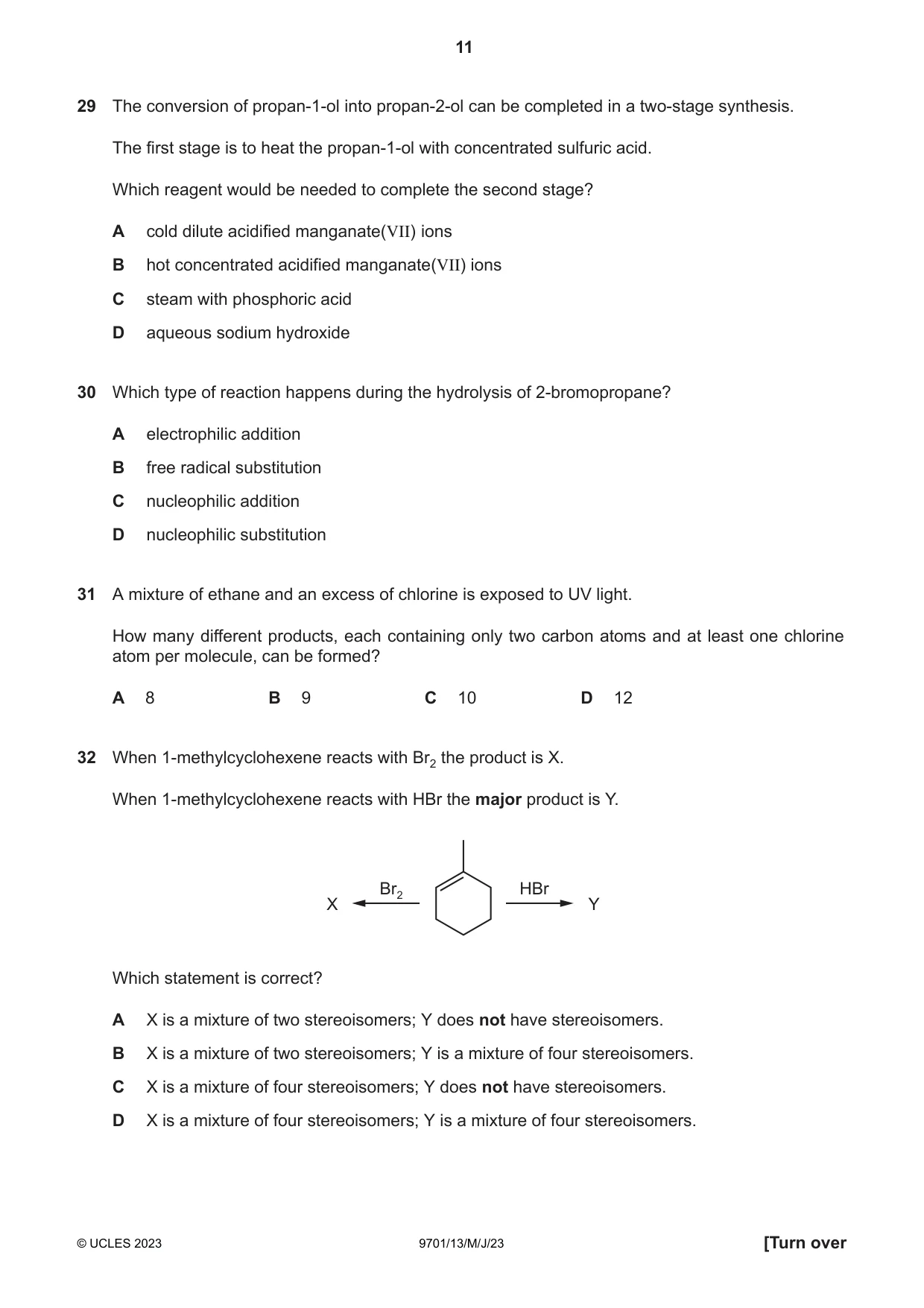
29 The conversion of propan-1-ol into propan-2-ol can be completed in a two-stage synthesis. The first stage is to heat the propan-1-ol with concentrated sulfuric acid. Which reagent would be needed to complete the second stage? A B Cc D cold dilute acidified manganate(VII) ions hot concentrated acidified manganate(VII) ions steam with phosphoric acid aqueous sodium hydroxide
Mark scheme: C
Q30 · Which type of reaction happens during the hydrolysis of 2-bromopropane?
30 Which type of reaction happens during the hydrolysis of 2-bromopropane? A electrophilic addition B free radical substitution C nucleophilic addition D nucleophilic substitution
Mark scheme: D
Q31 · A mixture of ethane and an excess of chlorine is exposed to UV light
31 A mixture of ethane and an excess of chlorine is exposed to UV light. How many different products, each containing only two carbon atoms and at least one chlorine atom per molecule, can be formed? A 8 B 9 C 10 D 12
Mark scheme: B
Q32 · When 1-methylcyclohexene reacts with Br, the product is X
32 When 1-methylcyclohexene reacts with Br, the product is X. When 1-methylcyclohexene reacts with HBr the major product is Y. Br, HBr xX —— —. Y A Xisamixture of two stereoisomers; Y does not have stereoisomers. Which statement is correct? X is a mixture of two stereoisomers; Y is a mixture of four stereoisomers. X is a mixture of four stereoisomers; Y does not have stereoisomers. Oo OO DW X is a mixture of four stereoisomers; Y is a mixture of four stereoisomers.
Mark scheme: C
Q33 · T is an organic compound which contains 66.7% by mass of carbon
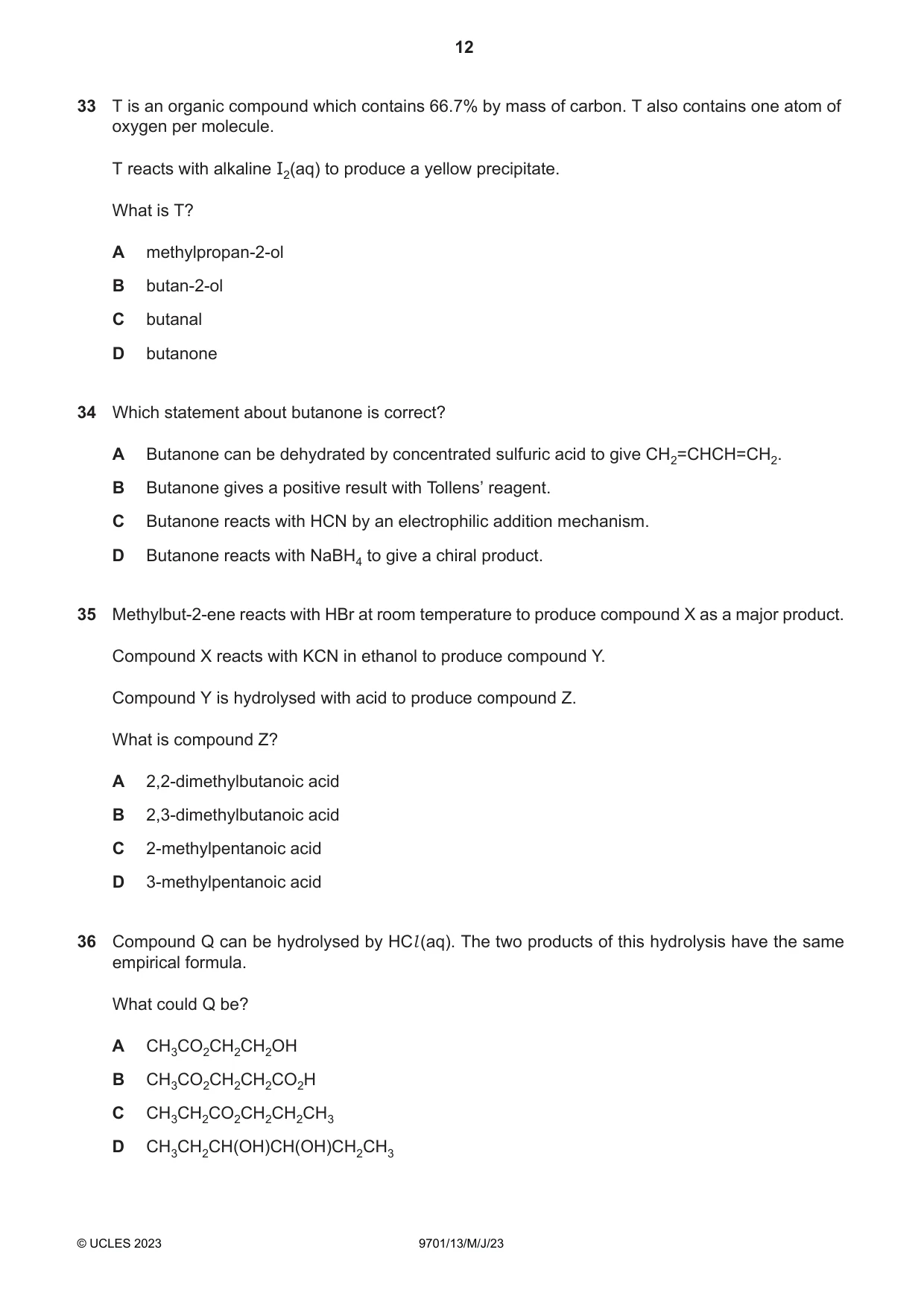
33 T is an organic compound which contains 66.7% by mass of carbon. T also contains one atom of oxygen per molecule. T reacts with alkaline I2(aq) to produce a yellow precipitate. What is T? A methylpropan-2-ol B butan-2-ol C butanal D butanone
Mark scheme: D
Q34 · Which statement about butanone is correct?
34 Which statement about butanone is correct? A Butanone can be dehydrated by concentrated sulfuric acid to give CH2=CHCH=CH2. B Butanone gives a positive result with Tollens’ reagent. C Butanone reacts with HCN by an electrophilic addition mechanism. D Butanone reacts with NaBH4 to give a chiral product.
Mark scheme: D
Q35 · Methylbut-2-ene reacts with HBr at room temperature to produce compound X as a major…
35 Methylbut-2-ene reacts with HBr at room temperature to produce compound X as a major product. Compound X reacts with KCN in ethanol to produce compound Y. Compound Y is hydrolysed with acid to produce compound Z. What is compound Z? A 2,2-dimethylbutanoic acid B 2,3-dimethylbutanoic acid C 2-methylpentanoic acid D 3-methylpentanoic acid
Mark scheme: A
Q36 · Compound Q can be hydrolysed by HCl(aq)
36 Compound Q can be hydrolysed by HCl(aq). The two products of this hydrolysis have the same empirical formula. What could Q be? A CH3CO2CH2CH2OH B CH3CO2CH2CH2CO2H C CH3CH2CO2CH2CH2CH3 D CH3CH2CH(OH)CH(OH)CH2CH3
Mark scheme: B
Q37 · An unsaturated carboxylic acid reacts with alcohol X to form an ester
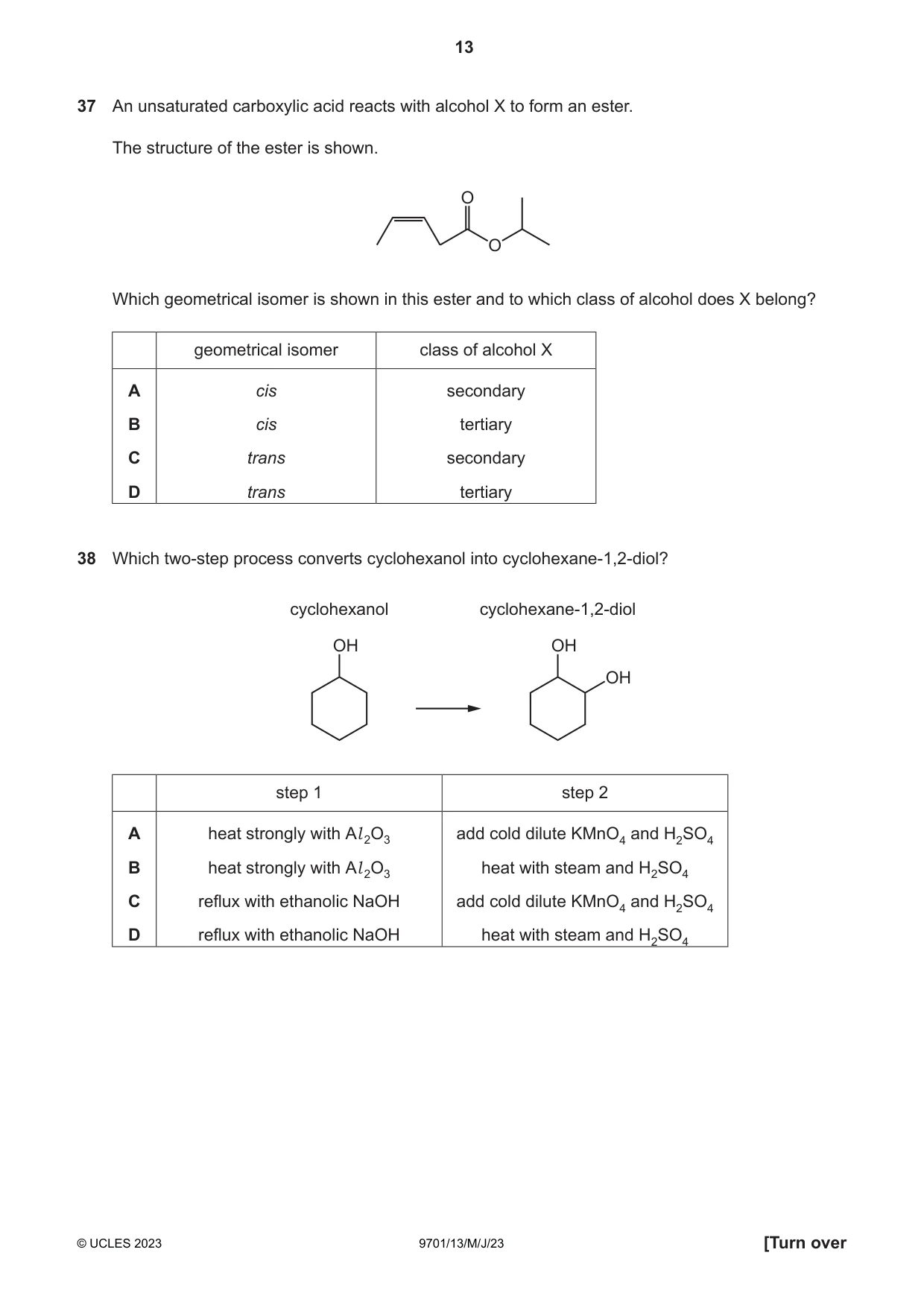
37 An unsaturated carboxylic acid reacts with alcohol X to form an ester. The structure of the ester is shown. 2 2 Which geometrical isomer is shown in this ester and to which class of alcohol does X belong? geometrical isomer class of alcohol X A cis secondary B cis tertiary C trans secondary D trans tertiary
Mark scheme: A
More questions on Isomerism: structural isomerism and stereoisomerism
Q38 · Which two-step process converts cyclohexanol into cyclohexane-1 ,2-diol?
38 Which two-step process converts cyclohexanol into cyclohexane-1 ,2-diol? cyclohexanol cyclohexane-1 ,2-diol OH OH OH step 1 step 2 heat strongly with Al,O, add cold dilute KMnO, and H,SO, heat strongly with Al,O,, heat with steam and H,SO, add cold dilute KMnO, and H,SO, reflux with ethanolic NaOH reflux with ethanolic NaOH heat with steam and H,SO,
Mark scheme: A
Q39 · In polymer G every carbon atom in the polymer chain is bonded to one hydrogen atom and…
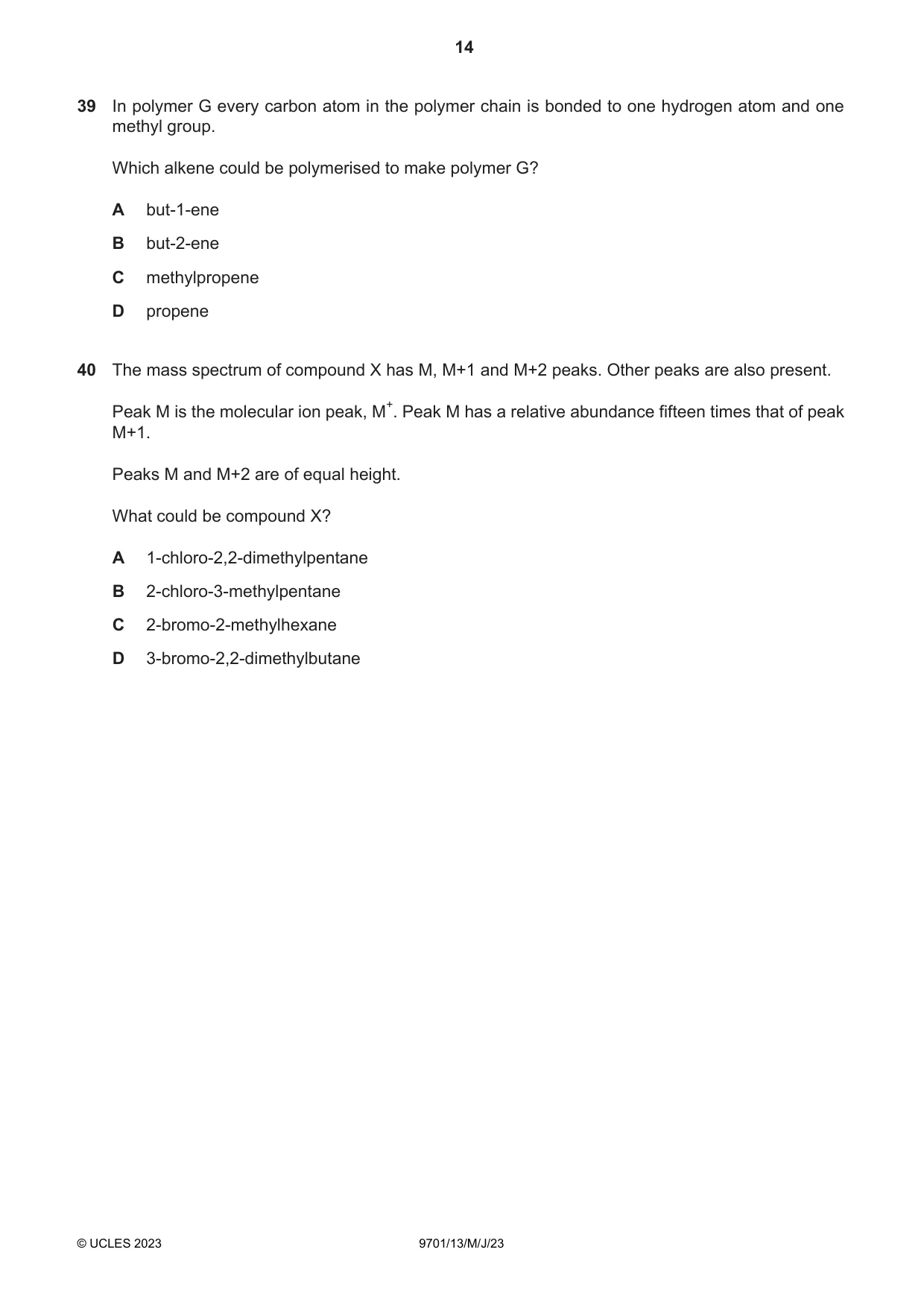
39 In polymer G every carbon atom in the polymer chain is bonded to one hydrogen atom and one methyl group. Which alkene could be polymerised to make polymer G? A but-1-ene B but-2-ene C methylpropene D propene
Mark scheme: B
Q40 · The mass spectrum of compound X has M, M+1 and M+2 peaks
40 The mass spectrum of compound X has M, M+1 and M+2 peaks. Other peaks are also present. Peak M is the molecular ion peak, M+. Peak M has a relative abundance fifteen times that of peak M+1. Peaks M and M+2 are of equal height. What could be compound X? A 1-chloro-2,2-dimethylpentane B 2-chloro-3-methylpentane C 2-bromo-2-methylhexane D 3-bromo-2,2-dimethylbutane
Mark scheme: D
What was in this paper
The subtopics covered by these 40 questions, and how many questions each got. Open one in a new tab to see every Cambridge question on it.
3Redox processes: electron transfer and changes in oxidation number (oxidation state)3Alcohols2Aldehydes and ketones2Alkenes2Effect of temperature on reaction rates and the concept of activation energy2Organic synthesis2Reacting masses and volumes (of solutions and gases)2The gaseous state: ideal and real gases and pV = nRT2Acids and bases1Addition polymerisation1Alkanes1Carboxylic acids1Chemical equilibria: reversible reactions, dynamic equilibrium1Electrons, energy levels and atomic orbitals1Esters1Halogenoalkanes1Intermolecular forces, electronegativity and bond properties1Isomerism: structural isomerism and stereoisomerism1Mass spectrometry1Nitrogen and sulfur1Periodicity of chemical properties of the elements in Period 31Periodicity of physical properties of the elements in Period 31Physical properties of the Group 17 elements1Rate of reaction1Shapes of molecules1Similarities and trends in the properties of the Group 2 metals, magnesium to barium, and their compounds1Some reactions of the halide ions1The chemical properties of the halogen elements and the hydrogen halides1What you needed in this session
Cambridge’s own grade thresholds for 2023 May/June, Paper 1 · Variant 3. A higher threshold means an easier paper — the bar moves with how the cohort did.