Cambridge A Level Chemistry 9701 — 2019 Feb/March Paper 1 · Variant 2
9701/12/F/M/19 · 40 questions · 40 marks · ≈45 min
The question paper and its mark scheme, free to read here and free to download. This is Cambridge’s own paper, exactly as it was sat.
Question paper16 pages

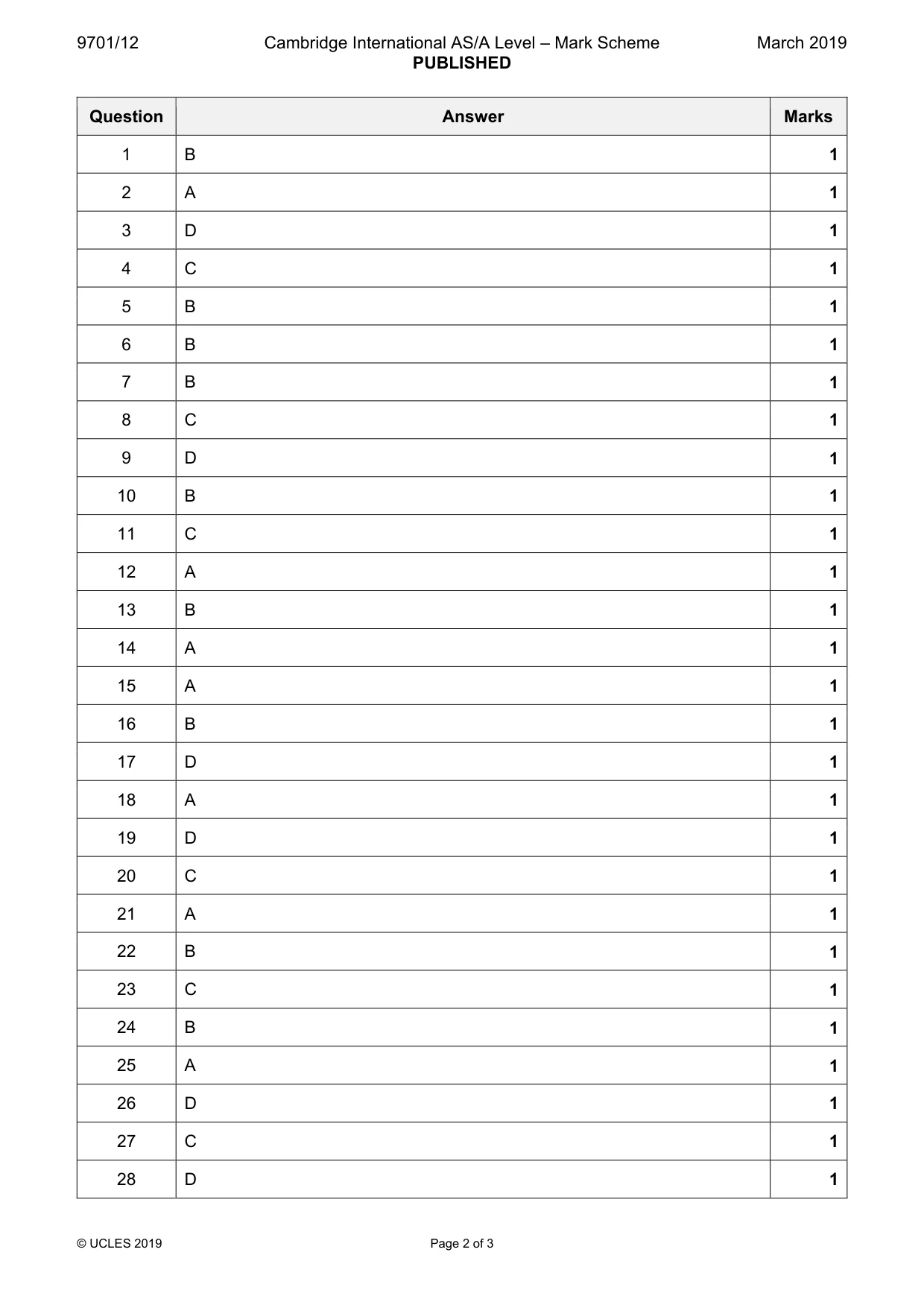
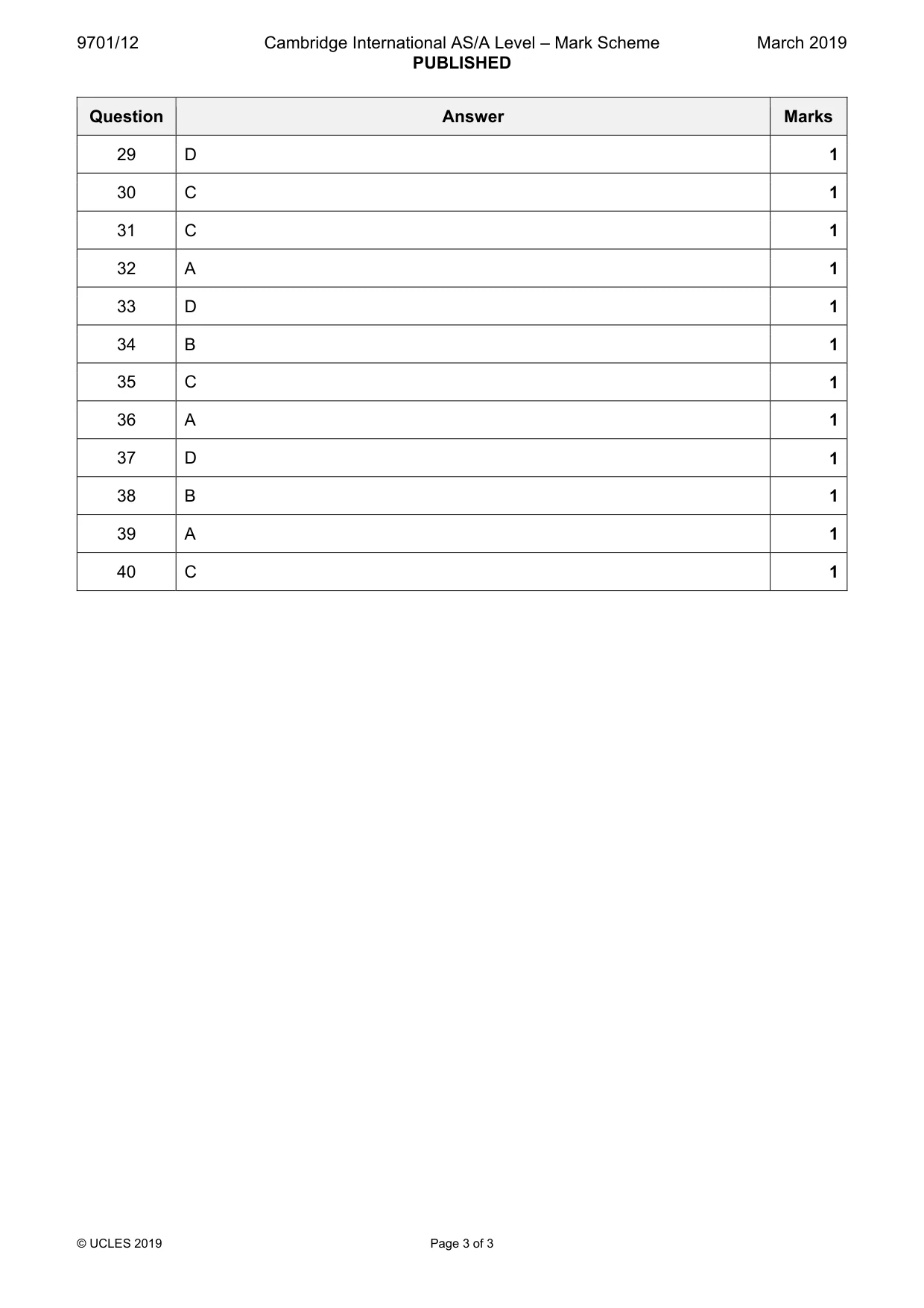
Mark scheme3 pages
Answers below. Sit the paper first if you are practising.
Questions as text
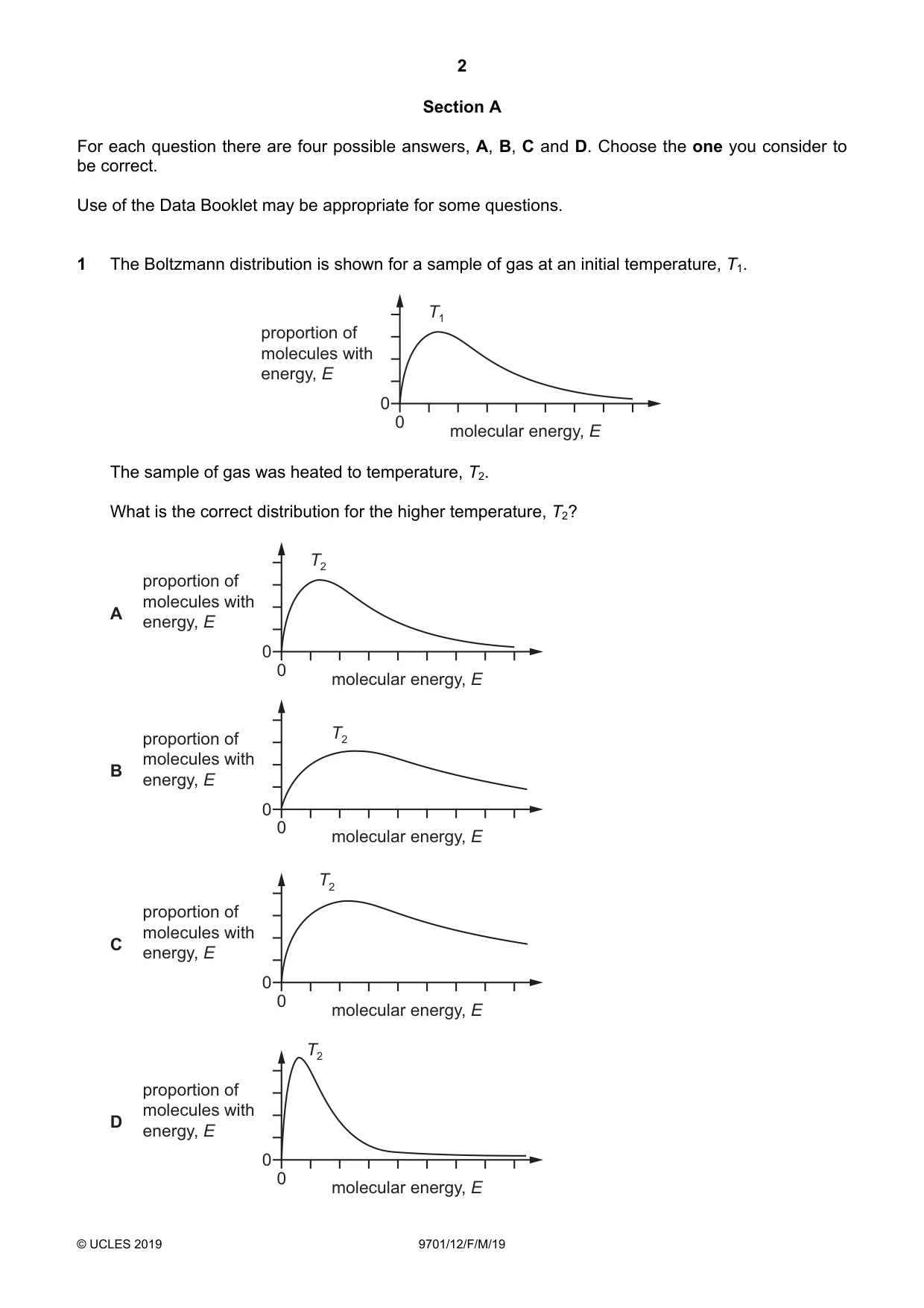
Q1 · The Boltzmann distribution is shown for a sample of gas at an initial temperature, T1
1 The Boltzmann distribution is shown for a sample of gas at an initial temperature, T1. T1 proportion of molecules with energy, E 0 0 molecular energy, E The sample of gas was heated to temperature, T2. What is the correct distribution for the higher temperature, T2? T2 proportion of molecules with A energy, E 0 0 molecular energy, E proportion of T2 molecules with B energy, E 0 0 molecular energy, E T2 proportion of molecules with C energy, E 0 0 molecular energy, E T2 proportion of molecules with D energy, E 0 0 molecular energy, E
Mark scheme: B
More questions on Effect of temperature on reaction rates and the concept of activation energy
Q2 · A 3.7 g sample of copper(II) carbonate is added to 25 cm3 of 2.0 mol dm–3 hydrochloric…
2 A 3.7 g sample of copper(II) carbonate is added to 25 cm3 of 2.0 mol dm–3 hydrochloric acid. Which volume of gas is produced under room conditions? A 0.60 dm3 B 0.72 dm3 C 1.20 dm3 D 2.40 dm3
Mark scheme: A
More questions on Reacting masses and volumes (of solutions and gases)
Q3 · Which statement about a 3p orbital is correct?
3 Which statement about a 3p orbital is correct? A It can hold a maximum of 6 electrons. B It has the highest energy of the orbitals with principal quantum number 3. C It is at a higher energy level than a 3s orbital but has the same shape. D It is occupied by one electron in an isolated phosphorus atom.
Mark scheme: D
More questions on Electrons, energy levels and atomic orbitals
Q4 · The eight species that follow all have covalent bonds
4 The eight species that follow all have covalent bonds. In which pair do the species have different shapes from each other? A BeCl 2 and CO2 B CH4 and NH4 + C NH3 and BF3 D SCl 2 and H2O
Mark scheme: C
Q5 · Histidine is an amino acid
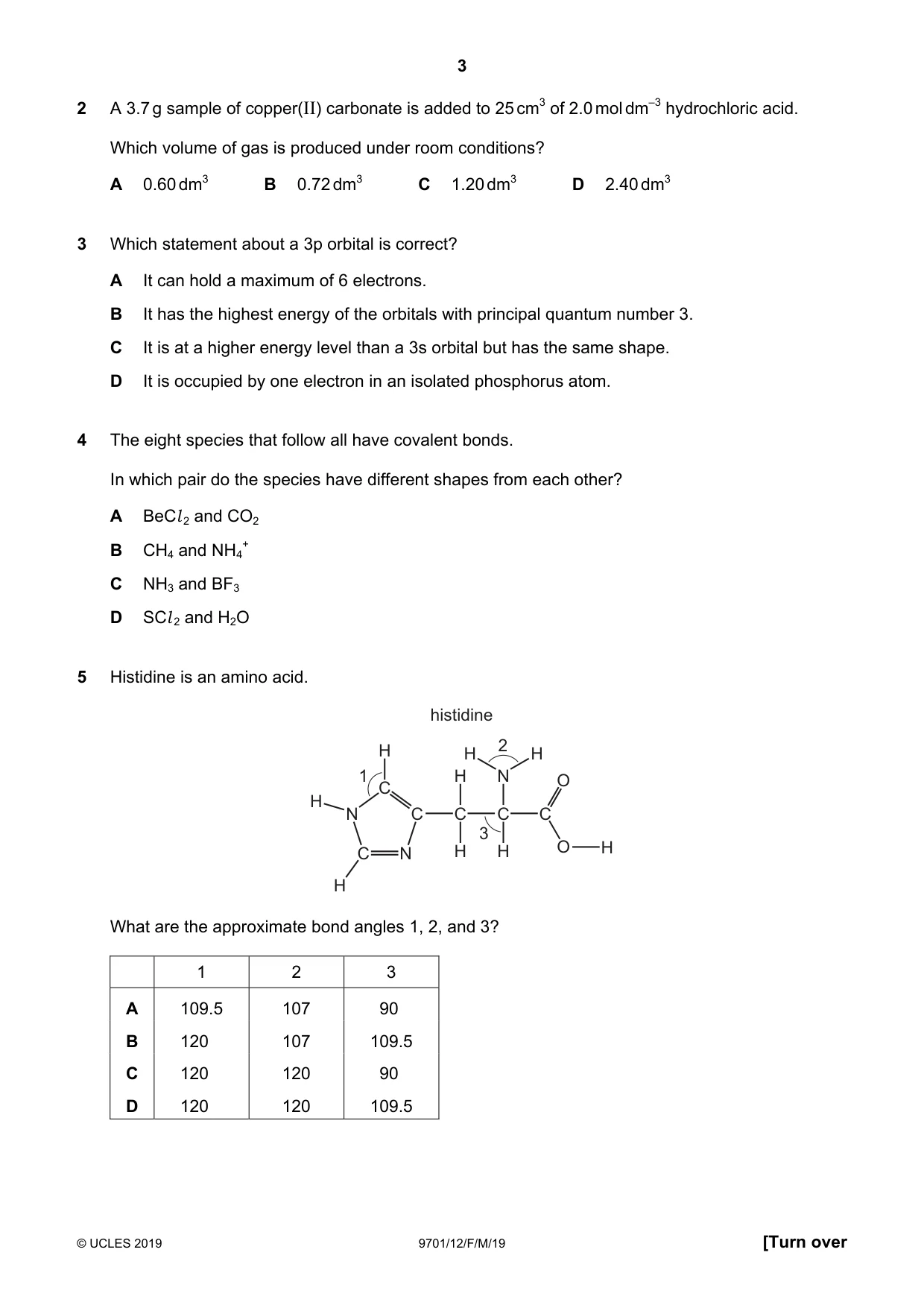
5 Histidine is an amino acid. histidine H 2 H H 1 H N O C H N C C C C 3 C N H H O H H What are the approximate bond angles 1, 2, and 3? 1 2 3 A 109.5 107 90 B 120 107 109.5 C 120 120 90 D 120 120 109.5
Mark scheme: B
Q6 · A sample of gas occupies 240 cm3 at 37 °C and 100 kPa
6 A sample of gas occupies 240 cm3 at 37 °C and 100 kPa. How many moles of gas are present in the sample? A 9.32 × 10⁻⁶ B 9.32 × 10⁻³ C 0.0781 D 78.1
Mark scheme: B
More questions on The gaseous state: ideal and real gases and pV = nRT
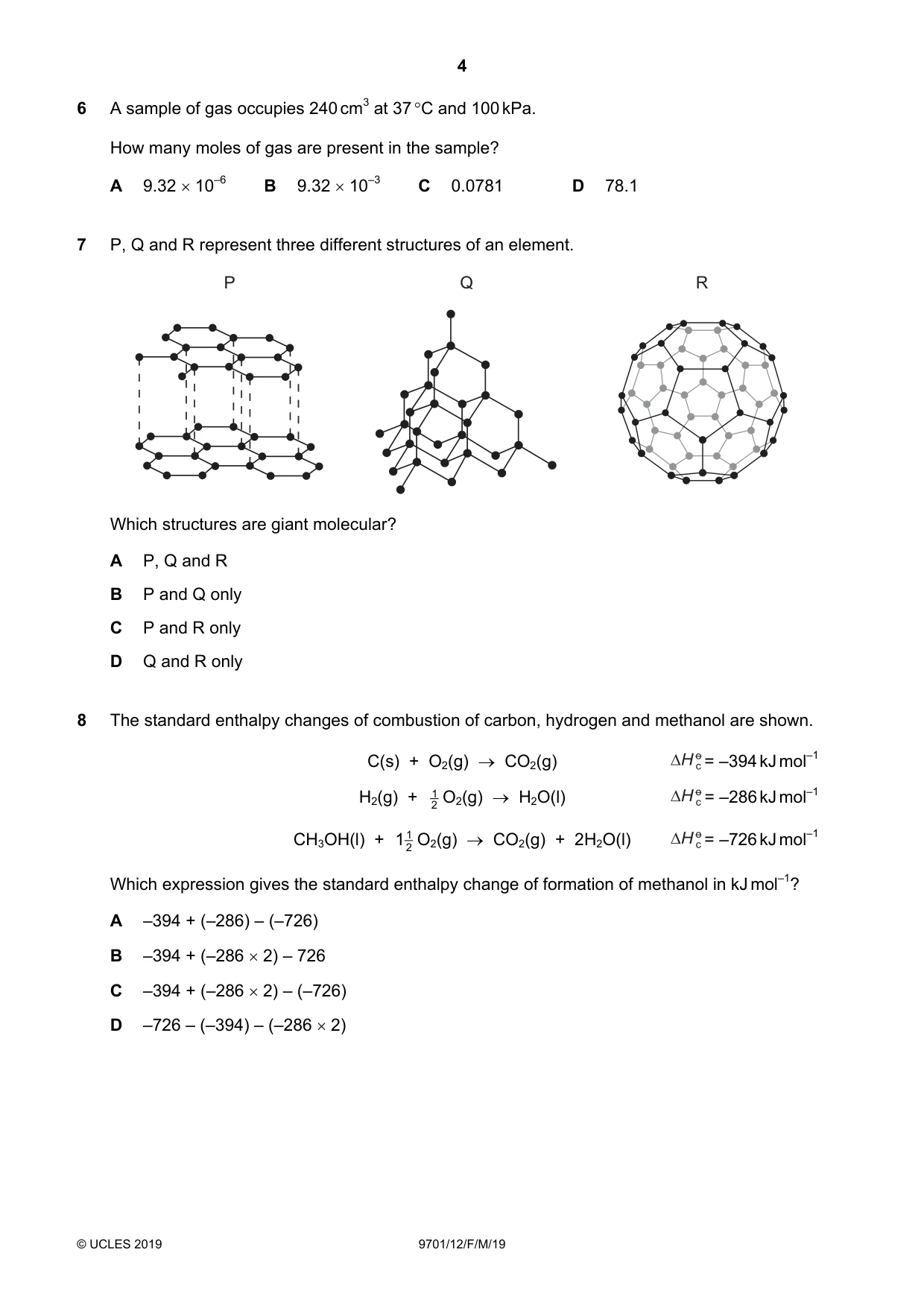
Q7 · P, Q and R represent three different structures of an element
7 P, Q and R represent three different structures of an element. P Q R Which structures are giant molecular? A P, Q and R B P and Q only C P and R only D Q and R only
Mark scheme: B
Q8 · The standard enthalpy changes of combustion of carbon, hydrogen and methanol are shown
8 The standard enthalpy changes of combustion of carbon, hydrogen and methanol are shown. C(s) + O2(g) → CO2(g) = –394 kJ mol–1 H2(g) + 2 1 O2(g) → H2O(l) = –286 kJ mol–1 CH3OH(l) + 1 O2(g) → CO2(g) + 2H2O(l) 1 = –726 kJ mol–1 2 Which expression gives the standard enthalpy change of formation of methanol in kJ mol–1? A –394 + (–286) – (–726) B –394 + (–286 × 2) – 726 C –394 + (–286 × 2) – (–726) D –726 – (–394) – (–286 × 2)
Mark scheme: C
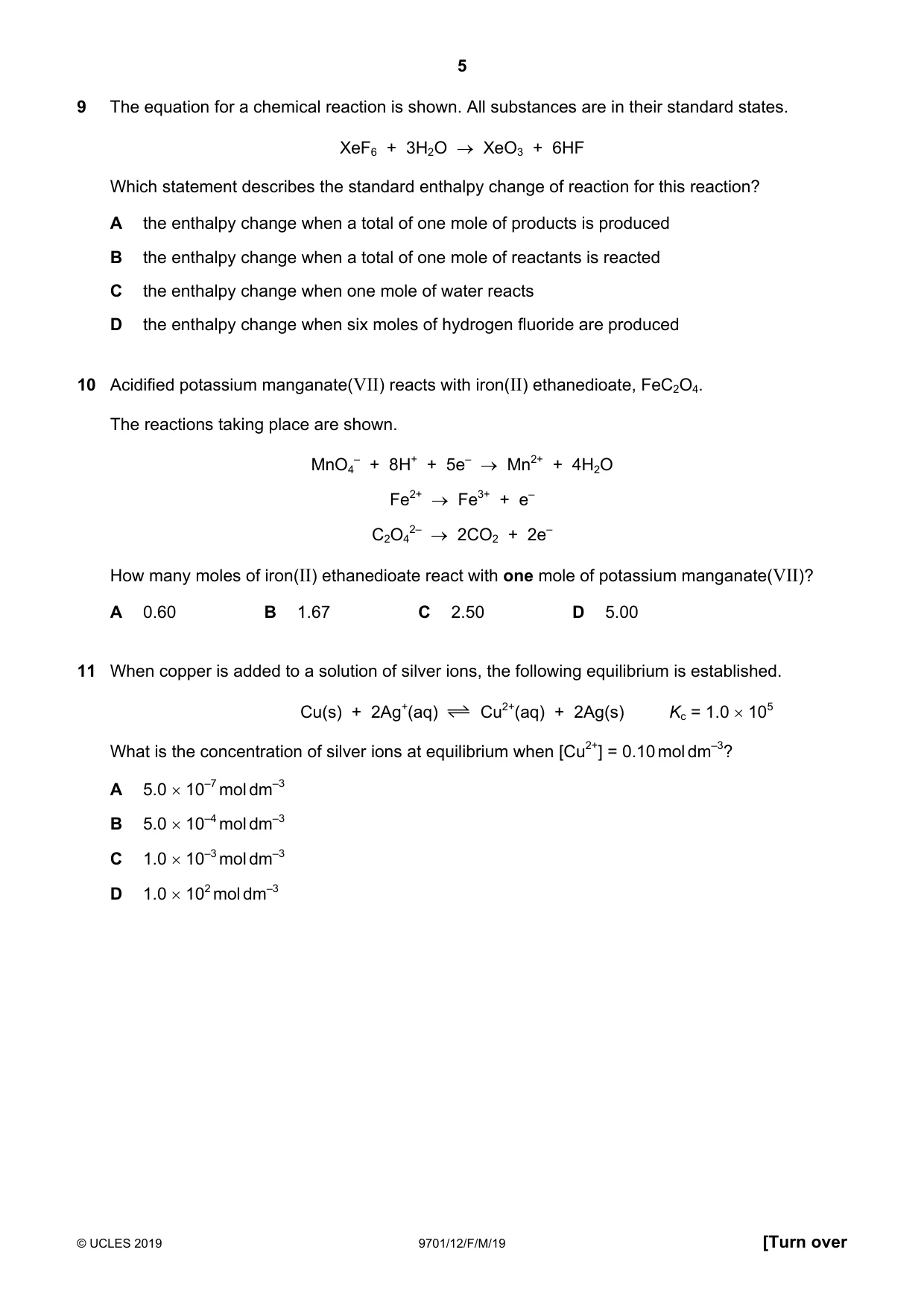
Q9 · The equation for a chemical reaction is shown
9 The equation for a chemical reaction is shown. All substances are in their standard states. XeF6 + 3H2O → XeO3 + 6HF Which statement describes the standard enthalpy change of reaction for this reaction? A the enthalpy change when a total of one mole of products is produced B the enthalpy change when a total of one mole of reactants is reacted C the enthalpy change when one mole of water reacts D the enthalpy change when six moles of hydrogen fluoride are produced
Mark scheme: D
Q10 · Acidified potassium manganate(VII) reacts with iron(II) ethanedioate, FeC2O4
10 Acidified potassium manganate(VII) reacts with iron(II) ethanedioate, FeC2O4. The reactions taking place are shown. MnO4 – + 8H+ + 5e– → Mn2+ + 4H2O Fe2+ → Fe3+ + e– C2O4 2– → 2CO2 + 2e– How many moles of iron(II) ethanedioate react with one mole of potassium manganate(VII)? A 0.60 B 1.67 C 2.50 D 5.00
Mark scheme: B
More questions on Reacting masses and volumes (of solutions and gases)
Q11 · When copper is added to a solution of silver ions, the following equilibrium is…
11 When copper is added to a solution of silver ions, the following equilibrium is established. Cu(s) + 2Ag+(aq) Cu2+(aq) + 2Ag(s) Kc = 1.0 × 10⁵ What is the concentration of silver ions at equilibrium when [Cu2+] = 0.10 mol dm–3? A 5.0 × 10⁻⁷ mol dm–3 B 5.0 × 10⁻⁴ mol dm–3 C 1.0 × 10⁻³ mol dm–3 D 1.0 × 10² mol dm–3
Mark scheme: C
More questions on Chemical equilibria: reversible reactions, dynamic equilibrium
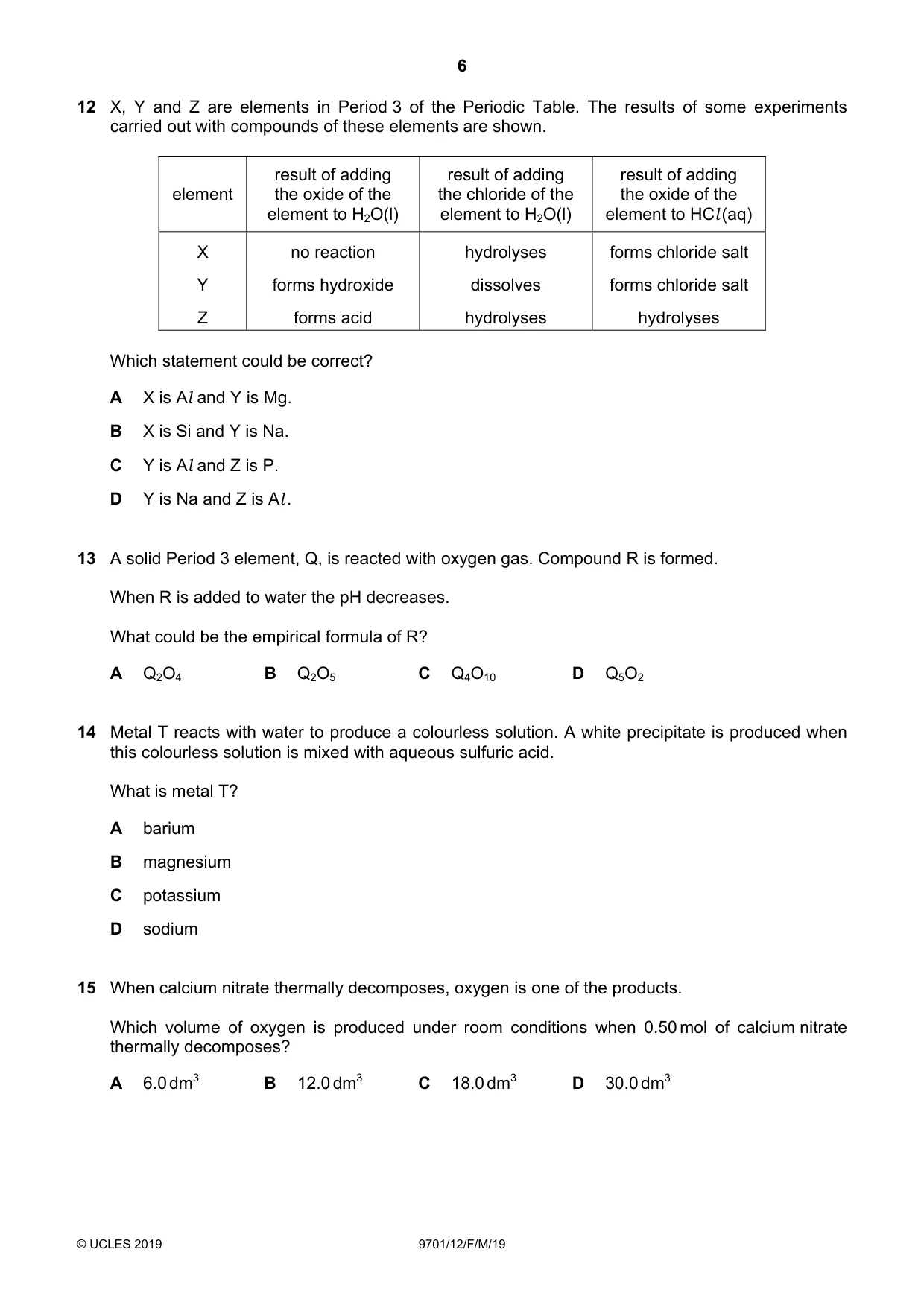
Q12 · X, Y and Z are elements in Period 3 of the Periodic Table
12 X, Y and Z are elements in Period 3 of the Periodic Table. The results of some experiments carried out with compounds of these elements are shown. result of adding result of adding result of adding element the oxide of the the chloride of the the oxide of the element to H2O(l) element to H2O(l) element to HCl (aq) X no reaction hydrolyses forms chloride salt Y forms hydroxide dissolves forms chloride salt Z forms acid hydrolyses hydrolyses Which statement could be correct? A X is Al and Y is Mg. B X is Si and Y is Na. C Y is Al and Z is P. D Y is Na and Z is Al .
Mark scheme: A
More questions on Periodicity of chemical properties of the elements in Period 3
Q13 · A solid Period 3 element, Q, is reacted with oxygen gas
13 A solid Period 3 element, Q, is reacted with oxygen gas. Compound R is formed. When R is added to water the pH decreases. What could be the empirical formula of R? A Q2O4 B Q2O5 C Q4O10 D Q5O2
Mark scheme: B
More questions on Periodicity of chemical properties of the elements in Period 3
Q14 · Metal T reacts with water to produce a colourless solution
14 Metal T reacts with water to produce a colourless solution. A white precipitate is produced when this colourless solution is mixed with aqueous sulfuric acid. What is metal T? A barium B magnesium C potassium D sodium
Mark scheme: A
Q15 · When calcium nitrate thermally decomposes, oxygen is one of the products
15 When calcium nitrate thermally decomposes, oxygen is one of the products. Which volume of oxygen is produced under room conditions when 0.50 mol of calcium nitrate thermally decomposes? A 6.0 dm3 B 12.0 dm3 C 18.0 dm3 D 30.0 dm3
Mark scheme: A
More questions on Reacting masses and volumes (of solutions and gases)
Q16 · L, M and N are Group 2 metals
16 L, M and N are Group 2 metals. L reacts more vigorously with dilute hydrochloric acid than N does. M(OH)2 is more soluble than N(OH)2. What could be the identities of L, M and N? L M N A Ba Ca Sr B Ba Sr Ca C Ca Ba Sr D Sr Ca Ba
Mark scheme: B
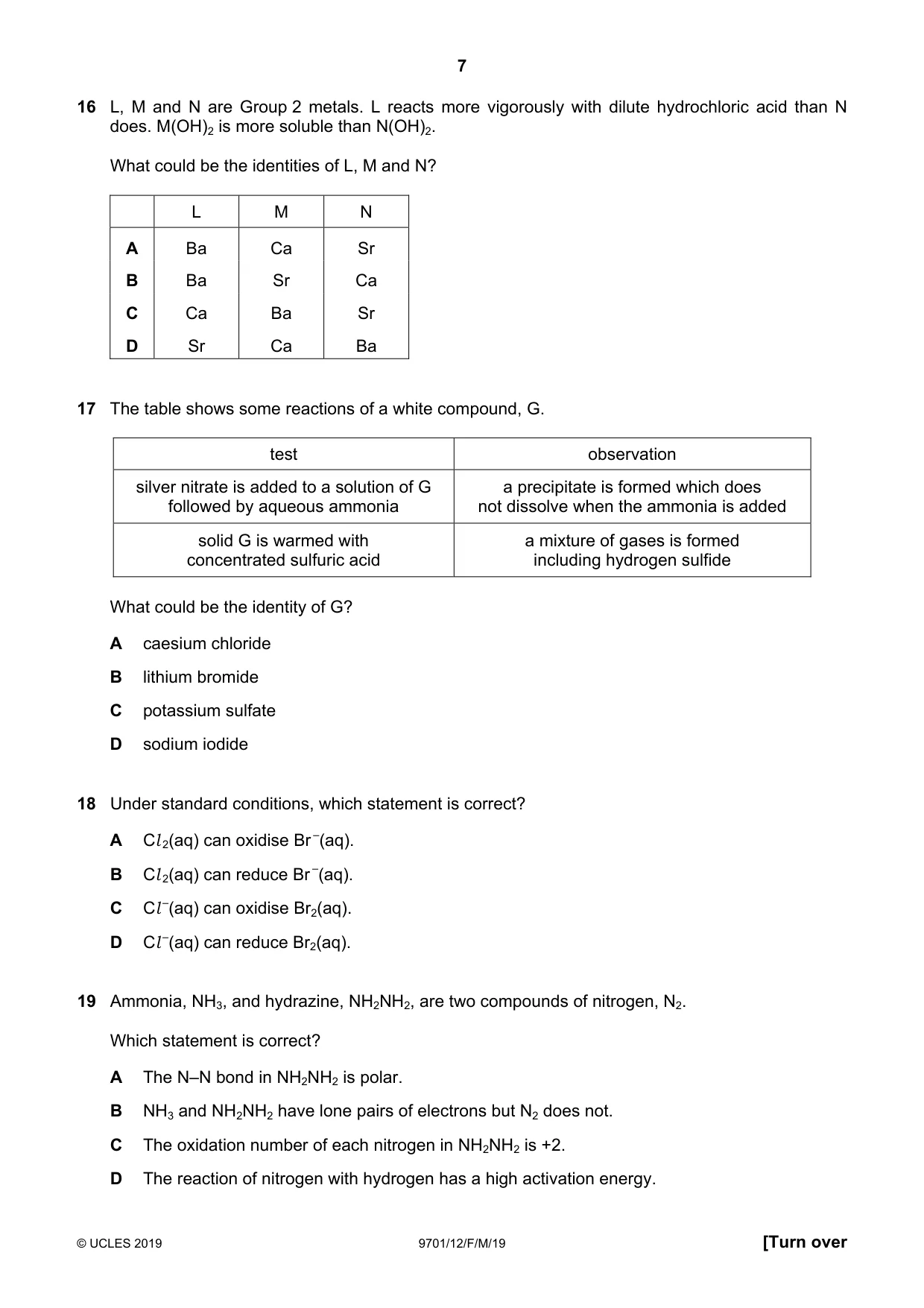
Q17 · The table shows some reactions of a white compound, G
17 The table shows some reactions of a white compound, G. test observation silver nitrate is added to a solution of G a precipitate is formed which does followed by aqueous ammonia not dissolve when the ammonia is added solid G is warmed with a mixture of gases is formed concentrated sulfuric acid including hydrogen sulfide What could be the identity of G? A caesium chloride B lithium bromide C potassium sulfate D sodium iodide
Mark scheme: D
Q18 · Under standard conditions, which statement is correct?
18 Under standard conditions, which statement is correct? A Cl 2(aq) can oxidise Br –(aq). B Cl 2(aq) can reduce Br –(aq). C Cl –(aq) can oxidise Br2(aq). D Cl –(aq) can reduce Br2(aq).
Mark scheme: A
More questions on The chemical properties of the halogen elements and the hydrogen halides
Q19 · Ammonia, NH3, and hydrazine, NH2NH2, are two compounds of nitrogen, N2
19 Ammonia, NH3, and hydrazine, NH2NH2, are two compounds of nitrogen, N2. Which statement is correct? A The N–N bond in NH2NH2 is polar. B NH3 and NH2NH2 have lone pairs of electrons but N2 does not. C The oxidation number of each nitrogen in NH2NH2 is +2. D The reaction of nitrogen with hydrogen has a high activation energy.
Mark scheme: D
Q20 · How many structural isomers are there of trichloropropane, C3H5Cl 3?
20 How many structural isomers are there of trichloropropane, C3H5Cl 3? A 3 B 4 C 5 D 6
Mark scheme: C
More questions on Isomerism: structural isomerism and stereoisomerism
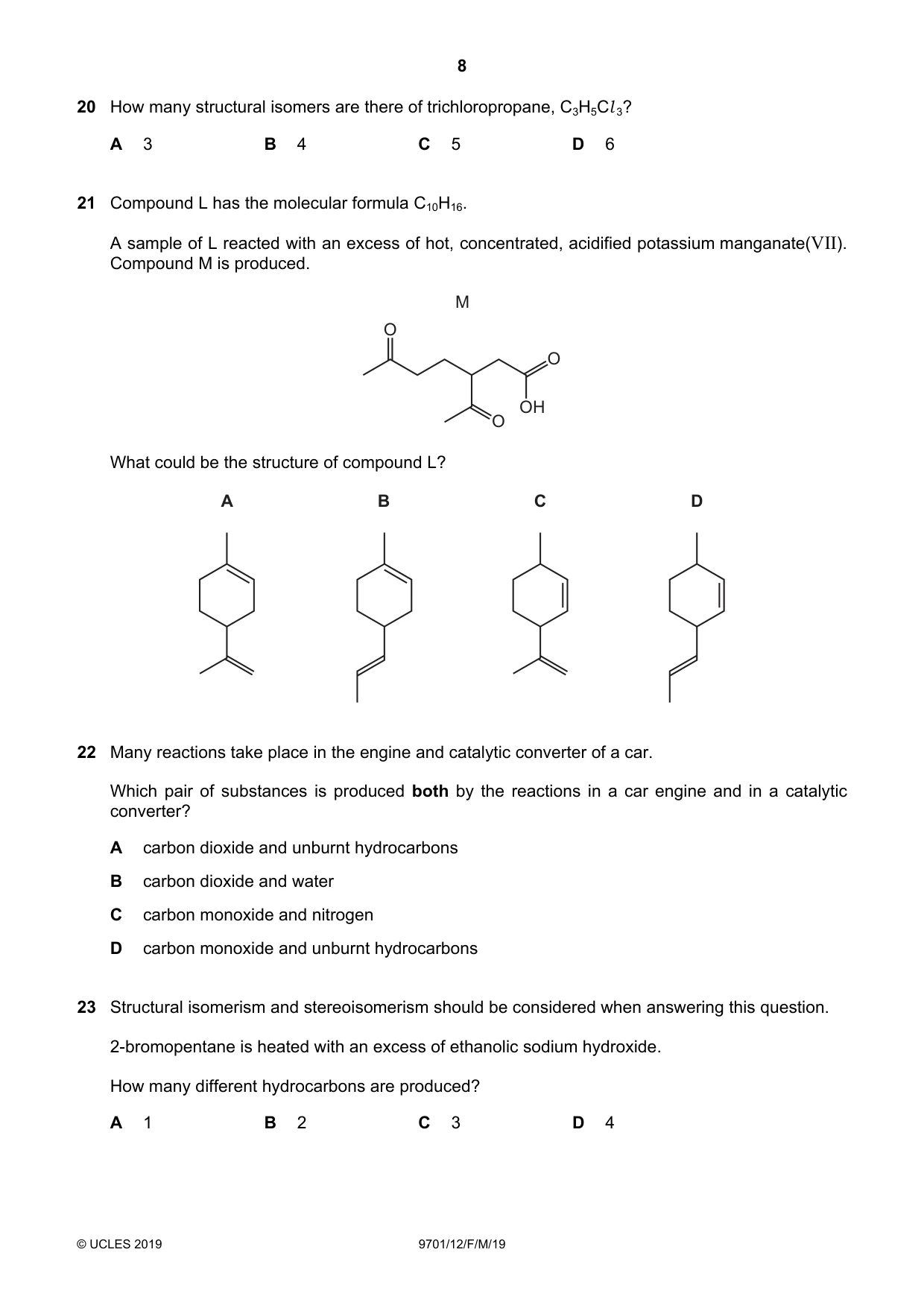
Q21 · Compound L has the molecular formula C10H16
21 Compound L has the molecular formula C10H16. A sample of L reacted with an excess of hot, concentrated, acidified potassium manganate(VII). Compound M is produced. M O O OH O What could be the structure of compound L? A B C D
Mark scheme: A
Q22 · Many reactions take place in the engine and catalytic converter of a car
22 Many reactions take place in the engine and catalytic converter of a car. Which pair of substances is produced both by the reactions in a car engine and in a catalytic converter? A carbon dioxide and unburnt hydrocarbons B carbon dioxide and water C carbon monoxide and nitrogen D carbon monoxide and unburnt hydrocarbons
Mark scheme: B
Q23 · Structural isomerism and stereoisomerism should be considered when answering this question
23 Structural isomerism and stereoisomerism should be considered when answering this question. 2-bromopentane is heated with an excess of ethanolic sodium hydroxide. How many different hydrocarbons are produced? A 1 B 2 C 3 D 4
Mark scheme: C
Q24 · Bromopropane reacts with water as shown
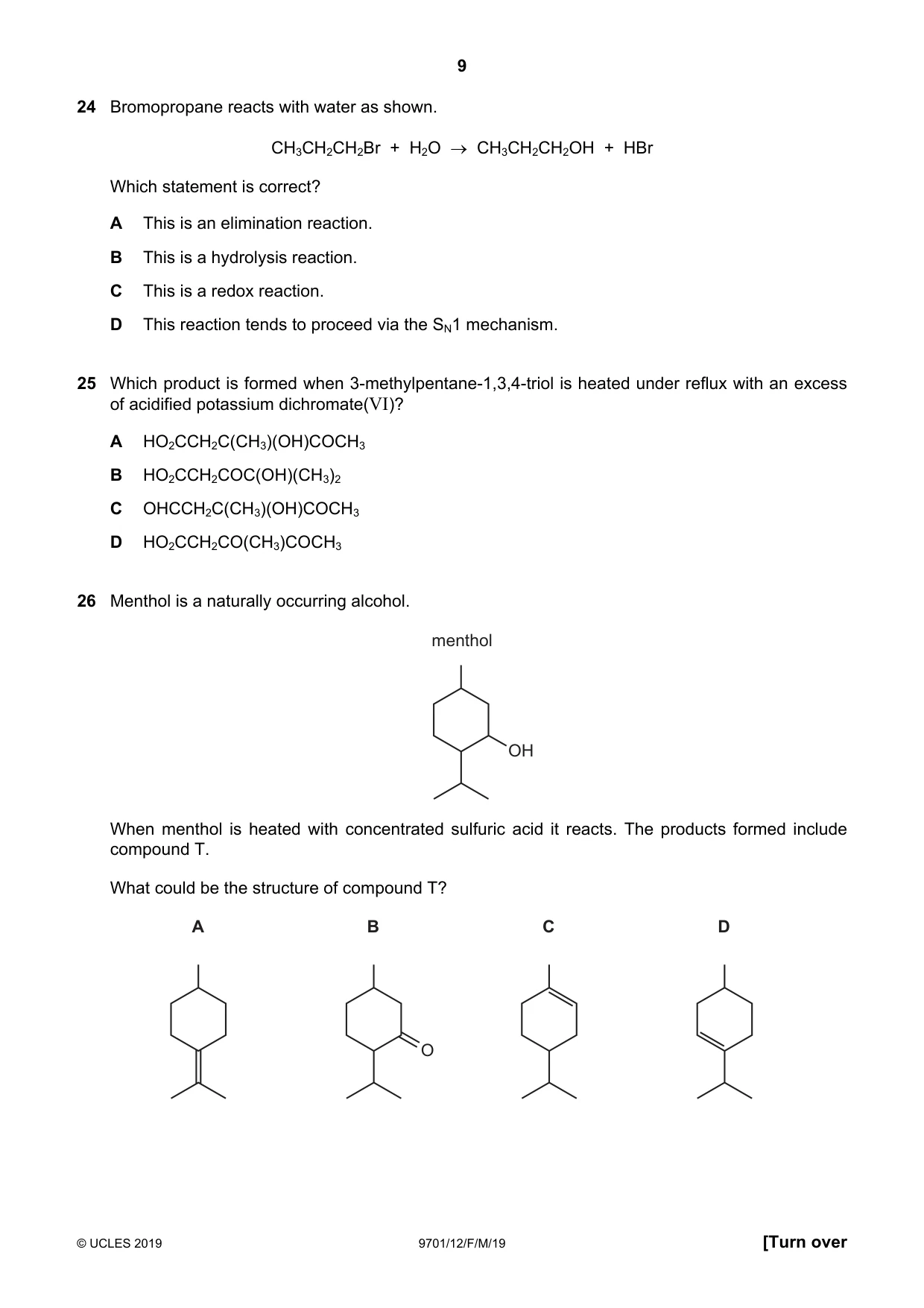
24 Bromopropane reacts with water as shown. CH3CH2CH2Br + H2O → CH3CH2CH2OH + HBr Which statement is correct? A This is an elimination reaction. B This is a hydrolysis reaction. C This is a redox reaction. D This reaction tends to proceed via the SN1 mechanism.
Mark scheme: B
Q25 · Which product is formed when 3-methylpentane-1,3,4-triol is heated under reflux with an…
25 Which product is formed when 3-methylpentane-1,3,4-triol is heated under reflux with an excess of acidified potassium dichromate(VI)? A HO2CCH2C(CH3)(OH)COCH3 B HO2CCH2COC(OH)(CH3)2 C OHCCH2C(CH3)(OH)COCH3 D HO2CCH2CO(CH3)COCH3
Mark scheme: A
Q26 · Menthol is a naturally occurring alcohol
26 Menthol is a naturally occurring alcohol. menthol OH When menthol is heated with concentrated sulfuric acid it reacts. The products formed include compound T. What could be the structure of compound T? A B C D O
Mark scheme: D
Q27 · Structural isomerism only should be considered when answering this question
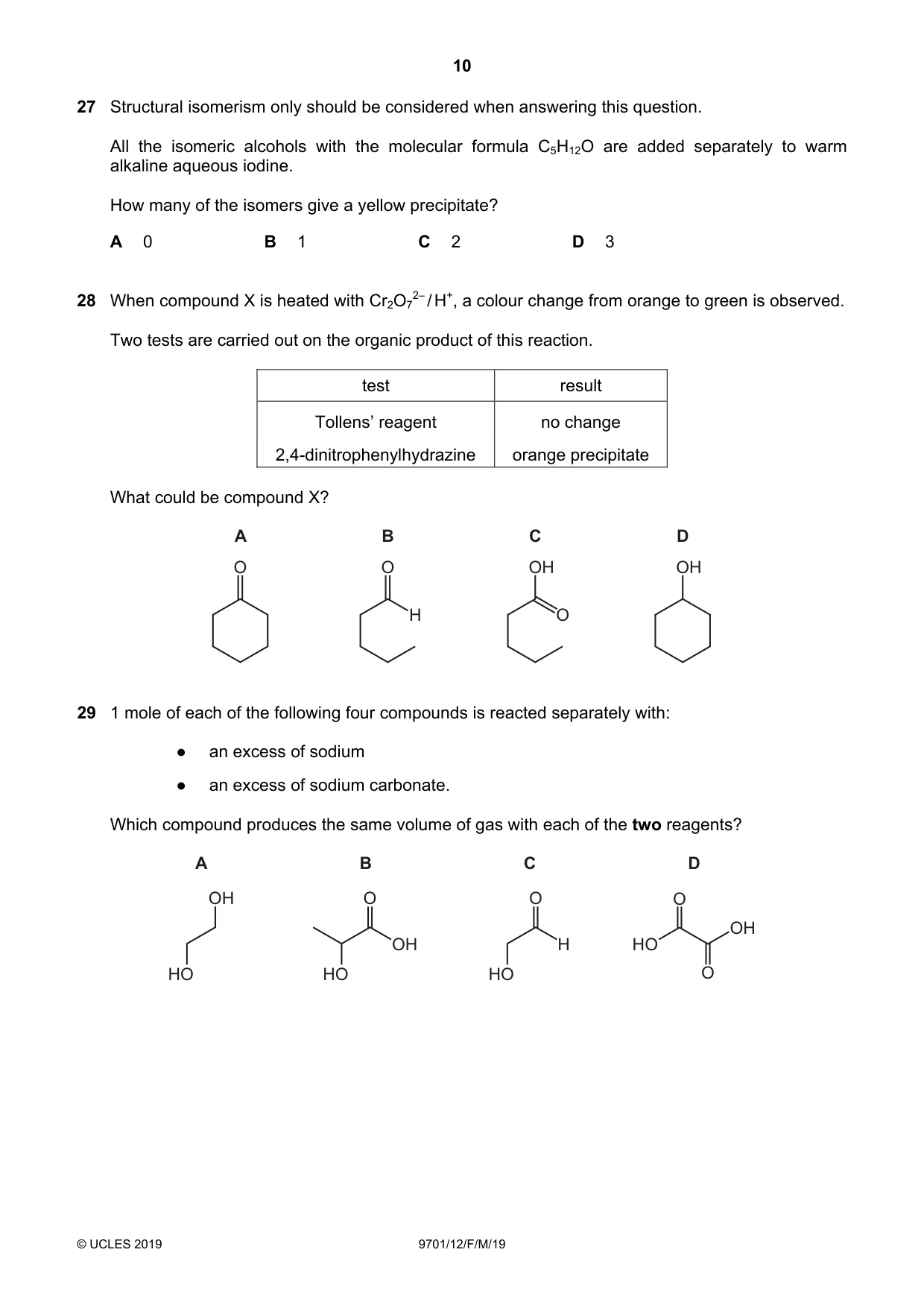
27 Structural isomerism only should be considered when answering this question. All the isomeric alcohols with the molecular formula C5H12O are added separately to warm alkaline aqueous iodine. How many of the isomers give a yellow precipitate? A 0 B 1 C 2 D 3
Mark scheme: C
Q28 · When compound X is heated with Cr2O7 2– / H+, a colour change from orange to green is…
28 When compound X is heated with Cr2O7 2– / H+, a colour change from orange to green is observed. Two tests are carried out on the organic product of this reaction. test result Tollens’ reagent no change 2,4-dinitrophenylhydrazine orange precipitate What could be compound X? A B C D O O OH OH H O
Mark scheme: D
Q29 · 1 mole of each of the following four compounds is reacted separately with: ● an excess of…
29 1 mole of each of the following four compounds is reacted separately with: ● an excess of sodium ● an excess of sodium carbonate. Which compound produces the same volume of gas with each of the two reagents? A B C D OH O O O OH OH H HO HO HO HO O
Mark scheme: D
Q30 · An infra-red spectrum shows a broad peak at 3000 cm–1 and a strong peak at 1710 cm–1
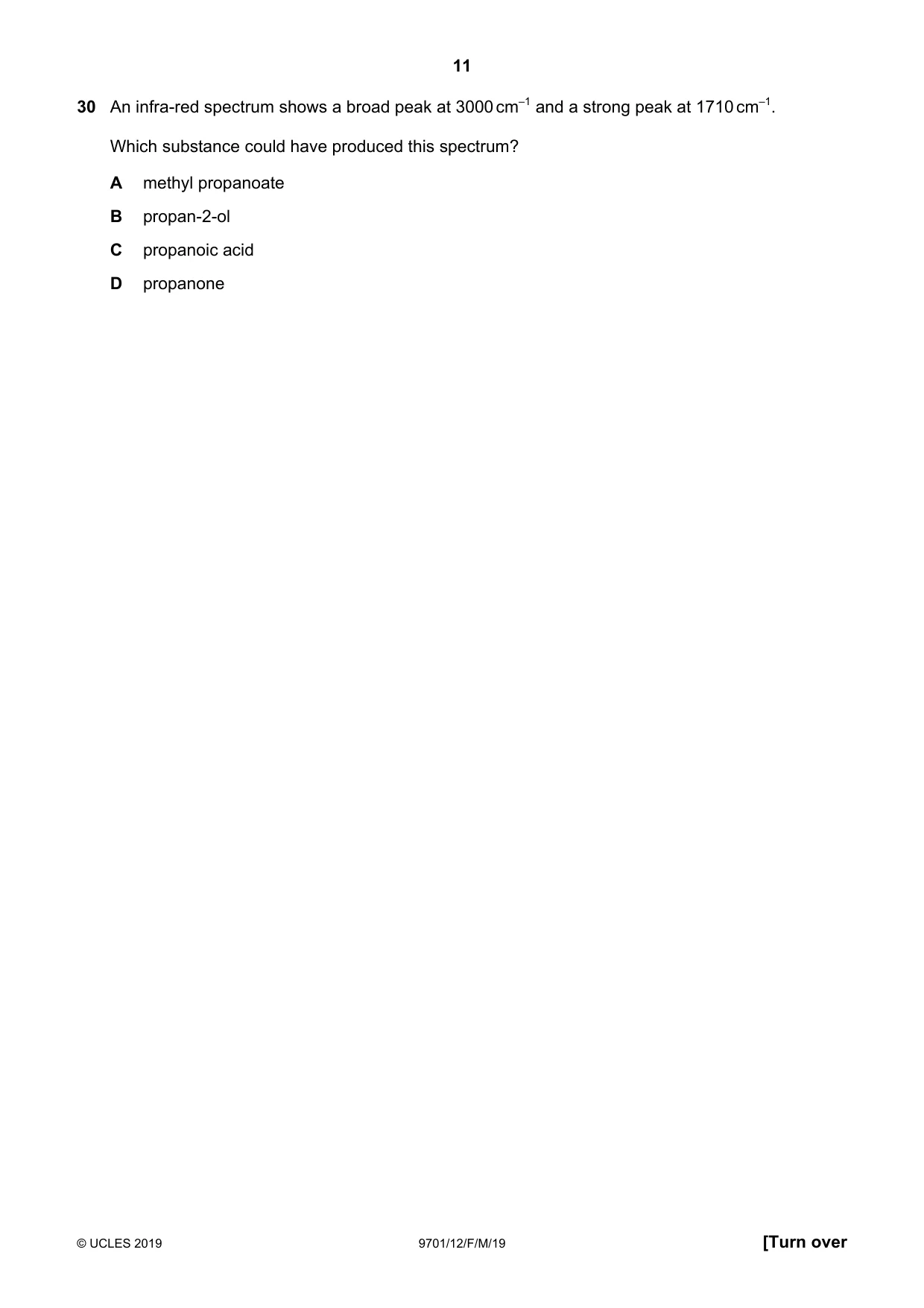
30 An infra-red spectrum shows a broad peak at 3000 cm–1 and a strong peak at 1710 cm–1. Which substance could have produced this spectrum? A methyl propanoate B propan-2-ol C propanoic acid D propanone
Mark scheme: C
Q31 · In an experiment, 10 cm3 of an organic compound, J, in the gaseous state is reacted with…
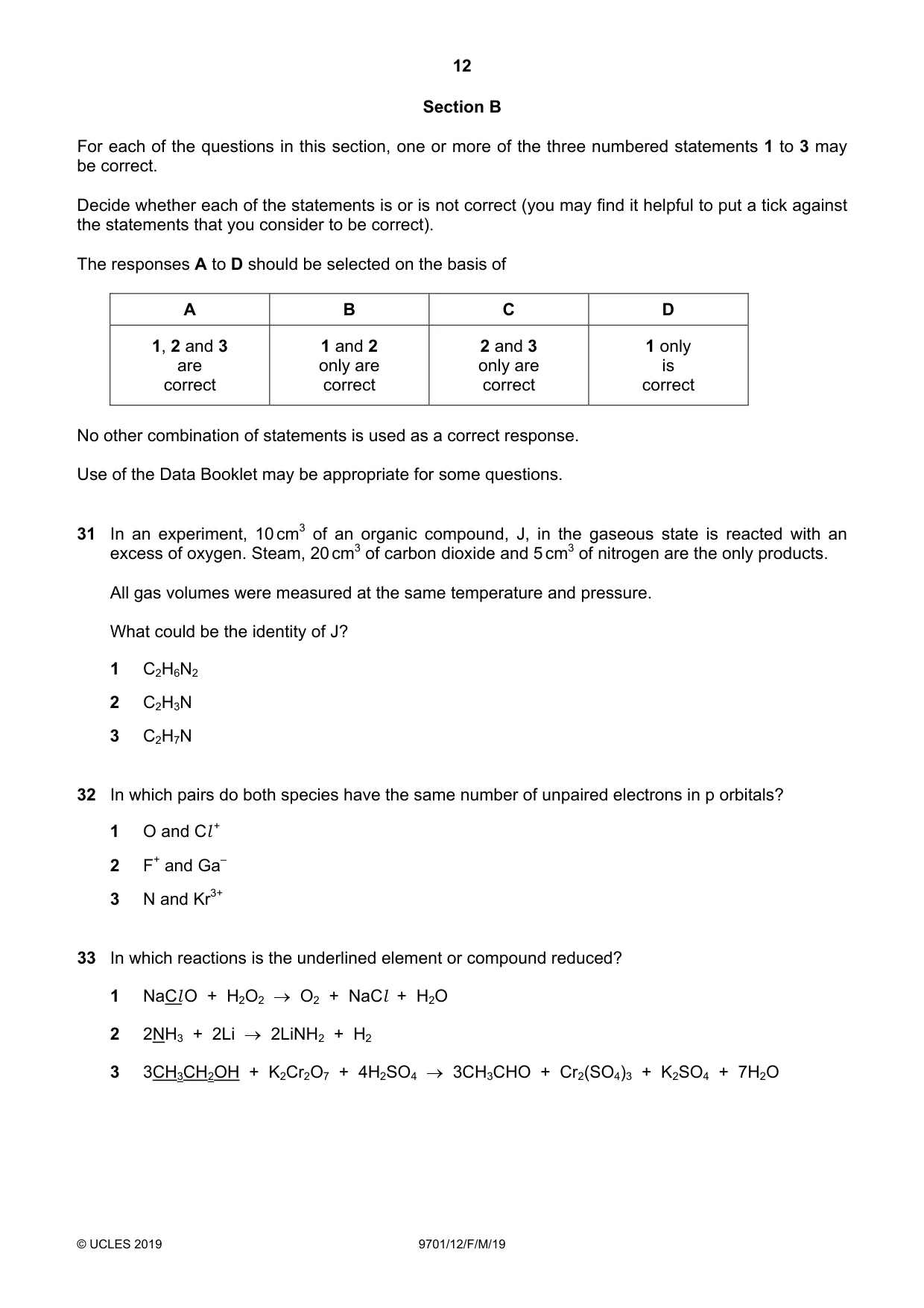
31 In an experiment, 10 cm3 of an organic compound, J, in the gaseous state is reacted with an excess of oxygen. Steam, 20 cm3 of carbon dioxide and 5 cm3 of nitrogen are the only products. All gas volumes were measured at the same temperature and pressure. What could be the identity of J? 1 C2H6N2 2 C2H3N 3 C2H7N
Mark scheme: C
Q32 · In which pairs do both species have the same number of unpaired electrons in p orbitals?
32 In which pairs do both species have the same number of unpaired electrons in p orbitals? 1 O and Cl + 2 F+ and Ga– 3 N and Kr3+
Mark scheme: A
More questions on Electrons, energy levels and atomic orbitals
Q33 · In which reactions is the underlined element or compound reduced?
33 In which reactions is the underlined element or compound reduced? 1 NaCl O + H2O2 → O2 + NaCl + H2O 2 2NH3 + 2Li → 2LiNH2 + H2 3 3CH3CH2OH + K2Cr2O7 + 4H2SO4 → 3CH3CHO + Cr2(SO4)3 + K2SO4 + 7H2O
Mark scheme: D
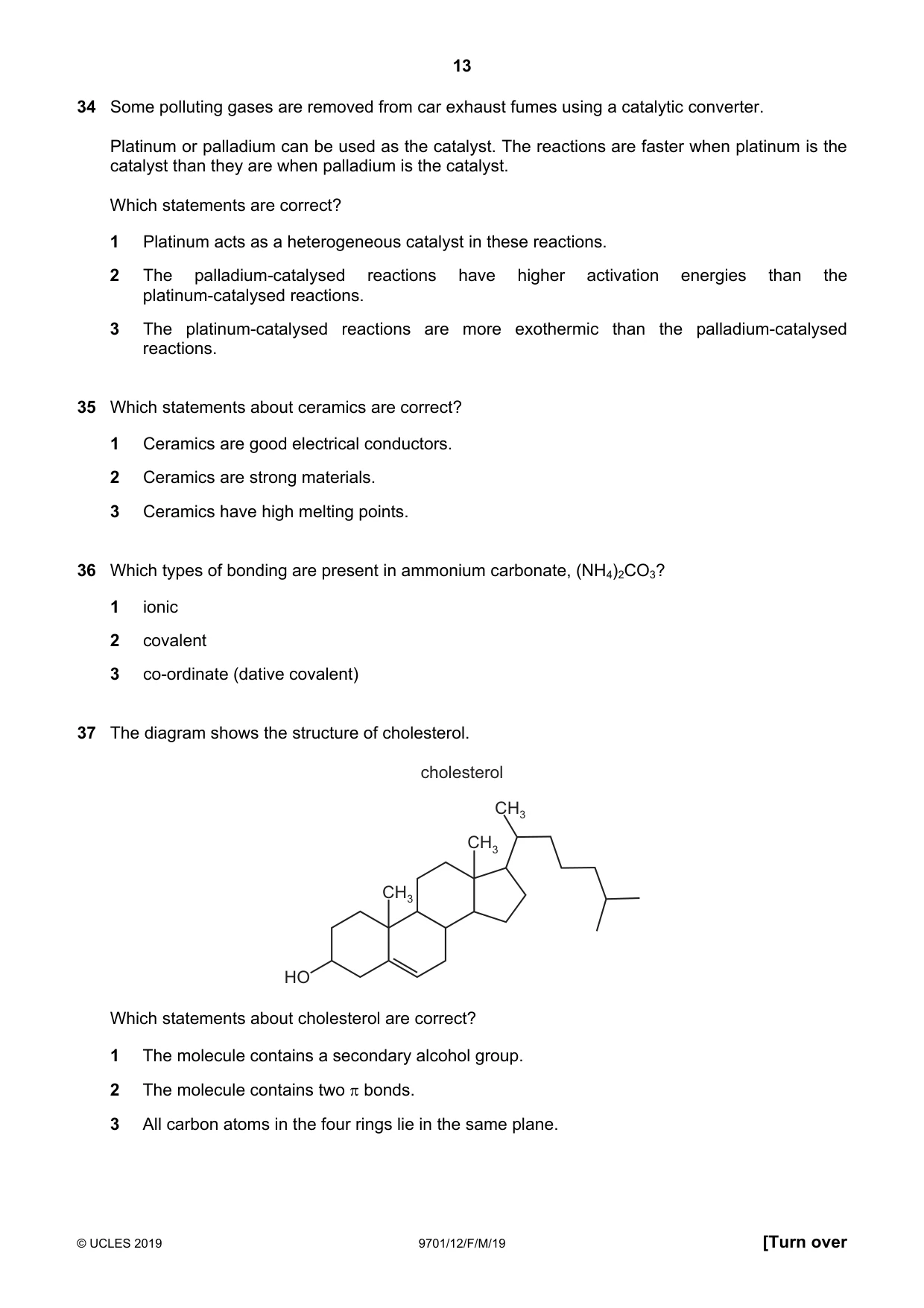
Q34 · Some polluting gases are removed from car exhaust fumes using a catalytic converter
34 Some polluting gases are removed from car exhaust fumes using a catalytic converter. Platinum or palladium can be used as the catalyst. The reactions are faster when platinum is the catalyst than they are when palladium is the catalyst. Which statements are correct? 1 Platinum acts as a heterogeneous catalyst in these reactions. 2 The palladium-catalysed reactions have higher activation energies than the platinum-catalysed reactions. 3 The platinum-catalysed reactions are more exothermic than the palladium-catalysed reactions.
Mark scheme: B
Q35 · Which statements about ceramics are correct?
35 Which statements about ceramics are correct? 1 Ceramics are good electrical conductors. 2 Ceramics are strong materials. 3 Ceramics have high melting points.
Mark scheme: C
Q36 · Which types of bonding are present in ammonium carbonate, (NH4)2CO3?
36 Which types of bonding are present in ammonium carbonate, (NH4)2CO3? 1 ionic 2 covalent 3 co-ordinate (dative covalent)
Mark scheme: A
Q37 · The diagram shows the structure of cholesterol
37 The diagram shows the structure of cholesterol. cholesterol CH3 CH3 CH3 HO Which statements about cholesterol are correct? 1 The molecule contains a secondary alcohol group. 2 The molecule contains two π bonds. 3 All carbon atoms in the four rings lie in the same plane.
Mark scheme: D
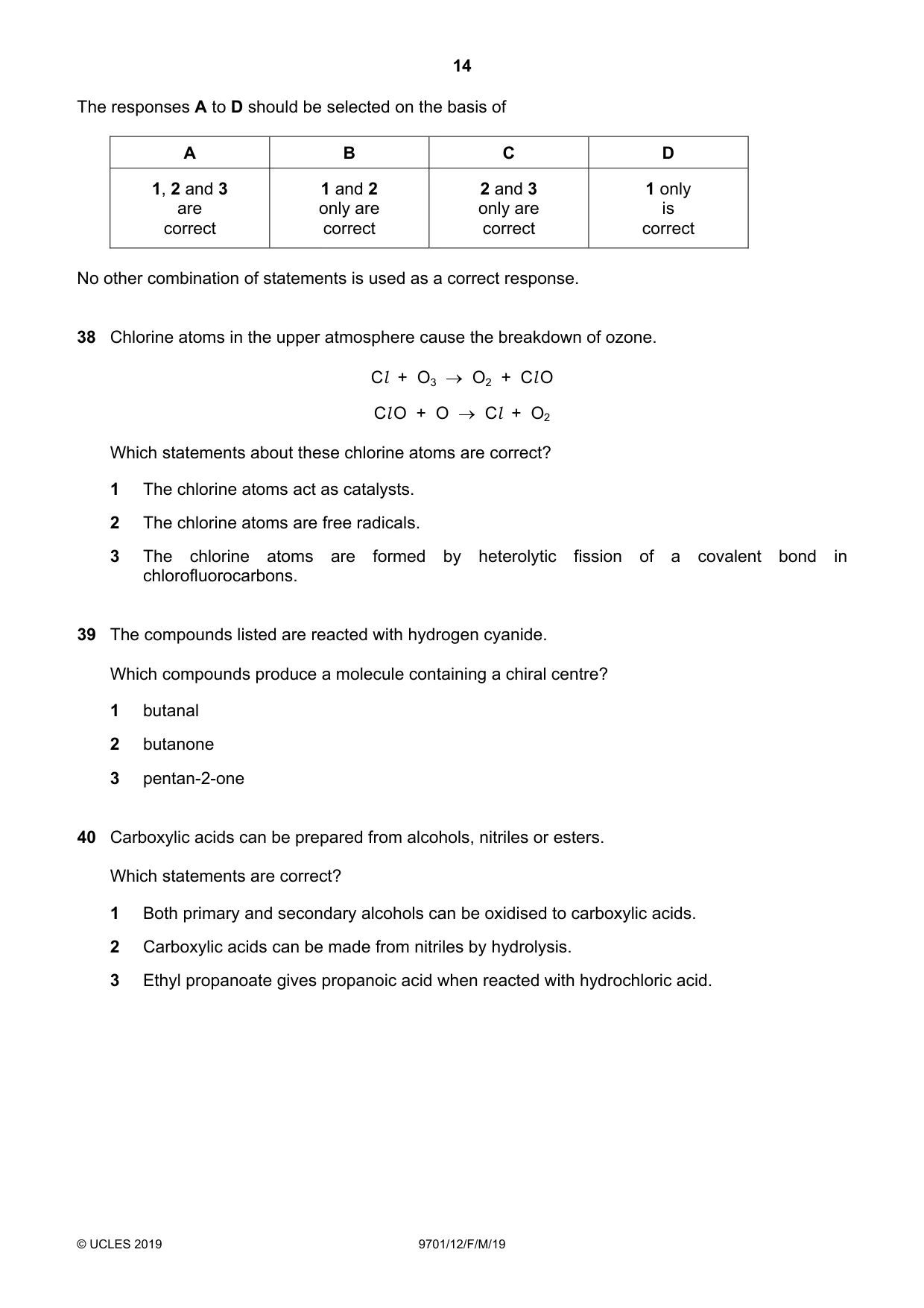
Q38 · Chlorine atoms in the upper atmosphere cause the breakdown of ozone
38 Chlorine atoms in the upper atmosphere cause the breakdown of ozone. Cl + O3 → O2 + Cl O Cl O + O → Cl + O2 Which statements about these chlorine atoms are correct? 1 The chlorine atoms act as catalysts. 2 The chlorine atoms are free radicals. 3 The chlorine atoms are formed by heterolytic fission of a covalent bond in chlorofluorocarbons.
Mark scheme: B
Q39 · The compounds listed are reacted with hydrogen cyanide
39 The compounds listed are reacted with hydrogen cyanide. Which compounds produce a molecule containing a chiral centre? 1 butanal 2 butanone 3 pentan-2-one
Mark scheme: A
Q40 · Carboxylic acids can be prepared from alcohols, nitriles or esters
40 Carboxylic acids can be prepared from alcohols, nitriles or esters. Which statements are correct? 1 Both primary and secondary alcohols can be oxidised to carboxylic acids. 2 Carboxylic acids can be made from nitriles by hydrolysis. 3 Ethyl propanoate gives propanoic acid when reacted with hydrochloric acid.
Mark scheme: C
What was in this paper
The subtopics covered by these 40 questions, and how many questions each got. Open one in a new tab to see every Cambridge question on it.
3Reacting masses and volumes (of solutions and gases)3Aldehydes and ketones2Bonding and structure2Carboxylic acids2Electrons, energy levels and atomic orbitals2Halogenoalkanes2Homogeneous and heterogeneous catalysts2Periodicity of chemical properties of the elements in Period 32Shapes of molecules2Similarities and trends in the properties of the Group 2 metals, magnesium to barium, and their compounds2Alkanes1Alkenes1Chemical equilibria: reversible reactions, dynamic equilibrium1Effect of temperature on reaction rates and the concept of activation energy1Enthalpy change, ΔH1Hess’s law1Infrared spectroscopy1Ionic bonding1Isomerism: structural isomerism and stereoisomerism1Nitriles and hydroxynitriles1Nitrogen and sulfur1Redox processes: electron transfer and changes in oxidation number (oxidation state)1Some reactions of the halide ions1The chemical properties of the halogen elements and the hydrogen halides1The gaseous state: ideal and real gases and pV = nRT1The mole and the Avogadro constant1What you needed in this session
Cambridge’s own grade thresholds for 2019 Feb/March, Paper 1 · Variant 2. A higher threshold means an easier paper — the bar moves with how the cohort did.