Cambridge A Level Chemistry 9701 — 2022 Oct/Nov Paper 1 · Variant 2
9701/12/O/N/22 · 40 questions · 40 marks · ≈45 min
The question paper and its mark scheme, free to read here and free to download. This is Cambridge’s own paper, exactly as it was sat.
Question paper20 pages


Mark scheme3 pages
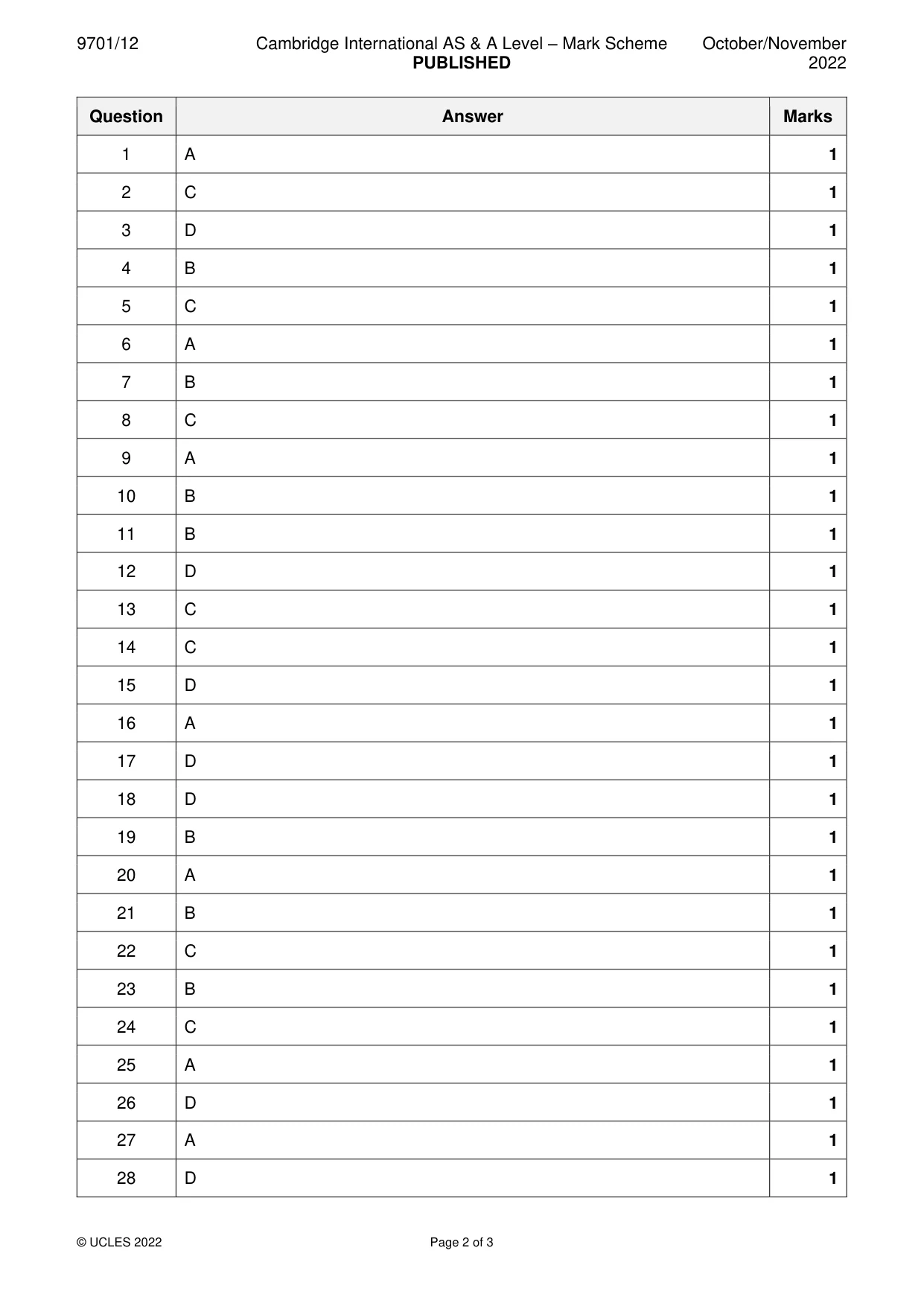
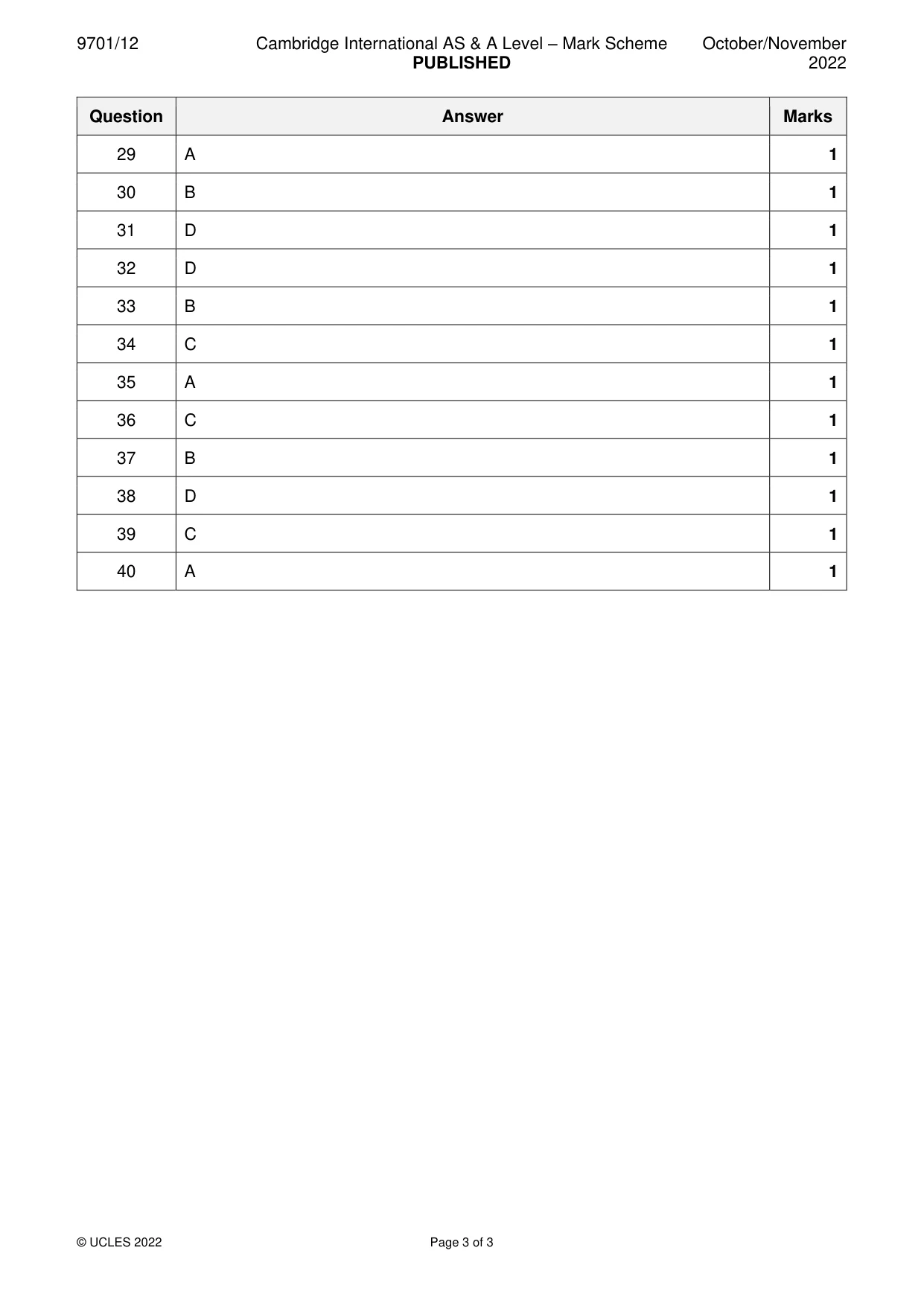
Answers below. Sit the paper first if you are practising.
Questions as text
Q1 · Why is the first ionisation energy of phosphorus greater than the first ionisation energy…
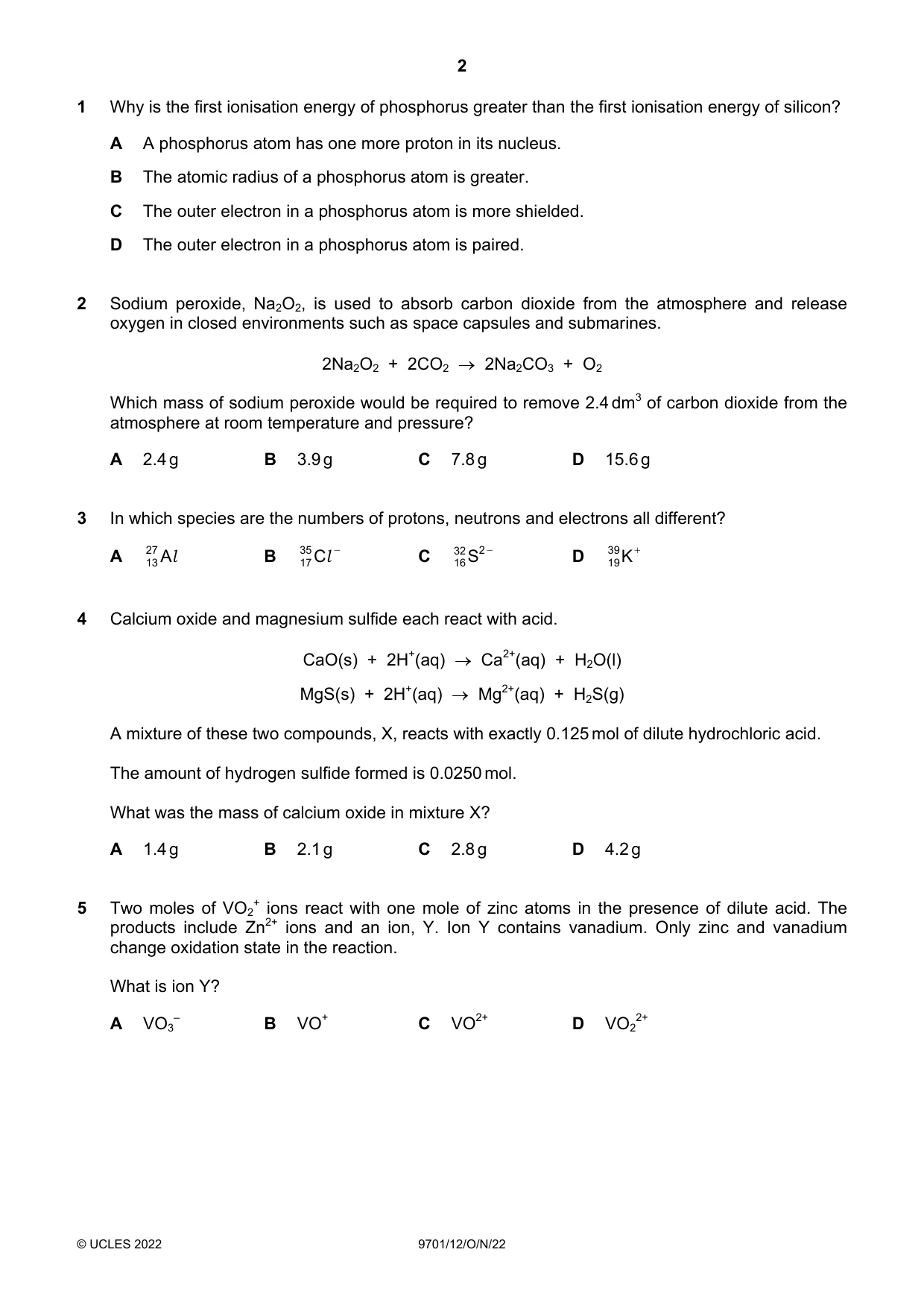
1 Why is the first ionisation energy of phosphorus greater than the first ionisation energy of silicon? A A phosphorus atom has one more proton in its nucleus. B The atomic radius of a phosphorus atom is greater. C The outer electron in a phosphorus atom is more shielded. D The outer electron in a phosphorus atom is paired.
Mark scheme: A
Q2 · Sodium peroxide, Na2O2, is used to absorb carbon dioxide from the atmosphere and release…
2 Sodium peroxide, Na2O2, is used to absorb carbon dioxide from the atmosphere and release oxygen in closed environments such as space capsules and submarines. 2Na2O2 + 2CO2 2Na2CO3 + O2 Which mass of sodium peroxide would be required to remove 2.4 dm3 of carbon dioxide from the atmosphere at room temperature and pressure? A 2.4 g B 3.9 g C 7.8 g D 15.6 g
Mark scheme: C
More questions on Reacting masses and volumes (of solutions and gases)
Q3 · In which species are the numbers of protons, neutrons and electrons all different?
3 In which species are the numbers of protons, neutrons and electrons all different? A 27 A l B 35 C l C 16S 32 2 D 39 K 13 17 19
Mark scheme: D
Q4 · Calcium oxide and magnesium sulfide each react with acid
4 Calcium oxide and magnesium sulfide each react with acid. CaO(s) + 2H+(aq) Ca2+(aq) + H2O(l) MgS(s) + 2H+(aq) Mg2+(aq) + H2S(g) A mixture of these two compounds, X, reacts with exactly 0.125 mol of dilute hydrochloric acid. The amount of hydrogen sulfide formed is 0.0250 mol. What was the mass of calcium oxide in mixture X? A 1.4 g B 2.1 g C 2.8 g D 4.2 g
Mark scheme: B
More questions on Reacting masses and volumes (of solutions and gases)
Q5 · Two moles of VO2 + ions react with one mole of zinc atoms in the presence of dilute acid
5 Two moles of VO2 + ions react with one mole of zinc atoms in the presence of dilute acid. The products include Zn2+ ions and an ion, Y. Ion Y contains vanadium. Only zinc and vanadium change oxidation state in the reaction. What is ion Y? A VO3 – B VO+ C VO2+ D VO2 2+
Mark scheme: C
Q6 · The compound potassium bismuthate(V), KBiO3, is a powerful oxidising agent
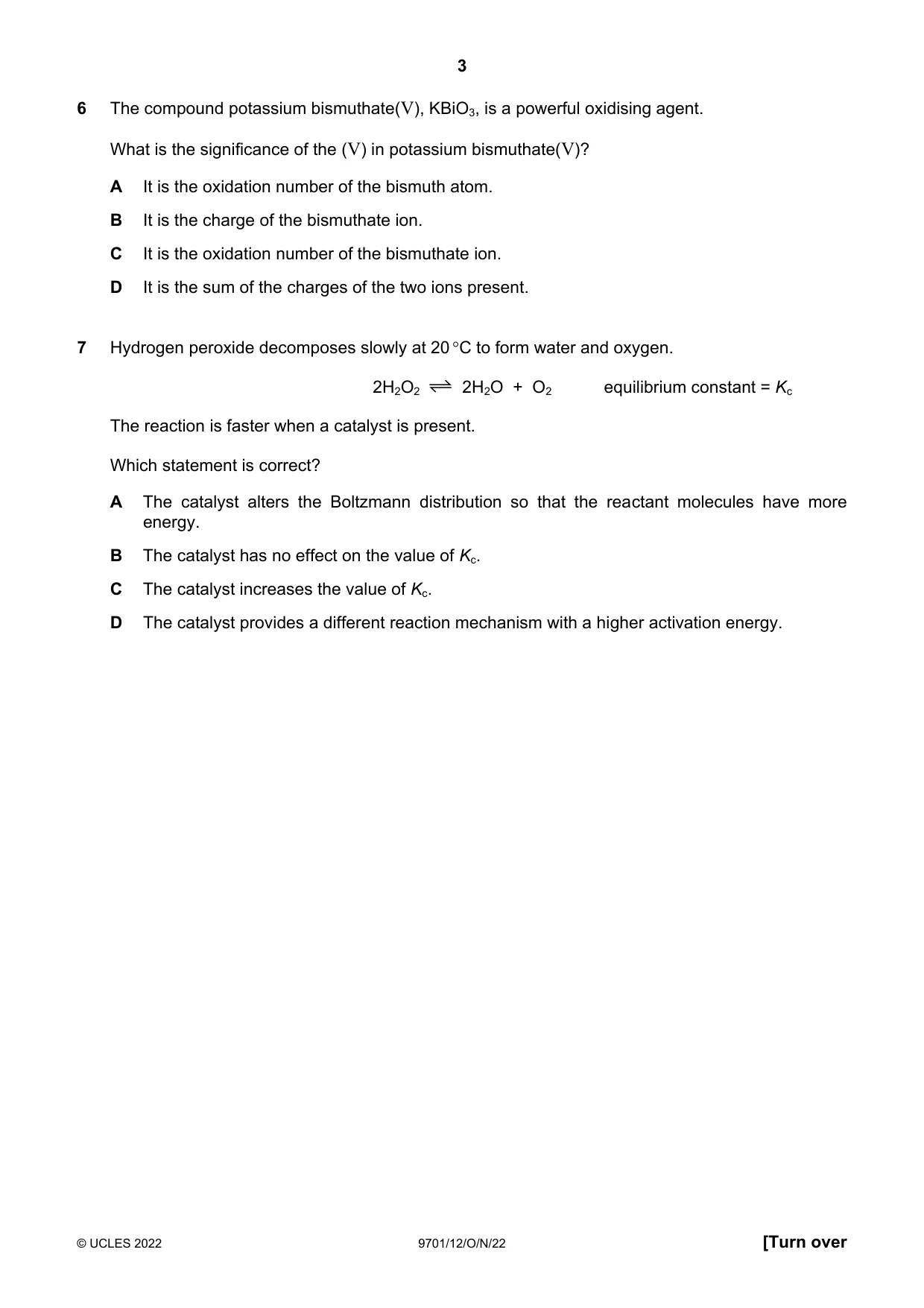
6 The compound potassium bismuthate(V), KBiO3, is a powerful oxidising agent. What is the significance of the (V) in potassium bismuthate(V)? A It is the oxidation number of the bismuth atom. B It is the charge of the bismuthate ion. C It is the oxidation number of the bismuthate ion. D It is the sum of the charges of the two ions present.
Mark scheme: A
Q7 · Hydrogen peroxide decomposes slowly at 20 C to form water and oxygen
7 Hydrogen peroxide decomposes slowly at 20 C to form water and oxygen. 2H2O2 2H2O + O2 equilibrium constant = Kc The reaction is faster when a catalyst is present. Which statement is correct? A The catalyst alters the Boltzmann distribution so that the reactant molecules have more energy. B The catalyst has no effect on the value of Kc. C The catalyst increases the value of Kc. D The catalyst provides a different reaction mechanism with a higher activation energy.
Mark scheme: B
More questions on Chemical equilibria: reversible reactions, dynamic equilibrium
Q8 · A dimer, Q, is stable when solid but a dynamic equilibrium is set up in solution
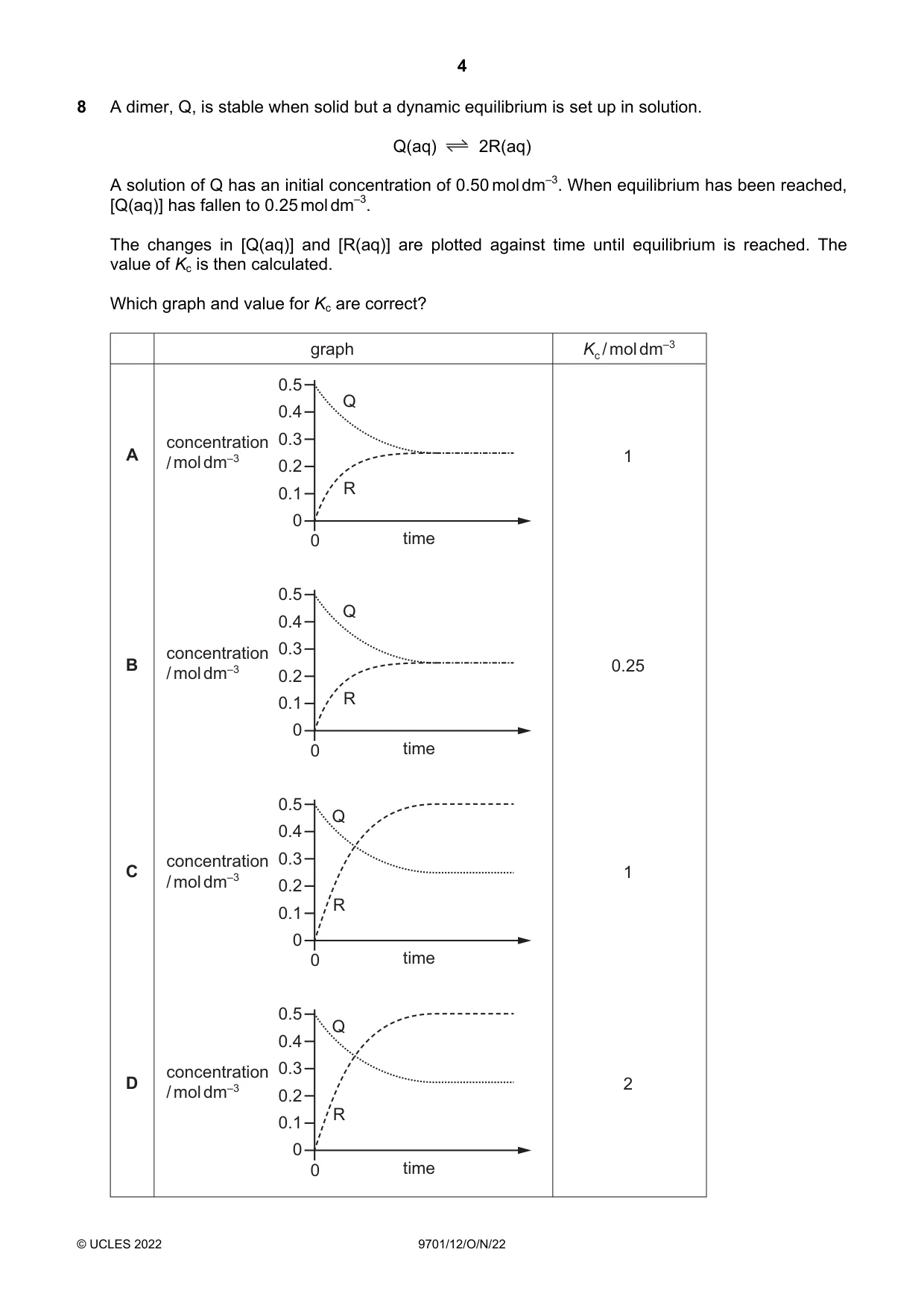
8 A dimer, Q, is stable when solid but a dynamic equilibrium is set up in solution. Q(aq) 2R(aq) A solution of Q has an initial concentration of 0.50 mol dm–3. When equilibrium has been reached, [Q(aq)] has fallen to 0.25 mol dm–3. The changes in [Q(aq)] and [R(aq)] are plotted against time until equilibrium is reached. The value of Kc is then calculated. Which graph and value for Kc are correct? graph Kc / mol dm–3 0.5 Q 0.4 concentration 0.3 A 1 / mol dm–3 0.2 0.1 R 0 0 time 0.5 Q 0.4 concentration 0.3 B 0.25 / mol dm–3 0.2 0.1 R 0 0 time 0.5 Q 0.4 concentration 0.3 C 1 / mol dm–3 0.2 R 0.1 0 0 time 0.5 Q 0.4 concentration 0.3 D 2 / mol dm–3 0.2 R 0.1 0 0 time
Mark scheme: C
More questions on Chemical equilibria: reversible reactions, dynamic equilibrium
Q9 · The reaction pathway for the forward reaction of a reversible reaction is shown
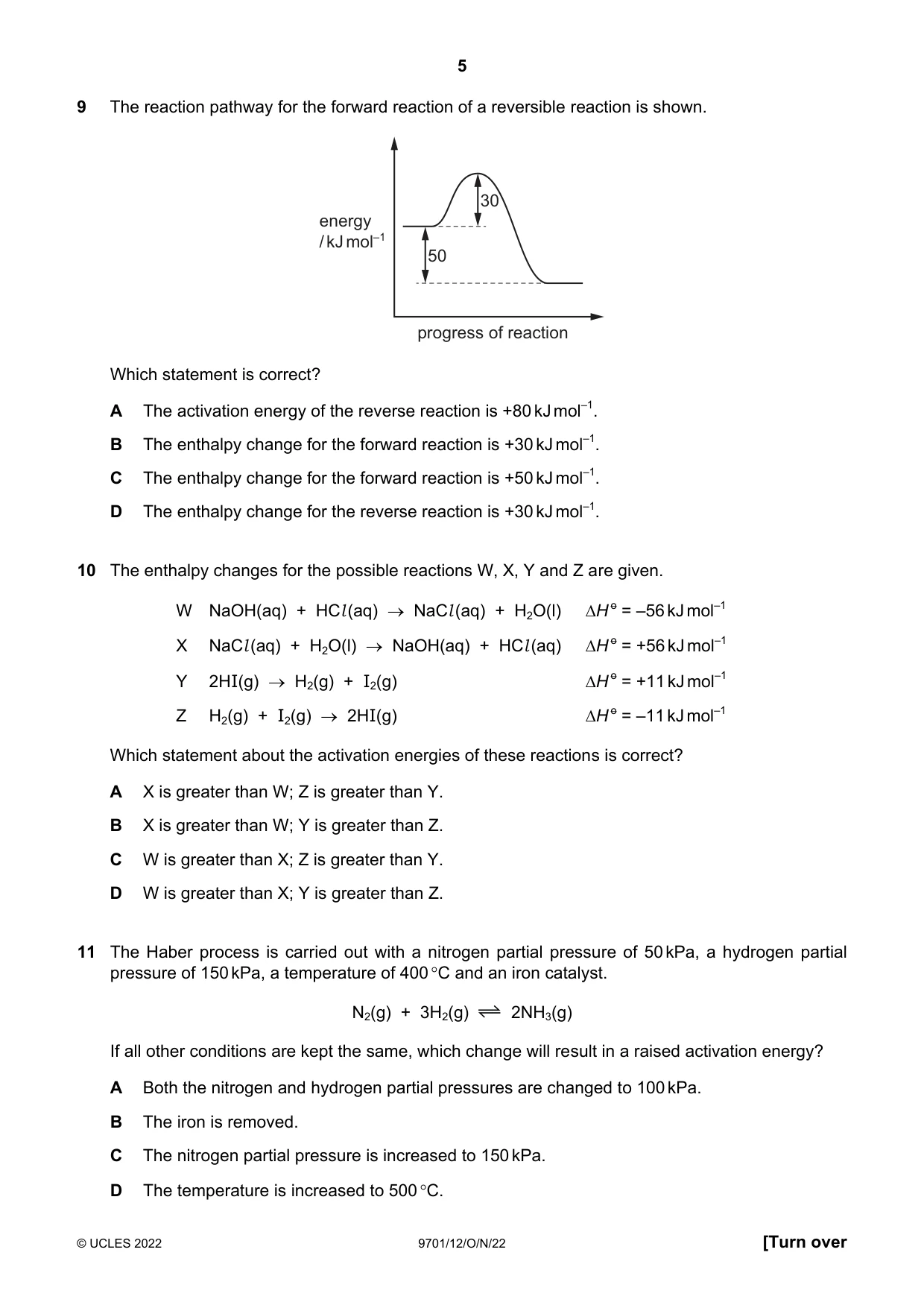
9 The reaction pathway for the forward reaction of a reversible reaction is shown. 30 energy / kJ mol–1 50 progress of reaction Which statement is correct? A The activation energy of the reverse reaction is +80 kJ mol–1. B The enthalpy change for the forward reaction is +30 kJ mol–1. C The enthalpy change for the forward reaction is +50 kJ mol–1. D The enthalpy change for the reverse reaction is +30 kJ mol–1.
Mark scheme: A
Q10 · The enthalpy changes for the possible reactions W, X, Y and Z are given
10 The enthalpy changes for the possible reactions W, X, Y and Z are given. W NaOH(aq) + HCl (aq) NaCl (aq) + H2O(l) H o = –56 kJ mol–1 X NaCl (aq) + H2O(l) NaOH(aq) + HCl (aq) H o = +56 kJ mol–1 Y 2HI(g) H2(g) + I2(g) H o = +11 kJ mol–1 Z H2(g) + I2(g) 2HI(g) H o = –11 kJ mol–1 Which statement about the activation energies of these reactions is correct? A X is greater than W; Z is greater than Y. B X is greater than W; Y is greater than Z. C W is greater than X; Z is greater than Y. D W is greater than X; Y is greater than Z.
Mark scheme: B
More questions on Effect of temperature on reaction rates and the concept of activation energy
Q11 · The Haber process is carried out with a nitrogen partial pressure of 50 kPa, a hydrogen…
11 The Haber process is carried out with a nitrogen partial pressure of 50 kPa, a hydrogen partial pressure of 150 kPa, a temperature of 400 C and an iron catalyst. N2(g) + 3H2(g) 2NH3(g) If all other conditions are kept the same, which change will result in a raised activation energy? A Both the nitrogen and hydrogen partial pressures are changed to 100 kPa. B The iron is removed. C The nitrogen partial pressure is increased to 150 kPa. D The temperature is increased to 500 C.
Mark scheme: B
More questions on Effect of temperature on reaction rates and the concept of activation energy
Q12 · The compound (CH3)3NAl Cl 3 has a simple molecular structure
12 The compound (CH3)3NAl Cl 3 has a simple molecular structure. Which statement about (CH3)3NAl Cl 3 is correct? A (CH3)3NAl Cl 3 molecules attract each other by hydrogen bonds. B The Al atom in (CH3)3NAl Cl 3 has an incomplete valence shell of electrons. C The bonds around the Al atom are planar. D The molecules contain coordinate bonding.
Mark scheme: D
More questions on Covalent bonding and coordinate (dative covalent) bonding
Q13 · VSEPR theory should be used in answering this question
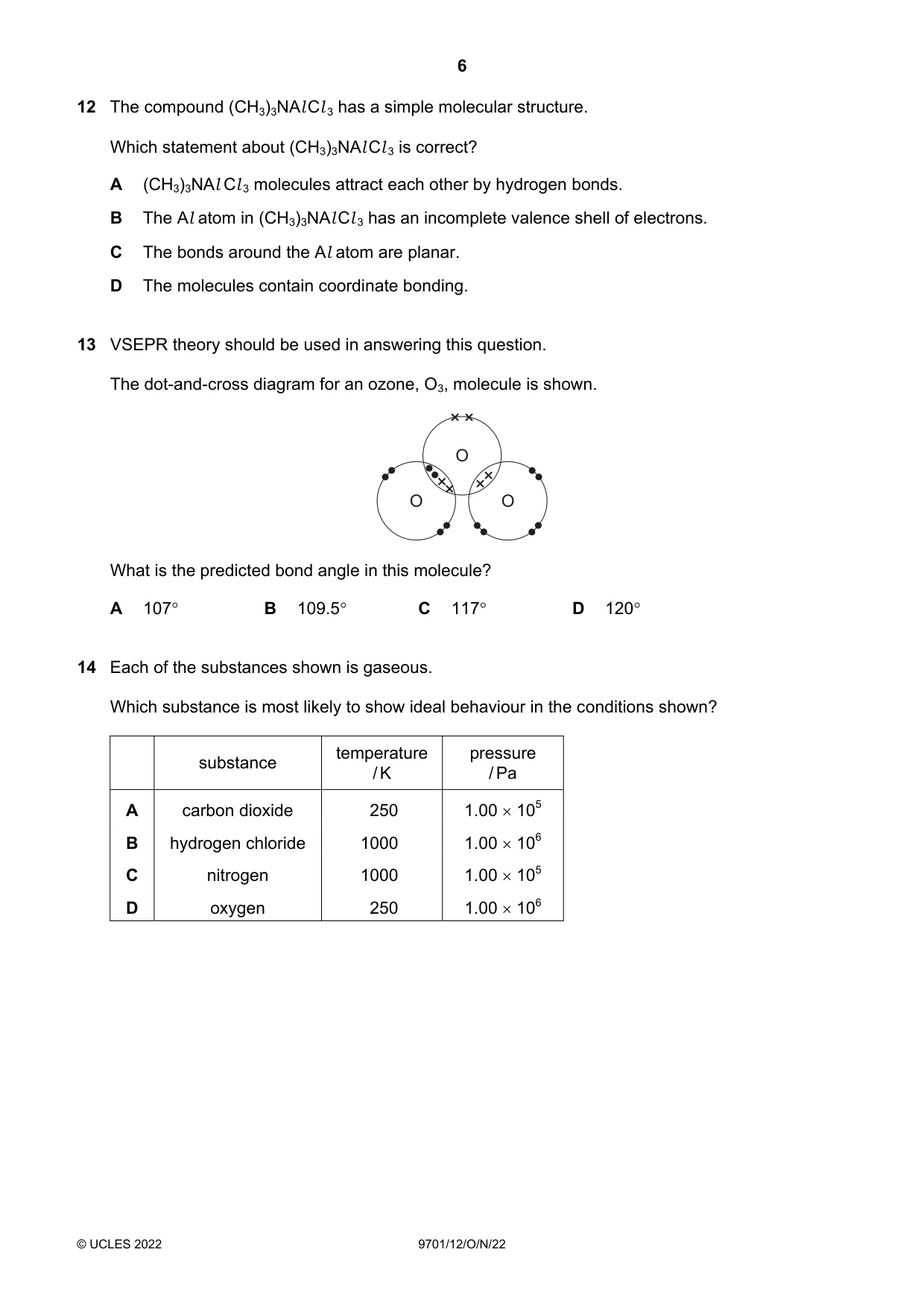
13 VSEPR theory should be used in answering this question. The dot-and-cross diagram for an ozone, O3, molecule is shown. O O O What is the predicted bond angle in this molecule? A 107 B 109.5 C 117 D 120
Mark scheme: C
Q14 · Each of the substances shown is gaseous
14 Each of the substances shown is gaseous. Which substance is most likely to show ideal behaviour in the conditions shown? temperature pressure substance / K / Pa A carbon dioxide 250 1.00 105 B hydrogen chloride 1000 1.00 106 C nitrogen 1000 1.00 105 D oxygen 250 1.00 106
Mark scheme: C
More questions on The gaseous state: ideal and real gases and pV = nRT
Q15 · Which graph represents the variation of pressure p and volume V of a sample of an ideal…
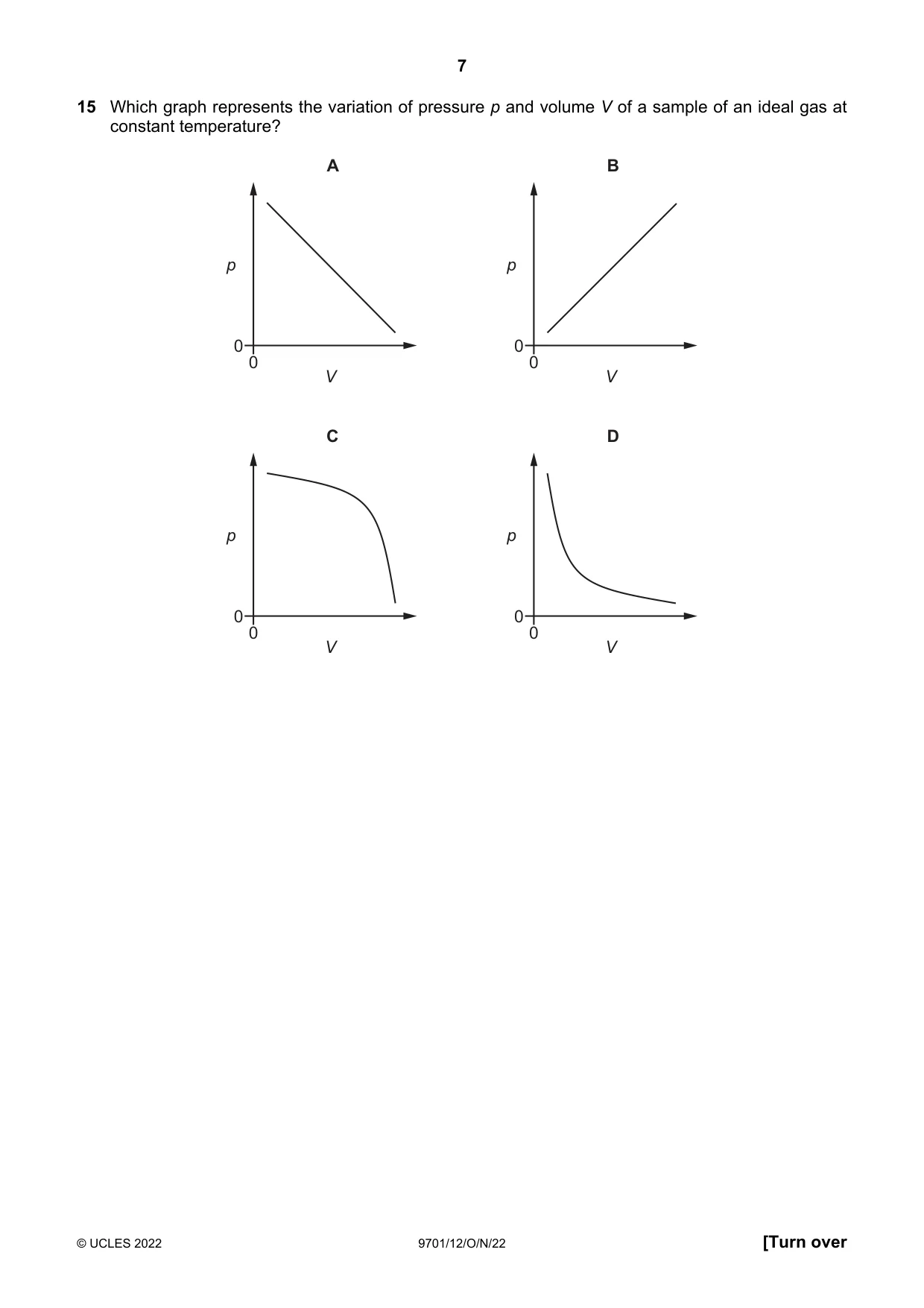
15 Which graph represents the variation of pressure p and volume V of a sample of an ideal gas at constant temperature? A B p p 0 0 0 0 V V C D p p 0 0 0 0 V V
Mark scheme: D
More questions on The gaseous state: ideal and real gases and pV = nRT
Q16 · Use relevant enthalpy changes from the tables to answer this question
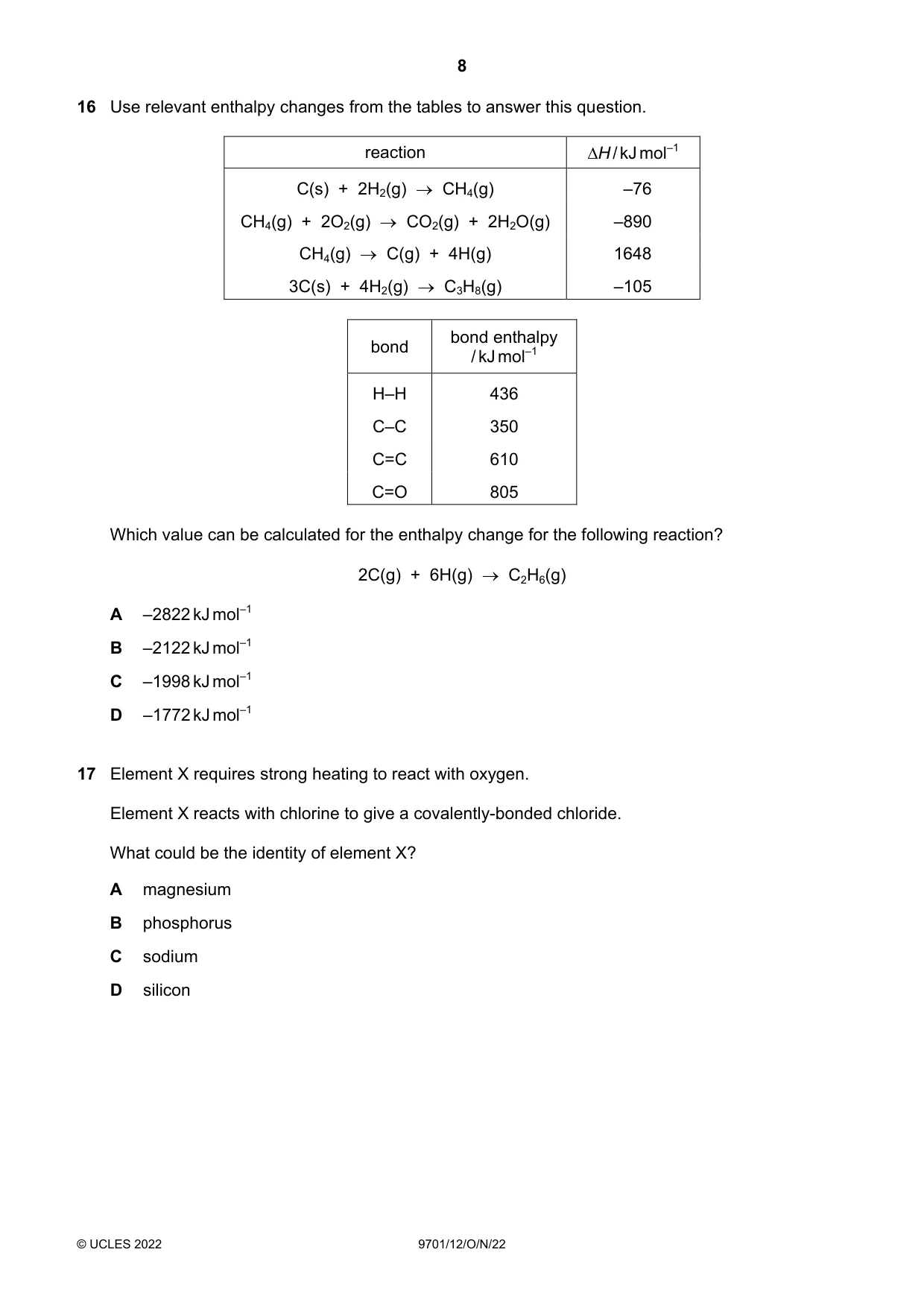
16 Use relevant enthalpy changes from the tables to answer this question. reaction H / kJ mol–1 C(s) + 2H2(g) CH4(g) –76 CH4(g) + 2O2(g) CO2(g) + 2H2O(g) –890 CH4(g) C(g) + 4H(g) 1648 3C(s) + 4H2(g) C3H8(g) –105 bond enthalpy bond / kJ mol–1 H–H 436 C–C 350 C=C 610 C=O 805 Which value can be calculated for the enthalpy change for the following reaction? 2C(g) + 6H(g) C2H6(g) A –2822 kJ mol–1 B –2122 kJ mol–1 C –1998 kJ mol–1 D –1772 kJ mol–1
Mark scheme: A
Q17 · Element X requires strong heating to react with oxygen
17 Element X requires strong heating to react with oxygen. Element X reacts with chlorine to give a covalently-bonded chloride. What could be the identity of element X? A magnesium B phosphorus C sodium D silicon
Mark scheme: D
More questions on Periodicity of chemical properties of the elements in Period 3
Q18 · The melting points of the Period 3 elements sodium to aluminium are shown in the table
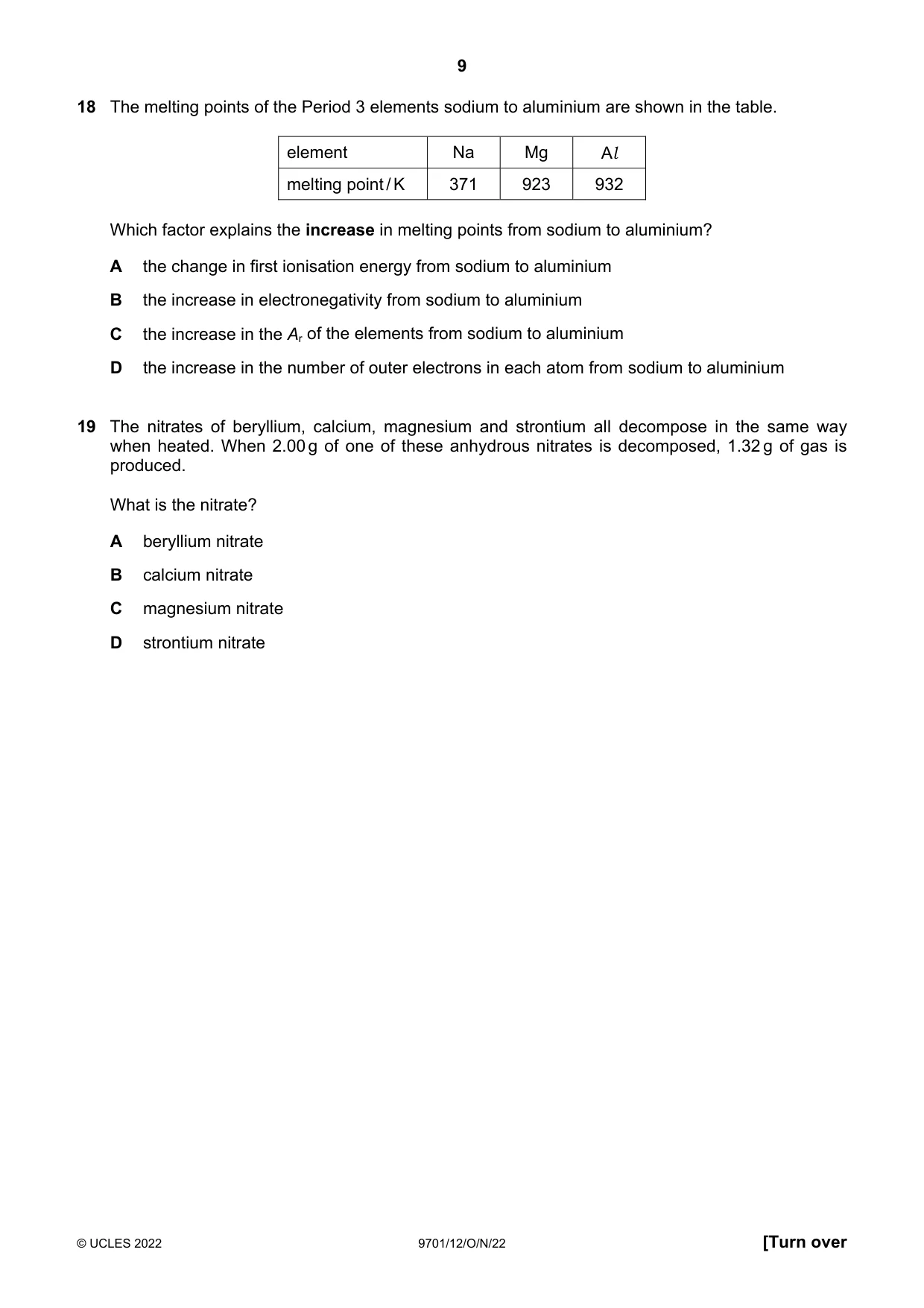
18 The melting points of the Period 3 elements sodium to aluminium are shown in the table. element Na Mg Al melting point / K 371 923 932 Which factor explains the increase in melting points from sodium to aluminium? A the change in first ionisation energy from sodium to aluminium B the increase in electronegativity from sodium to aluminium C the increase in the Ar of the elements from sodium to aluminium D the increase in the number of outer electrons in each atom from sodium to aluminium
Mark scheme: D
More questions on Periodicity of physical properties of the elements in Period 3
Q19 · The nitrates of beryllium, calcium, magnesium and strontium all decompose in the same way…
19 The nitrates of beryllium, calcium, magnesium and strontium all decompose in the same way when heated. When 2.00 g of one of these anhydrous nitrates is decomposed, 1.32 g of gas is produced. What is the nitrate? A beryllium nitrate B calcium nitrate C magnesium nitrate D strontium nitrate
Mark scheme: B
Q20 · In the diagram, each test-tube W, X, Y and Z contains 25 cm3 of a 0.1 mol dm–3 solution…
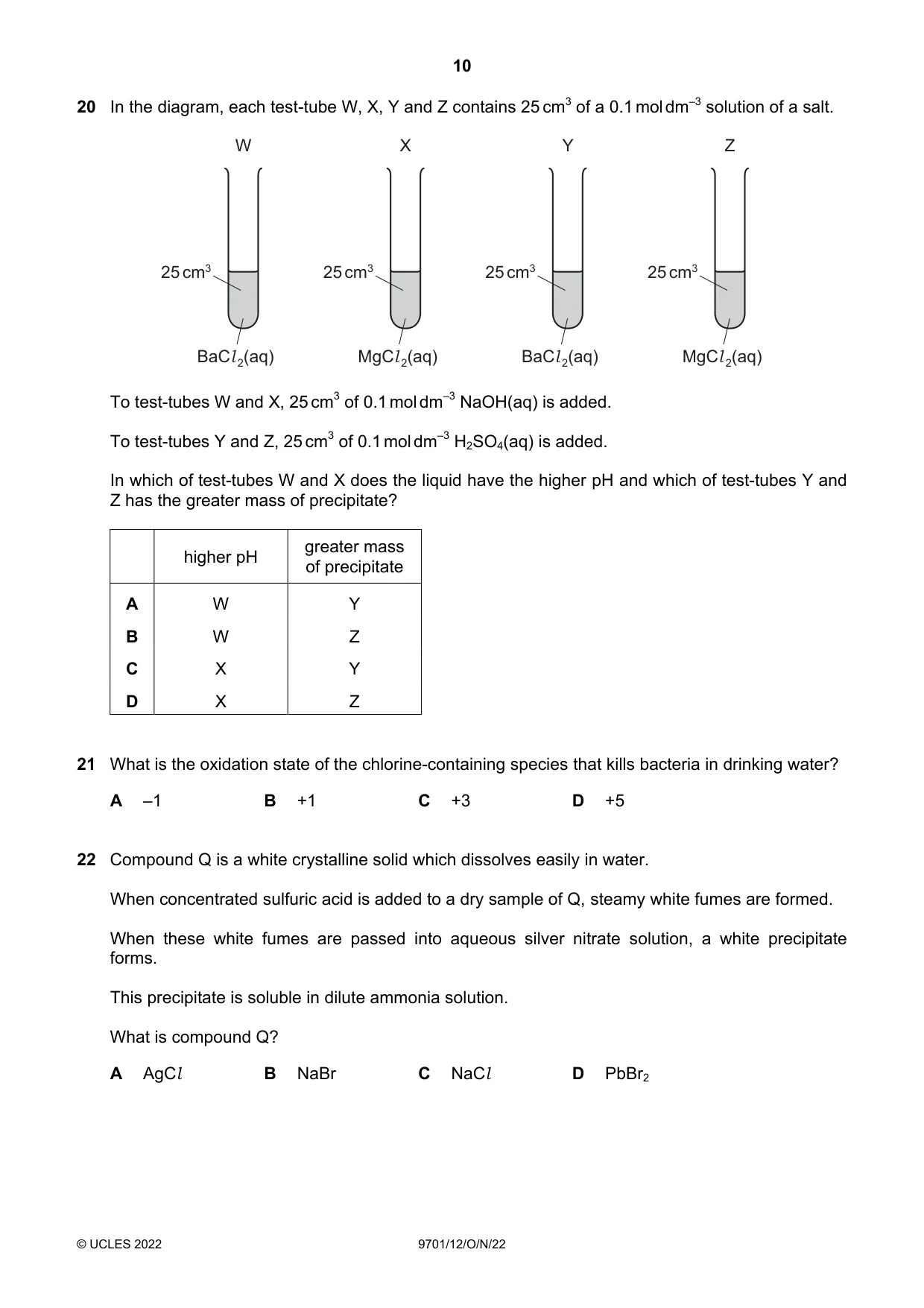
20 In the diagram, each test-tube W, X, Y and Z contains 25 cm3 of a 0.1 mol dm–3 solution of a salt. W X Y Z 25 cm3 25 cm3 25 cm3 25 cm3 BaCl 2(aq) MgCl 2(aq) BaCl 2(aq) MgCl 2(aq) To test-tubes W and X, 25 cm3 of 0.1 mol dm–3 NaOH(aq) is added. To test-tubes Y and Z, 25 cm3 of 0.1 mol dm–3 H2SO4(aq) is added. In which of test-tubes W and X does the liquid have the higher pH and which of test-tubes Y and Z has the greater mass of precipitate? greater mass higher pH of precipitate A W Y B W Z C X Y D X Z
Mark scheme: A
Q21 · What is the oxidation state of the chlorine-containing species that kills bacteria in…
21 What is the oxidation state of the chlorine-containing species that kills bacteria in drinking water? A –1 B +1 C +3 D +5
Mark scheme: B
Q22 · Compound Q is a white crystalline solid which dissolves easily in water
22 Compound Q is a white crystalline solid which dissolves easily in water. When concentrated sulfuric acid is added to a dry sample of Q, steamy white fumes are formed. When these white fumes are passed into aqueous silver nitrate solution, a white precipitate forms. This precipitate is soluble in dilute ammonia solution. What is compound Q? A AgCl B NaBr C NaCl D PbBr2
Mark scheme: C
Q23 · R is a solid
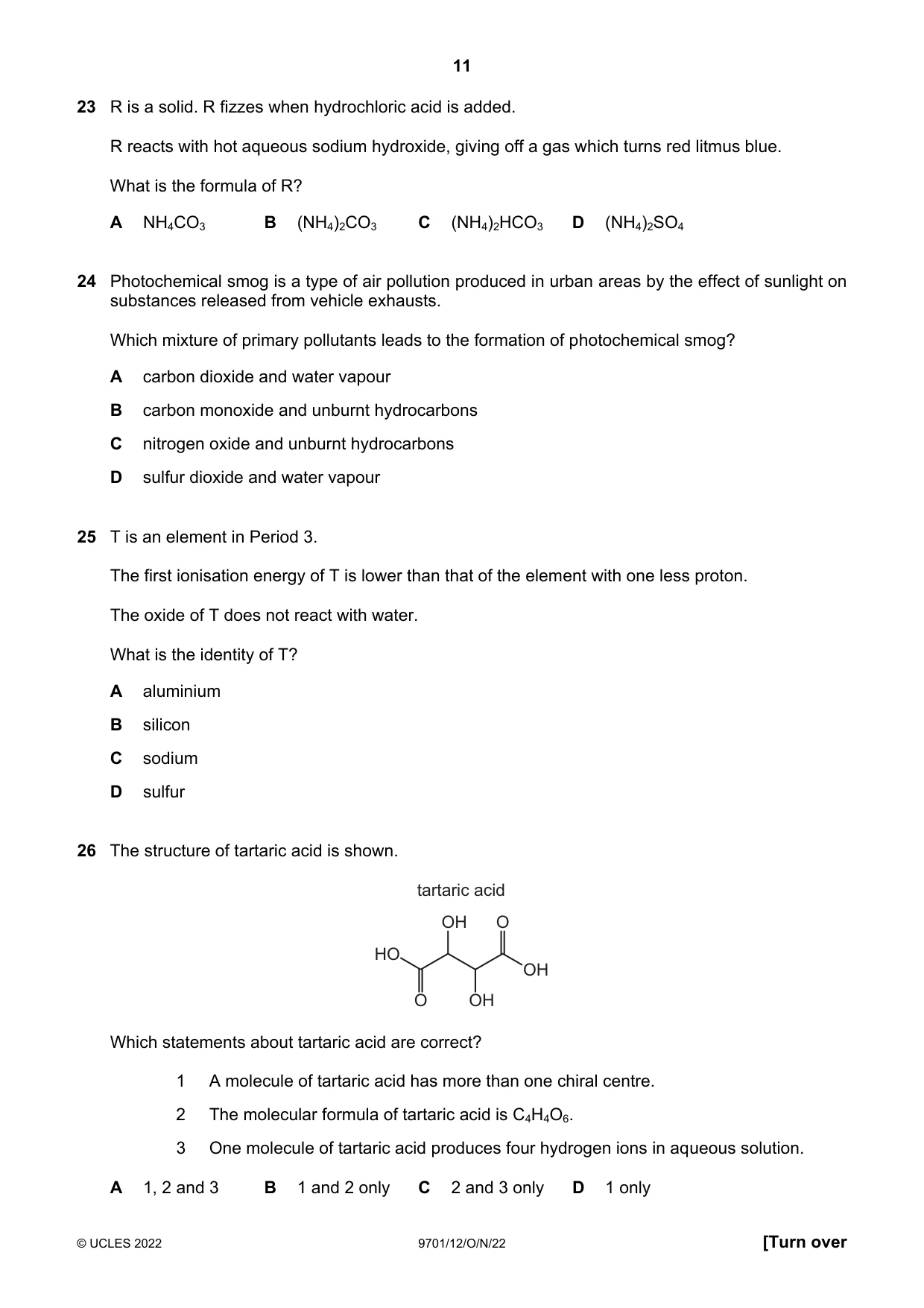
23 R is a solid. R fizzes when hydrochloric acid is added. R reacts with hot aqueous sodium hydroxide, giving off a gas which turns red litmus blue. What is the formula of R? A NH4CO3 B (NH4)2CO3 C (NH4)2HCO3 D (NH4)2SO4
Mark scheme: B
Q24 · Photochemical smog is a type of air pollution produced in urban areas by the effect of…
24 Photochemical smog is a type of air pollution produced in urban areas by the effect of sunlight on substances released from vehicle exhausts. Which mixture of primary pollutants leads to the formation of photochemical smog? A carbon dioxide and water vapour B carbon monoxide and unburnt hydrocarbons C nitrogen oxide and unburnt hydrocarbons D sulfur dioxide and water vapour
Mark scheme: C
Q25 · T is an element in Period 3
25 T is an element in Period 3. The first ionisation energy of T is lower than that of the element with one less proton. The oxide of T does not react with water. What is the identity of T? A aluminium B silicon C sodium D sulfur
Mark scheme: A
More questions on Periodicity of chemical properties of the elements in Period 3
Q26 · The structure of tartaric acid is shown
26 The structure of tartaric acid is shown. tartaric acid OH O HO OH O OH Which statements about tartaric acid are correct? 1 A molecule of tartaric acid has more than one chiral centre. 2 The molecular formula of tartaric acid is C4H4O6. 3 One molecule of tartaric acid produces four hydrogen ions in aqueous solution. A 1, 2 and 3 B 1 and 2 only C 2 and 3 only D 1 only
Mark scheme: D
More questions on Isomerism: structural isomerism and stereoisomerism
Q27 · A carboxylic acid, P, has no chain isomers
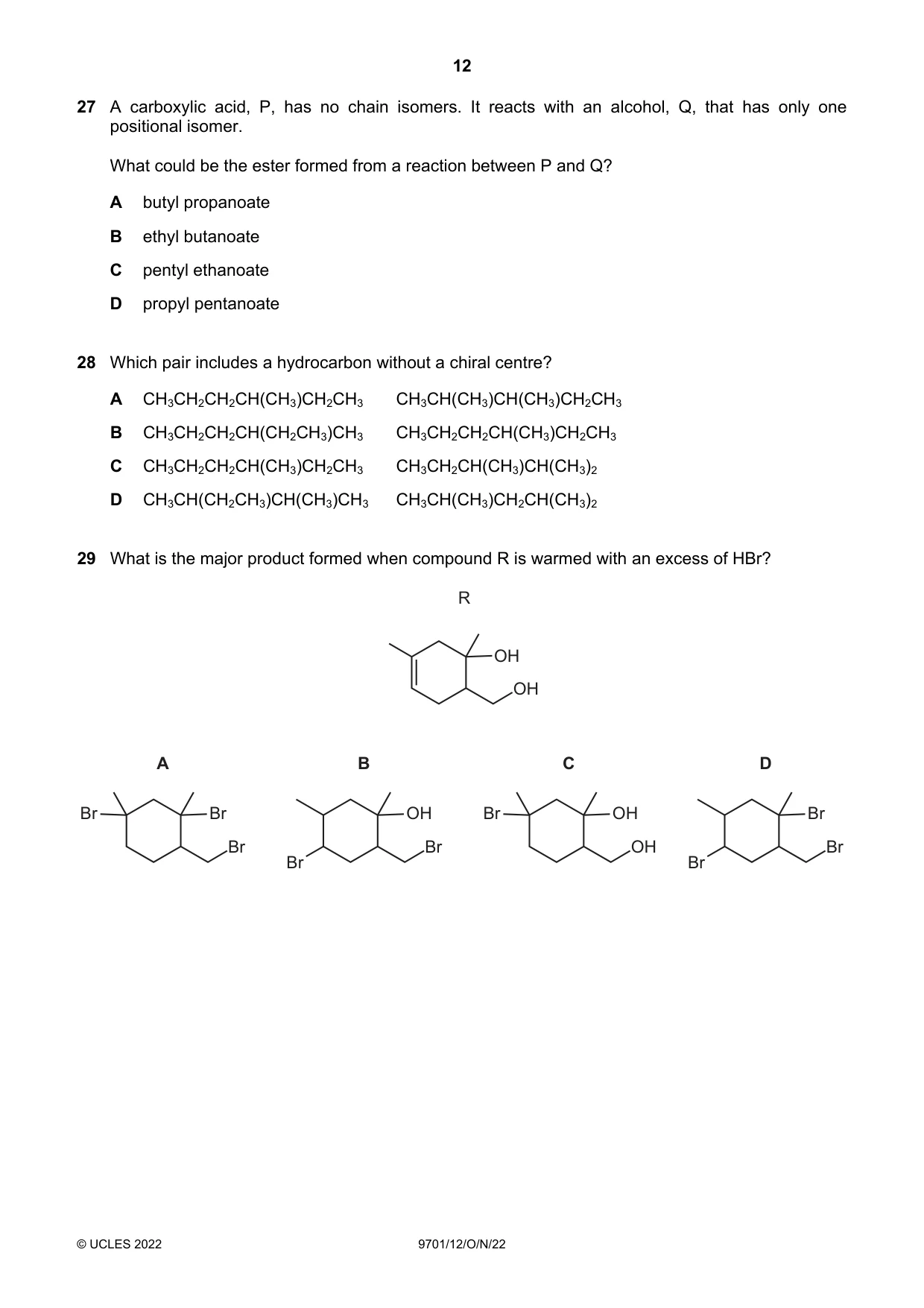
27 A carboxylic acid, P, has no chain isomers. It reacts with an alcohol, Q, that has only one positional isomer. What could be the ester formed from a reaction between P and Q? A butyl propanoate B ethyl butanoate C pentyl ethanoate D propyl pentanoate
Mark scheme: A
Q28 · Which pair includes a hydrocarbon without a chiral centre?
28 Which pair includes a hydrocarbon without a chiral centre? A CH3CH2CH2CH(CH3)CH2CH3 CH3CH(CH3)CH(CH3)CH2CH3 B CH3CH2CH2CH(CH2CH3)CH3 CH3CH2CH2CH(CH3)CH2CH3 C CH3CH2CH2CH(CH3)CH2CH3 CH3CH2CH(CH3)CH(CH3)2 D CH3CH(CH2CH3)CH(CH3)CH3 CH3CH(CH3)CH2CH(CH3)2
Mark scheme: D
More questions on Isomerism: structural isomerism and stereoisomerism
Q29 · What is the major product formed when compound R is warmed with an excess of HBr?
29 What is the major product formed when compound R is warmed with an excess of HBr? R OH OH A B C D Br Br OH Br OH Br Br Br OH Br Br Br
Mark scheme: A
Q30 · Cis-but-2-ene reacts with cold dilute acidified potassium manganate(VII) solution to give…
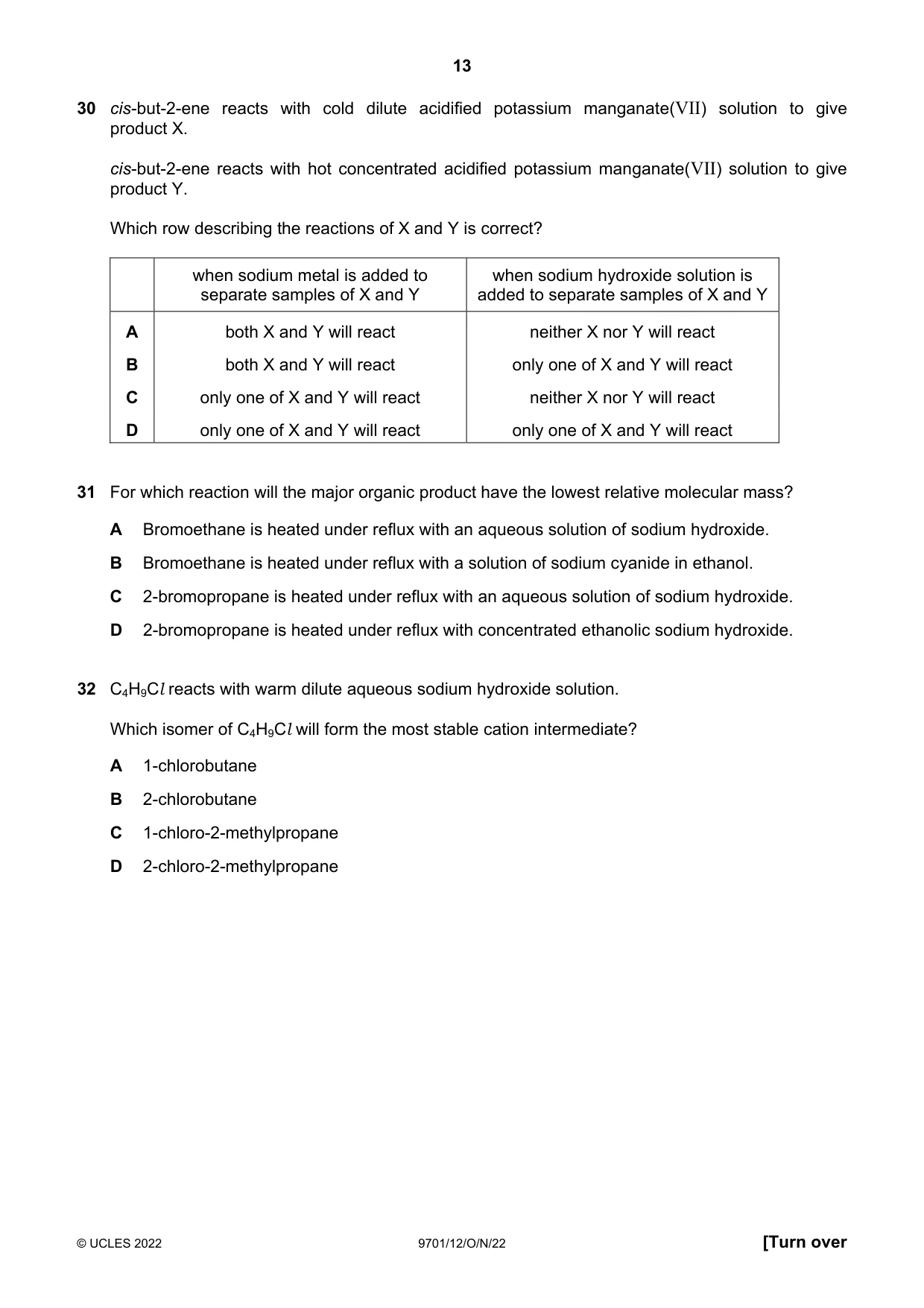
30 cis-but-2-ene reacts with cold dilute acidified potassium manganate(VII) solution to give product X. cis-but-2-ene reacts with hot concentrated acidified potassium manganate(VII) solution to give product Y. Which row describing the reactions of X and Y is correct? when sodium metal is added to when sodium hydroxide solution is separate samples of X and Y added to separate samples of X and Y A both X and Y will react neither X nor Y will react B both X and Y will react only one of X and Y will react C only one of X and Y will react neither X nor Y will react D only one of X and Y will react only one of X and Y will react
Mark scheme: B
Q31 · For which reaction will the major organic product have the lowest relative molecular mass?
31 For which reaction will the major organic product have the lowest relative molecular mass? A Bromoethane is heated under reflux with an aqueous solution of sodium hydroxide. B Bromoethane is heated under reflux with a solution of sodium cyanide in ethanol. C 2-bromopropane is heated under reflux with an aqueous solution of sodium hydroxide. D 2-bromopropane is heated under reflux with concentrated ethanolic sodium hydroxide.
Mark scheme: D
Q32 · C4H9Cl reacts with warm dilute aqueous sodium hydroxide solution
32 C4H9Cl reacts with warm dilute aqueous sodium hydroxide solution. Which isomer of C4H9Cl will form the most stable cation intermediate? A 1-chlorobutane B 2-chlorobutane C 1-chloro-2-methylpropane D 2-chloro-2-methylpropane
Mark scheme: D
Q33 · 1.0 mol of an organic compound, J, requires 6.0 mol of oxygen for complete combustion
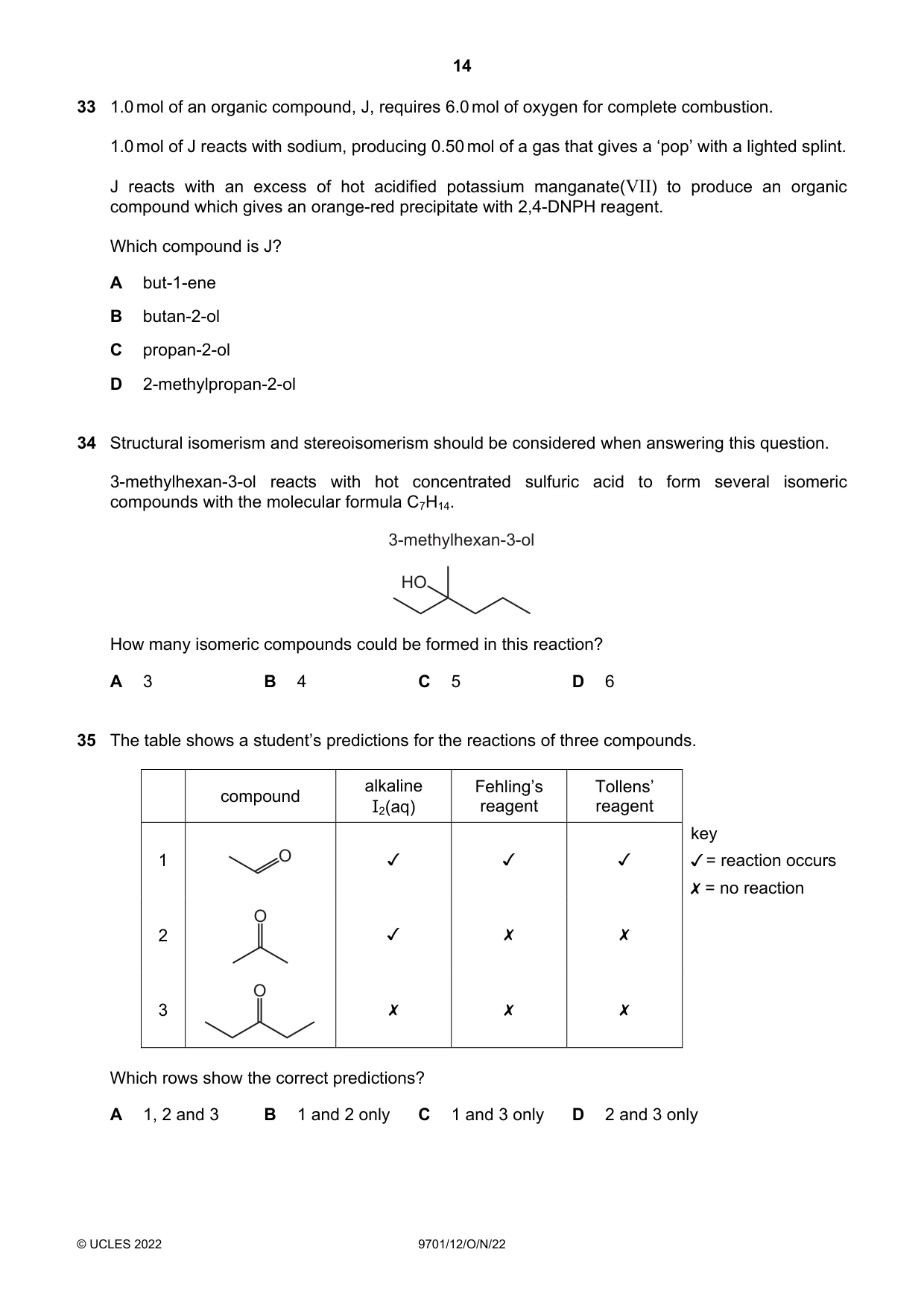
33 1.0 mol of an organic compound, J, requires 6.0 mol of oxygen for complete combustion. 1.0 mol of J reacts with sodium, producing 0.50 mol of a gas that gives a ‘pop’ with a lighted splint. J reacts with an excess of hot acidified potassium manganate(VII) to produce an organic compound which gives an orange-red precipitate with 2,4-DNPH reagent. Which compound is J? A but-1-ene B butan-2-ol C propan-2-ol D 2-methylpropan-2-ol
Mark scheme: B
Q34 · Structural isomerism and stereoisomerism should be considered when answering this question
34 Structural isomerism and stereoisomerism should be considered when answering this question. 3-methylhexan-3-ol reacts with hot concentrated sulfuric acid to form several isomeric compounds with the molecular formula C7H14. 3-methylhexan-3-ol HO How many isomeric compounds could be formed in this reaction? A 3 B 4 C 5 D 6
Mark scheme: C
More questions on Isomerism: structural isomerism and stereoisomerism
Q35 · The table shows a student’s predictions for the reactions of three compounds
35 The table shows a student’s predictions for the reactions of three compounds. alkaline Fehling’s Tollens’ compound I,(aq) reagent reagent key 1 \Z J J J / = reaction occurs X = no reaction 2 3 Which rows show the correct predictions? A 1,2and 3 B 1tand2only C 1and3only D = 2and3only
Mark scheme: A
Q36 · Which mechanism describes the reaction of aldehydes and ketones with HCN + NaCN?
36 Which mechanism describes the reaction of aldehydes and ketones with HCN + NaCN? A electrophilic addition B electrophilic substitution C nucleophilic addition D nucleophilic substitution
Mark scheme: C
Q37 · Propyl propanoate can be synthesised in three steps using propanenitrile as the only…
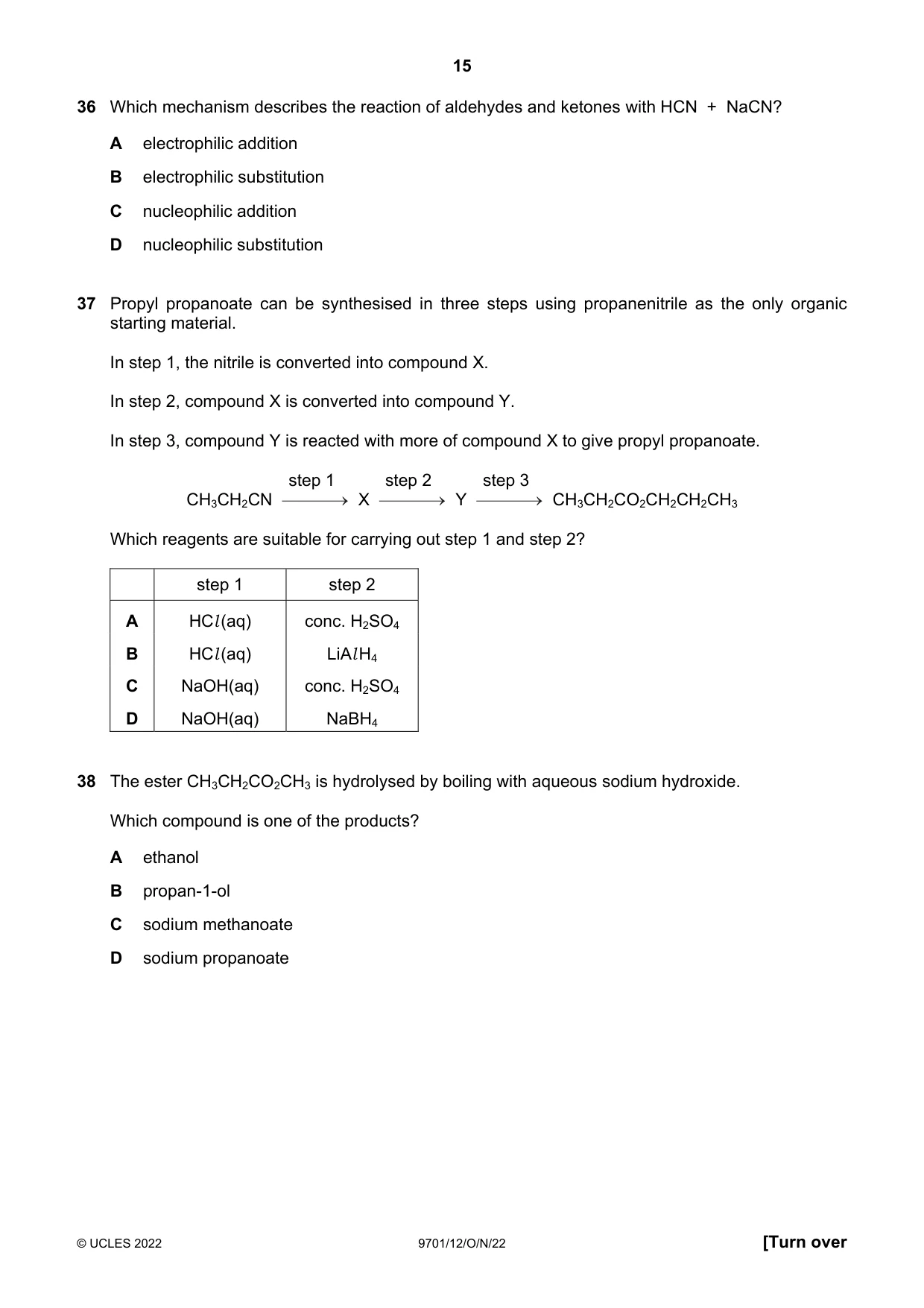
37 Propyl propanoate can be synthesised in three steps using propanenitrile as the only organic starting material. In step 1, the nitrile is converted into compound X. In step 2, compound X is converted into compound Y. In step 3, compound Y is reacted with more of compound X to give propyl propanoate. step 1 step 2 step 3 CH3CH2CN X Y CH3CH2CO2CH2CH2CH3 Which reagents are suitable for carrying out step 1 and step 2? step 1 step 2 A HCl (aq) conc. H2SO4 B HCl (aq) LiAl H4 C NaOH(aq) conc. H2SO4 D NaOH(aq) NaBH4
Mark scheme: B
Q38 · The ester CH3CH2CO2CH3 is hydrolysed by boiling with aqueous sodium hydroxide
38 The ester CH3CH2CO2CH3 is hydrolysed by boiling with aqueous sodium hydroxide. Which compound is one of the products? A ethanol B propan-1-ol C sodium methanoate D sodium propanoate
Mark scheme: D
Q39 · Compound V polymerises to form polymer W
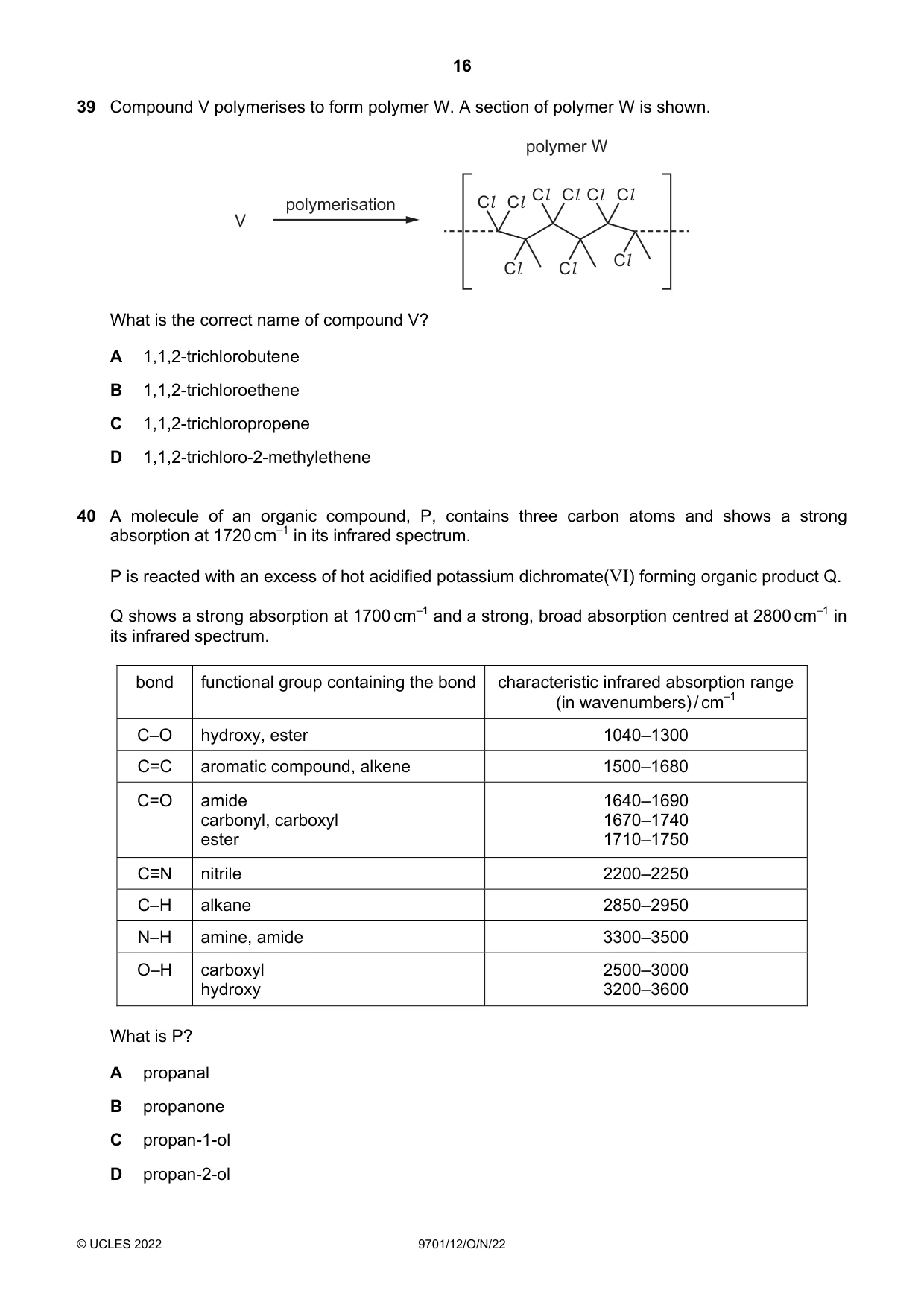
39 Compound V polymerises to form polymer W. A section of polymer W is shown. polymer W Cl Cl Cl Cl Cl Cl polymerisation V Cl Cl Cl What is the correct name of compound V? A 1,1,2-trichlorobutene B 1,1,2-trichloroethene C 1,1,2-trichloropropene D 1,1,2-trichloro-2-methylethene
Mark scheme: C
Q40 · A molecule of an organic compound, P, contains three carbon atoms and shows a strong…
40 A molecule of an organic compound, P, contains three carbon atoms and shows a strong absorption at 1720 cm–1 in its infrared spectrum. P is reacted with an excess of hot acidified potassium dichromate(VI) forming organic product Q. Q shows a strong absorption at 1700 cm–1 and a strong, broad absorption centred at 2800 cm–1 in its infrared spectrum. bond functional group containing the bond characteristic infrared absorption range (in wavenumbers) / cm–1 C–O hydroxy, ester 1040–1300 C=C aromatic compound, alkene 1500–1680 C=O amide 1640–1690 carbonyl, carboxyl 1670–1740 ester 1710–1750 C≡N nitrile 2200–2250 C–H alkane 2850–2950 N–H amine, amide 3300–3500 O–H carboxyl 2500–3000 hydroxy 3200–3600 What is P? A propanal B propanone C propan-1-ol D propan-2-ol
Mark scheme: A
What was in this paper
The subtopics covered by these 40 questions, and how many questions each got. Open one in a new tab to see every Cambridge question on it.
3Similarities and trends in the properties of the Group 2 metals, magnesium to barium, and their compounds3Aldehydes and ketones2Alkenes2Chemical equilibria: reversible reactions, dynamic equilibrium2Effect of temperature on reaction rates and the concept of activation energy2Enthalpy change, ΔH2Esters2Halogenoalkanes2Periodicity of chemical properties of the elements in Period 32Reacting masses and volumes (of solutions and gases)2Redox processes: electron transfer and changes in oxidation number (oxidation state)2The gaseous state: ideal and real gases and pV = nRT2Addition polymerisation1Alcohols1Covalent bonding and coordinate (dative covalent) bonding1Infrared spectroscopy1Ionisation energy1Nitrogen and sulfur1Organic synthesis1Particles in the atom and atomic radius1Periodicity of physical properties of the elements in Period 31Shapes of molecules1Some reactions of the halide ions1The reactions of chlorine1What you needed in this session
Cambridge’s own grade thresholds for 2022 Oct/Nov, Paper 1 · Variant 2. A higher threshold means an easier paper — the bar moves with how the cohort did.