Cambridge A Level Chemistry 9701 — 2018 Feb/March Paper 1 · Variant 2
9701/12/F/M/18 · 40 questions · 40 marks · ≈45 min
The question paper and its mark scheme, free to read here and free to download. This is Cambridge’s own paper, exactly as it was sat.
Question paper12 pages
Mark scheme3 pages
Answers below. Sit the paper first if you are practising.
Questions as text
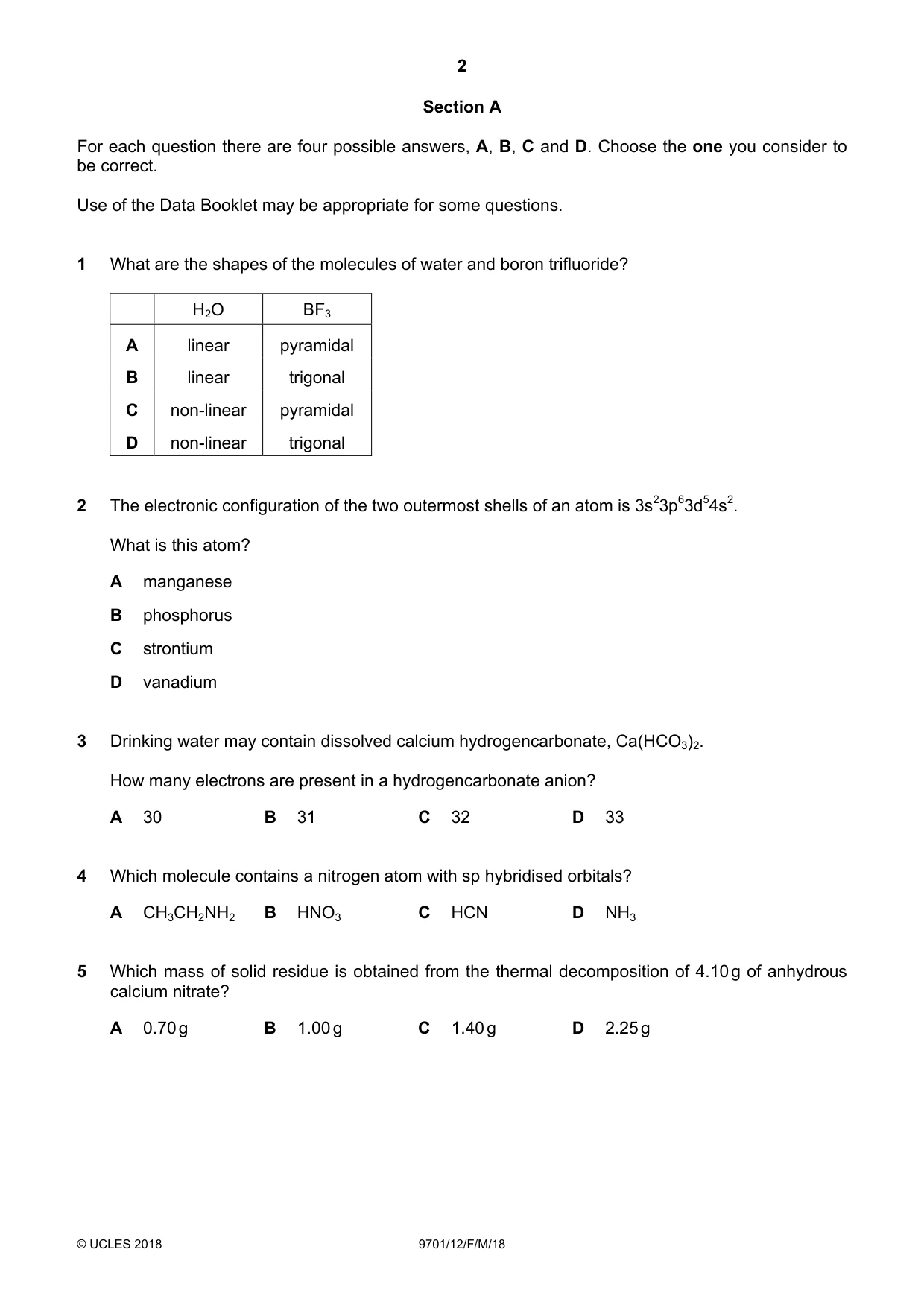
Q1 · What are the shapes of the molecules of water and boron trifluoride?
1 What are the shapes of the molecules of water and boron trifluoride? H2O BF3 A linear pyramidal B linear trigonal C non-linear pyramidal D non-linear trigonal
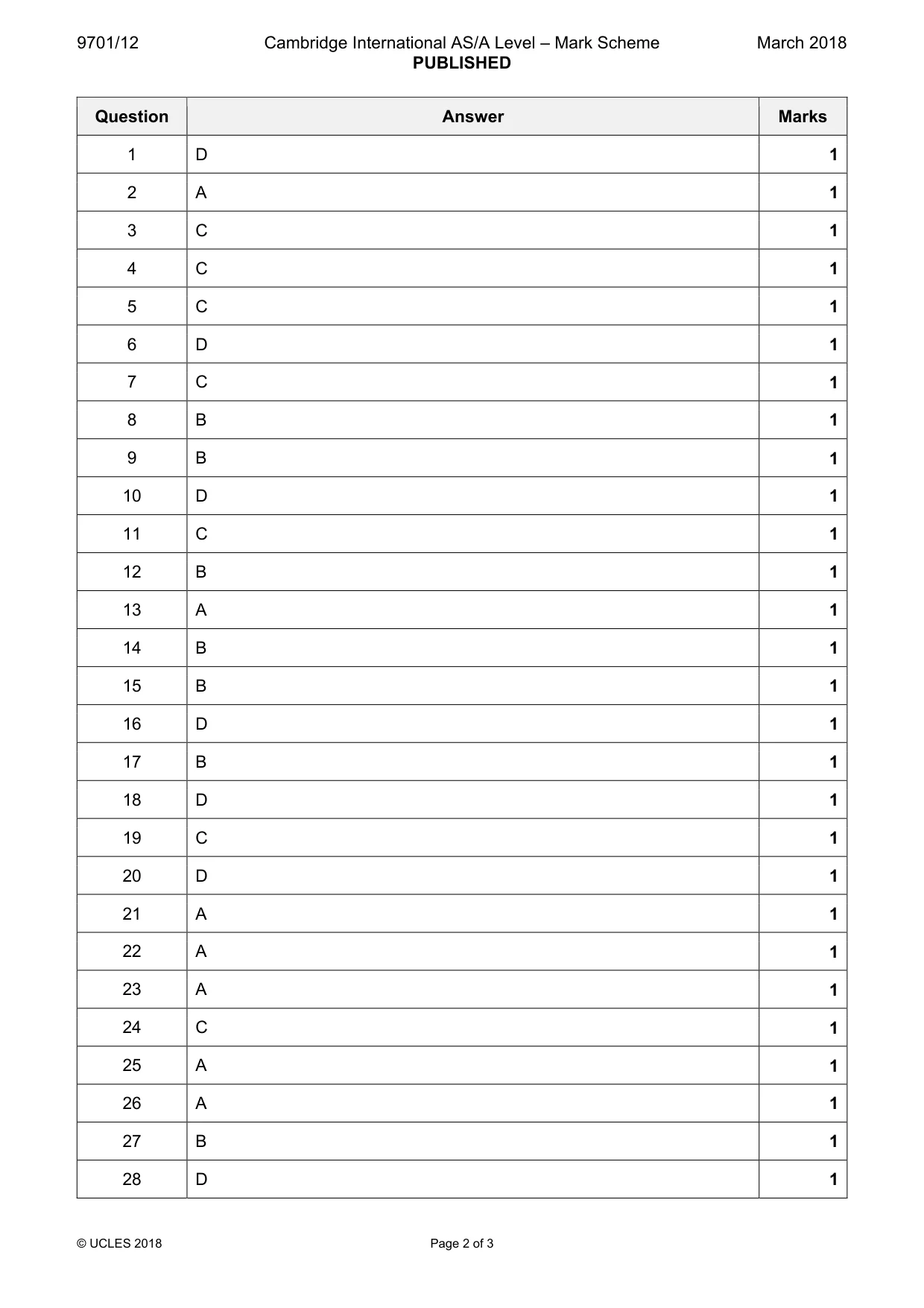
Mark scheme: D
Q2 · The electronic configuration of the two outermost shells of an atom is 3s23p63d54s2
2 The electronic configuration of the two outermost shells of an atom is 3s23p63d54s2. What is this atom? A manganese B phosphorus C strontium D vanadium
Mark scheme: A
More questions on Electrons, energy levels and atomic orbitals
Q3 · Drinking water may contain dissolved calcium hydrogencarbonate, Ca(HCO3)2
3 Drinking water may contain dissolved calcium hydrogencarbonate, Ca(HCO3)2. How many electrons are present in a hydrogencarbonate anion? A 30 B 31 C 32 D 33
Mark scheme: C
Q4 · Which molecule contains a nitrogen atom with sp hybridised orbitals?
4 Which molecule contains a nitrogen atom with sp hybridised orbitals? A CH3CH2NH2 B HNO3 C HCN D NH3
Mark scheme: C
More questions on Shapes of organic molecules; σ and π bonds
Q5 · Which mass of solid residue is obtained from the thermal decomposition of 4.10 g of…
5 Which mass of solid residue is obtained from the thermal decomposition of 4.10 g of anhydrous calcium nitrate? A 0.70 g B 1.00 g C 1.40 g D 2.25 g
Mark scheme: C
More questions on Reacting masses and volumes (of solutions and gases)
Q6 · Sodium hydroxide neutralises acid
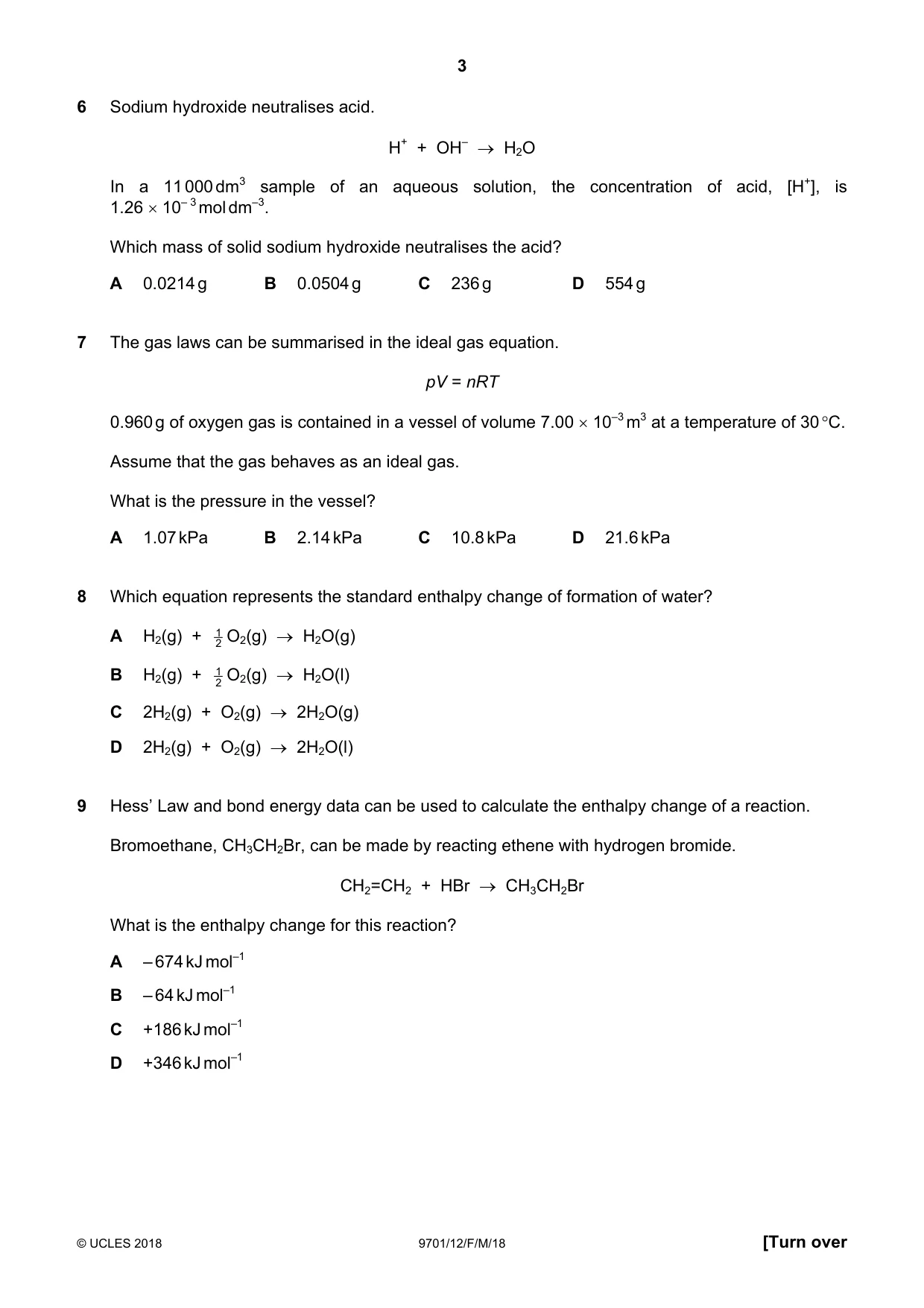
6 Sodium hydroxide neutralises acid. H+ + OH– → H2O In a 11 000 dm3 sample of an aqueous solution, the concentration of acid, [H+], is 1.26 × 10– 3 mol dm–3. Which mass of solid sodium hydroxide neutralises the acid? A 0.0214 g B 0.0504 g C 236 g D 554 g
Mark scheme: D
More questions on Reacting masses and volumes (of solutions and gases)
Q7 · The gas laws can be summarised in the ideal gas equation
7 The gas laws can be summarised in the ideal gas equation. pV = nRT 0.960 g of oxygen gas is contained in a vessel of volume 7.00 × 10⁻³ m3 at a temperature of 30 °C. Assume that the gas behaves as an ideal gas. What is the pressure in the vessel? A 1.07 kPa B 2.14 kPa C 10.8 kPa D 21.6 kPa
Mark scheme: C
More questions on The gaseous state: ideal and real gases and pV = nRT
Q8 · Which equation represents the standard enthalpy change of formation of water?
8 Which equation represents the standard enthalpy change of formation of water? A H2(g) + 2 1 O2(g) → H2O(g) B H2(g) + 2 1 O2(g) → H2O(l) C 2H2(g) + O2(g) → 2H2O(g) D 2H2(g) + O2(g) → 2H2O(l)
Mark scheme: B
Q9 · Hess’ Law and bond energy data can be used to calculate the enthalpy change of a reaction
9 Hess’ Law and bond energy data can be used to calculate the enthalpy change of a reaction. Bromoethane, CH3CH2Br, can be made by reacting ethene with hydrogen bromide. CH2=CH2 + HBr → CH3CH2Br What is the enthalpy change for this reaction? A – 674 kJ mol–1 B – 64 kJ mol–1 C +186 kJ mol–1 D +346 kJ mol–1
Mark scheme: B
Q10 · Which reaction is not a redox reaction?
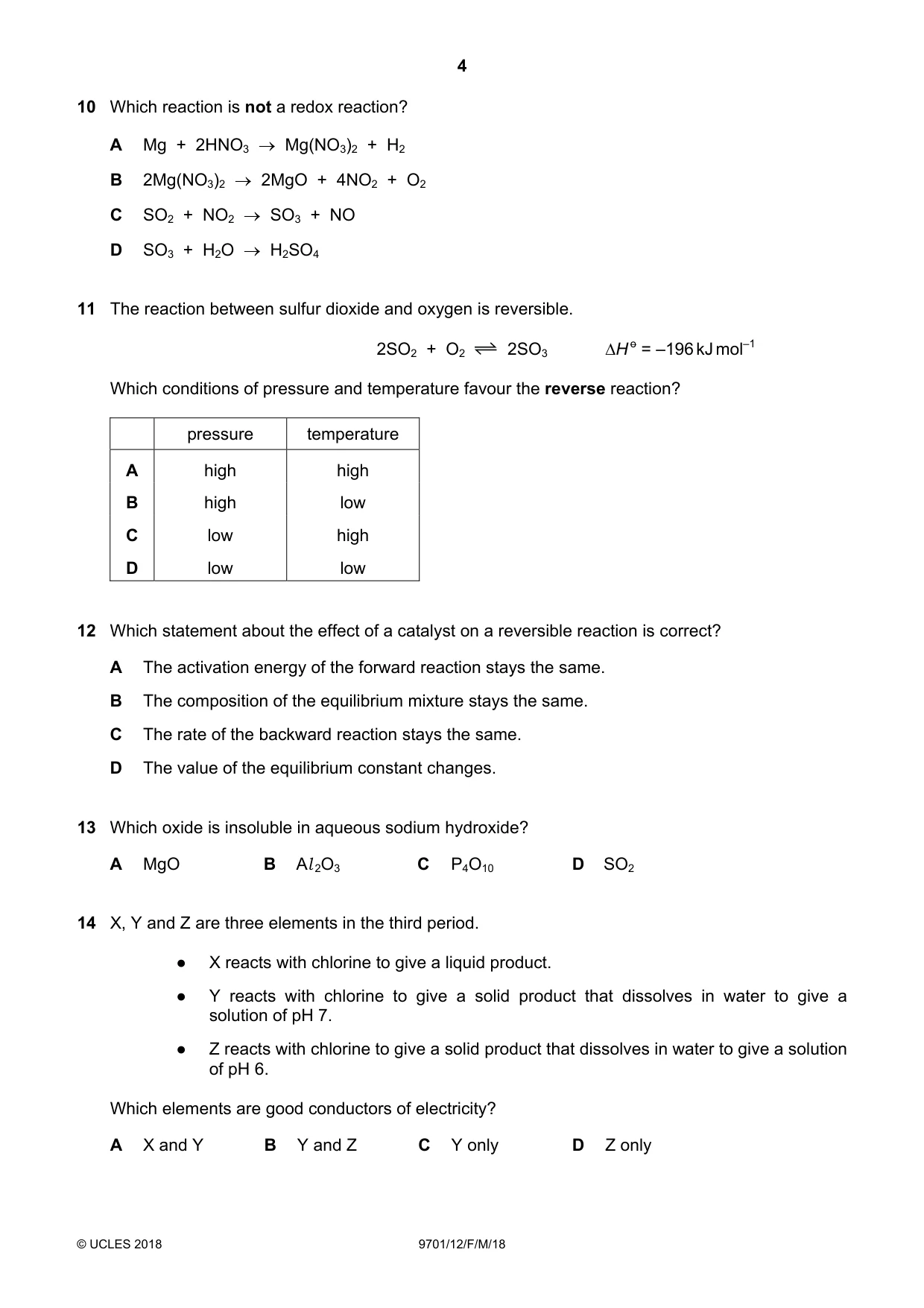
10 Which reaction is not a redox reaction? A Mg + 2HNO3 → Mg(NO3)2 + H2 B 2Mg(NO3)2 → 2MgO + 4NO2 + O2 C SO2 + NO2 → SO3 + NO D SO3 + H2O → H2SO4
Mark scheme: D
Q11 · The reaction between sulfur dioxide and oxygen is reversible
11 The reaction between sulfur dioxide and oxygen is reversible. 2SO2 + O2 2SO3 ∆H o = –196 kJ mol–1 Which conditions of pressure and temperature favour the reverse reaction? pressure temperature A high high B high low C low high D low low
Mark scheme: C
More questions on Chemical equilibria: reversible reactions, dynamic equilibrium
Q12 · Which statement about the effect of a catalyst on a reversible reaction is correct?
12 Which statement about the effect of a catalyst on a reversible reaction is correct? A The activation energy of the forward reaction stays the same. B The composition of the equilibrium mixture stays the same. C The rate of the backward reaction stays the same. D The value of the equilibrium constant changes.
Mark scheme: B
More questions on Chemical equilibria: reversible reactions, dynamic equilibrium
Q13 · Which oxide is insoluble in aqueous sodium hydroxide?
13 Which oxide is insoluble in aqueous sodium hydroxide? A MgO B Al 2O3 C P4O10 D SO2
Mark scheme: A
More questions on Periodicity of chemical properties of the elements in Period 3
Q14 · X, Y and Z are three elements in the third period
14 X, Y and Z are three elements in the third period. ● X reacts with chlorine to give a liquid product. ● Y reacts with chlorine to give a solid product that dissolves in water to give a solution of pH 7. ● Z reacts with chlorine to give a solid product that dissolves in water to give a solution of pH 6. Which elements are good conductors of electricity? A X and Y B Y and Z C Y only D Z only
Mark scheme: B
More questions on Periodicity of physical properties of the elements in Period 3
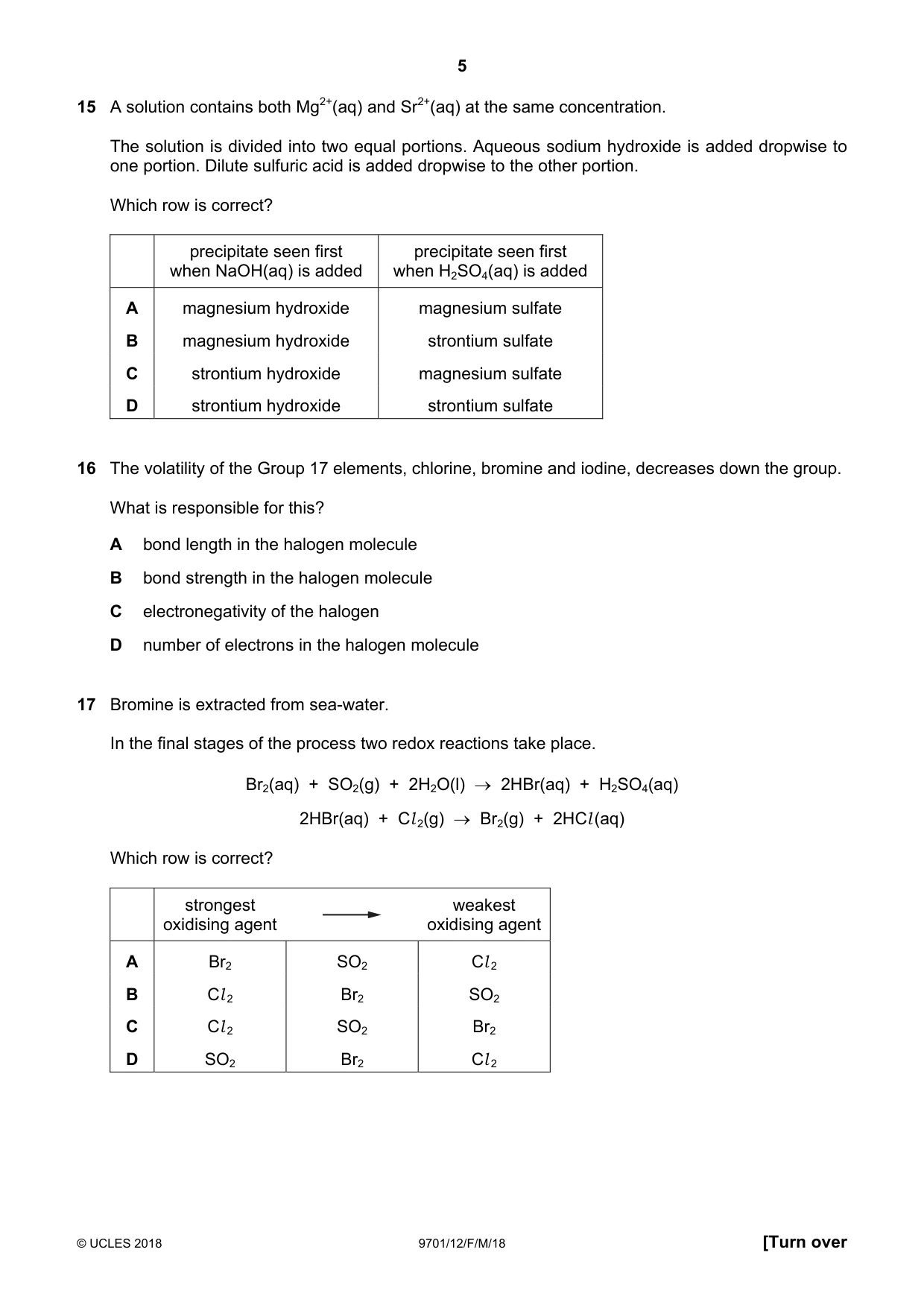
Q15 · A solution contains both Mg2+(aq) and Sr2+(aq) at the same concentration
15 A solution contains both Mg2+(aq) and Sr2+(aq) at the same concentration. The solution is divided into two equal portions. Aqueous sodium hydroxide is added dropwise to one portion. Dilute sulfuric acid is added dropwise to the other portion. Which row is correct? precipitate seen first precipitate seen first when NaOH(aq) is added when H2SO4(aq) is added A magnesium hydroxide magnesium sulfate B magnesium hydroxide strontium sulfate C strontium hydroxide magnesium sulfate D strontium hydroxide strontium sulfate
Mark scheme: B
Q16 · The volatility of the Group 17 elements, chlorine, bromine and iodine, decreases down the…
16 The volatility of the Group 17 elements, chlorine, bromine and iodine, decreases down the group. What is responsible for this? A bond length in the halogen molecule B bond strength in the halogen molecule C electronegativity of the halogen D number of electrons in the halogen molecule
Mark scheme: D
More questions on Physical properties of the Group 17 elements
Q17 · Bromine is extracted from sea-water
17 Bromine is extracted from sea-water. In the final stages of the process two redox reactions take place. Br2(aq) + SO2(g) + 2H2O(l) → 2HBr(aq) + H2SO4(aq) 2HBr(aq) + Cl 2(g) → Br2(g) + 2HCl (aq) Which row is correct? strongest weakest oxidising agent oxidising agent A Br2 SO2 Cl 2 B Cl 2 Br2 SO2 C Cl 2 SO2 Br2 D SO2 Br2 Cl 2
Mark scheme: B
More questions on The chemical properties of the halogen elements and the hydrogen halides
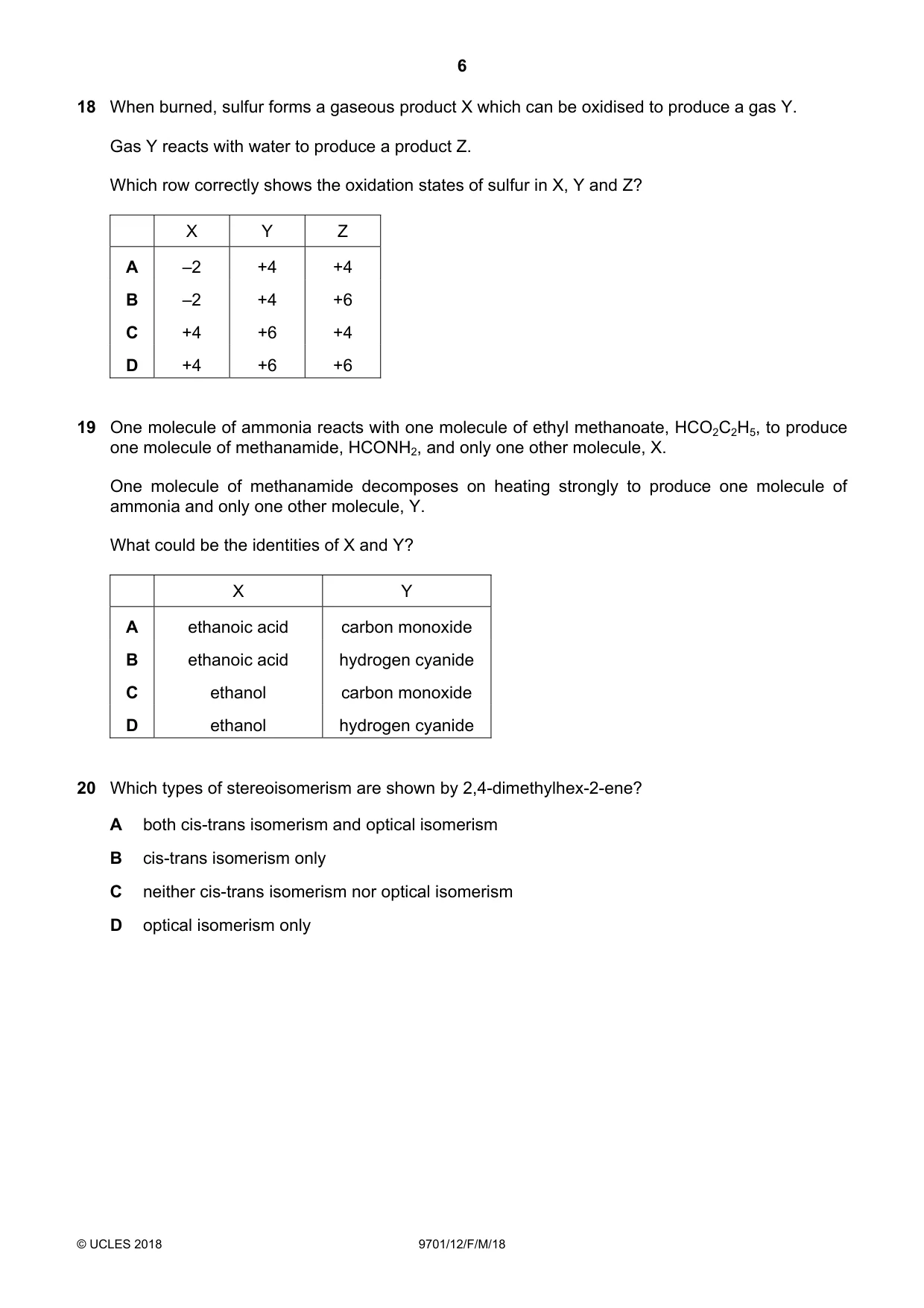
Q18 · When burned, sulfur forms a gaseous product X which can be oxidised to produce a gas Y
18 When burned, sulfur forms a gaseous product X which can be oxidised to produce a gas Y. Gas Y reacts with water to produce a product Z. Which row correctly shows the oxidation states of sulfur in X, Y and Z? X Y Z A –2 +4 +4 B –2 +4 +6 C +4 +6 +4 D +4 +6 +6
Mark scheme: D
Q19 · One molecule of ammonia reacts with one molecule of ethyl methanoate, HCO2C2H5, to…
19 One molecule of ammonia reacts with one molecule of ethyl methanoate, HCO2C2H5, to produce one molecule of methanamide, HCONH2, and only one other molecule, X. One molecule of methanamide decomposes on heating strongly to produce one molecule of ammonia and only one other molecule, Y. What could be the identities of X and Y? X Y A ethanoic acid carbon monoxide B ethanoic acid hydrogen cyanide C ethanol carbon monoxide D ethanol hydrogen cyanide
Mark scheme: C
Q20 · Which types of stereoisomerism are shown by 2,4-dimethylhex-2-ene?
20 Which types of stereoisomerism are shown by 2,4-dimethylhex-2-ene? A both cis-trans isomerism and optical isomerism B cis-trans isomerism only C neither cis-trans isomerism nor optical isomerism D optical isomerism only
Mark scheme: D
More questions on Isomerism: structural isomerism and stereoisomerism
Q21 · An organic ion containing a carbon atom with a negative charge is called a carbanion
21 An organic ion containing a carbon atom with a negative charge is called a carbanion. An organic ion containing a carbon atom with a positive charge is called a carbocation. The reaction between aqueous sodium hydroxide and 1-bromobutane proceeds by an SN2 mechanism. What is the first step in the mechanism? A attack by a nucleophile on a carbon atom with a partial positive charge B heterolytic bond fission followed by attack by an electrophile on a carbanion C heterolytic bond fission followed by attack by a nucleophile on a carbocation D homolytic bond fission followed by attack by a nucleophile on a carbocation
Mark scheme: A
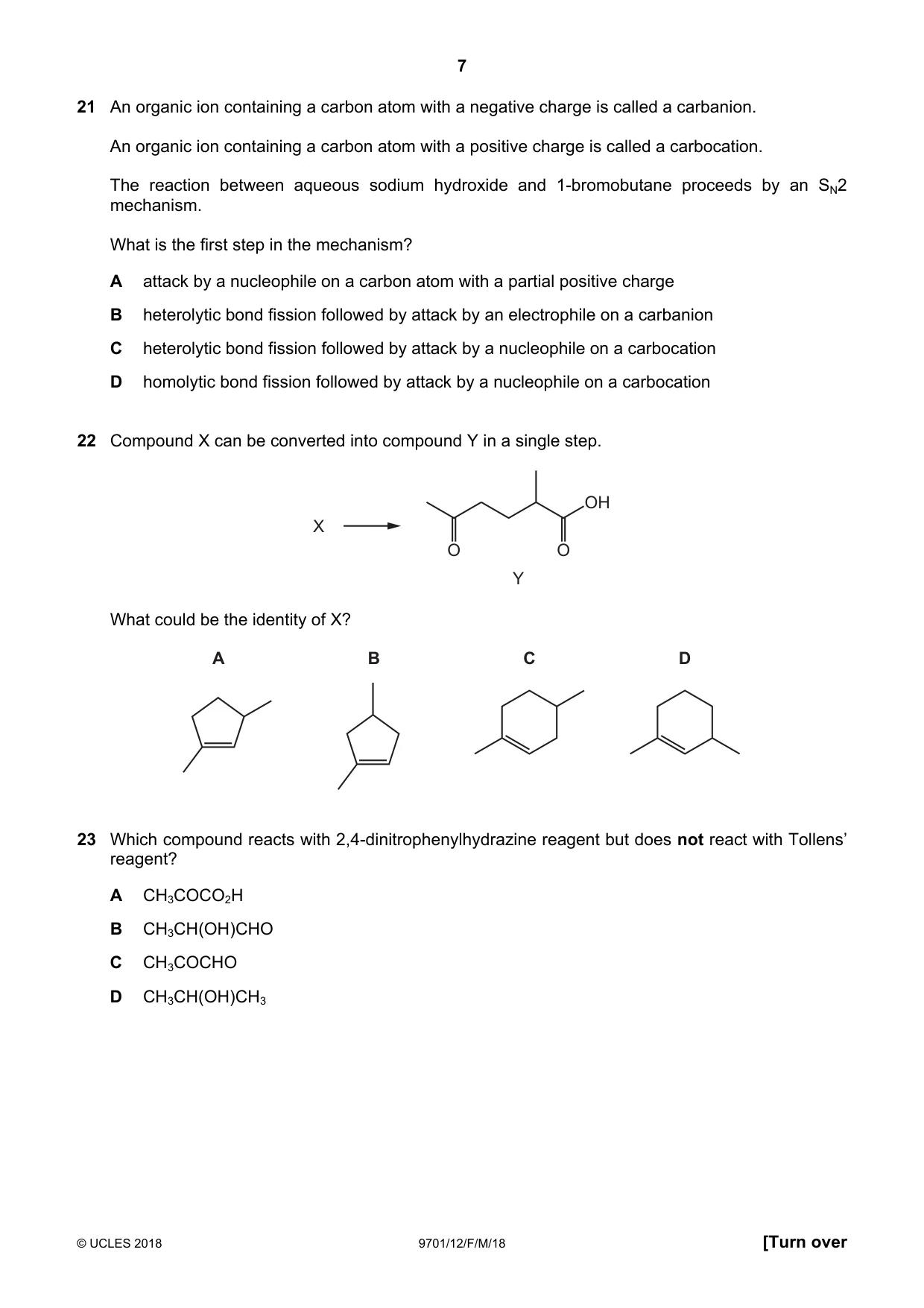
Q22 · Compound X can be converted into compound Y in a single step
22 Compound X can be converted into compound Y in a single step. OH X O O Y What could be the identity of X? A B C D
Mark scheme: A
Q23 · Which compound reacts with 2,4-dinitrophenylhydrazine reagent but does not react with…
23 Which compound reacts with 2,4-dinitrophenylhydrazine reagent but does not react with Tollens’ reagent? A CH3COCO2H B CH3CH(OH)CHO C CH3COCHO D CH3CH(OH)CH3
Mark scheme: A
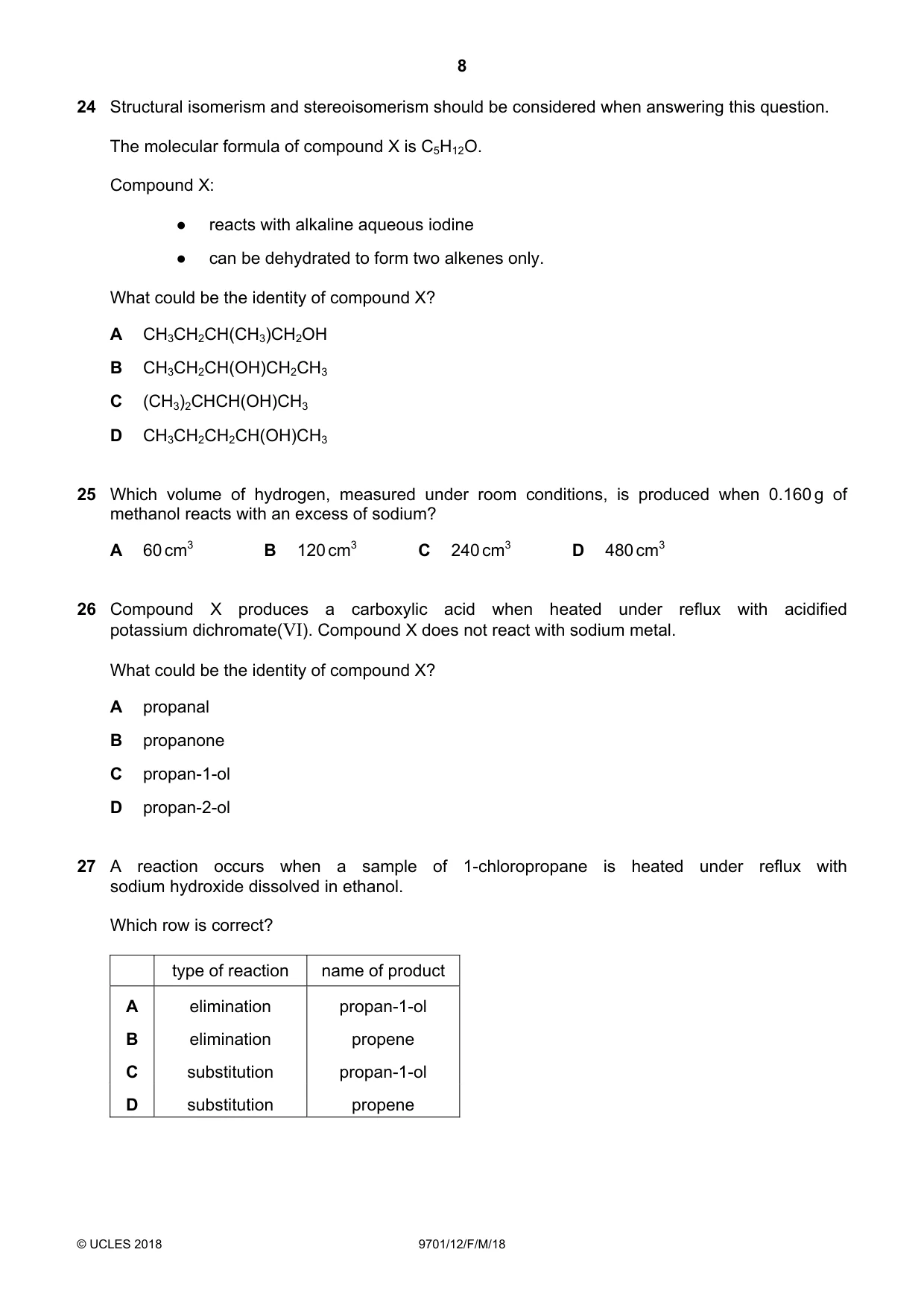
Q24 · Structural isomerism and stereoisomerism should be considered when answering this question
24 Structural isomerism and stereoisomerism should be considered when answering this question. The molecular formula of compound X is C5H12O. Compound X: ● reacts with alkaline aqueous iodine ● can be dehydrated to form two alkenes only. What could be the identity of compound X? A CH3CH2CH(CH3)CH2OH B CH3CH2CH(OH)CH2CH3 C (CH3)2CHCH(OH)CH3 D CH3CH2CH2CH(OH)CH3
Mark scheme: C
Q25 · Which volume of hydrogen, measured under room conditions, is produced when 0.160 g of…
25 Which volume of hydrogen, measured under room conditions, is produced when 0.160 g of methanol reacts with an excess of sodium? A 60 cm3 B 120 cm3 C 240 cm3 D 480 cm3
Mark scheme: A
More questions on Reacting masses and volumes (of solutions and gases)
Q26 · Compound X produces a carboxylic acid when heated under reflux with acidified potassium…
26 Compound X produces a carboxylic acid when heated under reflux with acidified potassium dichromate(VI). Compound X does not react with sodium metal. What could be the identity of compound X? A propanal B propanone C propan-1-ol D propan-2-ol
Mark scheme: A
Q27 · A reaction occurs when a sample of 1-chloropropane is heated under reflux with sodium…
27 A reaction occurs when a sample of 1-chloropropane is heated under reflux with sodium hydroxide dissolved in ethanol. Which row is correct? type of reaction name of product A elimination propan-1-ol B elimination propene C substitution propan-1-ol D substitution propene
Mark scheme: B
Q28 · Ethanedioic acid has the formula HO2CCO2H
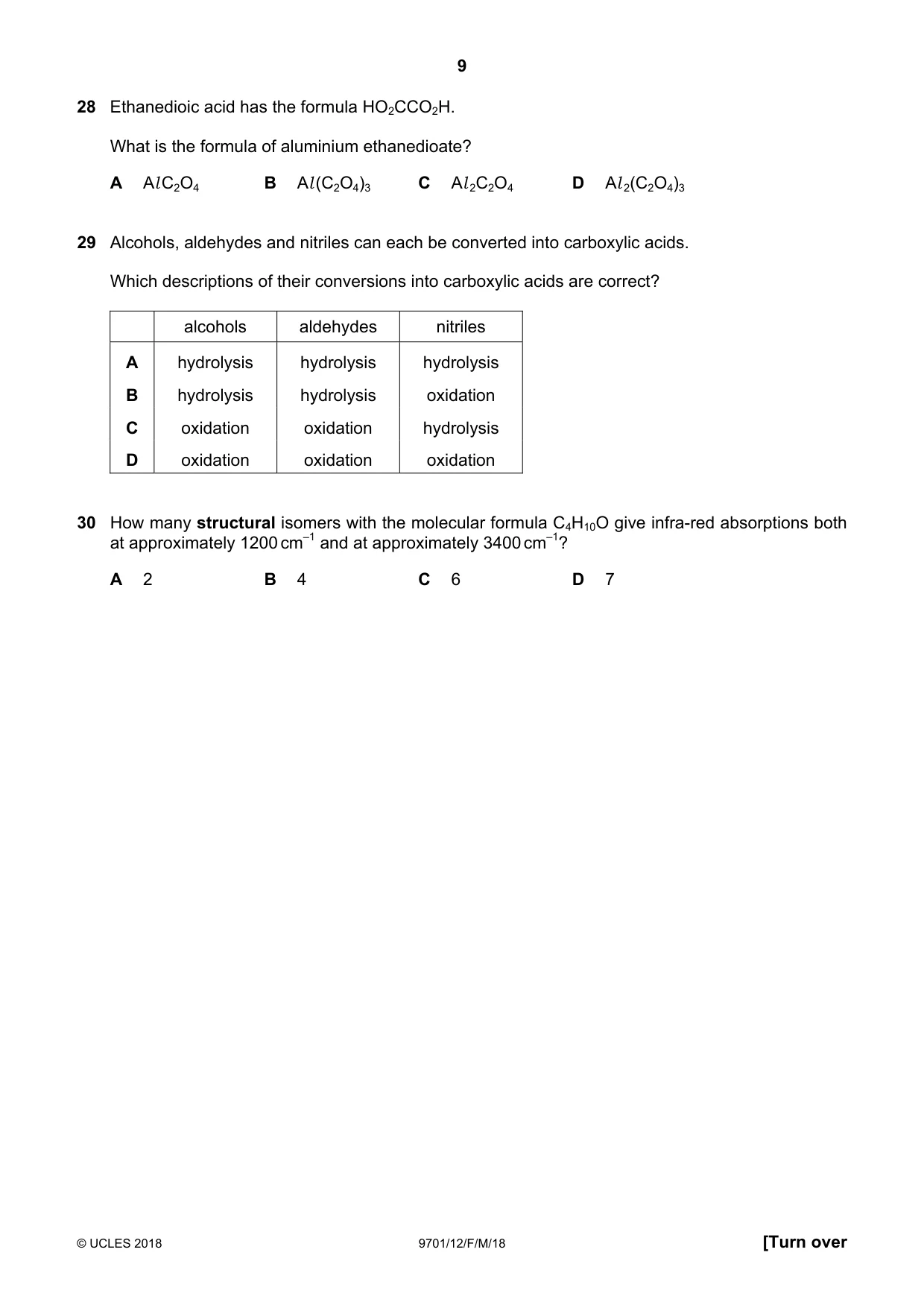
28 Ethanedioic acid has the formula HO2CCO2H. What is the formula of aluminium ethanedioate? A Al C2O4 B Al (C2O4)3 C Al 2C2O4 D Al 2(C2O4)3
Mark scheme: D
Q29 · Alcohols, aldehydes and nitriles can each be converted into carboxylic acids
29 Alcohols, aldehydes and nitriles can each be converted into carboxylic acids. Which descriptions of their conversions into carboxylic acids are correct? alcohols aldehydes nitriles A hydrolysis hydrolysis hydrolysis B hydrolysis hydrolysis oxidation C oxidation oxidation hydrolysis D oxidation oxidation oxidation
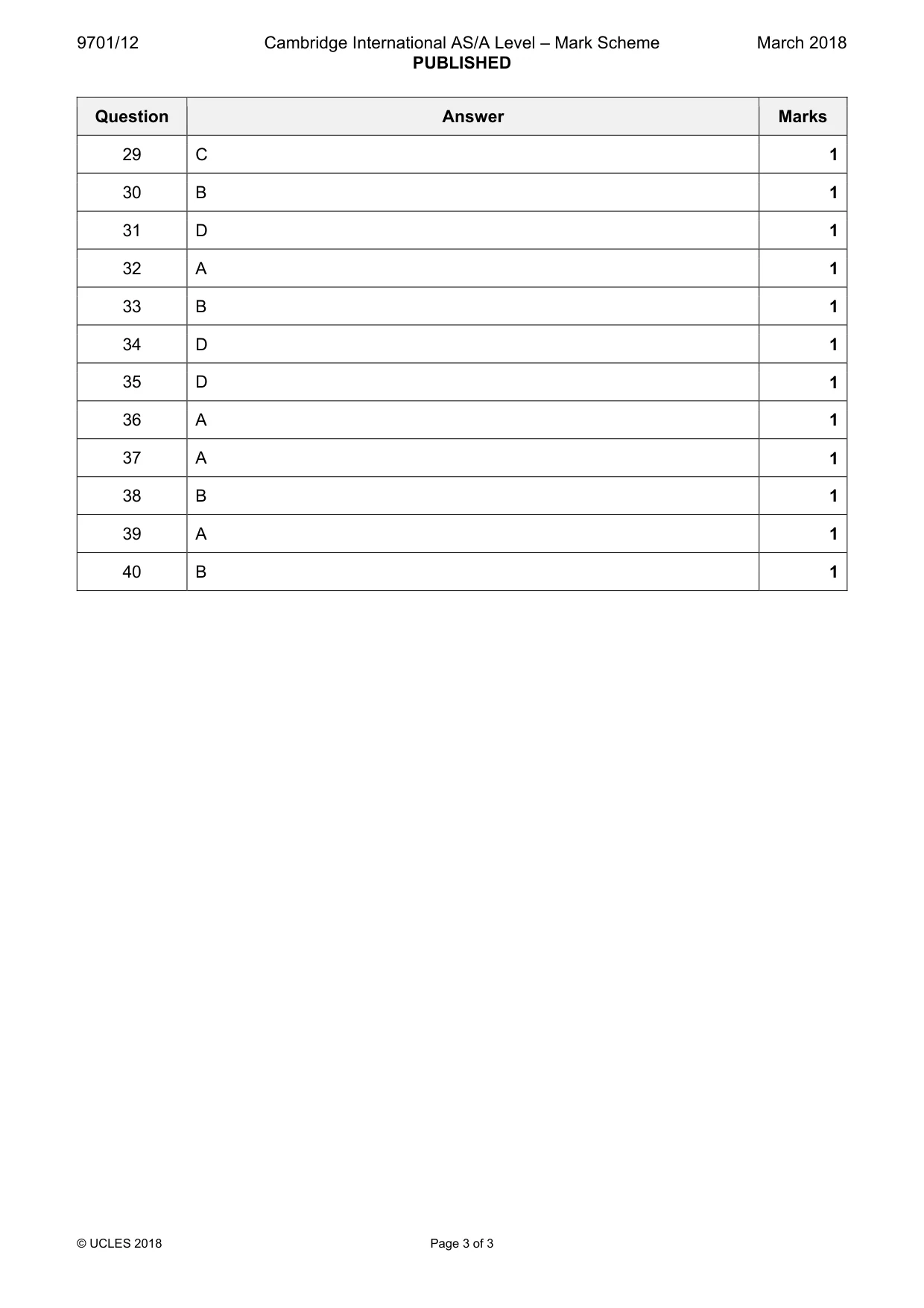
Mark scheme: C
Q30 · How many structural isomers with the molecular formula C4H10O give infra-red absorptions…
30 How many structural isomers with the molecular formula C4H10O give infra-red absorptions both at approximately 1200 cm–1 and at approximately 3400 cm–1? A 2 B 4 C 6 D 7
Mark scheme: B
Q31 · Compound Q contains 40% carbon by mass
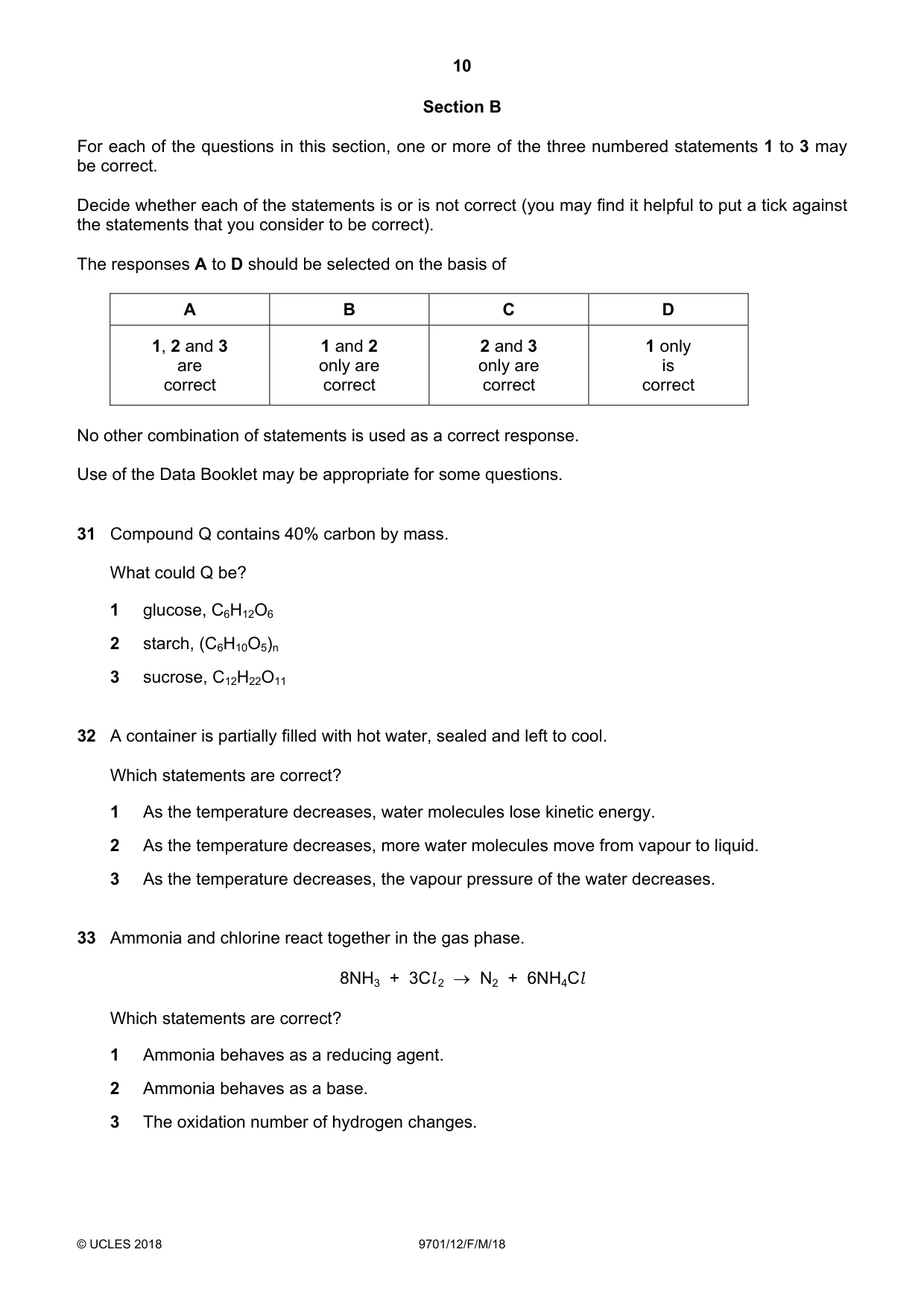
31 Compound Q contains 40% carbon by mass. What could Q be? 1 glucose, C6H12O6 2 starch, (C6H10O5)n 3 sucrose, C12H22O11
Mark scheme: D
Q32 · A container is partially filled with hot water, sealed and left to cool
32 A container is partially filled with hot water, sealed and left to cool. Which statements are correct? 1 As the temperature decreases, water molecules lose kinetic energy. 2 As the temperature decreases, more water molecules move from vapour to liquid. 3 As the temperature decreases, the vapour pressure of the water decreases.
Mark scheme: A
More questions on The gaseous state: ideal and real gases and pV = nRT
Q33 · Ammonia and chlorine react together in the gas phase
33 Ammonia and chlorine react together in the gas phase. 8NH3 + 3Cl 2 → N2 + 6NH4Cl Which statements are correct? 1 Ammonia behaves as a reducing agent. 2 Ammonia behaves as a base. 3 The oxidation number of hydrogen changes.
Mark scheme: B
Q34 · In which reactions does NH3 behave as a Brønsted-Lowry acid?
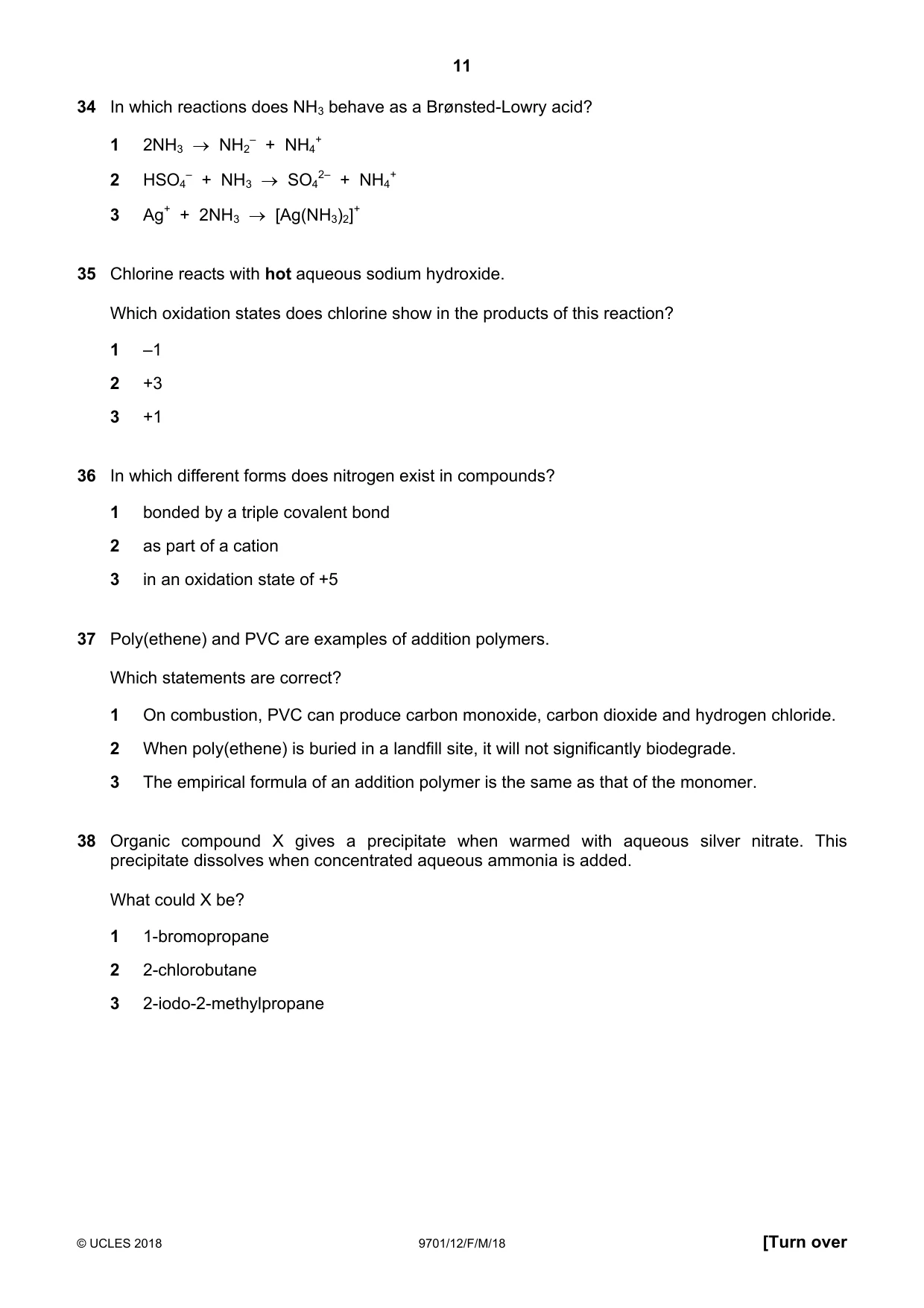
34 In which reactions does NH3 behave as a Brønsted-Lowry acid? 1 2NH3 → NH2 – + NH4 + 2 HSO4 – + NH3 → SO4 2– + NH4 + 3 Ag+ + 2NH3 → [Ag(NH3)2]+
Mark scheme: D
Q35 · Chlorine reacts with hot aqueous sodium hydroxide
35 Chlorine reacts with hot aqueous sodium hydroxide. Which oxidation states does chlorine show in the products of this reaction? 1 –1 2 +3 3 +1
Mark scheme: D
Q36 · In which different forms does nitrogen exist in compounds?
36 In which different forms does nitrogen exist in compounds? 1 bonded by a triple covalent bond 2 as part of a cation 3 in an oxidation state of +5
Mark scheme: A
Q37 · Poly(ethene) and PVC are examples of addition polymers
37 Poly(ethene) and PVC are examples of addition polymers. Which statements are correct? 1 On combustion, PVC can produce carbon monoxide, carbon dioxide and hydrogen chloride. 2 When poly(ethene) is buried in a landfill site, it will not significantly biodegrade. 3 The empirical formula of an addition polymer is the same as that of the monomer.
Mark scheme: A
Q38 · Organic compound X gives a precipitate when warmed with aqueous silver nitrate
38 Organic compound X gives a precipitate when warmed with aqueous silver nitrate. This precipitate dissolves when concentrated aqueous ammonia is added. What could X be? 1 1-bromopropane 2 2-chlorobutane 3 2-iodo-2-methylpropane
Mark scheme: B
Q39 · Propanal reacts with hydrogen cyanide to form 2-hydroxybutanenitrile
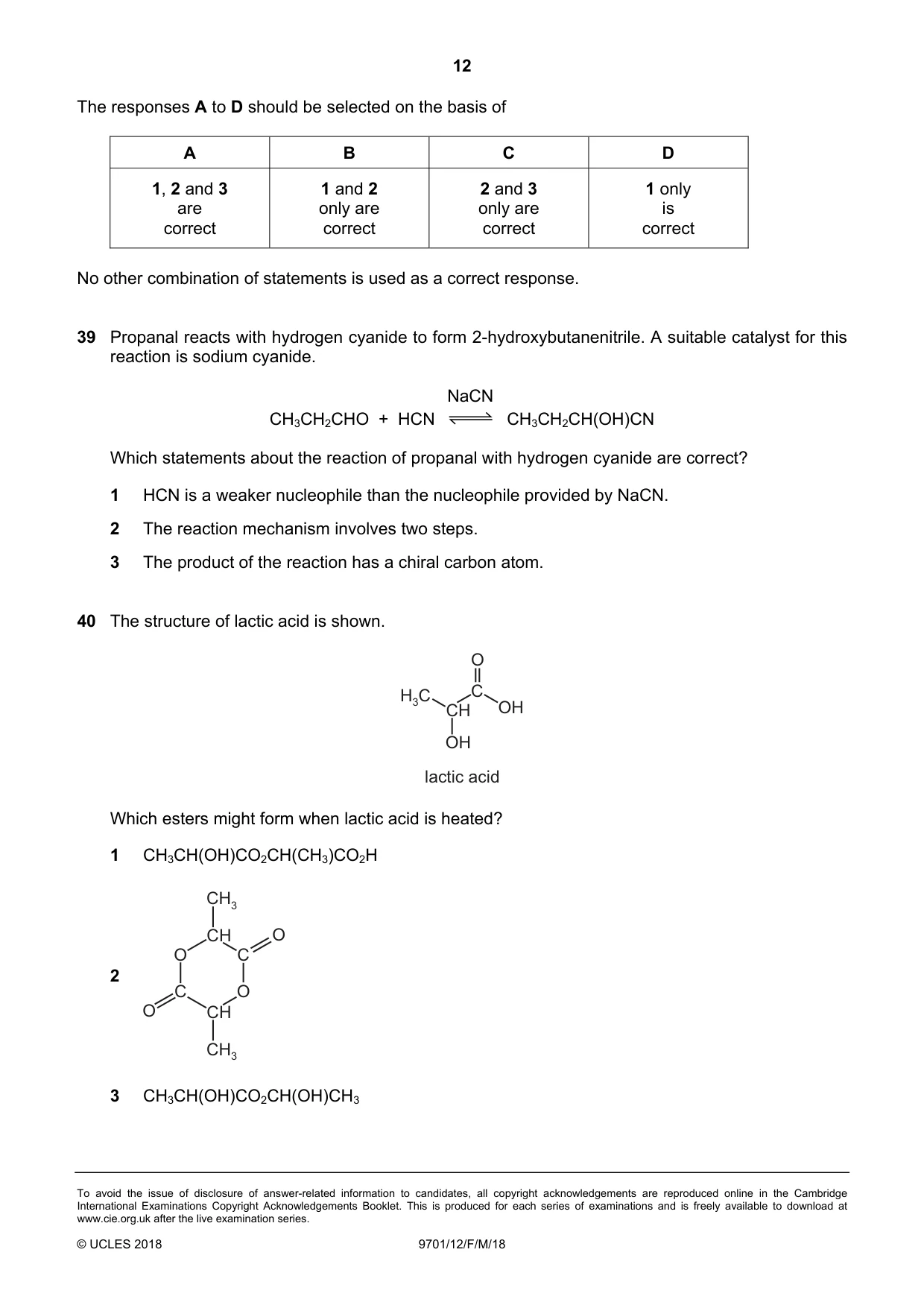
39 Propanal reacts with hydrogen cyanide to form 2-hydroxybutanenitrile. A suitable catalyst for this reaction is sodium cyanide. NaCN CH3CH2CHO + HCN CH3CH2CH(OH)CN Which statements about the reaction of propanal with hydrogen cyanide are correct? 1 HCN is a weaker nucleophile than the nucleophile provided by NaCN. 2 The reaction mechanism involves two steps. 3 The product of the reaction has a chiral carbon atom.
Mark scheme: A
Q40 · The structure of lactic acid is shown
40 The structure of lactic acid is shown. O H3C C CH OH OH lactic acid Which esters might form when lactic acid is heated? 1 CH3CH(OH)CO2CH(CH3)CO2H CH3 CH O O C 2 C O O CH CH3 3 CH3CH(OH)CO2CH(OH)CH3
Mark scheme: B
What was in this paper
The subtopics covered by these 40 questions, and how many questions each got. Open one in a new tab to see every Cambridge question on it.
4Alcohols3Reacting masses and volumes (of solutions and gases)3Aldehydes and ketones2Chemical equilibria: reversible reactions, dynamic equilibrium2Enthalpy change, ΔH2Formulas2Halogenoalkanes2The gaseous state: ideal and real gases and pV = nRT2Brønsted–Lowry theory of acids and bases1Carboxylic acids1Condensation polymerisation1Degradable polymers1Electrons, energy levels and atomic orbitals1Esters1Halogen compounds1Isomerism: structural isomerism and stereoisomerism1Nitriles and hydroxynitriles1Particles in the atom and atomic radius1Periodicity of chemical properties of the elements in Period 31Periodicity of physical properties of the elements in Period 31Physical properties of the Group 17 elements1Shapes of molecules1Shapes of organic molecules; σ and π bonds1Similarities and trends in the properties of the Group 2 metals, magnesium to barium, and their compounds1The chemical properties of the halogen elements and the hydrogen halides1The reactions of chlorine1What you needed in this session
Cambridge’s own grade thresholds for 2018 Feb/March, Paper 1 · Variant 2. A higher threshold means an easier paper — the bar moves with how the cohort did.