Cambridge A Level Chemistry 9701 — 2020 May/June Paper 1 · Variant 1
9701/11/M/J/20 · 40 questions · 40 marks · ≈45 min
The question paper and its mark scheme, free to read here and free to download. This is Cambridge’s own paper, exactly as it was sat.
Question paper16 pages
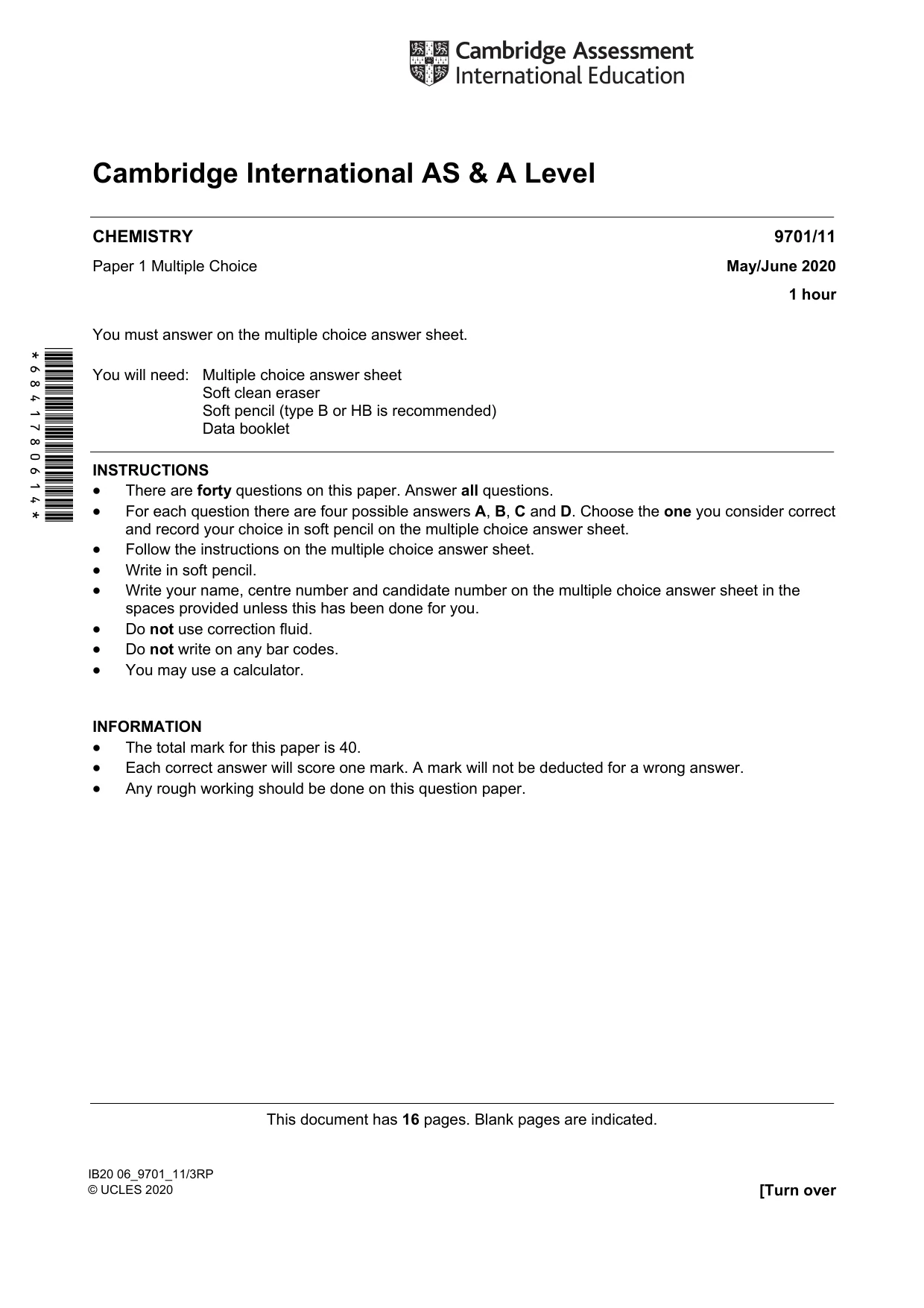

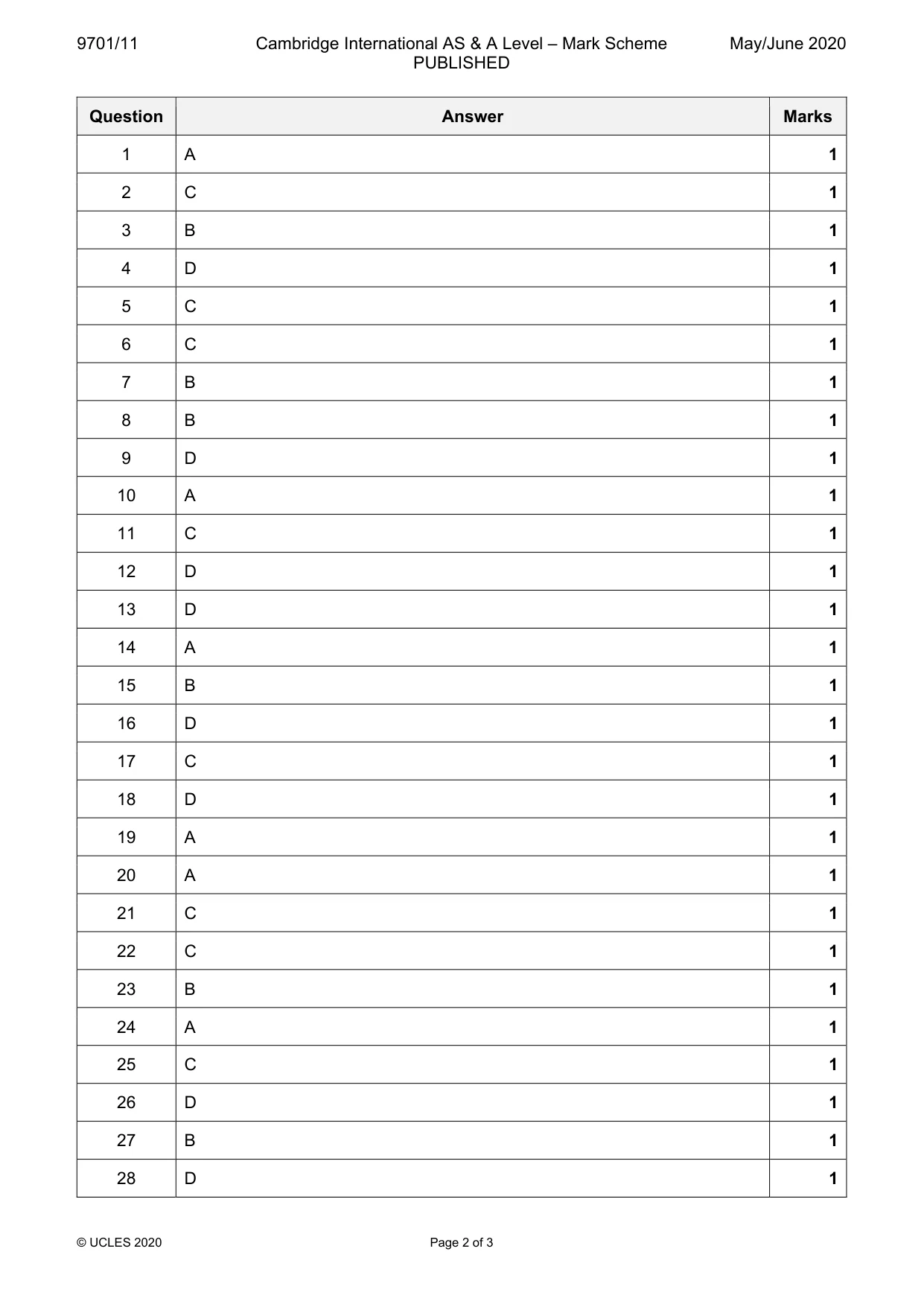
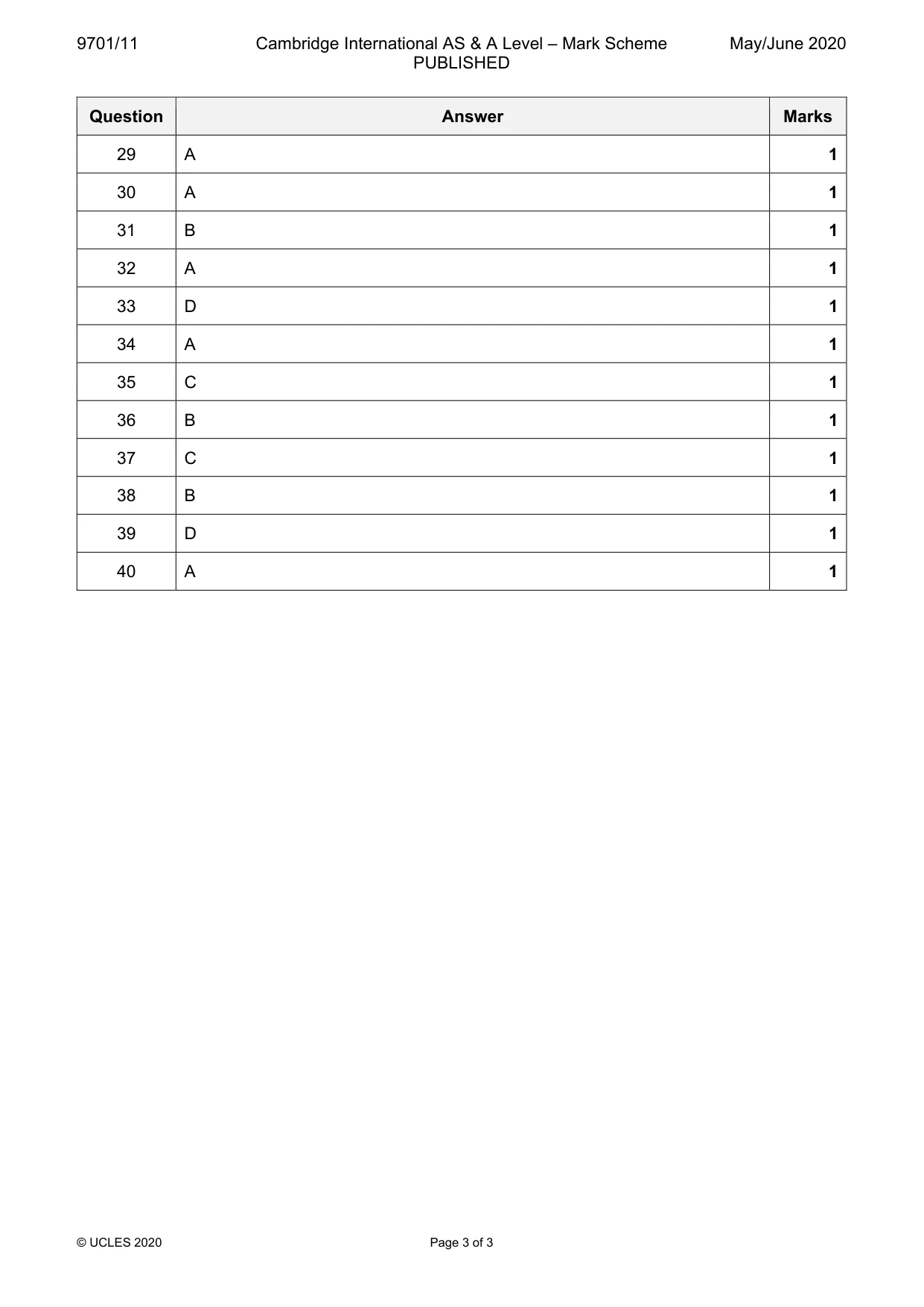
Mark scheme3 pages
Answers below. Sit the paper first if you are practising.
Questions as text
Q1 · Ethene can be oxidised to form epoxyethane, C2H4O
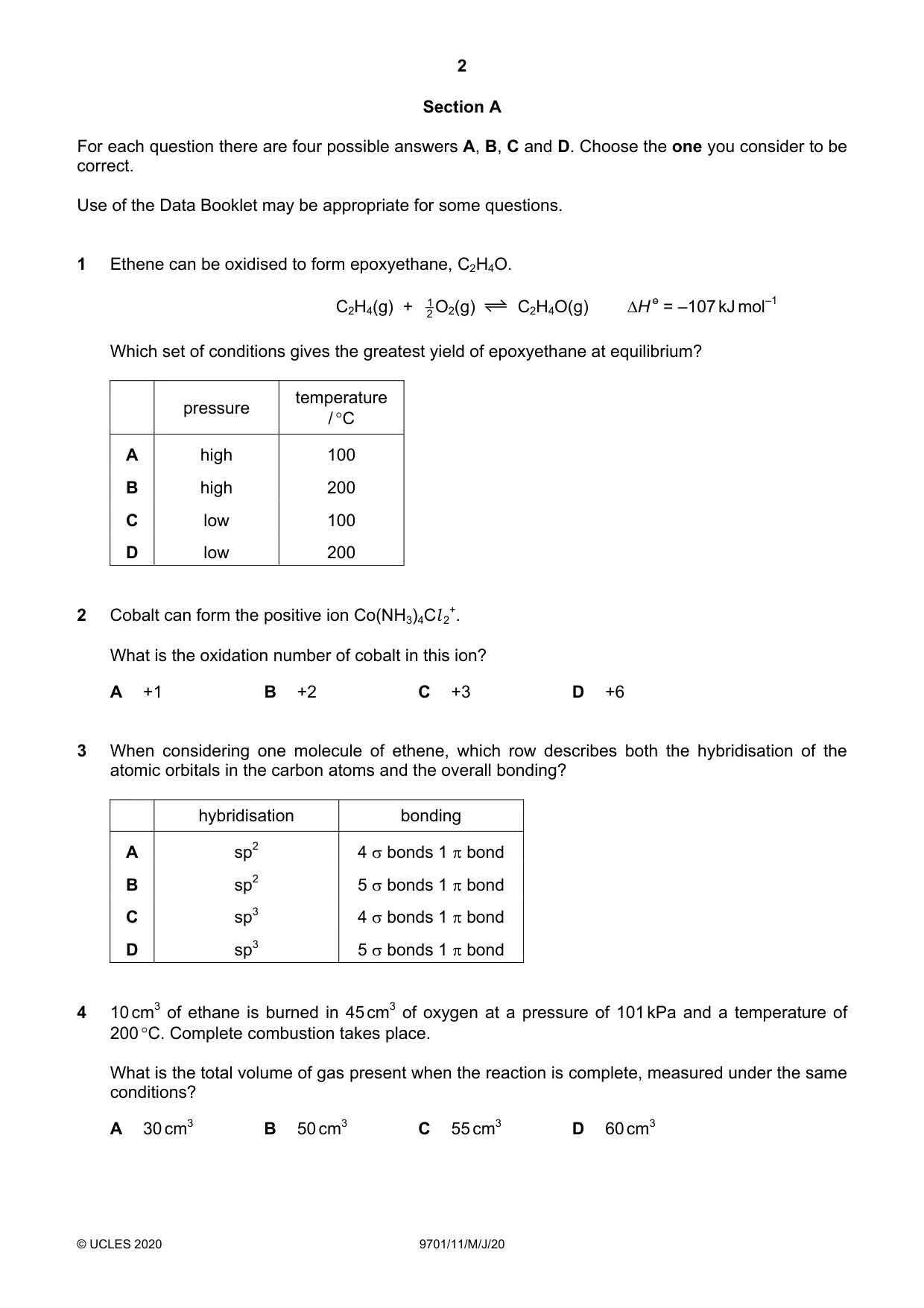
1 Ethene can be oxidised to form epoxyethane, C2H4O. C2H4(g) + 2 1O2(g) C2H4O(g) ∆H o = –107 kJ mol–1 Which set of conditions gives the greatest yield of epoxyethane at equilibrium? temperature pressure / °C A high 100 B high 200 C low 100 D low 200
Mark scheme: A
More questions on Chemical equilibria: reversible reactions, dynamic equilibrium
Q2 · Cobalt can form the positive ion Co(NH3)4Cl 2 +
2 Cobalt can form the positive ion Co(NH3)4Cl 2 +. What is the oxidation number of cobalt in this ion? A +1 B +2 C +3 D +6
Mark scheme: C
Q3 · When considering one molecule of ethene, which row describes both the hybridisation of…
3 When considering one molecule of ethene, which row describes both the hybridisation of the atomic orbitals in the carbon atoms and the overall bonding? hybridisation bonding A sp2 4 σ bonds 1 π bond B sp2 5 σ bonds 1 π bond C sp3 4 σ bonds 1 π bond D sp3 5 σ bonds 1 π bond
Mark scheme: B
More questions on Shapes of organic molecules; σ and π bonds
Q4 · 10 cm3 of ethane is burned in 45 cm3 of oxygen at a pressure of 101 kPa and a temperature…
4 10 cm3 of ethane is burned in 45 cm3 of oxygen at a pressure of 101 kPa and a temperature of 200 °C. Complete combustion takes place. What is the total volume of gas present when the reaction is complete, measured under the same conditions? A 30 cm3 B 50 cm3 C 55 cm3 D 60 cm3
Mark scheme: D
More questions on Reacting masses and volumes (of solutions and gases)
Q5 · Two reactions are shown
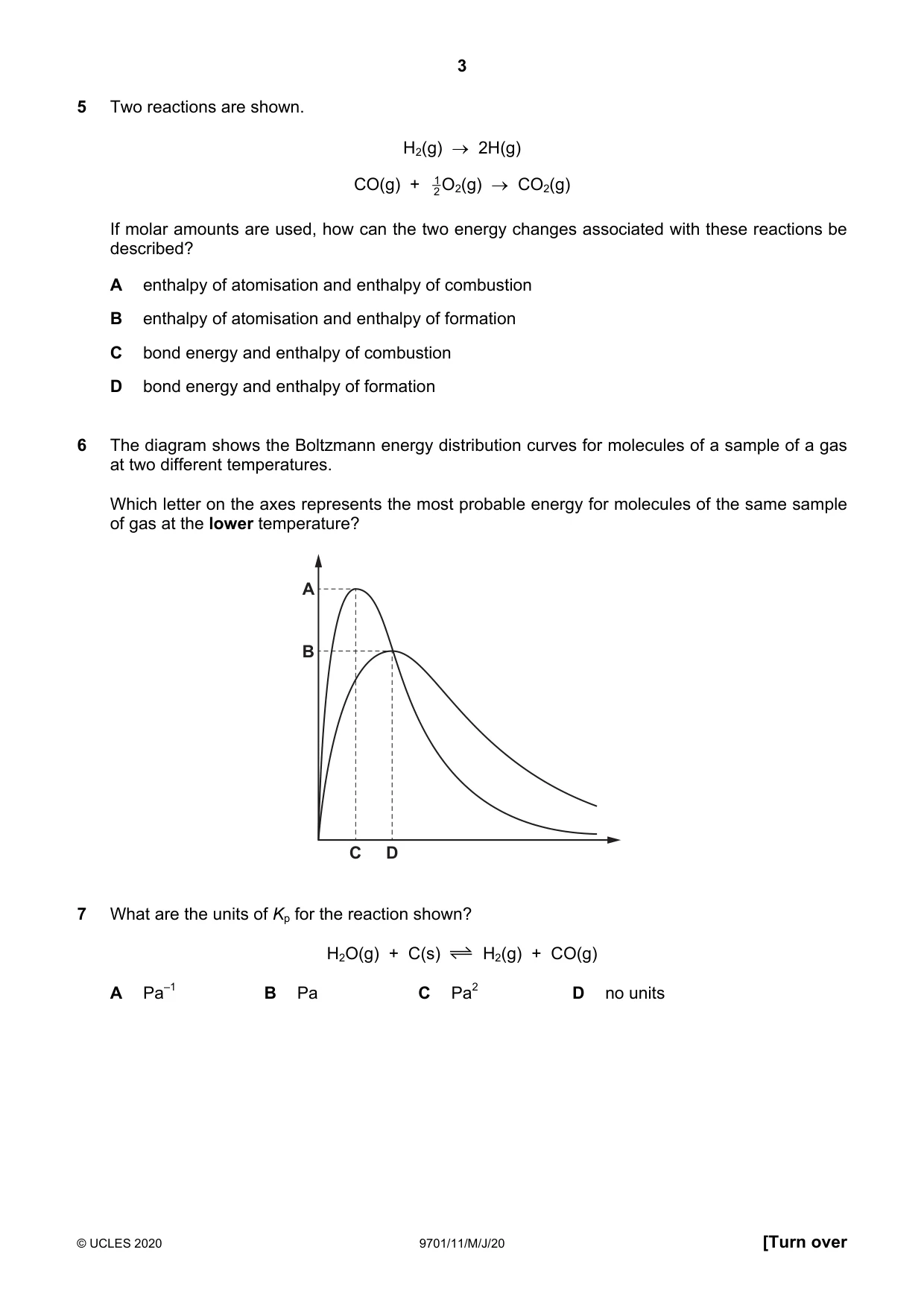
5 Two reactions are shown. H2(g) → 2H(g) CO(g) + 2 1O2(g) → CO2(g) If molar amounts are used, how can the two energy changes associated with these reactions be described? A enthalpy of atomisation and enthalpy of combustion B enthalpy of atomisation and enthalpy of formation C bond energy and enthalpy of combustion D bond energy and enthalpy of formation
Mark scheme: C
Q6 · The diagram shows the Boltzmann energy distribution curves for molecules of a sample of a…
6 The diagram shows the Boltzmann energy distribution curves for molecules of a sample of a gas at two different temperatures. Which letter on the axes represents the most probable energy for molecules of the same sample of gas at the lower temperature? A B C D
Mark scheme: C
More questions on Effect of temperature on reaction rates and the concept of activation energy
Q7 · What are the units of Kp for the reaction shown?
7 What are the units of Kp for the reaction shown? H2O(g) + C(s) H2(g) + CO(g) A Pa–1 B Pa C Pa2 D no units
Mark scheme: B
More questions on Chemical equilibria: reversible reactions, dynamic equilibrium
Q8 · In this question you should use changes in oxidation numbers to balance a chemical…
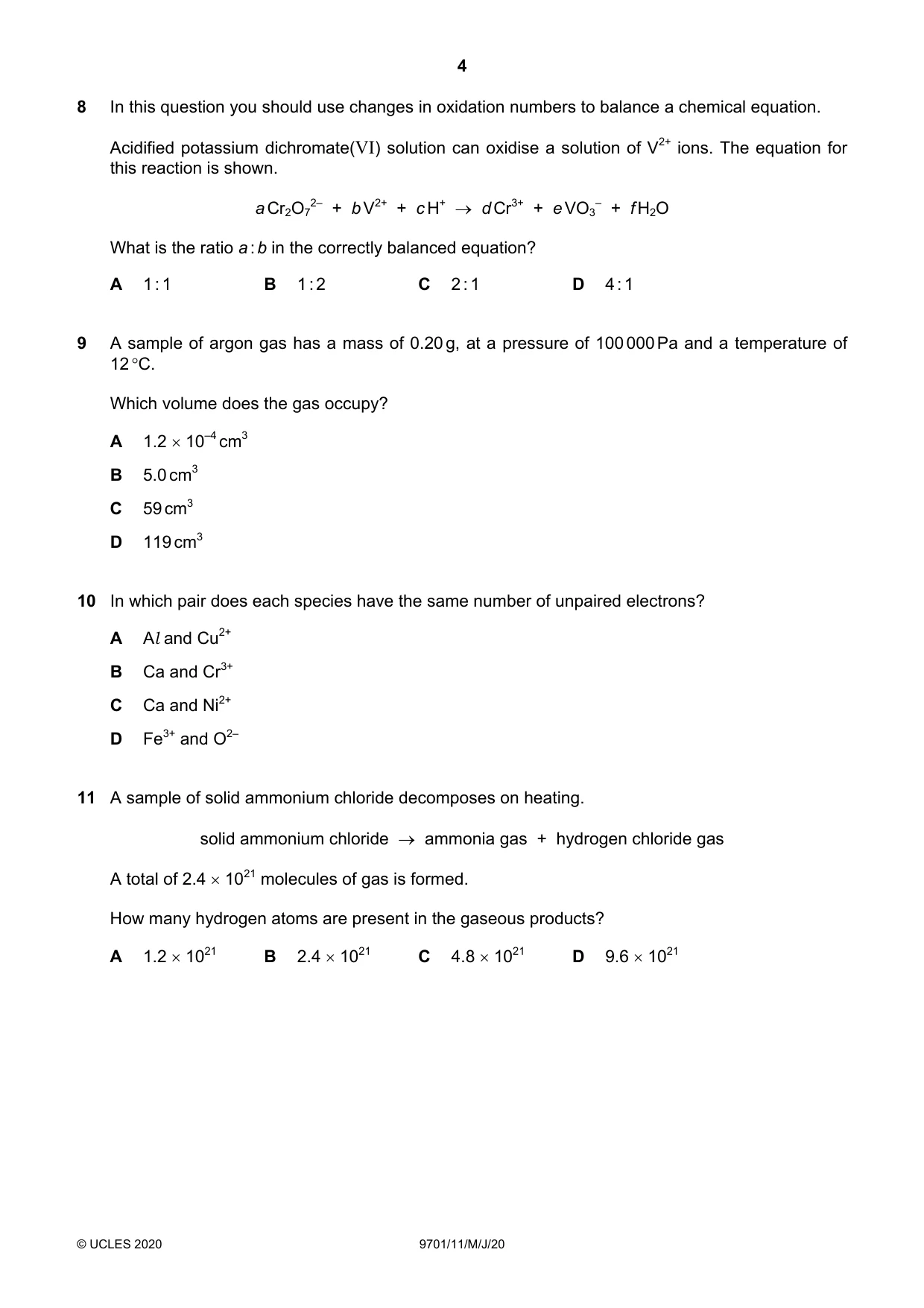
8 In this question you should use changes in oxidation numbers to balance a chemical equation. Acidified potassium dichromate(VI) solution can oxidise a solution of V2+ ions. The equation for this reaction is shown. a Cr2O7 2– + b V2+ + c H+ → d Cr3+ + e VO3 – + f H2O What is the ratio a : b in the correctly balanced equation? A 1 : 1 B 1 : 2 C 2 : 1 D 4 : 1
Mark scheme: B
Q9 · A sample of argon gas has a mass of 0.20 g, at a pressure of 100 000 Pa and a temperature…
9 A sample of argon gas has a mass of 0.20 g, at a pressure of 100 000 Pa and a temperature of 12 °C. Which volume does the gas occupy? A 1.2 × 10⁻⁴ cm3 B 5.0 cm3 C 59 cm3 D 119 cm3
Mark scheme: D
More questions on The gaseous state: ideal and real gases and pV = nRT
Q10 · In which pair does each species have the same number of unpaired electrons?
10 In which pair does each species have the same number of unpaired electrons? A Al and Cu2+ B Ca and Cr3+ C Ca and Ni2+ D Fe3+ and O2–
Mark scheme: A
More questions on Electrons, energy levels and atomic orbitals
Q11 · A sample of solid ammonium chloride decomposes on heating
11 A sample of solid ammonium chloride decomposes on heating. solid ammonium chloride → ammonia gas + hydrogen chloride gas A total of 2.4 × 10²¹ molecules of gas is formed. How many hydrogen atoms are present in the gaseous products? A 1.2 × 10²¹ B 2.4 × 10²¹ C 4.8 × 10²¹ D 9.6 × 10²¹
Mark scheme: C
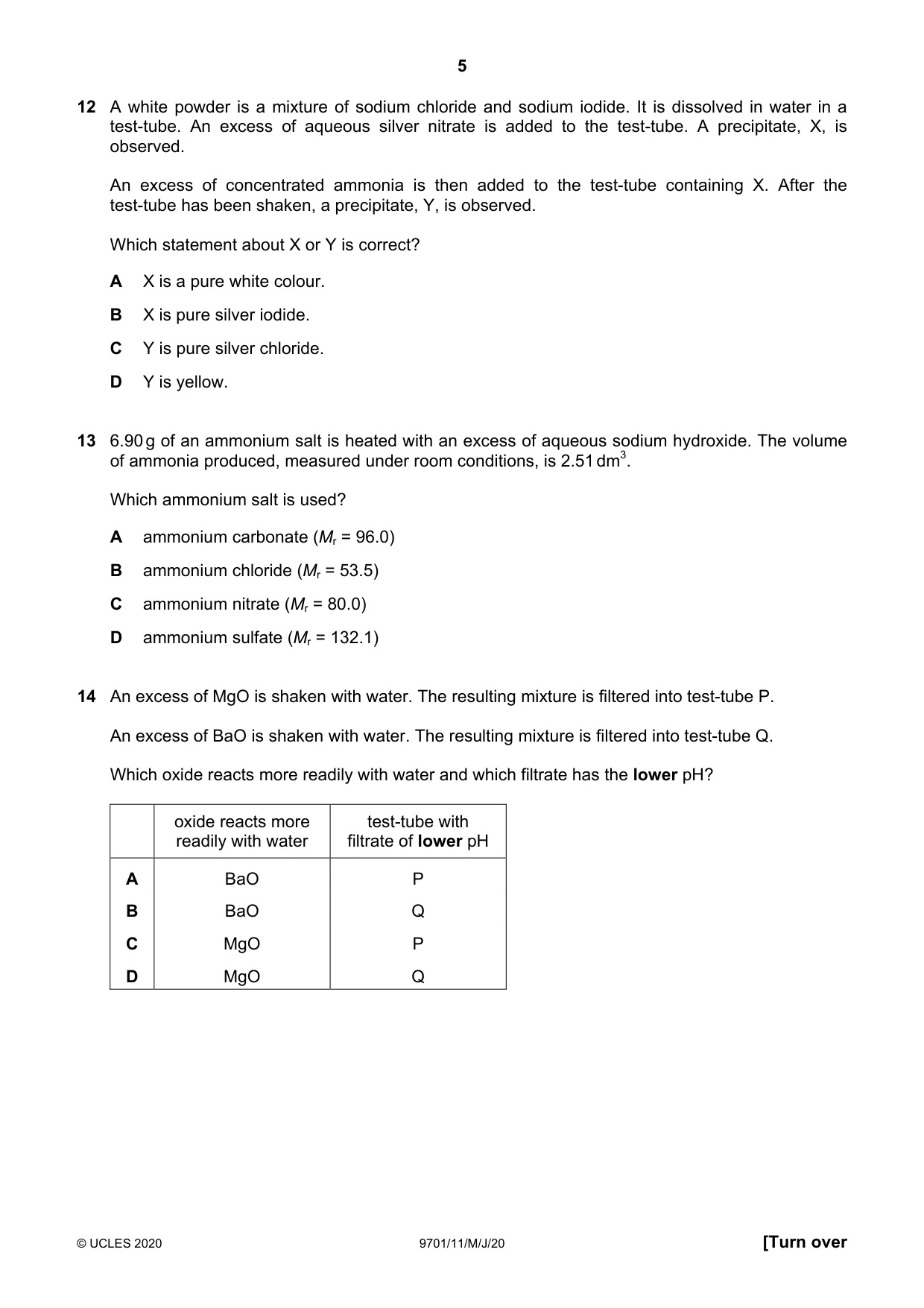
Q12 · A white powder is a mixture of sodium chloride and sodium iodide
12 A white powder is a mixture of sodium chloride and sodium iodide. It is dissolved in water in a test-tube. An excess of aqueous silver nitrate is added to the test-tube. A precipitate, X, is observed. An excess of concentrated ammonia is then added to the test-tube containing X. After the test-tube has been shaken, a precipitate, Y, is observed. Which statement about X or Y is correct? A X is a pure white colour. B X is pure silver iodide. C Y is pure silver chloride. D Y is yellow.
Mark scheme: D
Q13 · 6.90 g of an ammonium salt is heated with an excess of aqueous sodium hydroxide
13 6.90 g of an ammonium salt is heated with an excess of aqueous sodium hydroxide. The volume of ammonia produced, measured under room conditions, is 2.51 dm3. Which ammonium salt is used? A ammonium carbonate (Mr = 96.0) B ammonium chloride (Mr = 53.5) C ammonium nitrate (Mr = 80.0) D ammonium sulfate (Mr = 132.1)
Mark scheme: D
More questions on Reacting masses and volumes (of solutions and gases)
Q14 · An excess of MgO is shaken with water
14 An excess of MgO is shaken with water. The resulting mixture is filtered into test-tube P. An excess of BaO is shaken with water. The resulting mixture is filtered into test-tube Q. Which oxide reacts more readily with water and which filtrate has the lower pH? oxide reacts more test-tube with readily with water filtrate of lower pH A BaO P B BaO Q C MgO P D MgO Q
Mark scheme: A
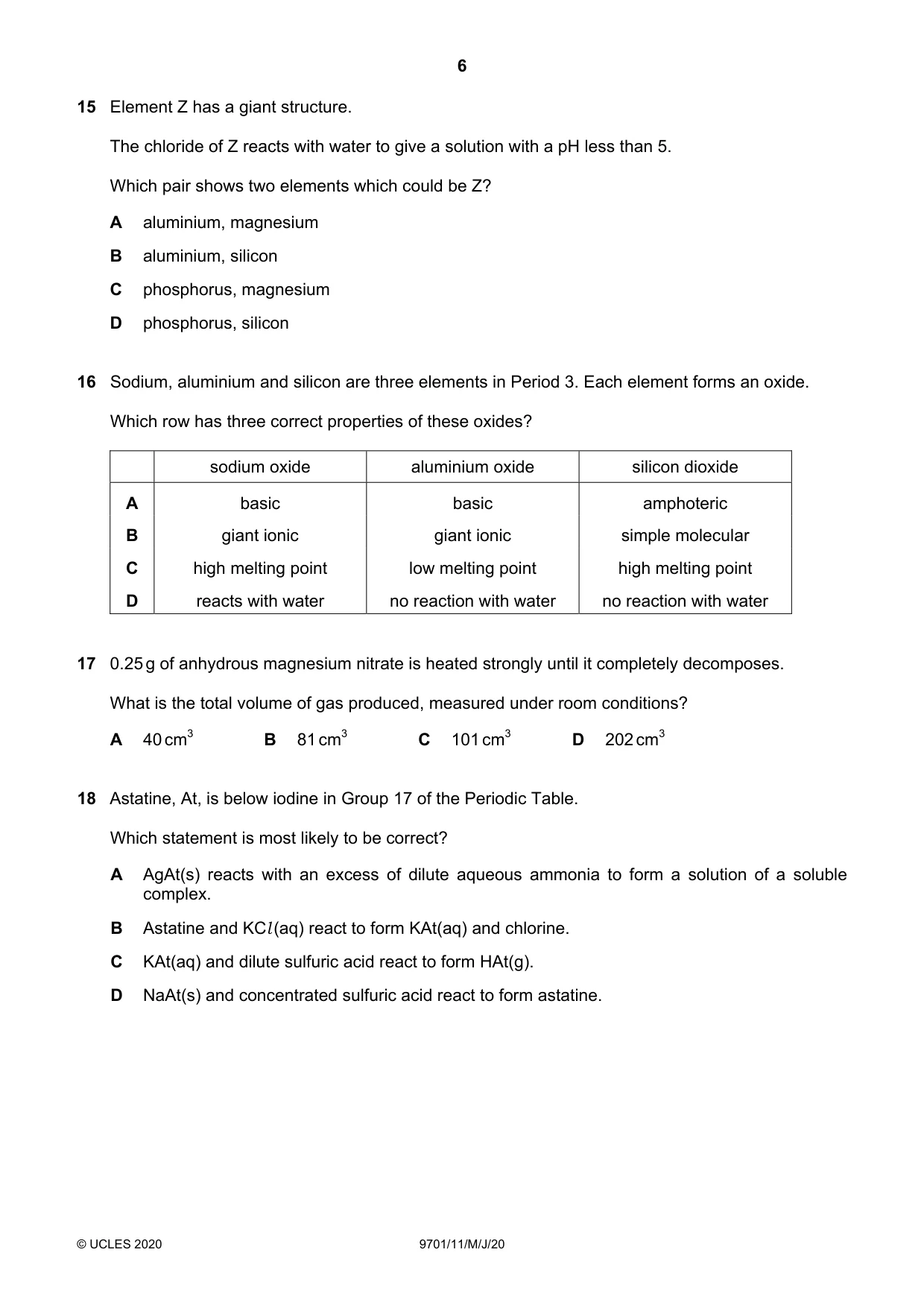
Q15 · Element Z has a giant structure
15 Element Z has a giant structure. The chloride of Z reacts with water to give a solution with a pH less than 5. Which pair shows two elements which could be Z? A aluminium, magnesium B aluminium, silicon C phosphorus, magnesium D phosphorus, silicon
Mark scheme: B
More questions on Periodicity of chemical properties of the elements in Period 3
Q16 · Sodium, aluminium and silicon are three elements in Period 3
16 Sodium, aluminium and silicon are three elements in Period 3. Each element forms an oxide. Which row has three correct properties of these oxides? sodium oxide aluminium oxide silicon dioxide A basic basic amphoteric B giant ionic giant ionic simple molecular C high melting point low melting point high melting point D reacts with water no reaction with water no reaction with water
Mark scheme: D
More questions on Periodicity of chemical properties of the elements in Period 3
Q17 · 0.25 g of anhydrous magnesium nitrate is heated strongly until it completely decomposes
17 0.25 g of anhydrous magnesium nitrate is heated strongly until it completely decomposes. What is the total volume of gas produced, measured under room conditions? A 40 cm3 B 81 cm3 C 101 cm3 D 202 cm3
Mark scheme: C
More questions on Reacting masses and volumes (of solutions and gases)
Q18 · Astatine, At, is below iodine in Group 17 of the Periodic Table
18 Astatine, At, is below iodine in Group 17 of the Periodic Table. Which statement is most likely to be correct? A AgAt(s) reacts with an excess of dilute aqueous ammonia to form a solution of a soluble complex. B Astatine and KCl (aq) react to form KAt(aq) and chlorine. C KAt(aq) and dilute sulfuric acid react to form HAt(g). D NaAt(s) and concentrated sulfuric acid react to form astatine.
Mark scheme: D
More questions on The chemical properties of the halogen elements and the hydrogen halides
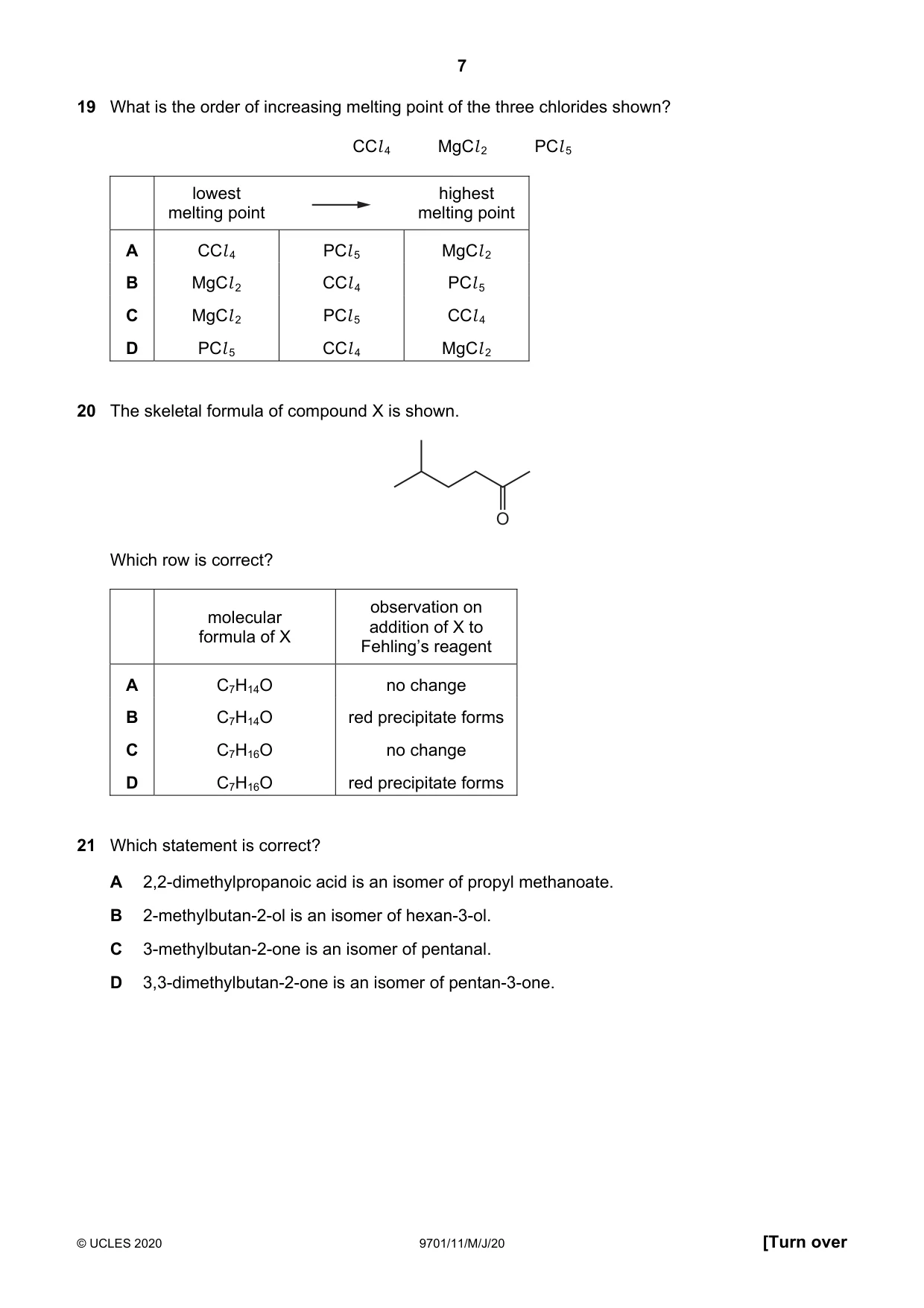
Q19 · What is the order of increasing melting point of the three chlorides shown?
19 What is the order of increasing melting point of the three chlorides shown? CCl 4 MgCl 2 PCl 5 lowest highest melting point melting point A CCl 4 PCl 5 MgCl 2 B MgCl 2 CCl 4 PCl 5 C MgCl 2 PCl 5 CCl 4 D PCl 5 CCl 4 MgCl 2
Mark scheme: A
More questions on Periodicity of chemical properties of the elements in Period 3
Q20 · The skeletal formula of compound X is shown
20 The skeletal formula of compound X is shown. O Which row is correct? observation on molecular addition of X to formula of X Fehling’s reagent A C7H14O no change B C7H14O red precipitate forms C C7H16O no change D C7H16O red precipitate forms
Mark scheme: A
Q21 · Which statement is correct?
21 Which statement is correct? A 2,2-dimethylpropanoic acid is an isomer of propyl methanoate. B 2-methylbutan-2-ol is an isomer of hexan-3-ol. C 3-methylbutan-2-one is an isomer of pentanal. D 3,3-dimethylbutan-2-one is an isomer of pentan-3-one.
Mark scheme: C
More questions on Isomerism: structural isomerism and stereoisomerism
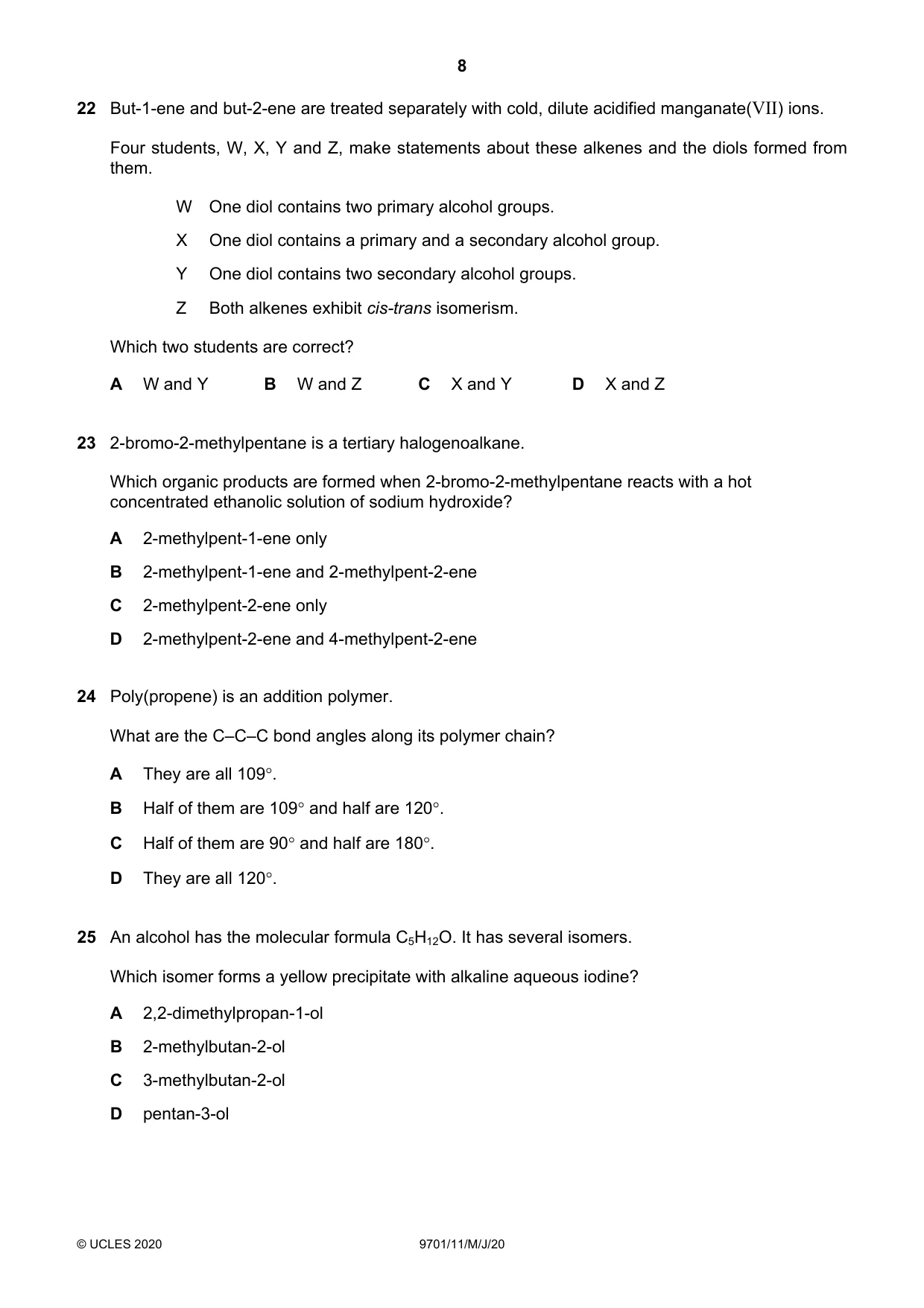
Q22 · But-1-ene and but-2-ene are treated separately with cold, dilute acidified manganate(VII)…
22 But-1-ene and but-2-ene are treated separately with cold, dilute acidified manganate(VII) ions. Four students, W, X, Y and Z, make statements about these alkenes and the diols formed from them. W One diol contains two primary alcohol groups. X One diol contains a primary and a secondary alcohol group. Y One diol contains two secondary alcohol groups. Z Both alkenes exhibit cis-trans isomerism. Which two students are correct? A W and Y B W and Z C X and Y D X and Z
Mark scheme: C
Q23 · 2-bromo-2-methylpentane is a tertiary halogenoalkane
23 2-bromo-2-methylpentane is a tertiary halogenoalkane. Which organic products are formed when 2-bromo-2-methylpentane reacts with a hot concentrated ethanolic solution of sodium hydroxide? A 2-methylpent-1-ene only B 2-methylpent-1-ene and 2-methylpent-2-ene C 2-methylpent-2-ene only D 2-methylpent-2-ene and 4-methylpent-2-ene
Mark scheme: B
Q24 · Poly(propene) is an addition polymer
24 Poly(propene) is an addition polymer. What are the C–C–C bond angles along its polymer chain? A They are all 109°. B Half of them are 109° and half are 120°. C Half of them are 90° and half are 180°. D They are all 120°.
Mark scheme: A
Q25 · An alcohol has the molecular formula C5H12O
25 An alcohol has the molecular formula C5H12O. It has several isomers. Which isomer forms a yellow precipitate with alkaline aqueous iodine? A 2,2-dimethylpropan-1-ol B 2-methylbutan-2-ol C 3-methylbutan-2-ol D pentan-3-ol
Mark scheme: C
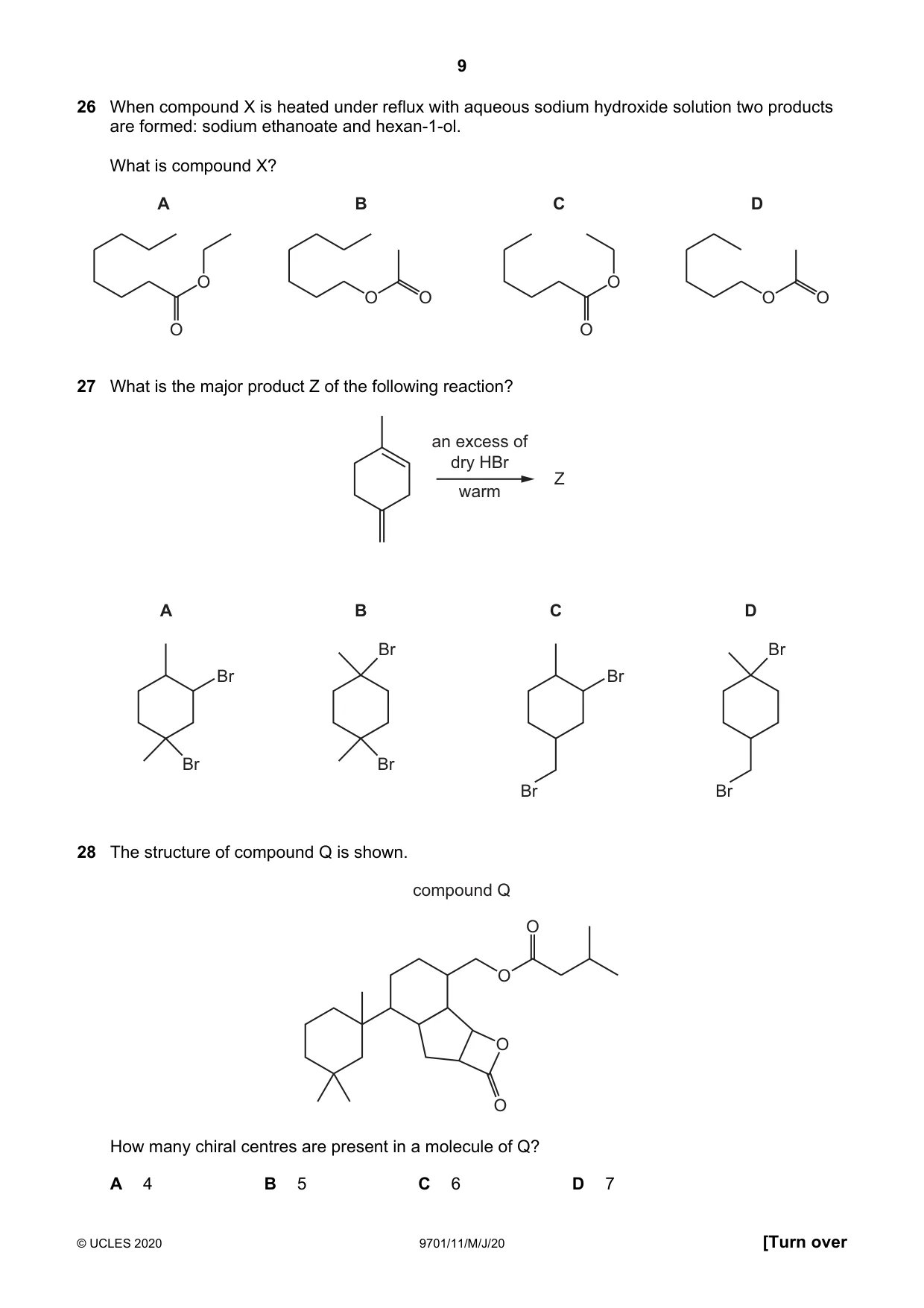
Q26 · When compound X is heated under reflux with aqueous sodium hydroxide solution two…
26 When compound X is heated under reflux with aqueous sodium hydroxide solution two products are formed: sodium ethanoate and hexan-1-ol. What is compound X? A B C D O O O O O O O O
Mark scheme: D
Q27 · What is the major product Z of the following reaction?
27 What is the major product Z of the following reaction? an excess of dry HBr Z warm A B C D Br Br Br Br Br Br Br Br
Mark scheme: B
Q28 · The structure of compound Q is shown
28 The structure of compound Q is shown. compound Q O O O O How many chiral centres are present in a molecule of Q? A 4 B 5 C 6 D 7
Mark scheme: D
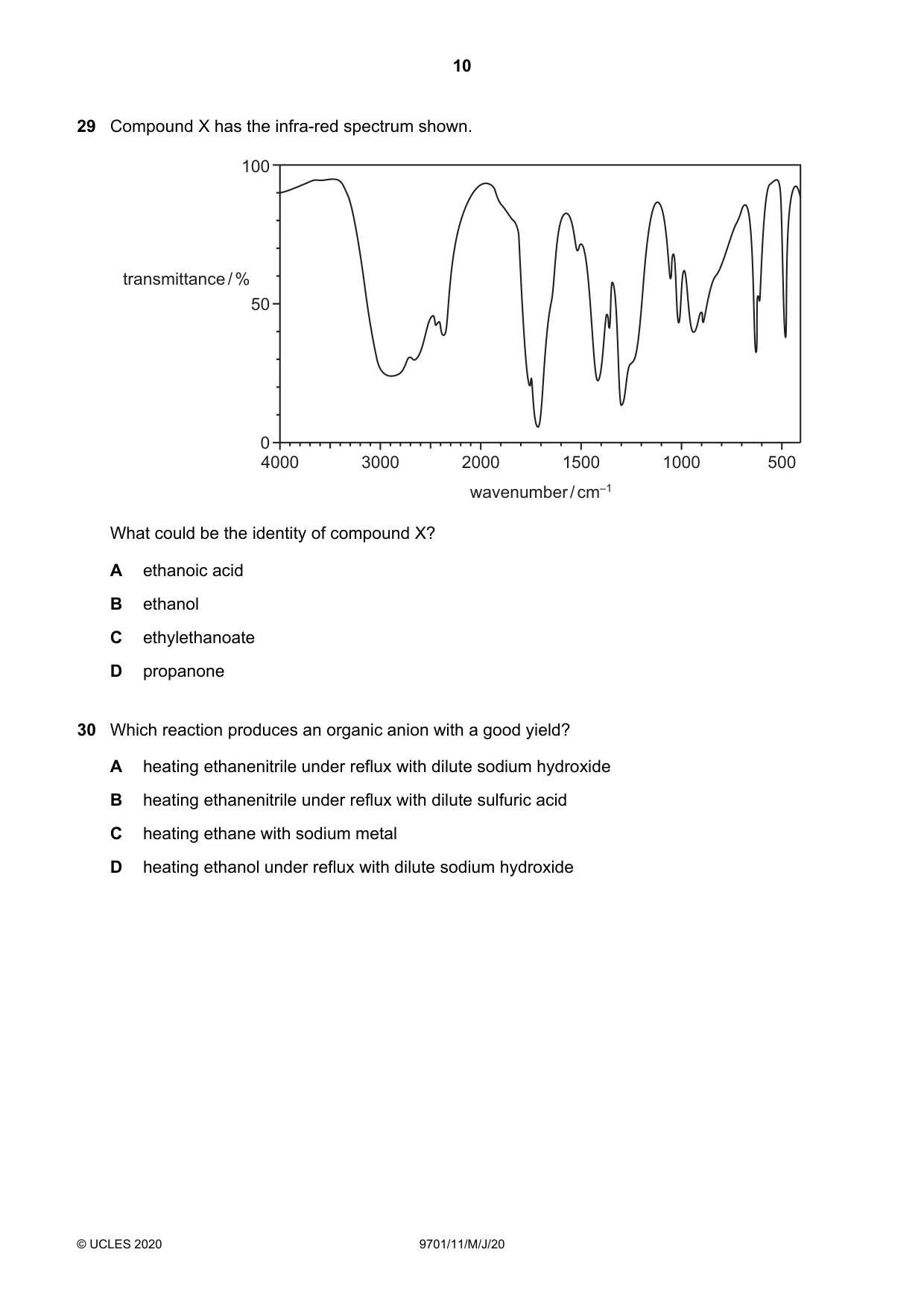
Q29 · Compound X has the infra-red spectrum shown
29 Compound X has the infra-red spectrum shown. 100 transmittance / % 50 0 4000 3000 2000 1500 1000 500 wavenumber / cm–1 What could be the identity of compound X? A ethanoic acid B ethanol C ethylethanoate D propanone
Mark scheme: A
Q30 · Which reaction produces an organic anion with a good yield?
30 Which reaction produces an organic anion with a good yield? A heating ethanenitrile under reflux with dilute sodium hydroxide B heating ethanenitrile under reflux with dilute sulfuric acid C heating ethane with sodium metal D heating ethanol under reflux with dilute sodium hydroxide Section B
Mark scheme: A
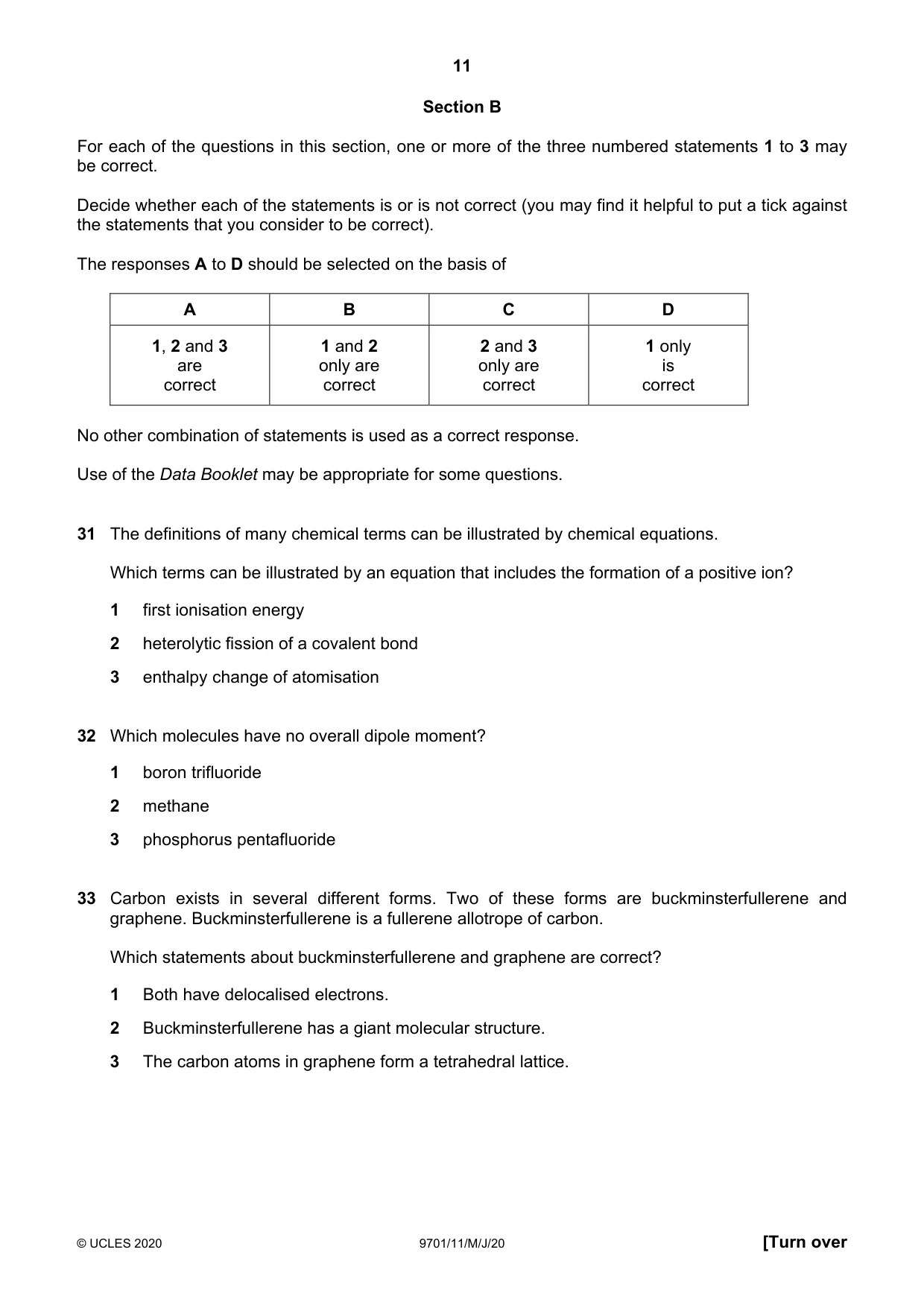
Q31 · The definitions of many chemical terms can be illustrated by chemical equations
31 The definitions of many chemical terms can be illustrated by chemical equations. Which terms can be illustrated by an equation that includes the formation of a positive ion? 1 first ionisation energy 2 heterolytic fission of a covalent bond 3 enthalpy change of atomisation
Mark scheme: B
Q32 · Which molecules have no overall dipole moment?
32 Which molecules have no overall dipole moment? 1 boron trifluoride 2 methane 3 phosphorus pentafluoride
Mark scheme: A
Q33 · Carbon exists in several different forms
33 Carbon exists in several different forms. Two of these forms are buckminsterfullerene and graphene. Buckminsterfullerene is a fullerene allotrope of carbon. Which statements about buckminsterfullerene and graphene are correct? 1 Both have delocalised electrons. 2 Buckminsterfullerene has a giant molecular structure. 3 The carbon atoms in graphene form a tetrahedral lattice.
Mark scheme: D
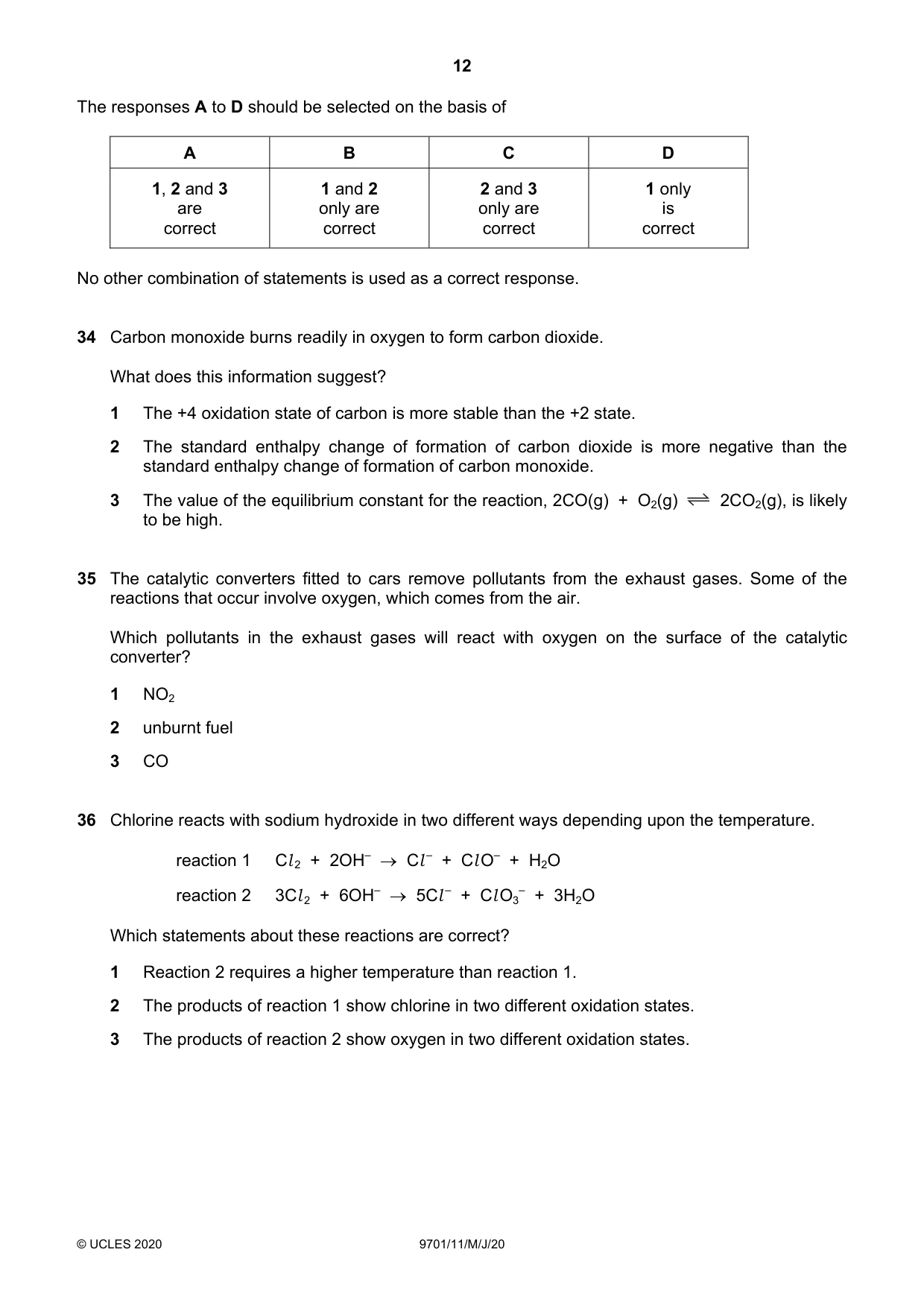
Q34 · Carbon monoxide burns readily in oxygen to form carbon dioxide
34 Carbon monoxide burns readily in oxygen to form carbon dioxide. What does this information suggest? 1 The +4 oxidation state of carbon is more stable than the +2 state. 2 The standard enthalpy change of formation of carbon dioxide is more negative than the standard enthalpy change of formation of carbon monoxide. 3 The value of the equilibrium constant for the reaction, 2CO(g) + O2(g) 2CO2(g), is likely to be high.
Mark scheme: A
Q35 · The catalytic converters fitted to cars remove pollutants from the exhaust gases
35 The catalytic converters fitted to cars remove pollutants from the exhaust gases. Some of the reactions that occur involve oxygen, which comes from the air. Which pollutants in the exhaust gases will react with oxygen on the surface of the catalytic converter? 1 NO2 2 unburnt fuel 3 CO
Mark scheme: C
Q36 · Chlorine reacts with sodium hydroxide in two different ways depending upon the temperature
36 Chlorine reacts with sodium hydroxide in two different ways depending upon the temperature. reaction 1 Cl 2 + 2OH– → Cl – + Cl O– + H2O reaction 2 3Cl 2 + 6OH– → 5Cl – + Cl O3 – + 3H2O Which statements about these reactions are correct? 1 Reaction 2 requires a higher temperature than reaction 1. 2 The products of reaction 1 show chlorine in two different oxidation states. 3 The products of reaction 2 show oxygen in two different oxidation states.
Mark scheme: B
Q37 · In which of the reactions is the organic compound oxidised by the given reagent?
37 In which of the reactions is the organic compound oxidised by the given reagent? 1 CH3CHO + HCN reagent 2 CH3CH2CH2CHO + Tollens’ reagent 3 CH3CH2CHO + Fehling’s reagent
Mark scheme: C
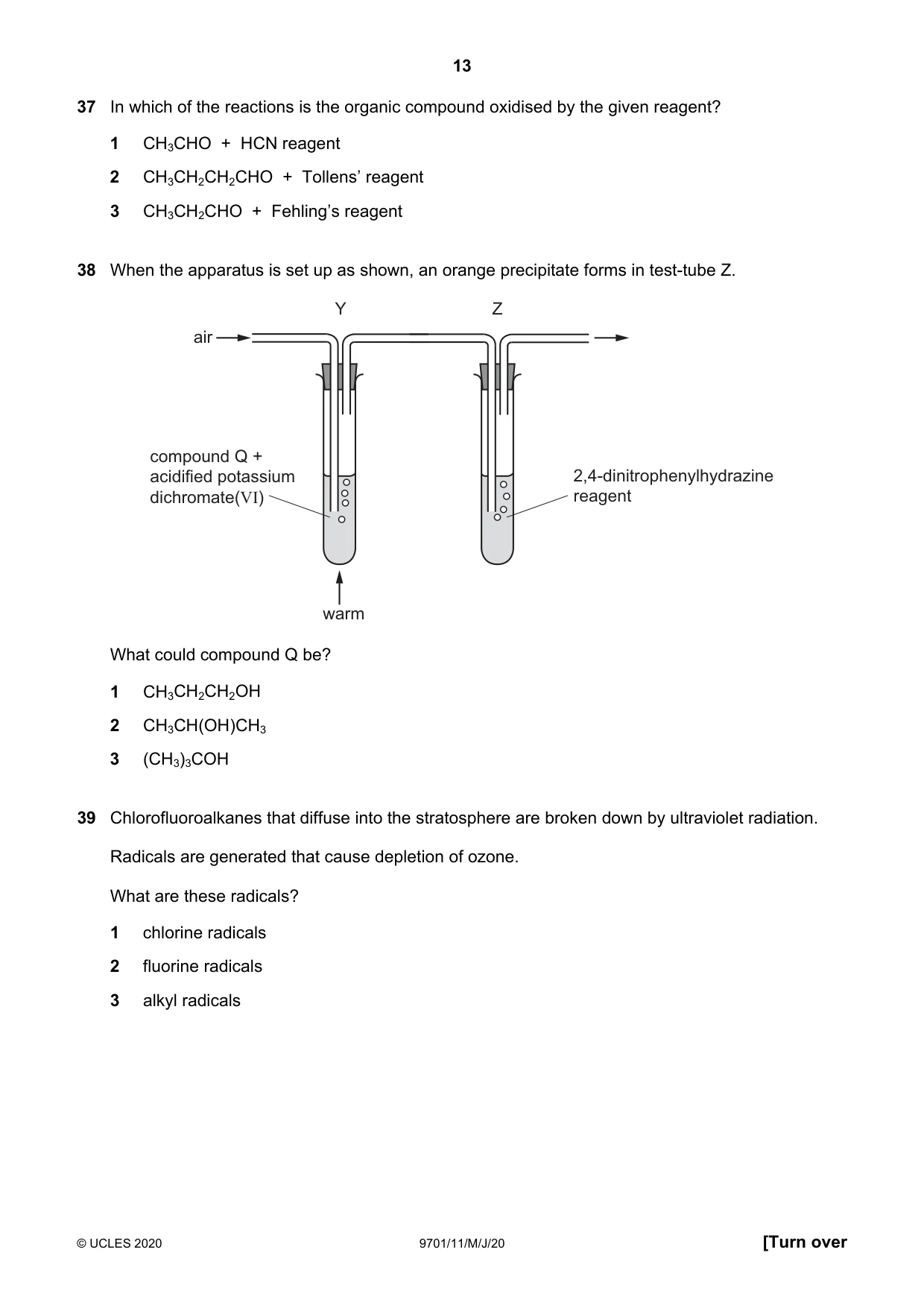
Q38 · When the apparatus is set up as shown, an orange precipitate forms in test-tube Z
38 When the apparatus is set up as shown, an orange precipitate forms in test-tube Z. Y Z air compound Q + acidified potassium 2,4-dinitrophenylhydrazine dichromate(VI) reagent warm What could compound Q be? 1 CH3CH2CH2OH 2 CH3CH(OH)CH3 3 (CH3)3COH
Mark scheme: B
Q39 · Chlorofluoroalkanes that diffuse into the stratosphere are broken down by ultraviolet…
39 Chlorofluoroalkanes that diffuse into the stratosphere are broken down by ultraviolet radiation. Radicals are generated that cause depletion of ozone. What are these radicals? 1 chlorine radicals 2 fluorine radicals 3 alkyl radicals
Mark scheme: D
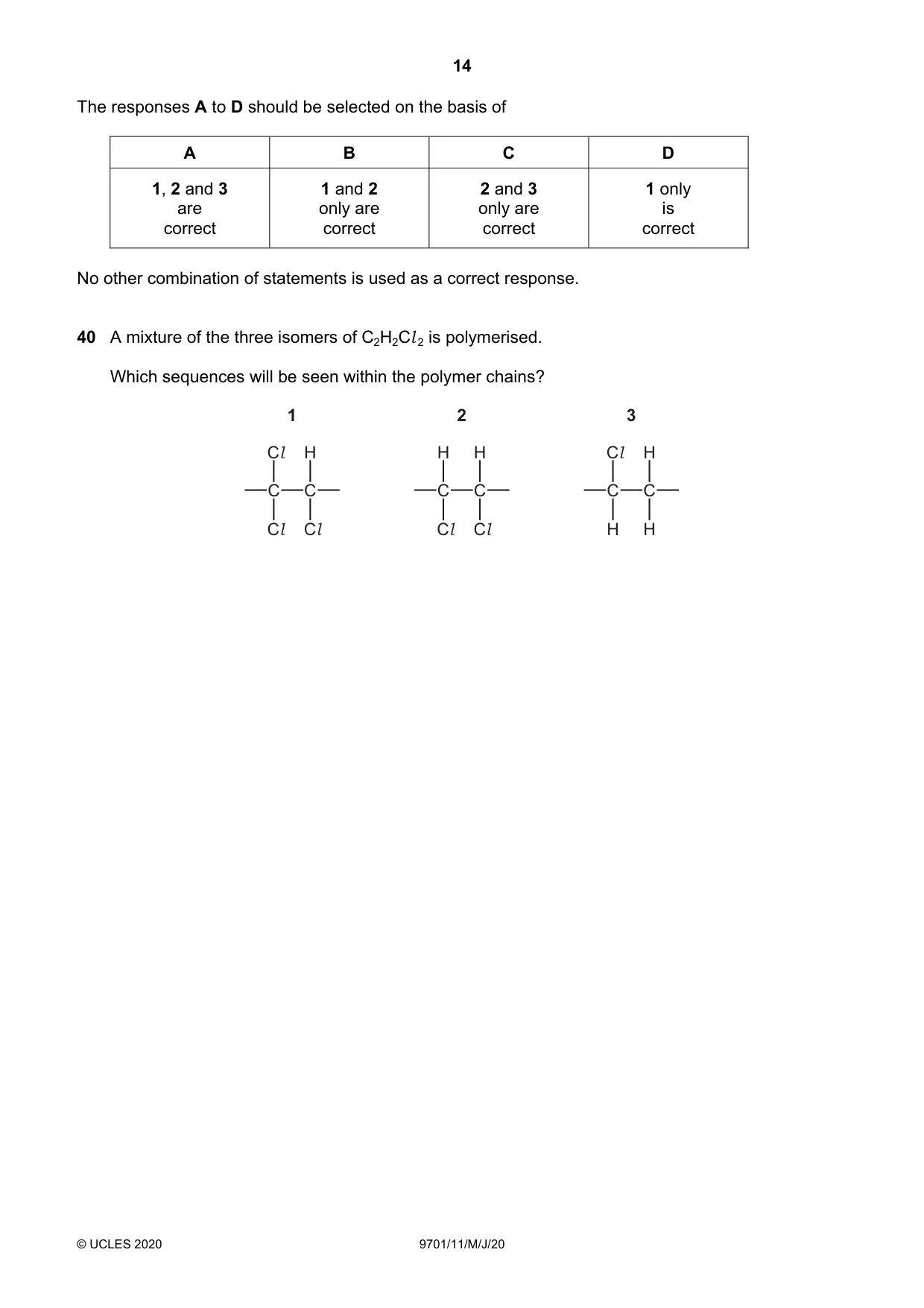
Q40 · A mixture of the three isomers of C2H2Cl 2 is polymerised
40 A mixture of the three isomers of C2H2Cl 2 is polymerised. Which sequences will be seen within the polymer chains? 1 2 3 Cl H H H Cl H C C C C C C Cl Cl Cl Cl H H
Mark scheme: A
What was in this paper
The subtopics covered by these 40 questions, and how many questions each got. Open one in a new tab to see every Cambridge question on it.
3Reacting masses and volumes (of solutions and gases)3Addition polymerisation2Alcohols2Aldehydes and ketones2Alkenes2Chemical equilibria: reversible reactions, dynamic equilibrium2Enthalpy change, ΔH2Redox processes: electron transfer and changes in oxidation number (oxidation state)2Bonding and structure1Effect of temperature on reaction rates and the concept of activation energy1Electrons, energy levels and atomic orbitals1Esters1Halogen compounds1Halogenoalkanes1Homogeneous and heterogeneous catalysts1Infrared spectroscopy1Ionisation energy1Isomerism: optical1Isomerism: structural isomerism and stereoisomerism1Nitriles and hydroxynitriles1Shapes of molecules1Shapes of organic molecules; σ and π bonds1Similarities and trends in the properties of the Group 2 metals, magnesium to barium, and their compounds1Some reactions of the halide ions1The chemical properties of the halogen elements and the hydrogen halides1The gaseous state: ideal and real gases and pV = nRT1The mole and the Avogadro constant1The reactions of chlorine1