Cambridge A Level Chemistry 9701 — 2012 Oct/Nov Paper 1 · Variant 3
9701/13/O/N/12 · 40 questions · 40 marks · ≈45 min
The question paper and its mark scheme, free to read here and free to download. This is Cambridge’s own paper, exactly as it was sat.
Question paper16 pages
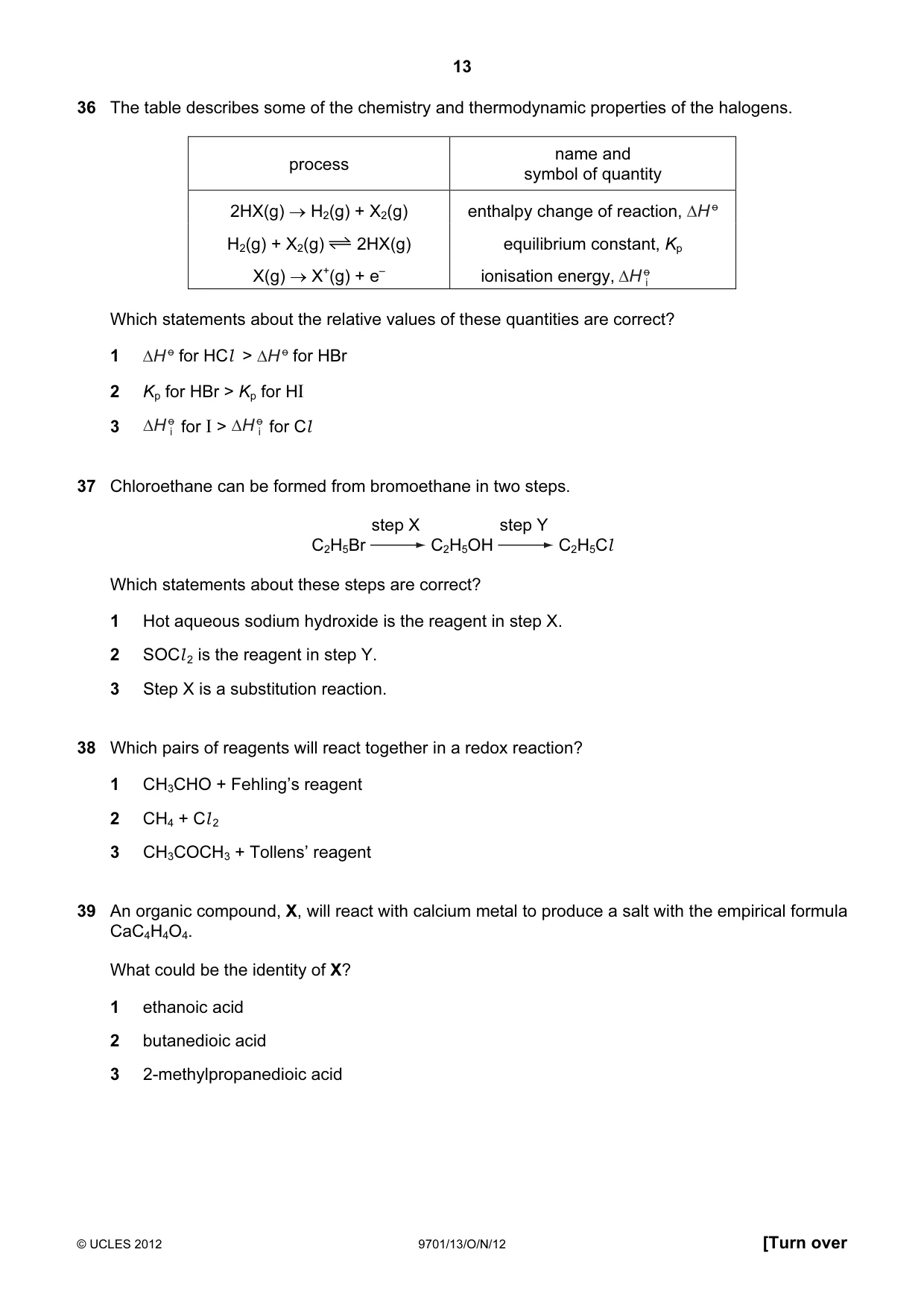
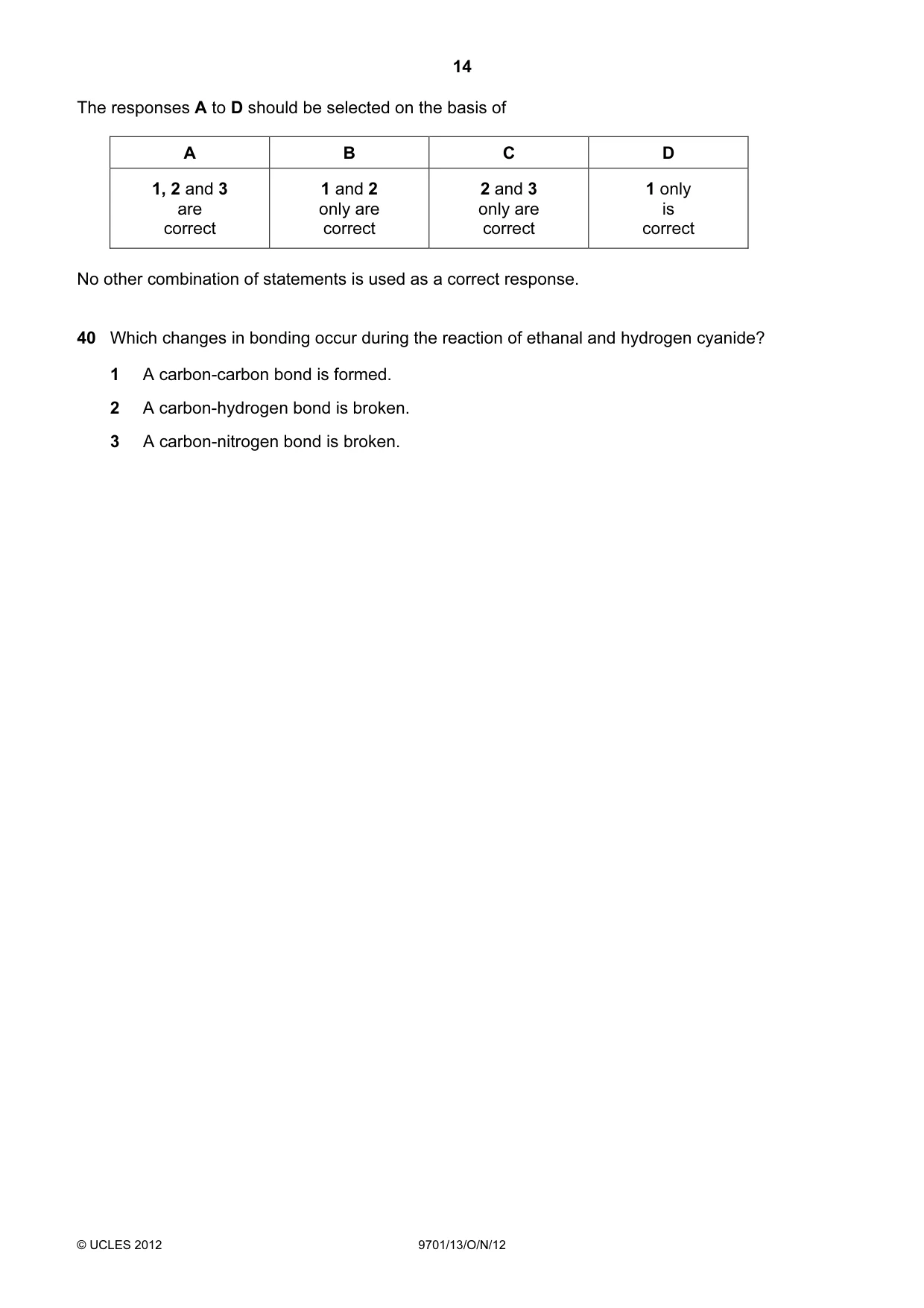


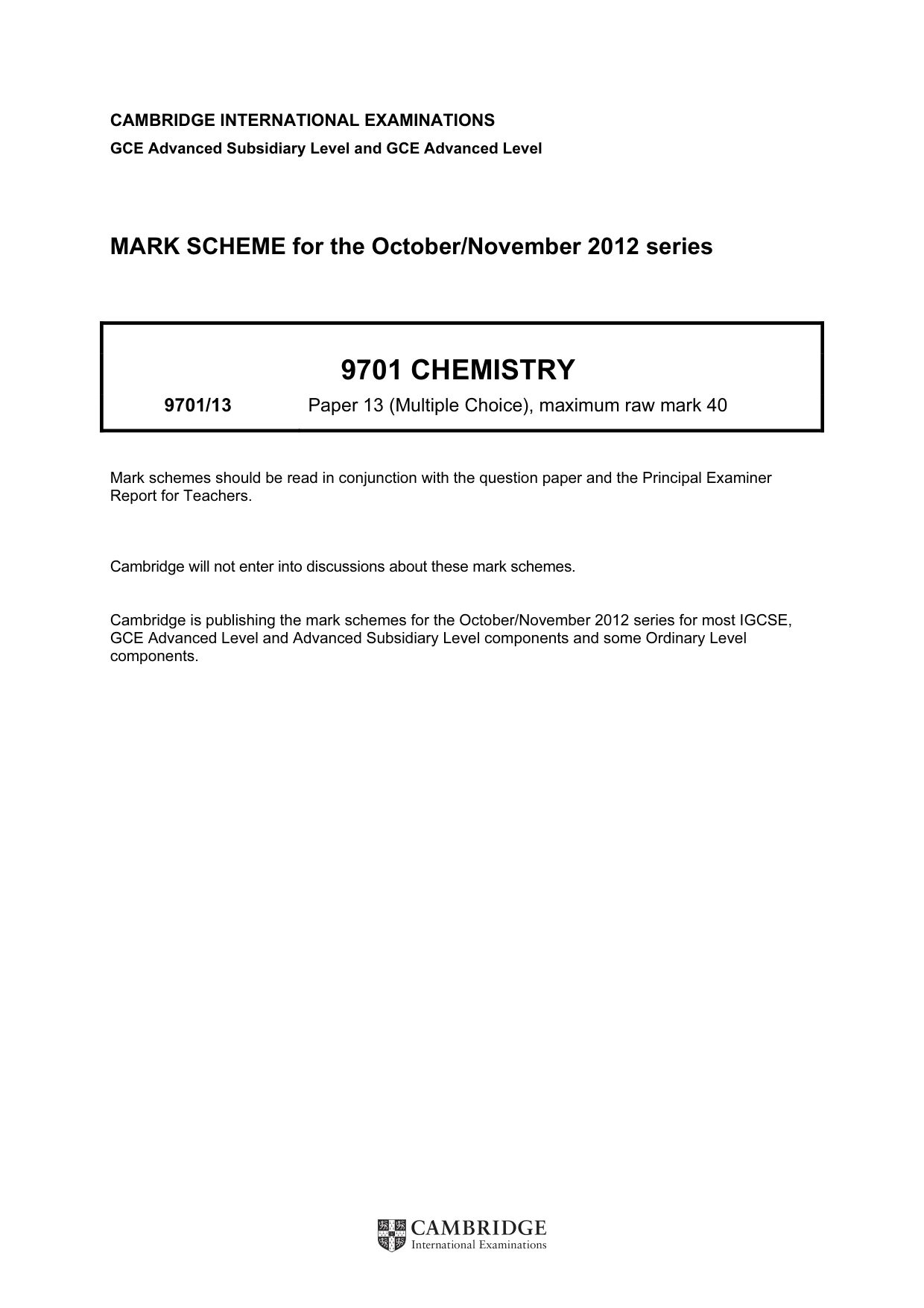
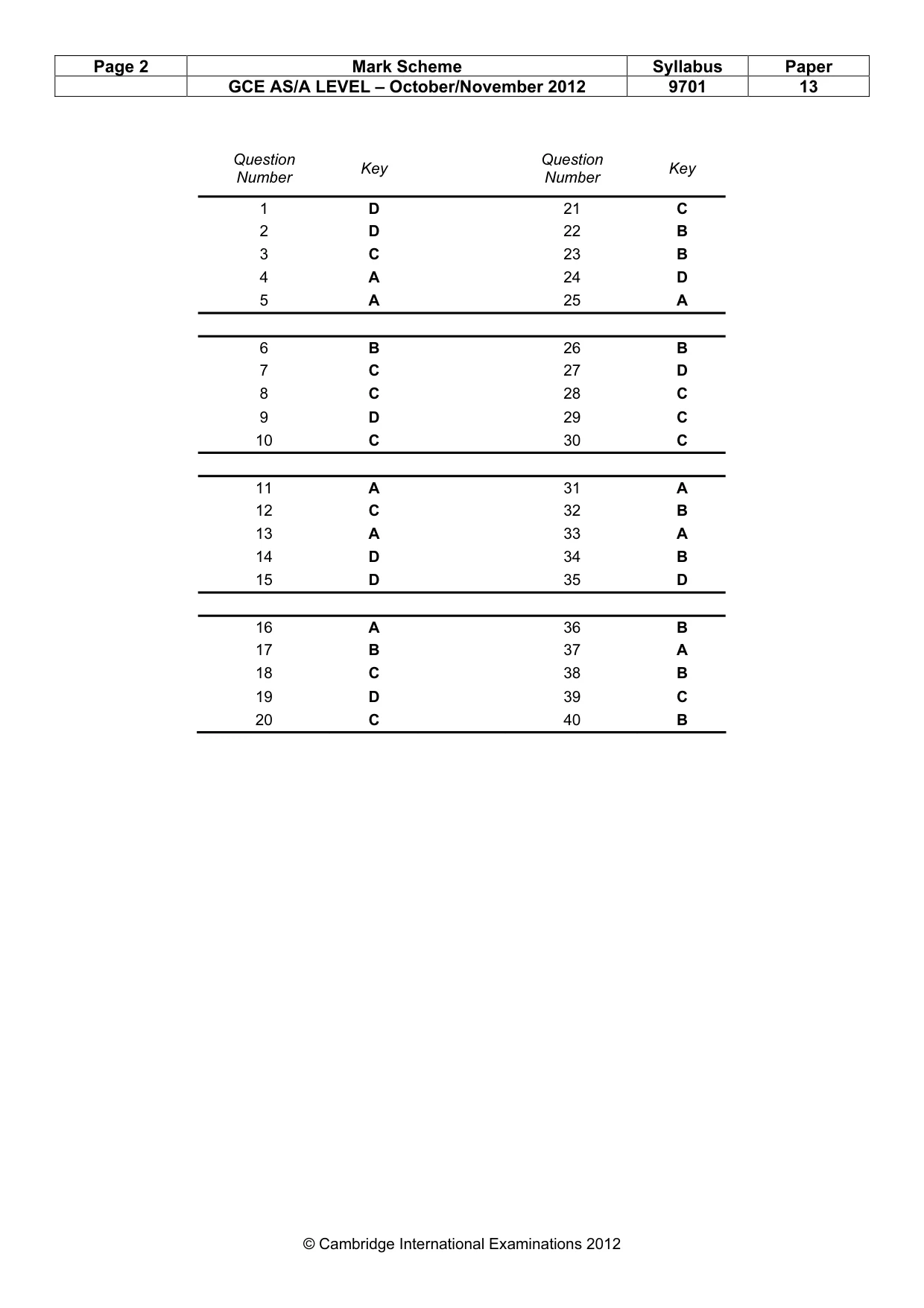
Mark scheme2 pages
Answers below. Sit the paper first if you are practising.
Questions as text
Q1 · Which diagram shows the correct graph of V against p for a fixed mass of an ideal gas at…
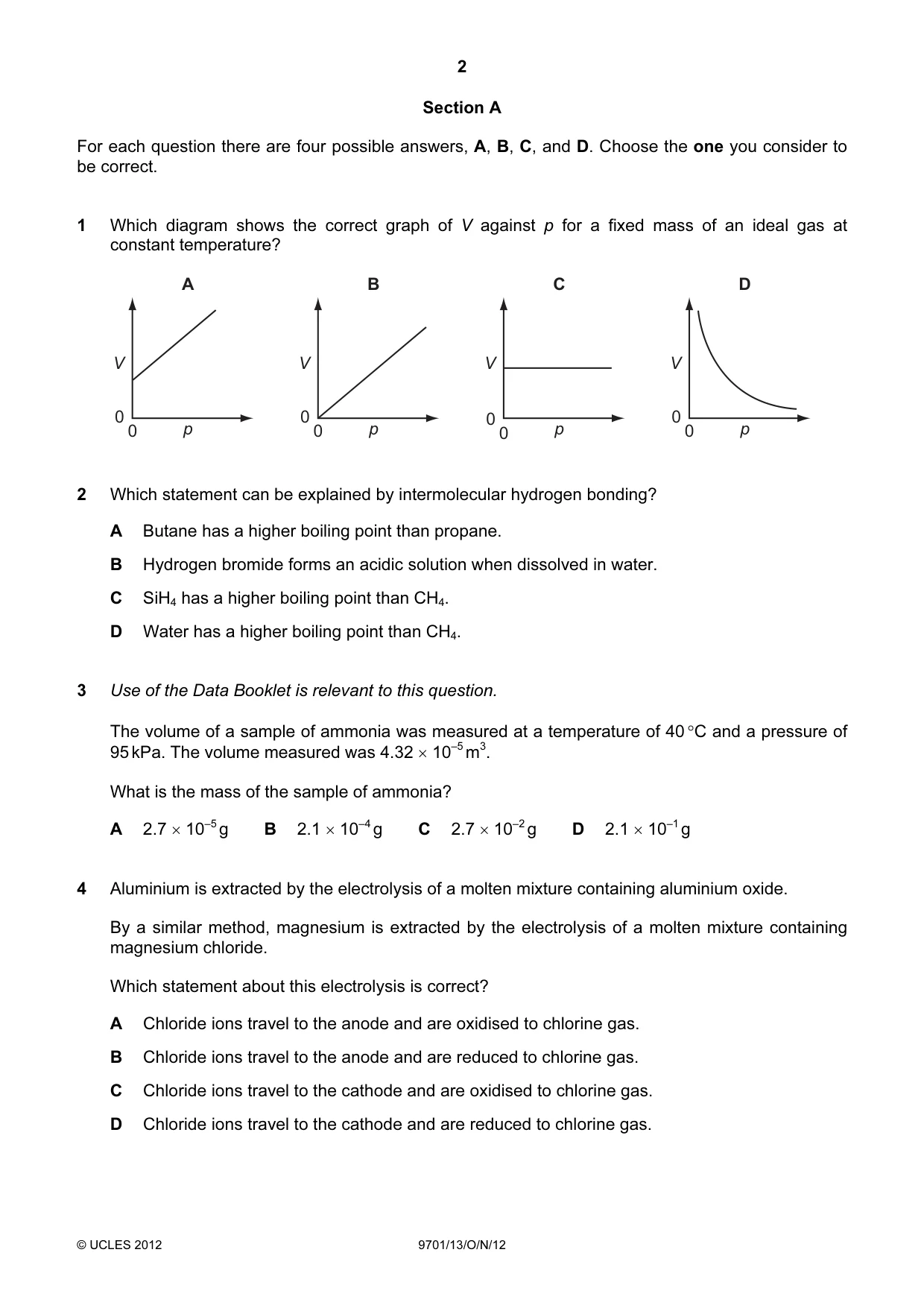
1 Which diagram shows the correct graph of V against p for a fixed mass of an ideal gas at constant temperature? A B C D V V V V 0 0 0 0 0 p 0 p 0 p 0 p
Mark scheme: D
More questions on The gaseous state: ideal and real gases and pV = nRT
Q2 · Which statement can be explained by intermolecular hydrogen bonding?
2 Which statement can be explained by intermolecular hydrogen bonding? A Butane has a higher boiling point than propane. B Hydrogen bromide forms an acidic solution when dissolved in water. C SiH4 has a higher boiling point than CH4. D Water has a higher boiling point than CH4.
Mark scheme: D
More questions on Intermolecular forces, electronegativity and bond properties
Q3 · Use of the Data Booklet is relevant to this question
3 Use of the Data Booklet is relevant to this question. The volume of a sample of ammonia was measured at a temperature of 40 °C and a pressure of 95 kPa. The volume measured was 4.32 × 10⁻⁵ m3. What is the mass of the sample of ammonia? A 2.7 × 10⁻⁵ g B 2.1 × 10⁻⁴ g C 2.7 × 10⁻² g D 2.1 × 10⁻¹ g
Mark scheme: C
More questions on The gaseous state: ideal and real gases and pV = nRT
Q4 · Aluminium is extracted by the electrolysis of a molten mixture containing aluminium oxide
4 Aluminium is extracted by the electrolysis of a molten mixture containing aluminium oxide. By a similar method, magnesium is extracted by the electrolysis of a molten mixture containing magnesium chloride. Which statement about this electrolysis is correct? A Chloride ions travel to the anode and are oxidised to chlorine gas. B Chloride ions travel to the anode and are reduced to chlorine gas. C Chloride ions travel to the cathode and are oxidised to chlorine gas. D Chloride ions travel to the cathode and are reduced to chlorine gas.
Mark scheme: A
Q5 · Ethyne, C2H2, completely combusts, as shown in the equation
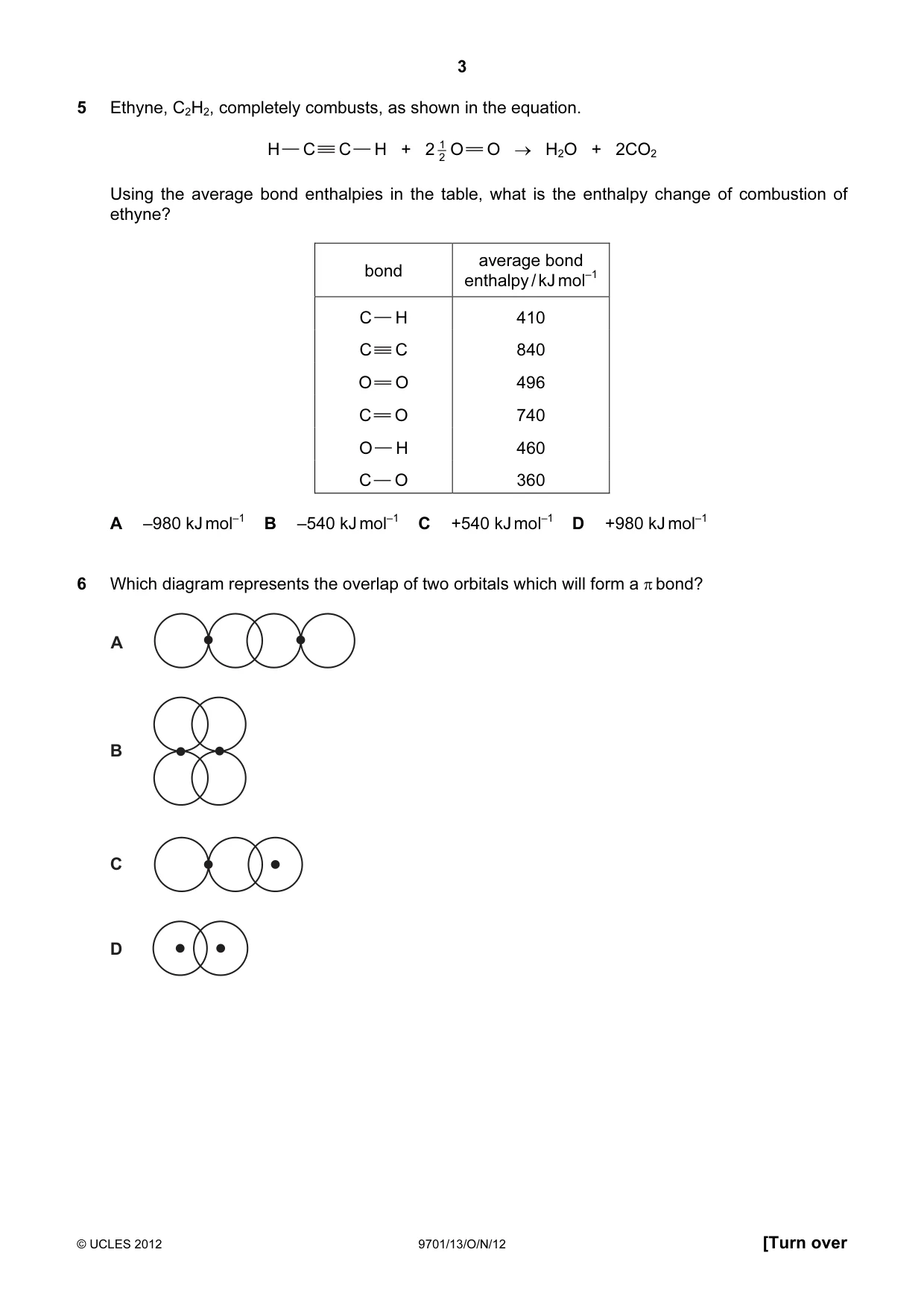
5 Ethyne, C2H2, completely combusts, as shown in the equation. H C C H + 2 2 1 O O → H2O + 2CO2 Using the average bond enthalpies in the table, what is the enthalpy change of combustion of ethyne? average bond bond enthalpy / kJ mol–1 C H 410 C C 840 O O 496 C O 740 O H 460 C O 360 A –980 kJ mol–1 B –540 kJ mol–1 C +540 kJ mol–1 D +980 kJ mol–1
Mark scheme: A
Q6 · Which diagram represents the overlap of two orbitals which will form a π bond?
6 Which diagram represents the overlap of two orbitals which will form a π bond? A B C D
Mark scheme: B
More questions on Shapes of organic molecules; σ and π bonds
Q7 · The table gives the successive ionisation energies for an element X
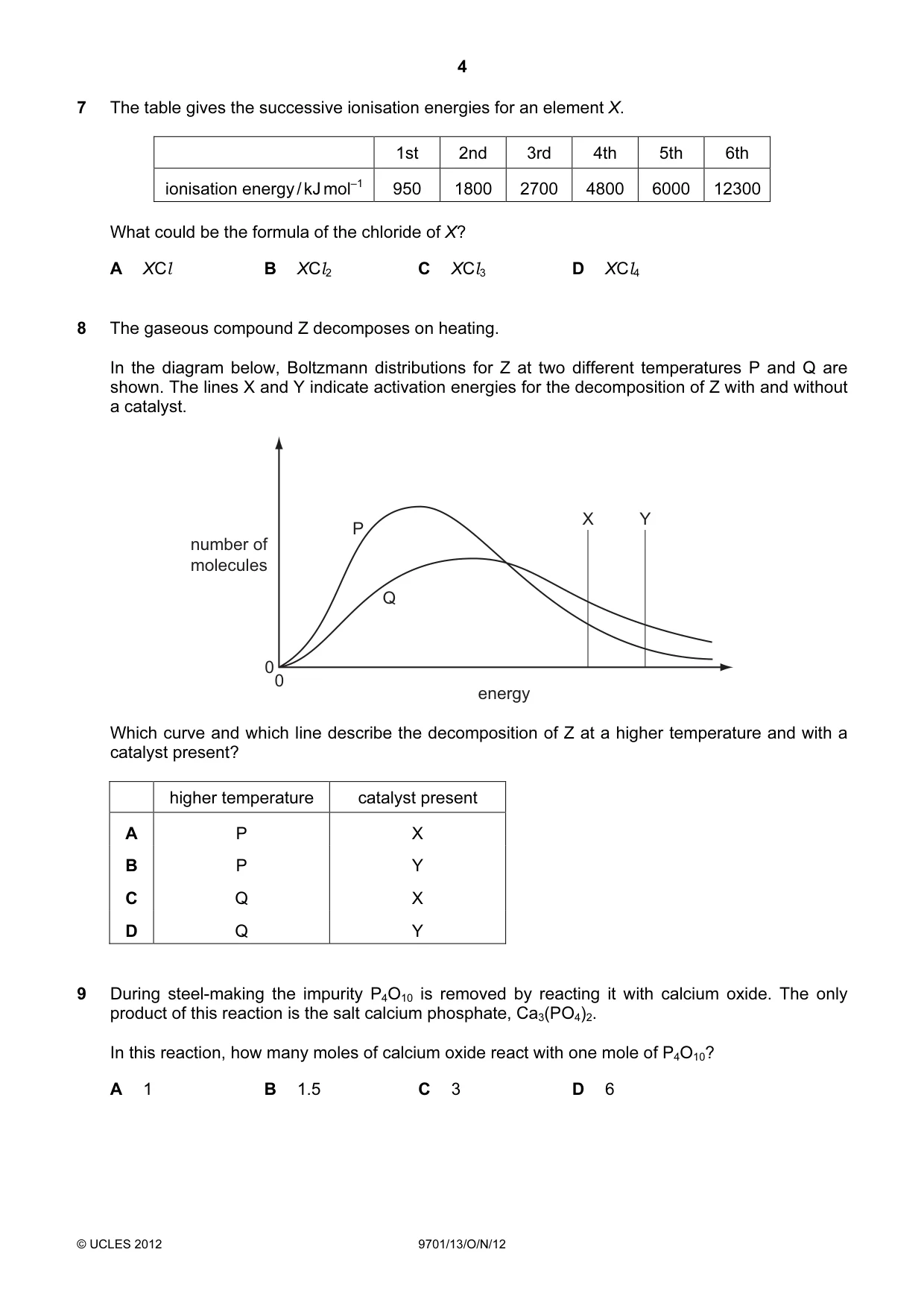
7 The table gives the successive ionisation energies for an element X. 1st 2nd 3rd 4th 5th 6th ionisation energy / kJ mol–1 950 1800 2700 4800 6000 12300 What could be the formula of the chloride of X? A XCl B XCl2 C XCl3 D XCl4
Mark scheme: C
Q8 · The gaseous compound Z decomposes on heating
8 The gaseous compound Z decomposes on heating. In the diagram below, Boltzmann distributions for Z at two different temperatures P and Q are shown. The lines X and Y indicate activation energies for the decomposition of Z with and without a catalyst. X Y P number of molecules Q 0 0 energy Which curve and which line describe the decomposition of Z at a higher temperature and with a catalyst present? higher temperature catalyst present A P X B P Y C Q X D Q Y
Mark scheme: C
More questions on Effect of temperature on reaction rates and the concept of activation energy
Q9 · During steel-making the impurity P4O10 is removed by reacting it with calcium oxide
9 During steel-making the impurity P4O10 is removed by reacting it with calcium oxide. The only product of this reaction is the salt calcium phosphate, Ca3(PO4)2. In this reaction, how many moles of calcium oxide react with one mole of P4O10? A 1 B 1.5 C 3 D 6
Mark scheme: D
More questions on Reacting masses and volumes (of solutions and gases)
Q10 · The enthalpy change of the neutralisation given below is –114 kJ mol–1
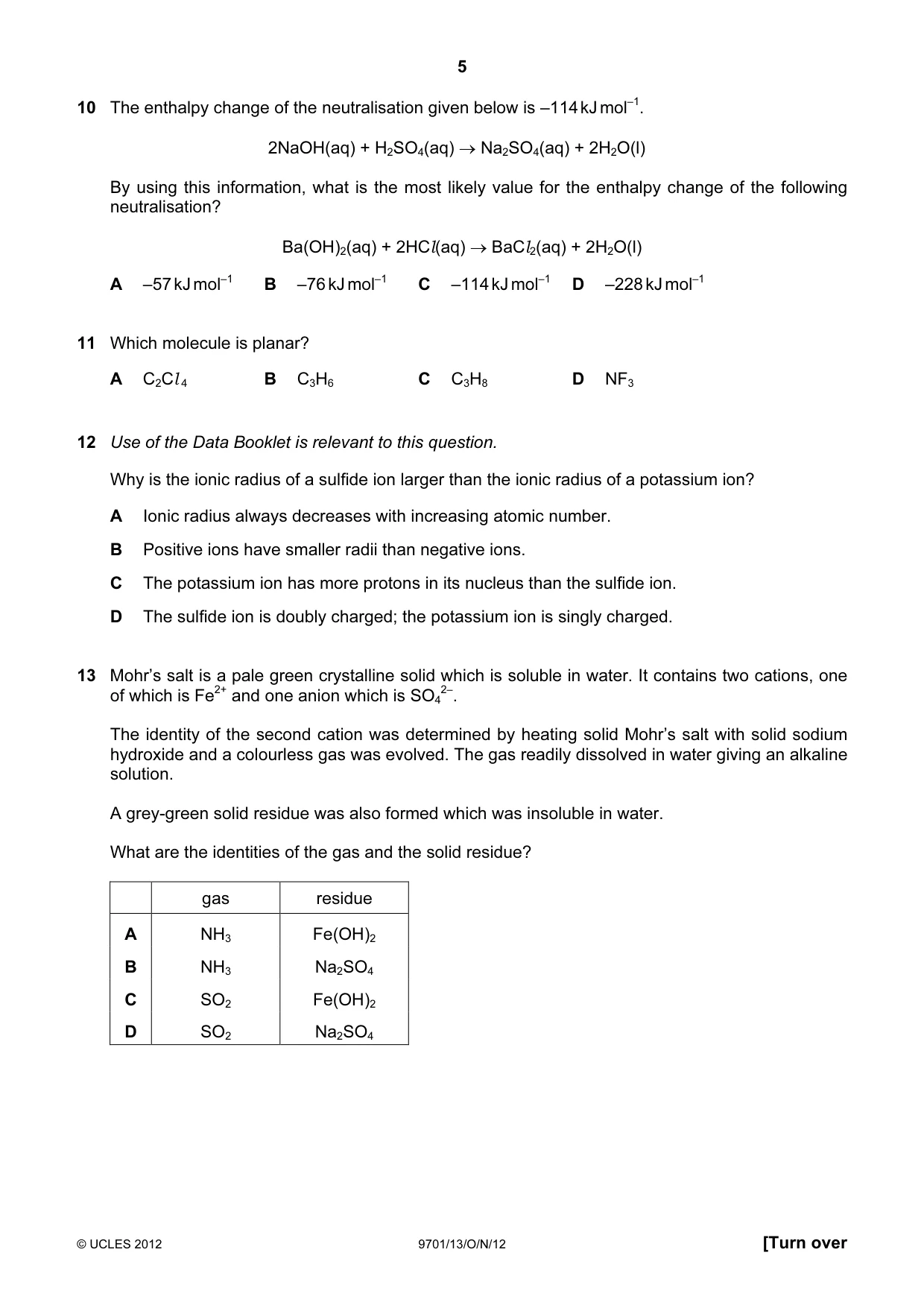
10 The enthalpy change of the neutralisation given below is –114 kJ mol–1. 2NaOH(aq) + H2SO4(aq) → Na2SO4(aq) + 2H2O(l) By using this information, what is the most likely value for the enthalpy change of the following neutralisation? Ba(OH)2(aq) + 2HCl(aq) → BaCl2(aq) + 2H2O(l) A –57 kJ mol–1 B –76 kJ mol–1 C –114 kJ mol–1 D –228 kJ mol–1
Mark scheme: C
Q11 · Which molecule is planar?
11 Which molecule is planar? A C2Cl 4 B C3H6 C C3H8 D NF3
Mark scheme: A
Q12 · Use of the Data Booklet is relevant to this question
12 Use of the Data Booklet is relevant to this question. Why is the ionic radius of a sulfide ion larger than the ionic radius of a potassium ion? A Ionic radius always decreases with increasing atomic number. B Positive ions have smaller radii than negative ions. C The potassium ion has more protons in its nucleus than the sulfide ion. D The sulfide ion is doubly charged; the potassium ion is singly charged.
Mark scheme: C
Q13 · Mohr’s salt is a pale green crystalline solid which is soluble in water
13 Mohr’s salt is a pale green crystalline solid which is soluble in water. It contains two cations, one of which is Fe2+ and one anion which is SO4 2–. The identity of the second cation was determined by heating solid Mohr’s salt with solid sodium hydroxide and a colourless gas was evolved. The gas readily dissolved in water giving an alkaline solution. A grey-green solid residue was also formed which was insoluble in water. What are the identities of the gas and the solid residue? gas residue A NH3 Fe(OH)2 B NH3 Na2SO4 C SO2 Fe(OH)2 D SO2 Na2SO4
Mark scheme: A
More questions on Periodicity of chemical properties of the elements in Period 3
Q14 · Use of the Data Booklet is relevant to this question
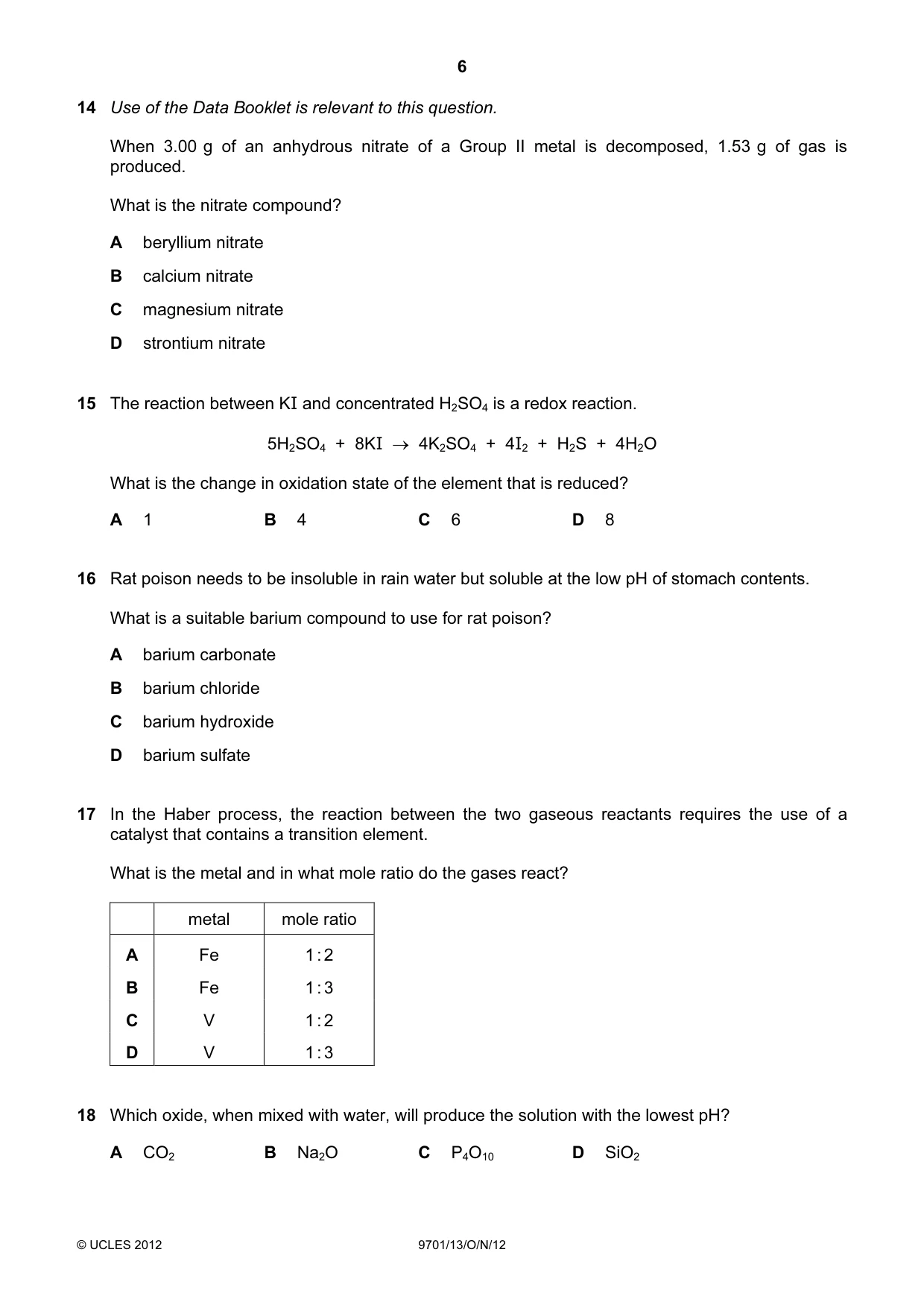
14 Use of the Data Booklet is relevant to this question. When 3.00 g of an anhydrous nitrate of a Group II metal is decomposed, 1.53 g of gas is produced. What is the nitrate compound? A beryllium nitrate B calcium nitrate C magnesium nitrate D strontium nitrate
Mark scheme: D
More questions on Reacting masses and volumes (of solutions and gases)
Q15 · The reaction between KI and concentrated H2SO4 is a redox reaction
15 The reaction between KI and concentrated H2SO4 is a redox reaction. 5H2SO4 + 8KI → 4K2SO4 + 4I2 + H2S + 4H2O What is the change in oxidation state of the element that is reduced? A 1 B 4 C 6 D 8
Mark scheme: D
Q16 · Rat poison needs to be insoluble in rain water but soluble at the low pH of stomach…
16 Rat poison needs to be insoluble in rain water but soluble at the low pH of stomach contents. What is a suitable barium compound to use for rat poison? A barium carbonate B barium chloride C barium hydroxide D barium sulfate
Mark scheme: A
Q17 · In the Haber process, the reaction between the two gaseous reactants requires the use of…
17 In the Haber process, the reaction between the two gaseous reactants requires the use of a catalyst that contains a transition element. What is the metal and in what mole ratio do the gases react? metal mole ratio A Fe 1 : 2 B Fe 1 : 3 C V 1 : 2 D V 1 : 3
Mark scheme: B
Q18 · Which oxide, when mixed with water, will produce the solution with the lowest pH?
18 Which oxide, when mixed with water, will produce the solution with the lowest pH? A CO2 B Na2O C P4O10 D SiO2
Mark scheme: C
More questions on Periodicity of chemical properties of the elements in Period 3
Q19 · Deposits of ammonium sulfate have been discovered in areas of high atmospheric pollution
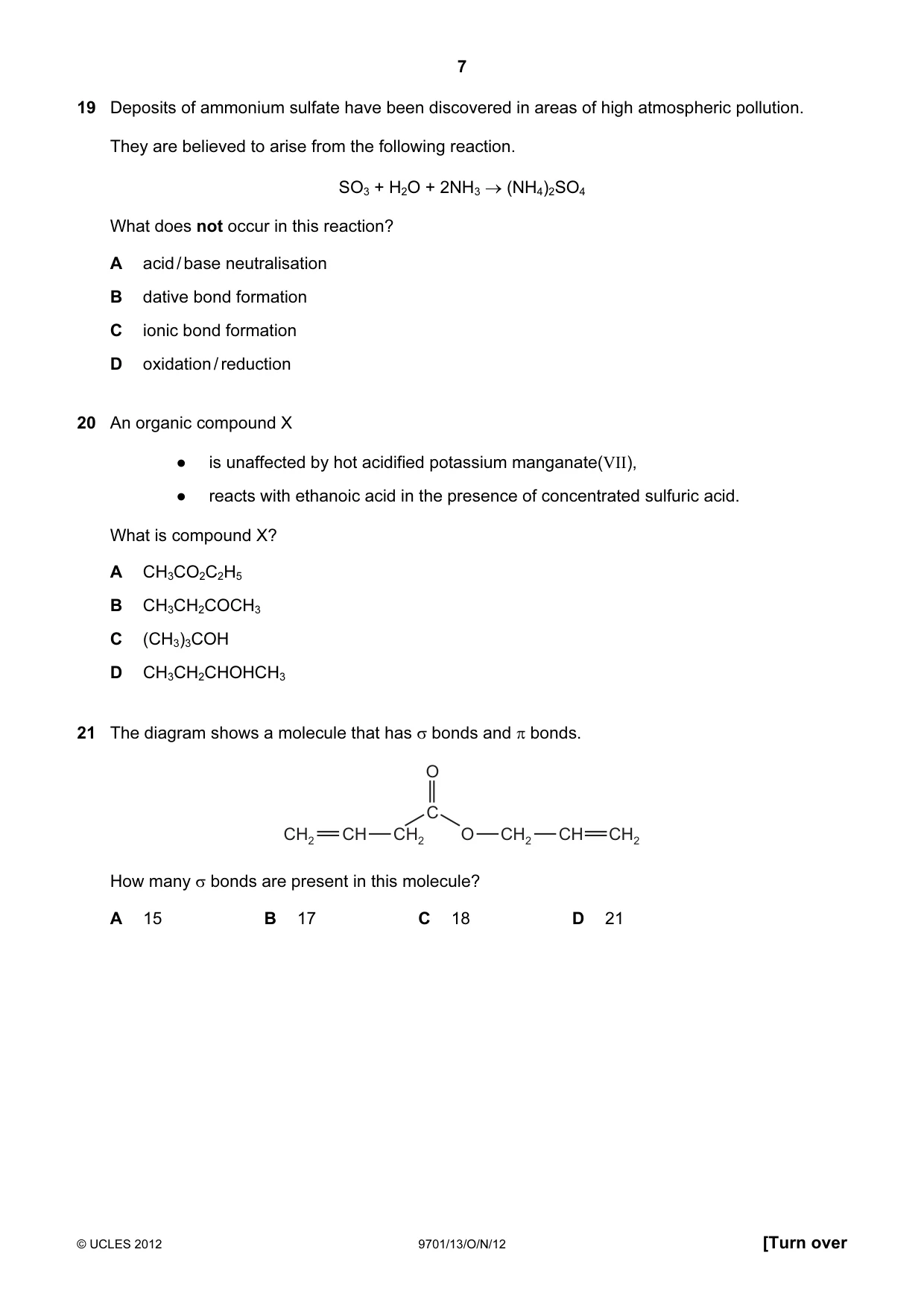
19 Deposits of ammonium sulfate have been discovered in areas of high atmospheric pollution. They are believed to arise from the following reaction. SO3 + H2O + 2NH3 → (NH4)2SO4 What does not occur in this reaction? A acid / base neutralisation B dative bond formation C ionic bond formation D oxidation / reduction
Mark scheme: D
More questions on Covalent bonding and coordinate (dative covalent) bonding
Q20 · An organic compound X ● is unaffected by hot acidified potassium manganate(VII), ● reacts…
20 An organic compound X ● is unaffected by hot acidified potassium manganate(VII), ● reacts with ethanoic acid in the presence of concentrated sulfuric acid. What is compound X? A CH3CO2C2H5 B CH3CH2COCH3 C (CH3)3COH D CH3CH2CHOHCH3
Mark scheme: C
Q21 · The diagram shows a molecule that has σ bonds and π bonds
21 The diagram shows a molecule that has σ bonds and π bonds. O C CH2 CH CH2 O CH2 CH CH2 How many σ bonds are present in this molecule? A 15 B 17 C 18 D 21
Mark scheme: C
More questions on Shapes of organic molecules; σ and π bonds
Q22 · A molecule of a polymer contained the sequence shown
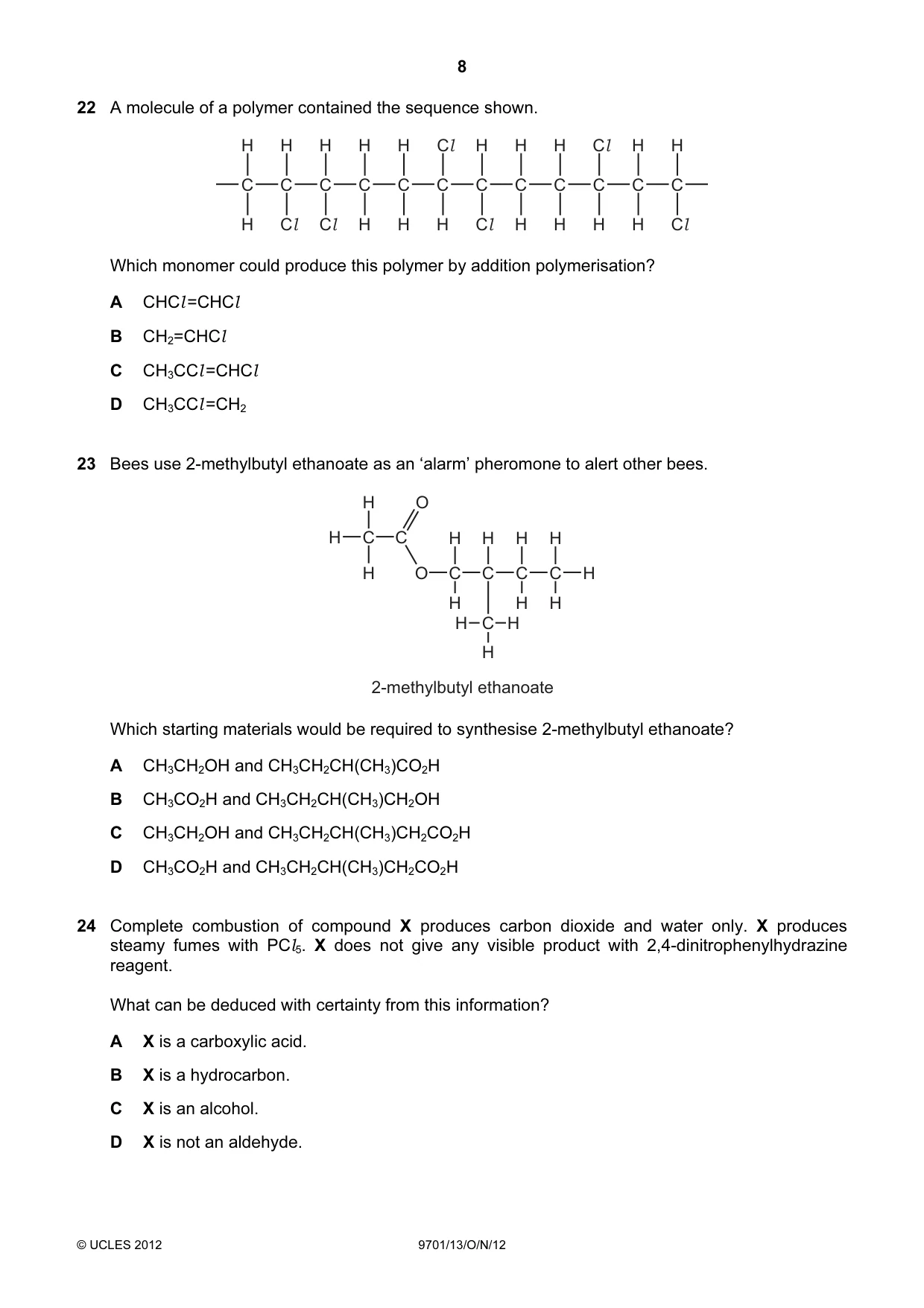
22 A molecule of a polymer contained the sequence shown. H H H H H Cl H H H Cl H H C C C C C C C C C C C C H Cl Cl H H H Cl H H H H Cl Which monomer could produce this polymer by addition polymerisation? A CHCl =CHCl B CH2=CHCl C CH3CCl =CHCl D CH3CCl =CH2
Mark scheme: B
Q23 · Bees use 2-methylbutyl ethanoate as an ‘alarm’ pheromone to alert other bees
23 Bees use 2-methylbutyl ethanoate as an ‘alarm’ pheromone to alert other bees. H O H C C H H H H H O C C C C H H H H H C H H 2-methylbutyl ethanoate Which starting materials would be required to synthesise 2-methylbutyl ethanoate? A CH3CH2OH and CH3CH2CH(CH3)CO2H B CH3CO2H and CH3CH2CH(CH3)CH2OH C CH3CH2OH and CH3CH2CH(CH3)CH2CO2H D CH3CO2H and CH3CH2CH(CH3)CH2CO2H
Mark scheme: B
Q24 · Complete combustion of compound X produces carbon dioxide and water only
24 Complete combustion of compound X produces carbon dioxide and water only. X produces steamy fumes with PCl5. X does not give any visible product with 2,4-dinitrophenylhydrazine reagent. What can be deduced with certainty from this information? A X is a carboxylic acid. B X is a hydrocarbon. C X is an alcohol. D X is not an aldehyde.
Mark scheme: D
Q25 · Use of the Data Booklet is relevant to this question
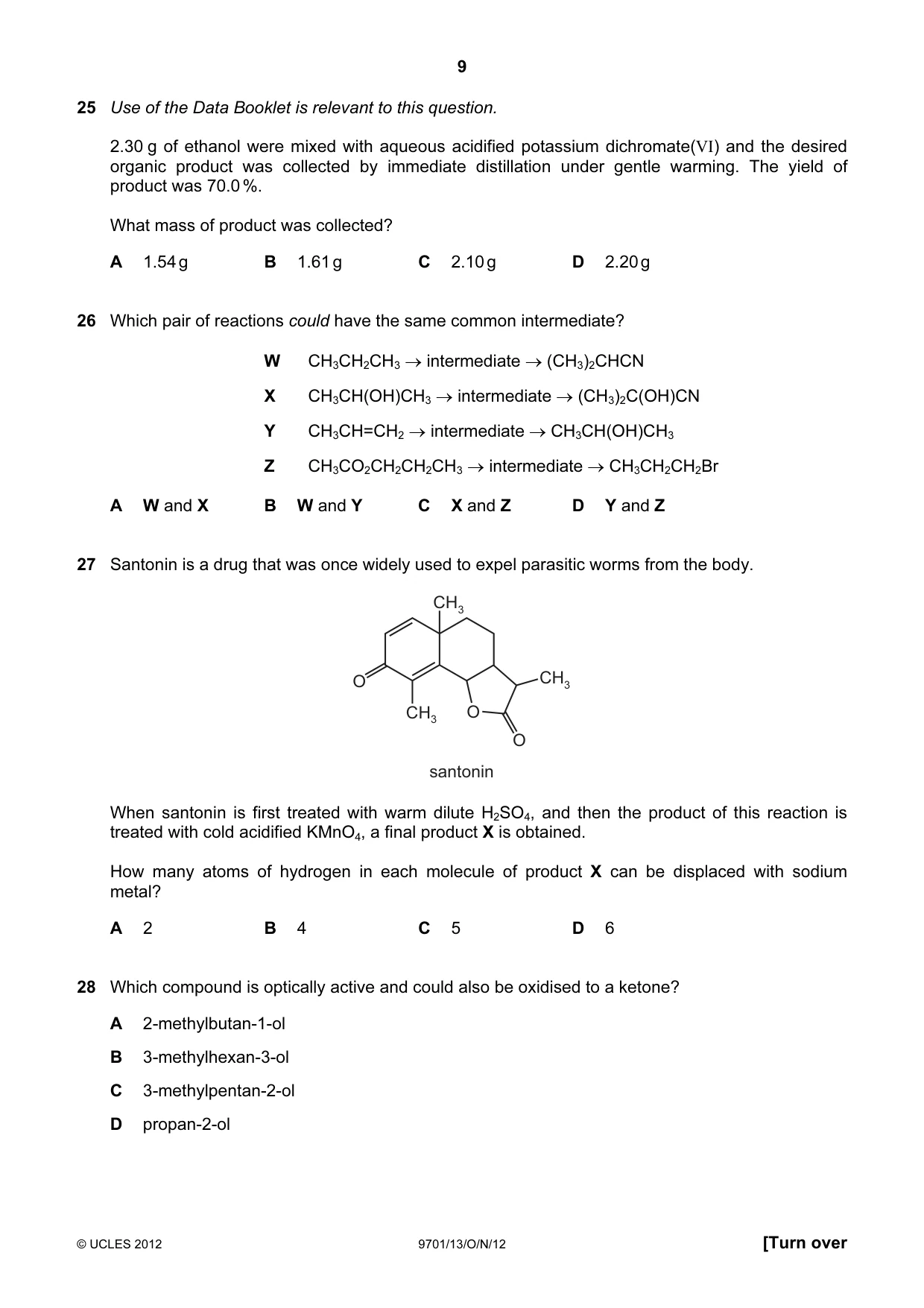
25 Use of the Data Booklet is relevant to this question. 2.30 g of ethanol were mixed with aqueous acidified potassium dichromate(VI) and the desired organic product was collected by immediate distillation under gentle warming. The yield of product was 70.0 %. What mass of product was collected? A 1.54 g B 1.61 g C 2.10 g D 2.20 g
Mark scheme: A
More questions on Reacting masses and volumes (of solutions and gases)
Q26 · Which pair of reactions could have the same common intermediate?
26 Which pair of reactions could have the same common intermediate? W CH3CH2CH3 → intermediate → (CH3)2CHCN X CH3CH(OH)CH3 → intermediate → (CH3)2C(OH)CN Y CH3CH=CH2 → intermediate → CH3CH(OH)CH3 Z CH3CO2CH2CH2CH3 → intermediate → CH3CH2CH2Br A W and X B W and Y C X and Z D Y and Z
Mark scheme: B
Q27 · Santonin is a drug that was once widely used to expel parasitic worms from the body
27 Santonin is a drug that was once widely used to expel parasitic worms from the body. CH3 O CH3 CH3 O O santonin When santonin is first treated with warm dilute H2SO4, and then the product of this reaction is treated with cold acidified KMnO4, a final product X is obtained. How many atoms of hydrogen in each molecule of product X can be displaced with sodium metal? A 2 B 4 C 5 D 6
Mark scheme: D
Q28 · Which compound is optically active and could also be oxidised to a ketone?
28 Which compound is optically active and could also be oxidised to a ketone? A 2-methylbutan-1-ol B 3-methylhexan-3-ol C 3-methylpentan-2-ol D propan-2-ol
Mark scheme: C
Q29 · What is the skeletal formula of 2-methylpentan-1-ol?
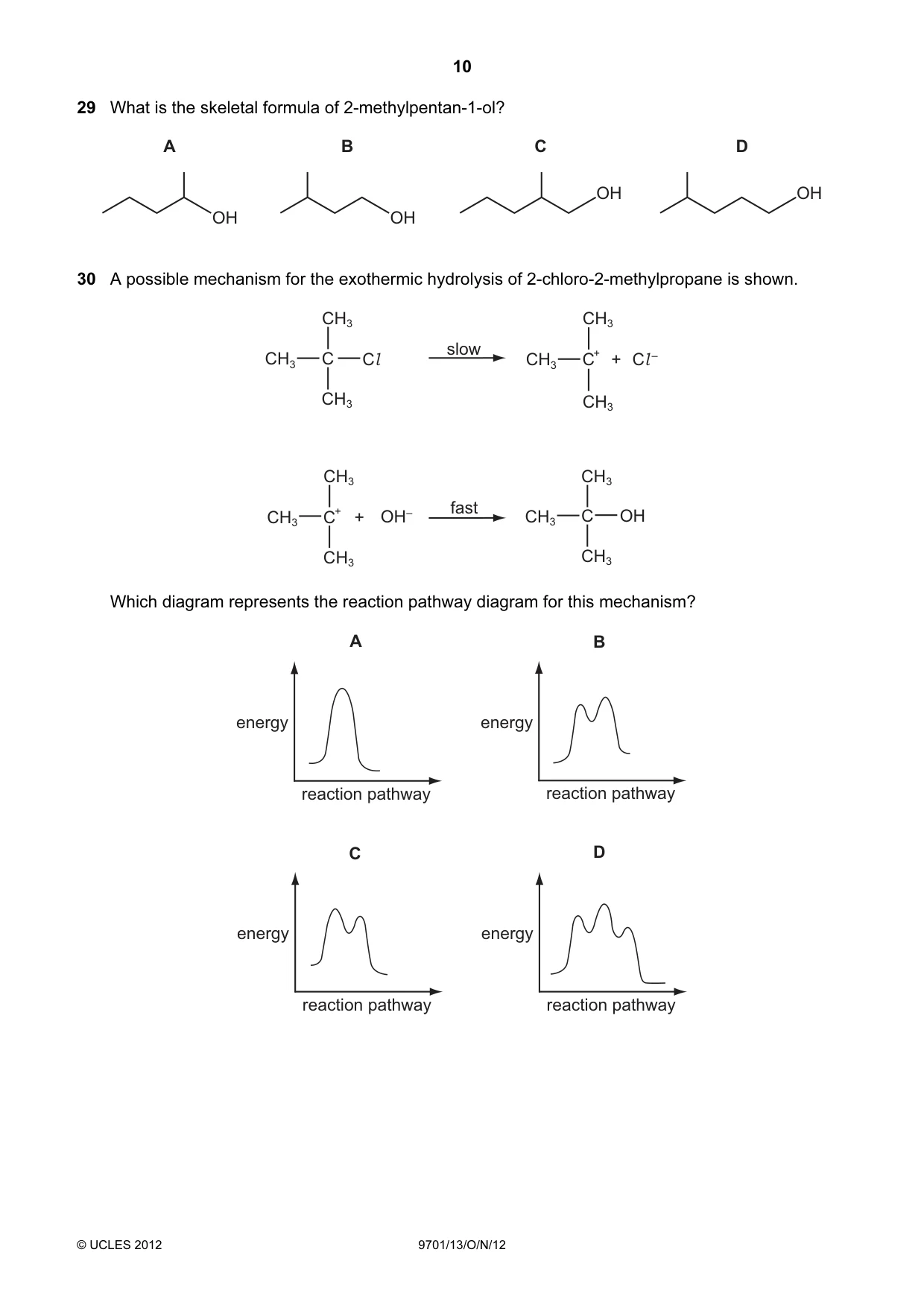
29 What is the skeletal formula of 2-methylpentan-1-ol? A B C D OH OH OH OH
Mark scheme: C
More questions on Formulas, functional groups and the naming of organic compounds
Q30 · A possible mechanism for the exothermic hydrolysis of 2-chloro-2-methylpropane is shown
30 A possible mechanism for the exothermic hydrolysis of 2-chloro-2-methylpropane is shown. CH3 CH3 slow + CH3 C Cl CH3 C + Cl – CH3 CH3 CH3 CH3 + OH– fast CH3 C + CH3 C OH CH3 CH3 Which diagram represents the reaction pathway diagram for this mechanism? A B energy energy reaction pathway reaction pathway C D energy energy reaction pathway reaction pathway
Mark scheme: C
Q31 · How may nitrogen exist in compounds?
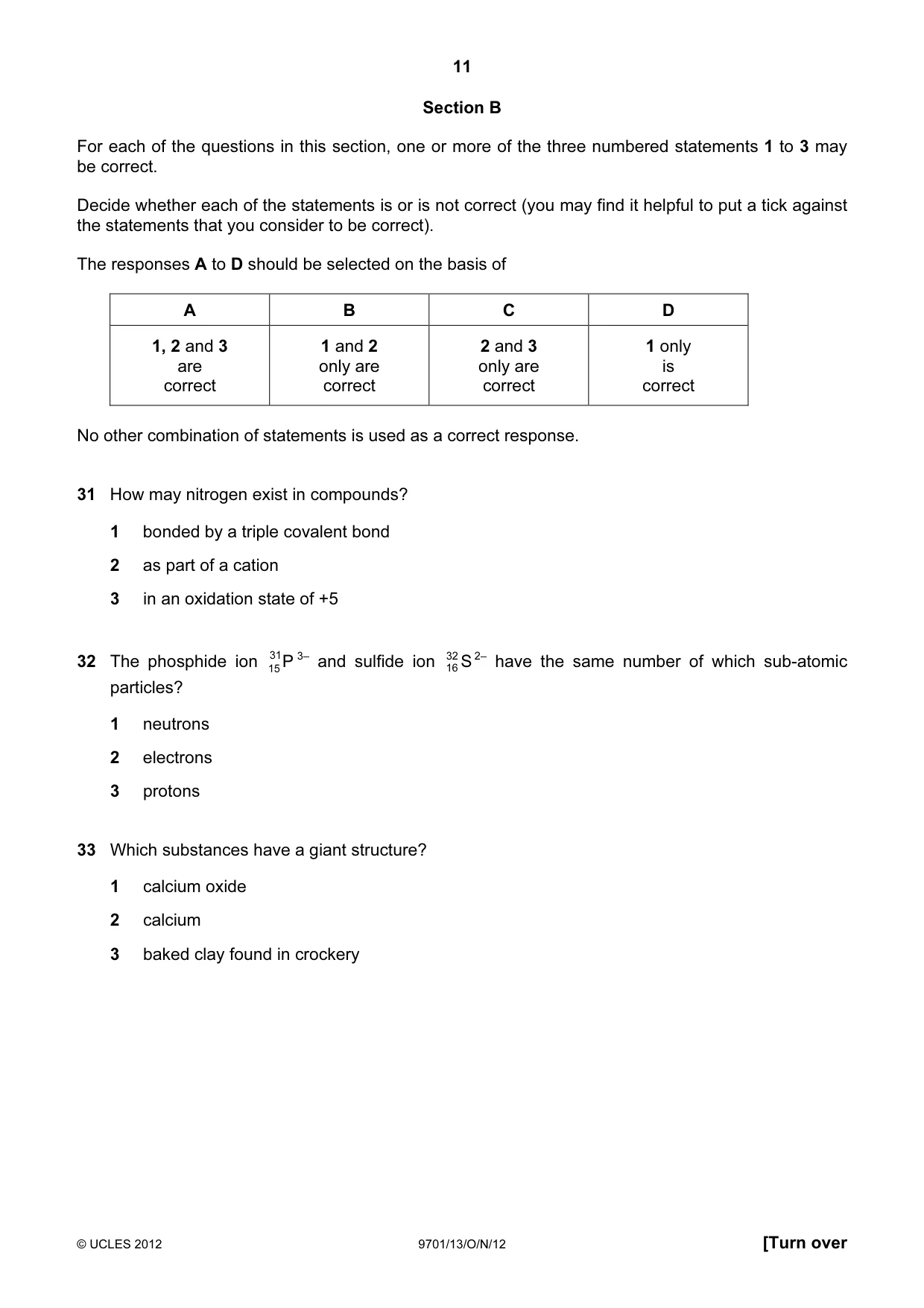
31 How may nitrogen exist in compounds? 1 bonded by a triple covalent bond 2 as part of a cation 3 in an oxidation state of +5
Mark scheme: A
Q32 · The phosphide ion 31 P 3– and sulfide ion 32 S 2– have the same number of which…
32 The phosphide ion 31 P 3– and sulfide ion 32 S 2– have the same number of which sub-atomic 15 16 particles? 1 neutrons 2 electrons 3 protons
Mark scheme: B
Q33 · Which substances have a giant structure?
33 Which substances have a giant structure? 1 calcium oxide 2 calcium 3 baked clay found in crockery
Mark scheme: A
Q34 · An element X and compound YZ react separately with acid as shown
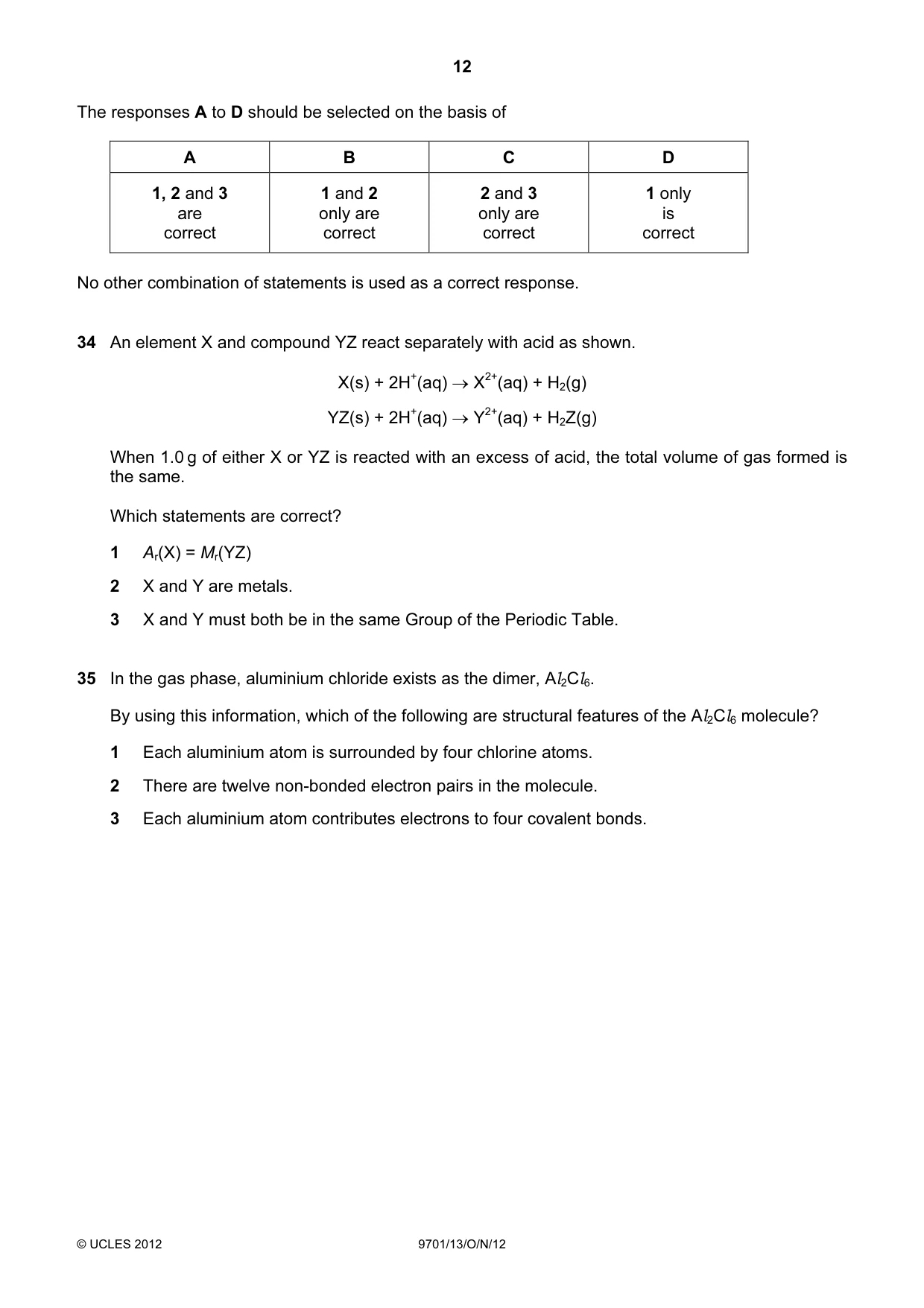
34 An element X and compound YZ react separately with acid as shown. X(s) + 2H+(aq) → X2+(aq) + H2(g) YZ(s) + 2H+(aq) → Y2+(aq) + H2Z(g) When 1.0 g of either X or YZ is reacted with an excess of acid, the total volume of gas formed is the same. Which statements are correct? 1 Ar(X) = Mr(YZ) 2 X and Y are metals. 3 X and Y must both be in the same Group of the Periodic Table.
Mark scheme: B
More questions on Reacting masses and volumes (of solutions and gases)
Q35 · In the gas phase, aluminium chloride exists as the dimer, Al2Cl6
35 In the gas phase, aluminium chloride exists as the dimer, Al2Cl6. By using this information, which of the following are structural features of the Al2Cl6 molecule? 1 Each aluminium atom is surrounded by four chlorine atoms. 2 There are twelve non-bonded electron pairs in the molecule. 3 Each aluminium atom contributes electrons to four covalent bonds.
Mark scheme: D
More questions on Covalent bonding and coordinate (dative covalent) bonding
Q36 · The table describes some of the chemistry and thermodynamic properties of the halogens
36 The table describes some of the chemistry and thermodynamic properties of the halogens. name and process symbol of quantity 2HX(g) → H2(g) + X2(g) enthalpy change of reaction, H2(g) + X2(g) 2HX(g) equilibrium constant, Kp X(g) → X+(g) + e– ionisation energy, Which statements about the relative values of these quantities are correct? 1 for HCl > for HBr 2 Kp for HBr > Kp for HI 3 for I > for Cl
Mark scheme: B
More questions on The chemical properties of the halogen elements and the hydrogen halides
Q37 · Chloroethane can be formed from bromoethane in two steps
37 Chloroethane can be formed from bromoethane in two steps. step X step Y C2H5Br C2H5OH C2H5Cl Which statements about these steps are correct? 1 Hot aqueous sodium hydroxide is the reagent in step X. 2 SOCl 2 is the reagent in step Y. 3 Step X is a substitution reaction.
Mark scheme: A
Q38 · Which pairs of reagents will react together in a redox reaction?
38 Which pairs of reagents will react together in a redox reaction? 1 CH3CHO + Fehling’s reagent 2 CH4 + Cl 2 3 CH3COCH3 + Tollens’ reagent
Mark scheme: B
Q39 · An organic compound, X, will react with calcium metal to produce a salt with the…
39 An organic compound, X, will react with calcium metal to produce a salt with the empirical formula CaC4H4O4. What could be the identity of X? 1 ethanoic acid 2 butanedioic acid 3 2-methylpropanedioic acid
Mark scheme: C
Q40 · Which changes in bonding occur during the reaction of ethanal and hydrogen cyanide?
40 Which changes in bonding occur during the reaction of ethanal and hydrogen cyanide? 1 A carbon-carbon bond is formed. 2 A carbon-hydrogen bond is broken. 3 A carbon-nitrogen bond is broken.
Mark scheme: B
What was in this paper
The subtopics covered by these 40 questions, and how many questions each got. Open one in a new tab to see every Cambridge question on it.
4Redox processes: electron transfer and changes in oxidation number (oxidation state)3Carboxylic acids2Covalent bonding and coordinate (dative covalent) bonding2Enthalpy change, ΔH2Esters2Particles in the atom and atomic radius2Periodicity of chemical properties of the elements in Period 32Shapes of organic molecules; σ and π bonds2The gaseous state: ideal and real gases and pV = nRT2Addition polymerisation1Alcohols1Bonding and structure1Effect of temperature on reaction rates and the concept of activation energy1Electrolysis1Formulas, functional groups and the naming of organic compounds1General physical and chemical properties of the first row of transition elements, titanium to copper1Halogen compounds1Halogenoalkanes1Intermolecular forces, electronegativity and bond properties1Ionisation energy1Isomerism: optical1Nitriles and hydroxynitriles1Organic synthesis1Shapes of molecules1Similarities and trends in the properties of the Group 2 metals, magnesium to barium, and their compounds1The chemical properties of the halogen elements and the hydrogen halides1What you needed in this session
Cambridge’s own grade thresholds for 2012 Oct/Nov, Paper 1 · Variant 3. A higher threshold means an easier paper — the bar moves with how the cohort did.