Cambridge A Level Chemistry 9701 — 2015 Oct/Nov Paper 1 · Variant 2
9701/12/O/N/15 · 40 questions · 40 marks · ≈45 min
The question paper and its mark scheme, free to read here and free to download. This is Cambridge’s own paper, exactly as it was sat.
Question paper16 pages

Mark scheme2 pages
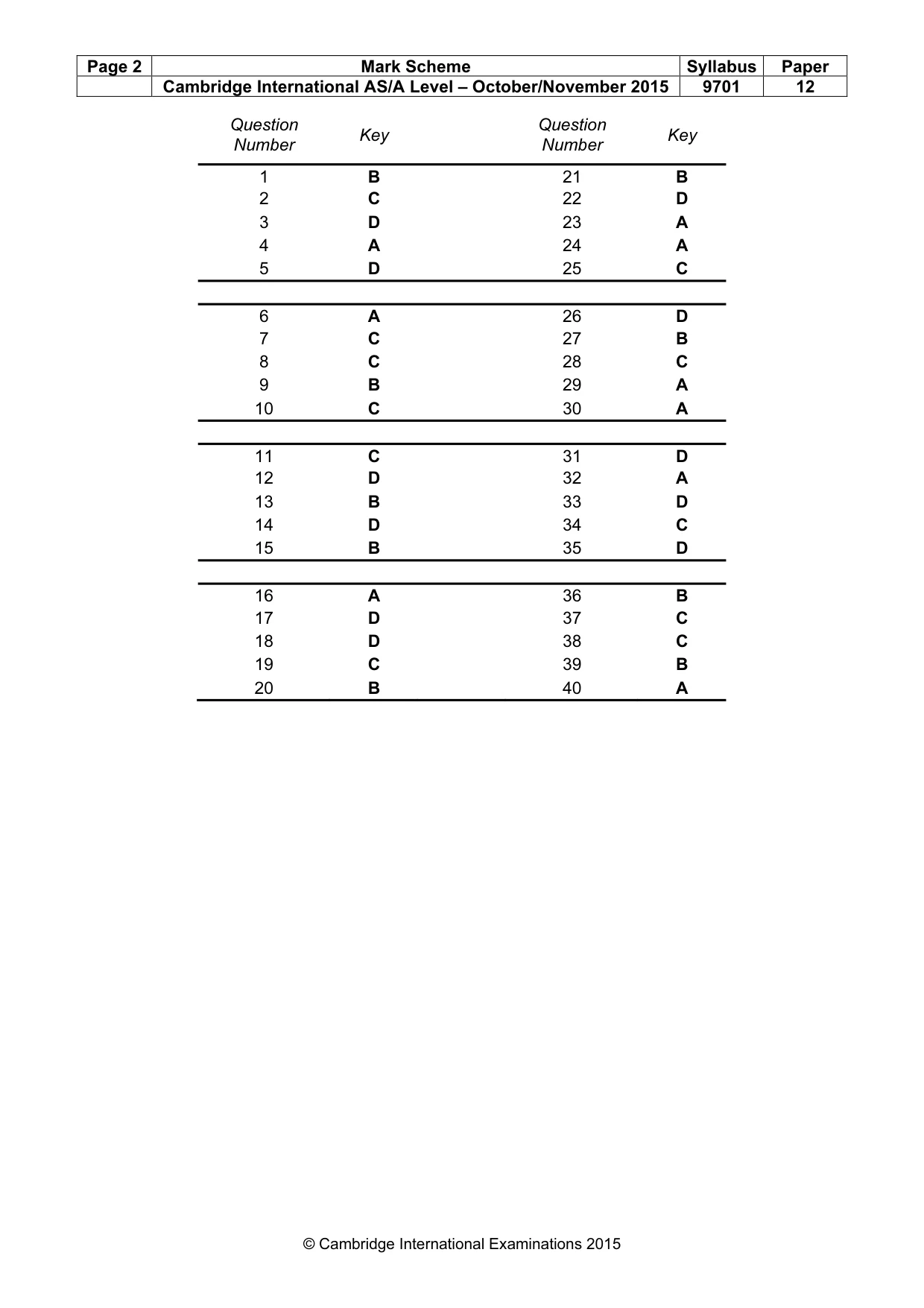
Answers below. Sit the paper first if you are practising.
Questions as text
Q1 · Which type of bonding is never found in elements?
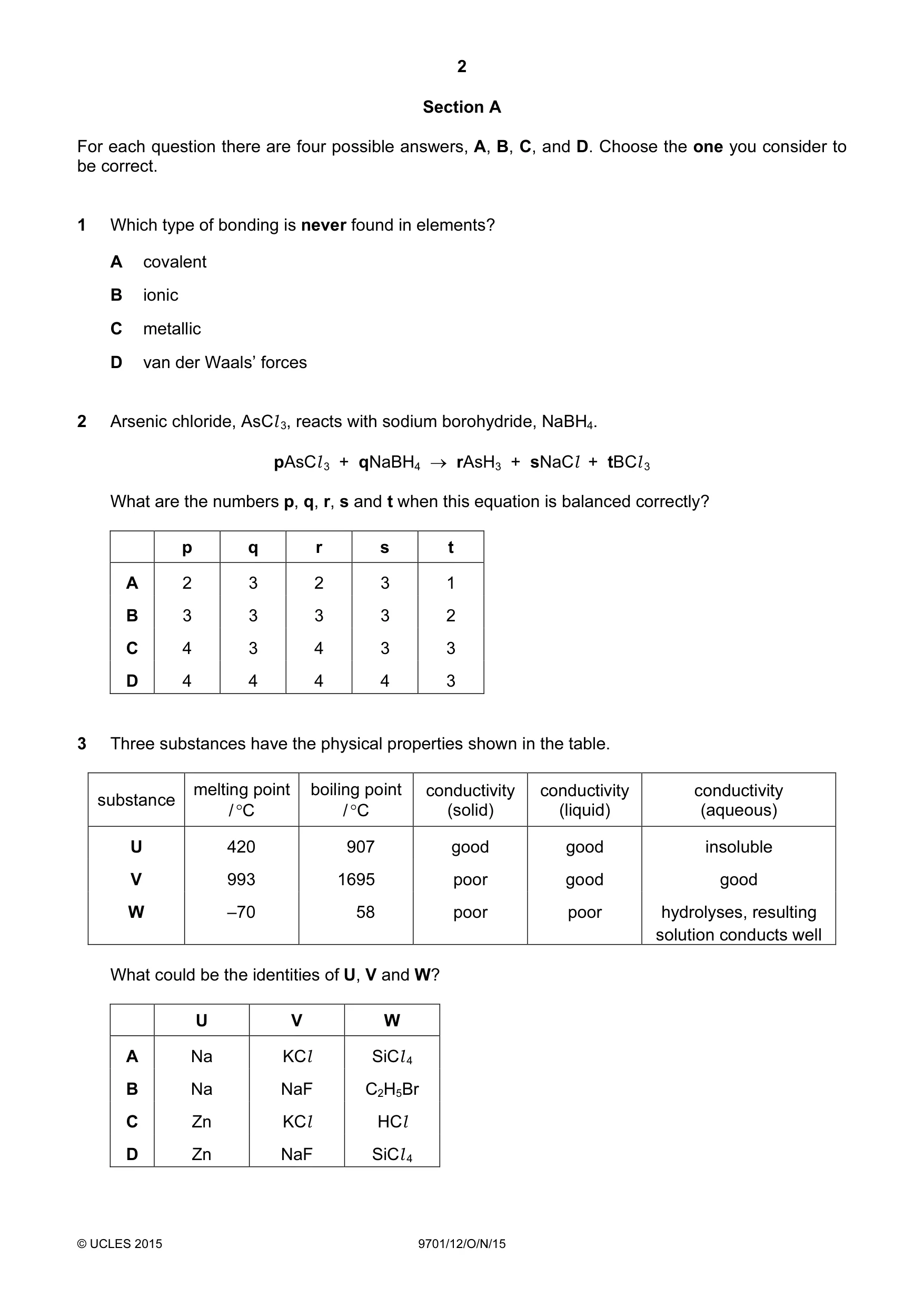
1 Which type of bonding is never found in elements? A covalent B ionic C metallic D van der Waals’ forces
Q2 · Arsenic chloride, AsCl 3, reacts with sodium borohydride, NaBH4
2 Arsenic chloride, AsCl 3, reacts with sodium borohydride, NaBH4. pAsCl 3 + qNaBH4 → rAsH3 + sNaCl + tBCl 3 What are the numbers p, q, r, s and t when this equation is balanced correctly? p q r s t A 2 3 2 3 1 B 3 3 3 3 2 C 4 3 4 3 3 D 4 4 4 4 3
Q3 · Three substances have the physical properties shown in the table
3 Three substances have the physical properties shown in the table. melting point boiling point conductivity conductivity conductivity substance / °C / °C (solid) (liquid) (aqueous) U 420 907 good good insoluble V 993 1695 poor good good W –70 58 poor poor hydrolyses, resulting solution conducts well What could be the identities of U, V and W? U V W A Na KCl SiCl 4 B Na NaF C2H5Br C Zn KCl HCl D Zn NaF SiCl 4
Q4 · Flask X contains 5 dm3 of helium at 12 kPa pressure and flask Y contains 10 dm3 of neon…
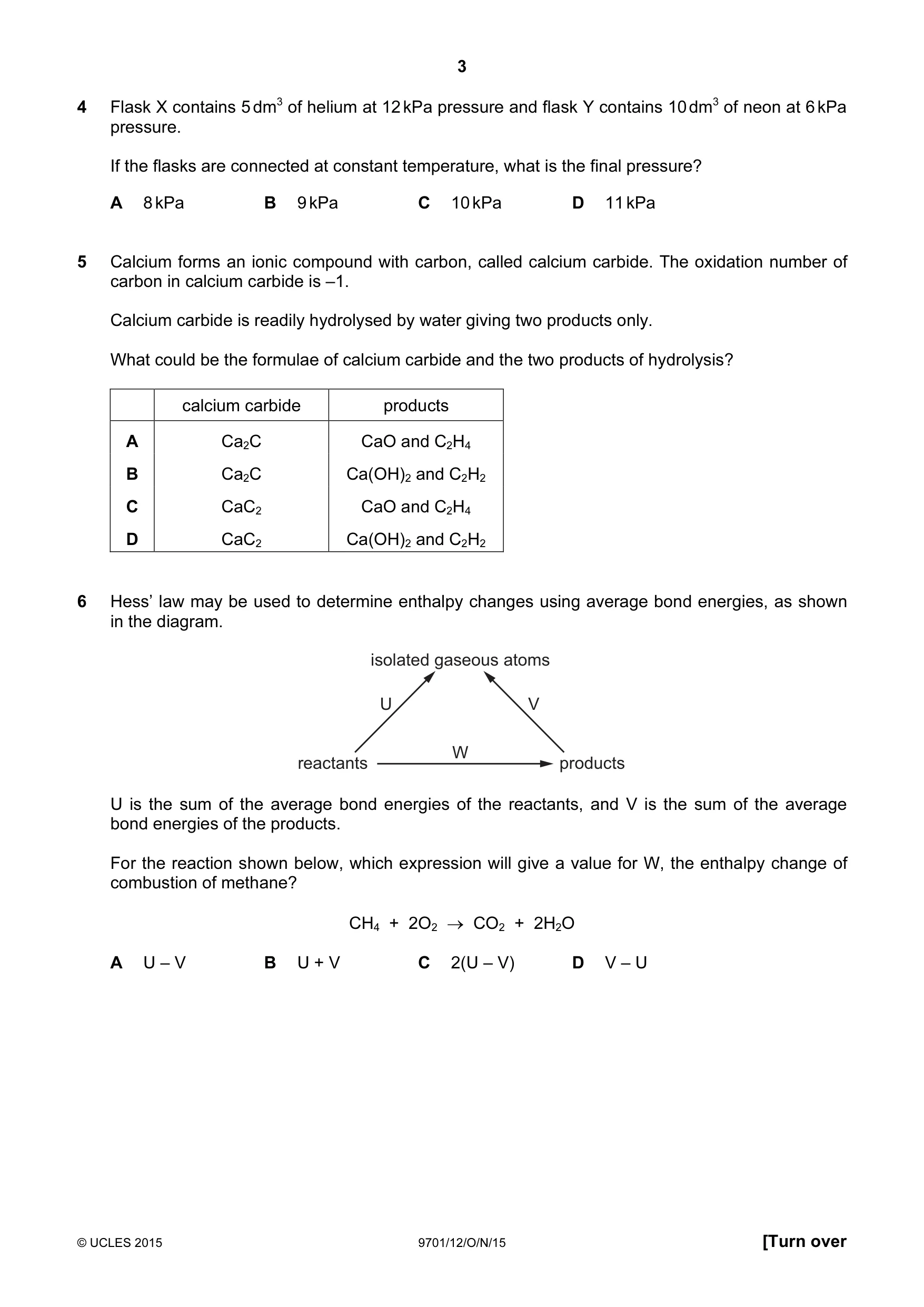
4 Flask X contains 5 dm3 of helium at 12 kPa pressure and flask Y contains 10 dm3 of neon at 6 kPa pressure. If the flasks are connected at constant temperature, what is the final pressure? A 8 kPa B 9 kPa C 10 kPa D 11 kPa
More questions on The gaseous state: ideal and real gases and pV = nRT
Q5 · Calcium forms an ionic compound with carbon, called calcium carbide
5 Calcium forms an ionic compound with carbon, called calcium carbide. The oxidation number of carbon in calcium carbide is –1. Calcium carbide is readily hydrolysed by water giving two products only. What could be the formulae of calcium carbide and the two products of hydrolysis? calcium carbide products A Ca2C CaO and C2H4 B Ca2C Ca(OH)2 and C2H2 C CaC2 CaO and C2H4 D CaC2 Ca(OH)2 and C2H2
Q6 · Hess’ law may be used to determine enthalpy changes using average bond energies, as shown…
6 Hess’ law may be used to determine enthalpy changes using average bond energies, as shown in the diagram. isolated gaseous atoms U V W reactants products U is the sum of the average bond energies of the reactants, and V is the sum of the average bond energies of the products. For the reaction shown below, which expression will give a value for W, the enthalpy change of combustion of methane? CH4 + 2O2 → CO2 + 2H2O A U – V B U + V C 2(U – V) D V – U
Q7 · The process of electrolysis can be used to purify copper, and to extract aluminium from…
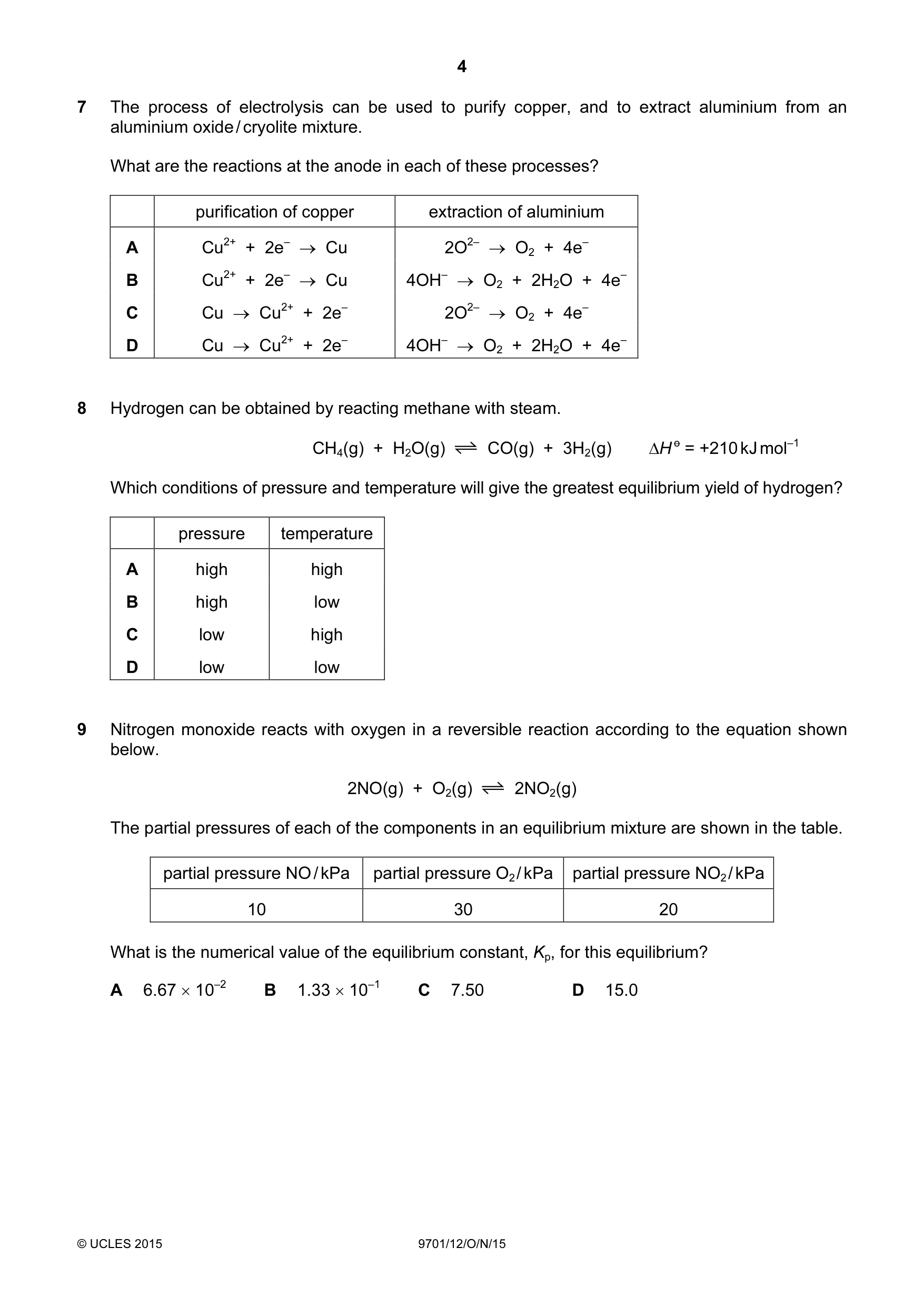
7 The process of electrolysis can be used to purify copper, and to extract aluminium from an aluminium oxide / cryolite mixture. What are the reactions at the anode in each of these processes? purification of copper extraction of aluminium A Cu2+ + 2e– → Cu 2O2– → O2 + 4e– B Cu2+ + 2e– → Cu 4OH– → O2 + 2H2O + 4e– C Cu → Cu2+ + 2e– 2O2– → O2 + 4e– D Cu → Cu2+ + 2e– 4OH– → O2 + 2H2O + 4e–
Q8 · Hydrogen can be obtained by reacting methane with steam
8 Hydrogen can be obtained by reacting methane with steam. CH4(g) + H2O(g) CO(g) + 3H2(g) ΔH o = +210 kJ mol–1 Which conditions of pressure and temperature will give the greatest equilibrium yield of hydrogen? pressure temperature A high high B high low C low high D low low
More questions on Chemical equilibria: reversible reactions, dynamic equilibrium
Q9 · Nitrogen monoxide reacts with oxygen in a reversible reaction according to the equation…
9 Nitrogen monoxide reacts with oxygen in a reversible reaction according to the equation shown below. 2NO(g) + O2(g) 2NO2(g) The partial pressures of each of the components in an equilibrium mixture are shown in the table. partial pressure NO / kPa partial pressure O2 / kPa partial pressure NO2 / kPa 10 30 20 What is the numerical value of the equilibrium constant, Kp, for this equilibrium? A 6.67 × 10⁻² B 1.33 × 10⁻¹ C 7.50 D 15.0
More questions on Chemical equilibria: reversible reactions, dynamic equilibrium
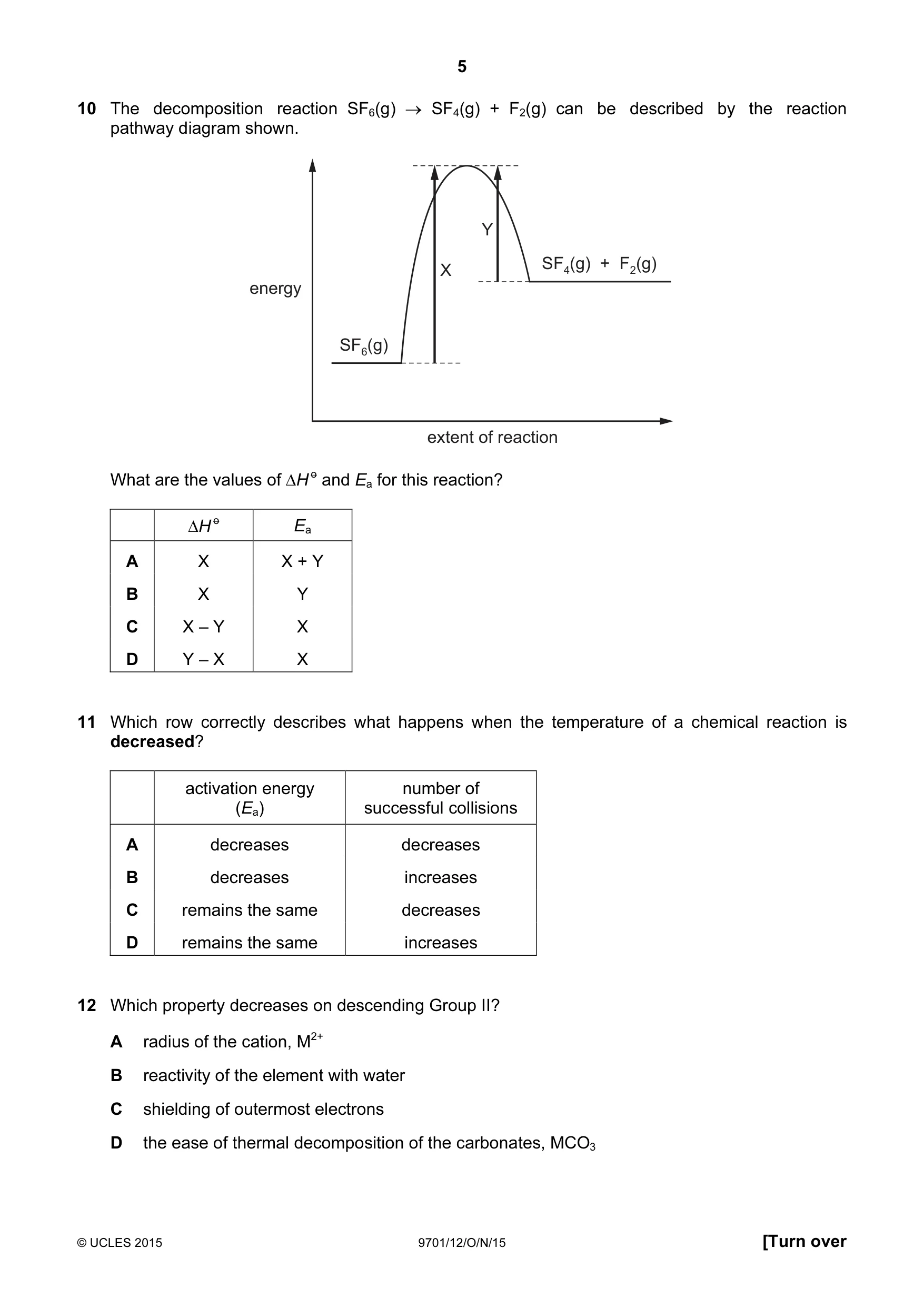
Q10 · The decomposition reaction SF6(g) → SF4(g) + F2(g) can be described by the reaction…
10 The decomposition reaction SF6(g) → SF4(g) + F2(g) can be described by the reaction pathway diagram shown. Y SF4(g) + F2(g) X energy SF6(g) extent of reaction What are the values of ΔH o and Ea for this reaction? ΔH o Ea A X X + Y B X Y C X – Y X D Y – X X
More questions on Effect of temperature on reaction rates and the concept of activation energy
Q11 · Which row correctly describes what happens when the temperature of a chemical reaction is…
11 Which row correctly describes what happens when the temperature of a chemical reaction is decreased? activation energy number of (Ea) successful collisions A decreases decreases B decreases increases C remains the same decreases D remains the same increases
More questions on Effect of temperature on reaction rates and the concept of activation energy
Q12 · Which property decreases on descending Group II?
12 Which property decreases on descending Group II? A radius of the cation, M2+ B reactivity of the element with water C shielding of outermost electrons D the ease of thermal decomposition of the carbonates, MCO3
Q13 · Use of the Data Booklet is relevant to this question
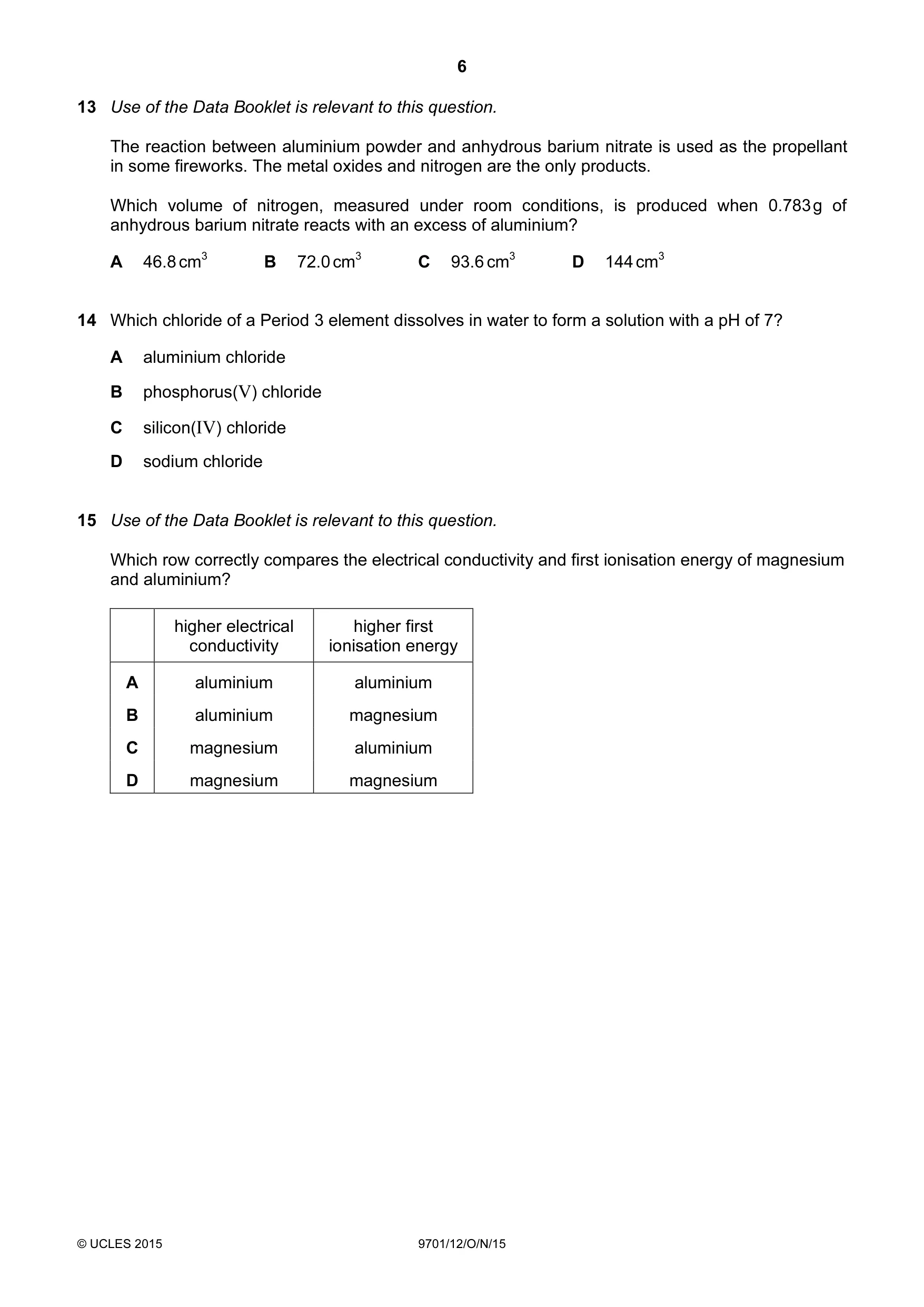
13 Use of the Data Booklet is relevant to this question. The reaction between aluminium powder and anhydrous barium nitrate is used as the propellant in some fireworks. The metal oxides and nitrogen are the only products. Which volume of nitrogen, measured under room conditions, is produced when 0.783 g of anhydrous barium nitrate reacts with an excess of aluminium? A 46.8 cm3 B 72.0 cm3 C 93.6 cm3 D 144 cm3
More questions on Reacting masses and volumes (of solutions and gases)
Q14 · Which chloride of a Period 3 element dissolves in water to form a solution with a pH of 7?
14 Which chloride of a Period 3 element dissolves in water to form a solution with a pH of 7? A aluminium chloride B phosphorus(V) chloride C silicon(IV) chloride D sodium chloride
More questions on Periodicity of chemical properties of the elements in Period 3
Q15 · Use of the Data Booklet is relevant to this question
15 Use of the Data Booklet is relevant to this question. Which row correctly compares the electrical conductivity and first ionisation energy of magnesium and aluminium? higher electrical higher first conductivity ionisation energy A aluminium aluminium B aluminium magnesium C magnesium aluminium D magnesium magnesium
Q16 · Use of the Data Booklet is relevant to this question
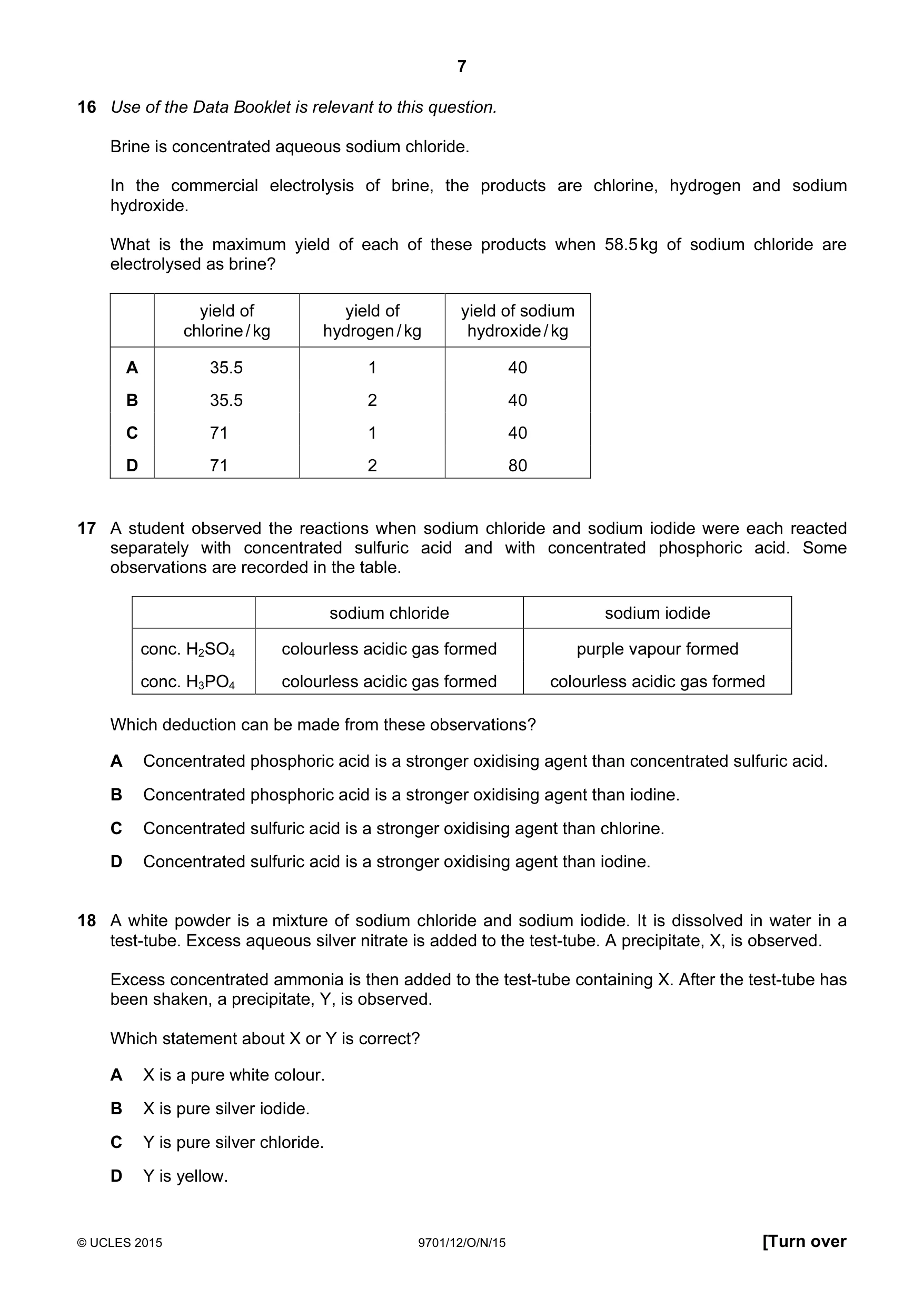
16 Use of the Data Booklet is relevant to this question. Brine is concentrated aqueous sodium chloride. In the commercial electrolysis of brine, the products are chlorine, hydrogen and sodium hydroxide. What is the maximum yield of each of these products when 58.5 kg of sodium chloride are electrolysed as brine? yield of yield of yield of sodium chlorine / kg hydrogen / kg hydroxide / kg A 35.5 1 40 B 35.5 2 40 C 71 1 40 D 71 2 80
Q17 · A student observed the reactions when sodium chloride and sodium iodide were each reacted…
17 A student observed the reactions when sodium chloride and sodium iodide were each reacted separately with concentrated sulfuric acid and with concentrated phosphoric acid. Some observations are recorded in the table. sodium chloride sodium iodide conc. H2SO4 colourless acidic gas formed purple vapour formed conc. H3PO4 colourless acidic gas formed colourless acidic gas formed Which deduction can be made from these observations? A Concentrated phosphoric acid is a stronger oxidising agent than concentrated sulfuric acid. B Concentrated phosphoric acid is a stronger oxidising agent than iodine. C Concentrated sulfuric acid is a stronger oxidising agent than chlorine. D Concentrated sulfuric acid is a stronger oxidising agent than iodine.
More questions on The chemical properties of the halogen elements and the hydrogen halides
Q18 · A white powder is a mixture of sodium chloride and sodium iodide
18 A white powder is a mixture of sodium chloride and sodium iodide. It is dissolved in water in a test-tube. Excess aqueous silver nitrate is added to the test-tube. A precipitate, X, is observed. Excess concentrated ammonia is then added to the test-tube containing X. After the test-tube has been shaken, a precipitate, Y, is observed. Which statement about X or Y is correct? A X is a pure white colour. B X is pure silver iodide. C Y is pure silver chloride. D Y is yellow.
Q19 · Use of the Data Booklet is relevant to this question
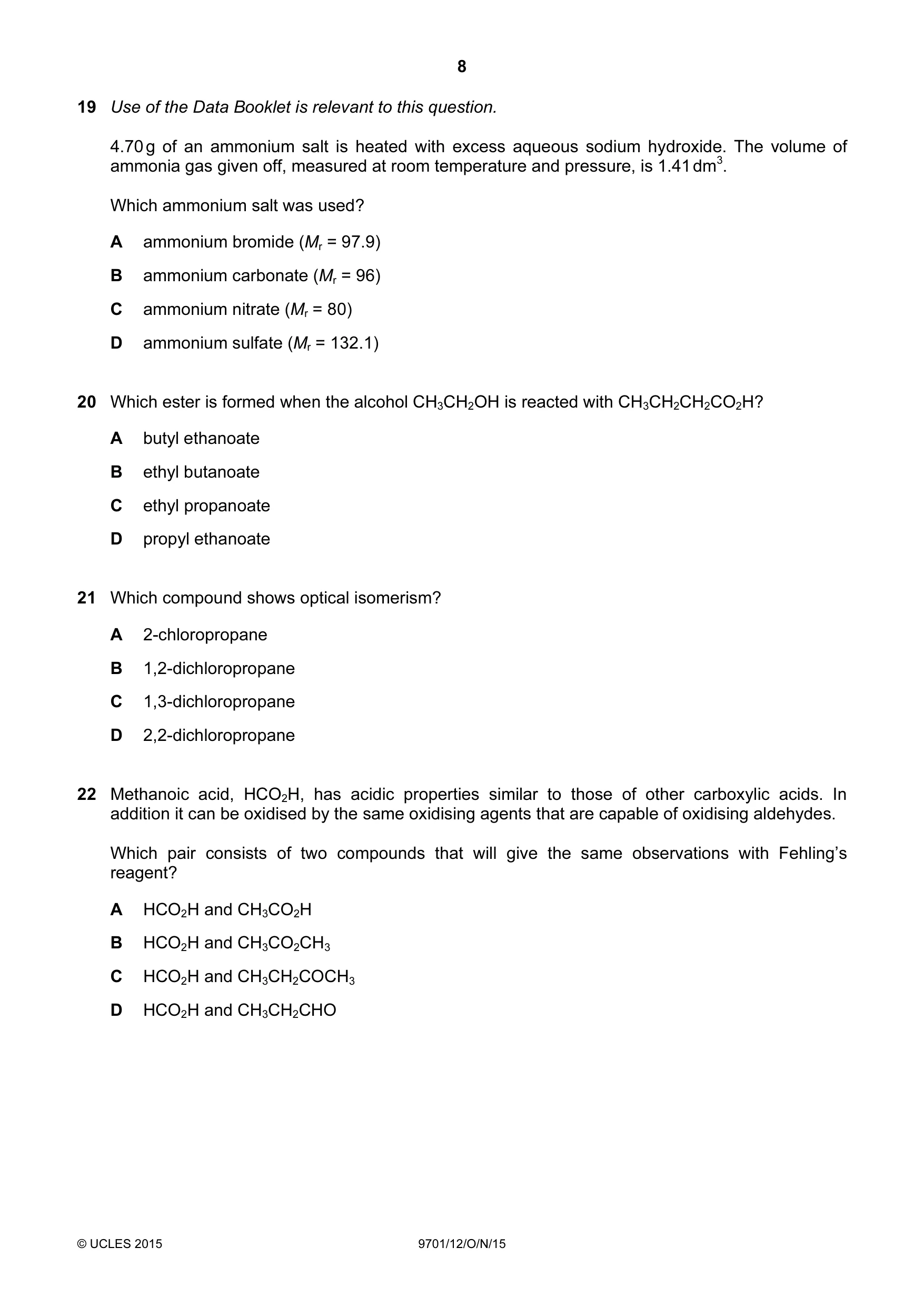
19 Use of the Data Booklet is relevant to this question. 4.70 g of an ammonium salt is heated with excess aqueous sodium hydroxide. The volume of ammonia gas given off, measured at room temperature and pressure, is 1.41 dm3. Which ammonium salt was used? A ammonium bromide (Mr = 97.9) B ammonium carbonate (Mr = 96) C ammonium nitrate (Mr = 80) D ammonium sulfate (Mr = 132.1)
More questions on Reacting masses and volumes (of solutions and gases)
Q20 · Which ester is formed when the alcohol CH3CH2OH is reacted with CH3CH2CH2CO2H?
20 Which ester is formed when the alcohol CH3CH2OH is reacted with CH3CH2CH2CO2H? A butyl ethanoate B ethyl butanoate C ethyl propanoate D propyl ethanoate
Q21 · Which compound shows optical isomerism?
21 Which compound shows optical isomerism? A 2-chloropropane B 1,2-dichloropropane C 1,3-dichloropropane D 2,2-dichloropropane
More questions on Isomerism: structural isomerism and stereoisomerism
Q22 · Methanoic acid, HCO2H, has acidic properties similar to those of other carboxylic acids
22 Methanoic acid, HCO2H, has acidic properties similar to those of other carboxylic acids. In addition it can be oxidised by the same oxidising agents that are capable of oxidising aldehydes. Which pair consists of two compounds that will give the same observations with Fehling’s reagent? A HCO2H and CH3CO2H B HCO2H and CH3CO2CH3 C HCO2H and CH3CH2COCH3 D HCO2H and CH3CH2CHO
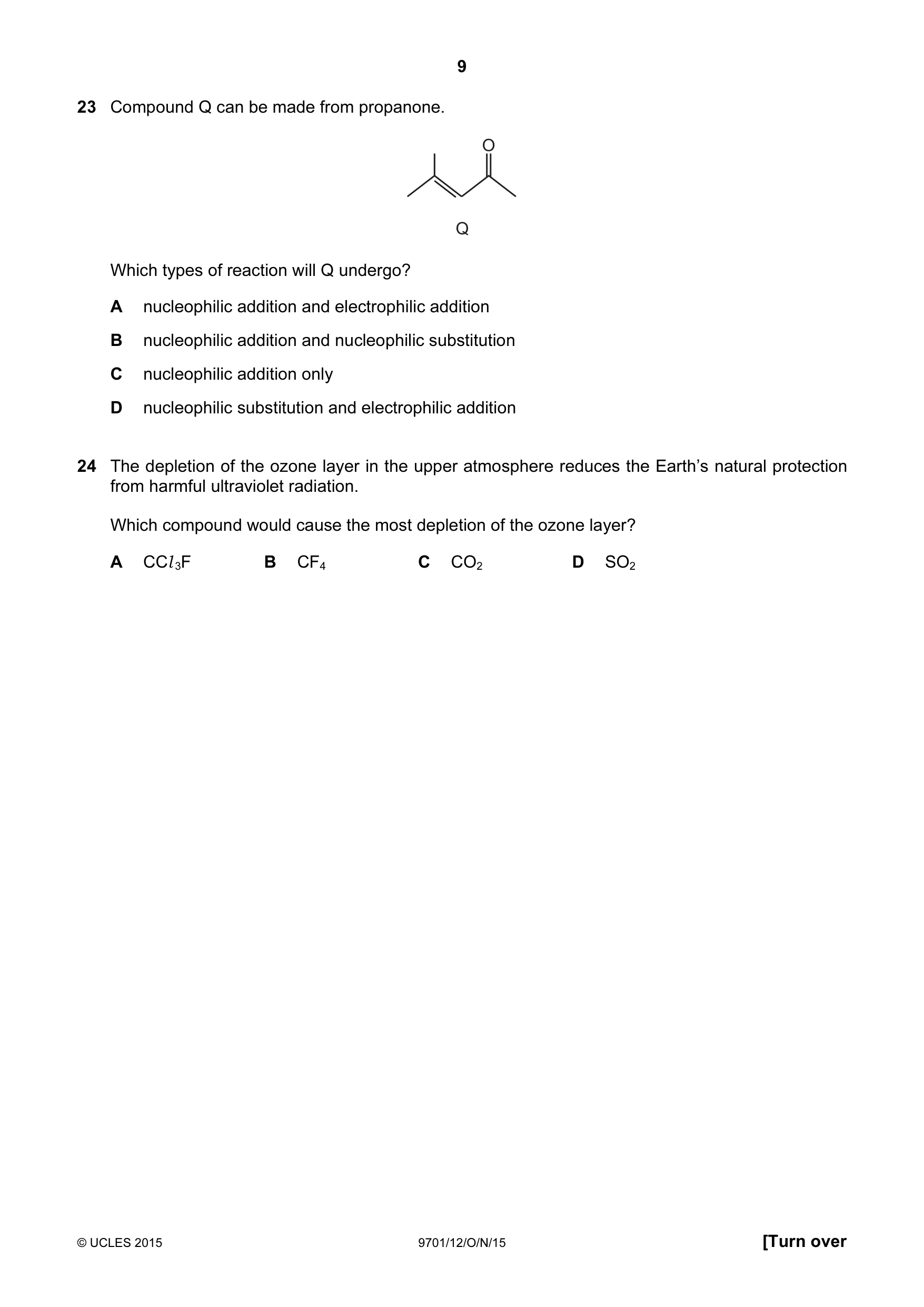
Q23 · Compound Q can be made from propanone
23 Compound Q can be made from propanone. O Q Which types of reaction will Q undergo? A nucleophilic addition and electrophilic addition B nucleophilic addition and nucleophilic substitution C nucleophilic addition only D nucleophilic substitution and electrophilic addition
Q24 · The depletion of the ozone layer in the upper atmosphere reduces the Earth’s natural…
24 The depletion of the ozone layer in the upper atmosphere reduces the Earth’s natural protection from harmful ultraviolet radiation. Which compound would cause the most depletion of the ozone layer? A CCl 3F B CF4 C CO2 D SO2
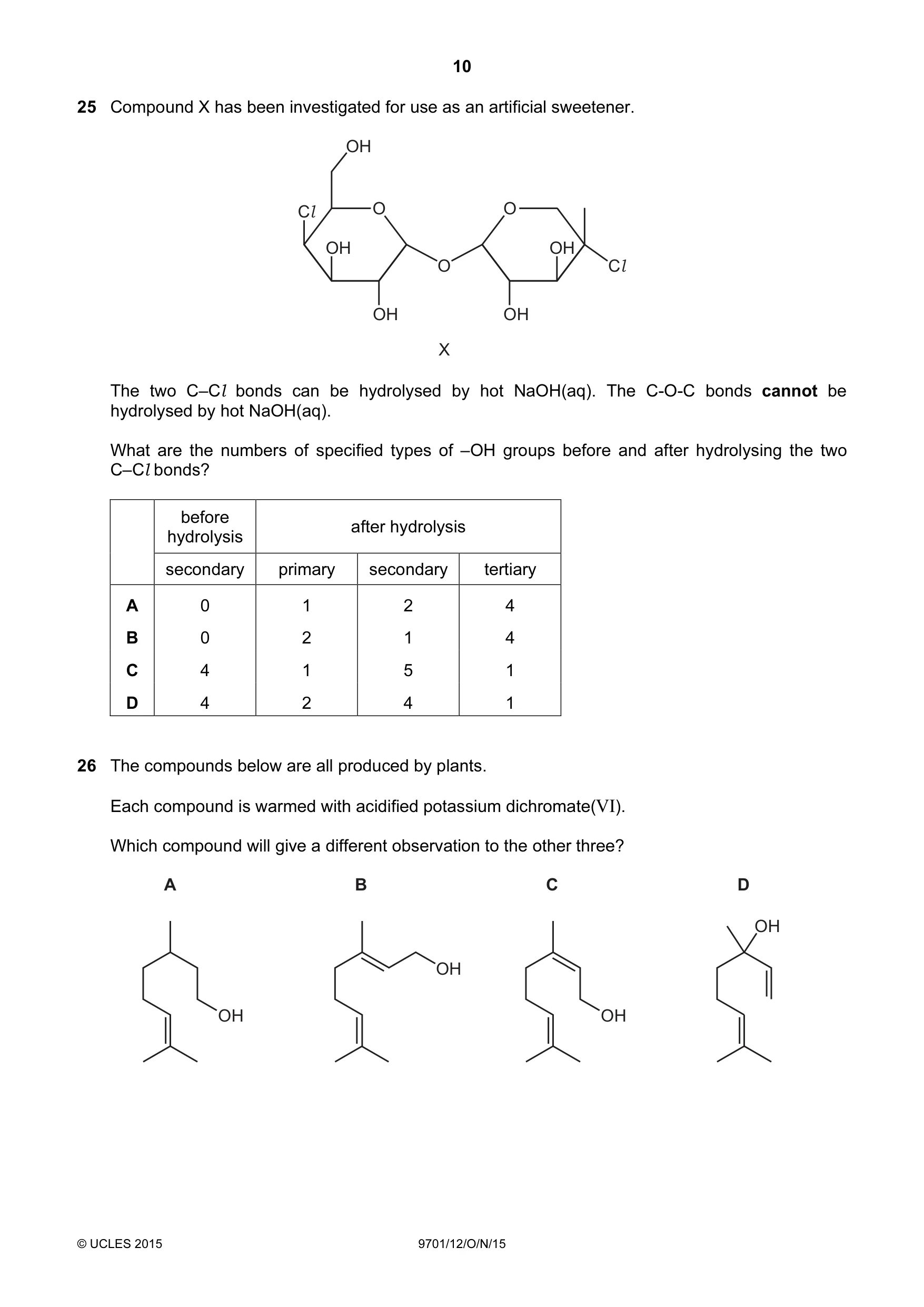
Q25 · Compound X has been investigated for use as an artificial sweetener
25 Compound X has been investigated for use as an artificial sweetener. OH Cl O O OH OH O Cl OH OH X The two C–Cl bonds can be hydrolysed by hot NaOH(aq). The C-O-C bonds cannot be hydrolysed by hot NaOH(aq). What are the numbers of specified types of –OH groups before and after hydrolysing the two C–Cl bonds? before after hydrolysis hydrolysis secondary primary secondary tertiary A 0 1 2 4 B 0 2 1 4 C 4 1 5 1 D 4 2 4 1
Q26 · The compounds below are all produced by plants
26 The compounds below are all produced by plants. Each compound is warmed with acidified potassium dichromate(VI). Which compound will give a different observation to the other three? A B C D OH OH OH OH
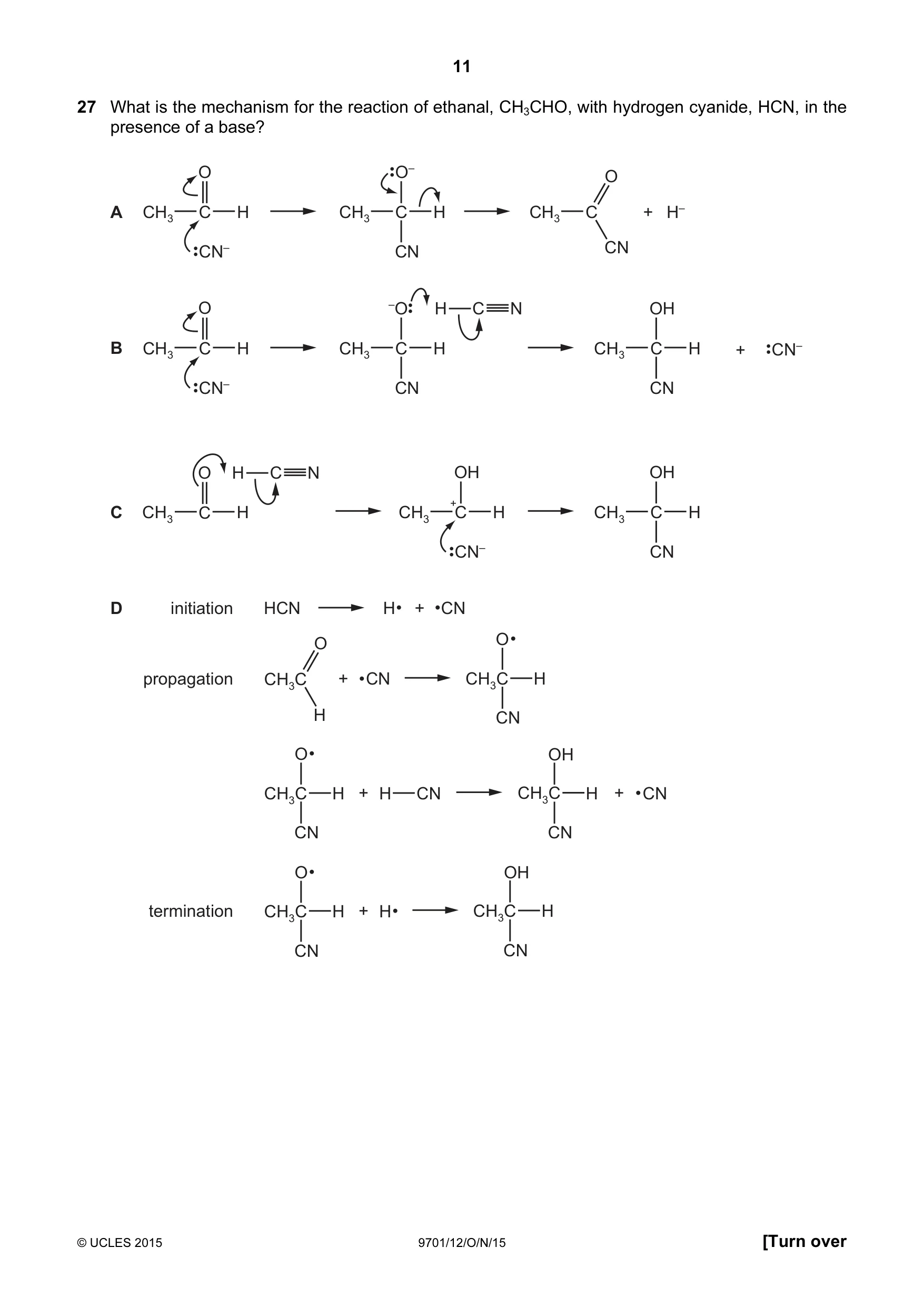
Q27 · What is the mechanism for the reaction of ethanal, CH3CHO, with hydrogen cyanide, HCN, in…
27 What is the mechanism for the reaction of ethanal, CH3CHO, with hydrogen cyanide, HCN, in the presence of a base? O O– O A CH3 C H CH3 C H CH3 C + H– CN– CN CN O –O H C N OH B CH3 C H CH3 C H CH3 C H + CN– CN– CN CN O H C N OH OH + C CH3 C H CH3 C H CH3 C H CN– CN D initiation HCN H • + • CN O O • propagation CH3C + • CN CH3C H H CN O • OH CH3C H + H CN CH3C H + • CN CN CN O • OH termination CH3C H + H • CH3C H CN CN
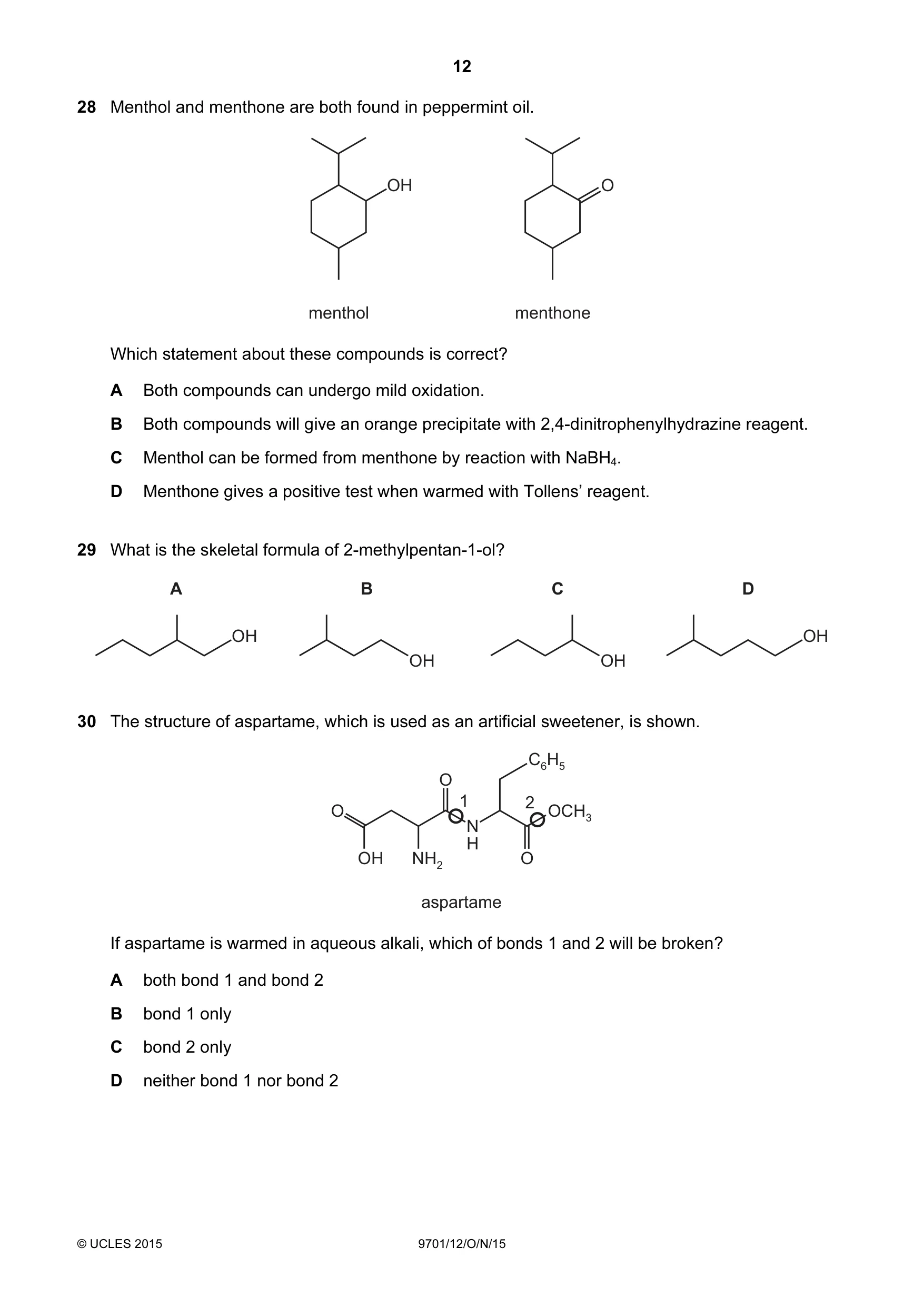
Q28 · Menthol and menthone are both found in peppermint oil
28 Menthol and menthone are both found in peppermint oil. OH O menthol menthone Which statement about these compounds is correct? A Both compounds can undergo mild oxidation. B Both compounds will give an orange precipitate with 2,4-dinitrophenylhydrazine reagent. C Menthol can be formed from menthone by reaction with NaBH4. D Menthone gives a positive test when warmed with Tollens’ reagent.
Q29 · What is the skeletal formula of 2-methylpentan-1-ol?
29 What is the skeletal formula of 2-methylpentan-1-ol? A B C D OH OH OH OH
More questions on Formulas, functional groups and the naming of organic compounds
Q30 · The structure of aspartame, which is used as an artificial sweetener, is shown
30 The structure of aspartame, which is used as an artificial sweetener, is shown. C6H5 O 1 2 O OCH3 N H OH NH2 O aspartame If aspartame is warmed in aqueous alkali, which of bonds 1 and 2 will be broken? A both bond 1 and bond 2 B bond 1 only C bond 2 only D neither bond 1 nor bond 2 Section B
Q31 · The relative molecular mass, Mr, of a particular sample of chlorine is 72.0
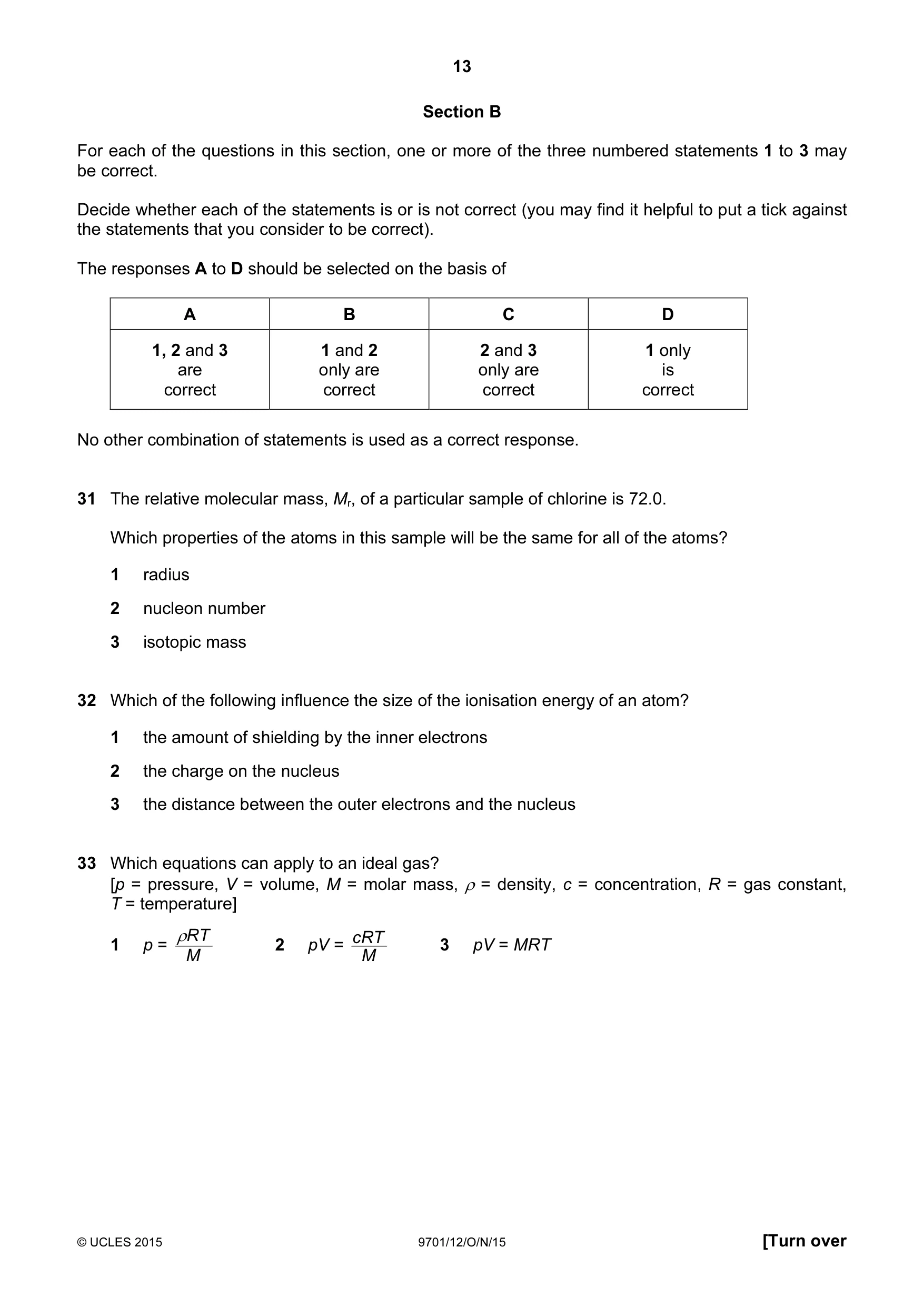
31 The relative molecular mass, Mr, of a particular sample of chlorine is 72.0. Which properties of the atoms in this sample will be the same for all of the atoms? 1 radius 2 nucleon number 3 isotopic mass
Q32 · Which of the following influence the size of the ionisation energy of an atom?
32 Which of the following influence the size of the ionisation energy of an atom? 1 the amount of shielding by the inner electrons 2 the charge on the nucleus 3 the distance between the outer electrons and the nucleus
Q33 · Which equations can apply to an ideal gas?
33 Which equations can apply to an ideal gas? [p = pressure, V = volume, M = molar mass, ρ = density, c = concentration, R = gas constant, T = temperature] ρ RT cRT 1 p = 2 pV = M 3 pV = MRT M
More questions on The gaseous state: ideal and real gases and pV = nRT
Q34 · Ammonia and chlorine react in the gas phase
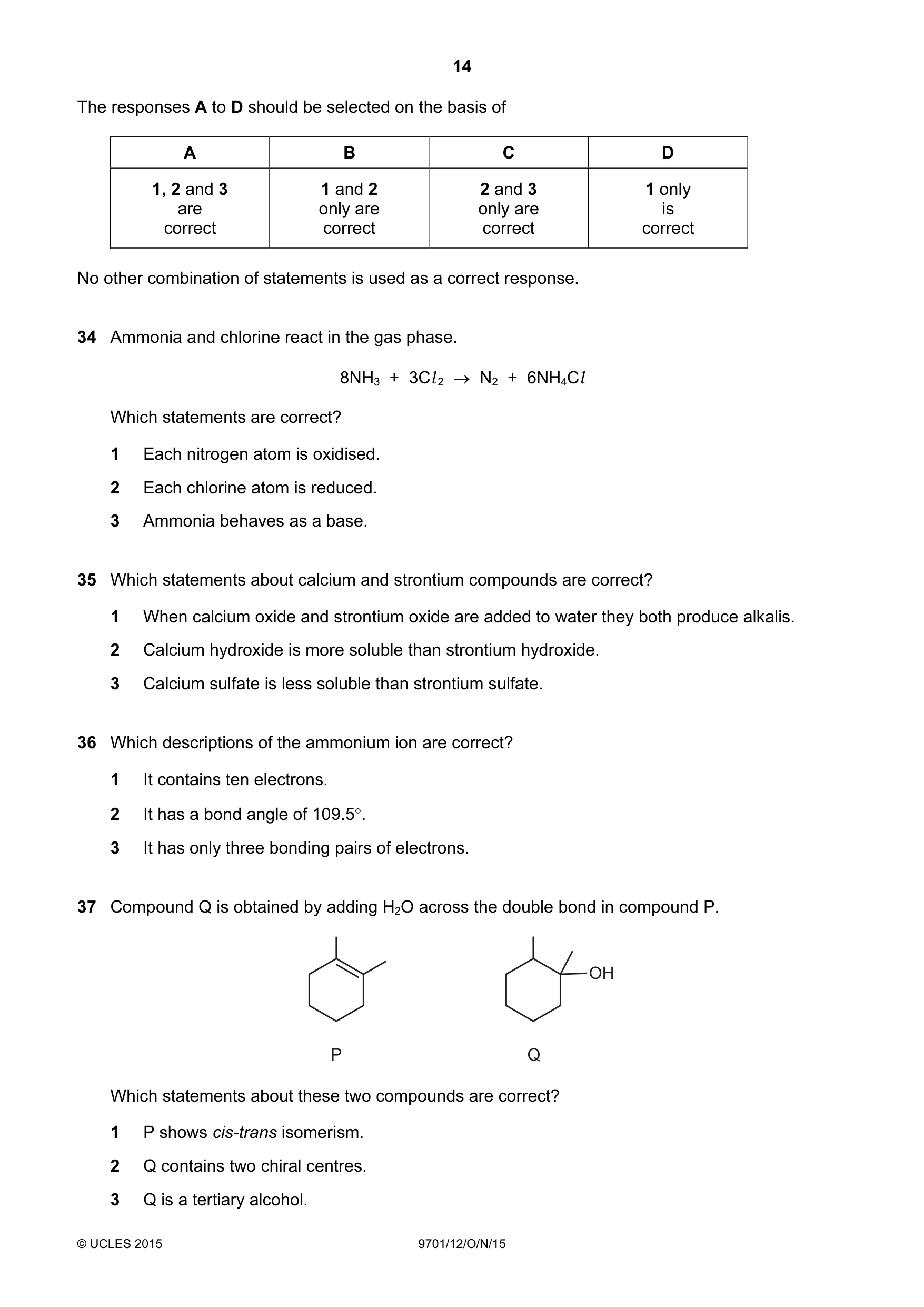
34 Ammonia and chlorine react in the gas phase. 8NH3 + 3Cl 2 → N2 + 6NH4Cl Which statements are correct? 1 Each nitrogen atom is oxidised. 2 Each chlorine atom is reduced. 3 Ammonia behaves as a base.
Q35 · Which statements about calcium and strontium compounds are correct?
35 Which statements about calcium and strontium compounds are correct? 1 When calcium oxide and strontium oxide are added to water they both produce alkalis. 2 Calcium hydroxide is more soluble than strontium hydroxide. 3 Calcium sulfate is less soluble than strontium sulfate.
Q36 · Which descriptions of the ammonium ion are correct?
36 Which descriptions of the ammonium ion are correct? 1 It contains ten electrons. 2 It has a bond angle of 109.5°. 3 It has only three bonding pairs of electrons.
Q37 · Compound Q is obtained by adding H2O across the double bond in compound P
37 Compound Q is obtained by adding H2O across the double bond in compound P. OH P Q Which statements about these two compounds are correct? 1 P shows cis-trans isomerism. 2 Q contains two chiral centres. 3 Q is a tertiary alcohol.
More questions on Isomerism: structural isomerism and stereoisomerism
Q38 · X is an organic compound
38 X is an organic compound. X gives a precipitate with aqueous silver nitrate. Some or all of this precipitate remains undissolved when excess dilute aqueous ammonia is added. What could be the identity of X? 1 2-chlorobutane 2 2-bromobutane 3 iodomethane
Q39 · Which compounds, on heating with excess concentrated sulfuric acid, produce only one…
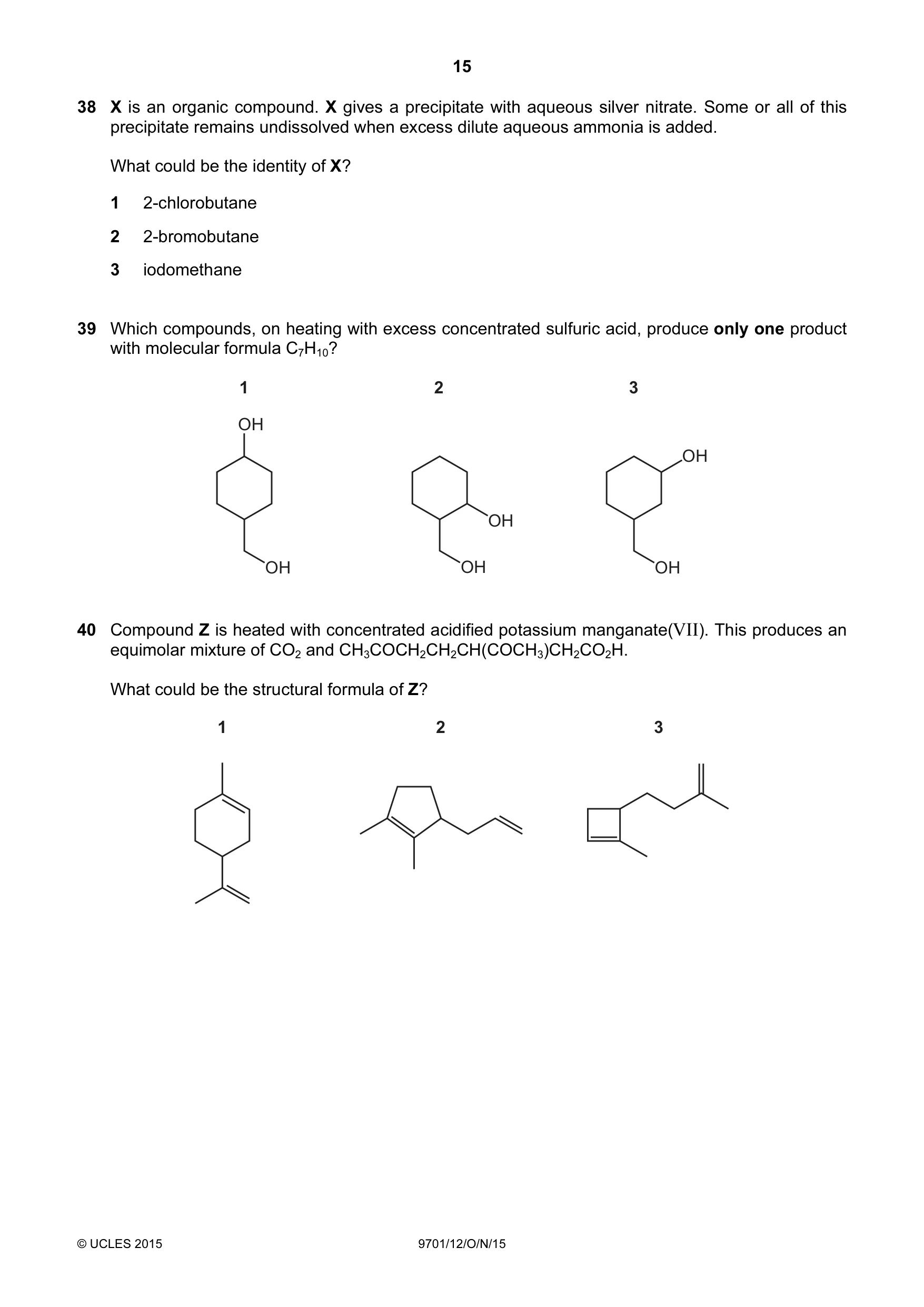
39 Which compounds, on heating with excess concentrated sulfuric acid, produce only one product with molecular formula C7H10? 1 2 3 OH OH OH OH OH OH
Q40 · Compound Z is heated with concentrated acidified potassium manganate(VII)
40 Compound Z is heated with concentrated acidified potassium manganate(VII). This produces an equimolar mixture of CO2 and CH3COCH2CH2CH(COCH3)CH2CO2H. What could be the structural formula of Z?
What was in this paper
The subtopics covered by these 40 questions, and how many questions each got. Open one in a new tab to see every Cambridge question on it.
3Redox processes: electron transfer and changes in oxidation number (oxidation state)3Alcohols2Chemical equilibria: reversible reactions, dynamic equilibrium2Effect of temperature on reaction rates and the concept of activation energy2Electrolysis2Halogenoalkanes2Ionisation energy2Isomerism: structural isomerism and stereoisomerism2Nitriles and hydroxynitriles2Reacting masses and volumes (of solutions and gases)2Similarities and trends in the properties of the Group 2 metals, magnesium to barium, and their compounds2The gaseous state: ideal and real gases and pV = nRT2Amino acids1Bonding and structure1Enthalpy change, ΔH1Esters1Formulas, functional groups and the naming of organic compounds1Halogen compounds1Metallic bonding1Particles in the atom and atomic radius1Periodicity of chemical properties of the elements in Period 31Shapes of molecules1Some reactions of the halide ions1The chemical properties of the halogen elements and the hydrogen halides1What you needed in this session
Cambridge’s own grade thresholds for 2015 Oct/Nov, Paper 1 · Variant 2. A higher threshold means an easier paper — the bar moves with how the cohort did.