Cambridge A Level Chemistry 9701 — 2025 May/June Paper 1 · Variant 3
9701/13/M/J/25 · 39 questions · 40 marks · 75 min
The question paper and its mark scheme, free to read here and free to download. This is Cambridge’s own paper, exactly as it was sat.
Question paper20 pages

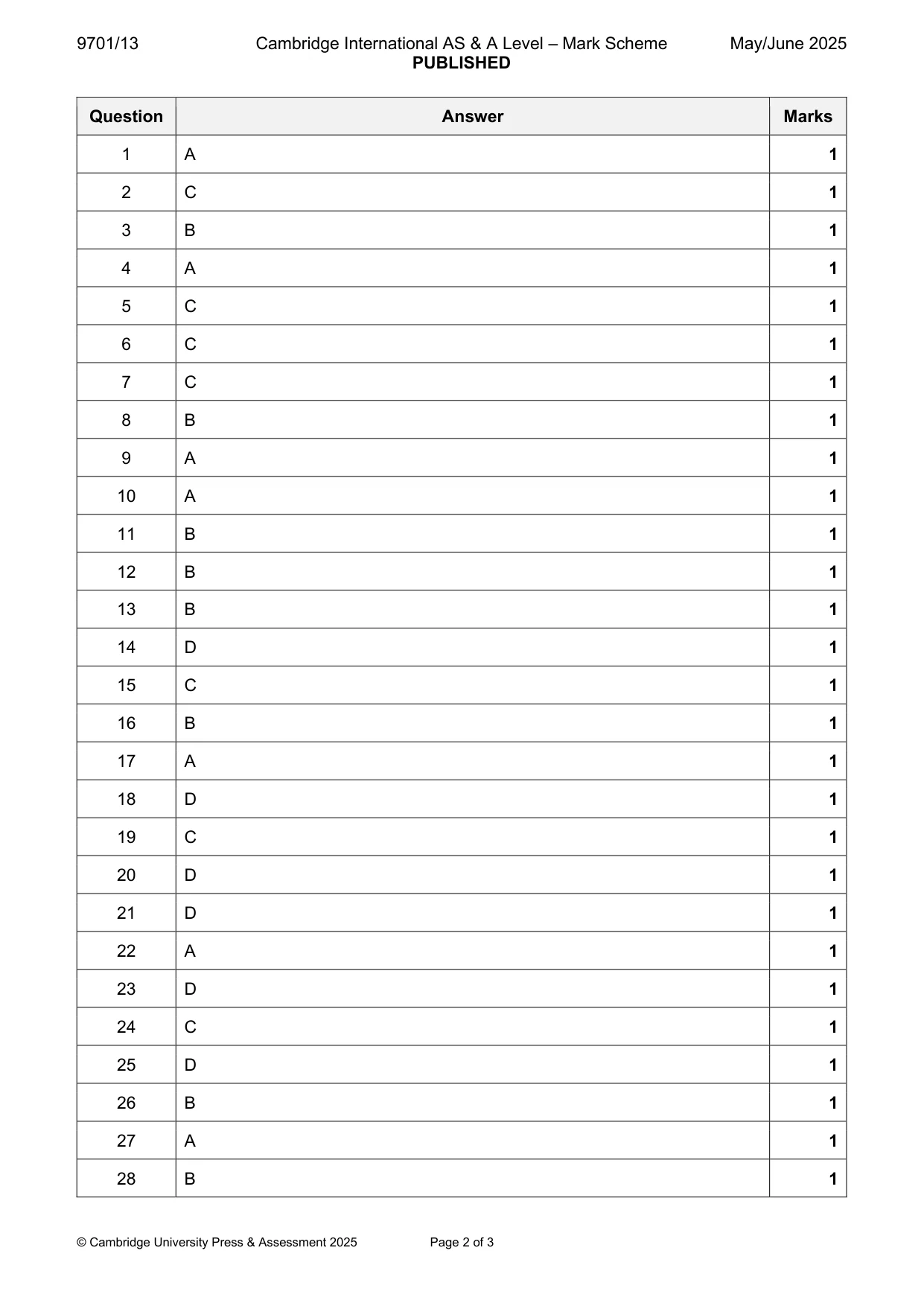
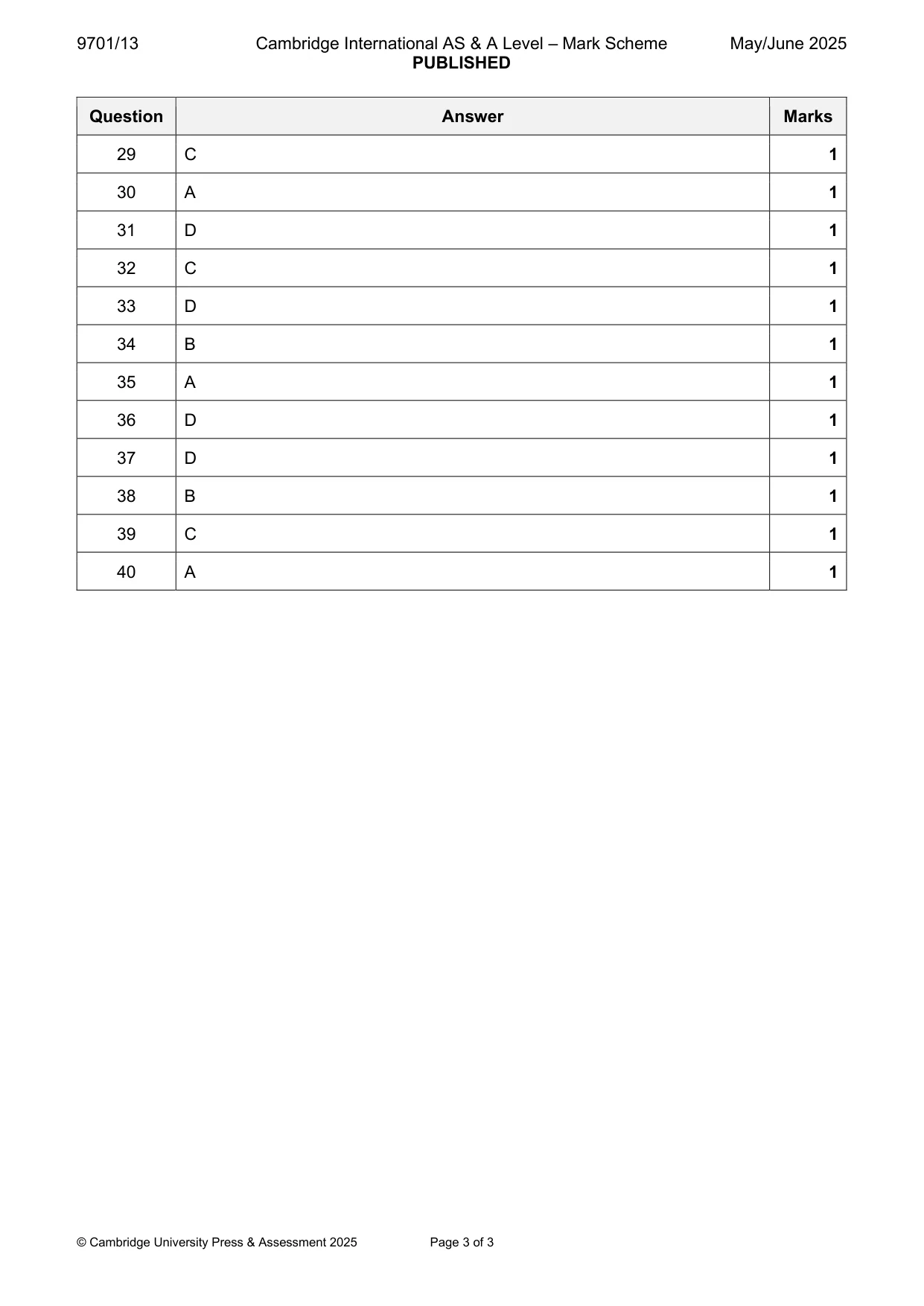
Mark scheme3 pages
Answers below. Sit the paper first if you are practising.
Questions as text
Q1 · Which isolated gaseous atom has a total of five electrons occupying spherically shaped…
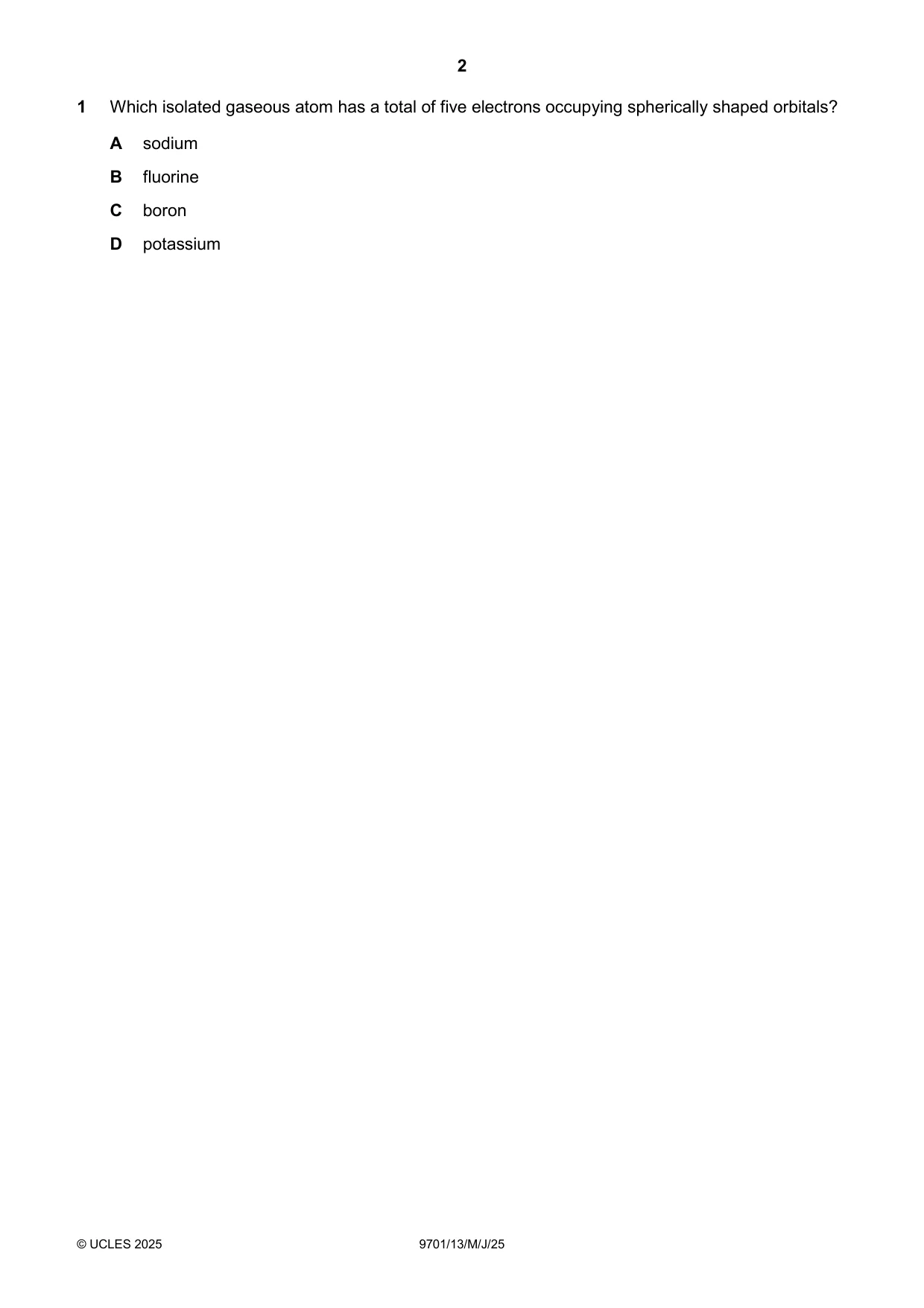
1 Which isolated gaseous atom has a total of five electrons occupying spherically shaped orbitals? A sodium B fluorine C boron D potassium
Mark scheme: Question Answer Marks 1 A 1
More questions on Electrons, energy levels and atomic orbitals
Q2 · The reaction pathway for a reaction
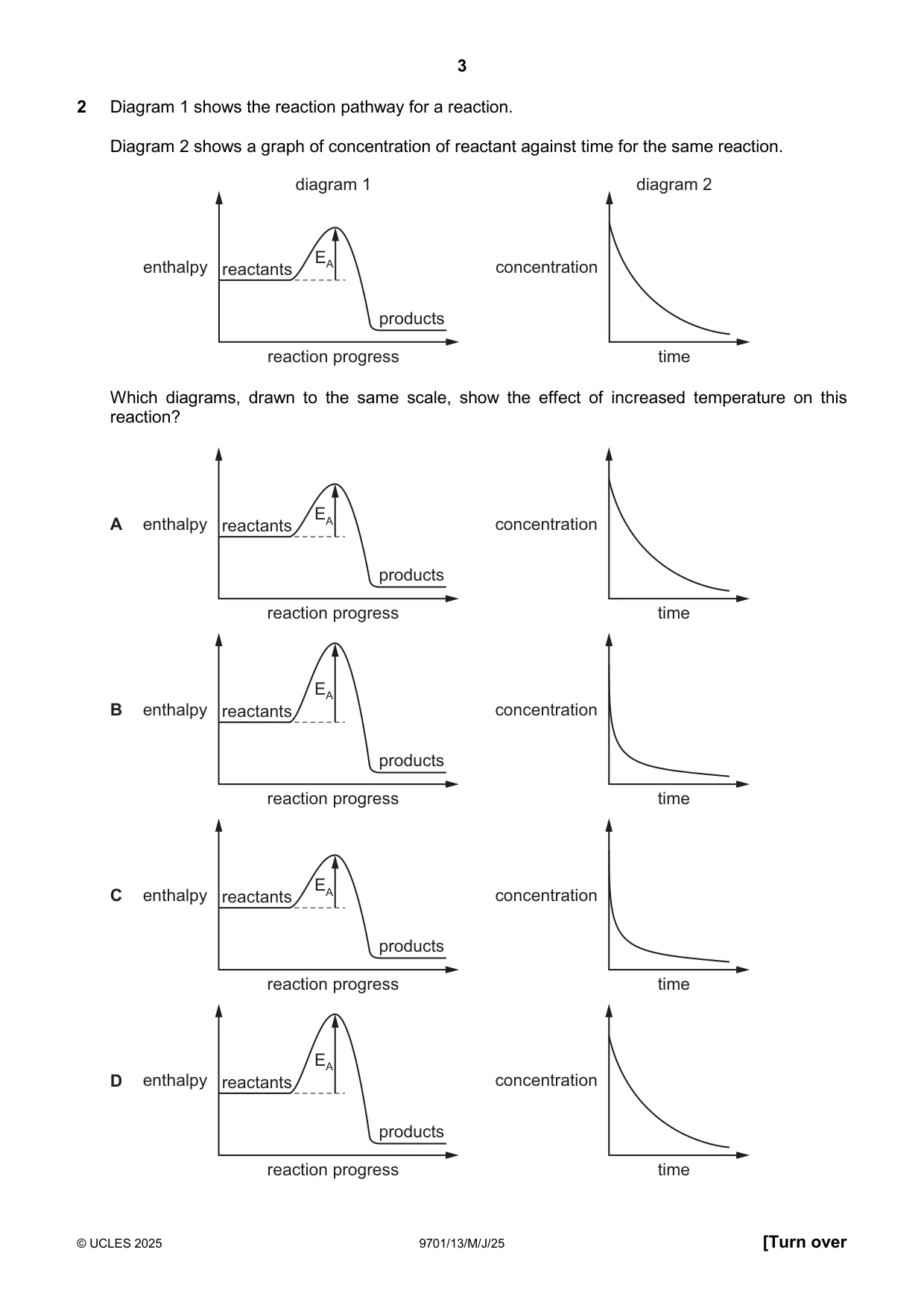
2 Diagram 1 shows the reaction pathway for a reaction. Diagram 2 shows a graph of concentration of reactant against time for the same reaction. reactants products EA enthalpy reaction progress diagram 1 concentration time diagram 2 Which diagrams, drawn to the same scale, show the effect of increased temperature on this reaction? reactants products EA enthalpy A reaction progress concentration time reactants products EA enthalpy B reaction progress concentration time reactants products EA enthalpy C reaction progress concentration time reactants products EA enthalpy D reaction progress concentration time
Mark scheme: C
More questions on Effect of temperature on reaction rates and the concept of activation energy
Q3 · The equation shows the overall reaction between an amine and an acid chloride
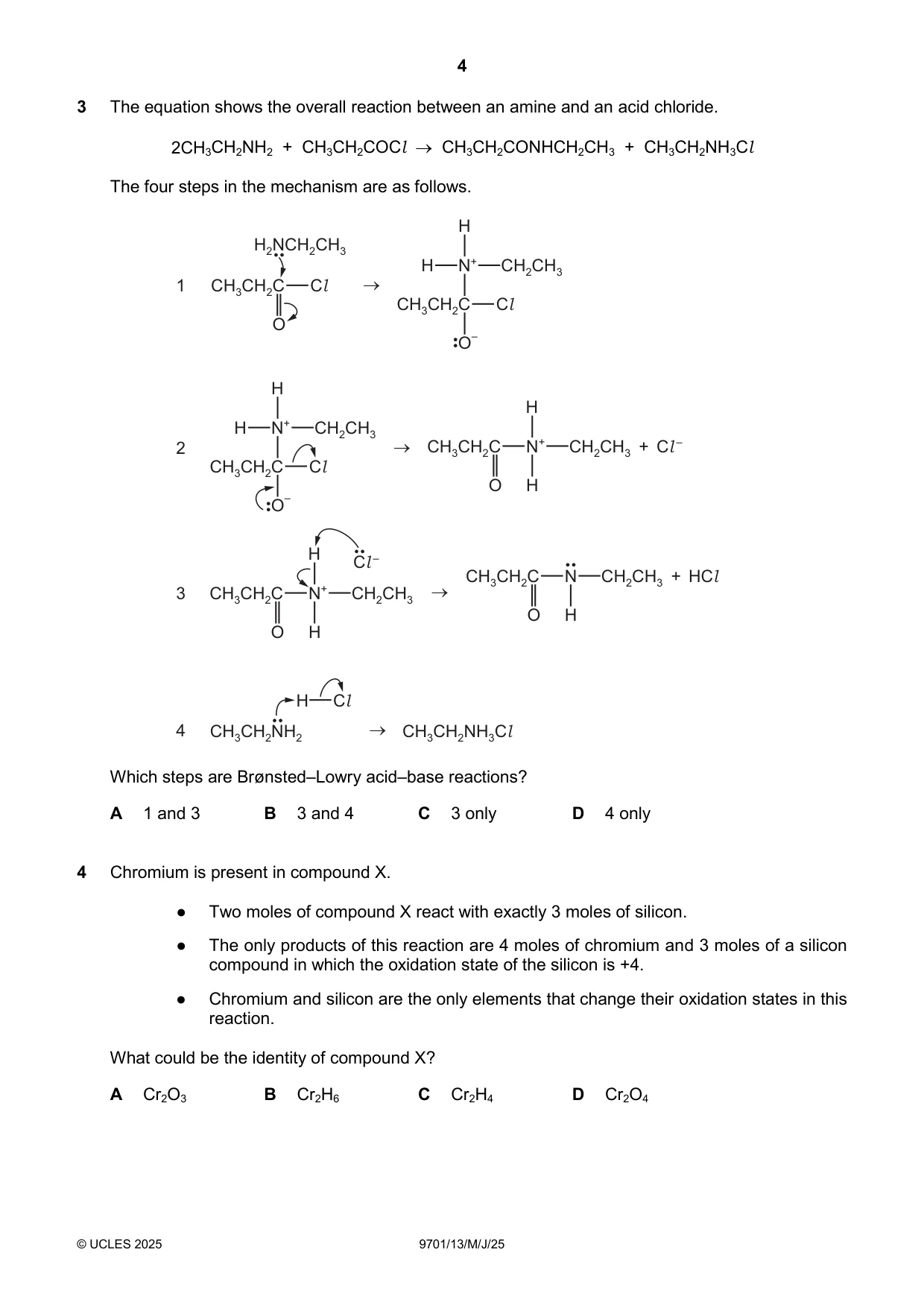
3 The equation shows the overall reaction between an amine and an acid chloride. 2CH3CH2NH2 + CH3sCH2,COCI — CH3CH2zCONHCH2CH; + CH3CH2NH;3Cl The four steps in the mechanism are as follows. H H,NCH,CH, H—N*—CH,CH, 1 CH,CH,C—Cl > CH,CH,C—Cl bo | Om H H H—N*—CH,CH, 2 LA + CH,CH,C—N*—CH,CH, + Cl- CH,CH,C—Cl | | O 4H Com r™, HH & CH,CH,C—-N—CH,CH, + HCI 3 CH,CH,C—N*—CH,CH, > | | | | OH Her 4 CH,CH,NH, —> CH,CH,NH,C/ Which steps are Br@nsted—Lowry acid—base reactions? A 1and3 B 3and4 C 3only D 4only
Mark scheme: B
Q4 · Chromium is present in compound X
4 Chromium is present in compound X. ● Two moles of compound X react with exactly 3 moles of silicon. ● The only products of this reaction are 4 moles of chromium and 3 moles of a silicon compound in which the oxidation state of the silicon is +4. ● Chromium and silicon are the only elements that change their oxidation states in this reaction. What could be the identity of compound X? A Cr2O3 B Cr2H6 C Cr2H4 D Cr2O4
Mark scheme: A
Q5 · The reversible reaction shown is in equilibrium at a temperature of 450°C
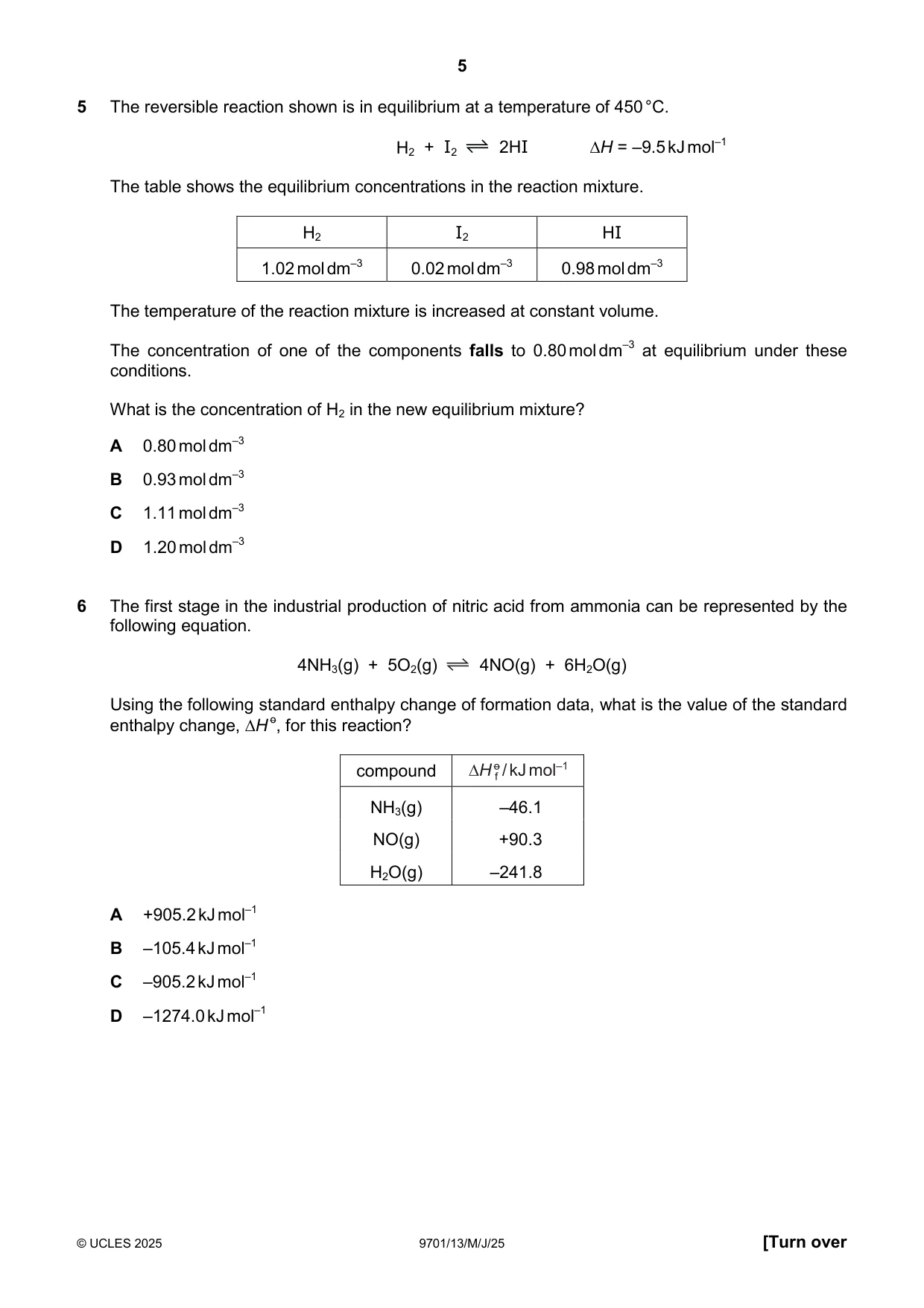
5 The reversible reaction shown is in equilibrium at a temperature of 450°C. H2 + I2 2HI H = –9.5kJmol–1 The table shows the equilibrium concentrations in the reaction mixture. H2 I2 HI 1.02moldm–3 0.02moldm–3 0.98moldm–3 The temperature of the reaction mixture is increased at constant volume. The concentration of one of the components falls to 0.80moldm–3 at equilibrium under these conditions. What is the concentration of H2 in the new equilibrium mixture? A 0.80moldm–3 B 0.93moldm–3 C 1.11moldm–3 D 1.20moldm–3
Mark scheme: C
More questions on Chemical equilibria: reversible reactions, dynamic equilibrium
Q6 · The first stage in the industrial production of nitric acid from ammonia can be…
6 The first stage in the industrial production of nitric acid from ammonia can be represented by the following equation. 4NH3(g) + 5O2(g) 4NO(g) + 6H2O(g) Using the following standard enthalpy change of formation data, what is the value of the standard enthalpy change, Ho, for this reaction? compound NH3(g) –46.1 NO(g) +90.3 H2O(g) –241.8 A +905.2kJmol–1 B –105.4kJmol–1 C –905.2kJmol–1 D –1274.0kJmol–1
Mark scheme: C
Q7 · The gaseous compound Z decomposes on heating
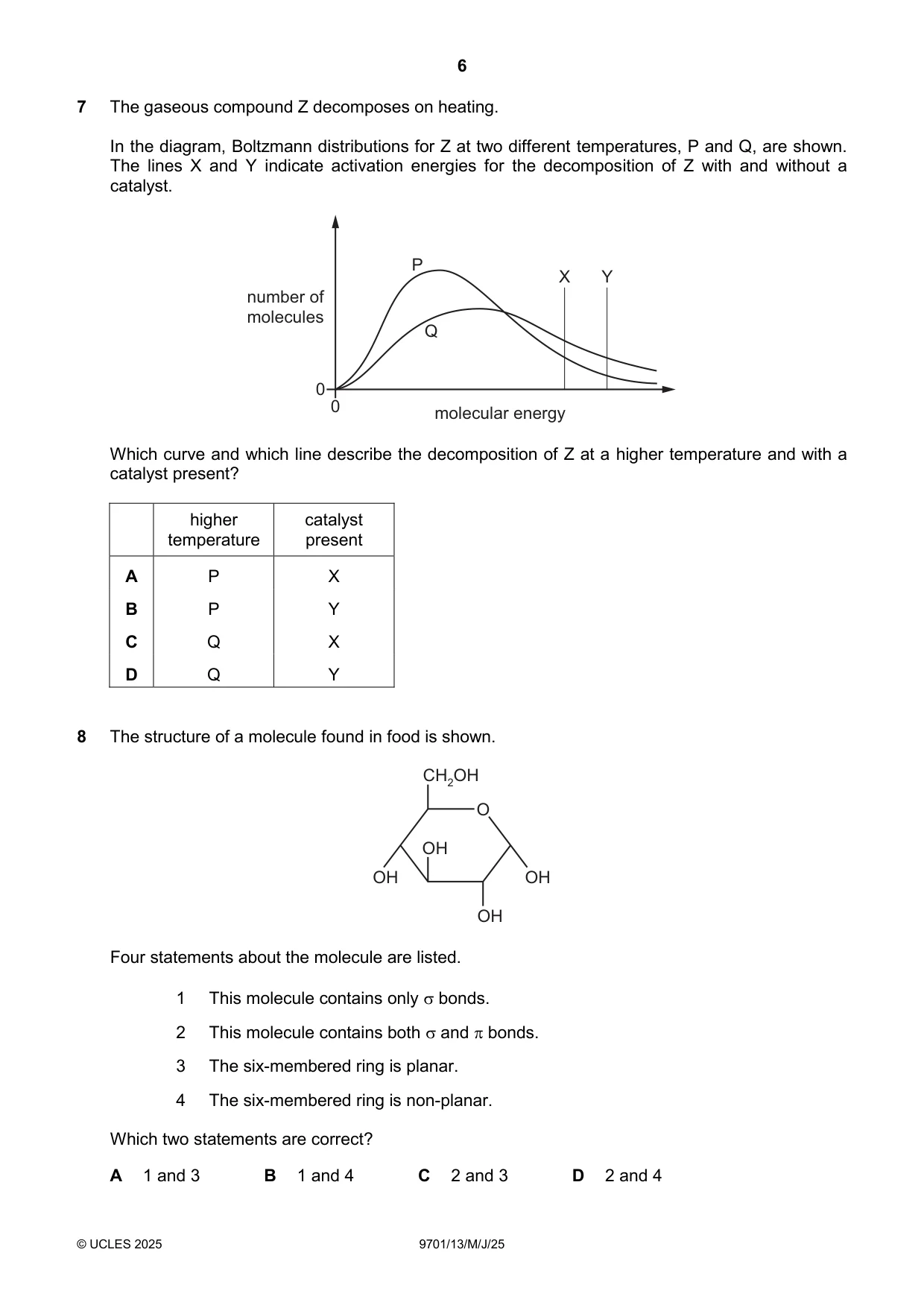
7 The gaseous compound Z decomposes on heating. In the diagram, Boltzmann distributions for Z at two different temperatures, P and Q, are shown. The lines X and Y indicate activation energies for the decomposition of Z with and without a catalyst. 0 0 molecular energy number of molecules X Y P Q Which curve and which line describe the decomposition of Z at a higher temperature and with a catalyst present? higher temperature catalyst present A P X B P Y C Q X D Q Y
Mark scheme: C
Q8 · The structure of a molecule found in food is shown
8 The structure of a molecule found in food is shown. CH2OH OH OH OH OH O Four statements about the molecule are listed. 1 This molecule contains only bonds. 2 This molecule contains both and bonds. 3 The six-membered ring is planar. 4 The six-membered ring is non-planar. Which two statements are correct? A 1 and 3 B 1 and 4 C 2 and 3 D 2 and 4
Mark scheme: B
More questions on Shapes of organic molecules; σ and π bonds
Q9 · In which substance are covalent bonds broken as it melts?
9 In which substance are covalent bonds broken as it melts? A silicon(IV) oxide B ice C iodine D ethanol
Mark scheme: A
Q10 · Why is the second ionisation energy of sodium larger than the second ionisation energy of…
10 Why is the second ionisation energy of sodium larger than the second ionisation energy of magnesium? A The attraction between the nucleus and the outer electron is greater in Na+ than in Mg+. B The nuclear charge of Na+ is greater than that of Mg+. C The outer electron of Na+ is more shielded than the outer electron of Mg+. D The outer electron of Na is in the same orbital as the outer electron of Mg.
Mark scheme: A
Q11 · BF3 reacts with NH3 to form a single compound with a simple molecular structure
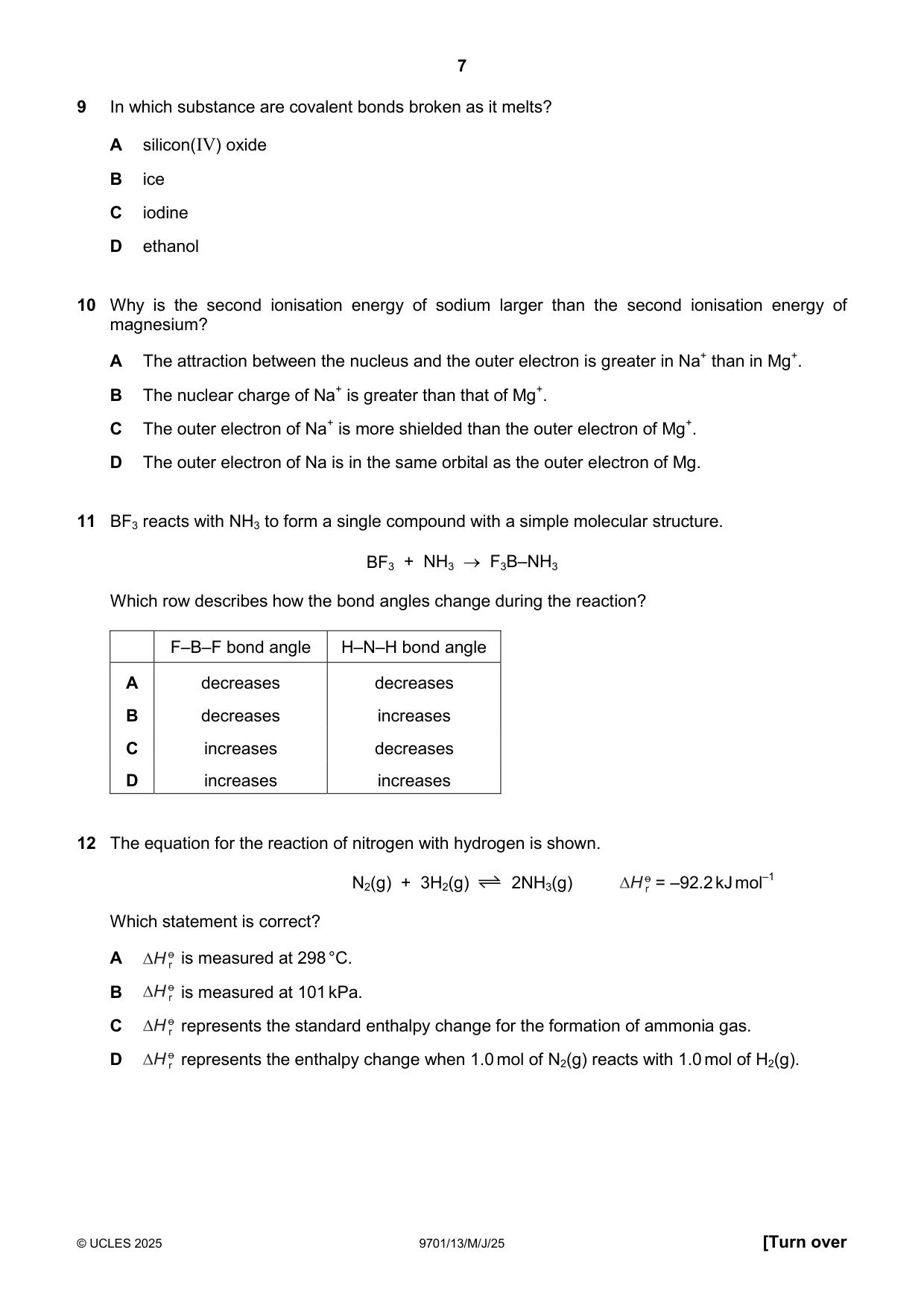
11 BF3 reacts with NH3 to form a single compound with a simple molecular structure. BF3 + NH3 F3B–NH3 Which row describes how the bond angles change during the reaction? F–B–F bond angle H–N–H bond angle A decreases decreases B decreases increases C increases decreases D increases increases
Mark scheme: B
Q12 · The equation for the reaction of nitrogen with hydrogen is shown
12 The equation for the reaction of nitrogen with hydrogen is shown. N2(g) + 3H2(g) 2NH3(g) = –92.2kJmol–1 Which statement is correct? A is measured at 298°C. B is measured at 101kPa. C represents the standard enthalpy change for the formation of ammonia gas. D represents the enthalpy change when 1.0mol of N2(g) reacts with 1.0mol of H2(g).
Mark scheme: B
Q13 · Hydrogen peroxide, H2O2, decomposes into water and oxygen when a suitable catalyst is…
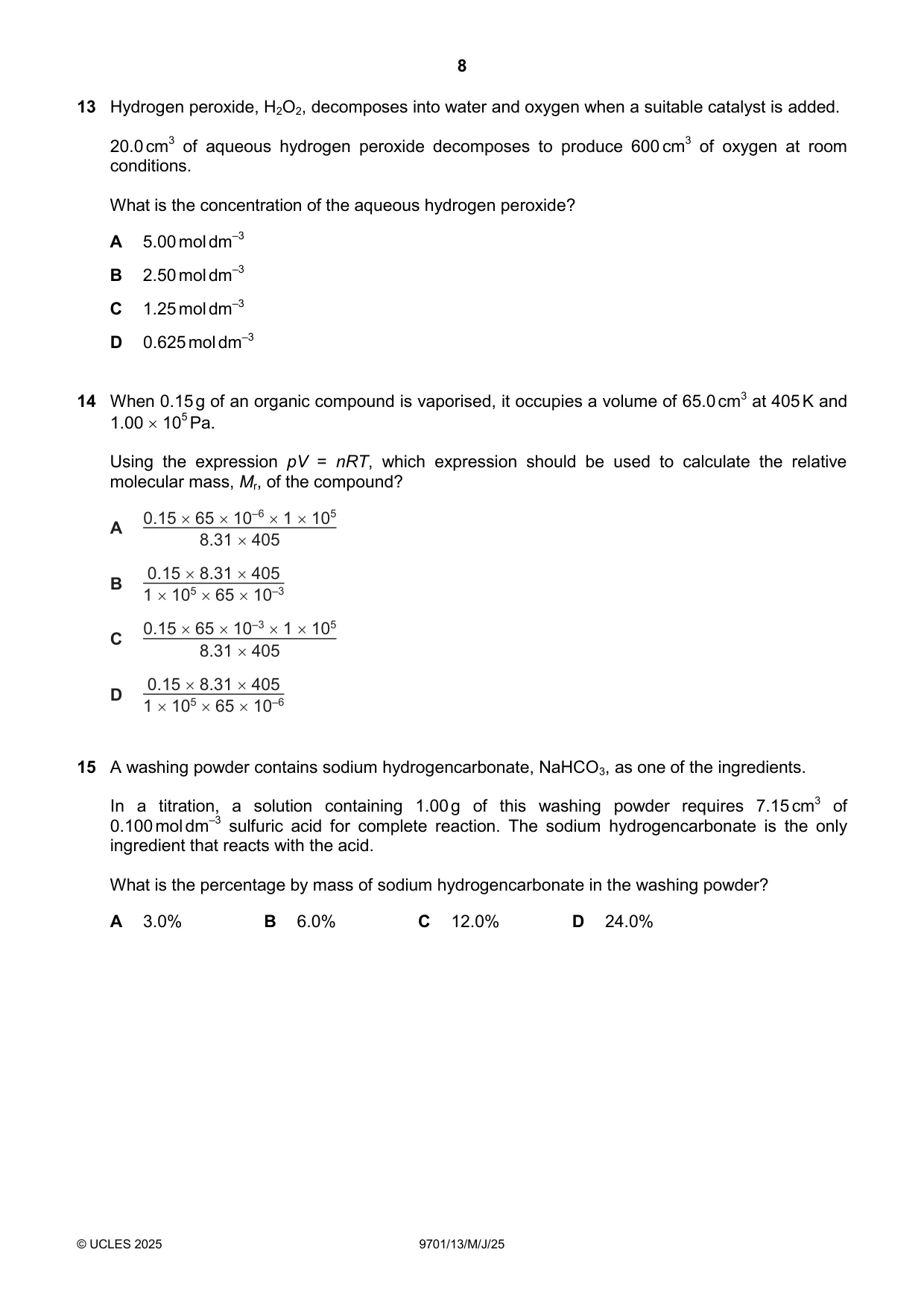
13 Hydrogen peroxide, H2O2, decomposes into water and oxygen when a suitable catalyst is added. 20.0cm3 of aqueous hydrogen peroxide decomposes to produce 600cm3 of oxygen at room conditions. What is the concentration of the aqueous hydrogen peroxide? A 5.00moldm–3 B 2.50moldm–3 C 1.25moldm–3 D 0.625moldm–3
Mark scheme: B
More questions on Reacting masses and volumes (of solutions and gases)
Q14 · When 0.15g of an organic compound is vaporised, it occupies a volume of 65.0cm® at 405K…
14 When 0.15g of an organic compound is vaporised, it occupies a volume of 65.0cm® at 405K and 1.00 x 10°Pa. Using the expression pV = nRT, which expression should be used to calculate the relative molecular mass, M,, of the compound? 0.15 x 65 x 10°§ x 1 x 10° A 8.31 x 405 B 0.15 x 8.31 x 405 1x 10° x 65 x 10° Cc 0.15 x 65 x 10° x 1 x 10° 8.31 x 405 D 0.15 x 8.31 x 405 1x 10° x 65 x 10°§
Mark scheme: D
More questions on The gaseous state: ideal and real gases and pV = nRT
Q15 · A washing powder contains sodium hydrogencarbonate, NaHCO3, as one of the ingredients
15 A washing powder contains sodium hydrogencarbonate, NaHCO3, as one of the ingredients. In a titration, a solution containing 1.00g of this washing powder requires 7.15cm3 of 0.100moldm–3 sulfuric acid for complete reaction. The sodium hydrogencarbonate is the only ingredient that reacts with the acid. What is the percentage by mass of sodium hydrogencarbonate in the washing powder? A 3.0% B 6.0% C 12.0% D 24.0%
Mark scheme: C
More questions on Reacting masses and volumes (of solutions and gases)
Q16 · The flow chart shows some reactions of nitrogen compounds
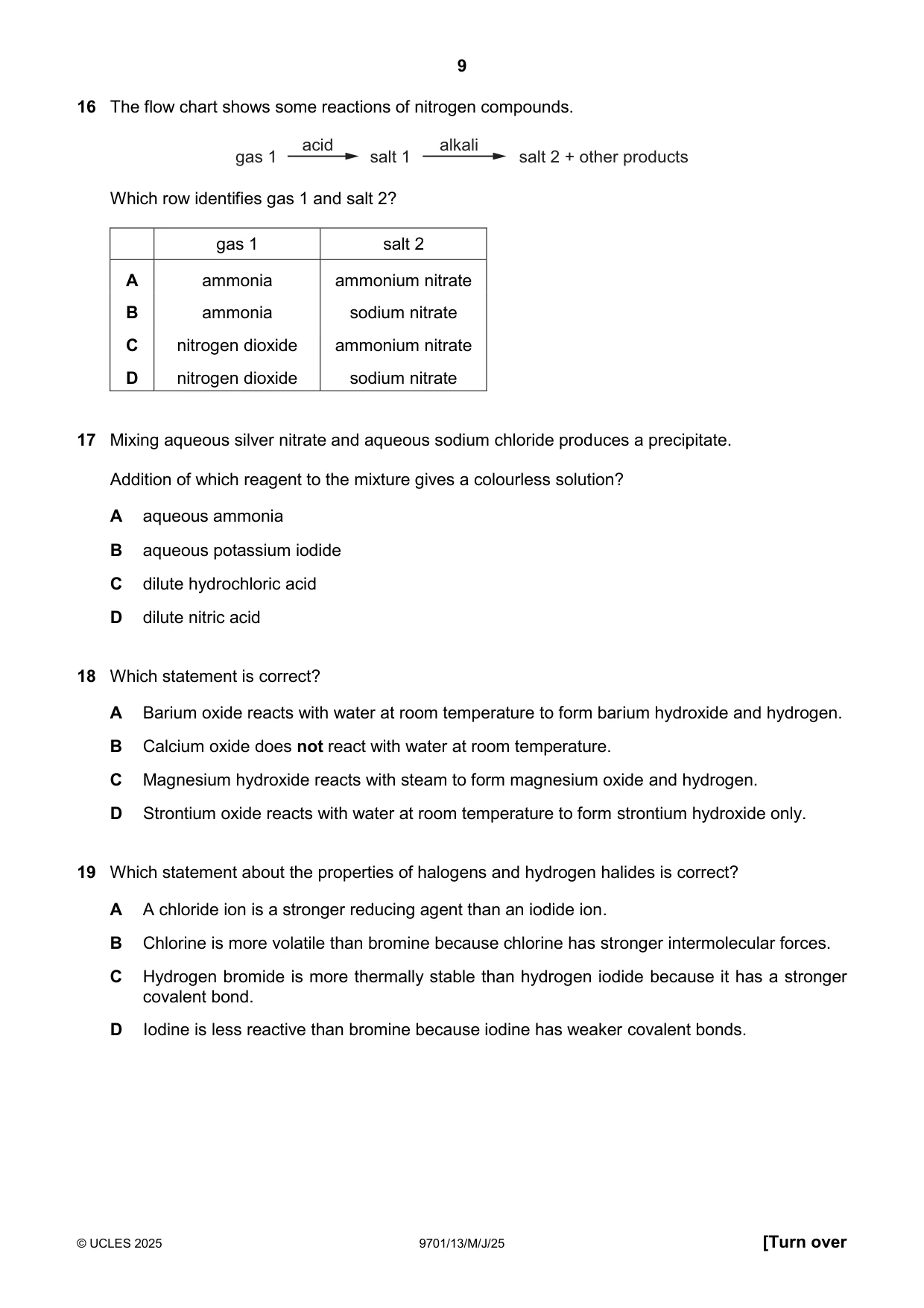
16 The flow chart shows some reactions of nitrogen compounds. gas 1 acid salt 1 salt 2 + other products alkali Which row identifies gas 1 and salt 2? gas 1 salt 2 A ammonia ammonium nitrate B ammonia sodium nitrate C nitrogen dioxide ammonium nitrate D nitrogen dioxide sodium nitrate
Mark scheme: B
Q17 · Mixing aqueous silver nitrate and aqueous sodium chloride produces a precipitate
17 Mixing aqueous silver nitrate and aqueous sodium chloride produces a precipitate. Addition of which reagent to the mixture gives a colourless solution? A aqueous ammonia B aqueous potassium iodide C dilute hydrochloric acid D dilute nitric acid
Mark scheme: A
Q18 · Which statement is correct?
18 Which statement is correct? A Barium oxide reacts with water at room temperature to form barium hydroxide and hydrogen. B Calcium oxide does not react with water at room temperature. C Magnesium hydroxide reacts with steam to form magnesium oxide and hydrogen. D Strontium oxide reacts with water at room temperature to form strontium hydroxide only.
Mark scheme: D
Q19 · Which statement about the properties of halogens and hydrogen halides is correct?
19 Which statement about the properties of halogens and hydrogen halides is correct? A A chloride ion is a stronger reducing agent than an iodide ion. B Chlorine is more volatile than bromine because chlorine has stronger intermolecular forces. C Hydrogen bromide is more thermally stable than hydrogen iodide because it has a stronger covalent bond. D Iodine is less reactive than bromine because iodine has weaker covalent bonds.
Mark scheme: C
More questions on The chemical properties of the halogen elements and the hydrogen halides
Q20 · Three statements about the chemical periodicity of Period 3 oxides are listed
20 Three statements about the chemical periodicity of Period 3 oxides are listed. 1 The maximum oxidation state of the Period 3 elements in their oxides increases from sodium to phosphorus, then decreases from phosphorus to sulfur. 2 The oxides from sodium to aluminium dissolve in water without hydrolysis; from silicon to sulfur they are hydrolysed by water. 3 The structure and bonding changes from giant ionic to giant covalent to simple molecular. Which statements are correct? A 1, 2 and 3 B 1 only C 2 and 3 only D 3 only
Mark scheme: D
More questions on Periodicity of chemical properties of the elements in Period 3
Q21 · Which dot-and-cross diagrams represent molecules that can react with unburned…
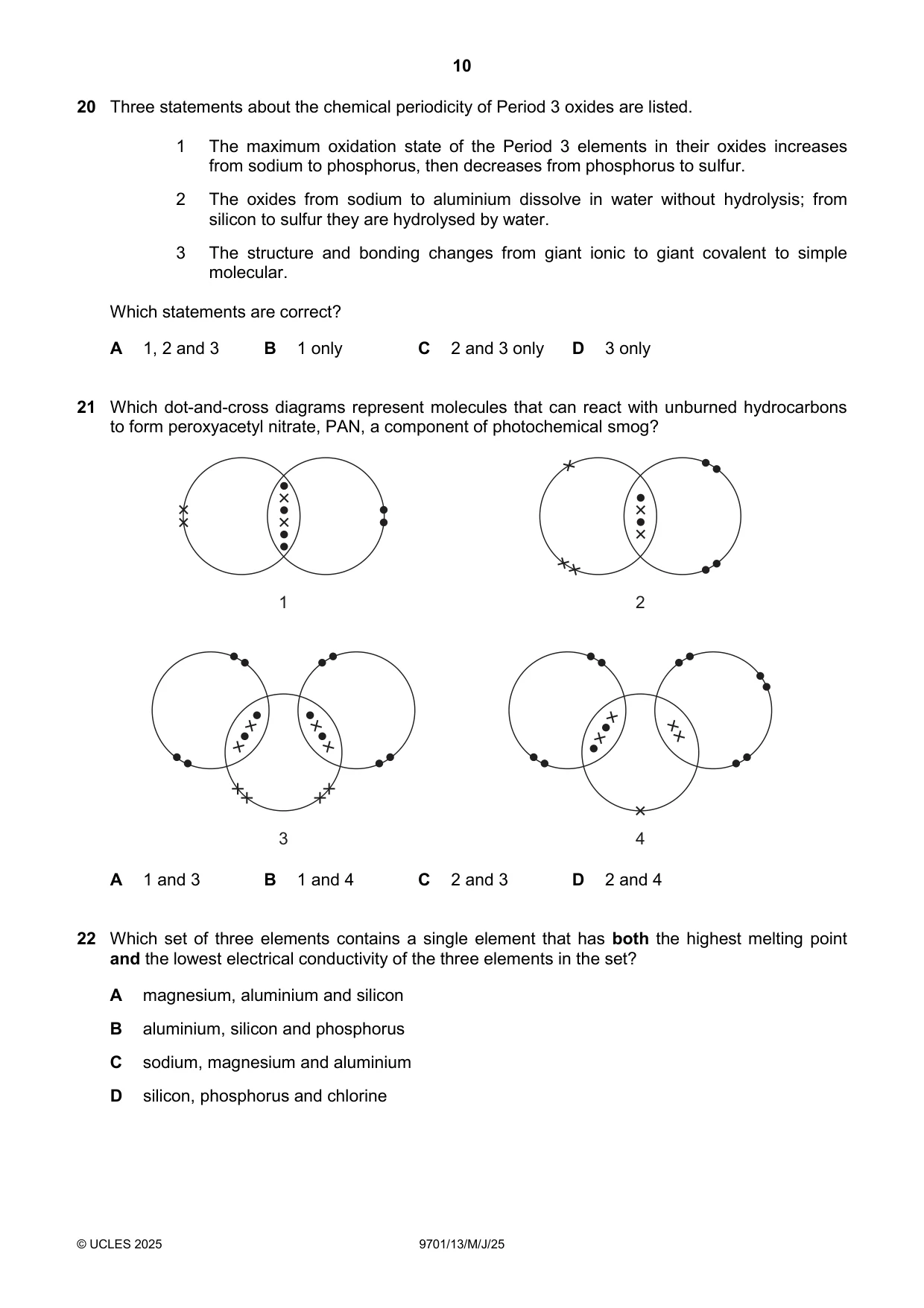
21 Which dot-and-cross diagrams represent molecules that can react with unburned hydrocarbons to form peroxyacetyl nitrate, PAN, a component of photochemical smog? 1 2 3 4 A 1 and 3 B 1 and 4 C 2 and 3 D 2 and 4
Mark scheme: D
Q22 · Which set of three elements contains a single element that has both the highest melting…
22 Which set of three elements contains a single element that has both the highest melting point and the lowest electrical conductivity of the three elements in the set? A magnesium, aluminium and silicon B aluminium, silicon and phosphorus C sodium, magnesium and aluminium D silicon, phosphorus and chlorine
Mark scheme: A
More questions on Periodicity of physical properties of the elements in Period 3
Q23 · In which row do the particles increase in size?
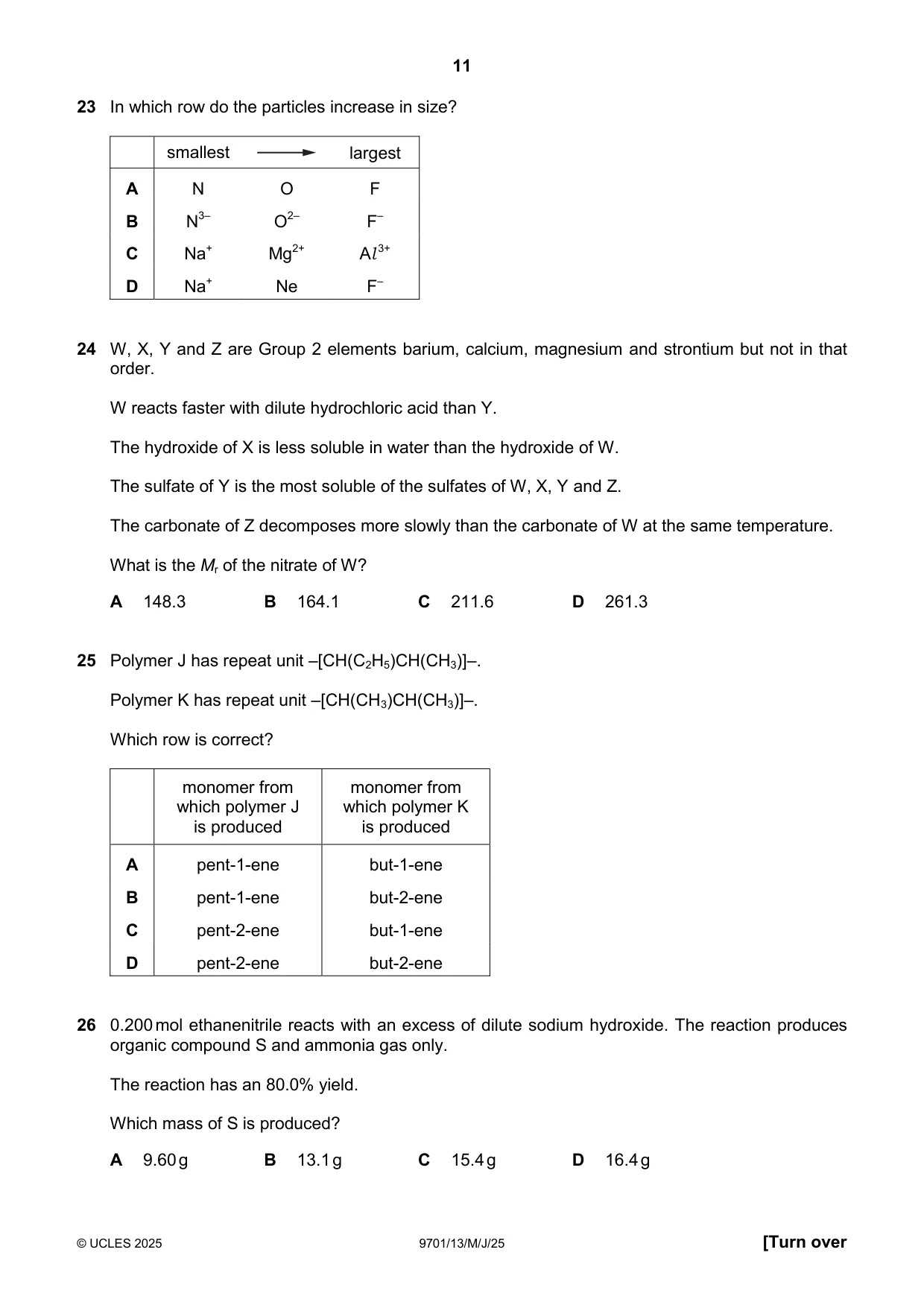
23 In which row do the particles increase in size? smallest largest A N O F B N3– O2– F– C Na+ Mg2+ Al3+ D Na+ Ne F–
Mark scheme: D
Q24 · W, X, Y and Z are Group 2 elements barium, calcium, magnesium and strontium but not in…
24 W, X, Y and Z are Group 2 elements barium, calcium, magnesium and strontium but not in that order. W reacts faster with dilute hydrochloric acid than Y. The hydroxide of X is less soluble in water than the hydroxide of W. The sulfate of Y is the most soluble of the sulfates of W, X, Y and Z. The carbonate of Z decomposes more slowly than the carbonate of W at the same temperature. What is the Mr of the nitrate of W? A 148.3 B 164.1 C 211.6 D 261.3
Mark scheme: C
Q26 · 0.200mol ethanenitrile reacts with an excess of dilute sodium hydroxide
26 0.200mol ethanenitrile reacts with an excess of dilute sodium hydroxide. The reaction produces organic compound S and ammonia gas only. The reaction has an 80.0% yield. Which mass of S is produced? A 9.60g B 13.1g C 15.4g D 16.4g
Mark scheme: B
More questions on Reacting masses and volumes (of solutions and gases)
Q27 · The structure of butenedioic acid is shown
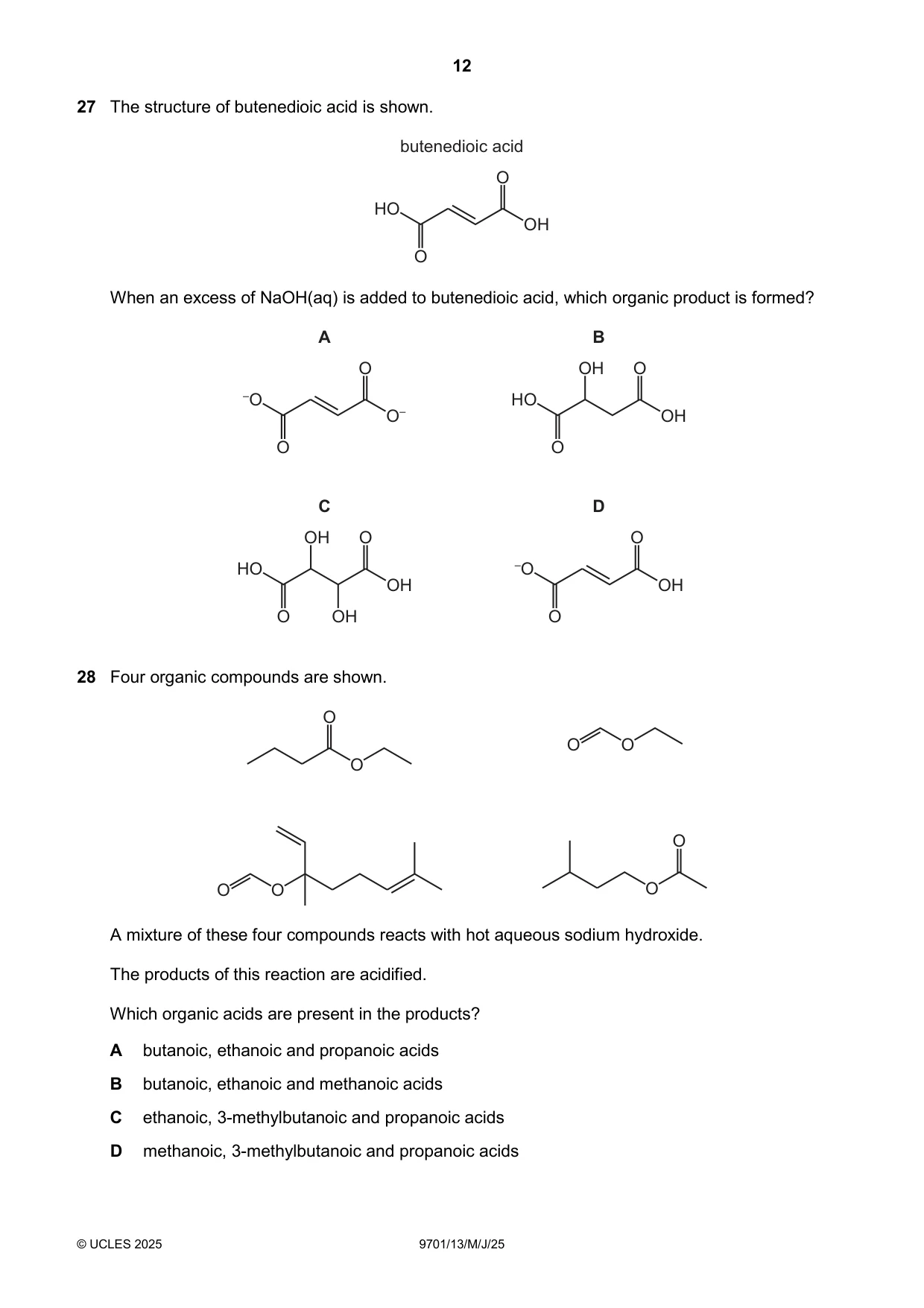
27 The structure of butenedioic acid is shown. butenedioic acid OH HO O O When an excess of NaOH(aq) is added to butenedioic acid, which organic product is formed? A OH –O O O D O– –O O O B OH OH HO O O C OH OH OH HO O O
Mark scheme: A
Q28 · Four organic compounds are shown
28 Four organic compounds are shown. O O O O O O O O A mixture of these four compounds reacts with hot aqueous sodium hydroxide. The products of this reaction are acidified. Which organic acids are present in the products? A butanoic, ethanoic and propanoic acids B butanoic, ethanoic and methanoic acids C ethanoic, 3-methylbutanoic and propanoic acids D methanoic, 3-methylbutanoic and propanoic acids
Mark scheme: B
Q29 · Ethanal reacts with KCN dissolved in liquid HCN
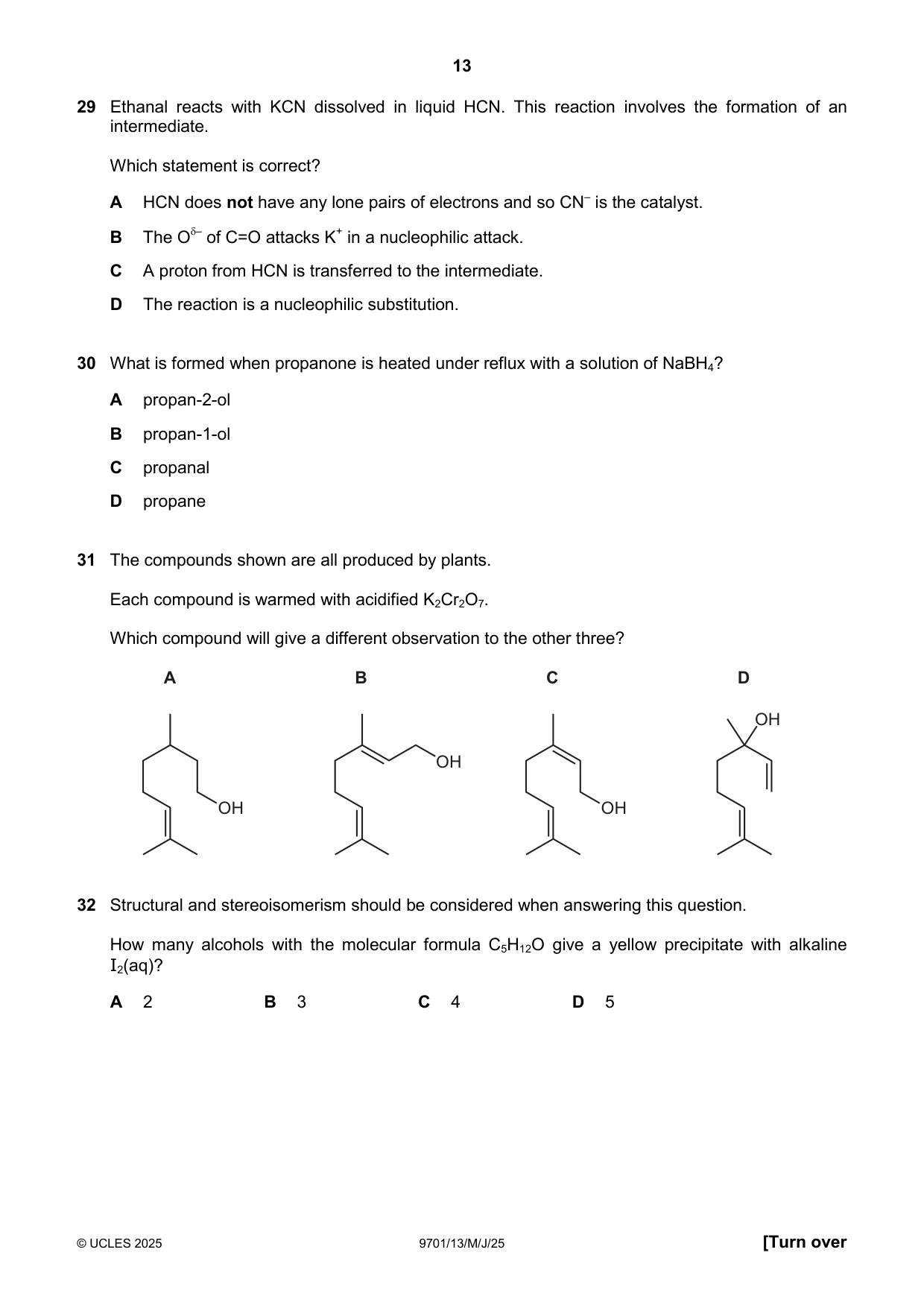
29 Ethanal reacts with KCN dissolved in liquid HCN. This reaction involves the formation of an intermediate. Which statement is correct? A HCN does not have any lone pairs of electrons and so CN– is the catalyst. B The O– of C=O attacks K+ in a nucleophilic attack. C A proton from HCN is transferred to the intermediate. D The reaction is a nucleophilic substitution.
Mark scheme: C
Q30 · What is formed when propanone is heated under reflux with a solution of NaBH4?
30 What is formed when propanone is heated under reflux with a solution of NaBH4? A propan-2-ol B propan-1-ol C propanal D propane
Mark scheme: A
Q31 · The compounds shown are all produced by plants
31 The compounds shown are all produced by plants. Each compound is warmed with acidified K2Cr2O7. Which compound will give a different observation to the other three? OH A OH B C D OH OH
Mark scheme: D
Q32 · Structural and stereoisomerism should be considered when answering this question
32 Structural and stereoisomerism should be considered when answering this question. How many alcohols with the molecular formula C5H12O give a yellow precipitate with alkaline I2(aq)? A 2 B 3 C 4 D 5
Mark scheme: C
Q33 · An amine is produced in the following reaction
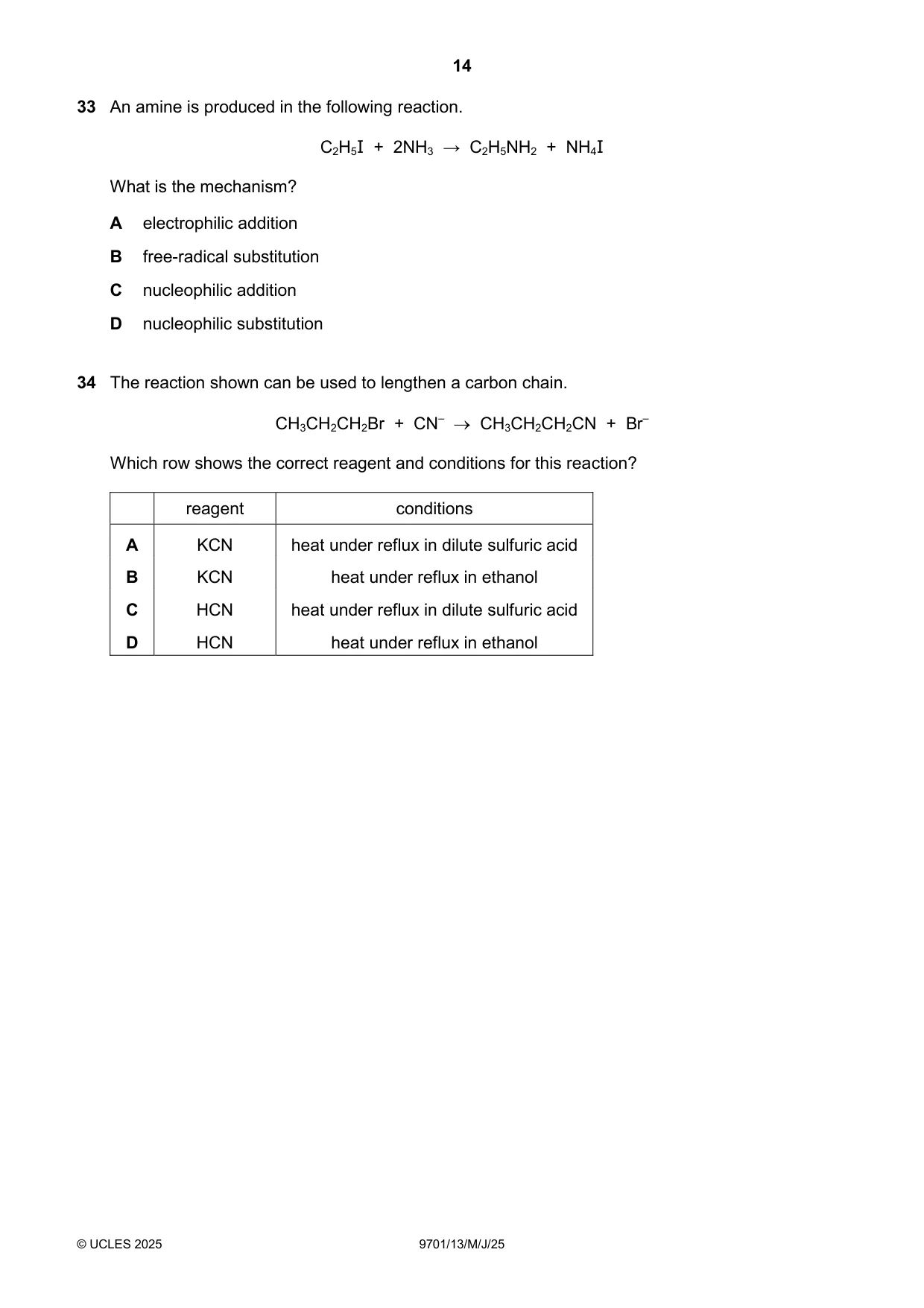
33 An amine is produced in the following reaction. C2H5I + 2NH3 → C2H5NH2 + NH4I What is the mechanism? A electrophilic addition B free-radical substitution C nucleophilic addition D nucleophilic substitution
Mark scheme: D
Q34 · The reaction shown can be used to lengthen a carbon chain
34 The reaction shown can be used to lengthen a carbon chain. CH3CH2CH2Br + CN– CH3CH2CH2CN + Br– Which row shows the correct reagent and conditions for this reaction? reagent conditions A KCN heat under reflux in dilute sulfuric acid B KCN heat under reflux in ethanol C HCN heat under reflux in dilute sulfuric acid D HCN heat under reflux in ethanol
Mark scheme: B
Q35 · Which row shows the products formed when cyclohexene reacts with acidified KMnO4 under…
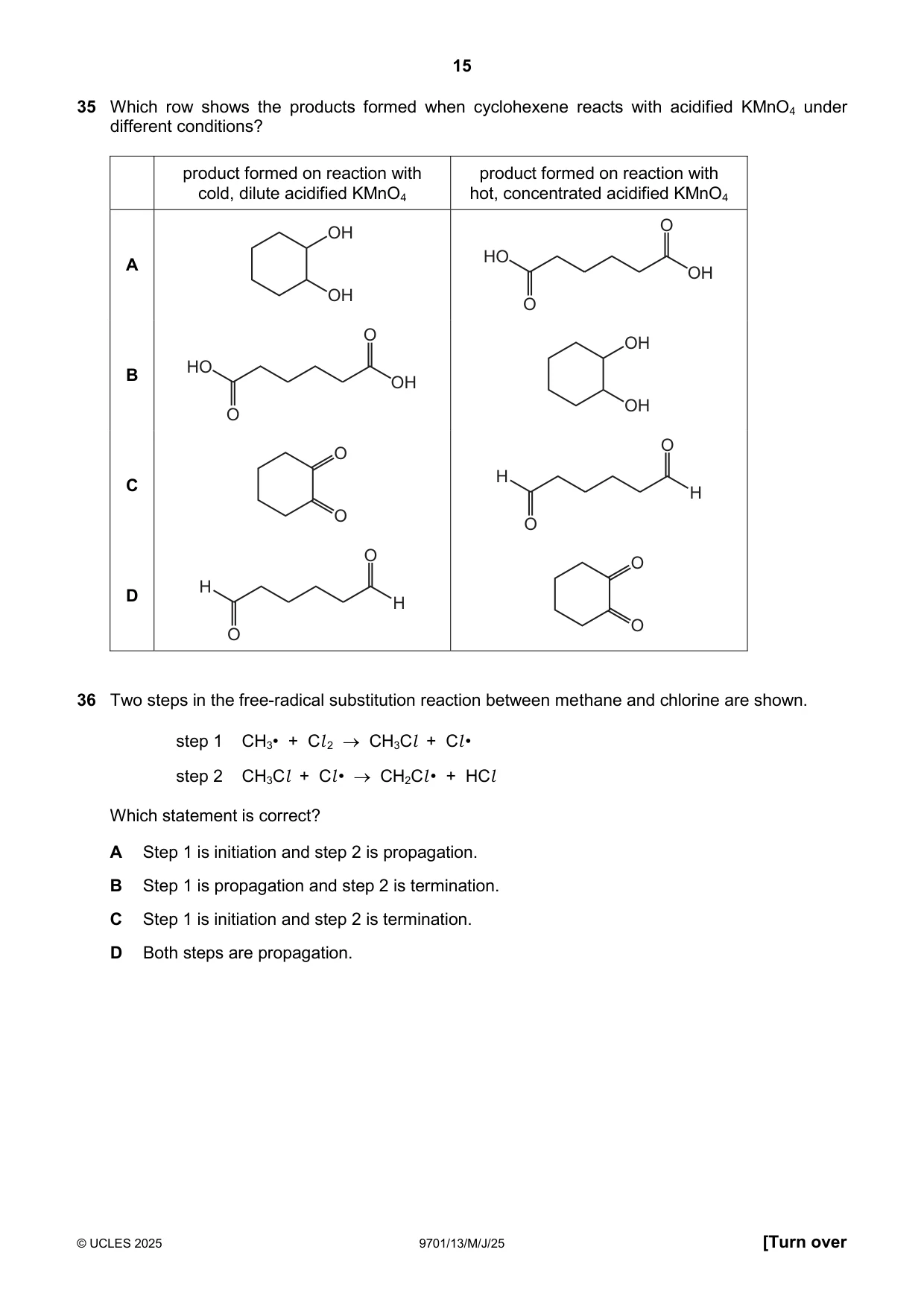
35 Which row shows the products formed when cyclohexene reacts with acidified KMnO4 under different conditions? product formed on reaction with cold, dilute acidified KMnO4 product formed on reaction with hot, concentrated acidified KMnO4 A OH OH O OH HO O B O OH HO O OH OH C O O O H H O D O H H O O O
Mark scheme: A
Q36 · Two steps in the free-radical substitution reaction between methane and chlorine are shown
36 Two steps in the free-radical substitution reaction between methane and chlorine are shown. step 1 CH3• + Cl2 CH3Cl + Cl• step 2 CH3Cl + Cl• CH2Cl• + HCl Which statement is correct? A Step 1 is initiation and step 2 is propagation. B Step 1 is propagation and step 2 is termination. C Step 1 is initiation and step 2 is termination. D Both steps are propagation.
Mark scheme: D
Q37 · Compound P displays cis/trans isomerism and gives a red-brown precipitate with Fehling’s…
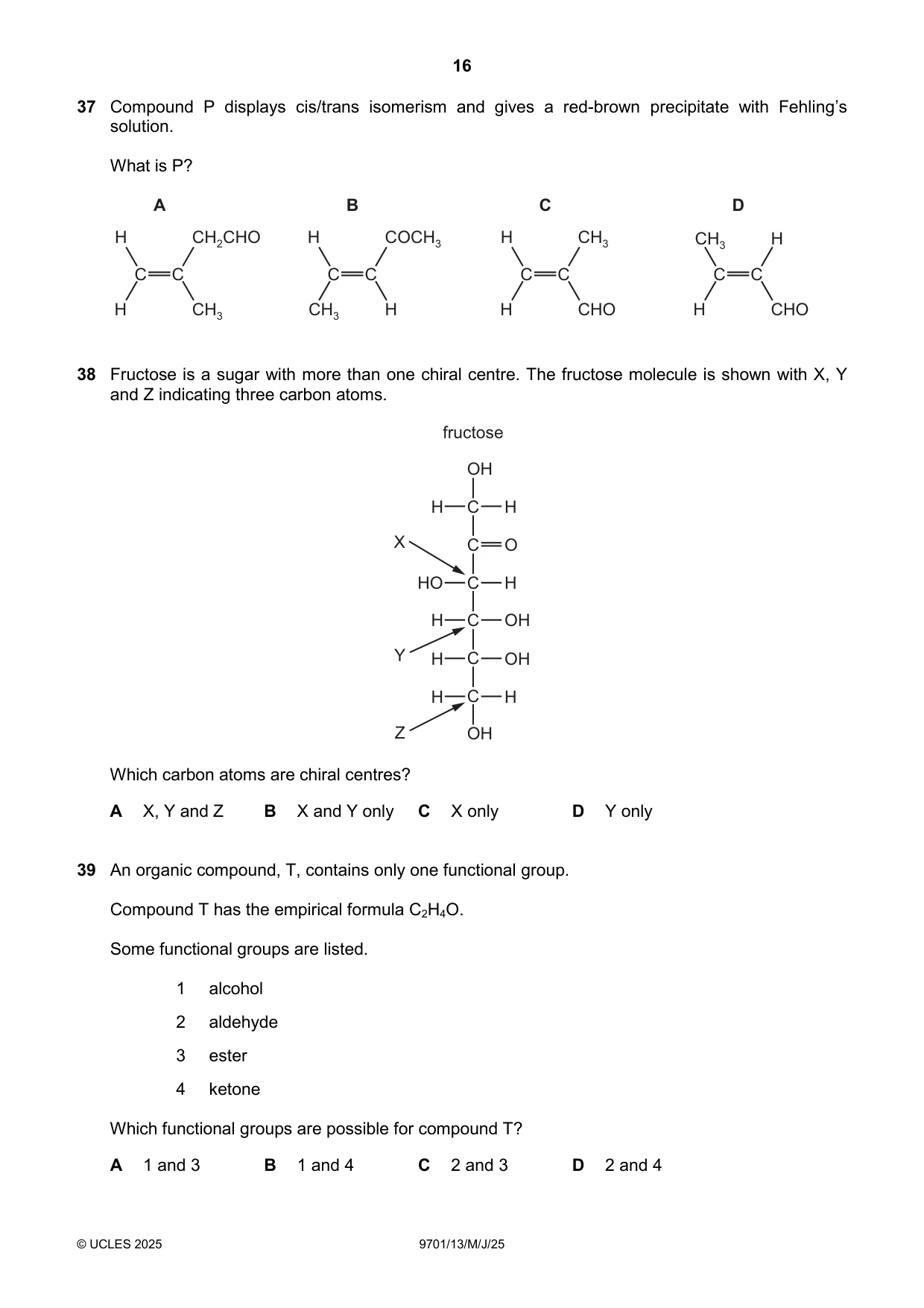
37 Compound P displays cis/trans isomerism and gives a red-brown precipitate with Fehling’s solution. What is P? C C H CH3 H CH2CHO A C C H CH3 H COCH3 B C C H CHO H CH3 C C C CHO CH3 H H D
Mark scheme: D
Q38 · Fructose is a sugar with more than one chiral centre
38 Fructose is a sugar with more than one chiral centre. The fructose molecule is shown with X, Y and Z indicating three carbon atoms. C C C C C C OH OH H H HO H H OH H OH H H O X Y Z fructose Which carbon atoms are chiral centres? A X, Y and Z B X and Y only C X only D Y only
Mark scheme: B
Q39 · An organic compound, T, contains only one functional group
39 An organic compound, T, contains only one functional group. Compound T has the empirical formula C2H4O. Some functional groups are listed. 1 alcohol 2 aldehyde 3 ester 4 ketone Which functional groups are possible for compound T? A 1 and 3 B 1 and 4 C 2 and 3 D 2 and 4
Mark scheme: C
More questions on Formulas, functional groups and the naming of organic compounds
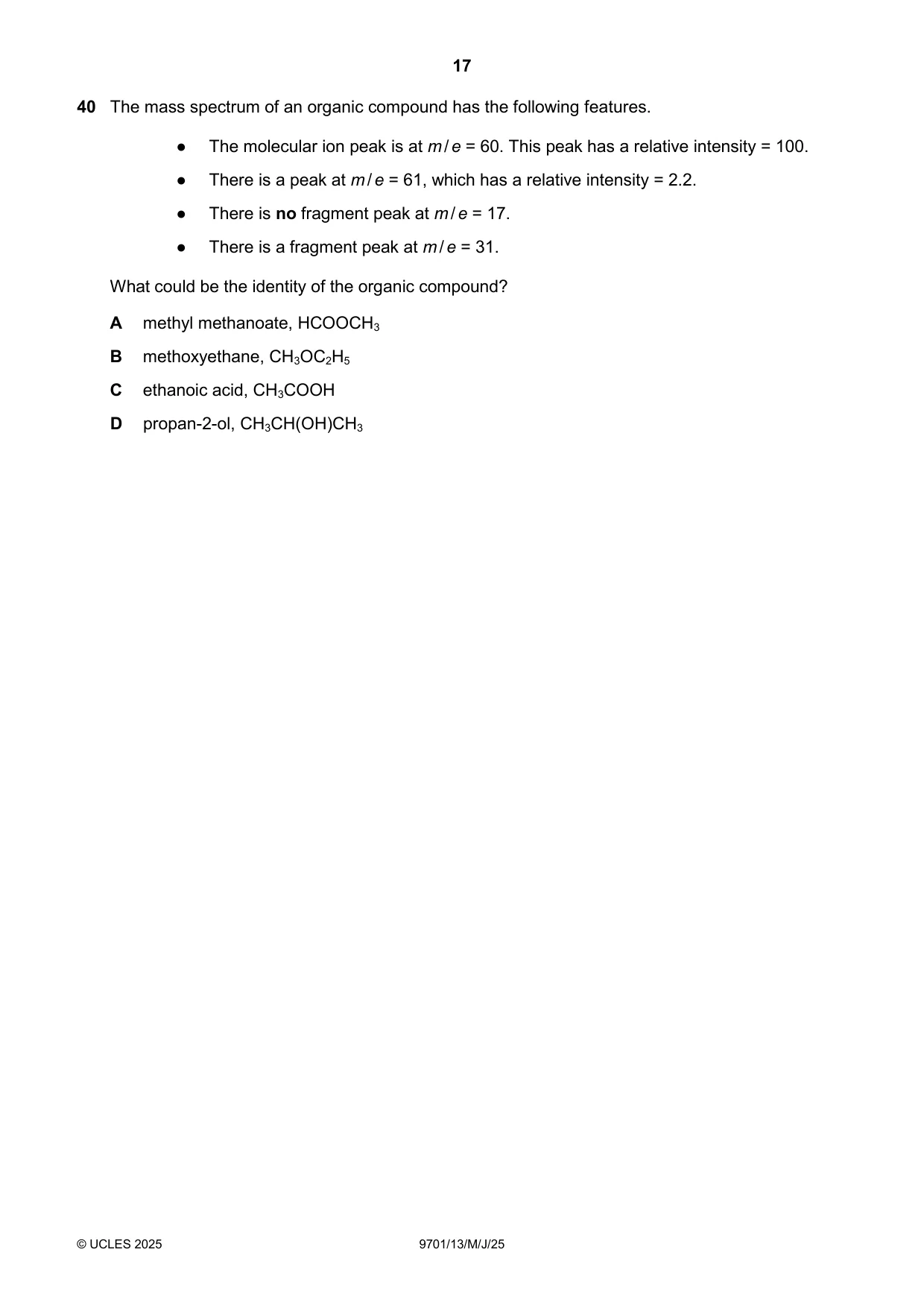
Q40 · The mass spectrum of an organic compound has the following features
40 The mass spectrum of an organic compound has the following features. ● The molecular ion peak is at m/e = 60. This peak has a relative intensity = 100. ● There is a peak at m/e = 61, which has a relative intensity = 2.2. ● There is no fragment peak at m/e = 17. ● There is a fragment peak at m/e = 31. What could be the identity of the organic compound? A methyl methanoate, HCOOCH3 B methoxyethane, CH3OC2H5 C ethanoic acid, CH3COOH D propan-2-ol, CH3CH(OH)CH3
Mark scheme: A
What was in this paper
The subtopics covered by these 39 questions, and how many questions each got. Open one in a new tab to see every Cambridge question on it.
3Aldehydes and ketones2Nitriles and hydroxynitriles2Similarities and trends in the properties of the Group 2 metals, magnesium to barium, and their compounds2Alcohols1Alkanes1Alkenes1Bonding and structure1Brønsted–Lowry theory of acids and bases1Carboxylic acids1Chemical equilibria: reversible reactions, dynamic equilibrium1Dot-and-cross diagrams1Effect of temperature on reaction rates and the concept of activation energy1Electrons, energy levels and atomic orbitals1Enthalpy change, ΔH1Esters1Formulas, functional groups and the naming of organic compounds1Halogenoalkanes1Hess’s law1Homogeneous and heterogeneous catalysts1Ionisation energy1Isomerism: optical1Mass spectrometry1Nitrogen and sulfur1Particles in the atom and atomic radius1Periodicity of chemical properties of the elements in Period 31Periodicity of physical properties of the elements in Period 31Phenol1Redox processes: electron transfer and changes in oxidation number (oxidation state)1Shapes of molecules1Shapes of organic molecules; σ and π bonds1Some reactions of the halide ions1The chemical properties of the halogen elements and the hydrogen halides1The gaseous state: ideal and real gases and pV = nRT1What you needed in this session
Cambridge’s own grade thresholds for 2025 May/June, Paper 1 · Variant 3. A higher threshold means an easier paper — the bar moves with how the cohort did.