Cambridge A Level Chemistry 9701 — 2013 May/June Paper 1 · Variant 3
9701/13/M/J/13 · 40 questions · 40 marks · ≈45 min
The question paper and its mark scheme, free to read here and free to download. This is Cambridge’s own paper, exactly as it was sat.
Question paper16 pages
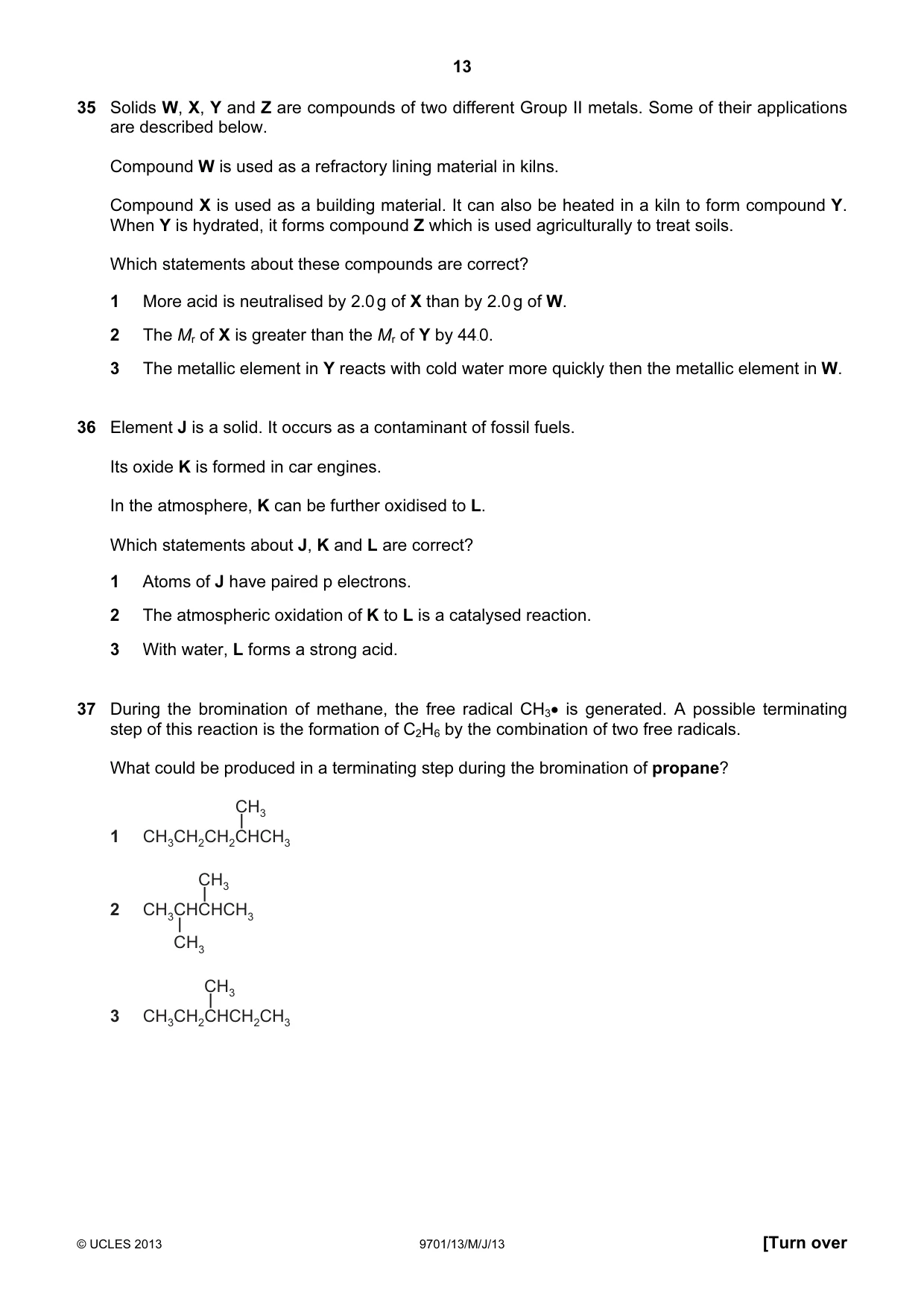
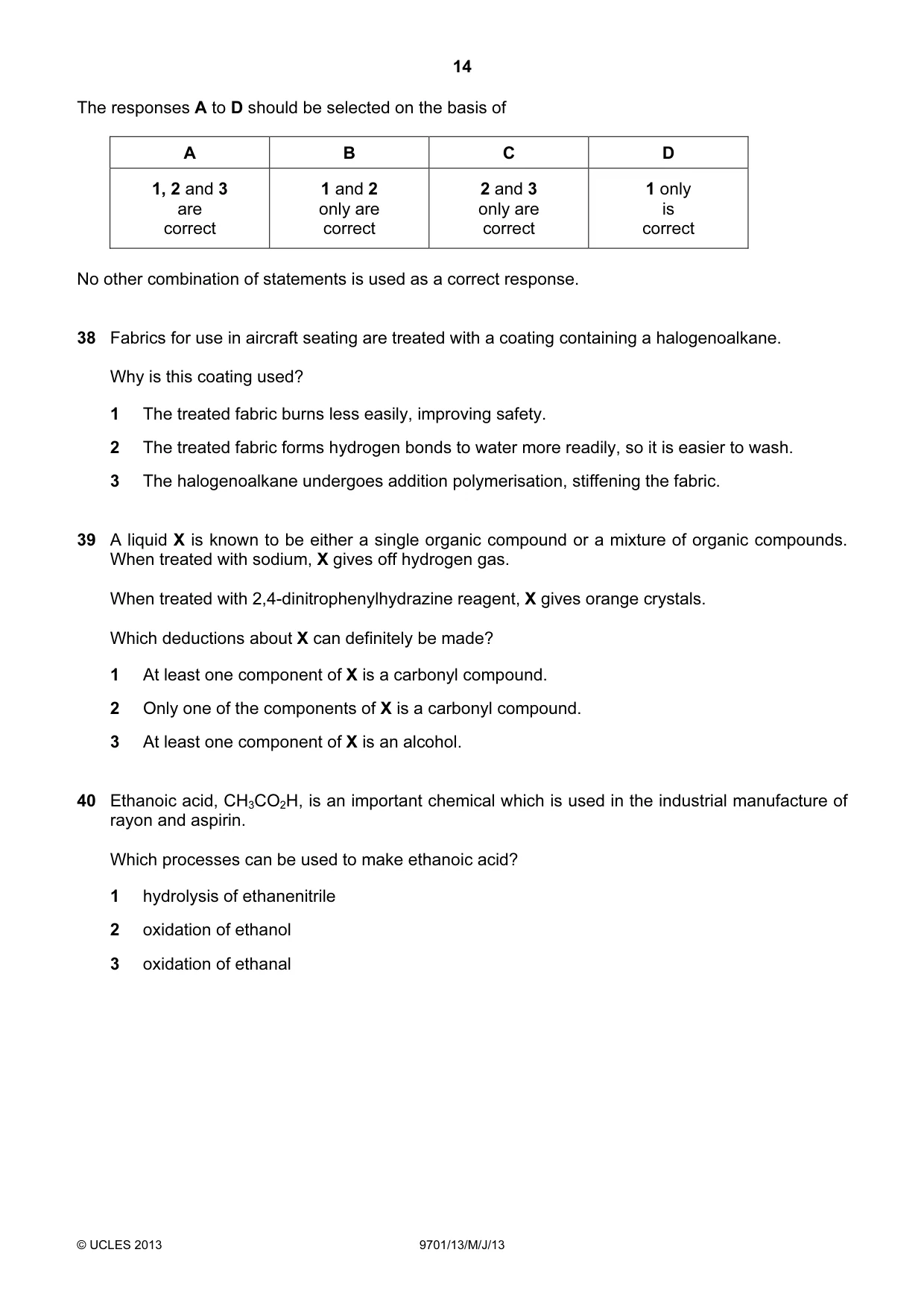

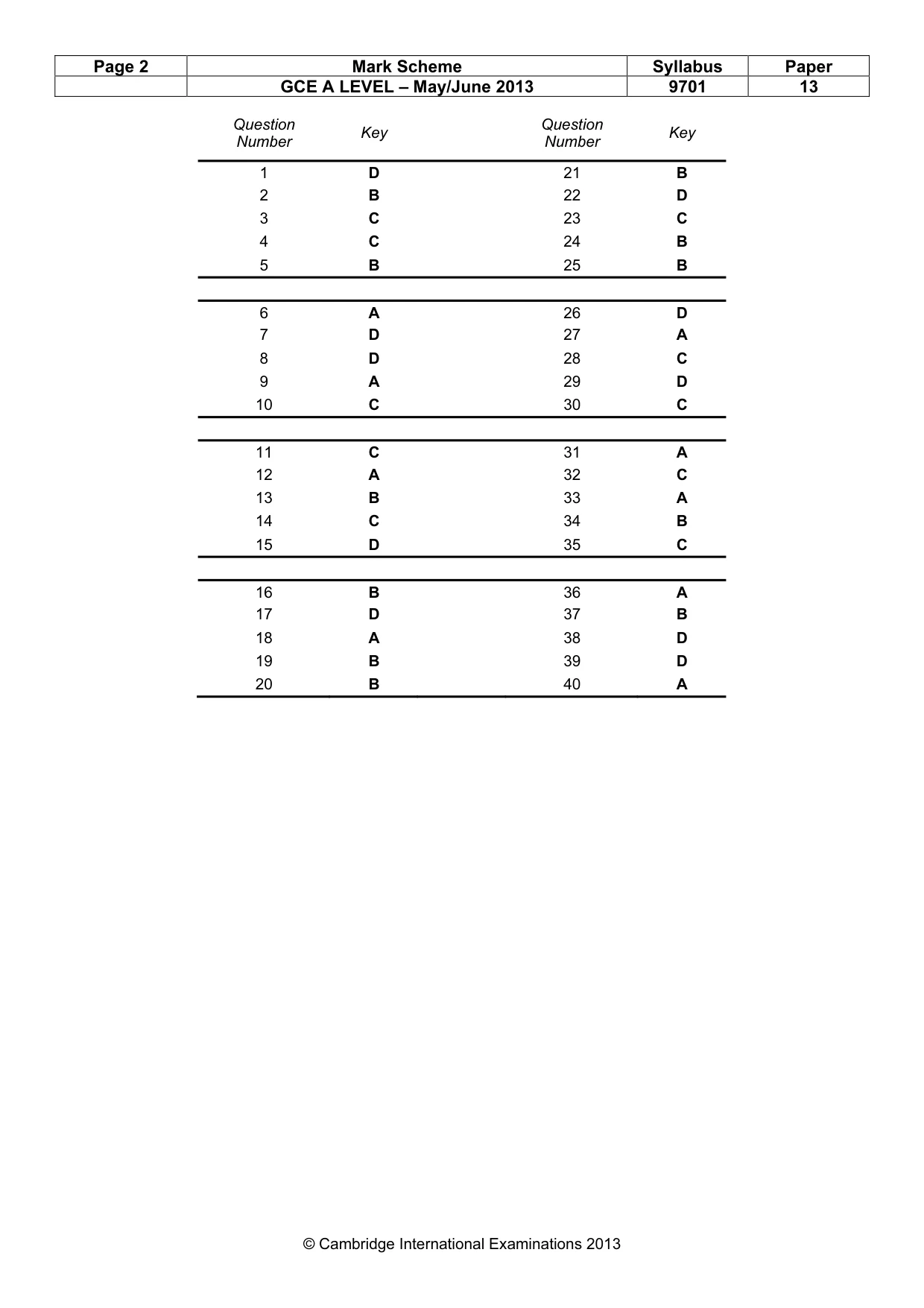
Mark scheme2 pages
Answers below. Sit the paper first if you are practising.
Questions as text
Q1 · In the redox reaction shown, how do the oxidation states of vanadium and sulfur change?
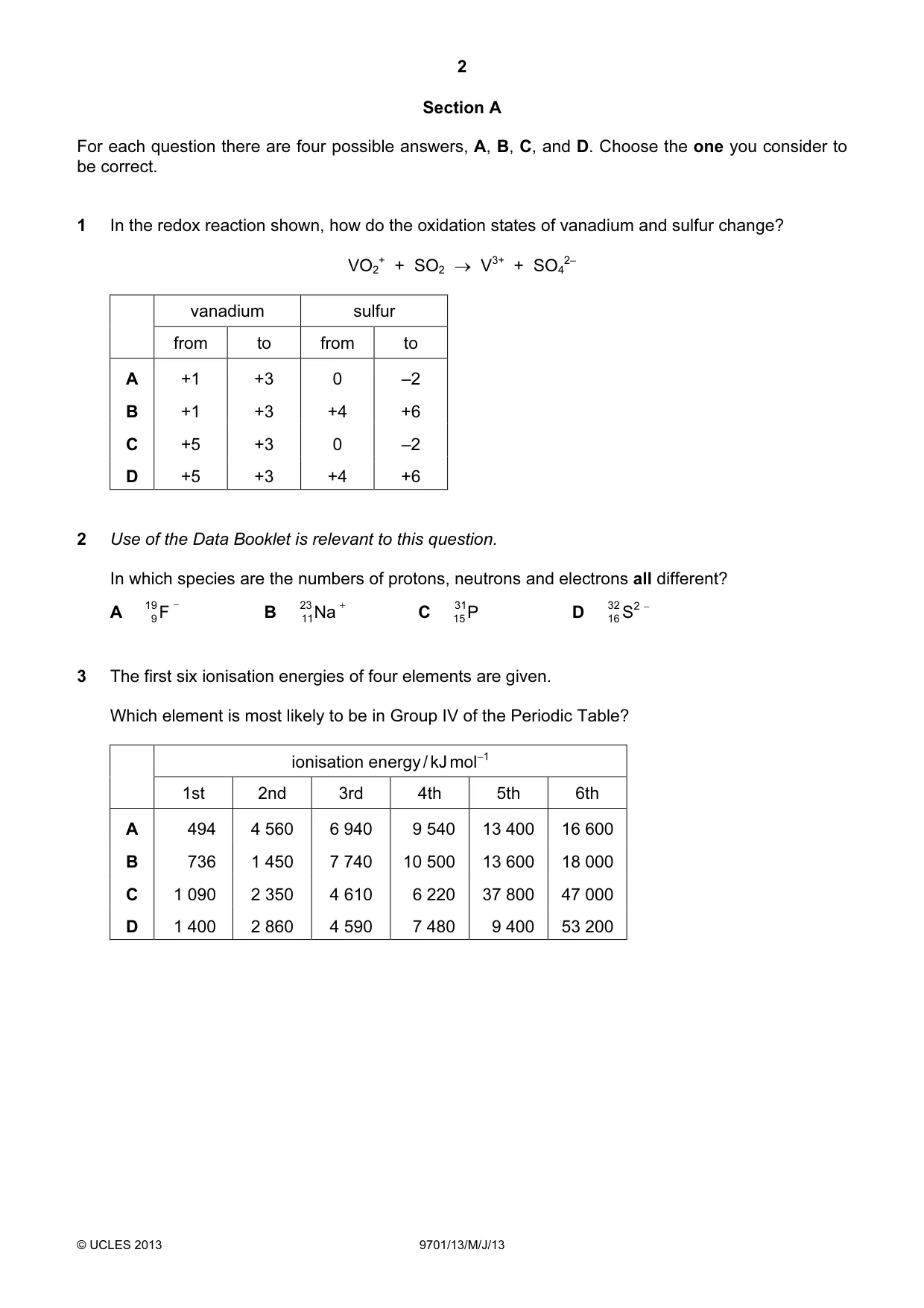
1 In the redox reaction shown, how do the oxidation states of vanadium and sulfur change? VO2 + + SO2 → V3+ + SO4 2– vanadium sulfur from to from to A +1 +3 0 –2 B +1 +3 +4 +6 C +5 +3 0 –2 D +5 +3 +4 +6
Mark scheme: D
Q2 · Use of the Data Booklet is relevant to this question
2 Use of the Data Booklet is relevant to this question. In which species are the numbers of protons, neutrons and electrons all different? A 19 F − B 23 Na + C 31 P D 16 S 32 2 − 9 11 15
Mark scheme: B
Q3 · The first six ionisation energies of four elements are given
3 The first six ionisation energies of four elements are given. Which element is most likely to be in Group IV of the Periodic Table? ionisation energy / kJ mol−1 1st 2nd 3rd 4th 5th 6th A 494 4 560 6 940 9 540 13 400 16 600 B 736 1 450 7 740 10 500 13 600 18 000 C 1 090 2 350 4 610 6 220 37 800 47 000 D 1 400 2 860 4 590 7 480 9 400 53 200
Mark scheme: C
Q4 · The diagram represents, for a given temperature, the Boltzmann distribution of the…
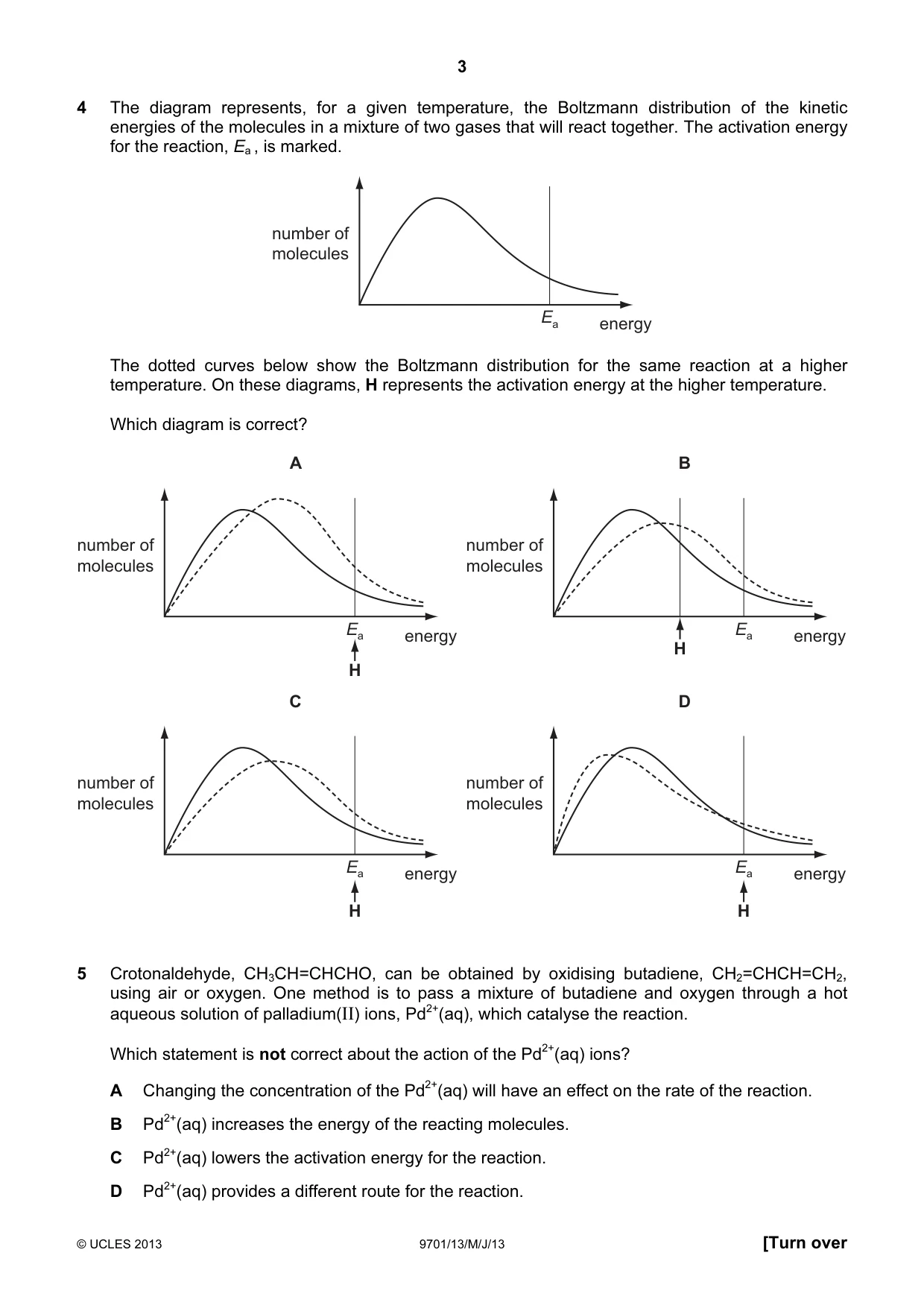
4 The diagram represents, for a given temperature, the Boltzmann distribution of the kinetic energies of the molecules in a mixture of two gases that will react together. The activation energy for the reaction, Ea , is marked. number of molecules Ea energy The dotted curves below show the Boltzmann distribution for the same reaction at a higher temperature. On these diagrams, H represents the activation energy at the higher temperature. Which diagram is correct? A B number of number of molecules molecules Ea energy Ea energy H H C D number of number of molecules molecules Ea energy Ea energy H H
Mark scheme: C
More questions on Effect of temperature on reaction rates and the concept of activation energy
Q5 · Crotonaldehyde, CH3CH=CHCHO, can be obtained by oxidising butadiene, CH2=CHCH=CH2, using…
5 Crotonaldehyde, CH3CH=CHCHO, can be obtained by oxidising butadiene, CH2=CHCH=CH2, using air or oxygen. One method is to pass a mixture of butadiene and oxygen through a hot aqueous solution of palladium(II) ions, Pd2+(aq), which catalyse the reaction. Which statement is not correct about the action of the Pd2+(aq) ions? A Changing the concentration of the Pd2+(aq) will have an effect on the rate of the reaction. B Pd2+(aq) increases the energy of the reacting molecules. C Pd2+(aq) lowers the activation energy for the reaction. D Pd2+(aq) provides a different route for the reaction.
Mark scheme: B
Q6 · Which least resembles an ideal gas at room temperature and pressure?
6 Which least resembles an ideal gas at room temperature and pressure? A ammonia B helium C hydrogen D methane
Mark scheme: A
More questions on The gaseous state: ideal and real gases and pV = nRT
Q7 · Use of the Data Booklet is relevant to this question
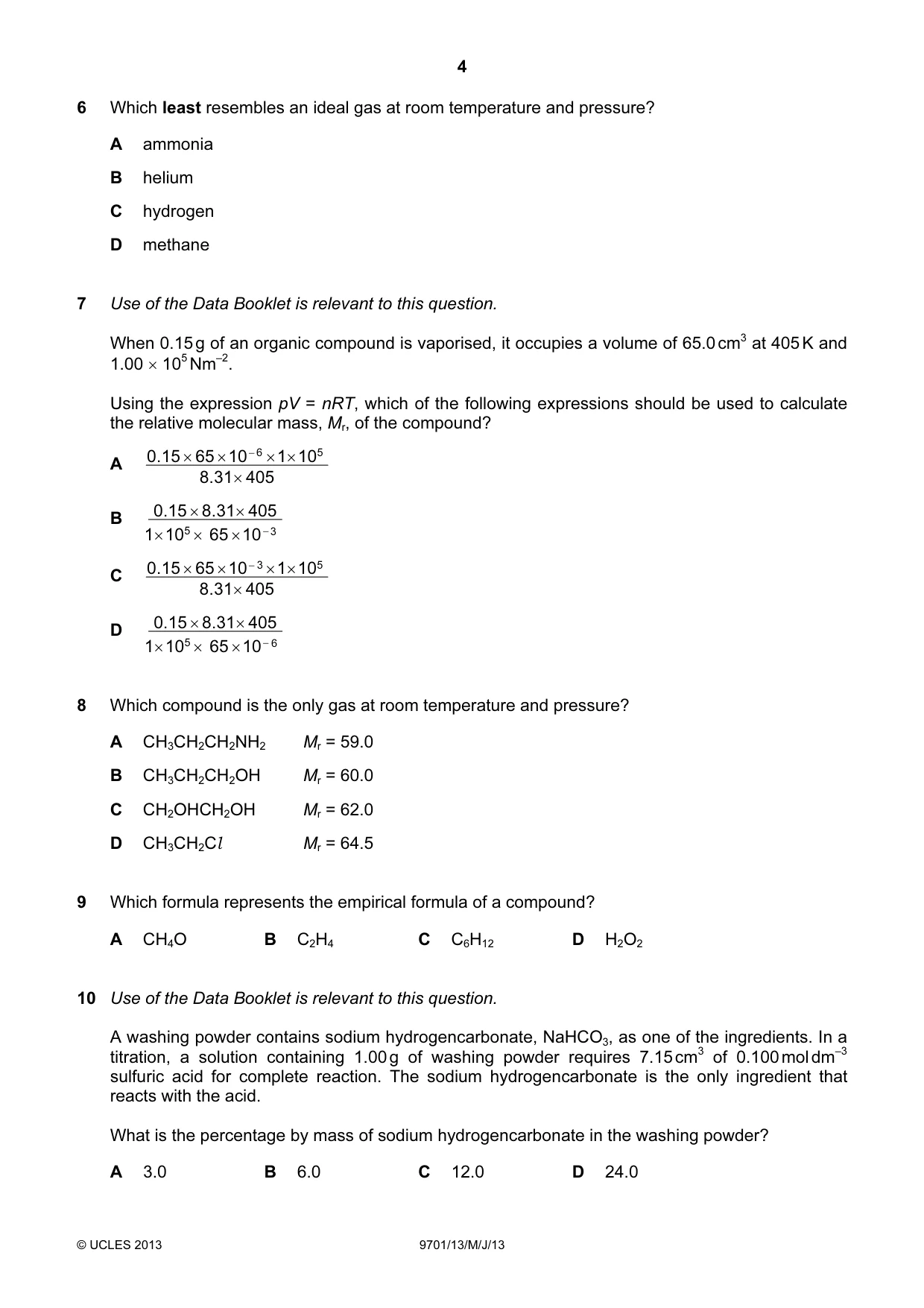
7 Use of the Data Booklet is relevant to this question. When 0.15 g of an organic compound is vaporised, it occupies a volume of 65.0 cm3 at 405 K and 1.00 × 10⁵ Nm–2. Using the expression pV = nRT, which of the following expressions should be used to calculate the relative molecular mass, Mr, of the compound? 0 . 15 × 65 × 10 − 6 × 1 × 10 5 A 8 . 31 × 405 B 0 . 15 × 8 . 31 × 405 1 × 10 5 × 65 × 10 − 3 0 . 15 × 65 × 10 − 3 × 1 × 10 5 C 8 . 31 × 405 D 0 . 15 × 8 . 31 × 405 1 × 10 5 × 65 × 10 − 6
Mark scheme: D
More questions on The gaseous state: ideal and real gases and pV = nRT
Q8 · Which compound is the only gas at room temperature and pressure?
8 Which compound is the only gas at room temperature and pressure? A CH3CH2CH2NH2 Mr = 59.0 B CH3CH2CH2OH Mr = 60.0 C CH2OHCH2OH Mr = 62.0 D CH3CH2Cl Mr = 64.5
Mark scheme: D
More questions on Intermolecular forces, electronegativity and bond properties
Q9 · Which formula represents the empirical formula of a compound?
9 Which formula represents the empirical formula of a compound? A CH4O B C2H4 C C6H12 D H2O2
Mark scheme: A
Q10 · Use of the Data Booklet is relevant to this question
10 Use of the Data Booklet is relevant to this question. A washing powder contains sodium hydrogencarbonate, NaHCO3, as one of the ingredients. In a titration, a solution containing 1.00 g of washing powder requires 7.15 cm3 of 0.100 mol dm–3 sulfuric acid for complete reaction. The sodium hydrogencarbonate is the only ingredient that reacts with the acid. What is the percentage by mass of sodium hydrogencarbonate in the washing powder? A 3.0 B 6.0 C 12.0 D 24.0
Mark scheme: C
More questions on Reacting masses and volumes (of solutions and gases)
Q11 · Use of the Data Booklet is relevant to this question
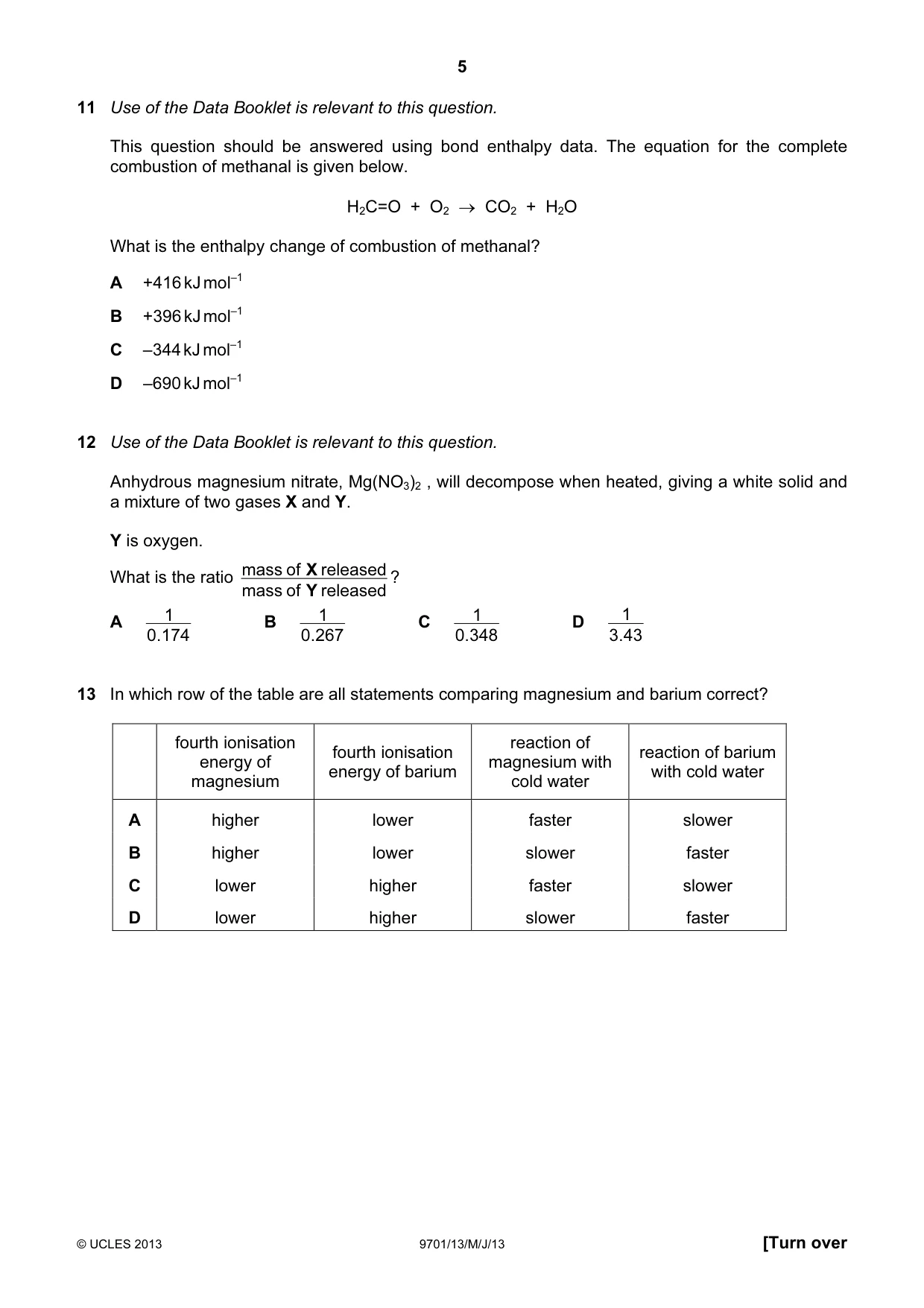
11 Use of the Data Booklet is relevant to this question. This question should be answered using bond enthalpy data. The equation for the complete combustion of methanal is given below. H2C=O + O2 → CO2 + H2O What is the enthalpy change of combustion of methanal? A +416 kJ mol–1 B +396 kJ mol–1 C –344 kJ mol–1 D –690 kJ mol–1
Mark scheme: C
Q12 · Use of the Data Booklet is relevant to this question
12 Use of the Data Booklet is relevant to this question. Anhydrous magnesium nitrate, Mg(NO3)2 , will decompose when heated, giving a white solid and a mixture of two gases X and Y. Y is oxygen. mass of X released What is the ratio ? mass of Y released A 1 B 1 C 1 D 1 0 . 174 0 . 267 0 . 348 3 . 43
Mark scheme: A
More questions on Reacting masses and volumes (of solutions and gases)
Q13 · In which row of the table are all statements comparing magnesium and barium correct?
13 In which row of the table are all statements comparing magnesium and barium correct? fourth ionisation reaction of fourth ionisation reaction of barium energy of magnesium with energy of barium with cold water magnesium cold water A higher lower faster slower B higher lower slower faster C lower higher faster slower D lower higher slower faster
Mark scheme: B
Q14 · Two students, P and Q, were asked to draw bar charts to represent how some properties of…
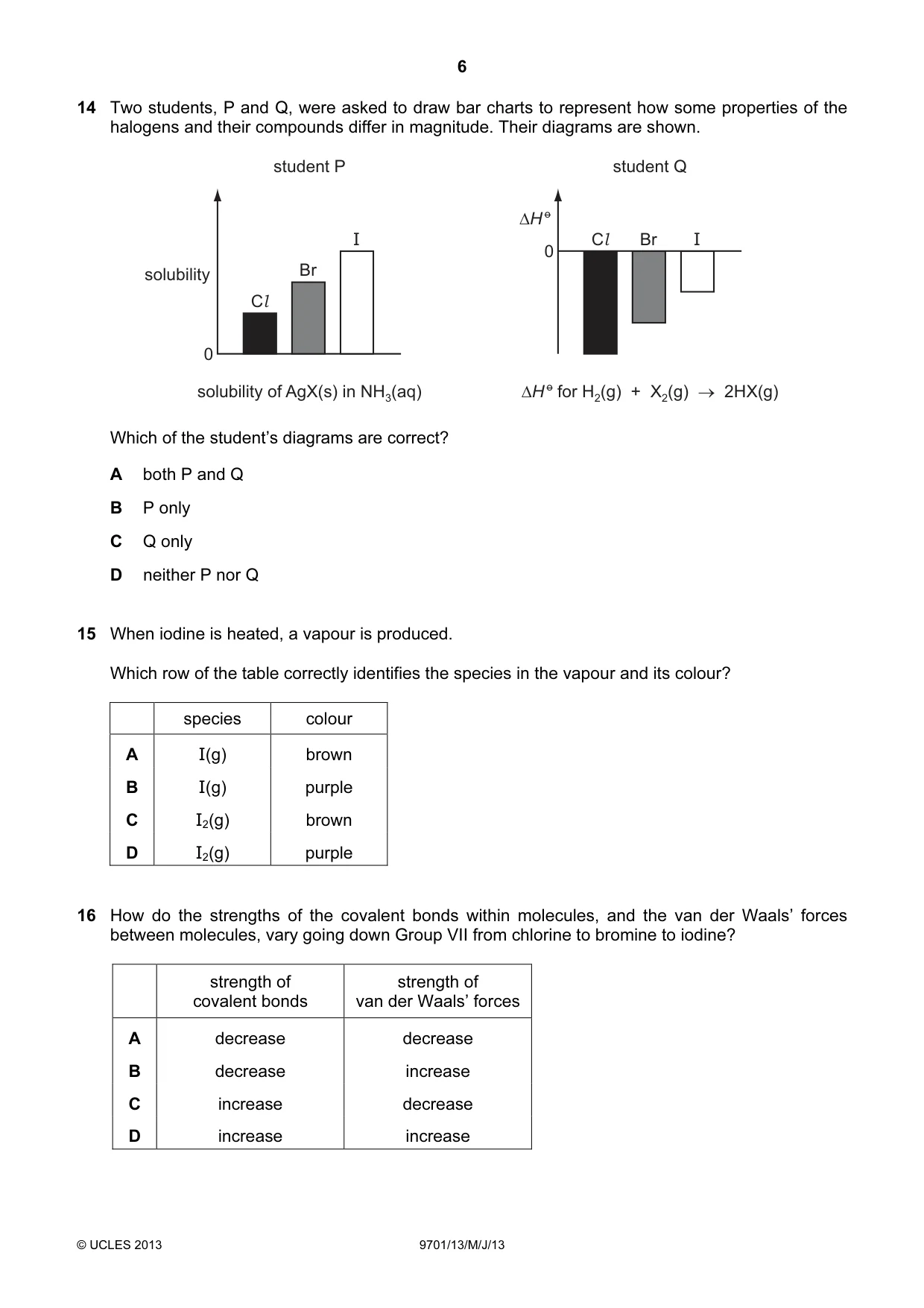
14 Two students, P and Q, were asked to draw bar charts to represent how some properties of the halogens and their compounds differ in magnitude. Their diagrams are shown. student P student Q ∆H o I Cl Br I 0 solubility Br Cl 0 solubility of AgX(s) in NH3(aq) ∆H o for H2(g) + X2(g) → 2HX(g) Which of the student’s diagrams are correct? A both P and Q B P only C Q only D neither P nor Q
Mark scheme: C
More questions on Physical properties of the Group 17 elements
Q15 · When iodine is heated, a vapour is produced
15 When iodine is heated, a vapour is produced. Which row of the table correctly identifies the species in the vapour and its colour? species colour A I(g) brown B I(g) purple C I2(g) brown D I2(g) purple
Mark scheme: D
More questions on Physical properties of the Group 17 elements
Q16 · How do the strengths of the covalent bonds within molecules, and the van der Waals’…
16 How do the strengths of the covalent bonds within molecules, and the van der Waals’ forces between molecules, vary going down Group VII from chlorine to bromine to iodine? strength of strength of covalent bonds van der Waals’ forces A decrease decrease B decrease increase C increase decrease D increase increase
Mark scheme: B
More questions on Physical properties of the Group 17 elements
Q17 · Graphs can be drawn to show the percentage of ammonia at equilibrium when nitrogen and…
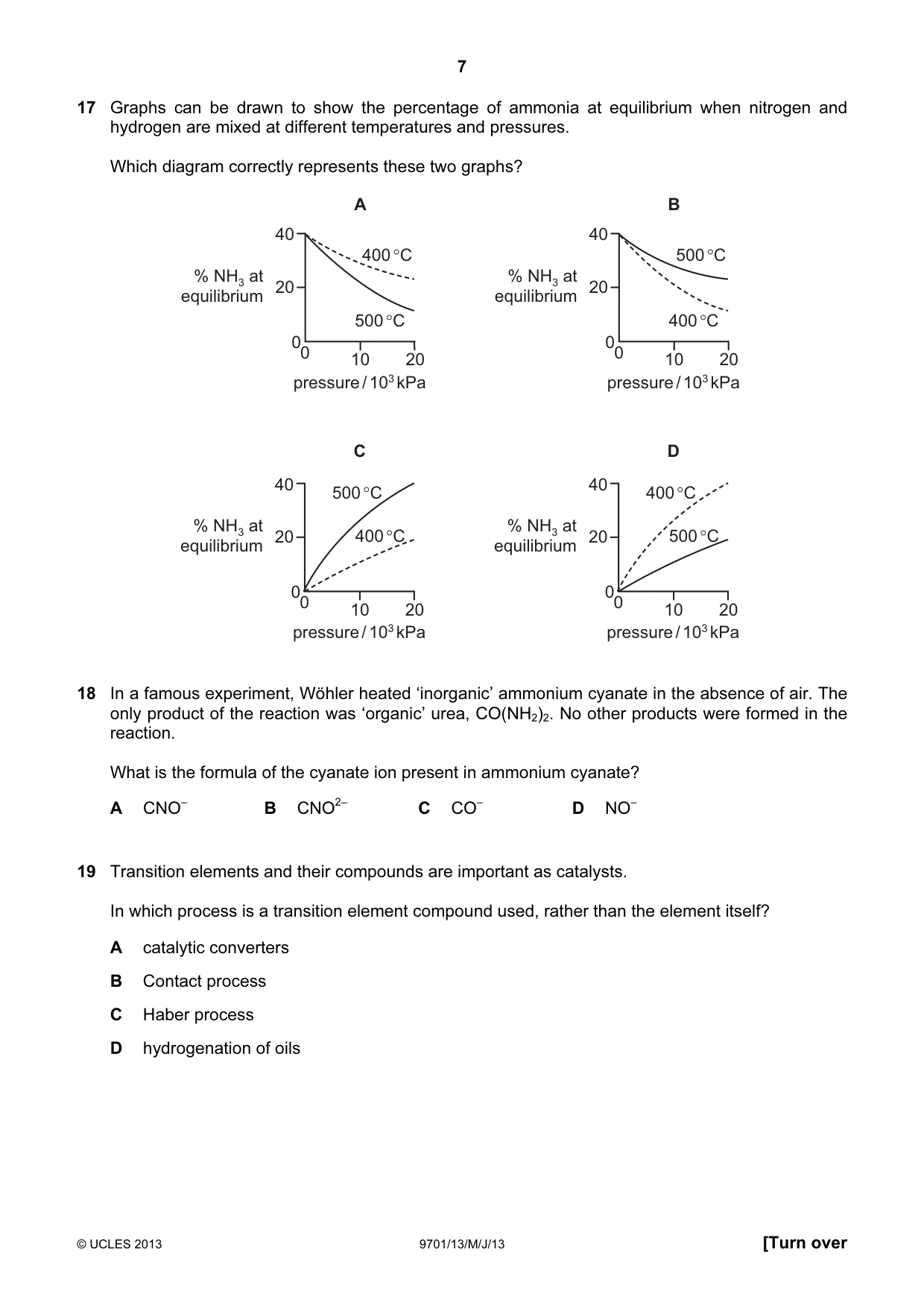
17 Graphs can be drawn to show the percentage of ammonia at equilibrium when nitrogen and hydrogen are mixed at different temperatures and pressures. Which diagram correctly represents these two graphs? A B 40 40 400 °C 500 °C % NH3 at % NH3 at 20 20 equilibrium equilibrium 500 °C 400 °C 00 00 10 20 10 20 pressure / 103 kPa pressure / 103 kPa C D 40 40 500 °C 400 °C % NH3 at % NH3 at 20 400 °C 20 500 °C equilibrium equilibrium 0 0 0 0 10 20 10 20 pressure / 103 kPa pressure / 103 kPa
Mark scheme: D
More questions on Chemical equilibria: reversible reactions, dynamic equilibrium
Q18 · In a famous experiment, Wöhler heated ‘inorganic’ ammonium cyanate in the absence of air
18 In a famous experiment, Wöhler heated ‘inorganic’ ammonium cyanate in the absence of air. The only product of the reaction was ‘organic’ urea, CO(NH2)2. No other products were formed in the reaction. What is the formula of the cyanate ion present in ammonium cyanate? A CNO– B CNO2– C CO– D NO–
Mark scheme: A
More questions on Formulas, functional groups and the naming of organic compounds
Q19 · Transition elements and their compounds are important as catalysts
19 Transition elements and their compounds are important as catalysts. In which process is a transition element compound used, rather than the element itself? A catalytic converters B Contact process C Haber process D hydrogenation of oils
Mark scheme: B
Q20 · Ethene reacts with steam in the presence of sulfuric acid
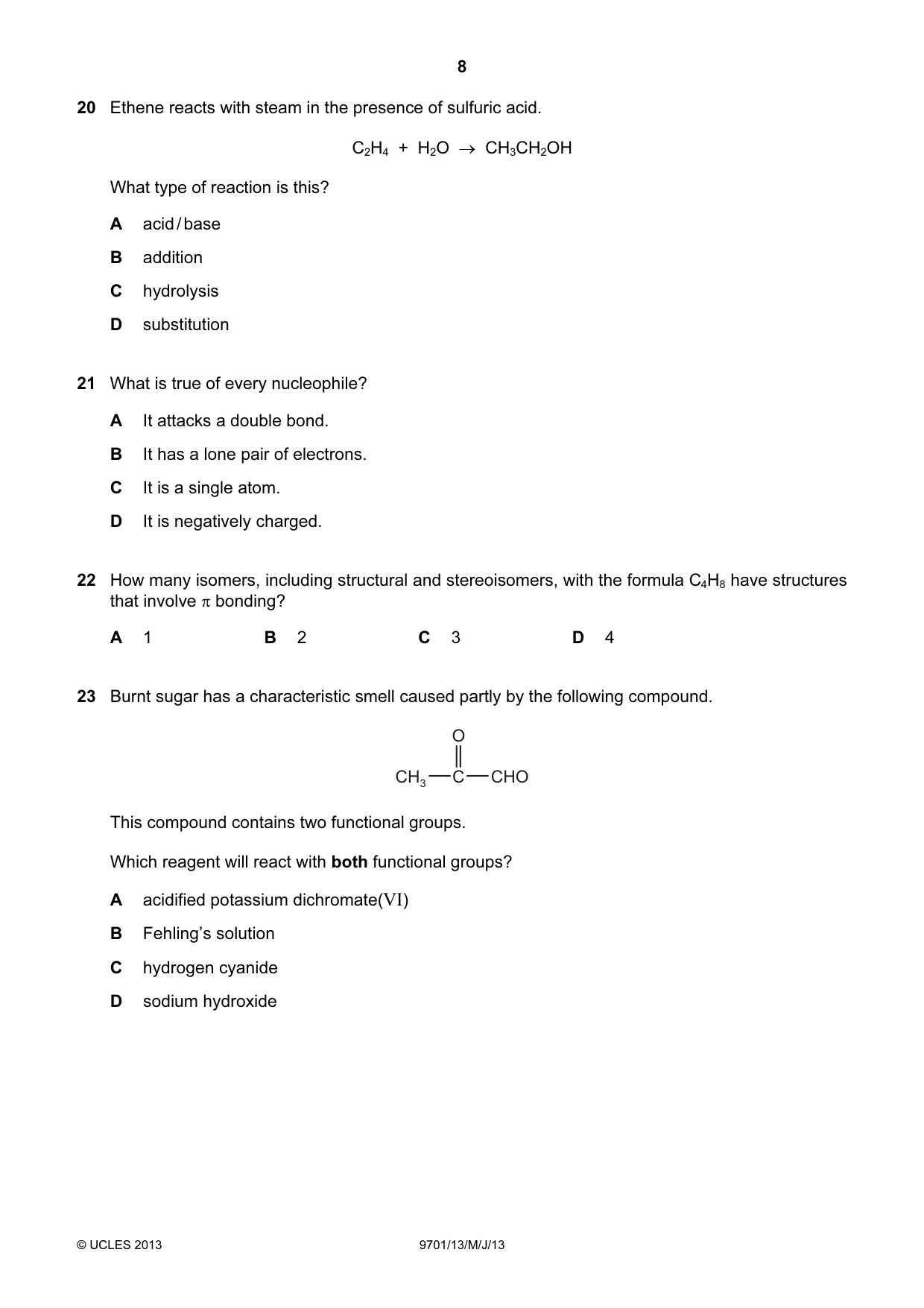
20 Ethene reacts with steam in the presence of sulfuric acid. C2H4 + H2O → CH3CH2OH What type of reaction is this? A acid / base B addition C hydrolysis D substitution
Mark scheme: B
Q21 · What is true of every nucleophile?
21 What is true of every nucleophile? A It attacks a double bond. B It has a lone pair of electrons. C It is a single atom. D It is negatively charged.
Mark scheme: B
Q22 · How many isomers, including structural and stereoisomers, with the formula C4H8 have…
22 How many isomers, including structural and stereoisomers, with the formula C4H8 have structures that involve π bonding? A 1 B 2 C 3 D 4
Mark scheme: D
More questions on Isomerism: structural isomerism and stereoisomerism
Q23 · Burnt sugar has a characteristic smell caused partly by the following compound
23 Burnt sugar has a characteristic smell caused partly by the following compound. O CH3 C CHO This compound contains two functional groups. Which reagent will react with both functional groups? A acidified potassium dichromate(VI) B Fehling’s solution C hydrogen cyanide D sodium hydroxide
Mark scheme: C
Q24 · Which sequence of reagents may be used in the laboratory to convert propan-1-ol into…
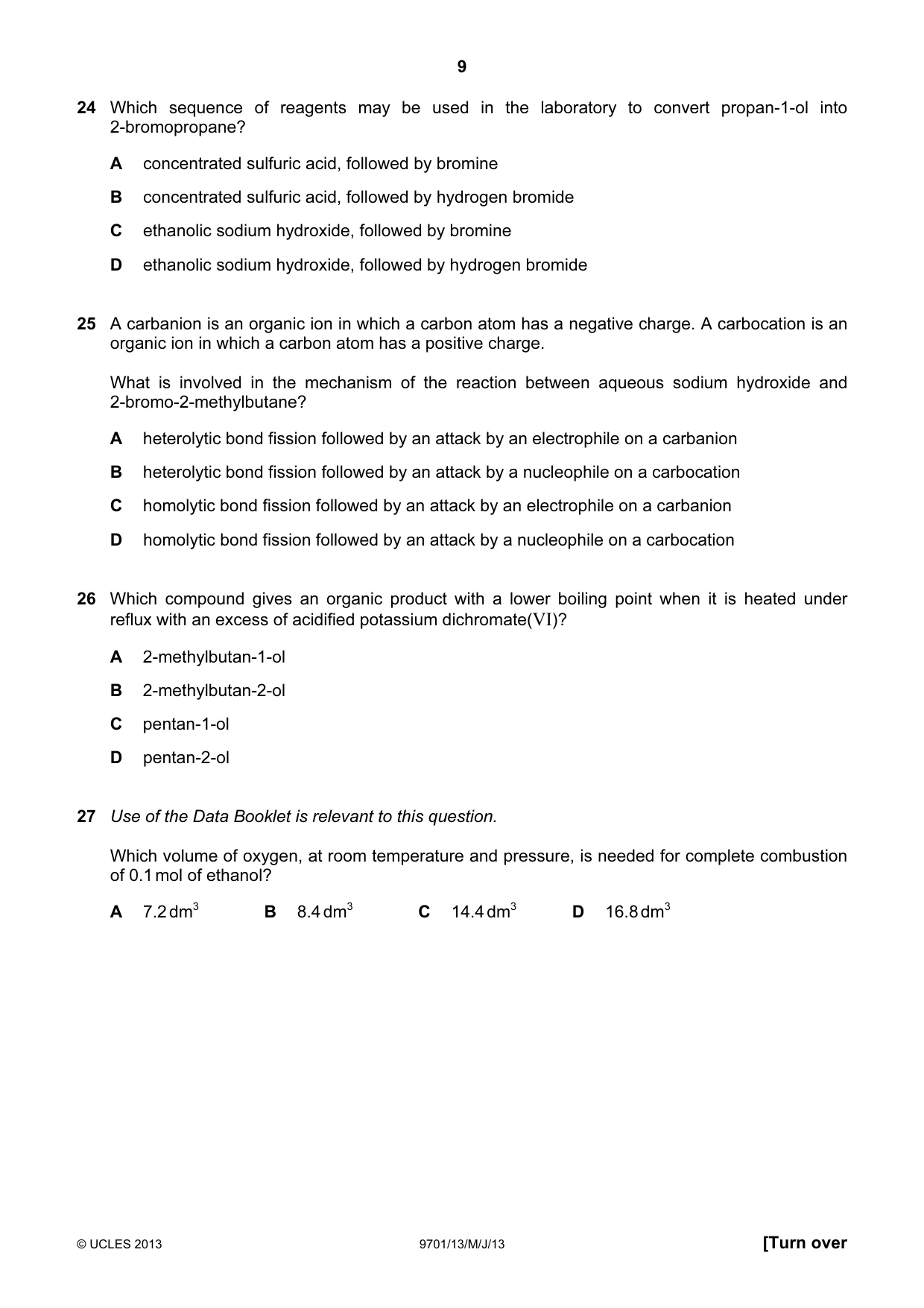
24 Which sequence of reagents may be used in the laboratory to convert propan-1-ol into 2-bromopropane? A concentrated sulfuric acid, followed by bromine B concentrated sulfuric acid, followed by hydrogen bromide C ethanolic sodium hydroxide, followed by bromine D ethanolic sodium hydroxide, followed by hydrogen bromide
Mark scheme: B
Q25 · A carbanion is an organic ion in which a carbon atom has a negative charge
25 A carbanion is an organic ion in which a carbon atom has a negative charge. A carbocation is an organic ion in which a carbon atom has a positive charge. What is involved in the mechanism of the reaction between aqueous sodium hydroxide and 2-bromo-2-methylbutane? A heterolytic bond fission followed by an attack by an electrophile on a carbanion B heterolytic bond fission followed by an attack by a nucleophile on a carbocation C homolytic bond fission followed by an attack by an electrophile on a carbanion D homolytic bond fission followed by an attack by a nucleophile on a carbocation
Mark scheme: B
Q26 · Which compound gives an organic product with a lower boiling point when it is heated…
26 Which compound gives an organic product with a lower boiling point when it is heated under reflux with an excess of acidified potassium dichromate(VI)? A 2-methylbutan-1-ol B 2-methylbutan-2-ol C pentan-1-ol D pentan-2-ol
Mark scheme: D
Q27 · Use of the Data Booklet is relevant to this question
27 Use of the Data Booklet is relevant to this question. Which volume of oxygen, at room temperature and pressure, is needed for complete combustion of 0.1 mol of ethanol? A 7.2 dm3 B 8.4 dm3 C 14.4 dm3 D 16.8 dm3
Mark scheme: A
More questions on Reacting masses and volumes (of solutions and gases)
Q28 · Cyclohexene, shown below, can form an addition polymer
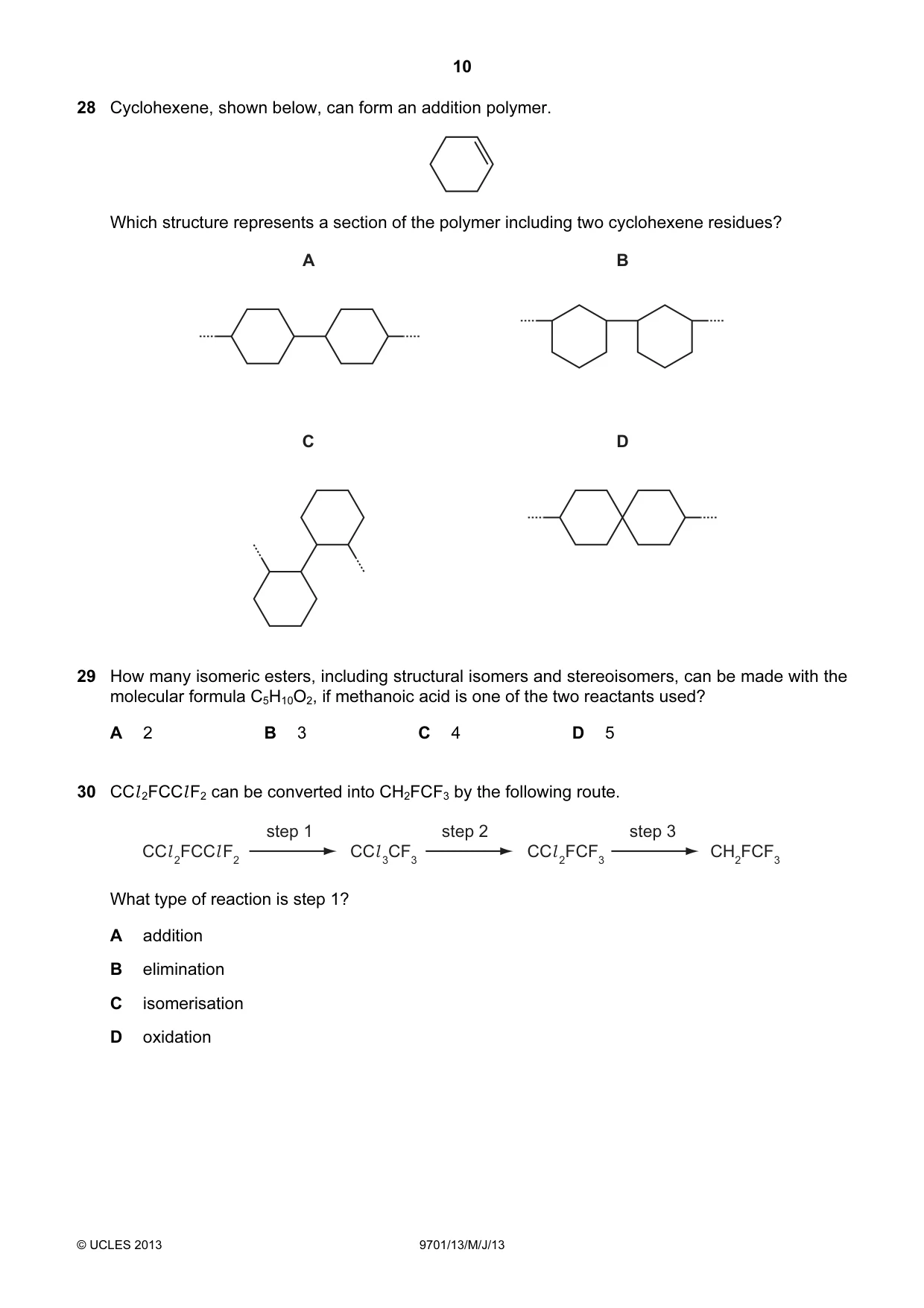
28 Cyclohexene, shown below, can form an addition polymer. Which structure represents a section of the polymer including two cyclohexene residues? A B C D
Mark scheme: C
Q29 · How many isomeric esters, including structural isomers and stereoisomers, can be made…
29 How many isomeric esters, including structural isomers and stereoisomers, can be made with the molecular formula C5H10O2, if methanoic acid is one of the two reactants used? A 2 B 3 C 4 D 5
Mark scheme: D
More questions on Isomerism: structural isomerism and stereoisomerism
Q30 · CCl 2FCCl F2 can be converted into CH2FCF3 by the following route
30 CCl 2FCCl F2 can be converted into CH2FCF3 by the following route. step 1 step 2 step 3 CCl 2FCCl F2 CCl 3CF3 CCl 2FCF3 CH2FCF3 What type of reaction is step 1? A addition B elimination C isomerisation D oxidation
Mark scheme: C
Q31 · A space shuttle’s upward thrust came from the following reaction between aluminium and…
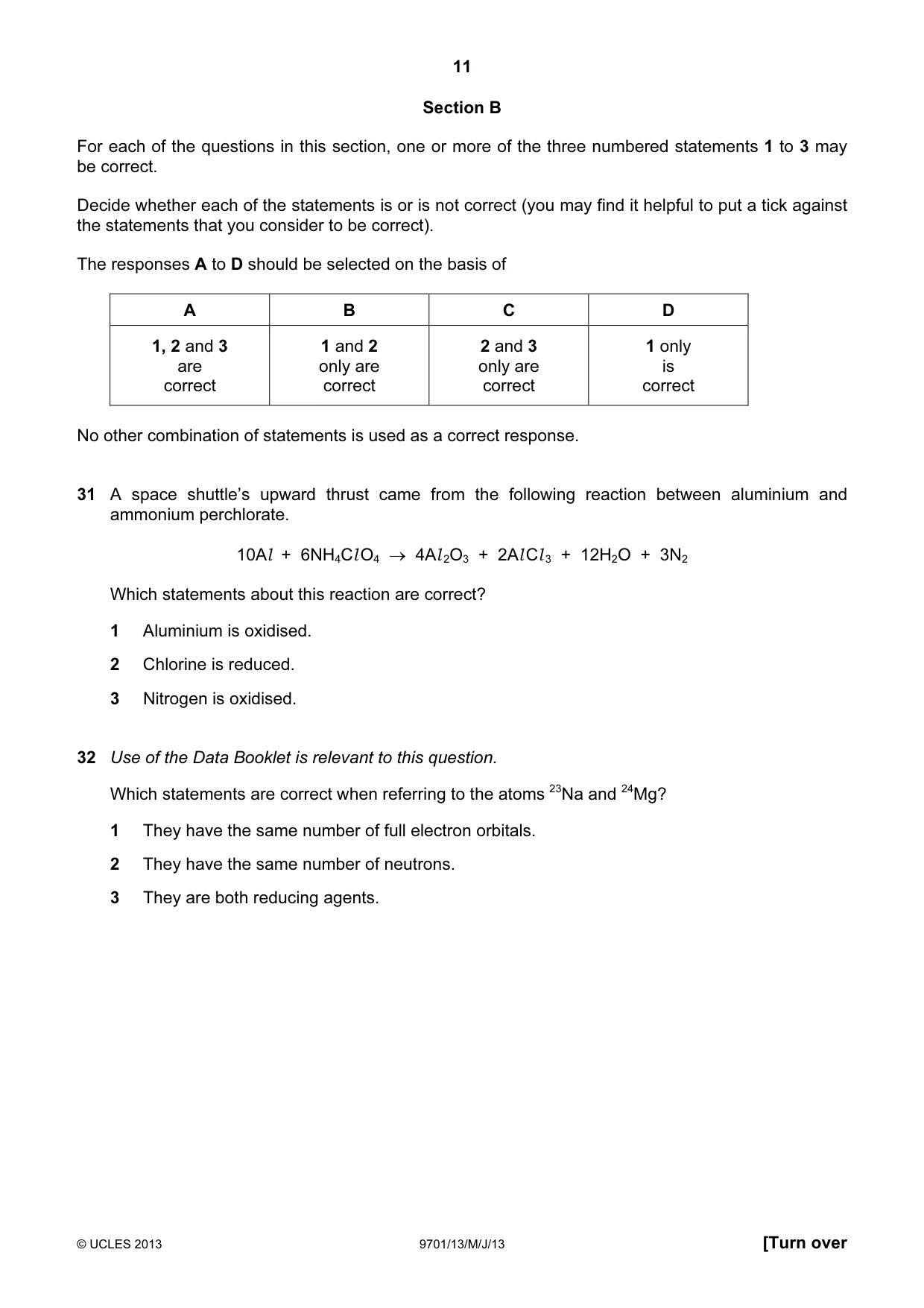
31 A space shuttle’s upward thrust came from the following reaction between aluminium and ammonium perchlorate. 10Al + 6NH4Cl O4 → 4Al 2O3 + 2Al Cl 3 + 12H2O + 3N2 Which statements about this reaction are correct? 1 Aluminium is oxidised. 2 Chlorine is reduced. 3 Nitrogen is oxidised.
Mark scheme: A
Q32 · Use of the Data Booklet is relevant to this question
32 Use of the Data Booklet is relevant to this question. Which statements are correct when referring to the atoms 23Na and 24Mg? 1 They have the same number of full electron orbitals. 2 They have the same number of neutrons. 3 They are both reducing agents.
Mark scheme: C
Q33 · The reaction pathway for a reversible reaction is shown below
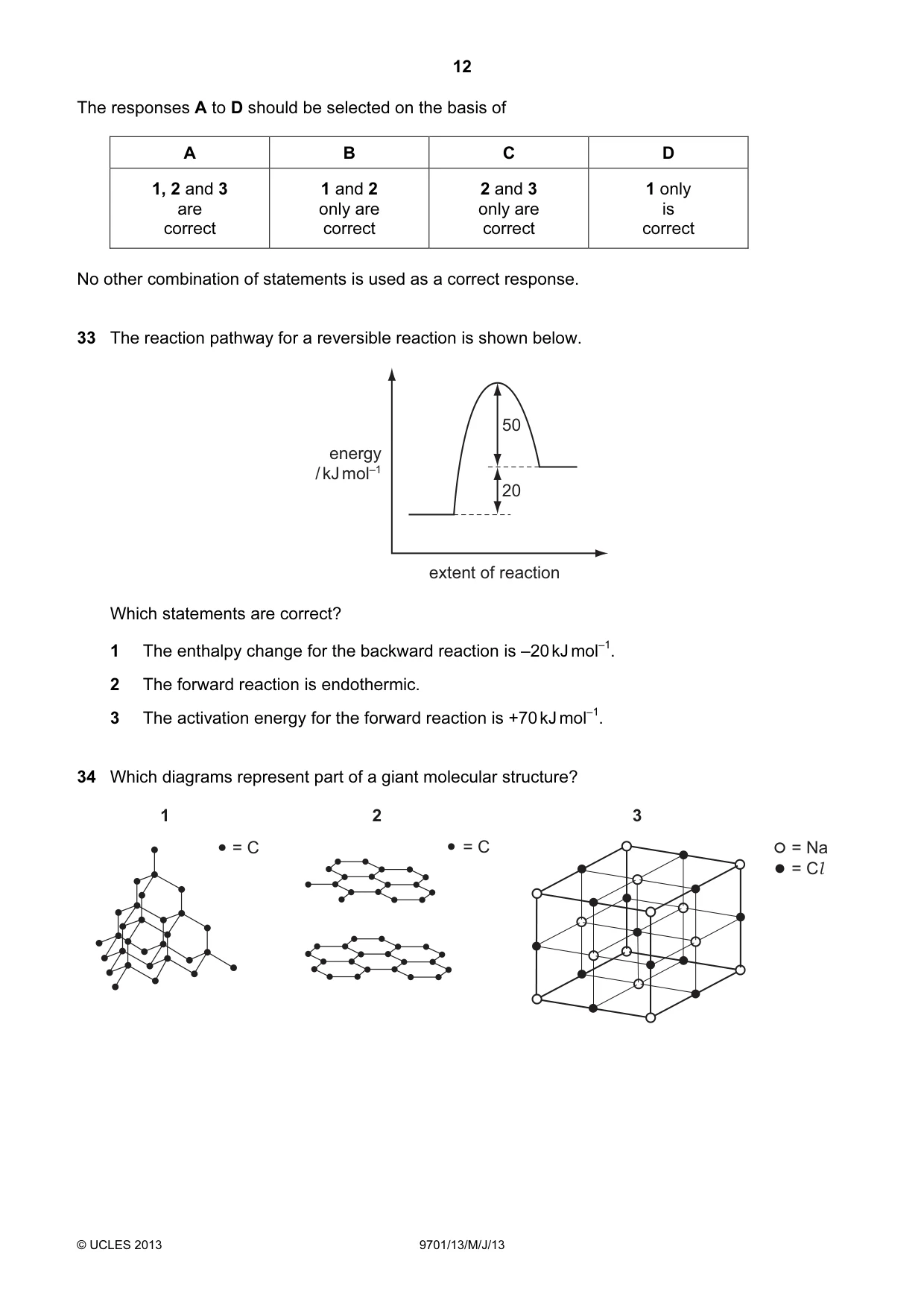
33 The reaction pathway for a reversible reaction is shown below. 50 energy / kJ mol–1 20 extent of reaction Which statements are correct? 1 The enthalpy change for the backward reaction is –20 kJ mol–1. 2 The forward reaction is endothermic. 3 The activation energy for the forward reaction is +70 kJ mol–1.
Mark scheme: A
Q34 · Which diagrams represent part of a giant molecular structure?
34 Which diagrams represent part of a giant molecular structure? 1 2 3 = C = C = Na = Cl
Mark scheme: B
Q35 · Solids W, X, Y and Z are compounds of two different Group II metals
35 Solids W, X, Y and Z are compounds of two different Group II metals. Some of their applications are described below. Compound W is used as a refractory lining material in kilns. Compound X is used as a building material. It can also be heated in a kiln to form compound Y. When Y is hydrated, it forms compound Z which is used agriculturally to treat soils. Which statements about these compounds are correct? 1 More acid is neutralised by 2.0 g of X than by 2.0 g of W. 2 The Mr of X is greater than the Mr of Y by 44.0. 3 The metallic element in Y reacts with cold water more quickly then the metallic element in W.
Mark scheme: C
Q36 · Element J is a solid
36 Element J is a solid. It occurs as a contaminant of fossil fuels. Its oxide K is formed in car engines. In the atmosphere, K can be further oxidised to L. Which statements about J, K and L are correct? 1 Atoms of J have paired p electrons. 2 The atmospheric oxidation of K to L is a catalysed reaction. 3 With water, L forms a strong acid.
Mark scheme: A
Q37 · During the bromination of methane, the free radical CH3• is generated
37 During the bromination of methane, the free radical CH3• is generated. A possible terminating step of this reaction is the formation of C2H6 by the combination of two free radicals. What could be produced in a terminating step during the bromination of propane? CH3 1 CH3CH2CH2CHCH3 CH3 2 CH3CHCHCH3 CH3 CH3 3 CH3CH2CHCH2CH3
Mark scheme: B
Q38 · Fabrics for use in aircraft seating are treated with a coating containing a halogenoalkane
38 Fabrics for use in aircraft seating are treated with a coating containing a halogenoalkane. Why is this coating used? 1 The treated fabric burns less easily, improving safety. 2 The treated fabric forms hydrogen bonds to water more readily, so it is easier to wash. 3 The halogenoalkane undergoes addition polymerisation, stiffening the fabric.
Mark scheme: D
Q39 · A liquid X is known to be either a single organic compound or a mixture of organic…
39 A liquid X is known to be either a single organic compound or a mixture of organic compounds. When treated with sodium, X gives off hydrogen gas. When treated with 2,4-dinitrophenylhydrazine reagent, X gives orange crystals. Which deductions about X can definitely be made? 1 At least one component of X is a carbonyl compound. 2 Only one of the components of X is a carbonyl compound. 3 At least one component of X is an alcohol.
Mark scheme: D
Q40 · Ethanoic acid, CH3CO2H, is an important chemical which is used in the industrial…
40 Ethanoic acid, CH3CO2H, is an important chemical which is used in the industrial manufacture of rayon and aspirin. Which processes can be used to make ethanoic acid? 1 hydrolysis of ethanenitrile 2 oxidation of ethanol 3 oxidation of ethanal
Mark scheme: A
What was in this paper
The subtopics covered by these 40 questions, and how many questions each got. Open one in a new tab to see every Cambridge question on it.
3Reacting masses and volumes (of solutions and gases)3Alcohols2Enthalpy change, ΔH2Halogenoalkanes2Isomerism: structural isomerism and stereoisomerism2Organic synthesis2Particles in the atom and atomic radius2Redox processes: electron transfer and changes in oxidation number (oxidation state)2Similarities and trends in the properties of the Group 2 metals, magnesium to barium, and their compounds2The gaseous state: ideal and real gases and pV = nRT2Addition polymerisation1Aldehydes and ketones1Alkanes1Alkenes1Bonding and structure1Carboxylic acids1Characteristic organic reactions1Chemical equilibria: reversible reactions, dynamic equilibrium1Effect of temperature on reaction rates and the concept of activation energy1Formulas1Formulas, functional groups and the naming of organic compounds1General characteristic chemical properties of the first set of transition elements, titanium to copper1Homogeneous and heterogeneous catalysts1Intermolecular forces, electronegativity and bond properties1Ionisation energy1Nitrogen and sulfur1What you needed in this session
Cambridge’s own grade thresholds for 2013 May/June, Paper 1 · Variant 3. A higher threshold means an easier paper — the bar moves with how the cohort did.