Cambridge A Level Chemistry 9701 — 2018 May/June Paper 1 · Variant 2
9701/12/M/J/18 · 40 questions · 40 marks · ≈45 min
The question paper and its mark scheme, free to read here and free to download. This is Cambridge’s own paper, exactly as it was sat.
Question paper12 pages
Mark scheme3 pages
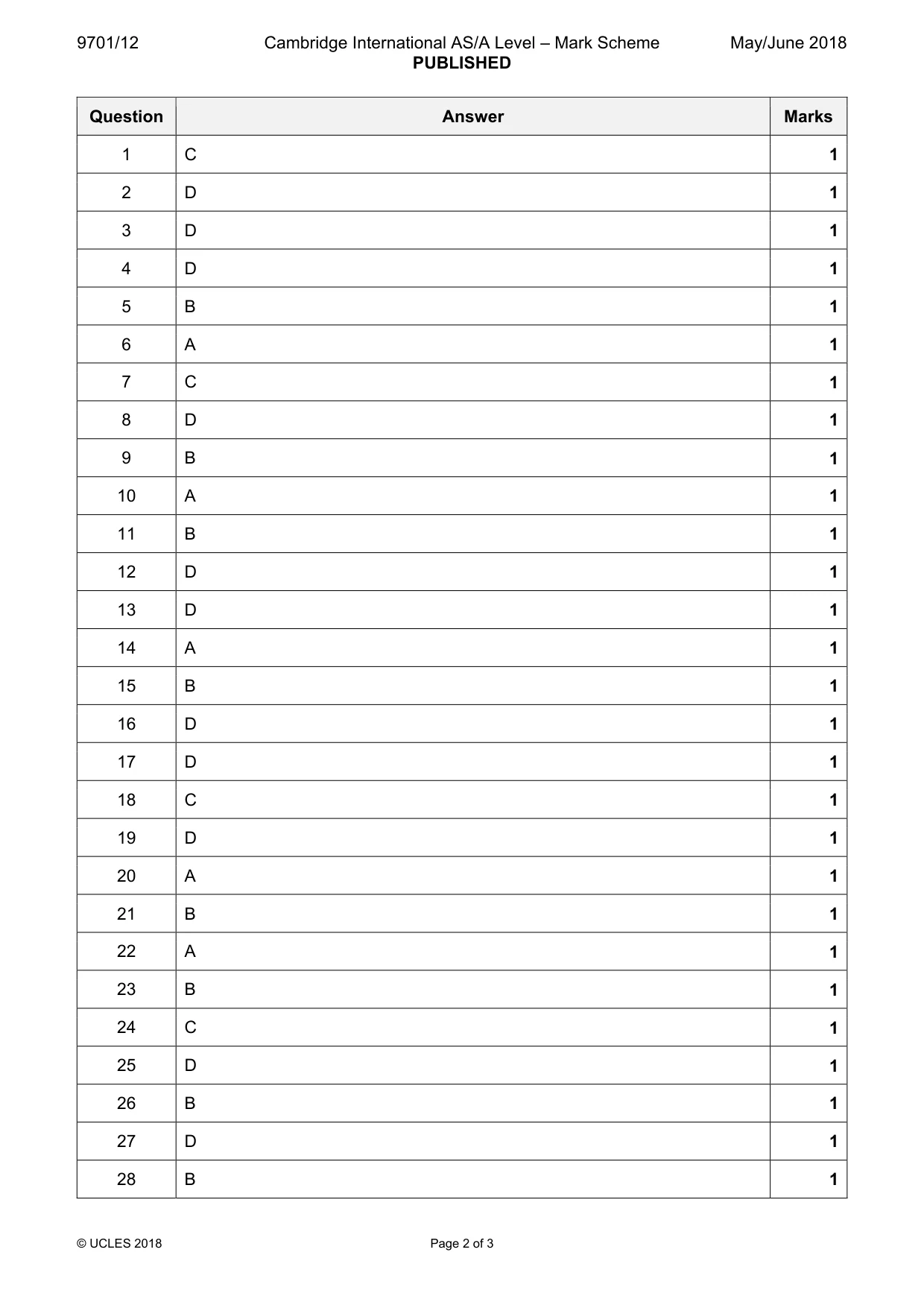
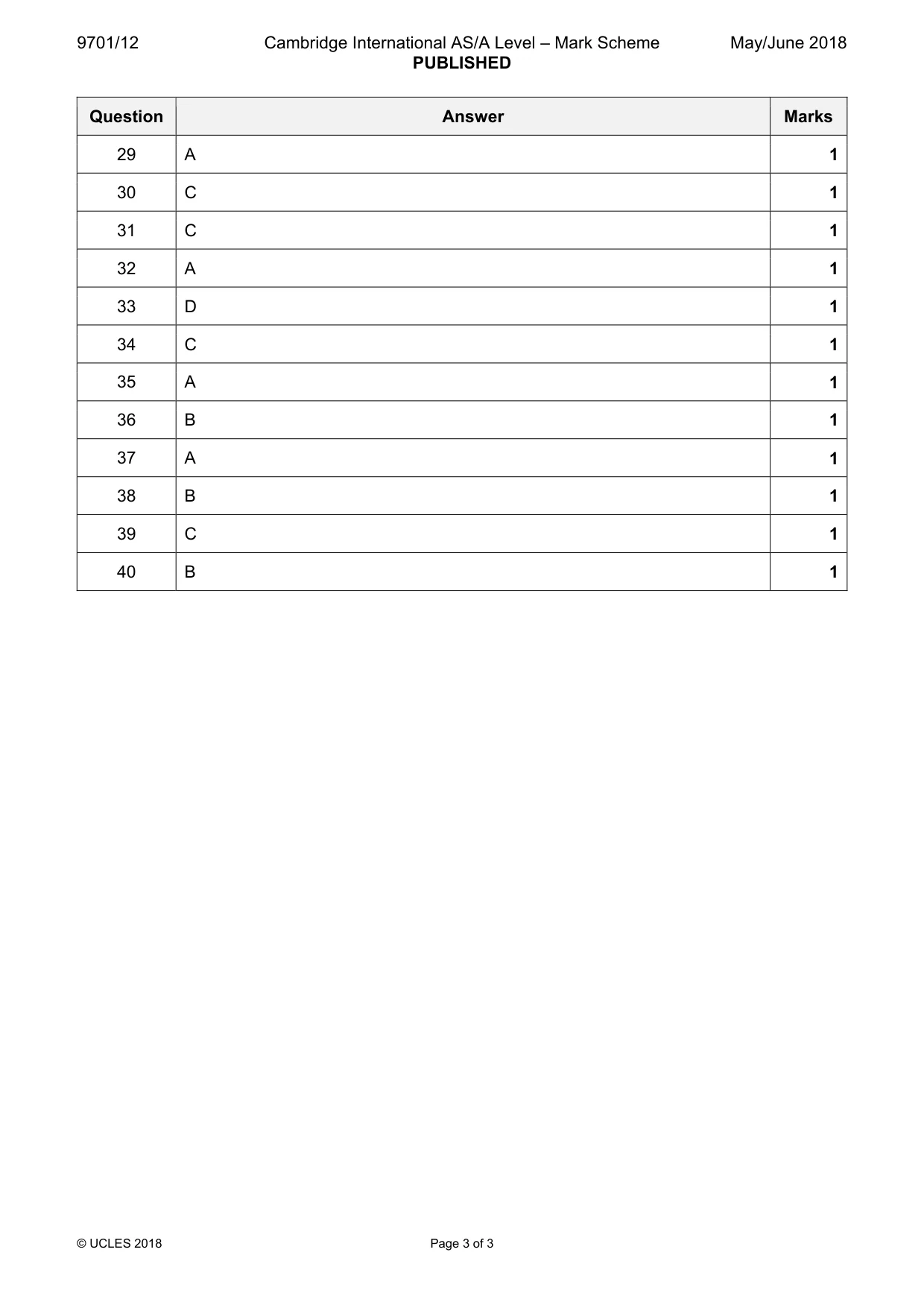
Answers below. Sit the paper first if you are practising.
Questions as text
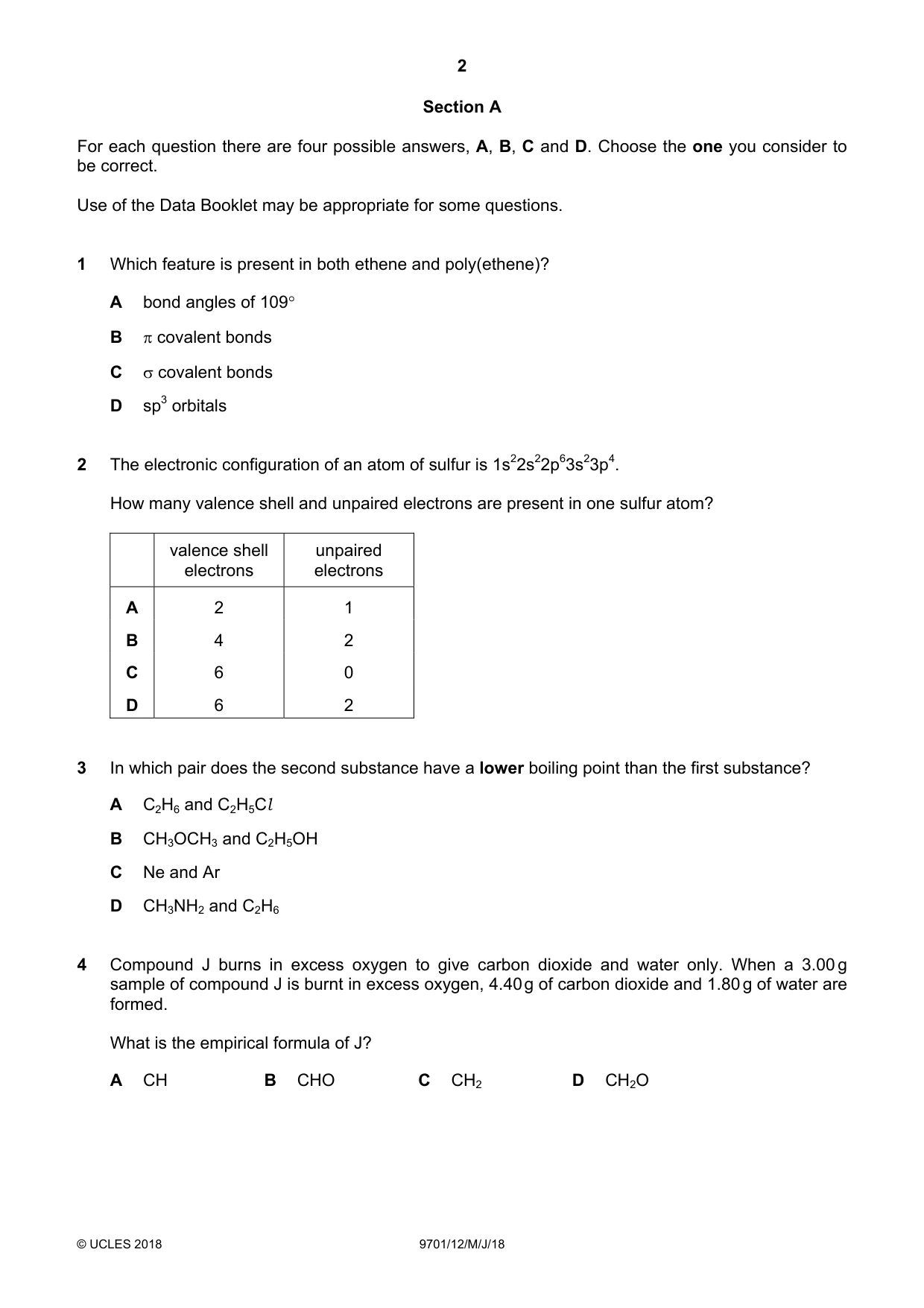
Q1 · Which feature is present in both ethene and poly(ethene)?
1 Which feature is present in both ethene and poly(ethene)? A bond angles of 109° B π covalent bonds C σ covalent bonds D sp3 orbitals
Mark scheme: C
More questions on Shapes of organic molecules; σ and π bonds
Q2 · The electronic configuration of an atom of sulfur is 1s22s22p63s23p4
2 The electronic configuration of an atom of sulfur is 1s22s22p63s23p4. How many valence shell and unpaired electrons are present in one sulfur atom? valence shell unpaired electrons electrons A 2 1 B 4 2 C 6 0 D 6 2
Mark scheme: D
More questions on Electrons, energy levels and atomic orbitals
Q3 · In which pair does the second substance have a lower boiling point than the first…
3 In which pair does the second substance have a lower boiling point than the first substance? A C2H6 and C2H5Cl B CH3OCH3 and C2H5OH C Ne and Ar D CH3NH2 and C2H6
Mark scheme: D
More questions on Intermolecular forces, electronegativity and bond properties
Q4 · Compound J burns in excess oxygen to give carbon dioxide and water only
4 Compound J burns in excess oxygen to give carbon dioxide and water only. When a 3.00 g sample of compound J is burnt in excess oxygen, 4.40 g of carbon dioxide and 1.80 g of water are formed. What is the empirical formula of J? A CH B CHO C CH2 D CH2O
Mark scheme: D
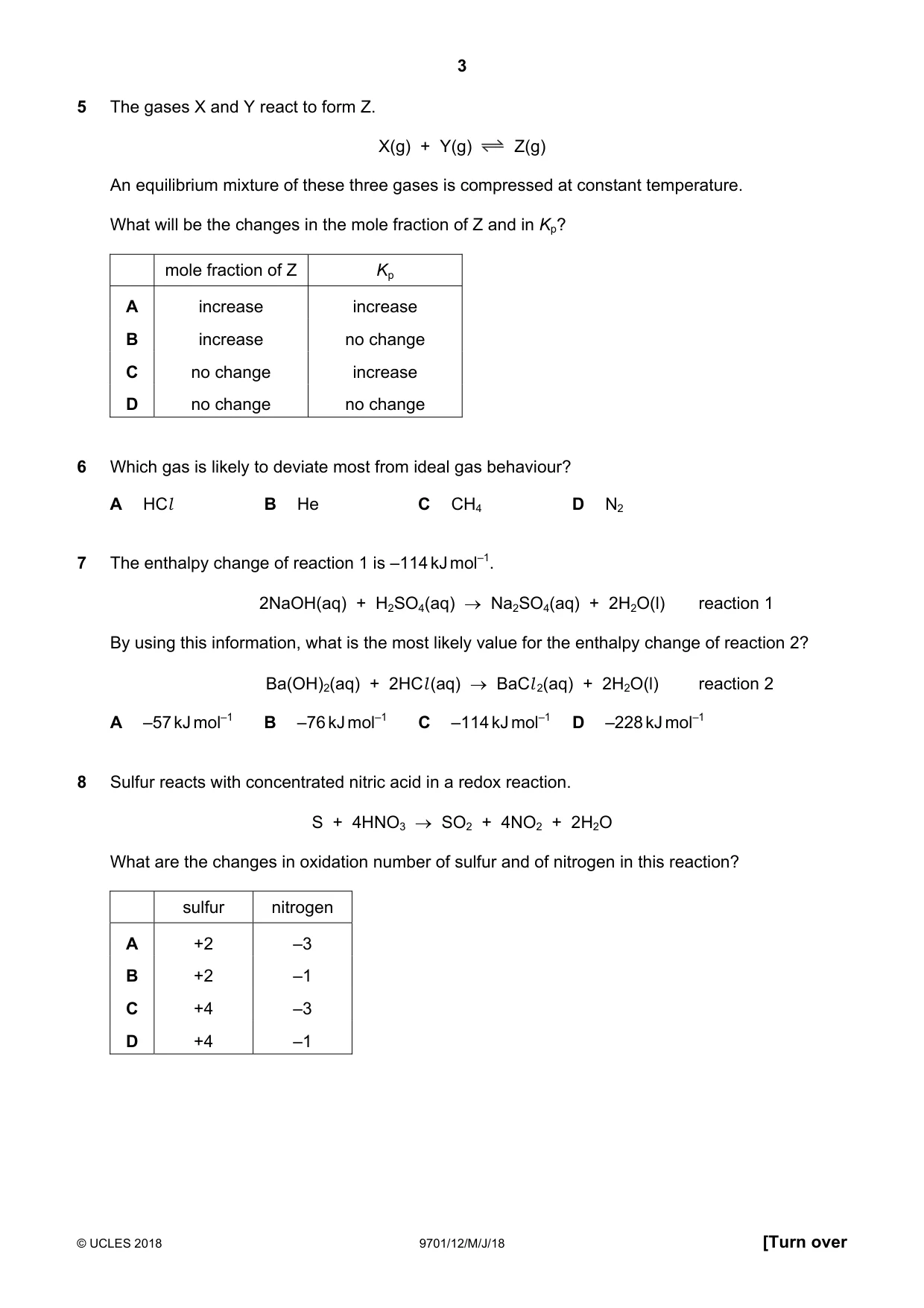
Q5 · The gases X and Y react to form Z
5 The gases X and Y react to form Z. X(g) + Y(g) Z(g) An equilibrium mixture of these three gases is compressed at constant temperature. What will be the changes in the mole fraction of Z and in Kp? mole fraction of Z Kp A increase increase B increase no change C no change increase D no change no change
Mark scheme: B
More questions on Chemical equilibria: reversible reactions, dynamic equilibrium
Q6 · Which gas is likely to deviate most from ideal gas behaviour?
6 Which gas is likely to deviate most from ideal gas behaviour? A HCl B He C CH4 D N2
Mark scheme: A
More questions on The gaseous state: ideal and real gases and pV = nRT
Q7 · The enthalpy change of reaction 1 is –114 kJ mol–1
7 The enthalpy change of reaction 1 is –114 kJ mol–1. 2NaOH(aq) + H2SO4(aq) → Na2SO4(aq) + 2H2O(l) reaction 1 By using this information, what is the most likely value for the enthalpy change of reaction 2? Ba(OH)2(aq) + 2HCl (aq) → BaCl 2(aq) + 2H2O(l) reaction 2 A –57 kJ mol–1 B –76 kJ mol–1 C –114 kJ mol–1 D –228 kJ mol–1
Mark scheme: C
Q8 · Sulfur reacts with concentrated nitric acid in a redox reaction
8 Sulfur reacts with concentrated nitric acid in a redox reaction. S + 4HNO3 → SO2 + 4NO2 + 2H2O What are the changes in oxidation number of sulfur and of nitrogen in this reaction? sulfur nitrogen A +2 –3 B +2 –1 C +4 –3 D +4 –1
Mark scheme: D
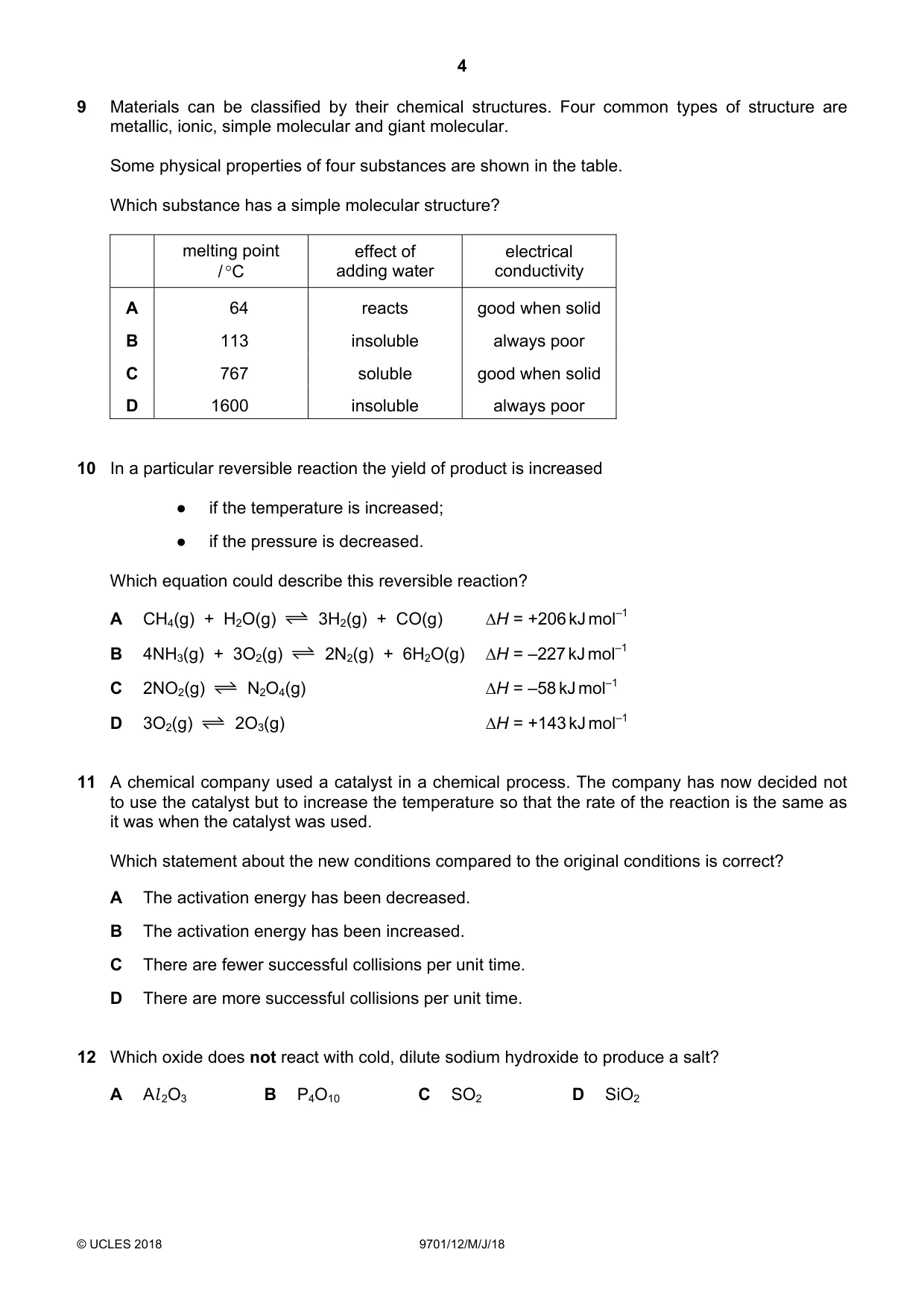
Q9 · Materials can be classified by their chemical structures
9 Materials can be classified by their chemical structures. Four common types of structure are metallic, ionic, simple molecular and giant molecular. Some physical properties of four substances are shown in the table. Which substance has a simple molecular structure? melting point effect of electrical / °C adding water conductivity A 64 reacts good when solid B 113 insoluble always poor C 767 soluble good when solid D 1600 insoluble always poor
Mark scheme: B
Q10 · In a particular reversible reaction the yield of product is increased ● if the…
10 In a particular reversible reaction the yield of product is increased ● if the temperature is increased; ● if the pressure is decreased. Which equation could describe this reversible reaction? A CH4(g) + H2O(g) 3H2(g) + CO(g) ∆H = +206 kJ mol–1 B 4NH3(g) + 3O2(g) 2N2(g) + 6H2O(g) ∆H = –227 kJ mol–1 C 2NO2(g) N2O4(g) ∆H = –58 kJ mol–1 D 3O2(g) 2O3(g) ∆H = +143 kJ mol–1
Mark scheme: A
More questions on Chemical equilibria: reversible reactions, dynamic equilibrium
Q11 · A chemical company used a catalyst in a chemical process
11 A chemical company used a catalyst in a chemical process. The company has now decided not to use the catalyst but to increase the temperature so that the rate of the reaction is the same as it was when the catalyst was used. Which statement about the new conditions compared to the original conditions is correct? A The activation energy has been decreased. B The activation energy has been increased. C There are fewer successful collisions per unit time. D There are more successful collisions per unit time.
Mark scheme: B
More questions on Effect of temperature on reaction rates and the concept of activation energy
Q12 · Which oxide does not react with cold, dilute sodium hydroxide to produce a salt?
12 Which oxide does not react with cold, dilute sodium hydroxide to produce a salt? A Al 2O3 B P4O10 C SO2 D SiO2
Mark scheme: D
More questions on Periodicity of chemical properties of the elements in Period 3
Q13 · The graphs show trends in four physical properties of elements in Period 3, excluding…
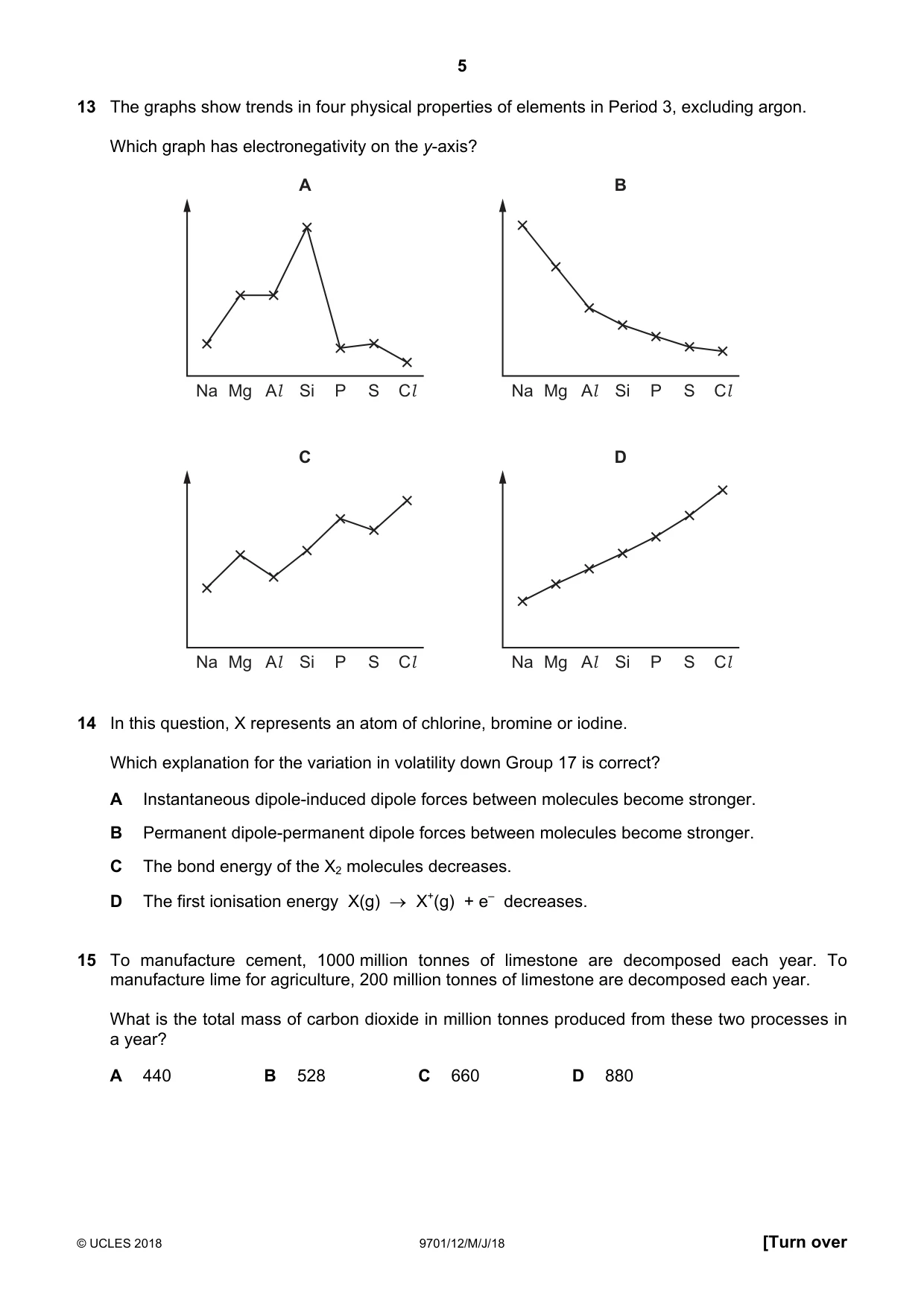
13 The graphs show trends in four physical properties of elements in Period 3, excluding argon. Which graph has electronegativity on the y-axis? A B Na Mg Al Si P S Cl Na Mg Al Si P S Cl C D Na Mg Al Si P S Cl Na Mg Al Si P S Cl
Mark scheme: D
More questions on Periodicity of physical properties of the elements in Period 3
Q14 · In this question, X represents an atom of chlorine, bromine or iodine
14 In this question, X represents an atom of chlorine, bromine or iodine. Which explanation for the variation in volatility down Group 17 is correct? A Instantaneous dipole-induced dipole forces between molecules become stronger. B Permanent dipole-permanent dipole forces between molecules become stronger. C The bond energy of the X2 molecules decreases. D The first ionisation energy X(g) → X+(g) + e– decreases.
Mark scheme: A
More questions on Physical properties of the Group 17 elements
Q15 · To manufacture cement, 1000 million tonnes of limestone are decomposed each year
15 To manufacture cement, 1000 million tonnes of limestone are decomposed each year. To manufacture lime for agriculture, 200 million tonnes of limestone are decomposed each year. What is the total mass of carbon dioxide in million tonnes produced from these two processes in a year? A 440 B 528 C 660 D 880
Mark scheme: B
More questions on Reacting masses and volumes (of solutions and gases)
Q16 · In Group 2 of the Periodic Table, the properties of the elements and their compounds show…
16 In Group 2 of the Periodic Table, the properties of the elements and their compounds show regular change down the group. Which property shows a decrease from magnesium to barium? A the decomposition temperature of the carbonates B the decomposition temperature of the nitrates C the solubility of the hydroxides D the solubility of the sulfates
Mark scheme: D
Q17 · When concentrated sulfuric acid is added to solid sodium bromide, bromine gas is…
17 When concentrated sulfuric acid is added to solid sodium bromide, bromine gas is produced, along with a number of other products. However when concentrated sulfuric acid is added to solid sodium chloride only hydrogen chloride and sodium hydrogensulfate are produced. What is the reason for this difference? A Bromine is less volatile than chlorine. B Hydrochloric acid is a weak acid. C Sulfuric acid is not an oxidising agent. D The bromide ion is a stronger reducing agent than the chloride ion.
Mark scheme: D
More questions on The chemical properties of the halogen elements and the hydrogen halides
Q18 · The dative covalent bond can be represented by an arrow,
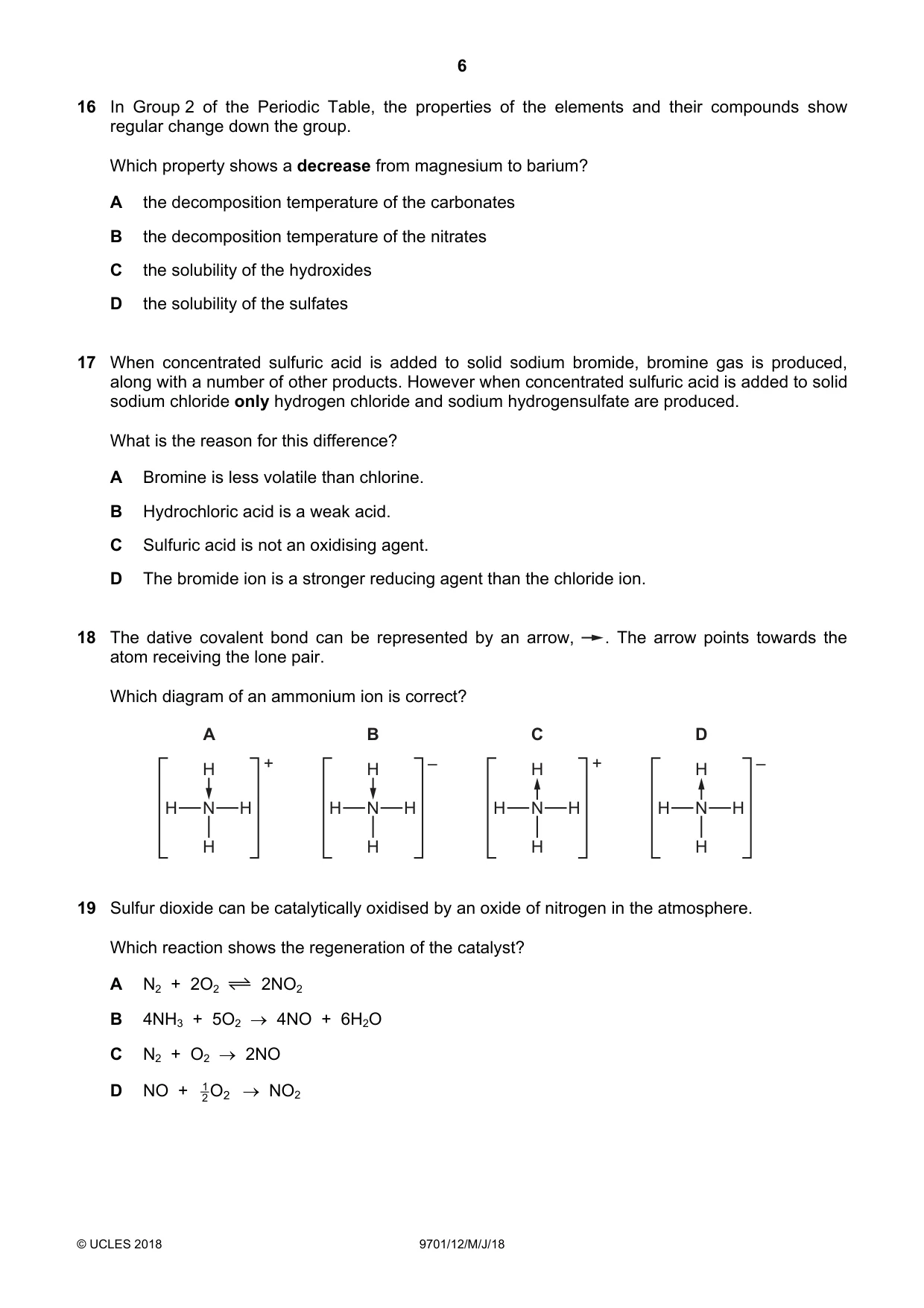
18 The dative covalent bond can be represented by an arrow, . The arrow points towards the atom receiving the lone pair. Which diagram of an ammonium ion is correct? A B C D H + H – H + H – H N H H N H H N H H N H H H H H
Mark scheme: C
More questions on Covalent bonding and coordinate (dative covalent) bonding
Q19 · Sulfur dioxide can be catalytically oxidised by an oxide of nitrogen in the atmosphere
19 Sulfur dioxide can be catalytically oxidised by an oxide of nitrogen in the atmosphere. Which reaction shows the regeneration of the catalyst? A N2 + 2O2 2NO2 B 4NH3 + 5O2 → 4NO + 6H2O C N2 + O2 → 2NO D NO + 1 O → NO2 2 2
Mark scheme: D
Q20 · Compound Y is treated with an excess of hydrogen gas in the presence of a nickel catalyst
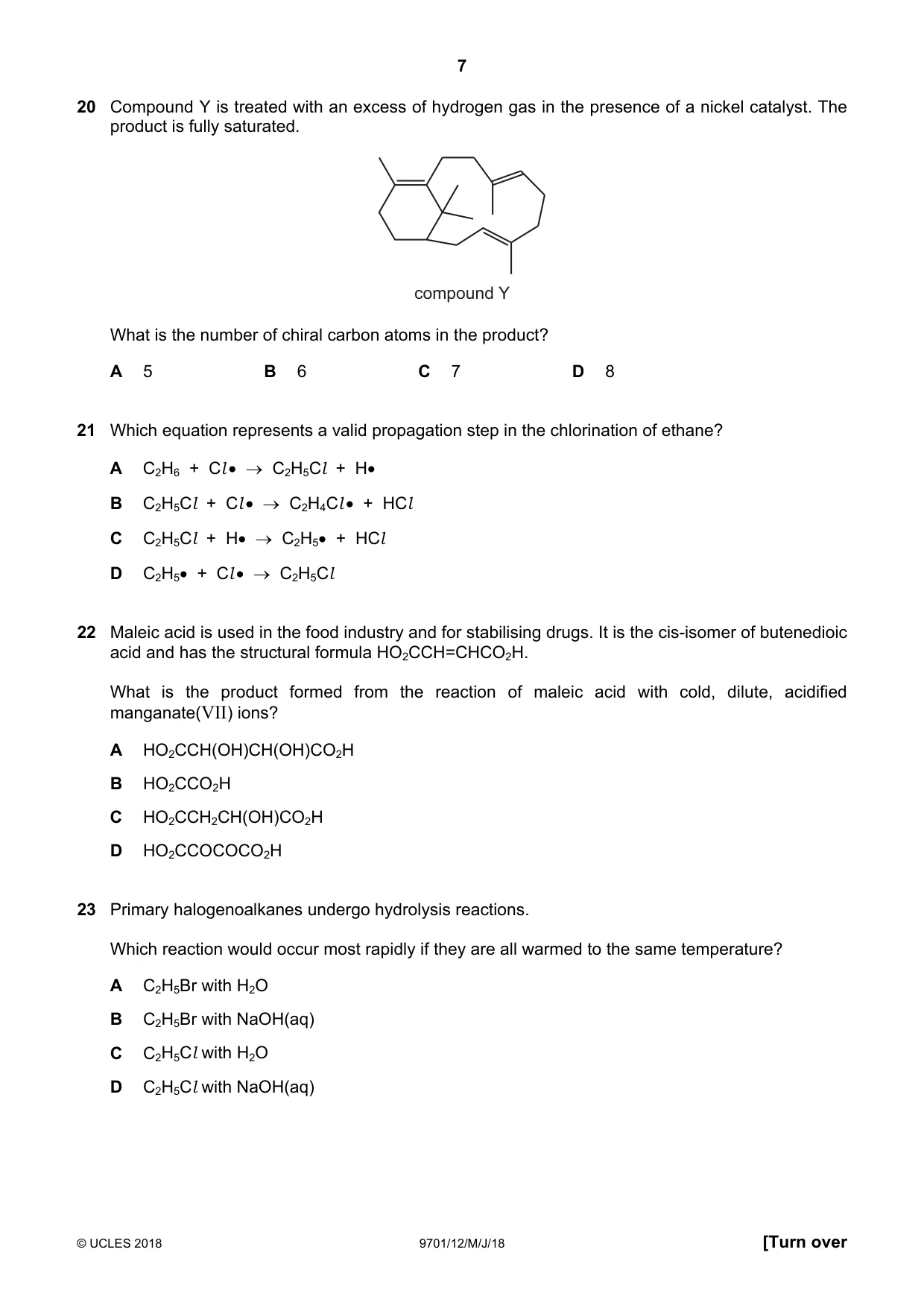
20 Compound Y is treated with an excess of hydrogen gas in the presence of a nickel catalyst. The product is fully saturated. compound Y What is the number of chiral carbon atoms in the product? A 5 B 6 C 7 D 8
Mark scheme: A
Q21 · Which equation represents a valid propagation step in the chlorination of ethane?
21 Which equation represents a valid propagation step in the chlorination of ethane? A C2H6 + Cl • → C2H5Cl + H• B C2H5Cl + Cl • → C2H4Cl • + HCl C C2H5Cl + H• → C2H5• + HCl D C2H5• + Cl • → C2H5Cl
Mark scheme: B
Q22 · Maleic acid is used in the food industry and for stabilising drugs
22 Maleic acid is used in the food industry and for stabilising drugs. It is the cis-isomer of butenedioic acid and has the structural formula HO2CCH=CHCO2H. What is the product formed from the reaction of maleic acid with cold, dilute, acidified manganate(VII) ions? A HO2CCH(OH)CH(OH)CO2H B HO2CCO2H C HO2CCH2CH(OH)CO2H D HO2CCOCOCO2H
Mark scheme: A
Q23 · Primary halogenoalkanes undergo hydrolysis reactions
23 Primary halogenoalkanes undergo hydrolysis reactions. Which reaction would occur most rapidly if they are all warmed to the same temperature? A C2H5Br with H2O B C2H5Br with NaOH(aq) C C2H5Cl with H2O D C2H5Cl with NaOH(aq)
Mark scheme: B
Q24 · Structural isomerism and stereoisomerism should be considered when answering this question
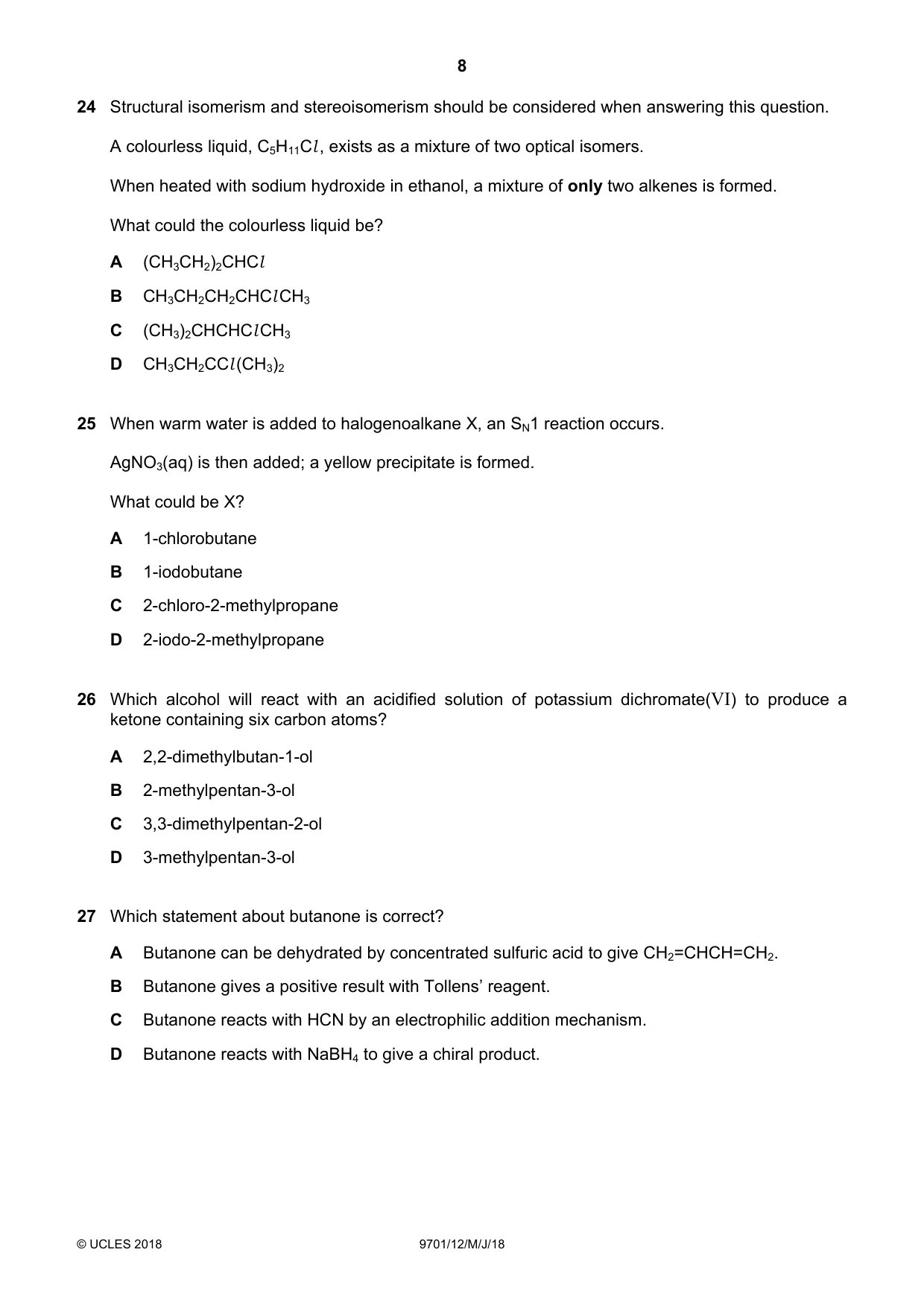
24 Structural isomerism and stereoisomerism should be considered when answering this question. A colourless liquid, C5H11Cl , exists as a mixture of two optical isomers. When heated with sodium hydroxide in ethanol, a mixture of only two alkenes is formed. What could the colourless liquid be? A (CH3CH2)2CHCl B CH3CH2CH2CHCl CH3 C (CH3)2CHCHCl CH3 D CH3CH2CCl (CH3)2
Mark scheme: C
More questions on Isomerism: structural isomerism and stereoisomerism
Q25 · When warm water is added to halogenoalkane X, an SN1 reaction occurs
25 When warm water is added to halogenoalkane X, an SN1 reaction occurs. AgNO3(aq) is then added; a yellow precipitate is formed. What could be X? A 1-chlorobutane B 1-iodobutane C 2-chloro-2-methylpropane D 2-iodo-2-methylpropane
Mark scheme: D
Q26 · Which alcohol will react with an acidified solution of potassium dichromate(VI) to…
26 Which alcohol will react with an acidified solution of potassium dichromate(VI) to produce a ketone containing six carbon atoms? A 2,2-dimethylbutan-1-ol B 2-methylpentan-3-ol C 3,3-dimethylpentan-2-ol D 3-methylpentan-3-ol
Mark scheme: B
Q27 · Which statement about butanone is correct?
27 Which statement about butanone is correct? A Butanone can be dehydrated by concentrated sulfuric acid to give CH2=CHCH=CH2. B Butanone gives a positive result with Tollens’ reagent. C Butanone reacts with HCN by an electrophilic addition mechanism. D Butanone reacts with NaBH4 to give a chiral product.
Mark scheme: D
Q28 · Ethanal, CH3CHO, is used to make product R in a three-stage synthesis
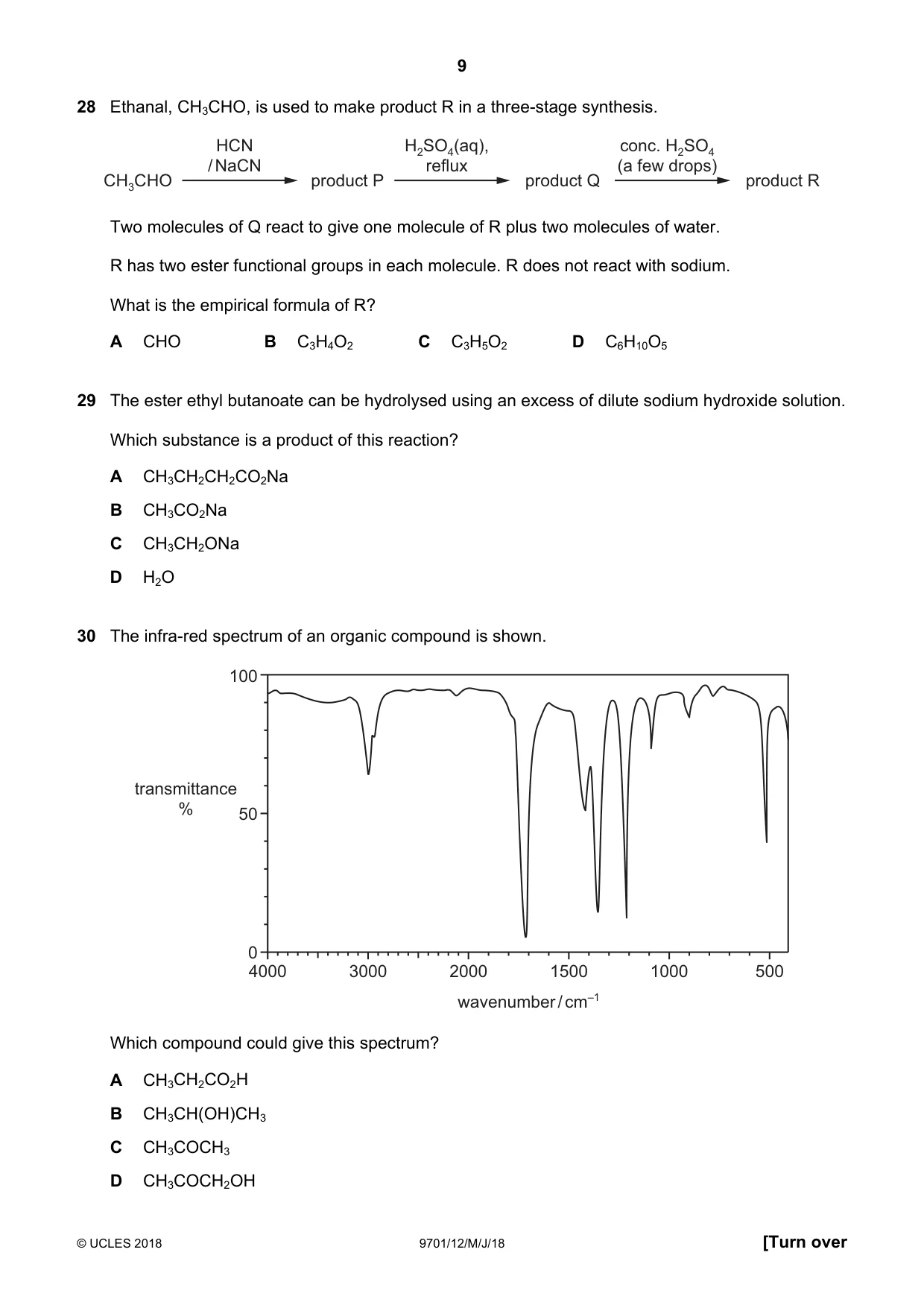
28 Ethanal, CH3CHO, is used to make product R in a three-stage synthesis. HCN H2SO4(aq), conc. H2SO4 / NaCN reflux (a few drops) CH3CHO product P product Q product R Two molecules of Q react to give one molecule of R plus two molecules of water. R has two ester functional groups in each molecule. R does not react with sodium. What is the empirical formula of R? A CHO B C3H4O2 C C3H5O2 D C6H10O5
Mark scheme: B
Q29 · The ester ethyl butanoate can be hydrolysed using an excess of dilute sodium hydroxide…
29 The ester ethyl butanoate can be hydrolysed using an excess of dilute sodium hydroxide solution. Which substance is a product of this reaction? A CH3CH2CH2CO2Na B CH3CO2Na C CH3CH2ONa D H2O
Mark scheme: A
Q30 · The infra-red spectrum of an organic compound is shown
30 The infra-red spectrum of an organic compound is shown. 100 transmittance % 50 0 4000 3000 2000 1500 1000 500 wavenumber / cm–1 Which compound could give this spectrum? A CH3CH2CO2H B CH3CH(OH)CH3 C CH3COCH3 D CH3COCH2OH Section B
Mark scheme: C
Q31 · For complete combustion, 1 mol of an organic compound X requires 2.5 mol of O2
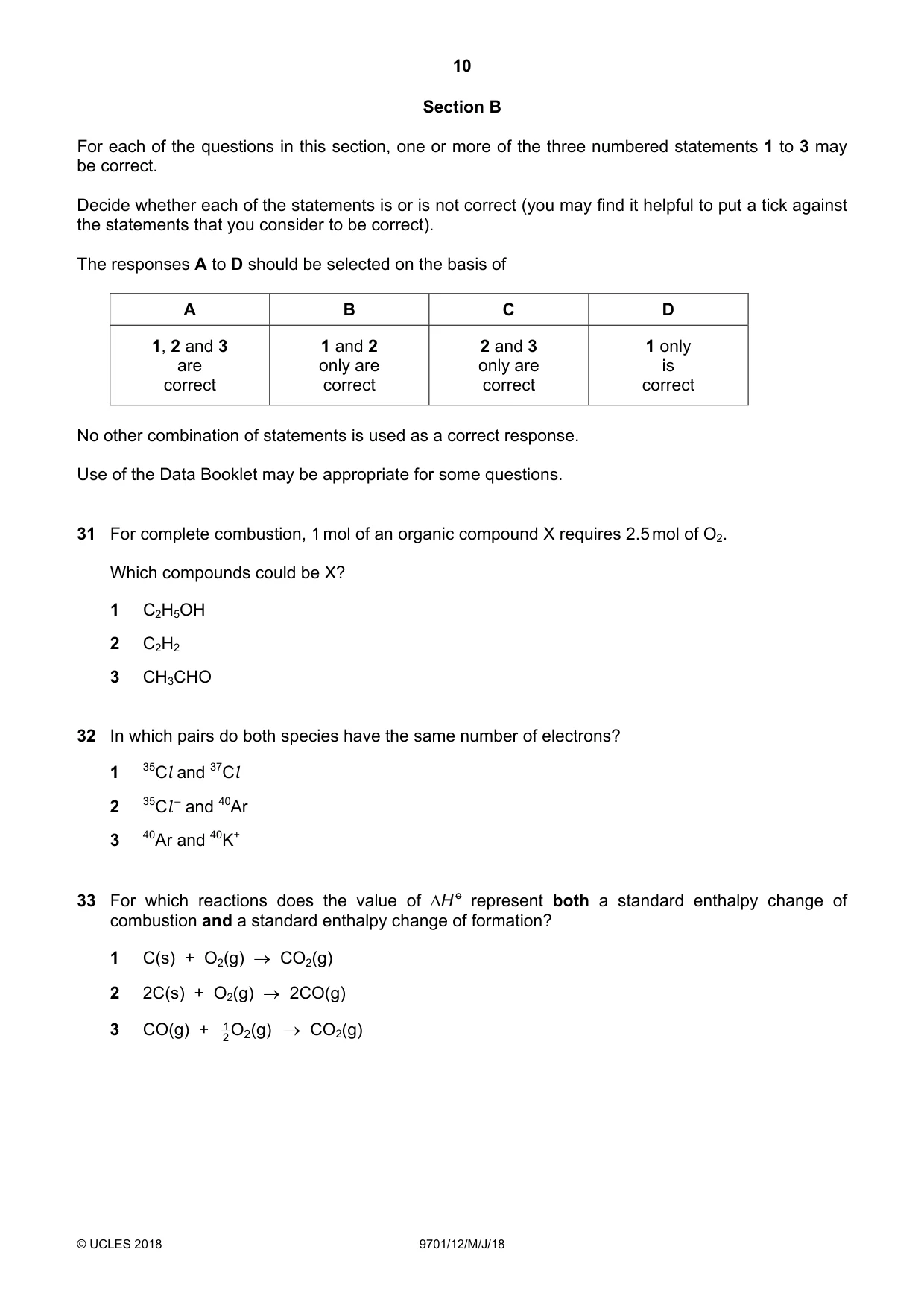
31 For complete combustion, 1 mol of an organic compound X requires 2.5 mol of O2. Which compounds could be X? 1 C2H5OH 2 C2H2 3 CH3CHO
Mark scheme: C
Q32 · In which pairs do both species have the same number of electrons?
32 In which pairs do both species have the same number of electrons? 1 35Cl and 37Cl 2 35Cl – and 40Ar 3 40Ar and 40K+
Mark scheme: A
Q33 · For which reactions does the value of ∆H o represent both a standard enthalpy change of…
33 For which reactions does the value of ∆H o represent both a standard enthalpy change of combustion and a standard enthalpy change of formation? 1 C(s) + O2(g) → CO2(g) 2 2C(s) + O2(g) → 2CO(g) 3 CO(g) + 1 O2 (g) → CO2(g) 2
Mark scheme: D
Q34 · The temperature of a reversible gas phase reaction is increased
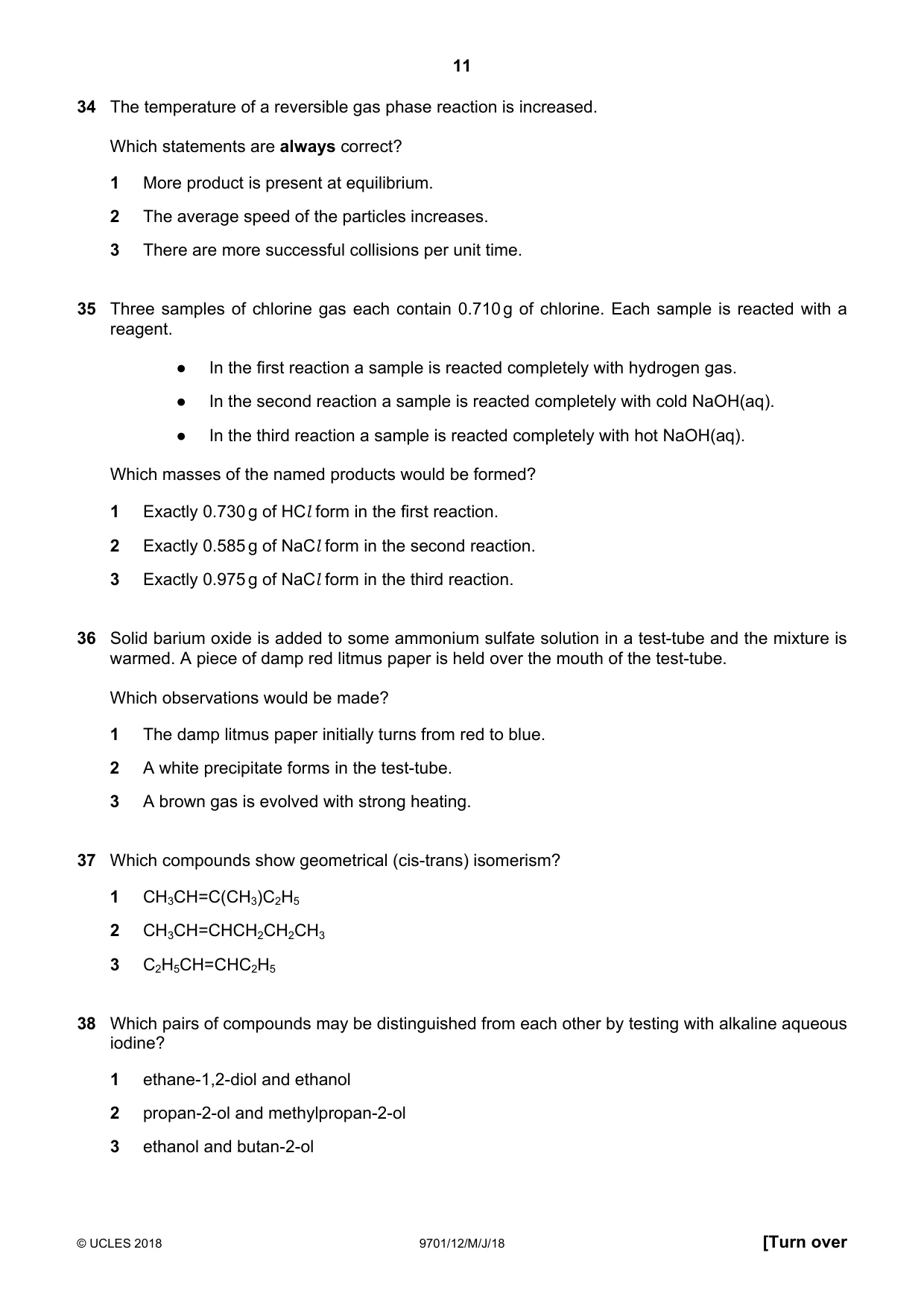
34 The temperature of a reversible gas phase reaction is increased. Which statements are always correct? 1 More product is present at equilibrium. 2 The average speed of the particles increases. 3 There are more successful collisions per unit time.
Mark scheme: C
More questions on Effect of temperature on reaction rates and the concept of activation energy
Q35 · Three samples of chlorine gas each contain 0.710 g of chlorine
35 Three samples of chlorine gas each contain 0.710 g of chlorine. Each sample is reacted with a reagent. ● In the first reaction a sample is reacted completely with hydrogen gas. ● In the second reaction a sample is reacted completely with cold NaOH(aq). ● In the third reaction a sample is reacted completely with hot NaOH(aq). Which masses of the named products would be formed? 1 Exactly 0.730 g of HCl form in the first reaction. 2 Exactly 0.585 g of NaCl form in the second reaction. 3 Exactly 0.975 g of NaCl form in the third reaction.
Mark scheme: A
Q36 · Solid barium oxide is added to some ammonium sulfate solution in a test-tube and the…
36 Solid barium oxide is added to some ammonium sulfate solution in a test-tube and the mixture is warmed. A piece of damp red litmus paper is held over the mouth of the test-tube. Which observations would be made? 1 The damp litmus paper initially turns from red to blue. 2 A white precipitate forms in the test-tube. 3 A brown gas is evolved with strong heating.
Mark scheme: B
Q37 · Which compounds show geometrical (cis-trans) isomerism?
37 Which compounds show geometrical (cis-trans) isomerism? 1 CH3CH=C(CH3)C2H5 2 CH3CH=CHCH2CH2CH3 3 C2H5CH=CHC2H5
Mark scheme: A
More questions on Isomerism: structural isomerism and stereoisomerism
Q38 · Which pairs of compounds may be distinguished from each other by testing with alkaline…
38 Which pairs of compounds may be distinguished from each other by testing with alkaline aqueous iodine? 1 ethane-1,2-diol and ethanol 2 propan-2-ol and methylpropan-2-ol 3 ethanol and butan-2-ol
Mark scheme: B
Q39 · The diagram shows an experimental set-up which can be used in several different…
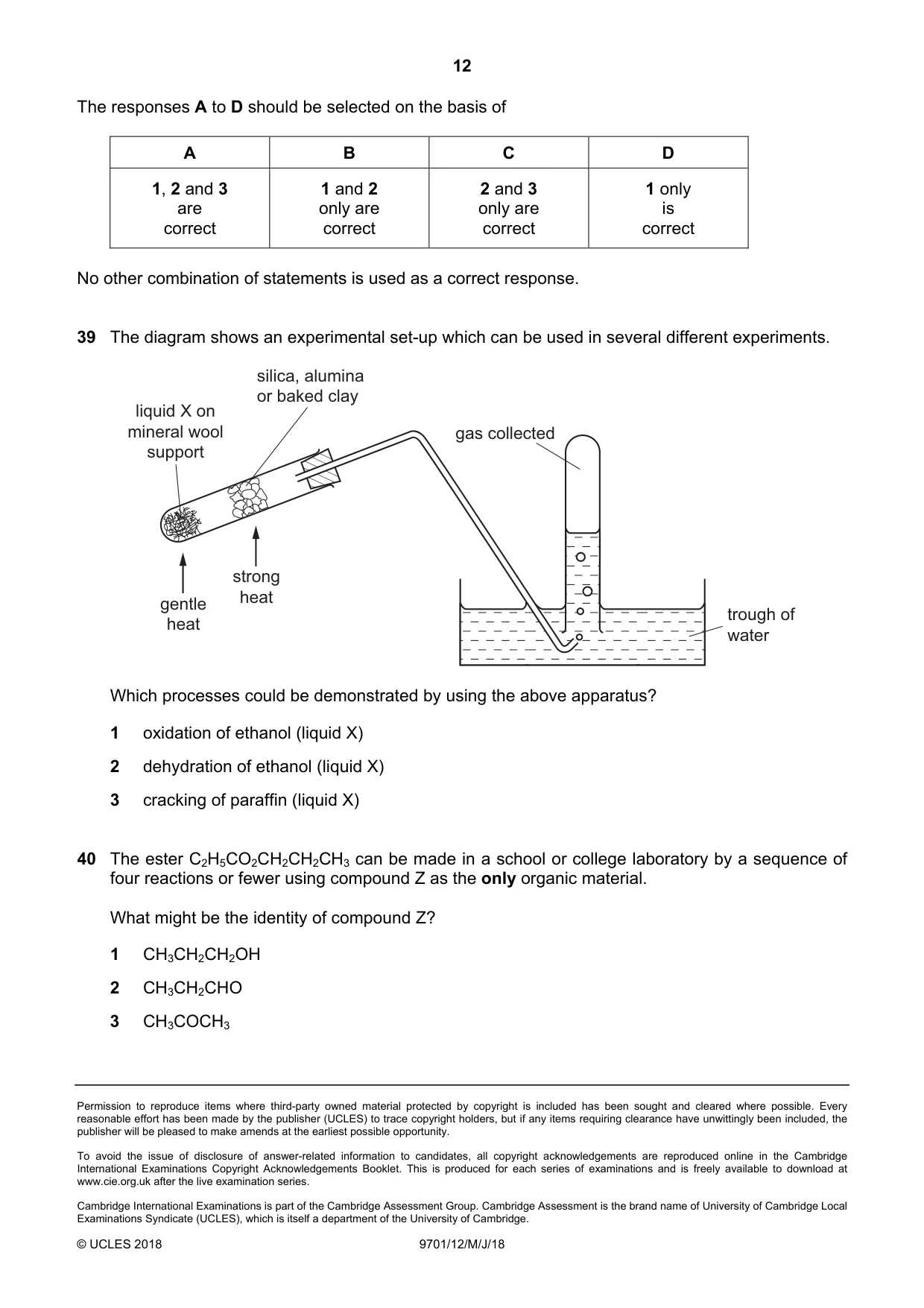
39 The diagram shows an experimental set-up which can be used in several different experiments. silica, alumina or baked clay liquid X on mineral wool gas collected support strong gentle heat trough of heat water Which processes could be demonstrated by using the above apparatus? 1 oxidation of ethanol (liquid X) 2 dehydration of ethanol (liquid X) 3 cracking of paraffin (liquid X)
Mark scheme: C
Q40 · The ester C2H5CO2CH2CH2CH3 can be made in a school or college laboratory by a sequence of…
40 The ester C2H5CO2CH2CH2CH3 can be made in a school or college laboratory by a sequence of four reactions or fewer using compound Z as the only organic material. What might be the identity of compound Z? 1 CH3CH2CH2OH 2 CH3CH2CHO 3 CH3COCH3
Mark scheme: B
What was in this paper
The subtopics covered by these 40 questions, and how many questions each got. Open one in a new tab to see every Cambridge question on it.
2Alkanes2Alkenes2Chemical equilibria: reversible reactions, dynamic equilibrium2Effect of temperature on reaction rates and the concept of activation energy2Enthalpy change, ΔH2Halogenoalkanes2Homogeneous and heterogeneous catalysts2Isomerism: structural isomerism and stereoisomerism2Similarities and trends in the properties of the Group 2 metals, magnesium to barium, and their compounds2Aldehydes and ketones1Bonding and structure1Covalent bonding and coordinate (dative covalent) bonding1Electrons, energy levels and atomic orbitals1Esters1Formulas1Infrared spectroscopy1Intermolecular forces, electronegativity and bond properties1Isotopes1Nitriles and hydroxynitriles1Organic synthesis1Periodicity of chemical properties of the elements in Period 31Periodicity of physical properties of the elements in Period 31Physical properties of the Group 17 elements1Reacting masses and volumes (of solutions and gases)1Redox processes: electron transfer and changes in oxidation number (oxidation state)1Shapes of organic molecules; σ and π bonds1The chemical properties of the halogen elements and the hydrogen halides1The gaseous state: ideal and real gases and pV = nRT1The reactions of chlorine1What you needed in this session
Cambridge’s own grade thresholds for 2018 May/June, Paper 1 · Variant 2. A higher threshold means an easier paper — the bar moves with how the cohort did.