Cambridge A Level Chemistry 9701 — 2024 May/June Paper 1 · Variant 3
9701/13/M/J/24 · 40 questions · 40 marks · ≈45 min
The question paper and its mark scheme, free to read here and free to download. This is Cambridge’s own paper, exactly as it was sat.
Question paper20 pages



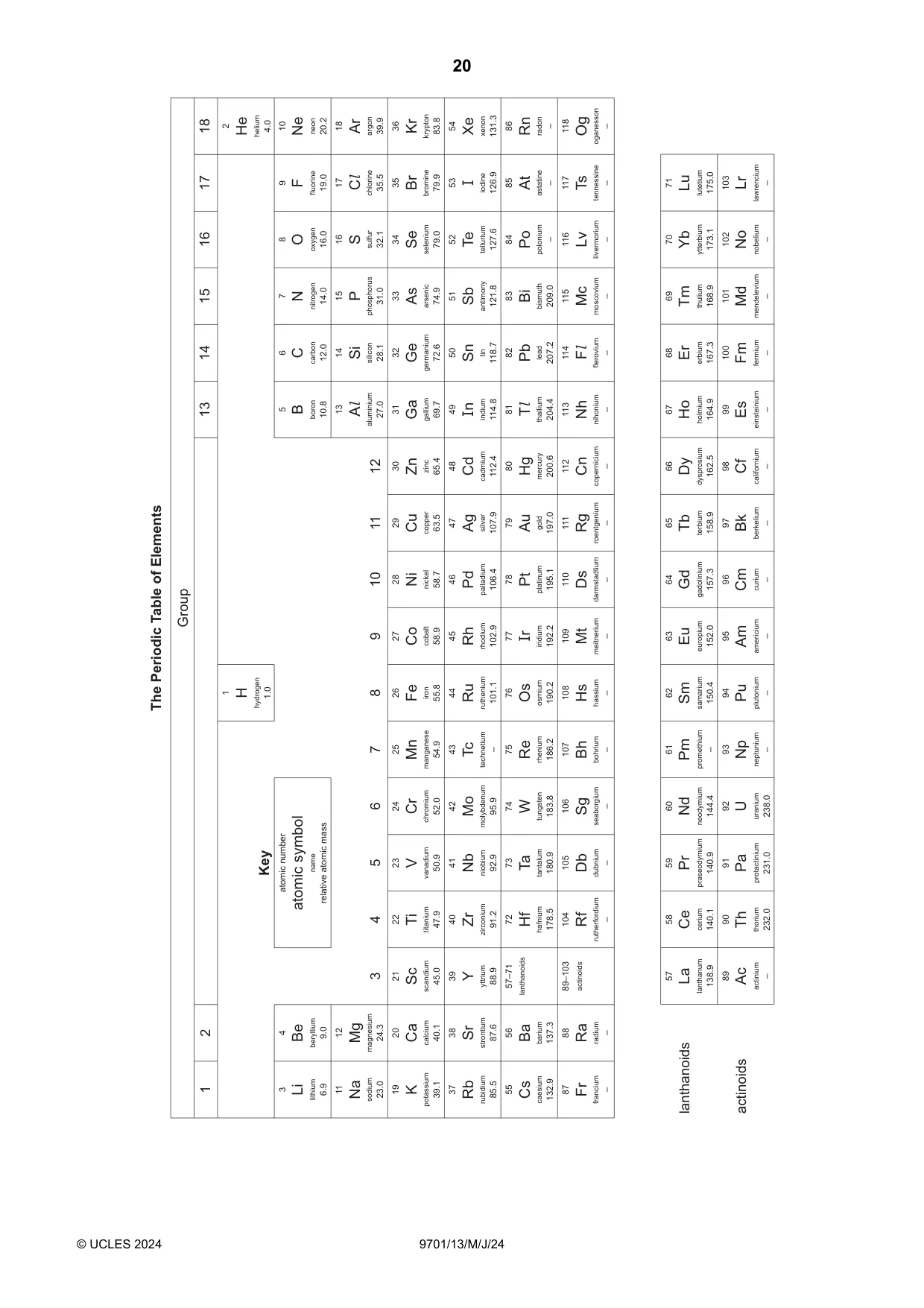
Mark scheme3 pages
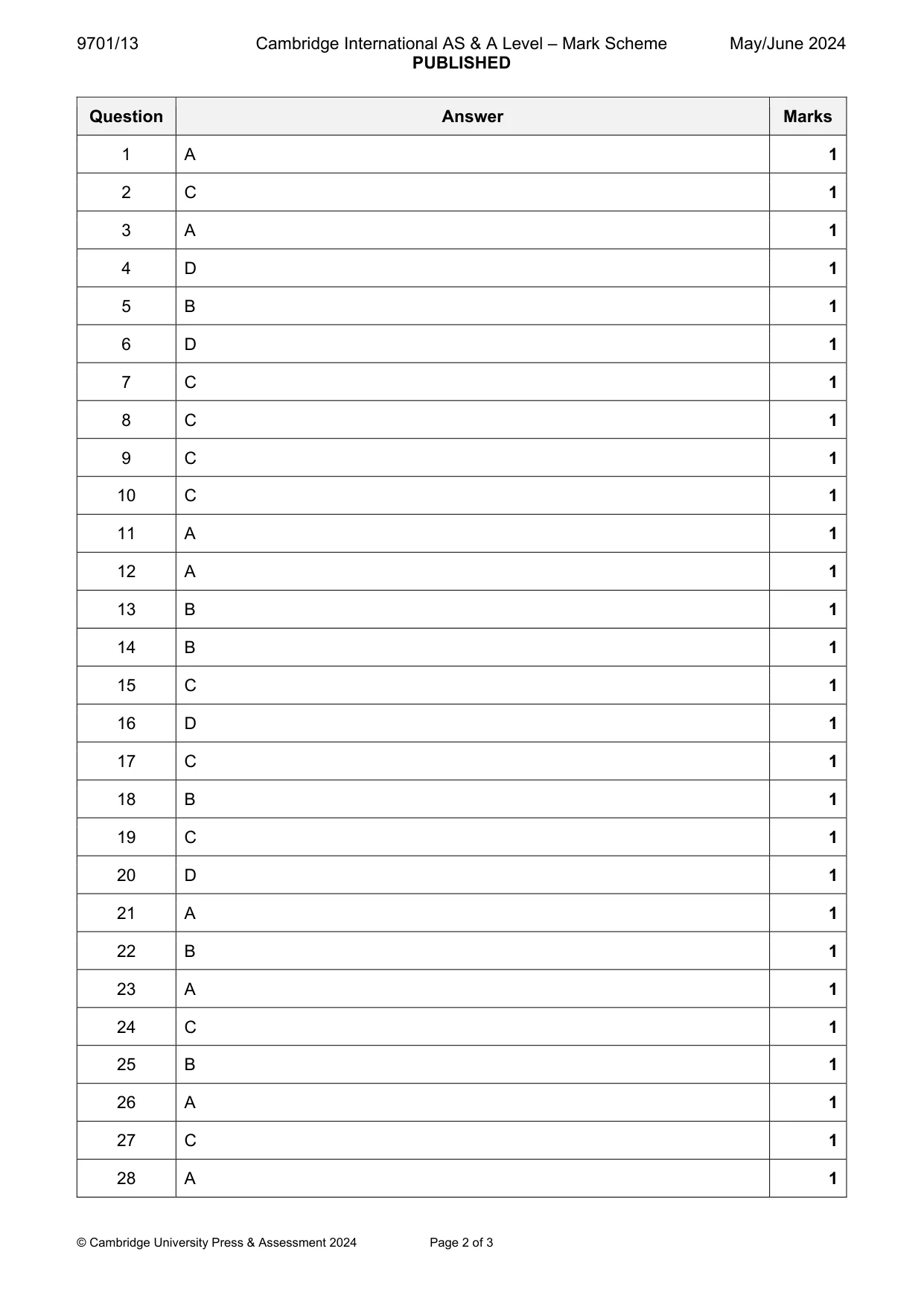
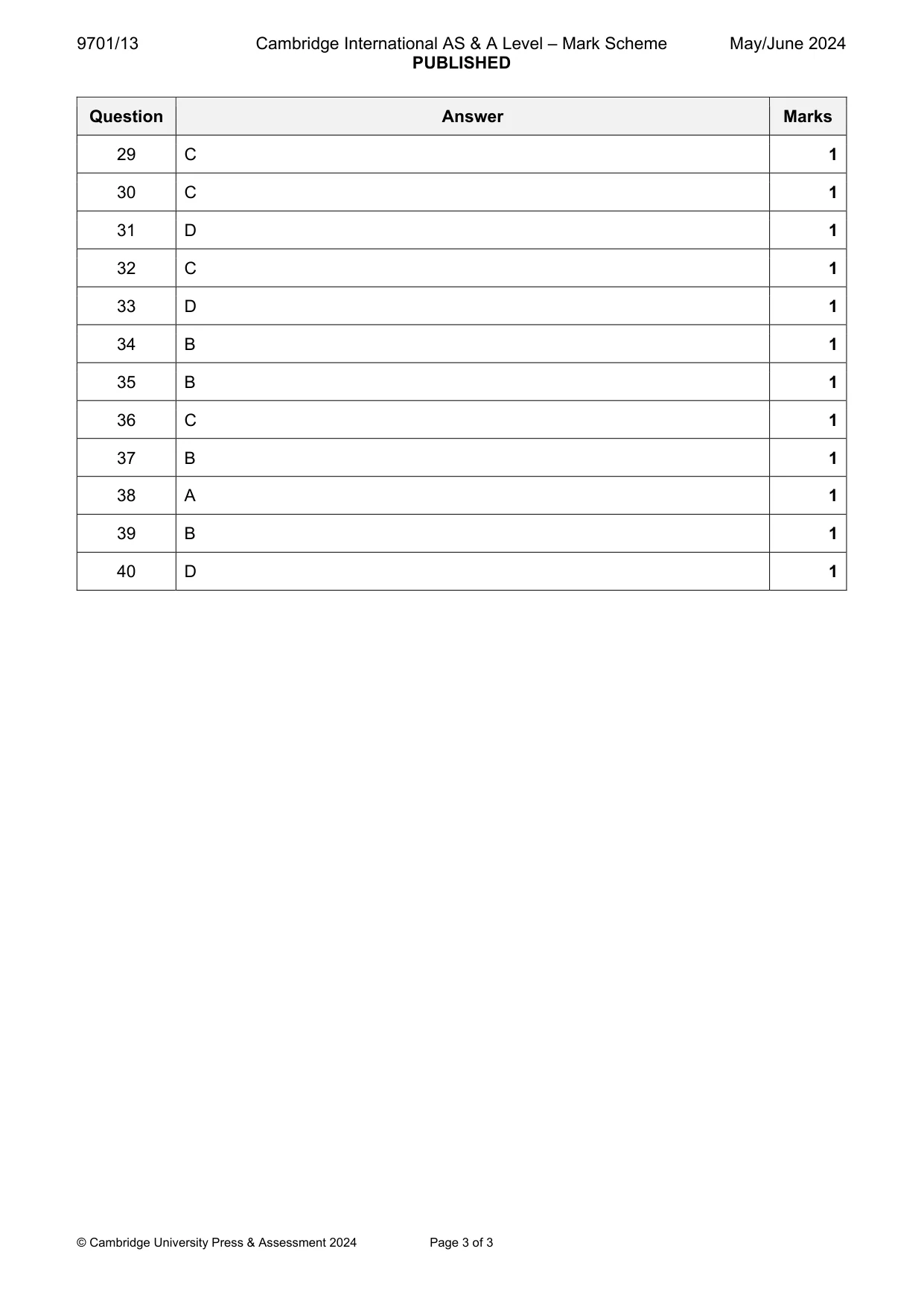
Answers below. Sit the paper first if you are practising.
Questions as text
Q1 · X is an impure sample of a Group 2 metal carbonate, MCO3
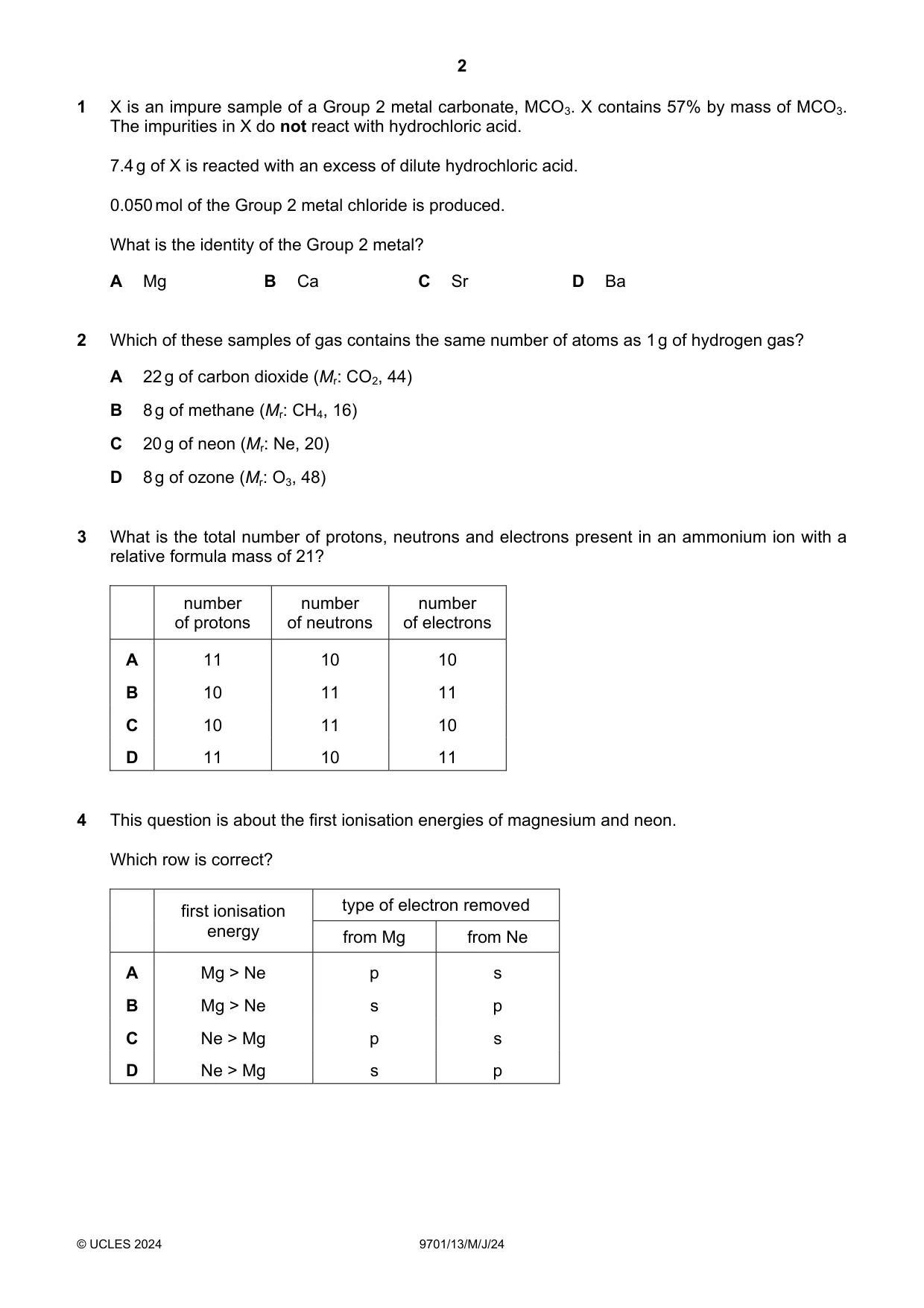
1 X is an impure sample of a Group 2 metal carbonate, MCO3. X contains 57% by mass of MCO3. The impurities in X do not react with hydrochloric acid. 7.4 g of X is reacted with an excess of dilute hydrochloric acid. 0.050 mol of the Group 2 metal chloride is produced. What is the identity of the Group 2 metal? A Mg B Ca C Sr D Ba
Mark scheme: A
Q2 · Which of these samples of gas contains the same number of atoms as 1 g of hydrogen gas?
2 Which of these samples of gas contains the same number of atoms as 1 g of hydrogen gas? A 22 g of carbon dioxide (Mr: CO2, 44) B 8 g of methane (Mr: CH4, 16) C 20 g of neon (Mr: Ne, 20) D 8 g of ozone (Mr: O3, 48)
Mark scheme: C
Q3 · What is the total number of protons, neutrons and electrons present in an ammonium ion…
3 What is the total number of protons, neutrons and electrons present in an ammonium ion with a relative formula mass of 21? number number number of protons of neutrons of electrons A 11 10 10 B 10 11 11 C 10 11 10 D 11 10 11
Mark scheme: A
Q4 · This question is about the first ionisation energies of magnesium and neon
4 This question is about the first ionisation energies of magnesium and neon. Which row is correct? first ionisation type of electron removed energy from Mg from Ne A Mg > Ne p s B Mg > Ne s p C Ne > Mg p s D Ne > Mg s p
Mark scheme: D
Q5 · Arsenic forms a compound with fluorine
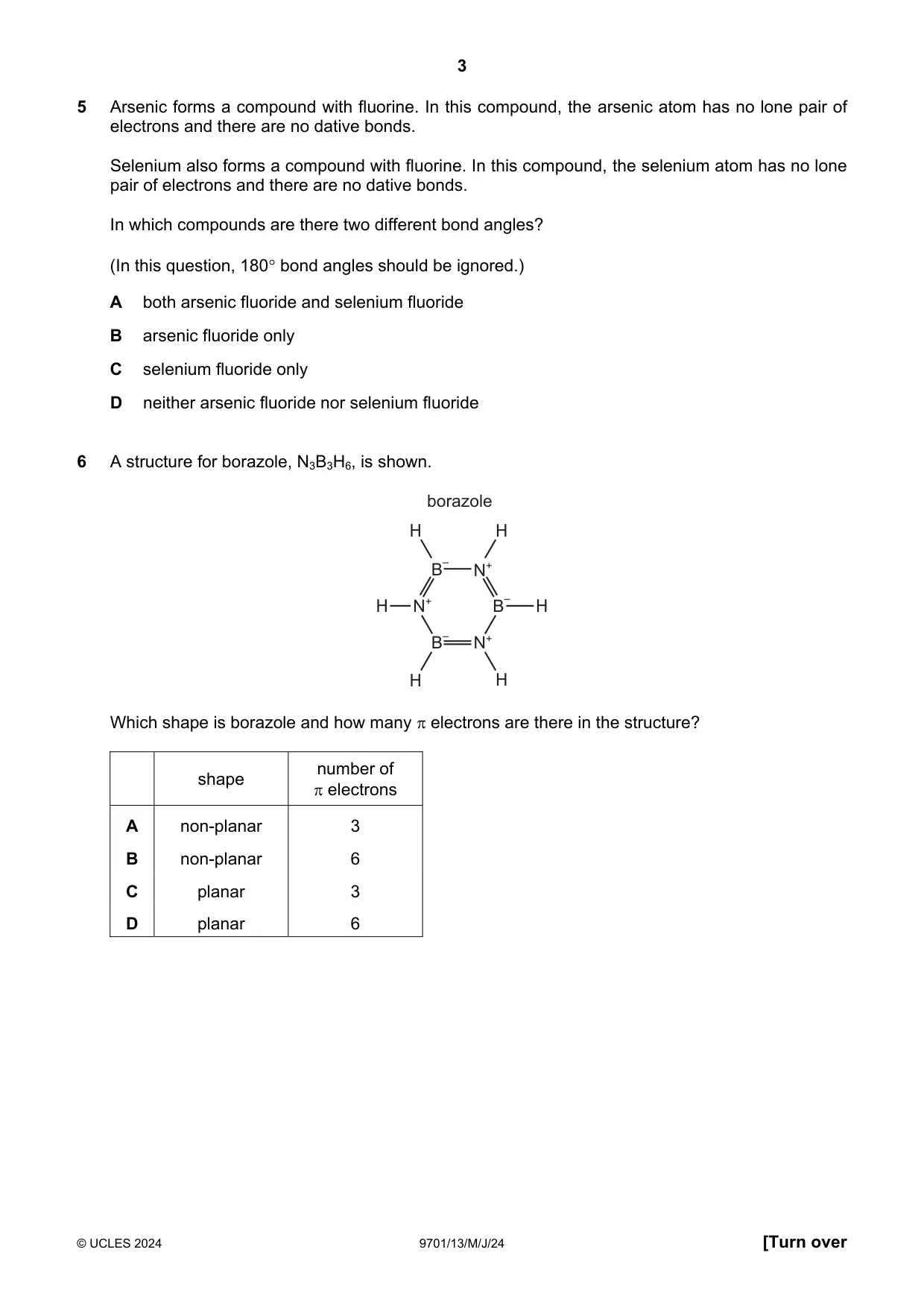
5 Arsenic forms a compound with fluorine. In this compound, the arsenic atom has no lone pair of electrons and there are no dative bonds. Selenium also forms a compound with fluorine. In this compound, the selenium atom has no lone pair of electrons and there are no dative bonds. In which compounds are there two different bond angles? (In this question, 180 bond angles should be ignored.) A both arsenic fluoride and selenium fluoride B arsenic fluoride only C selenium fluoride only D neither arsenic fluoride nor selenium fluoride
Mark scheme: B
Q6 · A structure for borazole, N3B3H6, is shown
6 A structure for borazole, N3B3H6, is shown. borazole H H B – N+ H N+ B – H B – N+ H H Which shape is borazole and how many electrons are there in the structure? number of shape electrons A non-planar 3 B non-planar 6 C planar 3 D planar 6
Mark scheme: D
More questions on Shapes of organic molecules; σ and π bonds
Q7 · The diagram shows the apparatus used to find the relative molecular mass of a volatile…
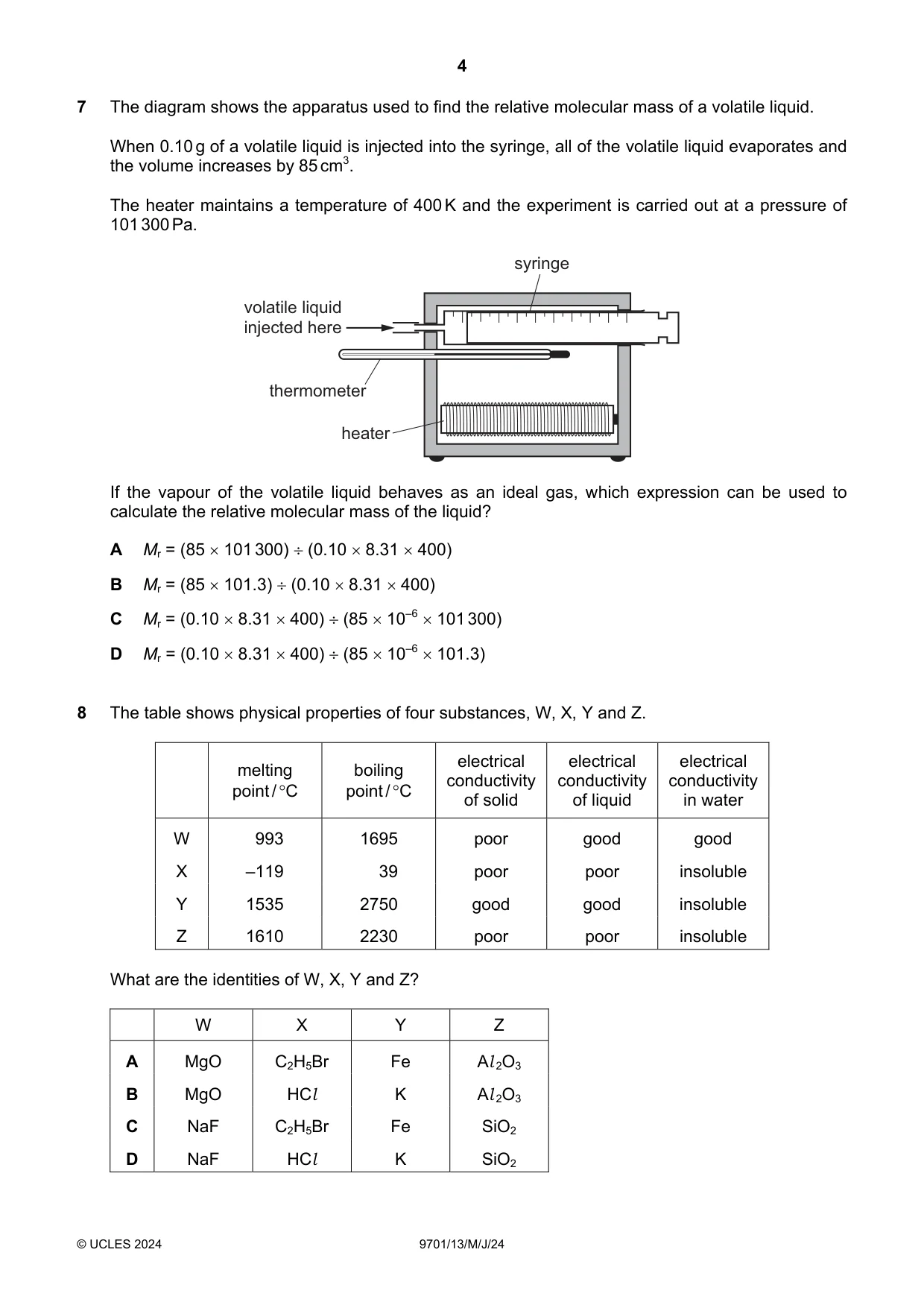
7 The diagram shows the apparatus used to find the relative molecular mass of a volatile liquid. When 0.10 g of a volatile liquid is injected into the syringe, all of the volatile liquid evaporates and the volume increases by 85 cm3. The heater maintains a temperature of 400 K and the experiment is carried out at a pressure of 101 300 Pa. syringe volatile liquid injected here thermometer heater If the vapour of the volatile liquid behaves as an ideal gas, which expression can be used to calculate the relative molecular mass of the liquid? A Mr = (85 101 300) (0.10 8.31 400) B Mr = (85 101.3) (0.10 8.31 400) C Mr = (0.10 8.31 400) (85 10–6 101 300) D Mr = (0.10 8.31 400) (85 10–6 101.3)
Mark scheme: C
More questions on The gaseous state: ideal and real gases and pV = nRT
Q8 · The table shows physical properties of four substances, W, X, Y and Z
8 The table shows physical properties of four substances, W, X, Y and Z. electrical electrical electrical melting boiling conductivity conductivity conductivity point / C point / C of solid of liquid in water W 993 1695 poor good good X –119 39 poor poor insoluble Y 1535 2750 good good insoluble Z 1610 2230 poor poor insoluble What are the identities of W, X, Y and Z? W X Y Z A MgO C2H5Br Fe Al 2O3 B MgO HCl K Al 2O3 C NaF C2H5Br Fe SiO2 D NaF HCl K SiO2
Mark scheme: C
Q9 · The apparatus used to determine a value for the enthalpy of combustion of butan-1-ol is…
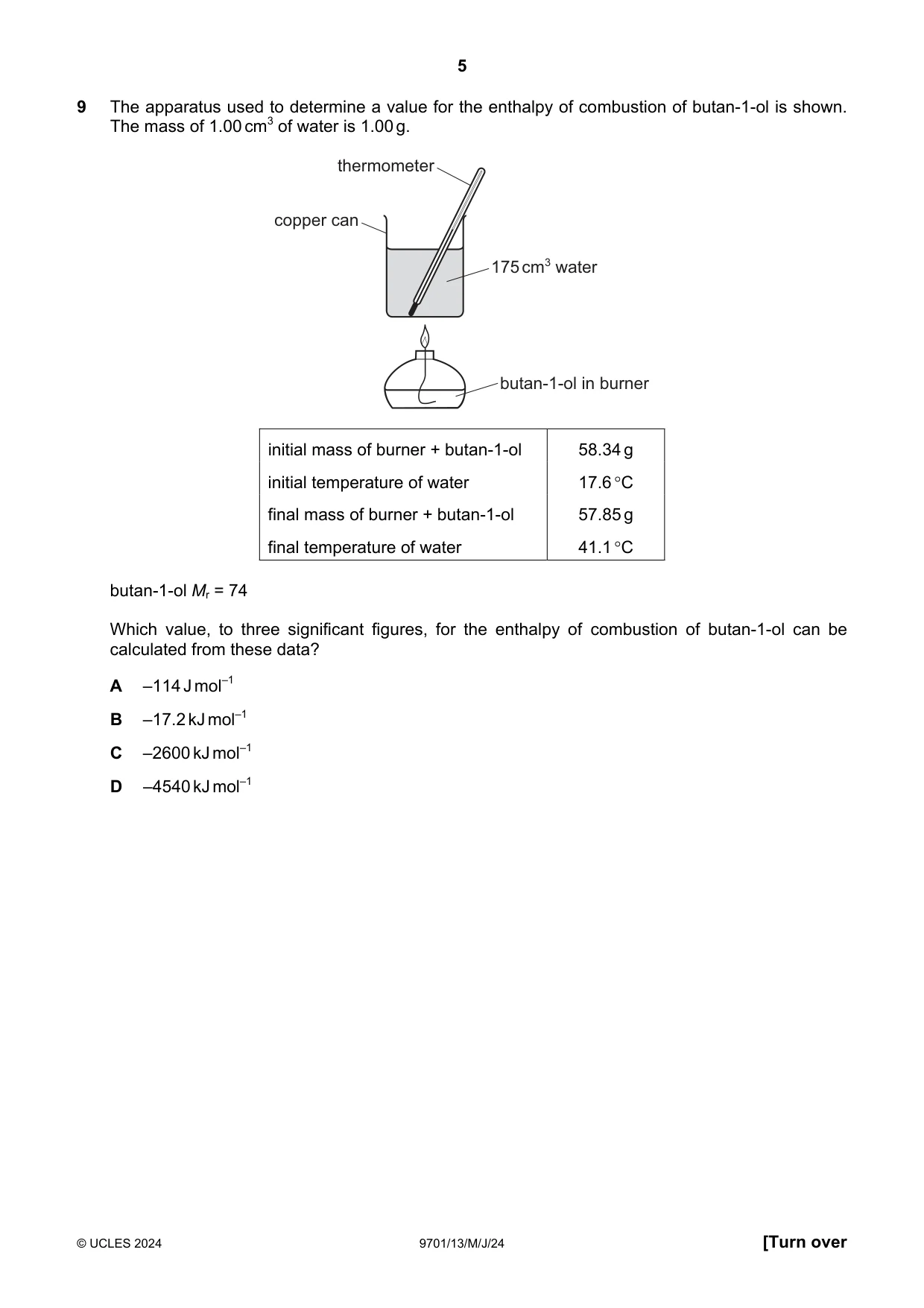
9 The apparatus used to determine a value for the enthalpy of combustion of butan-1-ol is shown. The mass of 1.00 cm3 of water is 1.00 g. thermometer copper can 175 cm3 water butan-1-ol in burner initial mass of burner + butan-1-ol 58.34 g initial temperature of water 17.6 C final mass of burner + butan-1-ol 57.85 g final temperature of water 41.1 C butan-1-ol Mr = 74 Which value, to three significant figures, for the enthalpy of combustion of butan-1-ol can be calculated from these data? A –114 J mol–1 B –17.2 kJ mol–1 C –2600 kJ mol–1 D –4540 kJ mol–1
Mark scheme: C
Q10 · In the high temperatures of car engines, nitrogen reacts with oxygen to produce nitrogen…
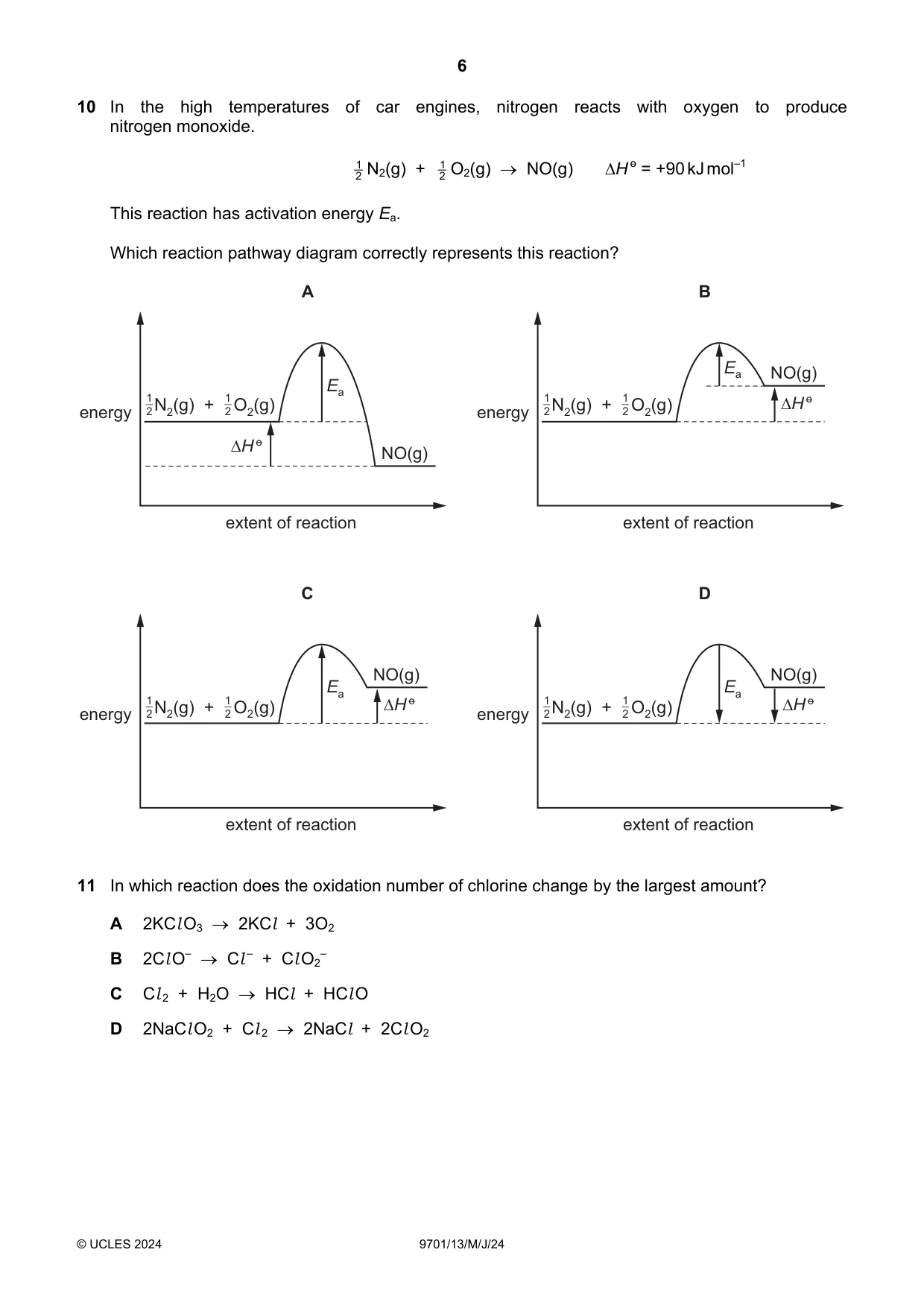
10 In the high temperatures of car engines, nitrogen reacts with oxygen to produce nitrogen monoxide. +No(g) + 40.(g) > NO(g) AH° = +90kJ mol" 2 This reaction has activation energy Ea. Which reaction pathway diagram correctly represents this reaction? extent of reaction extent of reaction energy extent of reaction extent of reaction
Mark scheme: C
More questions on Effect of temperature on reaction rates and the concept of activation energy
Q11 · In which reaction does the oxidation number of chlorine change by the largest amount?
11 In which reaction does the oxidation number of chlorine change by the largest amount? A 2KCl O3 2KCl + 3O2 B 2Cl O– Cl – + Cl O2 – C Cl 2 + H2O HCl + HCl O D 2NaCl O2 + Cl 2 2NaCl + 2Cl O2
Mark scheme: A
Q12 · Hydrogen is produced industrially from methane as shown in the equation
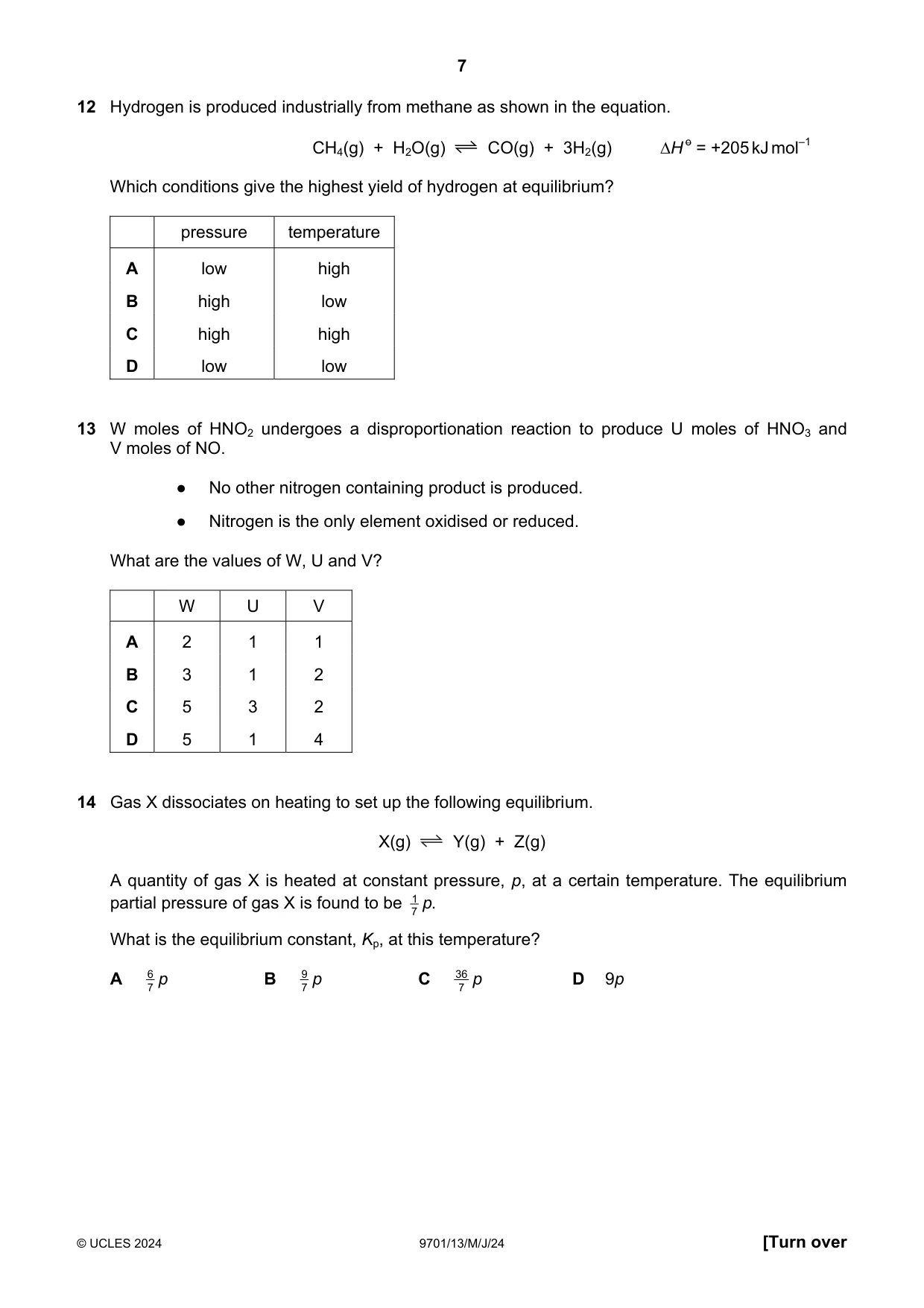
12 Hydrogen is produced industrially from methane as shown in the equation. CH4(g) + H2O(g) CO(g) + 3H2(g) H o = +205 kJ mol–1 Which conditions give the highest yield of hydrogen at equilibrium? pressure temperature A low high B high low C high high D low low
Mark scheme: A
More questions on Chemical equilibria: reversible reactions, dynamic equilibrium
Q13 · W moles of HNO2 undergoes a disproportionation reaction to produce U moles of HNO3 and V…
13 W moles of HNO2 undergoes a disproportionation reaction to produce U moles of HNO3 and V moles of NO. ● No other nitrogen containing product is produced. ● Nitrogen is the only element oxidised or reduced. What are the values of W, U and V? W U V A 2 1 1 B 3 1 2 C 5 3 2 D 5 1 4
Mark scheme: B
Q14 · Gas X dissociates on heating to set up the following equilibrium
14 Gas X dissociates on heating to set up the following equilibrium. X(g) Y(g) + Z(g) A quantity of gas X is heated at constant pressure, p, at a certain temperature. The equilibrium partial pressure of gas X is found to be 1 p . 7 What is the equilibrium constant, Kp, at this temperature? A 6 p B 9 p C 36 p D 9p 7 7 7
Mark scheme: B
More questions on Chemical equilibria: reversible reactions, dynamic equilibrium
Q15 · In the diagram, X is the Boltzmann distribution for the energies of the particles in a…
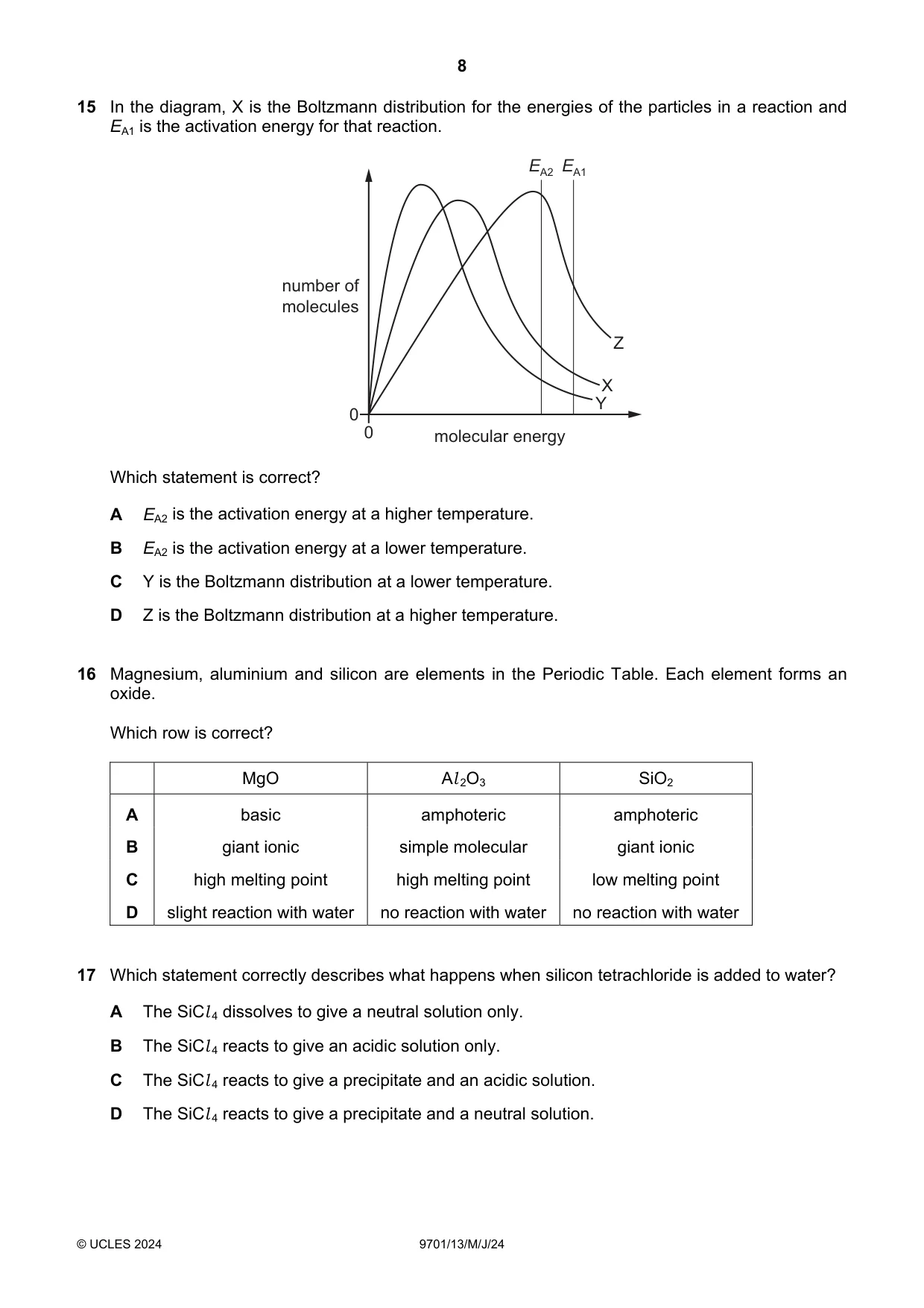
15 In the diagram, X is the Boltzmann distribution for the energies of the particles in a reaction and EA1 is the activation energy for that reaction. EA2 EA1 number of molecules Z X Y 0 0 molecular energy Which statement is correct? A EA2 is the activation energy at a higher temperature. B EA2 is the activation energy at a lower temperature. C Y is the Boltzmann distribution at a lower temperature. D Z is the Boltzmann distribution at a higher temperature.
Mark scheme: C
More questions on Effect of temperature on reaction rates and the concept of activation energy
Q16 · Magnesium, aluminium and silicon are elements in the Periodic Table
16 Magnesium, aluminium and silicon are elements in the Periodic Table. Each element forms an oxide. Which row is correct? MgO Al 2O3 SiO2 A basic amphoteric amphoteric B giant ionic simple molecular giant ionic C high melting point high melting point low melting point D slight reaction with water no reaction with water no reaction with water
Mark scheme: D
More questions on Periodicity of chemical properties of the elements in Period 3
Q17 · Which statement correctly describes what happens when silicon tetrachloride is added to…
17 Which statement correctly describes what happens when silicon tetrachloride is added to water? A The SiCl 4 dissolves to give a neutral solution only. B The SiCl 4 reacts to give an acidic solution only. C The SiCl 4 reacts to give a precipitate and an acidic solution. D The SiCl 4 reacts to give a precipitate and a neutral solution.
Mark scheme: C
More questions on Periodicity of chemical properties of the elements in Period 3
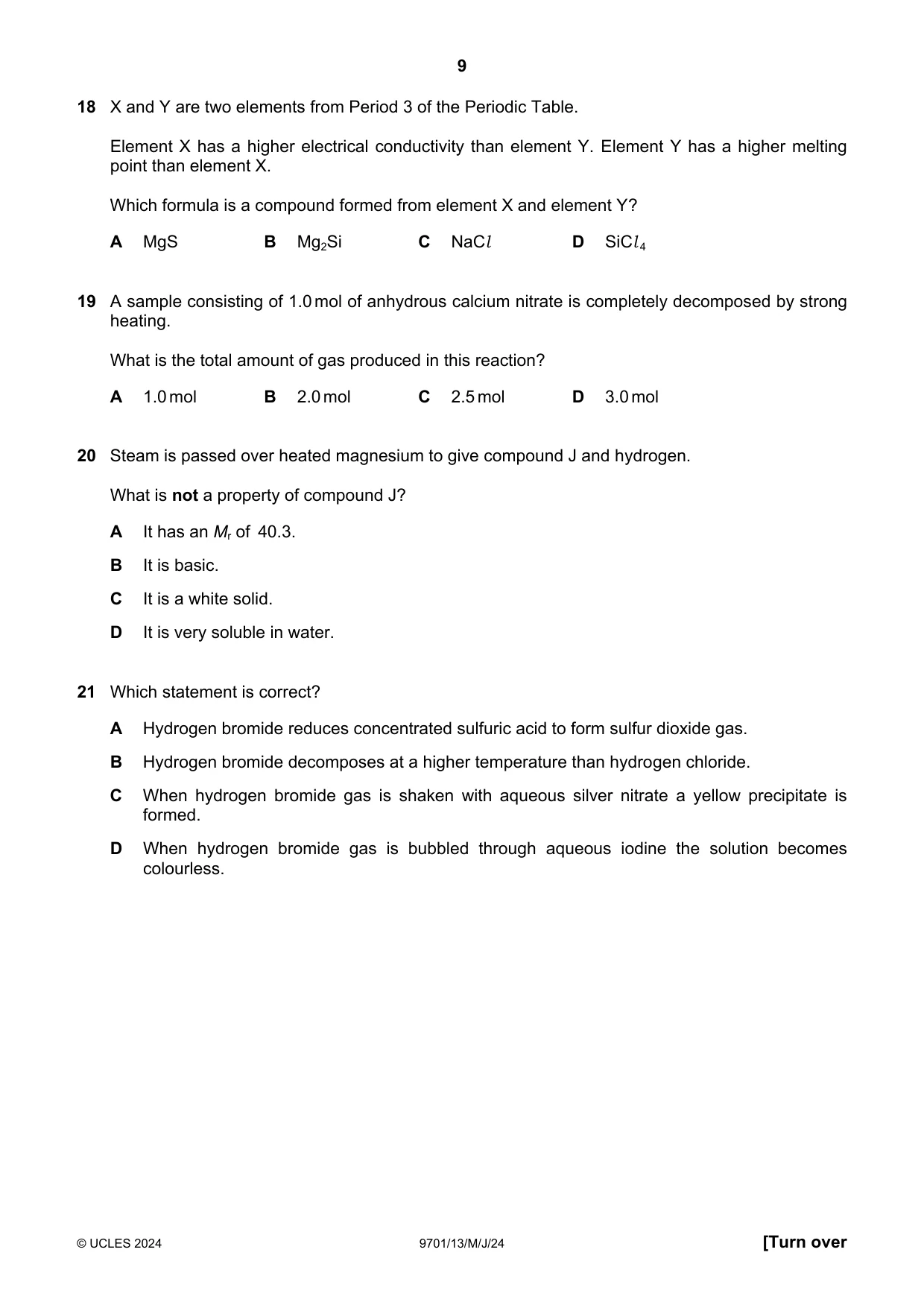
Q18 · X and Y are two elements from Period 3 of the Periodic Table
18 X and Y are two elements from Period 3 of the Periodic Table. Element X has a higher electrical conductivity than element Y. Element Y has a higher melting point than element X. Which formula is a compound formed from element X and element Y? A MgS B Mg2Si C NaCl D SiCl 4
Mark scheme: B
More questions on Periodicity of chemical properties of the elements in Period 3
Q19 · A sample consisting of 1.0 mol of anhydrous calcium nitrate is completely decomposed by…
19 A sample consisting of 1.0 mol of anhydrous calcium nitrate is completely decomposed by strong heating. What is the total amount of gas produced in this reaction? A 1.0 mol B 2.0 mol C 2.5 mol D 3.0 mol
Mark scheme: C
Q20 · Steam is passed over heated magnesium to give compound J and hydrogen
20 Steam is passed over heated magnesium to give compound J and hydrogen. What is not a property of compound J? A It has an Mr of 40.3. B It is basic. C It is a white solid. D It is very soluble in water.
Mark scheme: D
Q21 · Which statement is correct?
21 Which statement is correct? A Hydrogen bromide reduces concentrated sulfuric acid to form sulfur dioxide gas. B Hydrogen bromide decomposes at a higher temperature than hydrogen chloride. C When hydrogen bromide gas is shaken with aqueous silver nitrate a yellow precipitate is formed. D When hydrogen bromide gas is bubbled through aqueous iodine the solution becomes colourless.
Mark scheme: A
More questions on The chemical properties of the halogen elements and the hydrogen halides
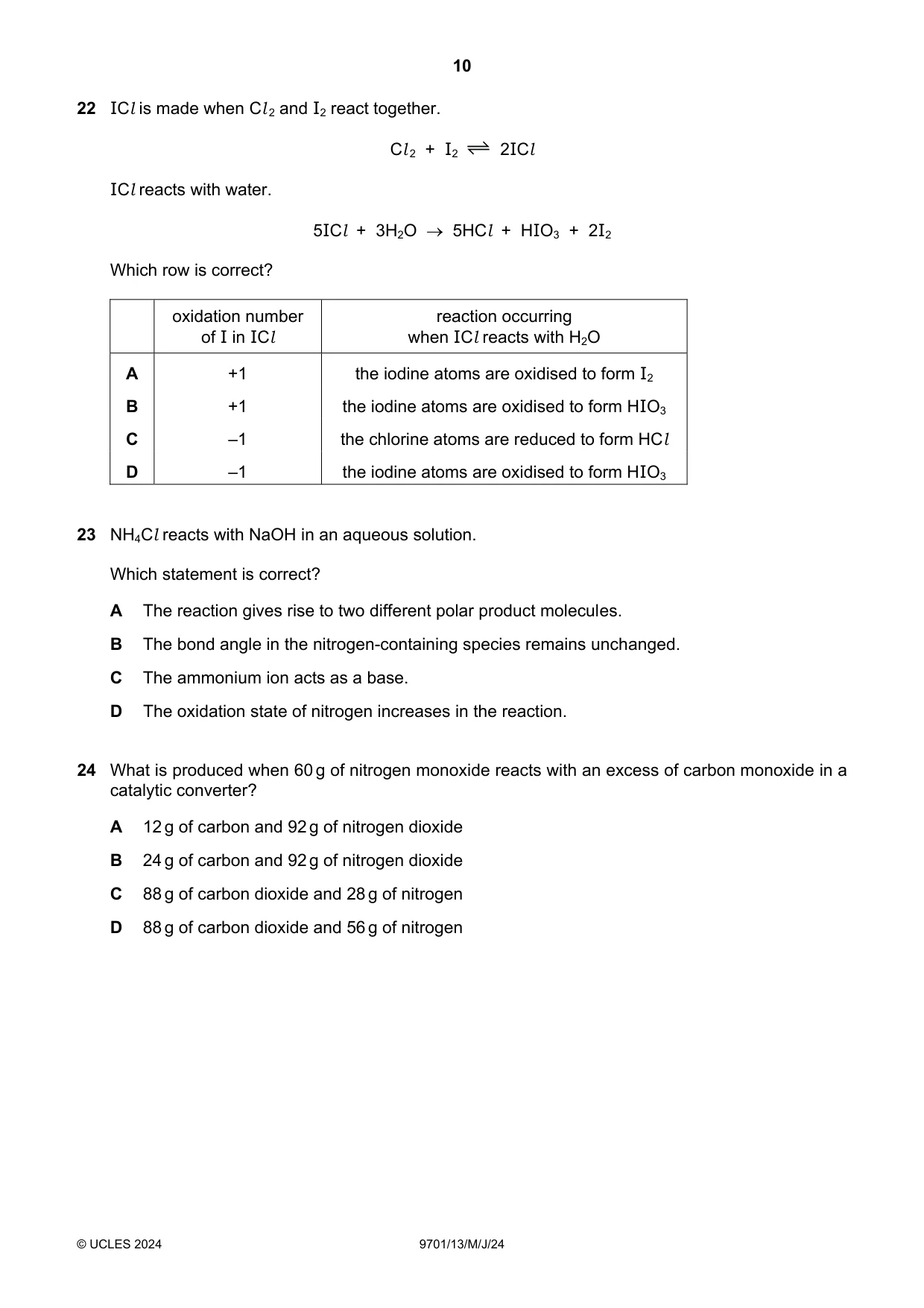
Q22 · ICl is made when Cl 2 and I2 react together
22 ICl is made when Cl 2 and I2 react together. Cl 2 + I2 2ICl ICl reacts with water. 5ICl + 3H2O 5HCl + HIO3 + 2I2 Which row is correct? oxidation number reaction occurring of I in ICl when ICl reacts with H2O A +1 the iodine atoms are oxidised to form I2 B +1 the iodine atoms are oxidised to form HIO3 C –1 the chlorine atoms are reduced to form HCl D –1 the iodine atoms are oxidised to form HIO3
Mark scheme: B
More questions on The chemical properties of the halogen elements and the hydrogen halides
Q23 · NH4Cl reacts with NaOH in an aqueous solution
23 NH4Cl reacts with NaOH in an aqueous solution. Which statement is correct? A The reaction gives rise to two different polar product molecules. B The bond angle in the nitrogen-containing species remains unchanged. C The ammonium ion acts as a base. D The oxidation state of nitrogen increases in the reaction.
Mark scheme: A
Q24 · What is produced when 60 g of nitrogen monoxide reacts with an excess of carbon monoxide…
24 What is produced when 60 g of nitrogen monoxide reacts with an excess of carbon monoxide in a catalytic converter? A 12 g of carbon and 92 g of nitrogen dioxide B 24 g of carbon and 92 g of nitrogen dioxide C 88 g of carbon dioxide and 28 g of nitrogen D 88 g of carbon dioxide and 56 g of nitrogen
Mark scheme: C
More questions on Reacting masses and volumes (of solutions and gases)
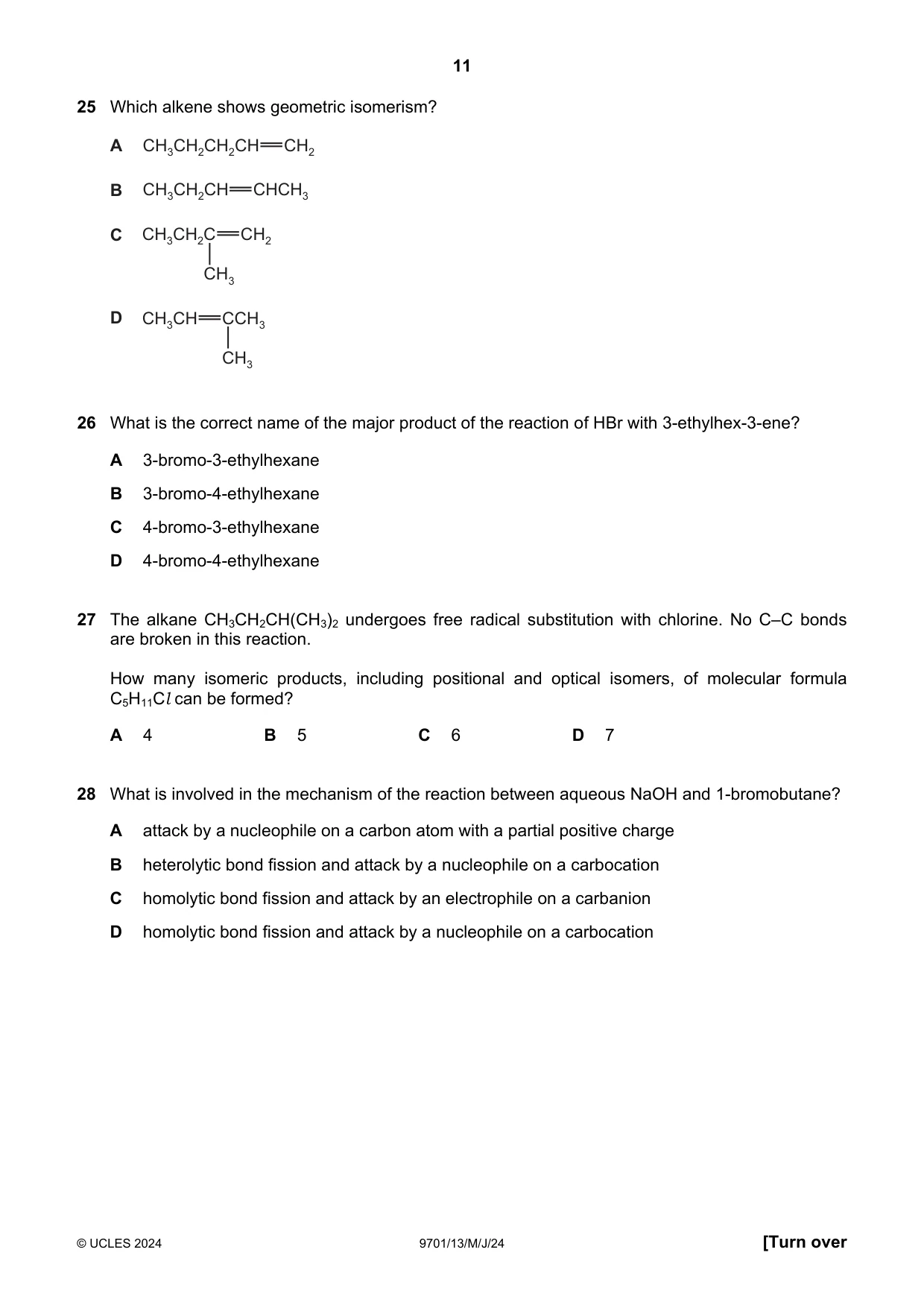
Q25 · Which alkene shows geometric isomerism?
25 Which alkene shows geometric isomerism? A CH3CH2CH2CH CH2 B CH3CH2CH CHCH3 C CH3CH2C CH2 CH3 D CH3CH CCH3 CH3
Mark scheme: B
More questions on Isomerism: structural isomerism and stereoisomerism
Q26 · What is the correct name of the major product of the reaction of HBr with…
26 What is the correct name of the major product of the reaction of HBr with 3-ethylhex-3-ene? A 3-bromo-3-ethylhexane B 3-bromo-4-ethylhexane C 4-bromo-3-ethylhexane D 4-bromo-4-ethylhexane
Mark scheme: A
Q27 · The alkane CH3CH2CH(CH3)2 undergoes free radical substitution with chlorine
27 The alkane CH3CH2CH(CH3)2 undergoes free radical substitution with chlorine. No C–C bonds are broken in this reaction. How many isomeric products, including positional and optical isomers, of molecular formula C5H11Cl can be formed? A 4 B 5 C 6 D 7
Mark scheme: C
Q28 · What is involved in the mechanism of the reaction between aqueous NaOH and 1-bromobutane?
28 What is involved in the mechanism of the reaction between aqueous NaOH and 1-bromobutane? A attack by a nucleophile on a carbon atom with a partial positive charge B heterolytic bond fission and attack by a nucleophile on a carbocation C homolytic bond fission and attack by an electrophile on a carbanion D homolytic bond fission and attack by a nucleophile on a carbocation
Mark scheme: A
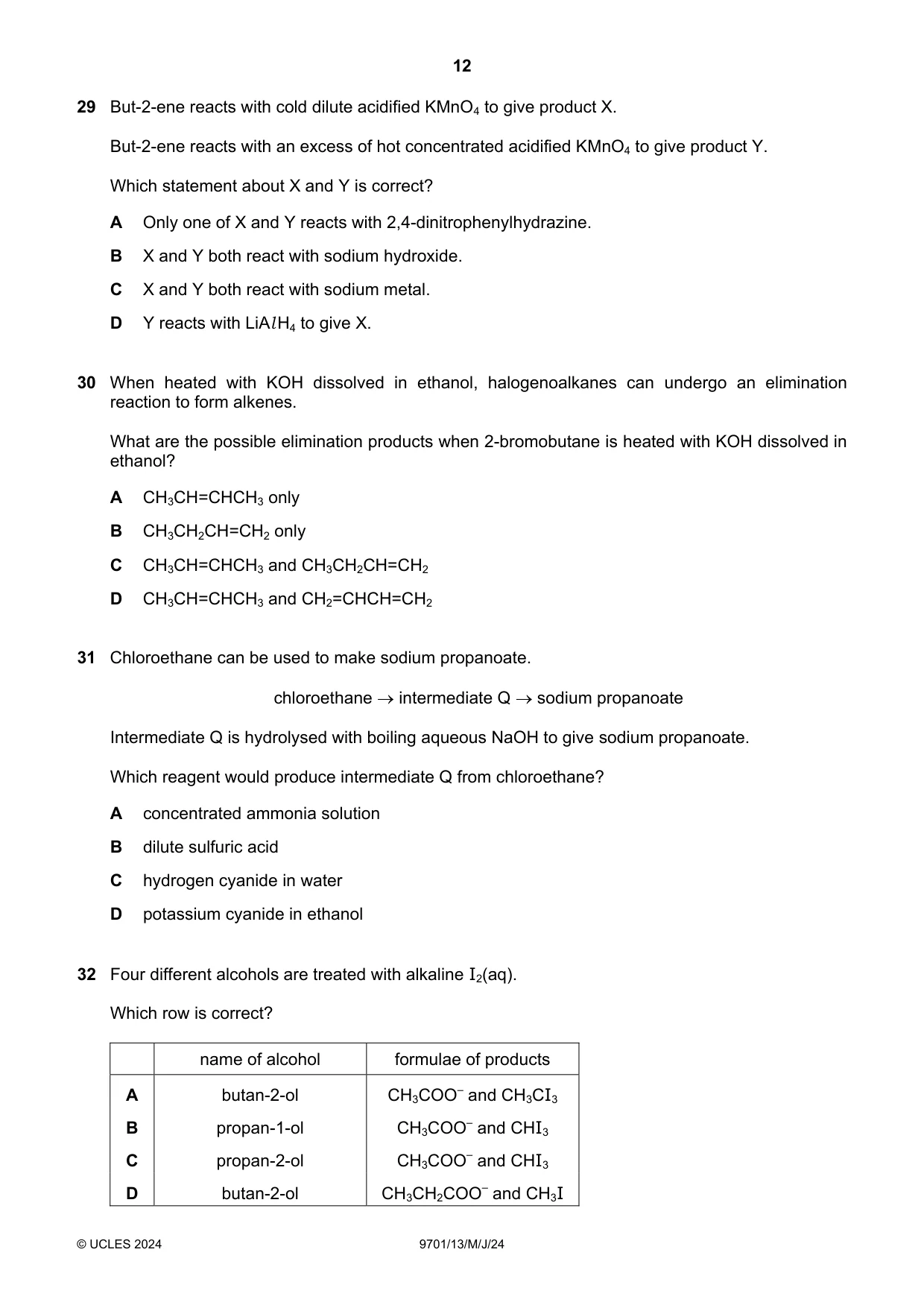
Q29 · But-2-ene reacts with cold dilute acidified KMnO4 to give product X
29 But-2-ene reacts with cold dilute acidified KMnO4 to give product X. But-2-ene reacts with an excess of hot concentrated acidified KMnO4 to give product Y. Which statement about X and Y is correct? A Only one of X and Y reacts with 2,4-dinitrophenylhydrazine. B X and Y both react with sodium hydroxide. C X and Y both react with sodium metal. D Y reacts with LiAl H4 to give X.
Mark scheme: C
Q30 · When heated with KOH dissolved in ethanol, halogenoalkanes can undergo an elimination…
30 When heated with KOH dissolved in ethanol, halogenoalkanes can undergo an elimination reaction to form alkenes. What are the possible elimination products when 2-bromobutane is heated with KOH dissolved in ethanol? A CH3CH=CHCH3 only B CH3CH2CH=CH2 only C CH3CH=CHCH3 and CH3CH2CH=CH2 D CH3CH=CHCH3 and CH2=CHCH=CH2
Mark scheme: C
Q31 · Chloroethane can be used to make sodium propanoate
31 Chloroethane can be used to make sodium propanoate. chloroethane intermediate Q sodium propanoate Intermediate Q is hydrolysed with boiling aqueous NaOH to give sodium propanoate. Which reagent would produce intermediate Q from chloroethane? A concentrated ammonia solution B dilute sulfuric acid C hydrogen cyanide in water D potassium cyanide in ethanol
Mark scheme: D
Q32 · Four different alcohols are treated with alkaline I2(aq)
32 Four different alcohols are treated with alkaline I2(aq). Which row is correct? name of alcohol formulae of products A butan-2-ol CH3COO– and CH3CI3 B propan-1-ol CH3COO– and CHI3 C propan-2-ol CH3COO– and CHI3 D butan-2-ol CH3CH2COO– and CH3I
Mark scheme: C
Q33 · The Mr of compound X is 88
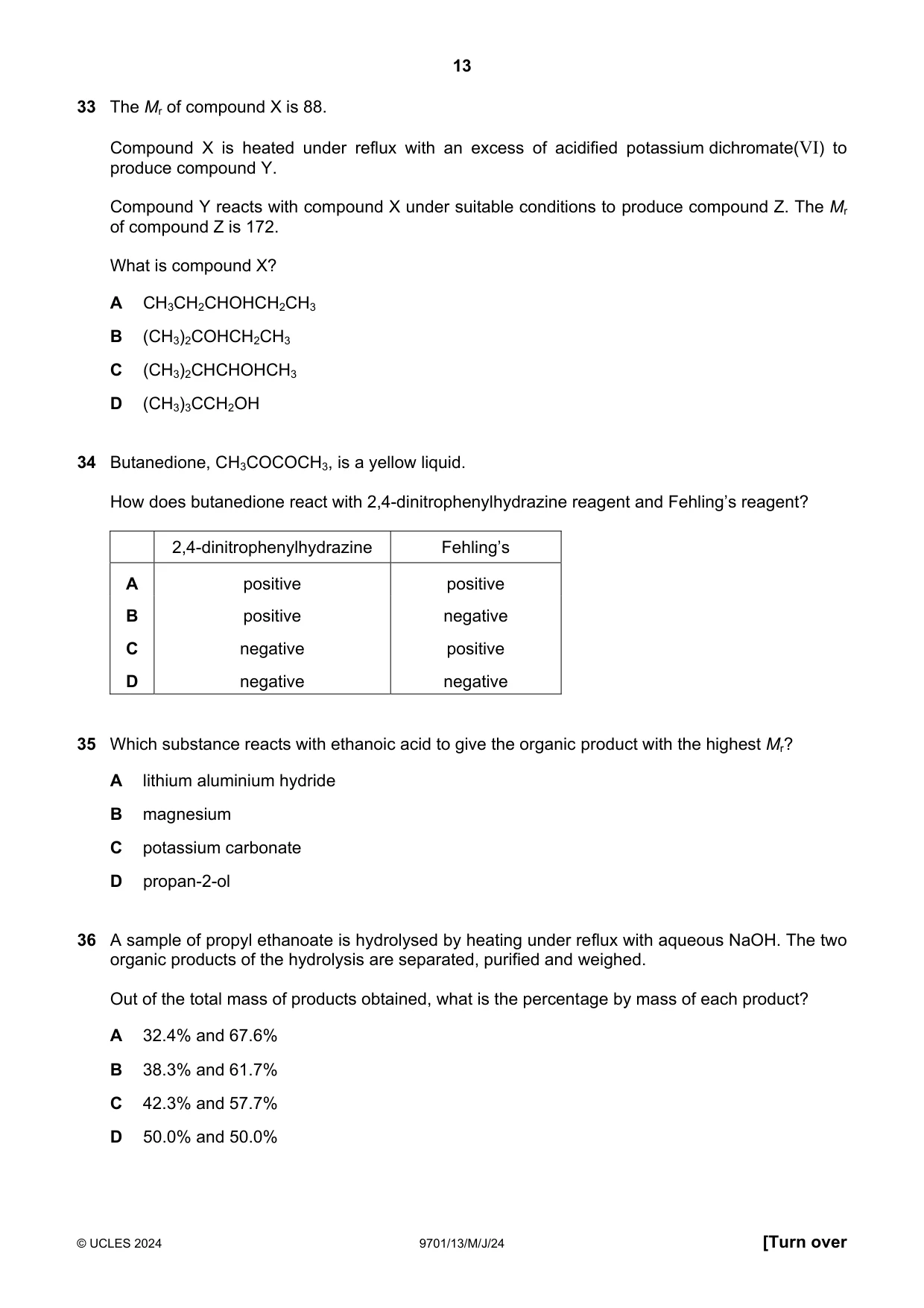
33 The Mr of compound X is 88. Compound X is heated under reflux with an excess of acidified potassium dichromate(VI) to produce compound Y. Compound Y reacts with compound X under suitable conditions to produce compound Z. The Mr of compound Z is 172. What is compound X? A CH3CH2CHOHCH2CH3 B (CH3)2COHCH2CH3 C (CH3)2CHCHOHCH3 D (CH3)3CCH2OH
Mark scheme: D
Q34 · Butanedione, CH3COCOCH3, is a yellow liquid
34 Butanedione, CH3COCOCH3, is a yellow liquid. How does butanedione react with 2,4-dinitrophenylhydrazine reagent and Fehling’s reagent? 2,4-dinitrophenylhydrazine Fehling’s A positive positive B positive negative C negative positive D negative negative
Mark scheme: B
Q35 · Which substance reacts with ethanoic acid to give the organic product with the highest Mr?
35 Which substance reacts with ethanoic acid to give the organic product with the highest Mr? A lithium aluminium hydride B magnesium C potassium carbonate D propan-2-ol
Mark scheme: B
Q36 · A sample of propyl ethanoate is hydrolysed by heating under reflux with aqueous NaOH
36 A sample of propyl ethanoate is hydrolysed by heating under reflux with aqueous NaOH. The two organic products of the hydrolysis are separated, purified and weighed. Out of the total mass of products obtained, what is the percentage by mass of each product? A 32.4% and 67.6% B 38.3% and 61.7% C 42.3% and 57.7% D 50.0% and 50.0%
Mark scheme: C
Q37 · Which statement about PVC is correct?
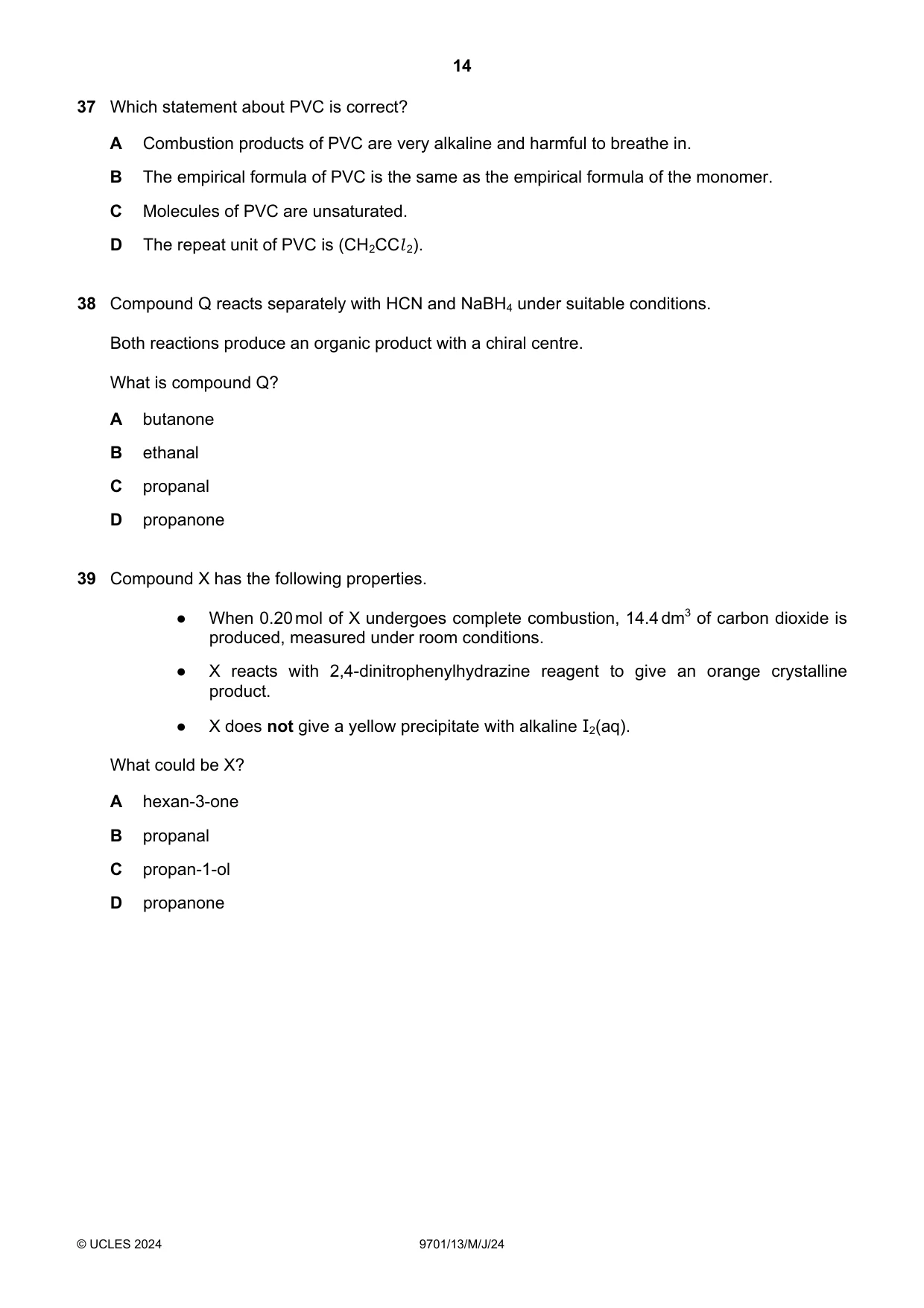
37 Which statement about PVC is correct? A Combustion products of PVC are very alkaline and harmful to breathe in. B The empirical formula of PVC is the same as the empirical formula of the monomer. C Molecules of PVC are unsaturated. D The repeat unit of PVC is (CH2CCl 2).
Mark scheme: B
Q38 · Compound Q reacts separately with HCN and NaBH4 under suitable conditions
38 Compound Q reacts separately with HCN and NaBH4 under suitable conditions. Both reactions produce an organic product with a chiral centre. What is compound Q? A butanone B ethanal C propanal D propanone
Mark scheme: A
Q39 · Compound X has the following properties
39 Compound X has the following properties. ● When 0.20 mol of X undergoes complete combustion, 14.4 dm3 of carbon dioxide is produced, measured under room conditions. ● X reacts with 2,4-dinitrophenylhydrazine reagent to give an orange crystalline product. ● X does not give a yellow precipitate with alkaline I2(aq). What could be X? A hexan-3-one B propanal C propan-1-ol D propanone
Mark scheme: B
Q40 · A sample of but-2-enoic acid, CH3CH=CHCOOH, is analysed using infrared spectroscopy
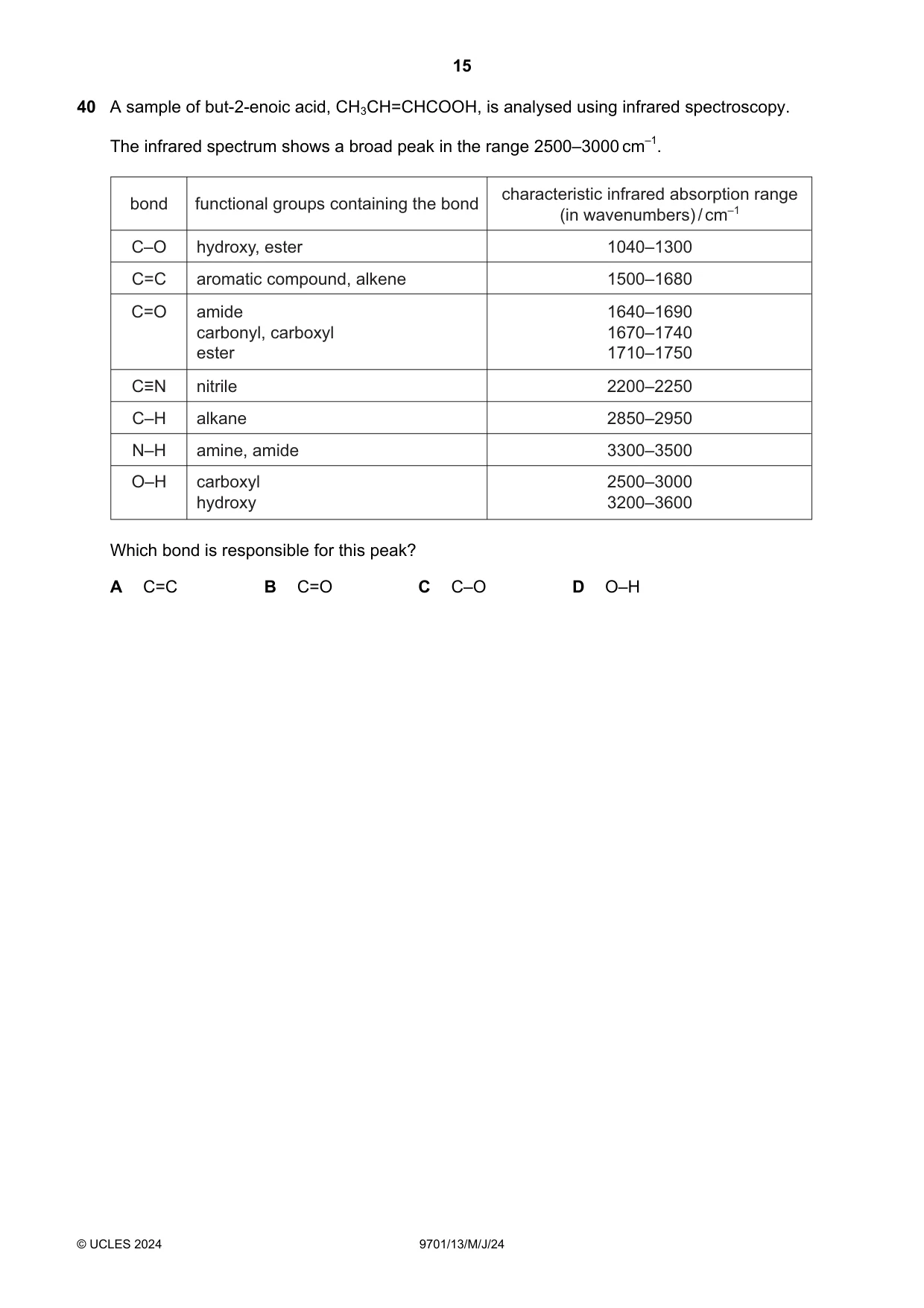
40 A sample of but-2-enoic acid, CH3CH=CHCOOH, is analysed using infrared spectroscopy. The infrared spectrum shows a broad peak in the range 2500–3000 cm–1. characteristic infrared absorption range bond functional groups containing the bond (in wavenumbers) / cm–1 C–O hydroxy, ester 1040–1300 C=C aromatic compound, alkene 1500–1680 C=O amide 1640–1690 carbonyl, carboxyl 1670–1740 ester 1710–1750 C≡N nitrile 2200–2250 C–H alkane 2850–2950 N–H amine, amide 3300–3500 O–H carboxyl 2500–3000 hydroxy 3200–3600 Which bond is responsible for this peak? A C=C B C=O C C–O D O–H
Mark scheme: D
What was in this paper
The subtopics covered by these 40 questions, and how many questions each got. Open one in a new tab to see every Cambridge question on it.
3Periodicity of chemical properties of the elements in Period 33Similarities and trends in the properties of the Group 2 metals, magnesium to barium, and their compounds3Aldehydes and ketones2Alkenes2Chemical equilibria: reversible reactions, dynamic equilibrium2Effect of temperature on reaction rates and the concept of activation energy2Halogenoalkanes2Nitriles and hydroxynitriles2Redox processes: electron transfer and changes in oxidation number (oxidation state)2Shapes of molecules2The chemical properties of the halogen elements and the hydrogen halides2Addition polymerisation1Alcohols1Alkanes1Bonding and structure1Enthalpy change, ΔH1Infrared spectroscopy1Ionisation energy1Isomerism: structural isomerism and stereoisomerism1Particles in the atom and atomic radius1Reacting masses and volumes (of solutions and gases)1Shapes of organic molecules; σ and π bonds1The gaseous state: ideal and real gases and pV = nRT1The mole and the Avogadro constant1What you needed in this session
Cambridge’s own grade thresholds for 2024 May/June, Paper 1 · Variant 3. A higher threshold means an easier paper — the bar moves with how the cohort did.