Cambridge A Level Chemistry 9701 — 2016 Oct/Nov Paper 1 · Variant 1
9701/11/O/N/16 · 40 questions · 40 marks · ≈45 min
The question paper and its mark scheme, free to read here and free to download. This is Cambridge’s own paper, exactly as it was sat.
Question paper16 pages
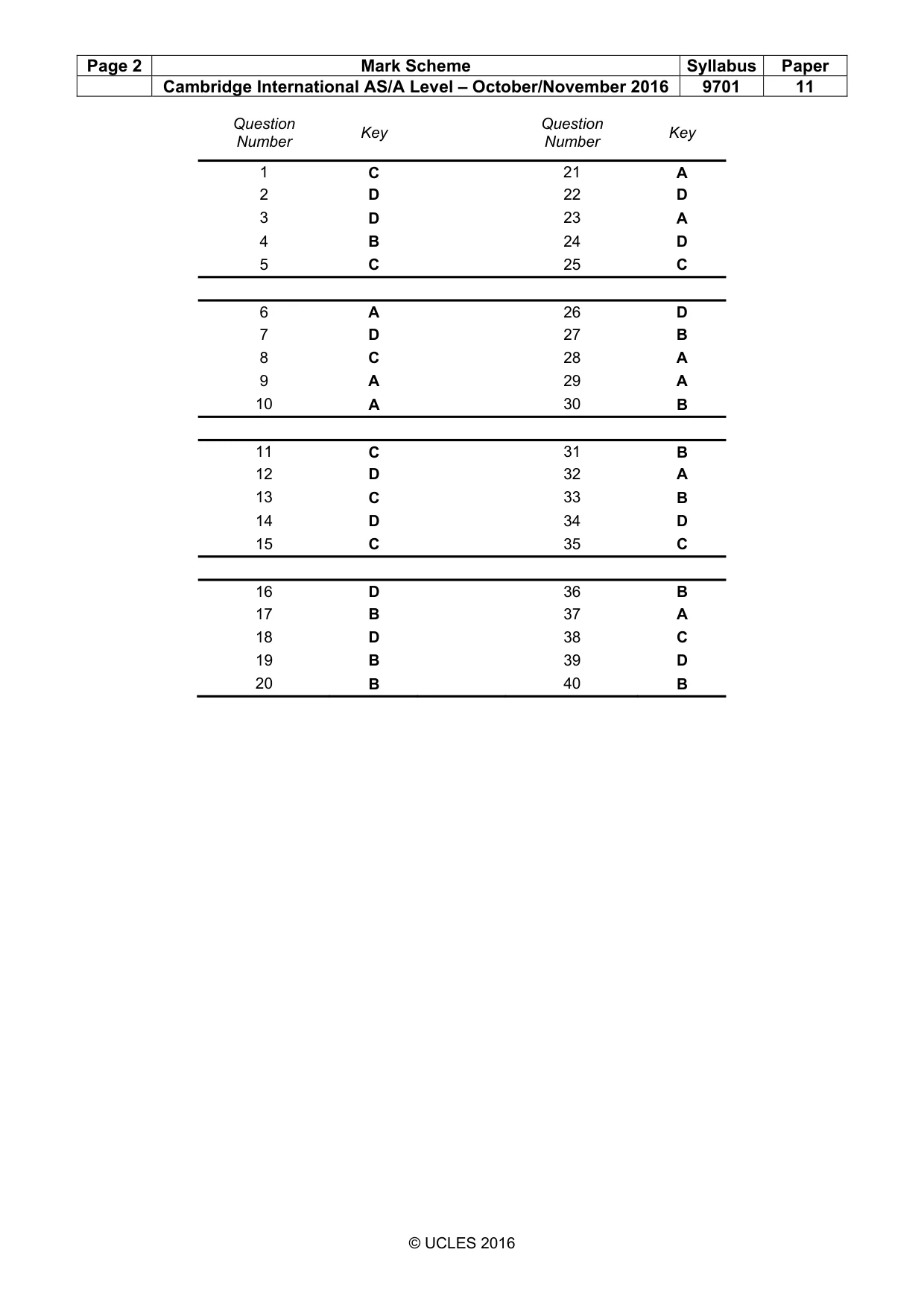
Mark scheme2 pages
Answers below. Sit the paper first if you are practising.
Questions as text
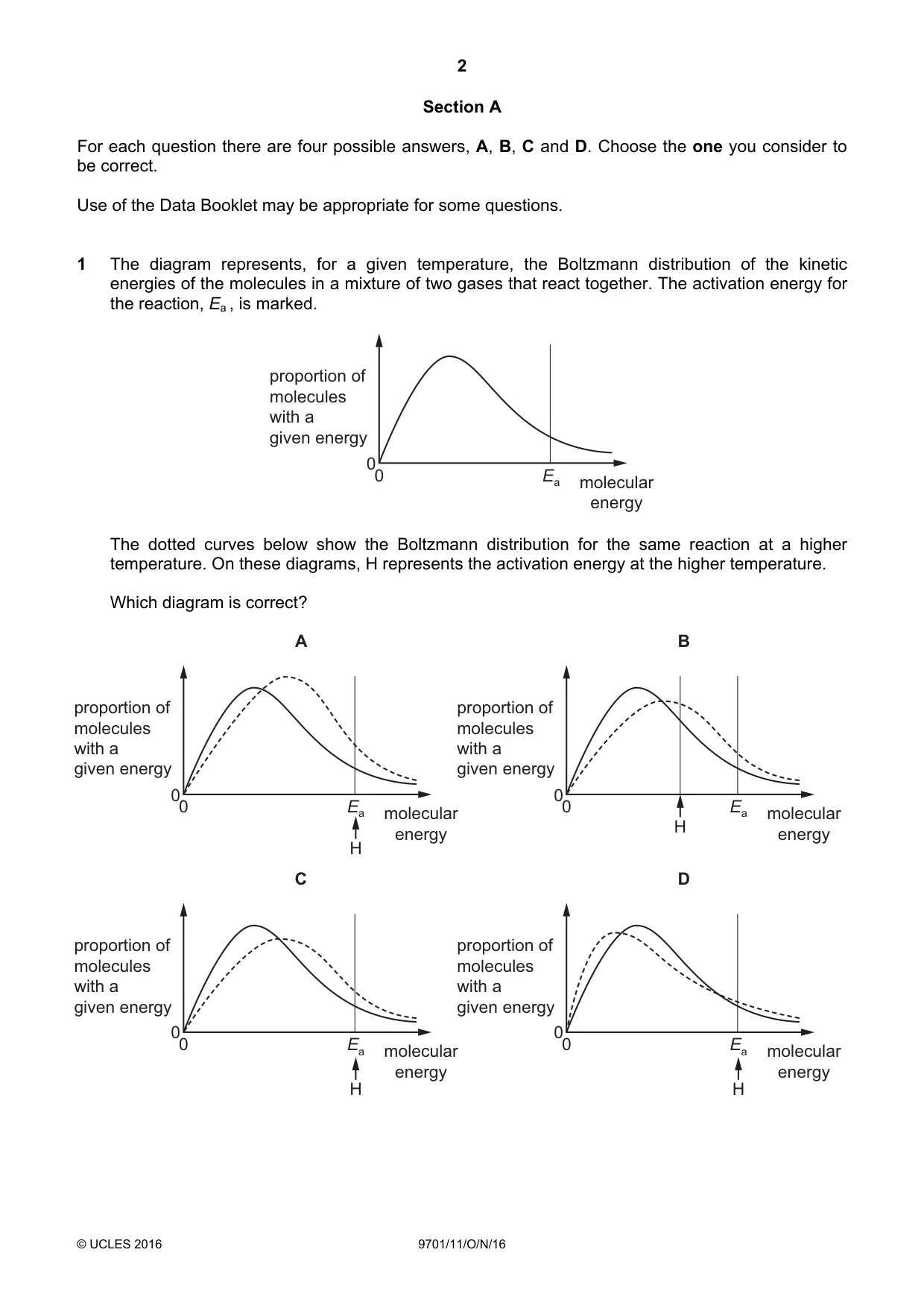
Q1 · The diagram represents, for a given temperature, the Boltzmann distribution of the…
1 The diagram represents, for a given temperature, the Boltzmann distribution of the kinetic energies of the molecules in a mixture of two gases that react together. The activation energy for the reaction, Ea , is marked. proportion of molecules with a given energy 00 Ea molecular energy The dotted curves below show the Boltzmann distribution for the same reaction at a higher temperature. On these diagrams, H represents the activation energy at the higher temperature. Which diagram is correct? A B proportion of proportion of molecules molecules with a with a given energy given energy 00 00 Ea molecular Ea molecular energy H energy H C D proportion of proportion of molecules molecules with a with a given energy given energy 00 00 Ea molecular Ea molecular energy energy H H
Mark scheme: C
More questions on Effect of temperature on reaction rates and the concept of activation energy
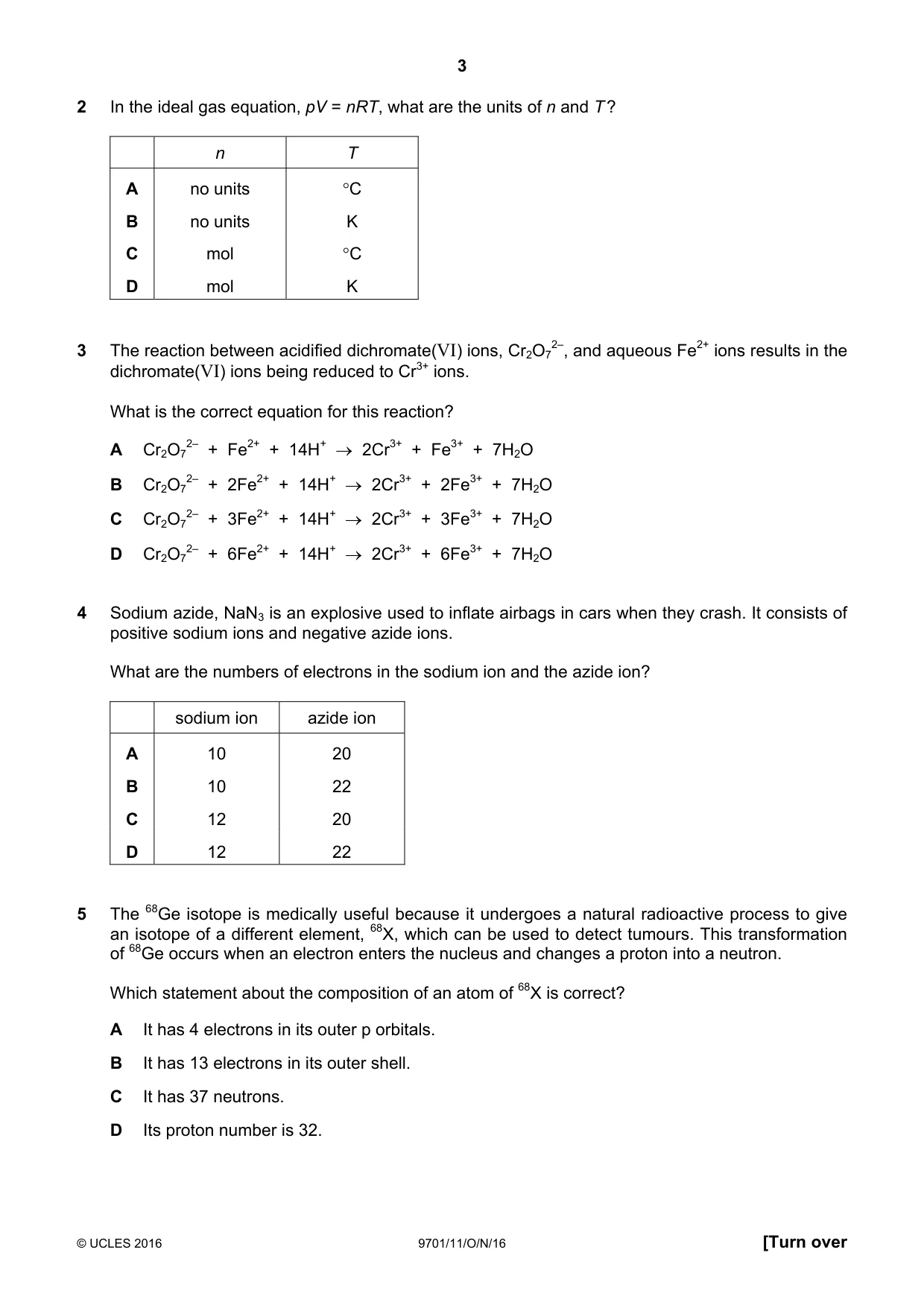
Q2 · In the ideal gas equation, pV = nRT, what are the units of n and T ?
2 In the ideal gas equation, pV = nRT, what are the units of n and T ? n T A no units °C B no units K C mol °C D mol K
Mark scheme: D
More questions on The gaseous state: ideal and real gases and pV = nRT
Q3 · The reaction between acidified dichromate(VI) ions, Cr2O7 2–, and aqueous Fe2+ ions…
3 The reaction between acidified dichromate(VI) ions, Cr2O7 2–, and aqueous Fe2+ ions results in the dichromate(VI) ions being reduced to Cr3+ ions. What is the correct equation for this reaction? A Cr2O7 2– + Fe2+ + 14H+ → 2Cr3+ + Fe3+ + 7H2O B Cr2O7 2– + 2Fe2+ + 14H+ → 2Cr3+ + 2Fe3+ + 7H2O C Cr2O7 2– + 3Fe2+ + 14H+ → 2Cr3+ + 3Fe3+ + 7H2O D Cr2O7 2– + 6Fe2+ + 14H+ → 2Cr3+ + 6Fe3+ + 7H2O
Mark scheme: D
Q4 · Sodium azide, NaN3 is an explosive used to inflate airbags in cars when they crash
4 Sodium azide, NaN3 is an explosive used to inflate airbags in cars when they crash. It consists of positive sodium ions and negative azide ions. What are the numbers of electrons in the sodium ion and the azide ion? sodium ion azide ion A 10 20 B 10 22 C 12 20 D 12 22
Mark scheme: B
Q5 · The 68Ge isotope is medically useful because it undergoes a natural radioactive process…
5 The 68Ge isotope is medically useful because it undergoes a natural radioactive process to give an isotope of a different element, 68X, which can be used to detect tumours. This transformation of 68Ge occurs when an electron enters the nucleus and changes a proton into a neutron. Which statement about the composition of an atom of 68X is correct? A It has 4 electrons in its outer p orbitals. B It has 13 electrons in its outer shell. C It has 37 neutrons. D Its proton number is 32.
Mark scheme: C
More questions on Electrons, energy levels and atomic orbitals
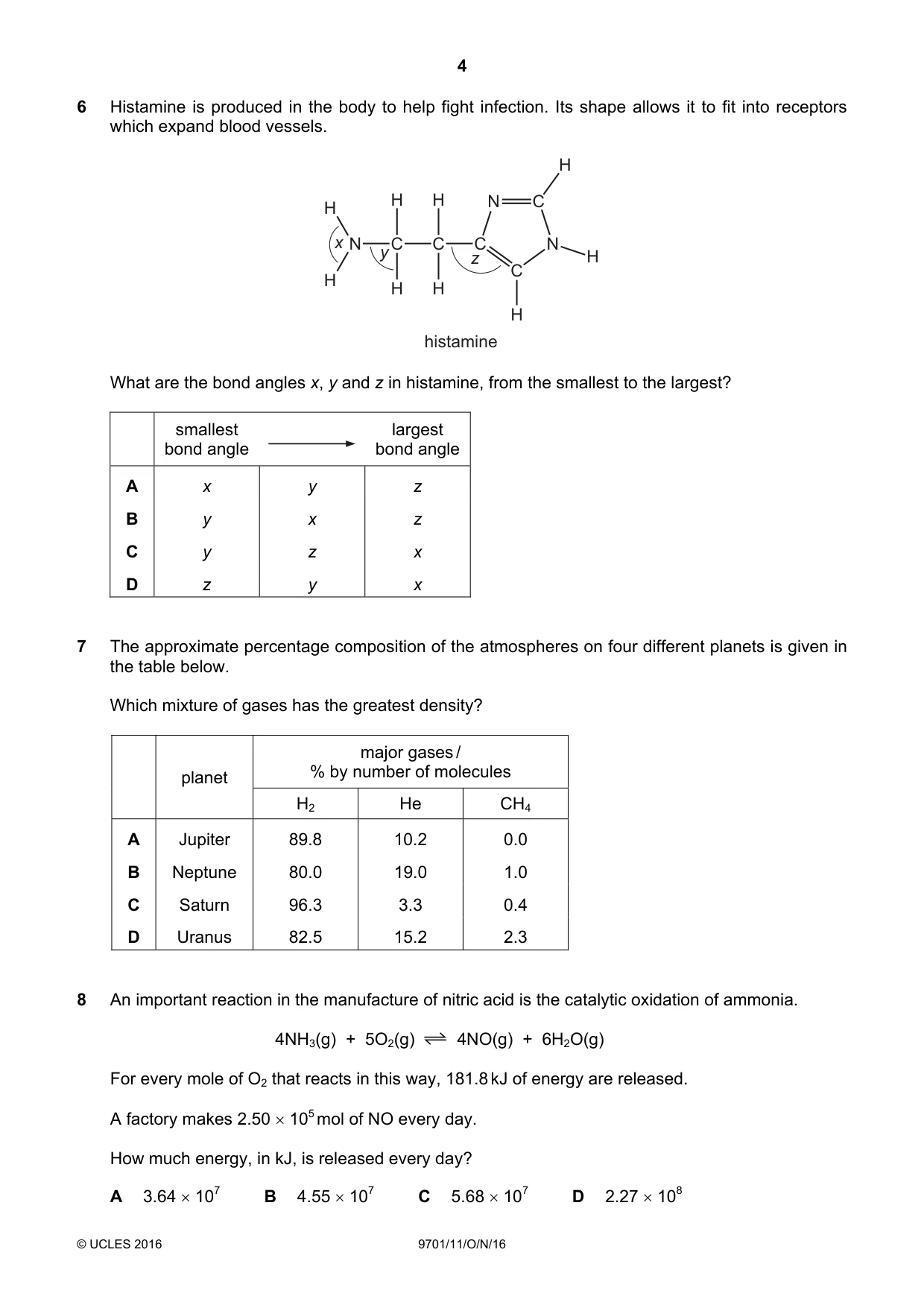
Q6 · Histamine is produced in the body to help fight infection
6 Histamine is produced in the body to help fight infection. Its shape allows it to fit into receptors which expand blood vessels. H H H N C H x N C C C N y z H C H H H H histamine What are the bond angles x, y and z in histamine, from the smallest to the largest? smallest largest bond angle bond angle A x y z B y x z C y z x D z y x
Mark scheme: A
Q7 · The approximate percentage composition of the atmospheres on four different planets is…
7 The approximate percentage composition of the atmospheres on four different planets is given in the table below. Which mixture of gases has the greatest density? major gases / planet % by number of molecules H2 He CH4 A Jupiter 89.8 10.2 0.0 B Neptune 80.0 19.0 1.0 C Saturn 96.3 3.3 0.4 D Uranus 82.5 15.2 2.3
Mark scheme: D
More questions on The gaseous state: ideal and real gases and pV = nRT
Q8 · An important reaction in the manufacture of nitric acid is the catalytic oxidation of…
8 An important reaction in the manufacture of nitric acid is the catalytic oxidation of ammonia. 4NH3(g) + 5O2(g) 4NO(g) + 6H2O(g) For every mole of O2 that reacts in this way, 181.8 kJ of energy are released. A factory makes 2.50 × 10⁵ mol of NO every day. How much energy, in kJ, is released every day? A 3.64 × 10⁷ B 4.55 × 10⁷ C 5.68 × 10⁷ D 2.27 × 10⁸
Mark scheme: C
Q9 · Sodium chromate(VI), Na2CrO4, is manufactured by heating chromite, FeCr2O4, with sodium…
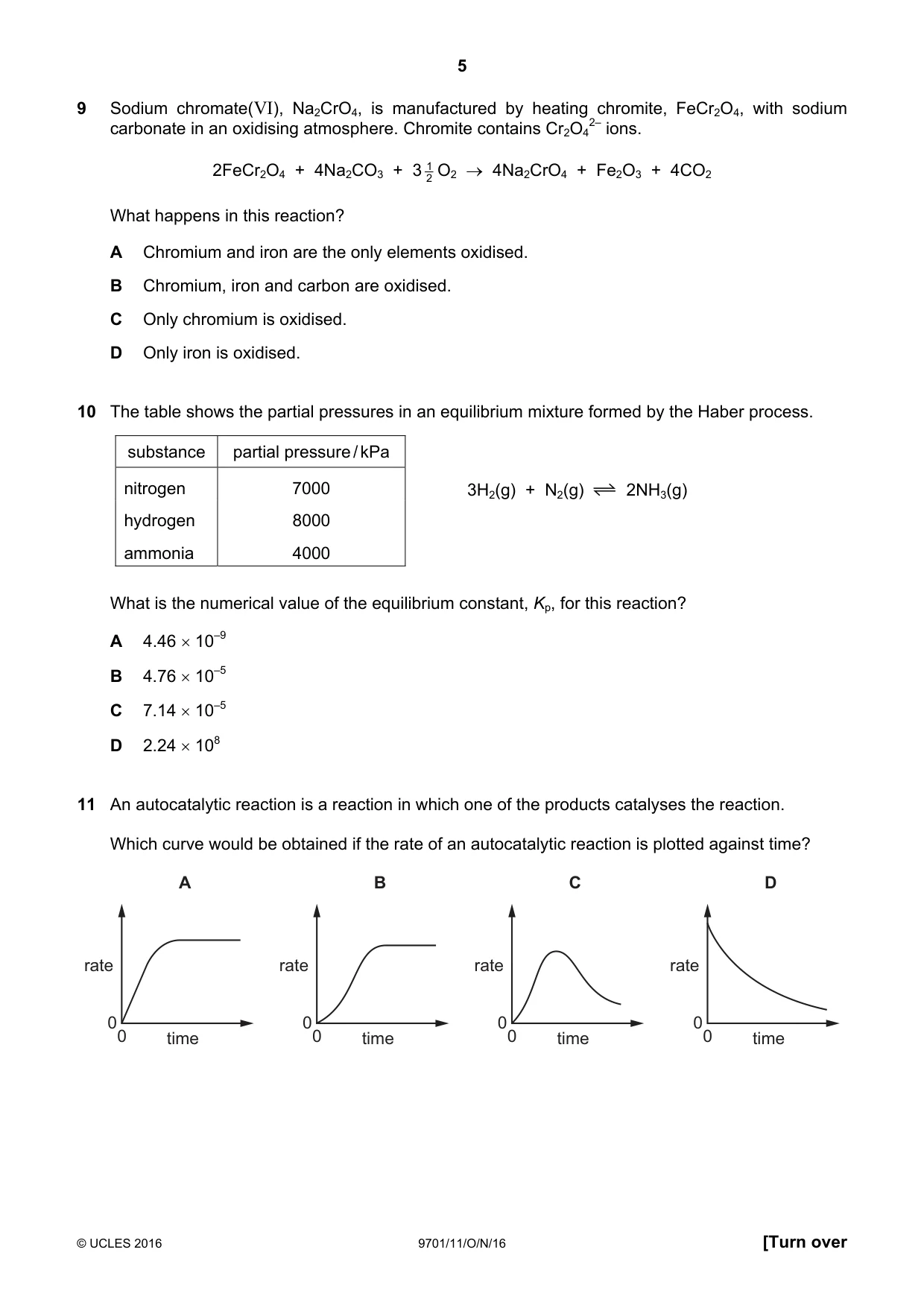
9 Sodium chromate(VI), Na2CrO4, is manufactured by heating chromite, FeCr2O4, with sodium carbonate in an oxidising atmosphere. Chromite contains Cr2O4 2– ions. 2FeCr2O4 + 4Na2CO3 + 3 2 1 O2 → 4Na2CrO4 + Fe2O3 + 4CO2 What happens in this reaction? A Chromium and iron are the only elements oxidised. B Chromium, iron and carbon are oxidised. C Only chromium is oxidised. D Only iron is oxidised.
Mark scheme: A
Q10 · The table shows the partial pressures in an equilibrium mixture formed by the Haber…
10 The table shows the partial pressures in an equilibrium mixture formed by the Haber process. substance partial pressure / kPa nitrogen 7000 3H2(g) + N2(g) 2NH3(g) hydrogen 8000 ammonia 4000 What is the numerical value of the equilibrium constant, Kp, for this reaction? A 4.46 × 10⁻⁹ B 4.76 × 10⁻⁵ C 7.14 × 10⁻⁵ D 2.24 × 10⁸
Mark scheme: A
More questions on Chemical equilibria: reversible reactions, dynamic equilibrium
Q11 · An autocatalytic reaction is a reaction in which one of the products catalyses the…
11 An autocatalytic reaction is a reaction in which one of the products catalyses the reaction. Which curve would be obtained if the rate of an autocatalytic reaction is plotted against time? A B C D rate rate rate rate 0 0 0 0 0 0 0 0 time time time time
Mark scheme: C
Q12 · 1.15 g of a metallic element needs 300 cm3 of oxygen for complete reaction, at 298 K and…
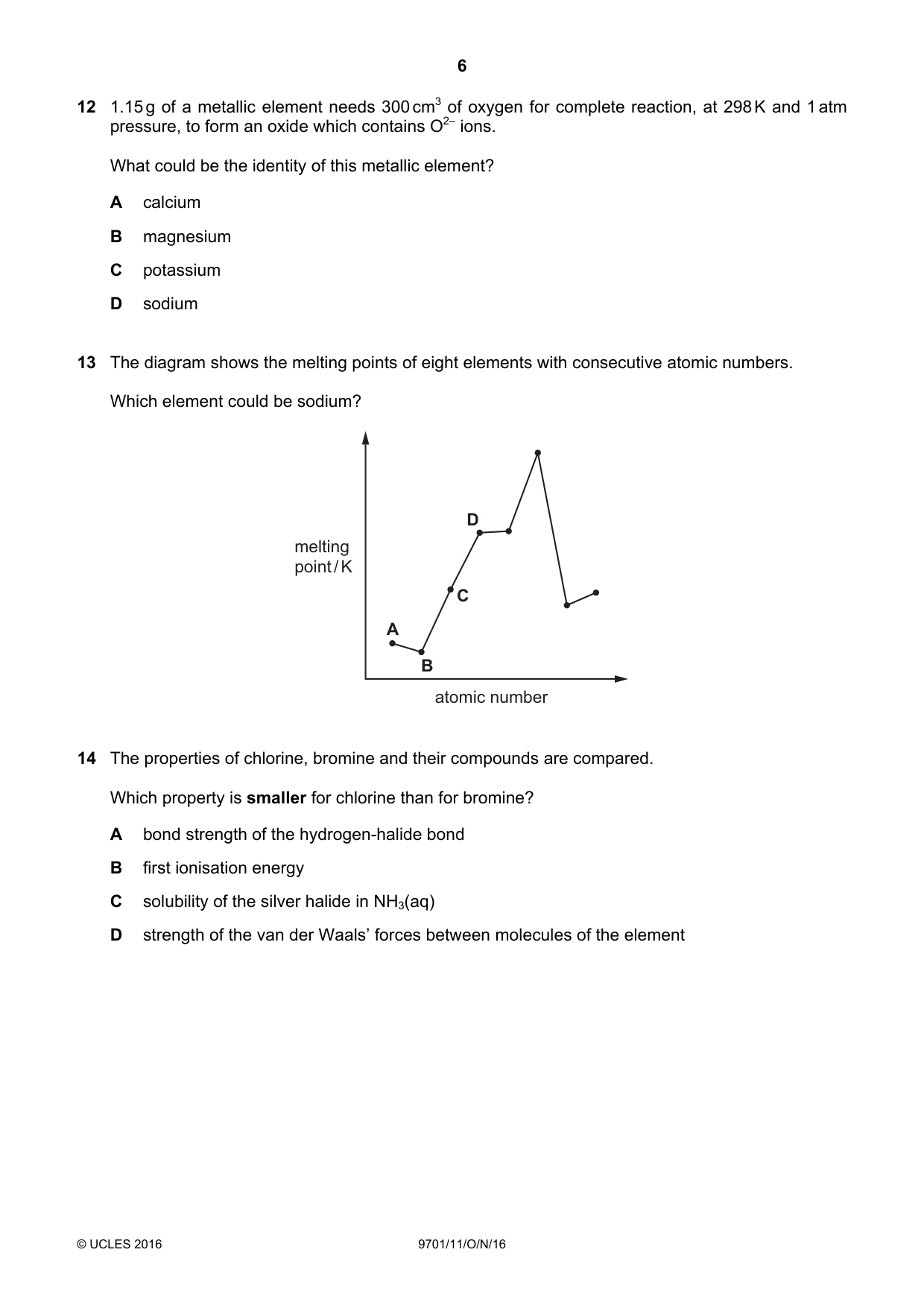
12 1.15 g of a metallic element needs 300 cm3 of oxygen for complete reaction, at 298 K and 1 atm pressure, to form an oxide which contains O2– ions. What could be the identity of this metallic element? A calcium B magnesium C potassium D sodium
Mark scheme: D
More questions on Reacting masses and volumes (of solutions and gases)
Q13 · The diagram shows the melting points of eight elements with consecutive atomic numbers
13 The diagram shows the melting points of eight elements with consecutive atomic numbers. Which element could be sodium? D melting point / K C A B atomic number
Mark scheme: C
More questions on Periodicity of physical properties of the elements in Period 3
Q14 · The properties of chlorine, bromine and their compounds are compared
14 The properties of chlorine, bromine and their compounds are compared. Which property is smaller for chlorine than for bromine? A bond strength of the hydrogen-halide bond B first ionisation energy C solubility of the silver halide in NH3(aq) D strength of the van der Waals’ forces between molecules of the element
Mark scheme: D
More questions on Physical properties of the Group 17 elements
Q15 · At 550 °C nitrogen dioxide reacts with unburnt hydrocarbon fragments such as CH3• in the…
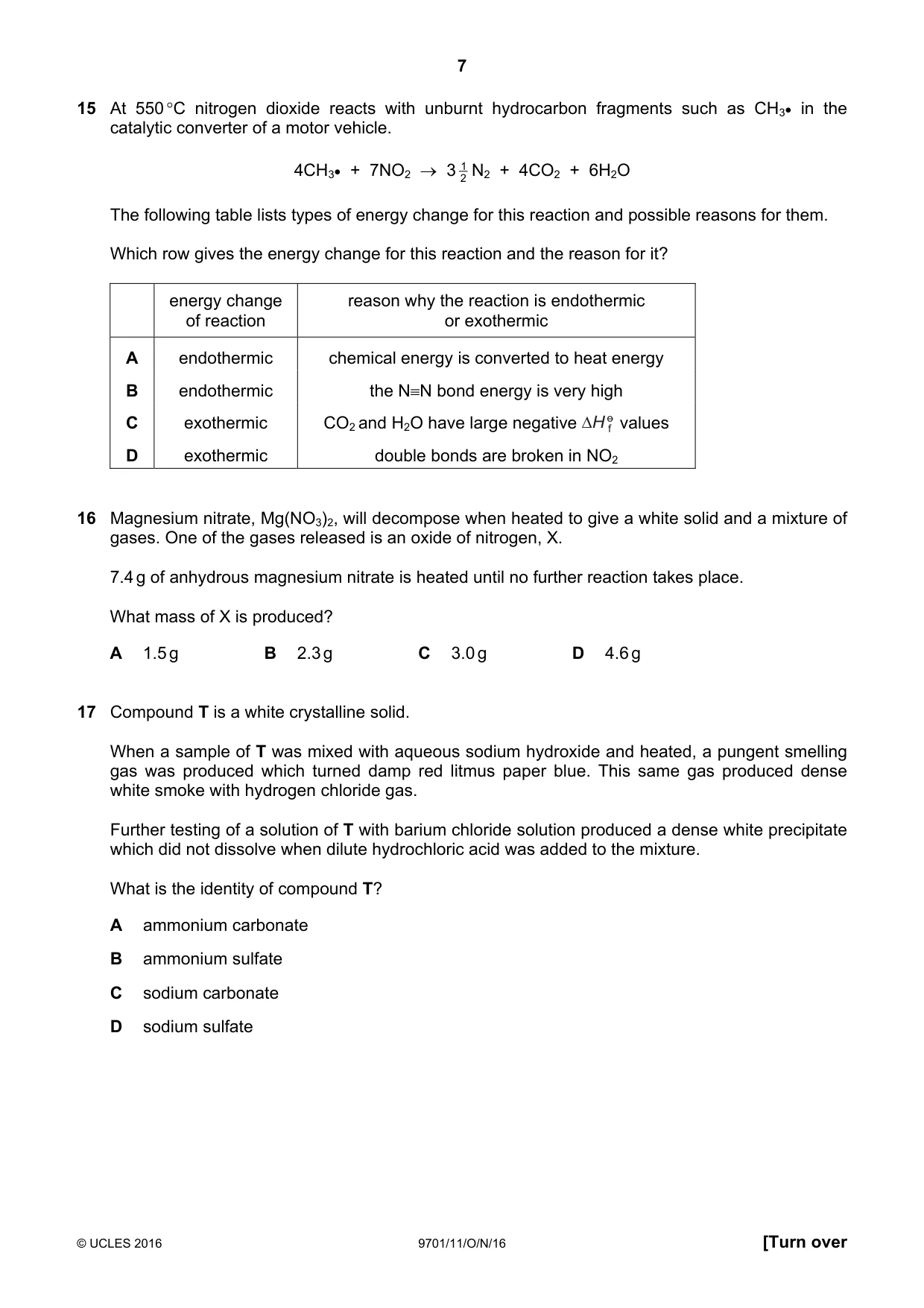
15 At 550 °C nitrogen dioxide reacts with unburnt hydrocarbon fragments such as CH3• in the catalytic converter of a motor vehicle. 4CH3• + 7NO2 → 3 2 1 N2 + 4CO2 + 6H2O The following table lists types of energy change for this reaction and possible reasons for them. Which row gives the energy change for this reaction and the reason for it? energy change reason why the reaction is endothermic of reaction or exothermic A endothermic chemical energy is converted to heat energy B endothermic the N≡N bond energy is very high C exothermic CO2 and H2O have large negative values D exothermic double bonds are broken in NO2
Mark scheme: C
Q16 · Magnesium nitrate, Mg(NO3)2, will decompose when heated to give a white solid and a…
16 Magnesium nitrate, Mg(NO3)2, will decompose when heated to give a white solid and a mixture of gases. One of the gases released is an oxide of nitrogen, X. 7.4 g of anhydrous magnesium nitrate is heated until no further reaction takes place. What mass of X is produced? A 1.5 g B 2.3 g C 3.0 g D 4.6 g
Mark scheme: D
More questions on Reacting masses and volumes (of solutions and gases)
Q17 · Compound T is a white crystalline solid
17 Compound T is a white crystalline solid. When a sample of T was mixed with aqueous sodium hydroxide and heated, a pungent smelling gas was produced which turned damp red litmus paper blue. This same gas produced dense white smoke with hydrogen chloride gas. Further testing of a solution of T with barium chloride solution produced a dense white precipitate which did not dissolve when dilute hydrochloric acid was added to the mixture. What is the identity of compound T? A ammonium carbonate B ammonium sulfate C sodium carbonate D sodium sulfate
Mark scheme: B
Q18 · Which row of the table gives correct comparisons between the solubilities of calcium and…
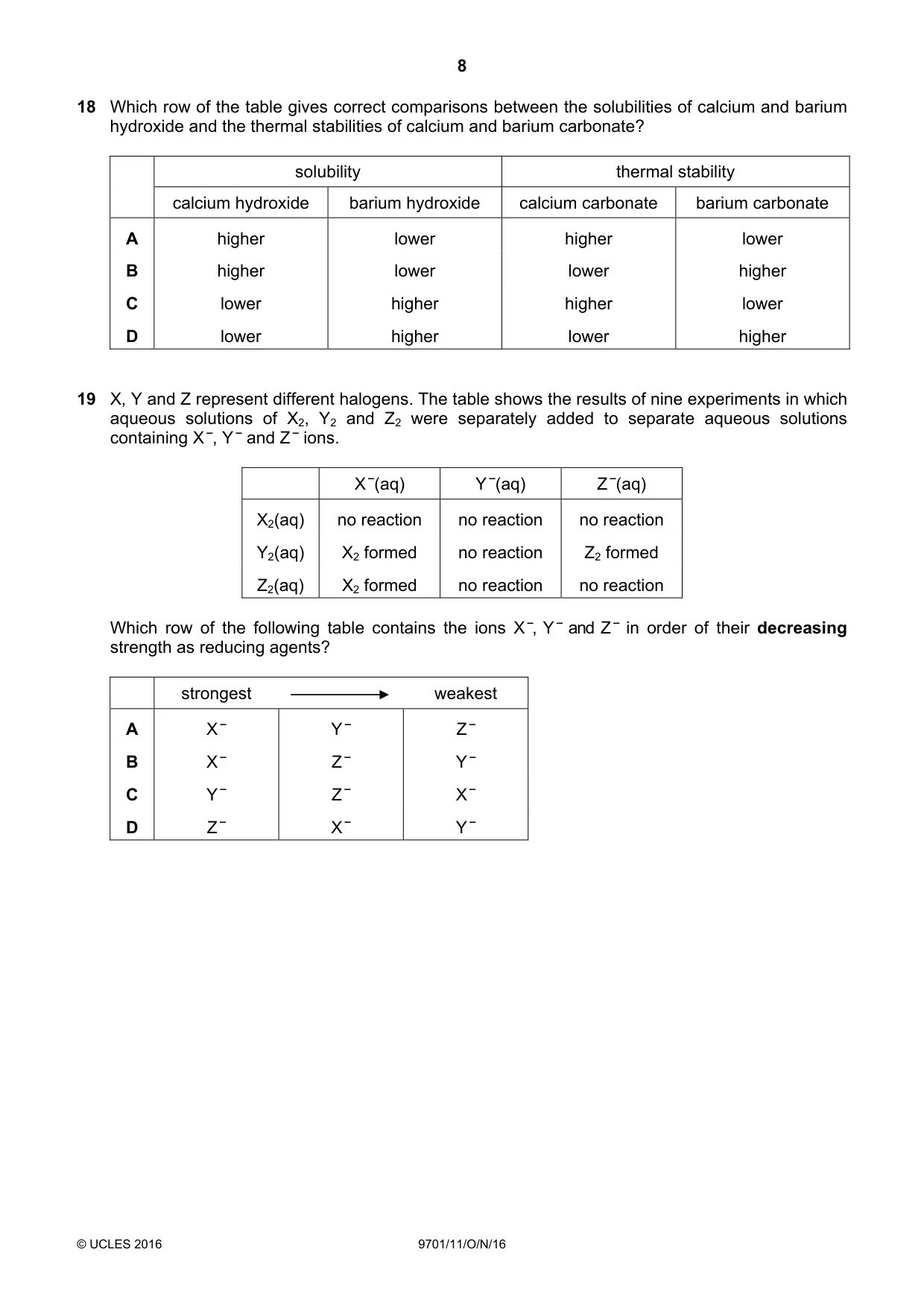
18 Which row of the table gives correct comparisons between the solubilities of calcium and barium hydroxide and the thermal stabilities of calcium and barium carbonate? solubility thermal stability calcium hydroxide barium hydroxide calcium carbonate barium carbonate A higher lower higher lower B higher lower lower higher C lower higher higher lower D lower higher lower higher
Mark scheme: D
Q19 · X, Y and Z represent different halogens
19 X, Y and Z represent different halogens. The table shows the results of nine experiments in which aqueous solutions of X2, Y2 and Z2 were separately added to separate aqueous solutions containing X –, Y – and Z – ions. X –(aq) Y –(aq) Z –(aq) X2(aq) no reaction no reaction no reaction Y2(aq) X2 formed no reaction Z2 formed Z2(aq) X2 formed no reaction no reaction Which row of the following table contains the ions X –, Y – and Z – in order of their decreasing strength as reducing agents? strongest weakest A X – Y – Z – B X – Z – Y – C Y – Z – X – D Z – X – Y –
Mark scheme: B
More questions on The chemical properties of the halogen elements and the hydrogen halides
Q20 · In 1865 Kekulé suggested a ring structure for benzene, C6H6, in which a hydrogen atom is…
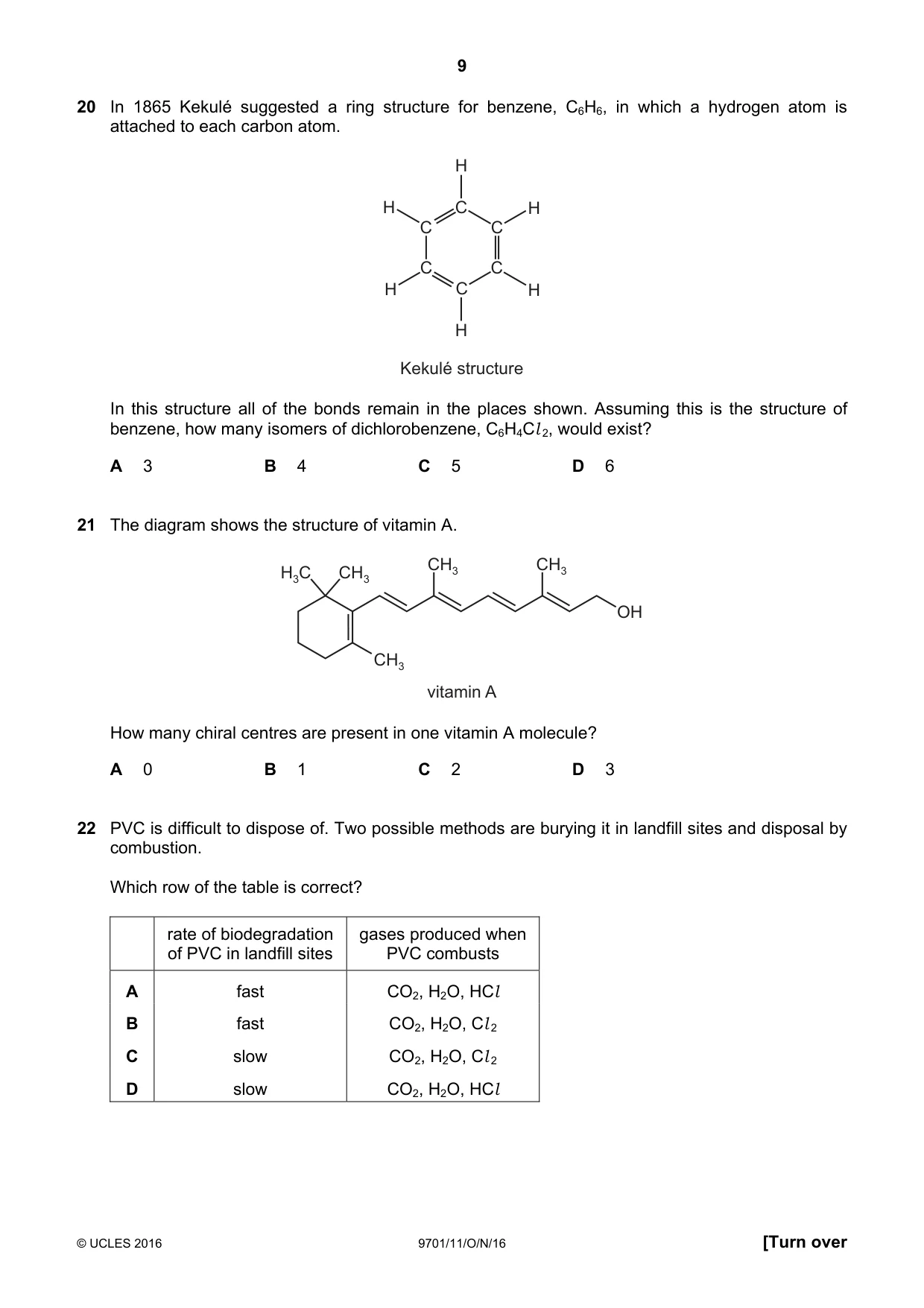
20 In 1865 Kekulé suggested a ring structure for benzene, C6H6, in which a hydrogen atom is attached to each carbon atom. H H C H C C C C H C H H Kekulé structure In this structure all of the bonds remain in the places shown. Assuming this is the structure of benzene, how many isomers of dichlorobenzene, C6H4Cl 2, would exist? A 3 B 4 C 5 D 6
Mark scheme: B
More questions on Isomerism: structural isomerism and stereoisomerism
Q21 · The diagram shows the structure of vitamin A
21 The diagram shows the structure of vitamin A. CH3 CH3 H3C CH3 OH CH3 vitamin A How many chiral centres are present in one vitamin A molecule? A 0 B 1 C 2 D 3
Mark scheme: A
Q22 · PVC is difficult to dispose of
22 PVC is difficult to dispose of. Two possible methods are burying it in landfill sites and disposal by combustion. Which row of the table is correct? rate of biodegradation gases produced when of PVC in landfill sites PVC combusts A fast CO2, H2O, HCl B fast CO2, H2O, Cl 2 C slow CO2, H2O, Cl 2 D slow CO2, H2O, HCl
Mark scheme: D
Q23 · Part of the structure of a fungicide, strobilurin, is shown
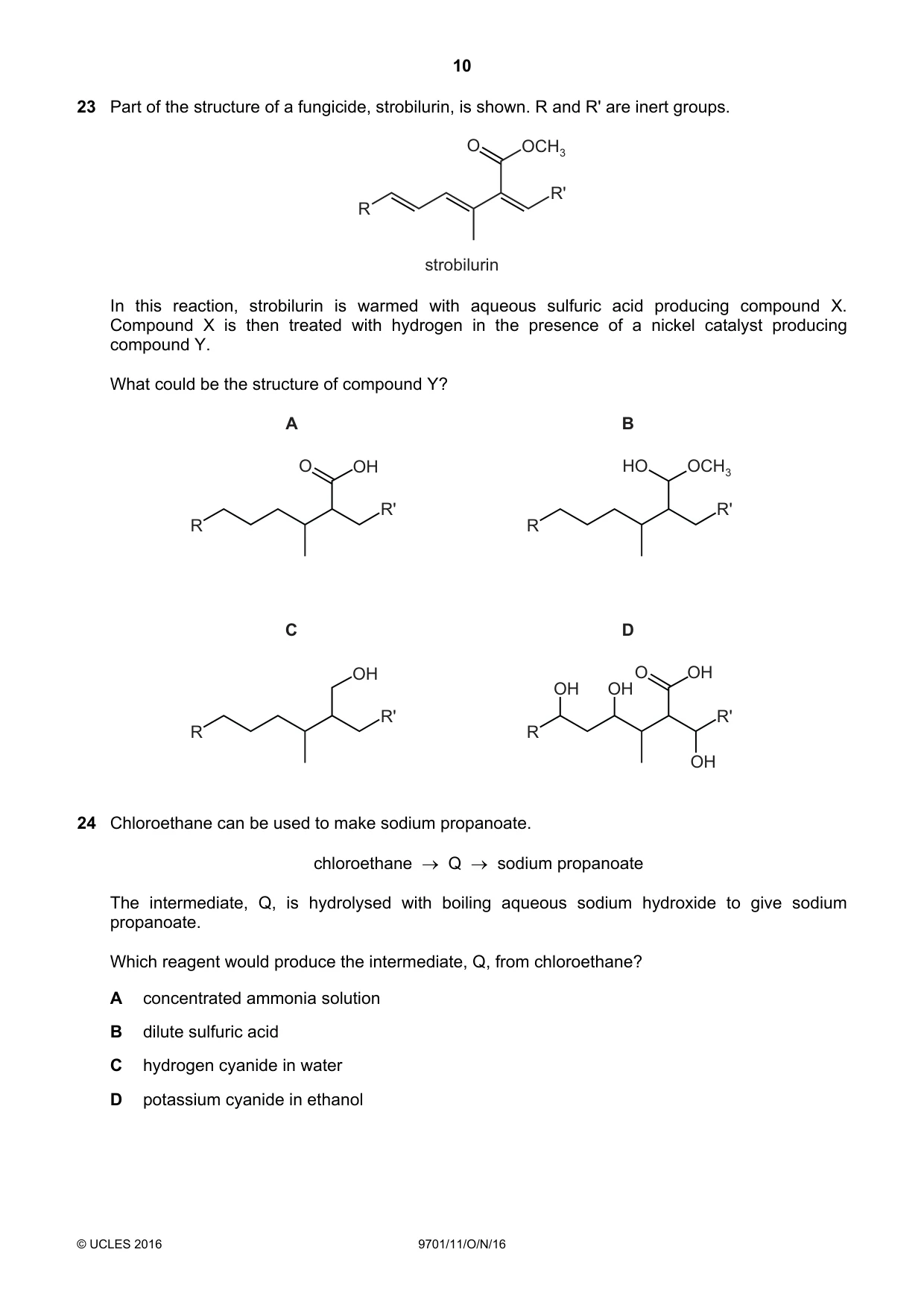
23 Part of the structure of a fungicide, strobilurin, is shown. R and R' are inert groups. O OCH3 R' R strobilurin In this reaction, strobilurin is warmed with aqueous sulfuric acid producing compound X. Compound X is then treated with hydrogen in the presence of a nickel catalyst producing compound Y. What could be the structure of compound Y? A B O OH HO OCH3 R' R' R R C D OH O OH OH OH R' R' R R OH
Mark scheme: A
Q24 · Chloroethane can be used to make sodium propanoate
24 Chloroethane can be used to make sodium propanoate. chloroethane → Q → sodium propanoate The intermediate, Q, is hydrolysed with boiling aqueous sodium hydroxide to give sodium propanoate. Which reagent would produce the intermediate, Q, from chloroethane? A concentrated ammonia solution B dilute sulfuric acid C hydrogen cyanide in water D potassium cyanide in ethanol
Mark scheme: D
Q25 · X, Y and Z are three isomeric alcohols
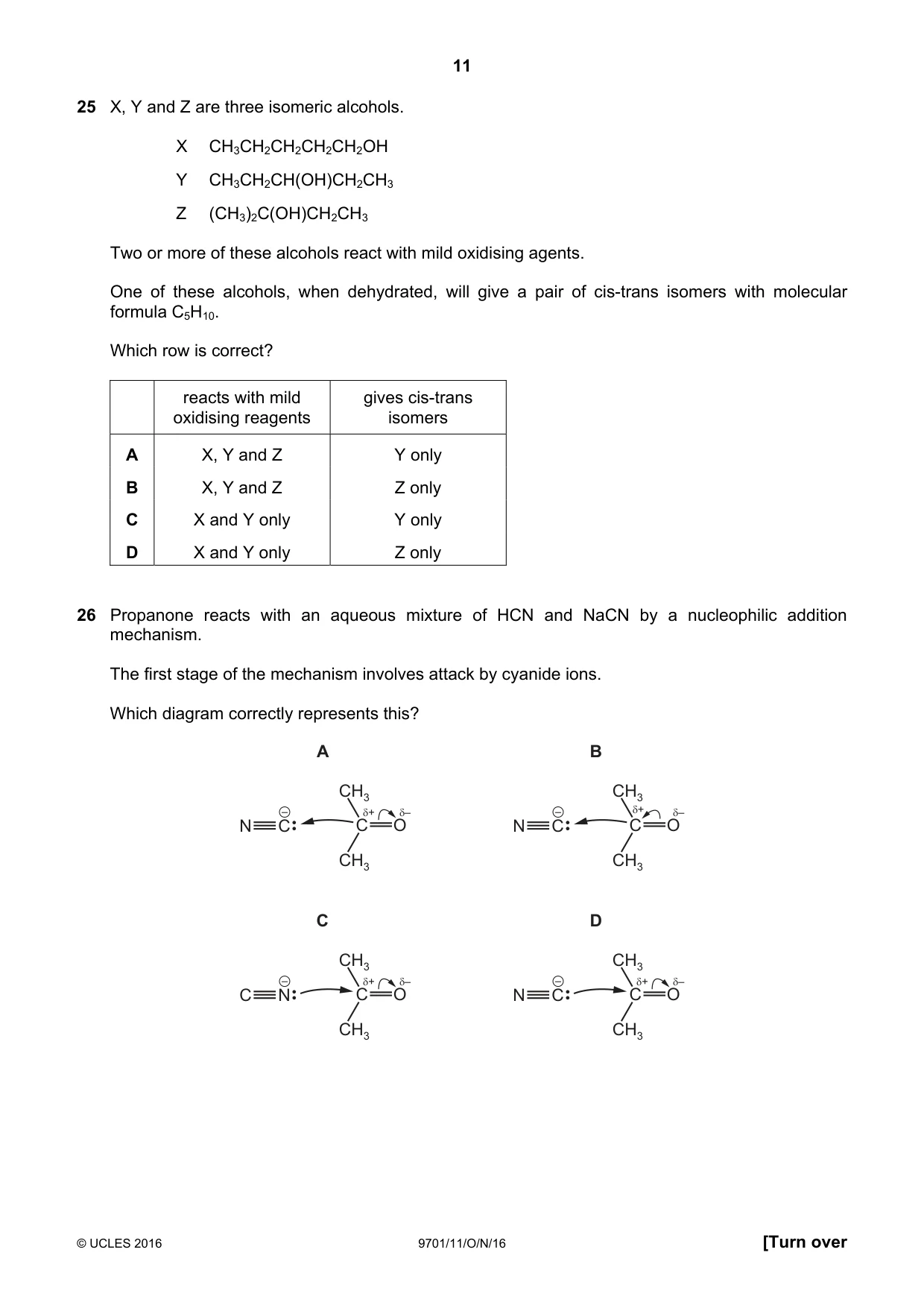
25 X, Y and Z are three isomeric alcohols. X CH3CH2CH2CH2CH2OH Y CH3CH2CH(OH)CH2CH3 Z (CH3)2C(OH)CH2CH3 Two or more of these alcohols react with mild oxidising agents. One of these alcohols, when dehydrated, will give a pair of cis-trans isomers with molecular formula C5H10. Which row is correct? reacts with mild gives cis-trans oxidising reagents isomers A X, Y and Z Y only B X, Y and Z Z only C X and Y only Y only D X and Y only Z only
Mark scheme: C
Q26 · Propanone reacts with an aqueous mixture of HCN and NaCN by a nucleophilic addition…
26 Propanone reacts with an aqueous mixture of HCN and NaCN by a nucleophilic addition mechanism. The first stage of the mechanism involves attack by cyanide ions. Which diagram correctly represents this? A B CH3 CH3 – δ+ δ– – δ+ δ– N C C O N C C O CH3 CH3 C D CH3 CH3 – δ+ δ– – δ+ δ– C N C O N C C O CH3 CH3
Mark scheme: D
Q27 · P, Q and R are carbonyl compounds
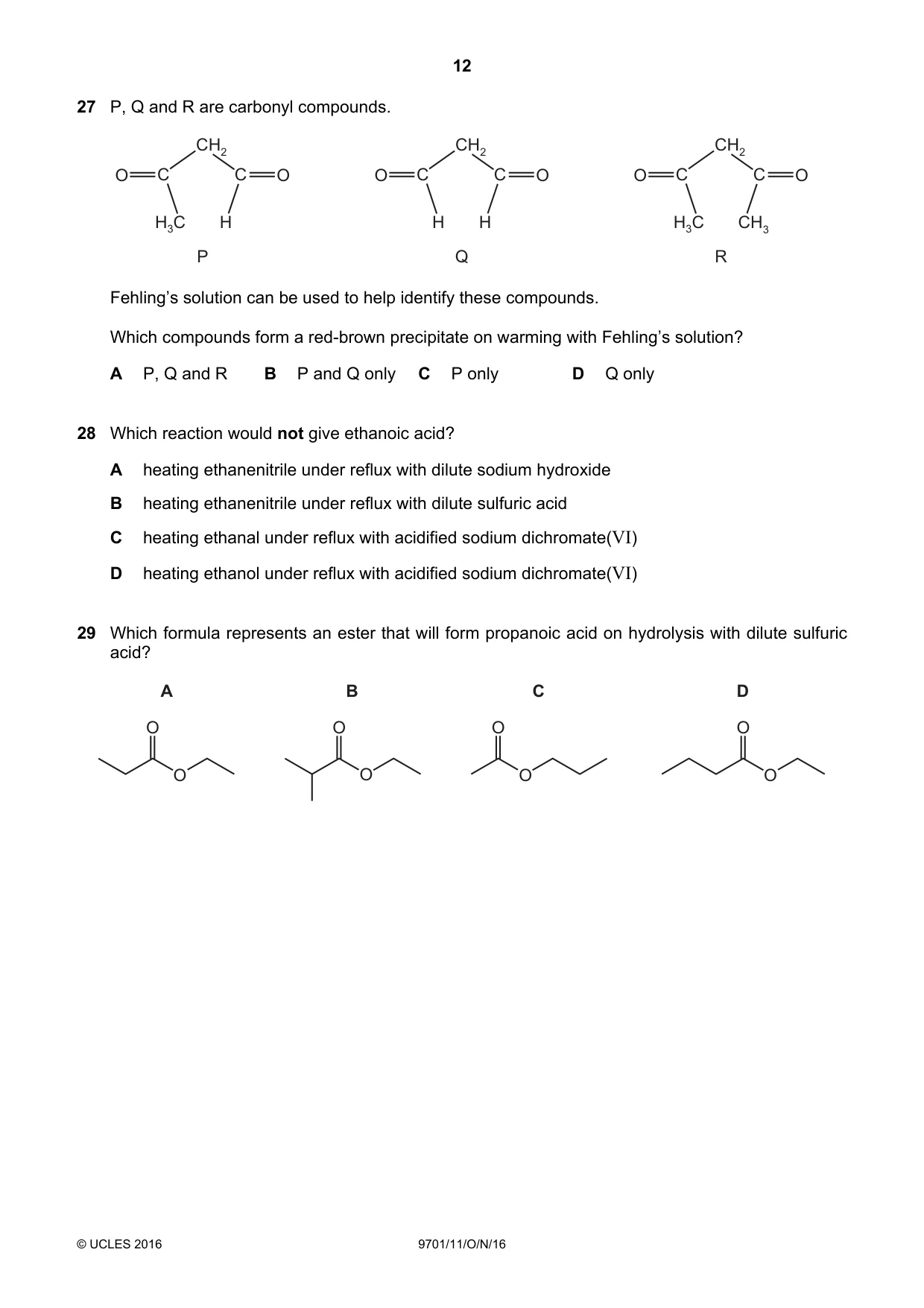
27 P, Q and R are carbonyl compounds. CH2 CH2 CH2 O C C O O C C O O C C O H3C H H H H3C CH3 P Q R Fehling’s solution can be used to help identify these compounds. Which compounds form a red-brown precipitate on warming with Fehling’s solution? A P, Q and R B P and Q only C P only D Q only
Mark scheme: B
Q28 · Which reaction would not give ethanoic acid?
28 Which reaction would not give ethanoic acid? A heating ethanenitrile under reflux with dilute sodium hydroxide B heating ethanenitrile under reflux with dilute sulfuric acid C heating ethanal under reflux with acidified sodium dichromate(VI) D heating ethanol under reflux with acidified sodium dichromate(VI)
Mark scheme: A
Q29 · Which formula represents an ester that will form propanoic acid on hydrolysis with dilute…
29 Which formula represents an ester that will form propanoic acid on hydrolysis with dilute sulfuric acid? A B C D O O O O O O O O
Mark scheme: A
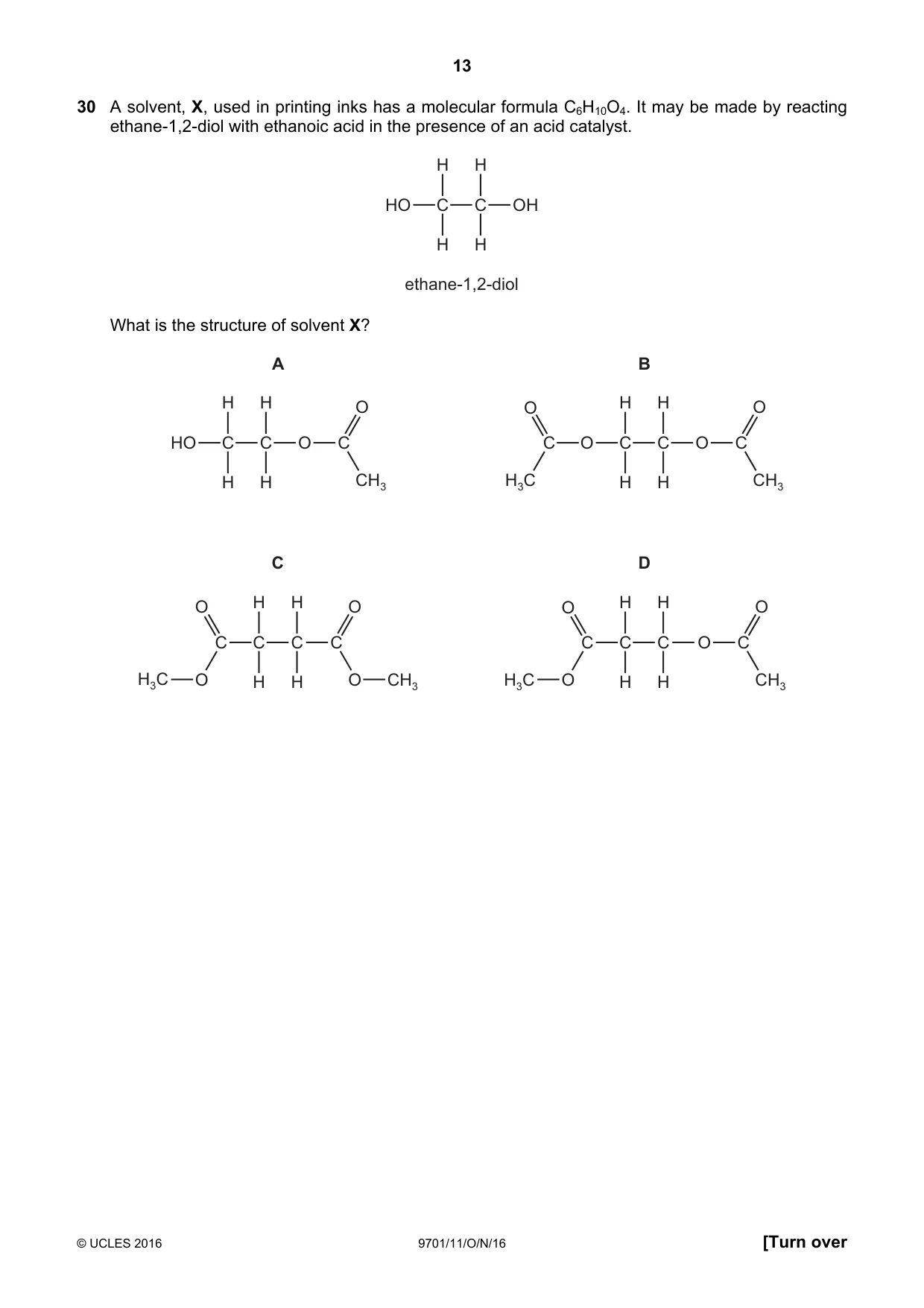
Q30 · A solvent, X, used in printing inks has a molecular formula C6H10O4
30 A solvent, X, used in printing inks has a molecular formula C6H10O4. It may be made by reacting ethane-1,2-diol with ethanoic acid in the presence of an acid catalyst. H H HO C C OH H H ethane-1,2-diol What is the structure of solvent X? A B H H O O H H O HO C C O C C O C C O C H H CH3 H3C H H CH3 C D O H H O O H H O C C C C C C C O C H3C O H H O CH3 H3C O H H CH3
Mark scheme: B
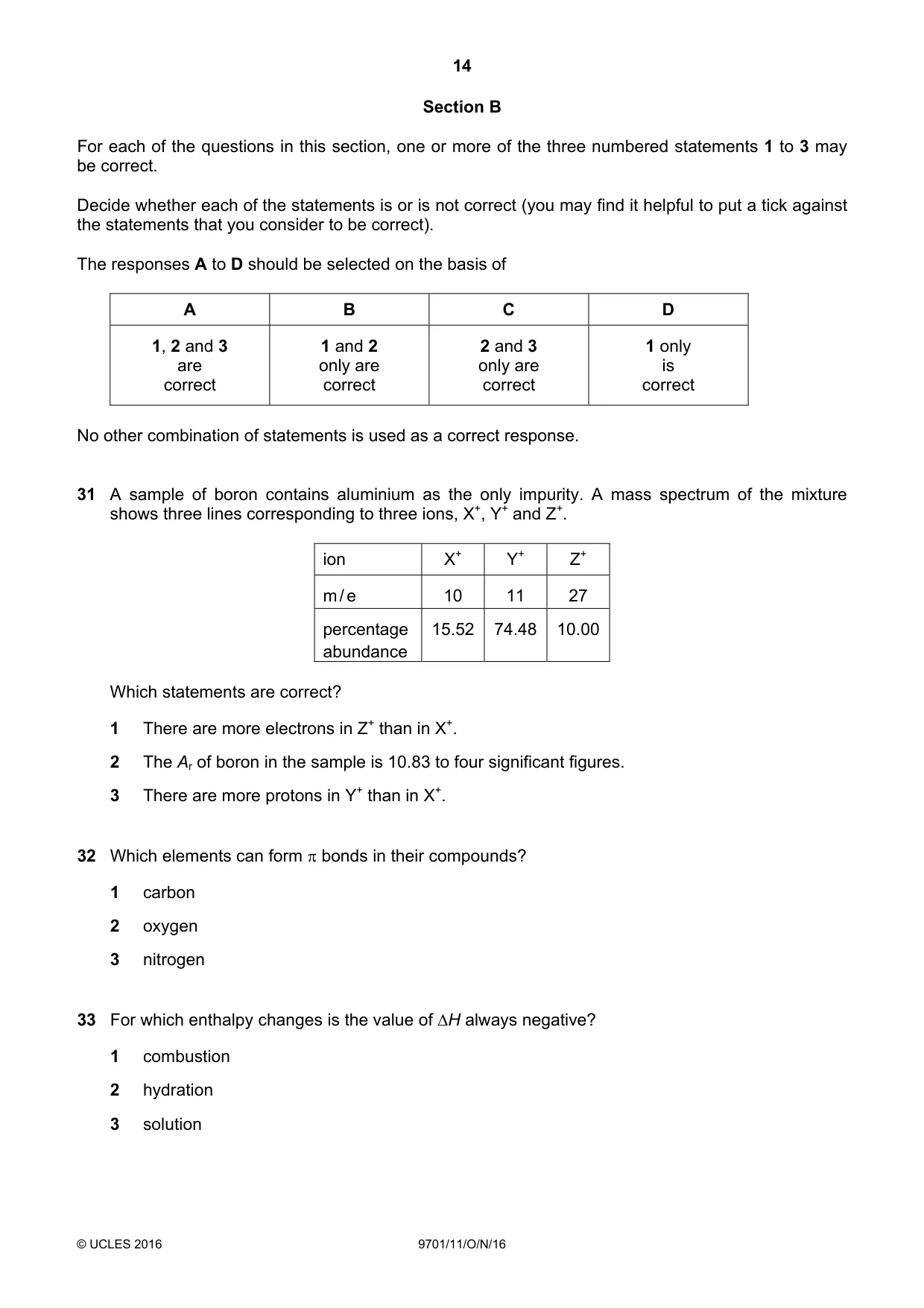
Q31 · A sample of boron contains aluminium as the only impurity
31 A sample of boron contains aluminium as the only impurity. A mass spectrum of the mixture shows three lines corresponding to three ions, X+, Y+ and Z+. ion X+ Y+ Z+ m / e 10 11 27 percentage 15.52 74.48 10.00 abundance Which statements are correct? 1 There are more electrons in Z+ than in X+. 2 The Ar of boron in the sample is 10.83 to four significant figures. 3 There are more protons in Y+ than in X+.
Mark scheme: B
Q32 · Which elements can form π bonds in their compounds?
32 Which elements can form π bonds in their compounds? 1 carbon 2 oxygen 3 nitrogen
Mark scheme: A
More questions on Shapes of organic molecules; σ and π bonds
Q33 · For which enthalpy changes is the value of ∆H always negative?
33 For which enthalpy changes is the value of ∆H always negative? 1 combustion 2 hydration 3 solution
Mark scheme: B
Q34 · In the manufacture of sulfuric acid, the following exothermic reaction occurs
34 In the manufacture of sulfuric acid, the following exothermic reaction occurs. 2SO2(g) + O2(g) 2SO3(g) Which changes will move the position of the equilibrium to the right? 1 increasing the pressure 2 increasing the temperature 3 using twice as much catalyst
Mark scheme: D
More questions on Chemical equilibria: reversible reactions, dynamic equilibrium
Q35 · Water is added to anhydrous aluminium chloride to make a 0.1 mol dm–3 solution
35 Water is added to anhydrous aluminium chloride to make a 0.1 mol dm–3 solution. Which observations are correct? 1 The reaction is endothermic. 2 The solution is acidic. 3 The solution contains the ion [Al (H2O)6]3+.
Mark scheme: C
More questions on Periodicity of chemical properties of the elements in Period 3
Q36 · Catalytic converters are used to modify exhaust emissions from motor vehicles
36 Catalytic converters are used to modify exhaust emissions from motor vehicles. Which reactions occur in catalytic converters? 1 C8H18 + 12 2 1 O2 → 8CO2 + 9H2O 2 2NO + 2CO → N2 + 2CO2 3 NO + SO3 → NO2 + SO2
Mark scheme: B
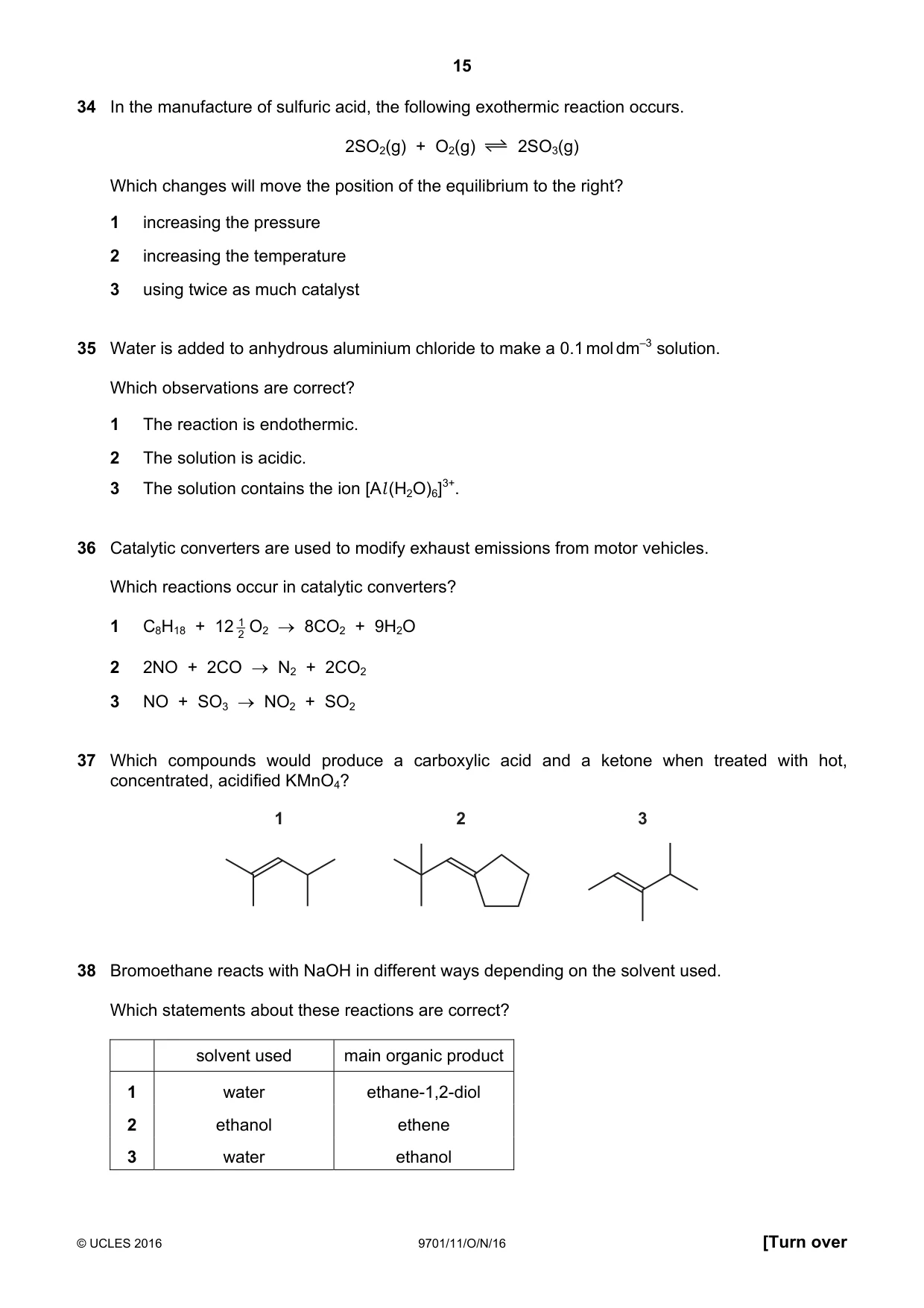
Q37 · Which compounds would produce a carboxylic acid and a ketone when treated with hot…
37 Which compounds would produce a carboxylic acid and a ketone when treated with hot, concentrated, acidified KMnO4? 1 2 3
Mark scheme: A
Q38 · Bromoethane reacts with NaOH in different ways depending on the solvent used
38 Bromoethane reacts with NaOH in different ways depending on the solvent used. Which statements about these reactions are correct? solvent used main organic product 1 water ethane-1,2-diol 2 ethanol ethene 3 water ethanol
Mark scheme: C
Q39 · Several structural isomers of C3H6O3 are listed below
39 Several structural isomers of C3H6O3 are listed below. HOCH2COCH2OH HOCH2CH(OH)CHO HOCH2CH2CO2H CH3CH(OH)CO2H Which statements about these structural isomers are correct? 1 One mole of each reacts with two moles of sodium. 2 Only one of the isomers contains a tertiary alcohol group. 3 They all contain a primary alcohol group.
Mark scheme: D
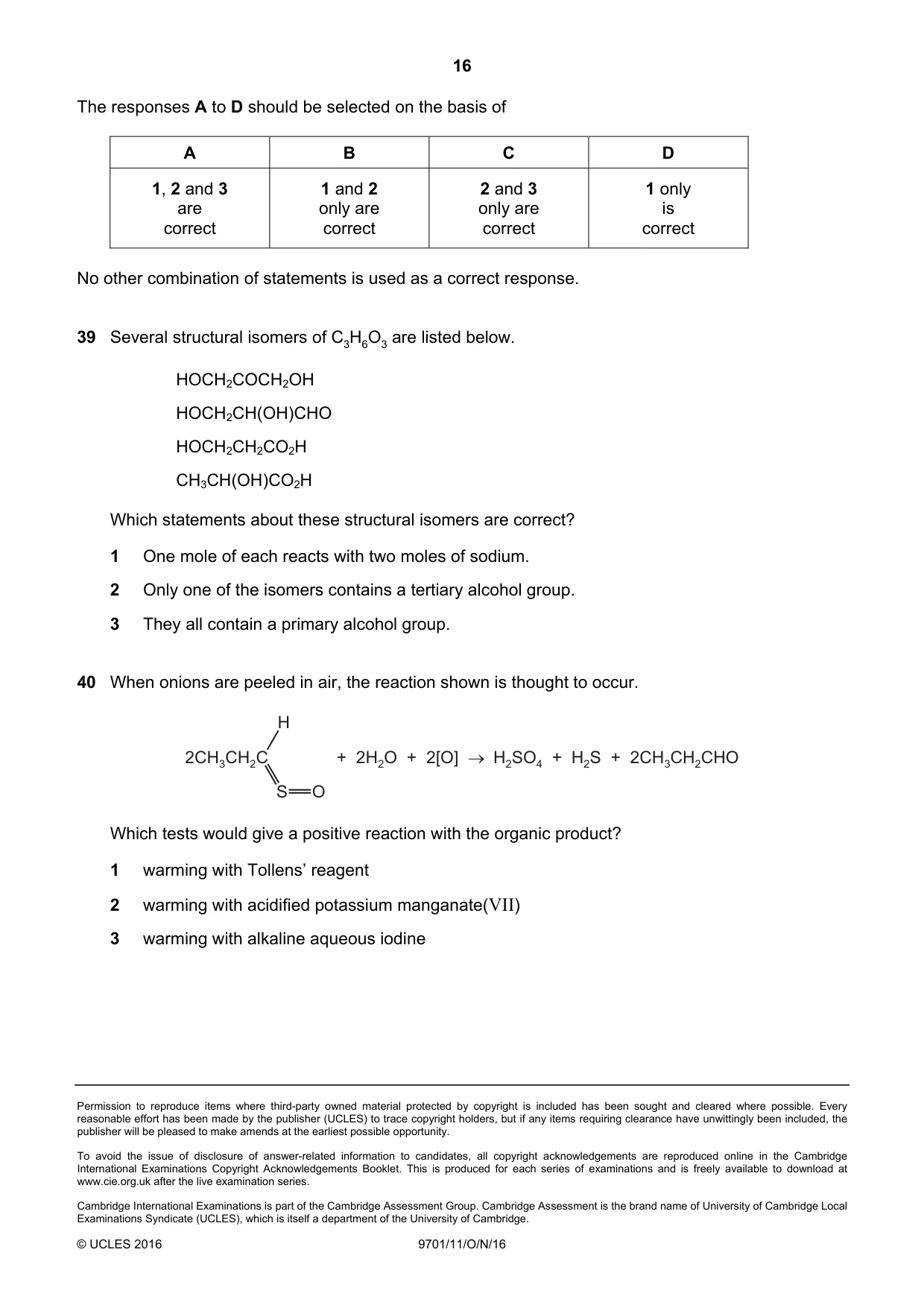
Q40 · When onions are peeled in air, the reaction shown is thought to occur
40 When onions are peeled in air, the reaction shown is thought to occur. H 2CH3CH2C + 2H2O + 2[O] → H2SO4 + H2S + 2CH3CH2CHO S O Which tests would give a positive reaction with the organic product? 1 warming with Tollens’ reagent 2 warming with acidified potassium manganate(VII) 3 warming with alkaline aqueous iodine
Mark scheme: B
What was in this paper
The subtopics covered by these 40 questions, and how many questions each got. Open one in a new tab to see every Cambridge question on it.
3Enthalpy change, ΔH3Esters3Aldehydes and ketones2Chemical equilibria: reversible reactions, dynamic equilibrium2Halogenoalkanes2Reacting masses and volumes (of solutions and gases)2Redox processes: electron transfer and changes in oxidation number (oxidation state)2Similarities and trends in the properties of the Group 2 metals, magnesium to barium, and their compounds2The gaseous state: ideal and real gases and pV = nRT2Alkenes1Arenes1Degradable polymers1Effect of temperature on reaction rates and the concept of activation energy1Electrons, energy levels and atomic orbitals1Isomerism: optical1Isomerism: structural isomerism and stereoisomerism1Mass spectrometry1Nitriles and hydroxynitriles1Particles in the atom and atomic radius1Periodicity of chemical properties of the elements in Period 31Periodicity of physical properties of the elements in Period 31Physical properties of the Group 17 elements1Rate of reaction1Shapes of molecules1Shapes of organic molecules; σ and π bonds1The chemical properties of the halogen elements and the hydrogen halides1What you needed in this session
Cambridge’s own grade thresholds for 2016 Oct/Nov, Paper 1 · Variant 1. A higher threshold means an easier paper — the bar moves with how the cohort did.