Cambridge A Level Chemistry 9701 — 2025 May/June Paper 1 · Variant 2
9701/12/M/J/25 · 39 questions · 40 marks · 75 min
The question paper and its mark scheme, free to read here and free to download. This is Cambridge’s own paper, exactly as it was sat.
Question paper16 pages
Mark scheme3 pages
Answers below. Sit the paper first if you are practising.
Questions as text
Q1 · Consider the following statements
1 Consider the following statements. 1 Silicon dioxide has a higher melting point than sulfur dioxide. 2 Ammonia has a higher boiling point than phosphine, PH3. Which statements are correct? A both statement 1 and statement 2 B statement 1 only C statement 2 only D neither statement 1 nor statement 2
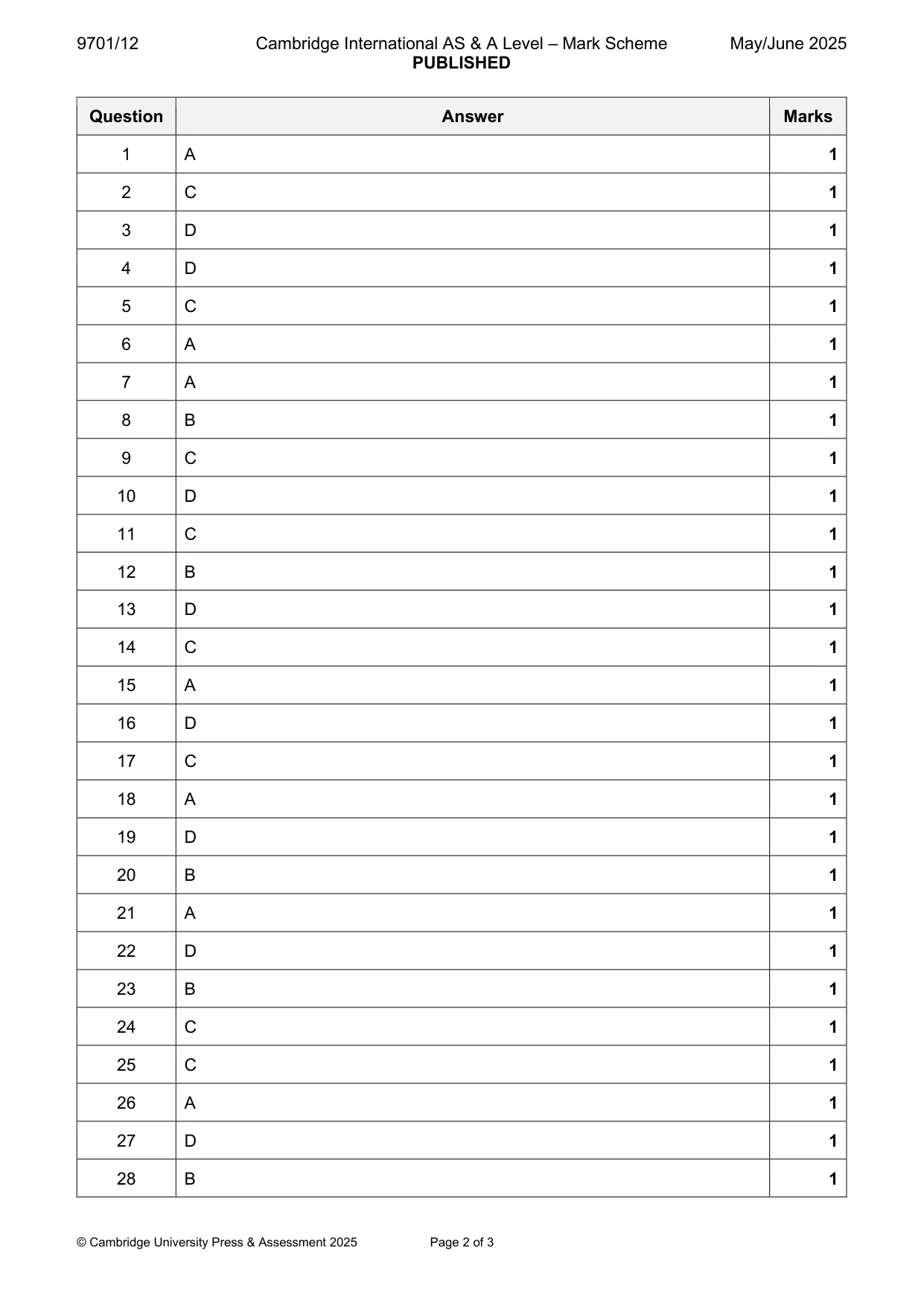
Mark scheme: Question Answer Marks 1 A 1
More questions on Intermolecular forces, electronegativity and bond properties
Q2 · How many neutrons are contained in an atom of iron with a mass number of 60?
2 How many neutrons are contained in an atom of iron with a mass number of 60? A 26 B 30 C 34 D 60
Mark scheme: C
Q3 · The diagram shows a Boltzmann distribution of molecular energies for a gaseous reaction…
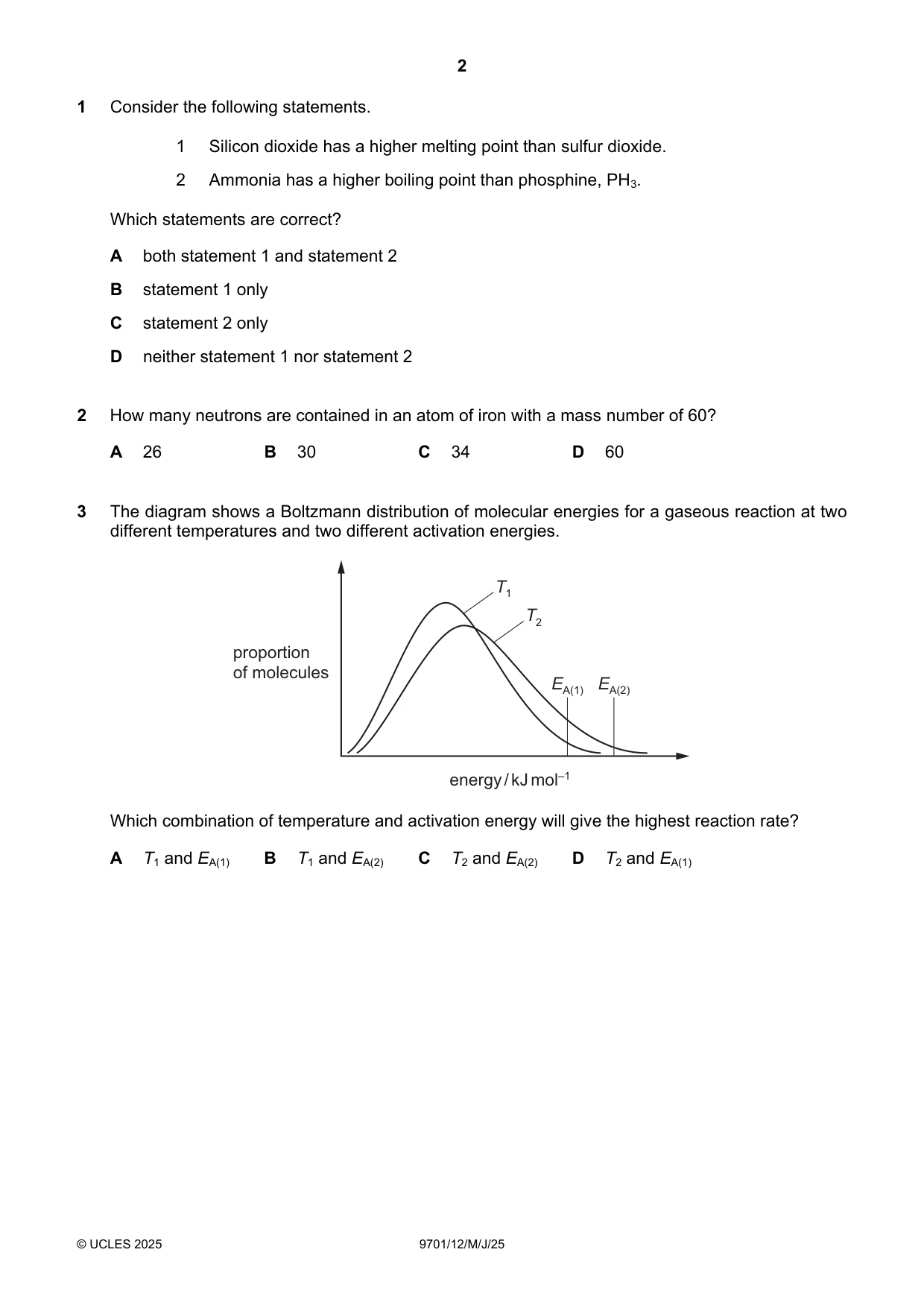
3 The diagram shows a Boltzmann distribution of molecular energies for a gaseous reaction at two different temperatures and two different activation energies. T1 T2 proportion of molecules EA(1) EA(2) energy / kJ mol–1 Which combination of temperature and activation energy will give the highest reaction rate? A T1 and EA(1) B T1 and EA(2) C T2 and EA(2) D T2 and EA(1)
Mark scheme: D
More questions on Effect of temperature on reaction rates and the concept of activation energy
Q4 · The reaction between sulfur dioxide and oxygen has the equation shown
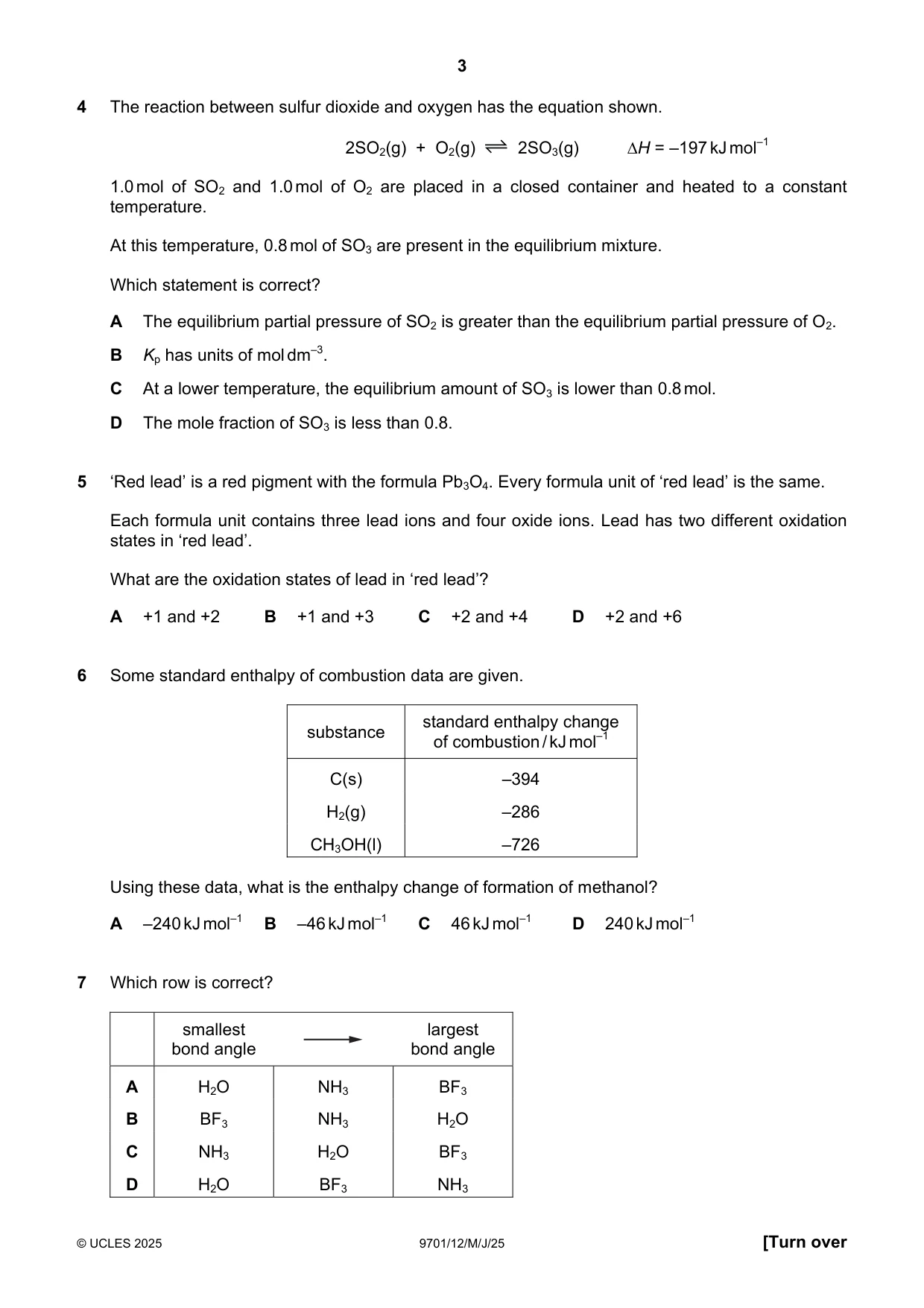
4 The reaction between sulfur dioxide and oxygen has the equation shown. 2SO2(g) + O2(g) 2SO3(g) H = –197 kJ mol–1 1.0 mol of SO2 and 1.0 mol of O2 are placed in a closed container and heated to a constant temperature. At this temperature, 0.8 mol of SO3 are present in the equilibrium mixture. Which statement is correct? A The equilibrium partial pressure of SO2 is greater than the equilibrium partial pressure of O2. B Kp has units of mol dm–3. C At a lower temperature, the equilibrium amount of SO3 is lower than 0.8 mol. D The mole fraction of SO3 is less than 0.8.
Mark scheme: D
More questions on Chemical equilibria: reversible reactions, dynamic equilibrium
Q5 · ‘Red lead’ is a red pigment with the formula Pb3O4
5 ‘Red lead’ is a red pigment with the formula Pb3O4. Every formula unit of ‘red lead’ is the same. Each formula unit contains three lead ions and four oxide ions. Lead has two different oxidation states in ‘red lead’. What are the oxidation states of lead in ‘red lead’? A +1 and +2 B +1 and +3 C +2 and +4 D +2 and +6
Mark scheme: C
Q6 · Some standard enthalpy of combustion data are given
6 Some standard enthalpy of combustion data are given. standard enthalpy change substance of combustion / kJ mol–1 C(s) –394 H2(g) –286 CH3OH(l) –726 Using these data, what is the enthalpy change of formation of methanol? A –240 kJ mol–1 B –46 kJ mol–1 C 46 kJ mol–1 D 240 kJ mol–1
Mark scheme: A
Q7 · Which row is correct?
7 Which row is correct? smallest largest bond angle bond angle A H2O NH3 BF3 B BF3 NH3 H2O C NH3 H2O BF3 D H2O BF3 NH3
Mark scheme: A
Q8 · In the Haber process, the reaction between the two gaseous reactants requires the use of…
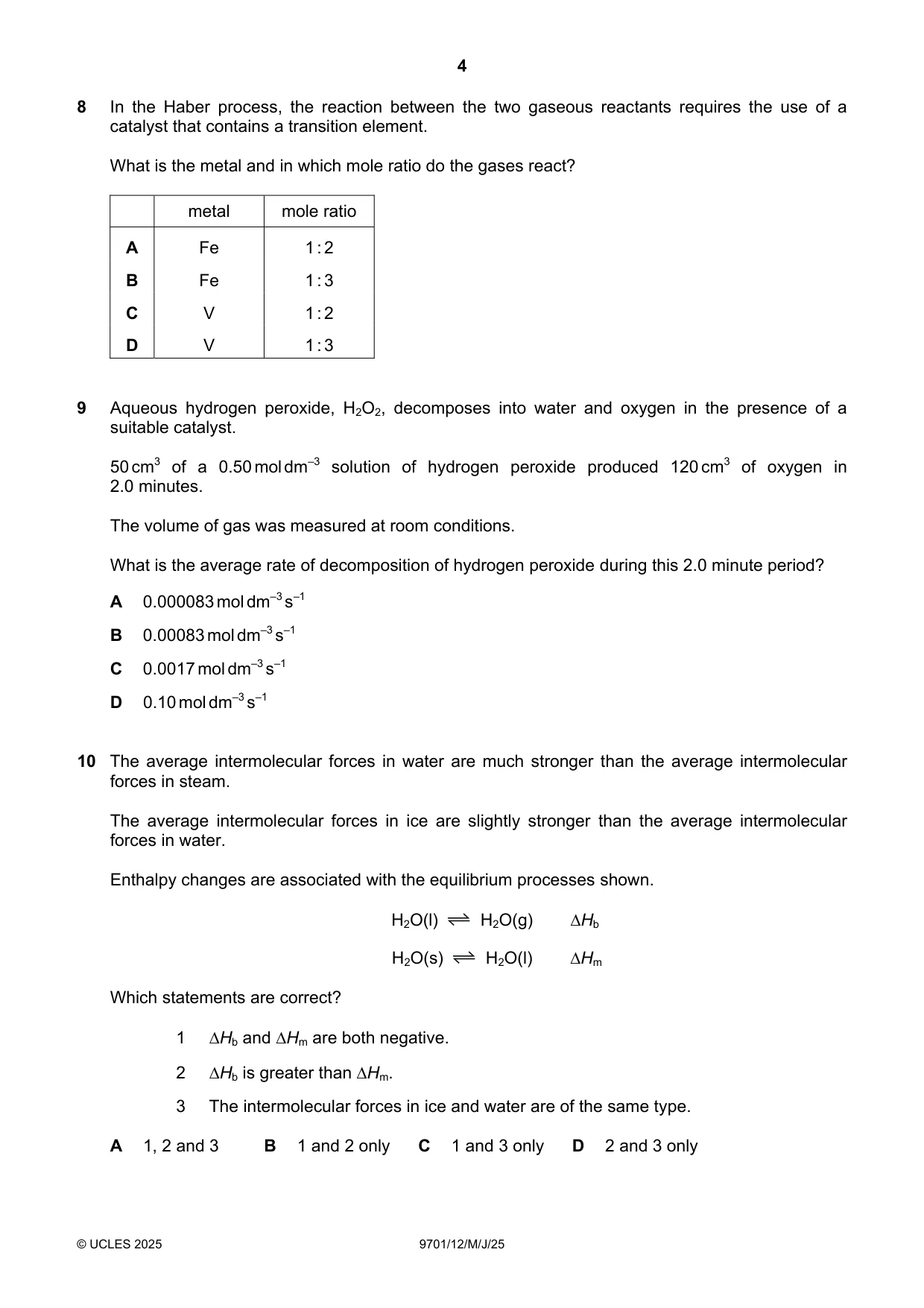
8 In the Haber process, the reaction between the two gaseous reactants requires the use of a catalyst that contains a transition element. What is the metal and in which mole ratio do the gases react? metal mole ratio A Fe 1 : 2 B Fe 1 : 3 C V 1 : 2 D V 1 : 3
Mark scheme: B
Q9 · Aqueous hydrogen peroxide, H2O2, decomposes into water and oxygen in the presence of a…
9 Aqueous hydrogen peroxide, H2O2, decomposes into water and oxygen in the presence of a suitable catalyst. 50 cm3 of a 0.50 mol dm–3 solution of hydrogen peroxide produced 120 cm3 of oxygen in 2.0 minutes. The volume of gas was measured at room conditions. What is the average rate of decomposition of hydrogen peroxide during this 2.0 minute period? A 0.000083 mol dm–3 s–1 B 0.00083 mol dm–3 s–1 C 0.0017 mol dm–3 s–1 D 0.10 mol dm–3 s–1
Mark scheme: C
Q10 · The average intermolecular forces in water are much stronger than the average…
10 The average intermolecular forces in water are much stronger than the average intermolecular forces in steam. The average intermolecular forces in ice are slightly stronger than the average intermolecular forces in water. Enthalpy changes are associated with the equilibrium processes shown. H2O(l) H2O(g) Hb H2O(s) H2O(l) Hm Which statements are correct? 1 Hb and Hm are both negative. 2 Hb is greater than Hm. 3 The intermolecular forces in ice and water are of the same type. A 1, 2 and 3 B 1 and 2 only C 1 and 3 only D 2 and 3 only
Mark scheme: D
More questions on Intermolecular forces, electronegativity and bond properties
Q11 · An experiment is carried out to determine the value of x in hydrated lithium hydroxide…
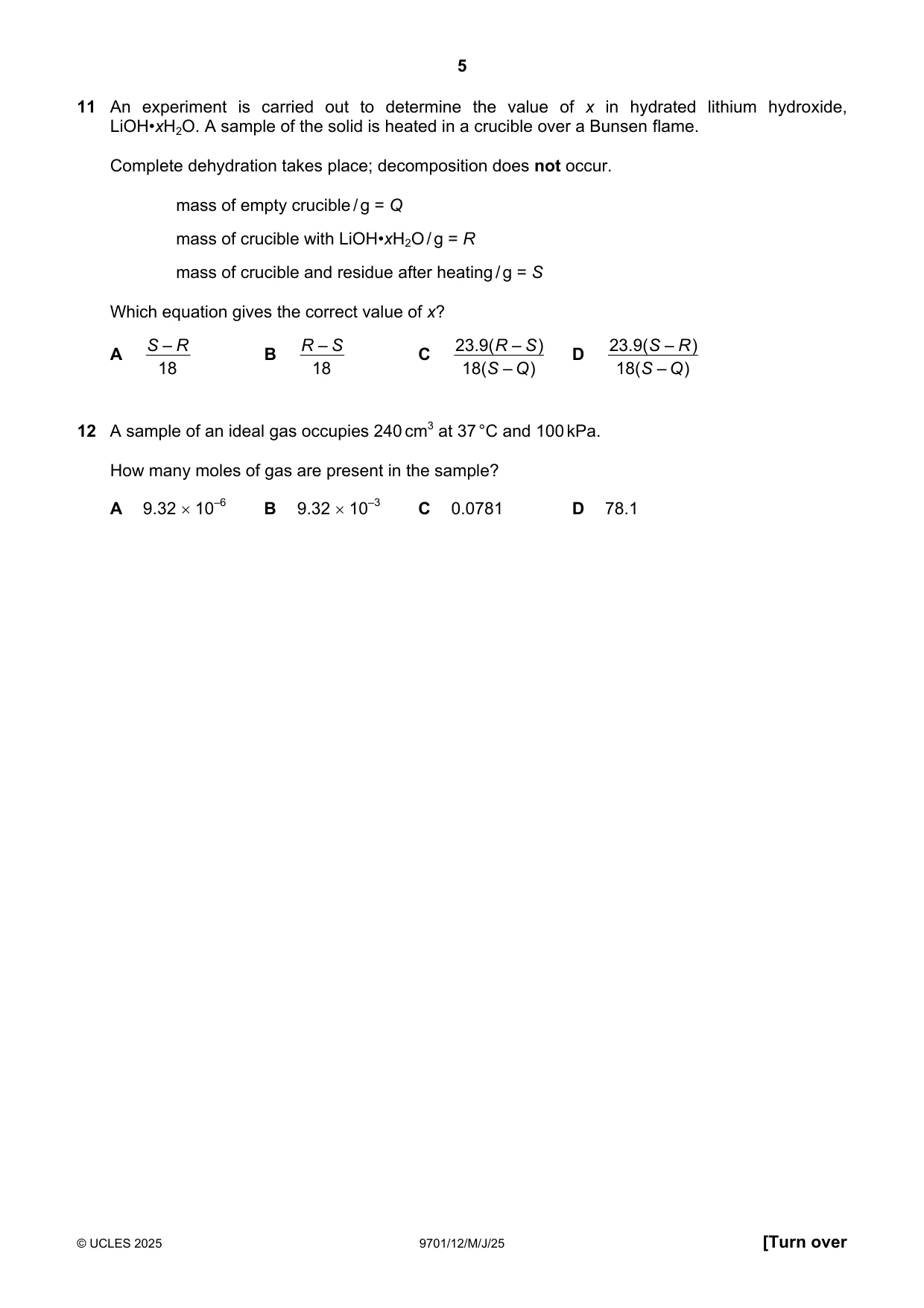
11 An experiment is carried out to determine the value of x in hydrated lithium hydroxide, LiOH•xH2O. A sample of the solid is heated in a crucible over a Bunsen flame. Complete dehydration takes place; decomposition does not occur. mass of empty crucible / g = Q mass of crucible with LiOH•xH2O / g = R mass of crucible and residue after heating / g = S Which equation gives the correct value of x? S – R R – S 23.9( R – S ) 23.9( S – R ) A B C D 18 18 18( S – Q ) 18( S – Q )
Mark scheme: C
Q12 · A sample of an ideal gas occupies 240 cm3 at 37 °C and 100 kPa
12 A sample of an ideal gas occupies 240 cm3 at 37 °C and 100 kPa. How many moles of gas are present in the sample? A 9.32 10–6 B 9.32 10–3 C 0.0781 D 78.1
Mark scheme: B
More questions on The gaseous state: ideal and real gases and pV = nRT
Q13 · Under certain conditions, CCl 4 and H2O react as shown
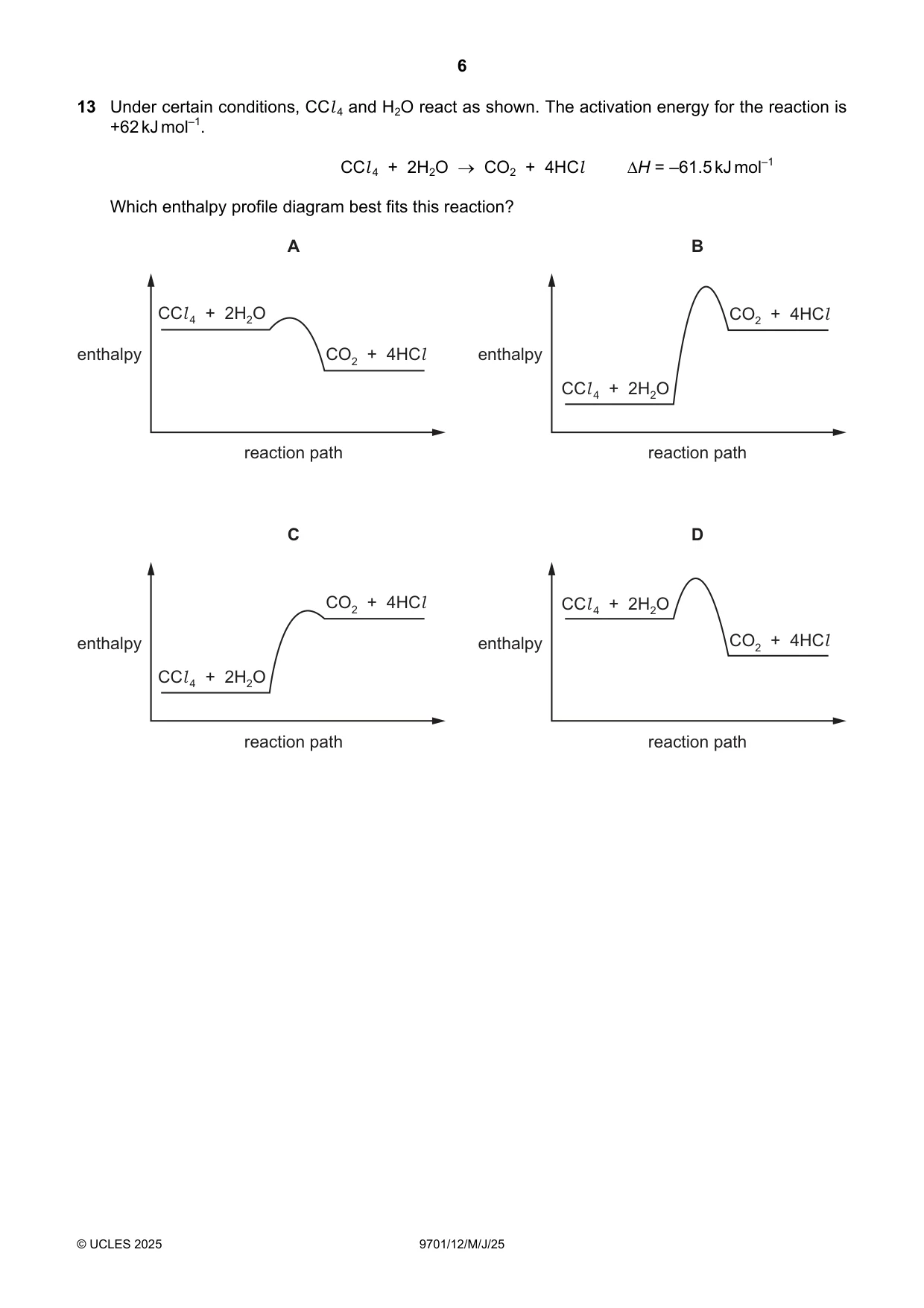
13 Under certain conditions, CCl 4 and H2O react as shown. The activation energy for the reaction is +62 kJ mol–1. CCl 4 + 2H2O CO2 + 4HCl H = –61.5 kJ mol–1 Which enthalpy profile diagram best fits this reaction? A B CCl 4 + 2H2O CO2 + 4HCl enthalpy CO2 + 4HCl enthalpy CCl 4 + 2H2O reaction path reaction path C D CO2 + 4HCl CCl 4 + 2H2O enthalpy enthalpy CO2 + 4HCl CCl 4 + 2H2O reaction path reaction path
Mark scheme: D
Q14 · A helium ion contains two protons, two neutrons and one electron
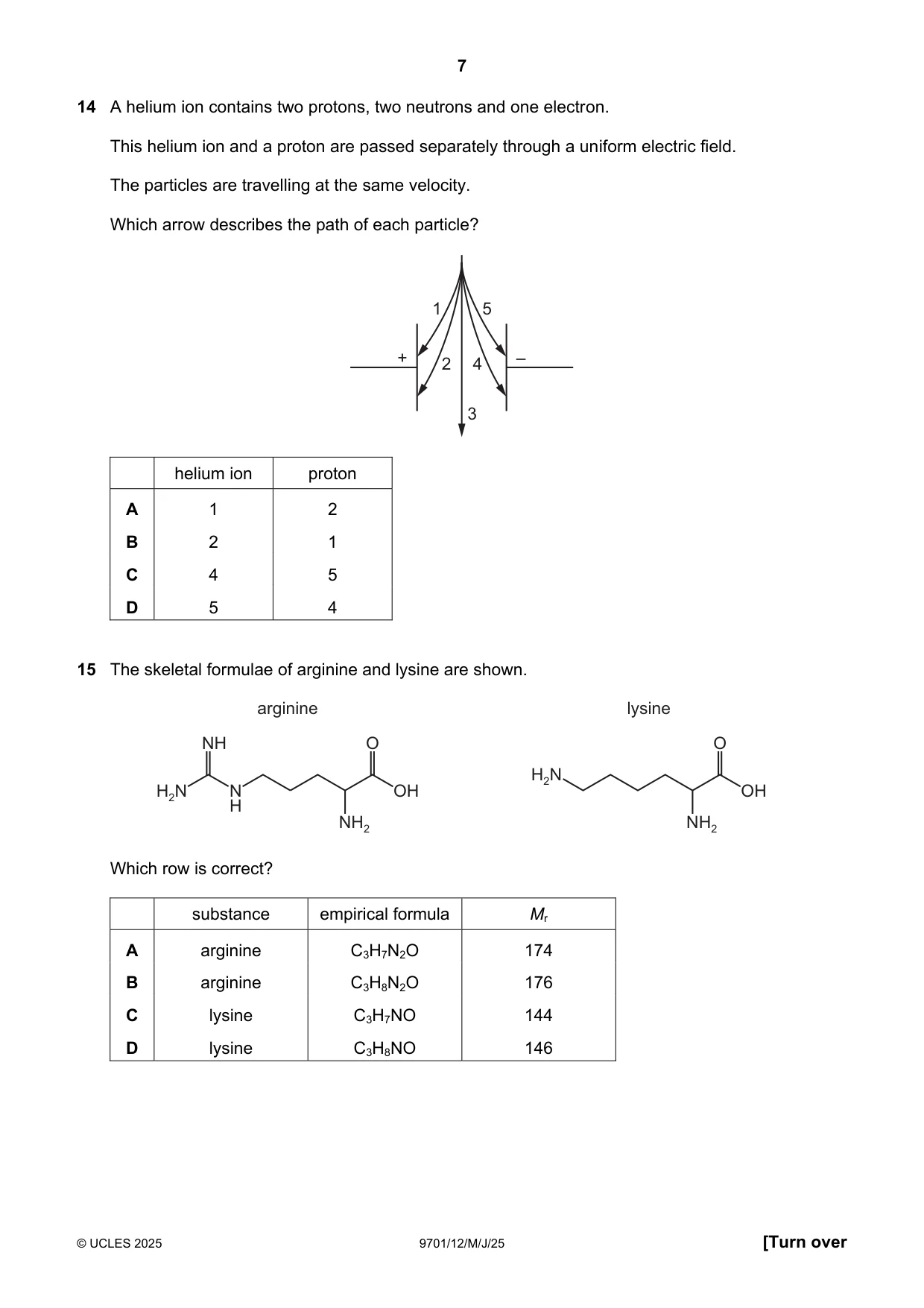
14 A helium ion contains two protons, two neutrons and one electron. This helium ion and a proton are passed separately through a uniform electric field. The particles are travelling at the same velocity. Which arrow describes the path of each particle? 1 5 + 2 4 – 3 helium ion proton A 1 2 B 2 1 C 4 5 D 5 4
Mark scheme: C
Q15 · The skeletal formulae of arginine and lysine are shown
15 The skeletal formulae of arginine and lysine are shown. arginine lysine NH O O H2N H2N N OH OH H NH2 NH2 Which row is correct? substance empirical formula Mr A arginine C3H7N2O 174 B arginine C3H8N2O 176 C lysine C3H7NO 144 D lysine C3H8NO 146
Mark scheme: A
Q16 · The oxide and chloride of an element X are separately mixed with water
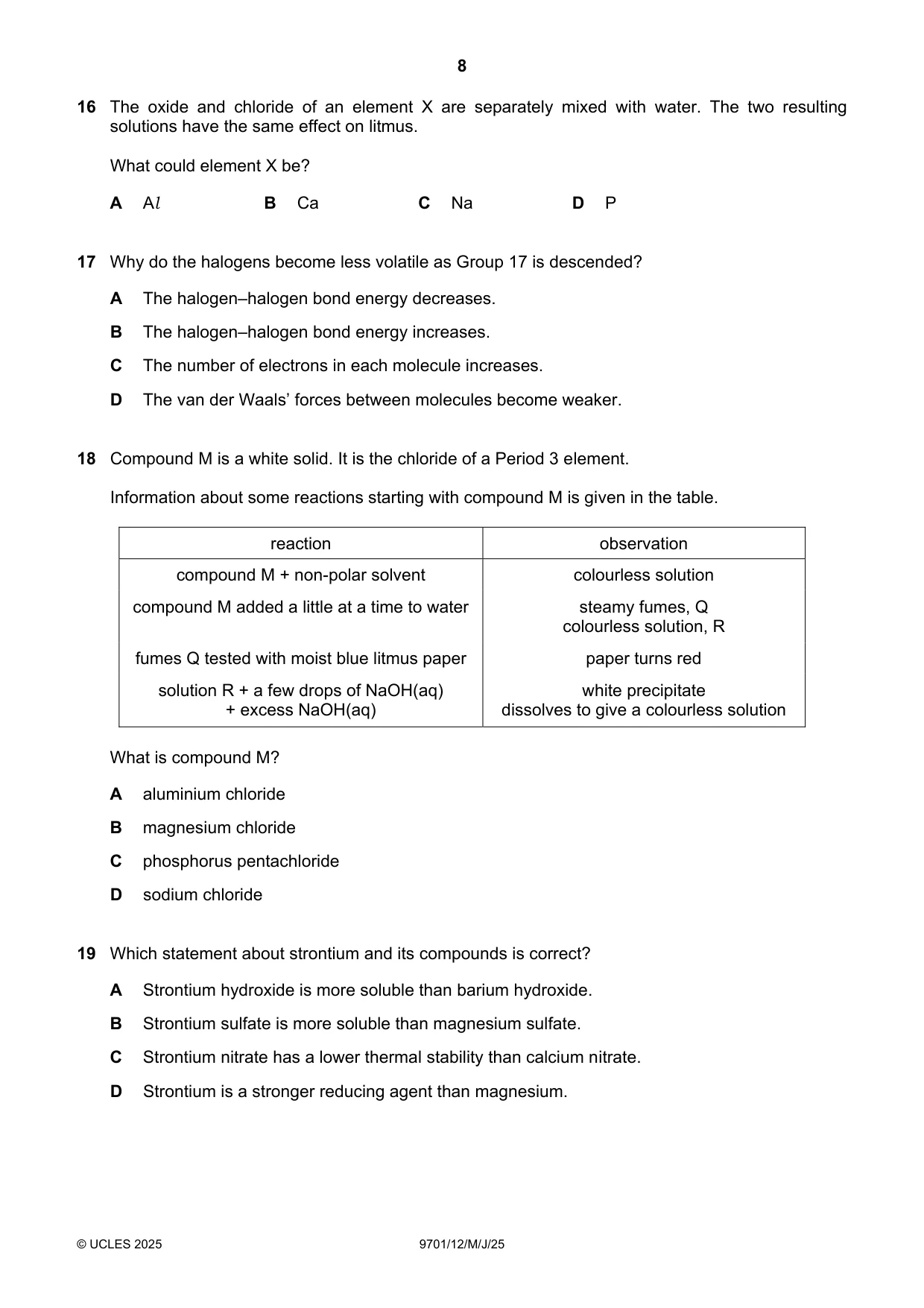
16 The oxide and chloride of an element X are separately mixed with water. The two resulting solutions have the same effect on litmus. What could element X be? A Al B Ca C Na D P
Mark scheme: D
More questions on Periodicity of chemical properties of the elements in Period 3
Q17 · Why do the halogens become less volatile as Group 17 is descended?
17 Why do the halogens become less volatile as Group 17 is descended? A The halogen–halogen bond energy decreases. B The halogen–halogen bond energy increases. C The number of electrons in each molecule increases. D The van der Waals’ forces between molecules become weaker.
Mark scheme: C
More questions on Physical properties of the Group 17 elements
Q18 · Compound M is a white solid
18 Compound M is a white solid. It is the chloride of a Period 3 element. Information about some reactions starting with compound M is given in the table. reaction observation compound M + non-polar solvent colourless solution compound M added a little at a time to water steamy fumes, Q colourless solution, R fumes Q tested with moist blue litmus paper paper turns red solution R + a few drops of NaOH(aq) white precipitate + excess NaOH(aq) dissolves to give a colourless solution What is compound M? A aluminium chloride B magnesium chloride C phosphorus pentachloride D sodium chloride
Mark scheme: A
Q19 · Which statement about strontium and its compounds is correct?
19 Which statement about strontium and its compounds is correct? A Strontium hydroxide is more soluble than barium hydroxide. B Strontium sulfate is more soluble than magnesium sulfate. C Strontium nitrate has a lower thermal stability than calcium nitrate. D Strontium is a stronger reducing agent than magnesium.
Mark scheme: D
Q20 · Sodium bromide is warmed with concentrated sulfuric acid
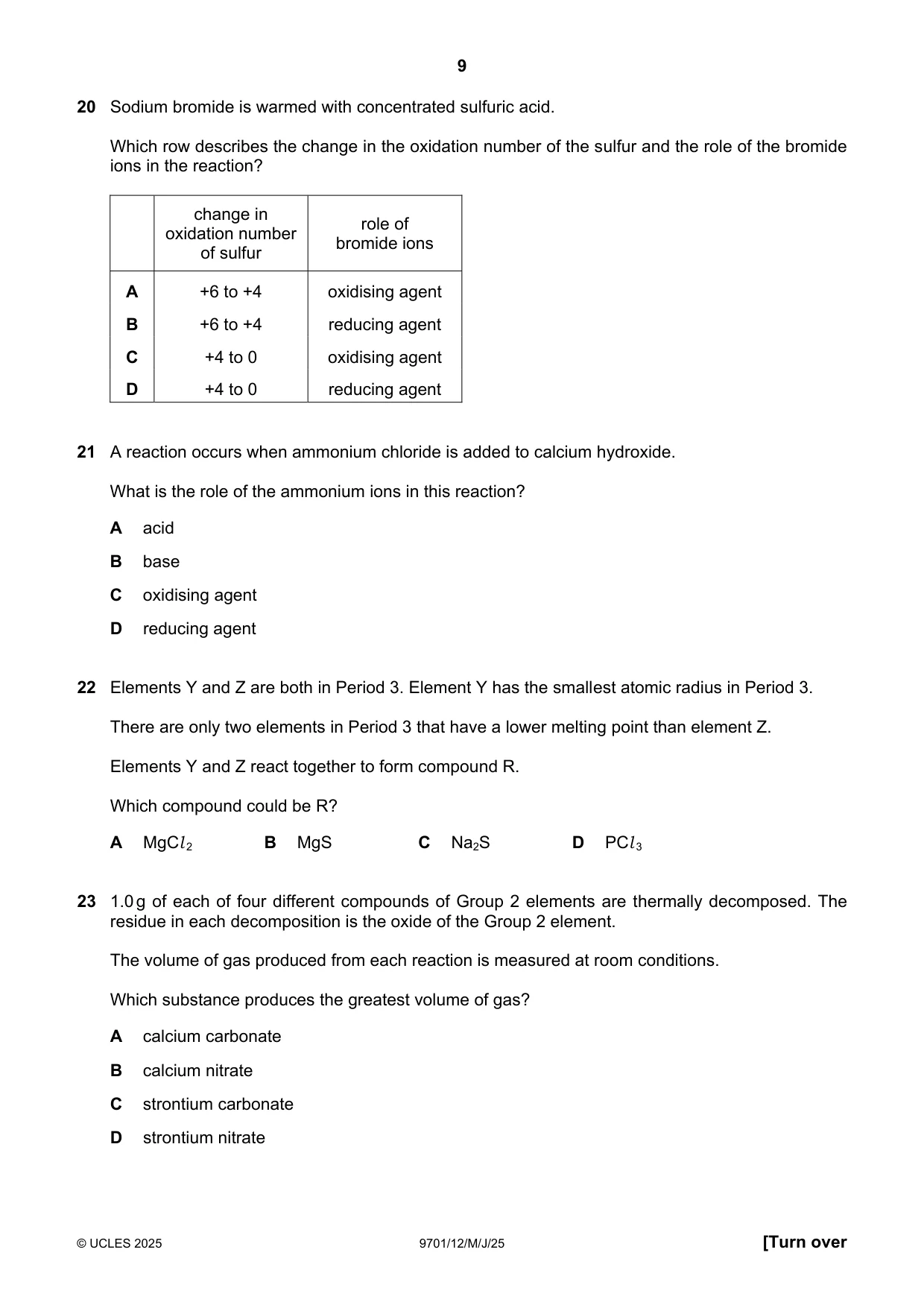
20 Sodium bromide is warmed with concentrated sulfuric acid. Which row describes the change in the oxidation number of the sulfur and the role of the bromide ions in the reaction? change in role of oxidation number bromide ions of sulfur A +6 to +4 oxidising agent B +6 to +4 reducing agent C +4 to 0 oxidising agent D +4 to 0 reducing agent
Mark scheme: B
More questions on The chemical properties of the halogen elements and the hydrogen halides
Q21 · A reaction occurs when ammonium chloride is added to calcium hydroxide
21 A reaction occurs when ammonium chloride is added to calcium hydroxide. What is the role of the ammonium ions in this reaction? A acid B base C oxidising agent D reducing agent
Mark scheme: A
Q22 · Elements Y and Z are both in Period 3
22 Elements Y and Z are both in Period 3. Element Y has the smallest atomic radius in Period 3. There are only two elements in Period 3 that have a lower melting point than element Z. Elements Y and Z react together to form compound R. Which compound could be R? A MgCl 2 B MgS C Na2S D PCl 3
Mark scheme: D
More questions on Periodicity of physical properties of the elements in Period 3
Q23 · 1.0 g of each of four different compounds of Group 2 elements are thermally decomposed
23 1.0 g of each of four different compounds of Group 2 elements are thermally decomposed. The residue in each decomposition is the oxide of the Group 2 element. The volume of gas produced from each reaction is measured at room conditions. Which substance produces the greatest volume of gas? A calcium carbonate B calcium nitrate C strontium carbonate D strontium nitrate
Mark scheme: B
Q25 · Which statement about the mechanism of an SN1 reaction of a halogenoalkane is correct?
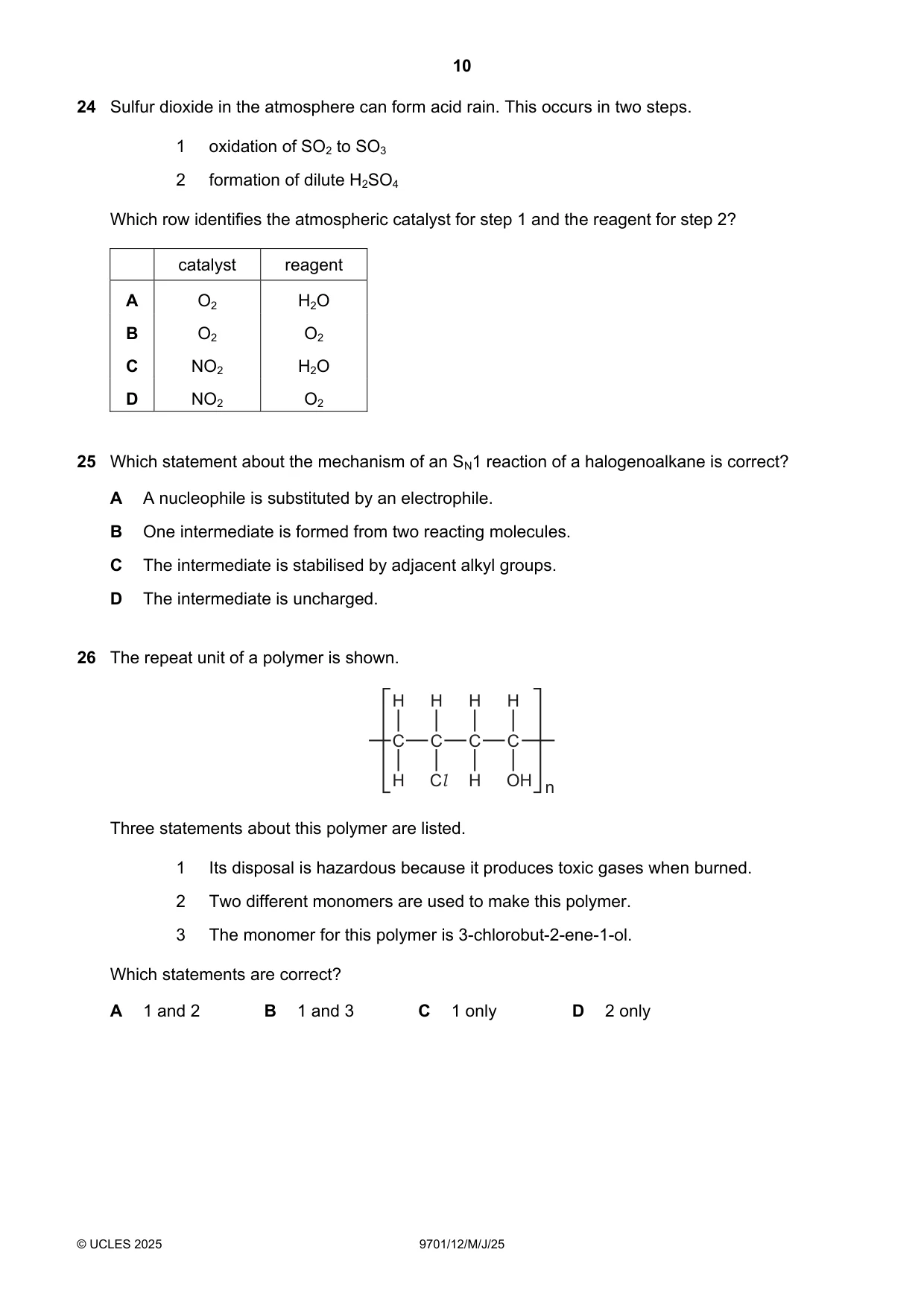
25 Which statement about the mechanism of an SN1 reaction of a halogenoalkane is correct? A A nucleophile is substituted by an electrophile. B One intermediate is formed from two reacting molecules. C The intermediate is stabilised by adjacent alkyl groups. D The intermediate is uncharged.
Mark scheme: C
Q26 · The repeat unit of a polymer is shown
26 The repeat unit of a polymer is shown. H H H H C C C C H Cl H OH n Three statements about this polymer are listed. 1 Its disposal is hazardous because it produces toxic gases when burned. 2 Two different monomers are used to make this polymer. 3 The monomer for this polymer is 3-chlorobut-2-ene-1-ol. Which statements are correct? A 1 and 2 B 1 and 3 C 1 only D 2 only
Mark scheme: A
Q27 · Methanoic acid, HCO2H, has acidic properties similar to those of other carboxylic acids
27 Methanoic acid, HCO2H, has acidic properties similar to those of other carboxylic acids. In addition, it can be oxidised by the same oxidising agents that are capable of oxidising aldehydes. Which pair consists of two compounds that will give the same observations with Fehling’s reagent? A HCO2H and CH3CO2H B HCO2H and CH3CO2CH3 C HCO2H and CH3CH2COCH3 D HCO2H and CH3CH2CHO
Mark scheme: D
Q28 · Which row gives pentanenitrile as one product?
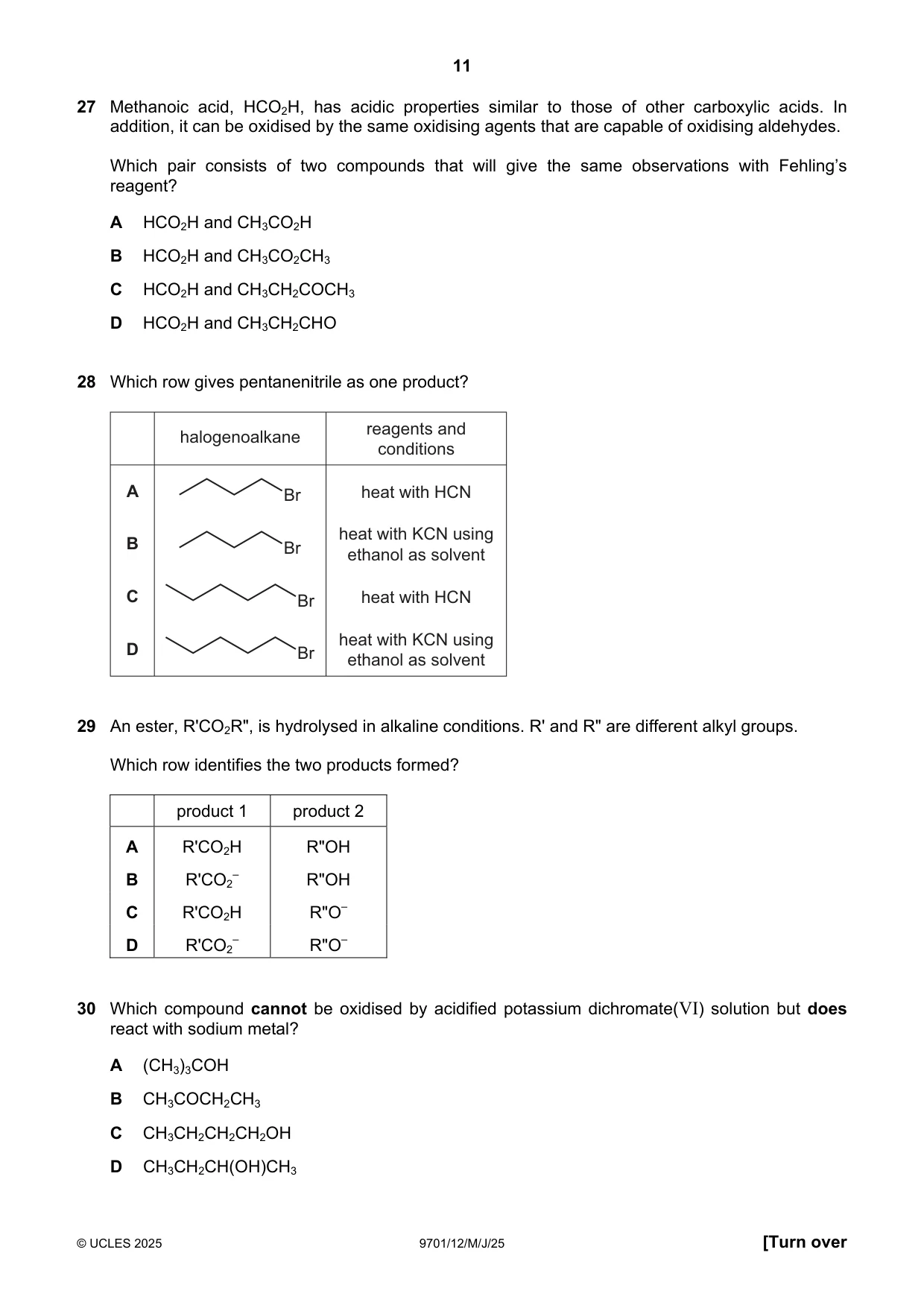
28 Which row gives pentanenitrile as one product? reagents and halogenoalkane conditions A heat with HCN Br B heat with KCN using Br ethanol as solvent C heat with HCN Br D heat with KCN using Br ethanol as solvent
Mark scheme: B
Q29 · An ester, R'CO2R", is hydrolysed in alkaline conditions
29 An ester, R'CO2R", is hydrolysed in alkaline conditions. R' and R" are different alkyl groups. Which row identifies the two products formed? product 1 product 2 A R'CO2H R"OH B R'CO2 – R"OH C R'CO2H R"O– D R'CO2 – R"O–
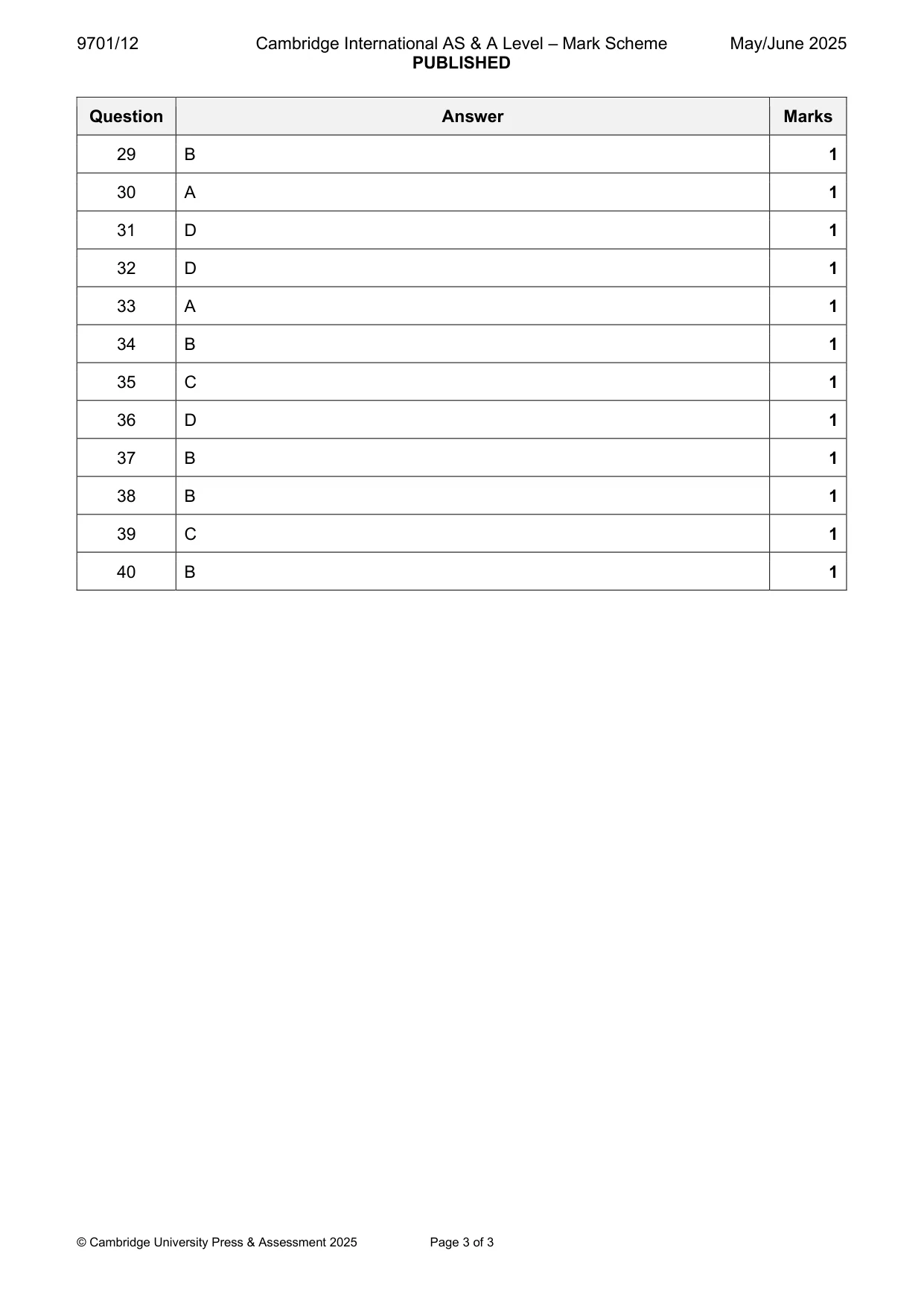
Mark scheme: B
Q30 · Which compound cannot be oxidised by acidified potassium dichromate(VI) solution but does…
30 Which compound cannot be oxidised by acidified potassium dichromate(VI) solution but does react with sodium metal? A (CH3)3COH B CH3COCH2CH3 C CH3CH2CH2CH2OH D CH3CH2CH(OH)CH3
Mark scheme: A
Q31 · Butan-2-one reacts with alkaline I2(aq)
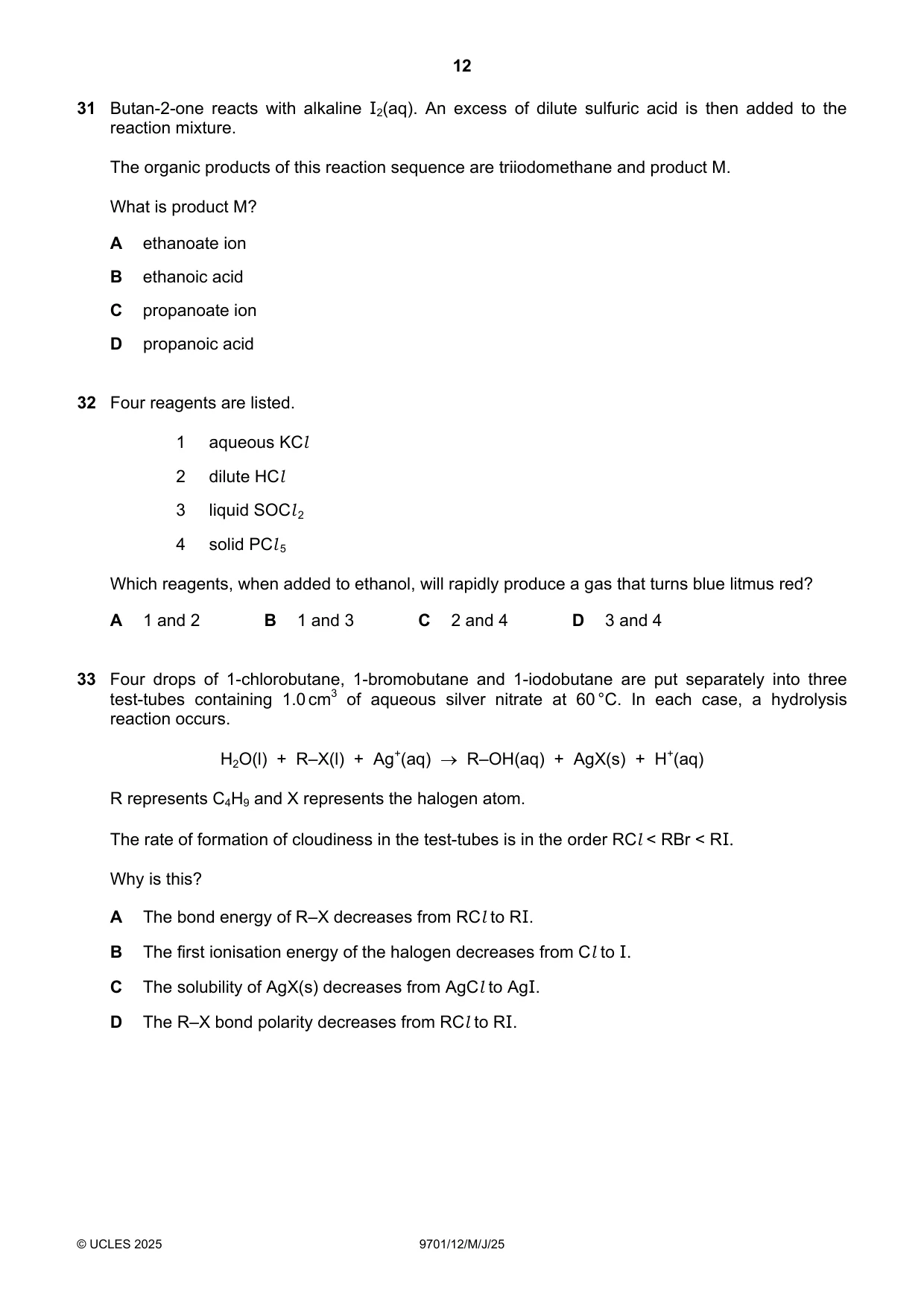
31 Butan-2-one reacts with alkaline I2(aq). An excess of dilute sulfuric acid is then added to the reaction mixture. The organic products of this reaction sequence are triiodomethane and product M. What is product M? A ethanoate ion B ethanoic acid C propanoate ion D propanoic acid
Mark scheme: D
Q32 · Four reagents are listed
32 Four reagents are listed. 1 aqueous KCl 2 dilute HCl 3 liquid SOCl 2 4 solid PCl 5 Which reagents, when added to ethanol, will rapidly produce a gas that turns blue litmus red? A 1 and 2 B 1 and 3 C 2 and 4 D 3 and 4
Mark scheme: D
Q33 · Four drops of 1-chlorobutane, 1-bromobutane and 1-iodobutane are put separately into…
33 Four drops of 1-chlorobutane, 1-bromobutane and 1-iodobutane are put separately into three test-tubes containing 1.0 cm3 of aqueous silver nitrate at 60 °C. In each case, a hydrolysis reaction occurs. H2O(l) + R–X(l) + Ag+(aq) R–OH(aq) + AgX(s) + H+(aq) R represents C4H9 and X represents the halogen atom. The rate of formation of cloudiness in the test-tubes is in the order RCl < RBr < RI. Why is this? A The bond energy of R–X decreases from RCl to RI. B The first ionisation energy of the halogen decreases from Cl to I. C The solubility of AgX(s) decreases from AgCl to AgI. D The R–X bond polarity decreases from RCl to RI.
Mark scheme: A
Q34 · Propanoic acid reacts with LiAl H4 to give organic product P
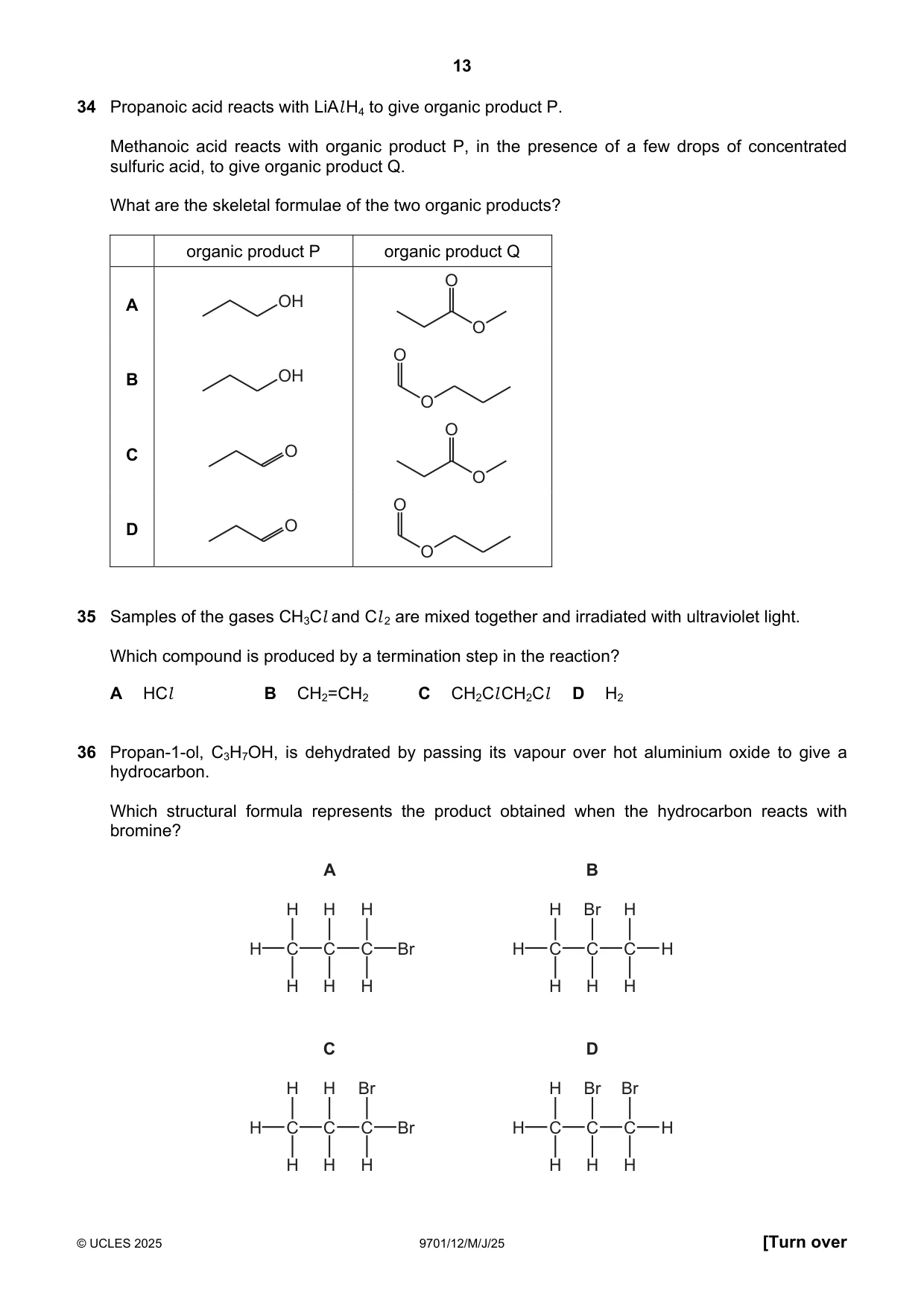
34 Propanoic acid reacts with LiAl H4 to give organic product P. Methanoic acid reacts with organic product P, in the presence of a few drops of concentrated sulfuric acid, to give organic product Q. What are the skeletal formulae of the two organic products? organic product P organic product Q O A OH O O B OH O O C O O O D O O
Mark scheme: B
Q35 · Samples of the gases CH3Cl and Cl 2 are mixed together and irradiated with ultraviolet…
35 Samples of the gases CH3Cl and Cl 2 are mixed together and irradiated with ultraviolet light. Which compound is produced by a termination step in the reaction? A HCl B CH2=CH2 C CH2Cl CH2Cl D H2
Mark scheme: C
Q36 · Propan-1-ol, C3H7OH, is dehydrated by passing its vapour over hot aluminium oxide to give…
36 Propan-1-ol, C3H7OH, is dehydrated by passing its vapour over hot aluminium oxide to give a hydrocarbon. Which structural formula represents the product obtained when the hydrocarbon reacts with bromine? A B H H H H Br H H C C C Br H C C C H H H H H H H C D H H Br H Br Br H C C C Br H C C C H H H H H H H
Mark scheme: D
Q37 · Alkane S has molecular formula C4H10
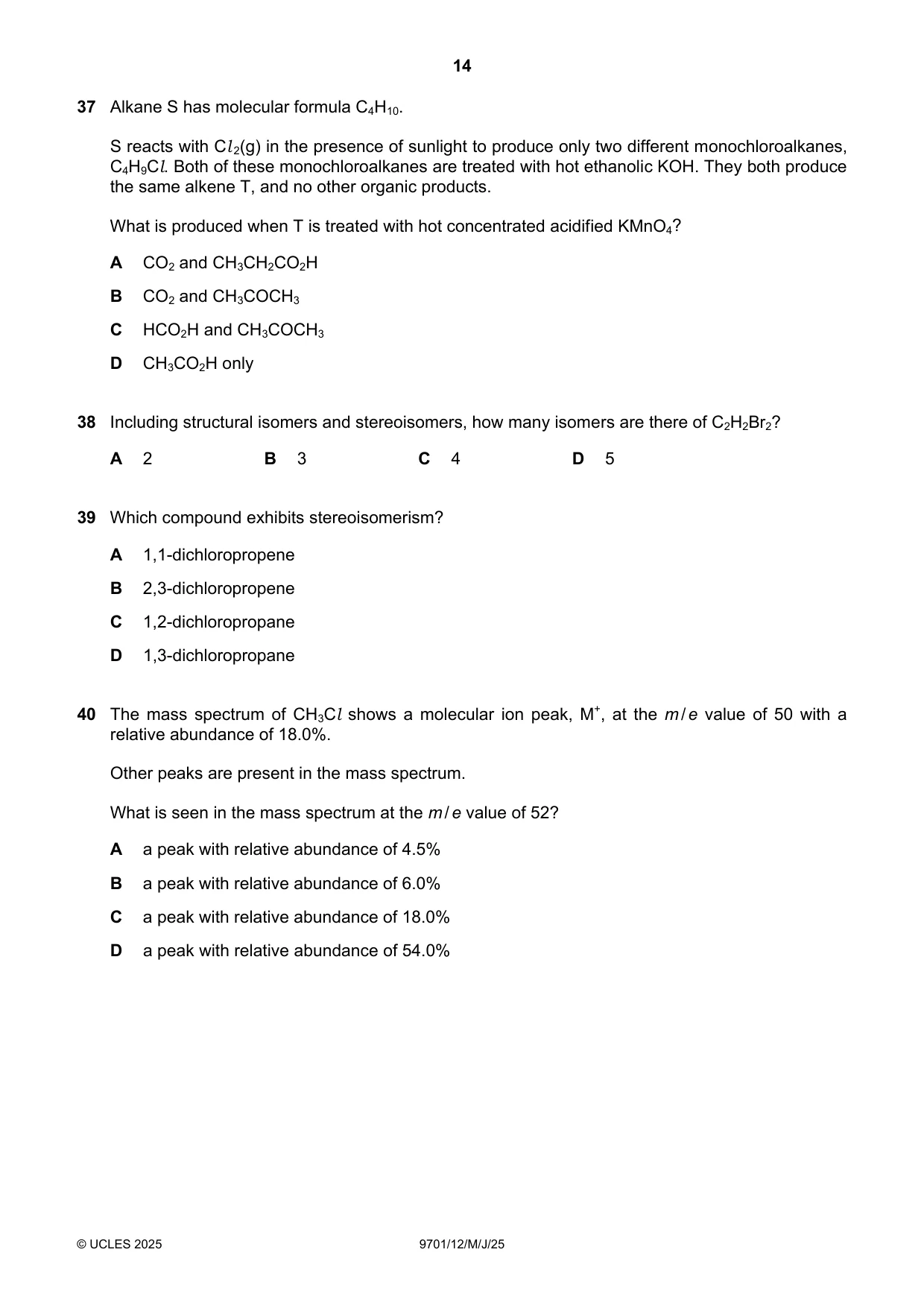
37 Alkane S has molecular formula C4H10. S reacts with Cl 2(g) in the presence of sunlight to produce only two different monochloroalkanes, C4H9Cl. Both of these monochloroalkanes are treated with hot ethanolic KOH. They both produce the same alkene T, and no other organic products. What is produced when T is treated with hot concentrated acidified KMnO4? A CO2 and CH3CH2CO2H B CO2 and CH3COCH3 C HCO2H and CH3COCH3 D CH3CO2H only
Mark scheme: B
Q38 · Including structural isomers and stereoisomers, how many isomers are there of C2H2Br2?
38 Including structural isomers and stereoisomers, how many isomers are there of C2H2Br2? A 2 B 3 C 4 D 5
Mark scheme: B
More questions on Isomerism: structural isomerism and stereoisomerism
Q39 · Which compound exhibits stereoisomerism?
39 Which compound exhibits stereoisomerism? A 1,1-dichloropropene B 2,3-dichloropropene C 1,2-dichloropropane D 1,3-dichloropropane
Mark scheme: C
More questions on Isomerism: structural isomerism and stereoisomerism
Q40 · The mass spectrum of CH3Cl shows a molecular ion peak, M+, at the m / e value of 50 with…
40 The mass spectrum of CH3Cl shows a molecular ion peak, M+, at the m / e value of 50 with a relative abundance of 18.0%. Other peaks are present in the mass spectrum. What is seen in the mass spectrum at the m / e value of 52? A a peak with relative abundance of 4.5% B a peak with relative abundance of 6.0% C a peak with relative abundance of 18.0% D a peak with relative abundance of 54.0%
Mark scheme: B
What was in this paper
The subtopics covered by these 39 questions, and how many questions each got. Open one in a new tab to see every Cambridge question on it.
2Alkanes2Esters2Formulas2Intermolecular forces, electronegativity and bond properties2Isomerism: structural isomerism and stereoisomerism2Particles in the atom and atomic radius2Similarities and trends in the properties of the Group 2 metals, magnesium to barium, and their compounds2Acyl chlorides1Addition polymerisation1Alcohols1Alkenes1Brønsted–Lowry theory of acids and bases1Carboxylic acids1Chemical equilibria: reversible reactions, dynamic equilibrium1Effect of temperature on reaction rates and the concept of activation energy1Enthalpy change, ΔH1General characteristic chemical properties of the first set of transition elements, titanium to copper1Halogen compounds1Halogenoalkanes1Hess’s law1Mass spectrometry1Nitriles and hydroxynitriles1Periodicity of chemical properties of the elements in Period 31Periodicity of physical properties of the elements in Period 31Physical properties of the Group 17 elements1Rate of reaction1Redox processes: electron transfer and changes in oxidation number (oxidation state)1Shapes of molecules1The chemical properties of the halogen elements and the hydrogen halides1The gaseous state: ideal and real gases and pV = nRT1What you needed in this session
Cambridge’s own grade thresholds for 2025 May/June, Paper 1 · Variant 2. A higher threshold means an easier paper — the bar moves with how the cohort did.